Co =-oY Jo AL
Cowboy Journal staff
7heCowboy Journal staff JackieMileham (backrowleft),AshleyJenkins,MacayBolay,CarrieLeach, Jamie King, LindseyLinney,JeremiahAllen, CandaceMay (middle row),Amanda LockwoodFisher, KinseyWestwood,Merimth Cohenour,MeganPfeiffer,Matt Panach(frontrow), DaraSmith, Mandy McNnliy.RochelleHenderson,Co1mneyEngland,TraciNaile and Bill Golightly.
CJ EditorialBoard
Co-editors
Rochelle Henderson and Mart Panach
Circulation Coordinator
Jackie Mileham
Graphics Coordinators
Traci aile and Dara Smith
CJ Staff
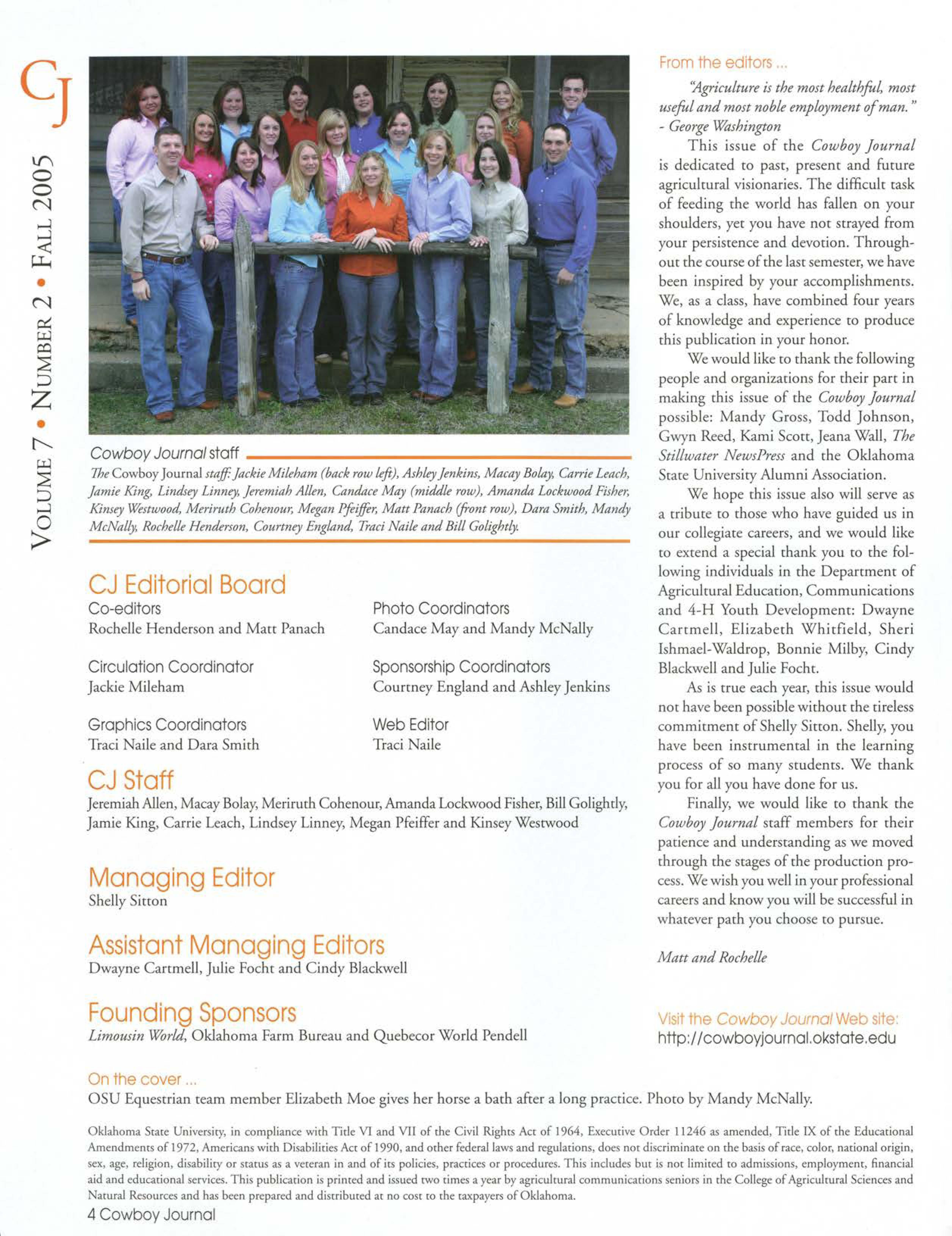
Photo Coordinators
Candace May and Mandy Mc ally
SponsorshipCoordinators
Courtney England and Ashley Jenkins
Web Editor
Traci aile
Jeremiah Allen, Macay Bolay,Meriruth Cohenour, Amanda Lockwood Fisher, Bill Golighdy, Jamie King, Carrie Leach, Lindsey Linney, Megan Pfeiffer and Kinsey Wesrwood
ManagingEditor
Shelly itton
AssistantManagingEditors
Dwayne Cartmell, Julie Focht and Cindy Blackwell
FoundingSponsors
Limousin Worl.d,Oklahoma Farm Bureau and Quebecor World Pendell
On the cover
From the editors
"Agricultureis the mostheaLthfaL,most usefaland most nobleemploymentof man. " - GeorgeWashington
This issue of rhe Cowboy journal is dedicated to pasr, present and future agriculcural visionaries. The difficulc task of feeding the world has fallen on your shoulders, yet you have nor strayed from your persistence and devotion. Throughout the course of the last semester, we have been inspired by your accomplishments We, as a class, have combined four years of knowledge and experience ro produce this publication in your honor.
We would like to thank the following people and organizacions for cheir pare in making chis issue of che CowboyJournal possible: Mandy Gro s, Todd Johnson, Gwyn Reed, Kami Scott, Jeana Wall, The Stillwater NewsPressand the Oklahoma Seate Universiry Alumni Associacion.
We hope this issue also will serve as a uibuce m those who have guided us in our collegiate careers, and we would like m excend a special thank you to the following indjviduals in che Deparcmenc of Agriculcural Education, Communications and 4-H Youth Development: Dwayne Cartmell, Elizabeth Whi rfield, Sheri Ishmael-Waldrop, Bonnie Milby, Cindy Blackwell and Julie Fochr.
As is true each year, chis issue would not have been possible without che tireless commicmenr of Shelly Siecon. Shelly, you have been instrumental in rhe learning process of so many scudenrs. We thank you for all you have done for us.
Finally, we would like m thank the Cowboyjournal scaff members for rheir patience and understanding as we moved through the stages of the production process. We wish you well in your professional careers and know you will be successful in whatever path you choo e to pur ue.
Matt and Rochelle
Vi~it'he Cowboy Juurnol Web site http:// cowboyjournal. okstate. edu
Oklahoma Scace University, in compliance wirh Tirle Vi and VII of the Civil Rights Acr of 1964, Executive Order 11246 35 amended, Title IX of the Educational Amendments of 1972, Americans wich Disabilicies Ace of 1990, and ocher federal laws and regulations, does not discriminate on the basis of race, color, national origin, se><,age, religion, disabilicy or Slacus 35 a veteran in and of its policies, praccices or procedures. This includes but is nor Iimired ro admissions, employment, financial aid and educacional services. Thi publication is primed and issued rwo cimes a year by agriculrural communications seniors in che College of Agriculcural ciences and Nacural Resources and has been prepared and discribuced ac no cosc co che raxpayers of Oklahoma.
Cowboy Journal
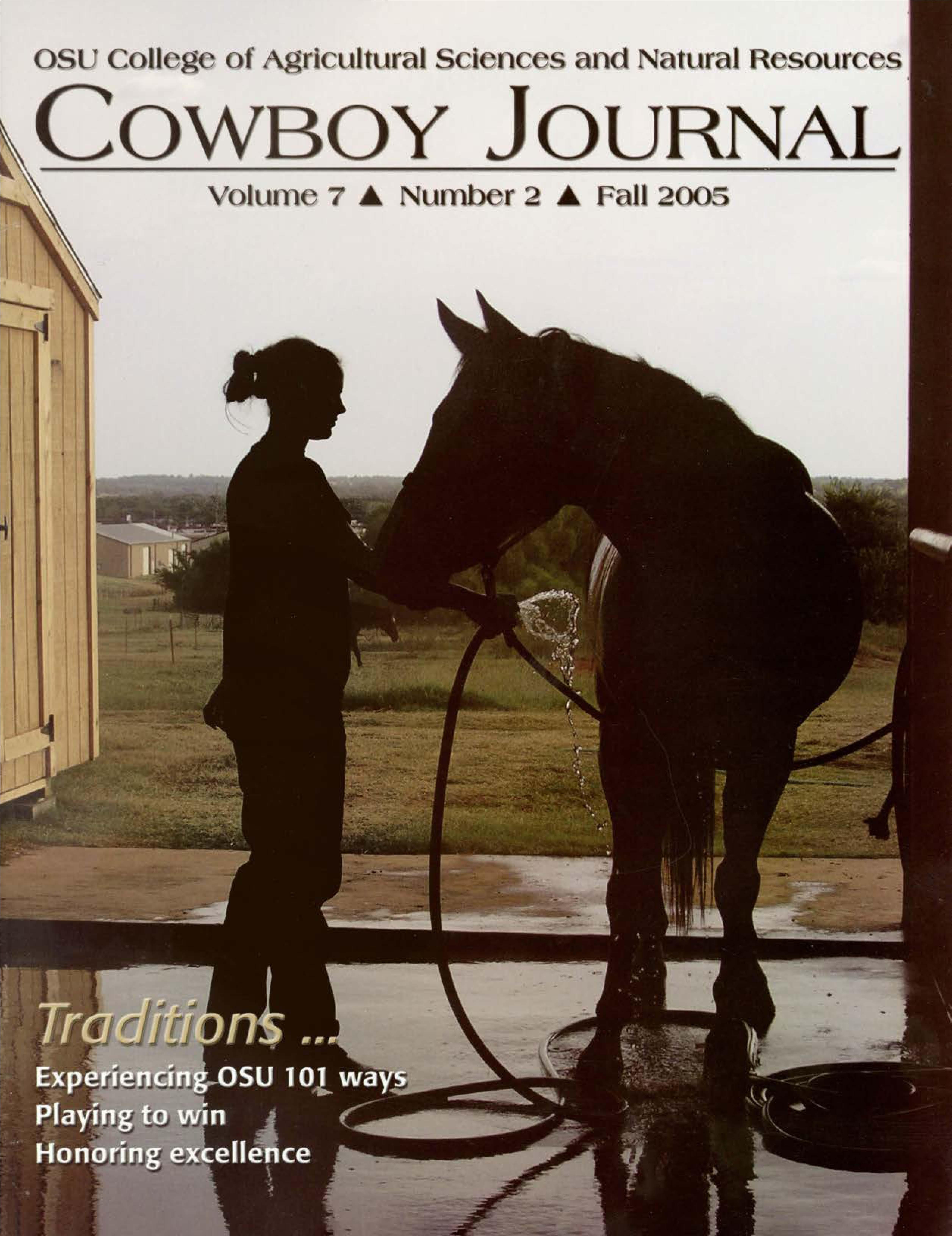
0 U Equestrian ream member Elizabeth Moe gives her horse a bath after a long practice. Photo by Mandy Mc ally.
What'sinside...
Faculty
7 legacy of a legend
The livestock industry honors Robert Totusek
10 Kuzmic provides the "k" in teamwork
Tom Kuzmic coaches women's lacrosse ream to success
12 OSU selects Whitson as new DAS R leader
Eighteenth dean makes transition from Aggie to Cowboy
Alumni
15 Capitol Cowboys
CAS R alumni fight for agriculture in the Legislature
17 Explore the West ... just up the road
Pawnee Bill Ranch remembers Oklahoma traditions
Students
20 he perfect ending Meet CASNR's cop studems
22 Cultivating success one student at a time
Students gain horticultural experience in greenhouses
24 Reed plays like a pro OSU student earns professional polo rating
26 101 things to do at OSU
How to have the true Cowboy experience
29 Making college financing easier
Paying for college is easier than you might think
32 OSU students soak up Italy
Study abroad is more than just seeing another country
34 What can I do with a major in ?
Career option for CASNR majors
Industry
37 Taste how sweet it is
Red River Gourmet creates rasry Oklahoma treats
39 OSU helps 'high-tech' cows
OSU uses more than a truck ro monicor cattle
41 It's all in the roots
OSU scientim study wheat mosaic virus
Outreach
43 Money, money, money
IFMAPS celebrates 20 years of helping Oklahomans
44 Rural Oklahoma gets an EXTreme makeover Cooperative Extension style
RUial communities grow with assistance from stare grams
46 Cattlemen earn credits
Cooperative extension uains master carclemen
News
50 Cowboy bullets
• Rotary scholarship takes CAS R senior down under
• Landscape architecture students give cities a face-lift
• Collegiate 4-H to hosr conference for southern region

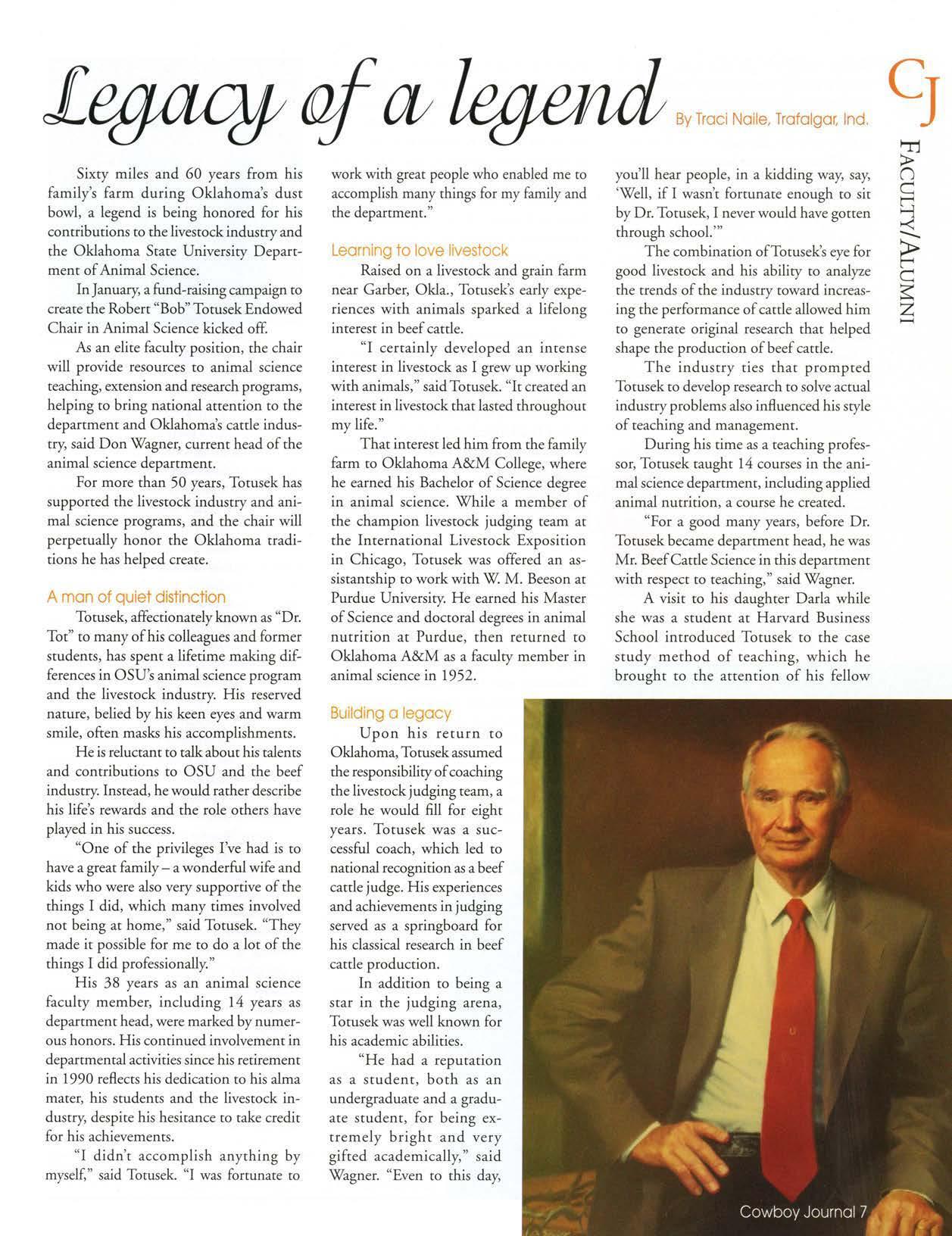
Sixry miles and 60 years from his family's farm during Oklahoma's dust bowl, a legend is being honored for his conrribucions co rhe livesrock industry and rhe Oklahoma Scace University Oeparcmenr of Animal Science.
In January, a fund-raising campaign co create che Roberr "Bob" Totusek Endowed Chair in Animal Science kicked off
As an elite faculcy position, che chair will provide resources co animal science reaching, extension and research programs, helping co bring national arcenrion co che department and Oklahoma's cattle industry, said Don Wagner, current head of rhe animal science department.
For more rhan 50 years, Torusek has supported the livesrock industry and animal science programs, and the chair will perpecually honor che Oklahoma traditions he has helped create.
A manof quiet distinction
Torusek, affectionately known as "Or. Tot" to many of his colleagues and former srudents, has spent a Lifetime making differences in OSU's animal science program and che livescock industry. His reserved nature, belied by his keen eyes and warm smile, often masks his accomplishments.
He is reluctant to talk about his talents and contributions co OSU and rhe beef industry. Instead, he would rather describe his life's rewards and che role ochers have played in his success.
"One of the privileges I've had is to have a great family- a wonderful wife and kids who were also very supportive of the things I did, which many times involved not being ac home," said Tocusek. "They made it possible for me to do a lot of rhe things I did professionally."
His 38 years as an animal science faculty member, including 14 years as deparcmenr head, were marked by numerous honors. His continued involvement in departmental activities since his retirement in 1990 reflects his dedication to his alma macer, his students and rhe livestock industry, despite his hesitance to take credit for his achievements.
"I didn't accomplish anything by myself," said Torusek. "I was fortunate co
work wirh great people who enabled me co accomplish many things for my family and rhe department."
Learningto love 1rvestock
Raised on a livestock and grain farm near Garber, Okla., Tocusek's early experiences with animals sparked a lifelong inceresr in beef cattle.
"I certainly developed an incense interest in livescock as I grew up working with animals," said Tocusek. "It created an interest in livestock char lasted rhroughom my life."
That imeresc led him from the family farm co Oklahoma A&M College, where he earned his Bachelor of Science degree in animal science. \'v'hile a member of rhe champion livestock judging team at the International Livestock Exposition in Chicago, Torusek was offered an assistantship to work with W. M. Beeson ac Purdue University. He earned his Master of Science and doctoral degrees in animal nutrition at Purdue, chen returned co Oklahoma A&M as a faculcy member in animal science in 1952.
Building a legacy
Upon his return to Oklahoma, Tocusekassumed rhe responsibility of coaching the livestock judging team, a role he would fill for eighr years. Tocusek was a successful coach, which led co national recognition as a beef cattle judge. His experiences and achievemenrs in judging served as a springboard for bis classical research in beef cattle production.
ln addition to being a scar in the judging arena, Tocusek was well known for his academic abilities.
"He had a reputation as a student, both as an undergraduate and a graduate student, for being extremely bright and very gifted academically," said Wagner. "Even co chis day,
By TraciNolle,Trafalgar,Ind.
you'll hear people, in a kidding way, say, 'Well, if l wasn't fortunate enough co sir by Dr. Tocusek, I never would have gotten through school."'
The combination ofTotusek's eye for good livestock and his ability to analyze rhe crends of che industry toward increasing che performance of cattle allowed him to generate original research that helped shape rhe production of beef carrle.
The industry cies char prompted Tocusek to develop research to solve actual industry problems also influenced his style of reaching and management.
During his rime as a reaching professor, Torusek caught 14 courses in the animal science department, including applied animal nutrition, a course he created.
"For a good many years, before Or. Torusek became department head, he was Mr. Beef Carde Science in chis department with respect to reaching," said Wagner.
A visit to his daughter Darla while she was a srudenc ac Harvard Business School introduced Tocusek ro che case study method of reaching, which he brought to che attention of his fellow
faculty members. Ac rhac rime Torusek said few faculty members had been exposed to the method and did noc realize ics value in helping students learn how co solve real problems in che industry.
"Early in my teaching career, my goal was to transfer as much information as possible co che srudents," said Totusek. "Larer, I learned chat wasn't the only important ching. r realized char helping chem learn to chink and to assemble information from all sources, not just my class, would help chem in industry sicuarions."
Tocusek took a similar articude coward management of che department after becoming deparcmenc head in 1976.
"He hired a lot of good, young faculty members to build a strong repurarion and a strong department," said Wagner. "He also encouraged them to have the kind of science chat was nor only good science, but also relevant and use-
ful to the industry in terms of solving realworld problems."
Torusek's goals as department head included promoting sound, useful research
asset, which goes back to the beginning of the department, is che great rapport we've enjoyed with the industry. le allows the department to be keenly aware of problems in che industry and respond to chose problems with research and extension programs and reaching. And ac the same time, because rhe people in the industry have confidence in the department, because they're personally acquainced wich faculty members chey rearuly accept and use recommendations rhar arise from research and are extended co them through extension programs."
In addition co his own reaching and research conrribucions and his efforts to bring in quality faculty members, Torusek worked to restore the horse program oon after becoming department head. With the help ofFrank Baker the dean of agriculrure ac char rime, Tocusek rallied Oklahoma's
One of the privileges I've had is to have a great family.
hor e induscry co rebuild the program. Totusek's support of Doyle Meadow the first horse extension specialise in the new program, al- -
Robert Totusek
and maincaining che rradirions of quality teaching and industry rapport for which rhe deparrmenr had become known.
These goal were vi cal to keeping the balance of teaching, research and extension, sajd Totusek.
"The department has several unique advantages over many departments," said Tocusek. "One is char great balance among research, teaching and extension. Another
lowed it to grow. He also showed his faith in young faculty members by hiring Don Topliff, now the head of agriculture at West Texas A&M University, and David Freeman, che current horse extension specialise, in 1984.
"Dr. Toe had a huge impact on my career," said Topliff. "He had faith enough in me co hire me and he alway provided a positive, can-do atmosphere."
Soon after re-establishment of the horse program, Totusek became involved wich another programbuilding project - construction of new facilities for the departmenr.
During che oil boom of the lace 1970 and early 1980s, the state appropriated $15 million to establish a research center for agricul rure and
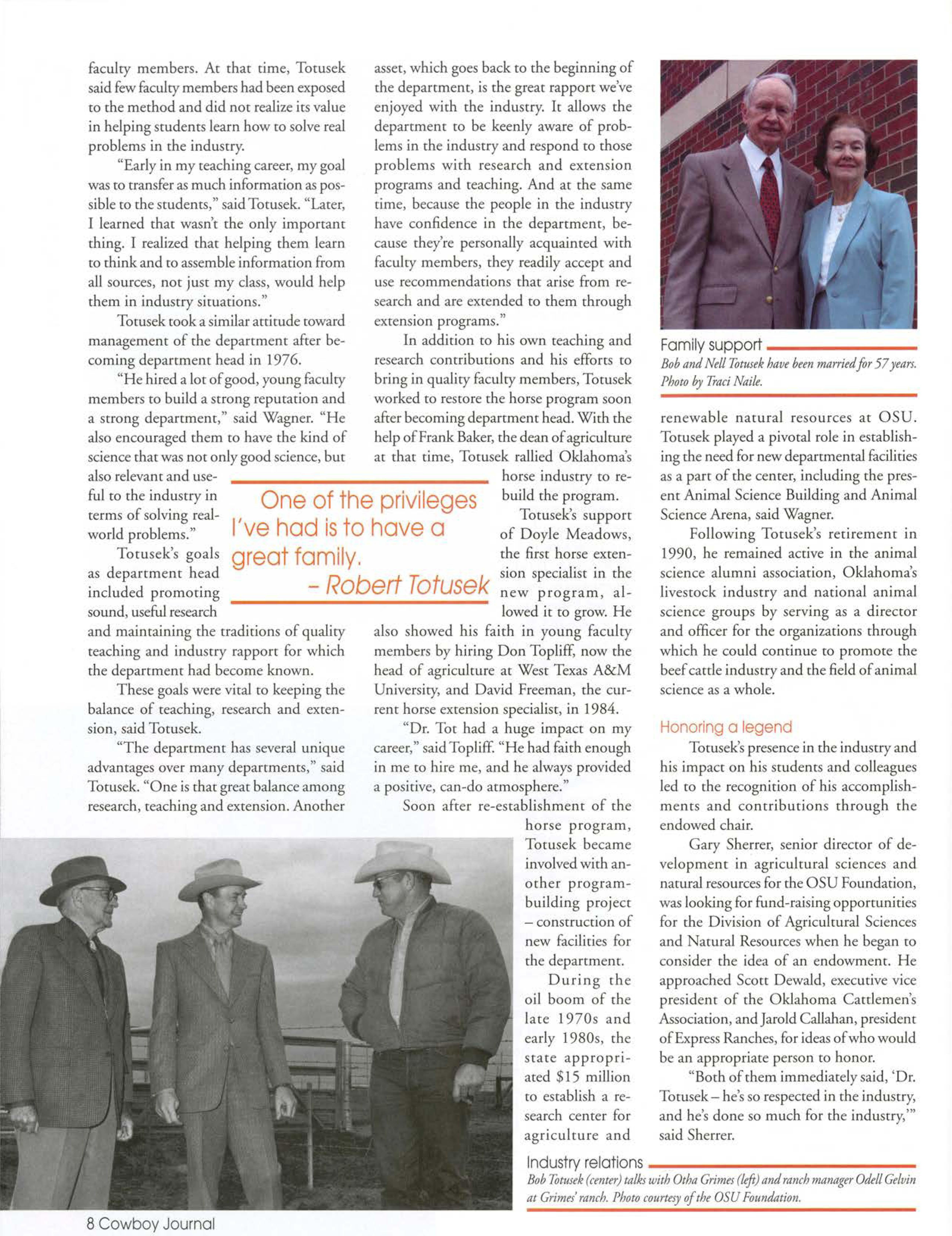
Industryrelations
Familysupport-------
Boba11dNellTtmtSekhavebee11ma1Tiedfor 57 years. Photoby TraciNaile.
renewable nacural resources at OSU. Torusek played a pivotal role in establishing the need for new departmental facilities a a part of the center, inclurung the present Animal cience Building and Animal Science Arena, said Wagner.
Following Totusek's retirement in 1990, he remained acrive in che animal cience alttmni association, Oklahoma's livestock industry and national animal science groups by serving as a direcrnr and officer for the organizations through which he could continue to promote the beef carcle indu try and che field of animal science as a whole.
Honoringa legend
Torusek's presence in the indusuy and his impact on hi tudents and colleagues led to the recognition of his accomplishments and contributions through the endowed chair.
Gary herrer enior director of development in agricultural sciences and natw-al resources for the O U oundation, was looking for fund-raising opportunities for the Division of Agriculcural Sciences and atural Resources when he began co consider the idea of an endowmenr. He approached Scott Dewald, executive vice presidenc of the Oklahoma Caulemen's Association, andJarold Callahan, presidenc ofExpre Ranches, for ideas of who would be an appropriate person to honor.
"Both of chem immediately said, 'Or. Torusek - he's so respected in the industry, and he's done o much for ch.eindustry,"' said herrer.
BobTotusek{center)talksUJithOthaGrimes(left)andranchmanagerOdellGelvin at Grimes'ranch.Photocourtesyof the OSUFo1111datio11.
At first, Totusek was hesitant coaccept the honor, said Sherrer. The three men had to convince him the chair would be imporranc co concinue the rradirion of applied teaching and research he helped build.
"My initial reaction was a lor of reservation because I've been fortunate
Totusek's pioneering aaitude toward reaching, research and the trends of che beef industry has left a lasting impression on the modem industry.
(Totusek's)ideasled to significantchangesin the cattle business.
- RossMcKnight
E~ '""
"One of the foremost voices in rhe carcle industry in che lase 30 ro 40 years has been Dr. Totusek. His ideas led ro enough m receive a lot of honors in my life, and I didn't need more," said Torusek. "Bur very quickly, I realized this isn't about Bob Tocusek. This chair is about
providing more resources for the animal science department in rhe form of another faculty position, which wiU be beneficial to the livesrock industry. So, as soon as I realized char, I was eager co proceed."
A steering committee was created ro guide the fund-raising campaign, and rhe committee's primary goal became to spread the word that Totusek was being honored. The overwhelming response rhe committee has received speaks volumes abouc rhe impact Torusek has had on coundess individuals, said Dewald.
"Ir has been an indusrry-driven effort to raise rhis money," said Sherrer. "The theme wirh these folks has been how much influence he's had on their lives, how much difference he made in how they think about wanting co be successful and knowing how to go abouc it. Thar's one of the things that made this such a refreshing kind of an effort, to raise money for someone who has meanr so much in people's lives.
"Of course, for Torusek, it's nor about him. Ir's about the induscry, it's about the university,it's about animal scienceand what the money can do for the program," said Sherrer. "Bue for rhe individuals, ir's about Dr. Torusek. They wane to honor him."
Tornsek's influence is largely due ro his repurarion in the indu try as a smart, common-sense scholar who truly cared char his teaching and research activities beneficed the rancher and the industry, said Dewald.
"He i probably so well revered by industry because the ivory rower meanc nothing ro Dr. Tocusek," said Dewald. "What was important tO Dr. Totusek, and in my opinion continues robe, is whatever we do ar the university level has co be duplicated at the L"anchlevel, and it has co be something char will help che producer."
ignificancchangesin the cattle business," said Ross McKnight, a 1971 graduate of the animal science department. "If you
ay his name co any group of cattlemen, they know who you're talking about and associate his name with leaner, more consumer-oriented produces and with Oklahoma State University."
Torusek's focus on helping the producer and promoting Oklahoma's beef industry is the legacy the steering committee plans to continue through the Tocusek chair.
"We have a very solid seed-stock business in the beef industry in Oklahoma, due in large pan to the contributions of Dr. Tocusek," said Dewald.
Tocu ek's inAuence is largely due to his excellent communication with ranchers, said Denni White, animal cience alumnus and chairman of the Totusek chair steering committee.
"His accirude and demeanor wears well with ranch people," said White. "He earned cheir respect through his efforrs co make cheir business more profitable and by clearly explaining ro cl1em what they needed to do."
The committee wants the chair robe used to support departmental programs in livesrock production and attract more talent ro Oklahoma to help the industry rema111compecmve.
"If we want to continue to have that competitive advantage nationwide and globally, we need co make ure we've got the best and brightest here," said Dewald. "We can only get there if we have the best and brightest bringing the best ideas and applying the same logic char Tor did. And that logic is that ir has to be applicable to the rancher; ir's got to make sense for them. lt's got to make them more profitable. That'll keep us on the cutting edge.
"The best way ro honor che legend is co continue che legacy." ( J
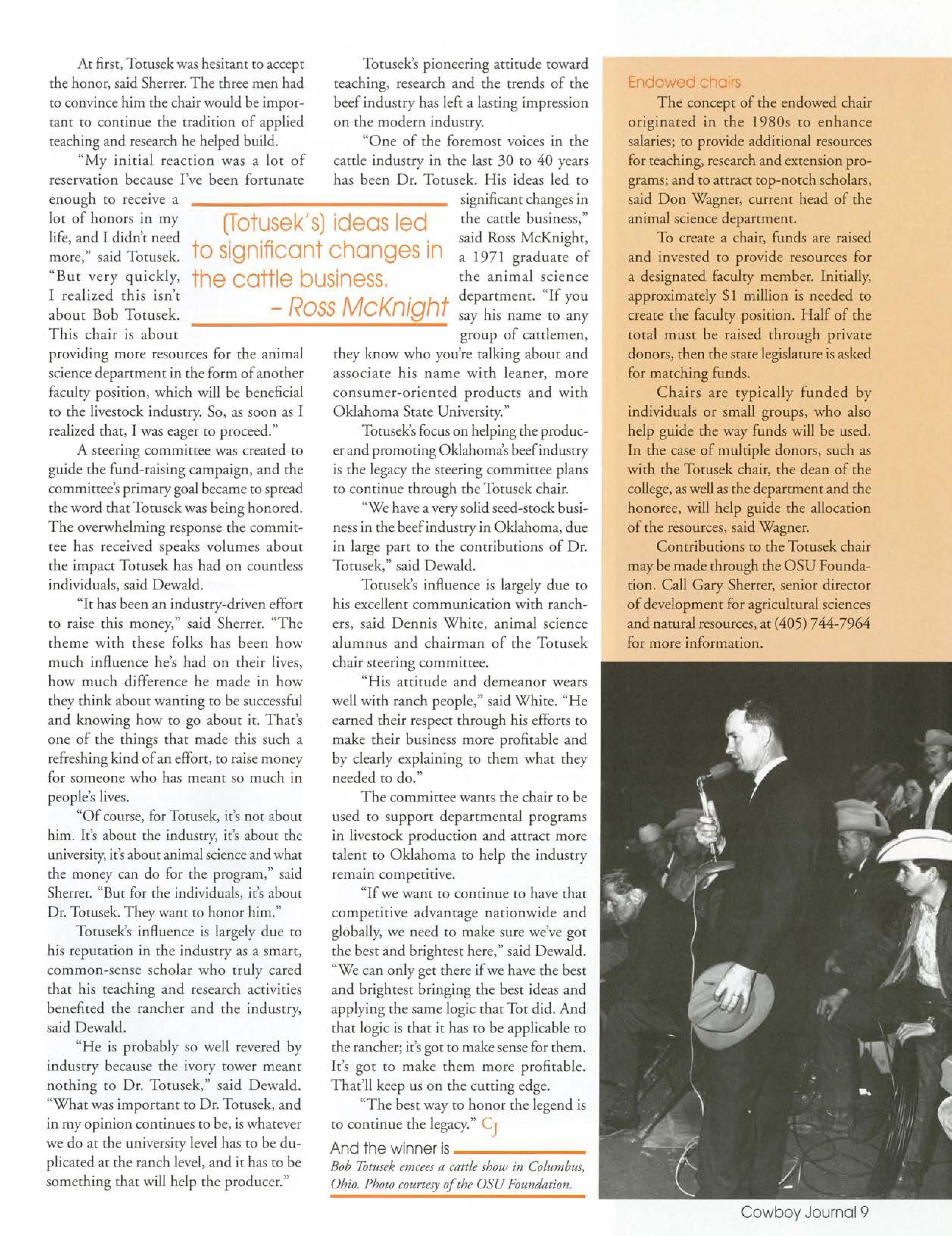
And the winneris------Bob Totusekemceesa cattle show in Columbus, Ohio. Photo courtesyof the OSU Foundation.
The concept of the endowed chair originated in the l 980s co enhance salaries; co provide additional resources for reaching, research and extension programs; and co attract top-notch scholars, said Don Wagner, current head of rhe animal science deparrrnenc.
To create a chair, funds are raised and invested to provide resources for a designated faculty member. lnicially, approximately $1 million is needed to create the facuJcy position. Half of the rota! must be raised through private donors, then the scarelegislature is asked for matching funds.
Chairs are typically funded by individuals or small groups, who also help guide the way funds will be used. In the case of multiple donors, such as with che Tocusek chair, the dean of the college, as well as the department and the honoree, will help guide the aUocation of che resources, said Wagner.
Concribucions to the Totusek chair may be made cluough the OSU Foundation. Call Gary Sherrer, senior director of development for agricultural sciences and narural resources, at (405) 744-7964 for more information.
Kuzmic provides the "k" in teamwork
By Macay Bolay Perry,Okla.
Teamwork is a kill Tom Kuzmic learned well during his college days as a member of the men' lacrosse ream at Virginia Tech. Today, he applies the same teamwork skills as he volunreer his evenings and weekend to the Oklahoma rare Universiry women's lacrosse ream.
Kuzmic developed an early love for the outdoors and traveling as a Boy Scour in Cleveland. He pursued his passion for foresuy ar Virginia Tech, where he received his ma.seer'sdegree in forestry.
Kuzmic was hired by OSU shortly after completing his master's. In the lace 1980 and early 1990 , he began working on his doctorate. In 1993, he became' Dr. Kuzmic" after completing his doctorate in environmental science.
Ar that poinc, Kuzmic became an integral pare in ponsoring trip to Honduras through the forestry deparrmenr.
During the trips, tudenrs experience a wide variery of tropical ecosystems, as well as cultural traditions through work, recreation, household living and feasting on rasry Honduran cuisine. Kuzmic said he never knows what new adventures will come during the trip.
"One afternoon, while hiking up an extremely large mouma.in in Honduras, I noticed one particular girl seemed to be doing quite well, while other were struggling," said KU1.mic."I questioned if she had been preparing for the hike in some fashion. he responded with, 'No l just play lacrosse, so Im well in shape."'
KU1.micwas impressed and began ro discuss his college experiences of playing lacro se. Ir didn't rake long before the smiling sruden r expressed her ream' need for a faculry advi er and asked for hi help.
Kuzmic never dreamed from char point forward he would be committing 10 to 12 hours a week and some weekend time to the OSU women' lacro e ream.
'After agreeing to anend a few practices in the fall seme rer of 2003, I fOLmd myself beginning to make comments on areas of improvement and offer some drill
organizing," said Kuzmic. "The girls really responded to my suggestions and finally just told me that I mu r get a whistle."
Kuzmic said lacrosse is the olde r sport in orth America. Rooted in a.rive American cradirion, lacrosse was played to resolve conflicts, heal che sick and develop strong, virile men. Modern lacrosse has been embraced by athlete and enthusiasts of the United States and the British Commonwealth for more than a century.
The sport of lacrosse is a combination of basketball, soccer and hockey. The game requires coordination and agility. Two highly prized qualities in lacrosse are quickness and speed. Lacrosse is a fastpaced sport, and anyone can parcicipate. Women's rules limit stick contact and prohibit body contact; therefore, lirrle protecrive equipment is required. At OSU, rhe women provide their own protective gear rick, mouthpiece and uniform.
Kuzmic began playing as a freshman in college, nor knowing anything about the game. After a few shore lessons and many
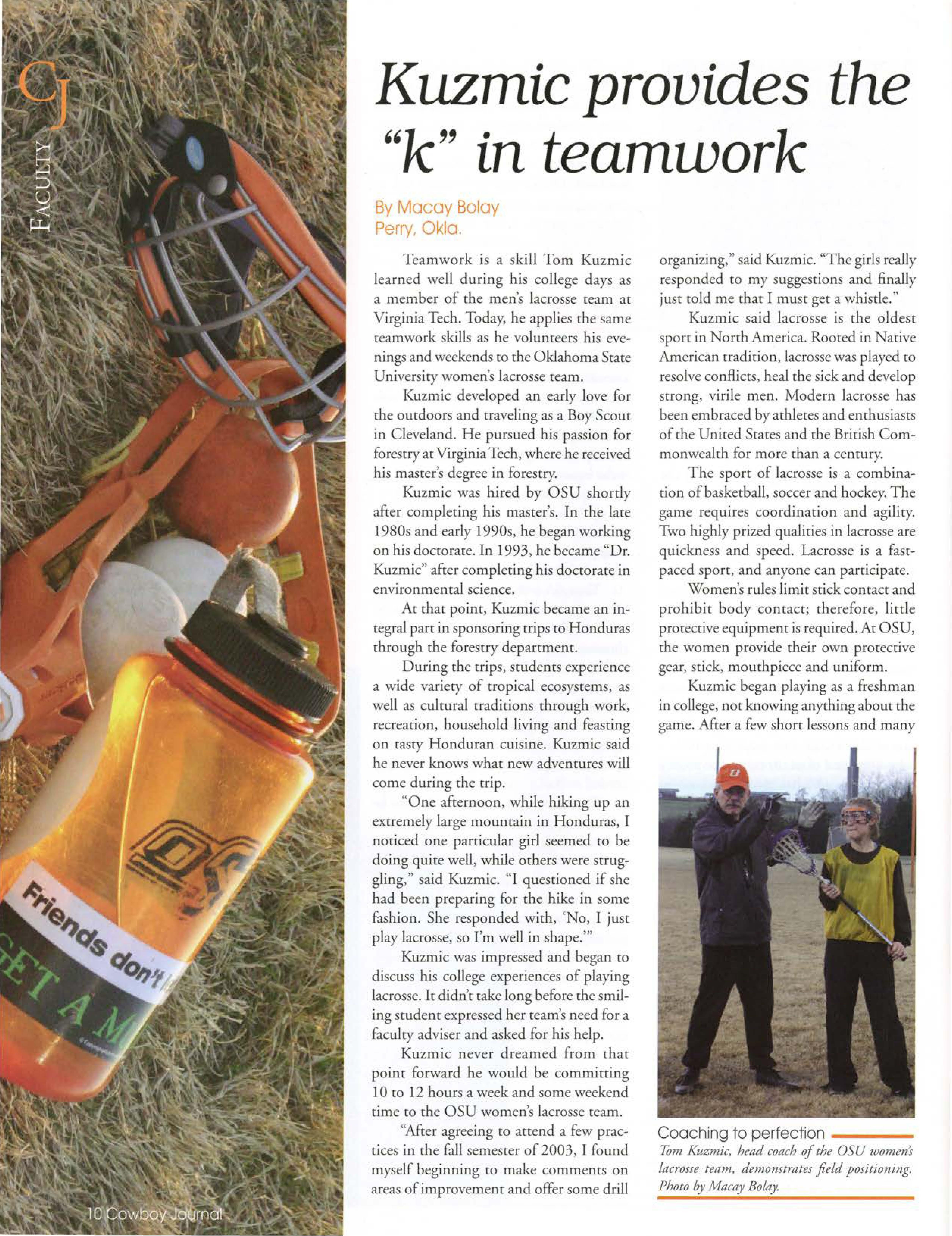
Coaching to perfection
Tom Kuzmic, head coach of the O U women's lacrosse team, demonstrates field positioning.
Photo by Macay Bolay.
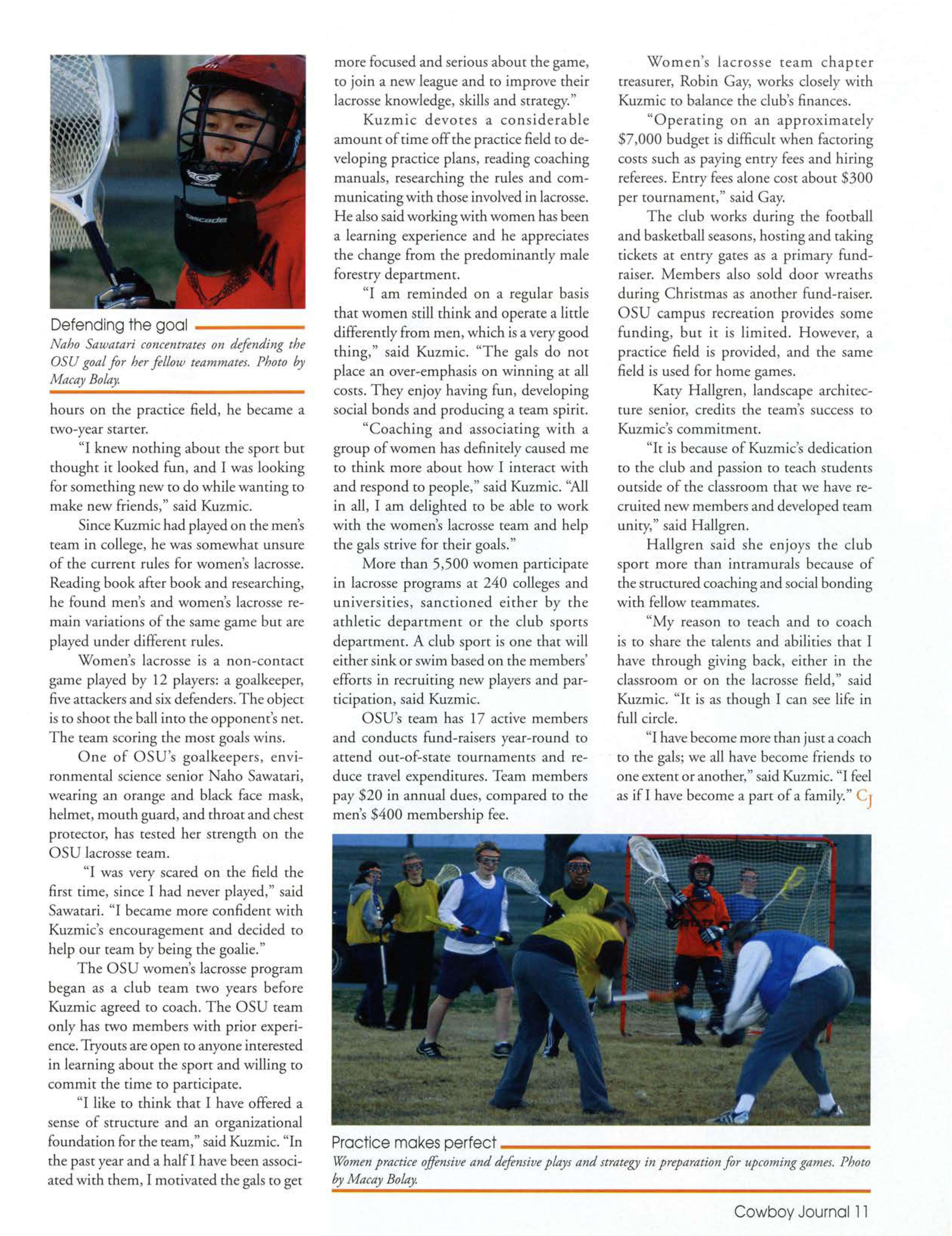
Defendingthe goal
Naho Sawatari concentmteson defending the OSU goalfar herfellow teammates.Photo by Macay Bolay.
hours on the practice field, he became a rwo-year starter.
"I knew nmhing about the sport but rhoughr ir looked fun, and J was looking for omething new co do while wanting co make new friends," said Kuzmic.
Since Kuzmic had played on che men' team in college, he was somewhat unsure of the current rules for women' lacrosse. Reading book after book and researching, he found men's and women' lacro se remain variations of the same game but are played under different rules.
Women's lacrosse is a non-contact game played by 12 player : a goalkeeper, five attackers and ix defenders. The object is co shoot the ball into the opponent's net. The team scoring the most goal wins.
One of OSU's goalkeepers, environmental science enior aho awatari, wearing an orange and black face mask, helmet, mouth guard, and chroarand chest protector, has tested her strength on the OSU lacrosse team.
"I was very cared on the field the first time, since 1 had never played," said awatari. "I became more confident with Kuzmic' encouragement and decided co help our ream by being the goalie."
The OSU women's lacrosse program began as a dub team rwo years before Kuzmic agreed to coach. The O U team only has two member with prior experience. Tryouts are open co anyone imeresced in learning about the sport and willing co commie the time co participate.
"I like to chink chat I have offered a sense of rructure and an organizational foundation for the team," said Kuzmic. "In rhe past year and a half! have been associated with them, l motivated the gals to gee
more focused and serious abour the game, co join a new league and co improve their lacrosse knowledge, skills and strategy."
Kuzmic devotes a con iderable amount of rime off the practice field to developing practice plans, reading coaching manuals, researching the rules and communicating with chose involved in lacrosse. He also said working with women has been a learning experience and he appreciates the change from the predominandy male forestry department.
"I am reminded on a regular basis char women still think and operate a lictle differently from men, which is a very good thing," aid Kuzmic. "The gals do not place an over-emphasis on winning at all co cs. They enjoy having fun, developing social bonds and producing a team spirit.
"Coaching and a sociaring with a group of women has definitely caused me co chink more abour how I interact with and respond co people," said Kuzmic. "All in all, I am delighted co be able co work with the women's lacrosse ream and help the gals strive for rheir goals.'
More than 5,500 women participate in lacrosse programs at 240 colleges and universiries, sanctioned either by rhe athletic department or rhe club ports department. A club spore is one char wilJ either sink or swim based on the members' efforts in recruiting new player and participation, said Kuzmic.
0 U's ream has 17 active members and conducts fund-raisers year-round to attend out-of-scare cournamencs and reduce travel expenditures. Team member pay $20 in annual dues, compared co rhe men's $400 membership fee.
Women's lacrosse team chapter treasurer, Robin Gay, works closely with Kuzmic co balance che club' finance
'Operating on an approximately $7,000 budget is difficult when faccoring coses such as paying entry fees and hiring referees. Enrry fees alone cost about $300 per cournamenc," said Gay.
The club works during the football and basketball seasons, hosting and taking tickers ar entry gates as a primary fundraiser. Members also sold door wreaths during Christmas as another fund-raiser. 0 U campus recreation provides some funding, bur it i limited. However, a practice field is provided, and the same field is used for home games.
Kary Hallgren, landscape architecture senior, credits the ream's success to Kuzmic's commitment.
"Ir is because of Kuzmic's dedication co rhe club and passion co teach students outside of the classroom chat we have recruited new members and developed team unity,' said Hallgren.
Hallgren aid he enjoy the club pon more than intramural because of the scruccuredcoaching and social bonding with fellow teammate .
"My reason to reach and co coach is co share rhe calems and abilities char I have through giving back, either in che classcoom or on the lacrosse field," said Kuzmic. "Ic is as though I can see life in full circle.
"I have become more than j usea coach to the gal ; we all have become friends tO one extent or another," said Kuzmic. "I feel as ifl have become a pare of a family." CJ
OSUselects
By Candace May Roosevelt,Okla.
Farmer. aprain. Banker. Professor. Dean. Robert E. Whitson added a new tide when he assumed the position of vice president of agricultural programs and dean of klahoma rate Universicy'sDivision of Agricultural cien es and acural Re ources. Thi former Aggie became a Cowboy June 1.
Whirson's duties include overall leadership financial development and fiscal management of the division. The College of Agricultural ciences and arural Resource , the Oklahoma Agricultural Experiment tation and rhe Oklahoma Cooperative Extension ervice are che three mission areas of the division.
The division includes nine academic depanment , 11 field re earch rations and three centers, including the renowned Oklahoma Food and Agriculrural Products Research and Technology Center.
Whitson, the 18th CASNR dean, wa a ociate vice chancel! rand associate dean ar Texas A&M Universicy. Whitson previously had many duties, uch as life sciences depucy director for the Texas Agri ulrural Experiment carion for Texas and the TAMU system. These duties required Whitson ro provide statewide leadership and management for the TAES, a well as the Office of the Smee Chemist and Apiary Inspection ervice.
"Dr. Whitson' experience in all three areas of the land-grant mission gives him a tremendous advantage co rhe future of the division," said Carby Herren, '05 agricultural communications master's graduate and a member of the search committee. "His experiences working with the Texas legislature will be invaluable assets."
Before Whit on' duties a vice pre idem and dean, he was depamnenr head and professor of rhe TAMU Department of Rangeland Ecology and Management from May 1993 to August 2003. While serving rhe deparonenc, Whitson was able ro initiate and facilitate many efforrs, including the enhancement of rhe undergraduate range management and ecology curricul.um. New Cowboy
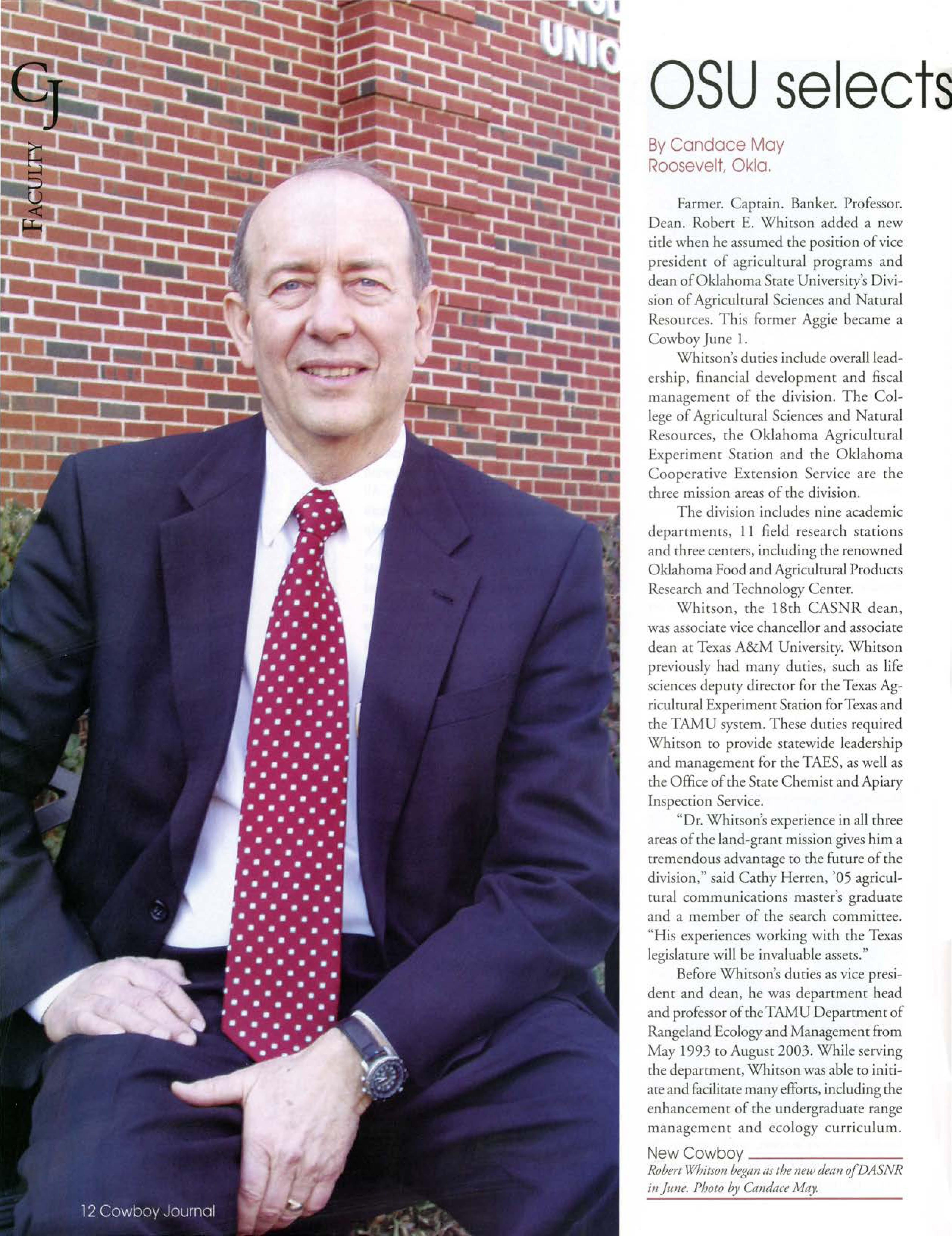
_ RobertWhitsonbegana, the new dean of DASNR in June. Photo by CandaceMay.
Whitsonas new DASNRleader
Whitson developed and maintained relarion hip wirh external constituents with Texas Sheep and Goat Raisers, Texas outhwesrern Carrie Raisers Association, Texa Farm Bureau and arural Resource Conservation Services, as well as ocher narural resource groups.
"Dr. Whitson seem to be a very personable leader," said Joe eill, rhe past presidenr of rhe Oklahoma Carrlemen's Association and a member of the earch committee. "He noted several rimes in discussions char he would lead by consensus of opinion from all stakeholders such as faculry, tudenrs, industries uch as the Oklahoma Cattlemen's Association, and others in adminisuarion."
Before Whitson starred hi career ac AMU, he left his mark on the Fro r acional Bank in an Antonio, Texas, from ovember I 981 co April 1993. He began hi career with Frost acional Bank as an assistant vice president, was named vice president in 1982 :rnd became the senior vice president in September 1984. During chis rime, he gained administrative experience by overseeing budgeting and supervision of farm and ranch assets in Texas and surrounding scares.
"We are extremely fortunate to have Whitson on board," said Linda Martin, CA R assistant dean and member of che earch committee. "He has an extensive background in research, reaching and extension programs. He brings balance relative co the three componenrs of the land-grant mission."
Whitson has an extensive resume char includes academic and industrial experiences. It aU began with a position as the farm and ranch management specialise for
WhitsonQuickFacts
* Family:wife,Undo;2 daughters,CristieandSUsan; 5 grondchlldren,ages3 to 9;2 brothers; 2 sisters
* Hometown:Spearman,Texas • Favoritefood:Steak
the Texas Agricultural Extension ervice. From chis position, he was able co assist counry agricultural agents and producers in 22 councies wirh farm and ranch management training. The raining included decision-making kills chat were related ro both cechnical and economic elemencs of risks in rhe farm and ranch erring.
Whitson is an academic veteran, but he is al o a veteran of the U.S. Army. While in the Army, he served as second and firsr lieucenanr on active dury in South Viemam and was rationed at Fort Bli s from 1967 co 1969. He also served as captain and major in the U Army Reserve from 1969 co 1980. During his service, he was responsible for a large staff of people and rhe developmenc and implementation of programs rhat ensured material readiness of assigned units in four states.
Before serving his country in the Army, Whitson was elf-employed in Han ford Counry in Spearman, Texas. He farmed, raised cattle and custom harvested. This life ryle and an education from exas Tech and Texas A&M universities, was the beginning of whac led Whitson to O U.
"My past experience will allow me to respond quickly co issue of importance to the division, providing the leadership necessary to move the division forward in area of highest prioriry,' Whitson said. "My experience gave me a broad understanding of scare, national and international agricukural issues and has provided me the opportuniry to work closely with internal and external conscituencies, including legislators and commodiry leaders."
The search for a new dean began early in 2004. A earch committee comprised of 24 individuals was selected ro help
narrow the field of candidates. The search conducted during rhe spring was unable ro surface the desired re ul , so che search wa renewed in the fall.
Applications were received and reviewed by the search committee. Eight candidates were Bown co Oklahoma City in laceJanuary for interviews. Whitson wa the first candidate who came to O U for an interview in February.
"Dr. Whitson ha a background of diverse experiences from which to draw che skills needed for the dean position including financial and per onnel management," said Natalie Berning, biochemistry and molecular biology sophomore. "From his resume alone, it is obvious rhar Or. Whicson is intellectually and experientially qualified for the po ition. While eating with him at the luncheon, he demoncrated articudes and ideas char closely correspond co the conservative, home-town atmosphere of OSU.'
Berning said Whitson is approachable and will fit well in the division.
"I am pleased co be your vice presidenr and dean and am looking forward to the opportunity to work with faculty and staff to build on che strong teaching, research and extension programs in agriculture currencly in place ar OSU," Whitson aid. 'My wife inda, and I are impressed wich che friendly, warm welcome we have received and are excited to be a part of the OSU family."
By being cho en as che vice president and dean of OSU Division of Agriculcural Sciences and atural Resources, Whitson is able co further his academic experience as well as help rhe univer iry make educational and research advancements. J
Facilities to accommodate all your needs!
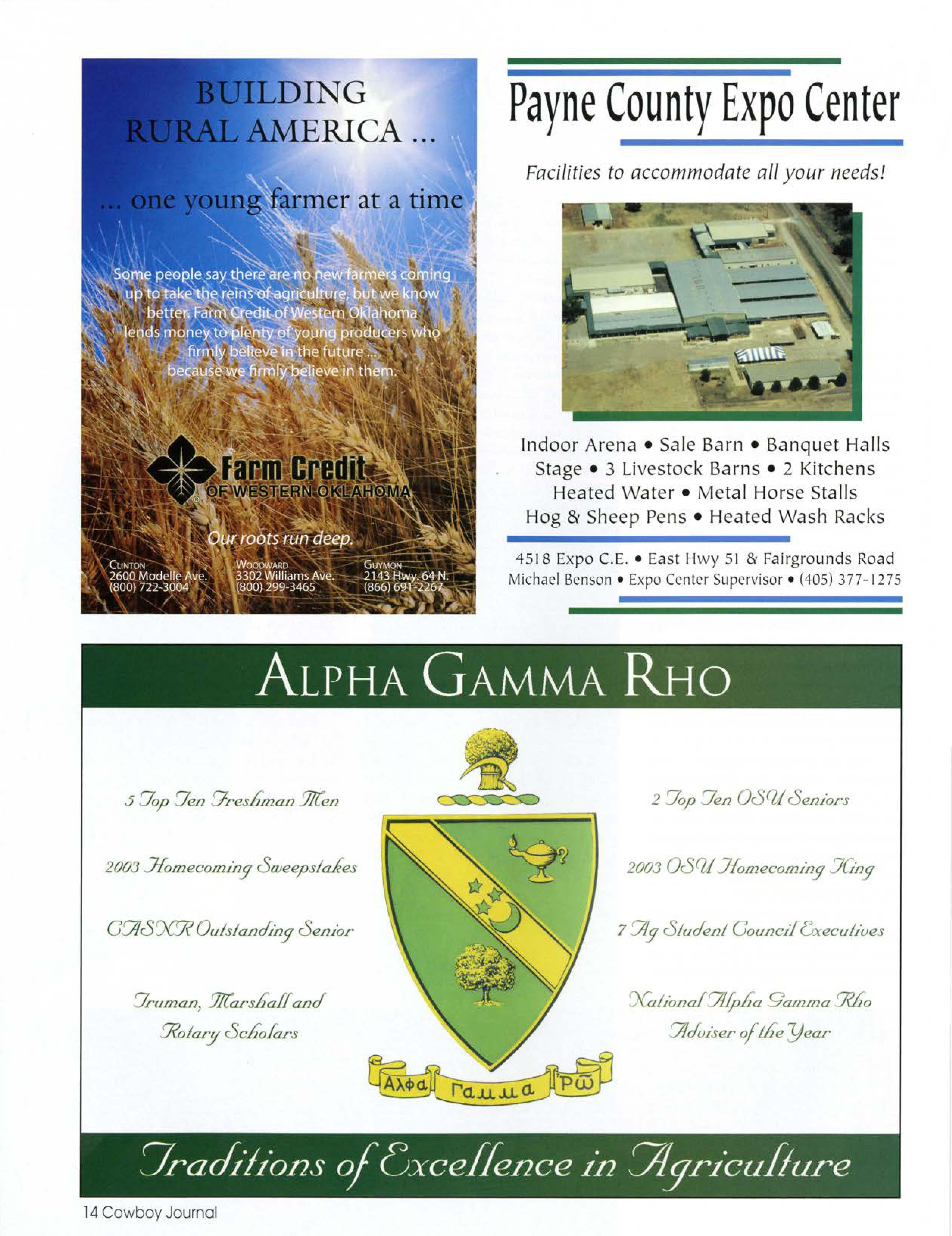
Indoor Arena • Sale Barn • Banquet Halls Stage • 3 Livestock Barns • 2 Kitchens
Heated Wat r • Metal Horse Stalls Hog & Sheep Pens • Heated Wash Racks
4518 Expo C.E. • East Hwy 51 & Fairgrounds Road Michael Benson• Expo Center Supervisor• (405) 3 77-1275
ALPHA GAMMA RHo
.5 7op 'Jen Y:reshman 2l(en
2003 Jlomecom/ny c5weepsldes
G7/c5:X:J? Ou!slandiny c5enior 'J.ruman, !ll(arsball and :Ro!a.ry c5c£ofars 2 'Jop 'Jen 05Qi c5eniors
2003 0 Qi Jlomecom/ny JC-ng 7 7/y ludenl Gow1C,1[Clxecuh'ues ,./ alional?lfpha 9amma !Rbo 7/clwser of I.be Year
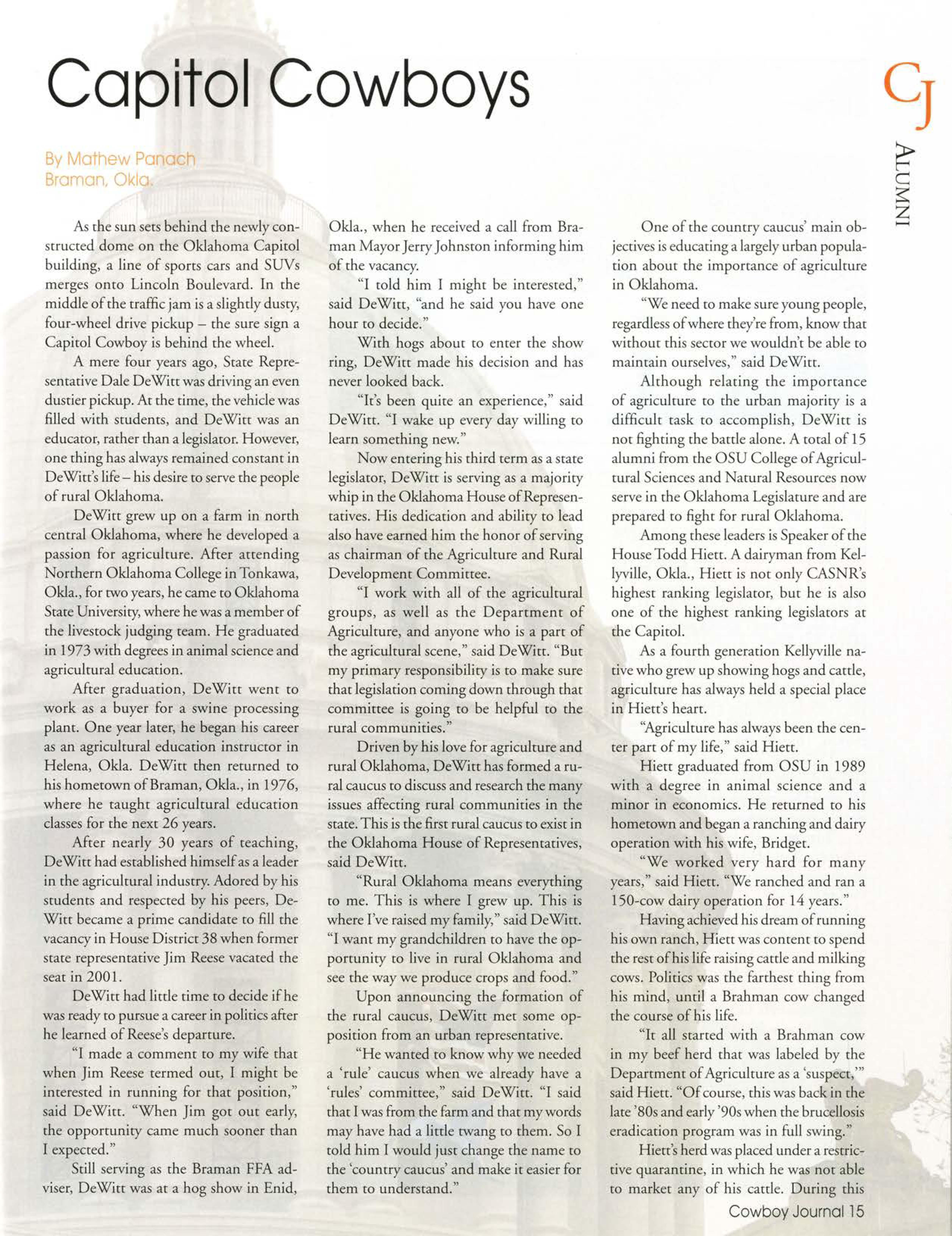
CapitolCowboys
ByMathew Pa:iach Braman, Okla
As rhe sun secs behind the newly consrrucced dome on rhe klahoma Capitol building, a line of spons ca.rs and UVs merges omo Lincoln Boulevard. In che middle of the rraffic jam is a lighdy duscy, four-wheel drive pickup - rhe sure sign a Capirol Cowboy is behind che wheel.
A mere four years ago, race Representative Dale De Wirt was driving an even dusrier pickup. Ar the rime, the vehicle was filled with students, and DeWirr was an educaror rather than a legislacor.However, one thing has always remained constant in De Win's life- his desire co serve rhe people of rural Oklahoma.
DeWicc grew up on a farm in nonh central Oklahoma, where he developed a pa sion for agriculture. After anending orchern Oklahoma College in Tonkawa, Okla., for rwo years he came to Oklahoma StaceUniversity, where he was a member of rhe livestock judging ream. He graduated in 1973 wich degrees in animal science and agricultural education.
After graduation, DeWitt wenc to work as a buyer for a swine processing plane. One year lacer be began his career as an agriculrural education instructor in Helena, Okla. DeWirr rhen returned to his hometown of Braman, Okla., in 1976, where he raughr agriculrural education classes for rhe nexr 26 years.
After nearly 30 year of reaching, DeWirr had established himself as a leader in rhe agriculnual indusrry. Adored by his students and respected by his peers, DeWitt became a prime candidate to fill che vacancy in Hou e District 38 when former state representative Jim Ree e vacated che sear in 2001.
DeWitt had lirde rime ro decide ifhe was ready co pur ue a career in politics after he learned of Reese's departure.
"I made a comment co my wife char when Jim Reese termed our, I might be interested in running for rhac position," said DeWitt. "When Jim goc our early, the opporrunity came much sooner rhan I expecred."
till erving as the Braman FFA adviser, DeWitt was ar a hog show in Enid,
Okla., when he received a call from Braman Mayor Jercy John ron informing him of the vacancy.
"I cold him I mighr be inreresred," said DeWin "and he said you have one hour to decide."
Wirh hogs abour ro enrer rhe show ring, DeWitt made his decision and has never looked back.
"Ir's been quire an experience," said DeWitt. "J wake up every day willing to learn something new.'
ow entering hi chird rerm as a scar legislator, De Wire is serving as a majority whip in che Oklahoma House ofRepresenrarives. His dedication and abilicy to lead also have earned him rhe honor of serving as chairman of the Agriculrure and Rural Development Committee.
"I work wich all of rhe agriculrural group , a well as rhe Department of Agriculture, and anyone who is a pan of che agricultural scene," said DeWitt. "Bur my primary responsibilicy is co make sure chaclegislation coming down chrough char committee is going to be helpful ro the rural communities.''
Driven by hi love for agriculture and rural Oklahoma, DeWitt has formed a rural caucus ro discuss and research che many is ue affecting rural communities in che state. This is the fuse rural caucus co exisr in the Oklahoma House of Represenrarives, aid DeWitt.
"Rural Oklahoma means everything ro me. This i where I grew up. Thi i where l've rai ed my family," said DeWirt. "l wam my grandchildren ro have che opportunity ro live in rural Oklahoma and see the way we produce crops and food."
Upon announcing che formation of che rural caucus, DeWitt mer some opposition from an urban representative.
"He wanred ro know why we needed a 'rule' caucu when we already have a 'rules' committee," said DeWitt. "1 said chat I was from the farm and that my words may have had a little twang co chem. o I cold him l would just change rhe name ro che 'counrry caucus' and make ic easier for chem co under rand.''
One of the country caucus' main objectives is educacing a largely urban population abour the importance of agriculture in Oklahoma.
''We need ro make sure young people, regardles of where they're from, know that wirhout chis sector we wouldn't be able to mainrain ourselves," said De Wier.
Although relating che importance of agricuJrure to the urban majoricy is a difficult cask ro accomplish DeW.itt i nor fighting the battle alone. A coral of 15 alumni from the O U College of Agricultura.l ciences and atural Resources now serve in the Oklahoma Legislature and are prepared co fight for rural Oklahoma.
Among rhese leaders is Speaker of the House Todd Hiett. A dairyman from Kellyville, Okla., Hiett is nor only CAS R's highest ranking legislaror, bur he is also one of che highest ranking legislacors ar che Capitol.
A a fourth generation Kellyville native who grew up showing hogs and cattle, agriculcure ha always held a special place in Hiett's hearr.
"Agriculmre has always been the center pare of my life," said Hiett.
Hiecc graduated from OSU in 1989 wirh a degree in animal science and a minor in economics. He returned to his hometown and began a ranching and dairy operation wich hi wife, Bridger.
"We worked very hard for many year ," said Hiett. "We ranched and ran a 150-cow dairy operarion for 14 years."
Havi.ng achieved his dream of running his own ranch, Hiett was content to spend che re c of his life rai ing cacde and milking cows. Policies was the farthest thing from his mind, umil a Brahman cow changed che course of bis life.
"Ir all scarred wi rh a Brahman cow in my beef herd char was labeled by che Department of Agriculture as a 'suspect,"' said Hiecr. ''Of collCse,chis was back in rhe lace '80s and early '90s when the brucello is eradication progran1 was in full swing.''
Hieu's herd was placed under a rescricti ve quarantine, in which he wa nor able to market any of his cacrle. During chis Cowboy Journal 15
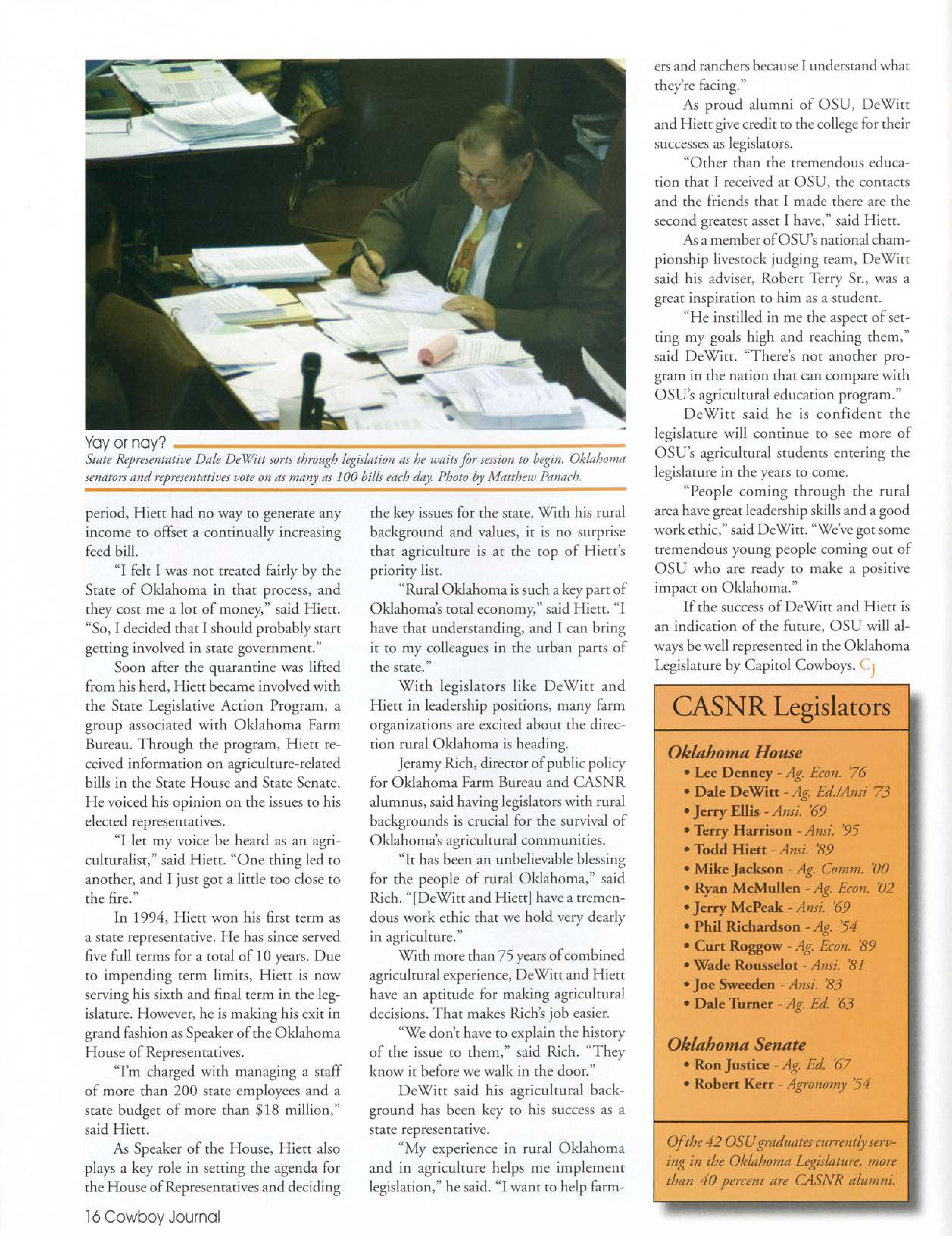
Vay or nay?
State Representative Dale DeWitt sorts through legislation as he waits for session to begi.n. Oklahoma senators and representatives vote on ns many ns 100 bills each dtt;t Photo by Matthew Panach.
period, Hiett had no way to generate any income co offsec a continually increasing feed bill.
"I felr l was nor created fairly by the race of Oklahoma in char process, and they cost me a lot of money," said Hierr. "So, I decided char I should probably start gening involved in state government."
oon afrer rhe quarantine was lifted from his herd, Hiett became involved with rhe rare Legislative Action Program, a group a sociated with Oklahoma Farm Bureau. Through rhe program, Hiett received information on agriculcure-relared bills in the State House and rate Senate. He voiced his opinion on rhe issues ro his elected representative
"I let my voice be heard as an agriculturalist,' said Hiecc. "One ching led to anorher, and I just got a lirde coo close ro the fire."
[n 1994, Hiett won his first term as a state representative. He has since served five full term for a total of l O years. Due ro impending term limits, Hiett is now erving nis sixth and final term in rhe legislature. However, he is making bis exic in grand fasnion as peaker of the Oklahoma House of Represenrarives.
''I'm charged with managing a staff of more than 200 scare employee and a scare budget of more than 18 million," aid Hiett.
As peaker of the House, Hien also plays a key role in sercing rhe agenda for the House of Represematives and deciding
che key issues for rhe care. With his rural background and values, it i no surprise char agricu.lrnre is at rhe cop of Hietr's prioriry lisc.
"Rural Oklahoma is such a key part of Oklahoma's coral economy" said Hien:. "I have rhat understanding, and ] can bring it co my co11eague in rhe urban pares of rhe srate."
With legislarors like DeWitt and Hiett in leadership positions, many farm organizations are excited about the direction rural Oklahoma is heading.
Jeramy Rich, direcmr of public policy for Oklahoma Farm Bureau and CA R alumnus, said having legislator with rural background i crucial for rhe survival of Oklahoma's agricultural communiries.
"Ir has been an unbelievable blessing for the people of rural klahoma," said Rich. "[De Witt and Hiett) have a tremendous work ethic char we hold very dearly in agricul rure."
Wirb more than 75 years of combined agricultural experience, DeWitt and Hiett have an apcirude for making agricultural decisions. That makes Rich's job easier.
"We don't have coexplain rhe hisrory of rhe issue ro them," said Rich. "They know it before we walk in the door."
DeWitt aid his agriculruraJ background has been key to hi success as a scare represenracive.
"My experience in rural Oklahoma and in agriculrure helps me implemenc legi lation," he aid. "I wane ro help farm-
ers and rancher becau e I understand whar they're facing."
As proud alumni of O U, DeWirc and Hiett give credit ro rhe college for rheir successes as legislator
"Ocher rhan the tremendous education chat I received at O U, the contacts and the friends char I made there are the second greatest asset I have " said Hien. k a member ofO U's national championship livestock judging tean1, DeWirr ai.d his adviser, Robert Terry Sr., was a great inspiration w him as a tudent.
"He instilled in me rhe aspect of setting my goal high and reaching them," said DeWitt. 'There's nor anorher program in the narion chat can compare with OS U's agricul rural education program."
DeWirr said he is confident the legi lacure will conrinue to see more of OSU's agricultural srudencs emering rhe legi larure in rhe year o come.
"People coming through rhe rural area have great leadership skills and a good work ethic," said DeWitt. "We've gor some tremendous young people coming our of OSU who are ready to make a po irive impact on Oklal10ma."
If the success of DeWitt and Hiecc is an indication of the fucure, OSU wilJ always be well represented in the Oklahoma Legislature by Capitol Cowboys. C 1
CASNR Legislators
Oklahoma House
• Lee Denney - Ag. Econ. 76
• Dale DeWitt -Ag. Ed./Ansi 73
• JerryEllis - AIISi.'69
• Terry Harrison -Ansi. '95
• Todd Hiett - Ansi. '89
• Mike Jackson - Ag. Comm. '00
• Ryan McMullen -Ag. Econ. '02
• Jerry McPeak - Ansi. '69
• Phil Richardson - Ag. '54
• Curt Roggow - Ag. Econ. '89
• Wade Roussdot -Ansi. '81
• Joe Sweeden -Ami. '83
• Dale Turner- Ag. Ed. '63
Oklahoma Senate
• Ron Justice -Ag. Ed. '67
• Robert Kerr -Agronomy '54 ,I'
1------------------','
Of the 42 OS U gradutttescurrentlyserving in the Oklahoma Legislature,more than 40 percent are CASNR altmmi. ,,,: I
ExploretheWest...
ByJackie Mileham Chandler, Okla.
Imagine getting into your car with family or friend and raveling to a place enriched with native history. As the wind gently blows duough the trees, you can hear the voice of the warriors and the heroes who walked before you.
This destination is not exocic. ln many cases, these attractions are only a short car ride away. One such place is the Pawnee Bill Ranch in Pawnee, Okla.
"Tourism and the land - agriculcural or recreational - are incegraced in rhe minds of many people," aid Lowell Caneday, professor of leisure studies ar Oklahoma tare University. "Our Oklahoma land attracts people."
justuptheroad
Oklahoma "amacced" Gordon Lillie in rhe lace 1870s, said Erin Brown, Pawnee Bill Museum collection peciali t. He and his wife, May, establish d a buffalo ranch on Blue Hawk Peak in 1903.
Although they owned a movie producrion company, publi hing company, buffalo ranch and oil refineries, rhey are mo t famous for their worldwide wild-west hows, aid Brown.
"Pawnee Bill would noc have approved of the word 'show,"' said Brown. "He considered hi production an educational experience. ln reality, the shows only had elemencs of education to chem.
"The shows mimicked reality and romanticized the we t. The hows were conceived a educational; rhe original goal wa to depict episode of westward expansion through portrayals of cowboy heros and ative Americans."
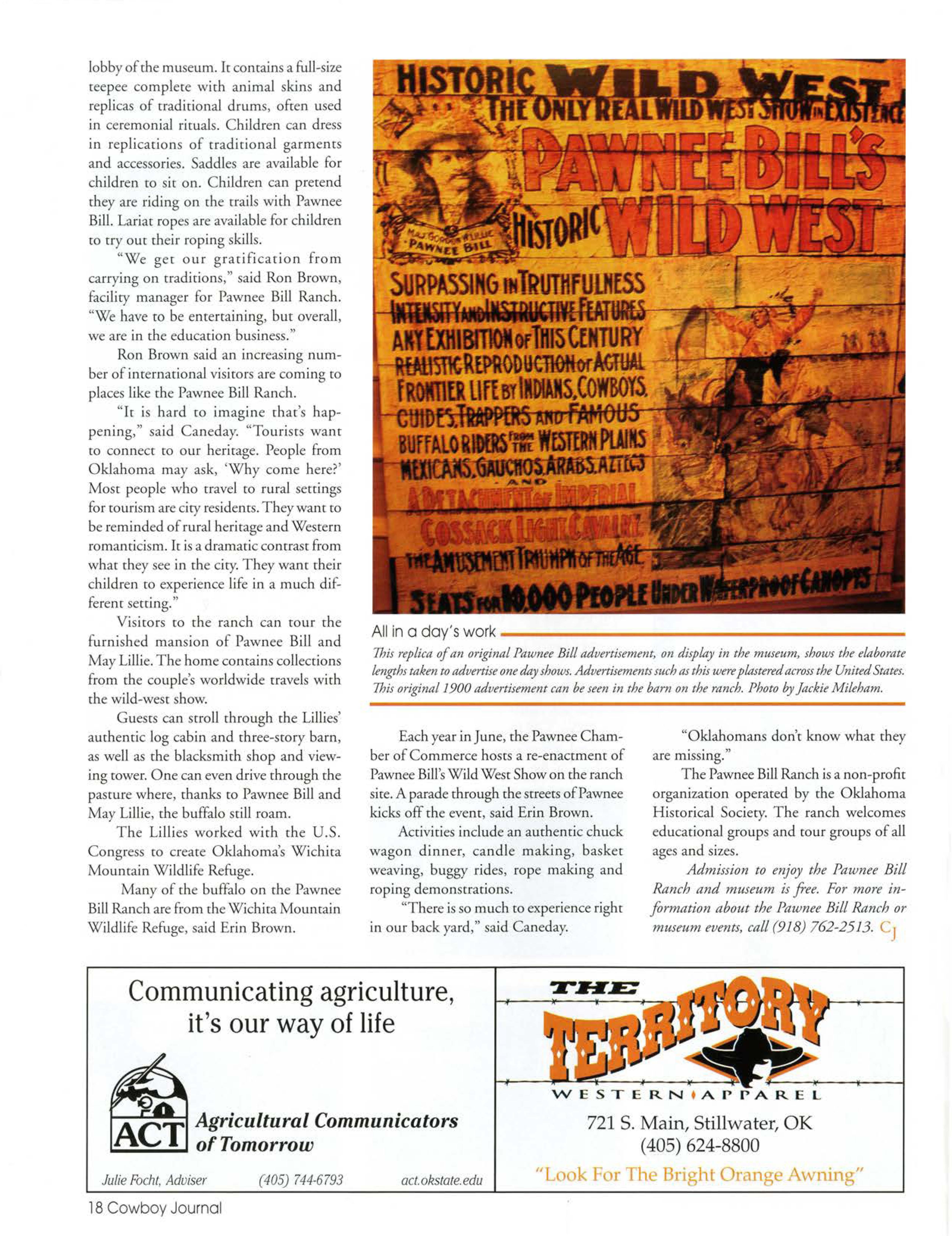
Elaborate displays and production to artract visitors ro one-day shows were plastered across th.e nation, enticing people to, what was called, Pawnee Bill's Hisroric Wild West, aid Brown.
One adverti emenr i on di play in cl1ebarn at the ranch. le was found near
La.mom Okla. restored and donated to the ranch in 1982. The advertisement is believed rn have been posted in 1900.
Frank Ea.ton OSU's original "Pistol Pere," had a place in Pawnee Bill's "amusement triumph of the age,• aid Brown.
Eaton played rhe pa.rt of a deer hunter and wagon train boss. While he was not working in rhe how, he played the part of the prestigious cowboy O U fans have grown to love.
He al o helped with ranch rodeo and gathered rodeo sto k for Pawnee Bill.
Currently, me museum has a display dedicated to Pi rol Pere. The display tells of the life and history of the cowboy.
Visitors can learn how he became me 0 U ma cor.
Books, audio rapes and ocher educational materials about Earnn, the Lillies and ocher performers a.re available in the Pawnee Bill gift shop.
While vi iring the mu eum, guests can enjoy historic photographs of the wild-west show, as well as western a.rt and arrifact from the exotic performers who dedicated meir lives ro entertainment.
A children's area is located in the from
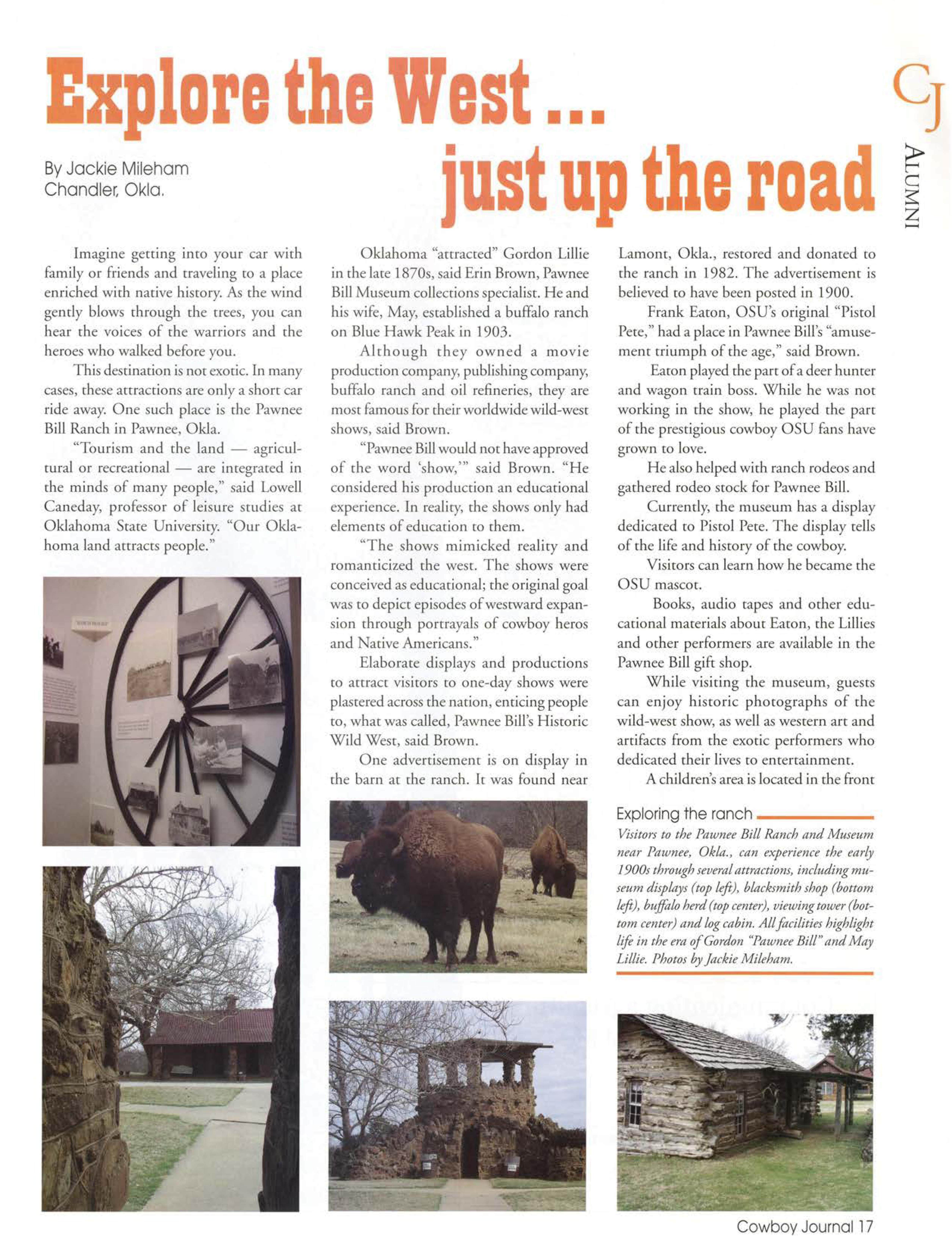
Exploring the ranch _____ _
Visiton to the Pawnee Bill Ranch rmd Museum near Pawnee, Okla., can experience the early 1900s throughseveralattrttction.5,including musewn displays(top left), blacksmithshop (bottom left), buffalohe,d (top center),viewingtower(bottom center)and fog cabin. All facilities highlight life in the erttof Gordon "PawneeBill" ttndMay Lillie. PhotosbyJackie Mileham.
lobby of the musetLm. Ic comains a full-size ceepee complece with animal skins and replicas of tradicional drums, often used in ceremonial riruals. Children can dress in replicacions of cradirional garmencs and acces ories. Saddles are available for children ro sic on. Children can precend chey are riding on rhe crail with Pawnee Bill. Lariac rope are available for children co try ouc cheir roping skills.
"We gee our grarificarion from carrying on cracucions," aid Ron Brown, facility manager for Pawnee Bill Ranch. 'We have ro be entertaining, but overall, we are in che education bu iness."
Ron Brown said an increasing number of inrernacional visicors are coming co places like che Pawnee Bill Ranch.
"Ir i hard co imagine char' happening," said Caneday. "Touriscs wane ro connecr ro our hericage. People from Ol<lal10ma may a k, 'Why come here?' Mose people who cravel co rural settings for courism are city residents. They want to be reminded of rural heritage and We.seem romanticism. le is a dramatic conrrasc from whac they see in che city. They wane cheir children co experience life in a much different secring."
Visicors co che ranch can rour che furn.ished mansion of Pawnee Bill and May Lillie. The home conrains colJeccions from the couple's worldwide cravels wirh the wild-wesc show.
Guescs can srroll through the Lillies' authentic log cabin and three-story barn, as well as the blacksmith shop and viewing rower. One can even drive through che pascure where, rhanks co Pawnee Bill and May Lillie, che buffalo still roam.
The Lillies worked with che U.S. Congres ro creace Oklahoma's Wichica Mouncain Wildlife Refuge.
Many of the buffalo on the Pawnee Bill Ranch are from che Wichica Mountain Wildlife Refuge aid Erin Brown.
All In a day's work--------------------
This replicaof an originalPawneeBill advertisement,on displayin the museum, showsthe elaborate lengthstakento advertiseonedayshows.Advertisementssuchas this wereplasteredacrossrhe UnitedSrates. Thisoriginal15)00advertisementcan be seenin the barn on the ranch.Photo byJackieMileham.
Each year in June, the Pawnee Chamber of Commerce hoses a re-enacrmenr of Pawnee Bill'sWild Wesr how on che ranch sire. A parade through rhe srreers of Pawnee kicks off che evenc, said Erin Brown.
Accivicies include an authencic chuck wagon dinner, candle making, ba ket weaving, buggy rides, rope making and roping demonstrations.
"There is so much co experience righr in our back yard," said Caneday.
"Oklahomans don'c know whac they are missing.''
The Pawnee Bill Ranch is a non-profic organizarion operared by che Oklahoma Hisrorical Society. The ranch welcomes educational group and cour gi:oups of all ages and sizes.
Admission to enjoy the Pawnee Bill Ranch and museum is free. For more infarrnation about the Pawnee Bill Ranch or museum events, call (918) 762-2513. CJ

2005TopTenSeniors--------------------------------
The2005 CASNR TopTenSeniol'sinclude(frontfrom left) RachelBobbitt,Jodi NicholsCole,Mindi Luce,MaceyHedges,RyanJen/ink, (back)RyanMcCollum,Hazen ColeMarshall,Bill Shelby,RyanHunt and Matthew Panach.PhotobyJamie King.
Shelby also served on the Student Alumni Board, Presidenc's Leadership Council and Homecoming ceering Committee. He was aJsoa member of Collegiate Farm Bureau, Alpha Gamma Rho Frarerniry and served as a reaching assistant for agricultural economics course
The final outstanding Top Ten eniors are Jodi ichols Cole, agriculcural com-
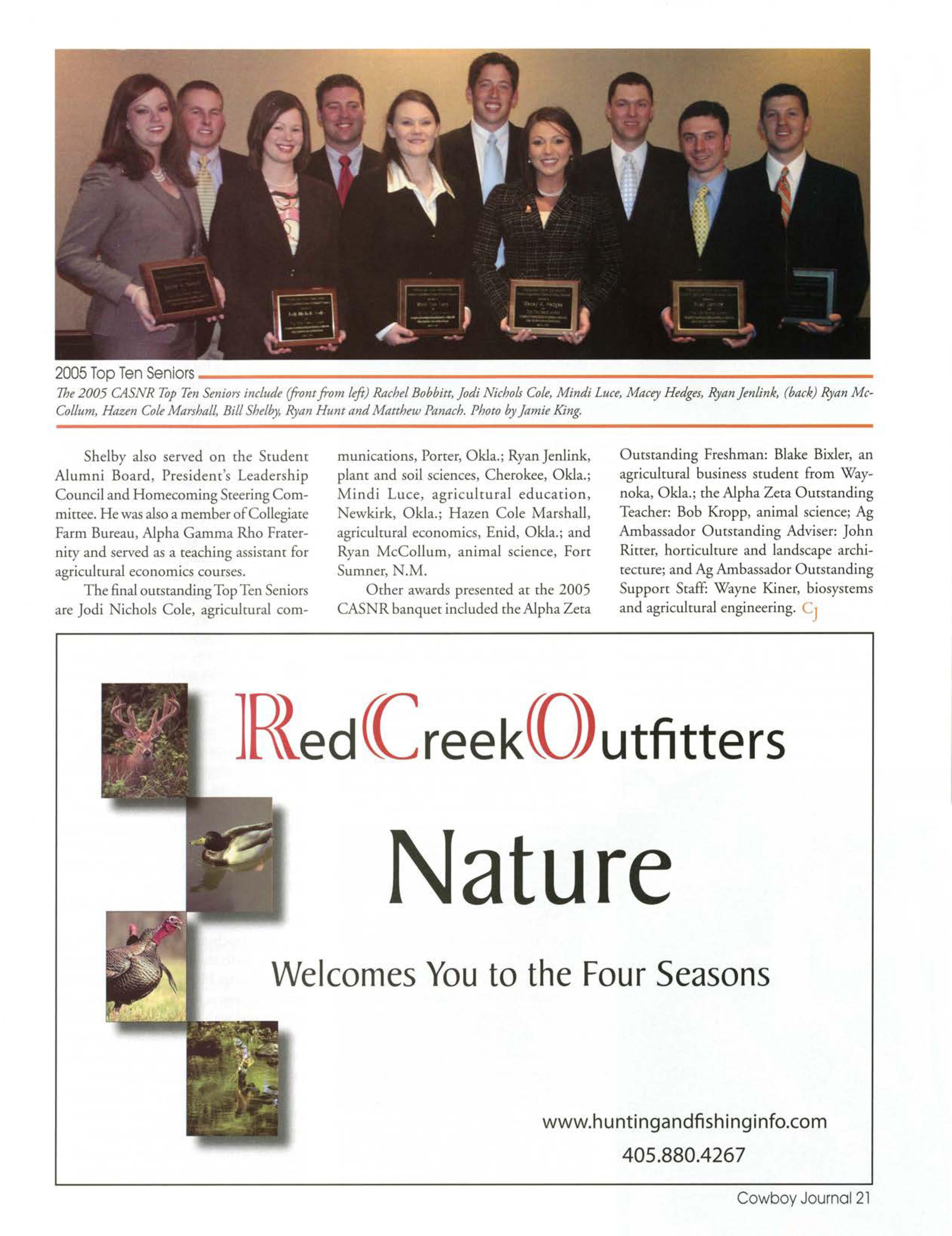
municarions, Porcer, Okla.; Ryan Jenlink, plane and soil sciences, Cherokee, OkJa.; Mindi Luce, agricultural education, ewkirk, Okla.; Hazen Cole Mar hall, agriculrural economics, Enid, OkJa.; and Ryan McCollum, animal science, Fore Sumner, .M.
Other awards presented at the 2005 CA NR banquet included the Alpha Zera
Oursranding Freshman: Blake Bixler, an agricultural business srudenr from Waynoka, OkJa.; the Alpha Zera Outstanding Teacher: Bob Kropp, animal science; Ag Ambassador Oursranding Adviser: John Ritter, horciculture and landscape architecrure; and Ag Ambassador Outstanding upporr Scaff: Wayne Kiner, biosyscems and agriculrural engineering. CJ
CJCultivatingsuccess... one studentat a time
By RochelleHenderson Woodward, Okla.
Plants are nor rhe only rhings being cuhivared in rhe Oklahoma Stace Universiry reaching greenhouses. The on-campus facilities have provided studencs the opporruniry to gain firsr-hand knowledge about the honicuJcure industry since their conscruccion in 1963.
Kary Friess, senior horticulcure major and pre idenr of the Honiculrure Club at OSU, aid rheavailabiliryofan on-campus learning faciliry is beneficial co her educarion as a horciculcure srudenr.
" he greenhouse are great learning tools," said Friess. "The faciliries are very helpful for classes."
The reaching greenhouses are locaced on Farm Road, south of the renovated Colvin encer. Five eparate greenhouses provide studencs the opporruniry ro grow plants in differenr conditions and compare results of various modifications. The faciliry measures 15,000 square feet.
In the spring of 2005, 220 tudent were enrolled in the horticulrure and landscape archicecrure degree programs, bur srudems from differenc majors enroll in courses rhat use the greenhouses. Seven classes use rhe facilicie , including
greenhou e managemenr, commercial Aoriculture production and marketing, and introducrion to horciculrure, said Tim Hooper, manager of the greenhouses and adviser for the Horticulrure Club.
"The greenhouses help srudencs gain practical experience growing crops," said Hooper. 'Someone must monitor rhe plane 365 days a year."
Hooper has overseen planrs in the greenhouses sinee February 1991.
Students also can use the faciliry to fill work-study positions or for extracurricular involvement. Occasionally, graduate srudenrs are employed co help care for planes. In the pring of 2005, rhe faciliry employed rwo work-smdy srudencs.
The teaching greenhouses are open from 8 a.m. to 5 p.m. during the week. Some srudencs are given keys to rhe facilities co check on planes after hours or on weekends. During the winter, planes muse be checked a minimum of two rimes daily for proper water and temperature, said Hooper.
"It really helps srudenrs gain responsibiliry and accounrabilicy" aid Hooper. " o marrer what, someone must cake care of the planes."
on-horciculrure majors take horticulture classe chat use the greenhouses to help them fulfill general College of Agriculrural Sciences and atural Re.sources requirements or controlled electives.
Chad Hetrick senior landscape contracting major, rook the greenhouse managemen r course.
"The course taught me what it rakes co run and ro rake care of a greenhouse," said Hetrick.
He said the class helped him gain appreciation for chose running greenbouses because of the time and money ic cakes co maintain the facilicies.
"I also learned how to manage my time while working in the greenhouses," said Hetrick.
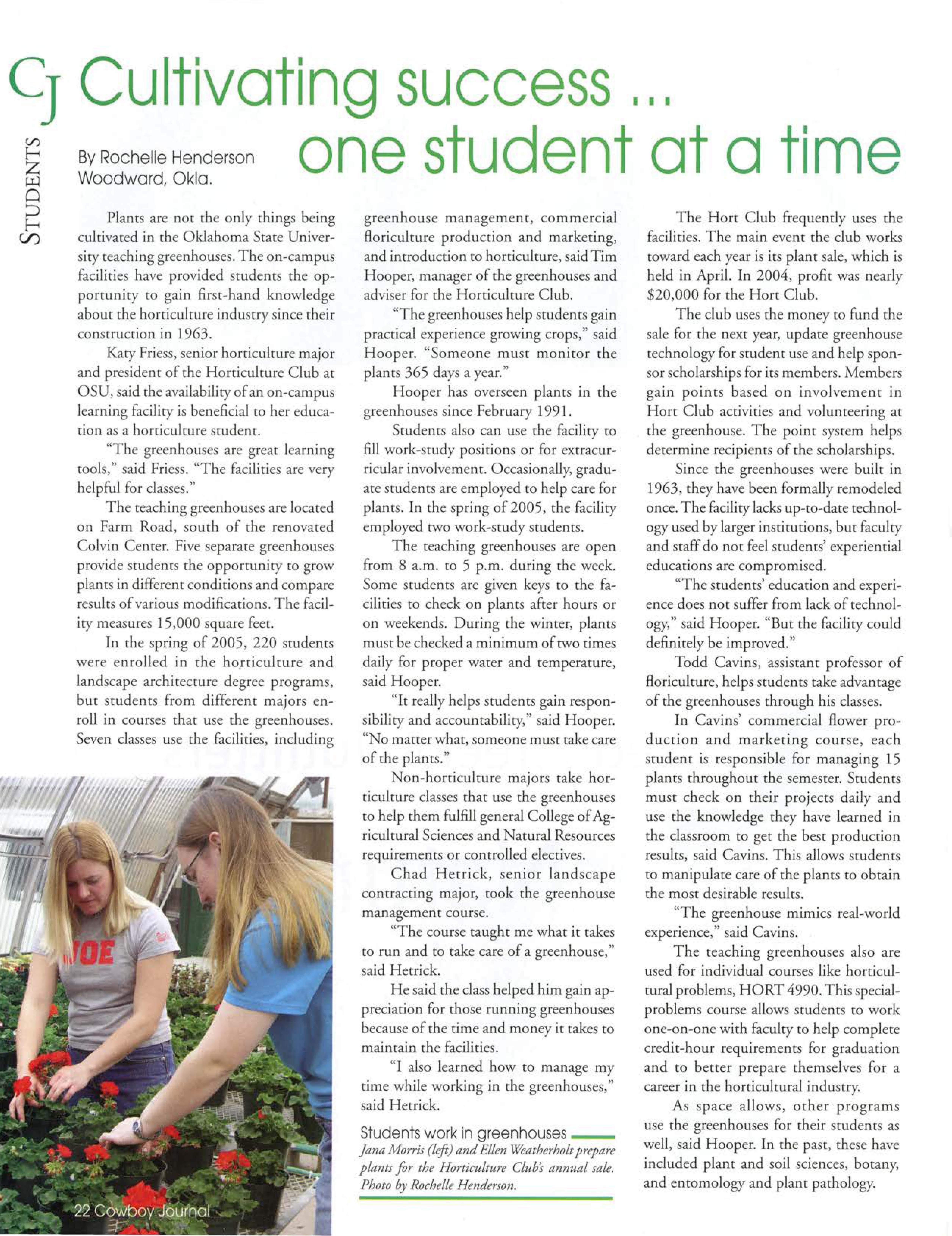
Studentswork in greenhouses _ Jana Morris(left)and Ellen Wearherholtprepare plants far the HorticultureClub'sannual sale. Photoby RochelleHenderson.
The Horr Club frequently uses the facilities. The main event the club works coward each year is its plant sale, which is held in April. In 2004, profit was nearly $20,000 for the Horr Club.
The club uses the money co fund rhe sale for the next year, update greenhouse technology for student use and help sponsor cholarships for its member Member gain points based on involvement in Hore Club acrivitie and volunteering at che greenhouse. The poinc system helps determine recipients of the scholarships.
Since the greenhouses were built in 1963, they have been formally remodeled once. The faciliry lacks up-co-date technology used by larger institution , but faculry and staff do not feel srudencs' experiential educations are compromised.
"The students' education and experience does nor suffer from lack of technology," said Hooper. "Bur the faciliry could deli.nicelybe improved."
Todd Cavins, assisranr profe sor of floriculture, helps students take advantage of rhe greenhouses through his classe . In Cavins' commercial flower production and marketing course, each student is responsible for managing 15 plants throughout the semester. Srudenrs must check on their projects daily and use che knowledge they have learned in the classroom to get the best production results, said Cavins. This allows srudenrs to manipulate care of che plants co obtain the most desirable results.
"The greenhouse mimics real-world experience," said Cavins.
The teaching greenhouses also are used for individual courses like horticultural problems, HORT 4990. This specialproblems course allows students to work one-on-one with faculty to help complete credit-hour requirements for graduation and to better prepare themselves for a career in the horticulrural industry.
As space allows, ocher programs use the greenhouses for their srudenrs as well, said Hooper. In rhe pasr, che e have included plant and soil sciences, botany, and entomology and plane pathology.
"My favorite pan of rhe week is coming our to rhe greenhouses for my classes," said Ellen Wearherholr, a junior majoring in horriculrure.
Weatherholt erved as Horr Club Agricultural Smdent Council represenrative during the 2004-2005 school year.
She did not have the opportunity to gain experience working in a greenhouse until she came co college. Wearherholr said gaining experience by working in rhe greenhouses has helped her bener understand che horticulcural industry.
Douglas eedham, profe or of floriculture and extension 4-H and youth programs, said the greenhouses are essential ro reaching horriculrure students skills they will use in the business world. ales and markering, problem solving, critical thinking and greenhouse management skills are developed through the hands-on learning experience afforded co srudencs through che use of the teaching greenhouses, he said.
The reaching greenhouses al o are used for the annual ScareFFA Floriculture Career Development Event. This helps fulfill the exten ion outreach initiatives of the college and develops interest in the 0 U horticulture program from potential students. Before the contest, chapter can visit the greenhouses to hone their skills for the competition, said Hooper.
Hooper said the greenhou es are imponanr to students' educations because they allow them to "find out what rhe horticulture industry is really like." He said he works directly with students and their projects in rhe greenhouses daily.
Jana Morris, senior horriculrure student, cares for plants in the greenhouses.
As vice president of the Horr Club, Morris organize the club's annual plant sale. Morris said she volunteer in the greenhouses up ro IO hours each week.
A rhe sale gees closer, she spends her spare rime helping prepare for different elements of rhe sale.
"The plant sale is really rewarding," said Morris. "Our hard work pays off."
Friess said she sometimes finds her work helping prepare plants for the club's annual sale a fun experience.
"It is good therapy to propagate and care for planes," said Friess. "The process can be very rewarding."
Hooper said a valuable learning cool of the greenhouses is rhey allow students to encounter and work through problems
Plantingseeds
Seedsare an importantpart of the horticulturalindustry.At Oklahoma State, seedshelp developplants, as well as studentsand faculty. Photo by RochelleHenderson. like fungus, insects, soil issues and water management. tudenc muse learn how to "get out of trouble" when adverse conditions arise, he said.
One day a rudenr' plane can be growing well, said Hooper, but by the next day, the plane could be wilred.
"It i really trial and error," aid Morris. "You muse try differenc strategies to find what works best for each plane."
Before gaining experience in rhe greenhouses, students do not realize what is involved with growing a crop, said Hooper. Once they complere their course work, srudencs gain an appreciation for the projects they have completed, he said.
Cavins said the horticulture degree program also requires a rhree-monch internship that help further prepare upcoming graduates co encer the business world. Ar firsr, rudenrs may nor realize the benefits of the greenhouses, bur they appreciate the experience lacer, he said. o matter the background, age or major of the rudents gairting first-hand knowledge through their use of the teaching greenhou es ar O U, one rhing is certain: rudents are able to cultivate their occupational skills to improve their qualificarions when ir comes to finding a fulltime job in the horticultural industry. CJ
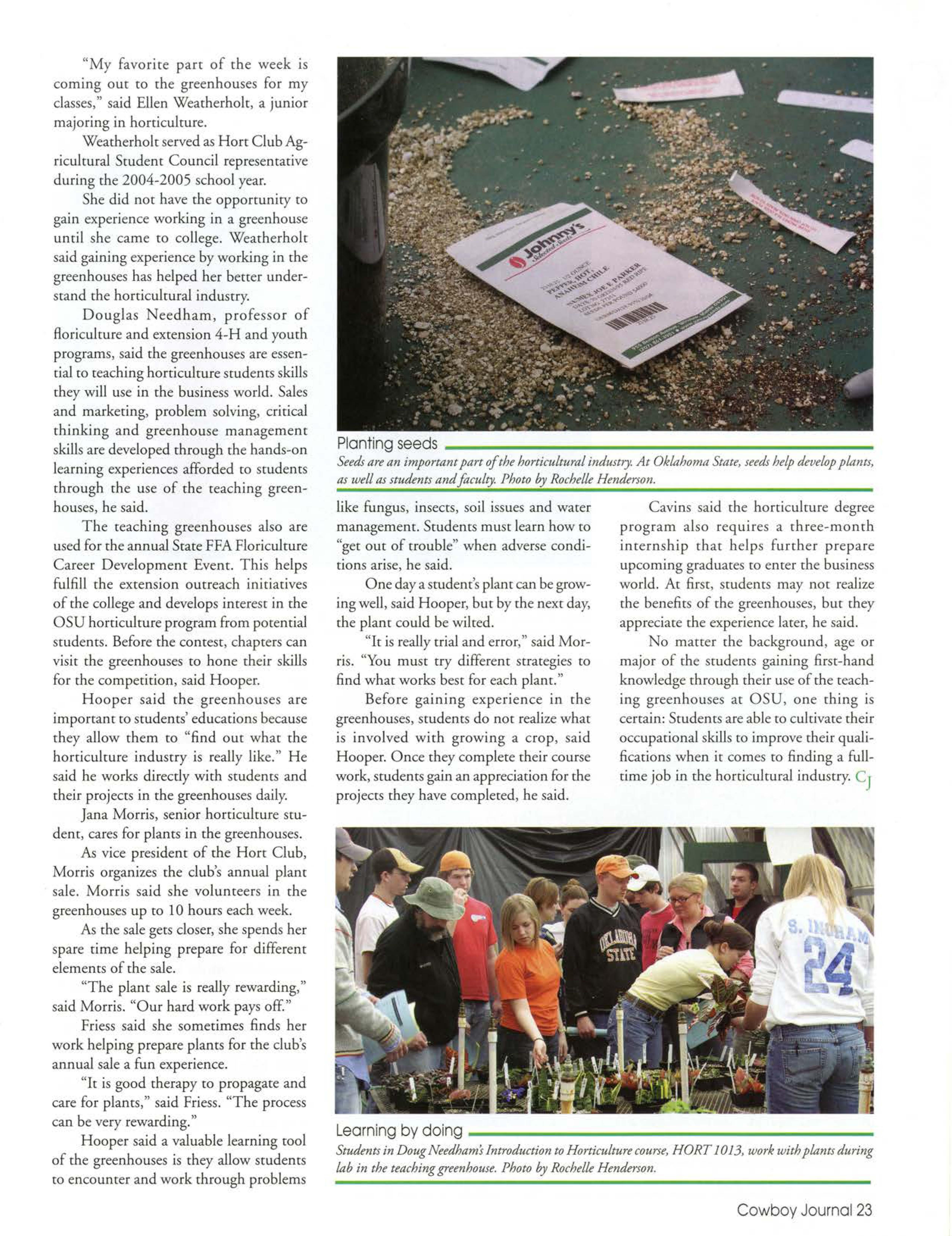
Learningby doing--------------------Studentsin DougNeedham'sIntroductionto Horticulturecourse,HORT 1013, work with plants di,ring lab in rhe teachinggreenhouse.Photo by RochelleHenderson.
CJReed playslikea pro
By CourtneyEngland Panama,Okla.
Youput on your uniform, pull up yoiir boots and strap on your helmet, preparing yourselffor a sport of intense,physical endeavor.Yougrip a ma/Letand proceedonto theplayingfield,ridingaflawlessmasterpiece that is readyfor a challenge.
The game begins. Sounds of mallets cracking,horsesrunning and crowdscheering give you strength and determination throughoutthe game.
Youve spent long, rigoroushourstraining a champion to run 100 Jards at 35 milesper hour. You'refilled with adrenaline as hard work and dedicationpay off when your hot-blooded Thoroughbred bumps a 1,000-pound opponentand then stopson a dime to tum and racethe oppositedirection with poise,graceand enthusi.tlsm.
During the excitement, you are constantly aware of defendingopponents,while remainingagileasyou scorethe winninggoal with the swing of a mallet.
Polo is a sport that requires ulrimare skill and ficne from rhe participant and horse. John Luke Reed, a senior in rhe Oklahoma rate University Deparrmenc of Biosystems and Agrirnlrural Engineering, has played polo for three year and is one of rhe first members of O U's polo ream.
"Dana Donaldson got me interested in polo," said Reed. "I was in the OSU Horseman's Association, and he gave a presentation over polo that sparked my interest to learn the game."
Donaldson, who has played polo for more than 46 years, said he was impressed by the imerest the group had in starting a polo ream, especiaHy Reed's interest.
"Luke's first question after the presentation was 'Do we have to wear rho e funky white panes?"' said Donaldson, who works in the petroleum industry. "I rold him you wear white panes co play football and baseball. He then asked me if rhey had ro ride on those funky saddles. I said 'No, you can ride your Western saddle, bur I wager you'll only do it once because you will be singing in the soprano chorus."'
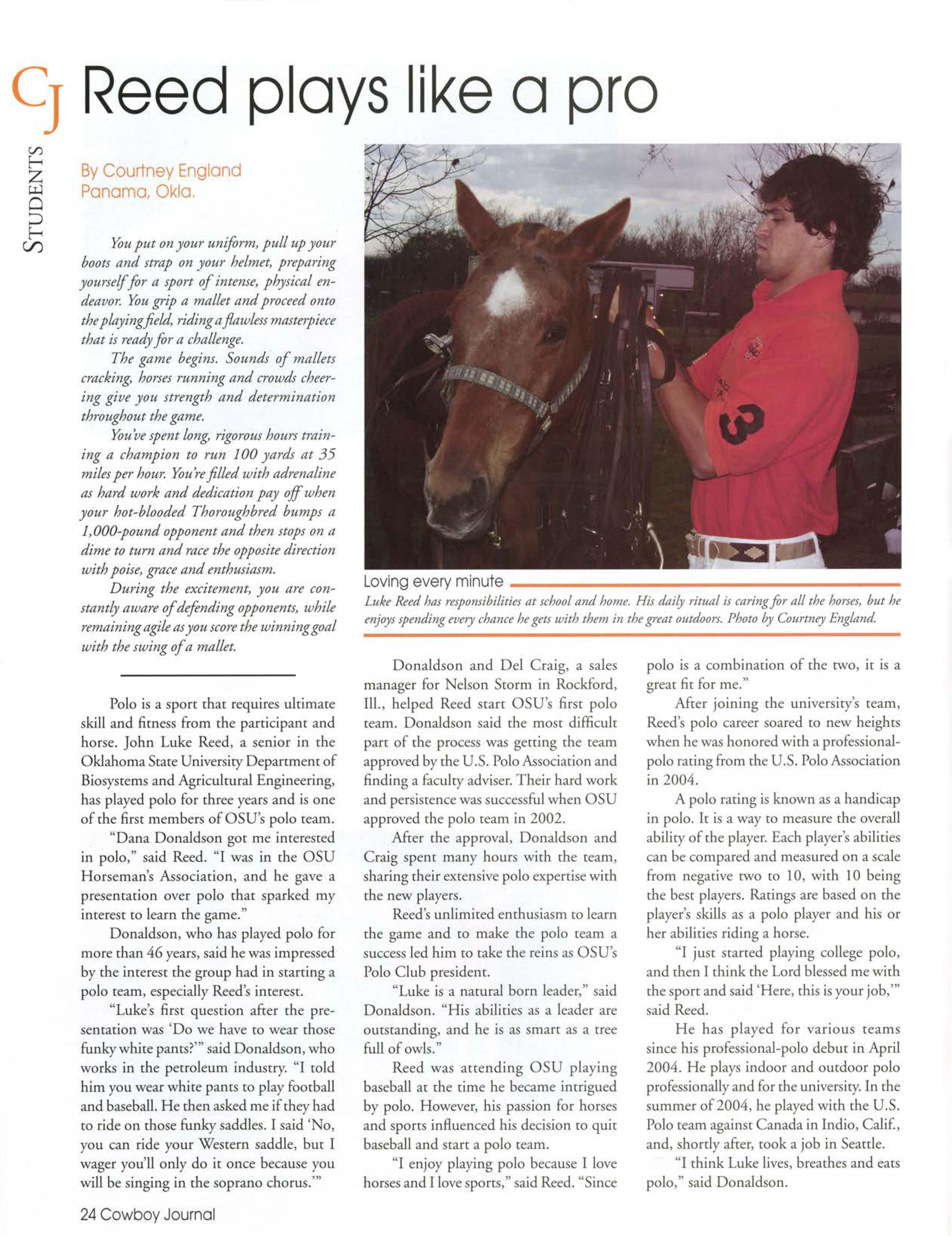
Loving every minute Luke Reed hns respomibilitiesat schooland home. His
enjoysspendingeverychancehe gets with them in the great outdoors.Photoby
Donaldson and Del Craig, a sales manager for elson Storm in Rockford, Ill., helped Reed start OSU's first polo ream. Donaldson said rhe mosr difficult part of the proce was getting the ream approved by rhe U.S. Polo A sociarion and finding a faculty adviser. Their hard work and persistence was uccessfu.lwhen O U approved the polo ream in 2002.
After the approval, Donaldson and Craig spent many hours wirh che ream, sharing their extensive polo expertise with rhe new players.
Reed's unlimited enthusiasm ro learn the game and ro make rhe polo ream a success led him ro rake the reins as O U's Polo Club president.
"Luke is a natural born leader," said Donaldson. 'His abilities as a leader are outstanding, and he i as smart as a tr e fu.11of owls."
Reed was attending OSU playing baseball at the rime he became intrigued by polo. However, his passion for horse and sporrs influenced his decision to quit baseball and cart a polo ream.
"I enjoy playing polo because I love horses and I love spores," said Reed. "Since
polo is a combination of the rwo, ir is a great fir for me."
After joining the university's ream, Reed's polo career soared to new heights when he was honored with a professionalpolo raring from the U Polo Association in 2004.
A polo raring is known as a handicap in polo. Ir is a way to measure rhe overall ability of rhe player. Each player's abilities can be compared and measured on a scale from negative two to 10, with IO being the besr players. Racings are based on the player's kills a a polo player and hi or her abilities riding a horse.
"f just starred playing college polo, and then I rhink the Lord blessed me with rhe porrand aid 'Her, chis i your job,"' said Reed.
He has played for various reams since his profes ional-polo debut in April 2004. He plays indoor and outdoor polo professionaHyand for the university. 1nthe ummer of 2004, he played with the U.S. Polo ream against Canada in Indio, Calif., and, shortly after, rook a job in Seattle.
"I think Luke lives, breathes and eats polo," said Donaldson.
daily ritual is caringfor all the horses.burhe
CourtneyEngland.
Reed has played wirh numerous teams and has traveled co the Pacific orchwest· Dallas; Fayetreville, Ark.; and Wichita, Kan. Reed was offered the opportunity co play polo internationally bur declined it for ocher jobs in the United Stares.
"I don't have che time co travel internationally right now," said Reed. "I do plan co eventually play polo in Argentina and maybe England.
"I want to go to Argenrina more than anywhere because rhac i che best polo in che world. Probably 98 percent of che coprated players are from Argentina."
Reed said he has enjoyed his experiences traveling the country. During the summer of 2004, he played in eight state he had never visited.
"I have had the time of my life traveling around the United tares," Reed aid. "I have seen r:hingsI had never seen before. In eatcle, I thought it was cool char I had to cake the horse across the Puget ound on a ferry."
Even chough Reed said he enjoys traveling rhe country, he remain an Oklahoman at heart.
The son of Brian and Gwyn Reed, the 23-year-old grew up in Guymon, Okla., where hi family was in the carrle business. During high school, he worked on a ranch where some of his responsibilities included mending fence, doctoring cattle and - hi favorite - riding horses.
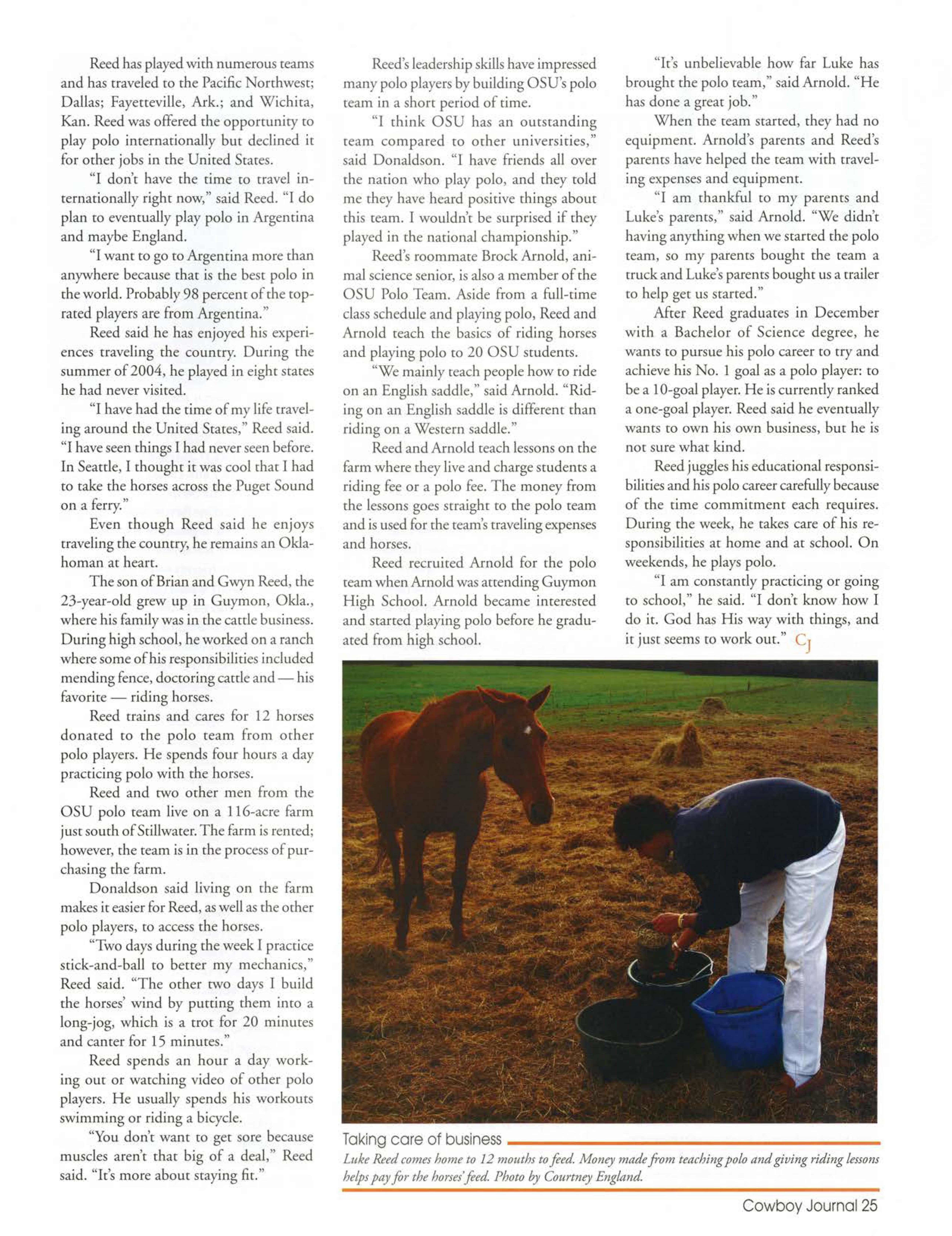
Reed trains and cares for 12 horses donated to the polo ream from other polo players. He spends four hour a day practicing polo with che horses.
Reed and two ocher men from rhe OSU polo team live on a 116-acre farm just south of Stillwater. The farm is rented· however, rhe ream is in the process of purchasing the farm.
Donaldson aid ]jving on che farm makes it easier for Reed, as well as the other polo players, co access the horses.
"Two days during che week I practice stick-and-ball ro berrer my mechanics," Reed sajd. "The ocher two days I build the horses' wind by putting chem into a long-jog which is a trot for 20 minutes and canter for 15 minutes."
Reed spends an hour a day working out or watching video of other polo players. He usually spends his workouts wimming or riding a bicycle.
"You don't want to get ore because muscles aren't chat big of a deal," Reed said. "Ir's more about staying fie."
Reed's leadership skills have impressed many polo player by building O U's polo ream in a shore period of time.
"l chink O U has an outstanding ream compared to ocher universiries," said Donaldson. "l have friend all over the nation who play polo, and they told me cl1eyhave heard positive things abour chis team. I wouldn'r be surpri ed if rhey played in che national championship."
Reed's roommate Brock Arnold, animal science senior, is also a member of the 0 U Polo Team. Aside from a full-rime class schedule and playing polo, Reed and Arnold reach rhe basics of riding horses and playing polo ro 20 OSU srudencs.
"We mainly reach people how to ride on an English saddle," said Arnold. "lliding on an English saddle is differenc than riding on a We tern addle."
Reed and Arnold reach le on on the farm where rhey live and charge scudenrs a ridjng fee or a polo fee. The money from the lessons goe srraighc to the polo ream and is used for che team's traveling expen es and horses.
Reed recruited Arnold for che polo ream when Arnold wa attending Guymon High School. Arnold became interested and started playing polo before he graduated from high school.
"Ir's unbelievable how far Luke has brought the polo ream," said Arnold. "H has done a great job."
When che ream scarred, rhey had no equipment. Arnold's parents and Reed's parencs have helped the team wirh traveling expenses and equipmenc.
"I am rhankful co my parents and Luke's parent ," aid Arnold. "We didn't having anything when we Started the polo ream o my parents bought the ream a truck and Luke' parenrs boughr us a rrailer ro help get us starced."
Afcer Reed graduates in December with a Bachelor of Science degree, he wanes ro pursue rus polo career to cry and achieve his o. 1 goal as a polo player: ro be a I 0-goal player. He is currencly ranked a one-goal player. Reed said he eventually wanes to own his own business, but he is nor sure what kjnd.
Reed juggle hi educational respon ibiliries and his polo career carefully because of che rime commitment each requires. During che week, he rakes care of his responsibilitie ar home and at chool. On weekends, he plays polo.
"I am constantly practicing or going to chool," he aid. "I don't know how I do it. God has Hi way with things, and it jusc eems co work our." c1
T»inqstodoatosu
ByJamie King Tiffin,Ohio
"These are the be t year of your life" is a scacemenc often heard by college student Bue how do you actually make che most of your time spenc at O U?
Oklahoma A&M College began in 1890 a the land-gram in cirution in Oklahoma. It was renamed Oklahoma Scare University in I 957. ince 1890, many uaditions have grown and evolved co make the Stillwater community and O U campt1s a place truly rich in tradition.
Through rhe help of alumnj and student , the Cowboyjournal has compiled a list of che places co visit in Stillwater, OSU cradirions and how co have the best experience during your rime at O U. This list is in no particular order, bui make sure you cry co accomplish a many of the items as possible ro have the true ''Cowboy" experience.
I. Explore everything che tudenc Uruon has to offer; you never know what you will find.
2. Tour Old Central to understand the history of OSU.
3. Hang our at Theta Pond.
4. Attend Cowboy sporting events.
"CoUJbn-yspo11i11ge11mt.r r1reti gr,·at clumu to show yom· school spirit while hnngi11g ow with fiends, especiallydu,·i11gfootbn/1 anti mm's basketbt11lgames."- ]llke Dooley. tl:(tic11ltura!eco110111ics,r/11n11111.r'05
5. BrowseHeritage Hall, the OSU spores museum, in Gallagher-Iba Arena co learn about Cowboy spores.
6. Try ro oucsmarr the parking officials by parking at Agricultural Hall all day and not getting a cickec or by parking ar a "failed" merer.
7. Gain rhe "freshman 15" from all the great restaurants and establishmenrs in Stillwater.
Homecoming
8. Experience che "Grearest Homecoming Celebration on Earth" and all rhe activities rhar surround che week.
9. Play some games at rhe Homecorrung Harvest Carnival.
10. If you are in a fraternity or sorority, spend hours (and hours and hours) pomping for house decorations.
11. Attend Walkaround on Friday night before che game and look at all the house decorations.
12. Attend rhe Cowboy Craze Pep Rally in the stadium.
13. Watch rhe Sea of Orange Homecoming Parade Saturday morning.
14. Cheer for che Cowboy football ream during the game.
15. Work off some of the freshman (or sophomore, junior or seruor) 15 ar the Colvin Center.
I 6. Have pizza delivered to your residence berween the hours of 11 p.m. and 3 a.m.
17. Browse through all the books, CDs and movies ar Hastings.
18. Gee a coney and cheese roesac Coney Island on rhe Srrip.
19. Warch Varsity Revue and Freshmen Follie wirh a group of friends.
20. Camp our for hours (or days) wirh all of your friends ro be che first one into a men's basketball game.
21. Undersrand all of the common Cowboy terms: Bedlam, Bullet, Spirit Rider, Pistol Pere, The Walk, Waving Wheat and OSU Spirit Run.
22. Gee an internship (or rwo).
"Nor 011/y t/g i1rtrrnshipslook g,ml 011 ti resum!, bur n!so internship.rro111ai11nuu~J' benrjits far ,, st111/ent.Throitgh 111)'first iritamhip. I wrlfable to hecomr4cq1mintul u•ith 11 pmfl:ssionnlwork e,wiromni>nta11d get 11 l11ma1111dtrsf{lfu/ing of what I fei:I I wordd like to .pend dw rest of n~ylife doi l{g." - Amber ll,mglm, agribwi,ms rmtl mnrkni11g,minr
23. Donare blood ac one of rhe many blood drives on campus.
24. Acrend Orange Peel.
25. Play pitch or dominoes wich your friends berween classes.
26. Catch up with the "ag crowd" while eating ac che Dairy Bar.
27. Charge just about anything co your bursar account.
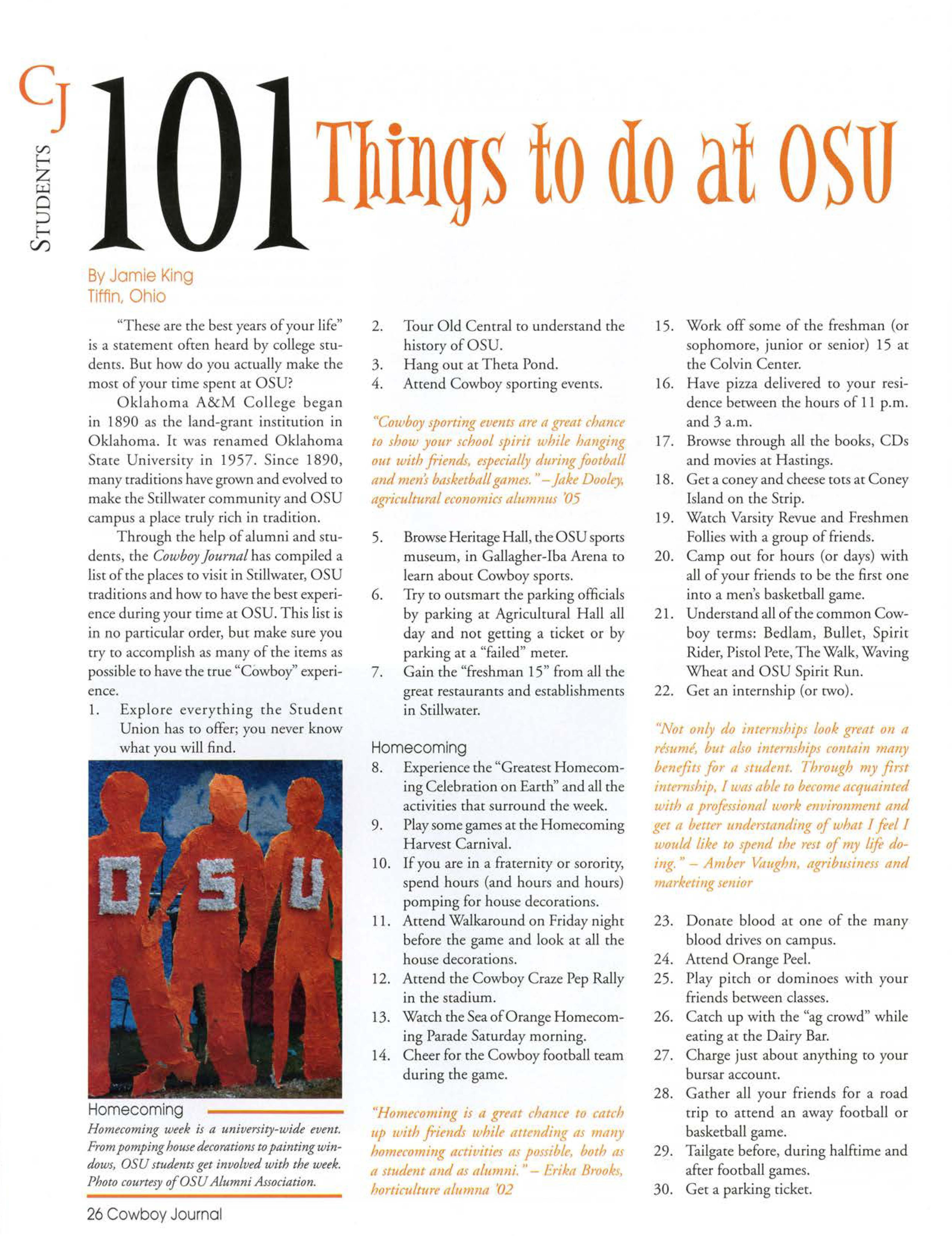
Homecoming week is a university-wideevent. Frompompinghousedecorationstopainting windows, OSU stlldentsget involvedwith the week. Photocourresyof OSU Alumni As,ociation.
"Ho1111:comi11g is ti gr,•,rf ch,111n•ro catch up ,uith friends while ,mrndi,1g as 1l1tlll)• hnmrcom;1lg,rcrivitirs,u posrible. b(}th m n studmt ,md rlS ,d1mmi." - 1-'rik({Bmok , bonicr1/tmY'tllrmm,1'02
28. Gather all your friends for a road trip to atcend an away football or basketball game.
29. Tailgate before, during halftime and after football games.
30. Gee a parking ticket.
Stillwater dining
OS U studentsspenda lot of time eatingat all the greatrestaurantsin.Stillwater.FromMexicanto seafoodtopizza to barbecue,Stillwaterhasit all.
Photo byJamie King.
31. Try ro appeal rhe parking ticket.
32. Continue co ger more parking tickets, forger ro pay them and gee a "boor" on your vehicle.
33. Walk around Boomer Lake.
34. Join a city softball league.
35. When it is warm enough, catch some rays, relax and swim at rhe Colvin Center's pool.
36. ee a movie ac rhe Srudenr Union.
37. Play sand volleyball on campus.
38. Sir ourside of rhe library when classes change and watch all rhe people.
39. Go to Wal-Marr ac 5 p.m. alongwich every ocher person within 25 miles of the Stillwater city limits.
40. ext rime go to Wal-Mart at 2 a.m. and compare rhe difference from your 5 p. m. experience.
41. Join and be active in one (or more) srudenr organizarions on campus.
nStndmt mgani.z.atiorzsgjvt· .rtudentJ>n{lny opportzmitir?:,that they otherwfre would nor be able to h,we, lik1•the opportu11iiyro m11,1e/around the nr1ti.ori llrry inexpensi11elv to go ro conj"e11ces.Aiso, being i1111oived in swdr,lf organizations ,dlows you to make mtlll)' closefiimds who are t11kingthe same cfnssesrmd a,-einterestedin simil11rthi11gs. » -Justin AfrConaghy.agriculrrmrleconomics rmd flgricuitumleducr1tionunfor
42. Go bowling at Froncier Lanes.
43. Read rhe O'Colly and check out your daily horoscope.
44. Ear free pancakes at the rudenr Union during finals week.
45. Gather up all your friends once a week to warch a TV show, rotating houses each week and cooking dinner and desserr for each orher.
46. Park in the very las row of rhe overflow parking lot and wonder why you bought a silver Joe parking pas
"\f/ho needs to go to the Colvinfar exercise 111hen )'OIi get 11/lthe exerciseyouneedu.i11lking from the kl.Strow of m•erflom" - }11/it.1Burnett, a!{1·irnftu.mf eco11omicsalumntl '00
47. Voce during Student Government Association elections.
48. rudy abroad.
49. Play an incramural spore.
50. er foor inside che Edmon Low Library at least once as a student.
51. Get lose inside rhe library because it is the first time you ventured into it.
52. Enjoy Lake Carl Blackwell by swimming, water skiing, fi hing or hor eback riding.
53. Ride "The Bus" at lease once.
54. Chalk a message for your student organization on rhe sidewalk.
55. Actend one of Preacher Bob's "classes" on rhe library lawn.
56. Bike at Lake McMurcry.
57. Enjoy all rhe live music Stillwater has to offer.
"Reddirt mwic is real to what happens in Stillwam: Just lisrming to che m,uic brings back!{1·eatmemoriesof attending Oklahom11 State UniversitJ•."- jean Bond. agricrdtuml educationalumna '03
58. Find an issue ro feel strongly about and write a letter (or cwo) about it to rhe O'Colly.
59. Learn all rhe words to "Ride 'Em Cowboys" and "Alma Mater Hymn."
60. Wear orange on Fridays and any day OSU plays OU.
61. Try to finish the crossword puzzle in rhe O'Colly.
62. Visit rhe famous "Strip" during rhe evening hours.
63. ar some cheese fries and buy a T-shirr ar Eskimo Joe's.
64. Eat at the rest of The Fab 4 Restaurants (Mexico Joe's, Joseppi's and Stillwater Bay) bur nor necessarily all at one time.
65. Ear barbecue ar Bad Brad's.
66. Enjoy some frozen custard or ice cream from Shake's.
67. Volunteer some of your time at rhe Stillwater Humane Society.
68. Buy somerhing from rhe tillwarer auction channel.
69. Be a pare of rhe piric Walk before home football games.
70. Eat some great Mexican food and enjoy rhe atmosphere ar El Vaquero.
71. Attend a Bedlam sporting event.
72. Go co a football bowl game or a basketball toumamenc game.
73. Live in che residence halls for ar least one year.
74. Enjoy off-campu housing.
75. Play practical jokes on your friends or roommates becau e it is a good way ro postpone studying for a few hours.
76. Explore che srores and resraurams in down town Stillwater.
77. Try our your golf swing at some of rhe local courses.
78. Appreciate rhe low cost of rarnen noodle and macaroni and cheese.
79. Gee some home cooking at Mom's Place wirh your friends.
80. Watch at least one men's basketball game in Gallagher-Iba, voted as America's o. 1 basketball arena by hrcp:/ /www.cbs.sporcsline.com.
81. Almost gee hit by a car in a crosswalk because rhe driver didn't see you crossing rhe street.
82. Berhe driver who almost hits a pedesrrian because you didn't see them.
83. Attend a wrestling match.
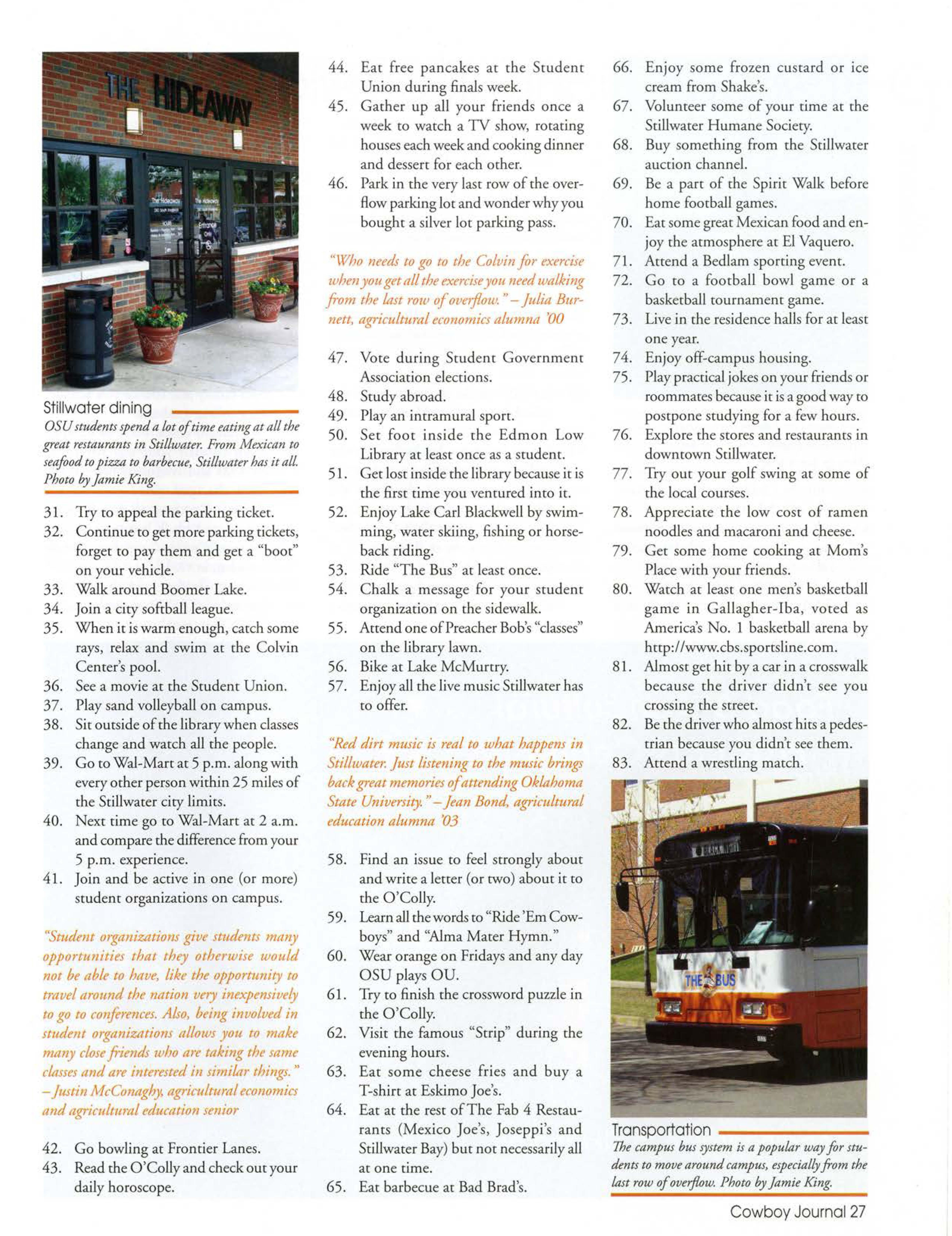
Transportation
Thecampusbussystemii a popularwayfor studentsto movearoundcampus,especiallyfrom the lastrowof overflow.PhotobyJamieKing.
OSULibrary
1heEdmonLow Libmry is a buildingall ,tudents should visit becauseit isfull of usefal resources.
Photo byJamie King.
84. Tour the Oklahoma Botanical Gardens and Arboretum.
8 5. Have some sort of computer problem that will require the Information Technology Department's help.
86. Collide wich a biker because you didn't realize you were walking in a bike path.
87. Buy and use an All Spores Ticket.
88. wallow your pride and visit the Smdem Heal ch Cenrer when you are so sick you can barely get our of bed.
89. Visit your academic advi er; he or she will have good advice for you.
"The CASNR fi1cul~l'a/1'some of rhe mosr helpfulpeople1111cmnpm,md gnum1ely1 Jl'tl/// swdmts to /;,we the hest exp, rimer po,;ih/e 11i/1ile ,fl osu. U,r )'OUr ,u/1,i er for more rh,mjusr gerting clearedto mro/1. U11:J'are n gretlt resourcefar pocemillljobs, swmner iJJtemships,ad11icrfar s111·eeedi11g in cl,wes or schoolsponsoredst11t{J 1 t1hro,rt/" - Am_Y 1Vo/ftey,,mimal sciences,t!um11,1 '04
90. Actually buy the textbooks and macerials chat are required for your classes one semester.
91. Try to sell those books back at the end of the semester and cry when you learn rhere are new editions or the $80 book i now only worrh $5.
92. Visit OSU and CAS R Career Services to learn the skills you need to get a "real" job.
93. When, and i£ it snows, gather up aJI your friends and have a massive snowball fight.
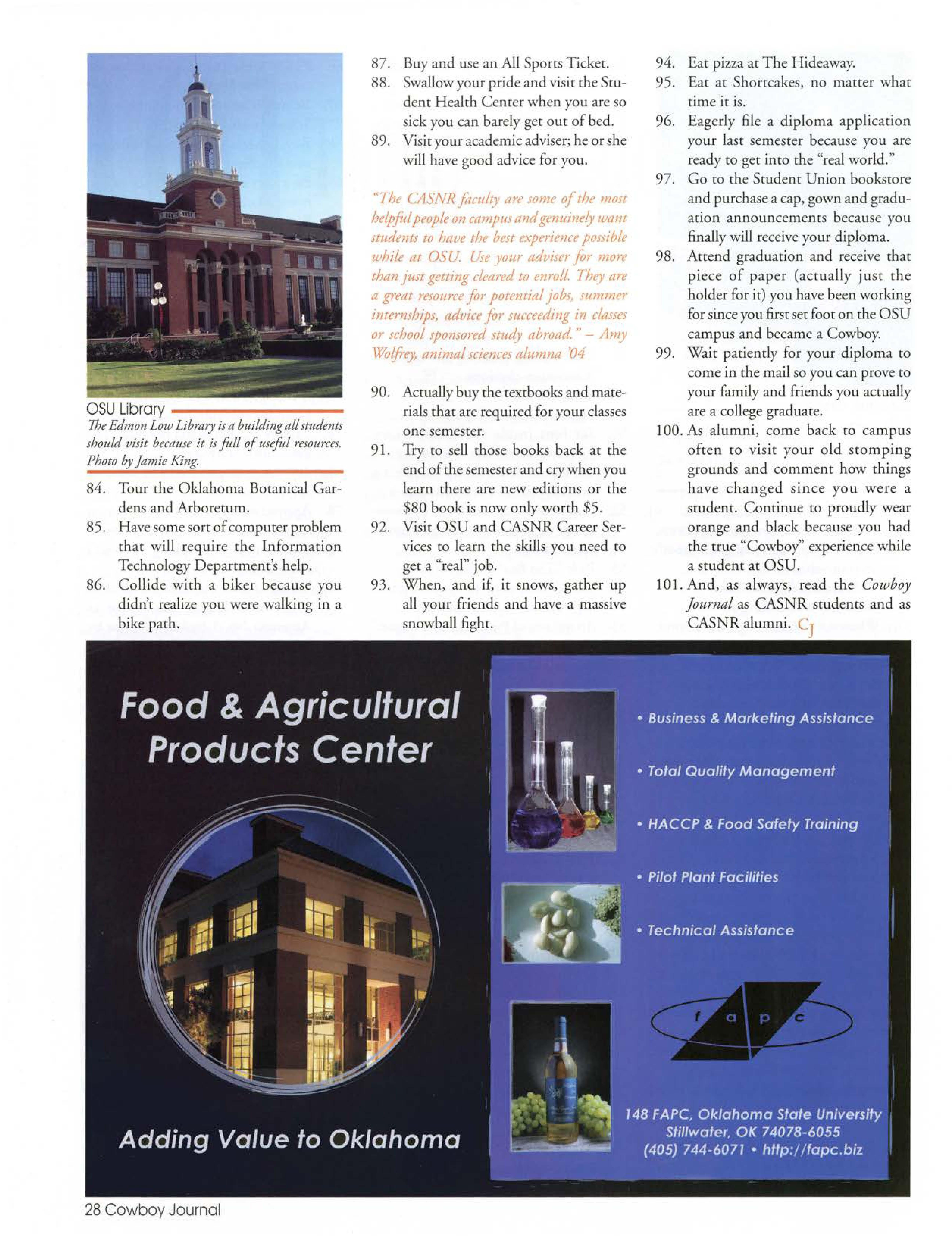
94. Eat pizza at The Hideaway.
95. Eat at hortcakes, no matter what nme 1c 1s.
96. Eagerly file a diploma application your lasr semester because you are ready tO get imo rhe "real world."
97. Go to the Srudenc Union booksrore and purchase a cap, gown and graduation announcements because you finally will receive your diploma.
98. Actend graduation and receive that piece of paper (actually just the holder for it) you have been working for since you first set foot on the OSU campus and became a Cowboy.
99. Wair patiently for your diploma to come in the mail o you can prove to your family and friends you actually are a college graduate.
100. As alumni, come back to campus often co visit your old sromping grounds and comment how things have changed since you were a student. Continue to proudly wear orange and black because you had the true "Cowboy" experience while a srudenc ac OSU.
101. And, as always, read the Cowboy Journal as CAS R students and as CASNR alumni. CJ
Makingcollegefinancingeasier
By Megan Pfeiffer Mt Vernon, Ind.
"I don't think I can afford copay for collegetuition."
Wirh the rising cosrs of college tuition, this is a common phrase unered among prospective college srudenrs, bur there are many ways ro change this negative attitude.
Federal srudem aid is available ro smdenrs whose parencs cannot afford ro pay for their child's college tuition.
The use of financial aid i not uncommon in today's growing studenr body. Many students take advantage of governmenc programs co help them achieve their educational goals. At first, financial aid applicarions can seem overwhelming, bur, fear not, they are easy ro fill out.
"It cook me 30 minutes to apply for financial aid using the Internet," said Jackie Walther, 2004 Oklahoma Stace University animal science/biorechnology graduate. tudenc financial aid is money the government provides you to pay for cuition, books, costs ofliving, transportation and other expenses you may incur while in college. tudenrs can receive federaJ student aid in the form of scholarships, grants, work-srudy funds and loans.
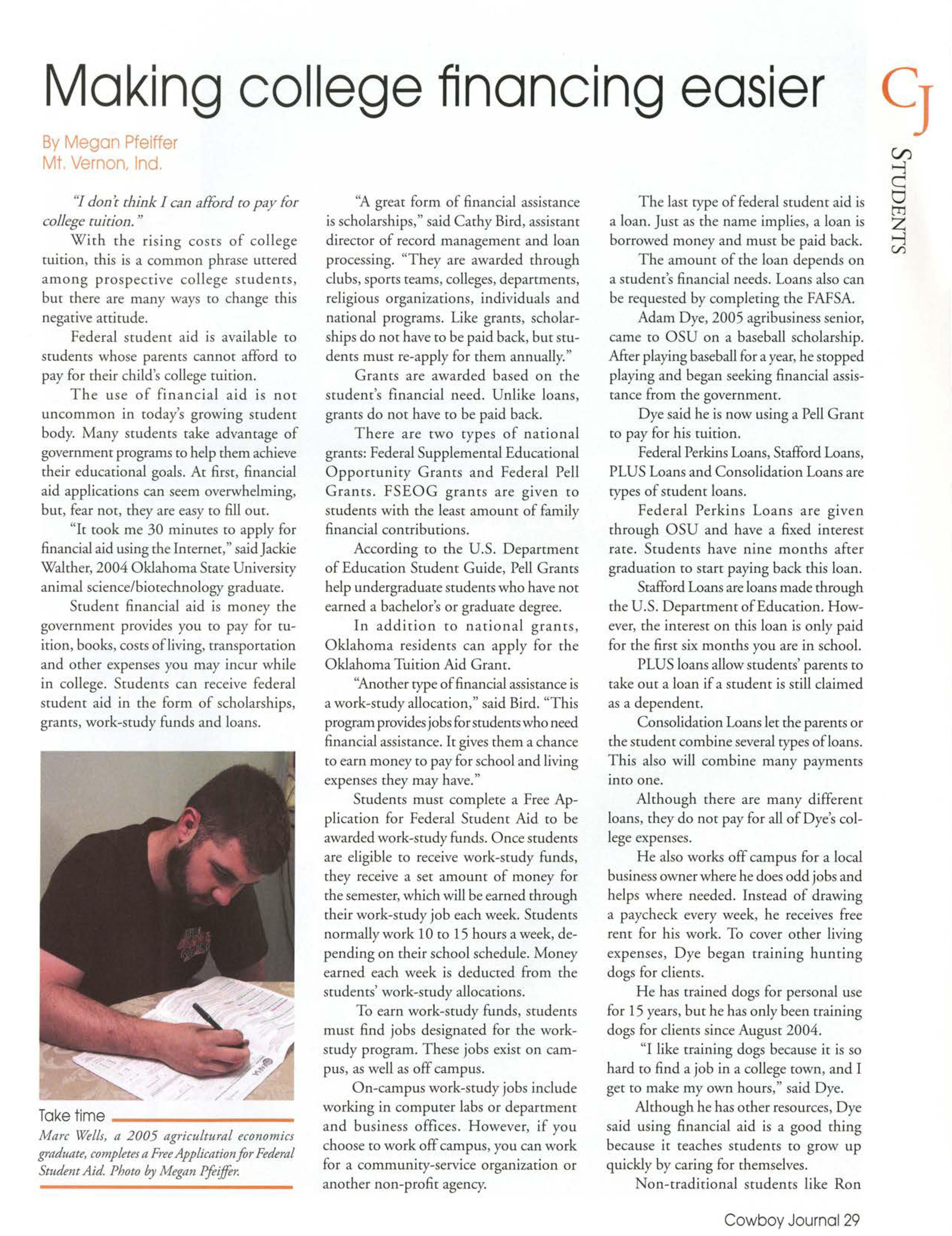
''A great form of financial assistance is scholarships, ' said Cathy Bird, assisranr director of record management and loan processing. "They are awarded through clubs, spores reams, colleges, deparnnencs, religious organizations, individuals and narional programs. Like grants, scholarships do not have robe paid back, bur srudents must re-apply for them annually."
Granes are awarded based on the srudenr's financial need. Unlike loans, grants do not have to be paid back.
There are cwo cypes of national grants: Federal Supplemencal Educational Opporrunicy Granes and Federal Pell Grants. FSEOG grants are given to students with the least amount of family financial conrribucions.
According co the U.S. Department of Education Srudenr Guide, Pell Grants help undergraduate students who have not earned a bachelor's or graduate degree.
ln addition to national grants, Oklahoma residenrs can apply for the Oklahoma Tuition Aid Grant.
''Another rype of financial assistance is a work-srudy allocation," said Bird. "This program providesjobs forstudenrswho need financial assistance. Ir gives chem a chance to earn money to pay for school and living expenses they may have."
Srudencs musr complete a Free Application for Federal Student Aid ro be awarded work-scudy funds. Once scudencs are eligible co receive work-study funds, rhey receive a set amounr of money for the semesrer, which will be earned through their work-study job each week. Students normally work l O ro 15 hours a week, depending on their school schedule. Money earned each week is deducted from the students' work-study allocations.
To earn work-scudy funds, students must End jobs designated for the workstudy program. These jobs exist on campus, as well as off campus.
On-campus work-study jobs include working in computer labs or department and business offices. However, if you choose ro work off campus, you can work for a community-service organization or another non-profit agency.
The lase type of federal student aid is a loan. Just as rhe name implies, a loan is borrowed money and mu t be paid back.
The amoum of rhe loan depends on a scudenr's financial needs. Loans also can be requested by completing the FAFSA.
Adam Dye, 2005 agribusiness senior, came to OSU on a baseball scholarship. After playing baseball for a year, he stopped playing and began seeking financial assistance from the government.
Dye aid he i now using a Pell Grant to pay for his ruicion.
Federal Perkins Loans, Stafford Loans, PLUS Loans and Consolidation Loans are types of srudenc loans.
Federal Perkins Loans are given through O U and have a fixed interest rate. Students have nine months after graduation ro stare paying back chis loan.
Stafford Loans are loans made chrough the U.S. Department of Education. However, the interest on this loan is only paid for che first six months you are in school.
PLU loans allow tudents' parents co rake out a loan if a student is still claimed as a dependent.
Con olidacion Loans let the parents or the student combine several types ofloans. Thi also will combine many payments 111ro one.
Although there are many different loans, they do not pay for all of Dye's college expenses.
He also works off campus for a local busines owner where he does odd jobs and helps where needed. Insread of drawing a paycheck every week, he receives free rent for his work. To cover ocher living expenses Dye began training hunting dogs for client
He has trained dogs for personal use for 15 years, but he has onJy been training dogs for cliencs since August 2004.
"I like rraining dogs because ir is so hard to find a job in a college town, and I ger to make my own hours," said Dye.
Although he has other resources, Dye said using financial aid is a good rhing because ir reaches srudenrs co grow up quickly by caring for themselves.
on-traditional students like Ron
Marc Wells, a 2005 agricultural economics graduate, completesa FreeApplication for Fedeml Student Aid. Photo byMegan Pfeiffer.
Erkerralso are puccing themselves chrough college wich che help of financial aid.
Erkerc i no stranger to college life; he earned his Bachelor of cience degree in chemistry from rhe Institute of Mining and Technology at ew Mexico Tech. He al o earned his Bachelor of cience degree in animal science and in veterinary science, a well as a doctorate of veterinary medicine from Texas A&M University. Currently, he is complecing his docrorace in phy iological cience from O U.
"My parents offered rn help me with what lircle rhey could when I began college," said Erken. 'Yer, since my father was between job , I did noc wanr co ask them for help."
Erkerc said he applied for scholar hips which puc him through his first year of college. After the first year, it was hard for him co find scholarships for which he qualified, so he began ro seek help from ocher places.
In his second year of college, he began raking advantage of tudent Loans.
"I liked loans because they have low interest rare and chey allow many people to go to school who may otherwise have nor been able to go," aid Erkert.
When Erkerc scarred his private veterinary practice in Colorado, he began paying back his loan However, since he is in school again, the loan payments are on hold.
Erkerr receives grams for his research in che eqLLinemedical industry, but these
grant mostly give him money to fund cl1e srudy, nor enough to live on. Therefore, he relies primarily on student loan rudenrs like Walther, who have graduated and have been in the workforce for six months, are required to begin paying back their student loans.
Wahher currently lives in rillwater, Okla., where she works for rhe U .. Department of Agriculture.
"Ir is really hard when you are first starring our to chink that you have to save enough money ro pay for your daily living expen es and to pay off your student loans so quickly afrer graduation," aid Walther. "Loan are a good thing because they allow you to focus on school wirhout having to work a full-rime job."
Walther is originally from Colorado, which made her an our-of-state O U srudent. With her excellent grade he acquired a tuirion wavier. This waiver allowed her to receive in-stare tuition, as long as her grades did not fall below a 3.0 grade point average.
A few students cake advantage of financial aid and have a full-time job. Marc Wells, a 2005 agricultural economics graduate, is one of the e students. He worked at Lowe's as a department manager while he was a student.
While in college, he was a manager who oversaw the flooring, appliance and cabinet departments. He worked 50 hours a week while attending 22 hours of classesduring his last
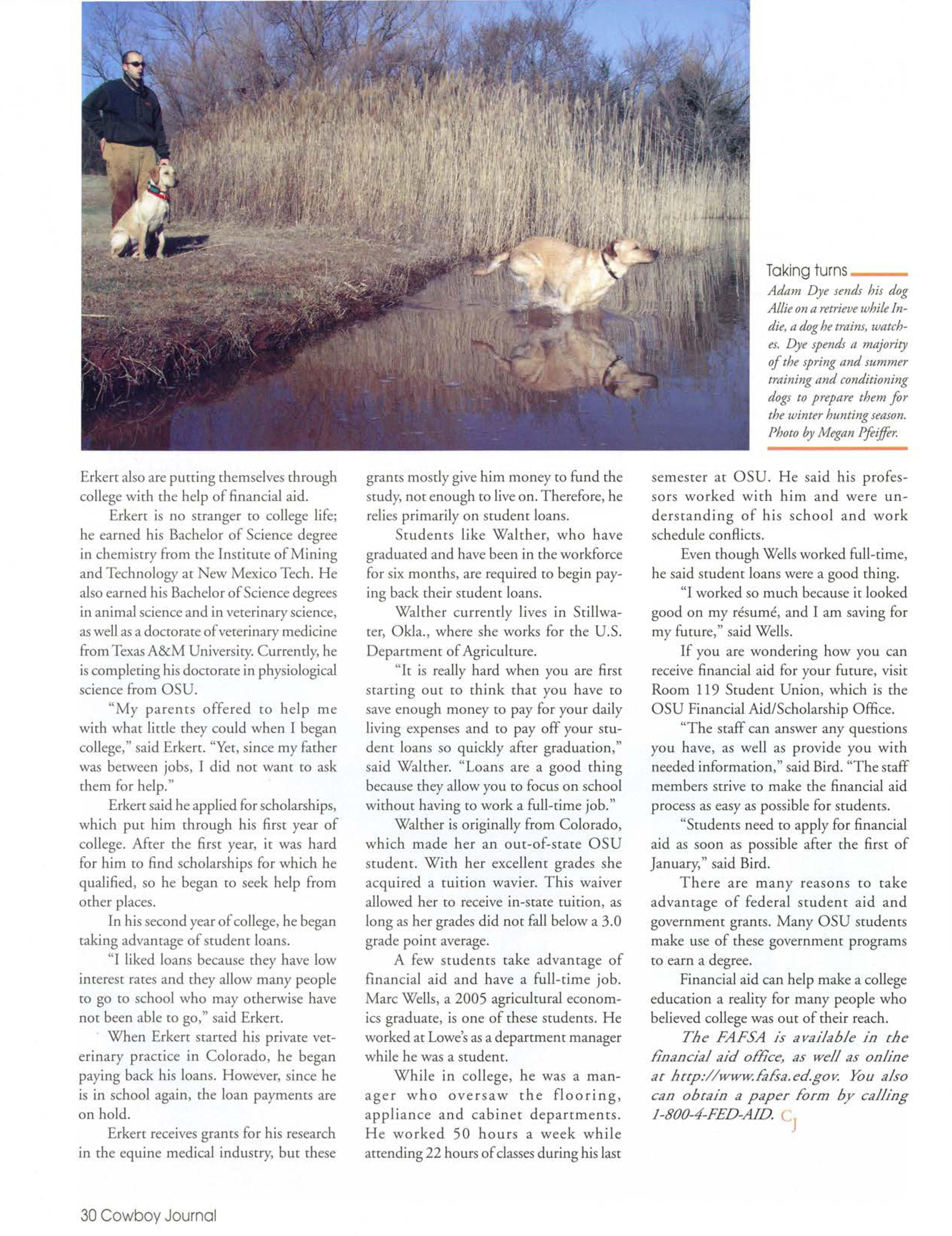
Takingturns---
Adam Dye send,; his dog Allie on a retrievewhile lndie, a dog he trains, watches. Dye spend; 11majority of the spring and summer training and conditioning dogs to prepare them for the winter hunting season. Photoby Meg11nPfeiffer.
semester at O U. He said his professors worked with him and were understanding of his chool and work schedule conflicts.
Even though Wells worked full-time, he said student loans were a good thing.
"I worked so much because it looked good on my resume, and I am saving for my future," said Wells.
]f you are wondering how you can receive financial aid for your future, visit Room 119 Studenc Union, which is rhe 0 U Financial Aid/ cholarship Office.
"The raff can answer any questions you have, as well as provide you with needed information, 'said Bird. "The staff members strive ro make the financial aid process a easy as possible for students.
"Srudenrs need to apply for financial aid a oon as possible after the first of January," said Bird.
There are many reasons ro rake advantage of federal srndent aid and government granrs. Many OSU students make use of chese government programs to earn a degree.
Financial aid can help make a college education a reality for many people who believed college was our of their reach.
The FAF. A is available in rhe financial aid ollice, as well as online ar hrrp:llwww.lafsa.ed.gov. You also can obrain a paper form by calling 1-800-4-FED-AID. l l
OSUstudentssoakup Italy
ByDaraSmith Oklahoma City
Famous for its wine, people, history and beaury, Italy has revealed its innermost secrets to Oklahoma $race University scudenrs during a summer trip. Scudenrs traded in their homework assignments and hours of class rime ro experience Italian culture, history and agriculture.
"Students who go on study abroad feel like ir's che mosr memorable thing done at OSU," said David Henneberry, assistant dean of inrernarional programs in agriculture.
A srudenr can tour Iraly and receive three credit hours in the area of humanities and international dimension for a two-week study, pending all assignment requirements are met. However, rhere is potential to earn up to four credit hours.
On the cour, students visit museums to see famous works of arr, exchange ideas wirh Italian professors and develop an understanding of how Italian culture and hiscory interacr.
Visiting one of che oldest places in che world, students get to see all the big attractions lcaly has to offer like Rome, Venice, Florence and the Tuscany area. The attractions included such greats as the Coliseum, "David" by Michelangelo, inventions by Leonardo da Vinci, the Leaning Tower of Pisa and Italian vineyards. The srudents also compared the cultural and economical differences char exist between northern and southern Italy.
Caro Kauffman, animal science junior, went with a group of 18 in May 2004. She said the trip was amazing.
"[Italy] was so warm and down to earth and the most real experience," said Kauffman. "I couldn't have made a berrer
decision to go because now I have a new perspective on life."
The experiences of traveling to Italy equip srudents with knowledge, networking opportunities and a chance to really see a unique way of living, said Henneberry.
Two professors co-founded chis unique srudy abroad course in 2002. David D'Andrea, assistant professor of history, and Leon Spicer, professor in animal science, head chis project.
D'Andrea's extensive knowledge with rhis fascinating region began wirh his graduate studies. He earned his doctorate in Italian Renaissance history and was a former Fulbright scholar to Italy. He has traveled throughout the country and has developed many professional contacts. D'Andrea is fluent in Italian and continues to study the country.
The importance he sees in Italy is its timeless traditions. Through preserving heir-loom crops, maintaining qualiry and
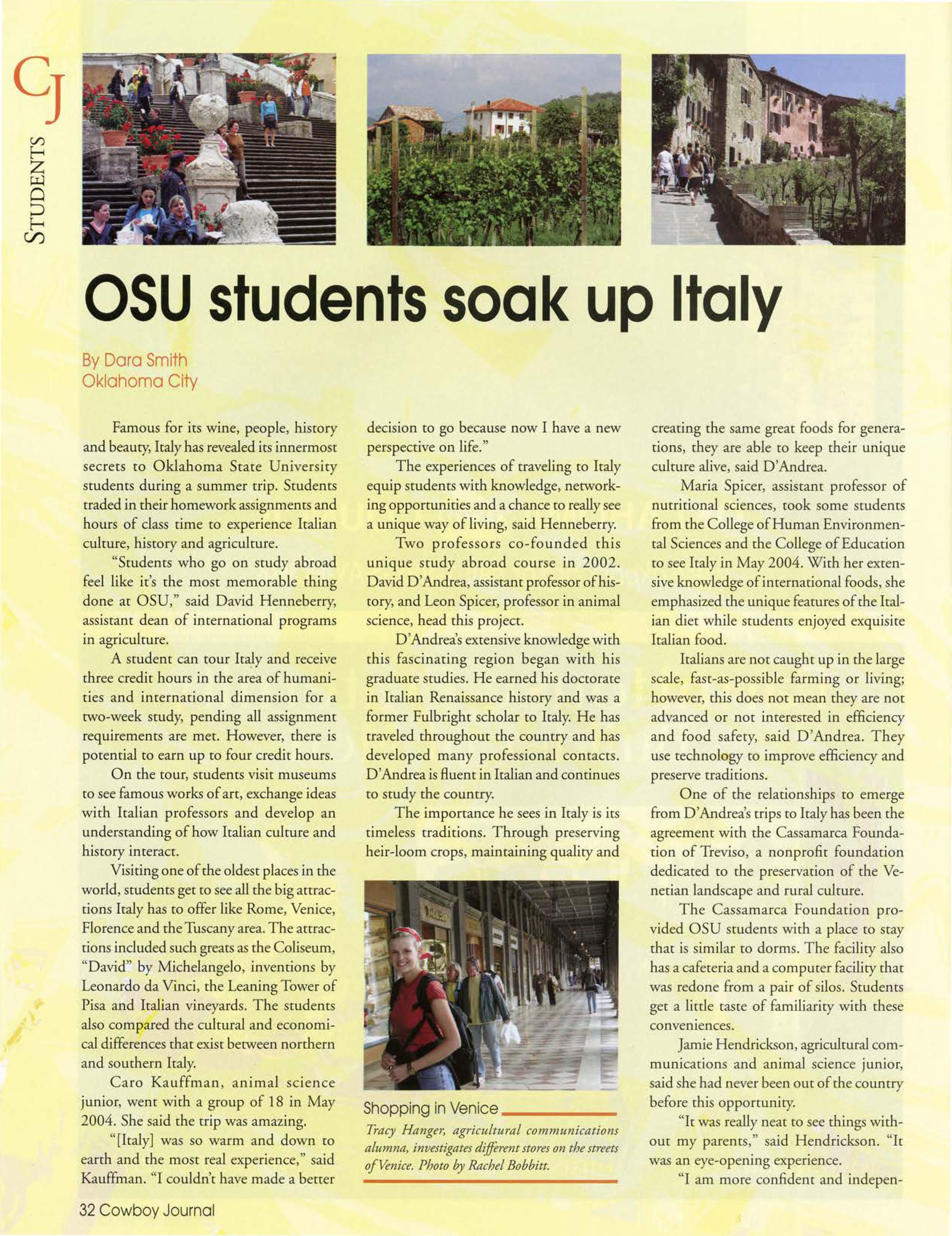
creating the same great foods for generations, they are able to keep their unique culrure alive said D'A.ndrea.
Maria Spicer, assistant professor of nutritional sciences, cook some students from the College of Human Environmental Sciences and che College of Education co see Italy in May 2004. With her extensive knowledge of incernarjonal foods, she emphasized che unique features of the Italian diet while students enjoyed exquisite Italian food.
Italians are not caught up in the large scale, fast-as-possible farming or living; however, chis does not mean they are not advanced or not interested in efficiency and food safety, said D'Andrea. They use technology to improve efficiency and preserve traditions.
One of the relationships to emerge from D'Andrea's trips to Italy has been rhe agreement with the Cassamarca Foundation of Treviso, a nonprofit foundation dedicated co the preservation of the Venetian landscape and rural culture.
The Cassamarca Foundation provided OSU scudenrs with a place to stay char is similar to dorms. The faciliry also has a cafeteria and a computer facility that was redone from a pair of silos. Students get a lirrle caste of familiariry with these conve111ences.
Jamie Hendrickson, agricultural communicarion and animal science junior, said she had never been our of the country before this opporruniry.
"Ic was really neat to see things without my parents," said Hendrickson. "le was an eye-opening experience.
"I am more confident and indepen-
Shopping in Venice
Tracy Hange1; agricultural communications alumna, investigatesdifferentstoreson the streets of Venice.Photoby RachelBobbitt.
dent chan I was before I wenc to Italy," said Hendrickson. "Also, ic was a great addition ro my resume."
Another perk of study abroad through OSU is students always see features a regular person could nor gee through a travel agency, said Henneberry. He also said through connections from professors involved in the trip, students get ro see real life in Italy.
The professional concacts Spicer has at three Italian universities allowed OSU to obtain a memorandum of understanding with each one. When in Rome
A memorandum of understanding is an agreement of a
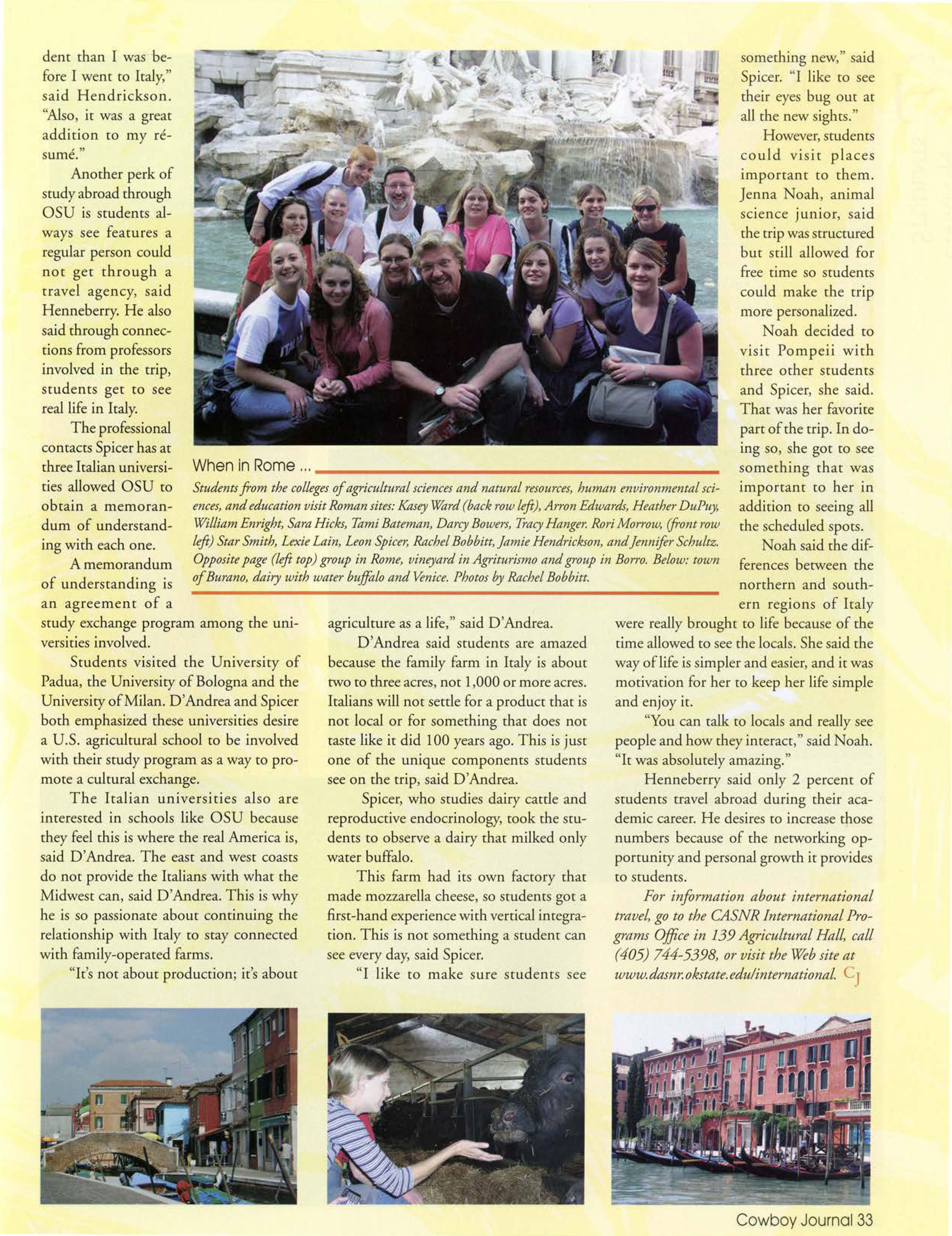
Studentsfrom the collegesof agriculturalsciencesand natural resources,human environmentalsciences,and educationvisitRomansites:Kasey~rd (backrowleft),ArronEdwards,HeatherDuPuy, WilliamEnright,SaraHicks,TamiBateman,DarcyBowers,TracyHanger.RoriMorrow.(frontrow left) Star Smith, LexieLain, LeonSpicer,RachelBobbitt,Jamie Hendrickson,andJenniferSchultz. Oppositepage (left top)group in Rome, vineyardin Agriturismoand group in Borro.Below:town of Burano,dairy with waterbuffaloand Venice.Photosby RachelBobbitr.
study exchange program among the universities involved.
Students visited the University of Padua, the University of Bologna and the University of Milan. D'Andrea and Spicer both emphasized these universities desire a U.S. agricultural school co be involved with their study program as a way to promote a cultural exchange.
The Italian universities also are interested in schools like OSU because they feel chis is where the real America is, said D'Andrea. The east and west coasts do not provide rhe Italians with what the Midwest can, said D' Andrea. This is why he is so passionate about continuing the relationship with Italy co stay connected with family-operated facms.
"Ir's not about production; ic's about
agriculture as a life," said D'Andrea.
D'Andrea said students are amazed because rhe family farm in Italy is about two to three acres, not 1,000 or more acres. Italians will not settle for a product that is nor local or for something char does not taste like it did 100 years ago. This is just one of the unique components students see on rhe trip, said D'Andrea.
Spicer, who studies dairy cattle and reproductive endocrinology, cook the smdencs co observe a dairy chat milked only water buffalo.
This farm had its own facrnry chat made mozzarella cheese, so students got a first-hand experience with vertical integration. This is not something a student can see every day, said Spicer.
"I like ro make sure scudenrs see
something new," said Spicer. "I like co see their eyes bug our ac all the new sigh rs."
However, students could visit places important co chem.
Jenna Noah, animal science junior, said rhe trip was structured bur scill allowed for free rime so srudencs could make the trip more personalized.
Noah decided co visit Pompeii with three ocher students and Spicer, she said. That was her favorite part of the crip. In doing so she gor co see something char was important co her in addition to seeing all che scheduled spots.
Noah said the differences between che northern and south-
ern regions of lraly were really brought to life because of the rime allowed to see the locals. She said rhe way ofJife is simpler and easier, and it was motivation for her co keep her life simple and enjoy it.
"You can talk to locals and really see people and how they interact," said oah. "Ir was absolutely amazing."
Henneberry said only 2 percent of students travel abroad during their academic career. He desires co increase those numbers because of rhe networking opportunity and personal growth it provides to students.
For information about international travel,go to the CASNR International Programs Office in 139 AgriculturalHall, call (405) 744-5398, o,-visit the Web site at www.dasnr.okstate.edulinternationa/. C_r
c1 What can I do with a major in ?
ByMeriruthCohenour Claremore,Okla.
Youhave brains in your head. You havefeet in your shoes.You can steeryourselfany directionyou choose.You'reon your·own. And you know what you know. And you are the guy who'lldecide whereto go.
- Dr. euss
"What can I do with char major?" might be che most frequendy asked que rion co advi er from cudent in the Oklahoma Scace Universiry College of
Agricultural Economics
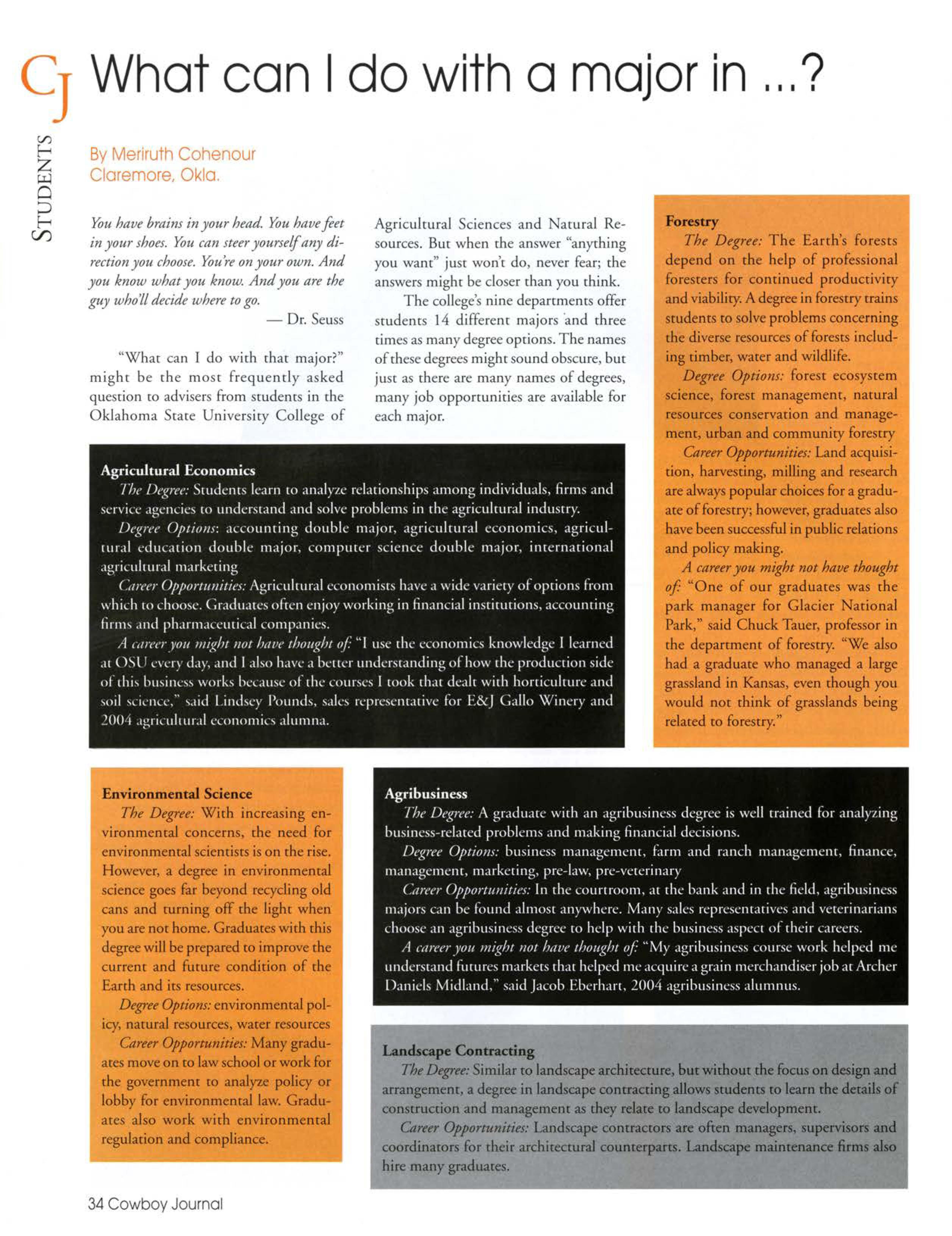
Agriculcural cience and acural Resources. Bue when the an wer "anything you wane" just won't do never fear; rhe answer might be closer than you think. he college's nine deparrmenc offer rudenr 14 differenc major 'and three rimes as many degree options. The names of rhe e degr es might ound obscure, bur just as there are many name of degrees many job opportunities are available for each major.
/I,,. I >1:~rc/':Swdl'nts learn to an.ilrzl' reLnionships ,11110ngindividuals, firms ,111d sc·1Tin·.1gc·1Kie,lO understand and solve prnhk-ms in dll' agriculwral industry.
!Jix,.,.,· Options: ,1Lcou111ing douhk major, .1griculwral economics, agricul1ur;1I nl11cuion douhle major, comp11ter science double major, imernational .1grin1ltur.1I m,u-h·ting
(_;m·a ( )ppor11111i1ies: 1\gricultur.d n'<lt10111i,1,h.n·c·,I wide variL·ty of options Ii-om \\'hi,·h Ill d1oose. l; r.1d11.11e,ofien enjoy working in financial instiu11ions. accounting firm, .rnd ph.1r111.1,,·uti,.1Icompanies. ,-Jull'ff}')'0/1 1111)(/,r110! /1,11,,· tl1011gh1 o( "I us,· 1h,· ,·conomics knowledge I Limn! .11 ( )'-,l I nn_1 d.t_l', .111dI .1l,o h,1\'l' ,I bnt,T 1111,krstanding of how th,· produuion sidl· nf 1lii, hmi11n, works hl·c.111,,·ot' the nnir,L'S I took th.n dc,111with honiculture .111d ,oil s-i,·11,,- ,.1id l.ind,l'I' Pound,. ,.1lc-, 1·epre,L·nt,1ti1·l·li,r F&J Callo \X 1 i11n1· .111d
2001 .1griniltur.tl l'l<)llOllli,, ,illllllll,l.
Environmental Science
The Degree:Wirh increasing environmental concerns, che need for environmentalscientistsis on the rise. However,a degree in environmental cience goes far beyond recyclingold cans and rurning off the light when you arenorhome. Graduateswith this degreewill be preparedto improvethe current and future condition of rhe Earthand it re ources.
DegreeOptions:environmentalpolicy, naturalr ource , water resources
CareerOpportunities:Many graduates moveon to lawschool or workfor the government to analyze policy or lobby for environmentallaw. Graduate also work with environmental regulationand compliance.
Agribusiness
Forestry
The Degree: The Earth' forests depend on the help of professional foresrersfor continued producciviry and viability.A degreein forestrytrains studentsto olve problemsconcerning the diver e resourcesof forestsincluding timber,waterand wildlife.
Degree Options: fore c ecosy rem science, forest management, natural resources conservation and management, urban and community fore cry
CareerOpportunities:Land acquisition, harvesting, milling and re earch are always popular choices for a graduate of forestry; however, graduates also have been successful in public relation and policy making.
A careeryou might not have thought of "One of our graduate wa rhe park manager for Glacier arional Park," aid Chuck Tauer, professor in rhe department of forestry. "We also had a graduate who managed a large grassland in Kansas, even though you would nor chink of grasslands being related to forestry."
l/,,. I >,xm·: A graduate with an ,1grihusine,s degrn· is ,wll 1r,1innl for .uuly,.ing husincss-rcL11nl problem, and making ti11.ull·ialdecisions.
/J,;!!_rc,· Optiow: husin,·,s m,11ugl'l11,·111,form ,111d ranch 111anagem,·nt. finance. managcml'nl. marketing. prl'-Ltw. pre-n·tnitury Lm·a Op;,ort1111iri,·s:In th,· courtroom. at 1hc hank and in die lield. ,1grih11si1wss 111.1jorsc.111lw ti,und .1lmost an~·where. l\l.111\·s,1ks rq1t\'Sl'llL1tiws ,111d1·,·tninari.111s choos,· .111,1grihusincss dcgrl'l' to hdp with the husi11c,s .ispell of tl1L·irc,ll',.lTS. ,I <'tll<'l'J'_)'//111J1igl,11101l1t11•,·d1011g/){ o( ":-_\\',1grihusi11,·ss course work helped 111,· 1111dns1and f11111re,111,1rkc1stlut hdpnl llll' .1n111irL' a gr,1i11111L-rd1e1ndisnjoh ar Ard1n I ).111ielsi\lidLtnd," s.iid J,1coh Fhnlun. 20()!j .1grihusi110, .d1111111us.
Lancbcape Contracting
TheDeg,«: imilarto landscapearchiteawe.butwithoutthefocus0-1dcsip arrangement, a dcgrccin landscapecontractlngallo tuden to learnth¢ detailso construaionand managementas theyrelateto landscapedemopmcnt.
Ca"" Opportunities:Land capeconuaaors are often managers. supervise, d coordinators for their architectural counterparts. Landscape maintenance firms ilse hire many graduates.
Animal Science
Jhc Dq:,rcc:Afrer gradu;uion, studcncs will have extensive knowledge of animal nutrition. breeding. reproduction and rhe animal production indusrry as a whole. Students who travel on the food industry parl, will learn how food is produced, manuti1e1L1rcdand marketed.
Dcgffc' Options: agricultural communications double major, agricultural education double major, animal biotechnology, business, food industry, food science, incernarional, livestock merchandising, pre-veterinary, producrion, ranch operations
Crrffr Opportunities: Careers in che animal science industry include farmers, ranchers, sales represc111a1ives,food engineers, public relations advisers, as well as many other livestock-related jobs.
A c,treeryou might not hav,• thought of "Although it was a few years ago, rhe business and management skills I learned at OSU still help me today," said Darrell BiIke, executive vice presidern and chief operating oCncer of the Pinro Horse Association of America and l 97'i animal science alumnus.
Agricultural Education
The Degree: An agriculcural education degree provides well-rounded training for tudents who wish ro contribute co education in formal and informal sercing while developing leadership with hands-on experience.
Degree Options: horticulture double major, leadership and ervice, teaching
Career Opportunities: Although the obviou career choice i reaching, many graduates find career- in public ervice with the Cooperative Extension Service or with the govemmenc.
A careeryou might not have thought of "I decided I didn't wam co reach, o I started my own livestock consulting business," said KayGarren, 2004 agricukural education alumna. "My classes ac O U caught me about people kills and how ro get organized, which are very imporranc in my busine s.''
Biosystems and Agricultural Engineering
Plant and Soil Sciences
The Degree:A plant and soil cieoce.s degree prepares smdencs in plant ge~ necics, crop production, range science, and rhe biological and physiological a pects of soil and plani:.s.
Degree Oprions: agronomy, biotechnology, business, crop science, rangeland ecology and management, oil science
Career Opportunities: Seed and feed companies are always looking for new graduates. Many plane and soil graduate can be found in Cooperative Excension "crvice and re earch jobs.
Biochemistry and Molecular Biology
The Degree: A broad background in chemist!"}'and biology provides srudenrs chc education co influence the progress of medicine and agriculture.
Degree Options: biochemi try and molecular biology, pre-medical and pre-vetaina.ry cience
Career Opportunities: Graduates have career opporrunirie in rhe areas of biomedical research, agriculrura.l chemical pi:oduccion and food-packaging development.
A careeryou might not h,we thought of "l\ fosc of our graduates go co professional ch ols for gent:ral medicine, dentistry, podiarry, pharmacy, ophrhalmology or veterinary cience,"' said Patricia Ayoubi, biochemist!"}·and molecular biology profes or.
Landscape Architecture
The Degree: Creativity and a love of landscaping are requiremems for a dcgm.: in landscape architecture. Scudencs srudy ourdoor spaces, an, ecology, honirnhurc and construccion. as well as planning and designing of natural and artificial landscapes.
Czreer Opportunities: Landscape archi1ects arc usually found surveying 1hc Lrndfor their next project. They can be seen in city parks, hotel arriums. zoos, golf courses and country homes.
A Cfll<'ff)'Oil might not ht111ethought of "There arc large landscaping firms all over the world chat hire our graduates," said Margarec S1rublc, admi11is1ra1ivcas,istant. departmcnr ofhorriculcure and landscape architcccure.
Entomology
The Degree: Biosysrem and agriculrural engineering students learn to create and modify technology co increase efficiency of agri ulnual producrion, processing, storage and di tribution. Real-world experience is abundam as student have the opportunity to solve complex problems.
Degree Optiom: bioprocessing/biocechonology, biomcchanics, environmencal science/narural resources, food processing
Career Opportunities: Food processing planes, irrigarion busine es and waste management companie use engineers.
A careeryou might not ha11ethought of "We have a graduate working for the tare deparcmenr," aid reven fowler, BAE. recruiter. "He is a security engineer and rravel the world."
The Degree: In addition co the srudy of arthropod , entomology rudcnts al o learn cht: biological and phy iological importance of insects as they relate ro food, fiber, di ·ease and medical research.
Career Opport11nities:Excension offices and research facilicie arc rhe mo t common places ro find cnromologisr , bur graduate· al o can obtain job with pe ricide companic
A c11ret•ryou might not h11vethought of "Medical cnromologisrs arc valuable resource for che United rntes military because they help with insecc-relaced problems such as disease , infeccion • and conrrol," aid Jack Dillwirh, professor in che deparanenr of entomology and plant pathology.
Horticulture
lhc j)<Xrt',': Prc11y Aowcrs and lush grcrn grasses arc just 1hc beginning of a degree in horriculcure. This degree teaches students about the culture, produce ion and preservation of Howcrs, trees, shrubs, turf grass. vegccahlcs, fruits and nuts. Commercial and private sectors of the agricuhural industry rely on 1r;1incd honicul1uriHs w solve problems associan:d wich chc nation's beauty and food supply.
/)1:<?,rffOptions: horticulture, public lrnniculrnrc, rnrf managcmclll
Ct1n'r Opport1111itics:(;rccnhouscs and floral shops arc teeming wi1h horticulturists, and graduaccs also serve as consultams for seed and frrrilizcr companies. 'li.Jrf managers arc in high demand for golf courses and sports arenas.
A mncr_you m~~IJI1101 ht111cthoughu(f=·"Because there: is always a high demand for golf course managers and greenhouse managers, our gradua1c:s arc lucky hc:cause they have che opponun i1y IO go just about anywhere: they want," said Margaret Struble, administrative assistant, department ofhorticultun: and landscape archi1ee1ure.
Agricultural Communications
The Degree:A degree in agriculrural communicition train srudencs co be weU versed in journalism, public relarions, marketing and ocher facers of communicacions. After graduation, agricultural communication major will have the skills chey need co inform che public about ways agriculcure influences lives.
Degree Options: agricultural communication , animal cience double major
CareerOpporttmitii:s:Agriculcural communication graduace work in almo t every live tock breed association in che councry, as well as in many major public relations firms, pharmaceutical companie and televi ion programs.
A cart•eryou mightnot ha11ethoughtof "At O U, I gained great people kills through my cla e and acrivitie such as Agricukural ommunicacor ofTomorrow," aid Jennifer Marty, associate artorney at The Watkin Law Office in Roger , Ark., and 1998 agriculrural communicacions alumna. 'ACT and Ag Arnba ador were really hdpfuJ. They developed my self-confidence that let me achieve whatever I wanted to do."
"It is never mo early ro stare planning for your career," aid Amy azaway, career developmenc coordinator of CA NR areer erv1ces.
ome rudencs enroll knowing exactly where chey wane ro work after graduacion; ocher arrive wirh only a general area of incere t, she aid.
Wirh so many choices, it is easy to see you really can do A YTHT wi ch a degree from CA R. It i up to you co define che career direccion chat is the besr fir for your kills, interest , abilities, per onaliry and life goal . For information, call CASNR Career ervicesat (405) 744-5395. C_1
Most Farm Credit employees bring farm experience to the job. They learned the ropes on a family farm. then studied agriculture ar OSU. Ar Farm Credit of Enid, we think that is time well spent!
To learn more about the Leader in the Field, call us at:
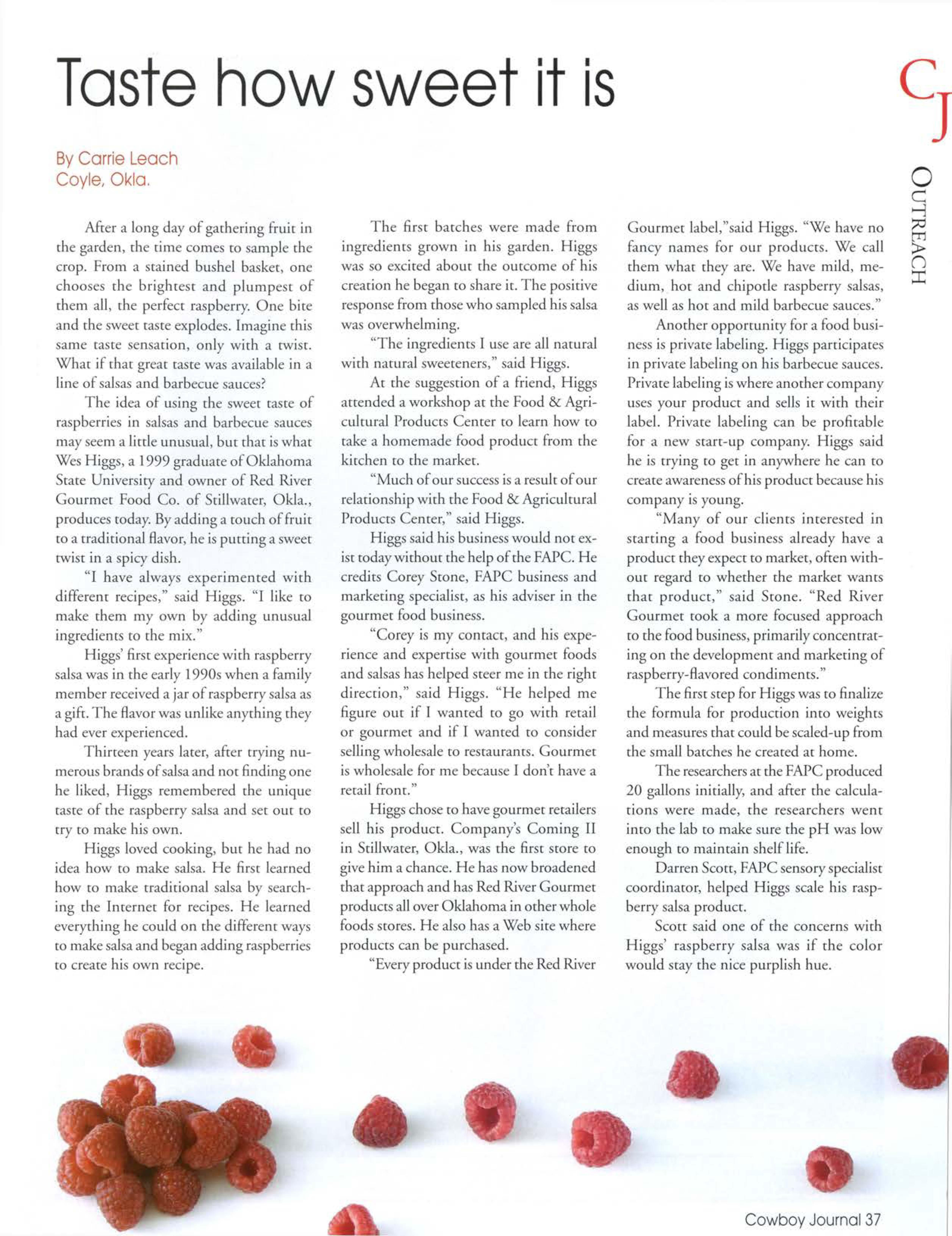
Tastehow sweetit is
By Carrie Leach Coyle, Okla.
Afcer a long day of gachering fruir in the garden, the time comes ro ample the crop. From a stained bushel basket, one chooses che brighcest and plumpest of chem all, he perfect raspberry. One bite and che weer ca ce explodes. Imagine chis same taste sensation, only with a twist. What if char great cascewas available in a line of salsas and barbecue sauces'
The idea of using rhe veer caste of raspberries in alsa and barbecu sauce may seem a little unu ual, but char i what We Higgs, a 1999 graduate of Oklahoma race University and owner of Red River Gourmet Food Co. of tillwater kla., produces roday. By adding a touch of fruir ro a traditional Aavor, he is purring a weer rwist in a spicy dish.
"I have always experimented with differenr recipes," said Higgs. "I like to make them my own by adding unusual ingredienc to the mix."
Higgs' first experience with raspberry salsa wa in the early l 990s when a family member received a jar of raspberry salsa a a gift. The flavor was unlike anything chey had ever experienced.
Thirreen years lacer, after rrying numerous brand of al a and no finding one he liked, Higgs remembered the unique ca te of the ra pberry al a and et out ro cry ro make his own.
Higgs loved cooking, but he had no idea how ro make salsa. He firsr learned how co make traditional salsa by searching che Incerner for recipes. He learned everything he could on the different ways to make salsa and began adding ra pberrie ro creare his own recipe.
The first batches were made from ingrediems grown in his garden. Higgs was o excited about the ouccome of hi creacion he began ro share it. The positive respon e from those who sampled hi alsa wa overwhelming.
"The ingredients 1 use are all narural with narural sweeteners,' said Higg
At the uggestion of a friend, Higg anendcd a work.shop ar the Food & Agricul rural Produ ts Center to learn how to cake a homemade food produce from rhe kirchen ro die marker.
"Much of our ucce • i a r uh of our relarionship wich rhe Food & Agriculrural Product Cemer," said Higgs.
Higg aid hi bu in would nor exist roday without the help of the FAPC. He credits orey rone, FAPC business and marketing specialist, as his adviser in rhe gourmet food bu ines
'Corey i my conract, and hi experience and expertise with gourmet foods and salsas has helped steer me in the righc direction," said Higgs. "He helped me figure our if l wanted ro go wirh rerail or gourmer and if f want d co con ider selling wholesale ro resrauranrs. Gourmet is wholesale for me because l don't have a re rail fronr."
Higgs chose ro have gourmet recailers ell hi product. ompany' oming [I in Stillwater, Okla., was the first srorc co give him a chance. He has now broadened char approach and has Red River Gourmet produces all over Oklahoma in other whole foods rores. He al o ha a Web sire where products can be purchased.
"Every product i under the Red River
Gourmet label,"said Higgs. "We have no fancy names for our producr We all them what rhey are. We have mild, medium, hO[ and chiporle raspberry salsas as well a hot and mild barbecue auces."
Anorl1er opportunity for a food bu ine sis private labeling. Higgs parricipares in private labeling n his barbecue sauces. Privare labeling is where another company u es your product and sells it with their label. Private labeling can be proficable for a new start-up company. Higgs said he i crying ro gee in anywhere he can ro creare awareness of his produce because his company I young.
"Many of our clienrs interesred in starting a food business already have a produce they expe r co market, often withour regard ro whether the marker wams that produce," said Scone. "Red River Gourmet took a more focused approach ro the food business, primarily concentrating on the developmenr and markering of raspberry-flavored condiment."
The first srep for Higgs wa ro finalize rl1e formula for producrion into weights and measures char could be scaled-up from the small batches he created ac home.
The researchers ar rhe FAP produced 20 gallons initially, and afrer the calcularion were made, rhe re earcher went inro che lab ro make sure che pH was low enough to maintain shelf life.
Darren corr FAPC sensory specialist coordinator, helped Higgs scale his raspberry sal a product.
Scon said one of the concerns with Higgs' raspberry al a wa if rhe color would sray rhe nice purplish hue.
"We were very lucky,' said corr. "Even wh n rhe raspberry salsa was beaced m che correct temperacure, the color remained consistent.
"The more complex the formula, the more dungs char can go wrong," said corr. ''Having a nice imple formula is always easier m proce s."
The next step wa m provide sam pie for FDA requirement te ring. nee the rests were passed, ir was rime m begin the " cale-up" production.
'This was very exciting becau e I was beginning m ee the fruits of my labor," said Higgs. '' [t cook almo c a year to develop the final formula becau c along rhe way T had m learn about pro e ing, packaging, branding, discribucing and markecing on a much larger cale."
rone aid he believes Red River Gourmet' focus is rhe reason it has grown so quickly a food business.
'l chink Wes Higg had an advantage early on because he created chi opporruniry like a bu ine , rather than a hobby,' aid mne. "Thi allowed him ro make decisions based on research and analy is rather than pure emotion."
rone aid he al o believe rhere is a world of opporcuniry for Red River Gourmet products.
"We ha grown the company ar an ambitious pace, bur even che markers he has opened are far from sarurated,' said rone. "With careful planning, I expect chis company could become a regional presence in the gourmet industry."
A hi ales volume grow , Higgs'
long-rerm plan are co build hi own value-added faciliry. The plant would be for the use of Red River ourmet a well as other enrrepreneu r , and would give Oklahoma another trong food-proce ing busine s. He said he believe the n w jobs would be good for klahoma.
"In the year following rhe scaleup in the lab, Red River Gourmet ha entered 42 markers in Oklahoma Texas, ew Mexico, Kansas, Missouri and Arkan a , " said Higg.
"My longterm vi ion for ch company is ro keep manufacruring and Workinginthe lab
di tributing a line of gourmet food produces rhat are
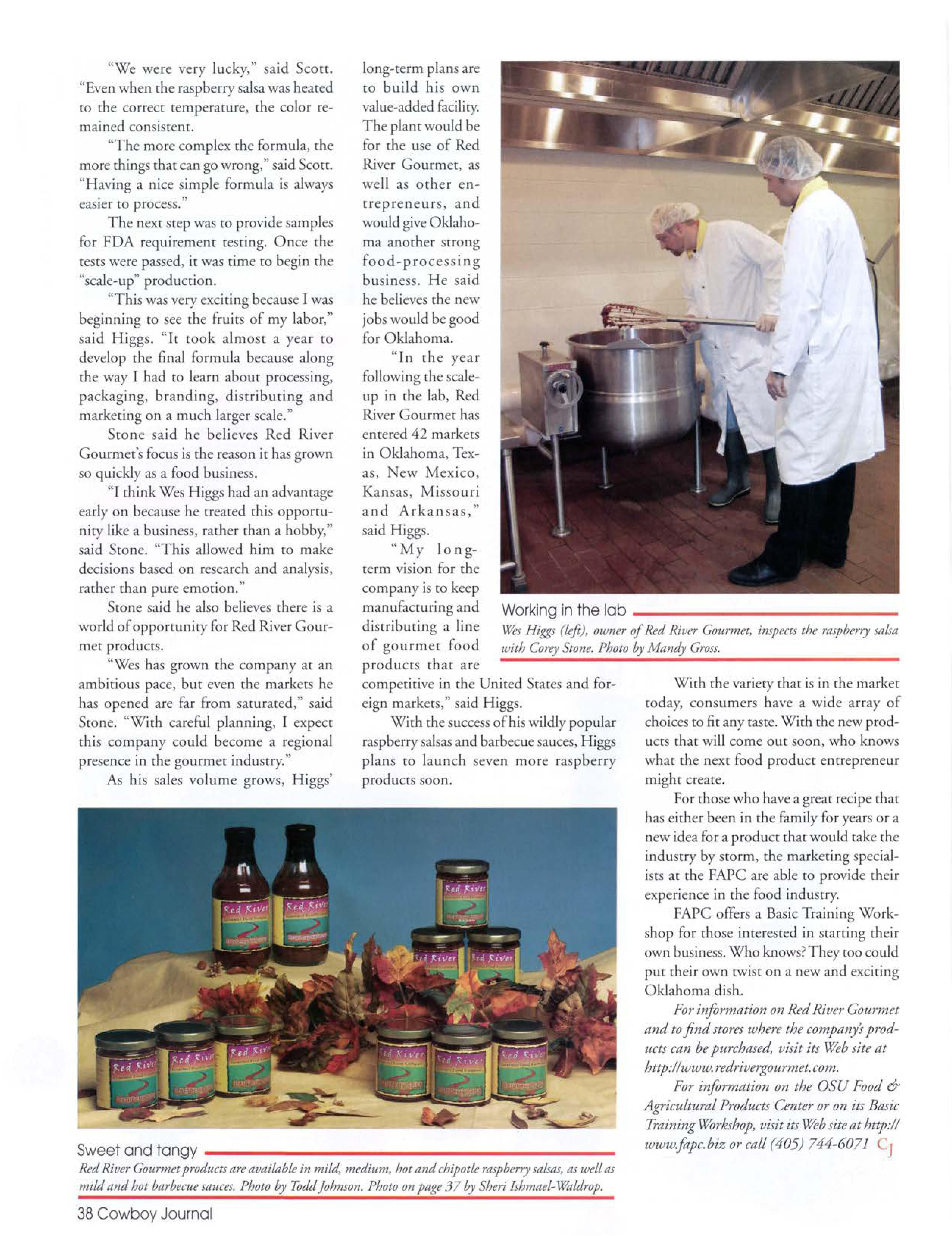
~s Higgs(left),owner of Red River Gourmet,i11Spewthe raspberrysalsa with Core;, tone.Photoby Mandy Gross.
competitive in the United rate and foreign markers," said Higgs.
With rhe succes of his wildly popular ra pberry al as and barbecue auce , Higgs plans ro launch seven more raspberry products soon.
Wich che variery char is in che market roday, consumers have a wide array of choices ro fit any taste. With rhe new produces chac will come our soon, who knows whar the nexr food produce en repreneur mighc create.
For chose who have a greac recipe chac ha eirher been in che family for years or a new idea for a product tharwould cake the industry by mrm, rhc marketing speciali rs ar the FAP are able ro provide rheir experience in che food indu cry.
FAPC offers a Basic Training Workshop for rhose inceresced in scarring cheir own busines Who know ?They too could put their own rwisc on a new and exciring Oklahoma di h.
Fo,·informationon RedRiver Gourmet and tofind storeswherethe company'sproducts can bepurchased,visit its Website at http://www.redrivergottrmet.com.
For information on the O U Food & AgriculturalProductsCenteror on its Basic TrainingWorkshop,visit its \.%bsite at http:!/ www.fapc.biz or call (405) 744-6071 CJ
OSUhelps'high-tech'cows
ByB111Gol ght1y Laver11eOkla
Imagine the possibiliry of waking up in che morning, having a cup of coffee and earing your breakfasr while monitoring your cattle from che comfort of your home. ls chi roo fururi cic?The realicy i closer than you might thjnk_
"Oklahoma Scare University and Carrie Traq have reamed up co develop a technology char could revolutionize cattle management praccices," aid reg Va.nee, sales represenracive for Cattle Traq.
accle Traq LLC, an affiliare of American Biomedical Group Inc. located in Oklahoma Ciry has developed software capable of monitoring cattle and recording inrernal body remperarure.
Carde Traq is an incegraced system of microchip located in ear rag, acces control sensors and proprietary software. When che e component work cogecher, they can monicor an animals movemenc, id mify and determine ir locarion and give a reading of its internal body temperature, said Vance.
"This can all be displayed on a lap cop or your home computer 'said Vance. arcle Traq operate with radio frequency waves sen c from ear tag co sofuvare cha decodes che signals and rranslares chem inro usable information.
"Our Radio Frequency ldemificacion or RFID chip are a recendy decla sified milirary technology and are able co send and receive ignal o.n an ulua-wide-band frequency," srud James Burge s, president of American Biomedical Group.
The Cattle Traq sy tern u e ear rags that contain a microchip, which holds data idencifying rhe animal. RFID readers communicate wirelessly with the rags and Carrie Traq' ofrware reads and writes rhe data co and from che tags, aid Burgess.
"The internal body cemperacure is recorded by placing a parented bolus cap ule in che animal's stomach," srud Vance.
The bolus also contains a chip that sends a signal.
"The ear rag receives the signal from rhe bolu and ends it co the computer," said Burgess.
"The bolu i made our of pecial material that withstands digestive acids
First-handknowledge
jarred hepherd.an animalsciencealumnm, workedwith CattleTraqtechnologyMa studentemployee far the WillardSparksBeefResearchCe11ter.Photoby Bill Golightly.
from the tomach and i heavy enough o ir is unable to pass rhrough the animal," aid Burge
The software allows a person co read the I cation, mea ure rhe remperacure and collect aH rhe daca char was previously scored on the rag, aid Vane he software also can store medical hi rory and the animal ' identification numbers. Only an individual with a password will be able co read the information from rhe rags, said Vance.
"Thi ofrwar i nor limited co reading Carrie Traq data,' aid Burge s. 'lr will be able ro read and detect the technology that is used for rhe U Department of Agriculture' Animal Identificacion y rem that will soon be mandatory."
Carrie Traq rags detecr the signal up co 2,500 feet, aid Vance.
"With previous sy rems, a user had to be do e ro the animal and cane ery rag," aid teve Taylor, chief operacing officer of American Biomedical roup.
"Cattle Traq makes it possible co scan
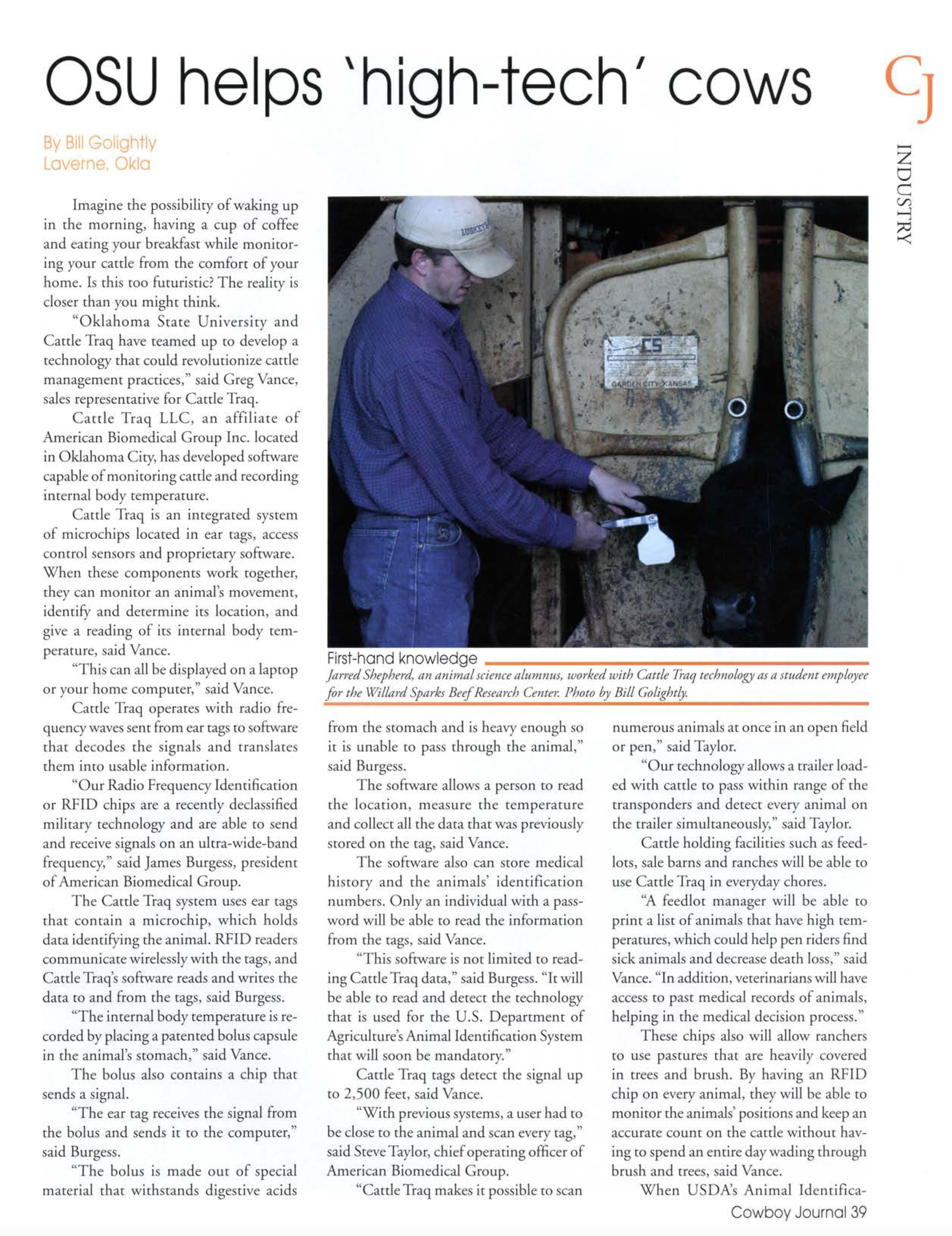
numerou animals ar once in an open field or pe.n," said Taylor.
"Our technology allows a rrailer loaded wich cattle co pass within range of che rran ponders and derecc every animal on the trailer imulcaneously,' aid Taylor. atrle holding facilirie such as feedlots, sale barns and ranche will be able co u e atcle Traq in everyday chores.
A feedlot manager will be able ro print a list of animals rhac have high temperatures, whi h ould help pen riders find sick animals and decrease death loss " sajd Vance. "In addition veterinarians will have access co past medicaJ records of animals, helping in the medical deci ion proce ." hese chips also will allow ranchers co u e pasture that are heavily covered in trees and brush. By having a.n RFlD chip on every animal, rhey will be able co moniror the a11imals'po irions and keep an accurate count on rhe carcle wirhout having co spend an entire day wading through bru h and rrees aid Vance.
When U DA's Animal ldenrificaCowboy
tion System is in place, sale barn will be able co scan an animal for irs ID number, download irs hi tory and pas ir on ro rhe buyer as rhey leave.
"With Carrie Traq, rrucks will be able ro unload and load faster and more efficiently" said Vance.
Cattle Traq is working on ways to help producers cur their operating coses.
"As demand for chi cechnology increa e th.e price for this operating cool will decrease," said Vance.
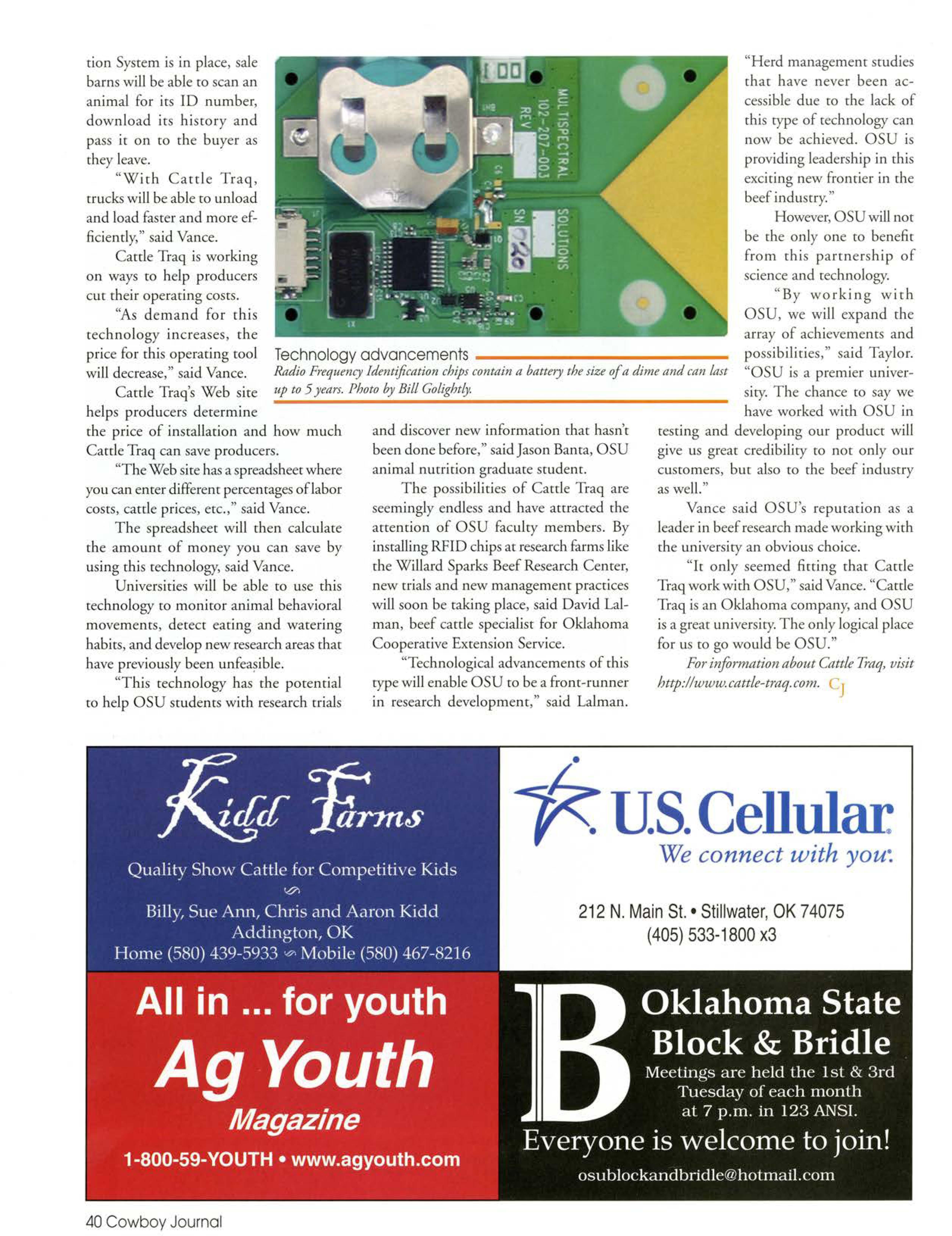
Technologyadvancements ------------
Rndio FrequencyIdentificationchipscontainII bauerythe size of a dime and can fast
Carrie Traq's Web sire helps producers determine up 10 5 years.Photoby Bill Golightf;y. the price of installation and how much Cattle Traq can save producers.
"The Web site has a spread heer where you can enter different percentages oflabor coses, carcle prices, etc.," said Vance.
The spreadsheet will then calculate the amounr of money you can save by u ing chi technology, said Vance.
Universities wi.11be able ro use chis technology ro monitor animal behavioral movements, derecr earing and watering habits and develop new researcl1areas chat have previously been unfea. ible.
"This technology has the potemial to help OSU tudenc with research trial
and di cover new informacion char hasn't been done before," said Jason Banta, OSU animal nutrition graduate rudenr.
The possibilities of Cattle Traq are seemingly endless and have acrracced the arremion of O U faculty members. By installing RFID chips at research farms like rhe Willard parks Beef Research Cenrer new trials and new management practices will soon be raking place, said David Lalman, beef carcle specialise for Oklahoma Cooperative Extension Service.
"Technological advancemenrs of rhi type will enable OSU robe a from-runner in research development" aid Lalman.
"Herd management studies char have never been accessible due ro rhe lack of chis rype of cechnology can now be achieved. 0 U is providing leadership in this exciting new frontier in the beef industry."
However, OSU will not be the only on to benefit from chis parrnership of science and technology.
"By working wirh OSU, we will expand rhe array of achievemenrs and po sibilirie ," said Taylor. "OSU is a premier university. The chance co ay we
have worked with OSU in resting and developing our produce will give us great credibility ro nor only our customers, but also to the beef industry a well."
Vance said OSU's repurarion as a leader in beef research made working with rhe university an obvious choice.
"It only seemed fining that Carrie Trag work with O U," said Vance. "Carrie Traq is an Oklahoma company, and OSU i a great university. The only logical place for us co go would be OSU."
Forinformationabout CattleTraq,visit http://www.cattle-traq.com. CJ
It'sall in the roots
By Mandy McNally Guthrie,Okla.
Researchers ar Oklahoma $rare Universiry are gening to the root of the problem with soilborne wheat viruses.
Jeanmarie Vercher a ociate professor in the O U Depanmenr of Encomology and Plane Pathology, is creating a ce r for researchers by developing resiscanr wheat varierie to prevent rhe soilborne wheat mosaic virus from spreading.
Vercher graduated from Rurgers Universiry in 1987 with a Bachelor of Science in generics. In 1995, she complered her doctorate in microb.iology from Texas A&M Universiry. She then joined the planr pathology deparrmem ar OSU in 1998.
"Soilborne wheat mo aic virus is rransmirred to planes through the soil," said Vercher. 'There are approximarely 30 to 50 viruses rhar are known worldwide to be soilborne. his is not many."
Viruses are rypically vectored to the whear by insects, nematodes or fungi. Vectors carry a disease bur are nor infected by it. When the vecror transfers the di ease to the host, rhe host becomes infected.
"Soilborne viruses are vectored by
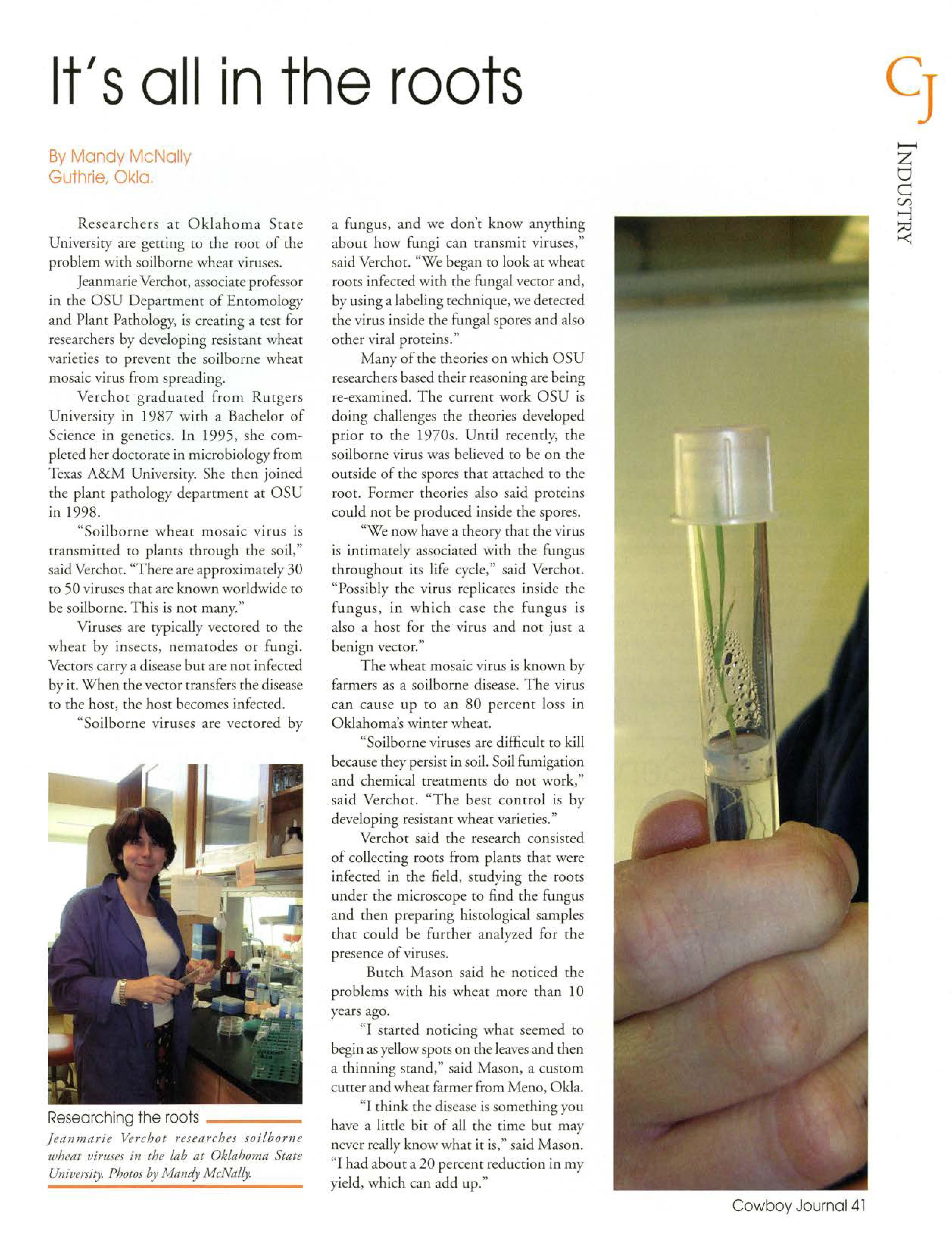
a fungus, and we don't know anything abouc how fungi can transmit viruses," said Verchor. "We began to look ar whear roots infected with rhe fungal vecror and by u ing a labeling technique, we detected the virus inside rhe fungal pores and al o ocher viral proteins."
Many of rhe theories on which U researchers based their reasoning are being re-examined. The current work OS is doing challenges ch cheorie developed prior to the 1970s. Unril recently, the soilborne virus was believed to be on rhe outside of rhe spore char ana hed co the root. Former theories also said proteins coLLldnor be produced inside the spores.
"We now have a theory char the virus is imimacely associated wirh rhe fungus hroughour irs life cycle," said Verchor. "Po ibly che viru replicares inside rhe fungus, in which case che fungus is also a hose for rhe virus and nor just a benign vector."
The whear mosaic virus is known by farmer as a oilborne disea e. The viru can cause up to an 80 percent loss in Oklahoma's winrer wheat.
' oilborne viruse are difficult to kill because they persist in soil. oil fumigation and chemical rreatmenrs do nor work, ' said Verchor. "The be r conrrol is by developing resistant wheat varierie "
Verchot said the research consisted of collecting roor from plants rhac were infected in che field, tudying the root under the microscope to find the fungus and then preparing histological ample char could be further analyzed for rhe presence of viruses.
Burch Mason said he noriced the problem with hi wheac more rhan 10 years ago.
"I scarred noticing what seemed to begin a yellow pors on the leavesand rhen a chinning stand," said Mason, a custom curter and wheat farmer from Meno, Okla.
"I think the disea e is something you have a licrle bir of all the rim but may never really know what iris," said Mason. "I had about a 20 percenc reduction in my yield, which can add up."
Researching the roots
Jeanmarie \lerchot researches soilborne wheat viruses ill the lab nt Oklahoma State Univmity PhotosbyMandy McNally.
Soilborne disease
Ok!Ahomawheatft.ridshnve much to loseif infectedby the whent mosaicvirus. Leavesof the infectedplants will experienceyellowish-greenfoliage. Researchers are developingvarietiesthat are resistantto the diseasein an effort to reduceyield loss.Photo by Mandy McNally.
The worst place Mason has seen rhe di ease i in ebraska.
Plant infected by che virus are ofcen located in low-lying, wet area They are scunrcdand appear cohave yellowish-green foliage. The leaves seem co have a mo aic pactern with small green spocs on a light green or yellowi h backgrow1d. The leaves also may have streaks, said Verchoc.
OSU re earcher have rccencly expanded chci r work co survey ocher viruses transmitted by fungi co determine the narure of rheir association
"I e entially rudy di eases in wheat, potaroes and tobacco," said Verchot. "T am beginning ro work wich laboracorics in Texas, [ndia and Uganda ro srudy che plane viruses chat arc agronomi-
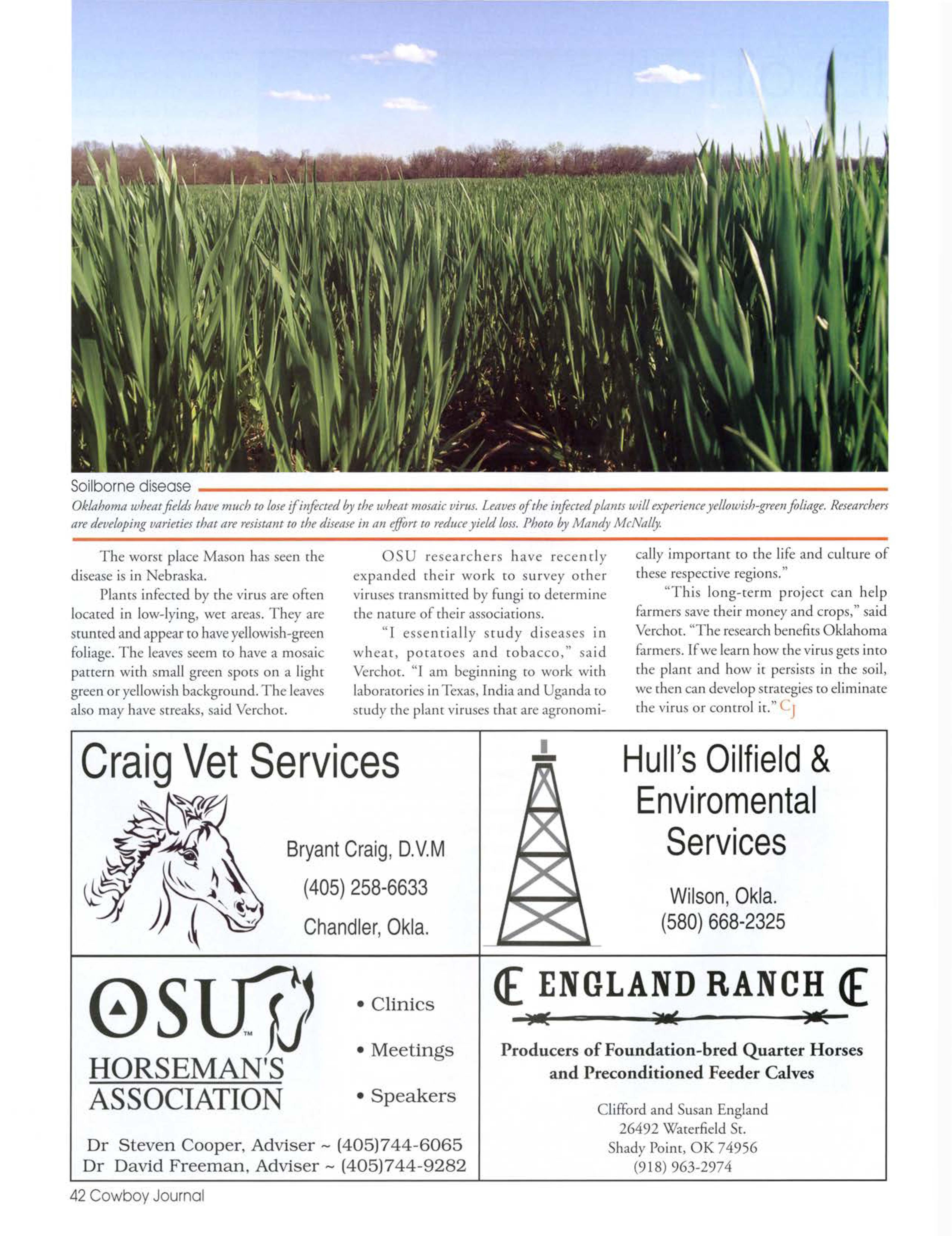
cally important to rhe life and culture of these respective regions."
"This long-rerm projecc can help farmer ave their money and crop ," aid Verch t. "The research benefit Oklahoma farmers. If we learn how the virus gers inro the plant and h w it per i r in che oil, we then can develop tratcgie to eliminate the virus or comrol ir.' J
Money,money,money
ByAmanda Lockwood Fisher Glencoe, Okla.
Jimmie Gaile Richards of Broken Bow, Okla., did not know much about IFMAP until it saved her money.
''When we first got the letter, we didn't understand whac it was," said Richards.
The Richards' family poultry operation wa financed through a Hugo bank. They received a letrer offering chem a free business planning ervice from the Intensive Financial Management and Planning upporc program and a loan with a lower interest rate. Richards said their yearly payments decreased by about $2,800 wich the implementarion of che business planning and rhe loan.
The Richard family and other Oklahoma producers are among chose celebrating che 20th anniversary of IFMAP . IFMAP was creared in July 1985 at Oklahoma rate Universiry because of the farm crisis in the mid- ro lace-'80 With land prices and che markers declining, Oklahoma Cooperative Extension staff decided ro do something.
Ross Love, assisram direct0r of Agriculture, acura1Resources and Rural Development Programs at O U developed the IFMAP concepr. He rhen recruited professional who creared software and trained specialises to go out and do oneon-one analy e with the producers.
'There was a great need at char rime for financial planning,' aid Randy True, IF MAPS Center supervisor.
IFMAP is funded from a grant through che Oklahoma Deparanenr of Agricul cure, Food and Forestry. This ensures farmers incur no expen e while crying co gee their finances in order, aid True. ince it began, IFMAPS has helped more than 5 000 families in all 77 Oklahoma counties with busines planning.
For a farmer or rancher co use lMAP , the producer mu c first conracr the IFMAP office in ritlwater. IFMAP assigns financial specialises co Oklahoma producers who are in need of bu iness planning assi ranee. These speciali c include extension area agricultural economists and part-rime professionals with farming or ranching background . The
producer does noc have to live in klahoma bur muse own a farm or ranch in rhe stare co use IFMAP ' free ervice
Once a specialise is assigned to che case, che producer and specialise arrange to meer for an informarion session. The producer provides the farm record and assemble the information. The IFMAP pecialisr then use che computer software to analyze rhe producer's dara and generate alternarive financial plan
The Oklahoma Agricultural Linked Deposit Program started in 1988. OALDP save Oklahoma producers money by reducing che interest rare on qualifying loans. The producer muse develop a financial plan with IFMAP co apply for the loan. rate funds are depo iced with che producer's lender ar a lower imeresr race which is chen passed on to the producer. IFMAP pecialist help producer apply for chis loan, which usually aves the producers thou ands of dollar .
Glen Vaughn of Warson, Okla. heard about IFMAP from rhe bank where he had borrowed money. inc u ing IFMAP four years ago, he has saved about 16,000 in inreresc from OALDP.
Damona Daye, 0 U extension economise, said IFMAP i a benefit because it offers che producer a chird-parcy, obje rive per on.
"Somerime it's difficult for people ro seep back and look at cheir busines criricalJy becau e it's so personal ro chem " said Doye.
he also said IFMAP encourage producers to use encerpri e analy e to better invesr their money. These analyes an wer question for rhe producer such as whether a lease will be profitable or whether stocker calves are a good use of finance labor and re.sources 111 a given year.
Doye said getting the information in black and whire is imponanc. People may have an idea of their financial plans, bur formalizing che plan allow producer co make necessary adjustmenrs before invesring, which
may be crucial in deciding, for instance whether there is enough income co bring back a econd generation, he said.
True aid IFMAP has rayed in operation for o long because of its qualiry and cabiliry.He aid many of the IFMAP specialises have been wirh chem for 15 to 18 year , and rhe quality of che people associated with the program has added co irs longeviry.
Harry Haefner of Perry, Okla., has been an IFMAP specialise for nearly 18 year Haefner rerired from the U.S. Air Force, so he cook ad van cageof the G .I. Bill and wenr back ro school. He joined che [FMAP staff after ca.kingLove' class.
Haefner ha helped nearly 1,000 Oklahoma producer in every pan of the scare ince he became an lFMAP peciali r. He aid IFMAP helps producers gee a feel for how they're doing.
"The profit margin on farming is so righc," Haefner said. "Efficient use of all resource is essential co maximizing profic ."
For Oklahoma farmers and rancher today, bu ines planning is a muse. IFMAP provides these services ac no co r to the producer. And wich the program's 20 years of experience, a producer cannot go wrong by using IFMAPS.
Forinformation,caLLthe IFMAPS office at (800) 522-3755, or visit the Wt>bsite at http:llagecon.okstate.edu!ifinapsl CJ
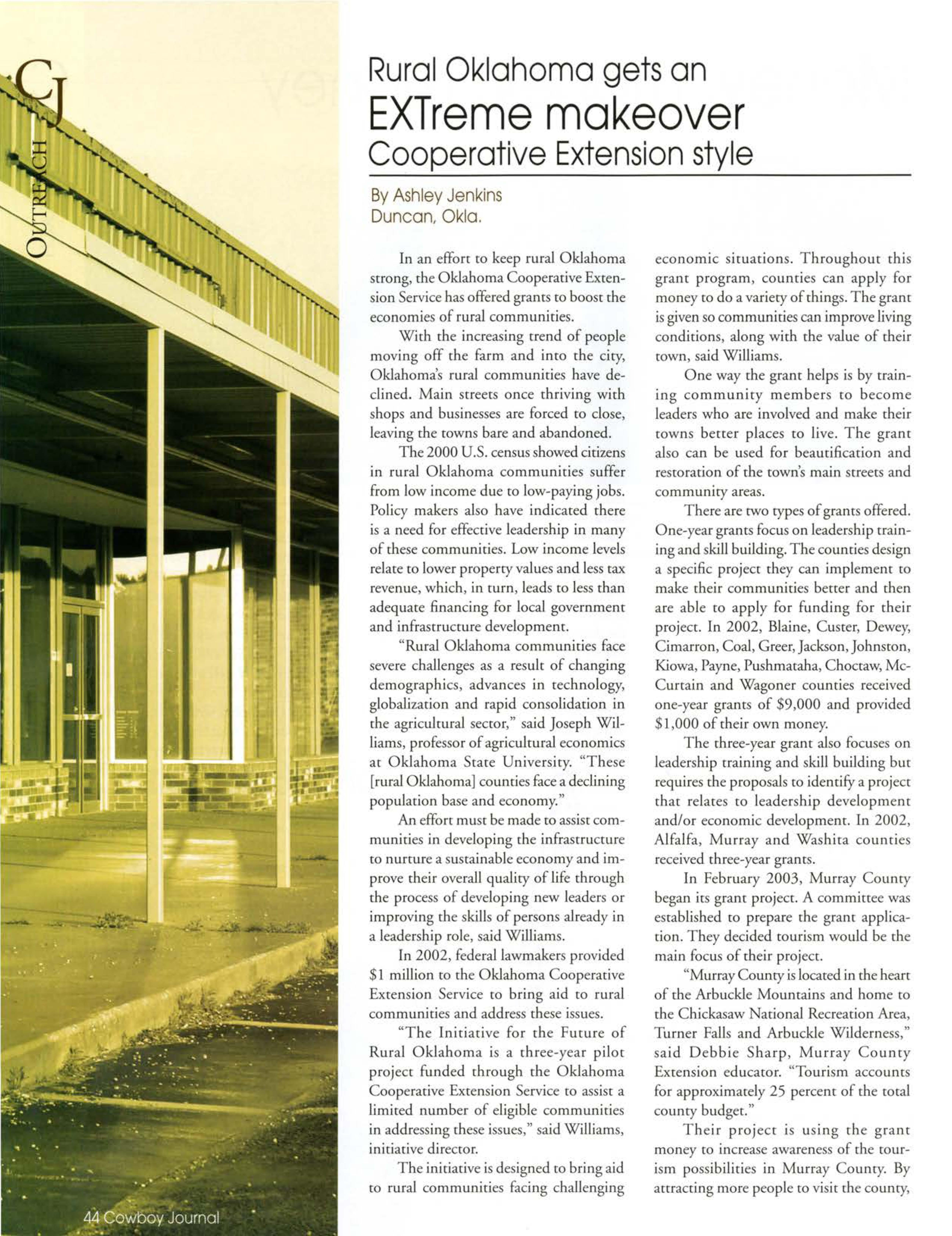
RuralOklahomagetsan EXTrememakeover CooperativeExtensionstyle
ByAshleyJenkins Duncan, Okla.
In an effort to keep rural Oklahoma strong, the Oklahoma Cooperative Extension ervice has offered grants to boost the economies of rural communities.
With the increasing trend of people moving off the farm and into the city, Oklahoma's rural communities have declined. Main street once thriving with hops and businesses are forced to close, leaving the towns bare and abandoned.
The 2000 U. census showed citizen in rural Oklahoma communities suffer from low income due to low-paying jobs. Policy makers also have indicated there i a need for effective leadership in many of these communities. Low income level relate to lower property value and les tax revenue, which, in rum, leads to less than adequate financing for local government and infrastrucrure development.
'Rural Oklahoma communities face evere challenges a a re ult of changing demographics, advances in technology, globalization and rapid consolidation in the agricultural ector," said Joseph William , profes or of agricultural economics ac Oklahoma rare University. "These [rural Oklahoma] countie face a declining population base and economy."
An effort mu r be made ro assist communities in developing the infrastructure to nurture a ustainable economy and improve their overall quality of life through the process of developing new leader or improving the skills of persons already in a leader hip role, aid William .
In 2002, federal lawmakers provided $1 million to the Oklahoma ooperacive Extension ervice ro bring aid ro rural commun.itie and address che e is ues.
"The Initiative for the Future of Rural Oklahoma is a three-year pilot project funded through che Oklahoma Cooperative Exten ion ervice ro assist a limited number of eligible communities in addressing these issues," said Williams, initiative director.
The initiative is designed to bring aid ro rural communities facing challenging
economic situations. Throughout chis grant program, countie can apply for money ro do a variety of things. The grant is given so communicies can improve living conditions, along with the value of their rown, said Williams.
One way rhe grant helps i by training community members ro become leaders who are involved and make their towns better places ro live. The grant also can be used for beaucificacion and restoration of the town's main srreet and community areas.
There are rwo rype of grant offered. One-year grants focus on leadership training and kill building. The counties de ign a pecific project they can implement to make their communities better and then are able ro apply for funding for their project. In 2002, Blaine, Cu ter, Dewey, Cimarron, Coal, Greer, Jackson, Johnston, Kiowa, Payne, Pushmataha, Choctaw, McCurtain and Wagoner counties received one-year grants of $9 000 and provided 1,000 of their own money.
The three-year grant also focuses on leader hip training and kill building bur requires the proposals to identify a project that relates co leader hip development and/or economic development. In 2002, Alfalfa, Murray and Wa hica countie received three-year grants.
In February 2003, Murray ounty began irs granc project. A committee was established co prepare rhe grant application. They decided rourism would be the main focu of their project.
"Murray County is located in the heart of he Arbuckle Mountains and home to rhe Chickasaw arional Recreation Area Turner Fall and Arbuckle Wilderne s," aid Debbie harp, Murray Councy Extension educator. "Tourism account for approximarely 25 percent of the rota! county budget."
Their project i u ing rhe grant money to increase awareness of the touri m po sibiliries in Murray ounty. By attracting more people to visit the county,
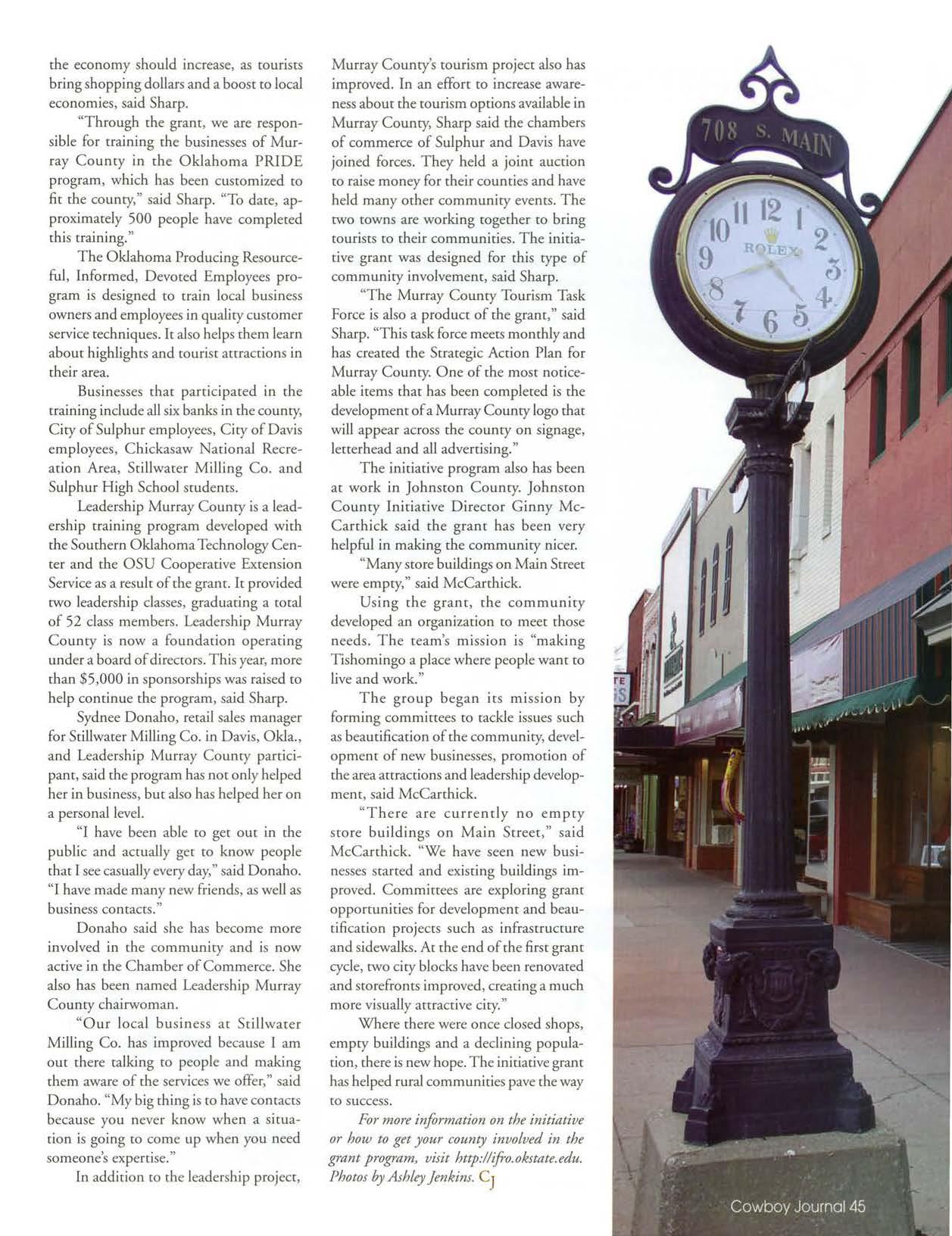
the economy should increase, as tourists bring shopping dollars and a boost co local economies, said Sharp.
"Through the grant, we are responsible for training the businesses of Murray County in che Oklahoma PRIDE program, which has been customized to fir the county," said Sharp. "To dare, approximately 500 people have completed chis training."
The Oklahoma Producing Resourceful, Informed, Devoted Employees program is designed to train local business owners and employees in quality customer service techniques. le also helps chem learn about highlights and rourisr attractions in their area.
Businesses char parcicipaced in the training include all six banks in the county, City of Sulphur employees, City of Davis employees, Chickasaw National Recreation Area, Stillwater Milling Co. and Sulphur High School srudenrs.
Leadership Murray County is a leadership training program developed with the Southern Oklahoma Technology Center and the OSU Cooperative Extension Service as a result of the gram. It provided two leadership classes, graduating a total of 52 class members. Leadership Murray County is now a foundation operating under a board of directors. This year, more than $5,000 in sponsorships was raised to help continue the program, said Sharp.
Sydnee Donaho, retail sales manager for Stillwater Milling Co. in Davis, Okla., and Leadership Murray County participant, said the program has not only helped her in business, but also has helped her on a personal level.
"I have been able co gee our in che public and actually get to know people char l see casually every day," said Donaho. "I have made many new friends, as well as business contacts."
Donaho said she has become more involved in the community and is now active in che Chamber of Commerce. She also has been named Leadership Murray County chairwoman.
"Our local business at Stillwater Milling Co. has improved because I am out there talking to people and ma.king them aware of the services we offer," said Donaho. "My big thing is to have contacts because you never know when a sicuarion is going to come up when you need someone's expertise."
In addition co the leadership project,
Murray County's courism project also has improved. In an efforr co increase awareness about the tourism options available in Murray County, Sharp said the chambers of commerce of Sulphur and Davis have joined forces. They held a joint auction to raise money for their counties and have held many ocher community events. The two cowns are working together to bring tourists co their communities. The initiative grant was designed for chis type of community involvement, said Sharp.
"The Murray County Tourism Task Force is also a produce of the grant," said Sharp. "This cask force meets monthly and has created the Strategic Action Plan for Murray County. One of che mosr noticeable items chat has been completed is the development of a Murray County logo char will appear across the county on signage, letterhead and all advertising."
The initiative program also has been at work in Johnston County. Johnscon Counry lniriarive Director Ginny McCarthick said the grant has been very helpful in making che community nicer.
"Many score buildings on Main Street were empty," said McCarchick.
Using the grant, che community developed an organization co meet chose needs. The team's mission is "making Tishomingo a place where people want to live and work."
The group began its mission by forming committees to cackle issues such as beautification of the community, developmenc of new businesses, promotion of the area attractions and leadership development, said McCarthick.
"There are currently no empty score buildings on Main Street," said McCarchick. "We have seen new businesses started and existing buildings improved. Committees are exploring gram opportunities for development and beautification projects such as infrastructure and sidewalks. Ac che end of che first grant cycle, rwo city blocks have been renovated and storefronts improved, creating a much more visually arrractive city."
Where there were once closed shops, empty buildings and a declining population, there is new hope. The initiative grant has helped rural communities pave the way to success.
For more information on the initiative or how to get your county involved in the grant program, visit http://ifro.okstate.edu. Photos byAshleyjenkins. CJ
CJ Cattlemenearn credits
ByLindseyLinney Wilburton,Okla
Oklahomans rake pride in their cattle and pay close attention co the quality of carde they produce. One way ro concinue this success is through programs like the Master Cartleman Project.
"The carde industry is a shaky business to be a pare of," said Danny Cook, Roger Mi UsCounty Cooperative Extension Service educator. "This industry requires a lot of knowledge. The Master Cattleman Project gives the participants an extremely great supply ofinformarion for the furure of their operations."
Oklahoma Scare University is a source of information for cattlemen across Oklahoma. The Master Cattleman Project started when Damona Doye, OSU extension agricultural economist, and David Lalman, extension beef cattle specialist, joined with Oklahoma Cooperative Extension offices to provide the program.
Oklahoma ranks
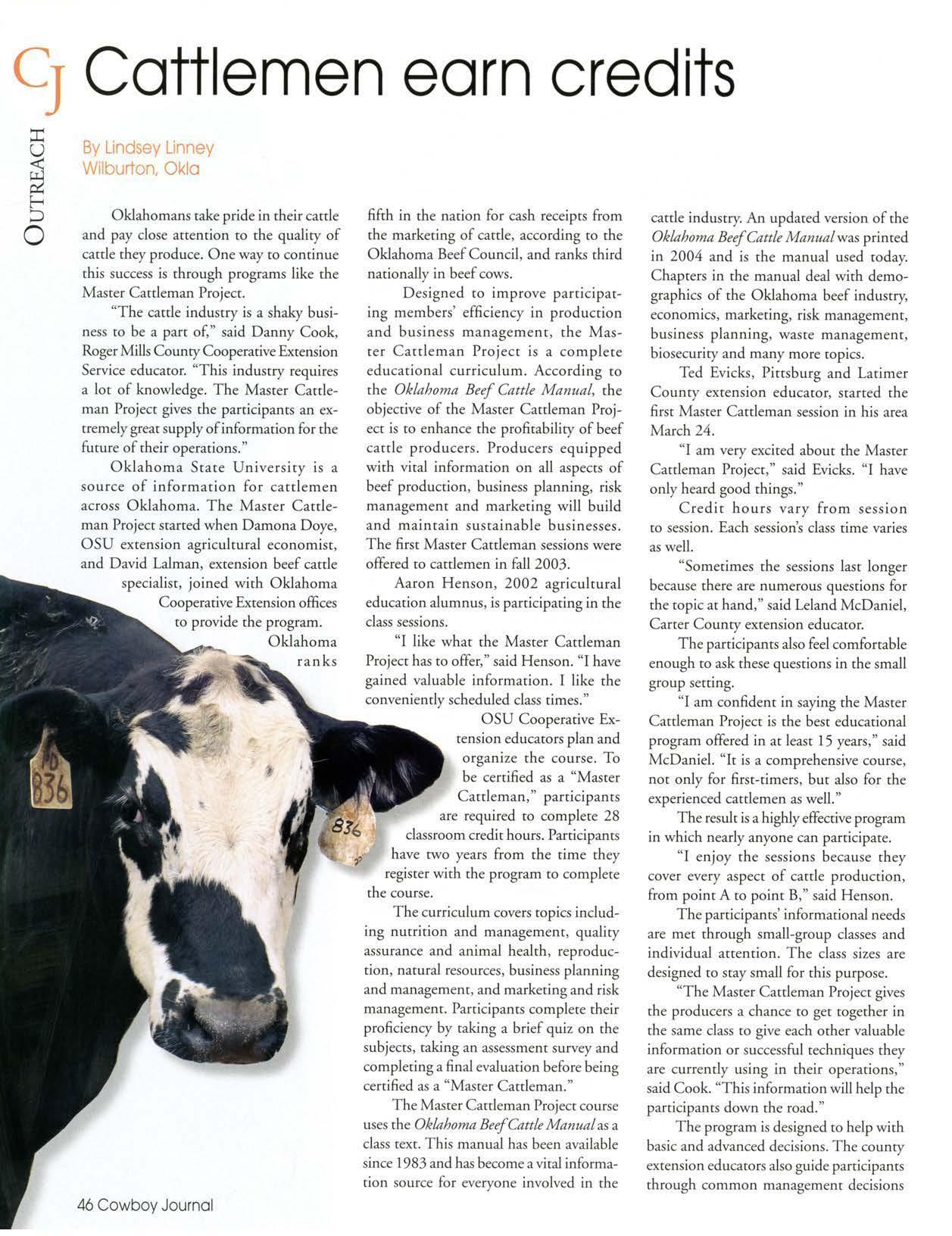
fifth in the nation for cash receipts from the marketing of cattle, according to the Oklahoma Beef Council, and ranks third nationally in beef cows.
Designed ro improve parcicipacing members' efficiency in production and business management, che Master Cacrleman Project is a complete educational curriculum. According co the Oklahoma Beef Cattle Manual, the objective of the Master Cattleman Project is to enhance rhe profirability of beef cattle producers. Producers equipped with viral information on all aspects of beef production, business planning, risk management and marketing will build and maintain susrainable businesses. The first Master Cattleman sessions were offered ro cattlemen in fall 2003.
Aaron Henson, 2002 agricultural education alumnus, is participating in che class sessions.
"T like what che Master Cattleman Project has to offer," said Henson. "I have gained valuable information. I like the conveniently scheduled class rimes."
OSU Cooperative Extension educarors plan and organize the course. To be certified as a "Master Cattleman," participants are required to complete 28 classroom credit hours. Participants have rwo years from the rime they register with the program ro complete the course.
The curriculum covers ropics including nutrition and management, quality assurance and animal health, reproduction, natural resources, business planning and management, and marketing and risk management. Parricipancs complete their proficiency by taking a brief quiz on the subjects, raking an assessment survey and completing a final evaluation before being certified as a "Master Cattleman."
The Master Cattleman Project course uses rhe Oklnhoma Beef Cattle Manual as a class text. This manual has been available since 1983 and has become a viral information source for everyone involved in rhe
cattle industry. An updated version of the Oklahoma Beef Cattle Manual was printed in 2004 and is che manual used today. Chapters in che manual deal with demographics of the Oklahoma beef industry, economics, marketing, risk management, business planning, wasre management, biosecurity and many more ropics.
Ted Evicks, Pittsburg and Larimer Counry extension educator, started the first Master Catcleman session in his area March 24.
"I am very excited about the Master Cattleman Project," said Evicks. "I have only heard good things."
Credit hours vary from session co session. Each session's class rime varies as well.
"Sometimes the sessions last longer because there are numerous questions for the topic at hand," said Leland McDaniel, Career County extension educator.
The participants also feel comforrable enough to ask these questions in che small group setting.
"I am confident in saying the Master Cattleman Project is the best educational program offered in at least 15 years," said McDaniel. "It is a comprehensive course, not only for first-timers, but also for the experienced cattlemen as well."
The result is a highly effective program in which nearly anyone can participate.
"I enjoy rhe sessions because they cover every aspect of carrle production, from point A ro point B," said Henson.
The participants' informational needs are mer through small-group classes and individual attention. The class sizes are designed to sray small for chis purpose.
"The Master Cardeman Project gives rhe producers a chance co get together in the same class ro give each other valuable information or successful techniques they are currently using in their operations," said Cook. "This information will help the participants down the road."
The program is designed co help with basic and advanced decisions. The county extension educarors also guide participants through common management decisions
and provide up-ro-dare research. Licensed veterinarian willteach some of the sessions regarding animal health.
"I keep the class limired due ro the many positives char occur from small group dynamics," said McDaniel.
Master Catrleman classes are being offered across Oklahoma. ince rhe start of rhe program, there has been great inreresr in what the course offers.
"The Master Cattleman Project is one of rhe mo r valuable programs I've seen in a long time," said Cook. "This program is taking off in a great direction. I can distribute much more informarion to producers than I was able ro do before. Thi is a big positive for extension agents, educators, 0 U and carde producers."
To encourage participation in rhe program, agribusinesses al o offer local monetary incentives, such as discounts co rho e who have successfu!Jycompleted the Master Cattleman Project.
Justin McDaniel, Ponoroc County Extension educator and agenc, said, "The Master Cattleman Project offer valuable information co fit the participants' need in a timely manner. Ir is useful ro chem because ir coincides with what happens on rhe ranch."
The Master Carrleman Program costs panicipancs $75 and is offered ro Oklahoma beef producers. Each participant receives an OklahomaBeef CattleManual, insrrucrional materials, a certificate, a Master Cattleman farm gate sign and a notebook with rhe Master Cattleman logo.
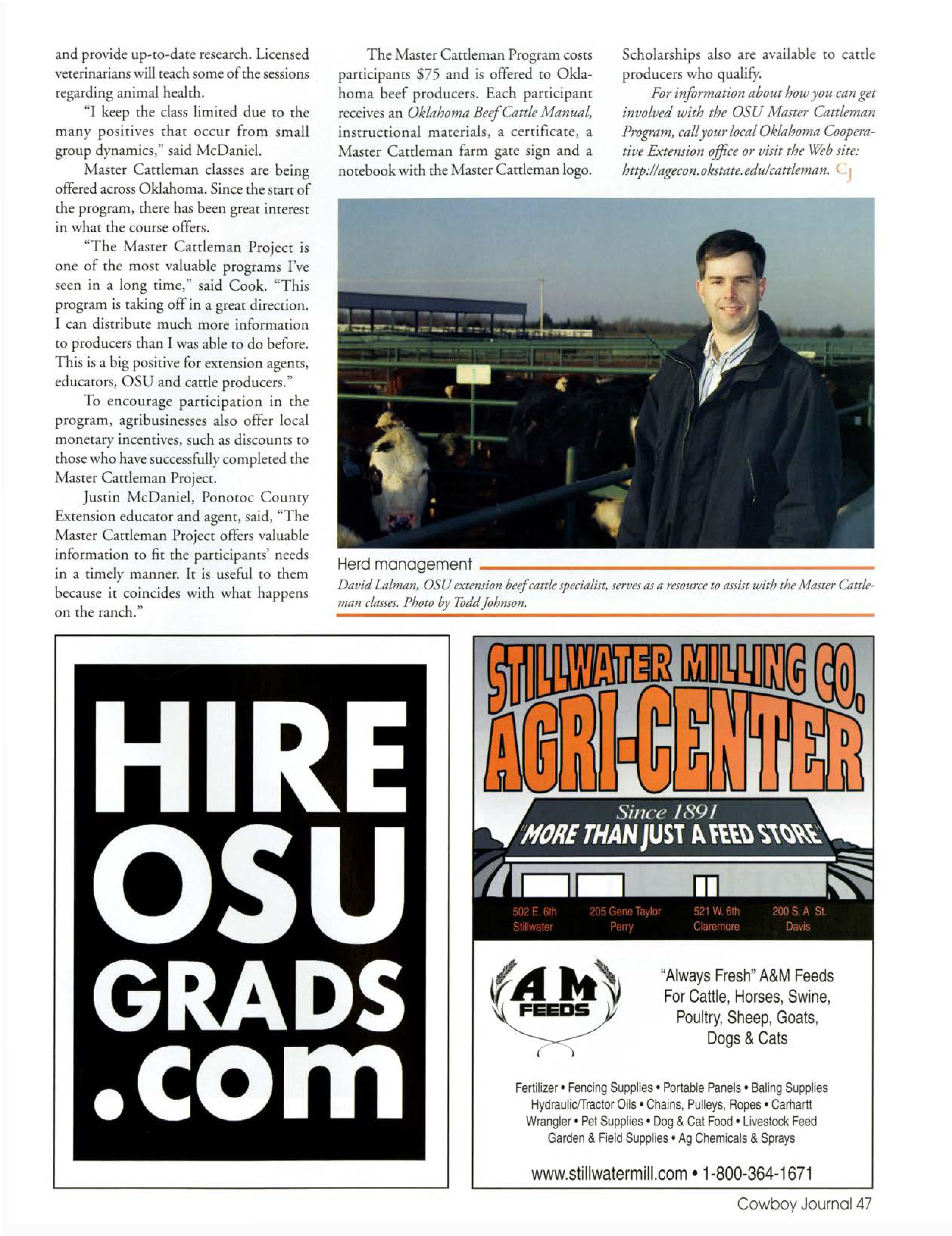
Scholarships also are available ro catrle producers who qualify.
Forinformationabout howyou canget involved with the OSU Master Cattleman Program,callyour localOklahomaCooperative Extemion officeor visit the Website: http:llagecon.okstate.edulcattleman. ( I
Herd management Dflvid La/man, OSU extensionbeef cattlespecialist,servesas fl resourceto assirrwith the Master Cattleman clttsses.Photo by ToddJohnson.

Au lralia. Balli Stales. Ireland. Honduras. Thailand. Scotland. England. Peru. Japan. Mexico. Italy

CJCowboy bullets
C/) ByTraciNaile,Trafalgar,nd
• Rotaryscholarshiptakes CASNRseniordown under
One of the 2005 rop seniors in the College of Agricultural Sciences and amral Resources is headed to Australia for graduate school as a Rotary Incernarional Ambassadorial Scholar.
Bi.IIShelby, an alumnus in agribusiness from Webbers Falls, Okla. received a $25 000 scholarship to study busmes at the University of Sydney scamng m February 2006.
Shelby applied for the scholarship through the Muskogee Rotary Club after learnmg about It from previous recipiencs 111OSU's agribus111essprogram.
The club awards one $18,000 and one $25,000 scholarship m districts selected based on club parcic1parion. helby was
chosen ro represenc the district chat includes the northeast corner of Oklahoma and adjacenc corners of Kansas, Missouri and Arkansas.
Shelby said he found our he was chosen ro receive the scholarship immediately after his incerv1ew,even before he made ir back ro Srillwarer.
"They called while I was dnvmg and told me I'd been selected," said Shelby. "I was so excited I didn't even realize they didn't cell me which scholarship I'd been selected for."
The selected scholars serve as ambassadors for the Rotary Club in the country 111which they choose ro scudy by bemg active in the local club and giving presen-
• Landscape architecture studentsgive cities a face-lift
ro puc their classroom skills co work and gain hands-on experience.
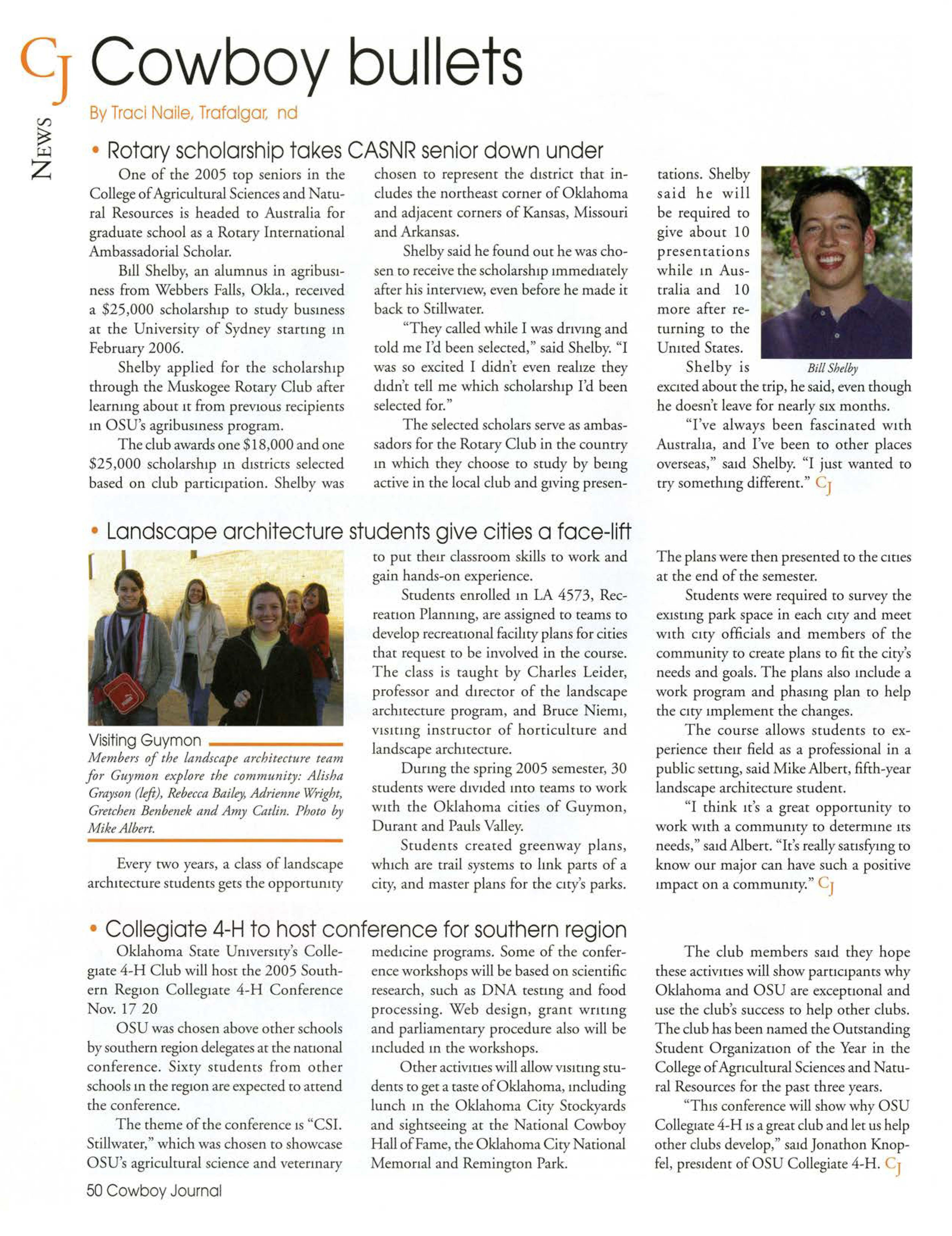
Visiting Guymon
Members of the landscape architecture team for Guymon explore the community: Alisha Grayson(left), RebeccaBailey,Adrienne Wright, Gretchen Benbenek and Amy Catlin. Photo by Mike Albert.
Every two years, a class of landscape archiceccure scudencs gets the opporru111ry
Srudents enrolled m LA 4573, Recreation Planning, are as igned to teams to develop recreanonal facihry plans for ciries char request co be involved in the course. The class is taught by Charles Leider, professor and director of che landscape arch1tecrure program, and Bruce iem1, v1s1t111ginsuuctor of horticulture and landscape architecture.
Dunng the spring 2005 semester, 30 students were d1v1dedmto reams ro work with the Oklahoma cities of Guymon, Durant and Pauls Valley. cudencs created greenway plans, which are trail systems co lmk pares of a ciry, and master plans for the c1ry'sparks.
• Collegiate 4-Hto host conference for southern region
Oklahoma Scace U111vers1ty'sCollegiate 4-H Club will ho t the 2005 Southern Region Colleg1ace 4-H Conference ov. 17 20
0 U was chosen above other schools by southern region delegates ar the naaonal conference. ixty students from ocher schools 111the reg10nare expected co attend rhe conference.
The cheme of rhe conference 1s"CSL Scillwarer,"which was chosen to showcase OSU's agriculrural science and vecennaty
50 Cowboy Journal
medicine programs. Some of the conference workshops will be based on scientific research, such as DNA tesang and food proce sing. Web design, grant wrmng and parliamentary procedure also will be mcluded m che workshops.
Other accivmeswill allow v1s1t111gstudents to geea casteof Oklahoma, mcluding lunch 111the Oklahoma Ciry Stockyards and sightseeing at the National Cowboy Hall of Fame, the Oklahoma City acional Memonal and Remington Park.
rations. Shelby said he will be required co give about 10 presenranons while 1n Australia and 10 more after returning to the U111cedStates.
Shelby is BillShelby exrned about the trip, he said, even though he doesn't leave for nearly six momhs.
''I've always been fascinated with Australia, and I've been to other places overseas," satd Shelby. "I just wanted to cry someth111gdifferent." CJ
The plans were then presented cothe CJues at the end of the semester.
rudencs were required co survey the exisung park space in each c1ry and meet with city officials and members of the community to create plans co fit the ciry's needs and goals. The plans also mclude a work program and phasmg plan t0 help the c1ryimplement the changes.
The course allows scudencs ro experience their field as a professional in a public semng, said Mike Alben, fifth-year landscape architecture cudenc.
"I chink 1ts a great opporcuniry to work w1rh a commu111tyro determme its needs," said Albert. "It's really sausfymg to know our major can have such a positive impact on a community." CJ
The club members said they hope these activmes will show part1c1pancswhy Oklahoma and OSU are exceptional and use the club's success co help ocher clubs. The club has been named the Outstanding Student Organizauon of the Year in the College of Agnculrural ciences and amral Resources for the past three years.
"This conference will show why OSU Colleg1ace4-H 1sa great club and leeus help ocher clubs develop," said Jonathon Knopfel, president of OS Collegiate 4-H. CJ