BOY Jou AL
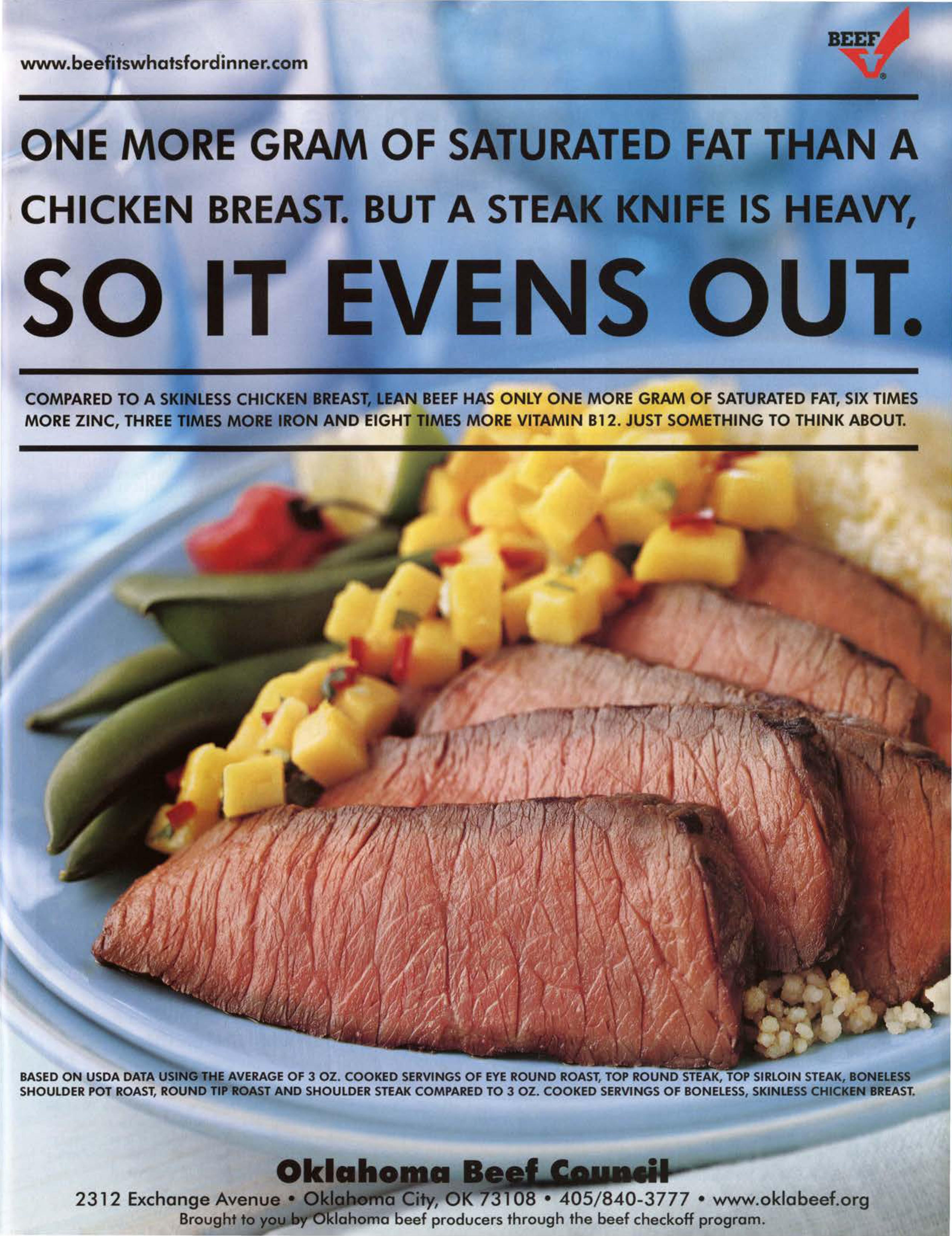
COMPAREDTO A SKINLESSCHICKENBREAST,LEAN BEEFHAS ONLYONE MOREGRAMOF SATURATEDFAT,SIXTIMES MOREZINC, THREETIMESMORE IRON ANO EIGHTTIMESMOREVITAMINBl 2. JUST SOMETHINGTO THINKABOUT.
CjCowboys work behind the scenes ...
cj staff
co-editors
laura kathleen mckay and luann ulrich circulationcoordinator
ryan Steele graphicscoordinators
jodi nichols cole and amy pagetr
photo coordinator
Stephanie mitchell sponsorshipcoordinators
macey a. hedges and cathy herren
web editor
rachel k. bobbin
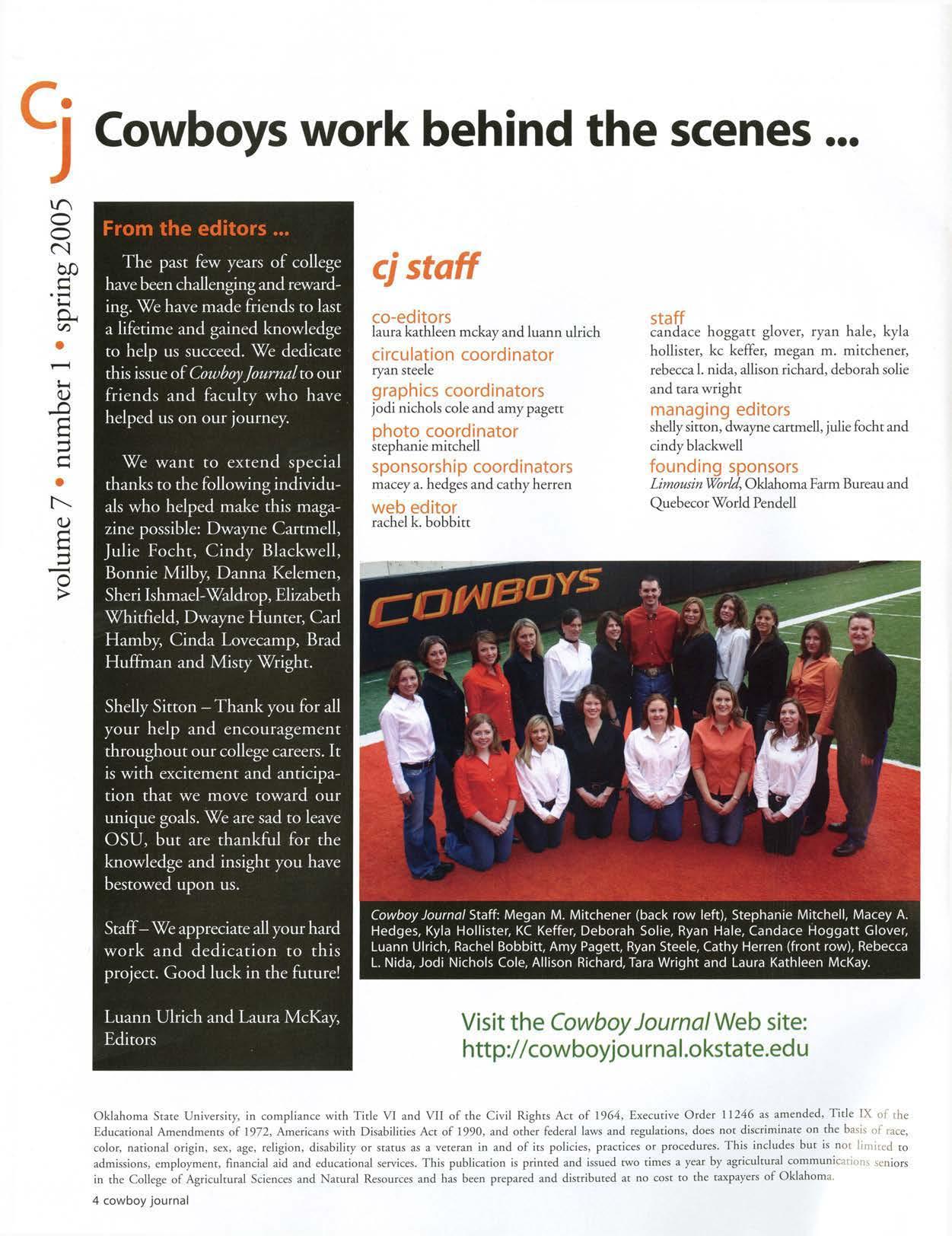
staff
candace hoggacr glover, ryan hale, kyla holliscer, kc keffer, megan m. mitchener, rebecca I. nida, allison richard, deborah solie and rara wright
managing editors
shelly sirron, dwayne cartmell, julie fochr and cindy blackwell
founding sponsors
LimousinWorld,Oklahoma Farm Bureau and Quebecor World Pendell
industry
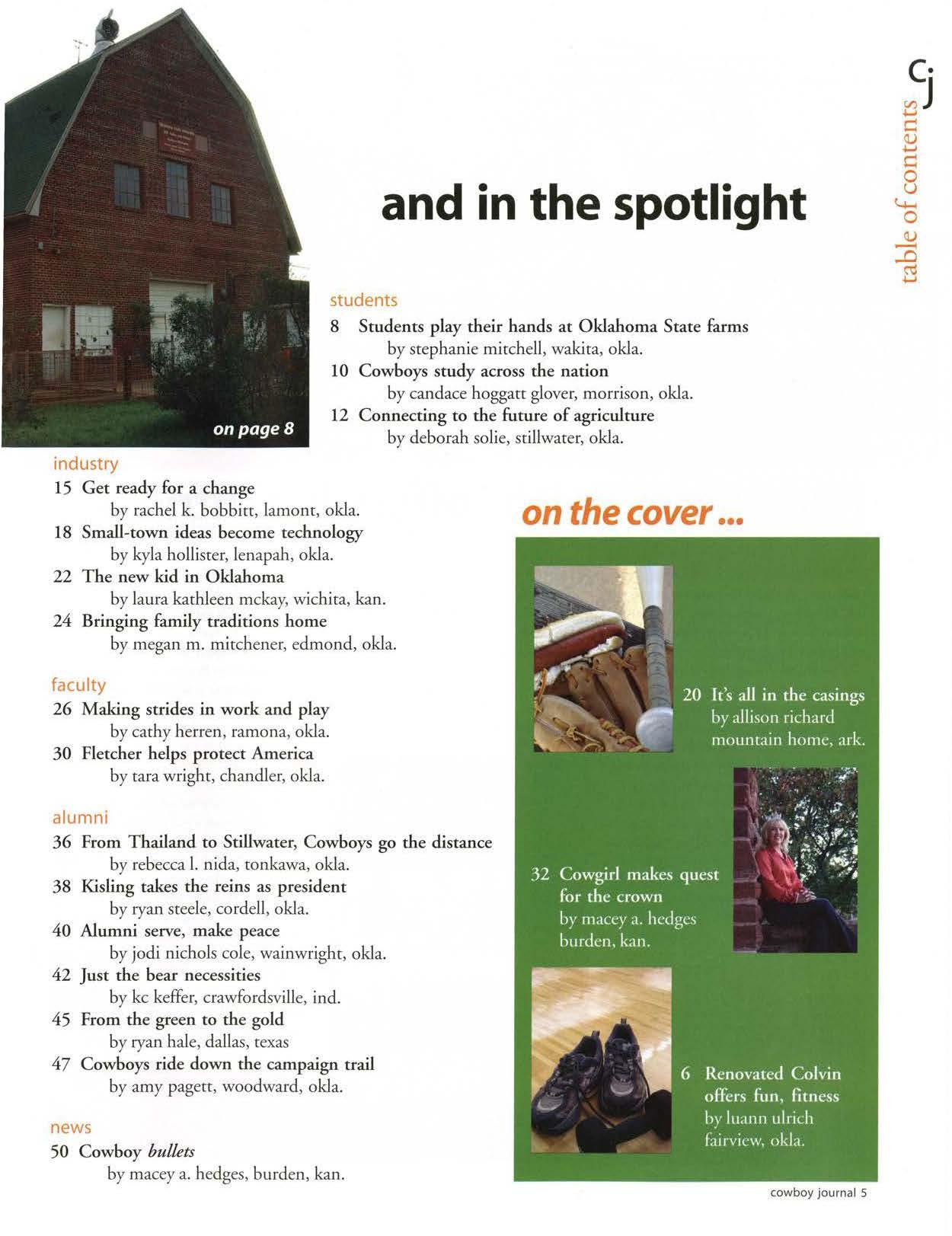
and in the spotlight
students
8 Students play their hands at Oklahoma State farms by Stephaniemitchell, wakita, okla.
10 Cowboys study across the nation by candace hoggatt glover, morrison, okla.
12 Connecting to the future of agriculture by deborah solie, Stillwater, okla.
15 Get ready for a change by rachel k. bobbitt, lamont, okla.
18 Small-town ideas become technology by kyla hollister, lenapah, okla.
22 The new kid in Oklahoma by laura kachleen mckay, wichita, kan.
24 Bringing family traditions home by megan m. mitchener, edmond, okla.
faculty
26 Making strides in work and play by cachy herren, ramona, okla.
30 Fletcher helps protect America by tara wright, chandler, okla.
alumni
36 From Thailand to Stillwater, Cowboys go the distance by rebecca I. nida, ronkawa, okla.
38 IGsling takes the reins as president by ryan steele, cordell, okla.
40 Alumni serve, make peace by jodi nichols cole, wainwright, okla.
42 Just the bear necessities by kc keffer, crawfordsville, ind.
4 5 From the green to the gold by ryan hale, dallas, texas
47 Cowboys ride down the campaign trail by amy pagett, woodward, okla.
news
50 Cowboy bullets by macey a. hedges, burden, kan.
Renovated Colvin offers fun, fitness
by luann ulrich
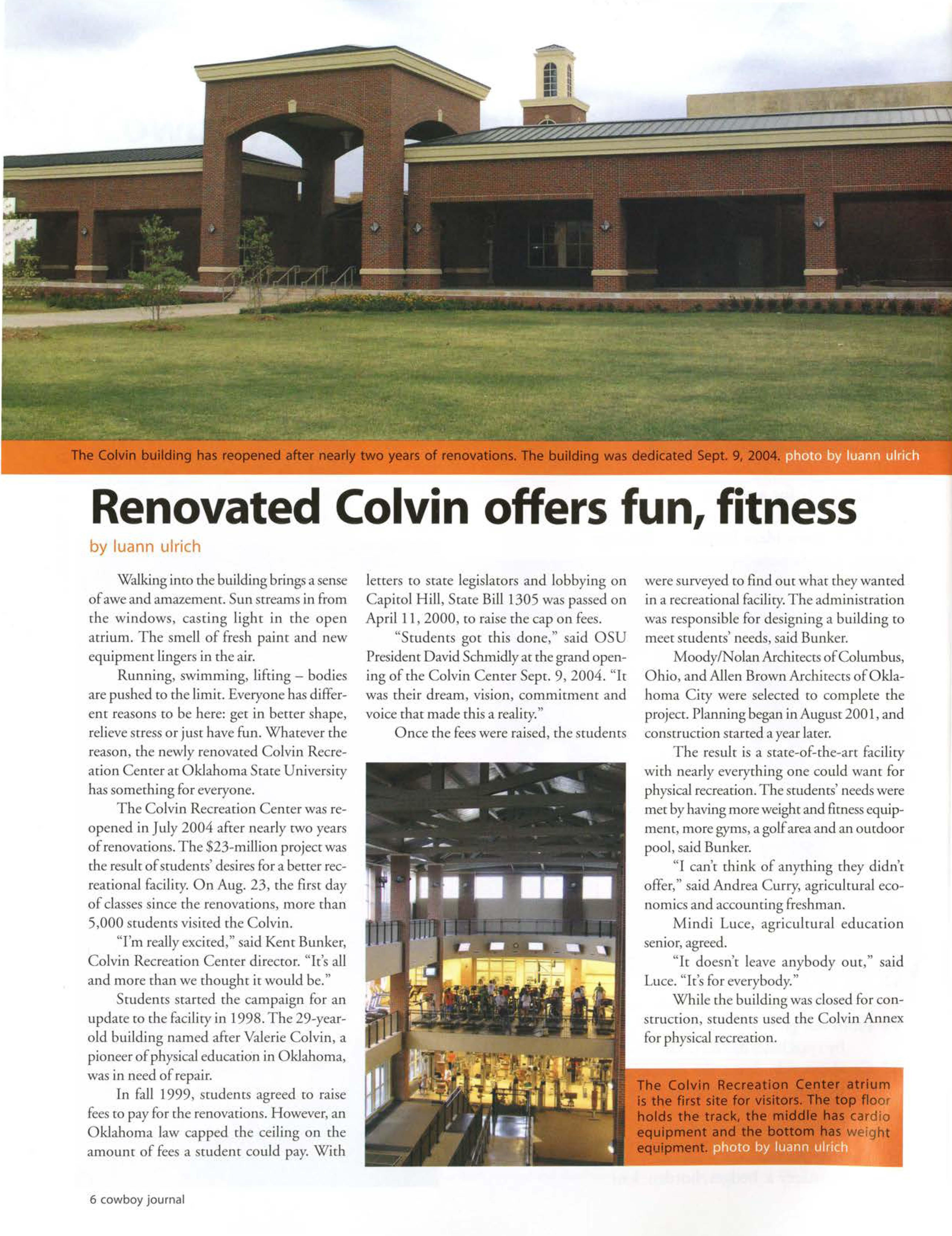
Walking into the building brings a en e of awe and amazement. un creams in from rhe window , ca ting light in the open auium. The mell of fre h paint and new equipment lingers in the air.
Running, swimming, lifring - bodie are pushed co the limit. Everyone ha different rea on co be here: gee in better hape, relieve sere or just have fun. Whatever the rea on, the newly renovated Colvin Recreation Center at Oklahoma rate University has omething for everyone.
The Colvin Recreation Center wa reopened in July 2004 after nearly two year of renovations. The 23-milJion project was the result of students' de ires for a better recreational facility. On Aug. 23, the first day of classes ince rhe renovation , more than 5,000 students visited the olvin.
'Tm really excited," aid Kent Bunker, Colvin Recreation Center dire tor. "It' all and more rhan we thoughr ir would be."
rudents scarred the campaign for an update co the facility in I 998. The 29-yearold building named afcer Valerie Colvin, a pioneer of physical education in Oklahoma, was in need of repair.
fn fall 1999. rudems agreed co raise fees co pay for rhe renovations. However, an Oklahoma law capped the ceiling on the amounr of fees a student could pay. With
letters co state legislators and lobbying on Capirol Hill, rate Bill 1305 wa pas ed on April 11, 2000 co raise che cap on fees.
" tudents goc this done," said O U President David Schmidly ar the grand opening of the Colvin Cencer ept. 9, 2004. "lr wa their dream, vision, commitment and voice that made this a reality."
Once the fees were raised, the srudems
were surveyed to find our whar they wan red in a recreational faciliry.The administration was responsible for designing a building to meer srudencs' needs, said Bunker.
Moody/ olanArdtirects of Columbus, Ohio, and Allen Brown Architects of Oklahoma City were selected to complete the project. Planning began ia August 2001, and consrrucrion starred a year later.
The result is a stare-of-the-arr facility with nearly everything one could wane for physical recreation. The srudems' needs were mer by having more weight and fitness equipmem, more gyms, a golf area and an outdoor pool, said Bunker.
"[ can't chink of anything they didn't offer," said Andrea urry, agricultural economics and accounting freshman.
Mindi Luce, agricultural education senior, agreed.
"le doesn't leave anybody our," said Luce. "Ir's for everybody."
While the building was closed for consuucrion, studems used the Colvin Annex for physical recreation.
he Colvin Re flms1te
David Brown, landscape architecture enior and a srudem manager at the Colvin said he wa extremely happy when che renovation were done. He said it was gratifying to ee it go from the facility ir was through ch Annex pha e to whar it i now.
ince the opening of the renovated Colvin, the Annex has been used as an overflow facility when needed, and it is rented ro groups for various a riviries, said Bunker.
Agricultural rudenc appreciate the new equipmenr and open atmosphere in the renovated Colvin. The increased an1ount of equipment makes it easier for more srudents to work our at the same time.
Clinr Ratke, plant and soil cien es senior, said he Jjkes char there is more room and that he does nor have to wait 30 minutes co an hour just to run or play basketball.
Lindsey Ander on, animal science prevec senior, aid she enjoys rhe new weight machines and rowing machine. he said ic i nice to have a wider variety of equipment.
"le' really impre ive," aid Anderson. "le motivates you to stay fie."
Luce said he did not work out at th Annex because ir was inconvenienc and he had to wair for equipment. he said it is easier to go to the renovated Colvin.
"lt's there, so why nor cake advanrage ofit?" said Luce.
rudents have taken advantage of the facility, averaging abouc 3,000 to 4,000 srudenrs per day. With all rhe Colvin has to
offer, it does nor appear these numbers will decline any cime soon.
"l thinkir' wonderful," aid Curry. "Ir gives scudent a nice place to work our."
Ander on aid he likes char the facility i more open and you feel like you have more pace.
"They paid atcention to detail on everything," said uce.
Rarke said he Likesrhat rhere is more equipment and basketball courrs. He said he also appreciates the air conditioning.
Th benefits of the Colvin are numerous. Aside from health and fitness, rhe facility is al o a ocial place for srudenc co relax and have fun. Bunker said it helps relieve srr s, and physical exercise has been proven ro increase mental retention.
"It really enhances the Lmiversityenvironment" aid Bunker.
Brown said the facility adds to srudenrs' quality oflife and gives students something constructive and healthy to do.
The newly renovated Colvin Recreation Center has impactedsrudenrs and staff in a positive way. The response from students has been overwhelming and exciting, said Bunker.
Brown said people usually have a jawdropping reaction when rhey see ir for the first time.
"Everyone we take through i amazed that chi is our facility,' aid Brown.
The renovations have made the
What's New at the Colvin: Equipment and Facilities
• 1/IO mile four-lane crack
• Indoor pool and ourdoor pool
• Three dance rudio with high-performance wooden floor for aerobi
• Three multipurpose rooms for activities such a kickboxing, yoga and pilaces
• Outdoor Adventure area for equipment rental and rrip regi trarion
• 35-foor climbing wall
• Lounge equipped with a 60-inch TV
• More chan 17,000 square feetof cardio/ficne equipmentwich seven pla ma TV
• More than 12,000 square feet of free weights and place-loaded machine
• Golf cenrer with three driving-range practice nets, a practice puCting green and rwo golf sim ularor
• 10 basketball courts
• 12 racquetball courts
• Multipurpose activity court gym for indoor occer and floor hockey
• Free day lockers
• Complete locker room and rowel erv1ce
• Equipment checkout services
• Vending area
• Five cla srooms and one computer lab
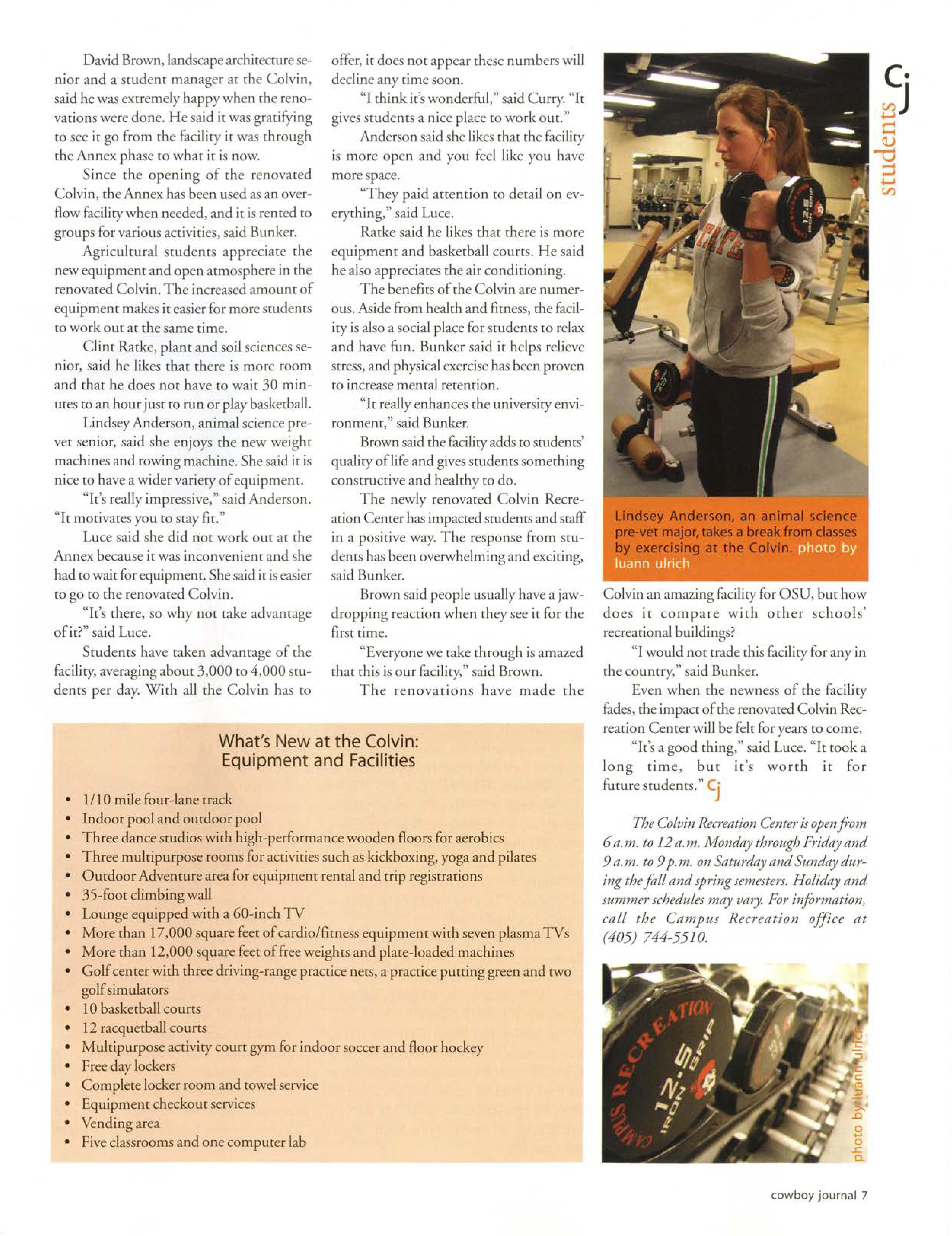
s n et-son,-ananiln sciente pre:,wtmaj(>r,ra~a break uerclsl at the Colvin
olvin an amazing facility for O U, but how doe ir compar with ocher schools' recreational building ?
"I would nor rade ch.isfacility for any in rhecou.nrry," said Bunker.
Even when the newne s of rhe facility fudes, rhe impact of rhe renovated olvin Recreation Cencer will be felt for year to ome.
"Ir's a good thing," aid Luce. "le cook a long rime bur it's worrh it for future srudencs." Cj
The ColvinRecreationCenteris openji·om 6 a.m. to I 2 a. m. Monday throughFridayand 9 a.m. to 9 p. m. on Saturdayand Sunday during thefall and springsemesters.Holiday and summer schedulesmay umy. For information, call the Campus Recreation office at (405) 744-5510.
S1buudlcent§ ]J_J)lay
at OlkRah({))rrna Stafce farrrn§
by Stephanie mitcnell
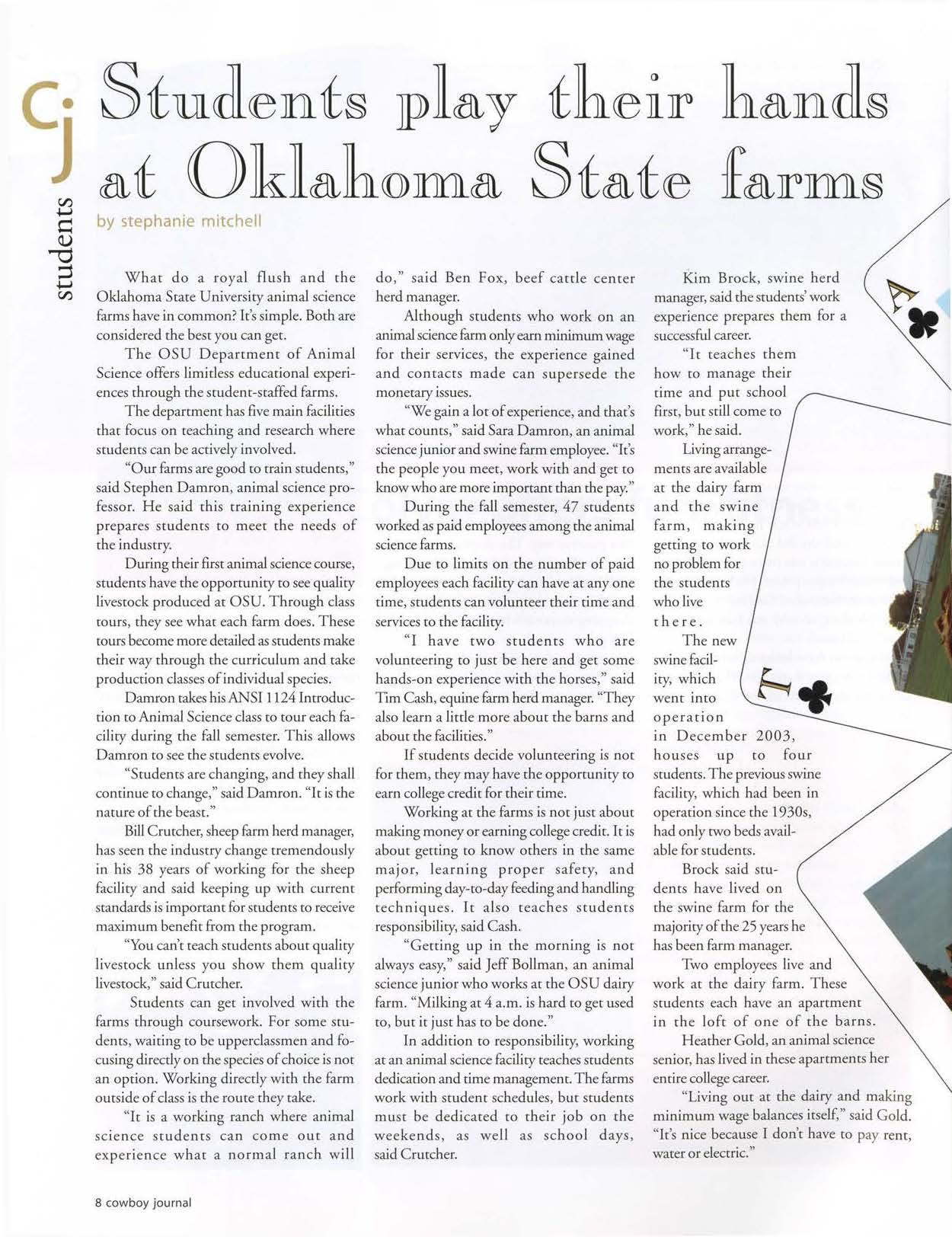
What do a royal flush and the Oklahoma Scace University animal science farms have in common? It's simple. Both a.re considered the best you can gee.
The OSU Department of Animal Science offers limitless educarional experiences chrough che srudenc-staffed farms.
The department has five main facilities that focus on reaching and research where students can be actively involved.
"Our farms a.regood to train scudenrs," said Stephen Damron, animal science professor. He said chis craining experience prepares scudencs ro meet che needs of rhe industry.
During their first animal science course, students have the opportunity to see qualiry livestock produced at OSU. Through class cours, chey see whar each fa.rm does. These tours become more derailed as scudenrs make cheir way through the curriculum and take production classesof individual species.
Damron rakes his ANSI 1124 Introduction co Animal Science class to tour each facility during the fall semester. This allows Damron co see the students evolve.
"Students are changing, and rhey shall continue co change," said Damron. "It is the nature of the beast."
Bill Crutcher, sheep farm herd manager, has seen rhe industry change tremendously in his 38 years of working for the sheep faciliry and said keeping up with current standards is important for students to receive maximum benefit from the program.
"You can't ceach students abour qualiry livestock unless you show them quality livescock,"said Crutcher.
Scudenrs can get involved with rhe farms through coursework. For some scudents, waiting co be upperclassmen and focusing di.reedyon the species of choice is nor an option. Working directly with che farm outside of class is the route they rake.
"It is a working ranch where animal science students can come our and experience whar a normal ranch will
do," said Ben Fox, beef cattle center herd manager.
Although students who work on an animal sciencefarm only earn m inimurn wage for their services, the experience gained and con races made can supersede rhe monetary issues.
"We gain a lot of experience, and chat's what counts," said Sara Damron, an animal science junior and swine farm employee. "It's che people you meet, work with and get co know who are more important than the pay."
During the fall semester, 47 students worked as paid employees among the animal science fa.rms.
Due co limits on the number of paid employees each faciliry can have at any one time, students can volunteer their time and services to the faciliry.
"I have two students who are volunteering co just be here and gee some hands-on experience with the horses," said 1im Cash, equine farm herd manager. "They also learn a little more about the barns and about the facilities."
If students decide volunteering is not for them, they may have rhe opportunity co earn college credit for their time.
Working ac the farms is noc just abouc making money or earning college credit. It is about getting co know ochers in the same major, learning proper safety, and performing day-co-day feeding and handling techniques. le also teaches students responsibility, said Cash.
"Geeting up in the morning is nor always easy," said Jeff Bollman, an animal science junior who works ac the OSU dairy farm. "Milking at 4 a.m. is hard co gee used to, bur icjust has co be done."
In addition to responsibility, working at an animal science faciliry teaches students dedication and rime management. The farms work with student schedules, bur students must be dedicated co their job on che weekends, as wel I as school days, said Crutcher.
Kim Brock, swine herd manager, said the students' work experience prepares tl1em for a successful career.
"I c teaches chem how ro manage rheiI time and put school first, but srill come co work," he said.
Living arrangements are available at the dairy farm and che swine farm, making getting to work no problem for the students who live there. The new swine facility, which went into operation in December 2003, houses up co four srudenrs. The previous swine facility, which had been in operarion since the 1930s, had only rwo beds available for students.
Brock said srudenrs have lived on the swine farm for the majori ryof rhe 25 years he has been farm manager.
Two employees live and work at the dairy farm. These students each have an apartment in che loft of one of che barns.
Heather Gold, an animal science senior, has lived in these aparrmenrs her entire co.liegecareer.
"Living ouc ac che dairy and making minimum wage balances itself," said Gold. "lc's nice because r don't have co pay rent, water or electric."
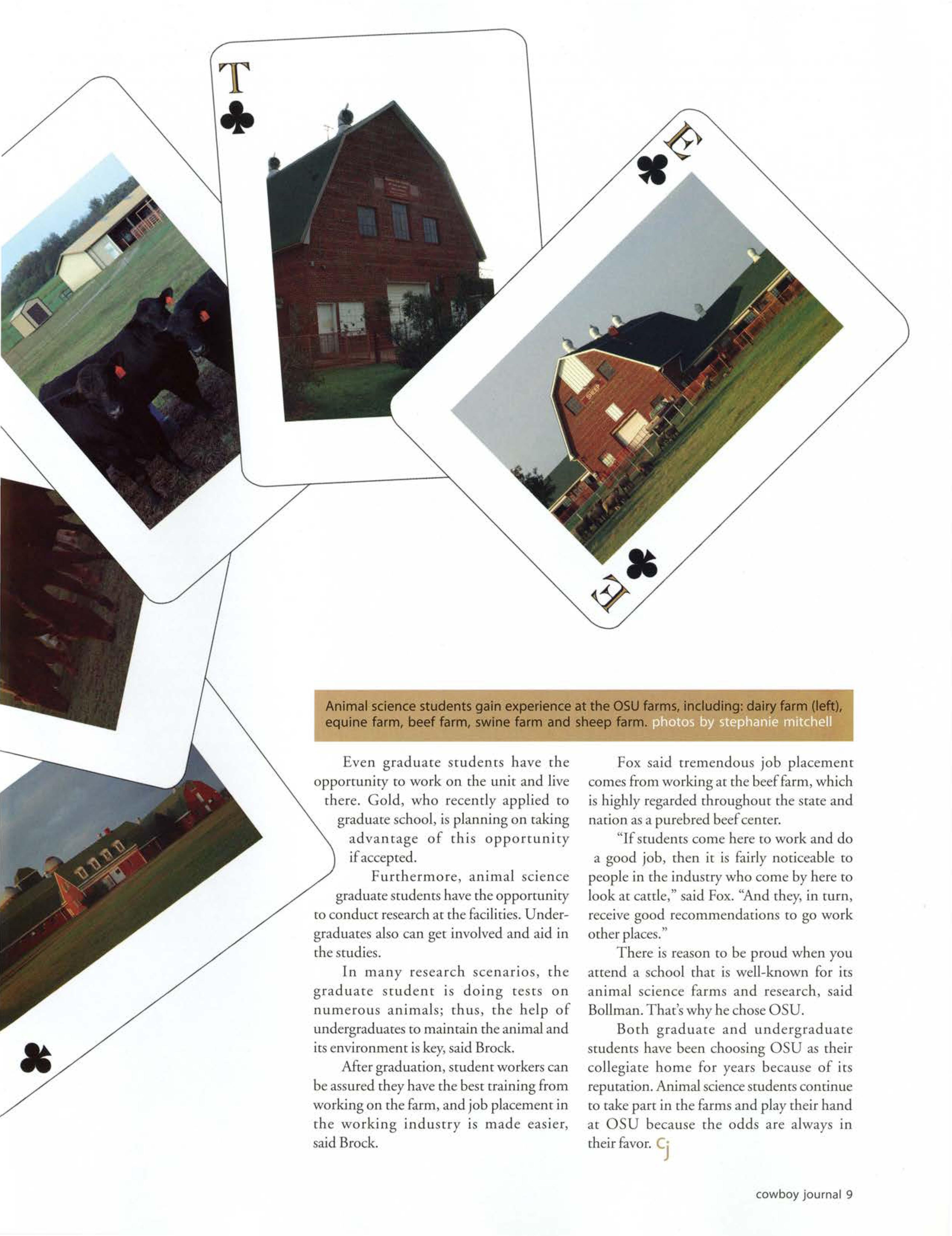
Animalsciencestudentsgainexperienceat the OSUfarms,including:dairyfarm (left), equinefarm, beef farm, swinefarm and sheepfarm.
Even graduate rudencs have the opportunity co work on the unjt and live there. Gold, who recently applied co graduate school, i planning on caking advantage of thi opportunity if accepted.
Furthermore animal science graduate students have che opportunity co conduct re earch at the facilicie Undergraduates al o can gee involved and aid in the tudie
In many research scenarios, the graduate smdenr is doing cescs on numerous animals; thus, the help of undergraduates co maintain the animal and it environment is key, said Brock.
After graduation, student workers can be as ured they have the best training from working on the farm, and job placement in the working indusrry i made ea ier, said Brock.
Fox said tremendous job placement comes from working at the beeffarm, which i highly regarded chroughour rhe srate and nation as a purebred beef cenrer.
"lf students come here co work and do a good job, then ic is fairly noticeable co people in che industry who come by here co look at carcle," said Fox. "And chcy, in rum, receive good recommendarions co go work ocher places."
There is reason co be proud when you attend a hool chat i weU-known for its animal ien e farm and re earch, said Bollman. That' why he cho e O U.
Boch graduate and undergraduate students have been choosing OSU a their collegiate home for year becau e of irs repuracion. Arumal ience srudents continue co cake pare in che farm and play their hand ac O U becau e rhe odds are always 111 rheir favor. CJ
Cow6oy s studyacrosstfienation
by candace hoggatt glover
The busy hum of a rudenc union, crowded idewalks as mdencs walk from one cla ro the next, a hu hed ilence in rhe library ... cbese things remain con cane on campu e throughout the nation. Jc is che people curriculum and campus tradition chat make each campus unique.
The opportuniry co experience rhe uniquenes ofacampu different than your own and the chance cobroaden your educational and culcural experience are po sible through the ational rudenc xchange.
"The E program i an opporcunity co exchange with ocher United rates and Canadian univer itie ," aid Gerry Auel, Oklahoma Srate Univer icy Study Abroad coordinator.
Participation in rhe program allows students to expand their educational and personal experiences through life-changing situations while studying ac anocher universicy.
" here are so many differenrculcures in the Un ired cares,and ir can be ju r as much of a cultural experience to exchange within the U. as going abroad," said Auel. "N Eis a door chat opens srudenrs up co more po sibili cies. ome of our students participate in the exchange for geographical reasons, family lies, cultural experiences or cenain curriculums not offered at O U."
Jennifer Walker, an animal cience enior, exchanged from Oregon cate Universiry ro O U for the 2002-03 school year.
"I found our about rbe E program in my freshman orientation," said Walker. "I wanted co go coa good ag chool and be in ag country.
' I narrowed down my rop three chool , and then I poke with Gerry Auel. She put me in couch wirh rhe animal science department," said Walker. ''Afrer rhe door was opened, everything fell inco place."
During her exchange, Walker entered the animal cience deparrmenc wirh an incere tin beef and equine, and she became involved in campus organization
"] wa 2,000 miles away from homeI was nervous," aid Walker. "I was very apprehen ive and didn't know how ir would turn out.
"lr's a completely differem world. I learned about bli rer beerles here; J didn't even know rhecewere blister beedes!"
he NS has 177 member campuse and places nearly 4,500 scudenc for exchange annually. Most E members are state-supported colleges, bur also included are several private campuses, as well as Canadian insciruces.
Only two universities in Oklahoma belong co the S program. One is Ea r Central University in Ada, and rhe other isO
Aarnn Perkin , a,n O U plant and soil sciences enior, exchanged co the Univericy of Idaho in Mo cow, Idaho, through
rhe E program. Perkins learned of the program through a friend from North arolina who wa ac O U participating in rhe exchange.
Perkinssaid he liked the ideaof experiencing another pare of the United races while continuing to work on his degree. Hewanted ro arcend a university with a strong rangeland and ecology management program.
"I realized char diverse experience and rhe willingness to travel are alway an advantage in rhe eyes of potential employers, especially in my field ofsrudy," said Perkins.
He said he chose UI because of how its range program is structured. I csAgricultural and Life ciences and arural Resources College appealed m him because ofirs suong individual department in rangeland ecology, wildlife management, forestry, and resource recreation and tourism.
"I al o chose Idaho becau e I had never been there, and I wanted co experience range management from more of a public land viewpoint as compared co rhe predominately private influence here " aid Perkins. "There were other issues in range management that were of concern co rhat region that ] didn't know very much about. T basically wanted to broaden my way of thinking and underranding by seeing them fo rhand."
While ac UI, Perkin was able to experience hand -on applicarions in his range das es. He was able ro work with cwo ranches i_nIdaho and gained a better understanding of range ecology through hi classes.
"I got a chance to see what range profe sional in rhe western rate encounter
in cheircareers," aid Perkin "AddirionalJy l encou mered ecosy rem and landscapes char l may not have ever gorcen a chan e ro ec." mdems parricipace in the E progran1 for various rca on . Whatever the moti varion, the chance ro become involved lies within OSU' study abroad office.
"The E program is an incrediblywellorganized and affordabl program," said Auel. "We cypically end out 20 co 25 cudencs a year and cake in about eight to 15."
OSU began participating in the E program in the early 1990 intending co ger students involved in inrernacional studies. Ln face, the E program came before study abroad, and it paved the way for international exchanges.
Participant in E must be full-time student at their home campus and also be in good standing financially, ocially and academically. A minimum grade point average of2.5 on a 4.0 scale is required. rudencs mu c comply with any addicional requiremencs or regulation p cified by the host campu
Each SE member campus determines its payment plan.
" cudenrs either pay Oklahoma cace Universiry's ruicion or the host school' instate ruition," said Auel.
Room and meals are always paid to rhe hose campus. In addition, fees a sessed as a condition of enrollment, e.g., laborarory uses,
u Iare always paid ro thehosccampus. Financial aid i available co scudenrs buc is applied for and awarded by the campus at which the studenc pays cuicion and fees. Through E, scudenrs can a.trend a university for either a semester or a full year, but ometime the experience has such an impact chat it may lead student down a different path.
After completing the exchange, Walker made the decision co rran fer to OkJalioma care.There were many opporrw1itie for her, and he said the relationship wirh her professors opened a lot of door.
ince tran ferring co O U she has become involved in organizations such as Ag Ambassadors, Mortar Board, Cowboys for Christ and Horseman's Association. he was al oaCA NR rudencAcademicMemor.
"The people were a big faccor in my deci ion co cran fer ro Oklahoma State,"
said Walker. "The iuvescmenc in my education and rhe experiences I've had our-.¥eigh any sacrifices I've made."
If you are eeking independence, a new curriculum or the opportunity co experience a different region, E could be rhe option for you.
For more information on the National tudent Exchange,visit the O U StudyAbroad office in 060G Stttdent Union or the NSE Website athttp://1vww.nse.org. ,--
Connectin
by deborah solie
Pharmaceutical representatives.Lav,,yers. Graphic anises. Animal geneticists. These and ocher Oklahoma Scace University College of Agricultural Sciences and Natural Resources alumni are waiting co talk costudents like you.
Helping ochers learn about che various careers and opportunities in agriculture has been che mission ofCASNR Career Services for more than 20 years. The career services office offers a variety of job preparation cools, including on-campus interviews, a career fair and more, but their newest cool promises co give students a glimpse of a dayin-che-life of agricultural professionals.
The new service, CASNR Career Connections, is a Web-searchable database for prospective and currenc srudencs, which provides self-written profiles by alumni and professionals in the agricultural industry.
"The most frequently asked question by prospective and currem studenrs during my 15-year career is, 'What do I do with a major and degree in agriculcure?"' said Louann Waldner, CASNR director of student career services. "The answer is 'You can do anything with your degree,' and chat is what chis database shows."
CASNRalumni are located throughout the United States and the world. CASNR graduates have pursued varying career paths, and each has a unique story co cell. Their experiences could help students discover their own major or future career, said Waldner.
"This database will help students figure out what they wam to do with their lives," said Allison Hayes, an agricultural education junior. "By seeing the success of alumni, students may realize they can succeed, coo."
Besides reading alumni profiles, students will gee che opportunity co contact some alumni via e-mail or telephone. Once alumni have given permission, srudencs may request their contact information from careerservices.
However, Waldner said contact information will never be accessible co the public via the Internet; rather, it will be held by career services until a student's request is made. Also, alumni can limit the number of srudencs who receive the information.
"Jc is important co protect rhe alums'
to the futureof agriculture
privacy, while making it possible co connect chem with students," said Waldner.
studentbenefits
CASNR Career Connections is a tool srudencs can use throughout their college career as they face difficult questions like "What do I major in?" and "Is chiscareersomething I'm realJy interested in?" All students face challenges when determining their future careers and chis will be a cool that will help clarify the possibilities available in any degree field, said Waldner.
'Tm excired about gercing co hear about jobs firsthand from induscry professionals," said Andrea Curry, an agricultural economics and accounting freshman. "With my major, 1 know there are many job possibilities char 1 haven't even thought of, and I'm also excited about learning the possibilities in other majors, coo."
Alumni provide career information for srudencs about their chosen fields and also suggest skills needed to ensure successin chose areas. These profiles can help students focus on their education, enabling chem to become proficient in the areas needed co succeed in their chosen profession.
CASNR Career Connections also offers students the opportunity co network with industry professionals. These contacts could lead co internships and even job opportunities, said Waldner.
"l view this Web sire as a definite networking cool, and you can never have coo many contacts in rhe industry," said Hayes. Career development is important, said Waldner, and the newest cool offered by career services is another positive partnership between the college and the agricultural industry.
alumni benefits
CASNR has been home co thousands of students during their college careers at Oklahoma ScaceUniversity. The extensive education srudents have received has helped chem become successful in their chosen fields. Now, alumni have rhe opportunity co help current and prospective students bercer understand the agricultural industry.
"We have fewer people coming from agriculcural backgrounds. If we wane co keep recruiting people co our industry, agriculture,
nacural resources and related fields, we will have to be proactive at letting people know the opportunities available," said Waldner.
By participating in CASNR Career Connections, alumni and industry professionals get a chance co contribute by rnorivating scudencs co investigate allof the opporruniries available.
"A great universiry and an exceptional college invested a tremendous amount of effort and resources in equipping us comake meaningful concribucions to agricuJture, and we owe a return on that investment," said
about rhe various areas of agriculture. Waldner said she expects the database to become fully popuJaced and used by students within a year of pub! icacion co the Web.
"We would like co see chis used in the freshman- and sophomore-level courses for srudent explorarion," said Waldner, "co intentionally make studenrs think about what chey wane ro do wich cheir degree and their life."
Alumni:
fees paid by OSU srudents.
This money allowed CASNR cohire rhe staff necessary to crea re a technology-supporced database char could
CASNR Career Connections would not be possible wirhour the smdents themselves. This Web sire was created with career services Shannon Ferrell, agric u It u r a I economics alumnus and environmental lawyer with McKinney andScringer.
"One of the best ways co achieve that is co serve as a link between the industry and the students who hope to join ic."
This is also a way co develop a relationship with a student who has che initiative co contact someone in che indusrry. By mentoring a motivated student, professionals could be training a future intern or employee for their company. The firsthand experiences students gain from alumni are i,nvaluable.
Waldner said ocher industry professionals are passionate about educating students of opportunities in the industry. They want to share their experiences wirh the students who soon will be in rhe job marker.
future benefits
The career services staff members anticipate CASNR Career Connections will become an integral service for studencs and rhe college. As the database becomes more populated with alumni profiles, they hope co begin using the Web sire in the classroom. Faculty could use the sire in freshman-level courses to reach students about che various opportunities available in char particular field.
Student academic advisers can use the database to answer students' questions about careers and become more knowledgeable
handle the demands of students and accumulate alumni information.
"We have cried to do chis project ac some levelfor about eight years," said Waldner. "Until now, we did nor have the money or che technology chat was necessary to create chis new Web site and the searchable database."
The fee money, student interest and alumni participation have made the Web searchable database the newest service available from the CASNR Career Services office.
Soon currenc and prospective srndents wilJ connect with their future in the agricultural industry. Doctors. Bankers. Forest rangers. Crop consultants. Broadcast journalists. Just a beginning of rhe many opporrnnities for graduates of the College of Agricultural Sciences and Natural Resources. CJ
For students interested in accessing the database and alumni interested in writing a profile, go to www.casnr.com and click on the CASNR Career Connections link. The Web site ha.sstep-by-step instructions to guide both students and alumni through the registrationprocess.

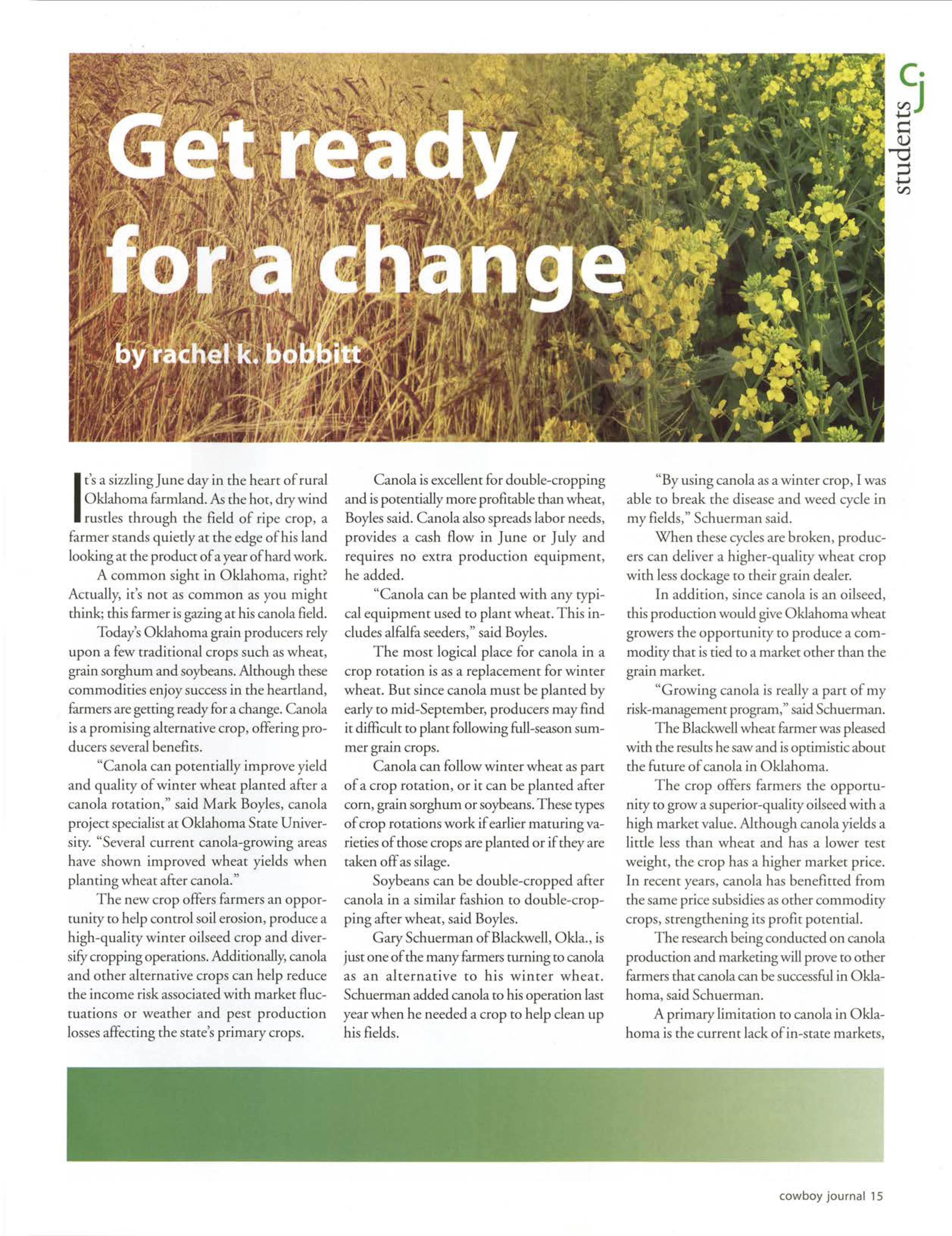
It's a sizzling June day in the heart of rural Oklahoma farmland. As rhe hor, dry wind rustles through the field of ripe crop, a farmer stands quietly at the edge of his land looking ar rhe product of a year of hard work.
A common sight in Oklahoma, right? Acrually, it's not as common as you might chink; this farmer is gazing ar his canola field.
Today's Oklahoma grain producers rely upon a few traditional crops such as wheat, grain sorghum and soybeans. Although chese commodities enjoy success in che heartland, farmers are getting ready for a change. Cano la is a promising alternative crop, offering producer several benefits.
"Canola can potentially improve yield and quality of winter wheat planted after a canola rorarion," said Mark Boyles, canola project specialist at Oklahoma Seate University. "Several current canola-growing areas have hown improved wheat yields when planting wheat after canola."
The new crop offers farmers an opporrun.ity co help conrrol soil erosion, produce a high-quality winter oilseed crop and diversify cropping operations. Additionally, canola and orher alrernarive crops can help reduce che income risk associated with marker fluctuations or weather and pest production losses affecting the state's primary crops.
Canola is excellent for double-cropping and is poremially more profitable cl1anwheat, Boyles said. Canola also spreads labor needs, provides a cash flow in June or July and requires no extra production equipment, he added.
"Canola can be planted wirh any typical equipment used ro plane wheat. This includes alfalfa seeders "said Boyles.
The most logical place for canola in a crop rotation is as a replacement for winter whear. Bur since canola muse be planced by early ro mid- eptember, producers may find it difficult ro plant following full-season stunmer gram crops.
Cano la can follow winrer wheac as part of a crop rocation, or it can be planted after corn, grain sorghum or soybeans. These types of crop rotacion work if earlier maturing varieties of those crops are planted or if they are taken off as silage.
oybeans can be double-cropped after canola in a similar fashion ro double-cropping after wheat, said Boyles.
Gary chuerman ofBlackwell, Okla., is just one of rhe many farmers turning to canola as an alternative to his winter wheat. Schuerman added canola ro his operacion last year when he needed a crop ro help clean up his fields.
"By using canola as a winter crop, I was able ro break che disease and weed cycle in my fields," Sclrnerman said.
When rhe e cycles are broken, producers can deliver a higher-quality wheac crop with less dockage ro cl1eirgrain dealer.
In addition, since canola is an oiJseed, rhis production would give Oklalloma wheat growers the opportunity to produce a commodity rhar is tied ro a marker ocher rhan the grain marker.
"Growing canola i really a pan of my ri k-management program," aid Schuerman.
The Blackwell wheat farmer was pleased wich che results he saw and is oprimiscic abour che future of canola i11Oklahoma.
The crop offers farmers the opportunity to grow a superior-quality oilseed wirh a high market value. AJchough canola yield a little less chan wheat and has a lower tesr weighc, che crop has a higher market price. In recent years, canola has beneficred from cl1esan1e price subsidies as ocl1ercom mod icy crop , rrengchening it profit potential.
The research being conducted on canola production and marketing will prove to ocl1er farmers char canola can be successful in Oklahoma, said chuerman.
A primary limitation ro canola in Oklahoma is rhe cLLrremlack ofin- rate markets,
bur chat, roo, is changing rapidly. Tbe marketing system for canola is still relatively young, bur many steps bave been taken to pur the necessary infrasuucrure into place.
"In production agriculture, you wane co be able co grow any crop. Bue co be successful, you have co have a market chat is close," said Mason Mungle, Oklahoma Farmers Union directorofgovernment relations.
Oklahoma Farmers Union, in conjunction with researchers at Oklahoma ScaceUniversity,isworking to devdop that infrastructure.
OFU recently received a U.S. Deparrmenr of Agriculture Rural Development Value-Added Developmem gram co conduce a feasibility study co establish an oilseed processing facilicy in western Oklahoma.
"This planr will bring oilseed markers co Oklahoma, boosting our rural economy," said Mungle.
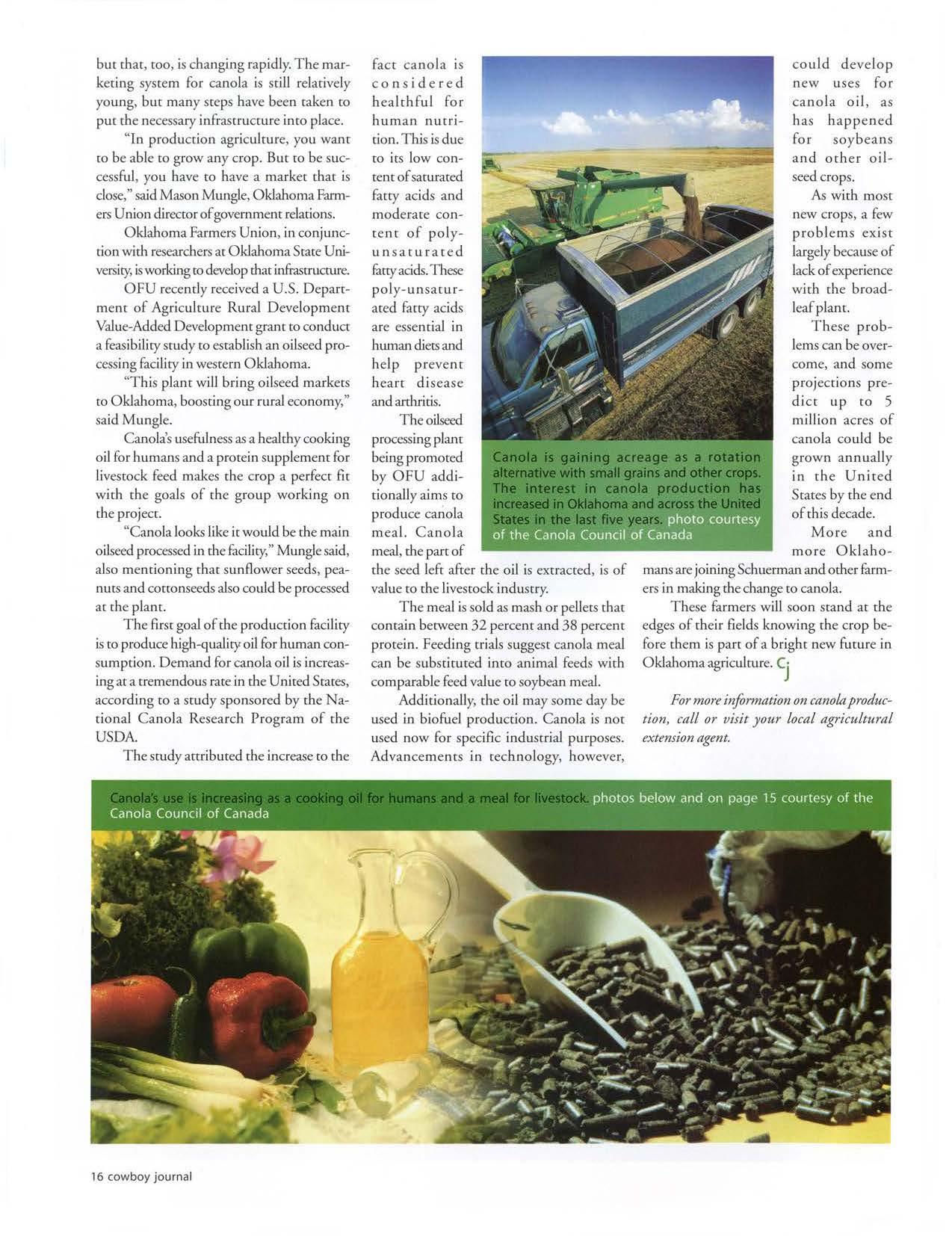
Canola's usefulness as a healthy cooking oil for humans and a protein supplement for livestock feed makes the crop a perfect fir with che goals of rhe group working on che project.
"Canela looks like ir would be che main oilseed processed in che Facility,"Mungle said, also mentioning char sunflower seeds, peanuts and cocconseedsalso could be processed ac the plane.
The fast goal of the production facility is to produce high-quality oil for human consumption. Demand for canola oil is increasing ar a tremendous race in the Uni red Scares, according to a study sponsored by the National Canola Research Program of che USDA.
The study attributed the increase co the
fact canola is considered healthful for human nutrition. This is due co its low content of saturnted faery acids and moderate content of polyu nsacu raced furryacids.These poly-unsaturated faery acids are essential in human diets and help prevent heart disease and arcluitis.
The oilseed processing plane being promoted by OFU additionally aims co produce canola meal. Canola meal, the part of the seed left after rhe oil is exrracced, is of value to rhe livestock industry.
The meal is sold as mash or pellets that contain between 32 percent and 38 percent protein. Feeding trials suggest canola meal can be subsrirured into animal feeds with comparable feed value cosoybean meal.
Additionally, the oil may some day be used in biofuel production. Canola is nor used now for specific industrial purposes. Advancements in technology, however,
could develop new uses for canola oil, as has happened for soybeans and ocher oilseed crops.
As with most new crops, a few problems exist largely because of lack of experience with the broadleaf plant.
These problems can be overcome, and some projections predict up to 5 million acres of canola could be grown annually in the United Stares by rhe end of chis decade.
More and more Oklahomans are joining Schuerman and other farmers in making che change cocanola.
These farmers will soon stand at che edges of their fields knowing rhe crop before chem is pare of a bright new fucure in Oklahoma agriculcure. Cj
For more infomiation on canolaproduction, call or visit yot~r local agricultural extension agent.
Small-town ideas become technology
by kyla hollister
Oklahoma State Universicy's New Produce Developmenr Cencer is using research and modern cechnology co help small businesses and co preserve rural Oklahoma communities.
The idea for rhe N PDC was developed by Larry Hoberock, professor and head of the mechanical and aerospace engineering deparrmenr, and Bill Barfield, regents service professor ofbiosystems and agricultural engineering. Afrer visiting with a small manufacturer in eastern Oklahoma, they realized many small businesses had great ideas bur did nor have rhe resources ro develop and marker them.
"The manufacturer developed a marker-cornering product bur couldn't pcoduce it," said Barfield.
Thar was the first step toward rhe creation of the NPDC. Afrer rwo years oflobbying co the legislature and gaining support from OSU officials, inirial product research began in September 2002.
The NPDC limits its services to small, rural businesses in Oklahoma.
"We target all of our services at existing, small manufacnirers," said Aururnn Hood, NPDC program coordinacor. "Our clienrs must be in rural areas and have 500 employees or less."
Those wanting co apply for assistance muse have their produces currently on che marker. The NPDC does not give assiscance for starting a business, but it does provide research and development support for existing manufacturers.
"Small businesses come co us because they have a great product idea, but they don't have rhe technical competencies, rime or funding co help turn the concept they have into an actual produce in production," said Hood. "We help chem over rhar initial hurdle."
Noc all businesses chat submit an application to the NPDC are accepted.
"Ir's a comperirive process because we have limited funding," said Hood.
The NPDC is funded by the state legislarure, which reviews the center's progress each year.
The probabiliry the product will be a success is taken into consideration when applicants are chosen. The product must fie into the manufacrurer's current expertise, and there must be a market for the new product.
"We also look for produces rhar are a good fie for the company and which have market potential," said Hood.
The NPDC focuses on helping manufacturers create new and exciting produces that will srrengchen the manufaccurer's competitiveness. Developing the new produce will create new jobs in rural Oklahoma, therefore, achieving one of the goals of the NPDC.
Once a produce application is selected, a ream of researchers goes co work developing an actual produce. The research team is
composed of OSU staff and faculry. Engineering students also are involved in the product development process, providing them valuable, hands-on experience.
"We gee the project first and then find people who would be a good fir for the development of the project," said Hood. "We approach chem wirh rhe project idea and ask chem ifrhey would be inrerescedin working on the project ceam."
Most projects selected by the NPDC have budgets generally targeted at $50,000 co $150,000. The manufacturer is required ro provide a percentage of the developmental coses and is expected co be involved throughout the process.
"Our clients need to be committed to the project, and we typically ask them to contribute financing, materials and labor coward the project," said Hood.
"We target completing the project in nine to 18 months," she said. "Thar is a shore rum around, so che people involved have co be really excited."
The NPDC has high expectations for rhe produces it develops.
"We eventually want the manufacturer co be able co generare a million dollars in new annual revenue from the new produce," said Hood.
In addition co produce development,
rhe NPDC offers market assessmenrs and promotional cools co manufacturers. This gives rhe manufacturer the chance to learn abour their marker segment by examining market size, potential customers and promotional strategies. rudenc involvement is an important prioricy to the NPDC.
NPDC Project Guidelines
Establishedmanufacturers
Existingfacilities
Limitedresources
Unique & different products
Economicimpact
NPDC Process
Projectapplication
Initial review
Detailed investigation
Research& development
Prototypedevelopment
"We are crying co introduce more scudenr interaction," said Hood. "We're trying co use more engineering cudenr in the development and more bu ines , marketing and agricultural communications rudenr on the orher end."
A number of small, rural bu ine se from acros the state, including Klutt Equipment [nc., have received help from che PD in the first three year of 1c existence.
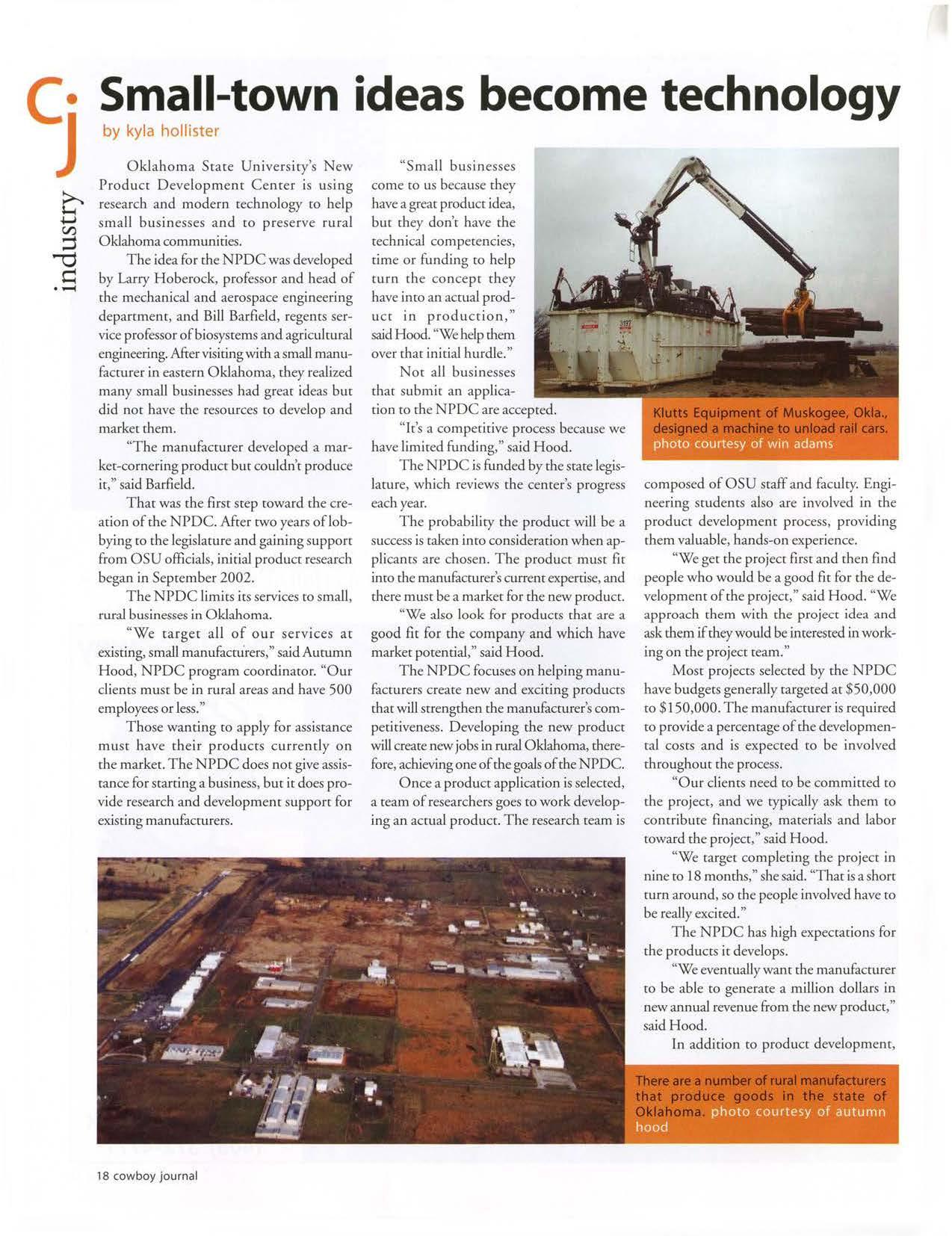
Bill Klun founded Klurc Equipment Inc. in 1987.Through 17 years of pecializing in purchasing and remanufaccuring railroad equipment, Kluns gained valuable experience in the railroad induscry. When he recognized rhe need for a new railroad gondola car-top material haJ1dler, he contacted a local applications engineer and turned in his application to che PDC.
Klutt 'idea was accepted, and a ream ofOSU re earchers went co work to develop the concept inco a realicy.The new car-cop material handler is expected co be a huge
uccess in the railroad indusuy.
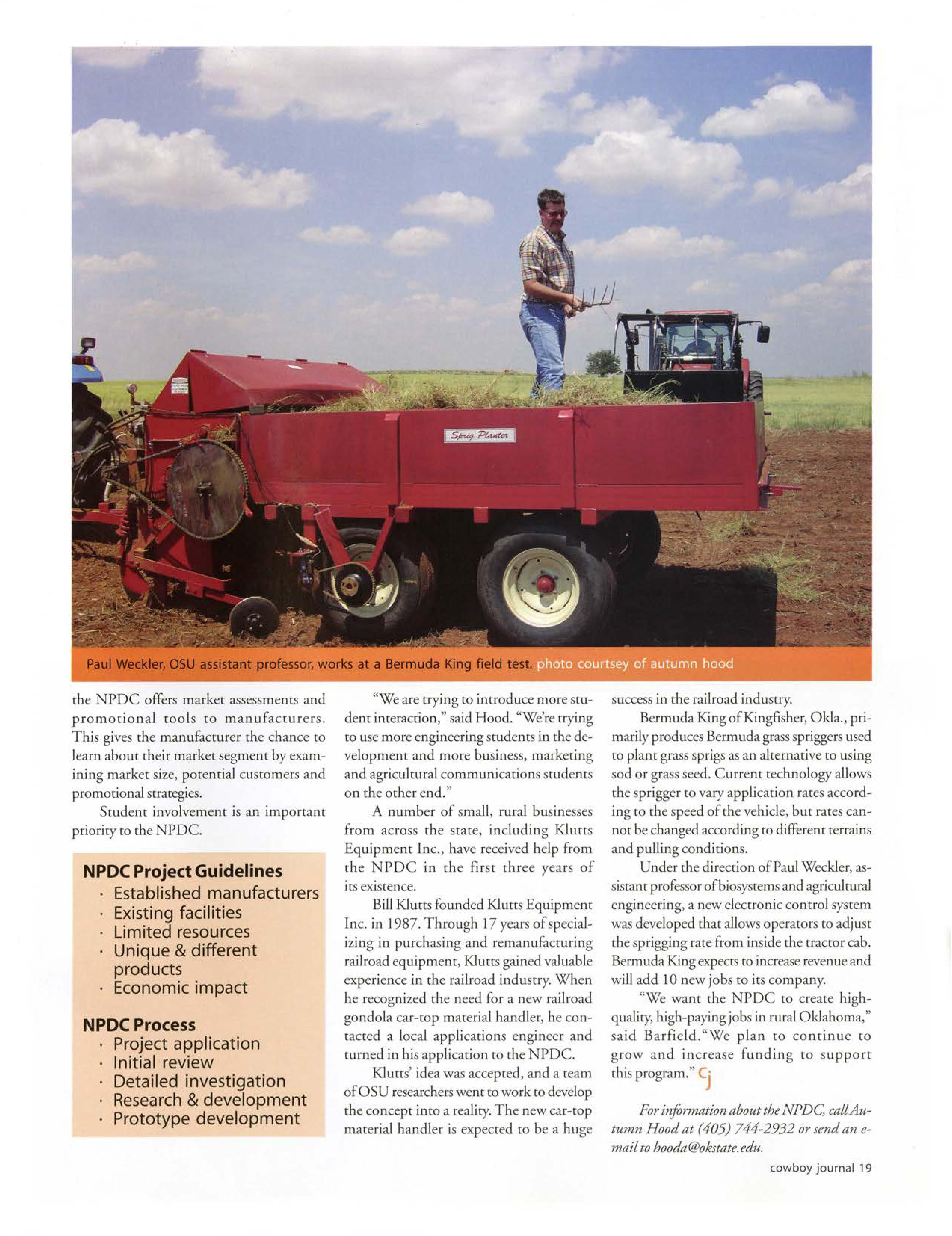
Bermuda King ofKingfisher, Okla., primarily produces Bermuda grass spriggers used to plant gra s sprigs as an alremarive ro using odor grass seed. Currenr technology allows the prigger ro vary application rates according co the speed of the vehicle, bur rares cannot be changed according ro differenr terrains and pulling conditions.
Under the dire tion of Paul Wecl<ler,assisranr professor ofbiosysrems and agriculrural engineering, a new electronic control system was developed char allow operaror to adjust the prigging rare from in ide the cracror cab. Bermuda King expects ro increase revenue and will add IO new jobs co ir company.
"We wane rhe PD co create highqualiry high-paying jobs in rural Oklalioma," aid Barfield. "We plan co con rinue to grow and increase funding to support this program." Cj
ForinfarmahonabouttheNPDC, ca!lAutumn Hood at (405) 744-2932 or send an email to hooda@okstate.edu.
cowboy journal 19
Pa1,d ~ler, OSUassistantprofessor, works at a Bermuda King field test.
Baseball would noc be the same without hordogs, and hordogs would nor be the same wirhour chose lirde crinkles at the end. Ever wonder how chose got there? The answer might be surprising.
Cellulose casings are the culpriesof those crinkles. Danielle Bellmer, food process engineer for the Food & Agricultural Produces Cenrer ar Oklahoma care University, is conducting research on cellulose casings and the idea of recycling chem.
Currently the facilities chat produce hotdog and ausages take the casings ro landfills. The casings slowly break down and put carbon back into the soil.
"The [processing] planrs just pile chem up and rake them ro the landfill," said Bellmer.
Before gercing imo the crux of cellulose casings, here's a little background abouc hotdog making. Hordogs are a combination of meats mixed imo a liquid pasce.The paste is pur into a plastic sleeve, and the sleeve is tied off into several links, hence, the crinkles ar che end ofhotdogs.
Once the sleeve is sealed, the hotdogs are smoked and cooked. The sleeve is then peeled off the produce. The cooked hotdogs are sent co packaging and readied for shipment ro grocery stores. The sleeves, or cellulose casings, are sent ro che landfill.
by allison nchard
There are two broadly accepted sources of cellulose for casings. One is derived from wood pulp, and the ocher is derived from corcon limers. Boch of these sources are converted to regenerated cellulose.
"Virtually all cellulose casings in rhe world marker are manufactured from regenerated cellulose " said J. Roy Escoubas, director of FAPC and former vice president ofViskase Corp.
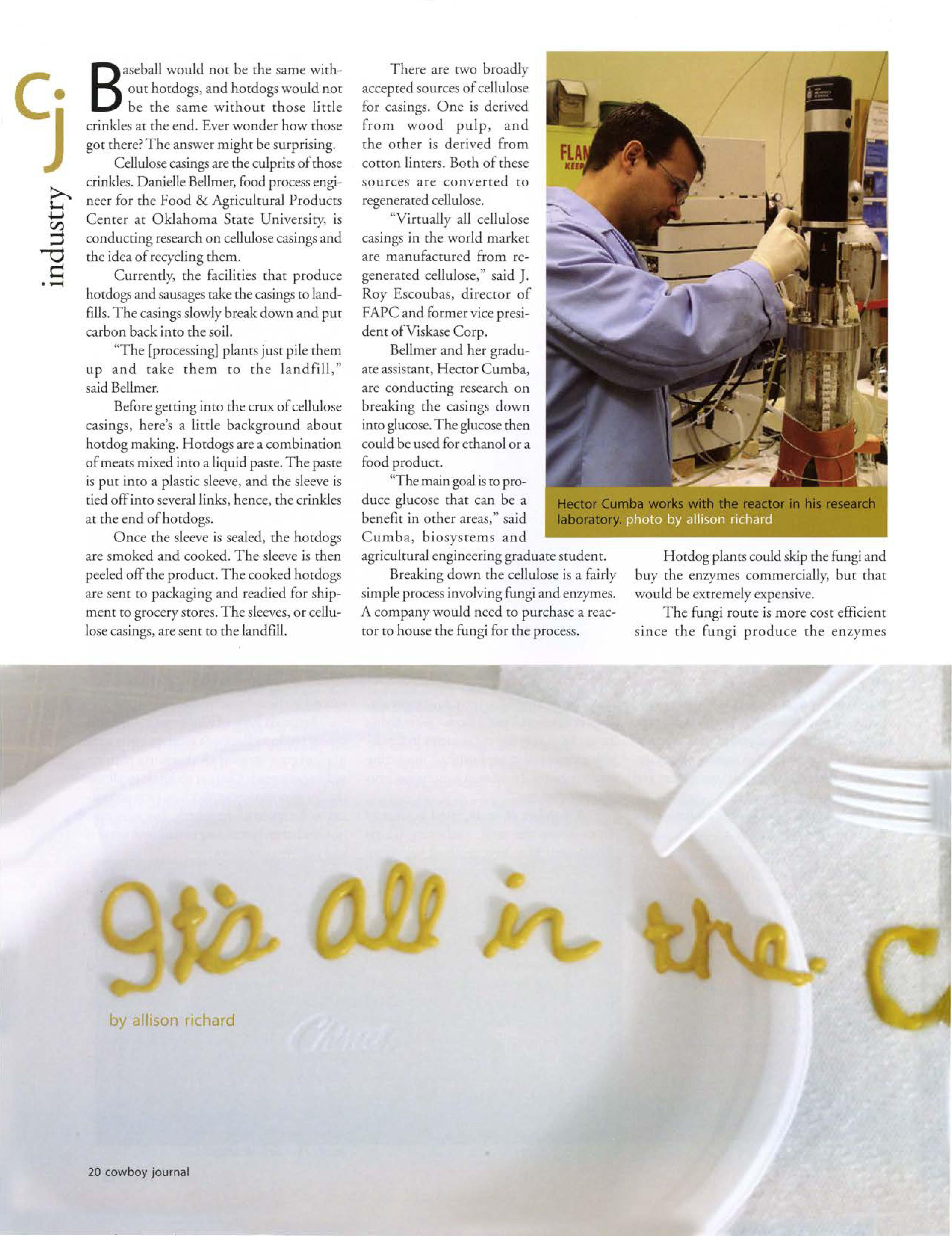
Bellmer and her graduate assistant, Hector Cumba, are conducting research on breaking the casings down into glucose.The glucose then could be used for ethanol or a food product.
"The main goal is to produce glucose char can be a benefit in other areas," said Cumba, biosyscems and
HectorCumbaworkswiththe
laboratory. • agricultural engineering graduace scudem.
Breaking down the cellulose is a fairly simple proces involving fungi and enzymes. A company would need to purchase a reactor co house the fungi for che process.
Hotdog plants could skip the fungi and buy the enzyme commercially, but char would be extremely expen ive.
The fungi route is more co t efficienc since the fungi produce che enzymes
needed ro convert the casings co glucose, said Cumba.
Cumba uses a three-liter reactor for his research. He does nor know what the size of an industrial reactor will be yet, bur ir could be between 5,000 liters and 10,000 liters, or between 14,300 gallons and 28,600 gallons.
To scare rhe process of turning casings imo glucose, the reacror is filled wirh a liquid char contains fungi. The fungi produce an enzyme calJed celluJase, and this breaks down the cellulose inro glucose. The carbon in the casings feeds the fungi and allows them ro keep reproducing.
"Once you have the fungi, you can usrain them forever. You keep feeding them, and they'll keep growing themselves," said Bellmer. "The idea is co creare a concinuous process."
Bellmer and Cumba gee their casings from Bar-5 Foods Co., which produces hotdogs, sausages and ocher produces. The researchers feed the casings to the reacror, and 12 hours larer they have gluco e.
The industry plants would do the same. As the plant produces hotdogs and pulls off che casing sleeves, rhe plant would put rhe casings i.nro the reacror. Once the glucose is produced, the planr has many options.
"Once you have glucose, you can make
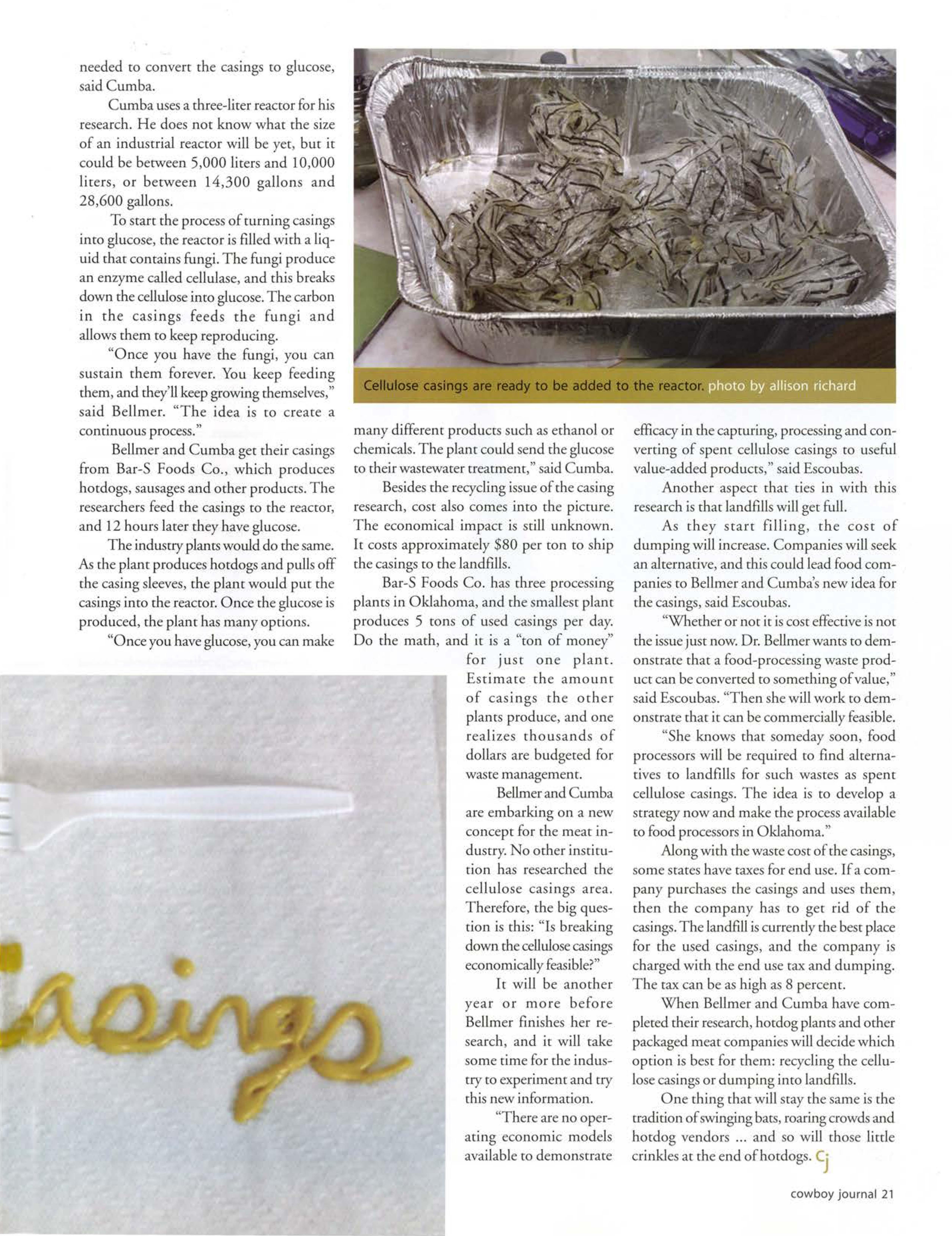
many differenr products uch as ethanol or chemicaJs. The plant could send che glucose co their wastewater crearmenr," said Cumba.
Besides d1e recycling issue of the casing research, cost also comes into the picture. The economical impact is still unknown. It co ts approximately $80 per con co ship the casings co the landfills.
Bar- Foods Co. has rhree processing plan rs in OkJahoma, and the mallesr plane produces 5 tons of u ed ca ing per day. Do the math, and it is a "con of money" for just one plane. Estimate the amount of casings the ocher plan rs produce, and one realizes rhousands of dollar are budgeted for waste management.
Bellmer and Cumba are embarking on a new concept for d1e meat indusrry. o other insrirurion has researched the cellulose casings area. Therefore, the big question is this: "Is breaking down the celluJosecasings economically feasible?"
Ir will be another year or more before Bellmer finishes her research, and ir will rake some rime for rhe industry to experimenr and cry chi new information.
"There are no operari ng economic models avaiJable ro demonstrate
efficacy in rhe capturing, processing and convening of spent cellulose casings co usefuJ value-added products," said Escoubas.
Another a pect that ties in with chis research is rhat landfills will get full.
As they stare filling, rhe cost of dumping wi.lli.ncrease. Companies will seek an alternative and this could lead food companies to Bellmer and Cumba' new idea for the casings, said Escoubas.
"Wherher or nor it is cost effective is nor the is ue just now. Dr.Bellmer wants to demonstrate that a food-processing waste product can be converted to someching of value," said Escoubas. "Then she will work to demonscrare char ir can be commercially feasible.
"She know that someday soon, food processors will be required co find alternatives co landfills for such wastes as spenr ceUulose casings. The idea is co develop a strategy now and make the process available co food proce sor in Oklahoma."
Along with the was re cost of the casings, some stares have taxes for end use. lf a company purchases rhe casings and uses chem, then rhe company has ro ger rid of rhe casings. The landfill is currently che best place for the u ed casings, and the company i charged with the end use rax and dumping. The tax can be as high as 8 percent.
When Bellmer and Cumba have completed their research, hotdog plant and other packaged meat companie will decide which option is best for them: recycling the cellulose casings or dumping into landfills.
One thing that wi.11scay rhe same is rhe tradition of swinging bars, roaring crowds and hotdog vendors and so will chose little crinkles at the end ofhordogs. Cj
C· J The new kid in Oklahoma
by laura kathleen mckay
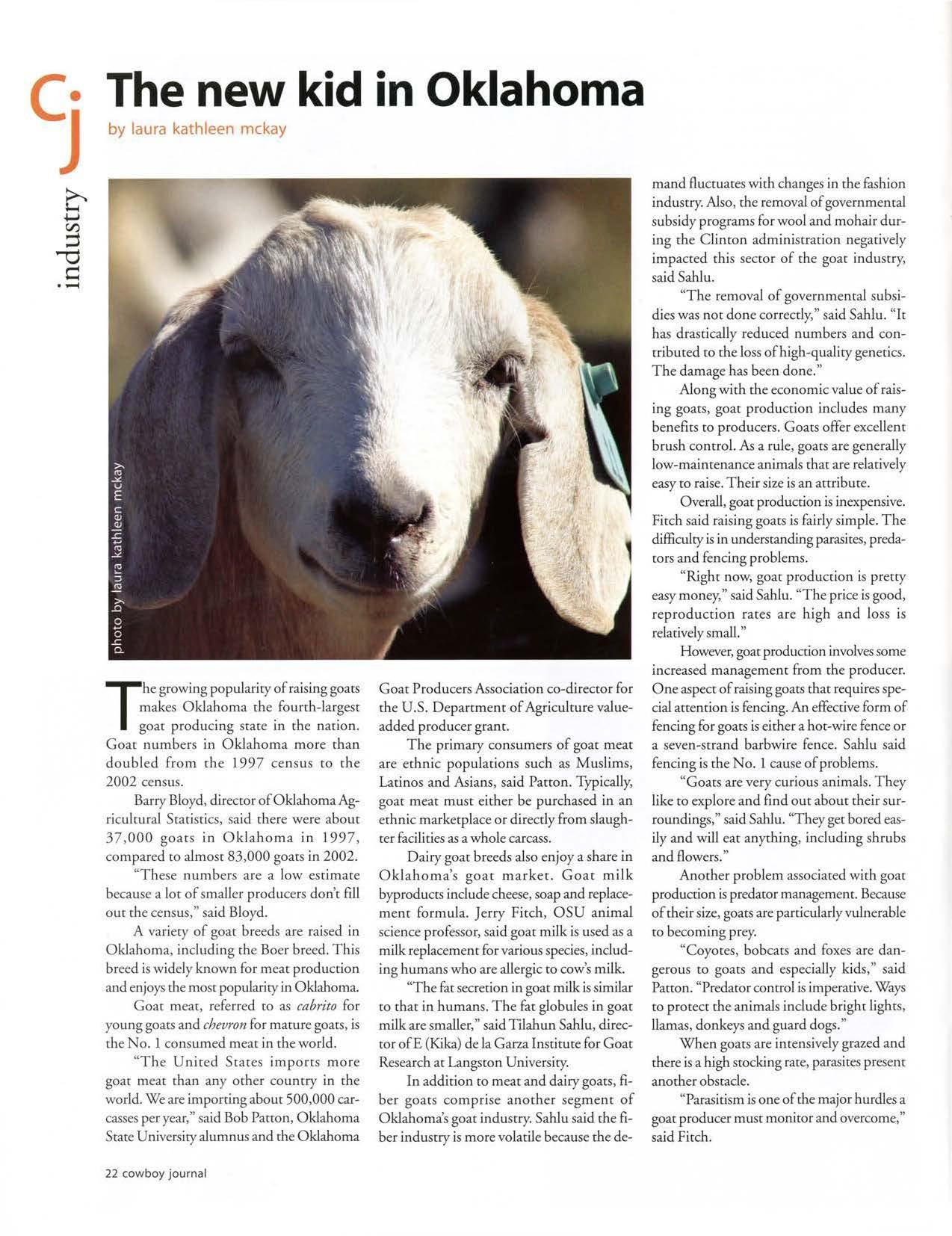
T:he growing populariry of raising goats makes Oklahoma the fourch-largesr goat producing state in the narion.
Goar numbers in Oklahoma more than doubled from the 1997 census to che 2002 census.
Barry Bloyd, direccor of Oklahoma Agricultural Statistics, said there were about 37,000 goars in Oklahoma in 1997, compared co almost 83,000 goacs in 2002.
"These numbers are a low estimate because a lot of smaller producers don't fill our the census," said Bloyd.
A variery of goat breeds are raised in Oklahoma, including the Boer breed. This breed is widely known for meat production and enjoys the most populariry in Oklahoma.
Goar meat, referred to as cabrito for young goats and chevron for ma cure goats, is the No. 1 consumed meat in the world.
"The United Stares imports more goar meat than any ocher country in the world. We are importing about 500,000 carcasses per year," said Bob Parton, Oklahoma State University alumnus and the Oklahoma
Goar Producers Associacion co-director for the U.S. Department of Agricukuce valueadded producer gram.
The primary consumers of goat meat are ethnic populations such as Muslims, Latinos and Asians, said Paccon. Typically, goac meac must either be purchased in an echnic marketplace or directly from slaughter FaciIiciesas a whole carcass.
Dairy goat breeds also enjoy a share in Oklahoma's goac market. Goar milk byproducts include cheese, soap and replacement formula. Jerry Fitch, OSU animal science professor, said goac milk is used as a milk replacement for various species, including humans who are allergic co cow's milk.
'The far secrecion in goat milk is similar co that in humans. The far globules in goat milk are smaller," said Tilahw1 Sahlu, director ofE (Kika) de la Garza Inscicute for Goat Research at Langston Universiry.
In addition co meac and dairy goats, fiber goacs comprise another segment of Oklahoma's goac industry. Sahlu said the fiber industry is more volatile because the de-
mand fluctuates with changes in the fashion industry. Also, the removal of governmental subsidy programs for wool and mohair during che Clinton administration negatively impacted chis seccor of the goac industry, said Sahlu.
"The removal of governmental subsidies was nor done correctly," said Sahlu. "le has drastically reduced numbers and contributed co che loss ofhigh-qualicy generics. The damage has been done."
Along with the economic value of raising goats, goat production includes many benefits co producers. Goats offer excellent brush control. As a rule, goats are generally low-maintenance animals chat are relacively easy co raise. Their size is an attribute.
Overall, goat produccion is inexpensive. Fitch said raising goats is fairly simple. The difficulry is in understanding parasites, predacors and fencing problems.
"Righc now, goac production is precry easy money," said Sahlu. "The price is good, reproduction races are high and loss is relatively small."
However, goac production involvessome increased management from the producer. One aspect of raising goats chat requires special accencion is fencing. An effective form of fencing for goacs is either a hoc-wire fence or a seven-strand barbwire fence. Sahlu said fencing is the No. 1 cause of problems.
"Goacs are very curious animals. They like co explore and find out abouc their surroundings," said Sahlu. ''They gee bored easily and will eat anything, including shrubs and flowers."
Another problem associated with goat produccion is predator management. Because of their size, goats are particularly vulnerable to becoming prey.
"Coyotes, bobcacs and foxes are dangerous to goacs and especially kids," said Paecon."Predator control is imperative. Ways co protect the animals include brighc lighcs, llamas, donkeys and guard dogs."
When goacs are intensively grazed and there is a high stocking race,parasites present another obstacle.
"Parasitism is one of the major hurdles a goat producer muse monicor and overcome," said Fitch.
As illustrated by the high ranking of Oklahoma's goat production, the sale of goats has increased. Perkins Livestock Auction in Perkins, Okla., onducr one of the largest goat ale in the rate every first and third Saturday of the month. Buel Hoar, owner and operator of Perkins Livestock Auction, said business is booming.
"We scarred the goat auction three years ago with 180 head. Last acurday [0cc. 2, 2004], we had 880 head," said Hoar.
Along with increased sales, more people are traveling co Oklahoma co purchase or sell goat
"Anymore, we geegoats from as far away as onh Dakota. We see registeredgoats from Kan as and Texas.There are goats from Missouri, Arkansas and Colorado a long way off," said Hoar.
A very important aspect to the industry i goat researchand extension. Langston University houses Oklahoma's goat research facility, the E (Kika) de la Garza American Institute for Goat Research. This research institute shares a do e relationship with Oklahoma tare University.
"We have several projects with OSU," aid ahlu. 'There are international research projects we share. We have some of Oklahoma rate's graduate rudencs helping here.
"We use the veterinary servicesof Oklahoma Scare Univer icy.The vet students will come here co gain experience with goats. Also, we share professors with OSU. We have a close relationship because we serve the same scare."
Langston University and the E (Kika) de la Garza American Institute for Goar Research offer several opportunities for producers through extension. The annual goat field day, held che lase
amrday in April, is usually attended by more than 250 producers.
"The objectives of the field day are co provide education and training and to provide a setcing for communication berween producers and Langston University personnel," said Sahlu.
In addition to the field day, Langston U niversiry conduces workshops on internal parasite control and artificial insemination, as well as a meat buck performance test. Meat buck performance resting evaluates many aspects of the animal including average daily gain, feed efficiency and muscling. The purpose of che evaluation is to rank each animal in comparison co its contemporaries.
'The 2004 Meat Goar Performance Test included 58 young bucks from 16 different ranches," Sahlu said. "This is the largest number of bucks char have ever been enrolled."
The demand for goats and goat meat is steadily increasing, yet supply is limited. This has kept goat prices strong. With its profitable market, more producers are expected to transition into goat production. Hoar said producers need to research the industry before becoming involved.
"Goar production is a business,just like anything else,' said Hoar. "Anybody considering raising goats for the first time needs to focus on self-education in order co be successful." Cj
Thefocus of this storyis theproduction side of the goat industry.The show industry alsohasexperienceddramaticgrowthin numbers.Forinformationon theshowgoat industry, cat! the Oklahoma State Fair at (405) 948-6704.
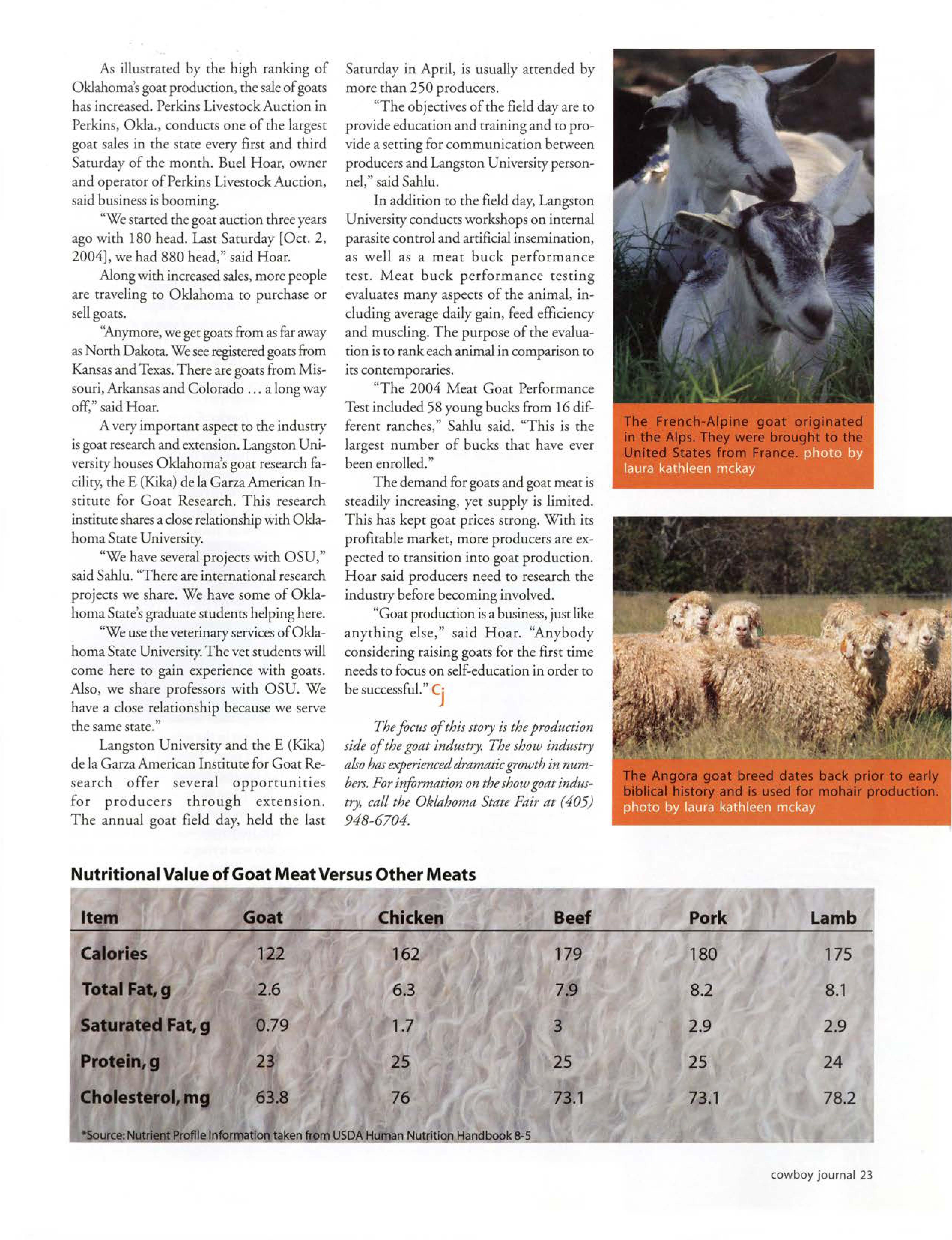
Nutritional Value of Goat Meat Versus Other Meats
Bringingfamilytraditionshome
by megan m. mitchener
Five years ago the aroma of Blesserris pasta sauce filled the kitchen of Jim and Judy Scovil. Now it fills the kitchens of families across Oklahoma.
Judy said she remembers her friends always enjoying her mother's Italian cooking. Judy's family came co the Unired $races in the early 1900s from the island of Sicily. Since then, good food has become a family tradition.
The idea ro marker Judy's roast beef pasta sauce came after her son and husband were brainstorming business ideas. When chis idea was presenred ro Judy, she laughed and said, "Do l look like I need to wear an apron all day?"
Jim andJudywereconvinced it would be a good idea to markec her pasta sauce when Judy made her sauce for 300 people at an Italian Fest ac their church. People were coming back for seconds.
"You can rell a !or by the places," said Jim. "It is the best way cosee if people like ic."
When everyone was finished eating, the Scovils looked around and placeswere clean. Then, people wanted co know if they could buy the leftover pasta sauce.
"I always thought people were just being nice when they said how much they really enjoyed it," said Judy.
For the Scovils, chis was a great way to
and Judy began cooking and testing the sauce.
Forone year Judy cooked about 12 hours a day in her kitchen at home. When she finally reached the desired pH, they returned to FAPC. However,Judy did not know how much of each ingredient was in the sauce.
I wanted to do something nobody elsehad done before.
-
Judy Scovil
Judy recurned co her home in Tulsa and began the tedious process of figurtng out how much of each ingredient was in the recipe. test chei r produce before investing money and time
inco another business because much of Jim and Judy's time was already being used to run rheir landscaping company.
When che Scovils decided ro cry and make a business out of selling their pasta sauce, they knew they needed to do their research.
They began by speaking wirh a rescauranr supplier who cold chem co speak with someone at the councy extension office. Someone at the extension office cold chem co conrace d1e Food & Agricultural Produces Center at Oklahoma Stace Universicy.
Through chis connection, me Scovils learned about the Basic Training Workshop offered once a monm at FAPC.
The workshop is offered on the iliird Thursday of every monm and is a basic encrepreneurial aaining day.The day includes nine or more guest speakers who provide information on ilie basics, including trademarks, labeling, healm regulations and various legal aspects of starting a business. Participants can ask questions and get inlmediate feedback from experienced professionals in an area.
Although Jim and Judy knew a lot about starting a business, FAPC was able co help chem in me food production area, wim which they were unfamiliar.
The first rhing me Scovils needed co do was get the pH of che roast beef pasta sauce to a level low enough chat it could sit on the score shelf for any given period of time.
For Judy co get the pH lower, she had to experiment wi ili different preservatives and find ones chacwould nor change the caste of the sauce.
The Scovils bought their own pH tester,
First, mey tried weighing each ing red i en r before Judy added it to
the sauce. When this did nor work, Jim decided ro place a weighed amount of each ingredient inro individual pie tins on rhe counter allowing Judy co cook as normal. When she was finished cooking, they weighed me remaining ingredients in each pie tin and subtracted it from the beginning weight.Judy was able co determine me exacr amounts needed for the roasr beef pasta sauce.
They returned to FAPC to make me first large batch of test sauce. On the first day of cooking, 40 gallons of sauce was thrown away.Jim and Judy looked at each other and agreed business is nor for the faint of heart.
The 40 gallons of sauce had too much of an ingredienr in d1e mix.Judy smiled and pointed co her nose: "I smelled it was wrong."
Once the ingredients were finalized in the roast beef pasta sauce, it was rime cocome up wim a name and packaging design.
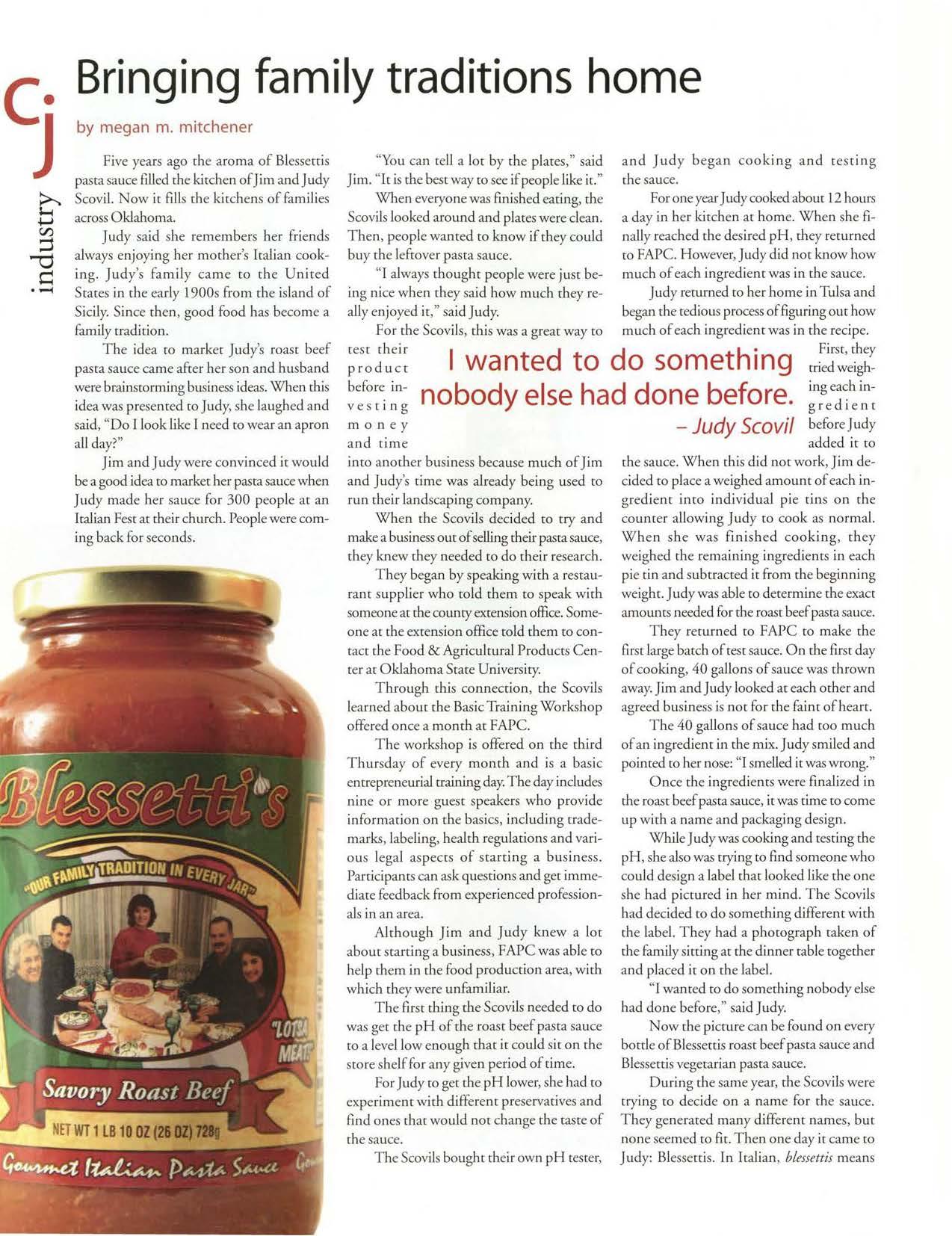
While Judy was cooking and testing the pH, she also was crying to find someone who could design a label chat looked like the one she had pictured in her mind. The Scovils had decided to do something different with me label. They had a photograph taken of d1e family sirring ar me dinner table rogemer and placed it on the label.
"I wa11ced co do someming nobody else had done before," said Judy.
Now the picture can be found on every boccieof Blessetcisroast beef pasta sauce and Blessettis vegetarian pasta sauce.
During the same year, the Scovils were crying co decide on a name for the sauce. They generated many different names, buc none seemed to fie.Then one day ic came to Judy: Blessettis. In Italian, blessettismeans
seven blessings. The name seemed ro be exacrly what che Scovils were looking for.
When che sauce was borded and packaged, ir was rime for Blessecristo be marketed ro rhe public. Because Blessettis coses more co make than sauces found in local grocery stores, Jim and Judy decided to sell che sauce in high-end rescaurancs, country clubs and gourmet stores.
Judy uses real roasc beefin rhe savory roasc beef sauce and only the besr ingredients in each botde, which makes the cosc higher for making the sauce.
Judy said she wanes Blessettis ro castejusc like ic does when she makes ic ac home.
"I wane to treat [customers] like they are ac my dinner cable," said Judy.
The Scovils have big plans for che future ofBlessetcis, wirh four new sauces debuting in 2005. Judy said she hopes ro marker che sauce next in Oklahoma Ciry. Gift baskets and frozen and fresh lralian entrees are also possible.
Currendy, Blessettis roast beef and vegetarian pasra sauce can be found in che Tulsa area and in Rogers, Ark. In rhe future, Judy
plans ro pose some recipes on the Blesseuis Web sire. She said some people only use che sauce on pasra. She said she hopes char by posting some of her recipes and chose of ochers, people will cry using Blessettis sauce in new ways. cj
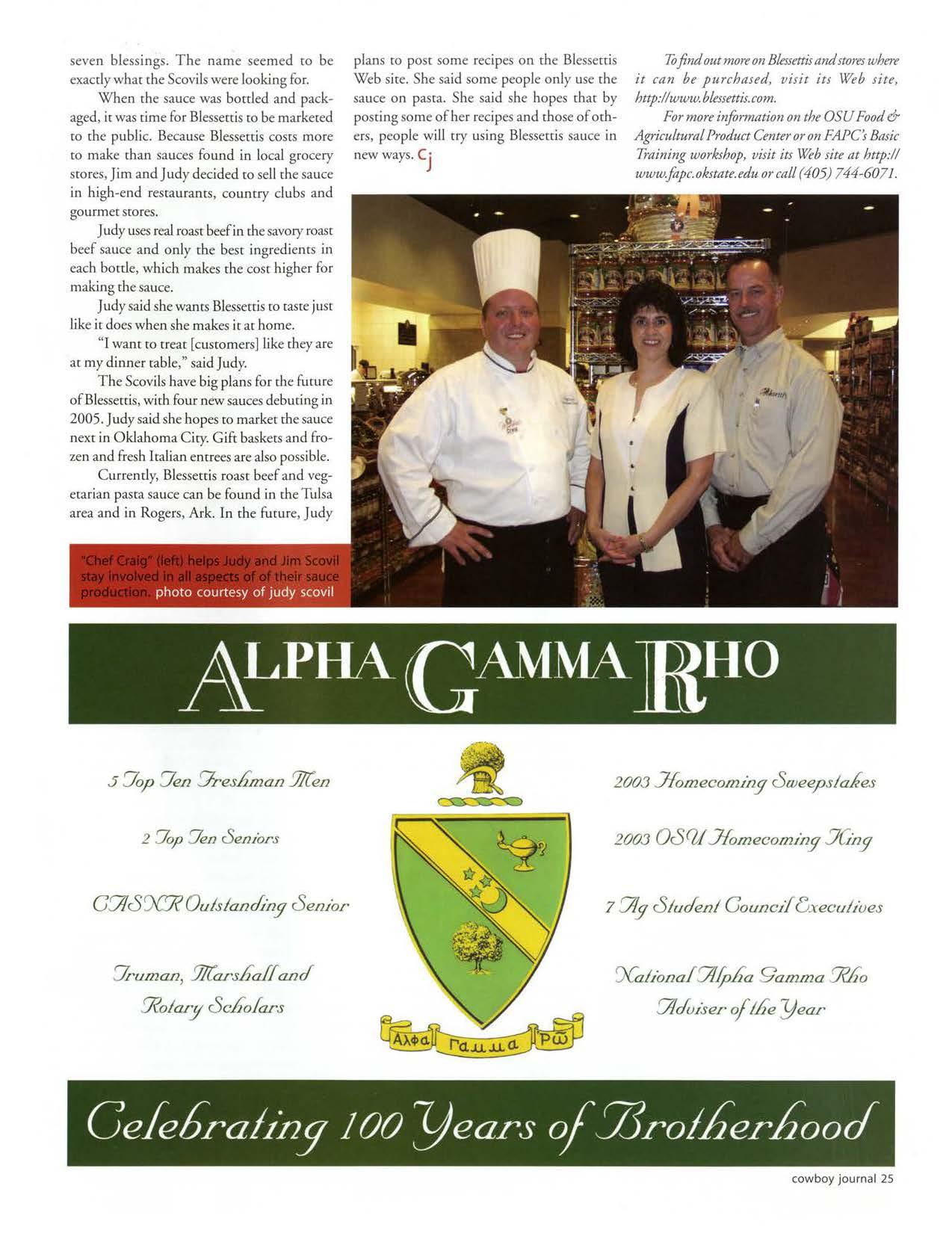
Tofind out moreonBlessettisandstoreswhere it can be purchased, visit its Web site, http://www.b!e.ssettis.com.
Formoreinformationon the OS U Food& AgricultumlProductCenteror on FAPC'sBasic Trainingworkshop,visit its Website at http:!! www.fapc.okstate.eduor call(405) 744-6071.
Making stridesin work and play
by cathy herren
Fifty thou and miles - more than rwice the di ranee around the equaror - that's how far Ed Miller bas run in the la t 24 year
He, like many other faculty member in the Division of Agricultural Sciences and arural Resources, is ma.king uides as an avid runner.
"Running is a great analogy co work," said Miller, DA R interim dean. "Running teachesyou about pace, and I chink life i about pace. You want ro accomplish a lor and wane ro do it ac a pace chac i aggre ive. You wan ro finish che race in ty]e and not burn our early."
Miller i anything buc burned our. He began as a swimmer, competing as a Divi ion I athlete for Iowa tace University for rwo years as an undergraduate.
He tarred running in 1975 a parr of a corpora re hallenge program while working in Hot pring , Ark. ow, he run an average of 40 miles per week, including a long run on undays wich friend Jike Phil Kenkel.
A professor i.nthe agricultural economics department, Kenkel is also an avid achlere, biking 16 miles ro work and back home, lifting weight and running ix ro nine miles each day.
Kenkel began running in 1984 after finishing his master's degree at rhe Univer icy of Kenrucky and caking a job at Morehead Univer icy in norcheascern Kemucky.
Kenkel's son Chad, is a dedicared athlete and runner like his father. He competed in hi fir t 5K run, slightly more rhan 3.1 miles, at che age of 5. ow 9 years old, rhe fourchgrader runs two co three races per year wirh his dad.
He is nor the only child of a DA R faculty member who runs. Morgan Waldner also enjoy runningwir.h her mom.
he i the 4-year-old daughter of Louann Waldner, director of rudenr care r ervice for rhe College of Agriculrural cien e and acural Resources and a doctoral student in agricukural educarion.
The pre-kindergarcener completed the fun run ar rillwarer's Juke Joint Jog in eptember 2004. The Juke Joint Jog amacted other CASNR runners, including Ke11kel,hi on and Miller.
Morgan Waldner said one of her favorite pans of the event was the finish line.
he also had fun in the event pending time wich her mom while learning the value of exercise.
"I like co run wirh my mom," aid rhe younger Waldner. "Ir's happy ro e:x rci e ro make you strong and healthy."
Exercise is one of che reasons Mary An.ne Gularte runs.
"Any type of exercise is useful. lr is invigorating and healthful," said Gularte, former incerim director of DA R agrirnlrural communications. "Running and exercise help me wicl1my work."
Gularte began run11-ingin 1975 during her fir r years of college ar cl1eUniversity of alifornia in anra Barbara. he receives upport for her running from Miller.
"He helped me quire a bit when I firsr started running [in tillwater]," said Gularte. "He's che one who encouraged me ro enter my fir trace."
The DA R faculty members who run encourage each other ro er goal and srrive ro reach cl1cm.
"Thar happen with runners," aid Gularte. "We encourage each ocher. We don't run at che same pace, but we all begin at che same line."
fn 1999, Gularte craveled to Dallas to complete che Whire Ro k Marachon, 26.2 miles, her farthest run ro date.
"lrwasagrear en eofaccomplishmenr," said Gularre.
Kenkel and Miller have rrained and compieced marathons as well, and rhey share Gularre's sense of accompli hmenr.
A1cl10ughhe has yer ro run a marathon, Donald Turton, like hi fellow faculty member , enjoy the sport. He has been running ince high school crack because he enjoys bei11goutside in nature.
"[I enjoy] getting outside away from the sterile environmenr of air condirioned and heated air in rhe building ," aid Turron, associare profe or of forest hydrology. "Ju r getting out part of the day i enjoyable, even ifir's raining or nowing."
urron's windowless office is located in me basemenrof Agricul ural Hall.
"Ir' nice o ger outside and see if the sun i till hining," he said.
reven Cooper, a i ranr profes or in equine reaching and re earch for the animal science deparrmenr, began running in junior high school along me eccion lines around cotron fields in rural Texa .
"I grew up on a production agricukw:e farm rai ing Lvestock and cotton and mat's all mydaddidhiswholelife," ajdCooper." y
farher didn'r need to go run a secrion wim me because that's all he did every day of his life wa phy ical labor."
Alrhough Cooper's dad is srill farming, only one generarion larer, ooper finds himself pending more rime in an office or clas room
than in production agriculrure.
Running provides him wicl1me physical exercise he need ro sray healrhy. However
KFor26 miles, mere are people; rhar'swhat surprised me rhe most," said Cooper. ''There are people everywhere."
The experience paid off, and boili Miller and Cooper enjoyed and exceUed in me race. Miller accidenrally enrolled rhe ream in
Runninghasbecome a way of life. It has become a part of the fabricof who I am.
rhe college srudents' category. They came home with first place in me category, beaing out men and women years younger than i wa not until April 2004, after Mjjler asked him ro run in a relay, char ooper beca.me more eriou about the port.
Cooper quicl<lyagreed co rw1 wim Miller, only ro find our later he had volunteered ro run rhe 13.1 miles required ro complere hi pare of che two-person relay ar the Oklahoma City Memorial Marathon.
This was rhe firsr rime coper had run competitively since 1988. Tn a month, he increased hi daily di ranee from 4 mile , the longes he had ever run ar che time, ro 13.l miles.
- EdMiller themselves. Miller urpti ed Cooper by presenring him with rhe trophy for their running achievements at an animal science department meeting lase um mer.
Cooper ha increased his goal chi year, planning to run ilie entire maramon in April 2005. He said he hopes to finish ar a rime fasr enough ro qualify for the Boston Maramon.
Many of rhe lessons ooper and ocher have learned from running carry into work
The skillsrequired ro comp re in a relay - preparation, teamwork and eeing omeone's porenrial w ucceed - are similar to those
required m excel in a work environment, aid MiUer.
"Runner rend co be incroverc Faculty, a a group rend to be introverted," he aid. " hey are goal-oriented, and running isa goalorienred accivicy. Faculty rend to be self-direcred and self-di ciplined, borh of which are desirable in running."
The benefirs of running are nor only physical, bur also mental. Running requires concrol and self-acrualizacion, said Miller.
"I rhink ir's a good rime to refresh mentally," aid Kenkel. "Ir helps your concencrarion at work and i a good ere relief."
ooper uses running as a similar oucler.
"If nothing else, it's just a good opporrunicy for an hour to do something to relax your mind fora moment" hesaid.
Cooper aid he does nor chink about hi obligation or work while runniJ1g, but instead chooses to pray, medicate or chink about nothing at ail. The mental benefits of running have a calming effect on him.
"When I run wich people our rhere, whether it' Phil or Ed or whoever, we don't calk about school, we don't talk about work," said Cooper. "Tc'sj use a good mental break."
Gulane likes running because of her abil-
icy co fie a break into her chedule.
" hat's che near thing about che activity," she said. "You can tailor it co your day, acrivicy and life."
Cooper aid he realizes individuals who do nor run may nor understand hi enthusiasm for the spore.
'They're chinking, How could you posibly chink char just going out and running is enjoyable?'" he aid. "'How could you look forward m char?' Jcgees addictive. Tc'salmo t like a drug; you've jusr gor to have that fix."
Miller said he knows ocher runners can relare ro hi accomplishmems in char area and is d1ru1kfulhis family and career allow rime for his running schedule.
After a while, running imply becomes a pare ofa person's rourine.
"You ger char in your mind, and ir ju t becom a part of your day," said Cooper. "I don't even have to chink abour ir anymore. I just know chat's what I'm going co do, and char's when I'm going co do ir. I rcy co nor let anything interfere with char because ic's become uch a routine part of my day."
Running is more than just a part of Miller's daily routine.
"Running has become a way oflife," said
Miller. ' Ir has become a pare of rhe fabric of who Iam."
Running is an integral part of their lives. The mental and physical benefits, combined with an appreciation for family and rhe ourdoor , allow these faculty members to continue making tride in their personal and professional lives. Cj
Photos (pages 26 and 27):
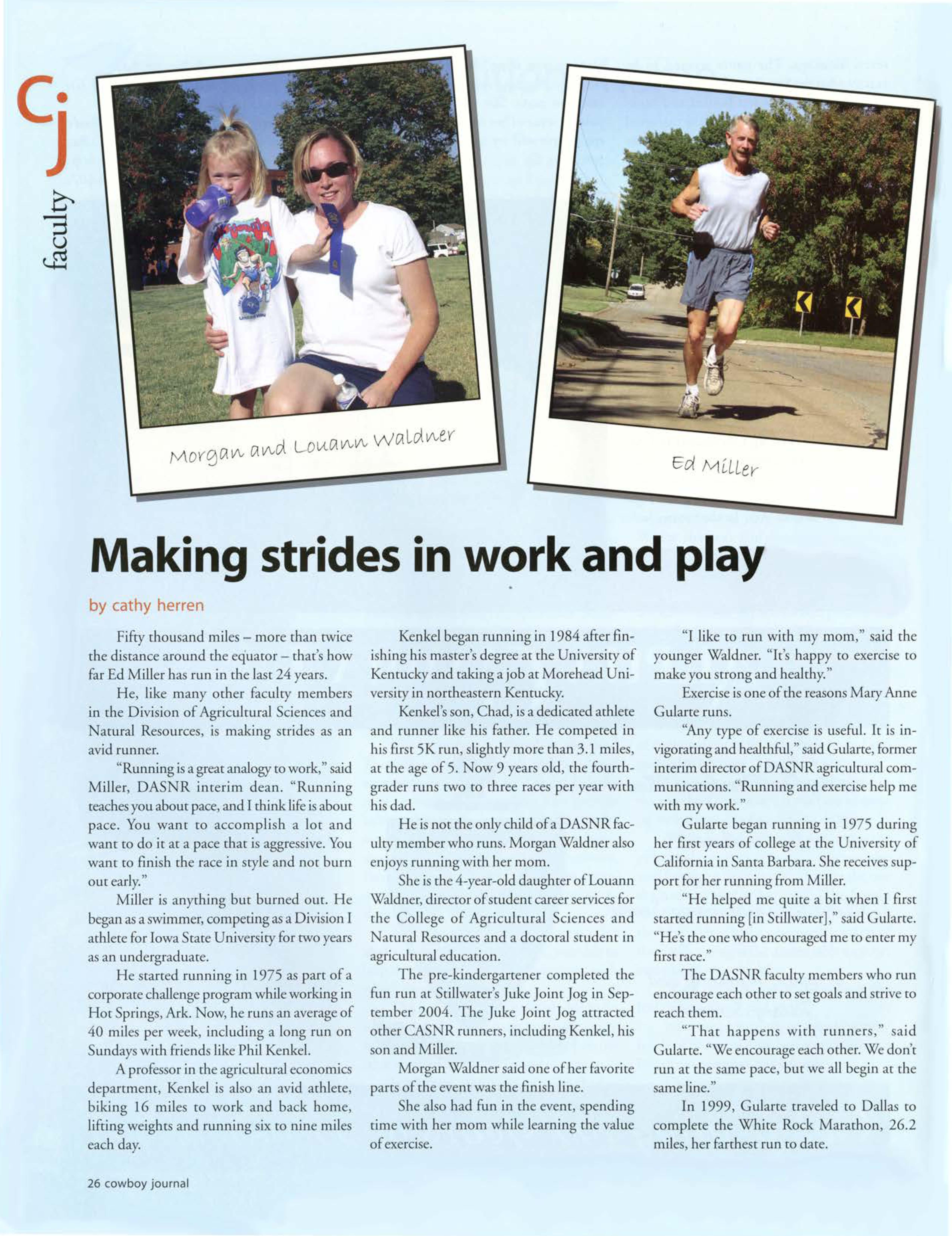
Morgan Waldner shows off her blue ribbon with mom, Louann Waldner, after finishing her first race, Stillwater's Juke Joint Jog Fun Run, in September 2004. photo by janet herren
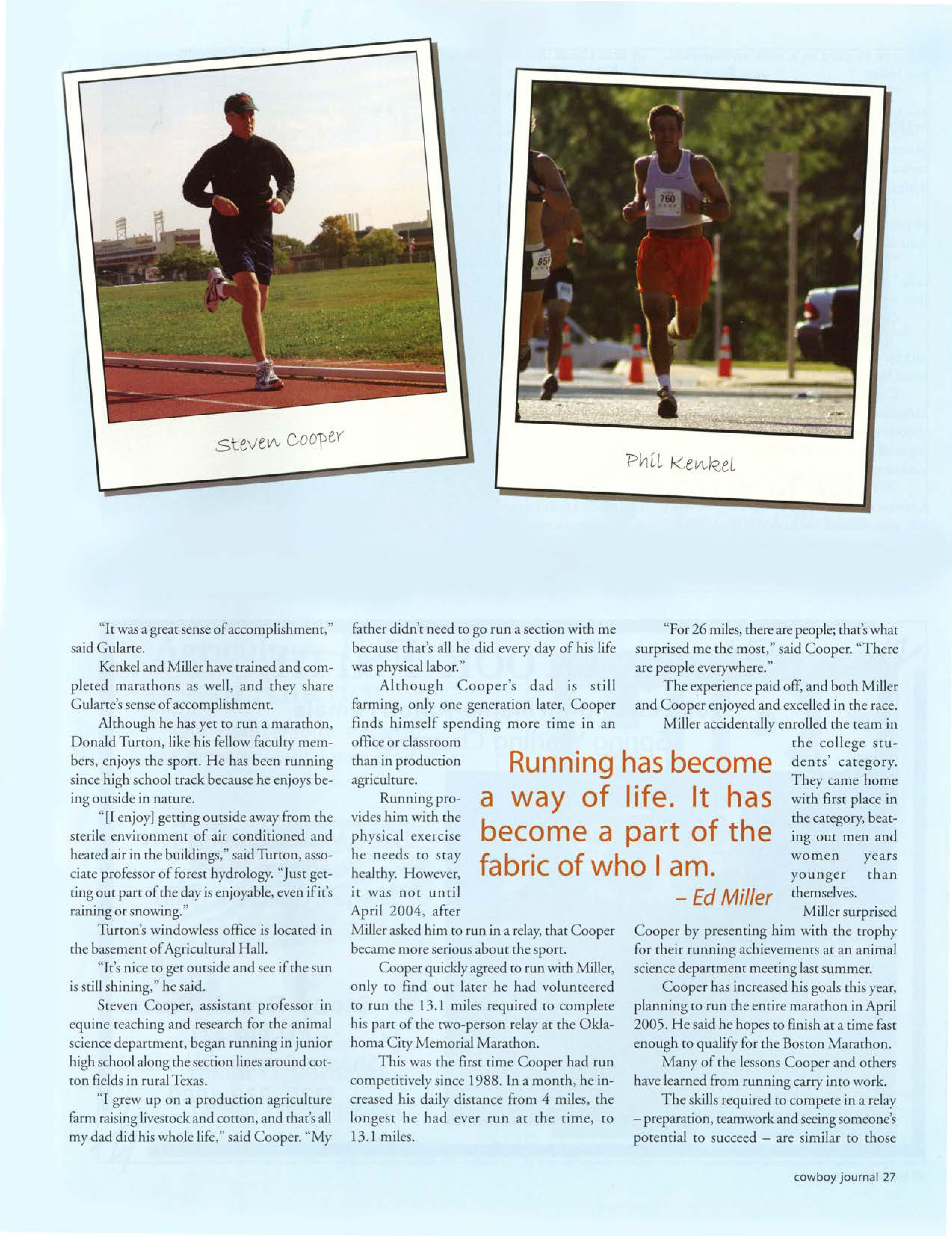
Ed Miller takes a Saturday afternoon run along the road near his home in Stillwater. Miller can often be seen running along roads near the OSU campus. photo by cathy herren
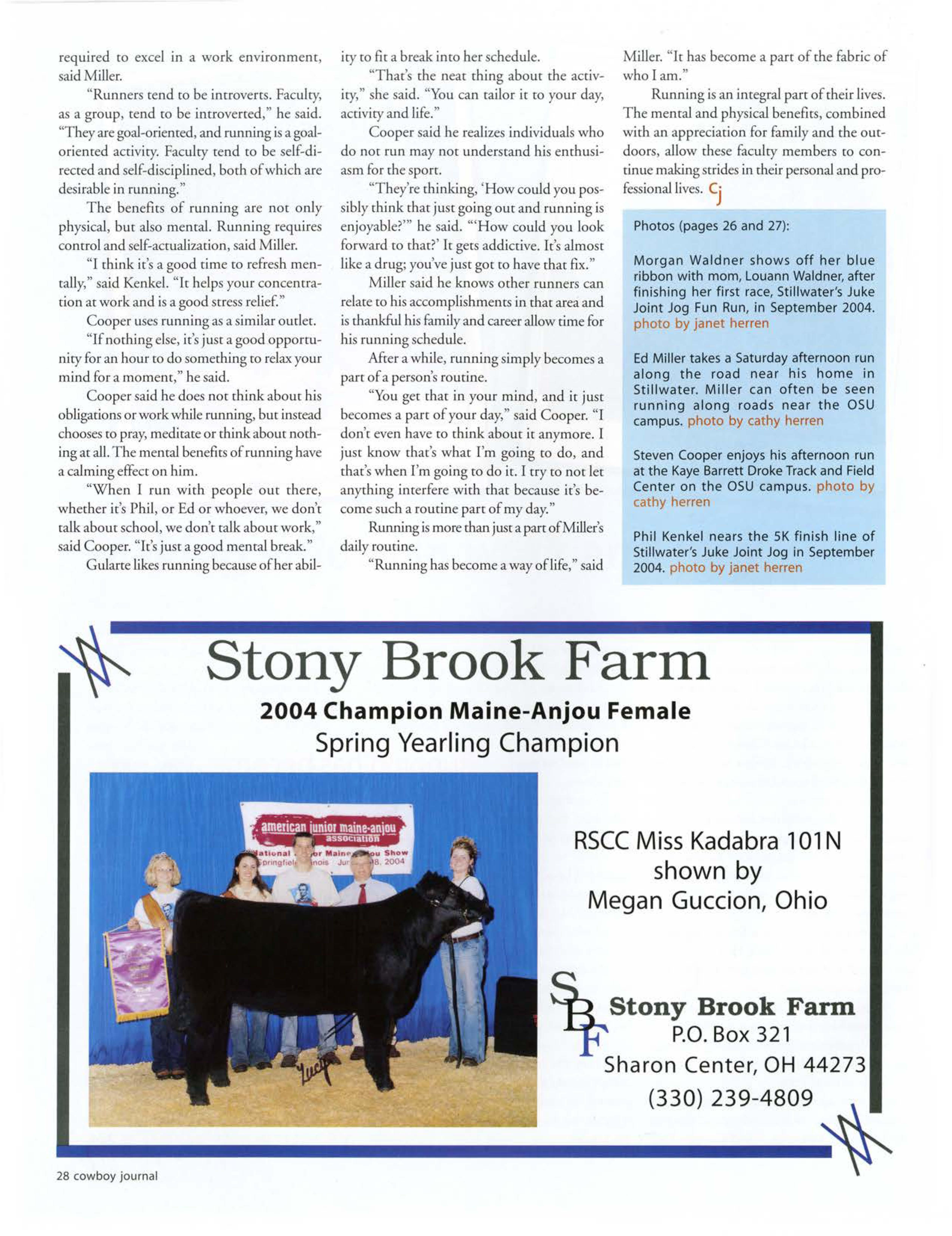
Steven Cooper enjoys his afternoon run at the Kaye Barrett Droke Track and Field Center on the OSU campus. photo by cathy herren
Phil Kenkel nears the SK finish line of Stillwater's Juke Joint Jog in September 2004. photo by janet herren

Fletcherhelps protect America
by tara wright
Getting exciced about a job is sometimes rare, bur Jacqueline Fletcher's passion for plant pathology provides Oklahoma Seate U niversicywich a valuable asset in more ways rhan one.
Fletcher, professor of entomology and plane pathology, said she developed her love for planes from her farher, Delberc Van Hercher. She said he was a chemise who loved nature and gardening.
Her passion for plane parhology developed while working on her master's degree at the Universicy of Montana wirh Meyer Chessin, professor of plane pathology, researching and studying plant diseases.
"I saw plane pathology as a way co help people while srill working wich planes," Fletcher said.
Known co her friends asJacque, Fletcher can be found hurrying through the hallways of the Noble Research Center. Her passion for her work is evident chrough the bounce in her seep.
Blake Bextinc, a 200 I docroral graduate of Fletcher's, said she was always willing to help.
"There were many times that Jacque would cake rime out of her busy schedule to talk with me abom my future plans," said Bextine, who is now working on a post docrorate at the Universi cyof California-Riverside. "Even now, I call Jacque on a regular basis for advice."
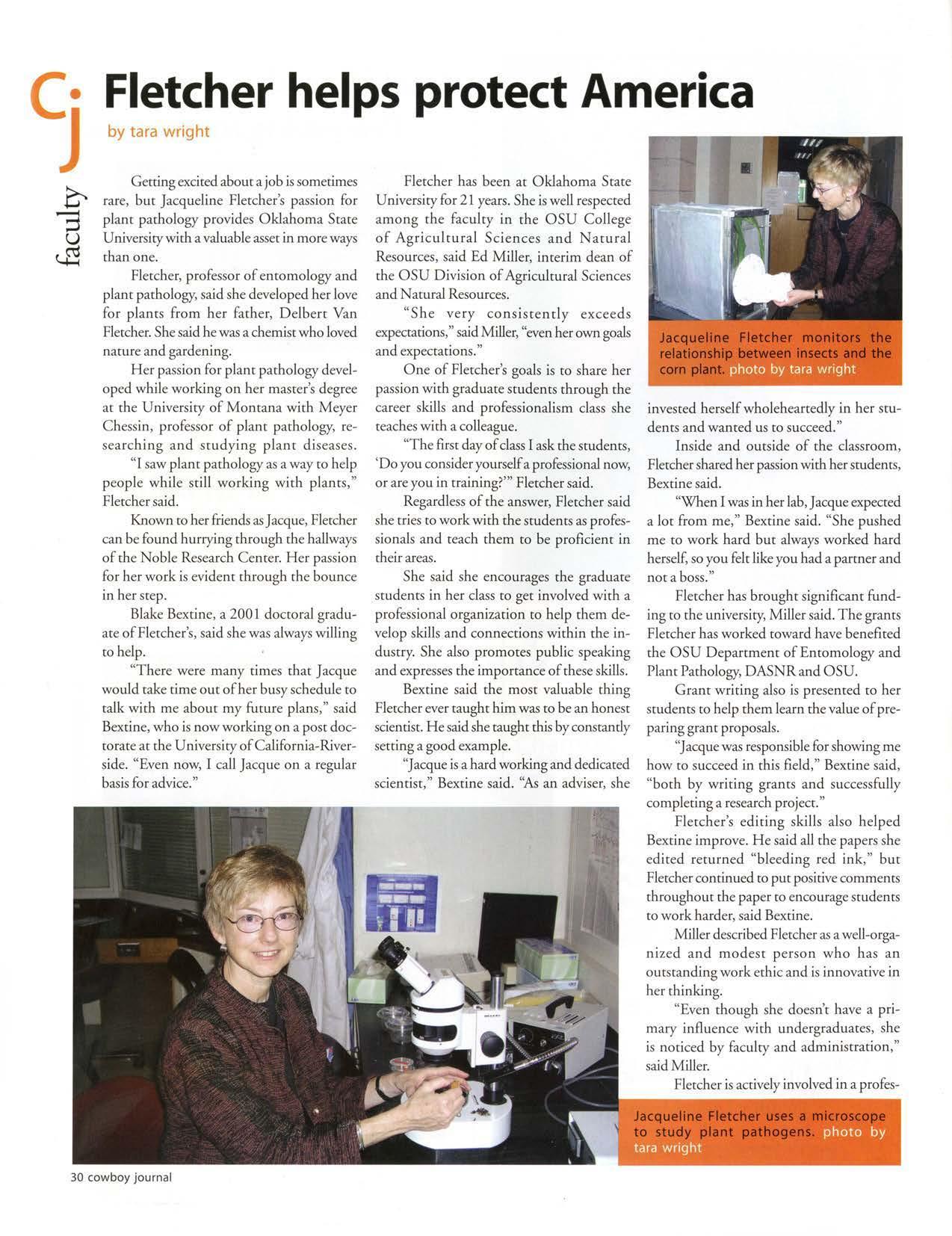
Fletcher has been ar Oklahoma Seate University for 2 Lyears. She is well respected among rhe faculry in rhe OSU College of Agricultural Sciences and Nacural Resources, said Ed Miller, interim dean of the OSU Division of Agricultural Sciences and Narural Resources.
"She very consistently exceeds expectations," said Miller, "even her own goals and expectations."
One of Fletcher's goals is to share her passion with graduate students through the career skills and professionalism class she reaches with a colleague.
"The first day of class l ask the students, 'Do you consider yomself a professional now, or are you in craining?"' Fletcher said.
Regardless of the answer, Fletcher said she cries ro work with the students as professionals and teach them to be proficient in their areas.
She said she encourages the graduate students in her class ro gee involved with a professional organization co help them develop skills and connections within the industry. She also promotes public speaking and expresses the importance of these skills.
Bextine said the most valuable thing Fletcher ever taught him was to be an honest scientist. He said she caught this by constantly setting a good example.
"Jacque is a hard working and dedicated scientist," Bextine said. "As an adviser, she
invested herself wholeheartedly in her srudents and wanted us ro succeed."
Inside and outside of the classroom, Fletcher shared her passion with her studenrs, Bextine said.
"When I was in her lab, Jacque expected a lot from me," Bexcine said. "She pushed me ro work hard but always worked hard herself, so you felt like you had a parmer and not a boss."
Fletcher has brought significant funding co the university, Miller said. The grants Fletcher has worked toward have benefited the OSU Department of Entomology and Plant Pathology, DASNRand OSU.
Grant writing also is presented to her students co help them learn the value of preparing grant proposals.
"Jacque was responsible for showing me how co succeed in this field," Bexcine said, "both by writing grants and successfully completing a research project."
Fletcher's editing skills also helped Bextine improve. He said all the papers she edited returned "bleeding red ink," but Fletcher continued ro put positive comments throughout the paper co encourage students to work harder, said Bextine.
Miller described Fletcher as a well-organ ized and modest person who has an outstanding work ethic and is innovative i.n her thinking.
"Even though she doesn't have a primary influence with undergraduates, she is noticed by faculty and administration," said MilJer.
Fletcher is actively involved in a profes-
Jacq relatl com
sional organization called che American Phytophathological ociecy. APS ha 5 000 plane parhologisc members, and ic is che largest organization for the discipline. The organization promote the study of plane diseases and their control through publications meetings symposiums, workshops and the World Wide Web. Fletcher has just completed a fouryear pre idential sequence.
he said epr. 11, 2001, had a major effect on rhe organization during her term, and it created a new view of planr pathology. Terrorism became a primary issue in the United races, and AP had the opportunity co reearch it from a new angle.
Fletcher aid pathologists chroughouc che nation research and participate in accivitie critical to the healrh and security ofU agriculture. A recem U.S. Department of Agriculture initiative was co establish a acional Plant Diagnostic Network. Thi divided che Un ired racesinro six regions, each with a hub laborarory. The O U Plant and Insect Diagnostic Laborarory sends rhe disease informarion ir coUecc to Kansas rare University the hub for thi region of rhe nacion. The K U lab forwards it to a national plant disease database ac urdue University.
Biorerror.ism research i beginning co in-
EducationalBackground
Bachelorof Science
Biology,EmoryUniversity
Masterof Science
Botany,Universityof Montana
Doctor of Philosophy
PlantPathology,TexasA&M University
PostdoctoralAssociate
PlantPathology,Universityof Illinois
crease inrernationaUy.Fletcher said APS is working with rhe European Union co develop a imiJar system. Once chis network is in place, ir will benefit the United caces' system by sharing information about plane diseases and pathogen , she said.
Fletcher said some discussion of biocerrorism had occurred before the arrack on America, bur aft:er epc. 11, 2001, AP had an audience. The public cook an interest in rhe pos ibiliry of a biocerrorist attack.
Member of APS have reamed rogether co research microbial forensics. This is part of the plan to protect America from biorerrorisrn and co stop the disease if an arrack occurred. If a disease emerges in a plane, APS is developing a way co trace the ource, uncovering u p1cious activity, Fletcher aid.
"The purpose of microbial forensics i amibucion and bringing the case and criminal inro a courr oflaw," she said.
This re earch is much more comprehensive since rhe source of the disease is vi cal evidence in a case, Fletcher said.
he aid it has challenged planr pachologisr to chink abour their research as a crime cene, racher than just studying che plane. Fletcher said she hopes chis research will help pathologists prevenr a bioterrori c arrack.
"The kinds of things we are trying co accompli h will be bene£cial to agriculrural producrion in the United rares,'' Fletcher said.
She said the research from AP wil I he!p ensure the safety ofU agriculture.
Fletcher' passion about her job and research for Oklahoma shows through her personality.
"We have a real advancage in ch.is stat where agricuJcureisstill a major fo u ," Flecd1er said. "We havesrrength in our root '
Fletcher aid he hopes re earchers and agriculturalists in Oklahoma will continue ro contribute to the growth and success of the agricuJcural induscry.
hrough research, reaching and gran cwriting, Flercher shares her eagerness for agriculture wirh srudenrs and fuculcyat O U. Cj
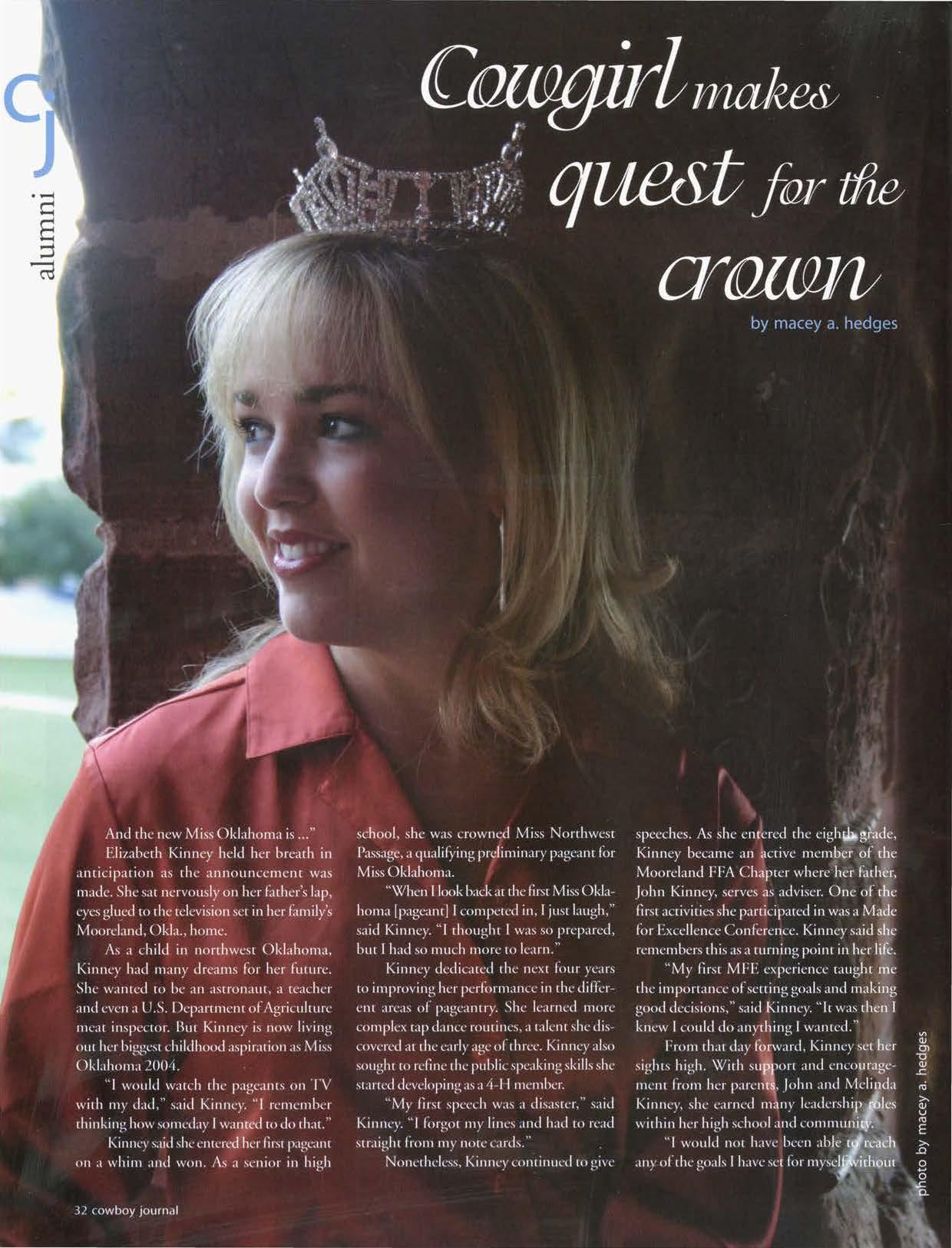
my family's constant backing," said Kinney. " o marter how di couraged I get, they are aJways there to pick me up."
Asa freshman at Oklahoma Stare University, she made an important decision. Kinney chose noc co compete in pageants so she could fulfill her goal of being a state officer in the Oklahoma FA Association.She knew th· decision would ultimately help her achieve her dream ofone day being Miss Oklahoma.
During her rime in office,Kinney poke to more than I 0,000 Oklahoma high school students. Each rime she improved and grew more confident in her speaking abilicy.
In addition coher comm.ion en r as a state Ff A officer,Kinney was activeon the OSU campus and within the College of Agricultural Sciences and arural Resources. he served as a freshman representativeon AgrirulruralStudent Council and was a member of the President's Leadership Council and Chi Omega ational Women's Fracern.icy.
After fulfilling her ob.ligations as a stare Ff A officer, Kinney returned ro the pageanr circuir. he brought with her a more mature atti rude and a clearer vision of how co reach her goaJs.
"While serving as a state FFA officer, I had a chance to really improve my public speaking kill ," he said. "I al o polished my people skills as I worked with students from across the state."
Throughout rhe course of the next two years, Kinney competed in about six pageants, qualifyingfor the Miss Oklahoma pageant both years. he placed in the Top Five in 2002 and in the Top Ten in 2003.
"Falling our of the Top Five in 2003 was a real awakening moment," said Kinney. "I realized the crown was nor going to be handed co me, and I would have to work harder the next year."
IJ1hersmioryearacO U, Kinney was crowned Miss Oklahoma Scare Fair. Although she dedicated herselfcopreparing for the Miss Oklahoma 2004 competition, she never neglected her academic goals. Kinney graduated wmna Cum Laude wirh a Bachelor of cience in agrirulruralcommun.icacionsand
a minor in agrirulruraleconomicsin May 2004. She was recognized as an Outstanding O U Senior and a Top Five CAS R en.ior.
"lam grateful for the opporcunitie I had while a student at O U," said Kinney. he was also a well-known leader on campus. As a rwo-year cudenr Alumni Board executive, an O [J Homecoming reering Committee member and Ag Studenc Council secretary, Kinney earned the re peer of faculty and her peers.
"I always admired Liz's ded.icarion to everything he was doing," said James Roller, fe!Jowclassmate and tare FFA officer. ' he was always the one who would get there early and cay late, and thar articude has alway been an as et for her."
arly in her college career, Kinney developed a passion and a talent for broadcasting. he starred as an intern ar " UNUP," an agriculrural news television program produced by the Oklahoma Cooperative Extension ervice for the Oklahoma Educaciona.lTdevi ion Authority. he eventually became an assisranr producer and srand-in anchor. As a senior, she was se-
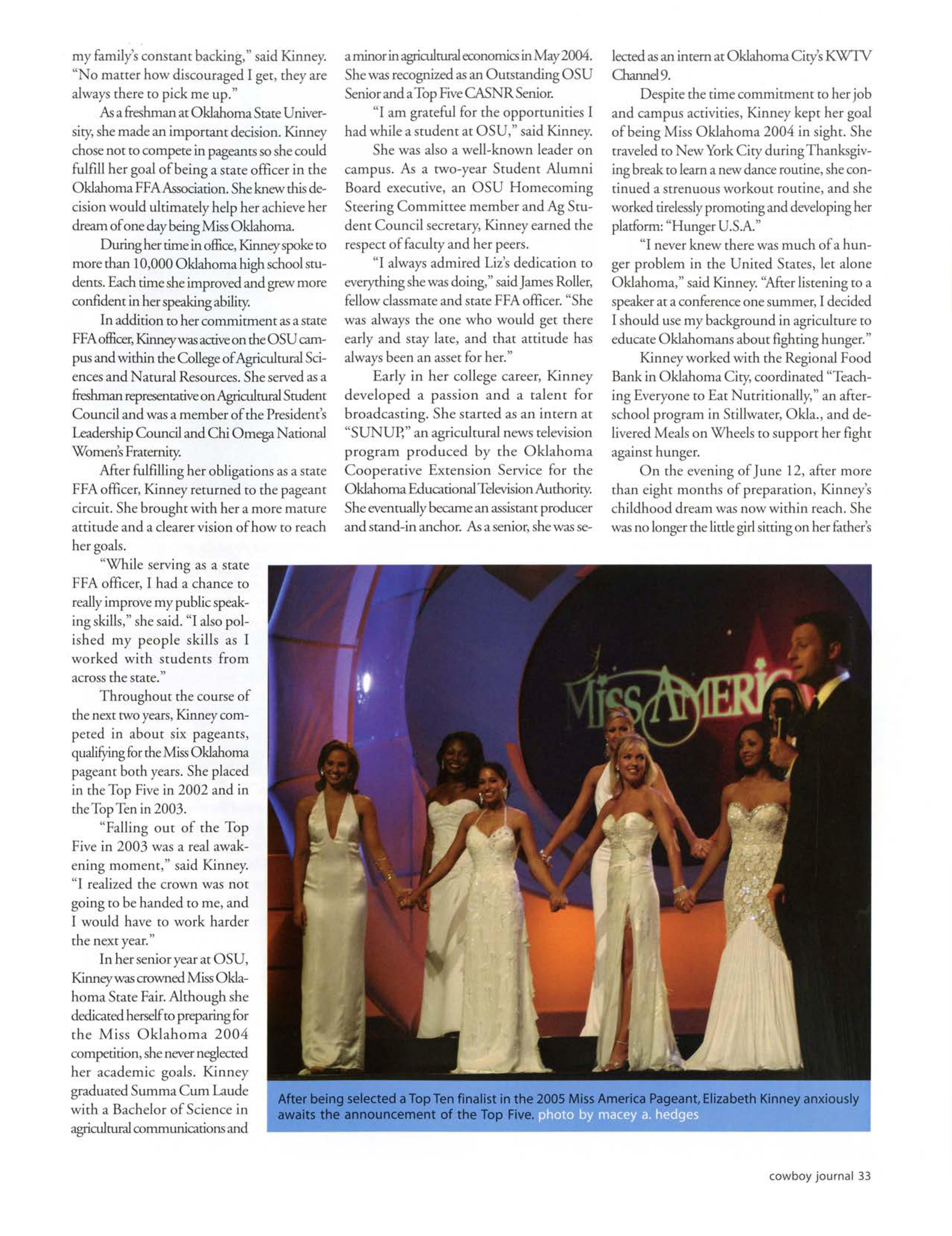
leered as an intern at Oklahoma City's KWIV Channd9.
De pite the time commicmenc to her job and campus activities, Kinney kept her goal of being Miss Ok.lahoma 2004 in ight. he traveled ro ew York City during Thanksgiving break to learn a new dance routine, she continued a strenuou workout routine, and she worked tirelesslypromoting and developing her platform: "Hunger lJ. A."
"I never knew there wa much of a hunger problem in the United tares, lee alone Oklahoma " aid Kinney. "After listening ro a speaker ar a conference one sun1mer, I decided [ should use my background in agricu.lrure ro educate Ok.lahomans about fighting hunger."
Kinney worked wich the Regional Food Bank in Oklahoma City, coordinated "Tead1i ng Everyone to Eat utritionally," an afterschool program in Stillwater, Okla., and delivered Meals on Wheels to support her fight against hunger.
On the evening of June 12, afrer more than eighc monch of preparation, Kinney' childhood dream was now within reach. he was no longer the lirde girl ittingon her father's
lap. She was a young woman, and he wa as prepared as she had ever been to win rhe ride. Afrer four nights of competition, Kinney's moment had arrived.
"I don't remember a lor after rhey announced my name," he aid. "I felr so good because I knew [ had done my very best."
Kinney wasted no time beginning her job as Miss Oklahoma 2004. Afrer being allowed about IO mi nu res ro compose herself, Kinney gave her fir t peech ro judges, fellow contestants and sponsors. After only a few hours of sleep, she poke at her first press conference.
Kinney's next responsibiliry a Miss Oklahoma was ro prepare for Miss America. he spent rhe summer learning yet another dance routine, staying informed of current world events, changing rhe name of her platform to "The Campaign ro End Hunger in Oklahoma," and selecting a variery of outfits co wear for each of the categories and variou orher events she would accend.
"The Miss Oklal10ma Organization was fortunate ro have vendors from all around Oklahoma that provided a wardrobe for Eliz.1beth " aid Kay Alexander, executive director of the Mi Oklahoma Pageant. "le wa a fun summer traveling across the srate with Elizaberh and making decisions about her cloches."
After all of her preparations, Kinney left for Atlantic Ciry, N.J., on epc. l. After arriving in New ]er ey, all 52 contestanrs traveled ro Washington, D.C., and spent five days attending fund-
Right:ElizabethKinneywelcomes OSUstudentsand alumnito the 2004 HomecomingPepRallyand lets them know how proud she is to be a Cowboy.
Inset:U.S.SenatorDon Nickles welcomesElizabethKinneyback to her alma mater and congratulatesherfor accomplishing her goal. •
of competition, che contestant participated in a float parade down d1e Boardwalk on Friday. On aturday, rhe 52 concesrancs lined up on d1e rage of the Old Convention Hall co hear the announcement of the Top Ten.
"1 had rhe biggest knot in my stomach beforethe announcement of Top Ten," said Kinney. "1just cold myself char th.isis Mis.s America and anything can happen."
Kinney was the rhird conresrant to be named co che Top Ten. She competed in the casual wear and swimsuit portions of the pageant again r the other nine finalises.
Alch ugh Kinney was nor named co rhe Top Five, he aid he was thrilled with her performance raising evenrs, speaking co rheir elected officials and vi iring the hi toric site of the ciry.
I get to go around the state meeting people and enjoyingthe stateof Oklahoma.There'snot a better job ever!
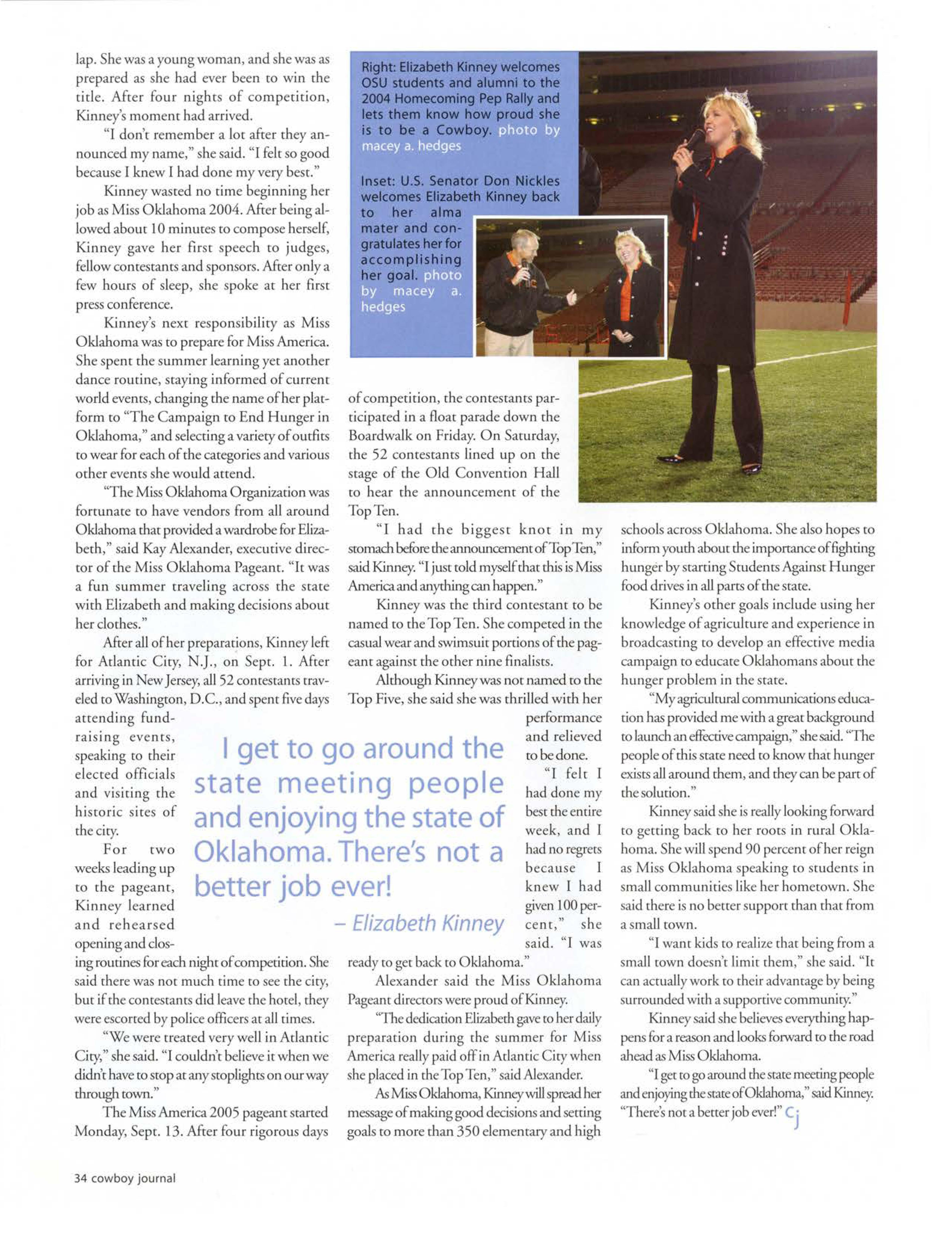
schools aero s Oklahoma. She also hope to inform youth about the imponanceoffighcing hunger by srarcing Students Against Hunger food drives in all parrs of the state.
Kinney's other goals include using her knowledge of agriculture and experience in broadcasting co develop an effective media campaign co educate Oklahoman about the hunger problem in rhe state.
For [WO weeks leading up ro rhe pageant, Kinney learned and rehearsed and relieved to be done.
- ElizabethKinney
"1 fel c had done my best the en rire week, and I had no regrets because I knew I had
given 100 per-
"My agriculnm.l commw1icacionseducation has provided me with a grear background colaunch an effectivecampaign," she said. "The people of this state need to know that hunger exists allaround them, and they can be part of the solution."
Kinney said she is really looking forward co getting back co her roots in rural Oklahoma. he will spend 90 percent of her reign a Mi s Oklahoma speaking to scudent in mall commL111itie like her hometown. She aid there is no better support than chat from a small town.
said. "I was ready co gee back co Oklahoma."
Alexander said the Miss Oklahoma Pageam direccors were proud of Kinney.
cenr,' she opening and dosing rouri11esforead1 nighcofcompetirion. he said there was nor much time co see the city, but if the conresranrs did leave rhe hotel, they were escorred by police officer at all rimes.
"We were created very well in Arlamic Cicy,' he said. "I couldn't believe it when we didn't have co cop at any sropligh rs on our way through cown."
The Miss America 200 5 pageant starred Monday, epc. 13. After four rigorous days
'The dedication Elizabethgave to her daily preparation during rhe summer for Miss America really paid off in Arlanric City when he placed in the Top Ten," aid Alexander.
AsMiss Oklahoma, Kinney willspread her message of making good decisions and setting goals co more rhan 350 elementary and high
''I wane kid co realize rhac being from a small town doesn't limir chem," he aid. "Ir can actually work to their advantage by being surrow1ded with a supportive communiry."
Kinney said she believes everything happens for a reason and looksforward co the road ahead as Miss Oklahoma.
"I geecogo arow1d the state meeting people and enjoyingthe. rateof klahoma,"saidKinney. "There's not a bercerjob ever!"Cj

to Oklahoma ScaceUniversity's College of Agricultural Sciences and Natural Resources for the best educarional experiences. Two CASNR alumni made the most of their OSU experiences and are now serving as presidents of major universities in Thailand.
Maejo University, or MJU, and Chiang Mai University,CMU, are located in Chiang Mai, Thailand. Chiang Mai is the secondlargest city in Thailand.
Thep Phongparnich, president ofMJU, isjust one of the srudenrs who roamed OSU's Agricultural Hall. He earned his docrorate of agriculrural education from OSU in 1978.
''.Asan ordinary student, I was so impressed with the OSU students because cl1ey all looked like real cowboys," said Phongparnich. "Ir had become one of my dreams co study at OSU ifI had the chance co go ro the USA."
As a student, Phongparnich began his climb up the campus ladder. Becoming president of rhe Thai Student Association in I977 was a scarring point for him. He also parricipated in the Horriculrure Club and the Collegiate Fu cure Farmers of America.
Robert Terry, agricultural education regents' professor emericus, served as Phongparnich's adviser. He said Phongparnich was an active member in the college and in the classroom.
"Our Thai students were very accom-
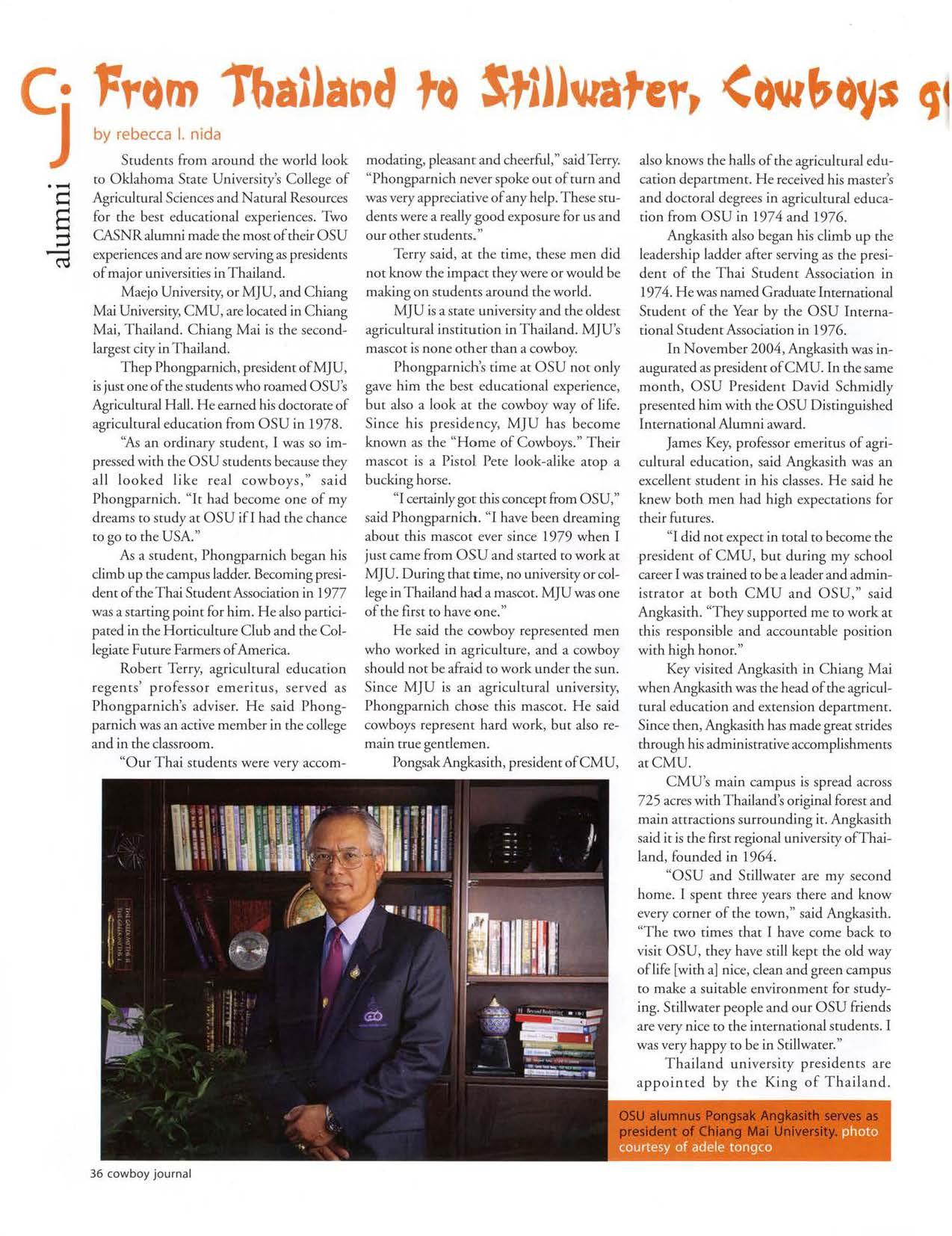
"Phongparnich never spoke out of rurn and cation department. He received his master's was very appreciative of any help. These Stu- and doctoral degrees in agriculrural educadems were a really good exposure for us and cion from OSU in l 974 and 1976. our ocher srudents."
Angkasith also began his climb up the
Terry said, at the rime, these men did leadership ladder after serving as rhe presinoc know the impact they were or would be dent of the Thai Student Association in making on students around rhe world. 1974. He was named Graduate Incernacional
MJU is a state university and the oldest Student of the Year by the OSU Inrernaagriculrural institution in Thailand. MJU's rional Student Association in 1976. mascot is none orh.er than a cowboy. In November 2004, Angkasith was in-
Phongparnich's time at OSU not only augurared as president ofCMU. [n the same gave him the best educational experience, month, OSU President David Schmidly bur also a look at the cowboy way of life. presented him with the OSU Distinguished Since h.is presidency, MJU has become Internacional Alumni award.
known as the "Home of Cowboys." Their James Key, professor emerirus of agrimascor is a Pistol Pere look-alike atop a culcural education, said Angkasich was an bucking horse. excellent student in his classes. He said he
"I certainly got chisconcept from OSU," knew both men had high expectations for said Phongparnich. "1 have been dreaming their futures. about chis mascot ever since 1979 when I "I did not expect in total co become the jusc came from OSU and scarred co work at president of CMU, bur during my school MJU. During chat time, no university or col- career I was trained cobe a leader and adminlege in Thailand had a mascot. MJU was one isrracor at both CMU and OSU," said of the first co have one."
Angkasich. "They supported me to work at
He said rhe cowboy represented men chis responsible and accountable position who worked in agriculmre, and a cowboy with high honor." should not be afraid to work under rhe sun. Key visited Angkasith in Chiang Mai Since MJ U is an agricultural university, when Angkasirh was the head of the agriculPhongparnich chose chis mascot. He said cural education and extension department. cowboys represent hard work, bur also re- Since then, Angkasich has made great strides main true gentlemen. through his adminiscrariveaccomplishments
PongsakAngkasith, president ofCMU, at CMU.
CMU's main campus is spread across 725 acres with Thailand's original forest and main attractions surrounding it. Angkasich said it is che first regional university ofThailand, founded in 1964.
"OSU and Stillwater are my second home. I spent three years there and know every corner of the town," said Angkasich. "The cwo times chat I have come back to visit OSU, they have srill kept rhe old way oflife [with a] nice, clean and green campus ro make a suitable environment for studying. Stillwater people and our OSU friends are very nice to the international students. 1 was very happy to be in Srillwacer."
Thailand university presidents are appointed by che King of Thailand.
The king decides iJ the appointee is fie to hold rhis position. For every universiry graduation, the King or Prince ofThailand is present.
Phongparnich and Angkasith spenc rime rogerher not only while in rhe classroom, bur also by living together. They served as mentors for one another's academic success.
Key said Angkasith played an instrumental role in bringing Phongparnich to OS U. Because of the success he was having, Angkasith encouraged Phongparnich ro come here and be a part of che program.
Terry said d1eexrreme respect rnese men have for any kind of authoriry is unique, especiallyfor their teachers.To these students, the professor was always right, and rney had hesitancy in asking questions or participating in discussions. Eventually, the faculry helped the Thai students overcome rheir reluctance in class.
"If eirner of chem were to walk into the room righr now to shake hands wirn us, rney would take our extended hand and place rneir other hand over ir and bow slightly as a signal of rneir honor and respect," said Terry.
There were challenges when working with international students during chis rime. Key and Terry said che department learned to handle language and cultural adjustment difficulries.
Terry said breaking these boundaries opened new doors. Once these boundaries were broken, mentoring and working with international studenrs provided a rewarding experience for rhe entire agricultural educarion faculry.
These menrors meant the world co Phongparnich's and Angkasich'seducational experience at OSU.
"Many persons made an impact on my life, my career and my success ar OSU where ! learned to work hard and join with ocher international srudems," said Angkasich. "Dr. Terry and Dr. Key gave us valuable time and knowledge during our time at OSU, which makes us proud of chem."
Phongpamich said he agrees.
"As an ordinary Thai cirizen, it is in-
deed an honor co serve your country and your people by being president of a scare universiry. I feel I could serve it honorably and wi rh excellence, particularly wirn my strong conviction and vision. I know I am a good leader because OSU made me one."
These men have devoted their educational experience co making Thailand a better place educacionallyand economically.
David Henneberry, CASNR assistant dean for international programs, said the Thai people feel education is the key co a gwwing country.
"OSU is known globally for irs strong educational commitment to international students," said Henneberry. "Our educational objectives and curriculum are being used globally.These alumni are caking what they have learned here and implementing icarcolleges overseas."
The cowboy spirit has inspired chese alumni to excel academically.
Terry said he was not sure how much he had co do with Phongparnich and Angkasi rh's success, bu c it was one of chose rare privileges where he was on rhe receiving end of the really meaningful experience of being associated with chem.
"I am certainly gratified and thankful chac I had the opportuniry co be a part ofir and goc co know rnese people and experience for myself some of the things rhey do," said Terry.
'They are very gracious and loving people, and there
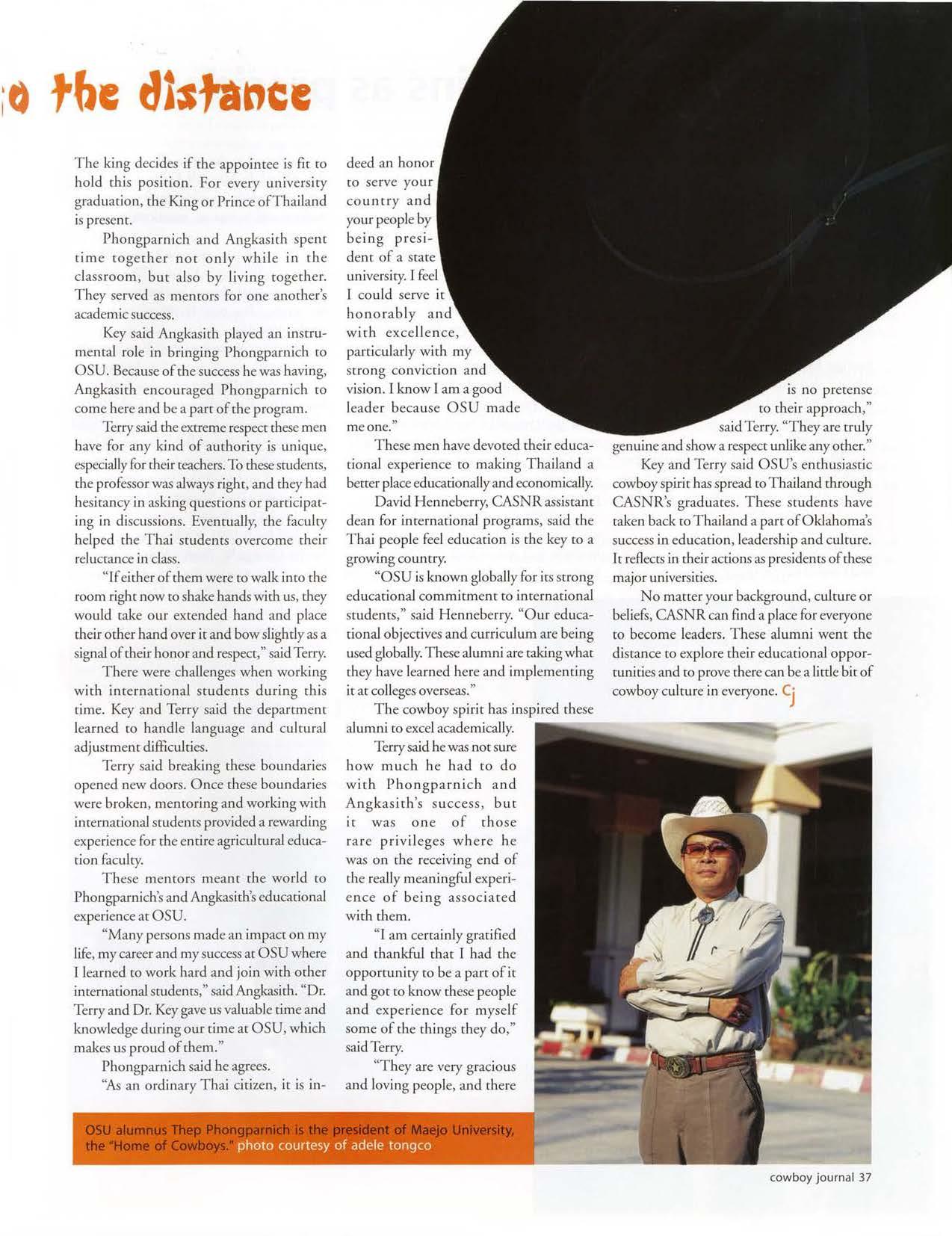
1s no pretense co cheir approach," said Terry. "They are truly genuine and show a respect unlike any orner."
Key and Terry said OSU's enthusiastic cowboy spirit has spread coThailand through CASNR's graduates. These srudents have taken back coThailand a pare of Oklahoma's success in education, leadership and culture. Ir reflectsin their actions as presidents of chese major universities.
No matter your background, cukure or beliefs, CASNR can find a place for everyone co become leaders. These alumni went the distance co explore their educational opportunities and co prove there can be a lirde bit of cowboy culture in everyone. Cj
C· J Kislingtakes the reins as president
by ryan steele
From getting an agribusiness degree at Oklahoma Scace Univer icy co becoming president of OSU's Agriculture Al um ni ociarion, Brent Kisling is living proof char hard work pay: off.
Born and rai.ed on a furn in rural northwe t Oklahoma, Ki ling said he knew early in his life char he wanted co pur ue a career in agriculture where be could help ocher in need.
"When l wa a kid, 1 pent a lot of time hauling hay and helping my family grow whear," sajd Kisling. "I began to appreciate ljfe in rural Oklahoma at a young age and realized agri ulrure was the career path I wanted to rake."
Kisling graduated from Burlingcon High chool in 1990 with a clas of IO scudcncs. horrly after, he began attending classesac Oklahoma rare Uruversicyand was in awe of the cam pus enviroomenr.
"] come from a cown of 156 people, and I would have ar leaserhar many in one of
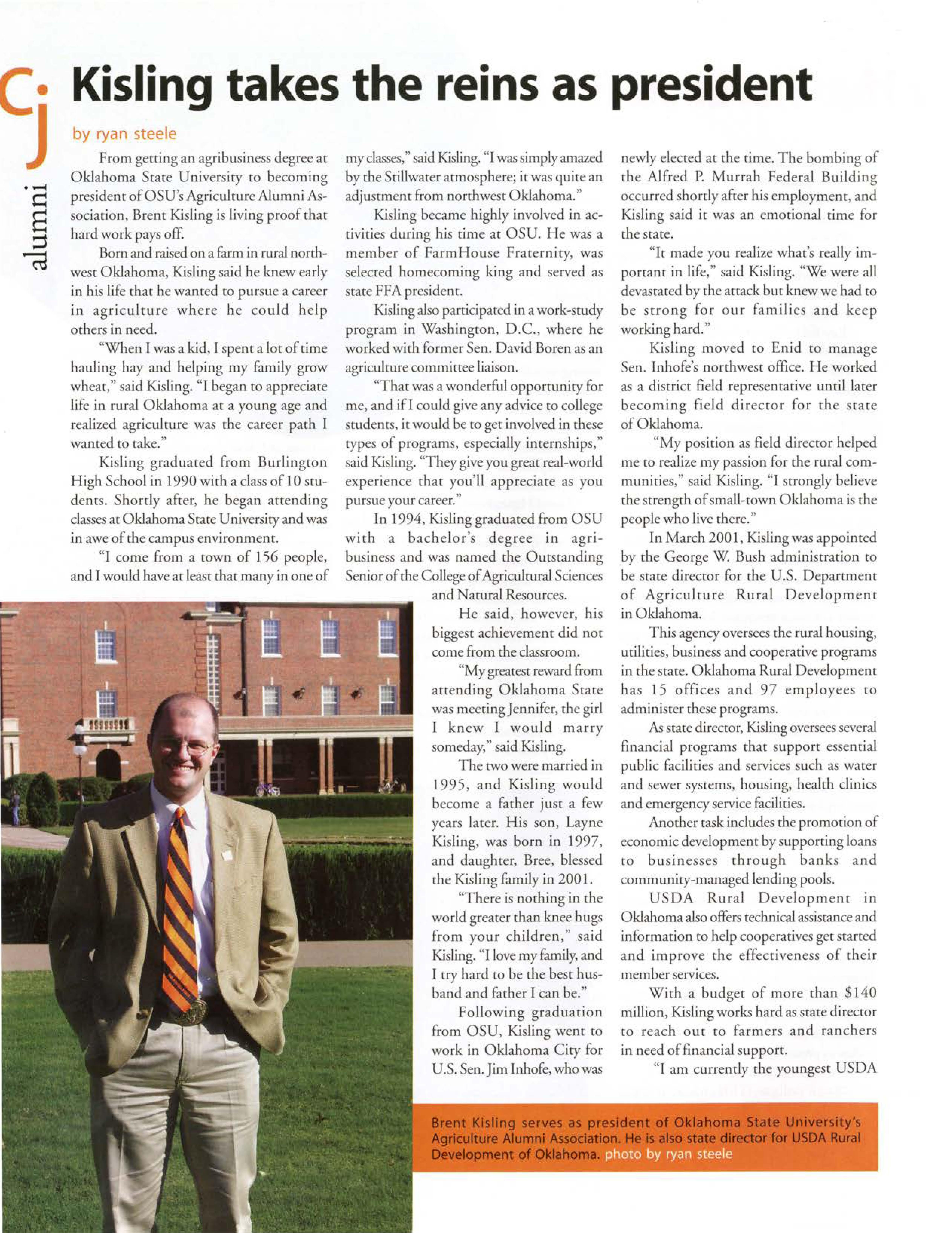
my classes,"said Kisling."I was simply amazed by the tillwacer aano phere; ir was quite an adjustment from northw r Oklahoma."
Kisling became highly involved in activities during his time at O U. He was a member of FarmHouse Fraternity, was selected homecoming king and served as state F A president.
Kisling alsoparticipated in a work-scudy program in Washingcon, D.C., where he worked with former en. David Boren as an agriculture committee liai on.
"That was a wonderful opportunity for me, and if I ould give any advice co college cudencs, it would be co gee involved in these rype of programs, e pecially intern hips," aid Ki ling. 'They give you great real-world experience that you'll appreciate as you pursue your career."
ln 1994 Ki ling graduated from O U wirh a bachelor's degree in agribusiness and was named the Outstanding en ior of the College of Agricul cural ciences and atural Resource
He said, however, hi biggesr achievement rud nor come from rhe classroom.
"My greatest reward from attending Oklahoma tare was meeting Jennifer, the girl l knew J would marry someday," said Kisling.
The rwo were married in 1995, and Kisling would become a father just a few years later. His son, Layne Kisling, wa born in 1997, and daughter, Bree, blessed rhe Kisling family in 200 l.
"There is nothing in che world greater than knee hugs from your children," said Ki ling. "I love my family,and 1 cry hard to be the best husband and father l can be."
Following graduation from O U, Kisling went co work in Oklahoma City for U. . en. Jim Inhofe, who was
newly elected at the rime. The bombing of rhe Alfred P. Murrah Federal Building occurred shorrly after hjs employment, and Kisling said ir was an emotional rime for the state.
"Ir made you realize what's really important in life " sajd Kisling. "We were all devastated by the arrack bur knew w had co be strong for our familie and keep workjng hard."
Ki ling moved co Enid co manage en. Inhofe's northwest office. He worked as a di trice field repre enracive until lacer becoming field director for the scare of Oklahoma.
"My position as field director helped me co realize my passion for rl1e rural communities," said Ki ling. "I strongly believe the crength of small-town Oklahoma is the people who live there."
In March 2001, Kisling was appoinced by the George W. Bush administration to be scare direccor for the U .. Department of Agriculrure Rural Development in Oklahoma.
This agency oversees the rural hou ing, utilities, business and cooperative programs in the scare. Oklahoma Rural Development has J 5 offices and 97 employees ro administer these programs.
Asstare director, Kisling overseesseveral financial programs that upporr essential public facilities and service uch as warer and sewer systems, hou ing, health clinics and emergency service facilities.
Another cask includes rhe promotion of economic development by upporting loans co busine es through banks and community-managed lending pool
U DA Rural Development in Oklahoma also offers rechnjcal assistance and information co help cooperatives gee tarted and improve rhe effectiveness of their member ervices.
With a budget of more than $140 million, Kisling works hard as scare director ro reach ou c to farmers and ranchers in need of financial support.
"I am currently the youngest U DA
director in the nation, and rhar's quire an honor," said Ki ling. "My career goal has always been ro help others, and I knew I could make a difference once I rook rhi position."
Kisling's career took another step forward when he was elected as president of the O U Agriculrure Alumni Association in October 2004. He previously served on the associacion' board of direccor a a northwest district representative for a year.
ormer association president ean Kouplen said he knew Kisling would continue co lead the association in the right direction.
"It wa really a privilege working wirb Bi:enron d1e board of direcrors," said Kouplen. "We served on the Agriculrural cudem Counci I cogerher while in college, and he's alway been an outstanding leader.
"Brenr has continued ro be a hard-working individual and very de erving of all his accomplishments," said Kouplen. "I am thrilled rhar be will be ucceeding me as presidenr."
Kisling aid filling Kouplen's shoes would be difficult, but he is prepared for the challenge. A few of his responsibilities as pre idenr include working wirh che current board of direcrors ro recruit new students for the college, building scholar hip progran, and
promoting agricultural student activities.
The Agriculture Alumni Association is represented at everal CA R events throughout rhe year, including Ag Roundup and the association's annual barbecue held rhe san,e weekend as OSU's homecoming festivities. In addition to sponsoring these events, rhe association presents scholarship to outstanding students.
Along with the re ponsibilities that come with being president, Kisling also has several goals for rhe Agriculrure Alumni Association, including increasing awareness about rheas ociation.
"Many CAS R studenrs and alumni do nor know about rhe benefits ofbeing involved wirh rhe Ag Alumni Association," said Ki ling. "We definitely wam to incl'ease visibility."
Some of che benefits char come wirh being a member of rhe association in lude automacical!y becoming a member of the O U Alumni Asso iarion, as well as having athletic ticker priority, discount to various busi nes es and ub cripti n co Oklahoma Stare publications including Cowboyjoumal.
Kisling said he also wanrs theAgriculrure Alumni Association ro connecr wirh CA R srudenrs on a per onal and professional level.
"We wanr co help tudent any way we
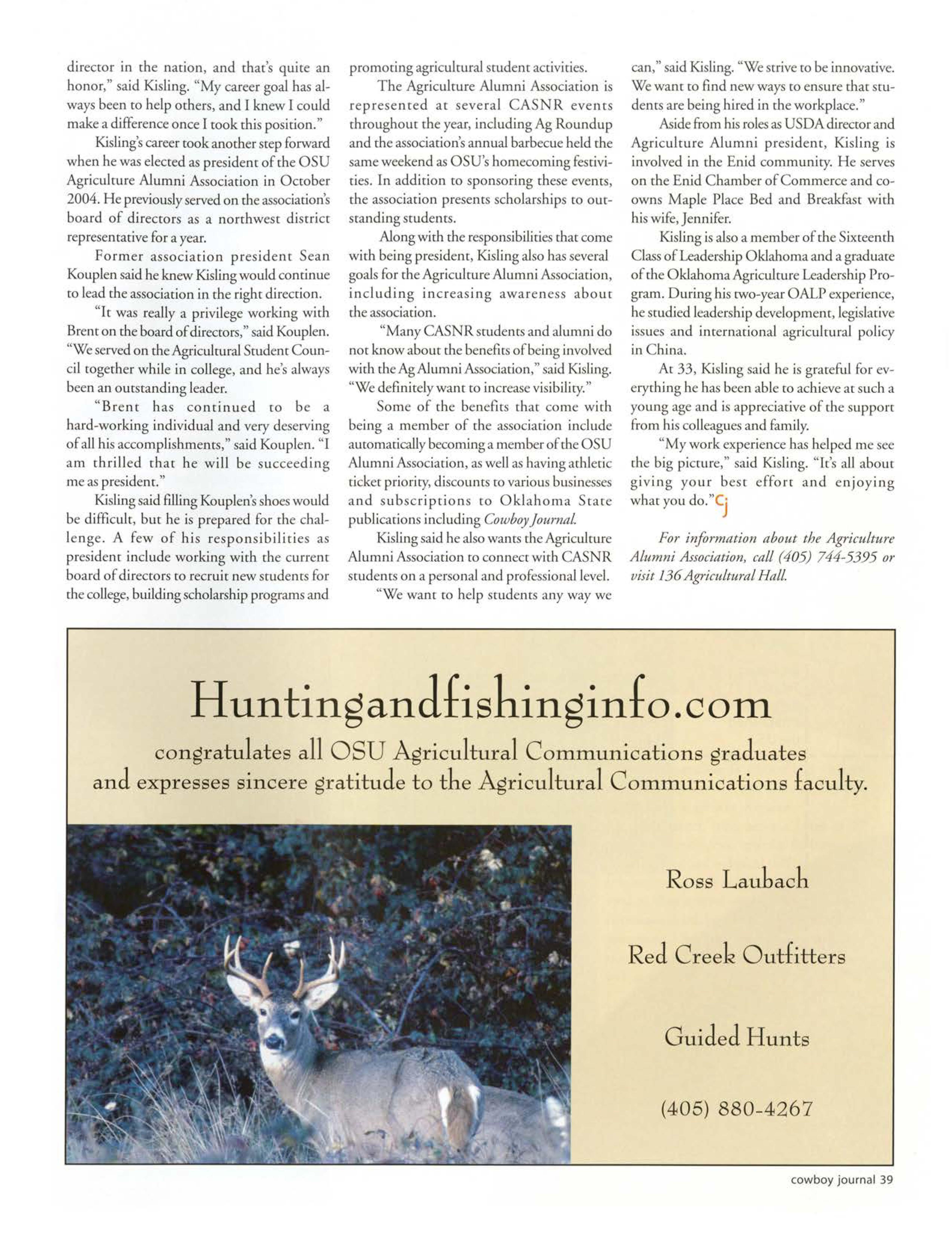
can" said Ki ling. "We crive robe innovative. We wane to find new ways ro ensure char srudents are being hired in the workplace."
Aside from hi roles as USDA director and Agriculture Alumni president, Kisling is involved in the Enid community. He serves on the Enid haniber of Commerce and coown Maple Place Bed and Breakfast with his wife, Jennifer.
Kisling is also a member of the i.xrcenrh Class ofLeader hip Oklahoma and a graduate of the Oklahoma Agriculture eadership Prograni. During his two-year OALP experience, he studied leadership development, legislative i sues and international agricultural policy in China.
Ac 33, Ki ling said he is graceful for everyching be has been able co achieve ar such a young age and is appreciative of che support from hi colleagues and family.
"My work experience has helped me see rhe big picrure," said Ki ling. "Ir's all about giving your be t efforr and enjoying what you do."Cj
For information about the Agriculture Alumni Association, call (405) 744-53.95 or visit 136Agricultuml Hall.
Alumniserve,makepeace
by jodi nichols cole
"What makesit hard is what makes it great. Becauseif it wasn'thard everyonewould do it. " - Tom Hanks
Though Hanks was noc referring co che U Peace Corps, his sracemenr firs. Serving as a Peace Corp volunceer is not always easy. In face, ir can be scary, overwhelming and sometimes even the biggest challenge one has ever faced. Bue it also can be rhe mosc exciting, rewarding and incredible experience possible.
" veryone alway say char in che Peace Corp there are really high high and really low lows," said Willis Kidd, Oklahoma Stare University alumnus and recent volunteer. "This is rhe way it was for me." ince its e rablishmenr by President
John F.Kennedy in 1961, rhe Peace Corps has conrinued in its effort to ''promote world peace and friendship" through three areas:
• helping the people ofinrere red countries meet their need for trained men and women;
• helping promote a becrer undersrandi ng of Americans on rhe pan of chose served·
• and helping promore a better understanding of other people on rhe parr of Americans.
According to the government agency, more than 170 000 Americans have joined rhe efforts co fight poverty, illiteracy, hunger and disease in 70 nations around the globe. And though rimes have undoubtedly changed, the Peace Corps' mi sion has nor.
"Whatmakes 1t hard is what makes it great ...
Volunteer Requirements
Age
Mar I President 1961 John F. Kennedy established the U.S. Peace Corps
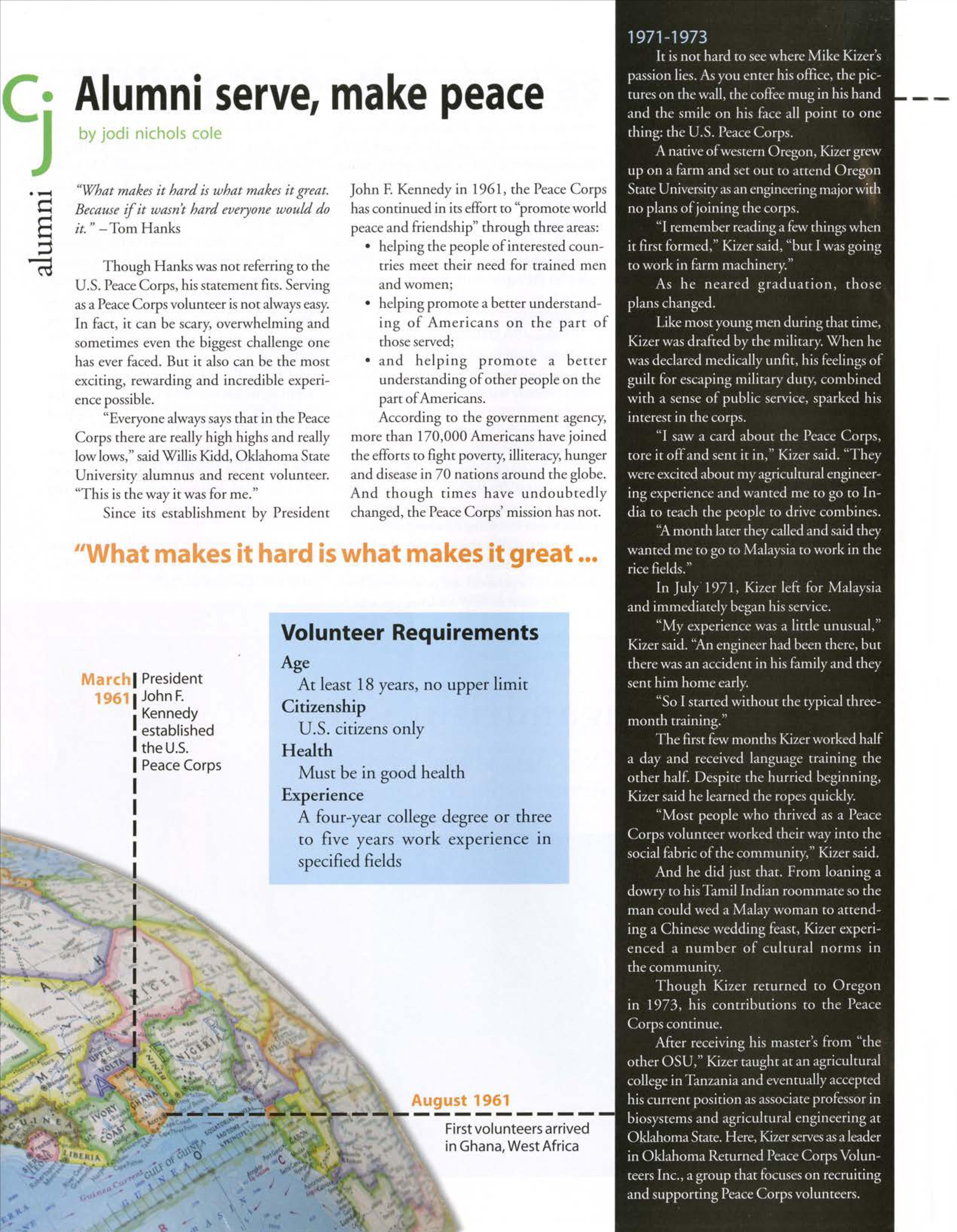
At least 18 years, no upper limit
Citizenship
U.S. citizen only
Health
Must be in good health
Experience
A four-year college degree or three to five years work experience in specified fields
1971-1973
!1 is 1101 hard w sec where Mike Kizer's passion lies. As you enccr his otHcc, the pictures on 1he wall, rhe collee mug in his hand and the smile on his face all point to one ching: the U.S. Peace Corps.
A narive ofwesrem Oregon, Kizn grew up on a form and set out w attend Oregon Statl' University a.san enginet:ring major with no plans of joining the corps.
••1remember reading a few chings wlwn it first formed," Kizer said, "but I was going to work in form machinery."
As he neared graduation. those plans changed.
Like most young men during dut time, Kizer was drafted by the military. When he was declared medic11ly unfit, his feelings of guilt for escaping military duty, combined with a sense of public service, sparked his imer,·s1 in the corps.
"I saw a card about lhe )\:ace Corps. tore it off and sen I it in." Kizer said. "'I ·hc·y were excited about my agricultural enginening experience and wanted me to go to India to reach the people to drive combines.
"A monlh lacer they called and said they wanted mt· co go to Malaysia to work in the rice fidds."
I 11 July 1971. Kizn left for Malaysia and immt:diatcly lx-gan his service.
"My experience was a li1de unusual." Kizer said. "An cngineer had been there. but there was an accidem in his family and they sent him home t:arly.
"Sol started without the typical rhreemomh training."
The fo-scfew months Kizer worked half a day and received language training tht: otht:r half. Despice the hurried beginning. Kizer said ht: learned che ropes quickly.
"Most people who 1hrived as a Peace Corps voluntt:er worked their way into the social fabric of tht: communicy," Kizer said.
And he did just that. From loaning a dowry lO his 'famil Indian roommate so the man could wed a Malay woman to attending a Chinese wedding fcasr, Kizer experienced a number of cultural norms in the community.
Though Kizer returned to Oregon in 1973, his contriburions to the Peace Corps cominuc.
ugust 1961
--------
First volunteers arrived in Ghana, West Africa
Aftt:r receiving his master's from "rh..: other OSU," Kizer caughc at an agricull11ral college in 'fanzania and eventually accepted his current position as associate professor in biosysterns and agricultural engineering at Oklahoma State. Here, Kizer serves as a leader in Oklahoma Returned Peace Corps Volunteers Inc., a group chat focuses on n::cruicing and supponing Peace Corps volunteers.
2002-2004
Frustrating and rewarding. These rwo words were u ed by O U agricultural economics alumnus Willis Kidd to describe his recent U.S. Peace Corps ervice in Purinesci Moldova.
"I know iris hard to be both of these " said the Fredonia, Ka.n., native, "but it has been. Ir has been an awesome experience."
Kidd began his service in Moldova on June 13, 2002. After an 11-week training program, he began financial management and planning consultations with small farmer through a local extension office in the Northern Moldovan village.
Some of the farmers, who only recently received their share of land chat had long been privatized in collective farms, lacked the experience and management capacity to
manage these farms effectively, Kidd said.
So he found a solution.
''I aw chat the e skills were lacking in Moldova," Kidd said, "so I developed a three-day seminar series co teach the very basics of financial managemenr to these small farmers.
"Additionally, I worked on a project that developed 110 crop budgets listing the revenues, coses, profit and other data for the major crops in each of the four growing regions of Moldova. The final outcome was a 238-page handbook chat was distributed through the national extension service and to ocher beneficiaries."
Like Kizer, Kidd said the be r experience was escabli hing close relationshipswith che Moldovans.
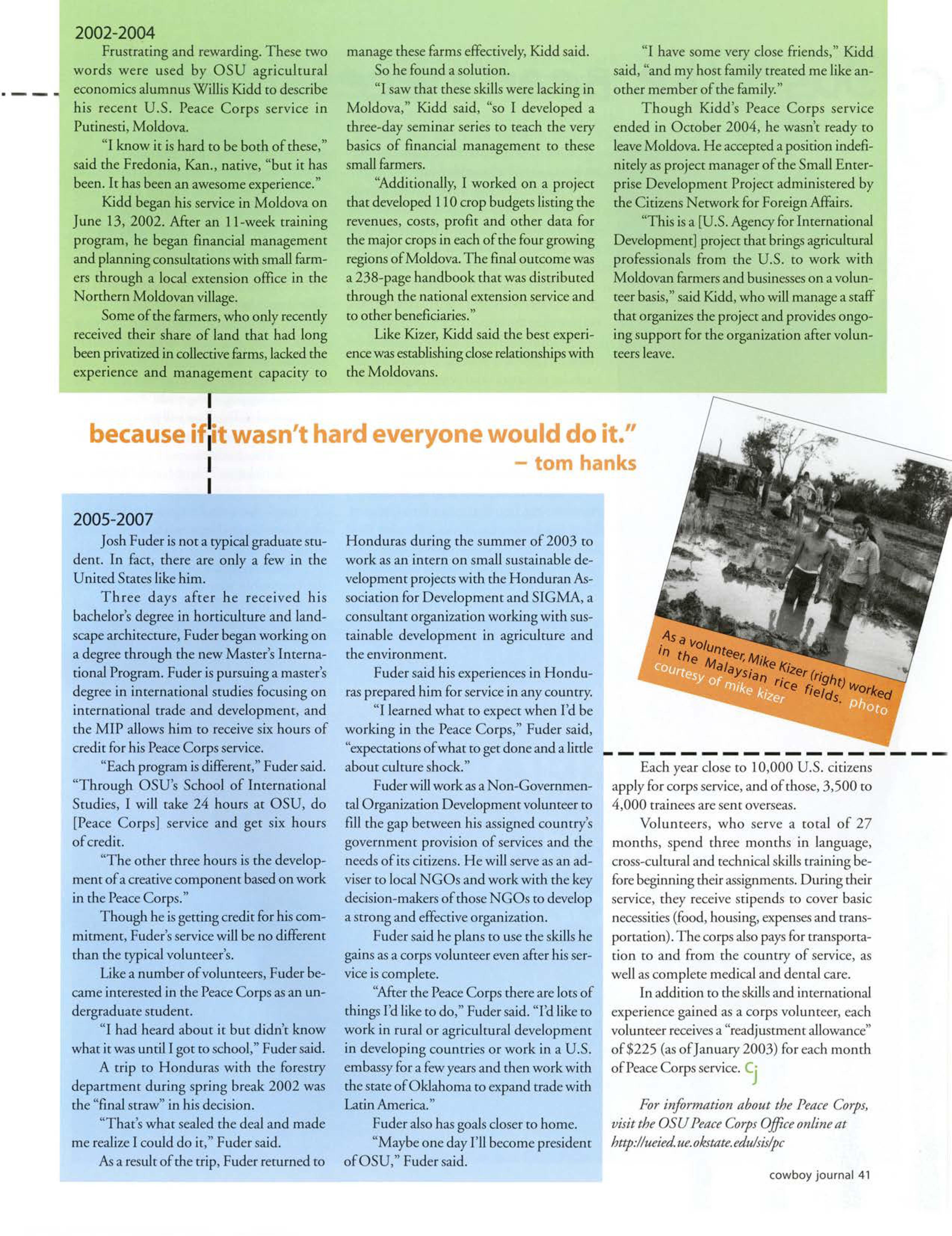
"I have some very close friends," Kidd said, 'and my host family treated me like another member of the family."
Though Kidd's Peace Corps service ended in October 2004, he wasn't ready ro leaveMoldova. He accepted a position indefinitely as project manager of the mall Encerprise Developmenr Project administered by the Citizen etwork for Foreign Affairs.
"This is a [U. . Agency for Internacional Developmenr] project chat brings agricultural professionals from the U to work with Moldovan farmer and businesses on a volunteer basi ," aid Kidd, who will manage a staff that organi--lesthe project and provides ongoing upporr for the organization after volunteers leave.
because if:·twasn't hard everyone would do it." I - tom hanks I
2005-2007
Josh Fuder is not a typical graduate student. In fact, there are only a few in the United tares like him.
Three days after he received hi bachelor's degree in horticulture and landscape architecture Fuder began working on a degree through rhe new Masrer's Inrernational Program. Fuder is pursuing a master's degree in international studies fo u ing on inrernarional trade and development and the MfP allows him co receive six hours of credit for hi Peace Corps ervice.
"Each program is different," Fuder aid. "Through O U's School of Internacional rudies, I will rake 24 hours at OSU, do [Peace Corps] service and gee six hours of credir.
"The other three hours is tl1e development of a creative component based on work in the Peace Corps."
Though he is getting credit for his commitment, Fuder's service will be no different than the typical volunteer's.
Like a number of volunteer , Fuder became interested in the Peace Corps as an undergraduate student.
"I had heard about it but didn't know what icwas until I got to school," Fuder said.
A trip to Honduras with the forestry deparrmenr during spring break 2002 was the "final straw" in his decision.
"Thar's what sealed che deal and made me realize I could do ic," Fuder said.
As a resulrof the trip Fuder returned co
Honduras during the summer of 2003 to work as an intern on small sustainable development project with the Honduran Association for Development and TGMA, a consultant organization working with sustainable developmenr in agriculture and the environment.
Fuder said hi experiences in Honduras prepared him for service in any country.
"I learned what co expect when I'd be working in the Peace Corps," Fuder said, "expectations of what to ger done and a little about cul cureshock."
Fuderwill work as a on-Governmental Organization Development volunteer to fill the gap between hi assigned country's government provi ion of services and the needs of it cicizens. H c will serve as an adviser to local NGOs and work witl1 the key decision-makers of chose NG Os to develop a strong and effective organi·zarion.
Fuder aid he plans to u e the kills he gains as a co.rpsvolunteer even afcer hisservice is complete.
"After the Peace orps ch.ereare lots of things I'd Liketo do,'' Fuder said. ''I'd like to work in rural or agricultural development in developing countries or work in a U.S. embassy for ah w year and then work with the state of Oklahoma co expand trade witl1 Latin America."
Fuder also has goal closer to home.
"Maybe one day I'll become president ofO U," Fudersaid.
Each year close to 10,000 U.S. citizen apply for corps service, and of those, 3,500 to 4,000 trainees are senr overseas.
Volunteers, who serve a total of 27 monrhs, spend three months in language, cross-culrural and technical skills uaining before beginning their assignments. During their service, they receive tipends to cover basic necessities(food, hou ing, expenses and cranportation). The corp also pay for tran porcarion co and from the country of service, as well as complete medical and dental care.
In addition to tl1eskills and inrernarional exp rience gained as a corps volunteer, each volunteer re eives a "readjustment allowance" of $225 (as of] anuary 2003) for each mon rh of Peace rp ervice. Cj
For information about the PeaceCorps, visit the O U PeaceCorpsOfficeonlineat http:llueiedu.e.okstate.edulsis/pc
C• Jus-t -the sear l"\e.cessi-ties ...
by kc keffer __ ._.__
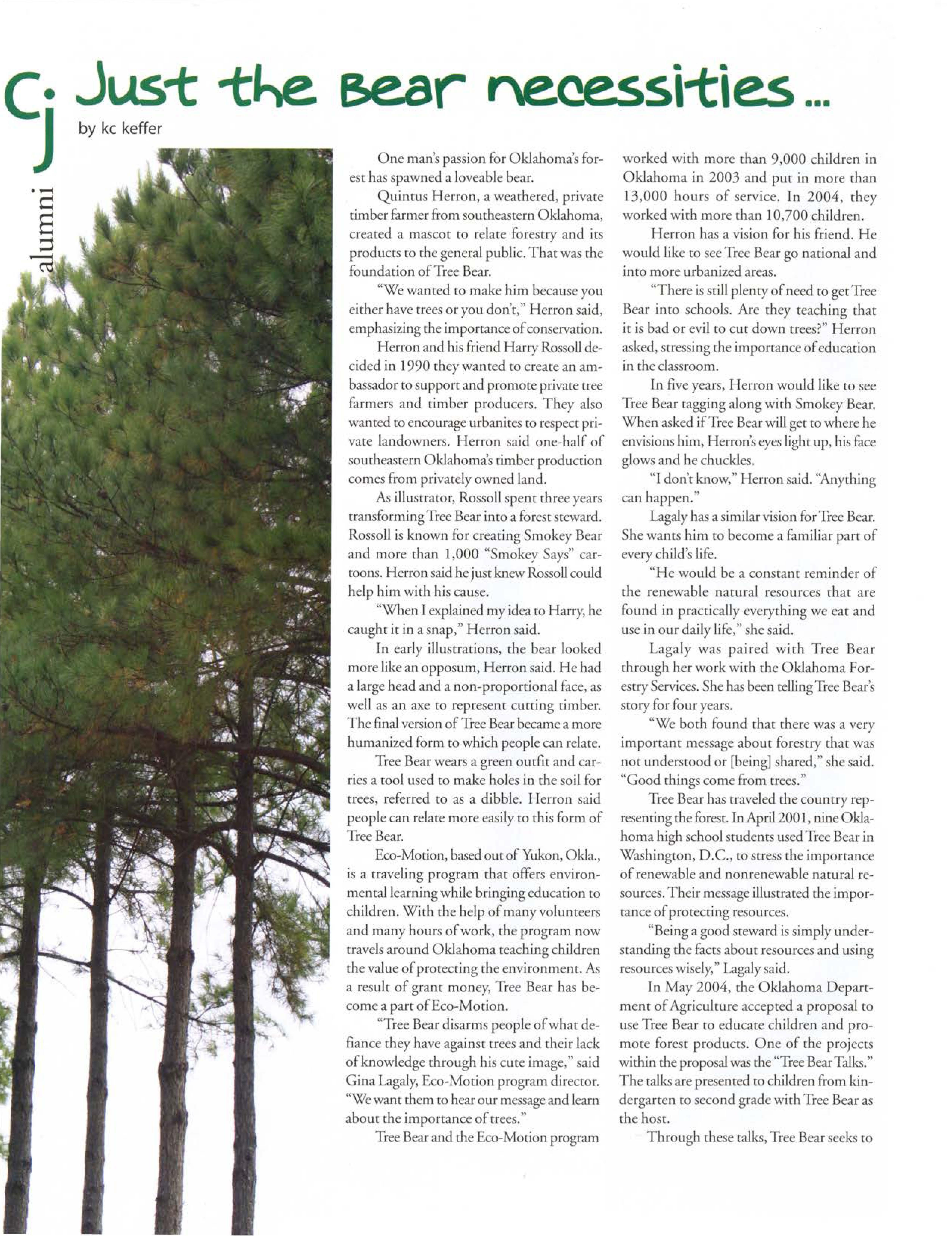
One man's passion for Oklahoma's fore cha pawned a loveable bear.
Quintus Herron, a weathered, private timber farmer from southeasrern Oklahoma, creared a mascot co relace forestry and it products to the general public. That was rhe foundation ofTree Bear.
"We wanred co make him becau e you either have rrees or you don'r," Herron said, emphasizing che importance of conservation.
Herron and hi friend Harry Ros oll decided in 1990 they wanted to create an ambassador ro supporr and promote private tree farmer and rimber producers. They also wanted co encourage urbanites co respect private landowners. Herron said one-half of oucheasrern Oklahoma's timber production come from privately owned land.
As illuscracor, Rossoll spent rhree years transforming Tree Bear into a forest reward. Rossoll is known for creating mokey Bear and more than I ,000 " mokcy ays" cartoon Herron said he just knew RossoUcould help him with hi cause.
"When I explained my idea to H,my, he caught ir in a snap," Herron said.
In early illustrations, the bear looked more like an opposwn, Herron said. He had a large head and a non-proportional face, as well as an axe co represent cutting timber. The final ver ion of Tree Bear became a more humanized form co which people can relate.
Tree Bear wears a green omfir and carries a cool used co make holes in che soil for trees, referred co as a dibble. Herron said people can rdare more easily co chis form of Tree Bear.
Eco-Mo ion, based our of Yukon, Okla., is a traveling program that offers environmental lea.ming while bringing education to children. With the help of many volunteers and many hours of work, the program now travels around Oklahoma teaching children the value of protecting che environment. As a result of grant money, ree Bear has become a part of co-Morion.
"Tree Bear disarms people of what defiance they have against uees and their lack of knowledge through his cure image," aid Gina Lagaly, Eco-Morion program director. "We wanr chem to hear our messageand learn about the importance of trees."
Tree Bear and the Eco-Morion program
worked with more than 9,000 children in Oklahoma in 2003 and put in more rhan 13,000 hours of service. In 2004, they worked wirb more than 10,700 children.
Herron has a vision for his friend. He would like co ee Tree Bear go national and inco more urbanized areas.
"There is still plenry of need co geeTree Bear inro schools. Are rhey teaching char ic i bad or evil to cut down trees?" Herron asked, rre ing the importance of education in the cla room.
In five years, Herron would like co sec Tree Bear cagging along with mokey Bear. When asked if Tree Bear will get cowhere he envi ion him, Hcrron's eyes light up, hjs face glows and he chuckles.
"I don't know," Herron said. "Anything can happen."
Lagaly ha a similar vi ion for Tree Bear. he wane him co become a familiar pan of every child's life.
"He would be a consranc reminder of the renewable natural resources chat are found in practically everything we ear and use in our daily life," he aid.
Lagaly was paired wirh Tree Bear chrough her work with the Oklahoma Forestry ervi es. She has been cellingTree Bear's story for four year
"We boch found chat there was a very important message about forestry char was nor understood or [being] shared," she aid. "Good dungs come from tree ."
Tree Bear has rraveled che country representing che forest. In April 200 I nine Oklahoma high school student used Tree Bear tn Washingcon .C., to stress the importance of renewable and nonrenewable natural reources. Their message illu traced the importance of protecting resou.rce
"Being a good reward is simply understanding the fact about resources and using resources wisely,' Lagaly said.
In May 2004, the Oklahoma Department of Agriculture accepted a proposal to use Tree Bear co educate child.ren and promote forest products. One of the projects within the propo al wasche "Tree BearTalks." The talks are presented co children from kindergarten co second grade with Tree Bear as the host.
Through these talks, Tree Bear seeks co
inform people of ome of the produ rs rhac come from trees: lipsrick, shampoos, ice cream, vitamins, pet food, etc., as reporred by the forcsrry services of the Oklahoma Department of Agriculrure, Food and Fiber.
The one-hour Tree Bear Talks are clas e conducted by a Tree Bear puppet or a life- ize mascot and con isr of a srory about Edi on, the Eco-Morion recycled school bus. There is al o a tour of Edison and several activities. The activities are de igned coencourage the exploration of trees. They are about rree production, phorosynthesis, tree life cycles and rree habitars. The whole program became available to chool statewide in January 2005.
fn December 2004, Tree Bear vi iced che Omniplex in Oklahoma Ciry. He presented a talk called "What WouJd Chri rmas be Withour a Tree?" The performance were played three times a day and were an adaptation of the original Tree Bear Talks.
Through Herron' vision, dedication, creariviry and friend hips, Tree Bear came to life.
Herron auended Oklahoma A&M. He began as a law major, bur evenruaUy switch d to fore cry. Herron was a member of the Fir r graduating class in farm fore rry and che second class in che forestry deparrmenr in 1951.
Herron own a privace timber farm that is producingirs6lstconsecutive ropchi year. His bu iness include rhou and of acres of timber where he allow tree co grow co a prescribed size and then harvests them. The small r trees are lefr behind co continue growing until they, roo, reach the pre cribed size, and the cy le continue
Herron is also an active member of his community and che forestry induscry. He is a member of che ocicty of American orescers, Oklahoma Forestry Association, klaJ1oma race hamber of ommerce, Oklahoma Mueum Association and che Oklahoma Heritage As ociacion.
Lagaly said Herron believes in che value of his ability co grow and harvest a renewable natural resource.
"] can see che twinkle in his eyes when he speak of trees and his family rree farm," she said.
The rwo main chara tee of chis coryare different yet one in the ame. They both have glasses love tree and promoce forestry. Bur one is a bear and one is the man who created rhe bear. The two make a dynamic duo char wilJ become role models and promoter of forestry a ros kJahoma and the country. Cj
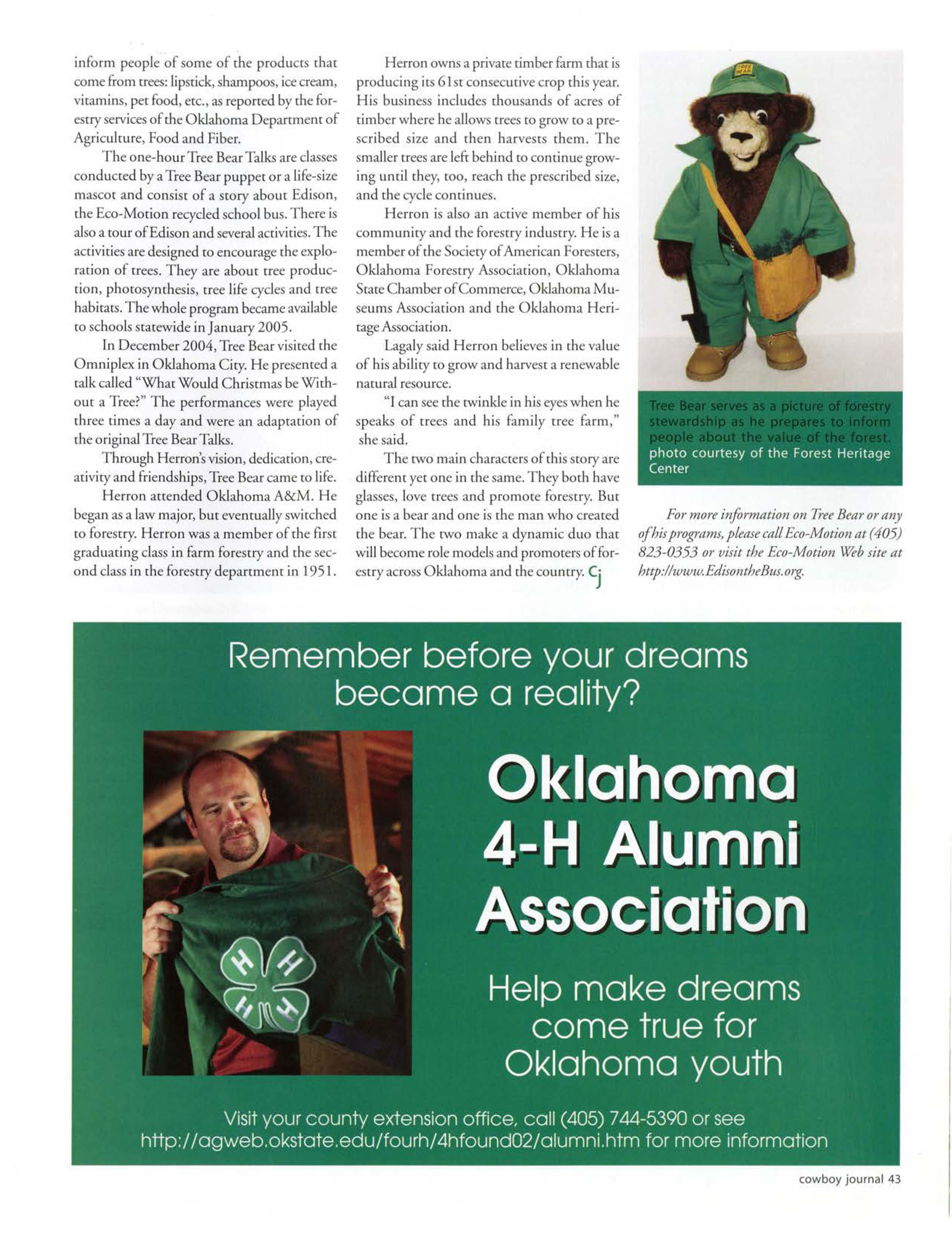
For moreinformationon 7i·eeBearor any of hisprograms,pleasecailEco-Motionat (405) 823-0353 or visit the Eco-Motion Website at http://www.EdisontheBus.01g.

From the Green to the Gold
by ryan hale
As rhe sun rises, footsteps break the dew where the men' and women's U.S. Olympic occer team train for the gold.
These steps are from Oklahoma narive KyleWater director of sports rurf and grounds at the Home Depoe Training Center in Carson, Calif.
Waters graduated from Oklahoma Srace University in December 2002 with a Bachelor of cience in turf management.
When first at.tending OSU. Waters didn't know exacclywhat life was going ro offer him. Initially, he decided ro pursue a degree in finance. However, he soon turned ro his first love: baseball.
Water loved baseball and O U, so he "walked on" to t:heOSU baseball team in 1996. He was able ro play for Coach Tom Holiday and wirh longtime friend Josh Holiday. Through the experience, Waters and Holiday developed a close friendship.
"Coach Holiday was like a farher ro me," said Waters.
Water began the 1996 season and played until an unexpected shoulder injury prevented him from playing baseball. Bur wirh the deire robe around his favorite sport, Waters realized no one was in charge of raking care of Allie P.Reynolds radium.
"They bad never really had anyone there ro take care of cl1efield," aid Waters.
In 1997, Water became the O eqwpment manager for the ba eball t am and groundskeeper for the scadium.
"I wanred ro make Allie P. a nice a it could be," said Waters, "you know, a nice as the fields at [Texas] A&M or [the University of Oklahoma]."
Waters built the program at O U from the ground up. All the mainrenance on the field, re-seeding of the outfield and infield, and mowing and irrigation of the gra were importanr in rurning around the stadium.
"One of the best parrs of being rhe ground keeper ar O U wa rhat it wa a hands-on experience,"said Waters.
Oklahoma ha hor summers and cold winter during which Water fought ro keep the field at irs maximum potential.
Warer mainrained Allie P.Reynolds radium for four years before he lefr chool ro rake a job through a connection he had made being the groundskeeper ar O U. Waters be-
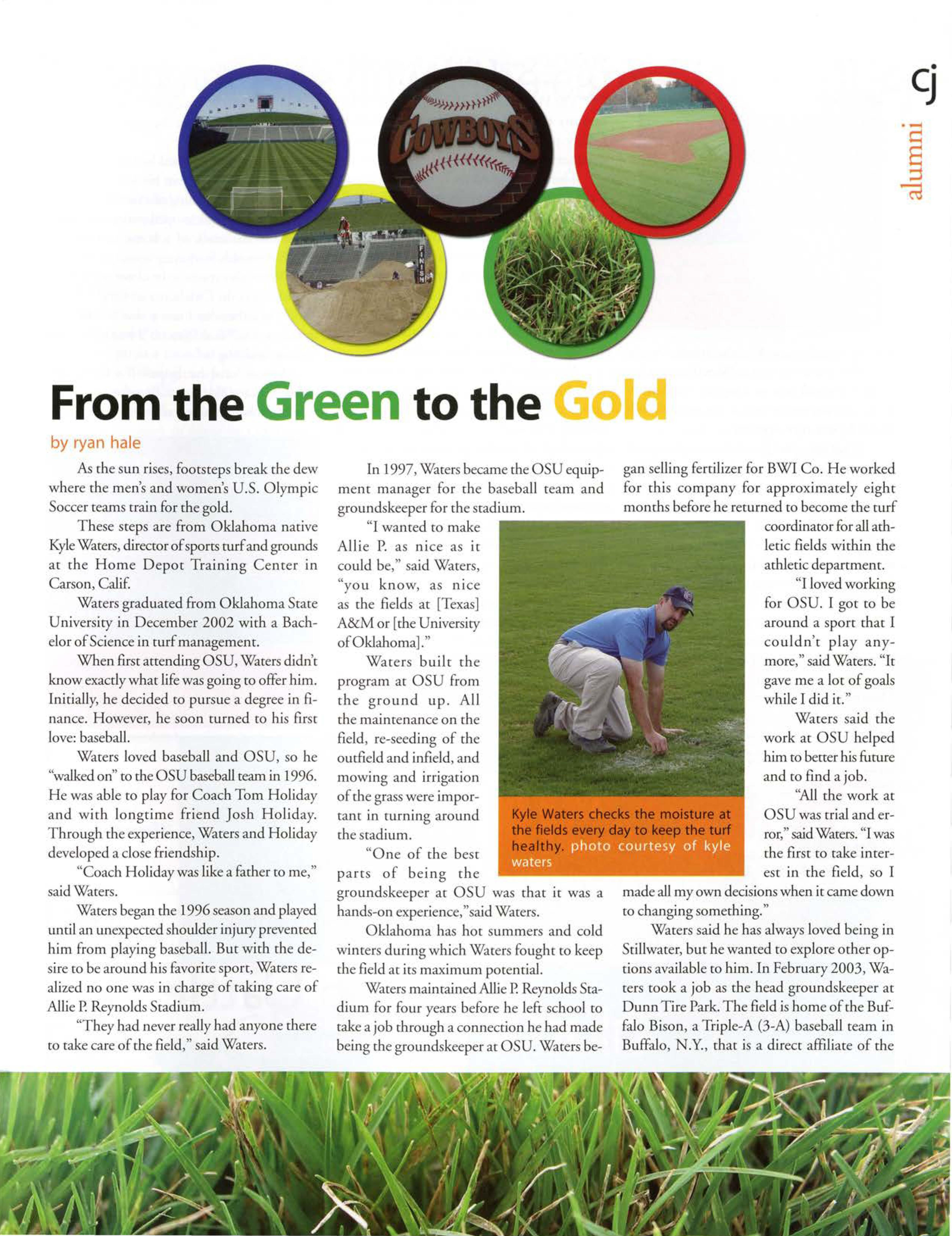
gan selling ferrilizer for BWI Co. He worked for rhis company for approximately eight months before he returned to become the mrf coordinaror for all athletic field within the athletic department.
"] loved working for O U. I got co be around a sport rhar I couldn't play anymore," said Wacers."Ic gave me a lot of goals while I did it."
Wacers said rhe work at O U helped him ro better his fucure and ro find a job.
"All the work at OSU was rrial and error," said Waters. "I was the fir r co cake interest in che field, so I
made all my own decisions when iccame down ro changing omething."
Warers said he has alway loved being in rillwacer, bur he wanced ro explore other opcions available ro him. In February 2003, Waters rook a job as cl1ehead ground keeper ac Dunn Tire Park. The field is home of rhe Buffalo Bi on, a Triple-A (3-A) baseball ream in Buffalo .Y.,chat i a direct affiliate of the
ymp1 fieldat t next gam
Cleveland lndian profes ional ba eball team.
Tbis was a big seep in Waters' career becau e it pushed him ro a higher standard of work, considering rhe levelof competition with which he was now involved.
"Thar was great for me becau e I was just one rep away from the big league ," said Waters."] feldike I was pan of the team."
Waters enjoyed the groundskeeper job in Buffalo, and hi effons in land caping on e again paid off. Waters was offered a job on the ocher side of rhe United rares wirh rhe An ·hutz ncerrainmenr Group.
AEG is one of the leading sports and enrerrainmenr presenters in rhe world. Jc owns numerous sports franchises and enrerrainment companies, training facilitiesand a TV station. Some of them include the OKIA and Kodak Theatre, the HEALTHSOUTH Training Center, the Home Depot Training enter and rhe
TAPLES Center which i home co the 8, 2004,' said Waters.' I had co move 8,000 LA.Lakers.
The Home Depot Training encer is nor jusr any training facility. The $ISO-million facility provides the largest contribution to amateur athletes.
11lis facilityhas nearly 125 acresin Carson, Calif., and i designated as an "Official U Olympic training site."
The center is home to the L.A. Galaxy (a Los Angeles profes ional occer ream) the San Diego hargers training camp and the U Olympic So er reruns.
The facility includes a 27 000-sear occer stadium, 13,000-sear tennis stadium, and 20,000- eat track and field facility.
ot only is Water in charge of the e radiums, but al o he maintains rhe surrounding area consisring of 12 soccer fields, a 3-mile jogging trail with 12 workout station and more than 16 acre of geraniums, palm tree and honeysuckles.
n a typical day of maintenance, Waters over ees more than 9,000 irrigation head u ed m water the sradiums and soccer fields on the grounds. He also mu t chedule rhe daily and weekly mowing and painting of all the soccer fields.
When crying to grasp an idea of the manpower needed to maintain the facility, one might think chi esrabli hmenc house many employees but Wacers employs only 13 ocher workers to maintain rhe soccer fields and ground ar the center.
"We ho red the X-Game on Aug.
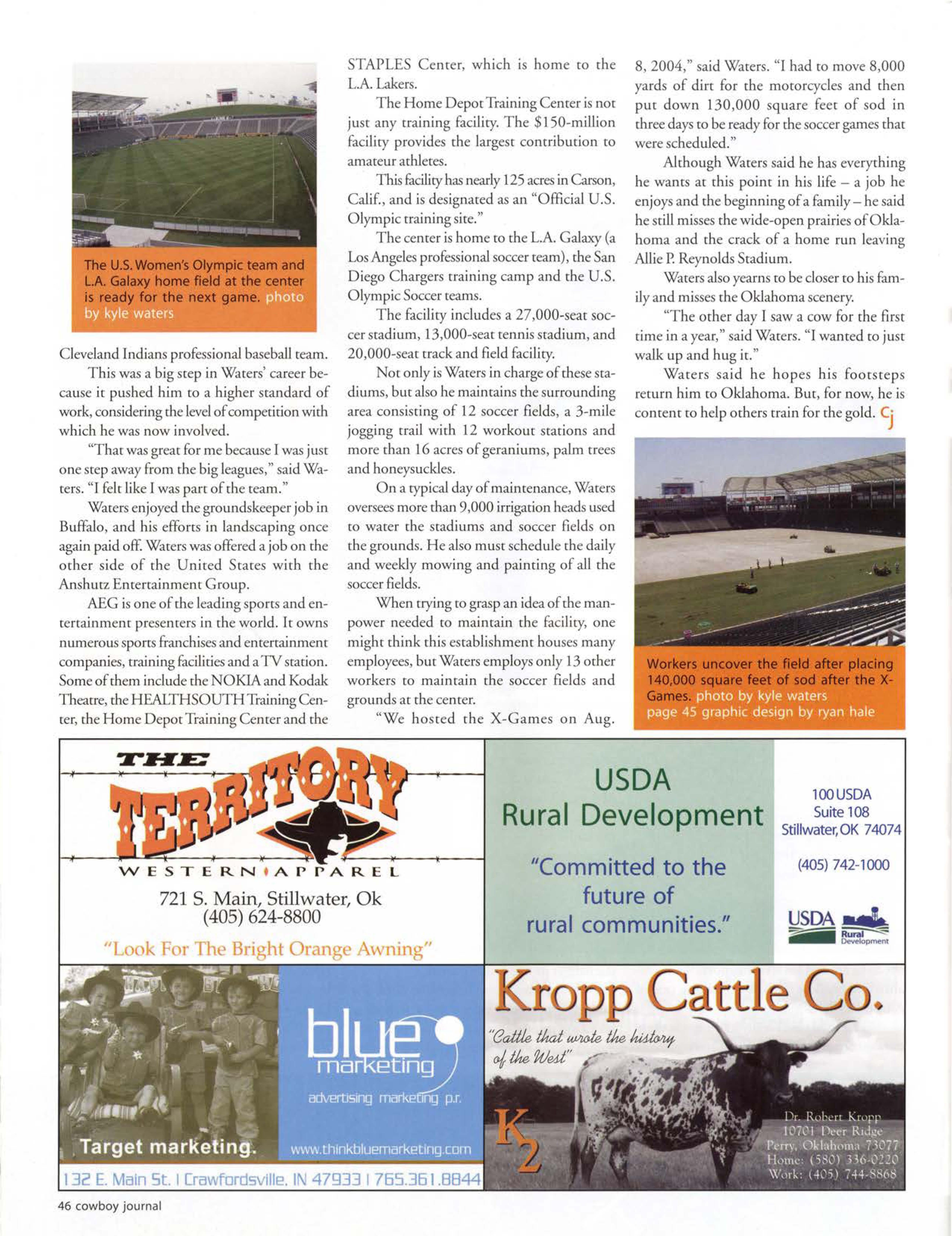
yards of dire for the mororcycles and rhen put down 130,000 square feet of od in three days to be re.adyfor the occer games that were cheduled.'
Although Waters said he ha everything he wants ar chis point in his life - a job he enjoys and the beginning of a family- he said he scill 1nissesthe wide-open prairie of klahoma and the rack of a home run leaving Allie P.Reynolds Stadium.
Waters also yearns to be closer to hi family and mi es the Oklahoma scenery.
"The other day l saw a cow for the first time in a year," said Water. "I wanted co just walk up and hug ir.'
Waters said he hopes his foot reps return him to Oklahoma. Bur, for now, he is comem m help others train for rhe gold. Cj
Cowboysridedownthecampaigntrail
by a my pagett
Hard, du ry roads and long days chese Cowboys hit the trail with saddlebags full of hope and ambition. Armed with experiences and a drive co succeed, they embraced the work that lay ahead in the world of political campaigning.
kristi bishop
Kristi Bishop animal science sophomore, was active during the 2004 presidential campaign as a member of the ollege Republicans. Bishop grew up in Tonganoxie, Kan., where her father and older siscer, both Oklahoma tare Universiry alumni, influenced her decision to come to OSU and instilled in her rhe importance of being policically informed.
"I come from a family that' trong in rheir political views," said Bishop. "They raughr me early how important iris ro make sure your voice is heard."
james mcspadden
James McSpadden, agribu iness senior, assisted en. Mike Morgan in his campaign for a third term re-election ro the Oklahoma ScaceSenaceand continued as an active member of Young Democrars. Mc padden's appreciarion for politics began in his hometown of Richardson, Texas.
"I always tried robe accivein high sd1ool and wanced to get involved in the poucical process on campus," said McSpadden.
mike jackson
Mike Jackson, from Burlington, Okla., is a 2000 OSU graduate with a degree in agricultural communications and a minor in agricultural economics. He ran in Disrricc 40 for Oklahoma House of Rep re entatives during che 2004 election. As a student ar OSU, Jackson prepared for his future in politics by being active in President's Leader hip Council and Ag rudenc Council.
"I really got a lot of experience at O U in leadership and working wich a budget, things I will use every day," said Jackson.
clay pope
Former Rep. Clay Pope, Ditrice 59, is also an O U agricultural communications graduate. Pope
served five term in rhe Oklahoma House of Representatives, completing his last cerm in 2004. Pope was active in college through severalstudent organizations including tudent ovemmcnr Association, Ag rudenr Council and Ag Amba ad r With a rrong background in agriculture, he appreciates his independence and underrands the importance of politics in the role of ci rizens.
"Growing up on a farm, I've always been independent and wanted ro control my future," aid Pope. "What happens in ongress controls your life."
Here's what these Cowboys said
How hasyour agricultural background influenced your values and helped you in pofitics 1
bishop:
You learn valuable ethics and build up your confidence. Just uke most jobs in agri-
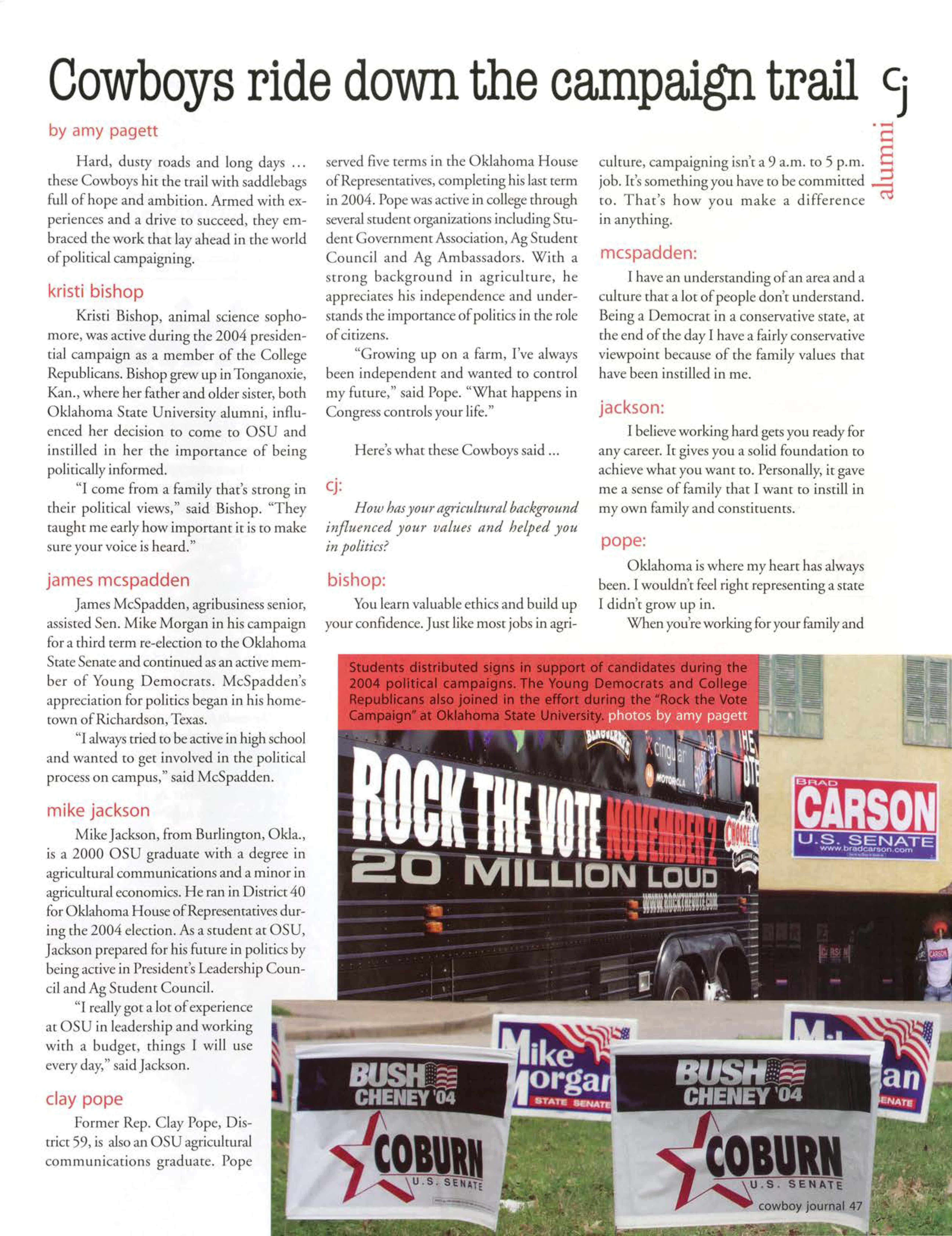
culmre, campaigning i n'r a 9 a.m. ro 5 p.m.
job. lt's omething you have to be com mined ro. That's how you make a difference in anything.
mcspadden:
I have an understanding of an area and a culture that a !or of people don't understand. Being a Democrat in a conservative stare, at the end of the day f have a fairly con ervative viewpoint becau e of che family values rhat have been in tilled in me.
jackson:
I beUeveworking hard gers you ready for any career. fr gives you a olid foundation to achieve what you wan c co. Personally, it gave me a sense of family chat I wane to instill in my own family and conscicuenrs.
pope:
Oklahoma is where my heart ha always been. I wouldn't feel right representing a srace I didn't grow up in.
When you're working for your family and
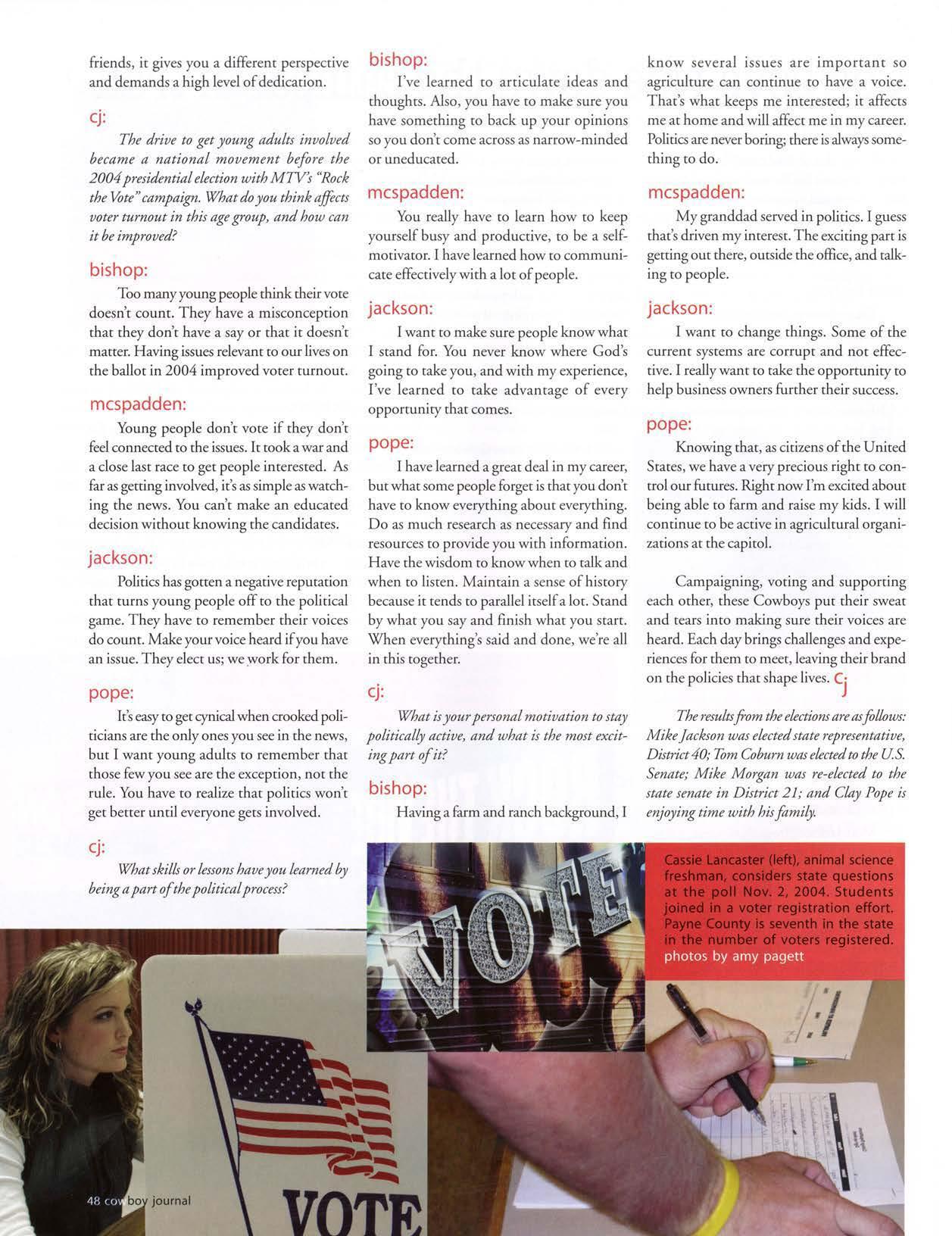
friends, ir gives you a differenr perspective and demands a high level of dedication.
cj:
The drive to get young adults involved became a national movement before the 2004 presidentialelectionwith MTV's "Rock the ¼te" campaign.Whatdoyou think affects voterturnout in this agegroup, and how can it be improved?
bishop:
Too many young people chink their vote doesn't count. They have a misconceprion char rhey don't have a say or that it doesn't marter. Having issues relevant to our lives on the ballot in 2004 improved voter rumour.
mcspadden:
Young people don't vote if they don't feel connected co the issues. Ir cook a war and a close last race to get people interested. As far as getting involved, it's as simple as watching the news. You can't make an educated decision without knowing the candidates.
jackson:
Policieshas gotten a negative reputation char rums young people off to the political game. They have to remember their voices do COLU1t. Make your voice heard if you have an issue. They elect us; we .work for them.
pope:
Ir's easy coger cynical when crooked policicians are rhe only ones you see in the news, but I want young adults to remember that those few you see are che excepcion, nor che rule. You have co realize that politics won't get berter until everyone gets involved.
cj:
Whatskillsor lessonshaveyou learnedby beinga part of thepoliticalprocess?
bishop:
I've learned to artictdate ideas and thoughts. Also, you have co make sure you have something co back up your opinions so you don't come across as narrow-minded or uneducated.
mcspadden:
You really have co learn how ro keep yourself busy and productive, co be a selfmorivator. I have learned how to commLU1icare effectively with a lor of people.
jackson:
I want to make sure people know what l stand for. You never know where God's going to take you, and wich my experience, I've learned ro cake advantage of every opportunity that comes.
pope:
I have learned a great deal in my career, but what some people forger is chat you don't have ro know everyrhing about everything. Do as much research as necessary and find resources co provide you with information. Have the wisdom co know when ro talk and when to listen. Maintain a sense of hiscory because it tends to parallel itself a loc. Scand by what you say and finish what you srarr. When everything's said and done, we're all in chis together.
cj:
What isyourpersonalmotivationto stay politicallyactive, and what is the most exciting part ofit?
bishop:
Having a farm and ranch background, I
know several issues are importanr so agriculture can concinue ro have a voice. Thar's what keeps me interested; it affects me ac home and will affecr me in my career. Policiesare never boring; there is alwayssomething to do.
mcspadden:
My granddad served in politics. I guess thar's driven my inreresr. The exciring pan is getting out there, ourside the office, and talking ro people.
jackson:
I wam ro change things. Some of the currenr systems arc corrupr and not effecrive. I really wane ro take rhe opporcuniry to help business owners further their success.
pope:
Knowing char, as citizens of the United Scares, we have a very precious right ro conrrol our fumres. Righr now I'm excired abour being able to farm and raise my kids. I will conrinue to be acrive in agriculrural organizacions ar the capitol.
Campaigning, voting and supporting each ocher, these Cowboys put their sweat and tears into making sure their voices are heard. Each day brings challenges and experiences for them to meet, leaving their brand on the policies char shape lives. Cj
Theresultsfom the electionsareasfollows: Mike Jacksonwaselectedstate representative, District40;TomCoburnwaselectedto the US. Senate; Mike Morgan was re-electedto the state senate in District 21; and ClayPope is enjoyingtime with hisfamily.

C• Cowboy bullets J
by macey a. hedges
•cowboy motorsportsteam buildswinning tractor
The Oklahoma tate Univer icy Cowboy Mororsporrs Team created a national <l.) champion ¼-scale tractor using rhou ands C:: of dollars, hundreds of hours and one unmatched design.
Members received the award during the 2004 American Society of Agriculcural Engineers 1/4-cale Tracror Narional Srudenr Design Competition in Moline, Ill., June 3-5 2004.
OSU students also placed first in a junjor var icy competition rhar featured 11 ream of freshmen and sophomores.
"TheX-Team competition requires tbe freshmen and sophomores to modify the rracror our ream competed wirh lasryear,'' said Ryan Haar, owboy Motor pores co-direcror.
Members of die rerun have been working
since rhe 2003 compericion to rai e money, colleer dara abour rhe project, develop and rest everal de igns, and build a final project.
"The craccoris a year-round projeer "said Haar. "We work on ir about cwo or three hours adaywhileweare in school, bur we are working 24 hours a day learung up to the concesr."
The tractor was equipped with a 16horsepower Briggs and Stratton engine and weighed about 800 pounds. The ream ompered again r 29 colleges and universities from the U niced races and anada. Performance, serviceability, mai1euverability and manufacturability were among the qualjries judges looked for ar rhe contest.
The ream con tru.cted che tractor in the biosystemsand agriculmralengineering lab with
• Women'srodeo team wins national championship
Ride 'em Cowgirls!Three OSU Women's Rodeo Team member- did just char, as rhey won che Women's earn arional hampionship and multiple inruvidual honors at the 2004 National Imercollegiare Rodeo ompecicion in asper,Wyo.,Junel3-l9.
A~er competing in che goat tying and breakaway roping competitions, senior team member Audra Magee receiv d the National All-Around Women's tide. Magee's hor al o earned the Women's Horse of the Yearaward. en.iorsGretch n Benbenekand Brenna Herrington competed in chebarrelracingcompecition. Benbenek won third pla e honors ar
• Alumni honor facultywho make a difference
Reflecting on their college day , graduates of the College of Agricultural Sciences and arural Resources realized faculty member had an extraordinary impact on their personal, professional and academ.ic growth.
To recognize these individuals, the Agriculture Alumni Association created che CA R Exemplary Faculty Award.
"We looked for faCLJtymembers who wenr beyond being a good eacher or a good club adviser," aid Linda Marcin, associarion executive secretary. "We were looking for those who left a lasting impact on their students."
More than 350 alumni who graduated in 1998 or 2002 responded to an OSU As essmenr Office urvey and nan1ed more rhan 70 faculty members in their re ponse . SOcowboy journal
Ten names stood our among the rest: Shelly itton, agricultural communication ; Robert Oehnman, Joe charzer and Joe Wil1iams, agriculmral economic ; David Buchanan Mark Johnson and Bob Kropp animal science; the late James White, agricultural education; Thoma Kuzmic, fore try· and Jeff Harrey plane and soi_!sciences.
They were honored with surprise individual presentation during one of their classes or a meeting with CAS R alumni present. The selected recipienrs al o were recognized ar the Ag Alumni Barbecue Oct. I 6, 2004.
"The nicest recognition are the one you know come purely from the srudenrs," srud Buchanan.
Colby funk (front row left), Curtis Johnson,KyleStein,JacobHamburger, LevfJohnson,RyanHaar,JoeBiggerstaff, DavlctCrossley,KristinStephens,Greg Slaughter,Marvin Stone(backrow), DustinHolden,JonathonNunnallyand Ronemott.
rhe help of faculty advi ers J Wayne Kiner.
the national c ntesr. The ream's combined placings earned them the championship and $7,000 in scholarships.
The three women earned the ,ighr to compete in asper, Wyo., by placing high enough in regional competition during l O regular eason rodeos. verall, the women's team placed econd in rhe Central Plains Region during the 2003-04 eason.
Team coa hes, Joe and ally Vielma, said meywere proud of che ream'saccomplishments.
'The girls represented O U well," said ally Vielma. "They are truly profes ional at what they do."
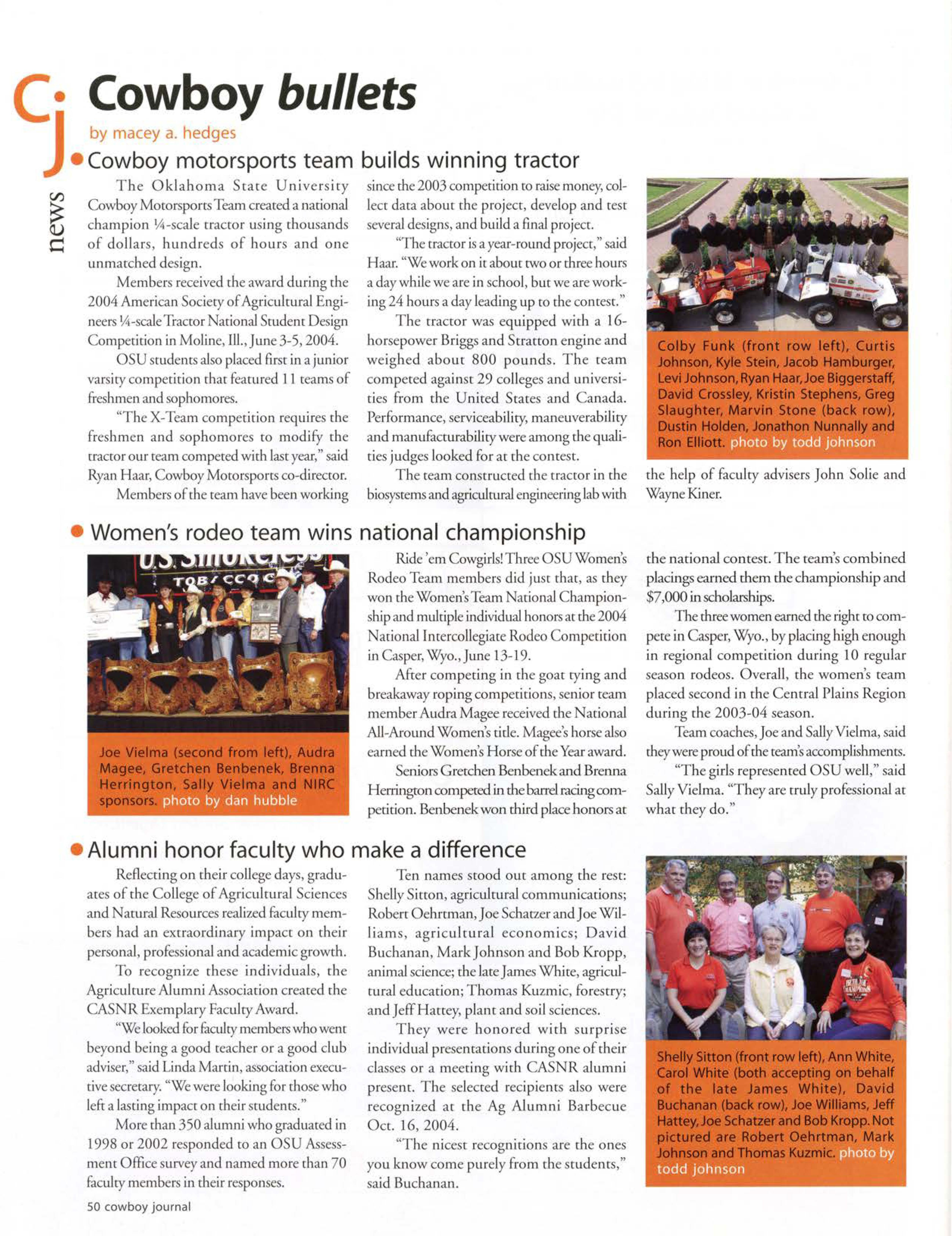
ShellySitton(frontrowleft),AnnWhite, QltolWhite(bothacceptingon behalf of he late James White), David Buc.hanan(backrow).JoeWilliams,Jeff Hattey;JoeSchauerandBobKropp.Not .ptcturedare RobertOehrtman,Mark JohnsonandThomasKuzmlc...,•->aa:u
Cowboy Journal
Oklahoma State University
Department of Agricultural Education, Communications and 4-H Youth Development
448 Agricultural Hall
Stillwater, OK 74078-6031