201 Animal Science Building Oklahoma tate University Stillwater, OK 74078 www.ansi.okstate. du/ext n/obi
National Livestock
Located at the Oklahoma ational Stockyards Oklahoma City, Okla.
Family owned and operated in Jones, Oklahoma, since 1970, Blue & Gold ausage Co. helps more than 800 groups raise funds for trips, community projects, equipment and anything else you can imagine!
P.O. Box 657 Jones OK 73049 (405) 399-2954 (800) 338-0938
Monday-Friday 9 a.m. to 4 p.m. CST www.blueandgoldsausage.com
Handing over the reins of DASNR
Sam Curl retiresas dean and director
His hands envelop those of the person he greets witha handshake. Largeand strong, lhese hand haveseen hard workin their years. Yet,they are rull oflove for the work they do.
After 41 years in uni,·ersity teaching, research and administration, including more than seven years al Oklahoma State University,SamCurl isreti1ingas dean and director of the Division of Agricultural Sciences and NaniralResources.
"Myparents were teachers, and I always wanted to be a teacher,"said Curl.
Aftercompletinghis education,Curl took a position at Texas Tech University in the Deparnnent of AnimalScience in September 1963, teaching animal physiology and genetics and conducting research 11~thcau.le and sheep.
It 11°asnot long beforehe becameinvolved wilh the administrationof the university,moving into the role of assistantclean of research for the TexasTech CollegeofAg1iculn1ralSciences and Nan1ralResourcesin 1968.
"Afterl went into administration, l continued my teaching and research role in the animalsciencedepartment,"said Curl."Finally, as [ moved through the level ofadministration,demandson mytimebecamegreatenough that I went into full-timeadminisu-ation."
Curl's first position at OSU was during the 1972-73academicyear,sening as a special assistant to the president, a nine-month internship through lhe American Council on Education. Curl, one of 39 young adminisu·atorsselected from across the country for the program, chose OSU Presidem Robert Kammto be his mentor,even though they had never.met.
"Tknew about him by reputation," said Curl."l knewthat Dr.Kammwasone of the top university presidents in the United States, and l had great respect for Oklahoma State University."
Curl said he reallyadmired Kamm's ability to workwith people.
"He also had an excellent knowledge of the major issues in higher education," saidCurl.
Kamm said the ACE program selected people who looked like promisingcandidates for higheradminisu-ationand allowedthem to
choosea universitypresidentto undersnidyfor nine months.
Don Wagner, head of the OSU Department of AnimalScience,remembersCurl's fast timeatOSU.
"Whenhe interned in the 1970s,Dr.Curl was alwaysvisible because he was the tallest man on campus,"saidWagner.
NotonlywasCurlextremelytall,but Kamm said he wasal.sove111 bright.
"He wasa ve1;1good student,"said Kamm. ''Yearslater wehad the opportunity to take this b1ightyoung man and name him dean oftJ1e OSU Di,~sionof Agriculture."
Curl ren1rnedto TexasTech at lhe end of his intemship 11~lh a great appreciation for his timeatOSU.
He continued to pro,~de leadership to Texas Tech as the associate vice president of academic affairs for three years before returning to Oklahoma as the president of Phillips University in Enid. Curl remained there for three years before he wasgiven the oppornmity to become dean oftl1eCollegeof AgiiculniralSciencesand atural Resourcesat TexasTech.
Hislm·efor agiiculturehelped Curl make the decision, and he remained dean at Texas Tech for almost 18years before he wasoffered the position of DASNRdean and director arOSU.
"I accepted tJ1isposition because of the opportunity to providestatewideleadershipin agriculturalteaching, extension and research at a major land-grant university,"said Curl.
Curt's"~e, Ma1;1,said the rno,·ewasa relativelyeasy one.
'The peoplefromOSUand Stillwaterwere so welcoming,"she said. "Theywelcome new people and are eager to get lhem involvedin lhe community."
After he began his duties as dean, Curl and hiswifetraveledaround Oklahomato meet with the Oklahoma Cooperative Extension Serviceeducators,experiment stationemployees, state commodity organizations, political leaders and other supporters of the division.
"People were curious to know and hear whatgoals he had in mfod for the divisionand his plans for the funire,"said MaryCurl."lt was a neat wayof meeting people in the state."
As dean, Curl quick.lygot down to business,takingsteps to moYetJ1edh~sionforward. The Food andAgiicultural Products Research and TechnologyCenter wasdedicatedjust days before he became cleanand director.
"Dr.Curl led FAPCthrough its initialembryonic stages and got it off to a good start," saidWagner."He helped guide the progi<1mto the successit has today."
Curl also was instrumental in secUJing funds for the Willard Sparks Beef Research Center and succeeded in relocating the ne\\' SwineTeaching and Research Center, which wi.Ube completedin October2004,saidWagner.
"He helped us to overcomethe obstacles that had previouslykept the center from becoming a reality,"said Wagner.
The accomplishmentof whichC,\1rlismost proud is tJ1eestablishmentof a close,working relationship between DASNRand tJ1eOklahoma agricultural industry,especiallythe establishment of the 45-member Dean's Advisor)' Committee. The committee provides a forum for the dean, other DASl\lRadministrators and faculty to meet with leaders in tJ1e ag1iculu1ralindusuyand receivefeedbackand suggestionsfor improvemenL
"Asu·ongag1iculturalcollege must have that kind of interaction wilh tJ1einclusl!)'to ensure it is reallyoperatingon lhe cu tt:ing edge of scienceand technologyand addressing the problemstJ1atare mostc1it:icalin lhe industry," s.'lidCurl.
Wagner said Curl did an excellent job of reaching out and getting to know people in the slate legislatureand in numerous commoditygroups.
"He wasalwaysveryvisiblein the external community,"saidWagner.
This relationship wasvitalin helping the divisiontJ1roughlhe dilliculdinancial timesit faced during the past three years. Despite these challenges, Curl worked to obtain tJ1efunding lhe divisionneeds.
''Through working\,~ththe state legislanire, Congress,p1ivategroups and individuals, my goal was to help secure lhe funding we need to adequatelysupport the division'shighqualityprograms,"said Curl."Forexample,we have made an all-out effort in our work with tJ1elegislature to secure the necessaq•funds
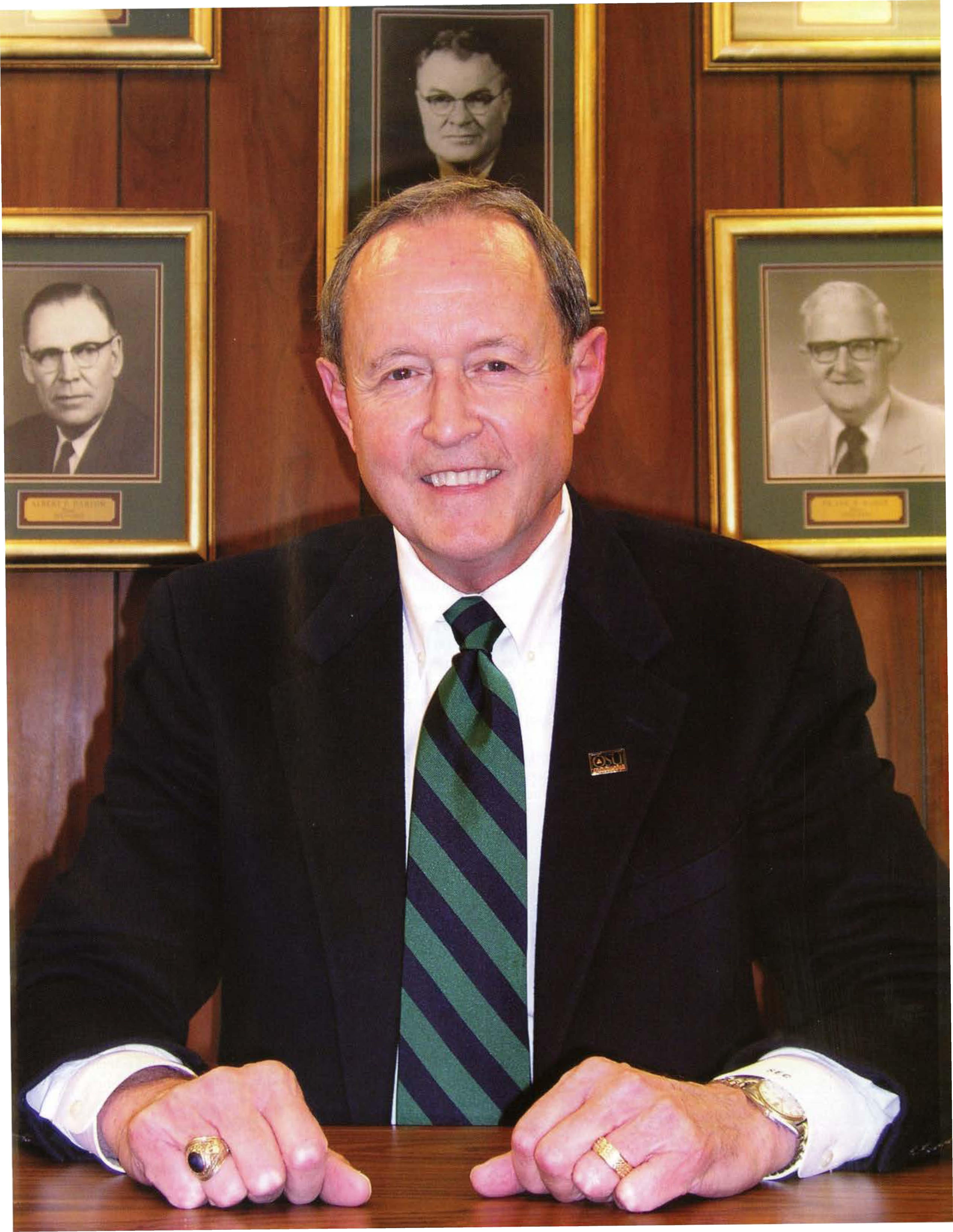
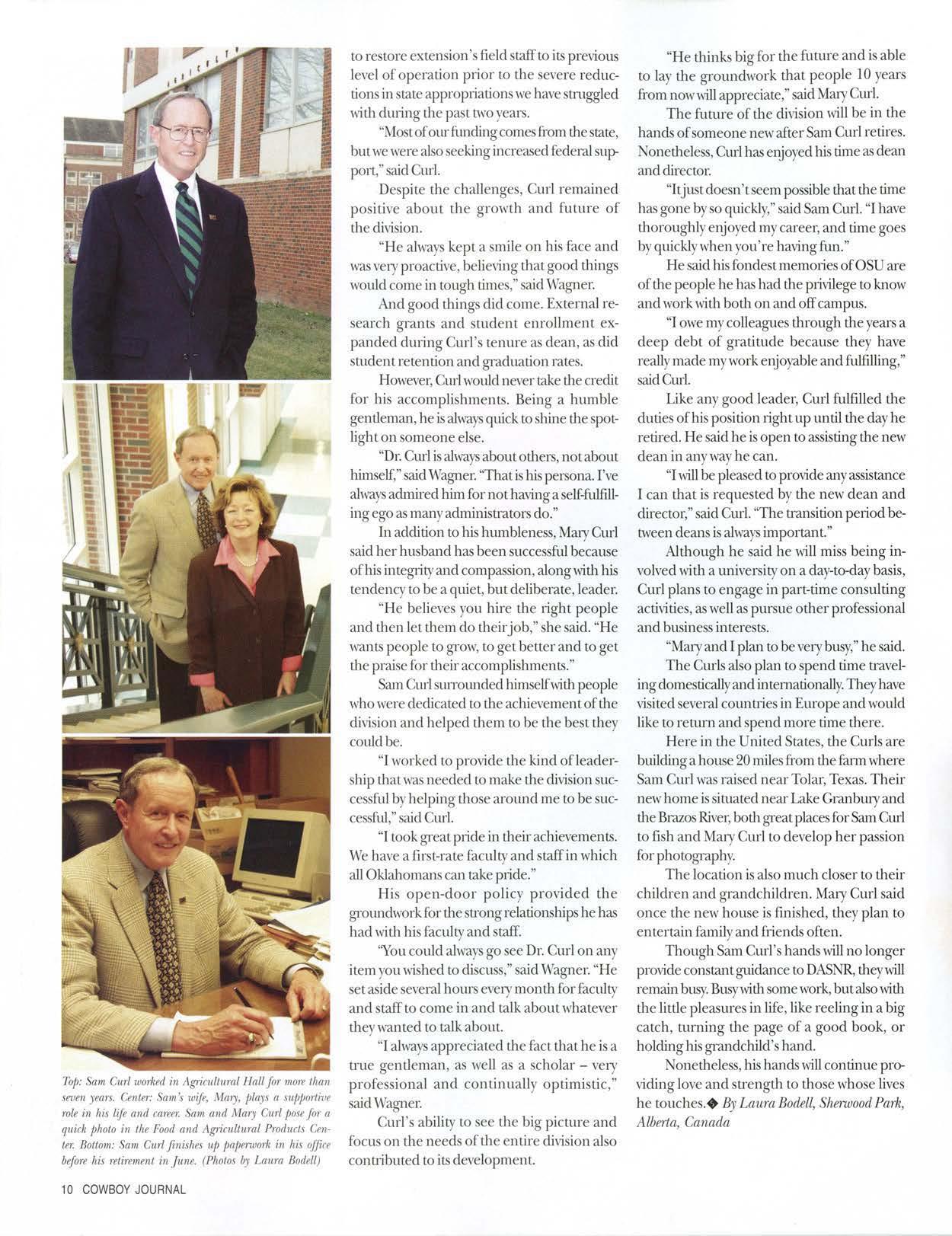
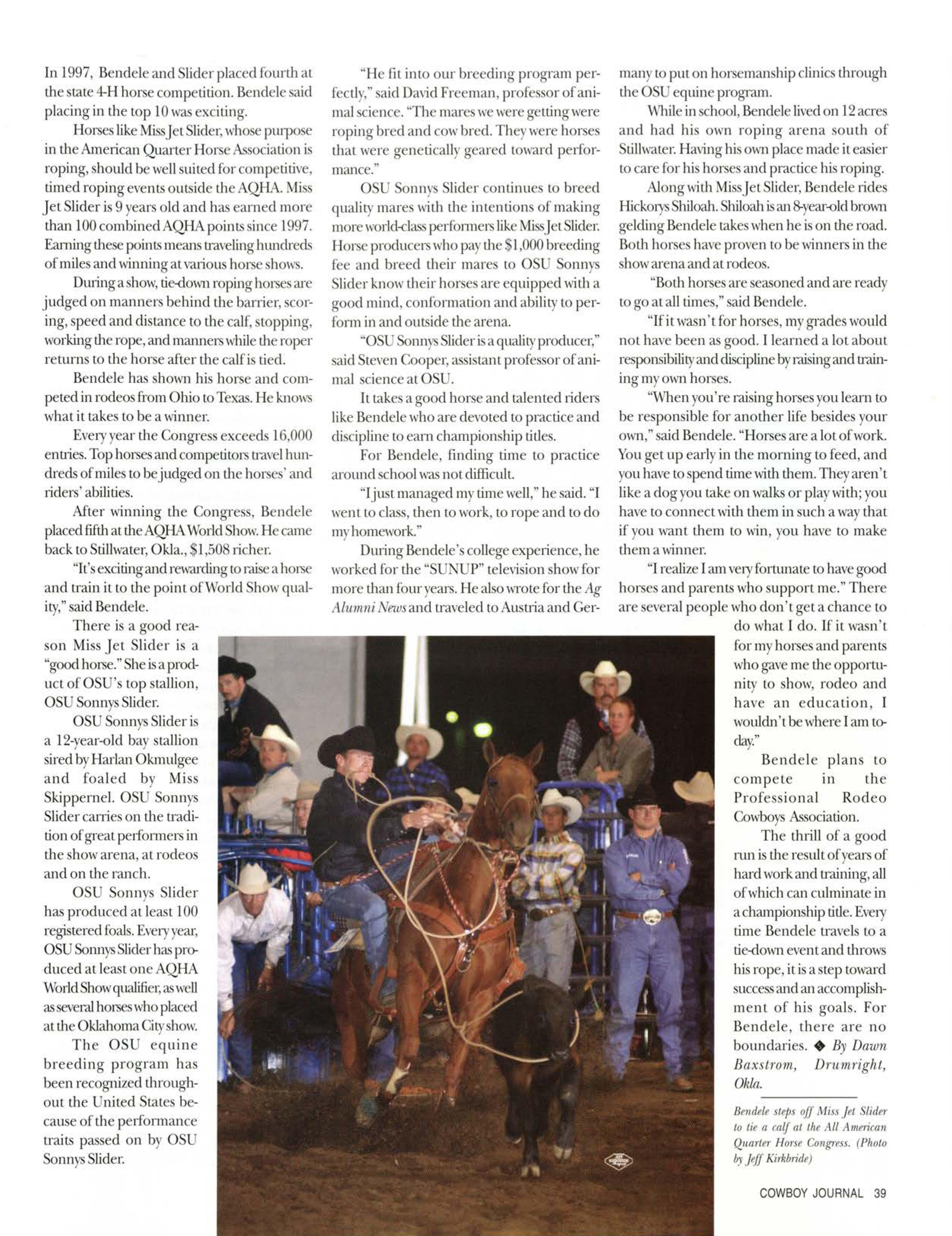
Top:Sam Curl workedin Agrirnllural/-Intlfor mo,~//um sn1e11_)'Mrs.Center:Sam'.swife, .lfrHJ, /1/ap II wpp11rtit•1 rolt in hi., iifr and rar1w.Sam 11111/Mary Curl po<rJo, a quirk photo i11the Food/UldAgrirultuml Prorlurt~Cmt,r. Bollom:Sm11C11rlfi11ishr,11/1 /1a/1mn01kin his riffir, beforehis ,~tire111,11t in J11ne.(Photosby Lrwm Bod,//)
Lorestore extension's field staff LOits pre,~ous levelof operation prior to the severe reductionsin state appropriationswe havestruggled with duiing the past twoyears.
''Mostof our fundingcomesfromLhestate, but wewerealsoseeking increa5edfederalsupport.," said Curl.
Despite the challenges, Curl remained positive about the growth and future of tJ1edivision.
"He alwayskept a smile on his face and wasvery proactive,belie,~ng that good things would come in tough time ," said Wagner.
And good things did come. External research grants and student enrollment expanded during Curl's tenure as dean, as did student retention and graduation rates.
However,Curl wouldnever take the credit for his accomplishments. Being a humble gentleman, he isalwaysquick to shine the spotlight on someone else.
"Dr.Curl isalwaysabout otl1ers,not about himself,"said Wagner."That is hispersona.I've alwaysadmired him for not havinga self-fulfilling ego as many administratorsdo."
In addition tO his humbleness,MaryCurl said her husband has been successfulbecause ofhis integrityand compassion,along with his tendency to be a quiet, but deliberate, leader.
"He belie,,es you hire the right people and then let them do theirjob," she said. "He wanLSpeople to grow,to get better and to get the praise for tl1eiraccomplishments."
Sam Curlsurrounded himselfwithpeople who werededicated t0 the achievementof the divisionand helped them to be the best they conldbe.
"l worked t0 pro,~de the kind ofleaclership that ""asneeded to make the divisionsuccessfulby helping those around me to be successful,·•said Curl.
"I took great p1idein their achievements. We ha\'e a first-rate facultyand sta.lfin which all Oklahomanscan take pride.''
His open-door policy provided the groundworkfor ilie su·ongrelationshipshe has had with his facultyand stall
''Youcould alwaysgo see Dr. Curl on any item you wishedto discuss."said Wagner.·'He set asidese,·eralhours everymonth for faculty and staff to come in and talk about whatever they wanted to talk about.
"I alwaysappreciated the fact i.hathe is a u·ue gentleman, as well as a scholar - very professional and continually optimistic,·· said Wagner.
Curl's ability to see the big picture and focus on the needs of the entire di,~sionalso conuibuted to its development.
"He thinks big for the future and isable to lay the groundwork that people 10 years from nowwillappreciate,''said MaryCurl.
The future of the di\~sionwillbe in the hands of someone new after Sam Curl retires. Nonetl1eless,Curl has ef!joyedhis rimeas dean and director.
"Itjust doesn'tseem possiblethat the time has gone by so quickly,"said Sam Curl. "l ha\'e tJ1oroughlyenjoyed mycareer, and rime goes by quicklywhen you're having fun."
He said his fondest memoriesofOSU are of the people he has had the p1ivilegeto know and workwith both on and off campus.
'1 owemycolleagues tl1roughtl1eyearsa deep debt of gratitude because they have reallymade myworkenjoyableand fulfilling," saidCurl.
Like any good leader, Curl fulfilled the clutie of his position 1ightup untiJ the day he retired. He said he is open to assistingthe new dean in any wayhe can.
"l willbe pleased to pro,~deany assistance I can that is requested by the new dean and di.recto1/said Curl. ''The transition pe1iodbetweendeans isalwaysimportant."
Altl10ughhe said he will miss being involvedwith a universityon a day-to-daybasis, Curl plans to engage in part-time consulting activities,as wellas pursue other professional and businessinterest5.
"Maryand I plan to be verybusy,"he said. TI1eCurls also plan to spend rime traveling domesticallyand internationally.Theyhave visitedseveralcountJies in Europe and would like Loreturn and spend more time there.
Here in the United States, the Curls are buildinga house 20 milesfrom ilie farm where Sam Curl wasraised near Tolar, Texas.Their new home is sitl1atednear LakeGranbury and the BrazosRive,~both great placesfor SamCurl to fish and Ma,)' Curl to develop her passion for photography.
The location is also much closer to tl1eir children and grandchildren. Mai)' Curl said once the new house is fo1ished, they plan to entertain familyand f1iendsoften.
Though Sam Curl's hands willno longer provideconst.an l guidanceto DASNR,ilieywill remain busy.Busywithsome work,but alsowith the liule pleasures in life, like reeling in a big catch, turning the page of a good book, or holding hisgrandchild's hand.
Nonet11cless,his hands willcontinue pro,,iding love and su·engtl1to those whose lives he By Laura Bodell,ShenvoodPark, Alberta.Canada
a mother sat next to her three children as they lie quietly,hanging on her everyword. She magicallyrecites the last of their favorite bedtime story and kissesthem on the tops of their tiny heads.
Witha quiet sigh she puts her children to bed and sits down in a small plasticchair at its matching table. Laying The Billy Goats Gruff down,she picks up a textbook and begins her own nightly ii tual.
This mot11eris 26-year-0ldCarrie Leach, an OklahomaStateUniversityagiiculturalcommunications senior. The three sleeping children are the diiving force behind Leach's determinationto be a collegegraduate.
"I've been going to school since my son Tyle1~now 7, was 4 months old.He laughsnow and remindsme we
and is majoring in biochemistry.She plans to graduate in May2006.
These students must makesacrificesdaily to accomplishtheir personal goal of becoming collegegraduates.
"There are small things I knowI \\~IImiss becauseI am at school,"saidMeganBible."The firsttime myson crawlsor walks¼iUprobablybe to his babysitterand not to his momma."
Although sacrificesmust be made, sometimes the sacrifices come at the expense of coursework,not familytime.On a typicaldayin tl1eLeachhome, courseworkis not evenstarted until allthe children are in bed. There are times when being a student and doing
haveeveningclasses,"Leach said."But Clint's biggest conuibution was gi\~ng me the opportunity to go to school and him to support us financially;it reallymeant a lot to me that he would do chat."
While the students who start college as l8-year-0ld high school graduates are st.ill OSU's dominant population, students with spouses and children are filtering back into tl1eeducationalsystem.To thesesn1dents,the chance to return to school means a better income for tl1eirfamiliesand a new outlook on life for themselves.
"Some nights I am not a student
at all," said Leach.
"I'm just a mom."
justamom."
homeworkis me nu~ thest thing from Leach'smind.
"Some nights I am not a student at all,"saidLeach.''I'm willbe graduating thisyear,"said Leach. "In all honesty, we will because he has been tl1ere withme through it all."
Leach not onlyattends class,but also runs back and forth between two daycare centers and an elementaryschooleach moming. hi an average day,Leach travels I 00 miles to leave her children at their respective destinations and get to classes.Leach and her husband, Clint, have been together for eight years,and he is the chief of police in Coyle,Okla.
Carrie Leach said she goes to school so her childrencan haveopportuniliesshe didn't haveas a child.
Having one parent in school can be a sourceof physicaland financialstres.sfor a family.But when both parents attend school full Lime,new challenges arise.Josh and Megan Bible,both 22, attend classesat OSU and have an l l-month-0ldson,Jayden.
·while attending classes full-time, the Bibleshavelittleroom forjobsoutsideof school or home.Josh Biblestarted his student teaching expe1iencetl1isfall and ischallenged with how he willsupport his family.Policyin the agiiculLuraleducation programbars.Joshfrom workingwhile he isstudent teaching.
The spouses of non-traditional students take on responsibilitiesmat wereprobablynever imagined when tl1eytook their marriage vows.
Josh Bible and Clint Leach agree supporting their wivesin their decision to attend school wasalwaysfirst prioiity.
"Clint gets the opportunity to play Mr. Mom while Tam at school, especiallywhen T
Advisersin the College of Agricultural Sciences and Natural Resources are now enrollingstudentswithfamiliesin classestl1at correspond with their children's schedules. Professors also are making class policies to help accommodate these student-parents, such as special attendance policies and allowing students to biing a child to class if necessary.
Jerry Fitch,animalscienceprofessorand coordinatorof undergraduateanimal science advising,said the most important job for an adviseris to get these students the schedules they need.
"Wetry to make the classesfit as closely as possible with the children's schedules so parents can take their children to school and be there when they get out," said Fitch.
MeganBibleisstarting her second semester back to school after the birth of their son
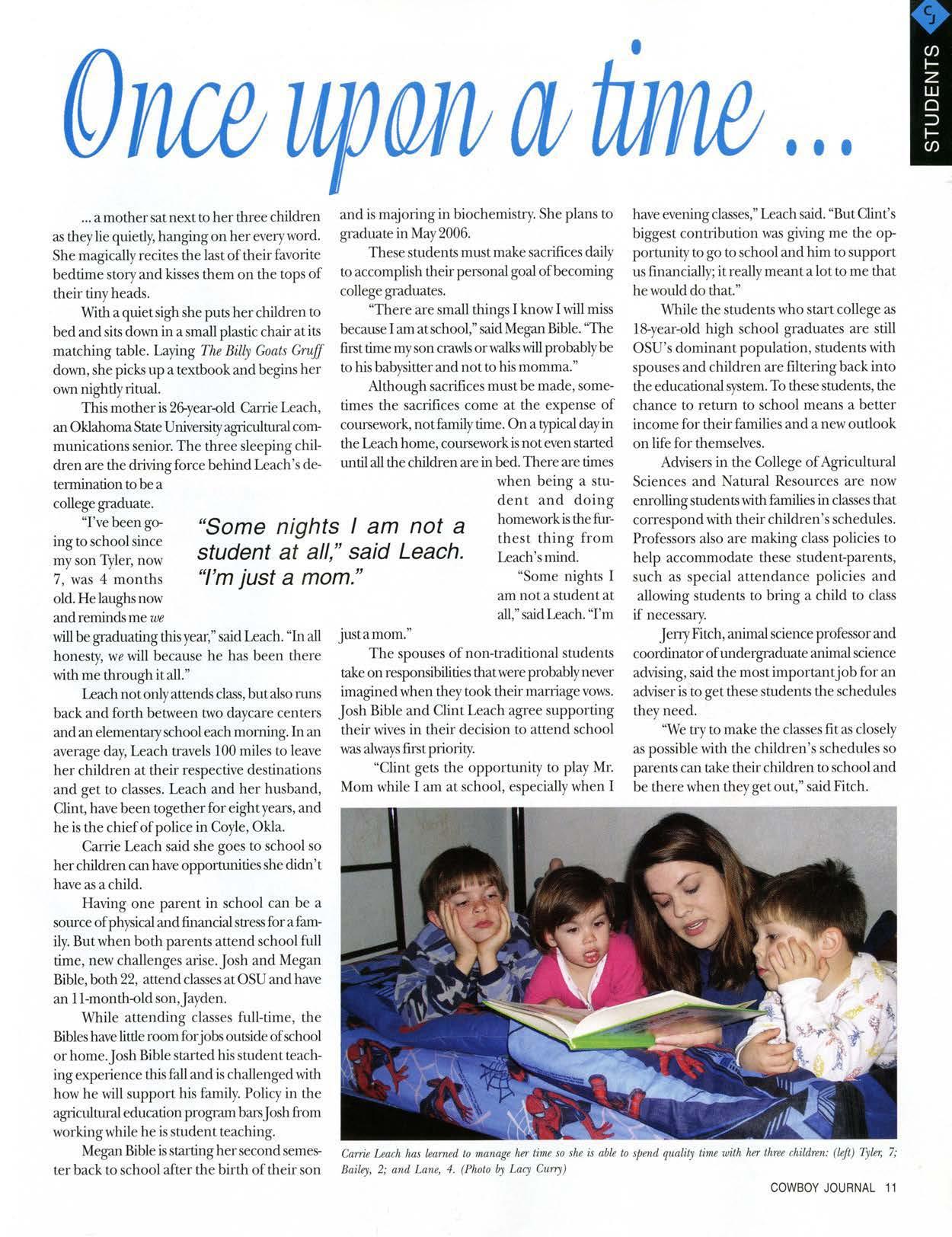
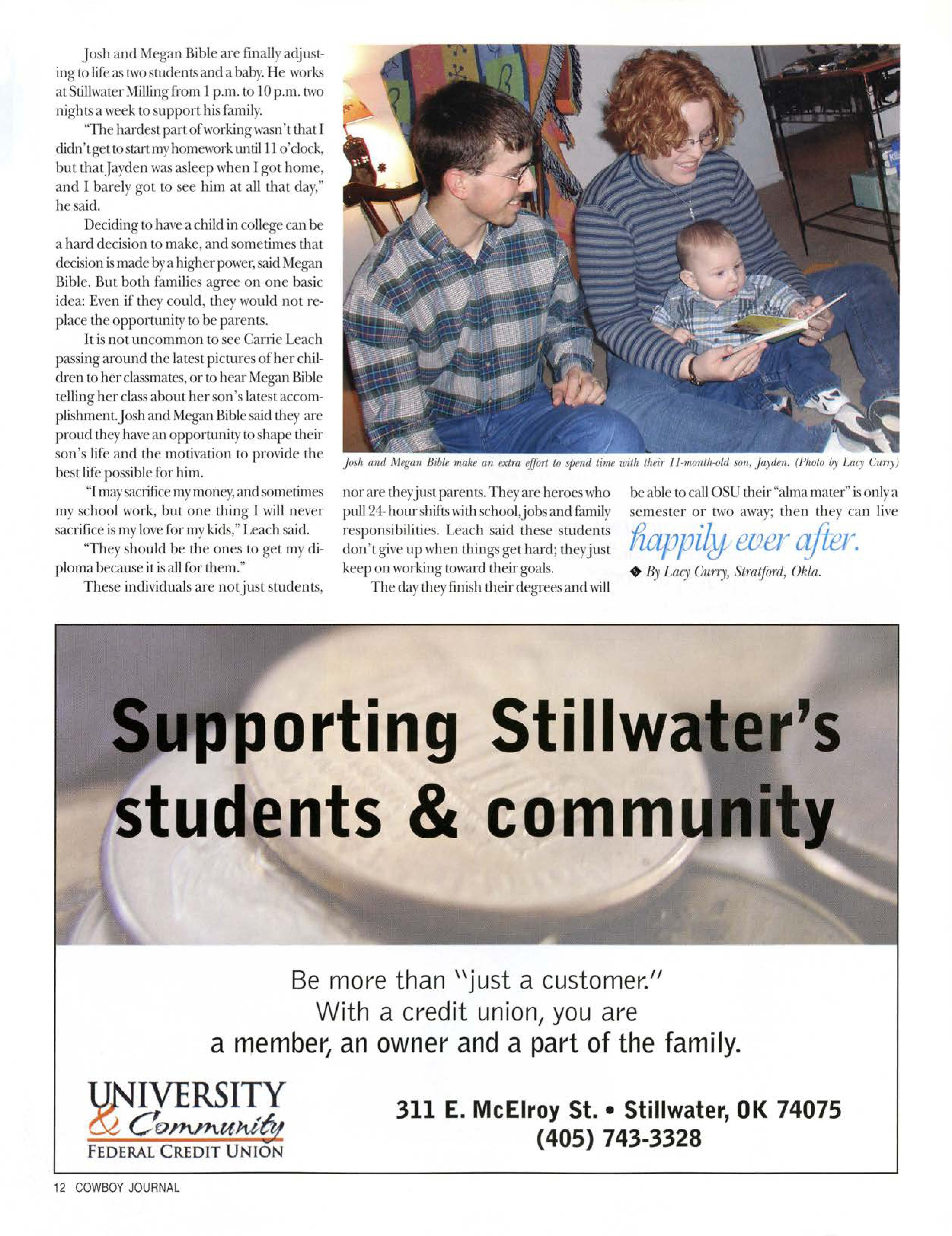
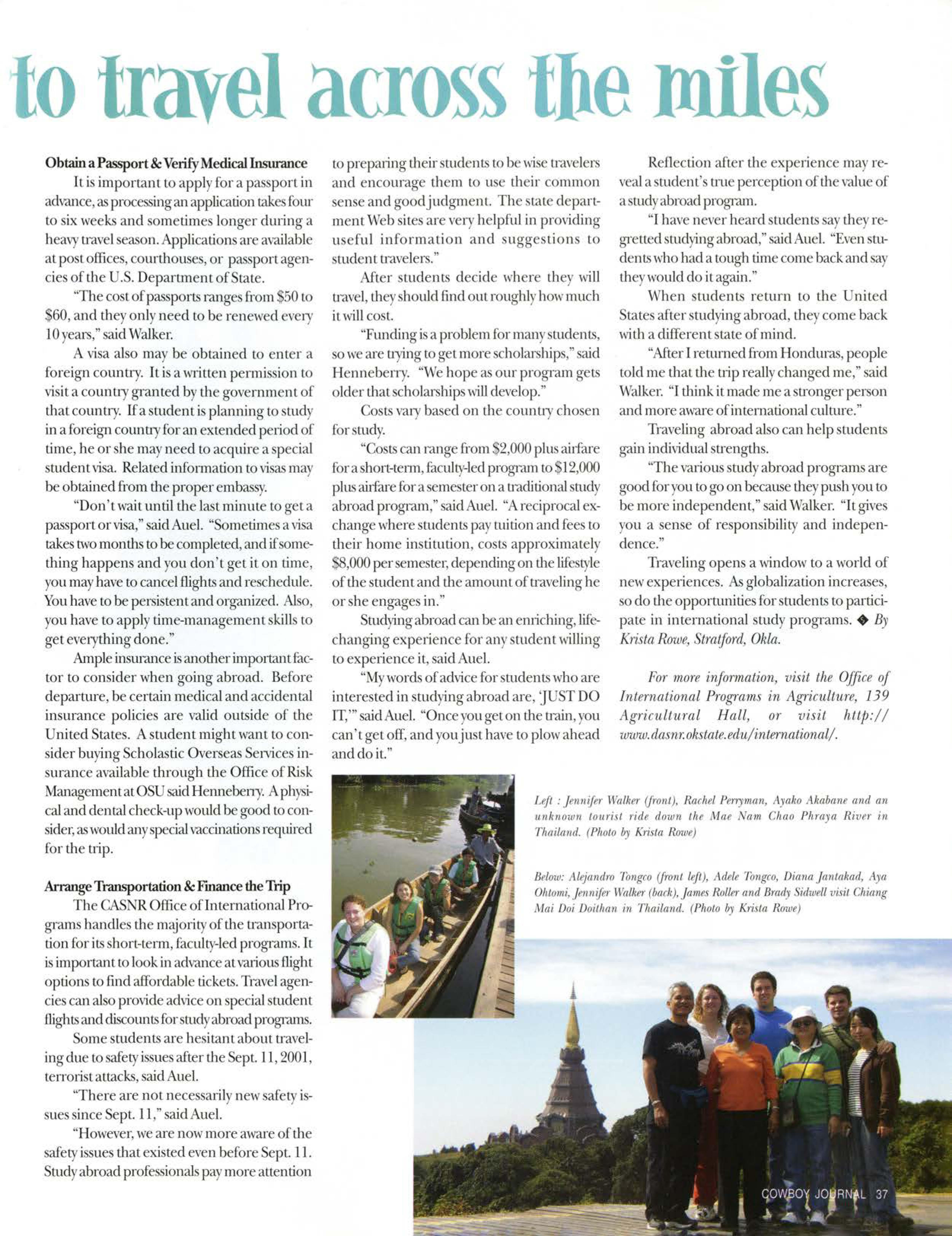
CarrieLeachhas learnedto 111a11age her timeso she is able to spend q11alitytime with her //,ru children:(left) Tyler,7; Bailey,2; a11dLane, 4. (Photoby Lacy Cuny)
Jo hand M an Bibleare final! adjusting to Ii£ as two tudents and a baby.He works at lillwaterMillingfrom 1 p.m. to 10 p.m. two nights a week to support his famil
"The hardest part of workingwasn't that l didn'tgetto 1a11myhomeworkuntillJo'clock, but lhatjayden wasasleep when I got home and I barely got to see him at all !.hatda ," he said.
Decidingto havea child in collegecan b a hard deci ion to make, and ometime that decisionismade bya higher power saidMegan Bible. But bolh familie. agree on one basic idea: Even if Lheycould, they would not replace !.heopportunity to be par nts.
It is not uncommon lO see Carrie Leach passingaround the late t pictures of her children to her das mates,or to hear MeganBible telling her classabout her on 'slate t accompli hment.Josh and egan Biblesaid th y are proud theyhavean opportunity lO hape th ir on' Ii~ and the motivation to provid th b t life pos ible for him.
"I ma sacrificemymoney,and som times my school , ork, but on thin I wiUn ver acrific is mylove for my kid ' L ach aid.
"They should b the ones to g t my diploma becauseit isall for them."
These individuaJ a.r not just stud nts,
nor are theyjust parents.Tb are heroe who pull 24-hour hiftswith chool,job and family re ponsibilitie Leach aid the e tudents don't give up when things get hard; 111 yjust keep on workingtoward th ir goals.
Theda they finish their degree and will
josh ,md Megm, Biblr mnke an exlm effort lOspend lime with their
l,J Lary C1tny)
six
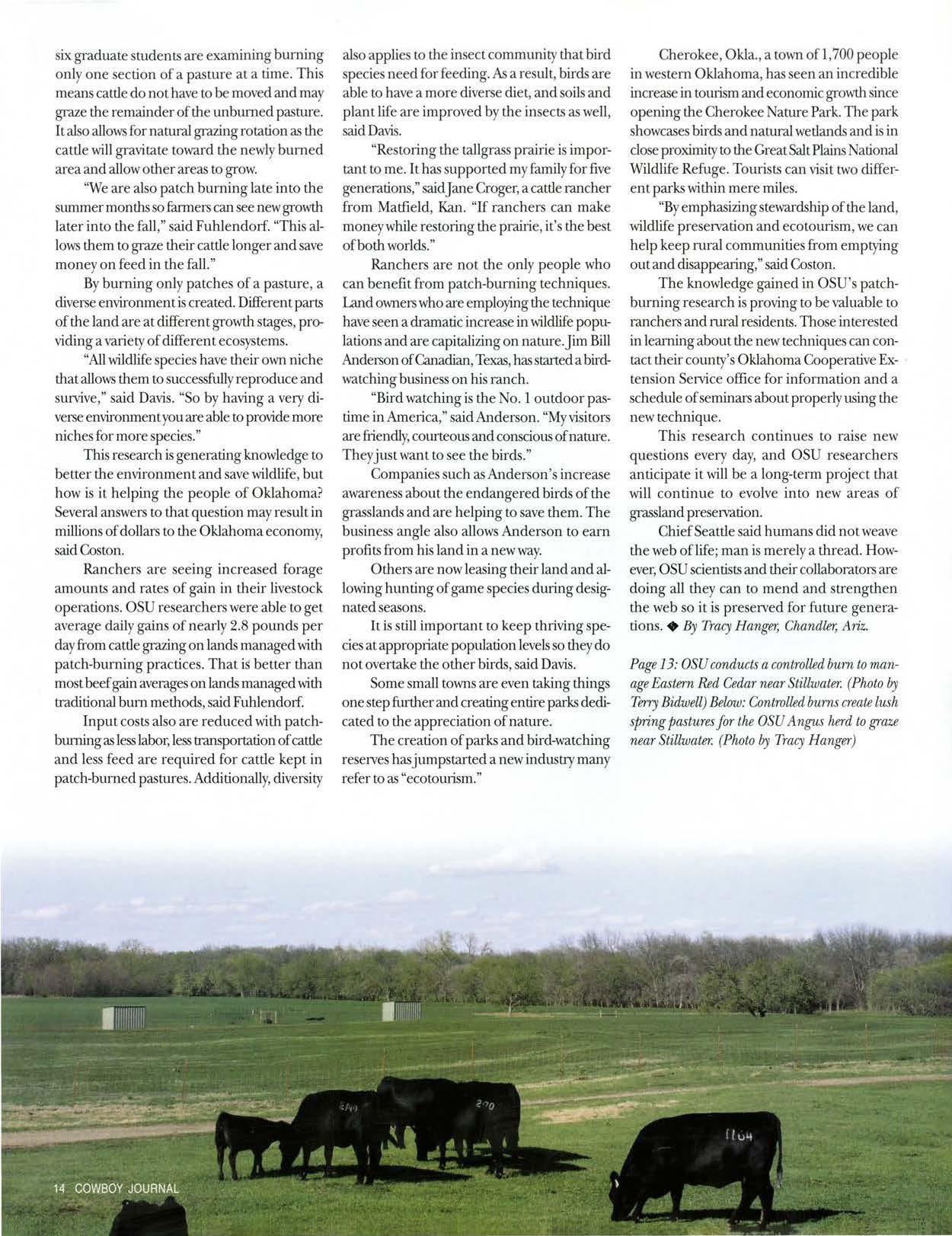
graduate students are examining burning only one section of a pasLUreat a time. This meanscattledo not haveto be movedand may graze the remainder of the w1burned pasture. It alsoallowsfor natural grazingrotation as the cattle willgravitate toward the newlyburned area and allowother areas to grow.
"Weare also patch burning late into the summer monthssofarmerscansee newgrowth later into the fall,"said Fuhlendoif. "This allowstl1emto graze their cattle longer and save money on feed in the fall."
By burning only patches of a pasture, a diverseenvironmentiscreated. Differentparts of the land are at different growth stages,providinga varietyof different ecosystems.
"Allwildlifespecies have their own niche that allowsthem to successfullyreproduce and survive,"said Davis."So by having a very diverseenvironmentyouare able to providemore nichesfor more species."
This researd1is generating knowledgeto better the environment and savewildlife,but how is it helping the people of Oklahoma? Severalanswersto that question may result in millionsof dollars to the Oklahoma economy, said Coston.
Ranchers are seeing increased forage amounts and rates of gain in their livestock operations. OSU researchers were able to get average daily gains of nearly 2.8 pounds per dayfrom cattlegrazingon lands managed with patch-burning practices. That is better than mostbeefgain averageson landsmanagedwith traditionalbum methods,said Fuhlend01f.
Input costs also are reduced with patchbumingas lesslabo1;lesstransponationof cattle and less feed are required for cattle kept in patch-burned pastures.Additionally,diversity
also applies to the insect community that bird species need for feeding. Asa result, birds are able to havea more diversediet, and soilsand plant life are improved by the insects as well, said Davis.
"Restoring the tallgrassprairie is important to me. It has supported my familyfor five generations,"saidJane Croger,a cattlerancher from Matfield, Kan. "If ranchers can make moneywhilerestoring me prairie, it's the best of both worlds."
Ranchers are not the only people who can benefit from patch-burning techniques. Land ownerswho are employingtl1etechnique haveseen a dramatic increasein wildlifepopulationsand are capitalizingon nature.Jim Bill Andersonof Canadian,Texas,hasstarteda birdwatchingbusinesson his ranch.
"Bird watching is the No. I outdoor pastime in America,"said Anderson. "Myvisitors are friendly,courteousand consciousof nature. Theyjust want to see tl1ebirds."
Companiessuch as Anderson's increase awarenessabout the endangered birds oftl1e grasslandsand are helping to savetl1em.The business angle also allowsAnderson to earn profitsfrom his land in a newway.
Others are now leasing their land and allowinghunting of game species during designated seasons.
It is still important to keep thriving speciesat appropriate population levelsso theydo not overtake the other birds, said Davis.
Some small townsare even taking things one step further and creatingentire parksdedicated to tl1eappreciation of nature.
The creation of parks and bird-watching reserveshasjumpstarted a new industrymany refer to as "ecotourism."
Cherokee, Okla., a town of 1,700people in western Oklahoma, has seen an incredible increasein tourismand economicgrowmsince opening t11eCherokee Nature Park.The park showcasesbirds and natural wetlandsand isin closeproximityto the GreatSaltPlainsNational WildlifeRefuge. Tourists can visit twodifferent parks within mere miles.
"Byemphasizingstewardshipof the land, wildlifepreservation and ecotomism, we can help keep rural communities from emptying out and disappearing,"said Coston.
The knowledge gained in OSU's patchburning research is proving to be valuable to ranchers and rural residents.Those interested in learning about the new techniquescan contact their county'sOklahoma CooperativeExtension Serviceoffice for information and a schedule of seminarsabout properlyusingthe new technique.
This research continues to raise new questions every day, and OSU researchers anticipate it will be a long-term project that will continue to evolve into new areas of grasslandpreservation.
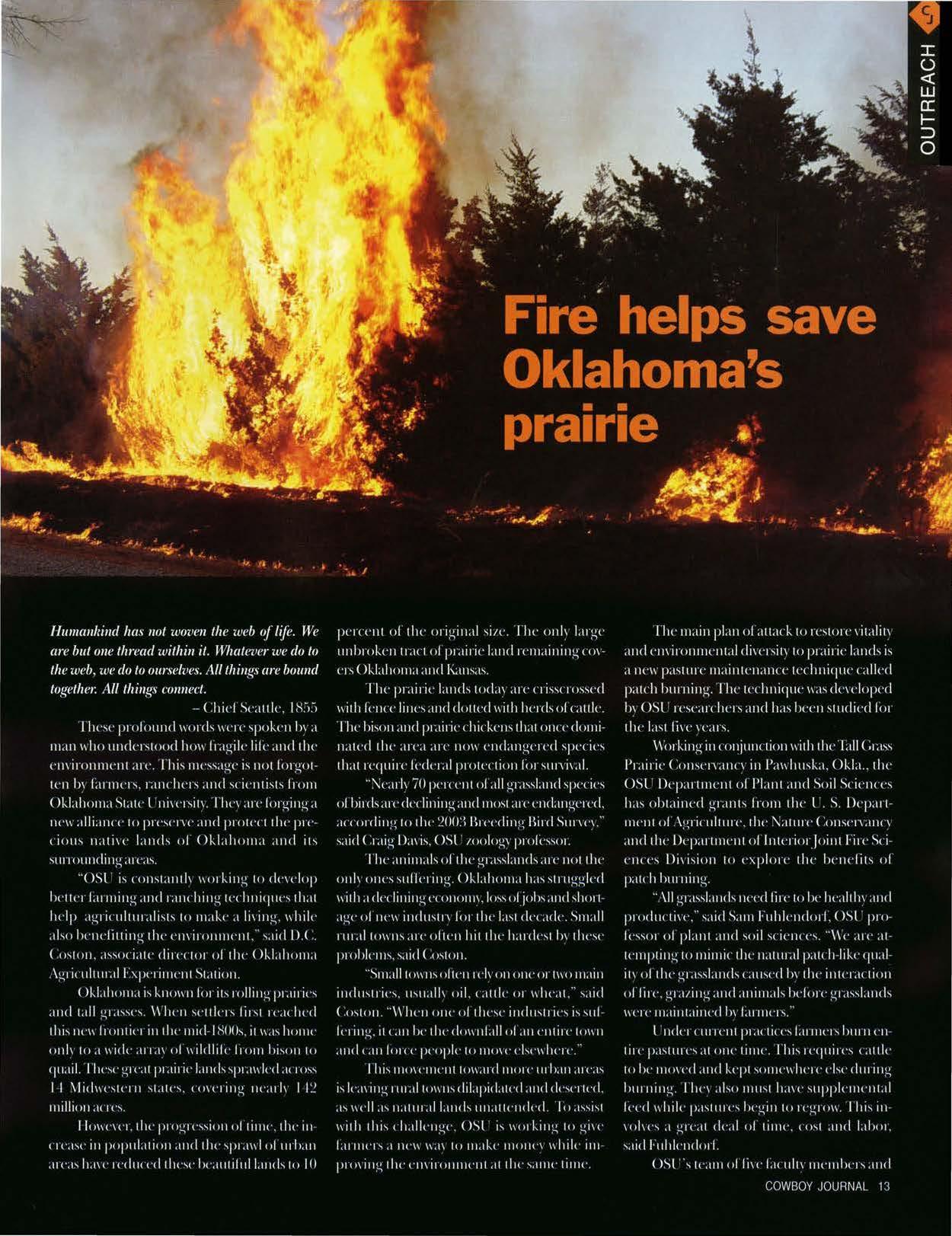
Chief Seattle said humans did not weave tl1eweb oflife; man is merely a thread. However,OSUscientistsand their collaboratorsare doing all they can to mend and strengthen tl1eweb so it is preserved for future generations. By TracyHangei;Chandlel;Ariz.
Ahough ts of Christmas trees and preen ts are beginning to creep into the hearts of children; parents are tarting to tre about Christmas lists,and holiday decor will line store helves within w eks. With the thoughts of the approaching ason, one Enid woman i still relishing in the joy of her Ch1istrnaspresent last year- a present that will continu to give year aft r year.
The familyof94-year-old arjo1ieHomer Andrew presented her with a 40 000 cholarship endowment in her name last Christmas. The cholar hip will be awarded annually to a graduate tudent in the O Department of Horticullure and Land cape Architecture. It will initially be a 2,000renewable award.
"We thought of the gift because of a 20 000 endowment presented to the department from the Enid [Okla.] Council of Garden lubs," aid Milton Andrew , arjori ' on.
Ma1jo1ieAndrew , president of the orga-
nization, said the club has provided tudents from Enid and Garfield County with scholarhip for many years. The membe1 decided that with ome of their remaining money they would create the endowment to en ure the cholarship would be available each year·.
"Becau e of the cholarship given by the Enid ouncil of Garden Club , her familyrealized how important holar hip were to Ma1jorie,» said Doug eedham, f101iculture profe or and chairman of the deparonent' chola.1 hip committee.
After learning of the garden club endowment, Milton Andrew pre ented the idea to hi family and began peaking with ilford Jenkins, fom1er enior director of development for the Divi ion of Agricultural ciences and atural Resources.Jenkin pre ented the fan1ilywith a number ofideas, including developing an award, creating a cholarship or naming gardens after her. The ettled on the graduate scholarship and presented it to Marjorie as her Christmas gift.
"ILwas av ry thoughtful way for the fan1ily to enable Marjo1i 's I gacy to be canied on at OSU and in th horticulture department tllrough assisting the education of oth r ," aid Jenkins.
ilton Andr ws said the family want d som tiling to honor h r permanently while h Iping otl1er at the ·ame time.
"Tt' a wayto publicly announce our fondne for aijo1ie while en llling her name ai1d accomplishments ai·eremembered throughout the horticulture community for years to come," said Andre\,
Ma1jorie Andrews was introduced to gardening and basic horticulture by her grandparn ts when she wa young.
"I've been doing [gardening] ever incel can remember," he aid.
¼'hen he began, people had to end for mail-order seeds. he said she would get so excited when tl1e package arrived. These early day tarted a great love that haped Ma1jorie Andrews' life.
She learned the many nuances of horticulture witl1a oial-and-error approach, hort course atO U and her early employment.
Her first job was helping a friend who owned a greenhou e. he then worked at a retail farm stor where he had to learn the difference in the eed , fertiliz rs ai1d em~ronments to help the customers make the best decisions for their la\ n and garden needs.
he later began working for the Enid tate chool as t.he horticulturi t..There he managed tl1reegreenhouses in which she grew all the plants to landscape the campus.
Sh loved tile work he was doing.
"I was probably the only tate worker who would have worked for nothing," she said.
She shared her passion for gardening with other byjoining many ornamental flower organization She i • a charter member and erved as presidemofthe Centr.tl Garden Club, th Oklahoma Gladiolus ociety the North C ntrallris Society,the Enid Ro e Soci ryand tl1eEnid Council of Garden Clubs.
Th e club participated in beautification proj cts in their r spective areas. They al o spon ored conte ts at the county fair to promote horticulnire' benefits.
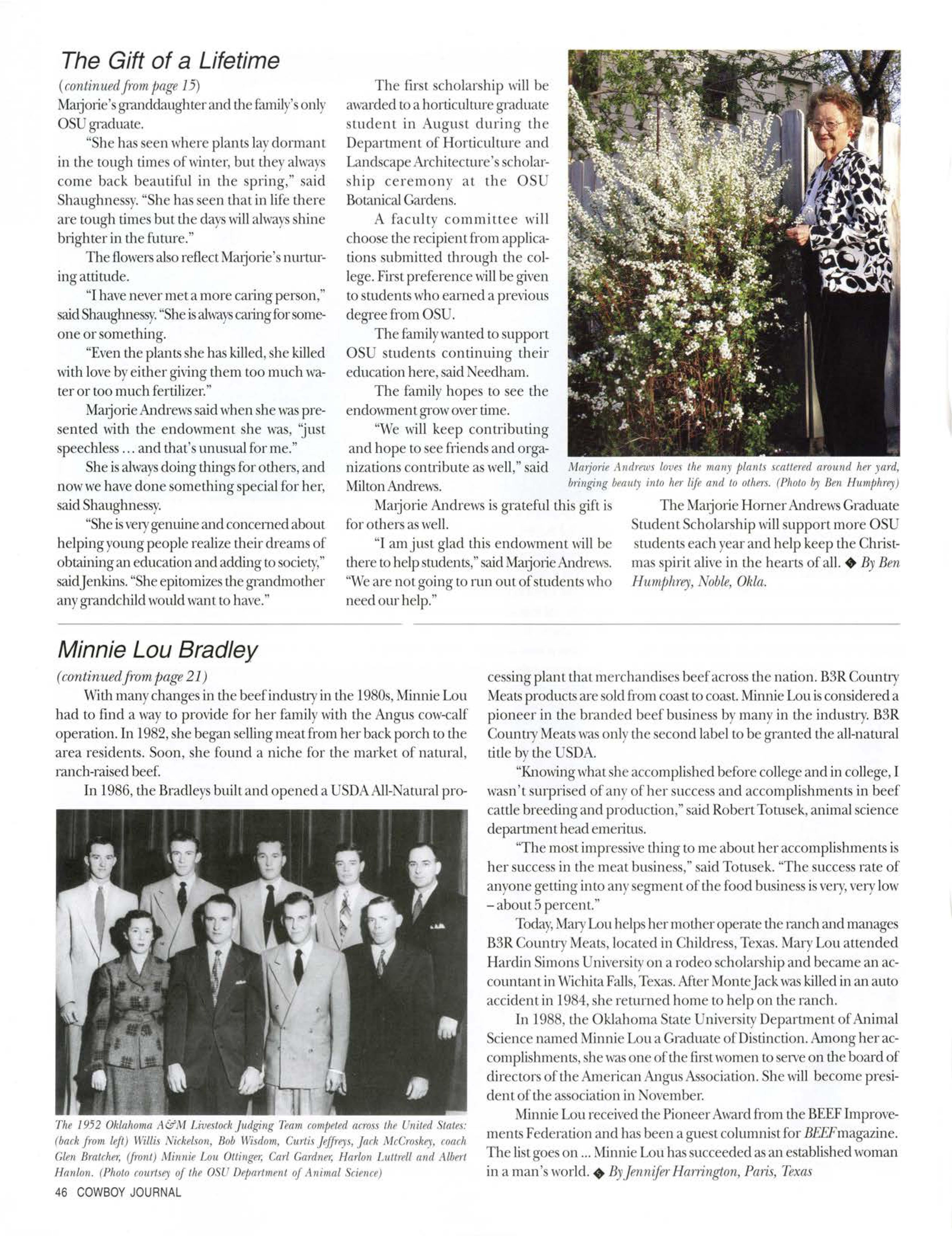
"Working witl1 flowers ha helped her have a po itive attitude about life and the world," aid Kay Shaughne y ( continuedon page46)
Hunt clinchestop senior honors
Studentsexcelon the college,universitylevels
Four yearsoflongstudy hours, countless committee and club meetings,and undivided devotion to the Oklahoma State University College of Ag1icultunllSciencesand Natural Resourceshas paid off for l Ostuden ts.
On a sp,-ingnight when the college presented $713,500in scholarships, these 10seniors receivedCASNR'stop awards.
Landon Hunt, a Grandfield,Okla.,native, took OutstandingSenior honors.
"While at Oklahoma State University,l decided I wanted to makea differenceboth in L11ecollegeof agiiculu1reand on tlie OSUcampus,"said Hunt. Hunt has done just tliat since he enrolled at OSU in August 2000.
On the college level, he served as the 2003-04Ag1iculturalStudem Council president, having been involvedwith the council since hisfirstsemester:Od1erpositionshe held included freshmanrepresentative,Dean'sVolleyballToumamentcoordinato1~homecoming coordinator, reporter and ,~ce president of businessaffairs.
Hunt also has been a member of Collegiate Farm Bureau and the l ational Ag1i-MarketingAssociation.
"During chiJdhood I fell in lovewith not only ag1iculture, but aJso tlie agticultural lifestyle,"said Hunt 'The agriculturallifestyle has taught me not only how to work, butalso how to treat people withrespectand digt1ity."
This respectand digt1ityfollowedHum as he participated in clubs, groups and events outsideofCASNR.
One ofHunt's top OSUaccomplishments was being crowned as the 2003 OSU HomecomingKing.
l-Jun1,afour 0yearmemberofAlphaGamma RJ10fraternity,also wasinvolvedv.~d1Orange Peel,Camp Cowboy,YMCAand Adopt-A-Highway,as well as the Big Event and Into the Streets communitysen~ceprojects.
"Selection as the wp GAS R senior is a perfect ending to a college career that provided me "~d1not onlya top-notcheducation, but also providedme 11~tlivaluableleadership opportunities,"said Hum.
Hunt is not the only senior to receive a top education and leadershipopporumities.
Elizabetl1Kinney of Mooreland, OkJa., also wasselected as one of the top fiveseniors inCAS R
Kiimeysaid her expe1iencesat OSU have been guided byher fad1er'swords:"Don'tforget your roots."
Kinney said even tllough many of her activities have taken her outside of CASNR, her roots remain in agricuJturc.
"Sincemyinvolvementin4-Hand FFAas a youd1,my roots havebeen firmlyplanted in agriculture and OSU,"said Ki1111ey."They,,~11 be with me whereverI go."
Kinney plans to travel this fall to the United Kingdomto pursue a Masterof Arts in internationaljournalism.
Kinney's involvement1vitlithe National
F'FAAssociation,ScudentAlumniBoard, OSU President's Posse,Student GovernmentAssociation,AgiiculturalCommunicatorsofTomorrow,"SUNUP"tele,~ion programand KWTVNews 9 has prepared her for such a journey abroad.
Anod1ertop CASNRseniorisEricStroud, a nativeofAlva,Okla.Stroudfindshimselffilled ,vid1pride when he reflectson his impressions ofOSU and CASr R.
"I think of the CASNRcommitment to teaching,research and publicsen~ce,"So·oud said. "I think of the community of students and professors,tlie pioneering spirit and the Cowboyphilosophy of hard work, integrity and hono1:"
Stroud has been activein severalorganizations throughout the college,universityand community:Aggie-X,YMCA,Into tlieSo·ects, OSU StudentAlumni A~sociation,Alpha Zeta and Phi KappaPhi.
JeffreySteichen or Perry,Okla.,joins tlie top fivelist.Steichen said his top accomplishments consistof maintaining a 4.0 GPA,being elected presidentofa socialfraternityand being a Top 20 Freshman Man.
"After leaving high school, I felt that there wasmore that I could have done," said Steichen. "I was determined not to have tlie same feeling after lem~ngcollege. l feel I will truly be able to look back on my Oklahoma State experience and sayI have no regrets."
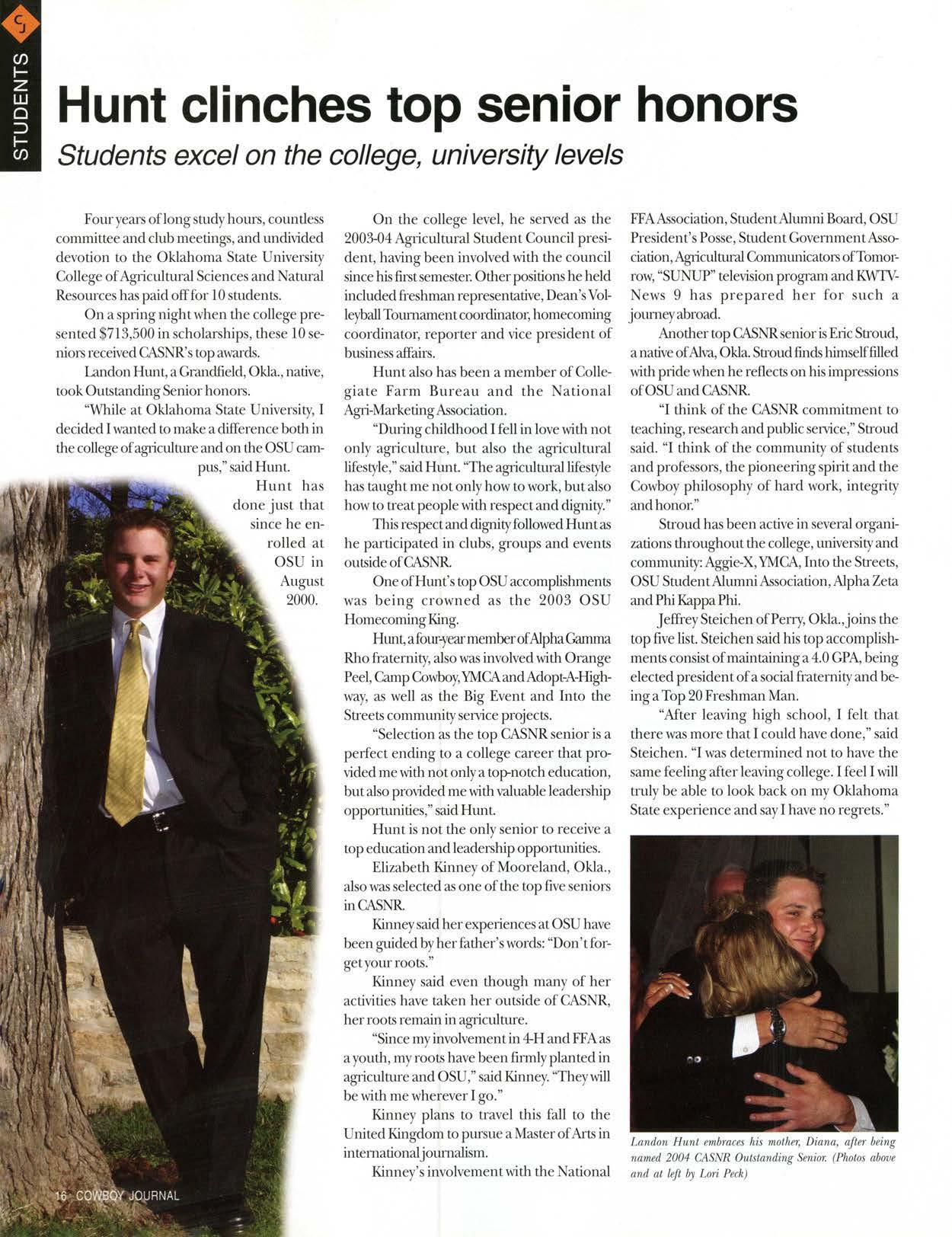
Landon /-11111/embmceshis mother,Diano. after being rum,ed2004 CASNR O111sla11di11gSenior.(Photosaho11e tmd tll lefl lryLori Peck)
Coming into 0 Lei hen et goal for him. elf. He wantedto havea s1rnngGP be succes ful in clas • b involvedand learn as much as he could. He used the e goal ro Lhru t him into the Top 20 Fre hman honors and to continue to be active throughout hi collegiatecareer.
Jamie John on of Wyandotte Okla. complete the Lop five eniorli tjohn on aidshe believe her experience· both educationall and per onally while at OS have Qivenher a well-roundededucation.
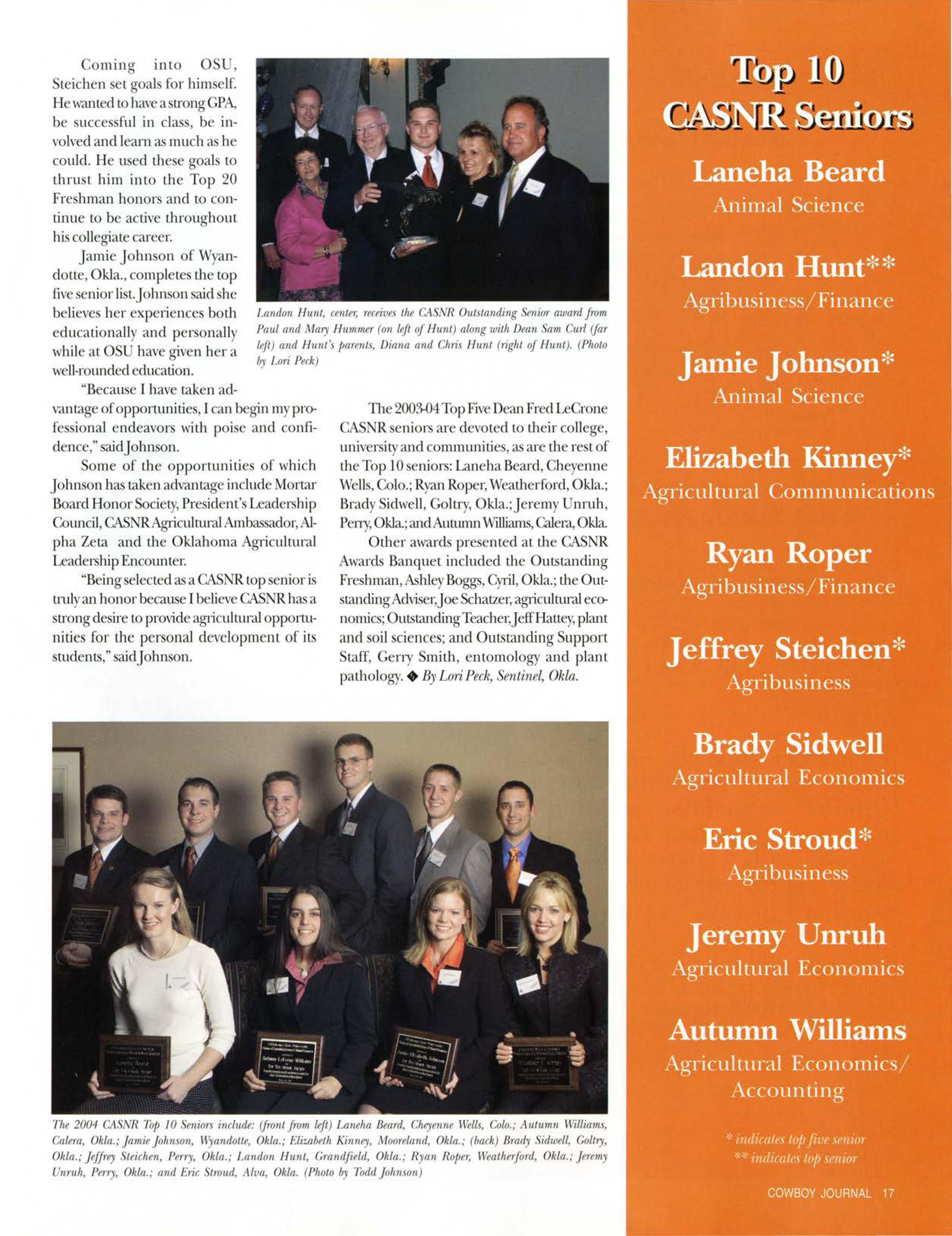
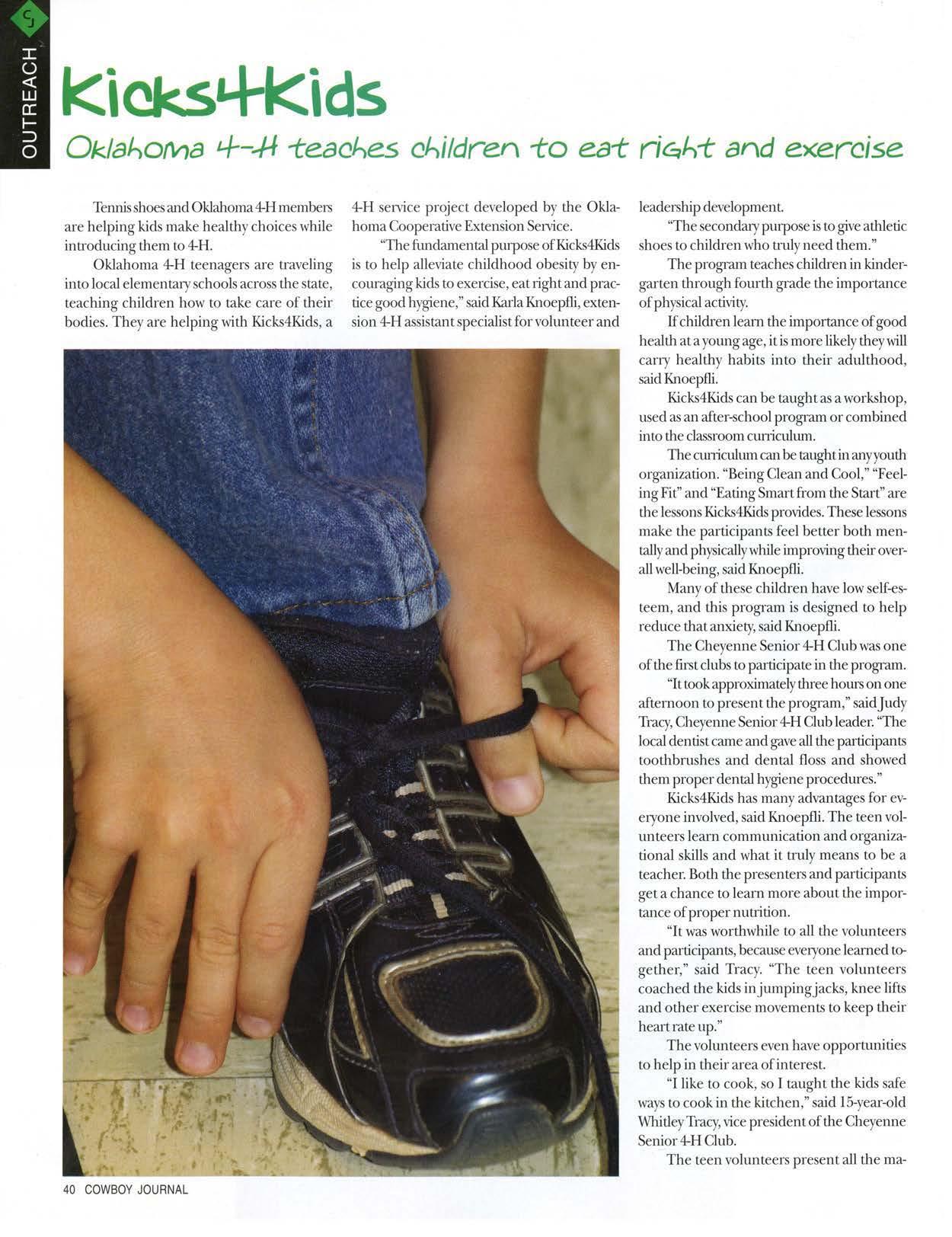
l.11ndonHu111,u11te1;,ueives the CA • IR OutstandingSeniorawardfrom Pm,/ mzd Mary Hummer(on left of Html) alongwith DeanSam Curl (far leji) a11dHunt' /mre11ts,Diana mu/ Chris/1u11/ (rightof lluu/). (Photo hy Lori Peck)
''Because l have taken advantag of opportunities, I can begin my profe ional endeavor with poi e and confid nee,"saidJohnson.
ome of the opportunities of which John on has taken advantageinclude Mortar Board Honor Society,Pr idem' Leade1'hip Coun iJ GAS RAgricuJruralAmbassador,Alpha Zeta and th Oklahoma oricultural LeadershipEncoumer.
"Being elected as a NR top enior is tmlyan honor becau e I believe NRhas a strong de ire LOpro\~deagiicultmal opponunities for the per anal dcvelopmcn L of its tudents,"saidjohn on.
The 2003-04Top FiveD an Fr clLe rone 1 R eniors are devot d to their coU ge universityand communities as are the re t of the Top 1.0seniors: Laneha B arc! heyenne Well , Colo.;RyanRoper,Weatherford,Okla.; Brad idwell,Goltr , Okla.;Jeremy Unruh, Perry,Okla.;and AutumnWillia111J, Otl ra,Okla.
Other award presen tee!at th GAS R Award Banquet included the Outstanding Fre hman,AshleyBoggs Cyril,Okla.;the OuttandingAd\~Ser~Joehatzer,agiiculturaleconomics;OutltandingTeache1;.JclfHaney,pl,mt and oil cien e ; and Outstanding upport taff, Gen)' Smith, enLomolo•zyand plant ByLoriPeck,Senlinl'l Okl,a..
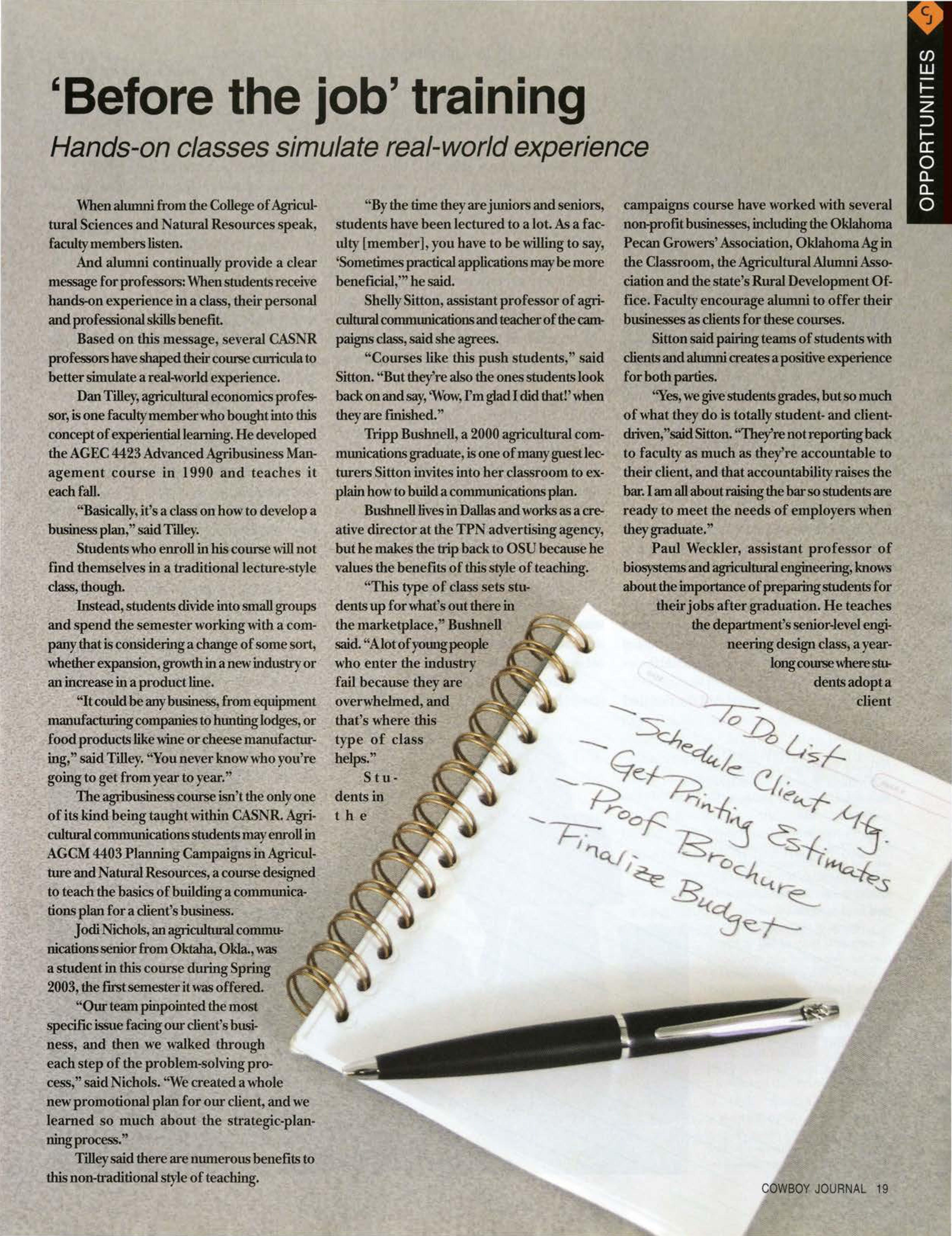
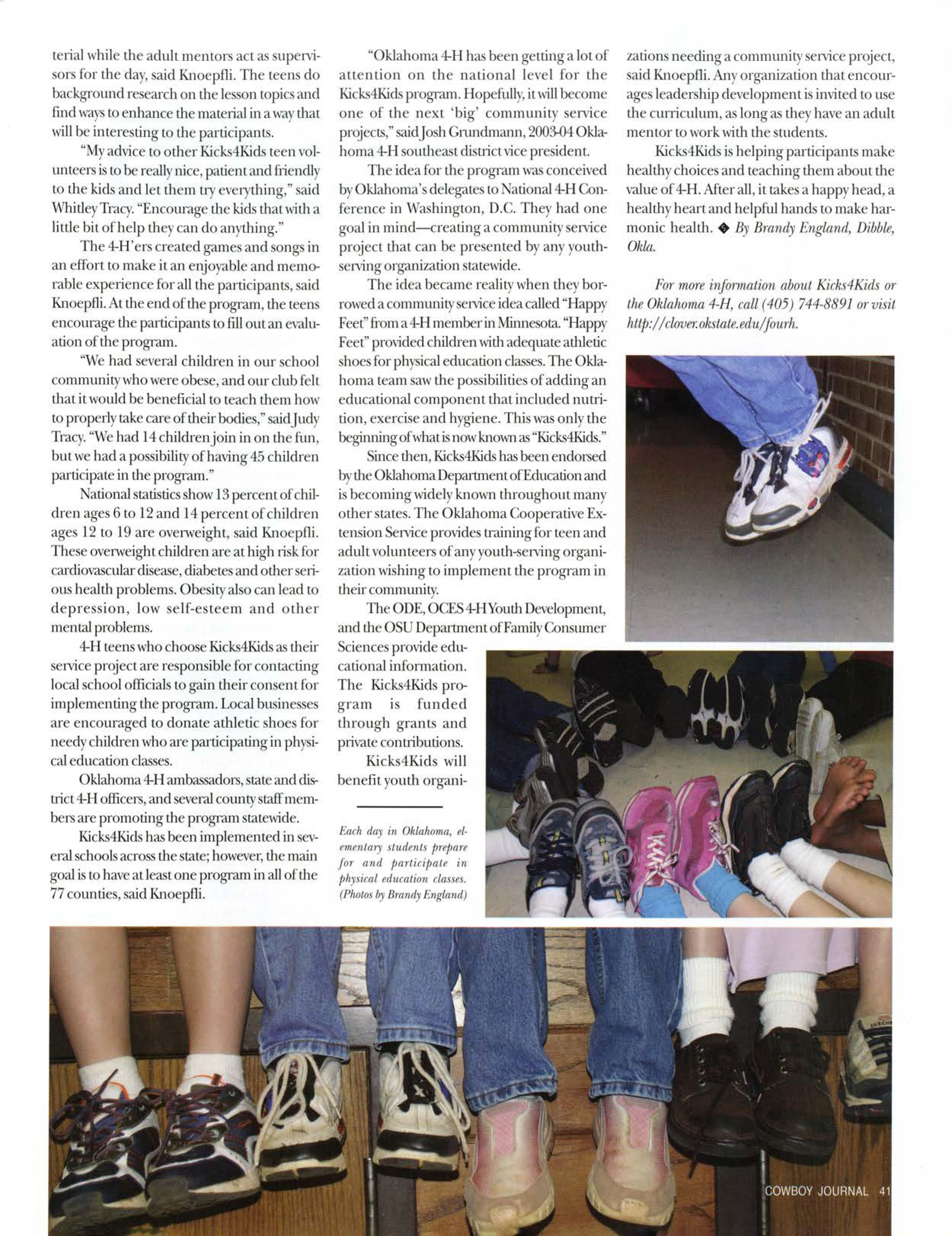
'/11; 2004 CAS R Top 10 eniorsinclude:(Iron/frow lefl) Lmielw Bem-d,Chrye1111eWells,Cow.;A111um11Williams. Ca/rra,Okla.;JamieJohnso11,l'\'.i•nndolle,Okla.: HlizabethKintll')',1Wooreland,Okla.; (back) Bmd_rSidwell, Gott,y, O/1111.:Jeffrey leirheu, Perry. Okla.; Landon 11,mt, Gra11dfleld,Okla.: Ryan Roper, Weatherford,Okla.;Jeremy Unruh, Pmy, Okla.: and Erir Stroud, Mva, O/i/a. (Photoby ToddJohnson)
'Before the job' training
Hands-onclassessimulatereal-worldexperience
When alumni from the College of Agrirultural Sciences and atural Resources speak, facultymembers listen.
And alumni continually provide a clear messagefor profC$0rs: When students receive hands-on experience in a class, their personal and profesgonal skillsbenefit
Based on this message, several CASNR professors have shaped their cm.m.erunirula to better simulate a real-world experience.
Dan Tilley;agricultural economics professor, is one facultymember who bought into this concept of experiential learning. He developed the AGEC 4423 Advanced Agribusiness Management course in 1990 and teaches it each fall.
"Basically,it's a cl~ on how to develop a business plan," said Tilley.
Students who enroll in his course will not find themselves in a traditional lecture-style class,though.
limeacl, students divide into small groups and spend the semester working with a company that is considering a change of some sort, whether expansion, growth ina newindustry or an increase in a product line.
"It could be anybusin~ from equipment manufacturing compani~ to hunting lodges, or food products like wine or cheese manufacturing," said Tilley. "You never know who you're going to get from year to year."
The agribusiness course isn't the only one of its kind being taught within CAS R. Agricultural communicationsstudents mayenroll in AGCM 4403 Planning Campaigns in Agriculture and atural Resourc~, a course designed to teach the basics of building a communications plan for a client's business.
Jodi icboJs,an agriculturalcommunicationssenior from Oktaha, Okla., was a student in this course during Spring 2003, the first sem~ter it wasoffered.
"Our team pinpointed themost specific issue facing our client's business, and then we walked through each step of the problem-solving process " said ichols. "We created a whole new promotional plan for our client, and we learned so much about the strategic-planningprocess."
Tilleysaid there are numerous benefits to this non-traditional style of teaching.
"By the time they are juniors and seniors, students have been lectured to a lot. As a faculty [member] you have to be willing to say, 'Sometim~ practical applicationsmaybe more beneficial,'" he said.
Shelly Sitton assistant prof~or of agrirulturalcommunicatioosandteacherof thecampaignsclass,said she agrees.
"Courses like this push students " said Sitton. "But they're also the ones students loolt backon and say,'Wow,rm gladI did that!' when they are finished.
Tripp Bushnell, a 2000 agricultural communications graduate, is one of manyguestlecturers Sitton invites into her classroom to explain bow to build a communicationsplan.
Bushnelllives in Dallasand works as acreative director at the TP advertising agency, but he makes the trip back to OSU becausebe values the benefits of this style of teaching.
"This type of class sets students up for what's out there in the marketplace," Bushnell said "Alotofyoungpeople who enter the industry fail because they are overwhelmed, and that's where this type of class helps."
Students in the
campaigns course have worked with several non-profit busin~ including the Oklahoma Pecan Growers' Association, Oklahoma Ag in the Classroom, the Agricultural Alumni Association and the state's Rural Development Office. Faculty encourage alumni to offer their businesses asclients for these courses.
Sitton said pairing teams of students with clientsand alwnni creat~ a pogtive experience for both parties.
"Yes,wegivestudents grades, but so much of what they do is totally student- and client• driven,"said Sitton."They're not reporting back to faculty as much as they're accountable to their client, and that accountability raises the bar. I am all about raisingthe barso students are ready to meet the needs of employers when they graduate."
Paul Weckler, assistant professor of biOS)Stemsand agriculturalengineering,knows about the importance of preparing students for their jobs after graduation. He teaches the department's senior.Jevelengineering design class a yearloogcomse\\herestudents adopt a client
and develop a solution Lo an actual indusuialproblem.
"I spent eight years in private industry working as an engineer after I got my Ph.D. here at OSU,and I knowwhatstudents do out in the real world,"he said. "During the senior design experience, we get past the textbook theory and deal \,~threal-lifeexamples."
Because the biosystemsand agricultural engineering department issmaller than most. only seven students enrolled in the class in 2003-04.Students created one three-person and one four-person team, and each team chose one engineering project from a list of potential clientsWecklerdeveloped.
"One group selectedto work\,~ththe U.S. ArmyCorps of Engineers and eventuallycreated a plan to build a man-made island in the ArkansasRiver as a nesting habitat for an endangered speciesof bird," said Weckler.
The group's hard workand planning paid off in the form of second place in a national design competition, and each team member received a trip to Las Vegas and a share of a SI,000prize.
This method of developingteamworkand critical thinking skills isjust one of the benefits of this style of teaching, said Tilley.
"What I ask students to do is rake all the skillsthey havelearned from individualclasses like accounting and marketing and use c.hem collectively.That's much more challengingfor them than simplylearning newmate1ialfor an upcoming rest,"said Tilley.
Industry professionalssaid the finished
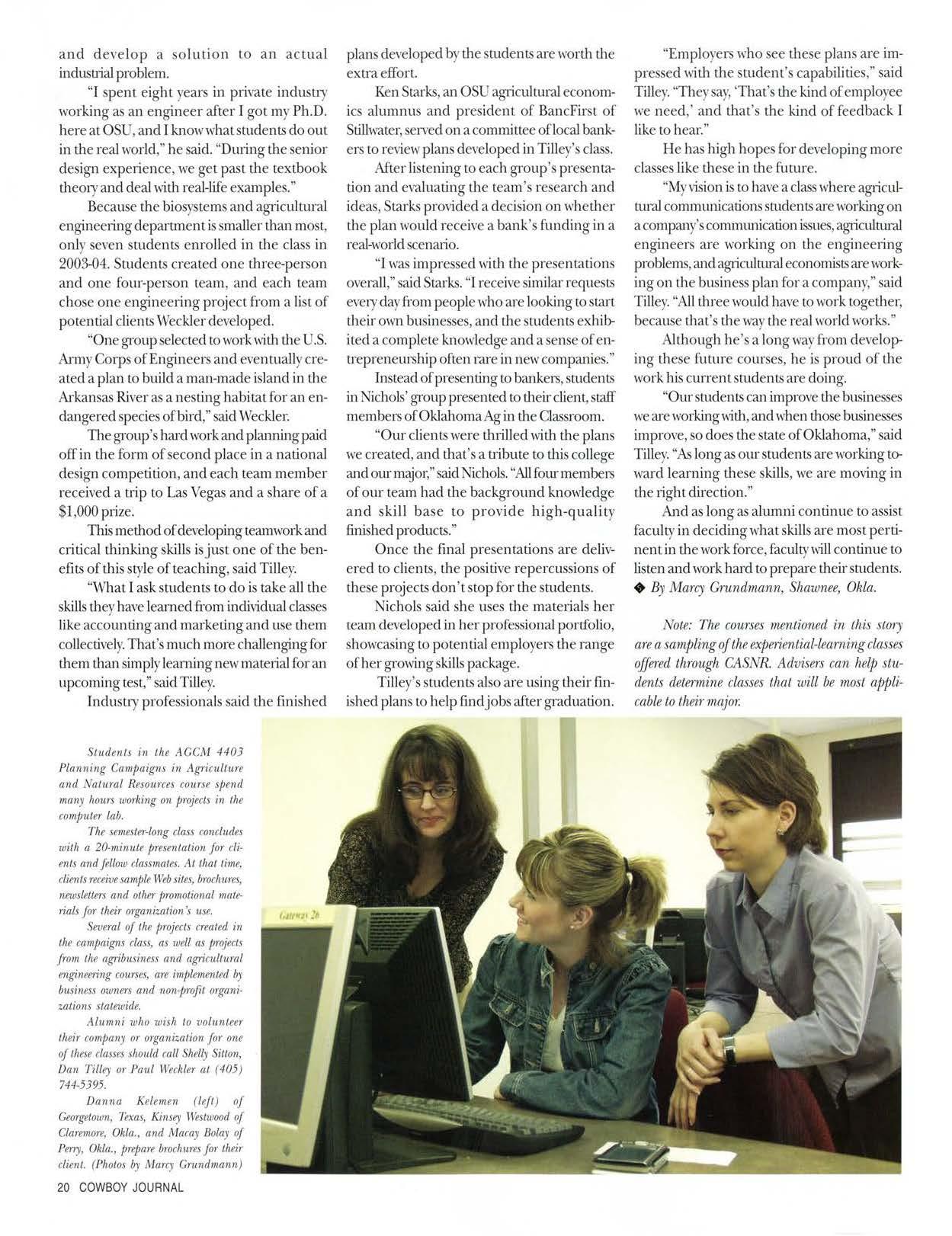
Students i11 the AGCM 4403 Pla1111i11gCampuig11sin Agriwlture a11dNatural Resourcescourse spend many hottrs working011projectsin the computerla/1.
The snnester-longclass ro11cl11des with a 2O-minule prem1talio11for cli• ents andfellowd11ssma.les. At that time, climtsreceivesampleWebsites.brochures, 11ewsleller1i and otherpromotio11almaterialsfor their 01gn.11izatio11 :Suse.
Severalof //it projectscreatedi11 the campaignsdt,ss, tis well llS f1rojerts from the agribusinessand agricu/tuml mgi11eeri!lgcourses,are implenumtedby businessowwrs and non-f1rofit01go11izatio11sstatewide.
Alumni who wish to volttnteer their companyor orga11izotio11 for one of Ihm classesshouldroll ShellySil/on, Dnn Tille)' or Paul ll'rcklfr al (405) 744-5)95.
Danna Kelemen (left) of Georgetown,Texas, Kinseyl~e.stwood of Claremore,Okla., and Macoy Bolayof Pe,ry,Oh/a.,preparebrochuresfor their client. (Photosby 1\forcy Gnmdma,m)
plan developed by the students are worth the exu,1effort
KenStarks,an OSUagriculturaleconomics alumnus and president of BancFirst of Stillwater,servedon a committee oflocal bankers to reviewplans developed in Tilley' class.
After listening to each group's presentation and evaluating the team's research and ideas, Starks provided a decision on whether the plan would receive a bank's funding in a real-worldscena1io.
"J wasimpressed with the presentations overall,"said Starks."I receivesimilarrequests everyday from people who are lookingto start their own businesses,and the studen ts exhibited a complete knowledgeand a sense of enu·epreneurshipoften rare in newcompanies."
Tnsteadof presenting to bankers,students in Nichols'group presented to thei_rcjjent,staff membersof OklahomaAg in the Classroom.
"Our clients were th1illedwith the plans wecreated, and d1at'sa u·ibuteto this college and our major,"saidNichols."Allfour members of our team had d1e background knowledge and skill base to provide high-quality finishedproducts."
Once the final presentations are delivered to clients, the positive repercussions of these projects don'Lst0p for the studems.
Nichols said she uses d1e materials her team developed in her professionalportfolio, showcasingto potential employers the range of her growingskillspackage.
Tilley's students also are using their finished plans to help findjobs after graduation.
"Employers who see these plans are impressed ,~th the student's capabilities," said Tilley."Theysay,'ThaL'sthe kind of employee we need,' and Lhat'sthe kind of feedback I like to hear."
He has high hopes for developing more classeslike Lhesein the future.
"Myvisionis to have a classwhere ag1icultural communicationsst11dentsare workingon a company'scommunicationissues,agriculnrral engineers are working on !lie engineering problems,and agiiculruraleconomistsare working on the business plan for a company,"said Tilley."Allthree would have to work wgether, because that's the wayd1ereal worldworks.'"
Although he's a long wayfrom developing these future courses, he is proud of the work his current students are doing.
"Oursn1dentscan improvethe businesses weare workingwith,and when those businesses improve,so does tl1estate of Oklahoma,"said Tilley."As long as our students are working toward learning these skills, we are moving in the right direction."
And as long as alumni continue to assist facultyin deciding what skillsare most pertinent in d1eworkforce, faculty\,~llcontinue to listenand work hard to prepare their students.
By Marcy Grundmann, Shawnee,Okla.
Nole: The coursesmentionedin !his st01)' area samplingof theexperiential-Leamingclasses offeredthrough CASNR. Adviserscan hel/1students determineclassesthat will be most applicableto theirrnaj01:
The 'Firsts' Lady
Bradley makes history in the livestockindustry
In fifth grade, Minnie Lou OLtingertold her parents she wasgoing to attend Oklahoma A&Mand participate on the live tockjudging team. Commonplacefor a girl today,but it was unheard ofin the early 1940
Raisedon a wheat tockfarm near Hydro, Okla., innie Lou attribut her pa ion for livestockto her younguncle Ted Otting r, who wa involvedin FFA.At the age of nine, he began howinglarnb and pig at the localfair as a 4-Hmember.When he wasold enough to handle cattle, she started a mall herd ofAngu A highlight of her showing career was havingthe re ervegrand championAngussteer at the 1949 Oklahoma tate Fair and reserve champion teer at the AmericanRoyalin Kansas City,Mo., in the ame year.
"I went to every live tock field day and juniorjudgingevent Mydaddyhauledme many miles to events,"said MinnieLou. "l practiced everychance I could. I read books on how to judge livestock.I did everythingI could to be on thejudgingteam."
Minnie Lou ucce sfully exhibited livestock and judging kills at 4-H events. At he time, women were not allowed to participate in FFA. onethele , ucce eemed to follow the determined young woman, as he was a member of an Oklahoma tate champion basketball team in 194 and received the Hydro HighSchoolOutstandingSeniorawardin 1949.
Minnie Lou wasborn in 1931in her family home in Hinton, Okla. Her fathe1~Ralph ThomasOttinger,wasin road consnuction,and her mother, Zulema Young Ottinger, was a school teacher. either of her parents had a fo1maleducation,but theydid encouragetheir children to attend college. Minni Lou, her two isters and her brother graduated from OklahomaA&M.
In the fall of 1949,fiveyears after World War II, Minnie Lou wa a fre hman at Oklahmna A&M.She recallsa lot of older men were in collegeat the time becaus of the GI Billof Rights.During her first eme ter, MinnieLou told Glen Bratcher, live tockjudging coach, she wanted to be on the Ji e tock judging team.
"He aid 'If) 10U are good enough to be on the team, I willlet you b on it, "she aid.
"Once he aid I could be on the team ifl wasgood enough, that wasmygoal. I thought, 'Well,if Iju t workhard enough ...' '
innie Lou tayed bu y with school and recall taking 18 hour mo t eme ter . What Minnie Lou did not knowwas that he would be one of the first women to enter the college of agricultur and get a degree in animal husbandry and the fir t woman to judge on the Oklahoma &Mlive tockjudging team.
aive to the fact she would make hi tm for the future of women at Oklahoma State Univer ity,Minni Lou credits th s xp riences to her ucc s. Her first win was the McArthurAwardfor b ing the top beef cattle judge at the 1951OklahornaA&MBlockand Bridlecont st.
She practiced for the livestockjudging team and made the traveling team. She had earned the pointstojudge at the ationalWestern tock how in Denver.After posting the points, Bratcher called her in and explained he had the points to na.vel,but he could not go becau e she wasa girl.
"I wasreallyhurt,' said MinnieLou.
After preparing for the next show in Ft. Worth,Texas,BratchercalledMinnieLou into his officeagain to explain she had the points to go. He had agreed he could be on the team if he wasgood enough, so he wasgoino to let herjudge at the Ft. Worth tock Show.
She recallswhatanimalhu bandrydepartment head AlDarlow aid at the time.
"'You are the fir t woman on th t am, and you could be th la t, "' aid Minnie Lou, with a refl ctive laugh. "H did not put any pres.sureon me."
Butthe Ft.Worth tock howwasnot h r last.In Octob r 1952,MinnieLou wasthe hi h indi,~dual be f cattlejudg at th Am 1ican Royaland seventh ov rall. In November1952, the team traveled to Chicagofor the International Live tock how.
"Astheyannounced results,Mr.Bratcher told me, I had rather you be last than cond,"' aid Minnie Lou.
Wh n th re ult were announced, •n nie Lou wasthe first, oman to be named high-point individualat the International Intercollegiate Live tock Judging onte t in Chicago,havingearned 901points outofl,000 po ible points. Minnie Lou had beaten 1 0 male collegiatejudge
In Chicago,she wasnamed "GirlPioneer." As a re ult of her accomplishments, Minnie Lou wasnamed to Gov.John ton Murray' taff
as honorary colonel and wasfeatured on national televi ion program for breaking barriers for women in animal husbandry.
In 1953,MinnieLou graduatedfrom Oklahoma A M witha bachelor' degree in animal husbandryand a minor in agticulturaljoumalism.Aftergraduation,IvlinnieLou became the first\ oman to eJYeasassistantexecutive ecretary of the Texa Angus sociation in Ft. Worth,Texas.
In 1955,MinnieLou manied BillBrndley, a 1953animal husbandry graduate he met at Oklahoma &M.With help from Bill' father, RustyBradley the newlywedwere able to purchase a ranch in Childre County, exas.The original ranch\ as 3,300 acres of We t Texa rollingprairiesand grasslands. t the time,they ran Hereford cattle.After Ii tening to Minnie Lou talk aboutA.ngu cattle, Rusty,the elder Bradley, aid, ''Youbuy ome o tl10 e black Angusbulls to put on tl1eseHereford cows."
Although tl1eyraised"blackbaldie "fora time, for tl1epast40years,tl1eranch has rai ed onl purebredAngu cattle. innieLouhas managedthe ranch and approximately400regi tered Angu co, for 49 yea1
In the early 1960 , Minnie Lou was one of the first charter member of the Performance Regisu-yInternational. he recall· the idea of keeping pe1fonnancerecord on cattle herds wa unheard of at the time and too far fetched to imagin .
"vVewerecon idered the weirdon ,"said innie Lou.
Lnaddition to qualitycattle, tl1eBrncll rni ed twochildren MonteJackand aryLou. ( continued on page 46)
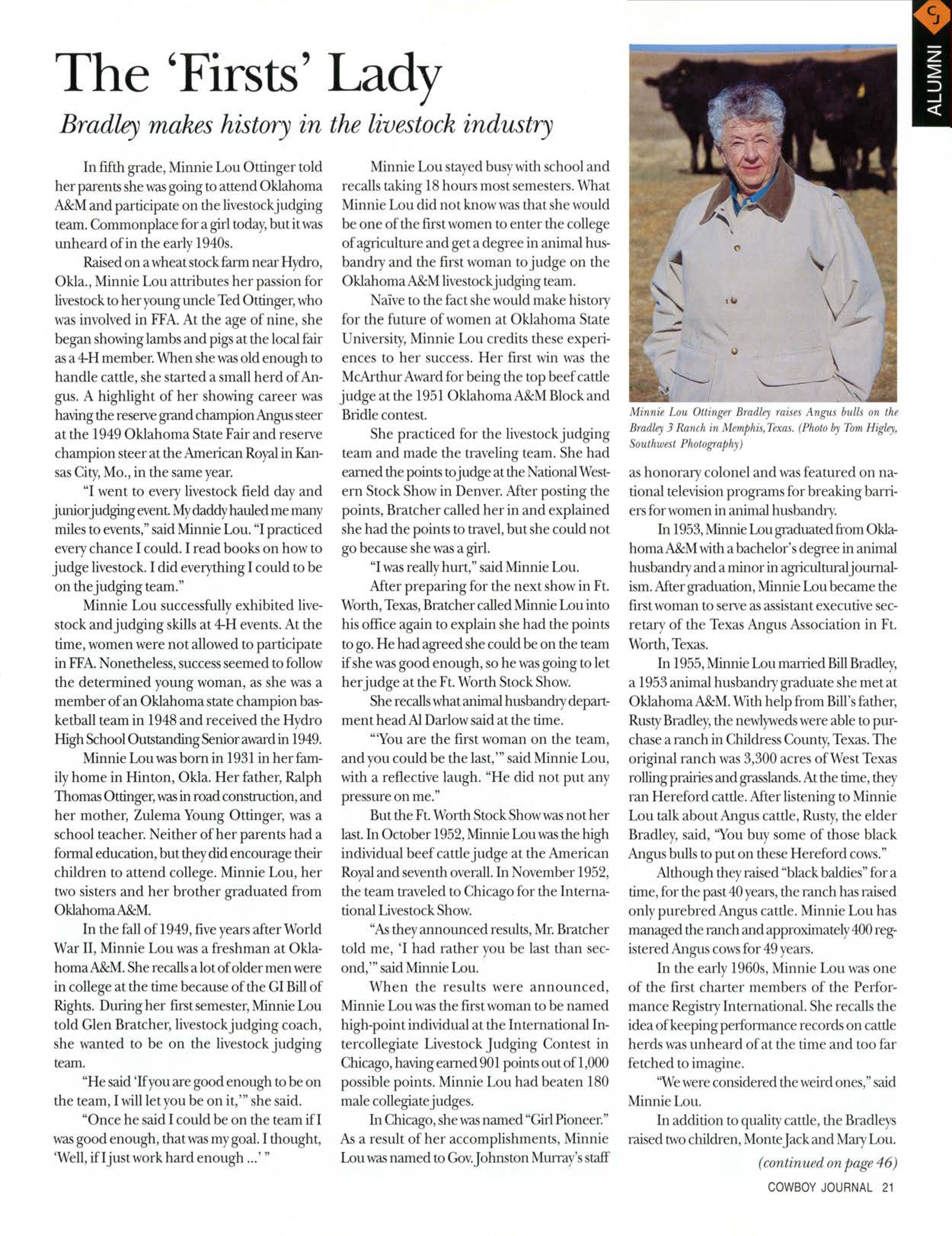
Minnie Lou Ouinger Brndl,y raisesA ngu bulls on th, Bradley3 Ranch in Mtmphis,Te.vu;.(Phowb)'TomHigley, oulhwestPhotograph)')
C2lrvinga niche in @klahoma
OSU ForestResourcesCenterworksto promoteforestiQdystry
Tucked away in the forest near Idabel, Okla., the Oklahoma State University ForestRe ourcesCenter playsa ,~talrole in one of the state's most overlooked agiicultural indusuies.
O1iginally,the center wasestablished by OSU as a horticulture research station. In the early 1960s,the forestrydepartmem took responsibilityfor the center and began forestry research acti,~ties.
"The No. l benefit is location,"said Craig McKinley,head of the OSU Department of Forestry. "Situated in the forestry region of Oklahoma, it provides a focal point to have the resources needed to cany out foresuy research."
Restingon 160acres, OSU owns the staLionand shares managemem duties with rhe OklahomaDepartmentofAgiicnlture,Foodand Forestty Sen~ces.
Initially,the OklahomaState Department ofForesuy reliedon the Forest ResourcesCenter to develop a genetic program to improve seed sourcesfor nativepine u·eesand to make
u·eesavailableto Oklahoma landowners.
O,·er time, the center shifted gear from a production-basedunit to developinga more research- and insu·uction-basedcen te1;said Bob Heinemann, OSU Forest Resources Center supe1intendent.
This change brought research studies in areas such as physiology,water-qualityissues and forestreproduction,whileat the same time managing to branch out in other areas.
" ow,a bullet of our responsibility is to facilitateon-goingresearch effortson campus that are actually located here in the timberbelt region of the state," said Heinemann.
"vVhatmakesour research station different than tJ1eother research centers in the state is that our station is directly associated with tJ1cforesU)'department at OSU."
The OSU Forestty Departtnent works joi.ntlywiththe center to conduct researchand pro"de educationalopporumitiesfor students.
The center is home to many graduate projects that are maintainedand implemented on site. Also,students take classfield trips to
explore the projects and experiments at the center and visitthe forest region of the state.
The station has welcomedstudents from the OSUforesoyand zoologydeparunents, as well as students from other state institutions. In reu1rn,students are able to ,~ewprojects at 1.hestation and gain hands-on experience.
"TI1eForesuyResearchCenter isa pan of who weare and what wedo," saidMcKinley."It is viewed as an integral pare of the forestry departmem and as important as any otJ1ersegment of the program."
The center has international visitorsas well. It has hosted a week-long tour for the Chinese Minister of Forestry and his entourage.The group learned about tl1ecenter and different forest1y techniques used i11Oklahoma.Countiy representativesfrom Thailand, Belgium, South Africa,Tasmania,Argenlina and lndia havealso visitedthe station.
The educaLionaJopportunitiesat tl1ecenter are not limited to field trips. Interested college students can complete internships at the center. The most recent intern at the center was Christofe Sicard, a student from the Universityof Leone in France. Sicardlearned about new technologiesUlatdeal witi1global positioningsystems.
Because of his imernship experience, Sicardhas had numerousopportunitiesto work 1,~thforesttycompanies in France.
Educational opportunities also reach beyond the college level.The staffconducts foresll)' workshops witJ1students ranging from elementa1y school to high school, as well as home-schooledstudents.
In fact, one week each summer is designated for the foresuy natural resourcescamp du1ing which each researcher at the talion teaches his or her own workshop.
The center has hosted activitiesfor 4-H and FFAstudents, including tlle state 4-Hfor-
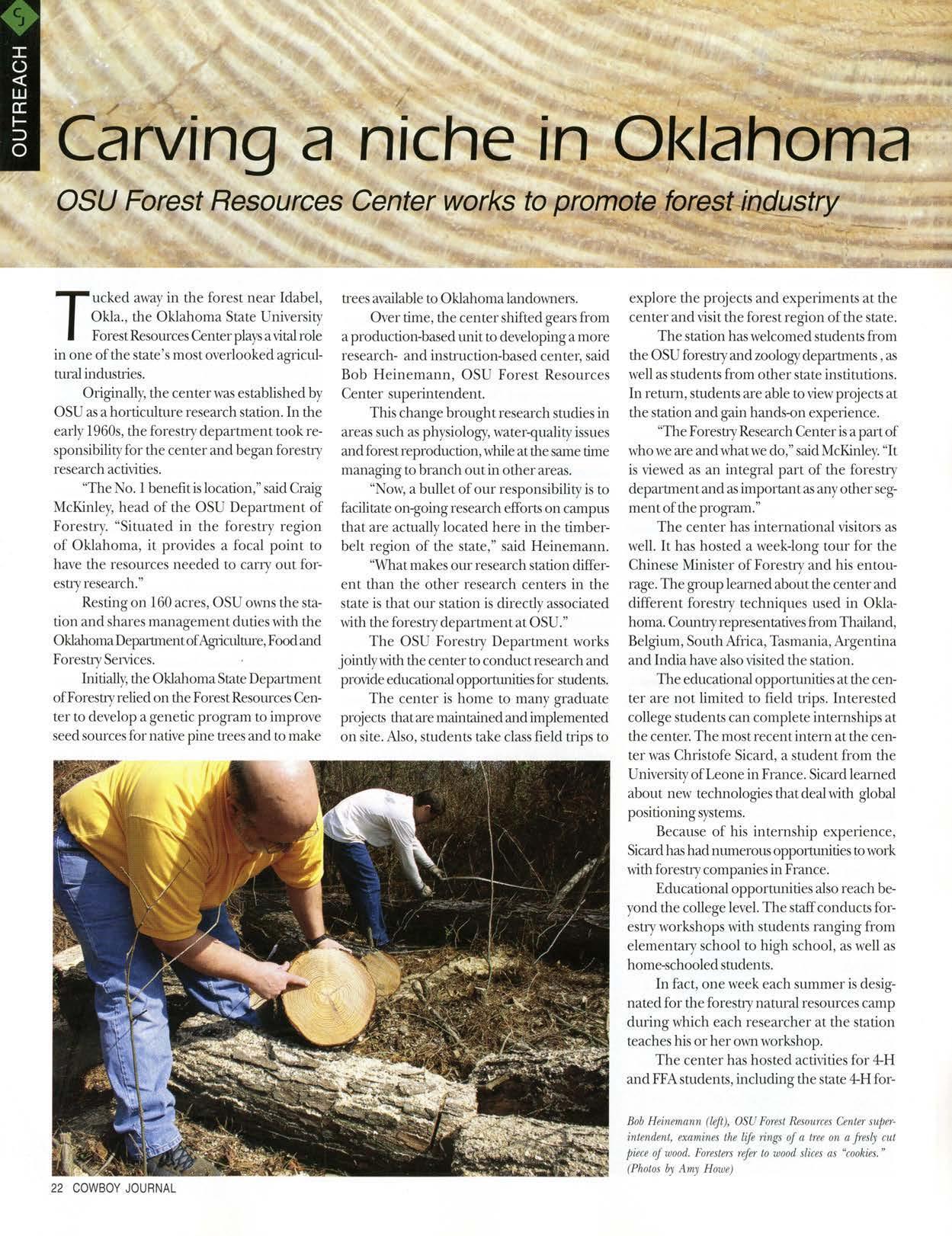
Bobl-lei11emr11111(left), OSUForestResourcesCenterS11f>n•i11tnule1U,exnmi11P<the life rin~ of a trtPon a fres()"ettl pieceof wood.Forestersreferto woodsliresas "rookies.• (Photosb1 Amy Howe)
e uycompetion and wildlifehabitat evaluation program. It al oh Ip rudenrs prepare for fortJ and ,,~ldlifi conte rs.
D nni Wilson, fi heries and wiJdlife biolo!'.!":i t at the talion, has worked with Boy cout member to help them earn badges b aclvi ing them in creatino- a bluebird Lrailat the center and banding giant anadagee e.
'Working at the talion i not your Lypical nine-to-five job," aid Wil on. "Day-to-day activitie are ju ta reflection of what i o-oing on ourside."
Wil on aid employees mu t be willing to work in har h em~ronmental condition because much of their research at the tation
" nlike mo tjob, we work harder on a rainy day monito1ingdifferent wale1 hed than on a unnyday."
One of the main projects the center i working on now i in co1"!iunction11•d1the .S. Forest en~ce. Randy H leman re earch pecialist, and Keith nder on, field teclrnician are invol\'ed in a GP project mat ,,~11create a map of the entire road y tern oflhe Ouachita ationaJ F re tin Oklahoma.
'Projecrs at Lhecenter vary all d1e time,' aid Holeman. "They are not limited to Lh tate of Oklahoma.'
The events and projecrs taking place at the center have expanded and ,1~Ucontinue hinge on d1eweather on any given work day. to grow.
"We are d1e repre entative for the forest indu O)' in Oklahoma, as well a for O U, and a lot of the larger fore try projects would be impo sible without chi re earch facility," said Heinemann.
The O Fore try Re ource Cemer matche the u·unk of the hardy Oklahoma tree while anchoring 1.he tate's third largest agiicultural industry and creating a olid foundation for future ByA myHowe, Lindsay,Okla.
Forinjol'mationaboutthe OSUFarestry ResourcesCenter,call (580) 286-5175 orfor the OSUForest1yDeparlment(405) 744-5438.
Cowboys choose success
CASNR recognizes2003-04 DistinguishedAlumni
Whal do Jectric coop rative and blm molding have in common? Positive upportof agiicttlturalproducers and twoOklahoma tate oive ityCollege of Agricultural cience and atural R ource alumni who work with th m: LarryWaLkin and Don Peter .
Re ognized as the 2003 CASNR di tinguished alumni, Watkin and Pet rs exp rtis in tJ1eirre p ctive areas, alongwitJ1dedicat d ervice t.o the improvement of agriculture, prompted th ir ele tion for thi honor.
"The purpose of this program is to recoo-nize and honor CASNRgraduate who have contributed ignificantly to ocieLyand whos
accomplishmen have brought di tinctcr <lit to the college and Oklahoma late Univerity,"said Linda Martin, assistant dean foracad mic programs.
Each of tJ1em n honored at me Fall 2003
Watkin earned a Bachelor of cience in agricultural education in 1969. In 1971, he tarted teaching vocational agriculture at Purcell High chool in Purcell, Okla., where he helped tran form a program filled with convocation cer monie has earned the award di ciplinary problems and difficult students
in their own distinctiv way.They took their challenges and form d Lheminto opportunity for countle othe1
lorry Watkin. Classof 1969
"I did ab olutel nothing t.o cl • rve the opportunit to be born in mral Oklahoma" said Watkins. "l was ble cl."
into an organization of which the town could be proud.
Watkin helped est.abli ha widely recognized livestockbreeding program and founded tJ1 Hea1tofOklahomaSwine ale. Three years lat r, the program was honored as the best single-teacher vocational agriculture program in Oklahoma.
In June I 976, Watkins left teaching to erve as dir ctor of the ag,icultural development divi ion of the Oklal10ma City Chamber of Commerce. Watkinsduties included promoting Oklahoma City' conomic growth and improvement in theagribu in sindustry.
Watkins assisted with the planning and production of the National Finals Rodeo and h lp cl e tablish Oklahoma City a the "Hor how Capital of the World." The e vents added an additional 9 million to $12 million annually into the economy of Oklahoma City.
In 1979, Watkins became a taff as i tant and lobbyist for the Oklahoma sociacion of El ctric Co perative and became the executiv vice pre ident and general manager of th organization in I 984. Thi long path of uc- c from a vocational agriculture teacher to m OAEC may eem somewhat unconnected, but Watkin attribute his first experience wim 1 ctric cooperative to the FF
'It was through F hat I developed the r lat.ion hip with electri cooperatives," aid Watkin.
Through hi accompli hmen in life, Watkin has continued to provide a simple piece ofadvi for students and individual of all ages.
"Take advantage of all tl1eopportunities so many people have provided to ou, and make ur others have the ame opportunities."
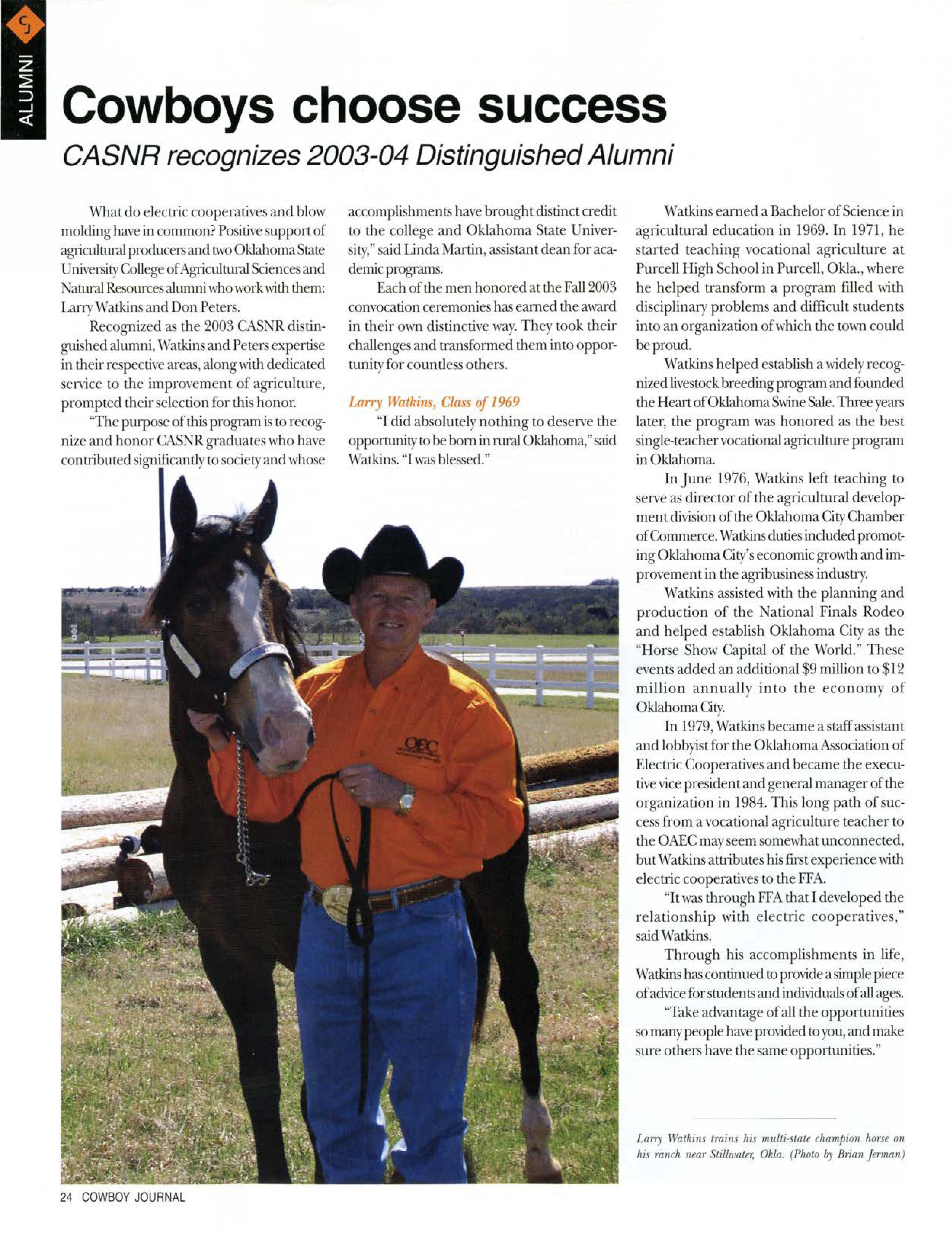
Larry Wa1ki11strains his m11lti-slatechampion horse1m his ranch11ear lillwater, Okla. (Phoioby BrianJerman)
D011 Peters,Classof 1951
Peters graduated from Oklahoma A&Min 19511,~tha Bachelor of Science in soils. Prior to attending OSU, Peters wasa member of the 38th Infantry Division in World War 11.He was given an honorable discharge as a sergeant in July 1946.
At OSU he was a member of lhe Agronomy Society and in 1948 was a member of the Oklahoma A&M varsity football team.
Upon graduation, Peters returned to his home in Kansas where he planned on becoming a farmer. However, shortly after relllrning to Kansas, Peters began looking for a job in a town that could provide more social stimulation. He then started ajob in Bartlesville,Okla., working for Phillips Petroleum Co. and started a 49-yearjourneyofsuccess wilh 1.hecompany.
During his first few years with Phillips, Peters was dissatisfied with his duties and was on the verg·e of seeking employment elsewhere unl.i.lhe transferred to the plastics di,~sion in 1958.
"Had I not transferred to plastics then, 1 would probably be a farrnet;" said Peters.
Peters thrived in the work en~ronment he experienced in the plastics di~sion of Phillips. He contributes his success and determination at Phillips to the tremendous leaders he found in the division. Peters said their willingness to work set a good example for him to follow and helped him to succeed in the field.
Peters expetienced many accomplishments in the years following his transfer. He is the owner of 36 patents and in 1985 received the 25-patent milestone award from Phillips Peu·oleum.
Much of the lechnology Peters developed is still used in the indusu·y today. Perhaps his most well-known inventions are the lid and handles of water coolers used by people everyday.
"v\lhen you see football players dump Gatorade on the coach after a game, we helped develop the handles for the cooler," said Peters.
In addition to the technology he helped develop, Peters has presented more than 200 technical lalks and seminars,
aulhored or coauthored 30 technical papers and articles, authored three chaplers in three books and amhored one entire publication, "Blow Molding Highly Irregular Shaped Parts wilh Moving Section J\folds," Freund Publishing, 1984.
Peter's simple advice for students: "II you don't get that pe1i'ectjob tight off the bat, don't give up."
Through his success in the blow molding indusuy and life, Peters has never forgouen the people who helped him along tl1ewayand advises others to do the same.
"Don't ever forget the people and mentors who helped you," Peters said, "because no one achjevessignificantlywithout By Brianjerman,Ambe1;Okla.
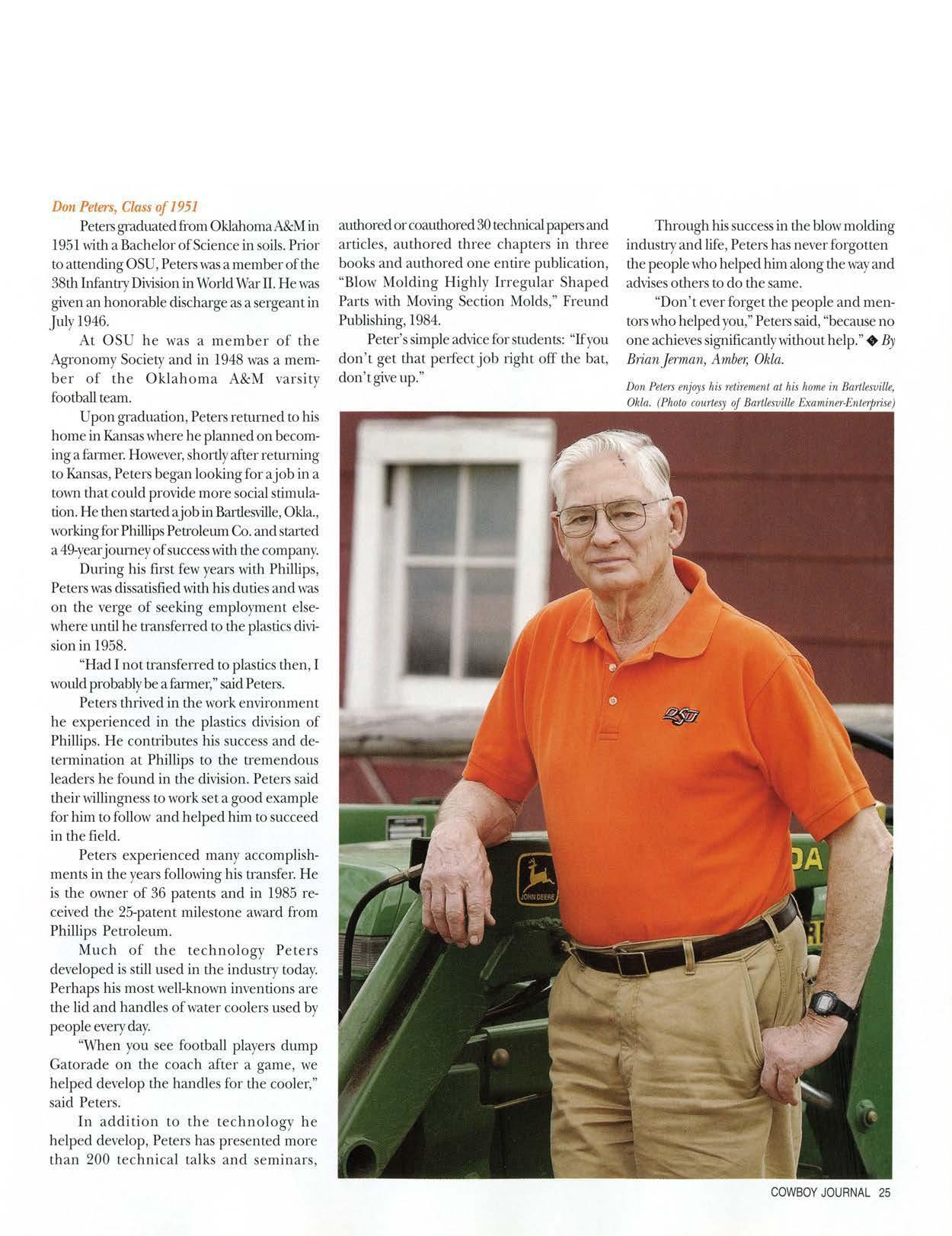
Don Petersenj<>JS his retirementat his homein Bartlesville, Okla. (l'hoto courtesJof Barl/esvilleExami11er-£11te1/Jrise)
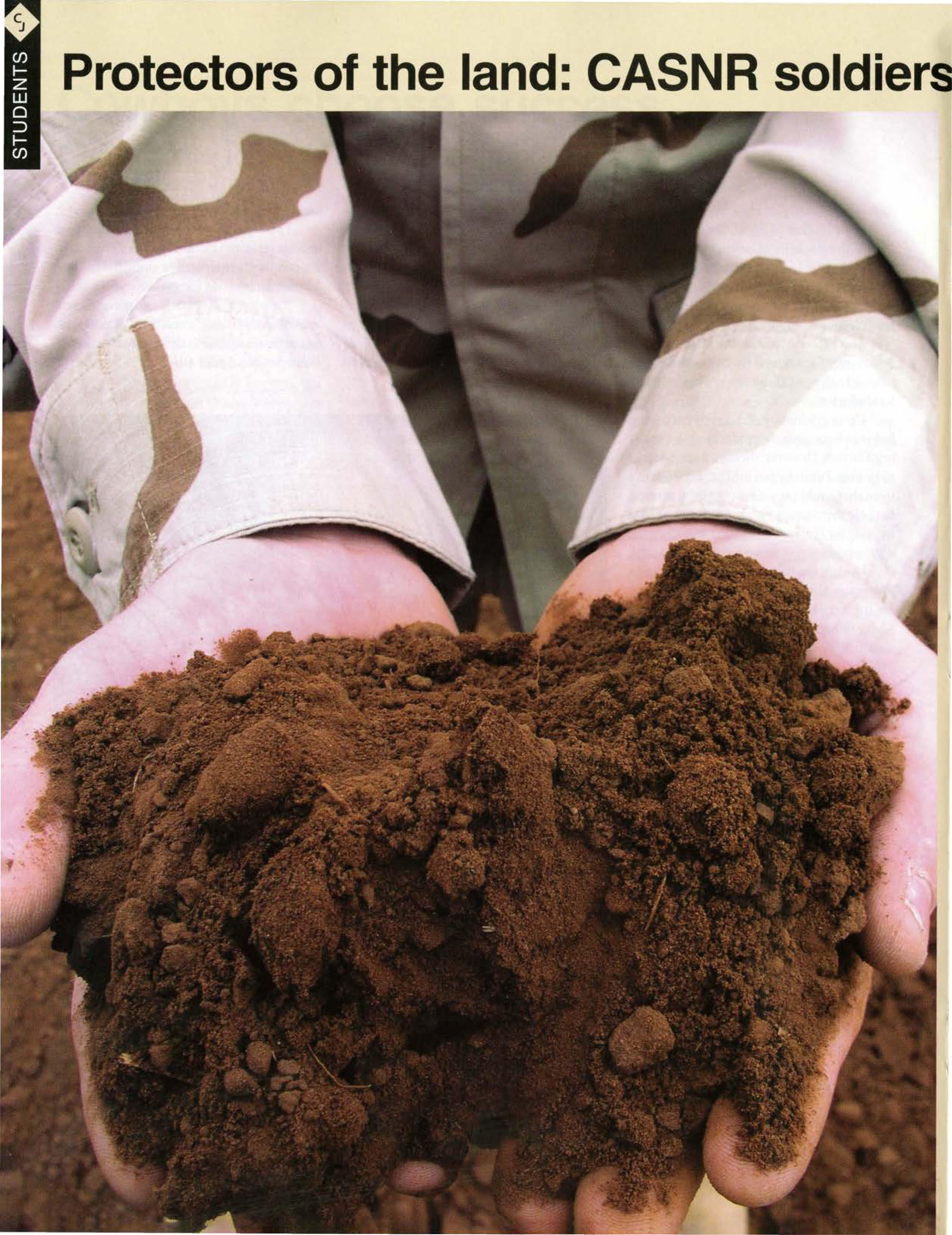
Protectors of the land: CASNR soldiers
serve their country
Freedom is not free.
With the recent conflictsin Iraq and Afghanistan,men and women around the worldare protecting the freedom and way of lifeso precious to Ame1icansbyserving in the militaryon activeduty.
Like other soldiers,those students from the Collegeof Agiiculmral&iences and 1amral Resourceswho have been called to active duty put their liveson hold,faced the tonnent of separationfrom their familiesand put themselvesin ha1m'swayto se"'e the counuywhen it needed them the most.
The actions of these young men show the character and honor CASNRsU"ives to develop in students.Asthese soldierscome back theyare welcomedwithopen arms and shine as examplesof character the collegeworksco developin everystudent.
While mostofhis peers feared the next exam, Sgt. Spence McConnellwasforced to fear for his life.
His U.S. Army unit's mission was to pro,~defuel to the entire military theau·e. His unit transported fuel from Kuwait to Iraq, which is directly in the center of the conflict.
A big weight on McConnell's mind duringthe warwasguerrillawarfaretacticsused by the Isaqis.
"Theywouldhide and try to get us," said McConnell.
The combination ofjetfuel and Iraqigun firewasdangerous,but McConnell also endu red an extreme
The agriculn1ralcommunicationsjunior also wasfaced with a long separation from his familyand friends.
Mailonlycameeverycwoweeks,computer use was sporadic, and telephones were not readilyavailable.
McConnell is nowdealiJ1gwith the readjustment to normal, everydaylife.
"l didn't know what it would be like to come home and if 1would be the same to my familyand lovedones," he said.
McConnell said he has a new appreciation for the Ame1ican way of life since his return.
''We don't know how good we have it," said McConnell."Thereare peopleio Iraq who still don't have running water or clecuicity. Somestill ridedonkeysaround."
McConnellsaid he is happy to haveseen
the world and learned about different countries and cultures. He even learned to speak a bit of Arabic.His fondest memories of his service are of those with whom he served.
''I got closewith the people I served with despite a wide variety of backgrounds and personalities," said McConnell.
"We made sure a person had a reason to be on th.e post," said Rogers.
Rogers was constantly troubled with rumors and the real possibilitythat he could be sent overseas.
"At any time we might have left to face bullets,"said Rogers.
Rogers said he felt blessed tO develop comradery with the other men with whom he served.
"The guysI served v.~thwould take a bullet for me like 1 would take a bullet for them," he said.
Rogers said he joined the Army to go to college. However,after his sen~ce, he is enthusiastic and dedicated to the military.
"I wouldn't leaveit now,"said Rogers.
Rogersis currently using his militat)'serviceto become a better student.
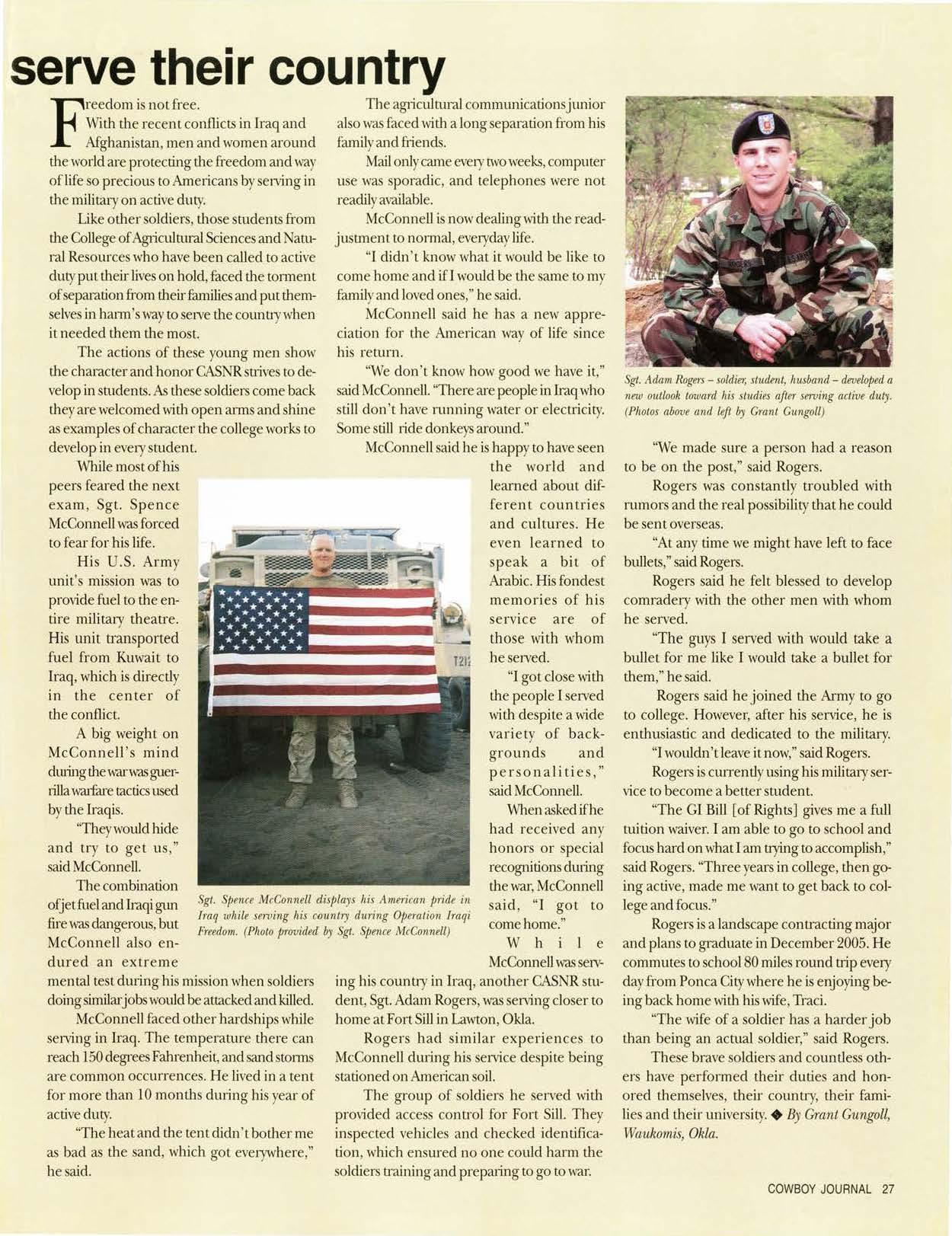
Sgt. SfienceMcCo,rne/1displa)'Shis American pride i11 Iraq while s,roing his count,)' drtringOpn-alionIraqi Freedom.(Photoprovidedby Sgt. Spe11ceMcC-011.1u/l)
mental test during his missionwhen soldiers doingsirnilarjobswouldbe attackedand killed.
McConnellfaced other hardships while sen~ng in Iraq. The temperature there can reach150degreesFahrenheit,and sandstonns are common occurrences. He livedin a tent for more than 10 months during his year of activeduty.
"The heat and the tent didn't bother me as bad as the sand, which got everywhere," he said.
Whenaskedifhe had received any honors or special recognitionsdming the war,McConnell said, "] got to come home."
W h i l e
McConnellwasserving his country in Iraq, another CAS R student, Sgt.Adam Rogers,wassenfog closer to home atFortSill in Lawton,Okla.
Rogers had similar experiences to McConnell during his service despite being stationed on Americansoil.
The group of soldiers he ser\'ed with provided access comrol for Fort Sill. They inspected vehicles and checked identification, which ensured no one could harm the soldiersu-ainingand preparing to go to war.
"The Gl Bill [of Rights) gives me a full tuition waiver.1am able to go to school and focushard on whatI am uying to accomplish," said Rogers."Three yearsin college, then going acLive,made me want to get back to collegeand focus."
Rogersis a landscape conu-actingmajor and plans to graduate in December 2005.He commutes to school SOmilesround mp every day from Ponca Citywhere he is enjoying being back home with his wife,Traci.
"The wife of a soldier has a harder job than being an acn1al soldier," said Rogers.
These brave soldiers and countless others have performed their duties and honored themselves, their country, their families and their By GrantOungolt, Waukomis,Okla.
Sgt. Adam Rogm- soldier,sttulimt,husband- developed a new outlooktowardhis s/udies after seroingactive duty. (Photosabove(Ind left by Gmnt Gtmgo/1)
Cowboy soldier killed in Iraq
Luke amuel James was a true Oklahoma tale niver ity cowbo
Jame , 24, came to O U in 199 and graduated in 2002 ,1~th a Bachelor of cience in animal cience.
·while at O , he gained many tJ1ing , including wife, Molly.more friend than can be coun Ledand, mo Limportamly,a passion to serve in the military.
James' love and pas ion for ROT and the arm began early in life.
Hi farher, retired Aim officer Maj.BradleyJame , wa in the Army R erve all through.Jame 'childhood. M~j.Jame 'influence on hi elde t on instilled the framework fora u·ongmilitarycareer.
Oo Dec. 13, 2002, Jame was com mi ioned a a econd lieutenant. He then became a member of lhe 2nd irborne Division.
Jame deployed from For Bragg, NC, for Iraq on Jan. 15, 2004.
However, thi young oldier' storie of battle are horL Jame was one of lhree ol-
dier killed Jan. 27 in an explosion near lskandariyah,lraq.
"He alway wanted to be a parau-oopert aid Erin hepherd a lifelong &iend ofJame "fr member him t llin us that h 11 aoin to ·ump out of plane I thought he 11~a k.iddi11g,but hi p ion wa in tJ, military."
Jam wa laid to re t Feb. 10 at the Arlington National emetery n ar Wa hington, D.
H i ·urviv db 11~fe,Molly; hi 1-yearold on, Bradle ; par nts, Bradley and Arleen; hi brotller Kirby;and sister, harla.
Jame rec i,· d rhe Purple Heart and the Bronze tar for hi effort in Operation Iraqi Freedom.
"People often ask how I am o t.rona sometim s " aid Luke Jame • wife, Molly. ''I teU iliem, 'I am ne of the lucky one • I never que tioned how much Luke loved Bradle or me or how much he loved being a oldier.~
Mollyalso said not many people get to do what they love to do, but Luke was doing that
"Many people ay that Luke wa a hero when he did.lbelier hewasa hero every day," he said.
Ev n though hi family realized th ri k of lo ing their son,
tJ1eywere upportive of hi deci ion of making the A.tmyhi full-time car er.
"It would not have been thi moilier choice, but you have to have young men and women willing to pre erve the freedom we have," aid Arleen James. "We are glad he was willing." By Grant Gungoll WauJwmis,Okla. and LoriPech,Sentinel,Okla.
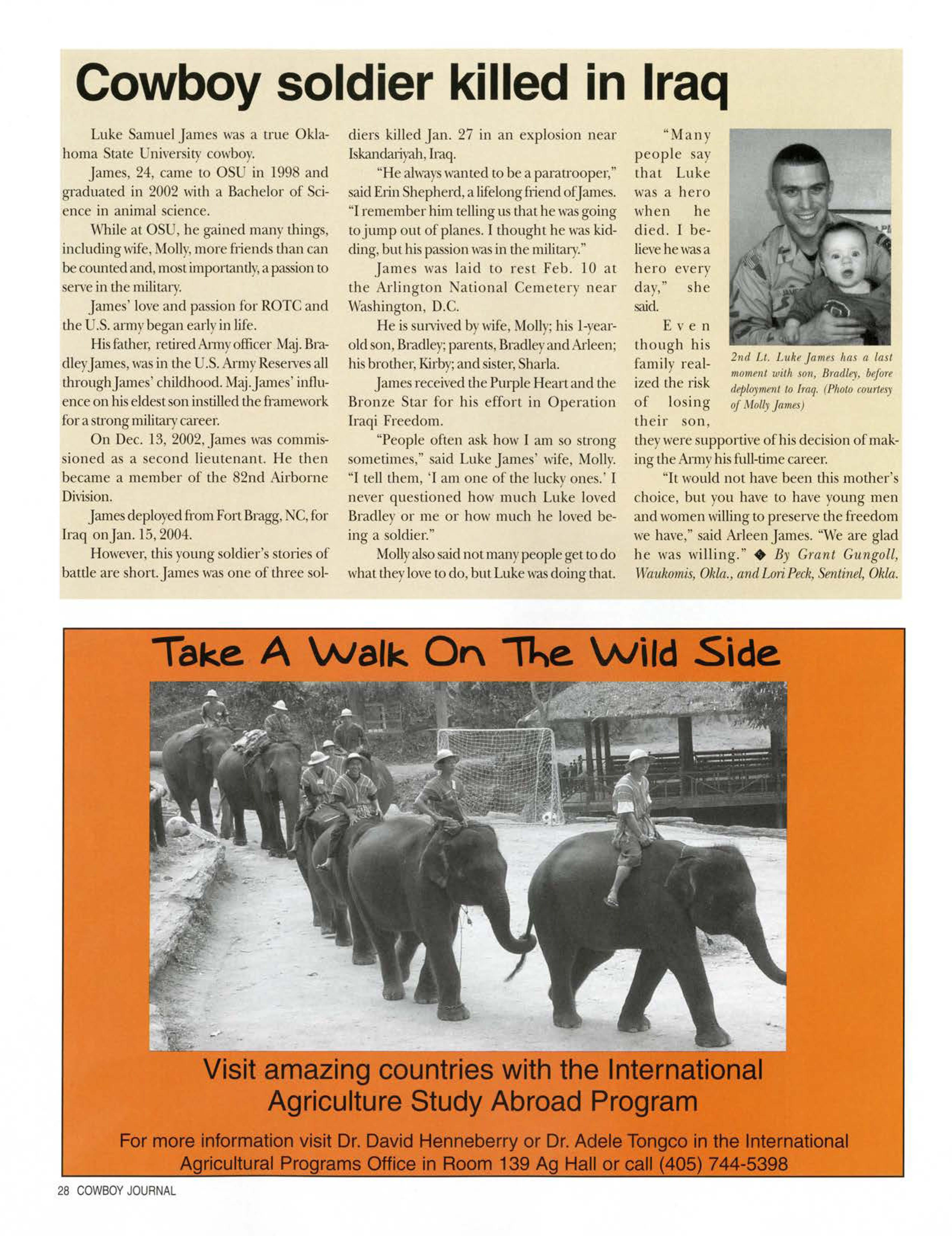
2nd LI. Luke James hnJ a la.st mome11/with .rm,, Braduy, bejou deploym,m/lo fmq. (PhoiocourttS)· of MollyJrm1es)
Bzzzz... the tead , hum of a lawn mow r i heard throughout Beaver Okla., on this hot um mer day.1l1e rural town, mack dab in the middle of the Oklahoma Panhandle, i stick and swelteringas the um mer un hine down.
Tnthe midstofitall, MikeAlbertpushe a lawn mower aero aw ll-tended yard. If only he had known where thi ummert.ime job would lead.
It wa the pring of 1996 when Alben began a lawn-mowing busine s with hi mom, Vona ue. Eager for exU"a pending money, Albert mowed more than 30 lawn in Beaver often working from unri e to un et. At the end of the ummer he had a profit of more than ,3,000. In tead of pending the mone on typical teenager purchase Albert began making bu ines investments. After buying a bulldog - Molly - and giving a tithe to hi church, he refurbi hed hi bu ine with the purchase ofa new napper lawnmower. The remaining profit was inve ted to tart a homebased plant bu in
His mom worked in a flower hop for ei ht yeai., ivinghimagreatre ourc forinfo1mation. tarting the bu ine proved to be an adventure \\~th tough que tions to answer.
"Iaskedmyself, 'howinth world would it stay afloat? How do I tan an actual bu ine ? Would people take a fre ·hman in high chool e,iously?"' aid Albert.
In Augu t before hi fre hman year of high chool, hi pai·ents took him to th Oklahoma Tai Comm· ion and the Oklahoma Deparonent of giiculture to receive hi tax p rm it and licen e. Alben wa onl the third minor in Oklahoma to receive the e documents. The bu ine had begun!
In the beginning, Albert old ea onal plants, uch as poin ettias and Easter lilie , om ofhi home. However, a the bu ine pread byword of mouth, he tarted upplying plants for funeral , birthdays and pecial occasion Within the year, cu tomerreque ts led to more expansion that included s asonal, house and b dding plants.Just ix we ' into the operation, Alben had already made a profit.
As an a rive memb r of the Beav r FF hapte1~Albert received th biggest honor for hi ambitiou bu ine plan at the Oklahoma FFA onvention. Dwinghissenioryeai;Alben \\, tandingon the convention tagewith hi agii ultural education teache1~Tom Lamie. and hi paren ,Jack and\ ona ue, when he wa named the tate FFA tar in gribu ine Hi competitor' projec included hio-h-profile horse, cattle and crop operations but the young man from the Oklahoma Panhandle \~th a retail plant bu ine took he top prize.
"It was a crazy experience, 'Albert aid "e pecially when you think of all the quality that come from Oklahoma FF membe To have the operation elected \ a trul, an amazing and ble ed honor."
Th busin is now in it eighth ·ear.Albert has old more than 17,000 plants aero Oklahoma, Texas ai1dKansas.He works \\1th 11 plant nu rie •in ix tate and was im1ted to the Dalla Gift Market and d1e Americasmart in Atlanta, Ga. Mo Limportantly, he has developed a core customer b c becaus ofhi bu ine s com1mmication and en~ce.
"It is important to listen to your customers and cat r to their market," Alb rt aid. "Without d1at, ou are nly killing your elf and your future."
But Alben' future wa on! trio brighter. B cau e of hi bu ine • knowledg and succe ·, w ll a his tron conn ction to agriculture, coming to Oklahoma tatc niversityand majoring in land cap architecture wasa narural deci ion.
TI1eland cape architecture program lasts
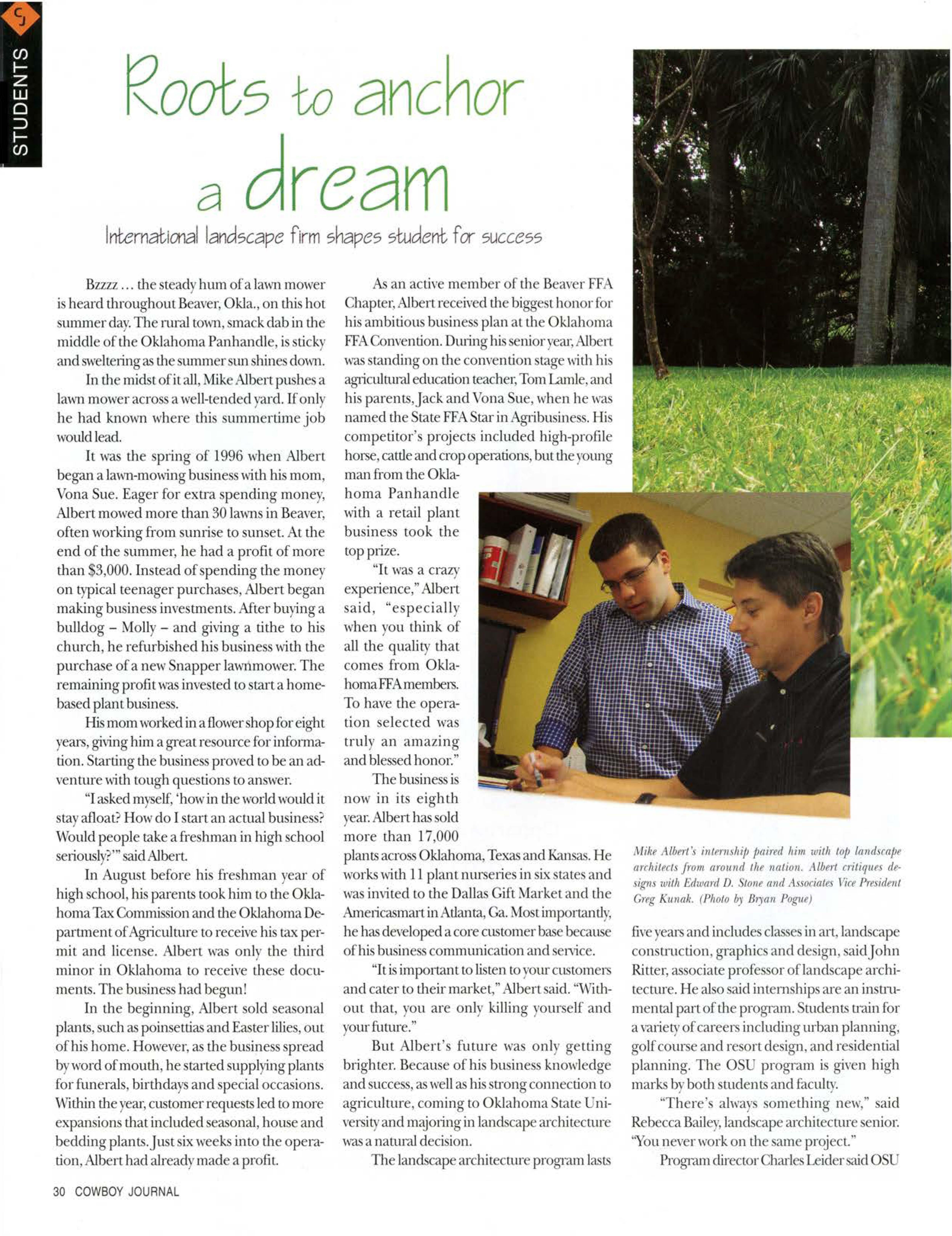
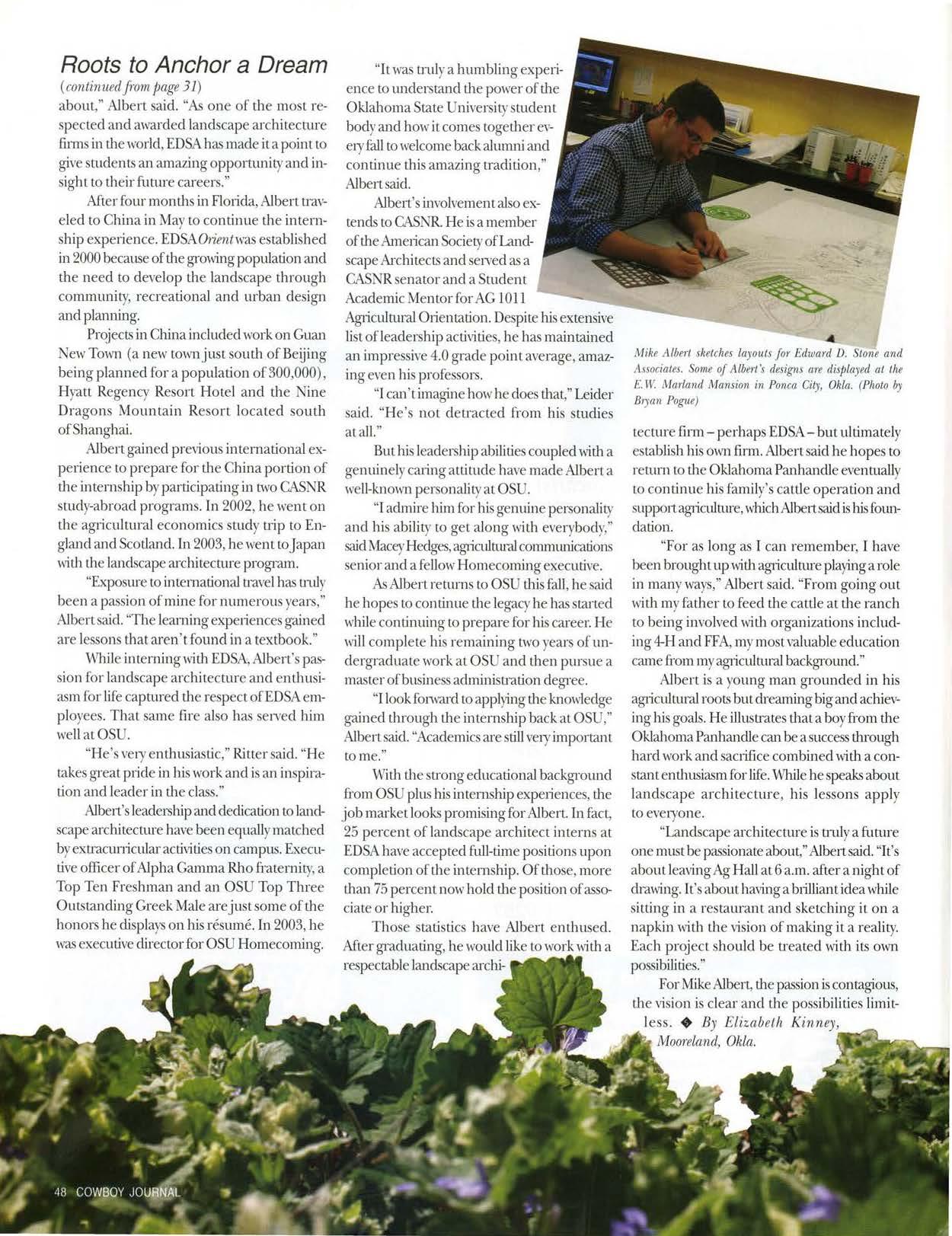
Mike Albrrl' intermhip paired him wit/, lo/1lmulunpe arrliitws from aro1111dthe nation. t\lbert critiquestlellfllS with EdwanlD. Sto11tand Ass0<ialesVirePresidenl C.-rgKimak. (Pliolo bJ'B1ya11Pogu,)
five 'ears and include cla e in art, land cape constniction graphic and de ign, aid John Ritter, as ociate profe sor ofland cape architecture. He al o aid imem hip ai·ean insu-umental part of the program. tudents train for a varietyofcaree1 including urban planning, golf cour e and re ort de ign, and r idenlial planning. The O program • given high marks by both students and faculty.
'There' alway omethin new," aid Rebecca Bailey,landscape arch it ctur ·enior. "Youn ver work on the am proj ct."
Program director Charle L id r 'lid 0
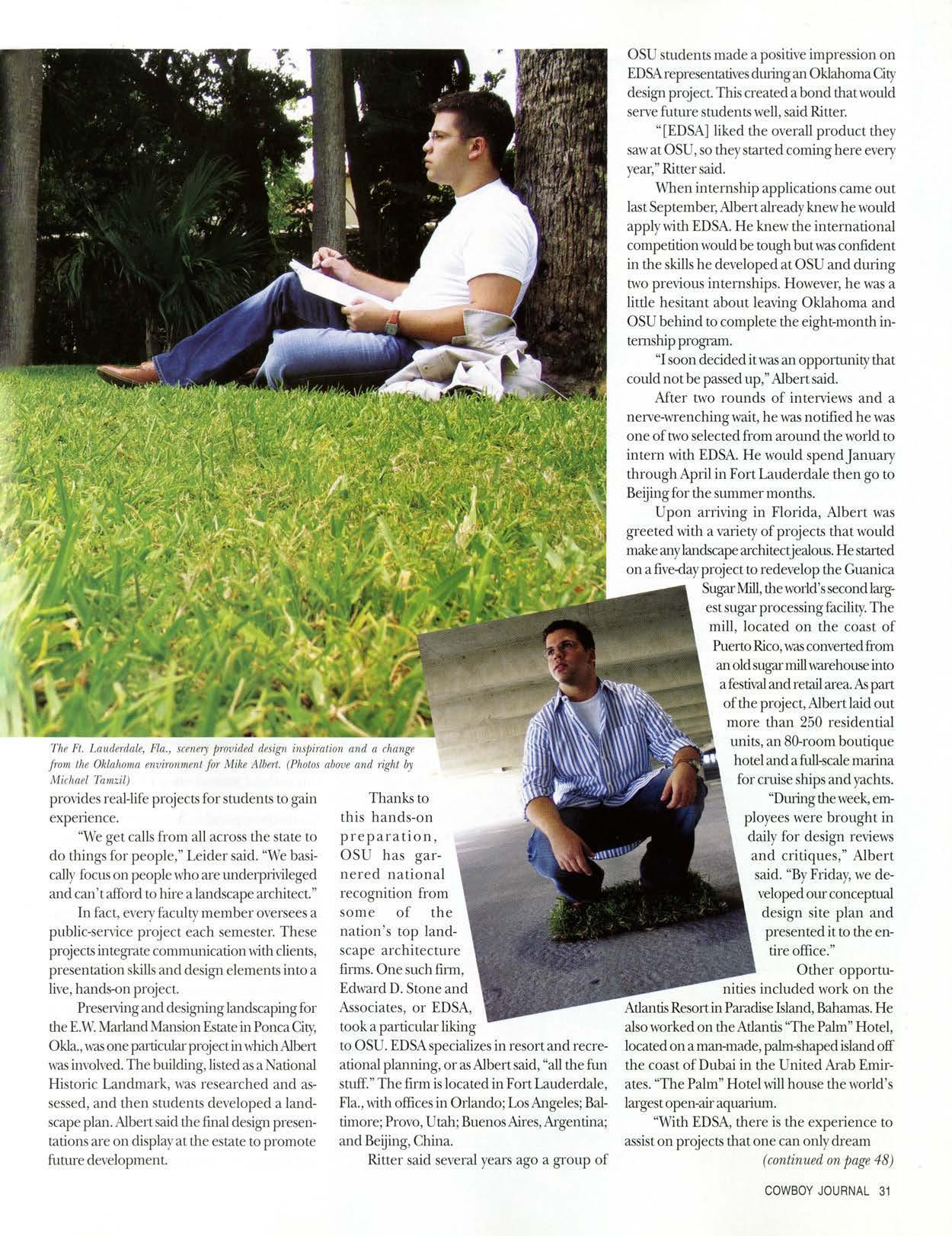
711efi. La11derdali',fla., sceneryprovideddesign i11spiralio11a11da rhonge fro111!he Ok/olw11111,11vfron111en/ for /\like Alber/. (Photost1boveand right by Midw,/ Tamzil)
providesreal-lifeprojectsfor students to gain Thanks to experience.
"Weget calls from all across the state to do things for people," Leider said. "Webasically focuson people whoare underp1ivileged and can't afford to hire a landscapearchitect."
In fact, eve1)'facultymember overseesa public-serviceproject each semester. These projectsintegratecommunicationwithclients, presentation skillsand design elements into a live,hands-onproject.
Presen~ngand designinglandscapingfor the E.W.MarlandMansionEstate in PoncaCity, Okla.,wasone particularprojectin whicl1Alben wasi1wolved.The building,listedas a National Historic Landmark, was researched and assessed. and then students developed a landscape plan.Albertsaid the final designpresentationsare on displayat the estate to promote future development.
this hands-on preparation,
OSU has garnered national recognition from some of the nation's top landscape architecture firms.One such finn, Edward D. Stone and Associates, or EDSA, took a particular liking to OSU.EDSA pecializesin resort and recreational planning, or asAlbensaid, "alJthe fun stuff."The firm is located in Fort Lauderdale, Fla.,1\~th officesin Orlando; LosAngeles;Baltimore;Provo,Utah;BuenosAires,Argentina; and Beijing,China.
Ritter said several years ago a group of
OSU students made a positiveimpression on EDSArepresentativesduringan OklahomaCity design project.This created a bond that would servefuture students well,said Ritter.
"[EDSA]liked the overall product they sawat OSU,so theystarted coming here every year,"Ritter said.
When internship applications came out lastSeptember,Albertalreadyknewhe would apply with EDSA.He knew the international competitionwouldbe tough but wasconfident in the skillshe developed at OSU and du1ing two pre\fous internships. However,he wasa little hesitant about leaving Oklahoma and OSUbehind to complete the eight-month internshipprogram.
"I soon decidedit wasan opportunitythat could not be passedup,"Albertsaid.
After two rounds of interviews and a nerve-wrenchingwait,he wasnotified he was one of twoselected from around the world to intern \1~thEDSA.He would spend.January through April in Fort Lauderdale then go to Beijingfor the summer months.
Upon arriving in Florida, Albert was greeted with a varietyof projects that would makeanylandscapearchitectjealous.He started on a five-dayproject to redevelopthe Guanica SugarMill,the world'ssecondlargest sugar processingfacility.The mill, located on the coast of Puerto Rico,1,>asconvertedfrom an oldsugarmillwarehouseinto a festivaland retailarea.Aspart of the project,Albert laid out more than 250 residential units, an 80-roomboutique hoteland a full-scalemarina for cruiseshipsand yachts. "Duringthe week,employeeswere brought in daily for design reviews and critiques," Albert said. "ByFriday,we developedour conceptual design site plan and presented it to the entire office."
Other opportunities included work on tl1e AtlantisResortinParadiseIsland,Bahamas.He alsoworkedon tl1eAtlantis"The Palm"Hotel, locatedon a man-made,palm-shapedislandoff the coast of Dubai in the United Arab Emirates. ''The Palm" Hotel willhouse the world's largestopen-airaquariwn.
''With EDSA,there is the experience to assiston projectsthat one can onlydream (continuedon page 48)
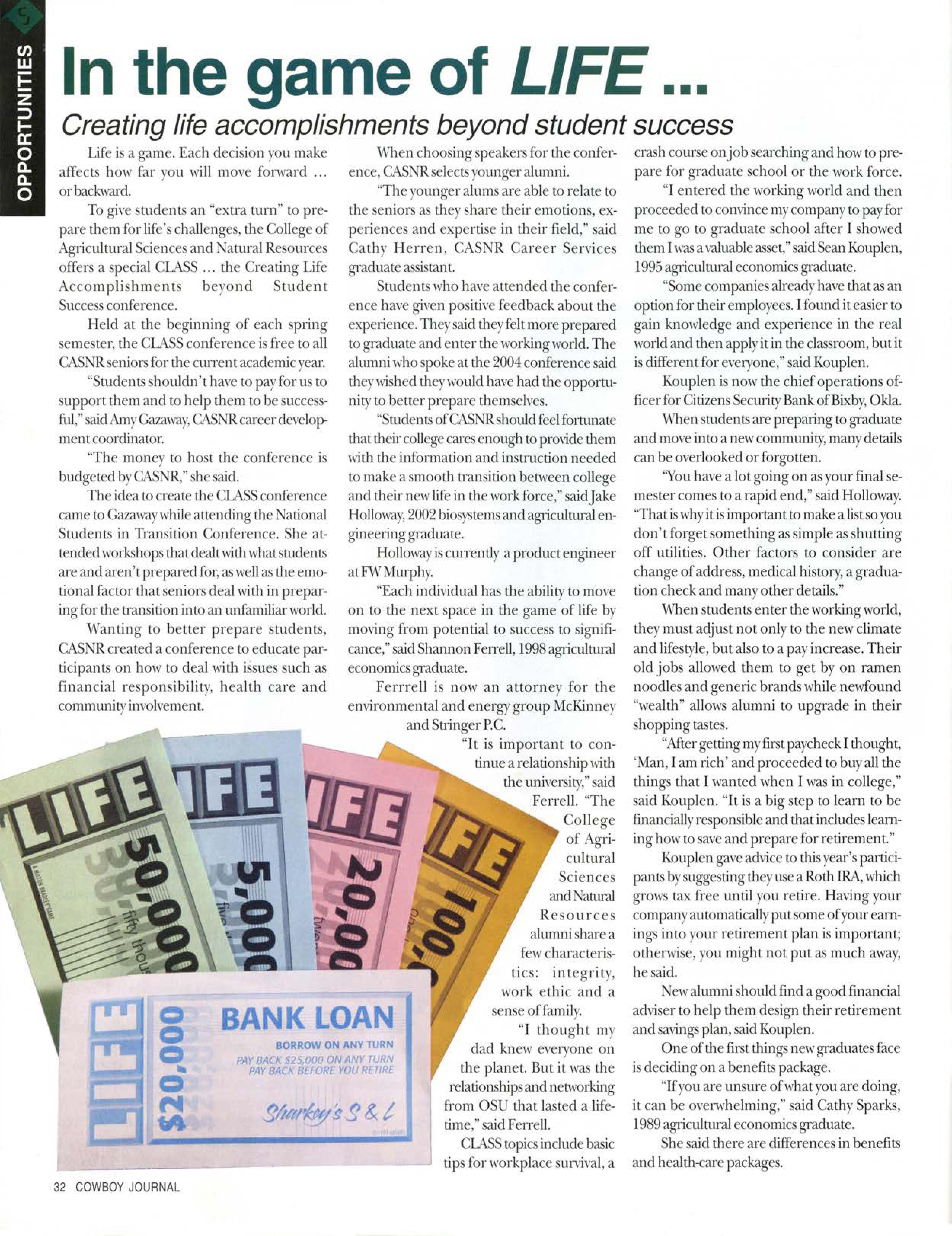
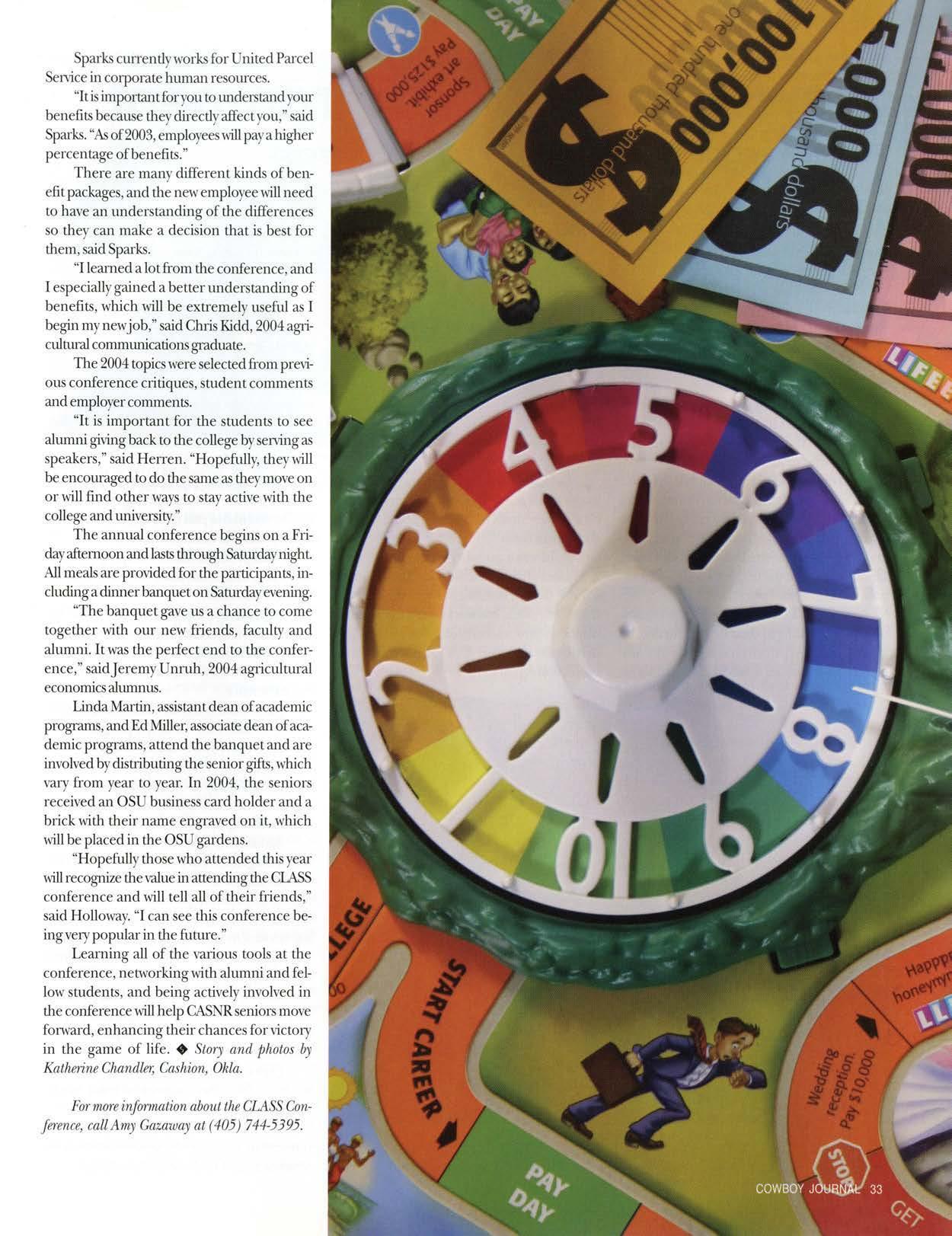
In the game of LIFE ...
Creatinglifeaccomplishmentsbeyondstudentsuccess
Lifi i a o-ame. Each d ci ion you mak affects how far you will moye forward or backward.
To give tudenis an "extra lurn" LOprepare them for life' challenges, tl1eCollege of Agricultural cience and NaLural Re ource offers a . pecial LAS ... the Creating Li~ Accompli hment beyond Student ucce conference.
Held al the beginning of each spring emeste1~the CLAS conference i. free to all CASl\lR.enio1 for the current academic •ear.
" tudents houldn 't haYeto pay for u to upport them and to h Ip d1em to be ucce sful,' saiclAm}'Gazaway, l\'Rcareerdev lo[r m nt coordinator.
"Th mone to ho t d1 conference i budgeted by l\lR," he said.
The idea to o·eate d1e lAS conference came to Gazawaywhile attending me National tuclent in Tran ition onference. he attended workshop t:hatdealt\\~tl1what tudents are and aren't pr pared for, as well as di emotional factor that eniors deal ,,~th in preparing for d1e tran ition into an unfamiliar world.
Wanting to better prepare tudents
R created a conferenc to edu ale participant on how to deal witll i ue such a financial respon ibiliL)', healLh care and communjly involvement
When choo ing peake1 for me conference, GAS rR, elects •oungeralumni.
'The younger alums are able to re lat to the enior a they hare lheir m tion , experience and experti in th ir fi Id," aid ath Herren, CAS 1R areer ervice graduaLe a i tc nt.
Stud ms who have attend cl the confi rence h ve given p itive feedba k about the expeiience. The •said d1e felt more pr pared to graduate and enter d1e working world. The a1umni who poke al the 2004 conferenc aid d1eywi hed they would have had the opportunity to better prepare d1em eh·e .
" tud nts of rR hould feel fortunate that meir college cares enough to prm~de them wid1d1e information and in Lruction needed to make a smooth transition between college and meir new life in the work force," aid Jake Holloway,2002 bio y tern and agticultwal enginee1ing graduate.
Hollowayi ctuTently a product engineer atFv\ Murph
"Each indi,~dual ha the ability to move on to the next pace in the game of life by mo ing from potential to ucce to ignifianc ," aid hannon Ferr ll, 199 agiicult:wal economi !!raduat
F rrrell i now an attorney for the environmental and n rgy group McKinney and tringer P.
"It i important to continue a r lation hip wid1 the unive1 ity,"said Ferrell. "Th oil o-e of Arirnltural
BANK LOAN
haracteriint grit' thic and a ffamil. th u ht my dad knew ,, 1 1one n th planet. But it was the relation hips and n tworkino-
from O that la t d a Imtime," said Ferrell.
CLAS topics ind ude b ic tip for workplace unival, a
rash cour on job earchino-and how to prepare for graduat: school or the work force.
"I entered me working world and d1en pro eeded to con~nce my company to pay for me to go to graduate chool after [ howed them 1wasa valuable ass t," said Sean Kouplen, 1995agricultural economi graduate,
" om companie already have that as an option for d1 ir mplo ee I found it easier to gain knowledge and experience in d1e real world and dlen apply it in me classroom, bu lit i differentfor veryone," aid Koupl n.
Kouplen is now die chief operation officer for itizen ecurityBankofBixby, Okla. vVhenslllden are prepa1ing to graduate and mm·e into a new community, many details can be overlooked or forgotten.
"You have a lot going on a your final eme ter come to a rapid end," aid Holloway. "That i wh it is important to make a Ii t o you don't forget omething a imple as hutting off utilitie Other factors to con icier are change of addre medical hi tory, a graduation check and man other details.'
When stud en ts enter tl1eworking world they mu t adju t not only to the new climate and lifestyle, but al o to a pay increa e. Their old job allowed them to get by on ram en noodle and generic brands while newfound "wealth' allow alumni to upgrade in their hopping taste .
"Aftergetting my first paycheck I thought, 'Man, I am rich' and proceeded to buy all the things that I wanted when I was in college," aid Kouplen. "It i a big step to learn to be financially re pon ible and d1at indudes learning how to av and prepare for retirem nt."
Kouplen gave ad~ce to this y ar' participants by ugge ting mey use a Roth IRA,which grow tax free until you retire. Having your companyautomaticallyput omeofyour aming, into your retirement plan is important; othenvi e, you mighL not put as much away, he aid.
1 walumni houldfindagoocll:inancial advi er to help them design their retirem nt and a~ngs plan, aid Kouplen.
One of the first d1ingsnewgraduat face i deciding on ab nefits package.
"If you are unsure of what you are <loin,it can be overwhelming," said Cathy Sparks 19 9 agiiculnual econonuc graduate. he aid tl1ere are differ nee in benefits and healm-c.-'lrepackage
Sparkscurrenlly worksfor United Parcel Servicein corporatehuman resources.
There are many different kinds of benefitpackages,and the newemployeewillneed to have an understanding of tl1edifferences so tl1eycan make a decision that is best for tl1em,saidSparks.
"I learned a lot from the conference.and I especiallygained a better understanding of benefits, which will be exu·emelyuseful as I begin mynewjob,"said ChrisKidd,2004ag1iculniralcommunicationsgraduate.
The 2004topicswereselectedfrom previous conference c1itiques,student comments and employercomments.
"It is important for tl1e students to see alumni givingbackto the collegebysen~ngas speakers," said Herren. "Hopefully,they will be encouragedto do tl1esan1eas tl1eymoveon or will find other waysto stay activewith tl1e collegeand unjversit.y."
The annual conference begins on a Fridayafternoonand laststhroughSalurdaynight Allmealsare providedfor the participants,includinga dinner banqueton Saturdayevening.
"The banquet gave us a chance to come together with our new friends, faculty and alumni. It was the perfect end to the conference," saidJeremy Unruh, 2004 agricultural economicsalumnus.
Linda 1\fartin, assistant dean ofacademic programs,and Ed Millet~associatedean of academic programs,attend the banquet and are inrnlvedbydistributingthe senior gifts,which vary from year to year. In 2004, the seniors received an OSU business card holder and a brick witl1their name engraved on it, which 11~11be placed in tl1eOSUgardens.
"Hopefullythose whoattended this year willrecognizethe valuein attendingthe Cl.ASS conference and will tell all of their friends," said Holloway."l can see this conference being verypopular in the future."
Learning all of the various tools at the conference, networking"~tl1alumni and fellow students, and being activelyinvolved in t11econferencewillhelp CASNRse1uorsmove forward,enhancing their chances for vicLOt)' in the game of life. Story and photosby Kat/wineChandler,Cashion,O/ila.
Go to college,get a degree and get ajob. This is t.he route many high school students embark after graduation. It seems simple, but formanyitisa road without a map.
Students who decide to continue their education after high school have difficultdecisionsto make before choosinga degree, and decidingon an academicprogram can be difficult because student~ often do not know exactlywhat career area to pursue.
The goal of manystudents is to concenu-ate their studies in a discipline of interest, one in which they would like to acquire employmentafter graduation.
"If you havescience in your background and would like to work \\~ththe en~ronment in the future, you are a perfect candidate to be a student in the environmental science program at OklahomaStateUniversity,"saidDa\~d Lewis,director oft.he OSU en~ronmental science undergmduateprogram.
Since the first em~ronmentalsciencestudents began filling in their degree sheets, the faculty'shighest priority has been to givestudents a broad academicfoundation t.hatallows
t.hem a lot of career flexibilityafter college, said Lewis.
When Ch1is Ruhl gi-aduated from high school in the small town of Geary, Okla., he already had a plan in mind for his future. He had picked a degree t11athe nor only liked, but also one that wouldreward him withajob after gi-aduation.
"Growingup, l wasalwaysinterested in the en~ronment, and t.hisseemed like the pe1fect fit for me," said Ruhl. "Before J entered tl1eprogi,1.m, I spoke to somepeople who said mere were good employmentopportunities,which ultimatelymade up my mind."
Ruhl said me fact tl1eprogrnm is located in me College of Ag1iculturalSciences and Natural Resomceswasa sellingpoint, since he grewup on fann.
Ruhl was a member of the first class of grnduateswho completed the en~ronmental science degree in 1996.Since his graduation from OSU, Ruhl has worked as a compliance inspector and, most recently, as an on-scene inspector for the U.S. Environmental ProtectionAgency.
During his time as a compliance inspect01;Ruhl ~sited a varietyoffaciUtiesacrossthe country,including some of the world'slargest oil refineriesand chemical manufacturing facilities.
As an EPAon-scene inspector, Ruhl has experienced many en~ronmental risk sites, including "Ground Zero" followingt.heSept. J 1 attackson NewYorkCity,when he wascalled to the site to help assessme area for emfronmental contamination. He also has ~sited regional disasters,such as a 5,000-gallonoil spill, and spent time at the Columbia space shuttle crash site in Texas.
Ruhl said he enjoys the u,wel involved with hisjob. He also acknowledgesthe education he receivedas pan of hisdegreehas helped him become successfulin this field.
"Jam proud of where [the program] has come and what it has done for me in my profession,"said Ruhl.
Because the classes environmental science students take are so diverse,it iscommon that students will receive interest from companies not directly involved in en~ronmental science.
Julia Arntz is a 2001 environmental science graduate who wasin the program from the day she set foot on the OSU campus. She said it was alwaysher intention to apply her education directlyto a career in en~ronmental science,but due to a fortunate u,~stoffate, she isworking in a different type ofjob.
Arntzsaid the classesshe took in political science, agricultural policy,agricultmal economicsand environmental science prepared her for her current position as a field representativefor CongressmanFrnnk Lucas.During her stint in Washington,D.C.,as an aide to Lucas, she used some of her en~ronmental knowledgeto b1iefLucason variousissues.
"I reallyliked tl1ediversityof the program and how I wasable to spend time with professors from many different departments," saidArntz.
Lewissaid the progrnm was initiated in the late 1980safter suggestions from faculty and students in the college.
EmployersofCASNRalumnialsowereinr.erestedin attaining the sen~ces of students ,vith environmental science knowledge.
Katie Frey,environmentalsciencejunior from BrokenArrow, Oklt,., prepareswatersamplejllrs befortcollectingand testingwater at lake uzrl Rlackwe/1.The water-testingprojtcl is sponsoredby the OSUEnviro11mmlalScienceClub. Studentswho take part iii the water-testingprojectmust be certifiedlo perfomiofficialtests.(Photoby DarbyCochrane)
"In 1993, we were given permission from the State Board of Regents in Oklahoma City to offer a major in environmental science," said Lewis.
He said the strengths of the campus were taken into account when developing curricula for the degree. This allowed the steering committee to take full advantage of the knowledge that could be gained from outside CASNR.
Since environmental science is not an academic department, the program is guided bya steering committee of volunteer faculty. The comminee has created some principles that guide the curriculum in a direction the faculty members want the program to go. By doing this, faculty members feel the program is one of the most focused in the country, said Lewis.
The environmental science program at OSU has a reputation for supplying students with a quality education that willprepare them for a variety ofjobs when they graduate from college. One of the features that makes the program unique is the fact students receive u-aining in other disciplines.
"The interdisciplinary nature of the program is a good thing, and we are trying right now to expand the interdisciplinary nature of the program," said Lewis. "We are at the start of an experiment to see if we can recruit faculty from outside the college to be interested injoining the steering commjuee, which has never been done before."
Lewissaid CASNRis a good place for the program because there is a lot of interest in the environment from within the college.
"A lot of the faculty have concerns about the environment from within their disciplines," he said.
Lewis said the program tends to be oriented more toward the application science, which is one of the characteristics of the college. Because many required classes on environmental science degree sheets are in other departments, a minor in those departments is easy to achjeve.
The chance to further one's academic career is also a great asset to this program. An undergraduate degree prepares students to further their education with graduate degrees. Lewis said many graduate degrees can be attained with the foundation of an environmental science degree. He also sajd lawschool is a good opportunity for someone with this undergraduate degree.
Students entering the environmental science degree program receive training forjobs related to the environment in industry, government agencies and consulting firms. With the environment being such an important issue in recent times, the need for environmental science stu• dents will continue to grow, Lewissaid.
Lewis said the program is going strong with 70 students on environmental science degree sheets. Even though the program has enjoyed great success, there are still areas faculty members are trying to improve, such as identifiable officespace withinAgriculturalHall for the program, he said.
Lewisis optirrustic about the future of the program and the need for his students in the workforce.
"Students of the environmental science program get employment in about the same length of time as other majors, and their starting salaries are slightly above those from the rest of the college," said Le¼~S.
As the days draw closer to graduation, Corey Gum is pleased with the decision he made, transferring from Tulsa Community College and joining the environmental science program at OSU.
"I wasworried about the lack of actual environmental science classes that we took, but I enjoyed being able to study all the other scientific disciplines," said Gum. "I like that I am not only prepared for an environmental science job, but I also feel prepared for almost any other job."
Hearing your name called during commencement marks the end of one journey and the beginning of another. Environmental science student5 have satisfaction in knowing they are equipped with an education that has them prepared for whatever career they intend to pursue. By Darby Cochrane,Alexander, Manitoba,Canada.
Formoreinfmnationabouttheenvironmental scienceprogram,call David Lewisat (405) 744-6723orvisit the CASNRWebsiteat http:// casnr.com.
Lisa Fultz (left) of Stillwater,Okla., mid Katie Freycheckthe resultsof their waler test. The tests monitordissolvrdoxygm levds, watertemperature,air temperatureand willerclarityat lake Carl Blackwellnear Stillwater.(Photoby Darby Cochrane)
AyakoAlwbane(right)and AdeleTongco(secondfrom
As the international roads and borders become increasinglytransparent, so do the classroom walls of Oklahoma State University'sCollege of Agricultural Sciences and NantralResom·ces.
Coursesofferinginternational travelopportunities broaden the world for students, said AdeleTongco, CASNRinternational programscoordinat01:
OSU has studyabroad programs offered in va,yinglengths,rangingfrom a foll-yearprogram lo two-or three-week sessions. More than 350 students participate in these study abroad programseach year.
Some students have never heard about studyingabroad, and if tJ1eyhave,theyare not familiarwith the planning process,said David Henneberry,CASNRassistantdeanof internationalagiicultura.lprograms.
"I think you have to start with yourself, who youare, whatexpe1ienceare you looking for, what your strengths and weaknessesare, what your academic background is, what you want to do wirJ1your life,and what your goals are," said GerryAuel,OSU studyabroad coordinator. "Youneed toassessyourqualities,both personaland academic."
There isan extensivepreparation process prior to taking a study abroad trip. Students learn tJieproper protocol \\~thhelp
from tJ1eSn1dyAbroadOfficeand the CASI\1R Officeof International Programs.
According to the Study Abroad Office, planning is the key to successful studying abroad, and the earlier a student begins planning, the better the experience can be.
"I think the vet)' Grst step before anything is to develop a mindset that you are actuallygoing,"saidAuel. "Youneed to get your mind fixed on the idea that this issomething you are acluallygoing to do."
The next step is for students to let their academicadviser,as wellas UleStudyAbroad Officestaff,know tJ1eyare interested in smdying abroad and what kindsof studyabroad prer grams willmeet tJ1eirneeds, either short term or long term. The Study Abroad Office will provide st1.1dents1\~thinformation and help students decide their best option.
The short-term study abroad program, which laststwo to Ulreeweeks,can count for up to tJ1reehours ofintemational dimension credit. if a student is interested in a long-term studyabroad program, he or she should make sure all tJie courses taken abroad transfer toOSU.
To make sure credit hours willtransfer,
Preparing
he or she should have the courses evaluated ahead of time, submitting documentation of coursesyllabiand classroomhours for evaluation. A student's adviser can reviewa degree sheet lo see what courses will meet the student's academicrequirements.
''Y./ehal'e many students who decide to su,dyabroad, and lheydon 'tactuallyneed the credits," said Henneberry. "For most of our students who do studyabroad, it's something they can point to as being above and beyond tJ1eminimum requirementsfor a degree.
"Ilshowsan individualeffort,which is an imponam human characte,istic."
A half dozen Liipshavebeen av,ulableto students through CASNRwitJ1inthe lastyear.
"Wehave had 90 students participate in study abroad programs in lhe last year,"said Tongco. "Students and facultyhave a·aveled to six amazingcountries."
Choosea Location& EvaluateLanguageSkills
WesternEurope isan atu-activeoption to the majority of srudents. However,st11dents alsoenjoystudyingin Asia,Africa,EasternEurope and L1tinAmerica,saidTongco.
"I had never been outofthecounll)'before, so I wanted to go abroad," saidJennifer Walke1~an animalsciencesenior:"I choseHonduras becauseitisa Spanish-speakingcoW1try, and since I took two years of Spanish in high school, it made me feel more at ease about the trip."
Language ability is a primary factor in choosing where to study. If students are not fluent in a foreign language, they might specifically want to study abroad to improve languageskills.
Being a member of the Global Agricultw·eOrganizationalsomight be a good qualification to have before LI-avelingabroad said Henneberry.Thisisa neworganizationfonned in Sp1ing2004.
Its purpose is to develop relationsamong domestic and international students at OSU. The org-,1nizationwillfamiliaiizestudentswith various cultures, which willbe an asset when travelingoverseas.
Agoal of tJ1eorganizationis to encourage students to travelaboveand beyondtJ1eixstudies at OSU.
left) t1iiitthe C/iaingRai Giant CatfishFarmin Thailand where lheysaw catfish weighingJOOpo1111ds or more.(PhotoII)·K,-istaRowe)
to travelacrosstilellliles
Obtaina P~ort &VerifyMedicalInsurance
Iti importamtoappl forapassporlin advance asproce ingan applicationtakesfour to six weeks and sometimes longer during a heavyu-avel eason.Application are availabl a postoffi e , counhou s, or pas portagencie of the .S. Departmento State.
'The co l of pas pons range from 50 LO 60, and they only need tO be renewed every IOyears," aid Walker.
vi a al o may b obtained to enter foreign country. It is a written perm is ion to vi itacounuygrantedbyth governmentof tha country. lfa tudenti planning to study in a foreigncountryfor an extended period of lime, he or he may n ed Loacquire a pecial tudent ,~ a. Relatedinformation tO visasmay be obtained from th proper embass}',
'Don't wait until the la t minme to O"eta passportor visa" aid Auel. " ometim s a vi a takestwomonths to be completed,and ifsomething happens and you don't (T tit on time, you mayhav to cancel flightsand re chedule. Youhave LOb pe, i t ntand organized. Alo, you have to apply tim -managemen kills to get v rythingdon ."
Ampleinsma.nceisanother import,1.ntfactor to consider when going abroad. Before departure, be certain medical and accidental insurance policie ar valid outside of the nited tats. Astudentmightwanttoconider buying cholasti Over ea ervice inurance availablethrough the Office of Risk Managementat O U saidHenneben . A ph}'ical and dental check-up\ OLt!dbe good to conside1;aswouldanyspecialvaccinationsrequired for the trip.
ArrangeTransportation & FmanceI.heTrip
The CA Officeoflnternational Program handle the m,tiorityofthe u-an portation for its hon-Lenn,faculLy-ledprOQTams. ft is important to look in advanceat vaiiousflight option to find affordabletickets.Travelagenciescan al o provideadviceon specialstudent llighL5and di 01111tsforsmdyabroadprogram
om students are hesitamabouL traveling due to afetyi ue aftenhe ept. 11,2001, terrorist attacks, aid Auel.
"There are noLnece arily new safety iues ince ept. 11,» aidAuel.
"However wear now more awareof the safetyi sue that existed even before Sept. l l. Stud abroad profe iona.l paymore attention
to prepa,ing their mdents to b wi e u.wele1 and encourage them to u e their ommon en e and good judgment. The tale department W b ite are very helpful in pro,~ding u eful information and suggestions to tuden t u-avelers."
After students decide wh re they will o-avel,they hould find om roughlyhow much it willcost.
"Fundin(1 i a problem for many cuden owe are U)fogto get more cholarship ," aid HennebeITy. "WeI ope a our progrnm gets older that cholarshipswilldevelop."
o t varybased on the country chosen for tudy.
" o ts can range from 2,000plu airfare fora hort-tenn,fucuh:y-ledprogramLO 12000 plusairfarefor a emesteron a u-aditionaltudy abroad pro ram " aid Auel. "Areciprocalechange where ·tudentspay tuition and fee to their home in titution, co ts approximately ,000p r • mest r depending on U1elife tyle of the tudentand the amountoftrnveling he or he en ag in."
Studyin abroad can be an enri hing, life-changing experien for an tud nt willing to experience it aid uel.
"M word ofadvicefor tudentswhoare intere ted in study'ng abroad are '.J T DO I ,'" said uel. Once youget on the train you can't get off, and youju t have t plowahead and do it."
Reflection after the experienc may reveala tudcnt' true perception ofth valu of a tudyabroadprogram.
"I have never heard students say they rgreetedsmdyin(1abroad" saidAuel. "Ev n sn1clentswho had a tough time come backand say they would do it again."
When tudents return LO the United tate after studying a.broad,they come back with a different tale fmind.
"AfterI returned from Hondurns, people told me that the trip really hanged me,'' a.id Walker."Tthink it made me a u·ongerpe1 on and more awareofinternational cult'ure."
raveling abroa I also can help tud nt gain individual trength
"The variousstudy abroad program are good for you to go on becauseU1 push you to be more independent," aid Walker. "It give you a sense of re ponsibilit and independence.'
raveling open a window to a world of new experiences. globalization increases, o do Lheopportunilie for tudents to participate in international tucl program By KristaRowe, traiford,Okla.
For rnoreinformation, visit the Office of International Programsin Agriculture 139 Agriciiltural I-fall, or vi it hlt/J:// www.dasni:oh.state.edu/inlernational/.
Ltft : .Je1111iferWalker (front), Rachel PmJmrm Ayako Akaba11,and m1 1111k11ow11/011ri.1Iride rlmvn I/ir Mn, Nn111Chao Phmya Riurr iu Thailand. (Photo by f.:ri In RJJw,)
Br/ow: tllejmulm 1imgco(froul lejl), Adele To11gco,Dia11a.fm1lnk(I(/,tl)'a Ohtomi,.Jmnifer \\'allier (bar/1),jflmPs /wl/Pr nnd Bmd.rSir/welluisit Chiang Mai Doi Doitlian i11 Thai/a11rl.I Pholo b)' Kri In Nowe)
le ridesgoodhorses
CASNR alumnuswinsat All AmericanQuarterHorse Congress
BrianBendelebacked into the box riding MissJee Slider, his piggin' ming clamped Lightlyin his teeth. ln anticipation and excitement, the crowd awaits.The chute opens, tl1e cal[ runs; Bendele rides out and throws his rope.
Seconds later, and with a score of 222, Bendele and MissJet Slider won the amateur tie-downroping at the AllAmerican Quarter Horse Congress.
"It was my first time to show at the Congress, and it was an honor to win it," said Bendele, a 2004 alumnus "~th a double
Bendele has been around horses all his life. His parents, Mike and Sandy,were both club leaders of the LincolnCounty4-HHorse Club in Chandler,Okla.Thanks to hisparents' support, Bendelewasgiventhe opportunity to start showing horses at a young age. His parents provided him with quality horses so he could compete at top levelsagainst other exhibitors. Asa result, Bendele has excelled in rodeos and horseshows.
Bendele started roping calves when he
was10,and the newsport became his passion. He chose calf roping over football, and it was then that his roping intensified.
Bendele devoted his energy to the Lincoln Coumy4-HHorseClub,4-Hand FFAjudging teams, horse showsand rodeos. His talent de\'elopedas he began o-aininghis ownhorses for competition, including MissJet Slider.
When Slider was 2 years old, Bendele workedhard to prepare her for the Oklahoma State4-H HorseShow.For tlie show,each competitor breaks,trainsand showshisor her horse in showmanshipand westernpleasureclasses.
Brian Bendelentop MissJet Slide,;stands with his /mre11ts,Mike and S(l11dyBm<lele.at the All AmericanQ,wrte, Horse(.Q11gress.(Photoprovidedb)'Jeff Kirkbride)
In I 997, Bendele and lider placed fourth at t.hestate 4-Hhorse competition. Bendelesaid placing in the top IOwa exciting.
l-101e likeMi J t lidel'.who e purpo e in the AmericanQuarter Ho1 e Associationi roping, hould be well. uited for competitive timed roping events outside t.heAQHA.Mi s JeL lider is 9 year. old and ha earned more than 100combined QHA points since 1997. E.1.mingthe e pointsmean travelinghundreds of mile and winningatva1iou horse ·hows.
DuiingaJ1ow,tie-downroping horse are judged on manner behind th barrier, scoring peed and di Lanceto the calf, Lopping, workin the rope, and mannerswhil th roper r turn to the horse after t.hecalf i tied.
B ndele ha shown his hor e and comp t din rodeosfrom Ohio lo Texas.He knm1 , hat ittake to be a 11~nner.
Everyyear the Congres exceed 16.000 en11is.Top hm esand competiL01travelhundreds of mil robe judged on the ho1 e 'and riders' abiliti s.
After winning Lhe Congre , B ndele placedfifthat the AQHAWorld how.He came back to Stillwate1;Okla., , 1,508richer.
"It' excitingand rewardingto raisea horse and train it to the point of World how quality," aid Bendele.
There i a good reaon Mi Jet !icier is a "goodhor e." he isa producLof OS 's LOpsLallion 0 onny lider.
0 U onnys lider i a 12- ear-old bay tallion ired byHarlan Okmulgee and foaled b Mi kippernel. 0 Sonny. lider canies on the tradition of great pe1fonnersin the how arena, aLrodeo and on t.heranch.
OS Sonn !icier has produced at least 1.00 regi tered foal . Every •ea1; 0 U Sonnys !icierhas produced at lea tone AQHA World howqualifiera~well asseveralhorses\ ho placed at 1.heOklahomaCity how.
The O equine breeding program has been recognizedthroughout the nited tate becau e of the performance m1its p, ed on b OS 01111 lider.
''He lit imo our br eding program perfectly,'' aid DavidFreeman, profe sor of animal science."The mare wewere getcino-wer roping bred and cow bred. They wer hors s tJ1atwere genetically geared taward performance."
0 U onny lider ontinue to breed quality mare with the intention of making more world•dassperfo1me1likeMis.sJetSlider. Hors produce1 who paythe 1,000breeding le and breed their mare to O U 01111 Iicierknow their hor es ar equipped \~lh a good mind, conformation and ability to perform in and outsid LJ1carena.
·•oU Sonn} lidcr i a qualit producer," ·aid teven Cooper, a ·i tam profes or of animal science at OSU.
lt take a good horse and talemed 1id rs like Bendel who ar devot d LOpractic a1 d di cipline ro earn championship titJe
For Bendele, finding tim 1.0practic around chool wasnot difficult.
"Ijust managed my time well,' he said. "I wenI to class,then to work LOrope and LOdo m homework."
Drning Bendele'· college xpcrienc , h worked for th· "SUN P" televi ion how for more than fouryea1 . He alsowrote for the Ag Alumni ewsand UaveledtO Au tria and Ger-
manyto put on ho1 eman hip clinicsthrough the O equine program.
Whilein chool, Bendelelivedon 12acre and had hi own roping arena .outh of Stillwater.Ha,~nghi own place made it easier lo care for hi ho1 es and praccic his roping.
Along 11~thMi Jet !icier,Bendel 1ides Hkko1 • hiloah. hiloalii' an year-oldbrown geldingBendele takeswhen he i on Lheroad. BotJ1horse have proven LObe winner in Lhe showarena and at rodeos.
"Both hot ·e are sea oned and are ready to go at all time ," aid Bendele.
"lfi wasn'tforhor e ,m grade would not hav been as good. I learned a lot.about responsibilityanddisciplinebyraisingandtraining myown horses.
"When you're rnisinghorsesyou learn to be re pon ible for another li~ be ide your own,' aid Bendele."Ho1 e are a lot of work. Youget up early in the morning to feed, and you haveto spend tim \~th them. Th yaren't like a dog ou take on walk or play with;you have to connecLwith them in such a waythat if ou want them to ,~n, you have to make them a winner.
"I realizeI am ve,yfort1mateto havegood hor e and paren who upport me." There are everal people who don't get a chance to do what T do. Jf it wasn't for my hor e and parents who gaveme the opportunity to show, rodeo and have an educaLion, I wouldn't b wh r I am toda ."
Bend plan to compete in Lhe Prof ional Rodeo CowboysAssociation.
The Lhril1of a good run i LJ1eresult of yearsof hard workand Lraining,all of, hich can culminate in a championshiptitle.Every time Bendele 1.ravelto a tie-downevemand thrm his rope iti a tep toward uccessand an accomplishment of his goals. For Bendele, there are no boundaries. By Dawn Baxstrom, Drumright, Okla.
Bendel, reps off Miss Jet Slider lo tie a calf at (/,e ,\/1 American Q,wr/PrHorseCongms. (Photo byJeff Kirkbride)
kiek.Sa..1-kids
01<.lahorv,a+--1-f-teaches children -to ea-t ri~J-.,-tand exercise
Tennisshoesand Oklahoma4-Hmembers are helping kids make healthy choices while introducing them to 4H.
Oklahoma 4-H teenagers are traveling into local elementaryschoolsacross LheSLale, teaching children how to take care of their bodies. They are helping \1~tb Kicks4Kids,a
4-H service project developed by the Oklahoma CooperativeExtension Service.
"The fundamentalpurpose ofKicks4Kids is to help alle,~ate childhood obesity by encouraging kids to exercise,eat right and practicegood hygiene,"said KarlaKnoepOi,extension 4H assistantspecialistfor volunteer and
leadershipdevelopment.
"The secondaiypurpose isto giveathletic shoes to children who u·ulyneed them."
The program teacheschildren in kindergarten through fourth grade the importance of physicalactivity.
JIchildren learn the importance of good health ata young age, itis more likelytheyv.~LI carry healthy habits into their adulthood, said Knoepfli.
Kicks4Kidscan be Laughtas a workshop, used as an after-schoolprogram or combined into the dassroomcuniculum.
The cuniculumcan be taughtin anyyoutJ1 organization. ''Being Clean and Cool,""Feeling Fit"and "EatingSmart from the Start" are the lessonsKicks4Kidsprovides.These lessons make the participants feel better both mentallyand physicallywhileimprovingtheir overall well-being,said Knoepfli.
Manyof these children have lowself-esteem, and this program is designed to help reduce that anxiety,said KnoepOi.
The Cheyenne Senior 4H Club wasone of the firstclubs to participatein the program.
"Ittookapproximatelythree hours on one afternoon to present the program," saidJudy Tracy,CheyenneSenior4-HClubleader. "The localdentist came and gaveall tJieparticipants toothbrushes and dental floss and showed them proper dental hygieneprocedures."
Kicks4Kidshas many advantages for everyone involved,said Knoepfli.The teen volunteers learn communication and orgai1izarional skills and what it u·ulymeans to be a teacher. Both the presenters and participants get a chance to learn more about the importance of proper nuuition.
"It was worthwhile to all the volunteers and participant5,becauseeveryonelearned together," said Tracy. "The teen volunteers coached tJ1ekids injwnpingjacks, knee lifts and other exercise movements to keep their heart rate up."
The volunteers even have opportunities to help in tJieir area ofintcrest.
"I like to cook, so I taught the kids safe wayst0 cook in the kitchen," said 15-year-old WhitleyTracy,vicepresident of the Cheyenne Senior4-H Club.
The teen volunteers present all the ma-
terial whil th adult mentors au as supe1;risors for the day,said Knoepfli. The teens do background researchon the I ·on topicsa.ncl find waysto enhance d1emate1ialin a waythat l\~II be in teresLingto the participan
"M advice to other Kick 4Kid teen voluntee1 i to b · reallynice, patient and [1iendl LOthe kid and I t them U')' everytlling," aid WhitJeyTracy."Encouraget.hekids tJ1atwitha little bit of help they can do anyLl1ing."
The 4-H'er er ated game and on in an effort to make it an enjoyable and memorable experi nee for all die participants, aid Kno pfli. t the end of the program, the teens encourage LheparticipantsLofillout an valuation of the program.
"Wehad several children in our chool ommunitywho were obese, and our club felt that it would be beneficial to teach them how to properlytake care ofth ir bodi s" aidJud Trac. "Wehad 14childrenjoin inon the fun, but we had a po ibilityof having 45 children participatein the program."
Nationalstati tics how 13percemof chi.1dren ages 6 to 12 and 14 percent. of children age· 12 to 19 are overweight, aid Knoepfli. The e overweightchildren are at high risk for cardiovasculardiease,diabete andother e1iou health problems. Obesityalso can lead to depre ion, low elf-e te m and other mental problems.
4-H teen who choo e Kick 4Kid as their en~ce project ar re ponsible for contacting local chool offi ials to gain th ir consent for implementino-me program. Localbu ine es are encouraged to donate ad1letic hoe for needychildren, ho are participatingin phy ical education classe
Oklahoma4-Hambassad01, tate and di u·ict4-Hoffice1, and severalcountystaffmembers are promoting tJ1eprogram statewide.
Kicks4Kidhas been implemented in several schoolsaero the rate;however,the main goal i to haveat leastone program in all of the 77 counties, aid Knoepfli.
"Oklahoma 4-Hha been getting a lot of attention on the national level for the Kick.s4Kidsprogram. Hopefull , it ,,~!Ibecome one of the next big' community ervice proj cts,"saidJo h Grundmann, 2 03-04Oklahoma 4-H outl1eastdisu·ictvicepresident.
The idea for ilie program wasconceived byOki homa' deleo-ate to National4-HConference in Wa hington, D.C. They had one goal in mind-creating a community en~ce project that can be pre ented b any youthenfog organization tate11~de.
The id a became realit, when they borroweda community en~ceidea called"Happy Fe t' froma 4-1-Imemberin Minn ota.."Happ Feet"pro1~dedchildr n wid1ad quate ad1letic shoes for physicaleducation classes.The Oklahoma team saw tl1epos ibilitiesof adding an ducational component that included nutrition, exercise and hygiene. Thi was nly the beginningofwhatisnowknownas"Kicks4Kids."
ince then, Kicks4Kidshas been ndorsed bythe OklahomaDepartrnen t ofEch,cationand i becoming "~delyknown throughout man otJ1er tates. The Oklahoma Cooperativ Exten ion en~ce provide training for teen and adult volunteer of an )' uth-servingorganization wishing to implement th program in their community.
The ODE,0 E 4-HYontl1Development, and the OS Departmentof FamilyCon tuner ci nee provide educational information.
The Kicks4Kidsprogram is funded through gran and privatecontribution
Kicks4Kid will benefit youm organi-
Each daJ in Oklahoma,elemcnla1)'studmtJ pref,ore for a ntl participate in php;ical edumtim, r/asses. (P/11,tosby Bmndyfngland)
zation needing a communityse1;riceproject said Kno pfli.An organization tl1atencourages leader hip development i invit d to u e the curriculum a long as Ll1y have an adult mentor to work\1~thd1 students.
Ki ks4Kid i helping participants mak heald1y hoice and teaching them about the lue of 4-H.After all, it take a happy head, a healthy heart and helpful hands Lomake harmonic health. By BrandyEngland,Dibble, Okla.
for w;re informationabou/Kick 4Kidsor theOklahoma4-H, call(405) 744-8891orvisit hlt/J://dover.oil.state.edu/Jourh.
Four yearsago, RandyandJovitaBlackof • Lone Grove, Okla., started making • homemade salsa for thei.rfriends and family.They never knew their hobby would growinto a full-timebusiness.
The Blacks and thei.r daughter Carla Boulton nowown and operate PepperJo's, a companyin Ardmore,Okla.,that producesand packagessalsa,chili"fixin's,"seasonings,Pistol Pete's BBQSauce and certain typesofjellies for nine companiesin Oklahoma.
The Blacks'cl.reamof a salsa-basedcompanydid not developovernightWithresources liketheFoodandAgiiculturalProductsResearch and TechnologyCenterat OklahomaStateUniversity,dreams are coming true for smallbusinesseslikePepperJo's.
FAPCofficialshave workedwithOklahomansacrossthe state to help tum hobbiesinto successfulbusinesses.
Asthe Blacks'businessstarted, they produced salsa for friends, family and a few Ardmore-areastoresin a restauranttheyrented a fewnights a week.
"'-Nefirst started in a restaurant downtown,"saidRandyBlack."Wewouldgo downto the restaurant after it closed to make our salsa and wouldhave to be out before the breakfast run the next morning."
They said they never dreamed their hobby of producingsalsawoulddevelopinto an actual business with a whole line of products.
'We e~joyedmaking salsa and thought, 'As longas it paysfor itselfand makesa littlebit of money, it is worth it,"' said Black. "Then wejust kept growing and growing."
Looking for ways to grow effectively, the Blacksdiscoveredtl1eOklahoma Food and AgriculturalProducts Research and Technology Center throughan articleRandyBlackreceived from a friend at work.
"I called FAPC and left a message witl1Jim Brooks,"saidBlack."Hecalledme back, and that ishowwebecameinvolvedwithOSU."
Jim Brooks,FAPCbusinessand marketing specialist, along with other FAPC officials, worked with the Blacksin perfecting recipes and marketingtheir products.
"Iwasaskedto come downand lookat the product5and discussfurtl1erplansfor Pepper Jo's," said Brooks.
Brookspresented tl1eBlackswithsuggestions of Oklahoma retail sources to provide PepperJo's productsfor sale.
"It wasjust a matter ofoying to prioritize and take the time to get their products introduced to grocers," said Brooks. "They had to get their product out in front of tl1epeople."
FAPChelpsget newproductson the market and ato<1ctscustomersfor smallbusinesses like Pepper Jo's. For individualswho do nol want to get involvedin the manufacturingprocess,the center conducts monthly basictrainingworkshops.
Byrecommending tl1emanufacturingof products to va.1iousbusinesses,FAPCcontinues to help many companies across the state, includingPepperJo's.
Brookssaidcustomerswillsign confiden-
tialitycontractsfor recipesand production of their products. It is then turned over to companies like Pepper Jo's to produce and packagethe products.
"The greatest impact FAPChas made is sending us customers," said Black."Without tllat,we wouldn't be where we are right now."
One of PepperJo's most recent customers is Bill Bonny of Woodward,Okla. Bonny owned PistolPete's BBQSauce,and when his former manufacturer went bankrupt, he contactedPepperJo's and sold the sauce recipeto tile Blacks.
From there, they began producing and packagingPistolPete's BBQSauce.
'With Billworkinga full-timejob tll.rough the weekand tryingto distribute the sauce on tile weekends, it just got to be too much for him,"said Black."He decided to sell it, and he made us a good offer.Weare nowthe owners of PistolPete's BBQSauce."
The Blackswantedto be a legalcollegiate seller of tile OSU logo on the Pistol Pete's BBQ Sauce label. They took it upon themselvesto establisha licenseto sell an OSU collegiate product and became official in February2004.
"ILtook four months to get all the paperwork through to become a legal collegiate seUer,"said Black."Throughallour salesof the sauce,8.25percent of the proceedsgo back to the university."
With the successPepperJo's has experienced dming the pastfouryears,theyare growing steadilyand are running out of room in thei.rcurrent facilities.The discussionof expanding their businessand buildingnewfacilitiesis unden\lay.
The Ardmore DevelopmentAuthorityis working closely\\~th the Blacksand FAPCin developinga plan to upsizePepperJo's. They developedthe Build-to-Suitprogramthat monitors the construction aspect of building newfacilities.
Biian Thorstenberg,vicepresidentof developmentfor the Ardmore DevelopmentAuthority, sees a great future for the Blacks in the discussionof expansion.
"Randy,\lantsto increasecustomer-based
ale before expanding th ir facilitie ,·, aid Th01 tenberg. "He wants to make sure he i there financially before proceeding."
Taking their own famil recip and making a bu ine hO\ hard work and potential for PepperJo's in the furure said Tho1 tenberg.
'Randy and Jovita use th ir resources well by putting all profits back into th bu iness," aid Thoe tenberg.
The Build-to-Suitprogram i a lease purchase the Ardmore Development Authority oversees. It own the propercy on an indusoial park where Pepper Jo' new facilitie could be built. The program is de igned to donate the land to Pepper Jo's for the encouragement of expanding its busine . The project i estimated to cost between 300,000 and 400,000.
FAPC nginee1 have put together a few
,I
ba ic floor plan for the new facilitie . They have examined modem equipment for production and al o have developed a co t anal i of the total expense
"The new facilitie willgiveadditional buying power for Pepper Jo' , e tabli hing the Blacks to buy in bulk at a cheaper price " aid Brooks. "Thi could open anorJ1erdoor. Doing all th bu ine they can in newer facilities could double income and production."
Pepper Jo' line of products i in variou tore aero Oklahoma. The Blacksare working to get approval for ale in grocery chains statewide. Pepper Jo's has its products in a few chain depending on the geographical location of the stores.
Brook aid he encourage the upsizing of Pepperjo' and envi ion them as continuing to be a uccessful company.
,I
'Th [P pp rjo'] hav beenagodsend for mall bu inesse " aid Brooks. "Th have mad an impact on mall companie , helping th m package and produce their products. '
The Blacksare counting on production to continue ata steady increase but plan forthe new facilitie are till year away.
"When we are not trying to pick up more customer , we are trying to bring more produ ts on the line," said Black. 'The more products we have out there, the better chance we have of urviving." taryaridphotosbyBrooke Hayton Billings,Okla.
ToI.earnmareaboutFAP and theprograms FAPCoffers,visithttp://zm11w.Japc.okstale.eduor call.fimBrooksal (405) 744-6071.
Close encounters in agriculture
Studentsexploreinterestsoutsidethe classroom
Students in the Oklahoma State UniversityCollegeof Ag1iculturalSciencesand Nau1ral Resources are becoming familiar with Oklahoma'sagiiculturalindusuyoutsideof the classroom.A new program allowsstudents to learn about Oklahoma agriculture whilevisiting the state's premier ranches, agricultural facilitiesand capitolbuilding.
The Oklahoma Ag1iculturalLeadership Encounter, or OALE, program expands the knowledgeof the agiiculturalindusu-yin Oklahoma for today's young adults, said Melissa Sharp,programleaderand the OklahomaYouth Expo show manager. The program iscoordinated through the OklahomaYouthExpo.
"Our purpose at the Oklahoma Youth Expo is to provide an educational experience witha hands-onand student-centeredapproach and a focus on agriculture,» said Sharp. "We tend to lose focus on what we are really here for-an educationalopportunityforstudents."
The OALEwasdesigned after the Oklahoma Agricultural Leadership Program, or OALP,for adults in the agricultural indusu-y.
The OALPprovidesreal-worldeducation in a two-yearclassfor imerested indi\~duals. Participantsexpe1iencean in-depthlookat ag1icultureacrossd1estate,and d1eprogia.inconcludes \vith a 10-dayinternational trip focusing on international agriculture.
OALEapplications are provided by the OklahomaYoud1Expo and are distributed to CASl\lRstudents in August.Applicationsare availablein l 36Agricultural Hall and are due in late August. Interested students who complete the application\\~IIbe considered for an interviewopportunity. The 20 students who are accepted into the program can receivetwo credit hours for their involvement.
Students selected for OALE see Oklahoma'sagriculturein four different,compactsessions.The 2003-04encountersincluded the Samuel Roberts Noble ResearchFoundation in Ardmore,Okla.;the Pillsbw-yFlourMill in Enid, Okla.; the State Capitol; The Heritage Place in Oklahoma City; and Express Ranchesin Yukon,Okla.
Through these types of tours, students
have a chance to sec the state's great ag1iculu1ralenterp1ises,said Sharp.
"The classroomcan be so textbook, and students need to see agriculture isa 1ritalpan of everydaylife,"said Sharp."Theyneed something to apply Lheirknowledge to and know that it's not just textbook material.
"True learning isachieved when it is applied.This program allowsus to pro~de an extension of the classroom and what students are learninginside the classroom,"said Sharp.
The OALEbroadens the students' ho1izons and allows them to get outside of the classroomfor a real-worldexpeiience.
"Beingable to see facilitieslikethe Noble Foundation and how d1eyhelp producers get the best out of their products wasthought provoking for future job opportunities," said La.nehaBeard, 2004animalsciencealumna. "l alsomet contactswho I wouldnot havehad an opportunityto meet ifl had not been involved in this program."
Out-of-statestudents can especiallybenefit from d1eprogram,becauseit enablesthem
to become involved \1~ththe state' agriculture in a waythat wasnot pre~ously possible, saidSharp.
"l t has been a wonderful expe1ience for me that I would not have had otherwise, becauseI am from Colorado,"Beardsaid."l really e1tjoyedseeing the different aspects of Oklahoma agriutlture."
OALEhas helped the students broaden their perspectiveson career choices and postgraduate opportunities.
"I had a greatexpe1iencewiththe OALE,'. said Jamie Johnson, 2004 animal science alumna."ltwasamazingto see howdiversefanning actuallyisin Oklahoma."
Following their encounters with the state's agricultural enterprises, students get a closer look at the world's largestjunior livestockshow, the Oklahoma Youth Expo.
"After their four educational sessionsfocusing on the Oklahoma agiiculniral industry, student~willjoin the OklahomaYouthExpo as valuablestaff members," said Sharp. "Ha,ing the opponunityto workat the OklahomaYout11 Expo really gives these students an in-depth look at the behind-the-scenes layout of a livestockshow.
"Expansion and extension of Ll1eeducationalcomponent of t11eOklahomajunior livestockprogram tJ1roughproduction agiicuJnire is a major goal of the Oklahoma Youth Expo board of directors and staff,"said Sharp. "It is tJ1rougha stronger concentration on education that future leaders are developed."
The students spend their sp1ingbreak at tJie Expo, learning aboul the different segments of the livestockshowindusuy. They are assigned to all areas of the show, performing different tasksat each one. They rotareamong the difierenLareas,either in the arena or show office, and are given Limeand place preferences drning the show in the cattle, sheep, swineand goat arenas, said Sharp.
"lt wasa great experience, and I believe we helped out tremendously in all the different areas of the show," said Jackie Roberts, 2004animal sciencealumna.
"Wewerein tJ1eshow1ingand alsoworked behind t.he scenes in the different. show officeshelping them run smoothly.
"Weworkedfrom 7a.m. to usually10or lJ p.m., but it was1,1onh the time involved."
BobF1mk,ownerof ExpressRanchesand ExpressPersonnel Services,said Ihe OALEis an ·'absolutelymarvelousprogram" to help the studen ts discoverwhat education outside the classroomhas to offer.
''The program has helped t.hestudent5 further themseh·esand learn how to work an
MeganPfeiffer(left}, Ben Spitzerand Brad Morgan,lts50ciateprofessorof animal scirnce,disc1tssOklahomaagriculture with Bo/1Funk of £xpms Ranr/1es.(Photoby f.<rri f',rk) event as large as the Expo," said Funk. "These students ensure lhe future of our state.
"V-/eneed valuesand corporations in the agriculturalindustrytoday,and these kidshave great values,'"he said.
Sharp said at many of the places tl1eyvisited tJ1eagriculturiststold tJ1estudents about employersreallywantingprospectiveemployees to be im·olvedin college acti~ties.
The OSUanimal sciencedcparllllent and the OklahomaYouthExpo encouragestudents to become inrnlvcd in tJiistype of program.
''It wasa great firstyear,"said Sharp. '-We have had very positiveexpe1iencesacross the board, and the students have reallygiven us a lot of positivefeedback."
The studentssaid it wasa wonde1fulexpe1iencefor them to see thesefacilitiesand travel the stale.
"It wasa tremendous opportunity to see the different places,"said Bea.rel.'·respecially e1~oyedvisitingExpressRanchesand meeting withBobFunk."
The OALEhas made a differencein those who participated during tJie firstyear.
·'It's a great program, and we received credit hours for our time involvedwithit,"said Roberts."Wehad d1eopport1mityto make new contacts witJiOklahoma ag1icultrnistSin different areas, notjusl in our field of interest, which waswellworth our time.•,
The participants agreed that it wasan interesting first year.
"I had a great time,"saidJohnson. "It was 1·e1yinteresting to see the different waysOklahoma is built around agriculntre and to network with all the people that I have met.''
The program built the student~•interest as they became more involvedwith it.
"The program wasan eye-openingexpc1icncc,'' said MeganPkiffc1~animalscienceand agriculturalcommunicationssenior.
faen though in the firstyear participants said tJ1cyliked the program, it willhave some adjustments for those who participate in the second year.
'The first year for the OALEwasa learning experience for cYeryone;it was great for us and hopefullyfor tJiest11dentsaswell,"said Sharp. "Weare going to run tJ1esame L)'))Cof program, but make a fewchanges in the second year.
Withoutthe OklahomaAgiiculturalLeadership Encounter program, these opportunitieswouldnot haveexisted.The OALEtouched tJ1eOSU students' lives and gave them the chance to explore Oklahoma agiiculture outsideof the classroom.ParticipantS encountered die real-worldoftJ1eOklal1omaagriculturalindustry and learned about its values. By J\lleghanWalenline,FortCalhoun,Neb.
For moreinformalionaboul !IreOklahoma AgriculturalLtadershipEnrountl'I;calljerry Fitch {(/ (405) 744-6065.
The Gift of a Lifetime
( ronlinuedfrom /1age15)
Maijo1ie' granddaught rand th family' only 0 graduate.
" he ha seen where plan lay dormant in the cough time of11~nter,but they always come back beautiful in the pring,' aid haughne y." he has een that in life ther are tough time but the da) willalway hine brighter in the future."
The flower alsoreflectMarjorie' nurturing attitude.
"I have never meta more caring person," said haughne " he isalwayca.ringfor omeon or omet.hino-.
"Eventh plants h has killed, he killed with lov by ith r givingth m too much war r or too much fertilizer.'
Marjori Andrew aid when he wa preen Led with the endowment he was ''.ju t peechle ... and that' unu ual for me."
he i alwaysdoing things for ot.h r , and now we have don omething p cial for h r, aid Shaughn
" he isverygenuine and cone med about helping young peopl realiz their dreams of obtainino-aneducationand adding to o i 1:y," aidJenkins." he epitomize the grandmother any grandchild wouldwant to have.·
Minnie Lou Bradley
(continuedfrom fJage21)
The fir t scholar hip will be award d to a horticulturegraduate u1dem in Augu t durin, the Deparunent of Horticulture and Land cape Architecture' cholarh i p eremony at the O U BotanicalGarden faculty committee will choo e the recipient from appli alion submitted through the college.First preference willb given to tudents who earned a pre\fous de eefromO
The familywai1tedto upp rt 0 U tucl nt continuing their education h r , said I edham.
The fai11ilyhop to e the endowmemgr wov rtim "\,\ will keep contributing and hop to ee friends and organization contribut a w II," aid MiltonAndrews.
Marjo1i Andrew i grateful thi gift i for others a w II.
"I am just glad this endowment will be th re to help tudents,"saidMarjo1ieAndi·e, "Weare not going to run out of tuden ts who need our h Ip.'
\.\itJ1111anychangeinthebeefinclu uyinthel9 0 ,MinnieLo,1 had to find a way to provide for her famil wit.hthe Angus cow-cal[ operation. In 1982, h b gan elling meat from her back porch LOthe area residents. Soon, h found a niche for th market of natural, ranch-raisedbeef.
In 1986,the Bradleysbuilt and opened a D AJI- acural pro-
Th M,ujo,ie Horner Andre, Graduate tudent cholar hip ,,~II upport more OS tud nts each year and help keep the Chri tma piriLalive in the hearts of By Ben Hum/1/irey, oble,Okla.
cessing plant that merchandises beef acros • the nation. B3RCountry Meatsproducts are sold from coast to coast.MinnieLou iscon iderecla pioneer in the brand d beef bu ine by many in the industry. B3R ounu-yMeatswa only the cconcllabel to be granted the all-natural title by tJ1 DA.
"Knov.foo-whatshe accompli hed before colle11eand in college,l wasn't suq)rised of an of her ucce sand accompli hment in beef cattle bre clingand production," aid Robert Totusek animal ·cience department head eme1itus.
"The most impre sivet11i.ngto me about her accomplishmentsis her ucce in the meat bu ine " aid Totu ek. "The ucce s rate of anyon geuingintoany gmentofthefoodbu ines i ve1 ,ver low -about 5 percent."
Toda , MaryLou help her mother operate the ranch and mai1age B3R CounU)' Meats,locat din Childre , 't xas. MaryLou attended Hardin Simon Univ rsityon a rod o scholar hip and became an accountant in WichitaFalls, exas.AfterMom Jack waskilled in an aulo accidem in 19 , she returned home to help on the ranch.
In 198 the Oklahoma tate niver ity Deparunent of nimal cience named Minnie Lou a Graduate of Di unction. Among her accompli hments, he 11 ne oftJ1efirstwomen to erveon tJ1eboard of directors of tJ1eAmerican ngu Association.She will b come pre idem of tJ1ea ociation in November.
Minnie Lou receivedthe Pioneer wardfrom the BEEFlmprovements Federation and has been ague t columni t for BEEFmagazine The Ii tgoes on ... M.innieLou has succeeded as an estabh hed woman in a man's ByjmniferHarrington,Paris Texas
Ma,jorie Andrews lows 1hr many plnnls sralleredamu11d/i,,- yard, bringing beau/)'iTlloher lift a11dto othm. (Photoby Ben Humplm0)
Meets 2nd and 4th Tuesday of each month
8 p.m. in 101 Ag Hall osuprevetmed@yahoo.com http ://ergs.okstate. edu/p revet
Cowboysfor Christ
OSU AgriculturalStudent Organization
Christiansreachingout to build up the Body of Christ osucowboysforchrist@yahoo.com www.cowboysforchrist.net
The College of Agricultural Sciences and Natural Resources
Ag Student Council
David Freeman, Adviser, (405) 744-9282
Steven Cooper, Adviser, (405} 744-6065
Roots to Anchora Dream
(continuedfrompage31) about," Alben said. '·Asone of the most respected and awarded landscape architecture fums in the world,EDSAhas made it a point to givestudents an amazingopportunity and insight to their future careers."
After four momhs in Florida,Alben tra\'eled to China in Mayto continue the internship experience. EDSAOrientll'asestablished in 2000becauseof the growingpopulationand the need to de\'elop the landscape through community, recreational and urban design and planning.
Projectsin China includedworkon Guan NewTown (a new townjust sout11of Beijing being planned for a population of 300,000), Hyatt Regency Resort HOLeland the Nine Dragons Mountain Re.son located somh of Shanghai.
Albert gained previousinternational expelience to prepare for d1eChina portion of the internship byparticipating in twoCASNR study-abroad programs. In 2002, he went on the ag1icultural economics study u-ip to England and Scotland. ln 2003,he wem to.Japan witl1the landscapearchitecture program.
"Exposureto internationalu-arelhas u1.1ly been a passion of mine for numerous years," Albertsaid. "The leaming experiencesgained are lessonsthat aren't found in a textbook."
VVhileimerning witllEDSA,Albert's passion for landscape architecture and enthusiasmfor life captured tl1erespect ofEDSAemployees. That same fire also has ser\'ed him wellatOSU.
"He's ,·eryenthusiastic,"Ritter said. "He takesgreat ptidc in his workand isan inspiration and leader in the class."
Alben'sleadershipand dedicationto landscape architecture havebeen equallymatched byextracurricularacti,~Lieson campus.Executiveofficer of Alpha Gamma Rho fraternity,a Top Ten Freshman and an OSU Top Three Outstanding Greek Maleare justsome of me honors he displayson his resume. In 2003, he wasexecutivedirectorfor OSU Homecoming.
"It wastn1l)'a humbling experience to understand the power of die Oklahoma State Universitystudent bodyand how it comes together eve11'fallto welcomebackalumni and continue this amazing tradition," Alben.said.
Albert'sinvolvememalsoextends to CAS:--J R He is a member of the Ame1icanSocietyofL-mdscapeArchitectsand servedas a CASNRsenator and a Student AcademicMentor for AG 1011 Agiiculnu-alO1ientation.Despitehis extensive listofleadership acti,~ties,he has maintained an impressive4.0 grnde point avernge,amazing e,·enhis professors.
''lcan'timagine howhe does that,"Leider said. "He's not detracted from his studies at all."
But hisleadershipabilitiescoupled v.~tlia genuinely caring attitude have made Alben a well-knownpersonalityatOSU.
"I admire him for his genuine personality and his ability LOget along with everybody," saidMaceyHedges,agricultw-alcommunications senior and a fellowHomecomjngexecutive.
AsAlbertreturns to OSU this fall,he said he hopes cocontinue tile legacyhe has started whilecontinuing to prepare for his career. He 1,~llcomplete his remaining twoyears of undergraduate work at OSU and then pursue a master of businessadministrationdegr·ee.
"l lookforwardto appl)~ngtl1eknowledge gained through the internship back at OSU," Alben said. "Academicsare stillveryimportant LOme."
With the su-ongeducational background from OSU plus his imernship expe1iences,the job market lookspromisingfor Albert.In fact, 25 percent of landscape architect interns at EDSAhaveaccepted full-timepositions upon completion of the internship. Of those, more than 75 percent now hold tJ1eposition of associate or higher.
Those statistics ha1·eAlbert emhused. Aftergrnduating, he would like to work"~tl1a re5peccablelandscapearchi-
Mike Albe,·/sketcheslayoutsfor Edward D. Stone antl Associates.Some of Albert'sdesignsare displayedat tile E.11'.iWarlmulMansion in PoncaCity, Okla. (Photoby B,Jan Pogue)
tecture firm - perhaps EDSA- but ultimately establishhis own firm.Albertsaid he hopes to return to tl1eOklahomaPanhandle eventually LOcontinue his family'scattle operation and supportagiiculture,whichAlbert.saidishisfoundation.
;<Foras long as I can remember~I have been brought up witl1agricultureplayinga role in many ways,"Albert said. ''From going out 11~dimy fad1er LOfeed the cattle at the ranch to being involved\\~tl1organizations including 4-Hand FFA,my most valuableeducation can1efrom myagricult1.11-albackground."
Alben is a young man grounded in his agiicultw-alrootsbut dreamingbig and achieving his goals.He illusu-atesdiat a boyfrom die OklahomaPanhandlecan be a successthrough hard workand sacrificecombined 1,~d1 a constant enthusiasmfor life.Whilehe speaksabout landscape architecture, his lessons apply to e\'e11'one.
'·Landscapearchitecture is trulya future one must be passionateabout,"Albert.said."It's about leavingAg Hall at6a.m. after a night of drawing.It's about ha~nga brilliantidea while sitting in a restaurant and sketching it on a napkin with the vision of making it a reality. Each project should be treated with its own possibilities.''
For MikeAlbert,the passioniscontagious, die vision is clear and the possibilitieslimitless. By Elizabeth Kinney, Moorp/and,Okla.
(405) 372-3300 • Cell (405)
As past and future alumni of OklahomaStateUniversity, we at GriswoldCattletake this opportunityto show our supportfor OklahomaStateUniversityand the College of AgriculturalSciencesand NaturalResources.