

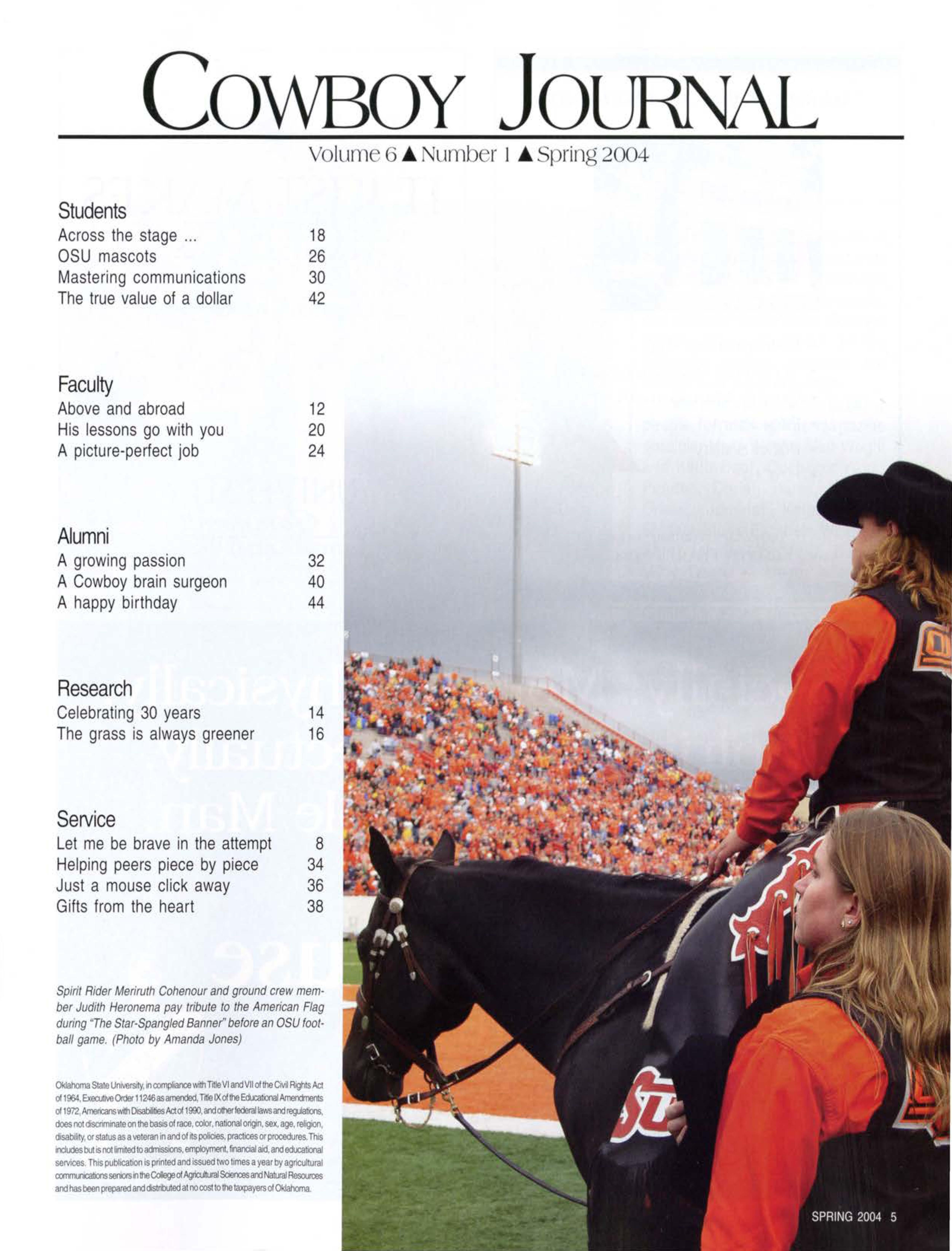
SpiritRiderMeriruthCohenourand groundcrewmember JudithHeronemapay rributeto the AmericanFlag during"TheStar-SpangledBanner''beforean OSUfootball game.(Photoby AmandaJones)
QI/Jal"l(J11aSla!alJMoelSl!y,11(X)f1"rllllalmv,,thfltl8VIandVII01Ille CiviAg,1$AC1 011964.Exea.MOder11246as.mnloo, TIieIXolll'leEdli:alJonal/\/n!!mnllrls 011912,Amllrl::n..O, DtsabllnesActo1199:l,aooahef 1ei»a1tawsaoomg'81kns. doesrotd&:mlklrueontheb.Wof raca,coor.natlonal ~- sex.•!II!,re/9011, osabilty,01Sl8lUSasaw e,aninandol11Spobaes.practicesorprooewfl!S, Ths rcl.Jjes bt.cisrotlmtedtom1SSions, tnanclalaid.andIWCl!bonal seNtces.Thisl)libl,callOll is pnnledand Issued!WOl1111es a yearbyagriclah\lral cx:nmncatmssooc,srih!CdeQeol~San:osaooNahlalReooutes andhasbee11pn,paredanddstrouledatriooosttolhelal<paye,solOldahoma.
• c:, tr I r n ur hiJ I s '111 nt • I ilot
• F 1) l1111 -.okstrnc. 'C (40,) 7 , (4()'°") I

l'hniUhiPJ! REDIT UNlON 311 L K,l:IRm &170STUl)I '1 UNIO 14051HI J:1211 - WWWLUINfOlJCII.COM
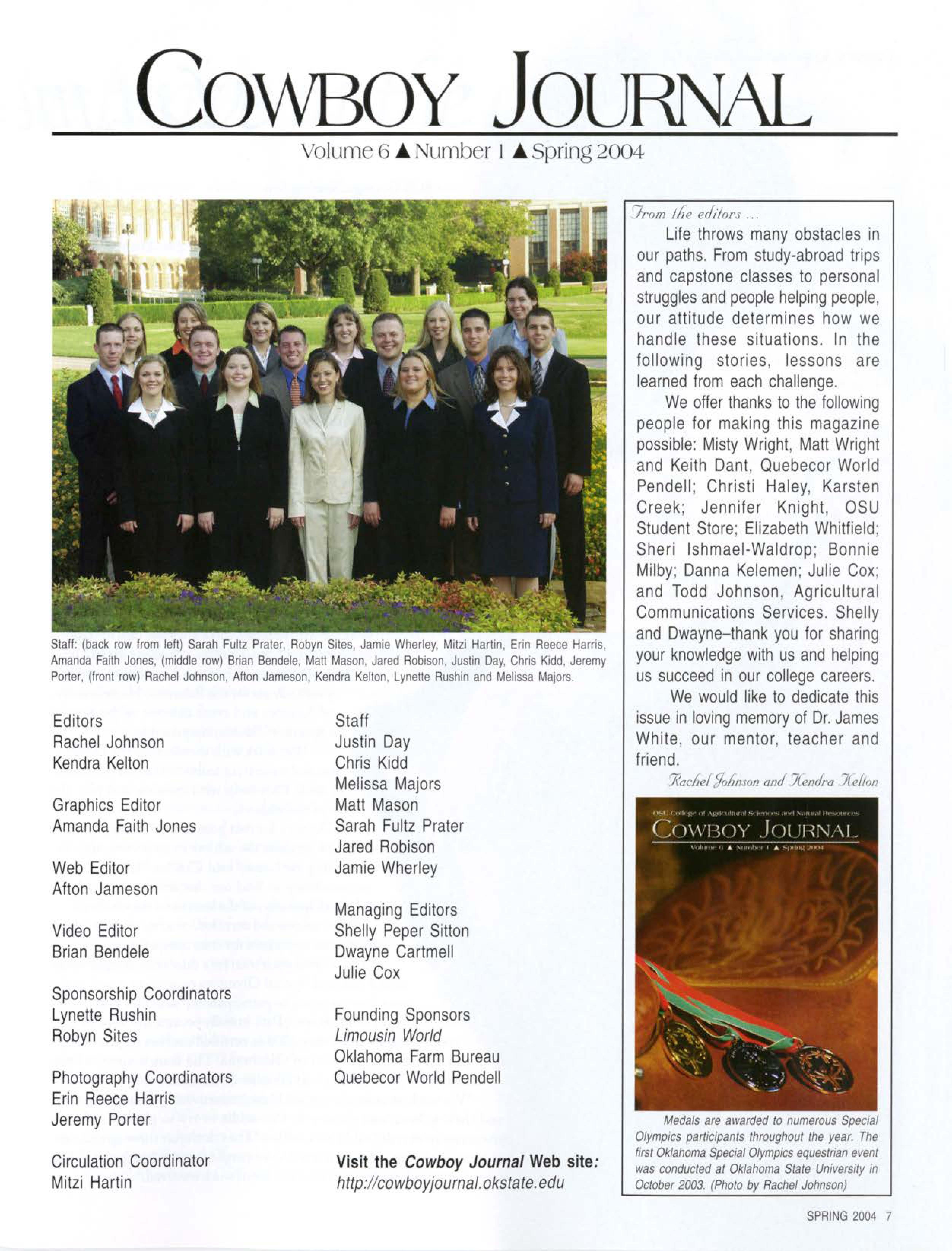
Staff:(backrow from left) SarahFultz Prater,RobynSites,JamieWherley,Mitzi Hartin,Erin ReeceHarris, AmandaFaithJones,(middlerow)BrianBendele,MattMason,JaredRobison,JustinDay,ChrisKidd,Jeremy Porter,(frontrow}RachelJohnson.AftonJameson,KendraKellon.LynetteRushinand MelissaMajors.
Editors
RachelJohnson
KendraKelton
GraphicsEditor AmandaFaithJones
Web Editor
Afton Jameson
Video Editor
Brian Bendele
SponsorshipCoordinators
LynetteRushin
RobynSites
PhotographyCoordinators
Erin ReeceHarris
JeremyPorter
CirculationCoordinator
Mitzi Hartin
Staff
Justin Day
Chris Kidd
MelissaMajors
Matt Mason
SarahFultz Prater
Jared Robison
JamieWherley
ManagingEditors
Shelly PeperSitton
DwayneCartmell
Julie Cox
FoundingSponsors
LimousinWorld
OklahomaFarmBureau
OuebecorWorldPendell Visit the CowboyJournalWeb site: http://cowboyjournal.okstate.edu
Jrom /he e<hlors ...
Life throws many obstaclesin our paths.Fromstudy-abroadtrips and capstoneclassesto personal strugglesandpeoplehelpingpeople our attitude determines how we handle these situations. In the following stories, lessons are learnedfrom eachchallenge.
We offerthanksto the following people for making this magazine possible:MistyWright,Matt Wright and Keith Dant, QuebecorWorld Pendell; Christi Haley, Karsten Creek· Jennifer Knight, OSU StudentStore; ElizabethWhitfield; Sheri Ishmael-Waldrop; Bonnie Milby; Danna Kelemen;Julie Cox; and Todd Johnson Agricultural CommunicationsServices. Shelly and Dwayne-thankyou for sharing your knowledgewith us and helping us succeedin our collegecareers. We wouldlike to dedicatethis issuein lovingmemoryof Dr.James White, our mentor, teacher and friend.
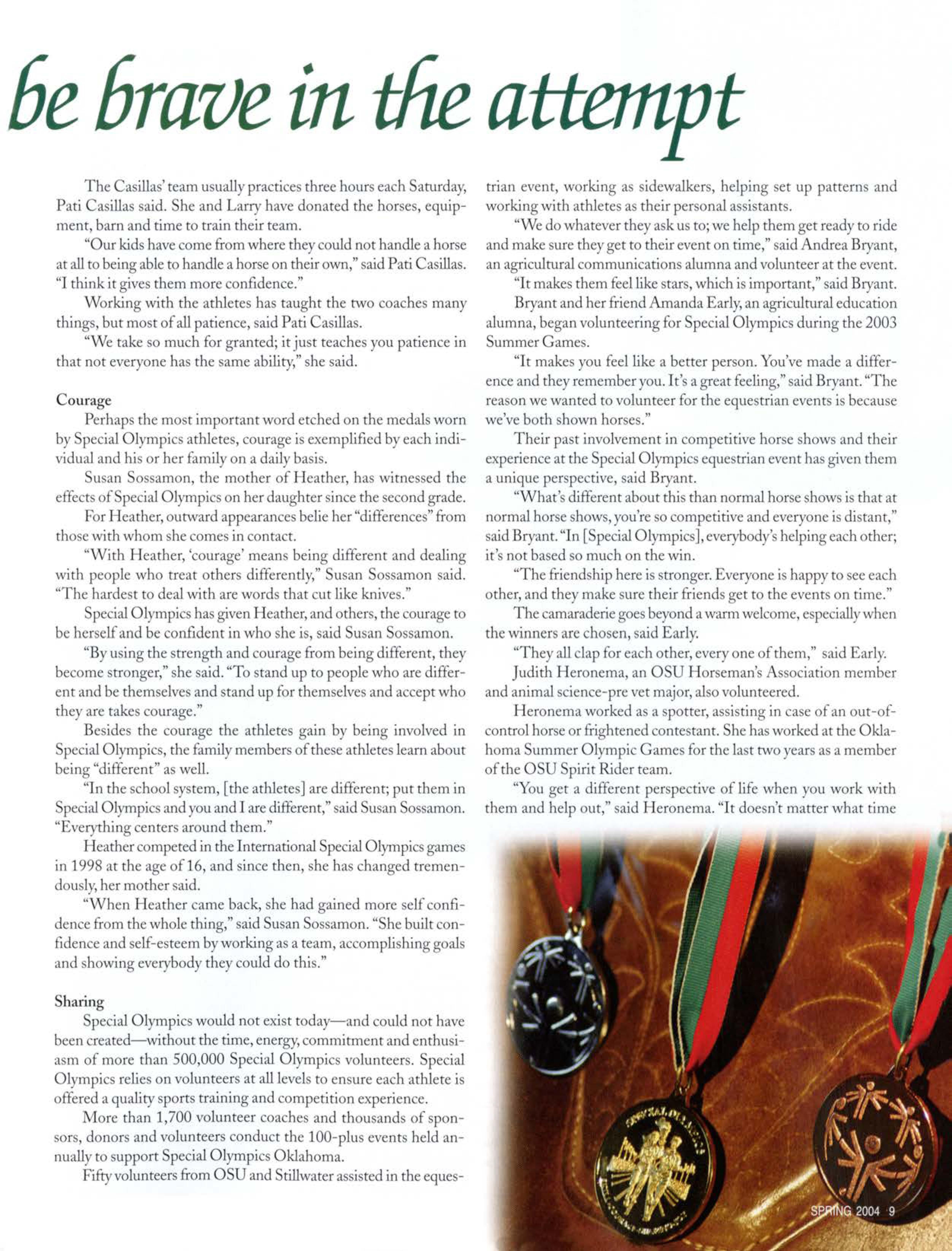
kill. ourage. haring.Joy.
Four imple w rd b at in the heart of pecial Olympic athlete and are etched in the medal w rn proudly around their ne ks. Tho e involved with pecial Olympics live the e word daily.The e four irnple word al ode. ribe the fir t tate eque trian competition for pecial Olympi Oklahoma.
The fir t Oklahoma pecial Olympi eque trian event was held at the Oklahoma rate Univer ity Animal c.ience ena Oct. 25 2003. ince the organization'· arrival to Oklahoma in 1969, more than 8,300 athletes have participated in 15 sports the most recent being eque trian. Twen -eight qu trian athlete ea ·h competed in three f the four ofered event -w ricing trail pole bending barrel racing and figure-eight takera ing.
Event planning and training of the athlete and coache took two year aid Teri Ho kett, a program dire tor with pe •al lympic Oklahoma.
'Here in Oklahoma it ju t make en e," aid Ho kett. 'We've g th r es and wb y o why don't we do an eque trian program and giv it a hot?" To date, Oklah ma ha 15 ertified coache The free training la t cw day.
While not required it i encouraged that the individuals who want to be oa he have expcrien e with hor e aid Hockett. When working with coache there i a great deal of re ponibility involved, ai Larry a ilias, pre i en of tht.:Oklahoma Palomin Exhibitors o iation, national youth advi er for the Palomino Hor ebreeders of America and event dire tor of the pecial lympic klahoma eque crian.
"We work with members of the O rode and eque trian team to train new oa he , he aid. They help with training and play the part of the athlete .
" here' a lot that goc into [training], including how to a i t the athlete in mounting and dim unting the hor c," ai a ilia "I the oach' respon ibility to find out the ability of the athlete and the di po ition o the hor e and match them.'
Once trained and certified, coa hes begin working with athlete t pre are r tatc ompe ition.
"Theathlcte mu ttrainforaminimum feightw eks with a ertified pe ial Olympic eque trian oach in the event the are oing to pa.rti ipa c in" aid Ho kett.
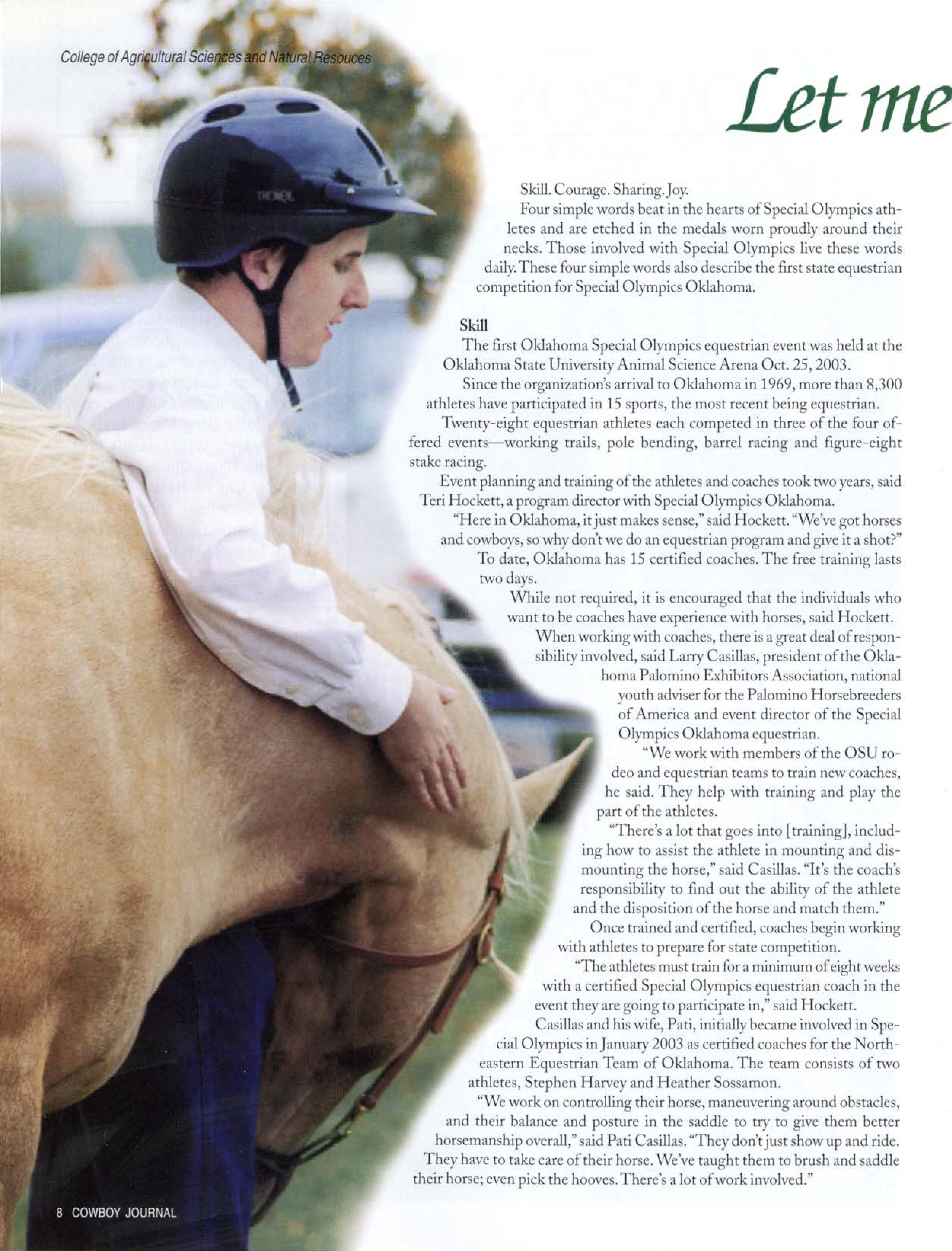
asilias and his wife Paci initially became involved in pecial Olympic in January 2003 as ertified oa hes for the onhea tern Equc trian Team of klahoma. The team on i t of two athlete , tephen Harvey and Heather o amon.
"We work on onrrolling thei1·horse, man uvering around obstacle and their balance and po ture in the addle to try to give them better horsemanship overall" aid Paci a ilia 'They don t ju t show up and ride. They have to take arc of their hor e. We've taughtthem to bru hand addle their horse· even pi k the h ove here' a lot of work involved."
The Casilla 'team u ually practice three hours ea h arurday, Pati a illa aid. he and Larry have donated the horses, equipment, barn and time to train their team.
"Our kid have come from where they could not handle a horse at all co being able to handle a hor eon their own," said ati Ca illas. "I think it give them more confiden e."
Working with the athletes ha taught he n.vo oache many thing , but mo c of all patience, aid Paci a i.Ua
"We take so much for granted; it just teaches you patien e in that not everyone ha the ame ability," she aid.
Perhaps the most important word etched on the medal worn by pecial OJ mpic athlete , courage i exemplified by each individual and hi or her famil on a daily basis.
u an o amon the mother of Heather, ha witne ed the effect of pecial Olympic on her daughter since the econd grade.
For Heather, outward appea.ran e belie her "differences" fr m tho e with whom he com sin contact.
'With J-learher, courao-e' mean being different and dealing with peopl who treat other differently," usan o samon aid. "The harde t to deal wi hare word that ut like knives."
pecial OJympi ha given Heather, and other , the ournge to be her elf and be confident in who she i , said u an o amon.
"By using the strength and courao-e rom being different, they become tronger," she aid. "To rand up to people who are different and be them el.ve an stand up for them elve and a ept who they are rakes oura e."
Beside the courage the athlete gain by being involved in pecial Olympic , the family members of the e athletes learn about being 'different" as well.
'In he ch ol y tern, [ he athlete ) are different; put them in pecial Olympic and you and] are different,' aid u an o amon. " verything enter ar und them.
Heather competed in the International pecial Olympics games in 1998 at the age of 16 and ince then, she has changed tremendously, her mocl1cr ,lid.
"When leather ame ba k she had gained m re el on 1den e from the whole thing," said usan So samon." he built con1den e and elf-esteem by working a a team, accompli hing g al and showing ever body he could do thi ."
pecial Olympic would n t exist today-and could not have been created-without the time, energy, commitment and enthu ia m of more than 500,000 pe ial Olympic volunteec . pecial Olympi s relies on volunteer at all levels to en ure ea h athlete is offered a qmtlity sport training and competition experien e.
More than 1,700 volunteer coa he and thou and of ponor donors and volunteer onduct the 100-plu event held annually to upport pecial Olympic Oklahoma.
Fifty volunteers from O U and tillwaterassisted in the eques-
trian event, w rl<ing a idewalker , helping et up pattern and working with athlete a their per onal a istant
"We do wha rever they a k u to; we help them get ready to ride and make sure they get to their event on time "said ndrea Bryant an agricultural ommu.ni ation alumna and volunteer at the event.
It makes them feel like tar , which i important "said Bryant.
Bryant and her friend Amanda arly an agri ultural edu ati n alumna, began volunteering for pe ial 01 mpic during the 2003 ummer Games.
"It make you feel like a better per on. ou've made a differen e and cl1eyremember you. It's a great feeling," aid Bryant. "The rea on we wanted to volunteer for the eque trian event i be ause we've bocl1 hown horse ."
Their pa t involvement in competitive h r e shows and their experien eat th pecial Olympics equestrian event has given them a unique per pective, aid Br ant.
"What' ifferent about this than n rmal hor e show i that at normal ho e how , you're o competitive and everyone i di tanr " aid Bry,lnt. "In [ pe ial lympics], cv rybod ' helping each other; it' not ba ed o much n the win.
"The friend hip her i rronger. Everyone is happy co ee each other and they make ure their friend get o the event on time.'
The camarad rie g beyond a warm welcome, espe ially\ hen the winner are ch sen, aid Earl .
'The all ·lap for ea h other every one of them," aid Early. Judith Heronema, an O Hor eman' ociation member and animal ien e-pre vet major al o volunteered.
Heronema worked a a potter, a si ting in a e of an out-ofcontrol hor e or frightened onte tanc. he ha worked at the Oklahoma um mer Olympi Game for the last two years as a member of the O pirit Rider team.
"You get a diff, r nt pcrspe rive of life when you work with them and help ut," aid Heronema. "It doe n't matter what imc
they run or if they do it correctly. It's getting out there and doing it that's worth it. They may be competitive, but it's all in good fun."
Eleven other members of the OSU Horseman's Association volunteered, as well as six members of the OSU Ro<leoTeam.
OSU has had a long history with Special Olympics Oklahoma, and the turnout of volunteers and departmental assistance is proof of that relationship.
"OSU's equestrian re,tm, rodeo team, animal science department and OSU College of Veterinary Medicine have all played a significant role in helping Special Olympics develop rhe equestrian program," said John Se,tls, Special Olympics Oklahoma area services and support director.
"We have our summer games here and have for almost 20 years," said Hockett. "I can guarantee you we would nor have this program ifit were not for OSU right now giving us the help, the facilities, the people and the knowledge they've offered. OSU is very good to Special Olympics Oklahoma."
According to Special Olympics, the organization empowers people with mental retardation to realize their fuJJpotential and develop skills through year-round sports training and competition. As a result, Special Olympics athletes become fulfilled and productive members of their families and the communities in which they live.
ft is an experience that i5 energizing, healthy, skiUfi.il, welcoming and joyful, according to the organization.
"One of our themes has been 'Special Olympics: Training for Life,' and I trunk equestrian really shows that," said Seals. "When coaches like Larry [Casillas] train their athletes, they not only train the athlete how to ride the horse, but also how to rake care of the horse. J think this program exemplifies the tntining for life motto."
Casillas agrees.
"] think it challenges rhe athletes," he said. "They arc dedicated, and they work hard. Ir's rewarding to see when they do a good job."
Being a part of Special Olympics Oklahoma has given many individuals a new perspective on life.
"When you look at our athletes and what they have to overcome just to get up in the morning and get going, no matter what their level of ability, they're positive,'' said Hockett. "They don't complain or gripe.
"They have a great sense of humor; they're fun and loving. 1t truly is a real joy. You're working with people who truly appreciate what you're doing."
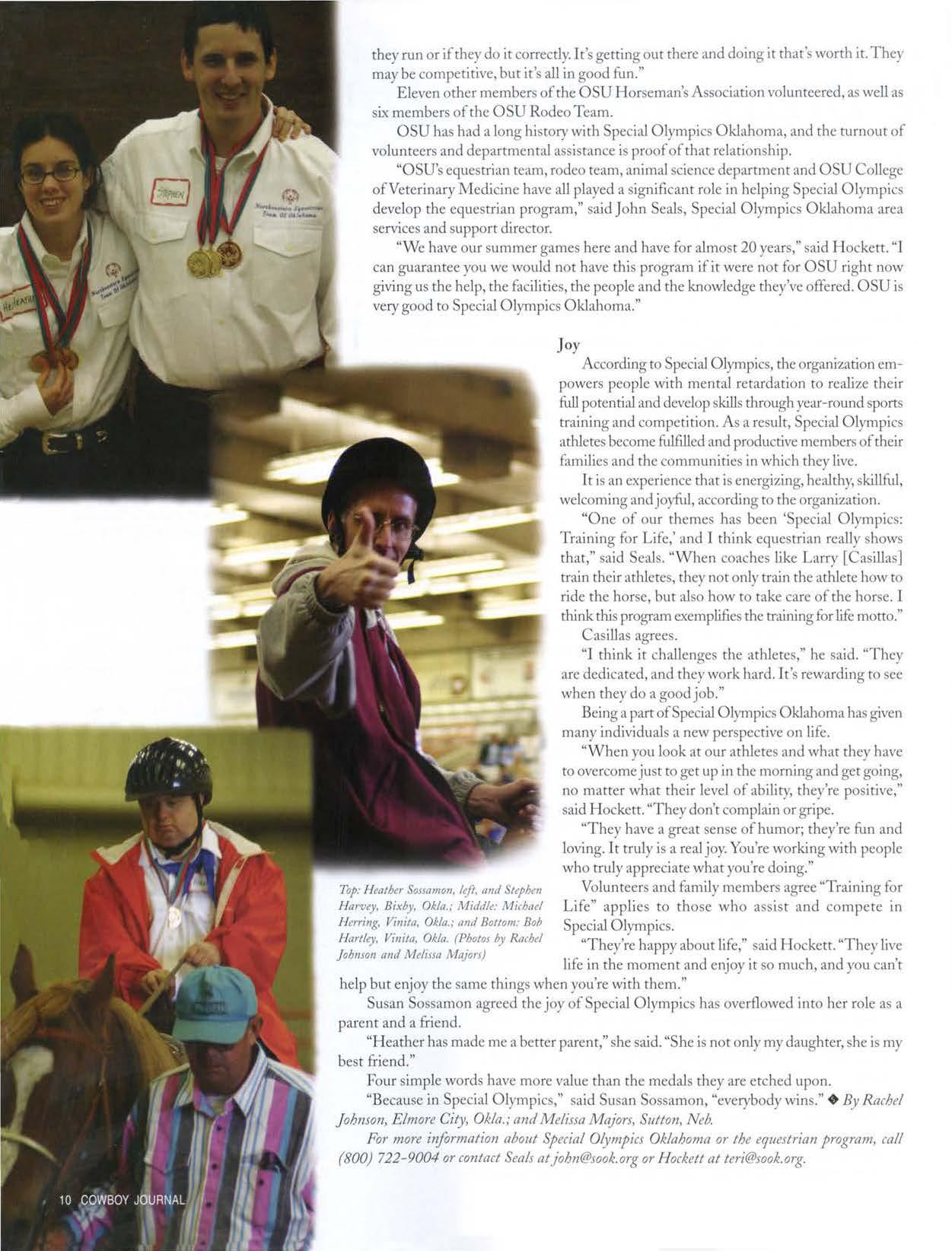
Top:HeatherSossamon.leji. and Stephw Harvey, Bixby, 0/,./a.;Middle Micht1el H,·rri11g.Vi11it11,01:.la.:1111dBottom:Bob Hartley. Vi11ito,Oklt,. (Photosby Rachel Johnso111111dMe/ism ivffliors)
Volunteers and family members agree "Training for Life" applies to those who assist and compete in Special Olympics.
"They're happy about life,'' said Hockett. 'They live life in the moment and enjoy it so much, and you can't help but enjoy the same things when you're with them."
Susan Sossamon agreed the joy of Special Olympics has overflowed into her role as a parent and a friend.
"Heather has made me a better parent," she said. "She is not only my daughter, she is my best friend."
Four simple words have more value than the medals they are etched upon.
''Because in Special Olympics," said Susan Sossamon, "everybody By Rflche/ Johnson, Elmore City, Okla.;and MelissaMajors, Sutton, Neb.
For more i11Jormatio11about Special OlympicsOklahomaor the equestrianprogram, call (800) 722-9004 or contactSealsatjoh11@sook.org or Hockett at teri@sook.01-g.
8,000 Acres Room and Board White Tail Deer Rio Grande Wild Turkey
R Cree" O tfitters RR I Box 69 • Leedey, OK 73654 (580} 488-3670 • (405} 880-4267
cra1granch@log1xonlme.net

Dear um
Remember when you read The Daily O'Collegianevery day between cla e ? Remember laughing and di cu ing opinion olumn and article with friends? What about tho e aptivating campu pi ture you u d to hang in your room?
Graduation may have ome and gone, but your O U pirit will never die.
Don't fade from college ... read The Daily O'Colfegiantoday.
Edinburgh Castle, rhe Tower of London, the Eiffel Tower, Windsor Castle and Westminster Abbey are just a few of the more well-known places students will tour on the trip. While there, students can choose where to visit and how much time they wish to spend at each place.
"Mosr museums in the UK have no admission charge," said Marcia Tilley. "This allows students to see first-hand some of the most well-known pieces of art in history. British museums cover worldwide contents, some with sections for North America."
By participating in a study-abroad program, students see more places and do more things than if they were to go independently, said Dan Tilley. Some parts of the trip arc planned activities, which are required, while other times students can choose what to do nex't.
Participating in the study-abroad trip includes traveling to famous places, attending classes and doing independent research.
For students and faculty members, summer break is a time to get away from classes and relax. For those participating in a study-abroad experience, it is a time to travel to diverse places.
Teaching as a husband and wife team, Dan and Marcia Tilley, both agricultural economics professors at Oklahoma State University, have traveled the world, sharing their years of experience teaching studyabroad courses for participating students.
"My wife and I are teaching a class on the trip,whichisour responsibilityasfaculty members," said Dan Tilley. "It's important for us to work as a team. Since both men and women participate in the program, it's important to have a couple guiding the trip. What better than a faculty couple?"
The couple has dedicated three summers to offer College of Agriculniral Sciences and Natural Resources study-abroad trips for CASNR studenrs. They have traveled to Turkey, England, Scotland and France with students while teaching agricultural issues, cultures and diversity.
Each year, CASNR offers summer study-abroad trips to students who wish to 12 COWBOYJOURNAL
participate. In AGEC 4803 International Agricultural Economics Tour, 25 to 30 sn1dems travel to Europe and conduct research while observing the agricultural practices and cultural differences. The itinerary includes Scotland, France and England.
"Students should have learning experiences outside of the United States," said Dan Tilley. "By traveling to other places, students gain self-confidence, having survived in other cultures. They gain an internationaJ perspective of life and of agriculture."
For sruden rstravelingwith theTi lleys, a wide array of activities and work has been set up for the trip. Having taught the studyabroad trip together several times, the Tilleys already have witnessed the sites for themselves. This has aJlowed them to better instruct the course while enjoying the excitement and amazement of students when they arc first introduced to the United Kingdom.
"Before we ever leave for the trip, we have a pre-trip scavenger hunt," said Marcia Tilley. "This not only helps students to become motivated about the trip, but also allows them to learn more about the culture and places they will be visiting."
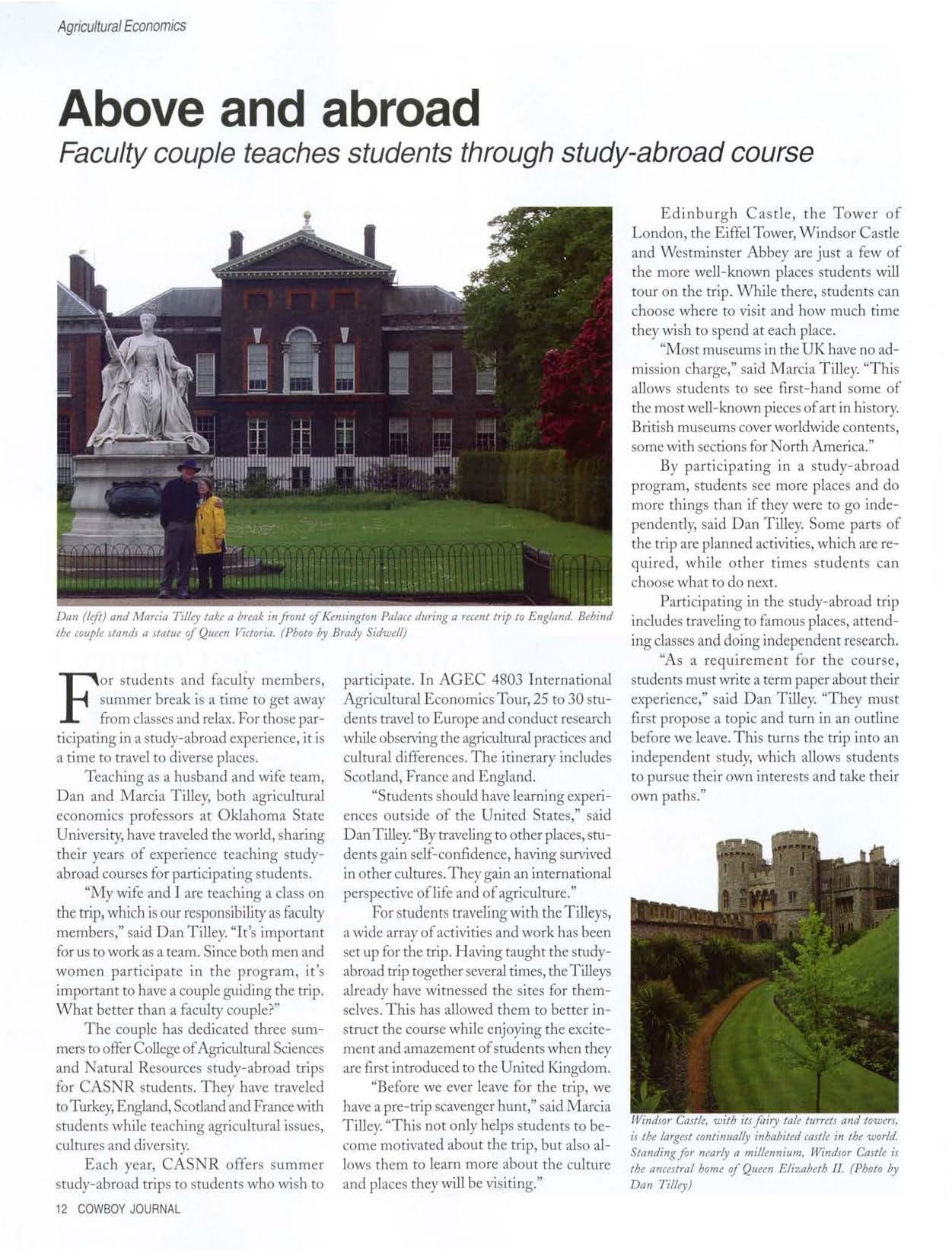
"As a requirement for the course, sn1denrs must write a term paper about their experience," said Dan Tilley. "They must first propose a topic and cum in an outline before we leave. This turns the trip into an independent study, which allows students to pursue their own interests and take their own paths."
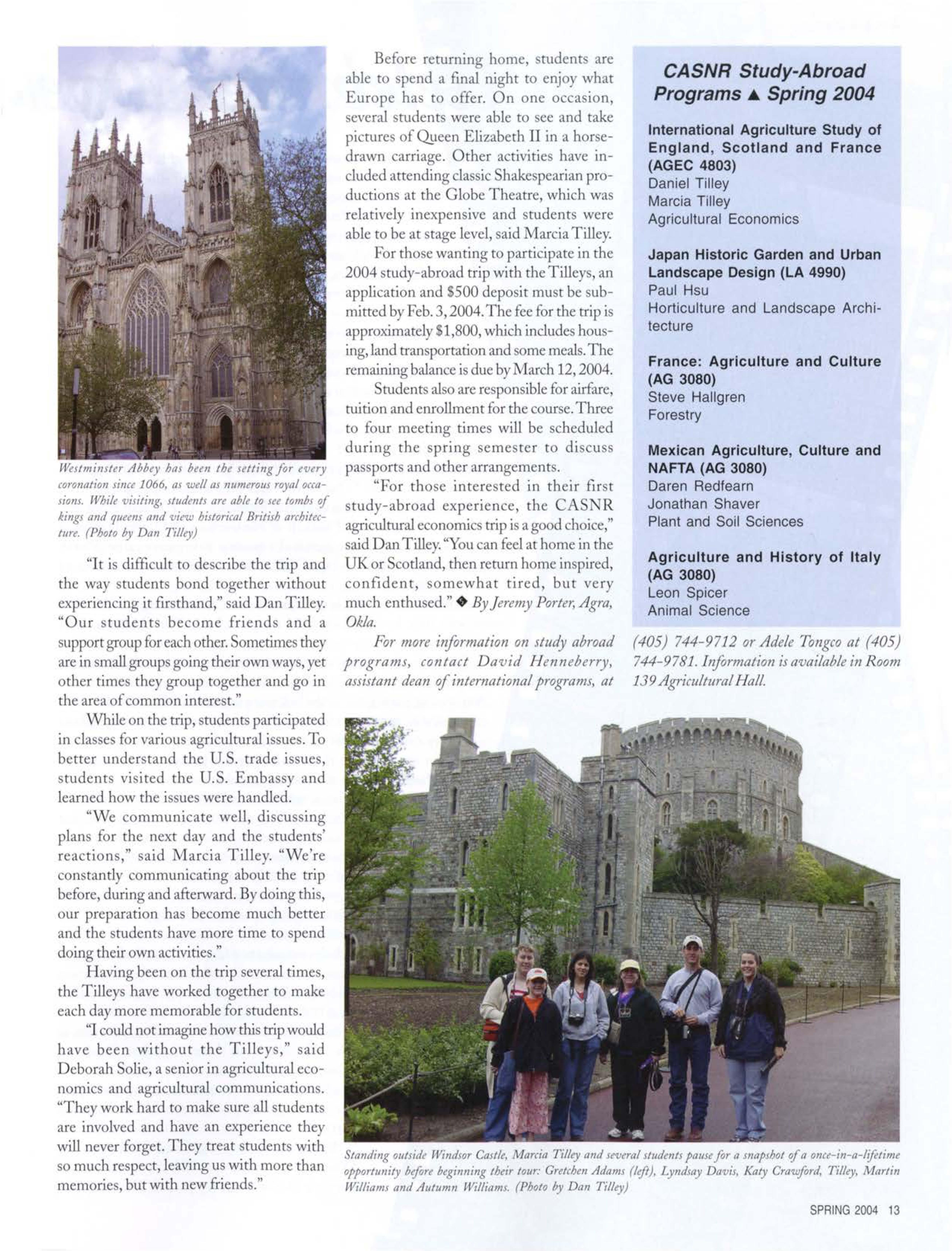
Westminster Abbey hm bu11 tht ufting for tvtry coro1wtio11sina 1066, as wt'// 111m,maous royaloa11siom. While 11i1iti11g,students are able to su tombs of kings <111dquews 1111d vi,-w histonral British architrcture. (Photo by D<111Tilley)
"It i diffi ult to de ribe the trip and the way tudent bond together with ut experiencing it fir thand," said Dan Tilley. "Our students become friends and a upport group for each other. ometimes the are in mall group going their own way , ct other time they group together and go in the area of common intere t."
While on the trip, tudents participated in la e fi r vari u agri ultural i ue . To better under tand th U. trade i tudent vi ited the U. Emba Learned how the i ue were handled.
"\/ 1/e communi ate well, discussing plans for the next da and the tudent ' rea tion " said IJarcia Tilley. "We're onstantly ommuni ating about the trip before, during imd afterward. By doing thi , our preparation ha become much better and the students have more time to pend doing their own acrivitie ,"
Having been on the trip everal time , the Tilley have worked together to make each day more memorable for tudent .
'1 couJd not imagine how thi trip would have been without the Tilley ," aid Deb rah olie, a enior in agri ulrural economics and agricultural communication . "They work hard to make ure all student are involved and have an experience they will never forger. They treat student with so much re peer, leaving u with more than memorie , but with new friend ."
Before returning home, tudent are able to pend a final night to enj y what Europe ha to offer. n one oc a ion everal student were able to ee and take picture of ~een Elizabeth II in a hor edrawn arriage. Other activitie have included attending cla ic hake pearian productions at the Globe Theatre, which wa relatively inexpensive and tudent were able to be at rage level, aid larcia Tilley.
For tho e wanting t participate in the 2004 tudy-abroad trip with the Tilley , an application and 500 depo it mu t be ubmitted by Feb. 3 2004. The fee for the trip i approximately 1,800, which includes h uing, land transportation and me meal The remaining balan ·e i due by March 12, 2004. rudent al are re pon ible for airfue, tuition and enrollment for the course. Three to four meeting time will be cheduled during the pring eme ter to di u s pa port and other arrangement
"For those intere ted in their tudy-abroad experience, the agricultural economics trip i a good choi e ' aid Dan Tille " ou an feel ar home in the UK or ocland, then ren1rn home in pired onfident, omewhat tired, bur very much enthu ed."
ByJeremy Porter,Agra, Okla.
For more infamwtion on study abroad programs, contact Dr:rnid llimneberry, assi ·tan/ dean ofintenwtional programs, at
International Agriculture Study of England, Scotland and France (AGEC 4803)
Daniel Tilley
Marcia Tilley
Agricultural Economics
Japan Historic Garden and Urban Landscape Design (LA 4990)
Paul Hsu
Horticulture and Landscape Architecture
France: Agriculture and Culture (AG 3080)
Steve Hallgren Forestry
Mexican Agriculture, Culture and NAFTA (AG 3080)
Daren Redfearn
Jonathan Shaver
Plant and Soil Sciences
Agriculture and History of Italy (AG 3080)
Leon Spicer
Animal Science
(40 ) 744-9712 or Jldele Tongco al (40 ) 744-9781. Information is available in Room 1 9 Agricultural Hall.
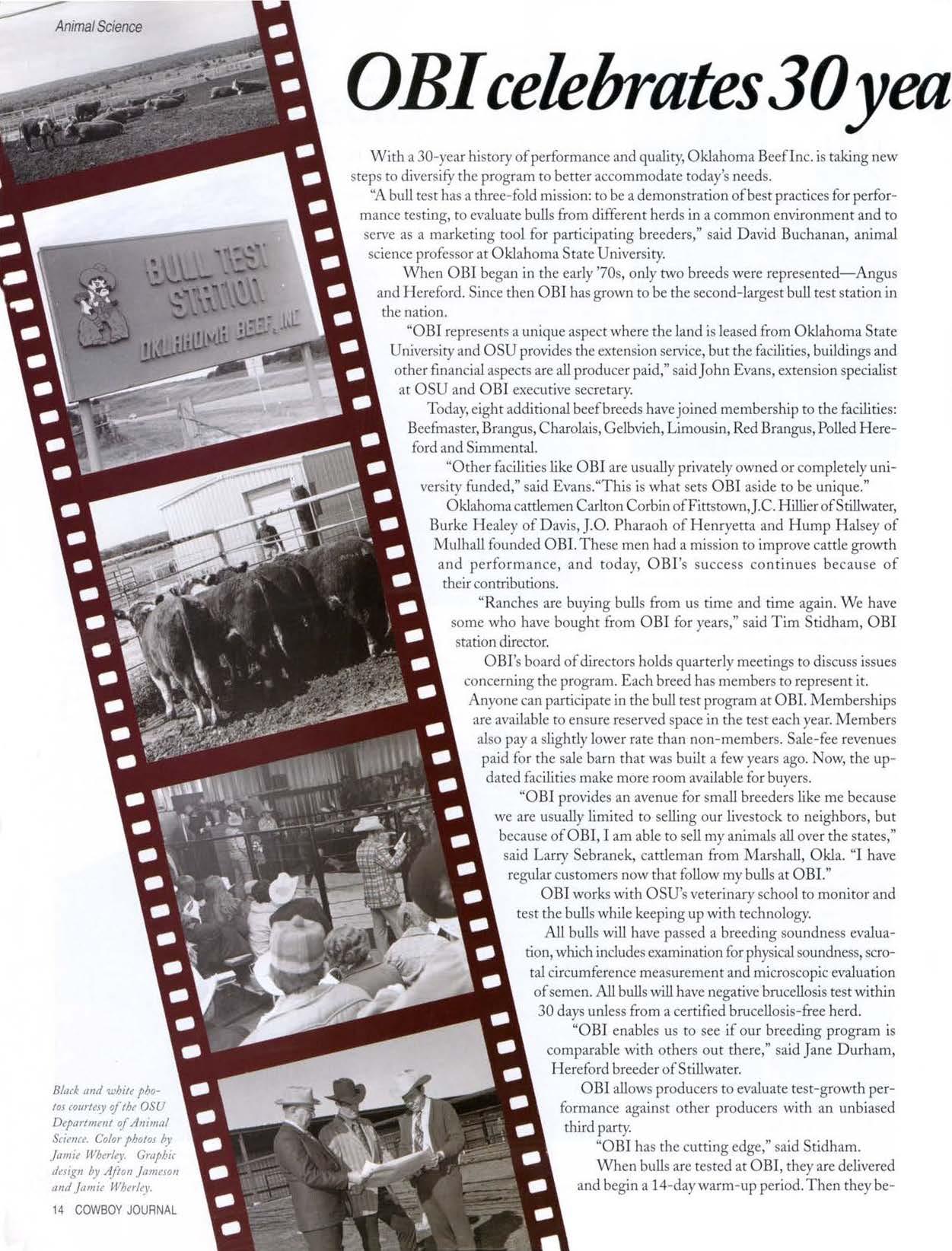
8l11ek""d u•hiu photos courteiyoftbt OSU Dep,1rtmr11Iof A11111111I Sctma. Colorphotos by }amit Wherley. Graphic duig11 by Ajio11}11111,•so11 and Jamie IVherley.
With a 30-year history of performance and quality, Oklahoma Beeflnc. is taking new steps to diversify the program to better accommodate today's needs.
"A bull test has a three-fold mission: to be a demonstration ofbest practices for performance testing, to evaluate bulls from different herds in a common environment and to serve as a marketing tool for participating breeders," said David Buchanan, animal science professor at Oklahoma State University.
When OBI began in the early '70s, only two breeds were represented-Angus and Hereford. Since then OBl has grown to be the second-largest bull test station in the nation.
"OBI represents a unique aspect where the land is leased from Oklahoma State University and OSU provides the extension service, but the facilities, buildings and other financial aspects are all producer paid," said John Evans, extension specialist ar OSU and OBI executive secretary.
Today, eight additional beef breeds have joined membership to the facilities: Beefmaster, Brangus, Charolais, Gelbvieh, Lirnousin, Red Brangus, Polled Hereford and Simmental.
"Other facilities like OBJ are usually privately owned or completely university funded," said Evans."This is what sets OBI aside to be unique."
Oklahoma cattlemen Carlton Corbin ofFittstown,J.C. Hillier ofSti.Uwater, Burke Healey of Davis, J.O. Pharaoh of Henryetta and Hump Halsey of Mulhall founded OBI. These men had a mission to improve cattle growth and performance, and today, OBI's success continues because of their contributions.
"Ranches are buying bulls from us time and time again. We have some who have bought from OBJ for years," said Tim Stidham, OBI station director.
OBI's board of directors holds quarterly meetings to discuss issues concerning the program. Each breed has members to represent it. Anyone can participate in the bull test program at OBI. Memberships are available to ensure reserved space in the test each year. Members also pay a slightly lower rare than non-members. Sale-fee revenues paid for the sale barn that was built a few years ago. ow, the updated facilities make more room available for buyers.
"OBI provides an avenue for small breeders like me because we are usually limited to selling our livestock to neighbors, but because of OBI, I am able to sell my animals all over the states," said Larry Sebranek, cattleman from Marshall, Okla. ''I have regular customers now that follow my bulls at OBI."
OBI works with OSU's veterinary school to monitor and test the bulls while keeping up with technology.
All bulls will have passed a breeding soundness evaluation, which includes examination for physical soundness, scrotal circumference measurement and microscopic evaluation of semen. All bulls will have negative brucellosis test within 30 days unless from a certified brucellosis-free herd.
"OBI enables us ro see if our breeding program is comparable with others out there," said Jane Durham, Hereford breeder of Stillwater.
OBl allows producers to evaluate test-growth performance against other producers with an unbiased third party.
uOBI has the cutting edge," said Stidham. When bulls are tested at OBI, they are delivered and begin a 14-daywarm-up period. Then they be-
gin a 112-day test specified by the Beeflmprovement Federation. The bulls fin.i h with a seven-day let-down period. The bull are weighed and height mea urement are taken at the beginning and end of the te t.
Weight al o are taken at 28-day interval during he te t to calculate average daily gain. The bulls are fed a complete ration which i equivalent to tarting feedlot rations. OBI purcha e its feed in bulk, making it heapcr for the producer.
Each year OBI condu t two saJes of tested bull with , pproximately 350 bulls li ted. ales are held in the fall and pring to meet a range of buyer 'need and the bull qualified are tho e who are in the top 70 percent of the group tested. Evans aid only the bulls with oundness and high te t number will ell.
"OBI can put on a sale and spread osr over multiple producer unlike small producer-,' aid Evan
ln the fall 2003 sale OBJ elebrated 30 years of performance te ting. Fifty-one bulls sold at a ale average o 2 447, and 62 heifers sold at an average of 929.
Jn the la t "O year nearly 18,000 bull repre enting 16 breed have completed the OBI program.
"The way the cattle indu try ha changed and the wa eed-sto ·k producers compete and market cattle made the OBI board of directors decide they needed ro do more than ju t te t bulls,". aid Evan .
The OBI board of director wanted to provide opportunities for additi n al ervice .
One way of providing additional servi e wa implementing a replacement heifer ale. OBI sold 67 heifers in the fall 2002 sale, and it turned out to be a benefit to producers. The heifers sold higher than the market price for that week. he replacement heifer program i open to any producer just like the bull te t program. It allow commercial breeder to get the ame geneti sand guarantee from rhe people who are involved with OBI. It al o wiJJ,illow small producer to marker their cattle where the , haven tin the past.
"In irne I would like to get o the point where heifers arc out of Bl-re red bull ," aid tidham. "Producer will be able to know what tho e cattle will do f. r them becau e hey will have a guarantee to be fun tional and ound when purcha ed.'
nother attempt to diver ify ha been providing produ er the opportunity to have private treaty sales at the OBI facility. Renting the sale barn and other facilities will enable ma11producers to compete with larger produ er aid tidham.
ln 2003, OBJ held it fir t edu ational ield day for the public. Thi day allowed producer to come and learn the late t inform a ion in the beef indu rry o they .an cay progrc ive. Evan said the fir c educational field day wa a , u e and people arc in ere ted in more to come. For tl1e next field day OBI will focu on current i sue fa ing the industry gencti improvement, marketing opportunities and herd health.
tidl1am aid one of hi goals for OBI i to get more breed invo]ved in the bulJ te t program. He al o would like to help producers with cu romized ceding and hei .er development program
"At OBI we pride ourselves in serving our u comer with individual a i tancc and providing the performance in our bull sale ," aid tidham. "That is what makes u the By Jamie Wherley,BrokenAnow, Okin.
For more information, call Oklahoma Beefluc. at{40S) 744-6060ornt {405) 624-1181 or visit http:llwww.ansi.okstate.edu/extenlobi.
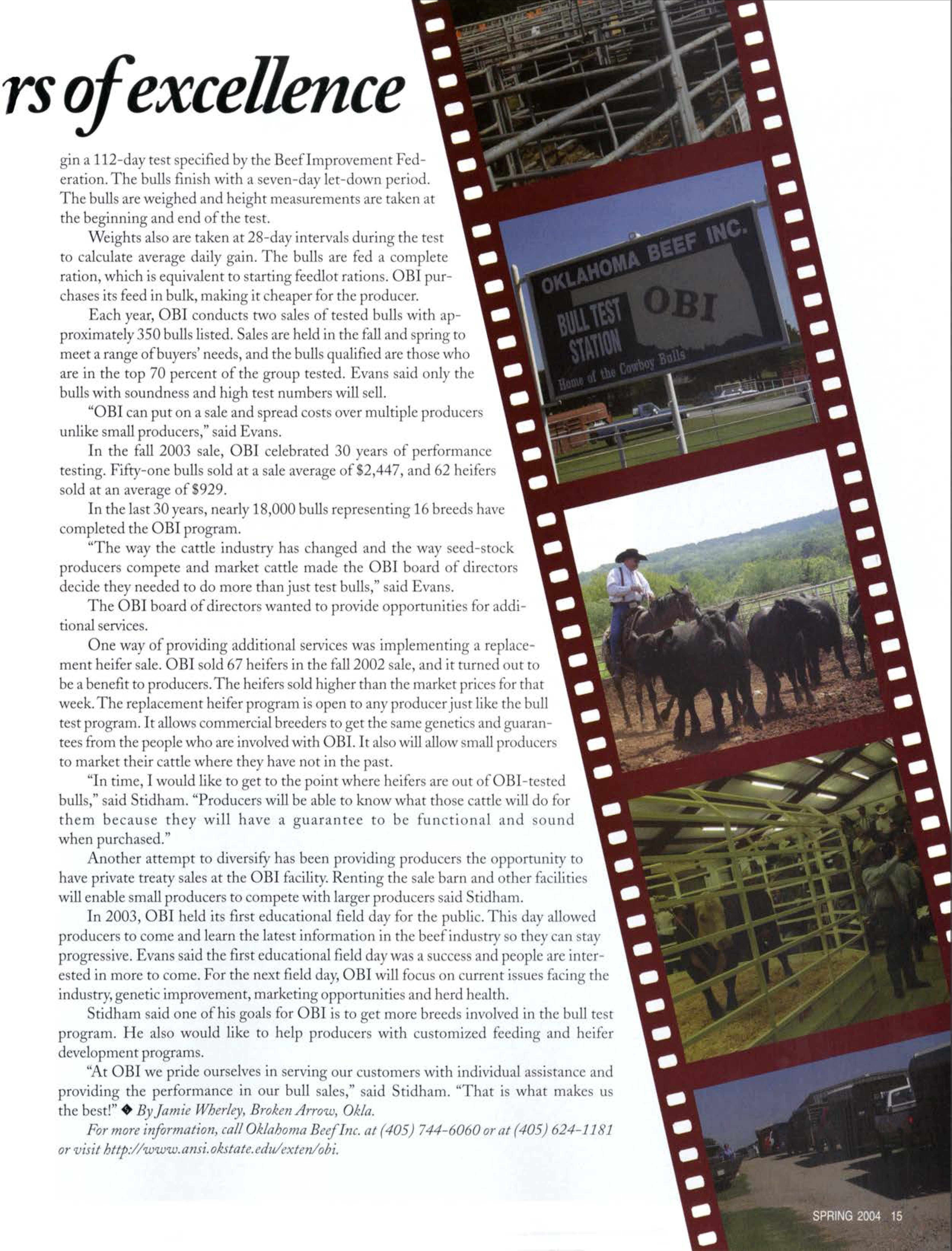
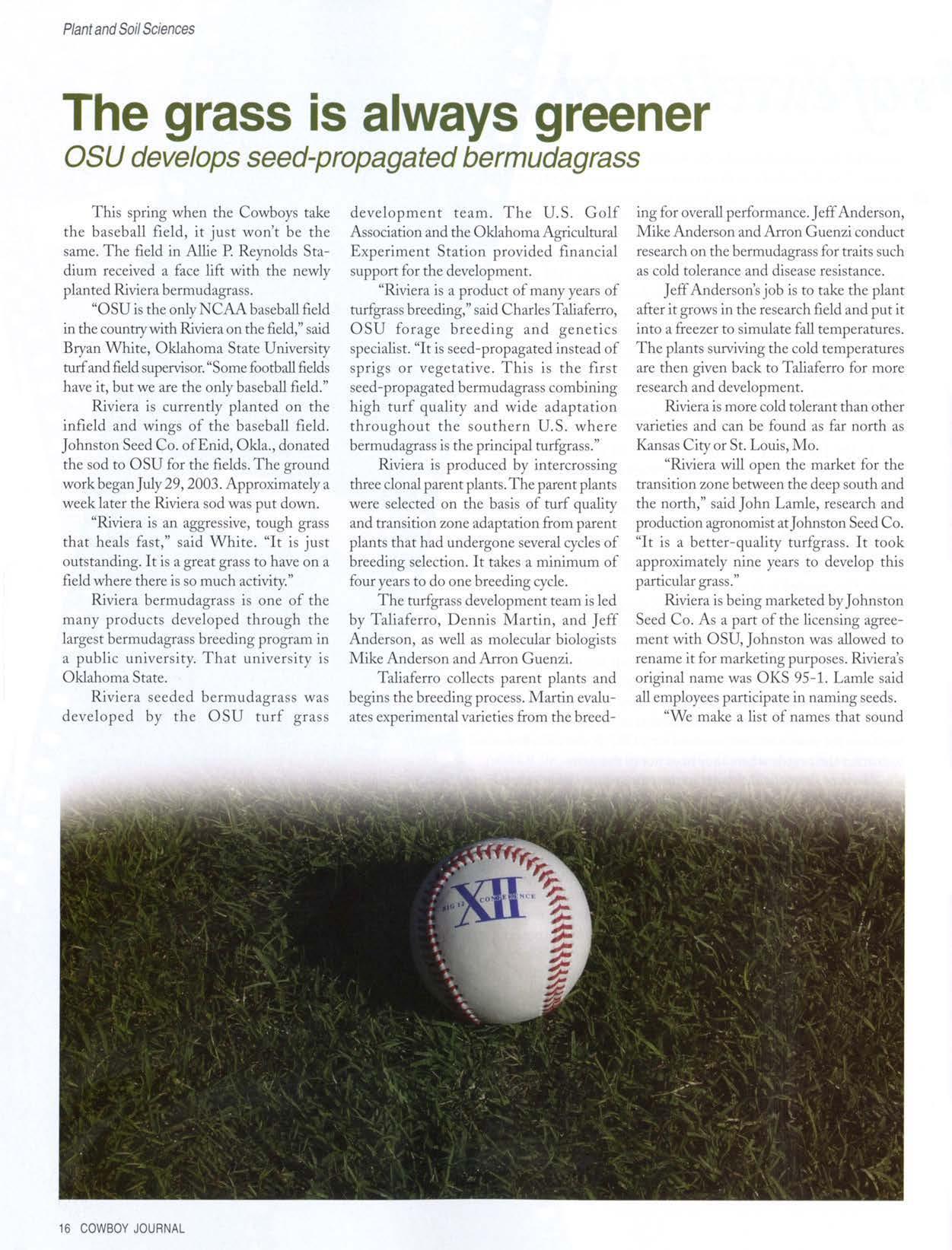
This spring when the Cowboys take the baseball field, it just won't be the same. The field in Allie P. Reynolds Stadium received a face lift with the newly planted Riviera bermudagrass.
"OSU is the only NCAA baseball field in the country with Riviera on the field," said Bryan \IVhite, Oklahoma Stare University turf and field supervisor."Some football fields have it, but we are the only baseball field."
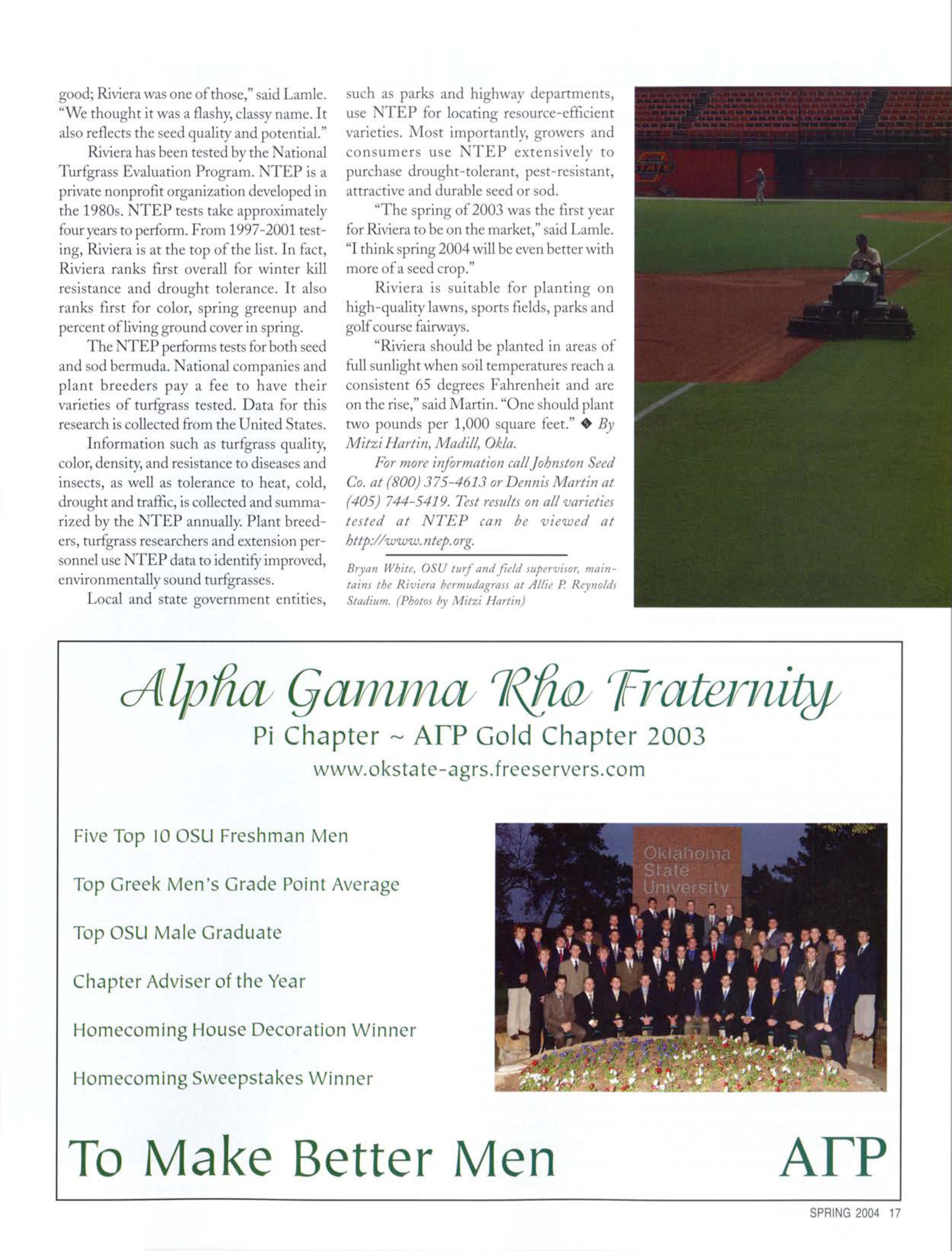
Riviera is currently planted on the infield and wings of the baseball field.
Johnston Seed Co. ofEnid, Ok.la., donated the sod to OSU for the fields. The ground work began July 29, 2003. Approximately a week later the Riviera sod was put down.
"Riviera is an aggressive, rough grass that heals fast," said White. "It is just outstanding. It is a great grass to have on a field where there is so much activity."
Riviera bermudagrass is one of the many products developed through the hugest bermudagrass breeding program in a public university. That university is Oklahoma State.
Riviera seeded bermudagrass was developed by the OSU turf grass
development team. The U.S. Golf Association and the Oklahoma Agricultural Experiment Station provided financial support for the development.
"Riviera is a product of many years of rurfgrass breeding," said Charles Taliaferro, OSU forage breeding and genetics specialist. "It is seed-propagated instead of sprigs or vegetative. This is the first seed-propagated bermudagrass combining high turf quality and wide adaptation throughout the southern U.S. where bermudagrass is the principal turfgrass."
Riviera is produced by inrercrossing three clonal parent plants. The parent plants were selected on the basis of turf quality and transition wne adaptation from parent plants that had undergone several cycles of breeding selection. le takes a minimum of four years to do one breeding cycle.
The rurfgrass development team is led by Taliaferro, Dennis Martin, and Jeff Anderson, as well as molecular biologists Mike Anderson and Arron Guenzi.
Taliaferro collects parent plants and begins the breeding process. Martin evaluates experimental varieties from the breed-
ing for overall performance. Jeff Anderson, Mike Anderson and Arron Guenzi conduct research on the bermudagrass for traits such as cold rolerance and disease resistance.
Jeff Anderson's job is to take the plant after it grows in the research field and put it into a freezer to simulate fall temperatures. The plants surviving the cold temperatures are then given back ro Taliaferro for more researcl1 and development.
Riviera is more cold tolerant than other varieties and can be found as far north as Kansas City or St. Louis, Mo.
"Riviera wiU open the market for the transition zone between the deep south and the north," said John Lamle, research and production agronomist at Johnston Seed Co. "It is a better-quality turfgrass. It took approximately nine years to develop this particular grass."
Riviera is being marketed by Johnston Seed Co. As a part of the licensing agreement with OSU, Johnston was allowed to rename it for marketing purposes. Riviera's original name was OKS 95-1. Lamlc said all employees participate in naming seeds.
"We make a list of names that sound
good; Riviera wa one of tho e " aid Lam le. "We thought it wa a fla hy, cla y name. It al o reflect the eed quality and orenrial."
Riviera ha been tested by the ationaJ urfgrass Evaluation Program. T P is a private nonprofit organization developed in the 19 0 TEP test take approximately four year to perform. From 1997-200 te ting Riviera i at the top of the ii t. In fa t, Riviera rank first overall for winter kill resistance and drought toleran e. Ir also ranks firt for color pring greenup and percent ofliving ground over in pring.
The T P pe1form tests for b th eed and sod bcrmuda. ational ompanie and plant breeder pay a fee to have their varieties of rurfgras tc red. Data for thi re earch i colic ted fr m the Onited tatcs.
Information uch a turfgra quality, olor, en ity, and re i ranee to di ea e and insc ts as well as tolerance to heat cold, drought and traffic, is olle red and summarized by the TEP annually. Plant reeders, rurfgra re earcher and c.xten ion peronncl use TEP data t identify impr ved, environmentill sound turfgras es.
Local and state government entities,
such as parks and highway departments use T P or lo ating re our e-ef:ficient varictie . tfo t importantly, grower and onsumer u. e l TEP cxten ively to pur ha e dr ught-toleranr, pc t-re i tant, attractive and durable seed r sod.
The pring of 200 wa the fir t year for Riviera to be on the mark t," aid Lamie. '1 think pring 2004 will be even better with more of a e d crop.'
Riviera is suitable for planting on hi rh-quality lawns ports fields, p:uks and golf our e fainvay
"Riviera hould be planted in area of fl.ill unlight when ii tempera ur rea h a consistent 65 degrees Fahrenheit and arc on the ri e," aid [arrin. "One hould plant two p und per 1,000 square feet." By Mitzi Hartin, Madill, Okla.
For more information cal/Joh11sto11cal Co. at (800) 375-4613 or Dennis Marli11at {405) 744-5419. Test results 011 all varieties te ted tit TEP can he viewed at hi tp./lwww. 11te-p.org.
Bryan Whitt'. OSU turf and Jield supuvuor, main/aim the Ri,,iua /1<-rm111/11gra,s ,11 A/lit P. Reynolds tudium. (Photorby Mitzi H11rti11)
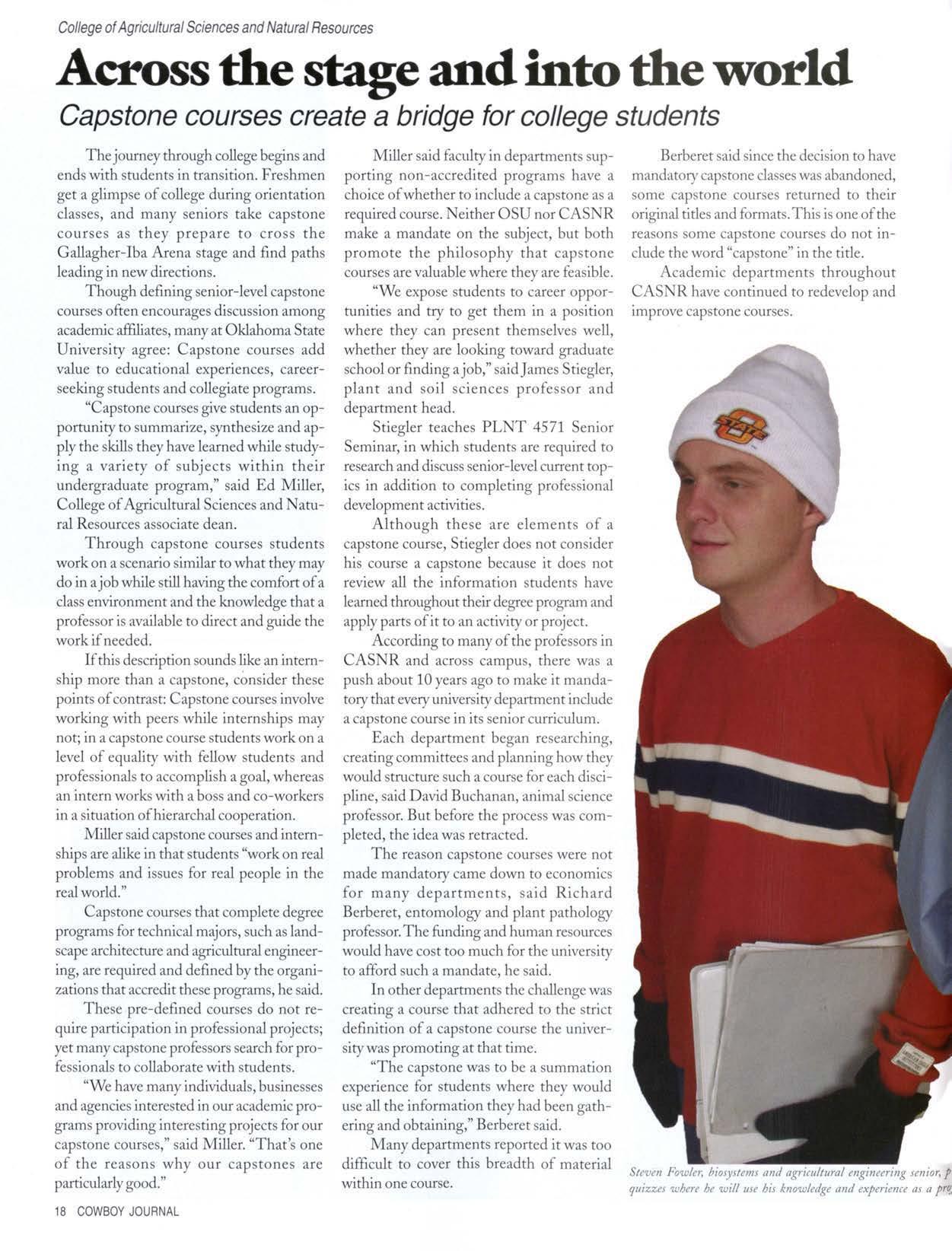
The journey through college begins and ends with students in transition. Freshmen get a glimpse of college during orientation classes, and many seniors rake capstone courses as they prepare to cross the Gallagher-Iba Arena stage and find paths leading in new directions.
Though defining senior-level capstone courses often encourages discussion among academic affiliates, many at Oklahoma State University agree: Capstone courses add value to educational experiences, careerseeking students and collegiate programs.
"Capstone courses give students an opportunity to summarize, synthesize and apply the skills they have learned while studying a variety of subjects within their undergraduate program,'' said Ed Miller, College of Agricultural Sciences and atural Resources associate dean.
Through capstone courses students work on a scenario similar to what they may do in a job while still having the comfort of a class environment and the knowledge that a professor is available to direct and guide the work if needed.
If this description sounds like an internship more than a capstone, consider these points of contrast: Capstone courses involve working with peers while internships may not; in a capstone course students work on a level of equality with fellow students and professionals to accomplish a goal, whereas an intern works with a boss and co-workers in a siniation of hierarchal cooperation.
Miller said capstone courses and internships are alike in that students "work on real problems and issues for real people in the real world."
Capstone courses that complete degree programs for technical majors, such as landscape architecnire and agriculn1ralengineering, arc required and defined by the organizations that accredit these programs, he said.
These pre-defined courses do not require participation in professional projects; yet many capstone professors search for professionals to coUaborate with students.
"We have many individuals, businesses and agencies interested in our academic probrrams providing interesting projects for our capstone courses," said Miller. "That's one of the reasons why our capstones are particularly good."
Miller said faculty in departments supporting non-accredited programs have a choice of whether to include a capstone as a required course. Neither OSU nor CAS R make a mandate on the subject, but both promote the philosophy that capstone courses arc valuable where they arc feasible.
«vve expose studenrs to career opportunities and try to get them in a position where they can present themselves well, whether they are looking toward graduate school or finding a job," said James Stiegler, plant and soil sciences professor an<l department head.
Stiegler teaches PLNT 4571 Senior Seminar, in which students are required to rcscard1 and discuss senior-level current topics in addition to completing professional development activities.
Although these are elem en ts of a capstone course, Stiegler docs not consider his course a capstone because it does not review all the information students have learned throughout their degree program and apply parts ofit to an activity or project.
According to many of the professors in CASNR and across campus, there was a push about 10 years ago to make it mandatot)' that every university department include a capstone course in its senior curriculum.
Each department began researching, creating committees and planning how they would structure such a course for each discipline, said David Buchanan, animal science professor. But before the process was completed, the idea was retracted.
The reason capstone courses were not made mandatory came down to economics for many departments, said Richard Berbcret, entomology and plant pathology professor.The funding and human resources would have cost too much for the university to afford such a mandate, he said.
In od1er departments the challenge was creating a course chat adhered ro the strict definition of a capstone course the university was promoting at that time.
"The capstone was to be a summation experience for students where they would use all the information they had been gathering and obtaining," Berberet said.
Many departments reported it was too difficult to cover this breadth of material within one course.
Berberet said since the decision to have mandatory capstone classes was abandoned, some capstone courses returned ro their original titles and formats. This is one of the reasons some capstone courses do not include the word "capstone" in the title.
Academic departments throughout CASNR have continued to redevelop and improve capstone courses.
" tudent face big hallenge when they graduate from college," said 1iller. " ome may doubt how much they have learned and how well they will perform in a work setting.''
MilJer aid a capst ne experience for mo. t srudent give. them a tremendou • boo t of el -confidence. hey begin to realize how much they have changed throughout heir college year , acknowledging the kill and abilitie they have developed.
Candi J hn.on, biosy t m and agricultural engineering enior focusing in biomechanical engineering aid participating in the cap tone ·ourse for her major, B E 4012 and BAE 4022 enior
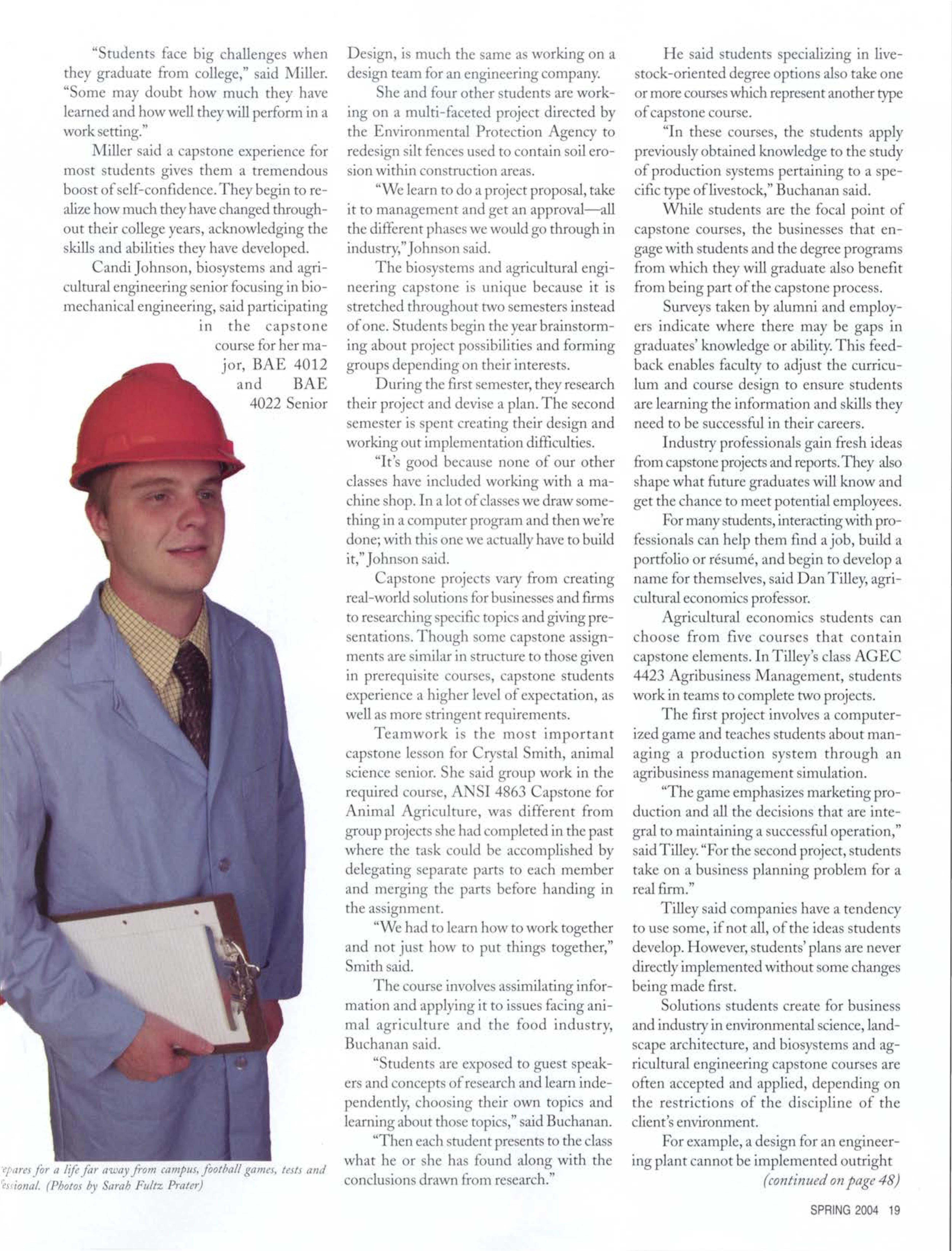
De ign, i much the same as working on a design team for an engineering compan_. he and four orhcr tudents arc working n a multi-fa eted project directed by the EnV1ronmcntal Protecti n gency to rede ign ilt fence u ed to contain oil eroion within construction area
"We learn to do a project proposal take it to management and get an approvaJ---all the diffcrenr ph.tses we would go through in indu tr ,"John on aid.
The bio tern and agricultural engineering capstone i unique be ause it i tr tched throughout two eme ter instead ofone. tudent begin the year brain t rming about proje r pos ibilities and forming group depending on their intere t
During the first semester, they research their project and devise a plan. The econd cme. ter is pent creating their de ign and working our implementati n difficulties.
"It's good bccau e none of our other cla e have included working with a machine hop. In a lot of classes we draw something in a computer program and then we're done; with thi one we a rually have to build it," John on said.
ap tone proje t vary from reating real-world olurions for busines e and firms to re ear hing. pecific t pi and giving precntarion Though omc cap tone a ignmcnt. arc imil:-trin tru ture to those given in prerequi ite our c , ·ap tone tudent experience a higher level of expectation, as well as more stringent requirements.
Team\ ork i. the mo t important capstone lesson for ry tal mi h, animal icnce enior. he aid group work in the required ourse, I 486 Capstone for nimal gri ulture, wa different from group projects she had completed in the pa t where the ta k could be a compli hed by delegating cparate part to ca h member and merging the part before h, nding in the a ignment.
"We had to learn how to work together and not ju ·t how to put thing. together," mith aid.
The cour c involve as imilating information and applyinct it to i uc facing animal agriculture and the food industry Buchanan aid.
" tudent arc expo ed to gue peaker and concepts of re earch and learn independently choosing their own topics and learning about those topics," said Buchanan.
«Then ea h. tudenr pre ents to the class what he r he has found along with the conclu ion drawn from re earch."
He said student pecializing in livestock-oriented degree options also take one or more courseswhich represent another type of ap tone our c.
'In he e ourse , the tudcnt apply previou ly ob rained knowledge to the study o produ ·tion y tern pertaining to a specific type oflivestock, 'Buchanan aid.
While student arc the fo al point of cap tone oursc , the busines e that engage with tudent and the degree program from which they will graduate al o benefi from being part of the capstone pro ess. urvey taken by alumni and employer indi ate where there may be gaps in graduate 'knowledge or ability. Thi· feedback enable fa uJty to adjust the urri ulum and cour c de ign to en ure tudents are learning the information and skill they need to be ucces fuJin their areers.
Indu try profc ionals gain frc h ideas from capstone projec and reports. They also shape what future rraduates will know and get the cl1ance to meet potential employees. or man_ ru en , interacting with profos ·i nals an help them find a job, build a portfolio or re ume, and begin to develop a name for themselve aid an Tilley agriculrural economics profe or. gricultural e onomic rudent can ch o e from five our c that contain capstone elements. In Tilley' cla GE 4423 gribu ines anagcmenr, n1dent work in teams to complete two projects.
The first project involve a computerized game and teaches tudent about managing a produ tion y tern through an agribu ine s management simulation.
"The game emphasize marketinct production and all the decisions that ar • integral t maintaining a u cc sful peration," aid Tilley. "For the second project, students take on a bu inc planning pr blem for a real fum."
Tilley aid companie have a tendency to u e ome, if not all, of the ideas sniden t develop. However, tudents' plan are never dire tly implemented without omc changes being made fir t.
olutions students create for business and indu try in environmental science, landscape ar bite nlfe, and bios t ms and agricultural engineering capstone cour e are often a cepted and applied, depending on the re tri tions of the discipline of the client's environment.
For c..xample,a design for an engineering plant cannot be implemented ou right (continued 011 page 48)
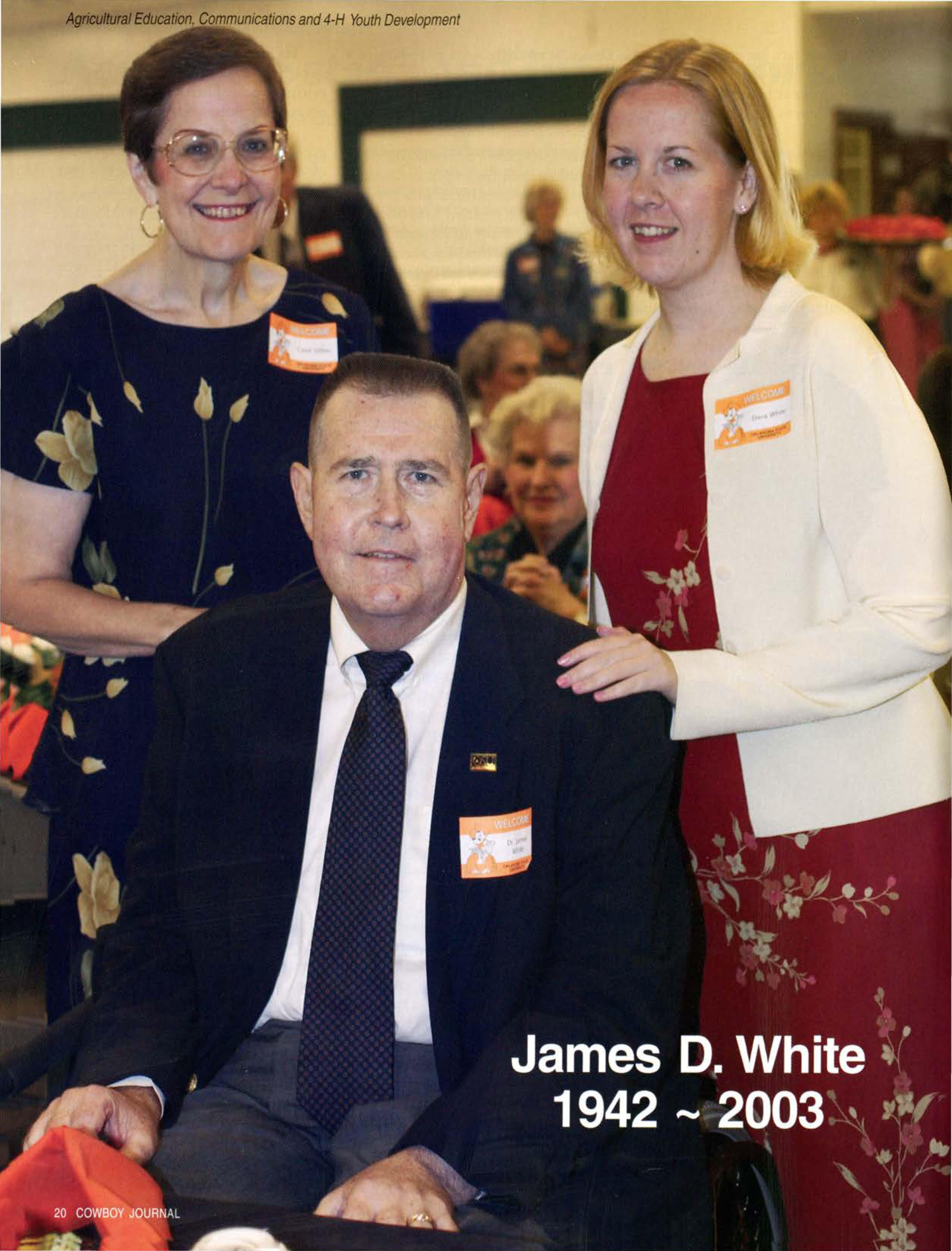
Ecft.<8lion•Cofllmunicabonsand4-H\blJl/loe,eic,pmenl
There comesthat specialmoment in every man's lift wheu he isfiguratively tapped on the shoulderand askedto dot; ve,y special thing, unique to him r111dfitted to his talents.
-Sir Winston Churchill
To be a great teacher, you must have once felt that tap, a calling or feeling that comes from deep inside and pushes you to give more to your students. A great teacher believes in students' abilities, as weU as in their dreams. Great teachers are compelled to encourage, challenge and support. They expect the most from students and won't settle for less than their all. A great teacher is one whose lessons stick with students long after they have exited the classroom door.
James White, professor of agricultural education, was such a teacher and so much more. Ile was a leader, a mentor. He was a student oflife, a member of the Oklahoma State University family, a friend to the College of Agricultural Sciences and Natural Resources faculty, and of course, an inspiration and gift to his students.
"Dr. White wanted his students to know that he cared about them as people, as well as how they performed in his class," said Jim Key, professor emeritus of agricuJn1ral education. "He was interested in what they were accomplishing as students at OSU, and he cared about the great successes they would have once they graduated."
White dedicated a lifetime to teaching and would have retired June 30, 2004. White taught a variety of courses during his 32 years of teacl1ing, but most noted was his work in developing the agricuJn1ral education leadership and service option.
His university teaching career was devoted to guiding students who desired to pursue careers in the cooperative extension service or to become agricultural education teachers.
White experienced OSU as a student and as a faculty member, having graduated from OSU in 1969 with a bachelor's degree in animal science. However, he felt a calling to help others and became certified to teach agricultural education in 1970, said Key.
"Dr. White said OSU was the greatest place in the world to get an education," said Key."He had outstanding teachers in terms of who they were and what they believed. lt
impressed him that faculty could have such an influence and have that spread to their students."
White served as a county extension agent in Texas County before teaching vocational agriculture in Davenport, Okla., for five years. White returned to OSU tO receive his master's and doctoral degrees in agricultural education. He began his teaching career in the OSU agricultural education program in 1979.
"1lc was proud that the College of Agricultural Sciences and Natural Resources has an advising system where students and faculty work as a team to help sn1dents grow profcssionalJy,'' said Key. "He appreciated how this allowed students to have the maximum amount of contact with people in the industry."
Nearly 200 undergraduate students completed industry internships under White's mentorship. The capstone experience for the leadership and service option is a 12-week internship in a professional agricultural position. White met with students several months in advance and helped them identify an internship that would help them achieve their goals. He conducted on-site supervision visits during their internships and worked with students in the develop-
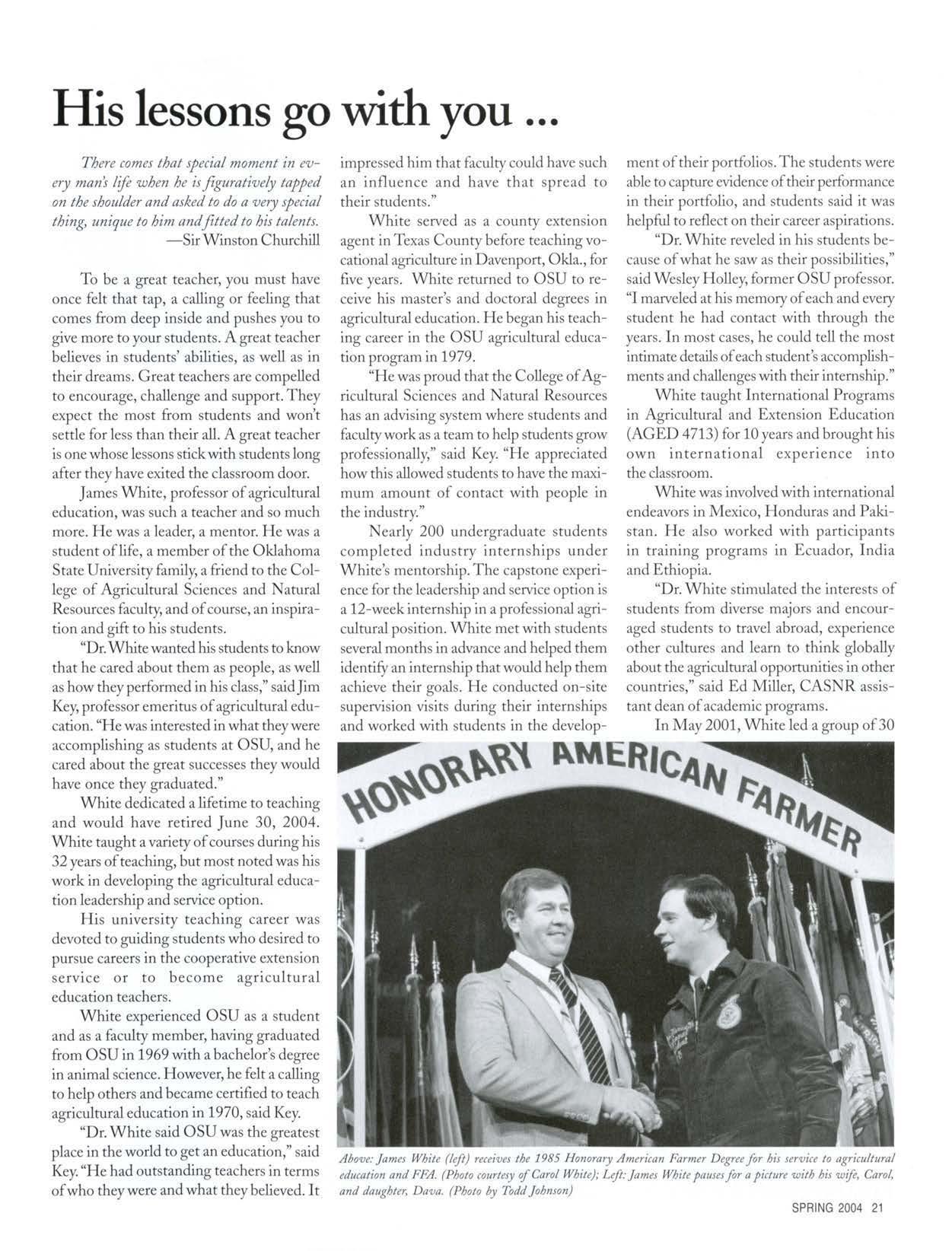
ment of their portfolios. The sn1dents were able to capture evidence of their performance in their portfolio, and students said it was helpful to reflect on their career aspirations.
"Dr. White reveled in his students because of what he saw as their possibilities," said Wesley Holley, former OSU professor. "J marveled at his memory of each and every sn1dent he had contact with through the years. In most cases, he could tell the most intimate details of each su.1dent'saccomplishments and chaUenges with their internship."
White taught International Programs in Agricultural and Extension Education (AGED 4713) for 10 years and brought his own in tern a tional experience in ro the classroom.
White was involved with international endeavors in Mexico, l londuras and Pakisran. He also worked with participants in training programs in Ecuador, India and Ethiopia.
"Dr. White stimulated the interests of students from diverse majors and encouraged students to travel abroad, experience other cultures and learn to think globally about the agricultural opportunities in other countries," said Ed Miller, CAS R assistant dean of academic programs.
In May 2001, White led a group of30
OSU students on a t\¥0-week study tour of Mexico. A group ofMexican students then came to OSU to be engaged in a study tour of Oklahoma.
,,Vhice valued ocher cultures and wanted students to appreciate rhc experience of international education, said Key.
Manuel Corro of Veracruz, Mexico, served as VVhite's teaching assistant for the international agriculture class for the last three years.
"As an international student arriving in a new culture, Dr. White helped and advised me," said Corro. "He gave me the right word at the right time. His guidance facilitated my adjustment to the Oklahoma environment and introduced me to American cultures and values."
White received many honors for teaching and international agricultural development. He once said a few of his most treasured included receiving the Honorary American Farmer Degree in 1985 and being named the Oklahoma FFA V1P recipient in 2002. In the spring of 2003, he was recognized by the Agricultural Education Graduate Student Association with the Outstanding Graduate Faculty Award.
"Dr. White humbly viewed these m,v:trds, not as things he earned, bur awards his students had helped him to receive," said Jim Leising, department head ofOSU Agricultural Education, Communications and 4-H Youth Development.
White was dedicated to his students. I-le made an effort co meet all of his students
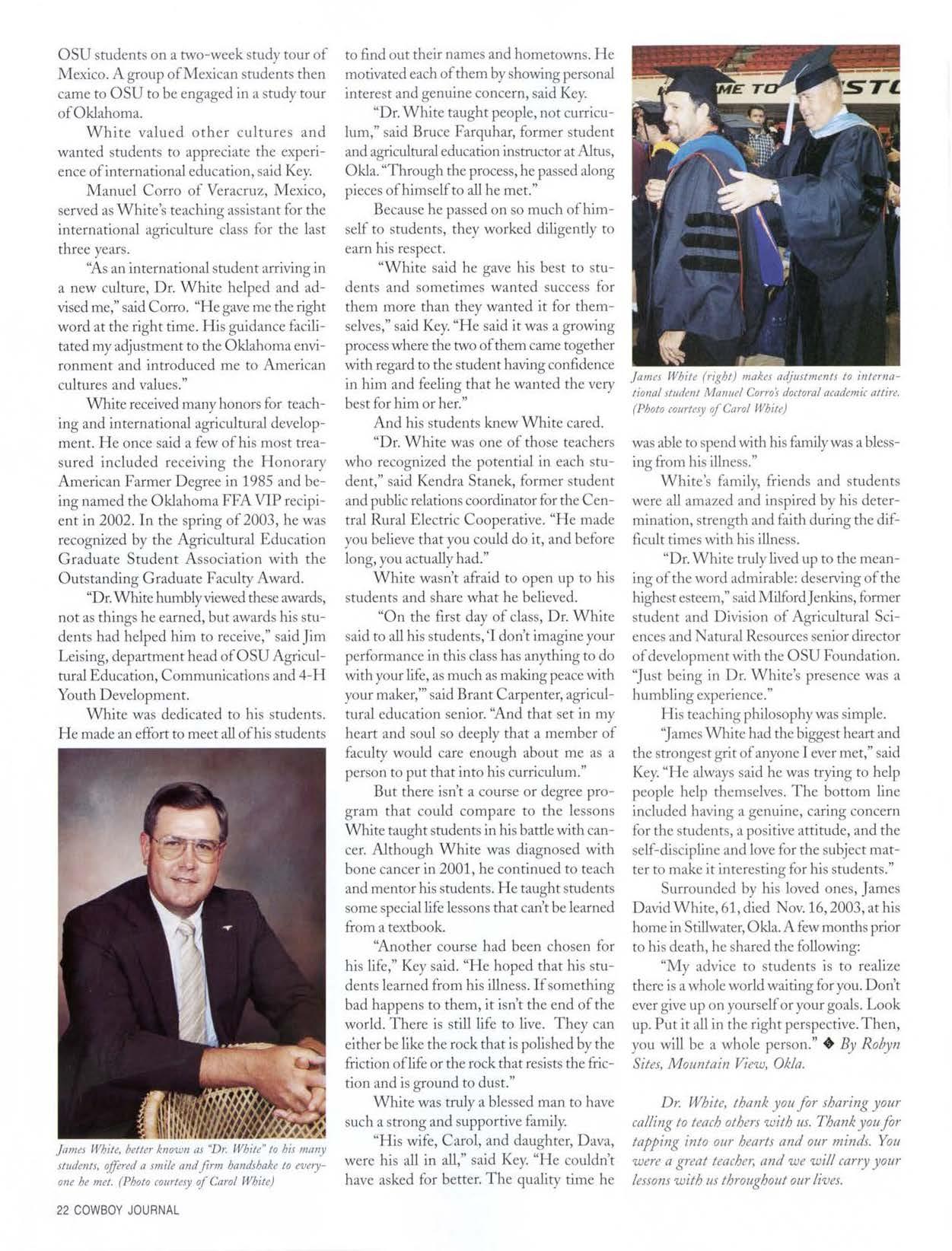
to find out their names and hometowns. He motivated each of them by showing personal interest and genuine concern, said Key.
''Dr. White taught people, not curriculum," said Bruce Farquhar, former student and agricultural education instructor at Altus, Okla. "Through the process, he passed along pieces of himself to all he met."
Because he passed on so much of himself to sn1dents, they worked diligently co earn his respect.
"White said he gave his best to students and sometimes wanted success for them more than they wanted it for themselves," said Key. "He said it was a growing process where the two of tl1emcame together with regard to tl1estudent having confidence in him and feeling that he wanted the vety best for him or her."
And his students knew White cared.
"Dr. White was one of tl1ose teachers who recognized the potential in each studenr," said Kendra Stanek, former student and public relations coordinator for the Central Rural Electric Cooperative. "He made you believe that you could do it, and before long, you actually had.''
White wasn't afraid to open up to bis students and share what he believed.
"On the first day of class, Dr. White said to all his students, '1 don't imagine your performance in chis class has anything to do with your life, as much as making peace with your maker,"' said Brant Carpenter, agricultural education senior. "And that set in my heart and soul so deeply that a member of faculty would care enough about me as a person to put that into his curriculum."
Bur there isn't a course or degree program that could compare to the lessons White taught students in his battle with cancer. Although White was diagnosed with bone cancer in 2001, he continued to teach and mentor his students. He taught students some special lifc lessons that can't be learned from a textbook.
"Another course had been chosen for his life," Key said. "He hoped that his students learned from his illness. If something bad happens to them, it isn't the end of the world. There is still life to live. They can either be like the rock that is polished by the friction oflife or the rock that resists the friction and is ground to dust."
White was truly a blessed man to have such a strong and supportive family.
"His wife, Carol, and daughter, Dava, were his all in all,'' said Key. "He couldn't have asked for better. The quality rime he
was able to spend with his family was a blessing from his illness."
White's family, friends and students were all amazed and inspired by his determination, strength and faith during the difficult times with his illness.
"Dr. White truly lived up co the meaning of the word admirable: deserving of the highest esteem," said Milford Jenkins, fonncr student and Division of Agricultural Sciences and Natural Resources senior director of development with the OSU Foundation. "Just being in Dr. \rVhite's presence was a humbling experience."
His teaching philosophy was simple.
"James \IVhite had the biggest heart and the strongest grit of anyone J ever met," said Key. ''He always said he was rrying to help people help themselves. The bottom line included having a genuine, caring concern for the sn1dents, a positive attitude, and the self-discipline and love for the subject matter to make it intcc:rescingfor his students."
Surrounded by his loved ones, James David White, 61, died Nov.16, 2003, at his home in Stillwater, Okla. A few months prior to his death, he shared the following:
"My advice ro students is co realize tl1ercis a whole world waiting for you. Don't ever give up on yourself or your goals. Look up. Put it all in the right perspective. Then, you will be a whol.c person." By Robyn Sites,Mountain Vi1'W, Ok/f/.
Dr. White, thank you far sharingyour callingto teachotherswith 11s.Th,mk youfar tapping into our heartsand our minds. You were a great /eache1;and we will carryyour lessomwith us thro11gho11I our lives.

cl on's major re carch area is the metabolic fun tion of vitamin and other retinoid A frequently publi hed author of research paper , elson h, re eived numerous awards grants and funding for his rescar h at Oklahoma tate.
"I am 75 percent reearch and 25 per enc teaching, which means I am 100 percent both," said elson.
"It' a full-time j b."
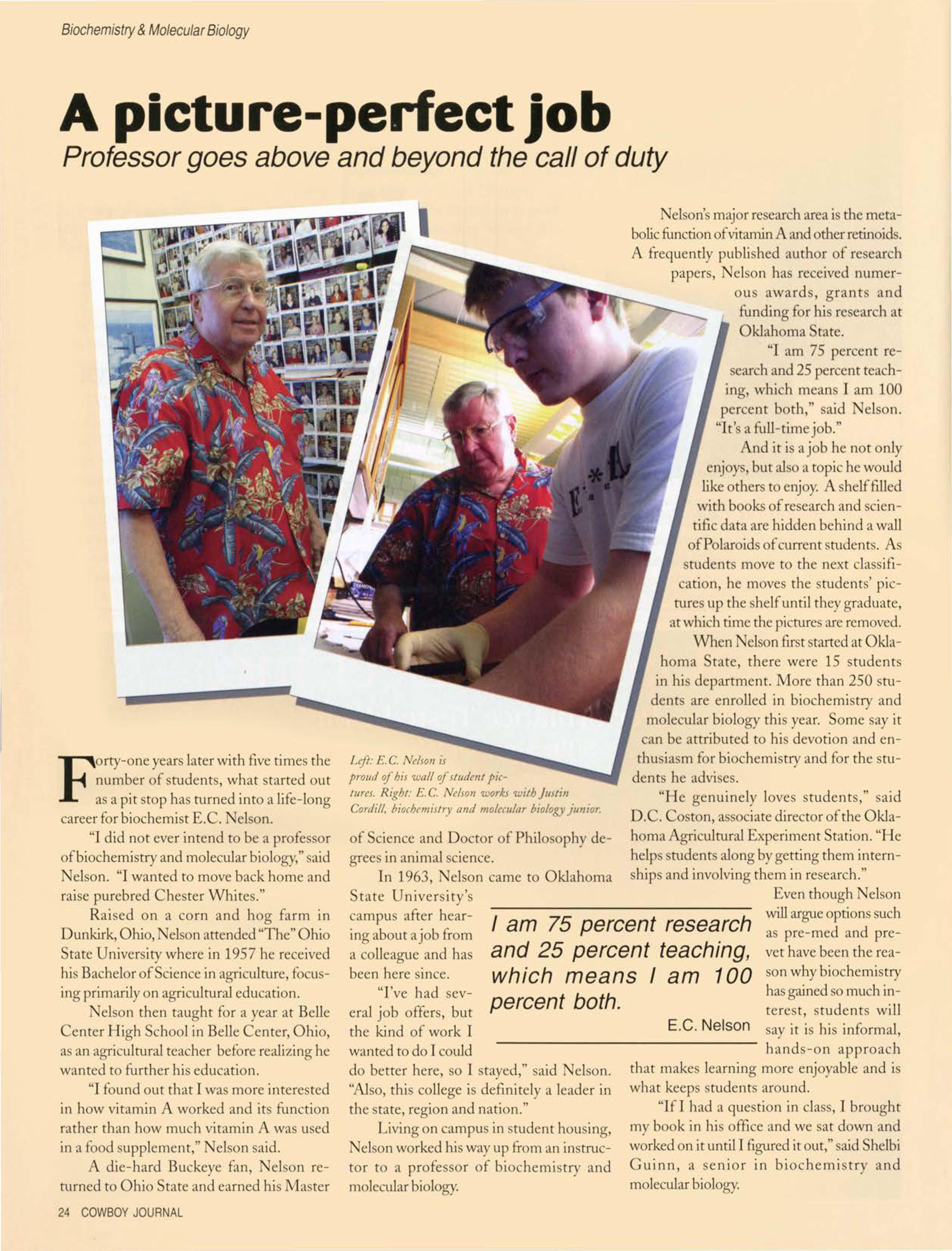
Fort -one year later with five times the number of students, what started out as a pi top has turned into a life-long career for biochemist E. cl on.
"] did not ever intend to be a profcs or of biochemistry and molecular biology," said elson. "I wanted to move back home and raise purebred Che ter Whites."
Raised on a corn and hog farm in Dunk.irk, Ohio, el on attended "The" Ohio tate Univer ity where in 1957 he received hi Bachelor of cience in agriculture, focusing primarily on agricultural education.
Nelson then taught for a year at Belle enter High School in Belle Center Ohio, a an agricultural tea her before realizing he wanted to forther his education.
"Tfound out that I wa more interested in how vitamin A worked and its function rather than how much vitamin A was used in a ood upplement," el on aid.
A die-hard Buckeye fan, el on returned to Ohio tate and earned his aster
L,j"I:E. C. elsonis proud ofhi! W(l/1 efstudmt pictures. Right: E.G. Nelson wMh withj11sti11 Cordill. biochemislr)'and mu/em/,,, biologyju11ior.
of cience and Doctor of Phi.lo phy degrees in animal cience.
In 1963, l elson came to Oklahoma tate Univer it 's
ampu a~er hearing about a job from a olleague and ha been here since.
I am 75
nd it i a job he not only enj , but al o a topi he would likeother to enjoy. shelf filled with books of re earch and cientific data are hidden behind a wall of Polaroid of current tu dent . tudent move to the next dassifiation, he move the rudent 'piehires up the shelf until they graduate, at which rime the pictures are removed. When el on fir t tarted at Oklahoma rate, there were 15 tudent in hi department. More than 250 student are enroUed in biochemi try and molecular biology thi year. ome say it can be attributed to hi devotion and enthusiasm for bio hemistry and for the student he advi es.
"He genuinely loves student ," said D. oston associate direetorof the Oklah ma gricuJcural xperiment tati n. "He help tudents along by getting them internhips and involving them in re earch."
percent
research and 25 percent teaching, which means I am 100 percent both.
Even though Nelson willargue option uch as pre-med and prevet have been the reason why biochemistry hasgained omu hinteresr, students will E.C. Nelson ay it is hi informal
"I've had several job offers, but the kind of work I wanted to do I could hand -on approach do better here, so I stayed," a.id cl on. that make learning more enjoyable and is "AJso this oUege is definitely a leader in what keeps students around. the tate, region and nation."
"Ifl had a que tion in class, I brought Living on campus in tudent housing, my book in his office and we at down and el on worked his way up from an in true- worked on it until I figured it our," aid helbi tor to a professor of biochemistry and Guinn, a .enior in biochemi try and moJccularbiology. molecular biology.
Guinn said elson's open-door policy and laid back anitude makes learning easier. He also helps establish class schedules that will best suit the individual student.
"l want them to feel free to discuss their academic problems," said Nelson.
1elson said it is important to know each student's interest. He said his goal is to get students to where they want to be, even ifit is not in biochemistry.
One way Nelson finds out whether or not students are interested is by getting them involved with the Freshman Research Scholars class.
"The fun thing about research is finding new information, new questions and problems, and how the field is expanding every day," Nelson said.
The Freshmen Research Scholars class is designed to give incoming students handson experience of what they can be expected to encounter in their major. This gives students the opportunity to get out of a regular lecnire and work in a lab, develop research and collect data, which is an important part of their major.
"This class really helps us think about if we really want to be in a lab," said Maggie Talley, biochemistry and molecular biology freshman. "It is an enjoyable and fun class."
clson's work is not only noted by students, but also by co-workers. Earl Mitchell, friend, neighbor and head of Oklahoma State Multicultural Affairs, worked alongside Nelson as a biochemist.
"It's his personality," said Mitchell. "He nurtures and cares for his students, gives them good advice and goes to bat for them.''
Mitchell said biochemistry has always had a i,rreatsuccess record for students going to medical school. He also said the program is rigorous and retention is a key issue.
"Ir is very natural for pre-med students to come into this major," said Mitchell. "Getting them to stay is another part, and that is pretty much what he did."
Nelson said Oklahoma Srare's open policy with administrators and deans makes his job easier and more enjoyable.
"The administration has always been open," said Nelson. "We could have disagreements but it never got personal; afterward, we could all go have a cup of coffee."
l\litchell said Nelson's strong family tics are what give him the ability to be so effective with students. Nelson and his wife, Joanne, enjoy spending time with their two
daughters, three granddaughters and one grandson.
Nelson retired at the end of the Fall 2003 semester and as his research winds down, he plans on traveling and spending more rime with his family. Retirement, however, will not ger in the way of his passion; he plans to continue advising and helping students.
Nelson's 41 years of service at Oklahoma State can be summed up with one simple statement: "The student comes first."
Everything he has <lonehas been aimed at helping the student or making the studenr's life better.
"l want them to find out what they can be successful doing," said Nelson. "They are not going to be successful at their job if they aren't By Brian Bmdel<', Chand/a, Okla.
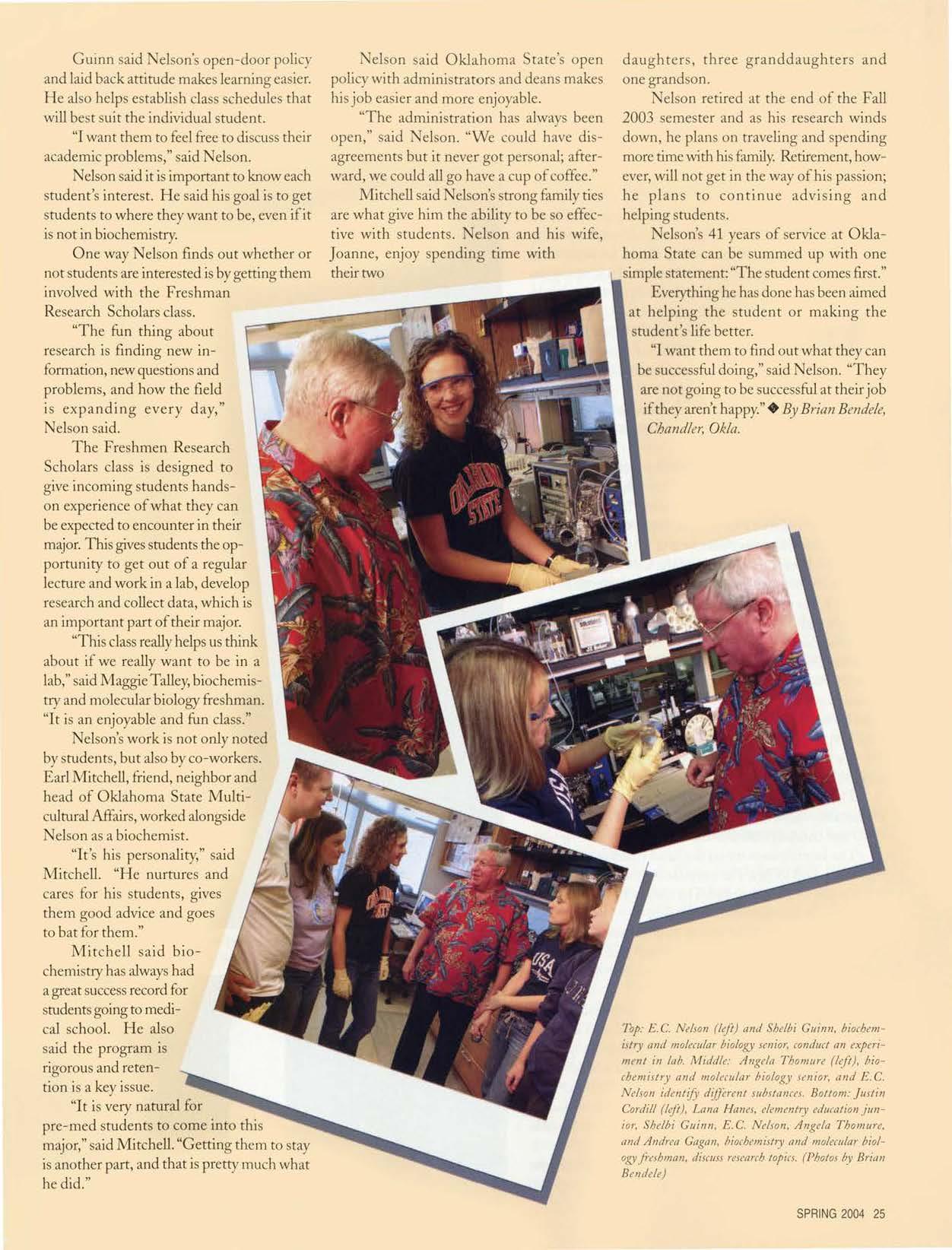
Top: E.C. Ndso11/l(ji) ,md Shdbi G11m11. b1orh,·111istry a11d111olemlt1rbiologysmior. comlua t111txprrimmt in l,,/1.Middle: Angdn Tho11111re(l,:/i}, biochm11stry 1111tlmolNult1r biology umor, and E.C. Ndso11 idmtijj d!ffermt mlnt1111rr.,Bollom: Justin Cordill (lcji). L1111t1Ha11,,. 1•/m1mtrytd11mtion}1111io,·, Shelbi G11i1111.E.C. Nrlso11,Angela Thomur,·. 1111d Andrm Gagan, biochemistry1111dmolemlar /1iologyJr,rhma11,dimm n•1,·11rrhtopics. ( Photosby Bri,111 Bmdcle}
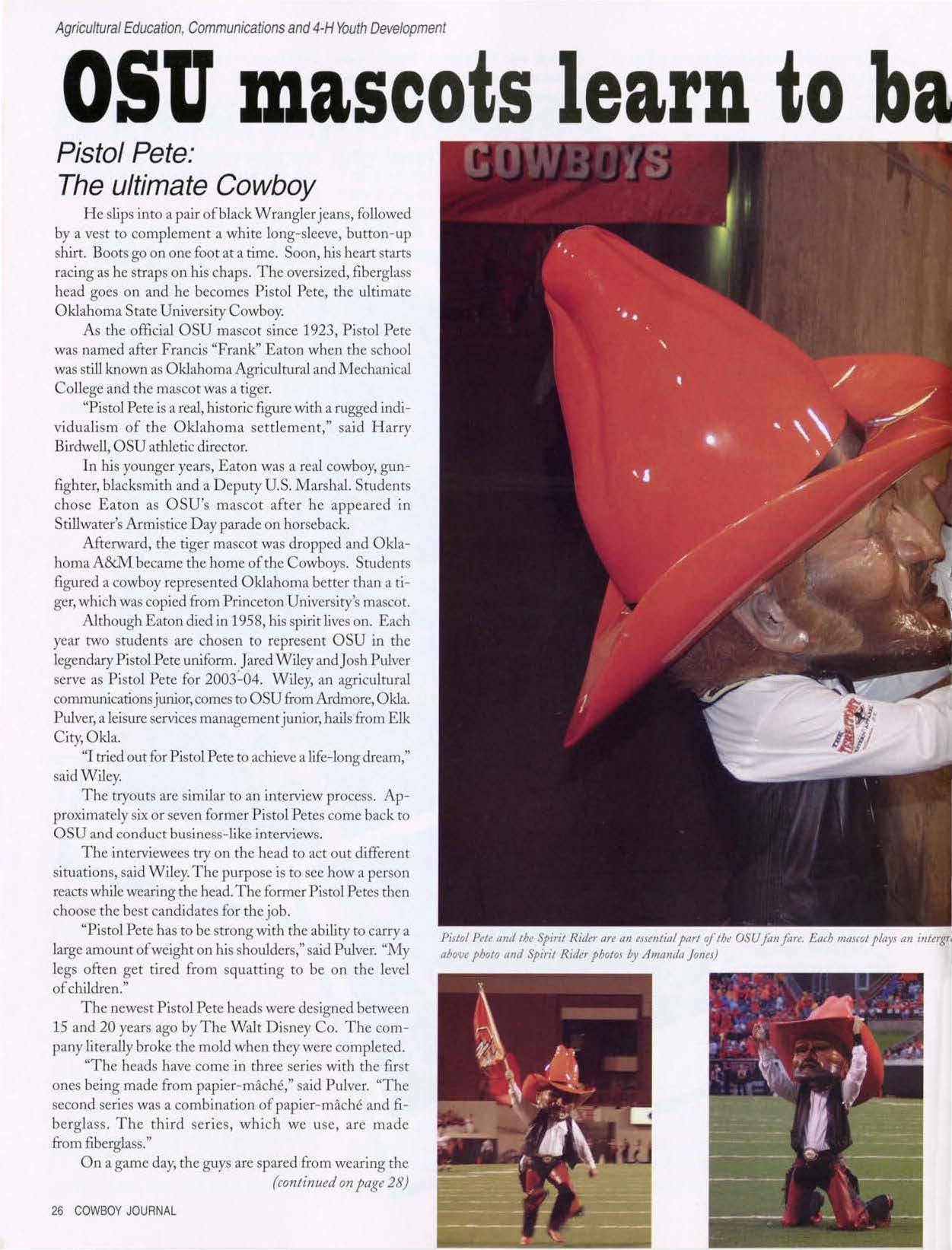
He slips into a pair of black Wrangler jeans, followed by a vest to complement a whfre long-sleeve, button-up shirt. Boots go on one foot at a time. Soon, his heart starts racing as he straps on his chaps. The oversized, fiberglass head goes on and he becomes Pistol Pete, the ultimate Oklahoma State Universiry Cowboy.
As the official OSU mascot since 1923, Pisrol Pete was named after Francis "Frank" Eaton when the school was still known as Oklahoma Agricultural and Meehan ical College and the mascot was a tiger.
"Pistol Pete is a real, historic figure with a rugged individualism of the Oklahoma settlement," said Harry Birdwell, OSU athletic director.
ln his younger years, Eaton was a real cowboy, gunfighter, blacksmith and a Deputy U.S. Marshal. Students chose Eaton as OSU's mascot after he appeared in StiJJwarer's Armistice Day parade on horseback.
Afterward, the tiger mascot was dropped and Oklahoma A&M became the home of the Cowboys. Students figured a cowboy represented Oklahoma better than a tiger, which was copied from Princeton University's mascot.
Although Eaton died in 1958, his spirit lives on. Each year two students arc chosen to represent OSU in the legend.try Pistol Pete uniform. Jared Wiley and Josh Pulver serve as Pistol Pete for 2003-04. Wiley, an agricultural communications junior, comes to OSU from Ardmore, Okla. Pulver, a leisure services management junior, hails from Elk City, Okla.
"1tried out for Pistol Pete to achieve a life-long dream," said Wiley.
The tryouts are similar to an interview process. Approximately six or seven former Pistol Peres come back to OSU and conduct business-like interviews.
The interviewees try on the head to act out different situations, said Wiley. The purpose is to see how a person reacts while wearing the head. The former Pistol Pctes then choose the best candidates for the job.
"Pistol Pete has to be strong with the ability to carry a large amount of weight on his shoulders," said Pulver. "My legs often get tire<l from squatting co be on the level of children."
The newest Pistol Pete heads were designed between 15 and 20 years ago by The Walt Disney Co. The company literaJJy broke the mold when they were completed.
"The heads have come in three series with the first ones being made from papier-mache," said Pulver. "The second series was a combination of papier-mache and fiberglass. The third series, which we use, are made from fiberglass."
On a game day, the guys are spared from wearing the (continued011 page 28)
Balancinglife in collegecan be challenging.Along with school, many students havejobs, a variety of extracurricular activities and a social life; however, one student adds additionaldutieseach yearby representingOklahoma State Universityas the OSU Spirit Rider.
Merirnth Cohenour, an agriculturalcommunications senior, is that student. Last spr.ing,she was chosen as the 2003-04 Spirit Rider. Cohenour served as a member of the ground crew in the 2002-03 season and is now the fifth femaleto ride as the Spirit Rider.
Cohenour began riding horses at a young age at her home in Claremore,Okla.
''I was on a horse before l could walk," she said. Her mother and grandfather went on horseback trail rides and toted Cohenour with them.
When she was 7 years old, Cohenour received her first horse. Shortly after, she began taking riding lessons. She is trained in western, English, dressageand jumping. Cohenour also showedwith the Pinto Horse Association of America and the Paint Horse Association,as wellas in4-H.
·'Igrew up activein the RogersCounry4-H," Cohenour said. '1 also held national officerpositionsin the PtHA and the APHA. College has slowed down my show schedule tremendously, but I still find time to ride and train my own horses."
Cohenour's passion for riding has grown with time, and she hopes to pursue a career that relates to horses.
"It has already been ru1 amazing experience,''she said. "I wanted to be the Spirit Rider becauseI had such a great experience last year on the ground crew."
"It's exciting to be able to combine my passion for riding and the school I loveby representing it as a mascot," Cohenour said.
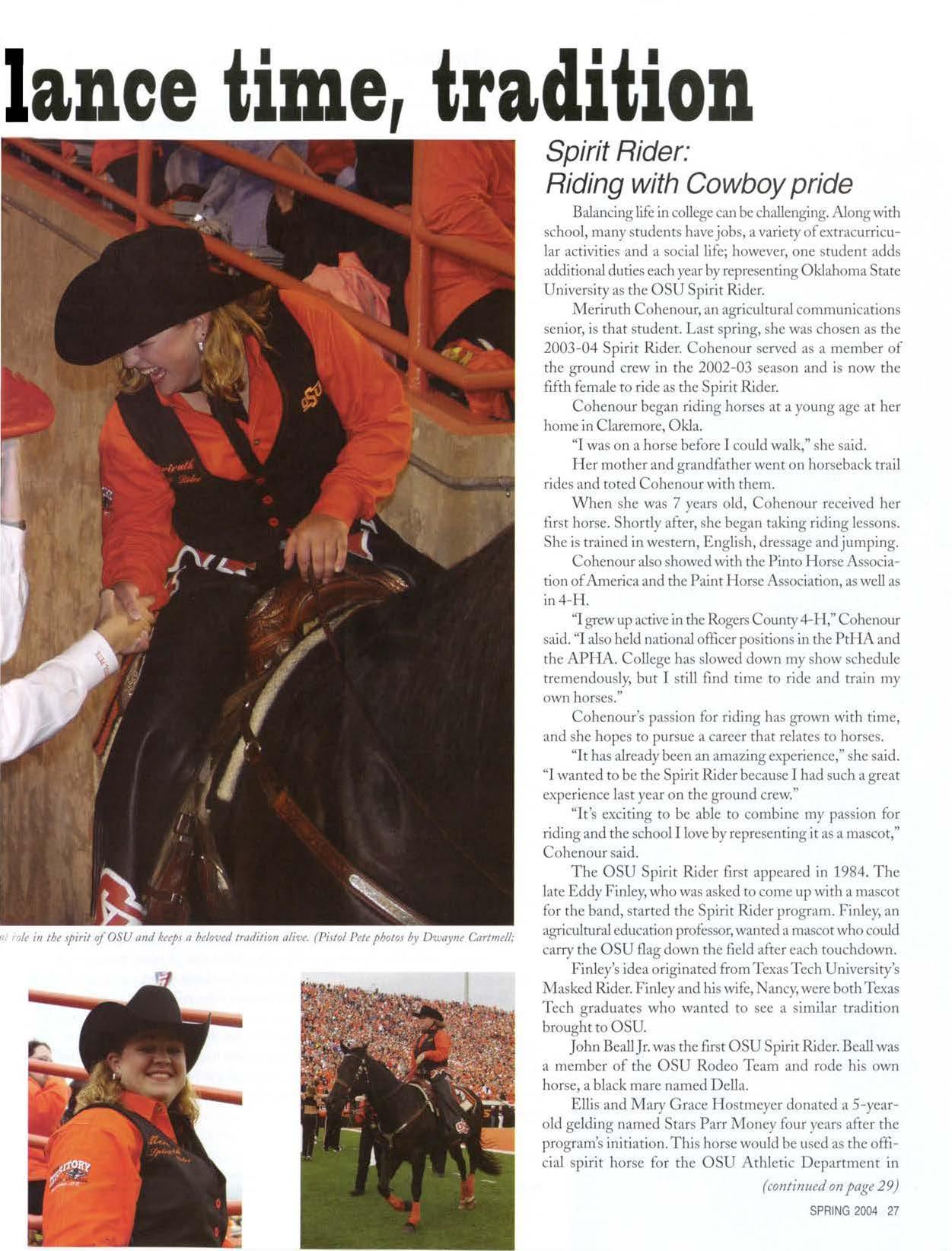
r1I.-111the ,pirit of OSU a11dkup, ff /,e/ovedtmdition alive. (Pi.,tolPetephoto.<l,y Dway11eCar/me/I;
The OSU Spirit Rider first appeared in 1984. The late Eddy Finley,who was asked to come up with a mascot for the band, starred the Spirit Rider program. Finley,an a£,rriculturaleducationprofessor,wanted a mascotwho could carry the OSU flag down the field after each touchdown. Fi n.ley'sidea originated from Tc,'<asTech U nivcrsity's Masked Rider. Finleyand his wife,Nancy,were both Texas Tech graduates who wanted to see a similar tradition brought to OSU.
John BeallJr. was rhe first OSU Spirit Rider.Beallwas a member of the OSU Rodeo Team and rode his own horse, a black mare named Della.
Ellis and Mary Grace Hostmeycr donated a 5-yearold gelding named Stars Parr ]Vloneyfour years after the program'sinitiation. This horse would be used as the official spirit horse for the OSU Athletic Department in (continuedon page 29)
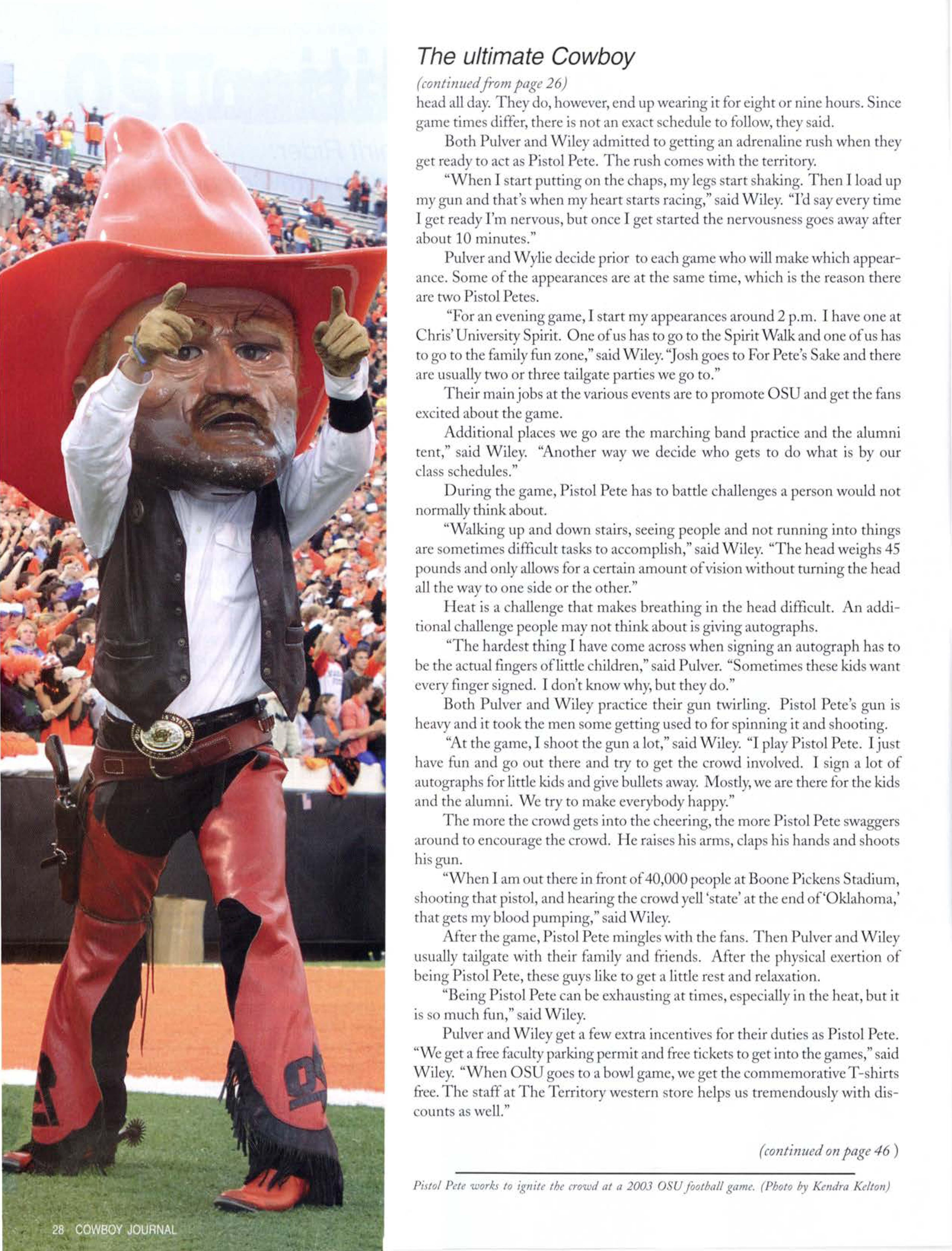
(rontin11edfrom page 26)
head all day. They do however end up wearing it for eight or nine hours. mce game times differ there i nor an exact schedule to follow, they aid.
Both Pulver and Wiley admitted to getting an adrenaline ru h when they get ready to act a Pi tol Pete. The ru h ome with the terri t ry.
"When I tart putting on the hap , my kg start baking. Then I load up my gun and that' when my hear art racing," aid Wiley. 'I'd say every time 1 get ready I'm nervou , but once I get started the nervousness goes away after about 10 minute ."
Pulver and Wylie decide prior to each game who will make which appearance. ome of the appearance are at he ame time, which i - the rea n there ru·etwo Pistol Pete
"For an evening game, tar my appearan es around 2 p.rn. I have one at Chri 'U rriver ity pirit. One ofus ha to go to the piri t Walk and one ofu has to go to the family fun zone," said Wiley. "Josh g e o ' r ete' ake an ther arc u ua!Jytwo or three tailgate parties we go to.'
Their main job at the variou event are t pr mote O U and get the fan exci.tedabout the game.
ddirional pla e we go are the marching band practi e and he alumni tent," aid Wiley. " nother wa we de idc who gets to do what i by our cla schedule .''
During the game Pi tol Pete ha to battle challenges a per on would no norma!Jythink about.
" alking up and down stairs, seeing people and not running into things are omctimes difficult ta k to a compli h," aid Wiley. 'The head weigh 45 pound and only allow or a ertai.r1amount of vision without turning the head all rhe way to one ide or the other."
Heat i a hallenge that make breat11ing in the head difficult. An additional cha!Jengc people may not think about is giving autograph .
"The hard t thing I have come aero when igning an autograph ha o be the a tual finger of little children " aid PLLlver." ometime the e kid want every finger signed. l cl n't know why, but they d ."
Iloth Pulver and Wiley pra tice their gun twirling. Pi tol Pete' gun i heavy and it took the men some getting u ed to· or pinning it and hooting.
" t he game, I hoot the gun a I t," aid Wiley. "I play Pi tol Pete. 1ju r have fun and go ut there and try to get the rowd involved. J ign a lot of au ograph for little kid and give bullet away. Mo tly, we arc there for the kid and the alumni. Werry to make ever body happy."
The more the crowd get into he cheering the more Pi tol Pete waggers around to encourage the rowd. le raises hi arms claps his hand and shoot hi gun.
"When I am our there in fr nt f 40,0 0 people at Bo ne Picken radium, hooting that pi tol, and hearing the crowd ell' rate' at the end of'Oklahoma ' that get my lood pumping" aid Wile
After the game, Pistol Pete mingle with the fan . Then Pulver and Wile u mill tailgate with their family and friend A~er the phy i al exerti n of being Pi tol Pete, the e guys like t get a little rest and relaxation.
' cing 1 i to! Pete an be exhausting ar time , e pecially in the heat, but it is so much fun," -~idWiley.
Pulver and Wiley get a few extra incentives for their duties as Pistol Pete. "We get a free faculty parking permit and free ticket to get into the game ," aid Wiley. "When U goe to a bowl game, w get the ommcmorativcT--hirts free. The taff at The Territory western store help u tremendou ·ly with dic unts as well.''
(co11ti11ued011page 46)
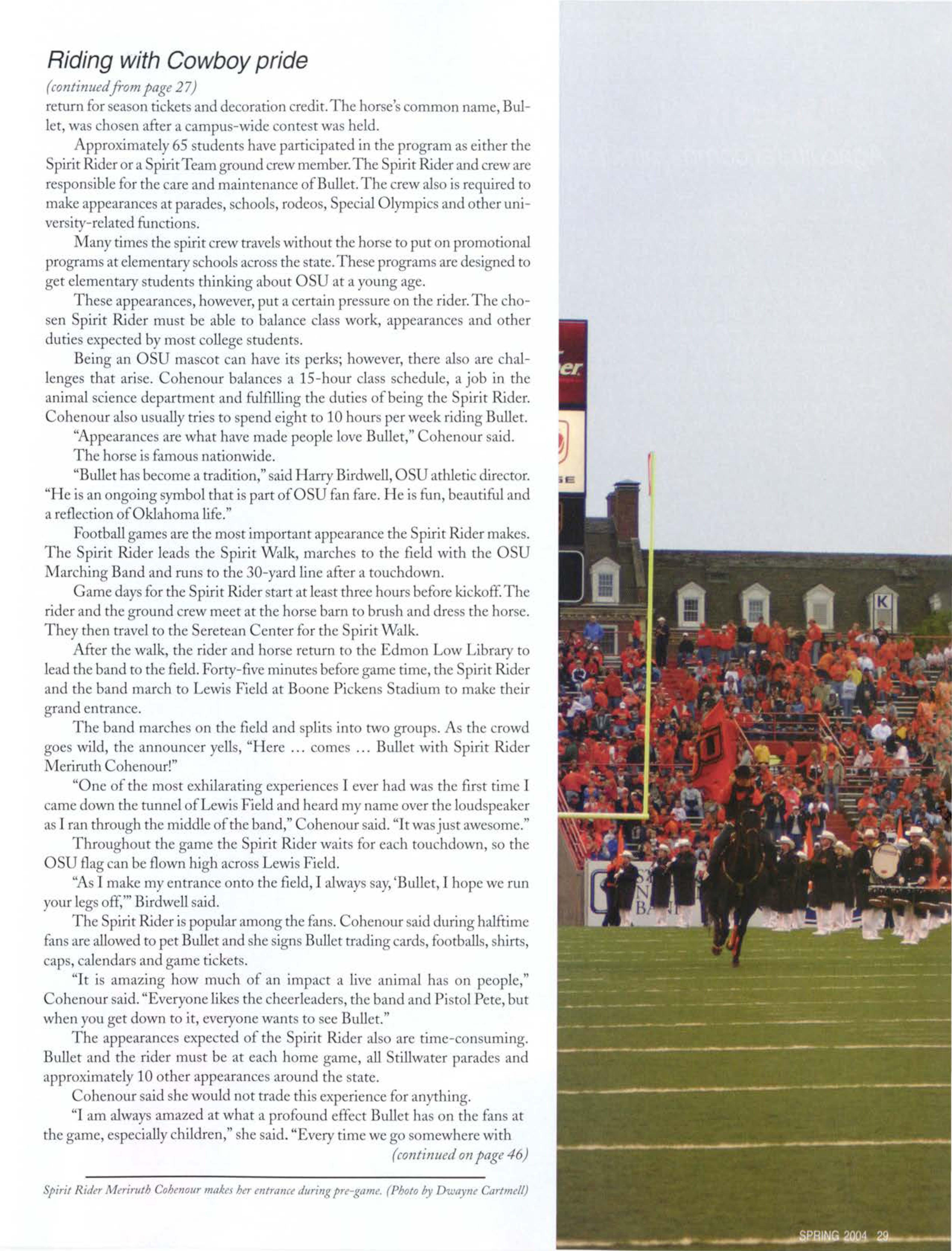
(continuedfrom pnge 27}
rerurn for ca n ti ket and dee ration credit. The horse's omm n name, BuJlet wa cho en after a campu -wide once t wa held.
pproximately 65 tudent have participated in the program a either the pirit Rider or a pirir Team ground crew member. The pirit Rider and crew are responsible for the are and maintenance ofBuUer. The rew also i required to make appearan e at parade , hool , r deo , pe •al OJympi and other university-related fun tion
an time the pirit crew tr.ave! without the horse to put on promotional program at elementary schools aero the rate. The e program are designed co get elementary students thinking ab ut O U at a young age.
The e appearan e , how ver put a ertain pre ure on the rider. The choen pirit Rider mu t e able t balance cla work appearan e and other dutie expected by mo t ollege student
Being an U ma cot can have it perks; however, there also arc challenges that ari e. ohcnour balance a 15-hour la chedule a job in the animal ien e department and fulfilling the duric of being the pirit Rider.
oh en our al o u ualJ trie t pend ei Tht o 10 h ur per week riding Bullet.
" ppearan e are what have made people lo e Bullet," ohenour aid.
The h r e i fam u nationwid
"Bullet has become a tradition," aid Harry Birdwell, U athleti dire tor. "He is an ongoing symbol that i part of O U fan fare. He i fun, beautiful and a reflection f Oklahoma life.'
Football game are the mo r imp rtanr appearan e the pirit Rider make 'he pirit Rider leads the pirit Walk, marches to the field with the O U Marching Band and run o the 0- ard line after a tou hdown. ame da for the piri t Rider start at least three hours before kickoff.The rider and rhe ground rew meet at the h r e barn t bru hand dre the h r e. They then travel to the ercte:rn enter for the pirir Walk. fter the walk, the rider and h r e return t the • dm n Low ibrary t lead the band to the field. Forty-five minutes before game time, the pirit Rider and the band march to Lewi Field a Bo ne Pi ken radium to make their grand enrr, n
The band marche on the field and plit int t\ group the r wd c wild, the an noun r yells, "Here . . . me ... Bullet with pirit Rider l\lleriruth ohen ur!"
"One of the m t exhilarating exp rien e I ever had was the fir t time 1 came down the tunnel of Lewis Field and heard m name over the loud peaker a J ran through the middJ f the band," ohenour aid. "lt wa ju t awe omc."
Throughout the game the pirit Rider waits f, r each t u hd wn, o the 0 flag an be flown high a r Lewi Field.
I make m entran c onto the field 1 alway sa 'Bullet, l hope we run your leg off," Birdwell aid.
Th pirit Rider i popular among the fan ohen ur aid during halftime fan are aUo~ed to pet Bullet and she sign Bullet trading card fc tball , hire , cap , calendar and game ti ket
"It i amazing how mu h of an impact a live animal has on people" ohenour aid. "Everyone like the cheerleader the band and Pistol Pete, but when you get down to it, everyone wants to see Bullet.'
The appearan e expe ted of the pirit Rider al are time-consuming. Buller and the rider mu t be at each home game, all tillwater parade and approximately 10 thcr appearan ·e around the tate. ohen ur aid hew uld not trade thi experien e for anything.
"l Rm alwa s amazed at what a profound effect Bullet has on the fans at the game, e pe iaUychildren," she aid. "Every time we go mewhere with (conti1111ed on pnge 46)
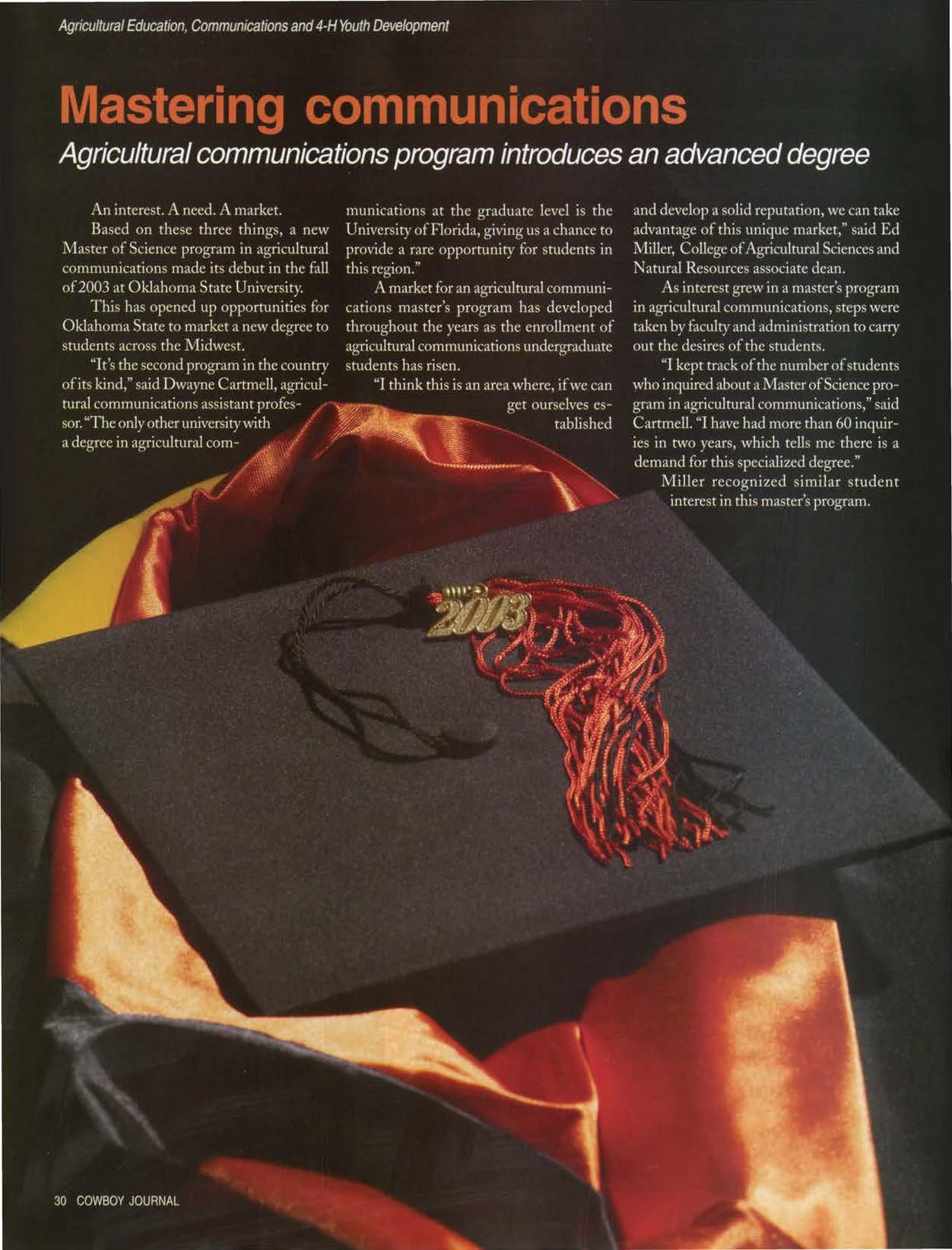
''This is something students have been wan ting,» Miller said, "but they can't define or create ir. Somebody has to create it for them."
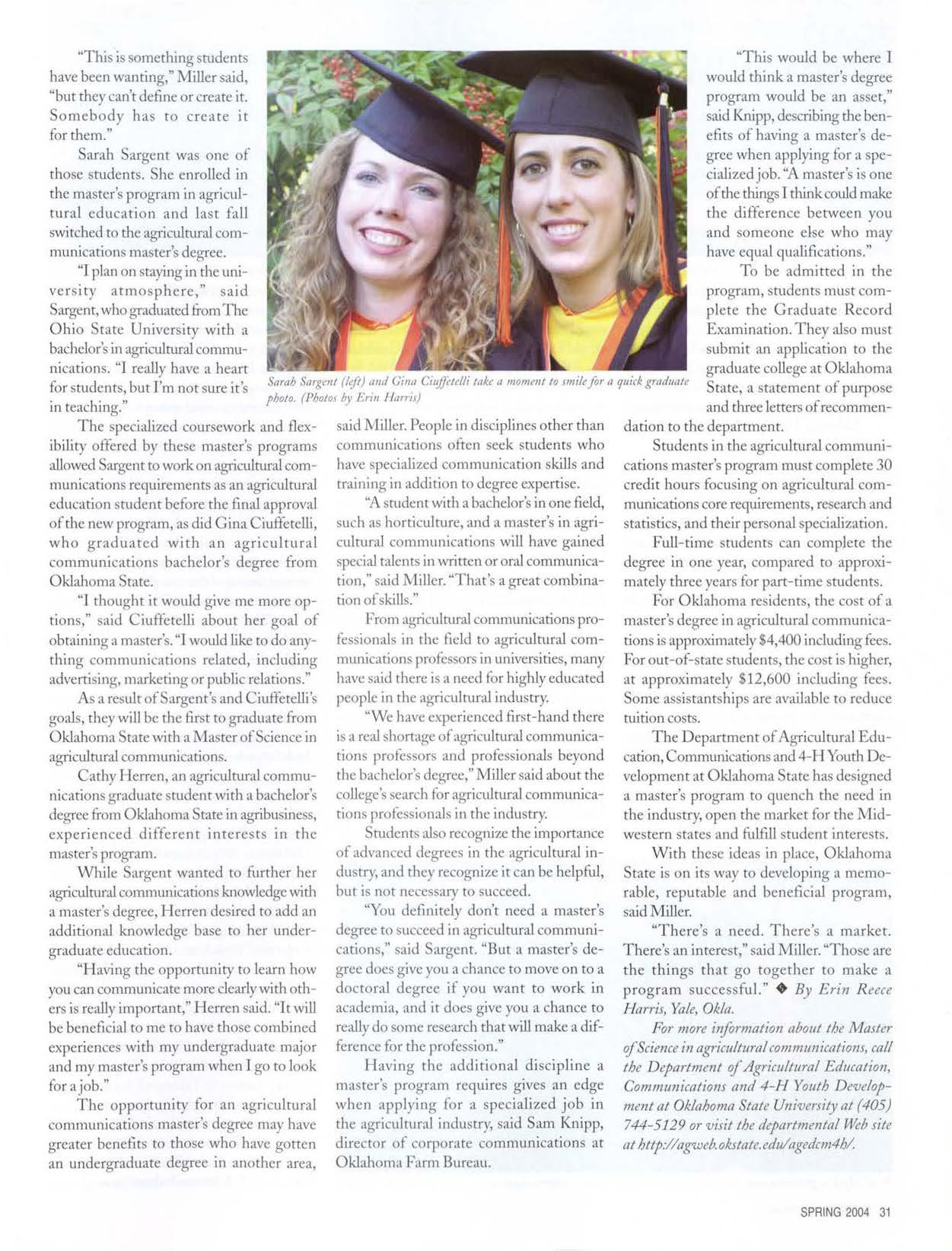
Sarah Sargent was one of those students. She enrolled in the master's program in agricultural education and last fall switched to the agricultural communications master's degree.
"l plan on staying in the university atmosphere," said Sargent, who graduated &om111e Ohio State University with a bachelor's in agricultural communications. "J really have a heart for students, but l'm not sure it's in teaching."
The specialized coursework and flexibility offered by these master's programs allowed Sargent to work on agricultural communications requirements as an agricultural education student before the final approval of the new program, as did Gina Ciuffetelli, who graduated with an agricultural communications bachelor's degree from Oklahoma State.
"1 thought it would give me more options," said Ciufferelli about her goal of obtaining a master's. "1would like to do anything commui1ications related, including advertising, marketing or public relations."
As a resulc of Sargent's and Ciuffetclli's goals, they will be the first to graduate from Oklahoma Stare with a l\1asrer of Science in agricultural communications.
Cathy I lcrren, an agricultural communications graduate student with a bachelor's degree from Oklahoma State in agribusiness, experienced different interests in the master's program.
While Sargent wanted to further her agricultural communications knowledge with a master's degree, Herren desired ro add an additional knowledge base ro her undergraduate educaLion.
"Having the opportunity to learn how you can communicate more clearly with others is really important," I Ierren said. "It will be beneficial ro me to have those combined experiences with my undergraduate major ,md my master's program when I go to look for a job.''
The opportunity for an agricultural communications master's degree may have greater benefits ro those who have gotten an undergraduate degree in another area,
said l\Iiller. People in disciplines other than communications often seek students who have specialized communication skills and training in addition to degree expertise.
"A sn1dencwith a bachelor's in one field, such as horticulture, and a master's in agricultural communications will have gained special talents in wrinen or oral communic-ation, '' said J\lillcr. "That's a great combination of skills."
From agricultural communications professionals in the field to a!:,rriculturalcommunications professors in universities, many have said there is a need for highly eJucated people in the agricultural industry.
"We have experienced first-hand there is a real shortage of agricultural communications professors and professionals beyond the bachelor's degree," Miller said about the college's i;earch for agriculrural communications profcssion.lls in the industry.
Srudents also recognize the importance of advanced degrees in the agricultural industry, an<l they recognize it can be helpful, but is not necessary to succeed.
"You definitely don't need a master's degree to succeed in agricultural communications," said Sargent. "But a master's degree docs give you a chance comove on to a doctoral degree if you want to work in academia, and it docs give you a chance to really do some research that will make a difference for the profession."
Having rhe additional discipline a master's program requires gives an edge when applying for a specialized job in the agricultural industry, said Sam Knipp, director of corporate communications at Oklahoma Farm Bureau.
"This would be where 1 would think a master's degree program would be an asset," said Knipp, describing the benefits of having a master's degree when applying for a specialized job. "A master's is one of the things I think could make the difference between you and someone else who may have equal qualifications."
To be admitted in the program, students must complete the Graduate Record Examination. They also must submit an application to the graduate college at Oklahoma State, a statement of purpose
and three letters of recommendation to the department.
Students in the agricultural communications master's program must complete 30 credit hours focusing on agricultural communications core requirements, research and statistics, and their personal specialization.
r:'uU-time students can complete the degree in one year, compared to approximately three years for part-time students.
For Oklahoma residents, the cost of a master's degree in agricultural communications is approximately 54,400 including fees. For out-of-state students, the cost is higher, at approximately $12,600 including fees. Some assistantships arc available to reduce tuition costs.
The Department of Agricultural Education, Communications and 4-HYouth Development at Oklahoma State has designed a master's program to quench the need in the industry, open the market for the Midwestern states and fulfill student interests.
With these ideas in place, Oklahoma State is on its way to developing a memorable, reputable and beneficial program, said Miller.
"There's a need. There's a market. There's an interest," said Miller. "Those arc the things that go together to make a program successful." By Erin Reece Harris, Yale,Okla.
For more i11jomu1tio11about the Master o/Sciencein ag,-icull11rt1Iromm1111ications,call the Departmcn/ ~/Agricultural Ed11catio11, Communicalionsand 4-H Youth Development al OklahomaState Universitynt (405) 744-5129 or visit the departmentalWebsite at http:llngweb.oh/ate.edulagedcm4hl
Plant a eed and it will grow.The adage is true not only when it comes to plants but al o in finding one' pa ion. Randy Davis knows this from experience.
Davi began t find hi life's pa ion as a high chool student employed at Gr enleaf ursel)' in Pa.rkHill, Okla., during the summers. While working at hi surnrn r job, avi began to c nsider his future.
I wa going to g to ortheasrern ate University] to be a teacher,' Davi said. " y dad was a teacher, and I wa going t go to ortheastern because I could afford it. th ughtO Uwastooexpen ive."
Although Davi had a plan, he was not overly en hu iasti about it.
Then opportunity knocked. ustin Kenyon an Oklahoma tate University graduate who wa the Greenleaf production manager at the time, a ked Davi if he had con idered attending sch ol in tillwater. After Dav:i old Kenyon he had but thought it would be too expensive, Kenyon and Gil ickel, o-owncrofGrcenleaf, offered him the Greenleaf holar hip.
The holarship wa originally int ndcd to be a ne- ime- nly offer pe ifi ally for Davis and would pay for his tuition, fees and books o a tend Davis was exited about the opportunity.
"J developed a love for plant at home in the garden," Davis said. "Itwa a thrill t ee one grow and develop into a big plant. I'm till amazed by the proce ."
Davis graduated from O U in December 1975 \.vith a degree in h rticulnire. He
immediately returned to work at reenl af as a propagation supervi or, a osition he would hold or 18 year Then he wa promoted and pen fiveyears as the mpany's vice president and produ tion manager. In 2000, Davi be ame he company's president and hjef executive officer.
When avi was ir t pre ented with the opportunity to come to , he said he could not have imagined the u e that would followwhen he returned t reenleaf
"I'm a goal tter,' avi said."I'm a firm believer that you set where you want to get to in life. I'm ha way about everything. Ycu have to et your life in the dir ction you want to go, realizing you don't alway have t tal ontrol. ometimes you achieve uc ess you didn't envi ion."
Although his achievement have far urpas ed any expe tation he had, Davi i most satisfied in having a career he love
'1t's een pretty amazing. It's neat bccau e I have such a pa sion for m work. I love reenlcaf ursery," Davis said. 'To me, tha ' the importan th..ing, r ou r for any ne. Whatever you go into for your career, y u hould have a pa ion for it. I you don't then you ought to get into something you do have a passi n for.] teU people that all the time, 'Whatever you do make ure you have a pa ion for it.' Life' too h rt n t to enjoy it,' h aid.
Kenyon aid the opportunitie Davi had a a n1dent at O have been vital to Davis' sue css.
ou ee o many nident like Randy,
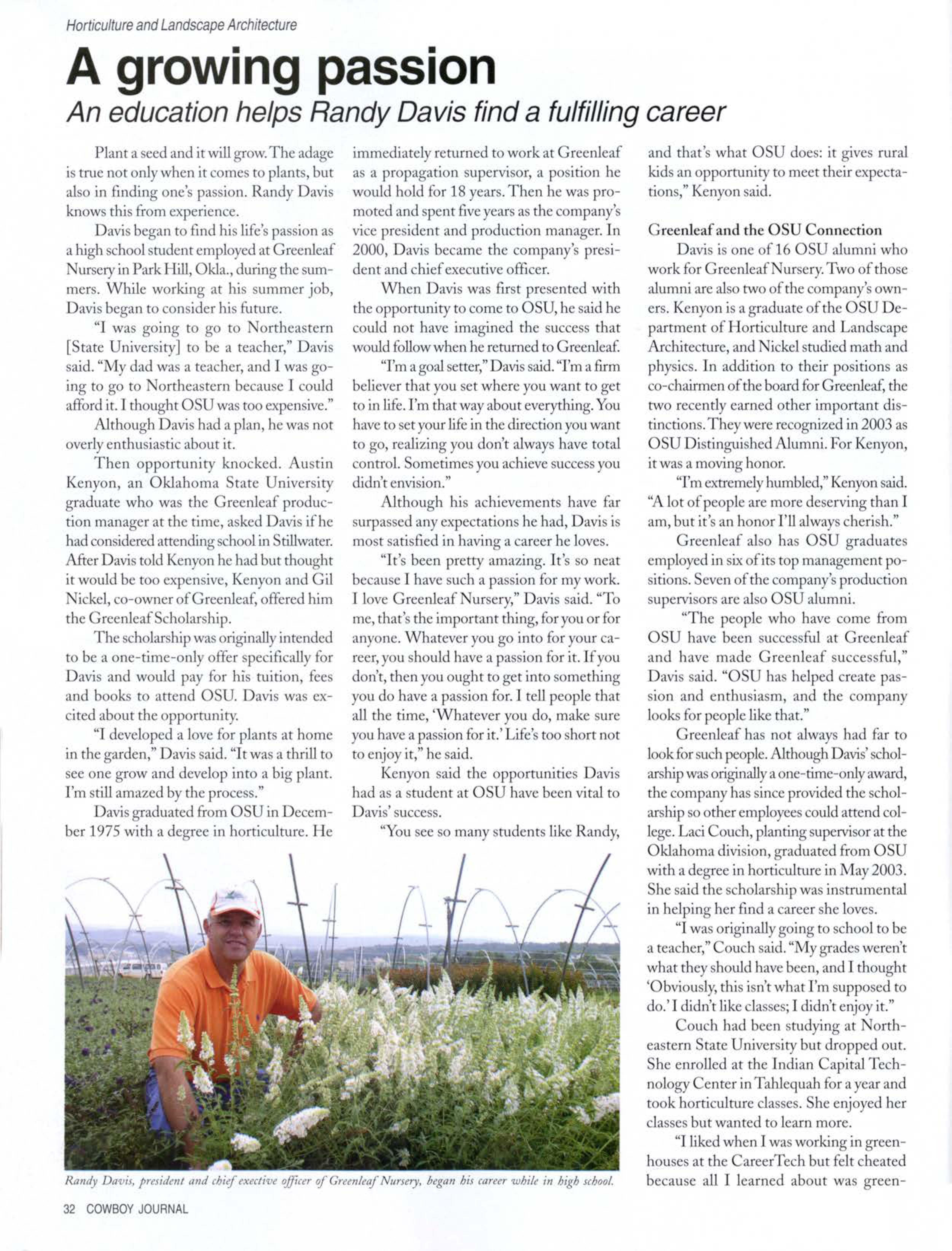
and tha ' what O does: i give rural kid an opportunity to meet their expectation ," Kenyon said.
Greenleaf and the O U Coone tion
Davi i one of16 0 alumni who work for Greenleaf ur cry. Two of those alumni are also two of the company's owners. Kenyon i a gradua of the O U Department of Horticulrure and Landscape Archite ture, and ickcl tudied math and phy ic In addition to their po ition a co-chairmen of t11eboard for Greenleaf, the two recent1y earned other important distin tion .Theywer recognized in 2003 as 0 U Di tinguished Alumni. For Kenyon, irwa a moving honor.
'Tm extremely humbled," Kenyon said. " 1 t of people are more de erving than I am, but it' an honor l'U alway cherish.''
Greenleaf al ha O gra uate employed i_nsix of its top management poition even of the company'· production supervisors arc also O alumni.
"The people wh have come from 0 U have been su cc ful at Greenleaf and have made reenleaf u e ful," Davi said. " U ha h lped create paion and enthusia m and the company looks for people like that."
reenleaf has not always had far to look for uch people. Al thou h avi ' cholarship wa originallya one-time-only award the ompan has in e provided the cholarship so other employees could attend college. a i ouch, planting upervi or at the Oklahoma divi ion, graduated from O U with a degree in horti u In,re in May 2003. he said th h lar hip was instrumental in helping her find a career she loves.
"I wa originally going to school to be a teacher," u h aid." 1ygrades weren't what they should have been, and 1 thought ' bvi usl thi i n'twha I'm uppo ed to do.' I didn t like classes; I didn t enjoy it."
ouch had been studying at ortha tern tate Univer ity but dropped out. he enrolled at the Indjan apital Techn 1 gy enter in ahlequah fc r a year and took horticulture classes. he enjo ed her clas e but wanted to learn more.
"I liked when I wa working in greenhou e at the areerTech but felt heated bccau e all I learned ab ut was green-
Th~ shippingfflcility lits in thr farrgrotmd ofGrunleflfs Pflrk Hill lowtion. Tht locationhas 600 flcresin produe1io11.(Photo.rbyj11.1ti11D,~y) houses,"Couch said."Then! was coldJ could plants. The innovations began as a result of Greenleaf has had tO expand to new places get a job here [at Greenleaf], and I thought the harsh winter in 1962-63 that resulted over the years. [n the 1970s, a second growit was the perfect opportunity to see if this is in the loss of 90 percent of that year's ing facility was purchased in El Campo, what I wanted to do." saleable crop. Texas, approximately 75 miles southwest of
Even while she was working at After that winter's loss, the company Houston. Davis said the El Campo location Greenleaf, Couch wanted to go back to began ro propagate and grow hardier types was chosen mainly because of the climate school. The opportunity to attend OSU of plant material such as deciduous shrubs provided by the area's long growing season through the Greenleaf Scholarship helped and shade trees. Over-wintering procedures and milder winters. her finish her education while learning more also were put in place the following fall. Re- "It wa~ mostly started for the growing about the work she enjoyed. Couch is search and development of winter pro tee- climate, but we wanted to develop the southpleased with the way things have rurned out. rion is an ongoing process at Greenleaf crn market, too," Davis said.
"I absolutely enjoywhat I'm doing now," today. Davis said the innovations made Today, the Texas operation boasts 400 Couchsaid. by Greenleaf extend beyond over- acresinproduction,makingitoneofthclarg-
wintering procedures.
GreenleafNursery has grown tremendously since the time Davis beciune an employee. A closer look at the company's history shows it has enjoyed a rapid growth since its inception.
Greenleaf ursery was founded in Muskogee, Okla., in 1945 by Harold and Rebecca ickcl.The company originaUyoperated as a small retail outlet, but soon began experiments in growing plant material in containers. John ickel, a son and business partner, looked to expand the company.
"There wasn't enough room in Muskogee to get any bigger,and they wanted to expand,'' Davis said.
Nickel began searching eastern Oklahoma for land to purchase and found a spot near Park Hill, Okla. The property lies 35 miles east of Muskogee on Lake Tenkiller and is the present-day location of the company's headquarters. Davis said the Park Hill location has grown from 100 acres co 600 acres in the time he has been employed at Greenleaf.
"I think [John Nickel] would tell you he never dreamed it would get this large," Davis said.
Along with the growth in land area at Greenleaf, Davis said the company has also grown in the areas of technology and plant diversity. Greenleaf has been a leader in innovations in over-wintering procedures for
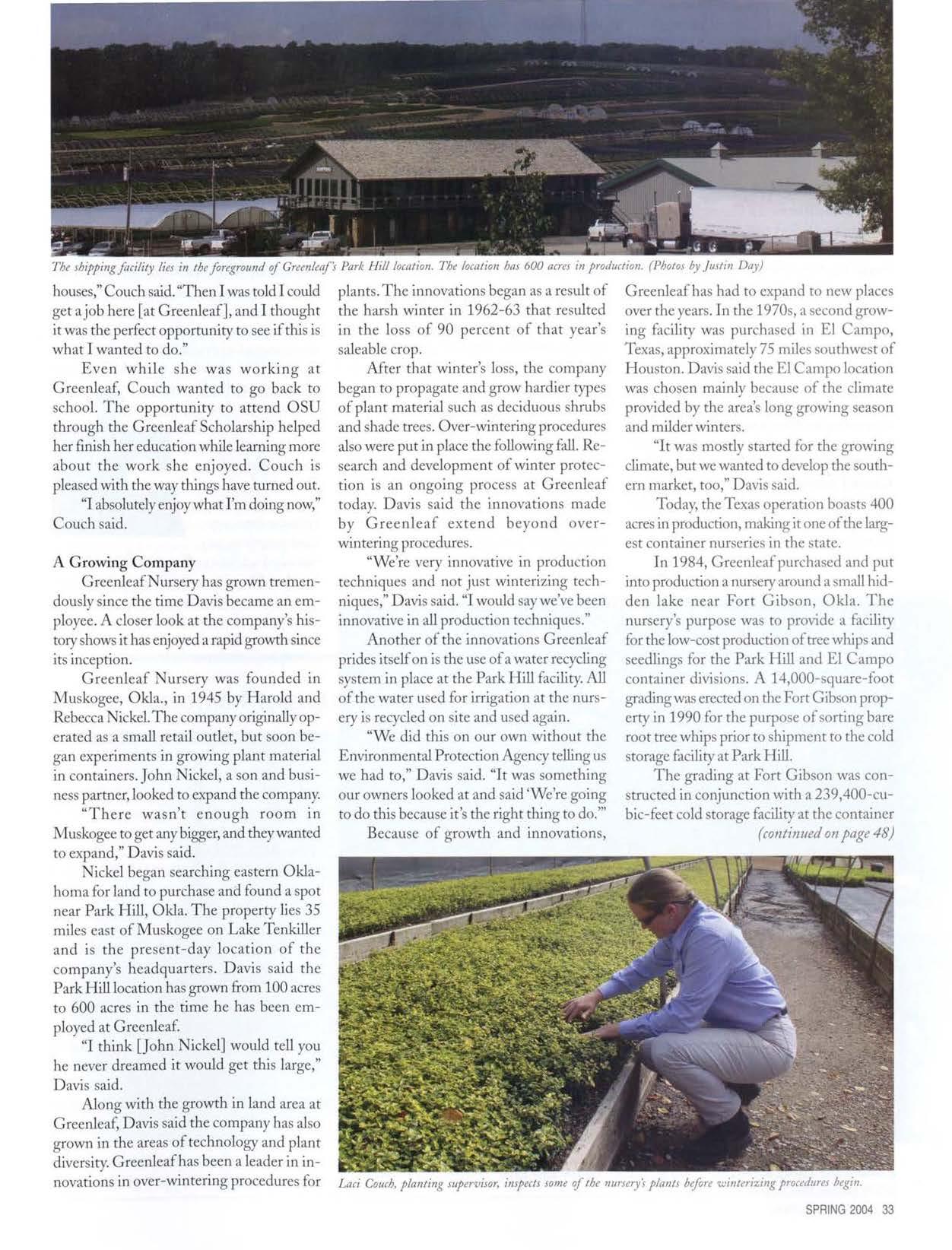
est container nurseries in the state.
"We're very innovative in production In 1984, Greenleaf purchased and put techniques and not just winterizing tech- into production a nursery around a small hidniques," Davis said. "l would say we've been Jen lake near Fort Gibson, 0 kla. The innovative in all production techniques." nursery's purpose was to provide a facility
Another of the innovations Greenleaf for the low-cost production of tree whips and prides itself on is the use of a water recycling seedlings for the Park Hill and El Campo system in place at the Park Hill facility. All container divisions. A 14,000-square-foot of the water used for irrigation at the nw·s- grading was erected on the Fort Gibson propcry is recycled on site and used again. erty in 1990 for the purpose of sorting bare
"Vvc did this on our own without the root tree whips prior to shipment to the cold Environmental Protection Agency telling us storage facility at Park I Iill. we had to," Davis said. "Ir was something The grading at Fort Gibson was conour owners looked at and said 'We're going structed in conjunction with a 239,400-cuto do this because it's the right thing to do."' bic-feet cold storage facility at the container
Because of growth and innovations, (continut!donpage -18}
With determination, dedication and a smile, the CoUegc of Agricultural Sciences and Natural Resources' Career Liaisons are ready to lend fellow students a helping hand.
"The Career Liaisons are a team that works hard together. They have a positive attitude of dedication, wiJJingness and service," said Amy Gazaway, Career Liaison adviser. "Career Liaisons have a strong desire to help other people who arc in the same situation they arc."
] n the spring of 2001, Gazaway and Louann Waldner, director of CASNR student career services, had a vision of students helping students with career development efforts. This vision was the beginning of the Career Liaison team.
"The program started out as an advisory board and has evolved into what it is today," said Gazaway. "It has come a long way in a short amount of time."
Every year a group of12 to 15 CASNR
students are selected to form the Career Liaison team. The selection of the Career Liaisons is coordinated through an application and interview process. From the applications, candidates are selected and evaluated in an interview, which includes a short, impromptu presentation, she said.
When the Career Liaisons arc selected, their duties are to inform srudents of careerrelatt:d activities, and they arc the voice of CAS R students when it comes to needed resources or sen,ices.
CAS R Career Liaisons link the classroom to the career by hosting career-related activities and services for their feUow students. Some services include resume development, mock interviews, career fairs and professional development workshops.
"When the Career Liaisons help their peers, there is a connection we as faculty and staff do not have," said Gazaway.
Career Liaisons offer a variety of dif-
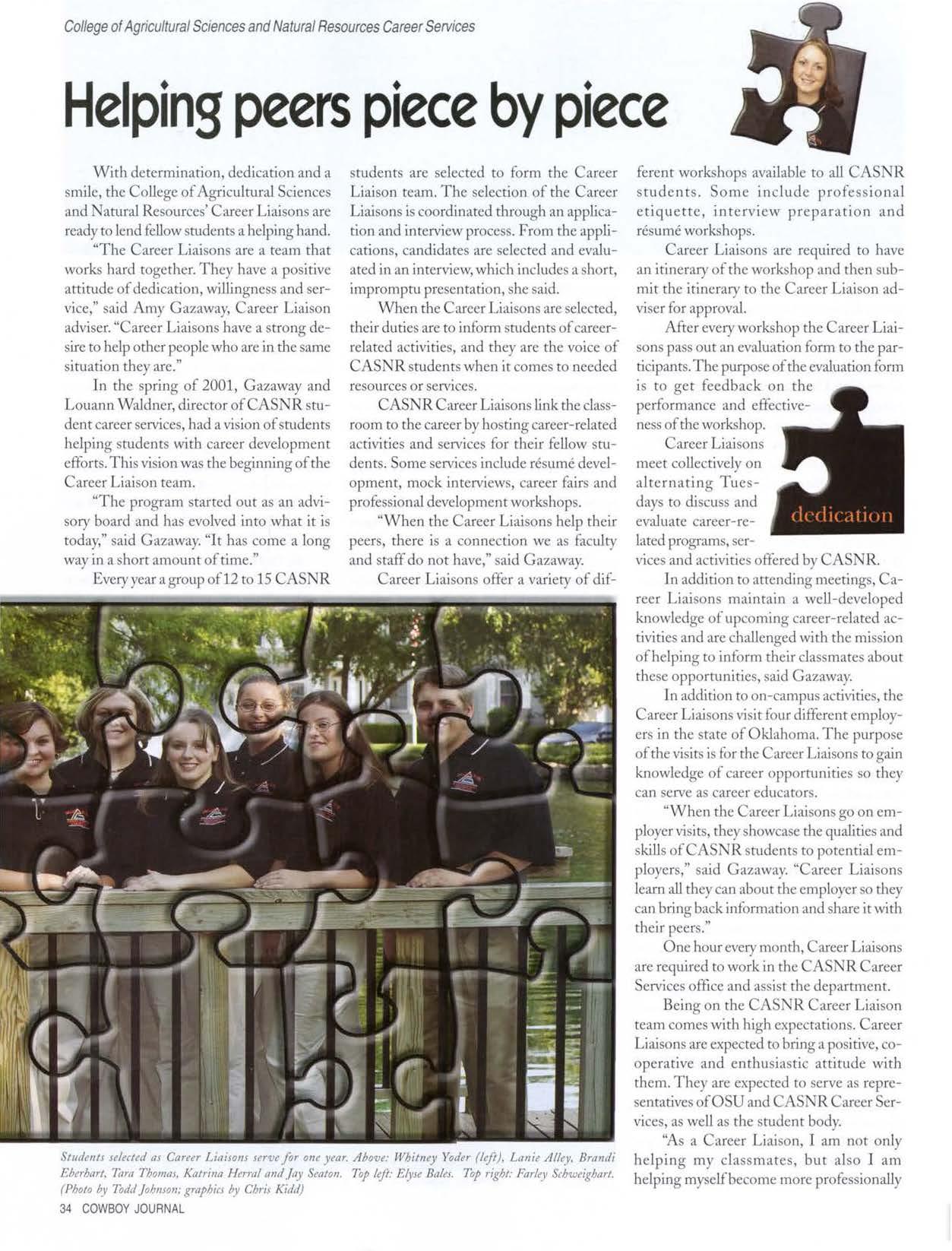
fcrent workshops available to all CAS R students. Some include professional etiquette, interview preparation and resume workshops.
Career Liaisons are required to have an itinerary of the workshop and then submit the itinerary to the Career Liaison adviser for approval.
After every workshop the Career Liaisons pass out an evaluation form to the participants. The purpose of the evaluation form is to get feedback on the performance and effectiveness of the workshop.
Career Liaisons meet collectively on alternating Tuesdays to discuss and evaluate career-related programs, services and activities offered by CASNR. ln addition to attending meetings, Career Liaisons maintain a well-developed knowledge of upcoming career-related activities and arc challenged with the mission of helping to inform their classmates about these opportunities, said Gazaway.
l n addition to on-campus activities, the Career Liaisons visit four different employers in the state of Oklahoma. The purpose of the visits is for the Career Liaisons to gain knowledge of career opporn111iriesso they can serve as career educators.
uWhcn the Career Liaisons go on employer visits, they showcase the qualities and skills ofCAS 1R students to potential employers," said Gazaway. "Career Liaisons learn alJ they can about the employer so they can bring back information anJ share it with their peers."
One hour every month, Career Liaisons arc required to work in the CAS R Career Services office and assist the department.
Being on the CASNR Career Liaison team comes with high expectations. Career Liaisons are expected to bring a positive, cooperative and enthusiastic attitude with them. They are expected to serve as representatives ofOSU and CASNR Career Services, as wcU as the student body.
«As a Career Liaison, I am nor only helping my classmates, but also I am helping myself become more professionally
sound," said my Brooks land cape architecture enior.
All areer Liai on are rra·ned to help other n,dents with their profc sional development kill , said Gazaway. In he ummer, the team travels to a location in Oklahoma for a retreat. The purpo e of the retreat i for the areer Liaison to get to know one another and become a team.
Before hool start , a weekend is devoted to areer Liai on training and profe ional development.
"lt goe further than training· iris the attitude thi team po sc ," aid Jay caton, areer Liai on and fore try ophomore. areer iai n have set goals in helping their fellow students. One specific goal i genera ing a clearer me sage about what areer Liai ons do and becoming more visible to R rudent o they will kn w help i available, Gazaway aid. nother o-oalthe areer Liai on have
et i developing a Web ite, whi h will include areer developmen information as well as the arcer Liaisons' contact information.
"Mo t tudents experience some level of confu i n in term of making areer d ciion and planning or their future," aid Gazaway. "That' why we have the R arccr Liaison ."
Jarrod Bochs an agriculruraJeconomic cnior attende a re ume workshop given by the Career Liai ons.
"It' differen when it ome from - meone on our level," aid Bo h . "They ar nor as intimidating and the thing they ay are easier to under tancl. It makes a differ n c when excited, pa sionate tudent are telling their peers about profe ional dev I pmenc and areer-relaced a tivirie ."
Whitney Yoder arcer Liaison and agricultural economi enior aid the program has helped her a mu ha it ha h lpcd her fell w tudent
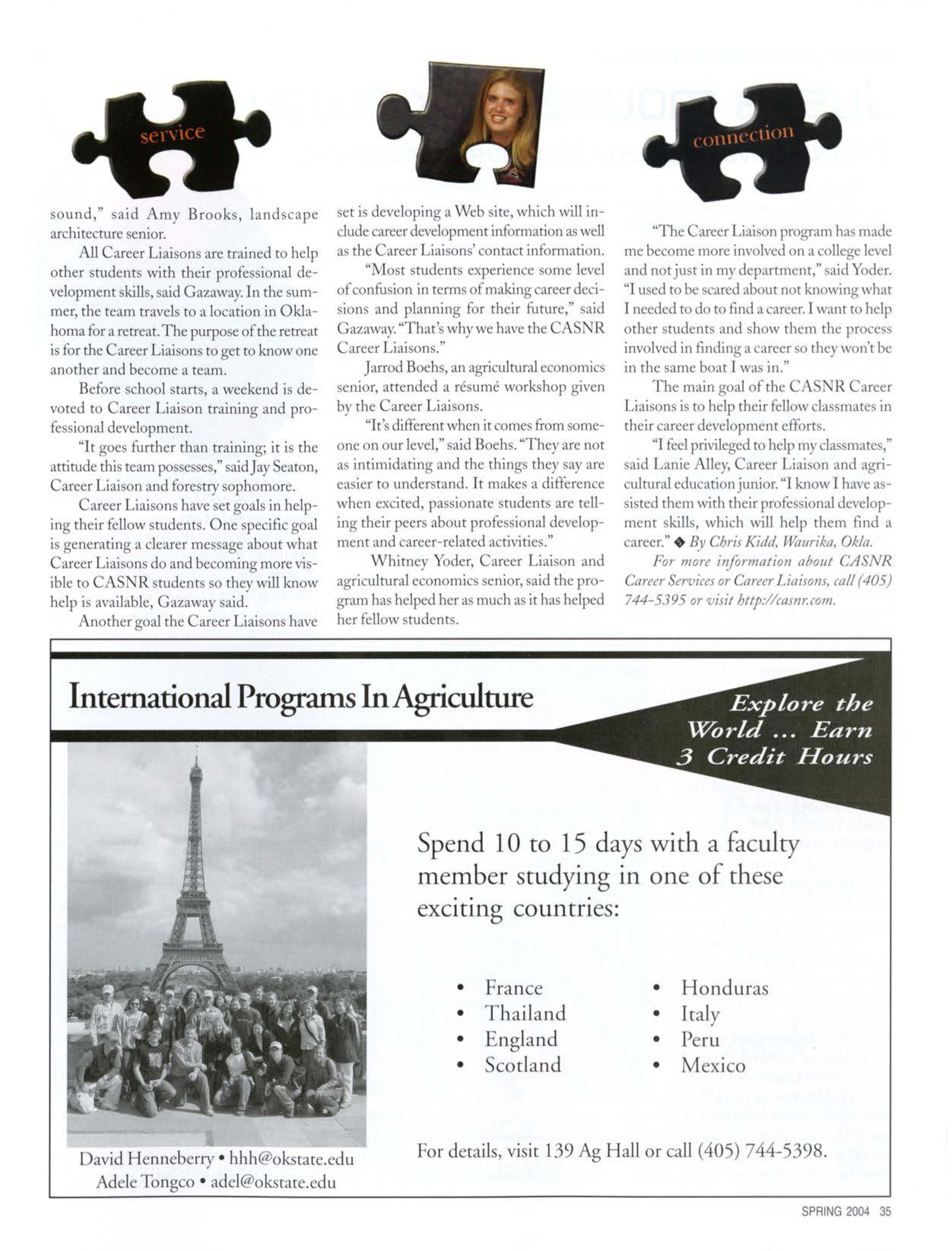
" he arecr iai on pr gram ha made me become more involved on a college level and not ju tin my department," said Yoder. '1 u ed to be scared about not knowing what I needed t d t find a areer. Twant t help other tudcnt and how them the proce inv lved in finding a career so they won't be in the same boat I was in."
Th main g ,tl of the Liaison i to help their fell w la mates in their areer development fforts.
'1 feel privileged to help my das ·mates," aid Lanie Alley arcer Liaison and agriuln1ral educati n junior. ''Tkn w J have ai ted them with their profcs ional development kill , whi h wiU help them find a
By Chris Kidd, Waurika,Okla.
For more i1!formatio11about CA R Caret'/' ervicesor CareerLiaisons, ml/ (405) 744- 395 or visit http://casnr.com.
Ready or not, here it comes.
The future ... and it's coming to the Division of Agricultural Sciences and Nan1ral Resources at Oklahoma State University in the form of Web-based technology.
Soon the days of fact sheets and pamphlets wiUbe gone, replaced by new onlinc databases accessible from the comfort of one's home. The result: a system more in tune with society's growing dependency on the World Wide Web.
Radio took 55 years to reach 200 million users, while the Web took only five. According tO the U.S. Census Bureau, "In August 2000, 54 million households, or 51 percent, had one or more computers, up from 42 percent in December 1998."
"The change in society, coupled with the need to be more financially efficient, has prompted the creation of two new searchable databases: the Prim-on-Demand System and OSU Extra," said Donald Stotts, communications specialist for agricultural communications services at OSU.
Prior to the Internet, DASNR relied heavily on mass-produced, hardcopy fact sheets written by faculty members to distribute information to the public, said Stotts.
"At one time everything was done hardcopy.To get a fact sheet, you would have to go to a cooperative exi:ension office where they would have copies," said Stotts. "If you needed a bunch of them, county personnel would have co order more copies from DAS R's publications warehouse."
The cost of paper, printing and storage is expensive, said Stotts. Putting information on the Internet saves on printing costs because people print just what they need.
"As the Internet exploded in popularity beginning in 1994, everybody quickly latched onto the idea of putting iJ1fonnation on the \i\leb to make ir more accessible," he said.
DASNR's first effort to put fact sheets on the Jnternet was Pete's Electron.icArchive and Resource Library, or PEARL.
"PEARL was our first effort of putting what was essentially a hardcopy format onto the Web," said Stotts. ''The format came about because at the time there was a concern that people might not make a connec-
tion between the fact sheets available at county offices and materials available on the Web. The problem with it was it looked exactly like the hardcopy format; it didn't take advantage of the medium of computers."
Stotts said the Print-on-Demand System and OSU Extra are simply the next step in the progression, and they are more accessible and easier to use.
The Print-on-Demand System is an electronic archive and ordering system for fact sheets available to all DAS R employees, includjng extension specialists, county extension educators and research station personnel. Those with Web access are able to search the database, select the fact sheer they need and place an order.
"There arc many benefits to this system," said Gayle Hiner, a graphics designer for agricultural communications services at OSU. "Printing and storage costs will decrease, we will never 'run out' of any fact sheers and the most current information will always be available."
DASNR created a second online database, OSU Extra, to provide information to consumers in a Aexible way.
With content identical to the Print-onDemand System, the database uses a keyword search and topic headings to make the database accessible and understandable to consumers. Brief descriptions of each fact sheet also are included to simplify a search.
OSU Extra is a free service available to the public, .tllowing anyone to view HTML or PDF files in the comfort of their homes, said Hiner. The address for the Web site is http://www.osuextra.com.
Hiner said the goal is to try and think like consumers when putting information into both databases.
"Fact sheets will cross reference and be put in more than one spot," said Hiner. "VVe want to put them wherever they will be the easiest to find and the most useful."
One key feature of the Print-on-Demand System and OSU Extra is the timcEness aspect. Fact sheets posted have expiration dates; when the designated time is up, e-mails arc sent to the author(s), prompting him or her co review the information, ensuring it is accurate and timely.
o fact sheet will be aUowed to remain in the database without review for more than three years, said Hiner.
"Because the two sires are mirror images of one another, staff members can easily work with consumers and assist them in searching for information," said Hiner. "The extension educator can talk the person through on the phone and teU them exactly where a file wiU be."
ln addition to developing two DAS R databases, the Oklahoma Cooperative Extension Service is working with other states to create a national e- Extension.
This new system is being developed in conjunction with other Land-grant universities with the goal ofbringing extension into the 21st century, said David Foster, retired associate director of the OCES.
Since the beginning of the Cooperative Extension Service, the goal has been to spread knowledge and educate people about agriculture. As society has changed, the need for a new way tO distribute that knowledge has become apparent.
"In the beginning, universities began to send people out in the field as practitioners to demonstrate to farmers why they should use improved farming techniques," said Foster. "By the end of the 19th century, there were a number of states that had people employed doing essentially extension work.
''The idea of extension is that individuals go out and actually be part of the community and be accepted as local people who happen to be in a position to help and move [agriculture] forward," said Foster.
With technology becoming more widely accepted and u ed, the demand to alter the way extension work is done ha heightened, aid Fo ter. The idea of a rp rarely managed databa e sy tern addres ing all of the subject matter pertinent to extension work would be attra tive.
"If there was a way all tares ould cooperate with one another to reate that database and then manage it at the y tern level on behalf of all the land-grant universities, that would be a powerful idea," aid Fo ter.
Thi i the foundation of c-Exten ion.
ccording to thee- • xten ion exe u tivc committee, "The challenge i to learn to cooperate and take advantage of the hared intellectual apacity of the land-grant ytern, in a way that an be I ally branded. EExten ion provide a vehi le for doing chi in a way cha addre e the informationcc king behavior of our current and funire cu comer ."
tott said the idea fore- Exten ion ha been talked about for year .
"It' a long proces bp hi h an organization make hange," aid tort "It' a crie of tep in whi h you bring a large organization together to then make a change. lt does happen slowly and it doe happen over time; it' more fa progre ion.
"The aim i to allow people to take advantage of information throughout the nation " aid tott
" hangc doc not occur overnight in mo t l:.trge organization e pe ially tho ·e chat have local tate, national and international omponent ," aid totts. "lt' more of a progression in whi h idea and new wa of doing thing are formulated te ted and then either adopted or di carded over time. '
The e-Exten ion national databa e i in the planning tage
"E-Exten ion i n the wa • however the exact manner in which everything work~ together has yet to be finalized,' aid rott .
It will incorporate information from land-grant univer itie acr the United tate and provide it in one database. cording to he c-Extension Exe utive ommittee, "The idea i that teams of ubjc t matter expert wiU be in charge of their ubjecr area. These ream wilJ be rep n ible for urriculurn interactive multimedia module , a k-the-cxpert and interactive de i ion t ol ."
The goal of the system is to help people find pccific information, thu allowing them to make ound de i ion , according to the e-Exten ion exe utive ommittee. on umers will be able to u tomize the information they are looking for and accc it on their own time.
Ready or not, technology i here to ray. With program u ha the Print-on-Demand y tern, 0 oming onlinc, D R i definitely ready. StoryandgraphicbyMelissaMajors,S11tto11, eb.
Ir all started with a gift.
A gift ofland was given by four Payne County farmers in 1890 to start a land-grant institution in Oklahoma. This priceless gift was the beginning of Oklahoma Agricultural and Mechanical College, now Oklahoma State University.
The university's first "gift-in-kind" laid the foundation for OSU, which continues to strengthen today through the donation of gifts-in-kind. Gifts-in-kind are non-monetary donations given to the university.
"Private gifts, monetary or non-monetary as in the case of gift-in-kind, go a long way in making a difference in the lives of teachers, students and citizens who come into contact with OSU's agricultural programs," said Milford Jenkins, Division of AgriculruraJ Sciences and arural Resources senior director of development with the OSU Foundation. '1t is not the size of the gift that counts, but it is merely the gift."
The OSU College of Agricultural Sciences and atural Resources receives many gifts throughout the year. Livestock, ranch property, equipment, real estate and farmland are a few of the gifts received. In addition, companies often provide equipment and classroom technology for the college.
"The gift-in-kind program is an opporruniry for donors to provide resources to the university for improvements in research, extension and teaching," said Jenkins.
111961, the university started officially receiving gifts-in-kind through the OSU Foundation, said Jenkins. At that time, the foundation was designated as the private gift-receiving entity by the OSU Board ofRegcnts.
Both OSU and donors benefit &om the gifts-in-kind program, Jenkins said. Gifts provide additional opportunities for teachers and students both inside and outside of the classroom. In many cases, srudcnts receive hands-on experience which benefits them after college. By giving, donors sec advancements in departments and progran1s, as well as tax benefits, he said.
"Any college, program or academic unit can benefit from gifts-in-kind," Jenkins said.
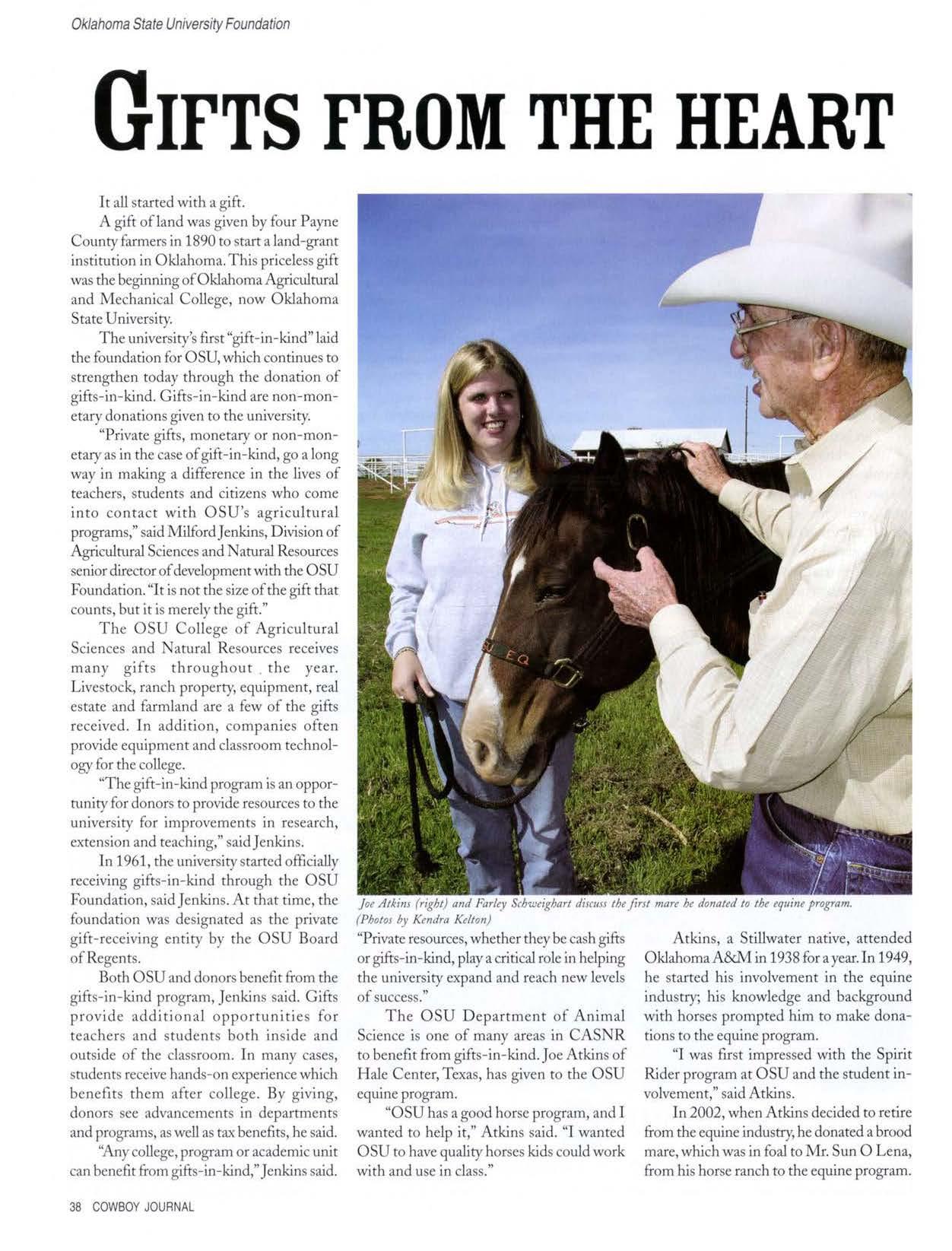
"Private resources, whether they be cash gifts or gifts-in-kind, play a critical role in helping the university expand and reach new levels of success."
The OSU Department of Animal Science is one of many areas in CAS R to benefit from gifts-in-kind. Joe Atkins of Hale Center, Texas, has given to the OSU equine program.
''OSU has a good horse program, and] wanted to help it," Atkins said. "I wanted OSU ro have quality horses kids could work with and use in class."
Atkins, a Stillwater native, attended Oklahoma A&t\1 in 1938for a year. In 1949, he started his involvement in the equine industry; his knowledge and background with horses prompted him to make donations to the equine program.
"I was first impressed with the Spirit Rider program at OSU and the srudenr involvement," said Atkins.
In 2002, when Atkins decided to retire from the equine industry, he donated a brood mare, which was in foal to Mr. Sun O Lena, from his horse ranch to the equine program.
ince then tl<.insha donated another mare and two breedings to r. un O Lena who tand at The Four ix.esRanch in Guthrie Texas.
"We do not buy any mares for our production herd at the fami," aid teven Cooper, equine teaching and research a sistant profes or. "There is no way we could buy the mares we wanted o improve the horse herd. Invaluable gifts-in-kind tarted our program and help maintain it today.' lot of donors are O U alumni or have a conne tion to O U, aid ooper.
ontribucors make ure their donation are going to b a good fir for the program and be u eful, ooper said.
tkins said he wanted O U to have his horses and knew the would be taken care of and put to good use.
"For omeone to tep out and donate horses of this caliber is out tanding,' said Cooper. "Our program would not be what it i today without gifts-in-kind."
any donors, like tkin.s,are long-time 0 U upporters and want to see the univer ity continue growing and crengthening in all areas, aid Jenkins.
"I had a goal to improve O U's brood mare band b giving outstanding mare ," aid tkin
The O U Purebred Beef enter al benefit rom gift -in-kind, aid Jenkins. "Donation to the beef center have helped it obtain the highest quality of geneti in he indu try," aid Cind Pribil 0 U Purebred Beef enter manager. " he beef center ha received attle, bull emcn and trucks," said Pribil. " mall gift make a big difference."

All donation , whether money or gift -in-kind, are critical and help the univer ity ave thou and of dollar every year by not having to expend valuable resources from appropriated thing, aid Jenkin
"The center i a teaching herd for student ," aid Pribil. "Our labor force i mainly tudent ; they benefit from rhe donations given and receive hand -on experience."
Gift -in-kind enhance program by providing additional opportunitie for fa ulty o supplement their cla room instruction strategies through technologi all advan ed di tan e education and la room tecbn logy.The coopera-
tive exten ion ervice and agricultural experiment stations likewise have benefited over the year from generou gift -in-kind, aidJenkin
'1n 1890,people had a pa ion, people had a dream and people had a vi ion. They were willing to unselfish[ and graciou ly provide re ource and a et to the univer iry," said Jenkins. "The made their vi i n a reality b giving an invaluable gift." By Kendra Kelton Muldrow, Ok.la.
nything an be po iblcwirh a degree from Oklahoma tare University, even brain urgery.
eurosurgcon Barry Pollard, a 1973 bi chemi try graduate, began hi academic studie preparing to be a veterinarian.
Pollard, who wa rai ed in the agricultural commw1ity of Hennes ey, Okla., grew up with a trong farming and ranching background. a youth he wa active in •F and enj yed working on his family's farm. Hi intere tin farming wa encouraged by hi father, Ru ell Pollard, who wa a high school vo ational agri ulrure in tru tor.
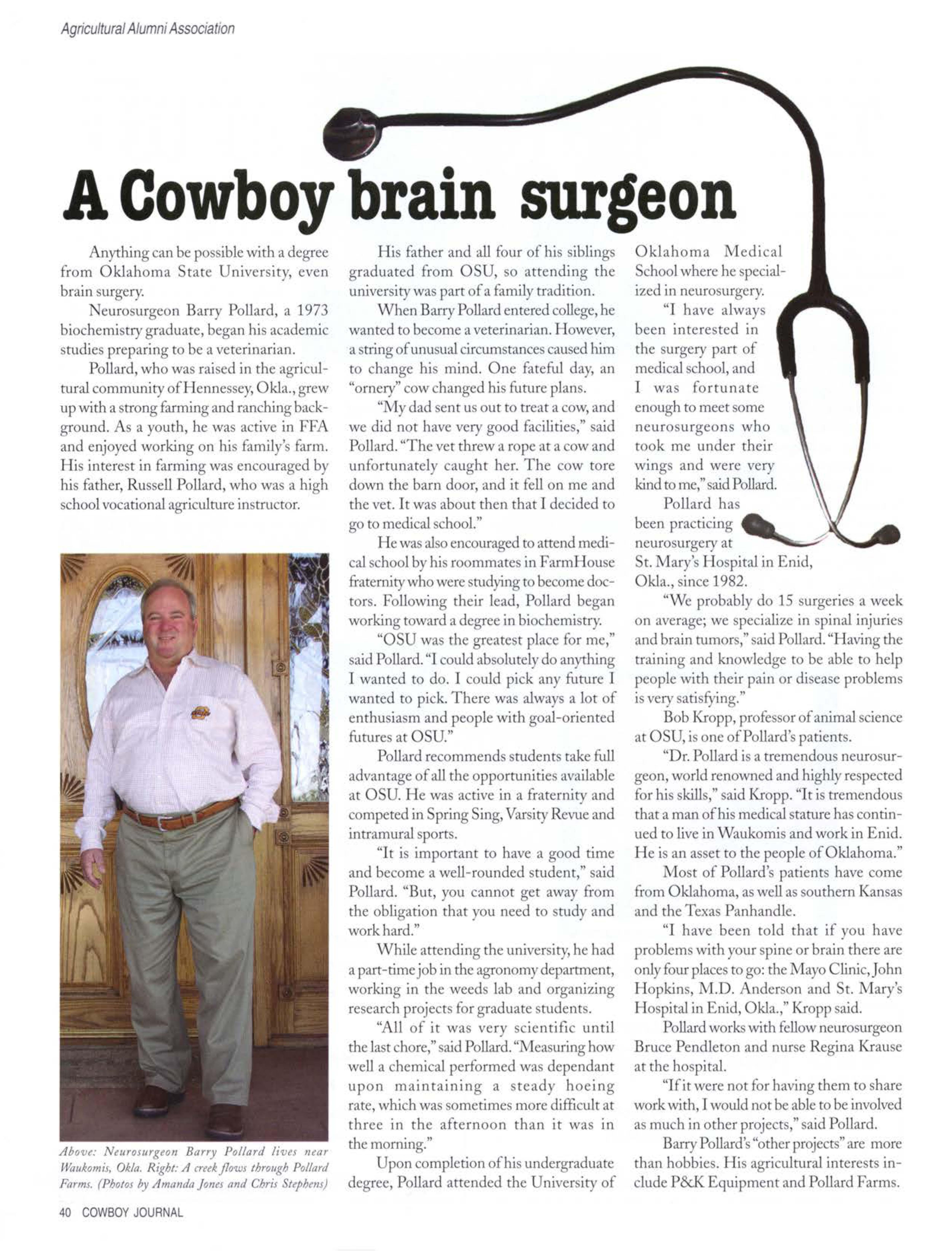
Hi ather and all four of his iblings graduated from O U, o attending the university wa part of a family tradition.
When Barry P llard entered college he wanted to become a veterinarian. However, a ring of unu ual circumstance cau ed him to change hi mind. One fa eful day, an "ornery" cow changed h' future plan " y dad sent us out to treat a cow, and we did not have very good facilities" said PolJard. "The vet threw a rope at a ow and unfortunately caught her. The cow tore down the barn door and it fell on me and the vet. It wa about then that I decided tO go to medical chool."
He wa aJ o encouraged to attend medical hool b hi roommate in FarmH u e fratem.ity who were rudying to become doctor Following their lead, Pollard began working toward a degree in biochemistr •.
"O U wa he greate t place for me," aid Pollard. "l could ab olu ely do anything I wanted to do. I ould pi k an future l wanted to pi.ck. There wa always a lot f enthusiasm and people with goal-oriented futures at O U."
Pollard recommend tudent take full advantage of all the opportunicie available at O He wa active in a fraternity and competed in pring ing, Varsity Revue and intramural pore
"It i important to have a good time and be ome a well-rounded tuden ," a.id Pollard. 'But, you cannot get away from the obligation that you need to tudy and work hard."
While attending the university, he had a part-time job in the agronomy department, working in the weed lab and organizing research project for graduate student . " 11 of it was very scientific until the last chore," aid Pollard." ea uring how well a chemical performed was dependant upon ma111ta111ing a teady hoeing rate, which wa ometimes more difficult at three in the afternoon than it was in the morning."
Upon omplccion of his undergraduate degree, Pollard attended the niver ity of
Oklahoma 1ledical chool where he pcciali.zed in neuro urgery.
"J have always been intere ted in the urgery part of medical hool, and I wa fortunate enough to meet ome neurosurgeons who took me under their wing and wer kind o me," aid Pollard ha been practicing neuro urgery at t. a.ry' Ho pital in Enid, 0 kJa., i11 C 1982.
"We probably do 15 urgeries a week on average; we specialize in spinal injurie· and brain tumors,' said Pollard. "Having the training and knowledge to be able to help people with heir pain or di ea e pr blem i very atisfying."
Bob Kropp, profes or of animal ci.ence at O U, is one of Pollard' patients.
"Dr. Pollard i a tremendou neuro urgeon, world renowned and high1y re pe ted for hi kill ," aid Kropp. "It i tremendou that a man of hi medi al tarure ha continued to Livein Waukomis and work in Enid. He i an as et to the people of Oklahoma." o t of Pollard' patient have ome fr m Oklahoma, a well a uthern Kan a and the Texas Panhandle.
"I have been told that if you have problems with your spine or brain there are onlyfourpla e rogo: the Mayo linic,John Hopkin , M.D. Anderson and t. ary Ho pita! in • nid, Okla.,' Kropp aid.
Pollard works with fellow neur urgeon Bru e Pendleton and nur e Regina Krau e at the hospital.
'1 fit were not for having them to hare work with, I would n t be able to be involved a much in other projects "said Pollard.
Barry Pollard' "other projec "are m re than hobbies. Iis agricultural intere t include P&K quipment and Pollard Farm .
In 1983 Pollard bough theJohnDeere dealer'hip in Kingfi her, Okla., with partner Wendel Kirtley,the managing operator who retired in 1996.
"The operation, whi h i ailed P K qwpmcnt, has become very ucce sful," aid Pollard. "In the next 10 year , you will ee ur dealer hip grow and pro per."
s the bu iness flourished, Pollard purchased dealership in nid, orman and Purcell with new partner hane lifton and Drew omb.
"The opportunity to own and operate a John Deere dealership in my home county offered me a future with my kind of people," aid PoUard. "The hard-working farm and ranch familie of Oklahoma are a plea ure t0workwith."
Through hi involvement with P Equipment, Pollard is a supporter of 4-H and FF activitie in he ountie with hi dealer hips. l lping with the area ' premium ale all llard to give back to the community. Another way he up ports lo aJ agricultural program is through regional and stare youth show
After developing hi private neuro urgical practice and building ad alcr hip bu ine , Pollard de id cl to inve tin developing a cattle operation. He purchased land and cattle and began a to ker-calf operation.
Eventually, he became intere ted in rai ing regi tered ngu cattle a a projec he and hi family could work on together.
"He i a elf-made man who i' very down to earth," Kropp said. "I have even een him in the pa ture with hi crub n. He i an example of the lo al boy from a mall town wh made g He operate one of the elite Angus programs. He is an a ct to the Ameri an gu soaanon."
Pollard said hi main goal for the Angus breed i t have the pr du t remain the mo t highly ought after meat product in the indu try, omething a ompli heel through product testing and geneti selection.
'1 wanted to u e my medical knowledge of genetic , embryo transplant and artifi ial in cmination produ e high-quality Angu attle " aid Pollard. "Hopcfull , it will let u develo omething that will tay in the family a long time."
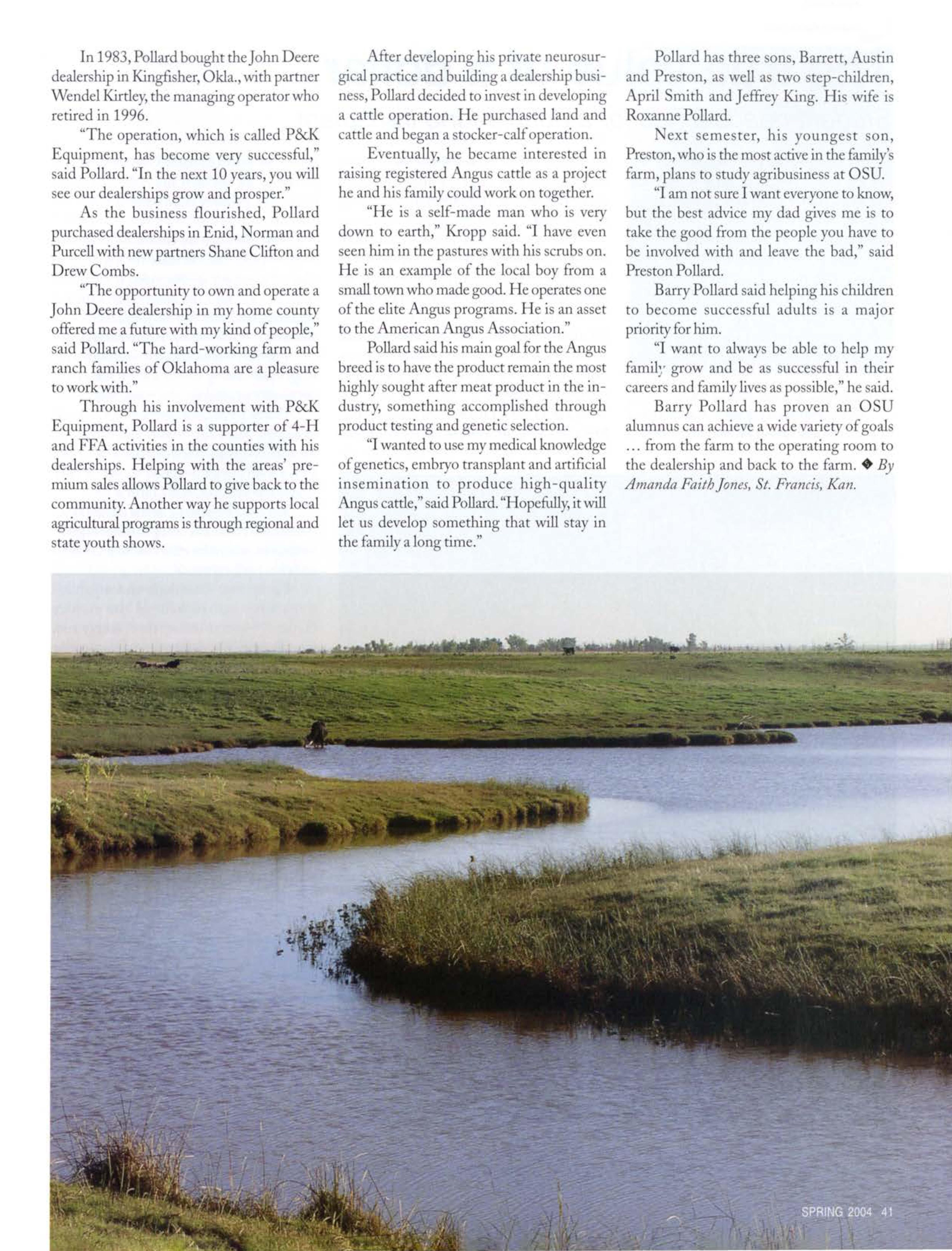
Pollard ha three on , Barrett u tin and Pre ton, a well a two rep-children, April mirh and Jeffrey King. lis wi e is R ocannePollard.
ex eme ter, hi youngc t on, Pre ton, who is the mo t active in the family' farm, plans co tudy agribu i.ne ar O U.
'1 am not ure I want everyone to know, but the be t advice my dad gives me i t take the good from the pe pie you have t0 be involved with and leave the bad" said Preston P Uard.
Barry Pollard aid helping hi children to become successful adult is a major priority for him.
"I wane to alway be able to help m famil;: grow and be a ucce sful in their career and family lives a po ible," he aid.
Barry Pollard ha proven an O U alum nu can achieve a wide variety of goals ... from the farm to he o crating room to th dealer hip and back to the farm. By /lmanda Faith Jones, t. Francis,Kan.
As college graduates take the next step in their lives, their debts may seem overwhelming, but for students who battle chronic illnesses, their educational expenses plus medical bills can be insurmountable.
Ashley Guthrie, agricultural economics junior, knows this story all too well. G uthric has battled cystic fibrosis for the past 22 years, and a double-lung transplant is her best chance at a normal, disease-free life.
"Since I have had ir my whole life, J really have never known any other way," Guthrie s;tid. "It's just part of me."
Cystic fibrosis is a genetic mutation that stops the production of protein in the cells of
the lungs, which causes abnormally thick, sticky mucus that clogs the lungs and leads to life-threatening lung infections, according to the Cystic Fibrosis Foundation.
The disease has been a nuisance throughout most of Guthrie's life, and it will eventually cause so much mucus ro build up in her lungs they will no longer be fonctional.
Guthrie has been on rhe donor waiting list since November 2002. The rwo-yearwait is more than half over, and Guthrie said she expects to receive a double-lung transplant in lovcmber 2004.
Due ro the S150,000 price rag on this life-extending procedure, the Oklahoma
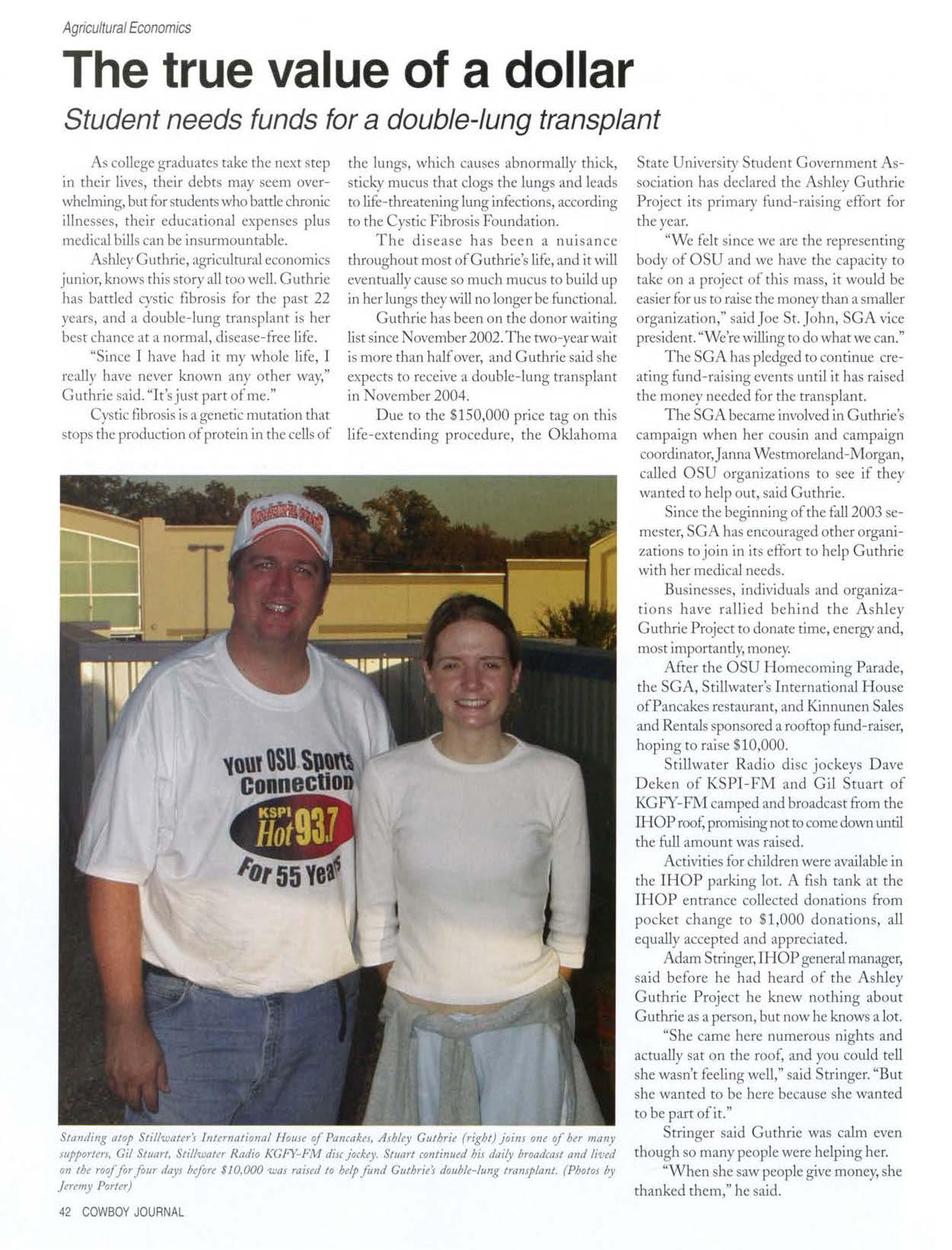
State University Snidcnt Government fusociation has declared the Ashley Guthrie Project its primary fund-raising effort for rhe year.
"We felt since we are the representing body of OSU and we have the capacity ro rake on a project of this mass, it would be easier for us to raise the money than a smaller organization," said Joe St. John, SCA vice president. "We're willing to do what we can."
The SCA has pledged to continue creating fund-raising events until it has raised the money needed for the transplant.
The SGA became involved in Guthrie's campaign when her cousin and campaign coordinator.Janna Westmoreland-Morgan, called OSU organizations to sec if they wanted to help our, said Guthrie.
Since the beginning of the fall 2003 semester, SGA has encouraged other organizations ro join in its effort ro help Guthrie with her medical needs.
Businesses, individuals and organizations have rallied behind the Ashley Guthrie Project to donate time, energy and, most importantly, money.
After the OSU Homecoming Parade, the SGA, StiUwater's International House of Pancakes restaurant, and Kinnunen Sales and Rentals sponsored a rooftop fond-raiser, hoping to raise Sl0,000.
Stillwater Radio disc jockeys Dave Deken of KSPI-FM and Gil Stuart of KGFY-FM camped and broadcast &om the !HOP roof, promising not to come down until the full amount was raised.
Activities for children were available in the ]HOP parking lot. A fish rank at the JHOP entrance collected donations from pocket change to S 1,000 donations, all equally accepted and appreciated.
Adam Stringcr,IHOP general manager, said before he had heard of the Ashley Guthrie Project he knew nothing about Guthrie as a person, but now he knows a lot.
"She came here numerous nights and actually sat on the roof, and you could tell she wasn't feeling well," said Stringer. "But she wanted to be here because she wanted to be pan: ofit."
Stringer said Guthrie was calm even though so many people were helping her.
"When she saw people give money, she thanked them," he said.
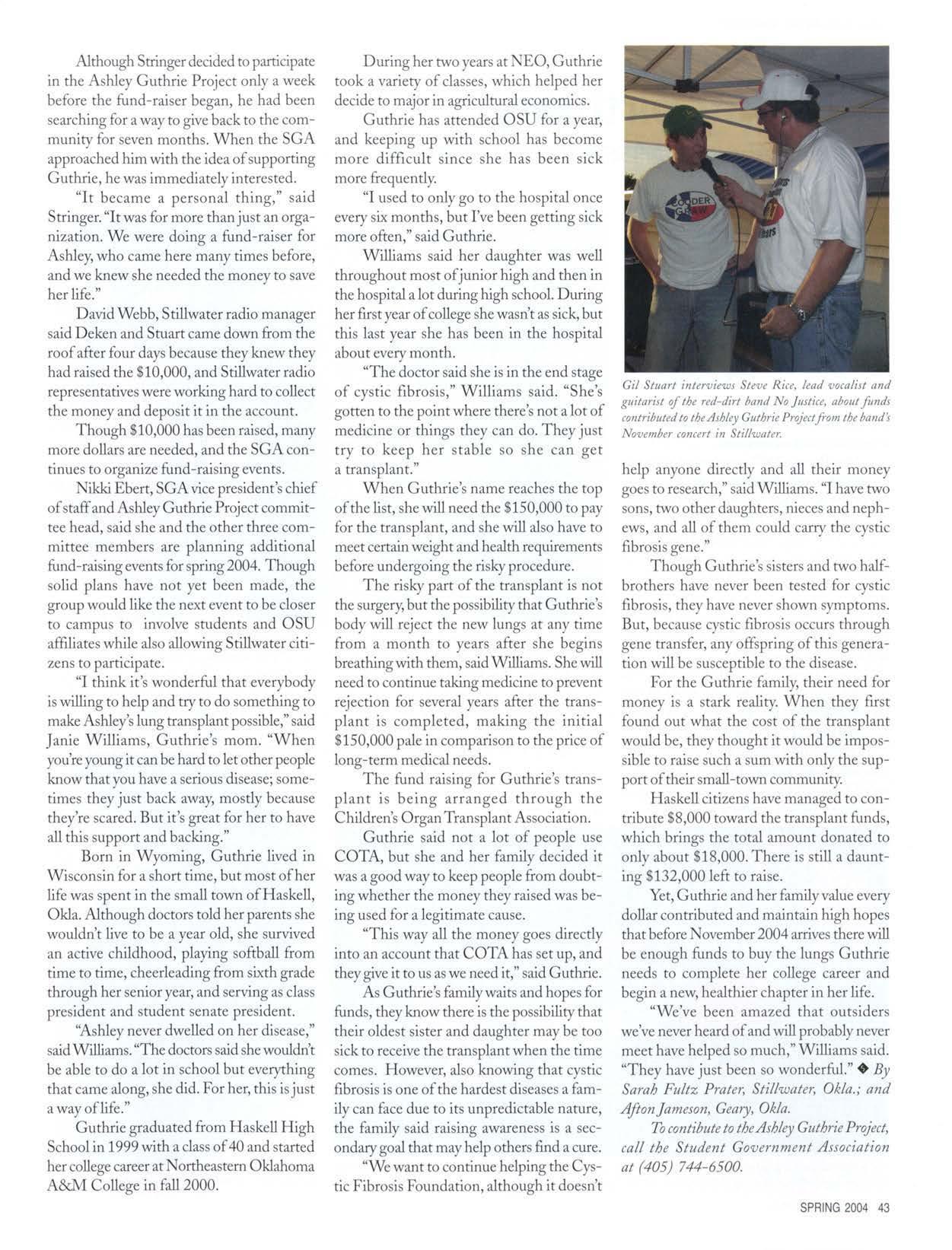
Although Stringer decided to participate in the Ashley Guthrie Project only a week before the fund-raiser began, he had been searching for a way to give back to the community for seven months. When the SGA approached him with the idea of supporting Guthrie, he was immediately interested.
"J t became a personal thing," said Stringer. ''ltwas for more than just an organization. Vl/ewere doing a fund-raiser for Ashley, who came here many rimes before, and we knew she needed the money to save her life."
David Webb, Stillwater radio manager said Deken and Stuart came down from the roof after four days because they knew they had raised the Sl0,000, and Stillwater radio representatives were working hard to collect the money and deposit it in the account.
Though Sl0,000 has been raised, many more dollars are needed, and the SGA continues to organize fund-raising events.
Nikki Ebert, SGA vice president's chief of staff and Ashley Guthrie Project committee head, said she and the other three committee members arc planning additional fund-raising events for spring 2004. Though solid plans have not yet been made, the group would like the next event to be closer to campus to involve students and OSU affiliates while also allowing Stillwater citizens to participate.
"l think it's wonderful that everybody is willing to help and try to do something to make Ashley's lung transplant possible," said Janie Williams, Guthrie's morn. "When you're young it can be hard to let other people know that you have a serious disease; sometimes they just back away, mostly because they're scared. But it's great for her to have all this support and backing."
Born in Wyoming, Guthrie lived in \i\/isconsin for a short time, but most of her life was spent in the small town of Haskell, Okla. Although doctors told her parenrs she wouJdn't live to be a year old, she survived an active childhood, playing softball from time to time, cheerlcading from sixth grade through her senior year, and serving as class president and student senate president.
"Ashley never dwelled on her disease," said Williams. "The doctors said she wouldn't be able to do a lot in school but everything that came along, she did. For her, this is just a way oflifc."
Guthrie graduated from Haskell High School in 1999 with a class of 40 and starred her college career at Northeastern Oklahoma A&M College in fa!J 2000.
During her two years at NEO, Guthrie took a variety of classes, which helped her decide to major in agricuJrural economics.
Guthrie has attended OSU for a year, and keeping up with school has become more difficult since she has been sick more frequently.
"I used to only go to the hospital once eve1y six months, but I've been getting sick more often," said Guthrie.
Williams said her daughter was well throughout most of junior high and then in the hospital a lot during high school. During her first year of college she wasn't as sick, but this last year she has been in the hospital about every month.
"The doctor said she is in the end stage of cystic fibrosis," Williams said. "She's gotten to the point where there's not a lot of medicine or things they can do. They just try ro keep her stable so she can get a transplant."
When Guthrie's name reaches the top of the list, she willneed the S150,000 to pay for the transplant, and she will also have to meet certain weight and health requiremenrs before undergoing the risky procedure.
The risky part of the transplant is not the surgery, but the possibility that Guthrie's body will reject the new lungs at any time from a month ro years after she begins breathing with them, said Williams. She will need to continue taking medicine to prevent rejection for several years after the transpl ant is completed, making the initial SlS0,000 pale in comparison to the price of long-term medical needs.
The fund raising for Guthrie's transplant is being arranged through the Children's Organ Transplant Association.
Guthrie said not a lot of people use COTA, but she and her family decided it was a good way to keep people from doubting whether the money they raised was being used for a legitimate cause.
"This way all the money goes directly into an account that COTA has set up, and they give it to us as we need it," said Guthrie.
As Guthrie's family waits and hopes for funds, they know there is the possibility that their oldest sister and daughter may be too sick to receive the transplant when the time comes. However, also knowing that cystic fibrosis is one of the hardest diseases a fami_lycan face due to its unpredictable nature, the family said raising awareness is a secondary goal d1at may help others find a cure.
«we want to continue helping the Cystic Fibrosis Foundation, although it doesn't
help anyone directly and ,tll their money goes to research," said Williams. "I have two sons, two other daughters, nieces and nephews, and all of them could carry the cystic fibrosis gene."
Though Guthrie's sisters and two halfbrothers have never been tested for cystic fibrosis, they have never shown symptoms. But, because cystic fibrosis occurs through gene transfer, any offspring of this generation will be susceptible to the disease.
For the Guthrie family, their need for money is a stark reality. When they first found out what the cost of the transplant would be, they thought it would be impossible to raise such a sum witl1 only the support of their small-town community.
Haskell citizens have managed to contribute S8,000 toward the transplant funds, which brings the total amotmt donated to only about $18,000. There is still a daunting Sl32,000 left to raise.
Yet, Guthrie and her family value every dollar contributed and maintain high hopes that before November 2004 arrives d1ere will be enough funds to buy the lungs Guthrie needs to complete her college career and begin a new, healthier chapter in her life.
"Vl/e'vc been amazed that outsiders we've never heard of and will probably never meet have helped so much," Williams said. "They have just been so By Sarah Fultz Prate,; Stillwate1; Okla.; rmd Afton Jameson, Geary, Okla.
To contibuteto theAshley Guthrie P,-qject, call the Student Government Assoriation al (405) 744-6500.
''Don't undertake a project unless it is manifestlyimportantor 11earlyimpossible."
-Edwin H. Land
Surely this statement was on the minds of Oklahoma State University graduates when the Agricultural Alumni Association was formed in 1983.
For years, graduates of the College of Agricultural Sciences and arural Resources knew something must be done for alumni to stay connected with each other and their alma mater after commencement.
Max Berry, a 1957 agricultural economics graduate and chairman of the "Committee ofTwenty," remembers how the Agricultural Alumni Association became a reality.
"Information was presented to us about other agricultural alumni associations around the nation," Berry said. "We felt the college, students, and we, as alumni, were missing out on opportunities that alumni at places like Purdue, Ohio State and l\1iehigan State were taking advantage of."
The "Committee of Twenty" was formed in 1983 to develop the CASNR Alumni Association. The committee actually consisted of21 CASNR alumni.
"Before the committee members were selected, it was decided to be The Committee ofTwenty," said Dirk Webb, 1978 agriculrural education graduate and member of
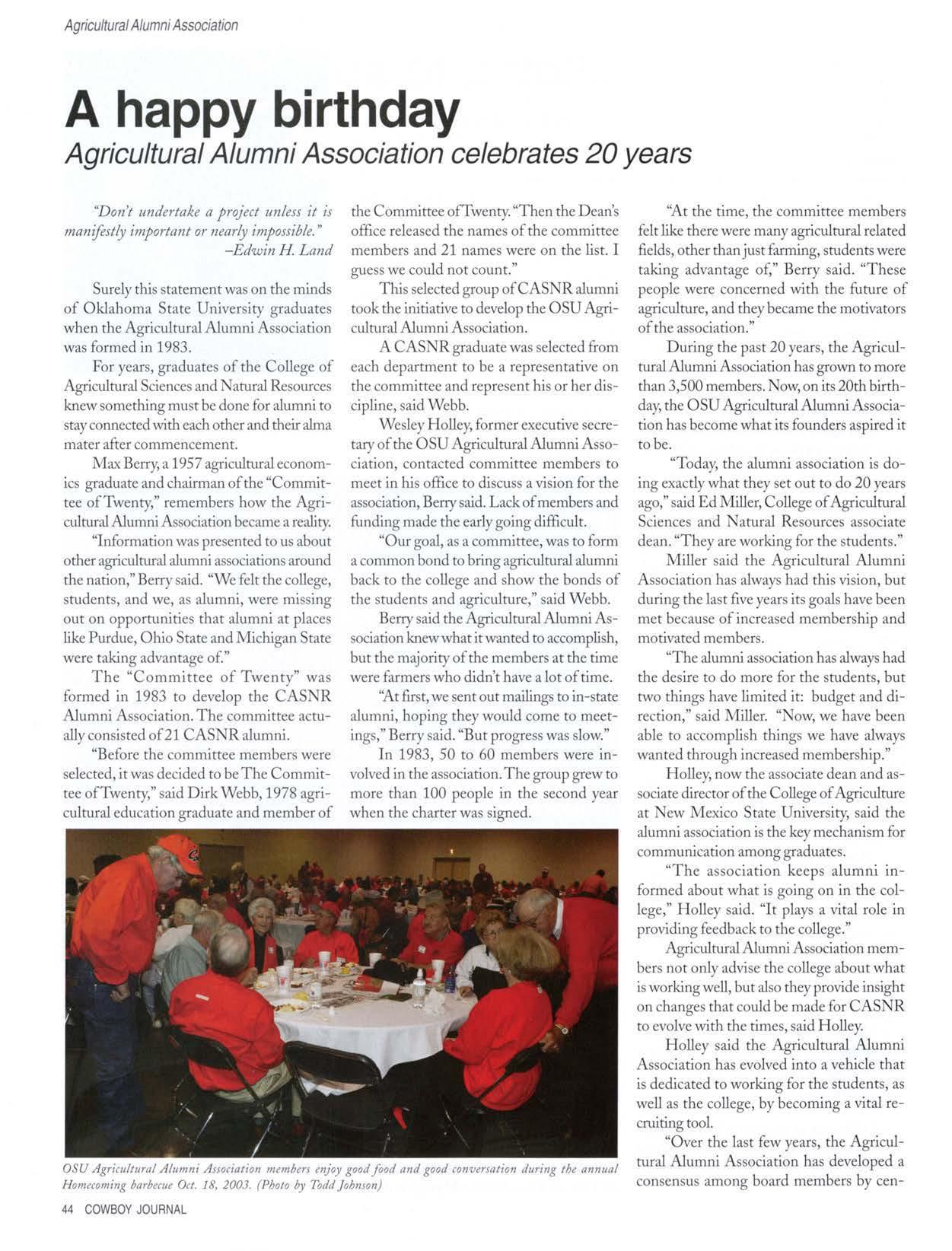
the Committee ofTwenty. "Then the Dean's office released the names of the committee members and 21 names were on the list. 1 guess we could not count."
This selected group of CAS R alumni took the initiative to develop the OSU Agriculrural Alumni Association.
A CASNR graduate was selected from each department to be a representative on the committee and represent his or her discipline, said Webb.
\!VesleyHolley, former executive secretary of the OSU Agricultural Alumni Association, contacted committee members to meet in his office to discuss a vision for the association, Berry said. Lack of members and funding made the early going difficult.
"Our goal, as a committee, was to form a common bond to bring agricultural alumni back to the college and show the bonds of the students and agriculture," said Webb.
Berry said the Agricultural Alumni Association knew what it wanted to accomplish, bur the majority of the members ar the time were farmers who didn't have a lot of time.
"Ar first, we sent our mailings to in-state alumni, hoping they would come to meetings,•·Berry said. "But progress was slow."
In 1983, 50 ro 60 members were involved in the association. The group grew to more than 100 people in the second year when the charter was signed.
"At the rime, the committee members felt like there were many agricultural related fields, other than just farming, students were taking advantage of," Berry said. "These people were concerned with the future of agriculture, and they became the motivators of the association."
During the past 20 years, the Agricultural Alumni Association has grown to more than 3,500 members. Now, on its 20th birthday, the OSU Agricultural Alumni Association has become what its founders aspired it to be.
"Today, the alumni association is doing exactly what they set out to do 20 years ago," said Ed Miller, College of Agriculn1ral Sciences and Natural Resources associate dean. "They are working for the students."
Miller said the Agricultural Alumni Association has always had this vision, but during the last five years its goals have been met because of increased membership and motivated members.
"The alumni association has always had the desire to do more for the smdents, but two things have limited it: budget and direction," said l\ililler. "Now, we have been able to accomplish things we have always wanted through increased membership."
Holley, now the associate dean and associate director of the College of Agriculture at 1cw Mexico State University, said the alumni association is the key mechanism for communication among graduates.
"The association keeps alumni informed about what is going on in the college," Holley said. "It plays a vital role in proV1dingfeedback to the college."
Agricultural Alumni Association members not only advise the college about what is working well, but also they provide insight on changes that could be made for CAS R to evolve with the times, said Holley.
Holley said the Agricultural Alumni Association has evolved into a vehicle that is dedicated to working for the students, as well as the college, by becoming a vital recruiting tool.
"Over the last few years, the Agriculrural Alumni Association has developed a consensus among board members by cen-
tering on supporting and recruiting student 'said Holley.
The griculrural Alumni o ,anon barbe ue on Homecoming aturda i an event chat allow member to gather and share idea about C R's future.
"The barbecue gives alumni a chance to talk about wha i g od for the college
while enjo ing rhem elve in a friendly atmo phere," aid Linda Iartin, C NR ai ranr dean and the gricultural Alumni A ociation execu ive ecretary.
The gri ultural umni A otiat1on has gained momentum through it members increa ed involvement and thi give the asciation the opportunity to achieve it goal
ofincrea ed rudent involvement, he said.
"vVe hope to get more feedback from our alumni ab ut what i working and what ould be better," Miller aid. ' Vie al o would like to funnel more money to tudcnts via re ognition program , a well as make more opportunitie available in career services through intern h.ip and job placement for our graduate ."
Th vision the founder had in 198 ha all wed the O U gri ulcural Alumni Association to tran form into the organiwtion it ha become today.
"Everything we set out to do in 1983 is happening now" Miller aid. "We are working for the tudents and the colJege i bene ting. 1ow we are fo u ing on how to make it better."
Graduate eeking information ab ut 0 U Agricultural Alumni A o iation membe1 hip an inquire in 36 gricul ural Hall, tillwater OK 7407 orvisirthe ollege of griculrural cience and arural Resource ' Web sire at http:// www.ca nr. om By Jared Robison, Ringwood Okin.
rot! Landgraf (lift) and Jack Pritchard dimm the .fi,turt of tht Agriwlturol Alumni llssociatio11.(Photo by ToddJohmon)
]om/ Will)' (foedi11g)1111dM,..-iruth Cohmour ;pc11d1i111,·togdher roordinn1i11gO U spirit nctivitirs lo make JI/rt' gamrday ,•xJurimm urt mjoyuble for ,,!/, (photo by Jnmie Wherft-y)
(ro11tin11edfrom page 28)
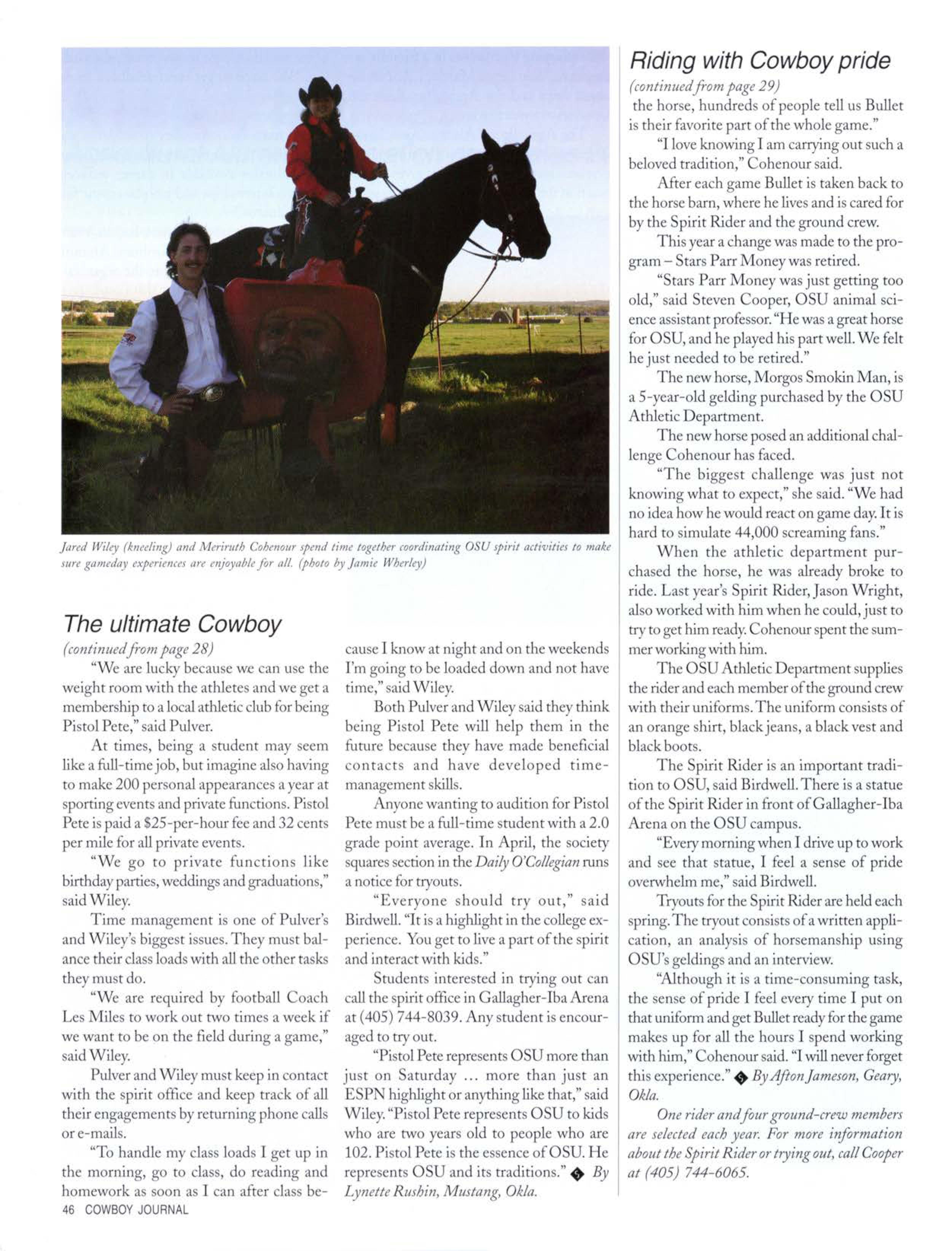
cau e 1 know at night and on the weekends
"We are lu k be au ·ewe can u e the 1'm going o be Joa led down and not have weight room with the athlete and we get a time,'' aid Wiley. member hip to a lo al athleri club for being
Both Pulver and Wiley aid they think Pistol Pete "said Pulver. being Pistol Pete will help them in the
At time , being a nident may eem future be au e they have made beneficial lik afull-timejob,butimaginealoha ing contact and have developed timeco make 200 per onal appearance a ear at management kill . porting event and private function Pi tol
Anyone wanting co auditi n for Pi col Pete i paid a 25-per-hour fee and 32 cents Pete mu t be a full-time tudent with a 2.0 per mile for all private event grade point average. J n pril, the ociecy
"We go to private function like quares e tionintheDai(yO'Collegia11run birthday partie , weddi11gsand gra uation ," a noti e for tryout said Wiley.
(continuedfrom page 29)
the hor e, hundreds of people tell us Bullet i rheir favorite ar of the whole game."
"I love knowing I am carrying our su ha beloved tradition," ohenour aid.
After each game Buller is taken back to the hor c barn, where he live and is cared for by be pirit Rider and rhe ground crew.
Thi year a change wa made to the program - tar Parr Money was retired.
" tars Parr Mone was ju t getting too old," aid reven ooper U animal science assi tan t professor. "He wa a great hor e for O U, and he played hi part well. We felt he ju t needed to be retired."
The new hor e, rgo mokin Man, i a 5-year-old gelding purchased by the O U thletic Department.
The new horse po ed an additional challenge ohenour ha faced.
"The bigge t challenge wa ju t not knowing what to expect" she said. "We had no idea how he would rea ton game day. It i hard to imulate 44,000 creaming fans."
When the athleti department purha ed the hor e, he was already broke to ride. La r ear' pirit Rider,Ja on Wright, also worked with him when he could,just co try t get him ready. ohenour penr the summer w rkingwith him.
The O U thletic Department supplies rhe rider and eacl1member of the ground crew with their uniform .The uniform con ists of an orange hirt black jeans, a black vest and black boot
The pirit Rider i an important tradition to O U, aid Birdwell. here i a ranie of the pirit Rider in front of Gallagher-Iba Arena on the O U campus.
"Every morning when I drive up to work and ee that tatue, I eel a en e of pride overwhelm me," aid Birdwell.
Tryout for the pirir Rider are held each spring. The rryout consists of a written application an analy i of hor eman hip using ' geldings and an intervi w.
tudent intere ted in trying out can
"Everyone should try out," aid Time management i one of Pulver' Birdwell. '1t i a highlight in the oUege exand Wile '. bigge t i sues. They mu t bat- perience. You get to live a part of the spirit ance their da load· with all th other ta k and interact with kids." they mu t do.
"We ar required b fi ocball oach all the pirit ffi e in allagher-Jba ena Le 1ile to work out rw time a week if at (405) 744-8039. An tudent i encourwe want to be on the field during a game" aged to try out. aid WiJcy.
"Pi col Pete repre ent O more than I ulverand Wile must keep in contact ju ton aturday more than ju tan with the pirit office and keep tra k of aU P highlight or an) hing like that,'' said their engagement by renirning phone all Wile ''Pi tol Pet repre ent O U to kid or e-maiJs. who are two year old to people who are
"To handle m la load I get up in 102. Pistol Pete is the essence of O U. He the morning, go to cla do reading and re1 re cnt O U and its tradition ." By homework a oon a I an after la be- Lynette Rushin, Mustang, Okla. 46 COWBOYJOURNAL
" th ugh it i a time- on l1t11ingta k, the sense of pride I feel every time I put on that uniform and get Bullet ready· or the game makes up for all the hour I pend working with him," ohenour aid. "I will never forget thi experien e. ByAftonfameson, Geary, Okla.
One rider andfaur ground-crew members are selectedeachyear. For more i11farmation about the piril Rider or hying out, call Cooper at (405) 744-6065.
910 S. Boomer
Stillwater, OK 74075 (405) 377-3633
Sidwell Farm & Insurance Agency. Inc.
Brenda Sidwell, Agent
/580) 496-2408 • I -800-299-2408
Fax/580) 496-2362
brenda@sidwellins.com
Mulu-PenlCrop Insurance& Crop Ha1I-F1re • LJfe Long-rermCare • MedicareSupplements
Rollingview Angus Farm

Robin, Susan, Kendra and Kaitlyn Kelton Rt. 2 Bo 385 • Muldrow, OK 74948 • (918) 427-5367
Equipment LLC Rt. l, Box 5 • Hobart, OK 7 651 Altu ( 00) 262-3373
on (800) 427-5693
(866) 726- 7200
Registeredgr01 and red Brahmans
FrankL Rushin 7528StateHvij KK
fv1arshfield.MO 65706 (417/ 859-6I 50 Frankrushin@luckyrranch.com James E. Posey,DVM
Billie Richardson, DVM
(continuedfrom page 19)
becau e law require that a de igncr mu t be a Ii need engineer before the plan i u ed, aid Paul We Ider, bio . , tcm and agricultural engineering profe or.
ln agricultural ommunications, agricultural education and other non-licen eeldicipline tudenr·' lution can be directly adopted when profc ional cc fit. 0 U tudent have contributed to a wide variety of professional endeavor directly and ind ire tly, aid David Lewi fore try profes or and environmental science undergraduate pro am dire t r.
"Among the urrent project that exist becau e of the work initially d ne b tudents arc the White Paper Recycling program at U and the ti.llwater reek Project," Lewi aid.
tudent al have m, de recommendation addrc sing i su including bio-ma s ern.i ion , compo ting at O U' poultry facility, defining the fea ibiliry of odor abatement relative to the Oklahoma enate wine bill and identifyin a volatile hydrocarbon contaminant in oil, aid Lewi riculrural edu ation tudents convert their education into practice while fulfilling the requirement in ludcd in GED 410" lethod and kills in Tea hing and T\Ianagement i.n gricultural Education.
ccording to the O U epartment of griculrural Education, ommunications and 4-H Y, uth evelopment, agri ulniral education eniors mu t develop unit ofintru rion and in tru ti nal tea hing t ol.
(continuedfrom page JJ)
ivi ion in Park I lill. The fa ility create a humidified tcmpcrature-conrroilcd environment to maintain the high quality and vigor of tree . The e con rru ti n allowed reenleafto begin marketing it. bare root tree and ceding in pring 1991.
Greenleaf added another new location in 1997 when 295 acres of land were purcha ed in Tarboro The Tarboro fa ilicy i a diver e, complete pr duct line, a mailer version of the klahoma and Texas OJ eration . Davi aid the orth arolina division wa opened becau c of its clo er locale to Grecnl af' ea tern market.
"We ell a 1 t of plant material in that area » Davi aid. "Vl/efelt we ould provide more for ur cu comer b, being there."
Today, reenleaf i the third largest nursery in the nited tate . During the
Cu11diJoh11n11(lift), Kody F~otherwm and Kent Eva/I ore <ompleti11gtheir majors.focuHdi11bio11mha11iml mgi11uri11gand will work do$ely with Ditrh /Vitrh exemlive,, Richard harp (mom/ Ji-om right), researchand devrlupmml prujert 111m111ger,,111dKevin elf. 1111m11ger of re.rearchand det•dopmenl, i11devdopi11g II rml•world sol11tio11for imlalli11g silt .fr11u1~(!iriently to ,1~•oidero11011lTround com/ruction au01.
before they leave campu to begin 12 weeks of tudem teaching.
From roilegc fre hmen to cap tone enior , 0 U student over ome many challenge on their wa from the dmissions Offi e to the other ide of the GalJagherlba ena rage, he aid.
ome may return a i.ndu try profe sional to add a real-world edge to future capstone experiences. Others could someday work a edu ators creating their own course that carry tudents through the m1nition from college to the working world.
peak ea on, the nur cry employ 1,200 people in it fa ilitic in Oklahoma Texa and 1orrh arolina. ln Oklahoma alone, Greenleaf produce more rhan 10 million liner, and 8.5 million finished plants. These plants in ·lude 70 varietic of conifers, 570 varietie ofbroadlcaf evergreen and deciduou hrub , and 145 varieties of shade and flowering trees, Davis said. The diver ity of plant the company produ e has been one of the biggc t change in e he has worked there.
"Diver icy in plants ha een a huge change," Da\~s said. "People want omething different. It' a real hallenge to keep up.'' rcenleaf currently hips to 45 state and anada. The ompany has enjoyed having a po itive economic impact in ea tern Oklahoma, a well as in it other location
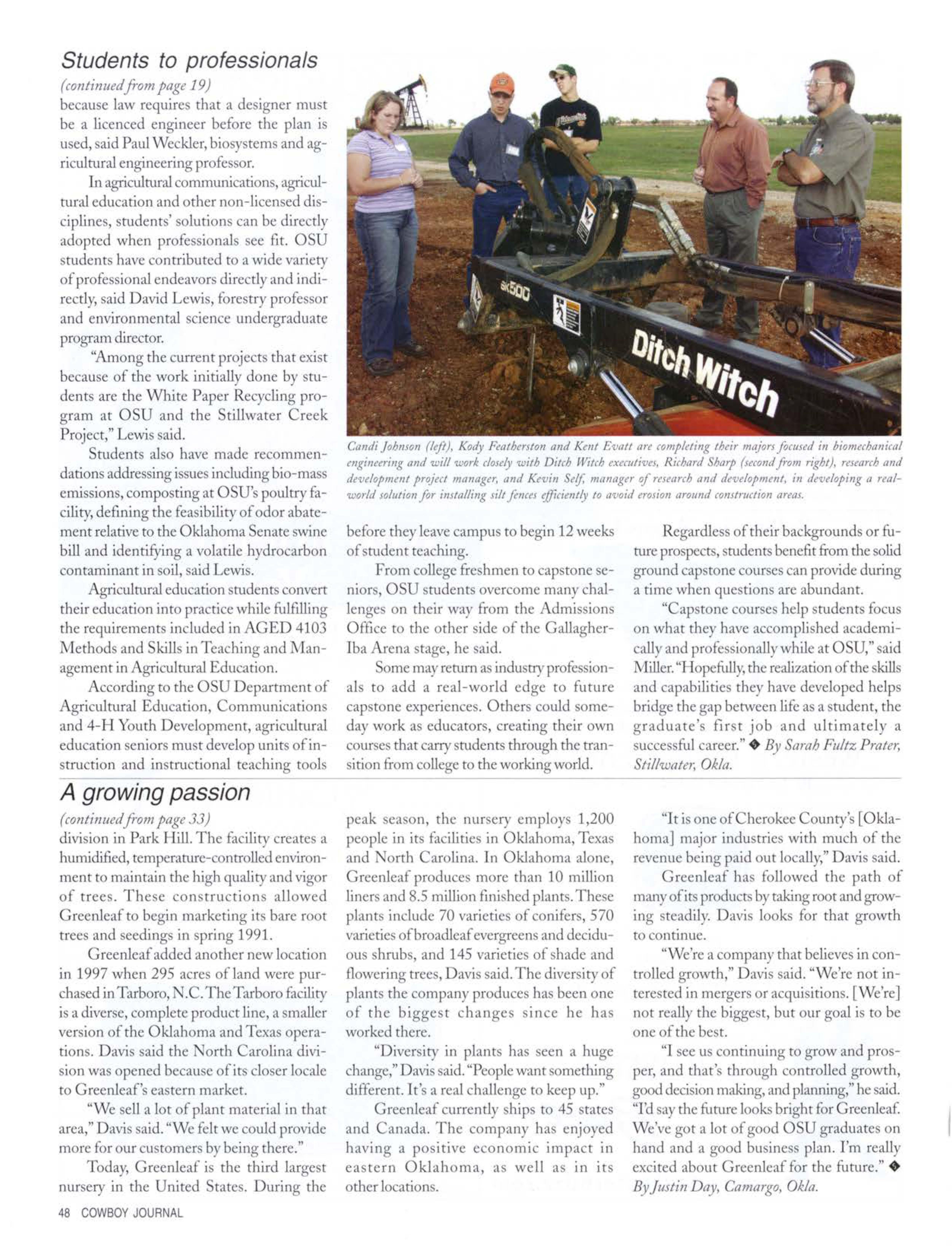
Regardle of their backgrounds or future prospe rs,. tudent benefit from the olid ground cap tone our e an proVld du.ring a time when que tion are abundant.
" apstonc cour e help student focu on what they have a c mpli.hed a ademically and profes ionally while at O U," aid l'vliller."Ho efolly,the realization of the skills and capabilitie they have developed help bridge the gap between life as a student, the graduate'. fir. t job and ultimately a ucce ful career." By arah Fultz Prater, ti!/wate,; Oklc1.
"It i one of herokee ouncy' [Oklahoma] major indu rrie with much of the revenue being paid out locail ,," Davis aid.
Greenleaf has followed the path of many of i pr du by t.'Uci.ng r t, nd growing readily. Davi look f, r that growth to continue.
"We're a ompany that believe in controlled growth,'' Davi aid. "We're not interested in merger or acqui irion [We're] not really the bigge t, but our goal i r be one of the be t.
"l see u ontinuing to grow and proper and that's through controlled growth, good deci ion making, and planning," he said. "I'd ,1ythe fi.itu1·eloo~ bri hr for reenleaf. We've got a lot of good O U graduate on hand and a good bu inc . plan. I'm reall excited about Greenleaf for the future.'' By Justin Day, Camargo, Okla.

"Always Fresh" A&M Feeds For Cattle, Horses, Swine, Poultry, Sheep, Goats, Dogs & Cats
Fertilizer • Fencing Supplies • Portable Panels • Hydraulic/TractorOils • Baling Supplies Chain Pulleys Rope • Carhartt • Wrangler • Pet Supplies • Dog & Cat Food Garden & Field Seed • Livestock Feed • Ag Chemicals & Sprays
www.stillwatermill.com• 1-800-364-6804
As a part of the Cowboy family at Oklahoma State University, we tal<e this opportunity to show our support for OSU and for the College of Agricultural Sciences and Natural Resources.

FromYoungFarmers& Ranchersleadershipactivitiesto empoweringruralwomento safetycoursestot youth, OklahomaFarmBureauofferssomethtngforeveryoneof all sizes.
Oklahoma
448 Agricultural Hall Stillwater, OK 74078-6031