In this issueof theCowboy Journal, we hope to walk you through some of the cutting-edge research projectsat OSU and give you a glimpseofsomeof our outstanding students and alumni. We welcomethe AgriculturalAlumni Associationto ourgroupof readers. Wehopewe remindyou of your homeat OSU. A specialthanksgoesto our contributing editors, Dwayne Cartmell, Julie Cox, Alan D'Souza a°nd Sheri Ishmael-Waldrop. This publicationcould not have beenpossiblewitlzout our managingeditor,Shelly Sitton, and lzerdedication and expertise. We also thank the following people for their specialassistance: Misty Wright and Matt Wright at QuebecorWorld Pendell; Todd Johnson of OSU AgriculturalCommunicationsServices;and Richard McCo/lough at MotoPlwtoof Stillwater.
RachelCrawfordand ShannonWebb,Editors
Editors
Rac...1e.C_ , !\Jrd
Shannon \,Vebb
Graphics Editors A ,n w ,\ 1d
Ross Walker
Web Editor Ll'~ '1(. 01
Photo Editors C..? c e .J "'b~"''1 An1y Jenkins
Sponsorship Coordinators '->l , C, -_ Katie Reim
Circulation Coordinator & ( I, - '-- c' J
Staff
JennyHard~'1• t:Ji-.., .. "' Ka ., • :)avid Miller
Sarah Sarge . • uke TetLscl1e1 • ) Waldschnridt
Managing Edi tor ...,. L 1 \ r .., ) 1
Founding Sponsors
Umow;inWorld• 0 2 '- nc c 1 \.., • • )uebecor World
Visit CowboyJournal on the Web at http:/ /cowboyjournal.okstate.edu
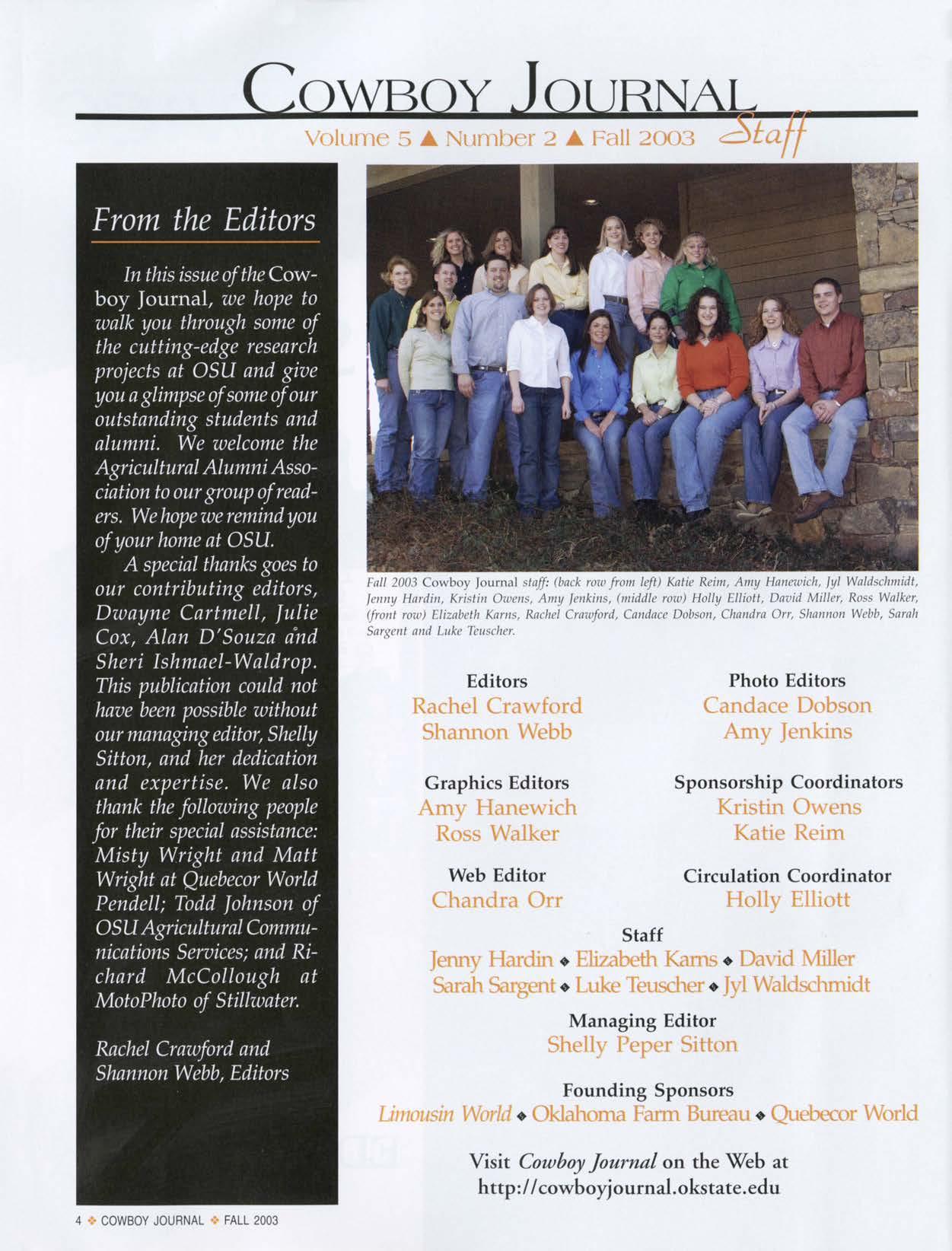
Fall 2003 Cowboy Journal staff: (back ron• from left) Katie Reim, Amy /-lrmewic/1,Jyl Waldscltmidt, Jenny 1/rmlin, Kristin Owens, Amy Jenkins, (middle row) Holly Elliott, David Milfrr, Ross Walker, (fro11trow} E.lizabt'lh Knms, Rae/telCrawford,Cane/aceO()bson, Chandra Orr, S/ra1111011Wel1b,Sarah Sarge11tand Luke Teuscher.
The foundation for leadership
CASNRstudents excel across campus
What do you think of when you hear the word leadership? Students and faculty at Oklahoma State University have at least five good reasons to think of the College of Agricultural Sciences and atural Resources.
When OSU chose the 2003 Top 12 seniors from across the university, five CASNR students who have excelled in scholarship, leadership and campus activities received the honor.
Bart Fischer,Cathy Herren, Trent McKnight, Chas Robbins and Carrie Trentham are the outstanding students who possess strong leadership qualities that started as early as junior high school.
"Many students from our college have great leadership skills because of the training and experience they gained while in 4-H, FFA and other youth development organizations," said Ed Milici~CASNR associate dean. "When these individuals come to OSU, they continue to serve in leadership positions, and this practice makes perfect."
Leaving the days of blue and gold jackets and 4-H Roundup behind, these students have embarked on new leadership challenges.
Organizations and activities such as Freshman in Transition, Agricultural Ambassadors, student academic mentors, Agricultural Student Council and numerous deparhnental dubs have allowed them to continue being leaders while attendingOSU.
Fisd1er of Frederick, Okla., who earned de-
grees in agricultural economics, accounting and finance, received CASNR's Paul and Mary Hummer Outstanding Senior Award. Fischer demonstrated leadership by serving as president of Aggie-X, as Ag Student Council vice president for business affairs and in Blue Key National Honor Society.
"Serving as a leader in club activities gave me the opportunity to lead a group of students and see how it was to serve," said Fischer. "These programs allow you to put things into perspective and help show you what you want to do in life."
Herren, agricultural business alumna from Ramona, Okla., was also recognized as one of the top five seniors in CASNR. She attributed her experiences in 4-H activities to be part of her success at OSU.
"The 4-H club gave me life skills that prepared me for the responsibilities l faced in college and gave me the chance lo work on projects and know the feeling of success when they are finished," said Herren.
While at OSU, she was involved in Ag Ambassadors, Ag Council, Collegiate Farm Bureau and Blue Key.
"The faith that people had in me while I was in these organizations has given me the confidence to achieve the goals l set for myself," said Herren.
Leadershjp opportunities are not limited to CAS R, they extend across the campus.
Trentham, agricultural economics alumna from Balko, Okla., displayed her leadership as homecoming executive director and was recognized as a Leadership Legacy. She was also a member of the National Agricultural Marketing Association, Ag Ambassadors and Blue Key National Honor Society.
"The college of ag does a great job prepari11gstudents for leadership roles within the college and across campus," said Trentham. "The preparation 1 gained through CASNR helped me with positions I had whileatOSU."
CASNR students always play an active role in homecoming, either through student organizations or individual executive and steering committee members. CASNR is contributing to Homecoming 2003 festivities, with five of eight executives and 22 of the 67 steering committee members from the college.
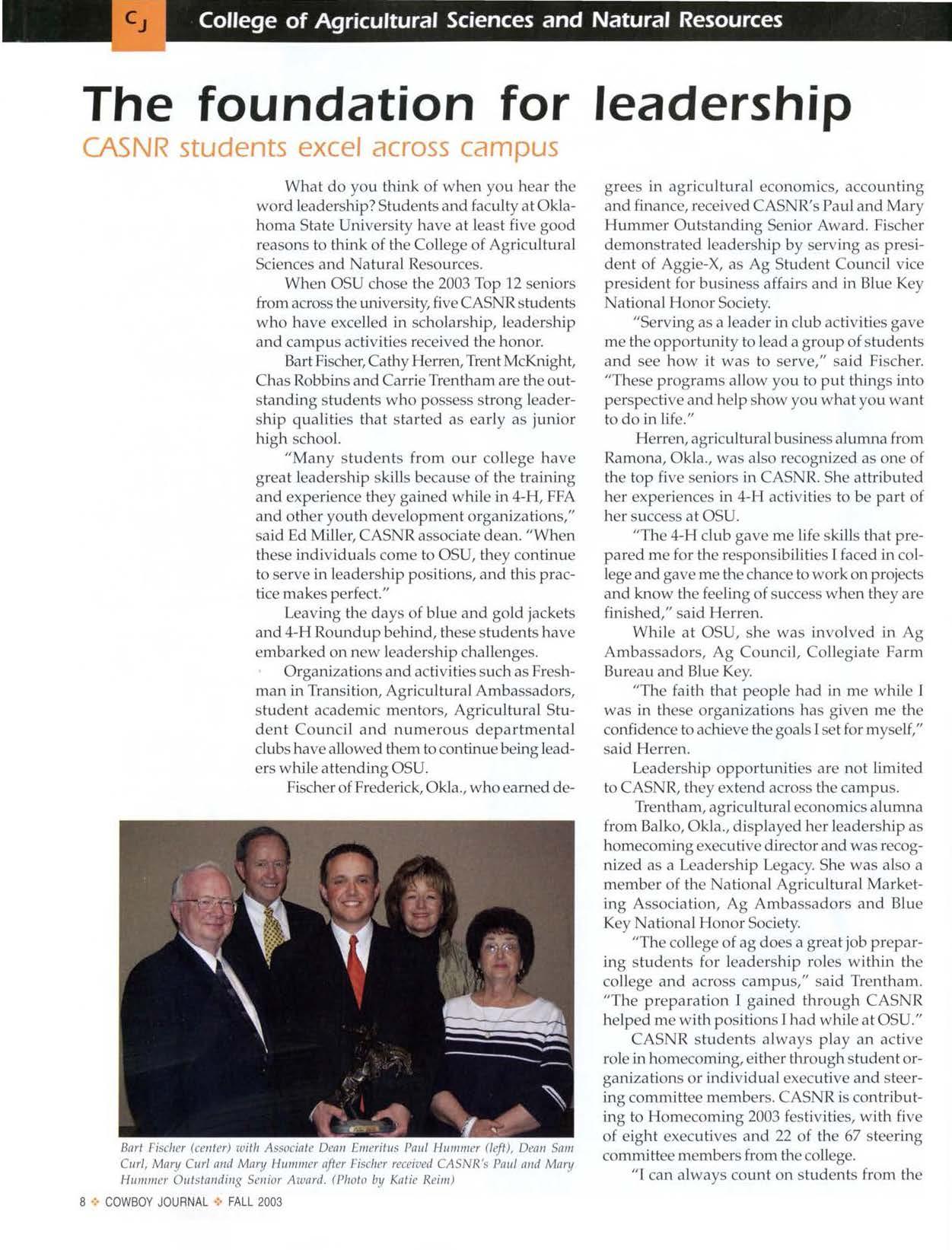
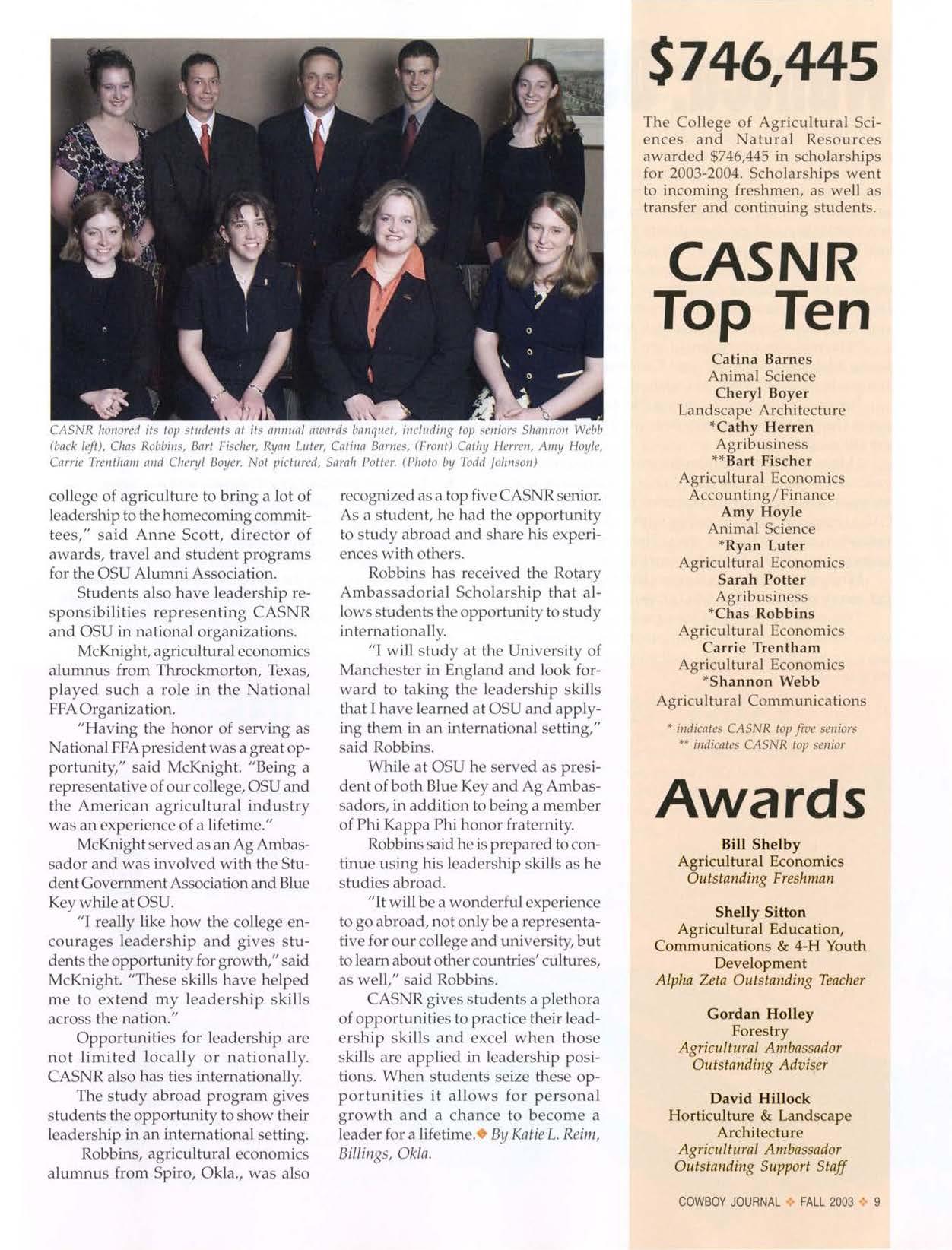
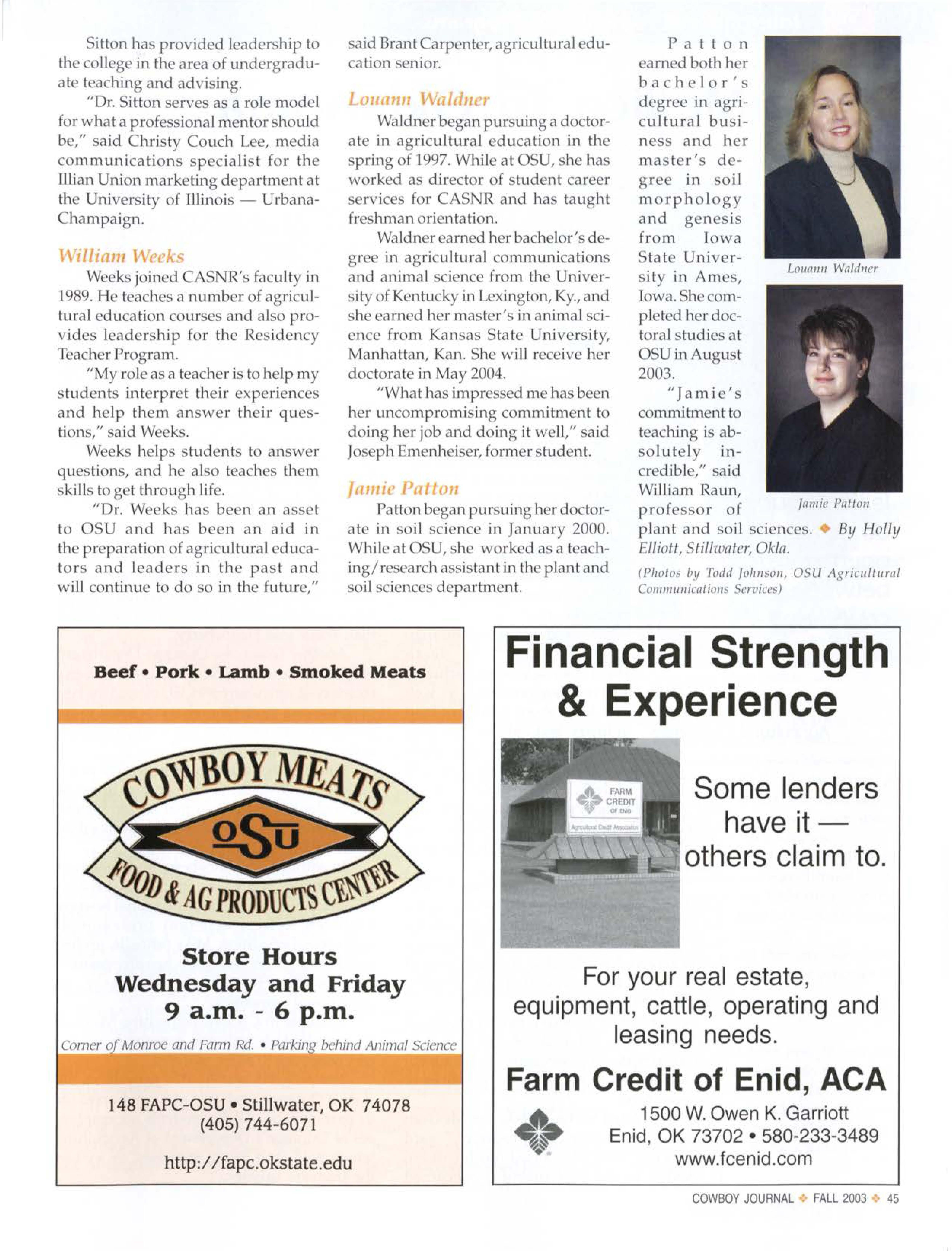
CASNR ho/lored its IOJ' st11de11ts at its 11111111//Iawnrds l11111q11et,inc/11di11gtop st•11ior;:Shn111wnWeb/I (back left), Chns Robbins,Bnrt fisc/1er, T<yn11Luter, Catina Barnes,(front) Cathy 1/errrn, Amy Hoyle, Carrie Trentham a11dCheryl Boyer. Nol pictured, Sarah /Joi/er. (Photo liy Todd Jo/111s011)
college of agriculture to bring a lot of leadership to the homecoming committees," said Anne Scott, director of awards, travel and student programs for the OSU Alumni Association.
Students also have leadership responsibilities representing CASNR and OSU in national organizations.
McKnight, agricultural economics alumnus from Throckmorton, Texas, played such a role in the National FFAOrganization.
"Having the honor of serving as National FFApresident was a great opportunity," said McKnight. "Being a representative of our coJlege, OSU and the American agricultural industry was an experience of a lifetime."
McKnight served asan Ag Ambassador and was involved with the Student Government Association and Blue Key whiJe atOSU.
"l really like how the college encourages leadership and gives students the opportunity for growth," said McKnight. "These skills have helped me to extend my leadership skills across the nation."
Opportunities for leadership are not limited locally or nationally. CASNR also has ties internationally.
The study abroad program gives students the opportunity to show their leadership in an international setting.
Robbins, agricultural economics alumnus from Spiro, Okla., was also
recognized as a top five CASNR senior. As a student, he had the opportunity to study abroad and share his experiences with others.
Robbins has received the Rotary Ambassadorial Scholarship that allows students the opportunity to study internationally.
"l will study at the University of Manchester in England and look forward to taking the leadership skills that l have learned at OSU and applying them in an international setting," said Robbins.
While at OSU he served as president of both Blue Key and Ag Ambassadors, in addition to being a member of Phi Kappa Phi honor fraternity.
Robbins said he is prepared to continue using his leadership skills as he studies abroad.
"[twill be a wonderful experience to go abroad, not only be a representative for our college and university, but to learn about other counh·ies' cultures, as well," said Robbins.
CASNR gives students a plethora ofopportunities to practice their leadership skills and excel when those skills are applied in leadership positions. When students seize these opportunities it allows for personal growth and a chance to become a leader for a lifetime. By KatieL. Reim, Billings, Okin.
$746,445
The College of Agricultural Sciences and Natural Resources awarded $746,445 in scholarships for 2003-2004. Scholarships went to incoming freshmen, as well as transfer and continuing students.
CASNR Top Ten
Catina Barnes
Animal Science
Cheryl Boyer
Landscape Architecture
*Cathy Herren
Agribusiness
**Bart Fischer
Agricultural Economics
Accounting/Finance
Amy Hoyle
Animal Science
"Ryan Luter
Agricultural Economics
Sarah Potter
Agribusiness
*Chas Robbins
Agricultural Economics
Carrie Trentham
Agricultural Economics
"Shannon Webb
Agricultural Communications
• i11dicnte,;CASNR top five s,:niors
•• i111/ir11te~CASNR top se111or
Awards
Bill Shelby Agricultural Economics Outstanding Freshmnn
David Hillock Horticulture & Landscape Architecture Agric11lt11rnlAmbassador Outstnnding Supporf Stoff
Wanted: ISi Craduatcs
CASNR helps students find jobs
A tudent prepare to walk aero the tage on th ir fu1al day at Oklah ma tate niv rsity, feeling f pri.de and excitement are often overwhelming, leaving them to wonder if th y will t the.ir dr am job and how far they will have to move to pur ue their goals.
WhiJe pursuing their dr am and goal , mo t f the tudents in the oUege of Agricultural ci nc and atural Re our hav th opp rtunity to work with Amy Gazaway, care rdevelopmentcoordinatorforCAS R ar r rvic
" majority of stud nts r e in my office _p.referto locate a job in Oklahoma," said Gazaway. "Th main r aon tudent want t tay in Oklah ma i famlly."
For tud nt looking for job in klahoma, th re i g od new De pite the current econ mk conditions, in-stat jobs ar till available.
"Many Oklahoma employer are small to mid-sized organizations that traditi nally don tu on-c, mpu int rviews or career fairs to fill their hiring needs," aid Gazaway. " l o, mpl yers ar op rating with r due d r cruihnent budgets compar d to past years. Therefore, tud nts mu t bemorepro ctivetofindj bopportunitie ."
While ome employers may not like their recruiting budget, many tiJI lik to hire OS graduates.
"W, c me to O U ai,d hire graduat for v raJ rson ," aid Li a Binger, Excel employment man, ger. "The have a good work ethic, are weIJ educated and have good p op! kill ."
How do I go
nbout finding tlie rigl,t job?
azawa ugg t d n rnrorkin , dir t company c ntact , j b Li ting and referral from CA R and O car er rvic s, on-campus interviews, Internet earches, tate empl ym ntoffices, mploym nt agencies, career and job fair , profe ional or
ites and job Ii ting inn wspaper a a f w urcc to use in the job earch.
L uann Waldner, dir tor of R areer rvic , said working with third party or profe ional recruit r i an option if the employ r pay for the rvice.
"There are o many recruiter who are free t tudents that paying or n i ju t not nee ary," aid Waldner. " tudents recejving graduat degree u recruiter more fr qu ntly. Whil r ruit r can b h lpful, tud nt h uld be cauti.ou and read all contract thoroughly before making any ommihn nt ."
Gazaway recommended student follow even teps to ha· ing a u c ful job ear h, wh th r earching in klahoma r in other tates:
• Re ea.rd, y ur If.
• Identify targets.
• Re earch pro pective employer and po ition
• Dev lop your j b-s arch tool
• Identify and u e job- earch re ources.
• R u t and pr par for int n i w
• Follow up after the interview.
B-for b ginning th job arch, individual hould rsearch their lives and car erg al , aid Gazawa . Additi n, lly, tud nt hould know the car r ar a and typ f position , re simile r to their intere t , , bilities and valu
The next t pi to identify targets. Write down type f organization , name of pecific mploy r and title f -pecific po iti n where you ar int re t d in w rking.
After identif ing potential employer and po itions a ailable, I arn a much a po ibl ab ut mpl y r and job opportunities, including how the employers recruit new professiona I
"111ere are no luni son what one should know about mploy r nd po iti n that re under con id rati n," aid Gazawa .
Equipp d with infoimati n, student sh uld devel p job- archin to I
"Developing a network with employers, alumni, faculty and fellow tudent i crucial," aid azaway. "During this time, tudent also ne d to targ t re um, and c rr pond n e in dditi n to pra ticing interviewing skills."
With knowledge and the appropriate tool in hand, it i tim to begin identif ing and u ing the resource acqufred through th job earch. Students h uldorganizeth irjob-searchre our e ,plan the proc and t re um' in cir ulati n.
Potential mployer ' awarene s of the candidate' a ailability and qualification- ignal the beginning of the interview proc s. To pr par for, n interview, a k th f II wing queti n : How do l it into the organization and p ition? Wh tare my career goal ?
"Knowin the an w r i n t enough," aid
Gazaway. "Candidates must be able to articulate the answers."
After each job interview, following up with the employers is essential, said Gazaway.
Initiative and genuine interest in the position arc demonstrated through polite persistence after the interview.
Job seekers can remind employers of their qualifications by sending thank-you notes and follow-up letters to express appreciation for interviews. Phone calls and e-mails also can help candidates keep in contact with employers about the selection process.
When sltould I start?
"It takes most people about six to nine months to find their ideal jobs once they actively begin pursuing positions and mailing out resumes," said Gazaway. "Students who arc graduating in May really need to begin actively looking for most jobs at least by September, even though a few employers might not advertise or begin recruiting until later in the year."
How 11wcl1 is enough?
Multiple factors must be consid-
ercd when negotiating a salary. First and foremost is the market value for individuals graduating in a student's area of study and planning to work in the student's identified career. Location and cost of living also affect a salary's value, said Gazaway. A bigger check does not always mean more money. Additionally, benefits should be closely evaluated as part of the total compensation package.
"Students with bachelor's degrees earned an average starting salary of $31,600 last year," said Gazaway. "This number usually increases by 3 percent to 5 percent every year, so students this year could average $33,300. I would encourage all students to visit with career services about more accurate numbers for their career choice."
The Bure;iu of Labor Statistics cites the mean annual income of Oklahomans as $28,630 compared to the national average of $34,020 in 2001. While the average salary of Oklahomans is lower than the national average, the 2000 U.S. Census cites the median value of homes in Oklahoma as being considerably less than the average national value. An average home
in Oklahoma should cost about $70,700, whereas the national average is almost $120,000.
Doing employer research also can help students determine what kind of starting salaries are realistic for them to expect.
"lt might also help to visit with fellow students, alunmi, co-workers, facu lly,advisers and other members of the student's network to gather this information," said Gazaway.
Additionally, CASNR Career Services provides a Web site designed to help students efficiently access career information and job-search resources.
"The Web site helps me to look into companies and employers a lot quicker than looking them up individually," said John Eric Denson, agribusiness junior. "It has really helped me pick out some of the better companies I would like to work for."
The CASNR Career Services Web site is located at http:/ /www.dasnr.okstate.edu/ casnr / career.html. For more information about career development or assistance with finding a job, call Waldner or Gazaway at (405) 744-5395. By A111yJe11ki11s,Bethel,Okin.
Extension educators provide the 'basics· in a new format
rban itiz n , r tradin in th ir ondo and p rt ar for ranch hou s and pickup trucks. Will thi "new generation" of ran h rs b bl to flouri h in tb truggling agricultural economy? o one can say for ure, but Oklahoma operativ ten i n rvic p r nn I c nd rearcb r at klahoma tate niversity are working to enure th ir ucce .
"P ople with 20 t 120 acre ne d information in a different format than traditional cattle ranch r ," aid Ro Ball, raig unt agricultural e tensi n agent.
Creating a way to prov id that inf rm, ti n i x, ctl what O ES i trying to a omplish. By d -
"People with 20 to 12 0 acres need information in a different format than traditional cattle ranchers."
-Roy Ball Craig County extension agent
veloping a rel ed, fun-fill d program of fact , v lu bl information, food and muic, e t n i n p 1· nnel are hoping to attract the n w and ca tor felt there wa a group of non tr, ditional land wn r who w ju t w r n't r achin ," aid Kent B rn ,0 Uarealiv stock speciaU t. "Our information wa pr ent din a format that wa too lengthy and d taiJed for their n eds and aried background ."
o fi thi probl m, team d with th klahom, legi latur t r at the herok e Prairi farm and ranch managem nt program. The program inc rporate new letters, al barn card , emim1r and demonstration targeted at the new cattl produc rand ranch r.
"W want t u th ·am informati n a before, ju repa kage and pr ent it in a differ nt format," ai Barn , Cher k e Prairi program co rdinator.
nee tbe problem was identified, reaching the new target audjence b came th- next b t cl t n ion ducator
vi it d county ourth u to obtain nam based on he iz of a landowner' known creage. Barne , id it wa not an a y undertaking.
After appro imately 6,000 to 7,000 nam w r id ntifi d in raig, Delawar , .ay s, Ottawa and Roger cow1ties, each e t n ion ag nt had to narr w his Ii t to approximat ly 450 tar t produc r . Thi final group became the mailing Ii t for the Cherok Prairi n w l tter, an informational pi c that fo uses on one main aspect of ranching in each edirion.
"W ar looking at th bottom line," aid Barne . Glenn elk, OS Uve t ck pe iali t, aid th int nti n f t n i n ducator is to rovid rancher with ba ic information in as man formats as possible.
111.isnew type of cattle and ranch nhanc m nt program, p cificall gear d for th herok e Prairie ar a of nortl1eastern OkJah ma, wa de ign d with th n w g nerati n f pr du r in mind. Th program i b·uctured with a pecial empha i on pro iding in ights nd an wer for produc r with mailer a reage operation
"We wru1t to make it ea ier than ever f r mailer prod uc r t a c inform.ah n mad vai!abl by U peciali t and re eard1er ," aid BeII. "Practical tip , profit.bl Jution ,pr nt dinanatm ph r offun,f dand fact ; that's what he program is about.'' an cattl produ r nth h rok ePraiJ:i hav two job : o.n in own during the day and the ther on th ranch at night. bvi u ly, thi can creat riou hall ng radihonalJy, e t nsion meeting and minar are held during regular busine hours. Bee<u e many new Cherok e Prairi rancher hold full-time po ition , fincLingtim to attend xt n i nm ting pre nted a problem.
Barn aid man of the e land wner cone de that pr fit i n't th ir bigg t al n th fa1·m;th e ranch r pref r a th tic valu
"The are much more on med about the lif tyl ," .ai • Ba
"Rancher ' ( pr vide h lpful ing th pa ttle that graze tho uality ofUf opl ranching nth rairie.
Ball aid ion of gricultur, I ience and
atural R h n pr vi • ight-f rward, un d -based an • ·tant u ti ar
Durin n 'pduced to thre " torefr re nd a er' • ·c ~ach stor t pro i in r q • farmer and ranch fa i
When\ ," pr du rs found ans" r to th ir qu ut what type of Li estock feed to u e and why.
th "f rtilizer tore" an wered guesti ns about f rti d herbi id , uch a h w mu h to appl and
An actual ve • ria1 on hand at the" etcr' medicin 't lai va ina t o i t liv k trate typ r nd e o of re id ming and n w d a famaid couples had the option of attending th onfe thcr, hcouldlearnaboutthcchaJI nge and opportuniti • ed in th ranching indu try. To dat , a ppr im, t I pc pl have attended the nevening minars.
"Th conference ha b en well rccei d," aid Barn "Tbe entir purpo e of thi program i to make our inf rrnation mar readily avail, ble t rn t the producer 'need . W also ant t market t n i n."
Th co t of tJ1 program i 5 per pers n. The regi tration f in Jud th~ c t of th confer nc ', a beef dim1 r, informational material' nd a night of entertainment.
Barn aid he hop thi program will h lp t m v many nonh·aditional produc r int the main stream of traditi nal ext n ion pr gram
"We ha a I t t ffer," aid Ball. "You'v got quelions; we'v got lutio1 ." or more information about the herokee Prairie program, cont<1t your county e t n ion ffic , or vi it the Web ite at http:/ /www.d<1 nr.ok tat•.edu/cher keeprairi Story n11dpltotoby !w,111011 Webb,Cordell,Okin.
Who said a college student can't cook? Now you can with new beef heat-and-serve products available in your local grocery store. For delicious recipes using heat-n-serve beef items, calf OBC at {800) 235-5403 or visit www.oklabeef.org
OKiahomaStareLlnNnty
148Food& AgProduc1sCllnler
SI111waterOK74078-6055
405,7446071• FAX!05744-6313
1111p·rapeoltstaleedt1
Our Roots Run Deep
For Your Agricultural Financing Needs in Western Oklahoma
Clinton ~ (580) 323-3004
Woodward ~ (580) 256-3465
Guymon ~ (580) 338-3828
• Client education oriented •
• Wellness-emphasized companion care•
• Geriatric care •
Maria DiGregorio,DVM
James Baker, DVM
Joseph Mccann, Ph.D EndocrinologyConsultant (405) 372-4525
Telephone answered 24 hours a day 2003 N. Boomer Road, Stillwater www.ocolly.com
ear um,
Remember when you u cl to read The Daily O'Collegianevery day between classe ? Remember how you used to laugh at tho e outrageou opinion olumns?
Remember the aptivating picture you used to hang in your room?
College may be over, but your OSU spirit will never di . Don't fade from college.
Pie lici warm pizzn. ook nd pas ibly notice • of I i.n the rich, red t m u ably n ver noti them,buttheyaddanaromaa11dc z t fl v r, and r • ar hi und rway to improve them.
"Th i with the oregano rs archi tol tth • • and th am un ii in aid urhan Dunford, a mi t t the klah m tat ood and Agricultural P arch and echnology n gano pla u e leav • I ancin me J eing an com reli fra and chewing gum. Pizza, h th f d it m mm nl , ociated with
FAPC goes international with research
or gano. The herb i • often pair d with garlic or other sh·ong-flavored herb . 11 [ r ganoj w rk well with fo d that already have a fairly trong flavor, or om thingyou'r mi ingoth r . trong flavor with, like garli ," ·aid Barb raBr wn,food pe iali tat " hi is why we see it in pizza sauce h garlic cind th pepper air ady have strong fla ors. It would probably n t work w 11with mild flav r d fi h. It would be too pronounced and that' a11you'd taste."
Mo oregano s Id in the United own in M xico.
For O year Silva Vazgu di d at th demi Research Cen atural Resourc [R ocat din hihuahua, ecently completed a atical from tudyatF P . azquez, the head no rar at C!Re • rtinsearc eIieved a becomin "Tha i11g azg uez. "They were cutting the pla f ran extra income fr the wild plant. I began r arch on oregano becau el wanted t ave th wild plant and try to re1 nt."
e , ilva hed way t ild plant. He l seeds from lant and plan a or gan crop. T ery diffi ult to
"Th
proje t wa • tr ing to pr tr at the from th wild plant," aid Vazquez." nl 1 p re nt f the would germinate. We used differ nt on trolled nd iti ns t tr t in r a g rmination."
With th pretreating Vazquez de eloped for nt will g rm· y get appro t LI ing t
Although the oreg adapt to oth r ar a , work continue today to a apt the plant to th de rt ii in Chihuahua.
"W ha rve ted the ed fr m th wild plant t grow m r ," aid ilva Vazguez. "The most important thing wa to tart gr wing it. W ar till work' pting th plant to the oil.
pin th removing the oregano oil from the leav em • • in a crud de tain hun mp phai rm The or ano must be refin procc call d h drodi tillati • hrmoves the undesirable nt f th • id Du
1pan United States ep oJR nin fril ontaining higher perce1 s than normally found of the tw imp rt, nt c mp in il, th ,_ mol and carvacrol.
" e kin at the bioactive c mp or mp und that 011tribu fo or to th ir pr duct," aid . J , the ff c a t arch chan th c h compounds. He also looked at ways the wat ram ii mp iti ninth
Theequipme Awa n t accurat her Vazguez aid he heard a fr m hi
young r br ther, Jo e L renzo Silva Vazquez, who att nd d h elder ilva Vazquez contacted Dunford ab ut researching in her laboat F P . Dunf rd h d more accurat quipment than h ha ac to in Mexico, an he could better control the variables at FAP , he said.
H am PC and u ed the equipment, s f whi h Dunfor d ign d. Hi pent at FAPC and hi researd1 w d d by a gr up f oregano pr d n Mexico.
Dunford an il ucz work d t g th r u F uipment to separate th f th oil harve m leav xi o. Th the th effe r had during th growth pro ess on each of th c mponent .
He learn d u ing P ' equipm ntall w d him to increa e p rcentagc of thymol and carva rot naturall
Howe er, upon comparing the resul to the plant grown in M ico, Dunf rd an ii a Vazquez learn d a few thin wer n t d n pr perly.
" h ir experim nts w r d n in th field, in th p n," aid Dunford, " o they didn't have reall good control f h am unt f w t r the plant get . It all vap rate ut, an th y were tr ing to limit the am unt of water one plant g t , but if it rain what ar you going to do? That plant is going to t wat r."
Dun.for and Silva Vazquez start d n wt t nd gr w regan plant at U plant and il scienc s gre n~u ~wh re~ yco~d ~tt r ootr l the variable They extracted th oil and com pc red th re ul.t with the prviou outcom
Or gano leav ar mall. Th ar a c uple of in h in l ngth. lt tak a lot of I ave to make a mall amount of ii. Thi , in ad iti n to it man u make th oil valuable.
" ompanie mi the ii with diff r ntthing tomak theirproduct ,"
aid Silva Vazquez. " oilcan ellfora·muha
$1,500 to 1,700."
"Right now th only thing we are elling is the dried leave , but th r arch h r is to xtr ct the oil and the differ ntcomponent o th oil," sc1id i]va Vazquez. " II of them havedifferentpropertie ."
ilva Vazqu z and Dun for pl, n to ind way to ell the c mp n nt f th oil individu, lly. TI1i i import, nt be a use c ch component erve a pcificne d for differ nt amp nie.
He said hi goal in his r s ard, i t dev I p wil plant o that the people in th de ert regi n of hihuahua can produc a nJu -added produ t to make a profit.
ii a Vazqu z and unford continue to work tog ther Jong di tanc to I k i.nto th probabilitie of other u or r gano.
Dunford said she wo lik to mak th tee knowledg n thi reea to kla-
"We te hn I gy for ther plants uch a edar or other herb ," aid Dunf rd. " or amp! , w have a client intere ted in I mon balm ii, which i very irnilar to or gan i1. Thi y ar th y are g ing to grow ne acre of lemon balm plant . They ar going to use the am t chnology t help Lhem tract the oil from lemon balm. lt' all r ally i.nterconn ct d."
!though thi int rnationa I r ar h d
notdir tly involve klah ma at thi tim , w rking through thi techn 1-
gy with regano an lead to uture b nefit for klahorna agri ultural produ t hi uld reate more products locally produc d for th consum r in additi n t r venue f r the Oklahoma produc r.
nxttimeyou at lice fpizza, tak am ment t 1 ok lo ly ,nd appre iate the value of the flavor a11dthe work and effort g ing into impro in ry bite you tak By Jyl Wnld ch111idt,Waldro11,Kn11.
All co111111e11t by Rn111011Silva Vnzq11eznre vin an i11terpreter, Pn/011m Cr1eslnA/011s0.
For 111orei11for111nlio11011FAPC or oreganore enrc/1,en/I (405) 744-6071or visit http:/lfnpc.okstnte.ed11.
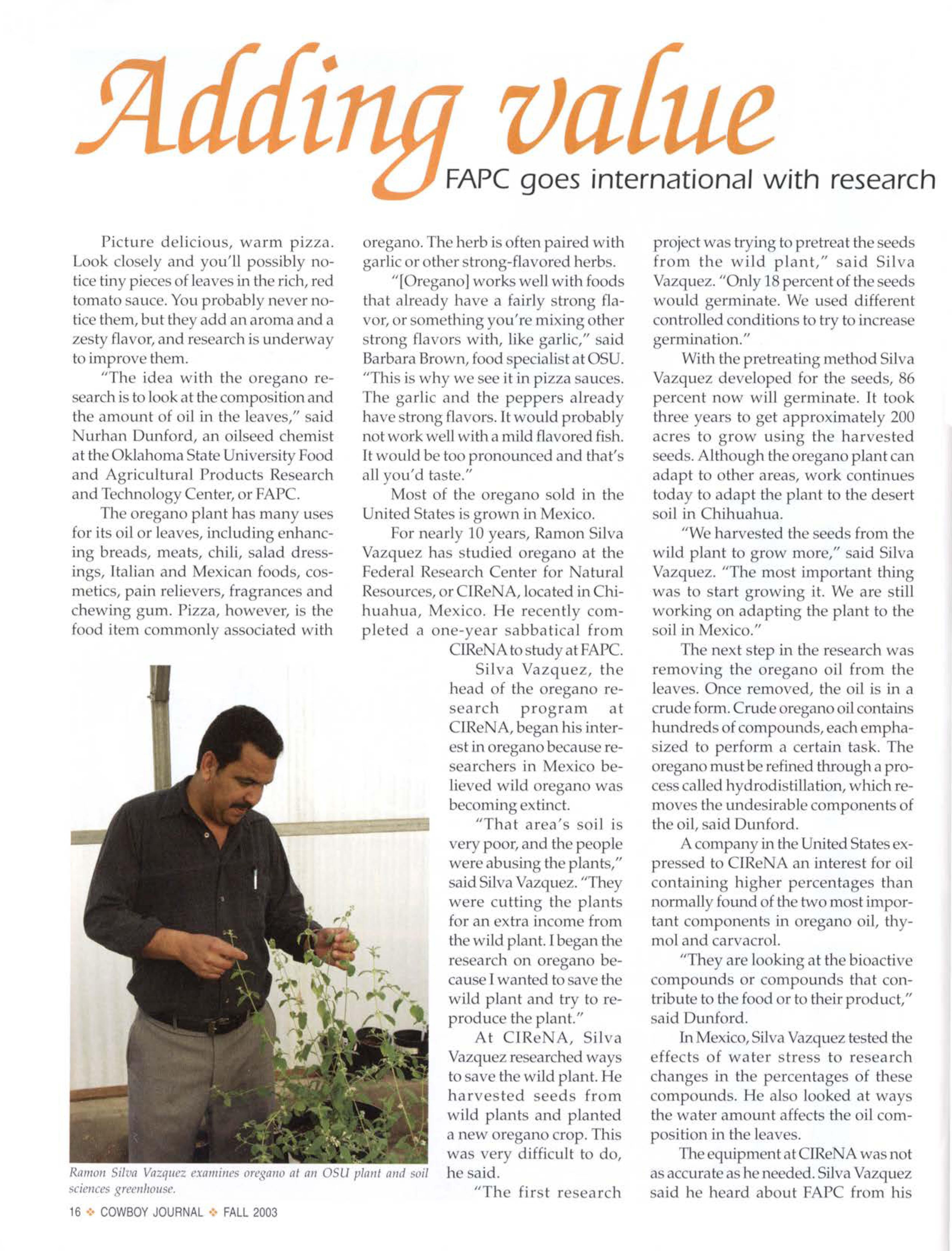
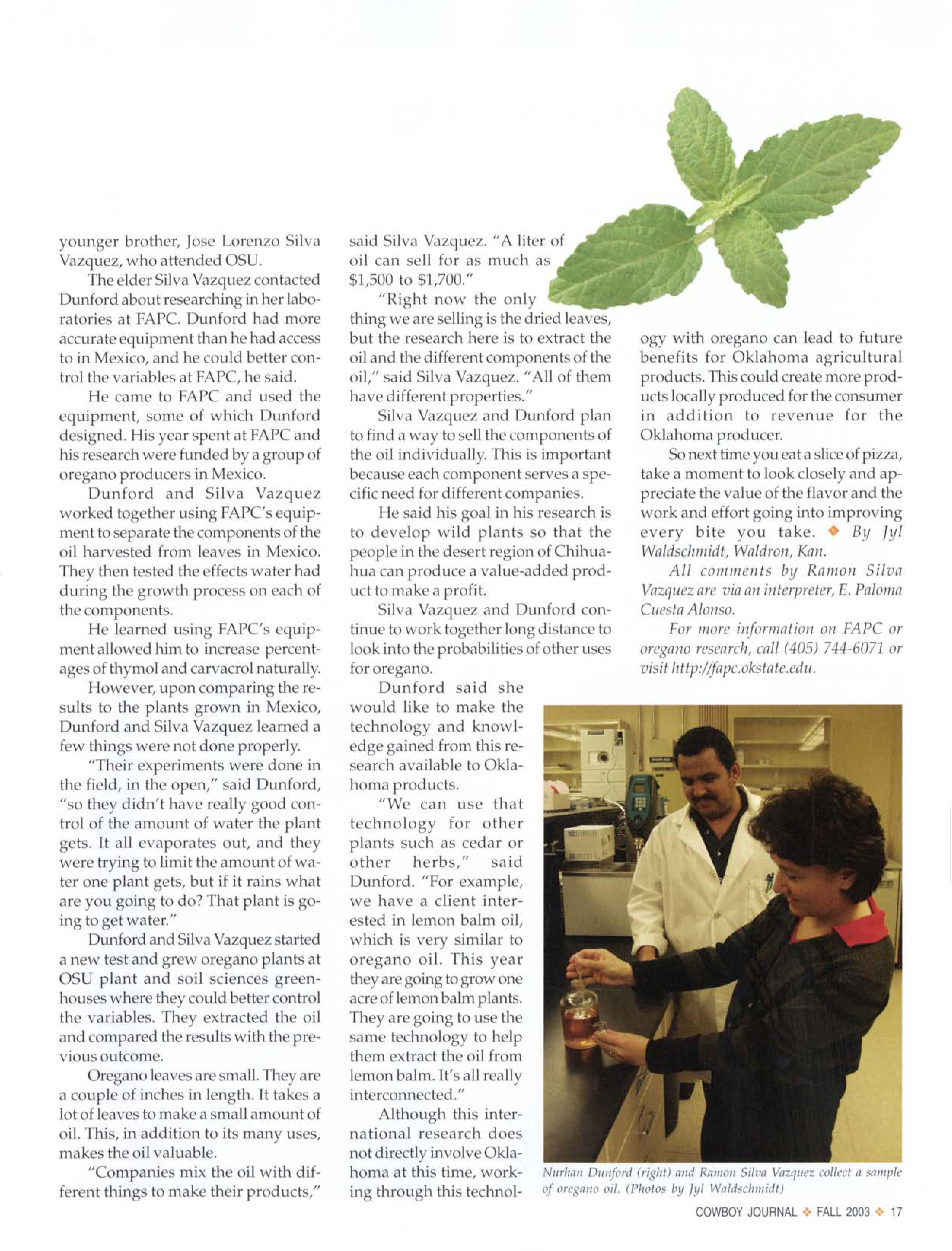
11rlm11D111,ford(right) ,111dR11111011 Silvn Vnzqm•zcoll~ctn s11111ple of ,wgm10 ml. (Pliotos by /yl Wa/dsch1111dt)
Economics
Wisdom shines bright
Sanders brings unique style to classroom and extension
A tropical print shirt, sandals and khaki pants may not fit into a student's image of an agricultural economics professor, but Larry Sanders is not a typical professor.
His clothes may not reflect the depth of his wisdom, but the salt tones in his salt-and-pepper-colored beard barely begin to tell his story.
Sanders was born into a working-classfamily in Carlsbad, N.M. His father, Lawrence, worked in the potash mining and refining industry, a11d his mother, Lillian, was a homemaker. Despite his parents' lack of formal education, they instilled in their son the value of higher education. Sanders refers to himself as a second-generation non-farmer because his father left the farm behind.
When Larry Sanders finished high school, he went to college, but he also took a job as a newspaper reporter.
"l didn't have formal reporting classes," Sanders said. "I was given a journalism text to read and then had to go out and act like I knew what I was doing."
Sanders worked as a reporter in Carlsbad for two years before he moved to Laramie, Wyo., to work full-time as a newspaper reporter for a semester. He then enlisted in the U.S. Army.
Sanders said he wanted to serve his cow1try in the military like his father, a World War TI veteran. He said he thought this service was the best choice he could make.
He spent 18 months in Vietnam during the Vietnam War,where he learned many tough lessons about life that gave him some of the wisdom he uses in his classroom today.
"In every crisis you are put in, you are given a gift," said Sanders. "When you find that gift you will begin to get better."
During the war as a lieutenant, he learned how to think critically, lead others and think quickly in critical situations.
"Probably the biggest thing I learned was to know myself and that I could perform in a crisis situation," said Sanders.
Sanders returned to the United States, but he stayed in the military for almost seven years.
"I never intended for it to be a career, and I never intended to be in as long as I was," he said. "But I hadn't decided what todo fora career, so it was a good place to be untiJ I decided."
He took night and weekend classes in California to finish his bachelor's degree in sociol-
ogy while he continued service in the military. "I wanted to better understand how the people in institutions around me worked," said Sanders." J aJso wanted to learn how to improve the way we live with each other."
Sanders then moved back to New Mexico and worked as a firefighter in the southern New Mexico mountains for one year before he went to New MexicoStateUniversity. Hcstudicd for his master's degree in agricultural economics there and received his teaching certificate.
In 1973, Sanders married. His wife, Linda, helped him "heal from the war." He said she was the only person who w1derstood exactly how he felt.
"My wife was my anchor," Sanders said. "She was the one who helped me when I got back from the war."
Sanders opened his own insurance agency and worked for the next few years selling insurance in New Mexico.
He then left New Mexico for Colorado to work on his doctora I degree in economics.
He focused his studies in the area of natural resources and took advantage of a job opportunity that allowed him to chart scenic rivers in Colorado and do research to complete his dissertation.
"It was a rough job - hiking, kayaking, fishing and mountain biking- but somebody had to do it," Sanders said with a chuckle.
After completing his doctoral dissertation in 1985, Sanders was recruited by Oklahoma State University.
"I was intrigued with the challenges of the job," said Sanders. "I had been helping extension in Colorado as part of my assistantship to help farmers in the farm crisis in the early 1980s, and I saw an opportunity to do the same thing in Oklahoma."
Sunders has worked at OSU for 18 years, spending part of his time teaching and part of his time working for the Oklahoma Cooperative Extension Service addressing poUcy issues that affect people in rural communities.
"I develop educational programs to help those audiences become more aware of the public policy issues that affect them," said Sanders. "I work with Congress, the state legislature and farm organizations to consider improvements in legislation."
When there isa new farm bill,Sanders helps
coo rd i na le ed uca tiona I programs about the bill.
Farmers, ranchers and legislative aides contact Sanders to ask questions about pending legislation or legislation recently passed.
Sanders h·avels professionally to other states and countries including Russia, Turkey, Japan and Mexico.
"My first love is the students i.nthe classroom, but I also love working with real world problems and the people of Oklahoma who are in the food and fiber sector," said Sanders.
Students can easily see Sanders' love for teaching through the energy he brings to his classes.
"If you have the opportunity to take one of his classes, you better jump on it," said Jeff Blake, agricultural education senior from Perry, Okla. "He is just a great person and a great teacher."
Sanders teaches agricultural policy and ethical issues in agriculture and the environment, but said he enjoys teaching his natural resources class the most.
"I want to try to help other people solve problems," Sanders said.
Students agree Sanders is full of wit, knowledge and wisdom.
"Not only did Dr. Sanders challenge us acadern icaUy,but healso cha 1lenged us morally to be the best people we can be both academically and personally," said Afton Jameson, agricultural communications senior.
Sanders said learning about agricultural economics might not be the most interesting thing students do. That is why he finds different ways to keep the class interesting.
"I try to bring speakers into the class to make sure the students are aware of what is going on in the real world," said Sanders.
He also tries to have team projects and encourages his students to bring in current event issues, which help him make real-world applications.
"I used to hike and write for enjoyment in my spare time," said Sanders, "but as you can see, class and extension work take a lot of time."
Sanders has no plans to retire soon. Instead, he will continue to surprise students when he arrives in relaxed clothes, equipped with knowledge that wilJ help students for a lifetime. By Ross Walker, Ln11casfer, 0/iio
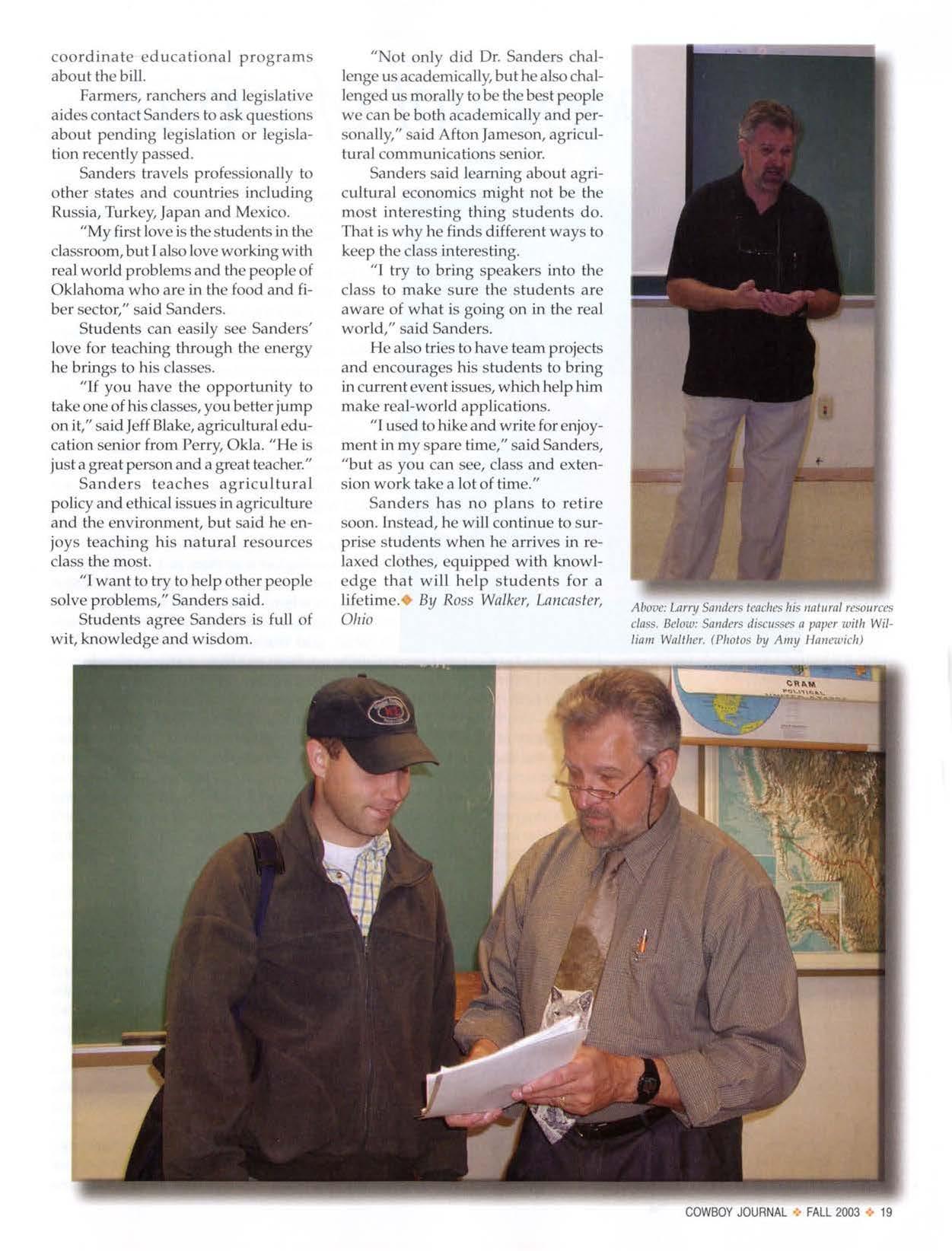
A/Jove:Lnrry Sandersfeache:;/,is 11a/11ralreso11rces class.Befow:Saudersdisc11sses a paper wit/1 Wi//ia,11Walther. (Photos by Amy Ha11ervic/1)
A faithbornnot ofwords
and after settling in Benrungton, Okla., my father left and went to California," said Watkins. Watkins and his family-mother Mary Etta; older sister Althea; and older brother L.V.;decided to beat the odds. They wanted a new start, and they found it on a small farm in. Bennington, Okla.
"It was probably one of the greatest things that happenedto me," said Watkins. "My mother had very little formal education, but she had a world of wisdom. She knew that our future did not lie in the fast-paced big cities."
ln Bennington, the Watkins family worked hard to make ends meet. Mary Watkins was determined to provide a future for her children.
"My mother did not want to go on welfare," said Watkins. "During that time, it was a stigma that she didn't want so she worked, and we worked, and we managed to stay off welfare."
Bennington was then, and is still today, a smalJ town, and like many smalJ towns in Oklahoma, it is home to a friendly community.
"You .knew everyone, and everyone knew you," said Watkins. "It was a great place to grow up. Everyone looked after everyone, and basically, they were just good neighbors."
A man of courage faith trust wisdom ... and respect.
'rhese words tell the story of a great leader, who for the past 20 years has dedicated his Ufe to serving Oklahoma, and now Wes Watkins is stepping down. The OSU alumnus retired Jan. 3, 2003, from the U. S. Congress. Today, Congress may have lost one of its leaders, but Oklahomans will always have a life-long friend.
7 "' 'ar!v 1/Cl7f
Wes Watkins was born Dec. 15, 1938, in the small town ofDequeen, Ark. His family suffered poor economic conditions, whid1 directly affected his life. Before Watkins was 9 years old, his family had moved between Arkansas and California three different times.
"Like a lot of people who had left the area in search ofeconomicsurvival,J picked cotton, cut grapes and gathered potatoes and onjons in the field," said Watkins.
Traveling back and forth took its toll on the Watkins family. Like many otller families, the goal was to find work and make money, but sometimes all they found were hardships.
"My mother and father ended up in divorce,
While attending school at Bennington, Watkins' first love was agriculture, but he also showed tl1esigns of an aspiring young athlete.
"I was on the baseball and basketball teams," said Watkins. "I tell people I started as point guard on the basketball team and second baseman on the baseball team, and it wasn't that J was that good, it was because they needed me. I guess that's how you know when you're in a small town."
When Watkins was in the eighth grade, a program was added to Bennington's curriculum had a profound affect on his life.
"A feJJow came to our community and started the vocational agriculture program and along with that, a Uttle organjzation called the FFA," said Watkins. "My brother first enrolled in it, and I followed, and from there we began to pave the way."
Becoming involved in the FFA, and then realizing where it could take him, was just the first step in a long staircase of blue-and-gold history for Watkins.
1t started with the first trip to Stillwater, Okla., to attend the State FFA Convention. Watkins was a naive 13-year-old boy when he
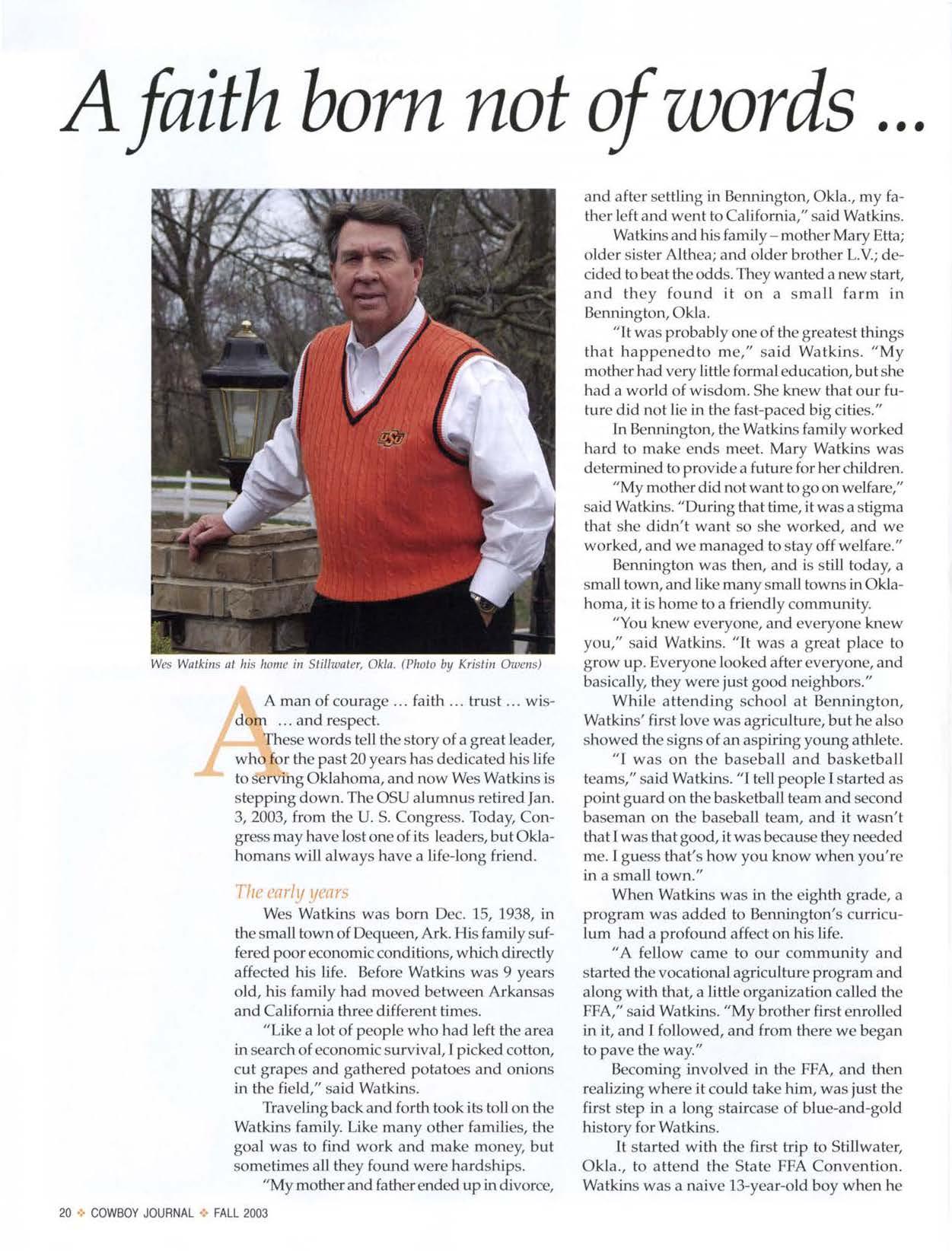
Wes Watkins al !tis home i11Stillwater, Okin. (Photo by Kristin Owens)
attended that first convention. Watching an organization come together under one roof was a marvelous si.ght for the young man. While sitting in the audience trying to take it all in, he came to the condusion that from this organization leaders were born.
"I marveled at the leadership quaUties of a young man who, at the time, was serving as the state FFApresident. His name was Barton Ridling from Sentinel, Okla.," said Watkins.
Watkins was seated in the far northeast corner of Gallagher Hall, really by himself, because he didn't want anyone talking to him because of his speech problem.
Watkins was born with a speech problem that impaired his ability to sound out words. After leaving the convention, Watkins was overcome with a heart full of excitement and determination, but he wondered if his speech impediment would stand in the way of his dreams within the FFA.
"My vo-ag teacher drove the bus back from the convention, and l sat behind him telling him how I would like to be a state FFA president some day," said Watkins. "He didn't laugh or show too much emotion one way or the other, but he was probably thinking 'What kind of dream is that?"'
The following Monday Watkins' agriculture teacher helped him by placing an Oklahoma Farmer-Stockman magazine on his desk.
"He asked me to pick out an article and get up and talk about it," said Watkins. "He did that for several years and four years later, I became a state FFAofficer."
( 01,1111 fa U ll
During the fall of 1956, Watkins embarked on a new chapter in his life. He set foot on the campus of Oklahoma State University as a college freshman and as the southeast district vice president for the Oklahoma FFA. He was excited about the chance to make agriculture a full-time career.
"Corning to OSU and literally stepping onto this campus, being accepted and helped by people who didn't even know me, and the students not judging me because l didn't have anything, truly opened up the world to me," said Watkins.
During his first year at OSU, Watkins set and accomplished many goals. One of those goals was fulfilling the dream of a boy who wanted to be a state FFA president. ln April 1958, Watkins was elected as the Oklahoma FFA president.
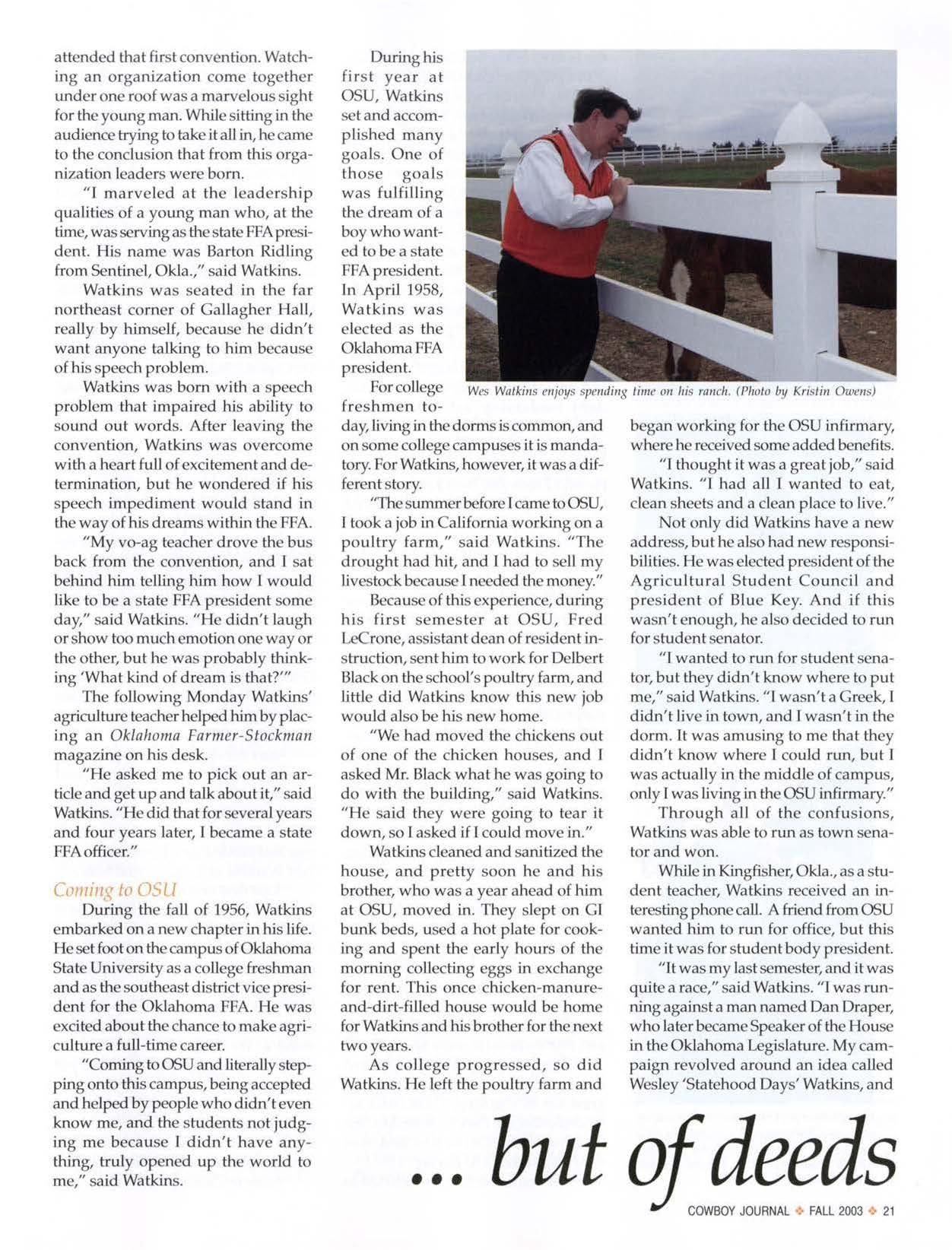
For college WesWalkinsenjoysspe11di11glime011 his ranch.(Photoby
freshmen today, living in the dorms is common, and on some college campuses it is mandatory. For Watkins, however, it was a different story.
"The summer before Jcame to OSU, f took a job in California working on a poultry farm," said Watkins. "The drought had hit, and I had to sell my )j vestock because I needed the money."
Because of this experience, during his first semester at OSU, Fred LeCrone, assistant dean of resident instruction, sent him to work for Delbert Black on the school's poultry farm, and little did Watkins know this new job would also be his new home.
"We had moved the chickens out of one of the chicken houses, and I asked Mr. Black what he was going to do with the building," said Watkins. "He said they were going to tear it down, so I asked if I could move in."
Watkins cleaned and sanitized the house, and pretty soon he and his brother, who was a year ahead of him at OSU, moved in. They slept on Cl bunk beds, used a hot plate for cooking and spent the early hours of the morning collecting eggs in exchange for rent. This once chicken-manureand-dirt-filled house would be home for Watkins and his brother for the next two years.
As college progressed, so did Watkins. He left the poultry farm and
began working for the OSU infirmary, where he received some added benefits.
"I thought it was a great job," said Watkins. "I had all I wanted to eat, clean sheets and a clean place to live."
Not only did Watkins have a new address, but he also had new responsibilities. He was elected president of the Agricultural Student Council and president of Blue Key. And if this wasn't enough, he also decided to run for student senator.
"I wanted to run for student senator, but they didn't know where to put me," said Watkins. "1 wasn't a Greek, I didn't live in town, and I wasn't in the dorm. It was amusing to me that they didn't know where I could run, but I was actually in the middle of campus, only I was Uvingin theOSU infirmary."
Through all of the confusions, Watkins was able to run as town senator and won.
While in Kingfisher,Okla., as a student teacher, Watkins received an interesting phone call. A friend from OSU wanted him to run for office, but this time it was for student body president.
"Jt was my last semester, and it was quite a race," said Watkins. "l was running against a man named Dan Draper, who later became Speaker of the House in the Oklahoma Legislature. My campaign revolved around an idea called Wesley 'Statehood Days' Watkins, and
KristinOwens)
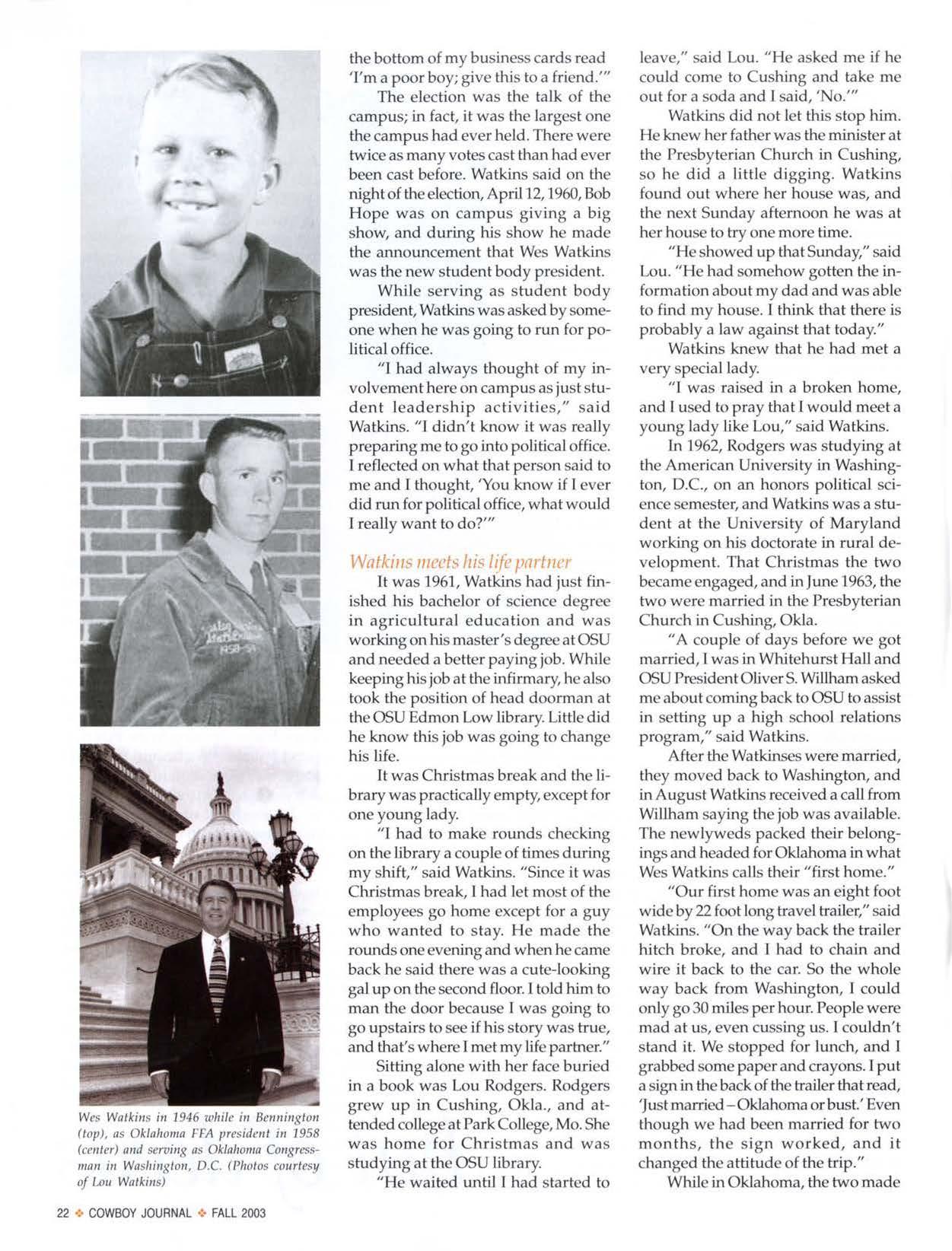
Wes Watkins i11 1946 while i11 Be1111i11gto11 (/op), 11s Okla/1oma /'FA preside11Iin 1958 (cenler) and servi11gas Qk/a/,0111aCo11gress111a11 in Was/,i11gto11,D.C. (Photos courtesy of Lou Watkins)
the bottom of my business cards read 'I'm a poor boy; give this to a friend."'
The election was the talk of the campus; in fact, it was the largest one the campus had ever held. There were twice as many votes cast than had ever been cast before. Watkins said on the nightof theelection,April 12, 1960,Bob Hope was on campus giving a big show, and during his show he made the announcement that Wes Watkins was the new student body president.
While serving as student body president, Watkins was asked by someone when he was going to run for political office.
"I had always thought of my involvement here on campus as just student leadership activities," said Watkins. "] didn't know it was really preparing me to go into political office. I reflected on what that person said to me and r thought, 'You know if I ever did run for political office, what would 1 really want to do?"'
Watkn,.,111cch/11s/1/t partner
It was 1961, Watkins had just finished his bachelor of science degree in agricultural education and was working on his master's degree atOSU and needed a better paying job. While keeping his job at the infirmary, he also took the position of head doorman at the OSU Edmon Low library. Little did he know this job was going to change his life.
It was Christmas break and the library was practically empty, except for one young lady.
"1 had to make rounds checking on the ]jbrary a couple of times during my shift," said Watkins. "Since it was Christmas break, I had let most of the employees go home except for a guy who wanted to stay. He made the row1ds one evening and when he came back he said there was a cute-looking gal up on the second floor. I told him to man the door because I was goin.g to go upstairs to see if his story was true, and that's where I met my life partner."
Sitting alone with her face buried in a book was Lou Rodgers. Rodgers grew up in Cushing, Okla., and attended college at Park College, Mo. She was home for Christmas and was studying at the OSU library.
"He waited until I had started to
leave," said Lou. "He asked me if he could come to Cushing and take me out for a soda and r said, 'No."'
Watkins did not let this stop him. He knew her father was the minister at the Presbyterian Church in Cushing, so he did a little digging. Watkins found out where her house was, and the next Sunday afternoon he was at her house to try one more time.
"He showed up that Sunday," said Lou. "He had somehow gotten the information about my dad and was able to find my house. I think that there is probably a law against that today."
Watkins knew that he had met a very special lady.
"1 was raised in a broken home, and I used to pray that I would meet a young lady like Lou," said Watkins.
ln 1962, Rodgers was studying at the American University in Washington, D.C., on an honors political science semester, and Watkins was a student at the University of Maryland working on his doctorate in rural development. That Christmas the two became engaged, and in June 1963, the two were married in the Presbyterian Church in Cushing, Okla.
"A couple of days before we got married, I was in Whitehurst Hall and OSU PresidentOliverS. Willham asked me about coming back to OSU to assist in setting up a high school relations program," said Watkins.
After the Watkinses were married, they moved back to Washington, and in August Watkins received a call from Willham saying the job was available. The newlyweds packed their belongings and headed for Oklahoma in what Wes Watkins calJs their "first home."
"Our first home was an eight foot wide by 22 foot long travel trailer," said Watkins. ''On the way back the trailer hitch broke, and L had to chain and wire it back to the car. So the whole way back from Washington, r could only go 30 miles per hour. People were mad at us, even cussing us. I couldn't stand it. We stopped for lunch, and 1 grabbed some paper and crayons. I put a sign in the back of the trailer that read, 'Just married-Oklahoma or bust.' Even though we had been married for two months, the sign worked, and it changed the atti.tude of the trip."
While in Oklahoma, the two made
th trav 1 trail r th ir horn for two years. For four year , Watkins vi ited every high hool in th tat of Oklahoma. He wa promoting O U, and h was also in pfring young, eager mind .
"You don't preach the g pel of 0 U with thr to fiv pe che a day unle you m an it," aid Watkin "I would say to myself b fore l would go give that last pc ch,' od, if I ould ju t ay one thing that would help at lea ton young p rson g on to oll g , it's worth it.' I would t U tudents, '[ don't are wbo you are. If you want to go to coJJegeatOSlJ, I'U get you ther , and I'll g t y u a job."'
B i.ng with young people every day gav Watkins a glimp e f th prure and probl ms om student face. Someon once a ked Watkin what word of encouragement h hared with young people.
"Th r i n word that eryon h uld hold in their h art, and that i the word joy," said Watkins. "Putje u fir t, other ond, and your elf la t, and la ur d th m it would b r warding. h y could have a sen e of peace, and tak that with th min their live ."
\\11Jki1,-.LIIIU pt l!IJ(.',
During that first year at OSU, Watkin not nly wa th dir t r f h1gh h ol relati ns, but h also did som important re earch. H wr t a paper titled "The e d of a Multicounty Organiu tion for the Economi.c row th of uth ast OkJah ma."
"In 1963 I presented thi paper in Wa hingt n t the mm r e D partment. Th y used part of the paper to na t the conomic D v lopm nt dm ini trati n Act of 1965," said Watkin "There i a ction about muJti-c unty planning di tri t, r th economic growth of poverty ar a ."
B cau e of tru paper, in 1966 Watkins left U and took hi areer in anoth r direction. H b gan working fort • i development di tri t • klahoma.
n micdevelopmentplan for outhea t klahoma, which included seven ounli.e ," aid Watkin
Lou Watkin aid her hu band i motivated to h Ip pcopl and ha made it hi life' pa ion.
"The on onstant focus I have n
in We i job d velopm nt," aid Lou. "fn fact, he is ab olut ly ob ed with helping people find job . I think that it goe clear back to his mother, becau e h always told him, 'Where ther ' a wiJJ, there' a way."'
hearts and their pocketbo ks and give. W didn't hav a paid mpl y , but we had the people with u , and w were very grateful."
Comingoutoftheprima.ry, Watkins had a 10,000 vot I ad o er
Wes Watkin worked for two years in economic development b fore he de ided to go into the home building and land development bu in "/ took politics as not the end in itself, but rather
harli Ward, Sp aker Albert's admini trative a sitant.
"I'll never forg t c ming out of that primary," aid Watkin "That' when th people realized l could win. as a vehicle."
Wes Watkins
Watkin r mained in the home building buin foranumbrofyar,andin that lime he and his wife were bles ed with thre hildren, Martha, ally and Wad.
In 1974, state n. G org Miller r ti.r-d during the middle of his term. arli. r, when Watkins had on id r d politics, h wa more intere t d in ngre , o wh n this ·eat came p n he wa skeptical.
"The odd were probably against u , but w d cid d to run anyway," aid Watkins.
v nth u h Watkin and hi family had only been living in Ada, Okla., for two year he had made a diff rence, and becaus of that, he was elect d a
"J went into the state Senate and ·tayed th re two y ar on th unpi.red term," said Watkins. ''However, my bu in b gan to uff r b aus the tat nat didn't pay very much. A a re ult, l felt like I ne ded to leav , mainly b cau 1 ouldn't mak a living there."
After Watkins' mad hi de i ion, something un xpected o curr d. On Jun 5,1976,U.S. p ak r fth Hous, arl Albert, annow,ced h wa not going to k r -ele non. Thi I ft an open congres ional seat the thfrd distri t of klah ma.
"Without hesitation and without looking ba k, my wif and I aid 'Yi , we are going t run,"' said Watkin In hi heart, Watkin knew thi wa what h wa meant to do. The opportunity aro e, and he grabbed it.
"We w •ren't the cho nones, we didn't he v th political bo and we didn't have the politi al partie , but we had th· p ople with us," aid Watkins. "We asked the people to open their
the J
he momentum was o trong that I could not have turn d tion ba k v n if I had to."
Watkin won the Demo ratic primary with 6 p r ent of th ot . H went on to win the genera I le tion with more than a 100,000-vot margin. He becam th U. R pre entative f r the third di ·tri t of klah ma.
"It election, on that I will ne r aid Watkins.
W s , Watkins served on the Bank and Finance mrnitt and ie chn l ommitt al f the fre h I. onible t ion.
Through th , Watkins e tabli hed rpri Ln ., which had a dir t impact n outhea tern OkJah ma
"Rural nt rpri i an ongoing, day-to-day group that helps with finan , inn vation, h u ingand a nwnber of different things," said Watkins. "Rural nt rpri w t up t tak care of the third district of Oklahoma, and it ha b ome th n y of mo t pla es throughout the country."
Watkin had nly been in ngr f r two year , but h had mad a difference. Tn197 he ran unopp d.
"l aid J wa l ct d to rv ail of the people, and the people responded byn tgivi.ngmeanoppon nt,"h said.
Watkin aid he kn w h oul.d do mor for klahom. if h n the appropriat committee
"l wanted to beon the ppropriations ommitte ," aid Watkin "So, l got on th tcering and Poli y ommitt e, which aUowed m t help make appointm nt t ommm . I th n got on th Appropriations ommilt and serv d on the Agricultural and Rural ontin11ed011 pnge42
Ol<lahomans lead the way
OALP strengthens agriculture 1n Oklahoma
With th gr wing gap betwe n th dirt road of the rural s ctor and the kyline of th urban int r st , klahoma agri ulture i in a stat· of constant change.
For 21 y ars, th klahoma Agri ultural Leader hip Program ha address d the growing i su f.l ad r hip in th agri ultural ind us try. The LP n ompa all facets of the agricu 1tura I indu try. la parti ipants may originat fr m many differ nt backgrounds, but th y all hav n thing in common: agri ultur
"Th chang and con rn ab ut agricultu r w r th r a n b hind in
1982," said Joe Williams, OALP dir klahoma n· ·ty. p mi dto provide each the training and twill nab th m es in th ta te," aid Will . wilJ h pdt rmin th fut klahoma agriculture and the part thi' important indu try play in tal y.
"Th ra pro • participant w· por incr th ir kn wle kill pro and explor n iliti kJah ma agri ulture." articipants are kept on the utting c nge wit • h agricultural indutr partoft
The program w d with th a• f th W.K.K da tion in 1982. Ead1 class is a two-year progr isting 1 nal min r ran m thr d weeks in length. emb t y agri. ultur ac lahoma and Kan d vi it Washington, D he eminar for ea h ALP cla i a
two-w ek inlernation I xp rience. Parti ipants tour one t everal countri sin thi twowe k time. The current cla s wilJ travel in February or March 2004.
In th past, m mb r f ALP have j urneyed to many countri , including hina, BraziJ, w Z a land, Au tralia, l~ran e, rmany, Belgium, he etherlands, Poland, Cz ho Ivakia, ngland, Holland and rg ntina.
Williamssaidmemb 3 r pendalot ftime with the f d ral gov rnm nt and th· U. epartment of Agriculture whjle in Wa hington, D. h y ar ab] to p ri n how agriculturaJ policies are formulated and witne s governm ntaJ r gulation that ur. Th y vi it agribusin ssfirms, creditagen ie and gri ulture-r It dmanufa turingfirm.
"Only seven months int the two-y ar prgram, I hav gain d much knowl dge, and l have a Litnearly a mile longofagriculture leadr we hav m t," aid usan iv ly f nd, kla., a member of A P lass XI.
Lively aid heh p t nhanc h r partn r hip with agricultural pr ducers and agribusine men, to enhan her leadership skills to better erve Oklahoma' b f pr du er , t tr ngth n h r know! d f th kJah ma agri ultural indu try, and t better und r tand and appr iat th I gislati a it r)ates to agriculture.
William aid th to production agricuJtur but also stresses the total c on mic and o ial id . fl mpha iz the part agricultur play in the citi , th nation and the world.
"Th program i a • ward dev loping future lea Oklahoma agricultur wh wil I • th community and t ne involved in ivi nd agricultural commodity groups," said Kyle W, rthington of klahoma ity, m mb r of A P la s XL
Cla s m mb r enjoy the lif l ng fri dhip that can b d v I p d throu h the prgram, while learning about agri ultur . " h program giv you a chan to agriculture in a whole different way in Oklah ma and th world," aid Lynn Ann Di tri h of am gi , Okla., a member of OA P la s V. She al aid it i aw nd rful opp rtunity to develop Iii long friends.
Th OALP program wa dev loped and ontinue to operate under poli i et by an advisory council compri d of re ogniz d a ri uJtural I ad rs working in cooperation with the OSU Divi ion of Agri ultural 1n e and Natural Re ourc s.
" urmaing ali totak m mb rs to th next level of leadership and mak th m mor aggr i e and w II trained," said Bob Terry, program director fOALP from 1994-2002."Jf w an d thi , l ader hip in agriculture i going t improve."
Terry ha b n involved with th • OALP from the beginning, d iring to improv agricultur in Oklahoma. He aid he feel th ne d to get young pe pl involv di important be aus th y hold the futur f agricultur
J ph BurtrumofStiUwater,Okla., a member of OALP Cla 1, aid being involv d in th program not nly helps expand hi view of agriculture within th tate f k.lah ma, but al ou id th tat .
"This class will help me improve my I ad r hip kill and b a pringboard for other I adership opportuniti ," aid Burtrum.
The ALP ha e tabli h d the following objective and hope to rea h th m with every cla :
• To increa e participant ' awar ne of klah ma' agricultural indu trie ;
• pand th parti ipant ' understanding of U.S. economic, poUtical, ultur, I and s ial y t m and how they affect agricultur in klahoma;
• To broaden the participants' per p tives on the major issues affecting agri ulture and U.S. i ty;
• increas the participant ' abilitie to analyz and r act to the omple problems aff ctingOklahoma agri ulture and its rural communities; and
• To i the participant ' I ad inv Iv and act, the lo te or nati elf rt fitof kl griculture.
For ca h a , th reer • • dividual memb rs th e to parti ipat int a- pportunity.
pro • ctiv Th candidates must actively engage th mlv in pr du tion agri ultur r in a related agribu ine s o cupation in klahoma. Produ tion agri ultur applica mploy d part time off th farm ligibl t lea t two-third of the cl • elected from applicants inIve pr du ti n agri ultur
"I highly encourage individ appl rogram and t n • o they don't make it the t f Ma of Yukon, AL s XI. ual wmad it i op nity. If a per • , would challenge him or h th information gain d ti the program t bee me for gri ultur ," aid Man k .
Manske aid to m< ny of klahoma' constitu nts and el cted official are unaware f th chalJeng thatfa agri ultur andruralAm ri a.
"It i ur bJigati n a leader in thi great indu try t kc p th m informed," saidMansk "If we don't st p to the forefront on b half of our own b Ii fs and backgr und, who will?"
Each ALP la con i t of a maximum of 30 individual involved in agricultur with pr i ren giv n to tho e from 25 to 45 years of age. Interested individual may apply or be nominat d f r th pr gram.
D n Schi berof Ponca ity, Okla., a m mb r f LP la I and a m mb r of th ALP ad isory committe , said he encourage interested individual t p ak with alumni, tension agents and O LP taff t be ome inv Iv din A P.
"l think mo't people would be pr ud to say th y ar involv d in this organization," aid hieber.
"Th- program has gotten b tter," aid Schieber. "The rea on for the program improving is each class learns from th on previou what to do and n tt do."
He aid th quality is consistent among th individual , yet every class is unique.
"Th program has gained more upport From arow,d th tat , and th imag is a lot b tt r than in the b ginning," aid hi b r.
WiUiams said more than 300 graduat from the progr m within th la t 20 y ars have made th ir way into some imp rtant positi n at th c unty, t t and national I vel . erry aid change he hope to se in th futur in lude ound financial backing. According to rry, m ney from th K llogg oundation is n I nger available. urrently, the cost for each cla i approximately $250,000; ach m mb r pays $1,500.Additional funding is made up by appropri. tions thr ugh ut th tat a w Ua alumni and everaJ private indu try gr ups.
"If you ar r ady to tart thinking outside the bo and gain a network of friend and nta t , thi program i definit ly for you," aid Lance England ofWo dward, kla., memb r f ALP la XI.
ew recruitment b gin in the pring of 2004 for ALP la s X a.
For additional information, write: William , 08 W s Watkin nt r for International Trade Dev lopm nt, klahoma tat Univ r ity, tillwat r, OK 74078 or caJJ (405) 744-5132. By Amy Hanewich,Rens elner,/11d.
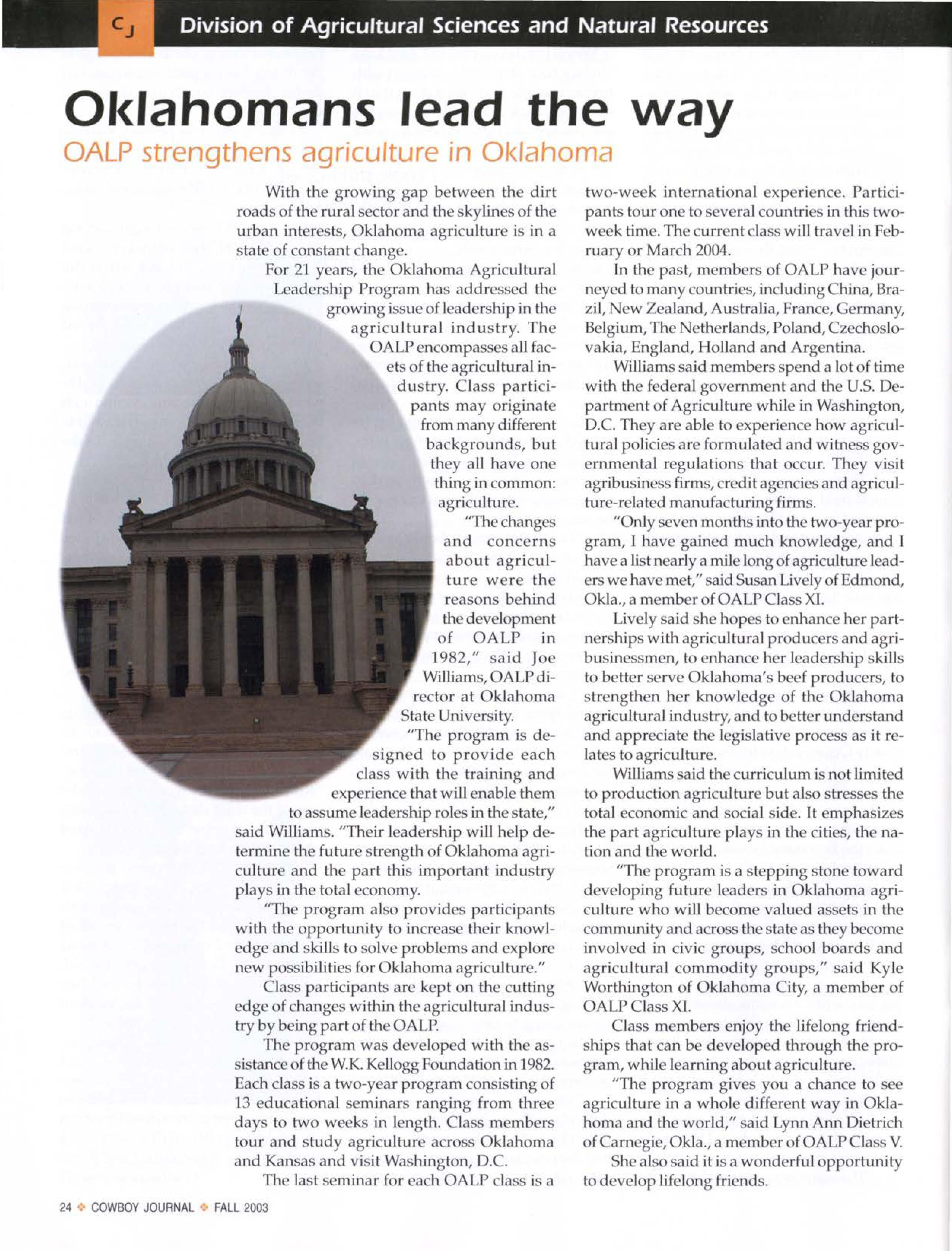
Members of Ille Oklahoma Agriculluml Leadcr_1,;p Program l'rnvels lo many /'laces learning abouf agrirn//11rl' am/ govern111•11I.One place !he group lrat•cls la is Okla/10111a'Slate Cnpilol, as Jww11 011 opposite page. (Photo by Amy Ha,wwich)
From t e en OU
Poultry students get more than hands-on experience
Student enrolJed in the poultry produ ti n cla at kJahoma tat niv r ity can tell you there i more to th ebird thanju tth ir g .
Joe Berry, exten ion poultry specialist, tead1c the poulh·y production la, a w II a p ultry judging and special probl m . B rry, who r eiv d hi d torat from Kan as Stat University, taught at Purd • ersity for 10 y ar befo • in 1980.
Animal aquired t rti 11 COU V , with n I verage enrollm • s 35 tudent e a
h. 1a n. r v n een a live chicken, whil others have handl d th m mo t f th ir live ," aid Berry.''Despit these differences, ev ryb dy tar from the ame pla e."
Th lud nt I arn the hj t ry f the pouJtry industry, the proc s of raising, bre di.ngand taking car f hi ken , as wel I a the commercia I id of the indu try.
After learning about th industry, tudent exp rien cit fir thand the la tak fi Id trip t om f th top poultry producer , uch a Peterson arm , Maha rd gg Fe rm, immon Foods and Tyson Foods.
uring the •me t r, th al o hav a littl h nd - n work of t wn. Eacl dent d f :1.elay rl sthat d to the farm. They feed, water and dean th on a dail ba i ln addition, tudents feed the br ii rchi nsth yra· fr m hi k until th y are 6 weeks old to 8 weeks old nd ready for harv t. Th tud n then have a proce sing lab and learn the harv ting pr . The gr nd final for th la i an old-fa hion d chi ken barb u t Berry' hou . "l r ally enjoy d thi cla ,'' aid Joshua Posey, animal science alumnus. "Jt t ught o mu h new inform ti n
28 COWBOYJOURNAL•. FALL2003
th t I wa unaw r of. I would recommend this class to anyone."
Ap rt fr m th da , U tudents al o have th pportunity to b a part f th. pouJtry judging program. UnJik the live to k, meat or horse judging team , th poultry team nly att nd n nt t h eme ter. In the fall, member attend th ational IIgiate ont tat th University of Arkansas in ayetteville, Ark, and in the pring th y tra el t Baton Rouge, La., to th ou h rn llegiat c nt t.
While ompeting in the ont ts, th tudent are cored on how they judge both liv bird and poultry product . "I had a great time thi eme ter on the judging team," aid Th ma Loafman, businc junior. "We had a great tim t th conte t, and I I am d a I t thr ugh thi ntir eme ter."
Th jud in t am and produ tion la sh v helped tudent learn about the industry a.ndprepare for careers that aren'tforth~bird. By Eliznbet/JKnm , Stillwnter,Okla.
se to our ouse
OSl J reSP;:trchsets s:tandardfor the poultry ind1Jstry
Arkansas might be known for its poultry production, but Oklahoma State University is known for poultry research unlike any other in the world.
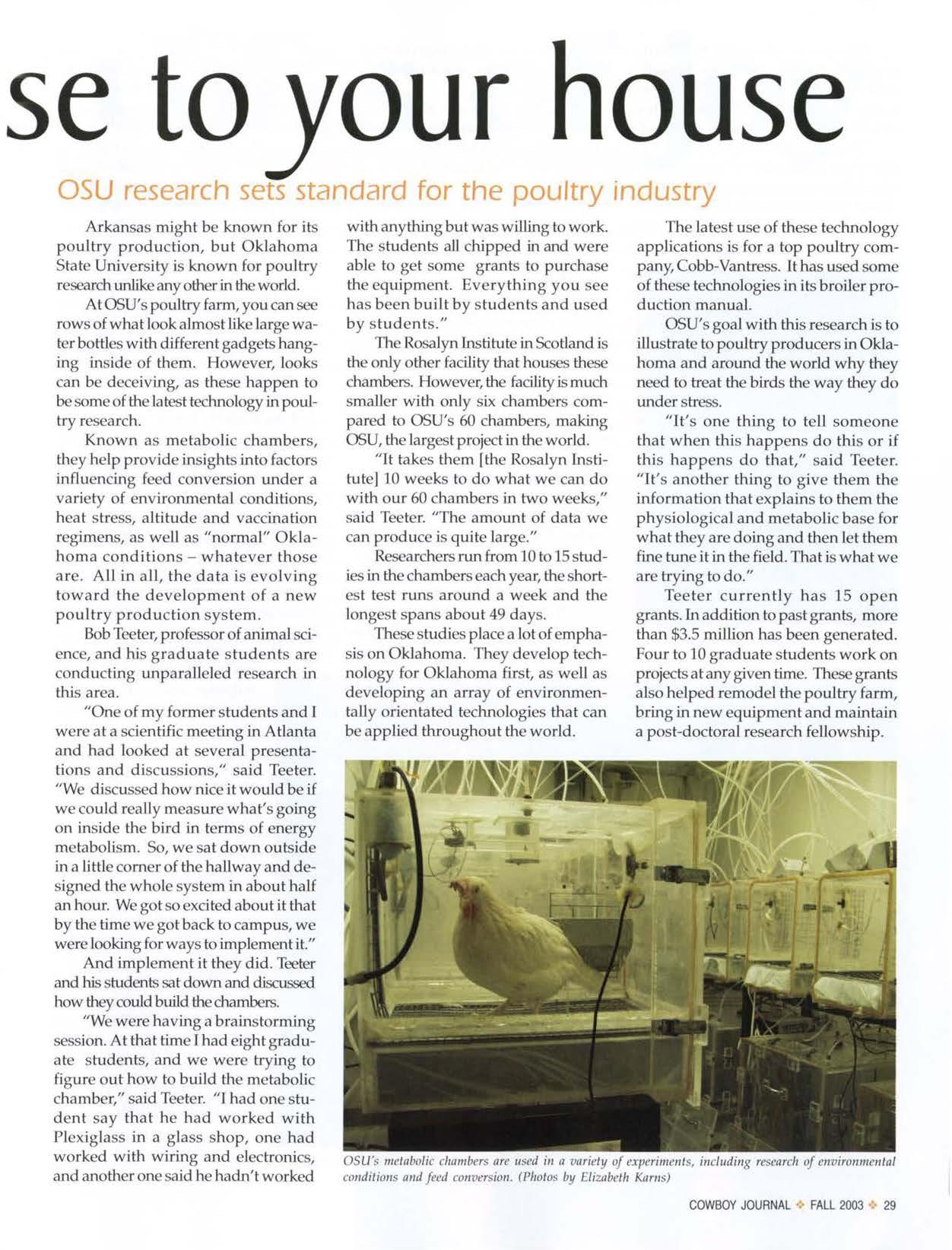
AtOSU'spoultry farm, you can see rows of what look almost like large water bottles with different gadgets hanging inside of them. However, looks can be deceiving, as these happen to be some of the latest technology in poultry research.
Known as metabolic chambers, they help provide insights into factors influencing feed conversion under a variety of environmental conditions, heat stress, altitude and vaccination regjmens, as well as "normal" Oklahoma conditions - whatever those are. All in all, the data is evolving toward the development of a new poultry production system.
BobTeeter, professor of animal science, and rus graduate students are conducting unparalleled research in this area.
"One of my former students and I were at a scientific meeting in Atlanta and had looked at several presentations and discussions," said Teeter. "We discussed how nke it would be if we could really measure what's going on inside the bird in terms of energy metabolism. So, we sat down outside in a little comer of the hallway and designed the whole system in about half an hour. Wegotsoexcited about it that by the ti.mewe got back to campus, we were looking for ways to implement it."
And implement H they did. Teeter and his students sat down and discussed how they could build the chambers.
"We were having a brainstorming session. At that time I had eight graduate students, and we were trying to figure out how to build the metabolic chamber," said Teeter. "J had one student say that he had worked with Plexiglass in a glass shop, one had worked with wiring and electronics, and another one said he hadn't worked
with anything but was willing to work. The students all chipped in and were able to get some grants to purchase the equipment. Everything you see has been built by students and used by students."
The Rosalyn Institute in Scotland is the only other facility that houses these d1ambers. However, the facilityis much smaller with only six chambers compared to OSU's 60 chambers, making OSU, the largest project in the world.
"It takes them lthe Rosalyn Institute) 10 weeks to do what we can do with our 60 chambers in two weeks," said Teeter. "The amount of data we can produce is quite large."
Researchers run from 10 to 15 studies in the chambers each year, the shortest test runs around a week and the longest spans about 49 days.
These studies place a lot of emphasis on Oklahoma. They develop technology for Oklahoma first, as well as developing an array of environmentally orientated technologies that can be applied throughout the world.
The latest use of these technology applications is for a top poultry company, Cobb-Vantress. rt has used some of these technologies in its broiJer production manual.
OSU's goal with this research is to illustrate to poultry producers in Oklahoma and around the world why they need to treat the birds the way they do under stress.
"It's one thing to tell someone that when this happens do this or if this happens do that," said Teeter. "It's another thing to give them the information that explains to them the physiological and metabolic base for what they are doing and then let them fine tune it in the field. That is what we are trying to do."
Teeter currently has 15 open grants. ln addition to past grants, more than $3.5 million has been generated. Four to 10 graduate students work on projects at any given time. These grants also helped remodel the poultry farm, bring in new equipment and maintain a post-doctoral research fellowship.
One area of research OSU is currently working on is the effect of altitude on feed efficiency in the chickens. Using the metabolic chambers, they can simulate altitudes up to 10,000feet.
"In each of the three rooms, we are able to go from sea level to as high as 10,000 feet in mimicking altitude," said Teeter. "We have also had a student try to produce birds at 500 feet below sea level, so we had an oxygen-enriched
environment for those animals with a Littlebit of a higher pressure for those animals to grow in."
The chambers arc also able to simulate weather conditions from the deserts of Saudi Arabia to the jungles of Columbia. They measure the bird's ability to produce a product with minimal energy waste. As a result, one mjght say the bird is more environmentally tolerant and friendly in that it produces Jess greenhouse gasses, said Teeter.
While conducting Lrials on heat stress of the bird's whole body, researchers record metabolic measurements as well as changes in respiration rate and evaporative cooling. The normal respiration rate of a chicken is 30 to 40 breaths per minute. Howeve1~ when heat stress is induced, researchers recorded rates of up to 300 breaths per minute.
The latest piece of equipment is one that you could see at any hospital. It is a bone Hologic X-ray densitometer. lt is used in hospitals to measure bone density in humans. However, it is used for a slightly different purpose at the farm.
"The unit that we have has an algorithm in it whereby we can compute the lean and lipid content on an ani-
ma!," said Teeter. "We have our own equations for taking this data and converting it into a reality for broiler composition. We are able to get an intermediate composition and then put them back into their cages and let them grow. Then, we are able to get another composition of them and get the actual tissue gain in various increments of time throughout their growth curve."
There are currently five students who are involved with poultry research.
"Our research is only as good as the students we have," said Teeter. "It's been a long tin1e since I have put my name first on a research article. 1 believe in letting the students get all the credit for what they do."
All of the research done by Teeter and his students has been recognized on national and international levels.
Teeter has a true sense of teaching, as he desires his students receive the credit they deserve and get the right education.
"lt's my goal to put the students first," said Teeter.
One of his students was recently asked to give a presentation about his research at a scientific meeting in Hamburg, Germany.
AJong with research, Teeter, who has his doctorate in ruminant nutrition, teaches two graduate courses. He teaches vitamin and mineral nutrition, as well as advanced non-ruminant nutrition. He has been on t11efaculty at OSU for 20 years.
This program has been successhtl because individuals and companies have trusted OSU in their vision and have had the opportunity to see the work that has been produced by Teeter and his graduate students.
"This program was built by the students of the past," said Teeter. "The students of the present stand on the shoulders of the ones of the past, and our pyramid keeps getting taller." By Elizabeth Knms, Stillwnter, Okin.
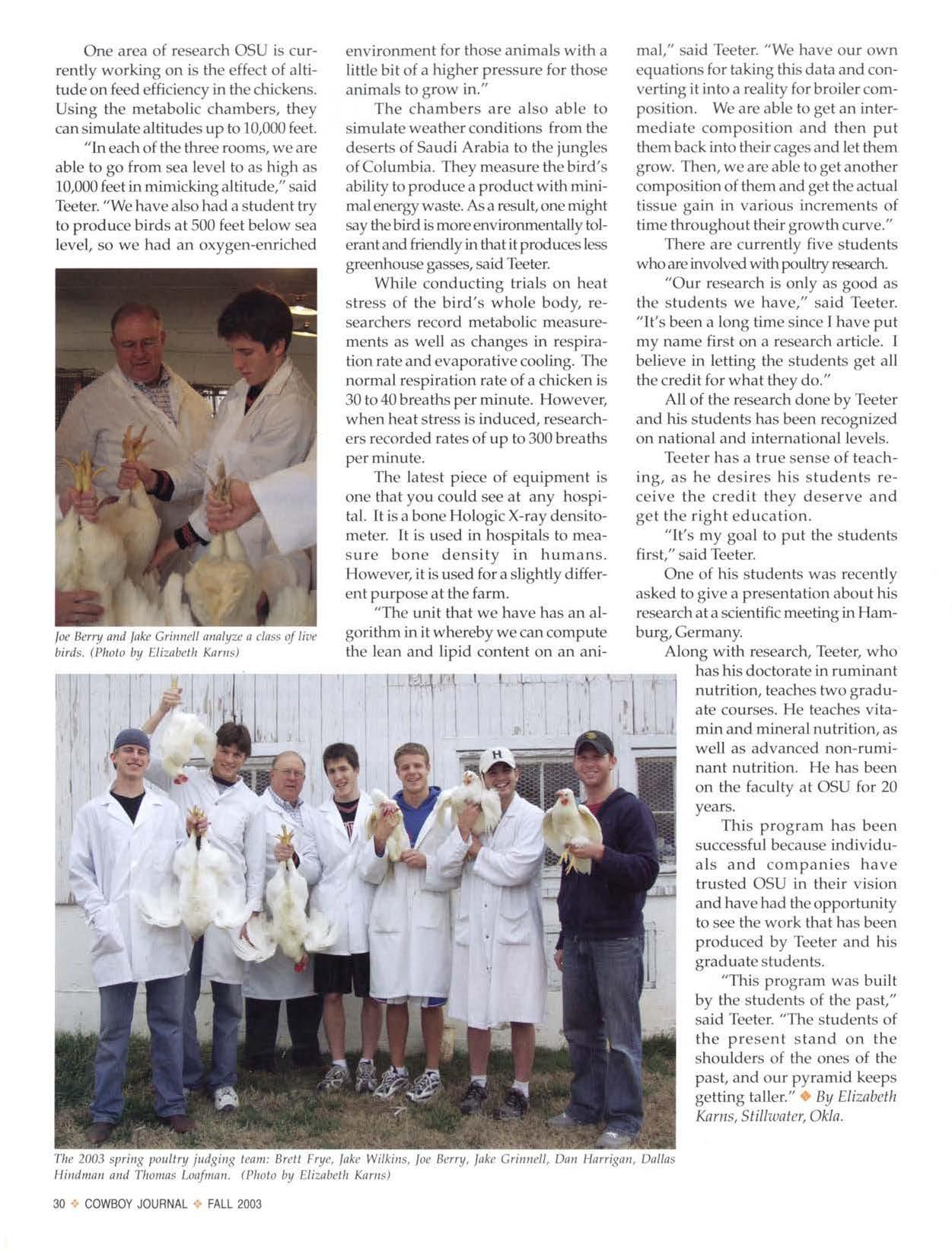
JoeBerry and JakeGri111wllnimlyze a classof live birds. (Photo by [liwbeth Kams)
ph n call in the late 1980s began th tring f losses adyn lee w uld face. But v n after th I • f h r two ons and husband, adyne would find j yin Lif throu h giving and a golden romance.
n a Sunday afternoon at the dawn of harv t, Donald and adyne le were pr paring for th n xt day on th farm n ar ary, kla. dyn aid h ·aw h r • n ·, Larry and Jim, fini h th ir work for the day and get their cow dogs and inner tubes ready to go and r lax for the night.
Aft r eating dinner that v ning, adyne aid h and Donald w r t o tir d tor ad the n w pap rand d cid d to go to bed early.
"It was 20 minut before 11 p.m. wh n the phon rang," adyne aid. "My hu band an wer d it, and I h ard thi woman hatt~ring. Th n, I h ard him ay h do n't Ji eh re, h ha a horn of hi own, and she just kept chattering. That's when I got up and start d g ttingdre • d b au I kn wit wa n't go d new . The phon call wa that Jim' tru k had been in a h ad- n ollisi n and wa on fir ." adyne aid she could e her on Larry' mobil horn aero s the ri er bottom and th Jjghts were on there. She said Larry and Jim w r t g th r a]l th tim , an th y want d to t ll Larry what was happening toke p him fr m driving to the wr cksiteandputtinghims lfin dang r.
"Larry wasn't home," adyne aid. "The hor w r in th h rs trail r h ked to the pickup wh r the boys left th m after r ping that aftern on, but no one was th r ."
na]d and a dyne then drove a few mor mile to th it f th wreck, h aid.
"I ran t ward the wre kage, but th y t pped m ," adyne aid.
She said a few minute lat r offici Is told them four people w re in th truck, but th y wer unabl to identify th 'm. dyn said Donald told th polic h
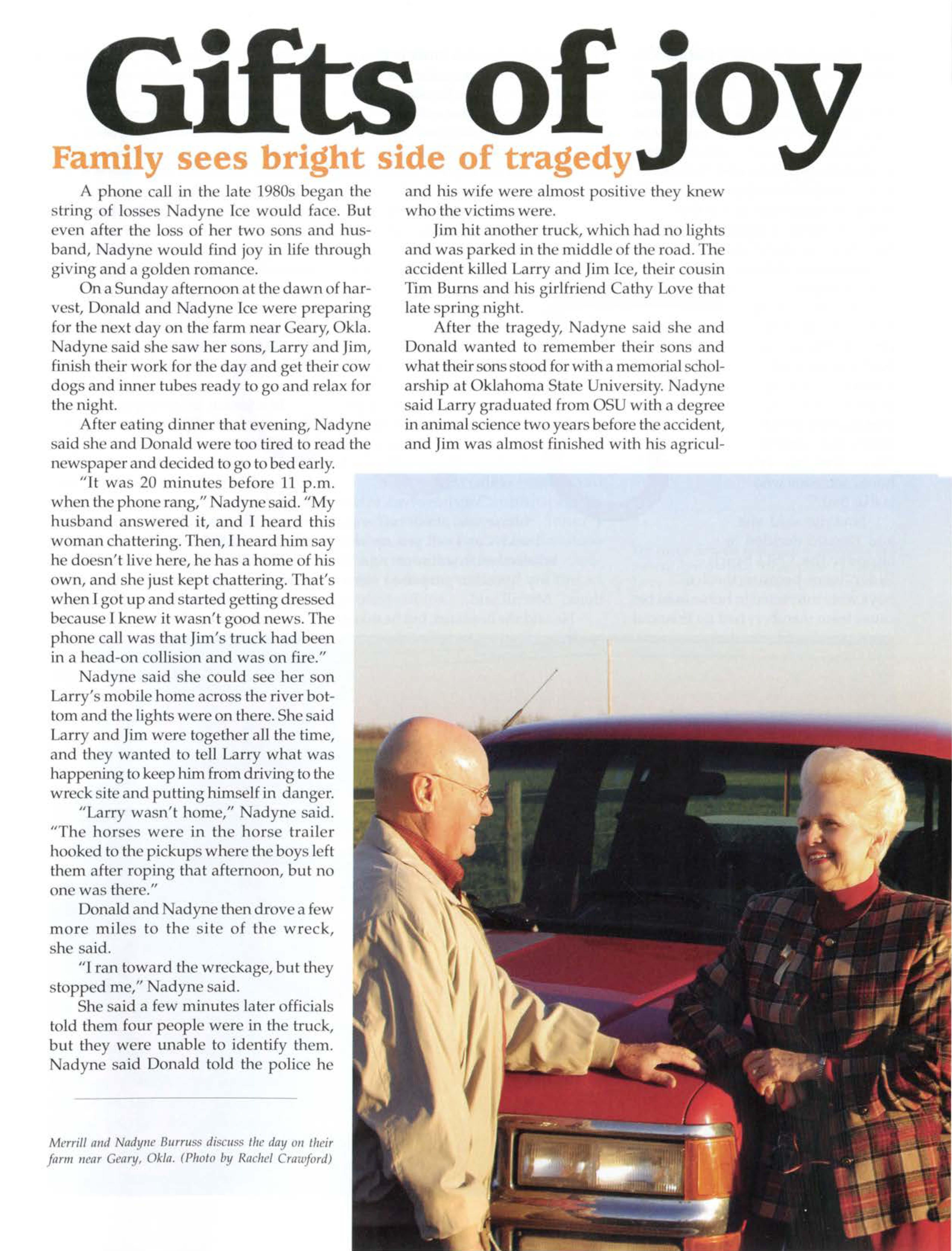
Merrill nnd Nndy11eB11rr11ssdiscuss /hi' dny 011 their fnrm 11e11rGeary, Okin. (P!to/o by Rt1che/Crawford)
and his wife were almost positive th y knew wh the i tirn w r Jim hit another truck, which had no light and w, park din the middl f th road. Th accident killed Larry and Jim Ice, their cousin Tim Burn and hi girlfri nd athy Lav th t lat spring night.
fter th trag dy, adyn and Donald wanted t r m mb r th ir s ns and what th ir ·on t od for with am morial cholarship at kJahoma tatc Univer ity. adyne aid Larry graduat d from U with ad gr in animaJ scien e two year before the accident, and Jim wa a Imo t fini h d with hi agri ul-
tural education degree when he was killed in the accident.
"Their wish was to carry on the names of Larry and Jim Ice and to memorialize them in some manner at Oklahoma State Unjvcrsity, and they wanted to support the OSU Spirit Rider Team," said Milford Jenkins, senior director of development for the OSU Division of Agricultural Sciences and Natural Resources and the OSU Foundation.
"My boys were not the top students, but they were hard-working, funlovi n g, caring people," Nadyne said, as a tear rolled down her cheek.
"We wanted to honor someone who is like that."
Nadyne said she and Donald decided to support the OSU Spirit Rider Team because the Lee boys were interested in horses and because team members had no financial support and worked in their spare time.
Three years after the boys were killed, Donald died of a cancerous brain tumor he fought for a little more than six months.
I· 01,rnme
Nadyne said she decided she could manage the farm alone if she sold some big machinery and grazed her crops with cattle, and she was in the bank depositing money when Merrill Burruss came into her life.
Merrill said he was at the Geary bank in early 1992 because his company had just purchased it. He traveled from his office in Kingfisher, Okla., to meet with the Geary branch manager. Merrill said while he was there, the branch manager took him to meet a customer- Na dyne Jee.
"I didn't know Nadyne or any of the kc family, but l knew she was the lady who had lost two sons," Merrill said. "I didn't know she had lost her husband."
She was busy and left quickly. But Merrill said the branch manager took him back to her office and began to tell
him about Nadyne's mother, her sister and other family members and finished the conversation by talking about how beautiful Nadyne was.
"Nadync did not know me or that my wife had died," Merrill said." And the next time I ran into her she tried to sell me something for my wife."
About a month after that meeting, Nadyne said she had a challenging business situation she did not know how to deal with and called Merrill hoping that he could help.
Merrill said he met Nadyne at her house and they drove together to the farm site she wanted rum to look at, but the ground was so wet they cou Id not get off the road.
"We drove back to her house, and about haH way, I said 'Can l call you up and take you out to cat some time?', but my question surprised her I think," Merrill said.
He said she hesitated, but he asked again and they set their first date.
"l didn't intend to marry the first time, and Cod had been so good, I certainly didn'l intend to push my luck," Nadyne said.
Merrill and Nadyne married Jan. 1, 1994, a little less than two years after the first time they met.
"God took care of me in two different ways," Nadyne said. "Not only did he give me a wonderful husband in Merrill, but he also gave me two sons who had lost their mother."
1-1,mlwort pm1~
Ironically, before Merrill and Nadyne met, Merrill had also provided scholarship support for students in the College of Agricultural Sciences and Natural Resources at OSU.
Merrill and Nadynesaid they have a unique idea about who should receive their scholarships.
"There are scholarships for those who do make straight A's, and there are scholarships for those who need
assistance, but many times the middle person is left out of scholarshlp plans," Nadyne said.
Merrill said a number of students work their way through school and manage to get decent grades and he feels like those are the people who do the majority of the work in the country and pay the majority of the taxes.
"lt's not that we don't feel other people can't come out and be the backbone of the nation, but we know thls is proven," Nadyne said. "They have to work for everything they get."
Jason Wright, OSU Spirit Rider for the 2002-2003 school year, is one of those people who worked his way through school.
Jn addition to serving as the Spirit Rider, he worked 20 to 30 hours at the OSU horse farm.
"I worked to pay my bills and a large part of my tuition," said the 2003 animal science alumnus. "If it wasn't for my job, I couldn't have stayed in school at OSU."
The Elmore City native said he has worked on the farm for a long time building fence and hauling hay.
A recipient of the Larry and Jim Ice Memorial Scholarship, he said he dreamed of being the Spirit Rider as a small child when he watched Bullet run onto the field.
Jason Wright said he worked on the Spirit Rider Team ground crew for a year before becoming the Spirit Rider.
"It gave me a sense of pride in the university, the athletic department and the team," he said. "I actually felt like I was part of everything that was going on."
A 111rw ;,,'< m1m
Members of the Spirit Rider Team are not the onJy ones who have felt the giving nature of the Burruss family. When Merrill retired from his position as bank president in 1996,he endowed two scholarships in academic depart-
ment to h lp other tud nt who are working toward college degrees.
M rrill aid h r civ d hi bachelor of cien c in agron my, n w kn wn as plant and soil i n . That is wh re h m t rank Davi , a faculty member from 1937 to 197 . Davi re arch d grain orghum, but Merrill honor d him with a scholar hip for th d ep impa the had on tud nts' li
" ot nly did hem an a lot to m , but he meant a lot to o many kid , " M rrill saJd. '' ft wa all boys m agronomy then, b lo 0 if w w r hi sons. 111.atkind of prof s r i r r ."
M rrilJ also endowed a ch Jar hip in the Burru famiJy nam in th U D partrn nt of AgriculturaJ Economi after hi youngc t n, harlie Burru s, graduated with ad -
gr in agri ultural onomi 1n addition, M rrillcontributed t the Betty Jo and Darnel D. Badger Scholarship fund inl991 inrespon t th impa t Badger had on hi on' Life.
" h w ek my youn t on tarted to college, he found out his moth r had anc r," M rrill said. "Through good time and bad, Dan Bad r loved harli thr ugh ch ol." M rrill and adyne n uJt d J nki.n regarding th ir gift to . Jenkins said peopl can ch fromavari t of way to giv, nd m et their needs.
Gift rang fr m ca h dnation to life in uranc poliie , e tates and gift annuitip • p n the d wishes, y d thing • Sc p ,room f hairs and professorships.
"Mo t people think corp rat or foundational support ompris s the majority of gift l , when in aU a tuality, 60 to 75 perc nt of charitable gi ing t U i from individual ," Jenkin said.
Jenkins id many p opt cho to give gift of land or appreciated to k, whi h can fund izeabl cholar hip or univ rsity causes of their ch i. H w r, one-ti m gift f $25 or $100 fund important cau es at OSU b aus they ar oft n not d ignat d for specific pu rpo e
" o matt r what th ir r s ur e , donor ar p opl like Merrill and adyn Burru who r un lfi h, very generous, very kind and willing to give fr our o th r will hav th pportun1ty tor eiv th iredu ation fr m U," J•nkin aid. By Rac!JelCrawford,Dill City, Okla.
TIii' brandsfenlured were t/,ose of Lnrry 1111d Jim le,, a11dTim B11ms. Jim used Ilic "/" bm11d, Larry 11-edlite "I E" brn111f1111dTim u ed tin• "8" l1rn11d.
THE ' ing Agriculture ;nee 1916" Home ffi 2821 Van Buren, nid klah ma 580 7-4276 A 1-800-894-5020
Rollingview Angus Farm
Robin Susan Kendra, and Kaitlyn Kelton (918) 427-5367
Box 38 • Linn, Kansas 66953 (785) 348-5537 1-800-252-084 7
SKID SERVICE
Custom Fence Construction • Tree Removal
Call us for a complimentary consultation! Heath and Kim Kohler • (405) 880-3460
Christy Collins
Oklahoma City OK • Frederick, OK www,collinscattleservices.com www.collinscatUe.com
B0.11
OK 73078 (40S) 373-3609
W\VW. b Wlwat r. om Monday-Wedn da and Saturday 10 a.m.-6 p.m. Thur day and Friday 10 a.rn.-8 p.m. 104 S. erkin Road (405) 372-4999
Passion is easily found in personal gain, but hidden deep inside the heart of a servant is the passion that drives the world to change. Though many would not notice, hidden in a hallway of offices, that world-changing passion seizes the opportunity.
Autumn Hood, a 2002 December graduate of the biosystems and agricultural engineering department at OSU, works to change the world, one rural community at a time.
As business coordinator of the New Products Development Center, Hood helps rural communjties create jobs and spark economic growth, giving her good experience as she completes a master's degree i.n business administration.
Hood takes care of the publications, markets the center to manufacturers, locates and secures funds, and develops materials to improve the center in the future, such as applications and business plans.
"lt is terrible to see small towns in Oklahoma withering away because they have nothing to keep people there," said Hood.
Growing up in Westcliffe, Colo., a town of about300 in a county ofonly 3,000, she understands the importance of rural communities. The NPDC has given her the opporhmity to impact the life of small towns.
"I want to see people stay in their hometowns because they have a job that is rewarding," said Hood, with a sense of determination.
Her home is just four miles from the base of the Rocky Mountains on a 2,000-acre ranch. Growing up, life revolved around the family's commercial cattle herd and native grass hay. Her love for agriculture and rural areas took root as a child.
"I spent my life on a ranch with my grandpa and my father," said Hood.
While wandering back in her mind to those days, her eyes glossed with the memories of her late grandfather and love for a time when being from the cow1try was not so hard.
"A summer day on the ranch began with hot cereal or
eggs and toast while watching cartoons with my father," she said as her smile began to show. "l would find a job where l could ride the horses, which usually meant checking cows and then off to the hay field in the afternoon."
Her passion to preserve agriculture and the rural way of life was easy to understand as she shared another heartfelt memory from her childhood.
"Our life virtually came to a halt when the yearly county fair rolled around," said Hood. "We persevered through everything, including my grandmother's kitchen remodel.
"We rnoved the entire baking operation to the dining room and worked around the contractors to make our blue-ribbon muffins that year."
Her devotion to agriculture and the rural way of life grew as she got older. Hood graduated with 26 students as one of three valedictorians from the only high school in Custer County, Colo. While looking at colleges, OSU's BAE department offered the challenge she was looking for.
"I am very analytical. For as long as I can remember, J have always looked for a challenge," said Hood.
"When I was 8 years old I chose my first dog," said Hood.
"I sorted through a book of dog breeds that I carefully selected from the library. Though my dream dog was a Great Dane, I decided the smart choice was a Terrier."
lt was the desire to solve problems and the challenge in science a.nd math that brought her to OSU.
"Autumn isa bright yow,gwoman, and we recogruzed that while she was in high school," said Bill Barfield, who was head of the BAE department while Hood was considering OSU.
"When Autumn came i.n,we knew she had an interest in business," said Barfield. "We set up a program where she could take business and industrial engineering courses as part of her major to get more manufacturing components."
With th course she took and her experiences in rural meri a, H od ea iiy b cam th perf ct fit for the poition at th PDC.
"lf we couJd et her to work with us, we kn w he would be a great ast," aid Barfield." h i d ing a gr at job for LI W will be leaning on her like an a iate director of thi c nter t mak bing happen for LI lt wa v ry clear that he could do it."
H d's pa ion driv th ff rt t se rur 1 communitie like her own horn town grow tr n r th r an have the am great memorie a -he.
"Agriculture ha a lot of tool that wearen tu ing," aid Hood. "Weare loinglandandotherr ourc butw have a lot oft hnology.
"Th que ti n are how do you integrate new technology into the farm? How d you u e farm rec rd to mak your bu ine m re productive? And, how do y u g t farmer comfortable with the new technology," aid Hood. he eeks to mak a difference by working to de el p the ommunHie of rural Oklahoma through her ff rt in the PD Unbelie able a it ound , he ha n t topped ther H r pa ion ha tak n her into her own reearch to impr e agriculture.
During an intern hip with John
De r , Ho d dev loped a program agriculturali t can use to keep track of data and u th informati n to nhance p rf rmance in their operation .
"111 r ar a lotofprogram toh Ip armer manage th ir fin, ncia I r cord , but there aren't many that help them keep producti n rec rd ," aid .Hood. he i d veloping a pr ducrion databa -e f r hand-h Id comput r . Thi databa e will enable farmer to keep produ tion record and manag m nt decision information in the palm of th ir hand , thr ugh th u r-fri ndly hand-held databa e pr gram.
" t' a y u ar in a tractor and you want to keep tra k of the f rtilizcr you put on a field, but you don't want to drag ut y ur laptop, or you don't want to pull out your noteb ok, write it down and lo e it," aid Hoo .
"Ln tead you can u your handheld to enter the numb r of acr sand amount of fertilizer appli d, he aid. Then, take it horn to download in your computer. At the end of the ear, y u willhaveallofy urr ord in databa e that give information to help inrea e ield and ave mon y."
In th n t five year , Hood will ontinuc to work with th PD to gain real-world e perience whil fini hin h r ma tcr' degree. ln the fu-
ture he want to stay in management and mark ting and continue c n ulting and d veloping agriculture.
What i it that ma people like Hood o d1·ivento see the world become a better place? Barfi Id ha w rked with Ho d inc she came to SU and h m to know.
"If you have th gritin our oul, it doesn't matter if you come from a town of 10 or 10 million. lf you have that, it is the key to succeeding," said Barfield.
"In my 0-plu y ar [a a profor], I hav een student with money, on s without money, one with high A T ore and me with I w T cor , but th ne ingredi nt that i hief to them u e ding in coll g i the grit in the ul, ju t th determination to do it. lf they hav that, they will mak it. Autumn has that," said Barfield.
Today, hidd n mewhere in a hallwa of office on the ampu U i a oung woman named u1:umnHood.
Though many will n - v r notice, hidden d p in her h art i th paion that dri the world to chan By David Miller, lmfin110/n,Okin.
Hood is picl11redw11/1 ha /Jors1•11mrStillwnler, Okin. ( Photo by Dmiid Miller)
NPDCr vivesrural ma
The cw Pr d • pm • pr gram betw nth par and Agricultural Engineering an of echanical and p ng· I ge of ngin ering, Arc m . Its major focu i to in rea la f ah ma job .
"We work with mall m nufac in rural klahoma because manufacturing ay more than other jobs," aid Bill Barfield, B nt r• prof or and director of C. center i a n w id a d partm nt' ed Application· ngin ogram.
1g a need, Barfield and L. L. Hob ro k, head of mechan' and aero pace en ineering, began a • ·n rural klah ma. th
receive pr p n d four pr duct t d v I p. Th al from building machine to el ctr mmunicahon y tern .
"We think ti ur products have real potentiaJt makeadif ii ompanie·and ommuniti s," aid f th m c uld d uble th employee ba 1e n ."
Th c nt rt ta manufactur r who are committed to Oklahoma and help them develop and mark t product that work.
TI, market-ready products are pr je t d to genrat $ .5 milli n achy ar in on mi impact.
"Thi uJtimately i job for rural Oklahoma," aid Barfield. "We will only con id rour I e ucc s fL1lwh naproductgoe intoproduction,i marketed and bring n w j b or a xi ting j Story by David Miller,Indinnoln,Okin.
Anything butminor
Students benefit from extra coursework at OSU
If ou want to add tra r dit to a bad, ,1or' dcgr , look no further than c n a ademic mi.nor.
"A minor indicates pecializcd education and training in a discipline that com pl m nt y ur maj r,'' aid d Miller, n ociate ean of th allege of Agricultural i 11ee and aturaJ Resour es. "Thcr quirem nt for all minor have been formaJly de igned and approved by
th f, culty to pr vid a lid intrduction to th minor discipline.
Extended knowledge and skillscan be a big advantage in a competitive job market.
"Min r formally h w h w graduates have broadened their ki!L through the com pl tion of a et of course in pecialized ar as," aid Mill r. "[ti a gr-at opp rtunity, an rganized way to enhanc your arecropportunitie ."
Miller earned his bachelor of cicnc dcgrc inf re by and a minor in soil cience at Iowa tat Univer ity.
- Ed Miller "Minor di play d on diplo-
Associate Dean m, s how graduate ha c planned for their future by expanding the kn wl dgc n ar to meet or e c ed th demands f a j b," aid Mill r. " tended kn wl dge and skill can b a big advantag in a comp titiv job market."
n incoming fre hman can d dare a minor ,,vhen deciding on a major. The degree plan i di u d with an ad i • r, aid Bill W k , profes or of agricuJ tural ed ucati n.
ff the tud nt is int r ted in an agricultural minor, the advi er will send the student t 1 gricultural Hall t pi k up a min r information. h et, said Weeks. tud nts ma then h t have ad gre plan dev I p d by th advi r r b ref rr d to an ther advi er in th
l currently nrolled, students may decide atan p inttoadd min r t theird gre •. hi d i ion mu t be di cu d with an advi er, and ·ometime our s u ed to meet major requir-•ment al o can be used toward a minor.
lf a cour e is required for the student's major, it al can b ount d toward a min w, thereby reducing the number of e tra cour es a tud nt mu t take f r a minor.
H ath r umn r, an animal ci nc enior, added a minor in agri ultural economics.
Th minor nl, added thr credit hour to Sumner's d gree program. he plans to pur ue a ma t •r' degr e in bu inc ad mini tration upon completion of her bachelor' degree. umn r' n mic min r gav h r additional ale e perience she said will be u eful for her futur < r r.
"Agri ultural marketing and ale wa. my favorite la s," said Sumner_ "lt gave me reallife e peri nee, and thi wa th la· I learned them tin."
ncr ai t had n ugh h ur. to complet a mjn r, did it.
"To an emplo er, a min r may look good n a re ume," aid iller. "ln ome cases, the alar ma b high r, if th min r kill arhighl valu db th mployer."
he re ume e tabH he your pr fil for a com pan and wilJ be a factor when hiring deci i n are made.
" min r may h Ip a graduate find a job; it depends n the tudent," aid my Gazaw. , R car rd v l pment ordinator. "Y, u hould lo k at your option nd e what it can do for ou_"
pl men ts r to the major may m d nta uniqu r e to c mpani h t market th e in today' comp indu try, ai
"When I • g my degree in biochemi try,itonlymad ns t pur u the minor in microbial aid Ben McLarty, 199 alumnu fr m 'Man f th our r quirements for the two majors were identical, and l f It lik I' • g man if I didn't cure thate e ognitiononmydiploma."
r tic lik &M nier tate yr guir tu ave a minor e field of h o not r quire in r in a dgree program, but it offers a v, of minors to pre ud ~te for j b against gra fr s.
R nt minor , i ding agricult < horti ultur oil scie n nd manag nt, lea e y, f od ience, entom bi I mo! ulnrbiology, ani ience and agr nomy.
d in all 2002, th r hip edu acoll g . The univ r it ' d ci ion to add thi minor was
ba ed on d veloping kill for per anal growth in a leaderhip role, aid Mill r.
Th univcrsit 's deci ion to approve thi minor was ba ed on the need for graduate, o better understand the ba ic of lead r hip d v Jopm nt and t be bl to apply thi kn wledg profes•ionally, aid iller.
The leadership ducationminor giv p ializati n to om one who wants to add a leadership focus to an acad mic progrn m.
" h leader bip ducati n min r erve a an opportunity for tud nt to gain an Lmd r tan ing of I ad r hip th ory whil teaching th r about I der hip," id Penny Pennington, a i tant professor of agricultural ducation. mj11 r requir few r hour th n a ouble major. cc rdin t the atalog, a econd bachelor' degree require tudents to tak• 0 additional hour t minor requir 22 hour , wheth r additi nal r a part of a maj r.
AS Rstudents an also ar-nminor from urriculum area out ide the college.
" comp! t d minor in a field quite differ nt than th, maj r fi Id of study can be a big ad ntage if graduate wi h to continu th ir education thr ugh graduat d r e in th minor icld," aid Mill r." h minor cour e will prvide a necessary fow1dation for advanced graduate course to buil on in th futur ."
To add a minor, talk t your advi er and add tra er dit t ur d r By Je1111yHnrdin, Po!lca City, Okin.
d€ct
Kouplen leads agricu1tura1 alumni association
an Kouplen i omeonc worth admiring. Elected in October at the gri ultural Alumni A ociation Homecoming Barbecue, Kouplen b came th new gri ultural lumni o iation pre ident in January. The 1995 graduate in agricultural con mic aid th focus of the a ciation will b on the students.
Ag alumni have always been supporters of the students, and I want to get us back to the point where our focus is mainly, if not entirely, on helping students.
"Ag alumni have alway b n upp rter 1t', and I want t g t th p int wh re ur f tly, if not entirely, on udent ," Kouplcn said. "Whether thr ugh encouraging alumni t provid cholar hip r t ent r hip and n 1 am , we want to f on nt ."
Kouplen, who also l!l' cs on the Oklah ma tatc niver it ational lumni ociation board of dire tor , aid tudent fail to realize th- involvement thAgricultural lumni A· o iation ha in th c liege, including pridin hambur r at g Roundup, pon oring the Agri ul- Sean Kouplen tural lumni Barb cue, h Iping to Agricultural Alumni President lect new dean and facult , and pon orin cholar hip .
"The g Alumni o iation i r ally br ad in t rm f what it i involved in," Kouplen aid. "l think ur expo ur to th stud nt in th pa t f w y ar ha not been where l would like to see it. y guess w uld b that tud nt kn w v ry littl ab ut the Ag Alumnj A sociation, and my goal is to correct that."
One thing students ma, not realize i that member hip in the Agricultural lumni ociation i fr e the fir t ear after graduation.
" tudent can me by th U lumni
A ociation office in the tud nt Uni n and r cei ea member hip during nior we k," aid elinda Tharp, form r co rdinator f publication and media relations for the 0 lumni A so iati n. " tud nts ta fr gift and free on -year member hip to both the Ag and Alumni A ciati n ."
After the first earof membersrup, the co t i $3 ear for indi idual m mbcr hip in both organizations. Joint membership is $45.
"My focus i tow rk with fa ulty and taff
to figur out how we can ben fit both the college and the tudent ," Kouplen aid. Kouplen's nwards and activitie while at arc nothing h rt of imprc ive. He wa an O U Top Ten Senior, the utstanding Senior in the oil g of gri ultural ci nc and atural Resource, the Outstanding Agricultural • onomi Student, th ut tanding Greek an and the Outst, nding ational Alpha Gamma Rh rat mity M mb r. H rv d a pre ident of AGR, Inter-fraternity Council and gricultural tu dent ouncil. ln addition, he was a member of the Blue Key ational H nor oci ty.
Thfa mall-town bo from Begg , n v r dr am d f bi futur uc at "Form to go to a major universit and be involved in o many activi tic and with so man people wa ju t overwhelming," Kouplen aid. "1 ju t oul n't b Ii v that om bod from a little town would ha e that man opportuniti , oJ'm ver grateful."
lronically,Kouplen' fir tchoiceof chool wa U' ri al, the nivcr ity of klah ma. "lwentt U ut fhigh cho landinthe summer behveen my fre hman and ophomore ear wa erving a pre id nt f the klahoma Junior Cattleman' A ociation," Kouplen aid. "I wa going to ariou field day talking about the a ociation and meeting people from OSU." f tho e p pl wa Mark John n, as oci te pr fessor of animal cience, who enc urag d Koupl n to onsid r U. Jobn n had an impact on Kouplen that da , and after om ul arching, he d cid d U would be a better fit.
" U ju t wa n't quit what I wanted," K uplen said. "I h·ansferred to Oklahoma tat that fall, nd it wa the warmest and mo tendearing place. I feel like I can uniquely appreciat O It' ju t, ph n mena1 university."
Koupl n, who earn d hi ma t r' in u ine admindration from OS - ul a in Deccmb r, rv a ni r vi pre idcnt and chi f operations officer of itizens Security Bank in Bixby, kla., wh r h i re pon ibl for marketing, customer er ice, personnel and bu in d vel pment.
Kouplen decided on banking aft r an int rn hip with· idFir t Bank in klahoma City. " he thing that really drew me to banking i th, t it's really a win-win pro e ion,"
Kouplen aid. "[f you'r coming in and you want to buy your first hou e, we can help you do that which is a win for you, while at th am time a win for us bccau ewe draw interest on that I an."
Beyon th bu in d v lopment ·idc fit, Kouplen' favorite part of the job is motivating employe
"( feel like my gift is helping mpl y e r aliz that th y really are important and we reaily want to h Ip them grow and d velop," K upl n aid. "I want to get them excited and ready to come to work v ry d y."
Kouplen aid p op! ornetime fail to realize they have a gift.
ry p r on ha a gift. lt' ju t c matter of knowing what that gift i ," Kouplen aid. "l think the b t f eting in th world i marrying your taJent with an r anization and an indu try that can use tho e talent ."
tr sing th importanc of handon >xperien e, Kouplen encourages" l:ud nt t pur ue intern hip
"l think nothing take· the pl ce of experi nc ," Kouplen aid. 11 ourwork and a ademi can tclJ you to m d gree what you're meant to be and the dis cti n you may h ad. But l think that until you acl:ually w r.k in a j b, th re' ju t no way to know."
Koupl-n till trav I back to hi hometown on w ekends to help with hi family' 2,000-acre H reford ranch. Hi fath r, t v , erv as pr sid nt f the klahoma Farm Bureau and hi ister, han -, r • with h r family i Hi er, Salli c ormi along id Koupl n at Citizen Bank in Bixby.
na brofth community, Kou as pr id nt of th Bi by Chamber of Commerce. He and
his wife, Angela, an 0 bu inc rnanag m nt, r xp cting their fir tchild in ptcmbcr. Kouplen aid h aunt hi bl ing dail .
"l fe I ble d to b at the right organization that ecu1.reall utilize m talent and allow m t grow," Kouplen ai "1 feel ble ed to be align with and th ag olleg , and [ fe I v -ry ble ed to ha found the right wife. [t's ju ta bl sing."
Kouplen challenges alumni to tay inv Iv d with tudent .
"I really believe that all alumni can lo k ba k at ome key figw·e who helped them get where they are. l think that a lumni, our obligati n i t help student live out th ir dr ams."
Thinkingb yond him lfi mething K upl n stri for each day.
"A lot ftime we,a adult ,can
become very elf-ab orbed," Kou pl n aid."~ u' e got bill to pay, m uth to fe d, a job t do, and it' ry ea to thi_11.kfyour lfandyourelfal n ."
Kouplen admire tho e p ople in hi lif wh take the c tra tep to look ar0tmd and help ther peopl .
"Wl1e11I've worked with p opl i_nm Lif who Ir lly admire, they ar pe plewh rue Jfle ," K upl n aid. 11 o, m goal a ag alumni pre ident over the next couple of year i to enc urag lumni to help tudents Live out their dr am . •ven if I ju t r ach n alumnu who help mentor stud nt that oth rwi wouldn't have, I think the job has been done."
And that' om thing worth admiring. By Snrn/1Snrge11t,Bradford, 0/tio
Scn11Ko11plc11,1995 awic11/t11rnll!co11omics111111111111s,l!cc11111e the lll!W Agricul/11rnl A/1111111il\ssociatio11J1reside11/111JnnwH"y.(Pholo by Snra/i nrge111)
Black, Field and Field Chiropractic Clinic
I111fivid11nln11dFnmily Hen/ti, nre
Davis F. Black, D. • Brenda Black-Field ,8 , Kenn L. ield, B , D.
ffi e Hour : MTWF a.m. - 6 p.m. • Thursday a.m. - noon Saturday by ppointmcnt nly 615 nivcrsity, tillwatcr, K 74074 (405) 372-4482 • Emcrgcnc : (405) 372-5466
Dev
e and the Subcommittee on Ener and Water De elopment. 1 serv d 10 y ar on the appr priation committee."
1gh th comrni tkins co1 ntrated on the mic infra tructu tin outh tern klahoma b ith in ark , roa water and ewers rquality, mone for vocational chool • and for economic and job de elopment.
"lt wa n tw rk of i u tur that would allow u to do re," aid Wa e were able to turn th' tid in o area from w providing privat tor job ."
During thi tim Watki up • • a t n truct a building f int r lrad pt to build the enter forJnternati , de a ent n U ampu • i t r, kl 19 1. • •an in 1980 . Tl 1ilding Watki buildi • midthe in of a pa mate, ri nd. Robbin rving r o reg n the deciding factor b hind
1e peo hy international trade, and I ay f 1 r port w I fr m klahoma, it will ,000 job , id Watkin r th n r in c nti1 d to crv a congre man • ct of Oklahoma.
"T took pol d in it elf, but rather as a vehicle," said Watkin "l felt like the mis ion J was trying to d wa build a futur th, p opl f Oklahoma."
Wa • want d to hi pa ion t mak an impa t in th Ii f klaho
klahoma, and r f lt like I ould do mo aid " • that if J c uld bee me th g nor h ild u e rn commitment and anp ,,
In 1990 Watkin le t in search of the g rnor' eat of klahoma. Jam Whit , prof r f agricultural education at U, r member th race quite w ll.
"I wa on hi arnpaign field taff," aid Whit "lt , a d finit I a high piont in m Iii , and v nth ugh w didn't win, it had a dramatic impact on many Ii es."
Watkin lo I to David Walt r .
"I didn't cry ov r pilled milk," aid Watkin . "I ju t th ught th r wa area on that thi wa n't m ant t b "
ln 1994, Watkins decided hew uJd again rw1 for grnor of klahoma, onl with a different approa h.
"I thought I ould bring Democrats and Republican tog th r, J b am an Ind p ndent and ran for go rnor," said Watkins. "I knew it wa goin to be an uphill battl b au thi had n v r ur d in klahoma."
That year Watkin r ceiv d m r vote than an oth r p r on in the nitcd tat who wa running as an Independent. H wever, itwa notenough.
"[ didn't make it, but I had b ome an lndep ndent, and I lik d it," ai Watkin
, ' 11
Bill Brewster had becom Wat in ' ucce or in ngre and n D c. 17, 199 , h gave Watkin <111imp rtai1t phon call.
"I really hadn't thought about running for office again, but when the phone rang, and it wa Bill Brew ter t lling me that h wa not g ing t ek re-ele tion, lb gan to con ider it," aid W tkin
B cau the U. . Hou f Representative ha b n taken over by the Republicans, Br w t r aid a a on ervativc D mocra , h wa a minority in the miJ1ority. He wa tepping down, which gav Watkin th chance to run f r ngr s again.
"I f It J-ik I till had a l t of n rgy, th right i ion and the commitment, but if I wanted to be effective, l couldn't go back as an lndep ndent or a a Demo r t," aid Watkin ..
W tkinsa ed th dd and followed hi in tin t
"M m tive were right, and the agenda that l wa trying to do for th p pl wa right," said Watkin "I put m fc ith, nd tru tin the people, ,md l changed my party and b am a R pu Ii an."
Watkin ran again t Darryl R bert , the majority lead r of the tate n, t
"We had a tough r c , but the pe pie were o d t u ," aid Watkins. "We literally put our tru t and faith in the peopl.e, and they vot d for 'WES' as a Republican."
H won b aming 51. p r nt f th vote
Dtuin thi term, Watkin erved on th Way and M an- mmitt , which ha juri diction ver all t xati n. Hi dream wa to make a differenc in Oklal1oma, and that dr am cam tru when h wrot a bill that gu lified a port:i n the state for accelerated depreciation n f rm r fndian. land Thi n w tax law w uld affect 64 counti in Oklahoma.
"I lo k at th.i a the o. 1 thing I was, ble to c chie e to help with conomic and j b growth for klahoma," id Watkin " hat one pro i ion on former Indian lands pr id more inc ntive for bu ine es and indu tri to I cate her than aU th tat in ntive c mbined."
Watkin wa passionat bout economic ev pment, and duringhi inv I m ntinpolitic-h mad that pa ion a career.
"Ct' been 20 ears, and as I look ba k I r aliz I' been in th ar na,'' aid Watkin "I' hit a f w home run , but I have al truck ut. r feel lik l h , ta cd h·ue to trying t h lp build the con my and opportunities for Oklahoman ." By Kri fin Owens, Fort S11pply, Okla.
W/JenI left /1/Yinterviewwit// Wes Watkin·, l a11ficipnted n friendly l,nndshnke,but i11 tendof exte11di11 n hnnd, Watkins ex/endedn hug. 1 tho11ht to 111y elf, "He truly docscnreabout thepeople,n11dwe, a Oklnhomn11s,nren/1the betterfor having k11ow11We Wntki11... tl1eCo11gress111n11."
College of Agricultural Sciences and Natural Resources
CASNR tal<es seven
OSU faculty and staff receive NACTA awards
North American Colleges and Teachers of Agriculture recognized seven Oklahoma State University faculty and staff for their excellence in teaching and advising at its annual conference in June in San Luis Obispo, Calif.
Douglas eedham won the 2003 NACTA Southern Regional Outstanding Teacher Award. Louann Waldner and Jamie Patton won NACTA graduate student teaching awards. David Buchanan, Shelly Sitton and William Weeks received NACTA Teacher Fellow awards.
NACTA also gives one journal article award each year, and Kathleen Kelsey, agricultural education assistant professor, earned the award with" A Case Study of Land Grant University Faculty Perceptions Toward Serving Stakeholders."
"NACTA is the only professional organization that promotes and enhances teaching across all disciplines in agriculture," said Linda Martin, assistant dean in the OSU College of Agricultural Sciences and Natural Resources.
According to the NACTA Web site, the organization was formed in 1955 to focus on the promotion and recognition of excellence in teaching agriculture and related areas at the college level.
"We have national caliber teachers in CASNR who should be recognized on a national level, and we're very fortunate to have seven award winners this year," said Martin.
To receive the Teacher Fellow Award, the ACTAmember must have been employeedon a full-time appoinh11ent with at least 25 percent teaching for the last five years.
To be nominated for the regional award, a member must wait two years after receiving the Tead,er Fellow Award, and a member can be nominated for the National Teaching Award only after receiving the regional award.
"We show excellence in a competitive field as the Southern Region is one of the most competitive," said Martin.
Other regions include the Canadian, the Central, the Eastern and the Western.
"NACTA provides outside validation and review on the quality of the teaching, advising and mentoring in the college of agriculture," said Martin. "lt reaffirms the fact that we have very talented teachers."
Receiving these awards impacts the college.
"It is in the best interest of the students, faculty and the citizens of Oklahoma that our faculty be successful," said Ed Miller, CAS R associate dean. "The reputation of our college is important because it helps us recruit excellent students, recruit and retain good teachers, and therefore increase the value of the degrees we award. It is truly a win-win opportunity."
This year OSU will leave its mark.
"NACTA will know about OSU this year, and OSU will know moreaboutNACTA," said Martin. By CJ,n11drnOrr, Redmond,Ore.
D r gl ., t·ullu ,
"J enjoy motivating and empowering stud en ts to pursue special interests," said Needham. "I believe students are important resources for our future and modern teaching techniques should be student-centered."
Needham began working at OSU in 1989 in the horticulture and landscape architecture deparhnent. He currently teaches four horticu 1ture courses and is an active adviser and mentor to students.
"What sets Dr. Needham apart from the others is his consistent attitude of joy in his work," said Amberly Goodman, former student. "He teaches for the love of teaching, not for the recognition it brings."
Di tlitl 1 , d11l I( Pl
"When r interact with a student, whether it is in class, in my office or just walking down the hallway, I must be at the top of my form," said Buchanan. "l have to always be looking for the 'teachable moment."'
Buchanan joined the animal science department at OSU in 1980. He has been responsible for teaching 15 different courses and advises undergraduate and graduate students.
"Dr. Buchanan makes a lasting impression on his students," said Andrea Pellegrini, former student. "He is a dedicated professor, mentor and friend."
51, •/111~ilLOll
Sitton started as a CASNR instructor and academic adviser in 1992 and became an assistant professor in 2001. Sitton has taught five different agricu1tura I communications courses.
"I am passionate about my students and helping them learn," said Sitton.
D011girlsNeedhnm
David B11chnn1111
Shelly Siffn,1
William Weeks
itton ha provid d leader hip to th c ll ge in th area of undergraduate teaching a • • .
"Dr. itt role model forwhatapro ntorshould be," aid hr Lee, m dia communicati i t for th lllian Uni n partm nt, t th Univer ity - Urbanahampaign.
l • • faculty in 199 fariultura ou al o provide for the Re idency ac
" I achcr • help my tu t th i r ri n e and I w r ir qution
I tu to an wer que a al a he th m kil t 1 I
"Dr. a n an a t to in the preparation of agricultural ducat r and I ad r in th pa t and in Lh futur ,"
a.id Brant arpenter, agri ultural edu' ti n nior.
Waldner b gan pur uing a doctorate in agricultural education in th pring of ·1 a he ha work d a of care r s rvice R a taught fre hman n.
Waldner earned h r ba h lo egre in agri communi s and animal fr m theity of K n xington, K ·h arned her in inence from Kan as tate niv r ity, anhalt n, Kan. he will r ei doctorat in ay 2004.
"What ha impr d m ha b '11 her unc mpromi ing commitment t doing her job and doing it well," aid J eph 'menhei r, form r student. , ) P I uingherd t rat i in Januar 2000. Whil orked a a teaching/ ntin th plant nd oils
Patton arned b th her b a h I r' in agria •a r
2003. "Ja • nut hin 1telI t t r dible," William Raun, pr f or f Jamie Pnt/011 plant and oil i nee . Elliott, tillwater, Okla. By Holly (Photos hy fodd Joh11so11, U Agric11/t11rn/ Co1111111111icntiimscn•ices)
From Mexico to Ol<lahoma
Students learn how to operate food products center
ajita . -nchil da . uth ntic, flav rful Me ·ican food. Ju t the thought make_ your mouth wat r. But i there more to exican food than the typi al M ican f od rv d in America?
'This is not about
American agriculture competing with Mexican agriculture. By working together with Mexico, we learn about each other, and that will open more trade between our
A cording t a scl- ct roup of Oklahoma tatc University faulty and 10 n ntradilional tudent fr m Durang , exic , ther i d finitely mor to e ican food than what mo t m ricmu; fi_rst i ualize.
"There i no uch thing axican fo db au e of the cultural diff aid D rr ricultu ra xico a trcm n ty f with a trem ount nta nt1 f d and n A have countries."
- Derrell Peel Professor y t to di over."
Th tudents from Durango wr ,t t larn about merican manufacturing and refining pr ce e , a w II as to learn about America' food Agricultural Economics indu try and culture. h ultimate goal is f r the state of Durango t buil c1 facility cl ly mo I d aft r V'. F od and gri ulturaJ Produ t Research and Techn I gy Center, ·aid David H 1111 b rry, asistnnt dean of R' Agricultural international Program . "Th gov rn r f Durnngo vi it d kJahoma and former G v. Frank Ke ting, where th id a tr n pir in m ting betw en th two," aid Henn berr "TI1e tate of Durango ha n't receiv d the funding to break ground yet, but it did ha e tudent, at U learning how to taff the fa ility."
A problem for Mexico i that it pro e ed food indu try i n t a d • eloped a it i in the nit d tat orothercoLmtrie . B cause of thi h to import large quantiti f pr ad.
nit d State floods the e 'ican market with merican roduct " aid rr . "Thi ha cau ed much concern lll ico, as the government is concerned
that exican c mpani will not be able to compete."
The tud nts were ampus to learn a a m rica' o d in1 t all w them t r uct that m t
nn Durango' ov. Lie Ang gio Guerrero Mier feel the t if they had th wn fo d and agri 1ral pr duct rsearch and technoJ gy c r, they could produe ab tt rpr du tan orttoth Unit d tates and other cow1tries.
• to th Fo d and gri ultural P gy enter, or F and-grant s ing ente ad re f what it ha ,Ii in r lation hip wi r th said Henneberry.
r rea ngo artm nt of re cl cau urango' agri U of th be t program and mod tit wanted to ac m • • it tatc, aid Jo e Vid, le , tudent in d dair products.
fa m rvea advi tud , butt in olved ac c th d benefit th ui 1 wl brief ta in Oklahoma.
In additi n t He e an four other fac er tina D Witt, a n· Kathi c1 , pr of agri ultur hnelle, profcsor of horticulture and land cape architecture; and hida , pr r of agricultural co
Stud nts in ped the Mc i an tud nts in dail anging fr m grocer shopping t ry.
Th progra d I Lir
. tate of Durang , c , reim r it participati n. I cnt a1e f urango' ' t of A ricultur , which priid their livin cnsc , a w 11a th tud nt ' alaric .
"As it is a new and relatively different program, the Durango go\•ernment must sell the program politically," said Peel. "This is hard for us to realize."
In addition to Vidales, students of the program included Fransisco Meraz ,rnd Juan Cossio, beef cattle; Rene Cuevas, dairy cattle and dairy products; Rafael Martinez and Gregorio Aguirre, organic agriculture; Juan Garcia, horticul turc; Miriam Velasco, food safety; Almn Perez, international trade; and Monica Galindo, agricultural communications.
The students from Mexico were viewed more as colleagues than students because their average age is 32.
"It is a professional relationship," said Peel. "It is not just a one-way flow. OSU gets something back with professional relationships."
The students were not enrolled in classes while at OSU.
"A unique aspect of the program is the students do not receive credit or a grade for any of the classes they attend," said Peel. "They arc here strictly for the knowledge and are auditing all of their classes."
Peel was a natural candidate to serve as an adviser to two of the Mexican students. He has worked on researching the Mexican beef industry for more than 10 years and recently returned from a year's sabbatical in Chihuahua.
"I was an ideal fit," said Peel. "This gave me a chance to work closely and consistently with things I was already doing."
The students from Mexico were at OSU for one academic year and were not officially admitted to OSU as students. Because they were not official students, they were not required to pass an English proficiency test.
"We arc fighting that battle," said Henneberry. "The program may have gone faster if they had better English."
Because Peel is fluent in Spanish, his experience with his students has been smoother than some of the other faculty members.
"It is much easier for me in the trainjng process because of my Spanish-speaking ability," sajd Peel. "Their lack of English skills was not a hindrance in my process; it actually al-
lowed me to use my Spanish more."
This was the first year of the program, and it is still unknown if more students will come to OSU to learn or if faculty and staff from OSU will travel to Durango.
The students arrived in August 2002 and returned to Mexico in May 2003.
"It is similar to an exchange program," said Vidales. "We are hereatOSU specifically to learn about marketing processes, speci fication processes and certification licensing to allow us to export products in the future. We arc also here to gain general and technical knowledge, as well as to get experience and
j()St'
to learn new processing techniques."
For Mexico to export products to the United States, it needs to meet the standards American companies also must follow.
The relationship between OSU and Durango wi 11be a long-term agreement and is the first step to building a food and research technology center in Mexico.
"In the future, we plan to have more students come to OSU and have people from OSU come to Durango to observe and learn," said Vidales.
Mexico represents the fastest growing food market in orth America.
"The marketing of Mexican and American products can complement each other," said Vidales. "We want to be able to export vegetables, meat products and processed food products in the future."
According to Agriculture Law News, in 2002 Mexico surpassed Japan as the number one destination for U.S. meat
exports of beef and beef variety meats.
"This is not about American agriculture competing with Mexican agriculture," said Peel. "By working together with Mexico, we learn about each other and that will open more trade between our countries."
Developing a Mexican equivalent ofOSU's Food and Agricultural Products Research and Technology Center will allow Durango to market internationally and nationally.
Mexico could then provide products that America cannot produce as well, said Peel.
Thanks toOSU, this goal may soon become a reality.
So the next time you picture authentic Mexican food, don't just visualize enchiladas and fajitas. Instead, picture organic cantaloupes and avocados, frijoles, salsa and Mexican processed meats. By Chn11dra Orr, Redmond, Ore.
Digital imagery is providing a faster and cheaper way for laboratories to diagnose crop problems and treah11ent.
The Plant Disease and Insect Diagnostic Laboratory at Oklahoma State University is one of the nation's first networked diagnostic labs to help detect potential bioterrorism threats through insect and plant diseases.
Created in 1998, OSU's digital diagnostics program has changed in response to terrorist attacks on American soil.
"Currently, no pests in Oklahoma are considered a bioterrorism threat," said Brian Olson, OSU plant disease diagnostician.
The U.S. government invited a network of universities to participate in a new program designed to protect the agricultural commodities Americans depend on for food, said Russell Wright, head of the OSU Department of Entomology and Plant Pathology.
"We wiU be prepared to detect an unknown agent that was intentionally introduced, whether it is an insect or plant disease," said Richard Grantham, insect diagnostician and director of the Plant Disease and Lnsect Diagnostic Laboratory.
The government established five regions to compose the National Plant Diagnostic Network. The Great Plains region includes Kansas, Oklahoma, ebraska, South Dakota, orth Dakota, Montana, Wyoming, Colorado and northern Texas.
Oklahoma is part of the Great Plains Diagnostic Network. Kansas State University serves as the headquarters for the nine-state region.
Wright said by combining the resources available at each lab, diagnosticians could cut costs and divide the workload among each program in the region.
When farmers a11dranchers had questions about insects in the past, they sent an actual sample of the specimen in question to a research facility, like OSU, and waited several days for a response. With distru1ce diagnostics, however, farmers can photograph or scan the specimen or take it to a county extension
office where the picture is sent via the internet.
"The best thing about the system is the improved efficiency and speed of response," said Wright. "Before, a person might have to send the sample in by mail, and we would have to identify it and get back to the person."
With this new technology in place, the lab can identify what kind of insect or plant disease a farmer or rancher has without having a physical specimen in the lab or looking at a crop in the field.
"It expedites the process by providing instant feedback," said Mick Jones, Lincoln County extension educator. Wright said this technology saves time and money for the universities involved.
This way, the farmer or rancher with the problem receives information more quickly.
" ow they can send an image in and we can have an answer back in minutes rather than days if we have all of the information," said Wright.
Distance diagnostics can also serve as an early warning system against potential sources of bioterrorism.
If an insect pest or plant disease was introduced into the United States and control was not established in the early stages, the effects could be devastating to the U.S. food supply, said Wright.
To protect crops that provide grain for livestock and humans, this new approach to establish early detection and response was created. The goal of this new idea was identification and quick release of information regarding control, said Wright.
"We give them the symptoms we have, and they e-mail us an answer. They sometimes follow up with a phone call if needed," said Jones.
One might think the use of digital diagnostics would be costly, but Wright said the new technology is relatively inexpensive.
"For plru1t disease samples we charge $1O to help pay for that diagnostic service because it costs money to run tests," said
[terbuq'
Wright. "We do not charge for insect diagnostic services."
The system works out of a large database of insect pictures and plant disease information. Every picture sent to the lab is kept in the database as a digital image for future use.
The lab also offers digital images the users can view to see if they can determine what the problem is with their crop, said Wright.
"The network is a communications avenue," said Olson. "Our lab will be receiving equipment for Web-based communications with microscopes and digital imaging."
The distance diagnostics system works because anyone can send a picture of an insect or crop to the lab for identification. Pictures of the insect or
crop damage can be scanned into a computer and sent to the lab through the lab Web site.
Areas of information avaiJable to the user on the Web site include the plant host, insect and arthropod identification, as well as plant diseases and field area.
According to the lab's Web site, the primary mission of the laboratory is to provide residents in the state of Oklahoma with accurate diagnoses of plant diseases and insect pests and to make recommendations for their conh·ol.
For more information about distance diagnostics and its uses, call (405) 744-9417, or visit the Web site at http:/ /entoplp.okstate.edu.
By Luke Teuscher,Gibso11City, Ill.
/11scclphotos: Rare ~peciesof insects 1101fo1111di11 Ok/a/10111n.(P/10/osccwrt<"SYof the OSU D1•pnrt111e11/of £11/01110/of(y & Pla11/Pnt/ro/ogy)
Above: Richard Grn11llrn111identifiesnu i11st'clfrom 11bn11n11nfret' i11Sou/Ir Americn (Photo by Luke Teuscher).
Fertilizer • Fencing Supplies • Portable Panels • Hydraulicffractor Oils • Haying Supplies Chain, Pulleys, Rope• Carhartt •Wrangler• Pet Supplies• Dog & Cat Food Garden & Field Seed • Livestock Feed • Ag Chemicals & Sprays www.stillwatermill.com• 1-800-364-6804
As a part of the Cowboy family at Oldahoma State University, we tal<e this opportunity to show our support for OSU and for the College of Agricultural Sciences and Natural Resources.
Penny and Garland Cupp
Nikki and Derrick Graves
Let me show you my farm ... .. , and I will show you Its HISTORY