Oklahoma State UnJverAlly,In compliance "1lh TIiie VJ and VII of the CMI Rlghts Act or 1964. Executive Ordrr 11246 ru; amended. TILieIX or the Educational Amendments of 1972. Americans wllh DlsabUIUes Act or 1990, and other federal laws and rcgulauon does not discriminate on the basis ofraCt'. C'Olor.national origin. sex. age. reltgton, dlBablllly. or status ns a veteran In and of lls pollcks, pmctJces or procedures. This lnclude& bul I& not llmlled to admissions. employment. Onanclal atd, and educational service This publlcatlon ,~ pr1nlcd and Issued two times a year by agricultural communications enlors In the College of Agncullural Sclen~ and atural ~urc and has been prepared and
dlslrlbuted at no ost to the taxpayers of Oklnhoma.
OPPORTUNITIES
Study Abroad
In the College of Ag ricu ltu ral Sciences and Natural Resources' International Agriculture Program
David Henneberry
Assistant Dean for International Programs 139 Agricultural Hall 405-7 44-5398 • Fax: 405-7 44-5339 hhh@okstate.edu http//www.dasnr.okstate.edu/international
Serving Stillwat r's Western Wear Needs Since I 997 Monclny-Fritlay • n: o <1.m. - 7 1 .m. <llllt'Cla~ • :· cl.111, - p.in. uncln> • noon - p.n1.
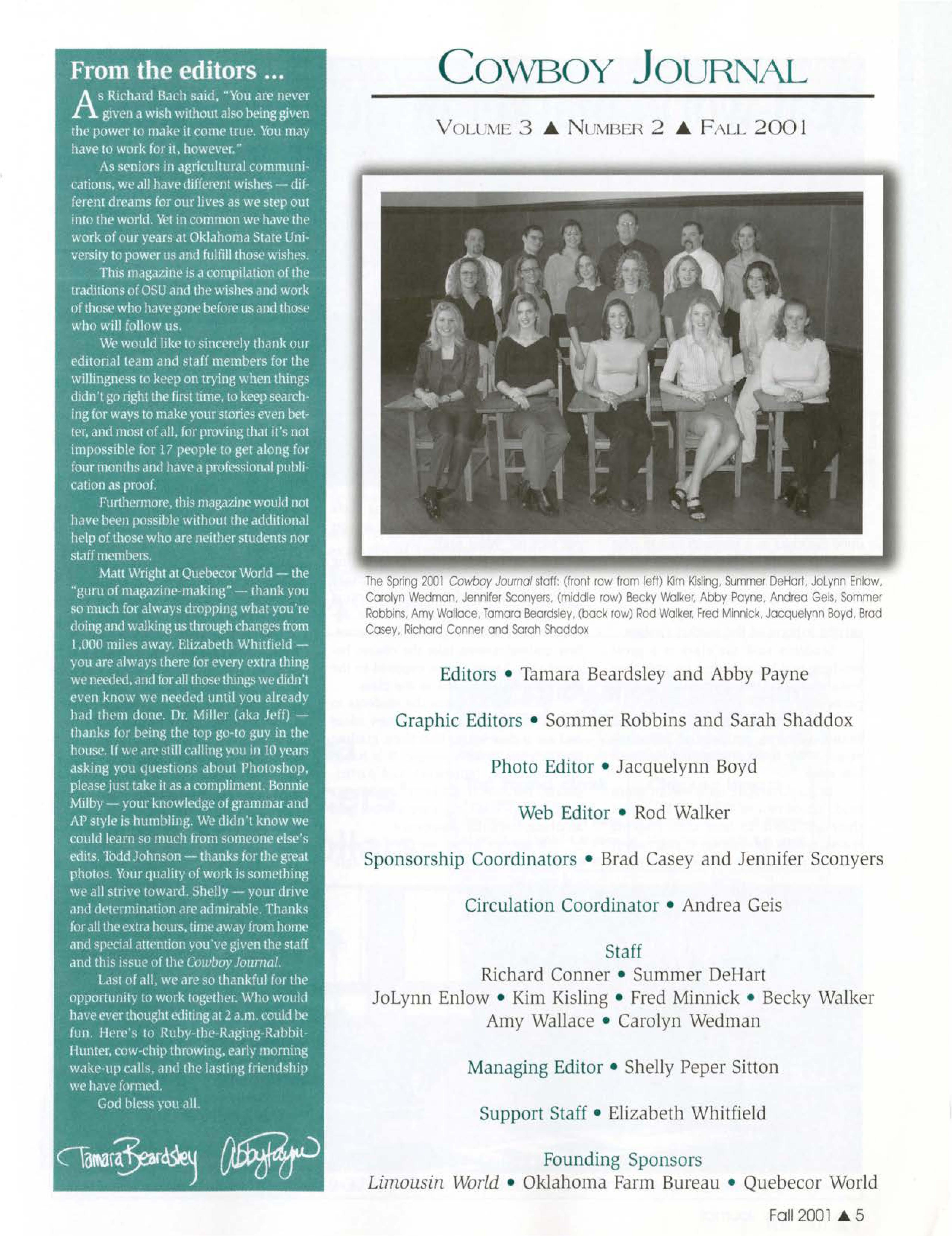
Graphic Editors • Sommer Robbins and Sarah Shaddox
Photo Editor • Jacquelynn Boyd
Web Editor • Rod Walker
Sponsorship Coordinators • Brad Casey and Jennifer Sconyers
Circulation Coordinator • Andrea Geis
Staff
Richard Conner • Summer DeHart
Jolynn Enlow • Kim Kisling • Fred Minnick• Becky Walker
Amy Wallace • Carolyn Wedman
Managing Editor • Shelly Peper Sitton
Support Staff • Elizabeth Whitfield
Founding Sponsors
Can we make a deal?
Real-worldmarketinvadesAgHall
"How many pens o{ callle you got?" "Depends on the weight." "1150s."
"Some. How many you need?" "Ten pens."
"What will you give me {or 'em?'"
This may sound like a business transaction in an office at Hitch Feeders. Actually, it's a conversation between students gathered in Oklahoma State University's Agricultural Hall.
The students are enrolled in Agricultural Economics 3990, the Fed-Cattle Market Simulator, which is better known as the packer-feeder game. This class uses real-world scenarios to teach students about the fed-cattle market.
Four agricultural economics professors developed the class during the summer of 1990. Clem Ward, Jim Trapp, Derrell Peel and Steven Koontz developed the class as a research tool to help students better understand what happens in the market place. Ward said the class uses experimental economics to show students what will happen when certain aspects of the market change.
Students said the class is a great teaching tool because the concepts they learn in other classes come alive as they participate in real-world situations.
"The class is really interactive," said Brandon Payton, agricultural education senior. "We learn firsthand how feedlots work."
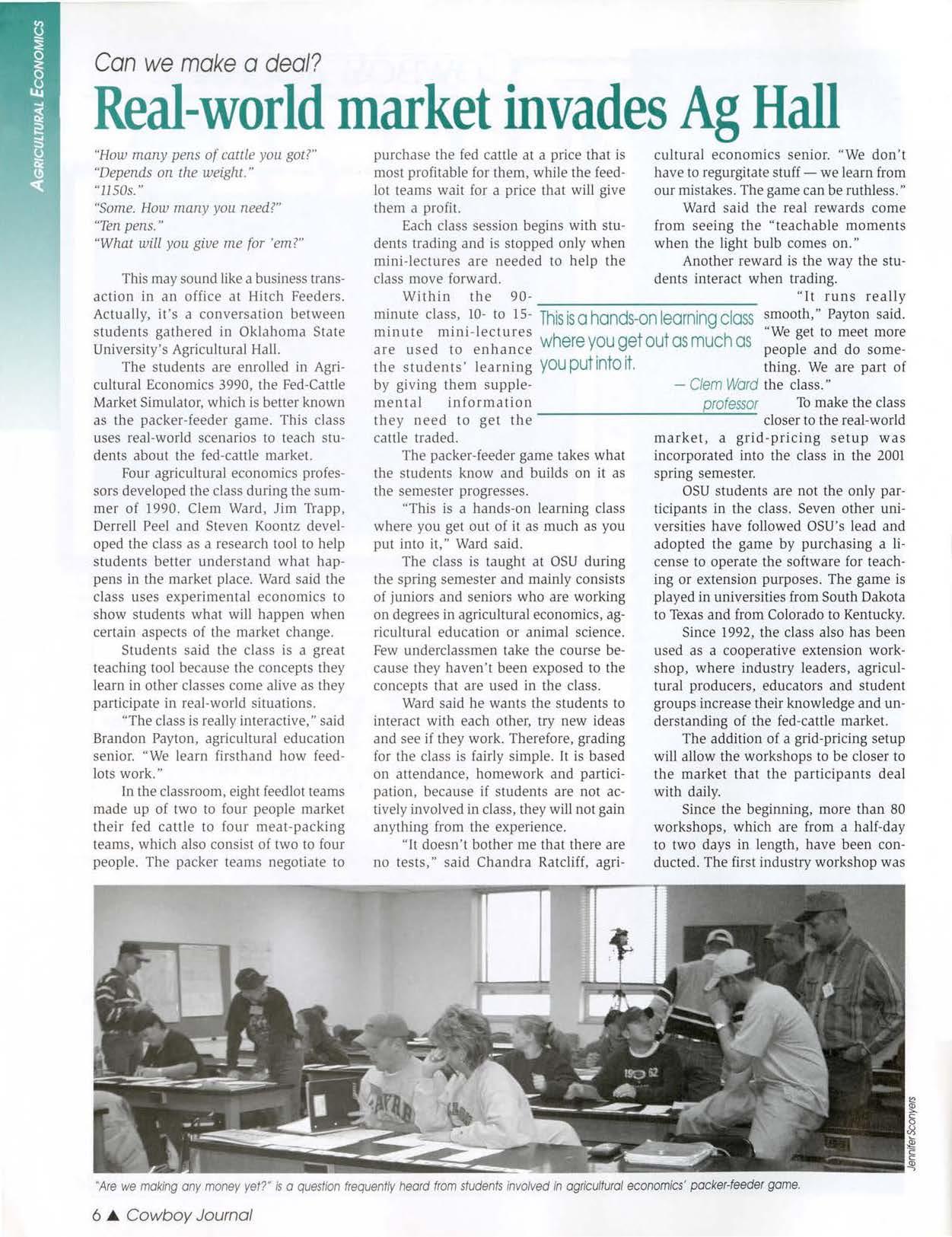
In the classroom, eight feedlot teams made up of two to four people market their fed cattle to four meat-packing teams, which also consist of two to four people. The packer teams negotiate to
purchase the fed cattle at a price that is most profitable for them, while the feedlot teams wail for a price that will give them a profit.
Each class session begins with students trading and is stopped only when mini-lectures are needed to help the
cultural economics senior. "We don't have to regurgitate stuff - we learn from our mistakes. The game can be ruthless."
Ward said the real rewards come from seeing the "teachable moments when the light bulb comes on."
Another reward is the way the stuclass move forward. dents interact when trading.
Within the 90- "It runs really minute class, 10· to 15- Thisisa hands-onlearningclasssmooth," Payton said. minute mini-lectures t t h "We get to meet more are used to enhance whereyougeOU asmuc as people and do somethe students' learning youputintoit. thing. We are part of by giving them supple- - ClemWardthe class." mental information professor To make the class they need to get the---------~--- closer to the real-world cattle traded.
The packer-feeder game takes what the students know and builds on it as the semester progresses.
"This is a hands-on learning class where you get out of it as much as you put into it," Ward said.
The class is taught at OSU during the spring semester and mainly consists of juniors and seniors who are working on degrees in agricultural economics. agricultural education or animal science. Few underclassmen take the course because they haven't been exposed to the concepts that are used in the class.
Ward sajd he wants the students to interact with each other, 1ry new ideas and see if they work. Therefore, grading for the class is fairly simple. It is based on attendance, homework and participation, because if students are not actively involved in class, they will not gain anything from the experience.
"It doesn't bother me that there are no tests," said Chandra Ratcliff, agri-
market, a grid-pricing setup was incorporated into the class in the 2001 spring semester.
OSU students are not the only participants in the class. Seven other universities have followed osu·s lead and adopted the game by purchasing a license to operate the software for teaching or extension purposes. The game is played in universities from South Dakota to Texas and from Colorado to Kentucky.
Since 1992, the class also has been used as a cooperative extension workshop, where industry leaders, agricultural producers, educators and student groups increase their knowledge and understanding of Lhe fed-cattle market.
The addition of a grid-pricing setup will allow the workshops to be closer to the market that the participants deal with daily.
Since the beginning, more than 80 workshops, which are from a half-day to two days in length, have been conducted. The first industry workshop was
held by Excel Corp., which has since sponsored 12 workshops.
The workshops turn the tables, allowing industry leaders to experience what the other side does. This gives them a better understanding of how they affect everyone around them.
The workshops also help producers gain insight on what feedlot operators do, and they can use Ibis information to get the best prices for their cattle.
Research is a big part of the class as data collected is used to address beef industry issues. The class provides useful information in a short time - the same data would be hard for researchers to compile from the industry.
One area researchers have investigated was how management affects packer industry mergers.
Ward said this type of data is hard to collect in the industry
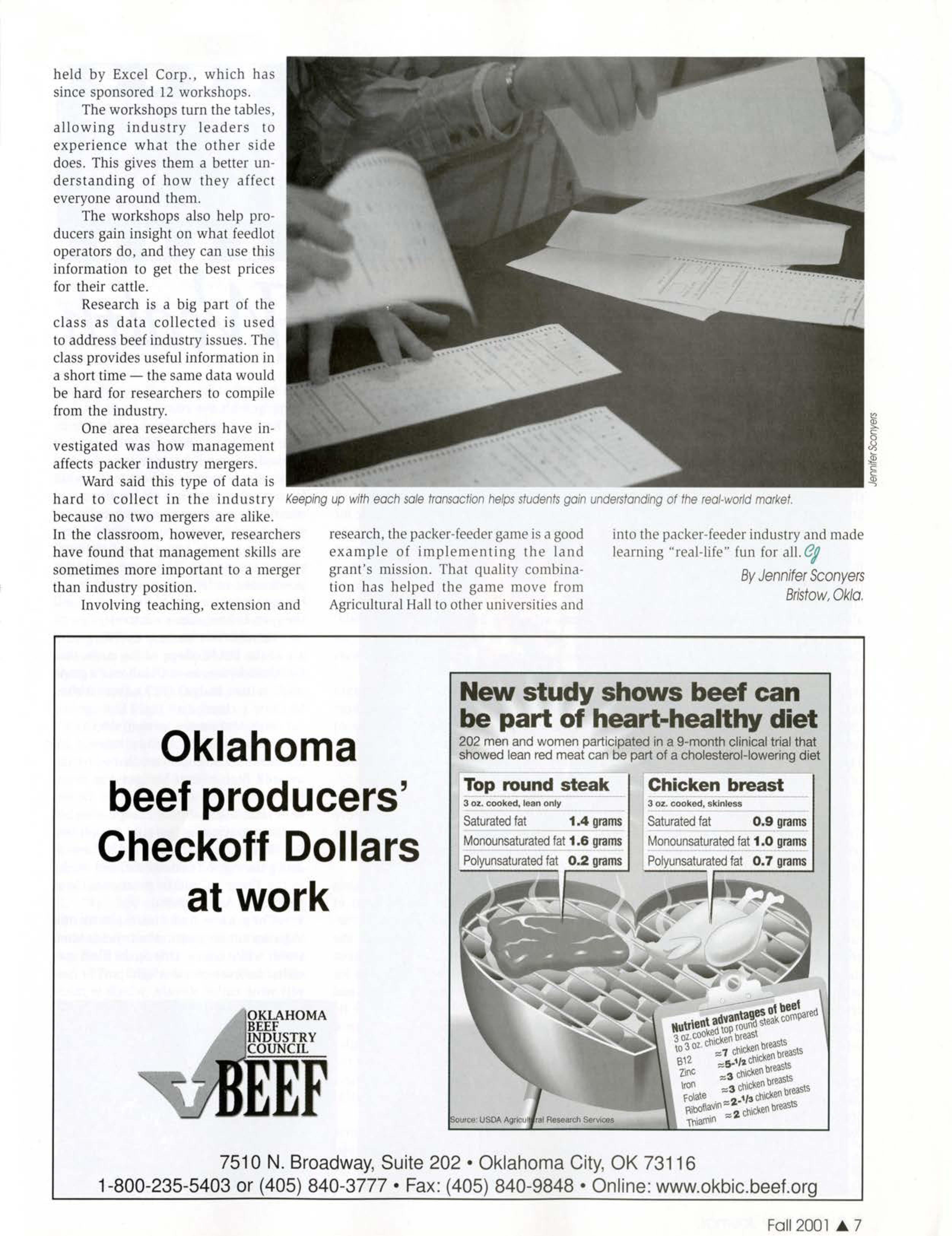
witheach soletransactionhelpsstudentsgain understanding of the real-worldmarket. because no two mergers are alike. In the classroom, however, researchers have found that management skills are sometimes more important to a merger than industry position.
Involving teaching, extension and
research, the packer-feedergam i a good example of implementing the land grant's mission. That quality combination has helped the game move from Agricultural Hall to other universities and
into the packer-feeder industry and made learning "real-life" fun for all. e!
ByJenniferSconyers Bristow,Okla.
Keepingup
(}rowing the (jrapesof 'Wealth
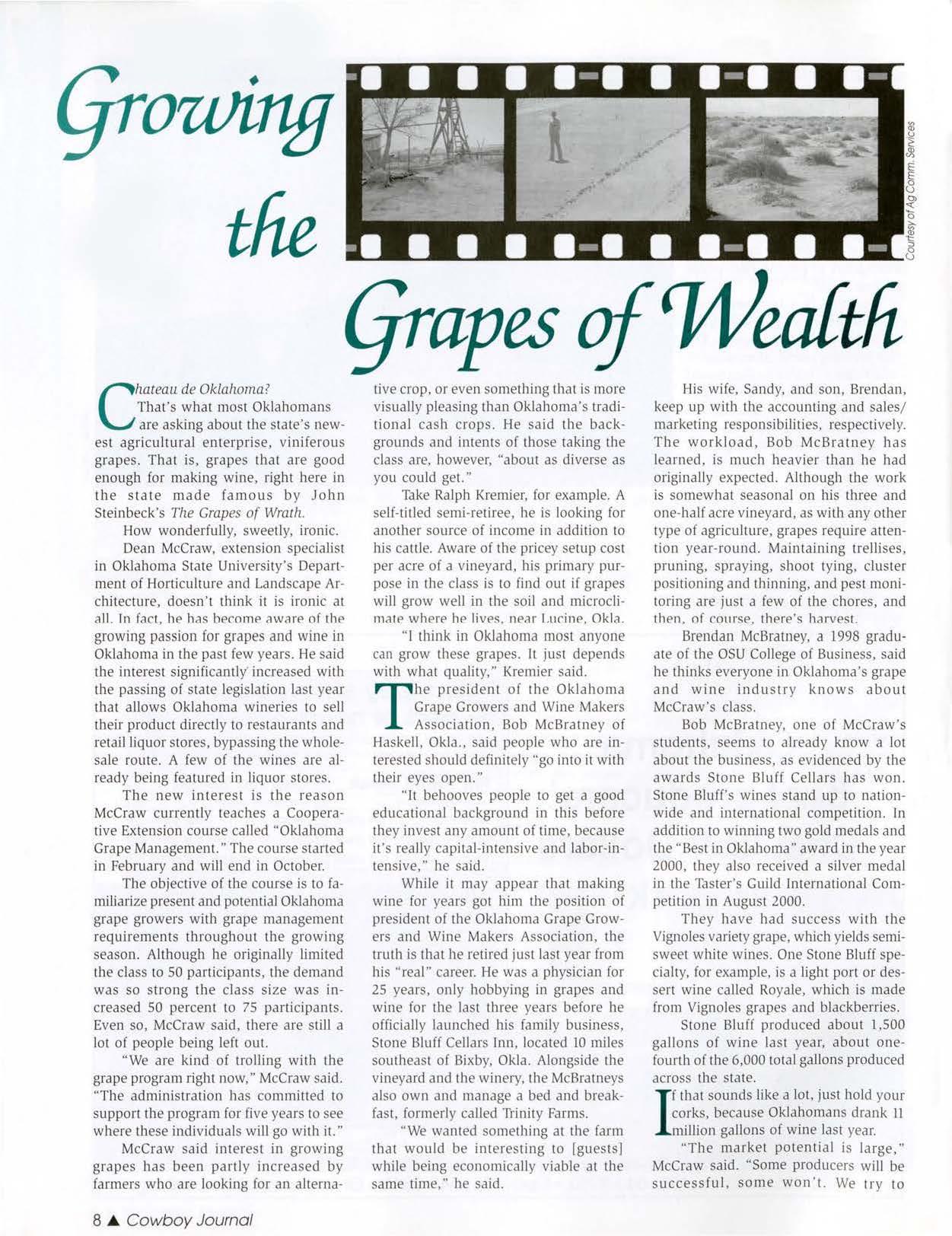
Chateau de Oklahoma?
That's what most Oklahomans are asking about the state's newest agricultural enterprise, viniferous grapes. That is, grapes that are good enough for making wine, right here in the state made famous by John Steinbeck's The Grapes o( Wrach.
How wonderfully, sweetly, ironic.
Dean Mccraw, extension specialist in Oklahoma State University's Department of Horlicullure and Landscape Architecture, doesn't think ii is ironic at all. In fact, he has become awart? of thP growing passion for grapes and wine in Oklahoma in the past few years. He said the interest significantly' increased with the passing of state legislation last year that allows Oklahoma wineries to sell their product directly to restauran1sand retail liquor stores, bypassing the wholesale route. A few of the wines are already being fea1ured in liquor stores.
The new interest is the reason Mccraw currently 1eaches a Cooperative Extension course called "Oklahoma Grape Management." The course started in February and will end in October.
The objective of the course is to familiarize presen1and po1en1ialOklahoma grape growers with grape management requirements 1hroughou1 the growing season. Although he originally limited the class 10 50 panicipants, the demand was so strong the class size was increased 50 percent to 75 participants. Even so, Mccraw said, there are s1ill a 101of people being left out.
"We are kind of 1rolling with the grape program right now," Mccraw said. "The administration has committed to support the program for five years to see where these individuals will go with it."
Mccraw said interest in growing grapes has been partly increased by farmers who are looking for an alterna-
Livecrop, or even something that is more visually ple,1singthan Oklahoma's traditional cash crops. He said the backgrounds and intents of those taking the class are, however, "about as diverse as you could get."
'foke Ralph Kremier, for example. A self-titled semi-re1iree, he is looking for another source of income in addition to his cattle. Aware of 1he pricey se1upcos1 per acre of a vineyard, his primary purpose in the class is 10 find out if grapes will grow well in the soil and microclimillP whPre hP livt?s, ne;ir l.urinP, Okl.:1.
"I think in Oklahoma most anyone can grow these grapes. It just depends wi1h what quality," Kremier said.
The president of the Oklahoma Grape Growers and Wine Makers Associa1ion, Bob McBratney of Haskell, Okla., said people who are interested should definitely "go into it with their eyes open."
"It behooves people LO get a good educational background in this before they invest any amount of time, because it's really capital-intensive and labor-intensive, •• he said.
While il may appear that making wine for years got him the position of president of the Oklahoma Grape Growers and Wine Makers Association, 1he truth is that he retired just last year from his "real" career. He was a physician for 25 years, only hobbying in grapes and wine for the last three years before he officially launched his family business, Stone Bluff Cellars Inn, located 10 miles southeast of Bixby, Okla. Alongside the vineyard and the winery, the McBratneys also own and manage a bed and breakfas1, formerly called Trinity Farms.
"We wanted something at the farm that would be interesting 10 [guests] while being economically viable at the same time," he said.
His wife, Sandy, and son, Brendan, keep up with !he accounting and sales/ marketing responsibilities, respectively. The workload, Bob McBratney has learned, is much heavier than he had originally expected. Although the work is somewhat seasonal on his three and one-half acre vineyard, as with any ocher type of agriculture, grapes require attention year-round. Maintaining trellises, pruning, spraying, shoot tying, clus1er positioning and thinning, and pest monitoring are just a few of the chores, and then, of course, 1here's harvest.
Brendan McBratney, a 1998 gradua1e of the OSU College of Business, said he thinks everyone in Oklahoma's grape and wine industry knows about McCraw's class.
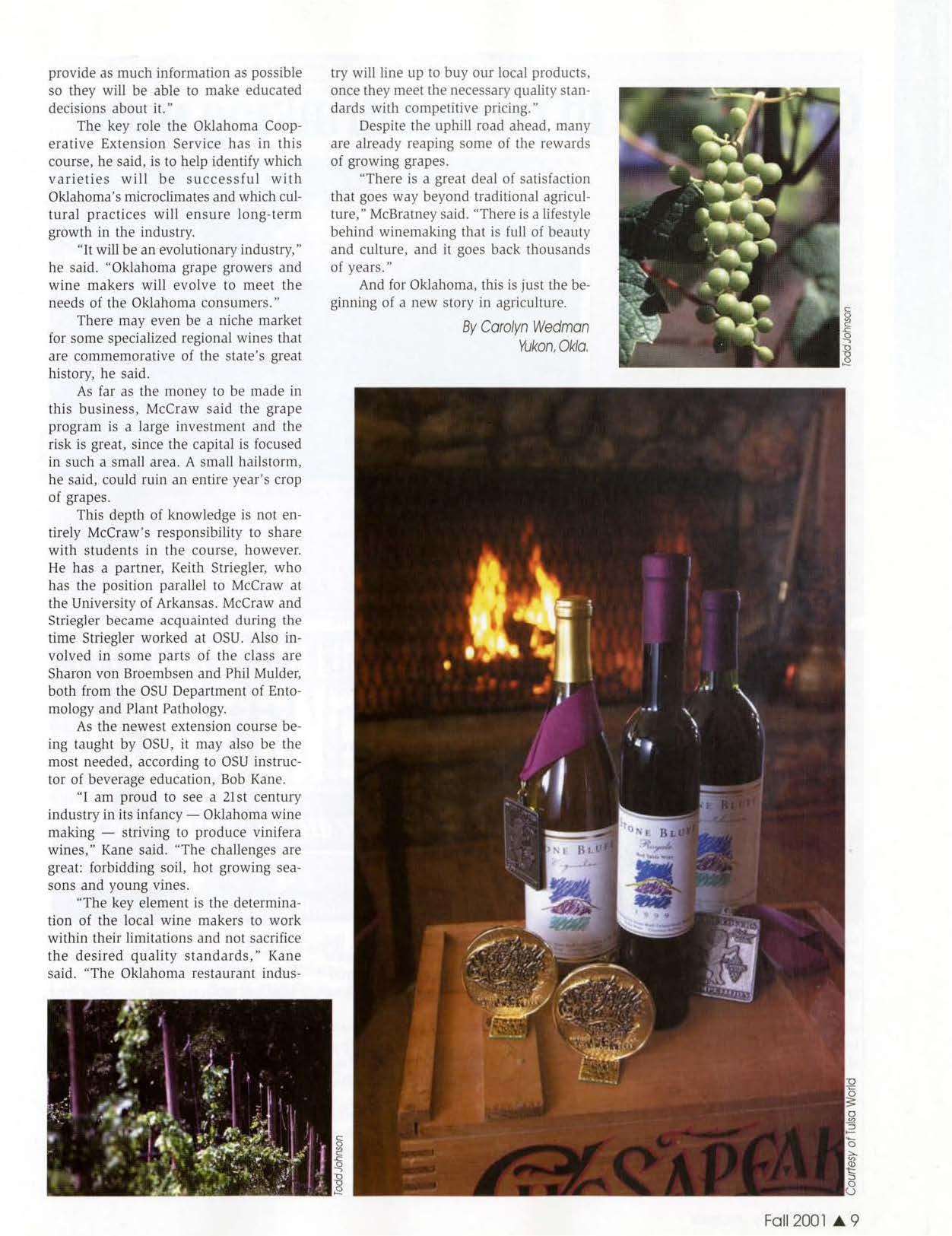
Bob McBratney, one of McCraw's students, seems to already know a lot about 1he business, as evidenced by the awards Stone Bluff Cellars has won. Stone Bluff's wines stand up to nationwide and international compe1ition. In addi1ion to winning two gold medals and the "Best in Oklahoma" award in the year 2000, they also received a silver medal in the Tas1er'sGuild International Competition in August 2000.
They have had success with the Vignoles variety grape, which yields semiswee1white wines. One Stone Bluff specialty, for example, is a light port or dessert wine called Royale, which is made from Vignoles grapes and blackberries.
Stone Bluff produced about l.500 gallons of wine last year, about onefounh of the 6,000 1otalgallons produced across the state.
If tha1 sounds like a lot, just hold your corks, because Oklahomans drank 11 million gallons of wine last year. "The market potential is large," Mccraw said. "Some producers will be successful, some won't. We try to
provide as much information as possible so they will be able to make educated decisions about it."
The key role the Oklahoma Cooperative Extension Service has in this course, he said, is to help identify which varieties will be successful with Oklahoma's microclimates and which cultural practices will ensure long-term growth in the industry.
"It will be an evolutionary industry," he said. "Oklahoma grape growers and wine makers will evolve to meet the needs of the Oklahoma consumers."
There may even be a niche market for some specialized regional wines that are commemorative of the state's great history, he said.
As far as the money to be made in this business, Mccraw said the grape program is a large investment and the risk is great, since the capital is focused in such a small area. A small hailstorm, he said, could ruin an eniire year's crop of grapes.
This depth of knowledge is not entirely McCraw's responsibility to share with students in the course, however. He has a partner, Keith Striegler, who has the position parallel to McGraw at the University of Arkansas. Mccraw and Striegler became acquainted during the time Striegler worked at OSU. Also involved in some parts of the class are Sharon von Broembsen and Phil Mulder, both from the OSU Department of Entomology and Plant Pathology.
As the newest extension course being taught by OSU, it may also be the most needed, according to OSU instructor of beverage education, Bob Kane.
"l am proud to see a 21st century industry in its infancy - Oklahoma wine making - striving to produce vinifera wines," Kane said_ "The challenges are great: forbidding soil, hot growing seasons and young vines.
"The key element is the determination of the local wine makers to work within their limitations and not sacrifice the desired quality standards," Kane said. "The Oklahoma restaurant indus-
try will line up to buy our local products, once they meet the necessary quality standards with competitive pricing.··
Despite the uphill road ahead, many are already reaping some of the rewards of growing grapes.
"There is a great deal of satisfaction that goes way beyond traditional agriculture,'' McBratney said. "There is a lifestyle behind winemaking that is full of beauty and culture, and it goes back thousands of years."
And for Oklahoma, this is just the beginning of a new story in agriculture.
ByCarolynWedman Yukon,Okla.
OSUstrivestoprotectdrinkingwater
ater. We need it to exist, yet we all take it for granted. However, clean water is becoming more difficult to find.
Cities all across America obtain drinking water from local reservoirs, riv· ers, lakes and groundwater. However, agricultural runoff is a main source of phosphorus pollution in surface waters, said Libby Dayton, soil and environmen· tal chemistry graduate student at Oklahoma State University.
Dayton said several different agricultural sources might contribute to the phosphorus pollution.
"It may be caused by an over-application of phosphorus to soil," Dayton said. "It's typical in concentrated animal feeding operations, but can also come from an over-application of phos· phorus fertilizer."
The problem occurs when rain washes nutrients, containing phosphorus, from pastures or nearby concentrated animal feeding operations into surface water bodies.
Dayton said the phosphorus is not toxic, but it promotes the growth of un• wanted algae. Nevertheless, scientists at OSU just might have a potential solution to the phosphorus runoff problem.
"If you keep the phosphorus on the field with the animal waste, you have less risk of polluting streams that even· tually run into source water," said Nicholas Basta, associate professor of soil chem· istry at OSU.
Scientists at OSU, the State Depart· ment of Environmental Quality and drink· ing water treatment facilities across the state have been working together to solve this problem. The process of treating water for safe drinking requires the removal of sediment from the water. Large amounts of residual are generated when treating drinking water, and treatment plants are faced with the problem of disposing the residual.
Basta, along with another OSU scientist, is working to find beneficial uses for those wastes. Basta said the residuals collected from drinking water plants throughout the state were characterized and were found to have varying adsorp· tion capacities.
"We collected materials from all over the state and characterized them," Basta said. "They all have different potentials for adsorbing phosphorus."
Dayton said the sorption capacity is related to the amount of amorphous alu· minum in the residual.
"We've found most aluminum residuals trap phosphorus," Basta said.
Nevertheless, some experiments had to be performed. OSU scientists con· ducted a small-sea.le experiment using poultry litter and the water treatment residuals. The experiment consisted of four box plots in which different amounts of the residuals were applied on top of poultry litter.
Two plots contained different amounts of the residuals broadcasted evenly, a buffer strip was placed on a third plot, and the final plot served as the control for the experiment on which poultry litter was applied but no residuals were applied.
A heavy rain was simulated over the plots with the use of a rain simulator built at OSU, and the water runoff was col· lected for resting.
Just as the scientists hoped, the water samples collected from all the tests plots, except the control, showed signifi· cant decreases in the amount of phosphorus in the runoff.
"This was the first time this material was used to removephosphorus from runoff," Basta said. "With these treat· ments you can cut the phosphorus run· off in half."
This experiment showed potential for protecting drinking water supplies from phosphorus contamination. The test plots were a success, but the test needed to be performed on a larger scale. Earlier
this year, OSU applied water treatment residuals to a 10-acre pasture near Mi· ami, Okla. The pasture was located near a poultry operation and had a massive amount of litter present.
A pond downhill from the pasture had been contaminated by phosphorus and was covered with algae. Basta said water tests revealed the runoff water contained three parts per million phosphorus, an excessive amount. The team applied water treatment residuals to the pasture in the amount of 10 tons per acre, simulated a heavy rain, and collected water samples.
According to the Miami study, the sample revealed a 70-percent reduction in phosphorus, but there is still poten· tial for even better results.
"If 20 tons are applied per acre, you would reduce the phosphorus by 90 percent," Basta said.
OSU plans to work with other universities in the future to protect driJ.1king water.
"We're hoping to put together a multi-regional study with other w1iversities and environmental consulting firms and do something on a larger scale, ta.k· ing what we learned with our preliminary studies and do something a little more comprehensive," Dayton said.
This may not be the entire answer to keeping drinking water safe from phosphorus runoff, but it is a step in the right direction, Basta said. e/ ByRodWalker Atlanta,Ga.
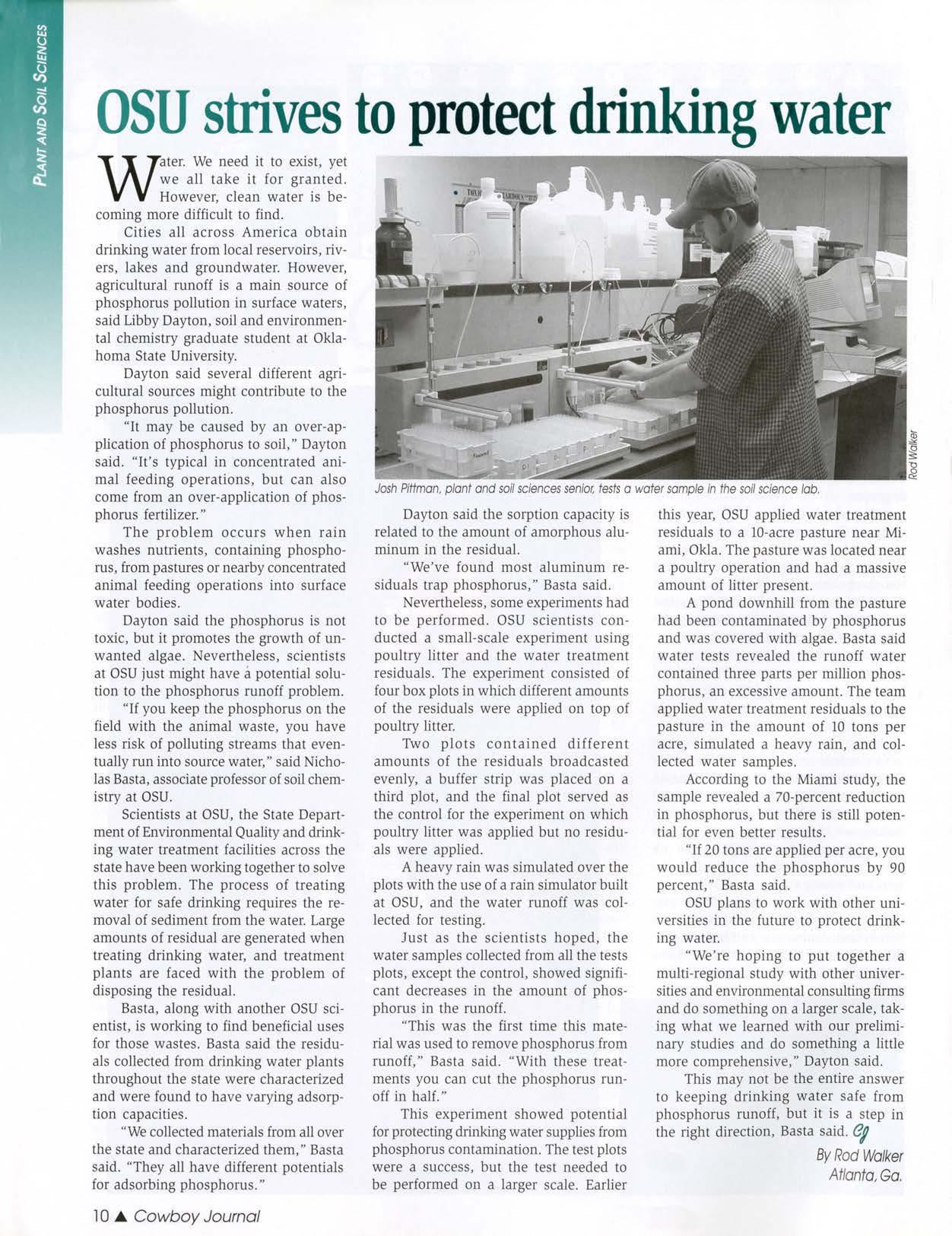
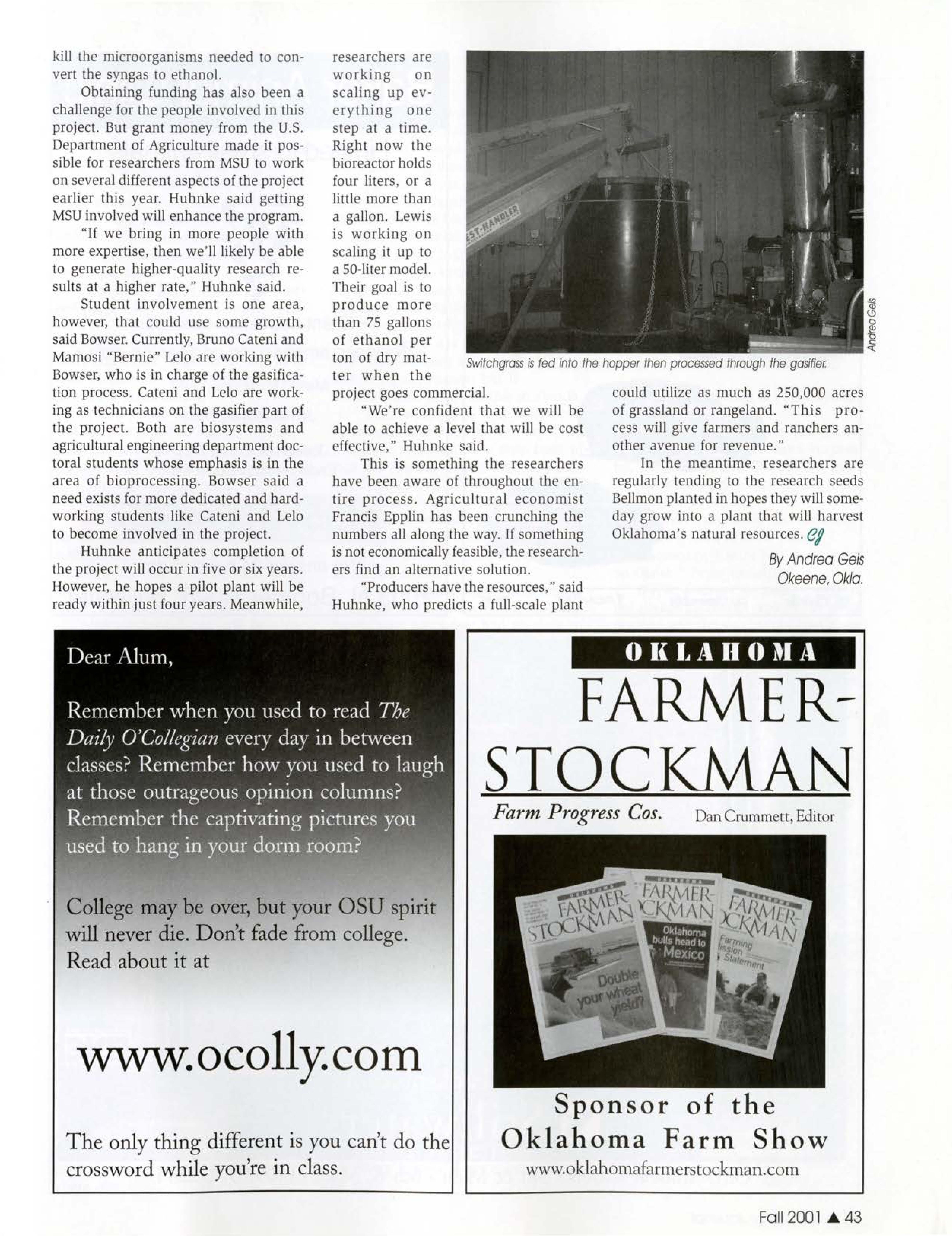
JoshPittman,plant and soilsciencessenior,testsa wotersampleIn the sol/sciencelab.
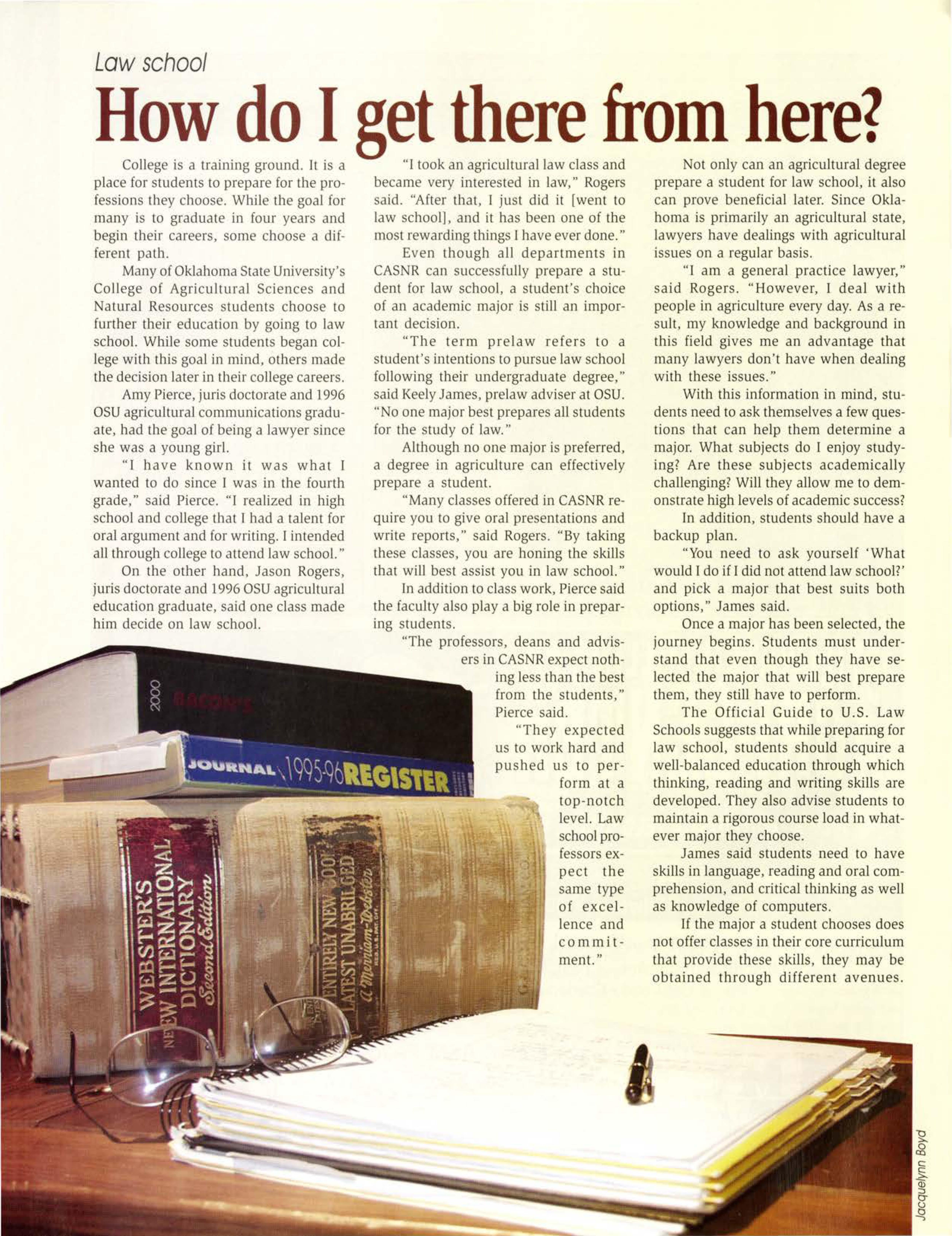
Lawschool HowdoI gettherefromhere?
became very interested in law," Rogers said. "After that, I just did it [went to law school]. and it has been one of the most rewarding thi_ngs I have ever done."
College is a training ground. lt is a "I took an agricultural law class and ot only can an agricultural degree place for students to prepare for the professions they choose. While the goal for many is to graduate in four years and begin their careers, some choose a dif· ferent path.
Many of Oklahoma State University's College of Agricultural Sciences and atural Resources students choose to further their education by going to law school. While some students began college with this goal in mind, others made the decision later in their college careers.
Amy Pierce, juris doctorate and l 996 OSUagricultural communications graduate, had the goal of being a lawyer since she was a young girl.
"I have known it was what I wanted to do since I was in the fourth grade," said Pierce. "I realized in high school and college that I had a talent for oral argument and for writing. I intended all through college to auend law school."
On the other hand, Jason Rogers, juris doctorate and 1996 OSUagricultural education graduate, said one class made him decide on law school.
Even though all departments in CAS R can successfully prepare a student for law school, a student's choice of an academic major is still an importam decision.
"The term prelaw refers to a student's intentions to pursue law school following their uJ1dergraduate degree," said KeelyJames, prelaw adviser at OSU. " o one major best prepares all students for the study of law."
Although no one major is preferred, a degree in agriculture can effectively prepare a student.
"Many classes offered in CAS R require you to give oral presentations and write reports," said Rogers. "By taking these classes, you are boning the skills that will best assist you in law school."
In addition to class work, Pierce said the faculty also play a big role in prepar· ing students.
"The professors, deans and advisers in CASNRexpect nothing less than the best from the students," Pierce said. "They expected us to work hard and pushed us to perform at a top-notch level. Law schoolprofessors expect the same type of excellence and commitment."
prepare a student for law school, it also can prove beneficial later. Since Oklahoma is primarily an agricultural state, lawyers have dealings with agricultural issues on a regular basis.
"I am a general practice lawyer," said Rogers. "However, I deal with people in agriculture every day. As a result, my kr1owledgeand background in this field gives me an advantage that many lawyers don't have when dealing with these issues."
With this information in mind, students need to ask themselves a few questions that can help them determine a major. What subjects do I enjoy studying? Are these subjects academically challenging? Will they allow me to demonstrate high levels of academic success?
In addhion, students should have a backup plan.
"You need to ask yourself 'What would I do if I did not attend law school?' and pick a major that best suits both options," James said.
Once a major has been selected, the journey begins. Students must understand that even though they have selected the major that will best prepare them, they still have to perform.
The Official Guide to U.S. Law Schools suggests that while preparing for law school, students should acquire a well-balanced education through which thinking, reading and writing skills are developed. They also advise students to maintain a rigorous course load in whatever major they choose.
James said students need to have skills in language, reading and oral comprehension, and critical thinking as welJ as knowledge of computers.
If the major a student chooses does not offer classes in their core curriculum that provide these skills, they may be obtained through different avenues.
;'When I find out a student is going to law school, 1try to use their controlled electives to better prepare them," said Shelly Sitton, agricultural communications adviser at OSU. "I usually try to enroll them in critical thinking, writing and other courses that will provide them with the skills they need to be prepared."
Undergraduate grade point average is important when applying to law school but is not the only factor taken into consideration. Law schools also look at a student's other activities.
"Through my internships l learned how to handle responsibility and to work under pressure," Pierce said. "I also learned bow to deal with others i.n a professional manner. Through my activities I was able to hone my communication skills which gave me a distinct advantage over other law students."
Law schools want students who are well rounded. They look for individuals who have a reason to study law, who have overcome in the face of adversity, who have extracurricular activities and who have work experience, James said.
Once students have done their best to prepare themselves for law school, the next step in the process is applying.
"Admission requirements for law school include completion of a bachelor's degree and a competitive undergraduate grade point average," said James. "A competitive score on the Law School Admissions Test is also required."
When a student has completed the undergraduate work and been accepted into a law school, the journey to becoming a lawyer is only about half over.
"Law school is nothing like college," said Pierce. "It requires levels of concentration and commitment that will rarely have to be displayed in college."
Rising to the occasion is not just suggested, it is expected from students.
"Law schools expect nothing less than 100 percent from their students," said Owen Anderson, professor at the University of Oklahoma's law school.
James said for most students who go to school full time, law school is a three-year program. Upon finishing, a student receives a juris doctorate, which is a general law degree.
If a student chooses lO specialize in one particular area, they may further their legal education by pursuing a master of legal studies.
The first year of law school typically includes a set of required courses. Second-year students usually have choices among a predetermined list of courses. Most students focus on courses needed to prepare them for the bar exam.
During the third year, most students complete preparatory courses for the bar exam and have several free choices. They may choose to develop an area of emphasis or take courses that meet their interests and diversify their knowledge or practical experience.
James said one factor that potential law students need to be prepared for is teaching style.
"Many law schools use a Socratic method of teaching," James said.
Under this method, lecturers utilize an exchange of questions and answers from readings and assignments.
"Students need to be prepared to do lots of reading," said Anderson. "In addition, they need to be able to discuss what they have read."
Discussions are not a mere portion of the classes students will have to take, they are the main emphasis.
"In law school you will be called on by your professor, and you will be expected to participate in a meaningful and intelligent djscussion regardfog the legal cases you reviewed the night before," said Pierce.
In addition, many Jaw school classes take only one test per course per semester. This test is typically a threeto four-hour essay exam.
"If you are a procrastinator, I recommend you save your money and find another profession," said Pierce. "You cannot put off opening a book until a few weeks before an exam."
If a student survives these three years, their options are endless. Having a juris doctorate does not mean that a student has to be a lawyer.
"Students with an agricultural background might be interested in working for governmental agencies such as the Department of Environmental Quality or the Departme111 of Agriculture," said Pierce. "In addition, an agricultural law student could seek employment with many of the numerous agricultural-related corporations and provide legal counseling."
Although these careers may be attractive to some students, other options exist for those who dream of returning to a small town.
"The agricultural law student could consider practicing in a small community," said Pierce. ''In this position, they could assist the small farmer with numerous issues he may encounter."
Whether it involves court cases or simply giving advice to a farmer, being a lawyer can be a fulfilling career.
Pierce said on the first day of class a professor told students that having a
Thinkingaboutlawschool?
• Beginpreparingfor the LowSchool AdmissionTest.
• Exploreyourlow schooloptions.
• Considerwho youwillaskto provide lettersof recommendation.
law degree was like having a tiger on a leash. It gives you the power and the ability to do anyt11ing you want to do. It gives you specific knowledge and skills that few people have, and for that reason, it is a powerful animal at your beck and call.
Though the road is long and difficult, students who have the desire and determination to succeed can achieve the dream of "possessing a tiger." el ByBradCosey Kiowa,Okla.
Peruvianexchangebeginstradition
From the sunny, mountainous regions of Peru to the icy plains of Oklahoma, nine students and two professors came as part of a Peruvian studio exchange program.
This program is designed so Oklahoma State University seniors in the landscape architecture Design IV class have the opportunity to work 10get11er on a design project with architecture students from the School of Architecture and Urbanism at the Universidad Peruana de Ciencias in Lima, Peru.
Rebekah Kerwin, OSU landscape architecture senior, said she looked forward to being involved with tJ1e project for more than a year.
"The Peruvian exchange program is part of the star on the cake icing of the things that we do. We really want to work with the architecture program," Kerwin said.
The idea for the exchange program began when Charles Leider, professor and program direclOr, was approached with the idea of student exchange by Renaldo Agama, a friend from graduate school, who lived and taught in Peru. Leider, along with department head Dale Maronek, presented the idea to the college before the agreements were signed in October 1993.
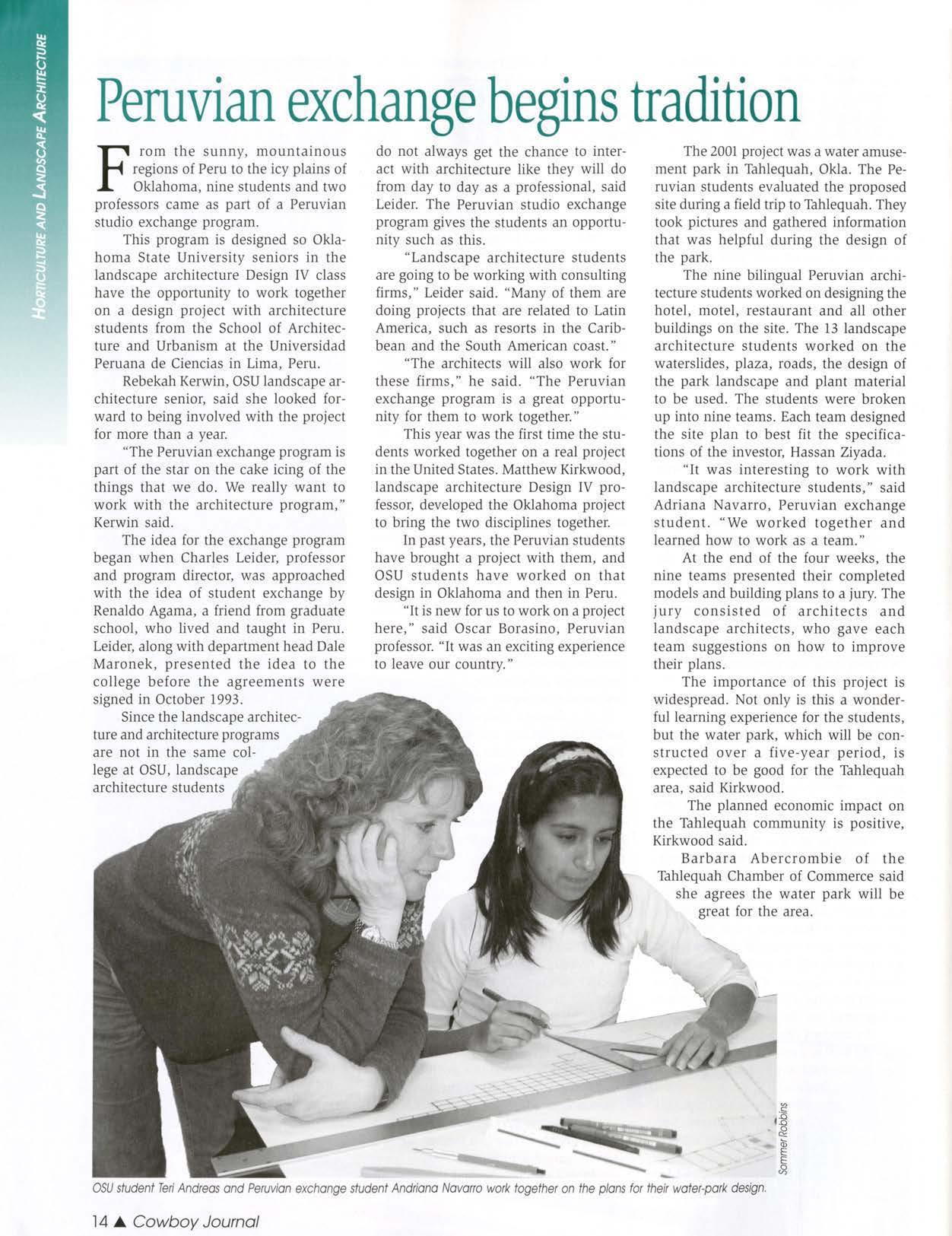
Since the landscape architecture and architecture programs are not in the same college at OSU, landscape architecture students
do not always get the chance to interact with architecture like they will do from day to day as a professional, said Leider. The Peruvian studio exchange program gives the students an opportunity such as this.
"Landscape architecture students are going to be working with consulting firms," Leider said. "Many of them are doing projects that are related to Latin America, such as resorts in the Caribbean and the South American coast."
"The architects will also work for these firms," he said. "The Peruvian exchange program is a great opportunity for iliem Lo work togeilier
This year was the first time the students worked together on a real project in the United States. Matthew Kirkwood, landscape architecture Design IV professor, developed the Oklahoma project to bring the two disciplines 10gether.
In past years, the Peruvian students have brought a project with them, and OSU studems have worked on that design in Oklahoma and then in Peru.
"It is new for us to work on a project here," said Oscar Borasino, Peruvian professor. "It was an exciting experience to leave our country."
The 2001 project was a water amusement park in Tahlequah, Okla. The Peruvian students evaluated the proposed site during a field trip to Tahlequah. They took pictures and gathered information that was helpful during the design of the park.
The nine bilingual Peruvian architecture students worked on designing t11e hotel, motel, restaurant and all other buildings on the site. The 13 landscape architecture students worked on the waterslides, plaza, roads, the design of the park landscape and plant material to be used. The students were broken up into nine teams. Each team designed the site plan to best fit the specificalions of the investor, Hassan Ziyada.
"It was interesting to work with landscape architecture students," said Adriana Navarro, Peruvian exchange student. "We worked together and learned how to work as a team."
At the end of the four weeks, the nine teams presented their completed models and building plans to a jury. The jury consisted of architects and landscape architects, who gave each team suggestions on how to improve their plans.
The importance of this project is widespread. Not only is this a wonderful learning experience for the students, but the water park, which will be constructed over a five-year period, is expected lO be good for the Tahlequah area, said Kirkwood.
The planned economic impact on the Tahlequah community is positive, Kirkwood said.
Barbara Abercrombie of the Tahlequah Chamber of Commerce said she agrees the water park will be great for the area .
"It is estimated the park will bring in around $100,000 per year during the first five years," she said.
Kirkwood said Lhebenefits for the program are twofold.
"Students will gain knowledge in international dimensions and become exposed to other professions which is important to their future as professionals,'' Kirkwood said.
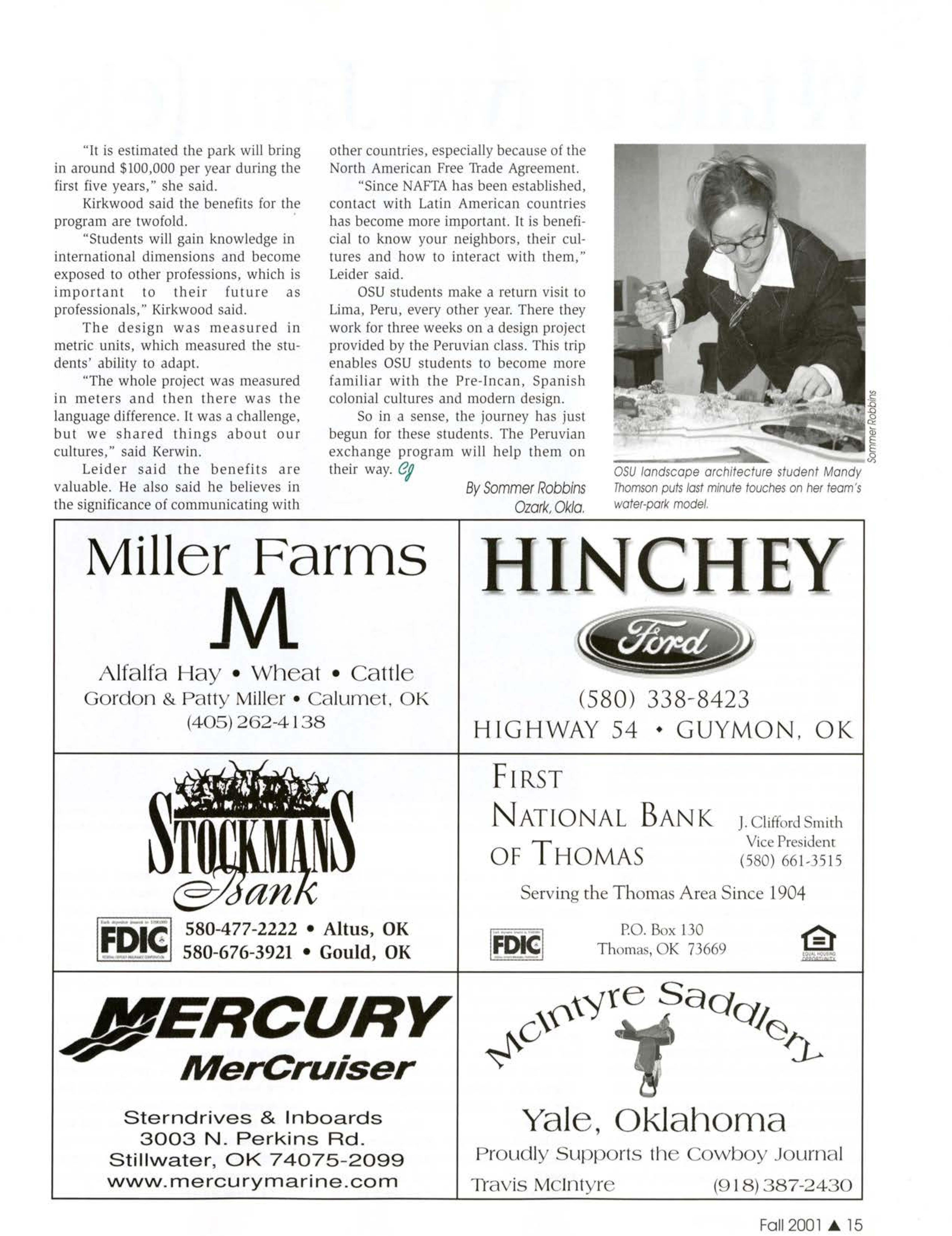
The design was measured in metric units, which measured the students' ability to adapt.
"The whole project was measured in meters and then there was the language difference. It was a challenge, but we shared things about our cultures," said Kerwin.
Leider said the benefits are valuable. He also said he believes in the significance of communicating with
other countries, especially because of the orth American Free Trade Agreement.
"Since AFTAhas been established, comact with Latin American countries has become more important. It is beneficial to know your neighbors, their cultures and how to interact with them," Leider said.
OSU students make a return visit to Lima, Peru, every other year. There they work for three weeks on a design project provided by the Peruvian class. This trip enables OSU students to become more familiar with the Pre-lncan, Spanish colonial cultures and modern design.
So in a sense, the journey has just begun for these students. The Peruvian exchange program will help them on their way. ef
BySommerRobbins Ozark,Okla.
Miller Farms M
A taleoftwoJami(e)s
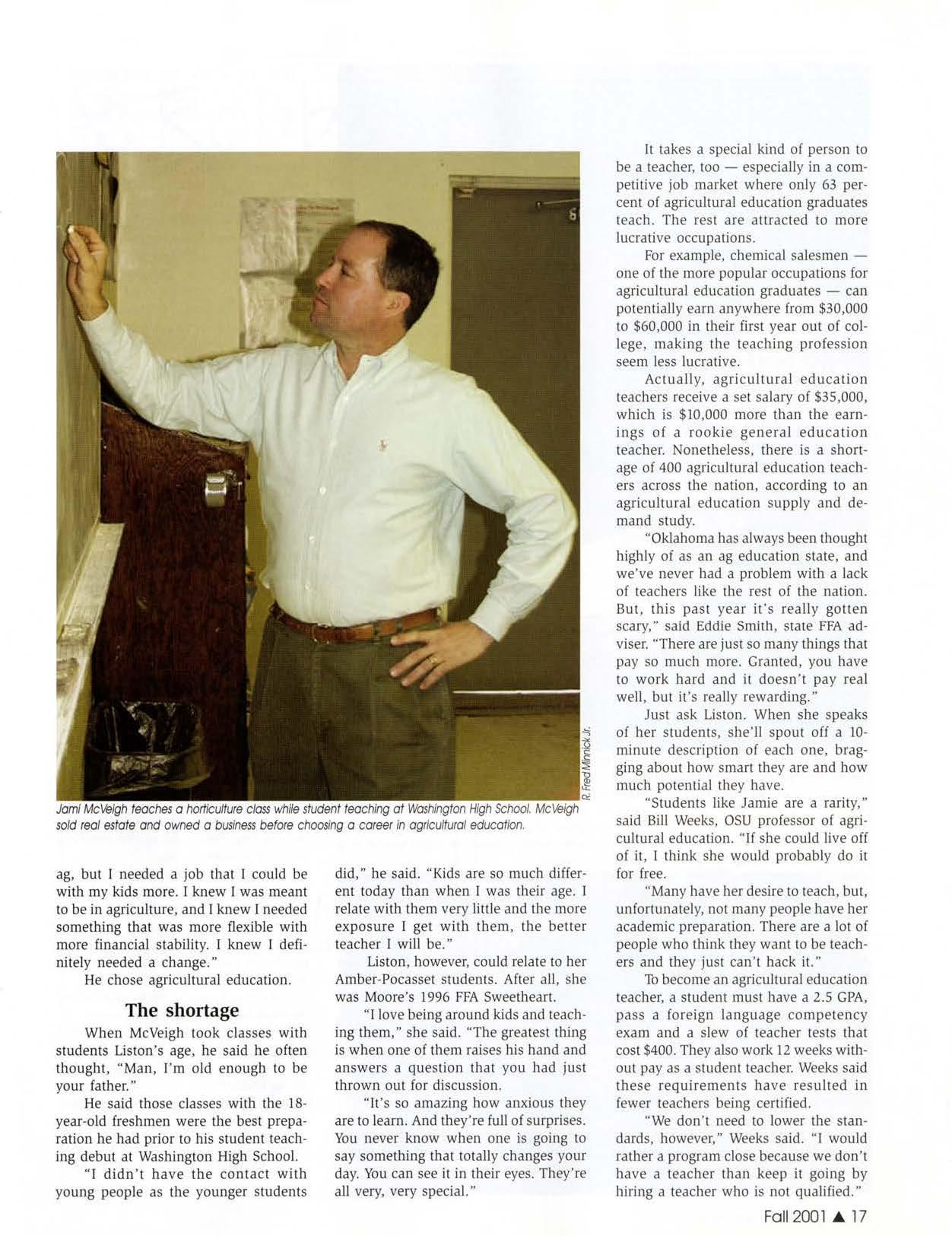
In 1979, when Jami McVeigh entered his first year of college at the University of Oklahoma and Jamie Liston's disposable diaper bills skyrocketed, nobody could predict how these two Jami(e)s would cross paths and eventually join the agricultural education family.
Night and day
McVeigh's father was a carpet salesman, who moved six times before Jami graduated &om high school. Liston was born, raised and schooled in Moore, Okla. Her father, Larry, was her agricultural education teacher, and her _mother, Sharon, was her math teacher.
She learned how to ride a hike in '82, when Mcveigh ·s calloused hands grappled oil wells for a living. He was running top-secret missions as an Army Special Operations soldier from '83 to '86, when Liston colored, read books and fell in love with learning.
In '88, McVeigh, who at the time was an Oklahoma State University animal science student, watched Barry Sanders break the NCAA's single-season rushing record, while 10-year-old Liston received a green corduroy jacket with 4-H embroidery. In the '90s, Liston became one of the state's top agricultural students, winning FFA and 4-H contests across the nation. Mcveigh owned a landscape business and sold real estate for most of the decade.
In '97, McVeigh decided to go back to school, detouring away from the corporate life for good. Liston graduated from West Moore High School in '97, was valedictorian of her class and was on her way to fulillling her dream of attending OSU. McVeigh, 40, a husband with two kids, has absolutely nothing in common with Liston, 22, the All-American girl with an astonishing grade point average and 16 A Cowboy Journal
the smile of a beauty queen. The two are as different as night and day with the exception of one thing: agriculture.
The passion they share
McVeigb recalls sharpening a peach-tree branch on his grandpa's grinding stone as his first memory. He ran around the farm, causing a ruckus with other youngsters.
"You know, we were just being kids," he said. "It was fun. 1 have a lot of great memories on grandpa's farmthat's where my passion for agriculture originated."
Liston's first thoughts are similar. After her grandfather harvested wheat, 4-year-old Liston climbed in the back of his truck and rolled around in the
freshly cut bushels. For hours at a time, she and her brother, Brad, innocently wreaked havoc on future bread loaves.
"That's where I first fell in love with agriculture," she said. "And now, I could never see myself doing anything else."
The same can be said for McVeigh, only his road had a few potholes.
"Ag has always been my passion; there's no doubt about that," he said. "But I was living a roller-coaster lifestyle with my own landscaping business. There was just no stability, and you had to depend on the weather all of the time.
"l tried seUing real estate, and that was a change."
[n real estate, Mcveigh no longer had occupational ties with his passion.
ag, but I needed a job that I could be with my kids more. I knew I was meant to be in agriculture, and I knew I needed something that was more flexible with more financial stability. I knew I definitely needed a change."
He chose agricultural education.
The shortage
When McVeigh took classes with students Liston's age, he said he often thought, "Man, I'm old enough to be your father."
He said those classes with the I 8year-old freshmen were the best preparation he had prior to his student teaching debut at Washington High School.
"I didn't have the contact with young people as the younger students
did," he said. "Kids are so much different today than when I was their age. I relate with them very lit1le and U1emore exposure I get with them, the better teacher I will be."
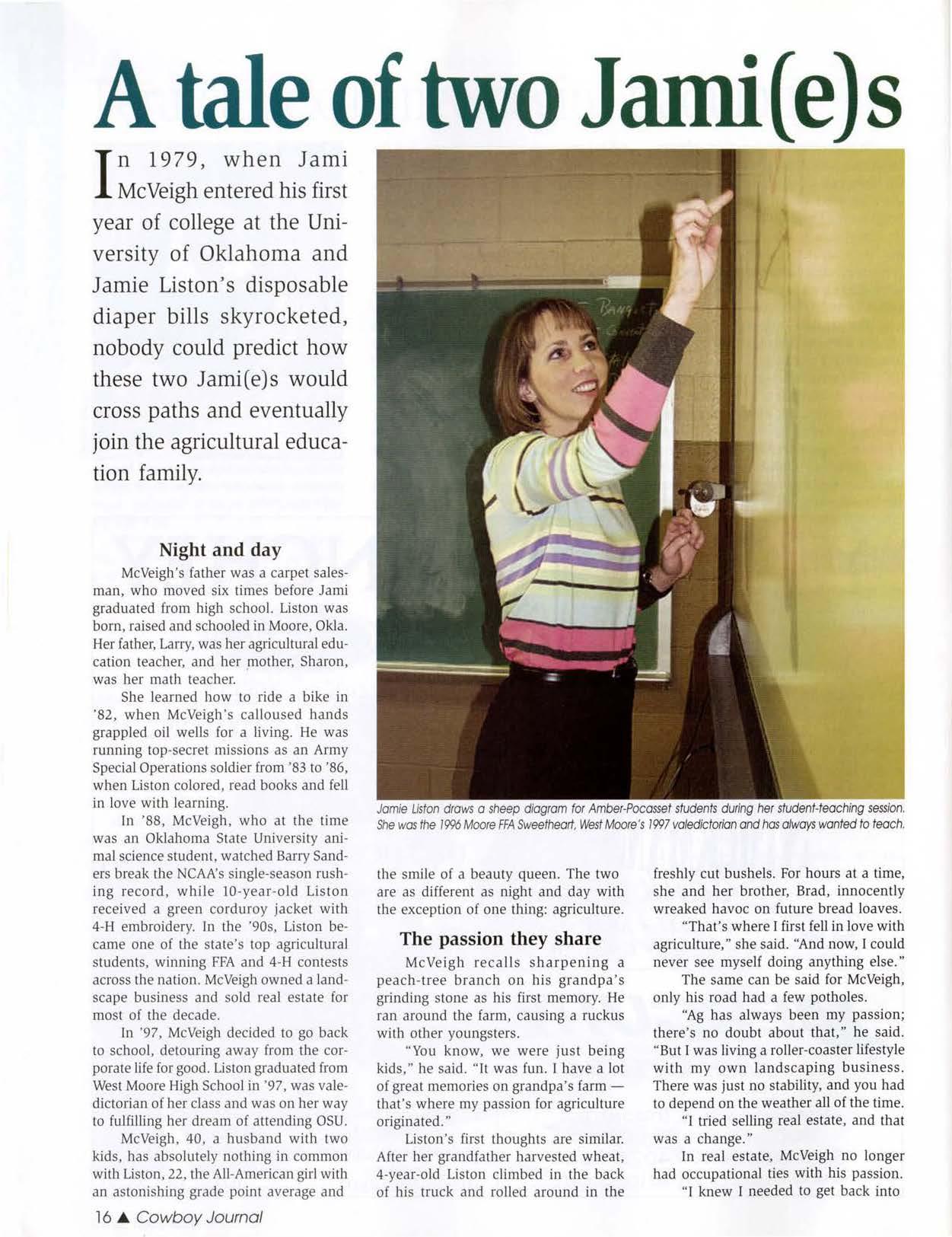
Liston, however, could relate to her Amber-Pocasset students. After all, she was Moore's l996 FFA Sweetheart.
"I love being around kids and teaching them," she said. "The greatest thing is when one of them raises his hand and answers a question that you had just thrown out for discussion.
"It's so amazing how anxious they are to learn. And they're full of surprises. You never know when one is going to say something that totally changes your day. You can see it in their eyes. They're all very, very special."
It takes a special kind of person to be a teacher, too - especially in a competitive job market where only 63 percent of agricultural education graduates teach. The rest are attracted to more lucrative occupations.
For example, chemical salesmenone of the more popular occupations for agricultural education graduates - can potentially earn anywhere from $30,000 to $60,000 in their first year out of college, making the teaching profession seem less lucrative.
Actually, agricultural education teachers receive a set sala1y of $35,000, which is $10,000 more than the earnings of a rookie general education teacher. Nonetheless, there is a shortage of 400 agricultural education teachers across the nation, according to an agricultural education supply and demand study.
"Oklahoma has always been thought highly of as an ag education state, and we've never had a problem with a Jack of teachers like the rest of the nation. But, this past year it's really gotten scary," said Eddie Smith, sme FFA adviser. "There are just so many U1ings that pay so much more. Granted, you have to work hard and it doesn't pay real well, but it's really rewarding."
Just ask Liston. When she speaks of her sllldents, she'll spout off a LOminute description of each one, bragging about how smart they are and how much potential they have.
"Students like Jamie are a rarity," said Bill Weeks, OSU professor of agricultural education. "If she could live off of it, I think she would probably do it for free.
"Many have her desire to teach, but, unfortunately, not many people have her academic preparation. There are a lot of people who think they want to be teachers and they just can't hack it."
To become an agricultural education teacher, a student must have a 2.5 CPA, pass a foreign language competency exam and a slew of teacher tests that cost $400. They alsowork l2 weeks without pay as a student teacher. Weeks said these requirements have resulted in fewer teachers being certified.
"We don't need to lower the standards, however," Weeks said. "! would rather a program close because we don't have a teacher than keep it going by hiring a teacher who is not qualified."
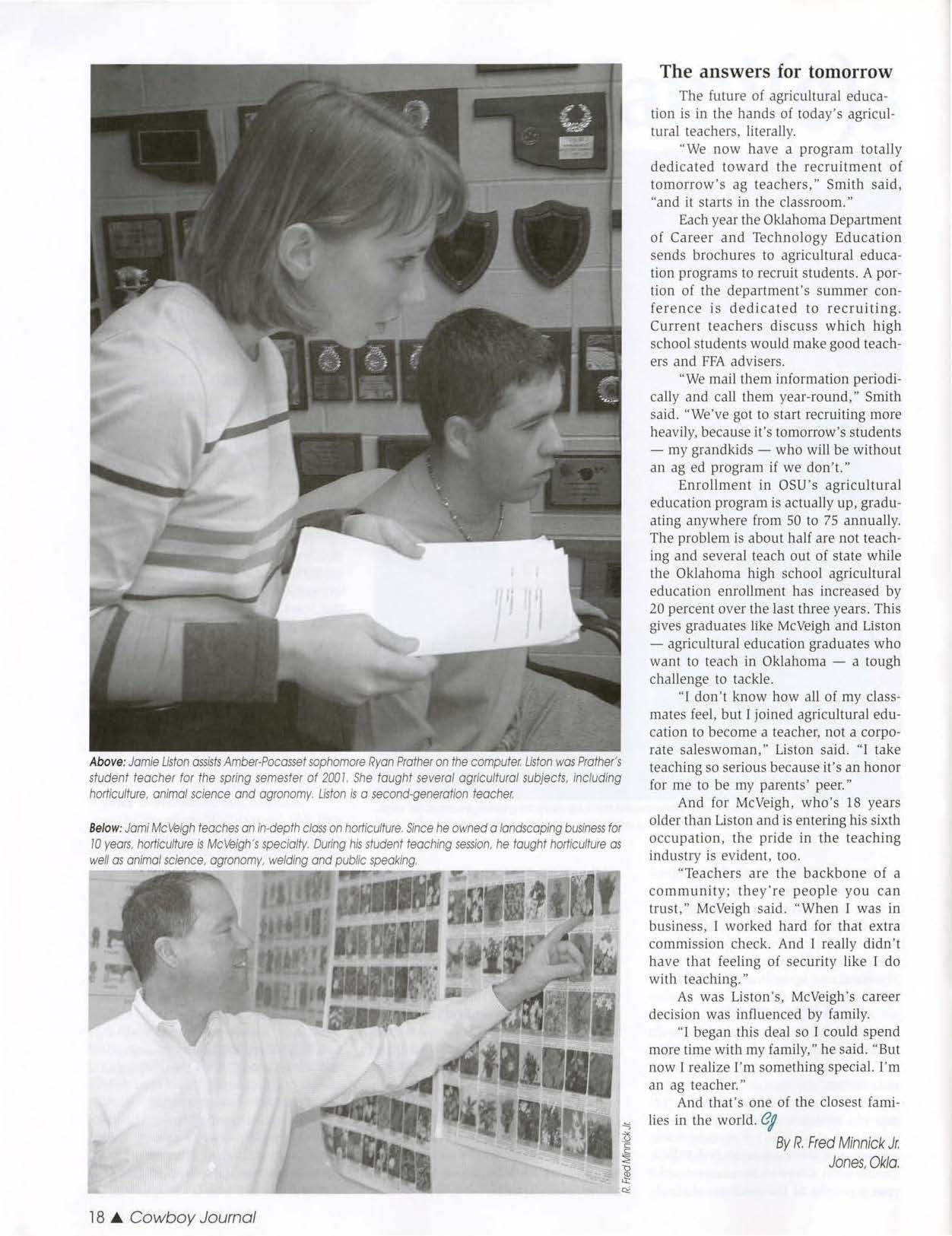
Above:JamieUstonassistsAmber-PocassetsophomoreRyonPratheron thecomputer.ListonwasProther's studentteacher for fhe springsemesterof 2001.Shetaught severalagriculturalsubjects.Including horticulture,animalscienceand agronomy.Ustonis o second-generationteacher.
The future of agricultural education is in the hands of today's agricultural teachers, literally.
"We now have a program totally dedicated toward the recruitment of tomorrow's ag teachers," Smith said, "and il starts in the classroom."
Each year the Oklahoma Department of Career and Technology Education sends brochures to agricultural education programs to recruit students. A portion of the department's summer conference is dedicated to recruiting. Current teachers discuss which high school students would make good teachers and FFA advisers.
"We mail them information periodically and call them year-round," Smith said. "We've got to start recruiting more heavily, because it's tomorrow's students - my grandkids - who will be without an aged program if we don't."
Enrollment in OSU's agricultural education program is actually up, graduating anywhere from 50 to 75 annually. The problem is about half are not teaching and several teach out of slate while the Oklahoma high school agricultural education enrollment has increased by 20 percent over the last three years. This gives graduates like Mcveigh and Liston - agricultural education graduates who want to teach in Oklahoma - a tough challenge to tackle.
"I don't know how all of my classmates feel, but I joined agricultural education to become a teacher, not a corporate saleswoman," Liston said. "l take teaching so serious because it's an honor for me to be my parents' peer."
And for McVeigh, who's 18 years older than Liston and is entering his sixth occupation, Lhe pride in the teaching industry is evident, too.
"Teachers are the backbone of a community; they're people you can trust," McVeigh said. "When I was in business, I worked hard for that extra commission check. And 1 really didn't have that feeling of security like I do with teaching."
As was Liston ·s, McVeigb's career decision was influenced by [amily.
"I began thjs deal so I could spend more time with my family," he said. "Bul now I realize I'm something special. I'm an ag teacher."
And that's one of the closest families in the world. 8/
Oklahoma
I strongly encourage OSU agricultural students to major in agronomy and entomology.
Robert Robbins, Class of 1960
CampusParkApartments
Wheve the ol'\ly thi"'<"jf""iffi <j if Mor-" ClubhouseWith PoolTable,PingPong,Lounge& TVs SwimmingPool• HotTub• FitnessCenter ComputerLabWith FaxandCopier Washer& Dryerin EveryUnit MonitoredIntrusionAlarms
FullyFurnished 1, 2, 3, 4 Bedroom
J•
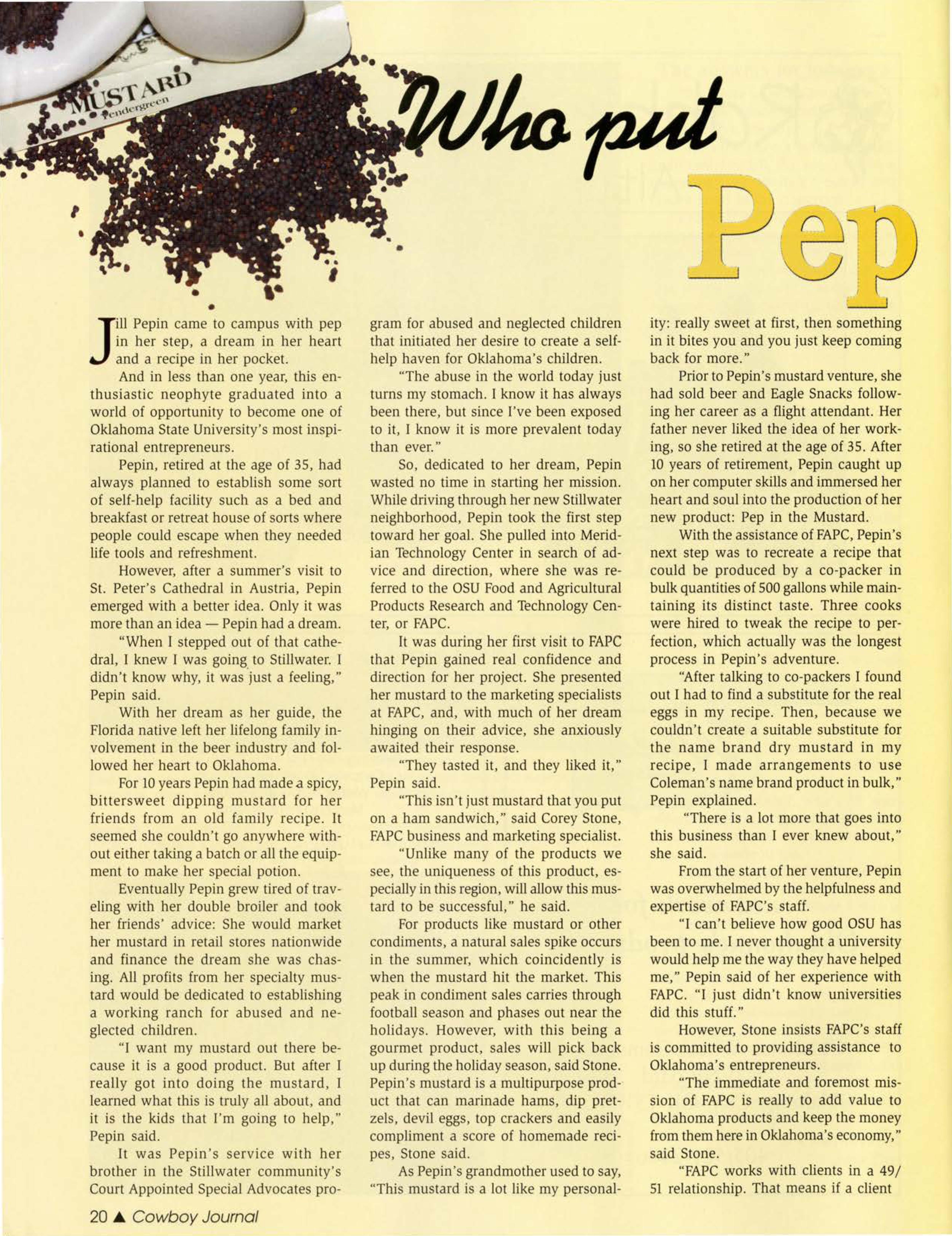
ill Pepin came to campus with pep in her step, a dream in her heart and a recipe in her pocket.
And in less than one year, this enthusiastic neophyte graduated into a world of opportunity to become one of Oklahoma State University's most inspirational entrepreneurs.
Pepin, retired at the age of 35, had always planned to establish some sort of self-help facility such as a bed and breakfast or retreat house of sorts where people could escape when they needed life tools and refreshment.
However, after a summer's visit lo St. Peter's Cathedral in Austria, Pepin emerged with a better idea. Only it was more than an idea - Pepin had a dream.
"When I stepped out of that cathedral, I knew r was going to Stillwater. I didn't know why, it was ·just a feeling," Pepin said.
With her dream as her gu.ide, the Florida native left her lifelong family involvement in the beer industry and followed her heart to Oklahoma.
For 10 years Pepin had made a spicy, bittersweet dipping mustard for her friends from an old family recipe. ll seemed she couldn't go anywhere without either tak.ing a batch or all the equipment to make her special potion.
Eventually Pepin grew tired of traveling with her double broiler and took her friends' advice: She would market her mustard in retail stores nationwide and finance the dream she was chasing. All prolits from her specialty mustard would be dedicated to establishing a working ranch for abused and neglected children.
"I wam my mustard out there because it is a good product. But after r really got into doing the mustard, I learned wl1at this is truly all about, and it is the kids that I'm going lo help," Pepin said.
It was Pepin's service with her brother in the Stillwater community's Court Appointed Special Advocates pro-
gram for abused and neglected children that initiated her desire to create a selfhelp haven for OkJaboma's children.
"The abuse in the world today just turns my stomach. I know it has always been there, but since I've been exposed to it, I know it is more prevalent today than ever."
So, dedicated to her dream, Pepin wasted no time in starting her mission. While driving through her new Stillwater neighborhood, Pepin took the first step toward her goal. She pulled into Meridian Technology Center in search of advice and direction, where she was referred to the OSU Food and Agricultural Products Research and Technology Center, or FAPC.
It was during her first visit to FAPC that Pepin gained real confidence and direction for her project. She presented her mustard to the marketing specialists at FAPC, and, with much of her dream hinging on their advice, she anxiously awaited their response.
"They tasted it, and they liked it," Pepin said.
"This isn't just mustard that you put on a ham sandwich," said Corey Stone, FAPC business and marketing specialist.
"Unlike many of the products we see, the uniqueness of this product, especially in this region, will allow th.is mustard lo be successful," he said.
For products like mustard or other condiments, a natural sales spike occurs in the summer, which coincidently is when the mustard hit the market. This peak in condiment sales carries through football season and phases out near the holidays. However, with this being a gourmet product, sales will pick back up during tl1e holiday season, said Stone. Pepin's mustard is a multipurpose product that can marinade hams, dip pretzels, devil eggs, top crackers and easily compliment a score of homemade recipes. Stone said.
As Pepin's grandmother used to say, "This mustard is a lot like my personal-
__J
ity: really sweet at first, then something in it bites you and you just keep coming back for more."
Prior to Pepin's mustard venture, she had sold beer and Eagle Snacks following her career as a flight attendant. Her father never liked the idea of her working, so she retired at the age of 35. After 10 years of retirement, Pepin caught up on her computer skills and immersed her heart and soul into the production of her new product: Pep in the Mustard.
With the assistance of FAPC,Pepin's next step was to recreate a recipe that could be produced by a co-packer in bulk quantities of 500 gallons while maintaining its distinct taste. Three cooks were hired to tweak the recipe to perfection, which actually was the longest process in Pepin's adventure.
"After talk.ing to co-packers I found out I had to find a substitute for the real eggs in my recipe. Then, because we couldn't create a suitable substitute for the name brand dry mustard in my recipe, I made arrangements to use Coleman's name brand product in bulk," Pepin explained.
"There is a lot more that goes into this business than I ever knew about," she said.
From the start of her venture, Pepin was overwhelmed by the helpfulness and expertise of FAPC's staff.
"I can't believe how good OSU has been to me. I never thought a university would help me the way they have helped me," Pepin said of her experience with FAPC. "I just d.idn·1 know universities did this stuff."
However, Stone insists FAPC's staff is committed to providing assistance to Oklahoma's entrepreneurs.
"The immediate and foremost mission of FAPC is really to add value to Oklahoma products and keep the money from them here in Oklahoma's economy," said Stone.
"FAPC works with clients in a 49/ 51 relationship. That means if a client
wiU do SI percent of the work, we will be happy to pick up the rest, just as long as lhe client retains ownership of rhe product."
From building business plans and conducting workshops to performing recipe tests and marketing home products, FAPC'sservices are available to any Oklahoma entity, whether it be Oklahomans, Oklahoma companies or national companies marketing in Oklahoma.
"My time and other marketing specialists' time is always free for Oklahomans," said Stone. "You can be assured it is always covered."
FAPC was established in 1996 by Oklahoma legislation 10 add value to Oklahoma commodili.es aml keep I.Ile revenue in the state. Therefore, FAPC's services are based on a client's ability to pay. Equipment and facility usage is charged at cost unless it is used by a large established company, who lhen pays full price for the facilities, equipment usage and utilities. However, in any case, FAPC's services always will be less expensive than private services, said Stone.
With the guidance of FAPC's specialists, less than a year has passed since Pepin's vision in Austria. Pep in the Mustard is already a hot item in private homes throughout Oklahoma with the potential to be on store shelves in the near future, but Pepin admits the biggest challenge of her venture is patience.
"l have my dream. Now l just have to slow down and let it happen,"Pepinsaid.
Pepin continues to follow the philosophy instilled in her by her father that has guided her throughout her venture: "You have to sell yourself before you can ever sell a product. Making friends is our business, and you can sell 10 for $4 before you can ever sell one for $40."
Alrhough it is important to Pepin that
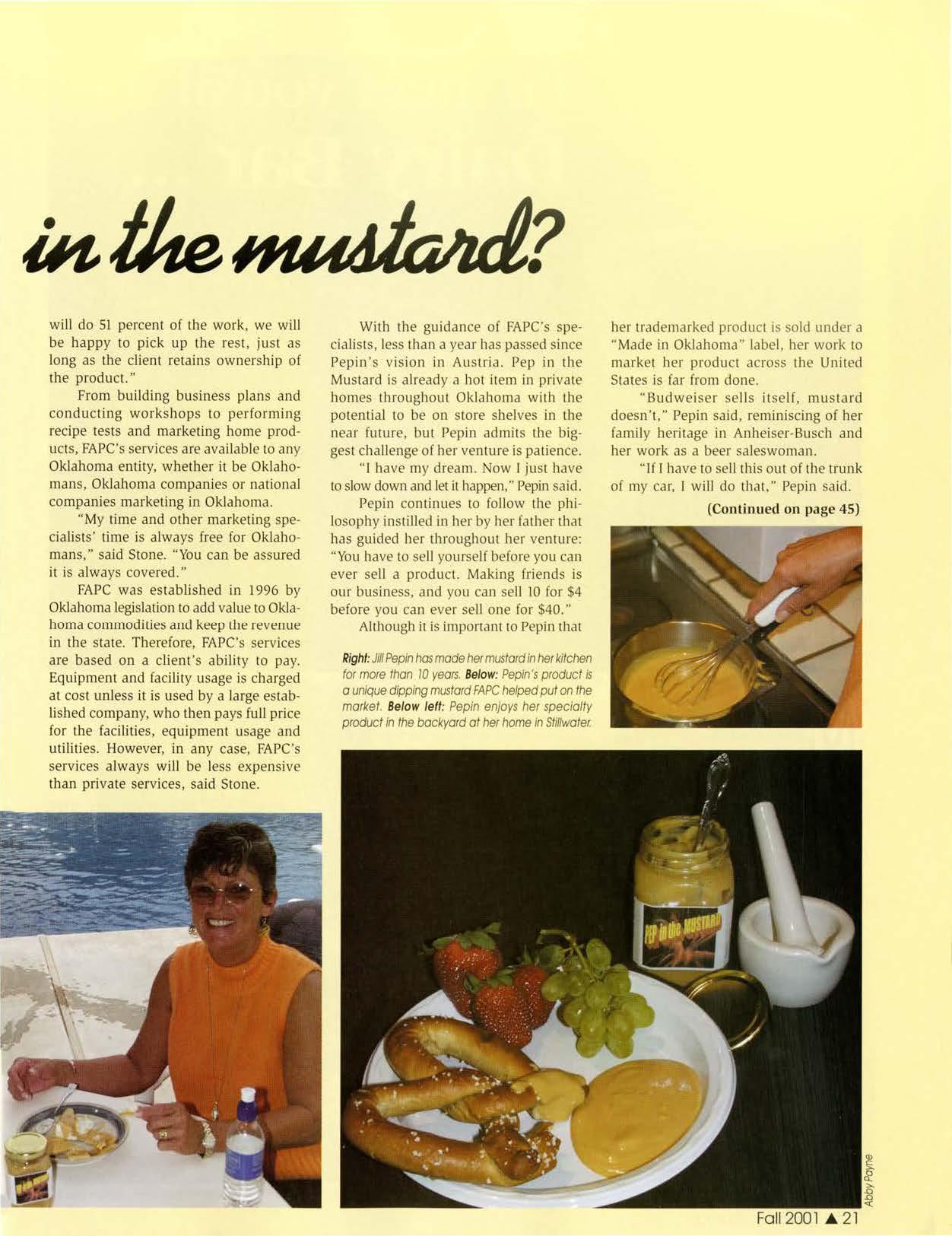
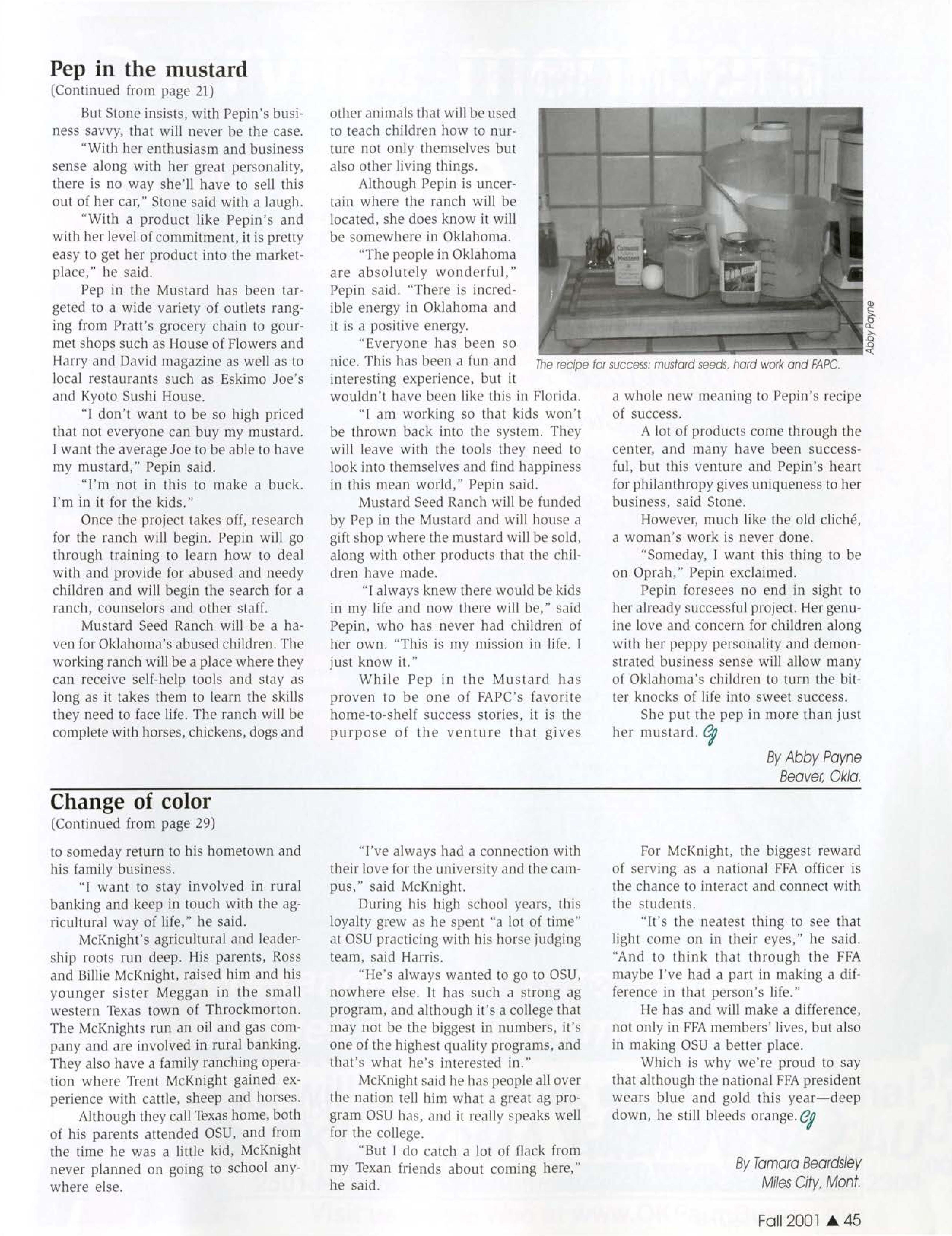
Righi:JillPepinhosmodehermustardinherkitchen for morethan 10years.Below:Pepin'sproductIs o uniquedippingmustardFAPChelpedput on the market.Belowleft: Pepinenjoysher specialty productin thebackyardof herhomeInStil/Woter
her trademarked product is sold under a ''Made in Oklahoma·· label, her work to market her product across the United States is far from done.
"Budweiser sells itseJr, mustard doesn't," Pepin said, reminiscing of her family heritage in Anheiser-Busch and her work as a beer saleswoman.
"If I have 10 sell this out of the trunk of my car, I will do that," Pepin said.
Mornings come early at the old Dairy Building, just like 1hey 1ave for more than 70 years.
While the hours have not changed much and the outside still looks the same, the former home of the dairy science department has changed from a dairy product processing plant and classroom into a main stay in Oklahoma State University's College of Agricultural Sciences and Natural Resources.
The building is the oldest within the college and has overcome time and technology to become a center of growth.
"The Dairy Building, at the time it was built, was on the fringe oJ campus. It has survived a long Lime," said Stanley Gilliland, food microbiologist formerly housed in the building.
The outside has not changed much since it was built in the 1920s.The threesto1y, rectangular building still has window-lined walls and some of the original landscaping. The east entrance still has the ornate scrollwork and name plaque above the door.
It almost gets lost in the surround-
ings of more modern buildings, but the Dairy Building maintains the senseof dignity it had in 1928 when 1he dairy science department moved in.
The pride of OSU's dairy department, the state-of-the-art facility housed work areas for dairy manufacturing, refrigeration equipment and laboratories.
The second floor held offices, teaching and research laboratories, and classrooms. The top floor was shared with the agricultural economics department and included an auditorium with motion picture and slide equipment.
"II was a pilot plant designed to provide service to the dairy industry,'' Gilliland said.
In the '20s and '30s, the dairy industry in Oklahoma was booming, despite financial trouble from the Depression, and Oklahoma A&M officials noticed a significant increase in dairy course enrollment.
Arthur C. Baer, head of the dairy department. found a way to incorporate the high number of students in the department and the need for hands-on
teaching and experience into the daily demands of a dafry.
Students could learn about and work in the production and processing areas of the dairy industry.
Experience and weekly pay were just a few of the benefits. They also enjoyed sampling new batches of milk and ice cream as they were finished.
"There were a lot of students who went th rough the department." said Gilliland, also a dairy science graduate.
Over the next 20 years, t11eDairy Building became a staple in OSU society. When the new dairy barn was built west of campus, the dairy plant was able to increase the amount of milk processed. At one time it provided most of campus with fresh milk.
"For a long time, we sold it in halfpilll bottles," said Curtis Richardson, retired dairy extension specialist. "We would gather them back up. wash them and use them again."
But milk was 1101 the only product needed to satisfy student and staff appetites for fresh dairy products. Former
faculty members said ice cream was sold on the first floor for "next to nothing," and during the summer, sometimes given away to keep it from spoiling.
"They had chocolate, strawberry and vanilla," said Freddie Gant, retired departmental secretary.
As far as the rest of the building, classes were held on the second and third floors. and the dairy department had several offices there.
Not much changed in the Dairy Building until the current Animal Science Building was built in the '70s. The dairy science department was merged with several others to form a new animal science department.
According to former departmental staff, when the Animal Science Building was built, there was some concern about the future of the dairy product sales room.
The products were as popular as ever, and many OSU faculty and alumni were worried about it closing.
"The milk was wonderful, refreshing and only cost a dime," Gant said.
The sales room stayed open for a few more years until the Student Union convened it into the snack bar which present students know as the Dairy Bar.
Today, the Dairy Building is home to part of the horticulture and landscape architecture department.
The second and third floors hold studios and graduate student offices that moved across the street a few years ago because of space problems in Agricultural Hall.
The layout of the rooms works well with the needs of the department and brightly colored models and diagrams can be seen through the windows.
Fire protection services and the geology department have equipment and records stored throughout the building.
Perhaps the most well-known element in today's Dairy Building is the little snack bar.
Located in the southeast corner of the building, the Dairy Bar, as it has been affectionately named over the years, is run by Student Union Food Services.
Nelda Henry, manager of the snack bar, said OSU students and employees were asking for a place to eat on the western side of campus. She became manager of the Dairy Bar in the '80s and has been there since.
"This is the best kepi secret on campus," Henry said.
The faces behind the counter at the Dairy Bar are familiar and never anything but friendly. This may be part of the reason the customers are so loyal.
"We just about know what they drink when they walk in the door," Henry said.
The Dairy Bar has become a popular
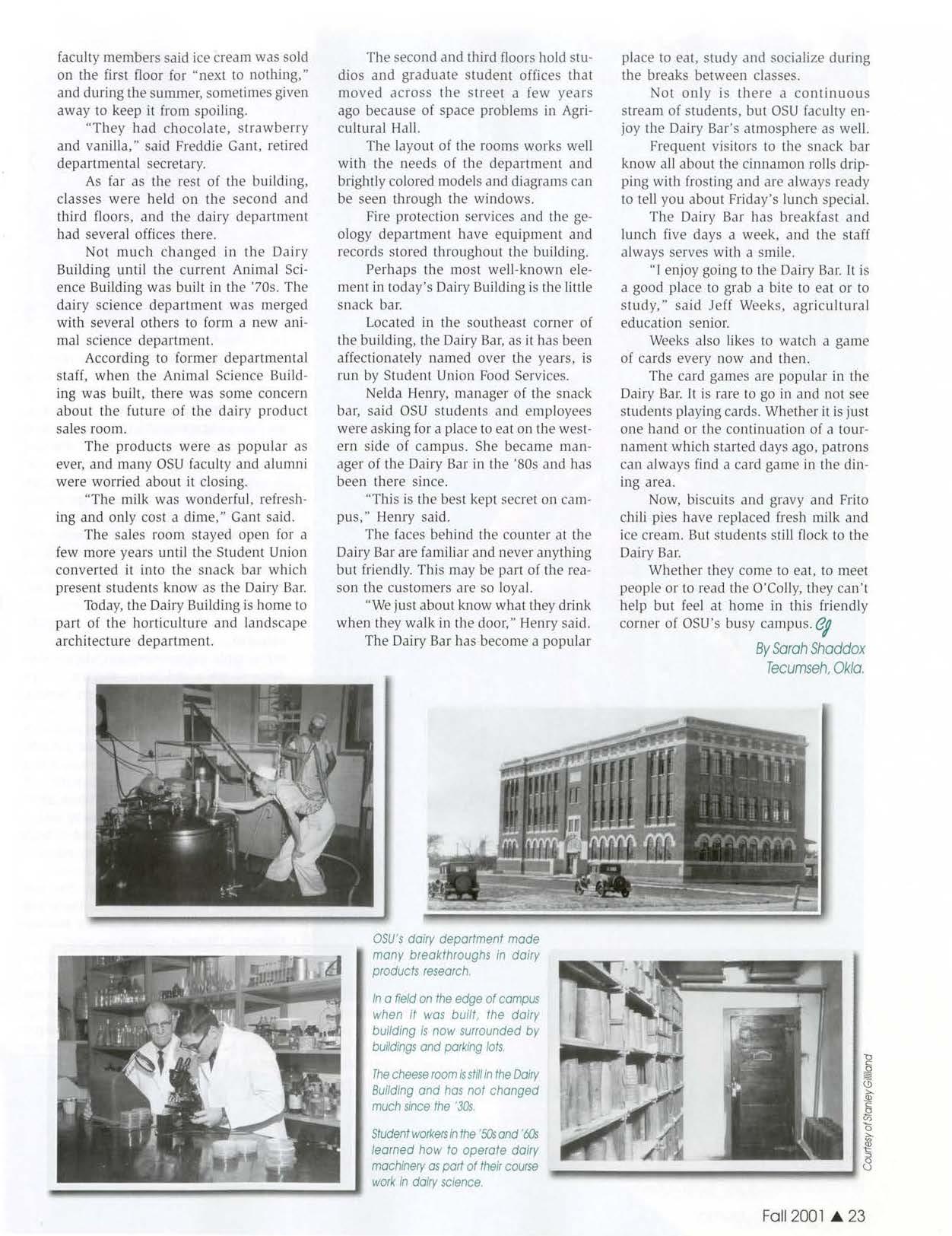
Ina fieldon theedgeof campus when It was built the dairy building Is now surroundedby buildingsand parkinglots.
ThecheeseroomIss11/1 in theDairy Buildingand hos not changed muchsincethe 30s.
StudentworkersInthe '50sond'60s learned how to operate dairy machineryasport of theircourse worl<In dairyscience.
place to eat, study and socialize during the breaks between classes.
Not only is there a continuous stream of students, but OSU faculty enjoy the Dairy Bar's atmosphere as well.
Frequent visitors to the snack bar know all about the cinnamon rolls dripping with frosting and are always ready to tell you about Friday's lunch special.
The Dairy Bar has breakfast and lunch five days a week. and the staff always serves with a smile.
"I enjoy going to the Dairy Bar. lt is a good place to grab a bite to eat or to study," said Jeff Weeks, agricultural education senior.
Weeks also likes to watch a game of cards every now and then.
The card games are popular in the Dairy Bar. It is rare to go in and not see students playing cards. Whether it is just one hand or the continuation of a tournament which started days ago, patrons can always find a card game in the dining area.
Now, biscuits and gravy and Frito chili pies have replaced fresh milk and ice cream. But students still flock to U1e Dairy Bar.
Whether they come to eat, to meet people or to read the O'Colly, they can't help but feel at home in this friendly corner of OSU's busy campus. e;
BySarahShaddox Tecumseh,Okla.
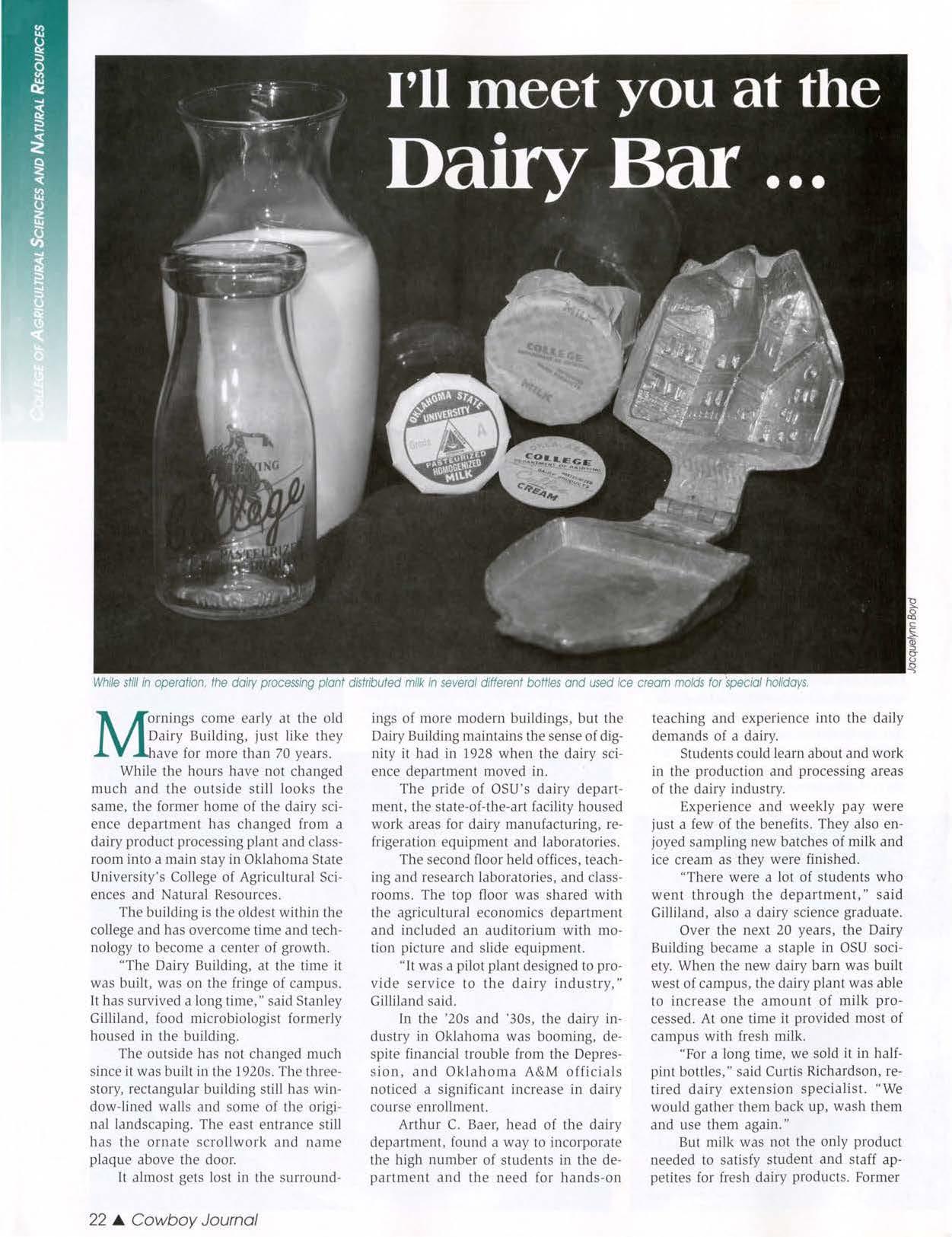
osu·s dai1ydepartment made many breakth10ughsIn dairy productsresearch.
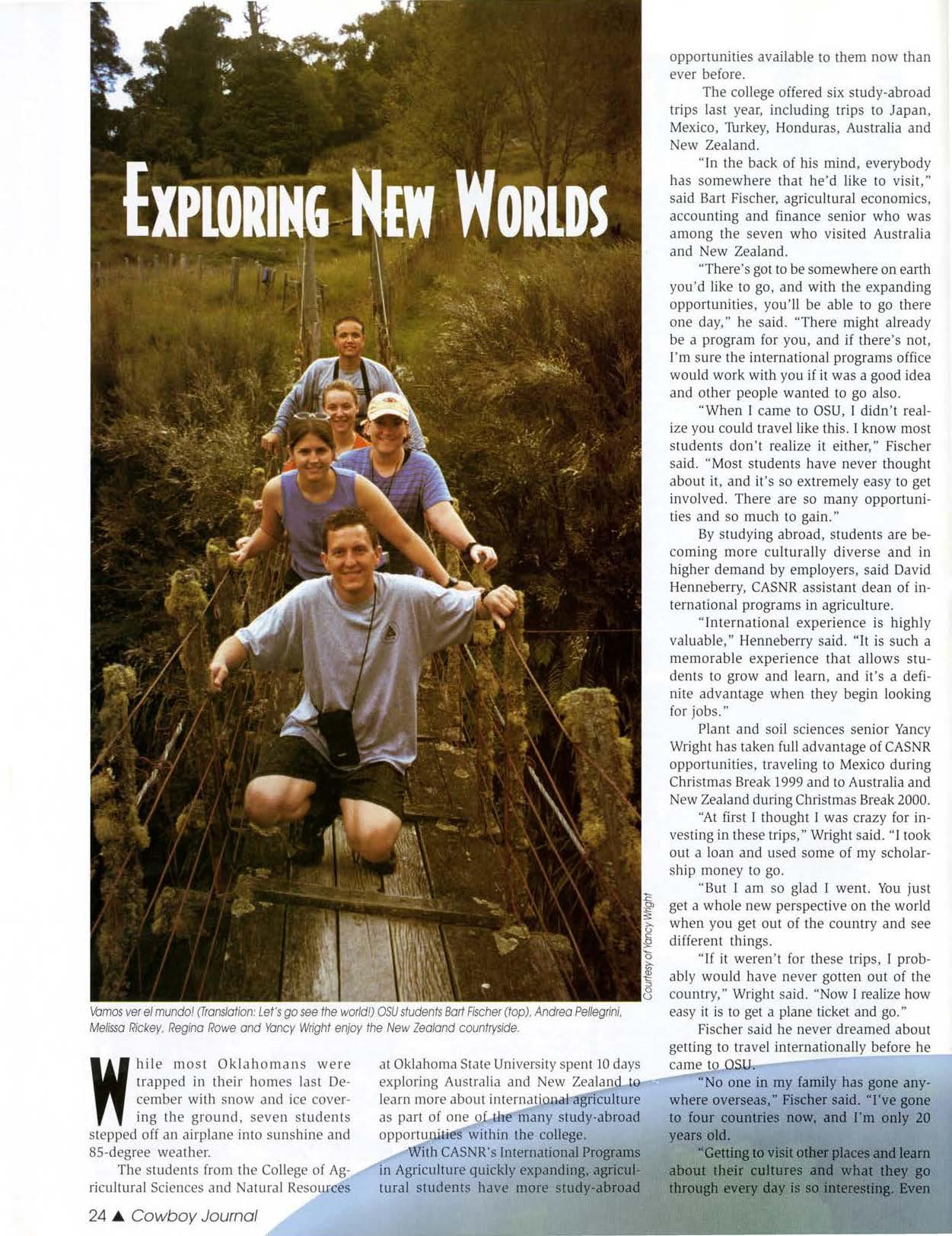
While most Oklahomans were trapped in their homes last December with snow and ice covering the ground, seven students stepped off an airplane into sunshine and 85-degree weather.
The students from the College of Agricultural Sciencesand Natural Resources
Cowboy
opportunities available to them now than ever before.
The college offered six study-abroad trips last year, including trips to Japan, Mexico, Turkey, Honduras, Australia and New Zealand.
"In the back of hls mind, everybody has somewhere that he'd like to visit," said Bart Fisch.er,agricultural economics, accounting and finance senior who was among the seven who visited Australia and New Zealand.
"There's got to be somewhereon earth you'd like to go, and with the expanding opportunities, you'll be able to go there one day," he said. "There might already be a program for you, and if there's not, I'm sure the international programs office would work with you if it was a good idea and other people wanted to go also.
"When I came to OSU, I didn't realize you could travel like this. I know most students don't realize it either," Fischer said. "Most students have never thought about it, and it's so extremely easy to get involved. There are so many opportunities and so much to gain."
By studying abroad, students are becoming more culturally diverse and in higher demand by employers, said David Henneberry, CASNR assistant dean of international programs in agriculture.
''International experience is highly valuable," Henneberry said. "It is such a memorable experience that allows students to grow and learn, and it's a definite advantage when they begin looking for jobs.··
Plant and soil sciences senior Yancy Wright has taken full advantage of CASNR opportunities. traveling to Mexico during Christmas Break 1999and to Australia and New Zealandduring Christmas Break2000.
"Al first I thought I was crazy for investing in these trips," Wright said. "I took out a loan and used some of my scholarship money lo go.
"But I am so glad I went. You just } get a whole new perspective on the world g when you get out of the country and see :l2 different things.
0
!at Oklahoma StateUniversity spent 10days exploring Australia and New Zealan.d--to learn more about international~ulture as part of one _9,f,.-thmany study-abroad opportuoitieswithin the college.
ith CASNR'sfnternational Programs in Agriculture quickly expanding, agricultural students have more study-abroad
"If it weren't for these trips, I prob-
ably would have never gotten out of the country," Wright said. "Now I realize how easy it is to get a plane ticket and go."
Fischer said he never dreamed about getting to travel internationally before he came to OSU
"No one in my family has gone anywhere overseas," Fischer said. "I've gone to four countries now, and I'm only 20 years old.
NGettingto visit otherplacesand learn about their cultures what they go through every day is so mte~. Even
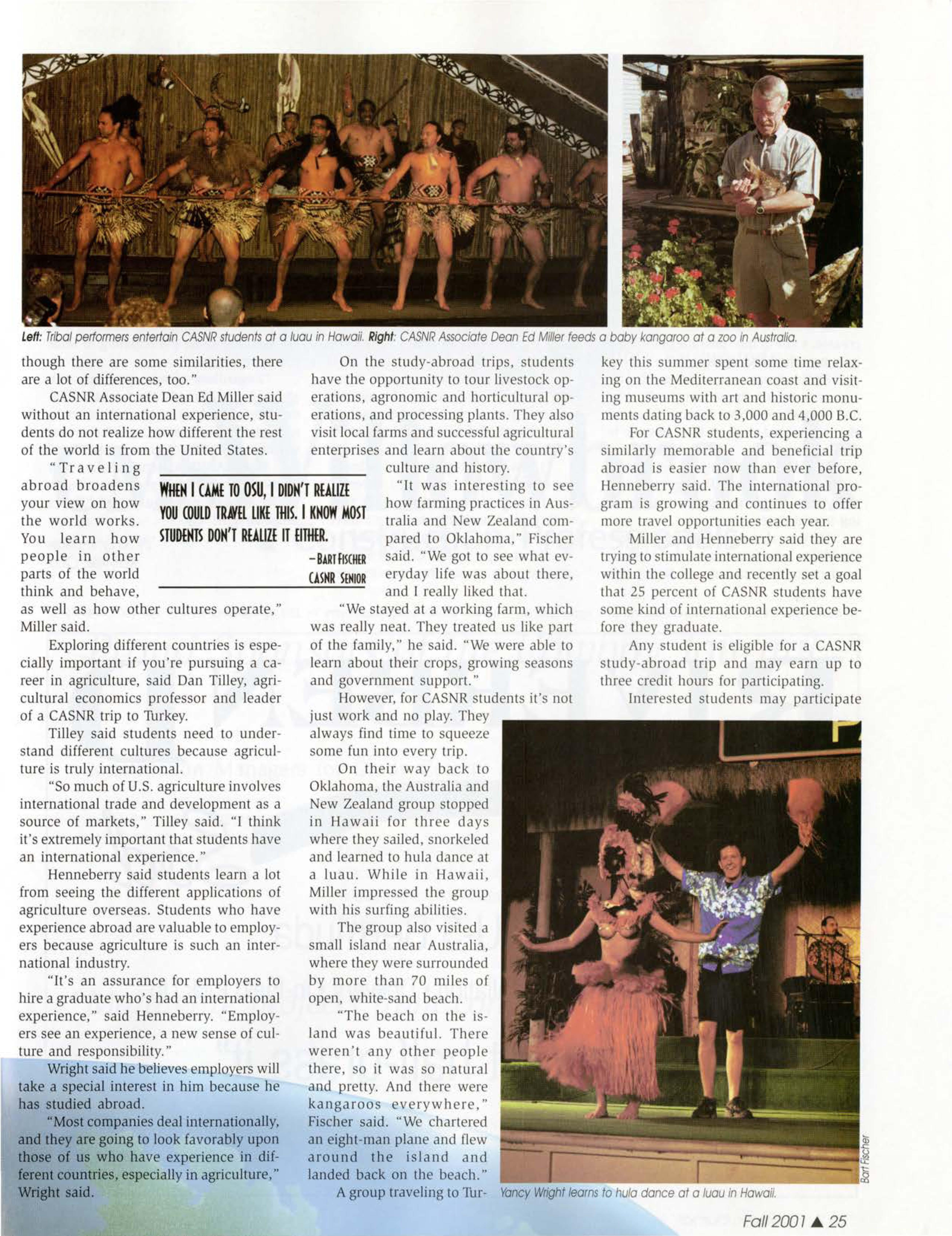
Lefl:TribalperformersentertainCASNRstudentsat a luauin Hawaii.Righi:CASNRAssociateDeanEdMillerfeedsa babykangarooof a zooin Australia. though there are some similarities, there On th tudy-abroad Lrips, students key this summer pent some time relaxare a lot o[ differences, too." have the opportunity to Lour Livestockop- ing on the M diterranean coast and visit-
CASNRAssociate Dean Ed Miller said erations, agronomic and horticultural op• ing museums with art and historic monuwitbout an international experience slu- erations, and processing plants. They also ments dating back to 3,000 and 4,000 B.C. dents do not realize how different the rest visit local farms and successfulagricultural For CAS R students, experiencing a of the world is from the United States. ent rprises and learn about th country's similarly memorable and beneficial trip
"Tr ave Ii n g ____________ cultur and history. abroad is easier now than ever before, abroad broadens WHEM I CAMETOOSU, I DIDM'lREALIZE "It was int resting to s e Henneb rry said. The international proyour view on how YOUCOULDTRNELLIKEIIUS. I KNOWMOST how farming practices in Aus- gram i growing and continues to offer the world works. tralia and w Zealand com- more travel opportunities each year. You learn how STUOEMJSDOM'lREALIZEITEITHER. pared to Oklahoma •• Fischer Mill rand Henneberry said they are people in other -BmfllCHERsaid. "We got to se what ev- trying to stimulate international experience parts of the world CASHRSENIORryday life was about there, within the college and recently et a goal think and behave, and I really liked tha1. that 25 percent of CAS R students have as well as how other cultures operate," "We stayed at a working farm, which some kind of international experience beMiller said. was really nea1.They treat d us like part fore they graduate.
Exploring different countries is espe- of the family." he said. "We were able to Any student is eligible for a CASNR cially important if you're pursuing a ca- learn about their crop , growing easons study-abroad trip and may earn up to reer in agriculture, said Dan Tilley, agri- and government support." thr e credit hours for participating. cultural economics professor and leader However, for CAS R students it's not Interested students may participate of a CAS R trip to Turkey. just work and no play. They
Tilley said students need to under• always find time to squeeze stand different cultures because agricul- some fun into every trip. lure is truly international.
On their way back to
"So much of U.S. agriculture involves Oklahoma, the Australia and international trade and development as a ew Zealand group stopp d source of markets," Tilley said. ··1think in Hawaii for three days it's extremely important that students have where they sailed, snorkeled an international experience." and learned to hula dance at
Henneberry said students learn a lot a luau. While in Hawaii, from seeing t.he different applications of Miller impres ed the group agriculture overseas. Students who have with his surfing abilit.ie experience abroad are valuable to employ-
The group also vi ited a ers because agricullure is such an inter· small island near Australia, national industry. where they were surround d
"Jt's an assurance for employers to by more than 70 miles of hire a graduate who's had an international open, white-sand beach. experience," said Henneberry. "Employ- "The b ach on the isers see an experience, a new sense of cul· land was beautiful. There ture and responsibility." weren ·1 any 0th r peopl
Wright said he believes employers will there, so it was so natural take a special interest in him because he and pr tty. And th re w re has studied abroad. kangaroo verywhere,"
''Most companies deal internationaliy, Fisch r said. "We chartered and they are going to look favorably upon an eight-man plane aJJdflew those of us who have experience in dif- around the island and ferent countries, especially in agriculture," land d back on th beach." Wright said.
A group traveling to Tur- YoneyWrightlearnsto hulodanceal a luauin Hawaii.
in a variety of trips. CASNR offers annual trips such as the Mexico and Honduras tour, as well as trips that occur only once such as those to Japan, to Peru, and to Australia and ew ZeaJand.
Henneberry is currently
weeks and cost from $1,000 to $4,000. Currently, only minimal financial assistance is available for students. Each student who traveled to Australia and ew Zealand
received a $500 scholarworking to schedule trips to
berry and Miller said they
ship. However, HenneTanzania and Costa Rica.
Henneberry said he is al- are working to develop adways looking for a new travel ditional funding so more opportunity [or the students students will have the opand tries to create new trips portunity to travel abroad. almost every year.
If student de man in-
Fischer said he en-
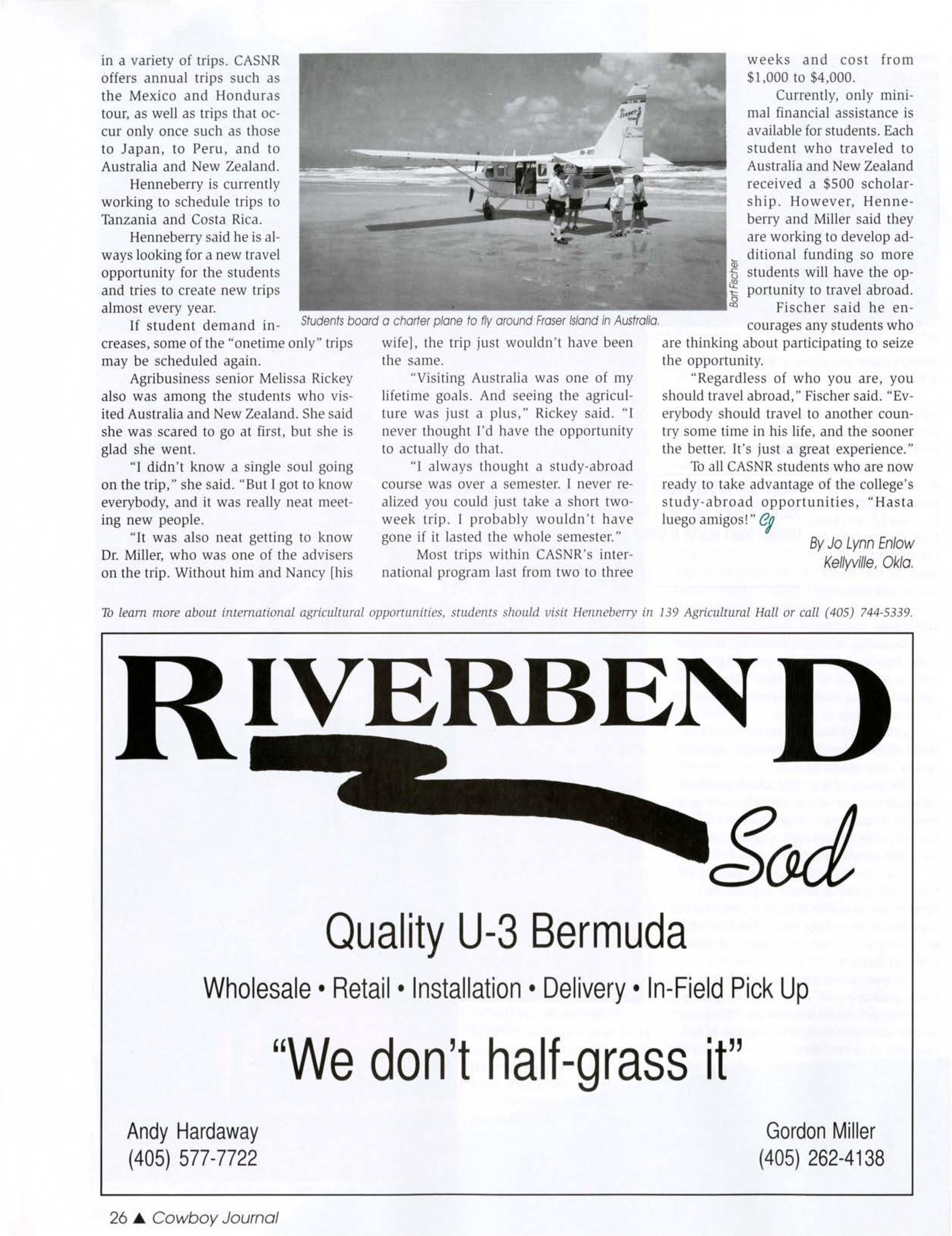
Studentsboard o charterplane to f!y aroundFraserIslandin Australia. courages any students who creases,some of he "onetime only" trips wife], the trip just wouldn't have been are thinking about participating to seize may be scheduJed again. the same. the opportunity.
Agribusiness senior Melissa Rickey "Visiting Australia was one of my "Regardless of who you are, you also was among the students who vis- lifetime goal And eeing the agricul- should travel abroad," Fischer said. "Evited Australia and New Zealand. She said ture was just a plus," Rickey said. "I erybody should travel to another counshe was scared to go at first, but she is never thought I'd have the opportunity try ome time in his life, and the sooner glad she went. to actually do that. the better. It's just a great experience."
"I didn't know a single soul going "I always thought a study-abroad To all CAS R students who are now on the trip," she said. "But I got to know course was over a semest r. I never re- ready to take advantage of the college's everybody, and it was really neat meet- alized you could just lake a hort lwo- srndy-abroad opportunities "Hasta ing new people. week trip. I probably wouldn 'I have luego amigos!'' el
'It was also neat getting to know gone if it lasted the whole semester." Dr. Miller, who was one of the advisers Most trips within CAS R's interon the trip. Without him and Nancy [his national program last from two to three
ByJo LynnEnlow Kellyville,Okla.
1b learn more about imemational agricultural opporl!lnities, students should visit Heunebeny in 139 Agrirnltural Hali or call
ConstructionProfessionals
Proud Sponsors of the Cowboy Journal
Construction Managers for Grady County and Stephens County Fairgrounds
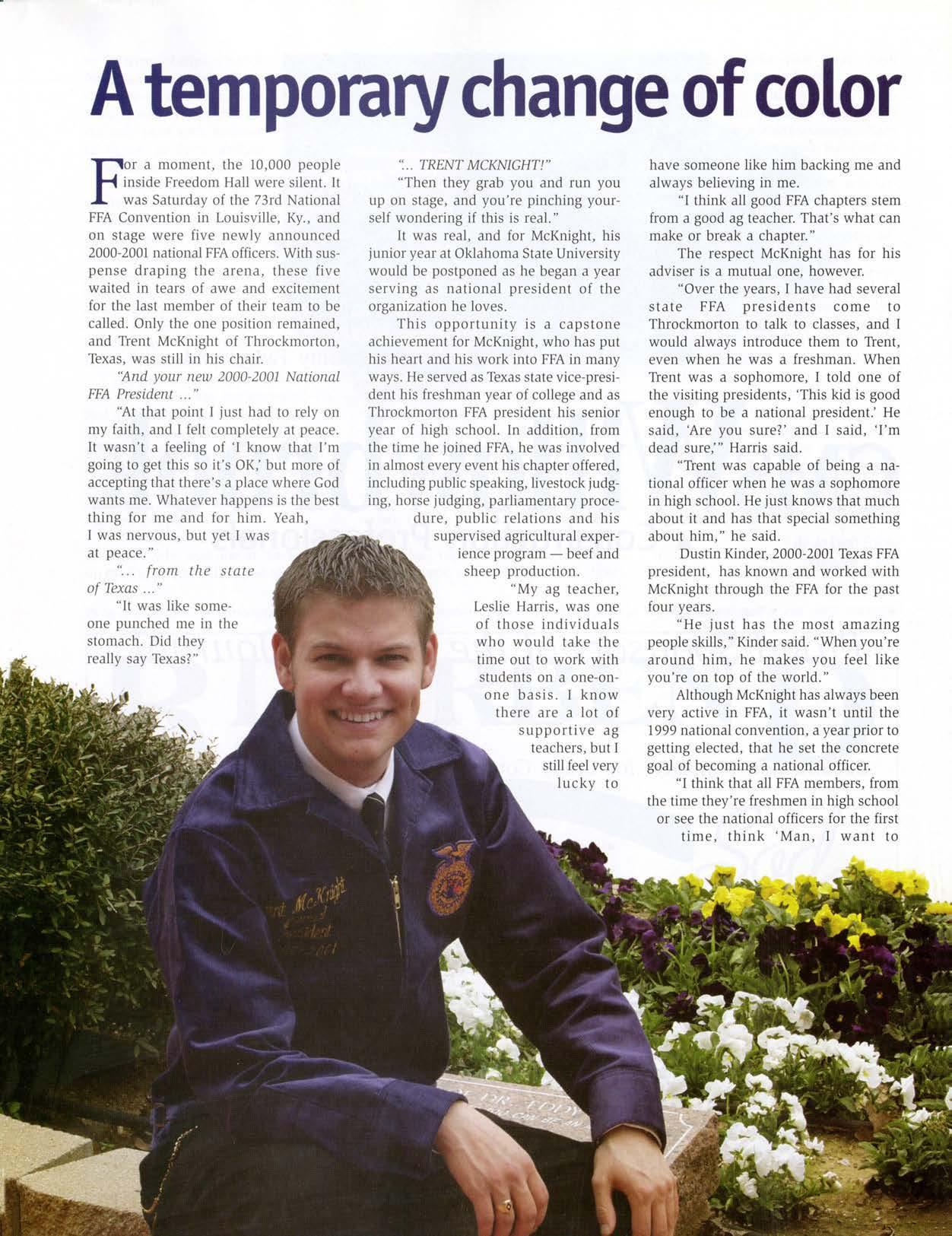
For a moment, the 10,000 people inside Freedom Hall were silent. It was Saturday of the 73rd National FFA Convention in Louisville, Ky., and on stage were five newly announced 2000-2001national FFAofficers. With suspense draping the arena, these five waited in tears of awe and excitement for the last member of their team to be called. Only the one position rema.ined, and Trent McKnight of Throckmorton, Texas, was still in his chair.
"And your new 2000-2001 National FFA President "
''At that point I just had to rely on my faith, and I felt completely at peace. II wasn't a feeling of 'I know that I'm going to get this so it's OK; but more of accepting that there's a place where God wants me. Whatever happens is the best thing for me and for him. Yeah, I was nervous, but yet I was at peace."
" from lhe slate of Texas ••
"It was like someone punched me in the stomach. Did they really say Texas?"
''. TRENT MCKNIGHT!''
"Then they grab you and run you up on stage, and you're pinching yourself wondering if this is real."
It was real, and for McKnight, his junior year at Oklahoma State University would be postponed as he began a year serving as national president of the organization he loves.
This opportunity is a capstone achievement for McKnight, who has put his heart and his work into FFA in many ways. He served as Texasstate vice-president his freshman year of college and as Throckmorton FFA president his senior year of high school. In addition, from the time he joined FFA, he was involved in almost every event his chapter offered, including public speaking, livestock judging, horse judging, parliamentary procedure, public relations and his supervised agricultural experience program - beef and sheep production.
"My ag teacher, Leslie Harris, was one of those individuals who would take the time out to work with students on a one-onone basis. I know there are a lot of supportive ag teachers, but r st ill feel very lucky lo
have someone like him backing me and always believing in me.
"I think all good FFA chapters stem from a good ag teacher. That's what can make or break a chapter."
The respect McKnight has for his adviser is a mutual one, however.
"Over the years, I have had several state FFA presidents come to Throckmorton to talk to classes, and r would always introduce them to Trent, even when he was a freshman. When Trent was a sophomore, I told one of the visiting presidents, 'This kid is good enough to be a national president.' He said, 'Are you sure?' and I said, Tm dead sure,"' Harris said.
"Trent was capable of being a national officer when he was a sophomore in high school. He just knows that much about ii and has that special something about him." he said.
Dustin Kinder, 2000-2001TexasFFA president, has known and worked with McKnight through the FFA for the past four years.
"He just has the most amazing people skills," Kinder said. "When you're around him, he makes you feel like you're on top of the world."
Although McKnight has always been very active in FFA, it wasn't until the 1999 national convention, a year prior to getting elected, that he set the concrete goal of becoming a national officer.
"I. think that all FFA members, from the time they're freshmen in high school or see the national officers for the first time, think 'Man, I want to
do that.' And I had that perception from the beginning, but it's not realistic until you reach a certain point where it starts to become something more tangible."
After serving as Texas FFAvice-president his freshman year at OSU, McKnight decided to take a year off and not be involved with the FFA.
"Many people tend to think, 'Well, I've been a state officer, so I guess the next step is running for national office.' But l wanted to see if my intentions were correct, to see if I really wanted to change members' lives, or if I was just taking the next step."
His year of thinking brought him to the conclusion that FFA was not yet out of his system, so McKnight declared his desire to be Texas' candidate for nationaJ office. He was nominated, and then the work began.
"l started preparing about three months in advance, for three hours every day, five days a week, leading up to the convention."
Then began the "most stressful week" of his life, as he went through a process of seven interviews and a test over the FFA, parliamentary procedure, agriculture and education issues.
"When you work so hard for something, and put three intensive months into training and preparing, it's hard be-
cause you begin playing the 'I wish' and 'what if' games. 'I wish I could have studied more for this,' or 'What if I could have prepared a little more in this
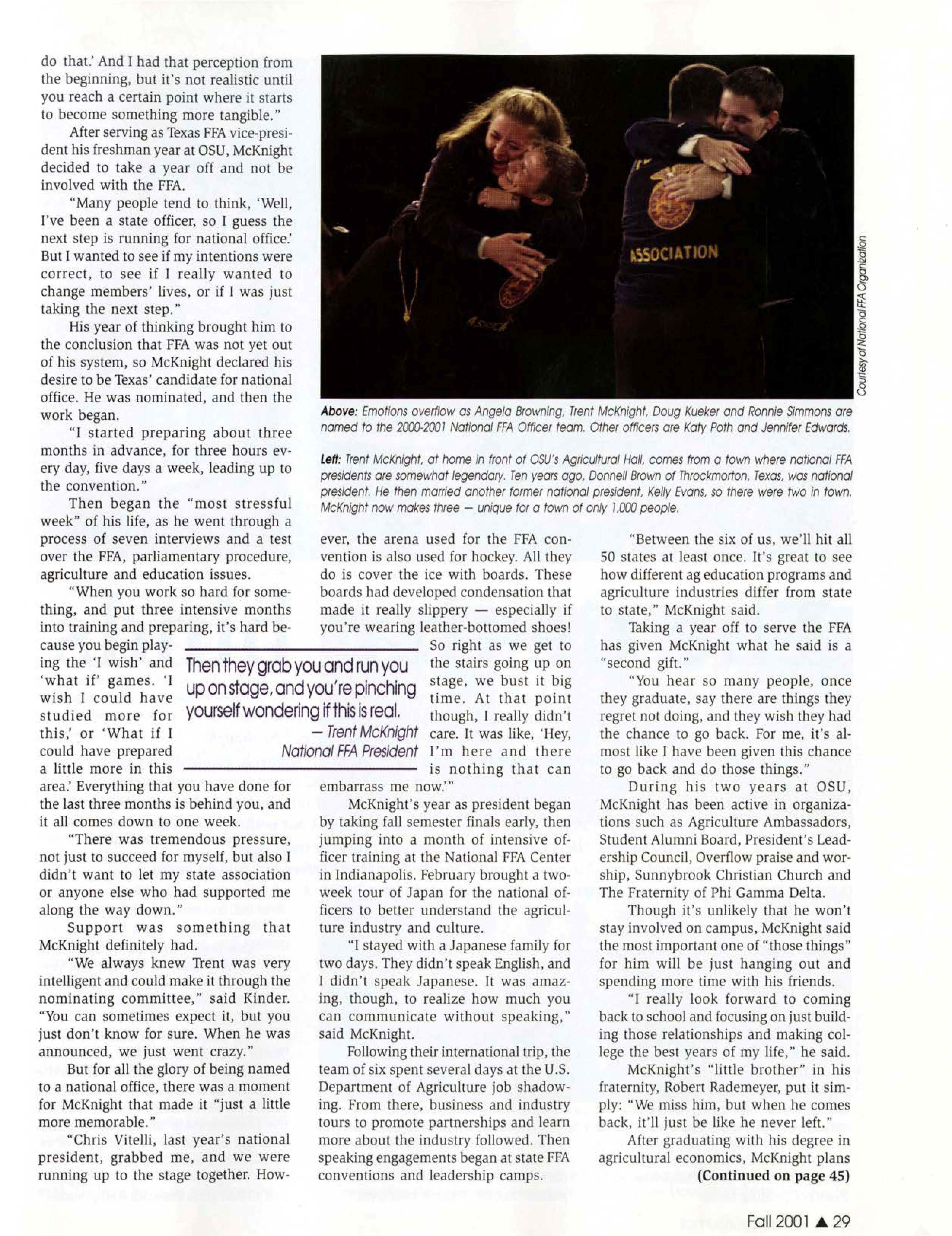
Above:Emotionsoverflowas AngelaBrowning,TrentMcKnight,DougKuekerand RonnieSimmonsare namedto the 2WJ-2001NationalFFAOfficerteam.Otherofficersore KatyPothand JenniferEdwards.
Lett:TrentMcKnight,or homeIn frontof OSU'sAgriculturalHall,comesfroma townwherenationalFFA presidentsare somewhatlegendary.Tenyearsago, DonnellBrownof Throckmorton,Texas,wasnotional president.He thenmarriedanotherformernotionalpresident,KellyEvans,so thereweretwo In town. McKnightnowmakesthree- uniquefor a townof only 1.(XXJpeople.
ever, the arena used for the FFA convention is also used for hockey. All they do is cover the ice with boards. These boards had developed condensation that made it reaJJy slippery - especially if you're wearing leather-bottomed shoes!
area.' Everything that you have done for the last three months is behind you, and it all comes down to one week.
"There was tremendous pressure, not just to succeed for mysel(, but also 1 didn't want to let my state association or anyone else who had supported me along the way down."
Support was something that McKnight definitely had.
"We always knew Trent was very intelligent and could make it through the nominating committee," said Kinder. "You can sometimes expect it but you just don't know for sure. When he was announced, we just went crazy."
But for all the glory of being named to a national office, there was a moment for McKnight that made it "just a little more memorable."
"Chris Vitelli, last year's national president, grabbed me, and we were running up to the stage together. How-
So right as we get to the stairs going up on stage, we bust it big time. At that point though, I really didn't care. It was like, 'Hey, I'm here and lhere
is nothing that can embarrass me now."'
McKnight's year as president began by taking fall semester finals early, then jumping into a month of intensive officer training at the ational FFA Center in Indianapolis. February brought a twoweek tour of Japan for the national officers to better understand the agriculture industry and cuJture.
"J stayed with a Japanese family for two days. They didn't speak English, and l didn't speak Japanese. It was amazing, though, to realize how much you can communicate without speaking," said McKnight.
Following their international trip, the team of six spent severaJ days at the U.S. Department of Agriculture job shadowing. From there, business and industry tours to promote partnerships and learn more about the industry followed. Then speaking engagements began at state FFA conventions and leadership camps.
"Between the six of us, we'll hit all SOstates at least once. It's great to see how different ag education programs and agriculture industries differ from state to state," McKnight said.
Taking a year off to serve the FFA has given McKnight what he said is a "second gift."
"You hear so many people, once they graduate, say there are things they regret not doing and they wish they had the chance to go back. For me, it's almost like I have been given this chance to go back and do those things."
During his two years at OSU, McKnight has been active in organizations such as Agriculture Ambassadors, Student Alumni Board, President's Leadership Council, Overflow praise and worship, Sunnybrook Christian Church and The Fraternity of Phi Gamma Delta.
Though it's unlikely that he won't stay involved on campus, McKnight said the most important one o[ "those things" for him will be just hanging out and spending more time with his friends.
"I really look forward to coming back to school and focusing on just building those relationships and making college the best years of my life," be said.
McKnight's "little brother" in his fraternity, Robert Rademeyer, put it simply: "We miss him, but when he comes back, it'll just be like be never left."
After graduating with his degree in agricultural economics, McKnight plans (Continued on page 45)
aeHis palms were sweating as he looked over his notes for the last time.
"I shouldn't be nervous. I've done this hundreds of times," he thought.
But as he tried to calm himself, the butterflies began fluttering in his stomach. Suddenly, the door opened into the room before him. It was time. He took a deep breath, closed his eyes and entered. Once inside, the room seemed to close in around him. He moved into position, and the reasons taker signaled for him to begin. He opened his mouth to speak but nothing came out.
He thought, "Hey! Get it together. You can't let your team down!"
Then suddenly in his mind he could see the four steers before him and he began.
"I placed this class of market steers 2, 4, 1, 3 "
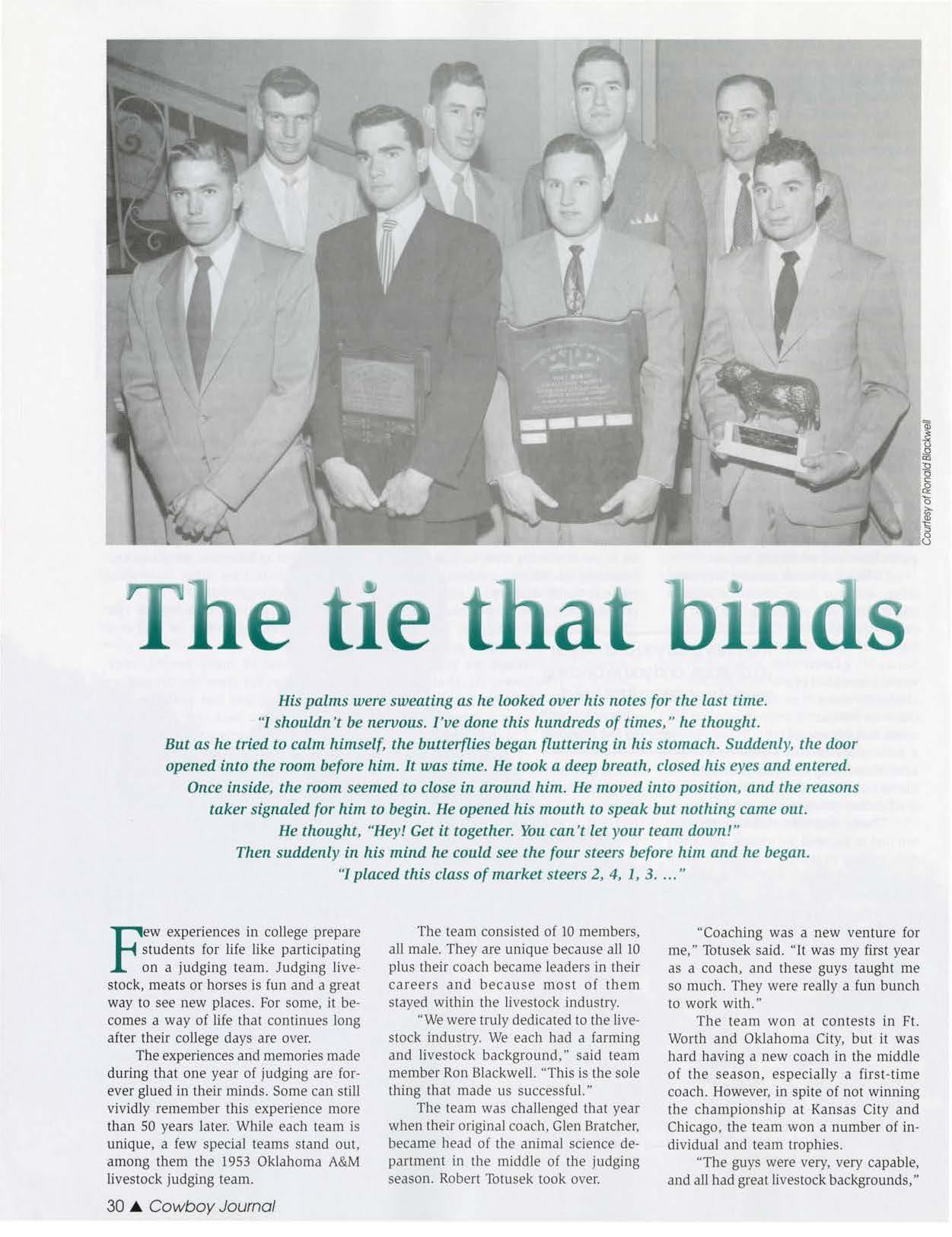
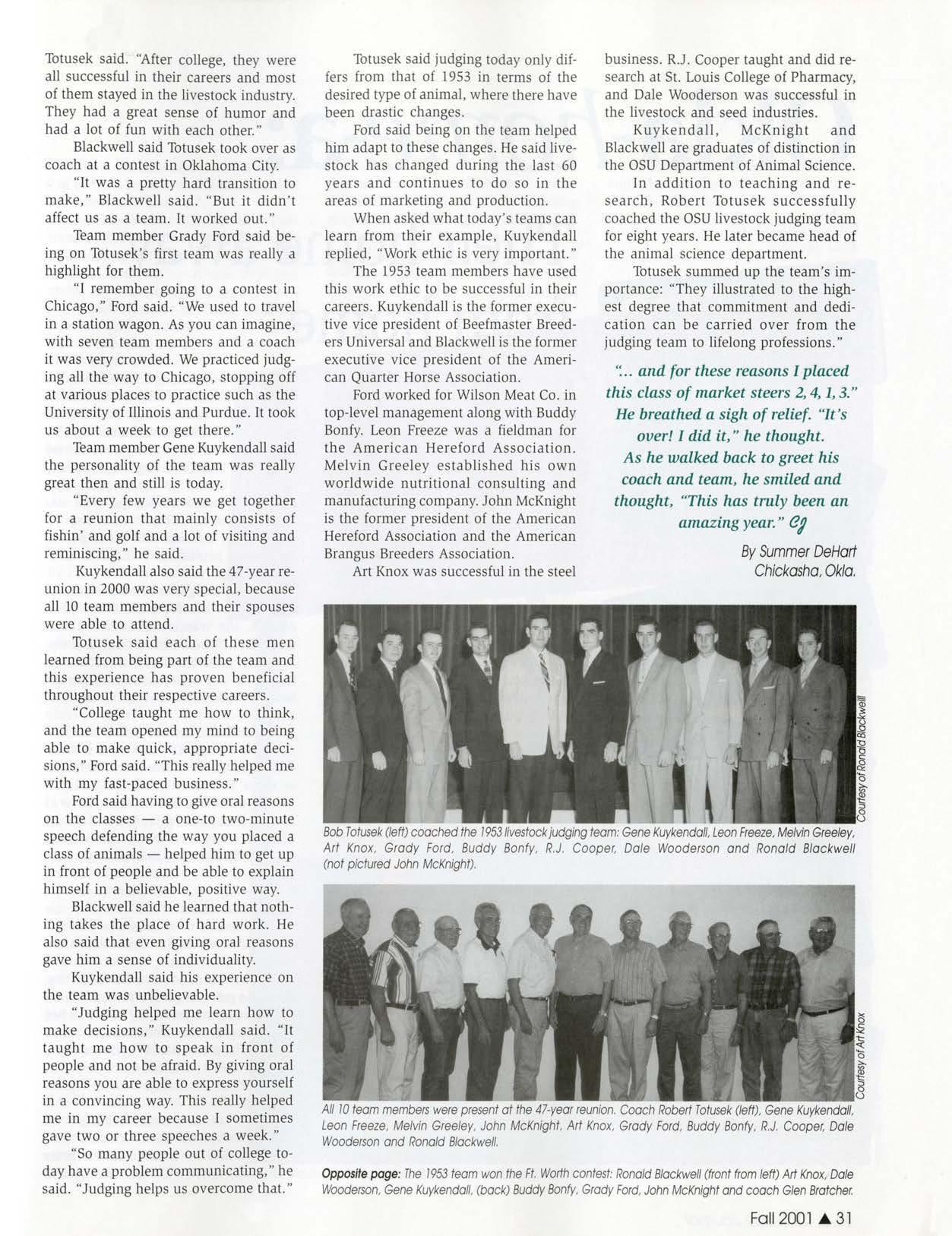
Few experiences in college prepare students for life like participating on a judging team. Judging livestock, meats or horses is (un and a great way to see new places. For some, it becomes a way of life that cominues long after their college days are over.
The experiences and memories made during that one year of judging are forever glued in their minds. Some can still vividly remember this experience more than 50 years later. While each team is unique, a few special teams stand out, among them the 1953 Oklahoma A&M livestock judging team.
The team consisted of 10 members, all male. They are unique because all 10 plus their coach became leaders in their careers and because most of them stayed within the livestock industry.
"We were truly dedicated to the liveswck industry. We each had a farming and Ii vestock background," said team member Ron Blackwell. "This is the sole thing that made us successful."
The team was challenged that year when their original coach, Glen Bratcher, became head of the animal science department in the middle of the judging season. Robert Totusek took over.
"Coaching was a new venture for me,'' Totusek said. "It was my first year as a coach, and these guys taught me so much. They were really a fun bunch to work with.''
The team won at contests in Ft. Worth and Oklahoma City, but it was hard having a new coach in the middle of the season, especially a first-time coach. However, in spite of not winning the championship at Kansas City and Chicago, the team won a number of individual and team trophies.
"The guys were very, very capable, and all had great livestock backgrounds,"
Totusek said. "After college, they were all successful in their careers and most of them stayed in the livestock industry. They had a great sense of humor and had a lot of fun with each other."
Blackwell said Totusek took over as coach at a contest in Oklahoma City.
"It was a pretty hard transition to make," Blackwell said. "But it didn't affect us as a team. It worked out."
Team member Grady Ford said being on Totusek's first team was really a highlight for Lhem.
"l remember going to a contest in Chicago," Ford said. "We used to travel in a station wagon. As you can imagine, with seven team members and a coach it was very crowded. We practiced judging all the way to Chicago, stopping off at various places to practice such as the University of lllinois and Purdue. It took us about a week to get there."
Team member Gene Kuykendall said the personality of the team was really great then and still is today.
"Every few years we get together for a reunion that mainly consists of fishin' and golf and a lot of visiting and reminiscing," he said.
Kuykendall also said the 47-year reunion in 2000 was very special, because all 10 team members and their spouses were able to attend.
Totusek said each of these men learned from being pan of the team and this experience has proven beneficial throughout their respective careers.
"College taught me how to trunk, and the team opened my mind to being able to make quick, appropriate decisions," Ford said. "This really helped me with my fast-paced business."
Ford said having to give oral reasons on the classes - a one-to two-minute speech defending the way you placed a class of animals - helped him to get up in front of people and be able to explain himself in a believable, positive way.
Blackwell said he learned that nothing takes the place of hard work. He also said that even giving oral reasons gave him a sense of individuality.
Kuykendall said his experience on the team was unbelievable.
"Judging helped me learn how to make decisions," Kuykendall said. "It taught me how to speak in front of people and not be aCraid. By giving oral reasons you are able to express yourself in a convincing way. This really helped me in my career because I sometimes gave two or three speeches a week."
"So many people out of college today have a problem communicating," he said. "Judging helps us overcome that."
Totusek said judging today only differs from that of 1953 in terms of the desired type of animal, where there have been drastic changes.
Ford said being on the team helped him adapt to these changes. He said livestock has changed during the last 60 years and continues to do so in the areas of marketing and production.
When asked what today's teams can learn from their example, Kuykendall replied, "Work ethic is very important."
The 1953 team members have used this work ethic to be successful in their careers. Kuykendall is the former executive vice president of Beefmaster Breeders Universal and Blackwell is the former executive vice president of the American Quarter Horse Association.
Ford worked for Wilson Meat Co. in top-level management along with Buddy Bonfy. Leon Freeze was a fieldman for the American Hereford Association. Melvin Greeley established his own worldwide nutritional consulting and manufacturing company. John McKnight is the former president of the American Hereford Association and the American Brangus Breeders Association.
Art Knox was successful in the steel
business. R.J. Cooper taught and did research at St. Louis College of Pharmacy, and Dale Wooderson was successful in the livestock and seed industries.
Kuykendall, McKnight and Blackwell are graduates of distinction in the OSU Department of Animal Science.
In addition to teaching and research, Robert Totusek successfully coached the OSU livestock judging team for eight years. He later became head of the animal science department.
Totusek summed up the team's importance: "They illustrated to the highest degree that commitment and dedication can be carried over from the judging team to lifelong professions."
''... and for these reasons I placed this class of market steers 2, 4, 1, 3."
He breathed a sigh of relief. "It's over! I did it," he thought.
As he walked back to greet his coach and team, he smiled and thought, "This has truly been an amazing year." (JJ
Oklahoma State University is home to many students who are proud to wear the OSU brand. For some of them, moving to Stillwater meant moving to a new state and being hours away from family, friends and the security of home.
Martin Sanders, an agricultural economics senior, chose OSU not only for the prestige of the College of Agricultural Sciences and Natural Resources but also for a place to explore new options and new freedoms.
Sanders and his fraternal twin, Phillip, both decided they wanted the chance to go to new places and meet new people before returning to Spearman, Texas, to run the family ranch. Phillip Sanders chose Texas A&M to pursue a degree in agricultural business, and Martin Sanders chose to wear the orange and black of the Cowboys.
"I had narrowed my choices down to three colleges, OSU being one of the three," Martin Sanders said. "College reputation, out-of-state waivers and personal influences all had a part in helping finalize my decision."
Sanders sajd it was the reputation of CASNR and the atmosphere around the college that made him decide to make Stillwater his home.
"CASNR has a family feeling about it. The professors care about their students," he said. "Not only do they care about the success students have in the classroom, they also care about personal issues students are going through."
In the fall of 2000, OSU enrolled approximately 1,800 out-of-state undergraduates. Of those 1,800, about 320 were freshman.
The bordering states of Arkansas, Texas and Kansas account for nearly half the nonresident undergraduate enrollment.
Melissa Majors, agricultural communications/animal science double major, decided she wanted to go to OSU the minute she walked on campus.
"l just knew it was where I wanted to go," she said. "Although I had already decided I would go to the place that offered the best scholarships, OSU was where I wanted to be."
Majors, a junior, said she is paying for college herself, and financial assistance is important to her.
After looking into other colJeges and applying for all the scholarships OSU offered, she was excited when it was OSU who offered the most financial help.
"My parents and I love OSU, but my dad always teases me about being 300 miles too far away from home," she said.
"I'm from Sutton, Neb., which is actually close to 350 miles from Stillwater, but the University of Nebraska is about SO miles from home," Majors said. "One day when my dad was teasing me, I told him I was actually 350 miles away. He responded with, 'I can handle SOmiles, but 300 is too far."'
Majors said the personal attention she receives in CASNR has made her love it even more.
"Everyone is so nice, and the faculty and staff really care about their students," she said.
"The students are also caring, everyone gets along and it is easy to make new Criends, which is very helpful when you are as far away from home as I am."
Sophomore Matt Vicinus from Chicago chose OSU and CASNR for the reputation of the college and the degrees it offered.
"I want to do something with environmental sciences," Vicinus said.
"I'm still not quite sure what route I'll take, but with all the career
development activities CAS R offers, I'm sure I'll be able to find the direction I'm most interested in."
Vicious said he learned about OSU from a high school teacher, who later played a great part in influencing Vicinus' decision to attend OSU and major in environmental science.
CASNRdirector of student services Louann Waldner said the college makes a point to recruit out-of-state freshmen and transfer students.
"We keep a database of students who have contacted us," Waldner said. "From that database we try to keep in contact with the prospective student through mailings."
Another helpful outof-state recruiting tool for CAS R is the alional FFA Convention in Louisville, Ky., she said.
"Out-of-state students are particularly impressed with OSU's out-of-state tuition policy,"Waldner said.
In addition to CASNR, the university's high school and coIJegerelations office also plays a large role in tJ1erecruitment of many students from all over the nation. They have three out-of-state recruiters who work recruitingspecifically in Oklahoma's bordering states.
"I know the recruiter from Texas does a great deal o[ recruiting in the Dallas/Ft. Worth area," Waldner said.
Don Pitchford of the high school and college relations office said proximity to home and scholarships offered to outof-state students play the biggest roles in recruiting.
"We always go to the major cities in bordering states such as Denver, Kansas City and Amarillo," Pitchford said.
This extra effort by OSU always proves beneficial for CASNR, said CAS R Associate Dean Ed Miller.
"Having a rich complement of out-of-state students
the College of Agricultural Sciences and atural Resources," said Miller.
With extended travel time and long road trips, OSUrecruiters work to reach the nation's best agricultural students.
OSU truly does reach farther than Stillwater, thanks to CAS R. The pride of being a Cowboy and the prestige CAS R carries hold strong for
recruiting students from across the nation. The proof is in the number of outof-state students enrolled at OSU.e/
ByJacquelynnBoyd Guymon,Okla.
CASNRhonorsitsown,itsbest
In the presence of distinguished alumni, supporters and students, the 2001 Oklahoma State University College of Agricultural Sciences and atural Resources banquet honored the college's b st March 30.
The majority of CAS R honorees were students recognized for their academic success. The e dedicated student took home $685,000 in scholarships, a $10,000increase in scholarships from last year's banquet.
There's a reason (or the increase in scholarships, said former associate dean Paul Hummer.
"Year in and year out OSUproduces the top agricultural graduates in tbe country, which is a tribute to OSU's outstanding faculty," said Hummer, who retired in 1998. "It gives me a new burst of energy to see the students I used to work with do so well."
One of the students Hummer helped is plant and soil sciences graduate James Enis, a 2000-2001Top lO CAS R Senior.
Enis,a former avy serviceman from Wilburton. Okla served OSUwelJ in his four-year stint, receiving Phi Theta Kappa and GoldenKey honors along with a slew of crop-judging awards. But he doesn't take credit himself.
"Without the plant and soil ciences
staff, there·s no way I would have been able to receive this honor," said Enis, who plans to become an OSU plant and soil sciences graduate student and pursue advanced degrees. "There's no doubt that it's an honor to be considered a Top 10 Senior, especially knowing some of my classmates are so bright."
Perhaps the
brightest star of the graduating 2001 class is Kent Gardner, the 2000-2001 CAS R Outstanding Senior.
Majoring in agricultural economics, the Sharon, Okla., na-
cultural communications major from Laverne, Okla.; Jamie Liston, agricultural education major from Moore, Okla.; Megan McElroy animal science major with a pre-veterinary option from Snyder, Okla.; Regina Rowe, biochemistry and molecular biology major from Stratford, Okla.; Elizabeth Siefert, biochemistry and molecular biol-
ogy major from Vancouver Wash.; Rosslyn Spencer, agricultural economics major wilh a veterinary business
management option tive was an OSU legacy when he enrolled, having three siblings who graduated from the university.
ow Gardner has built his own legacy, one that will more than likely not be duplicated. He received everything from 1997-1998CAS R Outstanding Freshman to the prestigious 2000 Harry S Truman Scholarship.
Along with Gardner and Eni are eight other outstanding seniors to complete the year's Top 10. They include Chri topher Azbell, environmental science major with a policy option from Tecumseh, Okla.; Kaleb Hennigh, agrifrom Chickasha, Okla.; and Kimberly Stuart, agricultural economics major from Stillwater, Okla.
"The talent in this college is exciting," said Ray Wulf, president of Oklahoma Farmers Union, the organization that sponsored activities during OSU Ag Week 2001. "The problem is getting them to stay in agriculture.
"Farmingis absolutely, positively the most rewarding and honorable occupation in the world. But the word 'farming· detour a lot of kids because they think it"s less lucrative. We need to show students agriculture is the way to go. We need to keep OSU's talent in agriculture," Wulf said.
"People who choose agriculture as a career are normally good, wholesome folks - people who are family oriented."
Hwnmer agreed.
"The reason agriculture will always succeed is because of family values," said Hummer. "You'd be hard-pressed to find a student in another college who has the family values that college of agriculture kids have.
"Yourmoresuccessful students have had their parents behind them the entire way."
Like Melissa Major . Majors' parents, Duane and Patricia Majors, cam from Sutton, eb., to surprise her and to watch her receive the highest honor bestowed upon a CAS R underclassman, the Charles and Magda Browning Outstanding Freshman award.
"The entire time I sat there thinking, 'If I get this thing, I sure wish Mom and Dad could be here,"' said Majors.
Until after the banquet, Majors was unaware that her parents saw the entire thing, even when she and
other
CAS R students received Fleming con· tinuing student scholarships.
Majors was not lhe only person to be surprised. Elizabeth Whitfield received the college's Outstanding Support Staff award.
"I couldn't believe it," said Whitfield, senior secretary for the department of agricultural education, commun.ications and 4-H youth development.
Wh.itfield was one of three faculty and staff honored at the banquet.
Other honorees were horticulture and landscape architecture assistant professor Greg Bell as 2001 Agriculture Am· bassadors' Outstanding Adviser and animal science professor Dave Buchanan as Alpha Zeta's Outstanding Teacher.
Alpha Zeta also honored agribusiness major and Morrison, Okla., native Ryan Leuter as the organization's outstanding freshman.
Alpha Zeta, the honorary agricultural fraternity received honors of its own. The organization earned the Outstanding Club award based on its leadership, community service, fund-raising, social and educational activities as well as its activities above the local level.
In addition to awards and scholarships, a few deserving students received recognition for their internships.
Agribusiness major Ryan McMullen of Burns Flat, Okla., was honored for his work as this year's agricultural legislative intern.
The Frank Lucas Agricultural Policy Internsh.ip was presented to Julie Arntz of Lawton, Okla., environmental science major and CAS R's most recent recipieni of a Truman Scholarship.
A night like the 2001 CAS R banquet is possible thanks to the support and hard work of CAS R faculty, staff and students. OSU honorees and future honorees have many to thank.
"The hardest job is that of the scholarship selection committee. This year the committee and college departments reviewed 920 applications," said Louann Waldner, CAS R director of student career services.
As more scholarships become available and CAS R students continue to succeed, the annual banquet will honor its own, its best. e/
ByR.FredMinnickJr.,Jones.Okla., and AmyWallace,Altus,Okla.
2001 CASNR Awards
Kent Gardner
Melissa Majors
Ryan Leuter
Alpha Zeta
Greg B U
Dave Buchanan
Elizabeth Whitfield
Outstanding Senior
Browning Outstanding Freshman
Alpha Zeta Outstanding Freshman
Dean's Outstanding Club
Alpha Zeta Outstanding Adviser
Alpha Zeta Outstanding Teacher Outstanding Support Staff
Top Ten Seniors
Christopher Azbell
James Enis
Kent Gardner
Kaleb Hennigh
Jamie Liston
Megan McElroy
Regina Rowe
Elizabeth Siefert
Rosslyn Spencer
Kimberly Stuart
RepresentativeFronkLucasrecognizesJulieArntzfor her ogriculturolpolicyInternship.
ColleenSWeeneyand DavidKingworl<to preparethe tissuefor theplant transformationprocesstho/ is doneby the OSUplant ond soilsciences'genegun.The genegun machineisn't the onlywayto transformplants,but SWeeneysaid It worl<sbestfor the projectstheyoreresearching.
OSUresearchersshootintothefuture
Shhhhhhhhhhhh - pop.
The gene gun sounds off as Colleen Sweeney works LO engineer a tiny speck of wheat to resist disease and fungi.
She meticulously maneuvers the newly developed wheat gene out of the machine and quickly recaps it to prevent dust particles and airborne microbes Cromspoiling her new creation.
"The gene gun isn't the only way to transform genes, but it's the most successful with certain kinds of mate· rial," Sweeney said. "The gene gun has been a great tool to allow students to learn the basics of biochemistry and molecular biology."
From an idea of Cornell University scientist John Sanford, Oklahoma State University is able to use the gene gun to genetically enhance wheat to be resistant to fungi, viruses and drought.
Plant and soil sciences senior David King takes part in t\1e project and has
gained valuable experience by genetically enhancing wheat.
"With the gene gun, we can begin to understand how the process works," King said. "The hard part of genetically engineering a plant is that only one out of a thousand of the cells will actually take the gene in and incorporate it into the chromosome."
The process of transferring genes is a controversial topic.
"We try to stick to the basics in order to stay away from the moral issue of whether it's right or wrong to genetically engineer genes," Sweeney sajd.
To get a gene that is resistant to a specific disease or fungus, researchers have to find a variety of wheat or grass that already contains the gene of interest. Then, they take it out and insert it into tissue of the plant they are trying to make resistant.
"We are currently doing research to
insert a gene that is a quality improvement project to enhance the gene capabilities of wheat that are already present," Sweeney said.
What OSU researchers do in their labs are just the basics of science and the beginning of the cycle to create a genetically engineered product.
"Other researchers use our engineered plants to produce new varieties of wheat which the farmer grows," Sweeney said.
Sweeney said OSU researchers are using the $10,000 gene gun machine as a tool to accelerate a gene of interest into wheat tissue culture cells.
"The gene gun allows us to genetically engineer any plant by regenerating whole plants from cells or small pieces of tissue," said Arron Guenzi, associate professor of plant and soil sciences, who also conducts research with Sweeney.
handgun or shotgun, the gun consists of a highly pressurized upper chamber and a low-pressure lower chamber with a diaphragm in the middle.
When the cUaphragm is punctured, pressure from the upper chamber emits a shock wave that hits the projectile, dischargingit forwarduntiJ the projectile hits a porous screen, which stops the plastic disk.
The D A-coated gold particles hit the targeted cells at a velocity high enough to puncture the cell wall and membrane. The genes are released and diffused into the nucleus of the cell.
Once the gene enters the nucleus, it is incorporated into a chromosome, which gives the plant a new genetic trait.
Gold or tungsten particles are used because they are strong enough to pierce the celJ wall, but are not toxic to the plant cells.
However, individual gold particles have a tendency to stick together and crush the cell, creating pit damage.
Sound complex? King said the most complex part is actually getting the gene prepared for the gene gun.
"Getting your gene put together with your marker genes and onto the gold particles is the complex part," King said.
King said the process of transforming a gene could happen in nature; however, it doesn't happen often.
"With the gene gun, it makes the intake of the D A into the genome more likely to happen," King said.
After transforming the gene, King places the plastic container containing
the coated genes under a Ught with a filter that allows him co view the areas of the tissue that have been engineered with the gold particles.
"After bombarding the gene," King said, "we put it through a tissue culture process, which is a primary step to being able to tell which plants have been transformed."
The tissue culture process includes putting the tissue into numerous media that stimulate shoot and root growth. Eventually, the small plant is moved into a pol, where the D A is tested to see if the transformation was successful.
With such a promising future, the plant and soil sciences department is working to qualify for grants that will help further research.
"It is expensive to operate the facility," Sweeney said. "There has to be money in order for the research to continue in the lab."
The ational Science Foundation and the State Regents for Higher Education in Oklahoma board provided the Experimental Program to Stimulate Com-
OSU'sGeneGun
Chambertho/ containsfhe
Whenthe DNA-coatedgoldparticlesoreInjected Into the plonr tissue,they appear fluorescent greenunderthe lob microscope.
petitive Research grant that was used to establish the lab. That money is almost exhausted, and now faculty members are probing for new ways to keep the laboratory in operation.
"By having to close the faciUty, it would slow down or stop some of our basic and applied research on trying to utilize biotechnology to improve the productivity and utilization of plants of economic importance to Oklahoma, such as wheat," said Guenzi.
OSU isn't the only one that has a gene gun. Some laboratories use the gun to do research on genes that can fight against cancer and other diseases.
For example, results from a study done in 1997 indicated that human cancers such as melanoma might be useful candidatesfor gene gun therapyon targeting skin tissues.
In fact, private biotechnology companies produced some corn and soybean varieties already on the market using a gene gun.
Even though the process is distrusted by some environmentalists who oppose tampering with nature, proponents say genetic manipulation holds out the promise of producing crops that will not just grow faster and bigger and be capable of delivering vaccines, but will also thrive without high doses of chemical pesticides.
"Because of everything the machine is capable of," Sweeney said, "the possibilities are endless."
ByKimKisllng
Burlington,Okla.
Pinkston'takescareofbugbusiness'
Real bugs, plastic bugs, wooden bugs, bug coat racks and toys with bugs in them. Bugs are every• where. Bug, bugs and more bugs are what you see when you enter the office of Ken Pinkston.
When you meet Pinkston, it does not take long to discover he is full of energy, with a quick wit and a humorous side and is serious about teaching students about bugs.
The idea that good bugs are not necessarily dead bugs is a philosophy he learned working weekends and school breaks for his father's pest control company in Oklahoma City.
"I figured out there was something better than killing bugs," said Pinkston.
After high school, Pinkston applied and was accepted into Oklahoma State University's entomology program with the idea that people should try to get along with insects because insects will always be here.
"I got into entomology more or less trying to figure out a way to help people better understand and solve problems with insects," said Pin~ston.
Pinkston's first academic adviser told him he would not pass his first semester at OSU. It was an experience that set a desire in him to succeed.
He went on to be one of the top students in his class. After receiving his bachelor's degree in entomology, he spent four years in the military as an Air Force communications officer. Upon completion of his military career, Pinkston returned to OSU to pursue a doctorate in entomology.
With his new degree in hand, Pinkston went to Muskogee, Okla., in 1970. He worked for the Oklahoma Cooperative Extension Service as an area entomologist, working in integrated pest management and with students in eastern Oklahoma.
In 1975, he went to work in the entomology department at OSU where he worked in the Cooperative Extension Service, helping county extension offices with programs and developing extension literature on insects and their control.
In 1992, when instructing staff fell short in the entomology department, he was asked to teach Entomology 2003, Insects in Society.
Since his first semester, the course
has continued to grow. It is popu· lar because it provides a natural science credit and because Pinkston is known as a teacher who cares about learning and keeps the class entertained with his humor.
His style came from watching and evaluating his instructors.
"An instructor told me the primary way to be a successful teacher is to have the desire to teach," said Pinkston. "I watched and learned from the teachers I had in class."
Russell Wright, professor and department head of entomology and plant pathology, said Pinkston's success in teaching is due to his charisma.
"The students tell other stu· dents about his class and about Dr. Pinkston's teaching style, so more kids want to take the class," said Wright.
The students agree Pinkston is full of energy and makes class fun, reminding them to TCB - Quickwitho
breakfromclass. Take Care of Business - one of his favorite cliches.
"He wants to keep you awake so he keeps you laughing," said Lindsey VonTungeln, an agricultural communications sophomore at OSU.
Pinkston said learning about bugs may not be the most interesting thing students do, so he finds different things to keep the class interesting.
Pinkston·s build-a-bug project allows groups of students to build a bug that is different than today's bugs. The students must make it from every day things and explain how it is different.
"You don't just build the bug but you have to describe the bug and what makes it a bug in a paper," said Pinkston. "This bug cannot be like any normal bug. It must be different."
Another thing that Pinkston does is have his students participate in the Bug Bowl. This quiz bowl is just like any other except it is all about - you guessed it - bugs.
"He is really cool," said John Koesler, agricultural education senior from Vinita, Okla. "It is a really good class."
Despite the fact that Pinkston is
widely known for his entomology class, Pinkston's life is not just about insects.
"[ used to fish and play golf in my spare time," said Pinkston. "But as you can see, this class takes a lot of time."
However, Pinkston has found time to be involved in the building of four houses since he has moved to Stillwater. Pinkston has decided to retire, but is going to teach on a contract basis for one more year to allow the department time to find his replacement.
"It is really a shame to see Dr. Pinkston retire," said VonTungeln. "There will be a lot of students who will miss out and not be able to enjoy his teaching style."
When asked what he wants to do when he retires, Pinkston pulled out a list of things he plans to do.
"I plan to golf, take classes and learn to play the guitar. I can pick some now, but I want to play well," said Pinkston. "l have been thinking about this for a while so whenever I think of something to do, I write it down." e/
ByRichardConner Pawhuska,Okla.
smile,Pinkstontokesa
Comer of Monroe and Farm Road - Parking behind Animal Science
• Two Top Ten FreshmanMen
• FreshmanFollies,Champions,2000
• Spring Sing, Champions,1998-2000
• GreekWeek, Champions,1998-2000
• Toysfor the Game,1st Place,1998-2000
• Achievedsevenof the nine 1999-2000 NationalChapterAwards
Grassto gas:opportunitiesabound
One thing Oklahoma State University researchers know for sure - opportunities are knocking, especially for agricultural producers. They will soon have the opportunity to grow and harvest grasses that may be in your car's gas tank in the future.
Four years ago, former Gov. Henry Bellman spearheaded a movement to get OSUinvolvedin converting biomass products such as switchgrass and wheat straw into ethanol through a gasification/bioconversion process. He believed Oklahoma was ideal for the project because of the vast amount of rural area and grassland.
"Thi project is a huge opportunity to provide a demand for a product [ethanol] that is not in surplus," said Bellman, who foresees the plants located in small communities where production of biomass products abounds.
Following Bellman's lead, researchers at OSU got busy. They began work and recruited an investigator from the University of Oklahoma and a researcher from Mississippi State University 10 help them in their endeavors.
The project, which .researchers believe could bring an estimated 150 jobs per plant to Oklahoma, could have a major economical impact on states that use ethanol as a fuel additive.
"We're concentrating on the ethanol because of the need for additional liquid fuel in the United States," said Raymond Huhnke, coordinator of the project and professor in the biosystems and agricultural engineering department at OSU. ''Thi way, we can decrease our dependency on foreign oil."
Decreasing the dependency on foreign oil may be one positive outcome of this project.
When gasoline prices skyrocketed
farms and then converting those grasses into ethanol.
Grasses, like switchgrass or perennial ryegrass or even wheat straw, are processed down to a relatively small part"iclesize and then metered into a gasifier. The gasifier, which operates al a temperature of 1,200 to 1,700 degrees Fahrenheit, converts rhe biomass into a synthesis gas, or syngas. This syngas bas the components necessary for the bioconversion to take place.
of 2000, many people began looking for an
Thisprocesswillgivefarmersand
in the summer ____________ _ Carbon monoxide, carbon dioxide and hydrogenproducts of the gasification process - are then cooled,
ranchersanotheravenuefor a It e rn at iv e revenue. source of fuel.
Ethanol is one
cleaned and bubbled into a such solution to bioreactor. Microorganisms called acetogens act on the gases and convert them into this problem.
- RaymondHuhnke professor
Huhnke said there will always be a demand for ethanol, which is currently utilized as a fuel additive in the upper Midwest. Ethanol is used as an oxygenate in gasoline because it boosts octane levels, burns cleaner and reduces con1aminants. This gasohol is a blend of gasoline that contains 5 percent to 15 percent ethanol.
Huhnke said OSU is taking a holistic approach on this project by utilizing grasses that can be grown on Oklahoma
ethanol. Once the conversion is complete, the ethanol is separated out. filtered and distilled into a fuelgrade prod t1ct.
With the help of OU researcher Ralph Tanner, investigators at OSUhave identified unique microorganisms they plan to use in the bioconversion process. "We are tailoring these bacteria and optimizing them so they'll grow to make alcohol from these gases," said Randy Lewis, chemical engineer at OSUwho is in charge of the bioreactor.
However, researchers are using bottled gases - not syngas - to simulate likely results, as the gasiti r has not yet been connected to tJ1ebioreactor.
Timothy Bowser,assistant professor in biosystems and agricultural engineering, is working closely with food processing engineer and fellow colleague DanielleBellmer on this research project. Bowser said researchers are close to connecting the gasifier to the bioreactor and predicts the two processes may become linked within the year.
Researchers have come far in their investigation or biomass to ethanol, but not without struggles along the way.
One challenge that had to be overcome had to do with the excess oxygen in the syngas. ln most cases, excess oxygen can be burned. However, because of the type of product trying to be obtained, oxygen is a liability instead of an asset in the case of the bioreactor. The bioreactor requires an anaerobic environment, one that is oxygen-free. Therefore, excess oxygen has the potential
kill the microorganisms needed to convert Lhesyngas to ethanol.
Obtaining funding has also been a challenge for the people involved in this project. But grant money from the U.S. Department of Agriculture made it possible for researchers from MSU to work on several different aspects of the project earlier this year. Huhnke said getting MSUinvolved wi_!lenhance the program.
"If we bring in more people with more expertise, then we'll likely be able to generate higher-quality research results at a higher rate," Huhnke said. Student involvement is one area, however, that could use some growth, said Bowser.Currently, Bruno Cateni and Mamosi "Bernie" Lelo are working with Bowser,who is in charge of the gasi[ication process. Cateni and Leto are working as technicians on the gasifier part of the project. Both are biosystems and agricultural engineering department doctoral students whose emphasis is in the area of bioprocessing. Bowser said a need exists for more dedicated and hardworking students like Cateni and Lela to become involved in the project.
Huhnke anticipates completion of the project will occur in five or six years. However, he hopes a pilot plant will be ready within just four years. Meanwhile,
Dear Alum,
researchers are working on scaling up everything one step at a rime. Right now the bioreactor holds four liters, or a little more than a gallon. Lewis is working on scaling it up to a SO-litermodel. Their goal is to produce more than 75 gallons of ethanol per ton of dry matter when the
SWitc/lgross is fed Into the hopperthenprocessedthroughthe gasifier.
project goes commercial.
"We're confident that we will be able to achieve a level that will be cost effective," Huhnke said.
This is something the researchers have been aware of throughout the entire process. Agricultural economist Francis Epplin has been crunching the numbers all along the way. If something is not economically(easible, Uteresearchers find an alternative solution.
"Producers have the resources," said Huhnke, who predicts a full-scale plant
Remember when you used to read The Daily O'Co!legian every day in between classes? Remember how you used to laugh at those outrageous opinion columns? Remember the captivating pictures you U$~9toh~ng.in y;gur dorh_1~foorti?-
College may be over,but your OSU spirit will never die. Don't fade from college. Read about it at www.ocolly.com The only thing different is you can't do the crossword while you're in class.
could utilize as much as 250,000 acres of grassland or rangeland. "This process will give farmers and ranchers ano her avenue for revenue.•·
In the meantime, researchers are regularly tending to the research seeds Bellman planted in hopes they will someday grow into a plant that will harvest Oklahoma's natural resources. 8j
ByAndreaGeis Okeene,Okla.
Pep in the mustard
(Continued from page 21)
But Stone insists, with Pepin's business savvy, that will never be I.he case.
"With her enthusiasm and business sense aJong with her great personaJity, there is no way she'll have to sell this out of her car," Stone said with a laugh.
"With a product like Pepin's and with her level of commitment, it is pretty easy to get her product into the marketplace," he said.
Pep in the Mustard has been targeted ro a wide variety of outlets ranging from Pratt's grocery chain to gourmet shops such as House of Flowers and Harry and David magazine as well a to local restaurants such as Eskimo Joe's and Kyoto Sushi House.
"l don't want to be so high priced that not eve1yone can buy my mustard. I want U1eaver ge Joe co be able Lohave my mustard," Pepin said.
"I'm not in this to make a buck. I'm in it for the kids."
Once the project takes off, research for the 1·anchwill begin. Pepin will go through training to learn how to deal with and provide for abused and needy children and will begin the search for a ranch, counselors and other staff.
Mustard Seed Ranch will be a haven for Oklahoma's abused children. The working ranch will be a place where they can receive self-help tools and stay as long as it takes them to learn the skills they need to face life. The ranch will be complete with horses,chickens, dogs and
Change of color
(Continued from page 29)
to someday return to his hometown and his family business.
"J want to stay involved in rural banking and keep in touch with the ag• ricultural way of life," he said.
McKnight's agricultural and leadership roots run deep. His parents, Ross and Billie McKnight, raised him and his younger sister Meggan in the small western Texas town of Throckmorton. The McKnights run an oil and gas company and are involved in rnraJ banking. They also have a family ranching opera· tion where TI-en! McKnight gained ex· perience with cattle, sheep and horses.
Although they call Texashome, both of his parents attended OSU, and from the time he was a little kid, McKnight never planned on going to school anywhere else.
other animals that will be used to teach children how to nurture not only themselves but also other living things.
Although Pepin is uncer· tain where the ranch will be located, she does know it will be som where in Oklahoma.
"The eople in Oklahoma are absolutely wonderful.'' Pepin said. "There is incredible energy in Oklahoma and it is a positive energy.
Everyone has been so nice. This has been a fun and rherecipeforsuccess:mustardseeds,hardworkand FAPC. interesting experience, but it wouldn't have been like this in Florida.
"! am working so that kids won't be thrown back into the system. They will leave with the tools they n ed to look into themselves and find happiness in thi mean world," Pepin said.
Mustard SeedRanch will be funded by Pep in the Mustard and will house a gift shop where the mustard will b sold, along with other products that the children have made.
"I always kn w there would be kids in my life and now there will be," said Pepin, who has never had children of her own. "This is my mission in life. I just know it."
While Pep in the Mustard has proven to be one of FAPC's avorite home-to· helf success stories, it is the purpose of the venture that gives
"I've always had a connection with their love for the university and the campus," said McKnight.
During his high school years, this loyalty grew as he spent "a lot of time" at OSU practicing with his horse judging team, said Harris.
"He's always wanted to go to OSU, nowhere else. It has such a strong ag program, and although it's a college that may not be the biggest in numbers, it's one of the highest quality programs, and that's what he's interested in."
McKnight said he has people all over the nation tell him what a great ag program OSU has, and it really speaks well for Lhe college.
"But I do catch a lot of flack from my Texan friends about coming here," he said.
a whole new meaning to Pepin's recipe of success.
A lot of products come through the center, and many have been successful, but this venture and Pepin's heart for philanthropy gives uniqueness to her business, said Stone.
lowever, much like the old cliche, a woman's work is never done.
"Someday I want this thing to be on Oprah," Pepin exclaimed.
Pepin foresees no end in sight to her already successful project. Her genuine love and concern for children along with her peppy personality and demonstrated business sense will allow many of Oklahoma's children to turn the bit· ter knocks of life into sweet success.
She put the pep in more than just her mustard.~
ByAbby Payne Beaver,Okla.
For McKnight, the biggest reward of serving as a national FFA officer is the chance to interact and connect with the students.
"[l's the neatest thing to see that light come on in their eyes," he said. "And to think that through the FFA maybe I've had a part in making a difference in that person's life."
He has and will make a difference, not only in FFA members' lives, but also in making OSU a better place.
Which is why we're proud to say that although the national FFApresident wears blue and gold this year-deep down, he till bleeds orange. e;