A new direction for those looking into agricultural education
8Preparing for the future
1\vo OSU horticulture students complete the Mosmiller Scholar Program
10 A past enriches the future
A look at the past and futur of Gallagher-Iba Arena
12
CASNR students travel the road to med school
Spotlighting a career not always associated with agricultural scienc s
14Disaster brings new life
African tuden overcomes family hardships and finds his way o OSU
16
OSU works to feed the world
New OSU farming technology may boost crop production and could help feed the world
18 It's a creepy, crawly adventure
Students find fun and ducation at OSU's Entomology Zoo
20 It's guaranteed tender
OSU researchers find a new way to improve beef tend em es
22"SUNUP"
Daily television program shines a ray of light on Oklahoma agricultural information
24
Students design new habitat for zoo animals
Tulsa Zoo plan ahead for California sea lions and African penguin
27
Future vet leads the way
Second-year veterinary medicine student balances family and school
28
FAPChelps cooperative "roll in the dough" ew value-added dough co-op brings more job and a n w bu iness to Oklahoma
30
CASNR recognizes Fritz as outstanding senior College honor its top cholars and leader during th spring banquet
32
CASNR goes international
OSU expand opportunities for students by introducing additional international programs
A not from the editor. ..
111building for 111fwure. w r alize tl1e importance of srmng Ji uncJarlon T/1r ughow /1i tory. agri ultur 110 prou n t b 1 trono Joundati n up n which our ountry wa. l)uilt. \Vit/1our rl1e hard work ancl edicwicm of r/1 p op/ it/1in 111 ogri ultuml inclu rry. we migl,r nor srancl where we are today, t/1us prouin agriultural ro ts truly clo en/1c1ncerl1 futur .
Tl1is issu 1 th wboy Journ I i proof ~- 11,e l1ardworking w 1d d oteci indiuiduol a· o iar d wilh the o/1,g, of Agriculrural ience anc/ arural Resources. Tl1rougl1our rl1e µasr four mo, 1rhs, we 11Clu , pull •cI rogether a a ream Gnd /corn ct from one anorh r' xperience_c;.
Wil/1our th d 'Clication from our raj{ and many orher~ th/ magazin woulc1 nor tJ "po ii)/ we would like 10 ex1enc/ our apµr ciar/011 ancl 1/lanks to rll J, /lowing for rheir onrribwions r thi i u : Tod(I J /111 ·011. J 1} r on Mill r, Bu ky Hurris. wayn J-/tmt r. Don tott Fre(i ausl y. ayle /-liner, Mart \\right. Robert TJ1omp on, Jim Bolding, Rll rrMin ·011. 1\latthew Kirkwo (1. i\/Orty rg 111. porr.s mforrnation. arionol wresrling 1--1011 of Fam and L niu r iry Archiu,o Li/Jrary. Wil/1 rh mp/ ti n of this i ·ue. our ·ralf marks rhe end if our und rgracluarc careers at LI /Jy knowin~; 1.,uc/1aue e ·to/)/i l1~d f ounclarions on wl1ich I<>build our fwure.
Oklahoma tole University. In complib.nce with TUlc VI 1md VII of thr c,,.,11 rugh1a A<!\ or 1064. EXCC'UIIVl'Order 11246 lUJIamended, TILie IX of lhe E:ducallOtlDIAmtndmt"nl.6 or 1972, Atnortcaru, with OISllblllUe Acl of 1990. nd Olh<r redrrnJ lnwl'Jond rcgulRllons. dCK'.~noL cHscnmtnate on lhr ba,1.., or rm::e. color, nn.tlonal origin. ex, o.gr-.rellglon, d1 l\blllly, or StlllUS JIS fJ vctera.u ,., and or 1111pol1 lt8 µrncUces or procedures Titll:11inaludN blil IA nol llm(lrll lo Rdml.salons. omploymcnt, Onom:ftt.1nld, :rrnd cducn.Uonol 1;1,rrvlcc~Tht-1:1publlcatton IS pl"'lnttd and 183ul:'dt-wo Um~ n ycn..r by agrlculturnl rommunl~ llous S1'."llIOr8In lhe College of Agr1cull11rnl S<:Len«s ond 1050 nlurn) Rr111our-ccs ond ho& been .A ,,rcpn.rc=d nd dl!illr1buted Ul no COSI lO I.he tnxpayen or Okl0homn
CovVBOY JouRNAL
Vol. 2 • 0. 2
ikki Harringt n di1or
Tl1ompson assi , rn ditor
Ian hard plloto ditor
r h Littl gr phi
ta y Franz and Erin pinl1an e W b dil r
rah o kh rt and 1ripp ushn II ponsor flip oordin I r
St y M ula1i n o rdinat
Asl1l y Em i D n1 1rman. I ~,ri Kl m nt, r rah Loud d , J nkin , a tty,
11-lly P p r itton m n gin di1 r lizab th Whitfi Id
Limousin world, kl h Qu _b or Printing r upp n s1aff
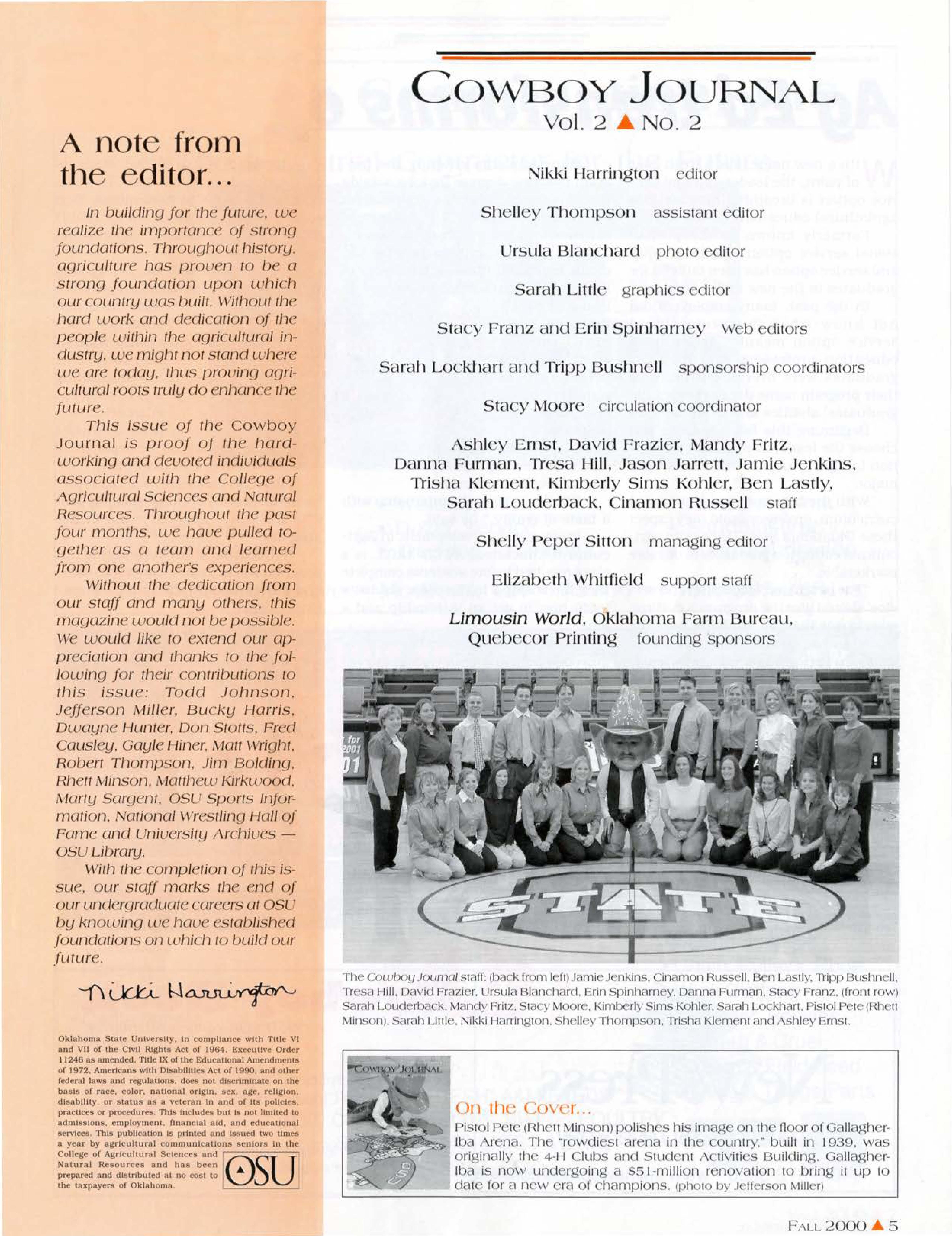
Tile CowlXJU Juumal sk If: rback from 11"11)Jamie Jenkins. h amon Russell. Ben La 1lv.11'1ppBusl1ncll. ne a Hill, I a\'Id Frazier. rs 1IaBlan 11 r I. Erin pinham y. Danna Furman, 1a y Franz. (fr 111 r w1 mh L U I 'l'b ck, ."vland} 1 1~ri1z, 1a }' Moore. Kimberly Sim K hi r. mah L khan. Pi IOI P I l~~llCII Min on). arah Li11tc.Nikki I 1arring1on.Shell ·yThompson. n1sha Klcmcrn and 1\shlcy Ernst. I te (Hll 11Min on) p n ll ( G II gh a. Th ·row 1 • • t in 193 w lly 1l1e4-H lu ing. Gall g11 n w un rg i1 bring it up or a ne, era of !Iller)
With a new name, like a fr sh coat of paint, th lead rship and service option is breathing new life into agricultural du ation.
Formerly known as the professional s r-vic option. the 1 ad r hip and s rvice option has b n tailor d for graduates in th new mill nnium.
In the pa t. many mployers did not know what the professional servic option meant. Agricultural education prof ssors said they fel gradua es w re overlooked becau e heir program name did not reflect the graduates· abilitie and training.
Beginning thi fall, students can choose the leadership and service option in agricultural education as their major.
With the new name and improved curriculum. professors said they expect th se Oklahoma Stat University agricultural ducation graduat s to be mor marketable.
''Th new name 'leadership and servic • should give the program a cuttingedge image that our students have the academic background, skills and experience to perform in a vari!!ty of situations:· aid James White. professor of agricultural education.
The professional service option wa started in 1985 to meet a unique need for agricultural education students. Many students felt a strong desire to be involved wi h agriculture and the public. How v r, there was a need for a program that was outsid lh cla sroom and used mor nonformal teaching techniques.
The leadership and service program focuses on education. but it is directed toward education for life. The program teaches leadership and re ponsibility.
Many students nt ring the program use th ir degrees for jobs outsid the classroom, such as coopera iv extension educators, 4-H leaders or community service repr sentatives.
The program requir s a total of 130 credit hours. Of those. a minimum of nine credit hours mus be earned in
Starting in spring of 2001, students can participate in AGED 2303. Personal Leadership Skills in Agricul ure. Thi class will prepare s udents for AGED 3303, Leadership Skills for Agricultural Organizations.
"This class will b a stepping tone to future, more intense classes leadership training curriculum. In addition, an int rnship is requir d to complete the
You really get to know who you are, and how to be the person you want to be.
Jennifer
that sharpen students leader hip skill , •• said Terry. Graduating agricul ural education seprogram.
Bridges agriculturaleducation senior nior Jennifer Bridges said she is glad the department changed th name of the option.
White described the internship as "intense learning experiences focused on real-world experiences."
··students leave the internship with a taste of reality." he said.
Professional Development in Agricultural Education, AGED 4203, is a class required befor studen complete their internships. In the class. students learn how to g t an internship and a job.
Du1ing the cours s udents ar requir d o seek and apply for an internship. They learn how to negotiate the internship experience.
Stud nts contact and obtain th ir own internships. much like getting a job after graduation. Th program require students to complete six credit hours of internship, which mean 12 weeks of work in the position.
Althouo-h studen s starting college befor August 2000 may not see the new nam on th ir degrees. they will still b nefit from the b·aining tha has been add d to the program, said Rob rt T rry Sr., regents service profi ssor of agricultural education.
Although her degree will read ·'professional service option " she still benefit from th changes in the degree program.
··1think thats udent entering this program will get more leadership skills and will learn more about themselves.'" B1;dges said.
"This program is more than a classroom experience. You really g t to know who you are and learn how to be ·the person you want to be," she said.
So if teaching in the classroom is not for you, try the leadership and service option for agricultural education majors.
For additional information. call (405) 744-5130 or visit th OSU Department of Agricultural Education, Communications and 4-H Youth Development Web site (www.oksta e.edu/ ag/agedcm4h/).
By Sarah Little Stillwater, Oklahoma
Little B's Construction, Inc.
The Industrial Contractor for the Future
• Pip lin
• Pip tin R pair
• H avy xcavation
• W !ding
• Doz r rvi
• Tru king - Hauling
• on r t Work
• Sandblasting
• llop Fabri ation
• Fertilizers
• Fencing
• Electric Fence Repair l=I~
• Cattle Panels
• Pet Supplies
• Ag Chemicals & Sprays (
• Hydraulic/Tractor Oils "ALWAYS FRESH" A&M FEEDS
• Bailing Supplies
• Chain, Pulleys, Rope
• Work Clothing
• Wrangler, Rockies
• Carhartt & Cruel
• Garden & Field Seed
• Cutting & Tillage Parts
Mo t people dream of re eiving flower arrangements. but two Oklahoma State University horticulture students dream of designing them.
Carissa Lussier, horticulture senior specializing in floriculture. and Shaun Dalrymple, horticulture and busines senior. are the first two OSU students to r ceive the honor of being a member of th nationwide Mosmiller Scholar Program.
"It i pretty prestigious." Lus ier said. "I never though om thing like this would happen to me. All my hard work and dedication has finally amounted to something."
Dalrymple, said it is wonderful to be a Mosmiller cholar.
I never expec ed I was going to be selected," Dal1yrnple said. "It was a big surprise."
Douglas eedham, horticulture profes or, nominat d th vo students for the program.
He said he is thrilled for Lussier and Da1rymple to have uch an opportunity as the Mosmiller Scholar Program.
"It i ncit typical o have students who are focused enough. driven to their career goal of owning their own flower hop and pursuing such an honor," Needham said.
The Mosmiller Scholar Program b gan in 1975, and is purpose is to provid quality
professional training for selected,
motivated fioricultur and environmental horticulture students, according to the American Floral Endowment.
The program selects five Mosmiller cholars two time per year. This is the first time OSU student have applied for the MosmiJler program.
The students are required to com-
and fulfiJJ re ponsibilitles assigned by the employer for the length of the intemsblp. Furthermore. they submit a 500-word report evaluating the experience within 30 day of completing the program.
Douglas Needham horticulture professor
Used for program promotion. these reports are shared with the program plete a 10to 16-week intern hip in a wholesale. retail or allied trade company located in the United
It is not typical to have students who are focused enough, driven to their career goal. board and the employ r.
Full-time, undergraduate students are eligible for the Mosmiller Scholar Program.
Th tud nts must b currently enrolled in a floriStates and away from home or school.
The tudents have the opportunity to decide where they would like to intern. The interns are paid by the employer during training, and upon successful completion of the program, they receive a $2,000 cash grant from the Arne1ican Floral Endowment.
Lussier completed her internship thi pa t ummer at Royer Flower in Pennsylvania.
"[ chose Royers Flowers because it is considered as one of the best flower shops in the United States. and I had never been to the East Coast before," Lussier said.
Lussier aid she wants to own her own flower hop in the future.
"My internship taught m everything l need o know about owning my own flower shop," Lussier said.
Dalrymple completed her internship this past summer at Toni's Flower Shop in Tul a.
"This was a wonderful opportunity, and by having the Mosmiller Scholar Program b hind me, it will open door for me in the fu ure," Dalrymple said.
I She said she plans to own h r own florist shop that specializes in wedding and parties.
Studen s in the Mosmiller Scholar Program must agree to
culture. environmental horticulture or business program at a two- or four-year college or university in th United States with a recognized f1oriculture program.
They also are required to maintain a "C" or better grade point average with satisfactory progress in a degree or certificate program and demonstrate paten ial and int re in a floral industry career.
Students apply for the Mosmiller Scholar Program through a f1oricuJture or business faculty member.
The application materials are submitted by the faculty member and include a comp! ted. current official application form, a two-pag statement by the student explaining reasons for applying, school transcripts, a letter of recommendation and endorsement by the faculty member. and a photograph of the applicant.
The application deadlines are March 15 for fall and winter training and Nov. 1 for spring and summer training.
The program was founded by the late Col. Walter E. Mosmiller Jr. His earnings provide the main source of financial support for th Mosmiller Scholar Program.
Mo miller was a past chairman of the American Floral Endowment and wa a retail florist in Richmond, Va.
According to the American Floral Endowment, Mo mill r demonstrated a trong, lifelong intere t
in professional training and encouraged young people to pursue floral industry careers.
The Mosmiller Scholar Program provides many benefits to students who are trying to pursue a career in horticulture, according to the American Floral Endowment. The students
• join a selec group of students who have gained experience a top industry facilities;
• enjoy a paid internship with diverse, hands-on experience. in which they put academic theories into practice: and
• d velop new and critical skills determine future career directions and receive a financial grant upon satisfac ory completion.
Lussier said b ing recognized as a Mosmiller Scholar has definitely affected her life.
~The Mosrniller Scholar Program has made me feel more self-confident " Lussier said. "I was given the opportunity to travel, and I probably wouldn't have had the chance to go to the East Coast without the program."
Dalrymple said the program has also affected her life.
"My family is ecstatic and very proud." Dalrymple said. 'The program
is very beneficial, and I recommend students to apply."
With the completion of this year's Mosmiller Scholar Program, these two students have taken a step closer to their dreams.
Maybe in the future you will be ordering your favotite bouquet from one of them.
Shaun Dalrymple (left) and Carissa Lussier work together to identify plants at the OSU Teaching Greenhouse. (photos by Mandy Fritz)
Story by Mandy Fritz Mountain View, Oklahoma
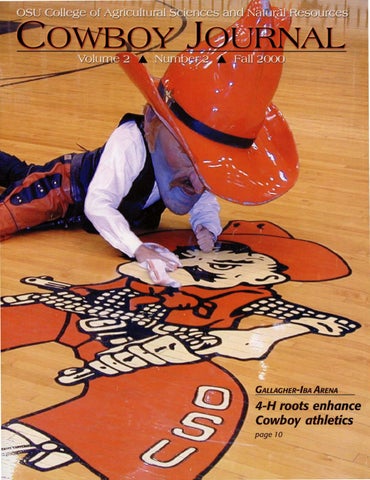
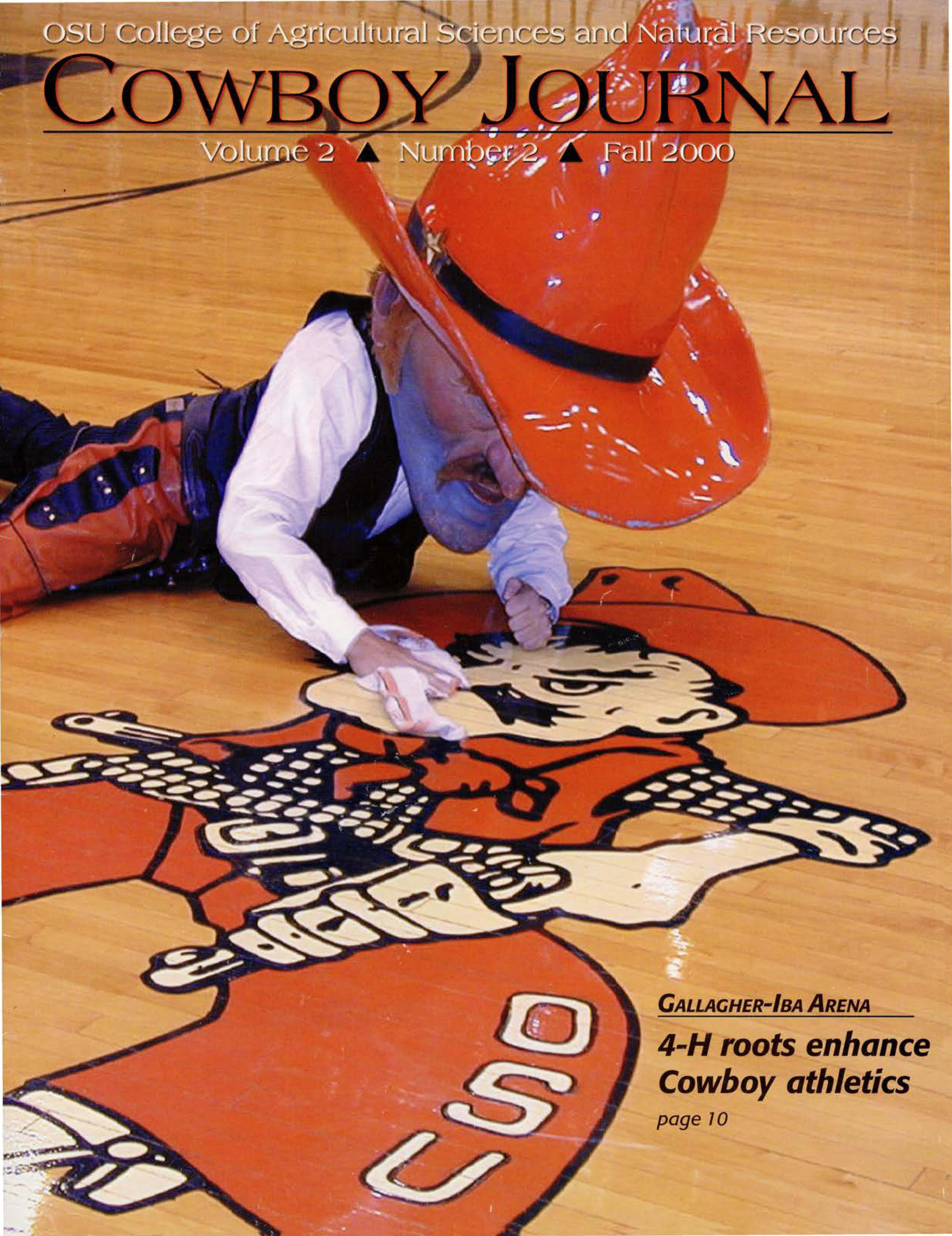
Bfore it became known as the "rowdiest arena in the country," Gallagher-Iba Arena was a 4-H building. The arena. originally named the "4-H Clubs and Student Activities Building," was built by 4-H funds. The historic building is undergoing a $51milli on renovation and the ·'new" Gallagher-Iba Arena is scheduled to open in December 2000.
As they still do today, Oklahoma 4-H'ers held their annual convention State 4-H Round-Up, on the campus of then Oklahoma A&M. Of course back then there were no dormitories or meeting halls for the convention. Members stayed in tents on campus.
Charles Cox, Oklahoma 4-H program specialist and sta e 4-H program leader, recounts the events that lead to funding for the facility.
"They set up a big tent for their general assemblies." Cox said. "Some 4-H members wer injured when th big tent collapsed in the early 1930s."
4-H members lobbied for money to build a facility that would be host for their conven ion every year. Henry Bennett, then president of Oklahoma A&M had been lobbying fbr money for a new athletic facility. but wi h no succe s. After the 4-H members were injured. legislation pa ed to provid funds for a much-needed facility.
"Part of the legislation indicated it was for 4-H and would be open to other student organizations. not just athletics.·· Cox said.
On Feb. 25, 1938. ground was broken for the new multipurpose facility. he "4-H Clubs and Student Activities Building."
Dedications
The arena hosted its first athletic vent Dec. 9, 1938, when Kansas came to town. The Aggi bask tball team def, ated the Jayhawks 21-15.
On Feb. 3, 1939, "Gallagher Day." the building was dedicated to the legendary wrestling coach Edward Clark Gallagher. On the opening night before a sellout crowd. the Aggies of A&M defeated the Indiana Hoo iers 18-6. The first wrestler on the mat. weighing in at 118 lbs., was senior Joe McDaniel.
"It was a thrill to dedicate Gallagher Hall," McDaniel said. ''The other two years I wrestled we were in the old armory in the box on a platform. The crowd was right up on you, and it was fun ...
After claiming three NCAA titles and a World Cup title. McDaniel coached wrestling out of state for 20 y ars. Back home in Oklahoma, he still attend many OSU wrestling matches. Gallagher-Iba has s en many
THE BEGINNING OF AN ERA
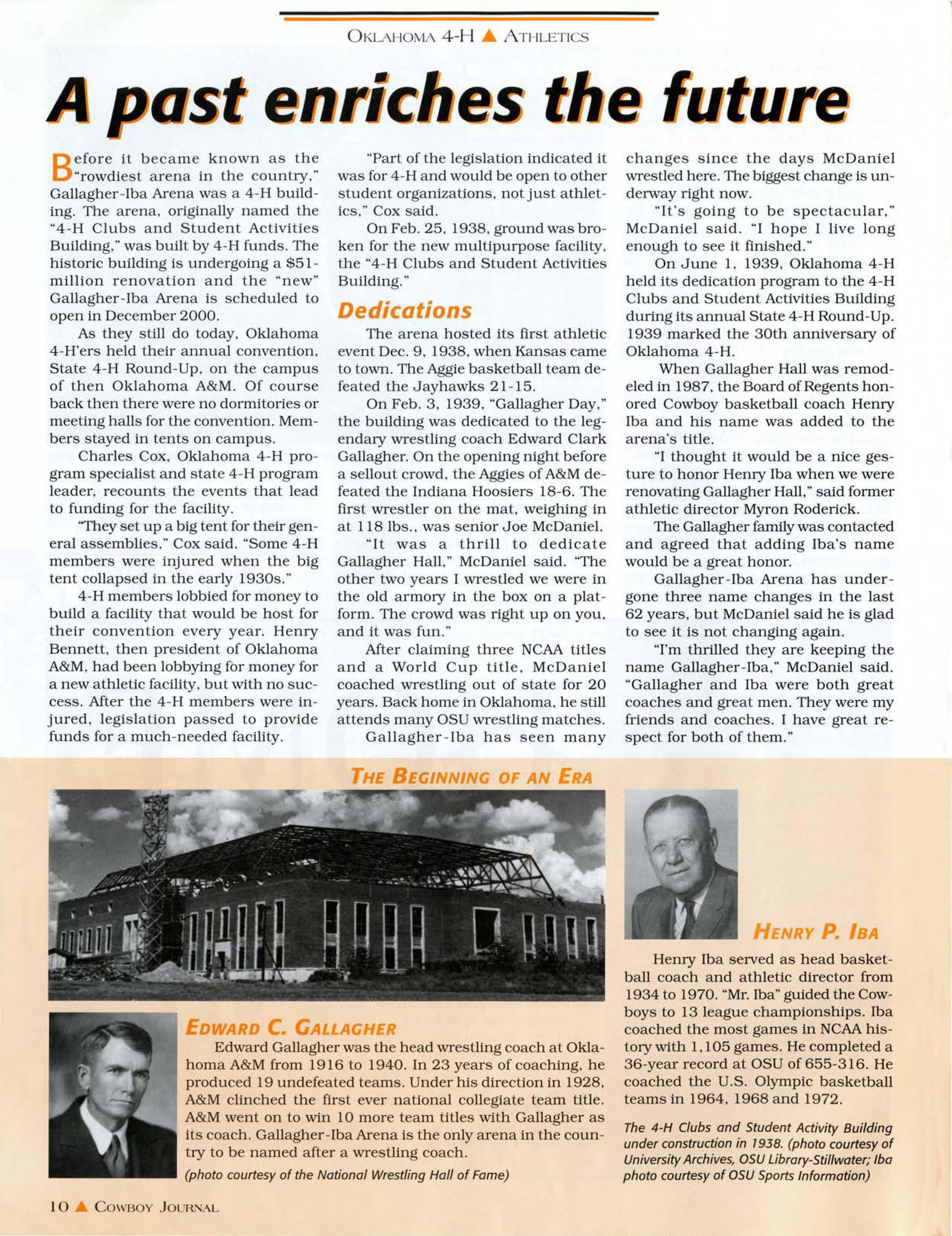
"Edward Gallagher was the head wrestling coach at Oklahoma A&M from 1916 to 1940. 1n 23 years of coaching, he produced 19 undefeated earns. Under his direction in 1928, A&M clinched the 0rst ever national collegiate team title. A&M went on to win 10 more team titles with Gallagher as its coach. Gallagher-Iba Arena is the only arena in the country to be named after a wrestling coach.
(photo courtesy of the National Wrestling Hall of Fame)
changes ince the days McDaniel \,vrestled here. The biggest change is underway right now.
"It' going to be spectacular," McDaniel said. ~1 hope I Jive long enough to see it 0nished."
On June 1, 1939, Oklahoma 4-H held its dedication program to the 4-H Clubs and Student Activities Building during its annual State 4-H Round-Up. 1939 marked the 30th anniversary of Oklahoma 4-H.
When Gallagher Hall was remodeled in 1987, the Board of Regents honored Cowboy basketball coach Henry Iba and his name was added to the arena's title.
··rthought it would be a nice gesture to honor H nry Iba when we were renovating Gallagher Hall " said former athletic director Myron Roderick.
The Gallagher family was contacted and agreed that adding Iba's name would be a great honor.
Gallagher-Iba Arena has undergone three name changes in the last 62 year , but McDaniel said he is glad o se it is not changing again.
"I'm thrilled they are keeping the name Gallagher-Iba." McDaniel said. "Gallagher and Iba were both great coaches and great men. They were my friends and coaches. I have great repect for both of them."
Henry Iba erved as head basketball coach and athletic director from 1934 to 1970. "Mr. Iba" guided the Cowboy to 13 leagu championships. Iba coached the most games in NCAA history with 1, 105 games. He completed a 36-year record at OSU of 655-316. He coached the U.S. Olympic basketball teams in 1964. 1968 and 1972.
The 4-H Clubs and Student Activity Building under construction in 1938. (photo courtesy of University Archives, OSU library-Stillwater; Iba photo courtesy of OSU Sports Information)
If walls could talk
When Gallagher Hall wa built. it was the largest collegiate athletic arena in the country. Roderick called it the "Cadillac" of its time.
"At the ime it was built, Gallagher Hall was U1ebest facility to watch wrestling in the United States." Roderick said. "It became known a the premier wre tling arena in the country."
The ori inal noor remains in Gallagher-Iba today. At he time the arena was built. they used a 3½-inch thick wood floor. much like the typ of floor you would find in a bowling alley. The floor that has held so many great athletes and champions will be saved during the renovations.
"There have been more individual championship and All-Americans on that noor than any oth r place, Roderick said. "lt has a distinct hit.ory."
Th walls of Gallagher-Iba have held more national champion hip teams than any other facility in Diviion I schools. osu·s 42 national championship banners hang from th rafter in Gallagher-ilia. Thlrty of tho e national hampionship belong to Cowboy wrestling. The storied arena has also held some of th rowdie t crowds in th country.
Great moments
"When wrestling was at. its tops here. back in th ·sos and "60s. the wrestllng crowds were by far the loudest crowd they ver had in there,"
Roderick aid. ''There were no fire retriction in tho e days. and the crowd would pack into Gallagher. -
But th rowdiest crowd ever in the arena wa probably in 1978. when the Big 8 Wrestling Championships wer held in Gallagher Hall.
"Tti boasted that there were some 8.300 people pa ked in Gallagher." Roderick aid. "Daryl Mono mith wa wrestling for u , and he defeated th defending national hampion from Iowa State. It got so loud. a lot of the lights busted in Gallagher. And that' the loudest I've ever heard it. It was unbelievable."
And who would know better than a man who has been attending athletic events in Gallagher-Iba since 1953. After completing his wrestling career at Oklahoma A&M, Roderick erved as head wrestling coach from 1957-1969. Then from 1983-1990. he served as athletic director. Roderick now serv s as pre ident of the ational Wrestlin Hall of Fame and Museum, located east of Gallagh r-lba.
Anoth r great rowdy mom nt in Gallagher Hall came in 1957 when th Aggies defeated th Kansas Jayhawks. when KU's Wilt Chamberlain wa conldered th "big man on campus.·· With only two econd remaining in the game. A&M· Mel Wright made a shot. hat would now be con idered a threepoint hot. to win the game.
"Jt had to b the biggest moment in basketball." Roderick aid. "One that p ople sWl con ider one of th most. memorable."
Everyon who has ev r attended a game or match in Gallagh r-Iba Arena can att st tha the noi can b deafening. And veryone ha a different story to shar as their mo t m morable experience in the "rowdiest arena in the country.-
Step ahead
The new changes to Gallagher-Iba Arena were brought in by the dawning ofa new century. One ofth thing that makes Gallagher-Iba uch a uniqu arena is the proximity of the crowd to the action. Although the expanded arena will hold more than 13,000 spectators. all of the eating on the floor will remain unchanged. Even more rowdy fans will hav an opportunity to be a part of th earth-pounding, bonechilling nois that only Gallagher-Iba can produce.
With the renovations, OSU is preparing its beloved Gallagher-Iba Arena for the future. No one knows what the future hold , but you can be sure a larger Gallagher will have the capacity to hold many more champions in both athl ti and 4-H.
So wh th r you ar watching a wr tling match, the Cowboy and Cowgirls hoop it up. or anticipating the announcemen of this year·s ta e 4-H officer team, rememb r you ar part of a unique hi tory in the "rowdie t arena in the country."
Story by Shelley Thompson Davenport, Oklahoma
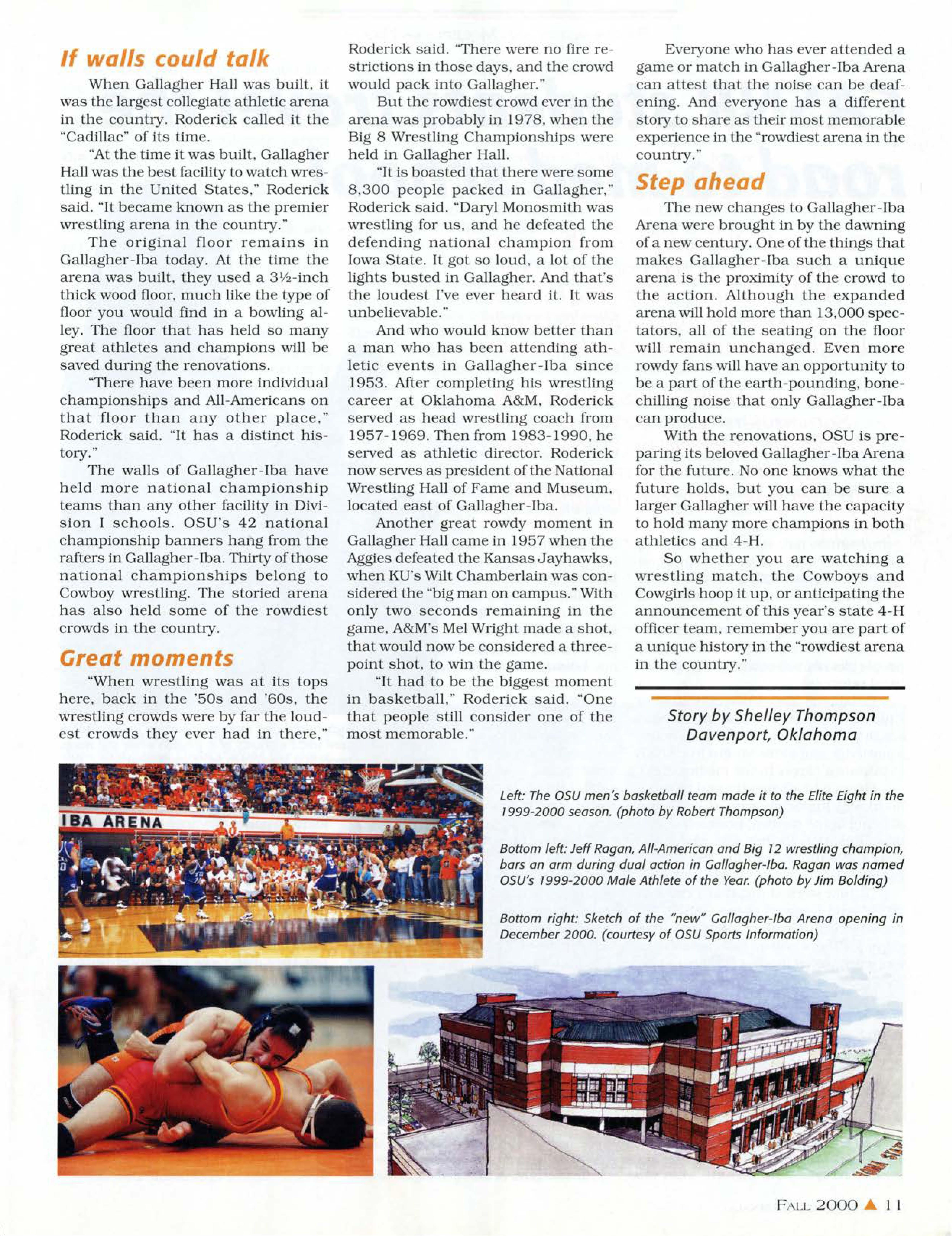
left: The OSU men's basketball team made it to the Elite Eight in the 1999-2000 season. (photo by Robert Thompson)
Bottom left: Jeff Ragan, All-American and Big 12 wrestling champion, bars an arm during dual action in Gallagher-Iba. Ragan was named OSU's 1999-2000 Male Athlete of the Year.(photo by Jim Bolding)
Bottom right: Sketch of the "new" Gallagher-Iba Arena opening in December 2000. (courtesy of OSU Sports Information)
eTwo roads diverged fn a yellow wood. And orry I could not tmvel both And be one traveler; long I stoocl And looked down as far as I could To where it bent in the W1dergrowlh. ..
I sh.all be telling this tvith a sigh Somewhere age W1d age hence: Two roads diverged in a wood. and II tool the one le raveled by And that has made al.I the difference ...
- Robert Frost
SomeCollege of Ag1icultw-al Sciences and Na ural R sourc s stud nts are following in th footsteps of Robert Frost by choosing the road less traveled and striving for a career many people do not associate with agricultural sciences. h Ip me get into medical school, and I can use the knowledge I have gained from tho experiences at work."
Oklahoma State University student Hollie Dean from Edmond and graduate Brad Liston from Moor plan to use knowledge and skills aught in CAS R to pursue a career in th medical field.
Dean. a biochemi try and molecular biology junior. grew up with the idea of being in the medical profession. The main question for her was where she would even ually pursue her career goals.
"It jus worked ou that I came to OSU," said Dean. "l chose CASNR because it's much more personal than other colleges. Also, biochemistry is more connected to what role genes play in illne s and how drug treatment work . I'm learning what goes on insid a patient's body a an effect of taking medicine."
Liston, a 1999 graduate of biochemist1y and molecular biology, currently works in the biomedical research department at the University of Oklahoma Health Selene Center.
"CASNR offered many opportunities for m to b come involv d in clubs and activities,'" said Lis on. "This will
Louann Waldner, OSU's direc or of agricultural career services, said biochemistry and molecular biology is probably the most frequent route to medical
school through CASNR. It is the only major that offers an official pre-med option, but i is not the only choice.
"Many students have gone to medical school. pharmacy school and d ntal school hrough majors such as plant and soil science animal science. entomology and plant pathology. There is also agricultural economics, biosystems and agricultural engineering, and biochemistry and molecular biology." said Waldner.
A heavy science background exist in CAS R cour es, however, it is important for the students them elves to have the initial interest in the medical field.
"Once that first step has be n aken. then choosing a program that allows them to m t the requir men s of medical schools is necessary.·· said Waldn r.
E.C. Ison, profes or and lead
adviser of biochemistry and molecular biology, said almost every class requirement to gain en ry into medical school is offered through a major within CASNR.
"It fits into our program well for omeon to have a goal of attending medical school,'' said Nel on.
CASNR tudents are not only provided with appropria e cla sroom work, but they also have the opportunity to learn skills and techniques in laboratory ituations early in their coll ge career.
"Research project and jobs are available to teach students about lab quipment and give them valuable hands-on experience, .. said Waldner.
"This allows s udent to decide arly on if they enjoy this area of study."
N Ison said CASNR biochemistry tudents have ln erned at places such
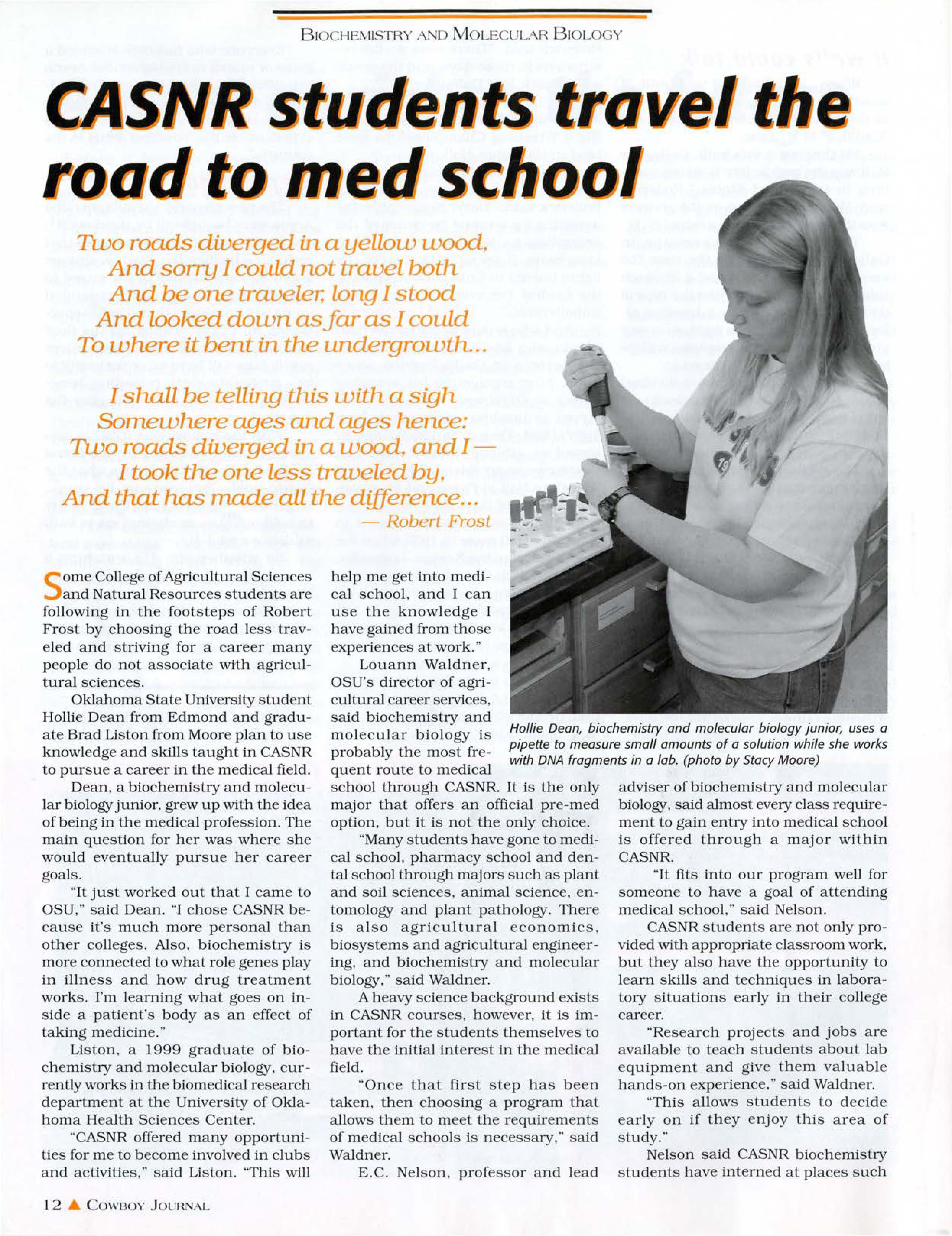
Hollie Deon, biochemistry and molecular biology junior, uses o pipette to measure small amounts of o solution while she works with DNA fragments in a lab. (photo by Stacy Moore)
as the OU Health Sciences Center and the world-renowned Mayo Clinic.
Freshmen have the opportunity to gain real-life experience from the beginning of their academic career through the OSU Freshman Research Scholar program.
·-Youactually ge to see what a biochemist does." said Dean. "You can be there with U1em, help them work. and actually take over a little piece of their research and do it yourself."
Liston said his involvement in the research scholar program was a big advan age.
"lt allow you to get hands-on experience from the very beginning and helps you decide if a medical career is something you want to pursue," said Liston.
OSU selects about 50 Freshman Research Scholar annually, of which 15 to 16 usually a.re biochemistry and molecular biology majors.
"The first semester they ar taught scientific m thodology. safety. problem solving. and some research concerns of the faculty." said elson. "Second emester they are actively working with faculty researchers. We have students who hav been cloning genes by the end of their first year."'
Dean cloned genes as par of her research project involving a bacteria called brucella. Brucella causes the immune system to work against th body and dm;ng pregnancy, it Willcause the child to be aborted.
"We'r trying o figure out why it does that.·· said Dean. "What I've done With this project is to map a gene of a certain protein (enzyme). I've proven that the brucella has this gene and I'm trying to find out if the brucella have the ability to make this protein."
Dean found out about the OSU Freshman Research Scholar program through her adviser.
"Professor Nelson is a great adviser," said Dean. "He tells you about opportunities and tries to get you involved. He'll help you out With anything."
Providing faculty advisers is one of the ways CASNR provides personal attention to students. regardless of their major.
"Each degree has faculty memb rs who advise students as well as teach classes," said Waldner.
"This allow the faculty to give helpful worldly advice o the students as well as teach them," she said.
Another advantage is that CASNR
has such a clos -knit group of people. said Liston.
"People also seem to be a little more friendly and social. With the number of activities availabl tho thing make il easy to ge involv ct," said Liston.
Dean said being involved helps you get your foot in th door and can help open doors to other club and help you build a resume.
Medical chool officials look for w II-rounded applicants. Resumes should show strong academic performance, evidence of interper onal skills through activiti s and clubs. leadership and th ability to see projects through to th conclusion. said Waldner.
"You're not going to learn communication, writing and problem-solving skills just by taking a list of classe required by medical schools said Waldner. "CASNR curriculum incorporates these essential elements into the lea.ming process to help make students more marketable."
CASNR also provides students With opportunities to develop leader hip and communication skills through student organizations and departm ntal programs.
"Ag Student Council was one of the most beneficial activities I wa involved in," said Liston. "It's a place where you
can meet student leaders Within CAS R and OSU. You al o have opportunitie to meet faculty members and deans. It's a grea way to learn teamwork and establish connections tha will be helpful in the future."
It is also important to re earch he programs at different medical school , in the same way tha a potential employer is researched.
Some programs may be based on academic achievement and the Medical College Admissions Test, while others may be mor skill-based.
"One thing I've found i that OU Health Sciences Center focuses more on a high MCAT score and good grades. whereas OSU College of O teopathic Medicine at Tulsa looks more at communication kills and exb·a curricular activitie ," said Liston.
Liston said a good MCAT score is an essential aspect of being accepted into medical school, but i is also just as substantial to concentra e on being well rounded.
"Advic I can offer to thos in the pre-med program is that coursework is important so do th best you can. but also pack on activitie , get involved, and learn good communication skills said Liston.
Story by Stacy Moore Cheyenne, Oklahoma
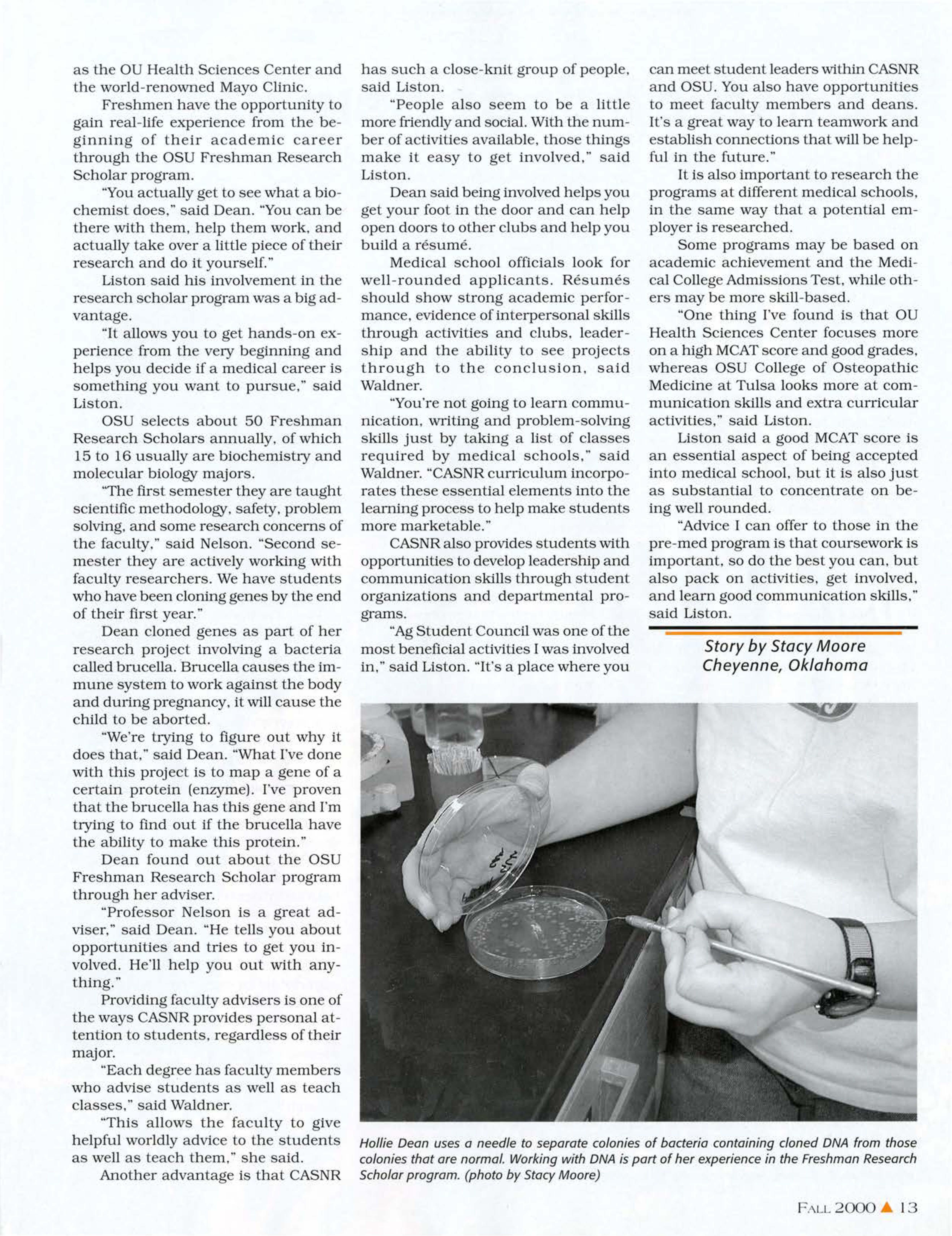
Hollie Dean uses a needle to separate colonies of bacteria containing cloned DNA from those colonies that are normal. Working with DNA is part of her experience in the Freshman Research Scholar program. (photo by Stacy Moore)
"God ha many ways to change a person's life. There was no chance for m to get a degree in my country. The disa ter that hit my village gave me a chance.·
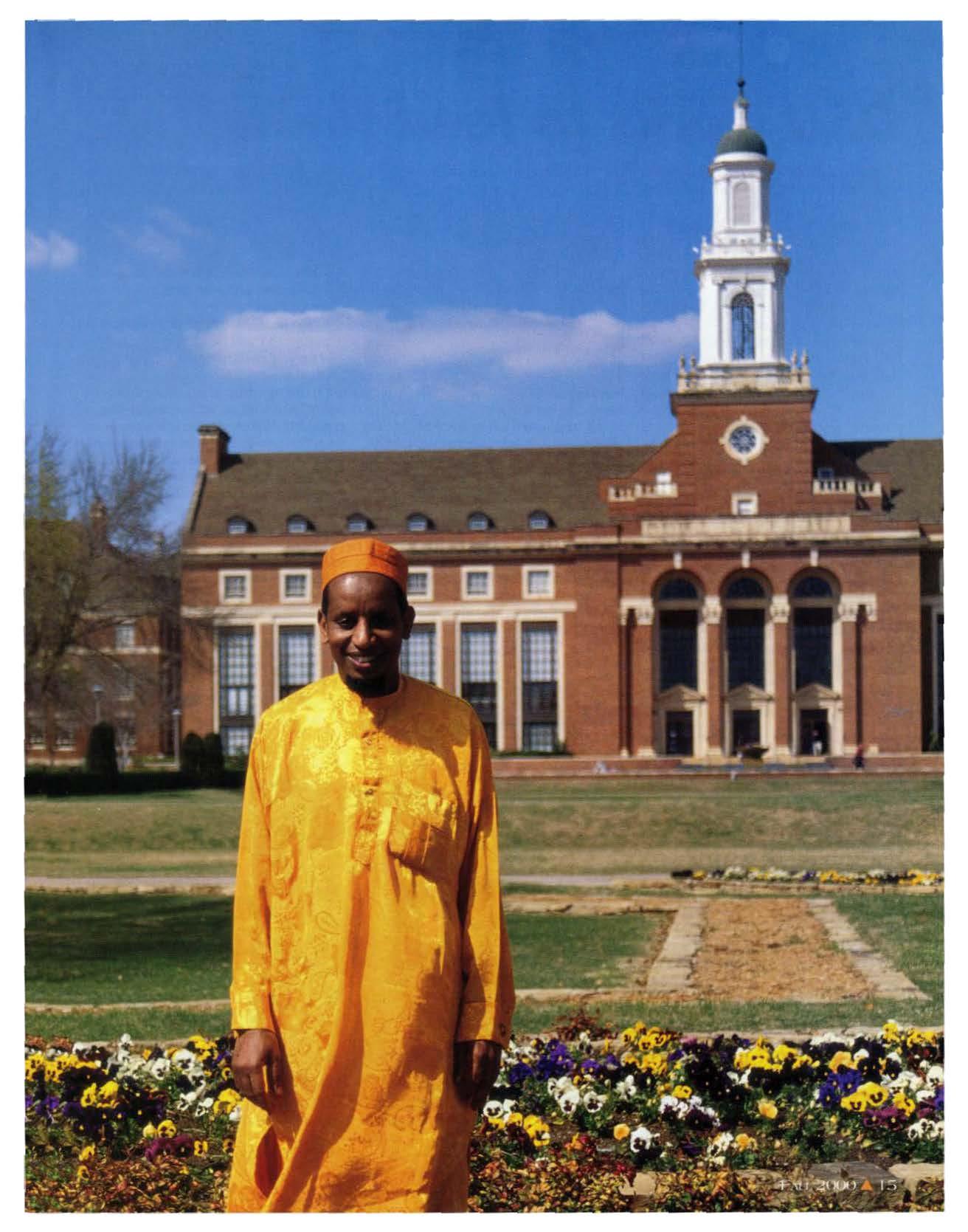
Umaru Sule is an international graduate student from the country of Cameroon in Central Africa.
But more importantly, Sule has overcome a major tragedy in his liti and turned it into a positive experience.
On Aug. 21, 1986, 24-year-old Sul I ft to run an errand. While he wa away. a nearby body of water. Lak Nyos. exploded and released carbon dioxide. More than 1.000 people in hi village died from suffocation. Sule's mother wa among other family members and friends who were victims a were countless livestock.
In the year following the explosion, an American program called Heifer Project International came to assist Sule's villag They supplied cattle for the survivors who had remain d in the area.
·1 was the only one who could speak English.· said Sule.
He becam acquainted with the Americans in the group. Thi led to his big chance in 1989. He was invited to attend the University of Massachusetts for a short time where he earned a bachelor of science degree in animal cience.
If not for the Lake yo disaster.
Sule would not have had a chance at advanced educa ion. Variou American churches and individuals spon ored hi trip to America. He then returned home to work in hi village.
Recognizing the imilari ties in their tragedies, survivors of the Oklahoma City bombing visited Sule' village in 1997. Sule became acquainted with Ern stine Clark. an Oklahoma State University alumna. Clark wa in one of the building near the Alfred P. Murrah Buildin when the blast occurred.
"Our disaster was natural." said Sule. -rheirs wa a crazy person trying to kill. But when we got together. we realized we were affected the same. The pain was th rune."
After sh realized Sute·s interest in agriculture. Clark remembered her father·s inter st i.n agriculture.
"We all have to help each other," said Clark. ··rthought that if I could help him, it would help build a bridge of peace between the two countries. It has already built a bridge between our hearts."
Clark worked together wi h retired OSU instruc or Melvin Jones and Earl Mitchell, OSU vice pre ident of multicultural affairs. to make the connections for him at OSU.
Sule visited the campu with nine other peopl in 1998. He wa ac epted to the university but did not receive
any financial aid until after he arrived. He brought his wife, Madina, and son. Abdul Samad. seven months later.
Sule had to make many tran itions when he moved to the United States. He learned English before he left Africa. but it was British Engli h. He had to adjust to he American style and even found differences in the dialect used in Massachu etts and Oklahoma.
Sule said one of the hardest adjustment was the amount of personal territory that Americans keep around th mselves. People in his country are very close o each other in both physical and emotional manners. In Cameroon. i is no uncommon for peopl ofth same gender to hold hands in public and be affectionate, bu he's learned to adjust.
In addition. the conversations and backgrounds ar completely different in the Unjted States.
"What's funny here is not funny in my culture." aid Sule, now age 38.
He said there is a difference in priorities. Family i the strongest unit above all others in Cameroon. The wellb ing of the village comes second, and ev ryone works for th salce of the whole community.
Religion ranks third as people will give up everything for the sake of being rewarded by God.
Sule said a person could be traveling and stop a a complete stranger's home. The ho t would welcome him or her and do everything possible to make the traveler comfortable. He would share what little he had.
He said overall there are more imilarities than differences. People in both countri hav the am ultimate goal of survival in life: having fri nds, making a family, and working to keep homes and food for their families.
Sule said he is very grateful for the opportunity for career development and education he has received from OSU.
··Getting financial support from families in this country means a lot to me and my family said Sule. "American ar the mo t generous people I've ev r met. I can't say thank you nough.''
Story by Jamie Jenkins Bethel, Oklahoma
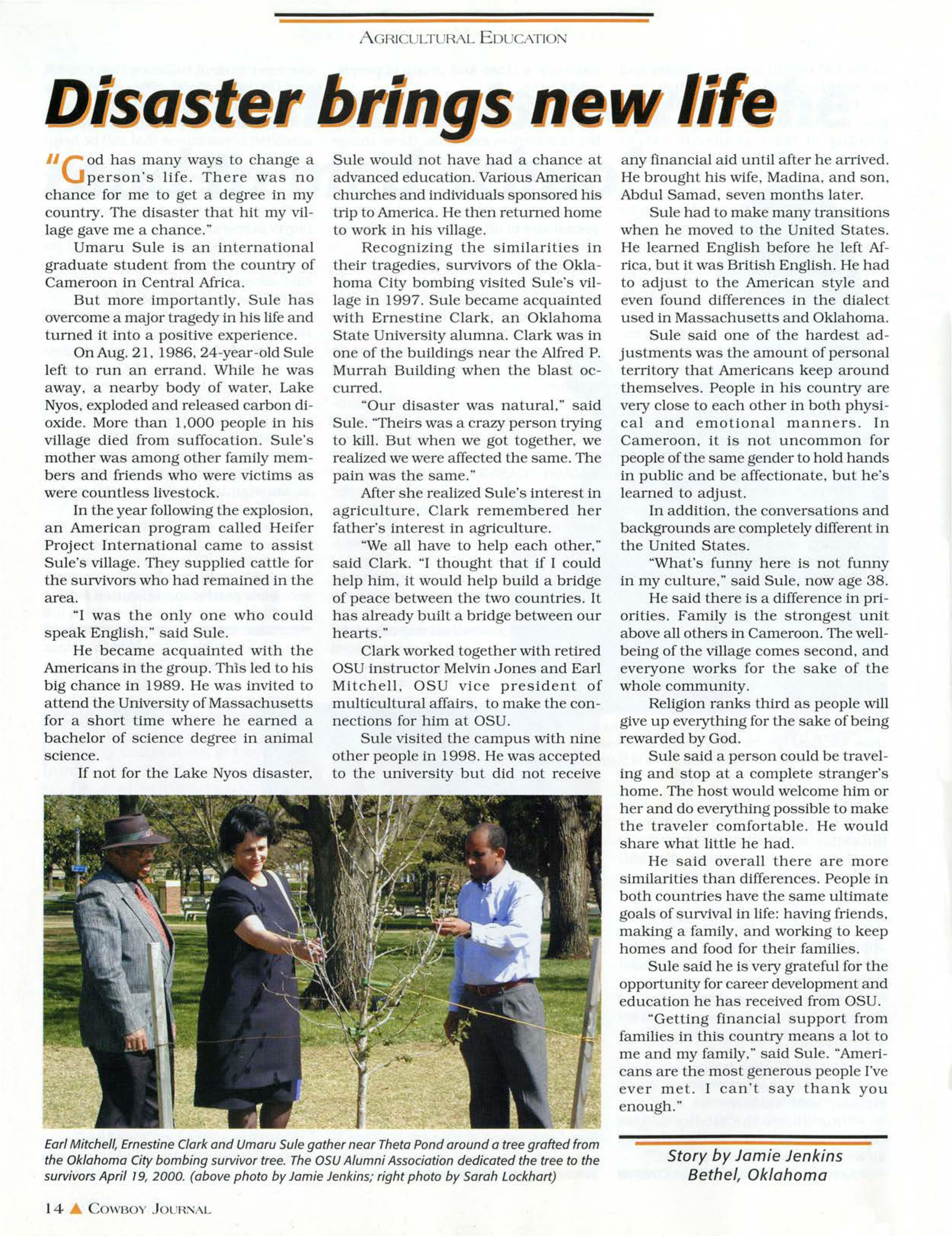
Earl Mitchell Ernestine Clark and Umaru Sule gather near Theta Pond around a tree grafted from the Oklahoma City bombing survivor tree. The OSU Alumni Association dedicated the tree to the survivors April 19, 2000. (above photo by Jamie Jenkins; right photo by Sarah Lockhart)
ll There are 33,000 people who dje every day due to starvation or malnutrition and we're going to go from 6 billion to 11 billion people in 40 years. We're going to have to have increas d produc ion.' said William Raun, Oklahoma State University agronomist.
Raun is not alone .in his fight against world hunger.
For more than 10 years. a team of four Oklahoma State University scientists have researched and tested a new "computerized" machine that could revolutionize the way farmers produce wheat.
The variable rate technology machine, or VRT was created by the OSU team of Marvin Stone and John Solie, biosysterns and agricultural engineers, and Gordon Johnson and William Raun. agronomists.
The team d v loped the applicator in the 1980s. However, the actual machine was not bull until 1996.
Th special machine can read how healthy the plants are and calculate what nutrients they need.
e'The machine can then calculate how much fertilizer the plants need to reach maturity and apply it." Stone said.
However, Us benefits are not Limited to fertilizer application rates.
The VRT machine also can estimate how much wheat a field will yield.
The team has confirmed through years of research that using individualized amounts of fer iliz r for each plant result in increased production levels, decreased levels of nitrogen runoff in field , and decreased fertilizer expenses for farmers.
"Using a op dress rate of 80 pounds of fertilizer per acre, frumers can boost production by eigh bush ls a $2 a bushel [using the VRTJ.··Raun aid.
"At the same time, th VRT can decrease nitrog n ra es by 12 pounds. and at 20 cents per pound. this results in an increased revenue ofroughly 18 dollars per acre. That"s a lot."
Individualizing fertilizer amounts for specific plants also helps to develop the plants· protein levels. Stone said.
In sampling the grain after harvest, the team found a more consistent crude protein level among the grrun tested.
Stone said this was because the VRT helps to create more uniform wheat yields.
Soon the VRT machine also may create more uniform fields for oth r crops.
··rn the near future, w ar hopeful that the VRT will be able to be used on all crops of all varieties throughout the United States," Solie said.
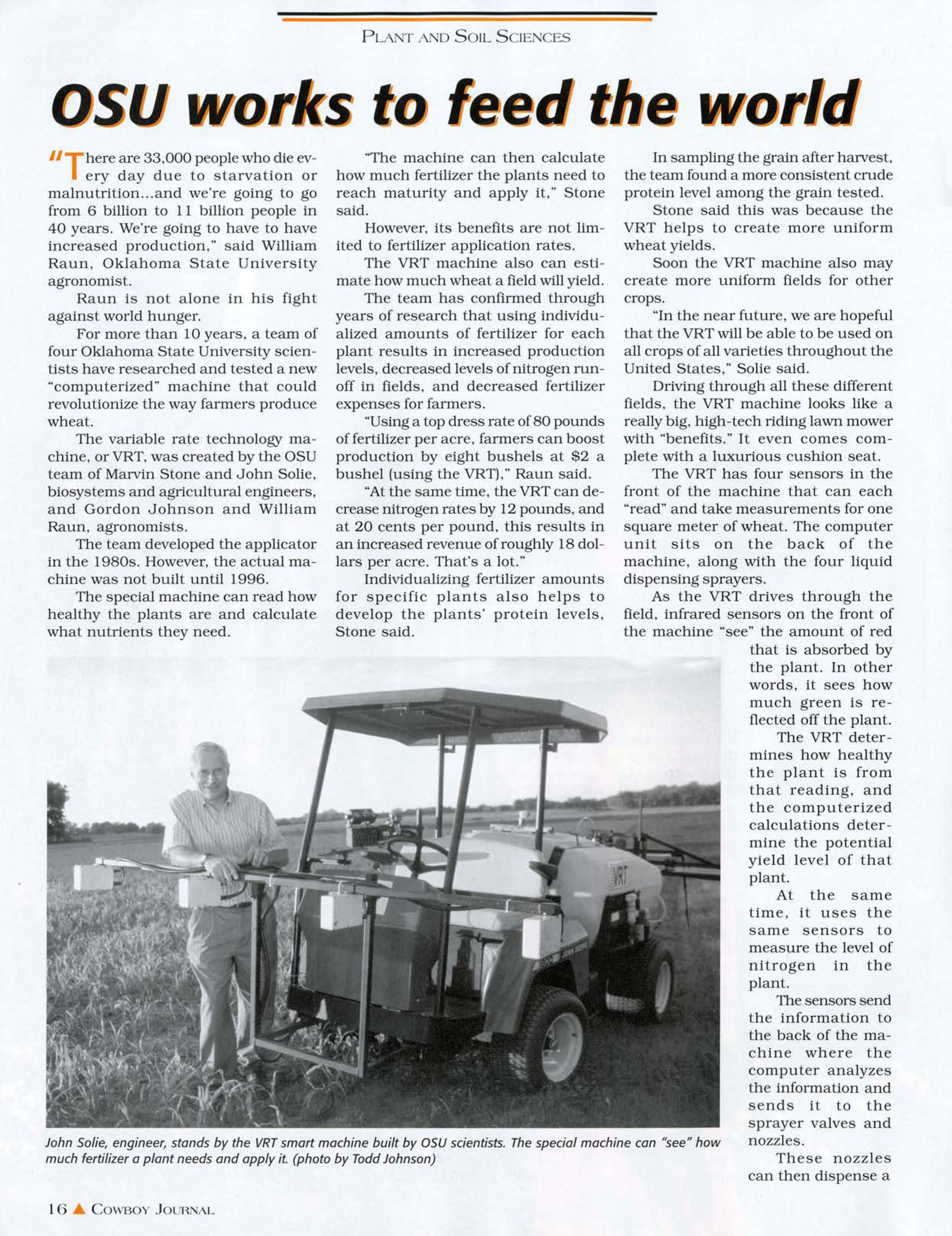
Driving through all these different fields, the VRT machine looks like a really big, high-tech riding lawn mower With ··benefits." It even comes complet \vith a luxurious cushion seat.
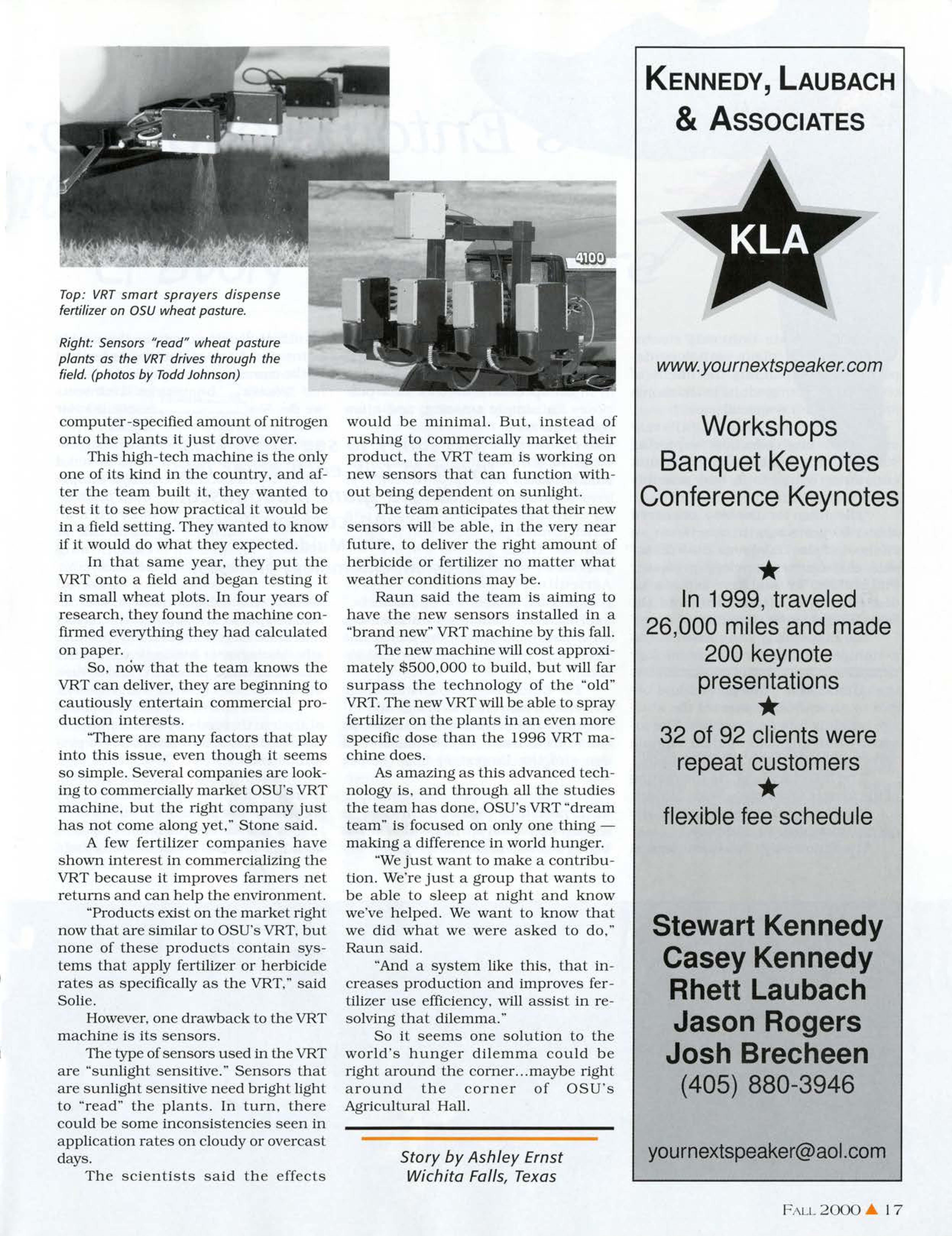
The VRT has four sensors in the front of the machin that can each "read" and take measurements for one square meter of wheat. The computer unit sits on the back of he machine, along with the four liquid dispensing sprayers.
As the VRT drives through the field, infrared sensors on the front of the machine ··see" the amount of red that is absorbed by the plant. In other words. it sees how much green is reflected off the plant.
The VRT determines how healthy the plant is from that reading and the computerized calculations determine the potential yi Id I vel of that plan.
At the same time, i • uses he same sensors to measure the level of nitrogen in the plant.
The sensors send the information to the back of the machine where the computer analyzes the information and sends it to the sprayer valves and nozzles.
These nozzles can then dispense a
John Solie, engineer, stands by the VRTsmart machine built by OSU scientists. The special machine can "see" how much fertilizer a plant needs and apply it. (photo by Todd Johnson)
computer- pecified amount of nitrogen onto the plants it just drove over.
This high-tech machine is the only one of its kind in the counby, and after the team built it. they wanted to test it to see how practical it would be in a field setting. They wanted to know if it would do what they expected.
In that same year, they pul the VRT onto a field and began testing it in small wheat plots. ln four years of research, they found the machine confirmed everything they had calculated on paper.
So. now that the team knows th VRT can deliver, hey ar beginning to cau iously ntertain commercial production interests.
"There are many factors that play into this issue, even though it seems so simple. Several companies are looking to commercially market OSU's VRT machine, but the right company just has not come along yet," Stone said.
A few fertilizer companies have shown interest in commercialiZing the VRT because it improves farmers ne retu1ns and can help the environment.
"Products exist on th market right now that are similar to OSU's VRT. but none of these products contain systems that apply fertilizer or herbicide rates as specifically as the VRT." said Solie.
However. one drawback to the VRT machine is its sensors.
The type of ensors u ed in the VRT are ··sunlight sen itive." Sen or that are sunlight sensitive need bright Ugh to "read" the plants. In turn. there could be some incon istencie seen in application rates on cloudy or overca t days.
The scientists said the effects
would be minimal. But, instead of rushing to commercially market their product, the VRT team is working on new sensors that can function without being dependent on sunlight.
The team anticipates that their new s nsors will be able. in the very near future, to deliver the right amount of herbicid or fertilizer no matter whal weather conditions may be.
Raun aid lh team is aiming to have the new ensors installed in a "brand new" VRT machine by this fall.
The new machine will cost approximately $500.000 to build. but will far surpass the t chnology of the "old" VRT. The n w VRT will be able to spray fertilizer on the plants in an even more specific dos than the 1996 VRT machine does.
As amazing as this advanced technology is. and through all the studies the team has done, OSU's VRT "dream team" is focused on only one thingmaking a difference in world hunger.
"Wejust want to make a contribution. We're just a group that wants to be able to sleep at night and know we'v h lped. Wi want to know that w did what we w r asked to do." Raun said.
"And a system like thi , that increases production and improves fertilizer use efficiency, will a ist in resolving that dilemma
So it seems one solution to the world's hunger dilemma could be right around the comer maybe right around the corner of OSU's Agricullw-al Hall.
Story by Ashley Ernst Wichita Falls, Texas
Top: VRT smart sprayers dispense fertilizer on OSU wheat pasture.
Right: Sensors "read" wheat pasture plants as the VRT drives through the field. (photos by Todd Johnson)
OSU' s Entomology Zoo:
It 's a
Oklahoma State University's entomology and plant pathology department is expanding the minds of children and young adults in Oklahoma and Texas With a special zoo.
The Entomology Zoo is osu· very own exotic bug collection, supplying students With what is often their first encounter With exotic and possibly harmful insects.
'"The idea for the zoo occurred about 10 years ago. It came from an offshoot of the Oklahoma State Fair," said assistant entomology professor Phil Mulder. "l would have to give a lot of credit to the department and Dr. Russ Wright for starting the program."
The Entomology Zoo tarted out a a storage building for the entomology department"s live insect collections. As the number of live insects on hand began to grow, OSU converted the storage building into an insectary. The insectary building is located on Virginia Street one mil north of the campus.
''The in ectary is where he rearing of the insects takes place." said Mulder.
Rearing is the d velopment of the insect from birth to adulthood.
The Entomology Zoo is involved in
projects ranging from supplying insects for high chool lab to taking an exhibit to the Special Olympics.
1he sp cim n used for such purpo e ar simply amazing, and a few
The collection contain thousands of insects. A few of the insects housed at the insectary are considered rare.
"We are for unate to get th insects we do. Since we are an institution for sp cimens are extremely tough to get," aid Mulder.
"We must go through strict (United States Department of Agriculture)
It is funny to see these kids trying to talk each other into holding a giant Madagascar hissing cockroach.
Phil Mulder assistant entomology professor
regulations o acquire our insects, said Mulder. "Sometimes when we ask for a particular insect the USDA has never had anyone request for that insect."
The Entomology zoo as well as the insectary's collection is broad and intriguing. The insects in the collection range from some of the mallest to som of the larg st species in the world.
For instance. one exotic walking stick measure almost 12 inches in length, and some of the beetles are as big as a grown man's fist.
higher education. the process is a lot more imple than if an individual would ask for them," said Mulder.
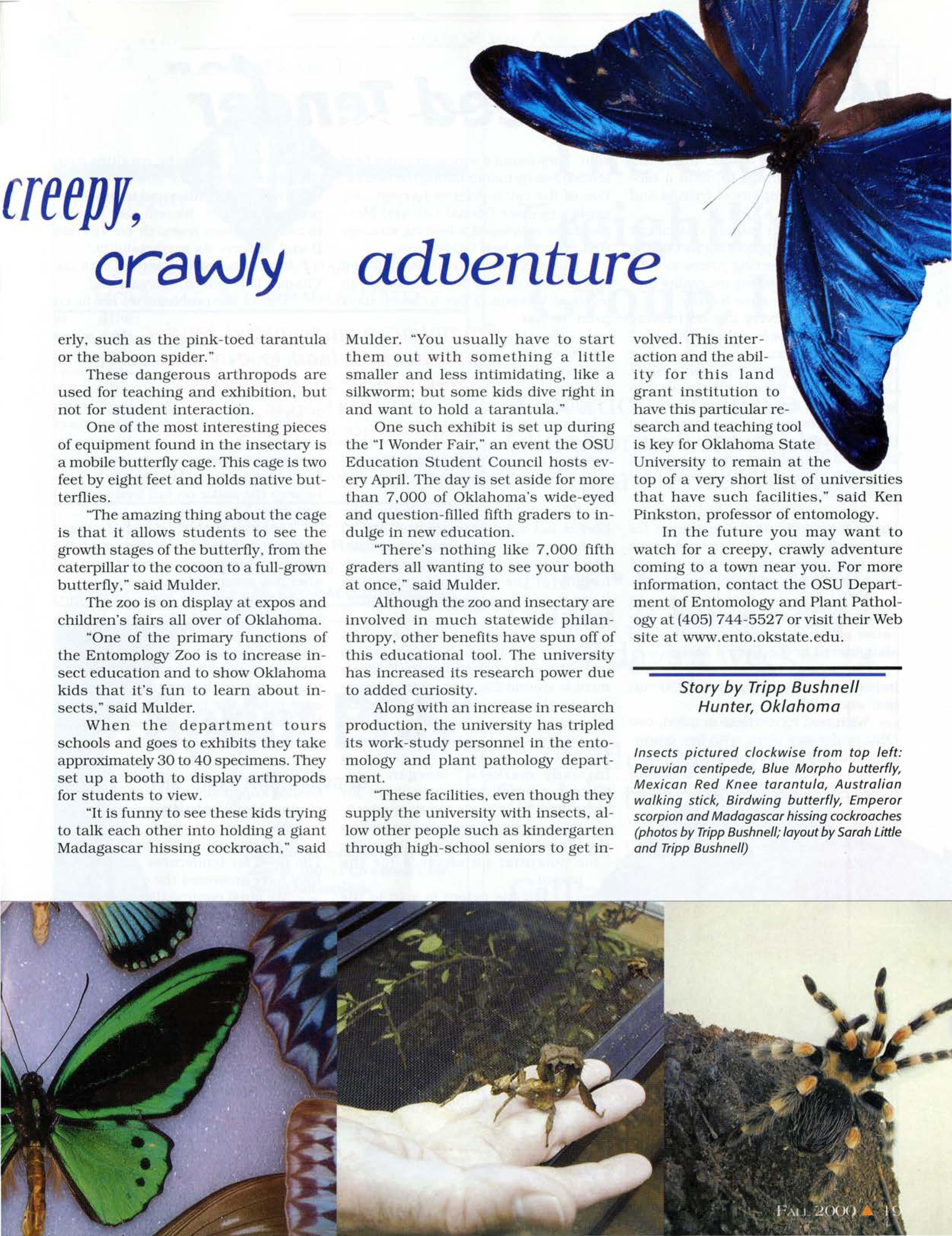
In the insectary. entomologis s raise s veral diffi rent types of arthropods. The facility has silkworm that actually produce silk. Madagascar hissing cockroaches that his when provoked. and a variety of poisonous corpions and spiders.
The zoo and the insectary get most of their arthropod by trading or purchasing from other universities or permitted zoos.
"Trading cuts our cost tr m ndously. but I have spent around $120 for a single live specimen," said Mulder.
~A few of the poisonous species ould be harmful if not handled prop-
creepy, crawly
erly. such as the pink- oed tarantula or the baboon pider. ••
These dangerous arthropods are used for teaching and exhibition, but not for student interaction.
One of the most intere ting piece of equipment found in the insectary i a mobile butterfly cage. This cage is two feet by eight feet and holds native butterflie .
'The amazing thing about the cage is that it alJows students to see the growth stages of the butterfly. from the ca erpilla.r to the cocoon to a full-grown butterfly." said Mulder.
Th zoo is on display at expos and children's fairs all over of Oklahoma.
"One of the primary functions of the Entomology Zoo is to increase insect education and to show Oklahoma kjds that it's fun to learn abou insects," said Mulder.
When the department tours schools and goes to exhibits they take approximately 30 to 40 specimens. They set up a booth to display arthropods for students to view.
"It is funny to see these kids trying to talk each other into holding a giant Madagascar hissing cockroach... said
adventure
Mulder. "You usually have to start them out with omething a littl smaJler and le s intimidating. like a silkworm: but some kids dive right in and want to hold a tarantula."
One such exhibit is set up during lhe "I Wonder Fair," an event Lhe OSU Education Student Council host every April. The day is s t asid for mor lhan 7,000 of Oklahoma's wide-ey d and que tion-filled fifth graders to indulge in new education.
"There' nothing like 7.000 fifth graders all wanting to ee your booth at once," said Mulder.
Although the zoo and insectary ar involved in much statewide philanthropy. other benefits have spun off of this educational tool. The university has increased its research power due to added curiosity.
Along with an increase in research production, the university has tripled its work-study personnel in th entomology and plant pathology d partment.
'These facilities. ven though they supply the univer ity with in cts. allow other p ople such as kindergarten through high-school seniors to get in-
volved. Thi interaction and the ability for this land grant institution o hav this particular rarch and leaching tool i key for Oklahoma Stat University to remain at the top of a very short list of universities that have such facilities." said Ken Pinkston. profes or of entomology. In the future you may want to watch for a creepy. crawly adventure coming to a town near you. For more information. contact the OSU Department of Entomology and Plant Pathology at (405) 744-5527 or visit their Web site at www.ento.okstate.edu.
Story by Tripp Bushnell Hunter, Oklahoma
Insects pictured clockwise from top left: Peruvion centipede, Blue Morpho butterfly, Mexican Red Knee tarantula, Australian walking stick, Birdwing butterfly, Emperor scorpion and Madagascar hissing cockroaches (photos by Tripp Bushnell; layout by Sarah Little and Tripp Bushnell)
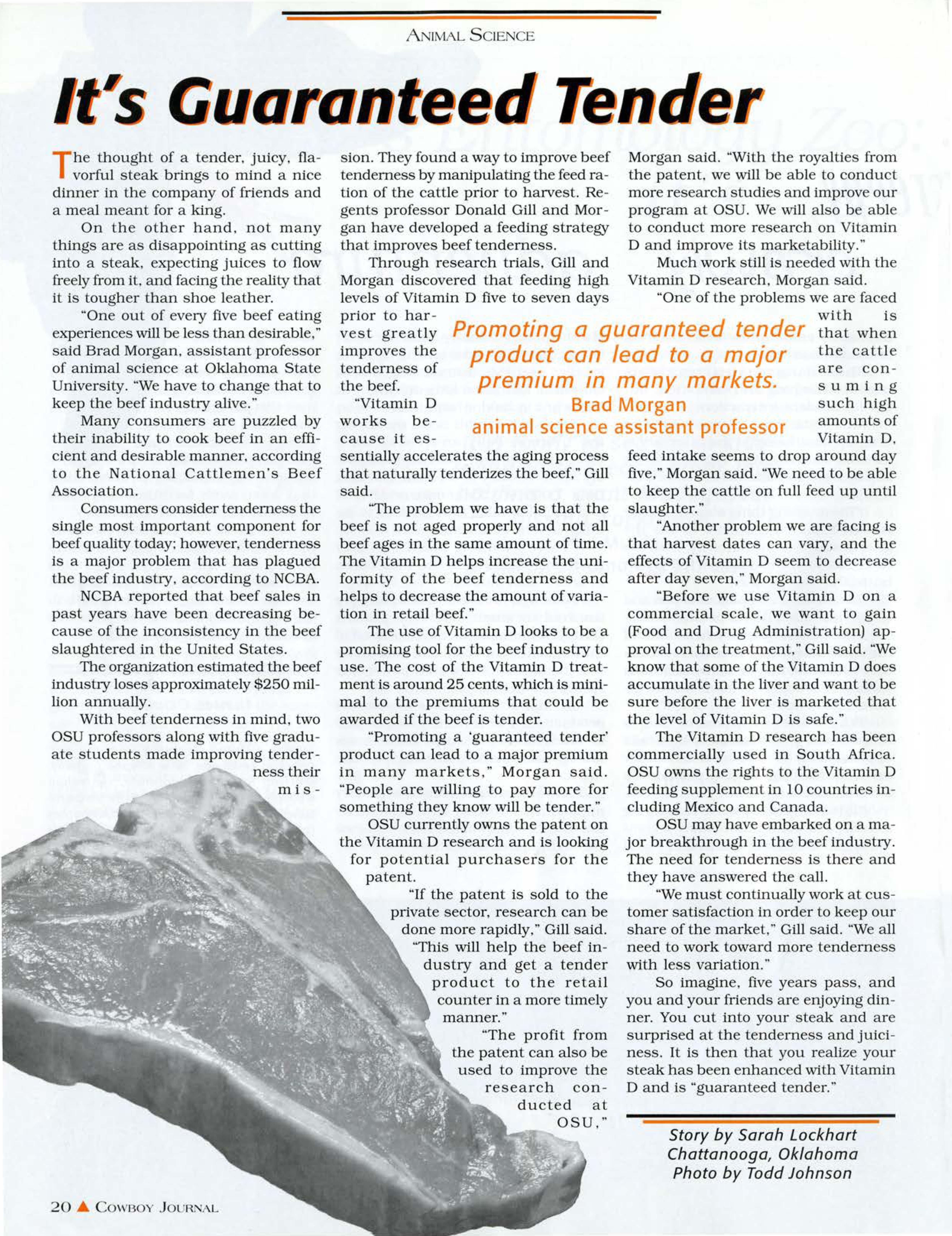
's G aran
The thought of a tender. juicy, flavorful s eak brings to mind a nice dinner in the company of friends and a m aJ meant for a king.
On the oth r hand. not many things are as disappointing as cutting into a steak, expecting juices to flow fre ly from it, and facing the reality that it is tougher than shoe leather.
"On out of every five beef eating exp riences will b les than desirable," said Brad Morgan. a sis ant professor of animal science at Oklahoma Sta e University. "We have to chang that to keep the beef industry alive
Many consumers are puzzled by their inability to cook beef in an efficient and desirable manner, according to the ational Cattlemen's Beef Association.
Consumers consider tenderness the single most important component for beef quality today: however, tenderness is a major problem that has plagued the beef industry, according to NCBA.
NCBA reported that beef sales in past years have been decreasing because of the inconsistency in the beef slaughtered in the United States.
The organization estimated the beef industry loses approximately $250 million annually.
With beef tenderness in mind, two OSU professors along with five gradua e students made improving tenderness their
sion. They found a way to improve beef tenderness by manipulating the feed ration of the cat 1 prior to harvest. Regents professor Donald Gill and Morgan have developed a feeding strategy that improves beef tenderness.
Through research trials, Gill and Morgan discovered that feeding high levels of Vitamin D five to seven day
Morgan said. "With the royalties from the patent. we will be able to conduct more research studies and improve our program at OSU. We will also b able to conduct more research on Vitamin D and improve it marketability."
Much work still is needed with he Vitamin D research. Morgan said.
"One of the problems we are faced prior to harvest greatly improves the tenderness of he beef.
Promoting a guaranteed tender product can lead to a major premium in many markets.
"Vitamin D works beBrad Morgan cause it esanimal science assistant professor sentially accelerates the aging process that naturally tenderizes the beef," Gill said.
"The problem we have is that the beef is not aged properly and not all beef ages in the same amount of time. The Vitamin D helps increase the uniformity of the beef tenderness and helps to decrease the amount of variation in re ail beef."
The use of Vitamin D looks to be a promising tool for the beef industry to use. The cost of the Vitamin D treatment is around 25 cents, which is minimal to the premiums that could be awarded if the beef is tender.
"Promoting a 'guaranteed tender' product can lead to a major premium in many markets," Morgan said. "People are willing to pay more for something they know will be tender."
OSU currently owns the patent on the Vitamin D research and is looking for potential purchasers for the patent.
"If the patent is sold to the private sector, research can be done more rapidly," GiJI said.
"This will help the beef indu ry and get a tender product to the retail counter in a more timely manner."
"The profit from the patent can also be used to improve the research conducted at OSU,"
wi h is that when the cattl are cons um in g such high amounts of Vitamin D,
feed intake seems to drop around day five," Morgan said. "We need to be able to keep the cattle on full feed up until slaughter."
"Another problem we are facing is that harvest dates can vary, and the effects of Vitamin D seem to decreas after day seven." Morgan said.
"Before we us Vitamin D on a commercial scale, we wan to gain (Food and Drug Administration) approval on the treatment." Gill said. "We know that some of the Vitamin D does accumulate in the liver and want to be sure before the liver is marketed that the level of Vitamin D is safe.··
The Vitamin D research ha been commercially used in South Africa. OSU owns the rights to the Vi amin D feeding upplement in 10 coun ries including Mexico and Canada.
OSU may have embarked on a major breakthrough in the beef industry. The need for tenderness is there and they have answered th call.
·we must continually work at customer atisfaction in order to keep our share of the market," Gill said. "W all need to work toward more tenderness with le variation ...
So imagine, five years pass, and you and your friends are enjoying dinner. You cut into your steak and are surprised at the tenderness and juiciness. It is then that you realize your steak has been enhanced with Vitamin D and is "guarante d tender."
Story by Sarah Lockhart
Chattanooga, Oklahoma
Photo by Todd Johnson
a agricultural
Agood night's sleep followed by a hearty breakfast and a heaping serving of agricultural news updates ar the secret to success for many Oklahoma agricultural producers.
"'SUNUP,"an ag:rtcullmal news program produced by Oklahoma State University faculty, staff and student in-
research and informa ion. Working through OSU and extension offices. th interested viewers can follow up on sto1ies and get more in-depth information as they n ed i
Working with 0 SUNUP" landed me the job I have now.
Austin Moore extension communications
specialist
Broadcasters and faculty member sp cializing in everything from economics o gardening give viewers a terns, is broadcas across the state to sle pyeyed viewers every weekday at 7 a.m. on Oklahoma
Educational Television Authority channels.
"W try to give the viewers ag new that they wouldn't get from anywhere else," said Rob Mcclendon. broadcast manager. "There is a nich we try to fill..,
With mor than 100,000 vi wers, ifs clear "SUNUP" reaches more than just the Oklahoma agricultural community, and McClendon works hard to ensure "SUNUP" covers topics that will appeal and relate to the diverse audience.
weal h of information In ju t 15 minutes of airtime. Becaus of
'"SU 1up·· was first introduced Jan. 1. 1987. and aired live from the OSU campus for 10 year Today. however, the show is taped weekday afternoons, when daily commodity market information becomes available.
While educating the audience is important. another important group of people benefi from the production of "SUNUP.'"
Abou 10 OSU student intern are involved in the daily production of the news program. Intern 1un cameras and TelePrompTers and assist in he production of graphics for the show.
Jamie Jenkins, OSU agiicultural communications graduate. said her role as a "SUNUP" intern gave her oncamera and real-world expe1i nee in th teleVision production industry.
Because of i s diversity and specific subject ma ter. it's no surpris the show is one of a kind. "SUNUP" stands alone in its field. without competition. McClendon said there is no other daily ag1icultural news show seen statewide. In fact, OSU is the only university to air a daily agricultural news program.
Sponsor d by the Oklahoma Cooperativ Extension SerVi.c the show provides a distribution outlet for the university's the nature of Oklahoma's agricultural industry, topics such as animal health and the environment are two important issues frequently covered by th "SUNUP"'crew, Mcclendon said.
"I have studio experience to put on a resume now." Jenkins said. "When I apply for jobs. this will put me ahead of other applicants."
While ioternjng. Jenkins had the opportunity to give market reports on camera, as well as run cameras and TelePrompTers.
Other interns have said they enjoy the internship because of the peopl lb y meet while working with the show.
"It has been a great experience.'· said Michael Jackson. OSU agricultural communica ions senior. "The people I have met through "SUNUP'are part of the Oklahoma agricultur in-
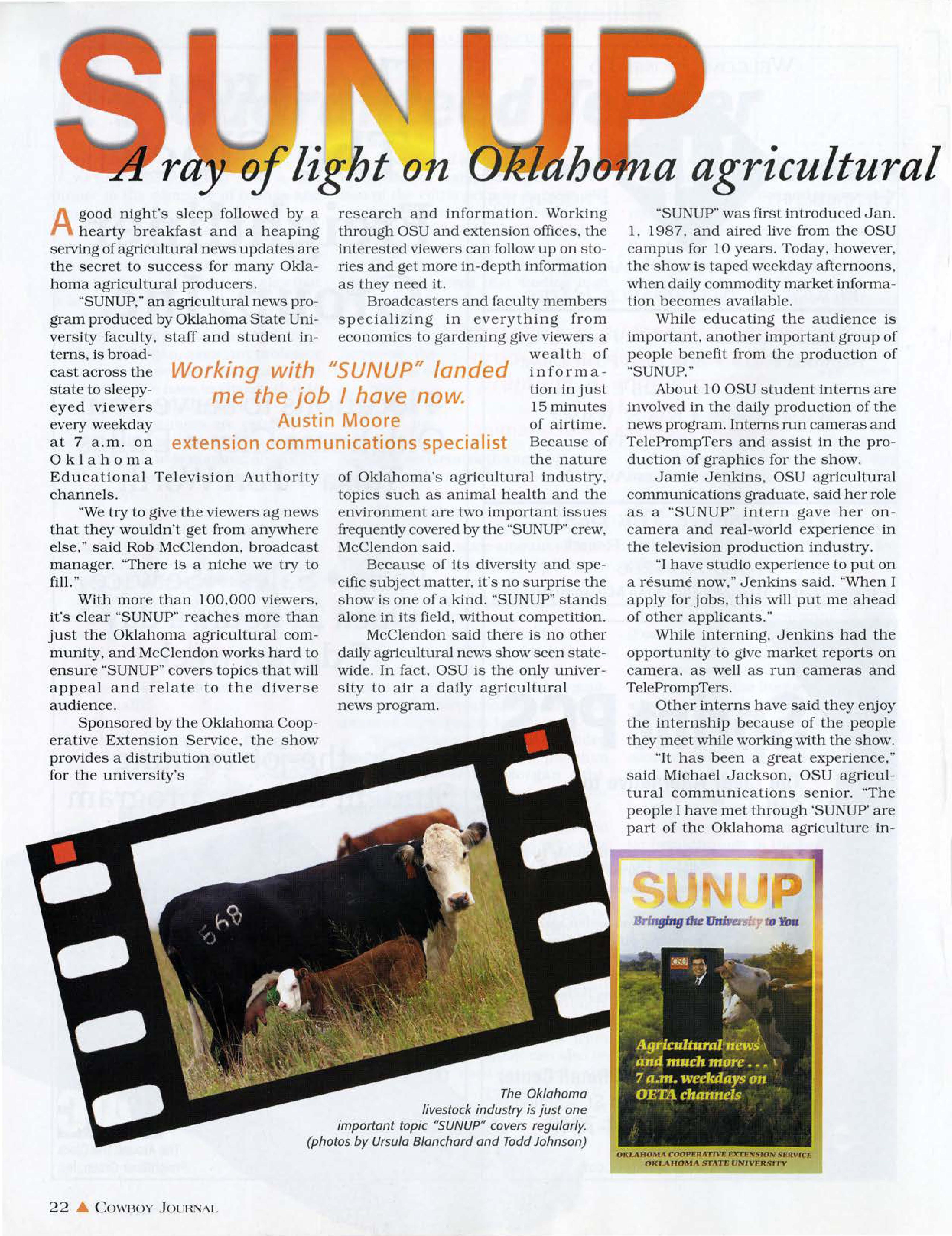
The Oklahoma livestock industry is just one important topic "SUNUP" covers regularly.
(photos by Ursula Blanchard and ToddJohnson)
information
dustry. They·re respected experts in their fields and really interesting o work with."
As an OSU agrtcul ural communications junior and "SUNUP" assistan director, Clinton Griffi hs has the opportunity to take par in all asp cts of the production and direction of the show.
·•1do wha ever needs to be done." Griffith said. 'Tve worked with 'SUNUP' a an intern for two years and now I have the chanc lo direc . This is real expe1ience, nol something I can learn from a textbook."
Griffiths ha built quite a resume as a "SUNUP" intern, and OSU graduat s who interned at ''SUNUP" are living proof that his future will look ven brighter.
"Working for ·SUNUP' landed me the job I have now," said Austin Moore, extension communi ations specialist at Texas A&M University. "I had the knowledge and I came into this position with more work experience than your typical recent college graduate."
Moore, a former intern, now produces educational video and radio r leases for the Texas Agricultural Exten ion Service. Moore said his intern hip with the show gav him thre year experience in t levision production before leaving OSU.
It seems o be unanimous. "SUNUP" interns value the experience and appreciate their new perspective on th television production industry. And most importantly. viewers appreciate the opportunity toge tbe latest scoop straight from the state's premier agricultural news source.
By creating this unique learning environment "SUNUP~ ensures future success for Oklahoma's agricultural industry.
Story by Ursula Blanchard Elgin, Illinois
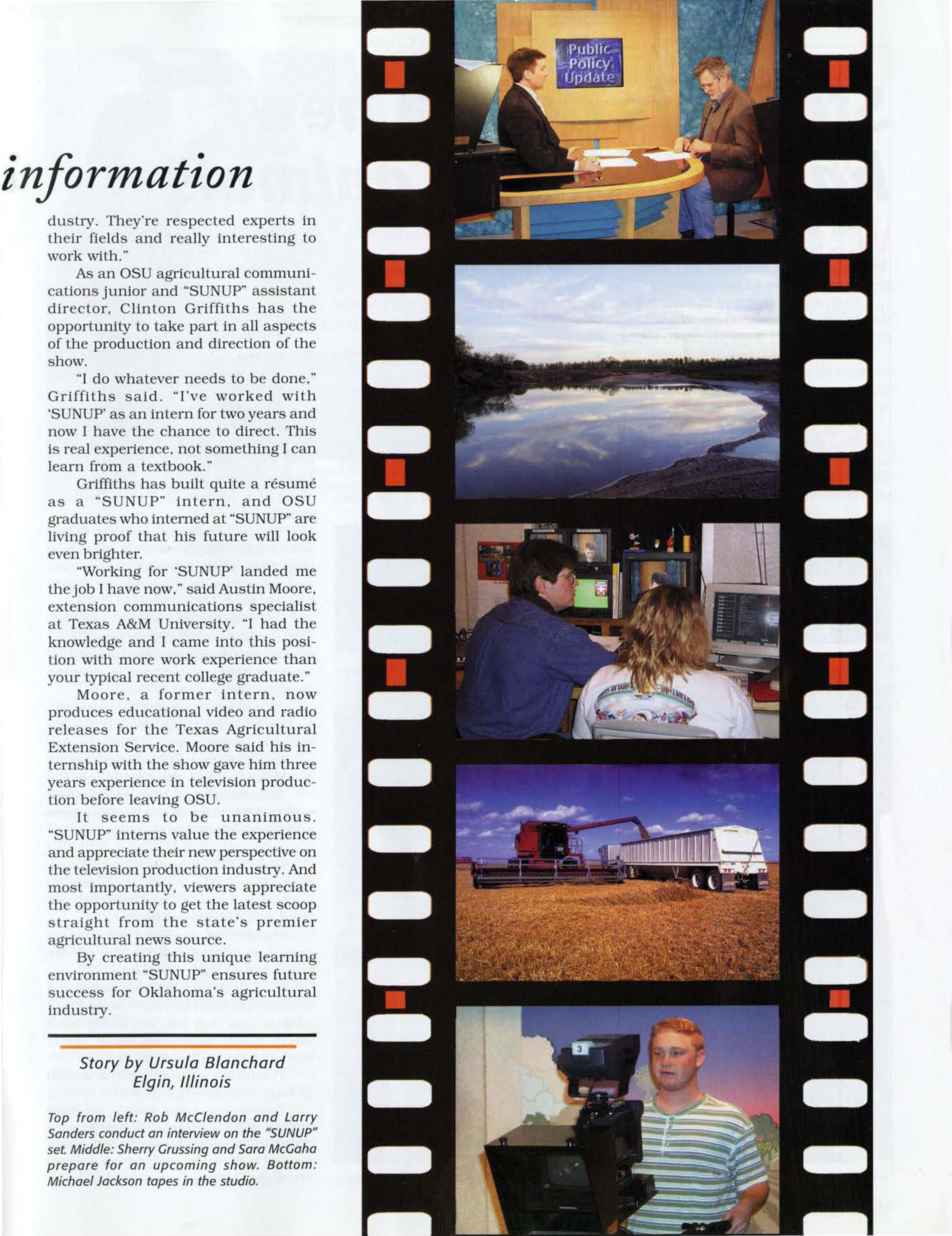
Top from left: Rob Mcclendon and Lorry Sonders conduct on interview on the "SUNUP" set. Middle: Sherry Grussing and Soro McGoho prepare for an upcoming show. Bottom: Michael Jackson tapes in the studio.
What do Oklahoma State University landscape architecture student , California sea lions and African penguins all have in common?
They are all involved in creating a fu ure exhibit for the Toi a Zoo & Living Museum.
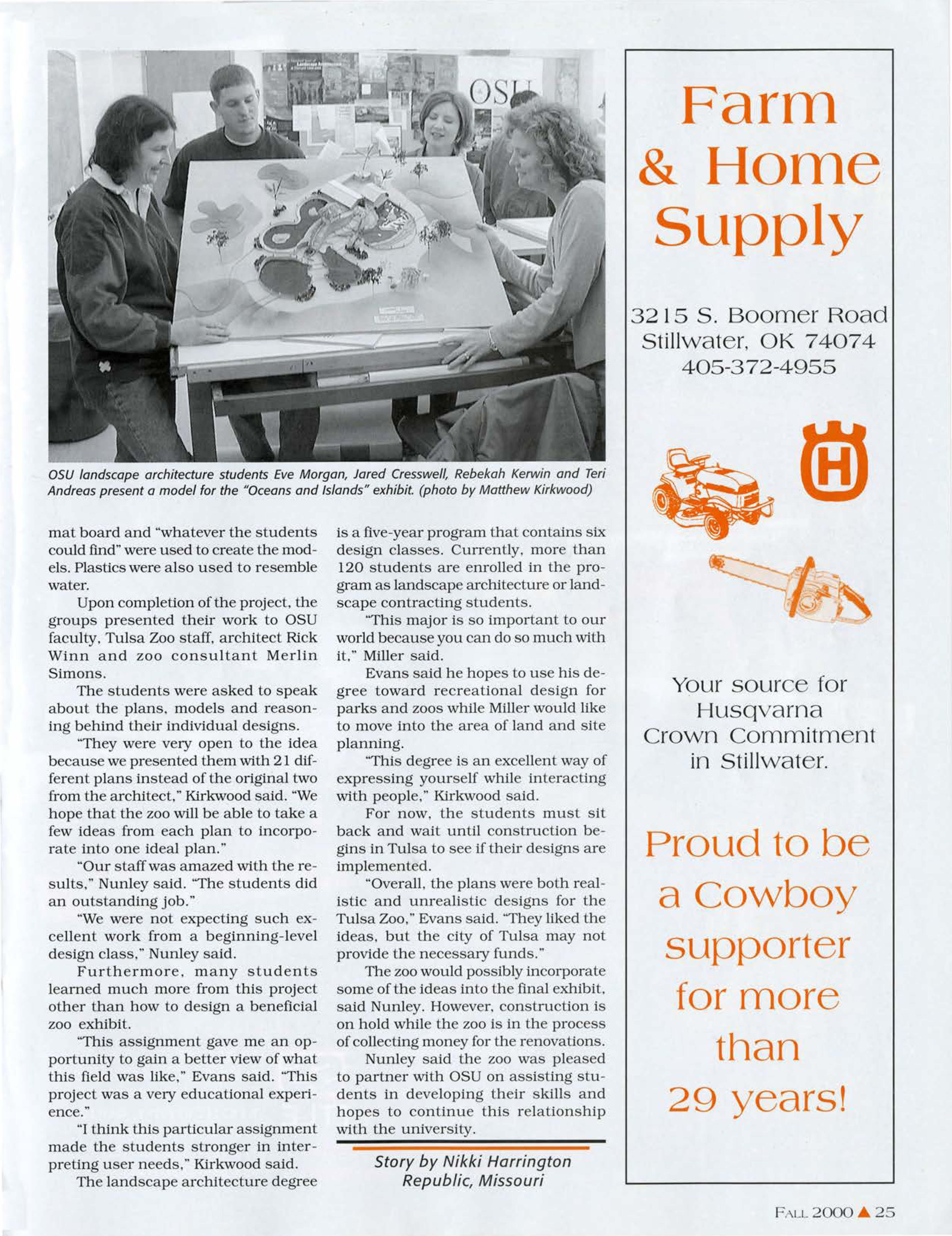
OSU students recently developed detailed models for a California sea lion pool renovation including the addition of an African penguin exhibit.
"I felt the zoo would make an ineresting project because it is an affilia e gard n member of the Oklahoma Botanical Garden & Arboretum, with whom our department works closely."
0esaid Ma th w Kirkwood, landscape architecture professor.
As a par of Kirkwood's Landscape Archit cture Design I class. students were asked to put their experience and knowledge to the es in designing new exhibits for the zoo.
The project originated when Kirkwood contacted the zoo concerning ideas for reconsbuction or expansion projects.
The zoo re ponded with a job to improve the existing California sea lion exhibit with the expansion of an African penguin exhibit.
Larry Nunley. director of he Tulsa
Zoo. said the zoo's intentions are to renovate the California s a lion habitat and to add an African penguin section to make a multi-species entrance to the zoo's future "Oceans and Island " exhibit.
"I felt this was a project that would benefit th zoo while giving students practical experience ,vi thin their field," Kirkwood aid.
Kirkwood said the zoo's contracted architect had previously presented ideas for the exhibit, but the zoo plann rs were willing to participate in the project to give students a perspective of what a project of this magnitude ntai.ls.
"As landscape architects, it is our job to meet client needs," Kirkwood said. "The challenge with this project was trying to meet the needs of the animal clients.··
Geoff Evans, landscape architecture senior, said the class began surveying and analyzing the project by taking a field trip to Tulsa to view the existing conditions.
"Our current exhibit is functional, but as with anything there is always room for improvement," Nunley said.
The class was split up into teams of two for th designing of the models.
"Our main goal with this project was to learn how to work with others and o e tablish earn-building kills,·• Kirkwood said.
Shaun Miller, landscape architecture senior, said it was necessary to do further research on California sea lions and African penguins.
Miller said the Internet b came useful in fmding information on the animals and their habitats.
"You first have to know what the animals are used to befor d signing a habitat that they will liv in day after day," Miller said. "We were really pushed o expand our ideas.H
The studen s were given a month to fully complete the project.
The requirements were to produce a plan design, a upport de ign with elevations and dimensions, and a model.
Materials such as crescen board,
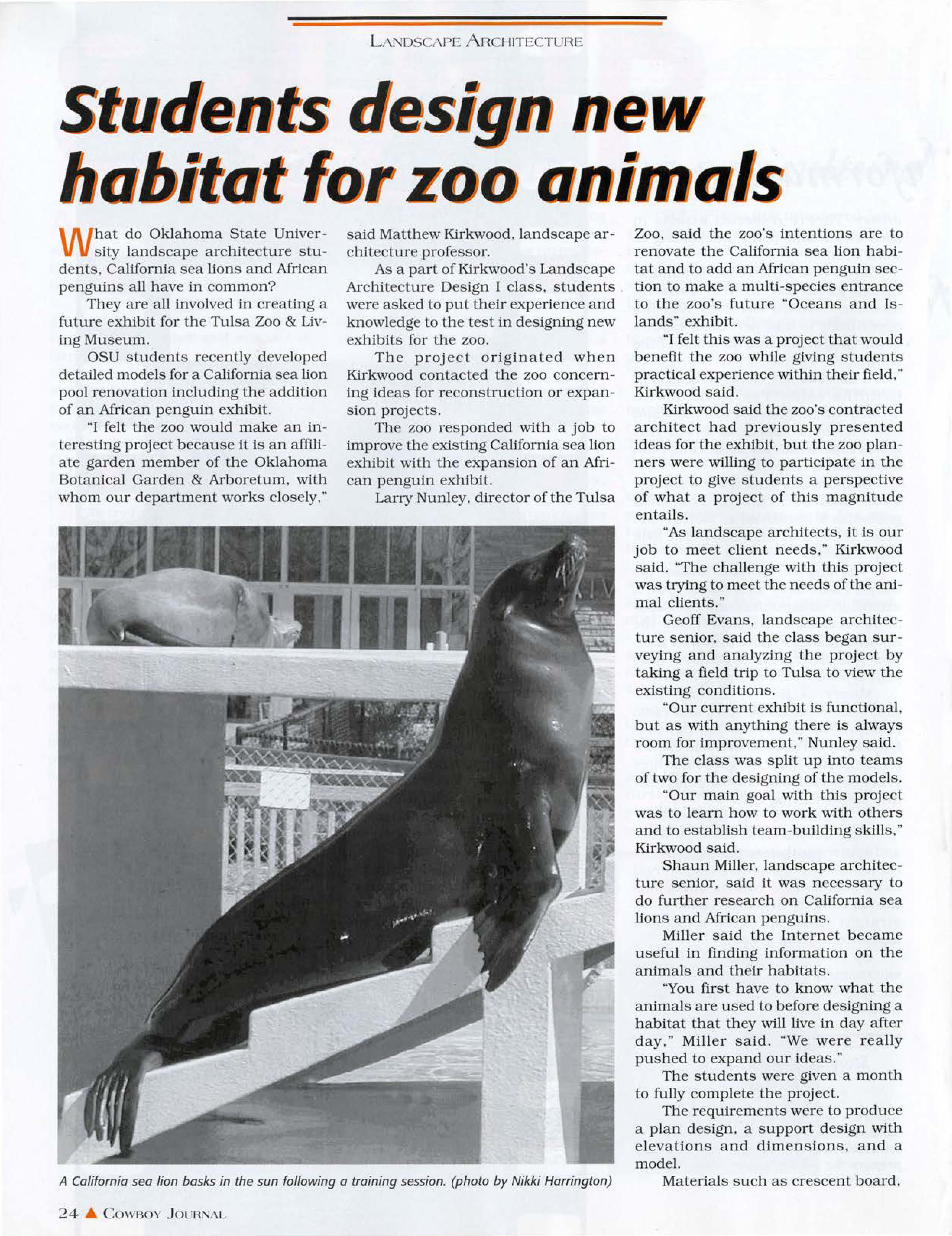
A California sea lion basks in the sun following a training session. (photo by Nikki Harrington)
mat board and ·'whatever the students could find" were used to create the models. Plastics were also used to resemble water.
Upon completion of the project, th group presented heir work o OSU faculty. Tulsa Zoo staff, architect Rick Winn and zoo con ultant Merlin Simons.
The students were asked to speak abou the plans, models and reasoning behind their individual d signs.
"They were very open to th idea because we presented th m with 21 different plans instead of the original two from the archit ct." Kirkwood said. ·we hope that th zoo will be able to take a few ideas from each plan to incorporate into one ideal plan."
"Our staff was amazed with the results." Nunley said. "The s udents did an outstanding job."
··we were not expecting such excellent work from a beginning-level design class." Nunley said.
Furthermore, many studen s learned much mor from this project other than how to de ign a beneficial zoo exhibit.
''This assignment gave me an opportunity to gain a better view of what this field was like." Evans said. ''This project was a ve1y educational exp rienc ."
"I think this particular assignmen made the students stronger in in erpreting user needs," Kirkwood said.
The landscape architecture degree
is a five-year program that contains six design classes. Currently. more han 120 s udent are enrolled in th program as landscape architecture or landscape contracting students.
''This major is so important to our world becaus you can do so much with it Miller said.
Evans said he hopes to use his degree toward recreational d sign for parks and zoos while Miller would Ilk to move into th area of land and site planning.
''Thi d gree is an excellent way of expressing yourself while interacting wi h people," Kirkwood aid.
For now, the students must sit back and wait until construction bgins in Tulsa to see if their designs are implemen ed.
"Overall, the plans were both realistic and unrealistic designs for the Tulsa Zoo » Evans said. "They liked th ideas, but the city of Tulsa may not provide the nee ssary fund "
The zoo would possibly incorporate some of th ideas into lhe final exhibit. said Nunley. However. construction is on hold while the zoo is in the process of collecting money for the renovations. unley said the zoo was pleased to partner with OSU on assisting students in developing their kill and hopes to continue his relationship with the universJty.
Story by Nikki Harrington Republic, Missouri
OSU landscape architecture students Eve Morgan, Jared Cresswell, Rebekah Kerwin and Teri Andreas present a model for the "Oceans and Islands" exhibit. (photo by Matthew Kirkwood)
Married. Five children. Two grandchildren.
Amber Hom. 39, is not your typical second-year vete1inary medicine studen.
"I've wanted to be a veterinarian every since I was little," said Amber.
This determination brought Amber to Oklahoma State University to pursue a career in veterinary medicine.
After attending Connor State Col-
"I do set tim to study. but it never quite work out that way." said Amber. "So I just study whenever ther ·s an opportunity."
When spa.re time is po ible, Amber likes to train and show Belgian Tervuren dogs in obedience.
Prior to the show season which tarts each April. she begins to work with her dog for a fi w hours each week.
Amber is forging the way for women, showing it all
can be done.
Katrina Meinkoth
recruitment coordinator
veterinary profession until the late 1970s, and in the 1980s and early 1990s less than half of veterinarians were women. said Katrina Meiakoth, coordinator of recruitment at the College of Veterinary Medicine.
"Amber is forging the way for women, showing it all can be done," said Meinkoth. who is herself a veterinanian.
After graduation she would like to lege part time for more than six years and Carl Albert State College for two semesters, Amber enrolled in the
OSU College of Veterinary Medicine.
You could say it was now or never for Amber.
To enroll in veterinary medicine all science requirements must have been met within the past eight years.
This was her only shot at becoming a veterinarian.
So Amber, her husband, Rick. and her four children still living at home, moved from Heavener to just outside of Cushing.
The Horns' children range in age from 8 to 21. In addition, they have two grandchildren.
What is amazing is that Amber and Rick home school their three youngest children.
Amber starts most days around 5:30 a.m. so she will have some qui t time o study.
Then the home-schooling responsibility is split between the couple.
Amber helps get the kids ready for the day and does livestock chores before she leaves for school. After clas e , she studies with her kids and reviews their work.
Rick works night at Mercruiser in Stillwater, so they both have to commute.
Commuting means Rick and Amber each have a 35-minute drive to and from Stillwater every day.
"Rick was one of the main reasons I decided to go ahead with it." said Amber. "H was willing to do it. and my parents were also willing to help out."
keep bowing and purchase more dogs. When thinking of typical veterinary m dicin students, indi-
viduals in their mid-20s. unmarried and without children come to mind.
"The nontraditional students manage as well as (traditional students) do. There are several students who are marri d or single par nts... aid Pat Stormont. manager of veterinary medicine admission
Amber is also helping lead the way for women in veterinary medicin
Women were not involved in th
Even Amber's fellow students are amazed at wha Amber achieves.
"It's hard to fmd time to study. It amazes me that she can get everything done," said Stephanie Foreman. second-year vet rinary medicine student. "She really is a source of inspiration."
"She is someone for women to look up to, not to mention extremely unique in the v terinary profession," said Meinkoth.
Amber said she expects to graduate in 2003 and would like to open her own mobile clinic.
When that occurs, she ca.n add "veterinarian~ to her long list of attributes.
Story by Stacy Franz Bingham Lake, Minnesota
On top of all this. Amber still has to pass her classes.
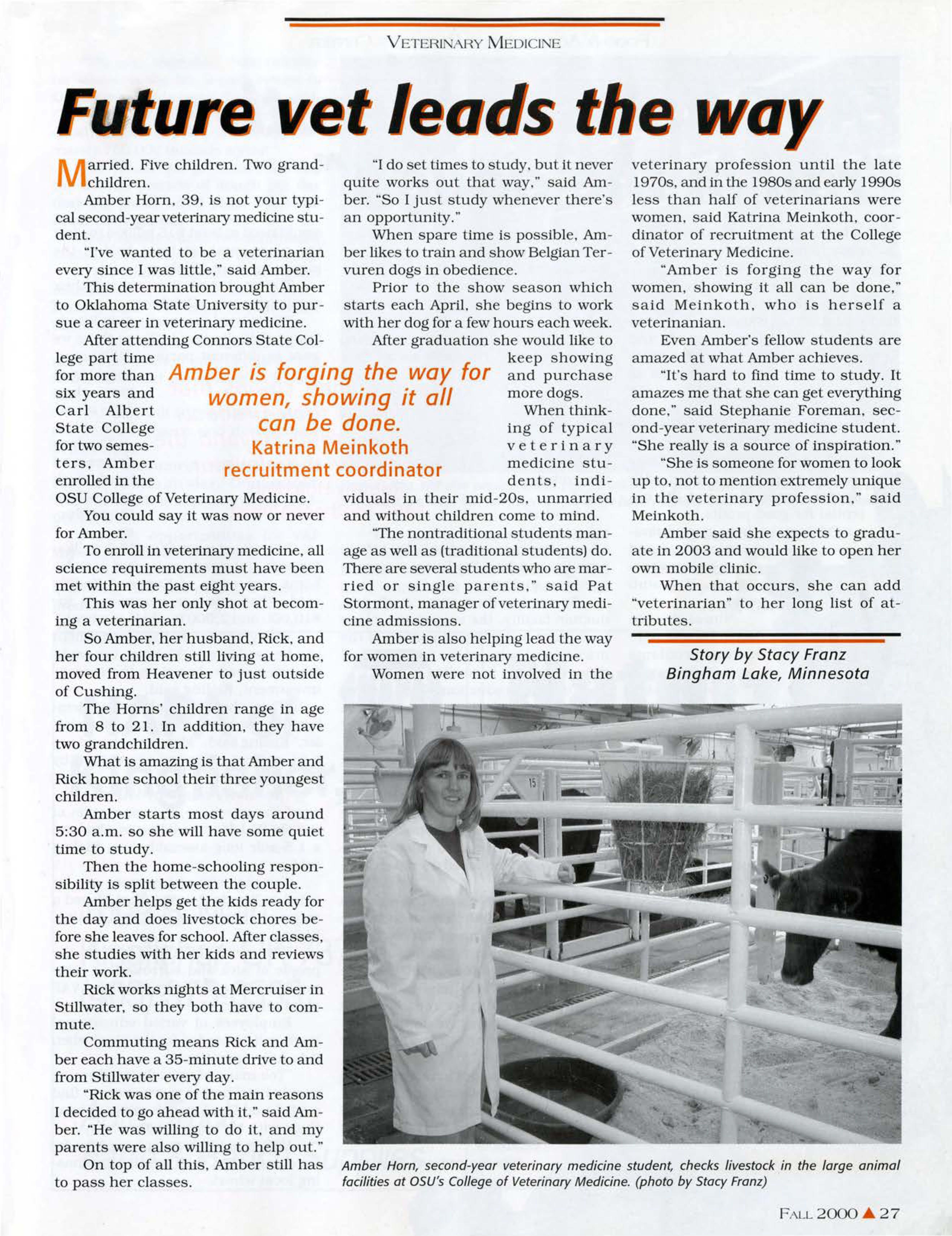
Amber Horn, second-year veterinary medicine student, checks livestock in the large animal facilities at OSU's College of Veterinary Medicine. (photo by Stacy Franz)
Oklahoma agriculture producers are ready to make some "dough" from their hard red winter wheat.
When producers wanted to make a product developed from their whea , they contacted the Oklahoma Food and Agricultural Products Research and Technology Center at Oklahoma State University. More commonly known as FAPC, the center assists the public in developing food projects.
"The idea was to find a market for their wheat." said Rodney Holcomb.
FAPC food economist. ~They wanted to enter a market with limited competition and the potential for good profits."
Other states have started similar cooperatives and have had great returns. Holcomb
"Rural cities in North Dakota were aving problems in their cities where their children weren't re• turning home after graduating from school because there was no place for them to work."
Holcomb said. "They developed co-ops to create jobs for the communities and bring money back to their cities."
The cooperative trend of valueadded products started in the
and has worked its way south through Nebraska and Kansas. The possibilities for different forms of cooperatives are endless. Holcomb said.
"Producer-owned co-ops that add value to their products are creating profits that don't end at the sale barn or the elevator," Holcomb said. ~ey
would need at least $15 million to start the plant, with at least half of the money up front," Holcomb said.
The producers then started their campaign across Oklahoma.
Producer owned co-ops that add value to their products are creating profits beyond the sale barn or the elevator.
"We started the meetings in Woods County," Kisling said. "From there we went to different parts of Oklahoma, have the potential to send even more money back to the producer and the community."
Producers used the
Rodney Holcomb FAPCfood economist information researched a FAPC to help form Value Added Products. a new cooperative in Alva.
By owning their own dough production facility, the cooperative plans to capture a significant portion of the price spread between the farm gate and the retail store. according to VAP.
To begin production, Keith Kisling, VAP vice president. said cooperative members sent their hard red winter wheat flour to Germany to be tested.
"Wewanted to make sure the wheat had the right characteristics to form a quality product ... Kisling said.
As the producers expec ed, the testing came back with positive results. Many pre-proofed product possibilities were developed from the Oklahoma wheat.
A pre-proofed product is a dough product that has already risen before it is immediately frozen and sent to a customer for baking, Kisling said.
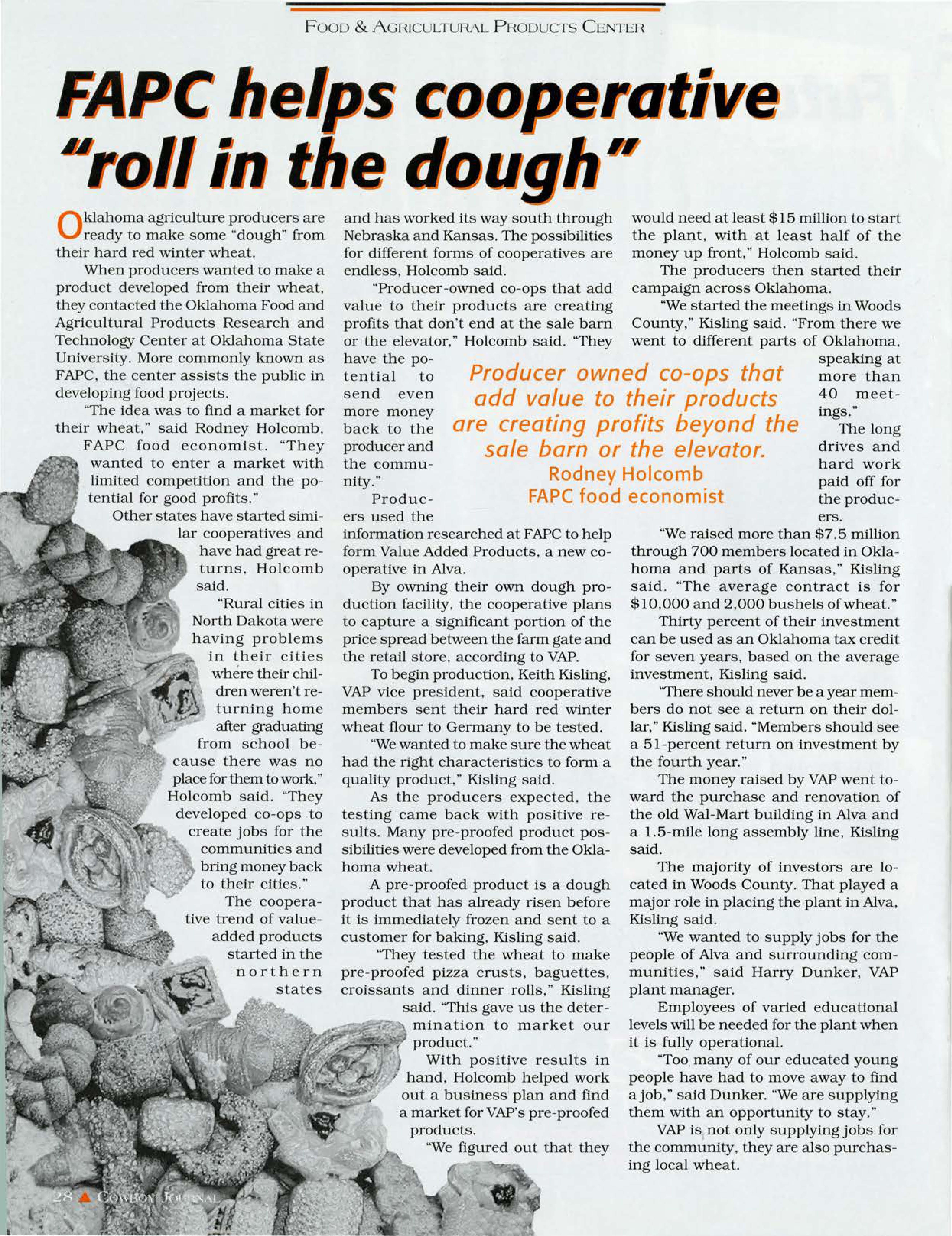
''They tested the wheat to make pre-proofed pizza crusts, baguettes, croissants and dinner rolls," Kisling said. "This gave us the determination to market our Z"~ai~ ..'i.,•.J product.··
With positive results in
, I hand, Holcomb helped work ~,,.,~ •~3 out a business plan and find
speaking at more than 40 meetings."
The long drives and hard work paid off for the produc-
"We raised more than $7.5 million through 700 members located in Oklahoma and parts of Kansas," Kisling said. ''The average contract is for 10,000 and 2,000 bushels of wheat."
Thirty percent of their investment can be used as an Oklahoma tax credit for seven years, based on the average investment, Kisling said.
'There should never be a year members do not see a return on their dollar," Kisling said. "Members should see a 51-percent return on investment by the fourth year.··
The money raised by VAP went toward the purchase and renovation of the old Wal-Mart building in Alva and a 1.5-mile long assembly line, Kisling said.
The majority of investors are located in Woods County. That played a major role in placing the plant in Alva, Kisling said.
"We wanted to supply jobs for the people of Alva and surrounding communities." said Harry Dunker, VAP plant manager.
Employees of varied educational levels will be needed for the plant when it is fully operational.
"Too.many of our educated young people have had to move away to .find a job," said Dunker. "We are supplying them With an opportunity to stay." a market for VAP's pre-proofed products. "'We figured out that they
VAP is not only supplying jobs for the community, they are also purchasing local wheat.
'The main ingredient. hard red winter wheat. is the No. 2 cash return to Oklahoma producers," Dunker said. "The plant will use 65,000 bushel of Oklahoma wheat per month or approximately 750,000 bushels a year."
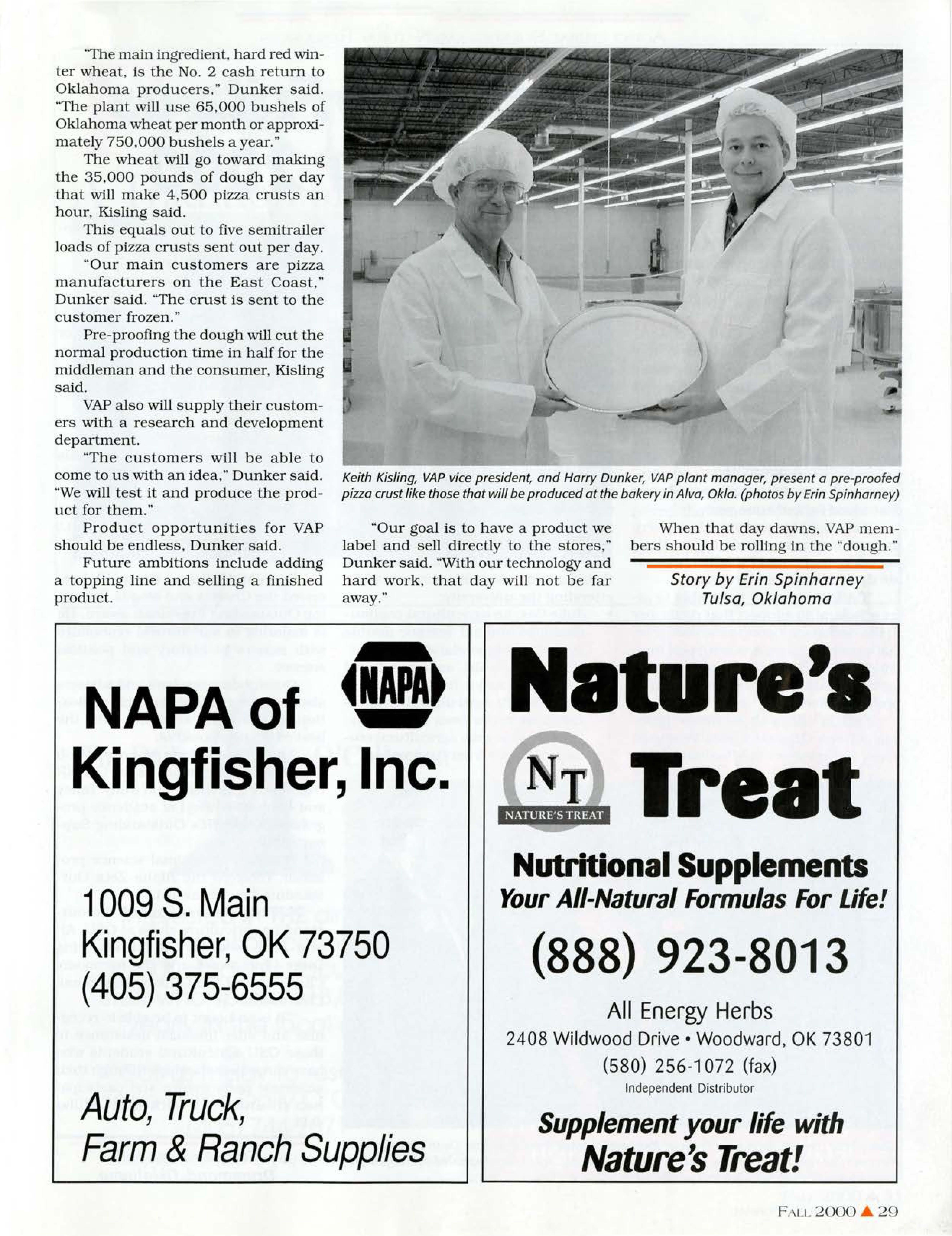
The wheat will go toward making the 35,000 pounds of dough per day that will make 4,500 pizza crusts an hour, Kisling said.
This equal out to five semitrailer loads of pizza crusts sen out per day.
"Our main customers are pizza manufacturers on the East Coast." Dunker said. "The crust is sent o the customer frozen."
Pre-proofmg the dough will cut the normal production tim in half for the middleman and the consumer, Kisling said.
VAP also will supply their customers with a research and development department.
"The cus omers will be able to come to us with an idea," Dunker said. "We will est it and produce the product for them ...
Product opportuni ies for VAP should be endless. Dunker said.
Future ambitions include adding a topping line and selling a finished product.
"Our goal is to have a product we label and sell directly to th stores," Dunker said. "With our technology and hard work. that day will not be far away."
When that day dawns, VAP members should be rolling in the ""dough."
Story by Erin Spinhorney Tu/so, Oklohomo
Keith Kisling, VAP vice president, and Harry Dunker, VAPplant manager, present a pre-proofed pizza crust like those that will be produced at the bakery in Alva, Okla. (photos by Erin Spinharney)
Dedication, devotion and motivation.
These are Lhree words that Mandy Fritz, agricultural communica ions/ animal science double major. molded h r education around while attending Oklahoma State University.
On March 24. the College of Agricultural Sciences and Natural Rsources honored Fritz and many other students at the annual scholar hip and awards banquet.
OSU agriculture students received more than $674,000 in scholarships and awards last spring. In 1999, CASNR presented nearly $490,000 in scholarships and awards - a record amount that s ood for only one y ar.
"Scholarships and awards are very important to many stud nts· continuing education," said Ed Miller, associate dean of academic programs.
"CASNR is proud to be able to offer scholarship support that rivals any in the nation for agricultural students, mad possible by generous support from donors who believe education is important in creating the next g neration of problem olvers."
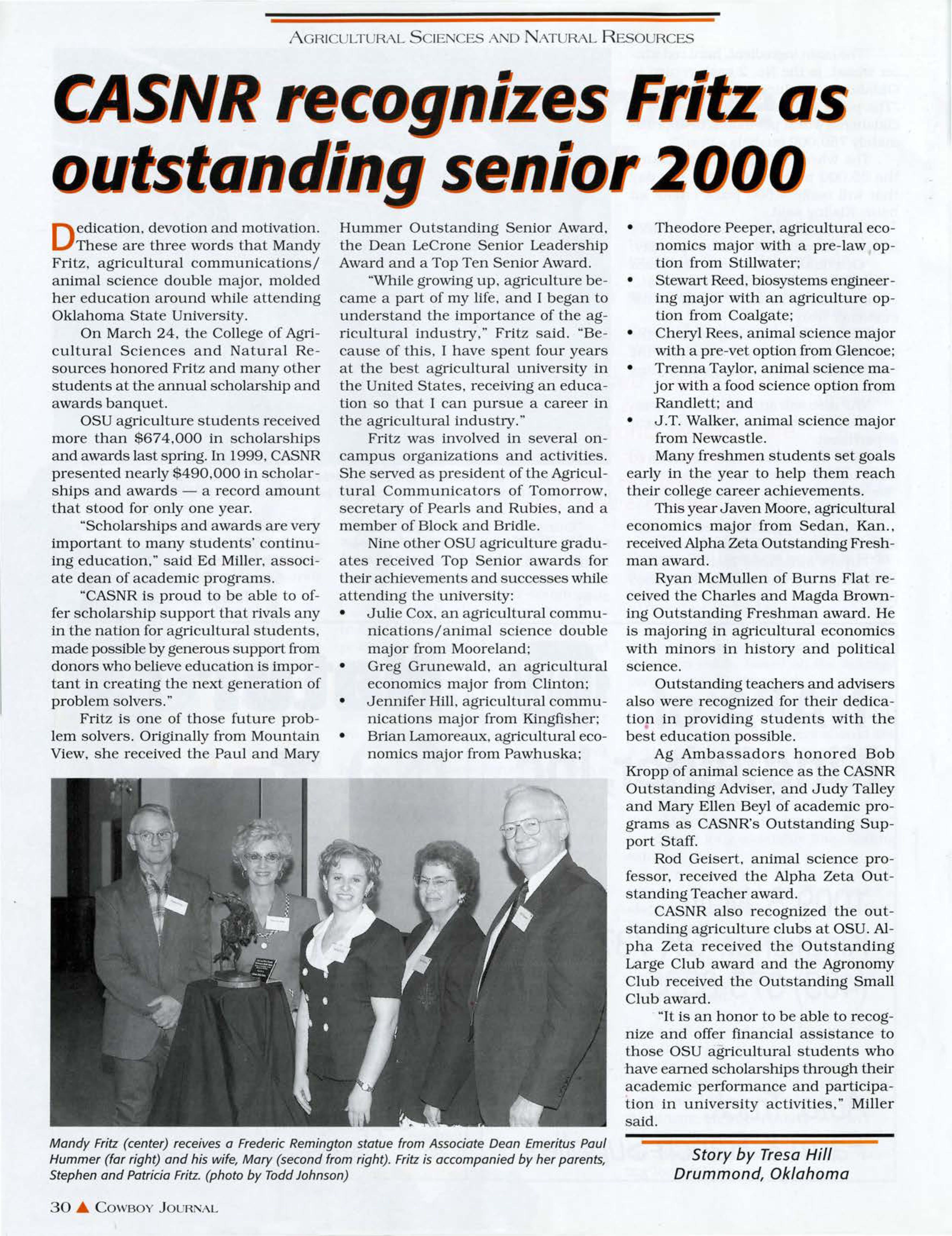
Fritz is one of those future problem solvers. Originally from Mountain View, she rec ived the Paul and Mru-y
Hummer Outstanding Senior Award. the Dean LeCrone Senior Leadership Award and a Top Ten Senior Award.
"While growing up. agriculture bcame a part of my life. and f began to understand the importan e of the agricultural industry." Fritz said. "Becaus of this, l hav spent four years at the b t agricultural univer ity in the United States. receiving an education so tha I can pursue a career in the agricultural industry.~
Fritz was involved in several oncampus organizations and activities. She served as president of the Agricultw·al Communicators of Tomorrow. secretru-y of Pearl and Rubi s, and a member of Block and Bridle.
ine other OSU agriculture graduates received Top Senior awards for their achievements and succes es while attending the university:
• Julie Cox. an agricultural communications/animal science double major from Mooreland;
• Greg Grunewald, an agricultural economics major from Clinton:
• Jennifer Hill, agricultural communication major from Kingfi her:
• Brian Lamoreaux, agricultural economics major from Pawhuska;
•
Theodore Peeper. agricultural economics major with a pre-law option from Stillwater; Stewart Reed. biosystems engineering major with an agriculture option from Coalgate;
Cheryl Rees, animal science major with a pr -vet option from Glencoe· Trenna Taylor. animal science major with a food science option from Randlett; and
• J.T. Walker, animal science major from Newcastle.
Many freshmen students set goals early in h year o help them reach their college career achievements.
This year Javen Moore. agricultural economics major from Sedan, Kan., received Alpha Zeta Outstanding Freshman award.
Ryan McMullen of Burns Flat received the Charles and Magda Browning Ou standing Freshman award. He is majoring in agricultural economics with minors in histo1-y and political science.
Outstanding teachers and advisers also wer recognized for their dedication in providing students with the best education possible.
Ag Ambassadors honored Bob Kropp of animal science as the CASNR Outstanding Adviser, and Judy Talley and Mru-y Ellen Beyl of academic programs as CASNR's Outstanding Support Staff.
Rod Geisert, animal science professor, received the Alpha Zeta OutstandingTeacher award.
CASNR also recognized the outstanding agriculture clubs at OSU. Alpha Zeta received the Outstanding Large Club award and the Agronomy Club received the Outstanding Small Club award.
"I is an honor to be able to recognize and offer financial assis ance to those OSU agricul ural students who have earned scholarships through their academic performance and participation in university activities," Miller said.
Story by Tresa Hill Drummond,
Oklahoma
Mandy Fritz (center) receives a Frederic Remington statue from Associate Dean Emeritus Paul Hummer (far right) and his wife, Mary (second from right). Fritz is accompanied by her parents, Stephen and Patricia Fritz. (photo by Todd Johnson)
FARM USE
A Tradition of Excellence
During 72 years of existence at OSU, we have prided ourselves in our continuous achievements and awards. We have a long-standing tradition of winning the Dean TroxelAwardfor the outstanding fraternity on campus. Our pledge classes have started their own tradition of winning the Jr. IronMan Awardfor the outstanding pledge class. For 70 years, we have maintained thehighestGPAamongthe fraternities.1999 was a year of national recognition for us. We received the honor of being the outstanding Fann.House chapter in the nation.
As agricultural job opportunities increase across the horizon, Oklahoma State University Is taking steps to open new international interests in its students.
The OSU faculty is trying to place a new light on little-known job possibilities in foreign markets for their graduates who are multilingual or have cosmopolitan experience.
David Henneberry, assistant dean for international programs in agriculture, is leading this push to integrate more international material into students core curriculum to increase their chances of finding career opportunities.
"Many agricultural graduates don' even receive foreign language skills while at ending college," Henneberry said.
'This is a missed opportunity for them because of the way the world is changing around us.''
Henneberry has experience in more than 60 countries, specializing in bulleting relationships between Oklahoma and Latin American nations.
His main concern is that currently only 5 percent of graduates leaving OSU have been exposed to agriculture outside of the United S ates.
''To prepare for the changes In today's global marketplace, it's vital we raise the level of international exposure to at least 50 percent of our students.·· Henneberry said.
He said he hopes during the next two or three years that around 10 percent of what is taught in the classrooms will have an international base.
"Our students need to think of international aspects as being intertwined with the majority of agricultural enterprises. rath r than something separate revolving around only a specific class or two ., Henneberry said.
"In the United States, we have though of ourselves as technological leaders in agriculture. However. things may be changing as the United States focuses on large-scale fanns while most of the world focuses on small farms."
This has led to an increase in technological advancement in other countries as more than 50 percent of agricultural patents filed in the United States last year were from foreign individuals or companies.
"With a large number of American
es
agrtcultural industries moving across the border into Mexico. an increasing number of oday's future employers want more students with Spanish backgrounds," Henneberry said.
James White, faculty member in agricultural education. agrees the ability to be fluent in other languages is an open ticke for the student's choice of careers around the world.
Whi e has worked on OSU's behalf in three countries and tries to bring this valuable xperience into the classes be teaches.
He said agricultural students who have initiative could increase the value of their education beyond the degrees stated on their resumes.
"For example, those who learn Chinese. Japanese or Korean could easily enhance their opportunities as export sales representatives in many Asian markets," White said.
"To really learn the language you have to be immersed in the culture," White said.
"When potential employers look at resumes, they will hire the ones who can bring the most to the table. It's the student's responsibility to decide if they want to be above average and make a unique difference by taking a few extra steps to gain additional experience," White said.
To give undergraduates the opportunity to immerse themselves, OSU offers students a number of internships and educational study tours in foreign countries.
Henneberry said the cost of the tours varies depending on what part of the world they take place.
"For example, over spring break students can take a trip to the rain forest in Honduras and learn about tropical forestry from a specialist in that area," Henneberry said.
"At present, it costs around $1, 700 per person. We are looking into renting dorm rooms in local unJversities and buses there for our transportation to cut down on the expense. It's a learning process and we are trying to make it where more students can take advantage of the opportunity."
The Honduras educational study tour is available to any student with an interest in natural resources.
There are no classification or
course prerequisite , but students must have their names on a waiting list and write an essay to be selected. Interested students can go to the International Forestry and Natural Resources class Web site for more information (www.okstate.edu/OSU_Ag/ honduras).
Story by David Frazier Idabel, Oklahoma
Baker Animal Clinic
DiGregorio, DVM
Baker,DVM
Mccann, Ph.D,
BOSS™Pour-On Insecticide
Takes Control Of Flies And Lice
• Bo controls a broad spectrum ofin ects
• Optimum control over economically damaging ectoparasites includ_inghorn flies, lice and face flies
• Extended residual control for up to seven weeks for lice
• Low-volume dosage
• Approved for all clas es of beef cattle, dairy cattle and heep
• o preslaughter withdrawal; no milk di card
Schering-Plough
Animal Health Corporation
.,):lwo top tenfreshmanmen
')f Hom comingsweep take winners
fi e of th last ix years
... r Stud nt GovernmentA ociationVicePre ident, upremeCourtJu tice,two Ag nators
.,r Fiveof nineAg StudentCouncilofficers
,',SpringSing I st pla winners 1999
:, Pre hmanFollie 2ndplac winners I 999
•...'<Gr kw ek champions1998,1999and 2000
...,):Toysto theGarn 1998and 1999winn rs
.:, chi ved se en of nin 1998-99nationalchapt r awards
Go Places with the College of Agricultural Sciences and Natural Resources
Several Study Abroad Opportunities:
Landscape Architecture in Japan and Peru
Forestry in Honduras
Agriculture of Northern Mexico
More programs in development for next year!
Dr. David Henneberry AssistantDeanfor InternationalPrograms I 39 AgriculruralHall 405-744-5396 • Fax. 405-744-5339 hhh@okstate.edu
http://www. dasnr.okstate.edu/international
Makeit a partofyourdegreeprogram I
ABOUT A CAREER?
Come
CRAZY about your career month
Sept. 19
Sept. 21
Sept. 26
Sept. 28
Oct. 1-7
Oct. 3
Oct. 5
Oct. 12
Oct. 17
Oct.18
Oct. 19
How to Get a Job: Today's Strategies for Tomorrow's Career
Under Construction: Building your Resume
Dear Who about What: Composing Career Correspondence
Professional Impressions: Sharpening Your Image and Etiquette