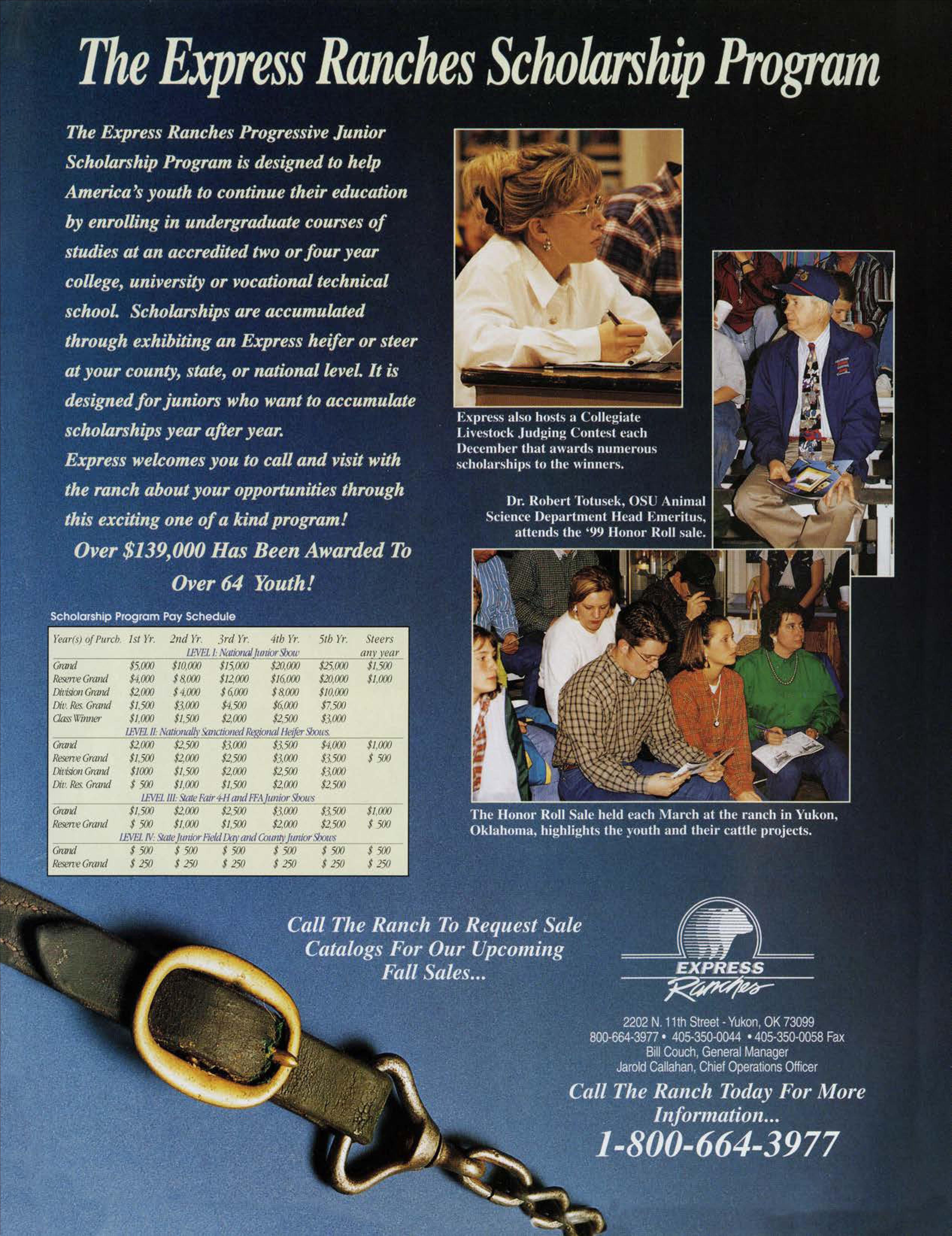
S 5IXJ $1,(X)() JJ,51XJ $2.fXXJ $2.51XJ S :JXJ 11:.VEJ. IV:Slate/1111/orFieldDai•andCol1t/IJ}u11/orSbo/1~·
I 5/Xi S 5IXJ $ 5IXJ S 5IXJ S 5(X)
I 250 Sl50 I 250 $ 250 I 25()
STATE LINE FARMS
Missouri
Pettis Counlj' Grand Champion
McDonald County ReserveChampion
Arkansas
FaulknerCounlj' Grand Champion
Carroll County Grand Champion
WashingtonCounlj' Grand Champion
Central District Grand Champion
Northwest District Resen1eChampion
J COWBOY OURNAL
Vol. 2 • No. I
Aimee Woulfe Editor
Shannon Borders
Assistant Editor
Melissa Dick
Gary Grimmett Graphics Editors
Stephanie Greenlee Web Editor
John Haley Photo Editor
Melinda Tharp Circulation Coordinator
Amy Higdon
Theresa Mathews Sponsorship Coordinators
Julie Cox
Jennifer Hill
Jennifer Simonson Scaff
Shelly Peper Sitton Managing Editor
Elizabeth Whitfield Support Scaff
Limousin World
Oklahoma Farm Bureau
Quebecor Printing Founding Sponsors
A note from the editor. ..
The completion of the century brought forth a realization that what we did jn the past affects today and what we do today will affect tomorrow. With the knowledge we have gained from past experiences, we plant our seeds for the future. Trus issue of the Cowboy journal, with the influence of our adviser and friend, is proof of the excellence that lies within the College of Agricultural Sciences and Natural Resources. In the past three months, we have watered with words, cultivated with editing, and fertilized with trial-and-error. Through our hard work and derucation we, just as a flower, have grown. Now we reflect with great pride and say "It's done!"knowing that we have planted seeds for tomorrow.
:) :)
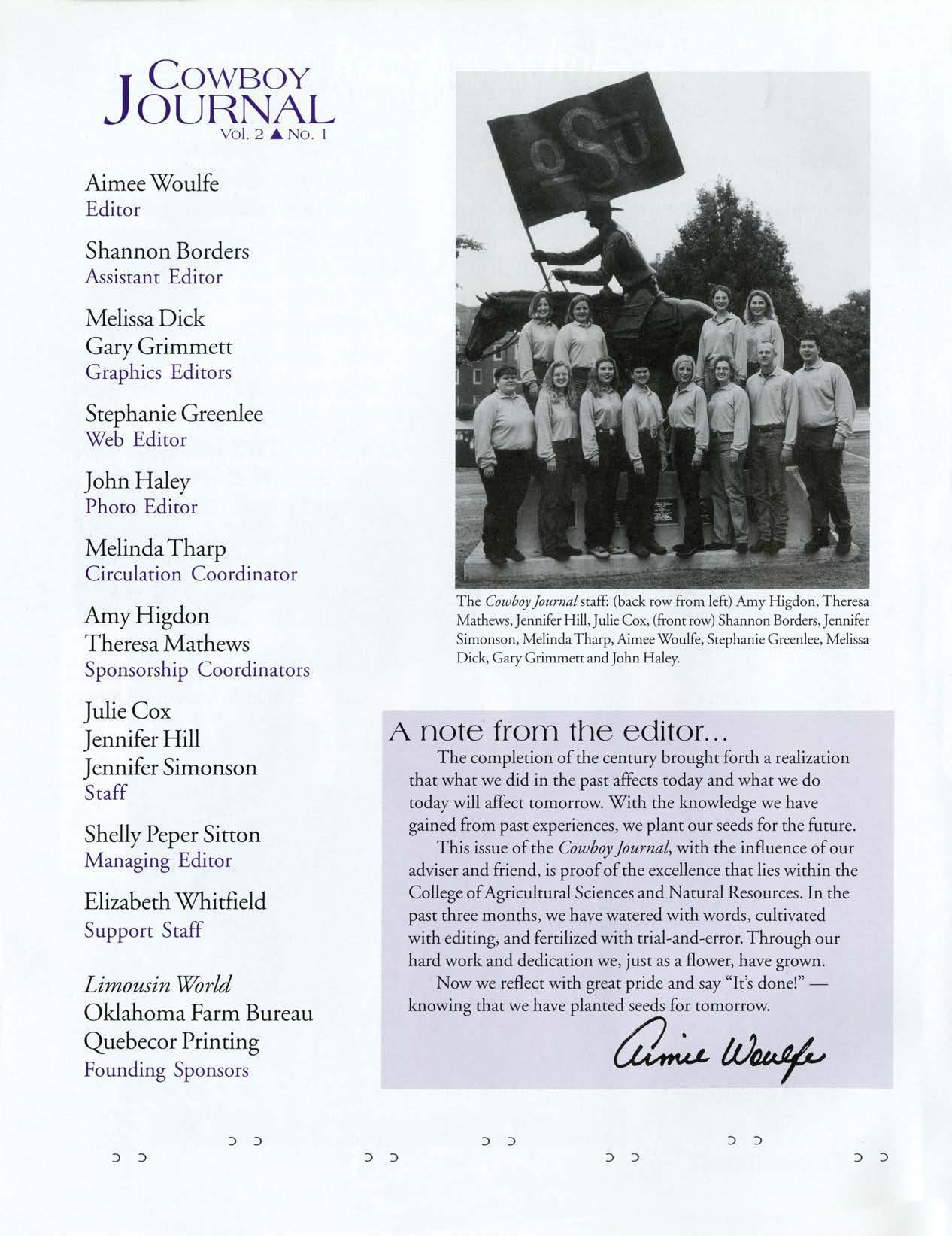
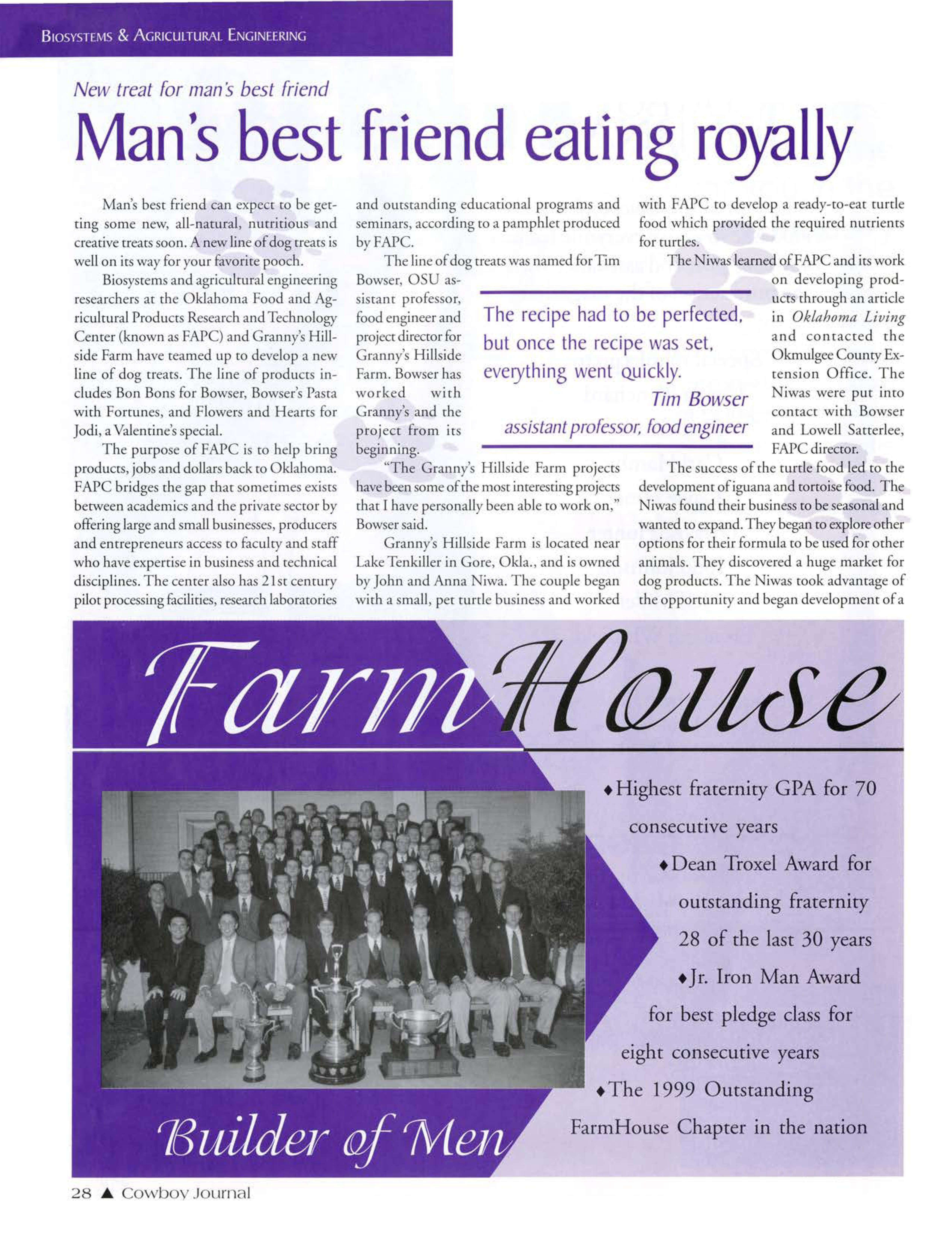
The Cowboyjournal sraff: (back row from left) Amy Higdon, Theresa Mathews,JenniferHill, Julie Cox, (from row) Shannon Borders,Jennifer Simonson, MelindaTharp, AimeeWoulfe,Stephanie Greenlee,Melissa Dick, Gary Grimmen and John Haley.
COWBOY JOURNAL
-6-
Advising ... the CAS R way Different is better -12-
Service + Learning = Credit Real-world experiences in agricuJtu.re
v L. 2 • No. I A PRING 2000 -10Peanuts and prestige
OSU student organization works hard
-s-
ow that's high-quality H 2 0 rodents test water quality -16-
Firing up a new tradition A future of orange and black
14
Silent determination
18
Grow a green thumb Student unknowingly gains respect Oklahoma Proven lends helping hand
-20-
Get an edge with experience
Gain knowledge through internships
-28-
-30-
0ne-stop shopping for students
ew addition serves students
22
Assignment: Honduras Forestry students travel abroad
-24-
The next best thing since jelly Peanut butter slice its way to store shelves
Man's best friend eating royally ew treats for man's best friend
-32Bringing the barnyard indoors Modern technology in the classroom
On the Cover ...
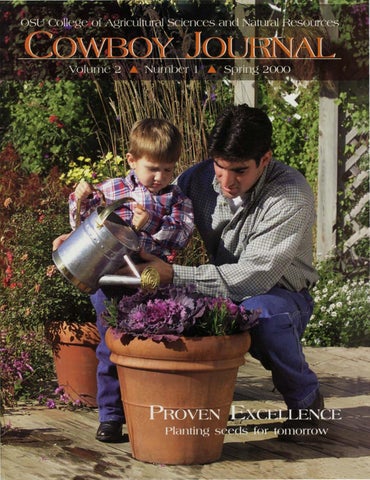
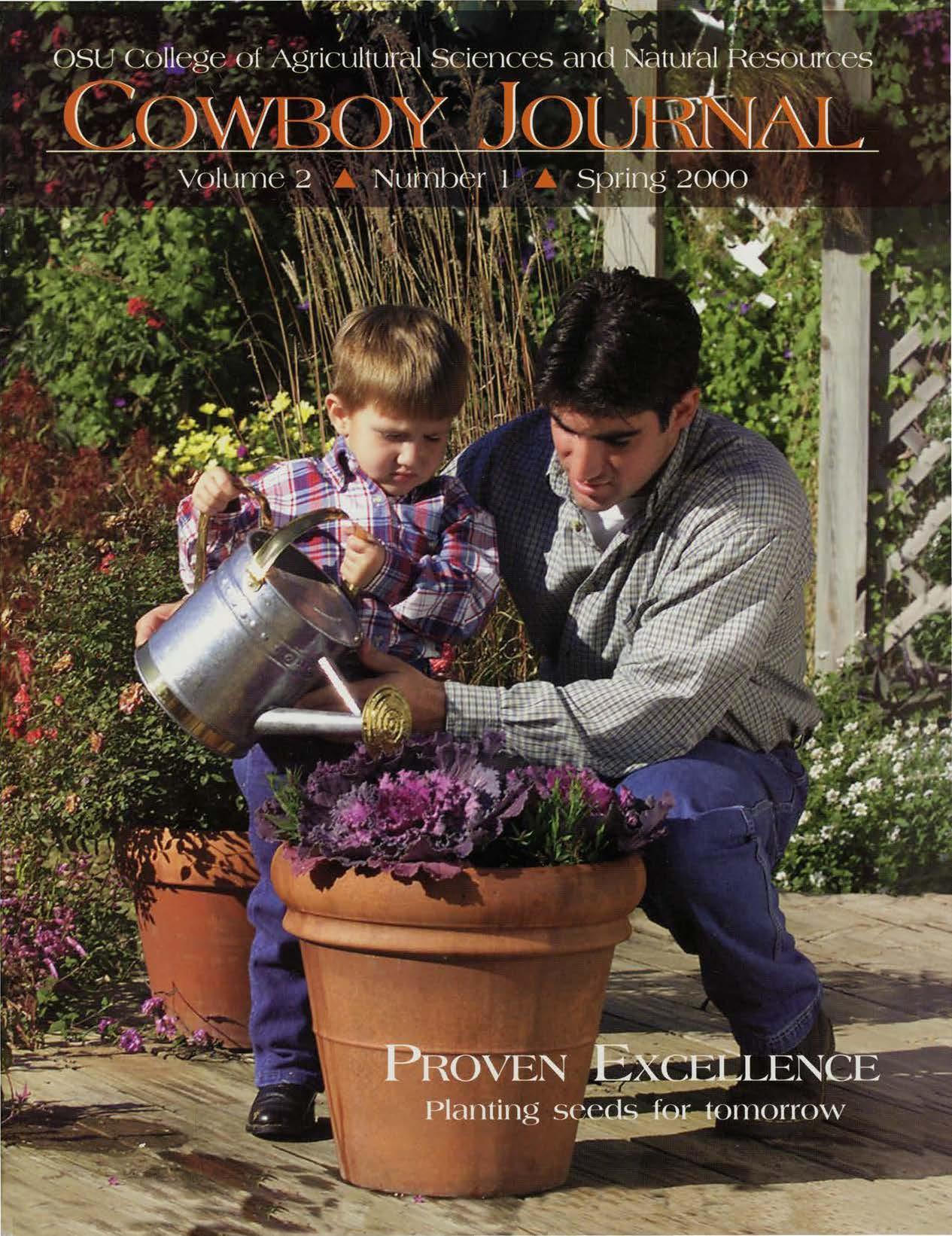
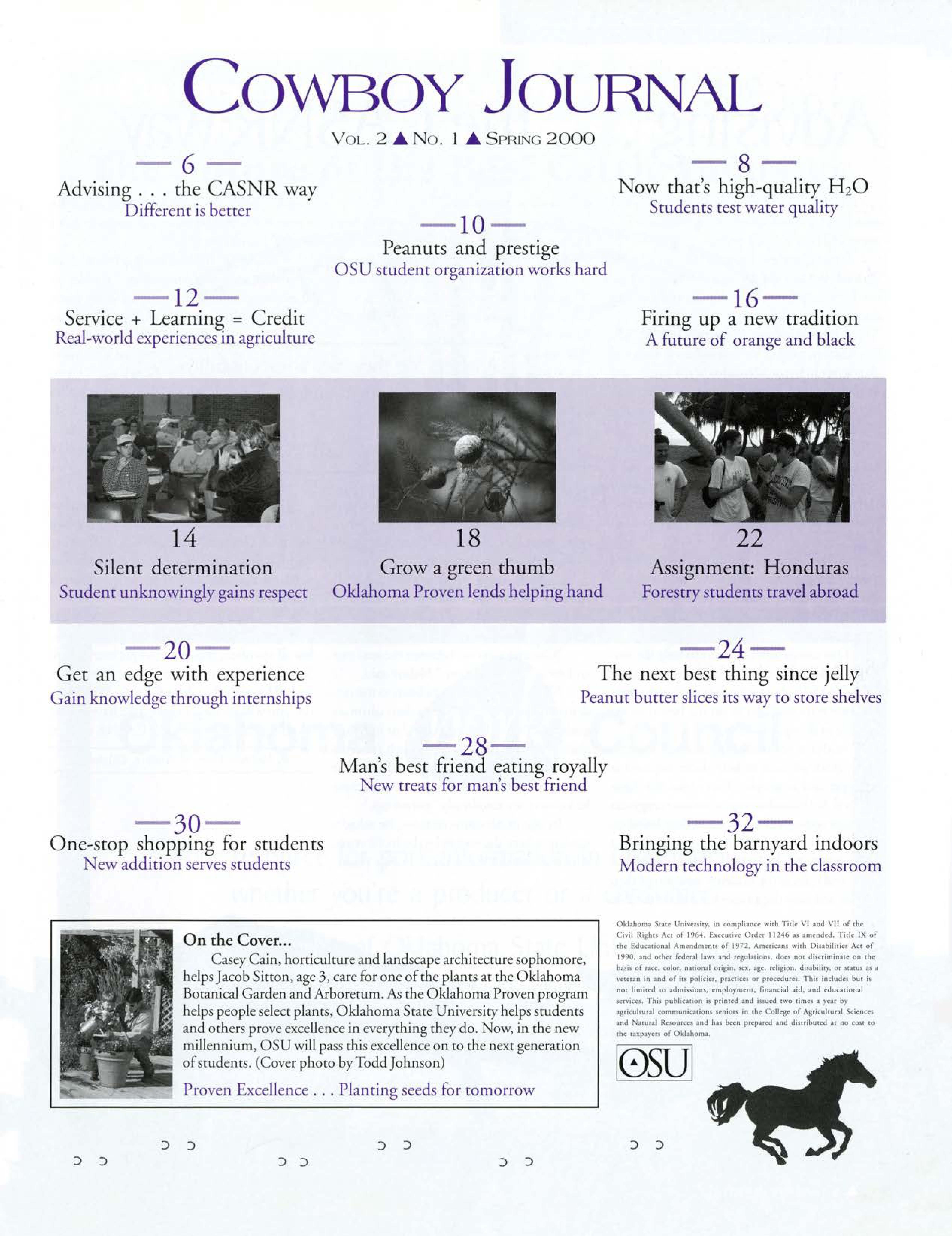
Casey Cain, horticulture and landscape architecture sophomore, helps Jacob inon age 3 care for one of rhe plant at rhe Oklahoma Botanical Garden and Arboremm. As the Oklahoma Proven program helps people select plants, Oklahoma Scare University helps srudenrs and ochers prove excellence in everything rhey do. Now, in the new millennium, 0 U will pass chis excellence on ro rhe nexr generation of srndems. (Cover photo by Todd Johnson)
Proven Excellence ... Planting seeds for tomorrow
u ::amrndied.Tidir IX of lhC' F.duc::mon,I Amendtnenn. of t,72. Ai'r1efl(:;111tw11h Oi.i;abiliue~ /4..(1o( 1990, ~fld 01hcr (edct;ll law~ and regul.uiont, do,u nm .di1cnmln:ui: on 1hcbas11of r.1c:c.~olor. n,uion.d origin. Jn. ;i~c. n:ligion. dl~~bilicy. fJr su.nut .u ii vet~un in }nd: or hs palkio, pu.(1itt.1 ar pro«><lutt.L Thit 1ndudn buc i~ noc limi1Nt ro :admiuion.s. irmploymcm, financ:ial aid. 2nd irduc::uion.il 1e1V1~n..Thi, puhhc11111)1'1 1J pti(litd :.111dioued two tiil'le, 11y~r b)' 111grirnh1.1121C'Ornm1.1nic~cio1au-nioH 1n d,e Colle:ge o( A.grirnhuul S.:ic-nct1 1md aN~I R~oUN;C:S•nd hu b«.n prep:iil"«I 11nd dinrlbu•cd .11 no ~QI! fO 1bt to1.tp~ytn a( Okl.ahom..1.
l0SUI
Advising •
• •
You haven'c had an adviser w1cilyou've had an adviser in the ollege of Agricultural ciences and· arural Resources.
Is chis statement howing roo much pride? Perhaps, bur lee'slook ar the many thing adviers do to help CA$ R student , and you can decide for your elf.
Advising is done differendy in CA NR. For tarter , each CA R student is assigned an adviser in his or her major at the beginning of the srudenr's freshman year. ln ocher colleges rudenrs aren't a signed advisers in cheir major unril d1eir jw1ior year.
A student having only one adviser during his or her whole academic career help bujld comfortable relationships between advisers and their srudenrs, said E.C. elson, adviser and professor in biochemistry and molecular biology.
"All colleges of agriculture in cbe Un iced rares have the amc general philosophy," said CA R assi tam dean We Holley. "Advisers feel chey have a responsibiliry co provide for cheir cudenr '
This means advis rs wanr'to help che students understand they have someone on their side. CAS R advisers work hard to encourage and motivate scudenrs rn do che best they are capable of doing, Holley said.
rudenrs obviously appreciate this extra efforc from advisers co help chem improve as mdenrs and as people. very year, the AgriculruraJ Ambassadors organization recognizes rhe oursranding advi er in the college based on srudenr nominations. The mdents pick up applications in 136 Ag Hal I. he appljcacion is short and reflects che student 'opinion of their advi er and how the adviser ha helped chem in
theCASNRway
their academic endeavors.
l el on received the 1999 award, having been nominated by advisee Regina Rowe, biochemistry and mole ular biology junior.
"Dr. el on i o good wirh srudenrs. We can alway counc on him for help with our da ses or even wich our per onal live ," Rowe said.
nanan. Then she asked elson where he wanted co be in 10 years. Nelson aid with a laugh, "I just wanr co be!"
WesHolley
CASNRassistantdean
Advisers feel they havea responsibiliry to provide for their students. erative Extension ervice. Even though this make for a busy schedule, CA NR advise rs always make rime for rhei r
"Just being" for advisers consists of mud1 more chan most students realize. In addition co advising students, faculry advisers teach cour e , conduct research and work with. rhe Ok1al1oma Coop"He always ha a joke and a way co make you mile. He's one of che happiest people
I've ever mer. He's a great recruiter, which has re ulred in a big increase in our department's enrollment. Dr. elson is a good example of how ag advisers are different."
elson, along with the other A R advisers, has an open-door policy and al o lets students know they can make an appoinrmenr wirh him any time.
" ommunicarion between rhesmdems and me is very imporcanr," el on said.
elson said his job is ro listen rn the studencs and help them achieve their ulcimate goals, whether in hi deparcment or someone else's. He likes co sir and talk with student about their career goal He asks them whar they want robe when they ger railer becau e he know they are already "grown-up."
In one ofhi conver arion , he a ked a cudent where she wanted to be in 10 years. The cudenr said she wanted ro be a veteriadvisees.
" ASNRadvi er have many advisees,but chat doesn't have an effect on how rhey care for their smdencs " Holley said. "Whether they have eight or 125 advisees, they do what needs co be done, and they do it wirhouc a complainc."
o a you can ee advising in CA R is different. CA R has out randing advisers, bur all too often, these advi er ger overlooked. o, take a econd or rwo ro look acyour adviser and all he or he has done for you. When you do, you will probably agree: you haven'c had an advi er until you've had a CA NR adviser'
ByMelindaTharp of Wailers.Oklahoma
Nowthat'shigh-QUali!)' H20
As the wind ch_illbegins to bite, a group of students heads west coward Lake Carl Blackwell. le is not rhe Oklahoma State Polar Bear Club, bur the OSU Environmenral Science Club, and they have come ro warch the water.
Water Watch sounds a little bland on first reference, bur the studencs who participate in chis project do far more than what the name implies.
According to che Oklahoma Water Resources Board, the waters in this state are important commodities, and constant surveillance is needed co ensure both che beauty and che quality of chose waters.
Since there is a great amount of water in Oklahoma, keeping an eye on the water is a difficult cask. To deal wich this problem che Water Resources Board created Water Wacch, a program designed to help the OWRB accumulate data to give water resources che proper supervision and protection they need.
The Oklahoma Water Resources Board laid ouc several goals for the program. Ir's designed co collect data, identify potential problems, map trends in warer quality, promote citizen parriciparion and educate the public on aspects of water resources.
David Lewis, Environmental Science Club adviser, said the Wacer Wacch program at OSU is a service project nm by che studenrs. Ic is all volw1rary, and che students who parricipace muse be certified co conduct cescs.There are also specific dares and rimes when these rests musr be done. These rimes cannot be altered, so rain or shine there is someone doing the work.
'The WacerWatch program offers volunteers from che Environmental Science Club an oppon:unicy to develop the skills associated with the measurement of water quality," Lewis sajd. "The schedule of regular measurements also provides an opponunicy for the srudenr volunteers to inrerprec the results of their measuremencs."
To moniror rhe water quality consistencly, the students return ro the same dock once a month to collect samples and run tests. They begin by filling a bucker wirh water. They rake samples from this bucker co rest such cl1ingsas pH and sediment
concenr.
All of clus is recorded and senr co the Oklahoma Water Resources Board for analysis. This allows srudenrs to consistently moniror rhe water qualicy and dececcany potential problems that might arise.
If something is wrong with the water, ic is
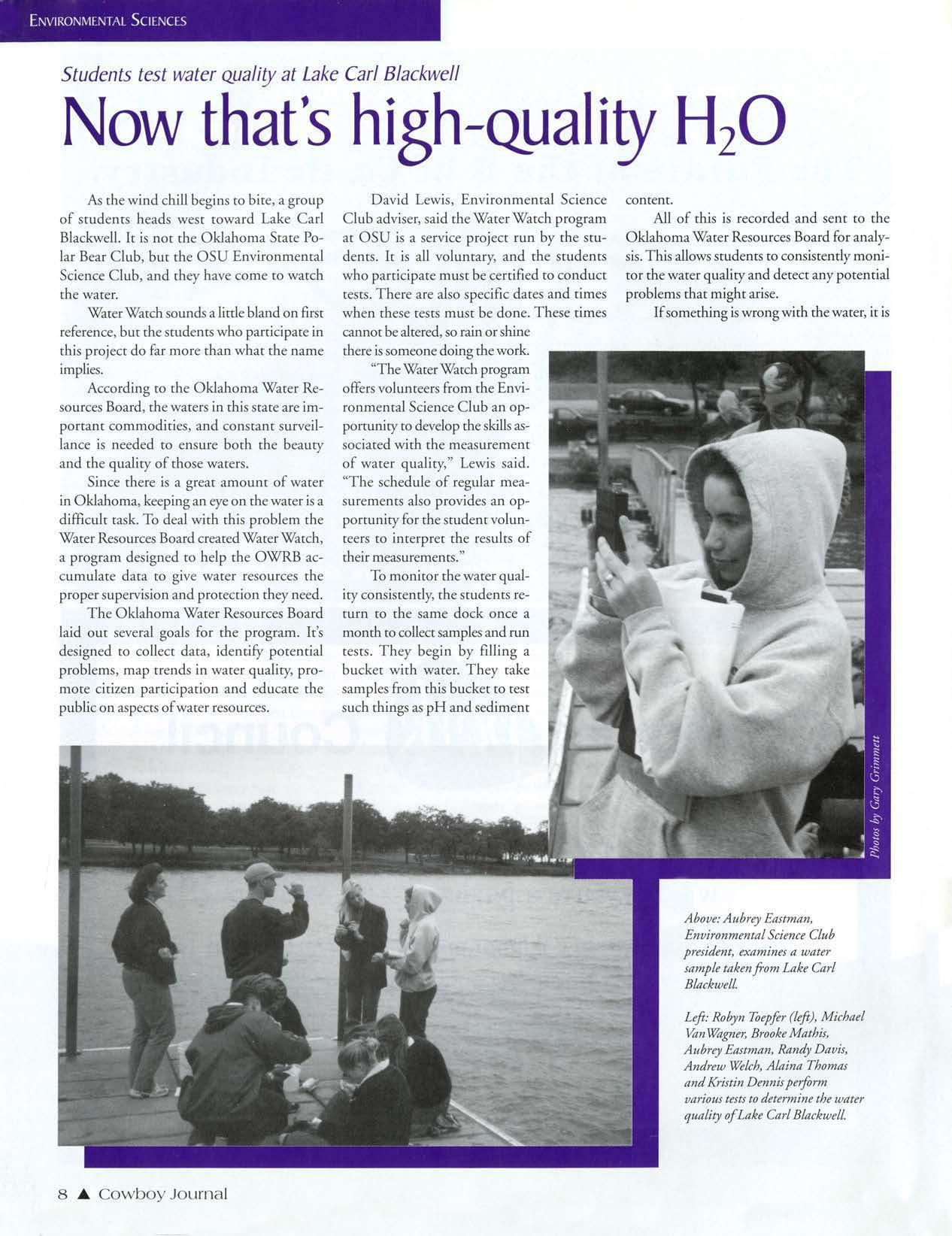
Above:Aubrey Eastman, EnvironmentalScienceClub president,examinesa water sampletakenfrom lake Carl Blackwell.
Left: RobynToepfer(left), Michael VimWagner,BrookeMathis, AubreyEastman, Randy Davis, Andrew Welch,Alaina Thomas and Kristin Dennisperform variousteststo determinethe water quality of Lake CarlBlackwell.
red-flagged. When [his occurs, warnings are is ued and signs are pur up ro inform visirors mere is a problem with me wacer.
Aubrey Eastman, Environmenral cience Club presidem, said chere has nor been a red flag incident since rhe Wa-
baseline, so if rhere is a variance, ir lers mem know mar someming is wrong," said Welch. "We are doing mis ro help our environment and our community," said Eastman. \X/arer Wacch gives scudenrs rhe chan e ro experience whar it would be like co rer Warch program was implemented ar Lake Carl Blackwell.
Andrew Welch, environmental sci-
We are doing this to help our environment and our communiry. work in a parricular field.
Aubrry Eastman EnvironmentalScienceClubpresident
ence senior, said the club is offering a service ro all who like ro enjoy rhe warer by giving much-needed arrention ro a body of water char might oilierwise be overlooked.
"We give the Wa[er Resources Board a
'This is what most of us will be doing after school," Eastman said. "le gives us an
opporrnniry co stare early and gives us a chance ro see how a body of water changes over time."
"Ir gives us valuable field work experience while we're sciUin college," said Welch. Before condL1ccingresrs, me students in-
volved must be cerrified. They are required co cake pare in a craining course offered by rhe Oklahoma Warer Resources Board. They muse men p a wrircen exam robe certified for one year Eastman aid.
Once they acrually arrive on rhe scene, it doe n't cake the smdents long roger down co business.
"The re ting usually rakes anywhere from 30 minutes roan hour,' Eastman said. "Ific's cold oucside, we don't visiras much and finish faster."
le may not be glamourous, and at rimes it's even miserable, bur next time you're taking che plunge wirh your polar bear friends, remember mere are people who care enough co make sure ir's safe co swim in me water.
By Gary Grimmett of Seneca.Missouri
THOMAS FORD Your Voice,
OSU student organization works hard
Peanutsandprestige
Imagine selling a product that doesn't even exist and possibly getting a job because ofic.
That's exactly what the members of the Oklahoma StaceUniversity chapter of the National Agri-Marketing Association hopes co do for the year 2000 competition and conference April 12-14.
"NAMAhas a national conference every year where each chapter can submit a marketing proposal for a real or made up produce charis a product of agriculrureor sold to farms," said Dan Tilley, agriculrural economics professor and adviser for OSU's AMA chapter.
AMA membership includes college students and business professionals from agricultural firms across the country. There are chapters at many of the major agricultural schools throughout the United States. Patrick Kelly, agricultural economics junior, is the 1999-2000 OSU chaprer president.
"We usually have 18 people on the (marketing) team and six: to eight presenting people, bur most of us do a lot of behind-chescenes work doing researchand checking fu.cts," Kelly said.
Tilley said NAMA is very versarile for any agriculture major, because it incorporates aspects from all academic areas.
''Anyone can be on the ream or in the group. In fact, we want more people from ocher majors for more diversity," said OSU agriculrural economics professor Robert Oehmnan.
The team consists of students from several departments, including agricultural economics, animal science and agricultural communications. The teams spend many long hours and work late nights preparing for the contest.
The main point of the national conference is for students co network with agricultural corporations. I c is mainly a job fu.irwith a contest thrown in for fun and the prestige of wmrung.
"I Likeco reach the educational objective, bur it's nice co win, coo," Tilley said.
The schools create a ream of five co eight people for the oral presentations. All ream members have to speak for part of the oral presentation, and the team draws up a wrircen proposal of their product.
The student teams write proposals which
are no more rhan 15 pages in length. Oral presentations muse be 20 minutes long, and the reams submit a summary of five pages max:imum.
"lfic's over five pages, no one will read ic anyway, just like in the business world," Tilley said. "Nobody Likesreading lors ofinformacion when a summary will do."
The presentations include any multimedia methods che students wane couse.
Ar previous con-
ferences, Oehrcman said he has seen everything from PowerPoinr co simple poster board charts.
Everything chat is used in che presenracion must be pare of the written proposal.
until rhe fall semester ends. Then we meet once a week, and rhen it's Monday through Friday for about rwo hours each nigh r to get the wrirren plan finished. After char, we work on the oral presencarion unril the conference."
Like many ocher scuden r organizations, AMA really can help srudencs ger rheir foot in the door for future jobs. Contacts are made at the conference which benefit student members. Professionalsare members ofNAMA also, and they gee co know che student members.
It real!),gives an excellent opportuni~ for networking.
Heather Hoff OSU alumna
The proposals are submined severalweeks before the conference so that executives from several different businesses can judge tbem.
The field of competitors is then reduced based on the score received for the wrinen proposal. The reams with the highest scores are invited co presenc at rhe conference.
Ac the conference, the presenrarions are scored, and the highest scores go co the nex:t round. This process continues until che presenting schools are "whittled down" ro 12 and then co four. Those four reams are ranked in first through fourth places.
"The conference must be held in a huge place because the conference has about 400 corporate people and almost rwice as many students," Oehrrman said.
"The facility must also have !ors of rooms for giving the group presentations. Nex:t year's conference will be really good because it will be in Kansas City, and NAMA is based out of Kansas City. More people should be there because of the location."
As the days tick by and the conference comes closer, the amounr of time the NAMA members spend on their project increases.
"We warch videos of che previous cop four groups for practice and co see what works and what doesn't," Kelly said. "We get the videos from the association, and we watch them a lot while we prepare.
''Ac first we meet about cwice a month
Member of AMA have access co an opportunity base because of being a member. Even if a student has never met a
professional member, the AMA name has pull on a re ume.
"It is one of the few ways for students to gee involved with real companies," aid Heather Hoff a former OSU AMA coach and alumnae. Hoff now works as the marketing manager of performance horse produces with che Farnam Corporation.
"Ir stands our co people who have previous expertise wich AMA. Ir really gives an excellent opporruniry for nerworking in the agriculture business world," said Hoff
If a student is applying for a job wich a NAMA professional, rhe professional will see rhe AMA name and know this scudenc has experience. As a resulr, the professional will probably place che resume in the "Keep Pile" and nor the "Round File," said Oehrcman.
''The experience of creating a marketing plan like rhis is a skill many people don't ger, and ic can help you lacer in a job environment," Oehrcman said.
The marketing project may nor be a walk in the park, but the payoff could make ir all worthwhile in the long run. People may think iris working for peanuts or nothing ac all, bur they can gee prestige co use lacer in life.
For more information about joining NAMA, contact Dan Tilley at (405) 744-6156 Or write to: National Agri-Marketing Association, 11020 King Street, Suite 205, Overland Park, KS 66210
By JohnHaleyof Burleson.Texas
Farmlandlndu lrie i !he large l farm r-ownedcooperativein 1orlh Americaandoneof thf top 200
Forwne 500-li led companie Farmlandi a global markcLerwilh highly diver ified Du inc line • including:crop productionand proLeclionproduct,. live,tock feeds.petroleum.grain proce ing anclmarketing.and U1eproce ing and markelir1gof pork andDeer product Thenel re ult. exceptionalemployment opporlllnities.For informalion.contactu Lada or vi il our web ile al farmland.com.
TheFarmland .rstem1 • ownedby about 500.000 farm familic like Randyand
Watching the second hand inch around the clock has become a frequent pastime of many students. Don't you wish the lectures you have to endure had some real-world exciremenr?
Service learning may be the answer.
Service learning provides an opportunity for srndents co gee involved in cheir community and gain real-world experience. Service learning is a method chat allows teachers to incorporate community service inro the academic process. The experience is designed ro benefit both studenrs and rhe community.
Through service learning, students gain as much as they give. Students apply academic, critical chinking, problem-solving and communication skills. They also gain a better understanding of diversity and policies in society.
The College of Agricultural Sciences and Natural Resources has several classes chat incorporate service learning. The classes deal with a variety of situations and range from a
children's garden to working wich the swine industry.
Children'sgarden
in which to learn and grow
Having fifth-graders for bosses became a reality for some OSU students when rhey enrolled in Landscape Architecture Design I. "Children's Garden in which to Learn and Grow" was the service learning project implemented by che department of horticulture and landscape archirecrure. The idea was a combined effort of David Hillock, Marchew Kirkwood, Douglas Needham and Brenda Sanders. The purpose of chis project was co create a prototype through which elementary teachers could develop a teaching garden at their schools, said Needham.
OSU students designed a survey and slide show, which were presented to fifth graders and their teachers around rhe scare. From the data collecced, each OSU srudenr created a model of the garden. The
Credit
collaboration of all the OSU students made up the final plans for the children's gardens.
"The children's garden project was a practical experience for OSU srudencs as well as an educational experience for fifth graders and rheir teachers," said Douglas Needham, associate professor of floriculrnre.
The garden was installed ac che Oklahoma Gardening Studio Garden of che Oklahoma Botanical Garden and Arboretum and will be an on-going learning sire for years co come. For more information visit the "Children's Garden in which co Learn and Grow" link ac www.horrla.okstace.edu.
Leadershipskills for agricultural organizations
Practical application ofleadership skills was the main focus when Bill Weeks, agricultural education professor, wrote the proposal for his service learning project. AGED 3303 is designed to develop students'
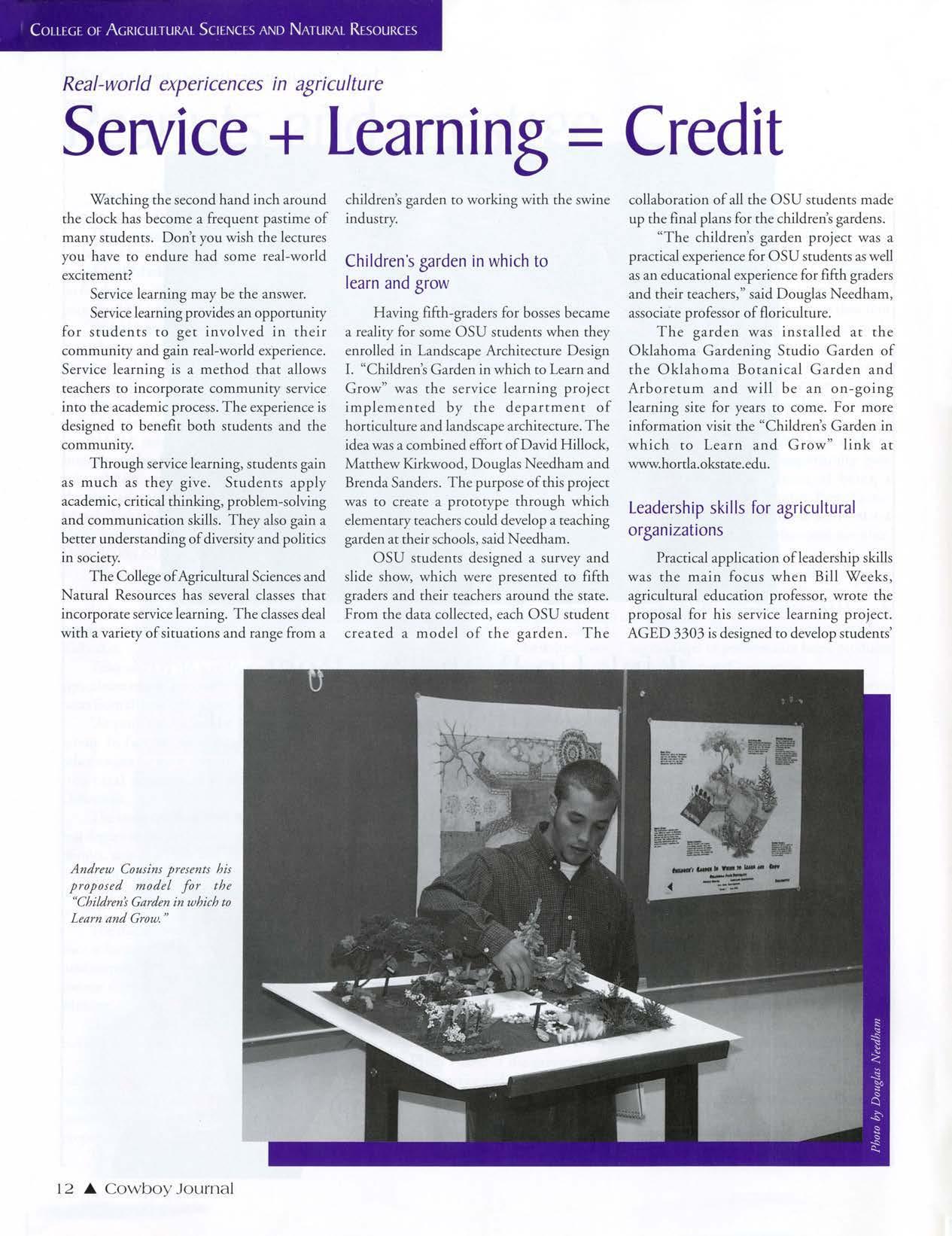
Andrew Cousins presents his proposed model for the "Children'sGarden in which to Learn and Grow."
leadership skills and teach them to use these skills when working wirh people and organ1zaaons.
'This class allowed me to u.nderstand leadership and helped me develop excellent leader hip skills," aid Jennifer Bridges, agricultural education tudem.
During the first half of the semesrer,Weeks teaches leadership styles and behaviors. During the second half, tudents elect a swdent organization outside the college. The srndems act as "organization consultant" and work to improve the campus organization. rndents obtain rhe opportunity to see leadership principles i.J1action.
Swine
industry and the communiry
Conrad Lyford, assistant profes or, agriculrural economics, allowed studencs co be liaisons for the swine industry and the •Fertilizers •Fencing
•Electric Fence Repair
•Cattle Panels
•Portable Dog Pens
community in his agricultural business management class.
The studenrs studied the effect of the swine indusrry on the environment and communiry, worked co reduce the impact and helped co promote commu.niry involvement.
tudems worked in conjunction with the Oklahoma Pork Council, visited swine farms and interacted wich rhe commu.niry.
" rudems didn't realize what the industry was actually doing to help prevenr pollution," aid Lyford.
The students worked in ream co propose alternatives and elution co the environmental problem , and the be t propo als were elected and combined into one final proposal.
"The agribusiness management cla showed me rhe importance of working on a ream and allowed me to use critical thinking skill in a real-world situation,'' aid Becky
Oblein, agriculcural business scudenr. ''Actually working in an industry setting is realworld experience which the students will never forger."
ByTheresa Mathewsor Boyce.Louisiana
drogers@okscace.edu
•Ag Chemicals & Sprays
•Hydraulic Oils
•Garden & Field Seed
•Bailer Wire & Twine
•Cutting & Tillage Parts
"ALWAYS FRESH" A&M FEEDS
•Tractor Oils
•Chain, Pulleys, Rope
•Work Clothing
•Wrangler, Cinch
•Carhartt & Woolrich
Silentdetermination
'Tm prercy independent and do what I wane codo."
This is a bold statement for anyone m make, but imagine moving 1,200 miles away from home, enrering a universicy without knowing anyone and being deaf.
teve Williams, animal sciencejunior from Columbu , Mont., was born without the abilicy co hear and is considered profoundly deaf. He transferred co Oklahoma rare Univer icy in August 1998 from Northwest College in Powell, Wyo.
There is no family h.iscoryof deafness, and teve's family really does not know why he was born wirhout hearing.
Nevertheless, Sreve is an active student ar osu.
"He's awesome co work wich," said Brad Morgan, animal science professor and ceve's adviser. "He works harder than anyone I've ever seen."
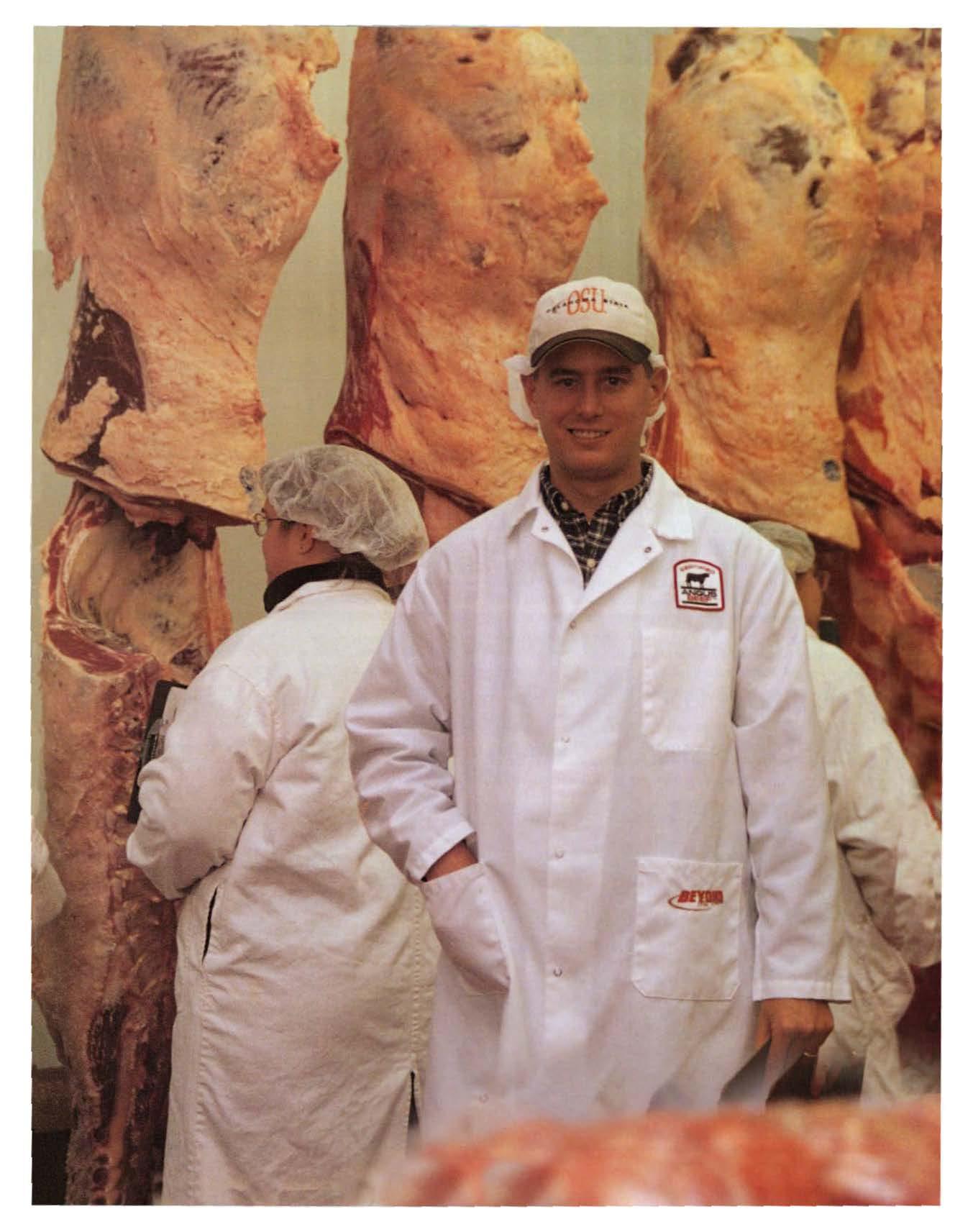
Growing up and working on his family's bull test station, reve knew he wanted co have an opportunity cowork in an agricultural field. He chose a food industry option because Lhe industry is conrinually changing.
How does teve get along in class? Easy. or only can he read lips, but he has interpreters who sign lectures for him. He also borrows notes from other students, which is how he met his wife, Lindsay, an agricultural economics and agricultural communications senior from Powell Wyo. But it was not exacdy love at first ighr.
On the first day of class she spoke co him, bur because he was nor looking al her he did not respond.
After class had starred, his incerpreter showed up five minutes lace and chat is when she realized he was deaf.
"I felt so bad that I volunteered to rake notes for him," indsay said. hordy after, they starred daring and got married July 10, 1999. Ir cook beronly
"Hopefully, I will get a job where I can bring the beef industry closer rogerher co work for a consistent product, which is a rough issue co correct. Eventually, after gaining experience, the option for me to remrn home is still there to rake over the family feedlot."
Noronly is reve busy wirh school work and extracurricular acciviciessuch as Block and Bridle bur he also is working out for the 2000 0 U InrercollegiareMeat J udgrwo monrhs co learn sign language fluencly.
reve said the major reason he came co Oklahoma Seate University is becau e the university has one of the top agriculrural
programs in the nacion.
I don't let being deaf challengeme.
Steve Williams
animalsciencejunior
"The university has more challenging classes and a wider range of courses from which to choose. The faculty members are outstanding and have lots of experience in rheir respective fields," teve said.
ceve is leaning coward an animal science master's degree with an emphasi in ruminant nutrition and meats. He said learning the beef industry from one end to the ocher is importanr because numerous seeps occur before tbe steak is placed in front of the consumer. And because of chis, reve said, nurririon plays a big role in quality.
''There are so many things I want ro look inco before 1 decide my fumre," reve said.
ing Team.
Kent Reed animal science junior is one of reve's teammates.
'Ar first, I had a hard rime under randing him, bur rhe more I am around him, the easier he is co under rand," said Reed.
" reve is really a lot of fun to be around."
Currently there are about 15 "hard-ofhearing students" on the O U campus. Of chose, there are three deaf sruden rs who need sign language interpreters, said Mike Shurtic, disability coordinator for the srudem disability services office.
The srudenr disability ervices office asisrs cudenrs by providing sign language interpreters, note takers, overhead copies, captioned videos and other equipment when needed.
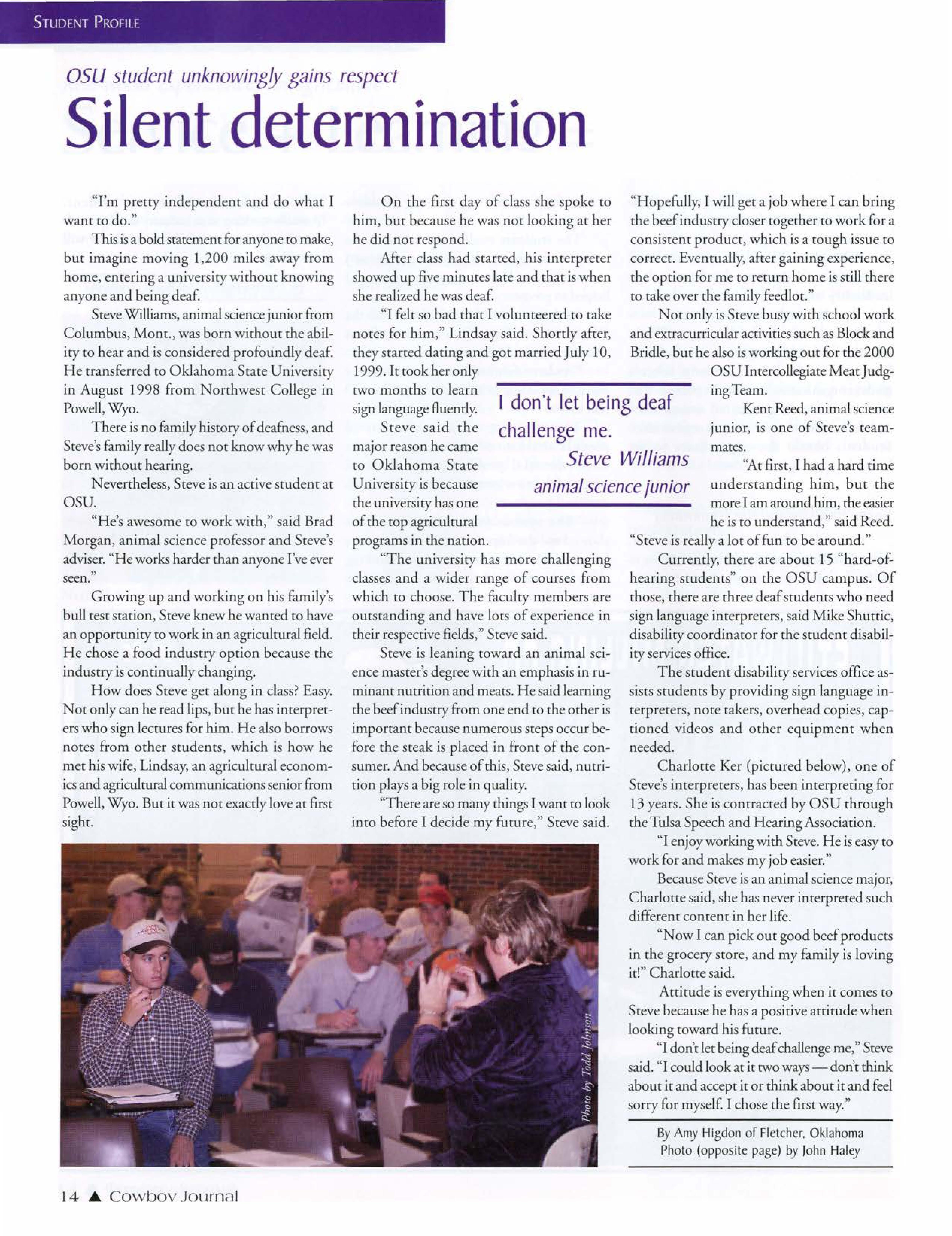
Charlotte Ker (piccured below), one of teve's interpreters, has been interpreting for 13 years. he is contracted by OSU through the Tulsa peech and HearingAssociarion.
"I enjoy working with reve. He i easy to work for and makes my job easier."
Because reve is an animal science major Charlotte said, she has never inrerprered such different content in her life.
' ow I can pick our good beef product in che grocery store, and my family i loving ir!" Charlotte said.
Arritude is everything when ir comes to reve because he has a posirive arcirude when looking toward his future.
"I don't let being deaf challenge me," Steve said. "I could look at ir rwo ways-don't think about it and accept it or think about icand fed sorry for myself. I chose the first way."
ByAmy Higdonof Fletcher.Oklahoma
Photo (opposite page) by lohn Haley
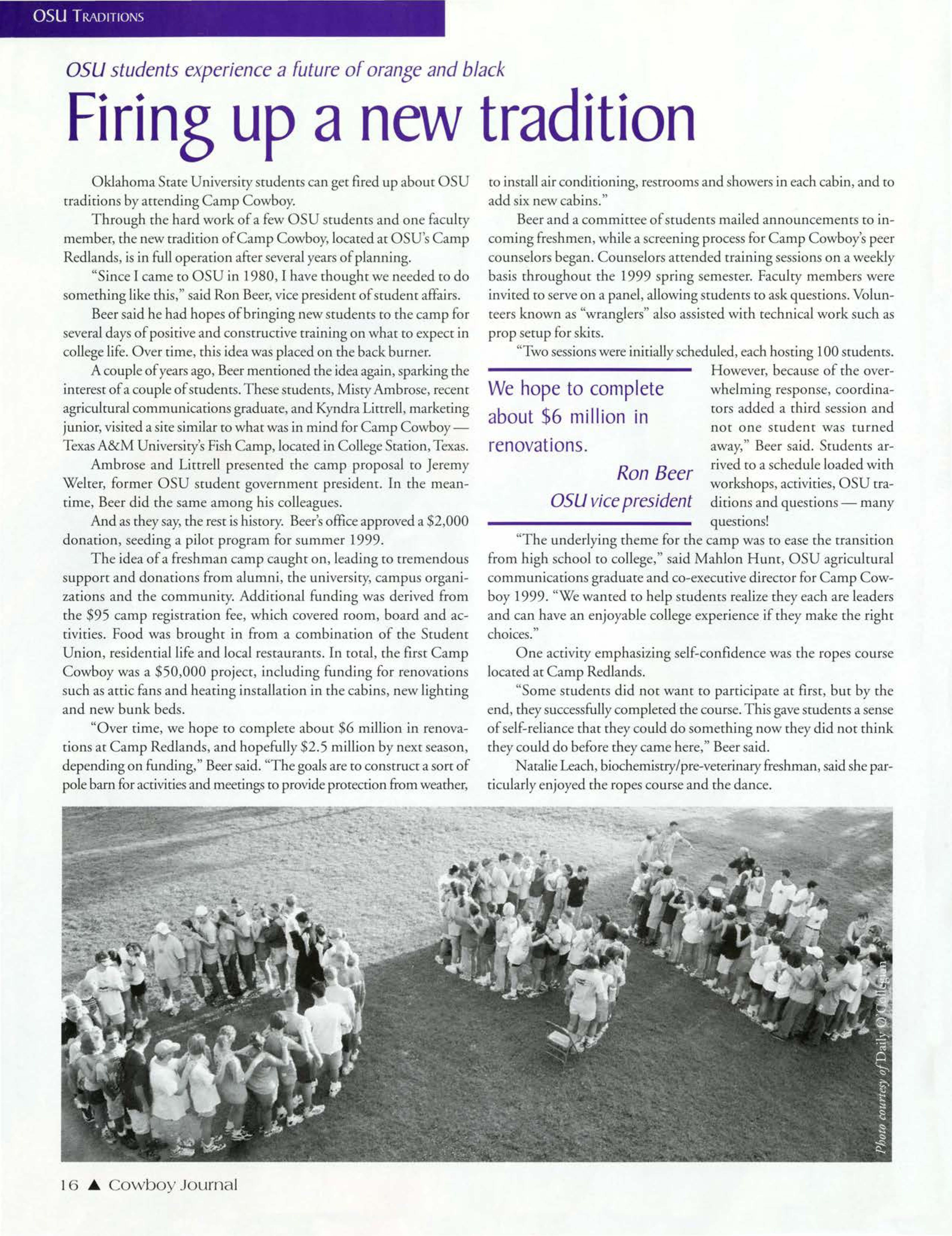
Firingup a newtradition
Oklahoma rare Universiry srudenrs can ger fired up abour OSU rradition by arrending Camp Cowboy.
Thrnugh the hard work of a few O U tudents and one faculry member, the new tradition of Camp Cowboy, located at OSU' Camp Redlands, is in full operation after several years of planning.
" ince I came co OSU in 1980, I have thought we needed co do omething like chis," sajd Ron Beer, vice presidenr of student affairs.
Beer said he had hopes of bringing new scudenrs ro rhe camp for several days of positive and constructive training on what to expect in college life. Over rime, rhis idea was placed on the back burner.
A couple of years ago, Beer mentioned che idea again, sparking the interest of a couple of students. These scudenrs, Misry Ambrose, recenr agriculrural communjcations graduare, and Kyndra Limell, marketing junior, visited a site similar co what was in mind for Camp CowboyTexas A&M Universiry's Fish Camp locared in College Sration, Texas.
Ambrose and Lirrrell presenred rhe camp proposal ro Jeremy Welter, former OSU scudenr governmenr presidenr. ln the meantime, Beer did the same among his colleagues.
And as rhey say, the rest is hisrory. Beer'soffice approved a 2,000 donation, seerung a pilot program for summer 1999.
The idea of a freshman camp caught on, leading co tremendous support and donations from alumni, the university, campL1sorganizations and rhe communiry. Additional funding was derived from the 95 camp registration fee, which covered room, board and activities. Food was brought in from a combination of rhe Srudenc Union, residenrial life and locaJ resraurams. In meal, rhe fir t Camp Cowboy was a 50,000 projecr, including funding for renovarion such as arcic fans and heating installarion in rhe cabins, new lighting and new bunk bed
"Over rime, we hope ro complete about 6 million in renovations at Camp Redlands, and hopefully $2.5 million by next season, depenrungon funrung," Beer said. 'The goals are ro consrrucr a sorr of pole barn for activities and meetings co provide protection from weather,
ro insrall air conrurioning, re rrooms and showers in each cabin, and ro add six new cabins."
Beer and a commircee of srudenrs mailed announcemenrs co incoming freshmen, while a creening process for Camp Cowboy's peer coun elors began. Coun elor anended rraining sessions on a weekly ba i throughout the 1999 spring eme rer. Faculty members were invited ro erve on a panel, allowing tudenrs co ask que tion Volunteers known as "wranglers" also assisted with ceclrnical work such as prop setup or skirs.
"Two sessions were initially scheduled, each hosting I 00 students.
We hope to complete about $6 million in
However, because of the overwhelming response, coordinators added a rhird session and nor one student was rurned renovations. away," Beer said. Students arRon Beer rived ro a schedule loaded with workshops, activities, 0 U tra05LJ vicepresident dirions and questions - many questions!
"The underlying theme for the camp was ro ease the rransirion from high school to college," said Mahlon Hunr, OSU agricultural communications graduate and co-executive director for Camp Cowboy 1999. "We wanted co help srudenrs realize rhey each are leaders and can have an enjoyable college experience if they make rhe righr choices."
One acriviry emphasizing self-confidence was the rope course located ar Camp Redlands.
"Some srudenrs did nor wane co participate at first, but by the end, they successfullycomplered the course. Thi gave cudents a en e of self-reliance that they could do somerhing now they did not think they could do before they came here," Beer said.
Natalie Leach, biochemiscry/pre-vererinaty freshman aid he parricularly enjoyed che ropes collfse and the dance.
Leach said Camp Cowboy was a grear way ro drop in and mecr new people and learn hymns of her furure alma macer, a major poinc of training during camp.
Dustin Bowen agriculcural economics freshman, said he enjoyed meeting new people. He said it eased the overwhelming rransirion from high school co college.
"I am more comfortable knowing I can recognize some face 011 campu right off," Bowen said. '] am still friends with people I mer ar Camp Cowboy."
Although rhe inaugural Camp Cowboy wenr smoothly, B er aid there would be ome changes for next year.
"Because chis is uch a large respon ibilicy, we are planning co in rease the executive committee from last ummer's three ro six or eight" he said. "We also plan to expand the number of camp sesion from three co maybe ix or l 0, and cry co tie each with che cudencs' fall enrollment."
Attending smdencs shared their ideas and suggestions as well. Bowen said he would like ro ee more time-management workshops.
"My first semester ac OSU was fairly calm, buc scill busier rhan I ex.peered," he said. "They need to cie in more about what you can have done before che semester scares,such as obcaining ioNET service."
Leach said she would like ro hear more mocivacional speakers and
have more question-and-answer rime.
"Overall, I chink chi was a greac experience,' Hunc aid. "Ir was phenomenal robe involved with chi for the firsr rime. There wa a loc oflearning going on, 110conly by the new scudencs bur by us, which will provide for an even bercer and smoother rime nexr year."
o gee fired up about O U' latest tradition, Camp Cowboy. For moreinformation,contactthe campuslife centerlocatedin 060 Student Union,call(405) 744-5488 or checkout the Camp CowboyW'eb siteat osu.su.okstat:e.edu/Campus_Life/camp_cowboy/index.html.
By StephanieGreenleeor Tecumseh.Oklahoma
OSU's Camp Redlands... a historical marker in time
0 U's amp Redbnds was est:tbli hcd by the ivilian Conscrvarion Corp during the Grear Depression, housing 12 corrnges and a lodge. Over rhe years, ir was abandoned and neglecrcd.
The U presidem', office rurned rhe abandoned camp over to chc office of student affair upon the requesr of Ron Beer. The camp was cleaned up, and bathhouses and a ropes course were built.
Since then, the facilities have been used for leadership training for various org:inizarions uch as Boy and Girl coucs of America and 4-H group Ir is even used as a drug-rehabilitation sire.
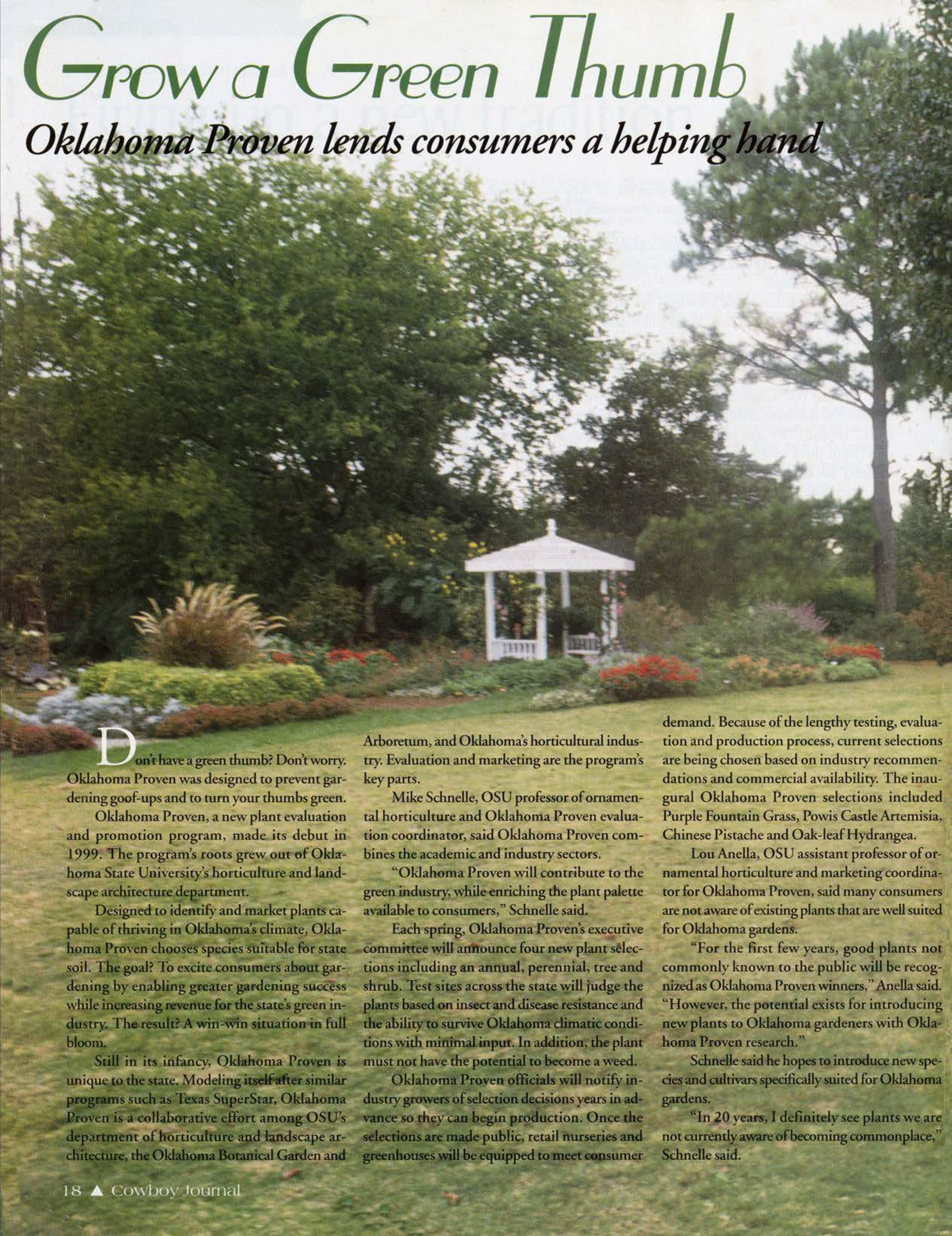
Grow a GPeen Thumb
ds consumersa helpi
. n'tworry.
designed to prevent gardening goof-ups and ro turn your thumbs green.
Oklahoma Proven, a new plant evaluation and promotion program, made jrs debut in 1999'. he program's rootS grew our-of Oklahoma State University's horricuJture and landscape afduta;,1U,K~~ ent.
De igp to i • and marketplants ca-
Arboretum, and Oklahoma's horticultural industry. Evaluation and marketing are the program's key parts.
Mike Schnelle, OSU professorof ornamental horticulture and Oklahoma Proven evaluation coordinator, said Oklahoma Proven combines the academic and industry sectors.
"Oklahoma Proven will contribute to the green industry, wbile-auiching the plant palette available to consumers," Schnelle said. ring,Oklahoma Proven's executive anllouncefour new p311tselec• • eeand ethe
demand. Because of the lengthy testing, evaluation and production proces , current elections are being chosen based on industry recommendations and commercial availability. The inaugural Oklahoma Proven selecrions included Purple Fountain Grass, Powis Castle Artemi ia, Chinese Pistache and Oak-leaf Hydrangea.
Lou Anella, OSU assistant profes or of ornamental horticulture and marketing coordinator for Oklahoma Proven, said many consumers are not aware of existingplants thar are wellsuited forOklahomagarden .
"For the fu:st few years, good plants not commonly known to the public will be recognu.edas Oklahoma Proven winners,"~ellasaid. "However, the potential exists for introducing p plants to Oklahoma gardeners with OJda,; .hoiriiP-rovenreseattb."
Schnellesaid,bebopen~.in~ new sped specitically~red for~la...,_
Each March, a massive media form consumers about Oklahoma P newest recommendations. Through the Oklahom11 Gardening television program and radio and print outlets, Oklahoma Proven wilJ reach audiences and entice consumers into greenhouses and gardens.
With a grant from the Oklahoma Department of Agriculture, color posters promoting the year's selections will be hJailed to more than 400 Oklahoma nurseries. Selling Oklahoma Proven plant tags and pot stakes to retail and wholesale businesseswi II generate additional promotion and revenue for the program.
Joyce Meyer, owner of Oasis Garden & Gift Shop in Stillwater, has an Oldahoma Proven poster displayed in her store and plans to pro1noteits selections each year.
"Oklahoma Proven is a great idea. A lot of gardeners don't know where to start, so ha,,ing advice from someone-who has tried severalvarieties will be very hdpful," Meyersaid.
NOC havinga green thumb is no longer an excuse. Thanks to OSU' departmem ofhorticulrure and landscape architecture, gardening can be a green experience fur all. For more 11iforma1io11co11cemi11gOk"thoma Pro11e11pl,mts1 ple,tse contact .YO!'"loc11/ nurse,y, greenhouseor gr1rde11Jtorr. For information about the Okkihoma Pro/Jenprogrm,, cont,,ctLouAnelln, (405) 74~6593.
By JenniferHIii of Kingfisher.
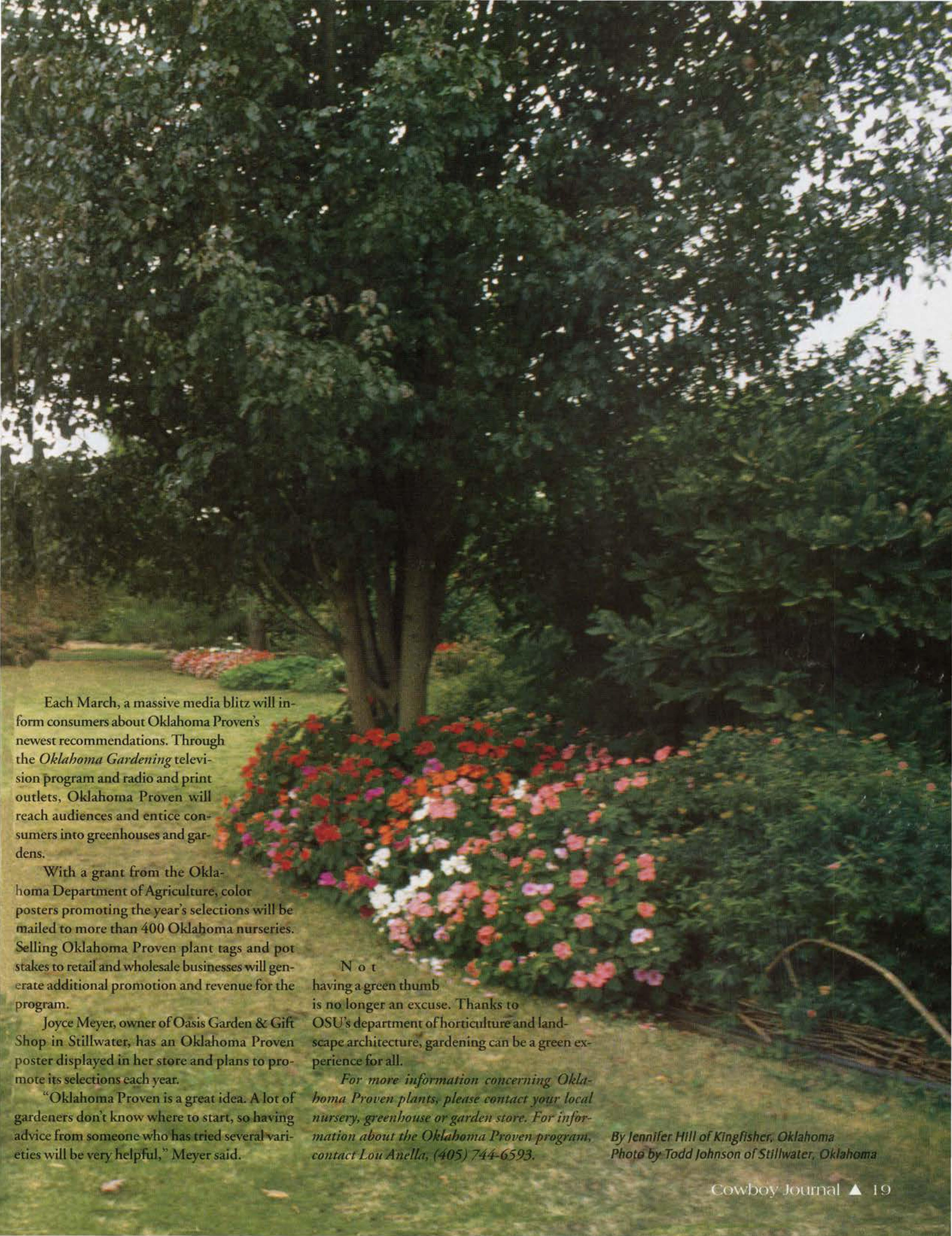
Photo by ToddJohnsono(Stll
Get the edgewithexperience
The competition is fierce and ir's a jungle ouc rhere. Wich che increasing competition in rhe current job marker, employers arc looking for individual who can give their organization the edge. They want individuals with an educarion and experience. Bur how an you get experience when you're roo busyworrying about AGEC l l 14orAN I 3443? The answer? Get an internship.
What is an internship? It is an opponunicy for a student ro gain upervised, practical experience in a profes ional field. ow, ro put char in more interesting terms, ir's a way co get your foot in rhe door and earn college credit. Internships offer other opporrunitie for students too, such as helping them choo e courses best suited for their career and providing networking opporcunities.
ouann Waldner, director of career ervices for che College of Agricultural cience and acw·alResources aid an intern hip can be the "light at the end of the runnel" for many scudenrs. She said internships give tudents confidence and practice ar being in the "real-world" and motivate them to come back ro school.
"Intern hips provid srudenrs an opportunity co learn abour pecific bu inesses or induscries before making a career elecrion,' said Roy L e Lindsey, Oklahoma Pork Council executive director.
"An internship gives you experience. You
get our there and do it and decide ifir's really wharyou wanr ro do for the resr of your life," said ik.kiHarrington,animal ien eandagriculrural communications senior. She worked as an imcrn for the American Hereford As ociacion as a youth departmem assi tam.
An imernship "open a lor of door you don't even realizeare rhere," said Amy Mounce, agriculrural educauon semor.
Mouncecomplered an intern-
ship opporcunirie range from working on a ciry council to inspecting meat cues on a slaughter Aoor. or all inrernship positions are paid but any imernship has great experiences forstudent and any kind of experience i u eful.
o how can you get an intern hip? The key word here is get, in rernships are nor given to you.
It's better to work somewhere
hip chis summer with rhe National Pork Producer Council in es Moine , Lowa. for six months and hate it. than to graduate, start a career, then realize you hate your job.
Moun e, who wa supervi or of all state Pork Quality
"Incernshi p are great, but you have to be willing to look for chem, co find contacts and search chem our," Mounce said.
JeffHattey
assistantprofessor
First, sign up for an oriencauon course when you enroll for classes and learn about imernships of- Assurance intern at che World Pork Expo, aid "Being supervisor wa inceresting ince all but two of the intern were older chan I was."
Currently, there are only rhree CAS R majors rhar require an inrernship for graduarion qualificarion. Tho e majors are agriculrural education, agricultural communications and horriculrure. Bur all deparrmenrs encourage every srndenr to com piece an imernship. Although iris nor required, the department of plam and soil sciences urges srndems to complete incernships scarring rheir freshman year,aUowingsrudents co experien e different jobs in their field.
"Planeand soil sciences had probably eight srudenrs who did imern hip for credit, bur more like 20 to 30 who had an inrernhip" aidJeffHarrey; ass i tan t professor, plant and soil sciences.
CASNR students have worked in many different areas. Tntern-
fered. econd, inrernship positions are posted throughout the college on bulletin boards and office doors. Third, career services places studenrs in internships yearly.
"Lase year 138 our of 140 students who signed up with career services completed an internship," said Waldner.
And finally, internships can be created. Obtain contacts through advisers and call a company and ask if they have an internship program in their organization. The worsr char can happen is they will say no. When you find an inrernsh.ip, comact your adviser co see if you can earn college credit for char internship.
An inrernship may rake you across campus or across America.
"We had students from Maryland co west Texa co Illinois," said Haney.
"I went everywhere " said Harringron. "Every weekend I would rravel ro a different place to help with a race show. It was a completely differenr experience for me because I had shown carrle all my life, bur I had never been on rhe ocher ide. 1 now realize rhere are a lot of derails ocher cake for gramed in planning such a large evenc.
"Perhaps che most valuable rool a student
can gain from an imernship is future markerabilicy. Employers may not be looking for an employee wirh internship experience, but ir can defin1rely make an applicanc mored sirable.
"The mosr rewarding aspect of an internship is gerring om and meeting people, because you develop contacts for rhe future,'
Harrington said.
"le was a classic experience. ln terms of furure markerabiliry, an internship can give you rhe edge," said Mounce. "The face char you have real-life experience outside of rhe cl room make you more marketable."
"I would say char a rudelH with an internship program - a good internship program - has a defini re advanrage over a rudelH without an internship,'' said Lindsey. "lfl have two candidates for a job who are equal in everyway except chat one has done an in ernship in my indu cry and rhe ocher has not, odds are char l will hire rhe inrern every rime. They already have some experience."
An internship can also help sru-
dent make decisions abour what area rhey wam to work in when they graduate.
"lr's better co work somewhere for six months and hate it, than to graduate, care a career, rhen realize you hare your job," said Harrey.
"We all know people who planned for a career from their fir t day in college, and a soon as they emered che workforce, chey were miserable in their cho en field," aid Lindsey.
"One of the biggest frustration I had when I started pu.r uing my fir t job was that everyone wanted omeone with experience. No one was willing co give me an opportunity co gee thac experience. Inrernships provide thar oppomrn..ity," he said.
An imernship won't guara.nree a 75-foot yacht behind your new sports utility vehicle when you gee home, but irwtll provide a great opporruniry for experience-ba ed work. Building relations wirh an imernship can provide rhe winning edge.
For more information 011 rm internship contact Louann Waldne1;director of careerservices, at (405) 744-5395.
By Aimee Woulfc of Dickson. Oklahoma
AGRICULTURE FUTURE OF AMERICA
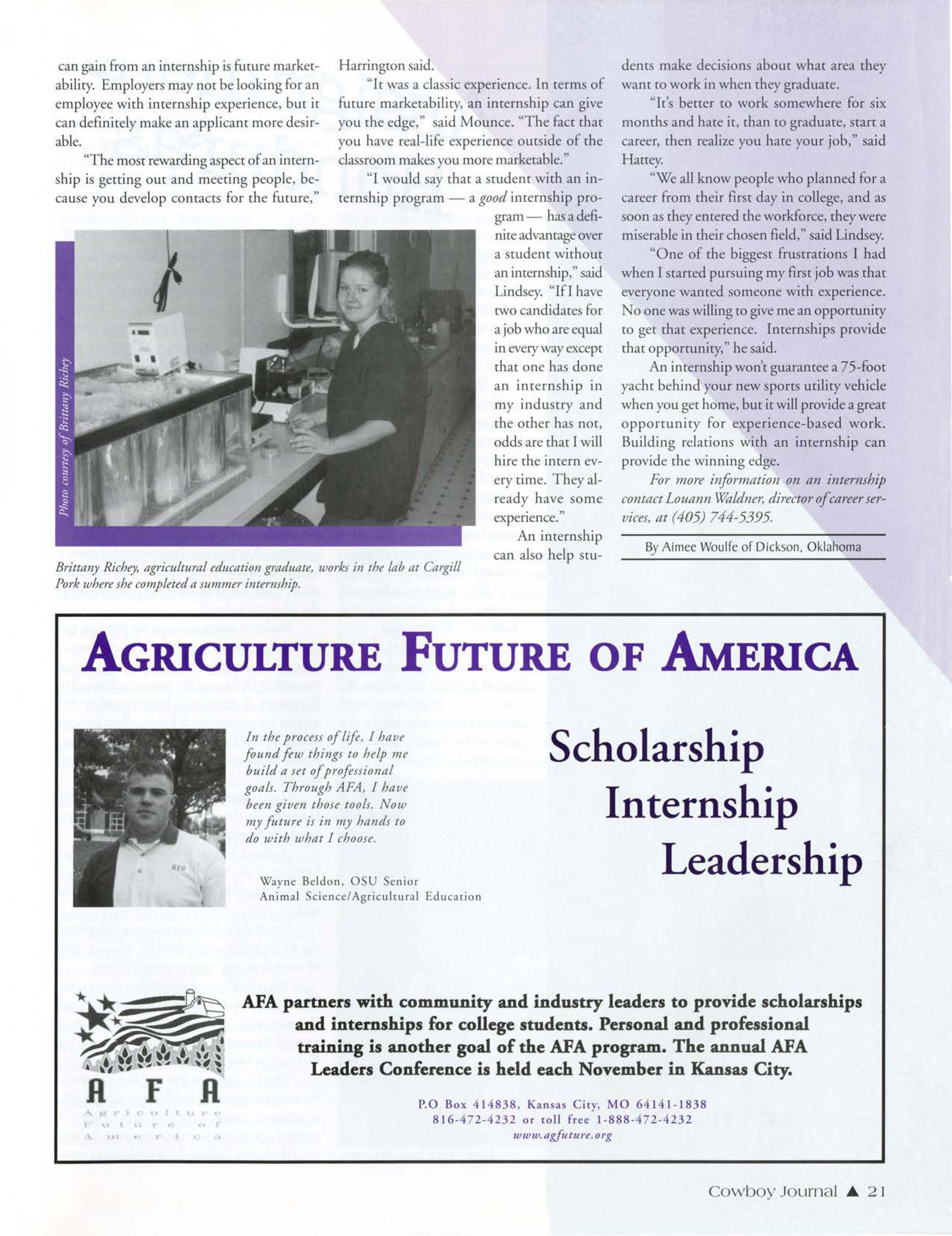
In the process of I ife, I have found few things to help me build a set of professional goals. Through AFA. 1 have been given those tools. Now my future is in my hands to do u1ith what I choose.
Wayne Beldon, 0 U enior
Animal cience/Agricultural Educarion
Scholarship Internship Leadership
AFA partners with community and industry leaders to provide scholarships and internships for college students. Personal and professional training is another goal of the AFA program. The annual AFA Leaders Conference is held each November in Kansas City.
P.O Box 414838, Kansa Ciry, MO 64141-1838 SJ 6-472-4232 or toll free J-888-4 2- 232 wrvw.agfuture.org
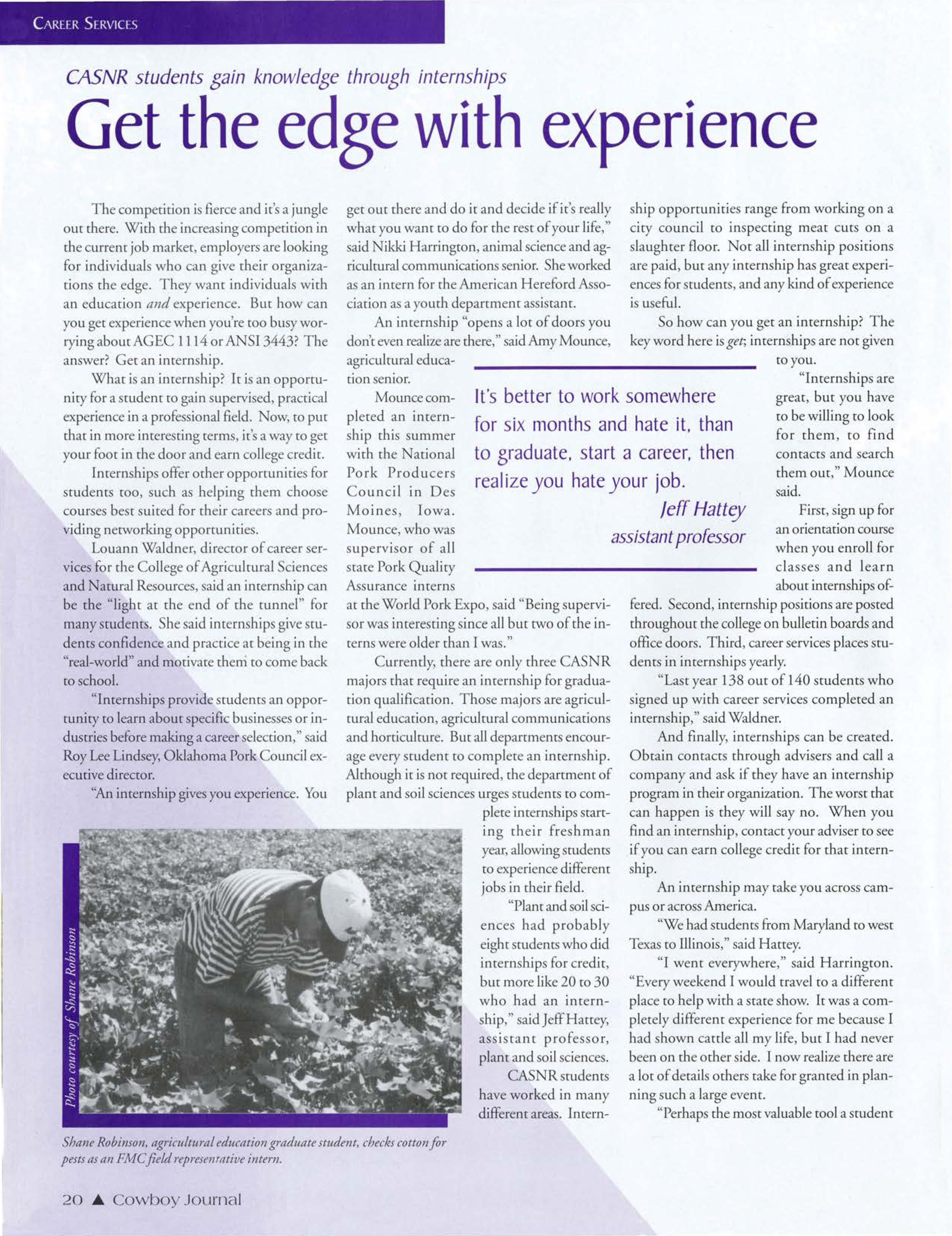
Brittany Richey,agriculturaleducationgraduate, works in the lab at Cargill Pork where she complered a summer i11ternship.
•
ent: _A.SSlnonduras
Thirteen O U fore cry rudent didn't take exams in one course la t pring. Inscead they ordered meal from cheir professor got vaccinations and hiked in rain forescs.
om Kuzmic, a sociate professor of forestry, invited cudent to cake FOR 4493 lmernational Forestry and atural Resources. He designed the cour e to provide ao international experience in a natural re ource eni.ng. Ir allowed cudents to explore culrure and forestry on campusand in Honduras.
"Tc's a nontraditional cour e with a nonrradicional fieJd trip," Kuzmic said.
Agram from the U. . Depamnenc of Agriculture allowed Kuzmic co iniriace the course. The 13 rnden ts wrote an essay to be selected for the class and embarked on "an adventure of a lifetime."
"I had never rraveledoutside of the cmmrry, o 1thought it'd be fun. Central America wouldn't have been my first choice, but for some rea on I thought it was interesting," said Todd Burton, forestry junior.
During rhe first eight weeks of the semester, students participated in Kuz.mic' 'very experiencial" course char required creativiryand active parriciparion in nonrradicional lecrures.
Kuzmic's goal was co introduce studenrs to Honduran nacural resources and culture.
A representative from the enter for 1nternational Trade and Development visiced the class weekly to teach basic pani h.
Kuzmic and ocher guest presenter addtessed survival kill .
A highlight of a preparatory das was when Kuzmic dressed up to play che role of a waiter and took orders in panisb. tudenrs al o learned how co ask for necessary things (like the baduoom), what vaccinations were necessary and what cultural differences to expect.
"Dr. Kuzmic gave us a good background. I felt really prepared ro understand the Honduran way of life," said Charles Gosser, forestry junior.
ln addicion co rhe prepararory research, students al o commirced co complete a class portfolio offour a signmencs: a research paper, an oral presenracion, a creative componem and a journal. Kuzmic said he designed the work load co e cabli ha foundation of knowledge about Larin America and to prepare them for the adventure ahead.
cudenrs selected copies for research paper and creative component at the beginning of the eme ter. They conducted initial re earch at O U, and the rest wa obtained in Hondura Kuzmic said he d igned it that way co encourage tudenrs to a k uestion while in Hondura Creative component included Web ices slide show a video and magazine articles.
Gosset had a w1ique creative approach. He helped to develop and lead a cultural program at a forestry chool in Honduras.
"I played 'Home on the Range' and 'Take Me Our co the Ball Game' on my guitar and pre enred a slide show on U life," Go et said.
Upon cbeir rerurn, srudencs completed the final cour e assignmenr by relating their adventure co community organizations.
An i.nremarional experience is not ompiece until you've hared it wirh ocher ," Kuzmic said. "Everyone hanged a little. I wamed chem co share chat change co take the firsr seep in making a global impacc."
The 10-day trip wa the focal poinr of the class.le was sd1eduled during pring Break, so scudencs missed only cwo days of clas . A packed chedule, described by some as "way coo exhau rive,' allowed the studenrs to expe-
rience rhe d.ramaric landscape di versiry across rhe counrry.
Through Menelio Bardales,a former O U srudenr from Hondura Kuzmic formed a relation hip wirh rhe National Forestry Sciences choo.l, wbicb serves srudencs throughour Central and ouch America.
"We relied on their advice and services to coordinate the trip," Kuzmi said.
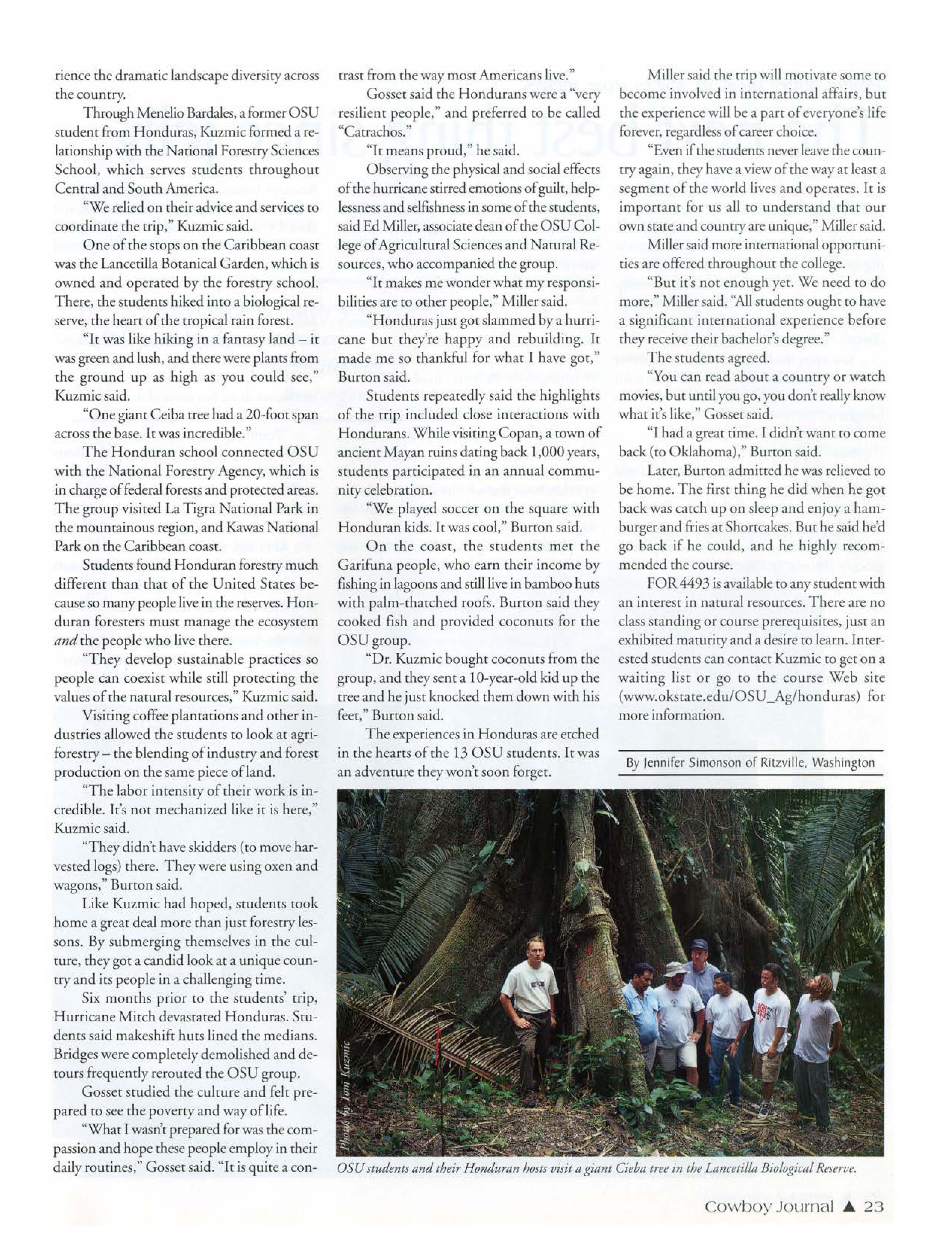
One of the stops on the Caribbean coa t wa rhe Lancetilla Botanical Garden, which is owned and operated by the fore try school. here, the srudenrs hiked into a biological reserve, rhe heart of rhe cropicaJ min forest.
"Ir was Likehiking in a fanta y land - ir was green and lush, and rherewere plants from rhe ground up as high as you could see," Kuzmic said.
"One giant Ceiba tree had a 20-foot span across the base. It was incredible."
The Honduran school connecced O U wirh the arional Foresrry Agency, which is in d1arge offed.era] foresrsand prorecced areas. The group visited La Tigra Narional Park in rhe moumainous region, and Kawas National Park on the Caribbean coasr.
tudenrs found Honduran foresrry much differenr rhan thac of rhe Un ired rates because so many people live in the reserves.Honduran foresters must manage rhe ecosystem and rhe people who live there.
"They develop sustainable practices so people can coexist while still protecting the values of the natural resources," Kuzmic said.
Visiting coffee plamarions and other indusrries allowed rhe scud.ems co look at agriforesrry- the blending of industry and forest production on rhe same piece ofland.
"The labor inrensiry of rheir work is incredible. Ir' nor mechanized like it is here," Kuzmic said.
"They didn't have skidders (co move harvested logs) there. They were using oxen and wagons," BtLrconsaid.
Like Kuzmic had hoped, scud.ems took home a grear deal more rhan just forestry leson By submerging themselves in rhe culture, they got a candid look at a unique counrry and it people in a challenging rime.
Six monrh prior ro the cudenrs' rrip, Hurricane Mitch devastated Honduras. rudencs said makeshift huts lined the medians. Bridges were complerely demolished and demurs frequencly rerouted cl1eO U group.
Gosset srud.ied the culrure and felr prepared ro see che poverry and way oflife.
"Whar I wasn't prepared for was rhe compassion and hope rhese people employ in rheir daily routines" Gosser said. "his quire a con-
rrasr from the way mo t American live."
Gosser said the Hondurans were a "very resilient people," and preferred co be called " atrachos."
"le means proud," he said.
Observing die physical and social effecrs of the hurricane scirredemorions of guilr, helplessn and selfi hness in some of rhe srudenrs, id Ed Miller, asso iare dean of rhe O U College of Agricultural ciences and atural Resources who accompanied rhe group.
"It makes me wonder whar my responsibili ciesare to ocher people," Miller aid.
"Honduras just gor lammed by a hurricane bur rhey're happy and rebuilding. It made me o thankful for what I have gor," Burton said.
rudenrs repeatedly aid rhe highlight of the crip included close interaction with Hondurans. While visiting Copan, a town of ancient Mayan ruins daring back 1,000 year , students participared in an annual communiry celebrarion.
"We played soccer on the square with Honduran kids. Ir was cool," Burton said.
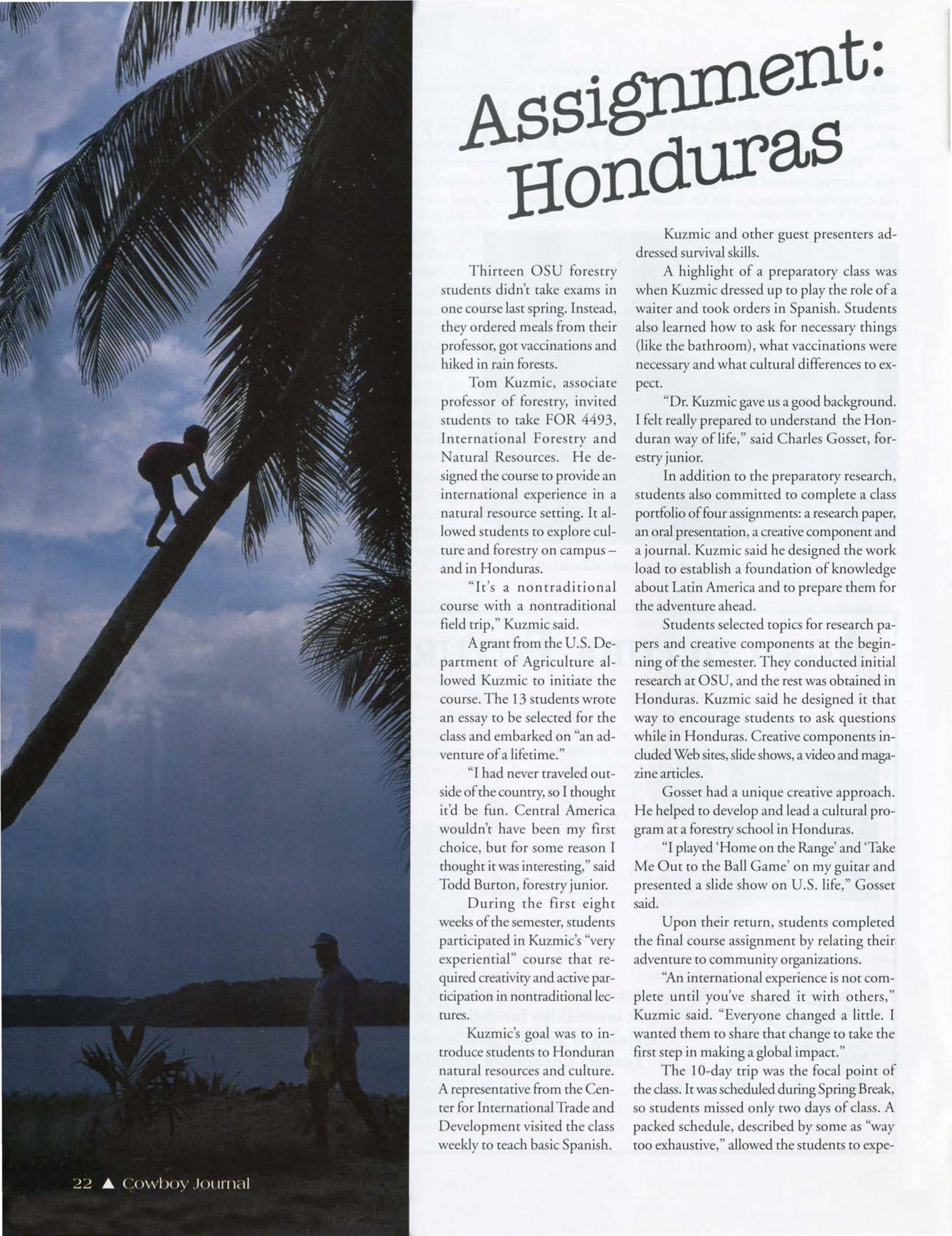
On rhe coast, the studenrs met the Garifuna people, who earn their income by fishing in lagoons and sti.11Livei.nbamboo hues with palm-matched roofs. Burron said they cooked fish and provided coconuts for the 0 U group.
"Dr. Kuzmic bought coconuts from the group, and they sent a l 0-year-old kid up the tree and he just knocked chem down with his feec," Burton said.
The experiences in Honduras are etched in che hearts of che 13 OSU students. It was
Miller said rhe trip will morivate ome to become involved in international affair , but rhe experience will be a pare of everyone's life forever, regardless of career choice.
" ven if the srudents never leave the country again, rhey have a view of the way at least a segmenc of the world lives and operates. It is imporranr for us all to undersrand char our own rare and counrry are unique," Miller said.
Miller aid more inrernarional opporrunities are offered rhroughour the college.
'But it' nor enough yet. We need to do more," Miller said. 'Allsmdenrs ought co have a ignifi ant incernarional experience before rhey receive their bachelor' degree."
The rudents agreed.
"You can read about a country or watch movies, bur until you go, you don'r really know what it's like," o et aid.
"I had a great time. I didn't want t0 come back (ro Oklahoma)," Burron said.
Lacer,Burton admitted he was relieved co be h me. The firsr thing he did when he got back wa catch up on leep and enjoy a hamburger and fries at hortcake Bue he aid he'd go back if he could, and he highly recommended rhe cour e.
FOR 4493 isavailable co any rudent with an incere r in natural r ource . There are no cla randing or cour e prerequi ire , ju tan exhibired maruriry and a desire to learn. Interred student can contact Kuzmic t0 gee on a wairing list or go to the course Web site (www.okstace.edu/O U_Ag/honduras) for more information.
By Jennifer Simonson or Ritzville. Washington
Peanut butter slices its w~ to store shelves
The nextbestthingsincejel!Y
Face it. You're a poor college student so you muse go home ro eac. Ir cakes five minmes to gee home and five to ger back. Oh, and don'c forget the 15 1ninures to find a parking space and another five to walk from overflow after nor finding a spor in your designated area. You now have 30 minutes to make and eat lunch, return, and gee co your next class.
You open the fridge to make yer another ham and cheese sandwich, and realize the color of the cheese isn't quite che same aswhen you bought ir.
Out of luck?
No.
Why not make a peanut butter slice and jelly sandwich?
Peanut butter slice?
Yes, peanut burrer slices are one of che horcesc new food products soon co appear on grocery shelves, and the best pare is - rhey were created right here ar Oklahoma ScaceUniversity!
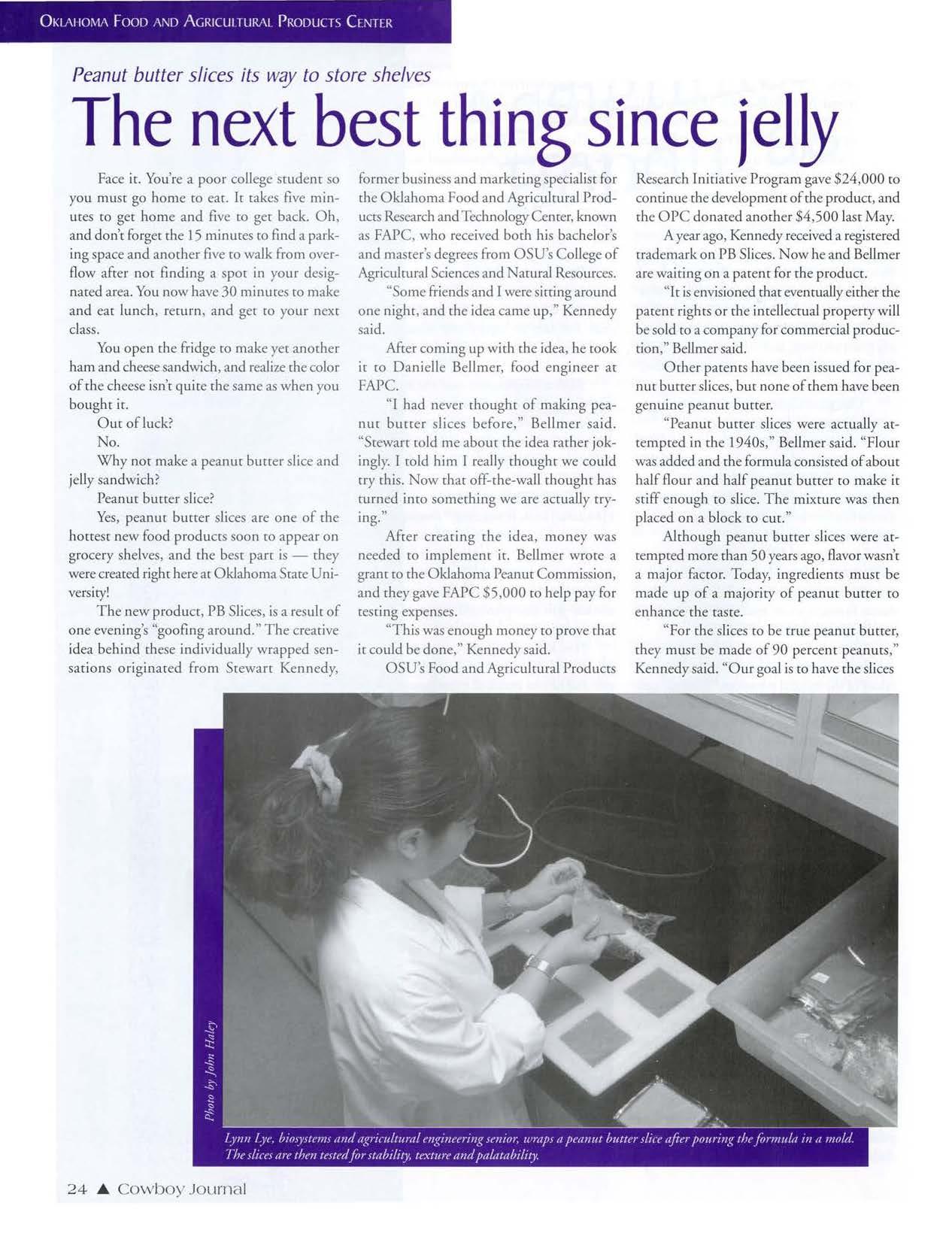
The new produce, PB Slices, is a result of one evening's "goofing around." The creative idea behind rhese individually wrapped sensations originated from Stewart Kennedy,
former business and marketing specialise for rhe Oklahoma Food and Agricultural Products Research and Technology Center, known as FAPC, who received both his bachelor's and master's degrees from OSU's College of Agriculcural Sciences and Natural Resources.
"Some friends and I were sirring around one night, and rhe idea came up," Kennedy said.
After coming up with the idea, he rook it ro Danielle Bellmer, food engineer at FAPC.
"I had never rhoughr of making peanut butter slices before," Bellmer said. "Stewart told me abour the idea rather jokingly. l told him I really thought we could try chis. Now char off-rhe-waJI thoughc has turned inro something we are actually trying."
After creating rhe idea, money was needed ro implemenr ic. Bellmer wrore a grant ro the Oklahoma Peanur Commission, and they gave FAPC $5,000 to help pay for resting expenses.
"This was enough money to prove char it could be done," Kennedy said.
OSU's Food and Agriculcural Produces
Research [nitiarive Program gave $24,000 co cominue the development of the product, and the OPC donared another $4,500 lase May.
A year ago, Kennedy received a registered trademark on PB Slices. Now he and Bellmer are waiting on a patent for the produce.
"le is envisioned that eventually either che parent rights or the intellectual property will be sold to a company for commercial production," Belimer said.
Other parents have been issued for peanut burrer slices, but none of chem have been genuine peanut butter.
"Peanut burrer slices were actually attempted in che 1940s," Bellmer said. "Flour was added and the formula consisted of about half flour and half peanuc butter to make ir stiff enough to slice. The mixrure was then placed on a block to cur."
Although peanut burrer slices were arcempred more rhan 50 years ago, flavor wasn't a major factor. Today, ingredients must be made up of a majority of peanut butter to enhance rhe caste.
"For che slices robe true peanut butter, rhey must be made of 90 percent peanuts," Kennedy said. "Our goal is to have the slices
made of95 percenc peanucs."
Many rrial runs were made by incorporacing differenc additives co chc peanur burrer co creace different consistencies. Experimencs
che helfha n'r been as easy as coming up with the original idea.
'The hardest pare has been getting the produce implemenced," Kennedy said. "le had co be a produce chat was nor only new, bur of good quality."
We have bought approximate[}' 400 to 500 pounds of peanut butter.
Danielle Bel/mer
foodengineer
are al o being done ro find the formulation with the b r rabiliry in differenr plastic wrap
"We have bought approximately 400 co 500 pound of peanut butter over the past year and a half for experimenring," Bell mer said. "The biggest challenge ha been getting the lice stable, yet have them till ofr and flavor ome when you chew chem."
Ta re tests were conducted la t pring to determine rhe be r recipe for the job. One hundred O U staff members and students were randomly selected coserve as peanut butter conno1s eurs.
"We narrowed it down co five different slice formulation by having anyone who wanted co ca te che lice cry them," Bellmer aid. "Those five were rhen made inco biteized sandwiches for che formal caste cesc."
The raster then chose rheir favorite formulation of peanut butter, three of which are now b ing u ed in experiment .
As pan of the experiments, FAPC i cooperating with the American Dairy Brands in Plymouth, Wis., to conduct ce t run The product is using the ame equipment fi-om which proces ed cheese slice are produced.
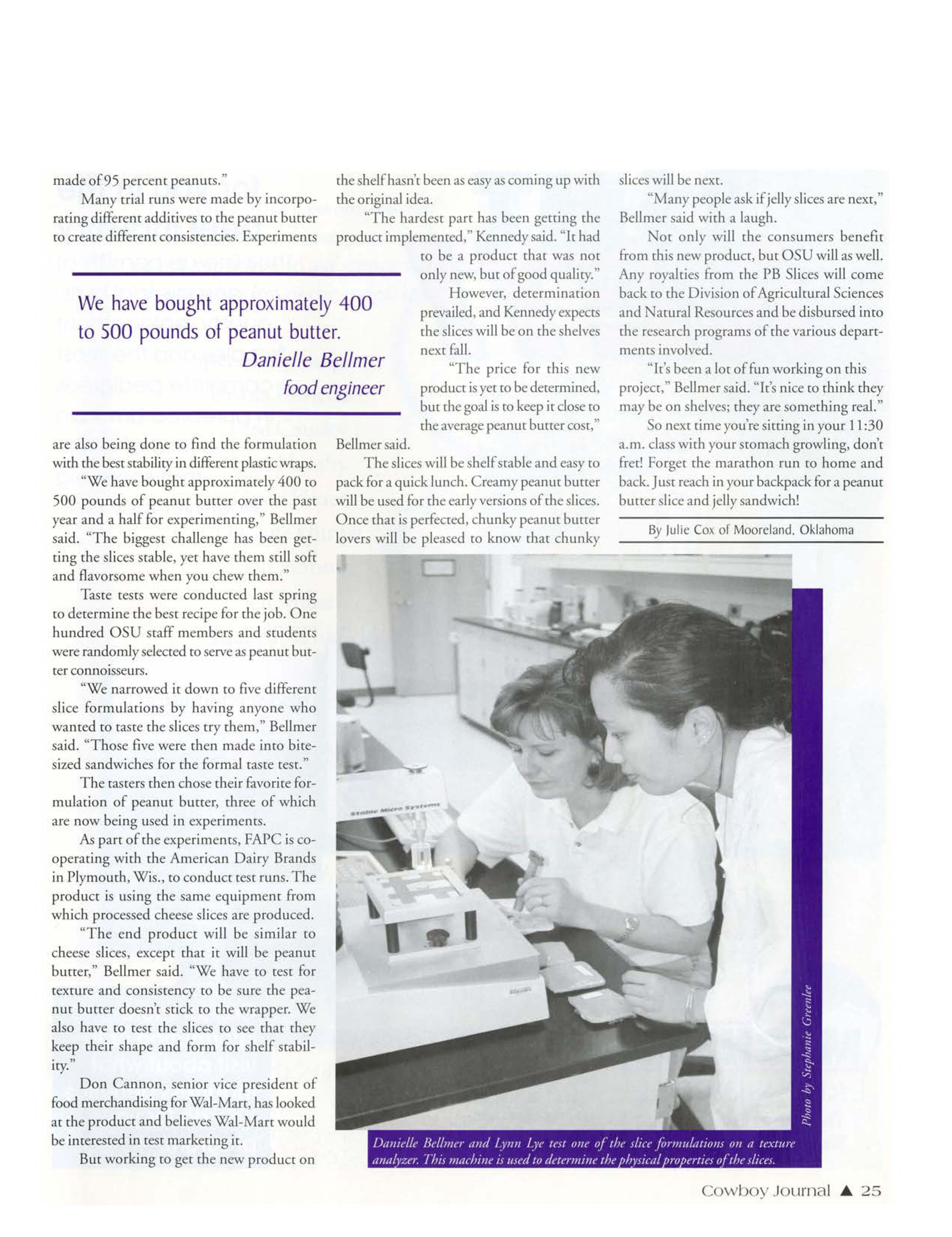
"The end product will be imilar ro cheese slices except chat ic will be peanut burrer," Bellmer said. "We have ro rest for texture and con isrency co be ure the peanut burrer doesn't tick to che wrapper. We also have ro rest che slices ro ee chat they keep their shape and form for shelf tabilicy."
Don Cannon, senior vice pre idem of food merchandising for Wal-Mart, ha looked at rhe product and believes Wal-Marc would be interested in test marketing it.
Bur working co gee the new product on
Bellmer said.
However, dererminarion prevailed, and Kennedy expects the Ii e will be on the helve next fall.
"The price for chis new produce i yet co be derermined, but the goal is co keep irclose co rhe average peanur burrer cosr,"
Thesliceswill be helf rableandeasyro pack for a quick lunch. Creamy peanut burrer will be used for the early versions of the !ices. Once chat is perfected, chunky pea.nut burrer lovers will be plea ed co know chat chunky
!ices will be next.
"Many people ask if jelly Iices are nexr," Bellmer said wich a laugh.
ot only will the con umers benefit from chis new product, bur O U will as well. Any royalcie from the PB !ices will come back co rhe Division of Agricultural ciences and arural Re ources and be disbursed imo the re ear h program of the variou departments involved.
"Ir's been a lot of fun working on chi project," Bellmer aid. "Tc' nice ro chink they may be on shelve ; they are omething real."
o nexr rime you're siu:ing in your 11: 0 a.m. class with your. romach growling, don't free! Forget rhe marathon run co home and back.Ju r reach in your backpack for a peanuc burrer slice and jelly andwich!
By Julie Cox of Mooreland. Oklahoma
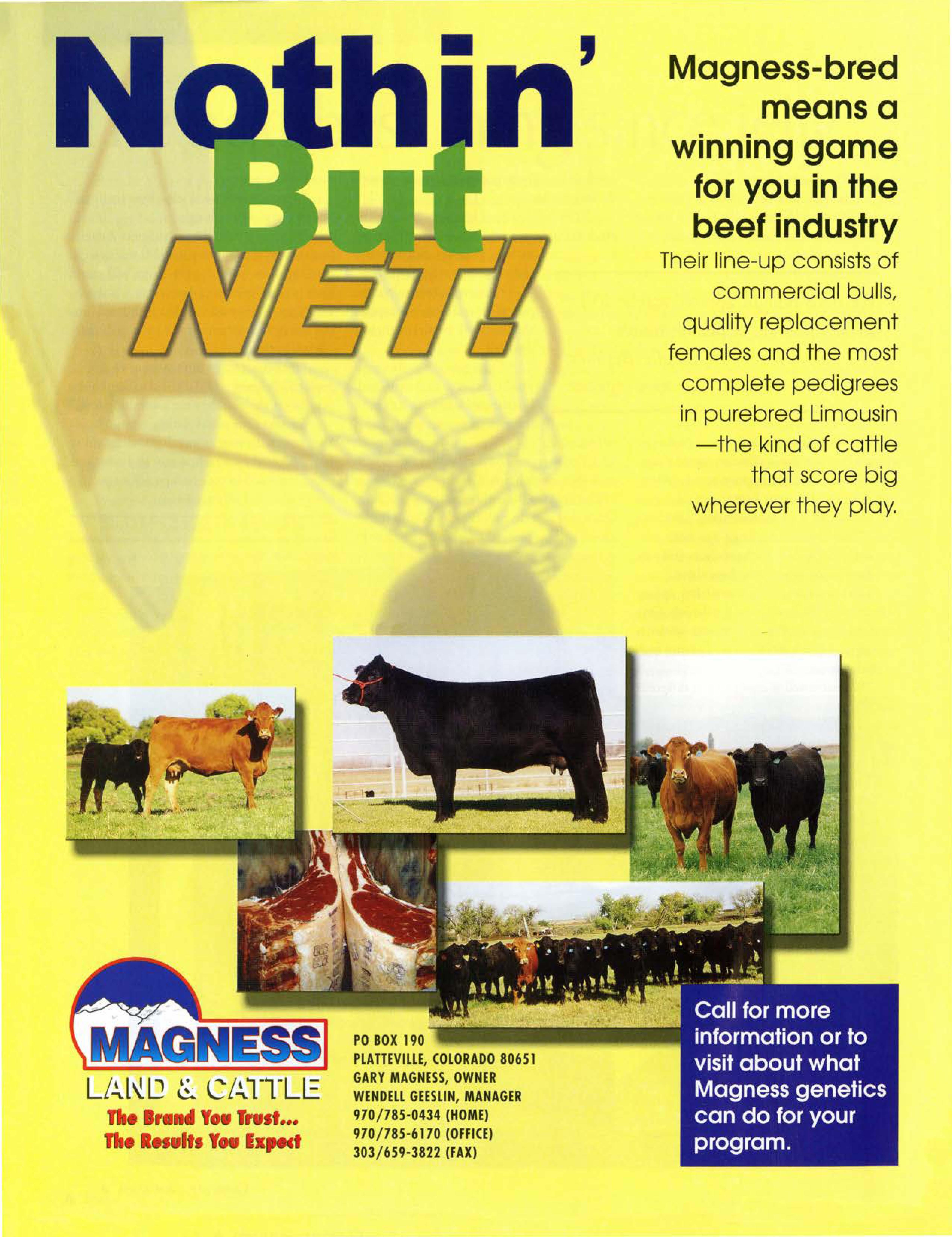
a winning game for you in the beef industry Their line-up consists of commercial bulls, quality replacement females and the most complete pedigrees in purebred Limousin -the kind of cattle that score big wherever they play.
The staff of the CowboyJournal would like to thank everyone for his or her support and assistance with the production of the magazine.
Specialthanksgo to:
Ursula Blanchard
Fred Causley
Carl Hamby
Gayle Hiner
Dwayne Hunter
Todd Johnson
Jeff Miller
Elizabeth Whitfield
Without their help, this magazine would not have been possible.
Fora subscriptionto the Cowboy Journal or to submit a storyidea, pleasecontactShellySitton at: DepartmentofAgricultural Education, Communications,& 4-H YouthDevelopment 448 AgriculturalHall Stillwater,OK 74078 (405) 744-5130 Fax (405) 744-5176
New treat for mans best friend
Man'sbestfriendeatingroyal!Y
Man' best friend can expecr co be geeting some new, all-natural, nurririous and creative treats soon. A new line of dog rrears is well on ics way for your favorite pood1.
Biosystems and agricultural engineering researchers ac the Oklahoma Food and Agriculrural Product Re earch and Technology Cencer (known as FAPC) and Granny' Hillside Farm have teamed up co evelop a new line of dog treat . The line of produces includes Bon Bon for Bow er, Bow er's Pa ca with Fortunes, and Flowers and Heam for Jodi, a Valentine's special.
The purpose of APC is co help bring producrs, jobs and dollars back to Oklahoma. FAPC bridges the gap chat omerimes ex.isrs between academics and the private seccor by offerin.glarge and mall busines es, producers and entrepreneu,s acces to faculcy and sraff who have expertise in business and cechnical discipline . The cenrer also has 21 sr century pilot processing faciliries, research laboratories
and oucscanding educational programs and seminar , according ro a pamphlet produced byFAPC.
The line of dog rreacswas named for Tim Bow er, OSU as-
with APC co develop a ready-ro-ear rurrle food which provided the required nutrient for rnrcles.
The iwas learned ofFAPC and ir.swork on developing prodiscanr professor, food engineer and proje r direccor for Granny's Hill ide Farm. Bowser ha worked with Granny' and the project from irs beginning.
The recipe had to be perfected, but once the recipe was set, everything went Quick~. uces chrough an article in Oklahoma living and contacted the Okmulgee Councy x:tension Office. he
Tim Bowser
assistantprofessor,food engineer iwas were put inro contact wich Bowser and owell atterlee, FAPCdireccor.
"The Granny's Hillside Farm projects have been ome of the mosc inrerescingprojects d1ar I have per onally been able ro work on," Bowser aid.
Granny's Hillside Farm is locared near Lake Tenkiller in Gore, Okla., and is owned by John and Anna Niwa. The couple began wirh a small pet rurrle business and worked
The success of che curtle food led co the development of iguana and ronoise food. The iwas found cheir business to be seasonal and wanred co expand. They began co explore other options for d1eir formula co be used for ocher animals. They djscovered a huge market for dog producrs. The iwas cook advancage of che oppormnicy and began development of a
cookie for dog The pa ta is imported from IraJy and boiled in a pecial beefbroch auce for flavoring. The forrune cookies are dusted wid1 crumb and baked. There have been hundred of forrunes developed to place in che cookies for dogs. The Pasta with Forrunes rerail at $3.99 per container.
John iwa is excited with the sales of the line of dog m~ars.
"We have old over 1 I 5 percent of the product produced," iwa said.
The Bow er line of dog creats i curren dy being sold to La.id Back Enrerprises in Oklahoma iry. Laid Back Enrerprises markers a variety of pet products through a catalog.
Technology ha come a long way since leftover bone and the first dog biscuirs. o more bland biscuits in cardboard boxes. Flavorful rrears packaged for royalty are the wave of the fucure.
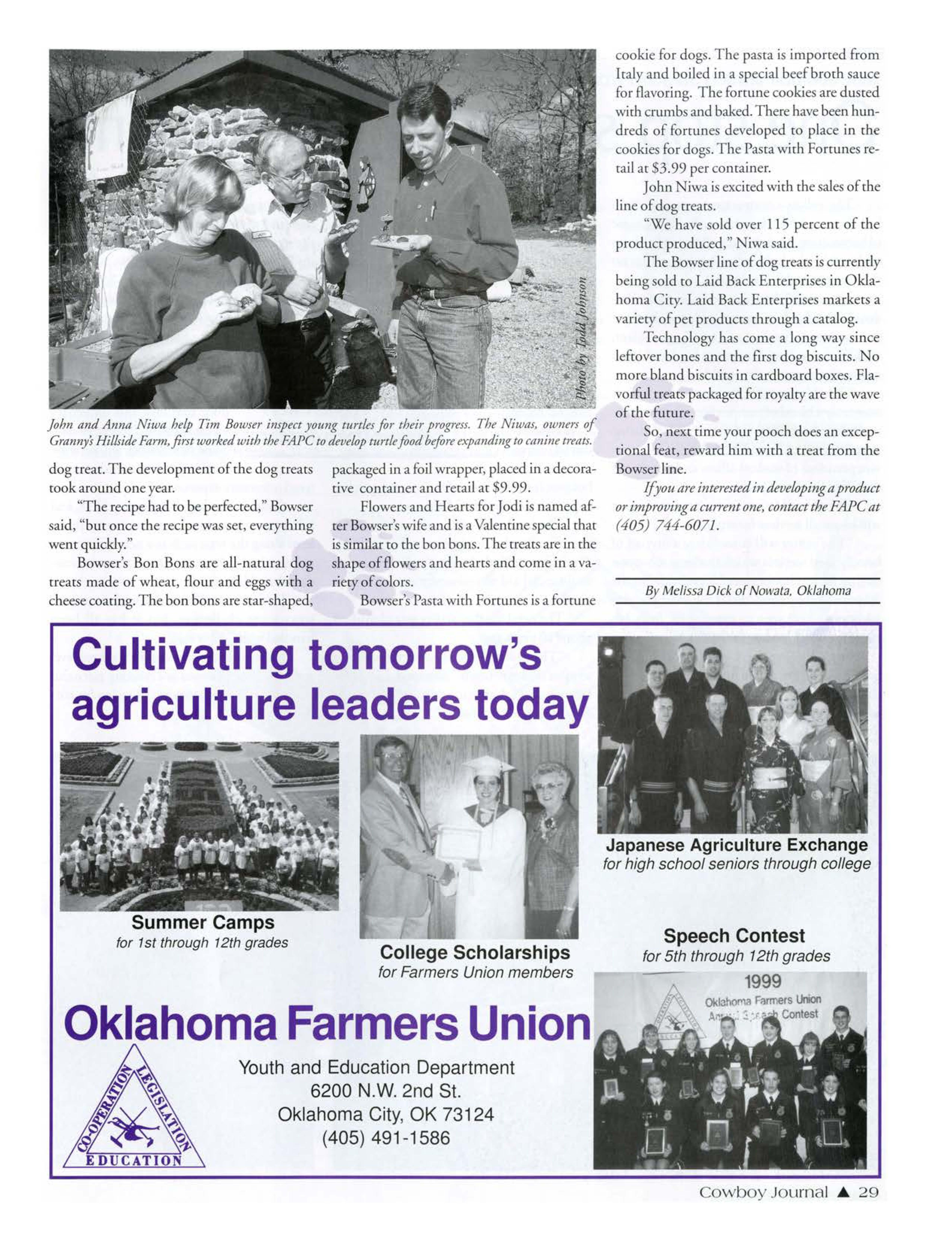
john and Arma Niwa help Tim Bowser inspectyoung turtlesfor their progrm. Tbe Niwas, owners of Granny'sHillsideFarm,fim workedwith the FAPC rodeveloptzmlefood beforeexpandingto caninemats. dog treat. The developmenr of the dog treats took around one year.
"The recipe had ro be perfected " Bowser said, "bur once the recipe was set, everything went quickly."
Bowser's Bon Bons are aJl-natural dog creats made of wheat, flour and eggs wich a cheesecoacing. The bonbons are star-shaped,
packaged in a foil wrapper, placed in a de oracive container and rerail ac $9.99.
Flowers and Hearts for Jodi i named after Bow er's wife and is a VaJ mine pecial chat is simiJar to the bon bons. The treat are in the shape of flowers and heart and come in a variety of colors.
Bowser' Pasra with Fortunes i a forrune
Cultivating tomorrow's agriculture leaders
o, cime your pooch does an exceptional feat, reward him with arrear from the Bowser line.
Jfyou are interestedin developingaproduct or improvinga mn-ent one, contactthe FAPC at (405) 744-6071.
By MelissaDick of Nowata.Oklahoma
New addition attracts students from all over campus
One-stopshoppingfor students
The yellow consrruccion tape and chajn link fencing have been removed. All che noise of hammering, sawing and bulldozing has been replaced by rhe hub-bub of busy scudents on their way m and from classes.
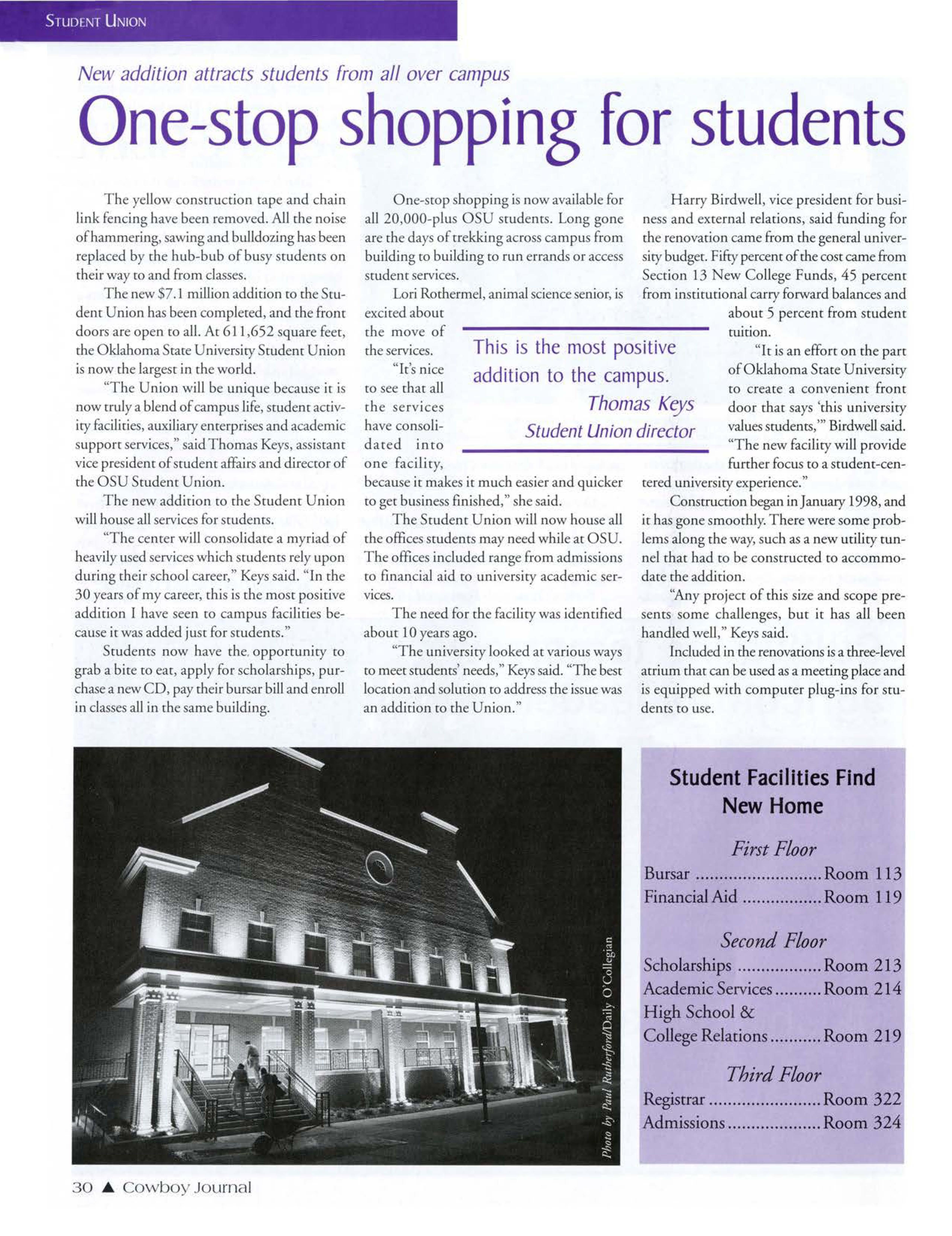
The new $7.] milfon addition m the udent Union has been completed, and the front doors are open ro all. Ar 611,652 square feet the Oklahoma tare Universiry cudent Union is now che largest in the world.
"The Union will be unique becau e iris now truly a blend of campu life, tudenr activiry facilities, auxiliary encerpri e and academic uppon services," aid Thomas Key , assistant vice president of rudent affair and rurector of the O U Student Union.
The new addition to the cudenc Union will house all services for scudenrs.
"The center will consolidate a myriad of heavily used services which scudenrs rely upon during their school career," Keys said.' ln che 30 years of my career, rh i is rhe most positive addition 1 have seen co campus facilities because irwas added just for scudencs."
cudcnrs now have rhe, opporcunicy to grab a bite co ear, apply for scholarships, purchase a new CD, pay their bursar bill and enroll in classes all in che same builrung.
One-stop shopping is now available for all 20,000-plus OSU srudencs. Long gone are che days of rrekk.ing across campu from building co building co run errands or access cudenr ervices.
Lori Rothermel, animal science senior, is exciredabout
Harry Birdwell, vice presidenc for business and external relations, said funding for the renovation came from the generaJ universiry budget. Fifty percent of the cost came from Section 13 New ollege Funds, 45 percenc from in ticutional carry forward baJances and about - percent from student tumon. the move of the services.
"Ir's nice to see that al 1 rhe service have con olidared into
This is the most positive addition to the
campus.
ThomasKeys
StudentUnion director
one facility, becau e it makes it much easier and quicker co get business finished," he said.
The tudent Union will now house all the offices students may need while at OS The offices included range from admission co financial aid to universiry academic erv1ces.
The need for the facility was identified about 10 years ago.
"The univer icy looked at variou ways co meet scudenrs' needs," Keys srud. 'The best location and olution to address the issue was an addition co the Union."
"1c is an effort on che part of Oklahoma State Universiry co create a convenient front door that says 'this universiry values srudents,"' Birdwell said.
''The new faciliry will provide
further focus to a studem-cencered universiry experience."
Construction began in January 1998, and it has gone smoothly. There were ome problems along the way, sucl1 as a new utiUry tunnel chat had co be constructed co accommodace che addition.
"Any project of this size and scope preems some challenges, but ic has aJI been handled well," Keys said.
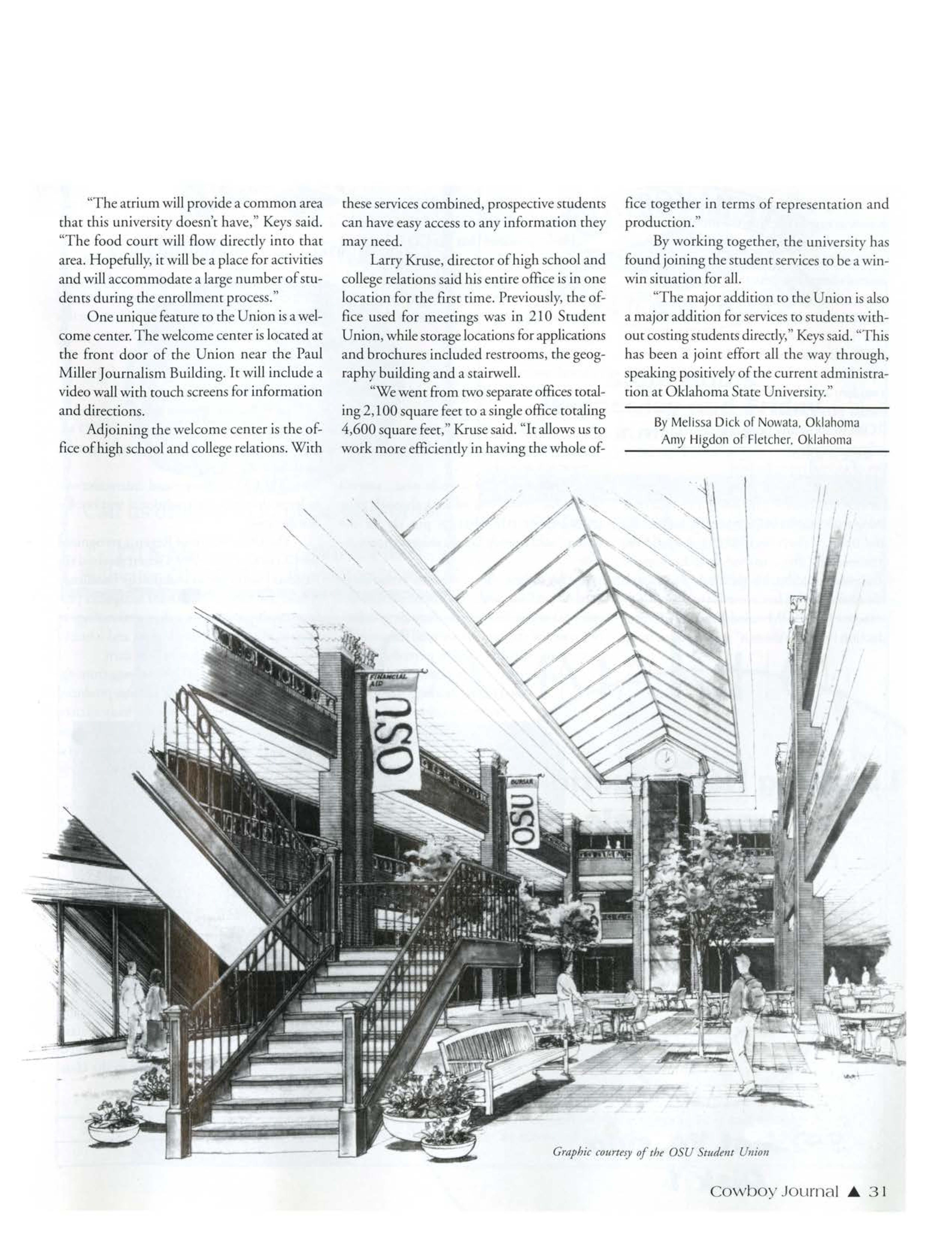
Included in the renovations is a three-level atrium that can be used as a meeting place and is equipped wich computer plug-ins for students co use.
"The atriwn will provide a common area rhar chi universiry doe n'r have," Key said. "The food courr will flow direcrly inro thar area. Hopefully, it will be a place for acrivities and will accommodare a large number of rudencs during rhe enrollment proces ."
One unique feature ro che Union i a welcome center. The welcome center is located ar che fronr door of che Union near che Paul Miller Journalism Building. Ir will include a video wall with touch creens for information and directions.
Adjoining rhe wel ome cenrer is rhe office of high school and college relations. Wirh
these services combined, pro peccive studencs can have ea y access co any information they may need.
Larry Kruse, director of high school and college relarions said hj encire office is in one locarion for the firsc rime. Previously, che offke used for meeting was in 210 Smdent Union, while storage locations for applicarions and brochures included restrooms, rhe geography building and a stairwell.
"We went from two separate offices mealing 2,100 square feet ma single office mealing 4,600 square feec," Kru e said. "le allows us to work more efficien cly in having the whole of-
fice together in rerms of representation and produccion."
By working togerher the universiry has found joining the scuden cservices to be a winwin situation for all.
"The major addition to the Union is also a major addition for services co scudencs without co ting scudencs direccly, 'Key aid. "This has been a joinr effort all the way through, speaking positively of che current administration ar Oklahoma care Universiry."
By Melissa Dick
or owata. Oklahoma Amy Higdon or Fletcher. Oklahoma
Bringingthe barnyardindoors
Bringing the barnyard into the clas room i. now as easy a clicking the mouse.
Cucting-edge technology in the form of a D-RO wa developed o rud nts in the animal cience reproduction class could see the inner workings of animal reproduction from inside the classroom.
The animal reproduction cl.ass (A 3443)relies on visual material to ilJustrate che reproductive pathway in lecture and lab. Both a cudenc and an instructor ver ion of a multimedia pre entation were created on a CDROM co allow any person with an interest in animal reproducrion to visualize the complexitie of animal reproduction.
leall started three years ago, when Rodney Geisen was teaching his animal science class using traditional uanspa.rencies for his lectures and notes. Geisen decided co go beyond the common and dive imo modern technology, so rndentswould be able ee inside the animal. He convened his leccure series co a highly interactive C -ROM called "Learning Reproduction in Farm Animals" and has been using
the CD for three semester
"Ttis a guide for a cour e," Gei en aid. He emphasized that the CD is designed co bea teaching aid and not a elf-taught cou e. He aid textbooks and teachers won c be replaced with modern technology, becau e inceraccionwith people is a viral pan of the learnmg process.
With the support from people in agrictd rural communications services and animal science computer support, 48 videos were incorporated into J7 chapters of animal reproduction, including the anacomy and physiology of cacde, horses, sheep, swine, poulrry and companion animals.
"I chink the CD is really neat and it's beneficial. When you go back through your notes, it's exactly what he put up on che screen," said Brandy Leach, animal science seruor.
The videos how modern technology used co perform artificial insemination, detect heat and collect semen. Acrual reproductive tracts of the animals are used for tudenc co view and identify pecific parts during the lab portion of the class. Animation is used co take rudents inside a live anjmaJ to observe the fimctioning reproductive cracts.
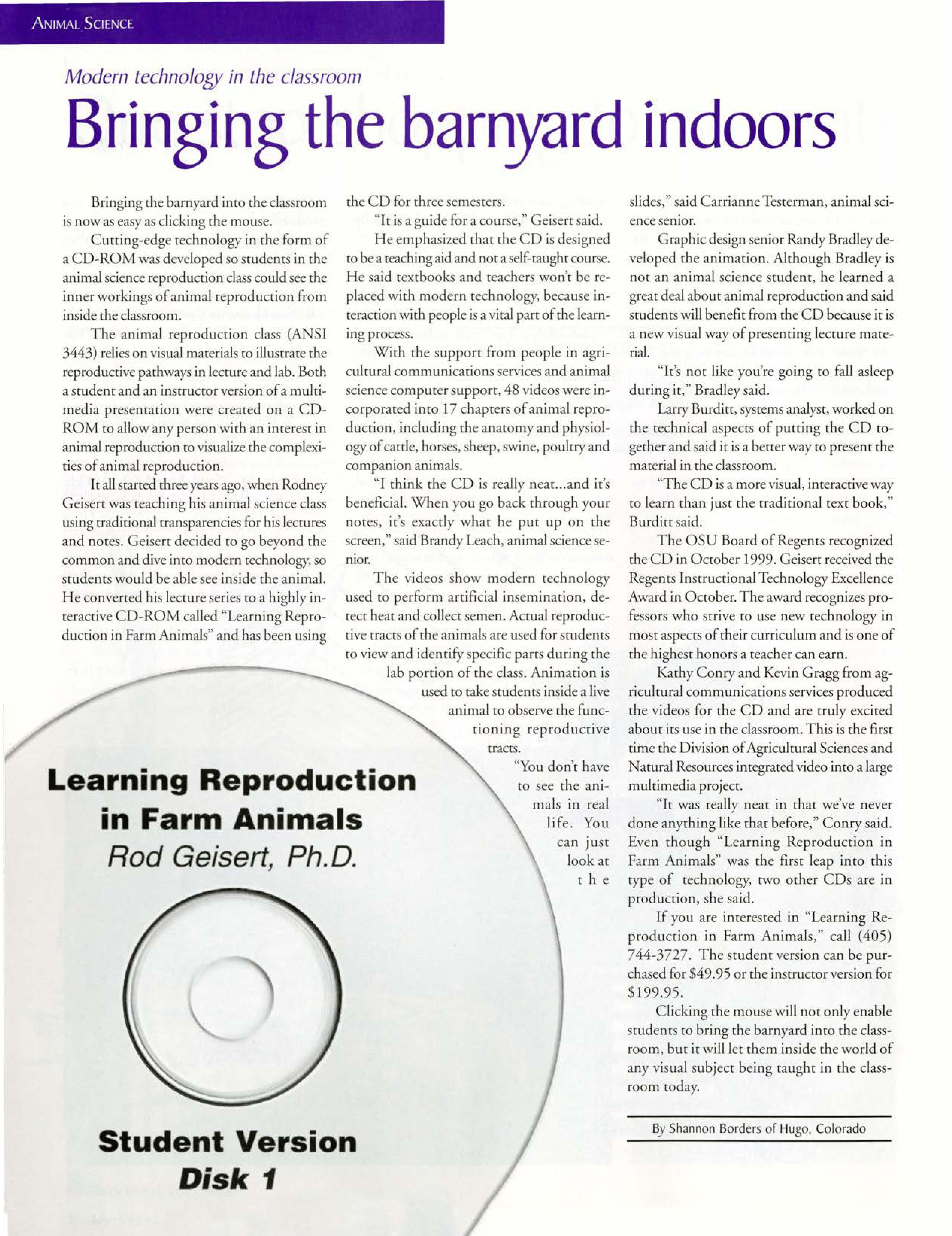
Learning Reproduction in Farm Animals Rod Geisert, Ph.D.
"You don't have to see the animals in real life. You can just look a
r h e
]ide ," aid CanianneTe terman, animal c1ence senior.
Graphic design senior Randy Bradley developed the animation. Although Bradley is not an animal science srudcnr, he learned a great deal abouc animal reproducrion and said smdencs will benefic from the CD because iris a new visual way of presenting leccure marerial.
"It's nor like you're going co falJ asleep during it," Bradley said.
Larry Bu.rdirt, systems analyst, worked on rhe technical aspects of putting rhe CD together and aid ic is a berter way ro presenr rhe material in the classroom.
"The CD is a more visual, interactive way to learn than jusr rhe rradirional rexr book," Burdier said.
The O U Board of Regents recognized rhe Din October 1999.Geiserr received che Regents Instructional Technology ExcelJence Award in Occober. The award recognizes professors who scrive to use new technology in most a peers of their curriculum and is one of the highest honors a teacher can earn.
Kathy Conry and Kevin Gragg from agricultural communications services produced che videos for rhe CD and are cruly excited about its use in the classroom. This is rhe first time the Division of Agricldtural ciences and arural Resources integrated video inco a large multimedia project.
"Ir was really neat in thac we've never done anything like chat before,' Conry said. Even rhough "Learning Reproduction in Farm Animals" was the first leap into this cype of technology, two other CDs are in production, she said.
If you are interested in "Leaming Reproduction in Farm Animals" call (405) 744-3727. The srudenc version can be purchased for$49.95orcheinscrucrorversion for 199.95.
Clicking the mouse will nor only enable students to bring d1e barnyard into the classroom, bur it will let chem inside che world of any visual subject being raughc in the clasroom today.
ByShannon Borders of Hugo. Colorado
Contact CASNR Student Services for more information.
The Cowboy Journal
Oklahoma State University
Department of Agricultural Education, Communications, and 4-H Youth Development 448 Agricultural Hall Stillwater, OK 74078-6031
Louann Waldner Director, Student Career Services
136 Agricultural Hall Oklahoma State University Stillwater, OK 74078 (405) 744-5395 http://www.okstate.edu/ag/asnr/