OSU College of Agricultural Sciences and Natural Resources
OSU College of Agricultural Sciences and Natural Resources
Volume l • Number l • Spring I 999
Vol. I O.
Barbi Dauer
Editor
Janna Ogden
Assistant Editor
Jill Mason Wagner
Amanda Early Graphics
Mahlon Hunt
Holley Brown
Spon orship
Shayla Harris Circulation
Kara Clark Web Design
Greg Gungoll
Matt Presson
Danielle Holt
Traci O'Hara
Cammie Johnson
Lydia Laske
Meredith Everett
Sarah Turner
Ana Webster
Travis Beams Staff
Shelly Peper Sitton
Managing Editor
Elizabeth Whitfield
Support Services
Limousin World
Oklahoma Farm Bureau
Quebecor Printing
Founding Sponsors
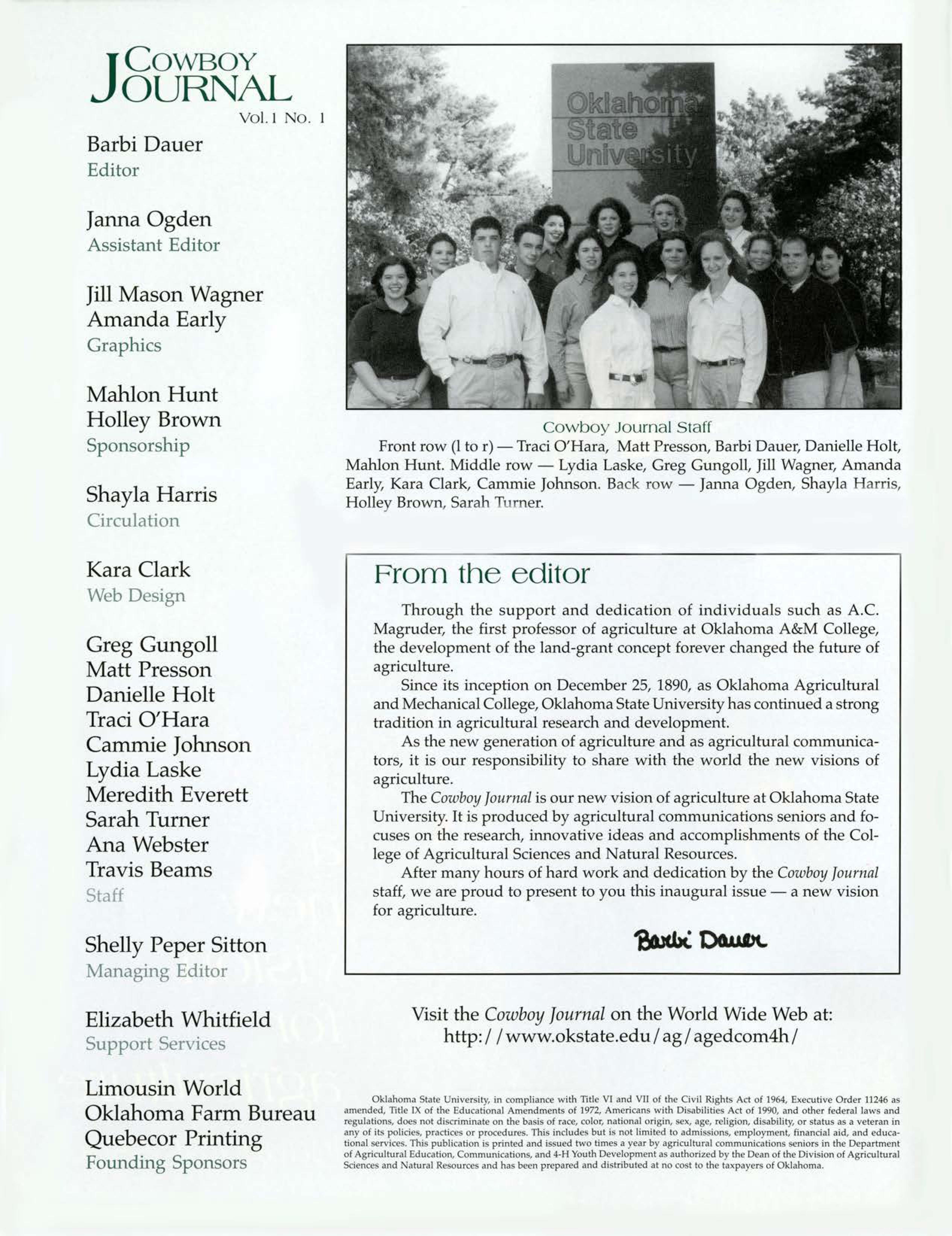
Front row (l to r)-Traci O'Hara, Matt Presson, Barbi Dauer, Danielle Holt, Mahlon Hunt. Middle row - Lydia Laske, Greg Gungoll, Jill Wagner, Amanda Early, Kara Clark, Cammie Johnson. Back row - Janna Ogden, Shayla Harris, Holley Brown, Sarah T 1mer.
Through the support and dedication of individuals such as A.C. Magruder, the first professor of agriculture at Oklahoma A&M College, the development of the land-grant concept forever changed the future of agriculture.
Since its inception on December 25, 1890, as Oklahoma Agricultural and Mechanical College, Oklahoma State University has continued a strong tradition in agricultural. re earch and development.
As the new generation of agriculture and as agricultural communicators, it i our responsibility to share with the world the new visions of agriculture.
The CowboyJournalis our new vision of agriculture at Oklahoma State University. It is produced by agricultural communications seniors and focuses on the research, innovative ideas and accomplishments of the College of Agricultural Sciences and atural Resources.
After many hours of hard work and dedication by the CowboyJournal staff, we are proud to present to you this inaugural issue - a new vision for agriculture.
the CowboyJournalon the World Wide Web at: http:/ /www.okstate.edu/ ag / agedcom4h
Man of integrity 4
Paul Hummer retires
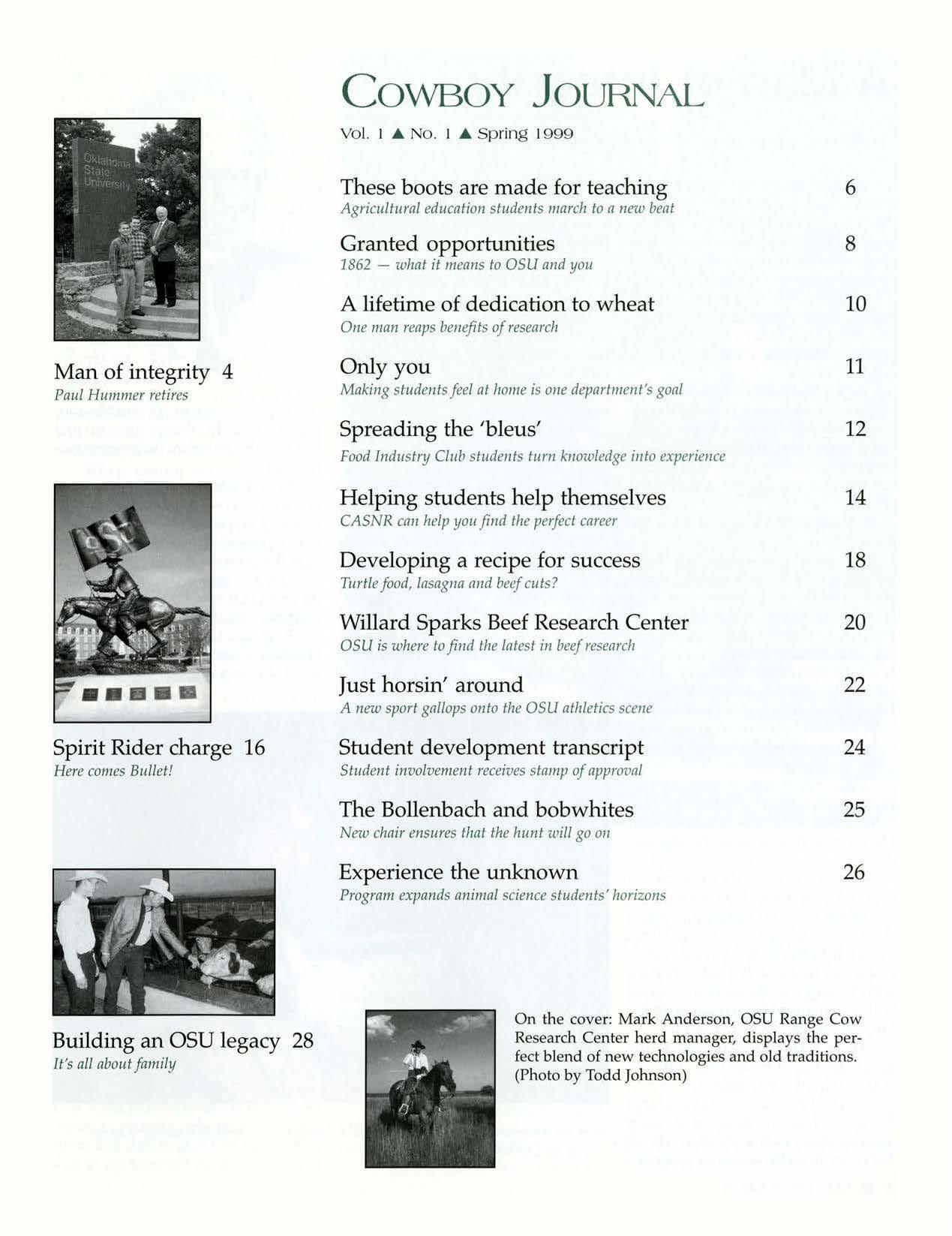
Spirit Rider charge 16
Here comesBullet!
Vol. I .&.No. I .A. Spring I 999
These boots are made for teaching
Agricultural educationstudents march to a new beat
Granted opportunities
1862 - what it means to OSU and you
A lifetime of dedication to wheat
One man reapsbenefits of research
Only you
Making students feel at home is 011edepartment'sgoal
Spreading the 'bleus'
Foodlndustn; Club students turn knowledgeinto experience
Helping students help themselves
CASNR ca11help you find the perfectcareer
Developing a recipe for success
Turtlefood, lasagnaand beefcuts?
Willard Sparks Beef Research Center
OSU is where to find the latest in beef research
Just horsin' around
A new sport gallops onto the OSU athleticsscene
Student development transcript
Student involvement receivesstamp of approval
The Bollenbach and bobwhites
New chairensures that the hunt will go 011
Experience the unknown
Building an OSU legacy 28 It's all aboutfamily
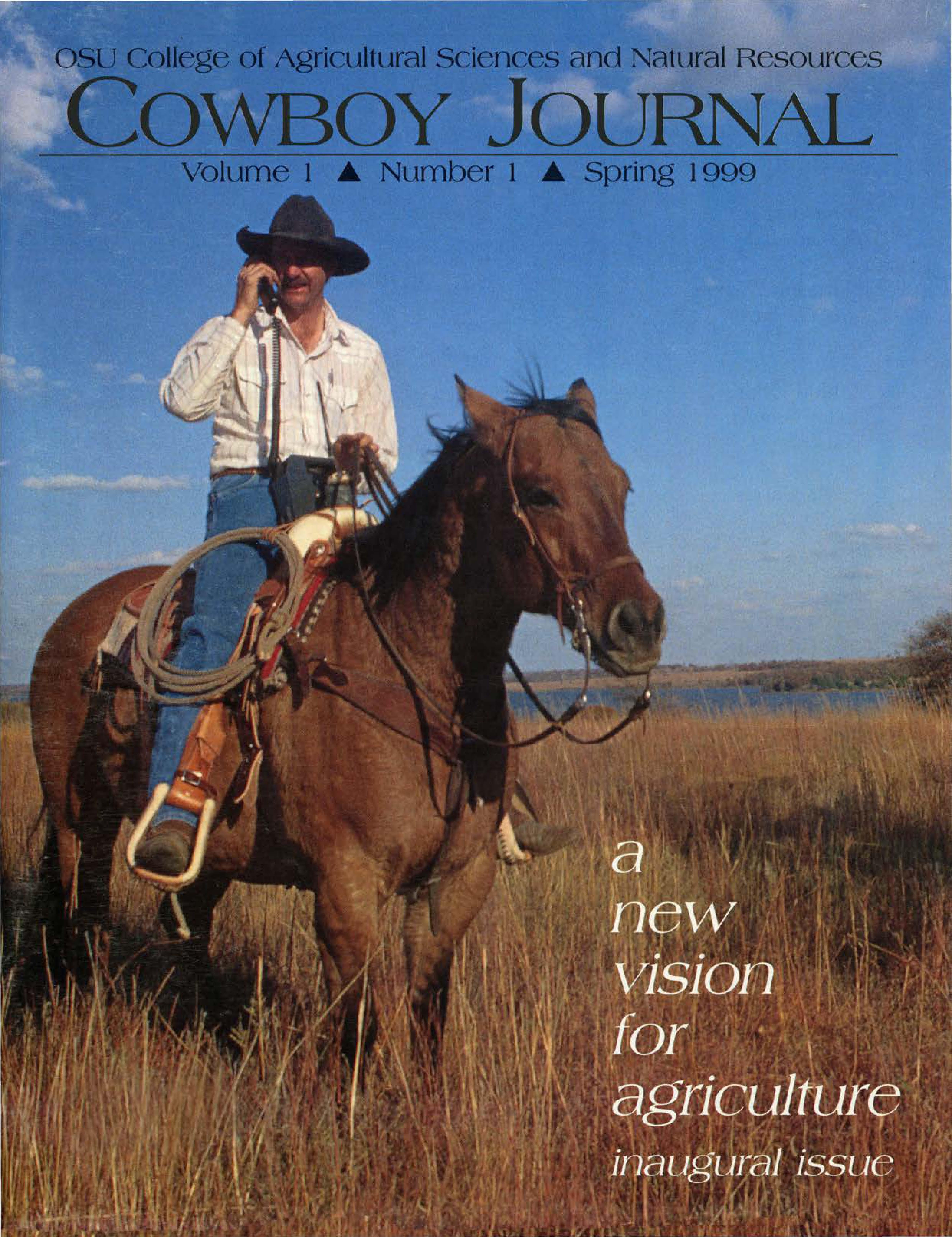
On the cover: Maik Anderson, OSU Range Cow Reseaich Center herd manager, displays the perfect blend of new technologies and old traditions. (Photo by Todd Johnson)
Hummer retires after 17 years as associate dean
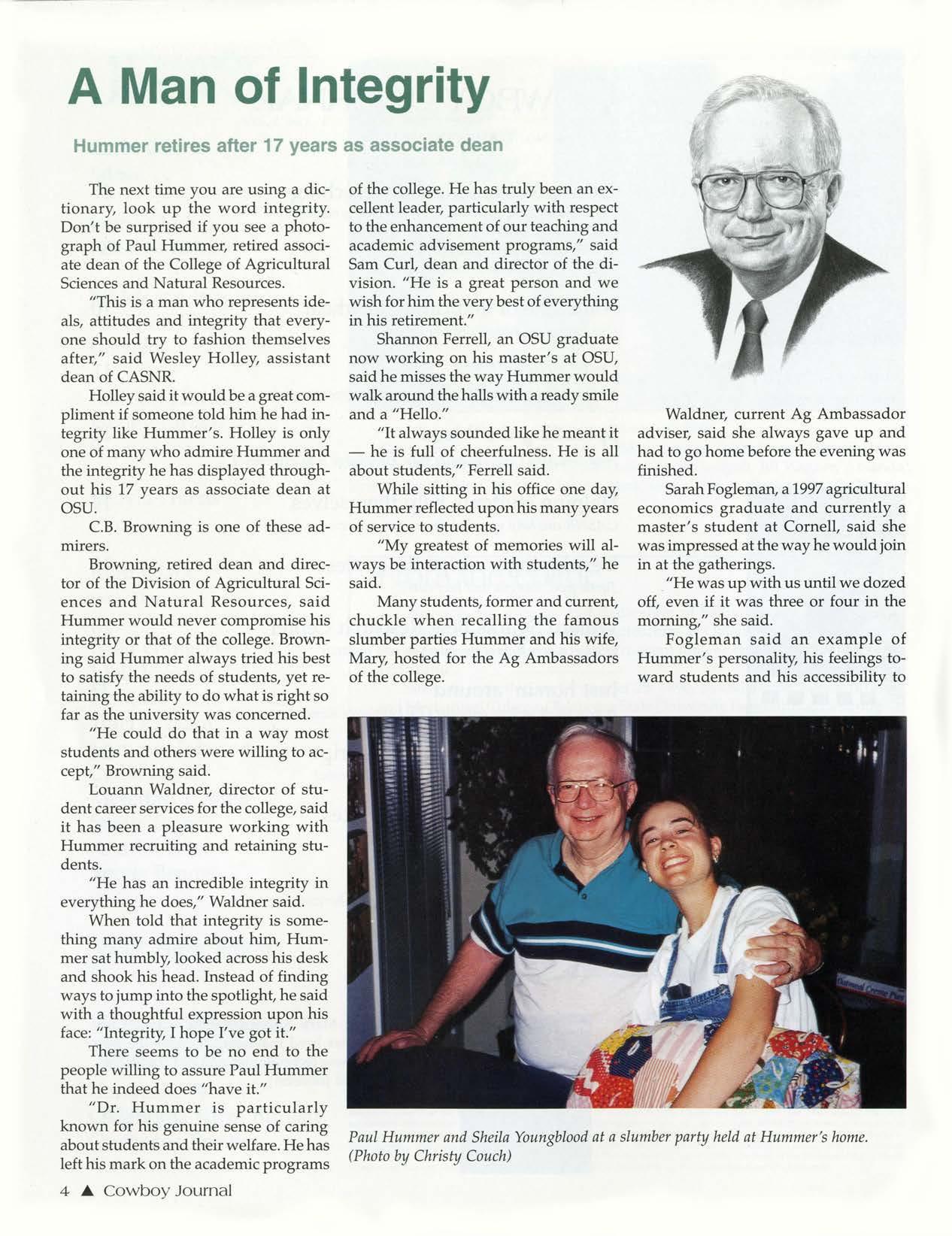
The next time you are using a dictionary, look up the word integrity. Don't be surprised if you see a photograph of Paul Hummer, retired associate dean of the College of Agricultural Sciences and Natural Resources.
"This is a man who represents ideals, attitudes and integrity that everyone should try to fashion themselves after," said Wesley Holley, assistant dean of CASNR.
Holley said it would be a great compliment if someone told him he had integrity like Hummer's. Holley is only one of many who admire Hummer and the integrity he has displayed throughout his 17 years as associate dean at osu.
C.B. Browning is one of these admirers.
Browning, retired dean and director of the Division of Agricultural Sciences and Natural Resources, said Hummer would never compromise his integrity or that of the college. Browning said Hummer always tried his best to satisfy the needs of students, yet retaining the ability to do what is right so far as the university was concerned.
"He could do that in a way most students and others were willing to accept," Browning said.
Louann Waldner, director of student career services for the college, said it has been a pleasure working with Hummer recruiting and retaining students.
"He has an incredible integrity in everything he does," Waldner said.
When told that integrity is something many admire about him, Hummer sat humbly, looked across his desk and shook his head. Instead of finding ways to jump into the spotlight, he said with a thoughtful expression upon his face: "Integrity, I hope I've got it."
There seems to be no end to the people willing to assure Paul Hummer that he indeed does "have it."
"Dr. Hummer is particularly known for his genuine sense of caring about students and their welfare. He has left his mark on the academic programs
of the college. He has truly been an excellent leader, particularly with respect to the enhancement of our teaching and academic advisement programs," said Sam Curl, dean and director of the division. "He is a great person and we wish for him the very best of everything in his retirement."
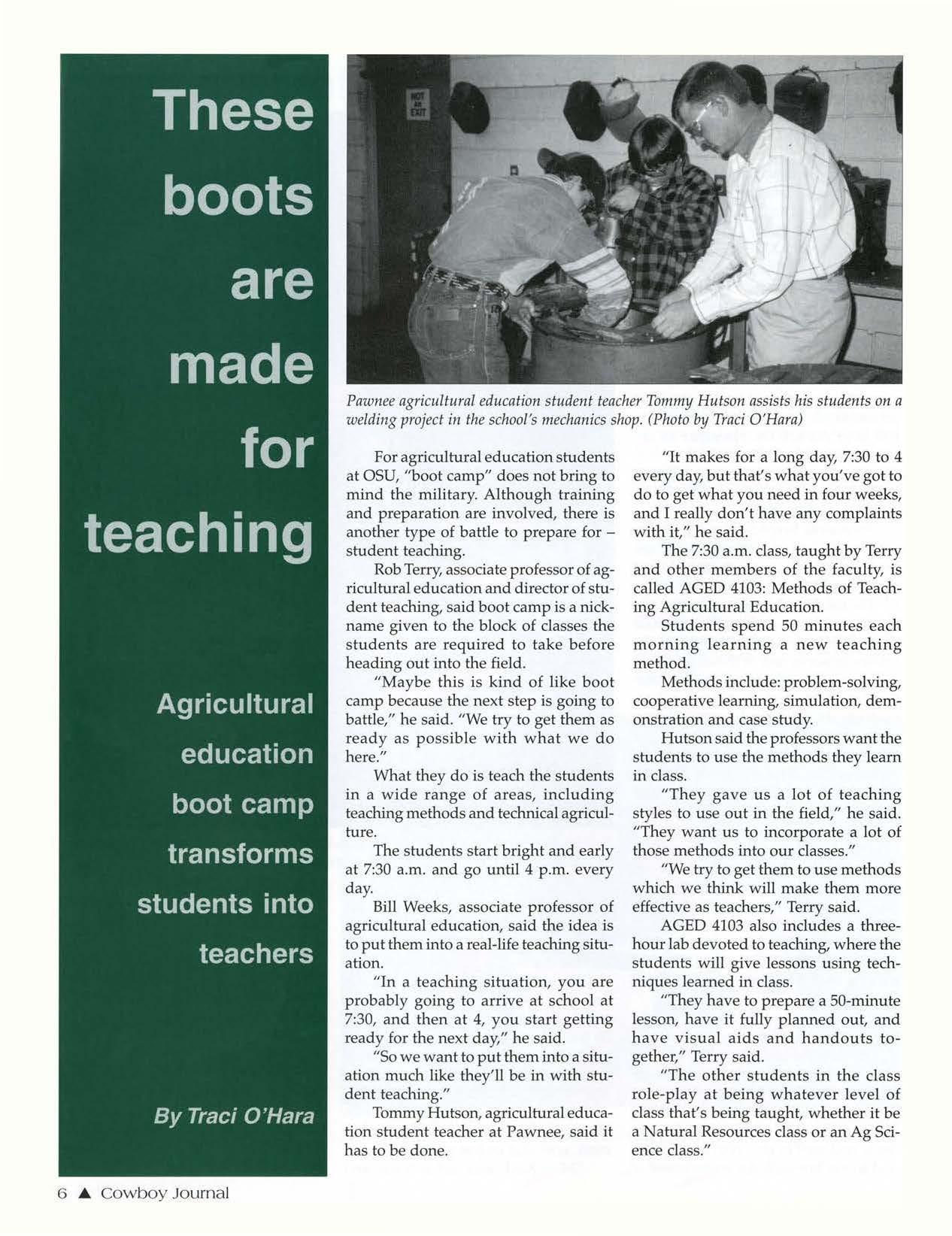
Shannon Ferrell, an OSU graduate now working on his master's at OSU, said he misses the way Hummer would walk around the halls with a ready smile and a "Hello."
"It always sounded like he meant it - he is full of cheerfulness. He is all about students," Ferrell said.
While sitting in his office one day, Hummer reflected upon his many years of service to students.
"My greatest of memories will always be interaction with students," he said.
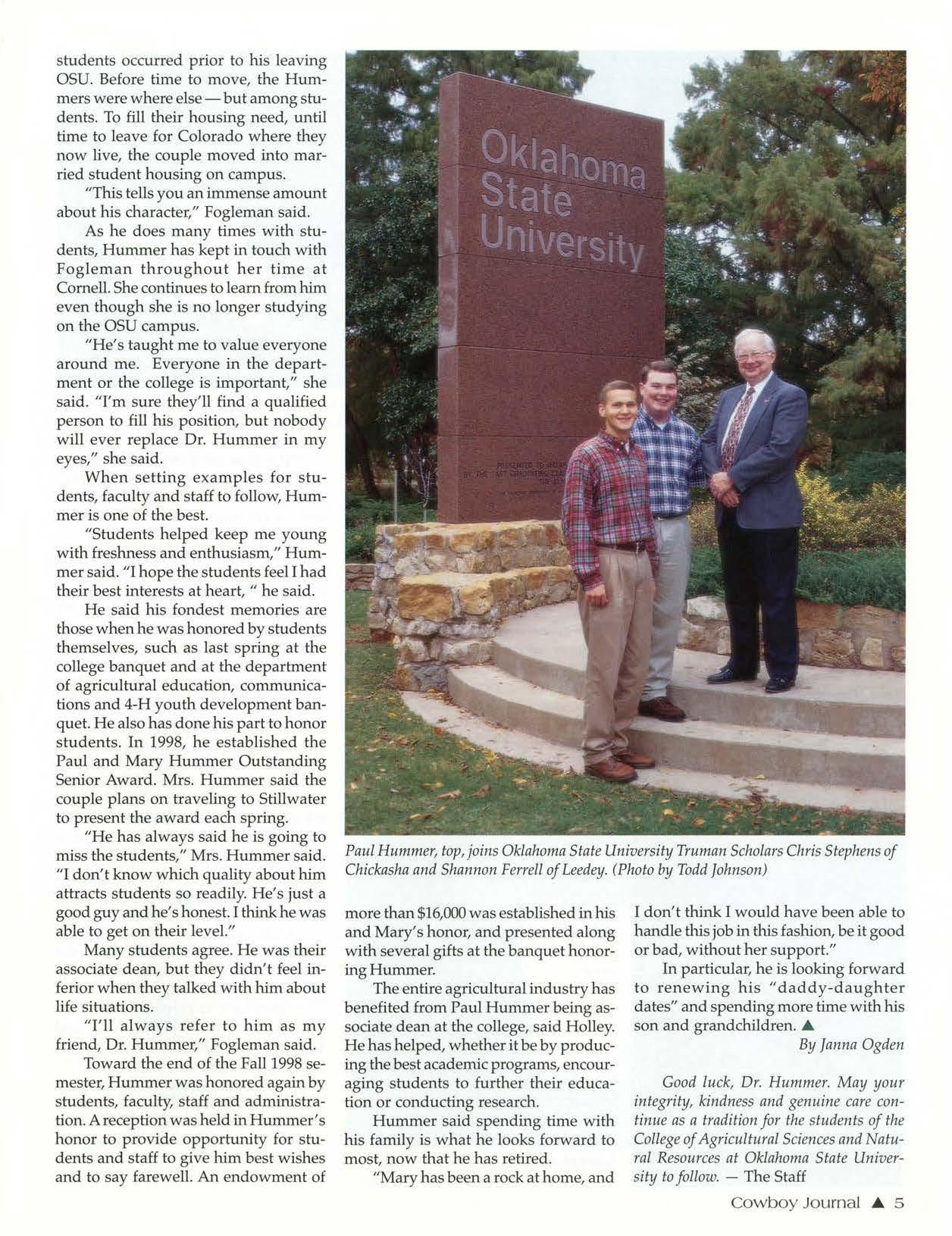
Many students, former and current, chuckle when recalling the famous slumber parties Hummer and his wife, Mary, hosted for the Ag Ambassadors of the college.
Waldner, current Ag Ambassador adviser, said she always gave up and had to go home before the evening was finished.
Sarah Fogleman, a 1997 agricultural economics graduate and currently a master's student at Cornell, said she was impressed at the way he would join in at the gatherings.
"He was up with us until we dozed off, even if it was three or four in the morning," she said.
Fogleman said an example of Hummer's personality, his feelings toward students and his accessibility to
students occurred prior to his leaving OSU. Before time to move, the Hummers were where else- but among students. To fill their housing need, until time to leave for Colorado where they now live, the couple moved into married student housing on campus.
"This tel.lsyou an immense amount about his character," Fogleman said.
As he does many times with students, Hummer has kept in touch with Fogleman throughout her time at Cornell. She continues to learn from him even though she is no longer studying on the OSU campus.
"He's taught me to value everyone around me. Everyone in the department or the coUege is important," she said. 'Tm sure they'll find a qualified person to fill his position, but nobody will ever replace Dr. Hummer in my eyes,'' she said.
When setting examples for students, faculty and staff to follow, Hummer is one of the best.
"Students helped keep me young with freshness and enthusiasm," Hummer said. "I hope the students feel I had their best interests at heart, " he said.
He said his fondest memories are those when he was honored by students themselves, such as last spring at the college banquet and at the department of agricultural education, communications and 4-H youth development banquet. He also has done his part to honor students. In 1998, he established the Paul and Mary Hummer Outstanding Senior Award. Mrs. Hummer said the couple plans on traveling to Stillwater to present the award each spring.
"He has always said he is going to miss the students," Mrs. Hummer said. "I don't know which quality about him attracts students so readily. He's just a good guy and he's honest. I thinkhe was able to get on their level."
Many students agree. He was their associate dean, but they didn't feel inferior when they talked with him about life situations.
"I'll always refer to him as my friend, Dr. Hummer," Fogleman said.
Toward the end of the Fall 1998 semester, Hummer was honored again by students, faculty, staff and administration. A reception was held in Hummer's honor to provide opportunity for students and staff to give him best wishes and to say farewell. An endowment of
more than $16,000was established in his and Mary's honor, and presented along with several gifts at the banquet honoring Hummer.
The entire agricultural industry has benefited from Paul Hummer being associate dean at the college, said Holley. He has helped, whether it be by producing the best academic programs, encouraging students to further their education or conducting research.
Hummer said spending time with his family is what he looks forward to most, now that he has retired.
"Mary has been a rock at home, and
I don't think I would have been able to handle this job in this fashion, be it good or bad, without her support."
In particular, he is looking forward to renewing his "daddy-daughter dates" and spending more time with his son and grandchildren . .A
By Janna Ogden
Good luck, Dr. Hummer. May your integritt;, kindness and genuine care continue as a traditionfor the students of the Collegeof AgriculturalSciencesand Natural Resourcesat OklahomaState University to follow. - The Sta££ Cowboy Journal
For agricultural education students at OSU, "boot camp" does not bring to mind the military. Although training and preparation are involved, there is another type of battle to prepare forstudent teaching.
Rob Terry, associate professor of agricultural education and director of student teaching, said boot camp is a nickname given to the block of classes the students are required to take before heading out into the field.
By Traci O'Hara
"Maybe this is kind of like boot camp because the next step is going to battle," he said. "We try to get them as ready as possible with what we do here."
What they do is teach the students in a wide range of areas, including teaching methods and technical agriculttue.
The students start bright and early at 7:30 a.m. and go until 4 p.m. every day.
Bill Weeks, associate professor of agricultural education, said the idea is to put them into a real-life teaching situation.
"In a teaching situation, you are probably going to arrive at school at 7:30, and then at 4, you start getting ready for the next day," he said.
"So we want to put them into a situation much like they'll be in with student teaching."
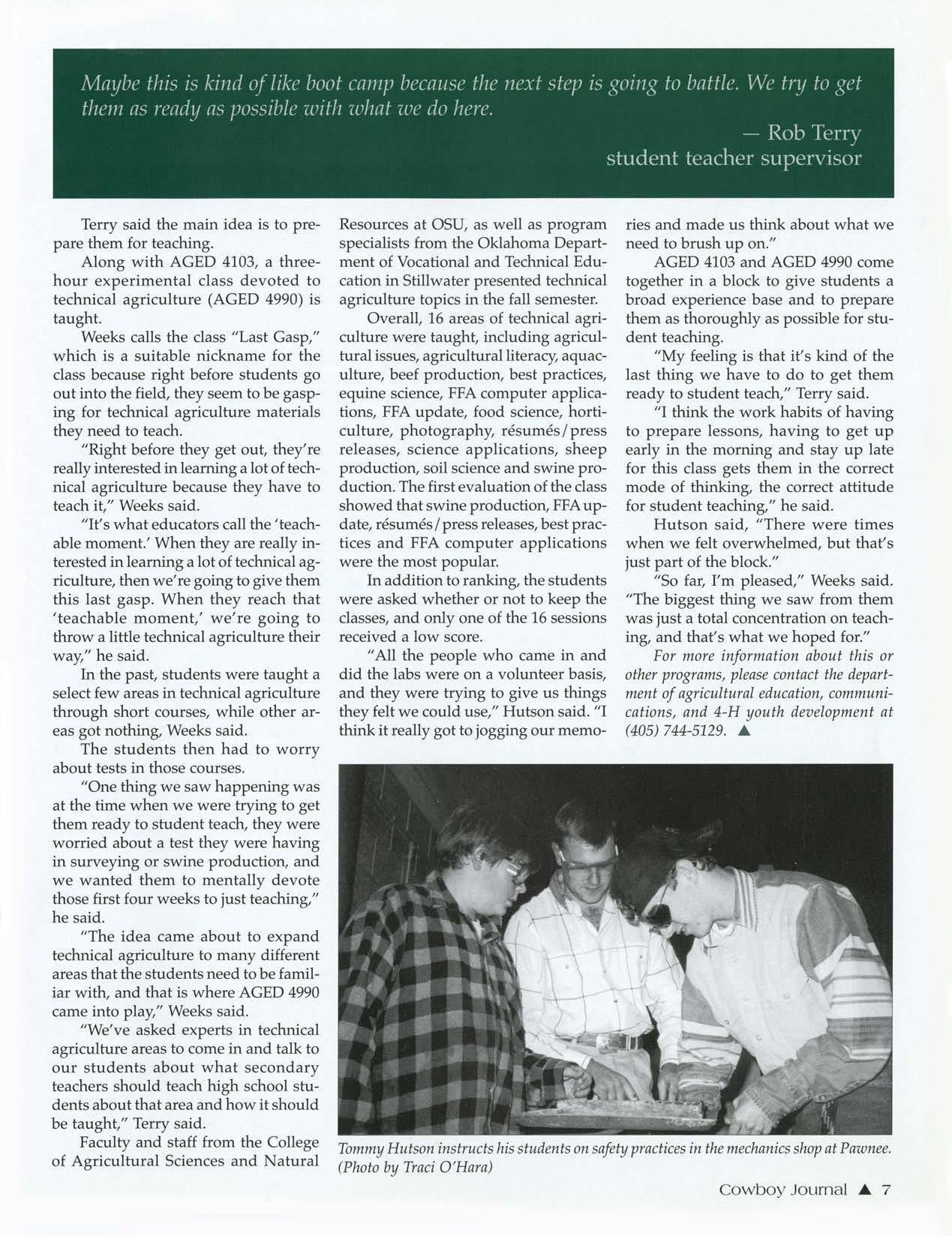
Tommy Hutson, agricultural education student teacher at Pawnee, said it has to be done.
"It makes for a long day, 7:30 to 4 every day, but that's what you've got to do to get what you need in four weeks, and I really don't have any complaints with it," he said.
The 7:30 a.m. class, taught by Terry and other members of the faculty, is called AGED 4103: Methods of Teaching Agricultural Education.
Students spend 50 minutes each morning learning a new teaching method.
Methods include: problem-solving, cooperative learning, simulation, demonstration and case study.
Hutson said the professors want the students to use the methods they learn in class.
"They gave us a lot of teaching styles to use out in the field," he said. "They want us to incorporate a lot of those methods into our classes."
"We try to get them to use methods which we think will make them more effective as teachers," Terry said.
AGED 4103 also includes a threehour lab devoted to teaching, where the students will give lessons using techniques learned in class.
"They have to prepare a SO-minute lesson, have it fully planned out, and have visual aids and handouts together," Terry said.
"The other students in the class role-play at being whatever level of class that's being taught, whether it be a Natural Resources class or an Ag Science class."
M11yhet!,is is kind (f like boot Cl1//IP[Jccausethe next step is going to battle. We try to get tl,c111tb ready as possif,/c ,uit!, "il'liat we do /Jere.
- Rob Terrv ., student teacher supervisor
Terry said the main idea is to prepare them for teaching.
Along with AGED 4103, a threehour experimental class devoted to technical agriculture (AGED 4990) is taught.
Weeks cal1s the class "Last Gasp," which is a suitable nickname for the class because right before students go out into the field, they seem to be gasping for technical agriculture materials they need to teach.
"Right before they get out, they' re really interested in learning a lot of technical agriculture because they have to teach it," Weeks said.
"It's what educators call the 'teachable moment.' When they are really interested in learning a lot of technical agriculture, then we're going to give them this last gasp. When they reach that 'teachable moment,' we're going to throw a little technical agriculture their way," he said.
In the past, students were taught a select few areas in technical agriculture through short courses, while other areas got nothing, Weeks said.
The students then had to worry about tests in those courses.
"One thing we saw happening was at the time when we were trying to get them ready to student teach, they were worried about a test they were having in surveying or swine production, and we wanted them to mentally devote those first four weeks to just teaching," he said.
"The idea came about to expand technical agriculture to many different areas that the students need to be familiar with, and that is where AGED 4990 came into play," Weeks said.
"We've asked experts in technical agriculture areas to come in and talk to our students about what secondary teachers should teach high school students about that area and how it should be taught," Terry said.
Faculty and staff from the College of Agricultural Sciences and Natural
Resources at OSU, as well as program specialists from the Oklahoma Department of Vocational and Technical Education in Stillwater presented technical agriculture topics in the fall semester.
Overall, 16 areas of technical agriculture were taught, including agricultural issues, agricultural literacy, aquaculture, beef production, best practices, equine science, FFA computer applications, FFA update, food science, horticulture, photography, resumes/ press releases, science applications, sheep production, soil science and swine production. The first evaluation of the class showed that swine production, FFA update, resumes/ press releases, best practices and FFA computer applications were the most popular.
In addition to ranking, the students were asked whether or not to keep the classes, and only one of the 16 sessions received a low score.
"All the people who came in and did the labs were on a volunteer basis, and they were trying to give us things they felt we could use," Hutson said. "I think it really got to jogging our memo-
ries and made us think about what we need to brush up on."
AGED 4103 and AGED 4990 come together in a block to give students a broad experience base and to prepare them as thoroughly as possible for student teaching.
"My feeling is that it's kind of the last thing we have to do to get them ready to student teach," Terry said.
"I think the work habits of having to prepare lessons, having to get up early in the morning and stay up late for this class gets them in the correct mode of thinking, the correct attitude for student teaching," he said.
Hutson said, "There were times when we felt overwhelmed, but that's just part of the block."
"So far, I'm pleased," Weeks said. "The biggest thing we saw from them was just a total concentration on teaching, and that's what we hoped for."
For more information about this or other programs,pleasecontact the department of agriculturaleducation,communications, and 4-H youth development at (405) 744-5129. •
Formany Oklahomastudentswhohave her freshman year and biochemistry known she would work in agriculture, grown up 011 farms, OklahomaState U11iversity has always been the place to attend college.Those students leam how to make agriculh1rebetterfor themselvesand a little easierfor theirfathersandgrandfathersstill living on theJann.
Forothers,OS Uhas beena link to their urban4-H club, a placethey could learn to be a clothing designer,an economistor a microbiologist - tl1ingstl1eirparentscould only dreamof being. Still, there are others whogrew up only k11orvingOSU as a school where,if theywereluckt;,they might beable to gain knowledge that would help make their lives better and n,eir children'slives better than their own.
Now, think abo11twhat OSU is to you. Is it all of these things, perhaps more, or even none?ls it somethingcompletelydifferent?
In reality, OSU is all of these things and more.Throughresearch,extensiona11d teaching,OSU has becomemany things to many people.
Today,a /a11d-gra11tuniversityi11cludes threeaspects- research,extensionand teaching - that createa networkof educational servicesfor students mid tlze public. This StJSternbeganwith thepassageof theMorrill Act of 1862. The Morrill Act established la11d-grantuniversitiesfor the pursuit of study in agricultureand mechanicarts. In 1887, the Hatch Act was passedfor the creation of state agriculturalexperimentstations al la11d-grantcollegesto pursue researchimporta11tto theirstates.Finally,the Smith-LeverAct was passedin 1914 to enact the cooperativeexte11sio11services.This act wasformed to allow educatorsand researchersto teach the public about issues elfecti11gtheir lives, includingfarm topics and economics.
Before coming to OSU, Darcey Landrith, a biosystems and agricultural engineering junior from Bartlett, Kan., was unaware of the amount of research that occurs as part of the Oklahoma Agricultural Experiment Station in the Division of Agricultural Sciences and Natural Resources. A few weeks into 8 .&. Cowboy Journal
degree, she became a part of a research team herself. Landrith was chosen as a freshman research scholar in the biochemistry and molecular biology department.
The research scholar program is designed to give students a first-hand look at research careers in their majors. Each student is matched with a faculty mentor responsible for setting up personal laboratory research for the student.
Landrith worked with John Cushman, assistant professor of biochemistry and experiment station researcher, editing cloned DNA sequences using computer programs. She searched a database maintained by the National Center for Biotechnology Information to identify the sequence. Then, if the sequence was not identified in the database, it was made available for cross-referencing.
Landrith said the purpose of the project was to find the gene in plants that controls reactions to drought conditions. She began to see how much research was done as she continued in the program. The realization of a career in research hit after two semesters of working in the lab.
"I thought this would be a good opportunity to see if this was something r really wanted to do before it was too Lateto change my major," she said.
Landrith said her parents had always encouraged her and she knew she could do anything she wanted. With this in mind, she changed her major to biosystems and agricultural engineering.
She also decided she was interested in the physical requirements of research sampling, not the analytical part, which she had already experienced.
"I like to work outside with trees and plants," Landrith said. An environmental science option in her degree will allow her the chance to work outdoors and understand both sides of the sampling process because of her research experience.
Although Landrith had always
she did not know about the biosystems engineering opportunity until she came to OSU and was exposed to different academic departments. She said she would eventually like to work as a private consu Itant in environ mental science or work with a government agency doing environmental sampling.
Shannon Ferrell has seen many different extension opportunities. Ferrell, who holds a bachelor's degree in agribusiness and is a master's candidate in agricultural economics, had an experience as part of his master's work that really hit home.
Ferrell, a native of Leedy, Okla., began his involvement in extension programs when he joined his local 4-H club at the age of nine. As he grew up, his involvement in leadership development and public speaking also brought selfconfidence and the desire to set and reach goals.
As a high school student, Ferrell said he knew the impact of rural development but had no idea it involved so much work and so many people. He said after coming to OSU, he was impressed by the extension professionals who were going the extra mile, meeting locally with producers and community leaders rather than having those people coming to them for assistance.
As part of Ferrell's project, he researched farm laws that will be included in a question and answer handbook. The handbook will present these laws in layman's terms for use in county extension offices. Ferrell said he has already been able to use his research for a farmer who found out about the handbook and called for help.
"I was so excited to be able to use my resources and the skills that I learned here to help that person," Ferrell said. He said he is proud to be affiliated with extension because of the truthfulness of the extension motto, Bl'ingingthe University to You, and how well extension works, he said.
Ferrell said extension is one of the greatest tools the state has to transmit know ledge to those who need it most to help improve their quality of life.
Someday, Ferrell hopes to serve in public office and be a strong advocate for extension and its programs. With public support and resources, he is certain the extension plan can do better and go further, he said.
Shon Balthaser now realizes how diverse a degree in agriculture can be. Although his bachelor's degree is in agricultural economics, Balthaser knew he could work in computer science, accounting, economics or a number of other things. He did not choose any of these, but chose to pursue a master's degree in agricultural education.
Balthaser found help from teachers and advisers that allowed him to make decisions about his career, espe-
dally which master's program to enter.
"Teachers are so committed and devoted to helping students, they always have time to visit or help with a problem," he said. "They have helped me not only in academics but also my personal life."
Balthaser, from Ringling, Okla., said he has been touched from the beginning of his college career by teaching and mentoring programs. As a freshman, his student academic mentor went out of his way to help his group find their way around Stillwater and OSU. From that point, Balthaser knew that he wanted to help students as well.
He began with students from his hometown, helping them get acquainted with the campus and Stillwater and offering common firstday-of-schooJ tips. Next, he began volunteering at Stillwater Medical Center in physical therapy. Finally, he moved into a work-study position in the
college's student academic services office. As a graduate assistant, he has gained the opportunity to offer career counseling to students, recruit new students and be a teaching assistant for the agriculture freshman orientation class.
"The most exciting part of my life right now is coming to the realization that after five years of college, I have figured out what 1 want to do with my life," Balthaser said.
In addition to completing his master's degree, Balthaser's plans include working in the human resource field, allowing him to apply the skills he gained in college to his everyday life.
So, how did these students get these opportunities? These opportunities were made possible because of landgrant universities. Land-grant universities, although created more than 100 years ago, allow students to become involved with OSU in unique programs found as part ofland-grant universities.
£ By Jill Mason Wagner
Oklahoma wheat producers have a unique and influential wheat specialist. With a lifetime of dectication to wheat production, research and interest, Gene Krenzer has spent the past 18 years at Oklahoma State University working on wheat research.
Field after field of wheat and hard work have paid
ployment longevity.
Oklahoma wheat growers had the perfect canctidate for the award.
"He has spent a long time with OSU developing and doing research with the characteristics of wheat varieties for Oklahoma producers," aid Erich Wehrenberg, executive director of the Oklahoma off for the OSU small grains extension specialist.
Krenzer received the Excellence in Extension Award from the
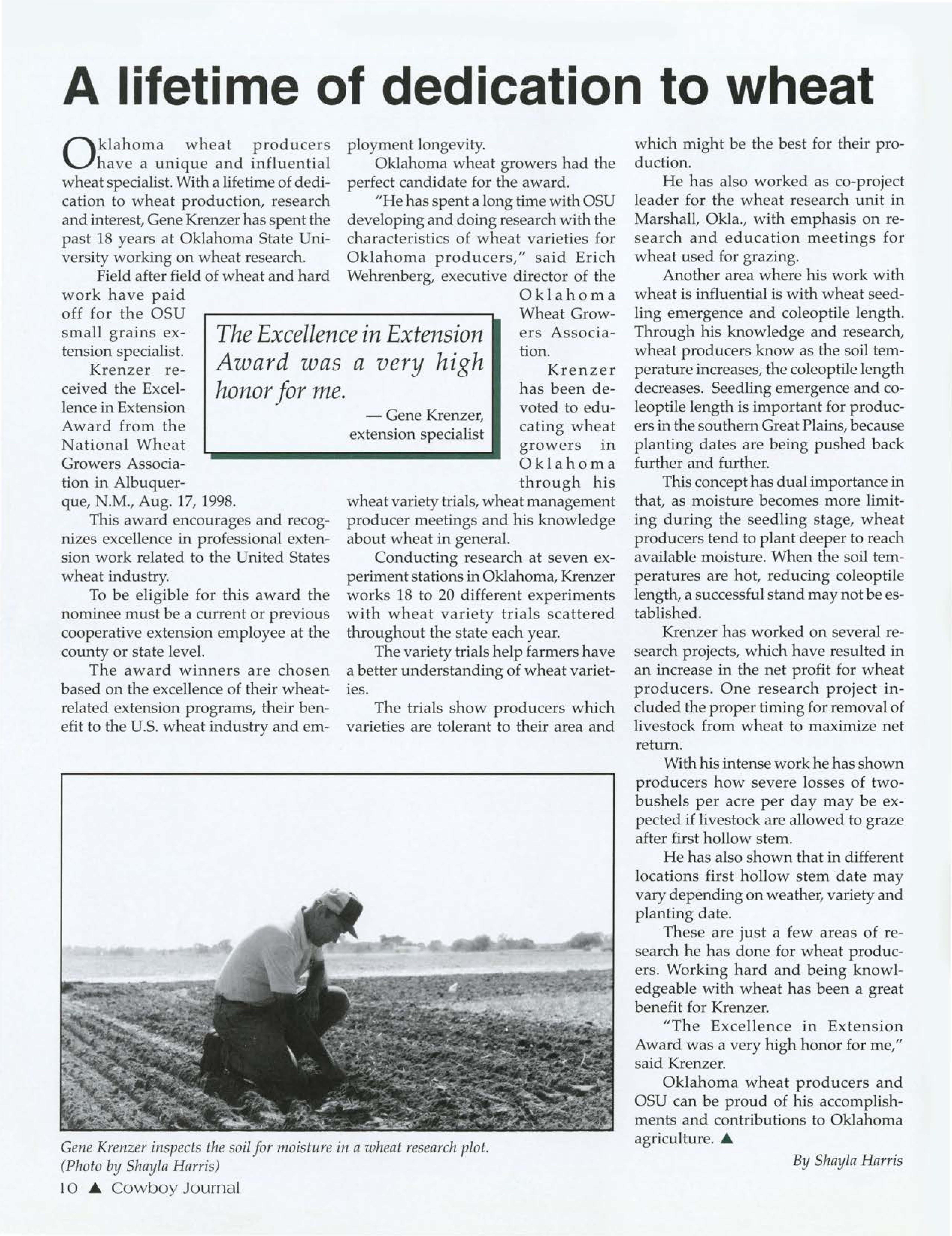
Award was a very high honorfor me.
- Gene Krenzer, extension specialist
Wheat Growers Association. Krenzer has been devoted to educating wheat growers in ational Wheat Growers Association in Albuquerque, .M., Aug. 17, 1998.
This award encourages and recognizes excellence in professional extension work related to the United States wheat industry.
To be eligible for this award the nominee must be a current or previous cooperative extension employee at the county or state level.
The award winners are chosen based on the excellence of their wheatrelated extension programs, their benefit to the U.S. wheat industry and em-
Oklahoma through his wheat variety trials, wheat management producer meetings and his knowledge about wheat in general.
Conducting research at seven experiment stations in Oklahoma, Krenzer works 18 to 20 different experiments with wheat variety trials scattered throughout the state each year.
The variety trials help farmers have a better understanding of wheat varieties.
The trials show producers which varieties are tolerant to their area and
which might be the best for their production.
He has also worked as co-project leader for the wheat research unit in Marshall, Okla., with emphasis on research and education meetings for wheat used for grazing.
Another area where his work with wheat is influential is with wheat seedling emergence and coleoptile length. Through his knowledge and research, wheat producers know as the soil temperature increases, the coleoptile length decreases. Seedling emergence and coleoptile length is important for producers in the southern Great Plains, because planting dates are being pushed back further and further.
This concept has dual importance in that, as moisture becomes more limiting during the seedling stage, wheat producers tend to plant deeper to reach available moisture. When the soil temperatures are hot, reducing coleoptile length, a successful stand may not be established.
Krenzer has worked on several research projects, which have resulted in an increase in the net profit for wheat producers. One research project included the proper timing for removal of livestock from wheat to maximize net return.
With his intense work he has shown producers how severe losses of twobushels per acre per day may be expected if livestock are allowed to graze after first hollow stem.
He has also shown that in different locations first hollow stem date may vary depending on weather, variety and planting date.
These are just a few areas of rsearch he has done for wheat producers. Working hard and being knowledgeable with wheat has been a great benefit for Krenzer.
"The Excellence in Extension Award was a very high honor for me," said Krenzer.
Oklahoma wheat producers and OSU can be proud of his accomplishments and contributions to Oklahoma agriculture. •
By Shayla Harris
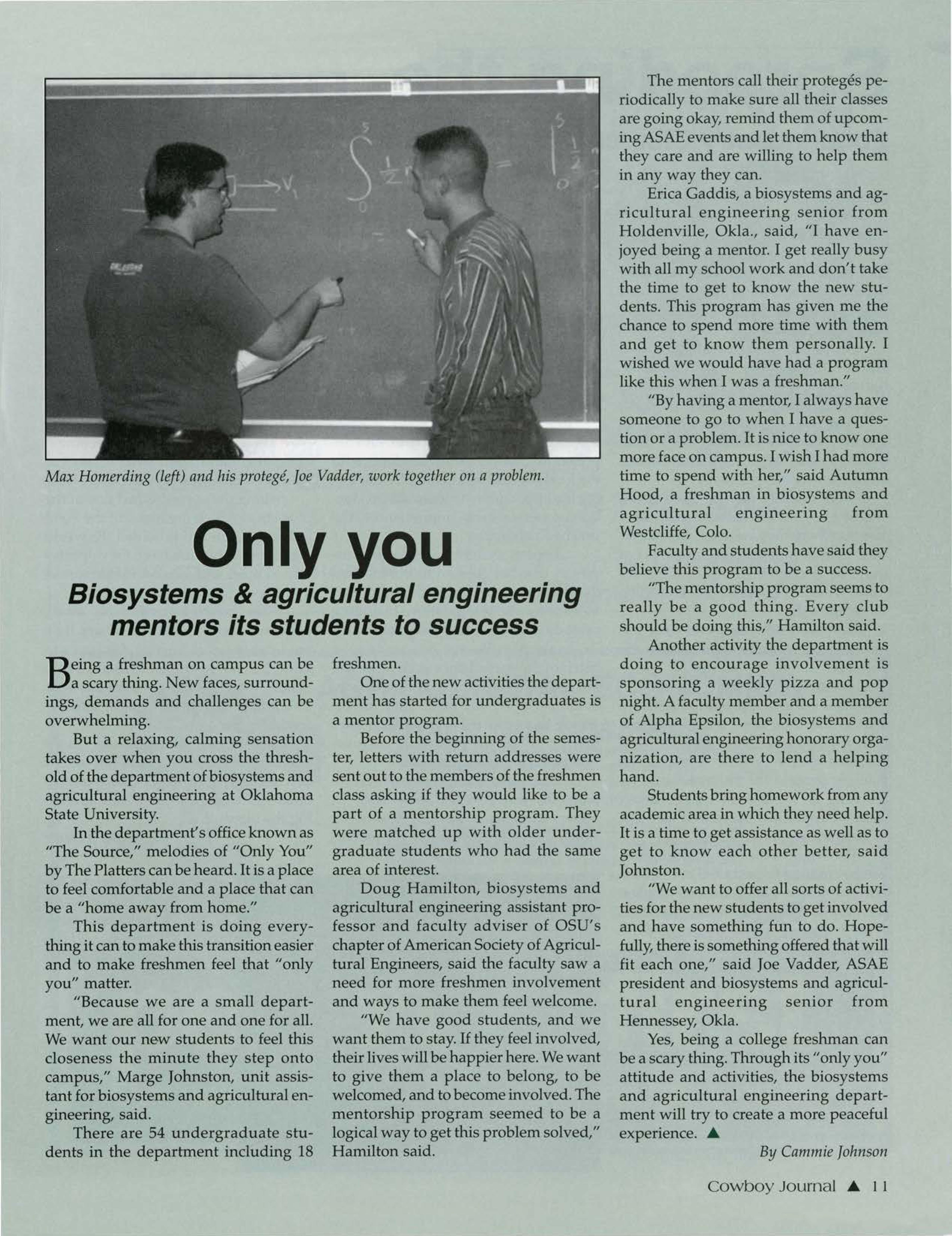
Max Homerding(left) and his protege,Joe Vadder,work together011 a problem.
Being a freshman on campus can be a scary thing. New faces, surroundings, demands and challenges can be overwhelming.
But a relaxing, calming sensation takes over when you cross the threshold of the department of biosystems and agricultural engineering at Oklahoma State University.
In the department's office known as "The Source," melodies of "Only You" by The Platters can be heard. It is a place to feel comfortable and a place that can be a "home away from home."
This department is doing everything it can to make this transition easier and to make freshmen feel that "only you" matter.
"Because we are a small department, we are all for one and one for all. We want our new students to feel this closeness the minute they step onto campus," Marge Johnston, unit assistant for biosystems and agricultural engineering, said.
There are 54 undergraduate students in the department including 18 freshmen.
One of the new activities the department has started for undergraduates is a mentor program.
Before the beginning of the semester, letters with return addresses were sent out to the members of the freshmen class asking if they would like to be a part of a mentorship program. They were matched up with older undergraduate students who had the same area of interest.
Doug Hamil ton, biosystems and agricultural engineering assistant professor and faculty adviser of OSU's chapter of American Society of Agricultural Engineers, said the faculty saw a need for more freshmen involvement and ways to make them feel welcome.
"We have good students, and we want them to stay. If they feel involved, their Hves will be happier here. We want to give them a place to belong, to be welcomed, and to become involved. The mentorship program seemed to be a logical way to get this problem solved," Hamilton said.
The mentors call their proteges periodically to make sure all their classes are going okay, remind them of upcoming ASAE events and let them know that they care and are willing to help them in any way they can.
Erica Gaddis, a biosystems and agricultural engineering senior from Holdenville, Okla., said, "I have enjoyed being a mentor. I get really busy with all my school work and don't take the time to get to know the new students. This program has given me the chance to spend more time with them and get to know them personally. I wished we would have had a program like this when I was a freshman."
"By having a mentor, I always have someone to go to when I have a question or a problem. It is nice to know one more face on campus. I wish I had more time to spend with her," said Autumn Hood, a freshman in biosysterns and agricul tura 1 engineering from Westcliffe, Colo.
Faculty and students have said they believe this program to be a success.
"The mentorship program seems to really be a good thing. Every club should be doing this," Hamilton said.
Another activity the deparbnent is doing to encourage involvement is sponsoring a weekly pizza and pop night. A faculty member and a member of Alpha Epsilon, the biosystems and agricultural engineering honorary organization, are there to lend a helping hand.
Students bring homework from any academic area.in which they need help. It is a tune to get assistance as well as to get to know each other better, said Johnston.
"We want to offer all sorts of activities for the new students to get involved and have something fun to do. Hopefully, there is something offered that will fit each one," said Joe Vadder, ASAE president and biosystems and agricultural engineering senior from Hennessey, Okla.
Yes, being a college freshman can be a scary thing. Through its" only you" attitude and activities, the biosystems and agricultural engineering department will try to create a more peaceful experience. A
By CammieJohnson
The Food Industry Club at Oklahoma State University is learning what it takes to spread the bleus - bleu cheese spread that is.
The spread is actually a tradition that began in the OSU dairy science department in 1951. Selling the spread has now become the main fund-raising project for the club.
The project also provides students with an opportunity to gain valuable hands-on experience in processing, packaging and marketing the product.
Fred Ray, extension animal foods specialist and senior adviser of the Food Industry Club, said the spread is not like other bleu cheese products.
"When most people hear 'bleu cheese' they are reminded of past experiences where they were left with a bad taste in their mouths. The spread is not quite as strong; it comes in a milder form. It's not a slice and eat cheese; it's more like a dip."
However, this unique project has not left a bad taste in Ray's.mouth. He supports this hands-on project which has become a tradition for the club.
"This is a good project. Students are able to take their book knowledge and turn it into hands-on experience with the bleu cheese project. It is a subtle training ground for the real world by learning to work with others, being there at appointed times and learning to delegate responsibilities."
The origin of the bleu cheese spread can be credited to past OSU animal science professor Paul Johnson. Johnson developed the recipe in conjunction with a cheese manufacturing class which focused on different types of cheese and developing new cheese products.
The products developed in the class were available for sampling at a cheese and sausage festival which became an annual tradition that lasted until 1994.
Now the Food Industry Club sells the product in eight ounce cartons through the Cowboy Meats retail store l.ocated in the Food and Agricultural Products Research and Technology Cen-
ter at OSU. The spread costs $3 per container.
The club is working with the Food and Agricultural Products Center in producing the spread. Ray said they spent most of last year preparing the equipment and lab for production. As operations at the center continue, the club hopes to have the opportunity to try other products.
The spread is produced and marketed entirely by students involved in the Food Industry Club.
Jolena Stephens, a food science major and president of the club, said the project involves orienting students with the food processing industry by providing the opportunity to learn the production process from raw ingredients to the finished product.
"It opens students' eyes to the complexity of what goes on in the food industry, from working with equipment to learning about regulations including sanitation procedures," Stephens said.
In the past the club has produced a batch of the spread once each semester, but they are planning to change to one batch per year, Ray said. They are focusing their efforts on the fall semester in order to sell the product in conjunction with the holiday season.
"Producing the spread involves an assembly line process," Ray said. "It allows students to develop teamwork skills. They are responsible for gather-
ing the ingredients and taking the product through the production process from inoculation to homogenization and pasteurization to filling the cartons."
The project is also allowing students an opportunity to develop valuable marketing skills and experience.
Ray said the students are developing skills in sales and advertising. They are learning to overcome marketing obstacles, such as royalty fees, that have increased the price per label of the product.
"They have to learn to become a salesperson and learn what it takes to market the finished product," Ray said.
Selling the spread is just one of the projects in which members of the Food Industry Club are involved. Ray said members of the club have the opportunity to meet and work with personnel in the food processing industry.
While the club is relatively small, with only about 15 to 18 members, they are learning and looking for ways to grow. It is not restricted to food science majors; the club is open to anyone with an interest in gaining insight into the foods industry.
So for those looking for ways to get involved at OSU, don't get left with a bad taste in your mouth. Check out the Food Industry Club and start spreading the bleus. A
By BarbiDauer
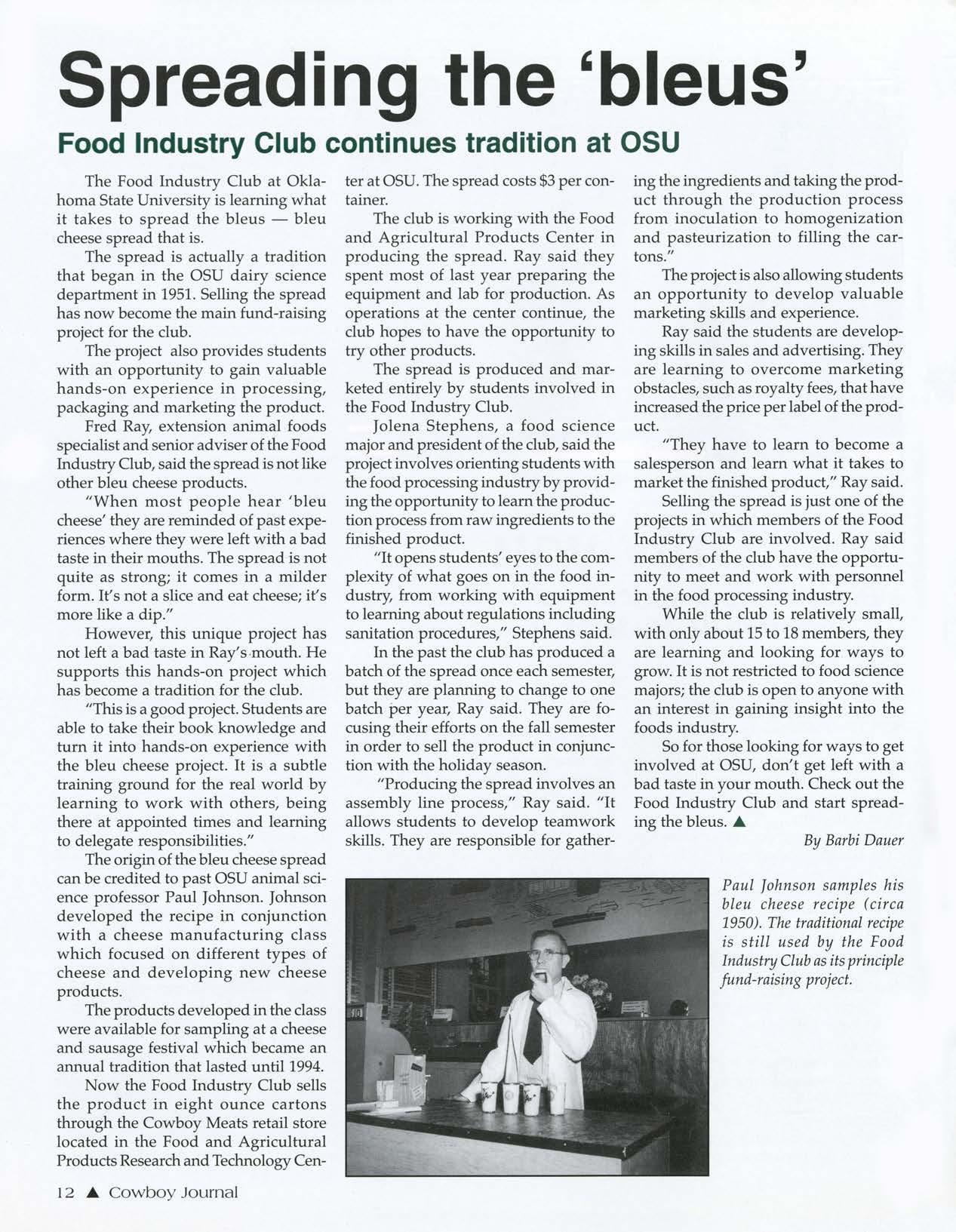
Paul Johnson samples his bleu cheese recipe ( circa 1950). The traditionalrecipe is still used by the Food Industry Club as its principle fund-raising project.
Derrel White
Crop-Timizer Manager P.O.Box 220
Sublette, KS 67877
(316) 675-8733 (316) 276-8811
PeopleFirstBankis thelargestfamily-farmandranchlenderin Oklahoma,one of the50largestagriculturelendersin theU.S.andthenation'slargest FarmServiceAgencyinterest-assistprogramlender.As ag lenders,we recognizeand appreciatethe excellenceand leadershipof OSU.
PeopleFirstis alsoa lendingsourceof commercialandsmallbusiness lending.In 1995,TheSmallBusinessAssociation'sOfficeof Advocacynamed our bank•numberone"in Oklahomafor lendingto smallbusinessesand listedit as the most'small businessfriendly"in the state.
Call405-375-5911for moreinformationabout :-.Ji PeopleFirst•~productsandservices. .- " f ,1EMBER
o to college. Graduate. Get a job. or many Oklahoma State Univerity students, the "get a job" part of the plan is often the most difficult and can be a full-time job in itself.
Fortunately, the office of Career Ser·ces in the College of Agricultural Sciences and atural Resources is here to help. Under the direction of Louann Waldner, CAS R's Career Services offers many resources to students.
"Career Services is about helping students help themselves. We strive to teach self-directed job search strategies," Waldner said.
In doing so, Waldner visits every freshman orientation class offered by the college, as well as many other undergraduate courses.
"Self-evaluation is critical," Waldner said.
She encourages students to determine what skills they have and what skills they need in order to qualify for the job they want. Reading current job listings is one method of self-evaluation. By familiarizing themselves with the requirements for a job they are interested in, students can begin building skills accordingly.
Waldner said it is important for students to realize the career search is something that, for the successful person, evolves over time; it shouldn't begin the semester they graduate.
She also advises students to begin etworking as soon as possible. Students can make networking contacts through professional organizations on campus as well as by getting to know upperclassmen and graduate students. Such contacts are helpful in getting a "foot in the door" when it comes time to interview.
Career Services works closely with numerous agricultural companies in earch of potential employees. The companies coordinate with Career Services to conduct initial interviews of OSU students on-campus. During the 1997-98 school year, 28 companies interviewed 213 students on campus during the fall and 36 companies interviewed 405 students in the spring.
All CAS R students are eligible to participate in the on-campus interview program. To interview, students must attend a Career Services orientation ses-
sion, register with Career Services and provide a resume to be kept on file. Once the requirements have been met, students can sign up to interview with the company of their choice.
"It is convenient for both the student and the company, and the students are given the opportunity to do their homework on a company they may not have otherwise been exposed to," Waldner said.
Bob Broeckelman of Farm Credit said OSU's on-campus interview program is "excellent, one of the best in the country." Farm Credit has been conducting on-campus interviews at OSU for at least 20 years.
"We make contact with some very outstanding students, and we are very pleased with the quality of students at OSU," Broeckelman said.
Farm Credit has hired almost 40 new employees and 10 interns from OSU in just the past five years.
In addition to coordinating on-campus interviews for full-time jobs, the office of Career Services works with agricultural companies in search of interns. Through Career Services, students can learn of internship opporhtnities and participate in on-campus internship interviews.
"Internships are experiential education opportunities that give students a chance to gain real-world experience. One of the greatest benefits of doing an internship is that it exposes the student to a real work situation. Students come back with such enthusiasm for their coursework. An internship helps them realize why their education is so important," Waldner said.
Sarah Haymaker, a plant and soil sciences junior, used Career Services in developing her resume and in finding an internship.
Through working with Career Services, Haymaker said she learned to include awards and activities on her resume.
During the summer of 1998, Haymaker worked with Collingwood Grain in Hough, Okla., as a crop consultant intern.
"I got a lot of practical experience you just can't get in the classroom. Internships are a chance for us to put to use theories learned in the classroom
and see what the actual physical result is going to be," Haymaker said.
Jobs, internships and other information is posted in the lobby of Agricultural Hall. In addition, Career Services maintains a web site containing current job listings, information about internships and career fairs, links to companies that hire CAS R graduates, a schedule of on-campus interviews and other miscellaneous information pertaining to Career Services. The Career Services web site can be found at http:/ / www.dasnr.okstate.edu I casnr / career.html
There are many ways students can benefit from the resources offered by CASNR's Career Services.
"The job search process is a multiforked road, and you will find yourself at a dead end if you aren't proactive in trying to help yourself," Waldner said.
CASNR students can begin to help themselves by scheduling an appointment with Career Services. Appointments can be made in 136 Agricultural Hall or by calling (405) 744-5395. .6.
By DanielleHolt
The job searchprocessis a multijorked road,and you willfind yourselfat a deadend if you aren'tproactivein trying to helpyourself.
TA 7hen Oklahoma State
V V Universityfootballfans go to a game, they all want to see one thing. It's better than eatinga hot dog,shakingPistol Pete'shand and chanting "Orange Power."
What do Cowboyfans want? Bullet!Any Pokelearnsquickly that seeing Bullet on the field means OSU has scored.
The Spirit Rider is the cowboy mounted on Bullet and together they represent more than just school spirit. They are an example of OSU' s western heritage. Their presence is welcomed by all who call Lewis Field home.
The Spirit Rider is now a tradition at OSU thanks to the late Eddy Finley. He had an idea of promoting school spirit the "cowboy way," on horseback. Finley was a professor in the depart-
ment of agricultural education, communications, and 4-H youth development.
His wife, Nancy, assistant coordinator of nursing services at the OSU Student Health Center, said Finley received the idea for the OSU Spirit Rider from the Texas Tech University mascot, the Red Raider. The Finleys both graduated from Texas Tech. He wanted the OSU Spirit Rider to be outfitted as a working ranch cowboy, she said.
"If he were here today he would be delighted at what the Spirit Rider has become," Finley said.
The program was a cooperative effort from the beginning. Athletic director Myron Roderick, former music department head Gerald Frank, and band director William Ballenger implemented the Spirit Rider program into the OSU spirit group.
Finley was the adviser of the Spirit Rider position for the first five years. Don Topliff, former professor of equine studies at OSU and good friend of Finley, took over. Now David Freeman, extension equine specialist, is the Spirit Rider adviser.
1984was the debut year of the Spirit Rider, but Bullet was yet to come. The first "Cowboy" to hold this position was John Beall, Jr.
He had a black mare named Della with whom he competed in rodeos. She gladly carried Beall and the orange and black. This was not the end of the group though; Hooker, Beall' s Australian Shepherd, made it a trio.
"Every time I see the bronze of
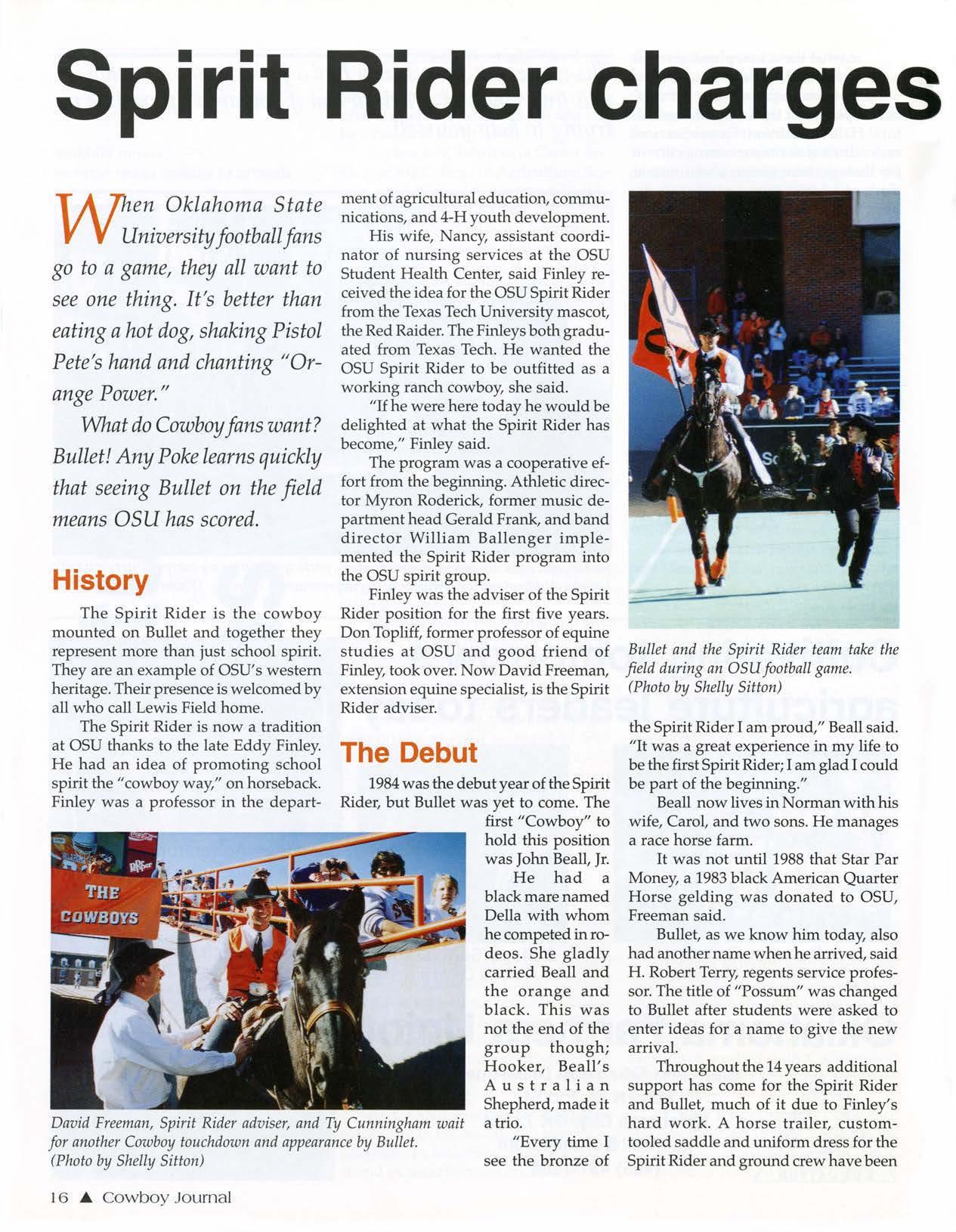
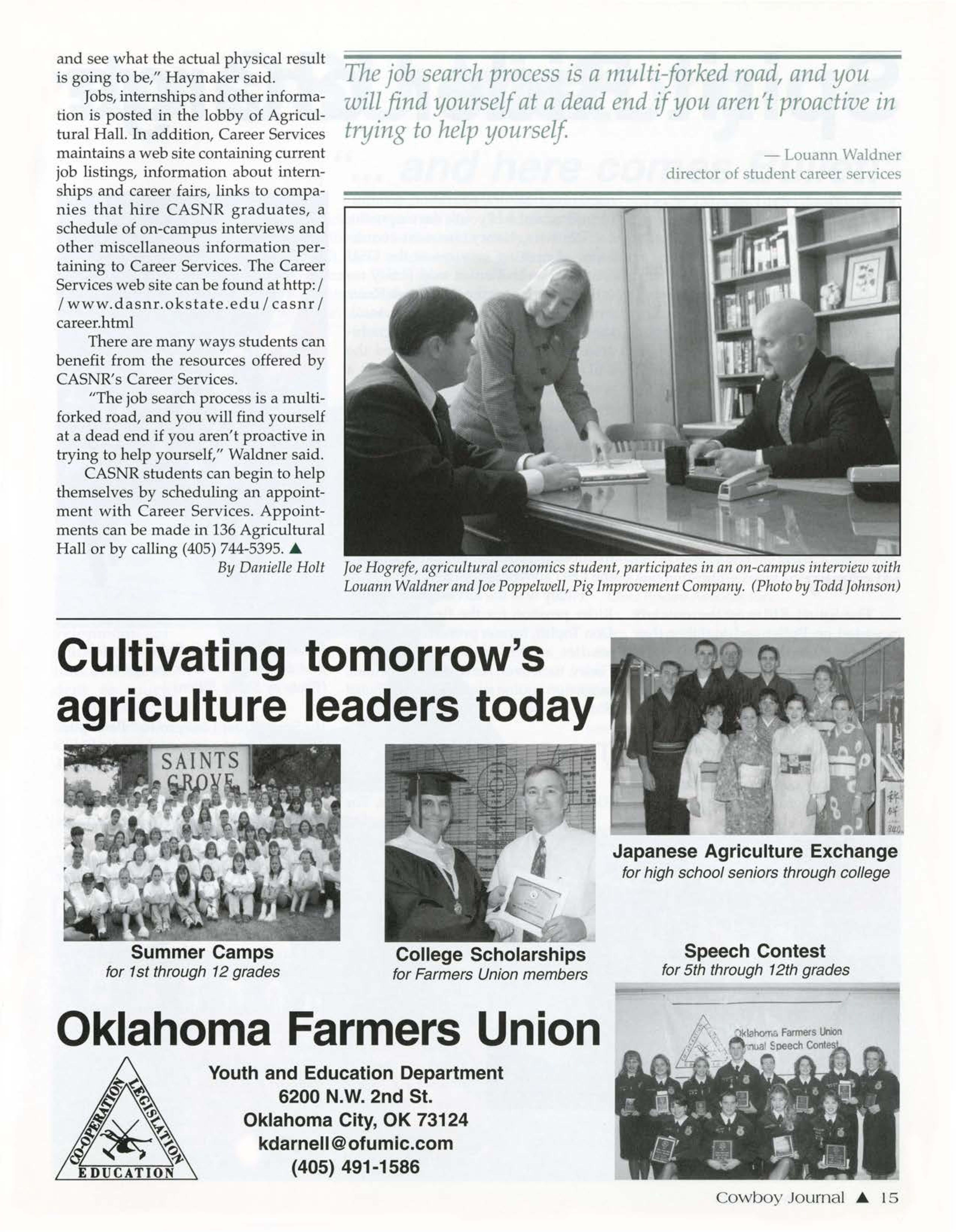
Bullet and the Spirit Rider team take the field during an OSU footballgame. (Photoby Shelly Sitton)
the Spirit Rider I am proud," Beall said. "It was a great experience in my life to be the first Spirit Rider; I am glad I could be part of the beginning."
Beall now lives in Norman with his wife, Carol, and two sons. He manages a race horse farm.
It was not until 1988 that Star Par Money, a 1983 black American Quarter Horse gelding was donated to OSU, Freeman said.
Bullet, as we know him today, also had another name when he arrived, said H. Robert Terry, regents service professor. The title of "Possum" was changed to Bullet after students were asked to enter ideas for a name to give the new arrival.
Throughout the 14 years additional support has come for the Spirit Rider and Bullet, much of it due to Finley's hard work. A horse trailer, customtooled saddle and uniform dress for the Spirit Rider and ground crew have been
donated to OSU.
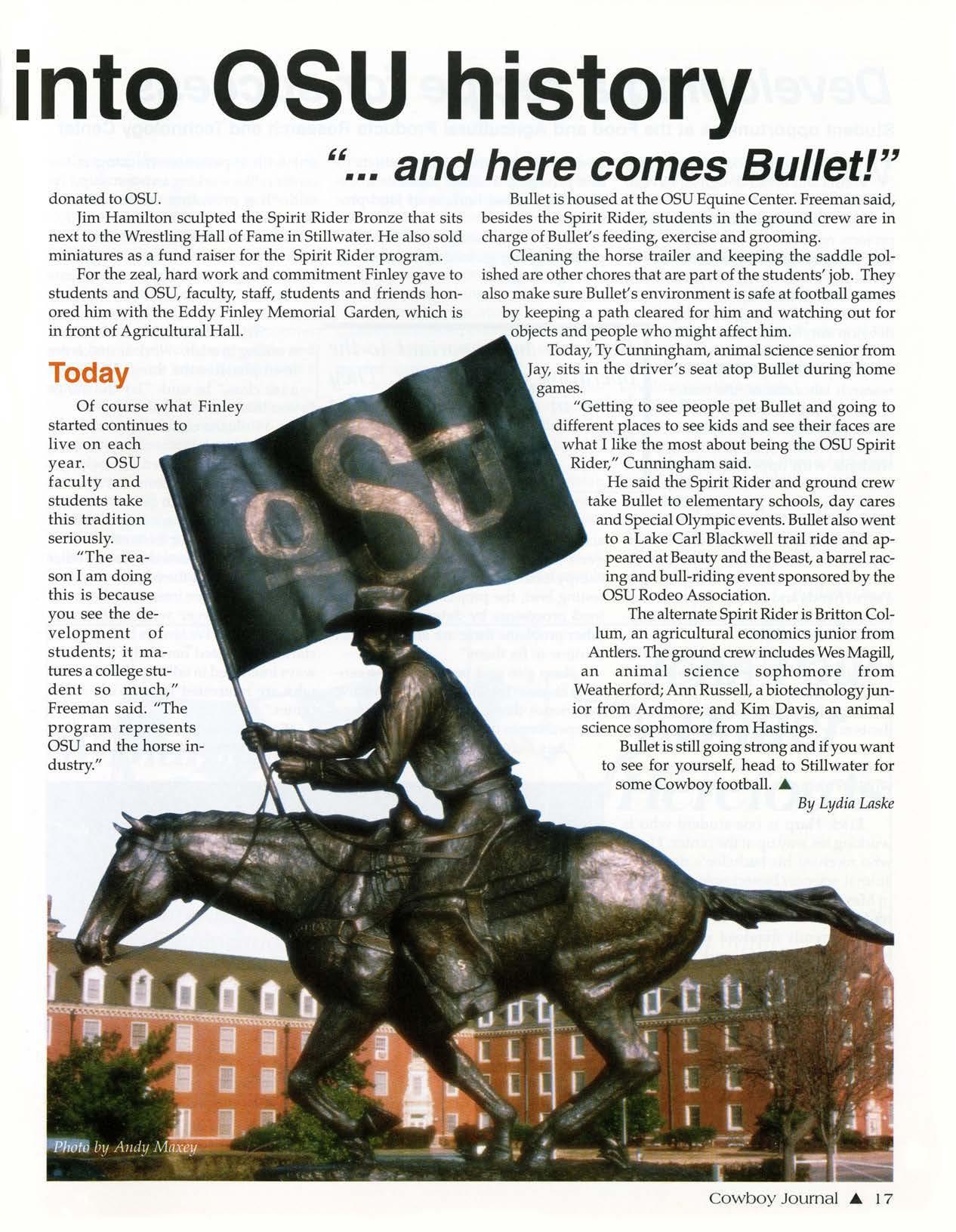
Jim Hamilton sculpted the Spirit Rider Bronze that sits next to the Wrestling Hall of Fame in Stillwater. He also sold miniatures as a fund raiser for the Spirit Rider program.
For the zeal, hard work and commitment Finley gave to students and OSU, faculty, staff, students and friends honored him with the Eddy Finley Memorial Garden, which is in front of Agricultural Hall.
Of course what Finley started continues to live on each year. OSU faculty and students take this tradition seriously.
"The reason I am doing this is because you see the development of students; it matures a college student so much," Freeman said. "The program represents OSU and the horse industry."
Bullet is housed at the OSU Equine Center. Freeman said, besides the Spirit Rider, students in the ground crew are in charge of Bullet's feeding, exercise and grooming.
Cleaning the horse trailer and keeping the saddle polished are other chores that are part of the students' job. They also make sure Bullet's environment is safe at football games by keeping a path cleared for him and watching out for objects and people who might affect him.
Today, Ty Cunningham, animal science senior from Jay, sits in the driver's seat atop Bullet during home games.
"Getting to see people pet Bullet and going to different places to see kids and see their faces are what I like the most about being the OSU Spirit Rider," Cunningham said.
He said the Spirit Rider and ground crew take Bullet to elementary schools, day cares and Special Olympic events. Bullet also went to a Lake Carl Blackwell trail ride and appeared at Beauty and the Beast, a barrel racing and bull-riding event sponsored by the OSU Rodeo Association.
The alternate Spirit Rider is Britton Collum, an agricultural economics junior from Antlers. The ground crew includes Wes Magill, an animal science sophomore from Weatherford; Ann Russell, a biotechnology junior from Ardmore; and Kirn Davis, an animal science sophomore from Hastings.
Bullet is still going strong and if you want to see for yourself, head to Stillwater for some Cowboy football. A
By Lydia Laske
l A That do turtle food, lasagna, beef V V cuts and bread dough all have in common?
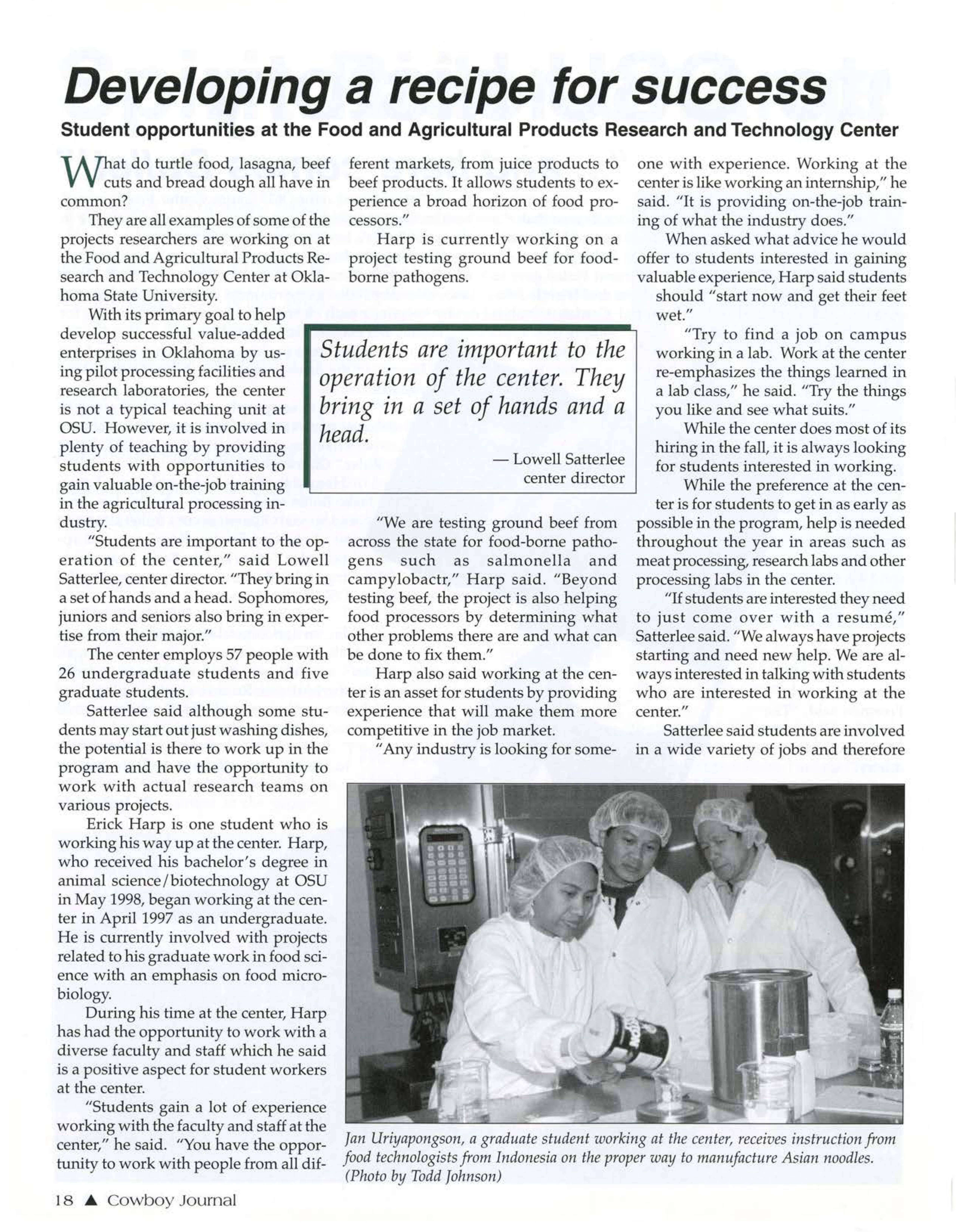
They are all examples of some of the projects researchers are working on at the Food and Agricultural Products Research and Technology Center at Oklahoma State University.
With its primary goal to help develop successful value-added enterprises in Oklahoma by using pilot processing facilities and research laboratories, the center is not a typical teaching unit at OSU. However, it is involved in plenty of teaching by providing students with opportunities to
gain valuable on-the-job training in the agricultural processing industry.
ferent markets, from juice products to beef products. It allows students to experience a broad horizon of food processors."
Harp is currently working on a project testing ground beef for foodborne pathogens.
Students are important to the operation of the cenfer. They bring in a set of hands and a head.
- Lowell Satterlee center director
one with experience. Working at the center is like working an internship," he said. "It is providing on-the-job training of what the industry does."
When asked what advice he would offer to students interested in gaining valuable experience, Harp said students should "start now and get their feet wet."
"Try to find a job on campus working in a lab. Work at the center re-emphasizes the things learned in a lab class," he said. "Try the things you like and see what suits."
While the center does most of its hiring in the fall, it is always looking for students interested in working.
"Students are important to the operation of the center," said Lowell Satterlee, center director. "They bring in a set of hands and a head. Sophomores, juniors and seniors also bring in expertise from their major."
The center employs 57 people with 26 undergraduate students and five graduate students.
Satterlee said although some students may start out just washing dishes, the potential is there to work up in the program and have the opportunity to work with actual research teams on various projects.
Erick Harp is one student who is working his way up at the center. Harp, who received his bachelor's degree in animal science/biotechnology at OSU in May 1998, began working at the center in April 1997 as an undergraduate. He is currently involved with projects related to his graduate work in food science with an emphasis on food microbiology.
During his time at the center, Harp has had the opportunity to work with a diverse faculty and staff which he said is a positive aspect for student workers at the center.
"Students gain a lot of experience working with the faculty and staff at the center," he said. "You have the opportunity to work with people from aJI di£-
"We are testing ground beef from across the state for food-borne pathogens such as salmonella and campylobactr," Harp said. "Beyond testing beef, the project is also helping food processors by determining what other problems there are and what can be done to fix them."
Harp also said working at the center is an asset for students by providing experience that will make them more competitive in the job market.
"Any industry is looking for some-
While the preference at the center is for students to get in as early as possible in the program, help is needed throughout the year in areas such as meat processing, research labs and other processing labs in the center.
"If students are interested they need to just come over with a resume," Satterlee said. "We always have projects starting and need new help. We are always interested in talking with students who are interested in working at the center."
Satterlee said students are involved in a wide variety of jobs and therefore
student employees come from a wide range of majors.
"We have majors from across the College of Ag in areas such as ag communications, ag engineering, animal science, and horticulture and landscape architecture, just to name a few," he said." A student's major isn't critical; it's the skills they bring in."
Student employees at the center must be disciplined, responsible and available to work from 10 to 20 hours a week.
Amy Childs is one student worker who knows all about discipline and responsibility. She began in March 1998 as a part-time employee and is now managing Cowboy Meats, the retail product store in the center.
Childs said she heard that Jake Nelson, the meat processing manager at the center, was looking for help so she turned in her resume and within one
week was working. A graduate student in human nutrition, she said having some previous financial experience from other jobs has helped her with the responsibilities of managing the store.
"My responsibilities at the store include stocking, inventory, working with customers and taking special orders."
Managing the store is offering Childs valuable experience, but she said it also has many other benefits beyond regular managerial tasks.
"Working in the store is good experience. My favorite part is the opportunity for people relations," Childs said. "I like being able to talk to all the different people who come in."
Through her work at the center, Childs has had the opportunity to work in areas she had never previously considered.
"The center is a good place to work as far as having a wide variety of people
to work with," she said. "While working full time this summer I had the chance to work with Dr. [Patricia] Rayas, a cereal chemist, with a project on wheat gels."
Childs said student workers have a unique opportunity to work with great people at the center and gain a wide variety of important skills.
"Getting to work with some of the top researchers, developing people skills, and problem solving skills are invaluable with any job."
Students looking to gain valuable experience and on the job training will find plenty of opportunities at the cent r and in the process they might even lean, what to feed a turtle, an Italian, or a cowboy.
For more informationon the Foodand Agricultural Products Researchand Technology Center,contact Lowell Satterleeat (405) 744-6071. A
By BarbiDauer
As we move into the 21st century, the challenges facing the livestock industry are tremendous. To respond, researchers must provide new and innovative information for producers.
Oklahoma State University is responding to these challenges with its newest agricultural research center, the Willard Sparks Beef Research Center.
"The Sparks Center is the most modern facility in the United States to do research on shipping stressed calves and feedlot cattle," said Donald Gill, regents professor of animal science at Oklahoma State University.
The Sparks Center is designed to benefit producers not only in Oklahoma but also throughout the United States. Bob Smith, McCasland Chair in beef health and production in the OSU College of Veterinary Medicine, said the goals of the Sparks Center are "to improve production efficiency in cattle, have a positive affect on beef quality and beef, and have a positive economical affect on all farmers and ranchers."
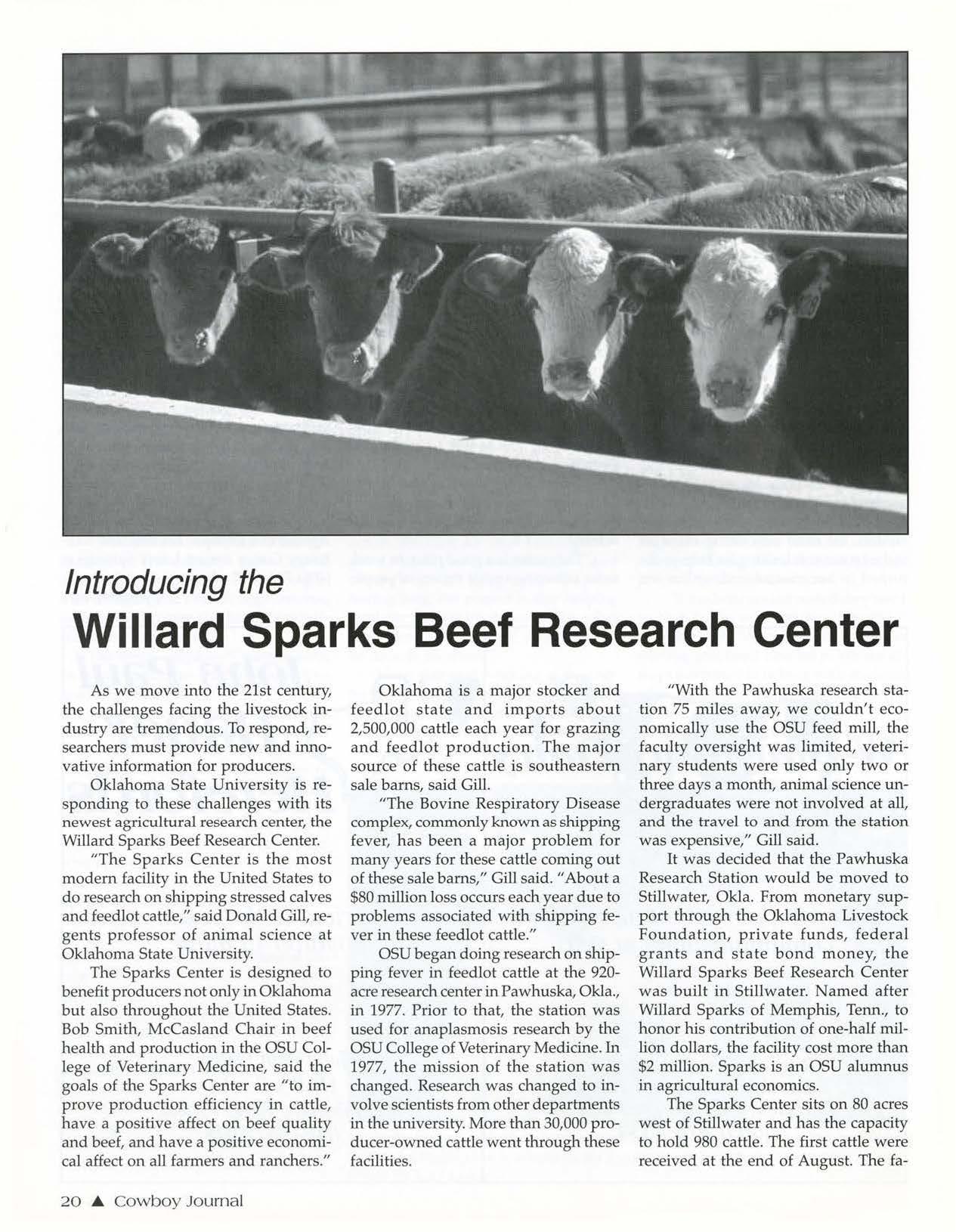
Oklahoma is a major stocker and feedlot state and imports about 2,500,000 cattle each year for grazing and feedlot production. The major source of these cattle is southeastern sale barns, said Gill.
"The Bovine Respiratory Disease complex, commonly known as shipping fever, has been a major problem for many years for these cattle coming out of these sale barns," Gill said. "About a $80 million loss occurs each year due to problems associated with shipping fever in these feedlot cattle."
OSU began doing research on shipping fever in feedlot cattle at the 920acre research center in Pawhuska, Okla., in 1977. Prior to that, the station was used for anaplasmosis research by the OSU College of Veterinary Medicine. In 1977, the mission of the station was changed. Research was changed to involve scientists from other departments in the university. More than 30,000 producer-owned cattle went through these facilities.
"With the Pawhuska research station 75 miles away, we couldn't economically use the OSU feed mill, the faculty oversight was limited, veterinary students were used only two or three days a month, animal science w1dergraduates were not involved at all, and the travel to and from the station was expensive," Gill said.
It was decided that the Pawhuska Research Station would be moved to Stillwater, Okla. From monetary support through the Oklahoma Livestock Foundation, private funds, federal grants and state bond money, the Willard Sparks Beef Research Center was built in Stillwater. Named after Willard Sparks of Memphis, Tenn., to honor his contribution of one-half million dollars, the facility cost more than $2 million. Sparks is an OSU alumnus in agricultural economics.
The Sparks Center sits on 80 acres west of Stillwater and has the capacity to hold 980 cattle. The first cattle were received at the end of August. The fa-
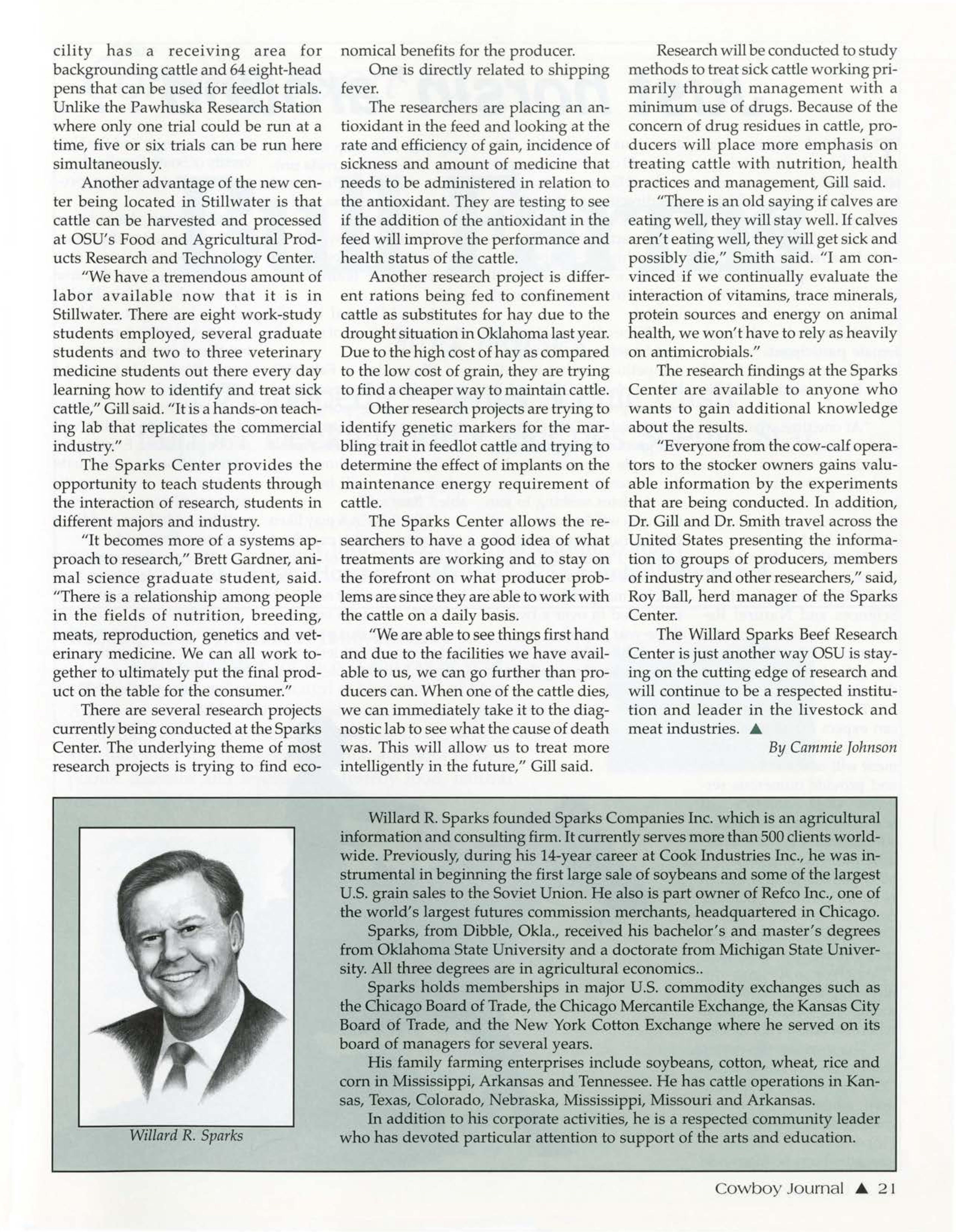
cility has a receiving area for backgrounding cattle and 64 eight-head pens that can be used for feedlot trials. Unlike the Pawhuska Research Station where onJy one trial could be run at a time, five or six trials can be run here simultaneously.
Another advantage of the new center being located in Stillwater is that cattle can be harvested and processed at OSU's Food and Agricultural Products Research and Technology Center.
"We have a tremendous amount of labor available now that it is in Stillwater. There are eight work-study students employed, several graduate students and two to three veterinary medicine students out there every day learning how to identify and treat sick cattle," Gill said. "It is a hands-on teaching lab that replicates the commercial industry."
The Sparks Center provides the opportunity to teach students through the interaction of research, students in different majors and industry.
"It becomes more of a systems approach to research," Brett Gardner, animal science graduate student, said. "There is a relationship among people in the fields of nutrition, breeding, meats, reproduction, genetics and veterinary medicine. We can all work together to ultimately put the final product on the table for the conswner."
There are several research projects currently being conducted at the Sparks Center. The underlying theme of most research projects is trying to find eco-
nomical benefits for the producer.
One is directly related to shipping fever.
The researchers are placing an antioxidant in the feed and looking at the rate and efficiency of gain, incid nee of sickness and amount of medicine that needs to be administered in relation to the antioxidant. They are testing to see if the addition of the antioxidant in the feed will improve the performance and health status of the cattle.
Another research project is different rations being fed to confinement cattle as substitutes for hay due to the drought situation in Oklahoma last year. Due to the high cost of hay as compared to the low cost of grain, they are trying to find a cheaper way to maintain cattle.
Other research projects are trying to identify genetic markers for the marbling trait in feedlot cattle and trying to determine the effect of implants on the maintenance energy requirement of cattle.
The Sparks Center allows the researchers to have a good idea of what treatments are working and to stay on the forefront on what producer problems are since they are able to work with the cattle on a daily basis.
"We are able to see tlrings fir t hand and due to the facilities we have available to us, we can go further than producers can. When one of the cattle dies, we can immediately take it to the diagnostic lab to see what the cause of death was. This will allow us to treat more intelligently in the future," Gill said.
Research will be conducted to study methods to treat sick cattle working primarily through management with a minimum use of drugs. Because of the concern of drug residues in cattle, producers will place more emphasis on treating cattle with nutrition, health practices and management, Gill said.
"There is an old saying if calves are eating well, they will stay well. If calves aren't eating well, they will get sick and possibly die," Smith said. "I am convinced if we continually evaluate the interaction of vitamins, trace minerals, protein sources and energy on animal health, we won't have to rely as heavily on antimicrobials."
The research findings at the Sparks Center are available to anyone who wants to gain additional knowledge about the results.
"Everyone from the cow-calf operators to the stocker owners gains valuable information by the experiments that are being conducted. h1 addition, Dr. Gill and Dr. Smith travel across the United States presenting the information to groups of producers, members of industry and other researchers," said, Roy Ball, herd manager of the Sparks Center.
The Willard Sparks Beef Research Center is just another way OSU is staying on the cutting edge of research and will continue to be a respected institution and leader in the livestock and meat industries. A
By Cammie Johnson
Willard R. Sparks founded Sparks Companies Inc. which is an agricultural information and consulting firm. It currently serves more than 500 clients worldwide. Previously, during his 14-year career at Cook Industries Inc., he wa instrumental in beginning the first large sale of soybeans and some of the largest U.S. grain sales to the Soviet Union. He also is part owner of Refco Inc., one of the world's largest futures commission merchants, headquartered in Chicago. Sparks, from Dibble, Okla., received his bachelor's and master's degrees from Oklahoma State University and a doctorate from Michigan State University. All three degrees are in agricultural economics
Sparks holds memberships in major U.S. commodity exchanges such as the Chicago Board of Trade, the Chicago Mercantile Exchange, the Kansas City Board of Trade, and the ew York Cotton Exchang where he served on its board of managers for several years.
His family farming enterprises include soybeans, cotton, wheat, rice and com in Mississippi, Arkansas and Tennessee. He has cattle operations in Kansas, Texas, Colorado, Nebraska, Mississippi, Missouri and Arkansas.
In addition to his corporate activities, he is a respected community leader who has devoted particular attention to support of the arts and education.
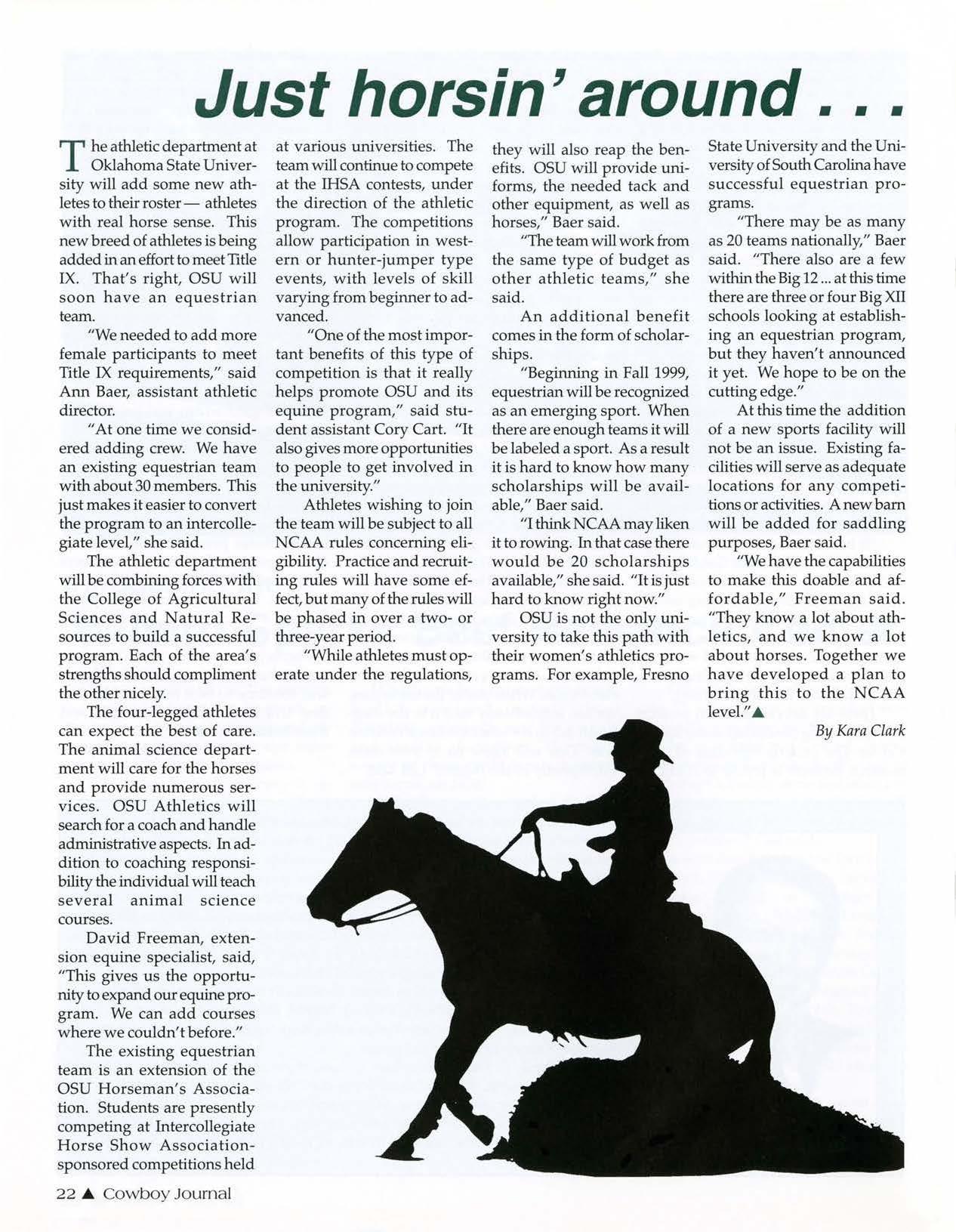
The athletic department at Oklahoma State University wi11add some new athletes to their roster - athletes with real horse sense. This new breed of athletes is being added in an effort to meet Title IX. That's right, OSU will soon have an equestrian team.
"We needed to add more female participants to meet Title IX requirements," said Ann Baer, assistant athletic director.
"At one time we considered adding crew. We have an existing equestrian team with about 30 members. This just makes it easier to convert the program to an intercollegiate level," she said.
The athletic department will be combining forces with the College of Agricultural Sciences and Natural Resources to build a successful program. Each of the area's strengths should compliment the other nicely.
The four-legged athletes can expect the best of care. The animal science department will care for the horses and provide numerous services. OSU Athletics will search for a coach and handle administrative aspects. In addition to coaching responsibility the individual will teach several animal science courses.
David Freeman, extension equine specialist, said, "This gives us the opportunity to expand our equine program. We can add courses where we couldn't before."
The existing equestrian team is an extension of the OSU Horseman's Association. Students are presently competing at Intercollegiate Horse Show Associationsponsored competitions held 22 A Cowboy Journal
at various universities. The team will continue to compete at the IHSA contests, under the direction of the athletic program. The competitions allow participation in western or hunter-jumper type events, with levels of skill varying from beginner to advanced.
"One of the most important benefits of this type of competition is that it really helps promote OSU and its equine program," said student assistant Cory Cart. "It also gives more opportunities to people to get involved in the university."
Athletes wishing to join the team will be subject to all NCAA rules concerning eligibility. Practice and recruiting rules will have some effect, but many of the rules will be phased in over a two- or three-year period.
"While athletes must operate under the regulations,
they will also reap the benefits. OSU will provide uniforms, the needed tack and other equipment, as well as horses," Baer said.
"The team will work from the same type of budget as other athletic teams," she said.
An additional benefit comes in the form of scholarships.
"Beginning in Fall 1999, equestrian will be recognized as an emerging sport. When there are enough teams it will be labeled a sport. As a result it is hard to know how many scholarships will be available," Baer said.
"I think NCAA may liken it to rowing. In that case there would be 20 scholarships available," she said. "It is just hard to know right now."
OSU is not the only university to take this path with their women's athletics programs. For example, Fresno
State University and the University of South Carolina have successful equestrian programs.
"There may be as many as 20 teams nationally," Baer said. "There also are a few within the Big 12 ... at this time there are three or four Big XII schools looking at establishing an equestrian program, but they haven't announced it yet. We hope to be on the cutting edge."
At this time the addition of a new sports facility will not be an issue. Existing facilities will serve as adequate locations for any competitions or activities. A new barn will be added for saddling purposes, Baer said.
"We have the capabilities to make this doable and affordable," Freeman said. "They know a lot about athletics, and we know a lot about horses. Together we have developed a plan to bring this to the NCAA level." A
By KaraClark
For more breeding information, contact: T. Shawn Howard• (405) 377-4754 • hobull@ionet.net
Building on a Tradition of Innovation . ..
. . . is our foundation for success and can be your vehicle for personal growth and achievement at Dow AgroSciences. One of the largest research-based agricultural and specialty products companies in the world, we are dedicated to the re ponsible management of pests, plants, diseases and weeds that destroy food, natural resources and personal property.
Please visit our website at www.dowagro.com
with over ten years of experience in cutting-edge research in plant and microbial genetic manipulation and the recent acquisition of a majority ownership position in Mycogen Corporation. Because we believe in the importance of moving forward to meet the needs of a growing world population, we have made a substantial investment in biotechnology. Additionally, we offer challenging opportunities within a timulating and diverse work environment, and are an affirmative action/ equal opportunity employer. Dow AgroSciences - Improving Quality of Life.
Throughout your college years, 8 percent of your time is spent outside the classroom. As an Oklahoma State University student you can now documen your student involvement on campus.
Being involved with community service and extracurricular activities on campus is impressive to prospective employers. The new student development transcripts are intended to complement students' resumes by detailing their campus and community involvement, said Kent Sampson, OSU director of campus life.
He said employers are excited about the new program.
"When asked if these transcripts would be useful to them, they all strongly agreed it would," Sampson said. "Student development transcripts give students a better way to tell their story."
This new program is expected to support a resume, not build it. This official university document will, however, validate extracurricular participation. Information on the transcript will include the type of organization, the skills level scale, and the number of hours of participation per week.
There is no fee required to create a student development file, but a $1 shipping and handling fee is charged if you request the transcript be mailed.
The transcript program can be started at any time in a student's college career, but they are encouraged to start as early as possible. This will help maintain accuracy of total involvement. Transcripts can be updated and edited at any time.
Wesley Holley, assistant dean of the College of Agricultural Sciences and Natural Resources, said the new student development transcript program is a good way for students to show diversity.
"It shows that students can be recognized for their academic accomplish-
ments, but 9 lso for being a participant, not only a listener," said Holley.
Students are excited about this new program and made the request for this type of transcript documentation themselves. They want a "stamp of approval" from the university recognizing them for their leadership and participation outside the classroom.
Agricultural economics senior Kelly Thompson said she plans to sign up for the program.
"I think my activity transcript will be beneficial as I apply for jobs," said Thompson. "Every employer will know I'm dedicated to my academic career while still being extremely involved on campus."
Thompson is currently serving on the Homecoming Steering Executive Committee, Student Alumni Board and Mortar Board. She is a member of Delta Delta Del ta, Alpha Zeta and Beta Alpha Psi. Thompson also serves as a community service volunteer.
This new program is expected to be a huge success. Sampson said he hopes for 10 percent of OSU students to be
using the program by spring 1999. He encourages everyone on campus, freshmen to seniors, to take advantage of this special opportunity.
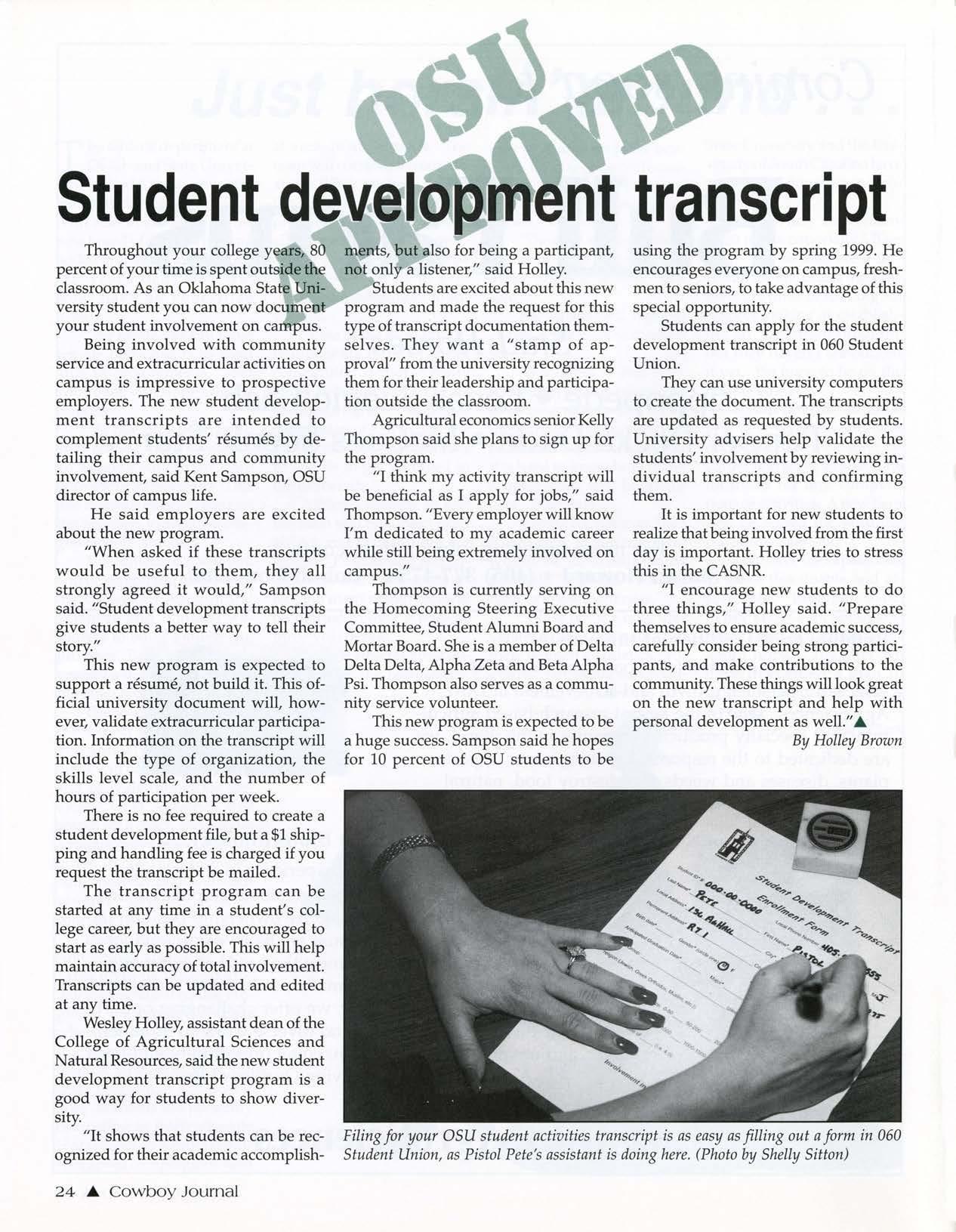
Students can apply for the student development transcript in 060 Student Union.
They can use university computers to create the document. The transcripts are updated as requested by students. University advisers help validate the students' involvement by reviewing individual transcripts and confirming them.
It is important for new students to realize that being involved from the first day is important. Holley tries to stress this in the CASNR.
"I encourage new students to do three things," Holley said. "Prepare themselves to ensure academic success, carefully consider being strong participants, and make contributions to the community. These things will look great on the new transcript and help with personal development as well." .A.
By Holley Brown
("'")klahomaState University is doing Vmany new things for agriculture. Established with contributed funds, The Bollenbach Endowed Chair in Wildlife Ecology is a good example. Hunters, students and anyone associated with OSU can be proud of this new endowed chair and its mission.
Along with production agriculture, wildlife is another diverse part of the Division of Agricultural Sciences and Natural Resources. Staying committed to the land-grant philosophy, the Bollenbach Chair contributes to teaching, extension and research.
Through the Bollenbach Chair, students can explore management techniques that will stabilize game bird populations and improve wildlife ecosystems. The population of game birds, such as quail and prairie chickens, has declined in the Southwest as well as other parts of the United States. Shrinking habitats for these birds are partly responsible for the loss.
Charles Scifres, former associate director of the Oklahoma Agricultural Experiment Station at OSU, and former Gov. Henry Bellmon shared an idea to create an endowed chair promoting wildlife ecology. Oklahoma Regents for Higher Education joined the effort in September 1996 by matching the private funds raised primarily by Bellmon and Charles B:rowning, dean and director emeritus of the division. The idea was officially a" go" when the OSU Agricultural Experiment Station made a longterm commitment to the project.
Homed in the department of forestry, the chair honors the late Irvin Bollenbach. A long-time friend of Bellmon, Bollenbach was a well-known rancher and, more importantly, a bobwhite hunter from Kingfisher, Okla.
Even though the Bollenbach Chair was named after a bobwhite enthusiast, its charge involves much more.
The charge includes establishing biologically and economically viable management systems for private range and forestlands and advising and directing graduate students conducting re-
search on natural resources. Its mission is to get management information into the hands of users through wildlife, forestry and range specialists. Conducting research on game and non-game birds in upland settings is also a goal of the Bollenbach Chair.
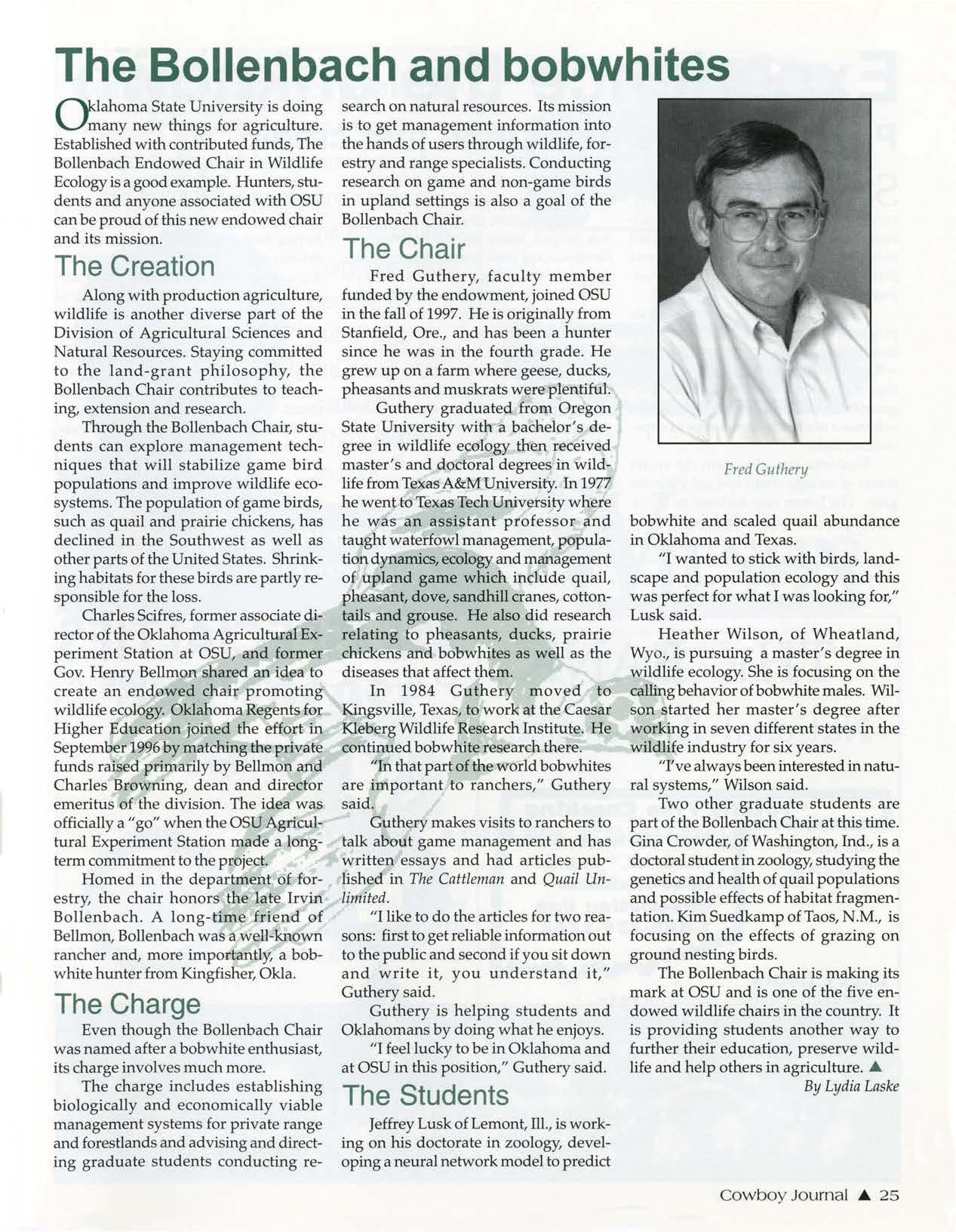
Fred Guthery, faculty member funded by the endowment, joined OSU in the fall of 1997. He is originally from Stanfield, Ore., and has been a hunter since he was in the fourth grade. He grew up on a farm where geese, ducks, pheasants and muskrats were plentiful.
Guthery graduated from Oregon State University with a bachelor's degree in wildlife ecology then received master's and doctoral degrees in wildlife from Texas A&M University. In 1977 he went to Texas Tech University where he was an assistant professor and taught waterfowl management, population dynamics, ecology and management of upland game which include quail, pheasant, dove, sandhill cranes, cottontails and grouse. He also did research relating to pheasants, ducks, prairie chickens and bobwhites as well as the diseases that affect them.
In 1984 Guthery moved to Kingsville, Texas, to work at the Caesar Kleberg Wildlife Research Institute. He continued bobwhite research there.
"In that part of the world bobwhites are important to ranchers," Guthery said.
Guthery makes visits to ranchers to talk about game management and has written essays and had articles published in The Cattleman and Quail Unlimited.
'1 like to do the articles for two reasons: first to get reliable information out to the public and second if you sit down and write it, you understand it," Guthery said.
Guthery is helping students and Oklahomans by doing what he enjoys.
'1 feel lucky to be in Oklal1oma and at OSU in this position," Guthery said.
Jeffrey Lusk of Lemont, Ill., is working on his doctorate in zoology, developing a neural network model to predict
bobwhite and scaled quail abundance in Oklahoma and Texas.
"I wanted to stick with birds, landscape and population ecology and this was perfect for what I was looking for," Lusk said.
Heather Wilson, of Wheatland, Wyo., is pursuing a master's degree in wildlife ecology. She is focusing on the calling behavior of bobwhite males. Wilson started her master's degree after working in seven different states in the wildlife industry for six years.
"I've always been interested in natural systems," Wilson said.
Two other graduate students are part of the Bollenbach Chair at this time. Gina Crowder, of Washington, Ind., is a doctoral student in zoology, studying the genetics and health of quail populations and possible effects of habitat fragmentation. Kirn Suedkamp of Taos, N.M., is focusing on the effects of grazing on ground nesting birds.
The Bollenbach Chair is making its mark at OSU and is one of the five endowed wildlife chairs in the country. It is providing students another way to further their education, preserve wildlife and help others in agriculture .+.
By Lydia Laske
So you don't have any experience working with the cattle industry, swine industry or any other animal science department, but you really want to major in animal science at Oklahoma State University. ever fear, the department has a program for you!
The animal science work experience program at Oklahoma State University enables students to become familiar with a side of animal science in which they may not have strengths. The program can give hands-on experience and enhance a student's knowledge in a specialized field.
Students can also gain up to six hours of college credit toward their degree. The hours may be u ed a an internship or as a controlled elective.
"This program is de igned to provide students that have limited background in animal science to get definite
hands-on experience," said Bob Kropp, professor of animal science.
The program, in effect for 10 years, has helped many animal science students toward their future. Since the student receives college credit, no salary is earned. However, the experience can get students farther down the road and into a better job.
Opportwuties for experience are not only available at the animal science livestock facilities, but research and development facilities are also included. Students may choose to work at one of the labs in the Animal Science Building.
Cindy Pribil, manager of the purebred beef center, said the work experience program is good for students because of the academic credit available and the opportunity to be around species unfamiliar to them.
"Students seem to be energetic and
positive, and also enjoy the exp rience," said Pribil. "Students get to learn in the books and then get the hands-on experience, basically doing practical applications which includes daHy care of the animals, feeding and nutrition, and dayto-day chores that helps make a cattle ranch operate."
So if animal cience i calling your name and Oklahoma State University is where you want to be, don't hesitate.
Enroll in the work experience program. Gain the knowledge and experience you deserve to help you £:inda successful job in the field of animal science.
Forfurther informationabout the work experienceprogram,contact Bob Kroppat (405) 744-8864 or Mark Johnson at (405) 744-6065 .&.
By Matt Presson
CongressmanWes Watkins proudlysupportsthe studentsof the OSUCollegeof AgriculturalSciences andNaturalResourcesandsalutes the Agricultural Communications seniorsfor publishing the inaugural issueof ''TheCowboy Journal."
The word legacy seems to have a different meaning for everyone.
Some think of inheritances, others think of powerhouse football teams. But for one inventive Oklahoma State University program, the word legacy has a whole different meaning.
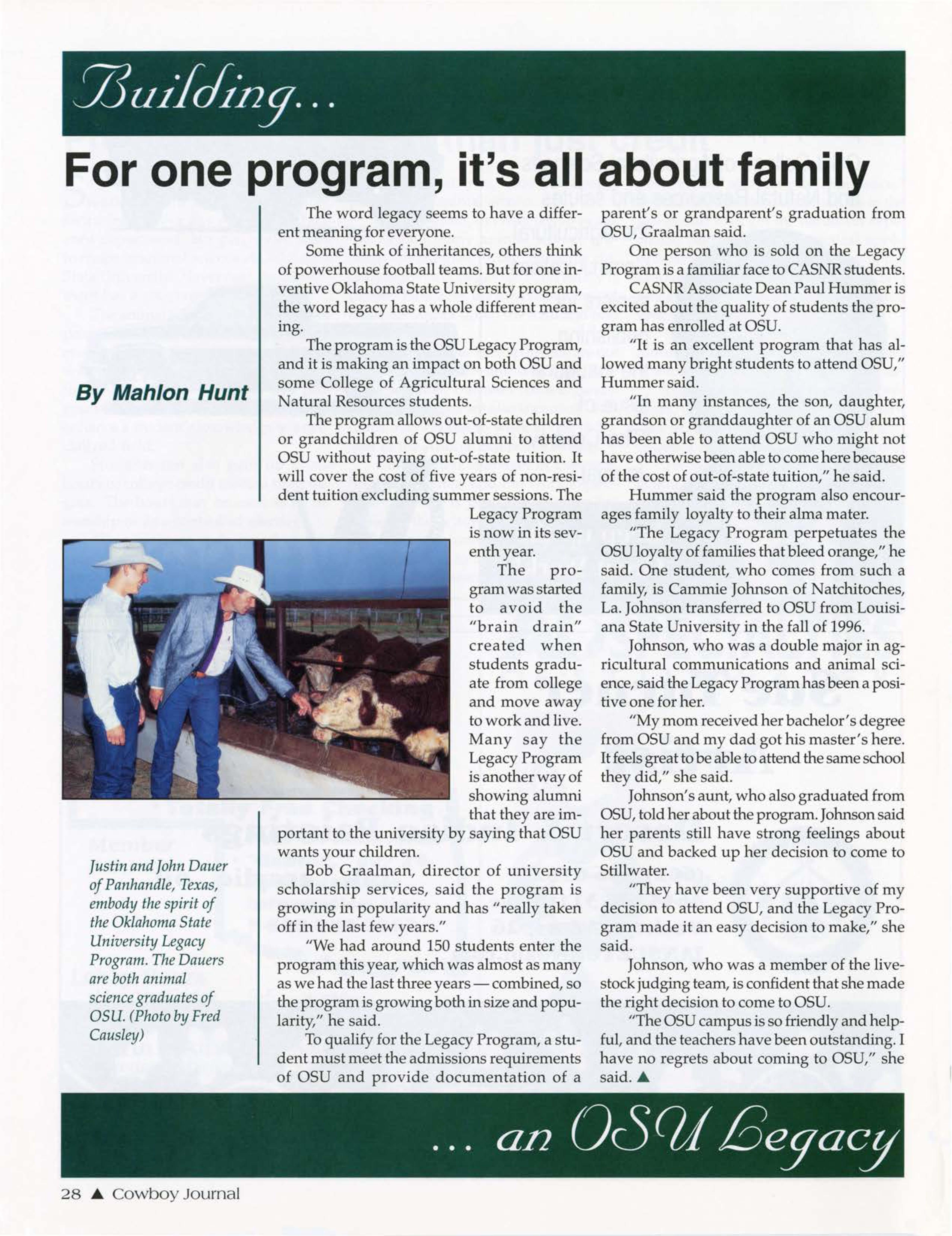
By Mah/on Hunt
Justin andJohnDauer of Panhandle,Texas, embodythe spirit of the OklahomaState UniversityLegacy Program.The Dauers areboth animal sciencegraduatesof OSU. (Photoby Fred CausletJ)
The program is the OSU Legacy Program, and it is making an impact on both OSU and some College of Agricultural Sciences and Natural Resources students.
The program allows out-of-state children or grandchildren of OSU alumni to attend OSU without paying out-of-state tuition. It will cover the cost of five years of non-resident tuition excluding summer sessions. The Legacy Program is now in its seventh year.
The program wa tarted to avoid the "brain drain" created when students graduat from college and move away to work and live. Many say the Legacy Program is another way of showing alumni that they are important to the university by saying that OSU wants your children.
Bob Graalman, director of university scholarship services, said the program is growing in popularity and has "really taken off in the last few years."
"We had around 150 students enter the program this year, which was almost as many as we had the last three years - combined, so the program is growing both in size and popularity," he said.
To qualify for the Legacy Program, a student must meet the admissions requirements of OSU and provide documentation of a
parent's or grandparent's graduation from OSU, Graalman said.
One person who is sold on the Legacy Program is a familiar face to CASNRstudents.
CAS R Associate Dean Paul Hummer is excited about the quality of students the program has enrolled at OSU.
"It is an exce1lent program that has allowed many bright students to attend OSU," Hummer said.
"In many instances, the son, daughter, grandson or granddaughter of an OSU alum has been able to attend OSU who might not have otherwise been able to come here because of the cost of out-of-state tuition," he said.
Hummer said the program also encourages family loyalty to their alma mater.
"The Legacy Program perpetuates the OSU loyalty of families that bleed orange," he said. One student, who comes from such a family, is Cammie Johnson of atchitoches, La. Johnson transferred to OSU from Louisiana State University in the fall of 1996.
Johnson, who was a double major in agricultural communications and animal science, said the Legacy Program has been a positive one for her.
"My mom received her bachelor's degree from OSU and my dad got his master's here. It feelsgreat to be able to attend the same school they did," she said.
Johnson's aunt, who also graduated from OSU, told her about the program. Johnson said her parents still have strong feelings about OSU and backed up her decision to come to Stillwater.
"They have been very supportive of my decision to attend OSU, and the Legacy Program made it an easy decision to make," she said.
Johnson, who was a member of the livestock judging team, is confident that she made the right decision to come to OSU.
"The OSU campus is so friendly and helpful, and the teachers have been outstanding. I have no regrets about coming to OSU," she said. A
Mission:Tobea Global.Consumer-Driven.Producer-Owned'Farm-ID-Table'CooperativeSystem.
FarmlandIndustriesis the large l farmer-ownedcooperativein orlh Americaandoneof the top200 Forwne 500-lisledcompanies.Farmlandis a globalmarketerwith highlydiver ified busines lines including:crop productionand protectionproducts,Jive tock feed petroleum.grain proce ing andmarketing.and the proce ing andmarkelingof pork and beef product Thenet re ult, exceptionalemploymem opporwnilies.For information.contactu Laday or vi it our web ite at farmland.com.
TheParm/andSy temis ownedby about500.000farm familie like RandyandMary Wilsonof Roundtake. MN.
f>'armlandIndustries.Inc.• 3101. Main.Suile#l 150.Wichita.KS67202 Phone1-800-362-0662 • Fax3 I 6-264-2971
The staff would like to thank everyone for their support and assistance with our first issue. We appreciate you sharing your time, your talents and your patience.
A special thanks goes to:
Fred Causley
Todd Johnson
Ursula Blanchard
Jon Dickey
Aimee Heald
Dwayne Hunter
Carl Hamby
Jeff Miller
Elizabeth Whitfield
Dr. Linda Johnson
Oklahoma State University chapter of Agricultural Communicators of Tomorrow congratulates the staff on the inaugural issue of the Cowboy Journal.
CAROLWHITE Agent
Mcconnel-WhiteInsuranceAgency
Auto• Home• Life• Commercial 326S.Main,Lindsay,OK73052• P.O.Box218,Lindsay,OK73052
Business:{405)756-2554 • Residence:(580)432-5337 Fax:(405)756-3562
619 N. Broadway 10290 Monroe Dr.#206
Tecumseh, OK 74873 Dallas, TX 75229 (405)598·2915 (214)·352·4744
Kacy Parker (Ag Econ '94)
Mendy M. Parker (Ag Comm '96)
MARS ELECTRONICS INTERNATIONAL l ·800•682·0358
Jennifer Bridges Stillwater, OK (405) 743-4715 Harriet Bridges Lake Providence, LA (318) 559-1855
Rt. 1 Box 645
Stillwater, OK 74074
Office: 405-377-8037 Fax: 405-377-4541
721 S. Main Stillwater, OK 74074 (405) 625-8800
Goad (405) 372-7665 Fax: (405) 372-2823
312 S. Duck P.O. Box 1747 Stillwater, OK 74076
Stillwater Milling Company
FEEDS 512 E. 6th Street Stillwater, OK 7 407 4 ( 405) 372-3445
Four gri-Center Location : tillwater Claremore, Davi and Perry
Office & School Supplies, Furniture, Printing
614 South Main Stillwater, OK 74075
Ph. (405) 377-9732 fax (405) 624-9149 OK WATIS (800) 346-5981
The Cowboy Journal Oklahoma State University
Department of Agricultural Education, Communications, and 4-H Youth Development 448 Agricultural Hall Stillwater, OK 74078-6031
For More Information Contact: Louann Waldner Director, Student Career Services 136 Agricultural Hall Oklahoma State University Stillwater, OK 74078 (405) 744-5395 http://www.okstate.edu/OSU_AG