Editors
Callie Hadley
Skyler Selby
GraphicCoordinators
Samancha Davidson
S,acy Pa,ton
SponsorshipCoordinators
Shawna Allen
Evin Goss
CirculationCoordinators
Austin Partida
Darrin Schultz
PhotographyCoordinators
Lance Shaw
Hannah Wright
WebEditor
Jillianne Zweiacker
Staff
Briccainy Barron
Blayr Beougher
Whirney Danker
Cori Harrison
Chrisra Marcin
Ashley chnoor
Sara"Jane Smallwood
Kirby mich
Kandice Taylor
ManagingEditor
helly Peper Sitton
AssistantManagingEditors
Cindy Blackwell
Dwayne Caranell
FoundingSponsors
Limausin World
Oklahoma Farm Bureau
Quebecor World Midland on the Web
Visit this issue and Cowbuy Jo11rn11larchives at http:// cowboyjournal.okstare.edu on the cover
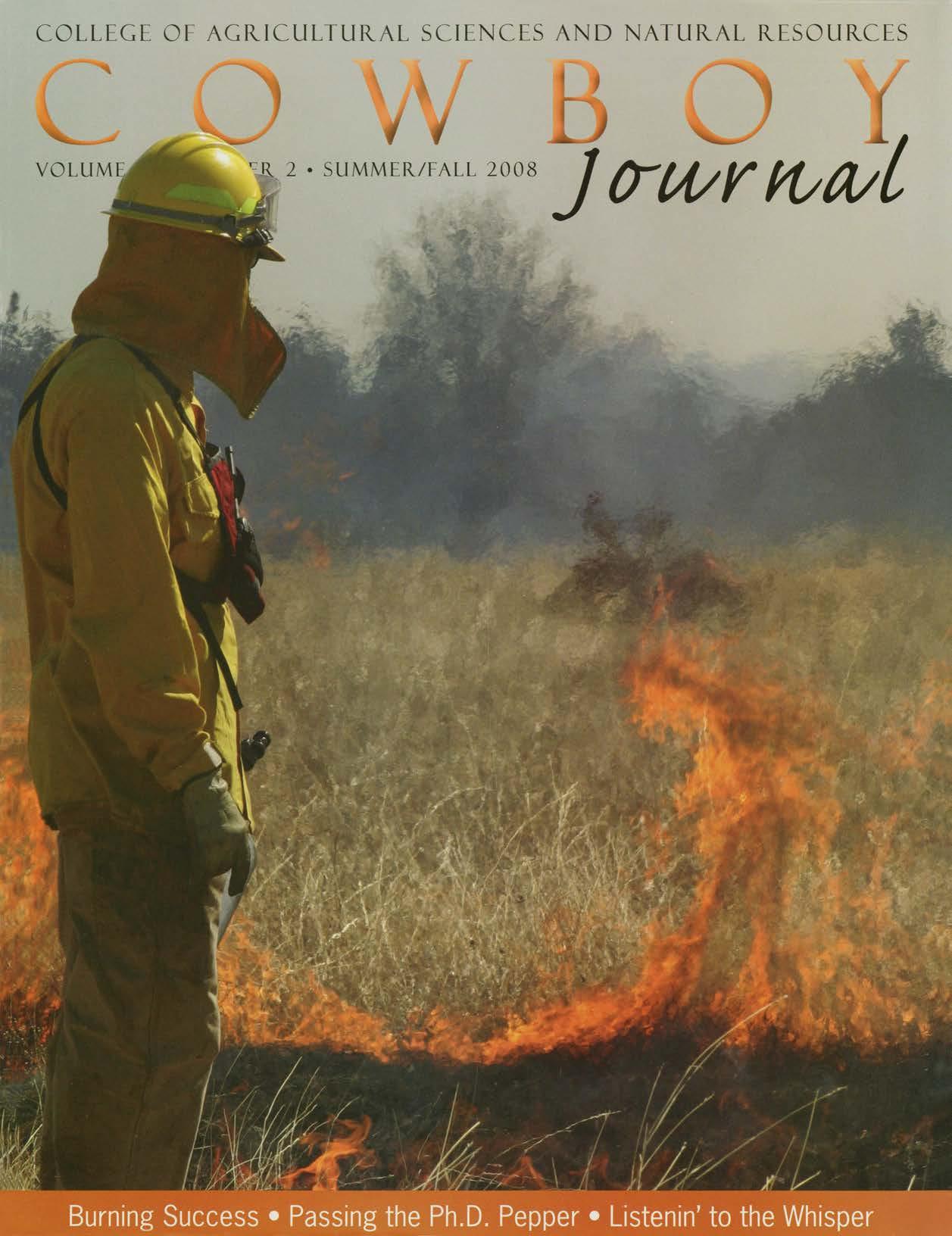
Prescribed burns are vital co research ar the Cross Timbers Experimemal Range.
teve Wincer works to maincain a conrrolled burn. (Phoco by Blayr Beougher)
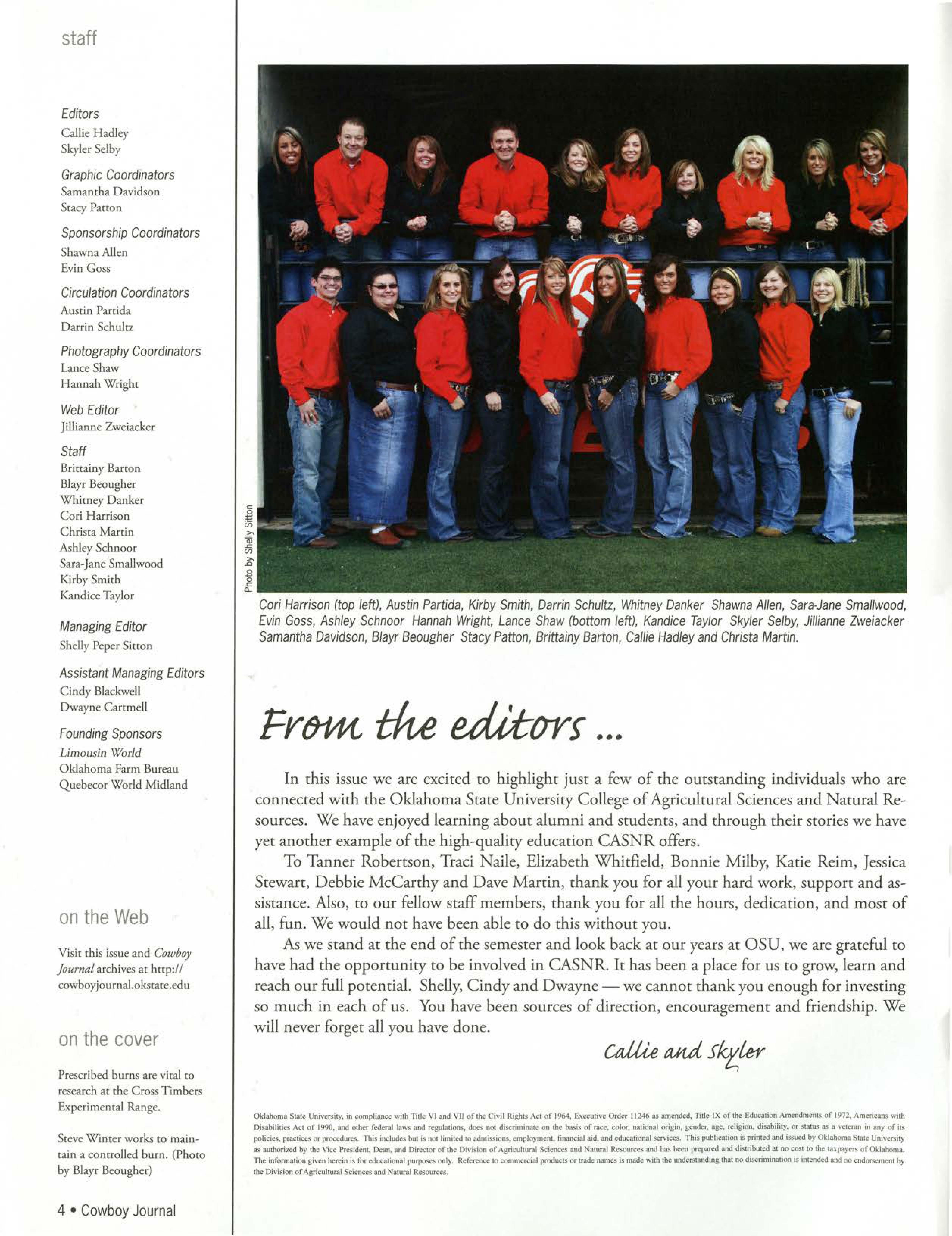
Cori Harrison(top left),AustinPartida,KirbySmith,DarrinSchultz,WhitneyDanker ShawnaAllen,Sara-JaneSmallwood, EvinGoss,AshleySchnoor HannahWright,LanceShaw(bottomleft), KandiceTaylor SkylerSelby,JillianneZweiacker SamanthaDavidson,B!ayrBeougherStacyPatton,BrittainyBarton,CallieHadleyand ChristaMartin.
In this issue we are excited to highlight just a few of the outstanding individuals who are connected with the Oklahoma State University College of Agricultural Sciences and Natural Resources. We have enjoyed learning about alumni and students, and through their scories we have yet another example of the high-quality education CAS R offers.
To Tanner Robenson, Traci aile, Elizabeth Whitfield, Bonnie Milby, Katie Reim, Jessica cewart, Debbie McCarthy and Dave Martin, thank you for all your hard work, support and assistance. Also, to our fellow staff members, rhank you for all the hours, dedication, and most of all, fun. We would nor have been able to do chis without you.
As we srand at the end of the semester and look back at our years at OSU, we are grateful to have had the opportunity co be involved in CAS R. le has been a place for us to grow, learn and reach our full potential. Shelly, Cindy and Dwayne - we cannot thank you enough for investing so much in each of us. You have been sources of direction, encouragement and friendship. We will never forger all you have done. Oldahom11State UmHr:<iU)', in complt.3nct'"ilh Title VJ and VU of the t:'n1l klgJnsAcl or 1964, b~ull\~ Order 11246 as WJlffidcd.1itle IX ortM" Ed.UC.11100AmefldmcnL.,.of 1972. Amcric;:msw1lh Disabilhu.~A(I or 1990. othtt fcder11IUlwJ1mdrcgul.111t>ns, not dikrim,n.;u,:on th,.:ban.• of l'flCt,color, n:)tktn1Icri,gut,.gcnckT.11.ge,tcliQion, JisaJ:otity.or staru.~li ti \tterun m any of ib politics., prai.tico l'llf i,roced111"CS.TI,i.sinc.II.Idesbut f'l oos limited 10:idmi 'lion~ tmploytnfflt, finnnci.aliud. lllld educ::111ian.11I$Cn•lcu. This publicanon is-prin1c:dWJdi$.!iucdby Oklllhoma S:uncUnhtt11it)' u .11.uthoriudby the Vier PrcsJdcnl Oc-an.and Director of 1M' Divblon of Agricultural Sc1mc~ and "lutwu.lRcsou,cc.~and ha,; b...'fflprq,aml t1nddi.stribun:dIJlt no cos110 the laXpa)·c-rs or Olllhoma., Thi: lnfottni:.1ioo.gl,.·cnhcrdn is for cdu<:11tiom1lpurposesonly. Refereou 10co«unctcial produca.sor trade nanit, l.!imade WJLhthe w·tdi:~llJldlft.&lhtltno dl.SCfimm.ahon l$ ml~dcd llOOno C'l\dorscnu:ntby the- Oivh:iOf'Iof Agncuhul'll.1Sc-1Cflccs1nd Nonll'lllResources.
c I The Voice Behind the Whisper • 26 §
Alumnus Richard Danel has called Varsity Barbershop 'home' for 50 years
ro Keepers ofYe Bottle • 33
Forry years of'Ye Olde Ph.D Pepper' in agricultural economics
OSU Alum Goes the Distance ... To Make a Difference • 35
Mibey assumes duties as vice chancellor of Kenya's Moi University
60 Years& Counting • 42
OSU's College of Veterinary Medicine commemorates its diamond anniversary
Real Men of Excellence • 46
CASNR honors three distinguished alumni
Ag Alumni News • 48
CASNR alumni in the spotlight
§ I Exploring Opportunities in Extension• 16
V> Cooperative Extension interns leave their mark on Oklahoma counties
C Q) Q) The New Face of'Oklahoma Gardening'• 18
This season of 'Oklahoma Gardening' brings its 10th host into homes across the tate
b I Cowboys Race Against Cancer • 37
::::s Division of Agricultural ciences and Natural Resources faculty 'ream up' in the barcle against cancer
u ro -
""5I A Delights~ful Alternative • 6
"5,._
FAPC helps Stillwater family offer healthy drink options
CSI: Agricultural Style • 20
O Forensics and plant pathology unite through the Division of Agricultural Science and Natural Resources
..c: I Black Gold to Sun Gold • 22
Oklahoma State University receives $2.5 million a regional center for Sun Grant Initiative
Plum Sweet Plum • 28
REM studies show sand plwn thickets provide homes for North American bobwhite quail
Cross Timbers • 30
OSU's Cross Timbers Experimental Range provides Oklahomans with information on managing natural resources
V> I Bikes and Buddies • 9
Two agricultural education graduate students give back to their communities by donating bicycles
What Do Biochemists Do? • 11
Exploring rhe truth abouc biochemistry careers
Cowboys Make the Call • 13
CASNR students call alumrri to raise scholarship money
CASNR Seniors Score Big• 21
Kuzma earns top honors at CASNR awards banquet
Introducing ... an International Master'sOption • 24
Students can use travel co earn a degree
Saving the World Professionally • 39
Environmental science class reaches students to apply knowledge in real-world situations
Making a Difference ... One Student at a Time • 44
CASNR implements new selection process for Student Success Leader
By HannahWnght Oologah,Okla.
ITS A COMPANY AS RICH I FLAvor, tradition and Oklahoma tate Uni versiry spirit as che man who founded ic. Fruity Delights was established in Stillwater, Okla., but the idea came from a thousand miles away.
Ac age 19, Ricardo Salas was operations manager ac a freighr forwarding company in Guadalajara, Mexico. One of the company's specialties was exporting Mexican handicrafts to Europe and the United States. Salas credits much of the business knowledge he obtained in the early years to his boss and mentor.
"My first boss was an entrepreneur" alas said. "He sat me at the right side of his desk for every decision. I learned a lot about business from him. I learned about being an entrepreneur as well."
In his early 20s, using the business contacts he made at the shipping company, Salas moved to Mexico City, ready to venmre imo his own business. Salas and his partner founded RS International Trading Co. The company focused on producing and
selling materials such as shop
ping bags boxes, wrapping paper, signage and post cards, alas said. They also produced other printed paper produces for companies such as autica, Tommy Hilfiger, Warner Brothers and Versace.
"My busine partner and I found ourselves playing ball in the big leagues," Salas said. "We were overwhelmed with the knowledge we were missing."
The company was a great success, but after two years of operation, Salas and his partner decided to close shop and head co college. Salas had lived in Stillwater with his family until he was seven years old while his father, Rodolfo Salas, studied animal science. Salas said he had fond memories of the town, and, after receiving a Legacy Scholarship co waive out-of-scare tuition, he headed co 0 U, where he tailored his education around his entrepreneurial ideas.
One of his ideas was Fruity Delights. Though he had three other business plans in the works while Fruity Delights was developing, the beverage company soon began emerging as an idea co be ca.kenseriously, and Salas saw the tremendous marketing potential in the United States.
alas and his wife, Pepper, both had full-time jobs in che early stages of Fruity Delights. As they juggled a family and work, Fruity Delights was placed on che back burner. But a devastating turn of events left the Salas family reeling.
"On May 25, 2006, our son died," alas said. "With his death left all interest I had in everyone else's business, and I could not focus on anything but Fruity
Delights, my passion. So my wife and I decided I should quit my job and focus on starting Fruity Delights as quickly as possible while she and some of our savings helped keep us afloat."
Salas said he knew, now more than ever, chis was what he wanted co do for the rest of his life.
"The time came when it was time for Ricardo co quit his job," Pepper Salas said. "I was managing a restaurant here in rown, and I said, 'I'll support the family for now and you just go gung-ho with ir."'
With all energy channeled into the new company, Ricardo Salas worked co make a name for Fruity Delights.
"The roughest point has been to know where co find the right information," Ricardo Salas said. "There is a bunch of data our there; knowing how to pick it in order co put a business plan together has taken the largest amount of rime and patience."
That's where Chuck Willoughby, business and marketing relations manager at the Robert M. Kerr Food & Agricultural Produces Center, got involved. Willoughby and Ricardo Salas first met through the Meridian Technology Center, Willoughby said.
The Meridian Technology Small Business Assistance Center called FAPC about getting involved with one of the small businesses they were helping, Willoughby said. That small business was Fruity Delights.
Ac chat stage of the company, Ricardo Salas was looking at small-stage
production in Stillwater, Willoughby said. Trial markers for his product were local vendors, such as The Daily Grind and OSU's Student Union. Boch are currently Fruity Delights vendors.
"At fost, we wanted to be a small retail location and make all the beverages ourselves and sell directly to the public," Ricardo Salas said. "FA.PC introduced the co-packer concept, which opened up a whole different company."
Willoughby aided Fruity Delights by suggesting using a manufacturing plant to produce the product and having regular business meetings with Ricardo Salas. They met every 30 days co discuss the business decisions Ricardo Salas had made and co plan what moves to make next.
After facilities to produce Fruity Delights in the United States proved too expensive, Ricardo Salas turned to his native country of Mexico.
Budget is crucial when trying to launch a new business, but money is not the only reason Ricardo Salas chose a factory in Mexico. He said some of the best-tasting fruit in the world is grown there. Now, Fruity Delights can reach more people at once and be made with some of the world's best fruit, Ricardo Salas said.
Strawberry, cantaloupe, lime and mango are Fruity Delights' fruit picks, and the Salases plan to expand. They have experimented with flavors such as grape, watermelon, pineapple, plum and pear. Ricardo Salas is particularly proud of the story behind the mango flavor, his personal favorite.
"I wanted to import mango from Mexico because we use a variety that is full in flavor and tastes nothing like the variety available in the U.S ," he said. "We managed to find a way to export it and communicate chat flavor to everybody else."
Since the manufacturing plant is in the heart of the best agricultural region in Mexico, Fruity Delights is processed, pasteurized, packaged and frozen within 24 hours of harvest. From there, the finished product is shipped to Oklahoma
and stays frozen until the vendor thaws it. It is then put in a granica machine, which keeps the product frozen at a slushy consistency. What does this mean for consumers? An amazingly fresh, colorful glass of Fruity Delights every rime, Ricardo Salas said.
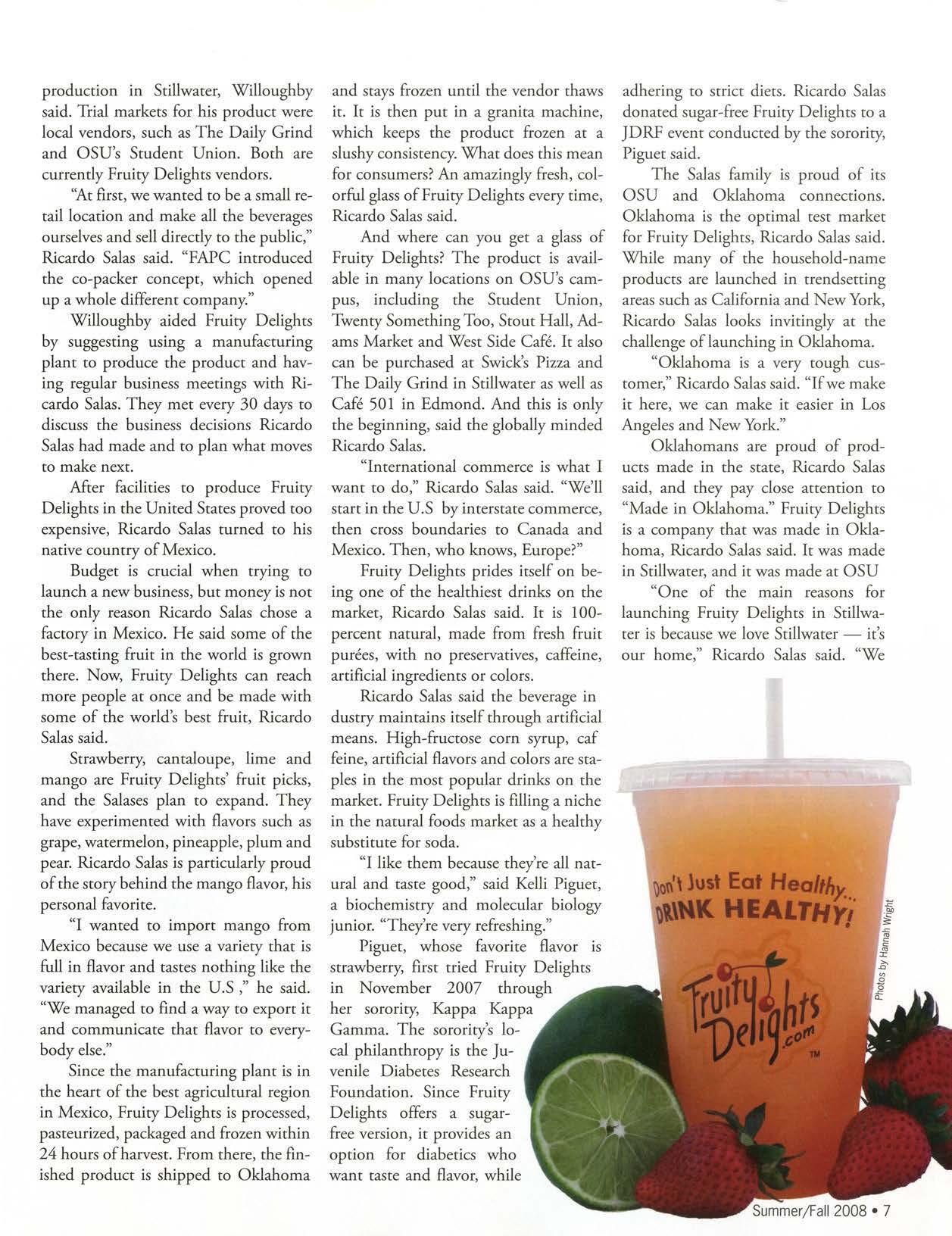
And where can you get a glass of Fruity Delights? The product is available in many locations on OSU's campus, including the Student Union, Twenty Something Too, Stout Hall, Adams Market and West Side Cafe. It also can be purchased at Swick's Pizza and The Daily Grind in Stillwater as well as Cafe 501 in Edmond. And this is only the beginning, said the globally minded Ricardo Salas.
"International commerce is what 1 want to do," Ricardo Salas said. "We'll start in the U .S by interstate commerce, then cross boundaries to Canada and Mexico. Then, who knows, Europe?"
Fruity Delights prides itself on being one of the healthiest drinks on the market, Ricardo Salas said. It is 100percent natural, made from fresh fruit purees, with no preservatives, caffeine, artificial ingredients or colors.
Ricardo Salas said the beverage in dustry maintains itself through artificial means. High-fructose corn syrup, caf feine, artificial flavors and colors are staples in the most popular drinks on the market. Fruity Delights is filling a niche in the natural foods market as a healthy substitute for soda.
"I like chem because they're all natural and caste good," said Kelli Piguet, a biochemistry and molecular biology junior. "They're very refreshing."
Piguet, whose favorite flavor is strawberry, first cried Fruity Delights in November 2007 through her sorority, Kappa Kappa Gan1ma. The sorority's local philanthropy is the Juvenile Diabetes Research Foundation. Since Fruity Delights offers a sugarfree version, it provides an option for diabetics who want taste and flavor, while
adhering to strict diets. Ricardo Salas donated sugar-free Fruity Delights to a JDRF event conducted by the sorority, Piguet said.
The Salas family is proud of its OSU and Oklahoma connections. Oklahoma is me optimal cesc market for Fruity Delights, Ricardo Salas said. While many of rhe household-name products are launched in trendsetting areas such as California and New York, Ricardo Salas looks invitingly at the challenge of launching in Oklahoma.
"Oklahoma is a very rough customer," Ricardo Salas said. "If we make it here, we can make it easier in Los Angeles and New York."
Oklahomans are proud of products made in the state, Ricardo Salas said, and they pay close attention to "Made in Oklahoma." Fruity Delights is a company that was made in Oklahoma, Ricardo Salas said. It was made in Srillwater, and ic was made at OSU
"One of the main reasons for launching Fruity Delights in Stillwater is because we love Scillwacer- it's our home," Ricardo Salas said. "We
love campus, and we want to give the opportunities that we learned through the process of creating Fruity Delights to 0SU's students."
Fruity Delights grew rapidly, and Pepper alas was able to quit her job to become the chief operations officer of the company.
Just as the Salas family is proud of Stillwater and 0SU, those who know Fruity Delights' story willingly support the company.
"You know you're supporting someone who was here at 0SU," Piguet said. "Being an 0SU srudent, I'm kind of following in bis footsteps, and it's nice having people like chat."
Fruity Delights has a wonderful beginning, and the future looks bright. Thanks to a driven entrepreneur, the help of FAPC and a wonderfi.i.lproduct, Stillwater and 0SU have a company of which they can be proud, and chat company is here co stay.-.
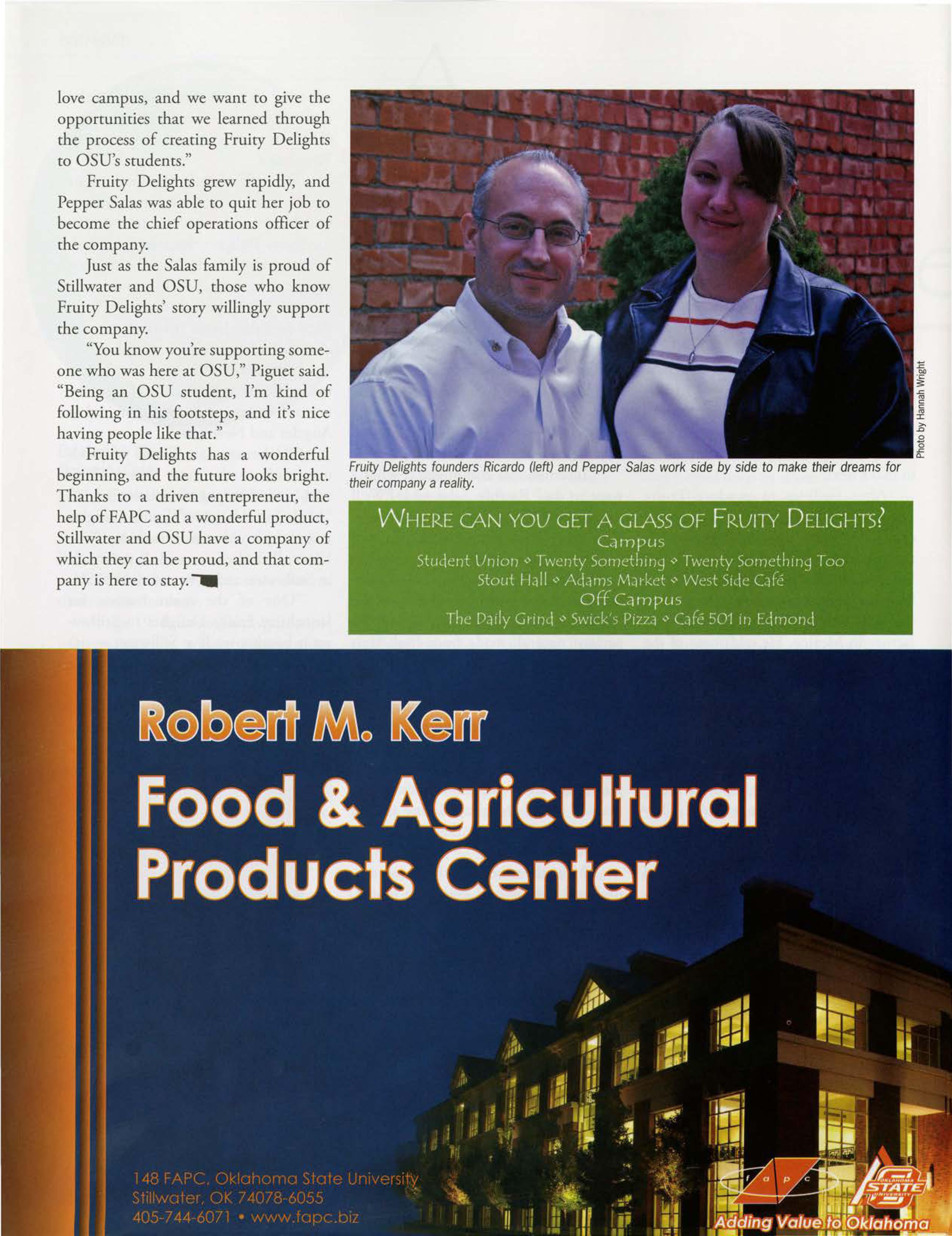
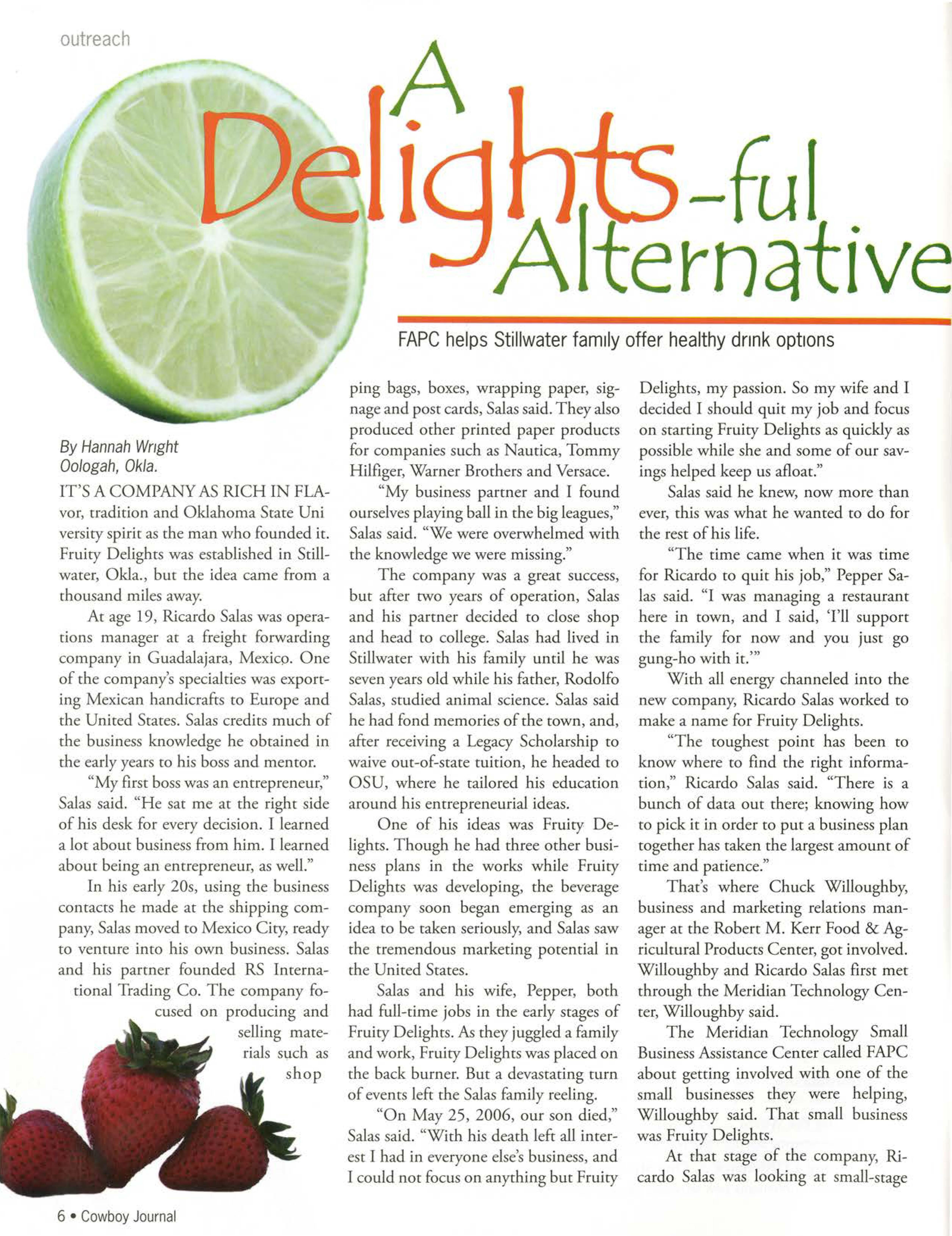
FruityDelightsfoundersRicardo(lefVand PepperSalaswork side by side to maketheir dreamsfor their companya reality.
C~tn()US.
StudenU/nron ,' Twenty Solllething-> Twenty Something Too Stout l·i:tll ,, Ahrns M:irket ,, West Side C::i(e Off C<1mpus The DailyG1·incl,, Swick's Pfv., ,, C:i(c50'! i11Edmond
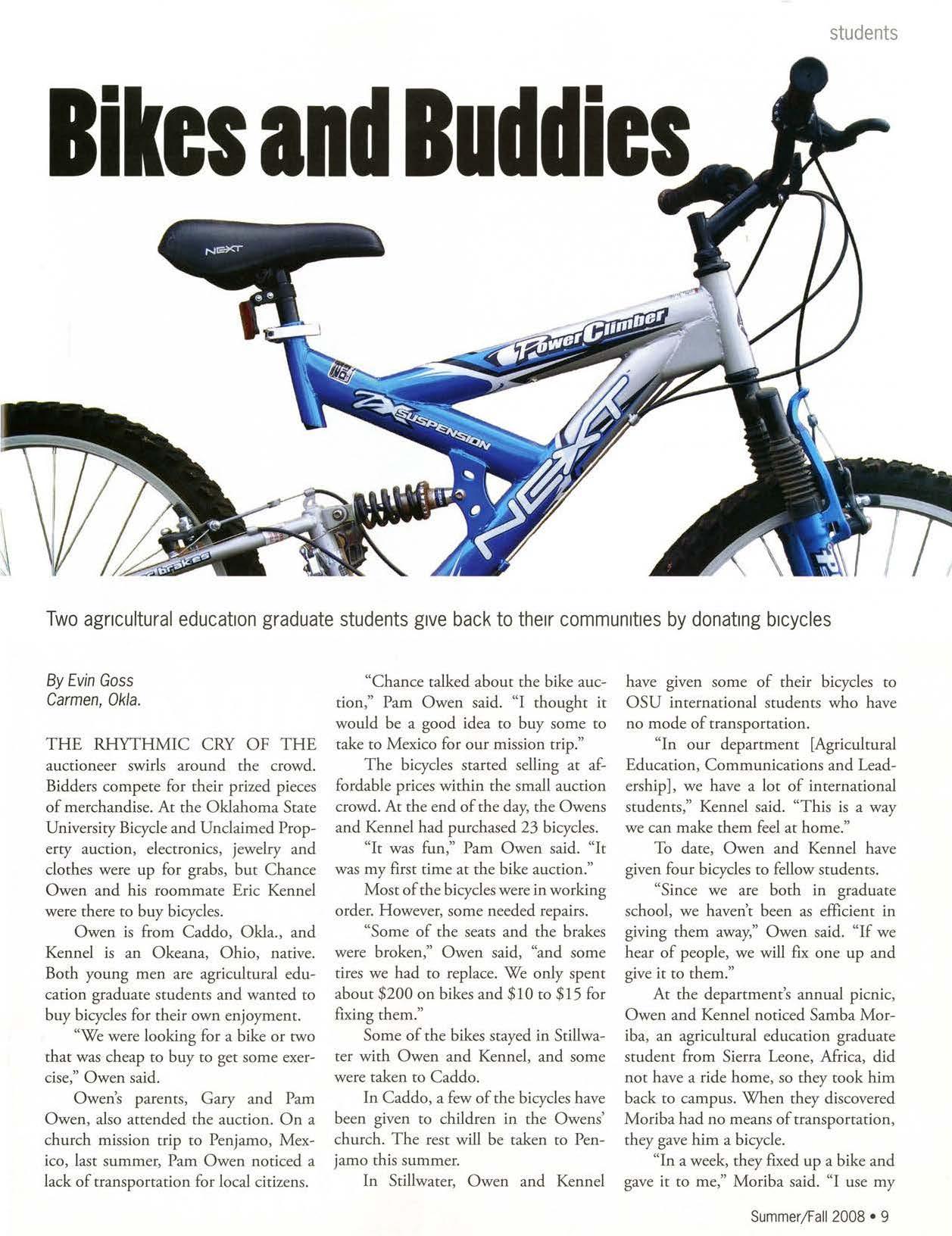
Twoagriculturaleducationgraduatestudentsgive backto their communitiesby donatingbicycles
By EvinGoss Carmen,Okla.
THE RHYTHMIC CRY OF THE auctioneer swirls around the crowd. Bidders compete for their prized pieces of merchandise. At the Oklahoma Seate University Bicycle and Unclaimed Property auction, electronics, jewelry and cloches were up for grabs, but Chance Owen and his roommate Eric Kennel were there to buy bicycles.
Owen is from Caddo, Okla., and Kennel is an Okeana, Ohio, native. Both young men are agricultural education graduate students and wanted to buy bicycles for their own enjoyment.
"We were looking for a bike or two that was cheap to buy to get some exercise," Owen said.
Owen's parents, Gary and Pam Owen, also attended the auction. On a church mission trip co Penjamo, Mexico, last summer, Pam Owen noticed a lack of transportation for local citizens.
"Chance talked about the bike auction," Pam Owen said. "I thought it would be a good idea co buy some co take to Mexico for our mission trip."
The bicycles started selling ac affordable prices within the small auction crowd. At the end of the day, che Owens and Kennel had purchased 23 bicycles.
"Ir was fun," Pam Owen said. "Ir was my first time at the bike auction."
Mose of the bicycles were in working order. However, some needed repairs.
"Some of the seats and the brakes were broken," Owen said, "and some tires we had to replace. We only spent about $200 on bikes and $10 co $15 for fixing them."
Some of the bikes stayed in Stillwater with Owen and Kennel, and some were taken to Caddo.
In Caddo, a few of the bicycles have been given to children in the Owens' church. The rest will be taken to Penjamo chis summer.
In Stillwater, Owen and Kennel
have given some of their bicycles co OSU international students who have no mode of transportation.
"In our department [Agricultural Education, Communications and Leadership], we have a lot of international students," Kennel said. "This is a way we can make them feel at home."
To dare, Owen and Kennel have given four bicycles to fellow students.
"Since we are both in graduate school, we haven't been as efficient in giving them away," Owen said. "If we hear of people, we will fix one up and give it co them."
At the departmenc's annual picnic, Owen and Kennel noticed Samba Moriba, an agricultural education graduate student from Sierra Leone, Africa, did not have a ride home, so they cook him back to campus. When they discovered Moriba had no means of transportation, they gave him a bicycle.
"In a week, they fixed up a bike and gave it to me," Moriba said. "I use my
bike every day, excepc when ic now I don't have a car and besides, i is good exerci e for me."
Mo r of the bicycle sold at the aucrion were abandoned and unclaimed on campus by students, aid Jan ook-Hernandez, a i cant manager of O U Parking and Tran it ervices. 0 U Parking and Transit Services and the O U Police Department conduct the O U Bicycle and Unclaimed Property Auction.
'We normaJly do rhe auction once a year," Cook-Hernandez said, 'but this year we are doing rwo."
The Owen and K nnel bought their bicycle at rhe August 2007 auction. An additional auction was held April 15 The annual aucrion will be held in August.
Owen and Kennel said they plan to attend the bicycle auction every year and continue to buy and donate bicycles.
Owen and Kennel aid they both love having the opportunity to give to others.
"If you give a licde [co other ], you get a lot in return," Owen said.-.
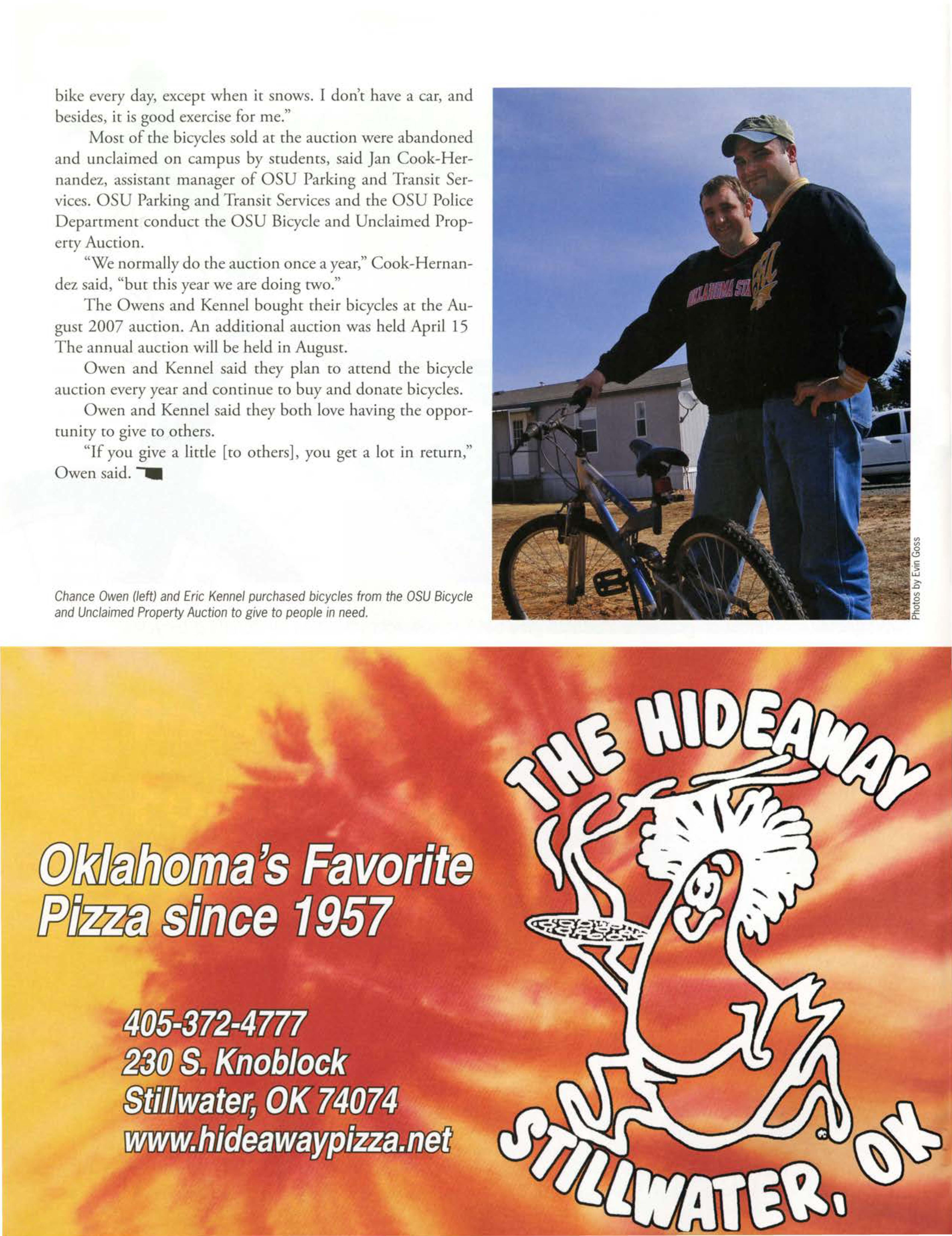
ChanceOwen(left)andEric Kennelpurchasedbicyclesfrom the OSUBicycle and UnclaimedPropertyAuctionto give to peoplein need.
By CallieHadley Midland,Texas
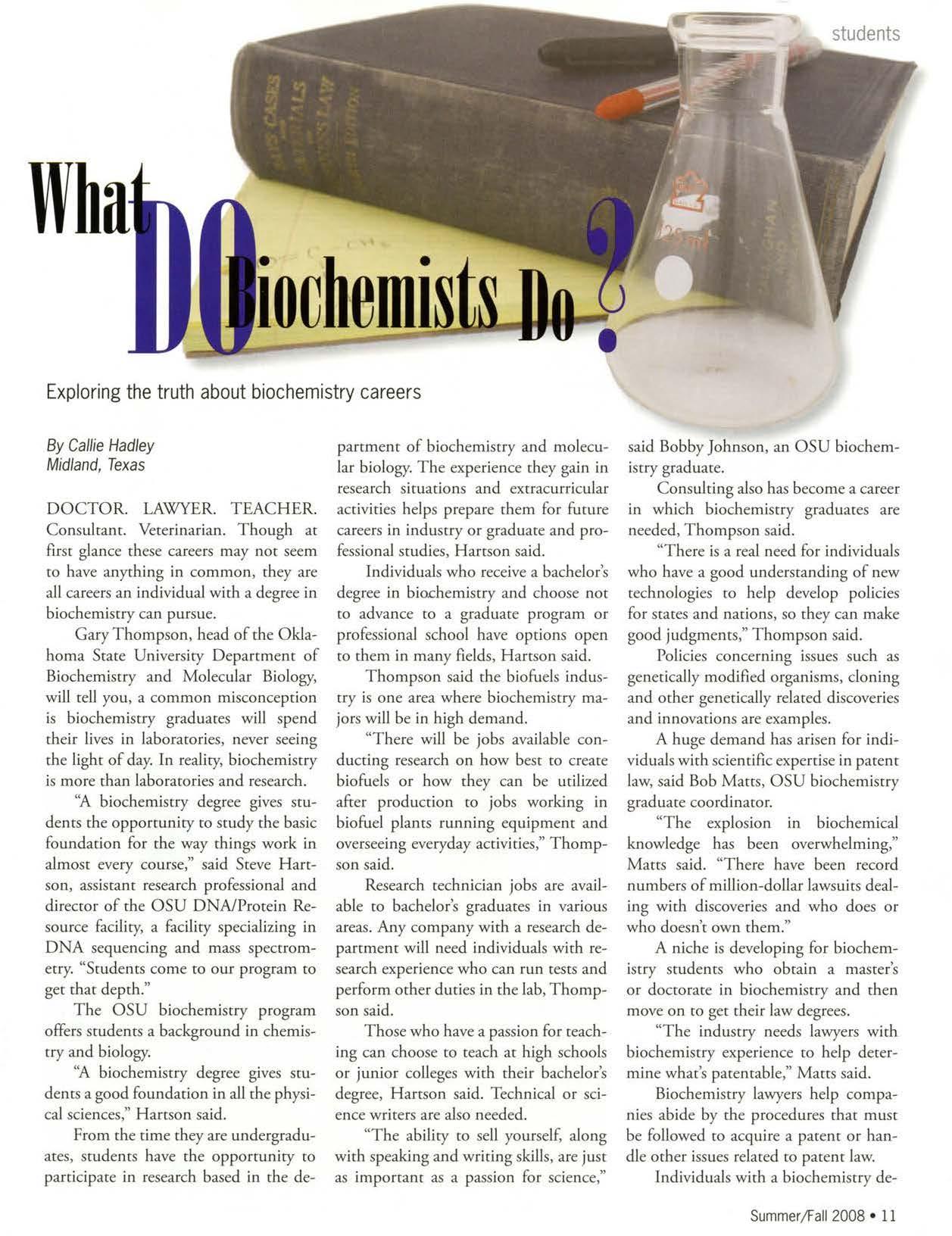
DOCTOR. LAWYER. TEACHER. Consultant. Veterinarian. Though at first glance these careers may noc seem to have anything in common, they are all careers an individual with a degree in biochemistry can pursue.
Gary Thompson, head of the Oklahoma Scace University Department of Biochemistry and Molecular Biology, will ceUyou, a common misconception is biochemistry graduates will spend their lives in laboracories, never seeing the light of day. In reality, biochemistry is more than laboratories and research.
"A biochemistry degree gives scudenrs the opporcunicy co study the basic foundation for the way things work in almost every course," said Steve Hanson, assistant research professional and direccor of the OSU DNA/Protein Resource facility, a facility specializing in DNA sequencing and mass spectrometry. "Srudencs come co our program to gee that depth."
The OSU biochemistry program offers students a background in chemisrry and biology.
"A biochemistry degree gives students a good foundation in all the physical sciences," Hanson said.
From the time they are undergraduates, students have the opportunity to participate in research based in the de-
parrmenr of biochemistry and molecular biology. The experience they gain in research situations and extracurricular activities helps prepare them for future careers in industry or graduate and professional studies, Hartson said.
Individuals who receive a bachelor's degree in bio.chemiscry and choose not co advance to a graduate program or professional school have options open to them in many fields, Hartson said.
Thompson said the biofuels industry is one area where biochemistry majors will be in high demand.
"There will be jobs available conducting research on how best to create biofuels or how they can be utilized after production co jobs working in biofuel plants running equipment and overseeing everyday activities," Thompson said.
Research technician jobs are available co bachelor's graduates in various areas. Any company with a research department will need individuals with research experience who can run tests and perform other duties in che lab, Thompson said.
Those who have a passion for teaching can choose ro reach ac high schools or junior coUeges with their bachelor's degree, Hartson said. Technical or science writers are also needed.
"The ability ro sell yourself, along with speaking and writing skills, are just as imporranc as a passion for science,"
said Bobby Johnson, an OSU biochemistry graduate.
Consulting also has become a career in which biochemistry graduates are needed, Thompson said.
"There is a real need for individuals who have a good understanding of new technologies ro help develop policies for stares and nations, so they can make good judgments," Thompson said.
Policies concerning issues such as generically modified organisms, cloning and ocher genetically related discoveries and innovations are examples.
A huge demand has arisen for individuals with scientific expertise in patent law, said Bob Mares, OSU biochemistry grad uare coordinator.
"The explosion in biochemical knowledge has been overwhelming," Matts said. "There have been record numbers of million-dollar lawsuits dealing with discoveries and who does or who doesn't own chem."
A niche is developing for biochemistry students who obtain a master's or doctorate in biochemistry and then move on co gee their law degrees.
"The industry needs lawyers with biochemistry experience ro help determine what's patentable," Matts said.
Biochemistry lawyers help companies abide by the procedures chat must be followed co acquire a patent or handle other issues related co patent law.
Individuals with a biochemistry de-
gree are not limited to geccing a job in biochemistry, Maces said. He suggests immunology, pharmacology and entomology as a few of the various options biochemistry students have available co chem after graduation.
Lenora Volk, a 2001 OSU biochemistry graduate, agreed. However, she said she cells students an advanced degree is aJwaysan option when they think about the future.
Volk, a Tulsa native, completed a bachelor's degree in biochemistry at OSU. She participated in research in Hanson's lab from her freshman year until graduation.
After graduacing from OSU, she earned a doctorate in neuroscience at the University of Texas Southwest Medical Center. She began pose-doctorate work in neuroscience at Johns Hopkins University in January 2008.
"Probably the best option is to go to graduate school and then enter the work force," Volk said.
Biochemistry graduates can earn a master's degree, but they have a unique option, also.
"When getting a graduate degree in biochemistry, you can go straight from your bachelor's into a Ph.D.," Thompson said. "However, if an individual isn't sure what they wane co do, getting a master's degree gives chem an opporrunity to chink about it."
Students can gee a master's in aJmosr anything chat relares co the field they wish to pursue, including biochemistry, Maces said. "le can reaJly give students that extra edge above the competition."
Students who are on the edge of getting into medical school often find getting a master's degree can help them get in where they wouldn't have otherwise. A master's degree also can make scudenrs more competitive in doctoral programs in other disciplines outside biochemistry, be said.
Professional degree options aJso are available in medicine, veterinary medicine or dentistry.
"The biochemistry degree prepares students for any professionaJ program in
medicine," Thompson said. "Our sntdencs go into graduate-level programs well-prepared because of the rigorous level of coursework required for a bachelor's degree."
The M.D./Ph.D., the doctor of medicine and the doctor of philosophy in biochemistry, is a degree combination available to students, Hartson said.
lndividuaJs who wish co go into the medical or pharmaceutical industries should consider working coward their M.O./Ph.D, he said.
"This program allows individuals to perform clinical trials and other research where they actually get co interact with human patients," Hartson said.
Hartson said other professionaJ programs such as veterinary medicine or dentaJ schools appreciate biochemistry graduates because of cheir research experiences and abilities to balance chaJlenging coursework and ocher activities.
The biochemistry and molecular biology program offers pre-professional degrees for medical and veterinary studies co help prepare students for professional schools. The challenging coursework helps students to be prepared and accepted co more competitive programs when they fmaJly apply, Thompson said.
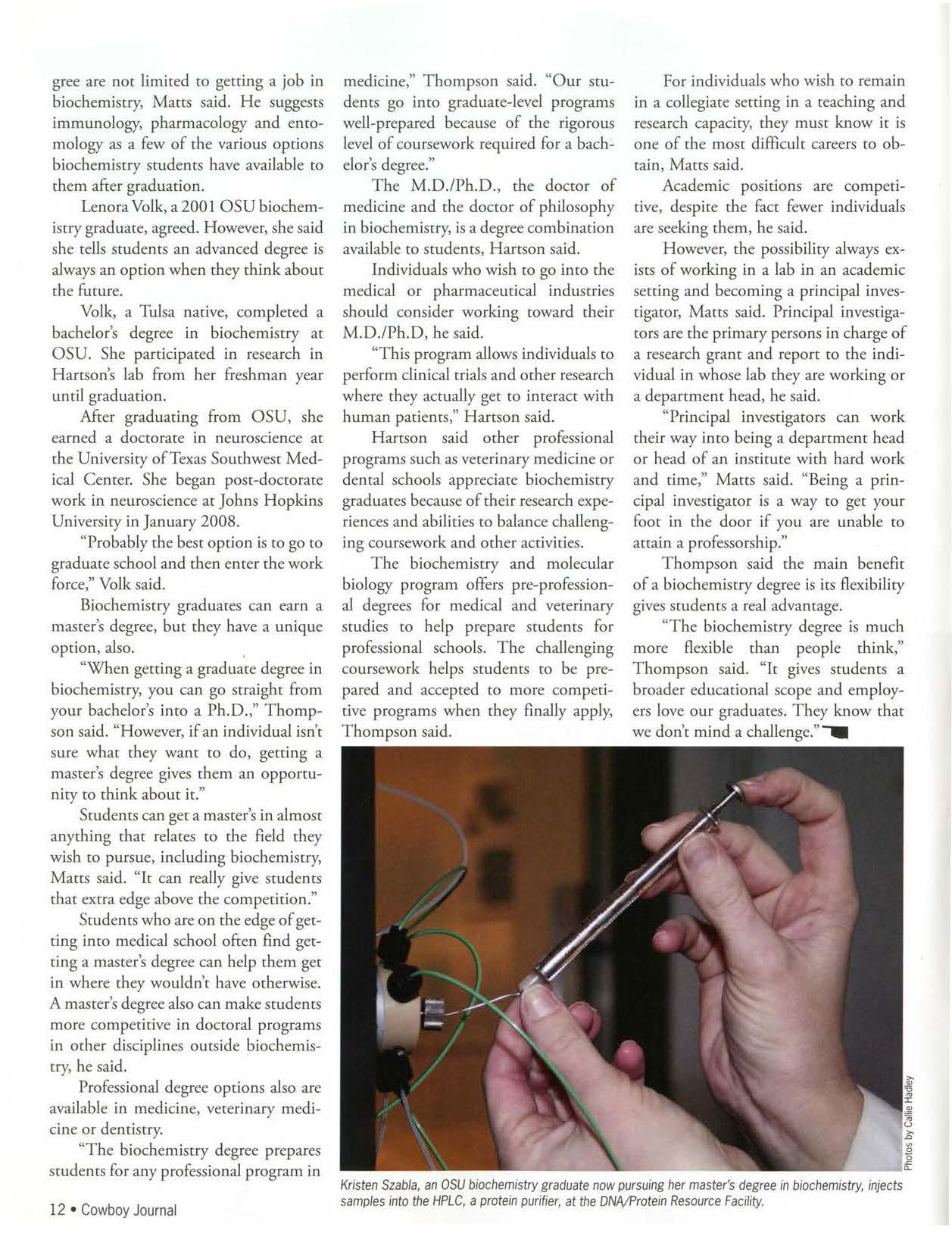
For individuals who wish to remain in a collegiate setting in a teaching and research capacity, they must know it is one of the most difficult careers to obtain, Macessaid.
Academic positions are competitive, despite the face fewer individuaJs are seeking chem, he said.
However, the possibility always exists of working in a lab in an academic setting and becoming a principaJ investigator, Marts said. Principal investigators are the primary persons in charge of a research grant and report to the individual in whose lab rhey are working or a department head, he said.
"Principal investigators can work their way into being a department head or head of an institute with hard work and time," Matts said. "Being a principal investigator is a way co gee your foot in the door if you are unable to attain a professorship."
Thompson said the main benefit of a biochemistry degree is its flexibility gives scudencs a real advan cage.
"The biochemistry degree is much more flexible than people chink," Thompson said. "Ir gives students a broader educational scope and employers love our graduates. They know chat we don't mind a chaJlenge.",a
By SkylerSelby Gage,Okla.
FOR STUDENTS fN THE COLLege of Agricultural Sciences and Natural Resources, raising scholarship money for their fellow students is only a phone call away.
CASNR student leaders, faculty and the Oklahoma ScaceUniversity Foundation are working hand-in-hand co raise money for CASNR students.
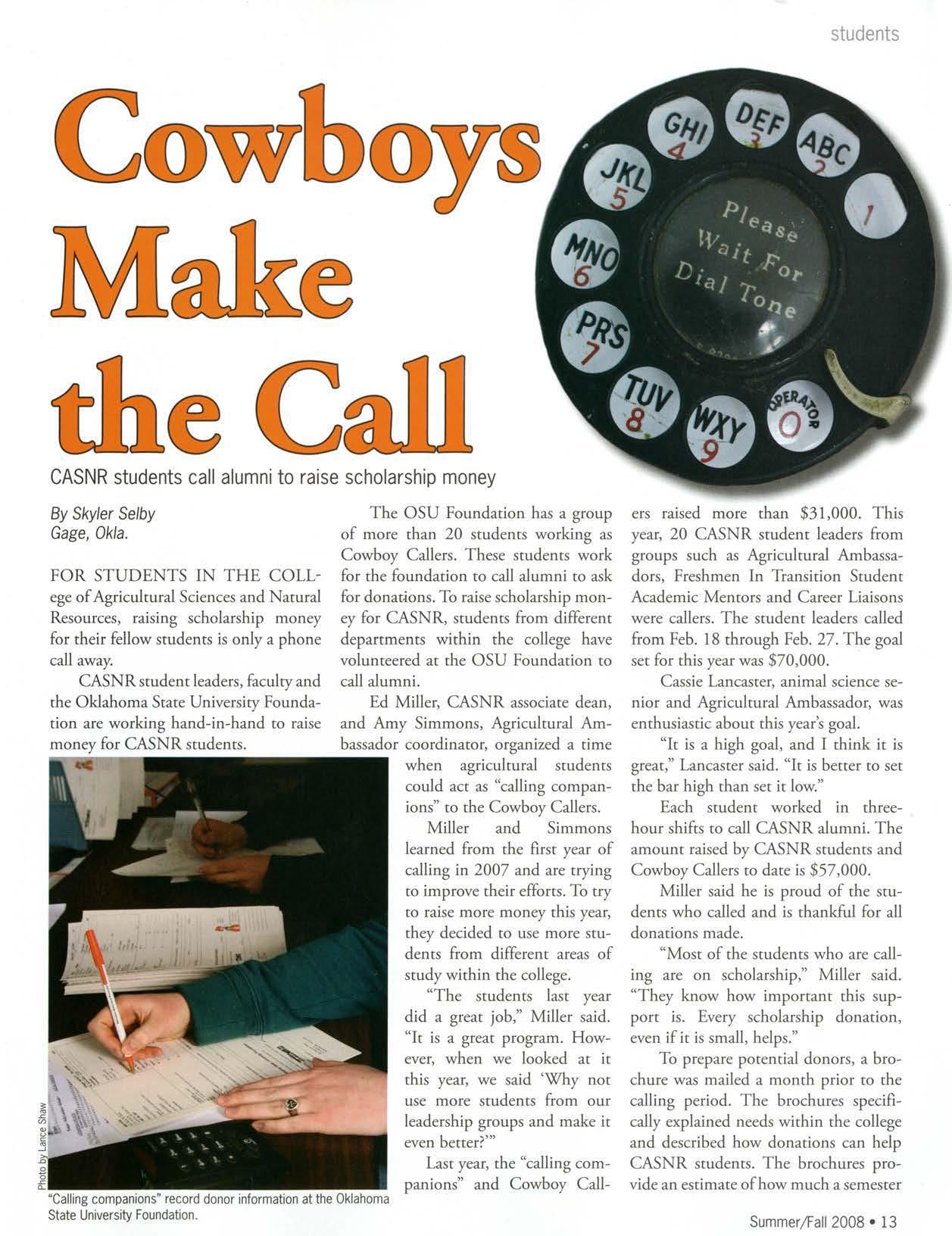
The OSU Foundation has a group of more chan 20 students working as Cowboy Callers. These students work for the foundation to call alumni co ask for donatfons. To raise scholarship money for CASNR, srudencs from different departments within the college have volunteered at the OSU Foundation to call alumni.
Ed Miller, CASNR associate dean, and Amy Simmons, Agricultural Ambassador coordinator, organized a rime when agricultural students could act as "calling companions" co the Cowboy Callers.
Miller and Simmons learned from che first year of calling in 2007 and aJe trying co improve their efforts. To try to raise more money this year, they decided co use more srudencs from different areas of srudy within the college.
"The students lase year did a great job," Miller said. "le is a great program. However, when we looked at it this year, we said 'Why nor use more srudencs from our leadership groups and make ic even better?"'
Lase year, the "calling companions" and Cowboy Call-
ers raised more than $31,000. This year, 20 CASNR student leaders from groups such as Agricultural Ambassadors, Freshmen In Transition Student Academic Mentors and Career Liaisons were callers. The student leaders called from Feb. 18 through Feb. 27. The goal sec for this year was $70,000.
Cassie Lancaster, animal science senior and Agricultural Ambassador, was enthusiastic about this year's goal.
"It is a high goal, and I think it is great," Lancaster said. "Tcis better to sec che bar high chan set it low."
Each student worked in chreehour shifts co call CASNR alumni. The amount raised by CASNR students and Cowboy Callers to dace is $57,000.
MiUer said he is proud of the srudencs who called and is thankful for all donations made.
"Mose of the students who are calling are on scholarship," Miller said. "They know how important this support is. Every scholarship donation, even if it is small, helps."
To prepare potential donors, a brochure was mailed a month prior to che calling period. The brochures specifically explained needs within the college and described how donations can help CASNR students. The brochw-es provide an estimate of how much a semester
at O U can cost to give donors a better idea of the monetary needs of roday's srudenrs. The brochures also let donors know about cheir options.
Donors can choose ro conrribure to a wide range of options: The CAR general scholarship fund· a specific scholarship, department, major or program; or student leadership and service scholar hip to provide students an international educational experience.
"People want ro be generous," said Debbie ance director of the annual giving program for the OSU Foundation. "They want to know their gift i going ro matter. The brochures help them with that."
Using srudenrs as Cowboy Callers is an effective and personal way ro raise money for CASNR.
"We try to reach as many alumni as we can in a short amount of time," ance said. "It helps when students are in the same area of study as the alumni.
rudents have a great time talking to alumni and it i a good way for chem co bLtild relarion hips and network."
CA Rstudent were excited about being "calling companions."
"I thought it really ounded like a lot of fun," Lancaster said. "I jumped on chat. I actually got co call my parent , and that was really fun!"
tudencs who volunteered co be "calling companions" said they realized how important donations can be and enjoyed connecting with alumni.
"This college has done a !or for me, and it is a great way for me co give back," Lancaster said. "I think it is so crucial co build relationships with alumni."
Last year was the first rime CAS R tudents were "calling companions." To becrer prepare them for calling this year, a training ession wa held prior to calling sessions.
allers pent time discus ing different calling scenarios, the anatomy of a
phone call and how to u e calling cripc while calking co alumni.
"The uaining teaches the callers how co build rapport and ba ically have a successful phone call," said Heather Briggs, annual giving coordinator for the OSU Foundarion. ' They also learned about th paperwork chat i involved and how to u e the phone."
Miller said it is good to use rudenrs for Cowboy Callers because of the close relationships between CASNR alumni and stud en cs.
"There is a strong connection in A R between our alumni and the deparcmenrs from which they graduated char you don't find in ch other colleges," Miller said. "We wanr co do everything we can do to maintain those wonderful relationships with our alumni.",.
To donate to CASNR, call the OSU Fou.ndAtion at 800-622-4678 or visit http:11OSUgiving.com.
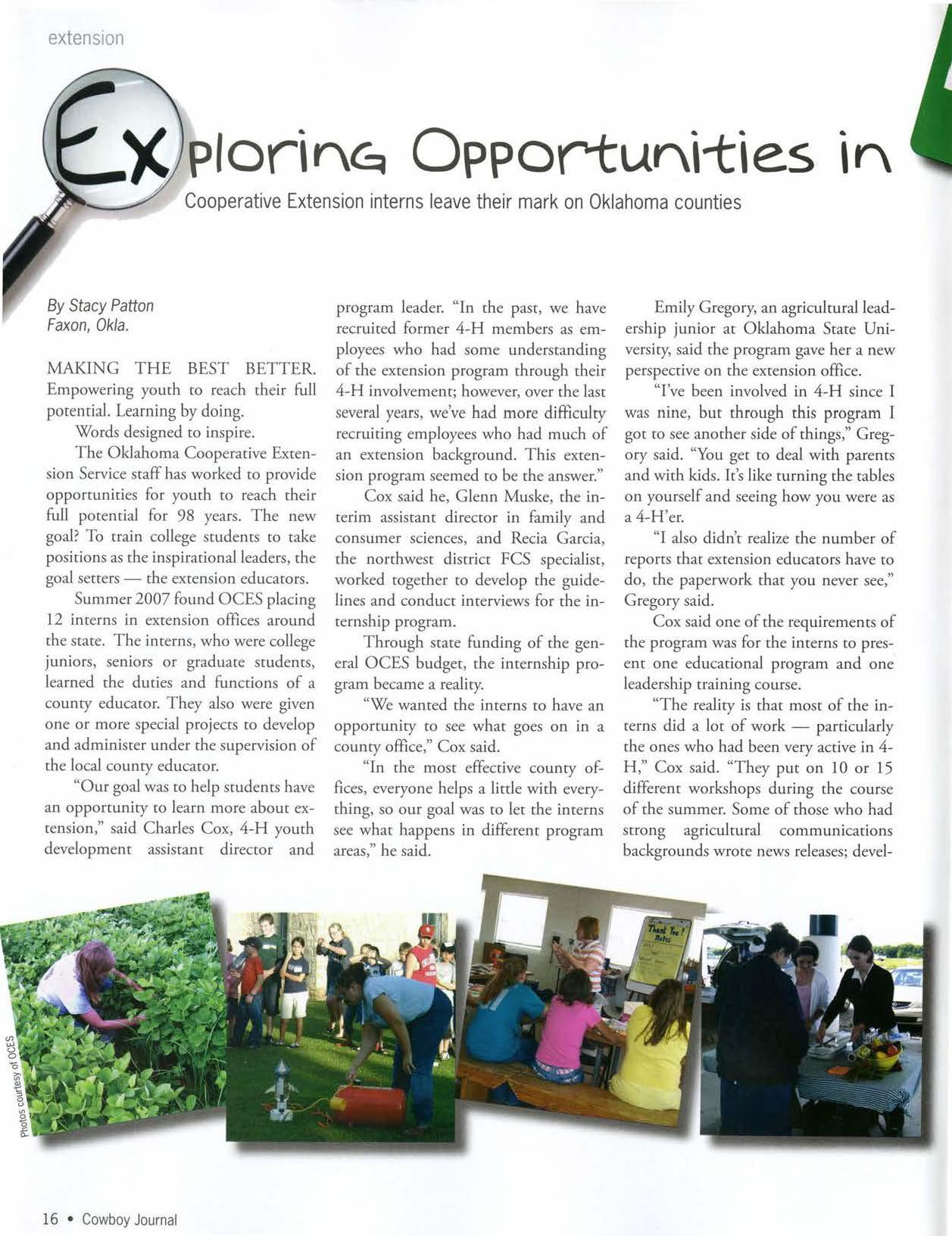
By StacyPatton Faxon,Okla.
Empowering youch to reach rheir full potential. Learning by doing.
Words designed co inspire.
The Oklahoma Cooperative Extension Service staff has worked to provide opportunities for youth to reach their full potential for 98 years. The new goal? To train college students to take positions as the inspirational leaders, the goal setters - the extension educators.
Summer 2007 found OCES placing 12 interns in extension offices around the state. The incerns, who were college juniors, seniors or graduate studencs, learned the duties and functions of a county educaror. They also were given one or more special projects to develop and administer under rhe supervision of the local county educator.
"Our goal was co help scudencs have an opportunity to learn more about extension," said Charles Cox, 4-H youth developmenr assistant director and
program leader. "In the past, we have recruited former 4-H members as employees who had some understanding of rhe extension program through their 4-H involvement; however, over the last several years, we've had more difficulty recruiting employees who had much of an extension background. This extension program seemed ro be the answer."
Cox said he, Glenn Muske, the interim assisrant director in family and consumer sciences, and Recia Garcia, the northwest district FCS specialist, worked cogecher to develop the guidelines and conduct interviews for the internship program.
Through state funding of the general OCES budget, the internship program became a reality.
"We wanted the interns to have an opportunity to see what goes on in a county office," Cox said.
"In the most effective county offices, everyone helps a litde with everything, so our goal was to let the interns see what happens in different program areas," he said.
Emily Gregory, an agriculrural leadership junior at Oklahoma State University, said the program gave her a new perspective on the extension office.
"I've been involved in 4-H since I was nine, bur through this program I got to see another side of things," Gregory said. "You get to deal with parents and with kids. lc's like turning the tables on yourself and seeing how you were as a 4-H'er.
"I also didn't realize the number of reports that extension educators have to do, the paperwork that you never see," Gregory said.
Cox said one of che requirements of the program was for the interns to present one educational program and one leadership training couJ"Se.
"The reality is rhat most of the interns did a lot of work - particularly the ones who had been very active in 4H," Cox said. "They put on l O or 15 different workshops during the course of the summer. Some of those who had strong agricultural communications backgrounds wrote news releases; <level-
oped publications, brochures and fliers; and marketed things. It was phenomenal the amount of work they did within their hosting counties."
Cox said counties hosting interns beneficed greatly from the experience.
"We had a few counties that applied and said, 'We're not sure if we want to do this because we don't wam co have co baby-sir somebody,"' Cox said. "Then at the end they were saying, 'Dang, chis is a good thing!'"
Kyle Worthington, extension educator in Oklahoma County, said the internship program was an excellent opportunity for the interns as well as the extension staff at the county level.
"Our intern [Rachel Perryman] was a blessing for a couple of reasons," Worthington said. "She rook on a large role in helping plan, coordinate and present programming for our county's youth retreat. She was just very professional with youth and adult audiences."
Likewise, Gregory said her experiences with the volunteer leaders in Bryan County were positive.
"Our volunteer leaders really complimented me," Gregory said. "I gor gifts from them when I left, which really helped me understand chat I actually made an impact."
Cox said rhe program is nor limited to OSU students. However, preference is given co juniors, seniors and graduate studenrs pursuing a major in che College of Agricultural Sciences and Natural Resources or the College of Human Environmental Sciences or co students with majors in other colleges that relate to employability with the OCES.
"We even have an international student planning co attend OSU in the fall who sent in an application," Cox said. "This student has an interest primarily in rural development and wanted co learn more about extension. He also wanted ro get acquainted with everything before he came to school."
Cox said the interns could express a preference for the county where they wanted to work, but the final assignment depended on counry needs and the collective preferences of all appli-
cants. To provide a student with new experiences, however, placement in the student's home county is avoided if possible, Cox said.
Because the extension intern program was a success, Cox said continuing tl1e program will not be an issue.
"Of the 12 sites tl1at we need for interns, we've bad about 20 counties that have applied co hose," Cox said. "We also had some that will fund their own positions, so I think the program will continue to grow."
Cox said the best way to tell if rhe program is a success is to see how many interns pursue a career within the extension field.
"Several of the interns said, 'This is for sure where I'm going co end up and what I want co do; this is the career I want to pursue,"' Cox said. "I think we'll have several who will apply and explore extension opportunities."
For more information about the Oklahoma Cooperative Extension Service, visit http://www2.dasnr.okstate.edu/extension.
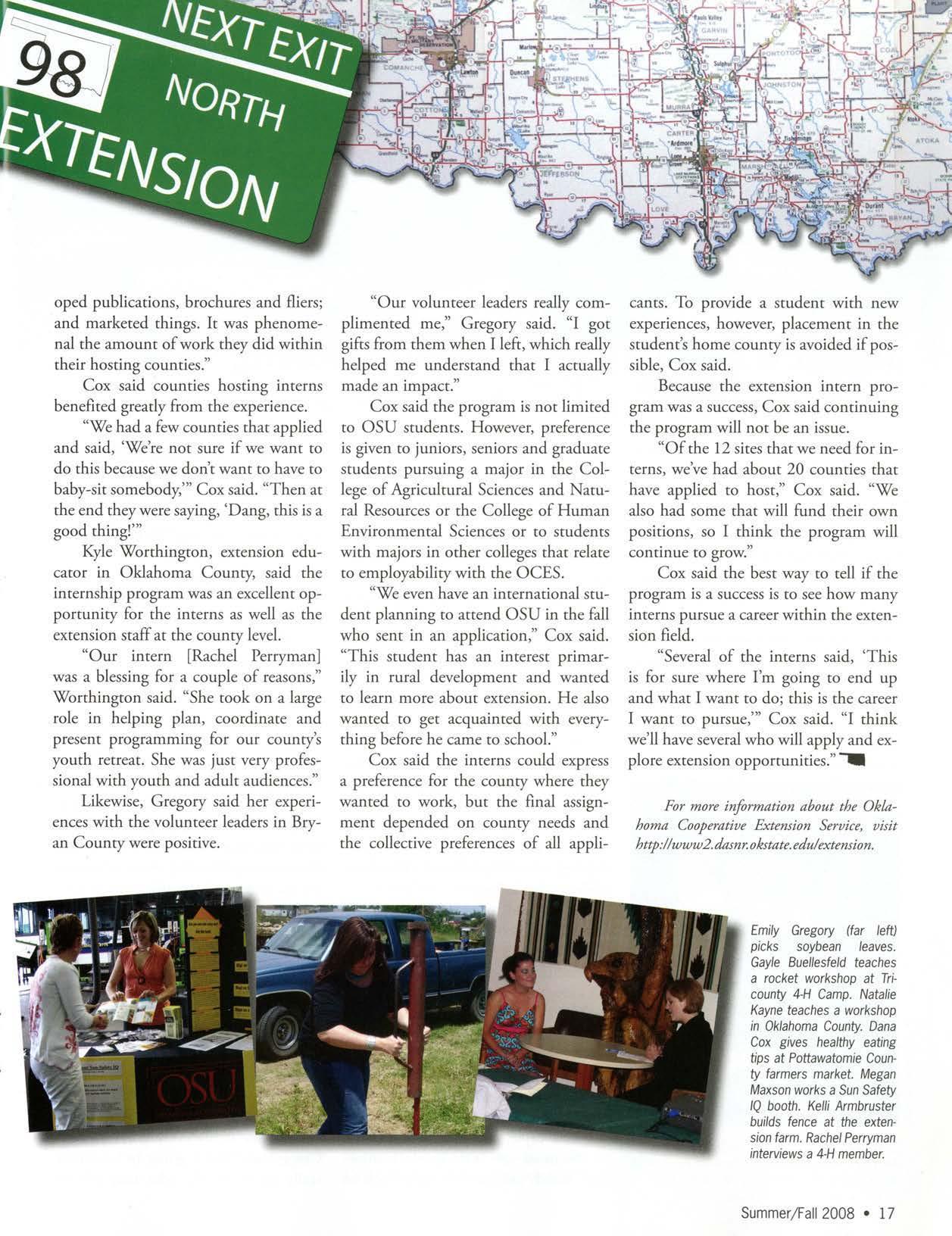
Emily Gregory (far le~) picks soybean leaves. Gayle Bue/lesfeldteaches a rocket workshopat Tr~ county 4-H Camp. Natalie Kayneteachesa workshop in OklahomaCounty.Dana Cox gives healthy eating tips at PottawatomieCounty farmersmarket. Megan Maxsonworksa SunSafety IQ booth. Kelli Armbruster builds fence at the extensionfarm.RachelPerryman interviewsa 4-Hmember.
By LanceShaw Chickasha,Okla.
WHEN APRIL SHOWERS BRING flowers, it can only mean one thing: Gardening season is back in full force. When the grass turns green and flowers scare to bloom, chose with green thumbs, and even those with noc-sogreen thumbs, need someone ro turn ro for all the latest tips and techniques. Thar person is Kim Rebek with "Oklahoma Gardening."
The 33rd season of "Oklahoma Gardening" is under way from the Oklahoma Botanical Gardens in Stillwater
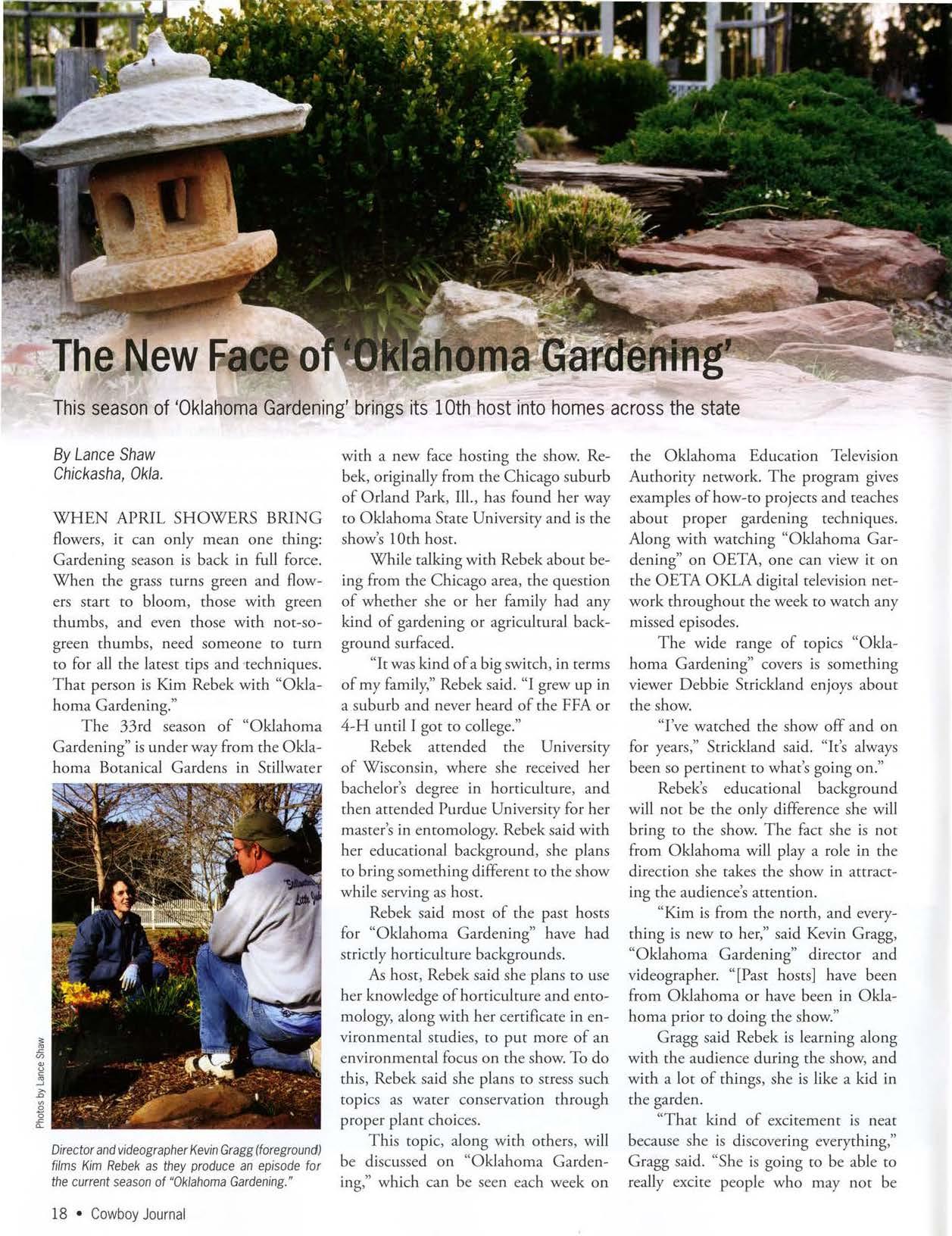
DirectorandvideographerKevinGragg(foreground) filmsKim Rebekas they producean episodefor the currentseasonof "OklahomaGardening."
with a new face hosting the show. Rebek, originally from the Chicago suburb of Orland Park, 111.,has found her way ro Oklahoma State University and is the show's l 0th hose.
While talking with Rebek about being from the Chicago area, the question of whether she or her family had any kind of gardening or agricultural background surfaced.
"It was kind of a big switch, in terms of my family," Rebek said. "I grew up in a suburb and never heard of the FFA or 4-H uncil 1 got ro college."
Rebek attended the University of Wisconsin, where she received her bachelor's degree in horticulture, and then attended Purdue University for her master's in entomology. Rebek said with her educational background, she plans ro bring something different co the show while serving as host.
Rebek said most of che past hoses for "Oklahoma Gardening" have had strictly horticulture backgrounds.
As host, Rebek said she plans to use her knowledge of horticulture and enromology, along with her certificate in environmental studies, co puc more of an environmental focus on the show. To do chis, Rebek said she plans ro stress such topics as water conservation through proper planr choices.
This ropic, along with others, will be discussed on "Oklahoma Gardening," which can be seen each week on
the Oklahoma Education Television Authority network. The program gives examples of how-to projects and reaches about proper gardening techniques. Along wich watching "Oklahoma Gardening" on OETA, one can view it on rhe OETA OKLA digital television network throughout the week ro wacch any missed episodes.
The wide range of topics "Oklahoma Gardening" covers is something viewer Debbie Strickland enjoys about the show.
"I've watched the show off and on for yea.rs," Strickland said. "Ir's always been so pertinent to what's going on."
Rebek's educational background will noc be the only difference she will bring to the show. The face she is not from Oklahoma will play a role in the direction she takes che show in attracting the audience's attention.
"Kim is from che north, and everything is new to her," said Kevin Gragg, "Oklahoma Gardening" director and videographer. "[Past hosts] have been from Oklahoma or have been in Oklahoma prior to doing the show."
Gragg sai.d Rebek is learning along with the audience during the show, and with a lot of things, she is like a kid in the garden.
"That kind of excitement is neat because she is discovering everything," Gragg said. "She is going ro be able ro really excite people who may not be
knowledgeable of the subject, almost to where she will come across as thoLJgh she is learning things at the same time."
ince Rebek is new to the show, nor only as rhe host bur also as a viewer, Gragg said he is crying to be open co her ideas and nor do things the way they usually do.
"I am letting her find her way," Gragg said.
When asked what Gragg was looking forward co chis season, he said it would be the opportunity of "gelling" more with Kim.
"Kim and I are still learning to dance cogether," Gragg said. "I equate it to dancing to where you have to learn what each person is chinking in order to furn the show."
The 2008 season of "Oklahoma Gardening" will be on the road for various episodes. Rebek said rhe show plans co visit 12 member gardens associated with rhe Oklahoma Botanical Garden and Aiboretum. While on the road visiting the member gardens the show plans to visir the northwest corner of the scare and feature gardening and growing for that region, Rebek aid.
"One aspect of the show is chat we vi it garden across the state and chose include homeowner's gardens public gardens or businesses," Rebek said.
She sajd another aspect of this season's show will be to expose viewers to the range of gardens across Oklal1oma. An example she mentioned was the plan for "Oklahoma Gardening" co visit an organic farm this season.
"I love the regional stuff because Oklal10ma is so diverse," Gragg said. "There is a huge difference in che types of plants chat can be grown from region co region."
trickland said she also enjoys the regional episodes thar hjghlighr rhe diversity of Oklahoma.
"To me, Oklahoma is distinctively divided into thirds," she said. "[Regional] epi odes give you, the viewer, an idea of the many characteristics of the state and whar rhe different areas have to offer."
The idea of traveling is somewhat of a new concept for the show, which started when former hosr Steve Owens and Gragg began going on the road. Gragg said these trips started a short trip around the state that could be done in a day and then became regional tours.
"We would go out for a week and concencra e on one region of the stare and its gardens and special plants for chat region," Gragg said. "We just kind of stumbled into things and people liked the idea, so we continued to do it."
Gragg said rhis year rhe show might be on the road more than ever.
Along with traveling the state this summer rhe show will have a series-long program about landscape design.
During this series, Rebek will discuss topics such as proper design element and different garden styles co use with rhe different landscapes of Oklahoma. Rebek also will describe different hardscape elements to use, uch as the type of stones landscapers can choose.
Continuing with the traveling theme of this season, Rebek said rhe show will visit various land cape designers and gardens in the Tulsa and Oklahoma Ciry area .
Even though it sounds like "Oklahoma Gardening" has a busy season ahead of it Rebek and fellow raff till find time to give back to viewers wirh the annual "Summer Garden fest," which is free co its viewers and the public.
"le is our way of thanking our viewers for watching the show," Rebek said.
Strickland attends "Summer Gardenfest" and said she likes being able to see the types of planes the hoses have used that she finds in her own yard.
"The longer you have your yard, the more shade you will have with the growth of your trees," said Strickland. " o co be able to go [to Gardenfest] and see the shade plants and the things that will grow in some sun but more shade is very enjoyable ro me."
This will be the seventh year for the celebration, which will rake place June 9 in the studio gardens located within the 0 U Botanical Gardens west of till-
water. Rebek said the event will include tours of the OSU Botanical Gardens and a workshop with Barbara Brown, an extension food specialist. This year's theme is "Insects and Gardens" and will feacure guest peaker Eric Grissell, who will speak on the relacionships between insects and gardens.
"His garden philo ophy i chat we should work with, rather rhan against, nature in our garden ," Rebek said.
he said the event will have a family atmosphere, and rhe O U entomology program will bring its insect zoo for the kids co see.
" ummer Gardenfesc," and most importantly the show, would not be possible if not for the support of the Oklahoma Cooperative Extension Service. Gragg said the O U Division of Agricultural cience and Na.rural Resources produce the show with a majority of rhe funding coming from OCES. ragg said even though the show is afred on OETA, the network does not produce it. OETA provides a conduit to air the show. Show production involves a partnership between OSU Agricultural Communications ervice and the 0 U Department of Horticulture and Land cape Architecture.
So for all of you green thumbs and ev n rho e not- o-green thumbs, tune in co "Oklahoma Gardening" when it airs on OETA aturdays at 11 a.m. and Sundays at 3:30 p.m. ,a
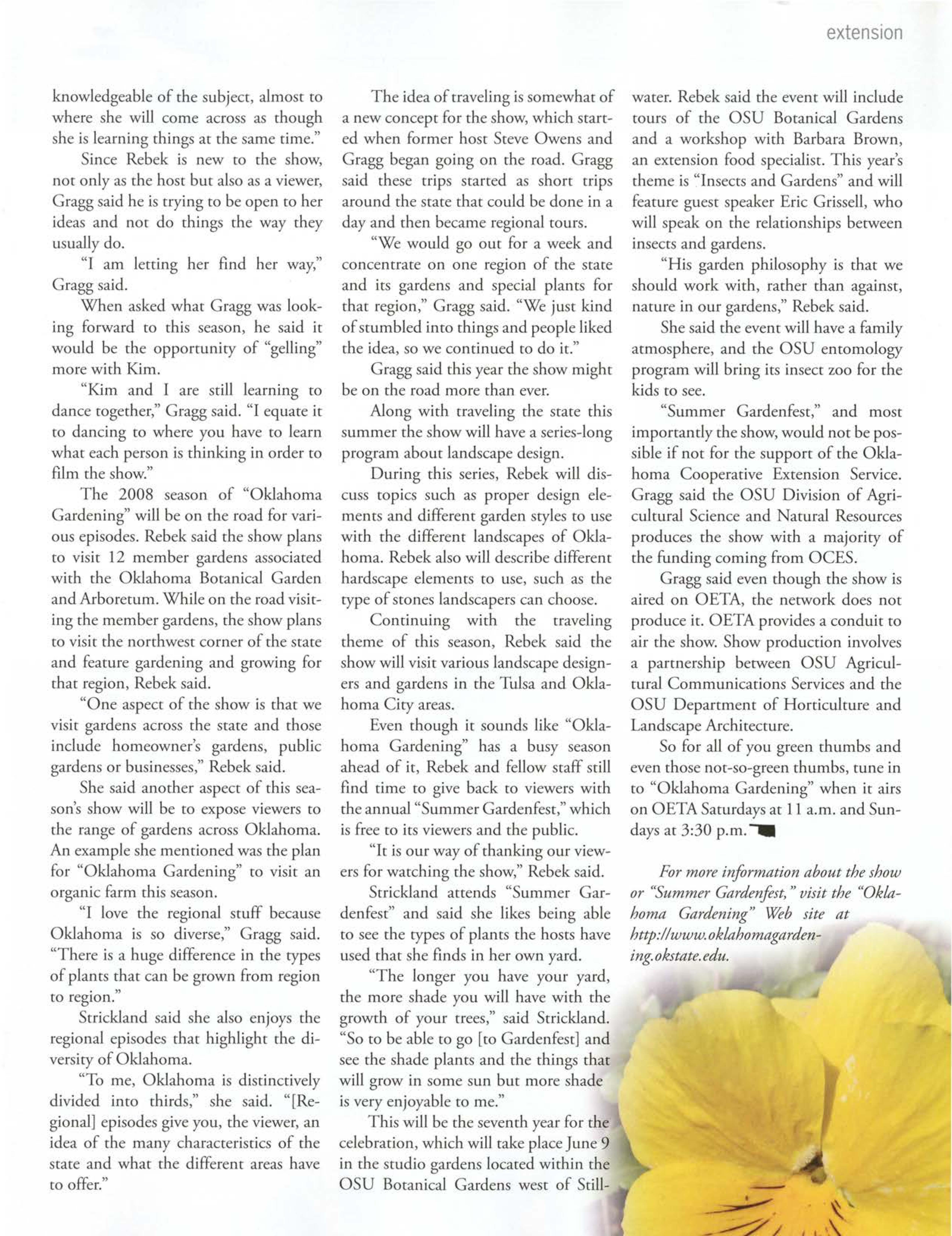
For more information about the show or "Summer Garden/est," visit the "Oklahoma Gardening" Web site at http://www. oklahomagardening. okstate.edu.
By AustinPartida Tipton,Okla.
WHAT IF THE U.S. FOOD SUPPLY was affected by bioterrorism? What would law enforcement per onnel look for in determining che cause?
Jacqueline Fletcher, arkey's distingui bed professor and director of che National Institute for Microbial Forensics and Food and Agricultural Biosecurity, or NlMFFAB, at Oklahoma cate University has designed an iniciacive to help answer these questions.
"What IMFFAB tries to do is get everybody coordinated and train personnel if we were faced with issuesIelated co food biosecurity," said Astri Wayadande, NlMFFAB assistant director.
IMFFAB began in January 2007 ro determine if an agricultural plane disease was caused by a natural outbreak or if the disease was intentionalJy placed.
To help the security community, IMFFAB will conduce an inaugural field exercise event in early May 2008.
The field day exerci e is one of the first outreach functions NIMFFAB has offered and it i cargecedcoward people who have liccle or no previous experience in agriculture, Fletcher aid.
"These are people from the FBl's hazardou material respon e unit, for example," Fletcher said. "They are very well-ver ed in incident command; they know diagnostk techniques, so we do not have to teach chem those things.' Instead, NIMFFAB will provide
training focu ed on an agricultural setting, Fletcher said.
"They are not used co going ouc in a wheat field or a peanut field," Fletcher said. "When they get into chat setting, what is a sample? Whac do they need co collect? Where do rhey collect? Is it from che roots, the water, or the leaves, or is it the soil?"
Fletcher said the field exercise will help law-enforcement personnel compare a healthy crop with one affected by a pathogen and learn how co better relate to the producer.
"You wane people co know what is expected and what the chain of command is " Wayadande said. "Unlikely though it may be of this happening, you do not want chaos."
In addition co the field exercise, OSU will teach courses co educate students about agricultural biosecurity.
'We'll have a very general agriculrwal biosecurity undergraduate course," Fletcher said. "We've planned an upper-level course primarily focused on microbial forensics. This will b in conjunction with our forensic science department, which is at the O U Center for Health Sciences in Tulsa.
he said O U could offer a minor in agriculrurnl biosecurity in the future.
"We are hoping co get more faculty on board who will be under the auspices ofNIMFFAB," Fletcher said.
Stephanie Rogers, an O U biochemistry alumna, is using NIMFFAB for her research project as she works toward a doctorate in plant pathology.
Rogers' research project includes a
study of wheat streak mosaic virus. Rogers uses the virus as a model system for all agricultural crop pathogens.
"It's like a question-answer tree thac will guide law enforcement investigating a field with steps to follow co determine if it was a natural outbreak or an intentional outbreak" Rogers said. "It will include the weather and ocher surrounding elements."
TeeCie West, a Tarleton Stace University biology alumna, also works within the NIMFFAB umbrella for her research project as he progres es coward a doctorate in biochemistry and molecular biology.
West's research includes sponing plant samples onto microarray
"I probe with known viral sequence and look for plants that have the viral sequences in them,' West said. "I will be working on a single nucleotide polymorphi m using microarray, as well."
NIMFFAB merges plane pathology and foren ic cience, Rogers aid.
"Forensic science is well establi hed" Roger aid. "Plant pathology is well established, bur rhey do not mesh.
"We are trying to modify techniques in both areas to connect them so if omething were to happen, we could have a really quick attribucion."
West said he and Rogers will participate in internships this summer at the National Federal Bureau of Investigation lab in Quantico, Va.
The threat of bioterrorism in the United States is low, but the "What if?" factor still exists. With continuing support, education and research, IMFFAB will help co answer the quescion. ,-
By ChristaMartin Anadarko,Okla.
LINDSAY KUZMA, AN ANIMAL science and agribusiness double major from Lodi, Wisc., was selected as outstanding senior in the College of Agriculrural Sciences and Natural Resources for her accomplishments as an Oklahoma State University srudent. She is the daughter of Frank and Wendy Kuzma.
Nine other seniors earned the Top Ten Senior award; the top five also earned the Dean Fred LeCrone award: Whitney Danker, a11agriculrural communications major from Wellston, Okla.; Travis Jeer, an agribusiness major from Laverne, Okla.; Kuzma; Blake Wilson, an animal science major from Okemah, Okla.; and Jillianne Zwei-
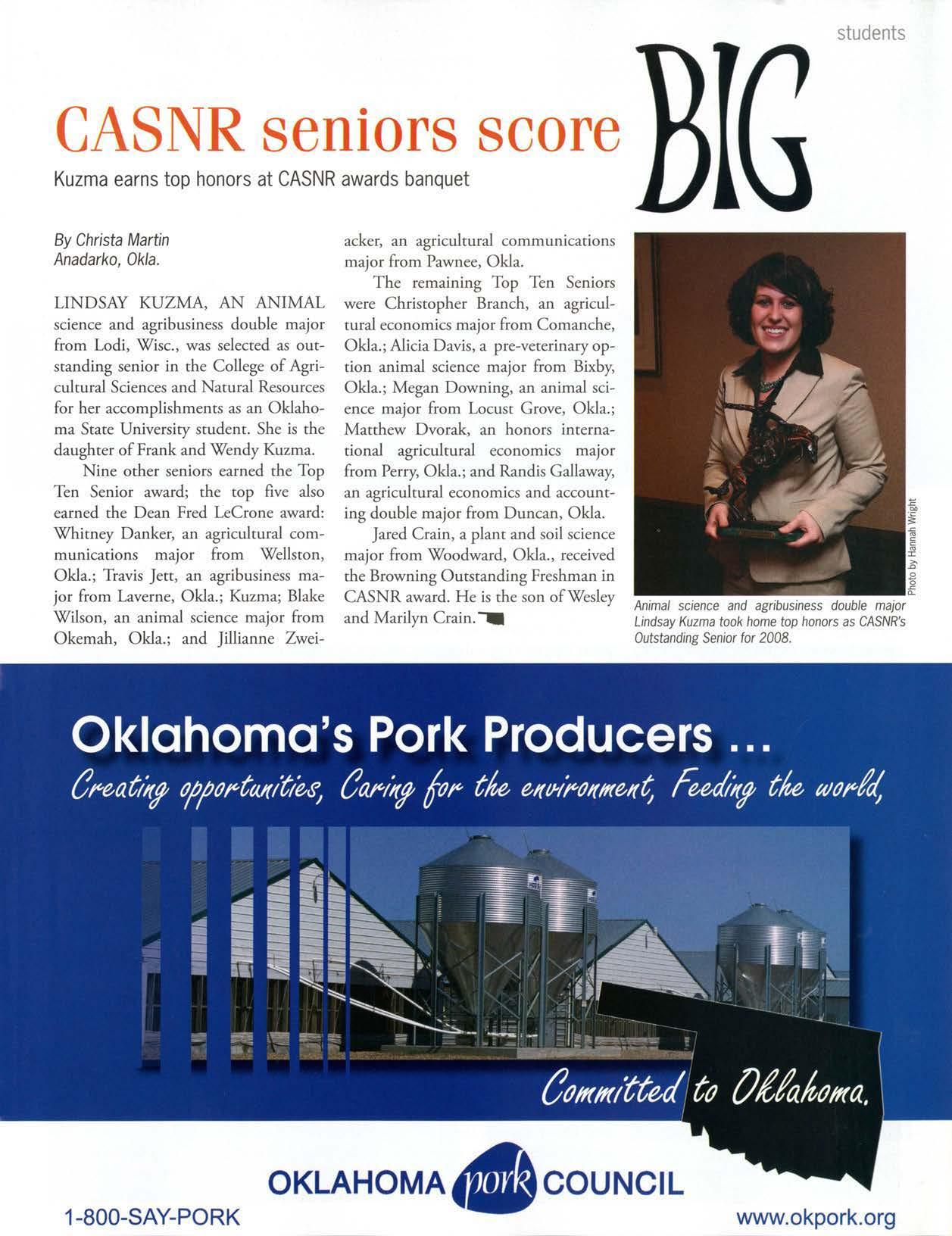
acker, an agricultural communications major from Pawnee, Okla.
The remaining Top Ten Seniors were Christopher Branch, an agricultural economics major from Comanche, Okla.; Alicia Davis, a pre-veterinary option animal science major from Bixby, Okla.; Megan Downing, an animal science major from Locust Grove, Okla.; Matthew Dvorak, an honors international agricultural economics major from Perry, Okla.; and Randis Gallaway, an agricultural economics and accounting double major from Duncan, Okla.
Jared Crain, a plane and soil science major from Woodward, Okla., received the Browning Outstanding freshman in CASNR award. He is the son of Wesley and Marilyn Crain.-.
By WhitneyDanker Wellston,Okla.
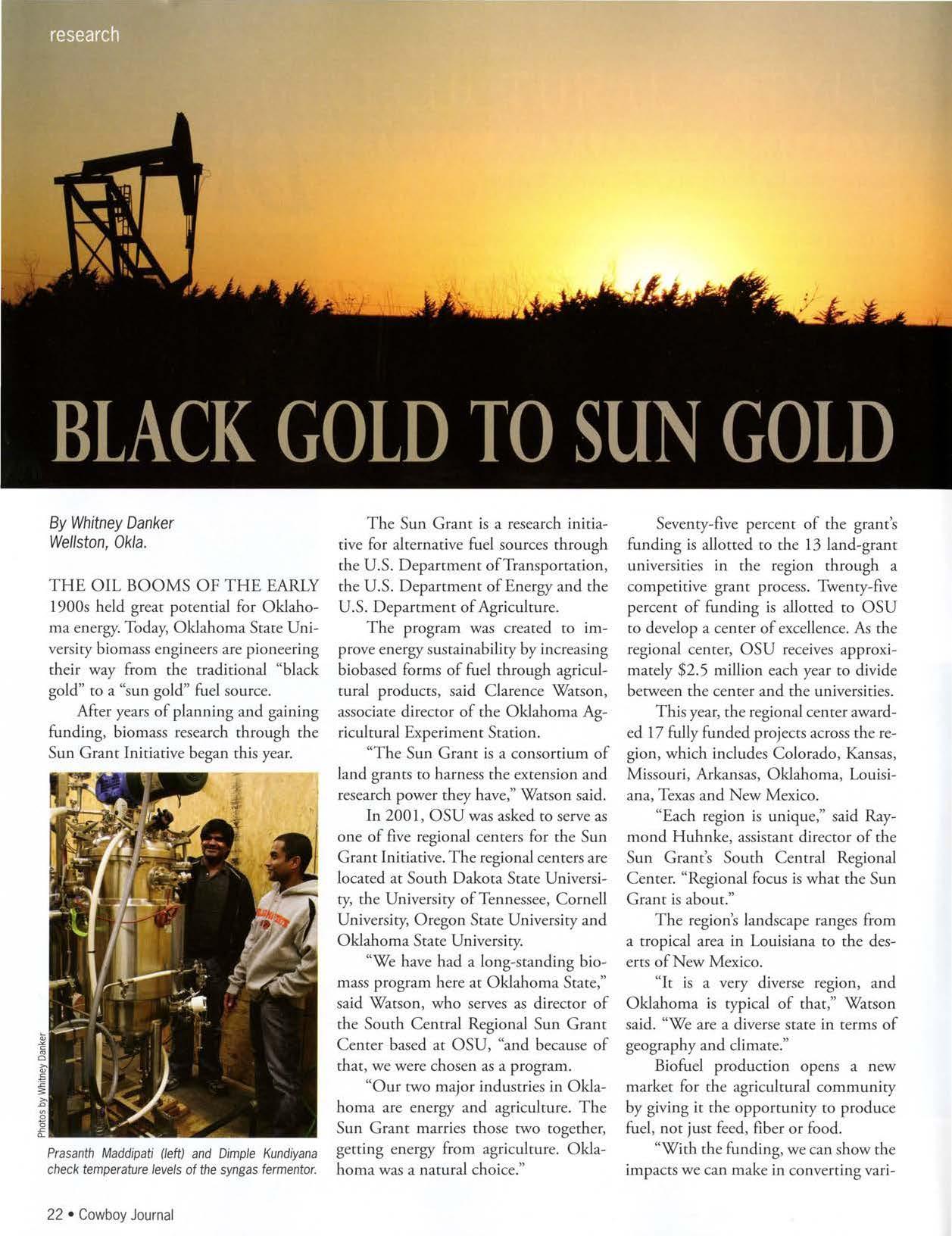
THE OIL BOOMS OF THE EARLY 1900s held great potential for Oklahoma energy. Today, Oklahoma ScaceUniversiry biomass engineers are pioneering their way from the craditiohal "black gold" co a "sun gold" fuel source.
After years of planning and gaining funding, biomass research through che Sun Gram Initiative began chis year.
The Sun Grant is a research initiative for alcernacive fuel sources through the U.S. Department ofTransportation, the U.S. Department of Energy and the U.S. Oeparrment of Agriculture.
The program was created to improve energy susrainability by increasing biobased forms of fuel through agricultural produces, said Clarence Warson, associate director of the Oklahoma Agricultural Experiment Station.
"The Sun Gram is a consortium of land grams ro harness the extension and research power they have," Warson said.
In 200 l, OSU was asked co serve as one of five regional centers for the Sun Grant Initiative. The regional centers are located at South Dakota Seate University, the Universiry of Tennessee, Cornell Universiry, Oregon ScaceUniversiry and Oklahoma Seate University.
"We have had a long-standing biomass program here at Oklahoma State," said Watson, who serves as director of che South Central Regional Sun Grant Cencer based at OSU, "and because of chat, we were chosen as a program.
"Our two major industries in Oklahoma are energy and agriculture. The Sun Grant marries chose two together, getting energy from agriculrure. Oklahoma was a natural choice."
Sevenry-five percent of the grant's funding is allotted co the 13 land-grant universities in the region through a competirive grant process. Twenry-five percent of funding is allotted to OSU co develop a center of excellence. As the regional center, OSU receives approximately $2.5 million each year co divide between the center and the universities.
This year, the regional center awarded 17 fully funded projects across the region, which includes Colorado, Kansas, Missouri, Arkansas, Oklahoma, Louisiana, Texas and New Mexico.
"Each region is unique," said Raymond Huhnke, assistant director of the Sun Gram's South Central Regional Center. "Regional focus is what the Sun Grant is about."
The region's landscape ranges from a tropical area in Louisiana co the deserts of New Mexico.
"Ir is a very diverse region, and Oklahoma is rypical of char," Warson said. "We are a diverse state in terms of geography and climate."
Biofuel production opens a new market for the agriculrural communiry by giving ir the opportuniry co produce fuel, nor just feed, fiber or food.
"With the funding, we can show the impacts we can make in converting vari-
ous type of feedstocks co marketable or value-added products," Huhnke said.
Ten of the selected proposals were joint projects, meaning universiries collaborate on rhe same research. The 10 projects each received $135,000 for rhree years. The remaining seven grants were ingle-univer icy projects focusing on seed research. The seed projects are funded at $35,000 for rwo years.
OSU received rhree of the competitive grants available in the region. un rant-funded research projects ar OSU include using sweet sorghum hybrids a bioenergy feed tock and breedLng new swirchgrass culrivars for increased bioma s production. The third project funded is syngas fermentation.
Dimple Kundiyana, a research engineer in biosyscems and agricultural engineering, is working on syngas research. The syngas project was approved for three years of fun.ding. Working with Kundiyana is Prasanth Maddipati, a BAE graduate student.
'Wt,have come a long way but are only at the. beginning.
- Raymond Huhnke
"Our main research objective is co increa e ethanol yield from the syngas fermentation process," Kundiyana said. " yngas, or synthesis gas, is produced during gasification of biomass, for instance, witchgrass or bermudagrass."
Their research crives to increase ethanol yield, reduce rhe price of ethanol and move from a bench-scale co a commercial-scale fermentor.
"From srudie , it has been found that corn is a cheap alternative source for producing ethanol," Maddipati said.
Maddipati said che initial cost can be reduced by u ing corn steep liquor, leading co lower prices at the pump.
Currently cheir proce yields three grams of ethanol for every one liter of syngas, but they said rhey are still a long way from their optimistic target.
"We have successfully scaled up from 5-liter fermencor to 75-liter fermencors" Kundiyana said. "The next challenge we face i to cale to 1,000gallon fermentors."
Reaching the 1,000-gallon goal would mean ethanol could be mass produced in less rime, making it more readily available co con umer Ir could also lower the production cost per gallon.
"We have come a long way but are only at the beginning," Huhnk.e said.
Boch Wac on and Huhnke said they want to reach an annual funding goal of $10 million co each regional center.
"We think the future looks very bright," Warson said.,.
By SamanthaDavidson Ringwood,Okla.
PERSONALIZATION, FLEXIBILITY AND AN EXCITing international experience concepts the College of Agricultural Sciences and Natural Resources faculcy had in mind when they added the new international agriculture option ro the Master of Agriculture degree.
"We specifically designed rhis program not to be research-based," said David Henneberry, assistant dean of inrernacional programs in agriculture. "The basis is coursework plus the international experience."
Many people worked rogerher ro add this internationally focused program to CASNR.
"Vice President Robert Whitson was a crucial element in getting chis degree started," Henneberry said.
Because this program is multidisciplinary, it is housed in the dean's office. The degree option requires 32 credit hours, six of which come from an international internship.
"There are two pieces ro the focus of this academic degree: inrernarional agriculture and an agricultural focus area," Henneberry said.
An agricultural focus area consists of agriculcural courses in che student's area of interest.
Brandon Boughen, an agricultural education alumnus, is the first graduate student accepted into the program.
"I spenr three months in Africa," Boughen said. "This really opened my eyes, and I found that international dynamic I was looking for. So, when I found out about the program from Dr. Jim Leising, I knew it was a perfect fit for me."
Wich CASNR's multiple international ties, international alumni will play key roles in the new program's success. Henneberry said he hopes these connections provide international experiences for CASNR students in che program.
"There are quite a few international graduates who have received their degree from the college of ag," Boughen said. "They would be more than willing ro do some kind of srudenr exchange. This would help ow· program tremendously."
Leising, assistant direcror of international agricultural programs, said he appreciates the benefits of the program.
"This is an interdisciplinary program," Leising said. "le
doesn't look at one aspect of agriculture but allows students co study multiple disciplines."
This broad education in agriculture provides students with a great deal of flexibility, Henneberry said. Students have the freedom co choose from a wide variety of agricultural coursework.
"The students have a lot of freedom in designing their programs," Henneberry said. "Students can pick and choose what is right for them. It doesn't have to make sense co someone else, bur ir needs to make sense to che student."
Henneberry said he is excited abouc chis degree and employers are excited about it, coo, because the international agriculture option prepares graduates for various careers.
"le offers a range of career options," Leising said. "There are a multitude of opportunities - everything from volunteer work co paid positions.
"Almost all large agricultural companies like ADM and Cargill have international operations," he said. "This degree would be a good fir for one of those careers."
Internacional work within state and national departments of agriculture is another career path these graduate students could follow.
"All 50 state departments of agriculture have international marketing divisions," Henneberry said. "This is a good degree for char type of position."
Leising said he anticipates growth in this program.
"This program meets the needs of our students," Leising said. "This new option will imegrate the knowledge about international agriculture and multiple disciplines needed to solve important problems in che world.
"Ir'll be a very exciting program and unique opportunity for students," Leising said. "If they wane to have some adventure in their lives, chis is the perfect rime co do it. Especially if they don't know what they wane co do, this helps chem find more opportunities and network."-.
Students interested in the master's in international agriculture program can call Jim Leising at 405-744-9718 or send a messageto james. leising@okstate.edu.
AlumnusRichardDane!has calledVarsityBarbershop'home'for 50 years
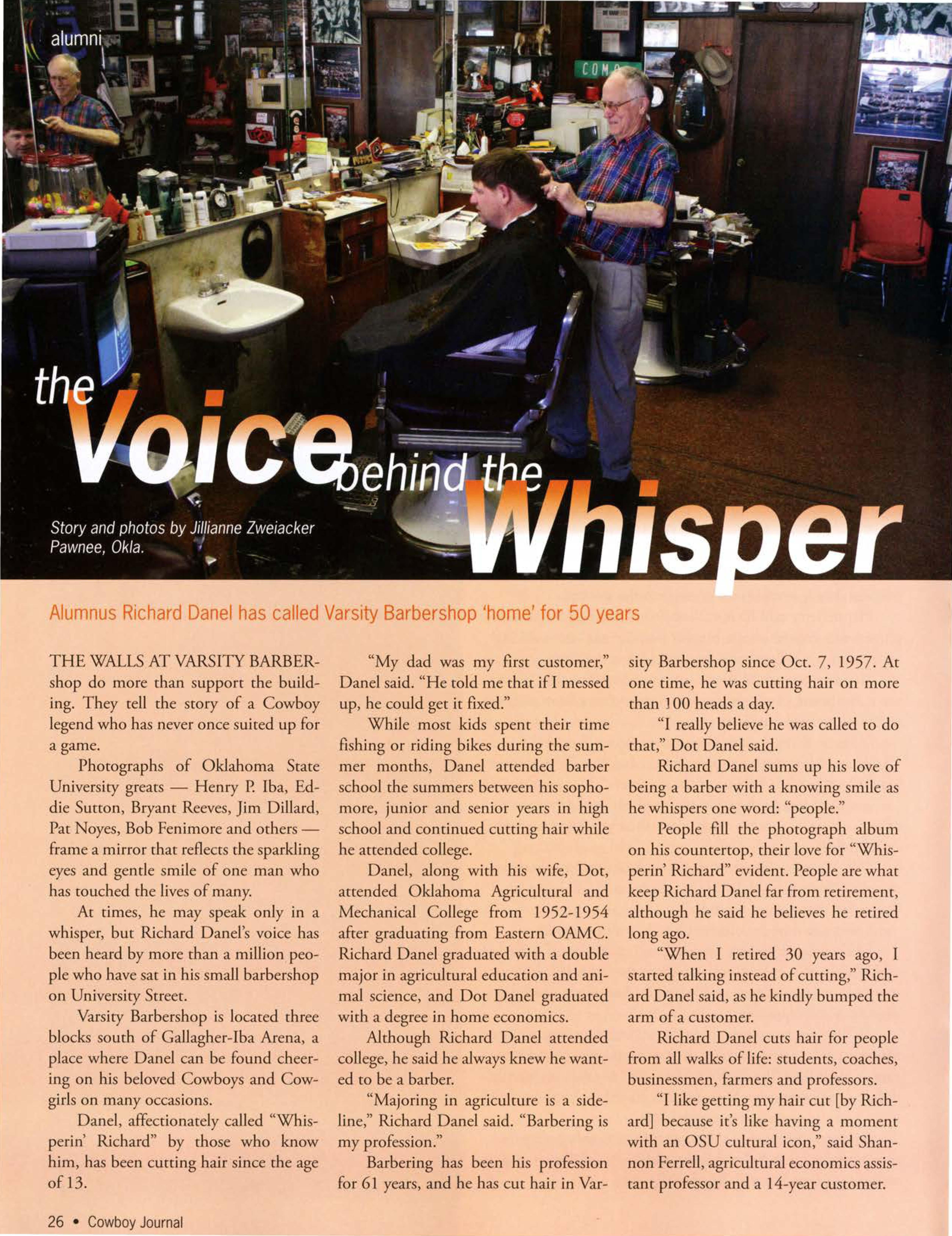
THE WALLS AT VAR ITY BARBERshop do more than support the building. They tell the story of a Cowboy legend who has never once suited up for a game.
Phorographs of Oklahoma rate University greats - Henry P. Iba, Eddie Sutton, Bryant Reeves, Jim Dillard, Pat Noyes, Bob Fenimore and othersframe a mirror that reflects the sparkling eyes and gentle smile of one man who has rouched the lives of many.
Ar times, he may speak only in a whisper, but Richard Danel's voice has been heard by more than a miJJion people who have sac in his small barbershop on University treet.
Varsity Barbershop is located three blocks outh of Gallagher-Iba Arena, a place where Danel can be found cheering on his beloved Cowboys and Cowgirls on many occasions.
Dane!, affectionately called "Whisperin' Richard" by those who know him, has been cutting hair since che age of 13.
"My dad was my first customer," Dane! said. "He told me chat if 1 messed up, he could get it fixed."
While most kids spenr their rime fishing or riding bikes during the summer months, Dane] attended barber school the summers between hi sophomore, junior and senior years in high school and continued cutting hair while he attended college.
Danel, along with his wife, Dot, attended Oklahoma Agricultural and Mechanical College from 1952-1954 after graduating from Eastern OAMC. Richard Dane] graduated wich a double major in agricultural education and animal science, and Dot Danel graduated with a degree in home economics.
Although Richard Dane! accended college, he aid he always knew he wanted co be a barber.
"Majoring in agriculmre is a sideline," Richard Dane! said. "Barbering is my profession."
Barbering has been his profession for 61 year , and he has cur hair in Var-
sity Barbershop since 0cc. 7, 1957. Ac one time, he was cutting hair on more than 100 heads a day.
"I really beHeve he was called to do that," Dor Danel said.
Richard Dane! sums up his love of being a barber with a knowing smile as he whispers one word: "people."
People ft.I[ che photograph album on his councertop, their love for "Whisperin' Richard" evident. People are what keep Richard Dane.I far from retiremenc, although he said he believes he retired long ago.
"When I retired 30 years ago, r started talking instead of cutting," Richard Danel said, as he kindly bumped rhe arm of a customer.
Richard Dane! cut hair for people from all walks of life: students, coaches, businessmen, farmers and profe sors.
"I like getting my hair cut [by Richard] because ic's like having a moment with an O U culcuraJ icon," said Shannon Ferrell, agricultural economics assistant professor and a 14-year customer.
People from the Stillwater area travel to Varsity Barbershop for their dose of "Whisperin' Richard."
"The more and longer l work, che more it builds up," Richard Dane! said.
Dot Dane! agreed people keep her husband away from retirement. She said he is able to relate ro people of all ages, from babies co adults.
"If you don't enjoy people, you don't reach char milestone of being friends with people of all ages," Dot Danel said. "Our Christmas list says it all. The barbershop is a common ground for everyone. Everyone is the same."
0 U legends have found chjs common ground, and Richard Danel has cut che hair of thousands of players and coaches, including his good friend Jim ranley the 1973-1978 head coach of the OSU football ream.
tanley is acrribuced with creating the nickname "Whisperin' Richard."
Wirh six barbers working in rhe barbershop originalJy, it became noisy, and Richard Danel wouJd answer the telephone quietly as a courtesy to customers and colleagues.
"Jim would call and ask if the shop was busy," Richard Dane! said. "Then he would tell the other coaches, 'I'm gain' to see Whisperin' and get me a haircut. I'll be back in a few minures.' Well, the name caught on."
A wooden sign above the window of the barbershop reads "Whisperin' Richard's." It was given to him by tanley, who received it from the men of the Sigma Nu fraternity.
Each year, the fraternity brothers buiJd a fort in the franc yard of the fraternity house for their annual Frontier Ball, and one year during rhe '60s they built "Whisperin' Richard's" barbershop as their focalpoint.
A picture of the fore now adorns che wall of the shop, and the red and white wooden barber pole embelli hes the outside of the franc window.
"I chink Richard is very proud of the sign," Doc Dane! said.
Aside from being a barber, Richard Danel is a wearer of many hats. He is a husband, father, grandfather, greatgrandfacher, rraveler, handyman and, most importantly, a friend.
"He is always busy accomplishing things," Doc Danel said.
The Dan.els grew up in Panola, Okla., and met before they began grade school. Best friend before they married, Richard Dane! said they kept people waiting for their wedding day.
' Everyone thought we would get married right after school was our in May but we didn't," Richard Dane! said. "We waited unrH June I."
The Danels have rwo daughter , Dana and Tami, three grandchildren and one great-grandchild. They love traveling and have visited each of the 50 states as well a 18 countries on four differenc continents. They also crave! co OSU ba ketball and football games as much as possible.
"We cake at least one vacation a year," Richard Dane! said. "Sometimes two weeks, sometimes four. We've been known co cake off for six weeks at a time, but cha.e'snot very nice [to the ] " customers
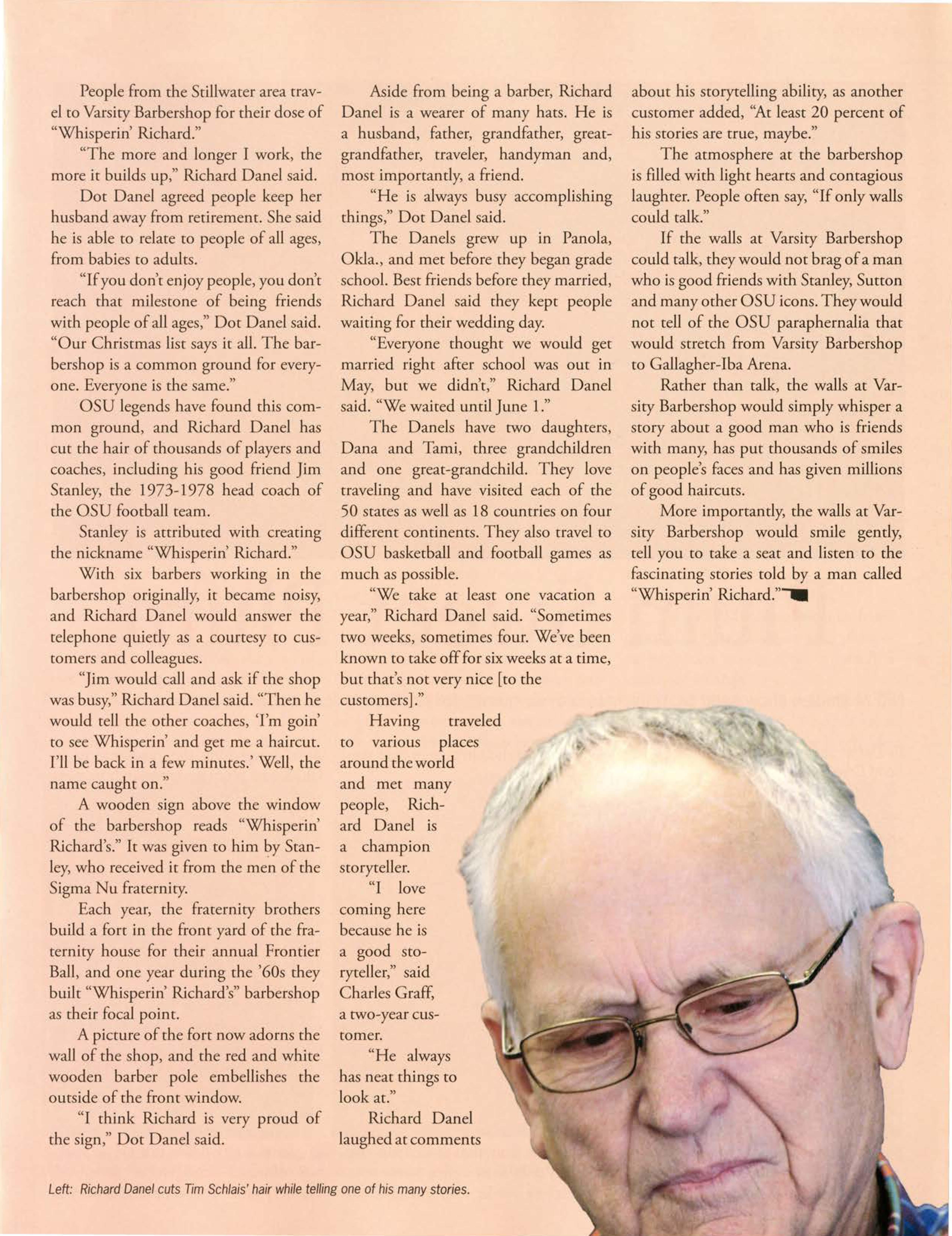
Having traveled to various places around the world and met many people, Richard Dane! is a champion storyteller.
"I love coming here because he is a good storyteller," aid Charles Graff, a rwo-year customer.
"He always has near thing to look at."
Richard Danel laughed at comm en rs
about his scorycelling ability, as another customer added, ''At least 20 percent of his caries are true, maybe."
The atmosphere at rhe barbershop is filled with light hearts and contagious laughter. People often say, "If only walls could talk."
If the walls at Varsity Barbershop could rail<,they would not brag of a man who is good friends with canley, Sutton and many ocher OSU icons. They would not cell of the O U paraphernalia char would stretch from Varsity Barbershop co Gallagher-Iba Arena.
Rather than calk, the wall at Varsity Barbershop wouJd simply whisper a srory about a good man who is friends wirh many, has puc thousands of smiles on people's faces and has given millions of good haircuts.
More imporcancly, the walls at Varsity Barbershop would smile gently, cell you to cake a seat and listen co the fascinating stories cold by a man called "Whisperin' Richard."-.
NREMstudiesshowsandplumthicketsprovidehomesfor NorthAmericanbobwhitequail
By DarrinSchultz PondCreek,Okla.
MOST PEOPLE'S MEMORIES OF wild plums are the jellies their grandmothers used ro make.
Although an Internet search on sand plum is more likely ro result in jelly and wine recipes than wildlife, during the last 50 years, the value of the sand plum as a source of food and medicine for humans has diminished.
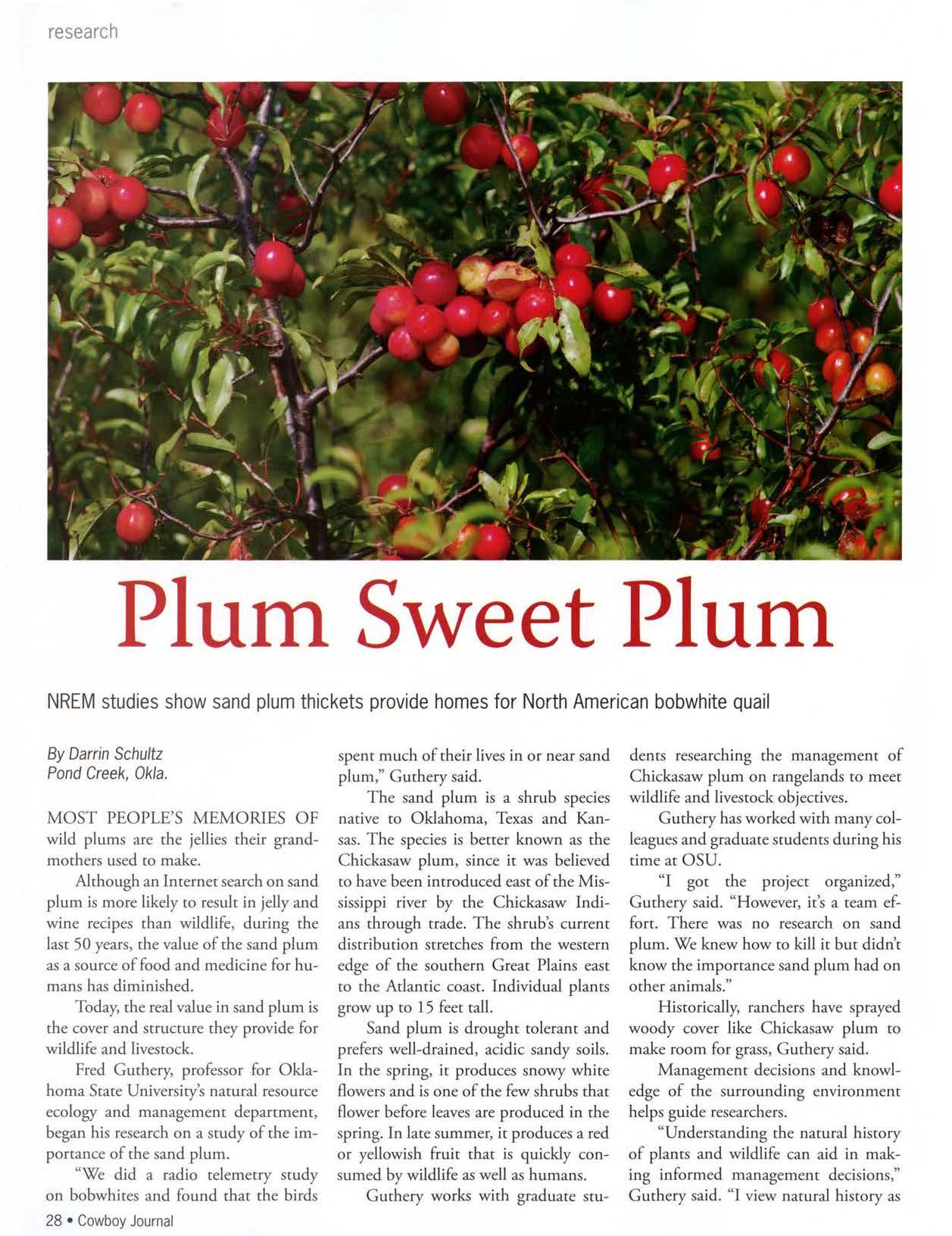
Today, the real value in sand plum is the cover and structure they provide for wildlife and livestock.
Fred Guthery, professor for Oklahoma Scare University's natural resource ecology and management department, began his research on a scudy of the importance of the sand plum.
"We did a radio telemetry study on bobwhites and found that the birds 28 • CowboyJournal
spent much of their lives in or near sand plum," Guchery said.
The sand plum is a shrub species native to Oklahoma, Texas and Kansas. The species is better known as the Chickasaw plum, since it was believed to have been introduced east of the Mississippi river by the Chickasaw Indians th.rough trade. The shrub's current distribution stretches from rhe western edge of the southern Great Plains east ro che Atlantic coast. Individual planes grow up ro 15 feet tall.
Sand plum is drought tolerant and prefers well-drained, acidic sandy soils. In the spring, it produces snowy white flowers and is one of the few shrubs chat flower before leaves are produced in tl1e spring. In lace summer, ic produces a red or yellowish fruit chat is quickly consumed by wildlife as well as humans.
Guchery works with graduate sru-
dents researching the management of Chickasaw plum on rangelands to meet wildlife and livestock objectives.
Guchery has worked with many colleagues and graduate students during his rime at OSU.
"I got the project organized," Guch.ery said. "However, it's a team effort. There was no research on sand plum. We knew how to kill it but didn't know the importance sand plum had on other animals."
Historically, ranchers have sprayed woody cover like Chickasaw plum to make room for grass, Guchery said. Management decisions and knowledge of the surrounding environment helps guide researchers.
"Understanding rhe natural hisrory of planes and wildJife can aid in making informed management decisions," Guthery said. "I view natural history as
the arithmetic of natural resource science because ic consists of the purest facts with which we deal. Facts of natural history are, in an ecological sense, cancamounr co the axioms of mathematicians and the molecules of chemises."
Guthery and Scacy Dunkin, NREM research assistant, directed a recent study on private properties in chree Oklahoma counties: Payne, Harper and Ellis.
In 2006, Dunkin surveyed the hiscory of che Chickasaw plum and che plane's relation to wildlife.
One of che objectives of chis project was co gather descriptive natural story observations on che use of Chickasaw plum by mammals, reptiles, birds, invertebrates and plants.
Chickasaw plum is an important food source for a variety of wildlife, including turkeys, black bears, wolves, coyotes, white-tailed deer and fox.
"I had observed 30 species utilizing or associated with Chickasaw plum," Dunkin said. "These included five species of mammals, 17 birds, one reptile and four insects."
Chickasaw plum fulfills che role of trees by providing shade for wildlife and livestock where trees are absent or restricted. The major benefit to domestic livesrock is shade that dense parches provide, and shade has been shown to be an
(I'hereal value
important factor in summer weight gain in Livestock,Guthery said.
Shade provided by the Chickasaw plum may be as effective as water and supplemental feeding as a tool to promote uniform grazing of pastures. Hear stress due to rhe lack of shade also affects breeding performance in cattle.
''A landowner might have a negative outlook on sand plum because the plum competes with livestock forage," Gurhery said.
Shade provided by sand plum is beneficial co cattle and other livestock, Dunkin said.
Cattle could be found resting during midday in large sand plum patches, he said. During calving season, calves were found resting in parches while the herd grazed nearby.
Dunkin's research study was the first to specifically look at Chickasaw plum growth and wildlife use. However, two additional studies followed from NREM research assistants Brett Cooper and Adam West.
"So far, our studies are the only ones ever done," Dunkin said.
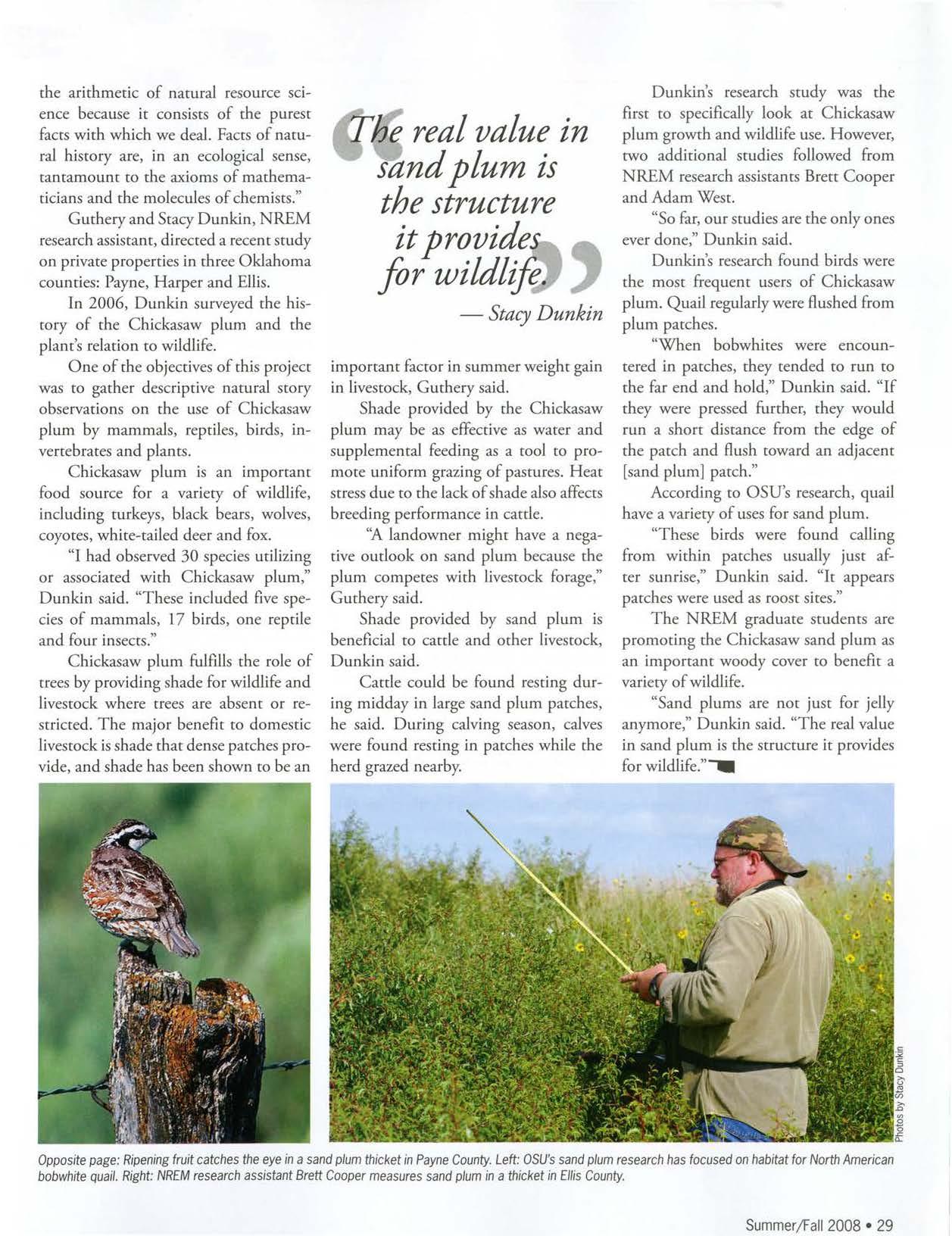
Dunkin's research found birds were the most frequent users of Chickasaw plum. Quail regularly were flushed from plum patches.
"When bobwhites were encountered in patches, they tended to run to th.e far end and hold," Dunkin said. "If they were pressed further, they would run a short distance from the edge of the patch and flush toward an adjacent [sand plum] patch."
According to OSU's research, quail have a variety of uses for sand plum.
"These birds were found calling from within patches usually just after sunrise," Dunkin said. "It appears parches were used as roost sites."
The NREM graduate students are promoting the Chickasaw sand plum as an important woody cover to benefit a variety of wildlife.
"Sand plums are not just for jelly anymore," Dunkin said. "The real value in sand plum is the structure it provides for wildlife_",.
By BlayrBeougher Owasso,Okla.
eastern Kan as co central Texas is Cross Timbers, a 19.5-million-acre ecosystem crossing through Oklahoma tate University territory. OSU owns roughly 1,800 acres of Cross Timbers on the OSU Range Research Station, 12 miles southwest of campus.
"Cross Timber is a big ecosystem and one of the few ecosystems still largely intact because of the nature of the terrain," said Adam Gourley, range research station assistant superintendent. "The soils and brush make it hard to farm and co rly to develop."
In the past, research has focused on vegetation responses on rhe Cros Timbers Experimental Range, Gourley said.
In fact, scientists agree a gap exists in rhe scientific knowledge about the ross Timbers ecosystem.
This Southern Plains eco ystem is not what it once was, aid Dwayne Elmore, state wildlife extension specialist.
Historically, Cro s Timber would have been an oak-savannah habitat with an open-forest strucrure. Fire uppression is a major component of the dosing canopy, the diminishing grasslands and the reduction in native wildlife species Elmore said.
Fire can bring back what was once natural ro this area.
"The interesting part of all this is char when you drive from tillwacer ro Oklahoma City what you see is not what this landscape looked like 100 years ago, " Elmore aid. "It would have been much more open, and there would have been great numbers of bison, prairie chicken and elk in Payne County, species that are not anywhere in this county now."
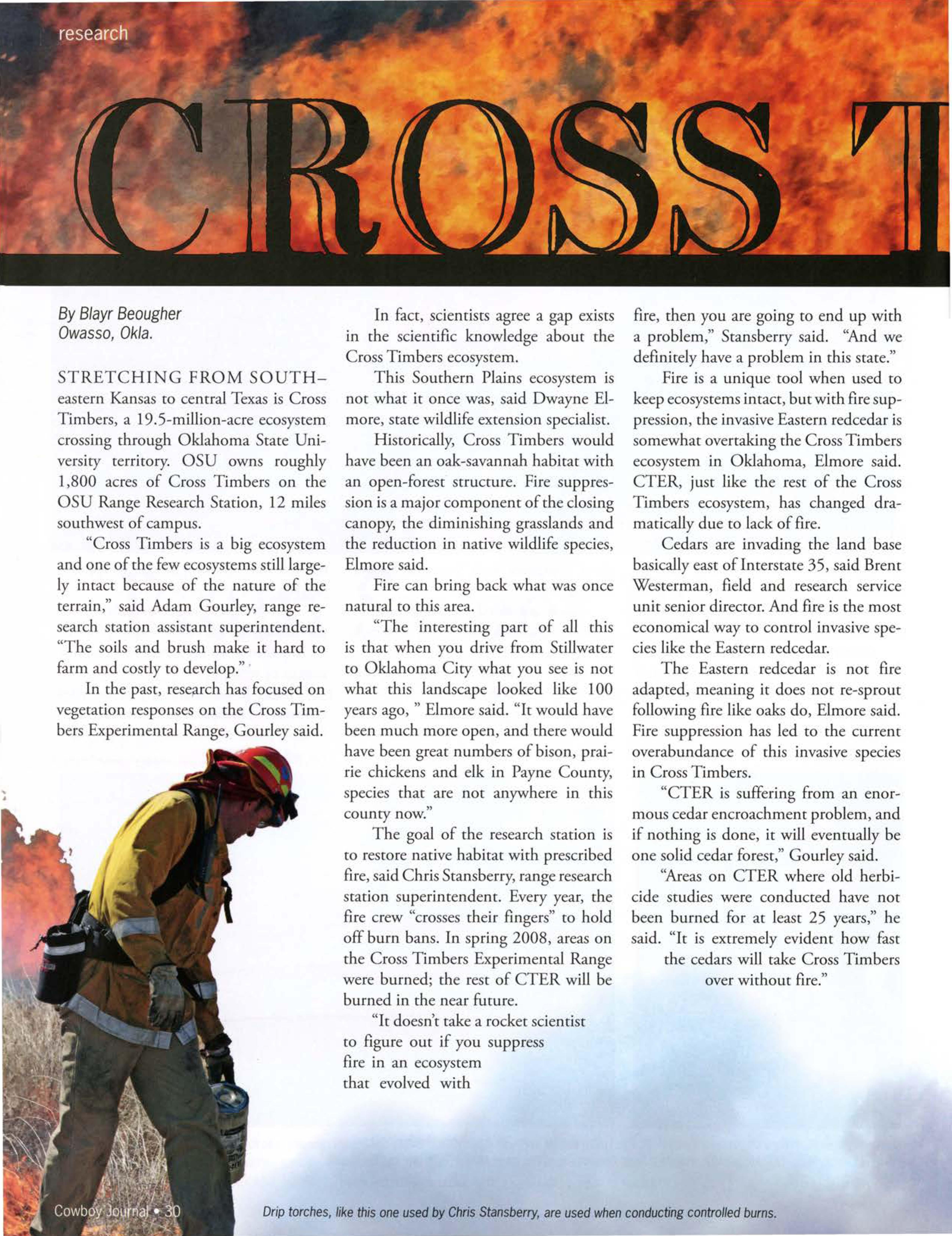
The goal of the research station is ro restore native habitat with prescribed fire, said Chris cansberry, range re earch station superintendent. Every year che fire crew "crosses their finger " ro hold off burn bans. In spring 2008, areas on the Cross Timbers Experimental Range were burned; rhe rest of R will be burned in the near future.
' Ir doesn't rake a rocker scienrisr to figure our if you uppre s fir in an eco ystem that evolved with
fire, then you are going co end up with a problem," tansberry said. ''And we defmitely have a problem in this scare."
Fire is a unique cool when used to keep ecosystems in tact, but with fire suppre sion the invasive Eastern redcedar is somewhat overtaking the Cross Timbers ecosystem in Oklahoma, Elmore said. CTER, just like the rest of the Cross Timbers ecosystem, has changed dramatically due ro lack of fire.
edars are invading the land base basically east of Interstate 35, said Brent Westerman, field and research service unit senior director. And fire is the most economical way ro control invasive species like the Eastern redcedar.
The Eastern redcedar is not fire adapted, meaning it does nor re-sprou following fire like oaks do, Elmore said. Fire uppression has led co the currenc overabundance of chis invasive species in Cross Timbers.
"CTER is suffering from an enormous cedar encroachment problem, and if nothing is done, it will eventually be one solid cedar forest," Gourley said.
"Areas on CTER where old herbicide studies were conducted have not been burned for ac least 25 years," he said. "It is extremely evident how fast the cedars will cake ross Timbers over without flre."
Some areas on CTER chat once were grasslands already have been converted ro a edar forest, Gourley aid. Because patches of CTER are so far gone, it will cake years and a lot of work ro see a major tum around, he said.
The abundance of cedars on CTER makes rhe staff more determined ro do everything possible co get rid of the rapidly spreading invasive species.
"Using fire to open the forest canopy is going ro somewhat shift Cross Timbers back to a grassland system and not dominated by forest," Elmore said. " ross Timbers wiU be more of a balance between forest and grass."
Stansberry said the fire crew plans ro make the perimet r and interior firelines on CTER 150 feet wide and free of cedars with few oaks, making prescribed fires much easier and safer.
'Economically important wildlife pecies, such as bobwhite quail, can thrive in Cro s Timbers habitat that are managed appropriately," said Sam Fuhlendorf, profe sor of natural resource ecology and management.
The O U Range Research cation and its Cross Timbers Experimental Range areas are important for research, as evidenced by the number and size of grants that have been awarded ro study wildlife, invasive specie , cattle and ecosystem shifts, Westerman said.
Most research stations only conduce cropland research, making the OS U Range Research cation unique, Fuhlendorf said.
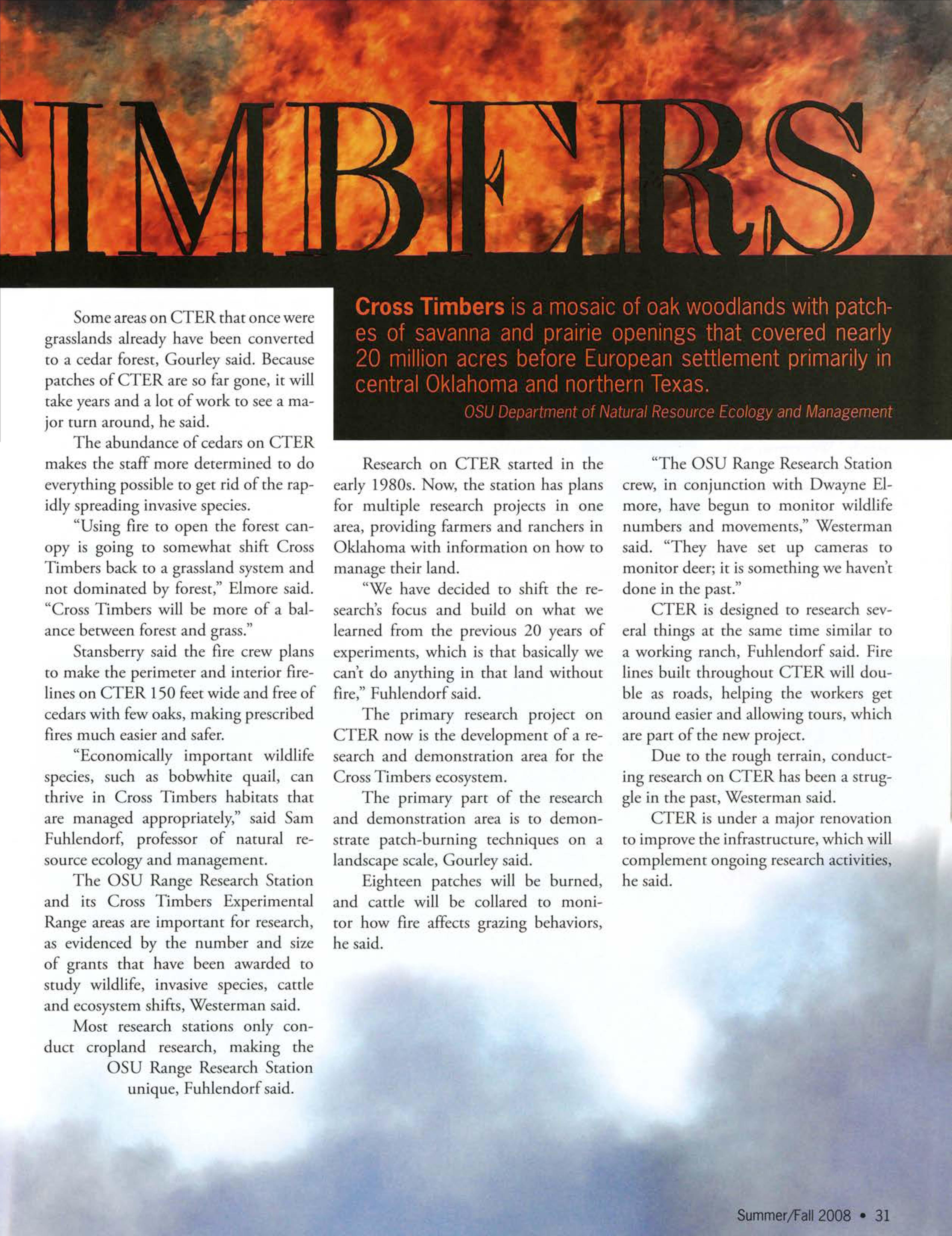
Research on TER tarted in the early 1980s. Now, the station has plans for mulcipl re earch projects in one area, providing farmers and ranchers in Oklahoma with information on how co manage their land.
"We have decided ro shift the research's focus and build on what we learned from the previous 20 year of experiments, which is that ba ically we can'r do anything in chat land without fire," Fuhlendorf aid.
The primary research project on CTER now is the development of a research and demonscracion area for che Cross Timbers ecosystem.
Th primary pare of che research and demonstration area is to demonstrate patch-burning techniques on a landscape scale, our! y aid.
Eighteen patches will be burned, and cartl will be collar d ro monitor how flre affects grazing behaviors, h said.
"The OSU Range Research Station crew, in conjunction with Dwayne Elmore have begun co monitor wildlife numbers and movements," Westerman said. "They have sec up cameras to monitor deer; it is something we haven't done in the past."
CTER is designed co research several things at the same rime similar to a working ranch, Fuhlendorf said. Fire lines built throughout CTER will double as roads, helping che workers gee around easier and allowing tours, which are part of the new project.
Due to the rough terrain, conducting research on CTER has been a struggle in the past, Westerman said.
CTER i under a major renovation co improve che infrastructure, which will complement ongoing research activities, he said.
CrossTimbersEcosystemwithsuppressedfire /left)andwithprescribedfire.
Renovations include road improve- Oklahoma Agricultural Experiment ments, pond upgrades and preparation Station's field and research service unit of the station to showcase research and co purchase an ASV Posi-Track loader," demonstration activities in the near fu- Stansberry said. "That piece of equipcure, Westerman said. ment is going co be a tremendous asset
"Currently, the terrain is so rough, co the range station for constructing fire one can hardly gee around, not ro men- Lines, roads, creek crossings and fences rion build fire lines and support re- not only on CTER but also the rest of search," Westerman said. the range station."
"Most of the area is only accessible CTER not only benefits research on foot or horseback." projects buc also is an area where local
gest wildlife comest in 4-H, the National Wildlife Habitat Evaluation Program Contest, which will be held in Oklahoma for che first time.
"The more people we can gee on this site the more people we can educate about fire, cattle grazing and wildlife," Stansberry said. "Research possibilities our here are endless."
A goal of the natural resource ecology and management depanment at OSU is co perform research that not only will be published in journals but also will provide relevant information co landowners about exactly how to manage their land, Fuhlendorf said.
CTER and OSU provide Oklahomans across che state with useful information about how to manage natural resources for multiple uses.
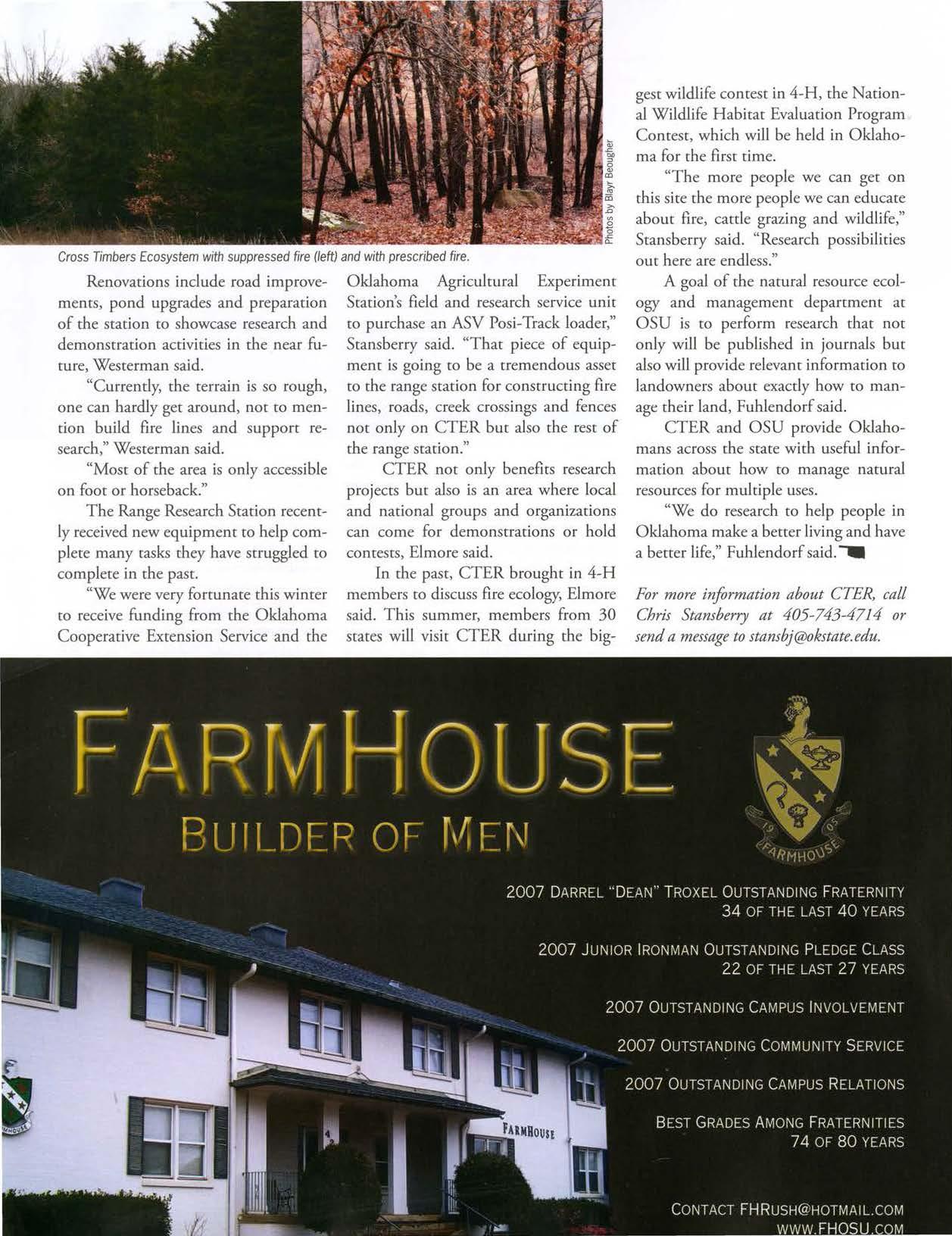
The Range Research Station recent- and national groups and organizations ly received new equipment co help com- can come for demonstrations or hold plete many casks rhey have struggled co contests, Elmore said. complete in che past.
"We do research to help people in Oklahoma make a better living and have a better life," Fuhlendorf said.-.
In che past, CTER brought in 4-H
"We were very fortunate chis winter members co discuss fire ecology, Elmore to receive funding from the Oklahoma said. This summer, members from 30 Cooperative Extension Service and the states will visit CTER during the big-
For more information about CTER, call Chris Stansberry at 405-743-4714 or send a messageto stansbj@okstate.edu.
By AshleySchnoor Maquoketa,Iowa
"NOW'S THE TIME. THIS IS THE Place. Dr Pepper is the Taste." "Be You." "The friendly 'Pepper-Upper."'
As the oldest major soft drink in America, Dr Pepper has nor only a history of slogans bur also a 40-year-old tradition of "passing the bottle" within the agricultural economics department at Oklahoma Scare University.
"I really started ic," said Gerald Doeksen, OSU regents professor.
The tradfrion began in 1968, Doeksen said, when 10 to 15 graduate students gathered nightly co study in Agricultural Hall. Nine o'clock served as break time co gee a Coke or Pepsi from che pop machine.
"One night we cook our break and went co get our pops," Doeksen said. "Dale Kalbfleish put his money into the machine, and instead of a Coke or Pepsi, he got a Dr Pepper."
Kalbfleish did nor like Dr Pepper and did not drink it. Rather, he sac it on his desk, starting the 40-yearold tradition.
When Kalbfleish graduated in 1969, he typed his name and graduating year on a black label, placed it on the Dr Pepper bottle and put the bottle on Doeksen's desk.
Doeksen followed Kalbfleish's lead and stuck his name and year on the bottle and passed the bottle co Harry Mapp after graduating.
Doeksen said the boccie is an antique and is older than his office in Agricultural Hall. When the tradition began, Ag Hall was two separate buildings, the north and south wings were not connected as they are coday.
"I am almost scared to couch it," Doeksen said. "It might blow up."
Since graduation, Doeksen has worked on the OSU campus. Although his titles have changed, he has nor ventured far from the College of Agricultural Sciences and Natural Resources, allowing him co watch the bottle travel among 27 graduate students.
Of those who have possessed the boccie, only two reach at OSU: Doeksen and Kim Anderson, the Charles A. Breedlove agribusiness professor.
"I was glad to get the bottle, because it was a stacus symbol rather than a bottle of shame," said Anderson, who earned his doctorate in 1980.
Anderson and many others were bestowed the honor of housing the Dr Pepper bottle after attending OSU for more than six years.
Some years have more than one name; Anderson said chis was because students left as soon as they finished their dissertations.
Anderson said he was not the only name for 1980; he was joined by Tom "TT" Harris.
"When you became the senior graduate student who had been here the longest, you received the Dr Pepper boccie and you got your name on it,"
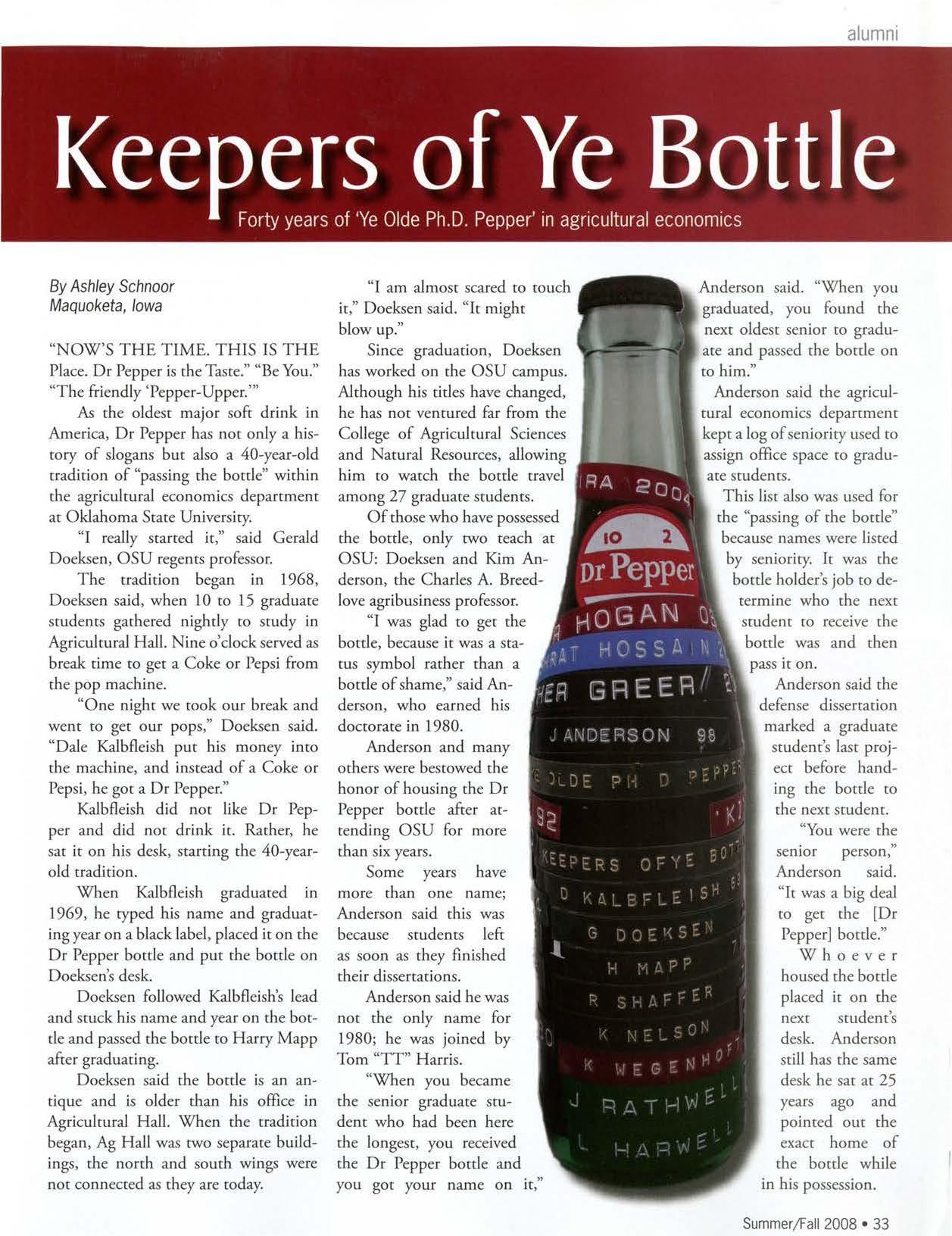
Anderson said. "When you graduated, you found the next oldest senior to graduate and passed che bottle on to him."
Anderson said the agricultural economics department kept a log of seniority used co assign office space co graduate students.
This list also was used for the "passing of the bottle" because names were listed by seniority. Ir was the boccie holder's job co decermine who the next student co receive the boccie was and chen pass it on.
Anderson said the defense dissertation marked a graduate scudent's lase project before handing the bottle co che next student.
"You were the senior person," Anderson said. "Ir was a big deal co gee the [Dr Pepper] boccie."
Whoever housed the boccie placed it on the next student's desk. Anderson still has the same desk he sac ac 25 years ago and pointed out the exact home of the bottle while in his possession.
Department Head Mike Woods currently houses the 39-year-old bottle of pop chat has close co 35 names taped co it. The bottle remains intact and ha never been broken or opened.
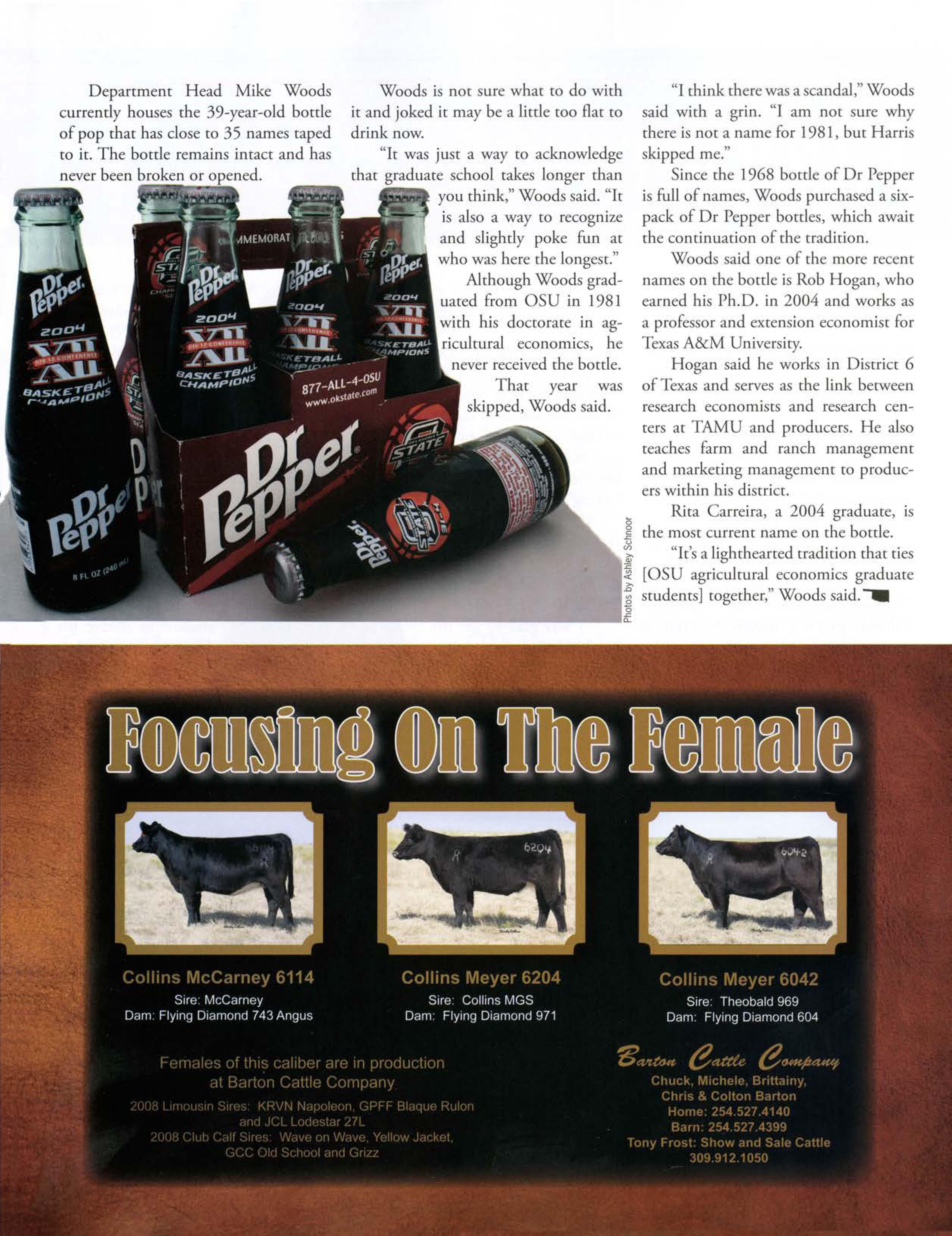
Wood is not sure what to do with it and joked it may be a Jjn]e coo flat to drink now.
"Ir was just a way to acknowledge chat graduate school takes longer than ---. you think," Woods said. "It is al o a way to recognize and slightly poke fun at who was here the longest."
Although Woods graduated from O U in 1981 with hi doccorate in agricultural economks, he never received the botde.
That year was kipped, Woods aid.
"I chink there was a candal," Woods said with a grin. "I am nor sure why there is nor a name for 1981, buc Harris skipped me."
ince che 1968 bottle of Dr Pepper i full of name , Woods purchased a sixpack of Dr Pepper hordes, which await he continuation of the tradition.
Woods said one of the more recent names on the bottle is Rob Hogan, who earned his Ph.D. in 2004 and works as a professor and excension economist for Texas A&M University.
Hogan said he works in District 6 of Texas and erves as th link between research economists and research centers at TAMU and producers. He also teaches farm and ranch management and marketing management ro producers within h_isdi trier.
Rica Carreira, a 2004 graduate, is J the most current name on the boccie. '-' "It' a lighchearred tradition char ties ! [OSU agriculruraJ economics graduate students] together," Woods said.-_
By CoriHarrison Minier,Ill.
0 THE WESTERN EDGE OF the African equatorial country of Kenya, you not only will find rhe world's second largest fre hwater lake and nearly 80 major species of animals bur also an Oklahoma rate University graduate making a difference in students' lives.
Kenya native Richard Kiprono Mibey walked the halls of Agriculcural Hall for nearly four year while obtaining his master's degree in plant pathology in 1981 and bis do rorare in agricultural education and extension in 1984.
"My time at OSU exposed me to various aspects of life,' Mibey said. "The university has a large foreign student population with diver e culture The environment is conducive co learning, doing re earch and recreation."
In addition ro working as a graduate assistant in rhe plant pathology program and as a research assistant at the U.S. Department of Agriculture laboracory 111 tillwacer, Mibey was pre idem of rhe plane pathology dub ar OSU. During this time, he was advised by Robert Price and was Price's 240th graduate rudent co advi e.
"Dr. Mibey is carrying on the excellenr tradition of the department of agricultural education and of Dr. Roberr Price with great respect" said David Henneberry, director of international agricultural programs.
Upon graduation from U Mibey returned co Kenya, where he gained an abundance of reaching and administrative experience, high.lighted by his re-
cenr signing as vice chancellor of Moi Univer icy in September 2006.
"[Dr. Mibey] is singLJarly focused on the future of Kenya, and on his role in shaping Moi University into an institution that Kenyans look co as a place where they can transform their futures through acquiring an education," Henneberry said.
Located approximately 300 mile from Kenya's capital city, airobi, in the city of Eldorer, Moi Univer ity opened as Kenya's second public university in 1984 and ha grown from a single forestry department co 13 schools spread across nine campuse .
Currently, the university has an enrollment of nearly 15,000 student and employs almost 3,000 staff members. Mi bey has been the upervisor of four of che university's doccoral students and 16 graduate srudents.
"Dr. Mibey is a very inspirational individual," Henneberry said. "He has a quiet portrayal of leader hip, allowing those around him co each have their rum in th potlighr."
Mibey said the management courses he rook in the later parr of his education have helped him to successfully overcome the situational management challenges a the leader of a university.
"Earlier this year, all rhe universities and chool in Kenya were do ed due co the widespread violence that erupted after the re tJts of our presidential elections," Mibey said. "I moved into the villages surrounding the university to eek peace and cooperation with our neighbors.
'After several day of discussions, the
communities supported my efforts inhelpingcore-op n che university."
Current O U agricultural education graduate student and fellow Kenyan Patrick Sai i is a close friend of Mi bey.
"He is goal-orienced, self-motivated and very innovative with good interpersonal skills " aisi said.
Before moving to Moi Univer icy, Mibey occupied several teaching and administrative positions. These included professor of mycology, the study of fungi, at the University of airobi in 2002 and deputy vice chancellor of administration and finance at Maseno University from 2004 co 2006.
While at Maseno University, he supervi ed the construction of five new university dorms and several lecture rooms. He also helped secure the deed for a univer icy farm co expand Maseno's veterinary program.
Along with his academic work, Mibey is a world-recognized specialist on fungal taxonomy and biodiversity conservation. Through his work as a fungal taxonomist, he has discovered and classified more than 120 species of
fungi and made notable contributions coward the conservation of Kenyan endangered indigenous tree species. He has published 28 articles about his work.
Mibey adds involvement in several distinguished societies to his lisr of achievements. He is the current president of rhe African Mycological Association, which was established in 1995 and promotes mycology through contact among members in Africa.
He has been a board member of the Kenya Forestry Research Institute and chairman of the Kenya Induscrial Research Development Instirure. The KFRI works to develop forestry through research, while the KIRDI promotes the developmem, acquisition and diffusion of technologies to the local industry.
Mibey has taken pare in several fellowships, i.ncluding membership as a senior research fellow in the pubLcly funded German academic exchange service. While working in Munich, he helped name a collection of fungi from around the world.
Ar this time, he is a fellow of rhe World Innovation Foundation, which helps make scienrifk advancements through research and knowledge.
Mibey also is a past Darwin Fellow at the Internacional Mycological lnsciruce in Ukraine where he conrribuced to naming fungi that previously had been iocorrectly identified.
Mibey currenrly resides in Eldoret with his wife, Elizabeth, and children.
In November 2007, Mi bey and a group of administrators from Moi University traveled to Stillwater to meet with OSU representatives to begin a collaboration between the two prominent research universities.
The two inscicucions formalized a memorandum of understanding between OSU and Moi University, which was signed by Mibey and Robert Whitson, vice presidenc, dean and director of the Division of Agricultural Sciences and Natural Resources at OSU.
"The memorandum of understanding signed between OSU and Moi Uni-
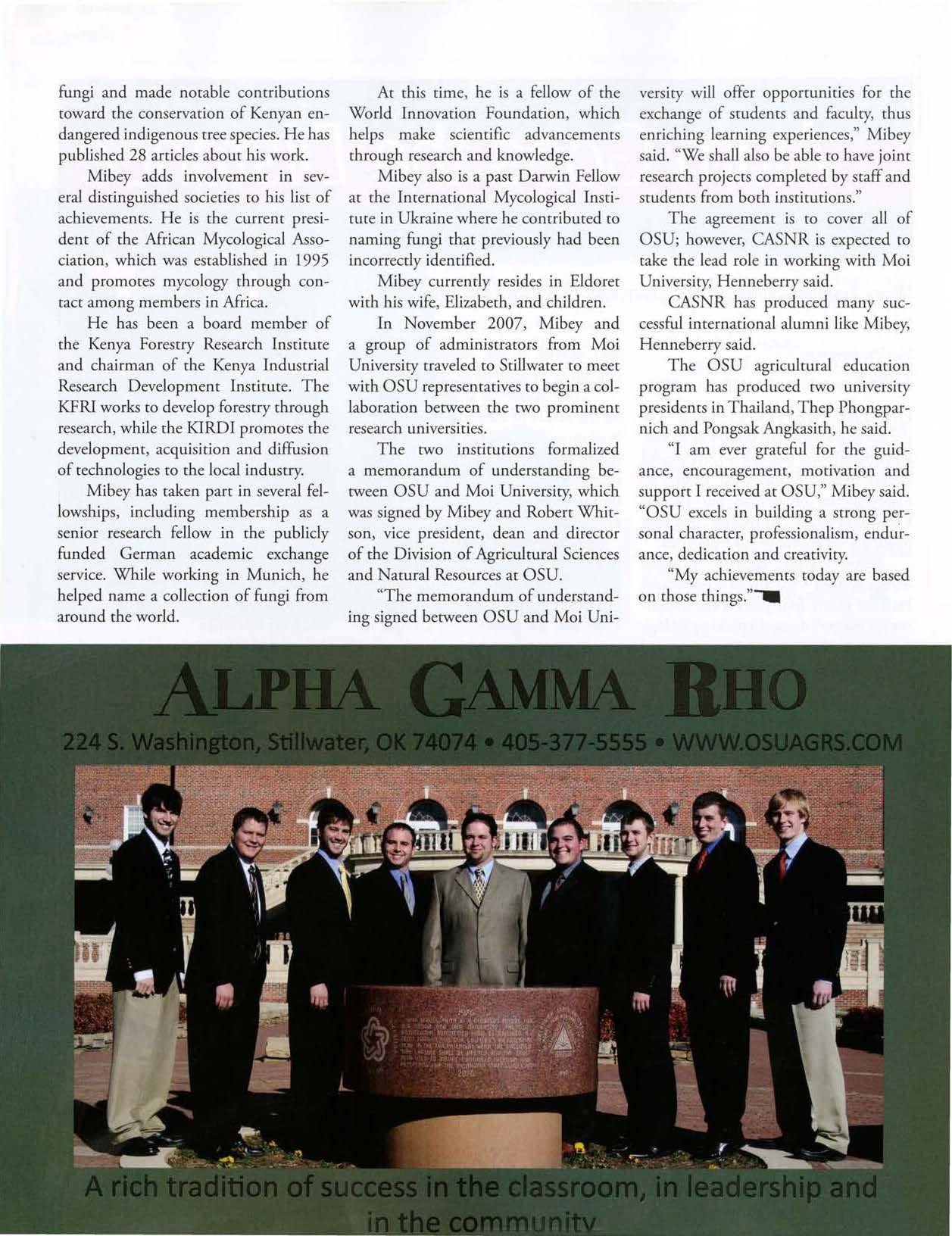
versicy will offer opportunities for the exchange of students and faculty, thus enriching learning experiences," Mibey said. "We shall also be able to have joint research projects completed by staff and students from both institutions."
The agreement is co cover all of OSU; however, CASNR is expected co cake the lead role i.n working with Moi University, Henneberry said.
CASNR has produced many successful international alumni like Mibey, Henneberry said.
The OSU agricultural education program has produced two university presidents in Thailand, Thep Phongparnich and Pongsak Angkasich, he said.
"I am ever grateful for the guidance, encouragement, motivation and support I received at OSU," Mibey said. "OSU excels in building a strong personal character, professionalism, endu·rance, dedication and creativity.
"My achievements today are based on those things."-.
Ecuua,E Ecu::,~
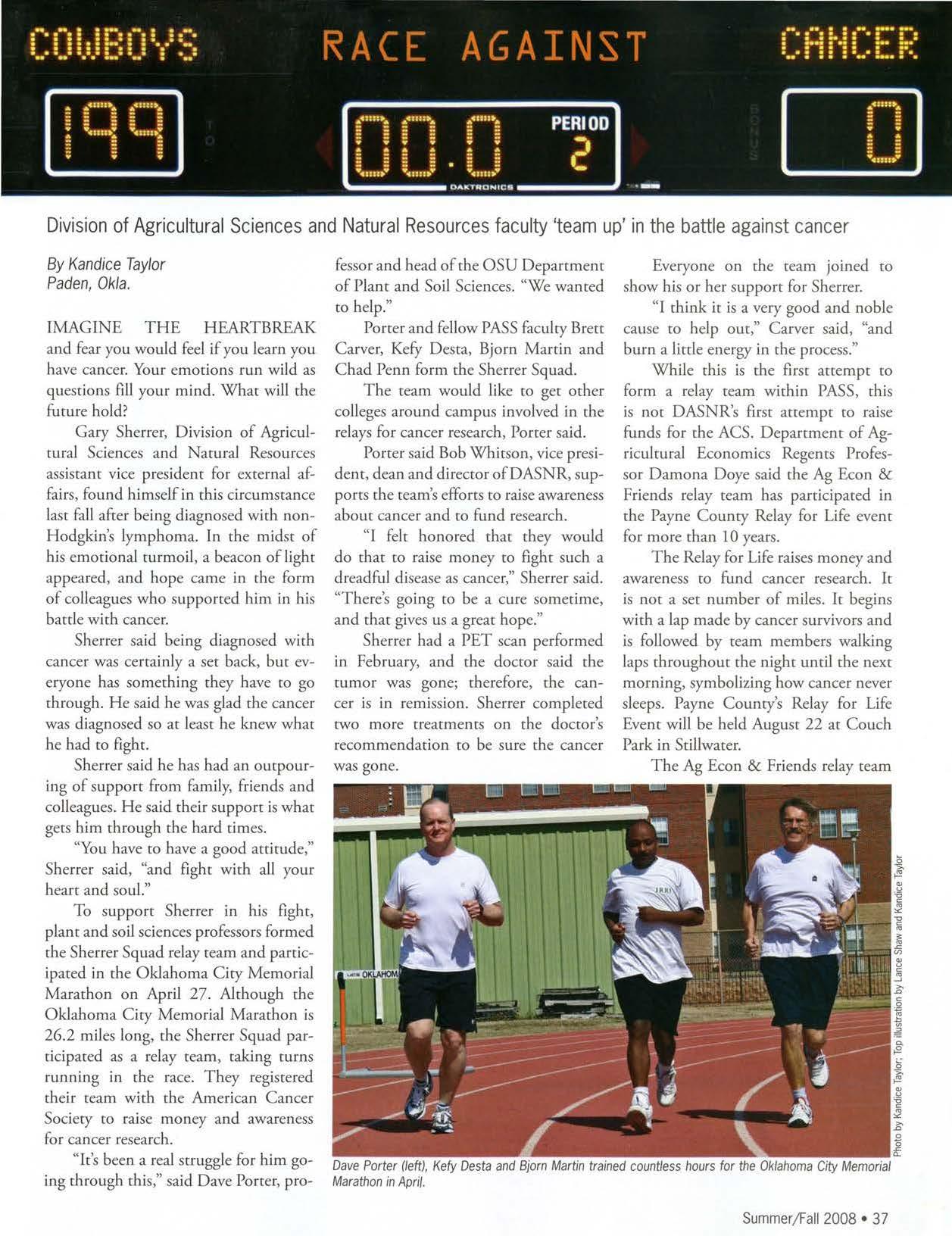
By KandiceTaylor Paden,Okla.
IMAGINE THE HEARTBREAK and fear you would feel if you learn you have cancer. Your emotions run wild as questions fill your mind. What will the future hold?
Gary Sherrer, Division of Agricultural Sciences and Natural Resources assistant vice president for external affairs, found hjmself in this circumstance last fall after being diagnosed with nonHodgkin's lymphoma. In che midst of his emotional turmoil, a beacon of light appeared, and hope came in the form of colleagues who supported him in his battle with cancer.
Sherrer said being diagnosed with cancer was certainly a set back, but everyone has something they have to go through. He said he was glad the cancer was diagnosed so at lease he knew what he had to fight.
Sherrer said he has had an outpouring of support from family, friends and colleagues. He said their support is what gees him through the hard times.
"You have to have a good attitude," Sherrer said, "and fight with all your heart and soul."
To support Sherrer in his fight, plane and soil sciences professors formed the Sherrer Squad relay ream and participated in the Oklahoma City Memorial Marathon on April 27. Although the Oklahoma City Memorial Marathon is 26.2 miles long, che Sherrer Squad participated as a relay team, tiling cums running in che race. They registered their ream with rhe American Cancer Society to raise money and awareness for cancer research.
"It's been a real struggle for him going through chis," said Dave Porter, pro-
fessor and head of the OSU Department of Plane and Soil Sciences. "We wanred co help."
Porter and fellow PASS faculty Brett Carver, Kefy Desta, Bjorn Marcin and Chad Penn form the Sherrer Squad.
The team would like to get ocher colleges around campus involved in the relays for cancer research, Porter said.
Porter said Bob Whitson, vice president, dean and director of DASNR, supports the ream's efforts co raise awareness abouc cancer and to fund research.
"I felc honored that they would do chat to raise money to fight such a dreadful disease as cancer," Sherrer said. "There's going to be a cure sometime, and chat gives us a great hope."
Sherrer had a PET scan performed in February, and the doctor said the rumor was gone; therefore, the cancer is in remission. Sherrer completed cwo more treatments on che doctor's recommendation co be sure the cancer was gone.
Everyone on the ream joined co show his or her support for Sherrer.
"I think ir is a very good and noble cause co help out," Carver said, "and burn a licde energy in the process."
WhiJe ems is the first attempt co form a relay team within PASS, chis is not DASNR's first attempt co raise funds for the ACS. Department of Agricul cural Economics Regents Professor Damona Doye said the Ag Econ & Friends relay team has participated in the Payne County Relay for Life event for more chan l Oyears.
The Relay for Life raises money and awareness to fund cancer research. It is not a set number of miles. Ir begins with a lap made by cancer survivors and is followed by ream members walking laps throughout the night until the next morning, symbolizing how cancer never sleeps. Payne County's Relay for Life Event will be held August 22 at Couch Park in Stillwater.
The Ag Econ & Friends relay ream
was started by a former colleague Dan Bernardo, a cancer urvivor. Since then, ochers have been diagnosed, including Doye's late husband, Harry Mapp who was also an agricultural economic profe or. Doye aid thi encourages the ream to keep participating to raise funds for research.
"Most peopl have a personal tie co the relay," said Doye. "For me, ir's a continuing tribute to Harry.'
Like the Sherrer quad, the Ag Econ & Friends ream include people who have been couched by cancer.
"Relay for Life is a great way to help raise money for cancer res arch," aid Kacie Reim, communications specialise and Relay for Life ream member. "Having family members and friends who have had cancer and are barding cancer, chis is a way for me co help raise money co support chis cause. le is also a rime for fellow hip and celebration for rho e who have fought the battle with cancer and won."
The Ag Econ & Friend relay ream ha raised $70,000 for cancer research. or only do the relay reams supporc cancer research by raising awareness and funds, but also they create team-member interaction which benefits members in their day-to-day jobs.
"Jr has given me the opportunity ro gee to know people outside of my department on a more personal basis " Doye said. "It's fun and rewarding."
Everyone gain omerhing different by being a part of the reams.
"Being a part of the relay allow m ro be chankful for my healchy family and friends and reminds me of rhe importance of giving back co other ," Reim
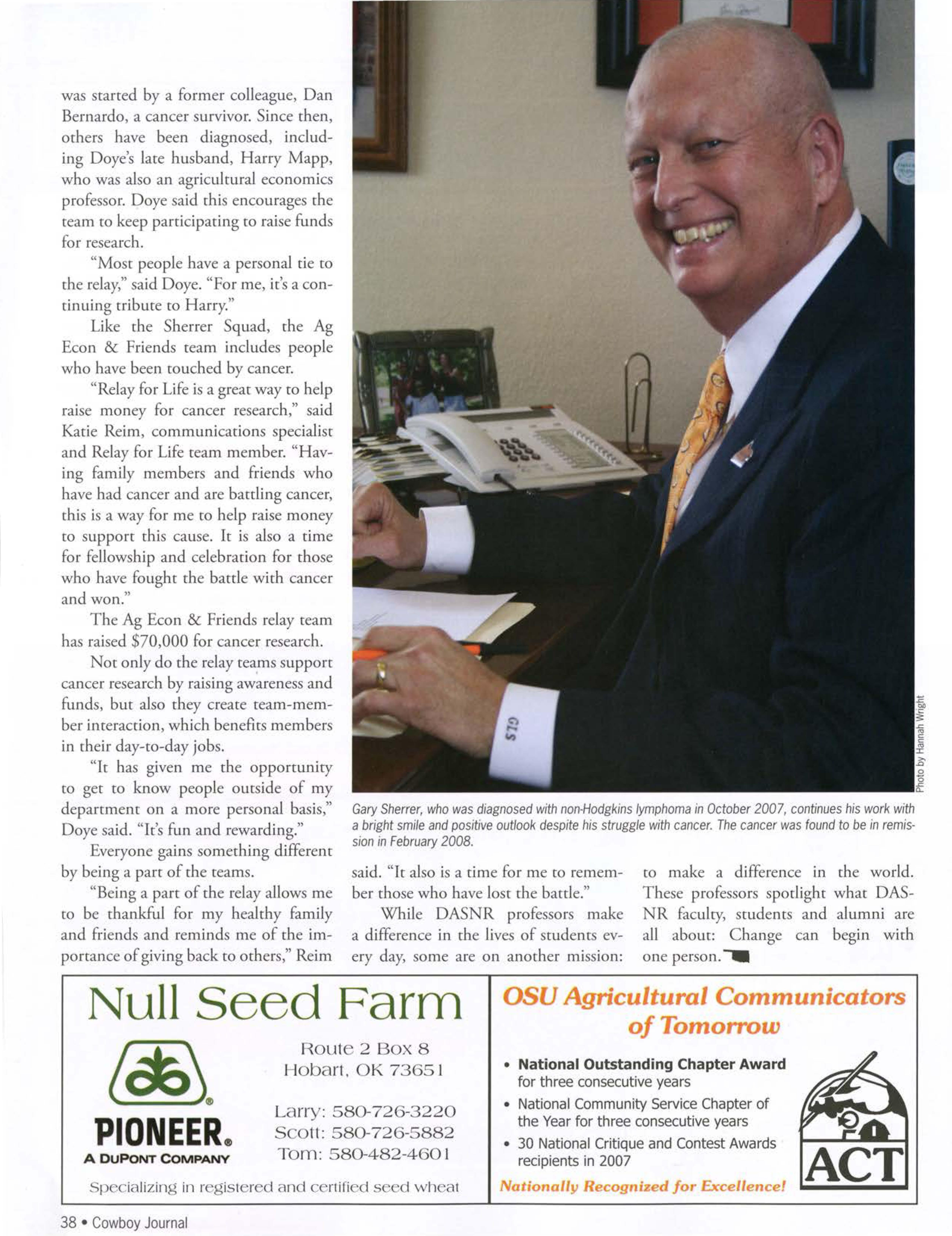
GarySherrer,whowasdiagnosedwithnon-Hodgkinslymphomain October2007, continueshis workwith a brightsmileandpositiveoutlookdespitehis strugglewithcancer.Thecancerwasfoundto be in remissionin February2008.
aid. "le al o i a time for me ro remember chose who have lost che barde."
While DA R profes or make a difference in the lives of rudenc every day, some are on anocher mission: ro make a difference in che world. These professors spotlight what DAR faculty, cudent and alumni are all about: Change can begin with one person. 7111
By KirbySmith Elk City,Okla.
LARK KE T' TRA FORMA-
tion ro Superman allowed him to dare into alleys and face the current risis in his legendary blue cape. His quick departure and high-flying problem solving ensured a safe fu rnre.
Oklahoma State University's College of Agriculrura1 ciences and Nacural Resources' environmental science program reaches students to resolve environmental is ue and, like uperman, help make the world a safe place to live.
Established in 1992 as an interdisciplinary program, environmental cience prepares its graduates ro identify and assess environmental problems, develop alternatives and understand the implications. A portion of this preparation is a capstone class.
'With the capstone cla , we really want students to begin interacting with
professionals in the indusrry" said Jeff Haccey, soil science professor, environmental sciences program direcror and capstone course instructor. "We want students ro understand what they will be doing when they walk onco a job."
Hattey i in his second year of reaching the class. He and ocher environmental cience faculty u innovarive teaching methods and classes co promote research opportunitie and partnership , such as the senior capstone class.
Th Environmental cience Application of Problem course, or ENVI 4813 addresse real-world is ue by connecting rudenc with organization and individuals needing advice co remedy specific environmental problem . Class objectives focus on developing an understanding of problem olving and the application of the environmental cience rudents also learn how to work with clients co meet their needs and develop the ability to communjcace
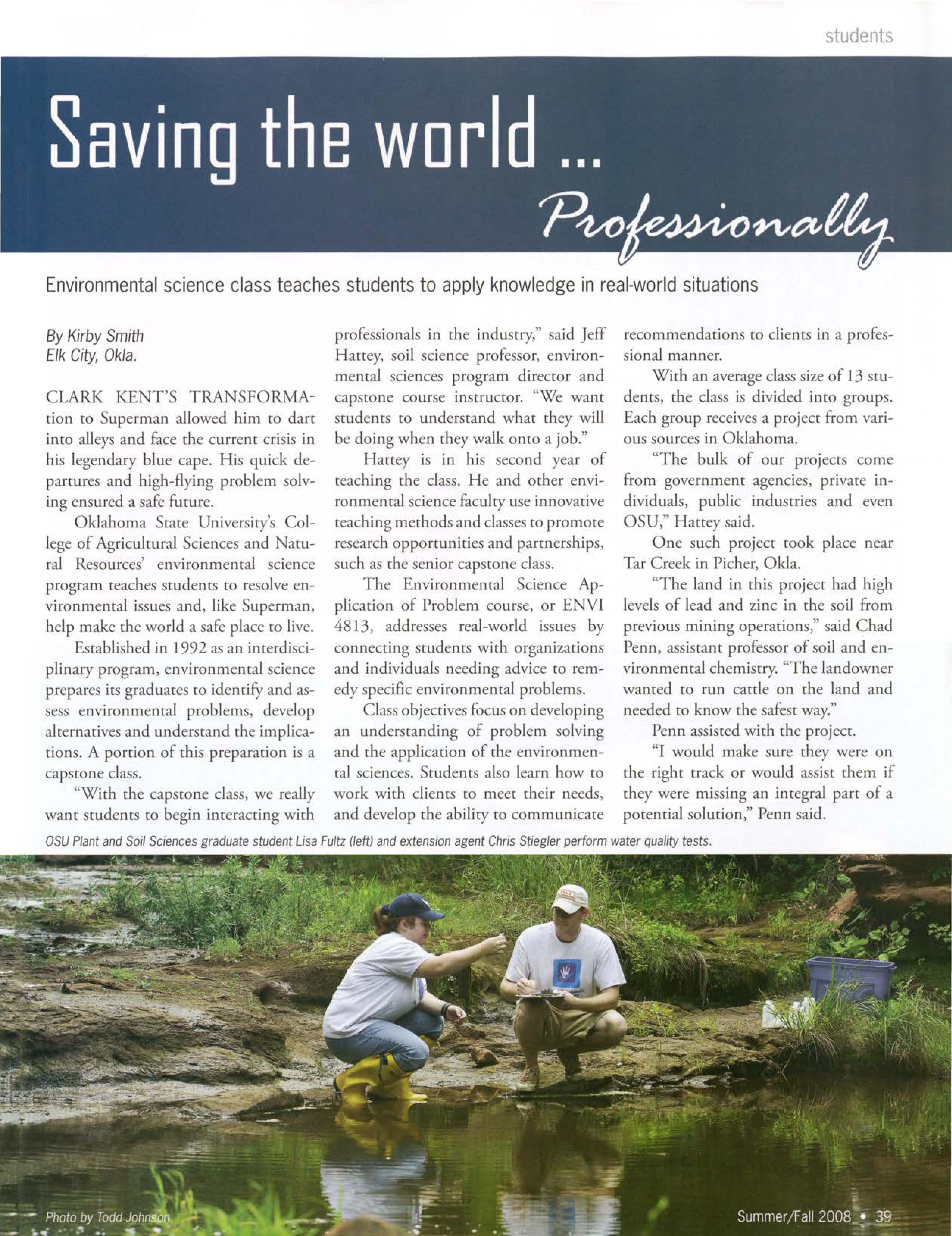
recommendations co clients in a professional manner.
With an average class size of 13 scudencs the clas i divided into groups. Each group receive a project from various sources in klahoma.
' The bulk of our projects come from government agencies, private individuals, public industrie and even 0 U," Hacrey said.
One such project took place near Tar reek in Picher, Okla.
"The land in chis project had high levels of lead and zinc in the soil from previou mining operarions," said Chad Penn, assi rant professor of soiJ and environmental chemistry. "The landowner wanced to run carde on the land and needed co know the afest way."
Penn assisted with the project.
"I would make sure they were on the right crack or would assist chem if th y were missing an integral part of a potential solution," Penn said.
"The students definitely did most of the work."
Brandon Sloan graduated in December 2007 with a Bachelor of Science in environmental science and a minor in soil science; he was a srudenc on the Tar Creek project.
"Being a part of che class and getting to work on the Tar Creek project really caught me that every problem isn't easy and not every problem is the same," Sloan said. "Every problem has more than one solution."
Sloan now works as an environmental scientist for a consulting firm in Tulsa, Okla. He credits the capstone class for familiarizing him with the dayco-day activities of his current position.
"In ocher classes, the only time you gee hands-on experience is in lab," Sloan said. "That's a shore time, but in the capstone class, time was yours to do what needed co be done. We made the initial contact with the client and met with him to find out what he wanted and his budget."
- Rhonda Gerig
Rhonda Gerig, an environmental science senior and participant in che class, reflected the feeling of working with an actual client.
"le was very intimidating," Gerig said. "At the end of the project, we gave our recommendations in an hour-long presentation. That experience really helped me because I've presented a project I worked on co a government agency. Any presentations I have to give in other classes are no big deal at all."
The capstone class focuses on preparing students to make the transition from college life co professional life, Hattey said.
"So much of college life is laid back," Harcey said. "We are trying to introduce students co the mind-sec of being a young professional."
Interacting wich clients gives students che opponuniry co practice professionalism before joining the work force.
"We hope this class lets people know our students are not only top qualiry in the classroom but also in the industry," Hacrey said.
Students in che capstone class receive a hands-on encounter with life as a working professional.
The experience gives students a chance to go beyond the books and see the application of their education.
"Out of all che classes at OSU I've taken, I learned the most and gained the most experience from the capstone class," Gerig said.-.

By ShawnaAllen Newcastle,Okla.
THIS YEAR MARKS THE 60TH ANniversary of Ol<lahoma tare University's College of Veterinary Medicine.
Oklahoma Agricultural & Mechanical College's chool of Veterinary Medicine opened its doors May 1 1948, afrer years of work by "the father of veterinary medicine in Oklahoma,' L. . Lewis.
Although Lewi died before the veterinary school opened, he had been appoinred the professor of veterinary
science in 1896 and was a vital pare of the college's success and establishment.
Early veterinary schools, such a OAMC's, began primarily for teaching equine care to students, said Michael Lorenz, CVM dean and OSU alumnus.
"Horses and hor e-drawn carriage were the means of transportation in the early 1900s," Lorenz said. "Veterinarians were needed co doctor and rake care of the horses.'
During the first year, OAMC's veterinary chool caught rwo clas e to th 31 male students: anatomy in the morn-
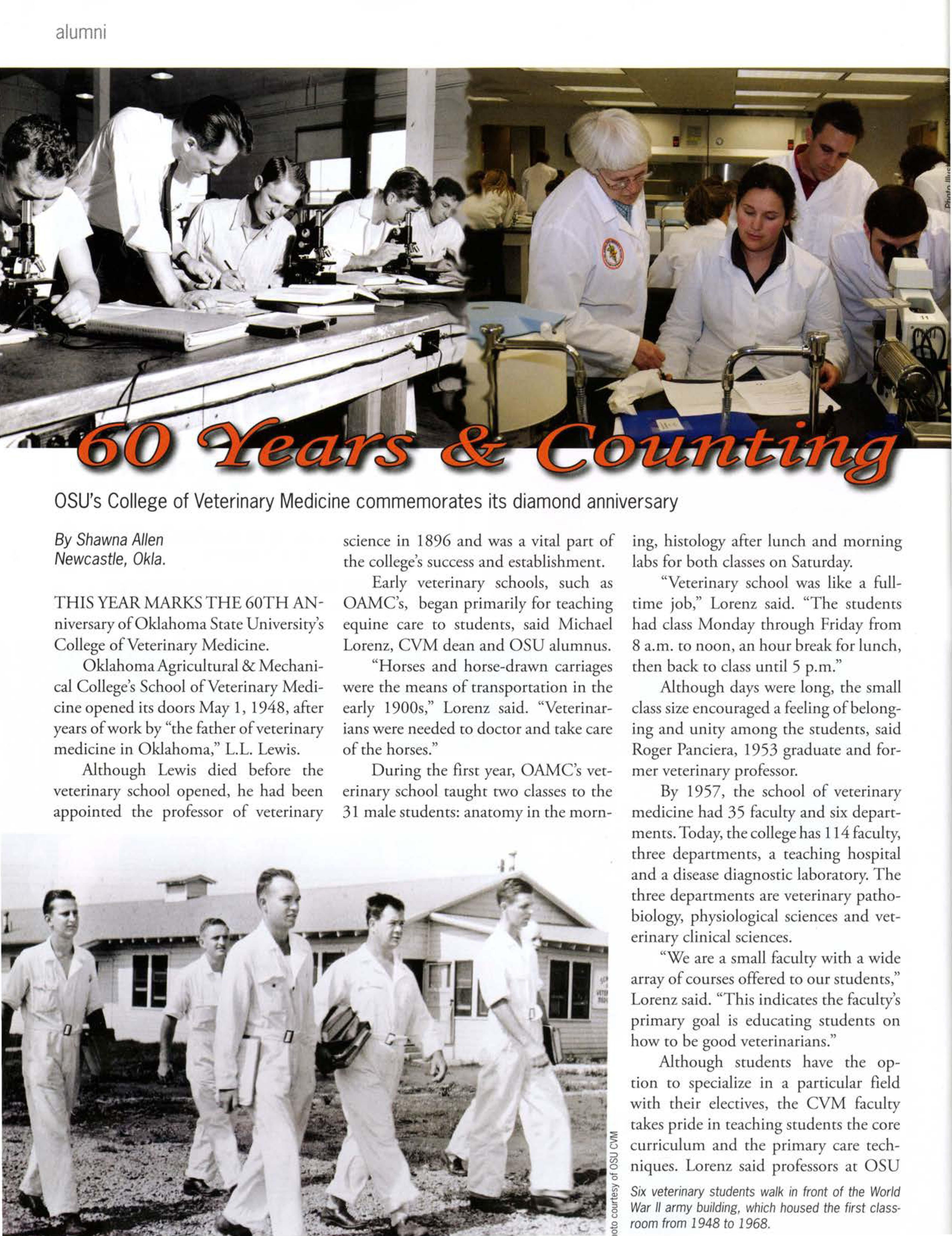
ing, histology after lunch and morning lab for both cla e on aturday.
"Veterinary school was like a fulltime job," Lorenz said. "The students had class Monday through Friday from 8 a.m. co noon, an hour break for lunch, then back to clas until 5 p.m."
Although days were long, the small class size encouraged a feeling of belonging and unity among rhe scudenrs, said Roger Panciera 1953 graduate and former veterinary professor.
By 1957 the chool of veterinary medicine had 35 faculty and six deparrmenr Today, the college has 114 faculty, three departments, a teaching hospital and a disea e diagno tic laboratory. The three departments are veterinary pachobiology, physiological ciences and veterinary clinical sciences.
"We are a small faculty with a wide array of cour es offered to our students," Lorenz said. "This indicates the faculty's primary goal is educating students on how co be good veterinarians."
Although srudencs have the option to specialize in a particular field with their elective , the CVM faculty takes pride in reaching students rhe core curriculum and the primary care techiil o nique Lorenz said professors ar OSU 0 >v, 0 u Six veterinarystudentswalk in front of the World WarII army building,whichhousedthe first classroom from 1948 to 1968.
are "eye-co-eye" with their students, making ure they learn and under rand the material.
he dedication put forth by the faculty and students re ulred in uccess for all. By 1961, 0 U's College of Veterinary Medkine had 255 graduate working in 37 states and overseas. ow, the coral number of graduates is 3 089.
"We've graduated three presidents of the American Veterinary Medical Association," Lorenz said, "along with Bob Whitney, the only veterinarian co serve as surgeon general."
With an increase in coral numbers and student succe came an increa e in cost and building space.
"In 1948, the budget allotted for the CVM was $110,023," said Derinda Lowe, CVM public relation coordinator. "Today, one semester of veterinary chool co t a student $6,565 in-state ruirion and $15,202 ouc-of-srace."
As for building pace, McElroy Hall was built a year after r:he school was established. During the year , several wings were added co che original structure co accommodate srudenrs faculty and laboracorie .
"We have more facilities faculty and research now r:han there were back then,' Panciera said.
Today the ollege of Veterinary Medicine [McElroy Hall], the Boren Veterinary Medical Teaching Hospital and the Oklahoma Animal Disease Diagnostic Laboratory are the three buildings housing rhe Center for Veterinary Healrl1 ciences.
"The first classroom was a temporary World War II army building and the veterinary hospital was located m
JOHN DEERE
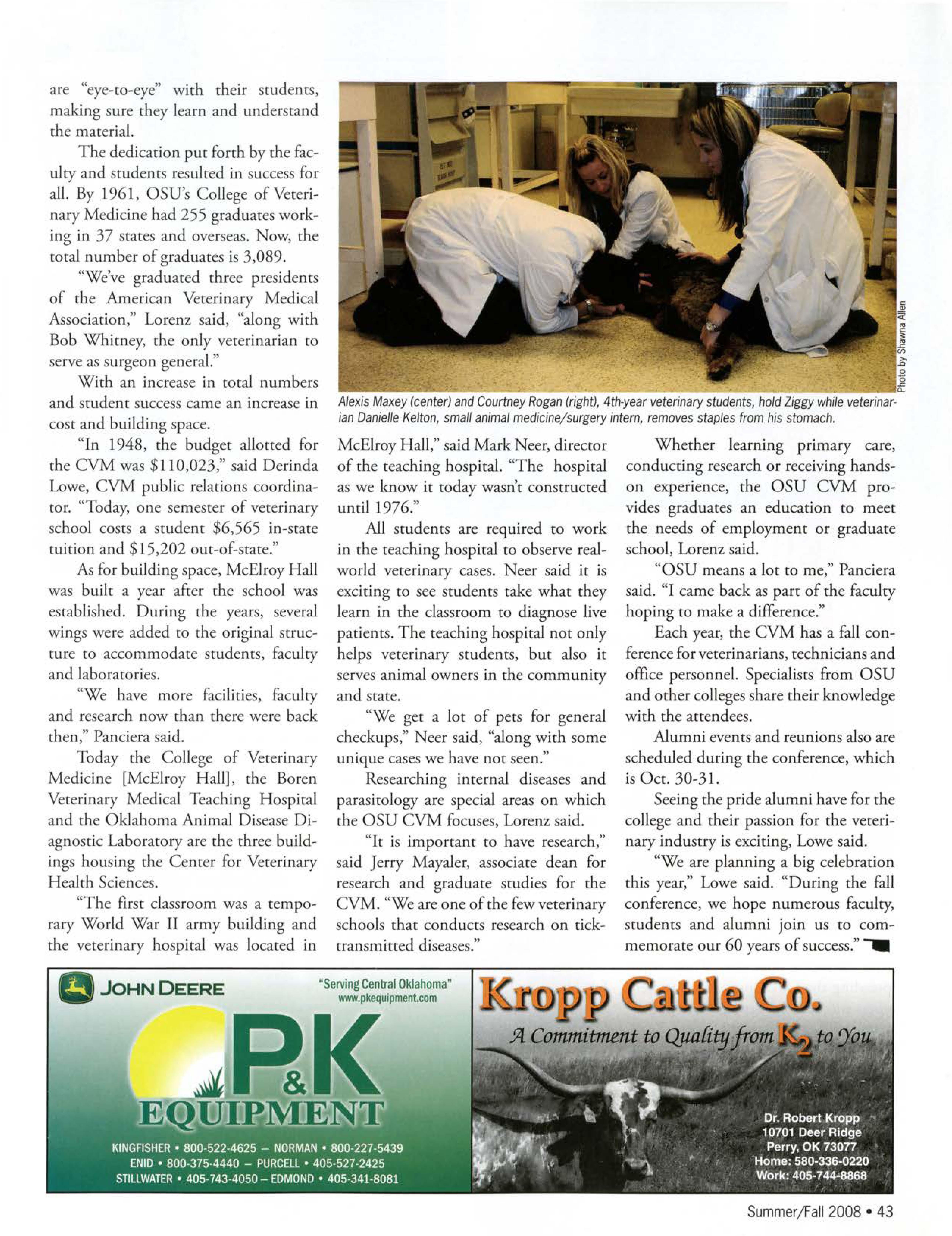
McElroy Hall," said Mark Neer, director of the reaching hospital. "The hospital as we know it today wasn't constructed umil 1976."
All srudents are required to work in che teaching hospital co observe realworld veterinary cases. eer said it is exciting to see students cake what they learn in the classroom ro diagnose live patients. The teaching hospital not only helps veterinary students, but also it serves animal owners in the community and scare.
"We get a lot of pees for general checkups," Neer said, "along wir:h some unique cases we have not seen."
Researching incernal diseases and parasitology are special areas on which the O U CVM focuses, Lorenz said.
"Ir is important to have re earch," said Jerry Mayaler, associate dean for research and graduate studies for the CYM. "We are one of the few veterinary schools char conduces research on ricktransmitted diseases."
Whether learning primary care, conducting research or receiving handson experience, che O U CVM provides graduates an education co meet the needs of employment or graduate school, Lorenz said.
"O U means a lot to me," Panciera said. "I came back as part of r:hefaculty hoping to make a difference."
Each year, che CVM has a fall conference for veterinarians, technicians and office personnel. pecialiscs from OSU and ocher colleges share their knowledge with the attendees.
Alumni events and reunions also are scheduled during the conference, which is 0cc. 30-31.
eeing r:hepride alumni have for r:he college and their passion for r:he veterinary industry is exciting, Lowe said.
"We are planning a big celebrarion this year," Lowe said. "During the fall conference, we hope numerous faculty, students and alumni join us to commemorate our 60 years of success."~
By BrittainyBarton Jarrell,Texas
UPO E TERI G THE STUdent uccess Center, one is greeted by smiling faces along with the sights and sounds of students assi ring fellow students wich resumes job searches and many other student development and career service-related activities. These same students are seen on campus helping with the recruitment of potential Oklahoma State University scudencs. These students are here because they share common interests: They enjoy preading the OSU spirit, wane co help others succeed and have a "team player" attitude. They are Student Success Leaders. SSLs consist of Agricultural Ambasadors, Career Liaisons and Freshmen in Transition cudent Academic Mentors, or FIT SAMs. Each team represenrs the College of Agriculrural ciences and arural Resources as well as O U.
Since an SSL has many responsi-
bilicies, potential applicants may worry becoming an SSL might conflict with classes and ocher activities in which they already are involved.
"We normally get cochoose our four office hours around our class schedule ac our convenience," said Carol Cook, Career Liai on. ''Also, I don't cake night classes so I can be available to do club presentations in the evenings."
Becoming an L provides students with networking opportunities with leaders in the college, the university and the community.
"Being an SSL will help me in the future because I have had experience working with a diverse group of students and have had the opportunity co network and help coordinate many activities," said Megan McCool, 20072008 FIT AM.
As an SSL, opportunities exist ro spread the spirit of OSU and to ensure ochers gain from their experiences.
"Being an L isn't about what
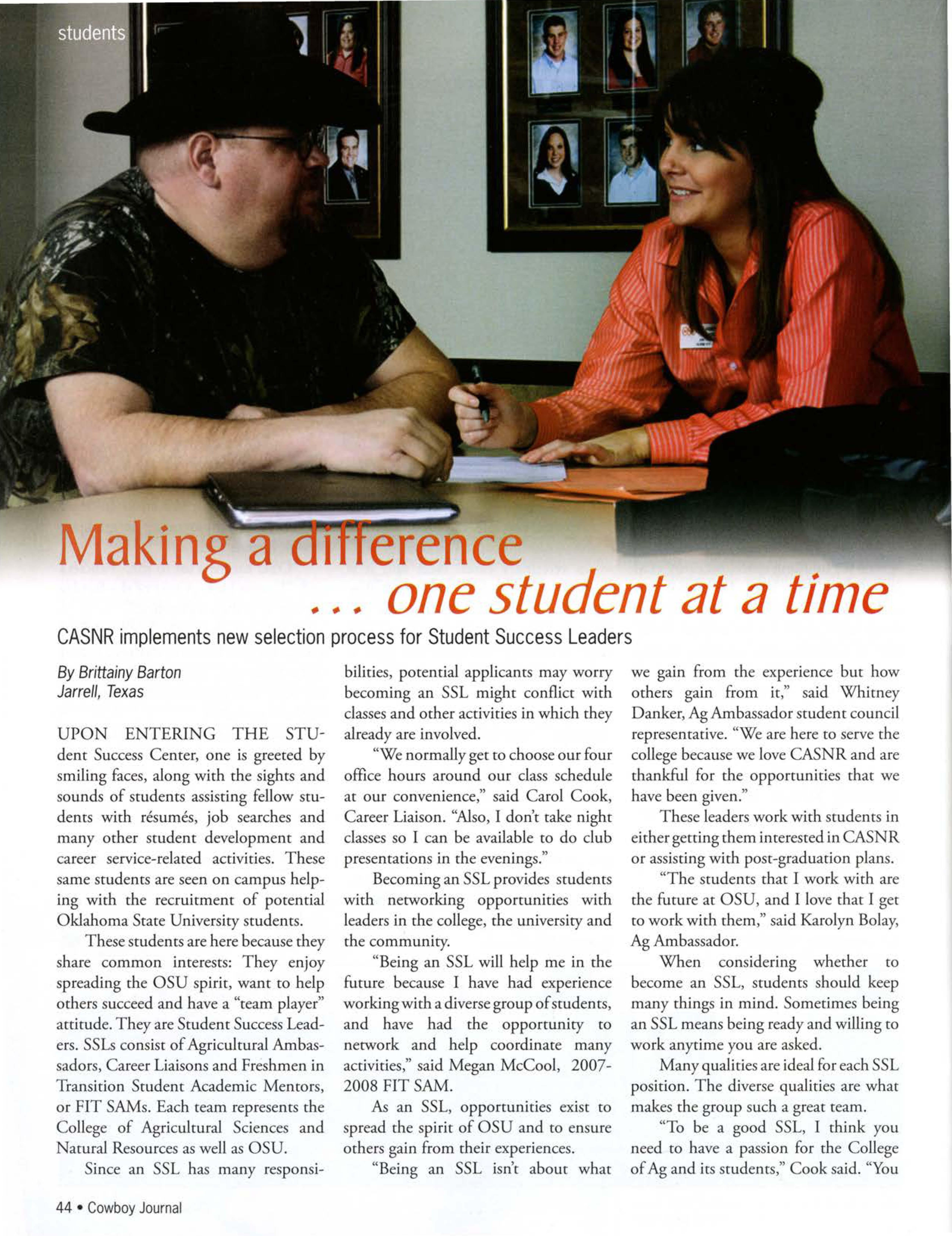
we gain from the experience but how or hers gain from it," said Whi rney Danker, Ag Ambassador student council represenracive. ' We are here to erve the college because we love CASNR and are thankful for the opportunities that we have been given."
hese leaders work with scudenrs in either gening them interested in CAS R or assisting with pose-graduation plans.
"The students chat I work with are the future ac O U, and I love that I get to work with chem," said Karolyn Bolay, Ag Ambassador.
When considering whether to become an SSL, srudencs should keep many rhings in mind. Sometimes being an L means being ready and willing to work anytime you are asked.
Many q uaHties are ideal for each SSL posi.tion. The diverse qualiri.es are what makes the group such a great team.
"To be a good SSL, I chink you need ro have a passion for the CoUege of Ag and it students," ook said. "You
need co have a servant's artitude and a willingness co help. These qualities - along with responsibility and smile - will make you a great SSL."
To become an S L, students muse participate in the new pre-training program for applicants.
"The idea to start the SSL training came from nerworking with other advi ers from universities similar co ours" said Amy Simmons, coordinator of prospective student services and Ag Ambas ador advi er.
Each year prior co the beginning of classes, SSLs were asked ro go through training to learn about etiquette, majors and option , presentation kills, resume development, job responsibilities of each position and general information about 0 U and the CASNR.
"We found that many of the students felt overwhelmed by what they were learning and wanted co know what was going co be expected of them prior co applying," Simmons said. "This prompted the development of the training process prior co applying."
The new election proce s also provides the advisers of each group an additional opportunity co interact with the applicants, co identify their strengths and weaknesses, and co decide in which group each student would fit best.
"You participate in four sessions before the L interviews take place, o rhat you can become acquainted with che advi ers and selection comminee as
well as learn what you will be doing if you are selected " Cook said.
After the sessions, the applicants are invited ro a mix and mingle event with the selection commi ccee.
"During che mix and mingle, each applicant gets one-on-one time with each committee member," Cook said. "Based on this experience, about 40 applicants are a ked in for interviews.
"The interview consists of a business-professional meeting with the selection committee, where you discuss why you would like co be an S L and which position you can see yourself in," she said.
The committee forms the teams and notifies the new Ls by e-mail.
"We are hoping that the new process will fir t indicate which rudents are uuly committed co the program," Simmons aid. " econd, we are providing an opportunity for students to learn about each position in depth, and third, the coordinators have the opportunity co interact with the participant multiple times prior to selection."
Currenc SSLs said they encourage their peers and new transfer students co consider an SSL position in the future.
"I have really come out of my shell by being an SSL" McCool said.
'It has given me confidence that I once did not have," she said. "I have met o many new people, and I credit all of rhis to being an SSL."~
•
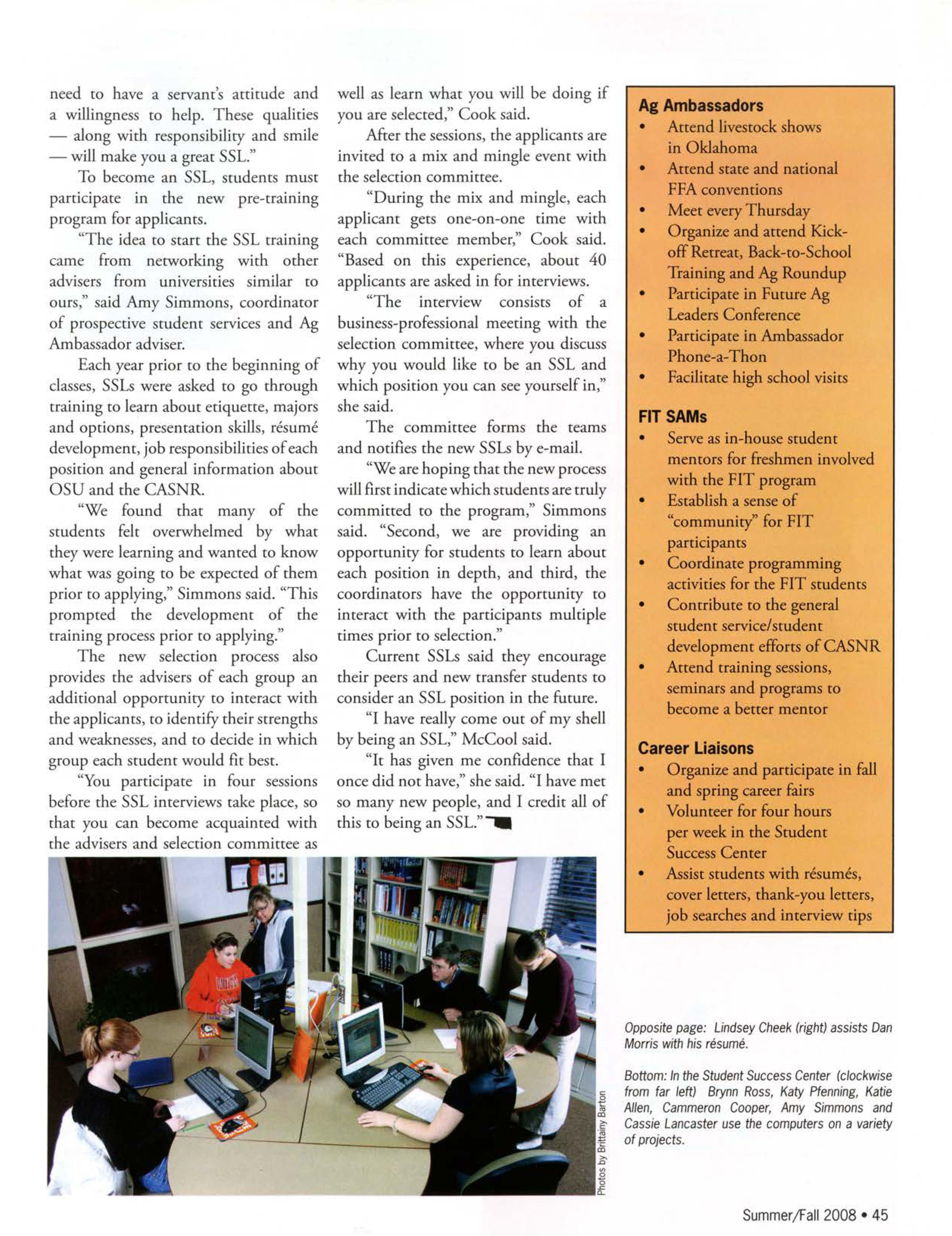
Attend livestock shows in Oklahoma
Attend srate and national FFA conventions
Meet every Thursday
Organize and anend Kickoff Retreat, Back-to-School
Training and Ag Roundup
Participate in Future Ag Leaders Conference
Participate in Ambassador
Phone-a-Thon
Facilitate high school visit
• Serve as in-house student mentors for freshmen involved with the FIT program
• EscabUsha sense of "community" for FIT participants
• • • Coordinate programming activities for the FIT students
Contribute to the general student service/student development efforts of CASNR
Attend training sessions, seminars and programs ro become a better mentor
•
Organize and participate in fall and spring career fairs
Volunteer for four hours per week in the cudent Success Center
Assist students with resumes, cover letters, thank-you letters, job searches and interview tips
Oppositepage: LindseyCheek(right)assistsDan Morriswithhis resume.
Bottom:In the StudentSuccessCenter (clockwise from far left) Brynn Ross, Katy Pfenning,Katie Allen, Cammeron Cooper, Amy Simmons and CassieLancasteruse the computerson a variety of projects.
By Sara-JaneSmallwood Clayton,Okla.
EXCELLENCE. EXCELLE CE. EXCELLENCE.
The excellence gene permeates graduates of the Oklahoma State University College of Agricultural Sciences and Natural Resources, especially the 2007 Distinguished Agricultural Alumni: Byrd Curtis, Eddie Smith and Dennis White.
"It's important to recognize achievements of outstanding individuals," said Ed Miller, CASNR associate dean for academic programs. "They provide a model of achievement for the rest of us to attain.
"Each honoree excelled in a quite unique way. They show us many ways to provide exceptional leadership and service in our industry."
Honorees are chosen each year based on their career achievements. Nominations for the Distinguished Agricukural Alumni Award come from many places and individuals, but most nominations come from the alumni's department or major.
''A strength of this awards program is that nominations can come in many ways," said Miller. "The university president, rhe dean, past honorees and faculty are great resources to identify nominees."
A worldwide career can start in Stillwater, Okla.
Byrd Curtis has traveled to 65 different countries and has called five of them "home." Thi world leader in wheat research, however, credit his career success co his time at O U.
"l couldn't have done any of it without my background from O U," urtis said.
Curtis completed boch his undergraduate and doctoral degrees at O U and served as an agronomy profe or from 1953-1962. He then worked as a faculry member at olorado tate Universiry, where he served as the state wheat breeder.
A5 be continued with his agronomic career, Cunis was the fir t manager for argill's hybrid wheat research program. Hi program helped improve the cross-pollination trait in wheat, advancements that led co the development of wheat hybrid in the U .. , although these hybrids were not adopted by producers.
"My experience with CargiU included many interaction with for ign wheat breeders, researchers and agriculmral admini tracors in Europe, ouch America and the USSR, Curtis aid.
This helped prepare him co be the director of the wheat program at che lncernacional Cencer for Maize and Wheat Improvement in 1981. Curtis was only the third person to hold this cicle at CIMMYf, where he oversaw the world's largest germplasm development network for wheat, uiticale and barley. Becau e of advancements in wheat varieties and wheat growing technology from CIMMYT, wheat production in many developing counrrie has increased dramatically.
CIMMYT i based in Mexico but has a global reach. As director of CIMMYT, Curtis rraveled to represenc the organization.
"I grew up in Roosevelt, Okla., a small town 40 miles northwest of Lawton," Curtis said. " ot many people [from mall town ] are that lucky ro travel to 65 countries."
Upon retirement in 1991 Curtis returned to Colorado where he is a retired emeritus professor at C U.
"Golf, exercising, Kiwanis volunteering and computer work, particularly in genealogy, keep me busy," urris said. "I have a good time each day. I never have a free moment."
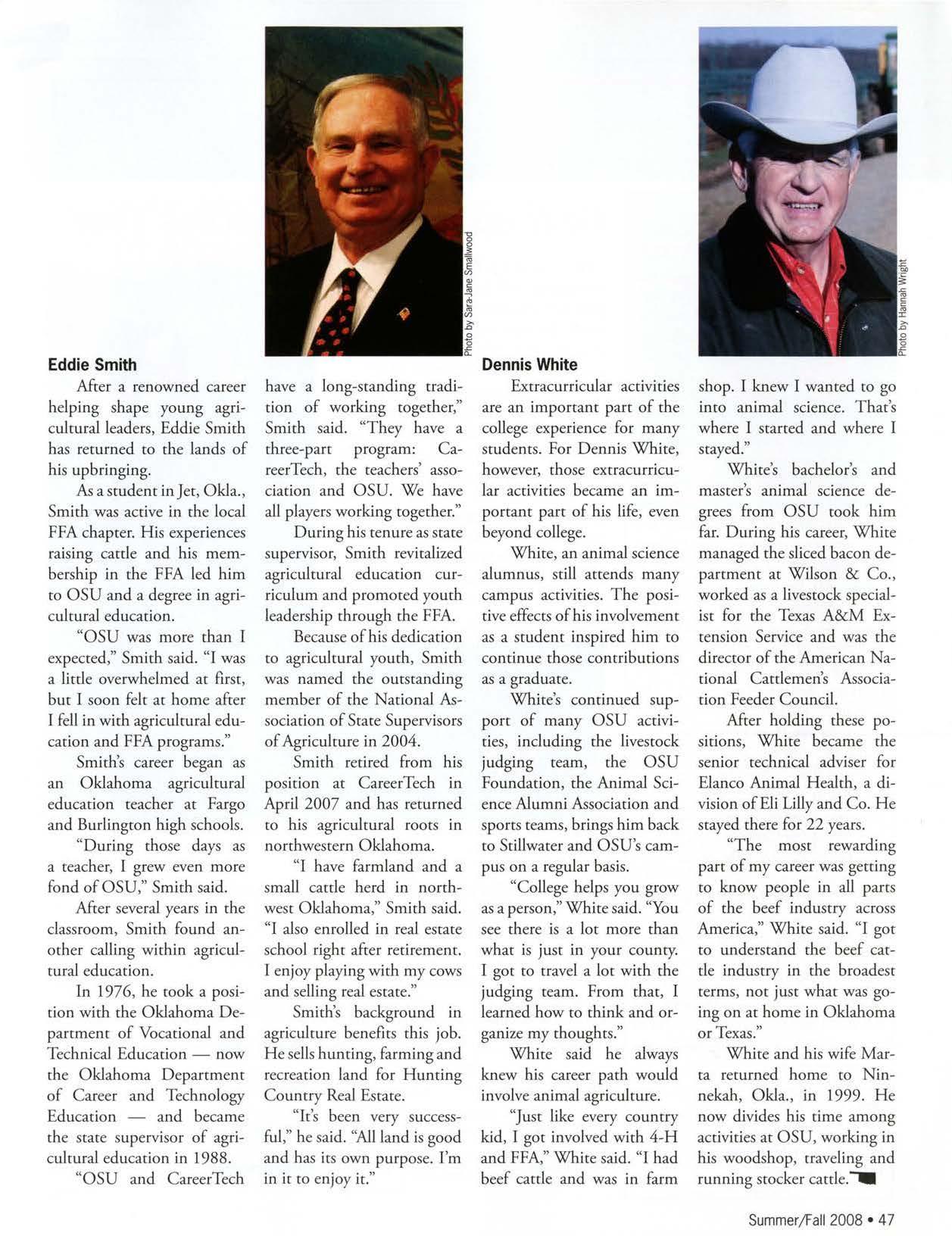
After a renowned career helping shape young agricultural leaders, Eddie Smith has returned co the lands of his upbringing.
As a srudenc in Jee, Okla., Smith was active in the local FFA chapter. His experiences raising cattle and his membership in the FFA led him co OSU and a degree in agricultural education.
"OSU was more than I expected," Smith said. "f was a little overwhelmed at first, bur I soon felt ac home after I fell in with agricultural education and FFA programs."
Smith's career began as an Oklahoma agricultural education teacher at Fargo and Burlington high schools.
"During those days as a reacher, I grew even more fond of OSU," Smith said.
After several years in che classroom, Smith found anocher calling within agricultural education.
In 1976, he cook a position with the Oklahoma Department of Vocational and Technical Education - now the Oklahoma Department of Career and Technology Education - and became the state supervisor of agricultural education in 1988.
"OSU and CareerTech
have a long-standing tradition of working rogerher," Smirh said. "They have a three-pan program: CareerTech, che teachers' association and OSU. We have all players working together."
During his tenure as state supervisor, Smith revitalized agricultural education curriculum and promoted youth leadership through che FFA.
Because of his dedication to agricultural youth, Smith was named the outstanding member of rhe National Association of Stare Supervisors of Agriculture in 2004.
Smith retired from his position at CareerTech in April 2007 and has returned co his agricultural roots in northwestern Oklahoma.
"I have farmland and a small cattle herd in northwest Oklahoma," Smith said. "I also enrolled in real estate school right after retirement. I enjoy playing with my cows and selling real estate."
Smith's background in agriculture benefits this job. He sells hunting, farming and recreation land for Hunting Country Real Estate.
"It's been very successful," he said. "All land is good and has its own purpose. I'm in it co enjoy it."
Extracurricular act1v1ues are an important part of che college experience for many students. For Dennis White, however, chose excracu.rricular activities became an important part of his life, even beyond college.
White, an animal science alumnus, still attends many campw Kci~cie~ T~ rive effects of his involvement as a student inspired him co continue those contributions as a graduate.
White's concinued support of many OSU activities, including the livestock judging ream, the OSU Foundation, the Animal Science Alumni Association and sports teams, brings him back co Stillwater and OSU's campus on a regular basis.
"College helps you grow as a person," White said. "You see there is a lot more than what is just in your county. I got to travel a lot with the judging ream. From thar, I learned how co think and organize my rhoughcs."
White said he always knew his career path would involve animal agriculture.
"Just like every country kid, I got involved with 4-H and FFA," White said. "I had beef cattle and was in farm
shop. I knew I wanted co go into animal science. Thar's where I scarred and where I stayed."
White's bachelor's and master's animal science degrees from OSU cook him far. During his career, White managed the sliced bacon department at Wilson & Co., worked as a livestock specialise for the Texas A&M Extension Service and was the director of the American National Catclemen's Association Feeder Council.
After holding these positions, White became the senior technical adviser for Elanco Animal Health, a division of Eli Lilly and Co. He stayed there for 22 years.
"The most rewarding pare of my career was getting co know people in all parts of the beef industry across America," White said. "I got co understand the beef cattle industry in the broadest terms, not just what was going on at home in Oklahoma or Texas."
White and his wife Marta returned home to Ninnekah, Okla., in 1999. He now divides his time among activities at OSU, working in his woodshop, traveling and running stocker cattle.-.
With increased interconnectivity in roday's world, DASNR emphasizes interdisciplinary programs in our classrooms, the Oklahoma Agricultural Experiment Station system and the Oklahoma Cooperative Extension ervice. Our students are provided che opportunity to experience multidisciplinary approaches to solving complex issues related ro Oklahoma agriculture and natural resources through these programs.
Most DASNR faculty and staff are affiliated with interdisciplinary teams to combine the knowledge and experience necessary co solve challenging issues and concerns importanr to Oklahoma, the region and beyond.
The division's 2nd Century Initiative - a road map co cackle the challenges of the future - has seven research and extension thrusts: 21st Century Animal Enterprises; 21st Century Biological Technologies; 21st Century Plant Enterprises; Economically Strong and Empowered Communities; Natural Resources - Quality and Management; Resilient and Healthy Families; and 4-H - Developing Community Leaders.
These thrum encompass highprofile issues, such as enhancing the energy industry through biofuel development, managing water resources and strengthening rural economies. We measure DASNR's successes in part by the success of Oklahoma and its citizens. In turn, our research and extension efforts enhance classroom opportunities, which is the land-gram mission made real.
Dr. Robert
E. Whitson
DASNR Vice President, Dean and Direcror
AGRICULTURE ALUM I Association will conduct its fifth tour Jw1e 4-5. The tour i a cwo-day journey across the state with several stop . Thi year, the tour will travel to the southcentral pare of the race.
The Agriculture Alumni Association board of directors looks forward ro the 2008 Access Tour and invites current and future alumni to mark their calendars for the event.
Come and ride with the Cowboys co learn about the diverse agriculture in the great state of Oklahoma.
If you would like more information about the tour call ceve Upson at 580-224-6433 or send a message co sdupson@noble.org.
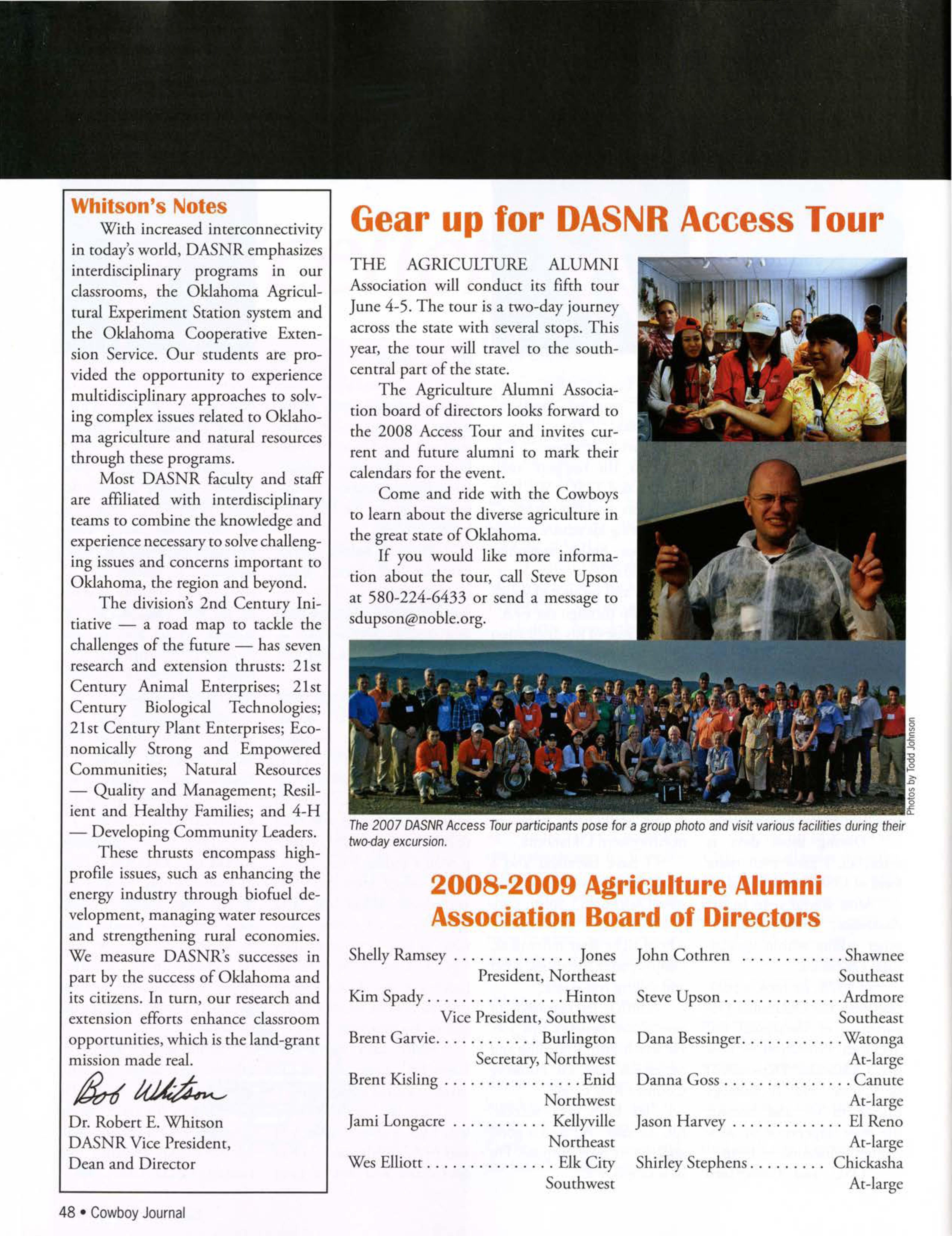
Shelly Ramsey .............. Jones President, Northeast
Kim Spady Hinron Vice President, outhwest
Brent Garvie ............ Burlington ecrecary, orthwe c
Brent Kisling Enid orthwest
Jami Longacre Kellyville Northeast
Wes Elliott ............... Elk City outhwesc
John Cothren hawnee Southeast
teve Up on Ardmore Southeast
Dana Bessinger. Watonga Ar-large
Danna Goss ............... Canute At-large
Jason Harvey ............. El Reno Ac-large
hidey Stephen .
Chickasha Ac-large
AS NEWLY ELECTED PRESIDENT of che Agriculcure Alumni Association, Shelly Ramsey is proof hard work, discipline and joy in what you do can cake a person far in life.
Growing up on a cattle and wheat farm in Bray, Okla., Ramsey said she participated in various activities for as long as she can remember.
"I was extremely active in 4- H and showed Shorthorn caccle for 11 years," Ramsey said. "In high school, I participated in every possible sport I could, including basketball, softball and track."
Ramsey's next seeps were to Scillwacer, Okla., and to the home of the Cowboys, Oklahoma Scace University. Things were different in a bigger city, but Ramsey made the most of her college experience.
"Going co OSU from a small town was frightening and exciting at the same rime," Ramsey said. "I quickly got to know my adviser and was helped in gaining the experience and knowledge I needed to be a success in the professional world."
Ramsey was involved in numerous organizations on the collegiate level, including the Agricultural Communicacors of Tomorrow, Agricultural Scudenr Council, Collegiate 4-H, Agricultural
Ambassadors and Kappa Delea sorority. She credits these activities with helping her grow as a person and learning to enjoy life in general.
"[My activities] taught me a great lesson in balancing personal life and business, something I use on a daily basis," Ramsey said. "It is very important to keep chat balance and remember to have fun and enjoy life. You only get one shot!"
Ramsey graduated in 1995 with a degree in agricultural communications. Shortly after, she married Greg Ramsey, a 1995 agricultural economics graduate. Now residing in Jones, Okla., Shelly Ramsey serves as an event coordinator for the University of Central Oklahoma, bur she has not forgotten her roots as an OSU alumna. She credits che Division of Agricultural Sciences and Natural Resources for much of her success.
"DASNR not only provides you a family away from home, but also it prepares you for what is to come in your future," Ramsey said. "Even though l may not work in the agricultural world on a daily basis, my degree prepared me for any type of role."
Ramsey became a lifetime member of the OSU Alumni Association about eighc years ago, and in 2004, was asked
ShellyRamsey to serve on the Agriculture Alumni board by former president Brent Kisling.
"I always participated in the Agriculture Alumni Association activities, bur when I was approached, I was honored," Ramsey said. "What better way co give back to a great college?"
Now, as che new president, Ramsey plans to continue her predecessors' work and give back co the College of Agricultural Sciences and Nacural Resources.
"In the past few years, the board has tried co increase the way it gives back co the college and the students," Ramsey said. "I hope to continue the success of the past presidents as well as reach out to those alumni with whom we have not made that connection back co the Agriculcure Alumni Association."
COME TO THE ANNUAL AGRIculcure Alumni Barbecue 0cc. 18, and cheer for the Cowboys as they cakeon the Baylor Bears.
Game time will be announced at a lacer dace, bur if cl1egame is at 2 p.m. or later, the barbecue will begin two and
half hours prior to game time. If game time is at 11 a.m., the barbecue will follow the game.
Special recognition will be given co alumni celebrating 10, 25 and 50 years, as well as the Distinguished Agriculture Alumni. It is a great opportunity to visit
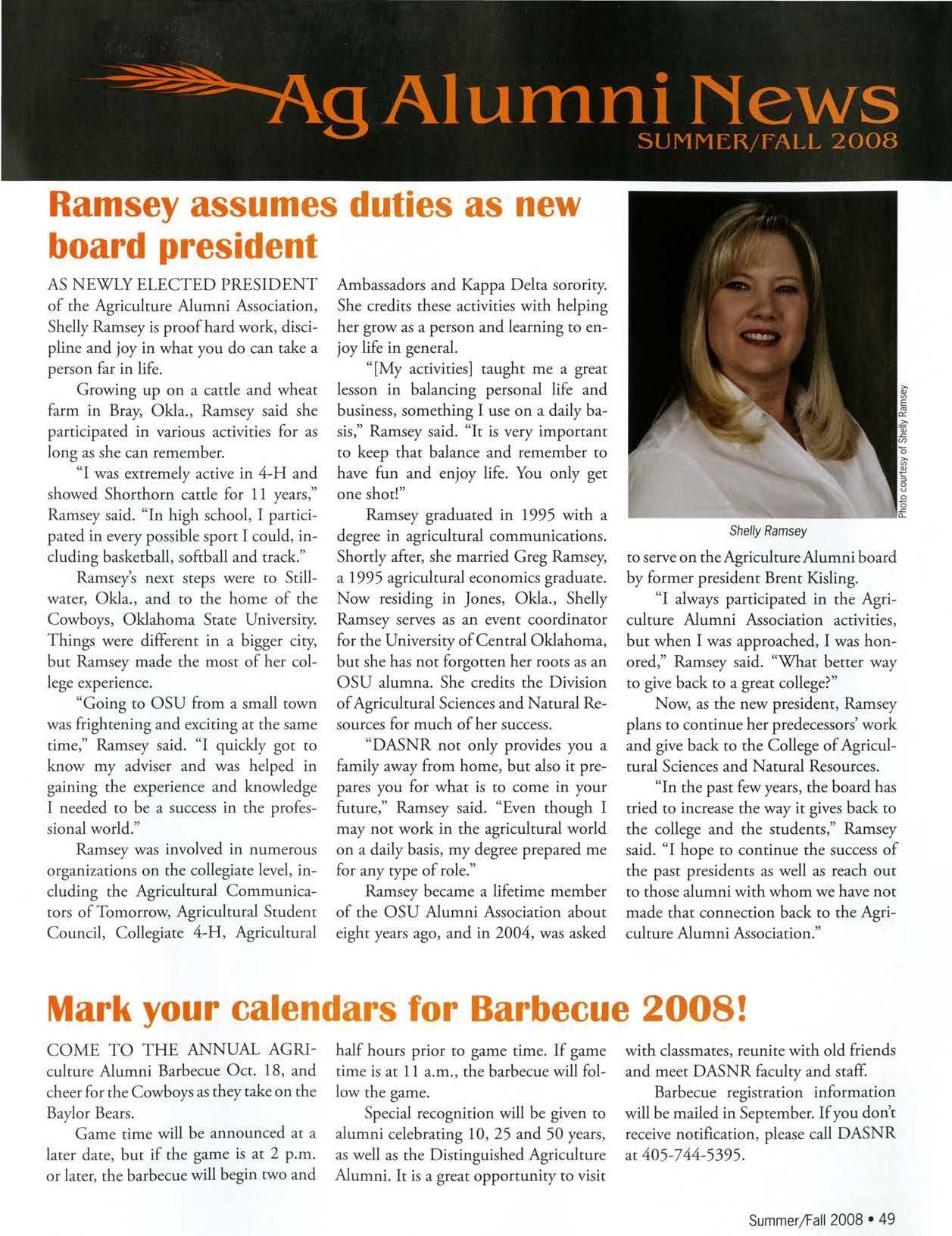
with classmates, reunite with old friends and meet DASNR faculty and staff.
Barbecue registration information will be mailed in September. If you don't receive notification, please call DASNR ac 405-744-5395.

YOUR FAMILYS OTHER DOCTOR.
Youmaythinkall insuranceagentsarea bunchof clowns.Well,if that'strue,theagentsat OklahomaFarmBureauaremorelikethekindof clownyou'dfindata rodeo.We'realwaysthereforyou,readytotakethebullbythehorns if thingsgetserious.Afterall,we'refromOklahoma,too.
Andif there'sonethingOkiesknowhowto do,It'stakecareoftheirneighbors.Youcantrustouragentstogiveyougoodadvice, a goodprice, andfast,friendlyservicewhenyouneedit. Asforthoseout-of-stateguys,well,let'sjustsayyou'dhavebetterlucktalkingto a mime .

b Journal
Cow oy University . O klahoma State . ltural Education, t f Agncu . Departmen d Leadership Communicat1ons an - It al Hall 448 Agncu ur 078-6031 Stillwater, OK 74