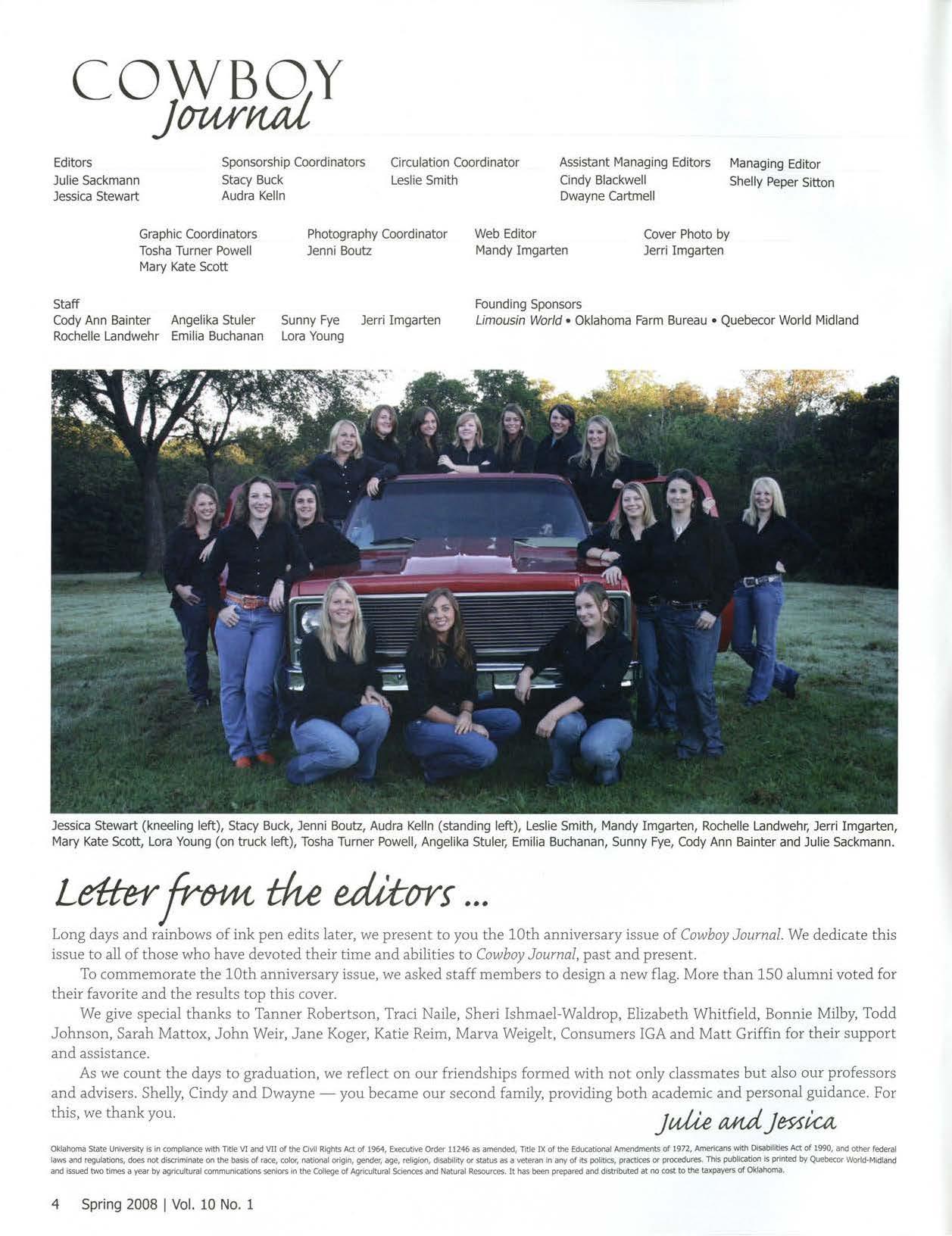
Long days and rainbows of ink pen edits later, we present to you the 10th anniversary issue of Cowboy Journal. We dedicate this issue to all of those who have devoted their time and abilities to Cowboy Journal, past and present.
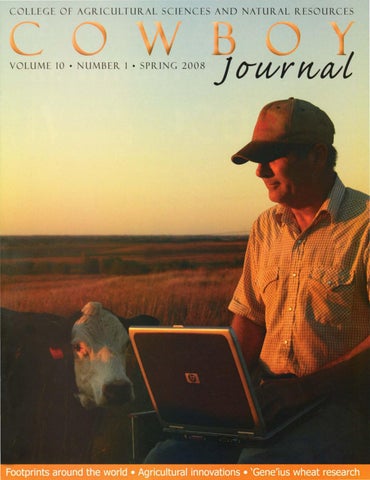
To commemorate the 10th anniversary issue, we asked staff members to design a new flag. More than 150 alumni voted for their favorite and the results top this cover.
We give special thanks to Tanner Robertson, Traci Naile, Sheri Ishmael-Waldrop, Elizabeth Whitfield, Bonnie Milby, Todd Johnson, Sarah Mattox, John Weir, Jane Koger, Katie Reim, Marva Weigelt, Consumers IGA and Matt Griffin for their support and assistance.
As we count the days to graduation, we reflect on our friendships formed with not only classmates but also our professors and advisers. Shelly, Cindy and Dwayne - you became our second family, providing both academic and personal guidance. For this, we thank you. ju/,,ie a.f'li';{, jmk,a
otdahornaState Universityis In compnancewith 1ltle VI aoo VII o/ the OIOIRightsAa of 1964,ExecutiveOrder11246as amended,r.ie IX of the EducationalAmendmentso/ 1972,Americanswith OisabmttesAct o/ 1990,aoo Otherfederal lawsaoo regulations,ooes no( diSCrimlnateon the baSiSo/ ,ace, COlOr,nationalorigin, gender,age, reJ;gloo,disability°'status as a ""teran In ""Y of tts pouticS,pra<ti<eS°'proceoores.Thispullllcatioo ,s printed I>/QuebeCOrWorld·M.dlaoo and issuedtwo timesa year I>/agtlculruralcommtinlcatioosseniorsIn the c:otl09<of Agl'iCu!tU<alScienc>!sondNaruralResources. It has beenP"'P<l'edanddiS<J1buted at no cost to the taxpayersof Oklahoma.
CASNRalumni carry on OSU traditions through family legacies
An FFA calling • 30
Childhood buddies continue bonds through college and career
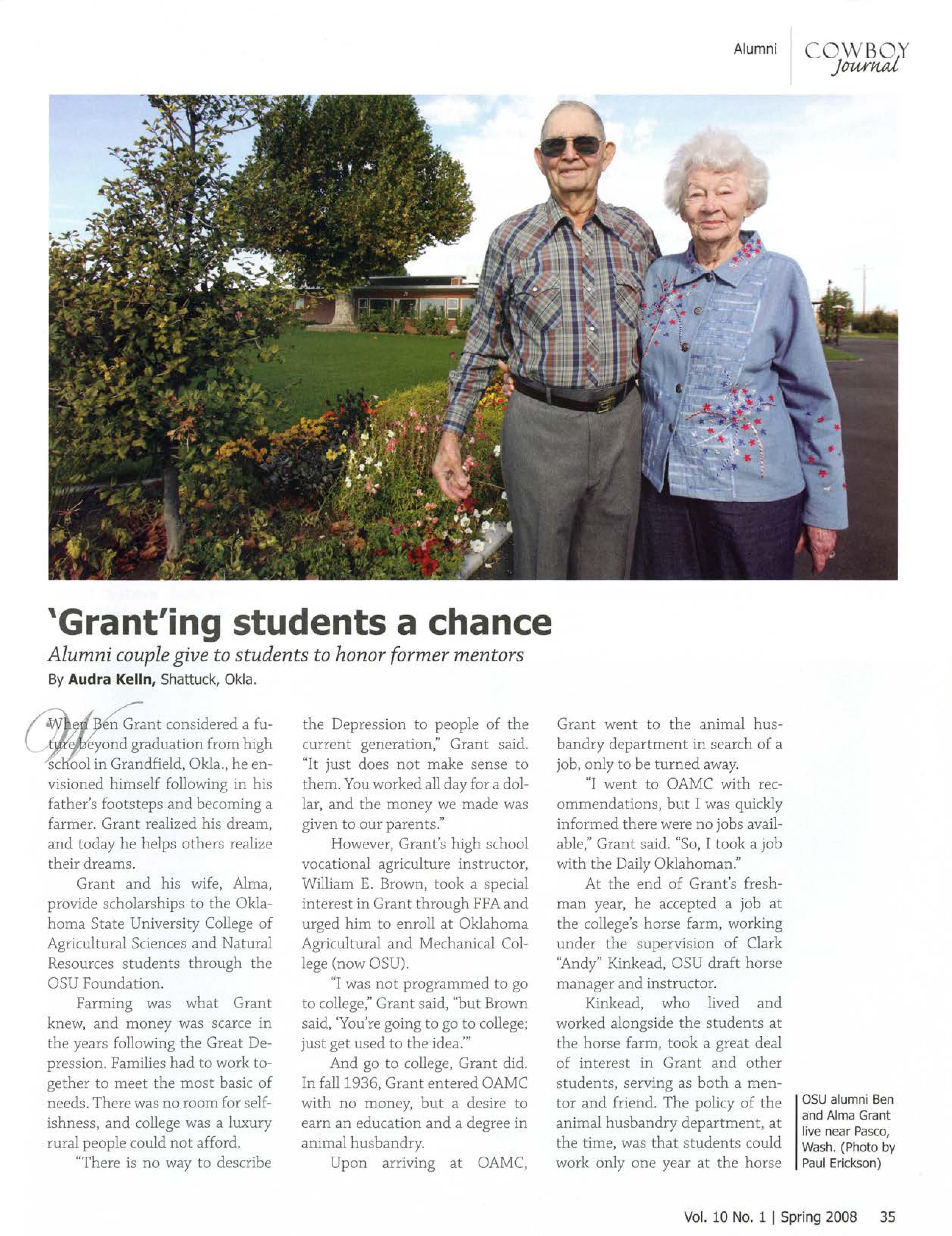
'Grant'ing students a chance • 35
Alumni couple give to students to honor former mentors
Directing youth to a new path • 12
Geospatial program educates 4-H youth about technology
Producers participate for prime progress • 24
The Oklahoma Steer Feedout improves herd management programs
A new highway for rural Oklahoma • 28
For each issue, the Cowboy Journal staff designs an insignia to mark the end of each story. This semester's staff designed an end mark to reflect the history of the Oklahoma State University College of Agricultural Sciences and Natural Resources. The triangle represents the three functions of a land grant university: instruction, research and extension.
Visit the Cowboy Journal Web site at http:// cowboyjou rnal .okstate.edu.
Broadband Internet access provides rural Oklahomans with boundless opportunities
Man of many missions • 8
Paul Weckler's journey leaves little left undone
A tale of two shepherds • 16
Alex McKenzie and Bill Crutcher create a tradition of tending to sheep and students
Gardening a world away• 22
Students tell a story through Japanese gardening
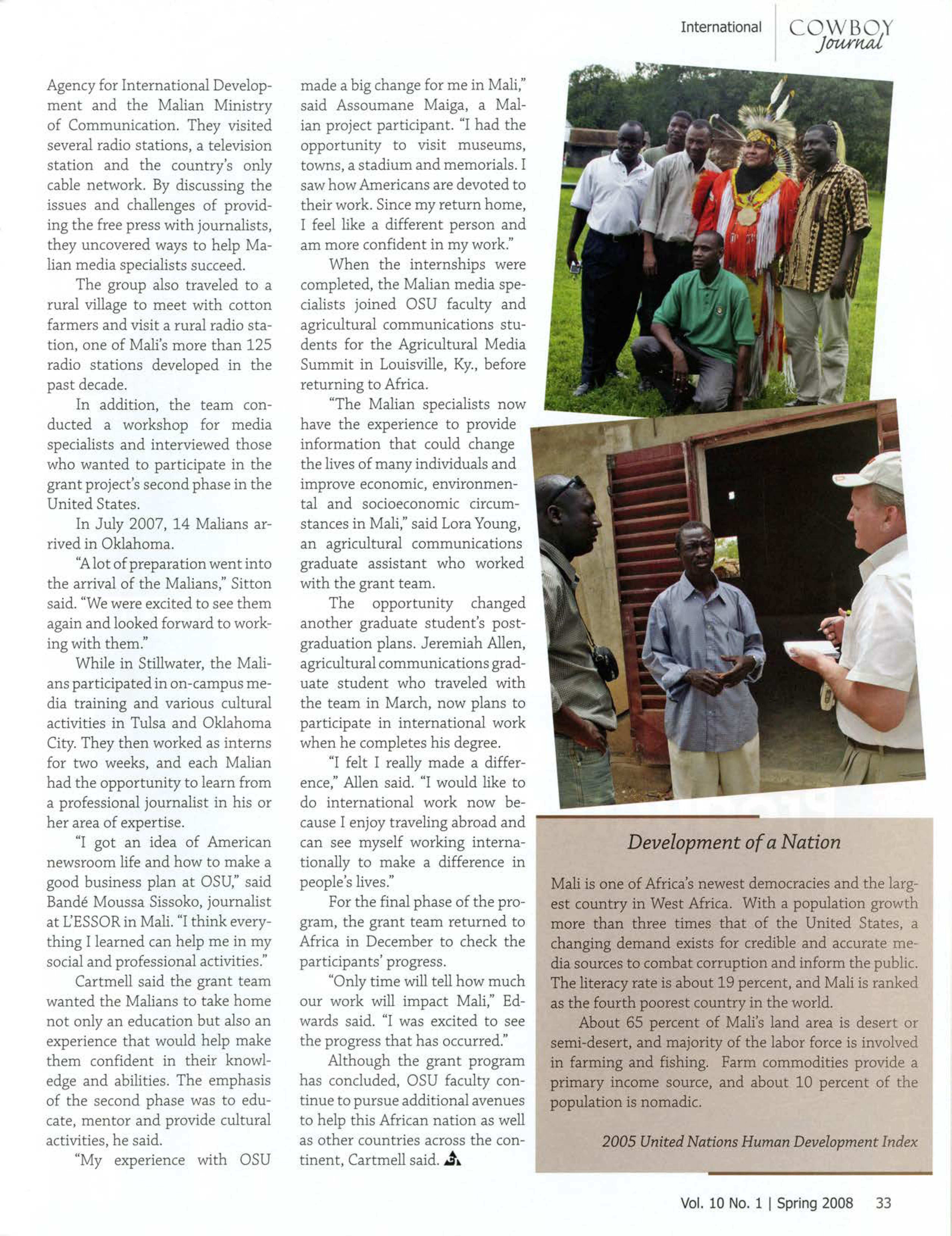
An African adventure• 32
Oklahoma professionals experience Malian culture and media
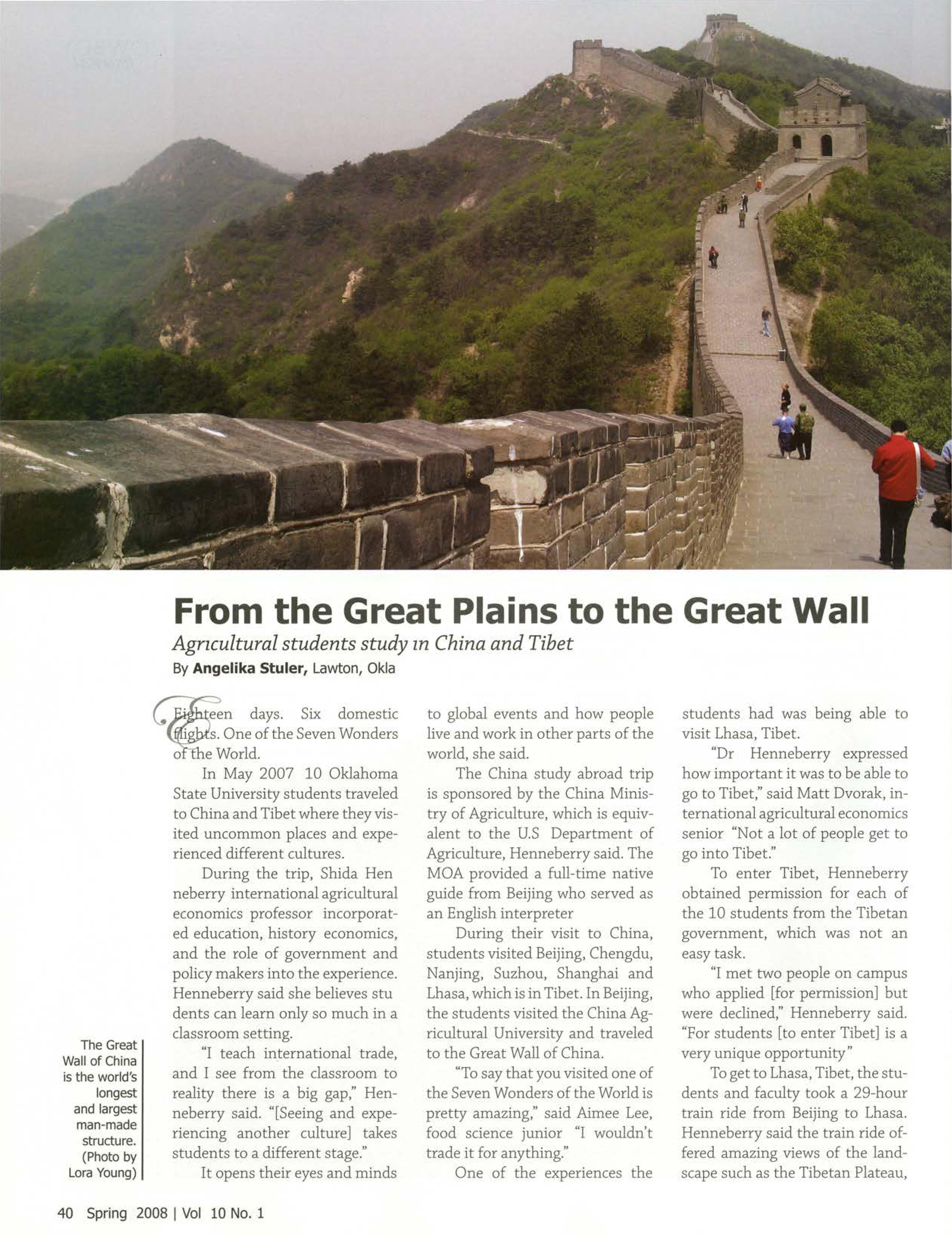
From the Great Plains to the Great Wall • 40
Agricultural students study in China and Tibet
Re:rearch
Money under the microscope • 14
Wheat improvement team benefits from discoveries
Sparking a new trend• 19
Researchers discover the benefits of a new rangeland management technique
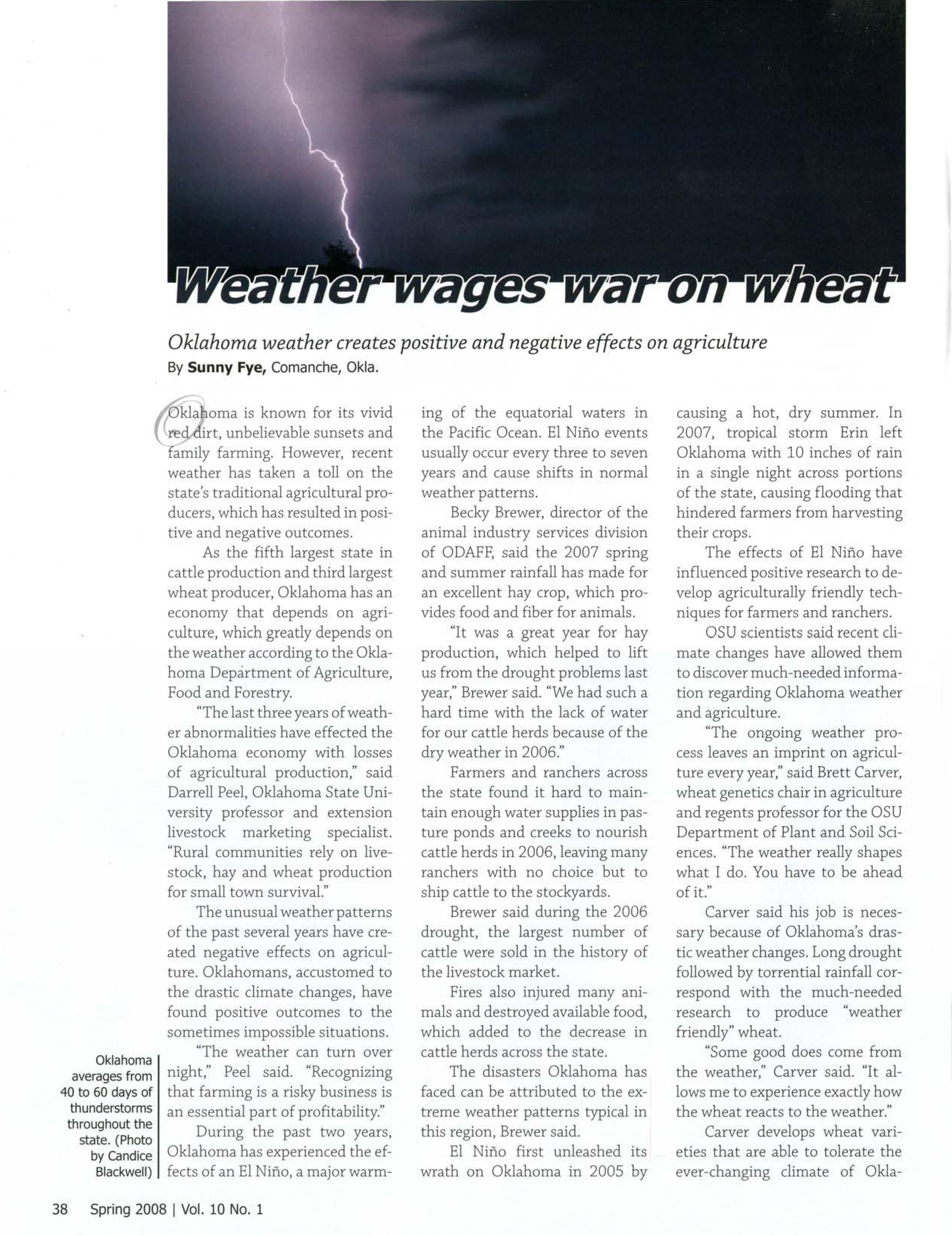
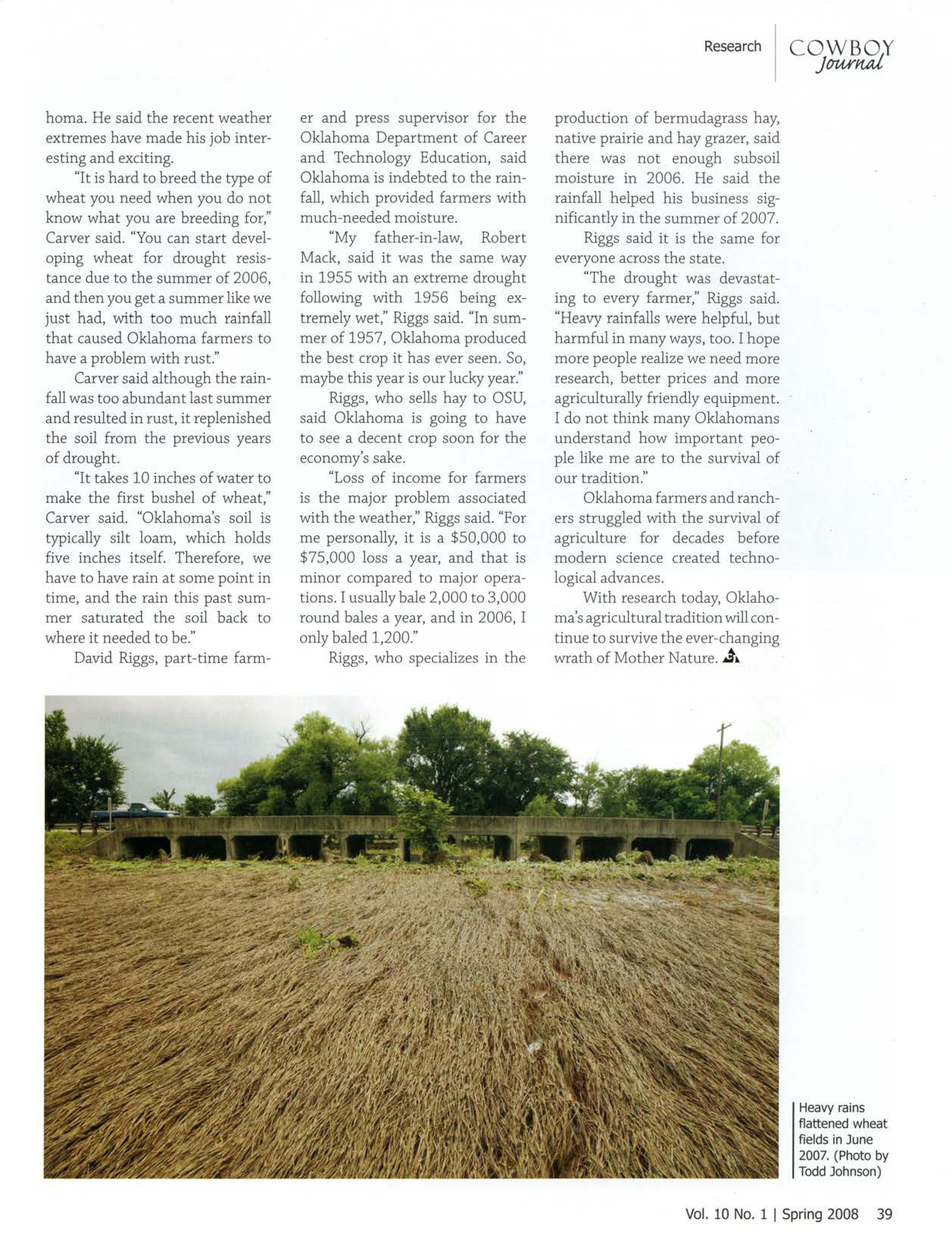
Weather wages war on wheat • 38
Oklahoma weather creates positive and negative effects on agriculture
studen:ts
Cowboys without boots • 6
Students bring diversity to CASNR
Take care, Sweetheart• 44
Tips on how college students can stay healthy
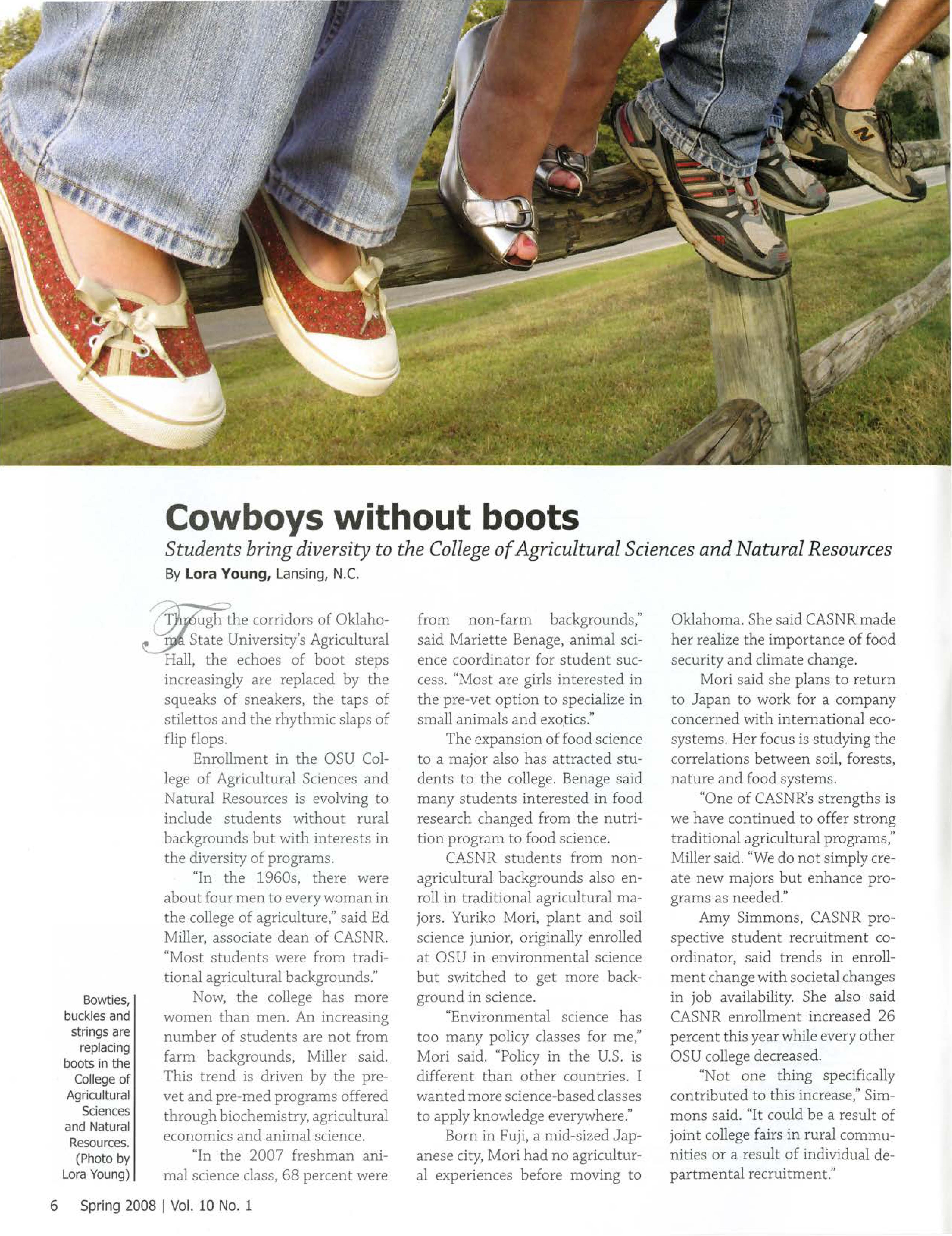
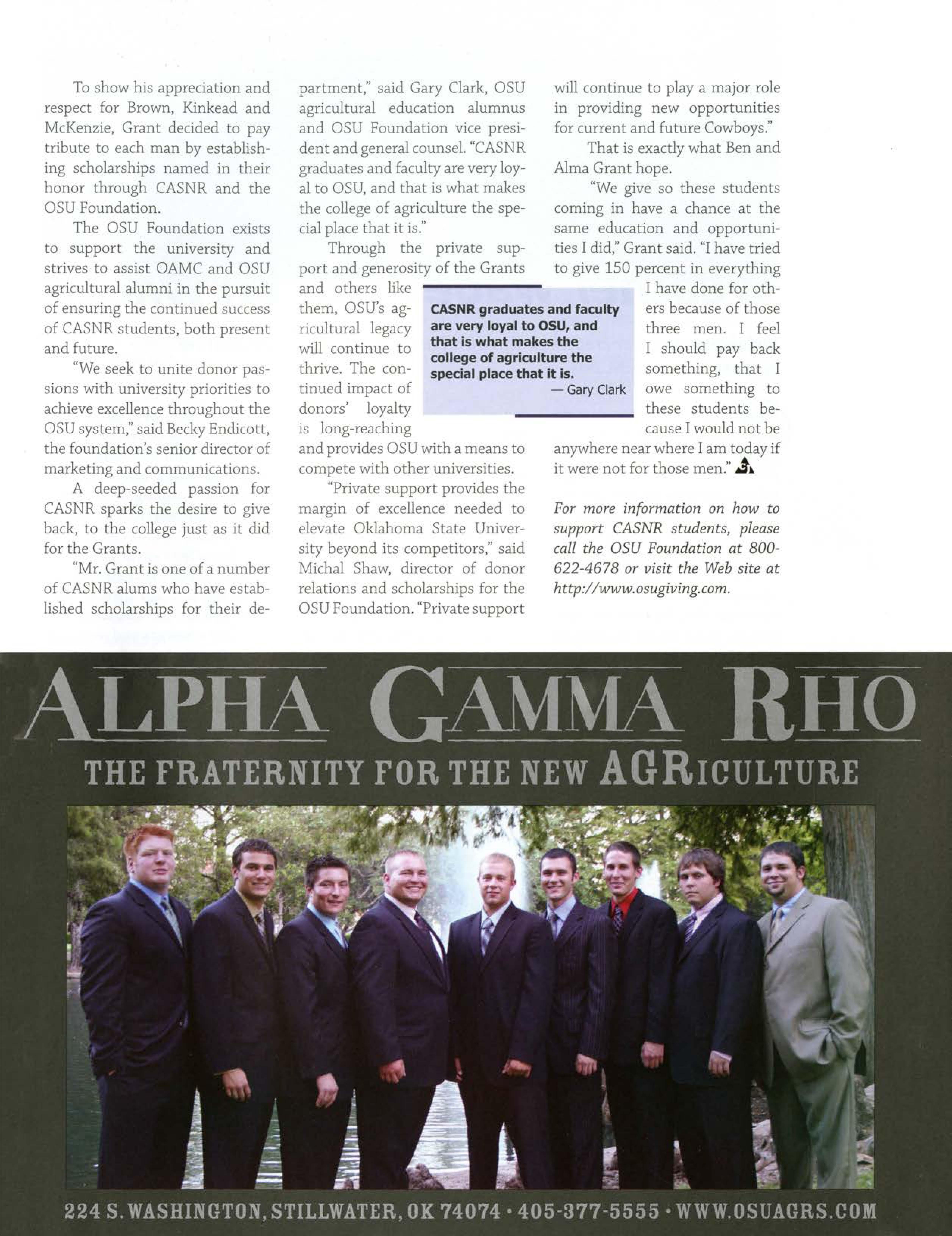
Bowties, bucklesand stringsare replacing boots in the Collegeof Agricultural Sciences and Natural Resources.
(Photo by LoraYoung)
Cowboys without boots
Students bring diversity to the College of Agricultural Sciences and Natural Resources
By Lora Young, Lansing, N.C.
ugh the corridors of OklahoState University's Agricultural Hall, the echoes of boot steps increasingly are replaced by the squeaks of sneakers, the taps of stilettos and the rhythmic slaps of flip flops.
Enrollment in the OSU College of Agricultural Sciences and Natural Resources is evolving to include students withou rural backgrounds but with interests in the diversity of programs.
"In the 1960s, there were about four men to every woman in the college of agriculture," said Ed Miller, associate dean of CASNR.
"Most students were from traditional agricultural backgrounds."
Now, the college has more women than men. An increasing number of students are not from farm backgrounds, Miller said.
This trend is driven by the prevet and pre-med programs offered through biochemistry, agricultural economics and animal science.
"In the 2007 freshman animal science class, 68 percent were
from non-farm backgrounds," said Mariette Benage, animal science coordinator for student success. "Most are girls interested in the pre-vet option to specialize in small animals and exo,tics."
The expansion of food science to a major also has attracted students to the college. Benage said many students interested in food research changed from the nutrition program to food science.
CASNR students from nonagricultural backgrounds also enroll in traditional agricultural majors. Yuriko Mori, plant and soil science junior, originally enrolled at OSU in environmental science but switched to get more background in science.
"Environmental science has too many policy classes for me," Mori said. "Policy in the U.S. is different than other countries. I wanted more science-based classes to apply knowledge everywhere."
Born in Fuji, a mid-sized Japanese city, Mori had no agricultural experiences before moving to
Oklahoma. She said CASNR made her realize the importance of food security and climate change.
Mori said she plans to return to Japan to work for a company concerned with international ecosystems. Her focus is studying the correlations between soil, forests, nature and food systems.
"One of CASNR's strengths is we have continued to offer strong traditional agricultural programs," Miller said. "We do not simply create new majors but enhance programs as needed."
Amy Simmons, CASNR prospective student recruitment coordinator, said trends in enrollment change with societal changes in job availability. She also said CASNR enrollment increased 26 percent this year while every other OSU college decreased.
"Not one thing specifically contributed to this increase," Simmons said. "It could be a result of joint college fairs in rural communities or a result of individual departmental recruitment."
The agricultural programs at OSU not only attract non-agricultural students from Oklahoma but also from around the world.
Christelle Huck and Gautier Simonin are foreign exchange students from a university in Lille, France; neither is from a farm, but they both are food engineering majors in France. They came to OSU for a semester to study agricultural economics.
"Economics is important," Huck said. "When combined with agriculture and food, I can also study world markets and trade."
Simonin said in agriculture he can find many ways to apply his knowledge and wanted to use his foreign exchange experience to increase his skills.
"I wanted to have another point of view of agriculture," Simonin said. "In France, my major dealt specifically with food processing; here, I can study markets,
trade and other global issues in the agricultural industry."
The curriculum is not the only feature of the college that attracts students. Andrea Hesser, animal science pre-vet sophomore, said she decided to be in the college because of the professors.
"It was easy to pick a major because the professors were so nice," Hesser said. "They go out of their way for their students."
Hesser said she not only enjoys the professors in CASNR but also feels accepted by the agricultural students.
'Tm the ag kid who doesn't know anything about what she's doing," Hesser said. "But still, I have made so many friends. The people, students and professors in this college are just happier."
Hesser said the college helps students financially with more scholarship opportunities through CASNR than other colleges.
Like Hesser, Mori said she was impressed with the availability of scholarships within the college and the openness of the professors. She said she also enjoys the job opportunities within the plant and soil sciences department.
"Faculty members are very open," Mori said. "They are willing to work with you to find jobs in your area and to create projects that suit your goals."
Whether it is a result of majors, trends, scholarships, jobs, professors or friends, an increasing number of non-agricultural students are attracted to CASNR.
"The biggest recruitment tool is students having a positive experience and taking it home to share with others," Simmons said.
With supportive faculty, expanding programs and a progressive mind-set, CASNR attracts students from all walks of life, wearing all types of footwear.~~
Man of many missions
Paul Weckler's journey leaves little le~ undone
By Stacy Buck, Altus, Okla.
~t}(c0mustache conceals a ~evous grin. One can expect to see him in cowboy boots and aviator sunglasses. His tall stature may seem intimidating at first, but his contagious chuckle is welcoming. An engineer, a mentor, a colleague and a friend, Paul Wecl<lerembodies the persona of a family man.
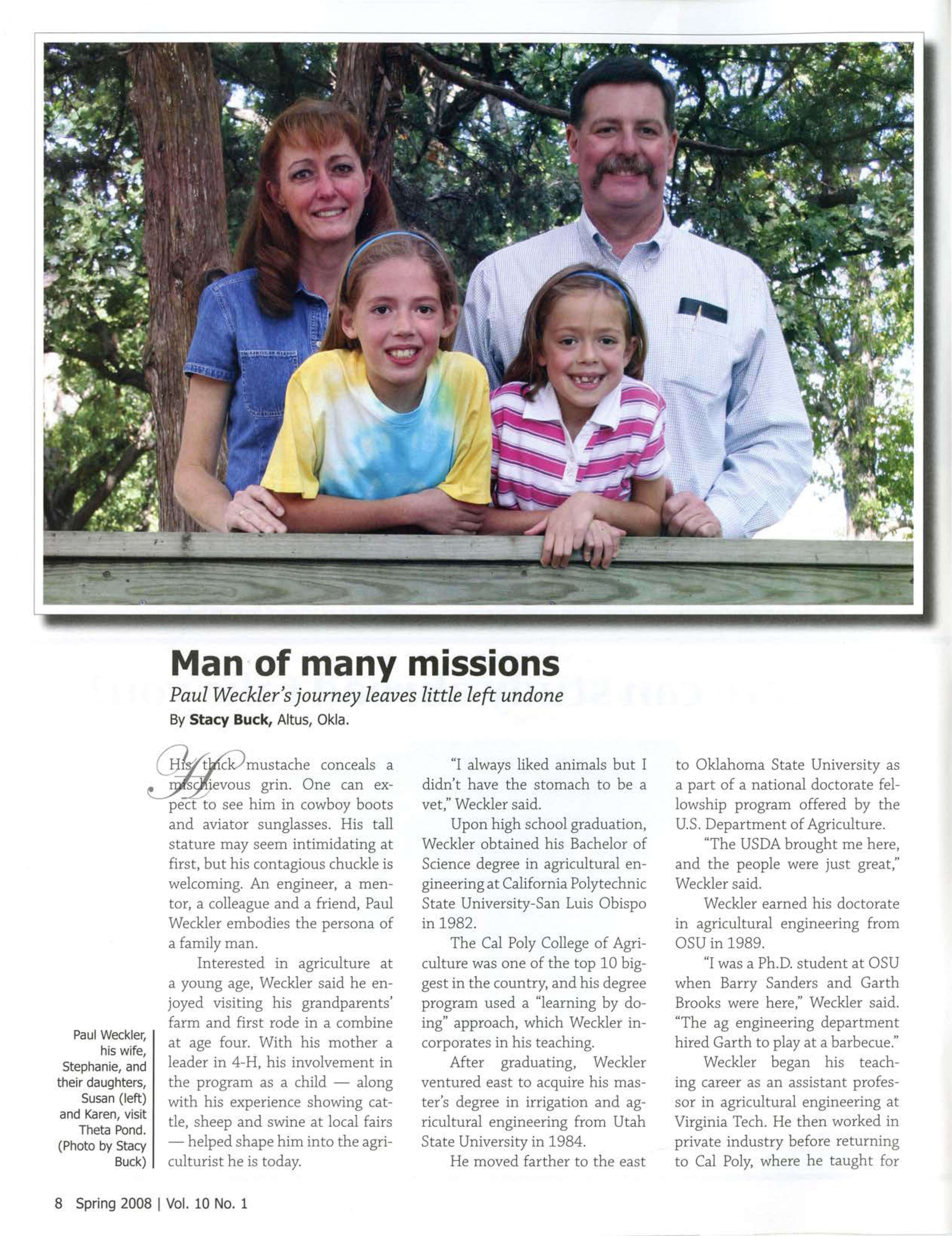
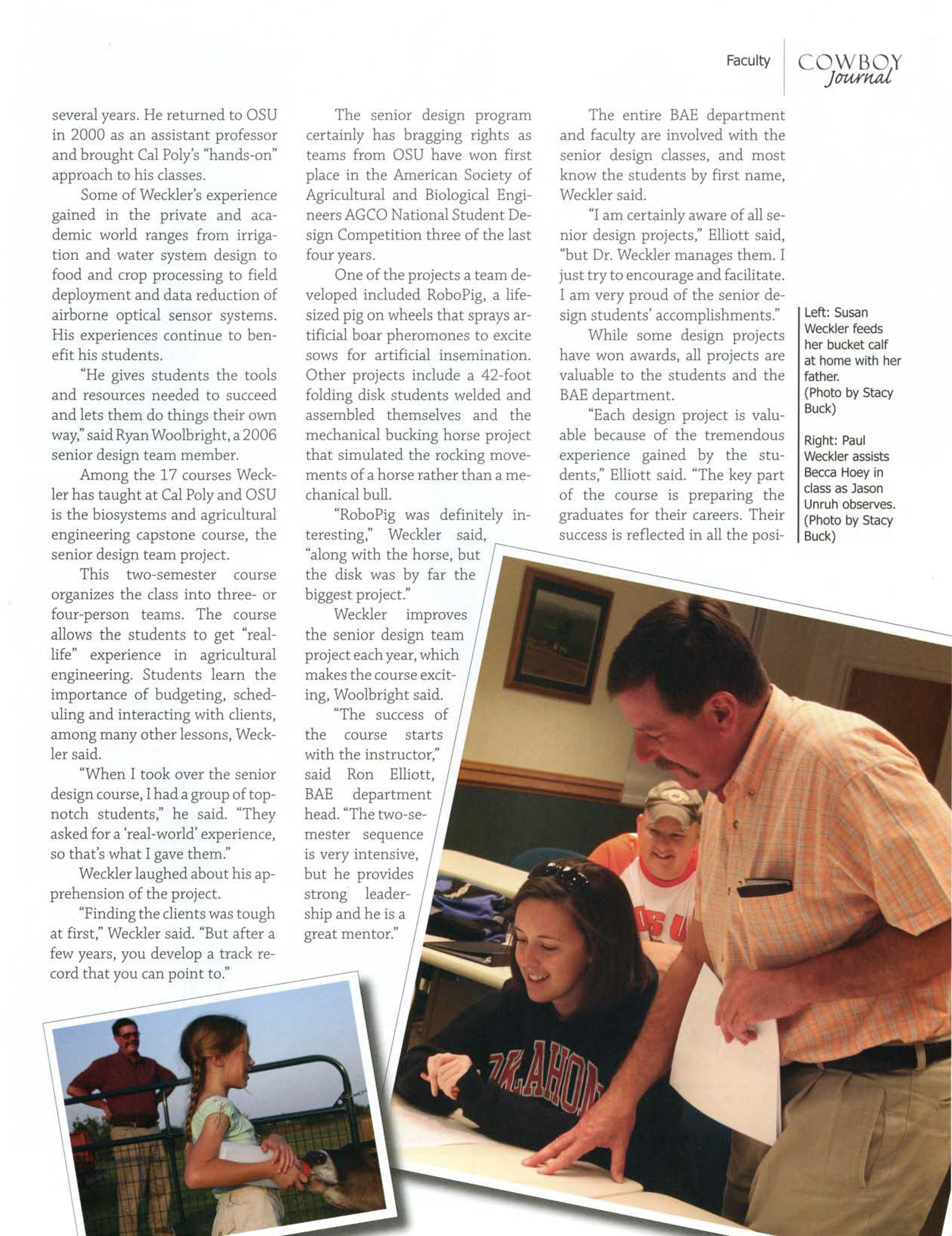
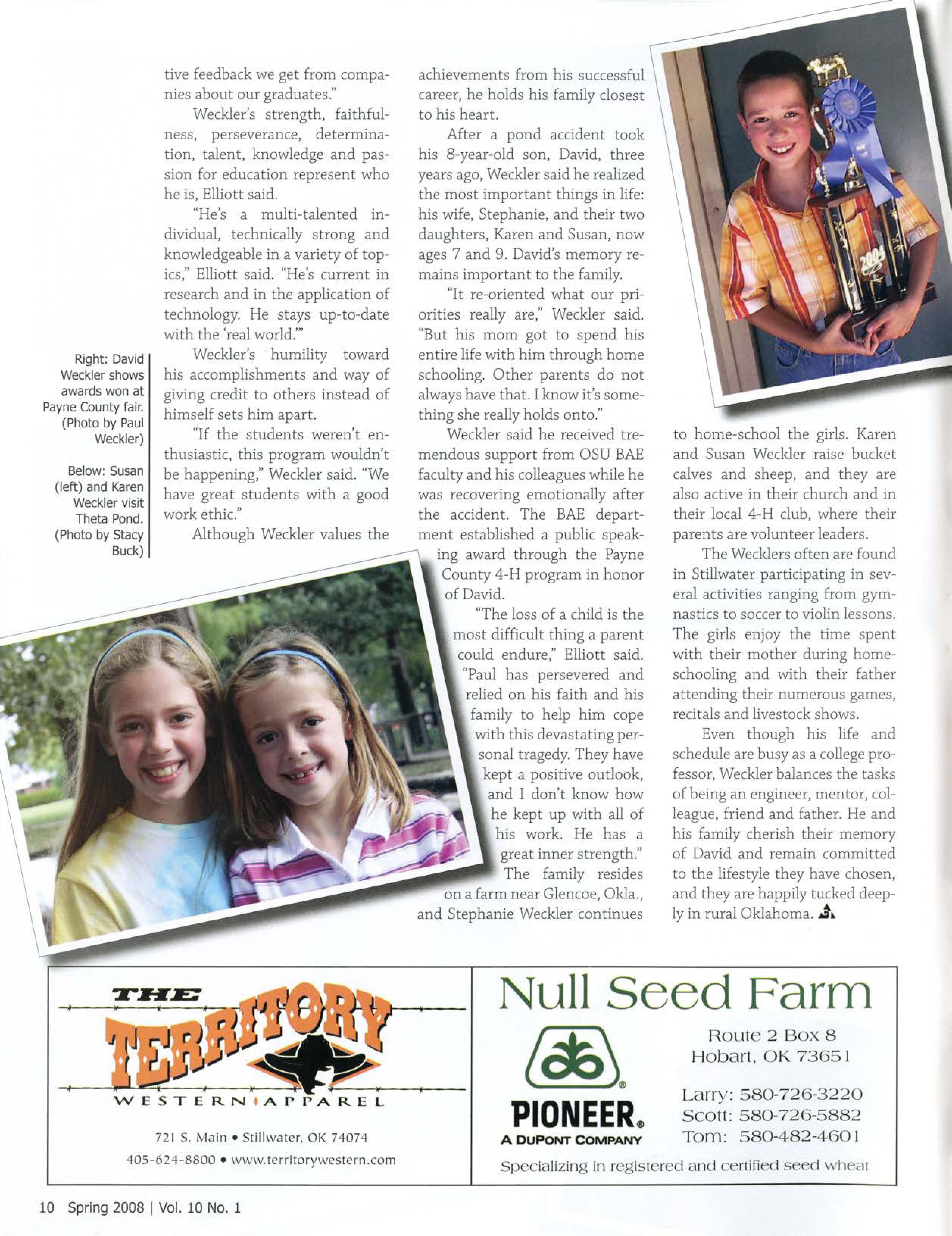
PaulWeckler, his wife, Stephanie,and theirdaughters, Susan(left) and Karen,visit
Theta Pond.
(Photoby Stacy Buck)
Interested in agriculture at a young age, Wecl<lersaid he enjoyed visiting his grandparents' farm and first rode in a combine at age four. With his mother a leader in 4-H, his involvement in the program as a child - along wi h his experience showing cattle, sheep and swine at local fairs - helped shape him into the agriculturist he is today.
"I always liked animals but I didn't have the stomach to be a vet," Weckler said.
Upon high school graduation, Weckler obtained his Bachelor of Science degree in agricultural engineering at California Polytechnic State University-San Luis Obispo in 1982.
The Cal Poly College of Agriculture was one of the top 10 biggest in the country, and his degree program used a "learning by doing" approach, which Weckler incorporates in his teaching.
After graduating, Weckler ventured east to acquire his master's degree in irrigation and agricultural engineering from Utah State University in 1984.
He moved farther to the east
to Oklahoma State University as a part of a national doctorate fellowship program offered by the U.S. Department of Agriculture.
"The USDA brought me here, and the people were just great," Weckler said.
Weckler earned his doctorate in agricultural engineering from OSU in 1989.
"I was a Ph.D. student at OSU when Barry Sanders and Garth Brooks were here," Weckler said.
"The ag engineering department hired Garth to play at a barbecue."
Weckler began his teaching career as an assistant professor in agricultural engineering at Virginia Tech. He then worked in private industry before returning to Cal Poly, where he taught for
several years. He returned to OSU in 2000 as an assistant professor and brought Cal Poly's "hands-on" approach to his classes.
Some of Weckler's experience gained in the private and academic world ranges from irrigation and water system design to food and crop processing to field deployment and data reduction of airborne optical sensor systems. His experiences continue to benefit his students.
"He gives students the tools and resources needed to succeed and lets them do things their own way,"said Ryan Woolbright, a 2006 senior design team member.
Among the 17 courses Weckler has taught at Cal Poly and OSU is the biosystems and agricultural engineering capstone course, the senior design team project.
This two-semester course organizes the class into three- or four-person teams. The course allows the students to get "reallife" experience in agricultural engineering. Students learn the importance of budgeting, scheduling and interacting with clients, among many other lessons, Weckler said.
"When I took over the senior design course, I had a group of topnotch students," he said. "They asked for a 'real-world' experience, so that's what I gave them."
Weckler laughed about his apprehension of the project.
"Finding the clients was tough at first," Wecl<lersaid. "But after a few years, you develop a track record that you can point to."
The senior design program certainly has bragging rights as teams from OSU have won first place in the American Society of Agricultural and Biological Engineers AGCO National Student Design Competition three of the last four years.
One of the projects a team developed included RoboPig, a lifesized pig on wheels that sprays artificial boar pheromones to excite sows for artificial insemination. Other projects include a 42-foot folding disk students welded and assembled themselves and the mechanical bucking horse project that simulated the rocking movements of a horse rather than a mechanical bull.
"RoboPig was definitely interesting," Weckler said, "along with the horse, but the disk was by far the biggest project."
Weckler improves the senior design team project each year, which makes the course exciting, Woolbright said.
"The success of the course starts with the instructor," said Ron Elliott, BAE department head. "The two-semester sequence is very intensive, but he provides strong leadership and he is a great mentor."
The entire BAE department and faculty are involved with the senior design classes, and most know the students by first name, Wed<ler said.
"I am certainly aware of all senior design projects," Elliott said, "but Dr. Wecl<lermanages them. I just try to encourage and facilitate. I am very proud of the senior design students' accomplishments."
While some design projects have won awards, all projects are valuable to the students and the BAE department.
"Each design project is valuable because of the tremendous experience gained by the students," Elliott said. "The key part of the course is preparing the graduates for their careers. Their success is reflected in all the posi-
Left:Susan Wedderfeeds her bucketcalf at homewithher father.
(Photoby Stacy Buck)
Right:Paul Wecklerassists BeccaHoey in classas Jason Unruhobserves.
tive feedback we get from companies about our graduates."
Weckler's strength, faithfulness, perseverance, determination, talent, knowledge and passion for education represent who he is, Elliott said.
"He's a multi-talented individual, technically strong and knowledgeable in a variety of topics," Elliott said. "He's current in research and in the application of technology. He stays up-to-date with the 'real world."'
Weckler's humility toward his accomplishments and way of giving credit to others instead of himself sets him apart.
"If the students weren't enthusiastic, this program wouldn't be happening," Weckler said. "We have great students with a good work ethic."
Although Wedder values the
achievements from his successful career, he holds his family closest to his heart.
After a pond accident took his 8-year-old son, David, three years ago, Wedder said he realized the most important things in life: his wife, Stephanie, and their two daughters, Karen and Susan, now ages 7 and 9. David's memory remains important to the family.
"It re-oriented what our priorities really are," Wecl<ler said. "But his mom got to spend his entire life with him through home schooling. Other parents do not always have that. I know it's something she really holds onto."
Wedder said he received tremendous support from OSU BAE faculty and his colleagues while he was recovering emotionally after he accident. The BAE department established a public speaking award through the Payne County 4-H program in honor of David.
"The loss of a child is the most difficult thing a parent could endure," Elliott said. "Paul has persevered and relied on his faith and his family to help him cope with this devastating personal tragedy. They have kept a positive outlook, and I don't know how he kept up with all of his work. He has a great inner strength."
The family resides on a farm near Glencoe, Okla., and Stephanie Weckler continues
to home-school the girls. Karen and Susan Weckler raise bucket calves and sheep, and they are also active in their church and in their local 4-H club, where their parents are volunteer leaders.
The Wecl<lersoften are found in Stillwater participating in several activities ranging from gymnastics to soccer to violin lessons. The girls enjoy the time spent with their mother during homeschooling and with their father attending their numerous games, recitals and livestock shows.
Even though his life and schedule are busy as a college professor, Weckler balances the tasks of being an engineer, mentor, colleague, friend and father. He and his family cherish their memory of David and remain committed to the lifestyle they have chosen, and they are happily tucked deeply in rural Oklahoma.
Rout 2 Box 8 Hobart, OK 73651
Larry: s o-726-3220
Scott: 80- 726- 82
Tom: 58 -482-4601
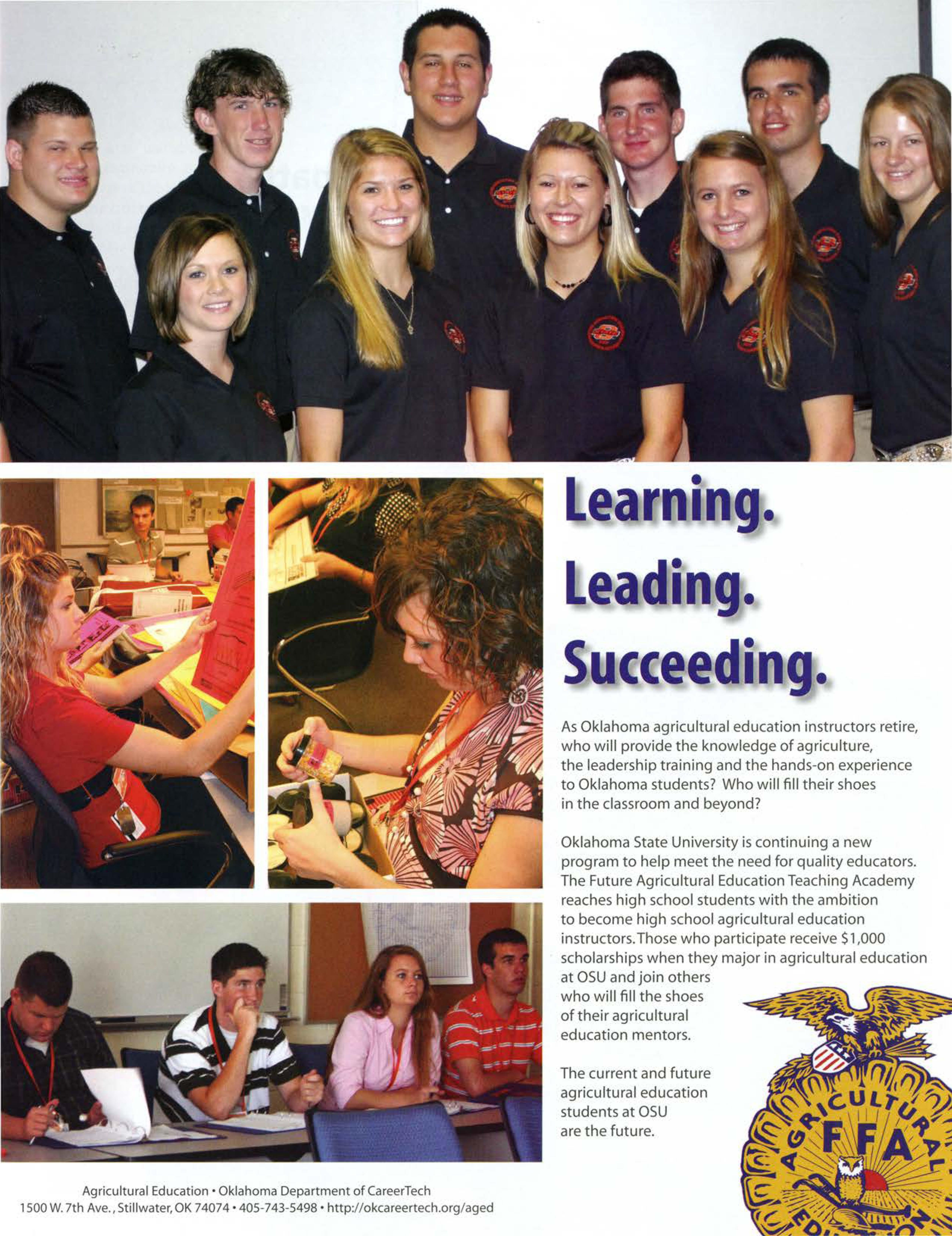
As Oklahoma agricultural education instructors retire, who will provide the knowledge of agriculture, the leadership training and the hands-on experience to Oklahoma students? Who will fill their shoes in the classroom and beyond?
Oklahoma State University is continuing a new program to help meet the need for quality educators. The Future Agricultural Education Teaching Academy reaches high school students with the ambition to become high school agricultural education instructors. Those who participate receive $1,000 scholarships when they major in agricultural education at OSU and join others who will fill the shoes of their agricultural education mentors.
The current and future agricultural education students at OSU are the future.
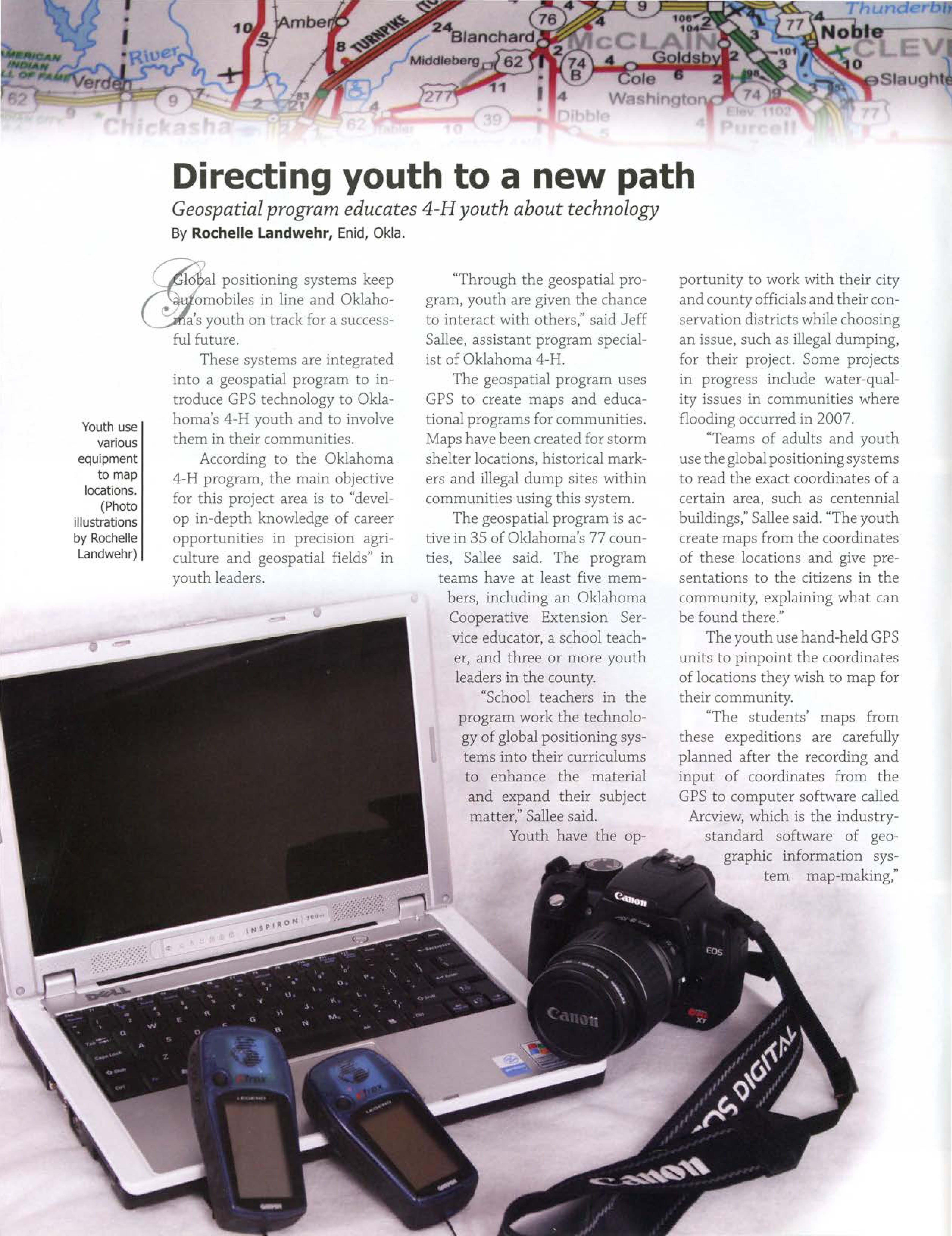
Youth use various equipment to map locations.
(Photo illustrations by Rochelle Landwehr)
Directing youth to a new path
Geospatial program educates 4-H youth about technology
By Rochelle Landwehr, Enid, Okla.
l positioning systems keep mobiles in line and Oklahoyouth on track for a successful future.
These systems are integrated into a geospatial program to introduce GPS technology to Oklahoma's 4-H youth and to involve them in their communities.
According to the Oklahoma 4-H program, the main objective for this project area is to "develop in-depth knowledge of career opportunities in precision agriculture and geospatial fields" in youth leaders.
"Through the geospatial program, youth are given the chance to interact with others," said Jeff Sallee, assistant program specialist of Oklahoma 4-H.
The geospatial program uses GPS to create maps and educational programs for communities. Maps have been created for storm shelter locations, historical markers and illegal dump sites within communities using this system.
The geospatial program is active in 35 of Oklahoma's 77 counties, Sallee said. The program teams have at least five members, including an Oklahoma Cooperative Extension Service educator, a school teacher, and three or more youth leaders in the county.
"School teachers in the program work the technology of global positioning systems into their curriculums to enhance the material and expand their subject matter," Sallee said.
Youth have the op-
portunity to work with their city and county officials and their conservation districts while choosing an issue, such as illegal dumping, for their project. Some projects in progress include water-quality issues in communities where flooding occurred in 2007.
''Teams of adults and youth use the global positioning systems to read the exact coordinates of a certain area, such as centennial buildings," Sallee said. "The youth create maps from the coordinates of these locations and give presentations to the citizens in the community, explaining what can be found there."
The youth use hand-held GPS units to pinpoint the coordinates of locations they wish to map for their community.
"The students' maps from these expeditions are carefully planned after the recording and input of coordinates from the GPS to computer software called Arcview, which is the industrystandard software of geographic information system map-making,"
said Samantha Ephgrave, McClain County 4-H extension educator.
The maps are then created, printed and distributed in the team's community to make citizens aware of the issue. Sallee said after the citizens are aware of the problem, they can do their part to help resolve the issue.
"I have gained the ability to read and use a GPS, make and read a map, and apply these skills to help my community," said Rylee Ellyson, Purcell 4-H member.
Using this system to map a lake, McClain County 4-H has helped many people in communities throughout the county.
"Our mapping of the lake added recreational value to a city park visited by nearly 8,000 people annually," Ephgrave said.
The McClain County 4-H geospatial team is planning to work with local residents and county officials to get an E-911 system in the county, which will impact its more than 31,000 residents.
"The project will involve collecting data for the E-911 system, such as rural fire hydrants, dry hydrants and bridge approaches, and coordinating rural addresses to driveways," Ephgrave said.
Funding and budgeting of the project is important because of the equipment needed to create a map with GPS.
''ESRI, a GIS mapping software company, offers a grant to programs that are bettering their communities by using this technology," Sallee said.
According to the ESRI,groups can receive software, online training and books to assist them with their mapping experiences.
The software enhances the
Space, Control, User
youth's experiences in the program and teaches them the basics of the technological industry.
The 4-H youth gain skills and experience in service learning, in planning and goal setting, and in cooperation, Sallee said.
"4-H has given me a chance to learn about mapping and other activities in the geospatial program," said Jordan Rolin, Purcell 4-H member. "Many companies are using geo-mapping in their business, and we are a step ahead by learning now."
Youth learn the geography of Oklahoma and how it affects the issues in their communities.
"Besidesincreasing geographical awareness, geospatial technology projects provide youth with an opportunity to learn skills related to one of the quickest growing career sectors, giving them an edge for college programs and future job markets," Ephgrave said.
GPS and GIS career fields include computer analysts, cartogaphers, photogrammetrists and agricultural precision engineers.
"With the new technology of GPS-driven farm equipment in Precision Ag, engineers, mechanics and researchers have become a great need," Sallee said.
Advancing technology and the geospatial program allow 4-H youth to become active and help solve community problems.
"GPSplays a major role in the future of youth who are interested in science and technology and the future of their communities," Sallee said . .J,}.
For more information, call or visit your county's Oklahoma Cooperative ExtensionServiceoffice.
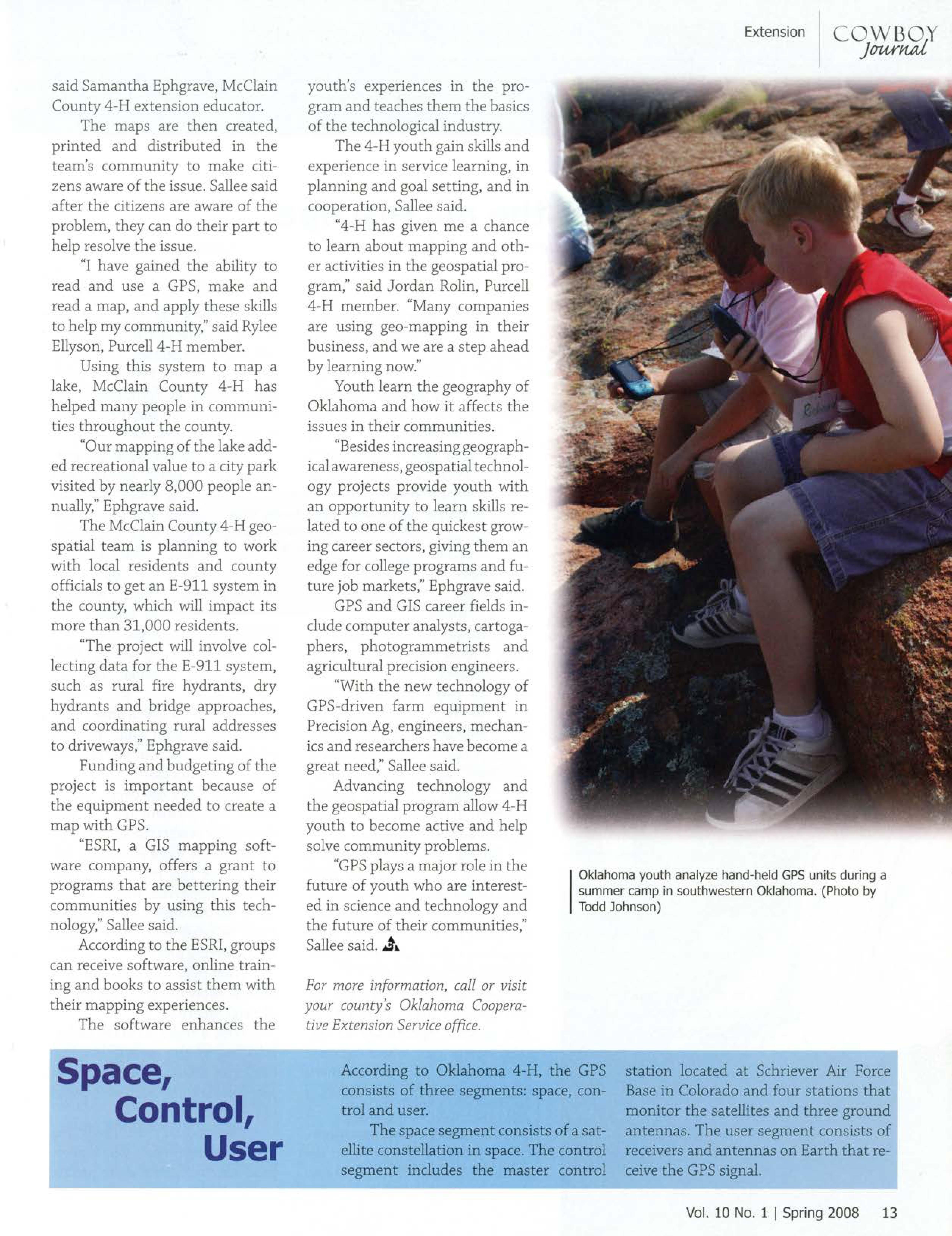
analyzehand-heldGPSunits during a summer camp in southwesternOklahoma.(Photo
According to Oklahoma 4-H, the GPS consists of three segments: space, control and user.
The space segment consists of a satellite constellation in space. The control segment includes the master control
station located at Schriever Air Force Base in Colorado and four stations that monitor the satellites and three ground antennas. The user segment consists of receivers and antennas on Earth that receive the GPS signal.
IOklahomayouth
by ToddJohnson)
Money under the microscope
Wheat improvement team bene'fi.ts from discoveries
By Mary Kate Scott, Willcox,Ariz .
• • ~ng wheat of Oklahoma 'f'ays has been at the mercy of Mother Nature, but it soon could be controlled in a laboratory by a cutting-edge scientist.
After joining the Oklahoma State University wheat improvement team only one year ago, Liuling Yan, assistant professor in the OSU Department of Plant and Soil Sciences, has made a discovery that has the potential to redefine the production of wheat in Oklahoma.
In this Great Plains state, wheat serves a dual purpose to producers: grain harvest and cattle production.
"Oklahoma is unique because it relies heavily on both uses," said David Porter, department head and professor in the OSU Department of Plant and Soil Sciences.
For many families in Oklahoma, this bilateral crop provides additional agricultural opportunities and profits. Both avenues of wheat production are interdependent upon each other. Porter said most Oklahomans do not see the value of cattle that comes from wheat. In turn, the maximum economic value of wheat reflects cattle production.
The economic value of wheat is not only seen by Oklahoma producers but also by other members of the scientific community. Support from the Oklahoma Center for the Advancement of Science and Technology, the Oklahoma Wheat Commission, and the U.S. Department of Agriculture's Coordinated Agriculture Project and
the National Research Initiative compares the genetic building grant program make Yan's re- blocks of some of the major agrisearch possible. cultural commodities. The wheat Yan, a native of China, has genome contains 16 billion basepinpointed the genomic sequence pairs, "oversized" compared to the responsible for the flowering pro- 2.3 billion in corn and the 3 billion cess in winter wheat varieties. By in the human genome. analyzing the genetic code, Yan is Yan's arduous task of anaable to identify a crucial piece of lyzing the intricate genetic code the biological could ease the switch between He had the opportunity to go efforts of not the vegetative anywhere. He wanted to stay with only Oklahoma and reproduc- wheat and build a program around a wheat produccrop he loved. tive stages in ers but also this species. - DavidR. Porter those working
As wheat to produce immakes its way through the growth proved wheat varieties. cycle, it must make critical transi-
Carver said.
"You are able to rely on DNA, tions between growth stages. In rather than Mother Nature," terms of cattle production and grain harvest, the transition between vegetative and reproductive stages is one of the most critical, said Brett Carver, wheat genetics chair in agriculture and regents professor in the OSU Department of Plant and Soil Sciences.
During the vegetative growth stage, the nonreproductive plant parts (leaf and stem) are exposed. The emergence of the reproductive plant parts (flower and seed) transitions the plant into the reproductive growth stage.
Having a more accurate understanding and timeline of this process, specifically in certain varieties of wheat adapted to Oklahoma and the southern Great Plains, is the foundation of Yan's research.
"Designing an Agricultural Genome Program," posted on the National Academic Press Web site,
'There's so much more that I can't see," Carver said. "You can guess in the field, but you can nail it down in Yan's lab."
With Yan's discovery, OSU's wheat improvement team is able to not only predict the wheat flowering process more effectively but also to use this research to help produce improved wheat varieties. With this ability, Porter said it could be possible to delay or stall the flowering process.
What does this mean for producers? More money in the pocket of rural America.
With a more accurate understanding of the genetic building blocks of wheat, researchers can increase profit on both avenues of wheat production.
The accuracy in predicting the flowering process would allow producers to have a more precise
date as to when to remove their cattle from wheat pasture grazing, Porter said. This would eliminate the risk of any damage to the plant during flowering that occurs by letting cattle graze too long.
"The right timing must occur for the transition from vegetative to reproductive growth stages," Carver said. "This is crucial when grazing cattle."
Carver said cattle put a tremendous amount of stress on wheat, removing the canopy.
"We ask wheat to redevelop after cattle graze it, with no drop in grain yield," Carver said. "This is a lot to ask."
On the other hand, with Yan predicting flowering more accurately, producers could gain extra days to extend their cattle's grazing period. This could be done by eliminating a premature halt in grazing and by stalling the flowering process to allow producers to have an extended grazing period.
"Each day cattle graze means money in the producer's pocket," Porter said.
This additional income, Porter said, essentially goes back to rural America. He said the little things add up and this could be a rejuvenation of rural economy. Although producers have been lucky enough to see an increase in the price of wheat, he said producers are still not as profitable as they should be.
Although most of Yan's current research is directed toward producers using wheat for dual purposes, the same methodology could be applied to producers harvesting wheat for grain only.
"Youcould eliminate competition," said Case Medlin, associate
professor in the OSU Department of Plant and Soil Sciences.
Medlin, who works as a weed science specialist, said he believes Yan's research could be applied to weed control. If Yan is able to stall or delay the flowering process, why not expedite the process for those harvesting for wheat grain?
With this idea, Medlin said he wonders if wheat could be harvested before weeds develop and mature. This could eliminate competition and reduce the need for traditional weedcontrol methods.
"You could outfox Mother Nature and harvest a clean grain," Medlin said.
Carver said grain "cleanliness" is a characteristic for which international buyers look. This concept would allow producers to offer a more desirable product to domestic and international markets.
Yan's research leaves the faculty at OSU, producers and scientists across the state with questions and possibilities to help resolve traditional problems in wheat production.
"We were lucky to get Dr. Yan here," Porter said. "He had the opportunity to go anywhere. He wanted to stay with wheat and build a program around a crop he loved."
Yan said he has been working in wheat science for more than 20 years.
"OSU has a great wheat improvement team," Yan said. "It was wheat that connected me to OSU."
Educated in his native country, China, at Yangzhou University and at Victoria University in Australia, Porter said Yan has made an immediate impact on a level that takes most faculty members years to achieve.
Yan has allowed OSU to remain competitive in the science of wheat improvement and to help produce better varieties of wheat for Oklahoma .J-l
For more information on the OSU wheat improvement team, visit http://www.wit.okstate.edu.
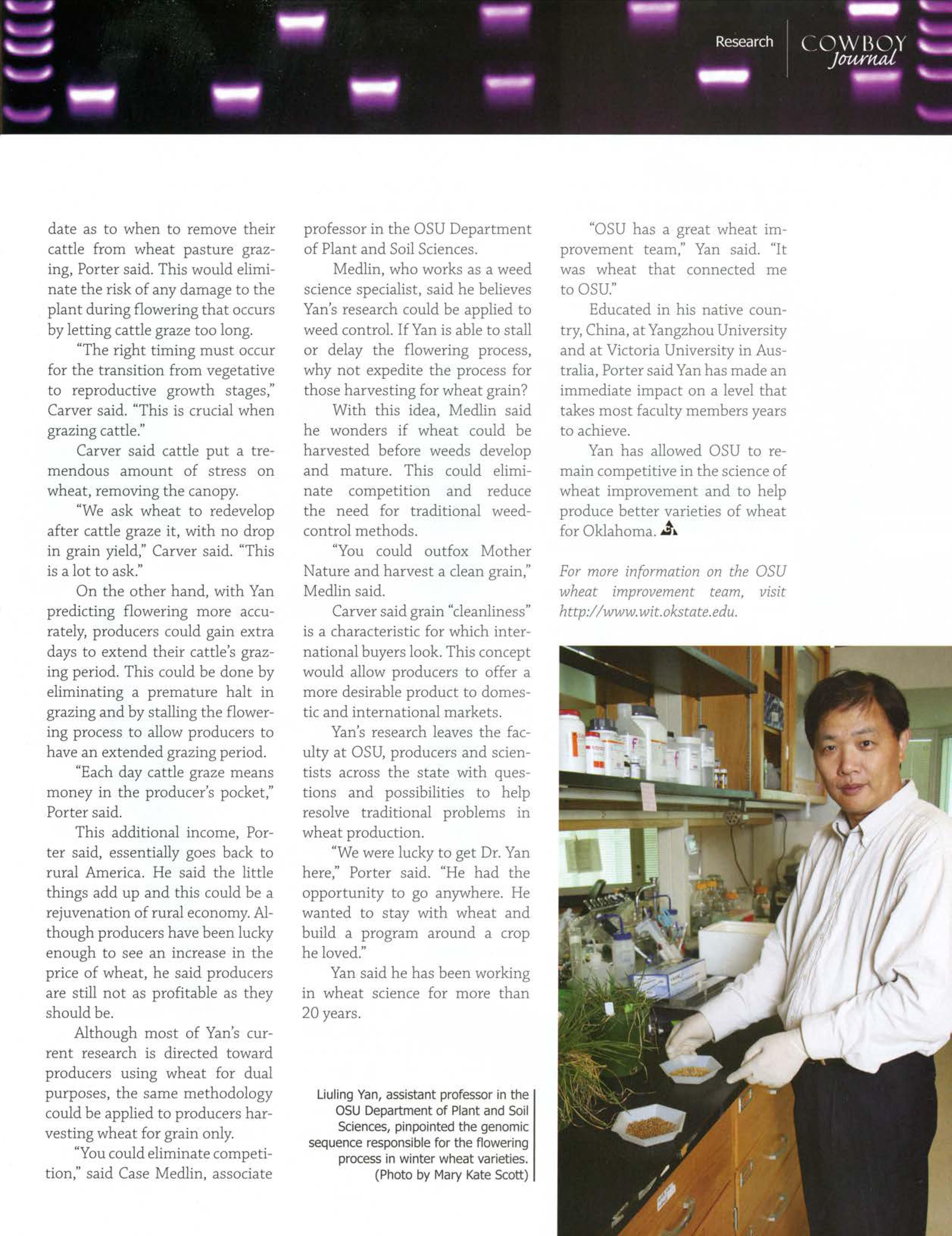
LiulingYan,assistantprofessorin the OSUDepartmentof Plantand Soil Sciences,pinpointedthe genomic sequenceresponsiblefor the flowering processin winterwheatvarieties. (Photoby MaryKateScott)
A tale of two shepherds
Alex McKenzie and Bill Crutcher create a tradition of tending to sheep and students
By Jessica Stewart, CanyonLake,Texas
bleat as the sun rises over rizon. It is another day at the barn, an 80-year-old fixture at Oklahoma State University.
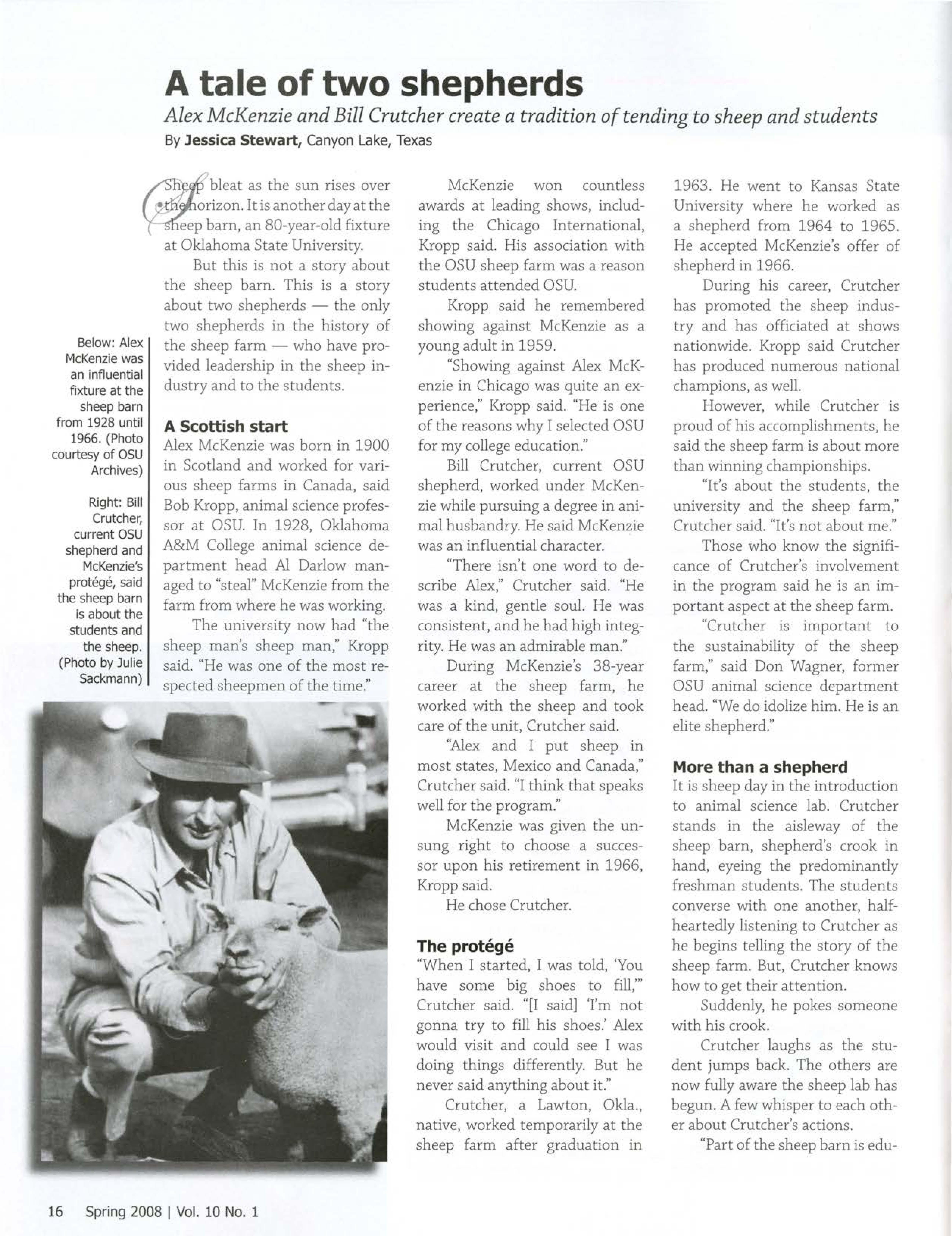
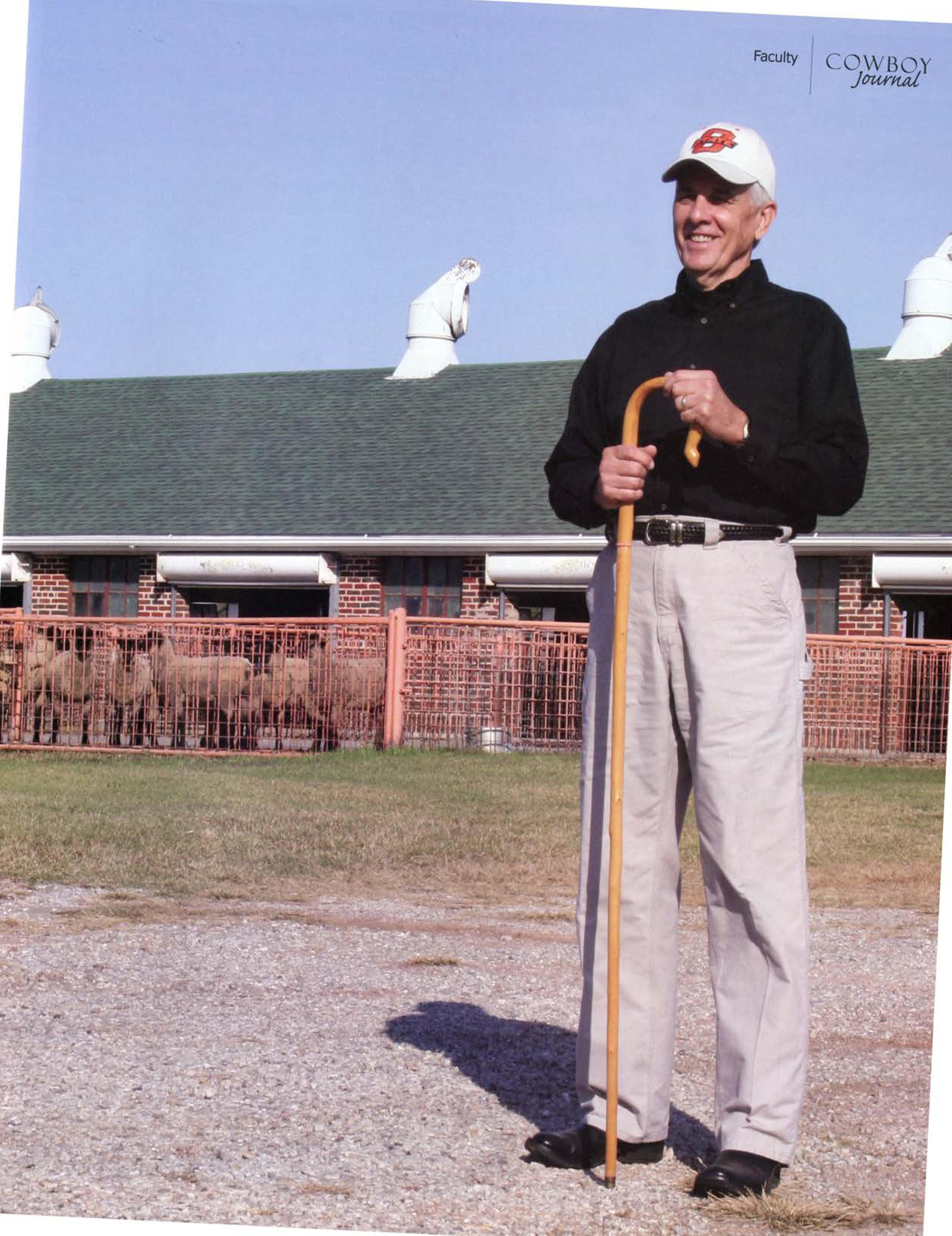
But this is not a story about the sheep barn. This is a story about two shepherds - the only two shepherds in the history of Below:Alex the sheep farm - who have proMcKenziewas d d l d h th an influential vi e ea ers ip in e sheep industry and to the students. fixtureat the sheep barn from1928 until 1966. (Photo courtesyof OSU Archives)
Right:Bill Crutcher, currentOSU shepherdand McKenzie's protege,said the sheep barn is about the studentsand the sheep.
(Photoby Julie Sackmann)
A Scottish start
Alex McKenzie was born in 1900 in Scotland and worked for various sheep farms in Canada, said Bob Kropp, animal science professor at OSU. In 1928, Oklahoma A&M College animal science department head Al Darlow managed to "steal" McKenzie from the farm from where he was working.
The university now had "the sheep man's sheep man," Kropp said. "He was one of the most respected sheepmen of the time."
McKenzie won countless awards at leading shows, including the Chicago International, Kropp said. His association with the OSU sheep farm was a reason students attended OSU.
Kropp said he remembered showing against McKenzie as a young adult in 1959.
"Showing against Alex McKenzie in Chicago was quite an experience," Kropp said. "He is one of the reasons why I selected OSU for my college education."
Bill Crutcher, current OSU shepherd, worked under McKenzie while pursuing a degree in animal husbandry. He said McKenzie was an influential character.
"There isn't one word to describe Alex," Crutcher said. "He was a kind, gentle soul. He was consistent, and he had high integrity. He was an admirable man."
During McKenzie's 38-year career at the sheep farm, he worked with the sheep and took care of the unit, Crutcher said.
"Alex and I put sheep in most states, Mexico and Canada," Crutcher said. "I think that speaks well for the program."
McKenzie was given the unsung right to choose a successor upon his retirement in 1966, Kropp said.
He chose Crutcher.
The protege
"When I started, I was told, 'You have some big shoes to fill,"' Crutcher said. "[I said] Tm not gonna try to fill his shoes.' Alex would visit and could see I was doing things differently. But he never said anything about it."
Crutcher, a Lawton, Okla., native, worked temporarily at the sheep farm after graduation in
1963. He went to Kansas State University where he worked as a shepherd from 1964 to 1965. He accepted McKenzie's offer of shepherd in 1966.
During his career, Crutcher has promoted the sheep industry and has officiated at shows nationwide. Kropp said Crutcher has produced numerous national champions, as well.
However, while Crutcher is proud of his accomplishments, he said the sheep farm is about more than winning championships.
"It's about the students, the university and the sheep farm," Crutcher said. "It's not about me."
Those who know the significance of Crutcher's involvement in the program said he is an important aspect at the sheep farm.
"Crutcher is important to the sustainability of the sheep farm," said Don Wagner, former OSU animal science department head. "We do idolize him. He is an elite shepherd."
More than a shepherd
It is sheep day in the introduction to animal science lab. Crutcher stands in the aisleway of the sheep barn, shepherd's crook in hand, eyeing the predominantly freshman students. The students converse with one another, halfheartedly listening to Crutcher as he begins telling the story of the sheep farm. But, Crutcher knows how to get their attention.
Suddenly, he pokes someone with his crook
Crutcher laughs as the student jumps back. The others are now fully aware the sheep lab has begun. A few whisper to each other about Crutcher's actions.
"Part of the sheep barn is edu-
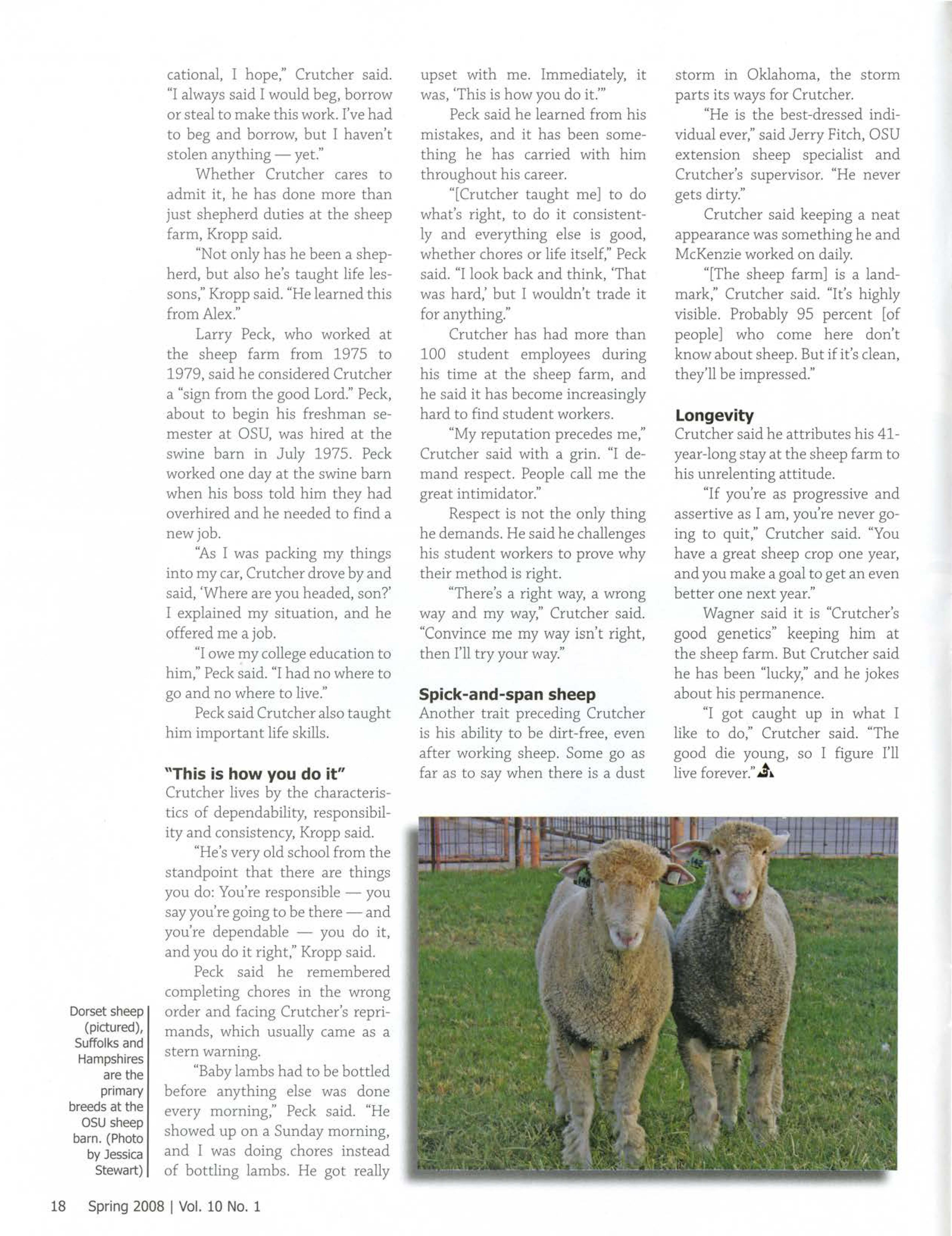
Dorsetsheep (pictured), Suffolks and Hampshires are the primary breedsat the OSU sheep barn. (Photo by Jessica Stewart)
cational, I hope," Crutcher said. "I always said I would beg, borrow or steal to make this work. I've had to beg and borrow, but I haven't stolen anything - yet."
Whether Crutcher cares to admit it, he has done more than just shepherd duties at the sheep farm, Kropp said.
"Not only has he been a shepherd, but also he's taught life lessons," Kropp said. "He learned this from Alex."
Larry Peck, who worked at the sheep farm from 1975 to 1979, said he considered Crutcher a "sign from the good Lord." Peck, about to begin his freshman semester at OSU, was hired at the swine barn in July 1975. Peck worked one day at the swine barn when his boss told him they had overhired and he needed to find a new job.
"As I was packing my things into my car, Crutcher drove by and said, 'Where are you headed, son7' I explained my situation, and he offeredme a job.
"I owe my college education to him," Peck said. "I had no where to go and no where to live."
Peck said Crutcher also taught him important life skills.
"This is how you do it"
Crutcher lives by the characteristics of dependability, responsibility and consistency, Kropp said.
"He's very old school from the standpoint that there are things you do: You're responsible - you say you're going to be there - and you're dependable - you do it, and you do it right," Kropp said.
Peck said he remembered completing chores in the wrong order and facing Crutcher's reprimands, which usually came as a stern warning.
"Baby lambs had to be bottled before anything else was done every morning," Peck said. "He showed up on a Sunday morning, and I was doing chores instead of bottling lambs. He got really
upset with me. Immediately, it was, 'This is how you do it."'
Peck said he learned from his mistakes, and it has been something he has carried with him throughout his career.
"[Crutcher taught me] to do what's right, to do it consistently and everything else is good, whether chores or life itself," Peck said. "I look back and think, 'That was hard,' but I wouldn't trade it for anything."
Crutcher has had more than 100 student employees during his time at the sheep farm, and he said it has become increasingly hard to find student workers.
"My reputation precedes me," Crutcher said with a grin. "I demand respect. People call me the great intimidator."
Respect is not the only thing he demands. He said he challenges his student workers to prove why their method is right.
"There's a right way, a wrong way and my way," Crutcher said. "Convince me my way isn't right, then I'll try your way."
Spick-and-span sheep
Another trait preceding Crutcher is his ability to be dirt-free, even after working sheep. Some go as far as to say when there is a dust
storm in Oklahoma, the storm parts its ways for Crutcher.
''He is the best-dressed individual ever," said Jerry Fitch, OSU extension sheep specialist and Crutcher's supervisor. "He never gets dirty."
Crutcher said keeping a neat appearance was something he and McKenzie worked on daily.
"[The sheep farm] is a landmark," Crutcher said. "It's highly visible. Probably 95 percent [of people] who come here don't know about sheep. But if it's clean, they'll be impressed."
Longevity
Crutcher said he attributes his 41year-long stay at the sheep farm to his unrelenting attitude.
"If you're as progressive and assertive as I am, you're never going to quit," Crutcher said. "You have a great sheep crop one year, and you make a goal to get an even better one next year."
Wagner said it is "Crutcher's good genetics" keeping him at the sheep farm. But Crutcher said he has been "lucky,"and he jokes about his permanence
"I got caught up in what I like to do," Crutcher said. "The good die young, so I figure I'll live forever."3,
Sparking a new trend
Researchers discover the benefits of a new rangeland management technique
By Leslie N. Smith, Sand Springs, Okla.
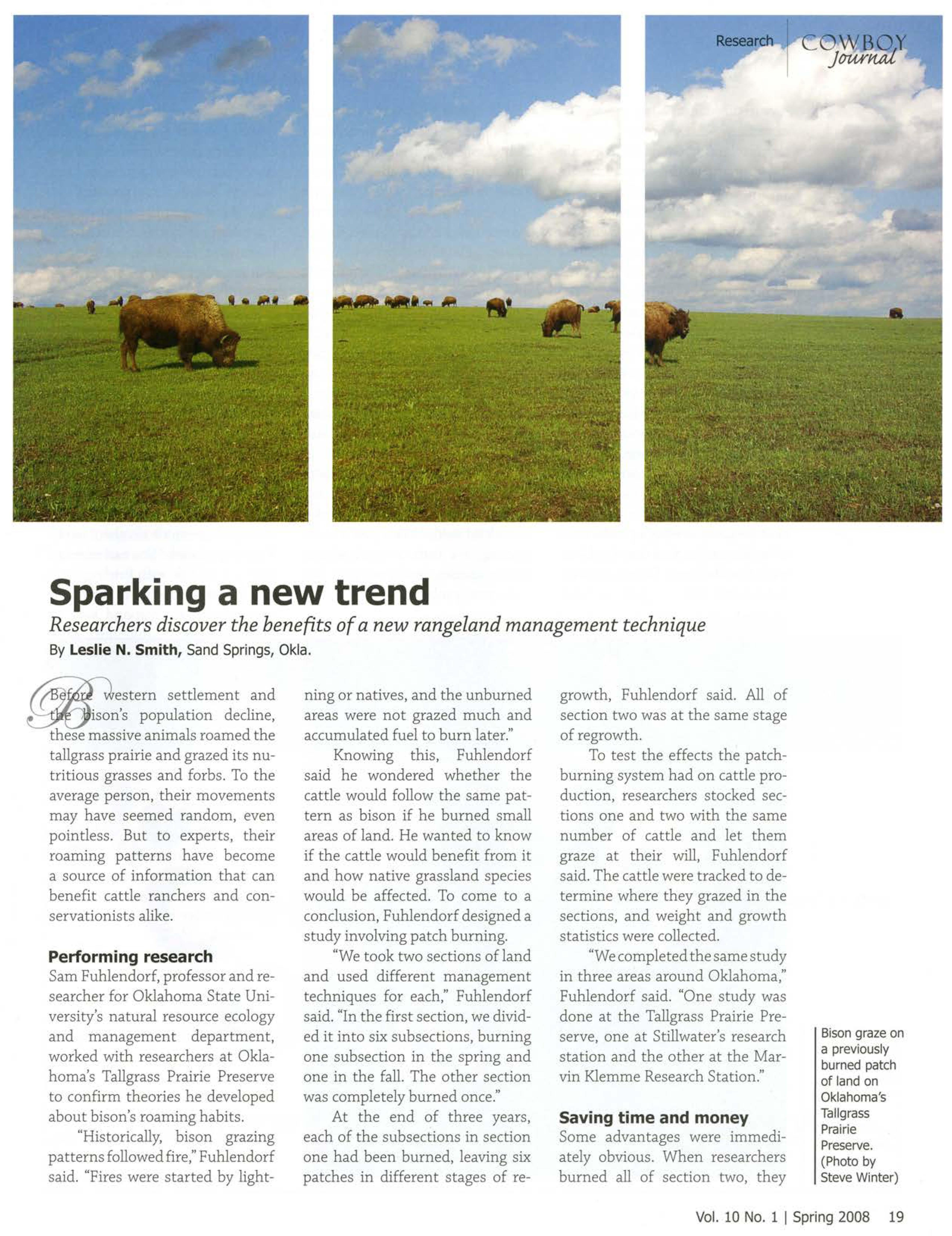
~estern settlement and ~ison's population decline, these massive animals roamed the tallgrass prairie and grazed its nutritious grasses and forbs. To the average person, their movements may have seemed random, even pointless. But to experts, their roaming patterns have become a source of information that can benefit cattle ranchers and conservationists alike.
Performing research
Sam Fuhlendorf, professor and researcher for Oklahoma State University's natural resource ecology and management department, worked with researchers at Oklahoma's Tallgrass Prairie Preserve to confirm theories he developed about bison's roaming habits.
"Historically, bison grazing patterns followed fire,"Fuhlendorf said. "Fires were started by light-
ning or natives, and the unburned areas were not grazed much and accumulated fuel to burn later."
Knowing this, Fuhlendorf said he wondered whether the cattle would follow the same pattern as bison if he burned small areas of land. He wanted to know if the cattle would benefit from it and how native grassland species would be affected. To come to a conclusion, Fuhlendorf designed a study involving patch burning.
"We took two sections of land and used different management techniques for each," Fuhlendorf said. "In the first section, we divided it into six subsections, burning one subsection in the spring and one in the fall. The other section was completely burned once."
At the end of three years, each of the subsections in section one had been burned, leaving six patches in different stages of re-
growth, Fuhlendorf said. All of section two was at the same stage of regrowth.
To test the effects the patchburning system had on cattle production, researchers stocked sections one and two with the same number of cattle and let them graze at their will, Fuhlendorf said. The cattle were tracked to determine where they grazed in the sections, and weight and growth statistics were collected.
"Wecompleted the same study in three areas around Oklahoma," Fuhlendorf said. "One study was done at the Tallgrass Prairie Preserve, one at Stillwater's research station and the other at the Marvin Klemme Research Station."
Saving time and money
Some advantages were immediately obvious. When researchers burned all of section two, they
Bisongraze on a previously burned patch of land on Oklahoma's Tallgrass Prairie Preserve. (Photo by SteveWinter)
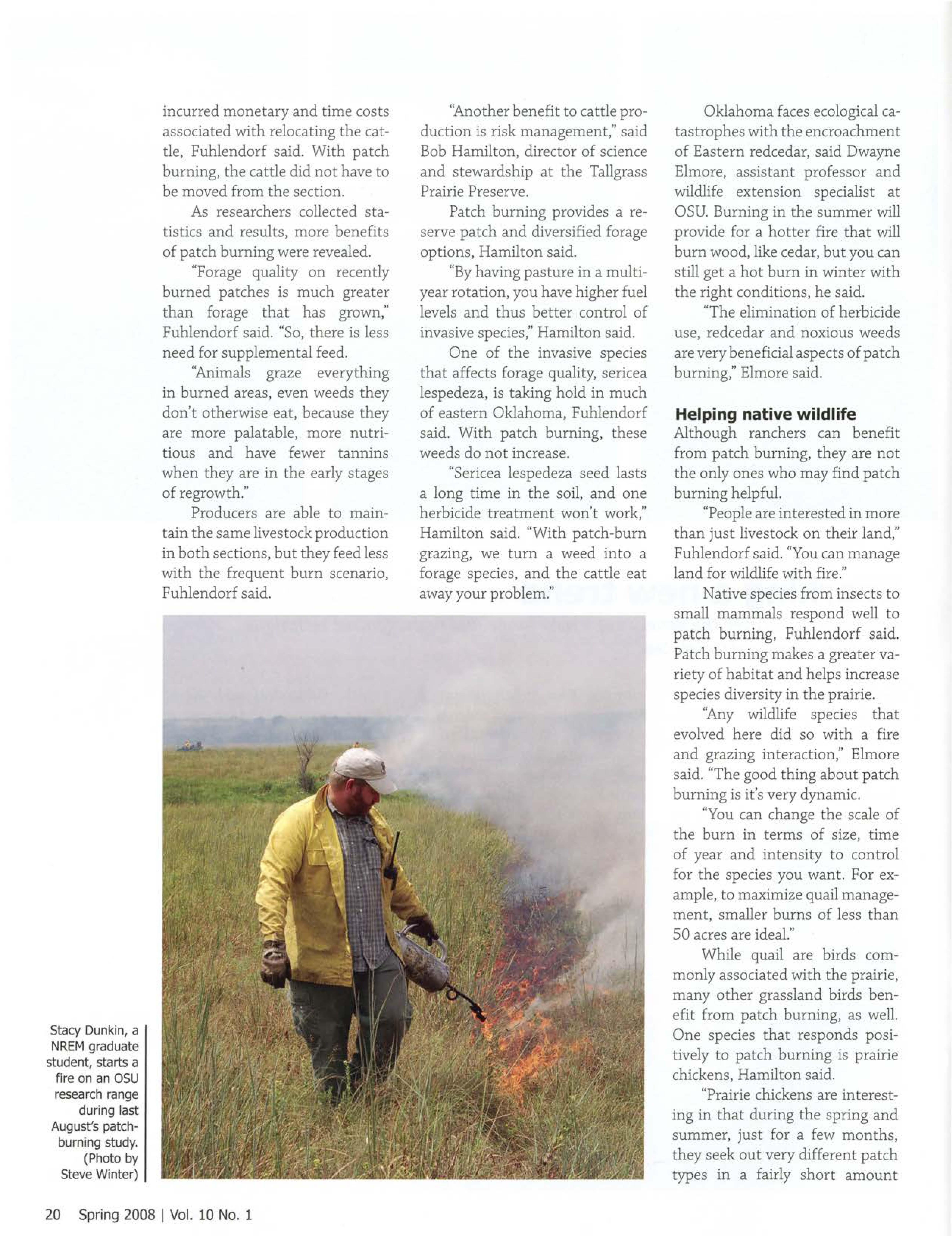
Stacy Dunkin,a NREMgraduate student, starts a fire on an OSU researchrange during last August'spatchburning study.
(Photoby SteveWinter)
incurred monetary and time costs associated with relocating the cattle, Fuhlendorf said. With patch burning, the cattle did not have to be moved from the section.
As researchers collected statistics and results, more benefits of patch burning were revealed.
"Forage quality on recently burned patches is much greater than forage that has grown," Fuhlendorf said. "So, there is less need for supplemental feed.
"Animals graze everything in burned areas, even weeds they don't otherwise eat, because they are more palatable, more nutritious and have fewer tannins when they are in the early stages of regrowth."
Producers are able to maintain the same livestock production in both sections, but they feed less with the frequent burn scenario, Fuhlendorf said.
''Another benefit to cattle production is risk management," said Bob Hamilton, director of science and stewardship at the Tallgrass Prairie Preserve.
Patch burning provides a reserve patch and diversified forage options, Hamilton said.
"Byhaving pasture in a multiyear rotation, you have higher fuel levels and thus better control of invasive species," Hamilton said.
One of the invasive species that affects forage quality, sericea lespedeza, is taking hold in much of eastern Oklahoma, Fuhlendorf said. With patch burning, these weeds do not increase.
"Sericea lespedeza seed lasts a long time in the soil, and one herbicide treatment won't work," Hamilton said. "With patch-bum grazing, we turn a weed into a forage species, and the cattle eat away your problem."
Oklahoma faces ecological catastrophes with the encroachment of Eastern redcedar, said Dwayne Elmore, assistant professor and wildlife extension specialist at OSU. Burning in the summer will provide for a hotter fire that will burn wood, like cedar, but you can still get a hot burn in winter with the right conditions, he said.
"The elimination of herbicide use, redcedar and noxious weeds are very beneficial aspects of patch burning," Elmore said.
Helping native wildlife
Although ranchers can benefit from patch burning, they are not the only ones who may find patch burning helpful.
"People are interested in more than just livestock on their land," Fuhlendorf said. "Youcan manage land for wildlife with fire."
Native species from insects to small mammals respond well to patch burning, Fuhlendorf said. Patch burning makes a greater variety of habitat and helps increase species diversity in the prairie.
"Any wildlife species that evolved here did so with a fire and grazing interaction," Elmore said. "The good thing about patch burning is it's very dynamic.
"You can change the scale of the burn in terms of size, time of year and intensity to control for the species you want. For example, to maximize quail management, smaller burns of less than 50 acres are ideal."
While quail are birds commonly associated with the prairie, many other grassland birds benefit from patch burning, as well. One species that responds positively to patch burning is prairie chickens, Hamilton said.
"Prairie chickens are interesting in that during the spring and summer, just for a few months, they seek out very different patch types in a fairly short amount
of time," Hamilton said. "In the spring, males look for very short vegetation where they can strut.
"Once hens breed, they seek patches with quite a bit of vegetation already on them so they can hide. Then, as soon as their eggs hatch, the hens try to take their babies to a patch with less dense vegetation because it is so difficult for the babies to get around."
Byhaving a diverse landscape, you have a much broader array of grassland birds because different ones require different vegetation, Hamilton said.
What you should know
While patch burning can be useful to ranchers and conservationists, researchers think there are some things both groups should know before implementing a new management plan.
"The producers need to be
comfortable with a forby, weedy initial response," Hamilton said. "People should know that patch burning takes a little more management, and they should be comfortable with having a messier looking landscape. Have trust in the plant community that it will respond and recover."
This leads to another benefit of patch burning. If you start and change your mind, you can burn the rest of your land with no loss on investment, Hamilton said.
"If I were a producer, I would want to know the bottom line, that is, weight gain and cost cuts," Elmore said. "Weight gains don't differ from traditional burns, patch burning costs substantially less, and it kills noxious weeds.
"It removes the need for interior fencing, which is a huge cost, and it greatly reduces handling time," Elmore said.
For those who used fire management before, trying patch burning will not be a big change, but for those who have not, it will be harder, Elmore said.
"We tell people to pick a section of land they are comfortable with and try patch burning for two to three years," Elmore said.
Then, if they are comfortable and it meets their objectives, he recommended they do it for the rest of their land.
''With the adoption curve, it takes a while for new information to take hold and be used," Elmore said. "Once people consider patch burning against the traditional alternatives, we believe they will decide to adopt this technique."3~
For additional information on patch burning, visit http://fireecology.okstate.edu or call Sam Fuhlendorf at 405-744-9646.
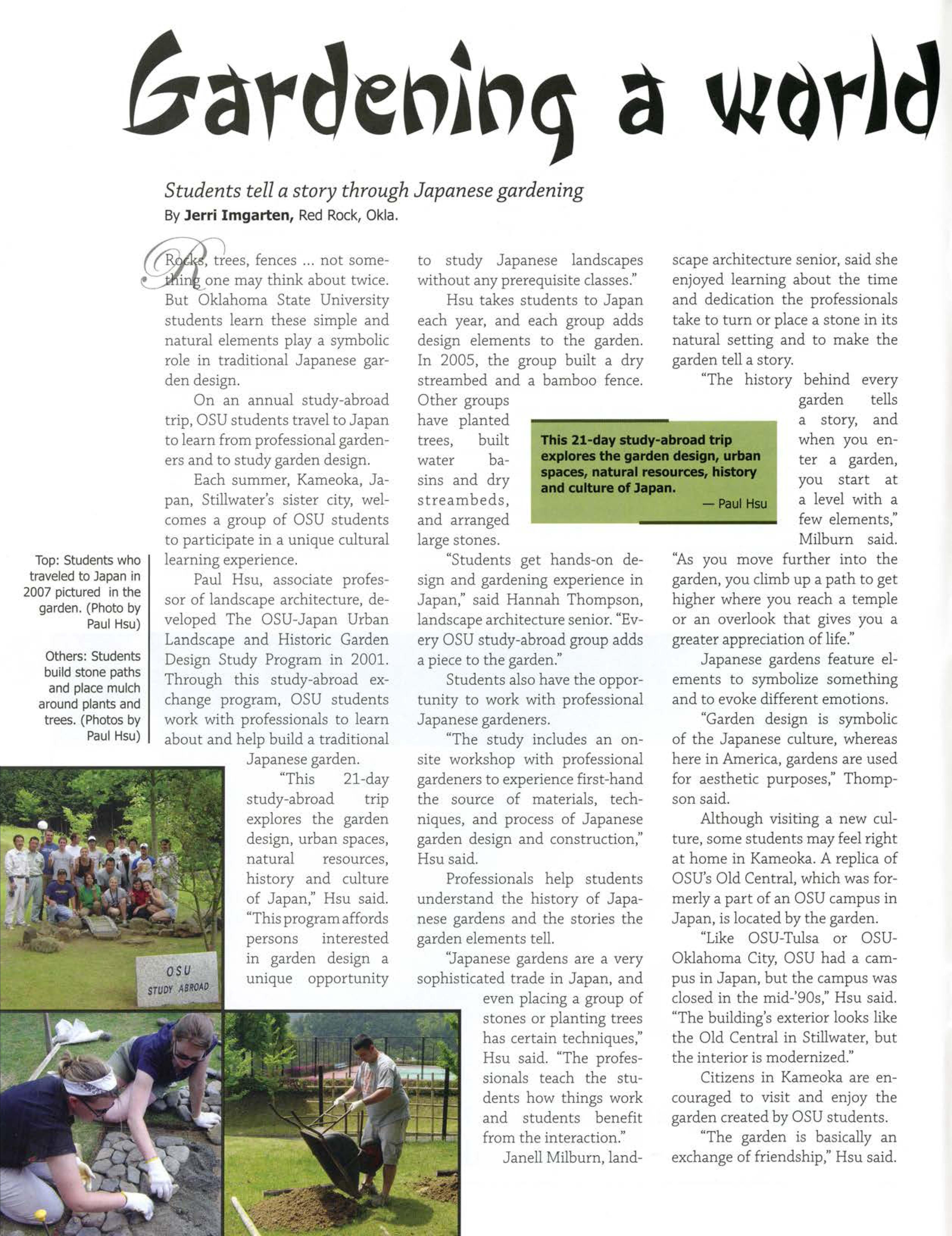
Top: Students who traveled to Japan in 2007 pictured in the garden. (Photo by Paul Hsu)
Others: Students build stone paths and place mulch around plants and trees. (Photos by Paul Hsu)
Students
tell a story through Japanese gardening
By Jerri Imgarten,
Red Rock,Okla.
~Jees, fences not some~r{one may think about twice. But Oklahoma State University students learn these simple and natural elements play a symbolic role in traditional Japanese garden design.
On an annual study-abroad trip, OSU students travel to Japan to learn from professional gardeners and to study garden design.
Each summer, Kameoka, Japan, Stillwater's sister city, welcomes a group of OSU students to participate in a unique cultural learning experience.
Paul Hsu, associate professor of landscape architecture, developed The OSU-Japan Urban Landscape and Historic Garden Design Study Program in 2001. Through this study-abroad exchange program, OSU students work with professionals to learn about and help build a traditional Japanese garden.
"This 21-day study-abroad trip explores the garden design, urban spaces, natural resources, history and culture of Japan," Hsu said.
"This program affords persons interested in garden design a unique opportunity
to study Japanese landscapes without any prerequisite classes."
Hsu takes students to Japan each year, and each group adds design elements to the garden. In 2005, the group built a dry streambed and a bamboo fence. Other groups have planted
trees, built water basins and dry stream beds, and arranged
scape architecture senior, said she enjoyed learning about the time and dedication the professionals take to turn or place a stone in its natural setting and to make the garden tell a story.
"The history behind every garden tells
This 21-day study-abroad trip explores the garden design, urban spaces, natural resources, history and allture of Japan.
-Paul Hsu Milburn
said.
a story, and when you enter a garden, you start at a level with a few elements," large stones.
"Students get hands-on design and gardening experience in Japan," said Hannah Thompson, landscape architecture senior. "Every OSU study-abroad group adds a piece to the garden."
Students also have the opportunity to work with professional Japanese gardeners.
"The study includes an onsite workshop with professional gardeners to experience first-hand the source of materials, techniques, and process of Japanese garden design and construction," Hsu said.
Professionals help students understand the history of Japanese gardens and the stories the garden elements tell.
''.Japanese gardens are a very sophisticated trade in Japan, and even placing a group of stones or planting trees has certain techniques," Hsu said. 'The professionals teach the students how things work and students benefit from the interaction."
Janell Milburn, land-
"As you move further into the garden, you chmb up a path to get higher where you reach a temple or an overlook that gives you a greater appreciation of life."
Japanese gardens feature elements to symbolize something and to evoke different emotions.
"Garden design is symbolic of the Japanese culture, whereas here in America, gardens are used for aesthetic purposes," Thompson said.
Although visiting a new culture, some students may feel right at home in Kameoka. A replica of OSU's Old Central, which was formerly a part of an OSU campus in Japan, is located by the garden.
"Like OSU-Tulsa or OSUOklahoma City, OSU had a campus in Japan, but the campus was closed in the mid-'90s," Hsu said. "The building's exterior looks like the Old Central in Stillwater, but the interior is modernized."
Citizens in Kameoka are encouraged to visit and enjoy the garden created by OSU students.
"The garden is basically an exchange of friendship," Hsu said.
"Every time we visit, we forge a relationship with local gardeners and professionals. Citizens who visit the center can see OSU has been building the garden, and it is a good reminder of a good relationship between OSU and the local community."
Building the garden, however, is only a small portion of what students experience on the trip.
"The course takes students to Tokyo, Kyoto, Osaka and other Japanese cities to visit historic gardens and contemporary urban landscapes and to explore the complex modern Japanese culture and its systems," Hsu said. "Students also spend one or two days with a host family to exchange cultural experiences."
Katy O'Meilia, landscape architecture senior, stayed with a host family whose daughter takes English classes at the university.
"It was a lot of fun to meet a family so different from mine," O'Meilia said.
culture, and through this study-abroad program, I became more open to traveling to other countries."
Yoshiyuk.i Minagawa, an architecture senior and native of Japan, said he fondly remembers his friends' reactions to the traditional Japanese breakfasts.
"The hotel typically provided some meals to us, but many did not like the food, so we made regular trips to Mister Donut," Minagawa said.
In addition to traveling to Japan, students also traveled a few days in Thailand to study landscape architecture and gardens.
"Thailand is an extended trip used as a comparison to Japanese landscape design." Hsu said. "I want to extend the students' design knowledge and vocabulary.
"No one in the family spoke English except a daughter, who was I gained respect for the Japanese allture, and I became more open to traveling to other countries.
Thai de-
sign has a very tropical essence but cominterested in learning more about English and American culture."
Students stay with different host families, and they come home with slightly different cultural experiences.
"I think the most important aspect of staying with a host family was seeing a completely different culture because everything is so different," Thompson said. "I gained respect for the Japanese
p are d to Japanese design you see strict styles and techniques. Thailand has free expression and uses an abundance of materials to enhance landscape design."
Hsu opens the course to anyone with an interest in studying abroad or learning about Japanese culture and garden design. He takes approximately 10 to 12 students to Japan each summer and said the trip typically costs a
student $3,500 including airfare.
Hsu said his goal is to provide students with a larger variety of international experiences and expand their cultural knowledge.
"I chose to participate in the studyabroad trip because while growing up and living in Japan, I did not have the time or money to travel," Minagawa said.
"This was a good opportunity for me to go back to my home country to see and understand the cultural differences between Japan and America."
The course helps students academically and personally become more diverse in cultural and design knowledge, Hsu said.
"Study abroad opens the students' eyes to a more diversified vocabulary because students are no longer limited to personal design ideas," Hsu said. "Outside of the design aspect, international experiences also help students become more open-minded and think about other people and cultures outside of their own.".J~
- HannahThompson
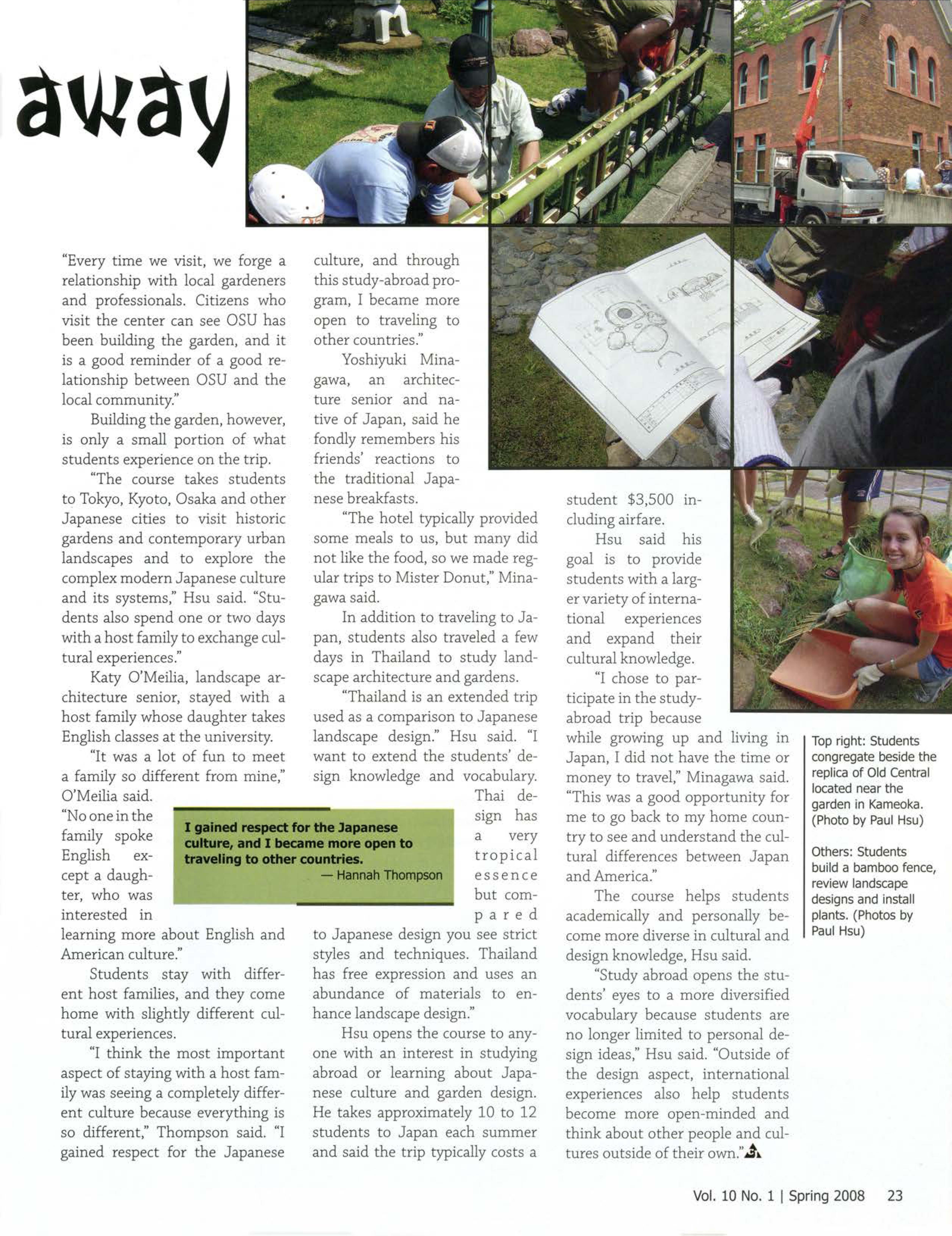
Top right: Students congregatebesidethe replica of Old Central located near the garden in Karneoka.
(Photo by Paul Hsu)
Others: Students build a bamboofence, review landscape designsand install plants. (Photos by Paul Hsu)
~han 4,000 years, ranch~~:-e- branded cattle to mark their ownership. A brand symbolizes the excellence and integrity of cattle producers.
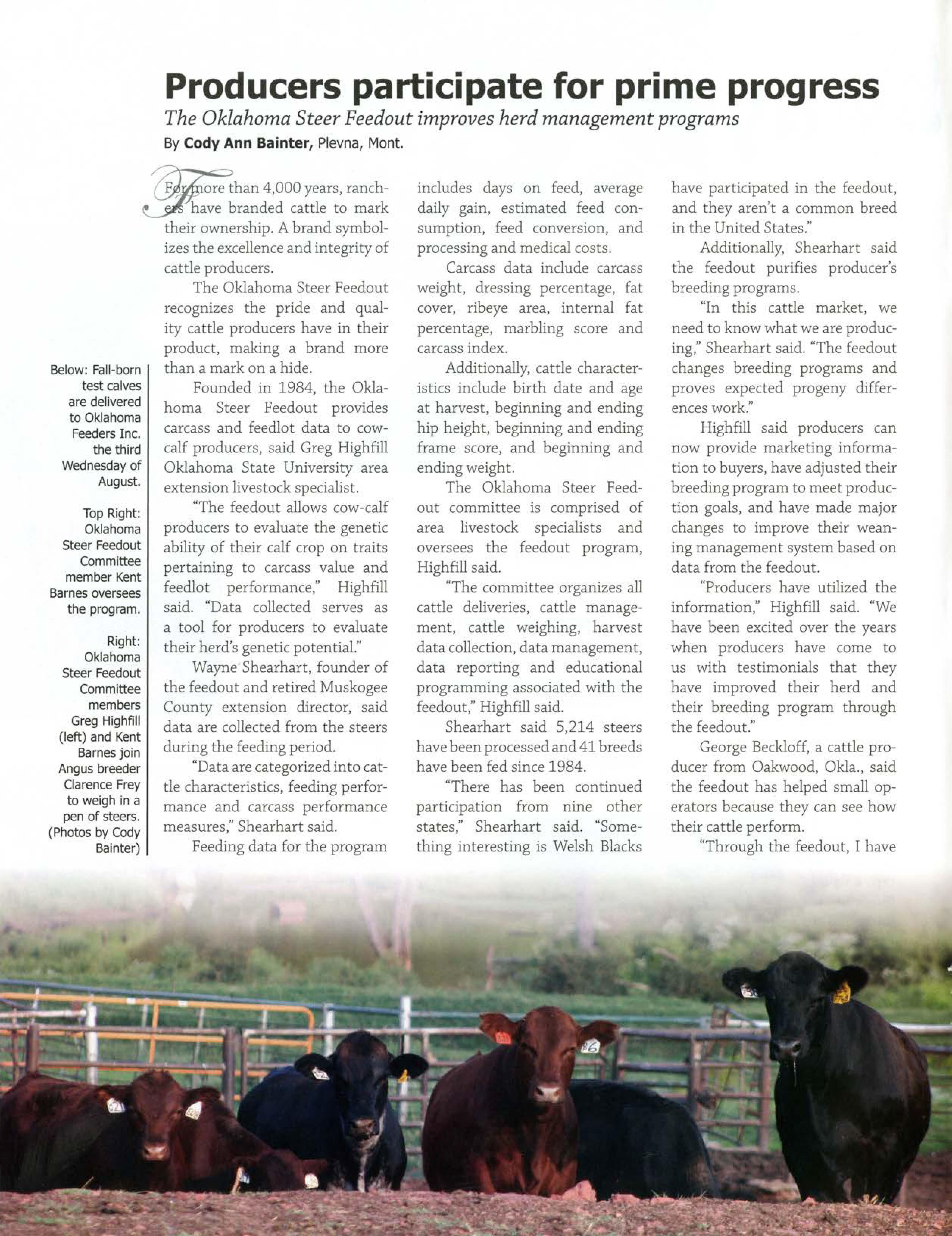
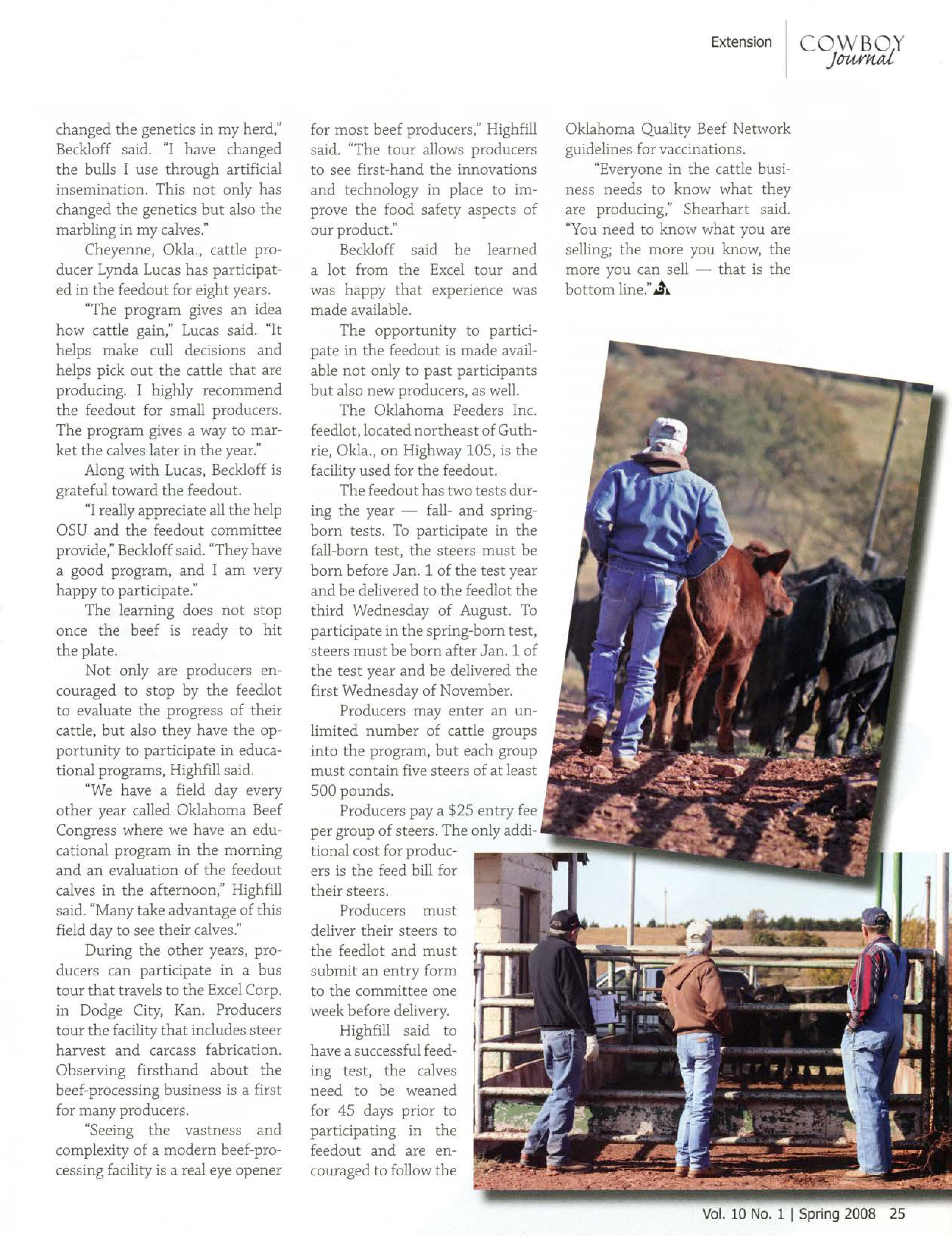
Below:Fall-born test calves are delivered to Oklahoma FeedersInc. the third Wednesdayof August.
TopRight: Oklahoma Steer Feedout Committee memberKent Barnesoversees the program.
Right: Oklahoma Steer Feedout Committee members GregHighfill (left)and Kent Barnesjoin Angusbreeder ClarenceFrey to weighin a pen of steers. (Photosby Cody Bainter)
The Oklahoma Steer Feedout recognizes the pride and quality cattle producers have in their product, making a brand more than a mark on a hide.
Founded in 1984, the Oklahoma Steer Feedout provides carcass and feedlot data to cowcalf producers, said Greg Highfill Oklahoma State University area extension livestock specialist.
"The feedout allows cow-calf producers to evaluate the genetic ability of their calf crop on traits pertaining to carcass value and feedlot performance," Highfill said. "Data collected serves as a tool for producers to evaluate their herd's genetic potential."
Wayne Shearhart, founder of the feedout and retired Muskogee County extension director, said data are collected from the steers during the feeding period.
"Data are categorized into cattle characteristics, feeding performance and carcass performance measures," Shearhart said.
Feeding data for the program
includes days on feed, average daily gain, estimated feed consumption, feed conversion, and processing and medical costs.
Carcass data include carcass weight, dressing percentage, fat cover, ribeye area, internal fat percentage, marbling score and carcass index.
Additionally, cattle characteristics include birth date and age at harvest, beginning and ending hip height, beginning and ending frame score, and beginning and ending weight.
The Oklahoma Steer Feedout committee is comprised of area livestock specialists and oversees the feedout program, Highfill said.
"The committee organizes all cattle deliveries, cattle management, cattle weighing, harvest data collection, data management, data reporting and educational programming associated with the feedout," Highfill said.
Shearhart said 5,214 steers have been processed and 41 breeds have been fed since 1984.
"There has been continued participation from nine other states," Shearhart said. "Something interesting is Welsh Blacks
have participated in the feedout, and they aren't a common breed in the United States."
Additionally, Shearhart said the feedout purifies producer's breeding programs.
"In this cattle market, we need to know what we are producing," Shearhart said. "The feedout changes breeding programs and proves expected progeny differences work."
Highfill said producers can now provide marketing information to buyers, have adjusted their breeding program to meet production goals, and have made major changes to improve their weaning management system based on data from the feedout.
"Producers have utilized the information," Highfill said. "We have been excited over the years when producers have come to us with testimonials that they have improved their herd and their breeding program through the feedout."
George Beckloff, a cattle producer from Oakwood, Okla., said the feedout has helped small operators because they can see how their cattle perform.
"Through the feedout, I have
changed the genetics in my herd," Beckloff said. "I have changed the bulls I use through artificial insemination. This not only has changed the genetics but also the marbling in my calves."
Cheyenne, Okla., cattle producer Lynda Lucas has participated in the feedout for eight years.
"The program gives an idea how cattle gain," Lucas said. "It helps make cull decisions and helps pick out the cattle that are producing. I highly recommend the feedout for small producers. The program gives a way to market the calves later in the year."
Along with Lucas, Beckloff is grateful toward the feedout.
"I really appreciate all the help OSU and the feedout committee provide," Beckloff said. "They have a good program, and I am very happy to participate."
The learning does not stop once the beef is ready to hit the plate.
Not only are producers encouraged to stop by the feedlot to evaluate the progress of their cattle, but also they have the opportunity to participate in educational programs, Highfill said.
"We have a field day every other year called Oklahoma Beef Congress where we have an educational program in the morning and an evaluation of the feedout calves in the afternoon," Highfill said. "Many take advantage of this field day to see their calves."
During the other years, producers can participate in a bus tour that travels to the Excel Corp. in Dodge City, Kan. Producers tour the facility that includes steer harvest and carcass fabrication. Observing firsthand about the beef-processing business is a first for many producers.
"Seeing the vastness and complexity of a modern beef-processing facility is a real eye opener
for most beef producers," Highfill said. "The tour allows producers to see first-hand the innovations and technology in place to improve the food safety aspects of our product."
Beckloff said he learned a lot from the Excel tour and was happy that experience was made available.
The opportunity to participate in the feedout is made available not only to past participants but also new producers, as well.
The Oklahoma Feeders Inc. feedlot, located northeast of Guthrie, Okla., on Highway 105, is the facility used for the feedout.
The feedout has two tests during the year - fall- and springborn tests. To participate in the fall-born test, the steers must be born before Jan. 1 of the test year and be delivered to the feedlot the third Wednesday of August. To participate in the spring-born test, steers must be born after Jan. 1 of the test year and be delivered the first Wednesday of November.
Producers may enter an unlimited number of cattle groups into the program, but each group must contain five steers of at least 500 pounds.
Producers pay a $25 entry fee per group of steers. The only additional cost for producers is the feed bill for their steers.
Producers must deliver their steers to the feedlot and must submit an entry form to the committee one week before delivery.
Highfill said to have a successful feeding test, the calves need to be weaned for 45 days prior to participating in the feedout and are encouraged to follow the
Oklahoma Quality Beef Network guidelines for vaccinations.
"Everyone in the cattle business needs to know what they are producing," Shearhart said. "You need to know what you are selling; the more you know, the more you can sell - that is the bottom line."J'~
CASNR alumni carry on OSU traditions through family legacies
By Mandy Imgarten, Enid, Okla.
ily backgrounds, long-stand• g traditions and a culture of excellence draw students and alumni to the Oklahoma State University College of Agricultural Sciences and Natural Resources. From all corners of the United States and around the world, they come to bleed orange.
Student organizations, scholarship opportunities and a large percentage of Top 10 Seniors and Freshmen are just a few reasons generations of families continue to choose CASNR, said Ed Miller, CASNR associate dean. The college also is known for its quality academics and faculty who care about student success, he said.
CASNR graduates come in multiple combinations, like the Holcombes' grandfather/father/ son legacy or the Gardners' brother I sister I sister /brother
bond. Regardless of genealogy, the destiny is the same.
Scot Holcombe, an animal science alumnus, said an agricultural background, CASNR's academic reputation, and standing family tradition drew him to OSU.
"I was the third generation to attend OSU," Holcombe said. "I was familiar with the animal science department and realized that I wanted to be involved in the cattle business as my vocation. My grandfather, Thad, was in animal husbandry, and my father, Lee, graduated with an animal husbandry degree in 1956."
Brett Gardner, an animal science alumnus and one of four siblings to graduate from OSU, said he appreciates the experiences and skills he gained during his time at OSU.
"I grew up in a small area," Gardner said. "OSU was the opportunity of a lifetime for me. It gave me the tools I needed to fully express my talents, grow and develop."
CASNR upholds its reputation for having outstanding faculty and staff. Therefore, it takes into careful consideration when hiring to ensure the tradition of faculty excellence continues, Miller said.
"Our faculty care about student success and strive to be efficient in and out of the classroom," Miller said. "Faculty are students'
advisers. They understand the importance of an effective studentteacher relationship and have personal, professional relationships with students."
Faculty and staff in CASNR provide students with quality academics and a friendly, professional atmosphere, Miller said.
"I loved the camaraderie between faculty and students in CASNR," said Donna Neumeyer, plant and soil sciences alumna. "I loved the clubs and organizations, the students, and the closeness of the professors and students. They all knew who you were by the time you graduated. You could not skip class without them knowing."
Similarly, Grayson Riddels, agribusiness junior, said he appreciates the dedication of the faculty and staff.
"Without the help of OSU and CASNR faculty, I would not be where I am today," Grayson Riddels said. "My time at OSU has given me a foundation and understanding of my life goals. I obtained beneficial interpersonal and public speaking skills through collegiate activities and interaction with fellow students, faculty and staff."
CASNR has a reputation for having well-rounded students and graduates, which is because of their participation in many agricultural organizations, Miller said "CASNR understands the im-
portance of student development outside the classroom," Miller said. "We stress leadership in clubs and organizations, teamwork and good work ethics. These qualities, combined with faculty support and strong foundations provided by 4·H and FFA programs, have contributed to CASNR'shigh percentage of Top 10 Seniors, Top 10 Freshmen and various other prestigious awards."
Gaylon Riddels, an agricultural economics alumnus and brother of Grayson Riddels, earned one of these awards.
"My greatest memory of OSU is when I was named an OSU Top 10 Freshman Man," Gaylon Riddels said. "All the events and activities that led up to that made it all worthwhile. I enjoyed being involved in the agricultural college, meeting new people and getting to know the faculty."
Being in an active leadership position and participating in or· ganizatio9al activities was a great way to meet other students and have fun, Gardner said.
"Many people encouraged me to be involved and to take a leadership role," Gardner said. "I was actively involved in many clubs and organizations. I could definitely see the amazing difference between CASNR and other col· leges on campus."
Brother of Grayson and Gay· Ion Riddels, Garrett Riddels, an
agribusiness alumnus, said he remembers the friendships and memories he made during his time at OSU.
"I loved the friends I met, the relationships I developed through classes and studying together, and the ability for friendships to last for years after school," Garrett Riddels said.
In addition to the faculty and student organizations, scholarships play an important role in re· cruiting and maintaining student enrollment. CASNR is fortunate to provide scholarships each year to deserving students, Miller said.
"We have a strong scholarship program due to the loyalty of our alumni," Miller said. "This is reflected in the large number of scholarships we are able to provide. This is a perfect example of alumni giving back to the college."
Gardner said he was blessed by the scholarships and thankful for the donors who allowed him to attend OSU.
CASNR takes pride in helping students celebrate success by providing scholarships, Miller said.
"Our goal is to increase academics by providing students with the necessary tools and funds to continue their academic excellence,"Miller said.
Faculty,student organizations and scholarships are three traditions that bring generations of OSU families back to CASNR. As technology advances, CASNR not only continues to provide quality traditional agricultural academic programs but also continues to expand to more non-traditional agricultural programs.
"CASNRcontinues to support traditional agriculture, but we are pursuing agriculture in a broader sense," Miller said. "Programs in horticulture, landscape architecture, turf management, food sci· ence and food safety are rapidly becoming prominent agricultural industries. Students who come through CASNR have an appreciation for production agriculture but also are prepared for nontraditional agricultural jobs.''.J1
new lqrlW~ or ru I lan'oma
Broadband Interne accessprovides rural Oklahomans with boundless ap11.ortunities
By Julie Sackman'n,MosesLake,Wash.
• I~n average day in rural Okla~a. A farmer gets up, performs his morning routine, eats breakfast, then sits at the computer to check the markets.
His fingers click away at the keyboard. www.cbot.com. Enter. He waits, waits and waits more for the page to load. "Finally!" the farmer thinks as the Chicago Board of Trade Web site loads, and he is able to click on market data. The waiting resumes until the next page loads, and he enters the market code and hits enter, sending the page on its way.
Suddenly, his son bursts in the room.
"Dad, the cows are out!"
The farmer gets up and hurries to follow his son. He does not make it back to his computer for the rest of the day and misses a market fluctuation, costing him hundreds of dollars.
If only he had broadband.
Broadband - the information autobahn
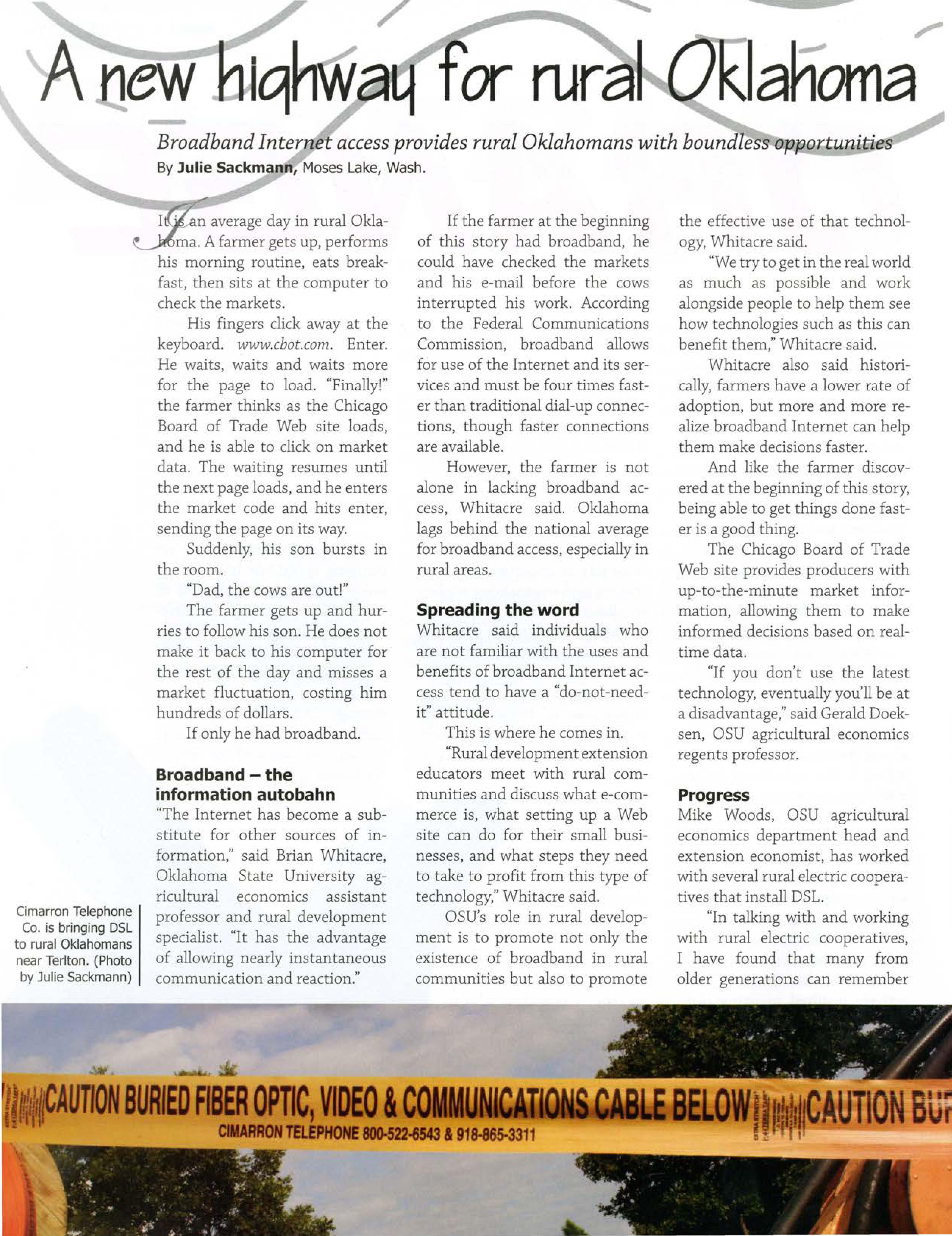
CimarronTelephone Co.is bringingDSL to ruralOklahomans near Terlton.(Photo by JulieSackmann)
"TheInternet has become a substitute for other sources of information," said Brian Whitacre, Oklahoma State University agricultural economics assistant professor and rural development specialist. "lt has the advantage of allowing nearly instantaneous communication and reaction."
If the farmer at the beginning of this story had broadband, he could have checked the markets and his e-mail before the cows interrupted his work. According to the Federal Communications Commission, broadband allows for use of the Internet and its services and must be four times faster than traditional dial-up connections, though faster connections are available.
However, the farmer is not alone in lacking broadband access, Whitacre said. Oklahoma lags behind the national average for broadband access, especially in rural areas.
Spreading
the word Whitacre said individuals who are not familiar with the uses and benefits of broadband Internet access tend to have a "do-not-needit" attitude.
This is where he comes in.
"Rural development extension educators meet with rural communities and discuss what e-commerce is, what setting up a Web site can do for their small businesses, and what steps they need to take to profit from this type of technology," Whitacre said.
OSU's role in rural development is to promote not only the existence of broadband in rural communities but also to promote
the effective use of that technology, Whitacre said.
"We try to get in the real world as much as possible and work alongside people to help them see how technologies such as this can benefit them," Whitacre said.
Whitacre also said historically, farmers have a lower rate of adoption, but more and more realize broadband Internet can help them make decisions faster.
And like the farmer discovered at the beginning of this story, being able to get things done faster is a good thing.
The Chicago Board of Trade Web site provides producers with up-to-the-minute market information, allowing them to make informed decisions based on realtime data.
"If you don't use the latest technology, eventually you'll be at a disadvantage," said Gerald Doeksen, OSU agricultural economics regents professor.
Progress
Mike Woods, OSU agricultural economics department head and extension economist, has worked with several rural electric cooperatives that install DSL.
"In talking with and working with rural electric cooperatives, I have found that many from older generations can remember
when electricity and water came to rural Oklahoma," Woods said. "Water and electricity provided important infrastructure that we couldn't move forward without. High-speed broadband infrastructure is the same issue for rural America, farms and communities - we cannot move forward without it."
The goal of rural development is not only for rural areas to have broadband access but also for rural areas to have affordable broadband access, said Brent Kisling, state director for the U.S. Department of Agriculture Rural Development Agency.
The USDA Rural Development Agency works to bring new opportunities to those who live in rural areas and to help them compete on a global level while still living in small communities.
One such opportunity is broadband Internet access.
"Broadband allows users to partake in e-commerce, stay in touch with friends and relatives around the world, and advance their education," Whitacre said.
Doeksen has worked in rural development for 40 years, focusing his efforts on community services and keeping rural hospitals open. Doeksen said broadband is helping to keep rural hospitals open using telemedicine - a broadband Internet service that allows doctors in larger cities to correspond with rural doctors.
"Many hospitals are hooking up with radiology," Doeksen said. "It allows for almost instant results, whereas it used to take one or two days. A doctor can be in Oklahoma City and have a patient in Boise City and have nearly instant readings."
Aside from telemedicine, broadband also can assist medical professionals with continuing education credits.
"Many courses are offered on• and doctors and nurses can get o tinuing education courses right at hospital," Doeksen said. "Tele-e uca ·o • per.fe helping expand education.'
Medical personnel are not the only ones who can benefit from tele-education. Many universities offer online courses through distance learning programs, which can lead to graduate degrees.
"Online classes are great because they allow individuals to keep up with classes and save time and mileage from having to drive to Oklahoma City or Tulsa to get credits," Doeksen said.
Boosting efficiency
In addition to education, users can benefit from broadband on a professional level. Business owners have come to rely on high-speed Internet access not only for their business operations but also for their customers.
"Youhave to have a Web presence for people to believe you're a real company," Whitacre said.
Bear Runyan, owner of 3C Cattle Feeders in Mill Creek, Okla., received broadband access the spring of 2006. When Runyan learned his company was to receive broadband, he was excited, he said.
"We had only heard about it," Runyan said. "We were pretty eager to get it going."
Now that Runyan has broadband, he is able to respond to customers and place online orders quickly, he said.
"It does not take me half the morning to check e-mail anymore," Runyan said.
If you are selling something, you have to have a Web presence, Doeksen said. Web sites help with marketing and getting messages delivered. People who use computers tend to rely on them.
In general, colle e individuals are more -savvy than older gener ·ems and cannot imagi mg without high-speed emet, Woods said.
"It starts in school," Woods said. "Kids get hooked on it and bring the technology home to their parents and grandparents."
Everywhere you want to be Doeksen, Whitacre and Woods all said broadband Internet access provides rural communities with opportunities for growth, jobs and income.
"I won't claim businesses grow solely because of broadband access, but it is definitely a factor," Whitacre said. "We have some small businesses that have increased their revenues by simply advertising online."
Woods said one of the driving factors that determines where people choose to live is the availability of broadband.
"People don't want to live in rural communities without digital infrastructure," Woods said. "Businesses don't want to move to areas without digital infrastructure. Broadband is a fundamental piece of infrastructure for rural areas to be competitive." .J~
For more information on rural development and bringing broadband Internet accessto rural areas, visit http:/lwww.agecon.okstate.edu/ broadband or http://www.rurdev. usda.gov.
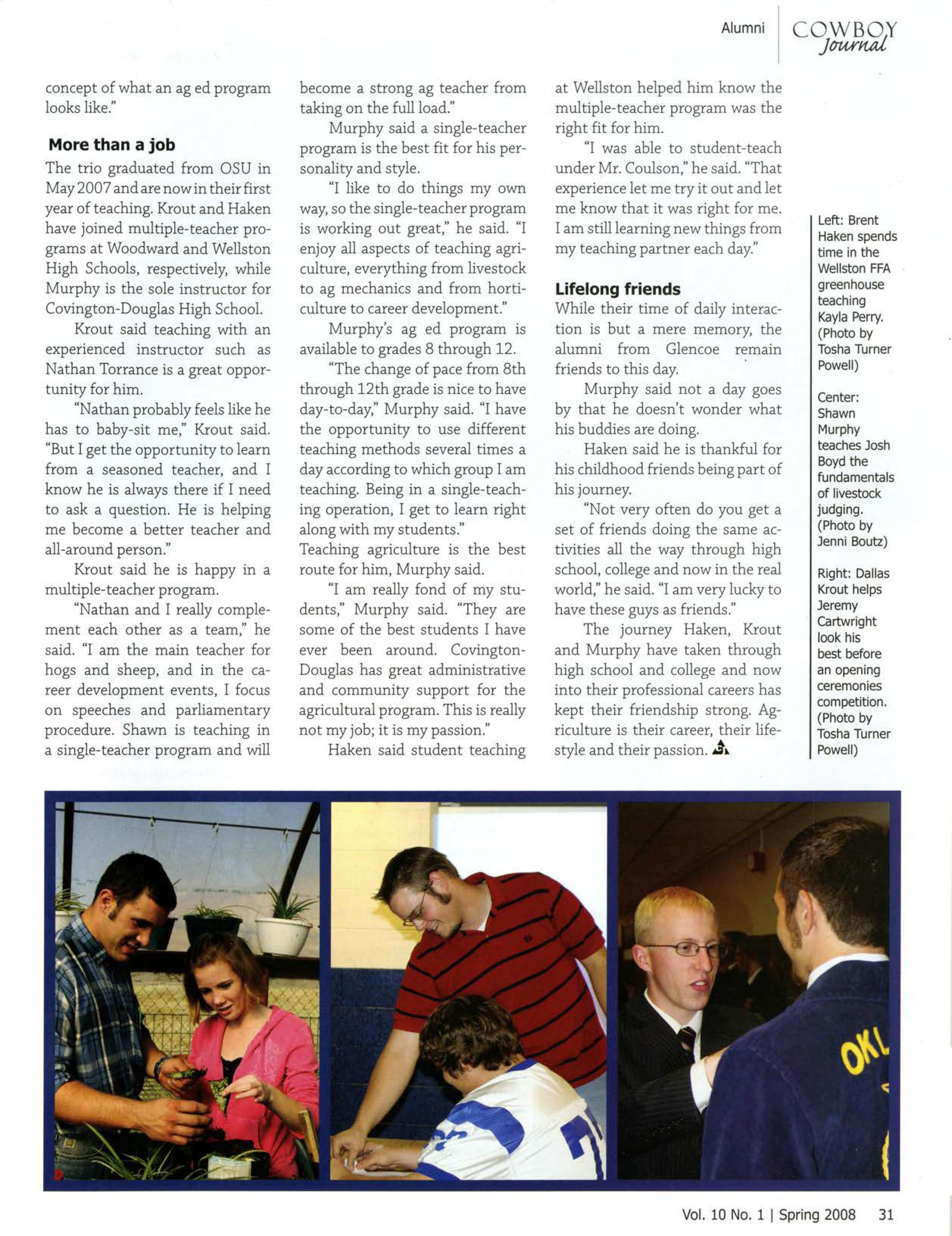
Numerousindividual wires comprisethe DSLcablesthat bring high-speed Internet to rural Oklahomans.(Photo by Julie Sackmann)
An FFA calling
Childhoodbuddies continue bonds through collegeand career
By Tosha Turner Powell, Amber,Okla.
( ~~dergarten through high ~ol :~ college and now careers, three Oklahoma State University College of Agricultural Sciences and Natural Resources alumni have built a lifestyle of learning from their passion for agriculture.
Glencoe, Okla., is where it all began for Dallas Krout, Brent Haken and Shawn Murphy.
"All but one of our parents graduated from Glencoe High School," Murphy said. "Naturally, the three of us spent kindergarten through our senior year together."
These three young men spent their high school years involved in Glencoe's agricultural education and FFA program under instructors Larry Brien and Chancer McPherson. They participated in the many aspects of agricultural education, including serving as chapter officers and running for president their senior year.
"I recall Shawn and I always trying to 'out do' each other when it came to FFAevents," Krout said. "Although we were competitive against each other, we are each other's biggest support system."
College bound
Each young man knew he would attend college; however, only two of them started college with plans to complete an agricultural education degree. Haken began his journey at Oklahoma State University as an agribusiness major.
"My family is one of the only ones left in Glencoe still farming," Haken said. "We raise cattle and own a custom harvest operation. I had plans to receive an agricultural business degree but figured out that I didn't really like the math."
Haken, along with Krout and Murphy, found himself attend-
ing OSU Collegiate FFA events and decided teaching and the FFA were where he wanted to be.
"I was thoroughly involved in the FFA in high school," Haken said. "I raised and showed cattle, judged livestock and was involved in many of the leadership activities. And, I found myself helping chaperone various CFFA events while in college. The education program was a better fit for me than business."
Murphy began his college career at Northern Oklahoma College in Tonkawa, Okla.
"My only reason for going to college was to be an agricultural education instructor," Murphy said. "I always knew I would end up at Oklahoma State University."
Murphy said he credits his passion for teaching to McPherson.
"J had always thought about teaching agriculture," Murphy said. "But it wasn't until Mr. McPherson came to Glencoe that I knew I wanted the same opportunity to impact students' lives."
Krout said his high school agricultural education instructors influenced his decision to become an "ag teacher."
"Brian always pushed us to give our all," Krout said. "McPherson also had a huge impact on my wanting to be an ag teacher. He taught me so much and truly inspired me to become more actively involved. By then, I had given up my dreams of being a rock star and made the decision to pursue a teaching career."
Krout, however, was involved in a larger aspect of the agricultural education program, the Oklahoma FFA.
"I was elected as central district vice president of the Okla-
homa FFA,"he said. "The FFA has had a tremendous influence on my life and is a large part of my decision on continuing the agricultural education route."
The college experience
For the three Glencoe natives, the Collegiate FFA chapter was a must, and they each helped coordinate and chaperone the Oklahoma FFA's Made for Excellence Program and the Advanced Leadership Development Conference.
Krout and Haken served as officers of the CFFA, while Murphy worked his way through college.
"I made a goal for myself to be finished with school and to be teaching before I turned 23 years old," Murphy said.
Jon Ramsey, teaching associate and coordinator of field placement for the agricultural education program, said these alumni received an experience in high school to set the stage for their collegiate and teaching careers.
"Their high school experience gave these three gentlemen the opportunity to travel down three distinctive paths that crossed to a very similar finish," Ramsey said. "To come from a strong rural program, such as Glencoe, these boys were ready to do what was necessary to take their experience to the next level."
Ramsey praised Haken, Krout and Murphy.
"These are exceptional young men who have passion, character and the ability to be an ag teacher," he said. "If everyone who joins the OSU agricultural education program had that kind of knowledge and experience, it would make our jobs as college professors much easier. These boys had the total
concept of what an ag ed program looks like."
More than a job
The trio graduated from OSU in May 2007 and are now in their first year of teaching. Krout and Haken have joined multiple-teacher programs at Woodward and Wellston High Schools, respectively, while Murphy is the sole instructor for Covington-Douglas High School.
Krout said teaching with an experienced instructor such as Nathan Torrance is a great opportunity for him.
"Nathan probably feels like he has to baby-sit me," Krout said. "But I get the opportunity to learn from a seasoned teacher, and I know he is always there if I need to ask a question. He is helping me become a better teacher and all-around person."
Krout said he is happy in a multiple-teacher program.
"Nathan and I really complement each other as a team," he said. "I am the main teacher for hogs and sheep, and in the career development events, I focus on speeches and parliamentary procedure. Shawn is teaching in a single-teacher program and will
become a strong ag teacher from taking on the full load."
Murphy said a single-teacher program is the best fit for his personality and style.
"I like to do things my own way, so the single-teacher program is working out great," he said. "I enjoy all aspects of teaching agriculture, everything from livestock to ag mechanics and from horticulture to career development."
Murphy's ag ed program is available to grades 8 through 12.
"The change of pace from 8th through 12th grade is nice to have day-to-day," Murphy said. "I have the opportunity to use different teaching methods several times a day according to which group I am teaching. Being in a single-teaching operation, I get to learn right along with my students."
Teaching agriculture is the best route for him, Murphy said.
"I am really fond of my students," Murphy said. "They are some of the best students I have ever been around. CovingtonDouglas has great administrative and community support for the agricultural program. This is really not my job; it is my passion."
Haken said student teaching
at Wellston helped him know the multiple-teacher program was the right fit for him.
"I was able to student-teach under Mr. Coulson," he said. "That experience let me try it out and let me know that it was right for me. I am still learning new things from my teaching partner each day."
Lifelong friends
While their time of daily interaction is but a mere memory, the alumni from Glencoe remain friends to this day.
Murphy said not a day goes by that he doesn't wonder what his buddies are doing.
Haken said he is thankful for his childhood friends being part of his journey.
"Not very often do you get a set of friends doing the same activities all the way through high school, college and now in the real world," he said. "I am very lucky to have these guys as friends."
The journey Haken, Krout and Murphy have ta.ken through high school and college and now into their professional careers has kept their friendship strong. Agriculture is their career, their lifestyle and their passion . .Jl
Left: Brent Hakenspends time in the Wellston FFA greenhouse teaching KaylaPerry. (Photo by ToshaTurner Powell) Center: Shawn Murphy teachesJosh Boypthe fundamentals of llvestock judging. (Photo by Jenni Boutz)
Dallas Krout helps Jeremy Cartwright look his best before an opening ceremonies competition. (Photo by ToshaTurner Powell)
Right:
Above: Bancoumana radio station staff share experiences with Rachel Hubbard(left), Rob McClendon and Assoumane Maiga.(Photo by ShellySitton)
Top right: AmagonoSaye (left), Souma·11a camara, N'Golo Diarra, Gamer Dicko (kneeling) and Aly Koita experienceNative Americanculture.
Oklahoma professionalsexperienceMalian culture and media
By Jenni Boutz, Oklahoma City
~meeting between two .....:uz;;;;a ~tate University scholars led to an African adventure that will influence many generations to come.
Agricultural education professor Craig Edwards met Mohomodou Boncana, a Fulbright scholar from Mali, Africa, when the two spoke to an international agricultural education class at OSU.
A friendship sparked.
"We kept in contact, and Mohomodou expressed the need for help in Mali through our conversations," Edwards said. "Because of my past international experience, I started looking for grant opportunities in Africa."
The opportunity came in late 2005 through the U.S. Department of State.
Edwards, along with agricultural communications faculty Cindy Blackwell, Dwayne Cartmell and Shelly Sitton, applied for
and received a citizens exchange program grant from the Bureau of Educational and Cultural Affairs.
"l had never been to the developing world before, and I have truly gained an appreciation for the need to help," said Cartmell, co-director of the Mali project.
As a democracy with a free press for less than a decade, Mali has a lack of professional development opportunities for its media specialists, and the OSU faculty focused on this need.
"Now that the people of Mali have a say in what happens to their country as a democracy, there is a real need for them to increase their professionalism in journalism," said Rachel Hubbard, KOSU news director. ''.Journalism allows Malians the opportunity to provide reliable information to the public and is key in a free nation to allow voices to be heard."
Hubbard was one of 10 pro-
fessionals and educators who traveled to Bamako, Mali, in March 2007 for the first phase of the three-phase project.
"Visiting a Third World country is a life-changing experience," Sitton said. "Nothing prepares you for the impact on your senses the sights, the sounds, the smells that assail you."
The team included graduate students and representatives from the Oklahoma Department of Career and Technology Education, Oklahoma Farm Bureau and the University of Central Oklahoma.
The grant team landed in Africa prepared to work.
"The main emphasis in this phase was to gain an understanding of the culture and recruit individuals to study in Oklahoma for the second phase," Cartmell said.
To learn about the culture, the grant team met with officials at the University of Bamako, the U.S.
Agency for International Development and the Malian Ministry of Communication. They visited several radio stations, a television station and the country's only cable network. By discussing the issues and challenges of providing the free press with journalists, they uncovered ways to help Malian media specialists succeed.
The group also traveled to a rural village to meet with cotton farmers and visit a rural radio station, one of Mali's more than 125 radio stations developed in the past decade.
In addition, the team conducted a workshop for media specialists and interviewed those who wanted to participate in the grant project's second phase in the United States.
In July 2007, 14 Malians arrived in Oklahoma.
''Alot of preparation went in to the arrival of the Malians," Sitton said. "We were excited to see them again and looked forward to working with them."
While in Stillwater, the Malians participated in on-campus media training and various cultural activities in Tulsa and Oklahoma City. They then worked as interns for two weeks, and each Malian had the opportunity to learn from a professional journalist in his or her area of expertise.
"I got an idea of American newsroom life and how to make a good business plan at OSU," said Bande Moussa Sissoko, journalist at L'ESSORin Mali. "I think everything I learned can help me in my social and professional activities."
Cartmell said the grant team wanted the Malians to take home not only an education but also an experience that would help make them confident in their knowledge and abilities. The emphasis of the second phase was to educate, mentor and provide cultural activities, he said.
"My experience with OSU
made a big change for me in Mali," said Assournane Maiga, a Malian project participant. "I had the opportunity to visit museums, towns, a stadium and memorials. I saw how Americans are devoted to their work. Since my return home, I feel like a different person and am more confident in my work."
When the internships were completed, the Malian media specialists joined OSU faculty and agricultural communications students for the Agricultural Media Summit in Louisville, Ky., before returning to Africa.
"The Malian specialists now have the experience to provide information that could change the lives of many individuals and improve economic, environmental and socioeconomic circumstances in Mali," said Lora Young, an agricultural communications graduate assistant who worked with the grant team.
The opportunity changed another graduate student's postgraduation plans. Jeremiah Allen, agricultural communications graduate student who traveled with the team in March, now plans to participate in international work when he completes his degree.
"I felt I really made a difference," Allen said. "I would like to do international work now because I enjoy traveling abroad and can see myself working internationally to make a difference in people's lives."
For the final phase of the program, the grant team returned to Africa in December to check the participants' progress.
"Only time will tell how much our work will impact Mali," Edwards said. "I was excited to see the progress that has occurred."
Although the grant program has concluded, OSU faculty continue to pursue additional avenues to help this African nation as well as other countries across the continent, Cartmell said ..i~
Development of a Nation
Mali is one of Africa's newest democracies and the largest country in West Africa. With a population growth more than three times that of the United States, a changing demand exists for credible and accurate media sources to combat corruption and inform the public. The literacy rate is about 19 percent, and Mali is ranked as the fourth poorest country in the world.
About 65 percent of Mali's land area is desert or semi-desert, and majority of the labor force is involved in farming and fishing. Farm commodities provide a primary income source, and about 10 percent of the population is nomadic.
'Grant'ing students a chance
Alumni couple give to students to honor former mentors
By Audra Kelln, Shattuck, Okla.
~ant considered a fuyond graduation from high s oo n Grandfield, Okla., he envisioned himself following in his father's footsteps and becoming a farmer. Grant realized his dream, and today he helps others realize their dreams.
Grant and his wife, Alma, provide scholarships to the Oklahoma State University College of Agricultural Sciences and Natural Resources students through the OSU Foundation.
Farming was what Grant knew, and money was scarce in the years following the Great Depression. Families had to work together to meet the most basic of needs. There was no room for selfishness, and college was a luxury rural people could not afford.
"There is no way to describe
the Depression to people of the current generation," Grant said.
"It just does not make sense to them. You worked all day for a dollar, and the money we made was given to our parents.''
However, Grant's high school vocational agriculture instructor, William E. Brown, took a special interest in Grant through FFA and urged him to enroll at Oklahoma Agricultural and Mechanical College (now OSU).
"I was not programmed to go to college,"Grant said, "but Brown said, 'You're going to go to college; just get used to the idea."'
And go to college, Grant did.
In fall 1936, Grant entered OAMC with no money, but a desire to earn an education and a degree in animal husbandry.
Upon arriving at OAMC,
Grant went to the animal husbandry department in search of a job, only to be turned away.
"I went to OAMC with recommendations, but I was quickly informed there were no jobs available," Grant said. "So, I took a job with the Daily Oklahoman."
At the end of Grant's freshman year, he accepted a job at the college's horse farm, working under the supervision of Clark "Andy" Kinkead, OSU draft horse manager and instructor.
Kinkead, who lived and worked alongside the students at the horse farm, took a great deal of interest in Grant and other students, serving as both a mentor and friend. The policy of the animal husbandry department, at the time, was that students could work only one year at the horse
OSUalumni Ben and Alma Grant live near Pasco, Wash.(Photoby PaulErickson)
barn. Upon completion of that first year, students were required to rotate to another of the college farms. Grant, however, remained at the horse farm during his sophomore year.
Kinkead also served as a charter member of the Alpha Gamma
animal husbandry department, so Kinkead arranged for a transfer to the sheep farm, which was managed by Alex McKenzie.
-Ben Grant
Andy and Alex showed me dream of being associated with or working for anybody with such high ethics. He was a prince of a man, what integrity and honesty and giving a full day's work plus 15 percent more is worth.
"Andy could not swing a deal for me to work another year at the horse farm, so I went to work for Alex," Grant said. "You could not Rho fraternity. And, through his association with the fraternity, he encouraged Grant to
join and participate as an out-ofhouse member.
"The founding of a fraternity was the last thing I had thought about," Grant said. "I did not have any money. But, Andy said 'You're just like a lot of farm kids who come up here. You've got a lot of rough edges on you. You are going to join that fraternity, and I'm going to pay for it."'
For two years, Grant lived and worked at the horse farm, under the watchful eye of Kinkead. The rooms were little more than horse stalls, and the wages were modest: 13 cents per hour, which equated to about $18 per month.
"All the time I was working at the horse farm, I lived on Post Toasties, sugar and milk," Grant said. "That is why the one meal a week I was required to eat at the fraternity house was like Christmas to me. It was a rare treat."
For young men who were physically fit, military training was required at OAMC,Grant said. Once again, Kinkead provided guidance to Grant, advising him to pursue an infantry commission as a second lieutenant in the college's ROTC program. Kinkead believed the United States would eventually become involved in the conflict overseas, Grant said.
Grant's employment at the horse farm came to an end with the star of his third year at OAMC. He had already exceeded the one-year limit set forth by the
just like Andy was."
Grant said he credits Kinkead and McKenzie for providing the inspiration and wisdom needed for him to finish college.
"Those two men made it possible for me to get through college," Grant said. "They gave some of the soundest and best advice."
Grant continued to work for the college farms until his graduation in 1940. After graduation, Grant went to work on a 132,000acre sheep and cattle ranch in New Mexico, managing the sheep flock and breeding records.
After nearly a year in New Mexico, Grant reported to active duty in June 1941.
"Uncle Sam sent me an invitation and ordered me to active duty," Grant said. "When I got my orders, I was already 10 days overdue in El Paso, Texas. I had to drop everything and report for duty."
Grant served in an infantry division for one year before going into the U.S. Air Force as a bomber pilot. During his tour of duty, Grant flew in 56 combat missions over Italy and various other European war theaters. And, once again, he credited Brown, Kinkead and McKenzie for instilling a strong work ethic and a solid sense of self-worth in him.
"They showed me what integrity and honesty and giving a full day's work plus 15 percent more is worth," Grant said.
Upon completion of Grant's
World War II tour of duty, Grant and his wife, an OSU business education alumna, returned to Oklahoma, producing wheat on rented land with the aid of a single selfpropelled combine.
In 1950, the Grants moved to Pasco, Wash., which is located in the Columbia Basin in southcentral Washington. The land was covered with sagebrush, but water was plentiful due to the Grand Coulee Dam and Columbia Basin Irrigation Project that provided irrigation water to area farmers.
The Grants started their farming and custom harvesting operation with the one combine Ben had purchased in Oklahoma.
"When I moved to Washington, I brought that little combine with me, and I could not have landed in a better place," Grant said. "When the crops started coming in, I started buying more combines and moving farther north. From 1951 to 1988, I never asked for a job; they all came to me. I was in that much demand."
In 1988, at age 70, Grant retired from farming and combining. In 37 years of farming and harvesting crops in Washington's Columbia Basin, Grant bought 64 new combines, all of which never traveled farther than 30 miles from home.
"I never loaded a combine and hauled it anyplace," Grant said. "I was home every night."
Now, at the age of 89, Grant lives on the farm he and Alma started together in 1950. The miles separating Pasco, Wash., from Stillwater, Okla., are many, but Grant credits his success to the three men from Oklahoma who helped shape him into the man he is today.
"There's not much time in my daily life that I do not think about one or more of those three men," Grant said. "I know I would not be where I am today if it was not for the interest they took in me."
To show his appreciation and respect for Brown, Kinkead and McKenzie, Grant decided to pay tribute to each man by establishing scholarships named in their honor through CASNR and the OSU Foundation.
The OSU Foundation exists to support the university and strives to assist OAMC and OSU agricultural alumni in the pursuit of ensuring the continued success of CASNR students, both present and future.
"We seek to unite donor passions with university priorities to achieve excellence throughout the OSU system," said Becky Endicott, the foundation's senior director of marketing and communications.
A deep-seeded passion for CASNR sparks the desire to give back, to the college just as it did for the Grants.
"Mr. Grant is one of a number of CASNR alums who have established scholarships for their de-
partment," said Gary Clark, OSU agricultural education alumnus and OSU Foundation vice president and general counsel. "CASNR graduates and faculty are very loyal to OSU, and that is what makes the college of agriculture the special place that it is."
Through the private support and generosity of the Grants and others like
will continue to play a major role in providing new opportunities for current and future Cowboys."
That is exactly what Ben and Alma Grant hope.
-Gary Clark
CASNR graduates and faculty are very loyal to OSU, and that is what makes the ers because of those three men. l feel I should pay back something, that I owe something to these students becollege of agriculture the special place that it is.
"We give so these students coming in have a chance at the same education and opportunities I did," Grant said. "I have tried to give 150 percent in everything I have done for oththem, OSU's agricultural legacy will continue to thrive. The continued impact of donors' loyalty
is long-reaching and provides OSU with a means to compete with other universities.
"Private support provides the margin of excellence needed to elevate Oklahoma State University beyond its competitors," said Michal Shaw, director of donor relations and scholarships for the OSU Foundation. "Private support
cause I would not be anywhere near where I am today if it were not for those men." J-.,
For more information on how to support CASNR students, please call the OSU Foundation at 800622-4678 or visit the Web site at http:/ /www.osugiving.com.
Oklahoma averagesfrom 40 to 60 days of thunderstorms throughout the state. (Photo by candice Blackwell)
Oklahoma weather creates positive and negative effects on agriculture
By Sunny Fye, Comanche,Okla.
/l klah.oma is known for its vivid llreg.. irt, unbelievable sunsets and family farming. However, recent weather has taken a toll on the state's traditional agricultural producers, which has resulted in positive and negative outcomes.
As the fifth largest state in cattle production and third largest wheat producer, Oklahoma has an economy that depends on agriculture, which greatly depends on the weather according to the Oklahoma Department of Ag1iculture, Food and Forestry.
"The last three years of weather abnormalities have effected the Oklahoma economy with losses of agricultural production," said Darrell Peel, Oklahoma State University professor and extension livestock marketing specialist. "Rural communities rely on livestock, hay and wheat production for small town survival."
The unusual weather patterns of the past several years have created negative effects on agriculture. Oklahomans, accustomed to the drastic climate changes, have found positive outcomes to the sometimes impossible situations.
"The weather can turn over night," Peel said. "Recognizing that farming is a risky business is an essential part of profitability."
During the past two years, Oklahoma has experienced the effects of an El Nino, a major warm-
ing of the equatorial waters in the Pacific Ocean. El Nino events usually occur every three to seven years and cause shifts in normal weather patterns.
Becky Brewer, director of the animal industry services division of ODAFF, said the 2007 spring and summer rainfall has made for an excellent hay crop which provides food and fiber for animals.
"It was a great year for hay production, which helped to lift us from the drought problems last year," Brewer said. "We had such a hard time with the lack of water for our cattle herds because of the dry weather in 2006."
Farmers and ranchers across the state found it hard to maintain enough water supplies in pasture ponds and creeks to nourish cattle herds in 2006, leaving many ranchers with no choice but to ship cattle to the stockyards.
Brewer said during the 2006 drought, the largest number of cattle were sold in the history of the livestock market.
Fires also injured many animals and destroyed available food, which added to the decrease in cattle herds across the state.
The disasters Oklahoma has faced can be attributed to the extreme weather patterns typical in this region, Brewer said.
El Nino first unleashed its wrath on Oklahoma in 2005 by
causing a hot, dry summer. In 2007, tropical storm Erin left Oklahoma with 10 inches of rain in a single night across portions of the state, causing flooding that hindered farmers from harvesting their crops.
The effects of El Nino have influenced positive research to develop agriculturally friendly techniques for farmers and ranchers.
OSU scientists said recent climate changes have allowed them to discover much-needed information regarding Oklahoma weather and agriculture.
"The ongoing weather process leaves an imprint on agriculture every year," said Brett Carver, wheat genetics chair in agriculture and regents professor for the OSU Department of Plant and Soil Sciences. "The weather really shapes what I do. You have to be ahead of it."
Carver said his job is necessary because of Oklahoma's drastic weather changes. Long drought followed by torrential rainfall correspond with the much-needed research to produce "weather friendly" wheat.
"Some good does come from the weather," Carver said. "It allows me to experience exactly how the wheat reacts to the weather."
Carver develops wheat varieties that are able to tolerate the ever-changing climate of Okla-
homa. He said the recent weather extremes have made his job interes ting and exciting.
"It is hard to breed the type of wheat you need when you do not know what you are breeding for," Carver said. "You can start developing wheat for drought resistance due to the summer of 2006, and then you get a summer like we just had, with too much rainfall that caused Oklahoma farmers to have a problem with rust."
Carver said although the rainfall was too abundant last summer and resulted in rust, it replenished the soil from the previous years of drought.
"It takes 10 inches of water to make the first bushel of wheat," Carver said. "Oklahoma's soil is typically silt loam, which holds five inches itself. Therefore, we have to have rain at some point in time, and the rain this past summer saturated the soil back to where it needed to be."
David Riggs, part-time farm-
er and press supervisor for the Oklahoma Department of Career and Technology Education, said Oklahoma is indebted to the rainfall, which provided farmers with much-needed moisture.
"My father-in-law, Robert Mack, said it was the same way in 1955 with an extreme drought following with 1956 being extremely wet," Riggs said. "In summer of 1957, Oklahoma produced the best crop it has ever seen. So, maybe this year is our lucky year."
Riggs, who sells hay to OSU, said Oklahoma is going to have to see a decent crop soon for the economy's sake.
"Loss of income for farmers is the major problem associated with the weather," Riggs said. "For me personally, it is a $50,000 to $75,000 loss a year, and that is minor compared to major operations. I usually bale 2,000 to 3,000 round bales a year, and in 2006, I only baled 1,200."
Riggs, who specializes in the
production of bermudagrass hay, native prairie and hay grazer, said there was not enough subsoil moisture in 2006. He said the rainfall helped his business significantly in the summer of 2007.
Riggs said it is the same for everyone across the state.
"The drought was devastating to every farmer," Riggs said. "Heavy rainfalls were helpful, but harmful in many ways, too. I hope more people realize we need more research, better prices and more agriculturally friendly equipment. I do not think many Oklahomans understand how important people like me are to the survival of our tradition."
Oklahoma farmers and ranchers struggled with the survival of agriculture for decades before modern science created technological advances.
With research today, Oklahoma's agricultural tradition willcontinue to survive the ever-changing wrath of Mother Nature. J-~
Heavyrains flattened wheat fields in June 2007. (Photo by ToddJohnson)
The Great Wall of China is the world's longest and largest man-made structure.
(Photo by Lora Young)
From the Great Plains to the Great Wall
Agrzcultural
students study zn China and Tibet
By Angelika Stuler, Lawton, Okla
en days. Six domestic One of the Seven Wonders World.
In May 2007 10 Oklahoma State University students traveled to China and Tibet where they visited uncommon places and experienced different cultures.
During the trip, Shida Hen neberry international agricultural economics professor incorporated education, history economics, and the role of government and policy makers into the experience. Henneberry said she believes stu dents can learn only so much in a classroom setting.
"I teach international trade, and I see from the classroom to reality there is a big gap," Henneberry said. "[Seeing and experiencing another culture] takes students to a different stage."
It opens their eyes and minds
to global events and how people live and work in other parts of the world, she said.
The China study abroad trip is sponsored by the China Ministry of Agriculture, which is equivalent to the U.S Department of Agriculture, Henneberry said. The MOA provided a full-time native guide from Beijing who served as an English interpreter
During their visit to China, students visited Beijing, Chengdu, Nanjing, Suzhou, Shanghai and Lhasa, which is in Tibet. In Beijing, the students visited the China Agricultural University and traveled to the Great Wall of China.
"To say that you visited one of the Seven Wonders of the World is pretty amazing," said Aimee Lee, food science junior "I wouldn't trade it for anything."
One of the experiences the
students had was being able to visit Lhasa, Tibet.
"Dr Henneberry expressed how important it was to be able to go to Tibet," said Matt Dvorak, international agricultural economics senior "Not a lot of people get to go into Tibet."
To enter Tibet, Henneberry obtained permission for each of the 10 students from the Tibetan government, which was not an easy task.
"I met two people on campus who applied [for permission] but were declined," Henneberry said. "For students [to enter Tibet] is a very unique opportunity"
To get to Lhasa, Tibet, the students and faculty took a 29-hour train ride from Beijing to Lhasa. Henneberry said the train ride offered amazing views of the landscape such as the Tibetan Plateau,
snow-capped mountain peaks and different autonomous regions. It also allowed the students to become acclimated to the climate and altitude changes. Oxygen was slowly pumped through the cabin so passengers would not pass out. At times, the train would pass through regions as high as 5 000 meters or 16,404 feet.
"It went from a temperate climate to desert-looking areas to a mountain type of terrain," said Gavin Rey agricultural business sophomore. "Lhasa itself is in a val ley in the middle of mountains."
In Lhasa, the students visited the Potala Palace, where the Dali Lama lived before he was exiled.
They also visited the Tibetan Agricultural Science Academy where research is done on wild mushrooms that grow only in high altitudes. Henneberry said growing anything in such a high altitude is limited.
"It was amazing to see the culture and the agriculture," Lee said. "I loved Tibet. It was a great opportunity and many people do not realize that."
From Tibet,.the students traveled to Chengdu, China, where they visited the Panda Breeding Station and the Dujiangyan Dam. The Dujiangyan Dam is more than 2,000 years old and is used as an irrigation system for people in the Chengdu Plain. Henneberry said the dam was special to see because it is so old.
"The 2,000-year-old irrigation system dams up [the Minjiang River] and was constructed so well that it is still fully functional today" Rey said.
After visiting Chengdu, the students traveled to Nanjing where they visited the Nanjing Agricultural University NAU students hosted a welcoming party for the OSU students and showed them a martial arts demonstration. The NAU students also per-
formed a calligraphy demonstration. Calligraphy is a traditional Chinese writing art form.
During their stay at NAU,OSU students listened to lectures and interacted with NAU students.
"I got to talk to animal science and food science students who are interested in what type of careers they could have after they got their degrees," Lee said. "I guess China is strict and most [students] go into nutrition and developing food, whereas in the United States we have so many opportunities."
NAUsent some students with the OSU group as they traveled around Nanjing. Henneberry said it was a great experience for the OSU students to participate in that kind of cultural exchange
"Not even tour companies can provide that," Henneberry said. "Seeing China on that level is a unique opportunity The most fulfilling part of the trip for me is to see the students grow through that experience."
Students also visited an el ementary school associated with
NAU.While there, they taught the younger students English. The elementary students did not know much English, which made communicating difficult when OSU students pointed to Oklahoma on the map.
"When the school bell rang, all [the elementary students] came up to us and wanted our autographs," Rey said. "I do not know if they were under the impression that we were somebody famous or what - we were swamped."
Rey said the trip to China was an insight to a different culture.
"It is a very enlightening view of the rest of the world and also how the world views the United States," Rey said. "The U.S is kind of stuck in a rut.
"We think our way of doing things is the best, and we should be more open-minded. When you compare the civilizations, we are the new kids on the block."
Henneberry said she believes college is a good time for students to study abroad because students have a flexible schedule and are
OSUstudents
Jeff Stewart (left), Benson Chu, Matt Dvorak, Lora Young and Gavin Reyvisit the Great Wall of China. (Photo courtesy of Matt Dvorak)
hopefully free of any prior prejudices. She said she believes the experiences will remain in students' hearts and minds for the rest of their lives.
"[The experience] was simply amazing," Dvorak said. "I've become more culturally aware. It was neat to see the way [the Chinese] interact with each other the games they play and their traditions. It is an experience I would not trade."
Lee said she believes studying abroad allows you to get out of your comfort zone and it shows how privileged people are in the United States.
"Spending three weeks in another country may not be the cheapest thing, but the experience is worth it," Dvorak said. "I did not know anyone going on the trip, but I came back with 10 new friends. That's pretty cool.'
Dvorak, who plans to study abroad in the Czech Republic for the entire spring semester said he has had many people comment on his experience in China.
"[Studying abroad] has opened so many doors for me," Dvorak said. "As I'm entering the job market, people see that I am willing to go abroad."
Henneberry said for students who are interested in internation al jobs, it helps if they can say they have experienced another country and culture.
"This is a great opportunity so take advantage of it," Henneberry said. "While you're young, invest in it. It is an investment in your life, in your career and in your future growth." .Ji
For additional information on study abroad visit http.//www.internationalagprograms.dasnr okstate.ed1,1,
Dragon fountains greet visitors at the Ming Tombs.
(Photo by Lora Young)
Maintaining a healthy diet and taking vitamins help build the immune system, making it easier to fight illness.
(Photo by Emilia Buchanan)
Take care, Sweetheart
Tips
on how college students can stay healthy
By Emilia Buchanan, Pawnee,Okla
e." - People, especially tudents, have a tendency hese words, as well as their health, for granted. Working, studying for exams, completing homework and still having time for friends creates stress. Getting enough sleep and staying healthy is the last thing on a college student's mind.
Why is it easy for students to become ill?
"More people get sick when they are stressed out or haven't had adequate sleep because the body is overloaded," said Tia Redus, health educator and coordinator of the Share the Wealth program at the Oklahoma State University Health Center
On a college campus, illness
can spread easily One key factor is the contact students have with one another, said Rachel Shreffler coordinator of health education at the OSU Health Center
"College students are in close contact with one another on a daily basis, which increases the risk of spreading illness," she said.
Interaction happens in the classrooms, computer labs, residence halls and the sit-down eating establishments on campus.
"You have to take care of yourself," said Timber Eaton, agricultural economics and accounting senior at OSU, who contracted bacterial meningitis, a potentially fatal illness, in 2006.
"Not taking care of yourself tends to lower the immune system, making you more susceptible
to a cold, sore throat, flu or even [a more severe illness such as] meningitis," Eaton said. "I was so tired and worn down, which made my body more susceptible to [contracting the disease] "
Managing stress
• Manage time Prioritize activities Do things you enjoy
• Get adequate sleep
Staying healthy
Shreffler and Eaton both stressed the importance of exercise, adequate sleep and a balanced diet. Eaton said although she was
Early meningitis symptoms
Sore throat
Chills
Migraine Fever
Nausea
Stiffness or aching
Diarrhea and vomiting
stressed and worn down when she contracted meningitis, she was able to recover from the disease, not only because she received timely medical care but also because she was in good shape.
"Having a healthy diet and exercising helps decrease stress and strengthen the immune system," Shreffler said. "People who exercise tend to get sick less often, and when they do, it doesn't last nearly as long."
Shreffler recommended exercising three to five days a week for at least 30 minutes.
"Exercise boosts the immune system, increases self esteem, decreases stress levels and, combined with making healthy food choices, gives the body what it needs to fight off illness," she said.
Shreffler said she advised consuming a variety of foods to have a healthy diet.
"You don't have to exclude any type of food," she said. "Look for balance and variety, and remember to eat in moderation.
"It is also important to get your immunizations, especially if you are in constant contact [with others] " Shreffler said. "Ifyou can prevent communicable diseases, it is important to do so."
OSU requires measles/ mumps/rubella and Hepititis B immunizations for all incoming students. The meningitis vaccination is required only for students living in campus housing.
"But if you are interested in significantly reducing your chances of contracting meningitis, the vaccine is a good idea," said Steve Rogers, director of student health at the OSU Health Center
Already sick?
It is important to do everything in your power to stay healthy and keep from getting sick, Rogers said. But if you have already contracted a sore throat, a cold or another illness, you can do some significant things to decrease the risk of spreading it to others.
"Washing hands is very important, especially during the cold and flu season," Rogers said. ''And if you can't get to water to wash your hands, use hand sanitizer"
Rogers also stressed the importance of covering the mouth while sneezing, coughing or even yawning or laughing.
"Another key thing to do is to make sure you do not go out in public during periods of being contagious," Shreffler added.
"[Usually this means] showing signs of a fever as well as vomiting and diarrhea," Shreffler said. "During times like these, you need to see your health care provider"
One health care option for students on campus is the OSU Health Center which has more than 26,000 student visits yearly
"February is the busiest time of year due to flu season, and September is second busiest due to allergies and colds," Rogers said. "The time of year 'flu season occurs varies, but it generally happens during the winter months."
One important thing to remember Eaton said, is that early symptoms of meningitis easily can be mistaken for the flu.
People in general think they are invincible, Eaton said. But it is so easy to get sick, especially for people who have constant contact with one another as do students.
"Educate yourself [on disease symptoms and prevention], because I had no idea," Eaton said. "I thought I would always be healthy Never say 'it won't hapm pen to me. ..ai.
Important things to remember
Using soap, wash hands with hot or warm water for at least 30 seconds
Eat a healthy diet
Take vitamins
Exercise three to five times a week for 30 to 60 minutes
Get eight hours of sleep each night
Manage stress
Do not eat, drink or smoke after anyone
Get immunized
Do not ignore a sore throat or what you think may be the flu
Educate yourself on symptoms of disease and ways to stay healthy
Scars on Timber Eaton's arms remain from her battle with bacterial meningitis.
(Photo by Emilia Buchanan)
OSU honors Sen. Kerr with renaming of FAPC
The Oklahoma Food and Agricultural Products Research and Technology Center on the Oklahoma State University campus celebrated its 10-year anniversary in July 2007 and renamed the facility the Robert M. Kerr Food and Agricul tural Products Center
The building's name change was in honor of the late Sen. Kerr and his active participation in the development of FAPC, which included two decades of creating the research and technology center
"Without the leadership, vision and consistent hard work of the late Sen. Kerr the Food and Agricultural Products Center would not exist today" said J. Roy Escoubas, FAPC director "Sen. Kerr worked tirelessly for two decades to pass legislation for the development of a food-processing center in Oklahoma."
The 96,000-square-foot FAPC opened in 1997 and the building serves as a home for animal harvesting, grain milling and food
Older than Oklahoma
Oklahoma was not the only one to celebrate a centennial last year Haskell Cudd, retired chief executive officer of Stillwater Milling Co., joined family and friends to celebrate his 100th birthday Aug. 31,2007
Born near Lindsay Okla. Cudd earned both his bachelor's and master's degrees in accounting from OSU in the early 1930s In 1933 Cudd began working for Stillwater Milling Co. as a book-
keeper He worked his way up to president and CEO in 1972 Cudd developed a strong connection with the College of Agricultural Sciences and Natu ral Resources through donations and fund raising assistance to help construct the Willard Sparks Beef Research Center He also has sponsored educational programs including the Advanced Cattle Management Seminar The OSU Department of Animal Science
"ServingCentralOklahoma" www.pkequipmentcom
microbiology among others. It also has conference facilities and laboratories for demonstrations.
Rodger Kerr the senator's son, was the keynote speaker and revealed FAPC's new name at a birthday party luncheon. Kerr spoke of his father's position in developing FAPC and the impact of FAPCon Oklahoma .t~
Contributedby Stacy Buck
honored Cudd with the Distinguished Service Award in 1989
"He always had a strong belief in getting a good education and its opportunities," said Don Wagner former OSU animal science department head. "He is a genu ine giver to students, producers, agriculture and OSU.".t~
Contributedby Mary Kate Scott
JOHN DEERE
Whitson's Notes
At the beginning of Oklahomas second century of statehood, the founding principles of the land-grant mission remain core values which continue to inspire and direct us to make a difference and affect positive change for all of Oklahoma, even if today's pace of life demands change happen more quickly than ever
Throughout DASNR's history, our successes always have been other peoples' successes as well, a partnership of discovery and implementation made possible by the integration of teaching, research and extension, science-based innovations that improve traditional agricultural activities and natural resource use while creating exciting opportunities enhancing the quality oflife for our communities.
Innovation and relevance are our trademarks. Advancements in scientific understanding and technology developed by DASNR researchers serve as the foundation for Oklahoma Cooperative Extension programs that assist Oklahomans on a local, county and statewide basis. They make their way into our classrooms, ensuring OSU students have access to the latest theory and practice that will enhance their ability to thrive professionally and personally
Advances and changes that once took decades now take mere months or less to become real. That is the challenge facing our extended DASNR family today It is a challenge we have always met, and with your help, we will continue to do so.
In an ORANGE state of mind!
The 2007 Homecoming Ag Alumni Barbecue brought hundreds of graduates and their families to Stillwater and an "ORANGEstate of mind." Those in attendance feasted on barbecue, enjoyed time with friends and other alumni, and celebrated a win over Kansas State.
CASNR had the largest number of returning SO-year alumni than any other OSU college. These SO-yearmembers were the last class to graduate from Oklahoma A&M University
and 25-year (above) and SO-year(left) graduation anniversaries.
A feast of fun and friendship
On Aug. 29 2007 at the Wes Watkins Center, the Ag Alumni Association welcomed freshman and transfer students to OSU with dinner and a Liveperformance by OSU marching band. More than 300 freshmen and transfer students from CASNRattended the event.
Ag Roundup annually serves as an orientation for new CASNR students. Attendees learn about the different stu dent organizations in CASNR.
New students are also introduced to the members of the Agriculture Student Council, leading faculty in CASNR and OSU traditions.
The Ag Alumni board of directors co-sponsored the meal for the event and served the students.
"The Roundup is a great opportunity for new students to learn about the great programs within CASNR,"said Ag Alumni president Jason Harvey "It allows the alumni board a chance to meet and greet as well."
Special thanks to our generous 2007 Ag Roundup sponsors: Oklahoma Farm Bureau, American Farmers and Ranchers, Bank of Western Oklahoma, Blue and Gold Sausage and Chisholm Trail Farm Credit.
Robert E Whitson Vice President, Dean and Director Division of Agricultural Sciences and Natural Resources
Ag Alumni celebrate their 10-
(Photos by Todd Johnson)
Studentsand alumni enjoy networking, food and fun. (Photos by Todd Johnson)
Ag Alumni Board Member Spotlight Brent Garvie
Brent Garvie, a 1990 graduate in agricultural economics with a marketing and business option, was born in Woodward, Okla., but has lived in Burlington, Okla. nearly all his life. He owns and operates the family farming operation, which consists mainly of wheat, alfalfa and stocker cattle.
Garvie s main hobby is community service projects. He serves as president of the Burlington Cooperative Association, is involved in Lions Club and the Burlington Educational Foundation, and is an EMT and fireman with the Burlington Fire and Rescue Department. Garvie also serves as a deacon of the Driftwood Christian Church.
Garvie is married to Vanessa, his wife of 15 years, and they have two daughters, 12-year-old Katelyn and 9year-old Sarah. Vanessa teaches kindergarten and pre-k at Burlington Public Schools where their daughters are in seventh and fourth grades, respectively Some of his favorite activities while at OSU included serving as president of Aggie-X and being a founding mem-
ber of the OSU chapter of the National Agricultural Marketing Association and being on the first NAMA Marketing Team atOSU.
He said his fondest memories include visiting with Dan Badger for advisement and counsel, catching up with fellow classmates, and assisting "desper-
ate freshmen" as a teaching assistant for AGEC 1114 as they scrambled to pass that difficult course.
The Ag Alumni board has been blessed with Brent Garvie's service for five years It is a pleasure to introduce this dedicated board member and true Cowboy fan!
loin us for the 2008 DASNR Alumni Access Tour
Mark your calendars for the upcoming Alumni Access Tour June 5-6, 2008. OSU Division of Agricultural Sciences and Natural Resources faculty staff, stu dents and alumni will spend two days touring various agricultural businesses
in several locations in the southwest region of Oklahoma.
The 2007 Access Tour to southeast Oklahoma was a great success thanks to enthusiastic participants and generous sponsors. The Ag Alumni board of di-
rectors is looking for tour locations and sponsors for the 2008 tour
If you are interested in hosting a visit to your business or participating as a sponsor of this event, please call the DASNR office at 405-744-5398.