What About Food Safety? The California Retail Food Code, Section 113996, requires all Potentially Hazardous Foods—such as milk, meals containing meats or cooked vegetables, or certain cut fruits such as melons—to be maintained under proper food holding temperatures to prevent the potential for rapid bacterial growth. Once food items leave their hot or cold environment, they are considered outside the Safe Temperature Zone (STZ). Food collected from the food share table should be at the STZ outlined in the chart at right.
Questions? For questions about, or referrals for, setting up a food donation program, contact: David Goldstein, County of Ventura Public Works Agency, Integrated Waste Mgmt. Division 805-658-4312 or David.Goldstein@ ventura.org
4
Fortunately, during a typical school meal period, food will be outside the safe temperatures only while it leaves the serving line and moves to the food share table. Nevertheless, schools must observe safe food handling procedures and customize their practices to meet food safety requirements. Keeping cold items in the STZ can be challenging, especially on hot days. Consider methods to keep cold items chilled, using refrigerators, chest freezers, ice tubs or ice sheets. Take temperature readings with a thermometer between lunch services and discard items outside the STZs in the chart below.
FOOD
SAFE TEMPERATURE ZONE (STZ)
Cold food
41°F
e.g. milk
or lower
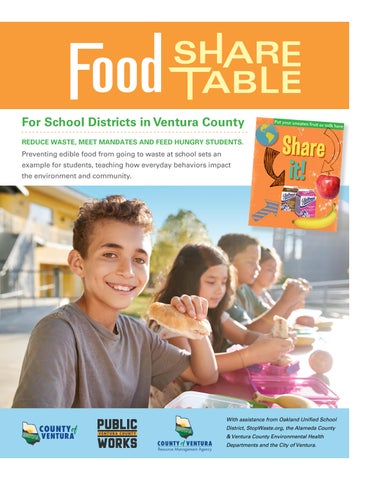
For School Districts in Ventura County REDUCE WASTE, MEET MANDATES AND FEED HUNGRY STUDENTS.
Preventing edible food from going to waste at school sets an example for students, teaching how everyday behaviors impact the environment and community.
WAYS TO CONTROL TEMPERATURE • Set up a separate area for cold items on the food share table. • Use ice tub or ice sheets • Set up a separate area for hot
Hot food
135°F
e.g. pasta
or higher
items on the food share table. • If items cannot be held at STZ, compost or dispose all remaining hot food at end of lunch period.
Room-temp. food e.g. oranges; crackers
N/A
• No temperature concern. • Ready to serve again after cleaning
More Information & Resources California Department of Education’s Food Share Mandate cde.ca.gov/ls/nu/sn/mbcnp032018.asp
USDA Guidance for Food Share in Child Nutrition Programs fns.usda.gov/use-share-tables-child-nutrition-programs
Food Share Table Sign for Download pwaportal.ventura.org/food_share_sign.pdf
With assistance from Oakland Unified School District, StopWaste.org, the Alameda County & Ventura County Environmental Health Departments and the City of Ventura.
2. Instructing Students
A food share table in the school cafeteria allows students to give away their unwanted, uneaten food items, so other students can select these food and beverage items at no cost during mealtime. Wire baskets, clear plastic tubs or clean table tops are best so students can see what is available.
1. Setup The food share table is part of the school cafeteria’s waste sorting station. Place it first in line (before the liquid pour station), so students can set aside food share items before they start to separate liquids, compostable items, recyclables and trash. Do not to place the food share container directly on the floor, or on the same level as the liquid dump bucket, in order to avoid contamination and splashing of liquids.
Signs Clearly mark the food share designated area with signs and show examples of acceptable items. The food to share can only be from the school cafeteria. Students with lunches from home should put leftovers back in their lunch. By doing so, a family/care-giver knows the student either didn’t like what was packed or their lunch was over-packed, and adjustments can be made. This prevents food waste and saves families money.
FOOD SHARE
Organization Set up separate areas for cold items (such as milk and yogurt, to be placed on an ice sheet), hot prepared entrees such as pasta, and room temperature items like fruit. Organizing shared foods like this will: • Control temperatures (see also food safety section) • Help students select food • Make cleanup and handling leftovers easier
2
Uneaten, Unopened, School Food Only NO Food from Home…Take Back Home!
Helping students understand that they are expected to eat the food items they choose will encourage them to select more carefully while in the serving line and set aside items they don’t intend to eat. Milk is one of the biggest items of waste. For meal reimbursement programs, if a student is offered at least 3 items, one being ½ cup serving of a fruit or vegetable, the student is not required to take a milk.
Food Share Table Rules: • Students place unwanted, uneaten items in the appropriate hot, cold or room temperature container. • Students select items they intend to eat during the meal period. • Items brought from home are not acceptable; they should be returned home, unless opened and unable to close (i.e. partially eaten applesauce, yogurt), which should then be composted or disposed.
3. Monitoring the Food Share Table Kitchen staff, with support from custodians and cafeteria monitors, must supervise the food share table— including between each meal and at the end of the last meal service. Check the station periodically throughout the meal period so food is not piling up, and make sure food is at the required Safe Temperature Zone (STZ). While the food share table is helpful when students want items they forgot to take or items no longer available, some students may use food share to fill up on items such as graham crackers rather than eating a balanced meal. Oversight by kitchen staff can reduce this behavior.
4. Handling Leftovers and Clean-up Handling Leftovers: At the end of the meal service, kitchen staff brings all items from the food share table into the kitchen for sorting and cleaning. Acceptable food items may be served again and claimed for meal reimbursement by the USDA. • Room Temperature Items Items like packaged crackers and pieces of fruit are ready to serve again after cleaning. • Individually packaged yogurt Ready to serve again after cleaning. • Hot or cold items If these items have been held in the Safe Temperature Zone,* they can be served again or donated, if an approved food donation program exists at your school. I f the items have been outside the Safe Temperature Zone* for more than two hours, they cannot be served again or donated. If your school has a composting program, remove any wrapping from the items and place into the compost bin. If removing the packaging is not an option, discard the item. * See food safety section on page 4.
Clean-Up: Wipe down and/or clean the food share container(s) and take back to the lunch sort station to be used for the next lunch period.
3
2. Instructing Students
A food share table in the school cafeteria allows students to give away their unwanted, uneaten food items, so other students can select these food and beverage items at no cost during mealtime. Wire baskets, clear plastic tubs or clean table tops are best so students can see what is available.
1. Setup The food share table is part of the school cafeteria’s waste sorting station. Place it first in line (before the liquid pour station), so students can set aside food share items before they start to separate liquids, compostable items, recyclables and trash. Do not to place the food share container directly on the floor, or on the same level as the liquid dump bucket, in order to avoid contamination and splashing of liquids.
Signs Clearly mark the food share designated area with signs and show examples of acceptable items. The food to share can only be from the school cafeteria. Students with lunches from home should put leftovers back in their lunch. By doing so, a family/care-giver knows the student either didn’t like what was packed or their lunch was over-packed, and adjustments can be made. This prevents food waste and saves families money.
FOOD SHARE
Organization Set up separate areas for cold items (such as milk and yogurt, to be placed on an ice sheet), hot prepared entrees such as pasta, and room temperature items like fruit. Organizing shared foods like this will: • Control temperatures (see also food safety section) • Help students select food • Make cleanup and handling leftovers easier
2
Uneaten, Unopened, School Food Only NO Food from Home…Take Back Home!
Helping students understand that they are expected to eat the food items they choose will encourage them to select more carefully while in the serving line and set aside items they don’t intend to eat. Milk is one of the biggest items of waste. For meal reimbursement programs, if a student is offered at least 3 items, one being ½ cup serving of a fruit or vegetable, the student is not required to take a milk.
Food Share Table Rules: • Students place unwanted, uneaten items in the appropriate hot, cold or room temperature container. • Students select items they intend to eat during the meal period. • Items brought from home are not acceptable; they should be returned home, unless opened and unable to close (i.e. partially eaten applesauce, yogurt), which should then be composted or disposed.
3. Monitoring the Food Share Table Kitchen staff, with support from custodians and cafeteria monitors, must supervise the food share table— including between each meal and at the end of the last meal service. Check the station periodically throughout the meal period so food is not piling up, and make sure food is at the required Safe Temperature Zone (STZ). While the food share table is helpful when students want items they forgot to take or items no longer available, some students may use food share to fill up on items such as graham crackers rather than eating a balanced meal. Oversight by kitchen staff can reduce this behavior.
4. Handling Leftovers and Clean-up Handling Leftovers: At the end of the meal service, kitchen staff brings all items from the food share table into the kitchen for sorting and cleaning. Acceptable food items may be served again and claimed for meal reimbursement by the USDA. • Room Temperature Items Items like packaged crackers and pieces of fruit are ready to serve again after cleaning. • Individually packaged yogurt Ready to serve again after cleaning. • Hot or cold items If these items have been held in the Safe Temperature Zone,* they can be served again or donated, if an approved food donation program exists at your school. I f the items have been outside the Safe Temperature Zone* for more than two hours, they cannot be served again or donated. If your school has a composting program, remove any wrapping from the items and place into the compost bin. If removing the packaging is not an option, discard the item. * See food safety section on page 4.
Clean-Up: Wipe down and/or clean the food share container(s) and take back to the lunch sort station to be used for the next lunch period.
3
What About Food Safety? The California Retail Food Code, Section 113996, requires all Potentially Hazardous Foods—such as milk, meals containing meats or cooked vegetables, or certain cut fruits such as melons—to be maintained under proper food holding temperatures to prevent the potential for rapid bacterial growth. Once food items leave their hot or cold environment, they are considered outside the Safe Temperature Zone (STZ). Food collected from the food share table should be at the STZ outlined in the chart at right.
Questions? For questions about, or referrals for, setting up a food donation program, contact: David Goldstein, County of Ventura Public Works Agency, Integrated Waste Mgmt. Division 805-658-4312 or David.Goldstein@ ventura.org
4
Fortunately, during a typical school meal period, food will be outside the safe temperatures only while it leaves the serving line and moves to the food share table. Nevertheless, schools must observe safe food handling procedures and customize their practices to meet food safety requirements. Keeping cold items in the STZ can be challenging, especially on hot days. Consider methods to keep cold items chilled, using refrigerators, chest freezers, ice tubs or ice sheets. Take temperature readings with a thermometer between lunch services and discard items outside the STZs in the chart below.
FOOD
SAFE TEMPERATURE ZONE (STZ)
Cold food
41°F
e.g. milk
or lower
For School Districts in Ventura County REDUCE WASTE, MEET MANDATES AND FEED HUNGRY STUDENTS.
Preventing edible food from going to waste at school sets an example for students, teaching how everyday behaviors impact the environment and community.
WAYS TO CONTROL TEMPERATURE • Set up a separate area for cold items on the food share table. • Use ice tub or ice sheets • Set up a separate area for hot
Hot food
135°F
e.g. pasta
or higher
items on the food share table. • If items cannot be held at STZ, compost or dispose all remaining hot food at end of lunch period.
Room-temp. food e.g. oranges; crackers
N/A
• No temperature concern. • Ready to serve again after cleaning
More Information & Resources California Department of Education’s Food Share Mandate cde.ca.gov/ls/nu/sn/mbcnp032018.asp
USDA Guidance for Food Share in Child Nutrition Programs fns.usda.gov/use-share-tables-child-nutrition-programs
Food Share Table Sign for Download pwaportal.ventura.org/food_share_sign.pdf
With assistance from Oakland Unified School District, StopWaste.org, the Alameda County & Ventura County Environmental Health Departments and the City of Ventura.