LEADER S C OT T I S H FA R M I N G
THE HARVEST ISSUE
£3.50 SEPTEMBER 2026
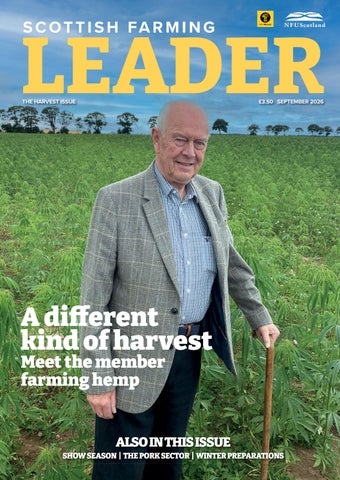
A different kind of harvest Meet the member farming hemp
ALSO IN THIS ISSUE
SHOW SEASON | THE PORK SECTOR | WINTER PREPARATIONS
Grown by Nature. Built for Living.
Low-energy homes designed for rural Scotland. Scan to explore.
The Keltie | A compact two-bedroom home.
01786 232770 info@hooseltd.co.uk
From family and succession homes to staff housing, holiday accommodation and rural diversification projects, Hoose designs and builds regenerative, low-energy homes using natural, carbon-storing materials. Our integrated team guides each project from land and design through to construction and completion, helping farmers, crofters and rural landowners create healthy, high-performance buildings designed for Scotland’s changing climate.
Explore what’s possible at hooseltd.co.uk
LEADER S C OT T I S H FA R M I N G
From the Editor From the Editor
NFU Scotland, Rural NFU Scotland, Rural Centre, West Mains Centre, West Mains Ingliston, Edinburgh Ingliston, Edinburgh EH28 8LT EH28 8LT
Megan Williams
Tel: 0131 472 4000 Tel: 0131 472 4000 www.nfus.org.uk www.nfus.org.uk nfuscotland nfuscotland @NFUStweets s summer draws to a close, there is plenty to be getting on with @NFUStweets EDITOR
A
across farms and crofts. Harvest is wrapping up, winter preparations are underway and, as ever, there is always something new to think Editor about. That comes through in this month’s issue. Editor In ‘A different kind of harvest’ on page 14, we visit Martin CessfordDiana near McGowan Diana McGowan editor@nfus.org.uk Brechin, where he has spent the last six years trialling hemp. It is an interesting editor@nfus.org.uk crop with plenty of potential, but Martin is also refreshingly honest about the work involved in figuring out how to grow, harvest, and market something that Editor Managing Managing Editor is still relatively new to Scottish agriculture. From soil health and rotations Craig to Gibson Craig Gibson fibre, food, and new markets, there is a lot to explore. We also hear from Jamie Wyllie on page 35, Chair of NFU Scotland’s Pigs Design & Production Committee, who has made the difficult decision to end his breeding herd after Design & Production Ryan Swinney years of riding out the ups and downs of the pig market. His story gives a very Ryan Swinney real picture of the pressure many pig producers are under, and asks how many Advertising Sales difficult cycles a business can realistically withstand? Advertising Sales Clare Stebbing And, with winter not too far away, Robert Neill shares his five things to think Clare Stebbing clare@connect about before the weather turns (page 49). It is a practical checklist covering clare@connect communications.co.uk forage, livestock condition, buildings, water, and the importance of having a communications.co.uk plan b. Tel: 0131 561 0024 Tel: 0131 Three very different stories, but all with something in common: farming and561 0024 crofting rarely stands still. There are always decisions to make, thingsPublished to try andon behalf Published on behalf challenges to work around. of NFU Scotland by NFU Scotland by That is one of the things I enjoy most about putting this magazine of together. Connect Publications Every issue gives us the chance to hear directly from members aboutConnect what is Publications (Scotland) Ltd. happening on their farms and crofts, and to share those experiences(Scotland) with the Ltd. Studio 2001, Mile End, wider membership. Studio 2001, Mile End, 12 Seedhill I hope you enjoy this month’s issue, and if you’ve got a story you like to tell Road, 12 Seedhill Road, Paisley PA1 1JS you can email me at editor@nfus.org.uk Paisley PA1 1JS
Keep up to date with all the news on Facebook or follow us on @NFUStweets @nfuscotland For the weekly news sent to your email, please send your name and membership number to contactus@nfus.org.uk Editor Megan Williams editor@nfus.org.uk Design & Production Mark Shreeve mark.shreeve@micropress.co.uk Andrew Hirst andrew.hirst@micropress.co.uk Advertising Sales Danny Lewis 01502 725862 danny.lewis@micropress.co.uk Lawrence Kenny 01502 725860 lawrence.kenny@micropress.co.uk
NFU Scotland Rural Centre, West Mains Ingliston, Edinburgh EH28 8LT 0131 472 4000 www.nfus.org.uk
Published on behalf of NFU Scotland by Countrywide Publications Fountain Way, Reydon Business Park, Reydon, Suffolk IP18 6SZ 01502 725800 Printed by Micropress Printers Ltd Fountain Way, Reydon Business Park, Reydon, Suffolk IP18 6SZ 01502 725800
Although every effort has been made to Althoughtheevery effortofhas made to ensure accuracy thebeen information ensure the accuracy of theNFUS information printed in this publication, cannot printedliability in this publication, cannot accept for errors orNFUS omissions. accept liability for errors omissions. The views expressed in thisorpublication The not views expressedthose in thisofpublication are necessarily the NFUS. are not necessarily those of the NFUS.
Diana Diana McG McG
H
OW often do you OW often do you see or learn about see or learn about something and something and think ‘I’m up for think ‘I’m up for that’, but then that’, but then never actually never actually realise that realise that positive thought/ positive thought/ silent commitment? Possibly too silent commitment? Possibly too often or not at all. often or not at all. In this month’s magazine, our In this month’s magazine, our two features cover inspiring stories two features cover inspiring stories and highlight just how rewarding and highlight just how rewarding delivering on such thoughts can delivering on such thoughts can be both for the individual involved be both for the individual involved and others who may benefit along and others who may benefit along the way. the way. We’re only a few weeks away from We’re only a few weeks away from the Royal Highland Show. Over the Royal Highland Show. Over the course of four days, thousands the course of four days, thousands will flock to the show to compete, will flock to the show to compete, judge, exhibit, organise, educate exhibit, organise, educate President’s Update and socialise. We’ll see the best of 4 judge, and socialise. We’ll see the best of the best and relish the atmosphere. bestPresident and relish the atmosphere. Vice Updates 7 the Among the highlights and away Among the highlights and away from the main show ring, this year the main show ring, this year News 8 from will see the welcome return of the will see the welcome return of the Golden Shears Sheep Shearing and Shears Sheep Shearing and Policy & Practice 20 Golden Woolhandling World Championships. Woolhandling World Championships. Taking place at the MacRobert place Activity at the MacRobert 38 Taking Regional Theatre, the 2023 Worlds will see Theatre, the 2023 Worlds will see more than 30 countries compete for FEATURES more than 30 countries compete for the prestigious title and it promises prestigious title and itharvest promises kind ofshowcase 14 the toAbediff an erent action packed of to be an action packed showcase of the art, skill and techniques required more cyclesrequired 35 theHow art, many skill and techniques to be a world champion. pig farming tocan be aScottish world champion. Perhaps a less well known event withstand? Perhaps a less well known event taking place at this year’s Highland is taking place at this year’s Highland is final qualifying round 49 theFive questions with of the 2023 the final qualifying round of the 2023 Britain’s Fittest Farmer competition. Robert Neill Britain’s Fittest Farmer competition. Taking part in this event for the Taking part in this event for the first time is Kyla Graham from first time is Kyla Graham from Kirkcudbrightshire. Kyla first spotted Kirkcudbrightshire. Kyla first spotted the event at the Show last year and the event at the Show last year and while watching it thought ‘I’m up for while watching it thought ‘I’m up for that’. Kyla knew however she couldn’t that’. Kyla knew however she couldn’t just enter there and then. Like any just enter there and then. Like any competition, she understood you competition, she understood you need to be ready for it and without need to be ready for it and without knowing if she would even enjoy knowing if she would even enjoy it, she set her mind to it to finding it, she set her mind to it to finding out if she would. Kyla shares her out if she would. Kyla shares her journey from that moment to the journey from that moment to the present and highlights how she’s present and highlights how she’s benefited already in so many ways benefited already in so many ways both mentally and physically, and both mentally and physically, and explains about the positive impact explains about the positive impact her preparation has had on her her preparation has had on her working life. working life. • Dec 2025 / Jan 2026 | 3 Scottish Farming Leader
14
24 33
CONTENTS
35
a a C C r r f f S S h h 4 4 t t c c c c u u t t t t
l l w w I I f f s s a a e e i i n n S S f f M M
“ “ o o t t
Listening to the voices of Scottish agriculture “It is time for the Government to listen to the voices of those who have successfully managed our uplands and hills for generations.” From the
PRESIDENT Andrew Connon
F
or most, it has been a great summer, with decent temperatures. However, there is no doubt the dry weather has impacted people in very different ways. Grand if you have had a decent crop of winter barley or oilseed rape coming in at low moistures, or if you’re one of the many folk who have made quality hay. But it has been extremely challenging for those with bare grass fields, the need to offer supplementary feeding already, the threat of abstraction bans, spring barley dying off before filling and, of course, springs and water supplies drying up, creating huge challenges. As harvest gets into full swing, it is frustrating to see fuel and fertiliser prices surge due to the resumption of conflict in the Middle East. NFU Scotland successfully made the case for support on rising input costs, helping secure a temporary reduction in red diesel duty from 10.18p to 6.48p – its lowest level in over 20 years. However, we have already written again to the UK Government, highlighting our concerns about rising input costs. 4 | September 2026
I have spoken to several farmers over the past few weeks who are concerned about the disproportionate rise in red diesel compared with diesel at the pumps. In conversations with fuel suppliers, it seems to be the case that, due to the volumes used at forecourts and longerterm contracts, prices can be slower to rise compared with tractor diesel, which seems to be based on a spot price. However, should evidence suggest excessive profits are being taken at the expense of our producers, we will not hesitate to raise those concerns with the relevant authorities, including the CMA. The prolonged dry spell has also been a factor in the recent wildfire near Nethy Bridge. I am increasingly concerned about Scotland’s capacity to tackle wildfires as they become more frequent and severe. Declining livestock numbers and reduced grazing in many upland and crofting areas, alongside changes in land use for carbon, forestry, biodiversity and rewilding, as well as restrictions on muirburn, are the key factors. Having highlighted our concerns over the past few years, and again to the First Minister during the show season, it is time for the Government to finally listen to the voices of those who have successfully managed our uplands and hills for generations. The political world is ever-changing, and we now have a new Prime Minister in Andy Burnham MP, a new Chancellor, John Healey MP, and a new Secretary of State at DEFRA, Angela Eagle MP. We
wait to see how the new Prime Minister’s policies unfold, particularly in relation to agriculture and trade. We have already written to the Prime Minister, highlighting the importance of our £5.1 billion Scottish agricultural industry, which underpins a Scottish food and drink industry worth £19 billion. I hosted a lengthy on-farm visit for DEFRA Minister Stephen Morgan MP on 6 August. It was a great opportunity to highlight multiple issues, including the need for the UK Government to convene an urgent pig industry summit to safeguard its future. We also discussed fuel and fertiliser costs, the SPS agreement, Brazilian beef imports, the UK beef market, EID, animal disease, border security and labelling, alongside the pressures facing arable farming, access to essential pesticides, drought resilience, labour availability, precision breeding, green ammonia and new cropping opportunities such as hemp. In other words, a lot! The meeting also provided an opportunity to reaffirm our position on IHT and the need for further scope to protect family farming businesses. It has been great to get round the shows. At the Border Union Show, an English farmer highlighted the stark difference in support, telling me her previous £75,000 payment is now worth just £600. Had she been farming in Scotland, that support would still be worth £75,000. NFUS will continue to fight hard to retain direct support, which underpins Scottish farming and crofting, our food supply, economy, biodiversity and nature. There has never been a greater need for a strong farming union to secure a sustainable future for Scottish agriculture.
Timber Buildings Natural products from renewable sources. Caring for the environment. EXAMPLE (TOP LEFT) as shown £8,000 + VAT 3 BAY MONOPITCH 45ft x 17ft x 10ft 6in eaves £9,600 incl VAT + many other options available, please see our website. Prices correct as of August 2026
farmplus.co.uk TEL: 01772 785252 SHAY LANE, LONGRIDGE, PRESTON PR3 3BT
R E T T E B S T T U B R YOU
1
KEEP
NT E M T A E R T E IN R ANT A U Q R U O Y F O ™ AS PART X I V L O Z USE E H T H G U O R H T S L IP S M R O W T E L A N. L P D O N’ T E N I T N A R QUA R U O Y N I K C A CR References: 1. I.A. Sutherland, J. Shaw, R.J. Shaw (2010) Veterinary Parasitology 171; 300–304. For further information call Elanco Animal Health on +44 (0) 1256 353131 or write to Elanco UK AH Limited, Form 2, Bartley Way, Bartley Wood Business Park, Hook RG27 9XA. ZOLVIX™ 25 mg/ml oral solution for sheep contains monepantel. Legal category: POM-VPS in UK. For further information, consult the product SPC. Advice should be sought from the medicine prescriber prior to use. Prescription decisions are for the person issuing the prescription alone. Zolvix, Elanco and the diagonal bar logo are trademarks of Elanco or its affiliates. This promotion is only intended for farmers in England, Scotland and Wales. Use Medicines Responsibly (www.noah.co.uk/responsible). ©2026 Elanco or its affiliates. PM-GB-26-0083. Date of Preparation: August 2026.
Vice Presidents’ Updates Robert Neill
Duncan Macalister
Vice President
Vice President
Keeping the heid this harvest
H
arvest is the best time of the year. Well, it is in my world anyway. There’s nothing better than climbing into the combine and heading into a field of ripe barley. That’s what it’s all about. Mind you, harvest on the west coast isn’t quite the same as harvest everywhere else. Folk on the east coast can sometimes cut for days and days on end. We don’t get that luxury. If we’re lucky, we get three or four days of decent weather. Miss that window and you could be waiting weeks. People ask me how long harvest takes. I always say, “If the weather’s good and all the machines work, three days.” Truth be told, I’ve never done it in three days. I’ve seen harvest finished in August, and I’ve seen combines still going in November. One year we even had snow during harvest – that’s farming. But if there’s one thing I’d ask everyone to remember this harvest, it’s this. Keep the heid. I’m saying that as much to myself as anyone else. Harvest fever gets hold of me every year. I get all fired up. You want to hash on. You want to get finished before the weather changes. That’s when shortcuts creep in. That’s when you start putting pressure on yourself and on everyone around you. I’m probably the world’s worst for it. Here I am talking about farm safety, but I know how easy it is to think, “I’ll just do this one thing quickly.” That’s when accidents happen. So if you’re out harvesting over the next few weeks, enjoy it. I hope the weather’s kind to you. But above all else, keep the heid.
One win Financial support secured for the pig sector – but the fight isn’t over
One worry Carbon Border Adjustment Mechanism (CBAM)
One to watch Beef imports from Brazil
Building resilience for the seasons ahead
A
s harvest draws to a close, with results varying across the country, our focus back home on the farm now turns to establishing next year’s crops. With a large livestock enterprise, producing enough straw is a key priority. The last two summers have been exceptionally dry, making spring barley production increasingly challenging. As a result, we are aiming to get as much winter cropping established as possible to improve both straw yields and overall resilience. We are also reviewing the grass seed varieties we use, with a greater emphasis on drought-tolerant options. Some of our grass leys containing red clover performed particularly well, with the clover being one of the few species that continued to grow throughout the very dry spells. Summer show season has come to an end with lots of engagement with members from all over the country, most people are very optimistic about the future of agriculture. All of these shows are a great opportunity to showcase the brilliant livestock we have here in Scotland and also a great opportunity to highlight to the public what we do. I was also pleased to see our First Minister out and about at lots of shows, he listened, and hopefully learned, a great deal from all sectors and regions. At the time of writing, I am looking forward to attending the biggest oneday ram sale in the country which is a great spectacle to see over 4000 rams being sold. This is just one of the events organised by the Border Union Agricultural Society – one of the others is the Border Union Show which I attended for two days along with Andrew Connon. This was the first time he had attended and hopefully he enjoyed his short stay in the Borders. One of my missions was to find a new mode of transport to cope with the drought-like conditions we have experienced over the summer – mission complete! September 2026
| 7
News
United we Stand John Davidson CEO
O
ne of the real highlights of the past few months has been getting out and about across the country and spending time with so many of you at our summer shows. Whether it was in our stand, the livestock lines, over a cup of tea or simply walking around the showground, those conversations reminded me exactly why NFU Scotland exists – to represent the people at the heart of Scottish agriculture. No two conversations were quite the same, but many shared common themes. Rising costs, better market returns,
succession, labour, regulation and the everyday pressures of running a farming business were all high on the agenda. Just as importantly, I also heard stories of innovation, resilience and pride in producing some of the world’s highestquality food. Those conversations are invaluable because they ensure that everything we do as an organisation is grounded in the real experiences of our members. The summer shows also gave us an important opportunity to engage directly with senior government ministers and decision-makers, including the First Minister. Every meeting was another chance to take your concerns straight to those shaping the future of Scottish agriculture. We have continued to press the case for practical, evidence-based policies that support profitable, sustainable farming businesses, and those discussions will continue well beyond the show season. Our policy work never stands still, and neither does our commitment to ensuring your voice is heard at every level of government. One message I came away with very clearly is that our collective voice matters more than ever. That is why I would ask every member to think about who else could benefit from joining NFU Scotland. If you have a neighbour, family member or fellow farming business that
AUTUMN CONFERENCE Thursday 29 October 2026 The Pavilion at Ingliston
Scan the QR code to register
8 | September 2026
isn’t yet a member, please encourage them to consider joining us – if you do, you receive a discount on next year’s membership subscription! Every new member strengthens our ability to influence government, shape policy and deliver the services and support that our industry relies on. Our greatest strength has always been our members, and growing that membership makes us an even stronger voice for Scottish agriculture. Alongside our representation work, we are always looking at ways to deliver practical benefits for members. One of our most recent initiatives is the introduction of our fuel card scheme, designed to help members access discounted fuel at the pumps. With fuel remaining one of the most significant costs for many businesses, there is no doubt this is proving to be a really popular member benefit. If you’d like to find out more or apply, simply call the NFU Scotland helpline and our team will be happy to talk you through the process and answer any questions you may have. As we head towards the busy autumn period, I want to thank each and every one of you for your continued support, your honesty and your willingness to share your views with me and the wider NFU Scotland team. Every conversation I’ve had over the summer has reinforced just how important it is that we continue working together.
Commercial update
News
New professional partnership: Davidson & Robertson Gemma Cooper Head of Operations and Partnerships
A
longside the expertise and support that members can receive from our Group Secretary network and NFUS staff, our members also have access to a range of partner fi rms. Our professional partnerships are carefully selected with experience and quality of service in mind, and members can be assured that the technical expertise available at the end of the phone is second to none. One of our more recent professional partnerships is our member helpline for utilities, infrastructure and renewables with Davidson and Robertson. A long-established fi rm of land agents, Davidson and Robertson have had a high profi le in rural sector for some time,
and a strong track record of successfully supporting landowners and occupiers through many signifi cant infrastructure projects. Decarbonisation of energy is a major agenda for both the Scottish and UK Governments and supporting and representing our members through initial discussions for major infrastructure projects like the Kintore to Tealing 440kv overhead line has been a major priority for the Legal and Technical Committee. We know that there are other similar projects under discussion, or still to come, and this is an issue that is going to impact more members. For projects like these, or whenever any third party seeks access to land, it is vital that members know their rights
and have adequate support and advice. This helps ensure that farming interests are protected in the long and short term, and that any fi nancial impacts are mitigated as much as possible. The Davidson and Robertson NFUS member helpline offers 15 minutes of free advice to support members who may be facing such issues. To access this, or to fi nd out moreTheinformation, Davidson and Robertson NFUS member helpline oS support members who may be facing such issues. To ac you can use the QR code below. And information, you can use the QR code below. And to kee lobbying work on infrastructure to keep abreast of NFUS policy and projects, you can speak Technical Committee representative. lobbying work on infrastructure projects, you can speak to your local Legal and Technical Committee representative. POLITICAL PULSE
Two images: Meeting with UK Government DEFRA Mi (keep caption)
Your Trusted Partner in Quality Firewood and Bespoke Timber
Minister meets President on farm
UK Government DEFRA Minister Stephen Morgan MP vis Andrew Connon’s farm in August, spending half a day d issues facing Scottish farmers and crofters.
Joined by NFU Scotland Deputy CEO and Director of Po covered high input costs, food imports and the need for of the Pigs Committee Danny Skinner also joined the di crisis facing Scotland’s pig sector.
We are a family-run sawmill, based at our own forest in Aberdeenshire
The visit provided an opportunity to highlight the particu Scottish agriculture, discuss issues aSecting farmers a importance of a strong and productive farming and crof Parliament returns after summer recess
Quality Firewood
We provide seasoned and high-quality softwood and hardwood logs, which are sustainably sourced and ready to burn. Delivery available 7 days per week. See our website for pricing.
Bespoke Timber
We offer bespoke timber milling services up to 8m in both hardwood and softwood. We also provide a contract milling service to meet your specific requirements.
Contact us to order or discuss your project: 07766 653658 www.sunnysideforestry.co.uk September 2026
| 9
News
Water scarcity and building resilience for the future Peter Wright
S
Specialist – Operations Land Unit at Scottish Environment Protection Agency (SEPA)
cottish farmers have always worked with the weather. Knowing the land, watching conditions and adapting to what each growing season brings are part of running a farm. But this summer is another reminder that the challenge is changing. SEPA have already introduced temporary restrictions on licensed water abstraction in parts of eastern Scotland following an exceptionally dry July and prolonged periods of very low river flows. Other catchments remain under pressure and, if low flows continue, further restrictions may be necessary. This is not an isolated year. Significant water scarcity affected parts of Scotland in 2018, 2023 and 2025, and climate projections suggest drought conditions could become more frequent and severe. While Scotland’s annual rainfall has generally increased, summers are becoming warmer and drier. For agriculture, that creates a particular challenge: water availability may be scarce at exactly the point when crops need it most. SEPA monitor rainfall, river flows, soil
10 | September 2026
moisture and other indicators, providing a wider picture to complement what farmers see on the ground. Many already use our weekly water scarcity reports and drought risk assessment tool (DRAT) alongside their own knowledge of their land, crops and water requirements. Early warning gives farmers and growers time to make decisions, but understanding the risk is only part of preparing for the future. That’s why SEPA commissioned research through CREW into how the sector can better prepare for prolonged dry conditions. The resulting Planning for Water Scarcity guidance helps turn that information into practical action, encouraging farmers and growers to understand their water requirements, assess where supplies may be vulnerable and identify opportunities to build resilience. There is no single solution that will work for every farm. Measures include reducing leaks, improving irrigation efficiency, monitoring soil moisture and crop water needs, and considering off-line ponds and water storage. But resilience isn’t only about how
water is abstracted, stored or applied. The soil itself matters. Healthy soils with higher levels of organic matter can retain more water, keeping moisture available to crops for longer during dry periods. Building organic matter through manures, compost, crop residues and cover crops can improve water-holding capacity. Once water scarcity becomes significant, options become much more limited. SEPA work with farmers, growers, and NFU Scotland as conditions deteriorate, helping abstractors prepare. Restrictions may ultimately be necessary to protect rivers and the plants and animals that depend on them. Water resilience increasingly needs to be part of farm business planning. Farmers and growers know their land and businesses; SEPA provide the science, evidence and wider picture to help inform decisions. The important thing is to use both and act early. Building resilience while water is available gives farms more choices than waiting until it isn’t.
News
Political update Minister meets President on farm
UK Government DEFRA Minister Stephen Morgan MP visited NFU Scotland President Andrew Connon’s farm in August, spending half a day discussing some of the key issues facing Scottish farmers and crofters. Joined by NFU Scotland Deputy CEO and Director of Policy Jonnie Hall, the meeting covered high input costs, food imports and the need for strong biosecurity. Vice Chair of the Pigs Committee, Danny Skinner, also joined the discussion to set out the ongoing crisis facing Scotland’s pig sector. The visit provided an opportunity to highlight the particular circumstances facing Scottish agriculture, discuss issues affecting farmers across the UK and underline the importance of a strong and productive farming and crofting sector.
Parliament returns after summer recess
After a busy summer of shows and political engagement across Scotland, both the Scottish and UK Parliaments return from summer recess, with NFU Scotland continuing to represent the interests of farmers and crofters nationally.
NFUS Jonnie Hall and Andrew Connon meet with UK Government DEFRA Minister Stephen Morgan MP
As this edition of the Leader goes to press, the First Minister is expected to set out the Scottish Government’s Programme for Government, outlining its priorities for the year ahead. NFU Scotland Director of Policy, Jonnie Hall, is also due to give oral evidence to the Rural Affairs Committee on the Rural Support Plan. NFU Scotland submitted written evidence to the Committee last month, setting out our members’ priorities for the future of agricultural support.
Food prices and Rural Renewal Bill
A consultation on proposals for a Food Price Cap is expected to be announced shortly. Over the summer, NFU Scotland has continued discussions with Scottish
Government Ministers and officials, seeking assurances that any proposals will not negatively impact domestic production. The Union will continue to engage with the Government to ensure those assurances are reflected in the detail of any proposals. NFU Scotland is also engaging with officials on the Scottish Government’s proposed Rural Renewal Bill and is pressing for early involvement in discussions to ensure the views of farmers and crofters are reflected as the legislation develops.
Action needed on rural crime
The return of Parliament is also expected to bring forward further discussion around machinery theft – an issue increasingly affecting farmers and crofters across Scotland. NFU Scotland welcomed Rachael Hamilton MSP to a member’s farm last month to hear directly about concerns around rural crime, alongside wider issues affecting Scottish agriculture. Rachael Hamilton MSP is proposing a Members’ Bill on machinery theft, which NFU Scotland has welcomed as an important step towards tackling the growing problem of rural crime. Recent research from NFU Mutual highlighted a 14 per cent increase in rural crime in Scotland since 2024, with the cost of crime reaching £1.4 million in 2025. The figures underline the need for an effective legislative framework to deter perpetrators, improve security, and strengthen measures to tackle rural crime. The impact extends beyond financial losses. Farmers and crofters already face increased vulnerability to poor mental health because of isolation, stigma, limited access to services, and growing concerns around crime can add further pressure.
September 2026
| 11
07789 220 469 www.landmaps.co.uk maps@landmaps.co.uk
Funded by the Scottish Government
Free and impartial energy saving support for your business Get in touch to access Scottish Government funding to help small and medium-sized enterprises save energy, carbon and money. Visit businessenergyscotland.org/farming Call 0808 808 2268
PPA04-01-0324 © March 2024
12 | September 2026
NFU Mutual / ADVERTISEMENT FEATURE HEALTH
Protecting people, protecting the farm
F
arm work depends on people. From full time employees and seasonal workers to casual labour, voluntary helpers and self-employed contractors, a wide range of people can play a part in keeping a farm running. For farm owners and managers, making sure those people are properly protected is not only good practice, but also a legal responsibility. Farming remains a high-risk industry, with machinery, livestock, working at height, chemicals and lone working all creating potential hazards. That is why employers’ liability insurance, accurate records and appropriate training all matter.
Why employers’ liability matters
Employers’ liability insurance is a legal requirement for most UK businesses with staff. It helps cover compensation costs and legal fees if an employee, including a former employee, is injured or becomes ill because of their work and the employer, or another employee, is found to have been negligent. On farms, it is important to think beyond PAYE employees. Employers’ liability may still be needed for part time, seasonal and unpaid workers, as well as voluntary helpers and self-employed people where the working arrangement effectively creates an employer and employee relationship. Even one part time employee is likely to mean cover is required. Failing to have the right employers’ liability cover can be costly. Businesses can be fined £2,500 for every day they are not properly insured.
Understanding your responsibilities
Employers have a duty to take reasonably practicable steps to protect their employees. In practical terms, this means providing a safe place of work, safe equipment, safe systems of work and the right information, instruction, training and supervision. An Tamsin Stentiford, NFU Mutual farm underwriter, explains: “Good employers’ liability protection is about more than having a policy in place. Farm businesses should be able to show the steps they have taken to protect employees, from risk assessments and training to
supervision, equipment maintenance and accurate records.”
Training is more than a tick box
Training should be relevant to the role and should give workers the knowledge and confidence to carry out tasks safely. It should be provided when someone starts work, change’s role, takes on new responsibilities, uses new equipment, substances or work processes, or when new risks are introduced. Some activities require formal training or evidence of competence, such as telehandler use, chainsaw use or pesticide spraying. Refresher training may also be needed for higher risk activities. Young, inexperienced and seasonal workers may require extra instruction, supervision and support until they have demonstrated competence. Documentation is an important way to evidence that responsibilities are being met. Records should include: • A current employers’ liability insurance certificate displayed where employees can access it, such as the workplace or website. • Training and competency records. • Risk assessments and safe systems of work. • Equipment inspection and maintenance records. • Accident and incident records. • Health surveillance or occupational health monitoring records, where applicable.
accounts gathered. Depending on the incident, a report may also need to be made to the Health and Safety Executive.
Prevention is always better than cure
When hiring staff, farm owners and managers should make sure workers understand their role and have the right skills, experience and aptitude. A thorough induction should cover site rules, emergency arrangements and key hazards, with supervision in place until competence has been demonstrated. A strong health and safety culture, supported by training, supervision and maintenance, can help protect workers and reduce disruption. It is also important that the business description on the insurance policy accurately reflects the work employees carry out. NFU Mutual Risk Management Services can support farm businesses with independent health and safety reviews, helping to identify hazards, training needs and opportunities to strengthen risk management. To find out more, speak to your local NFU Mutual Agent about your employers’ liability cover and how NFU Mutual Risk Management Services could help you review risks, training needs and health and safety arrangements on your farm. Visit nfumutual.co.uk/risk or scan the QR code for more information.
If an incident happens
If someone is injured on farm, stop work where necessary, remove any immediate danger and arrange medical treatment. An accident report should be completed, evidence preserved and witness Risk Management Services are provided by NFU Mutual Risk Management Services Limited and are not regulated by the Financial Conduct Authority or the Prudential Regulation Authority. The National Farmers Union Mutual Insurance Society Limited (No. 111982). Registered in England. Registered Office: Tiddington Road, Stratford-upon-Avon, Warwickshire CV37 7BJ. Authorised by the Prudential Regulation Authority and regulated by the Financial Conduct Authority and the Prudential Regulation Authority. A member of the Association of British Insurers.
September 2026
| 13
Martin with his hemp crop
Hemp
A different kind of
HARVEST By Megan Willliams
As Scottish farmers look for new ways to build resilient businesses, Martin Cessford is exploring a crop with the potential to transform arable rotations. Six years in the making, his hemp journey highlights both the opportunities and challenges of bringing something new to Scottish fields.
F
or most arable farmers, harvest is a familiar sight: combines moving through fields of wheat, barley or oilseed rape as the season draws to a close. But on Martin Cessford’s farm outside Brechin, this year’s harvest looks somewhat different. Standing tall across the field is hemp, a crop that has taken six years of trials, setbacks and learning to get to this point. By September, Martin hopes to harvest both seed and fibre from a crop he believes could have a much bigger role to play in UK agriculture. Martin is no stranger to trying new ideas. Alongside a mixed arable enterprise growing combinable crops, seed potatoes, carrots, beans and rhubarb, he has spent years exploring regenerative farming practices, developing a natural potato cyst nematode (PCN) control agent and investing in renewable energy across the business. “It’s taken a long time to get here,” he says. “But I believe there is a real opportunity with this crop if we can get the right varieties and the right systems in place.” Martin first began exploring hemp after conversations with Wendy and Madie from the Rowett Institution in Aberdeen at the Royal Highland Show sparked his interest. His first attempt, using an early variety, did not deliver the results he had hoped for. “It was a complete waste of time,” he says. “I thought that was the end of it.”
But after finding new varieties, including hybrid types from America, he saw the potential to revisit the crop. The difference has been significant. “Three years ago, compared with what we have now, it was chalk and cheese,” he says. “We’ve got so much more fibre and much better potential.” For Martin, hemp’s appeal is not just about what can be harvested from the crop, but what it can deliver within the wider rotation. The crop has shown benefits for soil health, including improved organic matter, stronger soil structure and increased biological activity. Early results also suggest the crop following hemp performs better. “We’ve seen improvements in the soil microbiome, carbon capture and the crop that follows it,” he says. “It’s got a lot going for it.” One of the most interesting aspects of hemp is that its opportunities extend far beyond a single end market. Hemp seed can be cold-pressed into oil for human and animal consumption, while the remaining pressed cake can be processed into high-protein flour or livestock feed. The fibrous stems have applications ranging from textiles and hempcrete to insulation, horticultural growing media and even components for the automotive industry. A key puzzle piece in this story lies in the Scottish Borders, where IndiNature operates a processing facility in Jedburgh with much larger capabilities for Scottish hemp than is currently
We’ve seen improvements in the soil microbiome, carbon capture and the crop that follows it
September 2026
| 15
Hemp
Harvested hemp fibers
being utilised. The challenge they face is that there, currently, there is not enough Scottishgrown hemp to meet demand. “At the moment they are importing hemp fibre because they need the product,” Martin says. “We have a factory there waiting for Scottish production.” For Martin, this is what makes hemp so promising. Having farmed for his whole life, he knows well that growing the crop is only one part of the journey. Developing the infrastructure, markets, supply chain and demand around it is equally important. A handful of Scottish farmers, including Martin, are now exploring new varieties, with complex legislative support from Dave Doogan MP and his team in the UK Hemp blocks for building
Visit from NFUS Climate Forum Working Group
Parliament. They are also developing new harvesting techniques to capitalise on that potential. Alongside this, they are taking part in trials using hemp fibre as an alternative to peat and coir in horticulture, while samples have also been sent to Germany for use in vehicle dashboard manufacture. It really does seem the more you look into hemp, the more potential uses you find. As we stand and look over his hemp fields one July afternoon, during an NFU Scotland Climate Forum Working Group meeting, Martin is equally honest about the challenges the crop presents. Hemp has a long growing season, requires specialist knowledge and comes with strict licensing requirements. In the early Hemp insulation
days, harvesting a plant with such a strong fibre certainly left its mark on Martin’s combine. But the newer varieties he is trialling are helping to overcome some of those challenges. “We need to keep improving the varieties,” he says. “If we can get this right, it could change the logistics of the crop.” There are also opportunities beyond fibre. Martin talks about it’s potential uses in food and animal nutrition, with research looking at how hemp seed could contribute to enhanced nutritional products. For him, the biggest question is not whether hemp can grow in Scotland. It is whether the industry can build the support needed to make it a viable part of future rotations. “We’ve got the crop, we’ve got the factory and we’ve got the demand,” he says. “The opportunity is there. We just need to make sure we don’t miss it.” With harvest underway, Martin’s field represents something different from the usual autumn picture. It is a reminder that farming has always evolved because farmers have been willing to try something new. The ambition behind it remains the same: finding new ways to build resilient, profitable, and sustainable farming businesses for the future. From renewable energy and soil health to new crops and technologies, NFU Scotland’s Climate Forum brings members together to explore the opportunities and challenges ahead. To find out more or get involved, contact Lorna at lorna.scott@nfus.org.uk.
5 year warranty 7year warranty
Providing farmers and farming contractors long-lasting tyres that are specially designed for a variety of farming applications and a variety of conditions.
on Bias tyres
on Farm Radial tyres
Keeping it simple
Premium Trailer Tyres IMB 160
IMB 161
FTR 170
FTB 190
SPB 260
FCR 185
For Ascenso Tyres in the UK, contact your local tyre dealer or visit www.ascensotyres.co.uk Trade enquiries: enquiries@ascensotyres.co.uk | 01205 743163
Agricultural
|
Industrial & Construction
|
Earth Mover
|
#NeverStopRising
Forestry September 2026
| 17
PROFESSIONAL PLANT HIRE & CONTRACTORS
Bruce Farm Machinery Bruce Farm Machinery is a family-owned agricultural machinery supplier based in Banff. They are main dealers for CLAAS tractors, Strautmann, Gregoire Besson, and other brands, offering:
Over 20 years experience in the plant hire and ground works trade providing professional, trustworthy and reliable contracting services to domestic and commercial customers across Scotland • Roads & Road Grading • Drainage • Renewables & Utilities • Landscaping • Forestry & Estates • Other services
New and used machinery sales Parts supply Servicing and repairs Forestry and land-clearing equipment
01261 821659 brucefarmmachinery.co.uk Banff, Aberdeenshire AB45 3LX
01738 827 377 | 07721 784 549 contact@cdmercercontractors.co.uk www.cdmercercontractors.co.uk 25 Taypark Road, Luncarty, Perth PH1 3FE
01786 833424 WWW.STIRLINGTRAILERCENTRE.CO.UK
Sales
•Ifor Williams Trailers •Approved Used Trailers •Overlander 3.5T Horsebozes •Trailer & Horsebox Hire •IWT Parts & Accessories •Milwaukee Tools & Accessories
Services
•Trailer & Vehicle Maintenance •Class 4 & 7 Vewhicle MOT Centre •INEOS Grenadier Service & Parts •Tyre Supply & Fit •Towbar Supply & Fit •4x4 Accessories Supply & Fit
18 | September 2026
NFU Scotland Fuel Card
Apply today and start saving on fuel at the pump. Scan the QR code to find out more
tinyurl.com/NFUScotlandFuelCard
Policy & PRACTICE
Future support in Scotland: evolution, not revolution Jonnie Hall
T
Deputy CEO/Director of Policy
he publication of Scotland’s first Rural Support Plan (RSP) in March marked an important milestone in the long journey towards a domestic agricultural policy designed for Scottish farming and crofting. It is also a useful moment to reflect on how far we have come, while recognising there is still work to do. When the UK left the EU, all four nations initially rolled over the existing Common Agricultural Policy schemes. Since then, each has taken a markedly different approach to the future of agricultural support. Much of the debate understandably focuses on the value of direct payments. But agricultural policy is about much
20 | September 2026
more than income support. It is about creating the conditions for profitable food production, environmental stewardship, investment and innovation, as well as supporting rural employment and resilient rural communities. Direct support remains critical to Scottish agriculture, and NFU Scotland has consistently made the case for maintaining it. But the bigger question is whether the overall support system gives farmers and crofters the confidence to invest, adapt and plan for the future. I believe Scotland is now in a stronger position than any other part of the UK to answer that question positively. A different path for Scotland The four UK administrations have taken very different routes since Brexit. England rapidly moved away from the Basic Payment Scheme towards environmental
land management schemes, centred on the principle of ‘public money for public goods’. Wales has taken a more complex route with its Sustainable Farming Scheme, with proposals evolving following extensive consultation and pressure from farming organisations. Northern Ireland has taken a steadier approach, maintaining business confidence while gradually introducing new conditions to direct support. Scotland has chosen a different path: evolution rather than revolution. Rather than dismantling one system before another was ready, Scotland has retained stability while introducing meaningful change. That measured approach has not happened by accident. It reflects years of engagement by NFU Scotland, from the development of the Vision for Agriculture and Agriculture Reform Programme through to the
Policy & Practice that cannot be ignored. The challenge is ensuring that reform strengthens the resilience of farm and croft businesses rather than undermining it. This is where the emerging fourtier framework has potential. It retains a stable foundation through Tier 1 while progressively supporting climate action, biodiversity, business efficiency, innovation and knowledge exchange through the higher tiers. Crucially, Scotland has largely avoided creating an artificial divide between food production and environmental delivery. Sustainable food production itself provides public value, and that principle must remain at the heart of future policy.
Agriculture and Rural Communities (Scotland) Act and, most recently, the first Rural Support Plan. Together, these establish Scotland’s new four-tier support framework and provide a clearer line of sight towards how agricultural support will evolve to 2030 and beyond. What it means for members For members, that clarity matters. The RSP confirms a period of stability through to 2030, retains familiar support mechanisms while the new framework is phased in, and provides a funding trajectory that businesses can plan around. The Scottish Budget continues to commit more than £660 million annually to support farmers, crofters, land managers and rural communities. Around £540 million remains dedicated to direct support, alongside investment in environmental schemes, agricultural reform, modernisation and business development. Importantly, the Scottish Government has also committed to maintaining at least 70% of agricultural funding through Tiers 1 and 2 during the transition. That provides an important foundation of stability while enhanced and elective measures
There will always be pressure on public budgets, and implementation will inevitably bring challenges and unforeseen issues are introduced. These commitments reflect a central principle that NFU Scotland has consistently argued for: there can be no successful agricultural transition if viable farming and crofting businesses disappear along the way. That does not mean resisting reform. Scottish agriculture must continue to evolve. Climate change, geopolitical instability, volatile input costs, food security, labour shortages, and animal and plant health risks are creating pressures
Evolution, with delivery still to come Ultimately, policy success will not be measured by the publication of plans, legislation or route maps. It will be measured by what happens on farms and crofts. Can businesses remain profitable? Can farmers invest and innovate? Can we continue producing high-quality food while delivering for the environment? Can young people see a future in Scottish agriculture? The framework now gives us a stronger foundation on which to answer those questions. But publication is not the end of the reform process. It is the beginning of the next phase: ensuring delivery matches ambition, that support is accessible and workable, and that future Scottish Governments maintain the funding commitments that have been established. NFU Scotland will continue to work constructively with government where progress is being made, while challenging decisions that risk undermining productive, profitable and sustainable agriculture. That is the role our members expect us to play. There will always be pressure on public budgets, and implementation will inevitably bring challenges and unforeseen issues. No policy framework will ever be perfect. But Scotland has so far avoided the false choice between supporting food production and supporting the environment. The future depends on delivering both. I am proud of the role NFU Scotland has played in helping shape that future. We have helped secure commitments on direct support that provides greater confidence for farms and crofts, while ensuring farming and crofting are recognised not simply as recipients of public funding, but as a strategic sector underpinning food security, economic growth, rural economies, climate resilience and the stewardship of Scotland’s land.
September 2026
| 21
Steel & Fibreglass Silos Multi-purpose Flex Augers Pig & Poultry Feeding & Drinking Systems Bio Mass / Gas & Electric Heating Systems
01772 690575
www.bildabin.co.uk 22 | September 2026
Policy & Practice
Concerns the egg market bubble is about to burst Penny Middleton Policy Manager
W
hilst consumer demand for eggs remains strong, particularly amid the boom in protein-rich foods, there are concerns that the positive outlook for Scottish producers could be set to change. Eggs are a great source of good-quality protein and extremely versatile, loved by fitness and health enthusiasts and bakers alike. While the egg market has been looking positive for Scottish producers, there are concerns the bubble could be set to burst. Not because demand is expected to drop, but because of increases in hen numbers in the UK and continued growth in imported egg volumes. Avian influenza saw a drop in bird numbers over winter, but as affected premises restocked, bird numbers and egg supplies have increased, softening the market. The situation has been exacerbated by significant numbers of new sheds going up, bringing new birds onto the market and raising concerns around where those eggs will go. In addition, we continue to see growth in cheap imported eggs coming into the country, mostly into the food service sector. In many cases, these eggs are
not produced to the same welfare or food safety standards demanded of UK producers. These cheap imports not only undercut UK producers, who are producing to higher and more expensive standards, but also undermine the reputation of British eggs and the standards underpinning their production.
He reiterated the Committee’s concerns around the importation of eggs produced in systems that would not be permitted domestically and called on governments to ensure a level playing field for Scottish producers. The Committee’s focus remains on ensuring Scottish producers receive a fair return from the marketplace and that
The Committee’s focus remains on ensuring Scottish producers receive a fair return from the marketplace NFU Scotland is urging the UK Government to ensure imported eggs meet the same production standards required of domestic producers, as growing market pressures begin to impact parts of the UK egg sector. In a recent press release, NFU Scotland Poultry Committee Chair Matthew Steel highlighted the positive outlook for Scottish egg production but urged anyone considering investment in egg production to undertake thorough due diligence and carefully assess market conditions, supply chain arrangements and longterm business viability before committing significant capital expenditure.
consumers have access to high-quality eggs produced to the standards they expect. What does this mean for members? For Scottish egg producers, increased UK production and rising imports could put further pressure on prices and producer returns. Anyone considering expansion or new investment should carefully assess market conditions, contracts and long-term demand before committing significant capital. NFU Scotland will continue to press for fair competition and for imported eggs to meet the standards expected of domestic producers.
September 2026
| 23
Backing innovation on farm Lorna Scott
Senior Policy Manager
T
he Climate Forum recently met at Arbikie for a tour of the distillery and to hear about their renewable energy schemes. Alongside its 1MW wind turbine, Arbikie, in partnership with Locogen, is developing a hydrogen energy project, due for completion this year. These investments have been made to reduce energy costs while increasing the resilience and security of the business’s 24 | September 2026
energy supply – priorities shared by many farming and crofting businesses, especially given the cost increases we’ve seen this year for inputs.
energy projects on their own farms. NFUS is engaging with the Scottish Government on proposed planning reform and the forthcoming Rural Renewal Bill, advocating for a framework that enables farm and croft businesses to strengthen resilience, diversify and invest for the future. The Forum then heard from Martin Cessford about his experience growing hemp at his farm (you can read more about this on page 14). After six years of trialling different varieties, Martin is optimistic about the American variety he is currently growing to improve yields, processing and profi tability. Hemp can provide both seed and fibre, while offering benefi ts including improved soil health, carbon capture and increased organic matter. However, limited processing infrastructure, developing markets, regulatory requirements and its long growing season remain challenges. The visit demonstrated the innovative approach of farmers and crofters, and
Members of the Forum highlighted the planning challenges they have faced when seeking to develop renewable energy projects on their own farms Members of the Forum highlighted the planning challenges they have faced when seeking to develop renewable
the importance of policy that supports and enables innovation and investment, rather than creating barriers to it.
BANDSAWS • EDGERS • SHARPENERS • LOG PROCESSORS • MOBILE EQUIPMENT • BOOK YOUR DEMO TODAY
Precision sawmill equipment
CUT WITH CONFIDENCE
Unlock the hidden potential of your estate Woodland can be more than a managed asset. It can be a source of new income and greater value for your business.
Why choose Trak Met
Whether producing timber for your own projects or supplying local markets, Trak Met helps you capture more value from your estate and business.
• User-friendly machine operation requiring simple, low-hassle maintenance
As sawmill operators ourselves, we trust Trak Met to deliver the reliability, performance and value that rural businesses depend on. Let us show you how you can grow with Trak Met.
• Robust, reliable equipment with dependable build quality
• Outstanding value machinery, trusted by estate owners and timber professionals From entry-level machines for efficiency estate management, to professional equipment for commercial diversification, Trak Met has you covered.
Trak Met UK Lilliesleaf Sawmill TD6 9JP +44 (0) 7415 904 737 sales@trak-met.co.uk
STATIC SAWMILLS
Manual handing
Hydraulic control
from
from
£5,600
*
£25,970
*
MOBILE SAWMILLS
LOG PROCESSORS
Models
Models
from
£14,500
*
from
£22,250 *
• Cost quoted exclude VAT and delivery - please contact us for a full quotation and to specify a machine to suit your needs.
www.trak-met.co.uk
Member Referral Scheme Get 10% off your NFU Scotland membership fees in 2027 with every new member you refer. Refer 10? Pay nothing!
Scan to find out more
Policy & Practice
Taking positive steps to address the threat of activism Bob Carruth
T
Policy Manager
he dairy industry across the UK is taking positive steps to address the growing challenge of animal rights activism targeting dairy farms with the sole intention of undermining the reputation of the sector. At farm level, the threats can be numerous, from covert filming taking place on farm over months or years, to activists gaining illegal access to a dairy premises. The latest exposé alleging mistreatment of animals on an Essex dairy farm involved video footage recorded in 2024 and 2026 and was released to the public through social media in early August. The footage was provided to farm assurance body Red Tractor in July and, after reviewing the footage, the farm’s Red Tractor certificate was suspended. According to Red Tractor, following a swift investigation the farmer agreed to conditions of certification that will ensure the welfare of animals and closer scrutiny of compliance. The suspension was lifted
after 48 hours. Fortunately, incidents involving animal rights activists in Scotland remain extremely rare, but it is worth every dairy farm considering what it can do to improve security, reduce the risk of being targeted and, were an incident to occur, what you would do in response. It is important to remember that the advice from Police Scotland is that if activists arrive on your farm, stay calm, where possible avoid direct confrontation,
Maintaining this trust is essential and call the police on 999 immediately. If activists have been on farm, and there is no immediate threat, then call 101 to report, gathering as much useful information as you can – persons involved, car registration numbers etc. Activism usually focuses on allegations around poor animal welfare. It is in the interests of the whole industry that animal welfare and animal handling continue to be of the highest order.
The standards set in Red Tractor’s dairy assurance scheme are already heavily focused on animal welfare and the new scheme standards, expected in 2027, will strengthen that. Red Tractor is also looking at how future standards might bolster the industry’s reputation around animal handling, ensuring all those involved in working with calves, youngstock and cows have the training and skills necessary. Already underway, “Mind the Moo” is a dairy cattle handling and welfare initiative created by independent UK dairy vet consultants. The programme focuses on low-stress stockmanship, improving cow flow, and educating farm staff on animal behaviour to enhance on-farm safety, efficiency, and overall livestock welfare. Standards for rearing dairy cattle in the Scotland are some of the highest in the world. This is reflected in high levels of public trust in farmers and maintaining this trust is essential. Going forward, the threat to our reputation of covert filming or whistleblowing is likely to remain. The strongest defence is ensuring our dairy farmers continue to deliver consistent, high-quality animal care.
From Brussels to the grain store: why glyphosate matters David Michie
T
Senior Policy Manager
he relationship between the UK and the EU is changing, and this is starting to have a real-world effect on farming. The grain trade have put out messages about glyphosate use this harvest. You may have been advised to not apply a pre-harvest glyphosate spray because of EU requirements. That can seem odd given that the UK is no longer a member of the EU. The UK Government is seeking closer trading arrangements with the EU through a Sanitary and Phytosanitary (SPS) agreement – alignment of plant and animal health and welfare regulations. Improved market access could bring
significant benefits for Scottish agriculture, including opportunities for sectors such as seed potatoes and dairy, by reducing trade barriers and bureaucracy. However, closer alignment may also involve tradeoffs, including the possibility of greater alignment on pesticide regulations. NFU Scotland has been actively engaging with UK negotiators to ensure Scottish farming interests are protected. While we do not support automatic alignment on pesticide policy, we recognise the political realities of the negotiations. Our priority is to secure a practical transition period that would allow products already authorised in the UK to remain available until they come up for EU review, while ensuring UK expertise continues to influence future decisions. If alignment does occur, the use of glyphosate as a pre-harvest desiccant could be affected. However, it can still
be used for weed control purposes throughout the season. As always, growers should follow product approvals and market requirements when making spraying decisions. Keir Starmer’s departure has delayed negotiations, making the timing of future regulatory changes uncertain. While there is speculation around an agreement being announced by winter, putting this agreement into practice will take a lot longer. Negotiations are still ongoing, legislation would still need to pass through Parliament, and implementation is unlikely to happen quickly. For now, the grain trade is understandably taking a cautious approach. NFU Scotland will continue pressing for workable outcomes and will keep members informed as soon as clearer details emerge.
September 2026
| 27
ur ay yo od et e t ot qu
G
Towbar Fitting in Glasgow, Lanarkshire & Edinburgh
SPECIAL SALES OF STORE CATTLE Mon 7th, 14th, 21st, 28th September Mon 5th, 12th, 26th October Shipping every week to Aberdeen
Travel to Orkney can be arranged
All classes of cattle sold every Mon
01856872520 872520 www.orkneymart.com 01856 www.orkneymart.com
We offer expert towbar and tracking system installations — at your home, workplace, or our Bellshill fitting centre. Fast, affordable, and backed by over 18 years of experience.
Need help choosing the right solution? We’re here to guide you. 01698 747474 www.citytowbarsandelectrics.co.uk
FOLLOW THE
LEADER?
FOR ADVERTISING OPPORTUNITIES WITHIN SCOTTISH FARMING LEADER, CONTACT A MEMBER OF OUR TEAM
Lawrence Kenny - 01502 725 860 lawrence.kenny@micropress.co.uk
Emily Morris - 01502 725 830 emily.morris@micropress.co.uk
COMMERCIAL METAL BUNDED FUEL TANKS REDUCED PRICES
1250 LITRE - £2,250 2500 LITRE - £2,795 5000 LITRE - £3,765 7500 LITRE - £5,000 10000 LITRE - £6,150
HOT WATER PRESSURE WASHERS SINGLE PHASE, 3.5HP, 1800PSI, 11LPM.. £2,800 SINGLE PHASE, 5HP, 2200PSI, 14LPM..... £3,025 THREE PHASE, 7.5HP, 2700PSI, 25LPM... £2,950 THREE PHASE, 10HP, 3000PSI, 18LPM.... £3,300 PETROL, 16HP, 3625PSI, 25 LPM ..............£6,075
COMMERCIAL METAL BUNDED FUEL TANKS STANDARD SPECIFICATIONS
HOT WATER PRESSURE WASHERS STANDARD SPECIFICATIONS
• 3mm British steel • 230 volt / 60 litre per min pump • 6m delivery hose • Water & particulate filter • Mechanical flow metre • Auto shut off nozzle • Contents gauge • Deadlock with 2 keys • Lifting Eyes • Steel box section across the base for forklift access and to raise the tank from the floor • Painted green as standard (Anti -corrosion paint) • BS799, OFS T200 & SSAFO compliant
• Heavy duty galvanised steel cabinet • Hawk pump • Mains water feed or will suck from bowser / IBC • Ravel electric motor / Briggs & Stratton petrol engine • 10 or 20 metres high pressure hose • Complete lance • 8 metres of electric cable • Diesel fired boiler complete with 20 litre fuel tank • 20 litre detergent tank • Max temp 80C or can be run as a cold pressure washer. • Pressure can be regulated from max to 500 PSI
www.briannixonltd.com E: sales@briannixonltd.com | T. 01789 721112
Brian Nixon Ltd, Blakes Hill, Ullington, Nr Evesham,Worcestershire WR11 8QH All prices quoted are + VAT, ex works
28 | September 2026
Policy & Practice
The risk of wildfires Georgia Watson Policy Manager
T
he Scottish Government’s 2026 Strategic Action Plan stresses that wildfire is now a year-round risk, the pattern is no longer “spring fires only”. Scotland’s climate is trending toward warmer, drier summers and more variable winters, which has stretched the season so that every month carries some level of risk, including times of harvest. The result is a continuous baseline risk, with spring and late summer peaks. NFUS’ Environment and Land Use Committee called an emergency ad hoc meeting in August to address heightened concerns from members after the ongoing Cairngorms’ wildfire. The recent fires have devastated moorland habitats, impacted rural communities, disrupted rural businesses such as hospitality and tourist attractions, and required significant emergency service resources. Well-managed livestock grazing reduces the accumulation of combustible vegetation, helping to manage fuel loads and create more
recognition of active grazing and wildfire management payments through specific new options within future agricultural support for the likes of strategic grazing,
Grazing should be recognised as a key component of integrated wildfire prevention resilient landscapes. Grazing should be recognised as a key component of integrated wildfire prevention. Responsible muirburn, undertaken by trained practitioners in suitable conditions, remains an important land management tool. The implementation of Scotland’s new muirburn licensing scheme must not create unnecessary barriers to fuelload management or undermine effective wildfire prevention. NFUS seek a comprehensive Wildfire Resilience Strategy including
firebreak maintenance, vegetation management, access routes and water points. Policymakers must recognise that viable upland farming businesses deliver significant public benefi ts beyond food production and ensure future policy enables, rather than restricts, practical land management. Upland livestock farmers, alongside gamekeepers and other land managers, play a critical role in managing vegetation, maintaining resilient landscapes and supporting biodiversity.
Have your say on species management Environment and Land Use Committee Species Management Survey Share your experience of species management by scanning the QR code below with your phone. Your responses will help us understand how species and invasive non-native species (INNS) are affecting farming, including impacts on business viability, animal welfare, wider conservation outcomes and the mental health of farmers and crofters.
September 2026
| 29
Policy & Practice
Fairer contracts, stronger protection for producers Lisa Hislop Policy Manager
I
n early August, NFU Scotland’s Pigs Committee recently met with the Agricultural Supply Chain Adjudicator (ASCA) to discuss the implementation of Fair Dealing Obligations in the pig sector and what they will mean for producers in practice. While the discussion took place against a backdrop of significant market pressure, including falling prices, contract uncertainty and ongoing supply chain challenges, the central focus was ensuring the new regulations deliver fairer and more transparent trading relationships for producers. The development of the Fair Dealing Obligations has to be a priority for us. Farmers often carry the greatest production risk within the supply chain, making it essential to ensure the principle of transparency and contractual certainty to build a fairer supply chain. The introduction of Fair Dealing Obligations is an important step towards achieving that objective on the basis that the regulations requires a written contract, with clearer pricing mechanisms, dispute resolution processes and opportunities for producers to raise concerns. However, we must also be clear that this set of regulations will not fix prices, this has been evident as Milk regulations roll out into its second year of full implementation. Discussions with ASCA and members underlines that there is significant work to be done. We continue to consider where further evidence may be needed, there are loopholes which only become evident when the regulations are applied and tested. There is much to learn and reflect from in the Milk sector, but also how the industry voluntary codes of practice might be developed to support the regulations. Importantly, in all of our engagement with ASCA we continue to support member engagement with the Adjudicator so that real-world experiences can help shape future improvements to the regulations. We continue working with members, industry partners and regulators like ASCA to ensure the Fair Dealing Obligations deliver meaningful benefits. This includes calling on the UK Government to resume development of similar regulations for the egg, fresh produce and combinable crops. As ever, policy progress can feel glacial but it’s essential that this suite of regulations is prioritised by the UK Government to underpin national food security, rural communities and mitigate unintended consequences for the wider food system if we do not try to rebalance power across the supply chain. 30 | September 2026
Stay secure this winter Rhianna Montgomery
A
Policy Manager
re you confident that your farm or croft is secure? Take the opportunity now as the clocks are changing and bringing in the darker winter months, to review and ensure your farm or croft security is in place and working. If you have added new items, equipment, machinery or made adjustments to any part of your property over recent months, ensure that you’ve taken steps to make these secure too. A few simple steps to improve security • Lock vehicles when not in use and keep the keys in a secure place • Keep sheds, gates, property etc secure and lock all the doors and windows at night • Remove any portable items of value from within vehicles and machinery • Ensure your yard and buildings are well lit • Use security devices e.g. CCTV cameras, alarms, immobilisers, and motion sensors. • Check the equipment you purchase is fit for purpose e.g. if you buy a camera will it read a number plate, will it clearly see a face from where you are looking to locate it? • Store machinery and equipment in locked premises. • Keep a record of all machinery, tools, vehicles and equipment with photographs and serial numbers where possible. If they are stolen and later recovered it will be much easier for the property to be identified as yours and returned to you. • Vehicle fuel tanks should be fitted with locking fuel caps. These can be alarmed if appropriate. • Report any suspicious vehicles in and around your property to the local police noting vehicle registration numbers or partial numbers if possible Vehicular access Following an incident where over 1000 cars were found using a newly sown field as a car park, NFUS has collaborated with Police Scotland to give some advice and tips on how to ensure this does not happen to you. • Plan ahead – if you are close to a city/town or any large car park take note of any dates which may cause issues. For example, those surrounding Edinburgh, any rugby days or large events. • Secure access where possible – if you can, close gates to prevent field access. Where this is not possible, consider placing bales, large stones or dirt mounds in gateways to prevent vehicular access. • Signage – you may wish to put up signs on fences/gates stating that the land is not to be used for vehicular access. • 999 – if you find that your land has been used for vehicular access, call Police Scotland as soon as possible.
DOUGLAS F MITCHELL LTD Family Run est. 1974
General Haulage Step Frame Trailers Flat Trailers Bulk Tipper Haulage Curtain Sided Trailers Local/Long Distance Haulage
01561 377741 | 07775 864462
OFFICE@DFMITCHELL.CO.UK | DFMITCHELL.CO.UK DOUGLAS F MITCHELL LTD, LAURENCEKIRK,AB30 1BE
Is your housing primed and ready for winter?
Rollerscreen Rollerscreen
We have a range of products to ensure your building is winter-ready and your livestock are protected. Don’t delay, get planning today! Speak to Mike Bryan your local Sales Manager – for farm visits, pricing and more.
07768 618 103 07768 618 103 or email marketsupport@galebreaker.com or email marketsupport@galebreaker.com
Agridoor Pro Agridoor Pro
Bayscreen Bayscreen September 2026
| 31
32 | September 2026
Policy & Practice
Shearing’s close shave: the need for a long-term solution Lucy McGillivray Policy Manager
B
y the time you’ll be reading this, the shearing season will be over for another year. Shearing is an ideal time to take stock after a busy spring, with both the ewes and lambs hopefully flourishing. However, the 2026 shearing season in the UK began with uncertainty with the UK Governments announcement to rescind the long-standing special concession to allow overseas shearers into the UK. Following continued pressure from numerous stakeholders including ourselves, the National Association of Agricultural Contractors (NAAC), NSA, British Wool and the UK Farming Unions alongside MPs, the Home Office reversed their decision, while confirming that the concession is expected to end permanently from 2027. When the Home Office announced the concession would end, we warned that around 1.5 million sheep could remain unshorn, significantly increasing the risk of heat stress, flystrike and other welfare issues. We have continually made the case that the UK relies on a small number of highly skilled overseas shearers who can complete large volumes of work during the short shearing season, while highlighting the UK does not have enough
experienced domestic shearers. Following the reversal of the initial UK Government decision to remove the concession, a new visa system was introduced to the UK for overseas shearers. This has significantly tightened up entry, with biometrics required ahead of travel and a cost of £682.00 for the visa (plus potential appointment costs in the home country). From speaking to stakeholders and shearing contractors, the scheme put in place in 2026 appears to have worked and run smoothly from an administrative point of view. However, the very late implementation of the new scheme (and new, unexpected and unbudgeted cost), and external factors including the war making travel difficult and expensive, and confusion over travel requirements and whether shearers could legally enter the UK, has had significant impact. With the likelihood of the Home Office allowing the original special concession again in 2027 being extremely low, an alternative and more achievable solution would be to advocate for the 2026 visa system to continue long-term to secure the overseas labour. If shearers are aware of the costs and requirements well ahead of the season, it would be more widely taken up to help fill the gap in the UK shearing industry. This issue has been a key priority us, and we have been lobbying hard for a solution. As soon as the UK Government announcement was made, we wrote to the then Parliamentary Under Secretary of
State for Scotland, Kirsty Neill MP, urging the UK Government to retain access to overseas shearers for 2026 and develop a longer-term solution. We have also met with Scottish Government officials several times to outline the impact on the industry, they recognise this and support our ask to allow overseas shearers access to the UK. We have worked closely with others in the industry to ensure our position is aligned to have a stronger voice, as well as Beef & Lamb New Zealand to gain an overseas perspective on the reciprocal nature of shearing labour. As always, the Livestock Committee have been working hard on the issue, and providing first-hand experience of how this has impacted the 2026 shearing season. I’ve also spoken to several Scottish shearing contractors to gather evidence on workforce needs and the impact of ending the concession, and discussing a workable way forward. Thanks to everyone I’ve spoken to so far, evidence is key – so if you’re a shearing contractor employing overseas shearers – please get in touch with me. On behalf of our members, we will continue to work with industry stakeholders to advocate for a workable solution that will be in place long term to provide clarity and stability. We will also continue political engagement, particularly with the Home Office, and raise the impact of the issue, while gathering evidence from contractors and members to demonstrate the ongoing need for overseas shearers. September 2026
| 33
Offering reliable & efficient electrical solutions from Campbeltown to mid-Argyll • Maintenance • Installation • Testing Domestic, agricultural & industrial needs
We manufacture and supply agricultural round posts 07515 747 994 timberconcepts1@ btinternet.com
Find us on facebook & speak to a member of our team today
01586 552963
office@archiehoustonelectrical.com 23 Lady Mary Row, Campbeltown, PA28 6HR
DM FORKLIFTS LTD STONEHAVEN
The leading UK The leading UK manufacturer of manufacturer of rubber grading rubber grading scrscreens eens for all typfor es of all gtypes rading equof ipmegrading nt . equipment.
LYNDON BARRAS STONEHAVEN AB39 2XP
CAT, Schäffer & Leguan dealers for NE Scotland Large range of New and Used Agriculture & Construction Equipment for Sale & Hire: Telehandlers 4 Metre – 26 Metre Excavators 900Kg – 14 Tonne Access Platforms 12 Metre – 28 Metre Dumpers 1 Tonne – 9 Tonne Spider Lifts 13 Metre - 27 Metre
•Rubber grading screens • Rubber grading screens •Rubber web covers •Sample ri•ddRubber les web covers •Perforated washer belts
• Sample riddles • Perforated washer belts Contact AGRI-WEB Ltd Tel: +44 (0) 2891275913 Web: www.agri-web.co.uk Email: info@agri-web.co.uk
Contact AGRI-WEB Ltd Tel: 02891275913 www.agri-web.co.uk Email: info@agri-web.co.uk 34 | September 2026
Tel: 01569-760210 Email: derek@dmforklifts.co.uk
Please Visit our Website: www.dmforklifts.co.uk
Pig Farming
How many more cycles can Scottish pig farming withstand? Scottish pig farming is at a critical point. Megan Williams sat down with pig producer and Chair of NFU Scotland’s Pigs Committee, Jamie Wyllie, to explore what happens when another downturn becomes one too many. His decision to end his breeding herd highlights the pressures facing producers and the urgent need to build a more resilient future for Scottish pig farming.
“I
don’t see how we can go through this again.” It is a conversation Jamie Wyllie never imagined having. After many years building on the established family pig business, investing through the highs and lows of the market and representing producers as Chair of NFU Scotland’s Pigs Committee, he sat down with his father earlier this year to discuss the future. The answer came quickly. “We’re going to have to stop.” For Jamie, that meant ending the breeding herd he had spent years working on. Not because he had lost his love of pigs, but because he could not face taking the business, or himself, back to where they had been during the last major downturn – when Brexit and Covid-19 combined to create unprecedented disruption across the sector. His decision reflects the immense pressure facing pig producers across Scotland. Since December 2025, confidence across the sector has fallen sharply as cheaper European pork, falling pig prices and processing constraints have put increasing pressure
on the domestic market. The result has been growing financial pressure on independent producers, many of whom are now questioning how much more they can absorb. Although the Scottish Government’s £2 million emergency support package, which followed sustained lobbying by NFU Scotland, has provided vital shortterm assistance, it cannot undo years of financial pressure or address the longerterm challenges facing the sector. Around 15 per cent of Scotland’s sow herd has already been lost this year. But behind that figure are businesses, families and people making incredibly difficult decisions about whether they can continue. A downturn to close to the last For Jamie, the current downturn came far too close to the previous downturn and cannot be separated from the challenges that came before it. Covid marked the beginning of a period of disruption that exposed deeper vulnerabilities within the sector. The temporary closure of the Brechin Processing Plant following a Covid
outbreak, coupled with the loss of its China export licence, created significant challenges for Scottish producers at that time. Pigs backed up on farms, markets stalled and businesses absorbed costs that many simply could not sustain. Against that backdrop, Jamie’s business came under severe pressure. As a result, they closed two breeding units, made around 20 members of staff redundant and the family business found itself carrying an overdraft well into the millions. Yet instead of walking away, Jamie continued. The business was set to recover and, after one of the most September 2026
| 35
Pig Farming
would allow shoppers to make informed decisions while encouraging retailers and the wider supply chain to recognise the value of Scottish production.
difficult periods in its history, he found his love of pigs again. “Working with the staff we increased productivity and got a very average farm producing really well and much more consistently” During that recovery, Jamie continued to bring the experiences of producers directly to NFU Scotland, helping ensure the realities facing pig farmers were understood beyond individual businesses. Then, late last year, prices began to fall again. This time, Jamie recognised the warning signs quickly. “I could see it,” he says. “I felt it wasn’t going to be a short one. I just had a feeling about it.” “I did the budgets again. Three, four, five, six different budgets.” They all pointed in the same direction. This time, Jamie knew he could not allow the business to reach the same point again. “I said to myself when we were so far into overdraft last time that I was never getting that far again.” But the decision was also about more than finances. “My family and my mental health is more important than anything,” he says. “I could feel myself already spiralling down again. And I just thought, I’m not going to that place I was before.” A sector waiting for recovery Pig farming has always operated in cycles. Producers understand that prices rise and fall, and that markets eventually recover. The concern now is whether enough businesses can withstand the length and depth of the current downturn to see that recovery arrive. Independent producers remain particularly exposed when prices sit below the cost of production for prolonged periods. Once breeding herds are lost, they cannot simply be replaced overnight. Rebuilding production capacity takes years. “To the guys and girls still in it,” Jamie says. “Many of whom have lost their contracts with processors, are still holding on. And I think, well done to you. That’s really brave.” That determination is exactly why NFU 36 | September 2026
Scotland has continued to push for action beyond emergency support. Securing the Scottish Government’s £2 million support package was an important intervention, but the longer-term challenge is creating the conditions that give producers the confidence to stay in the sector and invest. Alongside lobbying the government, NFU Scotland has continued to engage with processors, retailers and the wider supply chain – ensuring the realities facing producers are understood and making the case for the changes needed to rebuild confidence. For NFU Scotland, that means clearer country-of-origin labelling, stronger commitments to Scottish and British sourcing and a fairer return through the supply chain. Why labelling matters As Jamie reflects on the challenges facing the sector, one issue repeatedly returns to the conversation: imports. The UK produces only around half of the pork it consumes, meaning imported pork continues to compete directly with Scottish producers. For Jamie, the issue is not simply the presence of imported pork. It is whether consumers have clear enough information to know where the meat they are buying has come from and make an informed choice. “I used to think labelling was a nice-to-have,” he says. “Now I see it as absolutely vital.” Jamie believes consumers want to support Scottish producers – and he’s right. Research shows that 71 per cent of Scottish consumers are more likely to buy a product featuring the Saltire. The challenge now is making sure they have the information to do so. “Right now, I believe, many consumers do not genuinely know where the meat they are buying is coming from, and they quite innocently think it is British. The consumer will drive this, if they have all the facts” he says. Clearer country-of-origin labelling
Turning evidence into action One of the tools helping to strengthen that argument is ShelfWatch, NFU Scotland’s independent audit tracking the presence of Scottish produce on supermarket shelves. For Jamie, it has changed the conversation. “ShelfWatch is one of the best things the Union has done in recent years,” he says. “It’s almost made a league table for all the big retailers.” The evidence gives NFU Scotland a stronger basis for conversations with retailers, recognising those making progress while highlighting where more needs to be done. Recent ShelfWatch findings have shown that retailer sourcing behaviour can change, with British pork sourcing increasing, but pork on supermarket shelves remains predominantly labelled British rather than specifically Scottish. For NFU Scotland, that reinforced the case for greater visibility and recognition of Scottish produce. “They’re not supporting Scottish out of the goodness of their heart,” Jamie says. “ShelfWatch has shown there’s a value.” For Jamie, that evidence-based approach matters because the future of Scottish pig production depends on more than farmers simply enduring another downturn. It depends on creating an environment where producers can invest, plan and have confidence that their efforts will be rewarded. For Jamie, stepping away from the breeding herd does not mean stepping away from pigs completely. “I can’t get pigs out of my blood,” he says with a smile. “I probably should, but I can’t.” He still hopes to remain involved in the sector in some form, and he still believes the market will recover. “It will turn around,” he says. “There’s no doubt about it, it always does.” What has changed is his willingness to endure what it takes to survive the hardest parts of the cycle. Because behind every statistic about sow numbers, market prices and production levels, are people under extraordinary pressure. Jamie’s story reflects a wider question facing the sector: what happens if the producers, skills and businesses built over generations are lost? The pig cycle will turn again. Jamie is certain of that. The question is whether enough producers will still be there when it does.
High Performance Feed & Nutritional Advice for High Performing Livestock in Scotland, Northumberland & Beyond
07789 128756 (Ian) 07772 918772 (Kieran) performancefeeds17@outlook.com Mill Road, Earlston, TD4 6
FOLLOW US FO O U
30+ Years of Slurry Management Excellence
Designing and manufacturing high-quality slurry-handling solutions for modern farming. Trusted by farmers and contractors for quality, performance, and durability.
FIND OUT MORE FIND OUT MORE
SCRAPE IT SEPARATE IT SCRAPE IT
SEPARATE IT
MIX IT
PUMP IT
STORE IT
APPLY IT
PUMP IT
ST RE IT
MIX IT
APPLY IT
Engineered to Perform. Built to Last.
Contact your local Storth representative
Neil Robinson 07393 149598 September 2026
| 37
Regional ACT I V I T Y From Fettercairn to Turriff: a summer on the show circuit NORTH EAST
REGIONAL MANAGER
Lorna Paterson
V
07786 860 453 lorna.paterson@nfus.org.uk
ice President Robert visited us for a couple of recruitment days and, as usual, was a superstar. We enjoyed many interesting discussions with prospective members, and everyone, bar one, decided to join NFUS. Robert is our lucky mascot up here. Fettercairn Show kicked off our season, and what a great day we all had. We enjoyed a cross-party political discussion with Don Black MSP and Councillors Tracey Smith and George Carr. Key discussion topics included the proposed Kintore-Tealing pylons, badger predation, and concerns for the pig and arable sectors. Well done to Leigh McEwan, Andy Mackle, Alfie Smith, and all the Laurencekirk Office staff for organising such a brilliant stand. Next on the list was the New Deer Show, where Richard Thompson and his team put on a great spread of food and refreshments for everyone. Kenny Elphinstone, Davie Smith (Inkhorn) and
Robert Neill recruiting Sandy Hunter July 2026
38 | September 2026
New Deer Show political meeting
Davie Smith (Cloffrickford) did an amazing job helping to create the stand and manage the political meetings. We enjoyed the company of political representatives from the Conservatives, Liberal Democrats, Reform and SNP, covering subjects such as species management, local food procurement, labelling, new entrant challenges, and the pig crisis. The drinks reception in the evening was hugely popular, with lots of banter and fun, helped along to some extent by fine refreshments. A mini raffle and auction raised over £400, which was carried forward to the Turriff Show in aid of our two chosen charities: “Sma Wids” and “Deveron, Bogie & Isla Rivers Charitable Trust”. We didn’t have a stand at the Banchory Show this year, but nevertheless we attended and saw wonderful stock, enjoyed great conversations and beautiful weather. This was despite the slight smell of smoke drifting across from the latest Cairngorms National Park wildfire.
Fettercairn Show- political meeting July 2026
Turriff Show 2026 Gillian Martin mtg
Turriff Show was excellent as ever, and our marquee was exceptionally busy on both days, with great political engagement with representatives from the Conservatives, Liberal Democrats, Reform and SNP. Our Combinable Crops Chairs, Scott and Russell, also hosted a meeting with SQC and representatives from SWA, which allowed for constructive conversations and the airing of views by members. Olly “Blogs” Harrison and Martin Williams joined us in our marquee on Sunday and Monday for various political discussions, and their input was very well received by everyone. Our Unsung Hero Drinks Reception auction and raffle brought the total monies raised to £4,010. Thank you to everyone who supported us with donations and to Malcolm Allan for his continued sponsorship.
Andrew Connon, Rachael Hamilton, John Lamont and Robert Neill at the Kelso Show
LOTHIAN AND BORDERS
Shetland members make the case for biodiversity SHETLAND REGIONAL POLICY ADVISOR
Lee Smith
W
07554 741 030 lee.smith@nfus.org.uk
e had a recent visit from NFUS’ Jonnie Hall, Director of Policy, to the Island to meet with members and talk about future PGRS and EFA. NFUS Vice Chair Laura Sinclair accompanied Jonnie on visits to meet members on their farms and crofts across Shetland. The first visit was to Shetland Dairies at Quendale Farm, where Jonnie met with Martin Burgess to discuss the potential changes through PGRS and EFA, and the possible impact these changes could have on the dairy farm and the wider agricultural sector in Shetland. Jonnie then travelled to Sandwick to meet Peter Smith, who demonstrated the diversity of the land he manages, ranging from productive Region 1 land to hill ground. Peter explained how he crofts across the land while working alongside nature and biodiversity. He highlighted the collaborative work he and other crofters across the Island are doing alongside Matt Wilmott from RSPB Shetland to incorporate a ‘Species on the Edge’ scheme onto his land to help protect important habitats for a variety of wildlife. In the evening, Jonnie met with NFUS members at the local mart to discuss the proposed changes and how they may affect Shetland’s crofters and farmers in the years ahead. During the discussion, he
acknowledged the significant work already being undertaken by Shetland’s farming and crofting community to enhance biodiversity. He commented on the richness of the islands’ natural environment and recognised the way in which crofters and farmers work alongside nature in their day-to-day management. Members expressed that they are keen for the environmental work they already undertake to be recognised within future support schemes, rather than being penalised. This includes protecting and managing habitats for ground-nesting birds, twite, Shetland bumblebees and the wide variety of other native bird species found across the islands. Members emphasised that biodiversity is already an integral part of crofting and should be acknowledged and rewarded within future agricultural policy. This is my final piece for NFUS Shetland Branch. However, I leave you in the very capable hands of Johnina Henderson. Many of you will know Johnina well through crofting circles, QMS or the local marts. I wish her every success with NFUS.
Crofter Peter Smith from Sandlodge Farm with Jonnie Hall
REGIONAL MANAGER
Lindsay Brown 07780 441 750 lindsay.brown@nfus.org.uk
Tour de France
In July 2027 the Tour de France will be leaving Edinburgh and travelling down the A7 to Carlisle. It is expected that there will be a huge number of spectators who will line the route. There will be many opportunities for parking, viewing areas and campsites along the route. This is going to be a hugely popular event. Local councils will be offering support for anyone who want to take this opportunity. Please check the route at: www.letourgb.com/tdfroutes/stage-1/
Kelso Show
It was two busy days at Kelso Show with lots of members visiting the stand for some refreshments and a wee seat. President Andrew Connon and Vice President Robert Neill were available to speak to members throughout the two days. First Minister, John Swinney, spent some time on the stand which was a valuable opportunity to discuss national and local issues. Jamie Langan, Duncan Dunlop, Rachael Hamilton & John Lamont all spent time at the stand. On Friday evening, Kelso & St Boswells’ branch held a drinks reception for Borders member which was an enjoyable evening – and also attended by Borders councillors and parliamentarians.
Carfrae Farm Shop
There was a buzz in the air at Carfrae Farm, East Lothian, this summer. Alongside the usual crop of winter barley, a spectacular 20 hectares of phacelia, buckwheat and crimson clover were open to visitors, who were encouraged to wander paths cut through the field. Families, walkers and photographers were delighted by the sound of bees and by the wildlife that thrives there and found the experience of being ‘up close to nature’ therapeutic and relaxing. The field, which was free to access, drew new customers to Carfrae’s farm shop and holiday cottages, and helped spread awareness of the environmental benefits of sowing a crop that will never be harvested. Many visitors shared their photos and videos on social media and plan to return to the farm again.
September 2026
| 39
Regional Activity
Managing wildlife impacts on farm and croft
Photo: Lorne Gill
ARGYLL & ISLANDS REGIONAL MANAGER
Lucy Sumsion 07787 434 104 lucy.sumsion@nfus.org.uk
Member update on the Sea Eagle Management Scheme
NFUS members from Argyll were joined by members from Skye, Raasay and Lewis at an online meeting on 5 August 2026 to discuss the Sea Eagle Management Scheme and agree the key points to feed into the national stakeholder meeting. Members shared strong concerns about the ongoing impact of sea eagle predation on sheep flocks, replacement stock and
Strone Farm beaver meeting Aug 2026
40 | September 2026
the long-term future of crofting businesses in affected areas. There was clear support for increased, multi-year funding, with members arguing that management measures should be funded at 100% rather than the current 60%, as these actions are needed solely because of sea eagle impacts. The group also called for more flexible delivery of funded work, better oversight of contractors, clearer deadlines and stronger communication with farmers and crofters, especially in areas where awareness of the scheme remains low, such as the Western Isles. Members highlighted the need for support where predation forces major changes to farming systems and stressed that the scheme must remain separate from competitive agri-environment schemes. Better data collection, independent review and further research will be vital in demonstrating the impact on both
agricultural livelihoods and wider ecology, while local representation and member contact will help ensure those affected can access support. If any member is having issues with sea eagles, or is looking for clarification on an outstanding application, NFUS would encourage you to contact NatureScot at seaeaglescheme@nature.scot
Potential reintroduction of beavers to the River Lochy catchment in Lochaber.
In early August, Lochaber members met representatives from the Loch Abar Mòr nature restoration partnership, which is exploring the potential reintroduction of beavers to the River Lochy catchment. The partnership have been holding community discussions over the summer to understand local views on the possible benefits and challenges. At Strone Farm, Malcolm and Chris Cameron outlined concerns about impacts on their most productive in-bye fields, including localised flooding, damage to riverbanks and drainage systems through burrowing, and damage to trees. They also raised concerns about the financial and labour burden of mitigation, particularly if compensation proves inadequate. Members are encouraged to respond to the Loch Abar Mòr consultation form at https://www.lochabarmor.scot/
From Source to Supply Based in the Scottish Borders for 50 years, we provide services to domestic clients, farms and industries throughout Scotland, the North of England and beyond: • Well Drilling • Design, Supply & Installation of Pumping, Control & Water Treatment Systems • Pumping, Control & Water Treatment Systems Maintenance • Well Maintenance & Rehabilitation Services • Private Water Supply Assessments, Reporting & Rehabilitation
For all your private water supply needs, drilling works & more, contact us today:
01896 752295
www.holequest.co.uk
info@holequest.co.uk
Holequest Ltd, Winston Road, Galashiels, TD1 2DA
J Cuthbert Fencing, Landscaping & Forestry Services We are a well established fencing and landscaping business that’s been trading for over 25 years. Contact us: 07974 594724 cuthbert480@gmail.com Based in Berwick on Tweed, covering North Northumberland and the Scottish Borders
September 2026
| 41
FORTH & CLYDE
REGIONAL MANAGER
Sheena Murray 07789 796 582 sheena.murray@nfus.org.uk
their warm hospitality and for showcasing the excellent work they do through Kilmacolm Farm Tours in promoting Scottish farming and rural tourism. Appreciation is also extended to Martin McCluskey MP for taking the time to visit and engage with the issues affecting agriculture in the Forth & Clyde region.
Martin McCluskey MP Visits Promoting Responsible Access at the LPARC Fun Day Kilmacolm Farm Tours Renfrewshire Branch members James and Wendy MacDougall recently hosted a visit to Kilmacolm Farm Tours for Martin McCluskey MP, alongside NFU Scotland Forth & Clyde Regional Chair Rona Nicolson and Regional Manager Sheena Murray, providing an excellent opportunity to discuss the opportunities and challenges facing Scottish agriculture. Following a tour of the farm and the chance to meet some of the MacDougall’s Highland cattle, discussions focused on the opportunities and challenges facing Scottish agriculture and the wider rural economy. Topics included the importance of supporting local food production, increasing the use of Scottish produce in school meals, improving country-of-origin food labelling and continuing to develop agritourism as an important diversification opportunity for many farming businesses. The group also discussed the potential for Inverclyde’s growing cruise ship market to support rural tourism and create new opportunities for local farm businesses. A key theme throughout the visit was ensuring that Scottish agriculture can continue to produce high-quality food while delivering environmental benefits. The discussion highlighted both the challenges facing the sector and the opportunities to strengthen farming, food production and rural tourism across the region. Thanks go to James and Wendy for 42 | September 2026
NFUS Forth and Clyde was pleased to attend this year’s Lanarkshire Partnership Against Rural Crime (LPARC) Fun Day at Strathclyde Park, which attracted a large crowd of families, children and visitors from predominantly non-rural backgrounds. The event provided an excellent opportunity to engage with members of the public and promote a better understanding of farming and the countryside. Representing NFU Scotland, Regional Managers Holly and Sheena spent the
day speaking with attendees about responsible access to the countryside and the simple steps everyone can take to help protect livestock, wildlife and the rural environment. A key focus was responsible dog ownership and raising awareness of livestock worrying, highlighting the devastating impact even well-behaved dogs can have when they chase or worry livestock. There were also many conversations about enjoying the countryside responsibly, including the importance of following the Scottish Outdoor Access Code and leaving gates as they are found to help protect livestock and support day-to-day farming operations. Working alongside partners from the emergency services, local authorities and other rural organisations demonstrated the value of collaboration in promoting rural safety and strengthening understanding between farming and the wider public.
Regional Activity
AYRSHIRE
REGIONAL MANAGER
Holly Fitzsimmons 07775 838 926 holly.fitzsimmons@nfus.org.uk
Members night and BBQ
We had fabulous night at Dumfries House for our summer BBQ with over 100 people in attendance from across Ayrshire, Forth and Clyde, and Dumfries and Galloway. Vice President Duncan Macalister and Treasurer Rupert Shaw also joined in on the fun. A huge thanks must go to the top team at the MacRobert Farming and Rural Skills Centre for hosting us. It is important to make time for yourself and your family, and to take opportunities like this to get off the farm, have a blether and connect with old and new faces.
Shooting rates
Thanks to Robert Ramsay for hosting his local MSP Alan Brown on farm alongside John Kerr and Jimmy Ireland to discuss the challenges members have been facing in regards to shooting rates. There have been multiple inconsistencies in the processing of these claims which led to us to engaging at both national and local authority level on the issue. The Scottish Government recently announced on the 24th June that they would be reviewing the non-domestic rates system, and we will ensure NFU Scotland feeds in to this process.
September 2026
| 43
Regional Activity
Reflecting on a busy summer HIGHLAND
REGIONAL CHAIR
Mark McCallum
A
t the start of one of the earlier harvests on record for the region, the Regional Board met on 17 July at the Brora Heritage Centre. This was followed by an open meeting at Clynelish Farm, Brora. Vice President Duncan Macalister was in attendance at both events. It was a privilege to present Duncan with his farm safety award, where he was recognised by the Yellow Wellies campaign for his work on farm safety in Scotland. At the open meeting, the Regional Board presented former Highland Regional Manager Ian Wilson with a gift or two, which they hope he will be able to put to good use
over the years to come, in addition to an oil-based painting from the well-known artist Carolyn Milne. The open meeting, hosted and facilitated by Vic and Jason Ballantyne, highlighted what could be achieved by operating a different farming system, with grass aplenty and livestock in great condition. Thanks to Vic and Jason for the hospitality after the meeting. At the time of writing in early August, the region is in a spell of unsettled weather. By the time of reading, I hope the weather has improved and much of the harvest is in the shed, with the winter barley and winter oilseed rape in the ground for the 2027 harvest. Much head-scratching will have gone on with rising fertiliser prices and uncertain future grain prices. It is anticipated that the Basic Payment Scheme payments will be hitting bank accounts at a similar time to previous years, and these payments will be timely
Show season 2026 EAST CENTRAL
REGIONAL MANAGER
Kate Maitland
07919 001 23 kate.maitland@nfus.org.uk
A
s another busy show season draws to a close, we would like to congratulate our members who are involved in the shows on their fantastic showcasing events. You cannot underestimate the time and effort that goes into preparing for such shows which are not only enjoyed by those close to the land – but also those in the rural and often urban communities. NFUS took the opportunity to engage with many a member and to touch base with local parliamentarians.
Leven Catchment Collective Launched in summer 2025, the Leven Catchment Collective brings together
Scottish Farming Leader • February 2026 44 44 || September 2026
farmers, land managers, and community groups to support a future where thriving ecosystems, community wellbeing, and resilient businesses go hand in hand. At the heart of the Collective are two member-led networks: the Farmer Network and the Community Network. Through these networks, they provide one-to-one support and advice, peer-to-peer learning, and enable collaborative action. The networks are member-led, and the support, initiatives and learning opportunities that emerge are shaped by the interests, ideas and needs of the people involved. The Leven Catchment Collective is currently facilitated by Forth Rivers Trust, with the long-term ambition of becoming a locally held and locally steered network that helps connect people, strengthen support, and unlock new opportunities for the catchment. Whether you are looking to get involved, connect with others, or simply learn more about the work happening across the Leven Catchment, we’d love to hear from you.
for many. The reassurance provided by the Scottish Government that there will be no “cliff edge” or “big bang” to change these payments over the next five years, with the publication of the Rural Support Plan, does help to provide some clarity in the thought process when making decisions about future farming plans. The summer shows have passed for another year, and they provided great engagement opportunities for members and local politicians. Good engagement with politicians took place at the shows, and many of the issues raised will continue to be followed up at a local and national level. I look forward to introducing you to the new Regional Manager, Stuart Head, who is due to start in his role on 14 September. Please do get in touch if there are any urgent matters that need attention in the meantime.
How to get involved? Two groups within the Leven Catchment Collective are open to new members:
The Leven Catchment Farmer Network
Are you farming in or around the Leven Catchment? The Farmer Network offers a growing range of opportunities, including free on-farm advice from Niels Corfield, funded places at the Scottish Sustainable Farming Conference, a grazing group, and much more.
The Leven Grazing Group
Looking for a space to discuss grazing challenges, ideas and experiences with fellow farmers? The Grazing Group meets on farms across Kinross-shire, West and Central Fife, and Clackmannanshire, offering the chance to share practical experiences, learn together and access support to put ideas into practice. To find out more, please visit https://catchmentcollective.scot/
SELLARS
SELLARS is part of the CLAAS dealer network. We sell agricultural machinery and parts and we service machinery, too. Alongside CLAAS, we are also dealers for several other leading agricultural machinery manufacturers, including Lemken. From our 7 SELLARS branches, our knowledgeable teams provide machinery and expertise to customers across Scotland, from the north all the way down to south of the Firth of Forth.
Visit www.sellars.claas-dealer.co.uk to find your nearest branch for all your agricultural machinery, parts and servicing requirements
MURRAY DUGUID LTD SEED MERCHANTS
Unit 7 Meadows Industrial Estate, Oldmeldrum, AB51 0GN Tel: (01651) 873083 Mob: 07967 992454 Email: sandy@murrayduguid.co.uk • Grass Seed Mixtures • Fodder Crops • Conservation Mixtures • Root Crops • Organics • Amenity Mixtures • Cereals & Oil Seeds • Green Manure Mixtures • Cover Crops SALES REPRESENTATIVES: Graeme Christie: Mob 07974961749 Ian F Moir: Mob 07721517974 Blended, packed and distributed from our Oldmeldrum store since 1982 September 2026
| 45
PARTS SUPPLIED • SERVICING OF TRAILERS
01577 865251
OFFICES OPEN 9AM-5PM, MON-FRI QUIECHSIDE YARD, GALLOWHILL ROAD, MILNATHORT, KY13 0RD
The Smarter Way to Secure Your Farm Security that works From Scotland’s Farm & Rural Security Specialists
• Rural Security & CCTV • Remote Livestock Monitoring • Mobile Viewing from Anywhere • Professional Monitoring Someone’s always watching • NSI Gold Accredited
01382 217377 • farmerseye.co.uk
Unit 7 Larch Court, Myrekirk Place, West Gourdie Ind. Est., Dundee, DD2 4SS
46 | September 2026
Harvest is changing DUMFRIES & GALLOWAY REGIONAL MANAGER
John Cowan
john.cowan@nfus.org.uk
A
99-year-old care home resident in south-west Scotland has fulfilled his wish to show a cow at his local agricultural show one more time. Staff at Belmont Care Centre in Stranraer shared a post on social media about former farmer Jackie Brown’s dream, in the hope of making it a reality. It caught the attention of the organisers of Stranraer Show, who arranged for Jackie to attend the farming event on Wednesday. He showed one of the Ayrshire cows, just as he had done many times throughout his farming career. Jackie’s story is a reminder of how much farming has changed during a lifetime. Nowhere is that more apparent than at harvest, with traditional combining and straw baling becoming less common across Dumfries and Galloway in favour of wholecrop silage, while maize silage is increasingly dominating the landscape. Wholecrop silage can be made from a wide variety of cereals, allowing for flexibility in crop selection and feeding strategies. Overall, wholecrop silage offers a nutritious and cost-effective alternative
Wet & windy continued! ORKNEY REGIONAL POLICY ADVISOR
John Laughton
I
01856 872 048 john_laughton@nfus.org.uk
am sitting here writing this article on the Monday after show week, somewhat shell-shocked and exhausted after a hugely successful County Show on Saturday. I have just looked back at my last article, where I stated that you would either be drying out your waterproofs or slapping on the after-sun! Unfortunately, it is the former,
Regional Activity for livestock feeding, contributing to better animal health and sustainability in farming systems. Fermented wholecrop The ensiling of wet wholecrop cereals such as barley, wheat, oats and triticale will produce a feed of moderate energy content with low protein levels. This can be a good option if, for instance, first-cut grass silage yields were low or there is an obvious shortfall in forage for the winter. The combination of wholecrop with other forages, fed together, significantly increases daily DMI and helps maximise rumen function. Cereal and legume bicrops can make useful wholecrop silages, lifting protein content above that of the cereal alone. Drier milled wholecrop Drier milled wholecrop made from barley, wheat, oats or triticale has moderate energy and protein levels. Its starch content is usually higher than fermented wholecrop because it is harvested later. It can be used in place of silage for growing animals performing at moderate levels and for pregnant livestock. However, care should be taken to ensure it is properly balanced for protein, minerals and vitamins. Adding urea to this type of wholecrop can increase protein content and inhibit spoilage and fermentation losses by increasing the pH. This typically raises protein content to between 14-16% CP in DM.
around 16%. The ammonia stabilises the crop material and makes it alkaline. The feeding value is similar to that of goodquality grass or maize silage, which it can replace as a proportion of the overall diet. Care should be taken to provide adequate levels of rapidly fermentable energy in the ration, to use the ammonia in the rumen effectively. This is a useful product to feed alongside acidic silage. With all wholecrops, it is possible to increase the energy density of the crop by raising the cutting height, so the proportion of ear to stem is increased. The sight of white plastic covering acres of land in May has transformed into fields of 2m maize plants, enjoying and thriving in the hot, sunny climate.
Dry alkaline options for wholecrop The use of an ammonia-releasing product increases the crude protein level to
Maize silage Forage maize is a very palatable feed. It has high energy and starch content, but, if fed alone, its protein content is too low for cattle and sheep, so supplementation is required. Like all cereal wholecrops, it is low in minerals, vitamins and trace elements.
with show week having been somewhat of a washout. The weather was far from summery and the committees of all the shows had to battle with the elements. But, as ever, the communities throughout Orkney rallied around and ensured that the show did go on. Huge credit must go to all the organisers, volunteers, exhibitors, trade stand holders and sponsors – without each and every one, the shows would not go ahead. We now naturally look towards harvest, with many praying for an Indian summer. Barley crops have certainly been well watered this growing season but could do with a bit of sun. It is certainly challenging growing cereal crops in Orkney, but UHI Orkney Agronomy and Agriculture Institute is currently trialling a number of barley varieties from
Scandinavia – Norway, Sweden, Finland and Denmark – in association with the James Hutton Institute. The NFUS Orkney branch visited the Agronomy Institute to view the crop trials, amongst other things, at the beginning of July. It was a very informative visit, giving Orkney farmers the chance to view barley varieties that may be better adapted to our environmental conditions. Some of the varieties looked very promising, and it will be great to track their progress over the next three years through further branch visits to the institute. The institute is also successfully growing a variety of leafy vegetables, salads, herbs, strawberries and cucumbers via hydroponics in its Polycrub. With Orkney’s abundance of water this year, it was certainly food for thought for our branch members! September 2026
| 47
Five Questions with...
Five questions with... Robert Neill
As summer draws to a close, preparations for winter are already underway on livestock farms and crofts across Scotland. Megan Williams caught up with Robert Neill to find out what is on his winter checklist.
1. What is the first thing you think about when preparing for winter? For me, it starts with getting a clear picture of where we are with forage. You need to know what you have in the shed, how many animals you are carrying and how long you realistically need it to last. This year, with limited grazing available, we have already started using winter forage, so it is particularly important to think ahead about how we balance what we have against what we will need over the months ahead. It is better to identify any shortfall now, while there is still time to do something about it, rather than finding yourself short in the middle of winter. 2. How important is getting livestock into the right condition? It is really important. Autumn is a good opportunity to assess the condition of your stock and make sure they are going into winter in the right shape. Different groups will have different requirements, so it is about managing them accordingly rather than treating everything the same. Getting that right now can make a big difference to how they perform through the winter and into spring. 3. What often gets overlooked when getting ready for housing? The simple things. Water, gates, handling facilities, ventilation and bedding all need checking before the sheds are full. It is much easier to fix a broken trough or a gate that is not working properly in September than when you are trying to deal with it in the middle of winter. Good ventilation is particularly important, as you want to keep animals comfortable and reduce the risk of respiratory problems.
4. For farmers outwintering stock, what should they be thinking about? Have a Plan B. Outwintering can work very well, but you have to think about what happens if the weather turns. Where will the stock go if ground conditions deteriorate? How will you get feed and water to them? Can you still access the fields safely? Thinking through those things while conditions are good gives you options if the weather changes.
5. What is your one piece of advice for farmers and crofters heading into winter? Get ahead of it. There is always plenty going on at this time of year, but spending a bit of time now looking at your forage, stock, buildings and infrastructure can save a lot of stress later. You cannot control what the Scottish winter throws at you, but you can make sure you are as prepared as possible for it. September 2026
| 49
Farmer's Market V-Mac Silos Full Range of Storage Options available
A Winder & Son 07779 185 562 www.vmacsilos.co.uk
FOLLOW THE
LEADER?
FOR ADVERTISING OPPORTUNITIES WITHIN SCOTTISH FARMING LEADER, CONTACT A MEMBER OF OUR TEAM
Lawrence Kenny - 01502 725 860 q Custom-built solar powered water pumps lawrence.kenny@micropress.co.uk q Farmer friendly Emily Morris - 01502 725 830 q Cost effective emily.morris@micropress.co.uk q Sustainable q 12 month’s warranty on all parts q Made in Scotland Overton of Ardo, Methlick, AB41 7HT • Tel: 07712 397862 • ardo.water@btinternet.com
Farmer’s Market ardowatersolutions.com
• Custom-built solar powered water pumps • Farmer friendly • Cost effective • Sustainable • 12 month’s warranty on all parts • Made in Scotland • Aluminium boxes and framed solar panels • Recycled plastic pallets and back doors
• Pressure vessel • Pressure gauge • Integrated pressure switch • Self-priming pumps • Pump to a maximum vertical lift of 100m across 1000m or more • Maximum open flow 6 gal per min • Maximum of 7,000 ltr per da Supply plasson fittings and water pipe
q Custom-built solar powered water pumps q Farmer friendly q Cost effective q Sustainable q 12 month’s warranty on all parts q Made in Scotland
q Aluminium boxes and framed solar panels q Recycled plastic pallets and back doors q Pressure vessel FM_Poacher Block Quarter Ad FC July 20_X4 CMYK fixed.pdf q Pressure gauge q Integrated pressure switch q Self-priming pumps
q Aluminium boxes and q framed Pumpsolar to a panels maximum vertical lift of 100m across q Recycled plastic 1000m or more q pallets Maximum open flow 6 gal per min and back q doors Maximum of 7,000 ltr per day q Pressure vessel q Pressure gauge q Integrated pressure switch
ardowatersolutions.com
£7,500 + VAT
(£9,000 + VAT)
October 2025
q Self-priming pumps q Pump to a maximum vertical lift of 100m across 1000m or more q Maximum open flow 6 gal per min q Maximum of 7,000 ltr per day
ardowatersolutions.com
Fertiliser | Seeds | Agrochemicals | Feed | Minerals Animal Health | Crop Packaging | Dairy Supplies
Your farming supplies people 50 | September 2026
Turriff Office: 01888 569569
www.actionfarm.co.uk actscotland@actionfarm.co.uk
1
07/08/2020
PERFORMANCE ENHANCED YIELDS
NFU Scotland members who meet the eligibility requirements are now able to take advantage of a discount on a new 2.2 Isuzu D-Max pick-up. This discount can be used in conjunction with any offers from your local dealership.
EXPERIENCE THE NEW
2.2 ISUZU D-MAX
VISIT ISUZU.CO.UK TO BOOK A TEST DRIVE
For more information, visit the member vehicle deals section on the NFU Scotland website or contact NFU Scotland Membership Services on 0131 472 4000 for full details
Selectable
4x4
Off-Road Capability
3.5
Tonne Towing
400
Nm Torque
1.0 Tonne
Payload
8 Speed
Automatic Transmission
VAT Back
Qualified
All fuel consumption and emission values are based on the new WLTP (Worldwide Harmonised Light Vehicle Test Procedure) test cycle, which uses real-world driving data. Official fuel economy for the standard Isuzu D-Max range in MPG (l/100km): Low: 27.2 – 23.5 (10.4 - 12.0); Mid: 35.3 – 33.6 (8.0 – 8.4); High 39.8 – 38.2 (7.1 – 7.4); Extra-High 32.5 – 31.4 (8.7 - 9.0); Combined 34.0 – 32.5 (8.3 – 8.7). CO2 emissions (Combined) 217 – 229g/km. Visit Isuzu.co.uk for more information. Isuzu (UK) Ltd a subsidiary of International Motors Limited.
Save thousands on a new car with discounts for NFUS members A3 35 TDi 150ps Sportback Sport S-tronic Diesel List Price £34,745 NFU Discount £5,447 Member Price £29,298 Q5 SUV S-Line TDI Quattro 204ps S-Tronic Diesel List Price £56,610 NFU Discount £7,100 Member Price £49,510
Tucson Black Line 1.6T 150PS 2WD Auto List Price £35,185 NFU Discount £4,858 Member Price £30,327 Santa FE Ultimate Plug-in Hybrid 1.6T 288PS 7 seater 4WD 6AT List Price £56,445 NFU Discount £8,622 Member Price £47,823
All models and specifications available
www.nfus.motorrewards.co.uk 01522 467999