LEADER S C OT T I S H FA R M I N G
THE INNOVATION AND HERITAGE ISSUE
£3.50 OCTOBER 2026
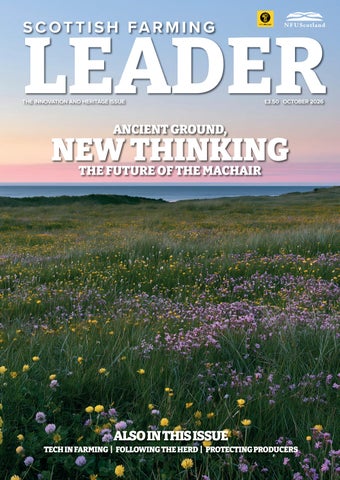
ANCIENT GROUND,
NEW THINKING THE FUTURE OF THE MACHAIR
ALSO IN THIS ISSUE
TECH IN FARMING | FOLLOWING THE HERD | PROTECTING PRODUCERS
BEYOND THE
TREAD Precision engineering
for Scottish agriculture When operating heavy agricultural machinery across Scottish terrain, equipment choice is about far more than just fitting off-the-shelf parts True performance comes from axles, suspension systems, tyres and braking working together as one system — the right axle load capacity, the correct tyre for the job, suspension set up for the application, and a braking system matched to the trailer. Get any one of these wrong and it shows up in handling, load stability, braking, and how efficiently the machine runs.
Your one-stop shop
Expert advice. Local support
ADR UK, part of the global ADR Group, manufactures axles, suspension and braking systems for trailers and agricultural implements, built to current trailer safety and compliance standards.
Our Scottish partner Agriwheel from Dumfries and Arbroath works with farms across the country, and between us we focus on advice that's specific to the job in front of us; whether that's a flotation tyre to reduce ground pressure and protect the soil, or the right braking setup for a particular trailer. We are exclusive distributor of Tianli, a brand with a long history in specialist offroad tyres built for demanding conditions.
Together with British Rubber, our tyre and rim business with over 90 years' experience in farming, that gives us a genuine one-stop shop service — from the suspension and axle to the tyre on the ground.
Real support for real on-farm challenges Most of the problems we see on farms are those that go unnoticed until something breaks or an inspection fails. Common examples include: Axle ratings — reviewing against actual load carried, as trailers are often repurposed for heavier loads than originally specified. Braking mismatches — resolving hydraulic-to-air braking mismatches between tractor and trailer, a common issue on farms running mixed fleets. Tyre selection & pressure — choosing the right tyre for the machine and load (load index, rolling circumference, operating pressure), and adjusting pressure between road transport and field work, to maximise tyre life, traction and fuel efficiency.
The right setup. Built to last The aim is simple: help you put together a setup where every part is doing its job properly, together, rather than just fitting whatever's on the shelf. Get in touch with the team to talk through what your machinery actually needs.
h cottis S g n i ort “Supp th ng wi farmi ng” ineeri g n e d truste
Agriwheel
British Rubber Co.
ADR UK Tyremart
7516 717 183
7572 894 297, 1274 585 427 sales@britishrubberco.co.uk
1400 283 820, 7923 593 014 sales@tyremartagri.co.uk
LEADER S C OT T I S H FA R M I N G
From the Editor From the Editor
NFU Scotland, Rural NFU Scotland, Rural Centre, West Mains Centre, West Mains Ingliston, Edinburgh Ingliston, Edinburgh EH28 8LT EH28 8LT
Megan Williams
F
Tel: 0131 472 4000 Tel: 0131 472 4000 www.nfus.org.uk www.nfus.org.uk nfuscotland nfuscotland @NFUStweets or the theme of this issue, Innovation and Heritage, I began thinking @NFUStweets EDITOR
about what we carry forward. There’s a tendency to think of innovation as something that arrives in a box: a new machine, a new Editor piece of technology or a new way of doing things. Editor Diana that McGowan But spend enough time around farms and crofts and it becomes clear Diana McGowan innovation is rarely quite so simple. Often, it starts with looking at what has editor@nfus.org.uk been done before and asking what might still have a place today. editor@nfus.org.uk That idea runs through this month’s Scottish Farming Leader, as we look at Editor Managing Managing Editor the relationship between innovation and heritage, and the ways Scotland’s Craig Gibson Craig Gibson farmers and crofters are finding their own ways forward. In Ancient Ground, New Thinking on page 17, we head to North Uist, Design & Production where generations of crofting have helped create one of Scotland’sDesign most & Production Ryan Swinney distinctive landscapes. Here, traditional cropping and grazing remain Ryan Swinney fundamental to the machair and the wildlife it supports. But with growing Advertising Sales pressure from geese, the future of that relationship is far from certain. Advertising Sales Clare Stebbing In Following the Herd (p.35), we visit Fife where David Moyes’ hens follow Clare Stebbing clare@connect the cattle around the pasture. It’s a new enterprise built around a remarkably old idea: finding ways for different parts of a farm to work together. clare@connect communications.co.uk communications.co.uk And in our conversation with Yokit co-founder James Fairlie, we look at 561 0024 Tel: 0131 Tel: 0131 561 0024 how technology can tackle some very old farming frustrations (p49). His approach is not about replacing the knowledge and experience of Published farmers, on behalf Published on behalf but giving them better tools to understand and manage their businesses. of NFU Scotland by Three very different stories, but each asks a similar question: howofdo weScotland by NFU Connect Publications take what works and make it work for the future? Connect Publications (Scotland) Ltd. Because perhaps the most useful kind of innovation isn’t about leaving (Scotland) Ltd. 2001, Mile End, the past behind. It’s about knowing what is worth carrying forward. Studio Studio 2001, Mile End, 12 Seedhill Road, 12 Seedhill Road, Paisley PA1 1JS Paisley PA1 1JS
Keep up to date with all the news on Facebook or follow us on @NFUStweets @nfuscotland For the weekly news sent to your email, please send your name and membership number to contactus@nfus.org.uk Editor Megan Williams editor@nfus.org.uk Design & Production Mark Shreeve mark.shreeve@micropress.co.uk Andrew Hirst andrew.hirst@micropress.co.uk Advertising Sales Danny Lewis 01502 725862 danny.lewis@micropress.co.uk Lawrence Kenny 01502 725860 lawrence.kenny@micropress.co.uk
NFU Scotland Rural Centre, West Mains Ingliston, Edinburgh EH28 8LT 0131 472 4000 www.nfus.org.uk
Published on behalf of NFU Scotland by Countrywide Publications Fountain Way, Reydon Business Park, Reydon, Suffolk IP18 6SZ 01502 725800 Printed by Micropress Printers Ltd Fountain Way, Reydon Business Park, Reydon, Suffolk IP18 6SZ 01502 725800
Although every effort has been made to Althoughtheevery effortofhas made to ensure accuracy thebeen information ensure the accuracy of theNFUS information printed in this publication, cannot printedliability in this publication, cannot accept for errors orNFUS omissions. accept liability for errors omissions. The views expressed in thisorpublication The not views expressedthose in thisofpublication are necessarily the NFUS. are not necessarily those of the NFUS.
Diana Diana McG McG
H
OW often do you OW often do you see or learn about see or learn about something and something and think ‘I’m up for think ‘I’m up for that’, but then that’, but then never actually never actually realise that realise that positive thought/ positive thought/ silent commitment? Possibly too silent commitment? Possibly too often or not at all. often or not at all. In this month’s magazine, our In this month’s magazine, our two features cover inspiring stories two features cover inspiring stories and highlight just how rewarding and highlight just how rewarding delivering on such thoughts can delivering on such thoughts can be both for the individual involved be both for the individual involved and others who may benefit along and others who may benefit along the way. the way. We’re only a few weeks away from We’re only a few weeks away from the Royal Highland Show. Over the Royal Highland Show. Over the course of four days, thousands the course of four days, thousands will flock to the show to compete, will flock to the show to compete, judge, exhibit, organise, educate exhibit, organise, educate President’s Update and socialise. We’ll see the best of 4 judge, and socialise. We’ll see the best of the best and relish the atmosphere. bestPresident and relish the atmosphere. Vice Updates 7 the Among the highlights and away Among the highlights and away from the main show ring, this year the main show ring, this year News 9 from will see the welcome return of the will see the welcome return of the Golden Shears Sheep Shearing and Shears Sheep Shearing and Policy & Practice 22 Golden Woolhandling World Championships. Woolhandling World Championships. Taking place at the MacRobert place Activity at the MacRobert 40 Taking Regional Theatre, the 2023 Worlds will see Theatre, the 2023 Worlds will see more than 30 countries compete for FEATURES more than 30 countries compete for the prestigious title and it promises the prestigious title and it promises Ancient Ground, be an action packed showcase of 16 to toNew be anThinking action packed showcase of the art, skill and techniques required the art, skill and techniques required be a world champion. 35 to the Herd toFollowing be a world champion. Perhaps a less well known event Perhaps a less well known event taking place at this year’s Highland is Innovation in focus with place at this year’s Highland is 49 taking the final qualifying round of the 2023 James Fairlie the final qualifying round of the 2023 Britain’s Fittest Farmer competition. Britain’s Fittest Farmer competition. Taking part in this event for the Taking part in this event for the first time is Kyla Graham from first time is Kyla Graham from Kirkcudbrightshire. Kyla first spotted Kirkcudbrightshire. Kyla first spotted the event at the Show last year and the event at the Show last year and while watching it thought ‘I’m up for while watching it thought ‘I’m up for that’. Kyla knew however she couldn’t that’. Kyla knew however she couldn’t just enter there and then. Like any just enter there and then. Like any competition, she understood you competition, she understood you need to be ready for it and without need to be ready for it and without knowing if she would even enjoy knowing if she would even enjoy it, she set her mind to it to finding it, she set her mind to it to finding out if she would. Kyla shares her out if she would. Kyla shares her journey from that moment to the journey from that moment to the present and highlights how she’s present and highlights how she’s benefited already in so many ways benefited already in so many ways both mentally and physically, and both mentally and physically, and explains about the positive impact explains about the positive impact her preparation has had on her her preparation has had on her working life. working life. • Dec 2025 / Jan 2026 | 3 Scottish Farming Leader
28
35
41
CONTENTS
16
a a C C r r f f S S h h 4 4 t t c c c c u u t t t t
l l w w I I f f s s a a e e i i n n S S f f M M
“ “ o o t t
From left Darren Stewart, NFUS Group Secretary for Shetland, Johnina Henderson, recently appointed Regional Manager for Shetland and Andrew Connon
A season of pressure and opportunity From the
PRESIDENT Andrew Connon
B
y the time you read this, I hope harvest is well on the way to being finished across the country. Weather has been very regionalised, resulting in mixed fortunes for yields and harvest dates this year. Compared to the horrendous tales from England, we have little to complain about other than the price. Futures seem to be all over the place, though firming, whilst malting premiums seem virtually nonexistent, which is incredibly frustrating and a real issue for loyal malting barley growers. OSR seems to be doing well, whilst “new crops” like Hemp are proving of interest but needs further investment in processing the product to supply the Jedburgh plant, which currently relies on imported material – surely a great opportunity! I have commented previously about the threat to our livestock industry from disease. Several weeks ago, there existed the perfect storm, bluetongue virus, and a case of BSE in South West Scotland, as well as Salmonella in imported eggs. This certainly grabbed the attention of the media. The bluetongue issue has caused major stress for all those impacted, and the topic will be covered fully in this issue. I would, however, like to mention the huge 4 | October 2026
shift put in by NFUS staff and Committee Chairs on dealing with the Blue Tongue issue, which led to daily meetings on an ever-changing situation as the virus took a hold and a number of local meetings for members. The Salmonella outbreak from imported eggs has been well reported. NFUS has been lobbying the UK Government for several years as to the threats of such an outbreak. Thankfully, UK-produced eggs are rigorously tested and flocks are vaccinated under the UK National Control Programme for Salmonella, but it yet again highlights the risks from imported food that is produced to lesser standards than our own. Our pressure on Government will remain. Regarding food imports, there is huge consternation over the EU ban on Brazilian products of animal origin (POAO). As of 3 September, the EU will have stopped Brazil, its second-largest beef supplier, from supplying beef and poultry, amounting to 92,000 tonnes of beef per year and 211,000 tonnes of poultry meat. Our concern is that some of this will be redirected to the UK, undermining our high standards and putting further pressure on our beef and poultry prices. We have lobbied MPs and have also written to DEFRA Secretary of State Dame Angela Eagle MP, jointly with the UK farming unions and as part of the Scottish Red Meat Resilience Group. The weekend of the 5 September took me to the Island of Yell off the Shetland Mainland for their annual. It was a tremendous community occasion and a great opportunity to speak to dozens of folk at the show, as well as visiting a farm
and some crofts. A stand out messages for me was the essential need for Less Favoured Area Support. In addition, the shorter season highlighted how farming by a calendar date is not practical across Scotland. It is evident how much crofters and farmers are already achieving in Shetland in regard to nurturing rare plants and ground nesting birds. Mention of future PGRS Greening schemes continues to cause alarm, and I firmly believe that any changes cannot reduce output. Productive grassland is scarce in the islands and remote areas and must be available to maintain grazing, forage, and both livestock and people numbers. However, these issues are relevant across Scotland and must be considered in future support schemes. October sees the unveiling of the UK Governments Budget. We have already stated our asks. A full reversal of the IHT reform introduced in October 2024, a reinstatement of full capital allowances for double-cab pick-ups, action to make up for the additional costs on employers due to the increase in Employer NIC contributions, widen the scope of full capital allowances to include buildings, increasing the AIA to £5 million, pause the Carbon Border Tax (CBAM) due to come in Jan 2027, and maintain the cut in fuel duty for red diesel. We have a fantastic industry that repeatedly rises to the challenge, but its time both Governments took off the shackles to allow Scottish farmers and crofters the ability to grow their businesses with confidence, securing a future for the next generation!
Your farm changes every season. Your cover might need changing too. What’s changed on your farm this year? New machinery? Your farm workforce?
Want to find out more? Find your local office at nfumutual.co.uk/farming-sfl
Different cropping or livestock? Check in with your local NFU Mutual Agent this summer.
Scan the QR code with your smartphone camera
Trusted for generations, prepared for tomorrow.
The National Farmers Union Mutual Insurance Society Limited (No.111982). Registered in England. Registered office: Tiddington Road, Stratford-upon-Avon, Warwickshire CV37 7BJ. Authorised by the Prudential Regulation Authority and regulated by the Financial Conduct Authority and the Prudential Regulation Authority. A member of the Association of British Insurers.
Advertorial
Unlocking peatland restoration: navigating the legal landscape
P
eatland restoration has become one of the most significant natural capital opportunities in Scotland, sitting at the intersection of climate policy, environmental stewardship and private investment. As governments and businesses seek credible pathways to achieving net zero commitments, increasing attention is being focused on Scotland’s peatlands and the critical role they play in carbon storage and sequestration. Scotland possesses a remarkable peatland resource. Covering almost two million hectares, Scottish peatlands account for approximately two-thirds of all peatland habitat in the United Kingdom. These landscapes represent one of the country’s most important natural carbon stores, holding an estimated 1.6 billion tonnes of carbon accumulated over thousands of years. However, decades of drainage, overgrazing, commercial forestry, peat extraction and other land management practices have left a substantial proportion of this resource in a degraded condition. Current estimates suggest that nearly three-quarters of Scotland’s peatlands are damaged. Rather than acting as carbon sinks, degraded peatlands can become significant sources of greenhouse gas emissions. The restoration of these habitats is therefore recognised as one of the most costeffective measures available to help tackle climate change. Healthy peatlands actively sequester carbon, improve biodiversity, enhance water quality, reduce flood risk and increase resilience to drought and wildfire. Consequently, peatland restoration forms a key component of both Scotland’s and the UK’s net zero strategies. Alongside public funding, the development of private investment mechanisms has become increasingly important in accelerating restoration at scale. Central to this market is the Peatland Code, a voluntary certification standard launched in 2015 and administered by the IUCN UK Peatland Programme. The Code provides a rigorous
Gary Webster, partner at Brodies LLP framework for measuring, verifying and registering the carbon benefits generated by eligible peatland restoration projects. By creating independently verified carbon units, it enables businesses and investors to support restoration activities while meeting environmental objectives. As a result, the Peatland Code has become a cornerstone of the UK’s developing natural capital market. For farmers, crofters and landowners, Peatland Carbon Units can provide flexibility. Units may be sold to generate an additional income stream from restored peatland, helping to diversify rural businesses. Alternatively, units can be retained and used to help offset a business’s own emissions in future, providing an asset that may become increasingly valuable as net zero requirements continue to develop. Of course, a combination of these approaches can also be pursued. The Peatland Code can also deliver verified carbon units more quickly than many Woodland Carbon Code projects – with first verified units typically becoming available at the initial verification stage around years five or six. However, the success of any peatland
restoration project depends upon more than ecological outcomes. Projects frequently involve complex legal and commercial arrangements between landowners, funders, project developers, carbon purchasers, agricultural tenants, crofters, shareholders in common grazings and other stakeholders. Funding arrangements, long-term management obligations and the ownership and sale of carbon units all require careful consideration. Projects on common grazings or tenanted croft land will also almost certainly require additional consent from the Crofting Commission and/or Scottish Land Court. Existing agricultural, sporting, forestry and renewable energy interests may also need to be considered. At Brodies, we have developed significant experience advising clients on the legal arrangements that support peatland restoration projects. As interest in natural capital continues to grow, careful planning and well-structured agreements will be crucial to ensure projects are capable of generating long-term environmental and commercial value.
For more information visit brodies.com or contact Gary Webster in the rural business and natural capital team at gary.webster@brodies.com or +44(0) 1463 214 409.
Vice Presidents’ Updates Robert Neill
Duncan Macalister
Vice President
Vice President
Back to basics
Taking stock
W
S
ometimes innovation is about looking forward. But sometimes, the best thing we can do is go back to basics. At the heart of every farm is soil. It’s made up of sand, silt, clay and water, and while farming has changed enormously during my lifetime, the fundamentals of good soil management haven’t. One of the most important is getting your soil pH right. We’ve known for decades that maintaining a pH of around 6 or above can make a significant difference to how effectively nutrients are used. If your soil is sitting at 5.5 and you’re putting fertiliser on, you’re potentially wasting money. It’s as simple as that. Lime has an important role to play, too, but getting the right type matters. In our soils, the balance of magnesium and calcium can have a dramatic effect on soil structure and porosity. If you add magnesium to the wrong soil type, the particles can cling together and stop water moving through. Replace that magnesium with calcium and the particles move apart. It’s quite dramatic, and within six months to a year you can see the difference in the soil. This isn’t new technology. The principles were worked out decades ago. But somewhere along the way we’ve forgotten how important they are. The weeds can tell you a story too. If you’ve got chickweed and other weeds associated with lower pH, that’s telling you something. Thistles and ragwort can point towards a higher pH. You need to understand what the field is telling you. The starting point is simple: test your soil and keep testing it. Ideally, samples should be taken every three to four years. If you want to take it further, GPS-based sampling allows you to return to exactly the same points and build a much clearer picture of what’s happening across a field. For me, this is where innovation and heritage come together. We don’t always need to invent something new. Sometimes the answer is sitting there in the basics, and we just need to understand them properly and use them better. Farming has changed enormously, but soil hasn’t. The fundamentals are still the fundamentals.
One win Getting out the house in the morning and remembering my wallet
One worry One of my constant worries is the weather, I don’t know how many times I check it a day
One to watch Imports, that’s going to be massive for the beef and poultry industry
e all have some form of technology on the farm that we use most, with great benefits, and we would be lost without it. But when it goes wrong, it can involve a lot of head scratching to get it back up and running – normally requiring a whiz kid with a laptop! For us, over harvest, looking at the yield maps on our combine was somewhat depressing, especially in the spring barley. There were more red areas than green, which certainly focuses the mind on why we keep doing this! My last show visit of the year was to Shetland, and it was certainly an experience. Our first attempt to land was aborted at the last minute due to fog. As we took off again, the poor lady sitting next to me was white as a sheet. She certainly didn’t hold back on the language. The weather was great for the show, and the icing on the cake was my overall sheep champion, a Suffolk gimmer, going on to win overall show champion. This has never been done by an NFUS delegate before! The day after the show, I had a great tour thanks to Grant and Laura. Again, back to technology, it was fantastic to see cows grazing land that had never been grazed for decades, using Monil virtual fence collars. Seeing this technology in practice is always better than watching it on a video or reading about it in a brochure. Bluetongue has been taking up a lot of our time at the Union. Well done to everyone involved – being out in front with communications and information for our members is so important. It is equally important that we feed our members’ concerns into the Scottish Government and try to come up with a solution that is workable for everyone. Now it is time to take stock, reflect on what we have learned, and start planning ahead for 2027.
October 2026
| 7
Funded by the Scottish Government
Free and impartial energy saving support for your business Get in touch to access Scottish Government funding to help small and medium-sized enterprises save energy, carbon and money. Visit businessenergyscotland.org/farming Call 0808 808 2268
PPA04-01-0324 © March 2024
An idyllic setting surrounded by breathtaking mountain scenery... Nestled just outside Kinlochleven and a few miles from magnificent Glencoe, on the south shore of Loch Leven in the beautiful Scottish Highlands.
• EHU available • Refurbished toilet block • Amenity block • Chemical disposal • Campfires permitted • Dog friendly
AprilOctober inclusive
01855 831 279 | enquiry@kinlochlevencaravans.com Caolasnacon Caravan & Camping Park, Kinlochleven, Argyll, PH50 4RJ 8 | October 2026
Food price caps: protecting farmers must be part of the plan Lisa Hislop
Supply Chain Manager
T
he start of September marked the launch of the anticipated consultation and draft Bill for the food price cap proposals, which was a key manifesto commitment for the Scottish Government. Over the summer, we have engaged with the Scottish Government at length and continue this work following the proposals that have emerged, reiterating the need for the Government to deliver its commitment to protect primary producers. We have convened meetings with Committee Chairs and officials, held ministerial engagement and on-farm visits, and participated in wider stakeholder discussions to ensure the voice of Scottish farmers and crofters is reflected. It’s important that the fundamentals are not lost throughout this consultation. Farmers are price takers, with no ability to absorb additional costs. Any policies intended to improve food affordability must avoid creating unintended consequences that could undermine domestic food
production or place further pressure on primary producers. We must ensure farming businesses remain economically sustainable, and we need a viable and functioning supply chain beyond the farm gate to get our produce onto consumers’ plates. The consultation states that the intention would be to
Food affordability and food security must go hand in hand. introduce policy interventions rather than legislative protections, which is a cause for concern. NFU Scotland is clear that protections for primary producers must be baked into any proposal to deliver the repeated assurances and ensure longevity in those protections. We also participated in the Fair Food Summit, which brought together stakeholders from across the food system
News and society to discuss food affordability, accessibility and resilience. This event highlighted that simply capping the price of essential items would not immediately alleviate the challenges facing those most vulnerable and experiencing poverty in Scotland today. Food affordability and food security must go hand in hand. Maintaining a strong domestic agricultural sector is essential to ensuring Scotland can continue to produce high-quality food, support rural communities and contribute to wider environmental objectives. What happens next? NFU Scotland welcomes the opportunity to continue engaging with the Scottish Government and stakeholders as discussions develop. We are considering our response to the consultation and will be reaching out to members for their views shortly. As work progreswses, NFU Scotland will remain actively involved in discussions around food affordability, fair food and food system resilience, ensuring the interests of farmers and crofters are represented and that policy development is informed by the practical realities of producing food in Scotland.Please keep up to date via www. nfus.org.uk/policy/food-supply-chain.aspx
Building the Future from What We Already Know
By Susi Sinclair, Brand & Communications Director at Hoose, a Scottish regenerative design & construction company
I
nnovation is often presented as a search for something new. Yet, as we look to the future of rural Scotland, some of the most valuable ideas can be found in the knowledge, skills and principles that have shaped our farming communities for generations. Traditional farm buildings were designed with a clear understanding of place and purpose. Their position responded to the land and prevailing weather, materials were sourced locally where possible, and buildings were expected to work hard, adapt over time, and be repaired rather than replaced. These decisions were born from practicality, but they also offer important lessons for how we build today. As farms and estates explore diversification, rural housing, visitor accommodation and new spaces for business, development should begin with a simple question: what could this land make possible? Answering it requires more
than choosing a building. It means understanding the land, its natural systems, access, orientation and longterm use. It also means considering planning, design, materials, energy and construction as one connected process rather than a series of separate decisions. This is where tradition and innovation can work together. Scotland’s timber and natural resources offer an opportunity to grow more of what we build with. Modern design and precision manufacturing can transform Scottish timber and natural fibre insulation into high-performance buildings that store carbon, use less energy and create healthy, comfortable places to live and work. Regenerative building asks us to look beyond reducing environmental harm and consider how development might contribute positively to the land, the people who use it and the wider rural
economy over its lifetime. Innovation can also make construction more practical for rural and harder-toreach sites. Bringing manufacturing, tools and skills closer to where a building will stand can help to reduce unnecessary transport, allow teams to respond more effectively to local conditions and create opportunities for rural skills and employment. The technology may be contemporary, but the thinking behind it is familiar: understand the land, use resources carefully, work with skilled people and build something capable of lasting. Farming heritage shouldn’t be viewed as something we preserve by standing still, it’s knowledge we can continue to learn from. The most meaningful innovation can be found by combining what generations before us understood with the tools and thinking of today to create buildings that remain valuable for generations to come and give back more than they take. October 2026
| 9
An e���t��� ne� ��r���e b���� la���h�� �y Ta�ff ���l��! IMPROVED BY
Fertiliser Product Manager, Scott Gallacher says “ The new Precision Farming service division is a
great step forward for Tarff Valley. ‘SOIL’ is an exciting new venture which will assist clients in understanding the nutritional requirements of their land whilst giving staff the tools to recommend personally tailored solutions for achieving optimal returns.”
Wha� ��� ca� ��p��� f�o� T�rff ����ey’� P�ec���o� F�r���g �e�v���: Fully integrated service, from initial soil sampling to processing data and generating detailed reports Accurate data on soil analysis, processed through a new online portal, ‘SOIL’ Personalised log in to ‘SOIL’ portal and access to farm results Tailored advice and recommendations based on accurate, up to date data
Cal� ���� ��l�a�h�� �� Col�� ���n�i�� t� �i�c��� y�u� ��q�i����n��: Sco� �����c�e�: 07823 341 462 Col�� ���n�i��: 07788 594 945
News
NFU SCOTLAND’S
Commercial Update
Gemma Cooper Head of Operations & Partnerships
Spotlight on member rewards Planning your vehicle investment
F
or many farmers and crofters, a pickup is an essential part of day-to-day farming. These vehicles have become workhorses on farms and crofts across the country, from taking the family to school and clocking up the miles travelling to NFUS meetings, to hauling a stock trailer to the mart in the hope of a decent price in the ring. Recent changes to Benefi t in Kind tax have had a signifi cant impact on the UK pickup market. Pickups have become less attractive as company vehicles and sales have fallen sharply. Alongside the gradual shift from diesel towards hybrid and electric vehicles, this has also affected availability and build times for some manufacturers. Our focus is on making sure members have a range of pickup options to choose from, with negotiated offers available through NFUS membership. For a reminder of the manufacturers we currently have offers with, scan the QR code.
We are also in discussions with several other manufacturers, with the aim of increasing the range of offers available to NFUS members.
New manufacturer partnership Here at NFUS, we have been putting one of our newer manufacturer partnerships through its paces, with a GWM POER300 Ultra kindly supplied by professional members A.F. Noble and Son in Penicuik. Our fleet pickup has already travelled across Scotland to NFUS events and meetings, giving us the chance to see how it performs in real-world conditions. GWM is one of our newer manufacturer partnerships, and NFUS members can save up to £2,000 on these vehicles. To take advantage of the offer, visit your local GWM dealership and let them know you are an NFUS member.
Welcome to our new professional members A warm welcome to the latest businesses to join NFU Scotland as professional members:
• Aitchison Hydro Seeding Ltd • Caolasnacon Caravan Park • A White Roofing • Cleantec Window Cleaning Ltd • Cairnglass House • Western Toyota • Bennachie Eggs Ltd • A & A Storry Ltd • Dun Aliscaig Estate Management Ltd • Deeside Landscapes Ltd
October 2026
| 11
DOUGLAS F MITCHELL LTD Family Run est. 1974
General Haulage Step Frame Trailers Flat Trailers Bulk Tipper Haulage Curtain Sided Trailers Local/Long Distance Haulage
®
01561 377741 | 07775 864462
OFFICE@DFMITCHELL.CO.UK | DFMITCHELL.CO.UK DOUGLAS F MITCHELL LTD, LAURENCEKIRK,AB30 1BE
12 | October 2026
News
Beatrice Morrice Head of External Affairs
Al Walker
Political Affairs Advisor
Political PULSE
A look at the conversations, meetings and decisions shaping Scottish agriculture, written by Al Walker and Beatrice Morrice BEHIND THE SCENES
WHAT’S NEXT
UNDER DISCUSSION
Who we’ve met & why it mattered
The key policy issues we’re working on
Key dates & decisions coming up
With both parliaments returning at the start of September, rural issues have already been front and centre. On future support, Jonnie Hall, Deputy CEO and Director of Policy, gave oral evidence to the Scottish Parliament’s new Rural Affairs Committee in a session focused on the Rural Support Plan (RSP). The RSP sets out the framework for agricultural support from 2026 to 2031, confirms significant direct support commitments and sets out a move towards multi-year funding, providing greater certainty for farmers and crofters. Jonnie underlined that NFU Scotland welcomed the plan. The First Minister also announced his Programme for Government, setting out his priorities for the next fi ve years and specific commitments for the coming 12 months. His speech and accompanying publication underlined the Scottish Government’s commitment to farming and crofting communities, stating that it has “and always will invest in our farming and crofting communities”. Beatrice Morrice, Head of External Affairs, was in London for Back British Farming Day on 9 September. She met with Scottish MPs attending the reception to celebrate the nation’s farmers and crofters and discuss the key issues facing the sector. NFU Scotland also met with Harriet Cross MP, the new Conservative Shadow Scottish Secretary, to discuss the pig sector crisis and import production standards.
The Food Price Cap proposals have attracted significant interest from the media and consumers, food producers, processors and retailers since they were announced in April. The Scottish Government has now published its consultation and draft Bill. NFU Scotland will be issuing a detailed response, underlining our concerns and highlighting the need for the Scottish Government to deliver on its commitment to ensure domestic producers are not negatively impacted. We have also held a useful briefing for Scottish Government officials and commodity chairs from pigs, dairy, livestock, horticulture and poultry, setting out the complexity of the supply chain. Further engagement with Ministers, MSPs and officials will continue.
NFU Scotland has submitted its priorities to the Treasury ahead of the UK Budget on 28 October. Our asks include fully reversing the October 2024 Budget changes to inheritance tax (IHT), addressing the increased cost of employment arising from higher employer National Insurance Contributions (NICs), increasing and extending the Annual Investment Allowance (AIA), reversing the tax treatment for double-cab pick-ups used as genuine agricultural working vehicles and maintaining reduced fuel duty rates for red diesel. We will continue to highlight these priorities with MPs and offi cials over the coming months. NFU Scotland is attending political party conferences over the coming weeks, including the Labour Party conference in Liverpool at the end of September. In October, we will also host an event on the future of Scotland’s agricultural sector at the SNP Conference in Aberdeen.
John Lamont MP and Beatrice Morrice
Lara Bird SNP MP and Beatrice Morrice
Jonnie Hall, Deputy CEO and Director of Policy
October 2026
| 13
News
Placed editorial by Grampain Growers
Growing for the Future: Sustainability & Innovation at Grampian Growers Words by Sofia Alexiou, AgriTech Project Manager, Grampian Growers Ltd
F
or Grampian Growers, sustainability is not a standalone initiative or a single environmental target. It is embedded across the whole business – from the way crops are grown and protected in the field, to how they are processed, stored and packed. Founded in 1970 by a group of farmers near Montrose, Grampian Growers has spent more than five decades adapting to changing markets and opportunities, remaining resilient and competitive. Today, the co-operative produces around 80 million daffodil stems, 3,500 tonnes of daffodil bulbs and 12,000 tonnes of seed potatoes annually. Practical sustainability from field to packhouse Sustainability begins in the field. Farmers work closely with Grampian Growers’ teams and agronomists to balance productive cropping with long-term land stewardship. Soil testing, nutrient management, crop rotations and cover cropping support soil health and maintain productive farming systems. Growers are adopting precision agriculture, improved water management, renewable energy and biodiversity measures to use resources responsibly and build resilience to environmental and economic pressures. The co-operative’s crop and soil health initiatives, potato breeding programme and field trials ensure innovation responds to real farming challenges. New approaches are tested under commercial conditions and shaped by grower experience. 14 | October 2026
Beyond the farm gate, investment in technology is improving efficiency and environmental performance. A new hotair and foaming bulb treatment system reduces water and energy use and lowers reliance on chemical treatments, supporting more sustainable bulb processing. Modern packing and bagging technology improves energy efficiency, reduces waste and increases productivity. Across production, processing and storage, the emphasis is on efficient resource use, safeguarding land and crops, and strengthening long-term resilience for growers and the wider business. Taking agricultural innovation beyond the farm gate A distinctive element of Grampian Growers’ approach is its involvement in collaborative AgriTech research. Working with universities, research organisations and commercial partners, the co-operative leads and participates in Innovate UKfunded programmes exploring how established Scottish crops can contribute to new value chains. GalanCEAmine is investigating a more sustainable UK supply of galanthamine, a plant-derived pharmaceutical ingredient used in Alzheimer’s treatment. The project combines daffodil production with controlled environment agriculture and green extraction technologies to develop a scalable, lower-impact year-round production system. Dancing with Daffodils, a fouryear collaborative project, is exploring
naturally occurring daffodil alkaloids as a plant-derived livestock feed additive. The research aims to reduce methane emissions from ruminants while improving nitrogen utilisation and feed efficiency, creating potential for one crop to support sustainability in another sector. Potatoes offer another route into the circular bioeconomy. The Phytocosmo project is investigating how potato haulms – the above-ground plant material from potato production – can be transformed into valuable bioactive compounds and bio-derived ingredients. Initial work focuses on extracting solanesol while exploring wider applications across cosmeceutical, nutraceutical, pharmaceutical and other bio-based markets. Sustainability that works for farmers Underlying all these activities is a key question: what does innovation deliver for farmers? Grampian Growers’ AgriTech strategy supports climate-smart agriculture, creates alternative income opportunities, diversifies beyond traditional markets, strengthens research partnerships and improves long-term commercial resilience. For a business founded by Angus farmers more than 50 years ago, technologies have changed, but the principle remains. By working together, investing for the long term and finding new value in existing crops and resources, Grampian Growers is helping build a more productive, resilient and sustainable future for Scottish agriculture.
VEHICLE | TRACKING | RECOVERY
TAKE MACHINERY SECURITY IN TO YOUR OWN HANDS See your asset anywhere, anytime 24/7
24/7 Real-Time Monitoring
GPS & RF Tracking
Theft Response Team
Recognised By Insurers
Unlimited Notifications
Lifetime Warranty
We can see your ATV, UTV, 4x4, Farming Equipment and more
hello@alltrac.co.uk | +44 (0) 1327 317 980
www.atvtrac.co.uk
“Best and most profitable tool we have on the farm” Accounts
^hDͲ/d͛Ɛ dKd >Ϯ ĐĐŽƵŶƚƐ ƉƌŽŐƌĂŵ ƉƌŽǀŝĚĞƐ Ă ŶŽ ŶŽŶƐĞŶƐĞ͕ ƉƌĂĐƟĐĂů ƐŽůƵƟŽŶ ƚŽ ZƵƌĂů ƵƐŝŶĞƐƐ ĐĐŽƵŶƚƐ͘ &ƵůůLJ ƵŶĚĞƌƐƚĂŶĚ ĂŶĚ ĂŶĂůLJƐĞ LJŽƵƌ ĚŝǀĞƌƐŝĮĞĚ ďƵƐŝŶĞƐƐĞƐ ZƵŶ dKd >Ϯ ůŽĐĂůůLJ Žƌ ĂĐĐĞƐƐ LJŽƵƌ ĚĂƚĂ ŝŶ ƚŚĞ ůŽƵĚ ZĞĐĞŝǀĞ ϭƚŽϭ ƉŚŽŶĞ ƐƵƉƉŽƌƚ All S����� so�ware designed specifically for farmers SCAN this QR code ǁŝƚŚ LJŽƵƌ ƉŚŽŶĞ ƚŽ Ŭ Ă ĨƌĞĞ EK K >/' d/KE ůŝǀĞ ŽŶůŝŶĞ ĚĞŵŽ
Žƌ >> h^ ŽŶ
01844 213003
ĐĐŽƵŶƚƐ ůŝĞŶƚ DĂŶĂŐĞŵĞŶƚ ĞĞĨ ĂŝƌLJ ^ŚĞĞƉ ƌĂďůĞ
October 2026
| 15
Ancient Ground
Ancient Ground, New Thinking The machair is a landscape shaped by agriculture, with biodiversity woven into generations of traditional practice. But with growing pressure from geese, can the people who created this landscape afford to keep working it? Editor Megan Williams sits down with NFUS member Donald Macdonald to discuss.
T
here is a point on the machair where nature and crofting seem almost impossible to separate. At Clachan Sands on North Uist, Donald Norman Macdonald works land that has been shaped by generations of crofting. Crops grow alongside wildflowers, livestock graze across the machai, and the Atlantic is never far from view. For Donald, this is simply crofting. “It’s a whole range of different habitats. It’s not just one. There’s boggy areas for the flowers, dry areas and sand dunes, so there’s lots of different bits to it.” Machair is not simply a landscape that has been left untouched. Across Uist, its distinctive character has been shaped by generations of crofting, including traditional cropping, grazing and periods of fallow. That relationship between people, livestock, and the land has developed around the particular conditions of the islands. Traditional crops, locally retained seed, and an understanding of when to graze, cut and rest the land, all form part of a system that has evolved over generations. Donald farms around 30 hectares of machair, of which about 10 hectares is ploughable. Rather than cropping it continuously, he works on a cycle of two years of cropping followed by two years of fallow, with around five hectares cropped each year. One of the crops is a traditional small oat, sometimes known locally as black oat, which is particularly suited to the machair. “It’s the type of seed that only really grows here,” Donald says. “It’s quite a unique thing.” The high calcium content of the machair means mainland oats do not grow in quite the same way. The locally adapted seed is therefore an important part of the system, with crofters retaining seed from one harvest to plant the next. The oats are grown as a whole crop, cut and
baled for silage, and fed to cattle through the winter. “It’s a very sustainable way of doing it, actually,” Donald says. The cattle return something to the land too. They are fed the silage through the winter, including on the cultivated ground, putting nutrients back into the soil through their manure. “The cattle are the base of the whole thing. The whole thing is linked: the machair, the ground and the cattle. You take one thing out of the equation and it all falls to bits, and the cattle are the key to it,” Donald explains. There is a seasonal rhythm to the grazing too. Around April and May, the cattle come off the machair and move onto higher pasture, leaving the land through the summer. For Donald, that pause in grazing is part of what makes the system work for wildlife. “It gives the birds and the bees and the flowers a chance to flower and seed.” And take full advantage they do. “When we’re cutting the grass, the waders follow us around,” Donald recalls. “We’ve got around 9,000 pairs of waders on Uist and Benbecula, and there are plenty more across the other islands. I’ve also counted 712 lapwings in one field. We have so many ground-nesting birds because we don’t have foxes, stoats, badgers, beavers or weasels.” It is a striking example of how closely agriculture and biodiversity are connected on the machair. Research into the Outer Hebrides’ species-rich grasslands backs up what Donald sees on the ground. These plant communities have developed through decades, and in some cases centuries, of management by local crofting communities. Cutting, grazing and maintaining the land in the traditional way has helped create diverse grasslands supporting a wide range of wildlife.
The whole thing is linked: the machair, the ground and the cattle.
October 2026
| 17
Ancient Ground
Machair challenges the idea that farming and nature are always in conflict. In many places, its rich biodiversity exists because of the way generations of farmers and crofters have worked the land. But that system only continues if people can continue to work the land. Increasingly, one of the biggest pressures comes from greylag geese. “A few years ago, when there were 10,000 resident greylag geese, we had to control around 4,000 geese just to stand still,” Donald tells me. “That’s just to keep the numbers down because they’re breeding so well and they’re so resilient. The harder you control them, the more they breed. Nature has its way of doing that. We’re never ever going to get rid of them, but they definitely need to be managed.” For crofters like Donald, goose damage can mean lost crops, lost income and, in some cases on Uist, threatened availability of unique seed for the following year. At the National Goose Forum in February, the Uist and Barra Local Goose Management Group reported that there was not enough landrace seed available to plant that year’s crop. Some crofters had enough for their own use but no surplus, while others had insufficient or no seed to sow. For Donald, the problem is something he has seen first-hand. “They [the geese] will pluck some of the seed off, but they also flatten the crop so it can’t really be harvested,” he says. Last year, on Berneray to the north of Uist, two plots were destroyed overnight. “It was the first time probably in living memory that they didn’t have any,” Donald says, referring to the seed the crofters had retained for the following year’s crop. The geese had come in during the night and flattened the crop – despite having skaters and kites all around. “Some really has to be there all the time”, Donald says. The result was that the crofters had to look for an alternative, buying triticale to replace the oats. And the implications go far beyond one crop or harvest. The more stressful it gets, the fewer crofters will be willing to continue growing the oats. That means less seed being retained, less cropping taking place and, ultimately, a change to this landscape itself. Donald says some crofters are already questioning whether it is worth continuing. “There are a couple of crofters that are just saying that they’re just going to pack up. They’ve had enough. It’s not worth the 18 | October 2026
Donald with his wife Caroline and children Rachel and Andrew Donald’s mother and neighbour in the 90s
anxiety.” And the consequences of that are not simply economic. If cropped areas are reduced, Donald says, “it goes rank” as the grass grows. The careful balance of cultivation, grazing and fallow that has created the machair’s distinctive habitats begins to change. The irony is that the areas attracting the geese are also the areas where continued crofting helps maintain the open, diverse character of the machair. The resident greylags have been on the islands for decades. “They’ve been here for decades now, as a resident population,” Donald says. “And, you know, the West Coast of Scotland here, we’ve got a fantastic
ABERDEEN-ANGUS A BERDEEN-ANGUS CATTLE CA ATTTLE SOCIETY SOCIETY
LLAUNCHES AUNCHES N NEW EW D DAIRY AIR RY YB BEEF EEF IINDEX NDEX October 2026
| 19
DUN-ALISCAIG ESTATE MANAGEMENT With over 20 years experience working in the renewable and land based industries, we pride ourselves in being able to provide key solutions to our customers' requirements.
Construction, Road Building & Repair
Forestry & Land
Renewables
Peatland Restoration
01862 857454 | 07867 528067 | www.demltd.uk Dun – Aliscaig Estate Management Ltd, Balleigh Wood, Edderton,Ross-shire IV19 1LF 20 | October 2026
Snow Clearing
Ancient Ground
habitat for them. We don’t get very much snow or frost or ice and they can feed all the time so they nest up everywhere. They don’t migrate, so they’re here all the time.” And the pressure is not limited to the oat crop.
Barnacle geese are protected, meaning the options for managing their numbers are limited. For Donald, that is why the issue needs to be addressed now, while there are still ways to manage it. And there has been recognition that something needs to be
For a system that has taken generations to develop, the cost of keeping it going is relatively small. Around 12,000 barnacle geese arrive on Uist over winter, Donald says, putting further pressure on grazing land. Among Donald and four neighbouring crofters, he says lambing percentages have begun to fall, which he believes is linked to the competition for grass.
done. Government funding for greylag management on Uist and Barra has increased to £30,000 this year which Donald says had made a difference. “I’m on the local goose management group, and we have meetings to try to get
things up and running, get more support and employ people to control them. It’s a teamwork effort between everyone who’s affected”, says Donald. But questions still remain. Does it give crofters confidence to continue putting crops in the ground? And is there enough certainty beyond one year? NFU Scotland has been calling for better-resourced, multi-year support for goose management, arguing that rising costs and increasing goose numbers are putting pressure on crofting businesses as well as the traditional management systems that support important habitats. For Donald, the amount of support being discussed is not enormous. “In the grand scheme of things, we’re not really asking for a lot of money,” he says. For a system that has taken generations to develop, the cost of keeping it going is relatively small. But the value of what is being maintained is harder to put a figure on. The machair supports traditional crops, but also the flowers, insects and birds that have become part of the landscape. And then there is the value of moral – the kind that keeps people working the land in rural areas. Remove the cultivation or the cows, and the system changes. The machair has been shaped by generations of crofters adapting to the land. The question now is whether they will have the support to keep doing so. Protecting the machair means protecting the people who work it. October 2026
| 21
Policy & PRACTICE
Building resilience, because Scottish Agriculture (and Scotland) depends on it Jonnie Hall
I
Deputy CEO/Director of Policy
f there is one lesson Scottish agriculture has learned over the past few years, it is that volatility is no longer the exception – it is the norm. Whether it is geopolitical conflict, soaring input costs, weather extremes, animal and plant disease, or uncertainty over agricultural policy, farming and crofting businesses are facing more frequent and more intense shocks. The recent instability in the Middle East is simply the latest reminder that events far away can have immediate consequences for Scottish agriculture. Managing risk has always been part of farming and crofting. But the scale, frequency and complexity of those risks are changing. The question we must now
22 | October 2026
ask is not how we respond to the latest crisis, but how we build an agricultural industry capable of managing the next one – and the one after that. That is why resilience should become the defining principle of agricultural policy and practice in Scotland. Resilience is sometimes portrayed as simply the ability to recover from adversity. In agriculture, it means much more than that. It means having farms and crofts that are profitable enough to invest, adaptable enough to cope with change, and productive enough to continue supplying the food our nation depends upon while delivering for climate and biodiversity. Ultimately, resilience is about securing the future of Scottish agriculture. Profitability is the foundation Too often, debates around agricultural policy begin with climate targets,
environmental delivery or land management. These are all important objectives, but they overlook a simple truth that without profitable farming businesses, none of these ambitions can be achieved. Profitability must be recognised as the foundation upon which sustainable food production, environmental improvement and rural economic growth are built. Farmers and crofters cannot carry all the risk Perhaps the greatest structural weakness within our farming and food system is the unequal distribution of risk. Primary producers carry almost every risk imaginable. Weather, disease, fluctuating input costs, volatile commodity markets and changing government policy all land at the farm gate. Yet farmers and crofters remain price takers, with relatively little control over the price they receive for
Policy & Practice regulations will evolve. Constant policy change discourages investment. Stability encourages it. If the government genuinely wants Scottish agriculture to improve productivity and accelerate climate action, it must first provide the confidence that allows businesses to make those long-term decisions. Resilience and climate action go hand in hand Climate change is often presented as an environmental challenge. Increasingly, it is also becoming a business challenge. Longer periods of drought, more intense rainfall, flooding, and new pests and diseases all affect farm productivity and profitability. Building resilience therefore means investing in adaptation as well as mitigation. Improving soil health, increasing water storage, investing in drainage and irrigation, adopting precision farming technologies, improving animal health, developing renewable energy and enhancing biodiversity are not separate policy agendas. Supporting these investments should become a central objective of future agricultural support.
what they produce. Processors, retailers and consumers all benefit from a stable domestic food supply. It is therefore entirely reasonable that resilience becomes a shared responsibility. Longer-term contracts, greater market transparency, pricing mechanisms that better reflect production costs and stronger supply chain relationships all have a role to play. Policy certainty encourages investment One of the greatest frustrations for farming businesses has been uncertainty over future agricultural policy. Farmers make investment decisions over decades, not years. Whether investing in new buildings, livestock genetics, precision technology or environmental improvements, businesses need confidence that the policy framework will remain sufficiently stable to justify that investment. The Scottish Government’s Rural Support Plan now provides a degree of certainty around funding until 2030. That represents significant progress. However, certainty over funding alone is not enough. Businesses also need greater clarity over how support will be delivered, what future schemes will look like and how
We need better tools to manage risk Scotland has historically relied heavily on direct support payments to underpin farm incomes. Those payments remain critically important, but they were never designed to deal with today’s levels of market volatility. Many other countries have developed complementary approaches, including income stabilisation schemes, governmentbacked insurance, climate risk protection and fiscal measures that help businesses manage significant fluctuations in income. This is not about replacing existing support. It is about recognising that farming now operates in a much more volatile world than it did even a decade ago. Building resilience means giving businesses better tools to manage risks that lie beyond their control. Infrastructure matters When people think about agricultural resilience, they often focus on individual farm businesses. Yet resilience is also about national infrastructure. Reliable water supplies, flood risk management, rural transport, digital connectivity, local processing facilities and secure energy systems all determine how well Scottish agriculture can respond to future challenges. Individual businesses cannot deliver many of these investments alone. If food security is recognised as part
of Scotland’s national resilience, then agricultural infrastructure should be viewed in the same way. Food security begins at home For many years there has been an assumption that if domestic production declined, international markets would simply fill the gap. Recent global events have challenged that assumption. Covid-19, the war in Ukraine, supply chain disruption and geopolitical instability have all demonstrated how fragile our food system can become. Food security does not mean selfsufficiency. Scotland will always trade internationally and benefit from doing so. Food security is about the availability and affordability of food and so maintaining a strong domestic production base, supported by local processing and resilient supply chains, is critical. Once productive capacity disappears, rebuilding it is difficult, if not impossible, and expensive. Protecting domestic production is therefore not protectionism – it is responsible governing. A shared responsibility Building resilience cannot be left to farmers alone. Both the UK and Scottish governments have a crucial role in providing longterm policy certainty and investing in infrastructure. Processors and retailers have a responsibility to ensure supply chains operate fairly. Financial institutions, researchers and advisers all contribute through innovation, investment and knowledge transfer. Agriculture must no longer be viewed simply as a sector requiring support or delivering environmental outcomes. It underpins Scotland’s food security, manages most of our land, sustains rural communities and supports one of the country’s most successful economic sectors. That makes agricultural resilience a national interest. Looking ahead Generations of farmers and crofters have adapted to changing times and challenging circumstances. But today’s challenges are broader, more interconnected and more persistent than ever before. And without resilient farming and crofting businesses there can be no resilient food system, and without a resilient food system, food security, environmental progress and rural prosperity all become increasingly difficult to achieve. The objective must therefore be clear – profitable farm businesses and productive agricultural land as the foundation of a prosperous and resilient Scotland.
October 2026
| 23
STEP INTO A NEW ERA OF HEARING AID TTECHNOLOGY! ECHNOLOGY!!
Fully independent, fully qualified professional hearing care across the Borders & Lothians At Borders Hearing Care and Portobello Hearing Care, Shona and Andrew bring a combined 38 years of experience in providing professional hearing care, advice and support to clients across the Scottish Borders and Lothians.
With clinics in Galashiels and Portobello, we offer expert, personal care from your first hearing assessment through to fitting, advice and ongoing aftercare.
We work with world-leading hearing aid manufacturers to provide the latest hearing technology, alongside comprehensive hearing assessments and professional hearing aid fittings. 52 Channel Street, Galashiels 01896 800 369 enquiries@bordershearingcare.co.uk bordershearingcare.co.uk
24 | October 2026
Our services also include tinnitus management, noise / shooting protection and ear wax removal, ensuring that we can support your hearing and ear care needs at every stage. We understand that everyone's hearing needs are different. That's why we take the time to listen, understand your needs and provide professional advice and solutions tailored to you.
HEARING ASSESSMENTS HEARING AIDS WA REMOVA VA W X REMOVAL V L EAR WAX
Whether it's hearing conversations with family, keeping connected with friends, or staying aware of what's happening around you at work, good hearing helps you enjoy the moments that matter.
All our hearing aids are offered as a NO OBLIGATION TRIAL!
NOISE PROTECTION 10a Bath Street, Portobello 0131 202 8222 enquiries@portobellohearingcare.co.uk portobellohearingcare.co.uk
Policy & Practice
BTV-3 Policy continues to evolve Penny Middleton Policy Manager
I
t has been a fast moving time for bluetongue policy, a rapidly developing situation has seen a constantly evolving picture, trying to keep up the implications and science of the situation to deliver balanced policy in an ever changing landscape. Scotland’s first case of Bluetongue Virus serotype 3 (BTV-3) was confirmed in Creetown, Dumfries and Galloway, on 8 August. Subsequent cases led to the introduction of a Temporary Control Zone (TCZ) covering Dumfries and Galloway, parts of Ayrshire and a small area of the Borders, introducing controls on movements into, out of, and within the TCZ, with the aim of slowing the spread of disease and giving producers time to vaccinate livestock. Movement controls varied depending on the type of movement, and the risk associated with the movement. The highest risk movements, those moving animals out of the TCZ to live in the free areas of Scotland, were initially only permitted with a clear premovement test, with the intention to allowing only vaccinated low risk animals to move after the 9 September, when predicted temperature drops meant lower risk of
further disease spread. High risk animals, pregnant cattle, and bulls, would continue to need a premovement test as well as needing to be fully vaccinated. The decision to require vaccination mirrored an earlier decision to require vaccination for movements of animals in the Restricted Zone of England and Wales to move to Scotland. This decision was made in response to the extremely high numbers of cases being seen in some areas of England. While movement controls can help reduce disease spread, vaccination remains the only truly effective defence against BTV. The requirement to vaccinate animals was seen as an added layer of precautionary measure, but one that encouraged vaccination. However, severe vaccine shortages made it difficult for producers to meet proposed vaccination requirements, raising concerns about the impact on livestock movements, breeding sales and the wider Scottish red meat supply chain. It was also leading producers to make hard decisions to vaccinate low-risk store animals purely so they would be able to move, rather than focusing on breeding animals where vaccination was more important. Following NFUS lobbying, the Scottish Government reviewed its planned controls and agreed that lower-risk movements, excluding pregnant cattle and breeding bulls, could continue during the low-risk
winter period without vaccination or testing. This approach balances disease control with the practical and economic realities facing producers. On 4 September, the TCZ became a formal Restricted Zone (RZ) after BTV-3 was confirmed to be circulating within the area. This was a legal requirement for Scottish Government and aligned Scotland’s disease status with the existing RZ in England and Wales and required consistent movement controls across both zones. This meant the earlier decision to require vaccination for English and Welsh animals moving to Scotland had to be reversed, reverting to same controls as last year throughout the low-risk period. Attention is now turning to disease control measures for next year when warmer weather will start to increase the risk of transmission. Options under consideration include maintaining the current RZ boundaries, expanding the zone if disease spreads further, or extending the RZ across Scotland with unrestricted movement within the Scotland wide zone. The key message remains unchanged: BTV-3 is now present in Scotland and vaccination is the best available protection. Producers are encouraged to discuss vaccination plans with their vets and place vaccine orders as soon as possible to help secure supplies ahead of next year’s higher-risk period.
October 2026
| 25
Policy & Practice
The essential cost of innovation Lisa Hislop Policy Manager
I
nnovation is no longer “nice to have” for the food and drink supply chain. It is essential to staying competitive, improving efficiency and managing risks that are never far from the farm gate. But innovation can be costly to implement, which raises a fundamental question for the whole supply chain: who carries the risk, and who pays? Wherever possible, the risks and investment required should be shared across the supply chain. Primary producers, processors, manufacturers, wholesalers, retailers, foodservice businesses and logistics all benefi t when innovation improves productivity, reduces waste or creates stronger routes to market. The investment needed to achieve those gains should therefore be recognised in commercial agreements, pricing, planning cycles and longer-term partnerships. As part of our on-going retail engagement, we often discuss the disproportionate risk that you carry, investing in your production well before
26 | October 2026
you have an idea on what the return might be. It is promising that retailers are paying heid to the challenges this poses, recently retailers like Sainsbury’s and Marks and Spencer’s have committed to long term agreements with producers, providing some certainty and confidence to invest in your business and potential innovation. While it is great to see the private
businesses including injecting £2.2 million into the potato sector to invest in optical grading, cold storage and added value processing, £700,000 into the egg sector for efficiency savings, and over half a million into the dairy sector to expand milk, cheese, cream and cottage cheese processing. Other projects included rapeseed oil processing, vegetable washing, flour milling and a
The Scottish Government confirmed a package of £6 million of support under the new Food and Drink Processing Scheme Scotland investment to support innovation, it’s equally important that government support continues to stimulate investment and support innovation. The Scottish Government confirmed a package of £6 million of support under the new Food and Drink Processing Scheme Scotland (FDPSS or the new FMPC grant) which match funded projects which aimed to increase productivity, efficiency and invest in new technology. This support has directly funded 28
focus on game meat processing. We welcomed this support from Scottish Government and continue to advocate for this type of support to continue in the future support framework. Whether investment comes from private partners or public funding, innovation will be essential to keeping Scotland’s food and drink sector competitive and fi t for the future. But for that innovation to be sustainable, the risks and costs must be shared more fairly across the whole supply chain.
LIFT MORE. LIFT HIGHER. Our 2.5 to 3.5t electric range is BRC compliant and allows you to stack more – at greater heights – than a diesel powered equivalent. Optimise your operations and improve sustainability when harvesting, preparing, packing and delivering your produce. And, when seasonal demands require more intensive work, our flexible battery options have you covered. So, if you need the right truck and support to boost your business...
0800 169 9789
sales@aprolishandling.co.uk www.aprolishandling.co.uk © 2026 Logisnext Europe B.V. All rights reserved. CAT, CATERPILLAR, LET’S DO THE WORK, and their respective logos “Caterpillar Corporate Yellow”, the “Power Edge” and Cat “Modern Hex” trade dress as well as corporate and product identity used herein are trademarks of Caterpillar used under license and may not be used without permission from Caterpillar. Specifications are indicative and may vary depending on operating conditions. Failure to assess all factors may result in performance deviations. All relevant sales support materials and technical expertise of the official distributor must be considered when identifying the best product/solution. Options and technical details may change without notice. Full legal notice and up-to-date product information: www.catlifttruck.com.
Policy & Practice
Modernising land tax – what does it mean for farmers?
Investment in Scottish dairy set to grow Bob Carruth
A
Policy Manager
key priority for NFU Scotland’s milk committee is promoting investment in dairy processing in Scotland. Around 20 per cent of Scottish milk currently goes south of the border for processing, presenting an opportunity to explore routes to adding value to that milk closer to home. There is already some significant investment underway, including £144 million being invested by the co-operative Arla in its Lockerbie site, developing the market for long-life and lactofree products and upgrading its cheddar plant. The Scottish industry has, for some time, been aware of plans, led by the Scottish Government-funded Scottish Dairy Growth Board, for a new site to concentrate milk for export. It is understood that further announcements on a joint milk concentration and butter plant are expected later this year. The recent announcement on successful bids to the Scottish Government’s Food and Drink Processing Scheme Scotland also sees some significant support for Scottish milk processing investments. What’s Fresh Ltd, based at Park Farm in South Lanarkshire, was awarded £89,000 to support expansion of milk processing capacity and improve dairy production efficiency. St Andrews Farmhouse Cheese Company in Fife was awarded £98,000 to support the expansion of cheese production capacity and 28 | October 2026
access to new retail and export markets. And with Scotland fast becoming an important producer of cottage cheese, Rowan Glen in Dumfries & Galloway was awarded £400,000 for diversification into cottage cheese and bulk cream production for UK and export markets. This builds on significant investment in cottage
There is already some significant investment underway cheese production already taking place in Fife and East Lothian. While there has been some significant success for dairy applications to the £6 million Scottish Government scheme, the industry understands that no funding is likely to be available in 2027/28. That is disappointing given the appetite for investment in Scottish dairy produce. In recent months, the Scottish Dairy Hub, a signposting service for the industry funded by Scottish Government, has also received several potential processing leads looking at specialty milk projects. As another possible route to growing Scottish dairy, a new project led by the co-op and food industry experts, SAOS, is looking at the potential for import substitution across all sectors.
Rhianna Montgomery Policy Manager
T
he Scottish Land Commission has published a fi ve-year route map for modernising Scotland’s land and property tax system. While the report does not propose an immediate new tax on agricultural land, it sets out changes that could make future land-based taxation easier to introduce. The Commission’s starting point is that Scotland’s current system is outdated and does not provide a complete picture of land ownership, use and value. It says around 90% of Scotland’s agricultural and woodland area is not included on the valuation roll. The report argues that better data and more regular valuation would give government greater scope to consider future tax changes. The proposed fi ve-year programme focuses on four areas: improving land data; developing land and property valuation; creating more joined-up digital systems; and testing potential future tax measures. The Commission also proposes developing the ability to model land-based taxes and trial targeted approaches. For farmers, this is important because better information about agricultural land could ultimately be used to support changes to how land is taxed. The Commission has previously examined land value taxation and the potential use of taxation to support land reform and environmental objectives. From an NFU Scotland perspective, any future changes to land taxation must recognise the unique nature of farming businesses, including the relationship between land value, agricultural income, investment, debt and the ability of a farm to generate a return. Taxation must not undermine productive agricultural land use or the viability of family farming businesses. The Commission itself recognises that land-based taxation is complex and recommends a pragmatic, incremental approach rather than sweeping reform. For now, this is a route map rather than a new tax, but it is an important development that NFU Scotland will continue to scrutinise closely as the work progresses. You can fi nd the full report on the Scottish Land Commissions’ website.
Policy & Practice
Tackling pests & disease: collaboration is key David Michie
W
Senior Policy Manager
hat did we learn from August’s bluetongue outbreak? It caused considerable anxiety for farmers and crofters. For about a week it was diffi cult to keep up with the rapidly changing situation. Dampening spread depended on the actions of others – vaccinations and livestock movements – and consistent information (if your vet told you not to vaccinate, you probably didn’t). NFU Scotland held a series of bluetongue information events during the outbreak, bringing farmers, vets and industry together to share the latest information and help members understand what they could do to protect their livestock. That need for clear, consistent information and collective action was one of the clearest lessons from the outbreak. While this was all happening, a new livestock disease was moving north through Europe, with SHAV (which is a bit like Schmallenberg) infections reaching the Netherlands. These disease threats are serious. But it’s not just animal health. Climate change is favouring aphids, spreading virus in
potato crops, using groundkeepers as staging posts. Pests and diseases don’t respect boundaries. They don’t stop at the farm gate. Whether it’s controlling potato groundkeepers for virus spread, co-ordinating sheep scab treatments, or mass bluetongue vaccinations, collaborative actions by farmers and crofters to benefi t themselves and others are key to managing disease. We think future agricultural policy should tackle these biosecurity challenges. Animal Health and Welfare plans and Integrated Pest Management plans are both Whole Farm Plan requirements. Support options, that
could look a bit like the old LMOs (Land Managers Options) could build on these, with options that mitigate pests and diseases on an individual holding basis. Schemes could also be developed to support actions by groups of farmers and crofters within landscapes to prevent disease spread. In August I learned that collective action can safeguard Scottish agriculture, and that consistent information and support is needed to make this happen. There’s a real opportunity for future policy to play a part in protecting Scottish agriculture from emerging pest and disease threats, and we’ll be lobbying for this.
October 2026
| 29
Weekly Sales of Prime & Cast Sheep, and Special Sales of Store Lambs
From Source to Supply Based in the Scottish Borders for 50 years, we provide services to domestic clients, farms and industries throughout Scotland, the North of England and beyond: • Well Drilling • Design, Supply & Installation of Pumping, Control & Water Treatment Systems
HISHA & Non HISHA Breeding Females – Sat 3rd Oct Ram Show & Sale – Thurs 8th Oct Ram Show & Sale & Breeding Females – Sat 24th Oct Shipping every week to Aberdeen | Sale dates on website
01856 872520
• Pumping, Control & Water Treatment Systems Maintenance
www.orkneymart.com
• Well Maintenance & Rehabilitation Services • Private Water Supply Assessments, Reporting& Rehabilitation
For all your private water supply needs, drilling works & more, contact us today:
Farm Secretarial Services VAT Returns – Accurate and on time Software Setup & Training – Cloud accounting and MTD-ready systems Record Keeping – Efficient, organized, and HMRC-compliant Accounts, Payroll & Taxation Services also available Friendly & knowledgeable staff with agricultural expertise Please contact Gillian.Dixon@renniewelch.co.uk for more information
01896 752295
www.holequest.co.uk
info@holequest.co.uk
Holequest Ltd, Winston Road, Galashiels, TD1 2DA
Farmer-Owned Cooperative
COMMERCIAL METAL BUNDED FUEL TANKS REDUCED PRICES
1250 LITRE - £2,250 2500 LITRE - £2,795 5000 LITRE - £3,765 7500 LITRE - £5,000 10000 LITRE - £6,150
HOT WATER PRESSURE WASHERS SINGLE PHASE, 3.5HP, 1800PSI, 11LPM.. £2,800 SINGLE PHASE, 5HP, 2200PSI, 14LPM..... £3,025 THREE PHASE, 7.5HP, 2700PSI, 25LPM... £2,950 THREE PHASE, 10HP, 3000PSI, 18LPM.... £3,300 PETROL, 16HP, 3625PSI, 25 LPM ..............£6,075
COMMERCIAL METAL BUNDED FUEL TANKS STANDARD SPECIFICATIONS
HOT WATER PRESSURE WASHERS STANDARD SPECIFICATIONS
• 3mm British steel • 230 volt / 60 litre per min pump • 6m delivery hose • Water & particulate filter • Mechanical flow metre • Auto shut off nozzle • Contents gauge • Deadlock with 2 keys • Lifting Eyes • Steel box section across the base for forklift access and to raise the tank from the floor • Painted green as standard (Anti -corrosion paint) • BS799, OFS T200 & SSAFO compliant
• Heavy duty galvanised steel cabinet • Hawk pump • Mains water feed or will suck from bowser / IBC • Ravel electric motor / Briggs & Stratton petrol engine • 10 or 20 metres high pressure hose • Complete lance • 8 metres of electric cable • Diesel fired boiler complete with 20 litre fuel tank • 20 litre detergent tank • Max temp 80C or can be run as a cold pressure washer. • Pressure can be regulated from max to 500 PSI
www.briannixonltd.com E: sales@briannixonltd.com | T. 01789 721112
Brian Nixon Ltd, Blakes Hill, Ullington, Nr Evesham,Worcestershire WR11 8QH All prices quoted are + VAT, ex works
30 | October 2026
Based on the fertile East Coast of Scotland, Grampian Growers is a trusted partner in agricultural supply and export. WHAT WE OFFER: • • •
Premium Seed & Ware Potatoes Daffodil Bulbs & Flowers Extensive Storage, Packing & Distribution facilities, built for quality and efficiency.
WHY CHOOSE US: • • • •
Farmer-owned UK growers, quality led Grown in Scotland’s ideal climate Certified high-standards, fully traceable crops Established expertise with industry knowledge
Grampian Growers Logie, Montrose Angus, DD10 9LD
T: +44 (0)1674 830555 E: info@grampiangrowers.co.uk W: grampiangrowers.co.uk
Policy & Practice
Innovation rooted in tradition Lorna Scott
Senior Policy Manager
I
nnovation in farming is often presented as something new: new technology, new machinery or new approaches to production. But some of the most valuable innovations may come from respecting practices used by previous generations. Traditional agricultural knowledge, built through generations of understanding and adaptation, has an important role to play in meeting today’s challenges. From rotational grazing and mixed farming to maintaining hedgerows, managing soils and protecting habitats, traditional practices can offer practical lessons in resilience, resource effi ciency and biodiversity. Muirburn is an example of a longestablished land management practice that has a role to play in the modern management of Scotland’s uplands.
Some of the most valuable innovations may come from respecting practices used by previous generations Muirburn helps manage important habitats, supports biodiversity and is a vital tool for managing vegetation and fuel loads. As Scotland faces increasing wildfi re risks, following a devastating summer of fi res, the knowledge and experience associated with responsible muirburn should be recognised as part of a wider toolkit for wildfi re mitigation. NFU Scotland achieved a delay in the implementation of the muirburn licensing system last year, and we have called for a further delay this year. The further restrictions on active and effective fuel
load management proposed by the licensing system will increase the wildfi re risk in Scotland, and it is disappointing that the Scottish Government is pushing ahead despite this. Effective traditional practices that support sustainable production and maintain well-managed landscapes can help create a farming system that is resilient, innovative and rooted in place and people. Farmers and crofters must be able to use all the tools at their disposal.
Protecting Scotland’s hefted flocks Georgia Watson Policy Manager
H
efted flocks are one of Scotland’s oldest and most culturally significant farming traditions. They represent a centuries old relationship between shepherds, sheep and upland landscapes, where animals learn, through generations, to stay within a specific unfenced territory. This practice is deeply rooted in Scottish pastoral history and remains central to the identity and management of many Highland, Island and upland communities. Hefted flocks shape the iconic Scottish upland scenery, with fencing being historically impractical on many landscapes. Shepherds relied on natural boundaries and learned flock behaviour to manage grazing across vast commons, open hills, and mosaic habitats that
define rural heritage. Many hefts are tied to family farms over centuries, forming part of local identity, crofting heritage, and communal grazing customs. Today, loss of shepherding knowledge, land-use change, and pressures such as white-tailed eagle predation risk undermining the continuity of hefts, with consequences for culture,
habitats, wildfire resilience through fuel load management, carbon and peatland protection through low-impact grazing and involves minimal fertiliser, machinery, fencing or supplementary feeding. We often overlook the value of our own heritage when seeking new solutions, yet sustained government and financial support for traditional farming
Hefted flocks shape the iconic Scottish upland scenery ecology and rural livelihoods. As Scotland debates upland biodiversity, wildfire risk, carbon targets and land reform, the environmental benefi ts of hefted hill sheep systems are often under-recognised. Hefted systems support nature restoration by maintaining diverse upland
and crofting practices remains essential to Scotland’s future. If any member is experiencing sea eagle impacts on their livestock and is unaware of the support available through the Sea Eagle Management Scheme (SEMS), please email seaeaglescheme@ nature.scot for details.
October 2026
| 31
11775B CLASSIC TRACTOR AD MOB PHONE_11775B CLASSIC TRACTOR
Wednesday 18 November 2026 Royal Highland Centre Ingliston, Edinburgh EH28 8NB
Beat the queues!
Register now for your FREE ticket
www.agriscot.co.uk
Register for your FREE AgriScot ticket and be in with a chance of winning a
Warrendale Wagyu Mixed Box* *
32 | October 2026
BOX WORTH OVER £110. TERMS & CONDITIONS APPLY.
Policy & Practice
Bluetongue underlines the need for stronger livestock disease resilience Lucy McGillivray
T
Policy Manager
he arrival of bluetongue virus serotype 3 (BTV-3) in Scotland this summer is a stark reminder of the growing disease threats facing our livestock sector. For NFU Scotland, the immediate priority is to support affected farmers, contain the disease and ensure that livestock keepers have clear, timely information on cases, vaccination, and movements. But we must also look beyond the current outbreak and consider what it tells us about Scotland’s wider preparedness for animal disease. Bluetongue illustrates how quickly an animal disease can create consequences far beyond the animals directly affected. Because the virus is spread by biting midges, its emergence is influenced by environmental conditions as well as livestock movements. Vaccination is an important tool in protecting livestock from BTV-3, and we continue to encourage farmers to discuss vaccination with their vet. But resilience cannot depend on vaccination alone. Strong surveillance, effective veterinary and diagnostic services, robust traceability, rapid access to reliable information and being vigilant about the stock you are buying are all essential. For farmers, the consequences as you will know, can include animal health and
welfare impacts, additional veterinary and testing requirements, movement restrictions and disruption to markets and breeding programmes. For the wider industry, disease outbreaks can affect supply chains, trade, confidence and the ability of farmers to move livestock when and where they need to. That is why disease resilience must be a long-term priority. Scottish farmers are operating in an increasingly uncertain animal health environment. The lesson from BTV-3 is that disease preparedness cannot begin when the first positive test is recorded. By then, farmers may already be dealing with restrictions, disrupted movements
control requires effective communication and cooperation between governments, veterinary authorities, farmers, livestock markets, auctioneers and the wider supply chain. We also need disease-control measures that are proportionate, evidence-based and workable. Farmers must be able to move livestock where necessary to operate their businesses, while controls must protect Scotland’s valuable animal health status. The threat is not limited to bluetongue. Foot-and-mouth disease, Schmallenberg and other emerging diseases demonstrate the need for continued vigilance and investment.
We collectively can build resilience before the next disease arrives, not after it and uncertainty over how the disease will develop. Therefore, resilience has to be built before an outbreak. That means maintaining strong surveillance and diagnostic capacity, effective veterinary services, robust traceability and practical biosecurity, while ensuring that farmers have access to the information, tools and financial support they need to protect their stock. It also reinforces the need for strong collaboration across the UK. Disease
We believe the (ongoing) experience of BTV-3 should be used to strengthen Scotland’s wider livestock health strategy. Farmers have a critical role to play, but they cannot build resilience alone. Investment in prevention is an investment in Scotland’s food security, rural economy and world-class livestock sector. We will continue to work on members behalf to ensure we collectively can build resilience before the next disease arrives, not after it. October 2026
| 33
PROVEN TODAY. READY FOR WHAT’S NEXT. The Case IH Optum 270–340 hp range combines the power and versatility to tackle demanding workloads with the technology and efficiency to keep your business moving forward. Did you know? Scottish Machinery Ring Members can benefit from exclusive rebates on all new Case IH Optum tractors. Speak to your local dealer today to find out more.
Following the herd
FOLLOWING
THE HERD
How David Moyes’ is turning an old farming relationship into a modern enterprise built around making better use of land and resources. Words by Megan Williams.
S
heer delight would probably be the best description of my expression as we pulled up outside the “Chicken Caravan” at Balcaskie Estate one August afternoon as part of their farm tour. There is something so wonderfully simple about it. The hens follow the cows. David Moyes’ flock travels around Balcaskie Estate in a mobile chicken the estate’s beef cattle. Established in 2025, it is still a relatively new enterprise, but the thinking behind it is an old one: capitalising on the natural relationship between different animals and the land they share. For generations, the trend in agricultural development has focused on sector-specific precision and specialisation. Enterprises naturally separated into dedicated, highly optimised units to maximise specific outputs. While this streamlined logistics, it also partitioned the multilayered environments that historically characterised livestock farming. Today, there is a quiet, practical interest in examining how these older, multispecies dynamics can support modern commercial goals. The partnership between cattle and poultry is a long-standing historical synergy. Well before modern supply chains, keeping multiple livestock types together was a staple approach to land utilisation. This arrangement relied on a highly functional ecological cycle where chickens naturally acted as a pasture maintenance crew. For David, that idea has become the
foundation of East Neuk Eggs. The system itself is remarkably straightforward.The cattle graze the pasture first, leaving behind manure pats which quickly attract insects and larvae. A few days later, the hens arrive. Their scratching breaks up the heavy manure pats, scattering the muck across the grass and incorporating nitrogenrich nutrients back into the earth. At the same time, foraging for larvae and pests
from acreage that is already in active use. For Bowhouse – Balcaskie Estate’s dedicated food hub for local enterprises – this means a regular supply of fresh eggs. And East Neuk Eggs is scaling up. A further 400 hens are due to arrive in October, taking annual production to more than 150,000 eggs, up from around 54,000. As Sam, the estate manager points out, people do not seem to mind
Sometimes the next step forward isn’t about pivoting to an entirely new sector. Sometimes, it could simply be about following the herd helps disrupt parasite cycles naturally, which can reduce the reliance on regular chemical treatments for the herd. For the business, it also lowers feed overheads by allowing the birds to forage a portion of their diet directly from the field. It is a clear example of a broader business principle: maximising the value of a single asset. At Balcaskie Estate, that way of thinking extends beyond the rotational grazing of the fields. Through the Pitch Up! and Grow programme, the estate gives new businesses the opportunity to develop alongside its existing farming enterprise, creating space for complementary ideas to function within a shared agricultural ecosystem. In this instance, it has unlocked an additional, independent income stream
paying a small premium for eggs. Ultimately, what David is spearheading here, is an established relationship being put to work under a modern management framework. There is no over-engineering required here. It is just cattle, chickens, grass, and someone who has identified a way to let two different operations support one another. As farm businesses across Scotland continue to look for ways to build resilience, optimise existing resources, and insulate themselves against volatile input prices, models like this offer plenty of food for thought. Sometimes the next step forward isn’t about pivoting to an entirely new sector. Sometimes, it could simply be about following the herd.
October 2026
| 35
Following the herd overall design was based around organic regulations to ensure I could provide the required accommodation, nest box space, perch space etc, to maximise the number of birds housed. Managing and moving small flocks is obviously less time-efficient than 3,000 birds in a barn, so you need to make the absolute most of the hen house space for the economics to be on your side. Despite all that effort on the coop design, the hens spend all their time outdoors anyway! Which is as it should be, of course, and means their diet is richer and more varied, and that makes the eggs better.
In conversation with David Where did the idea come from? And how did you get here? I’ve been into food production, growing etc for a while, just at home making booze, finding wild food, growing my own, and often dreamed up little business ideas based on what I was doing. This eventually led me to getting in touch with Balcaskie to see if they had any units at Bowhouse available that I could grow oyster mushrooms in. They did not, but pointed me to the Pitch Up! and Grow scheme they were part of. When I was researching for my application to Pitch Up! and Grow, I found out they were keen for someone to start a poultry enterprise fitting in with their mob grazing system. I had kept hens in the back garden before, so I thought to myself, “how hard can it be?” Luckily I didn’t know that the answer was “harder than you think”. I was already aware of mob grazing approaches as part of regenerative agriculture methods, from the likes of Joel Salatin in the States and Richard Perkins in Sweden, so I had some broad idea of what it was all about. Ultimately, Sam Parsons agreed to let me have a go and I’ve never looked back! I hear you designed and built the mobile shed yourself. What specific features have you developed? The coop is designed to fit the context at Balcaskie – a pretty big farm and following 1-200 head of cattle, so moving quite far, sometimes needing to go down roads etc. So the coop is built on an old bale trailer chassis, 8 metres by 2.5 metres. Fitting everything in was the main design challenge, so I made my own nest boxes from aluminium extrusion as commercially available ones were all too big. The
36 | October 2026
How do you keep the hens safe from predators and bullying within the flock? The hen house opens and closes automatically dawn and dusk, so during darkness they are protected from predators. I also use two layers of electric fence – poultry nets to keep the hens in and present any foxes with an unattractive jump, and three lines of electric polywire around the outside of that at a distance of about two feet, to provide a zap to any predatory noses and make the foxes contemplate an even bigger jump. So far I’ve seen no signs of predators having made the effort to get inside the fence, and the only loss to predators was a hen that got herself stuck on the wrong side of the fence overnight. As for bullying in the flock, that happens and I think always will. I get the impression it increases when I turn up to feed them or collect eggs, although I obviously don’t know what goes on when I’m not there (I do have cameras watching goings on, but don’t have the time to sit and watch all day!). So in the new coops I’m building, I have a human-only area where all egg collection is done, and auger-fed feeders so I don’t have to go galumphing in around the hens and get them all stressed out. I’m hoping that will help. How much time does it actually take you to move the custom ‘Airstream’ coop, and do you use standard farm machinery to pull it? I have a small 40hp tractor that pulls the coop. It takes around 1-1.5 hrs depending how energetic I feel, and most of that time is moving the electric fencing. Since you are separate businesses operating on the same land via the Pitch Up! scheme, how do you communicate daily with the livestock manager to coordinate the moves without getting under each other’s feet? Not much coordination is needed really, as the main operation on the farm is well drilled, cattle moves are predictable and I just follow as best I can. It takes very little time for them to move the cattle, and I
generally follow a few days behind, so there is normally a big enough distance between the cattle and hens that we don’t get in each other’s way. I’m part of the farm WhatsApp group so I keep track of what’s going on, and talk with Sam Parsons regularly. How long do the chickens stay on one patch of pasture before they risk over-scratching or poaching the wet ground, especially in a Scottish winter or shoulder season? I move twice a week, and the ground is fine at that point. Damage is concentrated on the area around the coop, and is actually less damage than cattle cause around their water troughs. After a few weeks, the patches where the coop was are much greener than what’s around, after the nitrogen dump from the hen poo. On wet ground in winter, the hens do a lot less damage than the cattle, but I have had a few tricky situations, like when the hens woke up in the middle of a newly formed pond, or when my tractor slid sideways across a muddy field instead of pulling the coop. Our plan for this winter is, I think, to pick the easiest, best-draining ground and stick to that! And addressing the elephant in the room, avian influenza – what risk does this pose to your operations, and how do you mitigate? Given how outdoorsy the hens are in this sort of system, the risk is probably a bit higher than for birds that spend most of their time in a barn. Last winter there was no general lockdown in Scotland, which was good, and hopefully that level of risk tolerance continues on the part of the authorities. For my part, I stick to the rules, keeping all feeders and drinkers indoors to avoid attracting wild birds. If there was an outbreak nearby, I would look at voluntarily keeping the birds in the coop. The coop fully meets organic housing standards, so if they had to be cooped up I can do that, albeit neither they nor I would like it. If it does happen, I will aim to provide additional scratch space in a polytunnel, which could mean some level of continued moving was possible.
INDUSTRIAL PRESSURE WASHERS John Syme & Co Ltd is based in Menstrie, Clackmannanshire and we cover the central belt, Fife and the Lothians, extending to Tayside and Border regions. We are happy to cover other areas if required. We supply, service and hire all types of cleaning equipment. Our main brands are Dirt Driver, Earle, Systemwash and DTE Nilfisk.
07803 495105 www.johnsyme.co.uk info@johnsyme.co.uk
FOLLOW US FO O U
30+ Years of Slurry Management Excellence
Designing and manufacturing high-quality slurry-handling solutions for modern farming. Trusted by farmers and contractors for quality, performance, and durability.
FIND OUT MORE FIND OUT MORE
SCRAPE IT SEPARATE IT SCRAPE IT
SEPARATE IT
MIX IT
PUMP IT
STORE IT
APPLY IT
PUMP IT
ST RE IT
MIX IT
APPLY IT
Engineered to Perform. Built to Last.
Contact your local Storth representative
Neil Robinson 07393 149598
October 2026
| 37
Nestled in private woodland in rural Aberdeenshire, our luxury, dog friendly lodges offer a perfect getaway for those seeking peace, tranquillity and natural beauty.
Oak Lodge
Larch Lodge
Sleeps 2 (king size bed) Fully equipped kitchen & shower room Heating • Hot water • Outdoor seating TV • Private off-road parking
Sleeps 4 (two bedrooms) Fully equipped kitchen & shower room Heating • Hot water • Outdoor decking TV • Private off-road parking
Scan for website
Your local Honda ATV Specialists Serving the agricultural community for over 40 years 108 Main Street, Forth, Lanark ML11 8AB Email: jmthonda@outlook.com Tel: 01555 811645
www.jmthonda.com 38 | October 2026
NFU Mutual / ADVERTISEMENT FEATURE DIVERSIFICATION
Diversification: Building a More Resilient Farm Business
F
or many farm businesses, diversification is no longer simply an opportunity to explore. It is becoming an important way to strengthen resilience, create new income streams and make better use of existing assets. According to NFU Mutual’s 2026 Voice of the Farmer survey, 38% of farm businesses in Scotland now undertake some form of diversified activity. Letting out buildings remains the most common option, but many farms are also exploring tourism, retail, renewable energy, leisure activities and events. The growth of farm events is a clear example of how agriculture is adapting to changing consumer interests. Open farm days, seasonal experiences, weddings, food festivals and educational visits allow farmers to connect directly with the public while generating additional revenue. At the same time, demand for local food, rural experiences and staycations continues to create opportunities for businesses willing to think differently about how their land and buildings can work for them. Diversification can also help reduce reliance on traditional farming income, which is often influenced by commodity prices, weather conditions and policy changes. According to NFU Mutual’s survey, on average 16% of UK farm businesses turnover comes from nonfarming activity. However, a successful diversification project requires careful planning. One of the most common pitfalls is choosing a venture because it appears popular, rather than because it is right for the farm. Every holding has different strengths, whether that is location, buildings, natural features, access, existing skills or local demand. Understanding these factors should be the starting point for any decision. Planning permission, infrastructure requirements and regulatory obligations can also be underestimated. A project that appears straightforward may
require significant investment in parking, access roads, utilities, health and safety measures or insurance arrangements before it is ready to welcome visitors. It is equally important to carry out thorough financial planning. New enterprises often take longer than expected to generate profit, and businesses should ensure they have realistic forecasts, adequate cash flow and contingency plans in place. As more diversified businesses rely on online booking systems, payment platforms, customer databases and digital marketing, cyber security has become an increasingly important risk to consider. Whether you’re running a farm attraction, wedding venue, holiday accommodation, farm shop or events business, a cyber incident could disrupt operations, prevent customers from making bookings, or compromise sensitive customer information. Protecting systems, training staff to recognise phishing scams and ensuring appropriate cyber insurance is in place can help reduce the financial and operational impact of an attack. Cyber Insurance can provide support with incident response, business interruption, data recovery and specialist expertise
when it’s needed most, helping businesses get back up and running quickly. With the right planning and advice, diversification can help create a more resilient future for farm businesses. Whether through farm events, tourism, renewable energy, property ventures or retail opportunities, the key is to develop an approach that works for your farm, your family and your long-term ambitions.
Speak to your local NFU Mutual Agent about protecting your farm business and any new diversification activities before you begin. Visit nfumutual.co.uk/div to find out more, or scan the QR code with your smartphone camera.
Risk Management Services are provided by NFU Mutual Risk Management Services Limited and are not regulated by the Financial Conduct Authority or the Prudential Regulation Authority. The National Farmers Union Mutual Insurance Society Limited (No. 111982). Registered in England. Registered Office: Tiddington Road, Stratford-upon-Avon, Warwickshire CV37 7BJ. Authorised by the Prudential Regulation Authority and regulated by the Financial Conduct Authority and the Prudential Regulation Authority. A member of the Association of British Insurers.
October 2026
| 39
Regional ACT I V I T Y Celebrities at Keith Show NORTH EAST REGIONAL MANAGER
Lorna Paterson 07786 860 453 lorna.paterson@nfus.org.uk
K
eith Show was a resounding success for all involved; the Association as well as NFU Scotland and NFU Mutual Agents Richard and Rosslyn. We enjoyed political meetings with various parties on both Saturday and Sunday, where local members participated to air their views on a myriad of topics. NFU Scotland President, Andrew Connon, joined us on Saturday and stayed for much of the drinks reception that evening. Banff shire Branch Chair, Gordon McKilligan, and Vice Chair, Phil Strathdee, did a fantastic job in organising and managing our drinks reception, with Phil demonstrating exceptional bartending skills throughout the event. There were lots of celebrities in attendance, including Gavin and Lindsay Ross, who were the main judges for Overall Supreme Champion in the Keith Show Livestock competition. Also present were Sammy Heaney (Bertie was parked further away on the showground) and Farming Life’s Isle of Lewis superstars: Ally and Maggie Williamson.
Attendees at Keith Show
40 | October 2026
Keith Show drinks reception August 2026 – Sammy & Phil
Our celebrities entertained everyone and increased the photoshoots which were happening at a fair rate of knots. Potatoes in Practice was a great success this year, with many more farmers present. Martin Cessford’s hemp plot was a real winner, as was the potato diseases and sniffer-dog demonstration area. Well done to James Hutton Institute for organising this event. I have been away in Norfolk for a week in mid-August, where harvest was complete, and signs of highly droughted crops still apparent in the stubble fields. Wheat and barley heads leftover were frightening when “rubbed-out” in the palm. It is little wonder that our Scottish crop prices have increased of late. For the fi rst time ever, I attended a BBC Radio 4 Friday night panel evening at Tullynessle and Forbes Hall. The room was packed and panellists
Norfolk holiday August 2026 – Tyne motoring on
took questions from the audience. The audience were invited to submit questions in advance, and the BBC staff chose those which they deemed to be most relevant and topical. Charlie Adam and I submitted seven questions between us but sadly were not selected to ask our choices. Perhaps discussions on the pig sector; lack of labour; food price caps and energy prices were not the most interesting subject matters in the organisers’ opinion? That said, we all enjoyed an interesting evening, and all four panellists really did a sterling job in coping with the questions and the audience groans and clapping from time to time. The chat afterwards was also very rewarding, and we now have an important contact in panellist Geoff Aberdeine, who seems keen to help us pursue a challenging renewable energy issue. Congratulations to the Hall committee and especially secretary Edna Harris for organising and hosting this event.
DUMFRIES & GALLOWAY REGIONAL MANAGER
John Cowan
john.cowan@nfus.org.uk
Bluetongue in the region
The humble midge has long been the bane of anyone living in or visiting Scotland. Described by some as being the major predator in Scotland, they do infl uence tourism and the local economy. The Scottish tourism industry reportedly loses an estimated £268 million annually in revenue due to midges, with tourists wisely staying away at peak times or cutting their trips short. In recent years however, the Culicoides biting midge has become more than just a painful nuisance, being the vector for blood borne diseases in livestock. Widespread in Europe, the warming climate and extending risk period has seen the prevalence of bluetongue and Schmallenberg virus travel into southern England and progressively north, recording the fi rst bluetongue case in Scotland on 8 August 2026.
Movement restrictions
Orkney trial explores future for heritage cereals ORKNEY REGIONAL MANAGER
John Laughton
01856 872 048 john_laughton@nfus.org.uk
T
he Orkney branch of NFUS visited the Orkney Institute of Agronomy in July. As well as seeing Scandinavian varieties of spring barley, heritage cereal plots were also on display to demonstrate cereal diversity. They included muckle oats, heritage barleys (popular 50-100 years ago), emmer wheat, rye and triticale. The trial is exploring whether Orkney could diversify cereal production, which is heavily dominated by spring barley. Last year the rye and triticale performed very well and were harvested at the same time as commercial barley crops. This year the season has been more challenging. They are several weeks later than locally grown barley and oat crops. The heritage barleys were donated by the James Hutton Institute. The Orkney Agronomy Institute have been collaborating with them on bere barley, one of the UK’s oldest cultivated cereals, grown in Orkney since Neolithic times, research for over a decade. A current PhD project is exploring how bere barley landraces can be used to genetically map manganese-use traits. This work will help scientists understand how heritage crops adapt to poor soils and challenging climates with more modern barley cultivars also exposed to these challenges.
As a result of sporadic cases being identifi ed across Dumfries and Galloway, a Temporary Control Zone was imposed on livestock movements to limit the spread of the disease until the threat level reduced, or farmers were able to vaccinate stock and allow movement. The restrictions were imposed at the worst possible time of year. This comes with with breeding sheep, store lamb and suckled calf sales at Lockerbie, Dumfries, Castle Douglas and Newton Stewart producing top quality stock usually destined for fi nishers in northeast Scotland and breeding sheep to regular customers across the UK.
Update meetings
NFUS held a series of meetings across the region in late August to let farmers hear from Scottish Government offi cials, local vets and auctioneers about the developing situation and communicate their concerns around delayed sales, restricted markets and animal welfare and fi nancial concerns of a prolonged lockdown. All the venues were very well attended, with nearly 600 people participating over fi ve days and benefi tting from direct access to the latest information. Thanks go to the auction marts who hosted the meetings and local vet practices which participated. Bluetongue Virus (BTV): Affects ruminants like sheep, cattle, goats, deer, and camelids. Symptoms include high fever, facial and tongue swelling (sometimes turning cyanotic or “blue”), sores in the mouth, and lameness. Schmallenberg Virus (SBV): Causes mild symptoms or goes unnoticed in adult cattle and sheep, but transplacental infection can lead to severe congenital malformations and stillbirth.
October 2026
| 41
Regional Activity
ARGYLL & ISLANDS REGIONAL MANAGER
Lucy Sumsion 07787 434 104 lucy.sumsion@nfus.org.uk
Update on geese
NFU Scotland have been continuing to highlight geese issues on the Isle of Tiree. In July, members on the island, and Regional Manager Lucy Sumsion, met with Gillian Martin MSP, Cabinet Secretary for Climate Action and Rural Affairs. It was a valuable chance to speak directly with Ms Martin about the impact Greylag geese are having on Tiree, as well as the increasing numbers of Barnacle geese adding to the challenge. That visit was followed in late August
by another, this time with senior officials from NatureScot and RPID. We visited a number of crofts, where members were able to show first-hand the difficulties they are dealing with – from securing enough winter fodder to getting reseeds and other crops properly established. One highlight was visiting Iain Lamont’s croft, where we saw barley, potatoes, fodder beet and turnips growing well. Cropping has long been a productive part of crofting on Tiree, earning the island the historic Gaelic name Tìr Iodh (“land of the corn”) or Tìr an Eòrna (“the land of barley”). This has been made increasingly difficult by the impact of geese in the last 20 plus years. Thanks to a huge effort to keep geese under control, Iain has managed to get these crops established – but it comes at a price, both financially and in the time and labour involved.
Campbeltown Stockjudging
More than 200 people attended Campbeltown Young Farmers’ stockjudging night at Lephinstrath Farm, Southend in August, with 179 competitors taking part. The event organised by the Young Farmers with support from Kintyre Agricultural Society and NFU Scotland raised a fantastic £1,683 for the SAYFC Big Build project. The event was a real family affair, with young and old, and everyone in between taking part. Huge thanks to the Millar family for hosting the successful event and to everyone else involved in providing refreshments and sponsorship. The Campbeltown Young Farmers are planning a race night later in the year to raise further funds for the appeal. 42 | October 2026
Bruce Farm Machinery Bruce Farm Machinery is a family-owned agricultural machinery supplier based in Banff. They are main dealers for CLAAS tractors, Gregoire Besson, and other brands, offering: New and used machinery sales Parts supply Servicing and repairs Forestry and land-clearing equipment
01261 821659 brucefarmmachinery.co.uk Banff, Aberdeenshire AB45 3LX
October 2026
| 43
Regional Activity
Innovation, diversification & local supply at Park Farm FORTH & CLYDE REGIONAL MANAGER
Sheena Murray
N
07789 796 582 sheena.murray@nfus.org.uk
FU Scotland Forth & Clyde members enjoyed a fascinating and informative visit to Park Farm, Auldhouse, hosted by the Neilson family, with plenty of opportunity to learn, ask questions and share experiences. The tour of the dairy and on-farm bottling operation was a particular highlight. Members saw first-hand how the family has embraced robotic milking technology alongside a strong focus on animal welfare, efficiency and sustainability. The group also heard about the journey of Park Farm Milk, which is bottled just metres from the dairy before making its way to
homes, coffee shops, restaurants and businesses across the local area. The farm’s commitment to local procurement and shortening the journey from farm to customer generated some excellent discussion. It was particularly relevant to NFU Scotland Supply Chain Policy Manager Lisa Hislop’s contribution to the day. Lisa discussed current supply chain challenges, market opportunities and the importance of strengthening local markets and creating value for Scottish produce. The visit also demonstrated how diversification can strengthen a family farming business. Members viewed Park
A lifelong love of tractors LOTHIAN & BORDERS REGIONAL MANAGER
Lindsay Brown
A
07780 441 750 lindsay.brown@nfus.org.uk
listair Robertson, who farms in Midlothian, reflects on a lifetime’s enjoyment of vintage tractors. It all began as modest curiosity in the late 1970s and started with a purchase by his father of a diesel TEF Ferguson – a working machine which only needed repainting. Alistair’s very first purchase was in 1979 at a local farm sale, 44 | October 2026
a petrolparaffin Ferguson. His mother took one look and asked what he planned to do with “that heap of scrap.” His father wasn’t convinced the hobby would last. In his early twenties, Alistair had limited engineering experience, but a keen determination to learn. After leaving school at 15 to work on the farm, dreams of becoming an agricultural engineer were put on hold. But a love of repairing things was fulfilled with vintage tractors which provided an endless opportunity to develop new skills. Learning alongside men who had worked on tractors during the Second
Farm Strength & Fitness, a unique venture combining diversification with physical and mental wellbeing in a rural setting. Farmstrong Scotland’s Community Engagement Lead, Clare Dickson, continued the wellbeing theme, encouraging an open discussion about the practical ways farmers look after themselves while managing the everyday pressures of farming. Our thanks go to the Neilson family for their warm hospitality and openness in sharing their experiences and to everyone who joined us and contributed to such a worthwhile day.
World War he spent countless hours absorbing their knowledge. Machines from 1910 to 1930 held a special interest, each built differently and presenting their own mechanical challenges. Keen to learn more, eight years were spent at the local college night classes for advanced metalwork, it was there that the skills to craft panels for tractors was learned and has served him well. Over the years this hobby has taken him well beyond the workshop, making connections with likeminded enthusiasts from the UK, USA and Australia with many remaining as good friends. Supporting vintage tractor classes at local agriculture shows also occupies much of the summer. Alistair’s favourite tractors are a Ford 3000, bought new in 1967 by his father and reacquired in 2012 for a full rebuild to be as good as new. And a DOE 130, an articulated brute made from two Ford 5000s, which is so unusual the DOE will be attending the Scottish ploughing championships at Whitburgh Farms Pathhead, Midlothian on Friday 23rd and Saturday 24th October, working a six furrow Ransomes Plough. So, the hobby is still going strong and not likely to stop any time soon as there are still engineering challenges to tackle.
A memoir to the late Henry Murdoch AYRSHIRE AYRSHIRE REGIONAL BOARD MEMBER
A summer in review EAST CENTRAL REGIONAL MANAGER
Kate Maitland
T
07919 001 23 kate.maitland@nfus.org.uk
he sun has shone across the region once again this summer. Thankfully, rainfall arrived at key times, preventing restrictions on water abstraction for vegetable crops and allowing cereals to develop at an appropriate rate. This enabled crops to meet either the maltsters’ specifications or achieve the necessary yield and quality standards for feed use. Great crops of silage and hay were made, providing peace of mind for winter and happy livestock. It was great to see so many members at the local shows. Full credit to all those involved in organising such events, a fantastic to way to showcase agricultural at its best and send a clear message to local communities that agricultural is the backbone of many a community providing and bolstering it in lots of ways. Communication remains paramount, NFUS continues to develop the ways in which we communicate with our members and are encouraging members to provide us with their most up to date email addresses and mobile numbers. Where possible we would like to communicate with you digitally however we understand this is not available to all. I am very conscious of the quietness of working by yourself but if you ever feel the need to chat please do make contact. Angus Parliamentarians, Dave Doogan and Lara Bird, took time during summer recess to visit Craignathro Farm, by the kind permission of the Steel family. Topics covered included imported eggs linked to the salmonella outbreak; trade deals – imported food standards; fair dealing obligations; current challenges in the pig sector; renewables and green hydrogen. Should anyone wish to invite their MSP or MP on to farm please do get in touch and I can help facilitate.
T
Willie Campbell
he rural community across Scotland was saddened by the passing of Henry Murdoch on 15th June. He was a true stalwart of the Union who gave selflessly of his time, effort and his immense knowledge and negotiating skills to improve the fortunes and wellbeing of his fellow farmers. Henry farmed at Torr Farm, Dalrymple, with his grandson Fraser, with arable and livestock rearing enterprises. His commitment to farming, his determination to do things right and his meticulous attention to detail are there to be seen. He had a great understanding and affection of the natural environment and could explain eloquently to any audience the co-relation between a thriving farming industry and the vibrant wildlife habitat – a true proponent of “regenerative farming” before the term was even invented. Henry was always good company with a tremendous sense of humour and a vast general knowledge. He used these assets to great effect in his many roles within the Union. Whether he was chairing a meeting, taking influential people around his farm or attending a branch, regional or national meeting, Henry could articulate the issues to perfection and would always urge and persuade all those present to reach a logical and rational conclusion or decision which was to the benefit of his fellow farmers. As a chair, his conduct was exemplary, always seeking to elicit points of view from all attendees and whether he agreed with you or not, he would display courtesy and respect. He built a great rapport with politicians from all parties. If they weren’t in full agreement on any issue, he would humorously tell them that “it was just because they hadn’t thought it through yet!” He was a master of winning hearts and minds. He had a huge affinity for those who brought new technology and mechanisation to farming which probably explains his impressive collection of vintage and classic tractors, restored to the ultimate degree. Likewise, he had the utmost respect for those who went before us, particularly the founder members of our Farmers Union. He worked hard to protect the Ayr Area Funds (originally raised to provide Union facilities in Ayrshire) and insisted that they should be used to assist existing and future members in Ayrshire. Outside of agriculture, he was a great Burns enthusiast, a leading Rotarian, a long-standing elder of Dalrymple Parish Church and above all else, a proud and loving husband, father and grandfather. Wherever he was and whatever he did he was a tremendous ambassador for our industry. And a reminder that every decision we make today helps shape the world that future generations will inherit. October 2026
| 45
Regional Activity
A warm welcome SHETLAND REGIONAL MANAGER
Johnina Henderson
H
ello everyone! I have recently stepped into the role of regional manager for our area. Many of you already know me well from across the Shetland agricultural community, given that I have worked seasonally in the marts for thirty years. Please feel free to reach out with any queries you might have – I will also be attending most of the mart sales in Lerwick, so do come and say hello.
Local shows & summer highlights Our branch has been exceptionally busy supporting and attending agricultural shows across the islands recently: WALLS SHOW: Lee Smith proudly represented us at Walls. Despite the thoroughly wet weather, it certainly failed to dampen the spirits of the competitors and the Walls and District Agricultural Show Committee. Well done to everyone involved for putting on an excellent show!
CUNNINGSBURGH SHOW: The NFUS Shetland Branch hosted a successful stand on the day. We were delighted to welcome several notable visitors, including Jim Fairlie (Minister for Agriculture, Marine and Islands) and Hannah Mary Goodlad (Shetland MSP). Additionally, Robert Neill attended to judge the prestigious Shetland Supreme Champion.
YELL SHOW: Andrew Connon made the trip to judge the Showfield Champion. While in Shetland, he also took the opportunity to visit a couple of local farms and thoroughly enjoyed the legendary island hospitality. It has been fantastic seeing such strong community spirit and resilience at all our events this season. Please don’t hesitate to get in touch as I settle into my new role.
Looking ahead HIGHLAND REGIONAL CHAIR
A
Mark McCallum
s the season turns, thoughts move to next year and what might lie ahead. Scotland has not avoided bluetongue in 2026, and I am sure more livestock will be vaccinated before the high transmission risk period in 2027. Thoughts go to those who are in the temporary restriction zone, and the additional pressures that were placed
Scottish Farming Leader • February 2026 46 46 || October 2026
upon the families farming in that area. Hopefully by the time this article is read a solution has been found to all the problems identified. Store livestock sales have maintained strong financial values this year, which will hopefully help maintain numbers in the upland areas of the region. At the time of writing in late August, harvest 2026 has been progressing well with some of the earlier growers finished. Winter oilseed rape has been the star of the show this year. Cereal yields and grain quality have performed well so far, although stronger market prices are
needed to help cover increasing input costs. Overall, in addition to the larger machinery which makes the process faster, harvests seem to be earlier in recent years, and it has been a while since winter wheat was cut in October. We will now have Stuart Head on board at NFU Scotland as the Highland Regional Manager and I will be able to hand on the baton of responsibility for writing this article to him. Stuart will introduce himself more formally in the next edition. If you would like to contact him his email is stuart.head@nfus.org.uk and his mobile number is 07784 041408.
Innovation in focus
Innovation in focus with
James Fairlie,
Co-Founder, Yokit What started as a frustration on the farm has become a new way of managing the day-to-day business of farming. We speak to Yokit co-founder James Fairlie about bringing old farming traditions together with new technology. Can you tell us a bit about yourselves and your farming background – what did the journey look like from growing up on the farm to running Yokit alongside your farming businesses? My cousin John and I grew up working the same farm before the business was divided into two separate enterprises by our dads when we were both around 13. I studied agriculture at SRUC in Edinburgh and have been farming at Fairlie Farms in Angus ever since, with potatoes, combinable crops, and a 500-kilowatt biogas plant I planned and commissioned in 2016. John runs Balmirmer Farms nearby, which is a mixed arable and livestock operation. He spent a decade in London as a chartered accountant and investment banker before farming called him home. After he came back, we both had ideas about how to solve a shared frustration with how poorly farm businesses were being managed administratively. We knew we’d complement each other well, and Yokit was born. What role has the Union played in your journey, and how has being part of that network supported you along the way? NFU Scotland’s network has been invaluable. Farming can be an isolated world, and having a community that truly understands the pressures gives you a solid base to test ideas against, whether that’s the daily grind of farming, or speaking to fellow NFUS members about our ideas for Yokit. That validation matters when you’re asking people to trust something new, and the conversations we’ve had through that network have helped shape the product’s development.
John (left) and James Fairlie, Yokit founders
For those who haven’t come across it yet, what is Yokit and how does it help farmers in simple terms? Yokit replaces handwritten timesheets, scrappy job tickets and piles of paperwork. Operators log their jobs and hours as they go. That feeds straight into live cost reports for managers, and can generate the data for payroll, or invoices for customers. You get a real-time picture of your business. We’re adding new features every week. The latest is pre-start checks which allows operators to check all the equipment they’re using for safety and maintenance before they start work. What were the biggest day-to-day challenges on your own farm that made you realise something like Yokit was needed? Contracting work was the real eye-opener. An operator would go out drilling or ploughing for a neighbour, come back with a scrawled note, and two weeks later I’d be trying to remember what we’d agreed to charge. Hours were lost, invoices went out late, and you were always running on memory. I also remember when we had two ploughs doing the same job and had no idea one tractor was burning six litres of fuel per hectare more than the other. Yokit’s reports showed us that, and one small settings adjustment and that money was straight back in the business. Looking ahead, how do you see tools like Yokit shaping the future of farming for the next generation? The farms that survive increasing pressure will be the ones with the clearest picture of their costs and where their margins lie. Our labour productivity as a sector is among the lowest of any UK industry. That must change. The next generation will
need a data-driven foundation in every business. Other sectors already take this for granted and have it in place. Young farmers coming through deserve tools that match their ambition. This edition focuses on innovation and heritage – what does that theme mean to you personally, both in farming in Scotland and in building Yokit? The name Yokit comes from an old Scots word; getting the horse yoked in the morning, ready for the day’s work. It’s a nod to the heritage of farming that still resonates today as you get ready for a day’s work. The knowledge of how to do a job and the experience of a skilled operator is the valuable piece of a farming business. That doesn’t change. But the way we capture information and analyse business performance has to move forward. So that’s what we’re doing with Yokit. We’re not here replacing heritage, but we are replacing the outdated tools which are not efficient or productive for today’s farming businesses. The only way businesses will thrive for the next generation is if we run them seriously, and that demands innovation.
James Fairlie October 2026
| 49
Farmer's Market V-Mac Silos Full Range of Storage Options available
A Winder & Son 07779 185 562 www.vmacsilos.co.uk
FOLLOW THE
LEADER?
FOR ADVERTISING OPPORTUNITIES WITHIN SCOTTISH FARMING LEADER, CONTACT A MEMBER OF OUR TEAM
Lawrence Kenny - 01502 725 860 q Custom-built solar powered lawrence.kenny@micropress.co.uk water pumps Emily Morris - 01502 725 830 q Farmer friendly emily.morris@micropress.co.uk q Cost effective q Sustainable q 12 month’s warranty on all parts q Made in Scotland Overton of Ardo, Methlick, AB41 7HT • Tel: 07712 397862 • ardo.water@btinternet.com
Farmer’s Market ardowatersolutions.com
• Custom-built solar powered water pumps • Farmer friendly • Cost effective • Sustainable • 12 month’s warranty on all parts • Made in Scotland • Aluminium boxes and framed solar panels • Recycled plastic pallets and back doors
• Pressure vessel • Pressure gauge • Integrated pressure switch • Self-priming pumps • Pump to a maximum vertical lift of 100m across 1000m or more • Maximum open flow 6 gal per min • Maximum of 7,000 ltr per da Supply plasson fittings and water pipe
q Custom-built solar powered water pumps q Farmer friendly q Cost effective q Sustainable q 12 month’s warranty on all parts q Made in Scotland
q Aluminium boxes and framed solar panels q Recycled plastic pallets and back doors q Pressure vessel FM_Poacher Block Quarter Ad FC July 20_X4 CMYK fixed.pdf q Pressure gauge q Integrated pressure switch q Self-priming pumps
q Aluminium boxes and q framed Pumpsolar to a panels maximum vertical lift of 100m across q Recycled plastic 1000m or more q pallets Maximum open flow 6 gal per min and back q doors Maximum of 7,000 ltr per day q Pressure vessel q Pressure gauge q Integrated pressure switch
ardowatersolutions.com
q Self-priming pumps q Pump to a maximum vertical lift of 100m across 1000m or more q Maximum open flow 6 gal per min q Maximum of 7,000 ltr per day
£7,500 + VAT
(£9,000 + VAT)
October 2025
ardowatersolutions.com
Fertiliser | Seeds | Agrochemicals | Feed | Minerals Animal Health | Crop Packaging | Dairy Supplies
Your farming supplies people 50 | October 2026
Turriff Office: 01888 569569
www.actionfarm.co.uk actscotland@actionfarm.co.uk
1
07/08/2
Rural properties for sale
Raggithill Kennels, Ayr For Sale/Coming Soon
Den of Ogil Reservoir
Land by Darrach Hill
Land at Rothienorman
For sale
Offers over £640,000
Contact us for more information T 01786 833 800 E rural@dmhall.co.uk dmhall.co.uk
With planning consent for an off grid cabin
For sale £105,000
Closing date 22nd September
Offers over £450,000
Save thousands on a new car with discounts for NFUS members A3 35 TDi 150ps Sportback Sport S-tronic Diesel List Price £34,745 NFU Discount £5,447 Member Price £29,298 Q5 SUV S-Line TDI Quattro 204ps S-Tronic Diesel List Price £56,610 NFU Discount £7,100 Member Price £49,510
Tucson Black Line 1.6T 150PS 2WD Auto List Price £35,185 NFU Discount £4,858 Member Price £30,327 Santa FE Ultimate Plug-in Hybrid 1.6T 288PS 7 seater 4WD 6AT List Price £56,445 NFU Discount £8,622 Member Price £47,823
All models and specifications available
www.nfus.motorrewards.co.uk 01522 467999