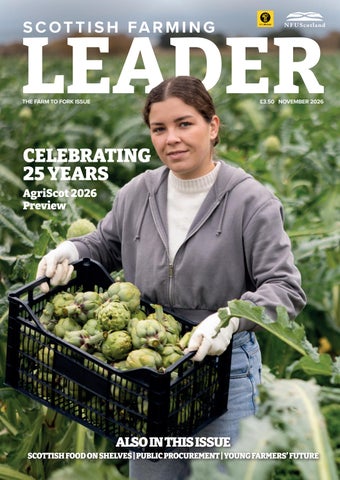
LEADER S C OT T I S H FA R M I N G
THE FARM TO FORK ISSUE
£3.50 NOVEMBER 2026
CELEBRATING 25 YEARS
AgriScot 2026 Preview
ALSO IN THIS ISSUE
SCOTTISH FOOD ON SHELVES | PUBLIC PROCUREMENT | YOUNG FARMERS’ FUTURE
Grown by Nature. Built for Living.
Low-energy homes designed for rural Scotland. Scan to explore.
The Keltie | A compact two-bedroom home.
01786 232770 info@hooseltd.co.uk
From family and succession homes to staff housing, holiday accommodation and rural diversification projects, Hoose designs and builds regenerative, low-energy homes using natural, carbon-storing materials. Our integrated team guides each project from land and design through to construction and completion, helping farmers, crofters and rural landowners create healthy, high-performance buildings designed for Scotland’s changing climate.
Explore what’s possible at hooseltd.co.uk
LEADER S C OT T I S H FA R M I N G
From the Editor From the Editor
NFU Scotland, Rural NFU Scotland, Rural Centre, West Mains Centre, West Mains Ingliston, Edinburgh Ingliston, Edinburgh EH28 8LT EH28 8LT
Megan Williams
EDITOR
A
s you well know, producing food is only part of the job. Getting it from the farm gate to the consumer relies on a network of businesses, facilities and infrastructure that we can sometimes take for granted. Today, the journey can be long and complicated, with fewer local facilities and greater pressure on the infrastructure connecting farmers and crofters with the people who buy their food. This month, we look at what it takes to bring more of that journey closer to home, from local processing to the businesses connecting producers with consumers. At AgriScot, we’ll continue that conversation, bringing farmers and the wider industry together to explore the opportunities, challenges and connections shaping the future of Scottish agriculture. Jordan Orme, NFU Scotland’s Professional Membership and Marketing Executive, explores this in more detail on page 16. With AgriScot celebrating it’s 25th year, there’s plenty to look back on, but also lots to look forward to. We also look at how policy decisions could shape the future of Scottish food. On page 22, Lisa Hislop, NFU Scotland’s Supply Chain Policy Manager, explores the potential implications of a proposed
Tel: 0131 472 4000 Tel: 0131 472 4000 www.nfus.org.uk www.nfus.org.uk nfuscotland nfuscotland @NFUStweets food price cap and why protecting @NFUStweets
progress in Scottish sourcing matters. Meanwhile, in our interview on page Editor 49, Jayne Jones, Chief Executive of the Editor Diana McGowan Scottish Food Commission, discusses Diana McGowan the opportunities to get editor@nfus.org.uk more Scottish editor@nfus.org.uk produce into public kitchens. Elsewhere, NFU Scotland CEO John Managing Editor Managing Editor Davidson explores the role businesses Craig Gibson Craig Gibson beyond the farm gate play in Scottish agriculture (p.9). This is part of our Design & Production professional membership recruitment Design & Production Ryan Swinney campaign, and why staying connected Ryan Swinney to farmers and crofters matters. Advertising Sales From the people producing our food Advertising Sales Clare Stebbing to the businesses processing, selling Clare Stebbing and serving it, every linkclare@connect in the chain clare@connect matters. Understanding communications.co.uk how those links work together, and communications.co.uk the 0131 challenges Tel: 561 0024 Tel: 0131 561 0024 and opportunities at each stage, is an important part of building a stronger Published on behalf Published on behalf Scottish food supply chain. of NFU Scotland by ofbrings NFU Scotland by As ever, this issue also together Connect Publications news, views and practical information Connect Publications (Scotland) Ltd. from across the Union, with updatesLtd. on (Scotland) Studio 2001, Mile End, the issues affecting members the Studioand 2001, Mile End, Seedhill Road, work being done on their12 12behalf. Seedhill Road, Paisley PA1 1JS I hope you enjoy. Paisley PA1 1JS
Keep up to date with all the news on Facebook or follow us on @NFUStweets @nfuscotland For the weekly news sent to your email, please send your name and membership number to contactus@nfus.org.uk Editor Megan Williams editor@nfus.org.uk Design & Production Mark Shreeve mark.shreeve@micropress.co.uk Andrew Hirst andrew.hirst@micropress.co.uk Advertising Sales Danny Lewis 01502 725862 danny.lewis@micropress.co.uk Lawrence Kenny 01502 725860 lawrence.kenny@micropress.co.uk
NFU Scotland Rural Centre, West Mains Ingliston, Edinburgh EH28 8LT 0131 472 4000 www.nfus.org.uk
Published on behalf of NFU Scotland by Countrywide Publications Fountain Way, Reydon Business Park, Reydon, Suffolk IP18 6SZ 01502 725800 Printed by Micropress Printers Ltd Fountain Way, Reydon Business Park, Reydon, Suffolk IP18 6SZ 01502 725800
Although every effort has been made to Althoughtheevery effortofhas made to ensure accuracy thebeen information ensure the accuracy of theNFUS information printed in this publication, cannot printedliability in this publication, cannot accept for errors orNFUS omissions. accept liability for errors omissions. The views expressed in thisorpublication The not views expressedthose in thisofpublication are necessarily the NFUS. are not necessarily those of the NFUS.
Diana Diana McG McG
H
OW often do you OW often do you see or learn about see or learn about something and something and think ‘I’m up for think ‘I’m up for that’, but then that’, but then never actually never actually realise that realise that positive thought/ positive thought/ silent commitment? Possibly too silent commitment? Possibly too often or not at all. often or not at all. In this month’s magazine, our In this month’s magazine, our two features cover inspiring stories two features cover inspiring stories and highlight just how rewarding and highlight just how rewarding delivering on such thoughts can delivering on such thoughts can be both for the individual involved be both for the individual involved and others who may benefit along and others who may benefit along the way. the way. We’re only a few weeks away from We’re only a few weeks away from the Royal Highland Show. Over the Royal Highland Show. Over the course of four days, thousands the course of four days, thousands will flock to the show to compete, will flock to the show to compete, judge, exhibit, organise, educate exhibit, organise, educate President’s Update and socialise. We’ll see the best of 4 judge, and socialise. We’ll see the best of the best and relish the atmosphere. bestPresident and relish the atmosphere. Vice Updates 7 the Among the highlights and away Among the highlights and away from the main show ring, this year the main show ring, this year News 9 from will see the welcome return of the will see the welcome return of the Golden Shears Sheep Shearing and Shears Sheep Shearing and Policy & Practice 22 Golden Woolhandling World Championships. Woolhandling World Championships. Taking place at the MacRobert place Activity at the MacRobert 40 Taking Regional Theatre, the 2023 Worlds will see Theatre, the 2023 Worlds will see more than 30 countries compete for FEATURES more than 30 countries compete for the prestigious title and it promises the prestigious title and it promises an action packed showcase of Abe griScot 2026 16 to to be an action packed showcase of the art, skill and techniques required the art, skill and techniques required to be a world champion. shelf space 22 toHard-won be a world champion. Perhaps a less well known event Perhaps a less well known event taking place at this year’s is Five questions with Highland taking place at this year’s Highland is 49 the final qualifying round of the 2023 Jayne Jones on the future the final qualifying round of the 2023 Britain’s Fittest Farmer competition. of public procurement Britain’s Fittest Farmer competition. Taking part in this event for the Taking part in this event for the first time is Kyla Graham from first time is Kyla Graham from Kirkcudbrightshire. Kyla first spotted Kirkcudbrightshire. Kyla first spotted the event at the Show last year and the event at the Show last year and while watching it thought ‘I’m up for while watching it thought ‘I’m up for that’. Kyla knew however she couldn’t that’. Kyla knew however she couldn’t just enter there and then. Like any just enter there and then. Like any competition, she understood you competition, she understood you need to be ready for it and without need to be ready for it and without knowing if she would even enjoy knowing if she would even enjoy it, she set her mind to it to finding it, she set her mind to it to finding out if she would. Kyla shares her out if she would. Kyla shares her journey from that moment to the journey from that moment to the present and highlights how she’s present and highlights how she’s benefited already in so many ways benefited already in so many ways both mentally and physically, and both mentally and physically, and explains about the positive impact explains about the positive impact her preparation has had on her her preparation has had on her working life. working life. • Dec 2025 / Jan 2026 | 3 Scottish Farming Leader
16
33
32
CONTENTS
22
a a C C r r f f S S h h 4 4 t t c c c c u u t t t t
l l w w I I f f s s a a e e i i n n S S f f M M
“ “ o o t t
President’s report From the
PRESIDENT Andrew Connon
F
or most, the harvest has been secured with satisfying yields. I sympathise, however, with those who struggled to get a dry day, particularly in Kintyre, Ayrshire, Caithness and Orkney. Reports of combines sinking and grain sprouting highlight just how localised our weather patterns can be, and how fine the line is between harvest success and disappointment. For those who have secured their grain, the next challenge is the marketplace: where to sell it and at what price. The malting barley market is presenting serious challenges for growers. It is another slap in the face for those who continue to produce a premium product without receiving a premium price. For malting barley to command a price below feed barley is deeply concerning and raises serious questions about the long-term sustainability of production. There is no doubt that the whisky industry is under pressure, but growers cannot be expected to shoulder a disproportionate share of that burden. Other cropping opportunities are being explored and, if these prove successful, the whisky industry risks losing growers who have supplied it for generations. We need distillers, maltsters and growers working together, with greater transparency, fair returns and a stronger commitment to long-term supply relationships. We continue to hold discussions with the supply chain at this very challenging time. October culminated in a trip to Liverpool for the Labour Party Conference. It was an intense couple of days of engagement, seizing every opportunity to get in front of Labour Ministers, MPs and MSPs. Headline topics included Inheritance Tax (IHT), input costs and imports, and our submission to the Treasury ahead of the UK Budget on 28 October. 4 | November 2026
By the time you read this, we will know whether any of our asks have been taken on board. These included a full reversal of the IHT reforms unveiled in the 2024 Budget; addressing the huge burden on employers caused by the increase in Employers’ National Insurance Contributions; broadening Capital Allowances to include buildings, while raising the Annual Investment Allowance to £5 million; reinstating full allowances on double-cab pickups; maintaining the cut in red diesel fuel duty beyond 31 December; and delaying the Carbon Border Adjustment Mechanism (CBAM), which is due to come into effect in January 2027 and will add costs to fertiliser. The additional cost per tonne remains unknown, which I highlighted as totally unacceptable. I made sure to speak with the Secretary of State for Environment,
in this together, and it is essential that we have a fully functioning supply chain without the volatility we have experienced recently in the beef sector. Yes, beef prices have improved but costs have risen considerably. Swings in beef prices do little to build confidence among producers and I highlighted the long-term damage done to the industry in 2019 and 2020. At the time, a 60p/kg drop in the deadweight price to £3.30 from the 2018 price prompted a major meeting attended by more than 500 farmers at Thainstone Mart. It was a time of despair and disillusionment for the sector, and it contributed to the decline in beef cow numbers. I also urged processors to talk up the sector rather than make nonsensical statements such as “nobody’s buying beef” or “nobody wants beef”. These phrases are commonly repeated at a
Our industry has so much to offer in terms of quality food, the rural economy, biodiversity, nature and landscapes Food and Rural Affairs, Dame Angela Eagle, focusing on the issues above, but particularly our concerns about Brazilian beef and the perilous state of the UK pig industry. I again pushed for a UK-wide meeting on the pig industry, and we will continue to put pressure on the UK Government to address these issues. Closer to home, a visit to Browns Food Group in Brechin provided an opportunity to discuss ambitions to grow Scotland’s pig industry beyond the current crisis. Recently, I was invited to speak at the Scottish Association of Meat Wholesalers (SAMW) Conference which gave me an opportunity to highlight the pressures facing producers and the need for transparency. We are all
time when there is a global shortage of beef. Our industry has so much to offer in terms of quality food, the rural economy, biodiversity, nature and landscapes. It encompasses far more than farmers and crofters, extending across the wider supply chain to our suppliers and customers. I am therefore delighted that our recruitment campaign continues to bring in new members, including farmers, crofters and our professional members. These include accountants, legal firms, machinery dealers, feed businesses and many other agriculture-related organisations. To all our new members, I warmly welcome you to NFU Scotland and thank you for your support!
Based on the fertile East Coast of Scotland, Grampian Growers is a trusted partner in agricultural supply and export. WHAT WE OFFER:
World Class Bale Handling Solutions
• Premium Seed & Ware Potatoes Saves up to 75% labour Saves up to& 50% straw • JOBS. Daffodil Bulbs Flowers TWO ONE MACHINE. • Extensive Storage, Packing & Distribution faciliFREEand * efficiency. ties, built for quality BIB OVERTROUSERS
WHY CHOOSE US:
with the purchase of a new Combi-Bale
• & Farmer-owned UK growers, quality led BED FEED Promotional code to quote to • Grown in Scotland’s ideal climate SFLCB-KAI • Certified high-standards, fully traceable crops Chop and feed haylage or silage Find •us at: Established expertise with industry knowledge Spread straw up to 49ft with * Terms & Conditions apply
Highland Hall Stand 141
T: 01244 394 258
minimal dust
E: sales@spread-a-bale.com
Request a demo:
Scottish Potatoes: Quality, Innovation and Markets For over 50 years, Grampian Growers has been at the heart of Scottish seed potato production, combining grower expertise, innovation and international trade. The farmerowned co-operative continues to invest in developing new varieties, strengthening supply chains and creating opportunities for its growers.
Breeding for the future Grampian Growers' established variety, GEMSON, has earned a strong reputation in the baby potato market, delivering high yields of uniform, small tubers and excellent disease resistance. Building on this success, the co-operative remains committed to developing the next generation of potato varieties, with promising new selections currently undergoing trials for fresh, salad and processing markets. The breeding programme focuses on improving disease resistance, climate resilience and crop performance, developing varieties better adapted to changing growing conditions and evolving market demands, while supporting the long-term sustainability and competitiveness of Scottish potato production.
Strengthening the potato supply chain Through its subsidiary, WM Fraser, Grampian Growers supplies quality chipping potatoes to over 115 fish and chip shops, wholesalers and hospitality businesses across North East Scotland, reaching as far north as Wick and the islands of Orkney and Shetland.
Operating from Montrose, WM Fraser sources specialist chipping varieties from trusted growers in England, carefully selected for their excellent frying qualities. With over 20 years of industry experience, the business prides itself on consistent quality, dependable deliveries and strong customer relationships. WM Fraser welcomes enquiries from new fish and chip shops and catering businesses seeking a reliable supplier of quality chipping potatoes.
Scottish seed potatoes for global markets Grampian Growers' seed potato business serves domestic and international customers, supported by specialist production, grading, storage and full traceability. Through Bennett Seed Exports, the co-operative supplies Scottish seed potatoes to established markets across North Africa, the Middle East and Southeast Asia.
Seed potato, variety and export enquiries: www.grampiangrowers.co.uk info@grampiangrowers.co.uk | 01674 830555
Chipping potato and fish & chip shop enquiries – WM Fraser: www.wmfraser.uk jon@grampiangrowers.co.uk | 07799 661333
November 2026
| 5
PROFESSIONAL PLANT HIRE & CONTRACTORS
From Source to Supply
Over 20 years experience in the plant hire and ground works trade providing professional, trustworthy and reliable contracting services to domestic and commercial customers across Scotland
Based in the Scottish Borders for 50 years, we provide services to domestic clients, farms and industries throughout Scotland, the North of England and beyond: • Well Drilling • Design, Supply & Installation of Pumping, Control & Water Treatment Systems
• Roads & Road Grading • Drainage • Renewables & Utilities • Landscaping • Forestry & Estates • Other services
• Pumping, Control & Water Treatment Systems Maintenance • Well Maintenance & Rehabilitation Services • Private Water Supply Assessments, Reporting & Rehabilitation
For all your private water supply needs, drilling works & more, contact us today:
01896 752295
www.holequest.co.uk
info@holequest.co.uk
Holequest Ltd, Winston Road, Galashiels, TD1 2DA
01738 827 377 | 07721 784 549 contact@cdmercercontractors.co.uk www.cdmercercontractors.co.uk 25 Taypark Road, Luncarty, Perth PH1 3FE
Wednesday 18 November 2026 Royal Highland Centre Ingliston, Edinburgh EH28 8NB
Beat the queues!
Register now for your FREE ticket
www.agriscot.co.uk
Register for your FREE AgriScot ticket and be in with a chance of winning a
Warrendale Wagyu Mixed Box* *
6 | November 2026
BOX WORTH OVER £110. TERMS & CONDITIONS APPLY.
Vice Presidents’ Updates Robert Neill
Duncan Macalister
Vice President
Vice President
The need for the shortest route
Autumn brings new decisions
here was a time when the journey from farm to fork was a much shorter one. Farmers produced food for their local market. Livestock went to local abattoirs. Processing happened much closer to where the food was produced and consumed. I know that world from experience. I’ve seen how the system worked when more of that infrastructure was on our doorstep, and I’ve seen what has happened as supply chains have become longer and more complicated. We talk a lot about food security, food miles and the importance of producing more food here in Scotland. But we also need to talk about what happens between the farm and the fork. If we want to produce more food in Scotland, we need somewhere for that food to go. That means investment in local abattoirs, processing facilities and the equipment needed to turn what is produced on Scottish farms into food that can reach Scottish consumers. When it comes to food production, we know what the ambition is. The First Minister came to our show and mentioned growth over a dozen times in his speech. If growth is the ambition, then we need to invest in the whole food chain. That means farms that can produce, local businesses that can process, and the infrastructure and equipment to connect the two. There is little point producing more food if we then have to send it elsewhere to be processed before bringing it back into the Scottish market. Shorter supply chains would keep more of that journey from farm to fork here in Scotland. They would support businesses in rural communities, give farmers and crofters more routes to market and make our food system less dependent on long and vulnerable supply chains. We’ve got to look at the big picture. If we know we want more food production in Scotland, then the next step is clear. Invest in the infrastructure that makes it possible. The farms are here. The ambition is there. Now we need to join the two. That is what farm to fork should mean.
s we head into autumn, with most of the arable work behind us, the focus turns to our winter routine, including getting livestock vaccinated, with pneumonia being one of the main priorities. But the big decision is BTV. When do we fit that into our vaccination programmes? It is something that needs considerable thought and discussion with our vets. At least the vaccine is becoming more readily available. We are now in a Restricted Zone, along with the rest of the United Kingdom. The impact on trading for all of us has now been mitigated, particularly when it comes to the paperwork. We now hope the effects of the dry, hot summer do not have an impact on calving and lambing percentages next spring. We like to follow everything from conception to plate, or farm to fork. This enables us to get feedback on what we are doing, whether it is right or wrong. I was thinking about when our cows or heifers settle in calf: it is, at the earliest, 25 months before we get a return on that investment, with no idea what the value will be. I am a farmer, but maybe I should be better described as a professional gambler! We had a great day on the farm when we hosted the head office team and regional managers. We had a farm tour, stock judging, quad bike driving, combine and tractor driving, including demonstrating the GPS in operation. I hope they all had an enjoyable day and got something out of it. The new Branch Chair Leadership Programme is also gathering momentum, with chairs, vice chairs and group secretaries coming together to share ideas, good practice and ways to strengthen branch activity. We are heading into branch AGM season, so hopefully I will be able to attend some and catch up with lots of you soon.
T
One win If we could get Donald Trump to stop starting wars
One worry He doesn’t stop
One to watch The price of crude oil
A
November 2026
| 7
Union News
SUPPORTING YOUR BUSINESS
Investing in your agricultural business By Gemma Cooper
W
Gill Johnstone with her partner Rob
Gill Johnstone remembered By Lucy Sumsion
N
FU Scotland was deeply saddened to learn of the death of Gill Johnstone on 12 September 2026, just weeks before her 69th birthday. Gill served as Group Secretary for Islay, Jura and Colonsay from March 1995 until her retirement in December 2018. Her commitment to the Union continued as Islay Branch Chair from January 2019, and the following month she received the NFU Scotland Miskelly Award in recognition of her exceptional service. Over more than two decades, Gill became a trusted friend and steadfast champion of farmers and crofters. Her deep understanding of island agriculture, generous spirit and determination to do the very best for members earned widespread affection and respect. Presenting her Miskelly Award, then NFU Scotland President Andrew McCornick described her dedication and enthusiasm as “a real inspiration for the agricultural industry”, praising the way she consistently went above and beyond for her local community. Gill’s tireless campaigning leaves a lasting legacy across the islands. She brought members together to lobby in Brussels against proposed changes to LFASS that threatened support for poorer ground, and led determined efforts in Brussels and at the Scottish Parliament to secure an adaptive management plan for barnacle geese on Islay. 8 | November 2026
NFU Scotland Deputy Chief Executive and Director of Policy Jonnie Hall said: “Gill was a fantastic advocate for farming and crofting, Islay, and NFU Scotland all rolled into one. Her unwavering commitment and passionate approach were an asset, and the recognition via the Miskelly Award was thoroughly deserved.” Following a diagnosis of young-onset dementia in 2020, Gill stepped back from Union activity but remained close to the life she loved, helping on the family croft and farm with her husband, Rob, for as long as she was able. Warm, generous and welcoming, Gill took great pleasure in hospitality. Together, she and Rob transformed a redundant farm building into self-catering accommodation and an office for her growing NFU Mutual business. When the new office opened in 2011, Gill laid on an impressive spread of local seafood and produce for members and visiting Mutual and Union office holders. On 27 September, Gill’s family, friends and NFU Scotland colleagues gathered to celebrate a life of friendship, service and devotion to the islands. Gill will be remembered with great fondness across Argyll and the islands for her couage, helpfulness, tenacity and enduring contribution to farming and crofting. Our heartfelt thoughts are with Rob, their daughters Samara and Rebecca, and all those in Islay’s farming and crofting community who knew and valued her.
e know that investment in Scottish agriculture is essential to secure domestic food production, drive rural economic growth, and meet national climate and biodiversity targets. Ideally, members should always have an eye to making investments that move their business forward, but we know that this can be a challenge when the operating environment makes affordability a challenge. Implementation of policy initiatives such as the Future Farming Investment Scheme can support businesses in making capital investments. However, we know that in tandem, access to other funding is vital. We await an announcement about the next round of funding, and members are urged not to put off investing planning in the meantime. Through our partnership with Anglo Scottish Asset Finance, members can access tailored loans, asset finance, business credit cards or refinancing options. Many members have already benefitted from this partnership, from making significant investments in critical infrastructure, to financing new and used machinery purchases. If you are interested in finding out more, you can scan the QR code below or call 07984 096430.
Welcome to our new members • Royal Bank of Scotland (RBS) • Britmilk, an Unlimited Company • AY Morton & Co Ltd • Alex Johnstone AI Services • Harper Macleod LLP • Morningside Rural Consultants • Regalis • Bells Seafood Ltd • D Steven & Son Ltd • Lorimer Cabs Ltd
A NOTE FROM THE CEO
Building stronger connections across Scottish agriculture John Davidson CEO
T
he future of Scottish agriculture matters to far more people than just those working the land. Across Scotland, thousands of businesses work alongside farmers and crofters every day. Whether it’s providing animal health services, financial advice, machinery, feed, insurance, legal support or new technologies, these businesses are helping agricultural enterprises succeed while building successful businesses of their own. For those businesses, understanding the issues facing farmers and crofters has never been more important. Scottish agriculture is navigating a period of considerable change. New technologies, changing policy frameworks, environmental expectations and evolving markets are all influencing how farm and croft businesses operate. For professional businesses serving the sector, staying connected to those developments is essential. That is why more businesses are choosing to become NFU Scotland professional members.
Professional membership offers direct access to the conversations shaping the future of Scottish agriculture. It provides insight into the challenges and opportunities facing farm businesses, helping members better understand their customers and the environment in which they operate. Just as importantly, it creates opportunities to build stronger relationships across the industry. One business that has seen the value of that connection is Birsay Farmers in Orkney. The co-operative, which serves around 1,200 members and supplies a range of products and services to agricultural businesses, joined NFU Scotland through its General Manager, Kevin Groundwater. For Kevin, professional membership provides an important link between suppliers and producers. As he explains: “Farmers change their approaches all the time, and their suppliers have to keep up.” That principle applies across the wider agricultural supply chain. Businesses that understand the pressures facing farmers and crofters are often best placed to support them, develop relevant products and services, and identify new opportunities as the industry evolves.
NFU Scotland’s professional membership network brings together businesses from across the rural economy, creating a valuable space for sharing knowledge, building connections and staying informed about the issues affecting the sector. Farming and crofting may sit at the heart of rural Scotland, but they do not stand alone. They rely on a wide network of professional expertise and support, and the strongest businesses recognise the importance of staying close to the industry they serve. NFU Scotland’s professional membership network helps strengthen those connections, bringing together farmers, crofters and the businesses that support them. As an NFU Scotland member, you likely work alongside trusted advisers, suppliers and service providers every day. If there are businesses in your network that would benefit from a closer understanding of the issues affecting Scottish agriculture, encourage them to explore professional membership and become part of the wider NFU Scotland network. Find out more about becoming an NFU Scotland professional member: https:// joinnfus.org.uk/professional-membership/
Presidential elections: nominations open
N
FU Scotland’s President and Vice President positions are due for election in February 2027. President Andrew Connon and Vice Presidents Duncan Macallister and Robert Neill have each completed their first two-year term.
Nominations open on Monday 26 October 2026 and must be submitted by 5pm on Friday 4 December 2026. For further information or a nomination form, contact John Davidson at john.davidson@nfus.org.uk or on 07776 957377.
November 2026
| 9
RSABI will celebrate its 130th anniversary in 2027 and there are so many ways for you to get involved and support Scotland’s farming community in this landmark year. From choosing RSABI as your company’s Charity of the Year, becoming a Friend of RSABI, playing The Farmers’ Lotto or taking on a fundraising challenge, to sponsoring popular events such as the Farmers’ Choir Charity Concert and Farmer Football Fundraiser, every contribution helps us provide vital emotional, practical and financial support to people in Scottish agriculture. With a wide range of events and partnership opportunities planned throughout 2027, now is the perfect time to get involved.
Get in touch to find out more: fundraising@rsabi.org.uk
www.rsabi.org.uk Helpline 0808 1234 555
NFU Mutual / ADVERTISEMENT FEATURE BUSINESS PLANNING
How resilient is your farm business?
A
s autumn turns to winter, many farmers are looking ahead to the challenges and opportunities the next year may bring. From unpredictable weather and rising costs to changing regulations and evolving business models, farming continues to operate in an environment of constant change. The reality is that resilience is no longer simply about getting through a difficult season. It’s about creating a farm business that can adapt, recover and thrive, whatever comes next. Here are five areas worth reviewing before the year draws to a close. 1. Look after your people People remain the most important asset on any farm. Yet agriculture continues to face challenges around recruitment, skills, workload and wellbeing. The autumn and winter months can be particularly demanding, with longer hours, poorer weather and increased pressure on both farmers and employees. Taking time to review working practices, refresh safety procedures and check in with those around you can make a significant difference. A resilient business depends on healthy, motivated people. 2. Protect your buildings, machinery and livestock Winter weather can put farms under considerable strain. Storms, flooding, power outages and freezing temperatures all have the potential to disrupt operations and cause costly damage. Now is a good time to assess buildings, electrical systems, fuel storage, machinery and livestock housing before the harsher weather arrives. Small preventative measures taken today can help avoid major problems further down the line. Many farmers are also investing heavily in new equipment and technology. Regular reviews can help ensure assets remain properly protected as businesses evolve. 3. Review how your business is changing Farms rarely stand still. New enterprises, renewable energy projects, environmental
schemes, contracting work and diversification ventures are becoming increasingly common across the industry. Each change brings new opportunities but can also introduce new risks and responsibilities. Taking stock of how your business has developed over the past 12 months can help ensure nothing is overlooked. The most successful farm businesses tend to combine innovation with careful planning. 4. Prepare for the unexpected Extreme weather events, disease outbreaks, supply chain disruption and market volatility have all highlighted the importance of business continuity in recent years. While no one can predict exactly what lies ahead, planning for potential disruption can improve confidence and reduce the impact should an incident occur. Simple questions can help start the conversation: What would happen if a key building became unusable? How would the business cope with a prolonged power outage? Is there a plan in place if essential equipment fails at a critical time?
with a trusted network of advisers, from accountants and land agents to solicitors and agronomists. Regular conversations with advisers can provide valuable insight, helping identify risks, opportunities and practical steps that support long-term success. As the UK’s leading rural insurer, NFU Mutual understands the unique challenges facing modern farming businesses. Whether you’re investing, diversifying, expanding or simply reviewing your plans, seeking advice early can help ensure your business remains resilient and prepared for whatever the future may bring.
To find out more, speak to your local NFU Mutual Agency. Find your local agency by visiting nfumutual.co.uk/find or scan the QR code with your smart phone camera.
5. Seek advice before you need it Many farming businesses already work Risk Management Services are provided by NFU Mutual Risk Management Services Limited and are not regulated by the Financial Conduct Authority or the Prudential Regulation Authority. The National Farmers Union Mutual Insurance Society Limited (No. 111982). Registered in England. Registered Office: Tiddington Road, Stratford-upon-Avon, Warwickshire CV37 7BJ. Authorised by the Prudential Regulation Authority and regulated by the Financial Conduct Authority and the Prudential Regulation Authority. A member of the Association of British Insurers.
Union News
Euan Bremner and Penny Montgomerie
“I’ll meet you at the Young Farmers Centre” By Glen Barclay, Chair of SAYFC Communications & Marketing
A
fter years of planning, fundraising and plenty of hard work from members past and present, the new home of the Scottish Association of Young Farmers Clubs (SAYFC) is finally making headway. Ground has now been broken on the new Young Farmer Centre, putting the organisation on track to have its new home ready for the Highland Show next year. SAYFC National Chair Euan Bremner said the start of construction was an important moment after a project which has taken longer than originally anticipated. “Getting ground broken now means that we’re still on track to be finished by the Highland Show, which is a big bonus because that is one of our main events in the year.” The project has required an extraordinary fundraising effort from clubs, current members, former members and supporters across Scotland. “The project’s been going on for a lot longer than we expected, and the fundraising efforts by our members and past members and others has been
12 | November 2026
extraordinary,” said Euan. “We’re really grateful for everyone that has donated so far.” The new centre will provide SAYFC with a permanent base once again, after recent Highland Shows have required the organisation to make use of temporary marquees and alternative spaces. With staff working out of premises elsewhere on the Royal Highland estate. For SAYFC President Sheena Munro, who has been involved with the organisation for decades, the importance of having a permanent home goes well beyond having somewhere to hold meetings. “I just feel it’s like Murrayfield to Scottish rugby or Hampden to Scottish football. We need a hub,” she said. “We need the base for people to know where you’re going. When you go to the Highland Show, everybody will meet you at the Young Farmer Centre.” That sense of having a home is particularly significant for an organisation whose membership and influence extend well beyond a person’s active Young Farmer years. Sheena said the organisation offers
something increasingly rare: a sense of belonging that can continue across generations. “There are not many organisations out there that can offer that membership-forlife aspect. The next generation comes through, but you still feel like you’re needed or wanted to help out.” The scale of the fundraising campaign reflects the affection in which the organisation is held by generations of members. “The Young Farmers means so much to so many people,” Sheena said. “They want to be involved in getting this new building up and running.” Euan believes seeing construction underway can now provide the confidence and momentum needed for the final stage. “We have to acknowledge that some folk were sceptical that this was ever going to happen,” he said. “But now that it is happening, hopefully they can see the progress being made and feel encouraged to get behind the project.” While the building is now underway, there remains work to be done to ensure it is fully equipped and ready to make the most of its first Highland Show. The support of the wider agricultural community will therefore remain important, whether through fundraising, sponsorship or getting involved with the opportunities being created around the new centre. One such opportunity is the planned donors’ board, including opportunities for agricultural businesses and individuals to showcase their own herds, flocks or families while supporting SAYFC. Sheena believes this could be particularly valuable given the connections Young Farmers has helped create throughout Scottish agriculture. “People have got so much out of Young Farmers and have met so many people to do with improving their herds,” she said. For an organisation which has relied heavily on the generosity and ingenuity of its members to reach this point, the message is clear: breaking ground is not the end of the fundraising story, but the beginning of the final push. “This is without doubt the most ambitious thing that SAYFC as an organisation probably has ever done,” said Euan. “It has been amazing to see some of the efforts that people have gone to, and some of the original ways that they’ve thought about trying to raise money.” The ambition now is to turn that extraordinary fundraising effort into a permanent home for generations of Young Farmers to come – and to hear a familiar phrase once again at the Highland Show: “I’ll meet you at the Young Farmers Centre.”
TRAMSPREAD: THE SLURRY AND DIGESTATE SPECIALISTS Complete solutions from storage to application
UMBILICAL DRIBBLE BARS
HOSE REELERS
REMOTE CONTROLS
NURSE TANKS
FLOATING COVER SYSTEM FOR SLURRY LAGOONS & IRRIGATION RESERVOIRS
COMPLETE UMBILICAL SYSTEMS OF ALL SIZES
ENGINE DRIVEN PUMPS
PTO PUMPS
SLURRY SEPARATORS
SLURRY STORAGE
SPEAK TO THE TRAMSPREAD TEAM TODAY
• +44 (0)1449 766133 • info@tramspread.co.uk • www.tramspread.co.uk scotnfuoct26.indd 1
14 | November 2026
10/10/2026 18:17:55
AgriScot 2026
AgriScot 2026
You don’t have to farm to have a stake in farming As AgriScot celebrates 25 years of bringing the agricultural community together, NFU Scotland is inviting the wider industry to connect, share ideas and discover the value of having a stake in Scottish farming says Jordan Orme, Professional Membership and Marketing Executive, NFU Scotland
S
cottish agriculture has always relied on more than the people working directly on the land. From the engineers designing machinery and the vets protecting livestock health to the advisers, suppliers and businesses helping farms run successfully, a much wider community has a stake in the future of the industry. That wider community will come together at AgriScot on Wednesday 18 November, as NFU Scotland once again supports one of the key dates in Scotland’s farming calendar. Celebrating its 25th year, AgriScot provides an opportunity for farmers, crofters and agricultural professionals to exchange ideas, explore new products and services, and build relationships across the industry. For NFU Scotland, it is also an opportunity to strengthen connections with the people and businesses whose work and livelihoods are closely linked to Scottish agriculture.
Recognising that contribution is at the heart of NFU Scotland’s professional membership campaign. Through professional membership, the Union is looking to strengthen its connections with the wider agricultural community and bring more of the people and businesses with a stake in farming into the conversation about the issues affecting the sector. AgriScot provides a fitting setting for that conversation. Few events demonstrate so clearly the breadth of businesses and expertise that contribute to Scottish agriculture, or how closely their futures are linked. For exhibitors, the event offers an opportunity to meet customers, build relationships and demonstrate how their products and services can support the sector. For visitors, it is a chance to compare products, seek practical advice and connect with people working across the industry.
“The future of Scottish agriculture also depends on the wider network of businesses, advisers, Meet NFU Scotland researchers, at AgriScot NFU Scotland will be at processors and Stand 2 in the Highland Hall service providers throughout AgriScot, with for visitors who work alongside opportunities to speak to the team about the sector every day.” the issues affecting Scottish
The people behind Scottish farming From agricultural finance and engineering to animal health, consultancy, technology and food processing, the sector depends on a network of skills agriculture and the work of and expertise that extends well Andrew Connon, the Union. beyond the farm gate. NFU Scotland President As part of its professional These businesses and membership campaign, the professionals play an important Union will also host an informal role in supporting farmers and networking drop-in session between 11am and crofters, helping them make informed decisions, 1pm. With tea, coffee and sandwiches available, improve efficiency and navigate an increasingly the session will offer professional members complex operating environment. They also and others working across the agricultural have a direct interest in the future of Scottish supply chain a chance to meet the team, make agriculture, from the resilience of domestic food connections and find out more about getting production to the strength of rural businesses involved. and communities. November 2026
| 17
AgriScot 2026
MEET NFU SCOTLAND AT AGRISCOT
FIND US AT Stand 2, Highland Hall
PROFESSIONAL MEMBERSHIP DROP-IN 11am-1pm, Stand 2 Tea, coffee and sandwiches provided.
Whether you are already a professional member or represent a business or organisation interested in joining, the session is an opportunity to explore how professional membership can help build stronger connections with Scottish agriculture. Building those relationships matters. A well-connected agricultural community helps share knowledge, creates 18 | November 2026
ANNUAL HEAD-TO-HEAD DEBATE 10am–11am, Seminar Room 1, Upper Foyer with Jim Fairley MSP.
DAIRY HUB SEMINAR 1-2pm Seminar Room 1.
opportunities for collaboration and strengthens understanding between the people producing food and those whose work supports them. Discussing the issues shaping Scottish agriculture Alongside its commercial exhibition, AgriScot features competitions, demonstrations, awards and seminars,
creating opportunities to share knowledge and consider the challenges and opportunities facing the sector. NFU Scotland will host its annual head-to-head debate from 10am to 11am in Seminar Room 1, Upper Foyer, with Jim Fairley MSP, followed by the Dairy Hub joint Seminar with Kite Consulting from 1pm to 2pm in Seminar Room 1. These sessions provide further opportunities to engage with the issues affecting Scottish agriculture, hear different perspectives and take part in the conversations shaping its future. As the sector navigates changing markets, rising costs, new technology and evolving environmental expectations, those connections will remain important. Farmers and crofters need access to expertise and practical solutions, while the businesses and professionals supporting them depend on a resilient and successful agricultural industry. AgriScot’s 25th anniversary is a reminder of the value of bringing that community together. For NFU Scotland, professional membership is one way to strengthen those links and ensure that the people and businesses with a stake in Scottish agriculture have an opportunity to connect with the Union and the wider industry. Because the future of Scottish agriculture matters to far more people than those working on the land. AgriScot 2026 takes place on Wednesday 18 November at the Royal Highland Centre, Ingliston, Edinburgh. Visit www.agriscot.co.uk for event information and free visitor registration. NFU Scotland’s professional membership team will be available at the Union’s stand throughout the event.
WWW.PENDERFEED.CO.UK Cattle Hurdles
The Home of Molasses
8ft, 10ft and 12ft in Stock
Before milk, comes molasses To maximise milk yields from forage remember to add Molasses! For more information about our extensive range of liquids and to find your local merchant please call us on 0151 955 4850 or visit www.unitedmolasses.com
Sheep Handling Systems
2nd Hand Wheeled bins
Prattley ATVAutodrafter Ramps
DogHook Pen Panels 2nd Hand over buckets
Bespoke Cattle Handling Weigh Crates Systems
Self Locking Yokes
Cattle Handling Setups WELL STOCKED. SPECIALIST KNOWLEDGE. GOOD SERVICE THINK PENDERFEED
MIDDLEFIELD, DUNS. TD11 3HT Peter 07967 387 577 bsanderson@penderfeed.co.uk Ben 07811 857 258
November 2026
| 19
INDUSTRIAL PRESSURE WASHERS John Syme & Co Ltd is based in Menstrie, Clackmannanshire and we cover the central belt, Fife and the Lothians, extending to Tayside and Border regions. We are happy to cover other areas if required. We supply, service and hire all types of cleaning equipment. Our main brands are Dirt Driver, Earle, Systemwash and DTE Nilfisk.
07803 495105 www.johnsyme.co.uk info@johnsyme.co.uk
The Smarter Way to Secure Your Farm Security that works From Scotland’s Farm & Rural Security Specialists
• Rural Security & CCTV • Remote Livestock Monitoring • Mobile Viewing from Anywhere • Professional Monitoring Someone’s always watching • NSI Gold Accredited
01382 217377 • farmerseye.co.uk
Unit 7 Larch Court, Myrekirk Place, West Gourdie Ind. Est., Dundee, DD2 4SS
20 | November 2026
Beatrice Morrice Head of External Affairs
Al Walker
Political Affairs Advisor
Political PULSE
A look at the conversations, meetings and decisions shaping Scottish agriculture, written by Al Walker and Beatrice Morrice BEHIND THE SCENES
WHAT’S NEXT
UNDER DISCUSSION
Who we’ve met and why it mattered
The key policy issues we’re working on
Key dates and decisions coming up
NFU Scotland was out in force at the Labour Party Conference in Liverpool, with President, Andrew Connon, Director of Policy, Jonnie Hall and Head of External Affairs, Beatrice Morrice attending meetings, events and receptions. The team met with Secretary of State, Dame Angela Eagle MP, Secretary of State for Scotland, Douglas Alexander MP, DEFRA Minister, Stephen Morgan MP, Scotland Office Minister, Melanie Ward MP, new Scottish Labour leader, Michael Marra MSP, as well as a number of MSPs and MPs. Discussions focused on NFU Scotland’s priorities ahead of the UK Budget, concerns around imports produced to different standards and the continued pressure of high input costs on farmers and crofters. NFU Scotland also held a briefing for SNP MSPs at the Scottish Parliament, with several MSPs hearing from President, Andrew Connon, Vice President, Robert Neill and Director of Policy, Jonnie Hall. Discussions covered agricultural policy, the importance of business viability and the need for regulation and legislation to consider unintended consequences. Further briefings with other political parties will take place over the coming months.
With the Scottish Budget due next month, NFU Scotland is making the case for increased investment in agriculture. Our submission highlights the real-terms reduction in agricultural funding in recent years, alongside the growing demands placed on farmers and crofters. We are setting out why sustained investment is needed to support viable farm businesses, maintain domestic food production and deliver on the wider expectations placed on the sector. We will meet with the Deputy First Minister and Cabinet Secretary for Finance and Local Government, to discuss our priorities, alongside meetings with representatives from other political parties. These discussions provide an opportunity to make sure the realities facing farmers and crofters are understood as budget decisions are considered, and to press for funding that recognises the importance of Scottish agriculture to the economy, food security and rural communities.
Food price caps The Scottish Government’s consultation on proposed price caps for essential food items is open until 24 November 2026. NFU Scotland is considering the potential implications for farmers, food producers and the wider supply chain, and the need to ensure primary producers are protected as proposals are developed. Members can share their views through the Scottish Government consultation.
NFUS at Labour Party Conference with Defra Minister Stephen Morgan
Meeting with Melanie Ward MP at Labour Party Conference
Scottish Parliament exhibition In November, NFU Scotland will host a three-day exhibition at the Scottish Parliament, showcasing the contribution farmers and crofters make through high-quality food production, climate and nature action, and sustaining rural communities. Our previous exhibition in 2024 engaged with more than a third of MSPs from across Scotland. With more than 65 new MSPs elected at the start of this Parliamentary term, this year’s exhibition offers an important opportunity to build relationships with new MSPs and highlight the contribution of farming and crofting across Scotland.
Exhibition in 2024
November 2026
| 21
Following the herd
Hard-won shelf space must not be sacrificed to flawed policy By Lisa Hislop, NFU Scotland’s Supply Chain Policy Manager
F
ood affordability is rightly high on the political agenda. The Scottish Government is currently consulting on proposals to introduce a food price cap on selected essential products, with the aim of helping consumers manage household costs and improving access to food. While the objective is understandable, it is important that the potential implications for Scottish agriculture and the wider food supply chain are properly understood before any decisions are made. As part of our response to the consultation, we asked members for their views. The feedback we received has been instrumental in shaping our response and highlighted a number of concerns around market distortion, sourcing decisions and the impact a food price cap could have on primary producers. One of the clearest messages from members was that, while any price cap would apply at the retail end of the supply chain, the consequences are unlikely to stop there. Farmers and crofters are operating in an increasingly challenging environment. Geopolitical uncertainty, climate pressures and volatile markets continue to influence costs, while primary producers often have limited ability to pass those costs on or fully recover them through the supply chain. Our response therefore focuses on ensuring policymakers understand the realities of food production and the importance of a fair return for those producing Scotland’s food. There are also significant concerns around sourcing.
If retailers are required to meet a fixed selling price, there is a real possibility that sourcing decisions become increasingly driven by cost. In those circumstances, retailers have been candid that lower-cost imported products could become the only option to comply with a food price cap, potentially displacing Scottish produce and disadvantaging businesses that are producing food to high standards. We have to question if this could risk the progress that has been made in Scottish sourcing? Our latest ShelfWatch report highlights that retailers are increasing their commitment to Scottish produce. The mid-year 2026 audit found that 26% of ownlabel products which were surveyed were Scottish, compared with 19% at the same point last year*. Every retailer surveyed increased its proportion of Scottish sourcing, with Aldi leading at 68% and Lidl reaching 51%. These figures matter because they represent more than shelf space. They represent the decisions being made by retailers to recognise the strategic importance of Scotland to the future of our food system and the value that consumers place on domestic food being available. It sends the positive signals needed to support confidence to invest, maintain processing capacity, create employment throughout rural Scotland and strengthen the resilience of domestic food supply chains. ShelfWatch shows that progress is possible when retailers actively choose to source from Scotland. It also highlights what could be put at risk if policy interventions unintentionally alter those sourcing decisions. For us, the key question that must be
Affordability cannot be considered in isolation from how food is produced
November 2026
| 23
Following the herd
considered by policy makers is not simply whether a food price cap might reduce prices at the till. It is whether such a policy can be introduced without damaging the viability of the future of our ability to produce high-quality food, while continuing to underpin rural communities, support climate mitigation and enhance biodiversity. This does not mean affordability and domestic food production are competing objectives. In fact, both are essential parts of a resilient food system. However, achieving both requires careful targeted policy design. We cannot simply avoid the tough realities and costs which come with producing food to high standards of food safety, animal welfare and environmental stewardship. Those standards are valued by consumers and policymakers alike, but they carry additional costs which primary producers cannot carry alone, something we continue to reiterate to both UK and Scottish Governments, processors, wholesalers and retailers. That is why we have been clear: any potential food price cap must have robust safeguards, comprehensive impact assessments and a full consideration of supply chain consequences before any proposals are progressed. As part of our engagement on this proposal, we have attended round tables with the third sector who highlight this policy won’t support those who are truly struggling with the reality of food poverty in Scotland. While the Scottish Government are attempting to face into
Progress is possible when retailers actively choose to source from Scotland the challenge of food affordability with this proposal, a universal food price cap is an incredibly broad intervention which some say could potentially disrupt the whole market instead of supporting those who really need it. Through our consultation response, informed directly by member feedback, we have sought to ensure that the voices of Scotland’s farmers and crofters are heard as this debate develops. Food affordability matters. But affordability cannot be considered in isolation from how food is produced. Any policy designed to reduce food prices must be judged not only on its impact at the checkout, but also on its impact on domestic food production, supply chain resilience and Scotland’s long-term food security.
*Due to changes in methodology, year-on-year figures provide an indication of trends rather than a direct comparison.
24 | November 2026
Farm Secretarial Services VAT Returns – Accurate and on time Software Setup & Training – Cloud accounting and MTD-ready systems Record Keeping – Efficient, organized, and HMRC-compliant Accounts, Payroll & Taxation Services also available
COMMERCIAL METAL BUNDED FUEL TANKS 1250 LITRE - £2,250 2500 LITRE - £2,795 5000 LITRE - £3,765 7500 LITRE - £5,000 10000 LITRE - £6,150
REDUCED PRICES
Friendly & knowledgeable staff with agricultural expertise
HOT WATER PRESSURE WASHERS
Please contact Gillian.Dixon@renniewelch.co.uk for more information
SINGLE PHASE, 3.5HP, 1800PSI, 11LPM.. £2,800 SINGLE PHASE, 5HP, 2200PSI, 14LPM..... £3,025 THREE PHASE, 7.5HP, 2700PSI, 25LPM... £2,950 THREE PHASE, 10HP, 3000PSI, 18LPM.... £3,300 PETROL, 16HP, 3625PSI, 25 LPM ..............£6,075
SPECIAL SALES OF STORE CATTLE Mon 16th Nov | Mon 14th Dec
Special Sale of Store Lambs – Fri 6th Nov Christmas Prime Stock Show & Sale – Fri 27th Nov Weekly sales of all classes of cattle & sheep
01856 872520
COMMERCIAL METAL BUNDED FUEL TANKS STANDARD SPECIFICATIONS
HOT WATER PRESSURE WASHERS STANDARD SPECIFICATIONS
• 3mm British steel • 230 volt / 60 litre per min pump • 6m delivery hose • Water & particulate filter • Mechanical flow metre • Auto shut off nozzle • Contents gauge • Deadlock with 2 keys • Lifting Eyes • Steel box section across the base for forklift access and to raise the tank from the floor • Painted green as standard (Anti -corrosion paint) • BS799, OFS T200 & SSAFO compliant
• Heavy duty galvanised steel cabinet • Hawk pump • Mains water feed or will suck from bowser / IBC • Ravel electric motor / Briggs & Stratton petrol engine • 10 or 20 metres high pressure hose • Complete lance • 8 metres of electric cable • Diesel fired boiler complete with 20 litre fuel tank • 20 litre detergent tank • Max temp 80C or can be run as a cold pressure washer. • Pressure can be regulated from max to 500 PSI
www.briannixonltd.com E: sales@briannixonltd.com | T. 01789 721112
www.orkneymart.com
Farm Business Consultancy Subsidy Advice - IACS (SAF) n Building Consultancy n Forestry & Woodland Management n n
Brian Nixon Ltd, Blakes Hill, Ullington, Nr Evesham,Worcestershire WR11 8QH All prices quoted are + VAT, ex works
Estate, Farm & Forestry Sales & Acquisitions n Estate & Farm Management n Valuations n
Carbon Audits & Natural Capital Agricultural Finance n Renewables & Utilities n Residential Estate Agency n n
For expert knowledge and advice contact your local office Aberdeen
01224 860 710
Ayr
Blagdon
01292 268 181
Inverness
01463 224 343
01670 789 621
Kelso
01573 224 244
Castle Douglas 01556 505 346
Morpeth
01670 331 500
Cupar
Edinburgh
01334 659 980
Penrith
01768 800 830
0131 240 6960
Perth
01738 451 111
Hexham
01434 693 693
Stirling
01786 434 600
Local n National n International n galbraithgroup.com
November 2026
| 25
Policy & PRACTICE
Shifting the focus from development to delivery Jonnie Hall
F
Deputy CEO/Director of Policy
or several years, Scottish agriculture has been immersed in a debate about the future. We have debated the architecture of agricultural support, the balance between production and environmental outcomes, the role of tiers and measures, the conditions that should accompany public funding and the evidence that farmers and crofters should be expected to provide. There has been no shortage of consultation, discussion and policy development. Much of that debate
26 | November 2026
has been necessary. Agricultural support must evolve to reflect changing circumstances, policy objectives and expectations. We know our industry must play a key role in meeting climate and nature goals, while managing market pressures and becoming more resilient. But the future support system can no longer simply be a policy discussion. The Agriculture and Rural Communities (Scotland) Act 2024 has provided the legislative framework. The Rural Support Plan has set out the direction of travel. The transition towards the new four-tiered approach is under way. We now need to move at pace in establishing how the new system will work, both from a farmer and crofter
perspective and in meeting the clear policy goals around food, climate, nature and people. Scotland’s agricultural profile is extraordinarily diverse. The circumstances of a dairy farm are very different from those of an arable or horticultural business, just as extensive hill farms and crofts face different challenges from mixed livestock finishing units or pigs and poultry enterprises. The new support system must be capable of recognising that diversity. That is where the focus on delivery becomes so important. Delivery starts with a fundamental principle: public support must recognise and support active farming and crofting.
Policy & Practice
participate, while ensuring that the requirements attached to public funding are proportionate to the outcomes being sought. We should not be opposed to conditions. Receiving public money comes with responsibilities, including demonstrating that public funding is delivering public value. But there is a difference between proper accountability and unnecessary complexity. Additional conditions, eligibility requirements, application processes and validation all come at a cost. Sometimes that cost is financial. Sometimes it is time, lost flexibility in managing enterprises, or the uncertainty and stress created when rules become difficult to navigate. The ultimate purpose of agricultural support is not to create an impressive administrative framework. It is to change what happens on the ground. That is particularly important for smaller farms, crofts and new entrants who may not have the administrative capacity available to larger businesses. A system designed to support active farming and crofting should not inadvertently make participation more difficult for the very businesses it is intended to support. But good delivery requires more than getting the rules right. There is little point in government
There is a very real distinction between supporting land simply because it is eligible and supporting the people and businesses undertaking agricultural activity on that land to deliver the intended goals. The future system must get that distinction right. If we want public support to underpin food production, maintain productive capacity and help farmers and crofters deliver better environmental and wider public outcomes, regardless of size, type or location, the foundation of the system has to be active farming and crofting. That does not mean putting production and the environment into separate boxes. One of the most important lessons we should take into the next phase of policy delivery is that they are fundamentally connected. Farm business viability and profitability are not optional extras in the pursuit of sustainability and environmental gains. The new system also needs to be sufficiently attractive and accessible to encourage farmers and crofters to
adequate backing is not delivery. Government must also recognise that agriculture is a long-term business operating within short-term political cycles. No government can promise that agricultural policy will never change, and nor should it, but governments can provide a clear direction, avoid unnecessary uncertainty and give businesses enough confidence to plan. That is why the stability provided through the Rural Support Plan during the transition to 2030 and beyond is vital. Farm businesses are also affected by decisions taken at Westminster on taxation, employment costs, trade, migration, energy and other economic levers. The viability of Scottish agriculture cannot be separated from those wider pressures. Our engagement with both governments will therefore remain critical. Our message must be consistent. If food security matters, back food production. If climate and nature outcomes matter, back the businesses that are going to deliver them. If rural communities matter, underpin the economic activity that sustains them. There will always be another scheme that could be tweaked, another condition that could be debated and another administrative detail that could be refined. But we should not lose sight of the bigger picture.
Ambition without adequate backing is not delivery setting out ambitious expectations for Scottish agriculture if the resources available to deliver them do not match those expectations. Farmers and crofters cannot be expected to maintain food production, improve environmental performance, adapt to climate change, enhance biodiversity, raise animal welfare standards and build business resilience while also absorbing extra costs. And those costs will not simply disappear. That is not a plea for agriculture to be insulated from economic reality. It is the economic reality. Ambition without
The success of Scotland’s future agricultural support system will not ultimately be determined by how sophisticated its architecture looks or how comprehensive its guidance becomes. It will be determined by what happens on Scotland’s farms and crofts. The debate about policy objectives, outcomes and future support frameworks has taken us a long way, and it has been necessary. But it is not sufficient. It is time to shift the focus and emphasis to delivery, and to properly back the active farmers and crofters who can and will deliver the outcomes. November 2026
| 27
Designed in Europe Specified for UK farms
A trailer can spend one minute crossing a rough field fully loaded and the next travelling on the road. But the solutions used across Europe aren’t always the same. Two traditions, one job Liam Lund, ADR UK Sales engineer: People assume that if an axle works on a European trailer, it will automatically suit a British one. Roberto, longest-serving ADR Group Sales Director, now consultant to ADR Group: The engineering principles are the same, but markets have developed differently. Square agricultural axles are common across continental Europe, while Britain has a particularly strong tradition of commercial-style round axles.
Part of a European group Liam: Being part of a European engineering group also means we can see where that technology is heading. Roberto: Some systems gaining ground on the continent are only beginning to attract attention in the UK. We can see that happening, while recognising that the UK market has its own requirements. Liam: But that doesn’t mean every British trailer needs it tomorrow.
Roberto: No. Britain has a strong tradition of robust, proven running gear that farmers understand and workshops can maintain. Our job isn’t to bring European technology here and tell customers to change; it’s to introduce new systems when they solve a genuine problem.
Technology with a purpose Liam: What sort of technology are we talking about? Roberto: Hydraulic suspension is one example. ADR is also developing ARIS independent suspension, TractionMax hydraulic drive and Dual-Function steering axles, responding to larger machines, more road use and the need for stability, traction and load management.
Liam: And there’s some interesting history behind that. Roberto: After the Second World War, surplus military axles and wheels were reused to build early trailers across Europe – JCB’s first farm trailer in 1945 used warsurplus Jeep axles. In Britain the link with commercial vehicle technology stayed strong, and the 127mm round axle became familiar on larger trailers.
Liam: So it's not about replacing what British farmers already know works?
A system, not a component Liam: We see this regularly in the UK. Trailers carry heavy loads across uneven fields and then travel on the road. Axles, tyres, suspension and brakes must all work together.
Liam Lund, UK sales engineer
Roberto Airoldi, ADR consultant
Roberto: Exactly. An axle is a component; running gear is a system. Suspension, brakes, wheels, tyres, load, speed and the towing vehicle all need to be considered together.
British Rubber Co.
07572 894 297, 01274 585 427 sales@britishrubberco.co.uk
Roberto: Not at all. A conventional axle and mechanical suspension may still be the best solution for many applications. But as machinery becomes larger and more demanding, we have access to a wider range of technologies. The important thing is choosing the right system for the job, not introducing technology simply because it's new.
itish ing Br t r o p p “Su g with farmin g” neerin i g n e d truste
ADR UK Tyremart
01400 283 820, 07923 593 014 sales@tyremartagri.co.uk
Policy & Practice
Beyond the farm gate: engaging and influencing Lisa Hislop
G
Policy Manager
etting food onto forks can take many forms, and every route to market brings its own challenges. I often describe my remit as the ‘post farm gate’, which ultimately covers how what you produce on farm reaches the end consumer, and the influence along the way. Perhaps even that is a bit of an oversimplification. In the 18 months or so since my role became dedicated to this space, we have made progress in certain areas, but there is still so much more to do. Over this time, we have strengthened our engagement with retailers, and the progress here is very visible within our ShelfWatch work. We have seen increases in Scottish and British sourcing, improved labelling, new Scottish lines and stronger in-store promotion. We are also now in frequent dialogue on the issues facing farmers and crofters, from the impact of BTV on livestock and the ongoing crisis in the pig sector to infrastructure challenges in poultry. Much of that discussion is focused on Scotland’s unique competitive advantage, which will only become more important as the climate becomes more volatile. More recently, we have expanded this
engagement across the supply chain, with a stronger focus on processors across the commodities. That has included meeting Müller to discuss ongoing concerns about the differential in milk prices, Browns to highlight the realities facing Scottish pig producers, and 2 Sisters to understand their investment in broilers. Step by step, we are working across the market to underline one consistent message: Scotland needs sustainable and profitable agricultural businesses if we are to keep delivering the raw products needed for onward processing and manufacturing.
Government Ministers to take forward and ultimately make meaningful change. There is however – as always – a significant amount of work to do. We continue to engage with Scottish Government on proposals for food price caps, highlighting the unintended consequences for primary producers. At UK Government level, labelling remains a key priority, particularly because it could unlock greater transparency around imports and the out-of-home sector. We are also continuing to call for the Fair Dealings Obligations to be extended to egg, fresh produce and combinable crops, introducing clearer terms and
We have seen increases in Scottish and British sourcing, improved labelling, new Scottish lines and stronger in-store promotion We have also made progress in public food procurement, calling on Scottish Government to establish a dedicated group to review the system and its barriers and opportunities. The aim is to rebalance procurement, so it looks beyond price and properly reflects the value and quality of local food in our schools, hospitals and other public places. The hard work on this begins now, we will work as part of the taskforce to make recommendations for Scottish
pricing mechanisms in those sectors. The work beyond the farm gate is never going to be finished. The routes from farm to fork are too varied, and the challenges facing each part of the supply chain continue to change. But the direction is clear. If we want to create a stronger market for Scottish food, we need to be around the table wherever decisions are being made, from retailers and processors, to government and public procurement.
November 2026
| 29
Policy & Practice
Scottish Land Commission strategy, what this means for members Rhianna Montgomery
T
Policy Manager
he Scottish Land Commission has published its 2026–29 Strategic Plan and programme of work. Built around People, Place and Opportunity, they aim to strengthen local influence over land-use decisions and widen access to owning, leasing and using land. For NFU Scotland members, the key issue is implementation. The Commission will support the Land Reform (Scotland) Act 2025, promote the Land Rights and Responsibilities Statement and advise government, increasing the focus on transparency, community engagement and the public benefits delivered by land-based businesses.
not weaken viable businesses. NFU Scotland’s test is whether delivery recognises food production, active land management and rural employment as public benefits. Land reform must complement agricultural support, planning, climate and nature policy. Measures should be evidencebased, properly resourced and developed with farmers and crofters.
Farmers and crofters should expect greater emphasis on community involvement where significant land-use change is proposed. Clear guidance and early engagement could reduce conflict, but new expectations must be proportionate and reflect the realities of producing food, investing and managing long-term change. Tenant farming remains central, with
They aim to strengthen local influence over land-use decisions stronger support for the Tenant Farming Commissioner and an expanded remit covering small landholdings. Work on landlord–tenant relations and new routes into land may help prevent disputes and support new entrants, provided it does
The strategy brings opportunities and challenges. We will continue to press for practical delivery, whilst encouraging members to provide us with the key evidence of the impact on rural businesses.
The leading UK The leading UK manufacturer of manufacturer of rubber grading rubber grading scrscreens eens for all typfor es of all gtypes rading equof ipmegrading nt . equipment. •Rubber grading screens • Rubber grading screens •Rubber web covers •Sample ri•ddRubber les web covers •Perforated washer belts
• Sample riddles • Perforated washer belts Contact AGRI-WEB Ltd Tel: +44 (0) 2891275913 Web: www.agri-web.co.uk Email: info@agri-web.co.uk
Contact AGRI-WEB Ltd Tel: 02891275913 www.agri-web.co.uk Email: info@agri-web.co.uk
30 | November 2026
Your Trusted Partner in Quality Firewood and Bespoke Timber We are a family-run sawmill, based at our own forest in Aberdeenshire
Quality Firewood
We provide seasoned and high-quality softwood and hardwood logs, which are sustainably sourced and ready to burn. Delivery available 7 days per week. See our website for pricing.
Bespoke Timber
We offer bespoke timber milling services up to 8m in both hardwood and softwood. We also provide a contract milling service to meet your specific requirements.
Contact us to order or discuss your project: 07766 653658 www.sunnysideforestry.co.uk
November 2026
| 31
Policy & Practice
Red Tractor seeks feedback on dairy assurance proposals
Bluetongue vaccination: protect your livestock and your business Penny Middleton
Bob Carruth
N
Policy Manager
FU Scotland urges Scottish dairy farmers and industry stakeholders to take part in Red Tractor’s consultation on proposed changes to Dairy farm assurance standards, which is due to close on 3 November. All Scottish dairy farmers will be members of this farm to fork assurance scheme, and you can view the proposed changes and respond to the consultation at www. redtractor.org.uk/bld-consultation The proposals for version six of the UK-wide scheme include revised audit requirements, a new code of conduct on animal care and handling, and changes aimed at reducing audit burden. There are also recommendations (not standards) on recommendations on cow comfort, environmental enrichment and foottrimming competence. This is an important opportunity to help shape future farm assurance standards and ensure the proposals are practical and workable for Scottish dairy farms. Over the past year, the sector specific Technical Advisory Committee for Dairy, made up of farmers, vets, processors, retailers and other industry representatives, have reviewed every audit point in version five of the standards against legislation, industry best practice, historical compliance levels, applicability, reducing audit burden and clarity. NFU Scotland has attended these important meetings. This is the first major consultation on standards since the wholesale 32 | November 2026
review of farm assurance schemes two years ago and the resultant recommendations around reducing audit burden, better communications and a move towards earned recognition. By consolidating and reordering requirements, reviewing audit points and removing prescriptive detail – where it does not add value – the proposals reduce the audit requirements for Dairy by one quarter. If approved, Dairy standards move from 157 standards and 377 audit points, to 172 standards and 238 audit points. Feedback from the consultation will be reviewed by the Dairy Technical Advisory Committee (in early January 2027) and Sector Boards, which will consider the information before confirming which of the proposals to move forward. Following assessor training, operational updates and UKAS approval, final standards will be published at least three months before implementation. For dairy, that is anticipated to be late autumn 2027. Through our involvement in the Red Tractor Dairy Board and the TAC, NFU Scotland is committed to streamlining the audit process itself, recognising and rewarding compliance, to help place less pressure on Scottish dairy producers during inspections. NFUS would encourage all dairy farmers to take part in this important consultation and help ensure these changes deliver real benefits on farm.
S
Policy Manager
cotland saw its first case of Bluetongue Virus 3 (BTV-3) in August 2026. The Scottish Government initially put a Restricted Zone (RZ) in place in the south-west, but has now extended it to the whole of Scotland. With no treatment for bluetongue, vaccination is an important tool for reducing the impact of the disease on your livestock and business. THREE STEPS TO PROTECT YOUR FLOCK 1. Vaccinate your animals Sheep can show some of the worst clinical symptoms of bluetongue, making vaccination particularly important. But cattle can also be affected, with the disease potentially impacting fertility, milk yield, growth and overall performance. Vaccination can reduce the risk of serious disease and deaths, while helping to protect breeding performance and reduce the costs and workload associated with an outbreak. 2. Speak to your vet early Do not wait until the disease is nearby. Depending on the vaccine and type of animal, one or two doses may be needed, with full immunity taking several weeks to develop. Recent vaccine shortages in the UK followed a period of low uptake, which led manufacturers to scale back production. With demand now increasing, getting your order in early will help ensure vaccine is available when you need it. Your vet can advise on the right vaccine and timing for your stock, including ahead of breeding, sales or movements. 3. Record your vaccination BTV-3 vaccinations for cattle, sheep and goats must be recorded on ScotEID within 5 days. You will need to record the animal ID/batch, vaccine name, dose, date and batch number. The message is simple: speak to your vet, get your vaccine ordered and make sure your records are up to date.
Policy & Practice
Nine meals from anarchy? David Michie
Y
Senior Policy Manager
ou may have missed it, but in September the UK Government urged the public to keep a few days’ supply of food and bottled water at home, as part of efforts to improve national resilience against risks including severe weather, cyberattacks and infrastructure disruption. Not large-scale stockpiling, don’t panic! Just enough to get through a few days if the systems we normally rely on are temporarily disrupted. If I’d seen that advice ten years ago, I would probably have dismissed it. Now, I’m not so sure. Since 2016, we’ve had significant trade disruptions with other countries, a pandemic and lockdown, and wars that have disrupted supply chains and increased costs for everyone. I think it’s fair to say that food and farming policy development hasn’t kept pace with the escalation of these threats. We, at NFUS, are influencing the political debate to recognise that food security is part of national security. This means making the case for governments to invest in domestic production and recognise agriculture as ‘critical national infrastructure’.
In Scotland, we need to see an increase, not a real-terms decrease, in Scotland’s agricultural support budget, ring-fenced and committed until at least 2030. Future support must reflect activity, not simply being in the right place at the right time when entitlements are granted. We also need a major capital investment and productivity programme for Scottish agriculture, enabling farmers, crofters and businesses across the supply
UK legal requirements), so that food produced to standards that would not be permitted here, does not simply undercut domestic production. And lastly, the cost of doing (agricultural) business is just too high. Policies that increase costs, like labour, fuel, and the Carbon Border Adjustment Mechanism (CBAM) must be re-examined and changed to support both domestic production and national economic growth.
Resilience cannot be built in the kitchen cupboard alone chain to invest in productivity, efficiency and resilience. But production is only sustainable if farmers and crofters can make a fair return. We need to see transparent supply chains giving fair returns to farmers and crofters, enabling them to invest in food production. And when it comes to imports, we need core production standards (equivalent to
A few days of food in the cupboard might make sense when the unexpected happens. But resilience cannot be built in the kitchen cupboard alone. It starts much further back, with a viable farming sector, productive businesses and the capacity to keep producing food when the world around us becomes less certain. That is food security. And increasingly, it is national security too. November 2026
| 33
SELLARS
SELLARS is part of the CLAAS dealer network. We sell agricultural machinery and parts and we service machinery, too. Alongside CLAAS, we are also dealers for several other leading agricultural machinery manufacturers, including Lemken. From our 7 SELLARS branches, our knowledgeable teams provide machinery and expertise to customers across Scotland, from the north all the way down to south of the Firth of Forth.
Visit www.sellars.claas-dealer.co.uk to find your nearest branch for all your agricultural machinery, parts and servicing requirements
FARM MANAGEMENT & CONSULTANCY SERVICES THROUGHOUT SCOTLAND
Farm Business Management • Farm & Estate Management Crop Consultancy • Support Schemes & Statutory Records Valuations & Compensation Claims • Other Professional Services 01888 563464 office@allathanassociates.co.uk www.allathanassociates.co.uk 34 | November 2026
Policy & Practice
What the first year of the 410-day rule tells us Lucy McGillivray Policy Manager
T
he first year of the Scottish Suckler Beef Support Scheme’s (SSBSS) 410-day calving interval condition provides useful evidence of what the policy is achieving, and important lessons for what comes next. Introduced for the 2025 scheme year, the condition linked eligibility to dams achieving a calving interval of 410 days or less, with first-time calvers exempt. Scottish Government has confirmed the rule will remain unchanged for 2026/27. The headline figures are encouraging. The mean calving interval fell to 391 days in 2025, the lowest recorded in the 2015–2025 series. The analysis also estimates that excess days over 410 for claimed dams fell substantially, equating to around 35,000 tonnes of CO₂e fewer excess emissions compared with 2015. These improvements demonstrate
the potential for better reproductive efficiency to support both productivity and environmental performance. However, the figures need to be considered in context. Changes in herd structure, market conditions and farmer behaviour, will also have contributed, meaning the emissions reduction cannot be attributed solely to the 410-day condition. The impact has also varied between businesses. Larger herds generally had a higher proportion of dams meeting the threshold, while smaller herds showed greater variation. This reinforces the importance of the derogation introduced for claims of 10 calves or fewer from 2026. Second calvers also warrant particular attention, with longer average calving intervals than the wider dam population. This highlights the need for policy to recognise the biological and management challenges associated with getting young cows successfully through their second calving. The first year shows that the policy can drive improvement. But sustained monitoring is essential. Ultimately,
SSBSS must support not just shorter calving intervals, but a productive, profitable and resilient Scottish suckler herd for the long term. As we look towards 2028 and beyond, the challenge is to make sure that support is not only retained, but designed in a way that gives farmers confidence to keep breeding cows, investing in their businesses and producing the high-quality beef for which Scotland is renowned.
The potential value of venison Georgia Watson Policy Manager
T
he Natural Environment Act 2026 saw Scotland enter a new era of deer policy, with Scottish Government mandating higher culls, expanding regulatory oversight, and ministers committing to producing a National Deer Management and Venison Plan within five years. The Common Ground Forum is now the central national platform bringing together farming, forestry, environmental NGOs, deer managers, sporting interests and government to agree practical, evidence‑based approaches to deer management. Earlier in 2026, NFUS hosted a webinar with BASC to support our members to discuss how the recent legislation changes would impact them and how to prepare, thus ensuring their
business was best equipped to manage deer going forward. At the time, BASC launched a new service, in essence acting as a ‘matching agency’ between deer stalkers and those needing their deer culled. These legislative commitments have inspired a viable venison market to be a greater part of the conversation,
lead on the Executive Committee of the Scottish Venison Association, as well as running her own small businesses, Findhorn Venison. The national plan requires ministers to include action to support venison markets, to secure investment in processing and chill facilities, better routes to market for lowland deer and
It is clear there could be a real opportunity to turn necessary deer management into a valuable, local food product within agriculture and environmental management. At a recent conference in Perth, the audience heard from Linzi Seivwright on the benefits of a more established venison market, from the ecological and health benefits as well as the paybacks of directly supporting local food producers. Linzi is the education
support for small-scale producers. It is clear there could be a real opportunity to turn necessary deer management into a valuable, local food product. A strong venison market and necessary infrastructure are essential to making deer management economically viable for farmers and crofters. November 2026
| 35
Regional ACT I V I T Y Farming is a people industry NORTH EAST REGIONAL MANAGER
Lorna Paterson
R
07786 860 453 lorna.paterson@nfus.org.uk
ecruitment has been a key priority lately, with CEO John Davidson joining David Greer and myself to visit some nonmember organisations. We are pleased to welcome Gordon and Conner Morison from Frendraught, Forgue, aboard, as well as Deirdre Falconer from Campbell Croft, and Robert Whiton and the Balmoral Estate at Ballater. John enjoyed his visit and will be coming up here again for another recruitment day and Regional Board evening meeting in the next couple of weeks. We are delighted to have new members joining us, as our industry needs as many voices as possible, especially at such a critical time when the political arena is so challenging. What a privilege it was to be invited to join the Deveron, Bogie & Isla Rivers Charitable Trust (DBIRCT) 25th Anniversary Dinner & Auction in September. The event was wonderful, with many rural folk from fishing, gamekeeping
CEO Recruitment North East G&C Morison, Forgue
and farming all supporting this fantastic charity. Jim Cruickshank and Richie Miller hosted the evening and raised over £25k, which will all be used to help preserve and improve the status of these wonderful river catchments. It is hoped that our NFUS North East farming clusters of members will work ever more closely with DBIRCT throughout 2027 and beyond, as we all share the same goal of maintaining healthy, clean rivers. NFUS members, Mike and Ness Duxbury, hosted an open day at Inclusive Farm Scotland’s McRobert Trust farm in Tarland earlier in September. There were many activities, including guided farm tours, feeding livestock and hearing the story behind the project’s creation. The showcasing of hands-on, inclusive learning and real work opportunities for people with disabilities and additional support needs by Mike and Ness is phenomenal. Little wonder the event was a sell-out! We hope that more money can
CEO Recruitment in NE with David Greer
be raised soon to ensure the necessary buildings and work can be completed as planned. There is most definitely a need to support and encourage inclusivity in our industry, and working with nature and animals can be such beneficial therapy for all involved. Finally, well done to Cairngorms Crofters & Farmers Community (CCFC), chaired by Robert McDonald, along with BASC, for hosting their incredible Wildfire event in Aviemore in September, with local politicians, Minister Fairlie and Fire & Rescue Scotland staff. The questions from the audience were compelling, with access to resources, better communication and a pause on muirburn resounding throughout the auditorium. NFUS will support CCFC as much as possible in this and other challenges. CEO Recruitment at Balmoral Estate (HRH) Robert Whiton Factor
36 | November 2026
DUMFRIES & GALLOWAY REGIONAL MANAGER James Thorburn in a crop of Sylvana seed at Farewell, Orkney
ORKNEY BY James Thorburn, GUEST WRITER
Farm to fork with Farewell Farms
F
arewell Farms is a family-run mixed farming business based near St Margaret’s Hope in Orkney. We are currently farming 315 acres on both owned and rented land. The team at Farewell comprises James & Ingrid Thorburn, Jim & Anne Seatter and one full time employee. The core business is the spring calving beef suckler herd of 85 breeding cows. We run a closed system breeding our own replacements with only bulls being bought in from registered herds. They are quarantined and BVD tested to ensure we maintain our high health status. We run one Aberdeen Angus bull with our heifers and have a further three Charolais bulls running with the main herd. We market our cattle through Orkney Auction Mart selling yearlings in the Spring grazing sales and stores off the grass in Autumn. We grow 40 acres of spring barley which is used for feeding. Alongside the cattle, we are the UK’s most northerly high-grade seed potato unit. Our location in Orkney provides natural isolation away from other potato-growing areas, creating favourable conditions for producing highquality early-generation seed potatoes. We work with Scottish, English and European seed houses, supplying potatoes to various sectors of the industry. In addition to seed production, Farewell Farms also grow ware potatoes using our own input seed. Each week we supply shops, pubs, hotels, restaurants and catering vans all over Orkney, the outer isles and Caithness with fresh local potatoes delivered directly from the farm to our customers. We have recently started growing swedes and carrots to add to our produce and we will soon be starting our own line of freshly made chips. We are stockists of Ugie Valley Feeds products including hay, haylage and straw. We also have a self-catering holiday home and run several 5kW wind turbines. For more information, please visit our website: www.farewellfarms.uk
John Cowan
john.cowan@nfus.org.uk
NFU Scotland Next Generation event A massive thank you must go to the Marchant family from Clonhie Farm, Penpont for hosting the NFU Scotland Next Generation event on Saturday 19th September 2026. Tarff Services, Lantra Scotland, Dumfries House, SRUC Barony campus and Farm Advisory Service provided information on training and career opportunities during the morning. Practical demonstrations were provided by ATV Services Ltd, Te Pari UK, Gordons Agricultural Equipment and G&T Solutions Ltd of the latest technical and practical developments to assist livestock and crop husbandry. Thornhill YFC administered a varied stockjudging competition of Angus breeding heifers, Cheviot gimmers and pigs to challenge the crowd. Following lunch, Ian Davidson from Scottish Land Matching Service chaired a discussion with three inspirational panellists who shared their journeys into the agricultural industry. • Helen Marsden farmed near Moniaive with husband Tom on a contract farming agreement with the landowner, alongside work as a fields person for Farm Stock - Scotland Ltd sourcing primestock to a network of UK abattoirs and store and breeding stock farm to farm. • John McCulloch is an apprentice auctioneer with Wallets Mart and has been a leading member of SAYFC and currently NFUS Next Generation Committee Representative for Dumfries and Galloway. • David Wyllie farms near Annan with brother Stewart and has diversified into a specialist fencing contracting business DWS Fencing, carrying out groundworks, drainage and fencing for both agriculture and industry. For those who missed the event and would like more information from any of the contributors, please contact John Cowan.
Joint stock judging with Stranraer and Rhins YFC
On 11 September, Stranraer and Rhins YFC held a very successful and well attended beef stock judging at Mid Knockglass Farm, kindly hosted by William Barrowman and family. Over 120 competitors attended and judged six classes of excellent forward store and breeding cattle, followed by excellent hospitality. Thanks to co-sponsors, Tarff Calley Ltd, United Auctions, J and S Montgomery and Academy Vets for your support. November 2026
| 37
Funded by the Scottish Government
Free and impartial energy saving support for your business Get in touch to access Scottish Government funding to help small and medium-sized enterprises save energy, carbon and money. Visit businessenergyscotland.org/farming Call 0808 808 2268
PPA04-01-0324 © March 2024
38 | November 2026
Policy & Practice
ARGYLL & ISLANDS REGIONAL MANAGER
Lucy Sumsion 07787 434 104 lucy.sumsion@nfus.org.uk
Top tips in the control of sheep scab
Following several successful meetings held in the region over the last year, here are some top tips from Dr Stew Burgess from the Moredun Foundation to help you control sheep scab. • Good biosecurity can prevent scab getting into your flock • A ssume all bought in or returning sheep are a scab risk – tups and hoggs returning from away-wintering are all high risk • Test for scab using the ELISA blood test or treat with an approved method • Testing is cost effective, saves
money, stops unnecessary treatments, slowing development of ML resistance • There are only two treatments for sheep scab – injectable MLs or plunge dip in OP – sheep showers are not effective in the control of sheep scab • Plunge dipping in an OP will kill mites that are resistant to the ML injectables • Sheep must remain in the bath for 1 minute and have their head dipped under the surface twice • Sheep scab is a notifiable disease. If you suspect signs of the disease, you must contact APHA • Contact neighbours with sheep in adjacent fields to warn them and/ or suggest they treat at the same time as you for maximum effect and protection Further information can be found at https://www.scops.org.uk/externalparasites/scab/
QMS Meat the Market meeting
Quality Meat Scotland are holding an open meeting on Tuesday 10th November, in the Royal Hotel, Argyll Square, Oban, PA34 4BE. The meeting will start at 7pm with tea/coffee and stovies available from 6.30 pm. The meeting will provide beef and lamb producers with practical guidance on target specifications for finished animals. Attendees will also receive guidance on grading home-finished cattle to help determine when animals are ready for sale and maximise returns. Flora Corbett of Mull Slaughterhouse will give an overview of the business and how to help maximise returns. Adrian Crowe, independent industry specialist, will explain market specifications, customer requirements, presentation of animals and minimising risk of carcase downgrades. Booking is essential and can be made here https://bit.ly/4hkJMPY
WEIGH IT. BAG IT. STACK IT. Bagging and weighing machines from 10 to 25kg sealing systems with medium/heavy duty stitchers and a range of options including sack presenters powered in-feed belt Total Sack Control Palletisers
Exclusive agents for:
t: 01353 740666 • e: sales@davidharrisons.com • w: davidharrisons.com November 2026
| 39
Regional Activity
AYRSHIRE REGIONAL MANAGER
Holly Fitsimmons EAST CENTRAL REGIONAL MANAGER
Kate Maitland
07919 001 23 kate.maitland@nfus.org.uk
Highland Perthshire Annual Tractor Road Run raises £2,520 for the My Name’s Doddie Foundation
35 tractors of all ages and sizes congregated at The Mill of Logierait Farm, courtesy of Peter and Fiona Guinan. This year’s route saw the tractors cross the Tay at Logierait, head up the south side of the river before crossing back to the north side at Pitnacree. Drivers continued up the north side of the Tay, heading to Kenmore, with a stop at the Courtyard for an ice cream, photoshoot and social. We then headed up Glen Quaich, stopping for lunch at the Loch before heading back to Wades Park, Aberfeldy, where we were met once again by a very supportive local community. Many thanks to Mains of Taymouth Courtyard at Kenmore, who kindly donated ice creams for those taking part.
Regional and Branch AGMs
It’s the time of year when Branch AGMs are undertaken and positions are to be filled. If you wish to become more involved in the Union, please do attend to find out more. Crieff Branch: Monday 16 November Perth Branch & Blairgowrie Branch: Thur 26 November Highland Perthshire Branch: Thursday 3 December West Fife and Kinross Branch: Friday 4 December North East Fife AGM: Tuesday 1 December Please keep a look out for the Angus Branch AGM date.
40 | November 2026
07775 838 926 holly.fitzsimmons@nfus.org.uk
Pause, connect, recharge
We were delighted to work alongside Woman in Agriculture and The King’s Foundation to bring together a wonderful group of women for a day focused on wellbeing, connection and community. From breathing meditation and an art workshop with Jan Laird, to Farmstrong and health checks from RSABI’s Health Hut, it was a brilliant opportunity to take some well-deserved time out for the hard-working woman in our great industry and a reminder of what’s possible when organisations come together. Thanks also to Darcey’s luxury home fragrance brand based within Balmoral Mill and Cafe, Galston for the beautiful gifts for all our guests. For more information and future events please see below: RSABI www.rsabi.org.uk – free 24 hour helpline 0808 1234 555 Farmstrong Scotland www.farmstrongscotland.org.uk Woman In Agriculture Scotland www.womaninagriculturesctland.com Save the date for the Woman in Agriculture Scotland AGM at Lanark Market on Saturday 14th November.
Your advert could be here
Join NFU Scotland as a Professional Member and unlock 50% off advertising in the Scottish Farming Leader
Just one of the benefits of connecting your business with Scotland's farming and crofting community
Discover the benefits of Professional Membership, contact Jordan Orme M: 07840854949 E: jordan.orme@nfus.org.uk
EUROPEAN ENGINEERING
BRITISH AGRICULTURAL EXPERTISE COMPLETE RUNNING-GEAR SOLUTIONS
FOR BRITISH AGRICULTURE
AXLES & STUB AXLES AGRICULTURAL & COMMERCIAL
SUSPENSION HYDRAULIC, PNEUMATIC & MECHANICAL
TALK TO OUR TEAM
about your next build or repair
42 | November 2026
TYRES & RIMS FOR AG & CON MACHINERY
01400 283 820, 07923 593 014 sales@tyremartagri.co.uk
SPARE PARTS ACCESSORIES & REPAIR KITS
BRAKING SYSTEMS HYDRAULIC, PNEUMATIC & MECHANICAL
07572 894 297, 01274 585 427 sales@britishrubberco.co.uk
SHETLAND REGIONAL POLICY ADVISOR
Johnina Henderson
From pasture to plate: The strength of Shetland’s farm and croft -to-fork supply chain
Shetland agriculture is well known for its resilience and top-quality livestock while maintaining elements of tradition and a deep connection to the unique landscape. Today, this is perhaps best showcased by our thriving local supply chain, which brings the exceptional produce of our islands directly from farm (and croft) to fork with minimal food miles, high health and welfare standards, and maximum traceability. We are fortunate to have our very own dairy. Shetland Farm Dairies continues to be a cornerstone of our community, processing and supplying fresh and high-quality dairy products that consumers know and trust. Having locally produced milk and butter readily available is a real asset to our island community which must not be taken for granted. Of equal importance is our local abattoir infrastructure. Having a dedicated facility in Shetland is not merely a matter of convenience; it is a vital part of our local food chain, enabling livestock producers to retain of the value of their produce within the islands. Producers such as Uradale Farm, alongside many other hardworking crofters and farmers, rely on this facility to process their beef and lamb. By processing and marketing their own produce locally, they are able to supply discerning customers, local shops, and hospitality businesses with high-quality meat that offers an authentic taste of Shetland. This integrated approach demonstrates the close connection between sustainable food production, animal welfare and environmental stewardship. Shetland’s low-intensity agricultural systems not only produce meat of exceptional quality but also supports biodiversity, maintains valuable habitats, and provides space for the abundance of wildlife that is such an important part of Shetland’s natural heritage. By choosing local food, consumers help support rural families, protect our natural environment, and strengthen the long-term resilience of Shetland agriculture. As we look to the challenges and opportunities ahead, strengthening and celebrating our local supply chain remains paramount. By continuing to champion Shetland-grown and Shetland-processed produce, we can ensure that the journey from farm and croft to fork remains short, sustainable, and proudly local. In doing so, we will not only preserve an important part of our economy and heritage, but also invest in the future of our communities, our environment, and our food security.
MSP Donald Mackinnon and Ed Mountain
HIGHLAND REGIONAL MANAGER
Stuart Head
Getting to know Highland members
I’m delighted to join NFUS as the Highland Regional Manager. I’m originally from Moray but primarily grew up in Oban on the west coast. I studied Geography at the University of Edinburgh, where my dissertation focused on comparing agricultural land management practices and their impact on soil microbiology. This gave me great insight into the critical relationship between farming practices, land management and the impact on soils. Before joining NFUS, I spent the past couple of years south of the border working for the NFU in a variety of policy roles. This included work on environmental and transport policy respectively, covering issues such as driving licences, abnormal loads, the carriage of dangerous goods, and load security. I also worked on wider projects, including a review of the NFU’s lobbying on Inheritance Tax. Since joining NFUS, I’ve been getting out and about, meeting members and learning more about their businesses, as well as hearing directly about the issues and challenges they face.
Cairngorm Wildfire Meeting
I recently attended the Public Wildfire meeting in Aviemore organised by the Cairngorms Crofters and Farmers Community, which allowed me to hear directly from industry about its concerns moving forward. I raised the importance of ensuring that farmers and crofters with practical, on-the-ground expertise, are properly involved in discussions around wildfire prevention, and subsequently called on Minister Fairlie to delay the implementation of the Muirburn Licensing Scheme until land managers are satisfied that it will not create barriers to reducing fuel loads and managing wildfire risk effectively. I also had the opportunity to meet several local and regional MSPs, as well as Highland Councillors.
Looking ahead
I’m looking forward to getting out and about across the region over the coming months, meeting more of you, learning about your businesses and making sure your views are heard. I look forward to getting to know you all. November 2026
| 43
Regional Activity
NFU Scotland Forth & Clyde and West Region Young Farmers join forces for successful stockjudging event FORTH & CLYDE REGIONAL MANAGER
Sheena Murray 07789 796 582 sheena.murray@nfus.org.uk
N
FU Scotland’s Forth & Clyde Region joined forces with SAYFC West Region for a successful joint open stockjudging event, held at Mains of Boquhan Farm by kind permission of Leanne Bertram and the Graham family. Mains of Boquhan provided an excellent setting for the evening with competitors of all ages putting their stockjudging skills to the test across an outstanding selection of dairy, beef and sheep. The event brought together members of the farming community for an enjoyable evening of friendly competition, with proceeds split between SAYFC West Region and Macmillan Cancer Support. The competition was judged by Robert Hunter and Robert Paterson, whose expertise and time were greatly appreciated. Scottish Farming Leader • February 2026 44 44 || November 2026
Results were as follows: UNDER 14S 1st Sophia Smiley (329 points) 2nd Darcy Bett (323 points) 3rd Katie Smiley (310 points) JUNIOR YOUNG FARMERS 1st Ben Graham (314 points) 2nd Alana Cormack (297 points) 3rd Jake Johnstone (295 points) SENIOR YOUNG FARMERS 1st Alexander Mitchell (324 points) 2nd Jack Graham (323 points) 3rd James Fleming (321 points) OPEN LADIES 1st Gemma Harkison (326 points) 2nd Stephanie Dick (325 points) 3rd Raven Hickson (312 points) OPEN GENTS 1st George Steel (332 points) 2nd David Mitchell Jnr (331 points) 3rd Alistair Nicholson (330 points) SIDE COMPETITION Winners Elizabeth Redpath and Elizabeth Groom NFUS Vice President Robert Neill was also in attendance, providing an opportunity for
members and Young Farmers to engage with him during the evening. The smooth running of the event relied on the efforts of many. Special thanks go to Leanne Bertram and her team for their hard work preparing and presenting the livestock on the evening. Appreciation is also extended to Forth & Clyde Regional Chair Rona Nicolson, the West Region Young Farmers organising team and all the runners, scorers and volunteers who assisted both behind the scenes and on the night. The event was supported by sponsors Forth Valley Vets, Lely, Semex, SCCL, Smith Contracts, A.L. Contracts, Advanced Ruminant Nutrition and Alta Genetics, whose contributions were greatly appreciated. The Forth & Clyde Region extends its thanks to everyone who attended and contributed to the evening’s success.
CO C OM ME EV VIISS IIT TU USS A AT T
FOLLOW US FOLLOW US
Engineered for Performance. ST S Built for Farming. TA AN ND D 11 4 40 Trusted by Farmers for Over 30 Years 0 High-quality slurry management equipment designed to deliver efficiency and reliability. FIND OUT MORE F OU
O
SCRAPE IT
PUMP IT
SEPARATE IT
Contact your local Storth representative
Neil Robinson 07393 149598
STORE IT
MIX IT
APPLY IT
From single machines through to complete turnkey installations, Haith has unrivalled experience and expertise in designing and installing vegetable handling solutions.
IN-TAKE
BOX TIPPLERS
WASHERS & DESTONERS
POLISHERS
GRADERS
OPTICAL SORTERS
TURNKEY SOLUTIONS
INNOVATION COMBINED
+44 (0) 1302 831911 sales@haith.co.uk www.haith.co.uk
November 2026
| 45
Regional Activity
LOTHIAN & BORDERS REGIONAL MANAGER
Lindsay Brown 07780 441 750 lindsay.brown@nfus.org.uk
World Sheep Dog Trials
Back in September the ISDS World Sheep Dog Trials were held at Huntington Farm just outside Lauder in the Borders. Rachael Roberts, Relationship Co-ordinator for the Borders, attended the four days of competitions and reported back. On a glorious autumn day the event started with an impressive opening ceremony; 300 competitors and their dogs were led by a local pipe band down to the trials field, the 34 national flags of each country being carried by local school children. The hosts the Runciman family must be congratulated for their warm hospitality, commitment to hosting such a successful and memorable occasion. The ISDS delivered an excellent event. Exceptional talent was showcased throughout over the four days, with dogs and handlers from around the world demonstrating remarkable skill with the overall champions pair coming from Wales. It was great to catch up with members and meet competitors, supporters, and visitors from around the world. 46 | November 2026
MSP at Morebattle Tofts
Environmental Land Use chair, Debbie Playfair, invited new MSP Jamie Langan to Morebattle Tofts to have a tour round the farm. This was a chance to showcase the areas which had great environmental and biodiversity benefits which ran seamlessly with the main livestock and arable business of the farm. There was discussion on wider agricultural policy and its benefits to the Scottish economy. Jamie was also able to ask any questions which would be helpful for him as he sits on the Rural Affairs Committee.
Price Cap discussion at East Lothian Produce
MSP Tom Arthur, Minister for Business and Fair Work (and leading the Scottish Government’s public consultation and stakeholder discussions regarding proposed legal price caps on essential food), was invited by NFU Scotland to East Lothian Produce to talk to Tracy McCullagh, Sarah Logan and Billy Logan about the true impact any proposed price caps would have on the business they run. They were able to show the minister the scale of investment they had made in their business to provide high-quality local food, the staff they employed. It was made clear that it should not be the farmers who bear the financial burden to meet the food price cap. The Logan family left him in no doubt of the strain that would place on their business.
MANUFACTURE & SUPPLY A WIDE RANGE OF STEEL AGRICULTURAL BUILDINGS & EQUIPMENT
Sheep, cattle and pig handling and feeding systems, crushes, creeps and troughs in galvanised steel for long-life in the field.
01668 281464 | info@glendaleengineering.co.uk | glendaleengineering.co.uk Berwick Road Ind. Estate, Wooler, Northumberland NE71 6AH
BRITISH-GROWN TREES, HEDGING AND PLANTING ESSENTIALS, ALL IN ONE PLACE From nursery to planting site, we have everything you need. Origin Green-tech brings together quality British-grown trees, hedging and shrubs from British Hardwood Tree Nursery (BHT), alongside a comprehensive range of tree protection and planting essentials.
• Plant Healthy certified quality and UKprovenance plants • UK contract-grown stock you can rely on • Full support from Origin Green-tech’s sales team • All your stock and tree planting materials available on one order
Order today by calling 01423 332100 or visit www.green-tech.co.uk sales@green-tech.co.uk
@origingreentech
green-tech-ltd
TAKING ORDERS NOW FOR 26/27 SEASON!
November 2026
| 47
DM FORKLIFTS LTD STONEHAVEN
LYNDON BARRAS STONEHAVEN AB39 2XP
CAT, Schäffer & Leguan dealers for NE Scotland Large range of New and Used Agriculture & Construction Equipment for Sale & Hire: Telehandlers 4 Metre – 26 Metre Excavators 900Kg – 14 Tonne Access Platforms 12 Metre – 28 Metre Dumpers 1 Tonne – 9 Tonne Spider Lifts 13 Metre - 27 Metre
Tel: 01569-760210 Email: derek@dmforklifts.co.uk
Please Visit our Website: www.dmforklifts.co.uk
BD SUPPLIES
Advisory Warning Boards See us at
Visit us at Agri-Scot, Lowland Hall - Stand 196
Upland Hall stand 238
ROOF MOUNTED Suitable for escort vehicles and wide loads
Suppliers of Hoof Trimming & Animal Husbandry Equipment 01738 842996
sales@bdsupplies.co.uk www.bdsupplies.co.uk 48 | November 2026
A versatile range of Advisory Warning Boards featuring reg 65 approved amber LEDs and high visibility yellow and red chevrons DIRECTIONAL ARROW HAZARD WARNING
NUMBER PLATE MOUNTED
Using class leading technology, Wilderness Lighting supply some of the highest quality and brightest LED lighting available on the market today for both on and off road use.
www.wildernesslighting.co.uk | 01525 852419
Five questions with...
Five questions with
Jayne Jones
Chief Executive of the Scottish Food Commission Explaining how public procurement could open up new opportunities for Scottish farmers and crofters. What is the Food Commission? The Scottish Food Commission is a new, independent public body established under the Good Food Nation (Scotland) Act 2022. Our vision is Making food work for all. Our purpose is to provide evidenceled, independent scrutiny of Scotland’s progress towards becoming a Good Food Nation. The Scottish Government, local authorities and health boards are required to prepare Good Food Nation plans, setting out the outcomes they want to achieve, how these will be delivered and how progress will be measured. The Commission will scrutinise those plans and their delivery, undertake research, provide advice and make recommendations. The first national Good Food Nation plan was published in December 2025, while local plans from local authorities and health boards are expected by April 2028. Independence is fundamental to our role. It enables us to assess progress objectively, follow the evidence and ask challenging but constructive questions. We also want to work collaboratively with everyone who has an interest in Scotland’s food system, including farmers, crofters and their representative organisations. What’s your role within it? As Chief Executive, I lead the development of the Commission and work with Commission members to turn our statutory responsibilities into effective, evidence-led scrutiny. My role is to ensure our work is independent, rigorous and accessible, and that it contributes to better decisions and outcomes across Scotland’s food system. Building relationships and learning from those working across the food system are central to that role. Through visits, events and discussions with farmers, crofters and their representative bodies, I have already had some valuable opportunities to hear about the opportunities and challenges
facing producers, and I’m looking forward to hearing more views. This engagement helps ensure our scrutiny is informed by robust evidence, practical experience and an understanding of how policies operate on the ground. As a new organisation, we will continue to listen, learn and work constructively with the industry, while maintaining our independence. How will it impact farmers and crofters in Scotland? Farmers and crofters are fundamental to Scotland’s food system. They produce food, sustain rural and island communities, support local economies, care for land and livestock, and contribute to action on climate change and nature restoration. Much of what they already do aligns closely with the ambitions and outcomes of the Good Food Nation Plan. Our role is to scrutinise whether public bodies’ plans and actions are coherent, credible and capable of delivering meaningful outcomes. Farmers and crofters should have opportunities to help shape local plans, ensuring that they reflect the realities of food production and draw on producers’ knowledge and experience. A stronger focus on local, sustainable food has the potential to benefit producers, communities and consumers. It could strengthen local supply chains, connect more Scottish produce with public kitchens and local markets, and build greater resilience across our food system. Food production cannot be considered separately from land use, the environment, public health, rural development, procurement, skills or fair work. We want
to understand where policy works, where it creates unintended consequences and where greater coherence or longer-term thinking is needed. How will you measure success? Success will be measured by whether our evidence and recommendations improve decisions, strengthen accountability and accelerate progress. We will look for clear outcomes, credible measures and evidence that public bodies are learning and adapting. We will consider whether action is delivering better outcomes for people, producers, communities, animals, nature and the planet. Prevention will also be important. A successful food system should help prevent poor health, food insecurity, environmental harm and economic vulnerability, rather than responding only after problems become entrenched. What’s the bigger picture? Food connects almost every part of our lives, communities, environment and economy. Scotland cannot become a Good Food Nation through one policy or organisation acting alone. It will require leadership, collaboration and honest, evidence-led assessment of progress. Farmers and crofters must be central to that conversation. Policy decisions affect them, and their knowledge and experience are essential to developing practical, lasting solutions. The Commission will maintain a clear focus on outcomes, provide independent scrutiny and help ensure commitments translate into meaningful action. That is how we will pursue our vision of making food work for all. November 2026
| 49
Farmer's Market V-Mac Silos Full Range of Storage Options available
A Winder & Son 07779 185 562 www.vmacsilos.co.uk
FOLLOW THE
LEADER?
FOR ADVERTISING OPPORTUNITIES WITHIN SCOTTISH FARMING LEADER, CONTACT A MEMBER OF OUR TEAM
Lawrence Kenny - 01502 725 860q Custom-built solar powered lawrence.kenny@micropress.co.uk water pumps Emily Morris - 01502 725 830 q Farmer friendly q Cost effective emily.morris@micropress.co.uk q Sustainable q 12 month’s warranty on all parts q Made in Scotland Overton of Ardo, Methlick, AB41 7HT • Tel: 07712 397862 • ardo.water@btinternet.com
Farmer’s Market ardowatersolutions.com
• Custom-built solar powered water pumps • Farmer friendly • Cost effective • Sustainable • 12 month’s warranty on all parts • Made in Scotland • Aluminium boxes and framed solar panels • Recycled plastic pallets and back doors
• Pressure vessel • Pressure gauge • Integrated pressure switch • Self-priming pumps • Pump to a maximum vertical lift of 100m across 1000m or more • Maximum open flow 6 gal per min • Maximum of 7,000 ltr per da Supply plasson fittings and water pipe
q Custom-built solar powered water pumps q Farmer friendly q Cost effective q Sustainable q 12 month’s warranty on all parts q Made in Scotland
q Aluminium boxes and framed solar panels q Recycled plastic pallets and back doors q Pressure vessel FM_Poacher Block Quarter Ad FC July 20_X4 CMYK fixed.pdf q Pressure gauge q Integrated pressure switch q Self-priming pumps
q Aluminium boxes and q framed Pumpsolar to a panels maximum vertical lift of 100m across q Recycled plastic 1000m or more q pallets Maximum open flow 6 gal per min and back q doors Maximum of 7,000 ltr per day q Pressure vessel q Pressure gauge q Integrated pressure switch
Fertiliser | Seeds | Agrochemicals | Feed | Minerals Animal Health | Crop Packaging | Dairy Supplies ardowatersolutions.com
Your farming supplies people
Turriff Office: 01888 569569
AgriScot stand 79
q Self-priming pumps q Pump to a maximum vertical lift of 100m across 1000m or more q Maximum open flow 6 gal per min q Maximum of 7,000 ltr per day
www.actionfarm.co.uk actscotland@actionfarm.co.uk
ardowatersolutions.com
£7,500 + VAT
(£9,000 + VAT)
October 2025
50 | November 2026
1
07/08/2020
PROVEN TODAY. READY FOR WHAT’S NEXT. The Case IH Optum 270–340 hp range combines the power and versatility to tackle demanding workloads with the technology and efficiency to keep your business moving forward. Did you know? Scottish Machinery Ring Members can benefit from exclusive rebates on all new Case IH Optum tractors. Speak to your local dealer today to find out more.
Save thousands on a new car with discounts for NFUS members A3 35 TDi 150ps Sportback Sport S-tronic Diesel List Price £34,745 NFU Discount £5,447 Member Price £29,298 Q5 SUV S-Line TDI Quattro 204ps S-Tronic Diesel List Price £56,610 NFU Discount £7,100 Member Price £49,510
Tucson Black Line 1.6T 150PS 2WD Auto List Price £35,185 NFU Discount £4,858 Member Price £30,327 Santa FE Ultimate Plug-in Hybrid 1.6T 288PS 7 seater 4WD 6AT List Price £56,445 NFU Discount £8,622 Member Price £47,823
All models and specifications available
www.nfus.motorrewards.co.uk 01522 467999