Anglia October 2026
Farmer
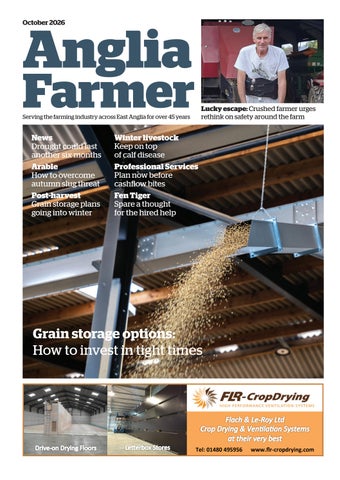
Lucky escape: Crushed farmer urges rethink on safety around the farm
Serving the farming industry across East Anglia for over 45 years
News Drought could last another six months Arable How to overcome autumn slug threat Post-harvest Grain storage plans going into winter
Winter livestock Keep on top of calf disease Professional Services Plan now before cashflow bites Fen Tiger Spare a thought for the hired help
Grain storage options: How to invest in tight times
Tel: 01480 495956
www.flr-cropdrying.com
S PA C E MAKES MONEY Diversify your farmland into a thriving shipping container self storage business Why use 1st Containers? Dedicated account management Supporting farmers with expert advice Depots throughout the UK
1stcontainers.co.uk 01708 558 700 sales@1stcontainers.co.uk
Buy or Hire
Anglia Farmer
OPINION Johann Tasker
EDITORIAL Editor: Johann Tasker | T: 07967 634971 E: johann@ruralcity.co.uk
Design: Mark Shreeve | T: 01502 725839 E: mark.shreeve@micropress.co.uk
Advertisement production: Jade Soanes | T: 01502 725840 E: jade.soanes@micropress.co.uk Polly Coleman | T: 01502 725841 E: polly.coleman@micropress.co.uk
ADVERTISING SALES Danny Lewis | T: 01502 725862 E: danny.lewis@micropress.co.uk Lawrence Kenny | T: 01502 725860 E: lawrence.kenny@micropress.co.uk Emily Morris | T: 01502 725830 E: emily.morris@micropress.co.uk Anglia Farmer is a controlled circulation magazine published monthly for farmers and growers in the eastern counties. To be included on the circulation list, a farmer must have a minimum of 70 acres of land, or 50 dairy/beef stock, or 50 breeding sows/250 growing stock, or 15,000 laying hens/broiler chickens. Intensive horticulture units are required to have a minimum of two hectares. Subscription is £18 a year (including postage). No responsibility can be accepted by the publishers for the opinions expressed by contributors. If you no longer wish to receive this magazine, please email gemma.mathers@micropress.co.uk © Countrywide Publications 2026 Published by Countrywide Publications, Fountain Way, Reydon Business Park, Reydon Suffolk IP18 6DH T: 01502 725800 Printed by Micropress Ltd, Suffolk.
Visit our website for all the latest farming news
Act now to get ahead of autumn uncertainty
R
ecent rain has been welcome after such an extraordinarily dry summer. Fields are greening up, drills are moving and, from the roadside at least, things are beginning to look reassuringly normal. Yet looks can be deceptive. Months of sustained rainfall are needed to replenish aquifers. Many farms could remain in drought until April. At the same time, flea beetle are back with a vengeance on oilseed rape and wetter weather has brought slugs back to the surface just as autumn crops are emerging. Market upheaval
There is similar upheaval in the grain market. Black Sea disruption and disappointing European crops are supporting prices, but plentiful global wheat stocks and hesitant buyers could quickly pull them the other way. Selling opportunities may emerge this autumn and winter, but they could be short-lived. The full consequences of the past season will gradually ratchet up over the coming months. As winter forage stocks tighten, so too will livestock cashflows. Growers too will continue to face challenges around grain prices. Forecasting those gaps now – and making plans to overcome them – will give farm businesses more time and more options than discovering them when cash becomes tight.
Contents
It also makes the question being posed at November’s National Farm Management Conference particularly timely: are today’s growers and livestock producers farmers or business managers? The answer, of course, is both. And doing both well is increasingly important for farm businesses to thrive at a time of economic and agronomic uncertanty. Knowing your numbers
Good farming will always depend on husbandry, experience and knowing your land. Increasingly, though, it also means knowing your numbers, watching markets and recognising trouble early enough to respond. As we have seen this year, noobody can control the weather, predict grain prices with 100% accuracy or know precisely what next season will bring. But businesses can take action to improve their ability to withstand all of those uncertainties. In farming, good management is increasingly about being proactive, taking decisive action, having a contingency plan and accepting we all need to be flexible in our thinking – making sure you are ready when the things you cannot control refuse to behave as expected. Johann Tasker Editor
Vol 47 • No 10 • October 2026
News . ................................................................... 4 Arable . ................................................................. 9 Post-harvest Technology ......................... 27
Winter Livestock ........................................... 39 Professional Services ..................................49 Fen Tiger .......................................................... 66
OCTOBER 2026 • ANGLIA FARMER 3
News Drought could last another six months England faces prolonged lack of rainfall
W
ater restrictions could continue into next year despite forecasts for a wetter autumn as the impact of the summer drought continues. Environment Agency modelling suggests 120% of typical rainfall is needed over the next seven months for all areas to recover. Even under the most likely weather scenario, East Anglia and Devon and Cornwall are expected to remain in drought until April. Defra water minister Emma Hardy said: “Recent rainfall is not yet enough to replenish all the water we’ve used over the last six months, and I will be carefully monitoring the actions of water companies which will be vital as we go through the autumn.”
Supply pressure Almost three-quarters of England remains in drought. The government is pressing water companies to maintain leakage reduction and follow drought plans as reservoir and groundwater levels continue to decline. There is roughly a one-in-four chance that about half of England will remain in drought next spring. The Environment Agency currently puts the risk of severe drought in the coming months at about 1%. Water demand rose by as much as 30% on the hottest summer days, says the government. England received just 56% of typical spring rainfall, followed by 64% during summer.
Great Brington village following the fifth summer heatwave of 2026 4 ANGLIA FARMER • OCTOBER 2026
Farm investment Agriculture is among the sectors facing pressure after drought contributed to a difficult harvest and tightened irrigation supplies. The government has announced a £65 million package for affected farmers. This includes up to £15 million towards on-farm reservoirs, aimed at allowing businesses to capture more water when rainfall is plentiful. Planning changes will also make it easier for non-water companies to develop reservoirs by allowing qualifying projects to be considered nationally significant infrastructure. Longer resilience Ministers are pursuing wider investment to increase water capacity as extreme weather puts greater pressure on existing infrastructure. Plans include nine major reservoirs by 2050, alongside desalination plants and water-transfer schemes. A further £100 million has been allocated to improve resilience to extreme weather and wildfires. The National Drought Group is now meeting weekly to monitor water resources and coordinate the response. Ms Hardy said water companies must continue acting during wetter weather. “They need to maintain momentum. We expect to see leaks fixed quickly, drought plans followed without delay and continued work to reduce demand to help avoid any further restrictions.”
Reservoir levels keep pressure on farms Low reservoir levels are keeping pressure on agricultural water supplies despite forecasts for a wetter-than-average autumn. Public reservoirs remain at concerning levels following the summer drought. Water supplies must continue to be balanced between farming, households and the environment, while companies work to secure supplies for next year.
Rain outlook “The drought situation remains very serious, and we cannot underestimate the challenge ahead over the coming months,” says Environment Agency chief executive Philip Duffy said The Met Office expects an increased likelihood of warmer and wetter-than-average autumn. This should help replenish water levels but it will take months of rain to erase the accumulated deficit. “The latest Met Office seasonal September to November outlook points towards the increased likelihood of a warmer and wetter than average autumn,” said Met Office head of environment and energy Sarah Davies. The developing El Niño could increase the chance of wet and windy conditions later in autumn.
The UK’s #1 online Get the best price for your grain
crop marketplace
TRUSTED BY
3,000+ FARMERS
Make every tonne count Free for farmers to trade and get impartial market insights
M
Plus, Members get more... Get the full market picture Know what your crop’s really worth
Take control of your fulfilment Easily manage your movements & cash flow
Earn more through Hectare Earn up to §¥²¦¥«t more on grain you sell±
Sign up today Search “Hectare Trading” or visit wearehectare.com
Trade anytime- any1here + on desktop and mo6ile *See website for full terms
News
Crushed farmer urges rethink on farm safety • Routine job caused devastating injuries • Lone working magnified accident risk • Mobile phone proved crucial lifeline
A
Hertfordshire farmer crushed beneath 1,500kg of hay bales is backing calls for safer working practices after being told he had a 75% chance of never walking again. Will Dickinson suffered 12 broken ribs, eight spinal fractures and a fractured pelvis when three bales fell from a trailer on his family farm near Harpenden. Now recovering at home, the sixth-generation farmer hopes his experience will persuade others to reassess routine jobs and the risks of working alone. “I was doing a job I’ve done hundreds of times,” he said. “In hindsight I should have gone around to check if the bales were safely resting on the trailer.” The accident happened on June 20 as Mr Dickinson was loading hay alone. The trailer became unbalanced and three bales fell as he pulled a strap over the load. Despite the severity of his injuries, his first reaction was to continue working. “I didn’t feel much pain at the time. I just thought I’d get these bales off me and crack on with work. “It was only later that I discovered how bad the injuries were and the im-
6 ANGLIA FARMER • OCTOBER 2026
pact they would have on me.” Mr Dickinson managed to reach his mobile phone while trapped and call for help. He was taken by air ambulance to the Royal London Hospital, where he spent six weeks. The prognosis was initially bleak. “I was told at the hospital there was a 75% chance I would never walk again, which was a huge shock. “I went through some very dark periods in those days after the accident. The thought of not being able to walk or care for myself for the rest of my life was devastating.”
Recovery target Two operations on his back and pelvis followed. More than two months after the accident, Mr Dickinson is home and expected to make a full recovery. Prompt treatment at the scene and specialist hospital care mean doctors now expect him to make a full recovery from his injuries. He has two metal rods in his back and currently uses a walking frame. “I’ve given myself a target of March next year to be back to how I was before the accident. I’m confident I will get there,” he said. “The care I received from the paramedics and from everyone at the hospital was amazing - it is now up to me.” His wife, Jan Dickinson, said the accident underlined the importance of carrying a charged mobile phone. Mr Dickinson had previously used a phone to summon help after becoming trapped beneath dual tractor wheels in 1998. “All farmers should have a mobile phone on them when lone working – if Will hadn’t been able to call for help and be treated quickly, his injuries could have been much worse,” said Ms Dickinson. “Will is so careful but these accidents can happen to anybody. I urge people to take extra care and prioritise their safety.”
Will Dickinson is rebuilding his strength after a serious farm accident.
“
I was doing a job I’ve done hundreds of times
Left: Mr Dickinson was
taken by air ambulance to the Royal London Hospital
Industry toll Health and Safety Executive figures show 29 farm-related deaths across Great Britain in the year to March 2026, six more than in the previous year. About 8,000 farm workers suffer non-fatal injuries in Britain each year, including serious and life-changing incidents. Mr Dickinson, a former NFU East Anglia regional board chair and NFU Hertfordshire chair, is supporting the union’s work to promote safer working. He chairs the Hertfordshire County Show and has campaigned through the NFU against fly-tipping. “Farming can be a very dangerous job, with lots of pressure, often working alone for long hours, but you should never take your safety for granted,” he said. “I feel very lucky and I know things could have turned out a lot worse for me.” NFU Hertfordshire county adviser Freya Samuel-Smith urged farmers to assess risks before starting work and remove them where possible. “Our message is clear, one serious injury or death on farm is one too many and no job is worth risking your life for,” she said. The family has received offers of practical help, including with harvest. Ms Dickinson said: “Farmers have been calling up, offering to help with harvest and to help in any way they can. “We have been blown away by everyone’s support.”
RESERVOIR DESIGN & BUILD SECURING YOUR FUTURE WATER SUPPLY Complete agricultural reservoir solutions Consultancy, surveying, design, permitting, construction and maintenance from one specialist team, helping clients achieve long term water resilience.
DESIGN & SURVEY
PERMITTING
CONSTRUCTION
WATER RESILIENCE
Consultancy, feasibility, engineering and reservoir design
Full planning & permitting service provided by our experienced team
Complete reservoir delivery and infrastructure
Practical storage solutions for agriculture and horticulture
Talk to Miles Water Engineering about your reservoir project
Water Resilience Specialists Designing and delivering water storage solutions that secure the future of farming 01359 242356 contact@miles-water.com www.miles-water.com
Independent repair, service and Parts Specialists for Land Rover Vehicles We offer a daily delivery service across Norfolk and north Suffolk and aim to deliver within 24 hours of receiving your order.
01603 787064 enquiries@jsf4x4norfolk.co.uk www.jsf4x4norfolk.co.uk 1 Spar Road, Norwich, Norfolk, NR6 6BY
MOTs • SERVICE REPAIRS • VEHICLE UPGRADES • PARTS • 4X4 TYRES
Arable Rain revives slug threat to crops this autumn • Drought fails to remove threat • Monitoring guides pellet timing • Calibration improves accuracy
R
ecent rain has restarted autumn drilling and revived the prospect of serious slug damage in emerging crops after the dry summer, ADAMA UK has warned. Growers are being reminded to monitor fields, study forecasts and prepare calibrated spreaders. Slug pellets should be used only after surface activity is confirmed and when settled weather will protect the application. “Given how hot and dry conditions were throughout the summer, there's an assumption that the threat posed by slugs could be reduced this autumn,” said David Griffiths, technical manager for crop protection specialists Adama UK. “Unfortunately, that's not strictly true as although slugs need moisture to remain active, they are exceptionally well adapted to surviving adverse conditions.” Wet weather prompts surviving slugs to seek fresh seedlings. Damage at emergence can destroy entire plants. Delayed treatment can therefore expose growers to establishment losses.
“
Regular slug counts are a priority.
Above right: David Griffiths: Monitoring essential Slug activity is threatening seedlings this autumn despite the dry summer
Regular slug counts are a priority. Growers should also check the forecast closely, said Mr Griffiths. Spreaders should be calibrated and ready once slugs appear and a favourable, settled period is expected. “Slug pellets should only be applied once slugs have been seen on the soil surface, and only if weather conditions are favourable,” he added.
Precision Products should not be spread immediately before heavy rain because poorer quality pellets can degrade quickly. A failed application can leave seedlings exposed. Pellet dimensions, weight and shape influence spreading ballistics and application accuracy. Equipment must be set up correctly. ADAMA recommends a forward speed of about 12kph to maintain a consistent spread. Two key pellet types from Adama are manufactured to a 2.5mm by 2.0mm specification. Gusto Iron contains 2.94% ferric phosphate, while Ferrabait contains one per cent elemental iron. At typical field rates, both products are designed to provide 40 to 50 baiting points per square metre. Their bright blue colour allows growers to assess coverage in seed-
beds and judge when a second application is needed, says Mr Griffiths. Adama claims the two products suppress slug appetites after ingestion. Its Desidro Technology uses a two-stage drying process intended to balance wet-weather persistence with palatability and improve resistance to mould. Independent trials cited by the business found that both pellets retained their shape, colour and palatability and remained mould-free for up to a week longer than other leading brands in wet conditions. “Developing and manufacturing high quality slug pellet takes a lot of time, research and testing,” said Mr Griffiths, “so it isn't safe to assume that different products will offer the same level of protection.”
OCTOBER 2026 • ANGLIA FARMER 9
Arable
Hub targets better returns from phosphate spending
G
rowers are being urged to examine how effectively crops use phosphorus before spending money on further applications, as new tools seek to improve returns from fertiliser inputs. A new Phosphate Stewardship Hub shifts the focus from how much nutrient is applied to how much crops can access. It uses yield, grain analysis and soil information to identify where phosphorus uptake is restricted. Launched by De Sangosse with support from ADAS, the hub is based on the premise that soil indices alone can provide an incomplete picture. Soils may contain significant phosphorus reserves while crops struggle to obtain enough at critical periods. “It’s not how much phosphorus you apply. It’s how much the crop can access and use,” De Sangosse said.
Harvest clues The hub builds on the company’s Phosphate Stewardship Guide, developed with ADAS. It encourages growers to
use the harvested crop to assess their existing strategy. Yield and grain analysis can calculate phosphorus offtake. Results can then be compared with soil analysis, rooting, establishment and field observations to identify constraints. ADAS senior research scientist Christina Baxter said harvest provided a valuable opportunity to assess performance. “The harvested crop is effectively the report card for the season,” she said. “Grain analysis, combined with yield information, can be used to calculate actual phosphorus offtake and provide greater insight into how effectively the crop has captured phosphorus.” Evidence from the ADAS Yield Enhancement Network has found big variations in grain phosphorus concentrations and crop offtake, including between crops grown at similar soil phosphorus indices. The findings suggest growers should look beyond soil status when
Better phosphate use reduces input costs, says Christina Baxter Left: The hub is helping growers to improve nutrient efficiency.
deciding how to manage phosphate. The hub divides potential limitations into three areas: crop access to phosphorus, its availability and the utilisation of existing soil reserves. De Sangosse commercial technical manager Rob Suckling said: “Rather than starting with what to apply, we want growers and agronomists to start by asking what is limiting phosphorus uptake. “Once you understand whether the challenge relates to access, availability or utilisation of existing soil reserves, you can make a much more informed decision about what needs to change.” Options are organised around three principles: Protect, Place and Unlock. Protect aims to maintain the availability of applied phosphate. Place focuses on improving root access to fertiliser, while Unlock seeks to use reserves already held in the soil.
Practical decisions A new Phosphate Clinic video series accompanies the hub. Dr Baxter and Mr Suckling examine harvest results, poor phosphorus access and ways of diagnosing constraints. For growers, the commercial argument is about extracting more value from phosphate expenditure rather than simply increasing inputs. Better phosphorus capture could improve nutrient-use efficiency and returns on fertiliser investment. It could also reduce losses from fields, with benefits for water quality. The hub encourages growers to treat phosphorus management as a cycle. Harvest performance informs diagnosis, which determines whether inputs need protecting, placing differently or whether existing soil reserves can be used more effectively.
Grain storage and handling
JH Vaudrey & Son Ltd
Steel framed buildings Groundworks All types of concrete Turnkey projects
Phone: 01379 678459 Email: info@jhvaudrey.co.uk
www.jhvaudrey.co.uk 10 ANGLIA FARMER • OCTOBER 2026
AGRICULTURAL & INDUSTRIAL STEEL BUILDINGS • Grain Stores, Livestock Shelters, Barns, Stables & Equine Arenas, Machinery & Equipment Storage etc. • CE & UKCA Certified Hot Rolled Steel Frames • Any Size Available - Made to Order • Nationwide Delivery Available • Weatherproof, Secure & Long Lasting • 30+ Years of Steel Construction Experience • One-on-One Project Support from Design to Completion
SCAN HERE TO REQUEST A FREE QUOTE
02476 659767 kitbuildings.co.uk sales@kitbuildings.co.uk
Is your property off the main sewage network? Do you have a septic tank? If so, we can install a new sewage treatment plant and provide a maintenance service. As well as servicing existing treatment plants.
Trimble RTK GPS Land drainage
t. Es 24 19
Drivers Seats
FOR ALL DRAINAGE AND SEWAGE TREATMENT PLANT NEEDS
Thomas Scott Seating Ltd
PICK FROM OUR LARGE RANGE OF SEATS Large stocks and most next day UK delivery!
Sewage Treatment Plant and Servicing
Forklift seats and seat spares for all types Full stock of GRAMMER seats and spare parts KAB SCIOX tractor seats Full range of economy tractor seats Truck seats from GRAMMER, KAB and ISRI Seat repairs, covers & spare parts for all ranges
01236 421835 info@drivers-seats.com www.drivers-seats.com
SUPPORTING BRITISH FARMERS! Ditching, Hedging, Flailing ELMS FARM, WELLS CORNER, LAXFIELD, SUFFOLK IP13 8EG
01986 798888 mail@lescottoncontractors.co.uk Supporting the NHS in East Anglia
OCTOBER 2026 • ANGLIA FARMER 11
Arable
Sparkler shines with repeat orders after drought test • Wheat tops farm performance • Growers increase autumn area • Robust yields despite drought
S
parkler winter wheat has won repeat orders from growers after topping yields on two farms despite prolonged drought and an unusually early harvest. The Group 4 soft wheat yielded up to 8.65t/ha during its first commercial season since joining the Recommended List in December 2025. Growers also reported good standing ability and relatively straightforward disease management. For Shropshire farmer Andrew Dalton, the result prompted a fivefold increase in the area planned for this autumn. Mr Dalton, who farms near Bridgnorth, grew just over 8ha of the variety last season. It was drilled at 115kg/ha on 19 September.
Farm results The crop received a standard pre-emergence herbicide followed by a post-emergence treatment and aphicide. A conventional four-spray fungicide programme was used, with no additional rust treatment required. “Overall, I would say it was pretty straightforward to manage despite the presence of yellow rust in our crops,” said Mr Dalton, who is drilling 40ha of Sparkler this autumn. “It stood well, remaining pretty clean throughout the year, and kept its green leaf a bit longer than the other wheats we’d drilled around the same time.” Harvested on 22 July, Sparkler averaged 8.65t/ha. That made it the farm’s highest-yielding winter wheat despite being grown on light land during near-drought conditions from May onwards. The variety also topped the farm performance table for Lincolnshire grower Paul Sheardown, who farms in the Vale of Belvoir near Grantham. He drilled 20ha as a first wheat after maize. Sparkler was grown alongside Arnie, Scope and Champion. All four varieties established well, although Sparkler appeared noticea12 ANGLIA FARMER • OCTOBER 2026
bly slower during spring. It remained healthy and clean, with no septoria or rust observed.
Rainfall deficit The main challenge came from exceptionally dry weather. Only 72mm of rain fell between 16 March and mid-July, compared with the farm’s normal monthly rainfall of 50-60mm. The conditions resulted in its earliest harvest on record. Sparkler was the last of the four wheat varieties to be cut, on 16 July. It yielded 8.3t/ha and beat the farm’s next-best winter wheat by about 0.5t/ha. “Of the four varieties we grew, Sparkler never looked the best variety at any stage,” said Mr Sheardown. “However, at the weighbridge, where it really counts, it delivered on the old adage of ‘looks for show, yield for dough’.” The crop received 220kg/ha of nitrogen in two applications during March and April. Like Mr Dalton, Mr Sheardown says he will certainly grow the variety again. Disease challenge Results were less clear-cut for Herefordshire farmer Ruth Gilder, but Sparkler remained competitive during a difficult season. She grew 12.6ha
Sparkler delivered competitive yields despite drought
Andrew Dalton is growing more Sparkler this autumn
near Ledbury as a first wheat following turnip seed. It was drilled on 25 September into medium Grade 2 loam. Alongside drought pressure, crops faced barley yellow dwarf virus after the farm entered a Sustainable Farming Incentive option that prevented insecticide use. Ms Gilder reported no BYDV symptoms in Sparkler. The crop also stood well and required no T3 fungicide. Harvested on 21 July, it averaged 7.14t/ha. That was in line with, or slightly ahead of, three other wheat varieties grown on the farm. “Sparkler showed great resilience in overcoming both yellow rust and BYDV, making it one of our cleanest crops. It coped better with the dry conditions than most of our other wheats and was consequently one of our last crops to be cut.”
Everyone’s talking about resilience. We’re helping farmers build it. This autumn, we’re offering 100 farmers a free one-to-one farm walk with an Agrii agronomist.
Bring us the questions. We’ll bring practical experience, local agronomy expertise and insights from our extensive research and trials programme.
It’s an opportunity to walk your farm, talk through what’s on your mind and get a fresh perspective on the challenges and opportunities ahead.
No obligation. Just a useful conversation about your farm.
Here to support you, season after season.
Book your free farm walk today. Coffee included. (in a free YETI flask)
Arable
BYDV-resistant wheats beat conventional varieties • Resistant wheats cut infection • Trial yields approach 10t/ha • Delayed drilling lowers risks
W
inter wheat varieties resistant to a key disease have yielded around 10t/ ha in an insecticide-free trial – outperforming some popular conventional varieties. Agronomy company ProCam tested winter wheat varieties resistant to barley yellow dwarf virus (BYDV).The result strengthens the commercial case for varieties genetic protection after the virus cut yields in unprotected wheat by up to 3t/ha last autumn. The trial recorded infection consistently below 10% among resistant varieties. Rates in non-resistant wheats ranged from more than 30% to almost 50%. ProCam said growers should combine variety choice with later drilling, green-bridge control and targeted insecticides as another high-risk season approaches. “The yield responses of the varieties tested were quite dramatic,” said ProCam head of technical development Rob Adamson. “In the presence of the BYDV virus, the resistant varieties outperformed some of the most popular Recommended List varieties – including Champion, Extase, Skyfall, Bamford and Solitaire.”
Right: Rob Adamson: BYDVresistant varieties exhibited a dramatic response Below: Resistant wheat varieties delivered stronger yields under BYDV pressure
“
Delay drilling until as late as possible
Timing Early drilled cereals face the greatest threat, particularly crops emerging in September and the first half of October. Historical data suggests risk falls significantly after mid-October, although warm conditions could keep later crops exposed. Following the UK's hottest summer on record, ProCam sees no guarantee that winter temperatures will suppress aphid populations. Growers should “delay drilling until as late as possible”, said Mr Adamson. Green bridges also carry infection between cropping cycles, he added. Wingless aphids can move the virus from volunteer cereals and grass weeds into emerging crops. ProCam recommends destroying those plants and leaving an ideal five-week gap before sowing. Crops drilled into green cover face the highest risk. Genetics Variety selection can change the financial outcome. ProCam tested 10 winter wheat varieties and found RGT Goldfinch, Griffin, Gorgon and Guardsman outperformed standard non-resistant choices. In the insecticide-free trial, RGT Gorgon yielded just under 10t/ ha, while RGT Guardsman delivered just over 10t/ha. ProCam said tolerance and resistance traits in wheat varieties such as RGT Goldfinch and hybrid barley SY
Kestrel gave farms another defence. The Recommended List has historically excluded data from plots infected with BYDV during trials, so headline yield potential may not reflect performance under virus pressure. “With the latest and greatest varieties stealing the Recommend List's headlines thanks to their higher yield potential in 'ideal' conditions, the promise they deliver doesn't always translate into field performance,” said Mr Adamson.
Spraying Growers in known hotspots are advised to assess varieties against local risk, rather than simply choosing the highest-yielding entry. Such decisions could protect output while reducing reliance on spray programmes. ProCam also backed the AHDB's new BYDV decision support tool. It can identify periods when crops face the next aphid influx and help time applications. Where treatment is justified, Mr Adamson suggested Gocha, which contains 25 g/L esfenvalerate. ProCam said it was less harmful than other pyrethroids to beneficial insects such as ladybirds, which prey naturally on aphids. Growers should use plant protection products safely, read the label and consult product information before application. 14 ANGLIA FARMER • OCTOBER 2026
• Building Renovations • Overcladding • Steel & Cement Cladding • Grain Walling • Gutter Systems • Steel Frame Building Erection • Building Repair • Apex, Dutch Barn, etc.
For all your cladding and repair needs D&M Cladding Services Ltd
07745 520385 dandmcladdingservices.com Doddington Road, March PE15 0RD
Improving irrigation efficiency since 1958
• Agricultural irrigation system design and installation • Small to large scale systems designed to suit individual requirements • From PVC & PE mains infrastructure to pumps and control panels
• Booster pumps, floating pumps, submersible pumps, borehole pumps • High efficiency PrimeTime variable speed control panels • PVC pipes, ductile iron fittings, gatevalves, available from stock
Services across East Anglia and the Midlands Trustans Farm, Westleton Road, Darsham, Saxmundham, Suffolk, IP17 3BP Tel: 01728 668668 - www.primeirrigation.co.uk OCTOBER 2026 • ANGLIA FARMER 15
Arable
Time to rethink potato irrigation strategy • Hotter seasons need faster response • Crops require more water • Key constraint is speed of delivery
P
otato growers may need to rethink irrigation as climate change exposes a growing gap between having enough water and being able to apply it quickly enough, says an independent expert. A potato crop can use 6-7mm of water a day during prolonged dry weather, according to potato consultant Mark Stalham. That could require 25mm every four days rather than the traditional weekly irrigation cycle. For some businesses, existing equipment cannot keep pace. Summer 2026 exposed shortcomings in irrigation capacity, storage and field infrastructure. More frequent droughts could also influence rotations, variety choice and the area of irrigated potatoes grown. “An inch or 25 millimetres of water is now required every four days,” said Dr Stalham. “That’s pretty astounding when growers realise that they can’t irrigate their whole crop every seven days, let alone every four.”
Delivery pressure The challenge is particularly acute on light sandy soils. At around 32°C, Dr Stalham estimates there may be only 12mm of readily available water before potatoes begin to experience stress.
16 ANGLIA FARMER • OCTOBER 2026
That could mean irrigating every two days to maximise yield. For businesses designed around a seven-day rotation, this presents an obvious capacity problem. An abstraction licence or reservoir does not ensure sufficient water reaches crops at the optimum time if pumping and application capacity are inadequate. Holding water back can also prove counterproductive. Yield potential may already have been compromised before stored water is applied.
“
If you’ve got water, use it when the crop actually needs it and you’ll get the biggest yield response “If you’ve got water, use it when the crop actually needs it and you’ll get the biggest yield response. That means applying water when the crop first comes under stress, and then again when it needs it, rather than preserving water for a theoretical ‘rainy day’.” Irrigation equipment and storage also represent substantial fixed costs, so unused capacity can undermine returns.
“If you’ve got a licence, pump it,” said Dr Stalham. “Pump it somewhere. Give it to your neighbour. Move it from one stream to another. Put it in a reservoir. If you’re not using it, somebody or another industry will come and take it away.” A farm may therefore have sufficient water on paper, but that means little if equipment cannot deliver the required volume during peak demand.
System economics Drip irrigation can deliver water precisely, but Dr Stalham cautioned against treating it as a universal answer. Drip operates at relatively low pressure and volume, so existing high-pressure systems may require redesign. Pump efficiency can suffer when pressure is reduced substantially, while installation carries significant fixed costs. So do evaporative losses. “On a 29°C day, it is estimated that evaporative losses from sprinklers are at around 5%. In hotter conditions such as 3738°C, with moderate wind, the potential loss is between 12 and 18%, but losses from large-nozzle rain guns are <10%. “This highlights the importance of understanding the irrigation system, the crop, the soil and the economics as a whole, rather than just focusing on the technology.” Early-season timing is equally important. Dr Stalham describes the first irrigation applications as crucial to building the crop’s “solar panel”. Rapid canopy development increases light interception and drives tuber production. “In a typical maincrop situation, two irrigation doses separated by around 7–10 days can help take ground cover from roughly 30% to 70–80%, then towards full canopy. But once that canopy has been built, the water requirement does not disappear. It increases because the crop now has a large evaporative surface to maintain.”
Rainfall during early June was therefore particularly valuable in 2026. Some 30-70mm fell across much of the UK during the first 10 days, helping crops establish their canopy and reducing the immediate need for irrigation.
Establishment race A hotter, potentially shorter effective growing season also puts greater value on rapid establishment. Bright conditions allow potatoes to accumulate yield quickly when water is available, but crops have less time to recover when growth is interrupted. That has implications for planting dates, variety selection, crop protection and harvest planning. Longer-season indeterminate varieties may continue rooting and exploit later rainfall. However, that does not automatically translate into greater yield. “Longer-season types may have greater opportunity to continue rooting and potentially capture later rainfall, but that does not mean they automatically convert access to water into yield. They remain dependent on adequate water supply if their yield potential is to be realised and stress avoided.”
YIELD EVERY OPPORTUNITY, SEASON, REGION & SCENARIO LG Beowulf is a great variety - it fits anywhere I need it to on farm. Rob Nickols, Lincolnshire
Clockwise from above: In drought years, potato crops need more water than some systems deliver Paul Goddard: rapid establishment Mark Stalham: water capacity
BASF business development manager Paul Goddard said agronomy should encourage rapid and even establishment. “For both determinate and indeterminate varieties, we’ve seen real benefits from using the Xemium-based Allstar in-furrow – it gets the crop off to a good start.” Mr Goddard said emergence was more than a week earlier than other in-furrow treatments in some seasons. “A week of light interception in June is worth three weeks in September.” Water stress can also complicate disease management. Drought-stressed plants may become more vulnerable to some pathogens, while very dry conditions can suppress other diseases. Physiological stress, nutrient deficiencies and disease can also produce overlapping symptoms, making careful diagnosis
important. For growers planning future potato enterprises, water volume, abstraction rights, storage and application capacity must increasingly be considered alongside soils, varieties and crop establishment. Planning solely around historic weekly water requirements may leave businesses exposed during periods of intense demand. “Growers cannot necessarily rely on the historical assumption that rainfall will arrive when a crop needs it, said Dr Stalham “We need to consider and adapt strategies now, so we are prepared for future seasons. Four of the last eight years have seen crops impacted by weather stress. It is no longer a question of ‘what if we have a dry season’, but more ‘when’.”
LG BEOWULF WINTER WHEAT
High yielding, consistent Group 4 hard wheat Stiff strawed, with OWBM resistance Excellent grain quality
lgseeds.co.uk/lg-beowulf
Limagrain Field Seeds
Arable
Late blight risk threatens potato crops as rain returns • Resistant strains found twice • Rain raises late infection risk • Call to maintain protection
P
otato growers are being warned against cutting fungicide programmes too soon after resistant late blight was detected at two sites and wetter weather increased the risk of late-season infection. The EU_46 strain was identified in Shropshire and Lancashire before conditions turned dry. Although disease pressure has remained unusually low most of the season, rain and surviving green leaf is an opportunity for blight to develop before harvest. “We learned last year that even in a dry year it can still turn wet late in the season and then, all of a sudden, EU_43 or EU_46 appears,” said Agrii lead technical advisor for potatoes Ed Maule. Monitoring has found no EU_43 this season. But the two EU_46 outbreaks underline the need to maintain chemistry alternation and protect against resistance, said David Cooke, a senior research development scientist at James the Hutton Institute.
Resistant strains “Now we have had some rain, it’s good to put some focus back onto blight programmes,” said Dr Cooke. “It can still infect low levels of green leaf late in the season, and volunteers will need managing.” The warning is particularly relevant because EU_43 was first identified on a volunteer last autumn. The origin of this season’s EU_46 outbreaks remains uncertain. Evidence points towards airborne spores because infection spread across the field at one site. “Fortunately, these outbreaks have been controlled by good programmes, alternating chemistry, and a bit of luck because of the weather becoming so dry,” said Dr Cooke. Disease priorities have been different across eastern England, where Alternaria and maintaining green leaf 18 ANGLIA FARMER • OCTOBER 2026
have demanded more attention. Mr Maule said protecting the canopy had been important in varieties such as Nectar, where maintaining green leaf allows crops to continue bulking late in the season. “We have some varieties like Nectar that can produce big yields, but we have really had to focus on canopy retention if we are going to hit that potential with late season bulking,” he said.
“
It can still infect low levels of green leaf late in the season
Programmes have therefore included products with elicitation or plant-stimulus effects. Mr Maule has used Voyager, containing valifenalate and fluazinam, and Privest, containing ametoctradin and potassium phosphonates. Innocul8, a peptide-based plant defence elicitor containing zinc and manganese, has also featured. Final protection Foliar nutrition has played a greater role as growers sought to maintain healthy canopies during difficult growing conditions. Attention is now shifting back towards late
Growers should maintain lateseason blight protection, says Ed Maule. Below: David Cooke: Volunteers need managing
and tuber blight with crops in their final weeks. Mr Maule said spray intervals may need shortening where green leaf remains, with programmes adjusted towards products offering appropriate late-season protection. “Where there is still green leaf that needs protecting from blight, Lieto (cymoxanil + zoxamide) will form the backbone of programmes from now on,” he said. “We will alternate with Ranman Top (cyazofamid), Shinkon (amisulbrom) or Infinito (fluopicolide + propamocarb) for tuber blight protection.” For growers, the lesson from another dry season is that low disease pressure does not remove the threat. “Even though this season will largely be known for very low pressure, we knew at the start that it would still need a flexible approach,” said Mr Maule. The Fight Against Blight website relies on reports of outbreaks to monitor blight strains circulating in Britain. It is run by the James Hutton Institute with potato industry support. For details, visit blight.hutton. ac.uk
PERFORMANCE ENHANCED. £1000 SAVED. †
WHEN YOU
TEST DRIVE THE NEW 2.2 ISUZU D-MAX
BOOK A TEST DRIVE AT ISUZU.CO.UK
Selectable
4x4
Off-Road Capability
3.5
Tonne Towing
400
Nm Torque
1.0 Tonne
Payload
8 Speed
Automatic Transmission
VAT Back
Qualified
All fuel consumption and emission values are based on the new WLTP (Worldwide Harmonised Light Vehicle Test Procedure) test cycle, which uses real-world driving data. Official fuel economy for the standard Isuzu D-Max range in MPG (l/100km): Low: 27.2 – 23.5 (10.4 - 12.0); Mid: 35.3 – 33.6 (8.0 – 8.4); High 39.8 – 38.2 (7.1 – 7.4); Extra-High 32.5 – 31.4 (8.7 - 9.0); Combined 34.0 – 32.5 (8.3 – 8.7). CO2 emissions (Combined) 217 – 229g/km. † £1,000 discount applies to all D-Max models purchased post test drive, offer starts 1st October and ends 31st December 2026, not to be used in conjunction with any other retail offer. Visit Isuzu.co.uk for more information. Isuzu (UK) Ltd a subsidiary of International Motors Limited.
Buy directfrom from Buy direct oure-shop e-shop our
Stronger together. SESVanderHave is powered by UBS
Buy direct from SalesUK@unitedbeetseeds.com
01522 442000
eshop.sesvanderhave.com/uk
United Beet Seeds UK Ltd. Heath Farm, Pottergate Road, Wellingore, Lincoln LN5 0DW
www.unitedbeetseeds.com unitedbeetseeds
Arable
‘Marginal gains can treble arable profits’ • Small changes transform margins • Cultivation choices can cut costs • No-till savings require scrutiny
S
mall improvements could almost treble profits on a typical arable farm, say experts – highlighting the need to scrutinise all parts of the business. A 400ha arable enterprise making £16,800 could lift net profit by 166% to £44,600 by raising output by 5% while cutting fixed and variable costs by the same proportion, according to agronomy advisers Hutchinsons. Based on standard industry costings, the example was presented by Hutchinsons farm consultant Tom Hind at a cultivation event near York. Modest changes can have a disproportionate effect when businesses operate on thin margins, he said.
Margin gains Growers should examine everything from cultivation strategy and soil management to inputs, machinery and insurance. While individual savings might appear insignificant, their combined effect could improve business performance, he said. “That’s how we can bring profitability into an enterprise where margins are very constrained,” said Mr Hind. Finding gains will vary between arable businesses. But Mr Hind said the principle was to question costs rather than assume established practices remained the most efficient option. “That varies for every business, but the key is to consider every aspect, from the farm management system you use, and cultivation strategy, to soil health, variable inputs, and even your insurance renewal.” He added: “The easiest money to make is the money you don’t spend.” Cultivations offer one area where savings may be available because unnecessary soil movement adds fuel, labour and wearing-part costs without necessarily improving establishment.
Farmers examine cultivation options during the open event
“
The easiest money to make is the money you don’t spend
Mr Hind highlighted subsoiling as an example. Depth should be determined by the position of compaction rather than a standard approach across every field, he told listeners at Little Grange Farm, Pocklington. “What’s the point of subsoiling to 12 inches if the compacted layer is at 6 inches? It won’t fully rectify the issue – and will cost more money in fuel and wearing parts.”
Soil decisions Hosted by H S Thirsk & Son, around 200 farmers attended the Hutchinsons event, which combined machinery demonstrations with advice on soil health, cultivation strategy and cost management. Working plots featured Sumo equipment, including a direct drill, close-coupled toolbar, T-Press highspeed tine press and Multipress tine cultivator. Tractors supplied by Wilfred Scruton Ltd ranged from 140hp to 500hp. A soil pit also allowed growers to examine the structure of the farm’s sandy clay loam over chalk. The aim was to demonstrate why cultivation decisions should reflect individual soil conditions rather than a predetermined system. That approach is more important as input costs remain volatile. Agronomist Sam Hugill said stronger wheat prices had improved sentiment among some growers, although higher oil prices threatened to increase fuel and fertiliser bills.
“We all need to continue doing everything we can to ensure that farm businesses remain profitable in what is an increasingly unpredictable economy and climate,” said Mr Hugill.
System risks Reducing cultivation intensity may appear an obvious response. Mr Hugill said more farmers were considering the zero-tillage option within the Sustainable Farming Incentive as a route to lower costs, improve soils and generate income. But he cautioned against making wholesale changes solely on the basis of headline fuel savings. Soil condition, rotation and weed pressure could determine whether the economics worked in practice. “Again, it all comes down to understanding your soils, and how they behave, as well as the implications a notill strategy has for crop rotation and other aspects, such as weed control,” said Mr Hugill. “You might use 50% less fuel under a no-till system compared with the plough, but if crops don’t establish as well because the soil isn’t ready for it, or there are increased grassweed issues that need addressing, those savings could soon be lost.” The wider lesson is that lower-cost farming does not necessarily mean adopting the least intensive cultivation system. Instead, growers should identify what each field requires – and avoid operations that deliver little value. OCTOBER 2026 • ANGLIA FARMER 21
Arable
BSPB drops site ratings to simplify maize choice • Four lists replace site ratings • Ten varieties join 2027 lists • Yields rise across decade
P
lant breeders have changed the way the recommend forage maize varieties because climate change is making local growing conditions harder to forecast. The British Society of Plant Breeders said it was replacing its site-based forage maize variety classifications with four maturity and performance lists for 2027 – aiming to give growers a clearer route through variety selection. The move will see the BSPB drop the former favourable, very favourable and less favourable site categories. Instead, it is ranking varieties as first or second choice in short-mid or mid-long season groups. The change, which follows a review, seeks to give farms a starting point based on required maturity and target harvest date, before they compare performance. The revised system draws on results from the full 13-site trial network.
New framework “The new descriptive lists are designed to make variety selection more straightforward for growers, while ensuring the data behind them reflects performance across a wide range of UK growing conditions,” said Ellie Roberts, Niab forage crop specialist and BSPB maize trial coordinator. The organisation reviewed its trial programme as increasingly variable seasons exposed the limits of assigning sites a fixed growing classification. Conditions can differ sharply between 22 ANGLIA FARMER • OCTOBER 2026
Maize trials now compare variety performance across 13 UK sites Photo: Natascha Kaukorat / Shutterstock.com
“
Ten new varieties join the 2027 Descriptive Lists
years, influencing trial outcomes. The updated analysis examines each variety across all conditions, rather than seeking to forecast its performance through a site label. The lists contain a small overlap between the short-mid and mid-long groups. BSPB said this will help growers compare varieties around maturity boundaries. First choice and second choice varieties can then be assessed within the relevant group. The lists provide parameters including dry matter and ME yield per hectare, starch percentage and cell wall digestibility. They also score early vigour, standing power and eyespot resistance. Ten new varieties join the 2027 Descriptive Lists. Short-mid season additions are KWS Giso, RGT Duxxford, LG Highlight, Katelego and KWS Marcopolo. The Mid-Long Season list gains DKC2644, Wesley, KWS Pluvio, Revelation and KWS Norento. KWS, RAGT, Limagrain, Bayer and Grainseed supply the new entries. Among the mid-long entrants, DKC2644 and KWS Pluvio posted the highest dry matter yields, at 19.4 t DM/ha each. Their dry matter contents were 34.0% and 31.3% respectively. Katelego delivered the top ME yield of 222k MJ/ha and the highest starch content, 35.6%, at 35.1% dry matter. KWS Giso led starch results among the new short-mid varieties at 39.2%, followed by RGT Duxxford at 36.3%. LG Highlight yielded 19.0 t/ha at 35.9% dry matter and produced 220k MJ/ha of ME yield. BSPB said trial results point to longer-term breeding progress. Forage maize dry matter yields have ris-
en by more than 2 t/ha in trials over the past decade. Starch content has increased by 2.7 per cent, while ME concentration has gained almost 0.5 MJ/kg. “Breeding continues to deliver improvements in yield, starch and energy, while the trial programme is also challenging breeders to improve performance and nutrient use efficiency under increasingly variable growing conditions,” said Ms Roberts. The descriptive list programme follows national variety list testing. Since the UK exited the EU, maize varieties sold in the country must be tested in UK conditions and accepted on the APHA national variety list.
Robust data Niab and plant breeders carry out trial work under contract to BSPB. Entry requires at least two years of robust trial data from six English locations. Varieties must complete an additional year of descriptive list trials across 13 sites before publication. Trials follow standard protocols, which are reviewed annually, and inspectors check compliance. NIAB independently verifies and analyses the data. A panel of farmers, breeders, nutritionists and agronomists reviews the list annually. BSPB said the process provides independent evaluation to support forage systems in a changeable UK climate. Growers can identify a maturity band, set against their intended harvest date, then weigh output and crop traits. The revised format is intended to make selection more direct in 2027. The full lists are available from BSPB and NIAB websites. They give growers the latest independent performance data for the coming growing season. For businesses balancing forage requirements with variable conditions, the change shifts attention from broad site labels to comparable trial performance. It also keeps maturity at the centre of the buying decision.
Anglia Farmer Whitesbridge Farm • Margaretting • Ingatestone • Essex • CM4 9JT
AGRICULTURAL LIVESTOCK EQUINE EQUIPMENT & ACCESSORIES
We are suppliers of Animal health products • Ear tags • Electric fencing Wooden & galvanised gates • Stock fencing • Barbed wire and posts • Drinking troughs • Pipe fittings • Clothing & footwear Kids farm toys • Wheelbarrows • Cattle & sheep handling systems Opening times: Mon-Fri 8:30am-5pm | Sat 8:30am-1pm 01277 356881 di@dissupplied.co.uk www.dissupplies.co.uk /dissupplies
QUOTE ‘ANGLIA FARMER’ FOR DISCOUNT
YOUR FIELD IS OUR FIELD Midland Farmer
www.angliafarmer.co.uk www.midlandfarmer.co.uk 01502 725862
www.countrywidepublications.com
WEIGH IT. BAG IT. STACK IT. Bagging and weighing machines from 10 to 25kg sealing systems with medium/heavy duty stitchers and a range of options including sack presenters powered in-feed belt Total Sack Control Palletisers
Exclusive agents for:
t: 01353 740666 • e: sales@davidharrisons.com • w: davidharrisons.com
POWER HEAVY DUTY REMAPPING EXPERTS
TORQUE EFFICIENCY
www.avontuninghd.co.uk
hd@avontuning.co.uk
01454 800117 OCTOBER 2026 • ANGLIA FARMER 23
Arable
Breeder adds five maize varieties for 2027
F
ive maize varieties from KWS have been added to the 2027 Maize Descriptive List, widening the breeder’s offer across forage, anaerobic digestion and grain markets. Additions range from early-maturing KWS Giso to KWS Pluvio, the company’s highest-yielding newcomer. KWS says the broader choice will help growers match maturity and harvest date more closely to site conditions, growing season and end use. “These varieties give growers a really useful spread of maturity types, so there’s an option to suit different sites, harvest timings and end uses, whether that’s livestock forage, AD or grain,” said Andrew Cook, KWS maize product manager.
Harvest choice KWS Giso has the highest dry matter content of the newcomers at 41.3%, said Mr Cook. It yields 17.2t/ha of dry matter, with 39.2% starch and metabolisable energy of 11.66MJ/kg DM. The short-season hybrid is also suited to early grain production, includ-
24 ANGLIA FARMER • OCTOBER 2026
ing crimping. “KWS Giso is a particularly interesting addition where early maturity and harvest security are priorities,” said Mr Cook. Meanwhile, Katelego targets the mainstream forage sector, yielding 19.0t/ha of dry matter. It has a starch content of 35.6%, starch yield of 6.77t/ha and an ME yield of 222,000MJ/ha. Both KWS Giso and Katelego are EnergyBOOST varieties aimed at dairy producers seeking higher output per cow and hectare. KWS Marcopolo produces 18.4t/ ha of dry matter with 34.6% starch. It can also be used for biogas and grain production, with breeding focused on faster grain dry down to reduce drying costs or enable earlier harvesting. “The focus of this programme is to maintain grain yields, and increase grain dry down on the plant to reduce the associated drying costs, or alternatively allow an earlier grain harvest,” said Mr Cook. Later-maturing KWS Pluvio leads the newcomers for dry matter yield
The five varieties from KWS include KWS Giso
at 19.4t/ha, while KWS Norento delivers 19.1t/ha. Both target AD and high-maize-inclusion diets, providing higher-outputs during a longer growing season.
Mammut Silo Bucket Precise Silage Extraction
From
£5,600 + VAT
01386 49155
richardaustinagriculture.co.uk
DRAINAGE DRAINAGE LIMITED (20) LTD
weaving-machinery.com
MAMMUT BUCKET QP 91 x 132.indd 1
24/09/2026 10:06:44
the Land Drainage Specialists the Land Drainage Specialists
••Agricultural Agricultural&& •Amenity Agricultural & Amenity Drainage Drainage Amenity Drainage ••Water Water Supplies, Supplies, •Mole WaterDraining Supplies, Mole Mole Draining ••Ditching Ditching & • Ditching & Ancillary Works • Utility Installation Ancillary Works Lodge Works, Great Ashfield, LodgeStWorks, Great Ashfield, Bury Edmunds, Bury StIP31 Edmunds, Suffolk 3HA Suffolk IP31 3HA MEMBER OF THE MEMBER OF THE
WATER WHEN & HOW YOUR CROPS NEED IT • Booms for lane widths 10 - 96 metres • Hosereels from 150 - 750m pipe length • Motorpump range; flow rates 30-200m3/hr • Raindancer & 7Sense fleet management • Fixtures, fittings, pipework and more... visit our website: briggsirrigation.co.uk call us on 01536 260338 or email: enquiries@briggsirrigation.co.uk
LAND DRAINAGE CONTRACTORS ASSOCIATION LAND DRAINAGE CONTRACTORS ASSOCIATION
TEL 01359 259424 FAX 01359 258073 TEL 01359TEL 259424 01359 258073 01359FAX 259424 www.milesdrainage.co.uk www.milesdrainage.co.uk www.milesdrainage.co.uk OCTOBER 2026 • ANGLIA FARMER 25
A Reminder to GC & AS Clients – Hope this helps? A Reminder to GC & AS Clients
A reminder toTemperatures GC & have ASputclients Very High Harvest stored Crops at Risk of Insects
harvest Temperatures have made Cooling Grain - very Di9icult. Very highHigh harvest temperatures put Very High have Harvest Temperatures have put sto Now that outside temperatures are cooling, farmers are strongly advised to stored crops at risk of insects High harvest Temperatures have made Cooling Gr maximise Cooling Opportunities.
A Reminder GC &toAS Clients –AS Hope A Reminder AtoReminder GC to&GC AS&Clients Clients –this Hope –helps? Hope this helps? this helps?
Bespoke systems designed and built to suit your crop storage needs:
High harvest temperatures have made cooling grain very difficult.are cooling, farmer Now that outside temperatures HGCA Recommended Target Temps to prevent Insects from Breeding: maximise Cooling Opportunities. Now that outside temperatures are cooling, farmers are 2 - weeks afterto harvest - 15C – Ifcooling you aren’t opportunities. near this – Take action!! strongly advised maximise HGCA Recommended Target Temps to prevent Ins
Very HighVery Harvest Temperatures have put stored Crops Risk of Insects 6 - weeks after harvest - 10C –at Crucial for most insects Are you anywhere near? High Very Harvest High Harvest Temperatures Temperatures have put have stored put stored Crops Crops at Risk at of Risk Insects of- Insects
2 - weeks after harvest - 15C – If you aren’t near this HGCA recommended target temps to prevent insects from breeding:
• Box Potato Stores • Bulk Potato Stores • Refrigeration • Ambient Systems • Louvres or Flaps • Ventilation Ducts • Servicing
. made Cooling Grain -–very 6weeks is Average Insect Life Cycle High harvest Temperatures have Di9icult. High harvest High harvest Temperatures Temperatures have made have Cooling made Cooling Grain -Grain very Di9icult. - very Di9icult.
6 - weeks after harvest - 10C – Crucial for most insec
By cooling, Christmas 5C – Grain Mite down to 6C – 6weeks is Average Insect Life 6–strongly weeks . breed Now that outside temperatures are farmers are advised toadvised 2 weeks after Now that Now outside that outside temperatures temperatures are cooling, are cooling, farmers farmers are strongly are strongly to to Byadvised Christmas after harvest maximise maximise Cooling Opportunities. Get extra Cooling Fans, Wall Fans & DiL.ByTemp. Control to achieve targets Christmas – 5C –Cooling Grain Mite breed down maximise Cooling Cooling Opportunities. Opportunities.
harvest
5°C
10°C
HGCA Recommended Target Temps totoprevent Insects Breeding: -Breeding: Get extra Cooling Wall & DiL.Grain. Temp. Contro Better purchase kit that will lastInsects you rather to Fans Fumigate HGCAHGCA Recommended Recommended Target Target TempsTemps to prevent tofrom prevent Insects fromyears, from Breeding: - thanFans, -having
15°C
• Grain Stores • Drive Over Floors • Fans • Heaters • Tunnels • Fan Houses • Automatic Controllers
Better toGrain purchase kit that will last you years, rather th 2 - weeks after harvest - 15C – Ifharvest you aren’t this – Take action!! 2 - weeks 2 - weeks after harvest after - 15C –- 15C Ifnear you– aren’t IfFan you near aren’t this near this– Take –action!! Take action!! mite breed Crucial for most Maxi Pedestal Fan Pedestal Evolution Fan If you aren’tStd near down to 6°C insects – are you 6 - weeks after harvest 10C – Crucial for most insects Are you anywhere near? Std Pedestal Fan 6 - weeks 6 - weeks after harvest after harvest 10C – Crucial 10C – Crucial for most for insects most insects Are you Are anywhere you anywhere near? near? Evolution Fan this – take action! anywhere near? . – 6weeks is–Average Insect Life Cycle -Insect . . 6weeks – 6weeks is Average is Average Insect Life Cycle Life -Cycle -
By Christmas – 5C – Grain Mite– –Grain breed down to 6Cdown By Christmas By Christmas – 5C 5C –Mite Grainbreed Mite breed to down 6C to 6C
Get extra cooling fans, wall fans & differential temp control to
Get extra Cooling Fans, Wall Fans &Wall DiL.Fans Temp. Control to achieve Cooling achieve cooling targets. Better to Control purchase kit that will last you Get extra Get Cooling extra Cooling Fans, Fans, Wall &Fans DiL. & Temp. DiL. Temp. Control to achieve totargets achieve Cooling Cooling targets targets
years, rather than having to fumigate grain. Better to purchase that willkit last you years, rather than having to Fumigate Better Better tokit purchase to purchase that kit will that last will you last years, you years, rather rather than having than having toGrain. Fumigate to Fumigate Grain. Grain.
Maximise cooling opportunities
GFA Di9erential Hydor Wall Fans MAXIMISE COOLING Pedestal Std Pedestal Hydor Wall MAXIMISE COOLING MaxiFan Pedestal Maxi Pedestal Fan Fans Fan Temp Controller StdFan Pedestal Std Pedestal FanEvolution Fan Fan Evolution Evolution Fan Maxi .Fan OPPORTUNITIES! .
SuSicient Fan Capacity? DiSerential Temp Control?
DiSerential Temp Control?
Exit Warm Air from Grainstore? Std pedestal fan
Evolution fan
Maxi pedestal fan
OPPORTUNITIES!
SuSicient Fan Capacity?
Hydor wall fan
Exit Warm Air from Grainstore? GFA differential
temo controller Agricultural SupplyAgricultural Services Supply Servic
GFA Di9erential Hydor WallHydor Fans Hydor MAXIMISE COOLING GFA Di9erential GFA Di9erential Wall Fans Wall Fans www.agrisupplyservices.co.uk MAXIMISE MAXIMISE COOLING COOLING www.agrisupplyservices.co.uk Temp Controller . OPPORTUNITIES! If you need Temp Controller Temp Controller . OPPORTUNITIES! . OPPORTUNITIES!
AGRICULTURAL SUPPLY SERVICES
grain&to Call us for Advice Needs usFan forCapacity? Advice & Needs -T.01452-741-112 be -T.01452-741-1 SuSicient SuSicient FanCall Capacity? SuSicient Fan Capacity? fumigated, se get in touch
DiSerential TempDiSerential Control? PS If– you need grain to be Fumigated – plea PS IfTemp you need to be Fumigated please DiSerential Control? Tempgrain Control? plea get in touch
Call us for advice 01452 741112 Exit Warm Air from Exit Warm ExitGrainstore? Warm Air from AirGrainstore? from Grainstore?
www.agrisupplyservices.co.uk Agricultural Supply Services Agricultural Agricultural Supply Supply Services Services www.agrisupplyservices.co.uk www.agrisupplyservices.co.uk www.agrisupplyservices.co.uk Call us forCall Advice &us Needs -T.01452-741-112 us Call for Advice for Advice & Needs & Needs -T.01452-741-112 -T.01452-741-112
PREPARE FOR THIS YEAR’S HARVEST
01621 868 138
PS If you need grain to be Fumigated –be please get in touch PS If you PS Ifneed you need grain to grain be to Fumigated Fumigated – please – please get in get touch in touch
sales@plugandcool.co.uk | www.plugandcool.co.uk
26 ANGLIA FARMER • OCTOBER 2026
TARGET HOTSPOTS IN YOUR GRAIN
Post-harvest Technology Volatility offers grain sellers opportunities Supply risk underpins nearby values
C
ereal growers with crops in store face a volatile six months, with physical supply risks supporting prices but ample global wheat stocks weighing on the market. Black Sea disruption, disappointing European crops and tighter nearby availability are underpinning markets. Yet ADM Agriculture warns that investment funds have built historically large and long positions in wheat. Any easing of geopolitical tensions could trigger selling and send prices sharply lower, said the trader in a September update. “The scale of speculative positioning makes any geopolitical breakthrough potentially very bearish,” it added. The result could be a market characterised by short-lived selling opportunities rather than a sustained rise through autumn and winter – depending on what happens in regions such as the Black Sea. Repeated attacks on Russian and Ukrainian port infrastructure have disrupted trade and increased the cost and risk of moving grain. Russian wheat remains competitive at about $210/t FOB, but execution has become more difficult. European availability is also causing concern. ADM points to French heat stress and Germany’s projected 20.8m-tonne wheat crop, while logistical problems on the Danube are restricting regional trade. Larger global supplies could limit gains. The AHDB reported global
wheat stocks for 2026-27 at 276.3m tonnes, three million tonnes above previous expectations, following increased Australian and Canadian crop forecasts.
Demand test Demand remains the weak link. ADM said Saudi Arabia had cancelled a 535,000t tender, highlighting buyer resistance to current prices, although Pakistan subsequently tendered for 750,000t. UK demand is mixed too. AHDB said flour millers used 14% less wheat in July than a year earlier, largely because of lower bioethanol production. Brewers, maltsters and distillers used 19% less barley. That leaves growers balancing supply concerns against the possibility that buyers simply refuse higher prices.
Grain growers face volatile markets as supply risks confront weaker demand
Feed barley may have stronger underlying domestic support. ADM describes supplies as tight, while attractive prices relative to other grains should encourage its use in livestock rations. Forage shortages could provide another floor. Growers in livestock areas are already reluctant sellers because of concerns over winter feed availability. Malting barley is less straightforward. Poor grain retention and high nitrogen levels have reduced availability of specification crop, but maltsters remain cautious buyers. Strong feed values are also squeezing malting premiums. For growers, the next six months favour active marketing rather than waiting the market to peak.
ADOPT offers 80% funding for farmer-led trials Farmers, growers and foresters in England can secure funding for up to 80% of project costs to test practical responses to severe weather under the latest ADOPT grant round. The Defra-backed scheme will support farmer-led trials costing between £50,000 and £200,000. Applications for round nine close at 11am on 7 October. Three further rounds have been confirmed. Projects can run for six to 24 months. The programme offers eligible farmers, growers and foresters up to 80% of their costs. A further £2,500 grant supports a project facilitator.
The latest call follows a hot, dry summer. ADOPT stands for Accelerating Development of Practices and Technologies. The programme is delivered by Innovate UK, which has 150 funded projects under way. Trials could assess crops, varieties, rotations, water management or infrastructure. They may also test equipment, post-harvest technology, crop establishment and other farming practices. For full details about the ADOPT projects and how to apply,, visit farmpep.net/adopt.
Scan Me
www.plugandcool.co.uk sales@plugandcool.co.uk
The UK’s most energy efficient grain cooling fan.
01621 868 138
OCTOBER 2026 • ANGLIA FARMER 27
Post-harvest Technology Growers should assess individual fields before subsoiling
After inspecting his own soils, Mr Oliver sees little justification for subsoiling. “Deep cultivation in very dry soils will increase metal wear and machinery damage for little agronomic pay off.”
Post-harvest soil check could cut autumn costs Dry soils demand more accurate assessment
G
rowers could avoid unnecessary cultivation costs by checking soil structure and nutrient reserves this autumn – rather than following a standard post-harvest crop-establishment programme. An unusually early harvest has provided more time for field assessments, while prolonged drought means soil conditions may differ significantly from a normal season, says BASIS-qualified agronomist Will Oliver. Residual nitrogen could also be higher in some fields because dry weather reduced leaching and crops matured early, explained Mr Oliver, who also farms in his own right on the Leicestershire-Warwickshire border.
Dig first Growers should resist assuming that hard ground requires remedial cultivation, he added. “Instead of focusing on what you’ve done historically, or what others are doing, let your soil dictate what action you take.” Mr Oliver recommends using a
“
Let your soil dictate what action you take
spade to assess structure in individual fields before bringing out cultivation equipment. “If soils were in good condition before, there’s no reason to assume they won’t recover once moisture returns,” he said. Cracks and channels created during the drought could improve water infiltration when rainfall returns, he added. Light discing could provide a lower-cost alternative where intervention is required.
Will Oliver: Evidence-led approach
Scan Me
www.plugandcool.co.uk sales@plugandcool.co.uk
01621 868 138
28 ANGLIA FARMER • OCTOBER 2026
Durable grain and Rapeseed Pedestals for the best results.
Nutrient reserves Growers should take a similarly evidence-led approach to autumn nutrition, particularly for oilseed rape, said Sam Leadbeater, sales manager for crop nutrition specialists OCI UK and Ireland. “Good nutrition at establishment is key for OSR, particularly ensuring phosphate, potash and sulphur availability.” Soil and tissue testing can identify deficiencies rather than growers applying nutrients routinely. Residual soil nitrogen could be particularly difficult to predict this autumn. “With little rainfall, there’s been less leaching or run-off, while crops also matured much earlier, cutting nitrogen uptake short,” said Mr Leadbeater. But reserves will vary because some growers reduced nitrogen applications earlier in the season. “That’s why soil testing will be particularly important this year.” Target inputs Where autumn nitrogen is justified, Mr Leadbeater recommends considering sulphur alongside it to improve nitrogen use efficiency. Sulphur helps plants convert nitrogen into proteins by supporting the formation of amino acids and enzymes. More broadly, the wider message is to use the extended post-harvest period to establish what individual fields require before spending money. “This year, soil condition and nutrient demand will vary field to field,” said Mr Leadbeater. “Use the extra time to test, assess and base decisions on what each field actually needs.” With margins under pressure, avoiding an unnecessary cultivation pass or fertiliser application could prove as valuable as choosing the right input, he concluded.
2023
2020
2016
2021
MF 8S.265 EXDE
MF 5S.115 ESD4
6 Hrs, 115 HP, Tyres: 340/85R28 (100%) 420/85R38 (100%)
£77,350 +VAT
MF 6714 S ESD6
4417 Hrs, 140 HP, Tyres: 380/85R28 (80%) 460/85R38 (80%)
£67,250 +VAT
MF 8737
6325 Hrs, 380 HP, Tyres: 600/65R34 (60%) 710/75R42 (100%)
£102,650 +VAT
£69,750 +VAT
NEW
NEW
2021
2016
2023
FENDT 314
FENDT 720
FENDT 724
7161 Hrs, 240 HP, Tyres: 600/65R28 (85%) 710/70R28 (75%)
4261 Hrs, 240 HP, Tyres: 600/65R28 (70%) 650/65R42 (70%)
£112,000 +VAT
£122,950 +VAT
£87,500 +VAT
£132,000 +VAT
2022
2023
2023
2021
5 Hrs, 140 HP, Tyres: 480/65R24 (100%) 540/65R38 (100%)
Errors and omissions excepted. All prices +VAT
2801 Hrs, 265 HP, Tyres: 600/65R28 650/75R38, Exclusive Spec Package, Datatronic 5, Novatel
1710 Hrs, 200 HP, Tyres: 480/70R30 580/70R42
FENDT 724
SKY X50 ECONOV SPREADER Sky 32-44 HR X50 Econov Spreader, 4200L Capacity, Isobus
1500
£21,350 +VAT
VALTRA G125EA
VALTRA T174EA
VALTRA T235D
VALTRA T254V ST
£91,500 +VAT
£115,750 +VAT
£146,500 +VAT
£98,500 +VAT
LESS THAN
HOURS
1029 Hrs, 125 HP, Tyres: 420/70R24 (100%) 520/70R34 (100%)
1750 Hrs, 175 HP, Tyres: 540/65R28 (90%) 650/65R38 (90%)
1850 Hrs, 235 HP, Tyres: 600/65R28 (100%) 650/75R38 (100%)
2496 Hrs, 260 HP, Tyres: 600/60R30 (80%) 710/60R42 (80%)
CALL CHANDLERS AG SALES TODAY Graham Peall: 07970 121109 or Andrew Elms: 07860 464753
PRECISION SEED DRILLS
CULTIVATORS
HARROWS
DIRECT SEEDING
SPREADERS
FOR MORE INFORMATION CONTACT YOUR LOCAL CHANDLERS FARM EQUIPMENT DEPOT TODAY.
SALES | PARTS | SERVICE www.chandlers.co.uk
he y 40s in tndustr ar i ye tter u sh
STEEL
Plough Ahead with Confidence
ROLLER
Stephenson Smart has been providing accountancy expertise across the county for more than 100 years. With our excellent friendly service and regional knowledge, we are perfectly placed to support you and your agricultural business.
King’s Lynn 01553 774104
Fakenham 01328 863318
Wisbech 01945 463383
March 01354 653026
Downham Market 01366 384121
East Coast 01493 382500
SHUTTER
DOORS We offer a made-to-measure solution to secure workshops and grain stores • Steel roller shutters can be operated by hand chain or electric using 3 phase or single phase motors • Standard finish is galvanised with colour options of Plastisol or Powder Coating • Access doors built into the shutter or positioned in the existing walls are also available • Shutters can be made up to 8m wide with wind anchors standard over 4.5m • With 40 years experience in the roller shutter industry call us anytime for a competitive price.
Acle 01493 750207
t: 01353 725 151 e: david@russellmillarltd.co.uk
www.stephenson-smart.com
GRAIN STORE 1,000T 80' X 60' X 20' FROM £55,000
STRAW SHED OFFER 100' X 50' X 21' FROM £28,000 GRAIN STORE 1,500T 120' X 60' X 23' FROM £84,000
INNOVATIVE
STEEL
STRUCTURES O N E
O F
T H E
U K ’ S
30 ANGLIA FARMER • OCTOBER 2026
L E A D I N G
01270 781158 Proudly Made in Britain 23 Years of Expertise Nationwide Delivery Custom Built Solutions 5-Star Customer Service
M A N U F A C T U R E R S
O F
S T E E L
F R A M E
B U I L D I N G S
Post-harvest Technology
Investing for the future Many on-farm grain stores need investment – but what are the options after a tough year? Scott McArthur explains 1. After a difficult harvest, why should a cash-strapped cereal grower consider investing in grain storage now rather than postponing it?
I think for many growers it makes sense to make do and see what happens over the next 12 months. Decisions should be made based on a longterm plan. It is quite common for us to replace 40-year-old systems as part of a once in a generation type renewal of a grain storage infrastructure. We also find that due to the challenges in the industry some growers are expanding their operation, and an efficient consolidated grain storage/ drying plant is essential to manage operational costs. Another reason growers might invest is if they are building a grain system to add value and potentially offer a service to others through crop cleaning. I certainly believe the current challenges remind us of the importance of a robust and resilient business case. And if there is a robust, resilient business case then the sooner it is implemented the sooner the benefits are recognised. 2. What is the strongest financial case for owning more storage: lower drying costs, avoiding harvest movement, better marketing opportunities, or something else?
Every farm business is different in terms of cropping, staff, and the availability of local grain storage provid-
ers/processors. Needless to say, markets, transport and rainfall have a big impact on what you get paid but unfortunately none are easy to predict. The strongest financial case for owning your own facilities is not to guarantee the highest turnover on a given year, but to remove some unpredictability by controlling costs This makes planning and future decision making much easier. 3. This year much of the crop has come off unusually dry. Has that changed the way farmers should think about drying capacity, or would it be a mistake to design a system around one exceptional harvest?
I think the only sensible way to approach it is to look at the past 10 years, take an average to determine requirements and then factor in any expansion plans. We certainly don’t need to build the doomsday scenario but do need to plan how grain will be managed in wetter years when drying the grain takes longer. This would typically involve planning how wet grain can be tipped up and managed prior to drying. In the meantime, I am hoping I can somehow earn £1 for every customer that asks if we have kit to fit to the driers to dampen the grain. 4. If capital is limited, where should farmers spend first: the building, drying capacity, ventilation, handling equipment or monitoring and automation?
“
The current challenges remind us of the importance of a robust and resilient business case
Assuming there are some general-pur-
pose buildings on the farm already then, I would say the grain drier. (I can almost hear people wondering what planet I’m on after this dry harvest). Firstly, grain driers are a lower capital outlay than storage, and a goodsized batch drier at least has some resale value if plans change. Secondly, no matter when is the best time to sell grain, it still needs to be dried and possibly cleaned up to avoid unwelcome penalties. >>
Scan Me
www.plugandcool.co.uk sales@plugandcool.co.uk
AgroLog Wireless Temperature Spears and Moisture Meters.
01621 868 138
OCTOBER 2026 • ANGLIA FARMER 31
Post-harvest Technology >> 5. Can upgrading an existing grain store deliver most of the benefits of a completely new facility – and what improvements tend to give the quickest payback?
This depends on what the desired benefit is. Economic benefits are typically optimized by long service life. Spending significant money upgrading an old system might turn into a perpetual cycle of unplanned, unwelcome repair costs whilst trying to run the system long enough to get a return. If the benefits sought are specific and time linked then a refurbishment or upgrade could deliver the best value. I say ‘time linked’ because you need to be certain that you will recognise profit from the upgrade within the time that the original system remains serviceable. 6. How should a farmer calculate whether a grain-storage investment genuinely stacks up? What should go into that calculation beyond the construction cost?
If you have the construction cost, I would start by suggesting adding a contingency to this. Ground conditions, and steel prices are repeat of-
fenders for cost escalation. The costs leading on from this are the operational costs. The biggest, other than depreciation are labour, power and fuel. But don’t forget servicing, repairs and insurance. When comparing suppliers make sure to get these costs understood. Ask them to show their workings to back up the claims!! Of course, the other cost to consider is the alternative to building your own storage. If you are lucky enough to be conveniently located near a competitively priced 3rd party storage facility that you trust, this might be the way to go. 7. Are farmers sometimes over-specifying grain stores and drying systems? Where can they reduce capital cost without compromising grain quality or future flexibility?
Sadly, I am not fortunate enough to come across these farmers very often! Honestly though, I tend to find the capital costs are focussed on intently and the costs of ownership gets a light touch. I would really encourage farmers to dig deeper on the running costs outlined in the previous answer.
These will be much more significant to the lifetime cost of a system than the cost to build. Despite the above there is a way that you might reduce capital costs without compromising spec. That is simply to pay for design work early, working with a company you trust, i.e. get the comparisons, specifications and quantities decided before obtaining competitive quotes. This will reduce cost escalation and reduce contingency built into quotations. 8. Energy is a major concern. What developments in dryer design, ventilation, heat recovery, automation or renewable energy are genuinely reducing the cost per tonne stored?
The margins are quite fine, features such as heat recovery and automation can deliver savings in certain cases but may have a downside. These need to be looked at on a case-by-case basis. When taking these into account I would encourage farmers to insist that suppliers’ backup their claims with calculations and evidence. The factor that definitely reduces the cost per tonne across the board is scale. This leads to more efficient
We supply and install high-quality compliant storage tanks that meet your needs. Agricultural, commercial and domestic. CBS Tanks is dedicated to keeping your operation up to date with legislation and running smoothly.
HEATING OIL TANK
WATER TANK
DIESEL TANK
ADBLUE
GET IN TOUCH TODAY FOR ALL YOUR TANK REQUIREMENTS CBSTANKS.CO.UK | 01284 630021| info@cb-services.co.uk 32 ANGLIA FARMER • OCTOBER 2026
systems but more significantly better buying power for fuel. Having enough scale can support the case for investment in cheaper fuel sources. This, combined with the challenges our industry is facing, leads me to believe there will be continued grain storage consolidation as farmers, one way or another, work together to build fewer, larger grain stores. 9. With increasingly volatile weather (very wet harvests followed by exceptionally dry ones) - how do you design a store and drying system capable of coping economically with both extremes?
Designing for the extremes would make a very expensive system. But we should certainly think about developing trends. As we move between extremes are we resetting the average over time? The best we can do is make a system that is easy to add to. If fortunate enough to be designing from scratch, the most important thing is to keep the system simple. By keeping handling routes uncomplicated and keeping enough space around, it allows future additions to be made easily. Avoid hemming in the plant area.
H
THE NEXT GENERATION MACERATOR. ARDCASTLE THE ORBITGRINDER.
Try to keep a flexible space, at least to one side, that is not essential for other purposes. 10. Looking ahead 10 or 20 years, what will the successful UK farm grain store look like – and what infrastructure being installed today do you think will become obsolete?
I think the most noticeable change for large operations will be movement toward silo storage. As grain stores grow larger though consolidation, the economic benefits of storing grain in silos as opposed to sheds will become more obtainable. Sheds are great for flexible space but when it comes to cost per tonne, silos are hard to beat. For small to medium farms I think fixed drying systems will give way to more flexible solutions such as mobile driers working alongside a general-purpose shed. Scott McArthur is project division director for grain storage and processing specialists McArthur BDC. For more information, visit mcarthurbdc.co.uk
H ARDCASTLE V EN V EHARDCASTLE NTACROP LTD
CROP STORAGE SP ENTACROP b CROP STORAGE SPECIALISTS
V
CROP STORAGE SPECIALISTS
CONSISTENT MACERATION OF SOLIDS. PROTECTING YOUR PUMPS AND SYSTEMS. + EVEN CUTTING SPEED + AUTOMATIC BLADE ADJUSTMENT + PIVOTED CUTTING BLADES
Improving pumping systems efficiency & reliability. Visit www.boerger.com/orbitgrinder to find out more.
Hardcastle Ventacrop are specialists in the manufacture and installation of hardwood mainVentacrop air ductsareand Hardcastle specialists in the manu Hardcastle Ventacrop are specialists in the manufacturehardwood and installation of Hardwood drive-over drying floors. Main Air Ducts and Hardwood Drive-ov Hardwood Main Air Ducts and Hardwood Drive-over Drying Floors. We also supply axial and centrifugal fans, gas heaters and Our proven equipment. design, 30 years of experience and th humidity/temperature control Our proven design, 30 years of experience and the use of quality materials
makes us the No.1 choice for Grain and Potato St makes us the No.1 choice for Grain and Potato Visit: Storage.www.hardcastleventacrop.co.uk EXCELLENCE – MADE TO LAST Hardcastle Ventacrop provides a full design, plan Hardcastle Ventacrop provides a full design, planning and installation service for contact us now all Crop Storage Syste To avoid disappointment all Crop Storage Systems.
email: dave@hvc2000.co.uk
Visit our Website: www.hardcastle Börger UK Limited | Shrewsbury | uk@boerger.com | +44Visit 1902our 798Website: 977 www.hardcastleventacrop.co.uk Sales: 07970 029 240 To avoid disappointment contact us now. Sales: 07767 277213 260915_OrbitGrinder_Abwasser_91x132 mm.indd 1
15.09.2026 08:08:02
To avoid disappointment cont
Sales: 07767 OCTOBER 2026 • ANGLIA FARMER 33 27721 Office: 01377 254257
Email: sale
AF0613A RN Euston_Layout 1 23/01/2014 09:20 Page 1
R.N. Euston Ltd A family-run business established in East Anglia for over 40 years Steel framed buildings Complete Building Construction including: Complete groundwork Mechanical handling equipment Drive on timber floors • Steel framed buildings • Complete groundwork Building refurbishment
• Mechanical handling equipment Drive on timber floors A family run business established • Building in East Anglia for over 40 years refurbishment AGENTS FOR SCORPION BUILDINGS For all enquiries COVERING EAST ANGLIA
T/F 01449 720256 M 07774 633608 E m.euston@sky.com Wilwyn, Flordon Road, St Mary, Ipswich, Suffolk Tel/Fax 01449 720256 Mobile 07774 Creeting 633608 For all enquiries
Wilwyn, Flordon Road, Creeting St Mary, Ipswich, Suffolk
THE TITAN
INDUSTRIAL AND AGRICULTURAL ROLLER SHUTTER
Electrically operated or manual options Compliant with current standard BSEN 12604 Heavy Duty and long lasting performance Hand built in the UK at our Norwich factory
01603 410304 Blinds & Shutters Ltd.
Doors for Home & Industry 34 ANGLIA FARMER • OCTOBER 2026
sales@cooksdoors.co.uk www.cooksdoors.co.uk
Post-harvest Technology
JCB targets farms with £55,000 backhoe
J
CB is targeting farmers and agricultural contractors with a £55,000 backhoe-loader designed to tackle groundworks without hiring specialist machinery. The new 3CX Sitemaster combines an excavator and front loader for jobs including ditch clearance, drainage, water pipe installation and building work. JCB is offering a single specification, with finance available from £271 a week. The machine uses JCB’s 3.0-litre, four-cylinder Stage V diesel engine. It produces 55kW, or 74hp, and 440Nm of torque. No diesel exhaust fluid is required, which JCB says should simplify servicing and reduce running costs.
Wider role JCB sales managing director Tim Burnhope said: “JCB’s backhoe-loader range is already very well accepted around the world, which is the reason why we have remained the global market leader for this product for more than 30 years, and the launch of the new 3CX Sitemaster is another milestone.” The agricultural specification in-
cludes a six-in-one shovel with integrated pallet forks. A JCB Quick Hitch can also be fitted, allowing operators to use familiar farm attachments including bale spikes and grabs. At the rear, a sideshift excavator and telescopic dipper provide additional reach for jobs such as ditch cleaning. Extending the dipper increases side reach by one metre, from 5.57m to 6.57m. The front loader has a maximum lift capacity of 3.65 tonnes and reach-
A JCB Quick Hitch will allow operators to use a range of farm attachments,
es 3.59m at the bucket pin. Return-todig technology is designed to speed up repetitive loading work. Air conditioning, LED work lights and seat-mounted servo excavator controls are standard. JCB’s Smooth Ride System provides loader-arm suspension to improve load retention during travel. A four-speed manual gearbox gives a maximum road speed of 40kph. LiveLink telematics provides security and maintenance monitoring.
December 1986 Stem anum it, Catanum quam unceps, Catuam tum teatilici fursu vit ocaete esim urn imena, prarta demolti ina.
Grain drying, storage & processing specialists.
Bellwin Drive, Flixborough Industrial Estate, Flixborough, Scunthorpe. DN15 8SN T +44 (0)1724 747110 E info@mcbdc.co.uk www.mcarthurbdc.co.uk
OCTOBER 2026 • ANGLIA FARMER 35
Manufacturers of centrifugal, low volume and portable fans, air tunnels, drive over floors, grain stirrers and gas burners.
MAXI-STIRRER CONSTANT HUMIDITY CONTROLLER
Precision gas burners that give total control for drying success.
BUILD & MANAGE
Agricultural buildings and crop stores, from design through to completion.
www.pellcroft.com sales@pellcroft.com 01526 342466
Gantry grain stirrer that breaks compaction, boosts airflow, and supports high-temp drying.
DESIGN & FABRICATE
Modelling and design, streamlined for precision fabrication.
VISIT WWW.HARVESTINSTALLATIONS.COM OR CALL +44 (0)1284 762451
SCAN TO ORDER
01233 226321
36 ANGLIA FARMER • OCTOBER 2026
Post-harvest Technology
How straw values are reshaping barley returns
R
ising straw values are prompting cereal growers to look beyond grain yield when calculating crop margins, with variety choice and straw output increasingly important to overall returns. Wheat straw was trading at £66 per 500kg square bale at the start of the year. More recent figures put big square barley straw at £86 ex-farm on average, with big square wheat straw ranging from £70 to £92 ex-farm depending on region. Demand from livestock, bedding and biomass markets has coincided with tighter supplies – encouraging growers to consider the value of the entire crop when choosing cereal varieties and planning arable rotations. “Profitable and sustainable farming is increasingly about making every hectare work harder,” says Heather Oldfield of plant breeders Limagrain. “When straw values are contributing a substantial proportion of a crop’s income, growers need information that looks beyond grain yield tables.” Straw is an important income stream alongside sugar beet, potatoes, winter barley and spring barley for George Thompson at Grasby House Farm, near Barnetby, in Lincolnshire. The farm grows barley for seed, but the straw is sold to Cherry Valley at Walesby and Buslingthorpe for duck housing. Now with Chinese owners, Cherry Valley pays well but demands consistent quality. That means straw is an important consideration when deciding which barley variety to, says Mr Thompson. “Quality has to be consistent, so variety choice matters as much for straw length and brightness as it does for grain performance and yield.” The farm produced about 15 bales/
ha this year, within its normal range of 12 to 20 bales. That generated about £247/ha of additional income alongside the seed crop. Mr Thompson also carries out his own variety trials. This year he compared two similar four-hectare fields. One was drilled with a six-row hybrid barley and the other with Limagrain’s LG Caravelle winter barley. “Caravelle produced significantly more straw than the hybrid, and the quality gap was just as noticeable – the hybrid’s straw simply didn’t match what came off the Caravelle. So we are justified in our decision to grow the variety for our straw business.” Agronomy remains flexible. Winter barley drilling can extend well into October if preceding potato crops are harvested late. Cultivations vary according to conditions. The farm uses either a plough and press or a one-pass stubble cultivation with a DTX. Nutrition is determined by soil testing.
Storage costs Producing valuable straw also brings extra work and expense. Bales must be stored on pallets and protected from rodents. Growing concern about bird flu means straw is now sheeted and covered during transport before delivery to Cherry Valley. “Straw is my all-yearround bread and butter,” says Mr Thompson. “But that does mean it has to be stored well but the extra value to the crop from the straw is well worth the effort.”
Higher straw values are changing management decisions.
Straw is part of the cropping equation, says Ryan MacCormack
Other growers take a broader view of its contribution. At Dennington Estates in Suffolk, manager Ryan MacCormack assesses straw alongside grain, environmental payments and the wider rotation rather than treating it as a by-product. “It is all about the full output off each hectare — every part of the crop has a value,” he says. “This may well be through the SFI contribution, the whole grain, and also the straw value, be that chopped or baled.” Variety decisions therefore reflect grain quantity and quality, straw characteristics and total output from each hectare.
Margin equation With straw worth about £42/t in the row in mid-August, Mr MacCormack says its potential income must be balanced against the cost of securing it. “The greatest value for us comes from the grain, and then we would look at the straw — but it’s all part of the financial equation.” That calculation starts before harvest. “I look at where in the rotation the crop fits, what it’s following, how it’s going to be cultivated, and whether it’s going to be chopped or baledall of which have associated costs.” Removing straw can avoid some of the problems associated with chopping it. Incorporated material can increase cultivation requirements for the following crop and raise slug pressure. But baling is not automatically the best option either. Leaving straw in the row for sale can reduce additional combine and handling costs. For growers, the calculation is therefore moving beyond tonnes of grain per hectare. Grain remains the primary output, but higher straw values mean the secondary crop can make a material contribution to the margin. OCTOBER 2026 • ANGLIA FARMER 37
ONE MACHINE. TWO JOBS. FREE * BED & FEED
COMBI-BALE Spread straw up to 49ft with minimal dust
AFCB-KAI
Available in a range of sizes
T: 01244 394 258 E: sales@spread-a-bale.com
ZIEHL FANS
FEEDER & LIFT SYSTEMS
VENTILATION
SMART MIN VENT
with the purchase of a new Combi-Bale Promotional code to quote to your dealer:
Saves up to 50% straw
ALARM SYSTEMS
BIB OVERTROUSERS
Chop and feed haylage and silage
Saves up to 75% labour
LIGHTING SYSTEMS
Offer valid from 07/09/2026 to 30/11/2026, or while stocks last, whichever comes first. * Full Terms & Conditions apply
World Class Genetics Your Choice Offering the best of Rattlerow and Europe’s leading genetics, Klasse AI gives producers the power to choose. Discover more at: 01379 383018 • www.KlasseAi.co.uk
A division of Rattlerow Farms Ltd
PigWorld HP •Pig Fair Advert_190x133mm v2.indd 1 38 262828 ANGLIA FARMER OCTOBER 2026
08/04/2026 12:15
Winter Livestock Hidden respiratory disease threatens calf growth Coronavirus antibodies found widely
N
ew screening data has exposed the scale of bovine coronavirus exposure in UK calves, increasing pressure to strengthen respiratory disease prevention before winter housing. More than two-thirds of calves screened by MSD Animal Health between 2022 and 2026 found 69.5% had antibodies to bovine coronavirus. Those calves were also more likely to show evidence of other respiratory pathogens. Subclinical bovine respiratory disease can damage lungs and reduce growth, while mixed infections mean vaccination must sit alongside colostrum management, nutrition, housing, ventilation and hygiene. “Vaccination is not a silver bullet for respiratory disease, but it is an important part of a wider prevention strategy,” said Kat Baxter-Smith, veterinary adviser at MSD Animal Health. Bovine coronavirus may act early in the disease process by affecting the respiratory tract’s protective lining. This could make it easier for other pathogens to contribute to disease. Clinical BRD typically affects about 11-16% of calves. However, re-
search cited by MSD suggests subclinical disease may affect 23-67%, with lung damage developing without obvious signs. “By the time coughing, nasal discharge or increased respiratory effort become apparent, lung damage may already have occurred,” said Dr Baxter-Smith. Even small lesions carry a performance cost. Calves with lesions measuring one to two centimetres recorded average daily gains 96-138g lower than animals without lesions, according to research cited in the release.
Early checks Blood screening can identify pathogen exposure and possible gaps in protection. Thoracic ultrasound can detect lung damage and subclinical disease before farmers see clear respiratory signs. MSD subsidises bovine respiratory disease screening through most GB veterinary practices. The service tests blood from a small selection of calves aged three to six months for exposure to five major pathogens. The company also markets vaccines covering respiratory coronavirus, BRSV, PI3, M. haemolytica and
Lungs can be damaged before symptoms emerge, says Kat Baxter-Smith
“
Vaccination is not a silver bullet
IBR. Its Bovilis Nasalgen-C intranasal vaccine can be given from birth and is licensed to reduce upper respiratory disease signs and nasal viral shedding linked to bovine coronavirus. “For farms where coronavirus is identified as part of the respiratory disease challenge, having the option to protect calves from the day of birth can be an important part of a wider prevention strategy,” said Dr Baxter-Smith. The screening analysis found that each additional PI3-positive calf was associated with an approximate 37% rise in the odds of a group being coronavirus-positive. The result supports a whole-farm approach because rarely one pathogen is involved.
Patience needed on forage rape
F
armers planting forage rape to support grazing following the summer drought should introduce the crop gradually to livestock diets. Livestock should initially receive access for one to two hours daily, building up over seven to 10 days, sys the Agricultura and Horticulture Development Board. Farmers should also provide additional fibre, clean water and appropriate minerals. Seed suppliers say fast-growing rape varieties can be ready for use within 10-12 weeks after planting – offering a short-term forage bridge while a new ley establishes on farm. But field pur-
pose should be considered alongside seed price. Jim Juby, of Horizon Seed, says growers should use mixtures containing Recommended List varieties suited to UK conditions. They should also assess immediate autumn demand alongside the field’s longer-term role for production. Unless growers have already done so this autumn, any clover to be included should now be overseeded next spring. Sowing after first cut or the first grazing round will enable spring control of broadleaved weeds before the clover establishes. Forage rape may be included in a grass reseed at 1.25kg/ha, or 0.5kg/acre.
Forage rape can support autumn grazing, says Jim Juby
OCTOBER 2026 • ANGLIA FARMER 39
Winter Livestock
Pig producers take contract crisis to government Farmers confront Defra officials
P
ig producers hit by processor contract cuts have taken their case directly to the government and independent supply-chain adjudicator amid warnings that farmers could leave the sector. Eight affected producers set out their concerns to agricultural supply chain adjudicator Richard Thompson and Defra officials at a roundtable organised by the National Pig Association (NPA). Farmers described contract reductions, low prices and difficult negotiations with processors. They also warned of the financial consequences as thousands of pigs potentially lose contracted outlets this autumn and winter.
Direct evidence NPA chief executive Lizzie Wilson said the meeting gave producers an opportunity to explain first-hand how recent market disruption was affecting their businesses. “What was discussed was deeply concerning, as producers highlighted the impact on them and their businesses of the turmoil we are seeing in the marketplace, and, in some cases, the way contract negotiations have been handled.” One producer at the meeting had decided to leave pig production altogether. Others warned they faced significant financial losses following contract reductions and prices they said were below quoted industry averages. The NPA estimates 10,000-15,000 pigs a week could enter the market without a contracted buyer during autumn and winter. Contract concerns Producers also raised concerns over agreements introduced to meet new Fair Dealing Obligations regulations, which came fully into force on 13 August. Some described proposed contracts as convoluted and unattractive. But limited alternative outlets meant farmers often had little negotiating power. Concerns were also raised about delays in receiving contracts and poor communication from processors. An NPA survey of about 50 produc40 ANGLIA FARMER • OCTOBER 2026
ers found nearly half had received notice on contracts. The reductions covered between 15% and 100% of their herds.
Sector pressure All four major processors – Cranswick, Pilgrim’s Europe, Sofina Foods and Morrisons’ Myton Food Group – had served notices on producers responding to the survey. Most reductions are expected to take effect during October and November. Some farmers are already responding. The survey found 14% were considering leaving pig production, while 20% were considering or had already reduced numbers. The NPA is seeking government support as it warns that further contraction could damage independent pig production. The roundtable also puts pressure on the adjudicator and Defra to consider whether current trading arrangements are delivering the fairer relationships intended by the new regulations. This works well as a numbers-led sidebar, complementing the main story rather than repeating the roundtable angle.
How serving notice is threatening pig sector Nearly half of independent pig producers responding to an industry survey have been served notice on contracts, raising fears of further contraction in the sector. The National Pig Association (NPA) survey of about 50 members found notices covered between 15% and 100% of affected producers’ herds. Most contract cuts are expected to take effect during October and November. Industry estimates suggest 10,00015,000 pigs a week could then come onto the market without a contracted buyer during autumn and winter.
Business response Some farmers are already reconsidering their future, says the NPA. Some 14% of respondents said they were considering leaving pig production, while 20% were considering or had already reduced numbers. A further 12% expected to sell pigs on the spot market after losing contracts. Others were considering culling animals or depopulating units before potentially restocking when conditions improve. The survey also identified uncertainty around new Fair Dealing Obligations regulations. Only 6% of respondents said they had a compliant contract in place ahead of the 13 August deadline. Nearly twothirds knew about the regulations but did not yet have a compliant contract. NPA public affairs manager Tom Haynes said: “The responses painted a stark picture, confirming our worst fears about the likely disruption coming in the autumn and winter when thousands of pigs will hit the market without a contracted destination.”
Pig producers have taken their contract concerns directly to Defra.
Dedicated Baler and Chaser Specialists providing first class service to: England • Ireland • Scotland • Wales • Europe SPECIALISING IN POULTRY CLEANING SPECIALISING INHOUSE POULTRY AND HAULAGE THROUGHOUT THE U.K.
HOUSE CLEANING AND HAULAGE THROUGHOUT THE UK
We operate a fleet of 40 lorries and over 150 pieces of plant, employing over 120 trained staff operating all over the U.K. We supply bulk quantities of poultry litter to supply farmers, power stations, composters and A.D. plants for use as fertilizer or fuel, producing electricity and gas throughout the U.K.
We operate a fleet of 40 lorries and over 150 pieces of plant, employing over 120 trained staff operating all Office: 01526 353978 over the UK. We supply bulk quantities of poultry litter e-mail: info@pedersencontracting.co.uk to farmers, power stations, composters and AD plants www.pedersencontracting.co.uk for use as a fertiliser or fuel,See producing electricity us at “Diddly Squat Farm” for and gas throughout the UK.
Office: 01526 353978 email: info@pedersoncontracting.co.uk 10 - 11 June 2026 www.pedersoncontracting.co.uk Stand 6 - 280 th
th
Heck Hall Farm, Great Heck, Goole, E Yorkshire DN14 OBB 01405 862240 | www.bigbalenorth.com
CHECK OUT
New and Used Big Square Balers and SuperChasers For Sale and Hire!
The UK’s premier free-range table poultry producer
Call us for a chat – what have you got to lose?
Contracts available for New Free Range Table Bird Production Slow Growing Breeds 27.5kg/m² max stocking density/ 10 week cycle Brood only 19kg/m² max stocking density Brooding of Seasonal Turkeys – use as a one crop break from broilers Turkey Poly Tunnel sites required,15 acres with woodland Jim Lambert | 07810 447285 james.lambert@tnpltd.com
Deborah Jeffries | 07909 724028 deborah.jeffries@tnpltd.com
www.tnpltd.com/ farming-opportunities OCTOBER 2026 • ANGLIA FARMER 41
Crop drying, ventilation and storage systems specialists. Flach & Le-Roy Ltd is an industry leader in designing and delivering high performance drying, ventilation & storage systems.
We have been supplying top quality drive-on and box store drying and storage installations to the arable farming industry globally for over 27 years and our business is continuing to grow. Drive-on Floor Systems • Letter Box Duct Systems • Control Systems Centrifugal & Axial-Flow Fans • Gas Burners • Walling Systems
35 years experience in the industry
10 year Guarantee Manufactured in England
“Drive on Dry off ” systems
Flach & Le-Roy Ltd
Telephone: 01480 495956 Mobile: 07774 141512 Email: enquiries@flruk.com Website: www.flr-cropdrying.com
Winter Livestock
Cover crops can ease winter forage squeeze Early drilling builds biomass
L
ivestock farmers facing tight winter forage supplies after the summer drought could extract more value from cover crops by managing them for grazing rather than simply environmental compliance. Poor grass growth has increased pressure on forage stocks, putting greater emphasis on crops capable of producing usable autumn biomass. But species choice, seed rate and drilling date can determine whether a cover carries livestock or merely keeps soil green. In August, 71% of England was in drought, with the Environment Agency reporting poor grass growth and increasing pressure on winter livestock forage stocks. Grainseed general manager and Maize Growers Association council member Neil Groom said growers planning to graze covers should treat them as forage crops from the outset. “If livestock are going to graze it, biomass and quality have to be an objective from day one,” he said. “A thin crop may cover the soil and meet the environmental objective, but it will not carry stock. You need enough plants, enough bulk and a mixture where every component is doing a job.”
Build bulk Early establishment remains one of the biggest influences on biomass, although this year growers have also had to contend with limited soil moisture. Cover-crop trials run by Grainseed and the MGA since 2017 have demonstrated the advantage of giving fast-growing species sufficient thermal time before winter. Trials drilled near Diss, Norfolk, on 15 August saw spring oats and grazing rye produce biomass approaching 10t/ha by the end of November. Both outperformed black oats and winter cereal species. “For a grazed cover, the cereal component is there to build bulk quickly,” said Mr Groom. “Then you can use brassicas and legumes to add a differ-
ent architecture and feed profile rather than relying on a token inclusion of several species.” AHDB guidance emphasises that species within seed mixtures compete with one other. That means proportions and seed rates should reflect the intended outcome rather than simply maximising the number of species included. Mr Groom said stubble turnips could be used at a lower rate within mixtures, allowing individual roots to bulk rapidly. Oil radish and forage rape provide leaf growth, while vetch introduces a legume. Spring vetch established by mid-August has produced active nodules by November in trials. Hairy vetch offers greater winter hardiness, although seed costs are higher.
Grazing value Grainseed’s Graze Green mixture combines spring oats, vetch, oil radish, stubble turnips and forage rape. Mr Groom said it produced the highest biomass in one trial and provided grazing for 150 ewes from Christmas Eve. But not every fast-growing cover species is suited to livestock. Buckwheat can flower within four weeks when established into adequate moisture, but Mr Groom said it was unsuitable for grazing. Its role is better suited to situations where rapid catchcrop growth is the priority. Farmers also need to consider what follows the cover. Where maize is planned, previous Grainseed and MGA work found covers should be fully dead before early-April drilling. This reduces the danger of nutrients becoming temporarily unavailable while large quantities of residue decompose. Brassica termination has another consideration. “Our agronomic target has been to destroy brassicas by the end of February because of the potential of cabbage stem flea beetle larvae being in the stem bases,” said Mr Groom. Destroying covers before larvae
Grazed cover crops should be treated as forage crops, says Neil Groom
“
A thin crop may cover the soil and meet the environmental objective, but it will not carry stock
leave plants to pupate can reduce the risk of producing adult beetles that could threaten subsequent oilseed rape crops.
Payment rules SFI requirements add another layer to the calculation, particularly where growers want both grazing and scheme income. Under SFI26, CSAM2 pays £129/ ha annually for a multi-species winter cover crop and permits grazing. However, the cover must remain well established through winter. Destruction for an early-sown spring crop is limited to six weeks before establishment. SOH3 pays £163/ha for a summer-sown multi-species cover but is not designed for winter grazing. Grazing is permitted only when destroying the crop, with destruction limited to two weeks before establishment of the following main crop. Those restrictions mean farmers need to match the payment option with their intended grazing and cropping dates before establishment. For livestock businesses, the calculation should extend beyond the SFI payment to include the value of grazing produced, soil protection and benefits to the following crop. “The SFI payment can strengthen the economics, but it should not be the specification,” Mr Groom said. “If the cover is going to earn its keep, those three things have to work together.” OCTOBER 2026 • ANGLIA FARMER 43
Winter Livestock
Protect lamb output before tupping this season • Drought cuts grazing supplies • Nutrition drives ewe fertility • Rams need early checks
E
we condition and feed supplies should be assessed promptly before tupping this autumn – to reduce the likelihood of barren ewes and weaker returns. Drought conditions have already seen many farms to use forage normally held for winter. Grass growth has fallen short, cutting the energy and protein available from grazing. Disease and parasite risks may also leave breeding stock in poorer condition than farmers expect. The commercial priority is to protect lamb numbers, the core driver of sheep enterprise profitability, by ensuring ewes are in good condition, said Euan Hart, trade team leader at livestock nutrition experts Fevara. Body condition scoring should lead the response, said Mr Hart. "It takes a good long time to move a ewe up by
Right: Ewe condition checks are critical before tupping begins, says Euan Hart Below: Rams should receive full fertility checks before joining the flock
one body condition score, so knowing where they are and doing something about it in the run-up to tupping is the way to go,” he warned. Mr Hart linked nutrition directly to flock output. “Energy is the key driver of ovulation – and getting ewes to the right body condition before tupping will have a big impact on lamb numbers,” he added. The cost of supplementing ewes could be difficult to absorb after a dry summer. But insufficient feeding before breeding could have a greater effect on next year’s income. This meant investing more to maintain body condition. "That may feel painful on the bottom line now, but the cost of doing nothing could be fewer lambs next spring, which will really hurt the business,” said Mr Hart.
Feed planning Farmers should establish what forage they have rather than assuming bought-in or conserved feed will provide the same nutritional value. Si-
lage, hay and concentrates may need to replace grass where grazing has failed. All conserved forage should be analysed before rations are set, said Mr Hart. Hay and straw should be treated as low-quality feeds unless analysis shows otherwise. This allows farmers to plan diets around the actual starting point. A supplementary bucket can improve forage digestibility and make better use of what is in front of the animal, while also providing energy, vitamins, minerals and trace elements at a time when ewes need extra support, said Mr Hart. Bluetongue adds another risk for flocks. Farmers should work closely with their vet and use reliable information when deciding how to respond. Rams should receive full fertility checks six weeks to two months before joining the flock. "This year farmers need to be especially sure rams are ready to work. We're encouraging farmers to assess the 4 'T's': Teeth, testicles, toes and tone, in good time," said Mr Hart. “Make the best of the forage available, take advice where needed and treat nutrition as an investment in what is to come. It may feel like a leap of faith, but if lambs are scarcer and prices strengthen next year, farmers will need lambs on the ground to benefit.
Rainfall raises worm threat to lamb growth
R
ecent rainfall after a hot, dry spell could cut lamb growth rates by up to 50% before sheep show clinical signs, say experts. Lambs may appear healthy despite a high risk of worm burdens eroding performance after rain. Some producers may only discover the problem only after sheep have begun to lose weight, says animal health company Elancop. “Lambs can quickly enter the ‘amber zone’, where worm burdens are already affecting growth, but the animals still look perfectly healthy,” said Elanco ruminant technical consultant Matt Colston.
During this period, Mr Colston advises producers to increase faecal egg count (FEC) monitoring, review daily liveweight gain and consider moving lambs to lower-risk pasture. Suitable pasture should not have been grazed by lambs already this season. The response should reflect each farm’s grazing options. FEC testing is becoming routine on many farms, with testing about every three weeks recommended. But sampling every group at that interval may not be practical. Mr Colston suggests setting a fixed weekly day and testing a different mob each week.
This allows farmers to adjust sampling when earlier results, weather or slower growth indicate rising risk. Daily liveweight gain offers a second early-warning measure. Farmers can compare current performance with previous-year averages and aim treatment at lambs in the bottom 25%. Individual prediction algorithms can identify lambs that fall below their expected minimum gain. A post-treatment FEC can confirm whether a wormer has worked. Producers should take samples seven days after a yellow, twoLV drench and around 14 days after treatment with other wormer groups. OCTOBER 2026 • ANGLIA FARMER 45
Trusted Professionals in the Pig Industry Trusted Professionals in the Pig Industry Trusted Professionals in the Pig Industry Launched in 2023, G&V Tait has in become the leading firm of Trusted Professionals the Pig Industry Launched in 2023, G&V Tait has in become the leading firm Trusted Professionals the Pig Industry professional valuers and consultants dedicated to the pigof Launched in 2023, G&V Tait has become the leading firm professional valuers and consultants dedicated to the pigof Trusted Professionals in the Pig Industry industry. We deliver precise, impartial assessments backed Trusted Professionals in the Pig Industry Launched in 2023, G&V Tait has become the leading firm professional valuers and consultants dedicated to the pigof industry. We deliver precise, impartial assessments backed
byG&V RICS quality standards Launched in 2023, Tait has become the leading firm professional valuers and consultants dedicated to the pigof industry. We deliver precise, impartial assessments backed byG&V RICS quality standards Launched in 2023, Tait has become the leading firm professional valuers and consultants dedicated to the pigof industry. We deliver precise, impartial assessments Launched in 2023, Tait has become the leadingbacked firm of byG&V RICS quality standards professional valuers and consultants dedicated to the pig Pig farm valuations sector-specific industry. We deliver precise, impartial assessments backed by RICS standards professional valuers andquality consultants dedicated to the pig Pig farm valuations sector-specific insight of over 15 farms to date industry. We deliver precise, impartial assessments backed by RICS quality standards Pigdeliver farm valuations -farms sector-specific industry. We precise, impartial assessments backed insight of over 15 to date by RICS quality -standards Piginsight farm valuations sector-specific of over 15 farms to date by RICS quality standards Equipment and valuations livestock valuations - valuing over Piginsight farm -farms sector-specific of over 15 to date Equipment and livestock valuations - valuing over Piginsight farm valuations -farms sector-specific £16m pig-related assets ofinover 15 to date Pig farm valuations - sector-specific Equipment and livestock valuations - valuing over £16m in pig-related assets insight of over 15 farms to date Equipment and livestock valuations - valuing over insight ofinover 15 farms to date £16m pig-related assets Used equipment brokerage - £70,000 in over Equipment and livestock valuations - valuing £16m in pig-related assets Used equipment brokerage - £70,000 Equipment and livestock valuations used equipment transacted to- valuing date in over £16m in pig-related assets Used equipment brokerage - £70,000 Equipment and livestock valuations used equipment transacted to- valuing date in over £16m in pig-related assets Used equipment brokerage - £70,000 £16m in pig-related assets used equipment transacted to date in On-farm auctions -brokerage two retirement auctions Used equipment - £70,000 in used equipment transacted to date On-farm auctions -brokerage two retirement auctions Used equipment - £70,000 in successfully completed used equipment transacted to date Used equipment - £70,000 in On-farm auctions -brokerage twocompleted retirement auctions successfully used equipment transacted to date On-farm - two retirement auctions successfully completed usedauctions equipment transacted to date Whether you're buying,- selling, or managing your pig On-farm auctions twocompleted retirement auctions successfully Whether you're buying, or your pig On-farm auctions two retirement auctions farming assets, G&V Tait- selling, is here to managing provide the expert successfully completed On-farm auctions - selling, two retirement auctions Whether you're buying, or managing your pig farming assets, G&V Tait is here to provide the expert successfully completed support you need. Whetherassets, you'resuccessfully buying, or your pig completed farming G&V Taitselling, isyou here to managing provide the expert support need. Whetherassets, you'reG&V buying, or your pig farming Taitselling, isyou here to managing provide the expert support need. Contact usassets, today to discuss the requirements of your Whether you'reG&V buying, selling, or managing your pigpig farming Tait is here to provide the expert support you need. Whether today you're to buying, selling, or managingof your pigpig Contact discuss the requirements your farmingusassets, G&V Tait isyou here to provide the expert farming business. support need. Contact today G&V tofarming discuss the requirements of expert your pig farmingusassets, Tait isbusiness. here to provide the Contact us today tosupport discuss you the need. requirements of your pig support you need. farming business. Contact us today to discuss the requirements of your pig Tel: 07900 605349 farming business. Tel: 07900 605349 Contact us today to discuss the requirements of your pig Email: info@gandvtait.com Contact us today tofarming discuss business. the requirements of your pig Tel: 07900 605349 Email: info@gandvtait.com Website: www.gandvtait.com farming business. farming business. Tel: 07900 605349 Email: info@gandvtait.com Website: www.gandvtait.com Tel: 07900 605349 Email: info@gandvtait.com Website: www.gandvtait.com Email: info@gandvtait.com Tel: 07900 605349 Website: Tel: 07900www.gandvtait.com 605349 Website: www.gandvtait.com Email: info@gandvtait.com Email: info@gandvtait.com Website: www.gandvtait.com Website: www.gandvtait.com
Water Supply Engineers and Borehole Drillers Suppliers and Installers of Pumps and Water Treatment Equipment
For over 90 years, TW Page & Son Ltd has been serving the agricultural community of East Anglia
• Borehole drilling • Submersible pumps for fresh water supply • Iron, manganese & nitrate removal • Reverse osmosis units • Ultra-violet disinfection • Water softeners • Water main laying & trenching services
Contact us for a free quotation 7 Buxton Road, Frettenham, Norwich NR12 7NQ
Tel: 01603 898071 Email: admin@twpage.co.uk www.twpage.co.uk 46 ANGLIA FARMER • OCTOBER 2026
KEEPING IT IN, KEEPING IT OUT SINCE 2003 01449 743981 WWW.GILLIESFENCING.COM
Your Local One-stop Trailer Shop
SALES
|
SERVICE
|
BRITAIN’S LEADING TRAILER MANUFACTURER
SPARES
|
HIRE
Suppliers of quality trailers to the agricultural, equestrian and construction industry E: info@agrocotrailers.co.uk Ipswich Road, Needham Market Suffolk IP6 8EL OPEN 6 DAYS A WEEK
0 1 47 3 6 5757 1 | www. a g ro c o t r a i l e r s . c o . u k
Winter Livestock
Five Ts for Tups: Don't let ram fertility be an afterthought
A
s tupping time approaches, it is easy to assume that because a tup worked successfully last year, he will be ready to go again this autumn, writes Nerys Wright. Unfortunately, sheep do not read the rule book. Age, injury, disease and environmental factors can all affect fertility, and after a summer of high temperatures and the continued challenge of bluetongue in some areas, it has never been more important to give breeding rams a thorough MOT before they head out with the ewes. The good news is that around 90% of fertility problems can be identified through a straightforward physical examination. Remember the Five Ts: Teeth Can he eat properly and maintain condition through mating? Toes Sound feet and legs are essential. A lame ram won't cover ewes effectively.
Tone Body condition matters. Rams should be fit, athletic and ready for work. Aim for BCS 4 at mating, as they can lose condition during the mating period. Testicles Check that both are present, even in size and consistency, and free from lumps, injuries or swelling. Size also matters: measure testicle circumference and aim for over 34 cm in ram lambs and 36 cm in mature rams. Treat Address any problems promptly and ensure rams are up to date with vaccinations. The sperm production process takes up to eight weeks, so illness close to tupping can cause problems. Check your rams with plenty of time to replace them
“We’ve been using Levucell SC Rumignition for the past three years, and are very happy with the results. We have seen a healthier herd throughout the winter, with no digestive problems and improved dung consistency. The cows have performed really well, averaging 38 litres per cow per day.”
Rumen-specific live yeast LEVUCELL SC naturally balances the rumen to improve feed efficiency and increase milk production. We have the science to prove it.
LEVUCELL SC. No other yeast works the same.
2610_Anglia Farmer_LSC Winter Feeding_HP.indd 1
Make sure your tups are ready for work.
if needed. This year, particular attention should be paid to rams that have experienced heat stress or have been on farms affected by bluetongue virus. Both can affect fertility, sometimes without obvious outward signs. If concerns remain after a physical examination, discuss them with your vet. A semen assessment may be appropriate for rams that fail part of the physical exam, or where the flock has been affected by bluetongue. However, semen testing is not something to undertake lightly. Samples must be collected and assessed by a trained and competent operator. Nerys Wright is an independent sheep consultant. Call 07891 187643 or visit sheepconsultancy.co.uk.
ON FARM EXPERIENCE
WE HAVE SEEN A HEALTHIER HERD THROUGHOUT THE WINTER Gethin and Eleri Gibbin milk 350 autumn-calving cows at Drefach Farm in Carmarthenshire, with milk supplied to Leprino.
Your regional expert:
Emma Church
Regional Business Manager East Anglia & East Midlands
+44 (0) 7483 990 745 echurch@lallemand.com
23/09/2026 09:10:18 OCTOBER 2026 • ANGLIA FARMER 47
James Gray Haulage established 1980. Serving the local agricultural industry in Norfolk & Suffolk Email james@jamesgrayhaulage.co.uk Phone 07711 019 180 / 01508 570 161 www.jamesgray-haulage.co.uk Hill Farm Hethel, Norwich NR14 8ET
FOR ALL YOUR DRAINAGE NEEDS JDP supports the modern farm with products and solutions for livestock and equine feeding, cleaning and hygiene.
• • • • •
CROP & ANIMAL HUSBANDRY LAND DRAIN MAINS SUPPLY STORMWATER RESIDENTIAL
CONTACT US JDP Cambridge 01223 654310
AVAILABLE NATIONWIDE 48 ANGLIA FARMER • OCTOBER 2026
cambridge@jdpipes.co.uk
JDP Norwich 01603 931318 www.jdpipes.co.uk
norwich@jdpipes.co.uk
Professional Services Plan now before drought cashflow strain bites • Forecast gaps in farm bills • Cereal and input costs bite • Experts on hand for support
F
arm businesses hit by the dry, hot summer should identify revenue shortfalls and agree funding plans before weaker harvests filter into farm accounts, say lenders. Immediate harvest damage will not translate evenly into cashflow pressures, said Brian Richardson, head of agriculture at Virgin Money. But businesses should use robust forecasts, advisers and bank managers to act early on likely funding needs.
Forecasting “The impact has varied across the UK,” said Mr Richardson. "There is no doubt that farming businesses across the country are facing another serious challenge.” Lower cereal prices across the last two seasons, combined with increased fuel and fertiliser costs, have already put enormous pressure on the arable sector. “This summer’s conditions have also created problems with forage availability for some livestock farmers.” Financial effects could emerge lat-
“
Farmers should plan sooner rather than later
Early action can help ease the pain later, says Brian Richardson.
er, even where harvest losses are already clear. Good record-keeping and budgets would give owners, partners and staff a shared view of pressures ahead, said Mr Richardson.
Input costs “It is important to identify any likely gaps in your cashflow now and plan accordingly. Tough times like these highlight the benefit of good financial recording and budgeting, and the value of ensuring that a robust cashflow forecast forms part of that overview. Everyone involved in the business should understand what may be coming down the line, added Mr Richardson. “Using this information to sit down with your advisers and bank manager is key." He added: “It will pay dividends to do that sooner rather than later, so you can agree a plan for future cash requirements and support wider planning on the farm.” Policy test Drought consequences also sharpen questions over domestic food production. The poor harvest has led the new Prime Minister to emphasise food security. Mr Richardson said the recognition should lead to practical support. “I hope this renewed focus feeds through into policies and prices that allow farmers to achieve realistic returns. They need the confidence to invest and sow the crops that will be essential to maintaining our food supply next year and into the future.” Virgin Money said individual approaches remain necessary because every business faces different circumstances. Its specialist agricultural team works with customers affected by drought and the resulting disruption to plans and cashflow. “The farming sector has worked its way through many challenges in the past and will do so again. However, understanding your business and having accurate figures available will be more important than ever when planning a successful route through the current situation and into the future,” said Mr Richardson.
Water storage should be treated as strategic infrastructure.
Growers demand water policy overhaul
F
resh produce growers and Morrisons will urge parliamentarians to reform water policy as drought increases risks to British food production and farm investment. The sector will set out four priorities at a House of Lords event on 17 November, hosted by former NFU president Minette Batters. The proposals follow a year-long project involving experts from Harper Adams University.
Storage priority More than two-thirds of England remains in drought following prolonged lack of rain during the summer. Growers say clearer regulation is needed to give businesses confidence to invest in long-term resilience. The recommendations call for food production to be placed at the centre of water policy. Agricultural water storage should also be treated as strategic infrastructure, supported by planning and funding measures. “Water is no longer simply an environmental issue. It is a food security issue, an economic issue and an investment issue,” said Alex Hardie, at Harper Adams University’s School of Sustainable Food & Farming. Horticultural leaders want the government to consider water quality and availability together – alongside the need for increased investment in research and knowledge exchange. Jon Hammond, director of Hammond Produce, said: “You cannot talk about food security without talking about water security.” The partners say regulatory certainty would help growers invest while supporting environmental objectives and maintaining domestic production. OCTOBER 2026 • ANGLIA FARMER 49
LIFT MORE. LIFT HIGHER. Our 2.5 to 3.5t electric range is BRC compliant and allows you to stack more – at greater heights – than a diesel powered equivalent. Optimise your operations and improve sustainability when harvesting, preparing, packing and delivering your produce. And, when seasonal demands require more intensive work, our flexible battery options have you covered. So, if you need the right truck and support to boost your business...
0800 169 9789
sales@aprolishandling.co.uk www.aprolishandling.co.uk © 2026 Logisnext Europe B.V. All rights reserved. CAT, CATERPILLAR, LET’S DO THE WORK, and their respective logos “Caterpillar Corporate Yellow”, the “Power Edge” and Cat “Modern Hex” trade dress as well as corporate and product identity used herein are trademarks of Caterpillar used under license and may not be used without permission from Caterpillar. Specifications are indicative and may vary depending on operating conditions. Failure to assess all factors may result in performance deviations. All relevant sales support materials and technical expertise of the official distributor must be considered when identifying the best product/solution. Options and technical details may change without notice. Full legal notice and up-to-date product information: www.catlifttruck.com.
THE RIGHT FORKLIFT FOR THE JOB, THE YARD AND THE SEASON M
oving potato and vegetable boxes from yard to store may sound straightforward, but agricultural handling can place very different demands on a forklift. Uneven surfaces, tight stores, high stacking, variable loads and intense seasonal peaks all influence which truck will work best. That’s why choosing a forklift should start with the application, not simply the truck.
however, are increasingly capable alternatives, particularly for produce stores and indoor applications. Modern electric forklifts offer strong performance for a wide range of agricultural handling applications, both indoors and outdoors. When working inside potato and vegetable stores, they bring the added advantages of no direct exhaust emissions at the point of use.
Start with what you need to move
We assess factors including:
Load weight and size are important, but so are the height you need to reach, the space available to manoeuvre and the surface beneath the truck. At Aprolis Handling, we look at the complete operation, from handling produce around the yard and moving boxes into storage, through to stacking, loading and unloading. This allows us to recommend equipment based on how and where it will actually be used. Depending on the application, that could mean a diesel, LPG or electric counterbalance forklift, supported by specialist attachments such as rotators for tipping and grading.
• Load size and weight • Required stacking height • Yard and floor conditions • Indoor and outdoor working • Available aisle and access space • Operating hours and seasonal peaks • Attachments and specialist handling requirements • Charging and power availability for electric equipment
More capacity where it matters Stacking heavy produce boxes at height makes residual capacity particularly important. Cat® Lift Trucks offer exceptional lifting capacities at height, allowing businesses to maximise storage space without automatically moving to a physically larger truck. For example, a 3.5-tonne Cat diesel forklift can be specified with a 6m triple mast and configured to handle two 1.2 tonne potato boxes at a time, stacking up to seven high. For operations considering electric, a 3.5-tonne Cat electric forklift can offer up to 2.7 tonnes of lifting capacity at 6.5m when correctly specified, providing impressive high-level performance from a compact and manoeuvrable machine.
Diesel or electric? It depends on your operation There is no single answer for every farm. Diesel and LPG remain practical choices for many agricultural environments, particularly where trucks spend significant time working outdoors. Modern electric forklifts,
From there, we can advise on the most appropriate truck, power source, tyres, mast and attachments for the job.
Keeping you moving through the season Agricultural operations cannot always choose when they are busy. When the crop is ready or the weather window opens, equipment needs to be ready too. Alongside new and used equipment and flexible hire options, Aprolis Handling provides nationwide service and maintenance support, LOLER inspections and operator training. Training and refresher courses can also be planned around quieter periods, helping agricultural businesses prepare their operators and equipment before the next seasonal peak.
Talk to us before you choose your next truck Whether you’re moving potato boxes across the yard, stacking vegetables into storage or looking for additional equipment to manage a seasonal peak, we can help you specify a handling solution around your operation.
www.aprolihandling.co.uk
J. R. Ford Farm Earth Works
AGRISPARES Agricultural Replacement Parts & Accessories
BEST PRICES FOR Forage Harvester Spares (all makes) Rake, Tedder & Mower Parts (all makes) Maize Header Parts Kemper, Claas RU/Orbis Filter Kits for SPFH & Tractors (all makes)
• Mole draining • Ditching • Farm roads • Building oversights • Reservoirs, lakes and ponds T: 07889 195196 or 07879 482949 E: lynnetteford@hotmail.co.uk www.jrfordearthworks.co.uk
BEST PRICES FOR Batteries, alternators, starter motors, bearings, drive chain, drive belts, all types of fixings
01380 850001
sales@agrispares.co.uk www.agrispares.co.uk
www.angloplant.co.uk | angloplant@hotmail.co.uk |
@Angloplantltd
Anglo Plant design and construct reservoirs for the agricultural and horticultural industries using the latest membranes and geotextiles. We build reservoirs for Anearobic Digester Plants and install the Cuspal Drainage system to comply with the new Environment Agency criteria. We can get all the relevant planning permissions and on many occasions get government grants for large and small schemes including rain harvest projects. We also do bulk excavation work, construct hard standing areas, roadways, land reclamation and landscaping using the latest GPS/laser technology.
Depot Tilsons Farm Yard, Blackbarn, Gedney Marsh, Spalding, Lincs PE12 9NE Tel: 01406 550558 Admin Angloplant Ltd, Marsh Farm, Gedney Marsh, Spalding Lincs PE12 9PA Fred Parnell: 07860 620613 Matthew Parnell: 07985 711899 52 ANGLIA FARMER • OCTOBER 2026
Professional Services
Ploughing championships celebrate 75 years Britain’s leading ploughmen and women will compete for national titles when the British National Ploughing Championships marks its 75th anniversary in Warwickshire next month. The two-day event at Austrey, near Atherstone, on 10-11 October will bring competitors from Scotland to Cornwall. Winners could ultimately earn the chance to represent their country at the World and European Ploughing Championships in 2027. Six women are among the competitors, including three young farmers. Sisters Ellie Bullard and Chloe Bullard, from Hertfordshire, will compete in conventional tractor and classic classes respectively, while Lauren Cope, from Derbyshire, enters the hydraulic class.
Family ties Family connections run throughout the competition. Janet Vickers will compete in the classic class alongside husband Nigel and son Nigel, while the Bullard sisters’ brother Josh will also take part. The second day will see leading competitors contest Plough-Off Finals for British titles and international qualification. The heavy
horse section has attracted 16 pairs, including Clydesdales, Shires, Comtois, Percherons and Ardennes. Away from competition, the Country Festival will showcase agricultural machinery and heritage. At least three pairs of steam ploughing engines will demonstrate, while Joe Hewes returns with his Chieftain tank for
tracked vehicle ploughing. Society of Ploughmen chief executive Sue Frith said: “It promises to be a fitting celebration of 75 years of competition and the generations of ploughmen and women who have made the event such an important part of Britain’s agricultural calendar”. For details and tickets, see www.ploughmen.co.uk.
Major expansion for farm business consultancy • Wider service across region • Consultants transfer firms • Auctions remain independent
F
arm business advisers Ceres Group have expanded their advisory capacity across Essex and Suffolk after taking on the land consultancy and planning teams from Stanfords. Coming into effect on 1 October, the agreement creates one of the region’s largest advisory teams for farmers, landowners and rural businesses. Stanfords will retain and grow its estate agency and auctions operations under its existing brand. The transfer represents a significant investment in Ceres Group’s East Anglian presence. Farmers are promised continuity from their existing advisers – as well as access to Ceres’ broader services in farming, planning, development, land and property. Stanfords was established in 1879 and has built its business around ru-
“
Ceres was the natural choice
ral consultancy, planning and development, property, land and auctions. Its estate agency and auctions divisions will remain independently operated by Stanfords. The land consultancy and planning and development teams at Stanfords will join Ceres, but will continue to serve clients from the Colchester area. Ceres says the deal will strengthen their existing land consultancy, planning, development and farm agency offer. “Stanfords has earned an excellent reputation over many years and we're delighted to welcome the Land Consultancy and Planning & Development teams to Ceres,” said Iain Halls, managing partner at Ceres Group.
Local foundation “This partnership builds on that strong local foundation, creating new opportunities for our people and enhancing the range of services available to clients, whilst maintaining the personal approach that both businesses are known for.” The two businesses have been work-
ing closely together before the transfer to provide a seamless handover for staff and clients. Stanfords will now concentrate on its estate agency and livestock and chattels auctions businesses across Essex and Suffolk. Ceres provides specialist advice to farmers, rural businesses and estates across England. Services include land consultancy, planning, development, farm consultancy, crop consultancy, farm agency, and farm, property and estate management. Graham Ellis, partner at Stanfords, said client trust had guided the decision. “Having advised landowners, farmers and rural businesses across Essex and Suffolk for many years, maintaining the trust of our clients has always been my top priority,” said Mr Ellis. “This agreement ensures the land consultancy and planning development teams have the platform, resources and support needed to continue delivering the high standards of service our clients expect, both now and in the future.” “Ceres Group shares our commitment to independent advice, strong client relationships and practical solutions,” said Mr Ellis. “I am confident that our clients and our people will benefit from the opportunities this partnership creates.” OCTOBER 2026 • ANGLIA FARMER 53
AUTUMN CONFERENCE PREVIEW
Professional Services
Farm managers urged to turn data into profit
F
arm businesses must harness data, respond to changing markets and sharpen management skills to remain profitable during a period of rapid change. That will be the central business message at the National Farm Management Conference in London on 5 November, where farmers and advisers will examine how better management can turn information into profit. The Society of Agriculture event comes as farm businesses face pressure from environmental requirements, labour challenges and volatile markets – as well as policy uncertainty and upheaval. The day will also explore new markets, workforce pressures and changing consumer demand. The conference theme – Lead. Connect. Grow – will focus on practical ways businesses can respond rather than simply absorb those pressures.
“
A farmer or a business manager?
Farm leaders will examine profitability, markets and management in London.
and manage the modern agricultural workforce. These are increasingly commercial questions. Finding customers is only part of growth. Businesses must also have the people and management structures to supply them efficiently.
Dan Morris of Warrendale Wagyu, Mark Hall of Waldersey Farms and James Smith of Loddington Farm will each share their perspectives on managing and developing agricultural businesses.
Market shifts Changing demand will provide another focus. A session chaired by Farmers Weekly editor Andrew Meredith will examine how businesses can respond to evolving markets and expectations. The discussion will include the opportunity presented by the Halal market. It will also consider how employers can build a culture that embraces change, communicate that change
Wider pressures Environmental stewardship and water management will complete the programme, reflecting pressures that increasingly influence costs, investment and long-term planning. Mark Suthern of the Environment Agency, Sophie Throup, director general of the NFU, and Chris Gerrard of Anglian Water will discuss those challenges in a session chaired by Society of Agriculture chair Simon Britton. The conference will be held at One Great George Street, Westminster. Tickets cost £150 including VAT for Society members and £288 for non-members. For details, visit www. soc-ag.org
Better decisions Business performance will take centre stage during the John Alliston Memorial Session. Speakers will examine how farms can differentiate themselves, develop demand-led growth and use business data more effectively. The session will also pose a deliberately simple but provocative question: are today’s growers and livestock producers best described as farmers or business managers? It is a distinction with growing significance. Technical farming ability remains essential, but tighter margins mean managers increasingly need to understand costs, markets and business performance alongside production.
Conference targets farm costs and returns
F
armers will be urged to scrutinise input spending, machinery costs and land use as pressure on agricultural margins drives a sharper focus on business efficiency. The Ceres AgriStrategy Conference 2026 will examine ways to improve profitability through nitrogen efficiency, input purchasing, labour management and alternative income. It takes place on 3 December at Rothamsted Research, Harpenden. NFU president Tom Bradshaw will give the opening address. Charlie Ireland of Ceres Rural will outline the farming outlook, while
Professor Quintin McKellar will examine the role of agricultural research.
Margin focus Nitrogen use and regenerative farming will feature alongside analysis of the 2026 harvest. Speakers will consider whether better agronomy and integrated pest management can reduce costs without sacrificing performance. The afternoon programme will focus on extracting more value from farm assets. Sessions will examine data-led input purchas-
ing and potential savings from labour and machinery. Farmers will also hear how machinery sharing agreements, contract farming agreements and farm business tenancies can improve resource allocation. Diversification and renewable energy will complete the programme, reflecting growing interest in income beyond conventional agricultural production. The conference runs from 8.30am until 7pm, including a drinks reception. BASIS and NRoSO points will be available. OCTOBER 2026 • ANGLIA FARMER 55
AUTUMN CONFERENCE PREVIEW
Professional Services
Tax policy and policy changes under scrutiny
L
arking Gowen will stage its 2026 Autumn Farming Conference across four East Anglian locations in November as farmers face continuing pressure from tax reform, policy change and tighter margins. The accountancy firm will hold half-day events in Bury St Edmunds, Fakenham, Norwich and Essex. The series follows record attendance in 2025, when more than 250 farmers, growers, landowners and rural business owners attended four conferences. Bookings for this year’s events are due to open shortly. Each conference will run from 8am until noon, maintaining the shorter regional format introduced last year to make the meetings more accessible to farm businesses.
More farm buildings are converted into luxurious homes
Farm show targets new income streams
F
armers looking to reduce their reliance on agricultural income will be offered new diversification options at the Farm Business Innovation show in Birmingham. The two-day event will bring together more than 110 exhibitors at the NEC on 4-5 November. Businesses will showcase opportunities ranging from renewable energy and accommodation to self-storage, farm retail and rural tourism. Organisers say the event is aimed at farmers and landowners seeking to turn existing land and assets into additional income. It will combine suppliers with advice and case studies from businesses that have already diversified.
Investment choices The emphasis will be on assessing returns and risks before farmers commit capital to new enterprises. The programme includes sessions on setting up new enterprises, protecting profits and assets, renewables and sustainability. A Diversification Exchange will give visitors access to specialists, 56 ANGLIA FARMER • OCTOBER 2026
while farmer-led case studies will feature on the Farm Business Innovation Stage. Tax and legal considerations will also feature. One seminar will examine how farmers can protect profit, assets and the future of their businesses as enterprises evolve. Renewable energy remains another focus. Exhibitors include businesses involved in electricity generation and energy infrastructure, alongside rural consultants, finance providers and construction specialists. Tourism and accommodation opportunities will be represented by holiday letting agencies, glamping specialists and lodge suppliers. Other exhibitors will focus on farm shops, visitor attractions and self-storage. The show will run alongside the Land Leisure & Tourism Show, giving farmers access to businesses operating beyond mainstream agriculture. Farm Business Innovation is held in partnership with the Country Land and Business Association. Entry is free to registered visitors. For details, visit www.farmbusinessshow.co.uk
Regional programme The first conference will take place at All Saints Hotel, Bury St Edmunds, on Tuesday 17 November. Fakenham Racecourse follows on Thursday 19 November, with a Norwich meeting on Tuesday 24 November. The final event will be held at Wivenhoe House, Colchester, on Wednesday 25 November. The conference series was launched in 2022 to bring farmers, growers, landowners and advisers together for practical discussion of agricultural business issues. Previous programmes have covered taxation, succession, farm support, diversification, environmental schemes and agricultural policy. Last year’s events were moved into December following the timing of the Autumn Budget, allowing speakers to assess its implications for rural businesses. Sessions included inheritance tax mitigation, pensions legislation, the Sustainable Farming Incentive and Environmental Land Management schemes. The 2025 meetings also highlighted subdued confidence across the sector. Delegate polling found negative sentiment towards farming’s future outweighed positive responses by three-to-one at some venues. Larking Gowen has yet to publish the full speaker programme for 2026. The firm says booking will be available soon. For details, visit www.larking-gowen.co.uk
The Larking Gowen team will be on hand at four venues this autumn
Save thousands on a new car with discounts for NFU & CLA members Jaecoo 7 Deluxe 1.6T 145PS 7DCT Auto Petrol List Price £30,165 NFU/CLA Discount £3,804 Member Price £26,361 Audi Q5 SUV S-Line TDI Quattro 204ps S-Tronic Diesel List Price £56,610 NFU/CLA Discount £7,100 Member Price £49,510
Hyundai Tucson Black Line 1.6T 150PS 2WD Auto List Price £35,185 NFU/CLA Discount £4,858 Member Price £30,327 VW Tiguan R-Line 2.0 TDI 150PS 7-Speed DSG 5 Door List Price £43,670 NFU/CLA Discount £6,467 Member Price £37,203
All models and specifications available
01522 467999 NFU.motorrewards.co.uk | CLA.motorrewards.co.uk
HGV ACCESS TRACKWAY & TURNING PADS. WHICH WOULD YOU RATHER?
HEAVY DUTY TRACKWAY FOR HIRE OR PURCHASE
W / all-weatheraccess.co.uk T / 01371 700 510
Join us for the 2026 series! The Autumn Farming Conference Series is on the road again for November 2026 across Norfolk, Suffolk, and for the first time, Essex. This year will focus on the England Farming Roadmap 2050, which sets out a vision for a more profitable, sustainable and resilient farming sector. Industry experts will discuss priorities such as investment in innovation and skills, nature-friendly farming and diversified income streams.
Bury St Edmunds
Fakenham
17 November All Saints Hotel
19 November Fakenham Racecourse
Norwich
Colchester
24 November Prospect House
25 November Wivenhoe House
In partnership with Scan here to book, or visit larking-gowen.co.uk/AFC
58 ANGLIA FARMER • OCTOBER 2026
Sponsored by
Supporting
AUTUMN CONFERENCE PREVIEW
Professional Services
REAP set to put agri-tech to the test
F
armers will be challenged to decide when new technology is good enough to justify investment at this year’s REAP Conference in Peterborough. The Agri-TechE flagship event will focus on turning innovation into commercially viable technology – and its relevance for growers, livestock producers, other businesses and investors. With research budgets under pressure and farm margins squeezed, speakers will examine how much evidence farmers need before committing money or changing established practices. Now in its 13th year, REAP takes place on 4 November the KingsGate Conference Centre. Its theme, “From Promise to Practice: What’s Good Enough?”, reflects growing pressure to demonstrate that innovations are scalable and cost-effective. The keynote address will be delivered by Professor Anjali Goswami, Defra’s chief scientific adviser and director general for science, data and analysis. More private companies are investing in the countryside
Norfolk conference asks who pays for nature
L
andowners and farmers will examine whether private finance can provide a viable new income stream at the Norfolk Landscapes Conference & Exhibition. The event will put the economics of environmental delivery alongside water management, changing farm policy and landscape-scale collaboration – including expert speakers from each sector. With conventional support being withdrawn and businesses being encouraged towards “blended” public and private finance, landowners need greater clarity about who will pay for nature – and what they expect in return. The conference takes place at the Norfolk Events Centre, Royal Norfolk Showground, on Tuesday, 3 November. It is organised in partnership with the Royal Norfolk Agricultural Association, Norfolk County Council and Norfolk Wildlife Trust.
Private finance Natural England head of agriculture Peter Craven will be among speakers examining where environmental investment is coming from. Mike Warmington of Nestlé will explain how the company expects to invest in nature over the next 10-15 years. Chris Gerrard of Anglian Water will examine the water company’s
approach over the same period. They will join a question-time panel looking at environmental finance, alongside Glenn Anderson of Swallowtail Consulting and Chris Fry of Accelar. Other sessions will consider how farmers can measure environmental improvements for investors and manage the risks involved in natural capital markets. Water will form another major strand following the drought conditions across England. Hannah Gray of Water Resources East will discuss changing policy and its implications for Norfolk, while further sessions will cover nutrient neutrality and the county’s Local Nature Recovery Strategy. Farm collaboration will also come under scrutiny, with speakers examining whether cluster groups and Landscape Recovery projects can deliver commercial as well as environmental benefits. Case studies include the High Suffolk Farm Cluster, West Norfolk Nature Network and Evenlode Landscape Recovery project. The day concludes with the Norfolk FWAG Impact Report and presentation of the Ian MacNicol Farm Conservation Award and Richard Waddingham Pond Award. For full details, visit norfolklandscapeconference.co.uk
Farm evidence A farmer panel will examine how growers assess and build trust in technology before introducing it into their businesses. Speakers include Marion Regan, chief executive of Hugh Lowe Farms; Jack Smith, farms technical director at Waldersey Farms; and Kathryn Wright, co-owner and director of Wright Farm Produce. Research sessions will pair farmers with scientists to examine how work from UK research institutes translates into practical improvements on farms. The conference will also examine how supply chains can encourage technology adoption without leaving farmers carrying a disproportionate share of the cost and risk. Professor Cristóbal Uauy, director of the John Innes Centre, will join David Coop, managing director of Elsoms Seeds, and Matvii Smirnov, innovation director at AMFRESH, for the supply-chain discussion. Seven emerging technology businesses will meanwhile be unveiled in REAP’s Start-Up Showcase, while an exhibition will give delegates the opportunity to assess new technologies directly. Farmer and full-time agricultural student bursaries reduce tickets to £80 plus VAT. Standard non-member tickets cost £300 + VAT until 16 October, rising to £325 afterwards. For fill details, visit www.agri-tech-e.co.uk The REAP Conference takes place on 4 November in Peterborough
OCTOBER 2026 • ANGLIA FARMER 59
Professional Services
400-acre farm has development potential
A
Hertfordshire farm combining nearly 400 acres of arable land with homes, grain storage and development consents, has been brought to market at a £5m guide price. Kingswoodbury Farm at Clothall, near Letchworth Garden City, is being marketed by Savills. It comprises a working Grade Two and Three arable business, a let seven-bedroom farmhouse and two former homes with planning permission, widening the scope beyond farmland alone. “Kingswoodbury Farm is a very pretty and productive arable holding that lies between the villages of Clothall to the west and Rushden to the east,” said Oliver Carr, director in Savills’ rural agency team in Cambridge.
Land base The arable acreage has been farmed inhand on a traditional cereal and environmental crop rotation. Savills said the fertile soils sit in large, workable fields suited to modern agricultural operations. Land makes up the core of the holding – amounting to some 460 acres in total. As well as the arable land, the remaining area comprises grassland, woodland and miscellaneous land, including buildings, ponds and tracks. The farm’s gently undulating ground includes pockets of woodland, pasture, ponds and a lake. It lies in an attractive setting while retaining connections to nearby towns and trans-
port routes, according to Savills. At the centre is a 19th-century seven-bedroom farmhouse extending to about 4,311 sq ft. The let property has an entrance hall, sitting room and dining room, both with fireplaces, plus a kitchen, study, utility room, store room and bathroom on the ground floor. “While in need of some updating, the farmhouse enjoys a prominent yet private setting within mature gardens,” said Mr Carr. A redundant four-bedroom cottage has consent for a part two-storey extension. A former four-bedroom bun-
Kingswoodbury Farm combines arable fields, homes and storage
galow has permission to convert its adjoining garage into living space. The buildings provide storage for machinery, crops, seed and fertiliser. It includes a 1,200-tonne grain store and other steel-framed barns. Mr Carr pointed to the additional assets as a way for buyers to shape the holding. “With a variety of additional buildings – including two cottages and various farm buildings that may also have potential for alternative uses – this is a farm that offers purchasers ample opportunity to add their mark,” said Mr Carr.
ForFarmers widens search for feed industry talent
F
orFarmers is seeking applicants from across agriculture for a two-year commercial training scheme starting in September 2027. The Commercial Development Programme aims to develop commercial skills while giving recruits a broad view of the livestock feed business. Degrees are not required, and the company is also targeting people who want to change careers. “Motivation and attitude are key,” said ForFarmers commercial director Greg Edwards. “We welcome applications from people with and without degrees, and from those at different stages of their careers.”
Placements ForFarmers will work with each successful candidate to design a placement route that reflects their interests and the needs of the business. Participants will receive training and gain practical experience across several departments. The scheme forms part of the company’s ef60 ANGLIA FARMER • OCTOBER 2026
fort to strengthen its pipeline of commercial and technical talent. ForFarmers supplies feed solutions, nutritional advice and on-farm expertise to livestock businesses across Europe. The company aims help participants find permanent positions after the programme, although no role is guaranteed in the announcement. “Our aim is then to work with each individual to identify a full-time role where they can take on greater responsibility." Millie Stevens entered the programme in June 2025. She said its placements and access to experienced staff had expanded her knowledge of the industry – and helped to broaden her professional horizon. “The opportunities within the programme, such as team building, attending meetings to discuss new products, being invited to conferences and being on farm with experienced nutritionists has given me so much inspiration for my future role.” For details, visit www.workingatforfarmers. co.uk/cdp.
Millie Stevens joined the development programme last year
Agricultural Land Drainage Contractors EXPERTS IN ALL AREAS OF WATER MANAGEMENT COMPLETE DESIGN & INSTALLATION SERVICE TRUSTED BY LANDOWNERS & FARMERS WORKING ACROSS EAST ANGLIA & FURTHER AFIELD
Celebrating
O YEARS G FT R A DIN
HOW DOES INVESTING IN LAND DRAINAGE HELP YOUR FARM? IMPROVED TIMELINESS OF OPERATIONS AEROBIC SOILS WITH CONSISTENT PROPERTIES LOWER YOUR FUEL BILLS IMPROVE YIELDS
ROOFING, CLADDING & INSULATION MATERIAL FOR INDUSTRIAL AGRICULTURAL & DOMESTIC USE
Call us on:
01362 820371 Want to know more? Read or download our brochures at:
We also supply... composite panels, fibre cement sheeting, accessories, fixings, fillers, mastics and can deliver to almost anywhere in the UK
williammorfoot.co.uk
t. 01449 737192 f. 01449 736666 e. rob.pwsltd@gmail.com www.peterwraggesupplies.co.uk
team@williammorfoot.co.uk
Raising yields by unlocking your soil’s potential!
Biomass Fuel
Anglia Farmer 2 R2.indd 1
HUGH PEARL LAND DRAINAGE
03/03/2022 19:46
Recycled A Grade Woodchip Virgin Woodchip We supply Dry 0-10mm Cattle Bedding
With 70 years experience of contracting, we can supply all your drainage and trenching requirements from design to construction
BSL0090600-0002 Recycled BSL0090600-0006 ARB
01279 777666
Email: janbor@btconnect.com www.janbor.co.uk
01277 890274 | admin@hughpearl.co.uk www.hughpearl.co.uk
We have sites in Hertfordshire and Norfolk
Bobbingworth, Ongar, Essex, GB, CM5 0DJ OCTOBER 2026 • ANGLIA FARMER 61
Professional Services
How to stay a step ahead EXPERT VIEW Being curious and willing to test new ideas can be a competitive advantage, says John Barrett.
I
’ve always been interested in the farmers who stay one step ahead. Not necessarily the biggest businesses, those with the newest machinery, or the greatest appetite for technology. But the ones doing something different. Often, they’re some of the most questioning people I meet. They want to see the figures, ask difficult questions, and know who has tried something and whether it made a difference. So what makes an early adopter? I don’t think it’s simply a greater appetite for risk. I think it’s a willingness to learn and act sooner. Increasingly, I wonder whether that is becoming a competitive advantage in its own right.
Knowing sooner In farming, some information has a shelf life. Knowing that an input market is tightening before you need to buy gives you time to consider your options. Seeing a new technology on farm before investing can save an expensive mistake. Understanding how your costs compare with other businesses gives you time to do something about them. That’s the important bit. Knowing something before you need to act gives you the opportunity to investigate, compare and test. Knowing when you have to act can leave very few options. Certainty vs. evidence Farmers are used to making decisions with incomplete information. We never have a perfect view of the weather, markets or what costs will look like six months from now. The most forward-thinking farmers I meet don’t expect anyone to guarantee that something will work. Instead, they work out how to get comfortable enough with uncertainty to test it. That might mean trying something on a small area, comparing two inputs, running the numbers, or speaking to another farmer who has already tried it. Rather than waiting for uncertainty to disappear, they use evidence and experience to reduce it. AHDB’s Strategic Cereal Farms reflect that approach, testing research and innovations on commercial farms and sharing the results. The point of a trial isn’t necessarily to 62 ANGLIA FARMER • OCTOBER 2026
prove an idea right. Sometimes its greatest value is finding out that it isn’t right for you.
Curiosity is key There’s a tendency to think an early adopter is simply the farmer who jumps in first. I’m not convinced. In 2021, AHDB research found that 69% of UK farmers showed a strong preference for a ‘theorist’ learning style, compared with 22% for an ‘activist’ style. That challenges the stereotype. Early adopters may not say ‘yes’ fastest. But they ask the best questions quickly: ‘What problem does this solve? What does the evidence say? What’s the return? Who has tried it? Would they do it again?’ Ultimately: ‘Does it make sense for my farm?’ The farmers I see staying ahead look beyond today’s decisions. They watch markets, compare costs, benchmark performance, talk to other farmers and test assumptions. They aren’t trying to predict the future. They’re trying to be ready for it. The cost of being late isn’t always making a bad decision. Sometimes it’s simply missing a better one. Benchmarking yourself Another trait I see in successful farming businesses is a willingness to look honestly at their numbers. AHDB analysis in 2024 found that the top 25% of beef and lamb, cereals and oilseeds, and dairy farms typically generated £50,000£120,000 more than the bottom 50%. Factors included costs, attention to detail and attitude to change. Baroness Batters’ Farming Profitability Report 2025 highlighted similar themes, including input costs, benchmarking, market understanding, financial planning and strategic decision-making. And for all the talk about AI, data and
“
technology, one of farming’s most valuable sources of intelligence remains other farmers. Seeing something working on a real farm, then asking the person doing it what they would change, provides context that a brochure can’t. It’s why we recently created our AF Agronomy WhatsApp group, where AF Members can ask questions, exchange ideas and share knowledge without fear of judgement. The response showed me how valuable those connections can be.
Progressive doesn’t mean new Ultimately, I don’t think early adopters are driven by technology. They’re driven by improvement. Will making a change reduce costs, save time, improve output, reduce labour, provide better information or make the business more resilient? They aren’t chasing every trend. They’re looking for the next useful thing. Most farmers rightly spend a lot of time thinking about what needs doing today. But those I see consistently staying ahead also make time to think about what might need doing tomorrow. That, to me, is the psychology of an early adopter: being curious enough to look ahead, commercial enough to investigate, connected enough to learn from others, and willing to test an idea before you have to act. The farmers I admire most aren’t necessarily those who get every decision right. They build businesses capable of making better decisions. Sometimes, the biggest risk isn’t adopting too early. It’s learning too late. John Barrett is chief agricultural officer at the AF Group. For details, visit af.farm or email john.barrett@af.farm
They aren’t chasing every trend. They’re looking for the next useful thing. John Barrett
Based in Derbyshire, we aim to provide a friendly and professional solution to our clients’ insurance needs. Predominately, our customers tend to be in the farming, agricultural and rural industries sector, although we do deal with a whole range of mainly commercial insurance requirements. Our customers are based nationwide, from Cornwall to Shetland. Our staff have a range of experience, including working for both other brokers and farm insurers in this field as well as a good understanding of the rural insurance industry in particular.
AGRICULTURAL SCRAP WANTED
Farm & General insurance
TOP PRICES PAID! OLD FARM MACHINERY, COMBINES, JCBS, TRAILERS, OLD TANKS • FARM CLEARANCE FOR SCRAP • OTHER SERVICES AVAILABLE • WE DISMANTLE GRAIN HOPPERS AND OLD BUILDINGS • WE BUY WORKING FARM MACHINERY
Find us on social media! Tel: 01332 362367 | enquiries@belmontregency.com 24-28 St Peters Churchyard, Derby, Derbyshire, DE1 1NN
Call G Metcalf 07774 805068
5 year warranty 7year warranty
Providing farmers and farming contractors long-lasting tyres that are specially designed for a variety of farming applications and a variety of conditions.
on Bias tyres
on Farm Radial tyres
Keeping it simple
Premium Trailer Tyres IMB 160
IMB 161
FTR 170
FTB 190
SPB 260
FCR 185
For Ascenso Tyres in the UK, contact your local tyre dealer or visit www.ascensotyres.co.uk Trade enquiries: enquiries@ascensotyres.co.uk | 01205 743163
Agricultural
|
Industrial & Construction
|
Earth Mover
|
#NeverStopRising
Forestry
OCTOBER 2026 • ANGLIA FARMER 63
Professional Services
Euston's new farming agreement sees estate sell machinery
M
ore than 70 pieces of machinery went under the hammer last month after the Euston Estate extended its farming agreement with RG Abrey Farms. The machinery sale by auctioneers Cheffins follows a 10-year deal that gives RG Abrey responsibility for cereal farming alongside its existing root vegetable work at Euston. It means the estate no longer requires machine as it reshapes its farm team. “As a result, much of our agricultural machinery which was used for cereals and arable crops is now surplus to requirements, hence our auction with Cheffins,” said the Duke of Grafton, who owns the estate. Euston Farms and RG Abrey Farms have worked together on root vegetables at the 10,500-acre estate for the past 15 years. The new arrangement runs for 10 years and expands the contractor’s role into cereals.
Auction highlights Sale highlights included a 2024 JCB Fastrac 4220 tractor, a 2019 Fendt 718 and a 2016 Fendt 716. Buyers were also able to bid on a 2020 Amazone Pantera and a 2018 Sands Horizon 5500 self-propelled sprayer. “Every item of machinery in the sale has been carefully maintained as part of a highly professional farming operation, where reliability and regular servicing are fundamental to dayto-day management,” said Cheffins head of machinery Oliver Godfrey. The auction offered an opportunity for farmers and contractors to invest after harvest and strengthen their businesses, said Mr Godfrey. Arable equipment and trailers attracted interest from buyers across the UK. The Duke said the agreement re-
64 ANGLIA FARMER • OCTOBER 2026
flected a shared commitment to “the long-term success and sustainability of farming at Euston”. Three Euston farm staff will transfer to Abreys, while remaining on the estate. The farm manager and other staff will stay with Euston. Their work will focus on broader estate priorities, including expanding the Red Poll cattle herd, environmental stewardship, conservation enhancement, hedge and woodland management, educational visits and other opportunities. The estate said it was saddened by the recent death of estate director Robert Childerhouse. It said the auction formed part of planned changes to its farming operation.
Clockwide from top: This JCB 4200 with 1,976hrs went for £109k. Other sales included a Lemken cultivator (£2000); 2020 Amazone Pantera 4503 on 5,816hrs (£101k); and a 2016 Fendt 716 Vario on 12,184 hrs (£39k).
AF DIRECTORY MATERIALS & MACHINERY
T.G. ASKEW
BLUE PUMP FARM, LOW ROAD, BRESSINGHAM, DISS, NORFOLK IP22 2AA
Bulk haulage • Aggregate Road Planings • Stock Feed For further information please contact T: 01379 388156 F: 01379 388109 Email: jeremy@tgaskew.co.uk PEST CONTROL
COMMAND PEST CONTROL LTD
• RODENT CONTROL
• GRAIN FUMIGATION
• GRAIN MONITORING • GRAIN STORE TREATMENTS
TEL: 01787 248049
FARM INSPECTION SERVICES LIMITED Insurance industry compliant inspections for
Agricultural Trailers LOLER (Lifting Operations & Lifting Equipment Regulations) PSSR (Pressure Systems Safety Regulations) PUWER (Provision & Use of Work Equipment Regulations)
Local staff in all regions covered by Anglia Farmer www.commandpestcontrol.co.uk Command House, Church Lane, Preston St Mary, Suffolk CO10 9NQ
Mr. David Howard NDA MBES MSOE LCGI Eng Tech
TANKS
07973 880046
INDUSTRIAL STORAGE TANKS HIRE - NEW - USED 01502 710100 info@regaltanks.co.uk
farminspection@outlook.com 8 Walpole Way, Freethorpe, Norwich, Norfolk, NR13 3SX
STORAGE
• Store hygiene • Post harvest treatment of stored crop FARM WORK
Official BRP Can-Am Dealer for Norfolk and Suffolk 01953 528053 sales@rangeandroad.co.uk Neaton Business Park, Norwich Road, Watton, IP25 6JB
TO ADVERTISE IN THE ANGLIA FARMER BUSINESS DIRECTORY CALL 01502 725830
Potato and crop storage treatments protecting your profits since 1971 Unit 4, Five Mile Business Park, Washinborough, Lincoln LN4 1BF Tel: 01522 797222 Email: info@storedcrop.co.uk www.storedcrop.co.uk OCTOBER 2026 • ANGLIA FARMER 65
FINAL SAY Fen Tiger
Spare a thought for hired help A short harvest has exposed the growing challenge of retaining the skilled people who keep farms running, says Fen Tiger
W
henever farming makes the tabloids or turns up on the local news, it is usually the farmer who gets interviewed. Owner-occupiers and tenants are asked about the harvest, the weather and whether there is any money in wheat at £150/t. Fair enough. But what about everyone else? Farm staff rarely get a mention. Nor do the students, retired farmers and part-time workers who turn up every harvest and autumn to keep the wheels turning. Harvest 2026 brought that home. On many farms, it was effectively over by the first week of August. But the legacy of what has been another challenging season will be felt for months to come – if not years. Low yields and less straw meant there was simply less material to put through the combine. Meanwhile, the great wall of sunshine stretching across the weather forecast meant fewer interruptions.
Supply chain That doesn’t bode well. A poor harvest means less money for replacement machinery. Less machinery sold means less work throughout the agricultural supply chain. We spend plenty of time discussing what the removal of farm support means for farmers. Perhaps we should think more about what it means for everyone whose livelihood depends on those farms spending money. Finding good staff is becoming difficult too. Farmers who can find reliable local harvest workers sometimes grumble about the cost of employing them. Pension contributions and other employment obligations add to the bill. Others tell me they would happily pay for good people if only they could find them. But the labour pool is shrinking – and will continue to do so without a change for the better in farming fortunes. Older retired farmers may understandably no longer fancy spending 14 hours bouncing along local roads with a corn trailer. Younger people can often earn more stacking super-
“
market shelves, with predictable hours and considerably less dust. Permanent farm staff have their own calculations to make. Accommodation, council tax and sometimes utilities can form a valuable part of the package. But how many are still salaried? How many are hourly paid? And if you are on a salary, how enthusiastic are you about working until midnight when harvest eventually does become difficult?
Skilled people This year that question was less important because harvest was so short. Next year could be very different. The bigger issue is whether farms can afford to retain skilled people through increasingly volatile seasons. Contractors are often presented as the answer. For some businesses they undoubtedly are. Machinery and labour costs can be shared across a much larger acreage. But contracting cannot replace everything. Good farm staff know the land. They notice the blocked drain, the broken fence and the heifer that doesn’t look quite right. They know which gateway turns into a bog and which field always goes flat first. That knowledge has value. So when we add up the cost of another disappointing harvest, spare a thought for the people whose names aren’t above the farm gate. They have had a lean harvest too.
Good farm staff know the land. That knowledge has value.
M Barratt / Shutterstock.com
Evening dews What happened to those heavy evening dews which once brought combining to a halt at 9pm? There weren’t many this year. Nor were there many mornings waiting until lunchtime before anything was fit. Some combines were going by 8.30am. All very convenient. Unless you were relying on the overtime. For students hoping to earn decent summer wages while gaining agricultural experience, a harvest that finishes weeks earlier than expected can leave a sizeable hole in the bank account. Some have apparently headed north to
try to get two harvests out of one summer. Then there are the machinery dealers. One local dealer told me it had been his quietest harvest since 1976. Service engineers accustomed to rushing from one breakdown to another were apparently trying to make themselves look busy.
66 ANGLIA FARMER • OCTOBER 2026
Gas, Electrical & Diesel Heaters INFRA-RED HEATERS • Ideal for workshops • Fume-free • Low noise • Inside & outside use
INDIRECT FIXED, MOBILE & SUSPENDED HEATERS From 34,000-358,000Btu
INDIRECT FIXED WORKSHOP HEATERS From 120,000-2,000,000Btu
Compressors & Pressure Washers COMPRESSOR • Ideal for workshops, fleet maintenance vehicles, tyre companies and much more • Efficient and trustworthy compressors
HOT WATER PRESSURE WASHER • Perfect for a professional clean • Ideal for extra cleaning power • Robust and reliable
COLD WATER PRESSURE WASHER • Sturdy and dependable • All round duty cleaner
For details or a demonstration ring Paul Bradford now on • Free advice on the best compressors, heating equipment and pressure washers to meet your needs • All parts available for compressors, heating equipment and pressure washers • Great deals available on sales and servicing
01449 766157
or email sales@tworkshop.co.uk See our website for details
www.twlimited.co.uk
Means a Grea eputation t De R r al” “Ou
Wash Lane, Mendlesham, Stowmarket, Suffolk, IP14 5TD
Vegetable and Grain Storage, Drying and Handling Equipment, Pig & Poultry Feeding Systems, Bulk Feed Hoppers
Marrison Agriculture Limited, Unit 8 Ironside Way, Hingham, Norfolk, NR9 4LF
www.marrisonagriculture.co.uk 01953 851771