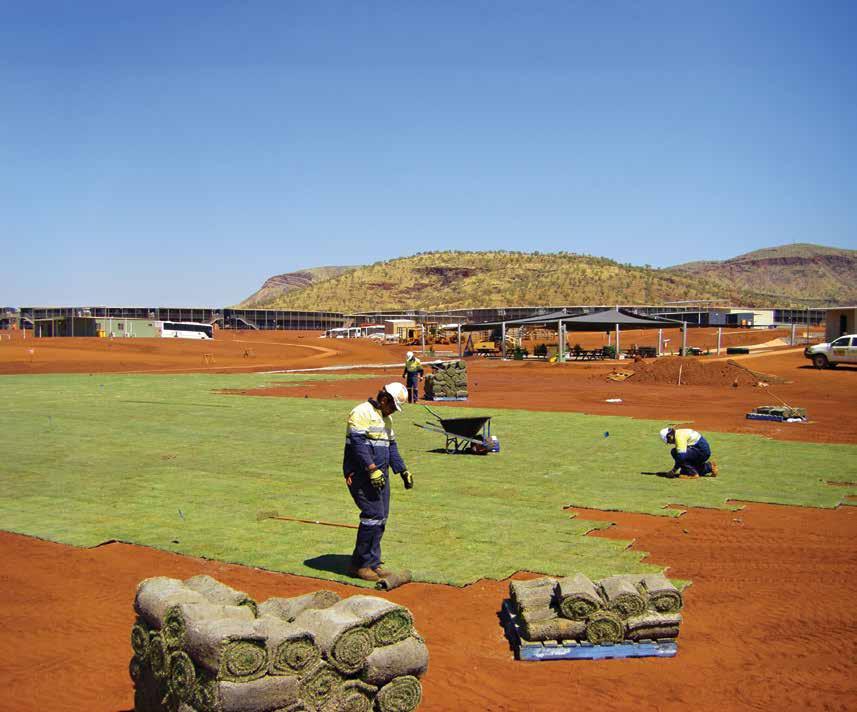
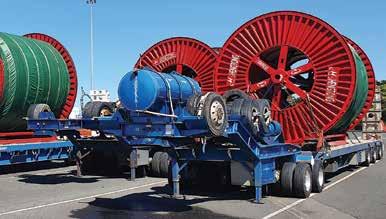
Eastern Guruma supports Australia’s leading iron ore miners and services the mineral resources sector across the Pilbara region of WA.
Mine site services
Eastern Guruma provides various mine site services including creating and maintaining access, road management, exploration works and rehabilitation.
Integrated services
Integrated services is one of Eastern Guruma’s top specialties. The team tailors every service to ensure operational maximisation of client assets.
Rehabilitation & closure
Eastern Guruma provides and industrial contaminated area rehabilitation.
08 9325 2424
Civil construction
As an experienced civil contractor, Eastern Guruma has delivered experienced team.
The company has the ability to undertake detailed civil works and determine solutions to meet client needs and budgets.
Fast, flexible CPD you can complete between shifts – self‑paced eLearning, webinars, podcasts
Advocacy that represents your profession, from capability recognition to workforce sustainability
Up‑to‑date clinical content to keep your practice informed and safe
Online tools built for shift workers – including our FREE CPD tracker and on‑demand learning library
Industry‑recognised professional development that strengthens your clinical profile
Exclusive member rates for workshops, events and conferences
Education and research grants for when you’re ready to take the next step
Membership fees are tax deductible
21-22 May 2026 | Canberra, ACT Join us for this unique event that has something for everyone.
Explore diverse opportunities in primary care and paramedicine
Hands on workshops to develop skills
Sharpen your clinical reasoning
Learn to work seamlessly with community based teams
Gain the skills to thrive in new areas of practice
PRESIDENT
Tess Oxley (HSU NSW)
VICE PRESIDENT
Faye McCann (Workers First Union NZ)
Alistair Vagg (UWU Qld)
SECRETARY
Josh Karpowicz (AEA SA)
ASSISTANT SECRETARY
Simone Haigh (HACSU TAS)
Erina Early (UWU NT)
TREASURER
Olga Bartesek (VAU VIC)
ASSISTANT TREASURER
Simon Gallagher (TWU ACT)
AMBULANCE ACTIVE JOURNAL
Craig Berger (CWA) 0426 954 744
Rising Pressure on NZ Frontline Crews
Northern Territory Spotlight
WORKERS SOMETIMES EXPECT THEIR trade unions to describe themselves as apolitical. But for ambulance workers, the real question is not simply whether we are apolitical — it is what that means when political decisions directly shape our safety, our workload, and the communities we serve. Being apolitical has traditionally meant that a union does not belong to, campaign for, or represent any political party. But being nonpartisan should never mean being silent.
Because the reality is unavoidable: many of the factors that determine our working conditions are political decisions.
Public health investment. These are not abstract policy debates — they are the environment in which paramedics and emergency medical professionals operate every shift.
Recent events have reinforced that reality in stark terms.
The attack at Bondi shocked the nation. For the ambulance crews who responded, it was another reminder that the nature of our work continues to evolve. Incidents once viewed as rare or exceptional are becoming part of the operational landscape emergency services must prepare for.
Mass casualty incidents, deliberate acts of violence, complex public-space emergencies — these were once considered low-probability events. Increasingly, they are scenarios that ambulance services must be equipped, staffed, and trained to manage. This is not unique to Australia. Across the world, emergency medical services are adapting to a changing risk environment shaped by urban density, social instability, and global security challenges. These trends are not theoretical to ambulance workers; they arrive on our radio channels and in the back of our vehicles. When those risks change, so must the systems designed to manage them.
That includes:
• Workforce numbers and surge capacity
• Specialist training and equipment
• Inter-agency coordination
• Mental health support for responders
• Operational planning for large-scale incidents
None of these exist outside public policy.
So the question unionists must ask ourselves is this:
If political decisions shape the safety of our members, can we genuinely advocate for workplace safety without engaging with those decisions?
And there is another reality that often goes unspoken.
As individual workers — particularly in emergency services — our ability to engage politically in our professional capacity is often limited. Codes of conduct, public sector obligations, and professional expectations mean that ambulance workers cannot always publicly challenge decisions that affect their work.
But unions can.
That is one of the fundamental reasons unions exist. Collective representation provides a voice where individual workers often cannot safely speak. Where one worker might face consequences for raising concerns publicly, a union can raise those same concerns on behalf of thousands.
In that sense, unions do not exist to make workplaces political. They exist because workplaces already are.
The union is simply the mechanism that allows workers to participate in those decisions collectively rather than being subject to them individually.
It means speaking with evidence rather than ideology.
It means holding every government to the same standard.
It means advocating for the safety of ambulance workers regardless of who holds office.
Because our responsibility as a union is not to protect governments from criticism. Our responsibility is to protect us. The members.
Ambulance workers are often the first to see how society is changing. We witness the consequences of policy decisions in real time — in overcrowded emergency departments, in delayed responses, and in complex incidents that stretch resources to their limits.
Ignoring those realities in the name of being “apolitical” does not protect neutrality. It risks abandoning the very purpose of collective representation.
As unionists, we should be clear about the distinction.
We do not represent political parties.
But we must represent the safety, professionalism, and future of ambulance workers.
In a world where the nature of emergencies is changing — sometimes suddenly, sometimes permanently — that responsibility has never been more important.
Because the job is changing.
The risks are changing.
And the systems designed to protect ambulance workers must change with them.
The real question for unionists is not whether we are apolitical.
It is whether we are prepared to speak — collectively, through our union — when the safety of our members demands it.
ACAU President TESS OXLEY
ACROSS AUSTRALASIA, WE CONTINUE to face a challenging industrial and professional landscape. Many affiliates have been engaged in protracted enterprise bargaining negotiations, often accompanied by ongoing struggles to secure adequate resourcing for their services and the communities they support. These negotiations are complex, and the length of time they can take places considerable pressure on our frontline members.
In the face of these challenges, we continue to find new ways to advocate for the interests of Paramedics and Ambulance Professionals. Whether through industrial action, public advocacy, or community engagement, our members consistently demonstrate remarkable determination in standing up for their profession and the communities they serve.
It is with this in mind that the collaboration of affiliates through the Australasian Council of Ambulance Unions (ACAU) becomes even more important. One of the great strengths of ACAU is the ability for members across Australasia to come together, share experiences, and learn from one another. Through these shared insights
the SECRETARY
we become stronger collectively, finding new and creative ways to advance and defend the interests of our members and ensure our profession continues to be respected, supported, and properly resourced.
Climate change, increasing violence and aggression towards ambulance workers, and growing demand for ambulance services are exposing our members to more frequent major incidents and placing increasing strain on their wellbeing.
Across the region, our members have responded to major and often confronting events – including the tragic attacks at Bondi Beach, the attempted bombing in Perth, cyclones and floods impacting communities across Australia, bushfires throughout New South Wales and Victoria, the landslip in Mount Maunganui in New Zealand, and the significant system pressures and ramping seen in Western Australia.
Many of our members have faced these events while working in difficult and sometimes isolated conditions, continuing to provide care to their communities under immense pressure. Their professionalism, resilience, and commitment deserve recognition.
At the same time, we cannot ignore the growing issue of violence and aggression directed towards ambulance workers. Increasingly, ambulance workers face unacceptable risks to their personal safety simply for doing their jobs. The changing environment in which our members operate demands continued vigilance and
advocacy to ensure employers meet their obligations to provide safe workplaces. This is particularly important as we see, in some areas across Australasia, a reduction in the level of inter-agency cooperation and support that frontline responders rely upon.
Looking ahead, the ACAU Executive will hold its first meeting of the year this March. The meeting will provide an opportunity to discuss, share, and collaborate on many of the challenges we face across Australasia. We will also continue planning for the 2026 ACAU Conference in Tasmania, which will represent a major milestone for ACAU, marking the 20th anniversary of the National Council of Ambulance Unions (NCAU)’s formation in Hobart all those years ago.
The Executive will also progress important governance work, including reviewing proposed rule changes to ensure compliance ahead of formal registration and consideration at the Conference’s AGM. Through collaboration, shared knowledge, and collective action, ACAU and its members will continue to advocate strongly for the interests of our frontline members, their safety, their conditions, and their profession.
Across Australasia, Paramedics and Ambulance Professionals continue to show extraordinary resilience and commitment to their communities. ACAU and its members will continue to stand together to ensure that dedication is matched with the safety, respect, and resourcing our members deserve.
In Solidarity
ACAU Secretary JOSH KARPOWICZ
Josh Karpowicz, a Registered Paramedic with 16 years’ experience, began his career with SA Ambulance Service in 2009. Now an Industrial Officer and Executive Member with AEA SA, Josh has also acted as Secretary, representing members in enterprise bargaining, employment tribunal matters, public campaigns, and policy negotiations. He combines his ongoing frontline paramedic work with strong union advocacy, advanced leadership training, and a drive to improving member conditions across the ambulance industry.
Don’t just see a financial adviser. See a specialist.
As a member of Ambulance Victoria, you’re with one of the few remaining defined benefit super funds. So when it comes to seeking financial advice, it’s important to find an adviser with specialist knowledge of your super.
ESSSuper Financial Advisers know your fund inside out, and that’s expertise you won’t find just anywhere.
Our advisers serve members like you every day, so they understand how to help you make the most of your account. They’ll examine your needs holistically, so your financial plan helps you build wealth both in and out of super.
ESSSuper is a profit-to-member fund, so we keep our fees as low as possible, and you’ll only pay what it costs to provide these services. And our advisers don’t work for commission, so you can rest assured they’ll put you first.
To book a complimentary first appointment, give us a call on: 1300 650 161
Find out more at esssuper.com.au/ tailored-advice, or scan the QR code.
Emergency Services Superannuation Board ABN 28 161 296 741 (ESSB) is responsible for administration of the Emergency Services Superannuation Scheme ABN 85 894 637 037 (ESSSuper).
ESSSuper has an arrangement with Guideway Financial Services Pty Ltd (ABN 46 156 498 538, AFSL 420367), under which financial product advice is provided to members by ESSSuper employed Financial Advisers who are Authorised Representatives of Guideway. As the advice is provided under Guideway’s Australian Financial Services License, Guideway is responsible for the advice you receive. ESSSuper pays Guideway a fee for this service. However, neither the Board, ESSSuper nor the Victorian Government guarantee or endorse any advice given by Guideway or its authorised representatives.
Don’t let success flatline – let’s make it happen with digitisation
ifm started over 50 years ago as a sensor company that wanted to do things differently and make technology work for everybody. We’ve kept to this value and run our business as a family does – keeping close to our customers and focusing on a full solutions platform along with quality reliable products and customer service.
Our goal has always been to protect what’s important to our customers. This hasn’t changed. Our cutting-edge automation technology has long proven its worth in supporting the ambulance and paramedic community.
Talk with our team about how we can help to:
Lower your energy costs
Reduce product wastage
Improve efficiencies
Gain a higher product quality
Reduce downtime
INDUSTRIAL REPORTS
ACT
TWU HSR AND DELEGATE ISSUED
a Cease Unsafe Work Direction against a prolific and recidivist perpetrator of occupational violence against Officers in the ACT. In a watershed moment for the industry the HSR the Union and the Employer have worked closely exploring options to ensure safety for the patient and officers across the ACTAS. An industry first, the TWU has explored issuing a Workplace Protection Order and Cease and Desists Proclamation to ensure members are safe and secure in providing care to patients. Agreement negotiations continue with a revised pay offer on the table for members to consider. Additional claims of meal protection continue and a revised version of the structure and careers opportunity for NEPT and the Communications Centre.
NSW
ACROSS NEW SOUTH WALES,
HSU members working within the ambulance sector continue to confront the consequences of a health system under sustained pressure. From workplace safety concerns to cultural reform and organisational restructures, members are increasingly being forced to step in where leadership has failed to act. Recent developments across several areas highlight both the challenges facing the workforce and the continued determination of union members to organise for safer and fairer workplaces.
RESPECT @ WORK –A HARD‑WON REFORM
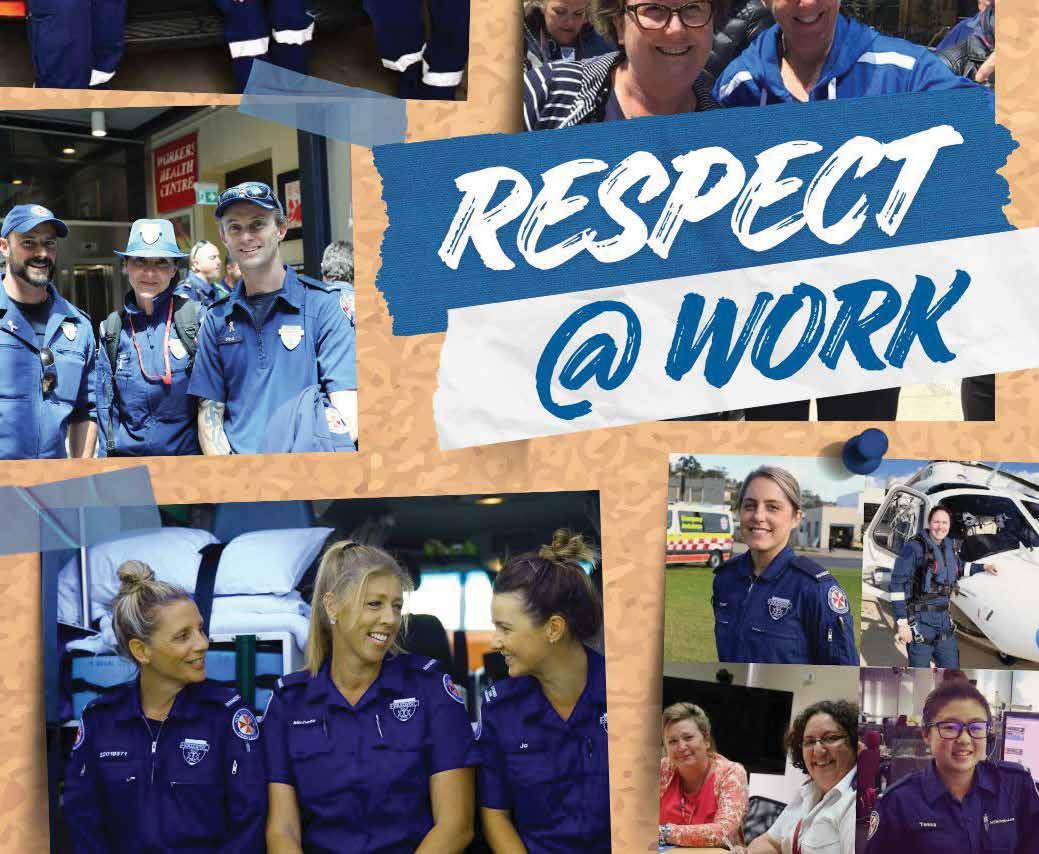
In 2024 the ADHSU Women’s Committee secured a landmark victory with the establishment of the Respect @ Work Unit within NSW Ambulance. The unit represents the first dedicated body within the service specifically tasked with addressing workplace sexual harassment, assault, and gender-based discrimination.
The creation of this unit did not occur in isolation. It was the direct result of sustained campaigning by union members and delegates who had raised concerns for years about the handling of complaints within existing management structures and the Professional Conduct Investigations (PCI) framework.
Government data reinforced what many members already knew from lived experience. Survey results showed that 15 per cent of respondents within NSW Ambulance had experienced sexual harassment or assault in the previous 12 months — around 10 percentage points higher than the broader NSW public sector.
The establishment of a specialist unit with trauma-informed investigators was therefore seen as a critical step forward.
Delegates who attended the unit’s early consultations reported a level of commitment and expertise that contrasted sharply with previous approaches.
The Respect @ Work team outlined a comprehensive strategy that included:
• A five-year cultural reform plan for NSW Ambulance
• Trauma-informed investigative processes designed to reduce retraumatisation for survivors
• A statewide training rollout aimed at preventing harassment and discrimination
• Dedicated pathways for staff to disclose experiences outside of their immediate management structures
For many members, it represented the first time the organisation had acknowledged the scale of the problem and committed meaningful resources to addressing it.
The workload facing the new unit was immediate and significant. Within weeks of its establishment, investigators were already managing multiple cases while working through a backlog of unresolved matters. The demand reflected years of under-reporting and delayed action.
Despite this heavy workload, members remained hopeful that the Respect @ Work Unit could begin the long process of rebuilding trust.
That optimism was shaken when NSW Ambulance recently confirmed that the manager responsible for establishing the Respect @ Work Unit had left the organisation after only a few months in the role.
The sudden departure has raised concerns among union members and survivors who had placed considerable hope in the new framework.
While the service has not publicly detailed the circumstances surrounding the resignation, the challenges facing the unit were evident from the outset. Recruitment for the position had already taken months due to uncompetitive remuneration, and the unit began operating under intense pressure due to the volume of cases requiring attention.
Members report that the unit was effectively dealing with the consequences of years of organisational inaction.
For many within the workforce, the departure reflects a broader cultural problem within NSW Ambulance — one where individuals committed to reform often find themselves confronting systemic barriers that make meaningful change difficult.
The ADHSU Women’s Committee has made it clear that the resignation will not derail the broader campaign. Survivors still deserve access to fair and trauma-informed investigations, and members have waited long enough for a comprehensive sexual harassment policy.
The union will continue to hold NSW Ambulance accountable to ensure the Respect @ Work framework remains operational and properly resourced.
Long shifts. Overtime. Changing rosters. High-pressure decisions.
The last thing you need is the stress of sorting out a home loan on your own.
I’ll triage the options, manage the paperwork, and find a loan that suits you – shift work and overtime included.
With access to over 50 lenders, including the big banks, you’ll get the right fit – not a one-size-fits-all loan.
No pressure. No jargon. Just clear advice and genuine support. Give me a call – I’d love to help.
WORKPLACE SAFETY CRISIS AT WOLLONGONG STATION
While cultural reform remains a priority, members are also dealing with more immediate workplace safety risks.
At Wollongong Ambulance Station, staff have now received their third hygienist report confirming mould contamination within the facility.
The recommendation provided by specialists was clear: affected materials in the plant room should be removed.
Instead, members report that the response from management has largely involved painting over the affected areas rather than undertaking full remediation.
Compounding these concerns is the presence of asbestos in the station ceiling. In recent weeks, a section of roofing concrete reportedly fell onto a member’s vehicle in the station car park — further highlighting the deteriorating condition of the facility.
For paramedics working out of Wollongong, the situation has reached a breaking point.
HSU members at the station have collectively resolved that they will not return to the building until a safe, purposebuilt facility is provided. While patient care will continue from alternative operational locations, members have made it clear that their own health cannot be placed at risk through temporary patch-up measures.
Union delegates have emphasised that staff are not seeking cosmetic fixes or short-term remediation. They are demanding a permanent solution to what has become an unacceptable workplace health and safety risk.
The situation stands in stark contrast to recent messaging from senior executives regarding investment in new administrative facilities.
For frontline workers, the message is clear: safe workplaces must come before cosmetic infrastructure upgrades.
FRONTLINE LEADERSHIP MODEL: CONSULTATION WITHOUT ANSWERS
Members are also continuing to raise serious concerns about the proposed Frontline Leadership Model (FLM) currently being advanced by NSW Ambulance. The model has been presented by the service as a solution to management workload and operational pressures. However, union members involved in the consultation process report that key questions remain unanswered.
Throughout the consultation period, delegates raised concerns about staffing structures, workload distribution, and the practical implementation of the
model across regions. Yet many of these concerns have received little or no response from management.
Instead of clarity, members report an increasing sense of confusion and frustration.
For frontline workers already facing fatigue, injury, and growing demand for ambulance services, organisational uncertainty only compounds existing pressures.
Members have therefore been encouraged to submit formal feedback through the union as part of the consultation process and to remain engaged in collective decision-making regarding next steps.
ADHSU members will soon vote to commence ‘HGD bans’ No ADHSU member will act up into higher grade duties until NSW Ambulance can demonstrate that they have heard workers concerns. That all positions will be filled with substantive workers, and enough managers for the needs of the staff, that education will be able to be provided to all including those entering the roles down the line, and that eduacation will not be limited to forcing staff to attend 3 weeks in Sydney.
The message from the workforce is straightforward: structural reform cannot succeed without genuine consultation with those who deliver the service on the ground.
LEADERSHIP CHANGE AT NSW AMBULANCE
Amid these ongoing issues, NSW Ambulance recently announced that Chief Executive Dr Dominic Morgan will be retiring after ten years in the role.
While ADHSU members wish Dr Morgan well in his future endeavours, the announcement comes at a time when many within the workforce believe the service is in urgent need of cultural change.
Over the past decade the organisation has faced significant challenges —
from rising demand and workforce fatigue to workplace safety concerns and longstanding issues relating to organisational culture. For many members, the coming leadership transition represents an opportunity for meaningful reform.
While a new Chief Executive is recruited, Clare Beach will assume the role of interim Chief Executive.
ADHSU members look forward to working constructively with the interim leadership during this transition period. Running one of the largest ambulance services in the world is no small task, and the pressures facing the system are well understood by those working within it.
However, members remain clear on one point.
They will not step back from advocating for the changes needed to build a safer and more equitable service — both for the paramedics and control staff who deliver care every day, and for the communities who rely on them.
COLLECTIVE ACTION REMAINS THE DRIVING FORCE
Across all of these issues — cultural reform, workplace safety, and organisational change — one common theme remains clear.
Progress within NSW Ambulance continues to be driven by collective action from members.
The creation of the Respect @ Work Unit, the exposure of safety issues at Wollongong Station, and the scrutiny of the Frontline Leadership Model have all emerged because union members chose to organise and speak collectively.
While challenges remain significant, the willingness of members to hold the service accountable demonstrates the continuing strength of the ambulance workforce.
As pressures on emergency services continue to grow, that collective strength will remain essential in ensuring that both workers and patients receive the safety and respect they deserve.
Home loans tailored for the life you want.
Get personalised lending solutions with clear advice and genuine support to help you achieve your property goals.
Whether you’re buying your first home, upgrading to your next home, investing for the future, or refinancing to improve your position, I’ll help you find the right loan and lender.
I work with a wide panel of lenders to compare options, negotiate competitive terms, and tailor a lending solution that fits your lifestyle now and where you want to be next.
Aaron McLeod Director & Broker
Your next move starts here
NZ
AUCKLAND ROSTER PROPOSAL
The Auckland roster proposal has been finalised by St John and staff are in the process of confirming which new roster they will be allocated to. During this consultation, St John confirmed that they would no longer be considering any future 12 hour shifts due to the fatigue they cause unless it was a current station that was converting from 12 hour cover to 24/7 cover.
GOVERNMENT CONTRACTS
Both St John and Wellington Free Ambulance are currently in bargaining for the next four-year funding contract they will hold with the government. This is a similar situation to the helicopter providers who can have a ten-year funding agreement. We have raised concerns that we do not believe the current funding model is suitable and will not allow for an increase in wages to keep up with inflation or the additional skills being asked of staff each year.
RADIO POUCHES
Issues have been raised regarding radios falling off belts and St John have agreed to do a radio pouch trial. While there is not currently any funding for radio pouches, if the trial is successful it will form the basis of a business case to be put towards government to fund radio pouches.
QLD
EBA IMPLEMENTATION PROGRESS – JANUARY–MARCH 2026
Formal implementation meetings between the Queensland Ambulance Service (QAS) and employee representatives have continued through early 2026 following certification of the QAS Certified Agreement 2025. Meetings were held on 12 January and 4 February, with United Workers Union (UWU) representatives monitoring implementation of agreed provisions and escalating delays where required.
Key developments over the past three months are outlined below.
END OF SHIFT TRANSFER OF CARE
UWU understands that the Queensland Health Director-General has issued a memorandum to Hospitals and Hospital
and Health Services directing the prioritisation of transfer of care for QAS crews ramped at end of shift.
UWU has not received a formal briefing from either QAS or the Director-General’s office. The directive appears to fall short of the operational mechanisms previously discussed during bargaining to support the Finish on Time provisions contained within the agreement.
Correspondence has been issued to QAS Commissioner Craig Emery outlining UWU’s concerns and emphasising the need for QAS to ensure operational supervisors are supported to escalate transfer-of-care delays at the hospital interface.
SICK LEAVE ACCRUAL
The agreement secured an additional 10 hours of sick leave, increasing annual accrual from 96 to 106 hours.
While the entitlement commenced from certification, adjustments to individual leave balances remain outstanding due to Queensland Shared Services system issues. UWU continues to pursue resolution with QAS.
IMPLEMENTATION OF NEW ADMINISTRATIVE PROCESSES
Several new administrative processes arising from the agreement have now been implemented through the QAS HR Portal, including:
• Level 6 Overtime claim form
• Level 6 AT Payout form
• Flexibility Allowance form for statewide emergency and disaster management support roles
ALLOWANCE
ADJUSTMENTS AND BACKPAY
Outstanding allowance increases, including the PDA allowance, are scheduled to be updated and back-paid in March.
Implementation of new allowances is progressing as follows:
• Night Shift Coverage Allowance –commences from March
• Critical Console Handover Allowance –scheduled for back payment from March
• Rural and Remote Single Officer Allowance – scheduled for back payment from March
FINISH ON TIME –SECTION 17 IMPLEMENTATION
QAS has appointed Zoe Hendrichs to oversee implementation of the agreement’s Section 17 – Finish on Time provisions.
UWU bargaining representatives are currently engaged with QAS in developing the operational procedures required to support these provisions, including work on Priority Pairing of Single Officers.
REGIONAL CONSULTATIVE COMMITTEES
Regional Consultative Committees continue to operate as a key forum for addressing local implementation issues and operational matters arising from the agreement.
Recent matters progressed through RCC processes include:
• Expansion of restocking stations at hospital locations
• Development of regional escalation processes for end-of-shift ramping
OCCUPATIONAL VIOLENCE PREVENTION
A QAS Occupational Violence Prevention Working Group has been established following matters raised by UWU representatives through the State Consultative Committee.
Expressions of Interest are being progressed across regions to ensure frontline representation, with four UWU representatives participating in the working group. The group will consider prevention strategies, operational controls and response measures relating to occupational violence risks.
COVID LEAVE CONSULTATION
Queensland Health Director-General David Rosengren has indicated an intention to wind back COVID-related leave provisions through a DG Directive.
QAS subsequently consulted staff and employee representatives on the proposed changes. UWU provided a formal response following consultation with its Queensland State Council, raising concerns regarding:
• ongoing occupational exposure risks for ambulance workers
• potential financial impacts where illness occurs on weekends
• the need to maintain appropriate workplace health and safety protections
SUMMARY
Implementation of the QAS Certified Agreement 2025 continues through formal meetings, consultative committees and operational working groups. UWU representatives remain actively engaged in monitoring progress and addressing outstanding matters with QAS and Queensland Health.
SAAS 2025 ENTERPRISE AGREEMENT
OVERWHELMINGLY ENDORSED
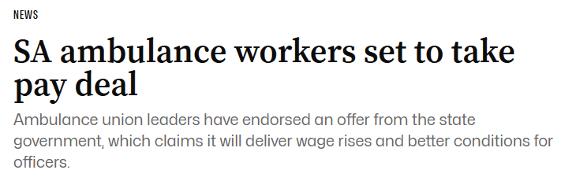
AEA SA members have recently delivered one of the most comprehensive enterprise bargaining outcomes in the history of the AEA following an extended and hardfought period of negotiations, which have now secured the new SAAS 2025 Enterprise Agreement.
The previous SAAS 2022 Enterprise Agreement expired December 31, 2024, with members receiving their last 2.5% salary increase on the expiry date, meaning members were next due an increase on 31 December 2025. Negotiations for a replacement agreement commenced six months prior to expiry in July 2024.
Over the following 18 months members put forward an extensive Log of Claims with key goals of improved salary, attraction and retention, and professional recognition. In order to achieve these goals, members demonstrated remarkable resolve and preparedness to instigate statewide industrial action should negotiations fail to advance. The willingness of members to stand together to advance their working conditions sent a loud and clear message. Ultimately, industrial action proved unnecessary. In the final stages of bargaining, and due to our members’ preparedness to take action, the South Australian Labor Government entered into intensive negotiations with the AEA bargaining team, through which the AEA was able to achieve a significantly improved offer. That offer was endorsed by the AEA State Council and subsequently accepted by members by an overwhelming majority, delivering a new Enterprise Agreement that provides real wage growth, improved career structures, attraction and retention, and professional recognition.
SALARY INCREASES
A key priority for our members was to achieve real wage growth following the significant inflationary pressures experienced in recent years. This was accomplished through a combination of three key elements: annual salary increases, increased salary increments, and an ongoing retention allowance payment.
The new agreement delivers a base 13.5% in annual wage increases over the life of the agreement for all members, consisting of
• 3.5% in December 2025
• 3.5% in December 2026
• 3.5% in December 2027
• 3% in December 2028
Through a combination of expanded salary pay points, classification improvements, and the introduction of a new retention allowance, many members will receive total salary increases exceeding 20% over the life of the agreement, with some workgroups receiving even higher outcomes.
Importantly, the revised pay structure with added pay points and increments will result in many members seeing salary increases occur every six months through the interaction of annual wage increases and staged pay point progression.
EXPANDED PAY POINTS AND SALARY INCREMENTS
For the first time since the introduction of professional rates, the agreement delivers new pay points across most classifications, improving salary progression and starting salaries, improving initial pay for junior members but also recognising and rewarding experience.
For Paramedics, two additional pay points have been introduced, extending progression beyond the previous salary ceiling. Members who previously capped at six years Paramedic 2.6 will now be able to progress through 2.7 and 2.8, recognising additional years of professional experience and providing further salary growth later in members’ careers.
Similar improvements have been implemented across the majority of the agreement, with many other classifications receiving additional pay points or improved salary structures.
One of the many key improvements was to the Graduate Paramedic Program students who are supported whilst working in a regional area on an emergency ambulance to complete their Paramedic degree over five years. Their pay was the lowest in the agreement and will now have a significant uplift in their starting salary from July this year to ensure pay parity with qualified Ambulance Officers, recognising and supporting their work and studies.
INTRODUCTION OF AN ONGOING AND PERMANENT RETENTION ALLOWANCE
Another landmark achievement in this agreement is the introduction of a new permanent and ongoing retention allowance.
Members who have completed ten years of service with SAAS will receive a 2% allowance calculated on their base salary, payable fortnightly and continuing every year thereafter.
The allowance will take effect from 31 December 2027 and represents a significant win for the profession for the attraction and retention of our most experienced members. Unlike oneoff cash-based retention bonuses, this allowance becomes a permanent and ongoing component of salary and an ongoing workplace condition, increasing automatically as base wages increase and continuing year on year.
PROFESSIONAL DEVELOPMENT ALLOWANCE
The agreement also introduces a Professional Development Allowance of $1,200 per year for members required to maintain registration with AHPRA.
For the first time, this recognises the professional obligations placed on registered clinicians and acknowledges the cost associated with maintaining professional registration and continuing professional development.
The allowance will be paid directly to members fortnightly and will not require reimbursement claims or evidence of expenditure.
IMPROVEMENTS FOR REGIONAL MEMBERS
Country members will also see significant improvements under the agreement through reforms to the Regional Incentive Payment (RIP) structure.
The new model includes:
• A minimum 25% increase to RIP payments
• Introduction of a four-zone system better reflecting harder-to-fill regional and remote locations
• Reduced progression time for hard-to-fill zones to the top increment
• Ongoing indexation of payments in line with salary increases to ensure future indexation does not need to be ‘bargained’ for
• Ability to claim SA Health locality payments in addition
These changes represent a long overdue modernisation of the RIP structure and will play an important role in supporting attraction and retention of Paramedics and Ambulance Officers in regional and hardto-fill locations.
The agreement also confirms a fixed date for the final removal of the remaining on-call stations, with Barmera and Loxton in the State’s Riverland region to transition to full 24/7 crewing by December 2026, bringing an end to a long-standing model that has placed considerable pressure on regional members.
END OF SHIFT PROTECTIONS AND OVERTIME IMPROVEMENTS
Members will now receive double time (200%) for end-of-shift overtime, recognising the impact of late finishes and the high disruption this causes for members and their families. This increases the payment which was previously only time and a half (150%). The agreement also strengthens protections around end-of-shift tasking by placing existing policy into an industrial agreement. This includes that members cannot be tasked to a low acuity case in their last hour of shift and can refuse any tasking after their rostered end of shift.
Additional meal break protections are now also included to ensure that members cannot be tasked to low acuity cases during their crib windows and are to be stood down in their last hour of shift if they have not had a break.
GENDER NEUTRAL PARENTAL LEAVE PROVISIONS
The agreement introduces new genderneutral paid primary carers leave, allowing either parent to access 16–20 weeks of paid leave depending on length of service. This is a massive win for many partners in SAAS who were previously unable to take anything other than one week of leave at the birth of their child.
In addition, members will also receive two weeks of paid partner leave (one week is taken from a new paid partner leave bank and the other week is taken from personal leave balances).
LEADERSHIP AND MANAGEMENT ALLOWANCES
The agreement introduces a new 15% allowance for middle management and leadership roles that do not work shift work, who previously received no additional allowances in recognition of the additional out-of-hours work performed. Operations Managers who work part of the administrative on-call will also see their allowance increased to 25%. Both workgroups will also see improvements in their annual leave provisions.
These changes aim to support recruitment and retention for members into operational leadership and management roles across the organisation.
A COLLECTIVE ACHIEVEMENT
While the financial and structural gains in this agreement are significant, they are ultimately the product of the collective strength of the membership.
Enterprise bargaining is rarely a straightforward process. Negotiations are lengthy, complex and require persistence from both the bargaining team and members.
Throughout this process, AEA SA members demonstrated extraordinary solidarity and preparedness to stand together to secure meaningful change. The mere prospect of coordinated industrial action reflected the strength and unity of the membership and played an important role in progressing negotiations toward a successful outcome.
The final agreement represents one of the strongest enterprise bargaining outcomes secured by the AEA in recent years and provides a strong foundation for continued improvements in future negotiations.
Home Loans
Done Properly
At Melbourne Mortgage Services, we help everyday Australians make smarter property decisions without jargon, pressure, or guesswork.
Whether you are:
• Buying your first home
• Refinancing to reduce repayments
• Investing for the future
• Looking for a second opinion
We’ll give you clear advice and access to a wide range of lenders, so you know your options before making big decisions.
Why Ambulance Professionals Choose Us
Straightforward advice you can trust, no sales talk.
We handle the lender chasing, paperwork and negotiations for you.
Ongoing support at every stage of the mortgage process.
TAS
FOUR MATTERS HAVE
overshadowed all other matters relating to Ambulance over recent months. Bargaining, Transfer of Care (Ramping), the issuing of Lawful and reasonable Directions to (mostly) senior managers across Ambulance Tasmania as well as the ongoing dispute relating to backpays owing to Community Paramedics, PACER and Secondary Triage Paramedics.
As is the case with the rest of the Public Sector, to date, bargaining has been nothing short of farcical and disgraceful. The feeble attempts of the Government to attempt to replicate Peter Reith or John Howard have been laughable, leading them to a point where they have now had to backtrack on their, still unclear, bargaining position. In Ambulance, reaching a quick settlement will be difficult given the complexity of some of the matters needing to be resolved that have now been promised in the past two agreements, Finalising a classification review and rostering reform are two matters which require urgent resolution.
Recent stalling (six months) by the Government has wasted valuable time in addressing these matters.
The 3% December offer was put to a ballot of Members of which 95% voted to reject. Members also voted to continue Industrial Action.
STAFFING/RECRUITMENT
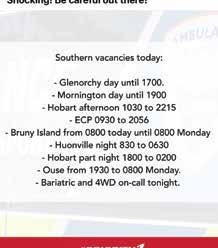
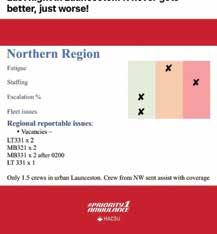
Vacancies, short term sick leave and growing demand are having a massive effect on the wellbeing of Ambulance Members (both on road and comms members). Over recent weeks we have seen massive staff shortages in Launceston. Whilst the Government has promised some additional staff, those are simply not enough! In a climate of austerity, the HACSU Ambulance Executive despairs at what will happen should there be no increase in staffing soon!
NEW CHIEF EXECUTIVE
Recently Nicole Ashworth Previous chief of 000 Victoria (The Victorian Ambulance Call Centre) and qualified Paramedic was appointed to the permanent CE position. After a short period of uncertainty and disarray since the resignation of the previous CE, we are looking forward to a period of leadership stability!
TRANSFER OF CARE REVIEW
Unfortunately, but not surprisingly, the ANMF and AMA are actively opposing the
45 Minute transfer of care ramping target. The matter will now go to arbitration before the Tasmanian Industrial Commission.
We have not intervened, but we trust that Ambulance Tasmania will run a decent case against the other associations.
Principally, the doctors and nurses argue that it is not safe for nurses to care for patients in corridors of hospitals, however the government will run a case that says that whilst this might be the case (and the government is doing what it can to fix it through improving patient flow in our hospitals) a greater risk exists where an ambulance in unable to respond to a 000 call in the community to a patient who’s condition is unknown and who has not been triaged or assessed!
We are currently considering possible action to rebalance the issue.
COMMUNITY PARAMEDICS, PACER (MENTAL HEALTH RESPONSE) SECONDARY TRIAGE CLASSIFICATION DISPUTE
In spite of meeting with everyone, including the Minister, the dispute relating to the payment of backpay remains unresolved. The Minister did write to us recently advising that she had asked the Secretary of the Department
(Dale Webster) to find a way to resolve the matter, we are yet to see any further action.
In the context of the current bargaining, we have made it clear that there will be no agreement with us until the backpay has been agreed.
As a direct result of our industrial action, AT had to recently “pause” the community paramedic training program. Current Community Paramedics have a banned mentoring students. The ball is in the Governments court. We are hopeful of a positive resolution soon.
BURNIE SUPER STATION RECLINE FACILITIES DISPUTE
We are awaiting formal advice that approval has been given to modify spaces inside the station into two additional bedrooms as agreed with AT. There is a considerable expense associated with this. Approval may be unlikely which again may result in further disputation.
FLEET
We have continued, in consultation with AT, on the development of a comprehensive fleet replacement and management procedure. Additionally, we have been monitoring the status of the fleet and ensuring that any operational vehicle that has an odometer showing in excess of 210 000 Klm is actively managed out of commission (i.e. dumped). Whilst we have been progressing discussions around the establishment of a new Fleet Policy we have made it clear that we would not approve until AT has secured a dedicated Fleet Manager position and certain other vehicle safety initiatives are implemented.
NON EMERGENCY PATIENT TRANSPORT
The Union has continued to engage with the NEPTs staff across the Stateon the possibility of moving them across to the Band (3) structure in the Health Award. This will result in a significant wage increase for members but also recognize changes in NEPTs over several years. Ambulance Tasmania are actively supporting this process which is pleasing to all NEPT’s members.
On their bargaining, NEPTs members have recently banned involvement in any bariatric activities as a direct result of the Government rejecting their claim for a bariatric allowance (Paramedic who do the same work get an allowance). Members are actively supporting the ban.
VIC
EMERGENCY WORKER
ASSAULT LAWS FAIL AGAIN
In September 2025, Paramedics Kathryn and Alessia started their shift after checking the truck. It was a peak period unit and knowing that they could be sent anywhere, they dropped into the local sandwich place and picked up some food for later.
They were heading back to the truck when they heard a scream and saw a male allegedly harassing a woman with her young child. Paramedic Kathryn called out to the male to leave the woman and her child alone.
The man then allegedly kicked Kathryn in the stomach causing her to fall to the ground and suffering an injury to her arm and ribs, injuries for which she was hospitalised.
Police later arrested the offender.
In February 2026, the VAU attended court to support Kathryn and Alessia. Mandatory sentencing laws were introduced in Victorian in 2014 to ensure that offenders who assault emergency workers receive a minimum six-month custodial sentence. Several previous cases have been widely reported where our members have been seriously assaulted, yet the offenders have walked free with no custodial sentence.
The VAU has been working hard to ensure that loopholes in the legislation that allow offenders to argue that they were impaired at the time of the assault (even if intoxicated or drug affected) are closed. This case however has exposed another serious loophole in the legislation.
Section 10 AA(9) of the Sentencing Act states:
(9) For the purposes of this section an emergency worker is on duty if— (b) in the case of an operational staff member within the meaning of the Ambulance Services Act 1986, the staff member is providing, or attempting to provide, care or treatment to a patient;
This means that an offender who assaults a paramedic while they are restocking equipment or making the bed at hospital, refuelling the ambulance, doing a truck check at branch or stopping for lunch while returning to branch after a case will not be captured by the mandatory sentencing laws.
The result of this loophole is that the mandatory sentencing provisions will not apply in this case, although other charges are still pending. This is another devastating blow to our workforce and evidence of the lack of meaningful consequences for people who assault our members.
The VAU immediately wrote to both the Attorney General seeking urgent review of the legislation along with the opposition to seek bipartisan support for the changes to these laws.
CLINICAL RESPONSE MODEL WORKING GROUP
Recently, following years of advocacy from the union as well as the results of the results of the Parliamentary Inquiry into Ambulance Victoria (AV), AV established the Clinical Response Model Working Group to look at issues with ambulance call-taking.
One of the biggest frustrations expressed by members is the lack of accuracy in Code 1 cases. This was a major theme in the submissions to the inquiry.
The CRM working group is in its early stages but brings together AV, TZV, Department of Health, Government, unions and a good mix of ACOs, ALS, MICA, Clinicians, Communications Support Paramedics and Duty Managers, Triage Practitioners, Improvement Leads, and many more positions.
This group will have a positive effect on the call-taking process provided it is backed by Government with appropriate funding and any required legislative reform needed to allow agencies to share or transfer risk in decision making. It is certainly it’s a move in the right direction with a focus on calltaking accuracy as distinct from dispatch grid reform.
NEPT REGULATIONS
The VAU is currently being consulted on proposed changes to the Non-Emergency Patient Transport Regulations.
Shockingly, proposed changes include allowing double-loaded patients to be left unattended in ambulances, and increasing mileage limits from 400,000km to 800,000km.
The VAU regularly hears reports of ambulances that are dirty, running poorly and even leaking exhaust fumes into the cabin.
The VAU does not agree with these changes and has been lobbying publicly that the proposed changes be rejected.
WA
AMBULANCE AND PATIENT
transport workers in Western Australia continue to face significant pressures across the health system, particularly as demand grows and workforce shortages persist. The United Workers Union (UWU) is actively advocating for improvements to resourcing, safety and wages across the sector.
WINTER DEMAND AND RAMPING RESPONSE
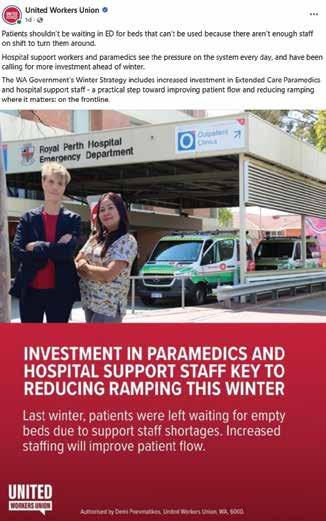
Following sustained pressure from UWU and other health unions, the Western Australian Government has announced its winter demand and ramping strategy earlier than in previous years. The early announcement is a positive step and reflects the growing recognition that ambulance ramping and hospital capacity issues require proactive planning ahead of the winter surge. UWU welcomes several elements of the announcement, including funding for additional Extended Care Paramedics and the commitment to add 200 more beds to the public health system. These measures have the potential to ease pressure on both ambulance crews and emergency departments by improving patient flow and providing more options for community-based care.
However, significant concerns remain about the scale of the response and
whether it will be sufficient to address the ongoing demand pressures facing frontline workers. UWU is awaiting further detail on the implementation of the strategy, including timelines, staffing plans and how these measures will translate into tangible improvements for ambulance crews and patients.
PATIENT TRANSPORT AGREEMENT BARGAINING
Enterprise bargaining for the Patient Transport Agreement is now well underway. UWU members have put forward a claim for a 7% wage increase each year for three years, reflecting the rising cost of living and the essential role patient transport workers play in supporting the broader health system.
Patient Transport Officers perform critical work moving patients safely between hospitals, aged care facilities and their homes. Despite this, the workforce has historically been undervalued and underpaid compared with other parts of the health system. UWU members are seeking fair wage increases and improved conditions that properly recognise the skill and responsibility involved in the role.
Negotiations are continuing and UWU remains focused on securing an outcome that delivers meaningful improvements for members.
STATE OPERATIONS CENTRE BARGAINING
Bargaining has also recently commenced for workers at the State Operations Centre (SOC), the critical communications hub that coordinates ambulance dispatch and emergency response across Western Australia.
UWU members in the SOC have identified safe staffing levels as a key priority in this round of bargaining. Chronic understaffing places significant pressure on call-takers and dispatchers, increases fatigue, and can impact both worker wellbeing and the safe coordination of emergency responses.
In addition to safe staffing levels, members are calling for stronger safety and fatigue management provisions, including additional breaks during understaffed shifts. Given the intense workload and concentration required in the SOC, ensuring adequate staffing and rest breaks is essential to maintaining both worker health and patient safety.
UWU will continue to work with members across the sector to push for improvements to staffing, safety and pay, while advocating for the broader system changes needed to relieve pressure on ambulance services in Western Australia.
BUDGET ROO GLOBAL
Budget Roo Global can ship products all around the world. On average small products can be shipped to you within 1530 days and large products 30-60 days. https://budget-roo.com/
BUDGET ROO AUSTRALIA
Budget Roo Australia (Camping Supplies) ships to Australian customers. On average all products can be shipped to you within 7-15 days Australia wide. https://budgetroo.com.au/
OZ BABY STORK
Oz Baby Stork (Baby Care) ships to Australian customers. On average all products can be shipped to you within 7-15 days Australia wide. https://ozbabystork.com.au/
Finance that Fits Your Lifestyle. Mortgage Broker Melbourne
Helping clients across Australia, Lifestyle Loans guides first home buyers, investors and homeowners refinancing from pre-approval through to settlement. Trusted since 2000, with access to 60+ lenders and over $1B in loans settled.
Why Choose Lifestyle Loans?
$1 Billion + in Loans Settled
With over $1 billion in loans settled, Lifestyle Loans has helped thousands of Australians achieve their property and finance goals.
25+ Years of Experience
Our team brings more than 25 years of mortgage broking expertise, guiding clients through buying, investing and refinancing with confidence.
60+ Lenders on Our Panel
We compare options from over 60 leading banks and lenders, giving you more choiceand ensuring you secure the right loan for your needs.
Lenders to Suit Every Lifestyle
From major banks to specialist lenders, we compare the market so you don’t have to.
2026: THE YEAR WE WERE PREPARING FOR
As 2026 gets underway, members across the ACT already know this isn’t just another year on the calendar — it’s the year we were preparing for.
BACK IN DECEMBER 2025, ACT Sub-Branch Secretary Klaus Pinkas made it clear that 2026 would bring “the big fights ahead,” and that our members were ready.
“As we look ahead to 2026 and the big fights ahead, I know that the relentless membership and Officials from our Subbranch are up to the task.”
Now, that moment has arrived.
Throughout late 2025, officials were out in yards across the Territory — with drivers, with FedEx members, at Linfox, and with Ambos — listening to what matters most as Enterprise Agreements expire and campaigns ramp up.
As Klaus said at the time:
“We’ve been out in yards across the territory these last few months, listening to members, standing by your side, and hearing what matters to you in 2026…”
For ambulance members in particular, the stakes in 2026 are clear. The ACT Ambulance Delegates Caucus has already laid the groundwork — hosting the Minister for Emergency Services to confront the realities facing ACTAS members:
• Roster pressures
• Increasing incidents of violence
• Infrastructure and southside facility regeneration
• Long-term resourcing challenges
These aren’t abstract policy conversations. They’re issues affecting members on shift today.
The Minister’s commitment to ridealongs and hospital visits was a starting point. In 2026, members expect progress — not just promises.
As Klaus closed out 2025, he said:
“I look forward to be standing with you as we take the fight to the industry in 2026.”
That fight is now.
And as campaigns roll forward, EA negotiations begin, and pressure builds across the sector, 2026 will test employers — not our resolve.
FLASHBACK & FIGHT
As the ACT Public Sector Ambulance Service Enterprise Agreement 2023–2026 approaches its nominal expiry, attention is turning from reflection to renewal.
THE CURRENT AGREEMENT HAS governed wages, rostering, leave, allowances and workplace consultation for the past three years, providing stability at a critical time for the Service. But as 2026 unfolds, members and delegates are asking a clear question: what must improve in the next round?
This year is not about extending an agreement — it is about strengthening it.
WHERE WE’VE COME FROM
The 2023–2026 Enterprise Agreement set the framework for employment conditions across ACTAS, including:
• Rates of pay and allowances
• Hours of work and rostering provisions
• Leave entitlements
• Consultation and dispute resolution processes
• Union representation rights It established a baseline and formalised key entitlements.
But ambulance work has evolved. Demand has increased. Operational pressure has intensified. Workplace realities have shifted.
The Agreement must evolve with it.
ROSTERS AND FATIGUE: FROM STRUCTURE TO SAFEGUARDS
While the current EA outlines roster structures and hours of work, members continue to raise concerns about fatigue, recovery time and the impact of shift patterns on family life.
In late 2025, ACT Sub-Branch Secretary Klaus Pinkas made clear that 2026 would be shaped by member input:
“We’ve been out in yards across the territory these last few months, listening to members, standing by your side, and hearing what matters to you in 2026…”
The message is consistent: rostering must do more than meet operational needs — it must protect health, safety and sustainability.
As bargaining approaches, improvements to fatigue management, overtime protections and roster flexibility are expected to be central issues.
PAY AND RECOGNITION
The current Agreement defines pay rates, allowances and penalty structures. It delivered important outcomes at the time.
However, cost-of-living pressures, workforce shortages and increasing clinical complexity have shifted expectations. Ambulance services nationally are entering strong bargaining cycles, and ACT members will reasonably expect outcomes that reflect:
• The intensity of frontline emergency work
• Specialist skills and experience
• Retention and attraction pressures
• Real wage growth in a rising cost environment 2026 presents an opportunity to ensure remuneration matches the demands placed on members.
CONSULTATION THAT CARRIES WEIGHT
The Agreement includes consultation and representation clauses designed to give members and delegates a voice in workplace change. As infrastructure challenges, roster reform and operational pressures continue, meaningful consultation becomes critical.
In December 2025, Klaus Pinkas framed the year ahead:
“As we look ahead to 2026 and the big fights ahead, I know that the relentless membership and Officials from our Subbranch are up to the task.”
Those “big fights” include ensuring consultation is not procedural, but influential — that delegate voices are heard early and workplace change happens with members, not to them.
2026: A TURNING POINT
The nominal expiry of the 2023–2026 Enterprise Agreement marks a turning point.
The next Agreement will shape working life for years to come — how rostering operates, how fatigue is managed, how skill is recognised, how safety is prioritised and how consultation is embedded.
The previous Agreement provided a foundation.
2026 is about building on it.
WOLLONGONG PARAMEDICS DEMAND SAFETY
Paramedics in Wollongong have taken protected industrial action over what the Health Services Union (HSU) describes as serious and longstanding safety concerns at the Crown Street ambulance station.
FROM THE FIRST
SHIFT OF February 6, HSU members implemented a black ban on the 57-year-old facility. Intensive Care Paramedics relocated to the new Fairy Meadow station, while general duty crews began operating from a temporary station in Unanderra.
Ambulance coverage in the region has not been reduced. The same number of crews and vehicles continue to operate across the city.
The action is directed at infrastructure not patient care.
LONGSTANDING CONCERNS
According to the Illawarra-Shoalhaven Sub-Branch of the HSU Ambulance Division, members raised concerns including black mould, deteriorating concrete and rotted supporting roof structures at the Wollongong station.
In a statement, the sub-branch said members had voted “overwhelmingly” to return to the site only if it is demolished and rebuilt.
The branch stated that proposed remediation works, inspections or partial renovations were not considered adequate.
“These items are longstanding, with previous concerns and requests for rectification met with short term solutions,” the sub-branch said.
For members, the decision followed years of frustration over what they believe are temporary fixes to structural problems.
INFRASTRUCTURE AND SAFETY
NSW Ambulance has said mould was identified in the station gym area and removed, with further remediation works planned following storm damage to the roof. The service also stated it continues to work with professional services and occupational hygienists to ensure safety standards are met.
However, HSU members have drawn a firm line, arguing that frontline crews should not be working in facilities they consider structurally compromised.
Workplace safety in ambulance services extends beyond clinical practice. Station infrastructure affects hygiene standards, equipment storage, security, fatigue management and overall staff wellbeing.
A BROADER ISSUE
The Wollongong action follows similar infrastructure concerns raised in 2025 at Warrawong station, where paramedics stopped working from the site due to security and building condition issues. Subsequent upgrades were made, including fencing, door replacements and roof repairs.
For many ambulance workers, these disputes highlight a broader challenge across the sector: aging facilities struggling to meet modern operational demands.
In Wollongong, members have made their position clear. Until permanent solutions are delivered, they will continue operating from alternative stations — ensuring community coverage while advocating for safer workplaces.
The Hon Sonia Hornery MP – State Member for Wallsend Deputy Speaker
Opened: 1969 | Age: 57 years Wollongong Ambulance Station
• Mould
• Coverage unchanged
• Roof structure issues
Authorised by Sonia Hornery MP, 67 Nelson Street, Wallsend NSW 2287. Funded using Parliamentary entitlements.
RESPECT @ WORK: A STRUCTURAL WIN FOR CULTURAL CHANGE
Addressing Gender-Based Harm in NSW Ambulance.
IN A LANDMARK STEP FOR workplace safety and cultural reform, the HSU Women’s Committee secured the creation of the Respect @ Work unit — the first dedicated body within NSW Ambulance focused specifically on addressing gender-based discrimination, sexual assault and workplace harassment. The establishment of the unit did not occur in isolation. It followed sustained advocacy from members who had raised concerns about reporting barriers, inconsistent responses, and the emotional toll of navigating complaints through traditional management structures. For many, the system itself had become part of the problem.
THE NEED FOR REFORM WAS CLEAR. State government data indicates that 15% of NSW Ambulance respondents experienced sexual assault or harassment within a 12-month period — significantly higher than across the broader NSW public sector. Behind that statistic are real members, real workplaces, and real impacts on mental health, career progression and workforce retention.
The creation of the Respect @ Work unit represents a structural response to that reality.
The unit is staffed by specialised, trauma-informed Senior Investigation Officers trained specifically in handling sensitive disclosures. Importantly, the team operates outside immediate line management structures, providing members with an alternative reporting pathway that prioritises safety, confidentiality and procedural integrity. Due to demand, the unit is already expanding — a clear indication that members are using the service and seeking safer avenues to come forward.
THE RESPECT @ WORK TEAM IS RESPONSIBLE FOR:
• Investigating disclosures of sexual assault, harassment and gender-based misconduct
• Delivering targeted education programs aimed at prevention and cultural reform
• Supporting broader organisational improvements to policy and investigative practice
Crucially, the unit allows survivors to disclose matters regardless of how long ago they occurred. Historical complaints — which may previously have gone unreported — can now be assessed and handled by trained professionals who understand the complexities of trauma and delayed disclosure.
While further procedural reforms remain under discussion — including consistency of disciplinary outcomes and preventative frameworks — the establishment of the unit marks a significant structural shift within the Service.
It signals recognition at an organisational level that gender-based violence and harassment are not interpersonal issues to be managed quietly, but systemic risks that require dedicated expertise and institutional accountability.
For many members, the Respect @ Work unit represents more than a policy change. It marks the beginning of meaningful cultural change within NSW Ambulance — and a step toward a workplace where safety is not just operational, but personal.
•
•
•
•
•
•
•
•
NORTHERN TERRITORY SPOTLIGHT
UWU Members Speak Out on Ambulance System Pressures.
UNITED WORKERS UNION (UWU) ambulance members in the Northern Territory are raising serious concerns about the state of emergency care, warning that the current system is not delivering for patients, communities or frontline workers.
Speaking publicly on ABC Radio Darwin, UWU ambulance representative Erina Early did not mince words.
“The ambulance system in the Northern Territory is fundamentally broken. Territorians deserve better.”
Her comments reflect growing concern among paramedics and emergency workers who say the system is under sustained pressure.
UWU members argue that ambulance services must be safe, reliable and publicly accountable — not stretched to the point where both workers and patients feel the strain.
When emergency care systems are overwhelmed, the impact is not abstract. Response times increase. Fatigue grows. Community confidence erodes.
Union members say the solution lies in properly funded, transparent and accountable services that prioritise patient care over cost-cutting measures.
UWU has reaffirmed its commitment to standing alongside paramedics and emergency workers as they push for meaningful reform.
“Territorians deserve better” has become a rallying call — not just for improved working conditions, but for an ambulance system that works for the entire community.
As debate continues in the Territory, UWU members remain clear: strong ambulance services depend on investment, accountability and listening to the voices of those on the frontline.
Paramedics report that rising demand, workforce shortages and hospital access delays are compounding daily operational challenges. Long shifts, missed meal breaks and extended turnaround times are becoming increasingly common, placing pressure not only on individuals but on overall service sustainability.
Members also point to the geographic complexity of the Northern Territory, where long transport distances and remote community coverage require careful resourcing and forward planning. Without adequate staffing and fleet capacity, crews say even routine surges can quickly escalate into system-wide strain.
UWU representatives have called for a comprehensive review of ambulance resourcing, including workforce growth strategies, improved retention measures and greater transparency around response performance data. They argue that sustainable reform must address both immediate operational pressures and longterm structural planning.
For union members, the issue is ultimately about patient safety and public trust. Ensuring that ambulances are available when communities need them most — whether in Darwin, Alice Springs or remote regions — requires consistent investment, clear accountability and meaningful engagement with the paramedics who understand the system from the ground up.
RESPONSE TIMES HIGHEST IN THE NATION
New national performance data has confirmed that ambulance response times in the Northern Territory are the longest in Australia, with median wait times rising sharply over the past year.
ACCORDING TO THE 2026 REPORT ON Government Services (RoGS), the Territory’s median ambulance response time increased from 13.4 minutes to 18.3 minutes within a 12-month period. By comparison, the national median across jurisdictions sits between 10 and 15 minutes.
For the most urgent, life-threatening incidents (Code 1 emergencies), average response times were recorded at 25.5 minutes in Darwin and 23 minutes across the Territory.
DEMAND CONTINUES TO CLIMB
The data shows the NT ambulance service responded to approximately 245 incidents per 1,000 people — the highest rate nationally. The national median sits at around 164 incidents per 1,000 people.
Triple Zero call volumes have also increased significantly. In 2024–2025,
101,500 emergency calls were recorded, up from 91,600 the previous year — a 10 per cent rise. Over five years, call numbers have increased by 70 per cent.
In total, the service managed 64,177 incidents and treated 56,028 patients, with 44,705 transported to hospital.
WORKFORCE PRESSURES
The Report also highlights ongoing workforce challenges.
Attrition rates in the Northern Territory remain the highest in Australia. In 2023–2024, the attrition rate rose to 24.8 per cent, with 54 staff leaving the organisation. In 2024–2025, the rate remained elevated at 23.3 per cent, with a further 49 departures.
St John NT has cited factors including recruitment and retention difficulties, workforce mobility, exposure to violence, and limited career progression opportunities.
SERVICE RESPONSE
St John NT has acknowledged the increasing demand and stated that additional measures have been introduced to address workforce welfare and fatigue management, including protected breaks and adjustments to certain response models.
The service has also indicated it is working with NT Health on future contractual arrangements aimed at supporting the delivery of a contemporary ambulance service.
Despite response time challenges, overall patient satisfaction in the Territory remains high, with 96 per cent of surveyed patients reporting satisfaction with their experience and 90 per cent expressing confidence in the care provided.
However, only 66 per cent of patients reported a clinically meaningful reduction in pain — below the national average of 80 per cent.
RISING PRESSURE ON NZ FRONTLINE CREWS
New national ambulance data confirms what paramedics across Aotearoa have been experiencing firsthand — workload is climbing, case complexity is increasing, and pressure on frontline crews continues to intensify.
IN 2025, EMERGENCY AMBULANCE demand reached its highest level on record, with more than 706,000 emergency 111 calls and 551,399 ambulance incidents attended nationwide.
Emergency call volumes have risen nearly 30 per cent over the past five years, while ambulance incidents are up 17 per cent since 2020 — a sustained upward trend rather than a temporary surge.
HIGHER
ACUITY, GREATER COMPLEXITY
The increase is not simply about volume. Life-threatening cases accounted for 35 per cent of incidents, while a further 43 per cent involved patients assessed as serious but not immediately life-threatening. The vast majority of ambulance responses therefore require significant clinical intervention.
Cardiac and respiratory arrest incidents rose five per cent in 2025, reaching 5,750 cases. Falls — now one of the largest drivers of ambulance demand — increased more than eight per cent to 52,559 incidents.
Nearly half of all ambulance responses involved people aged 65 and over, reflecting the growing impact of an ageing population on emergency services.
Winter demand placed additional strain on the system, with August recording the highest monthly emergency call volume on record.
WORKFORCE IMPLICATIONS
For Ambulance Professionals First, the figures reinforce long-standing concerns about workload intensity and sustainability across the profession.
Rising call volumes, increasing clinical acuity and sustained seasonal peaks translate directly into heavier shifts, prolonged turnaround times and cumulative fatigue for paramedics and dispatch staff.
The five-year growth trajectory — including a 70 per cent rise in total emergency calls — highlights the scale of change confronting the ambulance workforce.
SUSTAINED SYSTEM STRAIN
The data also reveals sharp increases in several key categories, including stroke, heart problems, allergic reactions and drowning incidents.
At the same time, 21 per cent of ambulance responses involved Māori patients — higher than their proportion of the national population — raising important considerations around equity, community health pressures and service accessibility.
While service providers point to triage models and alternative care pathways to manage demand, the underlying reality remains clear: ambulance clinicians are responding to more patients, more often, and with increasing complexity.
As demand continues to rise year on year, ensuring safe staffing levels, sustainable rosters and long-term workforce retention remains central to maintaining a resilient ambulance service across Aotearoa.
RAMPING PRESSURE AT PA HOSPITAL
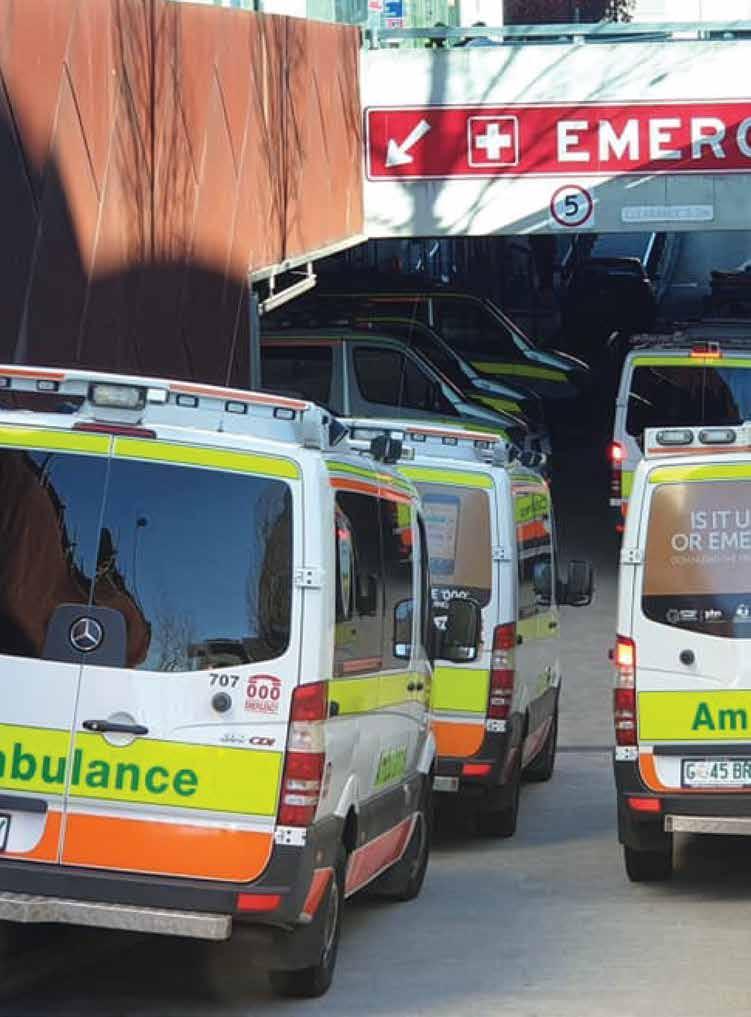
Footage captured by frontline ambulance workers at Princess Alexandra Hospital in Brisbane shows a confronting but increasingly familiar sight.
AMBULANCES LINED UP. CREWS waiting to offload. Patients remaining on stretchers while emergency departments operate at capacity.
United Workers Union members describe the situation simply: ramped to the eyeballs.
What the public often sees is the flashing lights and rapid response. What they don’t always see is what happens next. When hospital beds or treatment spaces are unavailable, paramedics remain with patients until transfer can occur.
The impact reaches far beyond the hospital driveway.
Every ambulance delayed at an emergency department is temporarily unavailable to respond elsewhere. At the same time, patients across the community wait for urgent care.
UWU members say this is not about individual hospitals or frontline staff — it is about systems under sustained strain.
Without efficient offload processes, adequate resourcing and coordinated planning across health services, bottlenecks form.
Pressure builds. Crews remain tied up. Community response times stretch.
The footage from PA Hospital reflects a broader challenge facing emergency care.
For ambulance workers, the issue is clear: better systems are needed to ensure patients are transferred promptly, paramedics can return to the road without unnecessary delay, and emergency services function as intended.
When offload stalls, the entire emergency response network slows with it.
For workers and for the community, that is simply not good enough.
SYSTEM STILL STRAINED
Ramping at Five-Year Low — But Pressure Still Mounting on Frontline Crews.
THE QUEENSLAND GOVERNMENT
says ambulance ramping has fallen to its lowest level in five years — but the opposition argues the broader health system remains under serious strain, with hundreds of thousands still waiting to access care.
Premier David Crisafulli announced that ramping across Queensland hospitals dropped to 37.3 per cent in the final quarter of 2025 — the best result recorded in half a decade. Speaking from QEII Hospital, he said the figures show recent changes are beginning to make an impact.
“Over the last decade, ambulance ramping has tripled in Queensland,” the Premier said. “This is the best result recorded in half a decade. It shows the changes that have been made are starting to bear fruit — but we’ve got a long way to go.”
While the government highlighted a drop in elective surgery waitlists — now sitting at just under 62,000, down from more than 66,000 following the election — the opposition says the headline ramping figure doesn’t tell the full story.
Deputy Labor leader Cameron Dick claims around 300,000 Queenslanders are currently waiting for an initial appointment in the public hospital system — a figure he compared to the combined populations of Townsville and Cairns.
“If you can’t get an appointment with a doctor, you never get your treatment journey started,” he said. “That may open up more beds in emergency departments,
but it leaves hundreds of thousands of Queenslanders stuck waiting.”
Health Minister Tim Nicholls acknowledged the figures would fluctuate but maintained the overall trend was moving in the right direction.
According to Queensland Health data from December, the median wait for an initial specialist appointment sits at 29 days. Emergency department data shows patients were seen within 14 minutes on average, with more than 207,000 presentations recorded statewide for the month — including 64,625 arrivals by ambulance.
For paramedics and frontline crews, ramping figures are only one measure of system pressure. While any reduction is welcomed, workload intensity remains high, with sustained emergency department demand and ongoing workforce fatigue continuing to shape the day-to-day reality on the road.
The announcement coincided with a milestone in the expansion of QEII Hospital, where the top floor of the redevelopment has now been completed. The project will deliver 112 additional inpatient beds, upgraded surgical facilities and expanded parking once the fit-out phase is complete.
For ambulance crews, additional capacity can’t come soon enough — but lasting relief will depend on system-wide solutions that address access to primary care, specialist bottlenecks, hospital bed capacity and workforce sustainability.
Lowest recently — But Still Too High
“While the latest quarter shows improvement, frontline crews continue to experience sustained demand and delayed offloads.”
2021 Rising pressure
2022 System strain intensifies
2023 Peak congestion
2024 Gradual easing
2025 -37.3% but still historically high
If ramping tripled over the past decade, then being the “lowest in five years” doesn’t mean it’s acceptable — it just means it’s lower than a peak.
SA AMBULANCE EMPLOYEES SECURE NEW PAY AGREEMENT
Paramedics and ambulance employees in South Australia have secured a new enterprise agreement delivering a 13.5 per cent wage increase over four years, following strong member endorsement.
THE SA AMBULANCE SERVICE
Enterprise Agreement 2025 covers approximately 2,100 workers and provides staged pay increases from December 2025 through to December 2028. The agreement follows months of negotiations between the Ambulance Employees Association (AEA) and the State Government, with AEA leadership endorsing the offer before it was put to members for a vote.
In addition to base wage growth, the deal delivers structural improvements aimed at strengthening workforce sustainability and professional recognition. These include end-of-shift overtime penalties increasing to 200 per cent, additional pay points and classification increments, enhanced regional incentive payments, improved primary carer and partner leave provisions, and a professional development allowance of $1,200 per year.
The agreement will now be lodged with the South Australian Employment Tribunal for formal approval.
A STRATEGIC BARGAINING CAMPAIGN
AEA General Secretary Paul Ekkelboom said the outcome reflects a focused and deliberate campaign centred on long-term workforce stability.
“The AEA ran a targeted and strategic campaign focused on securing real wage growth, strengthening professional recognition, and delivering meaningful initiatives to support attraction and retention across the service,”
Mr Ekkelboom said.
“Today, members have voted overwhelmingly in favour of the new Enterprise Agreement.
“This result reflects more than support for improved conditions — it reflects the culture that defines our union. A culture
built on solidarity, collective strength, and the belief that when one of us rises, we all rise together.”
Mr Ekkelboom noted that this round of bargaining unfolded in a different environment to previous negotiations.
“In 2022 the focus was on safe staffing and safety for the community,” he said.
“This is a very different scenario.”
Where earlier campaigns centred on workforce expansion and system safety, the 2026 negotiations focused on securing sustainable wage growth and reinforcing the professional standing of ambulance officers within the broader health sector.
STRENGTHENING RETENTION AND RECOGNITION
The inclusion of additional classification increments and strengthened regional incentives is intended to support attraction and retention across metropolitan and regional South Australia.
Workforce mobility and interstate competition remain ongoing challenges, making competitive conditions critical to maintaining staffing stability.
The increase in end-of-shift overtime penalties to 200 per cent also recognises the operational reality that ambulance shifts frequently extend beyond rostered hours due to system pressures.
Meanwhile, the professional development allowance acknowledges the expanding clinical scope of modern paramedicine and the continuing education requirements necessary to maintain high standards of patient care.
Together, these measures represent not only wage growth, but structural investment in the ambulance workforce.
OPERATING AMID SYSTEM PRESSURE
The agreement has been reached against a backdrop of sustained demand across the South Australian health system, including ongoing ambulance ramping challenges.
More than 52,000 hours were spent ramped outside hospitals during the past year, underscoring persistent patient flow bottlenecks and the operational strain placed on frontline crews.
Mr Ekkelboom has continued to advocate strongly on ramping issues.
“I ring the minister weekly and I’ve been quite vocal about ramping,” he said.
“I live for a utopian world where I think we can get rid of ramping.”
While the new enterprise agreement delivers wage certainty and improved conditions, broader system pressures — including hospital capacity constraints and rising demand — remain central issues for the profession.
BROADER BARGAINING LANDSCAPE
The agreement forms part of a broader round of public sector enterprise bargaining across South Australia, with firefighters, police, doctors and allied health professionals also reaching settlements in recent months.
The State Government has framed the ambulance agreement within its wider health investment agenda, including new and upgraded ambulance stations, expanded hospital capacity and additional frontline recruitment.
For ambulance employees, however, the central outcome is clear: real wage growth secured through collective bargaining and strengthened conditions designed to support the long-term sustainability of the workforce.
As the agreement progresses toward final approval, attention will shift to implementation — and to how effectively the improvements support recruitment, retention and operational resilience in the years ahead.
“IN 2022 THE FOCUS WAS ON SAFE STAFFING AND SAFETY FOR THE COMMUNITY”
AEASA
General Secretary Paul Ekkelboom
2,100 13.5%
Total Wage Increase (Over Four Years) 200%
End-of-Shift Overtime Penalty
Employees Covered
$1,200
Annual Professional Development Allowance
Concerns about hospital ramping and ambulance system pressure in Tasmania were brought sharply into focus at the end of 2025, when the Health and Community Services Union (HACSU) warned the state’s health system was struggling to cope with sustained demand.
IN LATE DECEMBER, HACSU RAISED alarm about extremely high ramping levels at the Royal Hobart Hospital, describing the situation as a serious service delivery challenge for Ambulance Tasmania.
HACSU State Secretary Robbie Moore said at the time that ramping delays were creating safety concerns for patients, paramedics and emergency department staff.
“The Royal Hobart Hospital’s ramping times are quite shocking,” Mr Moore said. “Our members are continually frustrated by delays in patient flow at the hospital.”
The union warned that high vacancy rates across Ambulance Tasmania — including both long-term and short-term staffing gaps — were compounding the pressure on frontline crews. Additional shortages in the State Communications Centre were also identified as a concern.
HACSU Ambulance Employees
Sub-Branch President and paramedic Simone Haigh said demand growth was placing ambulance resources under sustained strain.
“If we see a spike, ambulance resources will be put under extreme pressure,” Ms Haigh said.
While the warning was issued ahead of the New Year period, the concerns highlighted by HACSU reflected broader systemic challenges — including ramping delays, workforce shortages and patient flow bottlenecks — that continue to shape the operational landscape for Tasmanian paramedics.
The union made clear that any future industrial action would focus on ensuring ambulances are released from hospitals and able to respond to emergencies in the community, with patient care guiding any response.
As Tasmania moves further into 2026, the issues raised at the close of last year serve as a reminder that sustained investment in hospital capacity, workforce stability and patient flow remains critical to supporting ambulance services statewide.
Health system performance data since that time has reinforced the union’s concerns, with ongoing demand growth and persistent access block continuing to impact turnaround times. For frontline paramedics, ramping is not simply a metric — it represents hours spent waiting with patients in corridors and ambulance bays, delaying their return to the road and reducing system surge capacity during peak periods.
HACSU maintains that without coordinated action across hospital and ambulance services, these pressures risk becoming entrenched rather than episodic.
PAY TALKS AND RAMPING UNDER FIRE
Tasmania’s
public sector wage negotiations have reached what unions describe as a tipping point, with ongoing bargaining delays and worsening hospital ramping fuelling frustration across the health workforce.
IN RECENT MEDIA COMMENTS,
HACSU
State Secretary Robbie Moore criticised the handling of negotiations after it was confirmed the Government’s lead negotiator had stepped down due to illness, despite talks dragging on for almost a year with limited progress. For unions representing frontline health workers, the development was viewed as another setback in an already prolonged and frustrating bargaining process.
After months of stalled discussions, many members say confidence in both the pace and direction of negotiations has eroded.
“This just shows the mess that this situation is,” Mr Moore said.
While unions say they continue to negotiate in good faith, short-notice scheduling and ongoing delays have heightened concern among health workers already under significant strain. Many believe negotiations have lacked urgency at a time of mounting workforce pressure.
“It just demonstrates that this government has no respect for their health workforces,” Mr Moore added.
PAY PARITY CONCERNS
HACSU has also raised interstate pay parity concerns, warning that without competitive
wages and improved conditions, Tasmania risks losing skilled and experienced health professionals to better-paying jurisdictions offering stronger remuneration packages and clearer career pathways.Retention remains a critical issue, particularly in ambulance services where paramedics are managing sustained demand, staffing gaps and fatigue. The union argues that without meaningful wage movement, recruitment and retention pressures will continue to intensify.
With negotiations ongoing, unions maintain that fair wages are essential to workforce morale, longterm service stability and patient safety.
RAMPING ADDS TO PRESSURE
The wage dispute comes amid persistent hospital ramping across Tasmania.
Recent data shows ramping continues at the state’s four major hospitals, with spikes at the Royal Hobart Hospital and Launceston General Hospital. These delays reduce ambulance availability and create flow-on effects across the emergency response network.
For crews, ramping means waiting outside emergency departments to transfer patients — limiting their ability
to respond to new Triple Zero calls. Over time, this contributes to fatigue, extended shifts and growing frustration.
Paramedics say the situation is particularly challenging when delays prevent them from responding to time-critical emergencies.
WORKFORCE RESPECT AND SYSTEM STABILITY
HACSU maintains that both the wage negotiations and ongoing ramping reflect a broader issue of workforce respect and the value placed on frontline health professionals.
As bargaining continues, the union’s message remains clear: sustainable health services depend on fair wages, genuine engagement and decisive action to address hospital bottlenecks. Without meaningful reform, workforce pressures will continue to escalate, placing further strain on already stretched services.
For Tasmania’s ambulance workforce, wage parity, retention and ramping reform are directly linked to patient safety, service reliability and the long-term resilience of the emergency care system. The union argues that resolving these issues is not simply an industrial matter, but a critical step in safeguarding the future stability and performance of Tasmania’s health system.
HACSU State Secretary Robbie Moore
UNION SLAMS NEPT RISK
Proposed changes to Victoria’s Non-Emergency Patient
Transport (NEPT) regulations could allow private transport providers to leave patients alone inside locked ambulances — a move the Victorian Ambulance Union says would represent a serious setback for patient safety.
DRAFT
REGULATIONS BEFORE THE Department of Health could allow NEPT crews to leave a low-acuity patient unattended in the rear of a vehicle while collecting or unloading another patient during double-loading.
The Victorian Ambulance Union (VAU) has strongly opposed the proposal, warning it creates unnecessary risk and undermines patient dignity.
PATIENTS LEFT WITHOUT SUPPORT
While the draft rules state patients should not be left unattended during an “episode of care,” an exemption would apply during double-loading. In practice, this could mean patients left alone inside a locked ambulance while crews complete hospital transfers.
VAU Secretary Danny Hill said the implications are concerning.
“At larger hospitals, unloading a patient can take considerable time — often up to half an hour, sometimes longer if there are delays,” Mr Hill said.
“With vehicles locked for medication security, a patient inside has no practical way to alert staff if their condition changes.”
NEPT services are designed for patients who require clinical oversight during transport. The union argues that supervision is fundamental to that care.
COMMERCIAL PRESSURE AND DOUBLE LOADING
The VAU submission also raised concerns about workplace pressures in the private transport sector.
“Members consistently report commercial pressure to transport more patients at once,” Mr Hill said.
“In a recent poll, nearly a quarter said they had been pressured into double-loading unsuitable patients — and in some cases triple-loading — over the past two years.”
Limited ambulance parking and delayed handovers can further extend the time patients are left in vehicles.
“The union does not support any situation where a patient is left unattended during an episode of care,” Mr Hill said.
“This presents an unacceptable risk to patient safety and falls short of contemporary clinical governance standards.”
VEHICLE LIFESPAN CONCERNS
The draft regulations also propose extending vehicle life limits to 800,000 kilometres — well beyond the roughly 290,000 kilometres at which Ambulance Victoria retires its non-emergency fleet.
Mr Hill said members have reported ongoing concerns about ageing vehicles, including poor suspension, excessive cabin noise, broken fittings and diesel fumes entering patient compartments.
“The suggestion that vehicles could operate up to 800,000 kilometres is deeply troubling and raises serious safety concerns,” he said.
CONSULTATION ONGOING
The draft regulations follow a broader review of the NEPT sector and are scheduled to commence in April, with stakeholder feedback still under active consideration by the Department.
The VAU maintains its position: supervision, safety and patient dignity must remain central to non-emergency patient transport services across Victoria.
To every paramedic, first responder, support staff member and volunteer thank you for the care, professionalism, and compassion you bring everyday. Our community is stronger because of you. Whether it’s responding to emergencies, supporting patients, or providing reassurance during difficult moments, your dedication makes an enormous difference every single day.
UP TO 30+ MINUTES
Hospital delays can significantly extend unattended time.
ASSAULT LAW LOOPHOLE SPARKS ANGER AMONG PARAMEDICS
Victorian paramedics have raised serious concerns about a loophole in emergency worker protection laws after charges relating to the assault of a paramedic were dropped on a legal technicality.
VETERAN PARAMEDIC KATHRYN McCormack was allegedly kicked in the stomach during an incident in Mornington on September 13. McCormack, who has served for many years, is still awaiting surgery following the attack.
The incident occurred shortly after McCormack and a junior colleague began their shift. The pair were walking along Main Street when they witnessed a dispute and attempted to calm the situation. It is alleged a 58-year-old Seaford man crossed the road and attacked them before members of the public intervened.
The man was initially charged with several offences including assaulting an emergency worker. However, during a hearing at Frankston Magistrates’ Court,
prosecutors withdrew that charge after determining the paramedics were not actively treating a patient at the time of the incident.
Speaking after the hearing, McCormack said the outcome was deeply disappointing and felt like a failure of the system meant to protect frontline workers.
The Victorian Ambulance Union has called for an urgent review of the legislation, arguing the case exposes a significant gap in the law.
Union Secretary Danny Hill said the current interpretation suggests paramedics are only protected when actively treating a patient, leaving them vulnerable during other parts of their shift such as travelling between jobs, restocking vehicles or attending station duties.
Victoria introduced mandatory minimum sentences for assaults on emergency workers in 2014, with further reforms in 2018 aimed at strengthening the penalties.
Despite this, assaults remain common. Crime Statistics Victoria recorded 2,430 assaults against emergency service or authorised officers in 2025, with more than 20,000 incidents recorded since 2016.
Ambulance Victoria CEO Jordan Emery said violence or abuse directed at paramedics is unacceptable and acknowledged the dedication of ambulance crews who continue to serve the community every day.
The Victorian Government says it is seeking advice regarding the concerns raised by the ambulance union and Ambulance Victoria.
EMERGENCY GAPS PUT PARAMEDICS AT MAJOR RISK
Paramedics Left Exposed as WA Police Staffing Pressures Spark Safety Alarm.
A CONFRONTING INCIDENT IN Kalgoorlie-Boulder has once again highlighted the risks paramedics face on the frontline — and the dangerous consequences of under-resourced emergency services across regional Western Australia.
Vision from the weekend shows a 25-year-old man repeatedly smashing his head against the windscreen of a St John Ambulance vehicle while naked, as paramedics attempted to manage a volatile emergency. Police took 22 minutes to arrive on scene. The delay prompted a public apology from WA Police’s regional
commander, who cited multiple competing high-priority incidents at the time.
For ambulance paramedics, however, the issue goes beyond one apology or one shift stretched too thin. It raises a fundamental question: how many more times will frontline health workers be left without timely backup?
The United Workers Union (UWU), which represents WA ambulance paramedics, said the incident reflects what members have been warning about for years — chronically underresourced services are putting workers and communities at risk.
Paramedics routinely attend unpredictable and high-risk scenes, including mental health crises, drugaffected patients, family violence incidents and public disturbances. In regional areas, where distances are vast and resources limited, timely police support is not a luxury — it is essential for worker safety.
The Goldfields-Esperance Police District reportedly sits below authorised staffing levels, fuelling debate about whether shortages contributed to the delayed response. While political leaders dispute the extent to which resourcing was to blame, for paramedics on the ground
the lived reality is clear: when emergency systems are stretched, frontline workers carry the risk.
UWU representatives have repeatedly called for stronger coordination between emergency services, improved staffing ratios, and enforceable safety protocols that ensure paramedics are not left managing violent or escalating situations alone.
“NO EMERGENCY RESPONSE SHOULD LEAVE PARAMEDICS STANDING ALONE.”
No paramedic signs up to be assaulted or placed in harm’s way without support. Yet violence against healthcare workers is increasing, and ambulance crews are often the first to arrive in volatile environments.
Importantly, the union has emphasised that protecting paramedics is not about shifting blame between agencies. It is about governments investing properly in emergency services across the board — police, ambulance and health — so that response times are not compromised and workers are not left exposed.
When backup takes 22 minutes to arrive, that is 22 minutes where paramedics must manage risk, de-escalate volatile behaviour, protect themselves and continue providing care — often in full public view.
The Kalgoorlie incident is a stark reminder that frontline safety depends on a system that functions as one. Without adequate staffing and resourcing across emergency services, paramedics will continue to shoulder unacceptable risks while delivering lifesaving care.
The UWU says it will continue advocating for stronger protections, better resourcing and real accountability to ensure ambulance workers can do their jobs safely — no matter where they serve.
Because no emergency response should leave paramedics standing alone.
Being online has made meeting and interacting with others easier than ever before, but it’s important to know how to stay safe.
Here are ThinkUKnow’s top tips for safer online interactions:
• Question suspicious accounts, and trust your instincts if something doesn’t seem right - not everyone is who they say they are.
• Avoid meeting someone in person that you have only ever spoken to online. However, if you do meet, choose a public place and take someone with you.
• If something goes wrong, know how to block or un-match and report.
• Your safety should always come first! Sometimes things don’t go to plan but there is always help available. For more information, visit www.thinkuknow.org.au
ThinkUKnow is a national online child safety program led by the Australian Federal Police, delivered in schools through educational presentations and resources for young people and their parents and carers.
Always here, for 60 years.
Over 60 years ago, the Pharmacy Guild of Australia launched Guild Insurance – designed to protect and safeguard the pharmacy profession. Since then Guild has expanded the network of professionals we protect by forming partnerships with associations who represent a wide range of industries and the professionals who work within these fields.
Proudly partnering with the Australasian College of Paramedicine for over 5 years means we understand the importance of protecting you with more than just a policy.
With us, you’ll be shielded by a policy created from unmatched insight into your profession, access to risk management materials to help you reduce the risk of a claim, backing
from the industry body that stands up for Australian paramedics, and so much more.
Find out how you can be part of something bigger by visiting: guildne.ws/active or calling 1800 810 213 today.