2
O C T 2 6 // C O U N T R Y R O A D S M A G . C O M
// O C T 2 6
3
Contents
O C TO B E R 2 0 2 6
Introduction
6 8
Features
REFLECTIONS All Fired Up by James Fox-Smith
NOTEWORTHIES
An Irma Thomas biography, Halloween decorating parties & the return of ArtRocks
Events
11
VO LU M E 4 3 // I SS U E 1 0
NO TRICKS
Costume contests, pumpkin patches & reasons to eat your weight in candy.
32
“AT THE FOOT OF CANAL” A quest to pay respects to New Orleans's musical legends
36
THE TREE OF SOLES In Ossun, a place to lay one's burdens
40
Story and photos by Hex Windham
Photo Essay by Olivia Perillo • Words by Jordan LaHaye Fontenot
DID WE FUEL A HAUNTING? Pappy's land and the ghosts we held there Story and photos by Carmin Nezat
47
by Catherine Schoeffler Comeaux
SOUPÇON Italian pastries in Lafayette. T-Boy's in Crowley. Creole/ Caribbean from an LSU football player. Bagels! & LSU's New Dairy Store. by CR staff
Outdoors
48
PLANTS WE CAN'T LIVE WITHOUT The importance of keystone species by Jess Cole
4
Culture
52 54
DREAM SOULS Rodger Kamenetz and the science of natural dreamwork
Escapes
60
by Mimi Greenwood Knight
INQUISITION FOR BLOOD A book review by Chris Turner-Neal
A CENTURY ON THE RIVER The history of Baton Rouge's Old Municipal Dock by Mary Ann Sternberg
58
ISO: A PSYCHIC FROM LAKE CHARLES An old ghost story, new questions by Megan Broussard Maughan
O C T 2 6 // C O U N T R Y R O A D S M A G . C O M
Jacqueline DeRobertis-Braun
Creative Director
Kourtney Zimmerman
Contributors:
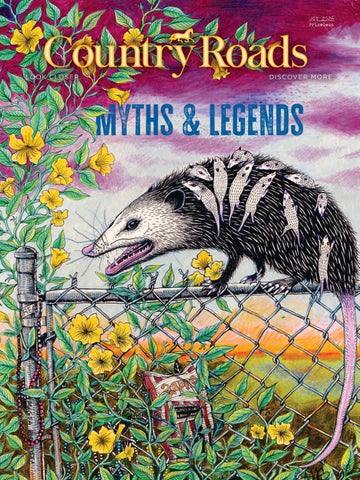
New Orleans artist Magda Boreysza has described the realm of her work as a celebration of the "in between"—as writer Mimi Greenwood Knight puts it, "where day mets night, where reality meets fantasy, where waking hours meet dreamscape." There is perhaps no better representative of the liminal than the opossum: a North American marsupial come to be a symbol of the South, a pacifist with a terrifying grin, simultaneously of the wild and of the suburbs, a creature who "plays with death," as it were. She is a spirit of the night, nocturnal, unless she becomes a mother—that primordial being of the in between, a portal of sorts, between this side and the other. When feeding babies, she might be seen scampering about on chainlink fences during the daytime hours, sleepless. Boreysza has said that the image of this smiling mother opossum, simultaneously heartwarming and unsettling, wandering out at dusk or at dawn, "is New Orleans" to her, in all its beautiful, strange ambiguity. It's the stuff that breeds myths, it's the stuff that breeds legends.
50
Arts & Entertainment Editor
Ingrid Marie Jensen
Art by Magda Boreysza
44
Managing Editor
Jordan LaHaye Fontenot
Editorial Intern
"NOLA POSSUM"
“A HAPPY POT IS AN EMPTY POT” Inside Louisiana's Dutch Oven Societies + a recipe
Associate Publisher
Ashley Fox-Smith
On the Cover
Cuisine
Publisher
James Fox-Smith
62
HAUNTERS OF RUINS In the Delta, Maude and Langdon Clay turn vanishing places into lasting stories by Marshall Blevins-DeLoach
“THE ONLY ELVIS PRESLEY POOL IN THE UNIVERSE” A forgotten marker of the King's time in Shreveport by Chris Jay
Perspectives
66
FOX & COMET
Magda Boreysza's forest creatures are tales of transformation by Mimi Greenwood Knight
Marshall Blevins-DeLoach, Jess Cole, Megan Broussard Maughan, Mimi Greenwood Knight, Chris Jay, Carmin Nezat, Olivia Perillo, Catherine Schoeffler Comeaux, Mary Ann Sternberg, Chris Turner-Neal, Hex Windham
Cover Artist
Magda Boreysza
Advertising
SALES@COUNTRYROADSMAG.COM
Sales Team
Heather Gammill, Heather Gibbons, Mary Margaret Lindsey
Operations Coordinator
Molly C. McNeal
President
Dorcas Woods Brown
Country Roads Magazine P.O. Box 490 St. Francisville, LA 70775 Phone (225) 343-3714 Fax (815) 550-2272 EDITORIAL@COUNTRYROADSMAG.COM WWW.COUNTRYROADSMAG.COM
Mailed Subscriptions
87.30 for 12 months
$
ISSN #8756-906X
Copyrighted. All rights reserved. No portion of this publication may be reproduced without permission of the publisher. The opinions expressed in Country Roads magazine are those of the authors or columnists and do not necessarily reflect the views of the publisher, nor do they constitute an endorsement of products or services herein. Country Roads magazine retains the right to refuse any advertisement. Country Roads cannot be responsible for delays in subscription deliveries due to U.S. Post Office handling of first-class mail.
// O C T 2 6
5
Reflections FROM THE PUBLISHER
W
hen I was a kid growing up in England and, later, Australia, Halloween wasn’t really a thing. But that doesn’t mean there was nothing for a kid keen on community-sanctioned mischief to get excited about. Granted, during October noone was rushing about organizing costumes, stockpiling candy or dreaming up ways to traumatize neighborhood children, but that’s because people were too busy getting ready for Guy Fawkes Night. Who was Guy Fawkes, and why should he have his own night, you ask? Guy Fawkes was part of a group of rebellious English Catholics who hatched a plot to assassinate King James I (a Protestant) by blowing up the English House of Lords during the State Opening of Parliament on November 5, 1605. The Gunpowder Plot, as it came to be known, was foiled when an anonymous letter tipped off authorities to search a cellar beneath the Houses of Parliament, where they encountered Mr. Fawkes stashing thirty barrels of gunpowder. The rest, as they say, is history—in which Guy Fawkes was arrested, tortured into confessing, and hanged by his hated Protestant overlords.
6
That might’ve been the end of the story were it not for the fact that some enterprising public relations person in King James’s retinue suggested designating November 5 an official day of thanksgiving to celebrate the plot’s failure. Across Protestant England, “Gunpowder Treason Day” as it was originally known, evolved into a major state celebration, with communities turning out each November 5 to build straw dummies of “Guys,” (apparently this is where use of the word “guy” as slang for a boy or man comes from), then burn them on huge public bonfires—occasions for much merry-making, fireworks-shooting, general tomfoolery; and, no surprise, anti-Catholic sentiment. You have to imagine that English Catholics would have found the whole thing in rather poor taste. At some point, since the event’s central activity was the building and burning of the straw “Guy,” Gunpowder Treason Day came to be popularly known as “Guy Fawkes Night.” Amazingly, nearly four hundred years later, the tradition was still observed where I grew up, although the effigies had usually evolved to depict more contemporary figures: politicians, TV personalities, coaches of losing sports teams and such. In other words, in English and Australian towns during the 1970s and ‘80s, thousands of small children were still getting excited at the prospect of burning fake traitors in the town square.
O C T 2 6 // C O U N T R Y R O A D S M A G . C O M
Given the American aversion to royalty, it’s no surprise that a festival hell bent on celebrating the survival of an English king fell from favor around the time of the American Revolution. Still, when Halloween rolls around, I can’t help feeling that the lack of a group activity involving burning effigies (European royalty? Tech CEOs?) is a missed opportunity. After moving to America, I took a swing at this. For a decade when our kids were small, we hosted a country Halloween party that grew larger and more raucously unhinged with each passing year. To begin with, it was a benign affair involving candy and cute costumes and pumpkin carving. As the kids got older, scary ghost stories and a hayride through the darkening woods were added. One year someone spiked the punch and the grownups all got knee-walking drunk, but I still missed the gothic weirdness of a Guy Fawkes-style bonfire. The following year, I added one. In a clearing between
two creepy, tumbledown barns, I built a massive, scarecrow-shaped installation using all the fallen limbs accumulated across summer, plus bamboo, burlap, and straw, then soaked the whole thing with diesel for good measure. On the party invitation I’d pitched this as a marshmallow-roasting bonfire, but when lit it exploded forty feet into the sky, growing so huge and terrifying that any costumed child who tried to get close with a toasting fork would have gone up in a blaze of polyester. Still, the kids were as mesmerized by it as their parents were traumatized, so maybe a seed was planted. A mob of costumed children jacked up on candy and raw marshmallows never had so much fun. While I haven’t been in Australia in October or November for years, I hear that these days, the old Guy Fawkes bonfire tradition has given way to Halloween. This might be because of the country’s weakening bonds to English traditions, or maybe to climate change, since in bushfire-prone eastern Australia, large-scale public blazes have rather fallen out of favor. But according to my English cousins, Guy Fawkes Night there remains as popular as ever. So, this November, if you see plumes of smoke rising from the sun-drenched uplands of West Feliciana parish, don’t worry: it’s just me feeling homesick. —James Fox-Smith, publisher james@countryroadsmag.com
// O C T 2 6
7
Noteworthy
O C TO B E R 2 02 6
NEWS,
T I M E LY
TIDBITS,
AND
ASSORTED
LO O K C LO S E R
CURIOSITIES
•
The Pied Piper Writes The Soul Queen's Biography
JOHNETTE DOWNING AND SCOTT BILLINGTON PEN THE STORY OF NEW ORLEANS LEGEND, IRMA THOMAS
I
rma Thomas’s voice is the stuff of legend, and her work with Allen Toussaint at the independent label Minit Records is synonymous with New hOrleans’s R&B and soul music of the 1960s. The length of Thomas’s career, which spans more than six decades, has resulted in multiple generations having the good fortune to enjoy her music as the soundtrack of their lives. Songs such as “It’s Raining,” “Time is On My Side,” and “Backwater Blues,” have become classics. Born in Ponchatoula, in 1941, Thomas began auditioning for record labels in her early teens. By the time she was eighteen, she had released the single, “Don’t Mess with My Man,” which charted at number 22 on the Billboard R&B charts. In 2007, her post-Katrina album After the Rain won a Grammy for Best Contemporary Blues Album. Irma Thomas: Soul Queen of New Orleans, to be released on November 16, is the first biography to be published on this living legend. Written by the husbandand-wife team Johnette Downing and Scott Billington in close collaboration with Thomas herself, the book will be released by the University Press of Mississippi in November. As part of the university’s American Made Music
series, it will provide a vital, comprehensive look at Thomas’s life. Known as the “Pied Piper of Louisiana Music Traditions” and recognized as the recipient of the New Orleans Tourism and Cultural Foundation’s 2026 Literary Arts and Humanities Award, Downing has dedicated her career as a writer and musician to preserving the history of Louisiana music, ensuring that these precious traditions reach younger generations. Billington (also a music educator) has spent decades as Thomas’s producer, working closely with her on projects including the Grammy-winning After the Rain. Comprising 288 pages, the biography charts Thomas’s life from her rural upbringing to her entrance into the music industry, first big hits, a move to Los Angeles in the early 1970s, and her subsequent journey back to New Orleans, where she lives to this day. A must-read for rhythm and blues and soul music aficionados, you can pre-order paperback or collectible hardback copies of the biography directly from the University Press of Mississippi at upress.state.ms.us. —Ingrid Marie Jensen
Art Rocks Anew
LPB'S EXPLORATION OF THE LOUISIANA ARTS SCENE RETURNS FOR A THIRTEENTH SEASON, WITH A FAMILIAR FACE
I
n television there’s an old adage about the camera adding ten pounds. Whether the camera also adds ten years is a question that longtime hviewers of Louisiana Public Broadcasting’s Art Rocks will get to judge for themselves when the program returns this month with a new season (the thirteenth), in a new format, and with ten all-new episodes. Actually, about the only thing that will be the same as the old Art Rocks will be myself, Country Roads publisher James Fox-Smith, returning as host for a tenth season—older, grayer, and arguably wiser, than before. Drawing on LPB audience research confirming viewers’ interest in their state’s vibrant visual and performing arts landscape, new episodes will focus exclusively on Louisiana art and artists. In addition to a longer “Featured Artist” segment, each half-hour episode will now carry an “Impressions” segment in which critics, curators, or collectors weigh in on the significance of a featured artist’s work. And with twelve preceding seasons, plus fifty years of Louisiana cultural coverage to draw upon, every episode will also include a “Vault Rocks” segment, that will connect the dots between featured 8
O C T 2 6 // C O U N T R Y R O A D S M A G . C O M
artists and other Louisiana creatives whose work has influenced or inspired them. To illustrate, LPB Producer Katherine Scherer points to the experience of acclaimed New Orleans painter Brandon Juan Surtain—subject of the season premiere on October 23. As a middle-schooler, Surtain was displaced from his New Orleans home to Baton Rouge during the 2005 aftermath of Hurricane Katrina. While in Baton Rouge, Surtain was enrolled at Glasgow Middle School, and credits the art classes taught there by artist/educator Geeta Dave with setting him on the creative path that defined his artistic career. Although she is now retired, Dave was featured in an Art Rocks episode that aired during 2017. When the episode airs on October 23, the “Vault Rocks” segment will acknowledge the creative impact Geeta Dave’s work had, not only on Surtain’s development as an artist, but also on the thousands of other Louisiana children she influenced during the course of her career. Episodes air at 8 pm Fridays, with a 5:30 pm encore screening on Sundays. lpb.org/artrocks. —James Fox-Smith
Artists Suzanne and Pat Juneau, pictured during an interview at their home in Scott, Louisiana for Art Rocks's new season. Photo by Katherine Scherer/LPB.
Where the Wild Things Glow
CALLING QUIRKY CREATIVES: THE HALLOWEEN ART AND NATURE FESTIVAL IN ARNAUDVILLE WANTS YOU
T
hhe folks at Atelier de la Nature in Arnaudville invite creatives and crafters to “join the dark side,” to help prepare for the 2026 Halloween Art and Nature Festival, themed: “Creatures of the Night.” The free festival, which takes place annually at the nature reserve/STEAM education center founded by Dr. Brandon Ballengée and Aurore Ballengée in Arnaudville, draws on the whimsy and weirdness of the Halloween season to inspire an over-the-top festival that features immersive installations, performances, and hands-on art-science activities. Events and installations are presented in collaboration with local and national organizations including Acadiana Master Naturalists, Fluker’s Cricket Farm, Louisiana Amphibian and Reptile Enthusiasts, Louisiana Master Naturalists, the TECHE Project, the West Baton Rouge Museum, and others. Taking place from 10 am–10 pm on Halloween, this year’s festival will feature twenty-five site-specific installations assembled by local and visiting artists. Among them are Ellen Denham’s Swampera (an experimental opera featuring local musicians like Dustin Gaspard and Corey Ledet), Molly Jo Shea’s Crawdessy (a performance inspired by crawfish) and “Mud Bug Graveyard” installation, community healing workshops presented by Li(sa E.) Harris and local traiteurs, Quintron’s “Frog Phone,” which tunes into the conversations of amphibians on the Atelier de la Nature property, Dana Sherwood’s ritualized dinner parties prepared for nocturnal creatures, and lots more. For full immersion, guests are encouraged to pitch a tent, and to come in costume. The broader Louisiana community is welcome to get involved—working directly with many participating artists, and bringing their own ideas to the Atelier. Each Sunday in October, the Ballengées will host Halloween Decoration Parties, to which the public is invited to help conceive of and build out props, decorations, and installations using repurposed and recycled materials—helping to bring the stuff of the Halloween Art and Nature Festival to life. “Some people just come to help, and we can give them jobs,” said Brandon. “Some people come with ideas and we can help work with them to realize those. There’s no real agenda, except to hang out, be creative, and have fun. There’s always music, the kids run feral, you meet a bunch of creative, interesting people. And we have lots of food.” Decoration Parties take place on October Sundays from 11 am–4 pm at 1050 Andrew Gautreaux Road, Arnaudville. Come for a few hours or for the day, and come hungry. Register (for free) for the parties or for the festival at the Atelier de la Nature Eventbrite page. More details at atelierdelanature.org. —Jordan LaHaye Fontenot
Art installation at the 2022 Halloween Art and Nature Festival by Carey Hamburg. Volunteers to this year's Decoration Parties will have the opportunity to assist with projects like this one. Photo courtesy of Atelier de la Nature.
v
// O C T 2 6
9
10
O C T 2 6 // C O U N T R Y R O A D S M A G . C O M
O C TO B E R 2 02 6
Events
E E R I E & C H E E RY
K E E P R O S E M A R Y B Y YO U R G A R D E N G AT E , P L A N T L AV E N D E R F O R G O O D L U C K , A N D FA L L I N LOV E W I T H T H E S E AU T U M N A L A DV E N T U R E S
•
On the first Friday of the month all fall long, head to downtown Lafayette for a celebration of music and culture. This month Downtown Alive! takes place on October 2, with LeTrainiump as headliner. See details on page 12. Photo courtesy of Downtown Lafayette.
UNTIL OCT 10th
between visual art and American poetry. themuseum.org. 1
Alexandria, Louisiana
UNTIL OCT 11th
ART EXHIBITIONS JOSEP MARÍA GARCÍA-LLORT AT THE AMOA This fall, the Alexandria Museum of Art displays a private collection of Josep
ARTISTIC ICONS "ROBERT GORDY: OUTSIDE THE MAINSTREAM"
María García-Llort (1921-2003) paintings.
New Orleans, Louisiana
An avant-garde Catalan painter who spent
NOMA presents an exhibition by Louisiana native Robert Gordy (1933–86), an artist who preferred to work "outside the mainstream" and is known nationally for his mastery of space, line, and color. After graduating from LSU with his MFA in the 1950s, Gordy lived internationally before settling in New Orleans in 1964. His works were exhibited at galleries in New York, Chicago, and New Orleans. The exhibition draws from NOMA's permanent collection, the archive of the Robert Gordy estate, and loans from private collections. noma.org. 1
several years working in Pineville, GarcíaLlort focused on flat colors and thick lines in his works—heavily influenced by the likes of Pablo Picasso, Antoni Tapies, Josep Palau i Fabre and Albert RàfoslsCasamada. Displayed pieces are on loan to the museum from the Freedman family. themuseum.org. 1
UNTIL OCT 10th
WORDS, WORDS, WORDS "BETWEEN THE LINES: 250 YEARS OF AMERICAN POETRY" Alexandria, Louisiana
Celebrate America 250 through artistic expressions of the written word at the Alexandria Museum of Art's Overlook Gallery. Between the Lines: 250 Years of American Poetry celebrates this historic anniversary and features artwork drawing inspiration from pieces by American poets. Through fourteen artworks by fourteen artists representing eight states, the exhibition highlights the connection
UNTIL NOV 1
st
ART EXHIBITIONS BILL ILES AT NUNU Arnaudville, Louisiana
Bill Iles is a painter and mixed-media artist in Lake Charles, known for his vibrant landscape paintings inspired by the forests, swamps, and waterways of Louisiana. Visit NUNU Arts & Culture
Collective and take in a solo exhibition of Iles' work, running through November 1. nunucollective.org. 1
UNTIL NOV 1st
ART EXHIBITIONS THIRTEENTH HBCU ART SHOWCASE AT THE OGDEN New Orleans, Louisiana
The Ogden Museum of Southern Art and The New Orleans Chapter of The Links, Incorporated present the thirteenth annual HBCU Art Showcase, featuring artwork by Dillard University and Xavier University of Louisiana students. Works are displayed in the Museum’s Education Gallery, which showcases arts education and student artwork from across the South. ogdenmuseum.org. 1
OCT 1st - OCT 3rd
REFLECTIVE TOURS NATCHEZ FALL PILGRIMAGE Natchez, Mississippi
"The most extensive tours of the most extravagant antebellum homes in America." That's the way the Pilgrimage Garden Club describes the Natchez Pilgrimage—the spring and fall tour of homes that has kept visitors coming back to Natchez since 1932. Natchez was once home to more millionaires per capita than any other city in America— // O C T 2 6
11
Events
The Sullivan Theatre presents a classic (and ghostly) farce by Noel Coward. Blithe Spirit tells the story of Charles Condomine, a novelist searching for his next inspiration in the world of the supernatural. When he hires a spiritual medium to host a seance, she accidentally summons the spirit of Charles’s deceased first wife, Elvira. Elvira does not like Charles’s new wife, Ruth, and makes it immediately known through a series of haunting shenanigans. 7:30 pm Thursdays–Saturdays, 2 pm Sundays. Tickets from $28. sullivantheater.com. 1
Longwood—also known as “Nutt’s Folly”—is a towering octagonal mansion left eerily unfinished since 1861. (Guess what happened.) By lantern light, guests are guided through the mansion’s richly furnished basement and into tales of sorrow, loss, and lingering spirits. Hear the tragic story of Haller Nutt, the heartbroken owner whose dream was shattered by the Civil War—and whose presence is still felt on the upper floors he never saw completed. Listen closely for the faint laughter of the Nutt children, rumored to play with their toys long after dark. And pause at the grand staircase, where sightings of Julia Nutt have sent chills down many a spine. This sixtyminute tour blends verified historical accounts with bone-chilling ghost stories passed down through generations. Wear comfortable shoes and bring your courage. Suitable for children eight and up. 7 pm Thursdays - Saturdays. $25. natchezpilgrimage.com. 1
with Art from The Johnson Collection. This exhibition explores how visual artists have grappled with the American South’s layered history through a lens long cultivated in Southern literature. Often described as a mood rather than a strict genre, Southern Gothic blends elements of horror, romance, decay, spirituality, and dark humor. In painting, printmaking, and sculpture, these sensibilities emerge as evocative landscapes, charged domestic interiors, allegorical scenes, stereotypical antebellum imagery, and portraits that hint at psychological depth and social complexity. lsumoa.org. 1
OCT 1st - OCT 31st
OCT 1st - JAN 3rd
the many creative spaces in downtown
Beginning October 1st - 2nd and the city has managed to preserve the extraordinary architectural legacy of that wealth while somberly reflecting on the human lives sold and lost in the process of building it. Today, Natchez's streets remain lined with the palatial mansions and filigreed townhouses, and each year the families that occupy them allow guests to nose through two-hundredyear-old homes, meet descendants, hear tales, sip a mint julep, stay in one of more than fifty historic B&Bs, and generally get a residents' eye view of life in this most historic of Southern cities. Find details at natchezpilgrimage.com. 1
OCT 1st - OCT 4th
JAZZ FINGERS NEW ORLEANS RAGTIME FESTIVAL New Orleans, Louisiana
The annual New Orleans Ragtime Festival is returning to America's jazz city once again, shifting to October dates for its tenth anniversary iteration. The four-day festival will span across multiple venues as it promotes the musical legacy of ragtime through performance and education. Free. theneworleansragtimefestival.com. 1
12
OCT 1st - OCT 4th
GHOST STORIES "BLITHE SPIRIT" AT SULLIVAN THEATER Central, Louisiana
HISTORIC HAUNTS ECHOES OF LONGWOOD: GHOSTS IN THE OCTAGON Natchez, Mississippi
Experience an immersive nighttime experience through one of America’s most hauntingly beautiful homes. Located in historic Natchez, Mississippi,
O C T 2 6 // C O U N T R Y R O A D S M A G . C O M
ART EXHIBITIONS SOUTHERN GOTHIC: LITERARY INTERSECTIONS WITH ART FROM THE JOHNSON COLLECTION
OCT 2nd
LIVE MUSIC DOWNTOWN ALIVE! Lafayette, Louisiana
Downtown Alive! has merged community and culture to create a first Friday of the month tradition (in the spring and fall) and celebration in Lafayette. Food and beverage concession are available, and sales help keep Downtown Alive! Free; please leave your ice chests at home with your pets. This month, catch LeTrainiump, with
Baton Rouge, Louisiana
an opening set by Whiskey Bay, at
The LSU Museum of Art presents Southern Gothic: Literary Intersections
Parc Sans Souci. 6 pm–8:30 pm. Free. downtownlafayette.org. 1
OCT 2nd
AUTUMNAL AFFAIRS ZACHARY FALL FEST Zachary, Louisiana
Stroll the streets of downtown Zachary and explore the annual Fall Fest. The kid-friendly event sees local businesses and organizations setting up their tables along Lee, Virginia, and Florida Streets downtown. 5:30–8:30 pm. Free. cityofzachary.org. 1
OCT 2nd - OCT 3rd ACROSS THE POND EURO FEST
awards also available. 9 am–4 pm. 100 Highland Colony Pkwy, Ridgeland, Mississippi. Free. euro-fest.net. 1
OCT 2nd - OCT 4th
OCT 2nd - OCT 4th
Lafayette, Louisiana
TRAIL MIXERS ROLLER COASTER OF LOVE MOUNTAIN BIKE FESTIVAL Franklinton, Louisiana
Hosted by the Northshore Off-Road Bicycling Association, the Roller Coaster of Love Mountain Bike Festival brings together riders of all ages and skill levels (along with interested spectators) for a weekend of racing, trail riding,
Ridgeland, Mississippi
and outdoor adventure. In addition
At the nineteenth annual Euro Fest, more than 1,600 European automobiles and motorcycles from across the Southeast will arrive at Renaissance at Colony Park. The weekend begins with a Friday morning convoy of vintage roadsters and modern exotics traveling from Downtown Jackson to the Governor’s Mansion for a public display, followed by Saturday’s showcase spanning four blocks of Renaissance. This year’s America 250 celebrations add a special anniversary angle with a “Ford vs. Land Rover” feature pairing historic and modern models. Awards are divided (mostly) by country, including German, Italian, and British cars, with partnering sponsorship
to a roster of competition events, the festival celebrates Louisiana's mountain biking community with group rides, camping, and opportunities to explore the nationally recognized trail system at Bogue Chitto State Park. The event includes youth races (groups for 13–17 and 12 and under) and a dedicated adaptive field for athletes using handcycles and modified mountain bikes. Whether competing, cheering on riders, or discovering the sport for the first time, attendees can expect a weekend of adrenaline, camaraderie, and outdoor fun. Schedule and registration instructions at rcol-mtb-fest.lovable.app. 1
THEATRE "A DOLL'S HOUSE" AT CITÉ DES ARTS
Ibsen's A Doll's House was a controversial success at its premiere in 1879; today, Cité des Arts presents a contemporary adaptation by Amy Herzog, refreshing the story of a woman trapped within her role in society to resonate even more strongly with modern audiences. New York productions of this version were nominated for Tony awards and nabbed three Drama Desk awards, including Best Adaptation. 7:30 pm Fridays and Saturdays, 2 pm Sundays. $25. citedesarts.org. 1
OCT 2nd - OCT 31st HAUNTED HIKES FRIGHT TRAIL Lafayette, Louisiana
The woods outside of Lafayette are full of things that go bump (and growl, and rawr) in the night. Are you brave enough to wander through them? Find out on the Fright Trail, founded by Literacy Inc., the nonprofit dedicated to fighting the growing illiteracy rate in America's teens. Through twenty miles of deep, dark, haunted woods, wanderers might run into any sort of bump in
the night—the creators pull out all the stops for this outdoor open house: props, animatronics, displays, sets, and scare actors galore. How long does it take? (Generally, thirty-five minutes.) How fast can you run? Due to the outdoor nature of the event no open-toed shoes, high heels, or flip-flops; old shoes or boots are recommended. Not recommended for children under eight years of age, children under ten years of age must be accompanied by an adult. Friday and Saturday nights from 7 pm–11 pm. $30; $40 for Saturday Frights Without Lights. Cash only; bring a little extra for treats. frighttrail.com. 1
OCT 2nd - FEB 14th
ART EXHIBITIONS SECOND NATURE: JAPANESE RINPA PAINTINGS FROM THE GITTER-YELEN COLLECTION New Orleans, Louisiana
The New Orleans Museum of Art (NOMA) opens Second Nature: Japanese Rinpa Paintings from the Gitter-Yelen Collection, an immersive look at this influential tradition. One of the most distinctive schools of Japan’s Edo period, Rinpa artists combined specialized ink painting techniques with a shimmering, polychrome palette in compositions depicting natural scenes. Second Nature includes an extraordinary collection
// O C T 2 6
13
Events
OCT 3rd
LOOKING GLASSES ARTINI 2026: WHIMSICAL WONDERLAND
Beginning October 3
rd
of nearly sixty paintings in an array of formats, including hanging scrolls, folding screens, fans, and handscrolls, as well as ceramics and decorative arts, to offer new insights and perspectives into Rinpa painting and the role of artist Sakai Hōitsu in defining the style from its disparate progenitors. noma.org. 1
OCT 3rd
HEADSPACES THE HONEY GOLD EXPERIENCE Baton Rouge, Louisiana
The Honey Gold Experience, an immersive audio-visual collaboration created by Louisiana artists Sariah Sizemore and Taylor Matherne, will present its live show, adapted for the dome, inside the Irene W. Pennington Planetarium at the Louisiana Art & Science Museum. Sizemore and Matherne will perform live, with original custom video collages created by the Honey Gold visual team projected across the planetarium dome. The evening blends original music, voice, sound design, and dome-scale visual storytelling into a single immersive environment. Doors at 6:30 pm;
14
Bossier City, Louisiana
performance begins at 7 pm. Snacks and refreshments will be served in the reception area. $40 adults, $20 children, $30 museum members, and $15 children of museum members. Tickets at lasm.org/honeygold. 1
OCT 3rd
AUTUMNAL AFFAIRS DENHAM SPRINGS FALL FESTIVAL Denham Springs, Louisiana
Downtown Denham Springs is the scene for its annual Fall Festival, filling the entire antique district with numerous activities for all ages. The family-friendly day includes vendors, artist demonstrations, military reenactments, food, and plenty of seasonal shopping in the town's Antique Village. Over 150 local and regional craftsmen will be displaying their wares, from antique treasures to your new favorite handmade bag. For those who need a break from shopping, there will be live music as well as free kids' activities. 9 am–4:30 pm. Free admission. denhamspringsantiquedistrict.net. 1
O C T 2 6 // C O U N T R Y R O A D S M A G . C O M
of classic Creole crafts and dishes, live music, and genealogy presentations— plus, they butcher a whole hog and make cracklins. Boucherie begins at 6 am, everything else at 10 am at Grand Coteau
Shimmy and shake the night away at the
Town Park, 231 Burleigh Lane, Grand
Bossier Arts Council's annual fundraiser
Coteau. Free. creoleculture.com. 1
ARTini, taking place at Live! Casino & Hotel of Bossier City. Sample an array of signature martinis, savor gourmet bites, and immerse yourself in creativity. This year's theme is Whimsical Wonderland.
OCT 3rd
FUN-DRAISERS LOUISIANA WALKS FOR PARKINSON’S
Think Alice, but old enough to drink.
Metairie, Louisiana
The evening shines a spotlight on local
Lace up your sneakers and join more
creatives of North Louisiana while
than 500 participants and volunteers
raising funds to support the Bossier Arts
for the 12th annual Louisiana Walks for
Council's community arts initiatives. 7
Parkinson’s at Lafreniere Park. LA Walks
pm–11 pm at 711 Live Casino Boulevard,
supports the Davis Phinney Foundation
Bossier City. $90. bossierarts.org. 1
for Parkinson’s. Explore other offerings,
OCT 3rd
like a kid's corner, prize draws, and live music. Resources will also be available
PIG-OUTS CREOLE CULTURE DAY
for folks with Parkinson's and their loved
Grand Coteau, Louisiana
11 am. $35 for adults; free for children
The organization Louisiana Creole Culture invites folks across Acadiana to celebrate the rich heritage of the region's Creole communities. The festival is designed as an immersion into the world of traditional Creole life, starting with
ones. Registration opens at 9 am; walk at 12 and under. parkinsonswalk.org. 1
OCT 3rd
ARTS & CRAFTS MOSAIC HALLOWEEN SKULL WORKSHOP
a live boucherie, linguistic activities like
Bay Saint Louis, Mississippi
Creole French Bingo, demonstrations
In this workshop presented by The Arts,
Hancock County, students will design their own Halloween-inspired mosaic skull using sparkling glass pieces in
OCT 3rd
FALL FAVORITES HARVEST DAYS
a variety of colors, shapes, and sizes.
Baton Rouge, Louisiana
Students will learn how to plan, glue,
Harvest Days is the LSU Rural Life Museum's long-running fall festival that provides a glimpse into what life on the farm would have looked, sounded, and felt like in nineteenth-century rural Louisiana. Living history demonstrations always include plowing, blacksmithing, soap and candle making, timber framing, open hearth cooking, sheep herding, and boat making, as well as folk music and dancing. 9 am–4:30 pm. 4560 Essen Lane. $12 for ages 12 and older, $10 for ages 4–11, free for ages 0–3. lsu.edu/rurallife. 1
and grout a mosaic design while creating a festive handmade piece to enjoy year after year. Go bold and bright or create a classic bone-inspired look—no experience is required, and all materials are provided. 10 am–1 pm at 405 Blaize Avenue, Bay Saint Louis, Mississippi. $10 due at the time of the workshop. Register in advance at tinyurl.com/mosaicskull. 1
OCT 3rd
LA LEGENDS DISCOVERY DAY: LOUISIANA FOLKLORE Baton Rouge, Louisiana
Head to the Capitol Park Museum for a fun-filled discovery day centering on Louisiana folklore. Besides walking through educational galleries where visitors can learn about Louisiana Cajun and Creole history, participants will have the chance to dive deeper into the subject matter through the creation of their own spooky or non-spooky loups-garous. 9:30 am–1:30 pm at 660 North 4th Street, Baton Rouge. $5; free for children ages six and younger. louisianastatemuseum.org. 1
OCT 3rd
COWPOKES THE WILD WEST STICK HORSE RODEO Zachary, Louisiana
Prepare to root and/or toot at Zachary's Wild West Stick Horse Rodeo. This family fun event invites kids to participate in dummy roping, bronco busting, barrel racing, and a full slate of other rodeo activities from the safe perch of a stick horse. Your cowpoke-intraining will have a blast, and proceeds will benefit the good work of the Zachary Rotary Club. 10:30 am–1 pm
OCT 3rd
HERITAGE IBERVILLE SWAMP LIFE EXPO Grosse Tete, Louisiana
Experience the authenticity of Cajun life in the swamp, mere yards from modern highway transportation. The Iberville Visitors Center hosts this annual program of hands-on demonstrations and cultural displays, which include crawfish trap making and cypress woodcarving. And don't forget the Cajun food, prepared by Atchafalaya locals—crawfish étoufée, gumbo, pecan pralines—and live zydeco. 10 am–2 pm. Just off I-10 at the Grosse Tete exit, 17525 Highway 77. Free. visitiberville.com. 1
OCT 3rd - OCT 17th
ART EXHIBITIONS "INTO THE GREENHOUSE" Baton Rouge, Louisiana
Kelwood Contemporary Art presents Into the Greenhouse, a solo exhibition featuring the vibrant, abstract floral paintings of Amanda Farris. The exhibition invites viewers into an immersive exploration of our relationship with nature, growth, and the spaces we create to nurture and contain them. The public is invited to an opening night reception at the gallery on October 3 from 5 pm–8 pm. Free. kelwoodcontemporaryart.com. 1
at 4412 Lee St., Zachary. Further details upcoming at cityofzachary.org. 1
OCT 3rd
GOOD GOLLY LOBLOLLY FESTIVAL Laurel, Mississippi
Lovely Laurel presents its annual Loblolly Festival, celebrating the settlement's past as a lumber town. Presented by Cannon Motors, the fair will welcome vendors, artists, and craftsmen to the historic streets of downtown Laurel. Attendees can look forward to live music, children's activities, and festival food. 9 am–4 pm. Free. laurelmainstreet.com. 1
OCT 3rd - OCT 31st
FAMILY FUN CORN MAZE AT LSU AGCENTER BOTANIC GARDENS Baton Rouge, Louisiana
The LSU AgCenter Botanic Gardens at Burden invite parents to lose track of their little ones for just a bit while they let the kids try to find their way through the traditional fall corn maze (don't worry, the scarecrows have an eye out for 'em). On Corn Maze weekends, besides navigating the maze of maize, you can romp around a haystack mountain, pick a pumpkin, visit the petting zoo, // O C T 2 6
15
Events
Beginning October 4th - 9th or join the hayride around the property. Mornings from 9 am–11 am, midday from noon–2 pm, afternoons from 2:30 pm–4:30 pm. The annual Night Maze will be held October 30 from 6 pm–9 pm ($20). $17.50 for all other days; $15 for ages 3–12. Free for children 2 and younger. 4560 Essen Lane, Baton Rouge. lsuagcenter.com. 1
OCT 4th
OLD FASHIONED FUN SUGARFEST Port Allen, Louisiana
The West Baton Rouge Museum returns with its annual SugarFest, a sweet celebration of the sugar cane harvest that has twice been named a Top Twenty Southeastern Tourism event. This is a full day of family-oriented activities, live music, and food. The celebration features attractions like a mule-driven cane grinder in action, praline making, blacksmithing, woodworking, and other historic craft demonstrations; Louisiana musicians performing New Orleans jazz, blues, folk, Cajun/zydeco, and bluegrass; opportunities for French
16
practice; hands-on activities for the kiddos; art and sugar-related exhibits inside the museum, and fresh sugar cane to gnaw on. The sweets contest takes the flavor up a notch with homemade sugary cakes, candies, cookies, and cupcakes. Ever wanted to enter grandma's cake recipe in a good, old-fashioned sweets contest? Here's your chance. Oh, and— naturally—a rum tasting. 11 am–4 pm at 845 N Jefferson Ave, Port Allen. Free. westbatonrougemuseum.com. 1
OCT 4th- OCT 25th
YEEHAW ANGOLA PRISON RODEO St. Francisville, Louisiana
Every Sunday in October, the traffic backs up for miles through West Feliciana as thousands line up for "The Wildest Show in the South." The Angola Rodeo offers a slate of events that includes bull riding, bareback riding, a wild horse race, barrel racing, bull-dogging, wild cow milking (really), convict poker, and rodeo clowns. The arts and crafts show, which features hundreds of items handmade by Louisiana State Penitentiary inmates, is
O C T 2 6 // C O U N T R Y R O A D S M A G . C O M
On October 18, stroll through downtown New Iberia to discover a series of theatrical presentations and musical performances held on local balconies. Details on page 22. Photo courtesy of Acadiana Center for the Arts.
almost as popular. Gates open at 8 am for the arts and crafts show. Rodeo starts at 2 pm. Lines are long; arrive early. At the Louisiana State Penitentiary, at the end of Hwy 66, deep in West Feliciana Parish. Proceeds promote faith-based initiatives at the prison. $25. angolarodeo.com. 1
OCT 7th
OPEN FLOORS CONVERSATIONS ON DANCE HALLS Opelousas, Louisiana
Throughout the twentieth century, Southwestern Louisiana dance halls were
popular spots for people to hear good music, have a drink, maybe a bite to eat, and dance the night into the early hours. Like many towns and small cities across the region, Opelousas hosted its own venues with a variety of music and dance. This program exploring their legacy opens with a conversation between Herman Fuselier and Michael Broussard about the role dance halls played in local communities. Herman Fuselier is the Executive Director of the St. Landry Parish Tourist Commission and author of Ghosts of Good Times: Louisiana Dance Halls Past and Present, which documents
the stories and cultural significance of dance halls throughout the region.
OCT 8th - OCT 18th
Michael Broussard is a PhD candidate
AUTUMNAL AFFAIRS RED RIVER REVEL
in Ethnomusicology at the University
Shreveport, Louisiana
of Illinois Urbana-Champaign. Born
Shreveport's Red River Revel welcomes heavy hitting headliners for one of North Louisiana's biggest events of the year— taking place over eight days at the Festival Plaza. Look forward to performances by over sixty musical acts from all over Louisiana and beyond, and fill up on local delicacies and international treats. Discover artists and makers representing virtually every media, and bring the young 'uns, too: the Kids Center offers attractions including a Mock Dino Dig, a miniature grocery, face painting, laser tag, and rides. Admission is $10 on weekends and weekdays after 5 pm; free Monday through Friday until 5 pm and for kids under 12. 101 Crockett Street, Shreveport. redriverrevel.com. 1
and raised in Lafayette, Louisiana, he focuses his dissertation on southwestern Louisiana dance halls and their enduring importance to the people who filled these legendary venues. The floor then opens to attendees to share their own experiences and knowledge of dance halls. Light refreshments provided. 6 pm–7:30 pm. Free. museum@cityofopelousas.com. 1
OCT 7th - OCT 11th GREEN THUMBS PLANTFEST!
Baton Rouge, Louisiana
Each October, the annual green-thumbed crowd pleaser has been bringing people and plants together in the unique natural space that is Hilltop Arboretum. PlantFest! returns with another veritable botanical bonanza of trees, shrubs, perennials, vines, ferns, gingers, camellias, ornamental grasses, and more, running the gamut from native and traditional to eclectic and electric newcomers. Saturday from 9 am–4 pm, Sunday from noon–4 pm; Hilltop members have early access Wednesday, October 7, from 9 am–4 pm. lsu.edu/hilltop. 1
OCT 7th - OCT 17th ART EXHIBITIONS ACADIAN ART SHOW Plaquemine, Louisiana
Local artists in Iberville and surrounding parishes show off their skills at the annual Acadian Art Show, showing art across professional, non-professional, and young adult categories. Art on display from
OCT 9th
GOURD TIMES PUMPKINS AND PIROGUES Plaquemine, Louisiana
Enjoy an evening of hay rides, kids’ games, cookie decorating, live music, artisan vendors, food, boat displays, and lockhouse tours. Kids can also pick and decorate a free pumpkin while supplies last, courtesy of Iberville Parks & Recreation. Bring your lawn chairs and come enjoy an evening of fall fun at one of Iberville Parish’s most unique historic landmarks. 4 pm–8 pm at the Plaquemine Lock State Historic Site, 57730 Main Street, Plaquemine. Free. Follow the event on Facebook for updates. 1
OCT 9th
PICKERS CANTON FLEA MARKET
October 7; awards and reception October
Canton, Mississippi
17 from 2 pm–3 pm. 24905 J. Gerald
Held the second Thursday of May and October, the Canton Flea Market is legendary in Mississippi—known as "one of the South's original and finest arts and crafts shows." Explore antiques, gifts, quality fine art, handcrafted wares, live plants, and more. With exhibitors by invitation only, patrons can be sure to find exceptional products at this one-dayonly event. 3332 N Liberty St., Canton, Mississippi. cantonmsfleamarket.com. 1
Berret Blvd. myipl.org. 1
OCT 8th - OCT 11th
CULTURAL CELEBRATIONS FESTIVALS ACADIENS ET CRÉOLES Lafayette, Louisiana
Festivals Acadiens et Créoles is returning to Girard Park to pay tribute to the music, food, and arts passed down since the arrival of the Acadian pioneers 250 years ago. Non-stop cultural immersion includes the Bayou Food Festival, workshops, cooking and craft demonstrations, the Courir à la Musique 8K, and more, while six stages offer dozens of acts in a non-stop musical mélange all festival long. Bring your lawn chairs, and your dancing shoes. Free. 500 Girard Park. festivalsacadiens.com. 1
CALENDAR OF EVENTS
October 2026
Bunkie Trade Days • Bunkie’s Main Street October 3, 2026 @ 7:00am-3:00pm • 318.346.2575 ART Afterglow • La Petite AAair Café October 3, 2026 @ 7:00pm • 318.528.1300 Juvenile, Webbie & Foxx Paragon Casino Resort • October 3, 2026 @ 8:00pm www.paragoncasinoresort.com ww Holy Ghost Church Fair Dinner Holy Ghost CC -Marksville October 4, 2026 • 318.253.7561 Ladies Night Out-Pink October • Paragon Casino Resort October 8, 2026 @ 6:00pm • 318.359.6901 Craig Shoemaker • Paragon Casino Resort October 10, 2026 @ 8:00pm www.paragoncasinoresort.com St. Joseph’s School Fair • Plaucheville LA October 10-11, 2026 • 318.922.3401 Sacred Heart School Fair • Moreauville LA October 17-18, 2026 • 318.985.2772 Health Fair & Cancer Walk Lacour Event Center - Simmesport La October 17, 2026 @ 8:00am • 318.201.9415 Taste of the Angels St. Mary’s Assumpution – Cottonport October 24, 2026 @ 5:30pm • 318.876.3651 Monster Ball Paragon Casino Resort • October 24, 2026 @ 7:00pm www.paragoncasinoresort.com ww Alligator Feeding Show Paragon Hotel Atrium • October 31, 2026 @ 4:00pm www.paragoncasinoresort.com
OCT 9th - OCT 11th
RETAIL THERAPY ANTIQUE FAIR & YARD SALE Washington, Louisiana
Come to historic Washington for a chance to browse the wares of over two hundred vendors at this enormous Antique Fair & Yard Sale at the historic, circa-1934 Old Schoolhouse Antique Mall—all 40,000 square feet of it. Expect plenty of food
8592 Hwy 1, Mansura, LA 800.833.4195 travelavoyelles.com // O C T 2 6
17
Events
Beginning October 9 - 10 th
and fun, but perhaps more importantly, great bargains on a wide variety of decorative tidbits for house, home, office, yard, or anywhere. 9 am–5 pm each day at 123 South Church Street, Washington. oldschoolhouseantiquemall.com. 1
OCT 9th - OCT 11th GOOD EATS CRESCENT CITY BLUES & BBQ FESTIVAL New Orleans, Louisiana
Powered by the New Orleans Jazz & Heritage Foundation, the Crescent City Blues & BBQ Festival celebrates Southern soul with legendary local and international blues and R&B talent, plus the greatest assemblage of home-style barbecue to be found within the city limits. Come for performances by Johnny Sansone, Ruth Foster, Washboard Chaz Blues Trio, Jimmy “Duck” Holmes, Linda Gail Lewis, and many more. What's even more ridiculous than getting all these folks in one place is that it's free to watch. Lafayette Square Park, 602 Camp Street, New Orleans. 5:30 pm–8:30 pm Friday; 11 am–8:30 pm Saturday and Sunday. Free. crescentcitybluesfest.com. 1
18
th
OCT 9 - DEC 19 th
th
PHOTOGRAPHY ELEMORE MORGAN AT THE ’76 FOLKLIFE FESTIVAL Lafayette, Louisiana
In the summer of 1976, the Smithsonian’s Festival of American Folklife ran for twelve weeks on the National Mall as the centerpiece of the nation’s Bicentennial, the country’s 200th birthday. A collective of Cajun and Creole musicians from South Louisiana took to the stages as recognized bearers of a national heritage. Louisiana artist Elemore Morgan Jr. traveled to the festival in Washington, D.C. with his camera. Morgan engaged the world constantly through his lens, and at the festival he turned it on the performers from home and the crowds who gathered to hear them. Morgan moved beyond the stages into the demonstration areas, markets, and monuments, where artisans and craftspeople worked at their trades. In all of it, he found his own region held within a wider American story, distinct and shared at once. His photos will be on display in a new exhibition at the Hilliard Art Museum, through December
O C T 2 6 // C O U N T R Y R O A D S M A G . C O M
19. Opening reception and talk Friday,
who rode the train from New York to
October 9, beginning at 3:30 pm. 710
Louisiana between 1873 and 1929 is not
East St. Mary Boulevard, Lafayette. Free
forgotten, the Louisiana Orphan Train
for members, general entry for non-
Society holds an annual reunion at their
members. (And there will be boudin.)
museum in Opelousas. Hundreds of the
hilliardartmuseum.org. 1
thousands of Orphan Train riders and
OCT 10th
BEAMING LASM “ROCK THE DOME” PLANETARIUM LASER SERIES
their descendants gather each year at one of only two museums in the United States dedicated to their history. Guests are invited to join in on the storytelling and the lineage tracing, and to explore
Baton Rouge, Louisiana
the museum. Light refreshments will be
Prepare for a high energy, electrifying
provided. 10 am–2 pm, with program
experience featuring laser light, music,
at 12:30 pm at 233 S. Academy Street.
and motion. The Louisiana Art &
Free. laorphantrainmuseum.com. 1
Science Museum (LASM) presents a Rock the Dome Laser Series at the Irene W. Pennington Planetarium,
OCT 10th
inviting guests into a full-sensory
MARKET TO MARKET DAUPHIN ISLAND ART TRAIL
experience set, this month, to the music
Dauphin Island, Alabama
of Led Zeppelin. 6 pm. $20 for general
Cadillac Square Park, on the beautiful,
admission; $25 for VIP early seating;
just-remote-enough barrier island,
$100 for a Rock the Dome package.
serves as the epicenter of the Dauphin
lasm.org. 1
Island Art Trail, which invites regional
OCT 10
th
REUNIONS LOUISIANA ORPHAN TRAIN ANNUAL GATHERING Opelousas, Louisiana
juried artists, writers, cooks, and more to display their work. Pick up a handy trail map before you set out—you can collect stamps to be eligible for prizes. 9 am–4 pm at 661 Bienville Boulevard, Dauphin Island,
Ensuring that the little-known story of
Alabama. Free admission. Details at
the two thousand parentless children
dauphinislandchamber.com. 1
Elemore Morgan Jr., "Untitled" [Barry Ancelet, Nathan Abshire, Bois Sec Ardoin, & Sue and Earl Vasseur], 1976. Courtesy of the artist. © Elemore Morgan Jr. Morgan's photography from the 1976 Smithsonian Festival of American Folklife, which captured one of the first times Cajun/Creole music was presented on a national stage, will be on exhibit at the Hilliard Art Museum this fall.
OCT 10th
AUTUMNAL AFFAIRS FALL FOR ART
an auction, and more, plus live music from Partly Cloudy. 6 pm. $60; $100 for premium. cathaven.org. 1
Covington, Louisiana
Welcome the start of autumn with the annual Fall for Art celebration in historic downtown Covington. The event features music and performances (this year's lineup includes Jay B. Elston Band and Dancescape Studio) and a sprawling art market along Columbia Street sure to delight. Expect thousands of attendees eager to enjoy the arts extravaganza produced by the St. Tammany Art Association. 6 pm–9 pm. Free. sttammany.art. 1
OCT 10th
MARKET TO MARKET SHADOWS ARTS & CRAFTS FAIR New Iberia, Louisiana
Among the giant oaks on the winding banks of the Teche, attendees at this twice-annual arts & crafts fair can pick up one-of-a-kind items from over one hundred vendors from around the state. From crocheted treasures to bath products and tea-dyed chenille bunnies, this market has it all. And of course—for
OCT 10th
STONE COLD FILES LOUISIANA'S ENDANGERED CEMETERIES
what fair would be complete without it—there will be plenty of food, drink, and dessert. 9 am–4 pm. $5; free for children ages twelve and younger. 320
New Roads, Louisiana
East Main Street, New Iberia. More info
Join author and historian Jessica
at shadowsontheteche.org. 1
Schexnayder in a discussion of Lousiana's endangered cemeteries at the Julien Poydras Museum and Art Center in
OCT 10th
New Roads. Schexnayder's work Fragile
FALL FLAVORS PECAN FESTIVAL
Grounds explores the cultural complexity
Ridgeland, Mississippi
of Louisiana memorials and burial
Celebrate this distinctly Mississippi
traditions and draws attention to the fact that rising waters and changing coastlines menace the survival of many of the sites of memory. Reception at 2 pm, lecture at 3 pm. 500 West Main Street, New Roads. Free. Follow the Pointe Coupee Historical Society on Facebook. 1
OCT 10
th
MEOW MIXERS CAT TALES & COCKTAILS Baton Rouge, Louisiana
Support Cat Haven in Baton Rouge with this feel-good feline party at the Crowne Plaza. Expect an evening of wine pulls, costumes (including a contest),
fall tradition at Freedom Ridge Park in Ridgeland. Visitors can enjoy local artisans, a farmers market, live music, and pecan-inspired treats highlighting one of the South’s favorite seasonal flavors. 10:30 pm–2:30 pm. Free. 253 W School St., Ridgeland, Mississippi. exploreridgeland.com/events. 1
OCT 10th - OCT 11th GOOD EATS WORLD CHAMPIONSHIP GUMBO COOKOFF NEW IBERIA, LOUISIANA
Can anyone's gumbo be better than ya mama's? A few upstarts in Iberia Parish // O C T 2 6
19
Events
OCT 15th
Beginning October 10th - 17th may think so at this annual World
Guatemala, and Turkey, sixty entries were
Championship Gumbo Cookoff, held
selected for the exhibition across a variety
in Bouligny Plaza. The Greater Iberia
of media. Artwork on display will also be
Chamber of Commerce will host the
for sale, with twenty percent commission
festivities, which will feature music,
on each piece going to benefit LSU Vet
family fun, and plenty of food. Over
Med programs. An opening reception
100 teams will make gumbos across five
will be held on October 10 from 4:30
categories: amateur chicken and sausage,
pm–6:30 pm in the LSU Vet Med
amateur seafood, amateur mélange,
Library. The exhibit will be open after
professional seafood, and professional
that from 8:30 am–6 pm weekdays,
non-seafood. Live music all festival
9 am–2 pm Saturdays, 1 pm–4 pm
long for when you need to sit still and
Sundays. lsu.edu/vetmed. 1
digest. Free at 100 West Main Street. iberiachamber.org/gumbocookoff. 1
OCT 10 - NOV 6 th
th
PAW PRINTS "ANIMALS IN ART" Baton Rouge, Louisiana
The LSU School of Veterinary Medicine has invited visual artists from across the globe to submit artworks celebrating animals, the best of which will be on display as part of the Vet School's annual Animals in Art exhibition. Of the 302 entries submitted by artists from across thirty states, plus Canada, Germany,
OCT 14th
ARTS FOR EVERYONE PRIZE FEST Shreveport, Louisiana
One of Shreveport's biggest festivals has everything, from film and food to music and comedy, with the chance to win cash prizes and awards. Prize Fest, a five-day extravaganza held in venues across downtown Shreveport, showcases artists' work and lets you vote for your favorites. Be sure to drop in on industry panel discussions, after parties, live music, and a red carpet event. Full schedule and ticketing information at prizefest.com. 1
2 0 O C T 2 6 // C O U N T R Y R O A D S M A G . C O M
WORDSMITHS 28TH ANNUAL SCRABBLE CHALLENGE Baton Rouge, Louisiana
Gear up for the annual Scrabble Challenge at L’Auberge Casino and Hotel, all to benefit Adult Literacy Advocates. Enjoy three rounds of team Scrabble, a cash bar, a silent auction, wine cork pull, and a buffet, among other activities, as ALA students share how funding can help them achieve their goals. Teams and individuals with the highest scores are eligible for cash prizes. 6 pm at 777 L'Auberge Avenue. $35 per person; $100 for four or a table. Student discount available. Tickets can be purchased at the door or adultliteracyadvocates.org. 1
Longue Vue board member Dr. Michael White takes place at 4 pm, followed by lawn games from 5 pm–7 pm. (Kids' games run from 4 pm, so there's a place to safely stow them during the reception.) $150, with proceeds directed to Longue Vue's garden education programs. Saturday brings a community games day with free gardens admission, inclusive athletic engagements for Louisiana families, and on-site trick-ortreating. Noon–4 pm. 7 Bamboo Road, New Orleans. longuevue.com. 1
OCT 15th - OCT 24th
SPOOKY CELEBRATIONS HALLOWEEN EVENTS AT NEW ORLEANS CITY PARK New Orleans, Louisiana
New Orleans, Louisiana
City Park Conservancy (CPC) invites all to enjoy an out-of-this-world October with outer space-themed iterations of its annual events, Ghosts in the Oaks and Brews and Boos. Unlike in space, your screams can be heard.
Longue Vue House and Gardens puts its own New Orleans twist on an English garden party with their annual Games in the Gardens, inspired partially by the “Racquet & Julep Club” founded by Edith and Edgar Stern at Longue Vue nearly a century ago. On Thursday, a reception honoring musician and
October 15-18: Ghosts in the Oaks— Four nights of a family-friendly trickor-treat path through the Historic Train Garden, unlimited amusement-park rides, activities, and live entertainment. Early admittance $35; general admission $30; Friends of City Park members $25; children 2 and under free.
OCT 15th - OCT 17th LAWN FAIRS GAMES IN THE GARDENS AT LONGUE VUE
October 23-24: Brews and Boos—Enjoy adults-only access to Carousel Gardens, including unlimited amusement-park rides, and open beer bars for $45. VIP Storyland Experience comes complete with full open bar, seating, and special treats for $70 (Friends of City Park $65). 21+ only. Tickets at neworleanscitypark.org. 1
OCT 16th
NO TRICKS A MERRY NOT SCARY HALLOWEEN Port Allen, Louisiana
This Halloween-inspired evening at the West Baton Rouge Museum is quite merry, and not so scary, so the whole family can enjoy. Expect seasonal activities, a costume contest, crafts and treats, a Halloween dance, and two percussionist shows. Bring blankets and lawn chairs. Costumes encouraged. 5:30 pm–7:30 pm at 845 North Jefferson Avenue, Port Allen. Free. westbatonrougemuseum.org. 1
OCT 16th- 17th
UP, UP... NATCHEZ BALLOON FESTIVAL Natchez, Mississippi
The city of Natchez makes a picturesque historic backdrop for balloonatics from all around the country during the annual hot-air balloon festival, when balloonists will fly above the high bluffs and Mississippi River. The Balloon Glow and fireworks show are always well-received, as is a lineup of bands that this year includes Tonic, Journey from The Heart, Terrance Simien & Zydeco Express, Matthias Lattin, Sammy Qadan & The Second Hand Smokers, and the Chee Weez. The festival also includes children's activities, carnival rides, a variety of regional food, and a Sports Tent showing all the weekend's big games on big-screen TVs, so it's up, up, and away you go to Natchez this weekend. $45 weekend pass for adults, $20 on Friday, $35 Saturday if purchased in advance. Children ages ten and younger are free. The festival kicks off at 4 pm Friday, with an 11 am start on Saturday, all on the grounds of Rosalie Mansion. natchezballoonfestival.com. bontempstix.com. 1
OCT 16th - OCT 18th AND AWAY BOUCHERIE & BALLOON FESTIVAL Sorrento, Louisiana
It's a whole-hog, hot air kinda weekend when the Sorrento Lions Club brings the Boucherie Festival to the Ascension Hot Air Balloon Festival. If pigs were ever
going to fly, it'll happen here. You'll wanna do a little advance fasting, as the menu includes jambalaya, hogshead cheese, cracklins, boudin and boudin balls, roast pork, and chicken and andouille gumbo— and those balloons can only carry so much weight. The combined event will be held at 9690 Airline Highway in Sorrento, featuring all the traditional trappings of the Boucherie Fest: cracklin' and jambalaya cook-offs, pig roasting, and all things pork—only now is the added magic of hot air balloon glows, live entertainment, fireworks, carnival rides, and more. Fun to be had all weekend. 4:30 pm–11 pm Friday; noon–11 pm Saturday; noon–6 pm Sunday. Admission by donation. boucheriefestival.com. 1
OCT 17th
OFFSHORE ESCAPADES SHAKE YOUR TRAIL FEATHER PADDLE PARADE Breaux Bridge, Louisiana
The TECHE Project returns with the fourteenth annual Shake Your Trail Feather Festival, celebrating the Bayou Teche National Paddle Trail. The day will include a Paddle Parade down Bayou Teche, featuring live music by local Cajun musicians playing on decorated barges. Participants take part in the 4.5 mile (2 hour) paddle to Parc des Ponts. There will be a pre-paddle shuttle ($5 cash at the bus) from each location (leaving from Parc des Ponts at 9 am). Land at Parc des Pont and celebrate with live musical entertainment, food, and libations. Parade starts at 10 am behind Poche's Meat Market; party from noon–2 pm. Registration for the event is $30 in advance and $35 day-of; free for children. Info about renting boats and how to watch from the shore at techeproject.org. Register through Eventbrite. 1
OCT 17th
SEASONAL SHINDIGS BOOTS & ROOTS FALL FEST Scotlandville, Louisiana
Boots & Roots Fall Fest brings together live music, community, creative vendors, culture, and outdoor recreation for a family-friendly afternoon in Uptown Baton Rouge. This year’s festival will feature live music from the Michael Foster Project, along with delicious food choices, arts and crafts, ATV rides, fun activities for the kids, and more. This festive event offers families, friends, neighbors, and visitors to the city of Baton Rouge opportunity to gather, have fun, and sample a little good old outdoor adventure. 3 pm–8 pm at Throw Dat Dirt ATV Park, 11890 Gibbens Road, Scotlandville, Louisiana. Free general admission, ATVs $40, ATV rides $15. Register via Eventbrite. 1 // O C T 2 6
21
Events
Beginning October 17th - 23rd OCT 17th
OCT 17th - OCT 18th
Baton Rouge, Louisiana
Madisonville, Louisiana
MADE-IEVAL BATON ROUGE MAKER FAIRE The East Baton Rouge Parish Library is inviting high- and low‑tech “makers” to its annual Maker Faire, where the "how to" of everything is explored by crafters, quilters, engineers, and more. This year’s medieval theme brings together history, science, art, and plenty of fun. Try snail jousting, wrap a colorful ribbon around the maypole, and discover medieval armor and battle techniques with Ordo Procinctus. You can also enjoy medieval music with Spiritus Mundi Crescentis and learn about the celestial signs and wonders that fascinated people during the Middle Ages. See centuries-old skills and crafts in action—with mead, soap, and stained glass demonstrations, workshops in chainmail and the art of illuminated manuscripts, and history presentations on medieval kite shields. 10 am–4 pm at the Main Library, 7711 Goodwood Boulevard. Free, though some events require registration. batonrouge. makerfaire.com. 1
BOATLOADS WOODEN BOAT FESTIVAL From pirogues to classic Chris-Crafts, there's just something so appealing about wooden boats. And in Louisiana, there's no place they look better en masse than abroad on the placid waters of the Tchefuncte River. As the major fundraiser for the Lake Pontchartrain Basin Maritime Museum, the Wooden Boat Festival in Madisonville attracts gorgeous examples; just ask one of the thousands of attendees who've been flocking to this celebration for over a quarter century. In addition to upwards of one hundred boats—from little pirogues to seventy-five-foot cruisers and trawlers—the fest features a main stage with live bands throughout Saturday and Sunday. Don't miss the return of the Quick 'n Dirty Boat Building Contest and Parade. 10 am–6 pm, all along the banks of the Tchefuncte River in Madisonville. $15; kids under 12 free. maritimemuseumlouisiana.org. 1
2 2 O C T 2 6 // C O U N T R Y R O A D S M A G . C O M
Something sweet this way comes...to Port Allen for SugarFest, West Baton Rouge Museum's annual sugar cane harvest festival, featuring old-fashioned fun for the whole family, taking place October 4. Details on page 16. Photo courtesy of West Baton Rouge Museum.
OCT 18th
OCT 18th - OCT 20th
New Iberia, Louisiana
Biloxi, Mississippi
Stroll down New Iberia's Main Street and witness, on select balconies, a series of theatrical presentations and musical performances. Performances begin at Shadows-on-the-Teche at 1 pm. Bring lawn chairs, and enjoy food and music before the event at the Shadows, 320 East Main Street, New Iberia. 11 am–4 pm.
The Old Biloxi Cemetery Tour returns, with portrayals of events from the histories of the city's late residents. This tour is a self-guided, continuously performed event, so attendees may arrive anytime and witness all eleven re-enactments. This year’s theme, “Where Royalty Rests,” features tales of Mardi Gras royalty past and featured riders from
SERENADES BENEATH THE BALCONIES
iberiatravel.com. 1
SPOOKY STROLLS OLD BILOXI CEMETERY TOUR
the city's Blessings of the Fleet, along with other types of Biloxi royalty. 2 pm–4 pm Sunday, 5 pm–7 pm Tuesday at 1166 Irish Hill Drive, Biloxi, Mississippi. Free, with donations for the upkeep of the cemetery appreciated; refreshments provided. More info from the Biloxi Main Street Office at (228) 435-6339. 1
more fun. "The Weekend" coordinates a weekend of sparkly events, starting with Sip & Shout on Thursday night, a GAYrage sale, a Big Muddy Mixer on Friday, a 5k along the Natchez Trace on Saturday morning, and "Miss Lou's Got Talent" that evening. Full schedule at yallmeansallnatchez.org. 1
OCT 21st - OCT 25th
OCT 22nd - OCT 27th
Franklinton, Louisiana
New Orleans, Louisiana
This festive, autumnal rural fair has been going on since 1911—come see what Washington Parish has learned about having fall fun in these 100+ years. Expect all the classic small-town fair offerings, as well as live performances by Clay Cormier, Frank Foster, Dustin Dale Gaspard, LeeAnn Rimes, Amanda Shaw, and many more. 100 Main Street, Franklinton. freefair.com. 1
The New Orleans Film Festival returns to venues across the Crescent City with over 150 films, ready to celebrate the work of emerging and established filmmakers from as near as down the street and as far as across the ocean. In addition to screenings, this Oscar-qualifying event will feature panels, filmmaker pitches programs, parties, and more. Complete schedule of screenings and workshops at neworleansfilmsociety.org. 1
FALL FAVORITES WASHINGTON PARISH FAIR
OCT 22nd - OCT 25th HOMETOWN HOMOS Y'ALL MEANS ALL'S "THE WEEKEND"
REELS NEW ORLEANS FILM FESTIVAL
OCT 22
nd
BROOMSTICKS WITCHES RIDE
costumes, participating in this seasonal charity bike ride event. Proceeds will benefit The Purple House Foundation, which seeks to establish and maintain a safe house for women and children escaping domestic violence. Put on your pointiest hat and check in at Parker Park from 3:30 pm–5 pm. The ride begins at 5:15 pm. Stop at The Mallory, 5747 Commerce Street, at 7 pm–10 pm for the after party. $60. witchesridesf.com. 1
OCT 22nd - NOV 1ST
CARNIVALS THE GREATER BATON ROUGE STATE FAIR Baton Rouge, Louisiana
The Baton Rouge State Fair pulls out all the stops each year with rides galore in the carnival midway and live music almost every night. Clowns and magicians amble about while fair-goers feed on delicious fair food. Plus there's mutton bustin', lawn-tractor pulls, pig races, and an exotic animal petting zoo... and the Human Cannonball returns for 2026. Junior beef, dairy, and goat shows also add to the agricultural theme. It's a Baton Rouge
Natchez, Mississippi
St. Francisville, Louisiana
tradition, this year at the Airline Highway
In Natchez, Mississippi, Y'all Means All—meaning that the community itself, and all of its enterprises, thrive the most when they are inclusive. They're also a lot
Witches will race through the streets of historic downtown St. Francisville on this evening, but fear not: it's just friends and neighbors wearing their witchiest
Park and Fairgrounds at 16072 Airline
& Sundays. $15 for weekends, with optional all-rides wristbands; prices vary during the week. gbrsf.com. 1
OCT 23rd
NO TRICKS BOO'S THERE? Baton Rouge, Louisiana
Get ready for a frightfully fun evening at Knock Knock Children’s Museum. Families can enjoy pumpkin painting, explore our Cardboard Corn Maze, and get their faces painted to show off their Halloween spirit. Cook or brew spooky treats in the Cauldron Café, discover the world of STEM in the Haunted Makers Mansion, and enjoy all eighteen Learning Zones. Costumes are highly encouraged, so come dressed as your favorite character and get into the family-fun Halloween spirit. 5:30 pm–7:30 pm at 1900 Dalrymple Drive, Baton Rouge. $10 for members; $25 non-members in advance; $30 non-members at the door. Children under 12 months free. More info at knockknockmuseum.org. 1
OCT 23rd - OCT 25th AWOOOO ROUGAROU FEST
Highway. All proceeds go toward local
Houma, Louisiana
charities and scholarships. 5 pm–10 pm
Who are we to say that the fabled
Mondays–Fridays; noon–10 pm Saturdays
rougarou (known in other parts
// O C T 2 6
23
Events
imaginary? Thousands of wide-eyed
OCT 23 - OCT 25 rd
th
convinced of its existence by parents who
CULTURAL CELEBRATIONS INTERNATIONAL ACADIAN FESTIVAL
commanded obedience by threatening
Plaquemine, Louisiana
a visit from this shape-shifting creature.
To honor the Acadian roots shared by so many area residents, Iberville Parish holds a Water Ceremony every year, a re-enactment of Longfellow’s poem in which Acadian exile Emmeline LaBiche (Evangeline) travels down Bayou Plaquemine on her journey to the Teche Country in search of her lover, Louis Arceneaux (Gabriel). As the story goes, she and her Native American guide spent the night on the banks of the bayou in what is now the City of Plaquemine. In the present-day ceremony, the Indian princesses and Evangeline (queen of the festival) arrive to greet the crowd at the Waterfront Park by fire-lit pirogues. All this, plus the typical festival trimmings: rides, games, music, Cajun food, 4-H booths, arts & crafts, cornhole tournament, and the International Acadian Festival Parade. $26 at the gate. 57845 Foundry Street, Plaquemine. acadianfestival.org. 1
Cajun youngsters would tell us otherwise,
This festival in downtown Houma revels in the frisson of fear, while remaining family-friendly. The festival itself is a creepier take on the traditional Louisiana festival, which, of course, must involve the crucial components of food and music; but organizers have upped the ante with a costume contest (voted one of the ten best in the country by USA Today), a spirited parade, a scavenger hunt, and carnival rides. Take part in a howling contest, a pumpkin lighting, a nutria pardoning, a Day of the Dead celebration, and more. And there's no skimping on the food: jambalaya, blackberry dumplings, and beignets are among the menu selections, so come hungry. 86 Valhi Blvd. near the Houma-Terrebonne Civic Center. Free. 5 pm–10 pm Friday; 10 am–10 pm Saturday; 10 am–5 pm Sunday. rougaroufest.org. 1
2 4 O C T 2 6 // C O U N T R Y R O A D S M A G . C O M
777 L'Auberge Avenue, Baton Rouge.
Laurel, Mississippi
OCT 24th - OCT 25th
CARNIVALS SOUTH MISSISSIPPI FAIR
Beginning October 23rd - 27th of Louisiana as the loup-garou) is
OCT 23rd - OCT 31st
Enjoy all the fun and festivity of a classic state fair at the South Mississippi Fair in Laurel. Pig races, plenty of performances, live music, a petting zoo, and mechanical bull rides are on offer—along with livestock and horticultural shows. Opens daily at 5 pm at 1457 Ellisville Blvd.,
ccmcfoundation.org. 1
LIVE MUSIC BOOTS ON THE BAYOU FESTIVAL Gonzales, Louisiana
Boots on the Bayou pumps up the country vibes at Gonzales's Lamar-Dixon Expo Center, hosting cowboy crooners
Laurel, Mississippi. Ticketing details at
from near and far. This year's headliners
somissfair.com. 1
include none other than Trace Adkins, Drew Green, Brantley Gilbert, Priscilla
OCT 24th
TURN IT UP CAPITAL CITY MUSIC FESTIVAL Baton Rouge, Louisiana
An all-new music festival will bring zydeco, blues, soul, and brass band music to the lawn at L'Auberge. The festival will be headlined by Kenny Neal, in
Block, among other local and national acts. Gates open 2 pm Saturday, 1 pm Sunday at 9039 Saint Landry Avenue. Tickets $59 and up. botbmusic.com. 1
OCT 24th - OCT 25th
AUTUMNAL AFFAIRS YELLOW LEAF ARTS FESTIVAL
his first performance following recent
Saint Francisville, Louisiana
health troubles, along with Cupid and
Embrace the whimsy of fall, small town
Lil Nathan and The Zydeco Big Timers.
charm, and some seasonal shopping with
The lineup also includes Geno Delafose,
the Yellow Leaf Arts Festival at Parker
Jourdan Thibodeaux, Big 6 Brass Band
Park in St. Francisville. Musicians,
and DJ Mr. Clean. The festival will
craftspeople, artists, and collectors gather
feature food trucks, art vendors, line-
each year for over two decades to hawk
dancing classes, and more. Bring lawn
their wares and share their craft. Make
chairs, but no ice chests. Noon–8 pm.
sure to catch the home-grown music
$80 general admission; $250 VIP.
from the area's songwriters and musicians
(with live music all day, both days) and check out the work of this year's featured artist, Jade Deshotel. 10 am–5 pm. artsforallstfrancisville@gmail.com. 1
OCT 25th
WHEELIES FRONT YARD BIKES BASH
OCT 26th
FALL FAVORITES HAINTS, HAUNTS, AND HALLOWEEN 2026 Baton Rouge, Louisiana
The LSU Rural Life Museum's annual "Haints, Haunts, and Halloween" event honors the sights, sounds, and activities
Baton Rouge, Louisiana
of an old-fashioned, family-friendly,
Pump up those tires, lube that chain, and
country Halloween. Presented in the
join the peloton when the 2026 Front Yard Bikes Bash rolls from BREC’s Botanic Garden to Mid City. This year’s group ride kicks off with a bike parade from Independence Park and into Mid City, with stops for snacks and tune-ups, then back to Independence Park where bicycleappropriate food, refreshments, and family fun await. 3 pm–6 pm. $40 registration fee includes a complimentary “Bike Hard, Live Easy” T-Shirt courtesy of Front Yard Bikes and Varsity Sports. Kids ride free. frontyardbikes.com/bikebash. 1
OCT 25th
BOTTOMS UP BOO & BREW New Roads, Louisiana
Come one, come all: New Roads hosts the annual Boo & Brew Halloween event with plans to fill downtown overlooking False River with craft beer, local food, live music, and Halloween activities for the kids. Local businesses will host a trickor-treat, as well as face painting, balloon animals, pumpkin and costume contests, yard games, a live caricature artist, and more. 3 pm–6 pm. $10 adults; $5 kids ages three to twelve; free ages two and younger; food and drinks sold separately. facebook.com/BooandBrewNR 1
OCT 26th
SKEETERS MOSQUITO FESTIVAL Cankton, Louisiana
As they say, in Louisiana we've got a festival for everything—even things that make our skin crawl (or itch, or break out in hives). Yes, it's time to honor Louisiana's unofficial state bird, the mosquito, at this shindig. Pack some bug spray and journey to Landon Pitre Memorial Park in Cankton to catch a swarm of local music, a jambalaya cook-off, blood drive, silent auction, plenty of vendors, and children's activities. The festival's lineup includes local favorites such as Cajun Roots, Dylan Aucoin & the Judice Ramblers, Mike Broussard & Quickdraw, Jamie Bergeron & the Kickin’ Cajuns, and 4 Horses. Free. For more information, visit louisianamosquitofestival.org. 1
charming style of a historic country fair, the museum's grounds fill with fun fall stuff: storytelling, cake walks, hayrides, pumpkin decorating, traditional fair games, and the timeless art of trick-ortreating, all there for kids to discover. Costumes encouraged, of course. 2 pm–4:30 pm at 4560 Essen Lane. $12 adults; $6 for ages 4–12; free for ages 3 and younger. lsu.edu/rurallife. 1
OCT 27th
ANIM-ALES BATS & BREWS Baton Rouge, Louisiana
LSU Hilltop Arboretum invites the community to celebrate Bat Week with Bats & Brews, an evening of science, stewardship, and locally crafted beer. Guests will learn about the bat species that call Louisiana home, including where they live, what they eat, and the remarkable adaptations that allow them to navigate and hunt in darkness. The program will also explore encounters between bats and people, the legal requirements surrounding bat removal in Louisiana, appropriate exclusion practices, and potential disease risks. Presenters will address common misconceptions about bats, the threats these oftenmisunderstood mammals face, and their important role in Louisiana’s ecosystems. Rally Cap Brewing Company will round out the evening with tastings of locally crafted beers, offering guests an opportunity to raise a glass to the unsung heroes of Louisiana’s night sky. 6 pm–8 pm. $15 students, Friends of Hilltop members, and Louisiana Master Naturalist members; $20 general public. 11855 Highland Road, Baton Rouge. Register at lsu.edu/hilltop. 1
OCT 29th - OCT 31st
CARNIVALS STATE FAIR OF LOUISIANA Shreveport, Louisiana
Carnival rides, livestock shows, aerialists, flame-spitters, and all the fried food your little heart desires? It's gotta be the Louisiana State Fair in Shreveport. Taking place each fall since 1906, this statewide gathering brings together all of Louisiana's best assets: from agriculture, to art, to live music, to delicious food— and a whole lot of good times. Open all // O C T 2 6
25
Events
Baton Rouge Food Bank will lead the procession, collecting nonperishable food
Beginning October 29th - 31st days during the run except Mondays and Tuesdays. 3701 Hudson Avenue, Shreveport. Admission, extras, and wristbands vary in price by day; confirm prices, entertainment offerings, and all other info at statefairoflouisiana.com. 1
OCT 29th - OCT 31st
EIGHT COUNTS "DRACULA" BY NEW ORLEANS BALLET THEATRE New Orleans, Louisiana
Garlic up your pearls and head out for a night at the theatre to enjoy a ballet production of the vampire classic Dracula, presented by the New Orleans Ballet Theatre. Audiences are invited to dress as gothically as they dare. 8 pm Thursday and Friday, 2 pm Saturday at the Orpheum Theatre in New Orleans. From $44. neworleansballettheatre.com. 1
OCT 29th - OCT 31st
SPOOKY SPECTACULAR FIFOLET HALLOWEEN FESTIVAL
donations from spectators along the route.
REVS & ROARS RUMBLE IN THE JUNGLE
Rolls at 7 pm. The Fifolet Halloween
Baton Rouge, Louisiana
Ball takes place on October 31 at the Lod
The cheetahs have some competition this fall at the Baton Rouge Zoo. The animals play host to a car show, sporting classic cruisers to custom builds. Expect animal encounters and a family-friendly atmosphere while perusing an impressive fleet of vehicles. 9:30 am–3 pm. $15; $12 for seniors, members, first responders, and veterans; $10 for children twelve and younger; free for children one and younger. 3601 Thomas Road, Baton Rouge. brzoo.org/rumble. 1
returning with a slate of hilarious and
Cook LSU Alumni Center. Costumes,
haunting events. Kick things off with
of course, encouraged. 8 pm. $60 for
a streak of dastardly do-gooding, by
standing room; $700 for table of ten.
donating gently used Halloween costumes
1031consortium.com. 1
and (store-bought, individually-wrapped) candy to ensure that all of the little monsters can have their day on the streets. The Fifolet Costume and Candy Drive will be held through mid-October at locations all over Greater Baton Rouge. The hallowed weekend itself brings its own set of festivities, starting with the Fifolet Hallween Festival Pub Crawl (or Zombie Crawl) along 3rd Street on October 29. Shuffle along to the bars on the marked route, souvenir cup in hand. Participants will receive special drink
OCT 30th - OCT 31st GOOD EATS BLACKPOT FESTIVAL Lafayette, Louisiana
This unique festival returns with a weekend full of music, dancing, and food at Vermilionville. It's a cooperative of South Louisiana musicians, artists, and roots enthusiasts who'll be joined by groups from other parts of the country, too. And all weekend long, competitors will get down and dirty for the title
discounts, and plenty of opportunities to
of champion in categories: gumbo,
win prizes along the way. Free makeup
gravy, cracklin', jambalaya, and dessert.
will be provided on a first-come, first-
Kicks off 6 pm Friday night. Overnight
serve basis one hour before the crawl.
camping is encouraged, so dust off that
6 pm. $45. October 30, the Halloween
tent and get back to your roots (or if you
Parade rolls through downtown Baton
prefer to sleep above the roots, bring
Rouge. Groups may register to participate
your RV). Weekend rate, which includes
Baton Rouge, Louisiana
for free, or you can just watch the
camping, is $70; $35 Friday, no camping;
The capital area's favorite Halloweenmongers, 10/31 Consortium, are back—
true horror of civic engagement and
$45 Saturday, no camping. 300 Fisher
good times as a spectator. The Greater
Road, Lafayette. blackpotfestival.com. 1
2 6 O C T 2 6 // C O U N T R Y R O A D S M A G . C O M
OCT 31st
OCT 31st
BIBLIOPHILES LOUISIANA BOOK FESTIVAL Baton Rouge, Louisiana
Louisiana's excellent annual literary festival returns this year, bringing hundreds of authors, literary-minded organizations, and bibliophiles together again, at last. Sprawling over the grounds of the Louisiana State Capitol, the State Library of Louisiana, Capitol Park Museum, and Capitol Park Event Center; expect book talks, workshops, signings, and plenty more literary loveliness. 9 am–4 pm. Free. Full event schedule at louisianabookfestival.org, and tickets to
the annual Wordshops writing workshops at bontempstix.com. 1
OCT 31st
OCT 31st
New Iberia, Louisiana
AUTUMNAL AFFAIRS HALLOWEEN ART AND NATURE FESTIVAL Arnaudville, Louisiana
Each fall, the folks at Atelier de la Nature host the extraordinary Halloween Art and Nature Festival. This year, the theme, “Creatures of the Night,” brings together more than twenty-five artists, scientists, musicians, educators, and community partners for a full day of immersive installations, performances, workshops, and hands-on activities for all ages. Other programming includes a swamp opera, LED and lantern procession, a "frog phone" allowing real-time eavesdropping on amphibian conversations, and more. 10 am–4 pm and 6 pm–10 pm at 1050 Andrew Gautreaux Road, Arnaudville. Free, but registration required through Eventbrite. atelierdelanature.org. 1
OCT 31st
GOOD EATS SWEET DOUGH PIE FESTIVAL Grand Coteau, Louisiana
A more inviting festival title could not be found. Head to the grounds of Grand Coteau Town Park for the annual celebration of the traditional goodness of the custard, fig, lemon, blackberry, whathave-you-stuffed pastry beloved by locals (and anyone else who takes a bite). Browse through more than seventy vendors of arts, handmade items, flowers, herbs, custom furniture, indoor and outdoor decor, baby and children's clothing while enjoying local food and live music. And of course, a pie competition. You can bet there will be piles of pie to buy, too. Guests will also get the opportunity to immerse themselves in the scenic town of Grand Coteau with self-guided tours, including St. Ignatius School, the St. Peter Claver complex, the Schools of the Sacred Heart, St. Charles Church, and cemetery—with its backdrop of Spanish moss-draped live oaks, which includes the graves of the first African American Mayor for the State of Louisiana postReconstruction, the woman that the St. Charles Church Bell was named after, and historical gravesites for combat veterans and esteemed Jesuit priests. Proceeds to benefit the Grand Coteau Cultural Foundation. 9 am–5 pm at 231 Burleigh Lane, behind Town Hall. Free, with $5 parking. For more information on the festival or to become a vendor, call (337) 331-6352 or visit the Town of Grand Coteau Facebook Page. 1
FALL FAVORITES NEW IBERIA HALLOWEEN PARADE Watch the annual painting of the New Iberia fountain at City Hall, which launches the festivities before the Halloween Parade down Main Street, ending with a trunk or treat extravaganza at Bouligny Plaza, 100 West Main Street, New Iberia. 4 pm. iberiatravel.com/ events-calendar. 1
OCT 31st
HALLOWEEN HULLABALOO TRICK-OR-TREAT TRAIL Opelousas, Louisiana
Families are invited to celebrate the Halloween season at the City of Opelousas’s annual Trick-or-Treat Trail at South City Park. This free community event provides a fun, safe, and familyfriendly alternative to traditional trickor-treating (though there's no law that says you can't do both). Children are encouraged to dress in their favorite costumes and make their way along the trail, lined by local businesses and community groups distributing treats and engaging with young attendees. In addition to trick-or-treating, families can enjoy train rides, a petting zoo, themed photo opportunities, and lively Monster Mash music. 3:30 pm–5:30 pm. 1524 South Market Street, Opelousas. Free. info@cityofopelousas.com. 1
For more events visit countryroadsmag.com/ events-and-festivals.
// O C T 2 6
27
V I S I T S T. F R A N C I S V I L L E It Takes a Village. . . St. Francisville voted “Best Town in Louisiana” by Louisiana Life magazine
W
hen the September/ October edition of Louisiana Life magazine hit newsstands, alongside feature articles about teal hunting in Jefferson Davis parish, Manresa House of Retreats in Convent, and recommendations for cozy towns to visit, the issue revealed the results of Louisiana Life’s “Best Town” contest, which invites readers to vote for their favorite town in the state. The winner for 2026 was St. Francisville, which won over readers not only for its hill country setting on the banks of the Mississippi, but also for its elegantly preserved Historic District, accessible nature trails, locally-owned boutiques, eclectic and sophisticated dining scene, and relatable small-town spirit—one that welcomes visitors like they’re family and makes everyone feel right at home. Those who know and love St. Francisville will already be familiar with landmarks like Grace Episcopal Church, Rosedown, The Myrtles, Market Hall, the Magnolia Café, and Audubon State Historic Site—locales that have made the town a beloved destination for generations. Less well-known is the story of the small group of residents who, more than fifty years ago, recognized that their town was special, and took steps to preserve, protect, and promote it. Someone who knows that story well is Helen Williams, who worked as Director of the Historical Society Museum from 1998 until her retirement in 2021. During that time, Williams had St. Francisville’s shortest, most agreeable commute, crossing Ferdinand Street from the house where she was born in 1937 to the West Feliciana Historical Society building—one of the Historical Society’s early success stories after they bought and restored the former hardware store in 1970. “Ann, Nancy, and Libby: they were ‘The Trinity,’” said Williams. “The three of them had a vision.” She’s talking about Ann Bennett, Nancy Vinci, and Libby Dart, the trio who, by 1970, had recognized the value of St. Francisville’s unusually complete architectural fabric, and were taking steps to preserve it. Their efforts led to creation of the West Feliciana Historical Society, which established standards for protecting the buildings in the Historic District; and the Audubon Pilgrimage, which attracted thousands to St. Francisville each spring for almost fifty years. “The Pilgrimage is really what brought tourists to begin with,” Williams 2 8 O C T 2 6 // C O U N T R Y R O A D S M A G . C O M
St. Francisville Mayor Andy D'Aquilla
said, remembering when dozens of tour buses would bring visitors to tour historic properties, hear stories of the Felicianas’ antebellum era, and walk in the footsteps of pioneering artist/naturalist John James Audubon, who lived and worked at St. Francisville's Oakley Plantation (now open to visitors as part of Audubon State Historic Site) in 1821. “The main thing back then was the Pilgrimage,” Williams remembered. “It was the brainchild of Lucile Leak. Libby Dart was the most fantastic historian. And Ann Bennett … she just did things in a nice way.” Few recognize the legacy of those early tourism pioneers better than St. Francisville Mayor Andy D’Aquilla, whose own father, Billy D’Aquilla, served as mayor for thirty-six years. “The Town of St. Francisville is truly grateful and honored to accept the Louisiana Life Magazine 2026 ‘Best Town in Louisiana’ award,” wrote Mayor D'Aquilla in a statement following the announcement. “An award such as this does not belong to any one person or administration. It belongs to an entire community—and it is important that we recognize the many people who have worked tirelessly to make St. Francisville the special place it is today.” Mayor D’Aquilla credited the vision, dedication, and hard work of community leaders including Nancy Vinci, Leigh Ann Bennett (daughter of Ann Bennett), and Laurie Walsh, as well as members of the West Feliciana Historical Society, and prior mayors and Boards of Aldermen for having “… the courage and foresight to pass ordinances and protections that preserved our historic character while still allowing St. Francisville to grow at a reasonable rate.” “Most importantly, we are grateful to the people of St. Francisville, wrote Mayor D’Aquilla. “This recognition belongs to all of us. We love it here, and we are honored that others see what we have always known—St. Francisville is truly a special place.” To read Louisiana Life's "Best Town 2026" article, visit louisianalife.com/besttown-2026-st-francisville
E - YO U ’ L L L OV E I T H E R E
// O C T 2 6
29
3 0 O C T 2 6 // C O U N T R Y R O A D S M A G . C O M
// O C T 2 6
31
Features
OCTOBER 2026
3 2 A M U S I C A L P I L G R I M AG E T H R O U G H N E W O R L E A N S G R AV E YA R D S OUR OWN GHOSTS?
SOULS LOST & FOUND
// 3 6 S H O E F I T I // 4 0 D O W E C R E A T E
•
PILG RIMAG E
“We All Meet at the Foot of Canal” A QUEST TO PAY RESPECTS TO NEW ORLEANS'S GREAT MUSICAL LEGENDS Story and photos by Hex Windham
Left: Buddy Bolden's monument in Holt Cemetery, a "potters' field" where New Orleans's indigent population has been buried since 1879. Bolden, who is credited as the " father of New Orleans jazz" is buried somewhere on the property in an unmarked grave. Right top: The resting place of jazz vocalist and pianist, "Sweet" Emma Barrett in St. Mark's Mausoleum in St. Louis Cemetery #3. Right bottom: The tomb of trumpeter and bandleader Louis Prima in the Metairie Cemetery.
A
midst a field of handcrafted plywood headstones sits a monument to Buddy hBolden, proclaimed by Jelly Roll Morton as “the blowingest man since Gabriel.” Charles Joseph “Buddy” Bolden, known among his contemporaries as “King” Bolden, is the near-mythical father of New Orleans jazz, of whom there are no extant recordings and whose entire legend rests on the memories of other legends who heard him play. Mor32
ton himself recorded Buddy’s signature tune “Funky Butt,” and retitled it “Buddy Bolden’s Blues,” a.k.a. “I Thought I Heard Buddy Bolden Say.” Bolden’s music career ended in 1907 after he received a diagnosis of dementia praecox (an archaic term for schizophrenia) and was admitted to the Louisiana State Insane Asylum, where he lived until his death in 1931. Bolden was then buried in an unmarked grave at Holt Cemetery, a city-owned “potters’ field” that has been the final resting place for New Orleans’s
O C T 2 6 // C O U N T R Y R O A D S M A G . C O M
indigent population since 1879. Families are given access to graves here for the cost of digging, making it affordable even for those for whom funeral costs would be otherwise prohibitive. However, the city’s location “below sea level” makes in-ground burial less than ideal, causing human remains to occasionally surface after significant flooding; this issue is further compounded by Holt being “officially” at capacity since the late 1980s, though the scarcity of affordable burial sites keeps it in active use to this
day. As a result, burial sites end up being reused multiple times. This, combined with a lack of formal records of who is buried where at Holt, has resulted in a loss of many individuals’ specific resting places over time. So, the Bolden monument is less of a true grave marker than an abstract symbol honoring the musician. Nearby lies the headstone of New Orleans R&B legend Jessie Hill; beneath his name is inscribed “Ooh Poo Pah Doo,” the title of the classic song he penned. (It is fairly common for New Orleans music
legends to have their signature songs included on their gravesites.) Though Mr. Hill was originally buried in one of these “unmarked” graves and for decades after his death in 1996 had no permanent headstone, fans preserved the site with a plywood music note painted over in text, which stood for years until family and fans were able to raise the funds to commission a permanent stone marker (albeit with an incorrect year of death). Other New Orleans music legends have been buried with more grandeur, in the archetypal crypts of the Crescent City: above-ground stone tombs that protect remains from flood damage and can be reused for generations. In Louisiana, we learn about the function of these tombs in elementary school. The visibility of the cemeteries makes them essentially ubiquitous in our culture, constantly reminding us of those who have passed, and that someday we will join them. In Metairie Cemetery, the tombs of jazz clarinetist Pete Fountain and trumpeter Louis Prima are both inscribed with music notes and lyrics from their signature songs (“A Closer Walk With Thee” for Fountain, “Just a Gigolo” for Prima). Prima’s comrade Sam Butera lies in nearby Greenwood Cemetery in a slightly more modest tomb, though still above ground. All of these men worked as professional musicians for decades and lived to relative old age (Prima at 67, Butera at 81, Fountain at 86), and all three had enough success that they were able to
The tomb of jazz clarinetist Pete Fountain in Metairie Cemetery.
purchase large tombs that will provide for generations of their descendants, too. This end of the city (“At the Foot of Canal Street,” as goes the song by local musicians Paul Sanchez and John Boutte) is the neighborhood of the dead—organized by the rows of above-ground tombs of Metairie Cemetery, Greenwood, Holt, Cypress Grove, Gates of Prayer, St. Patrick, and more, some historically integrated and some historically segregated. My daughter and I rode our motorcycles to Gentilly’s Mount Olivet Cemetery to find the graves of Professor Longhair, Fats Domino, and Allen Toussaint. Mount Olivet markets itself as “the only cemetery in New Orleans’s Mid-City District that caters to the African-Amer-
ican and Creole communities” and prides itself as a “small cemetery” that is “big on celebrating life.” Indeed, Mount Olivet does include massive tombs, some featuring musical embellishments (notes, piano keys, horns, etc.), but all three of the New Orleans musical giants we found there are currently resting in relatively unassuming mausoleum squares. Whereas Professor Longhair died in 1980 in relative poverty, on the cusp of releasing the Crawfish Fiesta album that would secure his legacy, both Domino and Toussaint lived into the 21st century and certainly had earned enough money in their lifetimes to have purchased more elaborate tombs. Both men were also known for a degree of flamboyance,
Toussaint especially notorious for driving his Rolls-Royce around town. As we were about to ride away, though, I noticed a quote from the Beatitudes on a plaque on the wall near Toussaint: “Blessed are the meek, for they shall possess the Earth.” Perhaps it was simply a personal choice on the part of these men to be buried in a modest mausoleum square, preferring to spend eternity in a quiet resting place with family as opposed to within an ornate monument to their own personal glory. Jazz vocalist and pianist “Sweet” Emma Barrett (a.k.a. “The Bell Gal”) was similarly buried in the St. Mark’s Mausoleum section of St. Louis Cemetery #3, the cemetery that I have visited the most throughout my life, where most of my mother’s family is buried in one of the more archetypal above-ground tombs. Ms. Barrett’s burial site is flanked by such tombs, owned by several African American families. But the fact was that I still hadn’t found a grave of a Black New Orleans musician that fit the traditional New Orleans archetype. This trend seemed to continue when we rode down to Providence Memorial Park on Airline Highway, right down the road from where Gram Parsons is buried at the Garden of Memories. (The story of why Gram Parsons, who never even played a concert in New Orleans, is nonetheless buried here is a story better told elsewhere.) Here the legendary eyepatched piano virtuoso James Booker
// O C T 2 6
33
Top: The plaque on the tomb of singer and "Emperor of the Universe" Ernie K-Doe, who is buried at St. Louis Cemetery #2. Bottom: The tomb of drummer Paul Barbarin, where also rests jazz guitarist Danny Barker and his wife, vocalist "Blu Lu" Barker, in St. Louis Cemetery #2.
rests in the Champagne family mausoleum square. Like Sweet Emma Barrett’s, Booker’s grave has an elegant inscription, denoting him as “The Piano Prince,” but it is otherwise unpretentious and free of ornament. One of my priorities was to visit the grave of Ernie K-Doe, a singer locally beloved perhaps even more than Domino. Indeed, though his music was relatively obscure elsewhere, in New Orleans, K-Doe was the self-proclaimed “Emperor of the Universe,” operating his own bar named after his biggest hit: the Ernie K-Doe Mother-in-Law Lounge. One of my prized possessions is a Japanese-style fan that belonged to the K-Does, which I bought from the garage sale held before the bar's closure after Ernie's wife Antoinette passed on. Thwarting me, though, was the fact that Mr. K-Doe is buried at St. Louis Cemetery #2, which has been closed to the public for years due to concerns about the fragile nature of the nineteenth-century tombs. However, after a couple of polite phone calls and emails, the nice folks at New Orleans Catholic Cemeteries granted me permission to visit, giving me a code for the digital locks on the security gates. On the appointed morning, my daughter and I rode back down Canal Street towards the French Quarter, turning on Claiborne, where St. Louis #2 is split into three separate plots, each of which is separately gated and locked. Wandering this graveyard brought back a childhood memory of looking into a dilapidated tomb near my paternal grandfather’s and being greeted by my first real look at human bones. Our visit through St. Louis #2 offered similar opportunities. These tombs were the oldest that I had ever seen, many of them inscribed in French or Spanish, and many housing celebrated figures from Louisiana history. I was expecting that Antoinette would be buried with
Ernie, but it was a pleasant surprise to discover that guitar legend Earl King was also buried in the same tomb, with a separate plaque for each local celebrity. It seems that a dedicated music fan had donated the use of her family’s tomb to all three, and Friends of New Orleans Catholic Cemeteries paid for the plaques. Around the corner I also found the resting place of jazz guitarist Danny Barker and his wife, vocalist “Blu Lu” Barker, buried together in the gleaming white tomb of drummer Paul Barbarin, who was Mr. Barker’s cousin. The biggest surprise, though, was accidentally stumbling on the family crypt of some of my own Creole ancestors—with an inscription in French indicating that the first three people buried there were children, distant cousins of mine who died in the yellow fever epidemic in 1850s New Orleans. I was grateful to be able to show the grave to my daughter, giving both of us a sense of belonging amidst the crumbling nineteenth century graves, all backdropped by the interstate highway and urban decay. My quest to find these gravesites had developed beyond being a hobby and into a bit of an addiction, but this day’s discovery brought me a sense of satisfaction and closure. There are a few gravesites of New Orleans music legends that eluded me during my research; however, I have come to accept this, especially if the families chose to keep the burial locations private. As someone who has family in those cemeteries so often visited by buses full of camera-toting tourists, I have made a special effort to keep sacred the burial sites I visit, always remembering I am walking past people’s ancestors and loved ones. I’d like to think that every person deserves the dignity of being remembered and celebrated, and in particular I’d like to make sure that these culture bearers will never be forgotten. 1
Boucherie & Balloon Festival
Sweet Things To Do Rhea Lana’s Consignment | Oct. 2 - 7 HardyCo Showdown | Oct. 9 - 10 Festa Italiana | Oct. 10 Monster Truck Nitro Tour | Oct. 10 St. Mark’s Fall Market & Festival | Oct. 16 - 17 Boucherie & Balloon Festival | Oct. 16 - 18 Autumn on The Avenue | Oct. 24 Boots on the Bayou | Oct. 24 - 25 La Fete des Bayous | Oct. 29 - Nov. 1 Home Show | Oct. 31 - Nov. 1 View our full calendar of events & details! VisitLaSweetSpot.com | @visitlasweetspot 34
O C T 2 6 // C O U N T R Y R O A D S M A G . C O M
Senior Tree Maintenance • Mulch, go wide! • Install lightning protection • Structural prune to mitigate risk • Low dose of organic based fertilizers
Bob’s Tree Preser vation • (8 8 8) 620 -TREE (8733) • w w w.bobstree.com
// O C T 2 6
35
P H O T O E S S AY
At the Foot of the Tree of Soles IN OSSUN, A PLACE TO LAY ONE'S BURDENS
Words by Jordan LaHaye Fontenot • Photos by Olivia Perillo
T
he Tree of Soles is actually three trees now. No one really knows when the first shoe was thrown, but it was before Hurricane Lili, which brought the original Tree to her knees, laces tied up all around her. The souls kept coming, 36
responding to the message “to hang your burdens” here. Your soles, that is. Looking down, I realize I have forgotten to bring an offering of my own. The gray slides, purchased from Target, would be no great loss to me, except that they are so easy to slip on in the morn-
O C T 2 6 // C O U N T R Y R O A D S M A G . C O M
ings, with the baby in my arms and our skin craving sunlight. There happens to be a single boot in a plastic bag in my passenger seat, picked up from the cobbler on the way here—a broken sole made new. In some ways it would be perfect, except that I love those boots, and
fall will come, eventually. I observe a pair of pointed heels, little rosettes of leather on the vamp, resting at the root of the tree, arranged together at a tilt, just so. I wonder if they were abandoned here because they were loved, or because they were not? Nike sneakers,
bedazzled cowboy boots, red Converse, a lone Chaco. Two tiny, pink rubber boots nailed upright and horizontal. You can almost picture the child who once wore them, walking up the trunk sideways. In places the shoes seem to swarm, claustrophobic and choked, they somehow lose their shoe-ness, seeping into the tree with the cicada shells and wasp nests. Disintegrating and misshapen, rotating slowly with the breeze, they look like something else, something that is alive, or rather, was. Is this sense of unease the essence of the soul/sole? The burden? A little research reveals other shoe trees around the globe. A street in Flensburg, Germany, is famous for its “shoefiti.” In other communities and cultures, shoes are thrown to celebrate endings and beginnings: completing the school year, starting a marriage. Along Route 66, shoe trees suggest a shared journey, wanderers following in one another’s footsteps. We’ve walked this way, and now, so have you. The origins of these sole trees are universally mysterious, and this specimen in Ossun, Louisiana, is no exception. The lore around this place is simply stated, and infinitely interpreted. We do not know how it began or who began it, only that as is so
// O C T 2 6
37
often the case, people understood, and followed suit. We humans can be rather cute in that way, nodding wordlessly across the ages as we leave our sandals dangling beside a stranger’s sneakers on this old gravel road. I leave nothing at the Tree of Soles today, not because the burdens I carry are light, but because they are the ones I have prayed for. Sleepless nights and cold coffee, hair sour with spit-up. One day I might return with my son to show him this shrine, and the stories it holds, a ritual of unburdening. One day we might need it. But for now, he knows nothing of such things, and his tiny fresh feet, born in the blaze of summer, have never known shoes. 1
Details • DETAILS • Details You can visit the Tree of Soles at 1009 Cocodril Road, Scott.
38
O C T 2 6 // C O U N T R Y R O A D S M A G . C O M
// O C T 2 6
39
PA R A P S YC H O LO GY
Did We Fuel a Haunting?
PAPPY'S LAND AND THE GHOSTS WE BEHELD THERE Story by Carmin Nezat
I
grew up in Sunset, Louisiana in the nineties, on a homestead surrounded by farmland. We hwere hsharecroppers; for generations, we had grown corn, potatoes and strawberries. My French-speaking maternal grandmother was the head of our household—the caretaker of me, my brother, both her ailing parents, and both her brothers, one of whom was completely disabled. On this land, my mother, aunt, and uncle also grew up. The ties run deep. In the house, we kept a tin box of artifacts we’d found in the fields: arrowheads, buttons, coins, marbles, and metal buckles that we knew were from the Civil War and other moments of history observed by our land. Over the years, the collection was reduced to only a few of the coins—the rest of it nabbed by cousins and family friends who wanted pieces of the history. The home itself and the surrounding outbuildings were built by the hands of my great grandfather, Edward Leger, from scrap wood. The “old house” was made from boards of cypress that he repurposed when Sunset’s original “Community Store” was dismantled. “Pappy,” as we called him, was a traiteur, a Cajun faith healer who used Catholic prayer and energy work to heal and treat the sick. Traiteurs have been compared to Reiki practitioners; the techniques are very similar. Growing up, there were always strangers around, sick strangers. As a kid I didn’t understand why but never really asked questions. It was just how things were. There were specific rituals, practices, guidelines, and rules that Pappy adhered to in order to honor his gift. My aunt recalled that when she was a child, my great grandmother would beg Pappy to give his work up; she was tired of having to nurse him back to health every time he would energetically take on these folks’ illnesses. And she was frustrated that he would not accept payment for his services, something forbidden of those with traiteur gifts. Other strangers have visited our homestead over the years, for reasons other than healing—people searching for something more tangible: treasure. 40
The story, according to family lore, is that beneath the nearly-two hundredyear-old live oaks in our backyard is buried $650,000 of gold treasure—placed there by either the infamous Jean Lafitte, or local cotton baron Hypolite Chrétien. My grandmother’s property, after all, was once part of Chrétien Point plantation. And the planter was known to bury bits of his fortune around his property, which in its heyday stretched upwards of 3,000 acres—some sources say 6,000, and some 10,000—all labored over by more than 500 enslaved individuals. Chrétien was also known to allow smugglers and pirates to use his land to distribute contraband—the most famous being Jean Lafitte, who became a friend and regular guest. These treasure hunters would take over our backyard, roaming around with their maps, metal detectors, and dowsing rods. My grandma has a specific memory of one stranger named Stanley who asked to explore the property. She instantly felt a bad energy coming from Stanley, but still allowed him access— albeit chaperoned by her nephew, Sherman, and her friend, Dudley Pontiff. Stanley had come equipped with a metal detector, a chainsaw, and shovels. The metal detector sensed something under or around the tree closest to the house, and over the course of days, Stanley dug and chopped at the roots of the tree, until my grandma was unable to see him. He’d dug a tunnel beneath the tree from one side to the other, and all the while, the metal detector kept beeping. According to my grandma’s telling, Stanley claimed to have some kind of special device that could differentiate between gold and silver. The closer to the house he would get, the more this device would sound off. Unbeknownst to him, my great-grandma kept a sack of silver dollars inside of the wall of the house closest to the tree. Still, Stanley claimed that it was gold that had the machine trilling. Metal detectors operate by generating an electromagnetic frequency that metals conduct; conductive metals elicit a strong response, and silver seems to be the benchmark for conductivity, with gold registering slightly below it. It’s unclear if the machines of the 1990s could have
O C T 2 6 // C O U N T R Y R O A D S M A G . C O M
Top: The author's family home, built by her great grandfather, Edward Leger, of cypress boards repurposed from Sunset's Community Store. Bottom: Author Carmin Nezat as a child, on the plank swing hanging from an oak tree on her family property. The swing was one of the places where the property's resident ghost, George, made himself known. All photos courtesy of the author.
possibly actually differentiated between the two. So, was it the silver dollars that Stanley’s machine detected, or was it truly the gold? He never did find the treasure. Once he’d thrown in the towel, my grandmother asked that he not return— though we feared for months that he might come back to find the gold, and perhaps harm us in order to do so. In addition to the earthly strangers frequenting our home and property, there were unearthly visitors as well, particularly in the proximity of the huge oak trees in the backyard. One came by so frequently that my grandmother gave him a name: George. If the history holds up, then George existed on our land before I was born, before my mother was born, and long before my grandmother or great grandparents were born. According to family legend, George’s bones are buried beneath one of the oaks, resting right there beside Lafitte’s treasure chest. As all those old pirate tales go, only dead men can keep secrets. We’d (or my grandmother, rather) surmised that “George” was tasked by Lafitte to dig the hole to bury the gold that unknowingly doubled as his grave. And for more than a century, he had roamed around our backyard, unaware that he was dead. But where did my grandma get the
idea that George’s tie to the property was to guard the rumored gold? Was Stanley’s detector faulty and in fact only picking up the silver we had hidden in the walls? Was there even any gold at all? If there wasn’t gold, then who was George and what was he doing there? One thing is clear: “George” did exist. We’d see him in our peripheral vision as just a passing shape, and we’d feel his presence on a regular basis. My brother and I spent a lot of time playing on the massive root systems of the oak trees—as did my mother, aunt, and uncle when they were children. Those tree roots were particularly suited for the imaginary worlds in which our GI Joes, Trolls, and Barbies inhabited. We had a plank swing tethered to the lowest branch of the smaller tree—it was still at least twenty feet high. So many hours were spent playing there and thus, spent with George. George had an affinity for the plank swing. As anyone in South Louisiana knows, wind and even light breezes are a rare thing unless there’s a storm rolling through. But when we’d play on the other trees, that swing would just get going, back and forth, back and forth, all on its own. “Hi George!” We weren’t bothered by him; we’d just continue doing whatever we’d been doing. My grandma taught us not to be afraid of him, but I learned later that she herself
was, in fact, the one who was afraid. She said her hair would stand up and she’d feel static electricity around her whenever she sensed him near. I’d feel it too—a sensation like being inside of a bubble. George wasn’t the only energy haunting our yard. We’d hear things, too. On what seemed like almost a daily basis, the sound of the song, “Dixie Land,” seemed to float over from the field behind the oaks—an often distorted and muffled, though sometimes very clear, arrangement of battle snare drums and trumpets. It seemed like it was coming from really far away, perhaps from a dimension parallel to ours, yet we could feel the rumbling of it inside our chests and stomachs. No one else lived in the area back then. My grandmother’s homestead sat isolated on Chris Road except for ninety-year-old Madame Verlice Higginbotham’s home almost a mile away as the crow flies, and an almost uninhabitable cabin that housed the Breauxs, who we suspected were the descendants of the enslaved people who once worked this land. They lived across the road on the opposite side of where we’d hear the song. As part of Hypolite Chrétien’s plantation, our family property was also in very close proximity to two Civil War battle
sites—the Battle of Buzzard’s Prairie, which was fought directly in front of the Chrétien Point big house (in plantation days, the front of the home was the part that faced the waterway, so that would’ve been Bayou Bourbeaux) and the Battle of Carrion Crow (meaning buzzard) Bayou (also known as the Battle of Bayou Carencro or the Battle of Grand Coteau, or the Battle of Bayou Bourbeux). There is a phenomenon called Place Memory Theory, in which events involving intense energy or negative/tragic situations can be absorbed and stored in locations where the electromagnetic field is strong enough. In these cases, events can repeat mechanically, like a playback loop, when and if the environmental conditions allow. It was as though the music and the elevated energy of those soldiers marching into battle had been recorded by the earth, played like a tape, again and again, whenever the veil was thin enough for us to be able to perceive it. Environmental triggers or sensitive human minds act like decoders, replaying the sights or sounds of the past. A long stretch of Bayou Carencro runs parallel to the area on Chris Road where our home was. My grandmother tells stories about how when she was a child, she and her brother were exploring near the big oaks when they found the red brick foundation to an old home, as well
// O C T 2 6
41
negative force. But when their creator has control over their abilities, they don’t have to be. Take Pappy for instance. He healed people by using energy fueled by his and their shared belief that they would be cured. And they were.
Left: The author's grandmother, Dot Leger Speyrer, standing beneath the ancient oaks on the family property. Right: The remnants of the family tin box treasure collection: old coins found around the property.
as a cypress cistern on the field-side of the oak trees. My grandmother always understood this home to have belonged to the overseer of the plantation. Pappy told her that he remembered a house still being there when he was a child, and that once, while digging to install posts for a clothesline, he had found human bones with Confederate uniform buttons in a shallow area of the yard. Once, before someone took them, those buttons lived in the tin box along with the old coins and things.
But what happens to the un-harnessed energy? The gift of healing is said to be passed down in family lines. I’ve long wondered if perhaps we, Pappy’s descendants, all have a bit of its power in us but were not aware enough to nurture it. Nor was the gift “handed down” to any of us, as is the tradition. If a person has excess energy and also possesses the ability to direct it, what happens when they direct it toward the wrong things—consciously or subconsciously? If all my family possessed this ability to harness energy, if our third eyes were more open than most other folks—then had our collective energy and beliefs, and more or less fabricated stories surrounding these hauntings, fueled or even flat-out created them? There is something in the field of parapsychology called “P-K manifestation,” or psycho-kinesis. I think of it as psycho-kinetic manifestation, influencing a physical system without physical interaction. This phenomenon is specific to people with unknown psychic abilities. It is usually associated with adolescents going through puberty, which is a tense and confusing time where emotions and energy run high. But I wonder if it isn’t age specific: strong enough emotion, intention, and things like mass thought can direct energy into forming its own entity—sometimes called a poltergeist. Poltergeists aren’t intelligent beings, they’re just a personified amalgamation of emotions, and are usually a
George isn’t there anymore. My grandmother says that one day, she was so spooked by him that she said aloud, “George, go home to your mama, go home.” And that was the end of that. Had she moved him on, or had she convinced herself that she had gotten rid of him by just believing that she had? And by believing that she had gotten rid of him, had the energy she put forth in order to do so in fact ceased his existence? Was George just the ghost in a ghost story that we had all collectively made up and chosen to believe in? Had we forged our own narrative surrounding his presence and then breathed life into the story, which in turn perpetuated this haunting? Did he, as an intelligent spirit, ever really exist, or had we completely created him? The fact that he stopped existing, to all of us, especially after my grandma told him to go, doesn’t answer these questions, but it makes me wonder if our collective belief that he had “gone home” cut off the energy supply that we manifested into the haunting. It was around the same time that we stopped hearing “Dixie Land” in the field. But concurently, the area was becoming more populated. This was the 1990s. My great grandparents passed away within a few years of each other, a subdivision was made on the other side of the field, my grandma sold some acreage behind the house, and a trailer park was built. Maybe all the new energy snuffed out the old ones. Or maybe we had just been so isolated back there that we made stuff up to entertain ourselves. The property is pure peace and quiet now, but has an empty feeling. My grandmother still lives there with my aunt, in a trailer. The old house sits vacant and forlorn in the backyard. I don’t visit as often. But when I began my research for this project, when I started asking all these questions and gathering the photos and walking around all the old hot spots, my grandma said there was an eerie feeling back near the oaks again. Is it only that I sparked her memory? Or has something woken up? 1
My family were spiritual people. My great grandparents had chosen to participate in the organized religion of most Cajuns, Catholicism. But they were spiritual in different ways as well—connected to the earth and to the people. Pappy was a traiteur, given a mystical gift by God. His wife, Delia, known to us as Ma-mom, was half Chitimacha. She held a profound connection to her land and the flora around her. Early on, I realized I carried some of this mysticism, too. It felt as though the things I saw and heard affected me more than anyone else in the family. As early as age five, I asked my grandmother relentless questions. Like my mother, I had dreams that felt riddled in meaning, location-specific dreams—something in the field behind the oak trees, all the time. My grandmother explained to me that I had these experiences because I was still so “close to the other Left: The ancient oaks on the author's family property, and all the mysteries they hold. Right: The author, Carmin Nezat, who grew up side”—I was a child and had only just recently crossed in Sunset and is today an herbalist and educator splitting time between North Carolina and Louisiana. over into our physical dimension. But also, children are not as tainted by societal beliefs and standards as adults are. I was very young, but understood what she meant immediately. All of these influences fueled an obsession with the paranormal that would carry on for years to come. I’d borrow every book I could find on ghost stories from the library, I’d ask my mom and dad to bring me to book stores and buy books about ghost-hunting, eye witness accounts, and folklore. I’d watch television shows about haunting re-enactments and psychics. But just recently, after years and years of reading and learning, I had an interesting revelation: could we have been haunting our own land? There is something to be said about energy and how it only changes forms but never disappears. Pappy used energy-work to heal the sick, but that was fueled by belief too, wasn’t it? Unless of course it was completely real—in which case he had the ability to harness his energy and use it in a way to heal the human body. 42
O C T 2 6 // C O U N T R Y R O A D S M A G . C O M
// O C T 2 6
43
Cuisine
OCTOBER 2026
GOING DUTCH
4 4 A S A T U R D A Y W I T H T H E L A T A N I E R C O O K E R S // 4 6 D U T C H O V E N R E C I P E : P I N E A P P L E U P S I D E D O W N C A K E / / 4 7 S O U P ÇO N
•
The Latanier Cookers are a chapter of the Louisiana Dutch Oven Society who gather every month at Palmetto Island State Park to prepare, and share, dutch oven delights.
SUPPER CLUBS
“A Happy Pot is an Empty Pot”
DUTCH OVEN SOCIETIES GIVE THE SPIRIT OF THE POT LUCK A REGIONAL FLARE Story by Catherine Schoeffler Comeaux • Photos by Jacob Cavallaro
T
ime slows down on Saturday mornings when the Latanier Cookers gather to light the coals and start prepping for the monthly Dutch Oven Gathering at Palmetto Island State Park. “It’s all about meeting, greeting, cooking, and eating,” said Danny Meaux, founder and head of the Latanier Cookers, who take their name from the Louisiana French word for “palmetto.” Meaux is also the former president of the Louisiana Dutch Oven Society. This writer spent a Saturday with the group–learning a few of the techniques of Dutch oven cooking and enjoying the camaraderie amongst the cookers as they fed over 150 people who came out of the palmetto-filled woods to enjoy the feast. As a Boy Scout, Meaux had dabbled in 44
baking cobblers and “black bottom biscuits” in a cast iron pot over an open fire. Many years later, and miles away on a bow-hunting trip for elk in the Blackfoot Mountains of Idaho, he was inspired by the field cook who prepared everything in black iron Dutch ovens. Meaux returned home to find there were Dutch oven societies in Louisiana and started his own at the state park less than a half hour from his home in Meaux, Louisiana. They’ve been gathering regularly there for thirteen years. Carlene Meaux, the group’s PR person and Danny’s wife, said that when she was young, her father instilled in their family the tradition of veiller. “We’d go visiting and have coffee with friends; something might be cooking on the stove. Saturday mornings are like that. You sit, you talk,
O C T 2 6 // C O U N T R Y R O A D S M A G . C O M
you exchange recipes. It’s a fellowship.” “Dutch oven cooking” is technically preparing food in a lidded pot of some sort of cast metal. Most explanations of the “Dutch” descriptor lead back to a method of casting iron that originated in Holland. Some cookers prefer caste aluminum for its comparative light weight, but a thick pot with a lid is a must for the low and slow cooking method. That day, eighteen cookers watched over their lidded pots with the help of spouses, cousins, friends, and curious onlookers. Many of them made a weekend of it, staying in the park’s campground. They gathered under festival-style tents in the parking lot on the edge of the woods, guarded by a larger-than-life sculpture of a Louisiana black bear. Barely perceptible wisps of smoke occasionally rose from the
cauldron-style pots, but no visible flames were to be seen. “Where’s the fire?” Richard Thibodeaux pointed underneath his three-legged pot, where nine coals smoldered and precisely eighteen sat atop the lid specifically designed with high sides to hold them. Known as the best baker of the group, he was using a charcoal heat chart to achieve the precise temperature he needed for a blueberry sweet dough pie. To adjust for weather and wind and without missing a word of conversation, every fifteen minutes he would give the pot a quarter turn clockwise then turn the lid a quarter turn counterclockwise. “However it comes out, that’s how it’s supposed to be,” he said, “A happy pot is an empty pot—that’s the goal.”
All food is donated by the cookers, each making enough to offer a taste. Someone always makes a larger main dish to ensure everyone eats well. That day, it was jambalaya. Attendees pay only the $3 park entry fee and are asked to bring a dish to share, whether it was made in a Dutch oven or not. Like most potlucks, it didn’t actually matter if you brought a dish; everyone was welcome to fill their plate after a prayer, the pledge, and a loud, “Allons manger!” proclaimed over the bullhorn. Repeat guests know to bring their own dishes, and discerning diners bring muffin tins to manage the wide variety of samplings like camp stew, peach cobbler, and black eyed peas with sausage. To help pay for disposable plates and forks, the group holds a multi-prize raffle. “Our one rule is, ‘No rude behavior,’ and we’ve never had a problem,” said Meaux as he served up the last of the jambalaya to a couple from Kansas city—cyclists who were spending their third springtime in the state park who said, “The food is great and everyone is so friendly.” Such Dutch Oven Gatherings happen all over the country, with chapters existing in over twenty states. This writer had the chance to communicate with Brent
Bolton of Ohio, the founder of the US Dutch Oven Society, who was still singing the praises of the delicious “crayfish [sic] étouffée” he’d tasted at a national DOG held in Rayne in 2023. (Louisiana will host the 2027 national DOG September 30 through October 2 at the Ruston Sports Complex.) Bolton noted that Louisiana has an abundance of chapters, second only to Texas (perhaps a per-square-mile analysis is in order). He cites various reasons for this high number: the exceptionally good year-round weather, the abundance of foods that respond well to cast iron cooking, the long standing cultural history of outdoor gatherings with live fire cooking, excellent management at the state level of the DOS, as well as the amazing cooperation from the state park system, which supports the gatherings. Traveling Dutch oven connoisseurs could spend every Saturday of the month being well fed while enjoying the state’s natural beauty in both south and north Louisiana. To plan your meals in the Louisiana wilds, see the schedule, or visit the programs and events page at lastateparks. com. For regularly updated DOG information, each chapter maintains a Facebook page. 1
Dutch Oven Gatherings Across Louisiana First Saturdays • Cajun Creole Cookers are at Lake Fausse Point State Park in St. Martinville. • Central Louisiana Dutch Oven Cookers are at Indian Creek Recreation Area in Woodworth. Second Saturdays • Bayou Pots are at Lake Bistineau State Park in Doyline. • Latanier Cookers are at Palmetto Island State Park in Abbeville. Third Saturdays • D’Arbonne Dutch Oven Cookers are at Lake D’Arbonne State Park in Farmersville. • Wego Cookers are at Bayou Segnette State Park in Westwego. Fourth Saturdays • Le Chien Cookers are at Sam Houston Jones State Park in Lake Charles.
// O C T 2 6
45
RECIPES
Dutch Oven Pineapple Upside Down Cake A FAVORITE AT THE POTLUCK
By Carlene Meaux
Photo by Dennis Wilkinson. CC BY-NC-SA 2.0
NEED: 12" Dutch Oven Charcoal briquettes (approximately 35) Charcoal chimney Charcoal table or pan Lid lifter & gloves Parchment paper liner Large mixing bowl Spatula or mixing spoon Knife Can opener INGREDIENTS: 1/2 stick butter 1 1/3 cup brown sugar 6 oz. can crushed pineapple 15 oz. can of sliced pineapple 1 small bottle of maraschino cherries 1 box yellow cake mix 3 eggs 1/3 cup cooking oil DIRECTIONS 1. Line bottom of Dutch oven with parchment paper. 2. Melt butter in bottom of the oven. 3. Stir in brown sugar. 4. Drain sliced pineapple, reserving juice. Place pineapple on top of brown sugar mixture, adding a cherry in the center of each ring. 5. Make cake mix as directed on box, substituting reserved juice for part of the water. 6. Pour mixture over pineapple 7. Bake at 325 degrees ( 26 coal briquettes, 10 on bottom, 16 on top) for 45–50 minutes. It is done when the top is golden and cake starts to separate from the pan. 8. Remove lid, Cool at least 10 minutes. Slide knife around the circumference of the pot, then put lid back on. Carefully turn the Dutch oven upside down on the lid stand, then remove the pot. 9. Serve and enjoy.
46
O C T 2 6 // C O U N T R Y R O A D S M A G . C O M
L AT E S T I N TA S T E
Soupçon A DASH OF DINING NEWS
By CR Editorial Staff Sarrica’s Little Italy Introduces: Panificio Sarrica This summer, Gina and Santi Sarrica, owners of Sarrica’s Little Italy in Lafayette, have opened up a bonafide Italian bakery at the front of their popular pizza café. On Fridays– Sundays each week, before they begin to serve the menus of authentic Italian lunch and dinner classics they’ve become locally famous for, they’ll now offer a selection of specialty Italian desserts, pastries, and artisanal breads under the moniker Panificio Sarrica. They’ll also offer viennoiserie—which translates to “things of Vienna,” and is a special classification of yeast-leavened breads that includes perennial favorites such as pain au chocolat, croissants, and Danishes—and trompe l’oeil pastries (delicate confections shaped like a fruit or a nut and generally filled with a decadent mousse or sponge cake). These special pastries take a high level of skill to make and are often hard to find. Panificio Sarrica opens its doors promptly at 8 am and closes after all the pastries are sold out. In October, Sarrica's will also open the gates on a Colombian-style burger joint on the front patio, honoring Gina's heritage alongside Santi's. 3546 Ambassador Caffrey Pkwy, Lafayette.
T-Boy’s is heading to Crowley Folklorist Barry Ancelet famously shut down the ongoing “Great Debate” about which of Acadiana’s many meat markets serves the best boudin when he uttered the truism: “The best boudin is always the boudin closest to where you live.” For most of my (Managing Editor Jordan LaHaye Fontenot’s) life, T-Boy’s Slaughterhouse in Mamou met this standard, and it has since remained the link I go to bat for, no matter where else I’ve lived. But if the fact that T-Boy’s is one of the last places that still uses liver, or that the pork is purchased live and processed in-house, doesn’t land the shop on the top of your list yet—perhaps its new proximity to I-10 will. After operating for almost thirty years in Mamou, T-Boys opened up their second location in Eunice just a few years ago, and are now expanding to Crowley, just off the interstate—making the famous boudin no longer a thing you have to brave the backroads for and positioning the shop much closer to the backyards of many more boudin lovers. Construction’s just begun, more details to come. tboysboudin.com
Bagels! A brand-new bagel shop is coming to Lafayette. Aptly named Bagels!, this exciting venture will be run by a team that consists of brother and sister Reece and Caroline Merryman (founder of the beloved local bakery, Caroline’s Cookies). With longtime Caroline’s Cookies team member Ashlyn Fruge working in tandem with these entrepreneurial siblings, Bagels! is set to open its doors in the near future, in the walkable River Ranch neighborhood, nestled between the restaurants Romacelli and Rock-n-Sake. Bagels! will serve up its namesake baked fresh in-house every day, using handcrafted dough. Customers will be able to choose from a wide-ranging selection of bagel spreads and cream cheeses. The shop will be open for lunch as well as breakfast, offering a menu that includes a selection of bagel sandwiches made with a focus on using the freshest local ingredients. Other offerings from the shop will include a roster of healthy and refreshing smoothies. 111 Stonemont Road, Lafayette. bagelslafayette.com. LSU Dairy Store The ice cream on LSU campus has been the stuff of legend for more than a century now, since the Louisiana Legislature established the iconic herd and creamery in 1904. Though the operation has moved from downtown, to the basement of Coates, to what is now the Nuclear Science Building, and then to the old Dairy Science Building, and more recently to the newly renovated Food Science Building, the recipe has gone unchanged. That fidelity will hold fast in the Dairy Store’s latest move as well, into the Our Lady of the Lake Health and Interdisciplinary Science Center. The relocation will allow for better public access and more space for inventory, including a wider selection of ice cream flavors and toppings. Check it out at 410 Tower Dr, Baton Rouge, and follow @lsudairystore on Instagram for updates.
Joelle’s Soul & Savour Braised oxtails meet seafood gumbo at the new Baton Rouge restaurant, Joelle’s Soul & Savour. Opened in September by Charles George, Martin Knightshead, and former LSU quarterback and professional football player Rohan Davey, a native of Jamaica, on Sherwood Boulevard, the Creole/Caribbean concept introduces new flavors to the city, while celebrating its old ones, too. The ambience is elevated, even “Instagrammable”—featuring murals by local artist Amos Lionel Brown, Jr.— with a bar program flavored by fresh fruits and original recipes curated by mixologist Kenny Milo. The dual-cultural menu is the work of Executive Chef Jo’Ron Johnson, Sr.—whose touch diners will recognize from the kitchens of The Colonel’s Club and Juban’s—with assistance in the kitchen from Davey. 3015 Westfork Drive, Baton Rouge. eatjoelles.com.
// O C T 2 6
47
Gardening
OCTOBER 2026
48 LET THE GOLDENROD GROW
KEYSTONE SPECIES
•
O U R S U S TA I N A B L E G A R D E N
The Plants We Can't Live Without KEYSTONE PLANTS GIVE OUR LANDSCAPES MORE THAN SEASONAL BEAUTY—THEY HELP HOLD ENTIRE ECOSYSTEMS TOGETHER. Story by Jess Cole
Photo by Beth Kleinpeter.
F
inally, the gods have bestowed autumn upon us humidity- and sun-beaten Louisiana souls. It’s true that Halloween could be 45 degrees or 85 (and let's be real … so could Christmas)—and still, it seems that the heaviness of summer has finally faded. Time to lean into our natural world, stay outside, and bask in the seasons we cherish South Louisiana for. This time of year brings to bloom flowers that not only gratify the eye but are of utmost ecological importance. Fall energy, these late blooming flowers, and the anticipation of coming winter bring to my mind the notion of “keystone” plants. The term “keystone” is borrowed from architectural parlance, referring to the tip top placement at the crown of an arch that holds the entire arch together. Without this cornerstone, structure quickly and visibly declines. This concept holds relevance with the living organisms of our natural world as well. Our native flora and fauna have evolved over millennia together, developing complex symbiotic relationships that are irreplaceable—formed long before we decided to start studying, categorizing, and controlling them. The monarch butterfly and its host Milkweed (Asclepias species) are a well-documented example of such an important flora and fauna relationship. Lesser known are the infinite other vital relationships native plants have with specific animals. “Keystone” species like milkweed are those that, through their relationships to fauna and related natural systems, play a large part in holding the entire ecosystem together. 48
O C T 2 6 // C O U N T R Y R O A D S M A G . C O M
Many of our native keystone species emerge in the fall, offering both late season food sources and habitat benefits to carry our wildlife through winter. These plants, such as goldenrods (Solidago species) and black willow (Salix nigra), can be aggressive, even weed-like. But if we can stay out of the way, these plants will do what they evolved to do: offer wildlife exactly what it needs to thrive with great abundance. Here, I’ll share a handful of the keystone plants I wish I encountered in more residential and commercial spaces. Because these plants are so very crucial to wildlife, I encourage you to seek out spaces where they can be allowed to reseed, spread, and offer as much winter goodness as possible. Even better if you can resist cutting them back until spring. The spent seedheads of the flowers are a significant winter food source for wildlife, the dried hollow stems of many serve as overwintering homes, and the herbaceous materials are used to build new homes.
Goldenrod (Solidago, all species) Goldenrods belong to the Asteraceae family, which happens to produce more keystone perennials than any other, including our aster and sunflower plant groups. The Asteraceae family is second only in benefit to the Fagaceae family, which boasts the most beneficial keystone species of all, our oak trees. Most acquaintances of mine seem to know goldenrod, as it is perhaps our most prevalent of roadside wildflowers and the absolute queen of fall bloomers.
We have more species of goldenrod in Louisiana than I can comprehend; I seem to learn a new one each fall. This plant does great in poor and disturbed soils, and most species seem to thrive just about anywhere. It is an aggressive perennial, so take heed when planting in small spaces, or choose spaces you don’t mind it taking over. I find both Wrinklelead Goldenroad (Solidago rugosa) and Bluestem Goldenrod (Solidago caesia) less aggressive options and relatively easy to access. The latter grows in semi-shaded woodland spaces and is a precious addition to any shade garden. And finally, fear not…contrary to popular belief, goldenrod is not what causes your fall allergy attacks. Our goldenrods bloom simultaneously with ragweeds, which are pollinated via wind and add tremendous quantities of pollen to the air, which we then breathe in. By contrast, goldenrod is purely insect-pollinated. Though the plants differ significantly in appearance, the goldenrod flower, with its bold yellows, is more visible to our eye, leaving the ragweed unnoticed and escaping blame.
Black Cherry, Prunus serotina The black cherry is my current tree fixation. The Prunus family supports over four hundred species of butterflies and moths, making it also a top tier keystone plant family. Black cherry is so common that odds are you may have one popping up in your yard, especially if you have any natural woods nearby. I believe the tree to be completely under-utilized with intention; I see it most often only in a space because it volunteered
itself there. The tree has a whimsical, lanky yet narrow form. The cherry bark is precious, and the seedy deep red cherries are my favorite native spring fruit with limitless culinary possibilities. An easy favorite is the Louisiana cherry “bounce”—prepared in various ways but largely using wild cherries infused with bourbon and spices.
October Plant Spotlight
Chasmanthium latifolium, Inland Sea Oats The common name for this grass comes from its resemblance to a coastal native grass, Uniola paniculata, common to sandy coastal dunes throughout the southeast. This native grass, though, you will find inland, growing abundantly along rivers, creeks, and in moist woods. Chasmanthium latifolium grows naturally at the edges of woods and riparian slopes, serving as an excellent stabilizer to sandy banks. This grass adapts incredibly well to seemingly any environment. It has proven to do excellently in full sun, drought conditions, and even harsh city spaces such as medians. I adore it for its oat-like seed heads that weep, creating interesting texture in the garden and seasonal beauty in the fall in both the natural world or on my dining table in cut flower bouquets alongside wild fall-blooming swamp sunflower and ironweed. In the average landscape, I recommend cutting the seeds heads to prevent them falling after their bronze fall color fades, due to how profuse of a reseeder this grass is. However, it is also incredible in giant masses, so perhaps you want it to take over a space.
Sweet Joe Pye Weed, Eutrochium purpureum + Hollow Joe Pye Weed, Eutrochium fistulosum Another all star from the Asteraceae family, pye weed is especially beneficial as a late summer bloomer, emerging after many spring blooms have faded and fall’s have yet to come. Both species are found throughout our region. The Sweet Joe calls wet shaded woodlands its home, whereas the Hollow Joe, with its vanilla-scented flowers, prefers sunny meadows. Both grow tall with sweet mauve flowers in large flower heads. I pass large ditch stands of Sweet Joe often on my drives through rural St. Tammany Parish.
Swamp Mallow.
Little Bluestem, Schizachyrium scoparium I would consider Little Bluestem to be the most prevalent native grass in our neck of the southeast. With that in mind, you could imagine how easily this one can spread across a space. With attractive, wispy blue/silver blades and a bounty of ecological benefit, the grass should be used more often in landscaping. As long as you avoid large reseeding, the grass can be a great way to add texture and color interest to a designed space. I
Inland Sea Oats. Photo by Jess Cole.
plant it often alongside purple coneflower (Echinacea purpurea), gaura (Gaura lindheimeri) and giant coneflower (Rudbeckia maxima) for one of my favorite wildflower combinations. Even better: find a space (perhaps a patch of old lawn) to reseed en masse, then enjoy the
soothing image of thousands of silvery blue blades swaying in a fall breeze. 1 Read more entries of Jess Cole's column, “Our Sustainable Garden,” at countryroadsmag.com.
A NEW LIVE REGIONAL DAILY RADIO PROGRAM ABOUT SOUTH LOUISIANA Monday through Friday live at noon and rebroadcast at 7:30 p.m.
In Baton Rouge on WRKF 89.3 FM In New Orleans on WWNO 89.9 FM and on wrkf.org and wwno.org
// O C T 2 6
49
Culture
OCTOBER 2026
50 INSIDE THE WORLD OF DREAM THERAPY
DREAMS / NIGHTMARES
// 5 2 B O O K R E V I E W : I N Q U I S I T I O N F O R B L O O D
// 5 4
O F F B E AT
D E S T I N A T I O N O R H I S T O R I C A C C E S S T O T H E M I S S I S S I P P I ? : B A T O N R O U G E ' S M U N I C I P A L D O C K // 58 IN SEARCH OF A PSYCHIC
•
THERAPY
How to Become a Dream Soul
RODGER KAMENETZ AND THE SCIENCE OF NATURAL DREAMWORK Story by Mimi Greenwood Knight
“A gainst an artificial intelligence, the natural intelligence of dreams represents all that makes us human.”
—R odger Kamenetz, Seeing into the L ife of T hings
M
y personal, admittedly rudimentary, dreamwork began when I was hthirteen and a teacher assigned an optional assignment over the Easter holidays. Students who wanted to would set an alarm periodically throughout the night and, immediately upon waking, write down whatever we’d just been dreaming about. The hypothesis was that we could train our brains to remember our dreams. The eleventh of twelve kids, I had only just landed a bedroom by myself. What better way to celebrate my newfound autonomy than to jump headlong into this experiment? I set my alarm for every three hours each night that week and, by the time school began again, I was indeed better able to remember my dreams. I kept up the practice, whenever I could, for a few years. Then came high school, college, marriage, career, four kids, and although I stopped chronicling my dreams, my fascination with dreams and dreaming never waned. Fast forward several decades and a record-scratch moment came to me when an acquaintance mentioned that his father-in-law is a dream therapist. It turns out, though, that his father-in-law is much more than a dream therapist. Rodger Kamenetz is an award-winning poet, author, tenured LSU professor, and certified natural dreamwork practitioner. Of his thirteen books, The Jew in the Lotus was an international bestseller that the New York Times called a “revered text.” Its sequel, Stalking Elijah, won Kamenetz the National Jew50
Rodger Kamenetz is an award-winning poet, author, tenured LSU professor,and certified natural dreamwork practitioner.
ish Book Award. He’s also received the Readers’ Choice Award in poetry from Prairie Schooner and the St. Andrews Review for two of his nine poetry collections. And for his book on dreamwork, The History of Last Night’s Dream, he was interviewed by Oprah. His newest book, Seeing Into the Life of Things: Imagination and Sacred Encounter is equal parts spiritual memoir and practical guide into his dream therapy practice. In it, Kamenetz explores how imagination—rather than being a form of escapism—can act as a medicinal force to help heal anxiety, envy, reactivity, and digital exhaustion. Based on that belief, he has worked one-on-one with dream therapy clients for more than twenty years. I had to know more. So, I made my way to one of those quintessentially New Orleans neighborhoods where vibrantly-colored Creole cottages sit cheek by jowl with funky shotguns all shaded by centuries-old oaks. I was greeted by an avuncular and generous soul I can imagine was a favorite of many an LSU student during his twenty-seven years as a professor of creative writing and religious studies. I also met Kenny, a geriatric lap dog Kamenetz fondly calls his “dream scout”. The first thing I learned is that dream therapy is not the same as dream interpretation. It’s actually quite the opposite, Kamenetz explained, “We’re looking at dreams as natural phenomena rather than a riddle to be solved. We’re looking not at the storyline of your dream but at the images and, more importantly, the feelings those images
O C T 2 6 // C O U N T R Y R O A D S M A G . C O M
evoke. When the awesome appears to us in our dreams, can we receive it or do we react to it and try to control or dominate it? It’s the difference between a genuine feeling of fear, terror, joy, disgust, pain, or love and our reaction to that feeling.” Dream therapy is not a quick process. It’s a journey embarked upon by the therapist and the dreamer. “Over time, the dream point of view, through various experiences of deeper feeling, softens and becomes more permeable and more open to feeling,” Kamenetz said. “Instead of being a dream ego, you become a dream soul. As a dream ego, you dominate, solve, judge, have opinions, and interpret. But as a dream soul, you can receive what your dream is offering. It takes time to dissolve the ego and receive what your dream is presenting.” He offered this example from his own life. “I had a reoccurring dream that I entered a lecture hall to teach a class, but I didn’t know what I was meant to teach. So, I began teaching and the class just ignored me. Some walked out. I told my own dream therapist about it and he asked, ‘How do you know you were the teacher?’ When I had that dream again, I took a seat and another teacher entered and began to teach. I think I’d become too attached to the narrative of myself as teacher. My dream was showing me I needed to step out of that role sometimes and allow myself to be the student.” Kamenetz took inspiration from the work of William Wordsworth for the title of Seeing Into the Life of Things. “Wordsworth was greatly preoccupied with the growth of the imagination,” he
said. “How can we cultivate the imagination? What things are we doing that are diminishing imagination?” “For me,” he went on, “dreaming is like being alive twice. I have this other life and the two, over time if you work with your dreams, can become more congruous. Your life will inform your dreams and your dreams will inform your life. But that takes time and devotion to the process.” What exactly is that process? It begins with remembering the images and, more importantly, the feelings in your dreams. “The plot of your dream is secondary,” Kamenetz re-emphasized. “Our rational mind wants to put things together in an understandable way. It can impose itself on the dream. It can be scary to let go of the ‘I’—the person we tell ourselves we are because of the things that have happened to us. But dreams don’t care about that. In dreams, you’re freer to be separated from your autobiography, and that’s where the work can begin.” Kamenetz firmly believes our dreams can restore us to wholeness and feeling. “As adults we live in an interpreted world and explain away our dreams,” Kamenetz said. “My first goal in natural dreamwork is to return the dreamer to the feelings images bring. That’s where the healing lies.” 1
Details • DETAILS • Details Learn more about Kamenetz's dreamwork at thenaturaldream.com and his other books at kamenetz.com.
// O C T 2 6
51
BOOK REVIEWS
New Perspectives on the Barnabet Case
DR. LAUREN HENLEY CHALLENGES READERS TO TAKE THE LEGENDARY ACCUSED SERIAL KILLER AT HER WORD
C
Review by Chris Turner-Neal
lementine Barnabet, the purported ax-wielding serial killer, is a local legend—but just local, and that’s part of the problem. For notoriety among American serial killers, this Black teenage girl lags far behind her white male peers and is outshone even by white women like fellow chopaholic Belle Gunness. Dr. Lauren Henley’s new book, Inquisition for Blood: The Making of a Black Female Serial Killer in the Jim Crow South, is a welcome scholarly attempt to give Barnabet her “rightful place” in the annals of American crime. Her work goes further 52
to show how race affected every aspect of the serial ax murders in Louisiana and Texas credited to Barnabet, a shadowy “ax-man,” a cult, or a concatenation of all three, and contextualizes the crimes and Barnabet’s trial—painting a compelling picture of a distinct moment in the region’s history. The result is an excellent and compelling book that anyone interested in the ax-man/Barnabet case, crime in Louisiana, or the less obvious manifestations of Jim Crow governance, will rip right through. One of Henley’s most provocative points is that to fully accept Black hu-
O C T 2 6 // C O U N T R Y R O A D S M A G . C O M
manity and equality, we need to accept the fact that Black people kill like everyone else. Black people can be spree killers and serial killers, even if the “canonical” examples of these types of criminal are white. In an interview, she pointed toward prolific Black serial killer Samuel Little as an example: highly “successful” by the grim metric of body count and with the nightmarish flourish of recounting his murders by drawing pictures, he lacks the weird cultural poster-boy status of better-known offenders like Ted Bundy or Jeffrey Dahmer. If Black people are fully human, they can be fully inhuman. Crime under Jim Crow is often thought of as white victimization of Black people, and while violence was certainly used to control and terrorize Black people and populations, Henley notes that the racialized system of the time also affected how murders assumed to be Black-on-Black violence were investigated. White authorities looked at the first murders, those that took place before the phenomenon of “the ax-man” had truly blossomed into the public consciousness, as individual crimes in the context of how they expected Black people to kill and die. Individual Black suspects were questioned and investigated, sometimes held, and in one instance tried, but they were assumed to have acted relatively impulsively and for petty, mundane motives, grudges, and greed. Admittedly, limitations on inter-jurisdictional communication and modern investigative techniques delayed early connection of the first murders—the concept of the “serial killer” was still decades away—and so it’s anachronistic to expect an Acadia Parish sheriff in 1909 to realize immediately what was going on. Nevertheless, we can still note attempts to fit these first attacks into a cultural idea of how crimes worked in the Black part of town. One of the classic questions about the Clementine Barnabet-ax-man case is “who really did it?” Henley simply posits that we should consider believing Barnabet herself. Many accounts (including my own Country Roads piece from a few years ago) look at Barnabet’s youth, powerlessness, and almost certain torture intended to elicit a confession, and assume that she broke under the colossal pressure, as many innocent suspects have. And of course, on the other side, some people cast Barnabet as magnificent in her capabilities, steering events and directing murders even from behind bars. Henley offers a straightforward third option: Try believing a Black woman. One of the above approaches assigns her power and the other cuts her slack, but neither takes her at her word. Henley pointed out that no one doubted Israel Keyes when, after intense questioning,
this white man gave a giggly confession of some eleven murders across a number of states. He was horrifying, he was repellent—but he was credible. Maybe Barnabet broke under questioning and then told the truth about her involvement in the murders that she was free and in the area for. Notably, she does not, in available records, confess to anything we know she could not have done. True crime journalism is sometimes accused of callousness, of profiting off blood and guts at the expense of the dignity of real victims. Henley acquits herself of this potential charge by the acuity of the scholarship but also because, especially as a central part of her project is accepting the full agency of Black actors, she does not skim over the human costs. In vivid but unsensational writing, she tells the stories of each set of victims (to the extent surviving sources allow) and, even more compellingly, describes the tightening anxiety Black populations felt as the death toll mounted over three nerve-racking years. People crammed into houses, slept in shifts, bought guns (to the consternation of white authorities), set up watches, and inevitably shot each other by mistake. All this shows just how rattled people across a vast area were by the murders—and how little comfort Clementine’s arrest gave them. I could go on, and if word count permitted, I would. Inquisition for Blood is a scholarly work, not a breezy read, but if it demands attention from its readers, it also earns it. Henley writes with the zest of someone interested in crime but the compassion of someone able to appreciate the humanity of victims and those who feared they were in danger. A natural investigator, she walked the distances from the railroads to every accessible murder scene and even swung an ax herself to gauge the strength it would need. (Her verdict: Henley is the same height and slightly leaner than Barnabet is reported to have been, and thinks if she were angry she could wield an ax without trouble. Barnabet, strengthened by the punishing work of a domestic servant—including chopping firewood— would have been physically capable of the crimes.) Inquisition for Blood changed not only how I think about these crimes, but about crime and race more broadly. The best news? Henley is at the beginning of her career; Inquisition for Blood is an expansion of work she did for her dissertation. We’ve got a whole career of work to look forward to from a scholar whose insights are as sharp as a blade. 1
Details • DETAILS • Details Find Inquisition for Blood for sale at lsupress.org.
// O C T 2 6
53
HISTORY
A Century on the River
THE BATON ROUGE WATERFRONT’S MOST ICONIC STRUCTURE HAS ENDURED, DESPITE HAVING BEEN BUILT IN THE WRONG PLACE Story by Mary Ann Sternberg • Photos by Molly C. McNeal
T
he first time I stood at the head of the old Municipal Dock in Baton Rouge, I felt as close to being part of the bustle of the Mississippi River as a landlubber could. This T-shaped concrete pier located just south of downtown reaches three hundred feet out from the levee so that in high water, the river rushes beneath it. At low water, the batture sprawls wide, decorated with willows and flotsam from faraway places. The view is a 180-degree panorama encompassing two Mississippi River bridges—the massive I-10 crossing looms nearly overhead while the old Huey P. Long bridge is visible to the north. Directly across the river stands the expansive industrial sculpture of the Port of Greater Baton Rouge; a broad reach of working waterway stretches south. Ambient sound includes the growl and rumble of freighters, tugs, and barge tows. River breezes blow incessantly. The wide-sky sunsets are often spectacular. The old Municipal Dock welcomes visitors who might notice a few mysterious elements: metal rails embedded through the head of the dock; several 54
staunch, metal bollards perched like sentinels along the edge; a great, rusted metal frame with gears and bars rising on the downriver side, resembling (in low water) a tall, industrial doorway. Painted across the concrete deck are the barely legible white letters (artist unknown) of stanzas from John Lennon’s song, “Imagine.” Lennon was writing about peace, but the invitation to imagine is still relevant, especially to appreciate this century-old structure that began operation in 1926 and was never intended to become an attraction. Baton Rouge was (and still is) the farthest point upriver on the Mississippi with a deepwater channel maintained by the U.S. Army Corps of Engineers, rendering it navigable by deep-draught, oceangoing ships. Standard Oil took advantage of this in 1909, constructing a large refinery with modern wharves north of downtown—at a time when Baton Rouge’s riverfront consisted of little more than mudbanks and a few wooden wharves. In 1922, responding to urging by the Inland and Coastwise Waterways Service (often referred to as the “Federal Barge Authority”), that was pushing
O C T 2 6 // C O U N T R Y R O A D S M A G . C O M
to increase waterway traffic, the city agreed to build a modern public dock. A well-engineered concrete and steel structure was designed by James W. Billingsley, a civil engineer from New Orleans who specialized in river terminals and coastal infrastructure; the first shipment arrived at the dock in August, 1926. This first real public dock for Baton Rouge, capable of servicing barges and oceangoing ships and transferring cargo “intermodally”—from rail to water and water to rail—was a source of great community pride. “An important contribution to the new industrial era,” crowed the local State Times newspaper. For nearly thirty years, the public dock functioned almost as planned. Barges and small oceangoing ships were accommodated, notwithstanding river levels that could fluctuate by as much as fifty feet between high and low water. A locomotive steam crane mounted on rails ran along the dock’s river-facing edge; a second static crane, floating wharf, and electrified escalator system serviced barges from the downriver platform of the T. An enclosed shed rose above the spine of the
long pier, leaving a perimeter broad enough for cargo—bulk commodities, iron and steel, automobiles, food, and general merchandise—and workers to circulate. The new dock’s design was cutting edge enough that teams of civil engineers and municipal planners from other river cities visited, to learn how it withstood the river’s relentless currents. Not long after its opening, the dock served as a staging ground for rescue efforts during the Great Mississippi Flood of 1927, and also received flood refugees being transported to safety. A scheduled packet line began operation for twice weekly service between the dock and New Orleans, and in 1932, the USS Constitution—also known as “Old Ironsides,” moored there to receive visitors. Small cruise ships, too, occasionally anchored at the Municipal Dock. From the beginning, however, the dock had an inherent problem: it had been built in the wrong place. Standard Oil’s facility was located at a site where the river’s deepwater channel swept directly past; the Municipal Dock was not. The deepwater channel crossed the river a little to the south of Standard Oil and flowed towards the
west bank—where the Port of Greater Baton Rouge now stands. Seemingly, the dock’s planning committee had failed to consider this immutable fact of the river’s hydrology—the need for access to the deepwater channel for dependability. Constant silting at the dock became an ongoing problem which required incessant dredging, except during the two or three months of high water each year, adding great expense to the dock’s operation. It became evident to business and legislative leaders that the Baton Rouge region could support an effective inland port but not at the site of Municipal Dock. Construction for the Port of Greater Baton Rouge began in 1954, eclipsing the Municipal Dock’s utility. By 1963, the dock was formally retired from service. Through the ensuing decades, the leaders tried repeatedly to attract a rent-paying tenant. A parade of businesses expressed interest: a restaurant housed in the 1927 steamboat Robert E. Lee, which would be perched on the T-head; an office for a tour boat company; the office of a marine repair company; a casino mooring; two separate creative mixed-use developments. Nothing panned out. Over time and disuse, the old dock
became dilapidated, overgrown with tendrilling vines and batture flora. It also developed into a mysterious and forbidden venue, a destination for trespassers. Many of these adventurers—high school and college students, underwear-clad fraternity pledges, homeless people, musicians cutting edgy videos, photographers taking advantage of the unique environment— tell tales of sneaking onto the long pier. They would have crossed the levee, tiptoed gingerly along the thin, corroding metal gangway and rotting wooden bridge connecting the dock to the levee, and slipped through a locked gate to emerge onto the T-shaped wharf standing stoutly above the river. The rusting walls of the long metal shed became a gallery of graffiti, inside and out—some so dense and brilliant it resembled stained glass, according to former Baton Rouge, now New Orleans-based artist, Denisse Reno. Somewhere along the way, John Lennon’s anonymous acolyte lovingly painted the words of “Imagine.” The old Municipal Dock endured as an offbeat destination and a chamber of commerce eyesore until 2017 when, finally, it was incorporated into the development of The Water Campus, a
// O C T 2 6
55
research center dedicated to the study of coastal restoration and sustainability, housing LSU’s Center for River Studies, The Water Institute of the Gulf, and other entities. Cleared, cleaned, and safety-railed, the dock was transformed to become the front porch of a striking metal and glass building that cantilevers beyond the levee, the Center for Coastal and Deltaic Solutions. Walkways along either side of the building lead visitors to a balcony overlooking the open deck and the river vista. Weathered, old wood stairways serve as both steps down to the deck as well as seating for occasions when the old dock is transformed into an events venue. Signage with historic photos and explanations tell the old dock’s story. It definitely takes a little imagination for visitors to appreciate what the dock was, and the role it was intended to play. But it takes little effort to wander the length of the pier, marvel at the river’s bustling activity, and instantly feel a part of the history of the great Mississippi River. 1
56
O C T 2 6 // C O U N T R Y R O A D S M A G . C O M
Details • DETAILS • Details The Estuary at the Water Campus 1110 River Road, Baton Rouge thewatercampus.org For walkers and bikers, the old Municipal Dock is accessible from the Mississippi River Levee Bike Path levee-top trail. For visitors arriving by car or bus, a free parking lot is directly across the River Road. Walk up the ramped driveway to walkways along each side of the Center for Coastal and Deltaic Solutions building.
// O C T 2 6
57
Artowrk courtesy of Megan Broussard Maughaun, designed by Blake Lagneaux.
IN SEARCH OF THE LOST TONGUE
ISO: A Psychic From Lake Charles AN OLD GHOST STORY UNEARTHS NEW QUESTIONS
A
Story by Megan Broussard Maughan
few months ago, I put out a call on social media: Bring me a mystery to solve. You see, I spent years producing true crime and paranormal television, and old habits are stubborn. I love a puzzle, but I especially love a puzzle involving ghosts. There are still missing pieces to this one, but I’m hoping you can help me find them. This story came to me through the most Louisiana chain of connections imaginable. The original owner of my childhood dance school saw my post and thought of a local author. She reached out to one of my old dance teachers who then connected me to her mother-in-law: Christine Word. In 1988, Word published a book called Ghosts Along the Bayou: Tales of Hauntings in Southwestern Louisiana. 58
O C T 2 6 // C O U N T R Y R O A D S M A G . C O M
When I Googled the cover, it looked familiar; I remembered thumbing through it once at a friend's house when I was a kid. There were a few stories from the book that stuck with me, but once Word and I got on the phone, she reminded me of one I’d forgotten called, “The Ghost of Grand Prairie.” The account, as Word documented it nearly forty years ago, goes like this: an elderly widow referred to only as “Maman” lived in a two-hundred-year-old Acadian house down a dirt lane near Washington, Louisiana. In 1987, she decided to have some renovations done, including brand new siding and a set of wooden steps off the back porch. But then came the water: puddles on the floor, soaked mattresses, water dumped on people’s heads, all without a source, even when the water in the house was completely shut off. Then it escalated. Flying pecans pelted guests, chairs were overturned, recipe cards were flung across the kitchen. And traced into piles of tossed salt and pepper on the kitchen table: “hi” and “love.” The family called in a psychic from Lake Charles, who was able to make contact with the spirit responsible for the mayhem. A male voice spoke through her in French, a language the psychic didn’t speak herself, so she had to ask the French-speakers in the family and neighbors to translate. The ghost presented himself as Leonce, a short, darkhaired man from Nova Scotia. He liked Maman, he insisted. He even had a message for her: decades earlier, on a night her husband had gone to town and left her home alone in the house, a Peeping Tom had come around, and Leonce was the one who ran him off. He made it clear that he wasn’t angry at Maman. He was just angry that those new back steps had been put directly onto his grave. Everyone in Word’s account is anonymous. To this day, no one publicly knows who Maman was or where exactly the house is located. But, I found someone who does: her grandson, who asked that I keep it that way. He now lives in the house alone fulltime, and he told me about the night it started, how his grandmother and uncle had water thrown in their faces with no glass in sight, how a bowl on the table kept filling itself, how every mattress in the house was soaked by morning. He told me about bringing four or five buddies to the house one Friday night as a teenager, and with all of them around the table, pecans started flying around the house. They all ran out. He told me about how his grandmother, calmly folding laundry while
towels launched themselves onto the ceiling fan, finally addressed the air: “I don’t mind you being here, but you’ve got to stop.” For eight or nine months, strangers showed up at the property wanting to witness the haunting, a couple hundred of them, he figures. Then, a priest came, a special Mass was given, and things slowed down. But they haven’t stopped. Recently, he hung two pairs of Wranglers on the banister to dry. Within a minute, one pair was gone, never to be found. He’s also seen the rocking chair swaying back and forth on its own, and one night, praying for Leonce’s peace as he does most evenings, something shook his bed. He grabbed his gun, though no one was there, and when it happened again, he watched The Godfather in his recliner until the morning and drove to his mother’s. But here’s where the story takes a turn. The thing about this ghost story that keeps me up at night is not what entity still haunts the house. It’s what happened to the psychic. The psychic’s name is Barbara C. Lewis of Lake Charles, Louisiana. She was, I’m told, once the personal psychic to Mildred Kingsbury, the first Miss Louisiana. She recorded her sessions with Leonce at the house, so somewhere there might still be tapes that exist of a woman channeling a Cajun-French spirit in a language she mimicked. I’d love to get my hands on those tapes, and want even more to talk to Barbara C. Lewis herself. The grandson and I have both tried to find her. I’ve contacted Lake Charles Tourism, worked the South-Louisiana Facebook groups, called the kind of well-connected Louisiana folks who always seem to know everyone, all with no luck. No one seems to know her or have heard of her. I find it odd that a psychic memorable enough to be summoned to Grand Prairie twice, and connected to Louisiana royalty, seems to have vanished like a ghost, herself. Maybe Lewis doesn’t want to be found, and if so, I will respect that. But if you knew her, worked with her, sat in her parlor, or know where those recordings went, do write to me. The mystery I have my sights on now is her. 1
Got intel? Reach Megan at megsbroussard@gmail.com and read more entries of her column, “In Search of the Lost Tongue,” at countryroadsmag.com.
// O C T 2 6
59
Escapes
O C TO B E R 2 0 2 6 60
A
ROAD
TRIP
W I T H D O C U M E N TA RY
PHOTOGRAPHERS
R O L L H I S TO R Y O N T H E WAY TO K R O G E R
OF
THE
D E LTA
THE ART OF NOTICING
//
62
WA L K I N G OV E R R O C K ' N
•
"Bob Wire," by Maude Schuyler Clay. Courtesy of the artist.
TREASURE HUNTING
Haunters of Ruins
IN THE DELTA, MAUDE AND LANGDON CLAY TURN VANISHING PLACES INTO LASTING STORIES
B
Story by Marshall Blevins-DeLoach
efore I moved to the Delta, before I knew about the hnecessity of riding around the Delta land just for the sake of it, before I had walked into my first abandoned house, coated in fertile dust, discovering long forgotten, long forsaken clothes, books, photographs—the Clays had seen it, lovingly photographed it, collected, remembered, documented it. The words come easy because it’s the truth: remembered, documented. If you go looking for Maude Schuyler Clay, you’ll find a presence that is made up more of images and less of speech. The portraits she makes are reflections: her daughter as a young girl tangled up in mimosa, the same as the blossoms, later playing with kittens on a shining porch in the rich green of summer, three maids standing the same as sentinels in the distance. In every photo there are multiple stories, in the way people in Mississippi talk, “So and so who was married to so and so, well you remember Clara Gray was her grandmother, and that’s where he’s from. He moved back, but I guess he didn’t like it and burned that restaurant down and left.” The portraits: a man holding a bunch of mustard greens, looking quietly proud 60
and trying not to let on. Another in clean blue coveralls with a plate of ribs in the gloaming, on one knee like it’s an offering, his life’s work. A teen against the wisteria. A woman in the forsythia. Family, friends, strangers. Dogs out in the bayou, protective spirits. These are the images that created the legend of Mississippi in my mind. I have bought more than one book just because it had a Maude Schuyler Clay image on the front, which to me marked it as Certified Real South Material. Now, as for Langdon Clay, go looking and you’ll find a whole landscape of images that is hard to quantify; brightly colored buildings in the right light, rain-splashed cars glittering in the big city, globes glowing like gems in a shop window. He describes one series of work “like a stage set with dancers, with a foreground, background, and midfield.” Together, the Clays’ approach to photography is infused with the sort of skill that makes it look easy, moving from digital to large format and 35mm. The crux, though, is they are always noticing. The first time I really met the Clays in person, it was out at Morgan Freeman’s Ground Zero in Clarksdale. Langdon climbed into this boat that was out in
O C T 2 6 // C O U N T R Y R O A D S M A G . C O M
the parking lot for display, and Maude stood by taking photos. I realized then that they were not stars beyond human reach, but in fact regular people that were downright friendly. One Sunday after a rainy weekend, the clouds parted, and the Clays agree to take me riding the roads. I head towards Sumner, a small town with a small town square, still recovering from a recent ice storm. Limbs pile along the side of the road, and some folks are burning all of their tree refuse next to the bayou. It is a leaning towards late-winter golden kind of day, and the redbuds are out in number, promising spring. The Clays keep their house next to Cassidy Bayou; they lovingly refer to it as Grey Gardens South. It’s a big two-story house and has this remarkable welcoming feeling to it, the wide porch like open arms. The inside is curio cabinet-meets-art museum, and Maude regularly rearranges objects to craft different stories. Their dogs are wonderful greeters, but it is time to hit the road, can’t linger long, can’t even really take all of it in. Headed south on Highway 49E, the Delta landscape is an embrace of an old friend, a returning of the seasons; the rows prepared for planting season, some with standing water reflecting the blue sky above us, the clouds just recently parted with all the heraldry of a homecoming, a return to the earth after winter’s ice out. Riding with the Clays and our friend and photographer, Ashley Gates, we cover a lot of ground both literally and metaphorically. Politics, of course, some buildings that have recently been razed, Billy Collins and his poetry, the challenge of ekphrastic poems, Maude’s forthcoming book, This Beautiful World. We arrive at the abandoned T.Y. Fleming School, which closed down around 2010. In traveling the Delta, I have passed this place many times on the way to Greenwood but never stopped. The construction vehicles had been there in the last few passes, but today there was only a grain hopper and piles of cement, bricks, and rubble between two buildings. There is a danger in accepting something as already-gone, and so never stopping to discover anew. Reflecting on the last time they had stopped here to photograph, Maude replied, “Oh it must’ve been three Valentine’s Days ago.” She mentions a trunk of letters she found, once belonging to a former
teacher. She kept some of the love letters, correspondence to a Freedom Rider who couldn’t return to his lover because “(he) couldn’t live there.” Maude still regrets leaving the trunk of other letters there; but she believed someone must be coming back for them. She couldn’t find the teacher either. The next time she came back, everything had been plowed under. I climb out of the car, the Clays and Gates already moving towards the building. Langdon hands me a headlamp and asks if any of us want a respirator mask, just in case. Then, he disappears into the shadow-licked building, windows obscured by vines and falling down blinds. Glass and tile crunches beneath our feet. Maude and Gates can be heard exclaiming, “Did you see this?” “Look at this!” Each room holds long-forgotten books, pages of careful handwriting, signs from another time, including “No Child Left Behind.”
Remnants and wreckage at the T.Y. Fleming School. Photos by Marshall Blevins.
Jacorey James wrote on December 4, 2008, “spring–a son comes after weather, summer, rain, back into the trees.” Travonte wrote on August 20, 2008 definitions for rumpled, worried, visible, unusual. Jacorey tells us about a football game on September 11, 2008: “the most exciting thing was we won the game.” He was in 5th grade, and the ruins of the school ask us to hope, if we can bear it. Graffiti covers some of the chalkboards with provoking text, “Books Burn Easier than Guns” and “Only a Living Planet Can Support Life.” Langdon finds a fine wooden desk— chipped, pale green—and plans to come back, because even though it’s missing a leg, “I have a leg that will fit it perfectly back at home.” Maude finds a small orange child’s chair, which she is excited to add to the collection. The origins of the stories and curios in the house emerge; a personal museum of found treasures. We cross pass the ruins, and Maude laments the destruction. When asked about why she photographs what she does, she says, “It’s leaving a record of something that you think is important.” The portraits of family and friends, the buildings long gone, the trunk of letters plowed under. Glimpses of heart and humanity that if not frozen in time would already have been forgotten. A bluejay laughs from the trees, and we walk down the breezeway towards what appears to
be the school building for younger children. It’s easy to picture kids jumping off the bus with too-big backpacks, rushing to class and hearing the jays cackling on bright and chilly spring mornings. We enter the cavernous, dripping, building, shouting into the dark for Langdon, who has been unseen for fifteen minutes. Maude assures, “He’s fine.” They’ve done this before, they’ve done this for decades. After entering and examining the first room, she exclaims, “I don’t know if I can bear it!” We turn back towards the sunshine, but from within the building rings another shout of “Did you see this?” Spacemen painted on the walls ask you to launch into reading. Political graffiti, a bleeding spray-painted Confederate flag. Beginner’s reading and science books fan the floor. Watercolor pans, plastic coins for learning to count change. The roof is leaking, and the whole building emanates a tearful spirit, of children joyfully educated, and of a building without a future. The tripods and headlamps, cameras, the new chair, and a bag of dice find room in the back of their car. We ride east across the highway towards Minter City, which used to be a thriving village. The artists point out where another schoolhouse that once was, and we drive by some cotton mill buildings. This is when it really strikes me, as we all stare in
Photo by Marshall Blevins-DeLoach.
awe of both the buildings and the river, calling it by its name, Tallahatchie. The Clays are wide-eyed still with curiosity and noticing, attention. This is the thing that makes an artist, and despite living and looking in the Delta together since the eighties, they still witness marvels. They still collect stories. Riding back north on 49 towards home, the fields pass in a blur, and the tales continue to bubble up. I ask if they have been out to Meek’s place recently. And they talk about the murals painted inside the walls, wondering if they’ll hold up to time, if they’re still there. A painter showed up one day and in exchange for a place to stay, he painted the history of Tallahatchie County in a frieze across the walls, “Audubon-level detail,” says Maude. I want to know next about the Baby Doll House down near Benoit. They correct me almost in unison—“The Burrus House.” “We were out there before they restored it,” says Langdon. “Little horse heads poking out of the floor.” Talking about a gift to give a friend,
Langdon mentions “I have a mummified rat. I take it out sometimes and make photos of it.” The histories range across the length and width of the Delta, the legends yet fully excavated. But they’ve done the work in making photos, worth thousands of words. We return to Sumner and pile out, and Langdon mentions picking out photographs for the story we’re telling now. I tell him I imagine he has better taste than I do. He says, “It’s difficult, especially when they’re your own photographs, because you were there, so they mean something more to you. You need an outside eye to help.” The Clays’ eye for the Mississippi Delta has brought outside eyes in, from across the world, to witness their tender view of their place that they call home. 1
Details • DETAILS • Details See more of the Clays’ work at: maudeclay.com & langdonclay.com.
Photos by Langdon Clay, courtesy of the artist. // O C T 2 6
61
HISTORY IN U N E XPEC TE D PL ACE S
“The Only Elvis Presley Pool in the Universe”
A FORGOTTEN MARKER OF ELVIS PRESLEY'S TIME IN SHREVEPORT IS BURIED BENEATH THE PARKING LOT OF THRIFTY LIQUOR AND WINE #16 Story by Chris Jay
Gary Lash, longtime CEO of the YMCA of Northwest Louisiana, pictured with the rescued historical marker from the "Elvis Presley Pool." Photo by Chris Jay.
C
amp Forbing Town Center, a sprawling, nicer-than-average shopping center that opened in southeast Shreveport in 2016, is not a place where one expects to encounter rock ‘n’ roll history. It certainly doesn’t feel like a place that played a part in launching the career of Elvis Presley. That kind of lore belongs to roadside juke joints and downtown diners, places that wear the patina of time as comfortably as Presley wore a Lansky Brothers suit—not those marked by unattractive landscaping and windows loudly announcing seasonal drink menus. But the fact is, the history is there. It’s beneath a layer of asphalt, but it’s there. The shopping center’s tenants include a sushi bar with long happy hours, a drive-thru CC’s Coffee House, and a Baskin-Robbins. A Kroger Marketplace anchors the development, and much of the steady stream of traffic that winds through the enormous parking lot is headed to, or from, Kroger. About a hundred yards east of the 62
supermarket, the piece of land that now serves as the parking lot of Thrifty Liquor and Wine #16, was, for fifty years, the site of a YMCA-owned public pool known colloquially as the “Elvis Presley Pool.” This was because the pool was built using funds donated to the YMCA of Northwest Louisiana by Presley when he was just twenty-one years old. The Times reported that construction on the pool began in April 1957 and was completed at a cost of $16,500. A new shower, washroom, and public toilets were also included in the project. By the time that it was paved-over in 2015, the Elvis Presley Pool had fallen into disrepair; it was an eyesore filled with rank, green water and surrounded by collapsed cyclone fencing. When the YMCA of Northwest Louisiana sold the tract of land that included the site of the pool to Houston-based real estate developers, a write-up in The Times made only a passing reference to the “Elvis Pool” being included in the sale. There was no uproar from local history buffs or public outcry over the loss. The pool
O C T 2 6 // C O U N T R Y R O A D S M A G . C O M
was quietly erased, but the story of how it came to be there lives on. Elvis Presley’s star-making turn came on the night of October 16, 1954, when the Louisiana Hayride radio show, which was broadcast live from the stage of Shreveport Municipal Auditorium, beamed his electrifying performance of “That’s All Right” and “Blue Moon of Kentucky” into hundreds of thousands of homes. Following his well-received Hayride debut, Presley signed a contract that required him to perform live in Shreveport most Saturday nights for the coming year. Per the terms of his first contract, Presley would be paid $18 per appearance and his band members would earn $12 per show. Even after renegotiating that contract, the most that Presley was ever paid for appearing on the Hayride stage was $200 per night. In February of 1955, Presley hired a new manager. “Colonel” Tom Parker was a cigar-chewing ex-carnival barker whose first order of business was to find a way out of what he called “a bad
deal.” Parker negotiated a buyout that included a $10,000 cash payment to the Hayride’s producers as well as the promise that Presley would headline one final Hayride concert. Presley agreed to donate his share of the money from ticket sales to help the YMCA construct an inground swimming pool in southeastern Shreveport. The concert that resulted from this agreement was a pivotal moment in Presley’s career. It took place at Shreveport’s Fair Grounds Youth Center, now Hirsch Coliseum, on December 15, 1956. Presley’s thirty-five minute set was so raucous that Times staff writer Bob Masters described it as “one of the finest displays of mass hysteria in Shreveport history.” The infamous “gyrating hips” performance of “Hound Dog” on The Ed Sullivan Show had scandalized America just a month prior, and Elvis-mania gripped the nation. The Hayride’s organizers foolishly placed Presley’s set in the middle of the night’s lineup, with an entire second half of the concert to follow.
Illustration by Nate Treme.
The nine thousand Presley fans in attendance screamed so loud for the duration of his set that the singer and band were unable to be heard above the din. The crowd nearly rioted when Presley waved goodbye. Louisiana State Troopers surrounded the singer and quickly swept him out a side door and into a waiting police cruiser. The crowd poured out of every exit, desperate for a final glimpse of the young idol. Hayride announcer
Horace Logan, desperate to calm the crowd and resume the show, assured the audience: “Elvis has left the building.” If there was a specific moment in Presley’s career when it became apparent that he was a star unlike any other in the history of American music, this may have been it. Just a few months after Presley ducked into that police cruiser, the new public swimming pool opened in Shreveport. It was a popular addition to Camp Forbing, a YMCA campground that hosted weekslong summer camps and often used the pool to teach swimming lessons. No trace of the pool exists today, but it has somehow survived on Google Maps. More than a decade after being paved over, the Elvis Presley Pool still shows up in Google satellite imagery; users can zoom-in on the Google Maps search results for “Camp Forbing Town Center” and wander around the pool and poolhouse in poorly rendered 3-D. Winston Hall, a Shreveport music history tour guide and professional piano player, calls the story of the Elvis Presley Pool “one of the most ridiculous moments in Shreveport music history.” “It’s one of those Shreveport things that’s just so random that it could only be true,” Hall said. “If you were gonna make up a story about Elvis and his influence in Shreveport, you wouldn’t say ‘He bought us a public pool and, now, that pool is underneath a liquor store.’”
An ad hoc historical marker that stood near the pool for many years was saved from the path of a bulldozer by YMCA officials. It currently resides in an archive of historical materials housed at the Y in downtown Shreveport. Gary Lash, longtime CEO of the YMCA of Northwest Louisiana, is thankful that the sign didn’t wind up in a landfill.
“This sign hung on the fence of the only Elvis Pool in the Universe,” Lash said, proudly displaying the hand-carved marker. “Over the years, I’d get a call every once in a while from an Elvis fan club in Germany, Europe, or Japan, asking to see the Elvis Pool. I personally took ten or fifteen groups to see it. I don’t know how they even knew it existed, to tell you the truth.” 1
Details • DETAILS • Details You can visit the parking lot where the Elvis Pool once was at 9468 Ellerbe Road, Shreveport. But Elvis fans visiting Shreveport will also want to be sure to make time for a tour of the Shreveport Municipal Auditorium, the circa 1929 National Historic Landmark that was the home of the legendary Louisiana Hayride radio and television show. Elvis performed there more than fifty times and it was here that host Horace Logan said the iconic line, “Elvis has left the building.” Schedule a tour at (318) 841-4000. $20 per person. 705 Grand Avenue, Shreveport. shreveportmunicpalauditorium.com Other Stops For Your Shreveport-Bossier Music History Itinerary • Catch a Show at the Louisiana Grandstand: Housed in the circa-1925 Women’s Department Club Theater, the Grandstand hosts a busy schedule of touring artists and showcases Northwest Louisiana’s remarkable music history. 802 Margaret Place, Shreveport. louisianagrandstand.com. • See where Hank Williams once lived: Though the house is no longer there, the address 852 Modica Street in Bossier City is where Williams purchased his first home in 1949, and it is where he brought his newborn son, Hank, Jr. home to from the hospital. • Eat gumbo at the old RAM Records: In the building that now houses Creole Café & Catering, singer/songwriter Mira Smith founded RAM Recording Studio in 1955—making her one of the first female record company owners in the country. Notable artists who were recorded or released through her studio include James Burton, Sonny Boy Williamson, and Linda Brannon. 2814 Greenwood Road, Shreveport.
// O C T 2 6
63
DIRECTORY OF MERCHANTS
Akers, LA Middendorf ’s
Albany, LA Livingston Parish CVB
38 30, 31
Avery Island, LA Tabasco Brand Baton Rouge, LA AllWood Furniture Baton Rouge Clinic Blue Cross / Blue Shield BREC East Baton Rouge Parish Library Elizabethan Gallery Greater Baton Rouge State Fair L’Auberge Casino & Hotel Louisiana Center for the Book Louisiana Public Broadcasting Franciscan Missionaries of Our Lady Health Pennington Biomedical Research Center Stafford Tile & Stone Window World of Baton Rouge WRKF 89.3 FM Public Radio Biloxi, MS Coastal Mississippi Brookhaven, MS Brookhaven Tourism Council Covington, LA Ozone Music Foundation Songwriters Festival
64
15 18 21 13 6 68 47 59 27 16 55 10 7 25 9 49 23 49
5
Natchez Convention Promotion Commission Y’all Means All
45
Franklinton, LA Washington Parish Tourism Commission
Natchitoches, LA Natchitoches Area Convention & Visitors Bureau
24
Hammond, LA Tangipahoa Parish CVB
67
DeFuniak Springs, FL City of DeFuniak Springs
DeRidder, LA Beauregard Parish Tourist Commission
Hattiesburg, MS Visit Hattiesburg
35
Lafayette, LA AllWood Furniture 18 TRAIL - Transportation Recreation Alternatives in Louisiana 12 Mansura, LA Avoyelles Commission of Tourism 17 Meridian, MS Visit Meridian Metairie, LA Hospice Specialists of Louisiana Morgan City, LA Cajun Coast CVB Natchez, MS Live @ Five / Natchez-Adams Community Alliance
14
O C T 2 6 // C O U N T R Y R O A D S M A G . C O M
41 38 37
47
Ridgeland, MS Explore Ridgeland
43
Scott, LA Bob’s Tree Preservation
34
57
New Iberia, LA Iberia Parish Convention and Visitors Bureau
Shreveport, LA Visit Shreveport-Bossier
46
53
New Orleans, LA Stafford Tile & Stone
Sorrento, LA Ascension Parish Tourism Commission
34
25
Starkville, MS Visit Starkville
26
New Roads, LA Arbor Family Health City of New Roads Pointe Coupée Parish Tourist Commission Opelousas, LA St. Landry Parish Tourist Commission Plaquemine, LA Iberville Parish Tourism Department
56 22
37 39 19
47, 51, 55
20
Port Allen, LA West Baton Rouge CVB West Baton Rouge Museum
33 11
Richland Parish, LA Meta
65
St. Francisville, LA Afton Villa Gardens Arts for All Bank of St. Francisville Cotton Exchange Cross Quilter NK Boutique Poppin’ Up Plants St. Francisville Food & Wine Festival The Conundrum Books & Puzzles The Myrtles Plantation / Restaurant 1796 Town of St. Francisville West Feliciana Education Foundation West Feliciana Historical Society West Feliciana Parish Tourism Commission
29 45 3 29 29 29 29 2 29 29 28 64 29 28
// O C T 2 6
65
Sponsored by Tangipahoa Parish Tourism P E R S P E C T I V E S : A R T O F O U R S TAT E
Fox & Comet MAGDA BOREYSZA’S FOREST CREATURES ARE, WITHIN THEMSELVES, STORIES OF TRANSFORMATION Story by Mimi Greenwood Knight
“Mother Night,” by Magda Boreysza.
S
itting at a café table beside a busy thoroughfare in New Orleans’s St. Roch neighborhood, latte in hand, I wondered how I would know which of the other customers was the woman I was supposed to be meeting. I’d searched for the artist’s image online but—although I found beaucoup samples of her work—the only photo of her was in costume with her face all but obscured. I made awkward eye contact with several women. Each smiled and walked on. Then, suddenly there she was. I knew her by her shirt—fey silk, saffron gold, with Bengal tigers collar to hem, worn with such quiet confidence. I had no doubt this was the woman who’d drawn the foxes, 66
O C T 2 6 // C O U N T R Y R O A D S M A G . C O M
opossums, wolves, crows, luna moths, owls, and bobcats on “The Calendar of the Full Moon” that had enchanted me since I received it for Christmas. I set my phone to record and, as trucks rumbled past, horns honked, and the sorority girls at the next table laughed, I wondered if I’d be able to hear Magda Boreysza’s soft voice, let alone capture it in my recording. I pride myself on identifying accents. But as she began to speak, I found hers to be a challenge. And no wonder. Although Boreysza was born in Poland to Polish parents, she spent her early twenties in Scotland, and by her early thirties had landed in New Orleans. Her art practice has taken nearly as circuitous
a journey. She’d received her undergraduate and master’s in fine art from Edinburgh College of Art, where she’d tried her hand at animation, printmaking, painting, ceramics, mask making, and embroidery, and finally settled on the thing she’d loved since childhood—simply drawing. “I like to tell stories in my artwork and I knew I could do that through illustration,” she said. “I’ve always struggled with words. They’re not my medium.” But through her artwork, which she creates under the name Fox & Comet, Boreysza is adept at crafting complex stories of transformation. Her forest creatures scamper. They whisper. They hide. They emerge. They tremble. They comfort. They connect. And above all, they transform. “I spent a lot of time outdoors growing up,” Boreysza said. “In Poland, we lived on the edge of the forest and I walked there every day with the dogs.” The natural creatures she encountered, or imagined, there play prominent roles in her work today, which always returns to the connecting theme of transformation. “Transformation is something you can read in various ways,” she said. “It can be personal transformation, becoming who you want to be. It can be spiritual or metaphysical transformation, what happens to us when we die or when we’re born. The world is in constant flux and transformation, and we’re transforming with it.” There are recurring characters in Boreysza’s work. There’s a feral girl child interacting with sage animals, usually in the forest at night. There are often foxes, which speak to Boreysza because they’re not creatures of the day or the night but of the hours in between. Her work is a celebration of that “in between” where day meets night, where reality meets fantasy, where waking hours meet dreamscape. The artist herself doesn’t spend much time interpreting the things she draws. “I’m often surprised by the things people see in my drawings,” she said. “They might read images like women changing into animals as someone becoming powerful, harnessing their inner power, or maturing and growing into the adult they will become. I don’t really think beforehand what I’m going to draw. It just sort of comes to me. I draw what I draw because it feels right. If it resonates with me, I’ll draw it. But I love to hear others’ interpretations.” From her first visit to New Orleans, Boreysza says she knew it was a good fit for her. “I first visited the Marigny and it immediately felt like home,” she said. “I met such lovely and interesting people, a lot of artists and musicians. The city has space for creativity. I felt like I was able to grow as an artist here and actually make a living doing my art.” If that wasn’t gift enough, the city also offered Boreysza Carnival. Through New Orleans’s Mardi Gras traditions, she’s been able to bring her beloved creatures to life, to recreate them in 3-D, inhabit them, and walk around inside them. “I get to transform myself,” she said. “I get to bring my ideas into reality. I get to embody my characters and experience life as they do.” Boreysza works on her costumes all year and, to her, they’re never truly finished. “I get to a point where I think they’re ready to wear, but my intention is to keep working on them forever,” she said. So, come Carnival 2027, if you encounter a fanciful fox or a whimsical opossum on a New Orleans street, know you may be coming face to face with a creature in transformation. 1 Details • DETAILS • Details See more of Boreysza’s work at foxandcomet.com.
// O C T 2 6
67
A family-friendly showcase of invention!
October 17 10 a.m. - 4 p.m. Main Library at Goodwood
Gettin Medie g With val It!
batonrouge.makerfaire.com