2
N O V 2 6 // C O U N T R Y R O A D S M A G . C O M
// N O V 2 6
3
Contents
N OV E M B E R 2 0 2 6
Introduction
6 8
Features
REFLECTIONS Movie Night by James Fox-Smith
NOTEWORTHIES
Musicians in the archives, Jon Batiste voices stories of the American Amazon & 20 years at Valcour Records
Events
11
VO LU M E 4 3 // I SS U E 1 1
FALL INTO FLAVOR Cook-offs and food fests make great Thanksgiving plate practice.
28 30 32 34
THE JAZZ AESTHETIC OF WENDELL PIERCE An actor who moves from screen to stage Story by Gregory James Wakeman
Publisher
James Fox-Smith
Associate Publisher
Ashley Fox-Smith
ANYWHERE BUT HERE Seeing Louisiana through the eyes of a film scout Story by Christie Matherne Hall
SO YOU WANNA BE IN THE MOVIES ... Be careful what you wish for Story by Anne Butler
THE ART OF THE UNREAL Cinematic realism guides the way for creature/ character artist Lee Romaire Story by Jordan LaHaye Fontenot
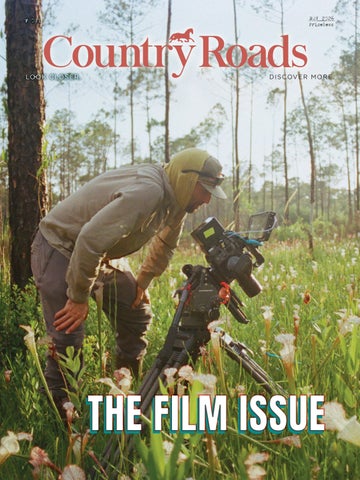
On the Cover
BEHIND THE SCENES OF "AMERICAN AMAZON"
Managing Editor
Jordan LaHaye Fontenot
Arts & Entertainment Editor
Jacqueline DeRobertis-Braun
Creative Director
Kourtney Zimmerman
Contributors:
Peter Ackerman, William Browning, Anne Butler, Wes Kroninger, Megan Broussard Maughan, Jess Cole, Beth D'Addono,Christie Matherne Hall, Gregory James Wakeman, John Wirt
Photo by Peter Ackerman
Independent filmmaker and storyteller Peter Ackerman is part of the dedicated, multi-disciplinary crew who came together over the course of four years to explore and document the mysteries of the American South’s wetlands for the forthcoming documentary, American Amazon— premiering in IMAX theaters on November 13 and as a two-part miniseries on PBS in early 2027, and featuring Louisiana's own Jon Batiste as narrator. In Splinter Hill Bog Preserve in Alabama, Ackerman captured this shot of director Eric Bendick filming amongst carnivorous pitcher plants, waiting for a green lynx spider to catch its prey. “Down at the ground level, the pitcher plant-bog habitat feels prehistoric and otherworldly, and looking down inside of these carnivorous plants was an eerie sight,” said Ackerman. “Upon bisecting a toppled pitcher plant down the middle, you could see the timeline of its most recent diet—a myriad of different exoskeletons and insect husks. As we looked along for unfolding narratives, we came across a tree frog coolly hanging out inside a pitcher plant, waiting for a fly to drop by.” Read more about American Amazon on page 8.
Cuisine
36
39 41
SECRETS TO A WELLSEASONED LIFE Chef Frank Brigtsen finally releases his Creole cookbook
Outdoors
42
by Jess Cole
by Beth D'Addono
RECIPE Butternut Shrimp Bisque: A Brigtsen's classic by Chef Frank Brigtsen
SOUPÇON A new coffee shop in Baton Rouge. The red beans and rice trail. The Brine on the Red River. by CR staff
IN THE COMPANY OF OAKS The ecological genius of Louisiana's native trees
Culture
44
COMING TO A SCREEN NEAR YOU ... Six new films to watch for this festival season by Jordan LaHaye Fontenot
48
NEWT KNIGHT'S VERSION Revisiting a 1921 interview with the rebel of Jones County by William Browning
4
N O V 2 6 // C O U N T R Y R O A D S M A G . C O M
50
THE MAN IN THE MOON A childhood favorite film, and all the memories it upends by Megan Broussard Maughan
Escapes
60
HOLLYWOOD, MS For thirty years, filmmakers have found small town America in Canton, Mississippi by William Browning
Perspectives
66
CREATURES GREAT & SMALL
Animatronics artist Barton Gilley by Jacqueline DeRobertis-Braun
Cover Artist
Peter Ackerman
Advertising
SALES@COUNTRYROADSMAG.COM
Sales Team
Heather Gammill, Heather Gibbons, Mary Margaret Lindsey
Operations Coordinator
Molly C. McNeal
President
Dorcas Woods Brown
Country Roads Magazine P.O. Box 490 St. Francisville, LA 70775 Phone (225) 343-3714 Fax (815) 550-2272 EDITORIAL@COUNTRYROADSMAG.COM WWW.COUNTRYROADSMAG.COM
Mailed Subscriptions
87.30 for 12 months
$
ISSN #8756-906X
Copyrighted. All rights reserved. No portion of this publication may be reproduced without permission of the publisher. The opinions expressed in Country Roads magazine are those of the authors or columnists and do not necessarily reflect the views of the publisher, nor do they constitute an endorsement of products or services herein. Country Roads magazine retains the right to refuse any advertisement. Country Roads cannot be responsible for delays in subscription deliveries due to U.S. Post Office handling of first-class mail.
// N O V 2 6
5
Reflections FROM THE PUBLISHER
T
hhe other evening my wife looked up from something she was reading and, eyes aglitter, exclaimed, “There’s a new Sense and Sensibility coming out!” Whatever reaction she was hoping to receive was apparently not forthcoming, because in response to my audible groan she remarked with a smirk, “You know it’s my turn!” You would imagine that a couple in their fourth decade of marriage, for whom the empty nest years following the childrens’ departure have coincided with the golden age of streaming entertainment, might have arrived at a more grownup way of deciding what to watch on a Friday night, but we’re still stuck taking turns. Time and again, our respective suggestions fall along predictable lines that almost never intersect: crime thrillers and psychological dramas for me, romantic comedies and period dramas for her—the more Empire waists and English gardens the better. She is squeamish about jump scares, explosions, and blood; I am made discom-
6
fited by petticoats, flower arranging, and breathless admissions of undying love. But since it’s no fun watching TV on your own, and because we’re optimists, we take turns picking the film or series, always hoping it’ll land in the small segment of the entertainment venn diagram that houses films we can both enjoy, since even the most bloodsoaked supernatural horror (Sinners is an example) might slip through her defenses if the accents, costumes, and storyline are good enough. An additional refinement: the non-choosing partner must give the other’s selection at least thirty minutes before quitting the couch—a simple-but-effective grace period that contributes to domestic tranquility, and leads each of us to the occasional great movie or TV experience that we never would have discovered on our own. Somehow though, I doubt that Sense and Sensibility—a period romantic drama based on a Jane Austen novel starring someone named Daisy Edgar-Jones—is going be one of these for me. Fortunately, it isn’t available to stream yet, so it’ll be several weeks before I have to undergo a halfhour reinforcement of my stereotypes before retreating to the barn with the dog.
N O V 2 6 // C O U N T R Y R O A D S M A G . C O M
That our taste in entertainment isn’t better aligned is due less to irreconcilable differences than to a lack of formative training. During the late 2000s and 2010s, while the rest of America was gorging on the entertainment smorgasbord delivered by the advent of streaming TV, the lack of internet service to our remote corner of West Feliciana parish meant that no such feast was on the menu. So, while their contemporaries were bingeing episodes of Care Bears and Kung Fu Panda, our kids—whose parents were too cheap to spring for satellite TV—were left to choose between trying to coax our vintage DVD player to play something from the dwindling selection of unscratched DVDs, or retreating into the woods to build a fort. Mostly they chose the latter. In their own way, I suppose their parents did, too. So, we’ve got some catching up to
do, because during the early years of streaming, a lot of great TV got made. An example is the first season of True Detective, the Southern gothic mystery thriller starring Woody Harrelson and Matthew McConaughey, directed by Louisiana native Nic Pizzolatto, and set in an atmospherically recognizable Southwest Louisiana. It was a sensation when it premiered in 2014, and we missed it for the reasons outlined above. In the end it was our twentyone-year-old son’s urging (he has become something of a cinephile), that brought it to the top of my list, and from the moment the first scene flickered to life we were transfixed. Admittedly his mother, who as reported has a low tolerance for on-screen violence, experienced parts of each episode on the move—watching through her fingers, sidling in and out of the room, and hovering anxiously outside the doorway during eruptions of mayhem, demanding a narration of what is going on. Sure, True Detective included some scenes that she couldn’t watch, but there were many more that she— no, we—couldn't look away from. And isn't that the mark of great art, whether on big screen or small? —James Fox-Smith, publisher
// N O V 2 6
7
Noteworthy
N OV E M B E R 2 0 2 6
NEWS,
T I M E LY
TIDBITS,
AND
ASSORTED
CURIOSITIES
LO O K C LO S E R
•
The Southern Wilds "AMERICAN AMAZON," NARRATED BY LOUISIANA MUSICIAN JON BATISTE, PREMIERES THIS MONTH
The American Amazon team filming in Alabama. Photo by Peter Ackerman.
T
hhe thematic overture of American Amazon, a forthcoming feature film and two-part Nature mini-series, emerges from one salient fact director, writer, and producer Eric Bendick finds endlessly fascinating: "Most people don't know that the southeast United States is the most biodiverse part of the whole country." From Grizzly Creek Films, PBS, and
distributed by MacGillivray Freeman Films, American Amazon unfolds as a complex and multifaceted exploration of the natural world across the Southern United States, winding through the region's endless waterways to tell stories Bendick wants a broad audience to hear. For the past twenty years, Bendick has been filming in the area, returning again and again to childhood memories of visiting the Southeast as a child to spend
time with his grandparents. "There was always kind of a legendary quality to the place, and always a mystique about the southeast. And I had a feeling these stories were not being told," he said. "[The South has] been known for all kinds of other beautiful things, amazing culture, amazing food, music, but the natural world of the South has not been explored or featured as much." And tell those stories American Amazon does—from hellbender salamanders living in the depths of the Appalachian Mountains and blooming Cahaba Lilies in Alabama, to swamp-loving black bears in Florida and manatees migrating across the Gulf. Fittingly, these tales are narrated by none other than one of Louisiana's most acclaimed musicians, Jon Batiste. When Bendick heard Batiste in an NPR interview, he knew he had found the film's voice. "We wanted to really have a sense of the project being grounded in a voice that not only was a creative spark from the area, but has a deep history with the place, and is deeply connected to the land and the water, and Jon has all of that," he said. "It's a really magical piece of the
story. Really, the whole place came alive with his voice. It was such a beautiful thing and a beautiful collaboration." Bendick and his team also reserve critical space in the film for conservation efforts. He refers to water as the "lifeblood" of the American Amazon, connecting various stories from its origins in the mountains, flowing all the way to the ocean, weaving together a diverse habitat. "My hope, and I think our team's hope overall, is that this is a moment that will be an awakening for much of the world to how beautiful and special and unique the South is," he said. "I think if people discover this special place, and discover its magic, they will want to protect it, they will want to conserve it, they will want to share it for generations. My hope is that this will be kind of a turning point in helping to save and protect the wonders of the South." American Amazon premieres on November 13 in select IMAX and giant screen theaters. A two-part Nature mini-series releases on PBS in early 2027. —Jacqueline DeRobertis-Braun
Dry Bones Are Gonna Rise Again
A NEW WEB SERIES BRINGS CONTEMPORARY LOUISIANA MUSICIANS INTO THE ARCHIVES
A
round six years ago, Joshua Caffery and his family got obsessed with the ‘90s/early 2000s British television show, Time Team—in which a team of archaeologists and archivists must solve some archaeological mystery in a span of three days. As the Director for the Center for Louisiana Studies at the University of Louisiana-Lafayette, who had recently received some funding to help local musicians during the stage-starved age of the pandemic, it occurred to him: what if we did this with our archive of thousands of Louisiana songs? “And,” he wondered, “what if instead of a scholarly consensus, the end product was a new studio performance of [these] song[s]?” What came next was a years-long collaboration between the Center, the filmmaking team Jeremey and Abby Lavoi, and a host of Acadiana’s finest roots mu8
sicians—culminating in a ten-episode web series called Dry Bones, which premiered last month. In each episode, hosted by musician and educator Chas Justus, musicians encounter and react to archival recordings of Louisiana songs from the Center’s vast collection, before reimagining them. In the very first installment of the series, we watch as Grammy-nominated Creole musician Cedric Watson digs through the archive’s collection, listens to a 1934 recording of the African American spiritual “Dry Bones”—a song about resurrection for which the series is named— performed by two formerly enslaved women living around Avery Island. He then works with other musicians to interpret the song, breathe new life into it. In his version, he decides to include an overdub of hand drums, acknowledging their importance to Afro identity and the fact that many musicians would have been
N O V 2 6 // C O U N T R Y R O A D S M A G . C O M
forbidden to use them during the time this song was originally sung. Such frisson-inducing moments stack quickly in each of the roughly ten-minute episodes, as the viewer witnesses the unfolding of a multiple artistic processes steeped in ancestral inspiration. “It may seem silly,” said Jeremy Lavoi. “But we never expected each episode to have such unique qualities and personality. The format is standardized, but each artist, or combination of artists, brought something special to the equation.” There’s the moment when Steve Riley and Peter Schwarz record a song, with Riley’s son Burke, originally performed by their mentor Dewey Balfa. Or when the Red Stick Ramblers ended up having a long-awaited reunion in the studio. The final episode, which was made in the midst of the tragic death of musician Chris Stafford, is the longest—serving as an emotional tribute to Stafford and a
testament to the transcendent power this kind of music holds. Acting as a continuation of the Lavois’ award-winning 2023 documentary, Roots of Fire, Dry Bones is an exciting and intimate window into the creative world of Louisiana roots music—this time with a new and expressive depth brought on by direct interactions with the voices of the past. “One of my favorite things about archives is their capacity to surprise and reframe,” said Caffery. “I was hoping that digging through the attics of our cultural music, and dealing with the particulars of what we found, would help us tell a more nuanced story of what our music is, and who we are. I think that happened.” Episodes of Dry Bones are being released each week through mid-December at drybones.net. —Jordan LaHaye Fontenot
20 Years at Valcour Records CELEBRATING THE CONTINUATION OF TRADITIONAL MUSIC IN ACADIANA
Joel Savoy, one of the founders of Valcour Records, along with Phillip LaFargue and Lucius Fontenot. Photo by Jo Vidrine, courtesy of Valcour Records.
I
t’s been about twenty years since the rise of digital audio file sharing collapsed the longtime model hfor selling recorded music— physical albums, singles, and EPs purchased in person or through the mail. Nonetheless, 2006 was the year that Acadiana musician Joel Savoy and his business partners, Phillip LaFargue and Lucius Fontenot, launched Valcour Records—committing not only to a traditional-format music business, but also to a revival of traditional music itself. From the beginning, the label dedicated itself to the musique and culture of southwest Louisiana. And twenty years later, they’re
still here and thriving. “It was an exciting time, back in 2006, Savoy said from the small recording studio near Eunice, where sixty percent of the label’s releases have been recorded. “A big part of founding the label was to represent the blossoming scene in Acadiana . . . A lot of new bands were doing interesting stuff with traditional music.” On November 19, the Grammy-winning Valcour Records will celebrate its twentieth anniversary with a special concert at the Acadiana Center for the Arts in Lafayette. Savoy plans to present a Louisiana Hayride-style concert featuring a cavalcade of Valcour artists. They’ll perform Cajun, zydeco, and Americana music, pop-influenced selections, and Congolese rhumba—with Savoy, LaFargue, and moderator Herman Fuselier providing introductions and commentary. “It’s hard to cover sixty-four records in a seventy-five-minute show, but I’m curating a parade of people, [each] doing one song representing some component of Valcour,” Savoy said. In this challenging era for music monetization, Valcour and the artists on its
roster directly and intentionally work to engage their followers. “We’ve seen a lot of crowdsourcing, which is a way for artists to connect with fans,” Savoy said. “The artists work with the fans to raise a budget to create their dream record.” “Because of the music and fans that Valcour Records has,” said LaFargue, Valcour’s Baton Rouge-based co-founder, “we’ve had sufficient sales of physical and digital products to sustain the work that we’re doing.” Earlier this anniversary year, Valcour received its second Grammy award with A Tribute to the King of Zydeco, a centennial celebration of zydeco pioneer Clifton Chenier. Savoy and the album’s executive producer, John Leopold, accepted music’s highest honor at the ceremony in Los Angeles. “It’s a heck of a way to kick off twenty years as a small independent record label in south Louisiana,” Savoy said from the stage. A Tribute to the King of Zydeco, Valcour’s highest profile and most successful release, features an all-star lineup including The Rolling Stones, Lucinda Williams, Taj Mahal, Steve Earle, Charley Crockett, Jimmie Vaughan, and Los
Lobos’s David Hidalgo. Louisiana musicians, including Cajun accordionist Steve Riley, zydeco musicians Nathan Williams Sr. and Keith Frank, and keyboardist Eric Adcock, served as the project’s studio band. Valcour’s physical, cultural, and historical connections to Louisiana’s zydeco community made it the ideal vehicle for the Chenier tribute. “A match made in heaven,” Savoy said. “When John [Leopold] came to me, I instantly accepted. But then I realized it was an enormous project. We had to do a good job and we needed a lot of help— and we got it.” Profits from A Tribute to the King of Zydeco, including a recent sum of $18,000, benefit the Clifton Chenier Memorial Scholarship at the University of Louisiana at Lafayette. This year has seen new Valcour releases by Bonsoir Catin, Boma Bango, and Savoy’s duo with Linzay Young. Next year’s announced recordings include a centennial tribute to one of Acadiana’s revered traditional musicians, the late Cajun fiddler Dewey Balfa. — John Wirt
Monthly episodes of The Coop, an online subscription content series containing exclusive videos and articles on Acadiana music, culture and cuisine, as well as previews of new Valcour releases, are another of the label’s points-of-contact with a worldwide audience. The Coop is available at valcourrecords.com/the-coop.
// N O V 2 6
9
v
10
N O V 2 6 // C O U N T R Y R O A D S M A G . C O M
N OV E M B E R 2 0 2 6
Events
GOURD TIMES
C R U N C H Y L E AV E S U N D E R F O OT, T H I S A U T U M N A L L I N E U P C A L L S F O R A J O U R N E Y TO T H E C A R N I VA L S , M A R K E T S , A N D F O O D F E S T S O F T H E FA L L S E A S O N
•
ECD
E T HE L C LAIBOR N E DAME RON LE C T U R E
FEATURING HISTORIAN
DR . IRIS DE RODE Sunday, November 22, 2026 • 2:30 PM Join us for a presentation on French involvement in the American Revolution and cultural connections between Louisiana and France. This presentation will be followed by a reception provided by the WBR Historical Association’s hospitality committee. The Ethel Claiborne Dameron Lecture Series is free and open to the public.
The St. Francisville Food & Wine Festival returns to its namesake town on November 13–15 for a weekend-long celebration of Louisiana and Mississippi's most esteemed chefs, including Saturday's Bubbles & BBQ, Sunday's Grand Tastings, and more. Details on page 18–19. Photo by Molly C. McNeal.
UNTIL NOV 8th
BRIGHT EYES & BUSHY TAILS "WHAT THE FOX KNOWS" Port Allen, Louisiana
The West Baton Rouge Museum presents What the Fox Knows, a nature-inspired journey of art and poetry through the eyes of a fox from artist Kathy Miller Stone and author Jacqueline Simon. In addition to the artistry and poetry on display, the exhibition shares facts about North American animals, birds, fish, and insects. westbatonrougemuseum.org. 1
UNTIL NOV 28th
HISTORY “REIMAGINING AMERICA: THE MAPS OF LEWIS AND CLARK” Baton Rouge, Louisiana
The Old State Capitol hosts an exhibition titled Reimagining America: The Maps of Lewis and Clark, showcasing historic map reproductions of the famous Lewis and Clark expedition on loan from the Lewis and Clark Trail Alliance, Inc. Explore how nineteenth-century science and geographic intelligence
UNTIL NOV 28th
TWEETS HIT ME WITH YOUR BEST SHOT!: NATIONAL BIRD PHOTOGRAPHY Lake Charles, Louisiana
This juried photographic exhibition at the Historic City Hall Arts & Cultural Center in Lake Charles includes fifty images from wildlife photographers across the U.S. and birds from around the world, celebrating the joys of birdwatching. gallerybythelakeswla@gmail.com. 1
UNTIL DEC 8th
VISUAL ARTS ASSOCIATED WOMEN IN THE ARTS EXHIBITION Baton Rouge, Louisiana
The talented women who make up the Associated Women in the Arts are hosting their annual member exhibition at the Louisiana State Archives Gallery. An opening reception will be held on November 5 from 5 pm–7 pm. Free. associatedwomeninthearts.com. 1
UNTIL JAN 2nd
to create a richer and more complex
ART EXHIBITIONS "DOCTOR DAZED DOODLE DELTA"
understanding of the Louisiana
Baton Rouge, Louisiana
Purchase. Find more information at
Presented in the The Jones Walker Foyer Gallery on the first floor of the Shaw
from Native Americans joined forces
louisianaoldstatecapitol.org. 1
Center, Doctor Dazed Doodle Delta features work by Dr. John Day, Professor Emeritus in the Department of Oceanography and Coastal Sciences at LSU. Day's "doodles" are brightly colored imaginings, inspired by his work with nature, created over decades while teaching and living life. manshiptheatre.org. 1
UNTIL JAN 3rd
ART EXHIBITIONS SOUTHERN GOTHIC: LITERARY INTERSECTIONS WITH ART FROM THE JOHNSON COLLECTION Baton Rouge, Louisiana
The LSU Museum of Art presents Southern Gothic: Literary Intersections with Art from The Johnson Collection. Drawing from the celebrated holdings of The Johnson Collection in Spartanburg, South Carolina, and Louisiana institutions and private collectors, this exhibition explores how visual artists have grappled with the American South’s layered history through a lens long cultivated in Southern literature. The show examines how nineteenth- and twentieth-century artists employed potent visual language to transcribe the tensions between the South’s idyllic aura and its historical realities. Drawing inspiration from Southern Gothic literary traditions, the grouping considers how artists translate // N O V 2 6
11
Events
Beginning November 1st - 6th into visual form the same tensions found in the writings of William Faulkner, Flannery O'Connor, Tennessee Williams, and Toni Morrison. Often described as a mood rather than a strict genre, Southern Gothic blends elements of horror, romance, decay, spirituality, and dark humor. In painting, printmaking, and sculpture, these sensibilities emerge as evocative landscapes, charged domestic interiors, allegorical scenes, stereotypical antebellum imagery, and portraits that hint at psychological depth and social complexity. The core group of artworks has been expanded to engage Louisiana’s distinctive cultural environments, layered histories, and enduring traditions. On display through January 3. lsumoa.org. 1
UNTIL FEB 20th
FEMININE PERSPECTIVES A CENTURY IN FOCUS: IMAGES FROM WOMEN PHOTOGRAPHERS OF THE 20TH CENTURY Lafayette, Louisiana
Photography changed how the twentieth century saw itself. So did the women who mastered it. Working through decades
12
of upheaval, war, depression, migration, and rapid industrial change, the ten artists in this exhibition at the Hilliard Art Museum pushed photography past pure documentation and made it an art form. Each found a different way in. Dorothea Lange and Sabine Weiss turned photojournalism toward the hardships of ordinary life. Anne W. Brigman and Ruth Bernhard leaned into experimentation and abstraction. Together they produced some of the most enduring images of the modern era. The practices of these artists challenged narratives long controlled by men and opened the medium to the women who came after. It shaped how we picture identity, family, memory, and struggle, and it still speaks to those questions now. Drawn entirely from the Hilliard's permanent collection, these photographs trace a century in focus. hilliardartmuseum.org. 1
UNTIL AUG 29th
PHOTOGRAPHY "PRESERVING PARADISE: THE VISION OF C.C. LOCKWOOD" Baton Rouge, Louisiana
The Louisiana Art & Science Museum
N O V 2 6 // C O U N T R Y R O A D S M A G . C O M
presents an exhibition on photographer C.C. Lockwood, who has spent more than five decades capturing Louisiana's wild beauty, from its landscapes to its waterways. Focusing on Lockwood's dedication to environmental stewardship, conservation, and artistic excellence, the exhibition highlights in particular his photography that centers on the Atchafalaya Basin and how it has shaped his work over the years. lasm.org. 1
NOV 1st
AUTUMNAL FESTIVITIES FALL & THANKSGIVING CRAFT DAY Baton Rouge, Louisiana
The Old State Capitol hosts an afternoon of seasonal fun for its first free Sunday in November. Bring the whole family to celebrate the changing leaves and autumnal holidays with several hands-on Thanksgiving craft stations—and make lasting memories at the same time. Noon–4 pm. Free. louisianaoldstatecapitol.org. 1
NOV 1st
CHEERS CAP CITY BEER FEST Baton Rouge, Louisiana
The annual Cap City Beer Fest pops tops in Downtown Baton Rouge. Local,
national, and international beers will be here for the sampling, complementing a mix of food, music, and games—all benefitting the Companion Animal Alliance. 2 pm–5 pm. $50; $15 designated driver ticket. capcitybeerfest.org. 1
NOV 1st
GRUB FOR GOOD HEROES WHO COOK COMPETITION Covington, Louisiana Gear up for this tasty fundraiser for a good cause. Heroes Who Cook will take place on the rooftop of the St. Tammany Parish Justice Center Parking Garage in downtown Covington, where eighteen celebrity and restaurant teams will face each other in a competitive cook-off to raise funds for the Children’s Advocacy Center—Hope House. Be sure to partake of the complimentary cocktails, beer, and wine, and enjoy the live music by Groovy 7. An online silent auction will also feature luxury items and one-ofa-kind experiences. 4 pm–7 pm. $105. cachopehouse.org. 1
NOV 1st - NOV 15th
CARNIVALS STATE FAIR OF LOUISIANA Shreveport, Louisiana
Carnival rides, livestock shows, aerialists,
Photography exhibition Preserving Paradise: The Vision of C.C. Lockwood, on display at the Louisiana Art and Science Museum. Details on page 12. Photo by Collin Richie. Courtesy of LASM.
flame-spitters, and all the hot and fresh fried food your little heart desires? It's gotta be the Louisiana State Fair in Shreveport. Taking place each fall since 1906, this statewide gathering brings together all of Louisiana's best (and tastiest) assets: from agriculture, to art, to live music, to plenty of delicious food—and a whole lot of good times in between. Open all days during the run except Mondays and Tuesdays. 3701 Hudson Avenue, Shreveport. Admission, extras, and wristbands vary in price by day; confirm prices, entertainment offerings, and all other info at statefairoflouisiana.com. 1
NOV 5th
GALAS FOUNDERS BALL New Orleans, Louisiana
The Louisiana Museum Foundation's annual gala opens the highly anticipated new exhibition Sportsman’s Paradise: Celebrating Conservation at The Cabildo (running until September 2028). The exhibition showcases the state's "sporting legacy and outdoor heritage," exploring early sporting traditions and contemporary conservation efforts. The exhibition draws from the Louisiana State Museum's permanent collection
and private loans to explore various perspectives—from the region's early sporting practices, to modern conservation efforts to support and sustain the state's wildlife, wetlands, and communities. Some of the featured artifacts include original works by John James Audubon and George Viavant, Louisiana-made decoys, and more. Also expect an evening of live music by Jourdan Thibodeaux, Johnny Vidacovich & The Desert Nudes, and signature dishes from Dickie Brennan & Co. Attire is black tie with "bold green hues" and "camo chic." 7 pm–11 pm at The Cabildo. Individual tickets start at $350. louisianastatemuseum.org. 1
NOV 5th - NOV 12th CONCERTS MID CITY BALLROOM NOVEMBER SHOWS Baton Rouge, Louisiana
Mid City Ballroom presents three nights of music this November, including: November 5: Girl of Glass, Thus Spoke Zarathursta, xMercyx, Tanto. Presented by Deadset. 7 pm–midnight. $15 in advance; $20 at the door. November 11: SHEEP, with Chesticle, SWARM, & Drew Frank. Presented by Joey Z. Doors at 8 pm; show at 8:30 pm. $10 in advance; $15 at the door.
November 12: Bill Kirchen Trio with Ralph & Erica. Presented by the Red Dragon. 8 pm–10 pm. $30; $40 VIP. bontempstix.com. 1
NOV 6th
FROLIC LOVE IN THE GARDEN New Orleans, Louisiana
There's nothing like a garden party to bring in the cooler autumn months, and NOMA's annual soirée in the Sydney and Walda Besthoff Sculpture Garden provides a perfectly romantic environment for sipping a cocktail and enjoying a conversation about fine art under moonlit oaks. Food will be provided by a variety of beloved local restaurants, and musical entertainment from Kristin Diable. Patron party begins at 7 pm, Garden Party at 8 pm. Tickets start at $125 for non-members, with sponsorship opportunities available. noma.org. 1
NOV 6th
YEEHAW FEDERALES FEST 2026 Baton Rouge, Louisiana
Gear up for fun times when Federales Fest returns to kick off the 'Bama game day weekend with a Friday afternoon celebration of good food, live music, and lots more at Live Oak Cedar Lodge. Live
// N O V 2 6
13
Events
Beginning November 6 music is courtesy of an all-star lineup that includes the Love Craft Band, B.B. Palmer (aka "The Alabama Samurai"), Louisiana supergroup Doussan Garrett Benoit (DGB), Starboro featuring members of Futurebirds & Susto, and Pecos and the Rooftops. This year's fest will also feature a second stage showcasing acoustic sets by Finn Tucker, Eli Howard, and Kristina Murray. 3 pm–11 pm at 6300 Jefferson Hwy. $50 general admission with food & drink available for purchase, $225 VIP includes complimentary food and libations all day, plus preferred viewing of the stage. $10 kids. A portion of proceeds benefits the nonprofit, Be Positive. federalesfest.com. 1
NOV 6th
EVENING JAMS LIVE AT FIVE Natchez, Mississippi
Grab a blanket or lawn chair and amble over to the Bandstand on the Bluff at 107 S. Broadway Street in downtown Natchez for an outdoor concert by Nanner Sammich. 5 pm. Free. visitnatchez.org. 1
14
th
NOV 6 - NOV 7 th
th
HERITAGE CHOCTAW-APACHE TRIBE OF EBARB VETERANS POW WOW & NATIVE AMERICAN ARTS FEST Noble, Louisiana
Head to the Pow Wow Grounds in Noble, Louisiana and join the ChoctawApache Tribe of Ebarb to celebrate Native American heritage and honor veterans. The event includes traditional dancing, Native American arts and crafts, cultural demonstrations, and more. Don't miss gourd dancing, grand entries, intertribal dancing, cooking contests featuring wild game, tamales, homemade sausage, frybread, and homemade pepper, plus an adult and youth art contest. toledobendlakecountry.com. 1
NOV 6th - NOV 7th
CULTURAL CELEBRATIONS BAYOU BACCHANAL New Orleans, Louisiana
In America's most Caribbean city comes the "Original Caribbean Carnival." Hosted by Caribbean Carnival/Friends of Culture, an organization run by New Orleans locals native to parts
N O V 2 6 // C O U N T R Y R O A D S M A G . C O M
of the Caribbean, Bayou Bacchanal exists to share the festive traditions of the Caribbean with the Crescent City community. Be sure to catch the kick off dance and pre-party the night before, and then head to the celebration and parade in Congo Square on Saturday. Free (except for the opening night party, which costs $25 at the door). bayoubacchanal.org. 1
NOV 6 - NOV 7 th
th
with its annual Ozone Songwriter Festival, spotlighting over one hundred local, regional, and national songwriters—from skilled amateurs to #1 chart topping Nashville songwriters with songs you'll be surprised to recognize (Tim McGraw and Keith Urban don't write all of their songs)—while raising money for music youth education. Expect concerts and round-robin songwriter sessions to be held across the Northshore
INKLINGS FESTIVAL OF WORDS
in venues like the Covington Trailhead,
Grand Coteau, Louisiana
and more. There will also be a special
Encore Bar & Grill, the Southern Hotel,
Grand Coteau's annual Festival of
hands-on songwriting workshops and
Words returns this year with three
symposiums, workshop series teaching
featured authors and two days of
skills in songwriting, live sound, studio
wonderfully wordy events—all for free.
mixing, and other industry skills, and
Authors featured include professor and
a songwriting contest. Find the full
author Darrell Bourque; writer, arts
schedule, lineup, and more details at
administrator and community activist
ozonemusic.org. 1
Patrice Melnick; and Associate Professor of Education and Co-Director of the National Writing Project of Acadiana at the University of Louisiana at Lafayette Dr. Toby Daspit. festivalofwords.org. 1
NOV 6 - NOV 8 th
th
NOV 6th - NOV 8th
TRINITIES HOLY GHOST CREOLE FESTIVAL Opelousas, Louisiana
Live Creole and zydeco music, Creole food favorites, and a gospel choir concert that's
TURN IT UP OZONE SONGWRITER FESTIVAL
drawn crowds for over twenty-five years
Covington, Louisiana
returns. The fun begins Friday morning
The Ozone Music Foundation returns
now—the Holy Ghost Creole Festival with finger-lickin' fried catfish, with the
tune of gospel choirs from Holy Ghost Catholic Church serenading the public that
NOV 6th - NOV 8th
of celebrating Acadiana's cultural treasures in an intimate, authentic
NOV 6th - AUG 15th
night. Rise early for more music, and arrive
LUMINARIES LIGHTHOUSE FESTIVAL
with an empty belly—ready to sample
Berwick, Louisiana
to Lakeview Park & Beach for three days
ART EXHIBITIONS "DANIELLE MCKINNEY: SHELTER"
famous backbone stew, sweet dough pies,
of music. Join rural Acadiana's cooks,
New Orleans, Louisiana
dancers, and musicians for two days of
brings the Creole Festival Parade, running
The Town of Berwick again sets up along the riverfront for a festival of local libations, live music, arts and crafts, cook-offs, bake-offs, Mass on the river, a cornhole tournament, a carnival, and
from Landry Street to Union Street.
more. cajuncoast.com. 1
await, with performances by Dylan
boudin, and other local delicacies. Or, start with the 5K or 1-mile fun walk, then get to eating when the exercise ends. Sunday
Bring lawn chairs and a blanket. Free. hgcatholic.org. 1
NOV 6th - NOV 8th
CULTURAL CELEBRATIONS SABINE FREESTATE FESTIVAL
setting—Le Grand Hoorah returns again
FAIS DO-DOS LE GRAND HOORAH
Jesse Lege and the Bayou Aces, Alphonse
Eunice, Louisiana
Catin, and a jam session with Luke
This new exhibition at the New Orleans Museum of Art features a survey of paintings spanning the last six years of artist Danielle Mckinney's intentional practice, which focuses on female subjects in the intimate and reclusive quiet of private moments. Mckinney is known for her ability to bridge art history and emotionally resonant feminine subjects, and render them in
Huval. prairieheritageinc.com. 1
deeply moving paintings. noma.org. 1
NOV 6 - NOV 8 th
th
Carrying on a long and storied tradition
unparalleled cultural celebration in one of the region's most iconic dancehalls. Boucheries, fais do-dos, and inspiration Aucoin & the Judice Ramblers, Geno Delafosse and French Rockin Boogie, Ardoin and Zydeco Kingz, Bon Soir
Florien, Louisiana
Turn back time to the days when the "Neutral Strip" between Spanish lands and the fledgling United States fostered a unique "No Man's Land" culture in Western Louisiana (1806–1821). Live out your Wildest West adventures with a shootout, or point your guns to the sky for a skeet shoot. Take part in pioneer demonstrations, jam sessions, a minnow race, axe throwing, an exotic petting zoo, and more—plus plenty of live music all day long. It all takes place on the Sabine Freestate Festival Grounds. Details at sabinefreestatefestival.com. 1
NOV 6th - NOV 8th
TREASURE HUNTS PONCHATOULA ANTIQUE TRADE DAYS AND ARTS/ CRAFTS FAIR Ponchatoula, Louisiana
Just in time for the season of giving, head to Ponchatoula's downtown commuter lot, where you will find hundreds of vendors selling everything from antiques, to collectibles, to repurposed arts and crafts, to handmade food treats from across the South. It's the long-standing Ponchatoula tradition known as "trade days". 7 am– 5 pm Friday & Saturday; 9 am–5 pm. ponchatoulachamber.com. 1
NOV 6th - NOV 8th
PIG-OUTS LOUISIANA SWINE FESTIVAL Basile, Louisiana
The first full weekend of November means Basile's Louisiana Swine Festival is back, complete with pork cook-offs and boudin eating contests, live music on Main Street, hog calling, and more. These porky proceedings are presided over by the festival royalty, anointed at a pageant the week before and honored with distinguished appearances from Queen Petunia and King Porky. louisianaswinefestival.com. 1 // N O V 2 6
15
Events
Beginning November 7th - 12th NOV 7th
SHINDIGS RAYNE RENDEZVOUS DOWNTOWN Rayne, Louisiana
Acadia Parish Tourism and the city of Rayne invite locals and visitors to the downtown center for a cultural celebration including Cajun French language demonstrations, children's programming, local author presentations, live Cajun and zydeco music, and food vendors. 11 am; Cajun Country Hoedown at 7 pm. acadiatourism.com. 1
NOV 7
th
SWEET TEETH BEIGNET FEST
options. Pair this vast array of tasty treats with a day of live music, featuring Amanda Shaw, Dragon Smoke, and more. Be sure to bring the littles for an interactive kids village. Festival proceeds benefit local autism programs for children and families. $25; free for children ages ten and younger. beignetfest.com. 1
NOV 7th
BOO-ZY NATCHEZ FOOD AND WINE FESTIVAL BRUNCH WITH THE SPIRITS Natchez, Mississippi
Enjoy a "Progressive Brunch" in Natchez, with carefully curated courses that tour
New Orleans, Louisiana
some of the iconic city's favorite local
Let's just say that for this flavorful
spots. In honor of Angels on the Bluff,
festival, you're going to want to avoid
there will be a character in each location
wearing black. Expect powdered sugar
in front of each Downtown Natchez
galore at this sweet celebration at New
storefront, portraying an individual
Orleans City Park's Festival Grounds.
buried in the city cemetery from a
With dozens of unique takes on the
previous year—along with cocktail
dessert featured, don't be surprised to see
pairings and small bites. Three start
some savory twists on the classic, along
times (10 am, 10:30 am, or 11 am) begin
with vegan, gluten-free, and non-beignet
at Nest, for all groups. Featured chefs
16
N O V 2 6 // C O U N T R Y R O A D S M A G . C O M
On November 7, puff pastry connoisseurs will gather once again for New Orleans's annual Beignet Fest. Details below. Photo by Laura Williams Photography. Courtesy of Beignet Fest.
for the morning excursion include Chef Cooper Miller, Chef Liza Sharp, and Chef Chaz Lindsay; cocktail pairings by Cathead Distillery. 10 am–noon. $75. bontempstix.com. 1
NOV 7th
GREEN THUMBS FALL GARDEN PARTY AT BURDEN Baton Rouge, Louisiana
The East Baton Rouge Parish Master Gardeners welcome families to a free Fall Garden Party in the Children's Garden at the LSU AgCenter Botanic Gardens at Burden. With a theme of "Edible
Gardening," the morning features garden tastings, a hunt, crafts, a race, and takehome treasures. Free, but pre-registration is required. ebrmg.wildapricot.org. 1
NOV 7th - NOV 8th
CREATIVE JOURNEYS PETER ANDERSON ARTS & CRAFTS FESTIVAL Ocean Springs, Mississippi
The Peter Anderson Arts & Crafts Festival was created to honor master artist, Peter Anderson, original potter of Shearwater Pottery, and to celebrate the arts community that has grown up in today's Ocean Springs. Come spend
a weekend exploring one of the most appealing little towns of the Mississippi Gulf Coast—and take a little bit of it home with you. 9 am–5 pm both days. peterandersonfestival.com. 1
NOV 7th - NOV 8th
HARD TO BEAT GIANT OMELETTE CELEBRATION Abbeville, Louisiana
The locals of Abbeville will be highly eggcited if you choose to join them for their annual Giant Omelette Celebration. No less than five thousand eggs—five thousand—go into the giant omelette in question, and there are plenty of other activities to keep festival-goers occupied while the omelette cooks in a twelvefoot skillet balanced over an open fire in historic Magdalen Square. Eggspect one of Acadiana's largest juried art shows, the procession of chefs, kids' world activities, exhibits of antique cars and farm equipment, a charity walk and bike ride, an egg cracking contest; and live music. Visitors from abroad will be present to represent "the sisterhood of cities who celebrate the omelette." Free. 9 am– 5 pm Saturday; 6 am–4:30 pm Sunday. giantomelette.org. 1
NOV 7 - NOV 15 th
th
THEATRE SPLAT PRESENTS: "A MIDSUMMER NIGHT'S DREAM" Abita Springs, Louisiana
This production of Shakespeare's A Midsummer Night's Dream at the Abita Springs Trailhead promises a twist on the classic comedy. Resident SPLaT (Shakespeare's Premier Louisiana Theatre Festival) director Julie Generes sets the tale in the present day, with a bit of a wander back to the past as characters venture into the woods. Pack picnic blanket or camp chair for prime seating. $17; $12 for students and seniors. bontempstix.com. 1
NOV 7 - NOV 28 th
th
MARKET TO MARKET THE LAFAYETTE FARMERS AND ARTISANS MARKET Lafayette, Louisiana
The Lafayette Farmers and Artisans Market, held every Saturday at Moncus Park, features a blend of local farmers selling fresh produce alongside artisans displaying handmade goods—plus a weekly Cajun jam. 8 am–noon. Free. marketatmoncuspark.com. 1
NOV 7th - DEC 13th
KNIGHTS & THE LIKES LOUISIANA RENAISSANCE FESTIVAL Hammond, Louisiana
The Louisiana Renaissance Festival is
upon us! Bring your falcon and step back in time every weekend through December 13 to party like it's 1499. Each autumn the festival gathers more than six hundred artists, entertainers, and educational demonstrators, converting the ten-acre compound into a sixteenthcentury English "Village of Albright" that features a Queen's Arms Pavilion, Village Common, Blacksmiths Way, and Piper's Pub. Festival-goers enter the turkey-leg-waving, mead-guzzling, knight-and-peasant-infested Renaissance village to experience period shows, music, games, food, and more. With more than fifty shows on a dozen stages, different themes each weekend, and one hundred booths featuring arts, crafts, and demonstrations, it's a jousting good time at RenFest, as it's affectionately known. Too many special events and highlights to list here, so be sure to visit the website. $30 per day for adults; $15 for children ages 6–12; free for children younger than 6. Weekend camping options. 8:45 am–5 pm Saturdays and Sundays, rain or shine at the Louisiana Renaissance Grounds. renfest.net. 1
NOV 12th - NOV 15th
ARTSY OUTINGS CHIMNEYVILLE ARTS FESTIVAL Ridgeland, Mississippi
Head to Waller Crafts Center in Ridgeland this holiday season to celebrate the incredible craftsmanship of artisans from Mississippi and beyond. Look forward to live demonstrations, unique handmade items, and fine craft. Preview party at 6 pm–9 pm Thursday; 10 am– 7 pm Friday; 10 am–5 pm Sunday. $10. mscrafts.org. 1
NOV 12th - NOV 15th PIG-OUTS PORT BARRE CRACKLIN' FESTIVAL
Port Barre, Louisiana
Celebrate over three decades of partying around crispy fried pork skin as you crunch your way through this pork-fueled fiesta in Port Barre at Veteran's Park. In addition to a cracklin' cook-off, there will be carnival rides, live music, a parade, and other blood-pressure-raising kinds of excitement. Live bands, featuring Cajun, zydeco, and swamp pop will be playing all through the rest of the weekend. cracklinfest.com. 1
NOV 12th - NOV 15th LIVRES MY FRENCH BOOK FEST Port Allen, Louisiana
Sponsored by the Consulate General of France in Louisiana, Villa Albertine, and in partnership with the Alliance // N O V 2 6
17
Events
Folk Festival returns to Jackson,
and Broken Levee, Gray Walker Band,
Mississippi for thousands to discover
Poisson Rouge, The Josh Mendoza
Beginning November 12 - 13
the many cultural traditions from across
Experience, Jared Crenshaw, Wily, Don
America—including music, dance, craft,
"Doop" Duprie, Alison Lewis, Dustin
Française de La Nouvelle-Orléans, the
storytelling, food, and more. The three-
Dale Gaspard, Drew Landry & The
day event showcases over three hundred of
Fightin'ville Aces, Mike Dean Band,
the nation's performers and craftspeople,
and Whiskey Bay. 14102 Sammy Road,
seven stages of continuous music and
Abbeville. Gates open 6 pm Friday; 11 am
dance, craft exhibitions, a festival
Saturday. $15 Friday night; $25 Saturday.
marketplace, family activities, trades, and
cowislandlivemusicfestival.com. 1
annual My French Book Fest spans three Louisiana regions—New Orleans, Lafayette, and Baton Rouge—and is Louisiana's only celebration of the French language specifically targeted toward youth. Grounded in immersion, culture, and history, the book festival
th
th
also enjoy cocktails, live music, bites, and more. 7 pm–11 pm. $65 for non-member tickets. Proceeds support connecting artists and audiences to art exhibitions. batonrougegallery.org/kinetics. 1
NOV 13
th
regional foods. The festival will be held in Jackson for a third and final year in 2027 before moving to a different American
encourages children to learn more
GOOD EATS BIG BOY'S MAIN STREET COOK-OFF
about French-language literature and
Thibodaux, Louisiana
cultural connections through school
Big Boy’s Main Street Cook-Off is a culinary showcase of Cajun cuisine prepared with fresh ingredients found along the bayou. In a two-block area of historic downtown Thibodaux, Big Boy’s celebrates the Cajun lifestyles of Thibodaux and Lafourche Parish. Admission goes to benefit Downtown Thibodaux and includes servings from over thirty cookoff participants. 5 pm– 10 pm. $20. downtownthibodaux.org. 1
NOV 13th - NOV 14h
promotes youth literacy in French and
visits, public performances, creative workshops, book fairs, and more. Details at westbatonrougemuseum.org. 1
NOV 13
th
BIDS KINETICS: BATON ROUGE'S PREMIER ART AUCTION Baton Rouge, Louisiana
Each November, Baton Rouge Gallery holds a fast, fun, and fiercely competitive live art auction as its annual benefit event. Celebrating the contemporary art scene in Baton Rouge, the auction allows eager art connoisseurs to bid on more than thirty works from talented local artists. Guests can
city. nationalfolkfestival.com. 1
SOUND ON COW ISLAND LIVE! MUSIC FESTIVAL Abbeville, Louisiana
Spend two days under the shade of eleven acres of oak tree field in Vermillion Parish with this Abbeville festival filled with endless live music. Friday kicks off the celebration with "Songwriter Night Under the Oak," bringing together
NOV 13th - NOV 15th FUN FACTS HISTORYFEST
New Iberia, Louisiana
For three days, HistoryFEST celebrates the history of Black women of Iberia Parish. Sponsored by The Iberia African American Historical Society (IAAHS), the event at Silman Theatre highlights the inclusive history of Iberia Parish with a different theme each year. 5:30 pm– 8:30 pm Friday; 9 am–3:30 pm Saturday; 9 am–1 pm Sunday. Free. iaahs.org. 1
NOV 13th - NOV 15th
performances (the lineup includes Alison
FALL FAVORITES ST. FRANCISVILLE FOOD & WINE FESTIVAL
CULTURAL CELEBRATIONS NATIONAL FOLK FESTIVAL
Lewis, Drew Landry, Don "Doop"
Saint Francisville, Louisiana
Jackson, Mississippi
Duprie, Mike McLeod Dean, and Gabe Verret). Saturday, catch the main
Delicious, innovative food. Lively, danceable tunes. Live fire cooking craft, boutique and small-batch wines, beers,
NOV 13th - NOV 15th
For a second year, the National
songwriters for a series of intimate
stage lineup, featuring Hudson Hebert
come curious. leave inspired.
BEAUMONT, TEXAS amset.org | beaumontcvb.com 18
N O V 2 6 // C O U N T R Y R O A D S M A G . C O M
open 7 days a week admission is always free
downtown St. Francisville. Featuring live fire cooking stations helmed by the Gulf South's most creative barbecue masters, a bottomless champagne bar, local and regional craft beers, live entertainment; and opportunities to sample natural wines, regional spirits, and specialty foods presented by regional purveyors. Noon–3 pm. $115.
"Country Gospel Music" by artist Robert Gwathmey (1903 – 1988), one of the works on display at the LSU Museum of Art's exhibition, Southern Gothic: Literary Intersections with Art from The Johnson Collection. Courtesy of LSU MoA. Learn more on pages 11–12.
and spirits: All the elements of Louisiana and Mississippi's inimitable culinary
of renowned New Orleans restaurant,
cultures come together in perfect, joyful
tour of culturally blended cuisine.
synchronicity at this, the annual St.
5 pm–9:30 pm. $195.
Francisville Food and Wine Festival—
• Saturday morning—Jazz Brunch at
now expanded to fill a whole weekend. In the charming and picturesque small town where this magazine got its start, foodies, oenophiles, music lovers, and diners come
Gautreau's, who will deliver a five-course
the St. Francisville Inn: Enjoy a lyrical, luxurious lunchtime feast at the St. Francisville Inn. Featuring a four-course menu by Chef Michael Dardenne, and
together to enjoy seated dinners and
a rousing jazz performance by New
exuberant tasting events in the company
Orleans's Tom Fischer Trio. 11 am–2 pm.
of some of our region's most celebrated
$225.
chefs. Here's what's on the roster this year.
• Sunday—St. Francisville Food & Wine Festival Grand Tastings at The Myrtles: Sunday's Grand Tastings present celebrated Mississippi and Louisiana chefs serving signature dishes from 30+ tasting stations arrayed around The Myrtles' grounds. Attendees explore The Myrtles property while discovering participating chefs' dishes, wine stations serving 50+ notable wines, a beer garden serving craft beer by Mississippi and Louisiana brewers and a "Spirits of The Myrtles" courtyard serving craft spirits and cocktails by regional distillers. 1 pm. $145. Get your tickets while they last. stfrancisvillefoodandwine.com. bontempstix.com. 1
NOV 13th - NOV 15th
Gonzales, is back just in time for your seasonal shopping needs this winter. Check out over four hundred booths with both local and out-of-town vendors hawking jewelry, clothing, candles, toys, art, and other do-dads. Kids can enjoy a petting zoo, Santa visit, Christmas crafts, face painting, and more. 10 am–6 pm Friday; 10 am–5 pm Saturday; 10 am– 4 pm Sunday. $10. Free for children under the age of ten. Mimosas in the Morning VIP Shopping on Saturday morning from 8 am–noon, with advance purchase tickets at $25. Cookies & Crafts with Santa will be Sunday at 2 pm, with advance purchase tickets at $30. merrymarket.shop. 1
NOV 13th - NOV 22nd COMEDIES "PICASSO AT THE LAPIN AGILE"
Bay Saint Louis, Mississippi
Picasso at the Lapin Agile explores the imagined scenario of Picasso and Einstein meeting in a cafe bar in 1904 Paris. Written by comedian Steve Martin, the play proceeds from this clever premise to produce a comedy that is as quick as
JOYEAUX MERRY MARKET
it is funny. Performed by Bay St. Louis
at North Commerce: The champagne,
at Restaurant 1796: Restaurant 1796
craft beer, and barbecue bonanza at
Gonzales, Louisiana
seniors; $14 for children twelve and other.
welcomes Rob Mistry, Executive Chef
North Commerce returns to historic
Merry Market, held at Lamar Dixon in
bontempstix.com. 1
• Friday evening—Visiting Chef Dinner
• Saturday afternoon—Bubbles & BBQ
Little Theatre. 8 pm–10 pm. $28; $22 for
// N O V 2 6
19
Events
NOV 14th
NOV 14th
Thibodaux, Louisiana
Westwego, Louisiana
Since its 1992 beginnings with just
For their annual Touch-a-Truck
thirteen vendors, this festival has grown
fundraiser, the Junior League of New
to welcome nearly two hundred vendors
Orleans is tapping into the curiosity
and thirteen thousand visitors. In
of childhood and situating it right in
addition to the arts, crafts and Cajun food
the company of *big stuff*. Featuring
on Saturday, Thibodeauxville will feature
displays of brightly colored, oh-so-
astudiointhewoods.org. 1
several stages' worth of continuous live
tempting and oft-forbidden tractors,
musical entertainment. Activities for the
backhoes, emergency responders, tractor-
NOV 14th
whole family include the popular Duck
trailers, utility trucks, and more, the
Race in Bayou Lafourche—the rubber
event will be held at the Alario Center
ducky's day in the sun. 8:30 am–5 pm.
(2000 Segnette Boulevard). 9 am–4 pm.
Free. Details at lacajunbayou.com. 1
$13. jlno.org/touch-a-truck. 1
NOV 14th
NOV 14th
Folsom, Louisiana
New Orleans, Louisiana
Beginning November 14th - 19th NOV 14th
WILDS FORESTIVAL
and lizards, a silent auction and more. This year's musical lineup includes The Rumble Ft. Big Chief Joseph
New Orleans, Louisiana
Boudreaux Jr.; Tonya Boyd-Cannon;
A Studio In The Woods once again
Bogue Chitto; and the Panorama Trio.
welcomes the public into its creative haven for the annual FORESTival, a celebration of art and nature. One of a few live-in artists’ retreats in the Deep South, A Studio in the Woods occupies seven-and-a-half acres on the Mississippi
11 am–5 pm. $20; children are free.
FALL FAVORITES ATCHAFALAYA BASIN FESTIVAL
COMMUNITY CELEBRATIONS THIBODEAUXVILLE FALL FEST
River in New Orleans and fosters both
Henderson, Louisiana
environmental preservation and the
Settled right on the great water basin
creative work of artists. This year's
itself, Henderson's Henry Guidry
FORESTival will showcase the work of
Memorial Park makes an ideal site for
residents and guest artists—including
the annual celebration of this beloved
Journey Allen, Manon Bellet, Cory
and unique landscape. Expect a day of
Diane, Big Chief Victor Harris, Carl
dancing, eating, fun jumps, rock wall
Don your favorite pair of blue jeans
Harrison Jr., Sheleen Jones, Big Chief
climbing, and more. In addition to a
and head to the second annual Blue
David Peters Montana, Tiana Nobile,
line-up of local musicians, festival-goers
Denim Night at the Giddy Up
and Rebecca Snedeker—as well as the
can expect car and truck shows, live
Grounds in Folsom. It's the chance
history and happenings of this unique
and silent auctions, raffles, and cooking
to go full-on country-western glam.
environment. It's a chance to experience
contests. All funds raised will go towards
Bring lawn chairs, grab a pet, and
Louisiana’s wetlands set to live music
Our Lady of Mercy Catholic Church and
listen to live music by Woods on
with food, artistic demonstrations and
Sacred Heart of Jesus Chapel. All day at
Fire—all while enjoying local bites,
activities, a walk in the woods with
103 Park Drive. Free. More information
businesses, and pop-up art. 5 pm–8 pm.
scientists, experiments with petri dishes
at basinfestival.com. 1
giddyupgrounds.com. 1
2 0 N O V 2 6 // C O U N T R Y R O A D S M A G . C O M
SHINDIGS BLUE DENIM NIGHT
FUN-DRAISERS TOUCH-A-TRUCK
RETAIL THERAPY HNOC'S HOLIDAY MARKET Join the Historic New Orleans Collection for its annual Holiday Market, celebrating local artists and makers. Peruse wares from more than a dozen local vendors in HNOC's French Quarter courtyard, enjoy live music by the New Orleans Jazz Vipers, and revel in the holiday spirit. Members receive a store-wide discount, plus complimentary mimosas and gift wrapping from 9:30 am–11:30 am. 9:30 am–4 pm. Free. hnoc.org. 1
NOV 14th
MATRIARCHS VENUS ENVY II
whole family to learn about Scottish/ Celtic heritage and culture. 9 am– 5 pm Saturday; 9 am–4 pm Sunday. $15
Baton Rouge, Louisiana
for adults; $10 for students thirteen and
The Ogden Art House (319 Hearthstone
older; free for children under twelve.
Drive) and Radio Bar play host to the second installment of Venus Envy, a jam-packed, art-forward, female-centric night celebrating women uplifting women through meaningful collaboration,
mshighlandsandislands.com. 1
NOV 14th - NOV 15th
FALL FAVORITES THREE RIVERS ART FESTIVAL
creativity, and community. The evening
Covington, Louisiana
includes visual art, music, local vendors,
As it has each November for years now, the largest juried art festival in the Southeast region will celebrate the work of over two hundred artists from across the country. Across Covington's historic downtown district, discover works of art in every medium, from ceramics to paintings to fiber art to jewelry. In addition to the vibrant parade of art booths, the festival will also present a children's area, an "Arts Alive!" demonstration tent, live music, and an impressive demonstration of our region's culinary arts as well— featuring local vendors. 10 am–5 pm. covingtonthreeriversartfestival.com. 1
specialty drinks, and community resources, all to support women. The night begins at Ogden Art House, and concludes at Radio Bar. A portion of the proceeds supports Baton Rouge nonprofit The Red Shoes. 4 pm–2 am. Free. theredshoes.org. 1
NOV 14th
BEAMING LASM “ROCK THE DOME” PLANETARIUM LASER SERIES: METALLICA Baton Rouge, Louisiana
Prepare for a high energy, electrifying experience featuring laser light, music, and motion. The Louisiana Art & Science Museum (LASM) presents a Rock the Dome Laser Series at the Irene W. Pennington Planetarium throughout the summer and fall months. The six-show lineup falls every second Saturday, inviting guests into a full-sensory experience set, this month, to the music of Metallica. 6 pm. $20 for general admission; $25 for VIP early seating; $100 for a Rock the Dome package. lasm.org. 1
NOV 14
th
SEASONAL MARKETS NEW IBERIA HOLIDAY VENDOR & CRAFT EVENT New Iberia, Louisiana
Kick off the holiday season in style at New Iberia City Park, where attendees can find plenty of shopping, good eats from local food trucks, craft booths, local art, kid activities, and many a sweet and treat. 10 am–3 pm. Free. iberiatravel.com. 1
NOV 14th - NOV 15th
TARTANS SCOTTISH HIGHLAND GAMES & CELTIC MUSIC FESTIVAL Gulfport, Mississippi
Keeping Celtic traditions alive, the Harrison County Highland Games feature all the classic events: Scottish dancing, pipes and drums, a broadsword exhibition, food, drink, and much more. Head to the Harrison County Fairgrounds for the opportunity for the
NOV 18th - NOV 21st
MUSICAL MOVEMENTS WORDS & MUSIC FESTIVAL New Orleans, Louisiana
One Book One New Orleans returns with its popular music, literature, and activism extravaganza, the Words & Music Festival. Stop by dozens of presentations taking place around the city at this literary festival extraordinaire. More details to come at wordsandmusic.org. 1
NOV 19th
HOLIDAY CHEERS POINSETTIAS & PROSECCO Baton Rouge, Louisiana
Hosted by the Friends of LSU AgCenter Botanic Gardens, Poinsettias & Prosecco brings magic to the Windrush Gardens at Burden. Enjoy a preview of the illuminated gardens decked in their holiday splendor for the annual Louisiana Lights spectacle while listening to live music and enjoying small bites and beverages from local restaurants. Twentyone and older only. 6 pm–9 pm. $100. lsu.edu/botanic-gardens. 1
NOV 19th - NOV 22nd REELS SOUTHERN SCREEN FILM FESTIVAL Lafayette, Louisiana
The Southern Screen Film Festival is again bringing filmmakers and film lovers together for four days of film fandemonium in the heart of Acadiana. Conceived to blend creativity and ingenuity with the unique Cajun // N O V 2 6
21
Events
Beginning November 20th - 28th joie de vivre, Southern Screen shows award-winning, independent films from around the world in the form of shorts, documentary, and feature-film formats, then presents open discussion panels, workshops, and demonstrations for filmmakers hosted by artists and professionals. This year's event will be hosted in downtown Lafayette and virtually. All access passes are $75; $105 VIP; with discounts for students and industry professionals, plus various piecemeal attendee options. southernscreen.org. 1
NOV 20th - NOV 22nd
RETAIL THERAPY HOLIDAY MARKET AT THE MILL New Roads, Louisiana
A spectacular shopping experience lands in New Roads for the holidays with the annual Market at the Mill. The nearly 40,000 square foot Cotton Seed Oil Mill will be packed with country furniture, architectural pieces, pottery, glassware, ceramics, art, woodwork, metalwork, and
The Woodlands Conservancy in Belle Chase invites birds of all feathers to the inaugural Plaquemines Parish Birding Festival, Wings Over the Delta, on November 21. Details below. Photo courtesy of Wings Over the Delta.
of course, loads of good cheer.
natural beauty of the parish. The day
the Vines, brings celebrated Louisiana
10 am–5 pm Friday, 9 am–4 pm
includes wildlife and nature programs,
Saturday, 11 am–4 pm Sunday. $5.
bird banding, art vendors, conservation
musicians to a gorgeous pastoral setting against a fall backdrop of autumn breezes
FALL FAVORITES WHITE LIGHT NIGHT
marketatthemillnewroads.com. 1
exhibits, and kids' activities—kicking
and golden hour evenings. November
Baton Rouge, Louisiana
NOV 21st
off with an early morning guided
brings Sally Baby's Silver Dollars to
birding walk. 6:30 am– 2 pm.
the stage, helmed by Sally Geloso
woodlandsconservancy.org. 1
and now known as one of the hottest
NOV 20
th
White Light Night returns to Mid City Baton Rouge this November as the neighborhood's largest art festival. Wander down Government Street exploring artist tents, makers markets, and more. Admire the white lights bedecking the streets, enjoy live music, and feast at area restaurants along the way. 6 pm–10 pm. Free. midcitymerchantsbr.org. 1
WILDS WINGS OVER THE DELTA Belle Chasse, Louisiana
Pack a pair of binoculars or two (and calling all birds of a feather to flock together). The Woodlands Conservancy
live bands in New Orleans. 6:30 pm–
NOV 21st
EVENING JAMS JAZZ'N THE VINES: SALLY BABY'S SILVER DOLLARS
9 pm at 81250 Highway 1082. Bring a picnic blanket and lawn chairs. The vineyard supplies the wines; various foods will be available for sale from
in Belle Chasse hosts the first annual
Bush, Louisiana
local vendors. $12 in advance; $15 at the
Plaquemines Parish Birding Festival,
Wild Bush Farm + Vineyard's long-
gate. wildbushfarmandvineyard.com.
celebrating the birds, wildlife, and
running outdoor concert series, Jazz'n
bontempstix.com. 1
2 2 N O V 2 6 // C O U N T R Y R O A D S M A G . C O M
NOV 21st
FUN FACTS DISCOVERY DAY AT THE CAPITOL PARK MUSEUM Baton Rouge, Louisiana
Head to the Capitol Park Museum to get acquainted with the legacy of Caroline Dormon, a Louisiana naturalist, botanist, artist, and writer who dedicated her life to championing the preservation of the state's native forests. Dormon would come to inspire generations of conservationists and environmentalists. Enjoy discounted admission and a free educational craft. 9:30 am–1:30 pm. $5; free for children six and younger. louisianastatemuseum.org. 1
NOV 21st
NOV 27th - DEC 30th
NOV 28th
Baton Rouge, Louisiana
Baton Rouge, Louisiana
Opelousas, Louisiana
Lace up your dancing shoes: Contra
Bask in the holiday season's glow at
dancing at St. Alban's Chapel is sure to
Louisiana Lights, an immersive lightshow
The Saturday after Thanksgiving, St. Landry Parish Courthouse Square is going aglitter with the twinkling glory of holiday lights and spirit, celebrating the unveiling of the historic nativity scene at dusk. Santa will be on site (and possibly the Grinch, for those wandering into Sophisticated Look La' Bellevue on Bellevue Street). Look forward to an evening of food and live music from Our Lady Queen of Angels Choir and a special youth jam session hosted by Louisiana Folk Roots Kids Camp alumni and friends. Plus, local boutiques and businesses will also be open late for Small Business Saturday, featuring discounts and deals. 5 pm–9 pm. Free. cajuntravel.com. 1
DO-SI-DO CONTRA DANCING
get you moving to the beat. A traditional American social dance, similar to square dancing but done in two long lines, contra dancing requires no experience, with both singles and couples welcome. Newcomer orientation 2:45 pm–3 pm; dance 3 pm– 5:30 pm. $7, free for first time attendees. louisianacontrasandsquares.com. 1
NOV 22nd
MUSIC HISTORY ETHEL CLAIBORNE DAMERON LECTURE
MERRY & BRIGHT LOUISIANA LIGHTS
at the historic Windrush Gardens at Burden Museum & Gardens. Step into an imagined winter wonderland and stroll through garden rooms lit for the holidays. Wednesday through Sunday, weekly. $19.95 on regular nights; $24.95 on peak nights. discoverburden.com/lalights. 1
NOV 27th - DEC 30th TWINKLES ZOO LIGHTS
Baton Rouge, Louisiana
The Walls Project's annual fall
the annual Ethel Claiborne Dameron
fundraiser cultivates an elevated farm-
Lecture Series, this year featuring
to-table experience at the Baton Roots Community Farm, where guests dine
historian, author, and speaker, Dr. Iris de Rode. The presentation will explore
under the autumn sky for an evening
French involvement in the American
of food, music, and support of a local
Revolution, along with cultural
nonprofit generating food security. 4 pm.
connections between Louisiana and
Tickers begin at $150. thewallsproject.
France. A reception will follow. 2:30 pm.
Generations of Capital City families have built a holiday tradition around a visit to BREC's Baton Rouge Zoo to see Zoo Lights—featuring more than scores of illuminated, larger-than-life displays of flamingos, giraffes, lions, tigers, gorillas, and more; and a range of festive family activities that lights up the night all month long. Many highwattage, computer-controlled displays are animated to add extra pizazz. 5:30 pm– 8 pm nightly. $10 adults; $8.50 seniors; $7 ages two through twelve; Free for one and under. Closed on Christmas Eve and
org/louisiana-walls. 1
Free. westbatonrougemuseum.org. 1
Christmas Day. brzoo.org. 1
NOV 21st
Port Allen, Louisiana
FEASTS BOOTS ON THE FARM
West Baton Rouge Historical Association
Baton Rouge, Louisiana
and West Baton Rouge Museum present
Rural. Local. Wonderful.
ere’s no place like home.
HOLIDAY TRADITIONS LIGHTING OF THE NATIVITY
For more events, visit countryroadsmag.com/ events-and-festivals.
Representing over 50 Louisiana artists & makers of Louisiana products
e Fiske eater, Oak Grove's jewel of main street, named to the National Register of Historic Places.
OPEN 10am-5pm Thursday-Monday CLOSED Tues-Wed
Fiske eater • Bayou Macon Wildlife Management Area Poverty Point World Heritage Site • Oak Grove Main Street
S you in West Cao! seewestcarroll.com
// N O V 2 6
23
Vi sit New Road s COME FOR THE CU
New Flavors on False River
Inside 108 East Main’s exciting new trio of dining & retail options
B
ehind the historic façade at 108 East Main Street in downtown New Roads, delicious things are taking shape. From the street front down to the banks of False River, several branches of the Ewing family—the Pointe Coupée culinary dynasty behind the Ma Mama’s and Not Your Mama’s restaurants—are breathing fresh style, color, and flavor into distinctively reimagined spaces. This fall, three destinations are delivering exciting culinary, retail, and entertainment options that’re worth building a date night, a day trip, or a full-scale family celebration around. Where to begin? At the top, of course.
Upstairs: Pier 108 – the River Club
In the bright, high-ceilinged dining room that was formerly home to Satterfield’s on the Riverwalk, local restaurateurs J.J. and Stephanie Ewing and their daughter, Sarah Ewing Collie, have poured all they learned running Livonia’s Not Your Mama’s restaurant into Pier 108 – the River Club—a sleek, contemporary dining destination that
welcomes guests with creative cocktails, a seafood-forward menu, flexible event spaces, and panoramic views over False River. On a recent lunchtime diners seated at banquette-flanked tables, on buttonback couches, or on the wraparound balcony, shared generous appetizers that included smoked fish or hot crab dips, oysters baked with bacon, bell pepper and breadcrumbs, fried calamari, and a vibrant tuna nachos dish constructed with colorful Asian slaw, wasabi crema, and crispy wonton chips. Artfully presented Thai, River Club, Caesar, and Wedge salads are attractive and substantial enough to be meals unto themselves. Or they would be, if entrées such as Ewing on the Line (seafood-stuffed, deep-fried unicorn fish topped with seafood sauce and served on crawfish rice), Slow-Braised Bison Short Rib, or Wild Boar Ragou Over Pasta weren’t also in the running. Dishes are generous and handsomely presented, well-paired with selections from a thoughtfully-curated list of wines, craft and domestic beers, and handcrafted cocktails with whimsical names that celebrate Pier 108’s waterside location. Arrive early for din-
2 4 N O V 2 6 // C O U N T R Y R O A D S M A G . C O M
ner, order a cocktail, and take your Pier Pressure (Maker’s Mark, Amaretto, bitters, pineapple, lemon, simple syrup), or Golden Hour Sour (Mannamaru Amaro, lemon, simple syrup), out onto the balcony to toast the False River sunset in all its glory. $14–$22 appetizers, $18– $48 entrées. (225) 495-3663.
Downstairs – The Landing on False River
Right beneath Pier 108—which is to say, right at the water’s edge—The Landing on False River bar and grill is a casual, dockside favorite that’s also been recently reopened by the Ewing family. During summer months, boaters tie up at The Landing for cold drinks and tasty bites in a casual environment that stays open late to take advantage of the evening breezes and False River sunsets. There’s regular live music, too. (225) 635-8005 or check Facebook for details.
Streetside – River Roost Pantry and Pour
That’s not all. Make your way from Pier 108 back towards Main Street and,
after you pass the Louisiana swamp wall mural and special event rooms for accommodating private functions and larger celebrations, the vibe switches again. At River Roost Pantry and Pour, Angel Ewing has created an inspired coffee shop-cum-gourmet market where, in addition to your elevated espresso drink (served in a real cup, with almond biscotti), you could also order French toast or a boudin and pepper jack cheese Cajun muffin at breakfast, an avocado and prosciutto bagel at lunchtime, or a steak and brie pressed sandwich pretty much anytime. Fresh baked goods and gelato ice cream are available; as are espresso martinis and old fashioneds in the evening. Grab-and-go options include fresh salads, quick bites, premium charcuterie meats and cheeses, gourmet snacks and preserves, and wines, spirits, and sparkling waters by the bottle. The artfully arrayed antiques and decorative items that give River Roost its French provincial flair are no accident. Right next door, The Antique Suite at River Roost is another Angel Ewing creation. (225) 713-5002.
ULTURE . STAY FOR THE SUNSETS .
// N O V 2 6
25
2 6 N O V 2 6 // C O U N T R Y R O A D S M A G . C O M
// N O V 2 6
27
Features
NOVEMBER 2026
ON LOCATION
2 8 M E E T T H E M A N B E H I N D R O L E S L I K E A N T O I N E B AT I S T E , B U N K M O R E L A N D , A N D W I L LY L O M A N
//
3 0 T H E L O C A T I O N S M A K I N G M O V I E M A G I C // 3 2 W H E N Y O U R H O M E B E C O M E S A F I L M S E T // 3 4 I T A L L S TA R T E D W I T H A ST U F F E D C R AW F I S H . . .
•
P L AY I N G T H E P A R T
The Jazz Aesthetic of Wendell Pierce HOW NEW ORLEANS SHAPED AN ACTOR WHO HAS BUILT A CAREER MOVING FROM SCREEN, TO STAGE, AND BACK Story by Gregory James Wakeman
Wendell Pierce, who was born in New Orleans and trained at the New Orleans Center for Creative Arts, today has built a successful career performing in films, television shows, and on Broadway as well. He is best known as Detective Bunk Moreland on HBO's The Wire. Photo courtesy of CBS/Paramount.
I
n 1963, when Wendell Pierce’s mother Althea was pregnant with him in New Orleans, she was watching a film starring the character actor Wendell Corey. Instantly inspired, she said, “I like that name.” “And here I am,” said Pierce himself. Pierce is unable to recall which Corey movie his mother was watching at the time, but whether it was Rear Window, The Big Knife, or Loving You, Pierce has done more than enough to live up to his namesake. 28
Best recognized for his role as Detective Bunk Moreland in the critically acclaimed HBO drama The Wire (2002– 2008), Pierce has also stolen scenes in Malcolm X (1992), Waiting To Exhale (1995), Ray (2004), and Selma (2014). From 2010–2013, he teamed up again with The Wire’s creator David Simon on the New Orleans-based show Treme— playing trombonist and bandleader Antoine Batiste. And he has more recently been a series regular in television shows like Tom Clancy’s Jack Ryan (2018–
N O V 2 6 // C O U N T R Y R O A D S M A G . C O M
2023), Suits (2013–2019), and Elsbeth, which premiered its fourth season in October. There’s also the small matter of Pierce playing Willy Loman in the revivals of Death Of A Salesman on London’s West End (2019–2020) and Broadway in New York (2022–2023), making history as the first Black actor to play the role and earning Olivier and Tony award nominations for Best Actor in the process. Over the course of such a rich and diverse career, backed by a Julliard train-
ing, Pierce has created instantly recognizable and relatable characters that audiences can’t take their eyes off of— which makes it all the more surprising that, as he was growing up in New Orleans, Pierce actually considered a number of other professions. At one time or another, Pierce dreamed of being an architect and a lawyer. But around age thirteen or fourteen, while attending the New Orleans Center for Creative Arts (NOCCA), he realized, “I could explore all of these dif-
ferent interests through acting,” he said. “Because, when you’re an actor, you’re a student of human behavior, and your curiosity is satisfied by all of the different stories you’re in, and all of the different characters you meet.” Immediately enthralled by the art of performance, Pierce went all in. “What I really liked was how seriously people took acting at the New Orleans Center for Creative Arts. This was a serious program. We studied text, our voices, and how to approach character.” The three years Pierce spent at NOCCA prepared him for the Juilliard Drama Division, where he studied from 1981 to 1985. “That’s where I was classically trained and that’s when my acting career took off,” he said. Shortly after completing his studies in New York, Pierce secured roles in the films The Money Pit (1986) and Casualties of War (1989). He also appeared in episodes of Vietnam War Story (1987), The Equalizer (1988–1989), and A Man Called Hawk (1989), all while also performing onstage in numerous theatre productions. Even at that early stage of his career, Pierce felt like he was living his dream. “My career goal was just to be a working actor. I have friends tell me not to reduce my career to being a journeyman actor. But I love going from filming Tom Clancy’s Jack Ryan: Ghost War to playing Othello on stage in Washington, DC. I’m always going from television to film to theatre. Having a diverse and broad ca-
reer was exactly what I wanted.” When Pierce is considering next moves, he always ponders what genre he hasn’t worked in for a while. “At one point I hadn’t done Shakespeare, so I sought out Othello. Right now I [hadn’t] done comedy, so Elsbeth is that. From year to year, I’m always looking to do something new.” Though Pierce has excelled in a variety of roles, The Wire will always be the defining moment of his career “I will forever be connected with that. It’s a great honor, too,” he said. “That exploded my career and so many people learned about my work from that.” Pierce is quick to add, though, that while playing Detective Bunk broadened his appeal to audiences and filmmakers, the role he considers a “high water mark” of his career is Willy Loman. “That really opened a Pandora’s box for me,” he said. “It really gave me encouragement and pushed me to embrace the challenges of these great roles. When you have such a great role, you can be fearful of doing it. But the older I get, the more I realize now is the time to do them. I still have that fear, but I also have courage.” At age sixty-two, Pierce still has countless stories he wants to tell. He wants them to be important stories, too. That’s how he got involved as the narrator for documentary Thibodeauxville: The Story of the Thibodaux Massacre: Race, Riot, and Resilience, which premiered at the
37th annual New Orleans Film Festival in October. Thibodeauxville explores the 1887 massacre in Thibodaux, Louisiana, which saw mobs of white vigilantes indiscriminately kill the town’s Black residents during a labor strike by its sugarcane workers. Pierce called the film “urgent, necessary, and long overdue,” especially since “the story of the Black residents of Thibodaux was erased.” He added, "Silence is not the same as gone. Their struggle, their sacrific—it happened. And I am deeply moved to be part of the effort to restore them to their rightful place in it.” Pierce is also dipping his toes into the work of directing, and has long sought to bring Albert French’s novel Billy to the screen. On the stage, he’s interested in pursuing more Shakespeare projects, such as King Lear and Richard III. It helps that Pierce has spent the last forty years being tri-coastal—with Broadway to the East, Hollywood to the West, and New Orleans always and forever remaining home. “I still live there,” he said. “That’s my home. New Orleans has definitely had an impact on the way I look at my craft and art.” Just the mere mention of his hometown immediately enlivens the already warm and gregarious Pierce, who immediately goes into an eloquent monologue about why no other city in America or the world demonstrates the importance of culture and art like New Orleans.
“As Americans, we forget the importance of culture and art,” he explained. “But for people from New Orleans, art and culture is where we gather together as a community and collectively reflect on who we are, who we hope to become, what our failures have been, what our triumphs have been, where we hope to go, and what our values are, before we then, hopefully, leave and act on those values.” For Pierce himself, the city’s artistic mantra of combining freedom and form—and the artistic tension between improvisation and structure—has inspired him ever since he was a student at NOCCA. “I’ve always tried to have that jazz aesthetic with my career,” he said. “I’ve always wanted to do stuff that's swinging and really hip, but at the same time, technically proficient and diverse. New Orleans is the reason I'm an actor and an artist.” 1
Details • DETAILS • Details See Pierce in his recent films: • • • •
Tom Clancy's Jack Ryan: Ghost War—Stream on Amazon Prime. Elsbeth—Stream on Hulu or Paramount+. They Fight—Stream on Hulu. Thibodeauxville—Learn about screenings at thibodeauxvillefilm.com.
// N O V 2 6
29
Images courtesy of location scout Tyler Hohmann. Scouting photo outside of Charity Hospital in New Orleans for James Mangold's 2017 Wolverine film, Logan.
H O L LY W O O D S O U T H
Anywhere But Here
SEEING LOUISIANA THROUGH THE EYES OF A FILM LOCATION SCOUT Story by Christie Matherne Hall
O
nce you’ve gazed upon enough oak alleys lining the lawns of River Road’s historic plantations, admired enough wrought-iron details in the French Quarter, or driven enough interstate bridges over cypress swamps, it’s hard to see them as anything but quintessential Louisiana. And that, they are; many of these scenes don’t exist anywhere else in the world. But within the familiar, there’s another world, and Louisiana film industry professionals know it. Ever since film and television production crews landed in Louisiana en masse over a decade ago, film location scouts have been training their eyes to see what the average pair might miss here. With a balanced combination of imaginative vision and production specifics—and a dash of movie magic—common scenes in Louisiana can be transformed into just about anywhere: The French Quarter morphs into nineteenth-century Saratoga Springs, New York. Downtown Baton Rouge makes a believable Washington, DC. A St. Francisville gravel pit’s sandy bottom becomes a Pakistani desert, and Amite turns into a Colorado town with mountains on the horizon. Scouting photo inside Orleans Tower in New Orleans for Lance Oppenheim's 2026 psychological thriller, Primetime.
Anywhere, Middle America
Louisiana is a prize in the film industry due to its versatility and proximity—rural areas with expansive fields and preserved plantations exist within easy driving distance of iconic urban settings and city high-rises. “The appeal of Louisiana is that you can shoot the French Quarter, but you can also find what we call ‘Anywhere, Middle America,’” explained New Orleans-based location manager Ashley Bunge. Part of a scout’s job is driving around Louisiana with a camera, looking for stands of tall trees or the perfect small-town football field. Romantic as it sounds, the job isn’t aimless; most of the time, a location scout is working to fill a specific list built from a script they’ve read after signing a non-disclosure agreement. “Every script has a location need in it, whether it’s one big location or many smaller locations,” Tyler Hohmann, another scout, explained. “I've got essentially a rolodex of old project photos that I can go back in time through, and kind of put an initial file pool together and give producers an idea of what the area has.” Though Hohmann didn’t scout every location for the 2017 Wolverine flick, Logan, he knows exactly why Oak Street in downtown Amite was chosen to cosplay a small Colorado mountain town. For one, despite the street’s name, it doesn’t feature any oak trees. “It believably feels like it can be anywhere,” Hohmann said. “Mountain ranges are very simple in the grand scheme of visual effects to paint into the background.” Fellow location scout Ron Uribe has his own mental map of Louisiana, developed from years of film work here. “When you're first starting out, it involves doing a lot of research, as well as seeking guidance from fellow veteran filmmakers and mentors,” Uribe said. “I have since accumulated a large database of locations, thanks to the various and unique projects I’ve been fortunate to have been a part of.”
Finding the Perfect Parking Lot Scouting photo in a cottage in the Greater New Orleans area for Yorgos Lanthimos's 2024 black comedy drama, Kinds of Kindness.
30
N O V 2 6 // C O U N T R Y R O A D S M A G . C O M
Flip through the “Locations Lookbook” published by Film Louisiana, and you’ll see Louisiana like the location scouts see it: tall grasses in Bush might look like an African savannah; a waterfall in Kisatchie National Forest could easily pass for a rainforest glade. But filming locations aren’t always exotic, and don’t necessarily require beauty. Sometimes, the script calls for a vast pine forest, but it needs to sit next to a giant, empty parking lot. This was easy enough for Bunge to find on the Northshore. Other times, she’s looking for an abandoned building in the middle of a giant parking lot, specifically not sitting on a major highway. That’s trickier. After she found and secured an abandoned school property in New Orleans East, the deal fell through; but Bunge found a workable replacement—another abandoned lot, sans building, in Chalmette; the crew was able to build a facade of the building against storage containers. Both the Northshore pine forest and the Chalmette parking lot were used as sets for the 2023 video game-inspired film, Five Nights at Freddy’s, about a pizzeria full of haunted animatronics. “You would never think finding a parking lot could be so complicated,” Bunge said. Whether or not a parking lot shows up in the film itself, a large expanse of flat concrete is invaluable for a film set. Ideally, a location will fit the script and support all the trappings of a film crew: flat areas for huge tents, room for actors’ trailers, decent roads leading to the filming area, and a massive amount of parking. Some locations, however, are too important to dismiss for a lack of parking, or too delicate to create permanent support structures around. For the 2022 film Emancipation, crews used a system of heavy-duty mats called DURA-BASE® to build their own parking at Evergreen Plantation in Edgard, Magnolia Lane Plantation in 9 Mile Point, and at Ardoyne Plantation in Schriever. “We used this material throughout Louisiana for our basecamp, work truck, crew, background extras’ parking and processing areas, as well as for other ancillary needs at various sets, including our railroad construction, Union camp, and battlefield builds in Bush, Louisiana,” Uribe said.
Courtesy of location scout Ron Uribe, photos of sets created for the film Emancipation—filmed in Bush, Louisiana.
Turnkey
To save resources, scouts try to find filming locations that fit the script with as little construction as possible—Hohmann calls them “turnkey” locations. But, naturally, finding those is not always possible. In 2011, for a scene in Abraham Lincoln: Vampire Hunter, Bunge said crews built Abraham Lincoln’s log cabin on a private property in Lacombe, only to disassemble the whole thing afterward. That’s how it goes sometimes. For Hohmann’s latest scouting mission—Primetime, starring Robert Pattinson— Orleans Tower was converted into the NBC executive offices in New York. But of the roughly twenty-five Louisiana locations in Primetime, most appear on screen without much improvement. And there isn’t a single part of the script actually set in Louisiana. “At the decoy houses [for Primetime], we swapped some furniture out but didn’t need to paint or transform any spaces too much,” Hohmann recalled. “My main challenge was making sure each location felt distinctly different from the last geographically, when they jumped around the country [in the storyline].” Even the most perfect sets need a little something extra to work for the scene. It’s common for location scouts to find a great location on private property—and, luckily for property owners, film crews often leave certain upgrades in these locations after filming wraps: new drapes for someone’s living room, or even a fresh paved driveway. “My favorite part is when you go to the house and go, ‘Hey, we love your house, we want to shoot here for a while, and we need to repaint the whole thing,’” Bunge said. On the set of the 2017 film, American Made, Uribe scrambled to find a residential home that looked right—and a homeowner willing to accept some free celebrity lawn care that same day. He ended up going door to door in a Westwego neighborhood. “One homeowner opens their door, and I explain to him that we were hoping to have Tom Cruise mow his lawn,” Uribe recalled, “and he starts to close the door.” After Uribe presented evidence that the request was legitimate, the homeowner said he’d believe it when Tom Cruise showed up. “He got to meet Tom, and we’re setting up the shot to mow his lawn,” Uribe said, “and the homeowner leans in toward Tom and says, ‘ You know, once you start, you gotta finish it!’” The scene didn’t make the final cut in the film, but Cruise (with help from the film crew) did in fact finish mowing the man’s lawn.
The Thirty-Mile Zone
Scouts often piece together multiple locations within specific geographical constraints—often referred to as the thirty-mile zone, or TMZ. “Essentially, wherever our production office is based, we have thirty miles, as the crow flies, to film,” Hohmann explained. “Anything filmed within that zone, you don't have to pay through an additional amount to work within. Most producers want to keep to that zone, but I've done projects … where they've decided they're going to get the most bang for their buck.” For Logan, the exterior of the long-abandoned Charity Hospital is used as a backdrop. (The scene: Logan is buying pain meds from a shady doctor.) Hohmann said Charity was chosen because it fit into the schedule seamlessly—they were filming at the Superdome that day—and they only needed an exterior shot of the hospital. Considering how much trouble it is to film a scene at an operating hospital, Charity, which had been abandoned for two decades, was ideal. “The interior [of Charity Hospital] is pretty bad, but the exterior affords that timeless art deco look when it gets a power wash,” Hohmann added.
Filming in Louisiana
The film industry made a cozy home in Louisiana about fifteen years ago, taking advantage of premium statewide tax credits created precisely to attract film production. Though the tax incentives remain active, the total capped amount for annual credits was significantly lowered beginning in 2025. Film professionals like Bunge, Hohmann, and Uribe remain hopeful for the future of “Hollywood South.” The total number of productions filmed in the state remained nearly identical between 2024 and 2025, and the hope is that the film-related infrastructure built over the previous decade keeps Louisiana attractive enough for production to continue. “What you get with the incentives—when they last for a long time—is the infrastructure,” Bunge said. “So, it's not necessarily just that we get a tax break [for filming here]. It's that we need two 40x100 tents because we've got all of these extras and period clothing, and they need a whole separate tent for the food. You can make that happen in Louisiana.” 1 // N O V 2 6
31
E S S AY
So You Wanna Be in the Movies . . .
EVER IMAGINED SEEING YOUR HOME ON THE BIG SCREEN? BE CAREFUL WHAT YOU WISH FOR. Story by Anne Butler
Image courtesy of the writer, Anne Butler, whose home at Butler-Greenwood Plantation has been the site of several films over the decades.
S
t. Francisville is a small town that steps back in time easily; throw a little dirt down on the streets and you’re back in the nineteenth century. So besides being a magnet for creative souls, the town has also been a popular shooting location for movies and documentaries. With historic streetscapes, miles of Mississippi River frontage, the very un-Louisiana-like topography of the Tunica Hills, bluffs and beaches along Bayou Sara creek, and multiple restored plantations and state historic sites—dozens of films and television productions have been filmed in the area. St. Francisville’s career as a movie location debuted in the 1950s when the western Drango, starring Jeff Chandler and Joanne Dru, was filmed here. More followed over the years, including North and South (1985) starring Patrick Swayze, the action movie G.I. Joe: Retaliation (2013), director Bruce Beresford’s miniseries Bonnie & Clyde (2013)—for which the Magnolia Café’s circa 1930s 3V Tourist Courts was used as a location—and Ethan Hawke’s biographical drama Blaze (2018). Key scenes from 2016’s The Magnificent 7, most of which was filmed in nearby Jackson, Louisiana, were shot in St. Francisville, as were scenes from the 2013 sci-fi epic Oblivion, which starred Tom Cruise. St. Francisville Main Street Director Laurie Walsh and photographer Bonnie Marquette, who has also worked as a location manager and scout on several productions, tend to be involved in helping scout locations when the film people come around. It’s a job that sometimes entails dealing with emergencies— such as when an inadvertently opened pasture gate once allowed cattle to demolish rows of crops carefully planted on the set of The Maze Runner (2014)—or calming a homeowner's temper after a set designer redecorated a dining room with wallpaper featuring large octopuses. Lifelong St. Francisvillian Susan Davis has hysterical memories of movies shot on and around her Weyanoke property, with Tom Cruise helicoptering in each morning to her cow pasture, where his two 32
N O V 2 6 // C O U N T R Y R O A D S M A G . C O M
$1,000,000 trailers (one for his dressing room, one for his gym) were parked on a gravel road. Davis remembers that they filmed in an abandoned gravel pit standing in for a post-apocalyptic desert. The script called for snow and ice, tsunamis … and camels; so the story goes, the nearby Louisiana State Penitentiary at Angola actually had a resident camel, but he was judged too tame, so the crew imported an angrier specimen from Los Angeles. But lemme tell ya, hosting a film isn’t for the faint-hearted, especially when you live on-site. Last fall, one production crew had just finished filming Ghosts of the Plantation at Catalpa Plantation (circa 1885) when a huge chunk of plaster fell from the ceiling, and homeowner Mary Thompson thanked her lucky stars that the film folks were not under it at the time. Three movies have been filmed at my own house— Butler Greenwood, which has been in my family since the 1790s. I’ve had to watch all my precious furnishings be hauled off to storage and replaced by a set designer’s questionable notions of “appropriate” decor. Fortunately the crew takes photos, so furnishings can be returned to exactly where they belong. Every experience hosting a film shoot was different from the last. All were fascinating; some were more enjoyable than others. The first was a sweet, slightly smarmy Hallmark production named Home By Spring, which re-fashioned the main house to serve as a lodge. The only actor whose name I recognized was the grandson of Steve McQueen (I guess I must be really old if he was the grandson of somebody I recognize). Mostly, I stayed out of the way of shooting, but my son, Stewart, and I were asked to be extras in a wedding scene. We got dressed up, and were seated across the aisle from Kix Brooks. The bride came out from the front gallery through a row of nineteenth-century cast iron urns to a small arch where the groom waited. We eagerly anticipated the movie’s release so we could enjoy the thrill of being movie stars, only to find that our side of the aisle had ended up on the cutting room
floor, dashing our hopes of discovery. All in all, it was not a bad experience. So, we were unprepared for the nightmare that accompanied filming of our second movie, Bad Habit. Produced by radio personality Scott Innes, this was a creepy story of the murder of a couple of nuns. My house was named St. Anne’s Convent (that’s a laugh), and production was marred by various disagreements between cast and director. Dramatic scenes involved actors being pushed down the stairs or throwing themselves off the roof. And then there was the scuba diver in our duck pond, pulling out a skeleton. I reluctantly allowed myself to be persuaded to take a small part, which mostly involved inviting someone to come in the back door. After several takes, it became apparent I was no great actress. Maybe it’s a blessing that this production hasn’t quite made it to the big screen, and probably never will. Most recently, we had a film named Exalted shot at Butler Greenwood, with an intimidating Russian man named Sergei in the director’s chair. The first payment check bounced, but after that, things went fairly well. There was one crew member whose main role seemed to be to keep me from pitching a screaming fit, and she did her job well. We learned why movies are so expensive to make. The crew included dozens of carpenters, makeup and costume staff, a medic, painters, furniture movers; and teamsters whose job was apparently to drive the big equipment trucks in from the highway parking area, sleep in them all day, then drive them back out after shooting ceased. The caterer had to feed the teamsters first, before anybody else. The more experienced crew members regaled our maintenance guy, Sammy, with tales of huge salaries and work in exotic locations, and I feared he would run off with the movie crew. Image courtesy of the writer, Anne Butler, from the filming of Bad Habit at Butler-Greenwood Plantation.
The only recognizable star was the great character actor Neal McDonough (Band of Brothers and many more productions), who was super nice. Sadly, my hopes of being recruited for a torrid love scene with him were dashed when I read that he refused parts requiring scenes with sexy actresses, out of respect for his wife. During shooting, there was a security guard whose job it was to patrol the property at night, checking the area where the big equipment trucks were parked, then walking the quarter-mile back to the main house and cottages. One night, as he ambled towards the house, he was terrified to catch sight of a bear in front of him, strolling just as nonchalantly in the same direction. We didn’t see the security guard after dark ever again. A psychological thriller, Exalted is the story of a man who suffered a trauma in his youth, then overcame it as an adult, before suddenly and very violently snapping. There was exciting stunt driving in our long driveway, which my grandsons watched wide-eyed from an upstairs window, as one vehicle flung gravel in every direction, then crashed into an urn that was a replica of our nineteenth-century originals. A huge fight scene was set in one cottage, and the glass in the main house back door was replaced with something that easily shattered when hit. The hardworking crew filmed day and night all over the place: front yard, main house, upstairs and down, Sammy’s workshop. Even our B&B cottages were used for makeup, costumes, equipment storage, and a few overnights for the crew. I stayed in one of the cottages and tried to keep out of the way when filming was taking place. I think this one might just make it to the big screen. Too bad I was not asked to be in it. But honestly, I never really wanted to be a movie star anyway. 1 After writing tour guides in Washington, D.C. and articles for newspapers and magazines in California, author Anne Butler says writing for Country Roads feels like a homecoming, since during the 1980s she was the magazine’s first editor, and recalls laboring over founder Dorcas Brown's dining room table putting each issue together manually. She is proud of what the publishers have done with it since then. Images courtesy of Susan Davis of scenes filmed for the 2013 sci-fi movie, Oblivion, starring Tom Cruise—for which a local sand pit made a nice substitute for a post apocalyptic desert.
// N O V 2 6
33
MOVIE MAG IC
The Art of the Unreal
FROM TAXIDERMIED CRAWFISH TO THE SET OF FRANKENSTEIN, CINEMATIC REALISM GUIDES THE WAY FOR CREATURE/CHARACTER ARTIST LEE ROMAIRE Story by Jordan LaHaye Fontenot
Images courtesy of Lee Romaire. Left to right: Henry from the Country Bear Musical Jamboree at Walt Disney World, redesigned by Romaire Studios. Artist Lee Romaire sculpting the face of Abraham Lincoln for Disneyland's Great Moments with Mr. Lincoln animatronic stage show. The toy soldier suit Romaire created for the 2006 anthology series, Nightmares & Dreamscapes: From the Stories of Stephen King.
W
hhen you ask Lee Romaire what it is exactly that he does at his Los Angeles-based studio, he sums it up without hesitation: “We create creatures.” It’s not a profession that they really tell you about in elementary school, when monsters and talking animals and superheroes seem the stuff of magic. Perhaps more than the average child, a young Romaire developed an intense fascination with things that weren’t real, but looked very much like they were. “My parents took me to Disney World at a young age,” he said. It was 1971, the year the iconic theme park first opened its gates in Orlando. “I remember the tiki birds on the Jungle Cruise, things like that.” He loved King Kong and Godzilla, Frankenstein. “And it wasn’t just creatures,” he said. “It could be like, fake trees, fake rocks. I was interested in all those kinds of artificial environments.” Magazines on film effects piled up in his bedroom. Growing up in Morgan City, Louisiana, the closest approximation an eightyear-old can find to practicing this kind of 3D realism is—bet you won’t guess it . . . taxidermy. “Being from the South, everybody has a fish on the wall or a deer head or something like that,” he said. “I would just stare at those things.” One of Romaire’s dad’s colleagues was a hobbyist, and was kind enough to loan the young Romaire his books on the subject. “And I taught myself how to do that.” He started with mounting a crawfish, and eventually moved to birds, establishing a little business for himself stuffing local duck trophies throughout high school. 34
“That was really the only kind of outlet that was right in front of me,” he said. The specific cultural traditions of South Louisiana presented another training opportunity for Romaire much later, as he continued to piece together a path towards a creatively fulfilling career. He was living in New Orleans after almost a decade of working in advertising when he felt his inner child nudging. Somewhat spontaneously, he decided to pivot and study special effects makeup. He picked up a magazine in a local bookstore called Makeup Artist Magazine, saw that there was a trade show in Los Angeles in a few months, and booked a flight. At that event, Romaire, remarkably, found himself face to face with one of the great legends of the world of special effects makeup: the late Dick Smith, otherwise known as “the godfather of makeup.” Some of the Academy Award winning artist’s most famous projects include The Godfather, The Exorcist, Taxi Driver, and Amadeus. Retired and acting as a mentor to a crop of up-and-coming makeup artists at that time, Smith told Romaire that he had promise. So he returned to New Orleans, abandoned his advertising career, and started working on a makeup portfolio. He found an outlet in the fantastical world of New Orleans Mardi Gras, where he created massive papier mâché pieces for Carnival floats for different Mardi Gras studios. All the while, he was practicing his prosthetic skills, sending his work to Smith for critique, and studying to complete the master artist’s distance-learning Advanced Professional Makeup Course. A year and a half later, with the course completed and a hefty, refined portfolio
N O V 2 6 // C O U N T R Y R O A D S M A G . C O M
in his bag, Romaire kicked off the millennium by getting on a plane headed West. “I had no job lined up, no prospects,” he said. It took him a month to land a job at a special effects company. “And then one thing after another happened,” he said. “In life when an opportunity presents itself, you have to go for it. I went from there.” Over the next three years, he joined teams at some of Hollywood’s most prestigious special effects companies, including Steve Johnson’s XFX, and earned an EMMY for Outstanding Makeup for a Series (Prosthetic) for his work on the HBO drama Six Feet Under. “I worked at places that were amazing,” said Romaire. But he learned pretty quickly that the lifestyle of a Hollywood makeup artist—who is usually the first person to arrive on a film set and the last to leave—wasn’t quite to his taste. “I enjoyed the sculpting and designing of makeup,” he said. “I didn’t love applying the prosthetics or being on set like that.” Jim Henson’s Creature Shop was different. “We were making puppets and suits,” he said. “Plus, I really like the vibe they had there. Just really good people. I kind of patterned what I wanted to do off of that experience.” Though less forward-facing than the work of actors or directors, the world of creature-creation is well-respected in the entertainment industry, encompassing a system of intertwined arts that includes creature design, prosthetic sculpting, animatronic suit-building, puppetry, special effects makeup, robotics, and much more. During his time at the Creature Shop, Romaire took part in some of the projects he’s most proud of, including the
2002 Country Bears movie, inspired by the classic Walt Disney World Country Bear Jamboree attraction. “That was like one of my favorite things as a kid,” said Romaire. Not only did he get to create animatronic suits and puppets for the live action film, later he got to update the bears in the actual Disney World attraction. “So that was incredibly cool for me.” Later, his relationship with the Creature Shop and founder Jim Henson's son Brian led him to an opportunity to create practical special effects suits for the toy soldiers that come to life in the premiere episode of the 2006 anthology series, Nightmares & Dreamscapes: From the Stories of Stephen King. “You know, the little green men? We created these suits for the actors, who were then visually shrunk down to the size of toys.” For that job, Romaire also designed the makeup for the miniature army’s leader, the “Savage Commando”—played by Bill Barretta, most famously known as the puppeteer behind Muppet characters Bobo the Bear, Johnny Fiama, Rowlf the Dog, Pepe the King Prawn, and more. “That was one of my favorite projects.” Almost thirty years since he landed in Los Angeles, Romaire now runs his own 10,000 square-foot studio, leading a team of artists and engineers to develop projects from conception stages to ultimate installation and performance. Almost every single project comes with unique parameters and challenges. These days, he’s become best known for his work in theme parks—a full-circle niche that began with a project developed for Walt Disney Imagineering: a redesign of the animatronic Abraham Lincoln at Disneyland.
“I resculpted that, and we applied a lot of new technology, a lot of things I had learned in the movie business,” said Romaire. “I realized then that there was a need for that kind of cinematic realism within the world of theme parks. That started a lot of work for us.” Romaire has been called a “secret weapon” for Disney and Universal theme
tile, it gives a different feeling and a richness to the film. So he always comes at it from that angle, rather than creating it all on a computer.” Romaire and his team were invited by Academy Award-winning special effects artist Mike Hill, who designed Jacob Elordi’s look as The Creature, to create a host of mangled and mauled sheep and huskies for the film.
Elizabethan Gallery More Than Just A Frame Shop
ONE DAY FRAMING AVAILABLE
Such opportunities will always bring Romaire back to the film industry. Though, the imaginative world of creature creation goes far beyond Hollywood, even extending all the way back home to Morgan City. Later this month, the small bayou town where Romaire grew up will dress itself up for the upcoming holidays, with the artist’s iconic Cajun-themed Christmas sculpture right there on the main drag. Called “In the Spirit of Morgan City,” the sculpture depicts a life-sized Cajun Santa Claus aboard a shrimp trawler, being pulled by three ten-footlong white alligators, with blue crab claws for antlers. Romaire said that when he was growing up, that prophetic attraction to three-dimensional realism fostered a delight, each year, when Morgan City would dress the shrimp boat display at the center of town with Santa and his reindeer. “I loved it,” he remembers. “It started falling apart eventually, though, and didn’t look too great.” So, in 2018, Romaire donated a Disney World-quality sculpture to his hometown, and it has since become a part of Morgan City’s annual Christmas tradition. “Everyone from Louisiana, please, go check it out,” he requests. “People love it.” 1
FALL ART SHOW & OPENING
FRIDAY, NOVEMBER 20TH 5-9PM
White alligators, with blue crab claws as antlers, pulling Santa's shrimp trawler in Romaire's holiday sculpture created for his hometown of Morgan City.
parks—the “secret” being a defining factor of much of his work, which is done under protection of nondisclosure agreements. “A lot of the work we’ve done, you’ve seen, but we can’t claim that we’ve done it. Ever.” It’s just something he has to live with, he says. The trade-off is that he’s working in a field of immersive live experiences, where practical effects can never truly be replaced, even as technological advancements continue to change the landscape of entertainment. But Romaire isn’t afraid of evolution, and believes there will always be a place for creature creation in the film industry, too. “Movies can’t occur without it,” he said. “When I was getting into the business, everyone said computer generated creatures were going to take over everything,” he said. “And again with VFX.” In both cases, studios started to realize that having practical things on set made the use of effects easier, more convincing, and often cheaper. “Then all of the businesses kind of came together to collaborate and grow and work together,” said Romaire, who is now witnessing the effects of AI on the industry. “These practical arts will never go away. They will just be utilized in different ways. And some producers will always want to cut costs— which sometimes includes actors and writers and artists. But others will always embrace that human touch, will be looking for that thing that, so far, the computer has just not been able to duplicate.” One of Romaire’s most recent film projects, for instance, was Guillermo del Toro’s 2025 Oscar-winning adaptation of Frankenstein. “Guillermo is very into practical effects,” he said. “He’s a big believer in it. When things are real and tac-
In conjunction with White Light Night
Fruit Loops, oil by Carol Hallock
Vodka Martini, watercolor by Carol Creel
Client Appreciation Wine & Cheese, 5-7pm
680 Jefferson Highway, BR, LA 70806 • 225-924-6437 • Elizabethangallery.com
Details • DETAILS • Details Morgan City will display Romaire’s “In the Spirit of Morgan City” sculpture on November 28 as part of its Christmas lighting celebrations, and it will be on display through the new year. // N O V 2 6
35
Cuisine
NOVEMBER 2026
POT COOKING
3 6 C O L O R S O F F L A V O R : F R A N K B R I G T S E N ' S N E W C O O K B O O K // 3 9 R E C I P E : B U T T E R N U T S H R I M P B I S Q U E // 4 1 S O U P ÇO N : A D A S H O F D I N I N G N E W S
•
COOKBOOKS
Secrets to a Well-Seasoned Life
WITH FIFTY-TWO YEARS IN THE GAME, NEW ORLEANS CHEF FRANK BRIGTSEN FINALLY RELEASES HIS CREOLE COOKBOOK Story by Beth D'Addono
A
sk Chef Frank Brigtsen the color of flavor, and he doesn’t hesitate for an instant. “It’s brown, definitely brown,” said the chef. “It’s about layering the flavors. All the ingredients in my recipes are just what everybody else uses. What’s different is the method, the sequence. The best thing to do is read the whole recipe. I go to great lengths to explain very clearly and concisely how to make a dish come out right, every time. I learned that from teaching.” With fifty-two years of experience in the kitchen, the storied New Orleans chef has finally written his legacy cookbook Frank Brigtsen’s Color of Flavor: Recipes and Recollections from a Creole Chef. With gorgeous photog36
raphy by Romney Caruso, the 361page oversized cookbook offers 150 recipes that document Brigtsen’s culinary career, including classics and more modern dishes. It’s a deeply personal book, full of vignettes and family stories. Through it all, the chef radiates his deep abiding love for his city, his team, the students he taught, and above all, his wife and partner, Marna. “We go together like red beans and rice,” is one of the Frankisms that pepper the book’s pages, published in a font that mirrors his own handwriting. “I’ve always had good penmanship, since the second grade,” said the chef. Color of Flavor has been percolating in the chef ’s mind for years. It took the urging and offer of assistance of his friend Ricky Thomas, the own-
N O V 2 6 // C O U N T R Y R O A D S M A G . C O M
er of Blue Runner Foods, to finally bring his stories to the page. Thomas and Brigtsen have known each other for more than fifteen years, sharing a mutual respect for authentic Creole cuisine. “I’ve collaborated with him several times,” said Brigtsen, who has developed recipes with the food company’s dried beans and worked to incorporate their bases into his dishes. “We did some videos together in their company kitchen across the lake,” he recalled. “I found it amazing that Frank hadn’t done a book,” said Thomas. “We want people to keep making this food. It’s our livelihood. If people stopped eating red beans and rice, we’d be out of business. It just made sense to partner with Frank on this project.”
Thomas retired a few years ago, turning over the operations of the company to his daughter Katie Bautsch. This gave him time to dig into the book project, including testing most of the recipes. “I made the duck four times—it was that good,” he said. From the start, Color of Flavor was conceived to be a class act, like Brigtsen himself. “I didn’t want this to be a cheap looking book. I wanted it to be worthy of its author,” said Thomas. Expenses ran into the six figures. There’s no profit incentive for him here, he added. “Any profits go to Frank.” When the book became available for pre-orders earlier this year, the first run of 3600 books started selling quickly; the second run
// N O V 2 6
37
From left to right: Brigtsen's famous filé gumbo. Photo by Romney Caruso. Top, Brigtsen pictured with Chef Paul Prudhomme at K-Paul's in San Francisco. Bottom, Brigtsen pictured during his time at K-Paul's in 1979, with his wife's sister, Sandy, on the right. Brigtsen pictured today in front of his restaurant with his wife, Marna. Images courtesy of Blue Runner Foods.
arrives this November. “This is a win/win for everybody. Every now and then, God smiles on you and you do the right thing. This is one of those times.”
A Storied Career
Brigtsen’s path to this legacy moment began when he was growing up in River Ridge. His father was a brick salesman; his mom was an outstanding cook who trained as a nurse and took care of the family. A fourth-generation New Orleanian with Norwegian roots, Brigtsen studied fine arts at LSU, working in restaurants to earn spending money. When he left LSU after five years without a degree, Brigtsen came home and worked as a prep cook. But it was his next job that would solidify his lifelong vocation. Brigtsen answered a wanted ad that said: “Commander’s Palace Now Hiring Creole Chefs or People Willing to Learn Creole Cuisine.” He was hired by Chef Paul Prudhomme in 1978. The famously Cajun chef had been brought on by Ella Brennan just three years before, during a time when Cajun food was considered “country” to Creole’s citified fare. Brigtsen recalls that the first time tasso ham was brought into Orleans Parish, Prudhomme drove it in his truck to Commander’s. Brigtsen’s culinary education under Prudhomme was priceless. He calls it, “The Creole school of hard knocks.” He followed Prudhomme to the French Quarter in 1979 to open K-Paul’s Louisiana Kitchen (“my graduate school”), and was trained there as a saucier. He later became the restaurant’s first night chef, eventually working his way up to executive chef. It was there that he met a bartender named Rhonda, who intro38
duced him to her sister, Marna—who would become his wife. Brigtsen’s career trajectory coincided with the evolving appreciation of American regional cuisine in the 1980s, powered by chefs like Prudhomme, Alice Waters, and Wolfgang Puck. In 1986, with Prudhomme’s full support, he opened Brigtsen’s inside a cozy Victorian cottage at 723 Dante Street in the Riverbend neighborhood of Uptown New Orleans. Rhonda, with her other sister Sandy, came to work for their sister and brother-in-law’s restaurant, and are still there to this day. “The four of us were here on opening night, and“ we’re still here.” Always with Marna at his side, Brigtsen managed to reinvigorate the classic New Orleans culinary lexicon, interpreting each dish with both reverence and vision. For the first dozen years owning the restaurant, Brigtsen cooked alone at night, with the sous chef and team getting everything prepped during the day. “We only had one stove—it was a one-man kitchen,” he recalled. But then he realized two things. “I was losing really talented young chefs because they couldn’t get on the line,” he said. “And my arthritis in my back started to hurt. I realized I wanted to turn the one-man show into a teaching and training kitchen.” He moved things around and wrangled a four-burner stove into the small space, where it still sits today. “Having two stations was a life changer for all of us. That’s when I really fell in love with recipes. They are such a great training tool to keep things consistent.” Each member of the team now has a binder codifying every dish on the menu. “I’m all for improvising at home. But I believe in making the recipe the way it is written first,” said
N O V 2 6 // C O U N T R Y R O A D S M A G . C O M
the chef. “After that, use it as a template and adapt to your palate.” When he started working on the cookbook project, Brigtsen had to decide what recipes to include—and what he had to leave out. “That was hard,” he said. His first priority was to include all of Brigtsen’s favorites, the dishes people have come to know and love. The butternut shrimp bisque. The duck. Not one, but four recipes for gumbo, which represents “pot cooking,” Brigtsen’s favorite way to cook. His famous pecan pie. Dishes for Thanksgiving, or as the chef says, “Franksgiving.” “It’s the most important meal of the year,” he said. “If you buy this book, you have in your hands how to make the most perfect turkey and gravy, start to finish. It’s the method my mom used. That’s where I learned it.” He bemoans leaving one of his personal favorites out: red bean pimento cheese dip. “It’s so perfect for football season. Add canned red beans to the bottom of a casserole, add some salsa and lime juice, season it up. Then my pimento cheese—that is in the book—then warm it in the oven and serve with pita chips. So good.” Over his fifty-two-year career, Brigtsen has won all the awards and accolades, which of course are points of pride. But besides taking care of his guests, he’s become known as a skilled teacher in the art of Creole cooking. First, he offered classes to the public at the New Orleans Cooking Experience, then to high schoolers at the New Orleans Culinary & Hospitality Institute (NOCHI) and culinary students at Chef John Folse Culinary Institute at Nicholls State University in Thibodaux. All the while, Brigtsen was running a kind kitchen before it was a thing. He genuinely cares about his team,
his community, his city. It’s an attitude that has earned him universal respect and affection.
The Next Course
At seventy-one, Brigtsen looks as handsome and vital as ever. But he moves slower, and can no longer stand for hours at the stove like he used to. “Marna and I have been talking about our future for the past three or four years,” he said. “Trying to figure it out. Now we have a plan. We have qualified people in place in the top positions. I have confidence in them to keep Brigtsen’s moving forward for years to come, without us here every day. I’m not retiring. Writing this book was one big goal, but maybe there will be another book. I love to write, and I have a couple of ideas.” Brigtsen’s place in the New Orleans chef canon is irrefutable. But like every visionary, the chef continues to evolve. He has been urged to expand, to open other restaurants over the years. At one time, he toyed with an opportunity to open two hundred Creole restaurants across the country “I thought about it for six months, then I killed it,” he said. “I didn’t want to travel that much. I want to be here. That’s what really matters to me. It’s important to me that each plate, especially the real New Orleans plates—the remoulade, the meuniere, the gumbo—convey the rich history of my culture.”1
Details • DETAILS • Details Visit Brigtsen’s legacy restaurant at 732 Dante Street, New Orleans, and order your copy of Color of Flavor at bluerunnerfoods.com.
RECIPES
Butternut Shrimp Bisque A BRIGTSEN'S CLASSIC
By Chef Frank Brigtsen
Butternut Shrimp Bisque, from Frank Brigtsen's Color of Flavor: Recipes and Recollections from a Creole Chef. Photo by Romney Caruso.
If I could make soups and gumbos all day and then go home, I would be a happy guy. “Pot cooking” is my favorite activity in the kitchen. This butternut shrimp bisque has been the signature soup at Brigtsen’s since the day we opened. The ingredients are simple. It is the technique and the marriage of flavors that make this soup special. Cook the squash, shrimp, and onion mixture thoroughly before adding the stock and cream. This is where the intense flavors are developed. Yield: 6 servings INGREDIENTS 3 tablespoons unsalted butter 2 cups diced yellow onion 1 bay leaf 4 cups butternut squash (peeled, de-seeded, and diced into ½-inch cubes) 2 cups peeled fresh shrimp 2 1/4 teaspoons salt 3/8 teaspoon ground cayenne pepper 1/8 teaspoon ground white pepper 1/2 cup shrimp stock (see NOTE) 6 cups heavy whipping cream DIRECTIONS NOTE: To make your own shrimp stock, place shrimp heads and shells into a saucepan, and cover with cold water. Bring to a boil. Reduce heat to low and simmer for 15 minutes. Strain. 1. Heat the butter in a heavy-duty saucepan over medium-high heat. Add the onions and bay leaf, and cook, stirring constantly, until the onions become soft and clear, 3–4 minutes. 2. Reduce heat to medium, and add the butternut squash. Cook this mixture, stirring occasionally, until the squash begins to soften, 6–8 minutes. 3. Reduce heat to low and add the shrimp, salt, cayenne, and white pepper. Cook, stirring occasionally, until the shrimp turn pink, 2–3 minutes. 4. Add the shrimp stock and cook, stirring occasionally, for 6–8 minutes. If the mixture begins to stick to the pan, scrape it with a spoon and continue cooking. This will intensify the flavor of the bisque. 5. Remove bay leaf and discard. Transfer the squash/shrimp mixture to a food processor, and purée. (Or if you have a hand blender, you can add the cream and purée the whole mixture together. Remember to remove the bay leaf.) Return the purée to a saucepan, and add the cream. Whisk until thoroughly blended. Bring to a boil. Reduce heat to low and simmer for 2–3 minutes. // N O V 2 6
39
40
N O V 2 6 // C O U N T R Y R O A D S M A G . C O M
L AT E S T I N TA S T E
Soupçon A DASH OF DINING NEWS
By CR Editorial Staff
Launching Louisiana's first Red Beans & Rice Trail
It’s easy, it’s cheap, it’s versatile, and it’s full of heart. Louisiana’s Monday culinary tradition of red beans and rice is practiced in home kitchens across the region, as well as in many of the state’s finest restaurants. The dish is an everyman’s dish, and it has layers of culture and history simmered into its flavors. In September, Camellia Beans and Cajun Country Rice launched Louisiana’s first ever Red Beans and Rice Trail, honoring public culinary institutions ranging from truck stops to fine dining establishments where the tradition lives on. The path is being paved by chef and author Toya Boudy, who is traveling across Louisiana throughout the fall to name twenty “Trail Champions” and taste their recipes. As of press time, twelve destinations have been selected, starting with the home of the Krewe of Red Beans, Beanlandia, and moving on to iconic spots like Dooky Chase’s in New Orleans, Hurst’s Restaurant and Seafood in Jefferson Parish, Triplets Blue Store in Baton Rouge, Chicken’s Kitchen in Harvey, and more. Follow along on Boudy’s Instagram @toyaboudy and Facebook, or at beansandricetrail.com.
Chef Balderas opens The Brine
The newest project of Shreveport culinary innovator Chef Gabriel Balderas, The Brine brings farmto-table thoughtfulness to the Bossier City Boardwalk, where the iconic, recently-restored carousel has just been reopened. Guests can take in Red River views while enjoying dishes like cornmeal crusted fried green tomatoes, citrus salmon, and an adult grilled cheese with Gruyere and bacon jam. The chicken and eggs come from Balderas’s own Nourishing Farms, and many of the other ingredients are sourced locally—as per Balderas’s brand. brinebossier.com.
A delightful new coffee shop near the Amite River
Red beans and rice at Napolean House in New Orleans, one of the "Champions" of the new Red Beans and Rice Trail. Image courtesy of Camellia Beans.
Denizens in my (A&E Editor Jacqueline DeRobertis-Braun’s) neck of the woods—the very edge of East Baton Rouge Parish pushing right up against the Amite River—have long bemoaned the lack of a cozy independent coffee shop nearby to satisfy our caffeine cravings. Enter Café Verdino, a very green, very vibe-y coffee shop nestled in a shopping center along Jones Creek Road that opened its doors this summer. The aesthetics are mid-century modern meets the Mediterranean, populated with sensible (green) cushioned chairs and citrus-forward artwork and decor; outside there are umbrellas and tables for guests to enjoy as the weather cools. I had the pleasure of visiting the café for my first official excursion postpartum (sans my third baby), during which I enjoyed a perfectly foamed cappuccino and noshed on a feta veggie tartine (fresh, bright, and gorgeously plated). It was so good that I brought my two-year-old the next week on a mother-daughter date for a generously sized chocolate muffin (hers) and a delightfully spiced Autumn Breeze (mine, Café Verdino's take on a brown sugar shaken espresso topped with chai cold foam). Perfectly timed for the season of hot beverages, the antidote to bland commercial coffee shops is here. cafeverdino.com.
// N O V 2 6
41
Gardening
NOVEMBER 2026
4 2 A T Ê T E - À -T Ê T E W I T H OA K S
FROM THE DEER STAND
•
for “hunting” turned out to be quite different from my previous notions about the pastime. This was no domination of nature, but instead a true expression of reverence for the woods. Native trees have always been at the forefront of my mind and work. But after swaying in the canopy of one over the course of our coldest weekend, my relationships with wildlife and native trees only intensified. The oak tree became my mecca. Hunters like oak trees, because deer like acorns. Acorns fall through winter and offer a nutrient-dense food source at a crucial time. Hunting and forests aside, the oak has tremendous importance wherever you may find her. In fact, the oak tree could arguably be the single most important native plant there is. As I have outlined before in this column, native trees in general offer more ecological significance than any flowering perennial; trees are even more important than “flowers” to bees and butterflies. But the oak stands taller than any other native plant—woody or herbaceous. Shall we have a tête-à-tête on oaks? Happy fall, happy hunting, and happy oak planting.
White vs. Red Oaks
O U R S U S TA I N A B L E G A R D E N
In the Company of Oaks ON SITTING QUIETLY IN THE WOODS AND DISCOVERING THE ECOLOGICAL GENIUS OF LOUISIANA’S NATIVE TREES Story and photo by Jess Cole
T
his past winter, in the hills of St. Francisville, I spent many a vespertine hour sitting in a red oak, three feet from a large beech tree. The intent of the sitting was to observe the forest and the wildlife that calls it home in the old tradition of “deer hunting.” Most of the time I bore witness to the incredible dance of the wild, letting the deer slip by. Ultimately, the winter passed and no life was taken in those woods. I find deer to be of tremendous magic—subtle beings soft in nature, agile of foot. Yet, it wasn’t them that drew me back each gloaming. Instead, it was 42
N O V 2 6 // C O U N T R Y R O A D S M A G . C O M
the tree-sit itself, and the opportunity for silent observation. After hours spent meditating in one space, eyes focused, ears never more attuned, you begin to etch into your psyche what is offered before you: magnolias and smilax greens contrasting with the ever-clinging bronze beech leaves, muscle woods, and hickories—the forest floor painted in twenty shades of brown. It’s the type of complex beauty humans have never been able to recreate and only rarely slow down long enough to notice. My time in the deer stand last winter was profound for me. It became a deeper way to experience the earth, and especially the trees. My newfound love
Oak trees belong to the Fagaceae family, which includes other trees, such as the beech and chestnut. Oaks are divided into two groups, white and red. White oaks’ leaves have rounded tips, and their branches grow mature acorns in one season (another great benefit for wildlife). They are slower growing than the red oaks, yet grow larger over time. White oaks have a rough, more scaly bark texture, lighter in shade—hence their name. On the contrary, red oaks are smaller, faster growing trees, with darker and smoother bark and pointier leaves. Though red oak acorns will only mature every other fall, plots of both red and white oaks are proven to be equally beneficial. I adore my white oaks though, especially the gorgeous Cow Oak (Quercus michauxii) and swampy Overcup Oak (Quercus lyrata), which drops perhaps the cutest acorns you have ever seen.
Oaks as Host Plant
I decided earlier this year that if I want to know everything about oaks (an impossible statement), I had better finally read Doug Tallamy’s acclaimed book, The Nature of Oaks: The Rich Ecology of Our Most Essential Native Trees. It did not disappoint, and reminded me that oaks aren’t just for deer. Tallamy emphasizes the wild food source acorns offer to various insects, birds, fungi, and mammals large and small. A host plant is a plant that offers an insect all it needs to survive, from food source to shelter. Oak trees host more insects than you could fathom, including over five hundred species of moths and butterflies. This quantity of caterpillars then offers enormous food opportunities for nesting birds. Imagine the significance you could bring to a city space by planting a single oak tree. Hearkening back to last month’s column, the oak tree is truly the single most important keystone plant. Its echo could be experienced for hundreds of years.
Types of Oaks
My tree friend John Broderick recently gifted me his beloved copy of the out-of-print classic Louisiana Trees and Shrubs by Clair A. Brown. Aside from being a beautiful old hardback full of poetic language, it was also graced with written notes and physical plant leaves from John’s studies. One treasure to fall out of the book was a collection of notes from a talk that renowned Louisiana botanist Dr. Charles Allen gave years ago. He says that aside from the thirty or so native oaks in Louisiana, there are an additional twenty-eight oak hybrids. We like to say that oaks are promiscuous, meaning they hybridize easily in the wild via wind pollination. Hybridizing is when two plants naturally cross each other and create a new set of genes. Think of two humans having a child who looks different from them and has its own personality. This reproductive tendency can often make oaks hard to identify. New hybrids are always abounding. And oak leaves can look very different from each other, especially in their younger years. Water oaks (Quercus nigra) are a great example of this wild variety in leaf. This quick and easy hybridizing must also be a part of the genius of the oak tree. They rapidly change genes while reproducing, causing a natural ecological diversity that is astounding in size and vigor.
Oaks and Bluejays
My favorite thing to learn of oaks, as of late, is their relation to bluejays. This tree and bird have a beautiful evolutionary history. Essentially, bluejays are the preeminent oak planters. A single jay could be responsible for burying as many as 4,500 acorns a year, storing them as a food source for the winter. Most of them (over 3,000) the bird never returns to, and are
November Plant Spotlight
Solidago caesia, Blue-stemmed Goldenrod
Blue-stemmed Goldnrod. Photo by Dan Mullen. CC BY-NC-ND 2.0
Fall to first frost welcomes the flaunting of another important keystone species, our goldenrods. We have an abundance of goldenrod species here in Louisiana; the most beloved to me is the dainty blue-stemmed goldenrod. This petite specimen stands apart from most other of her close Solidago species, with elegant arching bloom spikes cascading over slopes or edges of trails. She is a woodland goldenrod, so unlike our prairie goldenrods that can handle excess sun and disturbance, you'll find this one on semi-shaded forest verges. She differs from other species also in that she is not an aggressive spreader. That said, blue-stemmed goldenrod is a reliable plant like her family members—she’s not easily damaged and reseeds easily. I currently love planting her alongside the (also easy breezy) blue cardinal flower (Lobelia siphilitica). Their similar traits and needs, with contrasting blues and golds, form a precious woodland combination. left to germinate happily to become sapling oaks. What’s more, the beak of the jay has evolved to suit its relationship to the oak and its acorns—so that it is now able to hold up to five acorns at a time. There is also a hook at the tip of its beak, ideal for ripping the
seeds open. Oaks and jays began this partnership sixty million years ago. 1 Read more entries of Jess Cole's column, “Our Sustainable Garden,” at countryroadsmag.com.
// N O V 2 6
43
NOVEMBER 2026
Culture
44 SIX LOUISIANA-MADE FILMS WORTH ADDING TO THE QUEUE OF JONES
// 5 0 F A L L I N G O U T W I T H R E E S E W I T H E R S P O O N
STORY TO SCREEN
// 4 8 T H E T R U T H A B O U T T H E F R E E S T A T E •
WAT C H L I S T
Coming to a Screen Near You . . .
FROM THE ARTISTIC DIRECTOR OF THE NEW ORLEANS FILM FESTIVAL: SIX NEW LOUISIANA-MADE FILMS TO WATCH FOR THIS FESTIVAL SEASON Story by Jordan LaHaye Fontenot
Still from Across the Quiet, a short documentary by Olivia Perillo and Syd Horn of Honest Art Productions—one of the regional highlights of this year's New Orleans Film Festival. Image courtesy of NOFF.
L
ast month, the New Orleans Film Festival featured some of the international film world’s most talked-about projects. Among them were: an awardee of the Best Director Prize at Cannes, a film that received a fourteen minute standing ovation at the Venice Film Festival, features starring actors the likes of Julianne Moore, Catherine Deneuve, and Helen Mirren; and the film Tender Loving Care, which many are calling English screenwriter and director Mike Leigh’s final project. But alongside these blockbusters, the festival also featured more than fifty films made just down the road, set in the rice farms and the dance clubs, the spillways and the bike lanes of Louisiana. And while the annual event frequently showcases a significant slate of films emerging from the state’s creative epicenter, New Orleans, this year there was also an influx of stories emerging from farther corners of the region: a family farm in Sondheimer, a cypress music studio on the banks of the Bayou Teche, a century-old one-room school in Bayou Paul. “We’re always trying our best to make sure we are reaching filmmakers all over, especially in the region, and making sure they are sharing their work with us,” said Clint Bowie, the Artistic Director of the New Orleans Film Society. “This year’s festival in particular covered a lot of stories from all over the region in a way that we haven’t always in the past.” Drawing more than ten thousand cinephiles to the Crescent City every October for almost forty years now, the New Orleans Film Festival is Louisiana’s largest celebration of independent filmmaking—acting as an Academy Award-qualifying platform for more than 150 local, national, and international films and the diverse teams of artists behind them. Beyond the distinction of the festival’s venue in one of the most revelrous, creatively-stimulating cities in the world, NOFF stands out because of its commitments to curating its slate of films to be 50% or more directed by women and gender non-conforming artists and 50% or more directed by filmmakers of color. In addition, 90% of the films selected for the festival are chosen from submissions, rather than curation, leveling the playing field for emerging filmmakers to share a screen with well-known names in the game. In the post-haze of the 2026 event, we asked Bowie to share some of the highlights of this year’s festival, focusing on Louisiana-made films. Six projects, from a comedy starring Rachel Dratch to a documentary short following a folk duo’s process, immediately came to mind. Keep an eye out for them at other upcoming regional festivals and on streaming platforms. 44
N O V 2 6 // C O U N T R Y R O A D S M A G . C O M
Across the Quiet
Directors and Editors: Honest Art Productions Producers: Honest Art Productions, Crystal Hariu-Damore, Pete Damore Cinematography: Olivia Luz Perillo At the suggestion of roots musician and producer Dirk Powell, the founders of Honest Art Productions Olivia Luz Perillo and Syd Horn spent ten days in 2022 inside Powell’s’ Cypress House Studio on the Bayou Teche, documenting the recording process of married folk duo Crystal Hariu-Damore and Pete Damore for their album, Ordinary Elephant. The story of the record is intertwined with reflections on the couple’s story as partners and artists. As a documentary short, Across the Quiet premiered at the 2025 Cinema on the Bayou Film Festival in Lafayette, where it won “Best Louisiana Film,” received its Canadian premiere at the 2025 Folk Alliance International Music Conference, before returning to Lafayette for the 2025 Southern Screen Festival and to New Orleans for the 2026 New Orleans Film Festival. “It’s a really loving look at their process of making work, and their life, and their music,” said Bowie. “We’re very excited about that one.” Across the Quiet can be streamed for $10 on Ordinary Elephant’s Patreon. Follow @honest_art or @ordinaryelephant on Instagram for the latest updates on upcoming public screenings.
Harvest
Directors: Natalie Baszile and Hyacinth Parker Producer: Trevite Willis Cinematography: Keith Walker Editing: Gail Huddleson From the author of the novel-turned-television series (produced by Oprah Winfrey) Queen Sugar and her daughter, a producer on The Fall of Diddy and With Love, Meghan—this documentary feature tells the story of the Nelson brothers of Sondheimer, Louisiana as they steward
// N O V 2 6
45
Stills from regional films, spotlighted at this year's New Orleans Film Festival. Left: Jonathan Presson's Stories from a One Room School. Right: Jason Laurits's Loves Company.
their fourth-generation farm and work toward a dream of becoming “the biggest farmers in America.” The viewer is invited into the intimacies of this legacy, from the family bonds to the challenges of agriculture. The film had its world premiere at the Tribeca Film Festival this past summer and was praised for making audiences “fall in love with its participants in the most intimate way.” “I feel like this film really thoughtfully and beautifully addresses what life is like for [this family] and what the struggles of running a family farm in today’s culture looks like,” said Bowie. “It’s also just a beautiful film.” Keep up with the documentary’s upcoming screenings and streaming opportunities by following @harvest.doc on Instagram.
46
Some Kind of Refuge
Director: Alexandra Kern Producer: Colin Cadarette Cinematography: Eric Vera Editing: Victor Artesona & Anne Alvergue “Life is about living on an edge or a cliff,” says Macon Fry. “That’s where it’s happening. That’s where the energy is. And retreating is just no fun at all.” New Orleans award-winning filmmaker Alexandra Kern returns to the New Orleans Film Festival with her latest documentary short, Some Kind of Refuge. The project premiered at the prestigious Sundance Film Festival earlier this year and in October was screened on home turf. The film zooms in on the semi-aquatic “outsider community” of New Orleans’s batture, the land between the Mississippi River and the New Orleans levees. Viewers meet Jules Cote and Macon Fry, two of the batture’s longest living residents, who each demonstrate a certain rejection of modern society and a commitment to spiritual freedom via an often-difficult life lived on the outskirts. “It’s a very affecting portrait of the realities of living in this region,” said Bowie. “I’m just excited with everything Alexandra is doing.” Follow @refugedoc on Instagram for the latest updates on upcoming public screenings.
N O V 2 6 // C O U N T R Y R O A D S M A G . C O M
Settling St. Malo
Director: Virgile Beddok Story: Randy Gonzales Producers: Virgile Beddok & Randy Gonzales Cinematography: Geoffrey Marschall Editing: Virgile Beddok & Skip Shannon Adapted from poet Randy Gonzales’s 2023 poetry collection of the same name, the documentary short Settling St. Malo follows Gonzales’s journey researching and uncovering his hidden family history in archives and pilgrimages to places like Manila Village on Louisiana’s coastline. The story unfolds as a forgotten history, told via poetry, of New Orleans’s Filipino community and how they helped shape Louisiana’s seafood industry in the nineteenth and twentieth centuries. “[My grandmother] talked about Filipinos as if recounting a history that didn’t include her,” recites Gonzales. “We must account for this slippage, map those
Left: Virgile Beddok and poet Randy Gonzales (pictured)'s Settling St. Malo. Right: Alexandra Kern's Some Kind of Refuge. Images courtesy of NOFF.
memories on a history of Louisiana, restore what we can from fragments of cultural memory.” “[The film] tells such an interesting and important part of Louisiana’s history that has often gone undertold,” said Bowie. Visit settlingstmalo.com for the latest updates on upcoming public screenings and streaming opportunities.
Stories from a One Room School
Director, Producer, and Editor: Jonathan Presson Cinematography: Cameron Gordon This short documentary from Loyola alum Jonathan Presson turns to the small town of Iberville Parish’s Bayou Paul, where Sheryl Grace returns to reflect on the life of her grandmother, Amanda Grace. The elder Grace was a teacher
for almost twenty years at the historic Bayou Paul Colored School, a one-room school that was once the heartbeat of the area’s Black community during segregation. “She was a history maker in our city, state, and our country,” says Amanda in the film. “And of all the little schools they had in that area, the Bayou Paul Colored School is still standing. I’ve got to believe there’s a reason why it’s still standing.” The building has been preserved and now acts as a museum in the Amanda Grace Park in St. Gabriel. “It’s a lovely film,” said Bowie. “This story of a community in small town Louisiana that served Black students during the segregated South—it sheds a light on another part of the state’s history that not enough people know about.” Follow @storiesfromaoneroomschool on Instagram for the latest updates on upcoming public screenings and streaming opportunities.
Loves Company Director/Screenwriter: Jason Laurits Producers: Jason Laurits, Sarah Davie, Laura Singeterry, Fish Pot Studios Cinematography: Joshua J. Bagnall Editing: Kate Emerson A Southern spoof on the 1990 psychological thriller, Misery, this dark comedy feature spins out from a car crash in the Everglades. After the
sudden death of his life partner and manager (played by New Orleans’s own Bryan Batt), a 1970s game show host (Jack Plotnick) finds himself injured and seeking rescue from Antoinette Funk (Rachel Dratch)—who happens to be his (only) superfan. Set in Antoinette’s home in the swamp, the film was shot in New Orleans, largely at Fish Pot Studios, and featured a predominantly Louisiana cast and crew. “It’s hard to make a comedy feature these days, and they do it so well,” said Bowie.“ It’s a crowd pleaser for sure, and balances some of the heavier content featured in the festival.” Follow @lovescompanymovie on Instagram for the latest updates on upcoming public screenings and streaming opportunities. 1
OUR COAST IS CHANGING HEAR THE STORIES BEHIND IT.
Listen to Sea Change, the WWNO/WRKF podcast about the environmental changes reshaping the Gulf Coast—and the people working toward solutions.
wrkf.org/podcast/sea-change
Listen wherever you get your podcasts. // N O V 2 6
47
Photograph of the "Rebel of Jones County" Newton Knight (1837–1922).
HISTORY OF THE HISTORY
Newt Knight's Version of the Story REVISITING A 1921 INTERVIEW WITH THE REBEL OF JONES COUNTY
I
Story by William Browning
n 1862, about a year into the Civil War, a group of men in south Mississippi did something that has been argued over ever since. They deserted the Confederate Army, a hanging offense. And then they organized into a sort of paramilitary unit in order to defend themselves. These were native white Southerners who refused to fight the Union. Their exact number is unknown. There were at least fifty, maybe a hundred-plus, and they chose a young farmer named Newton Knight as their leader. For the rest of the war, they hid in and around Jones County, where they raised a U.S. flag at the Ellisville 48
courthouse. Because the Confederacy never managed to bring these men to order, Jones County became informally known as, “The Free State of Jones.” Anyone with a passing interest in Civil War history knows that story. At least five nonfiction books, one novel, and two feature films have been made about Knight and his men, the latest being Gary Ross’s 2016 movie, Free State Of Jones, which was filmed in Louisiana and starred Academy Award-winning actor Matthew McConaughey as Knight. It’s a moment in history that made an impact. And yet, it’s unclear if anyone truly understands it.
N O V 2 6 // C O U N T R Y R O A D S M A G . C O M
Since Gen. Robert E. Lee’s surrender at Appomattox, academics and laypersons alike have debated why exactly these men rejected the Confederacy. This debate remains most passionate among those Southerners who continue to identify with the war’s losing side, and it nearly always pivots around Knight’s personal motivations. The leader of this band of deserters has been portrayed as a principled Southern abolitionist; a selfish, apolitical scoundrel; a backwoods simpleton with a Robin Hood streak; as well as a common coward. As a Mississippi native who lives a block and a half from the Ellisville courthouse, I can personally attest to how seriously locals attach themselves to their favorite version of Knight— whose character has shapeshifted with time and changing political winds. It helps, of course, that like most legends left to be interpreted, he is dead and gone, unable to speak for himself. Except he did, actually, speak for himself. One day in January of 1921, a journalist went into south Mississippi and asked Knight, then an old man, why he rejected the Confederacy. That journalist then wrote a piece for a New Orleans newspaper explaining what he was told. The goal of this story—the one you are reading—was originally to detail that story, to celebrate the work of old school newsmen and show how a work of journalism helps us understand Knight. But like most everything else involving “The Free State of Jones,” it ended up not being that simple. The journalist’s name was Meigs O. Frost. He worked for the New Orleans Item, a now-defunct paper. His story on Knight appeared in the March 20, 1921, edition, under the headline, “South’s Strangest ‘Army’ Revealed By Chief.” “Nobody seems to have your own story of it…” Frost said to Knight. “Suppose you tell it to us just the way you remember it.” Knight responded with two reasons for rejecting the Confederacy. The first: in 1860, when Mississippi counties voted on sending delegates to a secession convention, Jones County overwhelmingly voted for a “cooperationist” candidate over a “secessionist” candidate. That “cooperationist” candidate then went to Jackson and inexplicably voted for secession. By Knight’s reasoning, Jones County itself never truly seceded from the Union. “Her delegate seceded,” he explained. “Next thing we knew they were conscripting us.” The second: in 1862, the Confederate Congress passed the “Twenty Negro Law,” which exempted white men who enslaved at least twenty people from military service. For Knight, the
law proved the Civil War to be “a rich man’s war and a poor man’s fight.” He told Frost he walked away from the Confederate Army soon after the law passed, reasoning, “if they had a right to conscript me when I didn’t want to fight the Union, I had a right to quit when I got ready.” Historian Victoria E. Bynum, the world’s preeminent Knight scholar, has written that Knight’s words to Frost “do not clearly describe a unionist.” What they show, she states, is that Knight was “a staunch believer in representative government and individual liberty.” Personally, this is also how I see Knight’s explanation to Frost—his decision had little to do with the larger conflict of the Union and the Confederacy. Though he was a farmer who never enslaved anyone, this was not about slavery for him. He rejected the Confederacy because its government was not living up to ideals of democracy and equality, and thus violated his personal belief system. Frost, I thought, was the only person in the world who had managed to give us insight into Knight’s principles, and the source of his courage. In 2001, Bynum published The Free States of Jones: Mississippi’s Longest Civil War, a deeply researched book that maintains academic formality while also managing to bring its characters to life, highlighting their complexities and contradictions not only as historical figures but as human beings. For example, she points out that Knight actually volunteered to join the Confederate Army after the war began, and that the timing of his first desertion (he did so twice) coincided with his grandfather’s death; she posits that it’s possible he may have left because he felt called home to be his family’s patriarch. Because Bynum grapples with these types of conflicting historical facts across 200-plus pages, her book is simultaneously difficult and rewarding—the mark of a fine academic historian. When I contacted Bynum about the Frost article, I did so with excitement, pointing out that it surely must be considered “something like essential reading” for Knight scholars. I was deflated, then, when she responded: “I would say that it amplified, but contributed little that was new.” Bynum mentioned her 2009 book, The Long Shadow of the Civil War: Southern Dissent and its Legacies, which contains a chapter on Knight’s failed efforts after the Civil War to be compensated by the U.S. government for supporting the Union. Her work is partly based on numerous documents relating to those efforts, which occurred between the 1870s and ’90s, and included a signed affidavit in which Knight claimed that he and his men obeyed “any and all orders from
United States Officers.” Another document mentioned that Gen. Ulysses Grant sent a Union officer into Jones County to muster Knight’s men into formal military service. (Confederate troops killed the officer before he could do so.) Cumulatively, the documents suggest that Knight not only rejected the Confederate cause, but was actively committed to the Union war effort. Frost’s story doesn’t reflect any such allegiance, and Bynum told me she was skeptical of the piece’s veracity. “I wondered how much of it was embellished, perhaps even manufactured,” she told me. Being an old newspaper reporter myself, I was initially irked that a man and his work could be knocked to the mat so dismissively. I reminded myself that Bynum is an academic historian, and a highly respected one, who operates from a place of healthy, intense skepticism. So, I figuratively sighed and resigned myself to move on, leaving Frost down for the count. But then Bynum pointed out that she had, in the end, chosen to use Frost’s piece as a source in her book— she even quoted from it—because, she said, he “appears by all accounts to have been a highly respected journalist.” With that, I pictured Frost, bloodied but proud, pulling himself up off the mat. Meigs O. Frost was not from Louisiana. He was born in New England, in 1882, to a family with proud roots straight back to colonial America. After attending the historic preparatory school, Phillips Academy, and Haverford College, he began writing for various newspapers, including The New York Times. In 1915, after a stint in Galveston, Texas, Frost decided to move back to the Northeast. The story is that he sent his family ahead before stopping off in New Orleans to enjoy the town for a day or two with an old friend. By the time they finished, Frost had decided to never leave. He was thirty-three years old and spent the rest of his life writing for New Orleans newspapers. Frost had a reputation for having boundless energy, a lyricist's touch, and an eye for detail. He was fearless in his work. In 1939, while working for The New Orleans States, Frost wrote a story that essentially toppled what remained of Huey P. Long’s political machine. He was also just fearless, serving with the U.S. Marine Corps. When he died, in 1950, at the age of sixty-seven, the Times-Picayune said he was “known as a writer, a Marine officer, humorist and raconteur.” Frost appears to have been led to Knight by Dunbar Rowland, longtime director of the Mississippi Department of Archives & History. In
The infamous 1921 article, written by Meigs O. Frost and publsihed in the New Orleans Item, in which Newt Knight shared his "side of the story" on his controversial rebellion against the Confederate Army in 1862.
1920, Rowland received a letter from an Ellisville attorney who said Knight wanted to tell his story. “This old man is liable to die any time,” attorney J.M. Arnold wrote, “and the chance to get the truth…will be lost.” A few months later, Frost set out from New Orleans for Jones County. He found Knight in Jasper County, just across the county line. They talked in his cabin, near a roaring fire, with the shotgun Knight used during the Civil War above the mantle. Frost wrote a long, fascinating story, and the New Orleans Item promoted it as the first time that Knight spoke publicly about his Civil War experience. Knight died in 1922, less than a year after it was published. There are certainly problems with the story. Frost quotes Knight at length, sometimes for paragraphs at a time. This was before the invention of portable voice recording equipment, so there is no way to know that the quotes are accurate. Frost also said, more than two decades later, that the interview commenced after he and Knight emptied a flask and started on a quart of bourbon. In one of her emails to me, Bynum cited other, bigger picture problems with the article. One is that Frost wrote about Knight in a way that ful-
fills stereotypical expectations of him as an “anti-authoritarian backwoodsm[a]n,” which she said, “seem[s] inadequate and demeaning.” A persistent message in Bynum’s book is that it is a mistake to view Knight and his men as anything like simple. “[I]t appears that Newt gradually developed a unionist stance born of personal experiences during the war that in turn stimulated his growing political consciousness,” Bynum writes. Frost also makes no mention of Knight’s flagrant rejection or disregard for white supremacist culture. Not only did Knight emerge from the Civil War devoted to the Union and Republican Party, he was known to engage in romantic affairs with African American women. He made no effort to conceal the romances and actually lived in a mixed-race homestead, which would have been quite the situation in Reconstruction-era Mississippi. It was still a mixed-race community when Frost visited, in 1921—and still considered a controversial way of life. Yet Frost did not mention it in his story. Bynum guesses that Frost aimed to portray Knight in a sympathetic light to his overwhelmingly white, circa-1921 audience, who would have likely been offended by open mixed race romantic relationships—so he chose to write around it.
Still, even if Frost’s story is not a perfect answer to Newt Knight’s why, and even if he did manipulate his angle with a conservative, white audience in mind, I still see something extraordinary in it. After the Civil War, as the efforts of Reconstruction receded, the culture of white supremacy that took hold in the South was brutal. While African Americans were relegated to a second-class existence, most white Southerners came to believe in the Lost Cause, a mythology that imagined the Old South as a monolithic entity of united genteel plantation owners who waged a noble defense of itself against a Northern aggressor. By the 1920s, this ideology had taken such a deep hold that it had become perhaps the dominant feature of Southern culture. Frost had lived in the French Quarter for more than five years by then, becoming a part of the bohemian art scene both as observer and member. In fact, when William Faulkner and artist William Spratling self-published a satirical book in 1926 called Sherwood Anderson and Other Famous Creoles: A Gallery of Contemporary New Orleans, they included Frost, whose portrait Spratling sketched with his hands up in a boxing-like position, a reference to his reputation as someone not afraid of a fight. During his time in his adopted home of New Orleans, Frost often wrote about French Quarter characters otherwise ignored by proper society because of their sexuality, politics, or left-of-center lifestyles. I cannot know his views on race, for sure, but the fact that he wrote about marginalized people the way he did, portraying them with respect and empathy to an audience that would typically have shunned them, leads me to believe he might well have rejected white supremacy, too. So, I’d like to think Frost perhaps used Knight as a Trojan horse. By telling his white audience the story of a white native Mississippian who rejected the Confederacy based on principle, Frost punctured a hole in the Lost Cause myth. I see something subversive in that. “You make an important point,” Bynum responded when I mustered the courage to pose the idea to her. “You’re right; it’s remarkable that Frost refuted the Lost Cause myths that were so embedded by that time.” Knight’s motivations will likely continue to be quibbled over forever, and Frost’s article, it turns out, leaves as many questions as answers when it comes to the truth about the Free State of Jones. But it prevails, like the legacy of Jones County, as a bold challenge to the lingering, misaligned ideals of the Confederate States of America. 1 // N O V 2 6
49
IN SEARCH OF THE LOST TONGUE
from her own childhood. I think that’s the film’s real secret, and why it still resonates all these years later. Together, Mulligan and Wingfield took small moments and made them as big, flashy, and visceral as a big screen bank heist. Most movies reserve that kind of gravity for car chases, and this one was spent on the strength of sisters. When it came out in 1991, I was four years old, so I didn’t see it until I was around the main character Dani’s age at fourteen. By then, I’d had the same best friend since the fourth grade: both Libras, both only children, both equally obsessed with getting our Y2K ramen-noodle curls just right. We became inseparable. She had roots in Sabine Parish and would take me along when she’d go on visits in the summer to a town where, as the story goes, one small scene of The Man in the Moon was filmed: the one where Dani and Court buy rock salt at the store. Those were some of my favorite memories. Us splashing around the pool with her cousins, laying out reading each other’s Cosmo horoscopes aloud, cooling off while eating pizza bagel bites and re-watching The Man in the Moon. We’d nap most of the day and stay up most of the night swapping wishes for when we’d finally grow up, get married, and our daughters would be best friends just like us. It was the closest I ever felt to having a sister. And, spending time with her family showed me how safe, warm, and welcoming other houses could feel. I loved it. I hated it. At times I was so jealous of it—of her and her happy home life. My own troubles at home, in a way, were what started to drive a wedge between us: I’d cancel sleepovers at the last-minute because my dad had drunk too much, I’d lie about a family trip happening at the same time as her birthday, when really I just didn’t want to leave my mom alone with him. I’d flirt with her boyfriend like the girls we despised, collecting scraps of attention from boys because scraps were all the man at home ever offered. There was one time I almost told her the truth. We were watching The Man in the Moon, and the scene I hate the most—the one where Dani’s father takes the belt to her—flashed across
The Man in the Moon REVISITING A CHILDHOOD FAVORITE FILM, AND ALL THE MEMORIES IT UPENDS Story by Megan Broussard Maughan
Artwork courtesy of Megan Broussard Maughan, designed by Blake Lagneaux.
I
t’s been thirty-five years since The Man in the Moon, Reese Witherspoon’s film debut, came out, and rewatching it feels like seeing an old photo of a high school friend pop up on Facebook. My immediate reactions are the same: Look how young she was. Remember when I could finish her sentences? Why did we ever have that falling out? Set in 1950s Louisiana, The Man in the Moon introduces a young girl (Witherspoon), who navigates first love, jealousy, and heartbreak when she falls for the boy at the farm next door. That’s what the cover of the VHS promised every time we’d rent it from the library. The lore behind the film always captivated me, as a fellow young Louisiana girl. To score the role, Witherspoon, born in New Orleans, answered a newspaper ad seeking “a fourteen-year50
old Southern girl.” A month of silence followed; then she came home one day after softball practice to news that Hollywood called. Robert Mulligan, the director of To Kill a Mockingbird, chose her out of 5,000 kids who auditioned. He shot the film in Natchitoches Parish and Sabine Parish in the summer of 1990. It was his final movie. It’s a coming of age love story like so many coming of age love stories— young summers, first kisses, formative heartache. But the angle that struck me most deeply was the sisterhood story: Maureen braiding Dani’s hair while doling out kissing tips, the two of them side by side on the sleeping porch, torn apart by tragedy and stitched back together by compassion. It’s familiar to me, and maybe that’s because a Louisiana girl wrote it that way. Screenwriter Jenny Wingfield, a preacher’s daughter raised all over the state, drew the story
N O V 2 6 // C O U N T R Y R O A D S M A G . C O M
the screen. I flinched, then looked at her, hoping for a knowing look back that she understood. It didn’t come. I decided to keep that secret to myself. She knew nearly everything about me, but she didn’t know the truth about my dad. That was the room in myself I kept locked away, even from her. Only-children like alone time and they know when another needs it. She had locked rooms too, though much different, I was sure. But, I didn’t pry, and she didn’t either. Eventually a fight over a boy before a football game did us in, our two cheer ponies bobbing in fury, me slinging the same kind of cutting language I’d gotten so used to hearing at home. And ever since it happened, it’s been one of my biggest regrets. It was the breakup that hurt the most, more than any romantic relationship’s. Now I recognize it is because I always took it as proof that I was broken, incapable of being loved, unworthy of forgiveness. For years, I kept the girlfriends I made after her at a slight distance, never getting that close. And I never watched our favorite movie again. But, now, re-watching The Man in the Moon decades later I wonder: had I shared my secret with her, would she have understood? Would she have recognized that my anger that day was misplaced, that I lashed out because I was scared to be hurt first? Would we have had that same reconciliation sisters Dani and Maureen have in the final porch scene, hugged it out and stayed best friends to this day? Maybe I’ve been too hard on myself. Because the friends I call best friends today have seen all of my hidden rooms, know all of my secrets. They’ve helped me crack those doors wide open, air them out, and redecorate into nooks I’m not so scared to peer into anymore. We don’t spend hours on the phone the way she and I did. But, that's not what closeness is. At fourteen, I thought closeness meant showing only the good parts of yourself, never the ugly ones—that it was the only way to keep the people I loved around. I know now, that’s how you push them away. At fourteen, like Dani in the final scene of the movie, I thought I knew everything, until the loss of my friend rocked me so hard I simply didn’t anymore. She says, “Sometimes, I think that nothing’s ever going to make sense again.” I may never truly get the resolution I’ve longed for with my old friend, my once-sister. But rewatching The Man in the Moon, that final scene on the front porch with Dani and Maureen, I realize I can sit there with my younger self and all her secrets, give her a hug, and forgive her. 1
Read more entries from Megan Broussard Maughan's column, “In Search of the Lost Tongue,” at countryroadsmag.com.
// N O V 2 6
51
Escapes
N OV E M B E R 2 0 2 6
52
THE
M OV I E C A P I TA L
OF
MISSISSIPPI
MOVIE MAGIC
•
Photos top to bottom: The original set of Jake Brigance's law office from A Time to Kill, now acting as the centerpiece of Canton's Movie Museum. Madison County's historic courthouse, built between 1855–1858. A mural created by a local artist for the filming of My Dog Skip.The diner set from A Time to Kill, now part of Canton's Movie Museums.
STEP ON SET
Hollywood, Mississippi
FOR THIRTY YEARS, FILMMAKERS HAVE FOUND SMALL TOWN AMERICA IN CANTON
Story by William Browning A note to readers: This writer’s visit was hosted in part by Canton Tourism, which provided complimentary travel accommodations. The story reflects the author’s independent editorial perspective.
T
here is a place in middle Mississippi where people will tell you stories about hhAcademy Award-winning actors and directors in such a way that you could be forgiven for thinking you had somehow teleported into a Hollywood suburb. These are not salacious, TMZ-style stories, but small impressions, casual tidbits. Liam Neeson has the manners of a saint and there is a sidewalk where both Matthew McConaughey and the Jack Russell Terrier from Frasier— called Moose—have spent time. Director Joel Coen, in pre-cell-phones-are-everywhere days, once stepped into someone’s office to make personal phone calls, and his wife, the great Frances McDormand, helped out a catering team like the most down-to-Earth person ever. Folks recall the late director Joel Schumacher gathering up his film crew and suggesting to them that it would be in the best interest of their careers to conduct themselves in a respectful manner while in town. These stories and others get told in Canton, Mississippi—a city twenty or so miles north of Jackson. So, how did a place approximately 1,900 miles east of Hollywood, with a population of roughly 11,000 people become a repository for such glamorous lore? The answer can be plucked from a conversation I had not too long ago with a longtime Mississippi-based film location manager named John Read, who told me, quite plainly, that Canton has been used as a filming location more than any other Mississippi municipality. When I suggested, diplomatically, that 52
N O V 2 6 // C O U N T R Y R O A D S M A G . C O M
that was “his estimation,” he responded: “Not my estimation. It is verifiable.” Read lives in Jackson. Nonetheless, his tone was that of a proud “Cantonion,” meaning the subtext of his words was this: any serious discussion of the best place to film a movie in Mississippi begins and ends in Canton. The numbers certainly support this. During the last thirty-five years, more than thirty feature films have been filmed in Canton, and if you count commercials, documentaries, and all other sorts of media involving films, that number rises above fifty. It is also worth considering the quality of the thespian talent that has worked here—Shelley Duvall and George Clooney, Morgan Freeman and Anna Kendrick, Samuel L. Jackson and Donald Sutherland, Sandra Bullock and Kevin Bacon, Diane Lane and Octavia Spencer. That incomplete list includes five Academy Award-winners and two Academy Honorary Award recipients. Then, there are the directors, a list that includes legends like Robert Altman, Ethan and Joel Coen, and the aforementioned Schumacher. Each of them qualifies as a Hollywood heavyweight who, almost quite literally, could have chosen to film their projects anywhere in the world. This A-list level of talent and success is dizzying to consider, and when I visited Canton in September, I was certainly looking to understand why the town has attracted so many fine filmmakers. But I was also hoping to bear witness to how the town—I mean its collective self—has come to handle all the moviemaking allure it has accumulated over the last few
Downtown Canton, whose charm and "Small Town America"-ness has attracted many a filmmaker. All images courtesy of Canton Tourism.
decades. And of course, what might film buff weekenders discover in the “Movie Capital of Mississippi”? I should say here that, as someone who grew up in south Mississippi with family on the northern end, I have crisscrossed the Magnolia State, longways, countless times, most frequently on Interstate 55, which runs from the Louisiana-Mississippi border to Memphis. Because of where Canton lies within those 290 interstate miles, for me the city has always just been a pitstop either right before or right after Jackson. So, I arrived in Canton with no idea what to expect. It is a short, two-mile drive from the impersonal interstate to downtown Canton, a happening space anchored by a two-story, Greek Revival-style courthouse. Built between 1855–1858 to serve as Madison County’s seat of government, the structure’s tall columns, high windows, and higher archways lend an approachable formality to the downtown district. The county ceased conducting its business there a decade or so ago, but local leaders continue to invest in its upkeep. A construction crew installed an almost $1 million new roof in the spring and, on the day of my visit, county workers were busy placing fresh pine straw in beds and mowing the grass. The stoic courthouse and its well-manicured grounds are the center of things, but the surrounding businesses—a mixture of both modern and old-school charm—are what give downtown Canton its distinct aesthetic. There is Canton Square Antiques and a Subway eatery. Lawyers’ offices and a local ice cream joint. Sulm’s Gifts has a history that goes back to the early 1900s, and is right next to the circa-2009 Emporium of Canton. The Canton Municipal Utilities main office is housed in what used to be the Canton Exchange Bank, and a former saloon is now home to Chandler O’Cain Barber Shop, where a man can still get a $10 haircut. History is always giving way to more history, I thought to myself. Nearly all of the downtown buildings are made of old brick, and their architecture has changed little over the past century. I learned later that in the Canton Courthouse Square Historic District,
most buildings pre-date 1910 and the sidewalks date back to 1911. There was something else, too. While most downtown structures housed thriving businesses, some were empty, and unkempt vines covered the side of a few more. The same imbalance ran through the surrounding residential neighborhoods. There were fine, nineteenth-century homes, well-maintained and lovingly lived-in, right beside vacant and vine-covered houses about to fall in on themselves. I could instantly see the appeal of this sort of scene to a filmmaker—Canton does not embody smalltown U.S.A.; it is smalltown U.S.A. The old architecture, the sleepy streets, the welcoming storefronts: they are a vision of a particular America, one that occurred earlier, seemed simpler, stayed innocent. I stopped first at the downtown offices of Canton Tourism, where Billy Joe Wells, a retired educator-turned-welcome center specialist, offered me a cup of coffee and showed me around the historic building, which was built in 1869 and once housed the Trolio Hotel. At one point during my visit, while I sat on the hotel’s steps, taking notes, Wells came over and told me to sit on the lobby’s antique furniture, which dates to the early twentieth century. When I mentioned that I had avoided doing so because the area was roped off, museum-style, Wells waved his hand in the air like that was nonsense. “Make yourself comfortable,” he said. During my time in the Canton Tourism Office, I observed several visitors come in and mill around, including a young man who appeared to be traveling solo. In a thick Dutch accent, he asked to tour The Canton Movie Museums, which are just down from the tourism offices on West Center Street. A staff member soon emerged to escort him over. I ran into him again later, on the courthouse lawn, eating an ice cream from The Daily Scoop. His name was Teun De Jong. He told me he was twenty years old, from the Netherlands, and on a New York City-to-New Orleans road trip. He had come to Canton, he said, because of an enduring love for the 1996 Schum-
acher movie starring Matthew McConaughey and Sandra Bullock, A Time to Kill. When I asked if the Canton Movie Museums had been worth the visit, he said, “Totally. It was actually better than I expected.” The museum is housed in a downtown building that was used as a set during the making of A Time to Kill, and De Jong told me, approvingly, that it looked like the space had been left untouched since on the last day of filming. I learned later that that is almost exactly what they did. Though some movies were filmed in Canton in the 1970s and ’80s—including 1974’s Thieves Like Us and 1988’s Mississippi Burning—it was A Time to Kill that truly set Canton on its trajectory toward becoming “The Movie Capitol of Mississippi.” Jo Ann Gordon, executive director of Canton Tourism, told me A Time to Kill is what “sealed the deal” for the town. A former school librarian, Gordon helped form the Canton Convention & Visitors Bureau in 1989, the same year that the city implemented the two percent tourism tax that funds her office and efforts. A woman with noticeable civic passion who entertained brief childhood dreams of being an actor, Gordon tells the story of Canton’s successful journey to becoming a filming destination by first recounting a failure. In 1989, around the time Gordon first envisioned Canton becoming a destination for Hollywood productions, the popular NBC series In the Heat of the Night considered filming in Canton. When the series’ scouting team came by, Gordon worked them hard. The team ultimately chose Covington, Georgia, but did not forget Gordon’s efforts. One of the show’s subsequent characters—a cafe owner named “Joanne St. John”—was named after her. A few years later, when producers looking to make a movie of Mississippi author John Grisham’s debut novel, A Time to Kill, came to Canton, Gordon was determined to land them. She put on a full court press, as did most of the community. “This town turned itself upside
down,” Gordon said, recalling that Canton Tourism offered producers the use of its entire office space. Not long after, in late 1995, Schumacher and his team arrived in Canton and began filming A Time to Kill. The crime drama proved to be a blockbuster, earning more than $150 million worldwide. It is hard to find a Cantonian today who doesn’t claim to have played some role in the movie. But the most interesting extra was Alice Scott—the first African American mayor of Canton, elected in 1994—who played an NAACP activist in the film. During my visit to Canton, she told me the role was an honor, as she is a lifelong NAACP member. After the success of A Time to Kill, other movie producers started choosing to film Canton—and basically have not stopped. The Coen Brothers came to film Oh Brother, Where Art Thou? John Krasinski came to direct and star in the comedy-drama, The Hollars. Two-time Academy Award-winner Renee Zellweger came for the Christian film, Same Kind of Different as Me. Academy Award-winner Holly Hunter led the cast in the indie drama Strange Weather. The list goes on and on. Along the way, Canton especially became something of the go-to place for directors making movie versions of stories by Mississippi authors. My Dog Skip, the popular movie based on Mississippi writer Willie Morris’s 1995 memoir of the same name, was filmed in town. A movie version of Eudora Welty’s 1953 novella, The Ponder Heart was also filmed, as was a James Franco-directed version of William Faulkner’s 1930 novel, As I Lay Dying. Gordon is particularly proud of these movies, as Grisham, Morris, Welty, and Faulkner are among “the greats” in Mississippi’s rich literary history. Even before A Time to Kill wrapped filming, Gordon and her team sensed the tourism possibilities. They asked the movie’s producers to leave them one of the downtown sets—the upstairs law office of McConaughey’s character, Jake Brigance, and the downstairs café. The producers agreed to do so and Canton Tourism turned the sets into a // N O V 2 6
53
CALENDAR OF EVENTS
November 2026
Open Hands - Sharing God’s Love • Bordelonville VFD November 7, 2026 @ 9:30am - NOON • 318.729.3951 Fête du Matin Brunch • The Spruill Hideaway November 7, 2026 @ 11:30am • 318.964.2025 Couples Therapy Comedy Show Paragon Casino Resort • November 13, 2026 @ 8pm www.paragoncasinoresort.com ww Christmas on the Island Fifth Ward Community Center November 14, 2026 @ 9:00am-2:00pm • 318.419.4260 Michael Jackson Tribute Show Paragon Casino Resort • November 14, 2026 @ 8:00pm www.paragoncasinoresort.com Cruisin’ Southern Style Car Show • Paragon Casino Resort November 20-21, 2026 • Cruisin’ Southern Style Christmas Extravaganza • Paragon Casino Resort November 21, 2026 • Marksville Chamber of Commerce Holiday Market • Hessmer School Gymnasium November 28, 2026 @ 9:00am – 3:00pm • 318.717.0774 Avoyelles Christmas Lighting Avoyelles Parish Courthouse-Marksville • November 28, 2026 Avoyelles Courthouse Light Up Foundation The Elements: The Music of Earth, Wind & Fire Paragon Casino Resort November 28 (Dinner @ 6pm, Showtime 6:30pm) www.paragoncasinoresort.com Alligator Feeding Show Paragon Hotel Atrium • November 28, 2026 @ 4:00pm www.paragoncasinoresort.com
8592 Hwy 1, Mansura, LA 800.833.4195 travelavoyelles.com 54
N O V 2 6 // C O U N T R Y R O A D S M A G . C O M
Susan Scanlan's home, which Willie Morris himself dubbed "perfect" as a representation of his childhood home for the 2000 film, My Dog Skip.
museum, filling the space with memorabilia, props, and photographs connected to the film. Later, they took the same approach with Morris’s coming of age tale and transformed the space next door into the Willie Morris & My Dog Skip Museum. When Charlotte Wilson, a tour guide manager at Canton Tourism, gave me a tour of the museums, she pointed out that two of the button-up shirts McConaughey’s character, Jake Brigance, wore are still on hangers in the law office, and a few of the cigars he smoked are in a glass case. (During my visit, Brigance’s framed fictional degree from the University of Mississippi Law School, as well as his office desk, were in Jackson, on loan to the Mississippi Department of Archives & History.) Downstairs, in the diner, the menus from the movie remain (“Two eggs, any style,” $2.95; “Coffee,” $1), as are the bottles of ketchup, pepper sauce, and molasses behind the counter. “That molasses has probably fermented,” Wilson said of one of the three-decadeold, unopened bottles. The Canton Movie Museums are at the downtown intersection of West Center Street and North Union Street. While Wilson and I stood outside on the sidewalk, she pointed out that the working streetlights above the intersection, which were of a vintage design, had been installed for A Time to Kill. The city could have taken them down and put up more modern ones, but Gordon, Wilson said, had insisted that the vintage lights remain. There are also three painted murals around the Canton Courthouse Square Historic District that blend in naturally with the town’s vibe, but were actually created for movie sets—including an advertisement for Coca-Cola hand-painted by Mississippi artist Noah Smith for My Dog Skip and a “Welcome to Canton” mural created by a Warner Brothers artist for A Time to Kill.
I learned later that a few awnings around the district had also been put up during the filming of A Time to Kill. They looked so much like the other, authentic awnings, though, that you could not tell the difference. It is a fair question to ask: Will people actually seek out and visit a place because a movie was filmed there? Read, the film location manager, said he has never understood why people do so. He laughed good-naturedly when he said it, like, “Hey, to each his own.” My inclination was initially to agree. Then I remembered something Matthew Morgan said to me. A Canton native who splits his time between Toronto and his hometown these days, Morgan is a casting director who has worked on films across North America, but especially in Canton— he was the casting director for As I Lay Dying and worked on The Minute You Wake Up Dead, a 2022 thriller starring Morgan Freeman that was also filmed in Canton. Morgan was a production assistant on A Time to Kill, his first time working on a film. In describing his love for movies, Morgan told me film is an art form that can reach people in a unique way. He was talking about his own passion, and he used the word “lasting” to explain the emotional impact a movie can have on someone. I thought of my own love of the Delta blues, which has led me into many far-flung cemeteries in search of the final resting places of obscure musicians. I thought of De Jong, the young man from the Netherlands, who, on his first trip to the U.S., made a pilgrimage to Canton to just put eyes on the place where A Time to Kill was filmed. I thought of the other people I saw sightseeing around Canton and wondered what film, or actor, had drawn them. Like all art, movies sometimes reach people in ways that mark them
permanently and send them off in search of getting, somehow, closer to the thing that moved them. For Canton Tourism, drawing visitors to town is just part of the equation. Another part is luring films to town. This is less about the mysteries of art than pure economics. Gordon, the daughter of a merchant who operated a men’s clothing store, knows how important foot traffic is to a small city’s downtown district. She also knows that a typical film crew consists of two or three hundred people, maybe more. Ed Hutchison, owner of the Emporium of Canton and Merri Pennie’s Mercantile & Tea Room, pointed out to me that every film crew that comes to town and stays for a couple weeks or so impacts the bottom line of local businesses. People spend money. They stay in hotels. They eat. They shop. It should be stated that few movies shot in Canton have been worldwide, massive hits. Small budget films, with more limited exposure, are what seem to be coming to town more often. By Read’s estimation, that is actually better for Canton’s economy than one big blockbuster. More movie crews mean more diverse sets of
people in town. In addition, Mississippi has an incentive program for moviemakers that essentially offers a rebate of roughly twenty five percent for money spent on filming a project in Mississippi. Read pointed out that the program is capped at $10 million per project and $20 million in total state funding each year, meaning one Hollywood blockbuster could wipe out half a year’s rebate program. Smaller projects, though, leave room for more smaller projects. The other important piece is that the residents of big cities sometimes get fatigued by having film crews around, blocking off roadways, crowding out certain spaces at odd times. But, “Canton hasn’t gotten tired of it,” Read said, adding that he was working with three different projects interested in shooting in Canton by the end of 2026, including a Christmas movie. Hutchison, who recently bought a Canton radio station (WMGO 1370, oldies and gospel), said Cantonians love the allure of movies and the work that goes into creating them. It is not uncommon for locals to bring folding chairs near a set, he said—but they also appreciate the economic impact. My last stop in Canton was at the Cen-
ter Street house that served as the home of the family in My Dog Skip. Suzanne Scanlan has lived at the home since buying it in 1991. While the property is private and not open to tours, Scanlan keeps a small sign in her front yard that says, “Skip’s House.” She also agreed to show me around. When My Dog Skip filmed in Canton in 1998, Scanlan and her family had to move out of their home for seven months while the crew altered the interior to suit the director’s vision. The production company rented Scanlan and her family a condominium in Jackson, but she spent most of that time in Canton; she wanted to be close to her home. When filming wrapped, the family moved back in and left the changes the film crew had made in place. Walking me through the home, Scanlan pointed out these details—the kitchen sink, the wallpaper of various rooms, some framed photographs hanging on walls, some curtains, some lamps. One of the few items the movie crew installed that she had taken out was the toilet that appeared on the My Dog Skip marquee poster. It had been installed in an upstairs bedroom and never worked quite right, so Scanlan, in a snit about it one day, had
her teenage sons remove it and put it out by the road. Within hours it was gone, forever, an occurrence a tickled Scanlan said Gordon still occasionally gripes about. (Gordon would have preferred to have placed the toilet in a museum.) When we reached the back of the house, Scanlan told me that when the movie’s producers were initially considering using her home, Willie Morris came by to look around, to see if it would do as a “stand-in” for the home he grew up in, thirty miles away, in Yazoo City. Scanlan told me that while she and Morris sat on her back porch, talking about his youth and his childhood dog, Skip, he was overcome with emotions, began sobbing and said, “It’s perfect.” Kevin Bacon, Diane Lane, and Frankie Muniz showed up to begin filming not long later. Since then, nine other projects have filmed in Scanlan’s home, which seems to encompass Canton’s relationship with the movies. It is a lived-in place that has become a destination for filmmakers because of its authenticity, which it somehow maintains while simultaneously embracing the influence of movie magic. 1
Details • DETAILS • Details Plan your trip to Canton at visitcantonms.org.
// N O V 2 6
55
DIRECTORY OF MERCHANTS
Albany, LA Livingston Parish CVB
Alexandria, LA Alexandria/Pineville Area CVB Avery Island, LA Tabasco Brand
51 21 31
Baton Rouge, LA AllWood Furniture 12 Ann Connelly Fine Art 9 Baton Rouge Ballet Theatre 18 Blue Cross / Blue Shield 20 BREC 47 East Baton Rouge Parish Library 60 Elizabethan Gallery 35 Franciscan Missionaries of Our Lady Health 37 L’Auberge Casino & Hotel39 Emeril’s Chop House Louisiana Public Broadcasting 46 LSU Foundation-Burden Museum and Gardens 40 LSU Rural Life Museum 19 Marie Madeleine 35 Mid City Merchants 45 The 121 29 WRKF 89.3 FM Public Radio 56 Beaumont, TX Art Museum of Southeast Texas
56
18
Breaux Bridge, LA Louisiana Marketshops at the 115 St. Martin Parish Tourism Commission
Cleveland, MS Visit Cleveland Folsom, LA Giddy Up/Far Horizons Art Gallery Franklinton, LA Washington Parish Tourism Commission Hammond, LA Tangipahoa Parish CVB
23 3 15
46
22 59
Lafayette, LA AllWood Furniture 12 TRAIL - Transportation Recreation Alternatives in Louisiana 13 Mandeville, LA LCI Workers’ Compensation
5
Morgan City, LA Cajun Coast CVB
Natchez, MS Live @ Five / Natchez-Adams Community Alliance The Bridges Hotel Wyatt Waters Gallery
14
14 35 6
Natchitoches, LA Natchitoches Area Convention & Visitors Bureau 26, 27 New Roads, LA Arbor Family Health Arts Council of Pointe Coupée B.E. Boutique City of New Roads Fontaine Lumber Parish Home and Farm Pointe Coupée Historical Society Pointe Coupée Parish Tourist Commission River Roost Pantry & Pour The Pointe Mercantile & More
33 27 26 27 27 27 17 27 27
Mansura, LA Avoyelles Commission of Tourism 54
Opelousas, LA St. Landry Parish Tourist Commission
41
Metairie, LA Hospice Specialists of Louisiana
Pioneer, LA West Carroll Tourism
23
N O V 2 6 // C O U N T R Y R O A D S M A G . C O M
41
Plaquemine, LA Iberville Parish Tourism Department
16
Port Allen, LA West Baton Rouge CVB West Baton Rouge Museum
55 11
Richland Parish, LA Meta
57
Ridgeland, MS Explore Ridgeland
7
Scott, LA Bob’s Tree Preservation
43
Sorrento, LA Ascension Parish Tourism Commission
43
St. Francisville, LA Bank of St. Francisville Poppin’ Up Plants St. Francisville Food & Wine Festival Town of St. Francisville Zachary, LA Zachary Lumber and Hardware
2 35 10 33 27
// N O V 2 6
57
Sponsored by Tangipahoa Parish Tourism
P E R S P E C T I V E S : A R T O F O U R S TAT E
Creatures Great & Small BARTON GILLEY ON THE “SHEER JOY” OF BRINGING ANIMATRONICS TO LIFE Story by Jacqueline DeRobertis-Braun • Photos by Wes Kroninger
A
s you enter animatronics artist Barton Gilley’s unassuming workshop (a shed affixed to a carport at his home in a quiet hcorner of Baton Rouge’s Jefferson Terrace neighborhood), it wouldn’t be unreasonable to liken the forty-one-year-old to a young Anakin Skywalker—and not just because of the to-scale R2-D2 in the corner. (To be fair, the R2-D2 replica is a functioning beer dispenser, so not exactly the robotic sidekick of Star Wars lore, but certainly a Louisiana-true approxi58
mation.) No, what calls to mind the space opera’s prodigy inventor is the evidence of how much sheer tinkering Gilley engages in. There are tools, parts, and wires everywhere, projects in-progress, shelves packed to bursting. This organized chaos suggests a mind constantly at work, coupled with restless and curious hands that have apparently been taking things apart and putting them back together since elementary school, even as early as kindergarten. “I remember there was a woman that came to our class and showed us how to
N O V 2 6 // C O U N T R Y R O A D S M A G . C O M
light up a light bulb with a battery and some rubber bands,” Gilley recalled. “And I went home and copied it.” Learning basic circuitry in kindergarten would blow his mind and transform his world, eventually leading him to a career working with Jim Henson’s Creature Shop, a legacy animation and special effects company best known for creating iconic cinematic characters for shows like The Muppets and Sesame Street. His parents nurtured his fascination with all things mechanical, buying him robots as presents; he was fascinated by films like E.T., The Terminator, Short Circuit, and, yes, Star Wars, for their lifelike depictions of puppetry and robotics. Yet it was discovering what happened behind the scenes of these types of blockbusters that entranced him the most. Gilley credits Movie Magic—a late-‘90s documentary series delving into the nitty-gritty process behind special effects—with teaching him how to approach animatronics as an amateur. Later, when the old episodes moved to YouTube, he would spend hours watching how artists created certain effects. At LSU, Gilley quickly realized he wasn’t cut out for engineering—he envisioned a career path for himself that was more hands-on. He switched his major to sculpture, where professors (one of whom ultimately referred to him as a “kinetic artist”) taught him a host of disciplines, from wood- and metal-working to painting and drawing. He learned to weld, and eventually landed a job at CFX, a Baton Rouge-based company that made silicone masks. They taught him how to sculpt, mold, and cast— other skills he would rely on after graduation. In 2010, when his father died, Gilley left CFX to join the family business, Gilley’s Gallery, where he spent his days in the frame shop. In his free time, he would show up at various maker’s fairs and art shows. He designed his popular R2-D2 beer dispenser, which led to other projects. Gilley got his big break in 2016 after entering a contest to create a five-minute short film in the world of Jim Henson’s all-animatronics fantasy, The Dark Crystal (1982). Along with friend and puppetmaster, Clay Achee, who developed the storyline, Gilley designed and created a character called “Twiggly,” an animatronic/hand puppet imagined as a resident in Henson’s dark fantasy world. Gilley and Achee didn’t win the contest, but as runners-up, they were invited to tour Jim Henson’s Creature Shop in Los Angeles. This was dream enough for Gilley. But another door opened while on the tour itself, when he showed one of the shop employees a few images of his work on his phone. Eight months later, the shop contacted him and asked if he would like to work on a Netflix prequel to The Dark Crystal. Gilley gave an em-
phatic yes. The show premiered in 2019, and since then Gilley has traveled back and forth between Baton Rouge and Los Angeles working on a number of projects. When I visited his studio in October, he had just returned from a trip to India, where he acted as on-set mechanic for a giant creature he helped build for a big budget Bollywood film. There’s also local work, such as building elements of Baton Rouge’s 13th Gate haunted house (this year featuring a gargantuan Frankenstein, which Gilley built in 2025). In his studio, wearing a t-shirt and drinking coffee from a “What Would Dolly Do” mug, Gilley gestures to a pair of yellow eyes inside what looks like a clear pumpkin head resting on his desk—his current project. A few weeks shy of Halloween, the puppet’s exposed skeleton is eerie, propped alongside what appears to be a headless puppet dummy. Using a video game controller, Gilley demonstrates how he can make the pumpkin’s eyes move—an uncanny effect ideal for the low-budget short horror film the character was designed for. Gilley assures me that all of this is only a few steps above the basic circuitry he learned as a child, that “it’s not that complicated.” The rest of his involved creative process is another story. “I think it’s really cool when people can see something that’s from the screen, but it’s right in front of them,” he said. “I try to build things for the haunt industry, or escape rooms, that are movie quality.” He begins the old-fashioned way, drawing obsessively for inspiration, and then eventually sculpting the creature with clay. Next, Gilley makes a mold with a liquid two-part resin, mixed with fiberglass for strength, to take the impression of the clay sculpture. He then creates a mold core, and injects silicone into the mold around that core, creating a realistic rubber skin. The core is then used to make the mechanical skull for the character. Gilley works with local artists to airbrush the silicone to develop a lifelike appearance. The core itself is what Gilley cuts and adds joints to in certain spots to make the animatronic underskull. It’s a time-intensive, meticulous process from a place of devotion to the craft, one that he believes cannot truly be replicated by the likes of CGI, 3D printing, or AI. “People still crave seeing a real thing, I think. It’s tangible. The actor can act with something that’s real. They’re also more enthused to act with something that’s actually there and looks cool. It’s kind of magical,” he said. “There’s that delight of it.” 1
Details • DETAILS • Details Follow Gilley’s work on Instagram @bartongilley.
// N O V 2 6
59