2
A U G 2 6 // C O U N T R Y R O A D S M A G . C O M
// A U G 2 6
3
Contents
AU G U ST 2 02 6
Introduction
6 8
Features
REFLECTIONS
Zen and the Art of Lawnmower Maintenance
NOTEWORTHIES Folklife Gathers Force. The Business of Benevolence. Freed by Governor Gálvez
Events
11
VO LU M E 4 3 // I SS U E 8
32 34 37
TOO HOT CAN'T STOP Nights in White Linen, Summer with Satchmo, Lafayette Laughing Matters
Publisher
James Fox-Smith
MEET MR. COLOUR Louis Aubert's design intuition has left its mark on more than 5,000 New Orleans homes by Kristy Christiansen
IF THESE WALLS COULD CAN TALK … and Sid Gray knows how to listen by Charlotte Jones
MADE TO BE LIVED IN Designers & curators are rooting the future of local fashion in the sensibilities of the past
Culture
43
SOUPÇON Another James Beard for Mbaye, Seafood King for a Year, Speaking Easy in BR, a roadside icon evolves by CR staff
Gardening
44 4
MEADOW MAKING Nixing your lawn and embracing biodiversity
48
ALL THAT REMAINS The architectural surrealism of Clarence John Laughlin
"HORSE" VS "HARSE" Investigating the nuances of my latent Cajun accent by Megan Broussard Maughan
49
THE PATRON SAINT OF SMALL FIXES Ode to the underappreciated art of making things work by Ed Cullen
by Jess Cole
A U G 2 6 // C O U N T R Y R O A D S M A G . C O M
Editorial Intern Creative Director
Kourtney Zimmerman
Contributors
Escapes
50
by Lauren Stroh
by Catherine Schoeffler Comeaux
Jacqueline DeRobertis-Braun
Brett Barnes, Kristy Christiansen, Cayman Clevenger, Jess Cole, Catherine Schoeffler Comeaux, Ed Cullen, Chris Jay, Charlotte Jones, Megan Broussard Maughan, Lauren Stroh
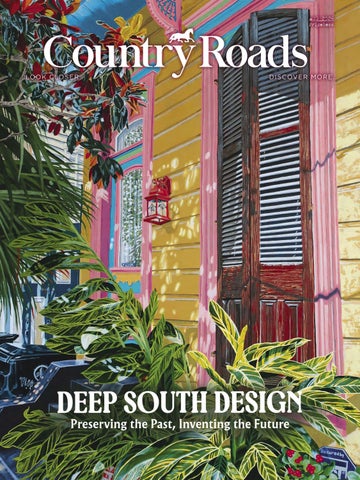
“I’ll be walking around my neighborhood. I’ll be walking and not thinking I’m planning a painting, but then I’ll see something that looks nice and I’ll try to get a good composition.” For New Orleans artist Nikki Nolan, ‘nice’ equals something very particular. She’s drawn to that gritty-but-pretty quality familiar to New Orleanians attuned to their city’s propensity for delivering vignettes of weird, unintentional beauty. Once Nolan spots a scene that begs to be painted, she’ll take a sneaky photo and retire to her studio, and might spend three to six months getting things just so. “I don’t paint in a traditional, gestural way; I get really fixated on the details,” she admitted. But for Nolan and her viewers, the details are where the magic lies. There’s a surreptitious, voyeuristic, playful quality that draws a viewer’s eye to the inadvertent elements that anchor any scene—from a meticulously styled front porch, to still lifes, to wheelie bins overflowing with summer greenery—in the here-and-now. “The unifying thing,” she says, “is finding the silly little detail that makes a place feel familiar, charming, and humorous. If something’s too perfect I don’t want to paint it.” Nikkinolan.com
46
Arts & Entertainment Editor
by Brett Barnes
36" x 48" acrylic on canvas by Nikki Nolan
40
Jordan LaHaye Fontenot
Odessa Barattieri
MARIGNY HOUSE
FIVE MILE EATERY A Lafayette restaurant leaning in to proximity, produce, and place
Ashley Fox-Smith
Managing Editor
On the Cover
Cuisine
Associate Publisher
NO SMALL FEAT Since debuting in 2024, the Natchitoches Bigfoot Festival has proven that Bigfoot is big fun—and big business
Cover Artist
Nikki Nolan
Advertising
ADVERTISE@COUNTRYROADSMAG.COM
Sales Team
Heather Gammill, Heather Gibbons, Mary Margaret Lindsey
Operations Coordinator
Molly C. McNeal
President
Dorcas Woods Brown
Country Roads Magazine P.O. Box 490 St. Francisville, LA 70775 Phone (225) 343-3714 EDITORIAL@COUNTRYROADSMAG.COM WWW.COUNTRYROADSMAG.COM
Subscriptions
22.10 for 12 months $ 39.78 for 24 months $
by Chris Jay
Perspectives
54
FROM ARCHITECTURE TO ATLANTIS The architectural imagination behind Robert Obier's sculptures by Cayman Clevenger
ISSN #8756-906X
Copyrighted. All rights reserved. No portion of this publication may be reproduced without permission of the publisher. The opinions expressed in Country Roads magazine are those of the authors or columnists and do not necessarily reflect the views of the publisher, nor do they constitute an endorsement of products or services herein. Country Roads magazine retains the right to refuse any advertisement. Country Roads cannot be responsible for delays in subscription deliveries due to U.S. Post Office handling of third-class mail.
// A U G 2 6
5
Reflections FROM THE PUBLISHER
L
ast month, I briefly achieved that elusive state of property-ownership nirvana in which every piece of equipment was working at the same time. For one glorious Saturday, not only the cars and the farm truck, but also my tractor, four-wheeler, side-by-side, lawn mowers, chainsaws, weed eater, backup generator, chipper, and outboard motor, were operating more or less as advertised. Anyone who has tried to impose order on a largeish rural property during a Louisiana summertime with anything besides an unlimited budget knows that this platonic ideal is rarely achieved. That Saturday morning, when my plans would normally be dictated by which bits of equipment happened to be working, no yard-maintenance project was off-limits. Ride-on-mower: check. Tractor: purring like a kitten. Chainsaw: yep. Weed-eater: likewise. Time to get to work. This state of affairs was made more surprising by the fact that most of my equipment is of a vintage that should long since have consigned it to the junkyard. Much of it has been resurrected from whichever barn, field, or roadside ditch it happened to be in when
it breathed its last. Our twenty-fiveyear-old farm truck was salvaged from a friend’s field, where it had sat abandoned since grinding to a halt five years previously, suffering electrical problems that I eventually traced to the activities of some mice living in the dashboard. Ditto the four-wheeler, which a neighbor was hauling to the dump when our son—at the time a bored fifteenyear-old stuck at home during early COVID—begged to try and resurrect it. The same neighbor was the source of the outboard motor, a 1968 Johnson which hadn’t run since the Reagan administration when we rescued it from the jaws of the garbage truck. With a little luck and a lot of YouTube videos, all these machines have been returned to, if not perfect, then at least sporadic working order. I’m not saying I’d set out to cross the Bering Strait with my Johnson outboard, but for an afternoon’s fishing on Lake Mary it does the trick. Being a "Man of a Certain Age"— which is to say, one whose confidence outstrips his ability—I find it hard to pass up any piece of defunct machinery without feeling a conviction that with enough care, attention and WD-40, it can be resurrected. What this fails to take into account is that sensible people don’t abandon expensive power equipment without good reason. So, much of the stuff I’ve inherited has id-
Residential & Commercial 6
iosyncrasies that make operating it a delicate proposition. I was reminded of this when my sister-in-law asked to use our elderly side-by-side to ride down to Thompson Creek. “Of course!” I said, then launched into a lengthy description of how to (a) start it, (b) put it in gear, (c) get it out of gear when it inevitably gets stuck in reverse, and (d) stop it, since the brakes don’t work very well. “Easy once you get the hang of it,” I assured her. Becky regarded me dubiously, and decided to walk instead. Corporate America takes a dim view of do-it-yourselferism. Try taking your salvaged tractor, car, or lawnmower to a dealership for parts and see how long it takes before someone insists you’d be better off with a new one. Admit that you’re planning any DIY maintenance beyond refilling the gas tank and you’re likely to be met with dark mutterings about voided warranties, electric shocks, or grievous bodily harm. Against this stands Stewart Brand, the eighty-seven-year-old counterculture
www.alberstadtlambertdesign.com
A U G 2 6 // C O U N T R Y R O A D S M A G . C O M
icon and founder of the Whole Earth Catalog. For decades, Brand has been a standard bearer for the “Right to Repair” movement, which asserts that ownership of a thing is not merely a question of having paid for it. Brand maintains that our ownership of things is only fully manifested when we also meet the challenge of learning how they work, how to maintain them, and how to keep them going, long after the warranty expires. It’s an idea that unites tinkerers, how-to video creators, and cheapskates everywhere. Six states have passed Right to Repair laws allowing consumers access to the parts, tools, and information required to fix the stuff they own, with legislation pending in many more. Of course, having the right to repair one’s tractor isn’t the same as doing so successfully. At the time of writing, my tractor is inexplicably moribund in the half-cut field where I parked it on Saturday night with intentions of resuming bushhogging activities come Sunday. Now it won’t start; I suspect mice have been at the wiring again. So next weekend, I’ll be out there with a toolbox, exercising my right to repair until the tractor sings again … or I give up and call a real mechanic—whichever comes first. James Fox-Smith, publisher —james@countryroadsmag.com
Natchez to New Orleans
// A U G 2 6
7
Noteworthy
AU G U ST 2 02 6
NEWS,
T I M E LY
TIDBITS,
AND
ASSORTED
LO O K C LO S E R
CURIOSITIES
•
Folklife in Force
THIS NOVEMBER, THE NATIONAL FOLK FESTIVAL'S RESIDENCY RESUMES IN THE MISSISSIPPI CAPITAL
F
or almost a century, the National Folk Festival has traveled from city to city as one of the biggest stages for celebrating grassroots American culture. This year, between November 13 and 15, the National Folk Festival gathers for a second year in Mississippi—the birthplace of America’s music— shining a national spotlight on the capital city of Jackson, in collaboration with the Smithsonian Center for Folklife and Cultural Heritage’s Of the People: the Smithsonian Festival of Festivals. This year's event will bring together foodways, crafts, parades, and family-friendly music by traditional artists representing cultural communities from all across the nation. The goal: to celebrate the sights, sounds, and flavors that are quintessentially American. First held in St. Louis, Missouri in 1934, through the ambitious visions of founder Sarah Gertrude Knott, the National Folk Festival redefined folk festivals by corralling the kaleidoscopic facets of American experience into one large-scale celebration. Jackson beat out forty-two cities to host a three-year residency of the festival, which is produced by the National Council for the Traditional Arts (NCTA). Blaine Waide, the Executive Director of the NCTA, said that Jackson felt like the perfect fit. “You can't tell the story of the emergence of American popular music without talking about Mississippi…There's something for everyone: parades, storytelling, music, dance, food, crafts, marketplace…No matter who you are, there is something for you at the festival,” Waide said. Numerous recipients of the nation's highest honor for folk artists—National Endowment for the Arts (NEA) National Heritage Fellows—will be featured in the program, alongside close to three hundred artists, musicians, dancers, story tellers, and craftspeople across six stages. Among them will be the Savoy Family Cajun Band of Eunice, Louisiana. “I think that the music will teach for itself…the lack of artifice in our presentation speaks of what makes Louisiana such a unique pocket of this great country,” said Ann Savoy, whose history with the festival stretches back fifty years.
Returning for the second in a three-year residency this November, the National Folk Festival brings foodways, crafts, and cultural practices representing communities from around the nation, back to Jackson, Mississippi.
Local festival manager and Jackson native, Thabi Moyo, believes that the festival will generate lasting confidence in Jackon’s cultural ecosystem, foster civic pride, and build the city’s momentum as a cultural hub, laying the foundation for other festivals and infrastructure development to continue for decades. “It's meaningful to me because I know what it will mean on the other side of it,” Moyo said. “Jackson needs something like this.” Described as the "nucleus" between local artists and the NCTA, Moyo has worked with a network of people from across the state to present a completely free gathering in which cuisine, artisans, and performances all contribute to quash any preconceived notions, compliment the cultural community already established in Jackson, and leave visitors thinking about Mississippi in a new way. “You won't get this level of authenticity anywhere else in the world,” Moyo said. November 13–15 in Jackson, Mississippi. nationalfolkfestival.com
The Business of Benevolence
THE RIVER ROAD AFRICAN AMERICAN MUSEUM’S EFFORTS TO RESTORE DONALDSONVILLE’S TRUE FRIENDS BENEVOLENT HALL ARE UNDERWAY
L
ong before modern insurance programs and attorney-assisted wills, individuals relied on one another. As far back as the late 1700s in Louisiana, benevolent societies were providing essential services like economic security, funeral and burial assistance, medical care, community support, and places of free expression to African Americans navigating life in a post-Revolutionary War South. By the nineteenth century, free people of color had established more than thirty societies in New Orleans alone. Many bought or built meeting halls for community gatherings and musical entertainment. One of which, True Friends Benevolent Association at 711 Lessard Street in Donaldsonville, is now the focus of restoration efforts by the River Road African American Museum (RRAM). First established at Tezcuco Plantation in Burnside in 1994, the RRAM relocated to Donaldsonville after Tezcuco burned down in 2002. In a handsome building at 406 Charles Street, RAAM’s mission to preserve the history, culture, and contributions of African Americans 8
A U G 2 6 // C O U N T R Y R O A D S M A G . C O M
in rural South Louisiana, continues. “When we started this museum we were in plantation country wanting to be a part of the tourist industry … telling the story of the Africans who were once enslaved in the River Parishes,” said Darryl Hambrick, Co-Founder and Executive Director of RRAM. “Once the fire happened, I was homeless, and we found our home in Donaldsonville.” Built in 1886, True Friends Hall served as a civic center, cultural hub, and music venue, that welcomed many of the greats of Southern Soul—performers on the Chitlin’ Circuit—and even Plas Johnson, a native of Donaldsonville and American soul-jazz saxophonist best known for his slinking intro in the theme to the “Pink Panther.” "It has been over 129 years since the True Friends Benevolent Association's members organized themselves to collectively take care of their families. It was the music and the meetings in TFBA Hall that helped them raise money and get through the hard times,” said Kathe Hambrick, Co-Founder and former Executive Director of the RRAM.
Backed by design plans by architectural firm EskewDumezRipple, the project has received a Martin Luther King Community Project grant, among other funding, and is now underway. Estimated to be completed no later than 2028, the goal of the True Friends project is to establish an indoor and outdoor venue to again host cultural events, where visitors can also learn about the history of the businesses located on either side—a barber shop that has long been a mainstay of the local African American community, and a beauty salon. “Hopefully the locals will have an opportunity to perform and carry on the traditions of the music and artistry that was developed and created in those walls” Darryl said. For the team at RRAM, reviving a cultural touchstone is about more than restoring brick and mortar; it's about carrying on the legacy of stewardship, meeting, and music that once reverberated between the walls, and spilled onto Lessard street. For updates visit riverroadaam.org.
Signed by Governor Gálvez
GENEALOGIST MICHAEL N. HENDERSON SHARES AN EXTRAORDINARY CONNECTION TO LOUISIANA’S REVOLUTIONARY WAR HISTORY
Historian and genealogist Michael N. Henderson
W
hen Michael N. Henderson was nine years old, he was confronted with a question that would set him on a decades-long genealogical journey.
Henderson, who was born and raised in Algiers, was among the first African American students to attend Holy Name of Mary Elementary during the turbulent 1960s. One day, a group of boys approached him, asking him why he was there, attacking him with racial slurs and leading to a physical fight. “At the time, I didn't realize how much of an impact it was going to have on me as a child,” Henderson said. “Not being able to explain why am I here, what is my purpose of being here.” It was not until years later, after earning the rank of Lieutenant Commander in the US Navy, that the surname of his grandmother, Nellie Mathieu, would reveal a remarkable connection between his enslaved fourth-generation grandmother, Agnes, and one of the most influential figures in Louisiana history: Spanish Governor Bernardo De Gálvez. Featured in a 2010 segment of the PBS Program History Detectives, Henderson discovered that Agnes had gained her freedom on December 16, 1779, with the assistance of Mathieu Devaux dit Platillo, a French national, and the Revolutionary War hero, Gálvez. He also uncovered a seven-page manumission document at the New Orleans Notarial Archives, written entirely in Spanish, detailing Agnes’s year-long struggle to win her freedom, and bearing the Governor’s signature at the bottom. “That's like finding the Emancipation Proclamation with your ancestor's name on it, signed by Abraham Lincoln,” Henderson said.
On August 22, Henderson will tell Agnes Mathieu’s story at Gálvez Rum Tasting Room and Distillery in Jackson, Louisiana. “We live in a country where our history is multi-ethnic, multidimensional, very, very diverse, but we all have stories that bring us together,” Henderson said. During a year that marks the nation’s 250th birthday, Henderson is proud to tell his ancestor’s story in a way that sheds light on the country's history of slavery and racial struggle. “As an African American, one of the challenges of doing this type of research is coming to terms with the fact that you descend from an enslaved individual in this country,” Henderson said. “I embraced the side of my enslaved ancestry. It allowed me to understand the work that we still need to do to help those individuals who want to deny that aspect of American history.” Through his presentation, Henderson, the first African American member of the National Society, Sons of the American Revolution in Georgia, offers a living testament to Gálvez's lasting impact and an answer to his longstanding search for identity. “My military history, my family's history, connects me to the history of being an American,” Henderson said. “I don't have to explain who I am, why I am. My family's story speaks for itself.” For more information about Henderson’s story, visit michaelnhenderson.com. For details on the August 22 event, visit galvezrum.com/tasting-room.
// A U G 2 6
9
10
A U G 2 6 // C O U N T R Y R O A D S M A G . C O M
Events
AU G U ST 2 02 6
MAD
DOGS AND
ENGLISHMEN
GO
OUT …
FOR
SUMMER STYLE GUIDE
WHITE
LINEN
NIGHTS,
F U N KY F E S T I VA L S & A I R - C O N D I T I O N E D A R T G A L L E R I E S
•
From Mom Walks and Yoga in the Park (Wednesdays), to the Lafayette Farmers & Artisans Market (Saturdays), and various one-off events like Family Game Night (August 6), or Art in the Park with Scrappie Studio (August 18), Lafayette's Moncus Park has plenty of fun and family-friendly activity to offer this summer. Photo courtesy of Moncus Park administration
UNTIL AUG 15th
VISUAL ARTS "ANDY WARHOL: PLUS ONE": SELECTIONS FROM THE HILLIARD PERMANENT COLLECTION Lafayette, Louisiana
Drawing from the Hilliard Art Museum’s collection of Warhol photography, Plus One explores Warhol's candid personal relationships, from images of his partner, Jon Gould, to artist Victor Hugo working on canvas in the studio. Viewers are invited into an observational, occasionally voyeuristic journey through Warhol's life, probing the significance of who is granted space in a memory or moment. hilliardartmuseum.org. 1
UNTIL AUG 22nd
VISUAL ARTS "SLOW": SUMMER VISIONS AT GLASSELL Baton Rouge, Louisiana
LSU School of Art and LSU College of Art & Design reveal the thirty artists selected for LSU School of Art’s 2026 Summer Contemporary exhibition SLOW, juried by New Orleans-based art historian and curator Emily Alesandrini.
Embracing “slow” in all registers, the exhibition features work that engages slow states of being, slow processes, and slow media, cultivating attention through deceleration and degraded signals. The call was extended to contemporary visual artists who live, work, study in–or are connected to– Louisiana. On view at Glassell Gallery in the Shaw Center for the Arts. Closing reception August 22 from 6pm–8pm. design.lsu.edu. 1
UNTIL AUG 30th LENSES "REVISION: WOMEN IN PHOTOGRAPHY" Baton Rouge, Louisiana
The LSU Museum of Art, in partnership with the Paul R. Jones Collection at the University of Alabama, presents an exhibition that explores how women artists have shaped the art of photography throughout time—and continue to influence the medium to this day. Themes include social justice, aging, feminism, relationships, reimagining shared narratives, empowerment, and feminine aesthetics. lsumoa.org. 1
UNTIL AUG 30th
HISTORICAL EXHIBITIONS “BECOMING LOUISIANA: BORDERS IN MOTION (1688–1812)” New Orleans, Louisiana
To celebrate America's 250th anniversary, Nous (The New Orleans Foundation for Francophone Cultures) presents an exhibition using historical maps reimagined in line art to examine the multifaceted historical forces that shaped Louisiana’s on its path to becoming part of the United States. Through the stories these images tell and the ones they omit, the maps encourage visitors to interrogate Louisiana's winding journey to statehood through a new lens. 602 Toulouse Street. nous-foundation.org. 1
UNTIL SEP 6th VISUAL ARTS "CAREFUL MAN" AT SIBYL GALLERY New Orleans, Louisiana
Artist Neil Hancock's solo exhibition at Sibyl Gallery makes use of both language and signs as material, blurring the boundary between drawing and writing // A U G 2 6
11
Events Ongoing
with acrylic paint, pencil, and marker. Hancock engages in restriction and discipline, his subject matter borrowed from his daily life, his themes focusing on his recent sobriety. • Also at Sibyl Gallery through September 6 is Gain of Function, an exhibit in which artist Kyle McLean presents work created using found, thrifted, or "harmlessly stolen" materials collected while walking the same routes day in and day out. McLean works to bring the discarded and wanted back into the world of valuable treasures, striving to create connection and continuity in the spaces where the lines have been broken. 8630 Zimpel Street. sibylgallery.com . 1
UNTIL SEP 6th
ART EXHIBITIONS "SOUTH ARTS SOUTHERN PRIZE & STATE FELLOWSHIPS FOR VISUAL ARTS" Baton Rouge, Louisiana
South Arts Southern Prize & State Fellowships for Visual Arts at The LSU Museum of Art revolves around a touring exhibition of artwork by the 2025 Southern Prize & State Fellowship
12
for Visual Arts recipients. The program celebrates contemporary art in the American South, with this year's cohort representing mediums such as quilting and African mask-making, and tackling universal narratives of migration, labor, and identity. southarts.org. lsumoa.org. 1
UNTIL SEP 12th
ART EXHIBITIONS STAA SUMMER SHOW Covington, Louisiana
For fifty years and counting, the St. Tammany Art Association has organized the national juried art exhibition, the Summer Show. The show runs through September 12, with a closing reception that day from 6 pm–9 pm. The range is always diverse; the standard high. Entrance to the gallery is free. sttammanyartassociation.org. 1
UNTIL OCT 10th
ART EXHIBITIONS JOSEP MARÍA GARCÍA-LLORT AT THE AMOA Alexandria, Louisiana
The Alexandria Museum of Art displays a private collection of Josep María García-
A U G 2 6 // C O U N T R Y R O A D S M A G . C O M
Llort (1921-2003) paintings. An avantgarde Catalan painter who spent several years working in Pineville, García-Llort focused on flat colors and thick lines in his works—heavily influenced by the likes of Pablo Picasso, Antoni Tapies, Josep Palau i Fabre and Albert RàfoslsCasamada. Displayed pieces are on loan to the museum from the Freedman family. themuseum.org. 1
UNTIL OCT 10th
ART EXHIBITIONS AMOA'S 39TH ANNUAL SEPTEMBER COMPETITION Alexandria, Louisiana
It's time for the annual September Competition at the Alexandria Museum of Art, a juried exhibition featuring contemporary artwork from around the country and displayed in the Lipsey Gallery. In its thirty-ninth iteration, the exhibition includes sixty artworks by fifty artists representing twenty-one states and two. countries, spanning a variety of mediums. themuseum.org. 1
UNTIL OCT 10th
WORDS, WORDS, WORDS "BETWEEN THE LINES: 250 YEARS OF AMERICAN POETRY" AT THE AMOA Alexandria, Louisiana
On display in the Alexandria Museum of
Kathryn Stockett, bestselling author of The Help, will visit St. Francisville August 5 to discuss her new novel, The Calamity Club (see page 17) Photo by Ken Kochey. Art's Overlook Gallery, Between the Lines: 250 Years of American Poetry celebrates the country's historic 250th anniversary and features artwork drawing inspiration from famous and moving pieces by American poets. Presenting fourteen artworks by fourteen artists representing eight states, the exhibition highlights the intimate connection between visual art and American poetry. themuseum.org. 1
AD
// A U G 2 6
13
Events
UNTIL DEC 19th
HISTORICAL EXHIBITIONS “EXCURSIONS, EXPEDITIONS, AND ‘DISCOVERIES:’ A YOUNG NATION EXPANDS”
Beginning August 1st UNTIL OCT 11th
ARTISTIC ICONS "ROBERT GORDY: OUTSIDE THE MAINSTREAM" New Orleans, Louisiana
The New Orleans Museum of Art presents an exhibition of works by Louisiana native Robert Gordy (1933–86), an iconic artist who preferred to work "outside the mainstream" and was known nationally for his mastery of space, line, and color. After graduating from LSU with his MFA in the 1950s, Gordy lived internationally prior to settling in New Orleans in 1964. Many of his works were exhibited at galleries in New York, Chicago, and New Orleans. The exhibition draws from NOMA's permanent collection, the archive of the Robert Gordy estate, and loans from private collections. noma.org. 1
UNTIL NOV 1st
ART EXHIBITIONS THIRTEENTH HBCU ART SHOWCASE AT THE OGDEN Baton Rouge, Louisiana
The Ogden Museum of Southern Art and The New Orleans Chapter of The Links,
14
Incorporated present the thirteenth annual HBCU Art Showcase, featuring artwork by Dillard University and Xavier University of Louisiana students. Featured works are displayed in the Museum’s Education Gallery, which showcases arts education and student artwork from across the South. ogdenmuseum.org. 1
Baton Rouge, Louisiana
UNTIL DEC 4th
President Thomas Jefferson to map
HANDMADE "THE MOSS MYSTIQUE: SOUTHERN WOMEN AND NEWCOMB POTTERY"
In Excursions, Expeditions, and ‘Discoveries:’ A Young Nation Expands, Louisiana's Old State Capitol invites guests to celebrate history by stepping into the extensive journals of explorers William Dunbar and Dr. George Hunter, who were commissioned by the land west of the Mississippi River. Through comprehensive contemporary landscape photography created by Louisiana State University School of Art
New Orleans, Louisiana
students, the exhibit juxtaposes Dunbar
The Moss Mystique: Southern Women and Newcomb Pottery, on display at Newcomb Art Museum of Tulane University, explores the intricate practices, imagery, and regional affiliations of Newcomb Pottery. The exhibition, which recently reopened after a summer break, examines in detail how Newcomb's artists visualized and ultimately defined ideas of place in the American South through various natural artistic depictions, from local flora to landscapes. newcombartmuseum.tulane.edu. 1
and Hunter's 1804 southern route with
A U G 2 6 // C O U N T R Y R O A D S M A G . C O M
an unexpected modern perspective. louisianaoldstatecapitol.org. 1
UNTIL DEC 28th
VISUAL ARTS CAROLO SARACENI'S "OUR LADY OF LORETO" AND PERUVIAN VICEREGAL STATUE PAINTINGS
painting misidentified. When the work, depicting the Virgin Mary in ornate dressing, was acquired by NOMA in 1970—its documents called it "Our Lady of Lima," an example of art from the Viceroyalty of Peru. It went on to travel the world and be displayed in international museums as a work of Spanish Viceregal art. In 2014, though, an art historian came across a copy of the work in the sacristy of the Church of San Bernardo alle Terme in Rome, signed by the Italian baroque artist Carlo Saraceni and titled, "Our Lady of Loreto." Now, "Our Lady of Loreto" is being exhibited under its true name at NOMA for the first time, alongside other Spanish works that served as prototypes for Marian iconography by Indigenous and Mestizo artists in Viceregal Peru—which later inspired similar paintings in Europe and the Americas. noma.org. 1
UNTIL JAN 15th
STYLE GUIDE “STITCHES IN TIME: QUILTS AND FASHION” Baton Rouge, Louisiana
New Orleans, Louisiana
Stitches in Time: Quilts & Fashion, on
Mistaken identities make for excellent
display at the LSU Textile & Costume
storytelling, and at the heart of this
Museum, studies the dialogue between
exhibition at NOMA is the story of a
dress and quilt making, exploring how
Revolution like never before—as if they were inside each experience themselves. Using a HistoPad (an interactive tablet), visitors get to explore interactive 3-D reconstructions of defining moments in the war, allowing them to glimpse people, places, and events of the time period more closely—and truly step into the past like never before. The nearly yearlong exhibition is officially part of the massive America 250 celebration. Free. hnoc.org. 1
AUG 1st Selections from The Folk Art Gallery at the LSU Museum of Art, a new exhibition displaying six artworks on loan for one year from the American Folk Art Museum in New York. The exhibition opened June 30, and will remain through summer 2027. Photo courtesy of the LSU Museum of Art.
fashion and this beloved crafting art form blend the boundaries of stylistic influence. The exhibition is made possible by a recent gift of a collection of garments by American designer and Louisianan, Geoffrey Beene, from Sylvia R. Karasu, MD, Clinical Professor of Psychiatry at Weill Cornell Medicine. While perusing, visitors can expect to glean how Beene's intricate designs highlight complex and unique connections in color, technique, and historical moment
in the nineteenth and twentieth century. lsu.edu/agriculture/textilemuseum 1
UNTIL JAN 17th
HISTORICAL EXHIBITIONS "AMERICAN REVOLUTION: THE AUGMENTED EXHIBITION" New Orleans, Louisiana
Amid various celebrations taking place around the nation's 250th birthday, the Historic New Orleans Collection invites visitors to experience the American
FESTIVALS SUGARLAND MUSIC & ARTS FEST Napoleonville, Louisiana
The Assumption Foundation for the Arts—an initiative to support musicians, visual, and performing arts in the parish—will stage a full day of lively musical and creative entertainment at the Assumption Parish Community Center. Expect a slate of local bands, student musician groups, poetry, and more on the Main Stage and Arts Village Stage, as well as a pop-up art gallery featuring local artists. There's also, of course, plenty of food vendors, cold beer, and other refreshments available; and a family zone for kids. Free. sugarlandfest.org. 1
AUG 1st
SUMMER FAVES WHITE LINEN NIGHT New Orleans, Louisiana
The New Orleans Arts District once again brings back its midsummer blockbuster White Linen Night, which transforms Julia Street's 300-600 blocks into one massive, progressive, community art party filled with live music, delectable cuisine and cocktails, and more than twenty coordinated exhibition openings at galleries and museums throughout the Warehouse Arts District. Admission to the block party and art openings, which are held from 5 pm–10 pm, is free, and cocktails and things to nibble are available for sale along Julia Street. Deck yourself out in your cleanest, chicest whites—and maybe put a tide pen in your purse, just in case. Find the full roster of participating galleries at artsdistrictneworleans.com. 1
AUG 1st - AUG 2nd
SOUND ON SATCHMO SUMMERFEST New Orleans, Louisiana
This weekend festival dedicated to the memory of Louis Armstrong presents an extensive roster of performances by contemporary New Orleans musicians from many genres, paying homage to
// A U G 2 6
15
Events
Beginning August 1st - 6th
The first Sunday of each month, Longue Vue House & Gardens welcomes Louisiana residents to stroll the grounds, enjoy a picnic, and generally make themselves at home amid the eightacre gardens and house museum, which was once home to civic and philanthropic visionaries, Edith and Edgar Stern. Admission to the lovely gardens is free for Louisiana residents. 9:30 am–5 pm. August 2 this month. Photo by Molly C. McNeal. the musical and cultural legend. Bands coming to play read like a who's who of traditional and contemporary jazz and brass bands. Don't miss a lecture series, children's programming, a Jazz Mass, a second line, and plenty of tasty New Orleans food to keep you going. The two main stages are located at the Jazz Museum in the Old US Mint, 400 Esplanade Avenue. Details at satchmosummerfest.org. 1
best plates forward, welcoming residents and visitors for summer getaways (or stay-cations) with prix fixe menus at participating restaurants and scrumptious special events. Enjoy two, three, or fourcourse meals at some of The Northshore's most respected dining establishments. The area is chock-full of local bed and breakfasts and hotels offering an extra dose of local charm, as well as a good night's sleep. tammanytaste.com. 1
AUG 1st - AUG 23rd
AUG 1st - AUG 31st
Baton Rouge, Louisiana
New Orleans, Louisiana
ART EXHIBITIONS "FREE AS THEY WANT TO BE: ARTISTS COMMITTED TO MEMORY"
VISUAL ARTS "HANG LOOSE WITH CAROL HALLOCK" AT GALLERY 600 JULIA
Baton Rouge Gallery, Southern University, and The West Baton Rouge Museum present a limited, multi-site exhibition featuring contemporary works inspired by historical memory and considering the role of photography and film in chronicling the complex legacies of slavery. The exhibition includes themes of migration, identity, and the African diaspora, among others, and features several celebrated contemporary American artists, such as Bisa Butler, Carrie Mae Weems, and Dawoud Bey. batonrougegallery.org. subr.edu.
Gallery 600 Julia hosts a solo exhibition by Northshore artist Carol Hallock, who approaches her Lacombe Bayou and New Orleans cityscapes with "loose realism." Artist's reception August 1, from 6 pm–9
westbatonrougemuseum.org. 1
once again presents its state-wide, juried
pm. gallery600julia.com. 1
AUG 1st - FEB 14th
ART EXHIBITIONS LOUISIANA CONTEMPORARY 2026 New Orleans, Louisiana
The Ogden Museum of Southern Art exhibition, Louisiana Contemporary,
AUG 1st - AUG 31st
GOOD EATS TAMMANY TASTE OF SUMMER
16
A U G 2 6 // C O U N T R Y R O A D S M A G . C O M
which is curated this year by Sarah Jones, Lulu C. and Anthony W. Wang Head of Live Arts at The Metropolitan Museum
Covington, Louisiana
of Art. The exhibition contains a survey
Get a taste of The Northshore during the annual Tammany Taste of Summer. Through the month of August, St. Tammany Parish puts its
of works by Louisiana artists, drawn from among hundreds of submissions to present a showcase of contemporary art practices in the region. Since Louisiana
Contemporary's inception, The Ogden
good eats for a good cause. 11 am–
a conversation and book signing at the Freyhan Center. In the years since the 2009 publication of The Help, and especially since the 2011 release of the Academy Award-nominated film of the same name, Jackson, MS, Stockett has become an American household name. This month, the author will be in St. Francisville to sit down in discussion with Baton Rouge Advocate correspondent Jan Risher about The Calamity Club. Stockett's new novel follows the path of three marginalized women in 1933 Oxford, Mississippi, as they hatch an audacious plan to reclaim control over their fragile individual destinies. 5:30 pm discussion and book signing at The Freyhan Center 4727 Fidelity Street (doors open at 5 pm), with a bookish pre-game from 3 pm–5 pm at The Conundrum Bookstore with refreshments. Presented by The Conundrum and The Freyhan Center. Copies will be available for purchase.
2 pm. $10 for all-you-can-eat red beans.
Free. thefreyhancenter.org. 1
has presented works by more than 650 artists. ogdenmuseum.org. 1
AUG 3
rd
MONDAY FUNDAY UNITED WAY OF SOUTHEAST LA RED BEANS 'N' RICE COOK-OFF Slidell, Louisiana
United Way will once again celebrate the hallowed Louisiana tradition of red beans on Monday at its annual all-you-can-eat Red Beans ‘N’ Rice Cook-Off at Slidell Auditorium, all for charity. The muchanticipated event marks the official kickoff of the organization's St. Tammany Parish fundraising campaign. Proceeds support suicide prevention, mental health services, and other programs offered by United Way on the Northshore. Come gorge yourself on apparently endless
unitedwaysela.org. 1
AUG 5
th
LITERATURE KATHRYN STOCKETT TALKS "THE CALAMITY CLUB
AUG 6th
LECTURES POP LIFE: WARHOL AND THE CULTURE OF VISIBILITY, PART ONE
St. Francisville, Louisiana
Lafayette, Louisiana
The New York Times bestselling author Kathryn Stockett will present
The Hilliard Art Museum in Lafayette hosts Dr. Allison Leigh, associate
professor of Art History at UL Lafayette. Leigh will lecture on the influence of pop art icon Andy Warhol, delving into his role as one of the original influencers to the voyeurism of his life and studio practice. 5:30 pm–6:30 pm. Dr. Leigh's lecture is given in conjunction with the Hilliard's Andy Warhol: Plus One exhibition, displaying pieces from the museum's permanent collection. The exhibition remains through mid-August. Access granted with museum admission; free for members, UL faculty, staff, and students. hilliardartmuseum.org. 1
AUG 6th - AUG 9th SIDE-SPLITTERS LAFAYETTE COMEDY FESTIVAL Lafayette, Louisiana
What do you call a stellar lineup of comedians? A cackle? A croak? Find out at the Lafayette Comedy Festival, held over four evenings at Club 337 inside the DoubleTree Hotel, with a Sunday brunch show at Artmosphere. Onstage, expect zingers and one-liners from headliners including Todd Barry, Kim Kongdon, Sam Jay, and more—with themed shows including Cereal Killers, Stoned vs. Drunk vs. Sober, and a live recording of the We're Dying Down Here podcast. 7 pm–9 pm Thursday and Friday;
11 am–9 pm Saturday; noon Sunday for Glitz & Giggles - A Brunch Affair. $100 for weekend festival passes; other single-day ticketing options available. lafayettecomedy.com. 1
AUG 7th
FUN-DRAISERS SOUTHERN NIGHTS SOIRÉE Mandeville, Louisiana
Ready to get gussied up in your finest seersucker suits or linen sundresses? The St. Tammany Chamber of Commerce's biggest fundraiser of the year brings casino games, an open bar, samples from area fine-dining restaurants, and both live and silent auctions to Fleur De Lis Event Center in Mandeville. Proceeds from the event—an opportunity to network with St. Tammany parish business leaders—enable the chamber to offer members relevant programs and services at reasonable prices. 7 pm–10 pm. $150; $250 per couple. sttammanychamber.org. 1
AUG 7th
TWO-PART HARMONY MICHAEL SCOTT BOUDREAUX + DOM ELLIS AT THE ACA Lafayette, Louisiana
Two Louisiana-born artists perform at the Acadiana Center for the Arts, for an
// A U G 2 6
17
Events
Beginning August 7th - 8th evening celebrating Southern songwriting. Michael Scott Boudreaux, a Breaux Bridge native, shares the stage with Dom Ellis, a Lafayette-raised, Nashvillebased singer-songwriter. 7:30 pm. $30. acadianacenterforthearts.org. 1
AUG 7 - AUG 9 th
th
SOMETHING OLD HNOC ANTIQUES FORUM: "MATERIAL BELIEF: OBJECTS OF FAITH, SPIRIT, AND TRADITION" New Orleans, Louisiana
For the annual convening of historians, authors, collectors, folklorists, antiquarians, and scholars that is the Historic New Orleans Antiques Forum, organizers have curated a deep dive into the world of Southern belief systems, rituals, and objects. Through the lens of material belief, attendees will explore the pursuit of faith, spirit, and tradition in this region. In addition to talks and expert panels, there will also be exhibition tours, a celebratory brunch, and a champagne reception. $225. Details at hnoc.org. 1
18
AUG 8th
SUMMER FAVES WHITE LINEN & LAGNIAPPE
Poydras Center. For ticketing details, visit
summer and fall months. Shows fall every
artscouncilofpointecoupee.org. 1
second Saturday, inviting guests into a
AUG 8th
FLEET FEET RED DRESS RUN New Orleans, Louisiana
Slidell, Louisiana
Scarlet-garbed runners will flex their inner
Get ready to slap on your best all-white outfit at Olde Town Slidell's annual White Linen & Lagniappe. This is an evening filled with family-friendly entertainment including live music, after-hours shopping, and art by local artists—including the new, permanent installation, Antique Umbrella Alley, above First Street. Come hungry and ready for a cocktail. 6 pm–9 pm. Free. For details, visitthenorthshore.com. 1
vamps during this year's Red Dress Run.
AUG 8th
PERFORMANCES ARTS COUNCIL OF POINTE COUPÉE PRESENTS: NEW ORLEANS'S BEST PARTY BAND New Roads, Louisiana
Sponsored by the Hash House Harriers, a self-proclaimed "drinking club with a running problem," the event offers not only a chance to imbibe in scarlet finery and unlimited beer, but to also support a good cause, with proceeds supporting more than one hundred local charities. This year's run begins at Crescent Park on N. Peters Street. 9 am. $89. nolareddress.com. 1
AUG 8th
LIGHT SHOWS LASM “ROCK THE DOME” PLANETARIUM LASER SERIES: LASER BEATLES
full-sensory experience set to musical favorites. August's show is titled Laser Beatles. 6 pm. $20 for general admission; $25 for VIP early seating; $100 for a Rock the Dome package. lasm.org. 1
AUG 8th
GOOD EATS PIT VS. POT COOK OFF Morgan City, Louisiana
At the Pit vs. Pot Cook Off, eager cooking teams who have practiced to perfection will compete under the Highway 90 Bridge in Morgan City to see who makes the finest low-tech grub. The event features free samples, music, and good old fashioned family fun. cajuncoast.com. 1
AUG 8th
BOOKWORMS MISSISSIPPI GULF COAST BOOK FESTIVAL Bilxoi, Mississippi
The Arts Council of Pointe Coupée's
Baton Rouge, Louisiana
The inaugural Mississippi Gulf Coast
2026 Performing Arts Series has kicked
Book Festival kicks off on the Biloxi
welcomes New Orleans's Best Party Band,
Prepare for a high-energy, electrifying experience featuring laser light, music, and motion. The Louisiana Art & Science Museum (LASM) presents a Rock the Dome Laser Series at the Irene W.
featuring Crescent City Soul. 7 pm at the
Pennington Planetarium throughout the
Regional authors, aspiring writers, book
off for the new year, with a summertime lineup that's set to serenade New Roads with fabulous musical acts. August
A U G 2 6 // C O U N T R Y R O A D S M A G . C O M
Town Green for a community-oriented, family-friendly day that celebrates literacy and storytelling, against the beautiful backdrop of the Mississippi Gulf Coast.
AD
// A U G 2 6
19
Events
Beginning August 8th
CALENDAR OF EVENTS
August 2026
Cruisin Back in Time Car Show Griin’s Service Station August 01, 2026 @ 8:00am Cruisin’ Back in Time Car Show SIP & WINE Spirit Fest Paragon Casino Resort August 8, 2026 @ 6:00pm www.paragoncasinoresort.com AKA 57 Martial Arts Fights Paragon Casino Resort August 15, 2026 @ 7:00pm www.paragoncasinoresort.com Alligator Feeding Show Paragon Casino Resort August 29, 2026 @ 4:00pm www.paragoncasinoresort.com Aretha & Lionel - A Tribute Show Paragon Casino Resort August 29, 2026 @ 8:00pm www.paragoncasinoresort.com Craig Morgan Concert Paragon Casino Resort September 5, 2026 @ 8:00pm www.paragoncasinoresort.com
8592 Hwy 1, Mansura, LA 800.833.4195 travelavoyelles.com 2 0 A U G 2 6 // C O U N T R Y R O A D S M A G . C O M
It's easy for Baton Rougeans to get their fresh local produce fix (plus fresh meat, seafood, and other food and goodies) thanks to the Red Stick Farmers Market, now over twenty years old. Each Saturday, the market hosts growers peddling fresh produce at the Main Street Market in downtown Baton Rouge from 8 am–noon, on the corner of Fifth and Main. Photo courtesy of BREADA. lovers, and small businesses converge for author meet-and-greets, book signings, live readings, vendor shopping, and other interactive experiences for all. 10 am– 3 pm. Free. coastalmississippi.com. 1
AUG 8 - AUG 9 th
th
ALL THAT GLITTERS GEM & MINERAL SHOW Gonzales, Louisiana
The Baton Rouge Gem & Mineral Society's rockin' show—held annualluy at the Lamar Dixon Expo Center—offers two sparkling, geode-centric days of door prizes, a silent auction, demonstrations on faceting and wire wrapping, and vendors selling everything from rock specimens to fossils, tools, and jewelry. Enthusiasts and experts alike are welcome to peruse, ogle, and bask in the glory of gems. 9 am–5 pm Saturday; 10 am–4 pm Sunday. $5 adults; $3 for children ages five to twelve; four
classics to engaging new documentaries and locally-produced stories. Here's what's in store for summer's end: • August 8: Harry Potter And The Sorcerer's Stone (25th Anniversary Screening): Follow Harry, Ron, and Hermione on the second installment of their magical adventures, adapted from the popular children's series. 2 pm. $9.50. • August 9: The Birdcage: Chaos and hijinks ensue after Val Goldman asks Barbara Keely to marry him, with his father, a gay nightclub owner, and his life partner, squaring off with the Keely family. 2 pm. $9.50. • August 14: The Hoodoos Premiere +Q&A: A heist job, voodoo horror, a local premiere—all filmed in Baton Rouge.
and younger free. visitlasweetspot.com. 1
7:30 pm. $12.50.
AUG 8th - AUG 16th
• August 16: Funny Girl - $5 Movie: In
SILVER SCREENS AUGUST FILMS AT THE MANSHIP
this classic, Fanny Brice, played by Barbra
Baton Rouge, Louisiana
as a bit player on a vaudeville stage and
Streisand, begins her entertainment career
Each month, the Manship Theatre offers
ends up starring on Broadway. 2 pm. $5.
a diverse slate of films, from modern
manshiptheatre.org. 1
AD
// A U G 2 6
21
Events
Beginning August 8th - 16th AUG 8th - AUG 23rd
THEATRE "THE CRUCIBLE" AT 30 BY NINETY THEATRE Mandeville, Louisiana
Arthur Miller's famous Puritan drama, The Crucible, comes alive at 30 by Ninety Theatre this summer, telling the riveting story of bigotry, violence, and fear in old Salem in a powerful, moralistic historical tale that has been retold time and again. 8 pm on Fridays and Saturdays; 2:30 pm on Sundays. $22; $20 for military and seniors; $17 for students thirteen and older; $14 for children twelve and younger. 30byninety.com. 1
AUG 9th
CONCERTS MAGNOLIA STRINGS CONCERT
bites and a signature cocktail. 5:30 pm–7 pm. $44. thefreyhancenter.org. 1
AUG 12th - AUG 16th
SEE-FOOD DELCAMBRE SHRIMP FESTIVAL Delcambre, Louisiana
For anyone who has ever pulled to the side of a two-lane road somewhere in
Pictured above is one of a number of pieces on display at the Historic New Orleans Collection for its highly-anticipated annual Antiques Forum, this year titled Material Belief: Objects of Faith, Spirit, and Tradition. August 7–9. Learn more on page 18. Image courtesy of The Historic New Orleans Collection.
South Louisiana, lured to a lean-to
$10 gate fee on Friday and Saturday;
an expert in both plein air and studio
shack by a hand-painted sign reading
Free Wednesday, Thursday, and Sunday.
work. artguildlouisiana.org. 1
"fresh shrimp," this one's for you. This
shrimpfestival.net. 1
Wednesday through Sunday festival offers carnival rides, a firemen water fight, a blessing of the local fleet, and fais-dodos every day. Plus live music from local legends the likes of Swampland Revival, The Adam Leger Band, Ryan Foret & Foret Tradition, and more. You enjoy the festival by boat. The Twin Parish Port
St. Francisville, Louisiana
Commission's new North Pier Marina
Spend hot summer Sunday evenings with Magnolia Strings, the Freyhan Center’s newest concert series, where audiences get to kick back and enjoy beloved classics and contemporary favorites alike. Admission includes light
is just three blocks south of the Festival Grounds. Hungry revelers will also be able to enjoy their shrimp in every conceivable iteration—boiled, fried, piquanted, stuffed. Held at the Shrimp Festival Grounds, 409 East Main Street.
2 2 A U G 2 6 // C O U N T R Y R O A D S M A G . C O M
AUG 12th - SEP 28th
ART EXHIBITIONS THE FIFTY-SIXTH ANNUAL RIVER ROAD SHOW
AUG 13th
COOLER PURSUITS SUMMER PORCH PARTY SERIES:J LOHR WINE TASTING Ridgeland, Mississippi
Baton Rouge, Louisiana
The Ridgeland Craft Center at the Guild
The Art Guild of Louisiana presents its fifty-sixth Annual River Road Show, a national juried show held annually at the Louisiana State Archives. This year, Marc Hanson, a current resident of Tybee Island, Georgia, serves as juror and judge for the exhibition. Hanson is a Master Signature Member of Oil Painters of America, and was trained at the Art Center College of Design in Pasadena—
invites the community to gather on its back patio for a Summer Porch Party Series. At August's event, attendees can enjoy a J Lohr Wine Tasting. Capped at forty-five guests, this wine tasting welcomes Jay Hunter and Chris Berry to guide guests through a curated selection of reds and whites, while Sarah Fey Brown leads a culinary experience of champagne and charcuterie. To round
out the evening, Nic Neese will be onsite glassblowing. 6:30 pm–9 pm. $50. mscrafts.org. 1
AUG 13
th
CELEBRATIONS POINTE COUPÉE CHAMBER ANNUAL SOCIAL New Roads, Louisiana
The Pointe Coupée Chamber Annual Social, this year themed "Off To The Races," celebrates the achievements of the local community. A special highlight includes 4 Under 40, recognizing four individuals under the age of forty making significant contributions to the region. At the Scott Civic Center. 6 pm–9 pm. $50. Details at the Pointe Coupée Chamber of Commerce Facebook page. 1
Thursday–Saturday; 2 pm Sunday. $25. sullivantheater.com/styc-tickets. 1
AUG 14th - AUG 15th
UP IN THE AIR ZACHARY REALLY HOT AIR BALLOON FESTIVAL Zachary, Louisiana
This weekend, see some of Louisiana's summertime hot air put to good use, powering this annual celebration of things that go up, up, up and away. The Zachary Really Hot Air Balloon Festival at BREC Zachary Community Park features hot air balloons (obviously), food trucks, dozens of craft vendors and artisans, a car show, and more. Along with rides and games for the kiddos, don't miss live music both nights. 4 pm– 9:30 pm. Free.
percentage of local business sales going toward the Covington Public Art Fund. Now what will you wear? 6 pm– 9 pm in historic downtown Covington. visitthenorthshore.com. 1
AUG 15th
TRADITIONS FÊTE DIEU DU TECHE
AUG 16th
DESIGN COASTAL TRASH COUTURE FASHION SHOW Morgan City, Louisiana
The first of its kind, the Coastal Trash Couture Fashion Show features original designs constructed from recycled and discarded materials to highlight
Arnaudville, Louisiana
environmental awareness in Louisiana. Held at Bayou Vista Community Center
It's time to brush up on your
Covington, Louisiana
On August 15, Catholics worldwide celebrate the Feast of the Assumption of Mary. In Acadiana, though, the date is also celebrated as the anniversary of the arrival of the French Canadian immigrants who brought this faith to Louisiana after many long years of great trials and suffering. In celebration, a Eucharistic procession takes place along Bayou Teche from Leonville to St. Martinville, retracing the historic voyage of the Acadians over 250 years ago. During this procession, fifty boats will disembark at 9:30 am and travel along Bayou Teche. The impressive forty-mile procession will make several stops along
Greek mythology. The award-
Covington's White Linen for Public
the way, including for a recitation of the
Head to the idyllic (and shady) LSU
Rosary and Benediction of the Blessed
AgCenter Botanic Gardens at Burden to
Sacrament. Families are encouraged
join the Icon Committee for the uniquely
to register a family boat or gather as a family at one or more of the stops along
calming experience of painting a religious
the procession route.
six-day class, no previous artistic skill or
fetedieuduteche.org. 1
experience is required. 1 pm–3 pm on
AUG 13th - AUG 16th
MUSICAL "HADESTOWN: TEEN EDITION" AT THE SULLIVAN Central, Louisiana
winning Hadestown—the teen edition— performed by the Sullivan Theater Youth Company, is a soulful, musical retelling of the love story of Orpheus and Eurydice. At the Sullivan Theater in Central. 7:30 pm
cityofzachary.org. 1
AUG 15th
SUMMER STROLL COVINGTON WHITE LINEN FOR PUBLIC ART
Art, presented by the Covington Public Art Fund, is a vibrant community affair which endeavors to brighten up downtown with meaningful works of art. Music, shopping, libations, and art are all on the docket, with a
in Morgan City, the event requires designs must be made of at least 75% recycled or reused materials, include a model, and a brief environmental fact to be shared during the show. Divisions include Grades 5–8, Grades 9–12, and an 18+ category. email info@cajuncoast. com or call (985)-380-8224. 1
AUG 16th - AUG 21st
ART CLASSES ICON PAINTING WORKSHOP: ST. NICHOLAS Baton Rouge, Louisiana
icon—specifically St. Nicholas. For this
// A U G 2 6
23
Events
Beginning August 20th - 22nd Sunday; 8 am–5 pm Monday–Friday at the Burden Museum and Gardens. Registration is $380; all materials are included. (225)-284-7440. 1
AUG 20th
BLOOMS FUN WITH FLOWERS, A FLORAL DESIGN CLASS Denham Springs, Louisiana
Calling all would-be gardeners or greenthumb-curious. This fun-filled evening exists to demonstrate that you can enjoy the spoils of nature without immersing yourself in earth. Mustard Seed Creamery in Denham Springs hosts an evening of floral arrangement with Petite Blooms Floral Gardens. Create a cottage gardeninspired floral arrangement, and be sure to bring a friend or two. 6 pm–8 pm. $60. bontempstix.com. 1
AUG 21 - AUG 30 st
th
THEATRE "MEN ON BOATS" AT RED MAGNOLIA THEATRE COMPANY Baton Rouge, Louisiana
Red Magnolia Theatre Company presents Men On Boats, performed at the
Cary Saurage Community Arts Center. Based on an account of the 1869 Powell Expedition to map the Colorado River through to the Grand Canyon, the play draws audiences in with an unexpected twist, starring an ensemble of nine women and one man. Bridging the gap between modern and historical perspectives, Men on Boats seeks to turn history on its head and explore voices often left out of grand narratives. $35; $30 for seniors; $25 for students. redmagnoliatc.org. 1
AUG 22
nd
LIVE RADIO THACKER MOUNTAIN RADIO LIVE IN OCEAN SPRINGS Ocean Springs, Mississippi
The Walter Anderson Museum of Art presents a special live show performance of the Thacker Mountain Radio Hour. Hosted by Jim Dees and the Thacker House band, Paul Tate and the Yalobushwhackers, the show welcomes as guests Mississippi author Erin Austen Abbott, New Orleans jam band Greasy Alice, and gospel group The Veal Brothers. The evening kicks off at 5:30 pm with a cocktail hour in
2 4 A U G 2 6 // C O U N T R Y R O A D S M A G . C O M
the museum before general admission seating begins at 6:30 pm. The show runs from 7 pm–8 pm, followed by a book signing by Abbott for her new national guidebook, Waterfront Living. $30; $50 VIP. walterandersonmuseum.org. 1
AUG 22
nd
SPORTY STOPS SWEET BATON ROUGE'S 8TH ANNUAL ULTIMATE TAILGATE Baton Rouge, Louisiana
With hundreds of guests expected, the ice cream anniversary serves as a fundraiser for Northshore Food Bank. Sessions from 1 pm–3 pm, and 5 pm–7 pm. $8 at the door. visitthenorthshore.com. 1
AUG 22nd
AMERICAN HISTORY AUTHOR MICHAEL N. HENDERSON ON GALVEZ, RUM, AND WINNING FREEDOM Jackson, Louisiana
Embrace two of Baton Rouge's most beloved pastimes—tailgating and shopping—at the return of Sweet Baton Rouge's annual Perkins Rowe tailgate. Expect favorite songs, a Jambalaya Cook Off, and live podcast of the gameday experience. 10 am–5 pm. Free. sweetbatonrouge.com. 1
Author Michael N. Henderson will visit
AUG 22nd
Colonial Louisiana, under Spanish rule,
SCOOPS GREAT AMERICAN LEGION BANANA SPLIT CELEBRATION
the Galvez Rum Tasting Room to share the story of his ancestor who fought for and gained her freedom, years before America won its independence. While the thirteen colonies fought for their independence from British rule while maintaining the system of slavery, offered several avenues to freedom for enslaved persons. Attendees will hear how Henderson uncovered the intersection
Covington, Louisiana
between slavery and freedom in Spanish
Ice cream. Bananas. Whipped cream. What more could a wilting soul want in the dead of a Louisiana summertime? Join these eager scoops, sprinkles, and cherry enthusiasts at Robert H. Burns American Legion Post #16 to celebrate the banana split, which turns 122 years old this year.
Colonial Louisiana during the American Revolution. 4 pm reception; 5 pm author talk. Afterwards, Henderson will sign copies of his book, Got Proof! My Genealogical Journey Through the Use of Documentation. galvezrum.com 1
// A U G 2 6
25
Events
Beginning August 22nd - 25th
AUG 22nd
AUG 22nd - AUG 23rd
St. Francisville, Louisiana
Gonzales, Louisiana
RETAIL THERAPY TOWN OF ST. FRANCISVILLE POP AND SHOP EVENT Just in time for tailgate season and the start of school, the town of St. Francisville Main Street and Merchants leans into the business end of summer with its annual Pop and Shop event, held downtown with live music, pop ups, and all the shops and restaurants in between. 4 pm–7 pm. Free. stfrancisville.net. 1
AUG 22nd - AUG 23rd
REMODELS PONTCHARTRAIN HOME SHOW & LOUISIANA FOOD FEST Kenner, Louisiana
Any DIY-ers out there? This one's for you. Explore the latest trends in kitchens, remodeling, flooring, outdoor living, and more, while tasting mouthwatering
COLD-BLOODED HERPS EXOTIC REPTILE & PET SHOW
The largest reptile and exotic pet show in Louisiana slithers into the Lamar Dixon Expo Center, promising thousands of reptiles, amphibians, and invertebrates to meet, greet, and, perhaps, even take home. This show also incorporates a large educational section, at which attendees can come nose-to-(insert relevant appendage here) with representatives of distantly related vertebrates. 10 am–5 pm Saturday, 10 am–4 pm Sunday. $10 for adults, $5 for children ages five to twelve; free for children four and younger. herpshow.net. 1
AUG 22nd - NOV 8th
ART AND POETRY "WHAT THE FOX KNOWS" ART EXHIBIT AT THE WEST BATON ROUGE MUSEUM
food samples at the annual Pontchartrain
Port Allen, Louisiana
Home Show & Louisiana Food Fest.
The West Baton Rouge Museum presents What the Fox Knows, a whimsical
10 am–5 pm. Tickets at jaaspro.com . 1
2 6 A U G 2 6 // C O U N T R Y R O A D S M A G . C O M
Dr. Allison Leigh, associate professor of Art History at UL Lafayette, will give a lecture on August 6, from 5:30 pm–6:30 pm, at the Hilliard Art Museum on the influence of Andy Warhol. See page 17 for details. Photo courtesy of the Hilliard Art Museum.
journey of art and poetry through the eyes of a fox from local creators: watercolor artist Kathy Miller Stone and Leaving Letitia Street author Jacqueline Simon.
AUG 25th
CONSERVATION "PROTECTING THE ATCHAFALAYA BASIN" AT THE LSU HILLTOP ARBORETUM
In addition to the artistry and poetry on
Baton Rouge, Louisiana
display, the exhibition shares facts about
LSU Hilltop Arboretum welcomes Dean Wilson, executive director of Atchafalaya Basinkeeper, for a Discover Nature presentation on the challenges facing the Atchafalaya Basin. Atchafalaya Basinkeeper has been on the front lines of protecting the nation's largest river swamp
native North American animals, birds, fish, and insects. A free opening reception will be held August 22 from 1 pm–3 pm. westbatonrougemuseum.org. 1
AD
// A U G 2 6
27
Events
Beginning August 26th - 27th
for more than twenty years, harnessing advocacy, education, and scientific research to make a difference. Wilson will discuss sedimentation and current management practices, maintaining the Basin's flood capacity, reducing flood risk, and more. 6:30 pm–8 pm. $15; $10 for students and Hilltop members. lsu.edu/hilltop. 1
AUG 26th
CONCERTS BATISTE LEGACY SESSIONS: JEREMY DAVENPORT Baton Rouge, Louisiana
Hosted at the Virginia and John Noland Black Box Studio at the Cary Saurage Community Arts Center, the Batiste Legacy Sessions are inspired by the Alvin Batiste Jazz Society Series, presenting an opportunity for audiences to experience more musical genres. August's performance features New Orleans trumpet master and vocalist Jeremy Davenport with strings. 6:30 pm–8 pm. $25; $10 for students; artsbr.org. bontempstix.com 1
AUG 27th
GOOD EATS FÊTE ROUGE Baton Rouge, Louisiana
The Baton Rouge Epicurean Society hosts the annual celebration of all things food and wine that is Fête Rouge. Forks and palates at the ready—there's lots of eating and toasting to be done. This year L'Auberge Casino & Hotel plays host to local chefs preparing their best dishes for the chance at winning the gold medal in the Fête Rouge Chefs Competition. The night features more than thirty restaurant creations and 350 wines from around the world, with live entertainment. 6 pm–10 pm. epicbr.org. 1
AUG 27
th
GOOD EATS SAVOR THE CITY New Orleans, Louisiana
For a second year, the Savor the City culinary fundraiser celebrating New Orleans restaurants returns to The Broadside. Amid rising costs and seasonal challenges, the event brings together
2 8 A U G 2 6 // C O U N T R Y R O A D S M A G . C O M
members of the community to support and celebrate the iconic city's culinary industry. The evening features specialty tastings from participating restaurants including Compère Lapin, Dooky Chase's Restaurant, Saffron, and Mister Mao, among others; live entertainment; a silent auction; and more. $100; $150 for VIP. savorthecitynola.com. 1
AUG 27th - AUG 30th
SILVER SCREENS BATON ROUGE UNDERGROUND FILM FESTIVAL Baton Rouge, Louisiana
Premiering on the Manship Theatre screen, the Baton Rouge Underground Film Festival was conceived and curated to celebrate indie and genrefocused filmmakers of the culturallyrich city while also nurturing the local independent film community. Support the innovative and creative spirit of the local creative industry by attending one or all four days of screenings, which will kick off on Thursday and run through Sunday. $30 day passes; $75 all access pass; discounts for students. Find the full schedule at batonrougeunderground.com. 1
AUG 27th - AUG 30th
QUACKERS GUEYDAN DUCK FESTIVAL Gueydan, Louisiana
Before Jean Pierre Gueydan founded the town named after himself, he lived in Abbeville, which was thirty miles west of a hunter's paradise that Gueydan visited often. What else could a dyed-in-the-wool hunter do but found a town for himself bang in the middle of all that bounty? That fair-feathered reputation follows the town of Gueydan to 1977, when it gained the official title "Duck Capital of America" and launched its annual Duck Festival. All the usual small-town festival fare is available, along with duck-and goose-calling competitions, cook-offs, a parade, skeet shooting competitions, dog trials, pageantry, rides and games, duck carving, and other activities. Free. Full schedule at duckfestival.org. 1 For more events visit countryroadsmag.com/eventsand-festivals.
AD
The Perfect Road Trip Start your day with a morning stroll along the shores of McFaddin Beach or Sea Rim State Park. Then, hike on shaded paths as you watch for colorful birds, ducks and alligators. Experience the life and times of iconic rock ‘n roller, Janis Joplin at the Museum of the Gulf Coast, or soak up the sunshine as you dine on spicy Cajun food and sip on a locally made craft beer, bourbon, whiskey or rum. Fall is a magical season, especially if you’re in Port Arthur. Home to a remarkable confluence of cultures and landscapes, there’s nowhere quite like this upper Texas Gulf Coast destination.
3401 CulTuRAl CEnTER DR | PoRT ARTHuR, TEXAS 77642 | 409.985.7822 | viSiTPoRTARTHuRTX.CoM // A U G 2 6
29
V I S I T S T. F R A N C I S V I L L E Building with a Soft Touch
The Architectural Studio’s Lance Malley on loving, and living with, historic architecture
D
rive I-110 towards downtown Baton Rouge and you can’t miss the latticework of scaffolding rising around the Louisiana State Capitol building. It’s the latest stage in a decade-long project to rehabilitate the aging exterior of the ninety-four-year-old, 450-foot skyscraper, which involves removing hundreds of panels of Alabama limestone that form its outer shell and replacing the failing hardware that secures them. This vast project is one of dozens in the current portfolio of The Architectural Studio (TAS), a Baton Rouge-based firm led by architect Lance Malley. And while Malley is spending plenty of time high on the walls of the State Capitol building this summer, on other days you’ll find him with his feet planted on solid ground—in TAS’s St. Francisville offices in the heart of the Historic District. It’s no surprise that an architect passionate about preserving historic buildings would be drawn to St. Francisville. Malley, who grew up in Meridian, MS, discovered the little river town while pursuing his Masters of Architecture at LSU in the early 2000s, when, during study breaks, he would drive up Highway
61 to explore the backroads of the Felicianas and the Tunica Hills in his Jeep. Malley relocated to St. Francisville in 2013 during The Architectural Studio’s four-year restoration of Audubon State Historic Site’s Oakley House. “It was as true a preservation project as we could possibly do,” Malley remarked. “When we took the project on, the house needed a new roof, it had structural components failing, paint and windows were deteriorating. We touched it as soft as we could to preserve as much of the historical fabric as possible.” Analyzing the history of the paint layers, the team uncovered the house’s original color schemes, revealing how it would have been painted when John James Audubon stayed here in 1821 while painting his Birds of America series. “Getting the paint back to what it would have looked like in the era of significance was really fascinating,” Malley said. “One of the beauties of technologies now, is that they help you to see things that aren’t visible to the naked eye. You can test materials, mortar samples, to find out what the original compositions were, then match the composition to keep things in equilibrium with how they were originally intended.”
3 0 A U G 2 6 // C O U N T R Y R O A D S M A G . C O M
In the years since the Oakley project, TAS has brought that soft touch to bear on St. Francisville-area projects old and new. Recently the firm has completed restoring the West Feliciana Historical Society building’s exterior to the way it would have looked when it was built in 1888, and overseen extensive renovations to the c.1855 private residence, Virginia. Currently, Malley and a TAS team are analyzing the composition of bricks and mortar at Grace Episcopal Church—the pilot phase of an extensive restoration that will correct issues with the church’s roof, re-point the mortar between bricks, restore stained glass windows and wooden sashes, replace HVAC systems, and repair interior plasterwork. In the Historic District and beyond, TAS has led sensitive new construction and adaptive reuse projects that help to preserve St. Francisville’s past while also preparing the town for the future. They include building The Francis Southern Table restaurant at the corner of Highway 61 and Commerce Street (2013), Restaurant 1796 at The Myrtles (2018), and Big River Pizza Company (2024), transforming the old Ford dealership at Commerce and Ferdinand streets to house Bayou Sara Brewing
Company (2025); and currently, leading an adaptive reuse project to convert the old library/post office building on Ferdinand Street to be a private residence and bed and breakfast. Then there’s The Architectural Studio’s office itself. Malley restored and adapted the circa 1915 Old Perkins Motor Co. building at 11770 Ferdinand Street to serve as the firm’s satellite office in his adopted hometown. During restoration, his team kept discovering unexpected architectural flourishes covered up during previous renovations, that hinted not only at the character of the original building, but also at the evolution of St. Francisville through the decades. “When we go into these projects, one of the things we really like to do is peeling back the layers, and figuring out what the original building was like,” Malley said. “With this building, we found enough little incidental elements—trim details and things—to realize that this was how the front of the space was finished out. It takes digging in, pulling back. Slowly peeling back those layers of time until you find the significant era – that’s the fun part.” https://thearchitecturalstudiobr.com/
E - YO U ’ L L L OV E I T H E R E
// A U G 2 6
31
Features
AUGUST 2026
DRINK THE RAINBOW
3 2 N E W O R L E A N S ' S " C O L O R G U Y " R E V E A L S H I S S E C R E T S // 3 4 W H E N W A L L S T A L K // 3 7 F I X I N G T H E FUTURE OF SOUTHERN STYLE IN THE SENSIBILITIES OF THE PAST
PA I N T T H E TOW N
Meet Mr. Colour
•
(Below, facing page) Interiors at New Orleans' historic Gallier Hall feature striking color combinations by Louis Aubert. Photos by Chris Granger for the book Painting the Town: The Importance of Color in Historic New Orleans Architecture via the Preservation Resource Center of New Orleans.
LOUIS AUBERT’S DESIGN INTUITION HAS LEFT ITS MARK ON MORE THAN 5,000 NEW ORLEANS HOMES Story by Kristy Christiansen
S
tep across the threshold of interior designer and historic preservationist Louis Aubert’s arts and crafts bungalow home, and the mood changes instantly. The shaded porch overlooking New Orleans’s Carrollton neighborhood gives way to striped wood floors in alternating Brazilian cherry and white oak. The slender wooden strips draw you deeper into a calming, green interior. The color, Benjamin Moore Palace Green, saturates the walls, extending to the frames of the wellstocked bookcases that face each other from opposite ends of the room. The lighting is minimal; window shutters filter sunlight to a soft glow that waxes and wanes as cloud cover shifts outside. When rays stream through the wooden slats, they illuminate the artwork on the walls—a large-format Clarence John Laughlin photograph, flanked by a misty, oil-washed live oak by Alexander John Drysdale, and contemporary landscapes by Melissa Bonin. An oversized oil on canvas by James Nathan Fisher, depicting a “Sudden Storm” rolling across Acadiana fields, hovers above an antique desk 32
open to reveal its network of drawers and shelves stuffed with papers and assorted curiosities. Bowls of conch shells collected in Aubert’s youth and Italian Carrera marble fruit adorn tables. Everything inside Aubert’s house is placed intentionally, selected for his enjoyment, curated for his collection, and precisely positioned to attract the eye. Known in interior design circles as “Mr. Colour,”* Aubert has devoted his career to perfecting the art of color selection and placement. Some of his best-known work can be seen at Gallier Hall (where the hallways share the same Palace Green), the Louisiana Supreme Court in New Orleans, and the Southern Hotel in Covington. But his portfolio is perhaps best manifested in the color palettes of countless homes in New Orleans’s historic districts. A lifelong New Orleanian whose family roots in the city date back to the early 1700s, Aubert grew up in Algiers Point in a circa-1896 shotgun double. After college, he landed a job as an interior designer at D.H. Holmes. “It was a grand old store, a high-fashion department store,”
A U G 2 6 // C O U N T R Y R O A D S M A G . C O M
Left: Designer/preservationist Louis Aubert at his home in New Orleans' Carrollton neighborhood. Photo by Paul Christiansen.
reminisced Aubert. “They had a restaurant, the Potpourri, that was famous for its blooming salad and turtle soup.” For thirteen years, Aubert worked with store customers, honing his talent and creating the rooms of their dreams. When he left in 1987, two years before the store closed, Aubert analyzed his favorite parts of his job—choosing background colors and fabrics, color placement, putting a room together, and historic preservation—and decided to make a career out of them. “When I first went out on my own, I advertised as Louis J. Aubert, ASID, Colorist,” he said. “It was a new term here. People would call and ask what I charged to paint a house, and I had to explain what I do for a living.” He detailed his job in two parts: color choice and color placement—each dependent on the other and meticulously planned. “There is no
free thinking on the part of the painter. Painters like that. I detail the body, trim, shutters, front door, everything, on a schedule. One contractor referred to my interior schedule as the bible.” Today, Aubert’s reputation precedes him. He hasn’t advertised in over twenty years and mostly works on referrals. While he designs a few full interiors every year, the bulk of his work now centers around the careful art of color selection. In fact, he’s credited with choosing interior or exterior color and finish materials for more than five thousand homes and buildings, including the color palette for the Preservation Resource Center of New Orleans Rebuilding Together project. The program has provided critical home repairs to nearly 1,600 low-income, elderly, disabled, or veteran New Orleans homeowners.
“COLORS ARE INTENSELY PERSONAL, AND YOU CAN DO WHATEVER YOU WANT. IF YOU GET A ROOM WRONG, IT’S TWO GALLONS OF PAINT AND A SATURDAY AFTERNOON.” —LOUIS AUBERT When Aubert first enters a home, he begins by walking through the house, evaluating how the rooms relate. “I ask about any changes—upholstery, rugs, drapery. I can either work with what they have or, if they are open to change, we can go in a new direction. I discuss their likes and dislikes. A lot of times they’ll say they like everything, and then when I ask what they dislike, they give me a whole list,” he laughed. “Most people have an idea of what they want or say, ‘What do you think?’ I’m like a native guide to help you get from point A to point B.” Aubert speaks of colors with an almost reverent awe, calling them a wonderful, free tool—“you buy paint, and the color comes for free”—and peppering his descriptions with words like “bold,” “garish,” “subtle,” “glossy,” or “boring.” Whites can be “warm,” “clean like plaster” (such as the popular Benjamin Moore Chantilly Lace), or “stark, like walking into a refrigerator.” You can saturate a ceiling to create a cozy, closed-in feeling, or move through a house with a series of one color—going up or down the scale in twenty-five percent increments to lighten or darken a room. He played with the green palette in his house this way, coating his front room walls and then tying in his kitchen with a lighter shade of green on the ceiling. When it comes to coloring interiors, Aubert feels there is no right or wrong way to do it. “Colors are intensely personal, and you can do whatever you want. If you get a room wrong, it’s two gallons of paint and a Saturday afternoon,” he explained before musing on the interior design elements. “Buy things that appeal to you, not what’s popular. Listen to your inner voice, and your things will work together.” Exteriors are a different story. With a much larger area to cover, the paint job can become expensive, so it’s best to get it right the first time. “Start with driving around and see what appeals to you,” said Aubert. “Pinterest is great. Put photos on a board without thinking about it, then go back and look at the board, and you’ll see a pattern repeating itself.”
He recommends painting two-coat sample colors directly onto the house in a twofoot-square area, covering sections both in the sun and the shadows. “Then sit back and live with it for a while,” he said. “When you’re painting an exterior, you’re putting your fingerprint on the house. You want your house to be distinctive, noticed, but not like a circus wagon. Neighbors are like cousins in a family, and some can be garish.” And if all fails? “Go with a pale house with a strong front door and shutters,” said Aubert. Or better yet, rely on an expert. 1
“Mr. Colour” is featured in popular New Orleans interior and historic architecture books, including Painting the Town and Bohemian Soul. He can be reached at 504-861-0968 or mrcolour@aol.com. * Editor’s note about “Mr. Colour:” Asked about his use of the anglicized spelling “colour,” Aubert explained that many years ago, when establishing an email account for his business, he discovered that the address mrcolor@aol.com was unavailable, and that his next best option would be mrcolor7@aol.com. “I immediately asked for mrcolour@aol.com,” he explained. The email, and the nickname, have endured ever since.
// A U G 2 6
33
THIS OLD HOUSE
If These Walls Could Can Talk … AND SID GRAY KNOWS HOW TO LISTEN Story by Charlotte Jones • Photographs by Molly C. McNeal
The Marguerite House in St. Gabriel, Louisiana, may be one of the oldest surviving buildings in the Mississippi River Valley.
S
id Gray claims he is not an academic. He prefers the term “old building” over “historic structure,” and he resists the authority implied by titles. Standing beside him at the Marguerite House in St. Gabriel, however, it becomes difficult to take him at his word. Gray is, at once, a restoration specialist, architectural historian, and antiquarian. He graduated with a degree in architecture in 1971, though he never pursued licensure. Instead, he spent decades working across Louisiana and Mississippi, consulting on and restoring aging structures that most people pass without a second glance. For the last twenty-three years, one building in particular has occupied his attention: the Marguerite House—also known as “Home Place.” Nowadays it is part of the Chatsworth Plantation, an event venue and space. Today, the house stands near the Mississippi River levee in St. Gabriel, though Gray is certain it has not always stood here. Held within the LeBlanc family for nearly two centuries, the building exists not as a fixed historical object, but as a survivor—moved, altered, and layered with time. To walk the Marguerite with Gray is 34
not simply to tour a house. It is to read it. To understand the Marguerite House, Gray insists you begin with the land. St. Gabriel was established in 1767 as a Spanish outpost, part of a colonial strategy to buffer British forces positioned nearby along the Mississippi corridor. That same year, 210 Acadian refugees—displaced by British expulsion—arrived in the region under Spanish authority. The following year, single Acadian men helped construct Fort St. Gabriel just south of today’s Bayou Manchac. The settlement that accumulated around the fort was not just a community, it was also a borderland: French-speaking Acadians and German Catholics living under Spanish rule, within reach of British territory and long-established Native American communities. Gray frames the Marguerite House within this cultural geography. He suspects it may have originated within Fort Bute, the nearby British fortification, before being relocated to its present site. He notes that building movement was not unusual; nearby St. Gabriel Catholic Church was itself moved multiple times as the Mississippi River shifted course. If this is true, the Marguerite is not merely a residence, it’s an artifact of the
A U G 2 6 // C O U N T R Y R O A D S M A G . C O M
borderlands, too. At Gray’s urging, sections of siding have been removed to expose the timber frame beneath. To most visitors, the surface might look rough or unfinished. To Gray, it is through these portals that the building speaks most clearly. He points first to the pegs. They are one inch in diameter, evenly spaced at roughly eight-inch intervals—“a very unusual detail,” he notes. Their regularity suggests intention, yet their exact function remains unresolved. Blue tags nearby mark samples taken for dendrochronology to date the timber. However, ongoing dendrochronological efforts remain in limbo. But Gray is cautious. The roof has been replaced. Not every piece can be assumed to be original. The wall itself reveals a layered construction: bousillage—mud packed between wooden members—and behind it, a refined three-coat plaster system. Scratch coat, brown coat, finish coat. But here, the scratch coat is not toolmarked. It is human. The builder pressed his thumb into the plaster every few inches. Gray leans in: if you look closely, you can see the imprint of a thumbnail. It is a surprising detail. The presence of the builder remains, literally embedded in the wall.
A sealed window interrupts the wall. “A remodel,” Gray says. Nearby, he traces the outline of a former door: hinge marks, a worn threshold with wood rendered slightly concave by the passage of generations of feet. Another doorway is visible a few feet away. The house, clearly, has not always been arranged as it is now; these tells are everywhere. The building has been opened, closed, expanded, and reconfigured over time. Doors have become walls. Circulation has shifted. Even the posts are telling. Nearly ten inches thick, they closely resemble those at nearby St. Gabriel Catholic Church—the oldest Catholic church in the Mississippi Valley and, in Gray’s words, an “outstanding example of professional carpentry.” The similarity leads him to a working hypothesis: the same builder may have constructed both. That possibility alone sets the Marguerite apart from typical Acadian dwellings, which were often constructed quickly and with limited means. Gray says the homeplace was mansion-like. Indeed, the interior feels, at first, like a large central room. But Gray directs a visitor’s attention downward. The floor reveals what walls no longer show. Rectangular depressions mark
“BY THE END OF THE WALKTHROUGH, THE MARGUERITE HOUSE FEELS LESS LIKE A BUILDING AND MORE LIKE A MYSTERY NOVEL.” where vertical posts once stood. Entire partitions have been removed. He sketches the earlier layout verbally: three rooms across—two larger chambers and a smaller one that may have functioned as a service or utility space. At the center, the outline of a former chimney is visible in the floorboards. Originally it would have stood as a central hearth—an early characteristic common to French and Spanish colonial buildings before later Anglo-American influences favored end chimneys and symmetrical plans. “You expect to see all creations and additions,” Gray says. Change, for him, is not damage—it is evidence. On the second floor, the sense of time deepens further. The floorboards have been sanded
in recent decades, but traces of earlier craftsmanship remain. Some floorboards are pegged with wood rather than nailed—something Gray has never seen elsewhere. They are hand-sawn cypress, each subtly tapered to follow the natural shape of the tree. In places, you can measure the taper across a single plank. These were not standardized materials. Each required labor-intensive cutting, often done by two men using a pit saw. Some boards have clearly been reused. Once flooring, now ceiling, they bear the marks of previous lives. Edges have been hacked to accommodate uneven thickness. Nothing here is uniform. Everything is negotiated and intentional. Gray hypothesizes, quite convincingly, that the Marguerite House may be one of the oldest surviving buildings in
Architectural historian Sid Gray has been investigating the origins of the Marguerite House for twenty-three years and counting. // A U G 2 6
35
the Mississippi River Valley. He bases this not on a single test or artifact, but on accumulation—construction methods, material details, comparisons to other known structures like St. Gabriel Church. He is less interested, however, in proving a title—though pinpointing potentially the oldest house in Louisiana would, understandably, be a fitting feather in Gray’s straw hat. Yet, giving credence to labels like “the oldest house” does not concern him nearly as much as understanding how the building came to be—and what it reveals about the people who built, used, and altered it. “They’re not all historic houses,” Gray insists. “But they are all old buildings. So that’s the term I prefer to use.” This distinction shifts focus away from prestige and toward process—from static designation to lived experience. It is perhaps fitting that Gray’s interest in old buildings began with something entirely modern: a geodesic dome a la Buckminster Fuller. Shortly after he had finished building a dome for a couple in Plaquemine Point, Gray was approached by a friend of the couple’s, who said, “ ‘Hey, I got an old house, you want to work?’ And I've been working with old buildings ever since.” For over two decades, the Marguerite House has been his most persistent puzzle. He continues to document it, to expose parts of it, and to argue for its
36
significance—not just as an isolated relic, but as part of a broader, understudied cultural landscape along this stretch of River Road. By the end of the walkthrough, the Marguerite House feels less like a building and more like a mystery novel. Doors that lead nowhere. A chimney that once stood at the center and now disappears. A thumbprint pressed into plaster two and a half centuries ago. Massive posts that echo those of a nearby church. Timber that may have been cut, hauled, and assembled by professional carpenters working under colonial authority. And perhaps most intriguingly: a structure that may have been moved, twice or more, across a shifting river landscape shaped by cultural and political geography. Sid Gray may deny being an academic, but in the Marguerite House, he has identified something scholars recognize well—a problem that resists closure. He continues, piece by piece, to try to fit it together. And he is, undoubtedly, the most knowledgeable on the subject. 1
chatsworthplantation. com/marguerite-house
Today, some 250 years since its construction, the Marguerite House is part of Chatsworth Plantation, an event venue.
A U G 2 6 // C O U N T R Y R O A D S M A G . C O M
F R O M T H E R U N WAY T O L A R U E
Made To Be Lived In
NEW ORLEANS DESIGNERS AND VINTAGE CURATORS BELIEVE THE FUTURE OF LOCAL FASHION IS FOUND IN THE SENSIBILITIES OF THE PAST Story by Brett Barnes
Fashion designer Nathaniel Adams, photographed by Brett Barnes
I
n the modern world of cheaply-made, algorithm-inspired, single-wear trends, there persists a thread of fashion that stitches the past to the future, turning back to what’s almost been forgotten, and re-emerging with the intention of lasting through all that is to come. This resurgence reflects a resistance to the relentless, wasteful cycle of the current fashion landscape. People are tired of wearing things that hold no meaning, that have been made to be seen and then instantly disappear. They want something that, spiritually and physically, stands the test of time. In New Orleans, a subset of designers, ateliers, and fashion aficionados are resurrecting the spirit of fashion as it used to be, as an art form infused with intentionality, time, and often—grit.
DESIGN
Nathaniel Adams’s custom clothing shop on Toulouse avoids the dark, hyper-masculine atmosphere of traditional tailoring spaces. Records lay in painted crates and bookshelves stand beneath eclectic artwork. Rich textures rest beside polished tailoring. Nothing feels sterile or overly serious. The space is elegant, slightly indulgent, unmistakably French Quarter. It is clear that what happens in this room doesn’t take place in haste but rather, through careful con-
sideration and thoughtful decision. On a regular workday, Adams sits at a large cylindrical marble table with his customers, several leather-bound books bearing the name Holland & Sherry open between them. Checkered fabric samples, along with swatches of rustic tobaccos, and an array of blues from navy to azure all vie for their chance to be seen. The materials Adams presents to his clients are light, breathable, and perfect for the New Orleans heat, or perhaps even a South African soirée. This assortment may seem haphazard, but with Adams at the helm, nothing ever is. Everything displayed has reason for being here—every fabric having earned its spot. What starts as simple chatter about the basics of a jacket fit quickly becomes in-depth conversation about climate, movement, travel, dinners, temperature, time worn, and the difference between something that looks decent at first blush and something that feels alive. Adams lays a cream linen fabric against a dark green silk lining. He holds horn buttons beside those of polished motherof-pearl. At one point, the spacing of a cuff is discussed as deeply as the drape of a shoulder. Nothing is rushed and nothing is accidental. Under Adams’s careful craftsmanship, his eye for design, his knowledge of material, and a love for fashion made
to stand out, the garment starts to take shape, even before the first stitch has been made. The designer is now known for his work as one of New Orleans’s foremost luxury clothiers, a leader in the bespoke suit space. He approaches his designs from the perspective of both a vintage loving dandy and modern fashion intellectual, and has worked in showrooms such as Canali, Doyle Mueser, Against Nature, and Paul Smith and helped found the Secret Empire custom suit company in London. But he began his education as a young man, shopping in vintage stores around his home in New York City’s Greenwich Village. “When I was younger, I didn’t have money, but I had time,” he said. “I could go hunt, learn, look, compare, and develop a sense of taste that way.” Some of his favorite fashion staples, and the ones he seems most fond of to this day, are Old Fred Perry polos, neckties made from Italian silk, and the distinct aesthetic of mid-twenties Brits during the 1960s. For Adams, these pieces hold memories of lives lived richly. “There’s real value in that kind of searching,” Adams said. “It teaches you how to see.” Adams moved to New Orleans a decade ago to launch his own company, drawn to the Quarter’s walkable
street culture and aesthetics. He refers to his adopted home as “a city of occasions”—a rather suitable place for a suitmaker. This is a city, after all, built around reasons to gather. Mardi Gras balls. Second lines. Easter parades. Dinner parties that stretch into the early morning. Events where showing up looking anything less than your best simply doesn’t cut it. The garments Adams creates respond to that culture. Lightweight cream suiting meant to persevere in the summer heat hangs beside colorful dinner jackets and sharply cut separates designed less for office buildings and more for candlelit courtyards, crowded bars, and long nights that refuse to end.
CURATION
For Chris Olsen, owner of vintage shops Vice & Graft and Swamp Rags and founder of the Louisiana Vintage Festival, New Orleans sensibilities aren’t only held by fashionable New Orleanians, but by the clothing itself. Around 2011, Olsen and his wife Megan moved to New Orleans from the Rust Belt, drawn by the city’s rich material history. The pieces he curates for his shops have moved through entire eras without losing their relevance. “There are just really cool garments that exist here that don’t exist anywhere else in the world,” he said. // A U G 2 6
37
(Top) In Adams' studio, a side table beside the marble table where the designer consults with clients holds measuring tapes and other tools of his trade. (Bottom) The interior of Vice & Graft on Royal Street. Photos by Brett Barnes.
Inside Vice & Graft on Royal Street, ceremonial wear from fraternal organizations hang beside Victorian lace negligées and workman’s coveralls. Traveled jackets brought home at the end of tours of duty sit near self-printed t-shirts, antique trinkets, and denim softened by decades of wear. There are century-year-old mourning garments, embroidered team bowling shirts, personalized Members Only jackets. Sometimes the pieces feel less like clothing and more like artifacts. Their value lies, intrinsically, in their very survival into the twenty-first century. Just as Adams carefully creates his pieces to respond to New Orleans’s relentless social calendar, so too did the fashion makers whose garments endured long enough to end up in Olsen’s shops. Clothing of the city couldn’t just be worn, it had to perform. It was sweated through, danced in, patched up, reinterpreted. Worn to Mardi Gras parades and second lines, clothes have been expected to carry presence and symbolism. They were altered, repaired, repurposed, passed between generations, stored and then pulled back out when the right moment called. Even after Katrina, even after entire histories nearly disappeared, certain pieces held on. Olsen describes New Orleans as an international crossroads shaped by tourism, shipping, military history, film production, and ceremony. Fashions that arrived 38
A U G 2 6 // C O U N T R Y R O A D S M A G . C O M
here hold stories of soldierly travel, trading routes, gifts from abroad, and times both of prosperity and hardship. Brought together, those histories created a fashion archive unlike anywhere else in the country. And increasingly, curators like Olsen and designers like Adams, as well as haute couturier Magdalene, are able to treat these archives less as pure nostalgia and more as everyday raw material.
REPURPOSING
Most of Magdalene’s creations are stitched together using textiles that might be described as ‘secondhand.’ “Almost everything I make starts with already worn material,” he said, explaining that used fabrics aren’t dead fibers waiting to be recycled but rather, beautiful tools waiting to be collaborated with. Often, these older materials, after all, are superior to the plastic-heavy textiles rapidly overtaking modern day clothing production. “I work almost exclusively in natural fibers,” Magdalene explained. “If I find an old linen set or a tablecloth with a stain on it, I don’t see anything ruined. I see material with life left in it.” Inside his French Quarter studio apartment—which also functions as his workroom—discarded linens, hand crocheted doilies, even flour-sack fabrics wait to become something else entirely.
One ensemble, which became the final look and showcase design of his most recent collection, was constructed from a circa-1930s hand-embroidered tablecloth from Magdalene’s home in Kansas. The dimensions of this now upcycled work completed the multi-layed, floor-length gown, dictating its silhouette and forcing the garment into existence like a puzzle. The aforementioned collection, named “Dairy Magdalene,” debuted last fall in a runway show at the Marigny Opera House. What began as a fascination with dairy packaging evolved into a mostly-off white landscape of sculptural scoop forms and flowing silhouettes inspired, somewhat absurdly, by postwar farm austerity. “I’ve always wanted to build whole worlds,” said the designer, who came to New Orleans in the years following the pandemic after years spent studying fashion at prestigious overseas institutions including Central Saint Martins in London and ESMOD in Paris. His commitment to using reclaimed textiles goes deeper than sustainability. It’s an exercise in memory and inheritance, and a gesture of respect toward the labor of those who came before us. He speaks often about his grandmother hand-beading the collar she wore to his parents’ wedding, and about growing up around women who transformed found materials into objects of beauty. It’s a legacy that Magdalene carries on through his couture collections, which
present less like seasonal ready-wear releases and more like participants in an immersive environment, full of emotional logic, humor, and internal language. And despite the designer’s penchant for theatre, the clothing is never mistaken for costumery. “A costume is made to be seen,” Magdalene said. “Fashion is made to be lived in.” It’s an important distinction to be made in New Orleans, where extravagance quickly blends into the ordinary. Magdalene describes the city’s style as “almost like haute couture ready-towear,” a place where visual boldness and everyday life coexist naturally. Perhaps this is why New Orleans continues to attract designers and curators like Adams, Olsen, and Magdalene. Here, arguably more than elsewhere, there survives an appreciation for the remarkable—existing alongside a culture with a historic tendency toward rebellion. Raging against the now-societal-norm of fast fashion, New Orleanians are primed to reject disposability in favor of something slower, stranger, and far more personal—allowing fashionmakers the opportunity to build a new creative ecosystem rooted in preservation, reinvention, and individuality. 1
Learn more about these New Orleans designers at nattyadams.com, olsen. ventures, and mgdln.com.
Designer Magdalene considers the recycled textiles he uses "beautiful tools waiting to be collaborated with."
A NEW LIVE REGIONAL DAILY RADIO PROGRAM ABOUT SOUTH LOUISIANA Monday through Friday live at noon and rebroadcast at 7:30 p.m.
In Baton Rouge on WRKF 89.3 FM In New Orleans on WWNO 89.9 FM and on wrkf.org and wwno.org
// A U G 2 6
39
Cuisine
AUGUST 2026
4 0 T A K I N G " G O I N G L O C A L " T O I T S L O G I C A L C O N C L U S I O N / / 4 3 S O U P ÇO N
NEIGHBORHOOD EATS
•
R E S TA U R A N T P R O F I L E
Five-Mile Eatery
IN LAFAYETTE, A RESTAURANT LEANING IN TO PRODUCE, PEOPLE, PROXIMITY, AND PLACE Story by Catherine Schoeffler Comeaux
Photos courtesy of Five Mile Eatery.
“C
an you build a meal using ingredients gathered within a five-mile vicinity of where you stand?” This, and the promise of community-supported agriculture, was the challenge that initially propelled partners Sarah Trotter and Kelsey Leger when they began catering private dinners and pop-ups in Arnaudville, Louisiana, in 2022. Calling themselves “Five Mile,” they were able to source almost all of their ingredients within the parameters they’d set by their name, in the process connecting their kitchen to the larger project of developing a more vibrant local food system. They planned for a brick-and-mortar location in nearby Lafayette. Leger, having honed her professional skills in kitchens in New York City and New Orleans, had already wowed Acadiana as chef/co-founder of Scratch Farm Kitchen. Trotter, a self-proclaimed computer geek, took a series of detailed projections
40
to local banks in search of a loan to open a restaurant with a menu built around locally-sourced, sustainably produced ingredients. Every one of them told her, “No, this is unrealistic.” But a small group of women, including a grandma investor, bankrolled the endeavor with a collection of microloans. In April, 2023, Leger and Trotter opened Five Mile Eatery in Lafayette’s Oil Center, a historic business district that was developed in the 1950s to serve Acadiana’s burgeoning oil economy, and which today has expanded to include restaurants, retail shops, and healthcare services, connected by avenues of walkability. “We surpassed all of our projections on day one. I couldn’t believe it,” said Trotter. “Lafayette really values thoughtful, high-quality food and experiences. People here love sharing good meals with friends and family. Word of mouth is huge in Acadiana. We’ve grown mostly through community support rather than
A U G 2 6 // C O U N T R Y R O A D S M A G . C O M
heavy advertising, which says a lot about the demand for local, intentional food.” Trotter noted that now, in year three; the restaurant continues to exceed her own initial projections. Over the years, as the business has grown, so has its food-sourcing radius— which today extends considerably further than five miles, encompassing Louisiana, Mississippi, Texas, Florida, and North Carolina, though Five Mile Eatery maintains its initial commitment to sourcing as many ingredients as possible from small, regional businesses the partners can cite by name. “As Five Mile grew into a full-time restaurant with daily service, we realized there simply aren’t enough small local farms [in the immediate vicinity] to fully support the volume and consistency we need for our entire food and drink program,” Trotter said. Their dedicated support of the ones that do exist, though, plots a hopeful path towards a more robust local agriculture system in the future.
While many restaurants utilize conveniently pre-cut ingredients, Leger is excited when fresh beets come in with a little mud still clinging to them. Preparing fresh-from-the-farm produce frees her to be adventurous in the kitchen—and, she asserts, makes for more delicious food that looks prettier on the plate. “Our customers tell us they can taste the difference, and that’s the best compliment we can ever get,” said Trotter. “Sourcing locally is still incredibly important to us, and we do it whenever possible,” she continued. To fill in the gaps in availability, Trotter and Leger are especially grateful to food purveyors like JV Foods out of New Orleans, which acts as a farm-to-table distributor for the Gulf South, working directly with smaller farmers and helping get their products into restaurants consistently. “It’s a massive undertaking, and we’re constantly singing JV Foods’ praises because they make regional sourcing much
more realistic for businesses like ours,” Trotter said. While constraining at times, the focus on local sourcing has inspired a creative menu that blurs the line between breakfast and lunch, with tasty, unexpected surprises like Louisiana sweet potatoes served as a breakfast side, or iced tea made with North America’s only native source of caffeine—yaupon holly sustainably harvested in Texas, by Cat Spring Yaupon. Wild mushroom toast and several other menu items are served on crunchy sourdough bread made with fresh, organic milled flour by Lafayette’s Straw Cove Baking Company. Three years into their eatery endeavor, Trotter, Leger, and their team have come to approach the five-mile concept from a new perspective. They are less focused on the question, “What can we get within five miles?” and more about, “What can we give back within this radius? How can we foster local community and make a positive impact within our vicinity?” The community building begins in the kitchen, where Trotter and Leger encourage their employees to contribute significant input. “We have a strong team,” said Leger. “It's nice to not feel the load is only on us. There are other people with different opinions and perspectives, which come in handy.” That collaborative approach spills from the back-of-house into the cozy dining area—a space that welcomes sweet potato-mashing children and well-dressed
professionals alike. Staff bops around ensuring customers are well attended-to, and also understand how to use the available self-service areas—which include a unique table-clearing station with separate bins for dishwashing, recycling, landfilling, glass recycling with Backyard Sapphire, and composting with the Worm Lady. If team members are not available, experienced customers tend to jump in to help newbies. “The space is very interactive,” said Trotter. “It’s fun to watch people educating each other.” In addition to the sense of community and exchange happening inside the Five Mile space—Trotter and Leger have reached beyond the eatery itself. Last fall, they hosted a 5K “farm to pavement” fun run, which started and ended at the restaurant—funnelling runners through the Oil Center, a nearby neighborhood, and Girard Park. A portion of the proceeds was earmarked to support the Acadiana Food Alliance, whose mission is “to unite people, ideas, and resources to grow the culture and economy of Acadiana’s local food system.” The duo say they hope to host another such event later this fall. Living within five blocks of the eatery, I am often drawn by the shiny neon okra signage out front. On a recent morning, I stopped in around 10:30 am and quickly opted for the thick, beefy co-op burger with a golden latte as a second breakfast. While savoring my burger, layered with Guidry Organic Farm’s grass-fed
Kelsey Leger and Sarah Trotter, co-owners of Five Mile Eatery in Lafayette.
beef, pickled red onions, basil mayo, and crispy lettuce—all artfully housed within a sweet potato bun—I overheard a fellow diner telling his friend, “As a vegan there aren’t many places I can really chow down, but this is one of them, and it’s not just rabbit food, it’s really good!” Even to my carnivorous eye, his bright green salad looked tempting, with nuts, blueberries, and tempeh croutons generously scattered about; but not as tempting as my breakfast burger. I wouldn’t get hungry for lunch that day until well
after suppertime. Walking out of the eatery, I ran into Nicole Johnson—recognizing her as a farmer from the Lafayette Farmers and Artisans Market. The golden latte— which gets its delicious spicy earthiness from Johnson’s turmeric—was still on my tongue. I felt a little star struck, and delightfully connected. fivemileeatery.com
Look for our September edition The
Performing Arts
// A U G 2 6
41
42
A U G 2 6 // C O U N T R Y R O A D S M A G . C O M
L AT E S T I N TA S T E
Soupçon A DASH OF DINING NEWS
By CR Editorial Staff Dakar NOLA’s Seringe Mbaye wins James Beard Award
For the second time, the Senegalese native was named Best Chef in the South at the 2026 James Beard Restaurant and Chef Awards in Chicago on June 15. Chef Mbaye, one of two New Orleans chefs to be nominated, credits New Orleans for the win. Mbaye arrived in New Orleans to open Dakar nearly a decade ago, serving multiple-course, family-style dinners that blend modern West African cuisine with locally sourced seafood and produce—earning him one of the nation’s most prestigious honors in the restaurant industry. dakarnola.com
Chef Kris Allen named King of Louisiana Seafood
At the nineteenth annual Louisiana Seafood Cookoff, Acadiana native and owner of Pamplona Tapas Bar and Restaurant in Lafayette went head to head against twelve other Louisiana chefs to be named the 2026 King of Louisiana Seafood. Chef Allen won over the hearts and palates of some of the state’s most prestigious chefs and food connoisseurs with a herb-crusted crab flounder served with corn panna cotta, vibrant ochre crab fat foam, brown espelette butter and black pepper tuile, and topped with an edible flower garnish. On July 25, Allen will represent the state at the twenty-second annual Great American Seafood Cook Off in New Orleans, competing against chefs representing more than a dozen states from sea to shining sea, and will serve as the Louisiana Ambassador for seafood for the year to come, promoting Louisiana seafood across the nation. If Chef Allen prevails, he would be the first Louisiana chef to bring the title home since Chef Nathan Richard of New Orleans’ D.T.B. did so in 2019. To access the recipes presented by each participating chef and more, visit LouisianaSeafood.com
A Speakeasy for Circa 1857
After perusing the vintage shelves of Circa 1857 just off Baton Rouge’s Government Street, antique-lovers may stumble upon a new after-hours lounge tucked right down the hall, no password required. Beginning July 17, Hearsay Social Club will be opening Thursdays and Fridays from 4 pm to 11 pm and Saturdays and Sundays from noon to 11 pm. “It's a beautiful space and we are super excited to offer a really creative and unique setting for Baton Rouge,” said Circa co-owner, Garret Kemp. “Aside from the space and atmosphere, our cocktails will speak for themselves … We are definitely trying to elevate the cocktail industry.” After acquiring Circa 1857 around 2016 and being inspired by speakeasy-style bars in Chicago and Texas, Kemp elected to transform an empty storage room in the back of the complex into a whimsical, cocktail hideaway. Hearsay Social Club will serve snacks and external cuisine from visiting chefs and food trucks, as well as artisanal cocktails infused with the expertise of former Blend owner and certified sommelier, Scott Higgins. circa1857br.com
Mammy’s Cupboard Rebrands and Relocates
For generations, road trippers and Mississippi locals have been pulling into a gravel parking lot beside U.S. Highway 61 to gape at the towering figure of a twentyeight-foot woman, her voluminous hoopskirt framing the entrance to an historic roadside dining destination. Serving as one of Natchez's oddest, most iconic, and most beloved Southern food and hospitality restaurants since 1994, Mammy’s Cupboard is relocating and rebranding under a new name: “The Cupboard.” First built in 1940 as a gas station and convenience store, time had taken its toll on the unique structure, pushing owners Tori Johnson and her parents, Lorna and Terry Martine, to relocate the restaurant to a site at 33 Sergeant S. Prentiss Drive, near Southside Market in Natchez. The move should be complete by September 1, and notwithstanding the realities of a new location, a new name, and a more conventional setting, the owners’ commitment remains the same: providing patrons with an iconic pit-stop serving hearty, home-cooked meals, and fantastic pies, too. Learn more at the Mammy's Cupboard Facebook page.
// A U G 2 6
43
Outdoors
AUGUST 2026
4 4 I N T H E H I G H G R A S S // 4 5 I N S P I R E D B Y S W E E T S P I R E
•
O U R S U S TA I N A B L E G A R D E N
Meadow Making
NIXING YOUR LAWN AND EMBRACING BIODIVERSITY
photo by Amy Galloway
Story and photos by Jess Cole
E
very realm of human creative endeavor has its fashions and flights of fancy, and the gardening world is no exception. Perceptive observers can often trace a garden’s origins based on the plants it contains. In suburban landscapes, the presence of Nandina (Nandina domestica) and the dreaded sago palm (Cycas revoluta) typically date a garden to the nineteen-seventies and ‘eighties. Both are tough as nails and difficult to remove, so once they have a foothold, their stubborn claim can endure for generations. For me, the aggressive tropical perennial Cashmere Bouquet (Clerodendron bungei) always marks a garden or landscape as being rather—how shall I say it—“old school.” This tall, rather wild plant abounds in older neighborhoods with large lots, where an abundance of tall trees casts shade over the plant’s lilac flower heads. I adore it though, probably on account of the childhood memories it awakens in me. In my opinion, the landscape world has been embracing some exciting new fashions of late. This decade has produced a notable shift away from tidier, more formal landscapes, and towards greater acceptance of native plants and naturalistic layouts. A popular trend that many gardeners have been inspired to embrace is that of the meadow. Whether it be acres of transformed, former pasture, or petite “pocket meadows” within subdivision backyards, meadow-making is one fad I can really get behind. Replacing the relative monocultures of suburban lawns and border beds with meadow offers great 44
A U G 2 6 // C O U N T R Y R O A D S M A G . C O M
NATURE AS TRANSLATOR
opinions being fall or spring. I prefer to lay my meadow seed by late fall, mimicking when the natural world drops most of her seeds. Though not all seeds require cold temperatures to germinate, preferring the warmer conditions of spring, many species establish better when soil is wetter and cooler. Throwing out seed in the fall lets winter do most of the work, with a minimum of assistance from the gardener. 3: You won’t find any recommendations for using chemical herbicides or pesticides to prepare your meadow plot for seeding, since I avoid using glyphosate completely. To me, even when it’s sprayed in the name of encouraging native plants, the temporary benefits of glyphosate do not justify the cons. Given this, I would point out that the methods recommended will not produce perfect results in every situation. Lazy Man’s Meadow As the name implies, this is the simplest method. Essentially, it involves throwing down seed in a space with minimal initial ground preparation. Seed likes to touch soil to germinate, so at the least, I suggest weed-eating existing ground cover as low as possible before introducing new seed to it. This approach might not suit perfectionists or control freaks, though, since you’ll assuredly encounter more weeds and competition from existing plants than when using other methods. With the Lazy Man’s method you’re trading perfection for ease. I have been surprised how well this method, which essentially consists of embracing existing vegetation and adding seed atop the earth, can work. It can produce exquisite meadows; it can also produce “weedy” messes. But it’s a fun experiment, with little that can’t be corrected with a lawn mower, should you choose to abandon the effort.
benefits—from enhancing biodiversity with a broader range of grass and flowering plant species, to creating habitat for more wildlife and pollinators, to improving stormwater management and lowering maintenance costs. Meadows, usually chock full of native grasses and perennials, make efficient storehouses of carbon, prevent erosion, hold water, and save time and money, all the while introducing meaningful biodiversity back into urban and suburban landscapes. Oh, and they’re beautiful. Hey, what’s not to like? How to Make a Meadow There are many ways to make a meadow, and as you can probably imagine, strong opinions and vigorous debates around how and when to prepare your meadow plot for seeding. Here, I’ll offer several suggestions based on my own experience—with a couple of caveats thrown in for good measure. Jess’s Caveats 1: Some methods require significant ground preparation time—months in some cases. It’s a good idea to start planning any meadow-making project well in advance. This late summer season, when yard maintenance work finally slows down, can be a good time for planning a big project like converting your backyard lawn into a meadow. 2: In meadow-making circles there is much discussion regarding the ideal time to sow seed, the consensus
Solarization Solarizing is a ground preparation technique that uses plastic in alignment with the sun to “kill off” ground cover. Simply place plastic sheeting over your desired meadow plot, using cinder blocks or bricks at the edges to keep the plastic taut and secured. In my fantasy kingdom, I would only ever build meadows this way, since it tends to result in successful initial seeding with the least amount of undesirable “weeds.” The downside of solarization is that you will be looking at a large swathe of plastic where your lawn used to be, for up to two months. For the most effective kill-off, you want to solarize during the hottest months when the sun is at its most powerful. I have used both black and clear plastic, depending upon the space. Clear plastic is my go-to overall, as the sun pouring through the plastic produces amazingly high temperatures. I use black plastic in shadier spots, where the blackout effect is better at killing grass not already receiving enough sun. I avoid the use of trash bags and any such thin plastic, which breaks down too quickly in the sun, releasing masses of microplastics into your soil. Source a thicker, more durable plastic, such as old greenhouse plastic or used billboards. If you have a manageable-sized space, solarize! Sheet Mulch Sheet mulching involves applying a layer of cardboard or carpenter paper to the earth to kill weeds and other
ground cover. Ninety-five percent of the gardens I build are established using sheet mulching. It’s incredibly fast and an excellent way to eradicate existing vegetation. Some sheet mulch then wait months to plant directly into the space. I sheet mulch, then add a layer of bulk soil directly on top of the cardboard, often on the same day, creating an instant and ready-prepped canvas for seeds or plants. This one can be difficult to render on a large scale, and depending on your chosen supplies, can get expensive. But boy, it brings epic moments of instant gratification. The cardboard is excellent at killing the vegetation beneath it, too. The Three Till Method I first learned this method from landscape architect Owen Wormser’s great little book Lawns into Meadows. It’s what I recommend when converting landscape to meadow at scale (i.e. anything larger than an acre). As the name suggests, the Three Till Method involves tilling the land three times at two-week intervals. After selecting the plot for your meadow you till the space, then wait two weeks for weed seeds to pop up (ideally, you want rain or watering during the rest times to encourage weed seeds to germinate. Then you till again, repeating the cycle a total of three times. The process usually brings up all weeds seeds resting in this soil, and kills them. Start the process six to eight weeks prior to applying your meadow seed mix. Early November is my go-to seeding time. Seed Mixes & Resources Now comes the fun part. Be sure to purchase a seed mix with a good cover crop/”nurse crop” addition—a fast-growing non-native annual such as clover. This cover crop plant will be quick to grow, without living as long as the native seed it's combined with. The cover crop
August Plant Spotlight Itea virginica, Sweetspire
Photo by Jess Cole
Itea is an incredible native shrub that can be found at your local nursery. Its form is unique as it suckers, and, when given free range, creates large colonies. Itea grows up to eight feet tall and shoots spindly new growth up and out over time. I use it in residential plantscapes as a specimen, and also as a large ground cover of sorts. In spring, itea produces precious, creamy white bloom spikes that pollinators go wild over. Its deciduous nature lends striking fall color, and I have had equal success with it in shade and full sun. By nature it loves water, yet once established I have seen it do just fine without supplemental water. I came to understand this plant after spending time with it in the Pearl River watershed, where you find itea growing in insanely large masses at the water’s edge in tupelo forests. Itea puts me in mind of the aspen tree, which famously shares a common root system that enables large groves to function as a single, interconnected organism. What might look like a forest of aspen, or itea, might in fact be one huge specimen, sharing resources to expand its verdant blanket across the landscape.
serves to cover bare soil quickly during early establishment, before bowing out as slower growing native seed gets established, and takes over after at least one full seasonal cycle. • LA Native Seed Company louisiananativeseed.com An excellent local source of seed based out of St. Landry Parish, offering an expanding array of mixes and services. • Native American Seed seedsource.com/native-seed/seed-mixes/
This is my favorite seed company, based out of Texas. It's always best to source seed as close to home as possible, as seed will be better adapted to our local climate and pressures, but this company is close enough to offer excellent seed with lots of native species overlap. Lagniappe: they produce my most cherished snail mail— a biannual catalog that includes beautiful and provoking commentary and poetry concerning our natural world and ecology, remaining available year-round. I have had good success with their Coastal Prairie, Pocket Prairie, Bee Happy, Caddo and Wetland Fringe mixes. Find more installments of Jess's “Our Sustainable Garden” column at countryroadsmag.com.
// A U G 2 6
45
Culture
AUGUST 2026
46 CLARENCE JOHN LAUGHLIN'S SOUTHERN GOTHIC "LOUISIANA PROJECT"
ARCHITECTURAL ELEGIES
// 4 8 I N S E A R C H O F T H E L O S T
T O N G U E : A L I N G U I S T I C I N V E S T I G A T I O N O F " A R " // 4 9 T H E Q U I E T I N G E N U I T Y O F S M A L L S O L U T I O N S •
Clarence John Laughlin. "Elegy for Moss Land," The Clarence John Laughlin Archive at the Historic New Orleans Collection, 1981.247.1.888
ART / ARCHITECTURE
All That Remains
THE ARCHIVE OF SURREALIST PHOTOGRAPHER CLARENCE JOHN LAUGHLIN VIEWED AS AN ARCHITECTURAL SURVEY OF THE GOTHIC SOUTH
T
he poet-photographer Clarence John Laughlin, resident surrealist of twentieth-century New Orleans, was emphatically concerned with both the ennuyé of the Southern Gothic and the destiny of architecture once it succumbed to abandon, ruin, and neglect. In his lifetime, he understood such subjects as allegories for the South’s decline following the Civil War, but he also believed he could use Louisiana’s landscapes, which he lived 46
Story by Lauren Stroh among for the whole of his life, as vehicles for modernist expression. In relying on his familiar environment, he thus freed himself to experiment with his prints’ very constitution—finishing them with floor varnish as a lacquer, which he is said to have carried in water-filled buckets from his Metairie studio to the Pontalba via streetcar. The results were one-of-a-kind “painted” works. Laughlin’s conditions for the exhibition and purchase of his images were
A U G 2 6 // C O U N T R Y R O A D S M A G . C O M
exacting, and at times alienating, to those who would have otherwise expressed interest in them. It is hard not to assume that his difficult personality, along with his photographs’ overdependence on literary and historical motifs, are contributing factors to his work’s present marginalization, despite the high regard and professional success he achieved over the course of his career. His contemporaries held his work in esteem, as evidenced by commissions from Minor White at Aperture and an
invitation by Josef Albers to exhibit his photographs at Black Mountain College. Others regarded his mid-century commitment to his immediate locale as regional and thus provincial. But in the modern day, even while they have largely fallen out of the public eye, his works have maintained an enduring prescience, given what we now know of Louisiana’s vulnerability to the effects of climate change and the incremental loss of its traditional cultures and heritage as a result.
"Clarence John Laughlin photographing an interior," The Clarence John Laughlin Archive at the Historic New Orleans Collection, 1981.247.12.15.
Images from the Clarence John Laughlin Archive at the Historic New Orleans Collection. Top: Clarence John Laughlin. "Staircase to Emptiness, Number Three," 1983.47.4.2678. Middle: Clarence John Laughlin. "The Tall Boy," 1981.247.1.891. Bottom:"The Shadows Fall, Number One. The Black Professional," 1981.247.1.1066.
I have long admired Laughlin’s pictures, and was delighted, although perhaps a bit saddened, to learn he considered himself first a writer, but pivoted his creative focus to photography when he realized it was the more lucrative pursuit. He never did completely abandon the former: his captions and notes, which were ignored or critically dismissed in his lifetime, are now archived at the Historic New Orleans Collection, accounting for the second half of what he referred to as his “image-text works,” where the one informs the other as integral part of an interdisciplinary whole. His writings affirm the scholarly rigor of his photographic work, most of which is not chiefly aesthetic (in spite of its great beauty) so much as it is narrative, research-driven, and intellectually considered. Both are deeply poetic, owing their providence to Laughlin’s idol, the symbolist Charles Baudelaire. Plantations, cemeteries, and churches constitute the subject matter of his unpublished Louisiana Project, which was made up of photographs that are haunting, elegiac, contradictorily romantic and morose. But it is his note-taking, which is extensive and informs the belabored captions he scribed for each of these images, that accounts for the real meat of the project: In addition to the dates of construction for the edifices he photographed, the accountings of remodels, the names of their owners across history—he also writes of ghost buildings that preceded them. The notes include floridly detailed descriptions of each building’s workmanship and features, its architectural style, and the histories of such designs. Laughlin even endeavors to report the structures’ historical use and the misfortunes that resulted in their disrepair. His archive is thus more than a collection of artworks; it stands as an architectural log of the South that finds its contemporaries only in guidance issued by the United States Department of the Interior to the regional directors of the National Park Service regarding the evaluation of Deteriorated, Damaged, or Previously Altered Buildings. It is a compelling project, then, to consider how the ruins Laughlin photographed in the twentieth-century have fared to the present, given the environmental concerns that have
characterized the first quarter of the twenty-first century and the evolving politics that inform the maintenance and preservation of historic sites. Many of the places he photographed have not survived, including the plantations Nottoway, which burned in 2025, and Uncle Sam, which succumbed to the Mississippi River as a result of levee work by the Army Corps of Engineers (the Mosaic Uncle Sam Chemical Plant in St. James Parish has since replaced it). The Girod Street Cemetery in New Orleans, the “earliest burial ground entirely devoted to Protestants,” which eventually became the “resting place for practically all important figures in the early history of the city who were non-Catholic,” was eventually demolished to make way the Union Terminal Station, from which the city’s buses and trains now depart. And the “Good Darky" statue in Natchitoches, erected in 1927 to memorialize Black workers’ “arduous and faithful service,” was removed from its original context in 1968; it now sits on an out-of-the-way plot of land behind the LSU Rural Life Museum in Baton Rouge. More obscure destinations have fared ambiguously: There are no results in online searches for the status of Emanuel Negro Baptist Church near Barton, constructed by members of the congregation out of wood painted green “for luck.” This type of building (“the negro country churches” of Louisiana) Laughlin once described as having “undeniable value as Americana,” even if he could not recognize their “great importance historically or architecturally.” Today it is disheartening to imagine these histories lost to the past in the absence of a watchful eye. One assumes the intention for Laughlin's Louisiana Project was twofold: both accounting for the status of human enterprises of personal intrigue at the time of its execution and a wish for their preservation into future time. As fate would have it, it is through Laughlin’s image-texts that these sculptures and buildings are salvaged for future generations’ consideration if not in life, encouraging magical thinking and narrative imagination—even when their history has been factually amended, and their grandeur diminished. 1
// A U G 2 6
47
IN SEARCH OF THE LOST TONGUE
Do Horse & Harse Rhyme?
INVESTIGATING THE NUANCES OF MY CAJUN ACCENT, AND WHAT IT MEANS WHEN IT STILL SLIPS OUT AFTER TWENTY YEARS AWAY FROM HOME Story by Megan Broussard Maughan
Artowrk courtesy of Megan Broussard Maughaun, designed by Blake Lagneaux.
I
t was my best friend’s daughter’s birthday, and though I’d remembered she’d recently switched from a bunny-dollhouse phase to a trucks-in-dirt phase, I’d forgotten the most important part of the gift—well, at least the most important part for the memory box her parents are undoubtedly keeping for her future self . . . probably. The birthday card. “I’ll be right back,” I called over my shoulder to my husband. “Running out to get Mags a card.” “Cord!” he yelled back, laughing and imitating the way the word emerged from my Cajun mouth. “Yes, go get that birthday cord.” I laughed with him too, caught, and surprised that that sound could slip through the mental filter I’d started building years ago, after moving from South Louisiana to Texas right out of college and realizing that saying certain words the way I always had invited a near-automatic follow-up Q&A session
starting with: Where are you from? I learned quickly that sometimes, when you’re just trying to get through a CVS checkout line or make your point in a meeting, it’s easier to assimilate than explain your whole geography and migration. So I practiced keeping my mouth more open, giving my vowels less shape, forming words differently than how they’d naturally emerged back home. And yet, after seventeen years away from South Louisiana, that sound still slips out on occasion. The thing is, words with “ar” and “or” have never sounded different to me. Words like car, bar, and char can drift toward core, bore, and chore. Both spellings send a signal to my brain to start with “oh” and finish with “are” even when I try really, really hard—hord— not to. Oddly enough, other words pull in the opposite direction, leaning deep into the traditional “ar” sound when they aren’t
necessarily “supposed to.” Horse, fork, and short can come out sounding like harse, fark, and, unfortunately, shart. The first time I noticed this distinction at all was in college at the University of Louisiana. I was taking an international communications course with students from around the world—China, Haiti, Colombia, and India to name a few. During the guest lecture about agricultural work at a nearby horse farm, my classmate from India nudged my elbow and pointed to a note he’d scribbled in his notebook. “Harse?” At first, I was confused. Then I laughed and wrote back: It’s our accent here. Horse/harse. Same thing. We both giggled. Now, almost twenty years later, as I scour Paper Source’s birthday card section in my Brooklyn neighborhood, I find myself wondering: why do we sound like that? Is it a remnant of French? When I reached out to my cadre of Louisiana culture experts, none of them were quite sure the sound was even a thing. They claimed that they didn’t really make that noise themselves when it came to ar/or words. So for a moment, I buffered: Was this something my family did? Some weird tic that had nothing to do with the larger culture at all? Oh God, this is embarrassing. Eventually, I was pointed to the right subset of linguistics experts—people who have heard of my people. One search led to another, which landed me with Katie Carmichael, associate professor and director of language sciences at Virginia Tech, and Aaron Dinkin, a linguist at San Diego State University, who are both studying these exact vowel patterns. The answer, as it turns out, is complicated. Carmichael told me there’s no definitive evidence that this particular “ar/ or” sound comes from French. The vowel sounds before “r,” she explained, are known to be slippery in English and so have all kinds of regional variation. Dinkin said that South Louisiana isn’t alone. Similar patterns show up in pockets of St. Louis and even Utah, while older Boston English once split these sounds into even more nuanced distinctions. The takeaway, Carmichael shared, is that the experts are still figuring this stuff out. What they do know now is that while these or/ar sounds are not unique to Louisiana, they do seem to differenti-
ate Louisiana accents from surrounding areas like Texas and Mississippi, opening up more questions about how they developed and also why they are found in both rural Cajun and urban New Orleans accents—when the people of those cultures and dialects and backgrounds are usually quite different from each other. In other words, only time will tell if there will ever be one neat historical explanation. Languages, like people, are constantly shifting, after all. There was something that Carmichael said, though, that stuck with me. South Louisiana is one of the most “native” places in the United States. She didn’t mean native in the Indigenous sense, but in the sense that it has retained a local identity that still feels distinctly its own, at least compared to the rest of the country. You would expect that kind of depth to have sparked a robust program around linguistics in the region, the way places like Philadelphia have been academically studied down to its every vowel shift. And yet . . . we know way more about how Philadelphians say the word “water” than we do about why many South Louisianans say “harse.” In a nation where our collective American culture has often bred sameness, it makes me proud to think that South Louisiana remains one of the few special places where speech carries the weight and richness of the place. As Dinkin put it when I asked why anyone—the average person who doesn’t study language for a living—should care about the variants and origins of speech, it all comes down to identity. It’s why I cared, after all, enough to track down these experts and interrogate them about why the words “horse” and “farce,” to me, rhyme. Dinkin admitted he had intentionally worked to preserve traces of his own Massachusetts accent after moving to California. Sometimes the way we pronounce a word is simply our way of staying close to where we came from. I asked my husband Rick what it makes him think when he hears my accent slip out, when he hears me say things like birthday cord. “It sounds like you’re resting,” he said. “It sounds fully you. Not crafted.” And maybe that’s the real answer to “why do we make this sound?” Maybe it’s simply about feeling at home—home as less of a physical place than a person, or a community, who makes it safe to sound like yourself, no matter where you are. 1
Read more entries of Megan Broussard Maughan's column, “In Search of the Lost Tongue,” at countryroadsmag.com. 48
A U G 2 6 // C O U N T R Y R O A D S M A G . C O M
E S S AY
The Patron Saint of Small Fixes
AN ODE TO THE UNDER APPRECIATED ART OF MAKING THINGS WORK Story by Ed Cullen
D
esign Man lies recumbent on a chaise longue beneath a beach house on the Alabama coast. He is relaxed, one eye on his book, the other eye turned inward to the mental lab that operates around the clock. The designing brain is ever alert for the need for art, practical work and res-
cue. A sound has been banging at Design Man's lab door for ten minutes. He is a slow reader who is trying to be absorbed in Liz Moore’s The God of the Woods without interruption for at least five minutes. Moore is good, but the intriguing sound has now been identified as that of a tire screaming in a hole of its own making. The acrid smell of burning rubber on a clear, blue-sky day in early spring arises. Someone has stuck his or her vehicle in the abundant sand and is going nowhere fast. Design Man has the equivalent of a Ph.D. in designing extractions of truck tires from the gumbo ya-ya of Louisiana pine forests. So slick is the gray clay at the bottom of such tire holes, there is no stench of burning rubber, just the high-pitched whine that sings, “The only way this ends is when the axle touches ground.” No panic. In six months, the ground will have dried. Drop her into low gear and drive right out. Of course, if people needing to cross rivers had the time and material to build barges, there’d be no need for bridges. This is where Design Man and, of course, Design Woman come in. For eons, Design Woman labored in the shadow of significant others who were either not around when design was needed or couldn’t design a tent peg from an already sharpened tree branch. It is Design Man who answers the call of the truck stuck behind the house next door. The situation: A young Mexican man has tried to back up a Big Box Store truck of twelve wheels after delivering a refrigerator. The truck’s rear four tires are prisoners of the sand. The driver speaks no English, but he smiles and is instantly likeable. His partner speaks English with no accent. He acknowledges Design Man’s observation that the truck is stuck good. Sweating like a man whose truck is struck, the driver’s mate allows that the sun is dropping and that he and his partner have three more deliveries to make. Design Man seizes the opening. “Por favor,” Design Man says, exhausting his Spanish. “Put two long boards BEHIND the rear wheels. Back onto the boards and out of the hole. Then, place smaller boards in front of the rear wheels. Move forward slowly until the wheels gain traction. Give her the gas slowly, and don’t stop.” Moses’s parting of the Red Sea has gotten more ink than the work of Design Man, but those who’ve benefited from his designs hold him in high, if anonymous, regard. The delivery men roar off in their freed truck, waving from either side of the cab. The stuck site looks like a small wooden building has exploded—rough boards scattered where beach houses are going up, as though hurricanes and the lending rate are no consideration. The next morning, Design Man, basking in the glow, has turned his attention to designing a windsock to withstand the gale force winds his previous windsock did not. In the afternoon, he works on a door stop that will arrest the wind’s slamming of the shed door under the house. Taking a break, he observes a perfect hole drilled into the deck that just fits a bolt fixed to the bottom of the shed door. Design Man raises an Ultra (2.6 carbs and 95 cals) to the designer of the shed door’s deck bolt. The beer is designed to shrink the belly, sip after satisfying sip. Successful designers work hand in hand with master marketers. 1 // A U G 2 6
49
Escapes
AU G U ST 2 02 6
50
YOUR
FEET'S TOO BIG
BIG BUSINESS
•
FAC T O R F I C T I O N
No Small Feat
SINCE ITS DEBUT IN 2024, THE NATCHITOCHES LOUISIANA BIGFOOT FESTIVAL HAS PROVEN THAT BIGFOOT IS BIG FUN—AND BIG BUSINESS
J
Story by Chris Jay • Illustration by Kourtney Zimmerman
eff Tarpley knows what he saw. It was larger than he’d imagined—so large that he couldn’t believe his eyes. The line to enter the inaugural Natchitoches Louisiana Bigfoot Festival, held on Sept. 7, 2024, snaked out the front door of Natchitoches Event Center, wrapped around the building, and wound its way down the street. The enormous turnout made evening news broadcasts around the state. When Tarpley woke up that morning, he and his business partners expected something like three hundred sasquatch enthusiasts to attend the festival. The actual turnout topped 2,500 guests, with 50
attendees traveling to Natchitoches from as far away as Montana to spend the weekend listening to guest speakers, attending panel discussions, and swapping stories with fellow Bigfoot researchers, hunters, and believers. “I think the reason why this thing has so much appeal is because just about everyone you meet either has a story (of encountering Bigfoot), or they know someone who’s got a story,” Tarpley said.
The 2026 Festival
The Third Annual Natchitoches Louisiana Bigfoot Festival will be held at Natchitoches Event Center, 9 am to 6 pm, on Saturday, September 5. Admis-
A U G 2 6 // C O U N T R Y R O A D S M A G . C O M
sion is $15 for adults and $10 for children twelve and under, and advance tickets are now for sale online. A link to purchase tickets can be found on the festival’s Facebook page. As he finalized preparations for the upcoming event, Tarpley said that he was looking forward to reconnecting with friends and fellow “Squatchers” from around the country. “I’m really optimistic about what’s happening this year,” he said. He’s booked an interesting slate of guest speakers, vendor spaces are filling quickly, and local tourism boosters from the Mayor’s Office to the tourist bureau are throwing their support behind the
event. Natchitoches Mayor Ronnie Williams even filmed a promo spot for the 2025 festival; the clip shows Williams in the woods, searching for Bigfoot. Tarpley attributes the event’s warm reception in Natchitoches to a variety of factors, including the family-friendly nature of the event. “It’s a kid-friendly day, we make sure of that,” he said. “It’s strictly a family-oriented, alcohol-free, fun time.” Tarpley believes that interest in Bigfoot, as well as other cryptids like Louisiana’s legendary swamp monster, the Rougarou, is high in the Natchitoches region. With its proximity to the dense woods of Kisatchie National Forest and the piney
“NOT ONLY ARE WE KNOWN FOR HAVING HISTORICAL THINGS LIKE BIGFOOT, BUT OUR TOWN ITSELF IS HISTORICAL. WE’RE THE OLDEST TOWN IN THE LOUISIANA PURCHASE, SO BIGFOOT MORE THAN LIKELY STOMPED THROUGH NATCHITOCHES BEFORE HE VISITED ANY OTHER CITY.” —ARIANA RACHAL, NATCHITOCHES CONVENTION & VISITORS BUREAU
hills of East Texas, Tarpley said, Natchitoches is in a prime spot to attract a lot of folks who are interested in Bigfoot. He added that he hopes to bring a Rougarou expert to a future edition of the festival. “There’s still so much space that’s never been touched by man,” he said. “How can we really know what’s out there?” While Tarpley hasn’t personally seen Bigfoot, he and his friend believe that they heard “tree knocks” made by a sasquatch while hunting in Colorado’s San Juan National Forest in 2021. A self-described conservationist, he has taken part in several Bigfoot-hunting expeditions. He met the festival’s Featured Speaker for 2026, Jason Kenzie, during an expedition in Kisatchie National Forest.
Guest Speakers (It's a Monster Lineup)
All of the guest speakers for this year’s Bigfoot Festival are prolific Bigfoot hunters. A self-described “real-life monster hunter,” Kenzie is the creator of Searching for Sasquatch, a long-running documentary series that investigates Bigfoot sightings across the country. Local Bigfoot researcher Jim Lansdale, co-founder of the Gulf Coast Bigfoot Research Organization, is one of the subjects of the streaming series, Killing Bigfoot. Robert Swain is the author of Arkansas Bigfoot: A Look at the Wildman in the Natural State and is recognized as one of Arkansas’s leading Bigfoot authorities. “Super” Dave Rogers is a Bigfoot researcher, expedition guide, and evangelist who refers to himself online as “the Bigfoot Preacher.” Tarpley said that one of his favorite parts of the festival each year is showing his guest speakers around Louisiana’s oldest city. When they’re not presenting their research or participating in panel discussions, they typically get swept up in the charm of Front Street. “They all love it,” he said. “They love the brick streets and the old feel of this town, and they always end up eating some great Louisiana food.”
A Big (Economic) Footprint
Whether or not you share in the belief that Bigfoot is real, the economic impact generated by thousands of Bigfoot enthusiasts is undeniable. Ariana Rachal is the communications manager for the Natchitoches Convention and Visitors Bureau. She described the impact of the Bigfoot Festival as “huge,” and said that her office fields a steady stream of calls from travelers planning to visit for the festival. “Ideally, we hope that people will make a weekend out of it,” Rachal said. “Whenever they’re not learning about Bigfoot, we hope they’ll take some time to check out some of our shops and restaurants.” Rachal said that Natchitoches and Bigfoot go together naturally. Since Natchitoches is the oldest city in Louisiana, she said, it stands to reason that Natchitoches would have been the first city in Louisiana to be visited by the creature. “Not only are we known for having historical things like Bigfoot, but our town itself is historical,” Rachal said. “We’re the oldest town in the Louisiana Purchase, so Bigfoot more than likely stomped through Natchitoches before he visited any other city.” Who knows? Maybe Natchitoches will someday be as well-known for its annual Bigfoot Festival as it is for Christmas lights and meat pies. Rachal said that she could see the event continuing to grow and reach new audiences. She agreed with Tarpley that what makes the subject so exciting is that so many people have a story about Bigfoot. “It’s something that we all grew up hearing stories about,” she said. “That’s why it resonates with everyone so much.” 1 To learn more about the 2026 Natchitoches Louisiana Bigfoot Festival, and accommodation, dining, and attraction options in Natchitoches, visit natchitoches.com // A U G 2 6
51
DIRECTORY OF MERCHANTS Akers, LA Middendorf ’s Avery Island, LA Tabasco Brand
36
Brookhaven, MS Brookhaven Tourism Council 28
16
Hammond, LA Tangipahoa Parish CVB
Baton Rouge, LA Alberstadt Lambert Design 6 17 AllWood Furniture Blue Cross / Blue Shield 18 BREADA 53 BREC 22 13 Capital Area United Way East Baton Rouge Parish Library 56 Elizabethan Gallery 45 Glassell Gallery 26 Louisiana Public Broadcasting 39 LSU Foundation - Burden 27 Museum and Gardens Old State Capitol 5 Stafford Tile and Stone 51 Window World 14 WRKF 89.3 FM Public Radio 39 Beaumont, TX Art Museum of Southeast Texas Biloxi, MS Coastal Mississippi 52
33
2
Jackson, LA Galvez Rum Jackson, MS National Folk Festival
55
49
10
Natchitoches, LA Natchitoches Area Convention & Visitors Bureau 21 New Iberia, LA Iberia Chamber of Commerce 33 Iberia Parish Convention and Visitors Bureau 19 New Orleans, LA Stafford Tile and Stone
51
17 41
New Roads, LA City of New Roads
36
Laurel, MS Visit Laurel & Jones County 42
Oak Grove, LA West Carroll Tourism
Lafayette, LA AllWood Furniture J & J Exterminating
Mansura, LA Avoyelles Commission of Tourism Morgan City, LA Cajun Coast CVB Louisiana Shrimp and Petroleum Festival Natchez, MS Natchez Pilgrimage Tours Stedman Ulmer Wyatt Waters Gallery Y’all Means All
A U G 2 6 // C O U N T R Y R O A D S M A G . C O M
20
39
38
Opelousas, LA St. Landry Parish Tourist 38, 49 Commission Plaquemine, LA Iberville Parish Tourism Department
12
Scott, LA Bob’s Tree Preservation
28
Sorrento, LA Ascension Parish Tourism Commission
45
Starkville, MS Visit Starkville
15
St. Francisville, LA Bank of St. Francisville Cross Quilter NK Boutique Poppin’ Up Plants Southern Garden Symposium St. Francisville Food & Wine Festival The Conundrum Books & Puzzles The Myrtles / Restaurant 1796 Town of St. Francisville West Feliciana Parish Tourism Commission
3 31 31 31 26 25 31 31 30 30
43
35 22 9 23
Port Allen, LA West Baton Rouge CVB 24 West Baton Rouge Museum 11 Port Arthur, TX Visit Port Arthur
29
Zachary, LA Lane Regional Medical Center 7
// A U G 2 6
53
P R E S E R V I N G T H E PA S T, I N V E N T I N G T H E F U T U R E
From Architecture to Atlantis THE ARCHITECTURAL IMAGINATION BEHIND ROBERT OBIER’S INVENTIVE SCULPTURES Story by Cayman Clevenger
A
t a particular artist’s Baton Rouge home and studio, a rose bush in full bloom winds around a white picket fence and arched pergolas, and a birdhouse hangs from the porch. Passing by, you might not give it a second look—though you should: the fence is bisected by industrial metal work, the birdhouse is from 2050, and the sides of the house are reconfigured metal roofing with steel bolt finishes. Welcome to the world of Robert Obier. After graduating from LSU with a degree in architecture, Obier worked as an architect and industrial designer for decades. Along the way, he attended the prestigious ArtCenter College of Design in California, a distinction shared by many Disney Imagineers, artists, and designers, including George Rodrigue and Thomas Kinkade. But it wasn’t until five years ago, when he decided to pursue his personal design interests full time, that he began calling himself an artist. Unattached to clients or assignments, Obier has found a sense of freedom in how he works now. “What I love about art,” he said, “is that I can go from a sketch directly to building it.” That does not make the work easier. In many cases, it’s actually the opposite. Some pieces take a month to complete. Others evolve mid-process, forcing new materials, new techniques, and new solutions. The difference, for Obier, is in the ownership. Every decision belongs to him. You see it immediately in the work, objects of incredible originality and magical thinking. Obier’s futuristic sculptures are built of industrial material, meticulously designed and constructed to disguise the work that goes into them. The aluminum is milled with surgical precision, the wood carved and assembled by hand. Oil paint is layered, wiped back, and pushed forward again. Everything is in its right place, like the gears of an automaton. And yet, somehow, the result is not mechanical. It is imagination grounded in execution, defying simple artistic classification. Obier’s work is influenced by historic luminaries like Leonardo da Vinci, twentieth-century Art Deco futurism, science fiction, and binary code. But it also somehow feels ancient, like the unearthed artifacts of an advanced civilization. These objects belong everywhere and so, nowhere; they collapse time. 54
When I described the works as resembling artifacts, Obier affirmed: that is exactly the territory he is working in. He reinterprets the Vitruvian man with computer wiring and binary code. In his Atlantis works, he imagines a lost civilization more advanced than ours, built upon knowledge that simultane-
of sails, wings, automotive bodies, architectural cantilevers appearing again and again—variations of a language he continues to refine. Unlike many of his contemporaries, Obier is not interested in leaving things unresolved or open-ended. He rejects the tendency in the contemporary art
Robert Obier. “Atlantis 2.0—Ghost of the Singularity from the Digital Deep.” Image courtesy of the artist.
ously fueled its prosperity and undoing. “I’m driven,” he said, “by this fascination with human invention.” That word, invention, is doing a lot of work. Obier studies form and the impulse behind it; why humans build what they build, why certain shapes feel timeless, ubiquitous, and how every generation reforges and repurposes them until they are at once ancient, current, and futuristic. In his body of work are the echoes
A U G 2 6 // C O U N T R Y R O A D S M A G . C O M
world to equate obscurity with depth and instead aims for clarity. “Another thing about the current age of art is that it’s about ambiguity,” he said. “But my work is about resolution.” This is not work asking to be deciphered, only encountered. The object is complete, and the viewer is invited to experience it as it is. He credits that preference for clarity to his training in architecture.
Obier is an acolyte of modernist architect Frank Lloyd Wright, particularly Wright’s philosophy of organic design—the idea that form, proportion, and structure are not decorative decisions but foundational ones. The challenge, Obier contends, is to build by the conventions of architecture while maintaining novelty, and allowing for surprise. There is no clean category for what Obier does, no established collector base waiting for it, no obvious place to slot it within the traditional gallery ecosystem. And yet, the people who respond to it, those invested in the marriage of form and function— engineers, designers, and people in tech—tend to do so with intensity. One of his earliest collectors, a tech executive, purchased a major piece almost immediately after encountering it, drawn to the work’s direct tension between humanity and precision. The piece, a reimagined Vitruvian Man for the age of artificial intelligence, fused binary code, industrial cables, and machine-like forms with the timeless language of classical proportion and sculpture. Later, Obier designed a series of sculptural lamps for the same collector’s wine cellar, each an assemblage of more than 250 industrial parts. Then came Ardi Tavangarian, the developer and architect of the $177 million Bel Air estate, Villa Siena, which overlooks downtown Los Angeles and the Bel Air Country Club. For this home, Obier designed another monumental Vitruvian Man, personally traveling to California to do the install of the work so that it would exist in seamless dialogue with the home’s architecture. What Obier is doing is building a body of work that reflects a lifetime of thinking about how things are made, why they are made, and what they mean once they exist. In a region like the Deep South, where design is often framed through tradition, materiality, and place, he introduces something that feels both aligned and entirely outside of that conversation. There is craftsmanship and a clear lineage of making in what he does. But there is also a willingness to step beyond what is familiar and ask, ‘what comes next?’ What does Southern design look like when it is not just preserving the past, but actively inventing the future?
obierstudios.com
// A U G 2 6
55