Country Roads Magazine "The Cuisine Issue" July 2026
REFLECTIONS
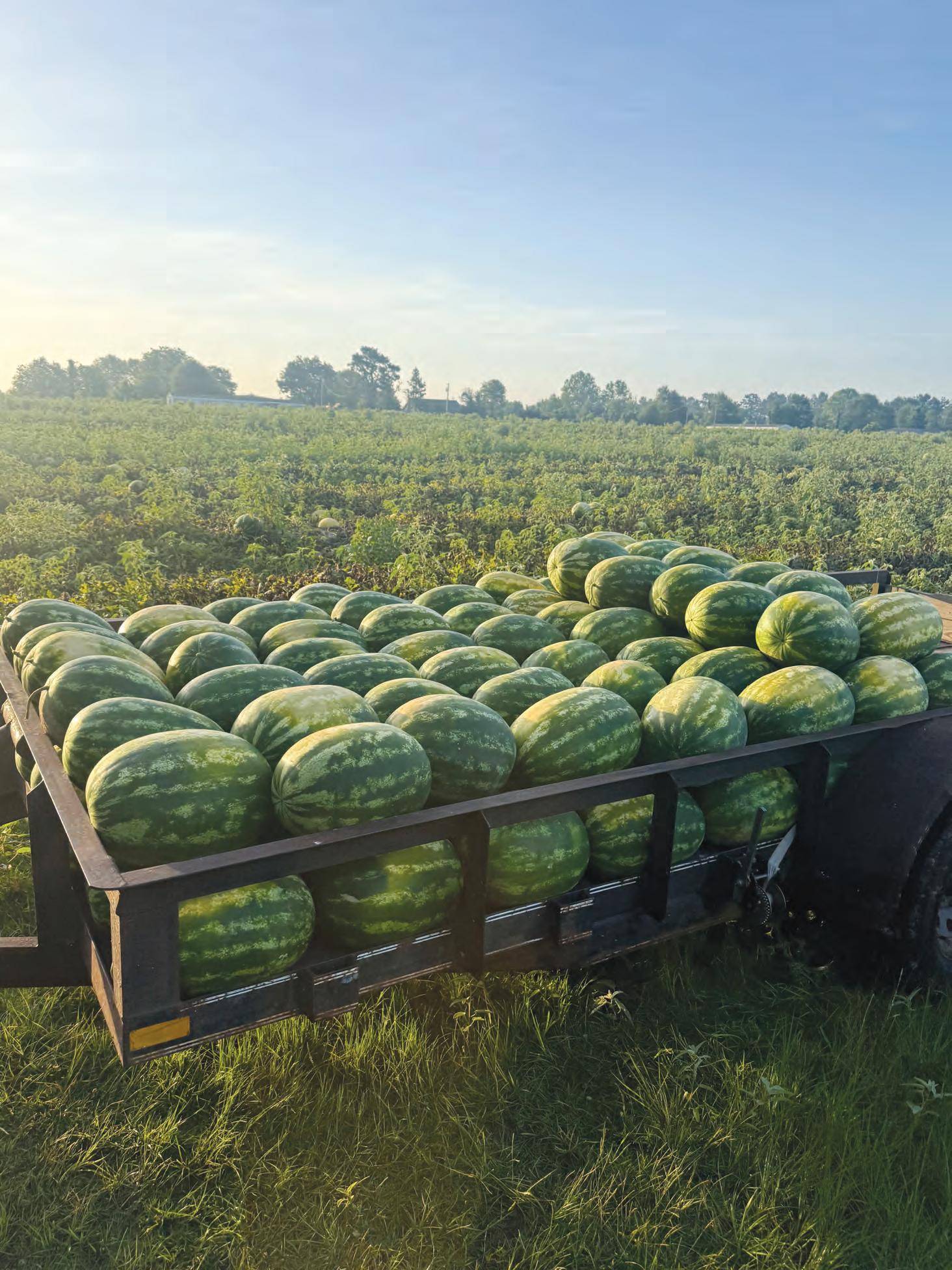
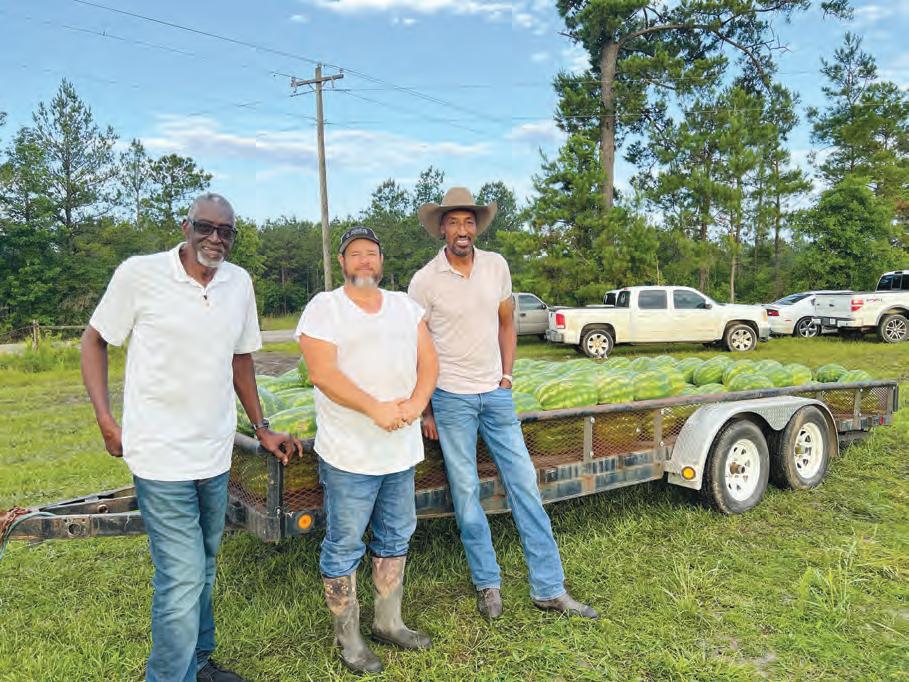
Bumper Crop by James Fox-Smith
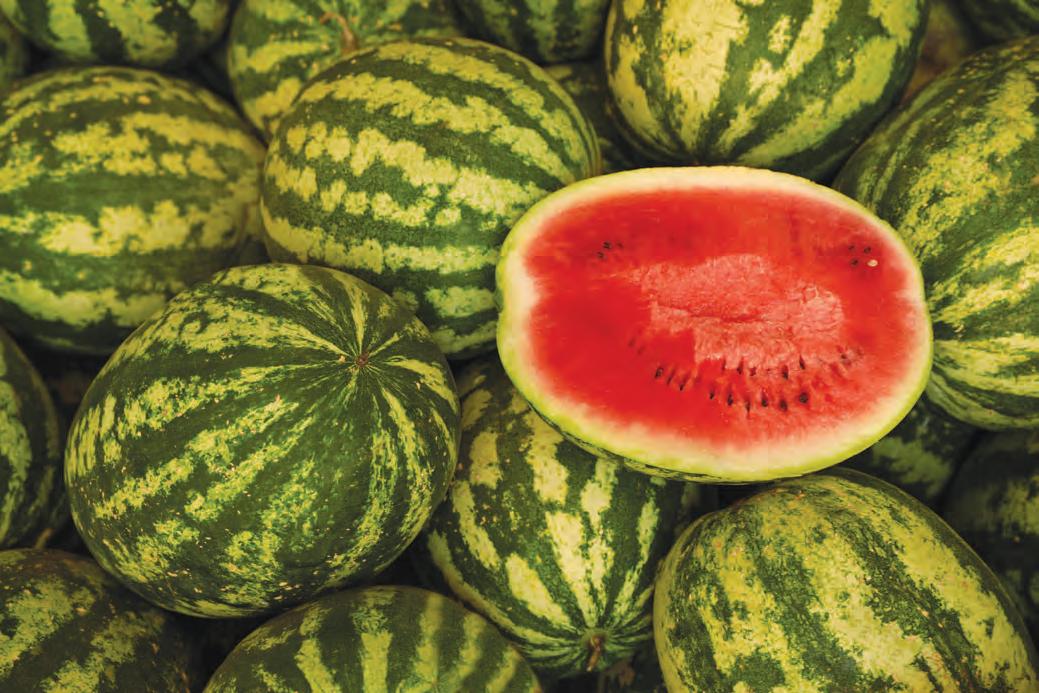
MELON DRAMA
Would a Sugartown Watermelon, by any other name, taste as sweet? by Chris Jay
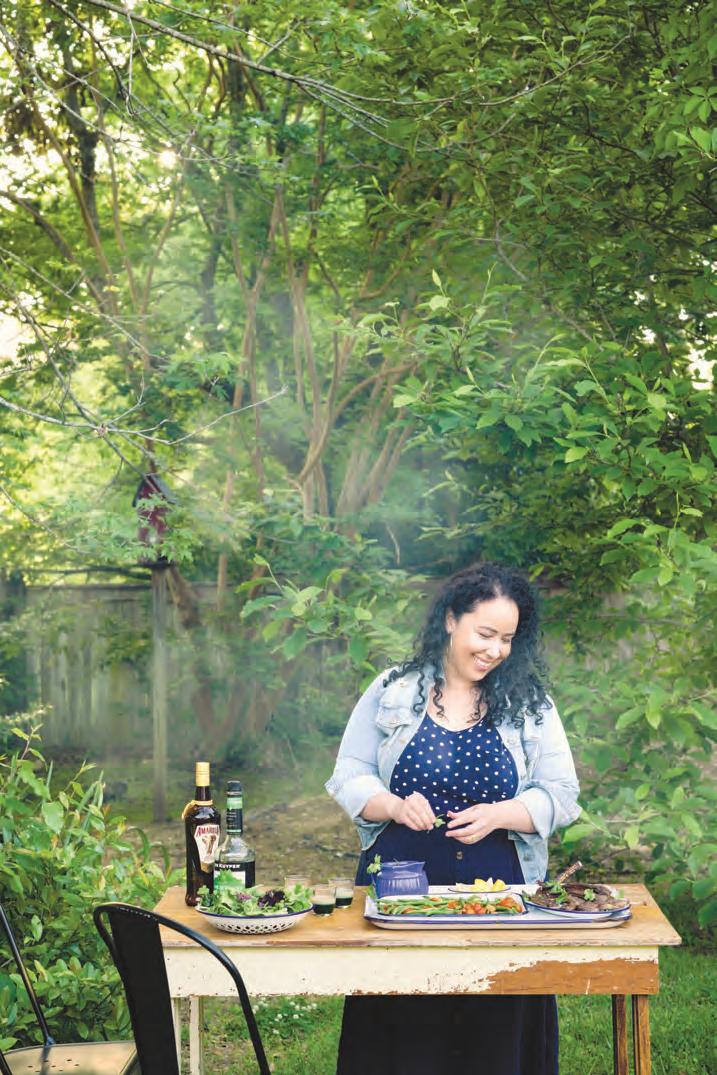
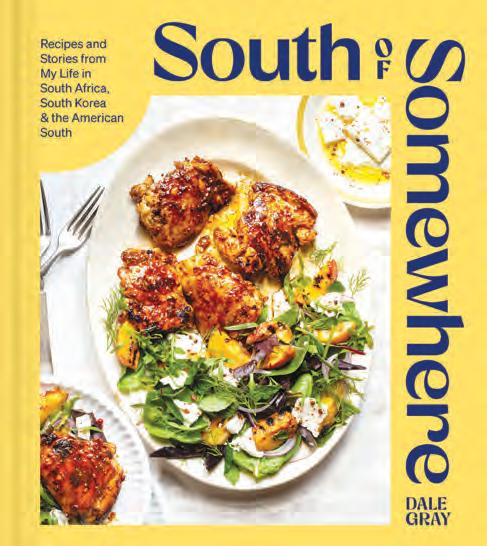
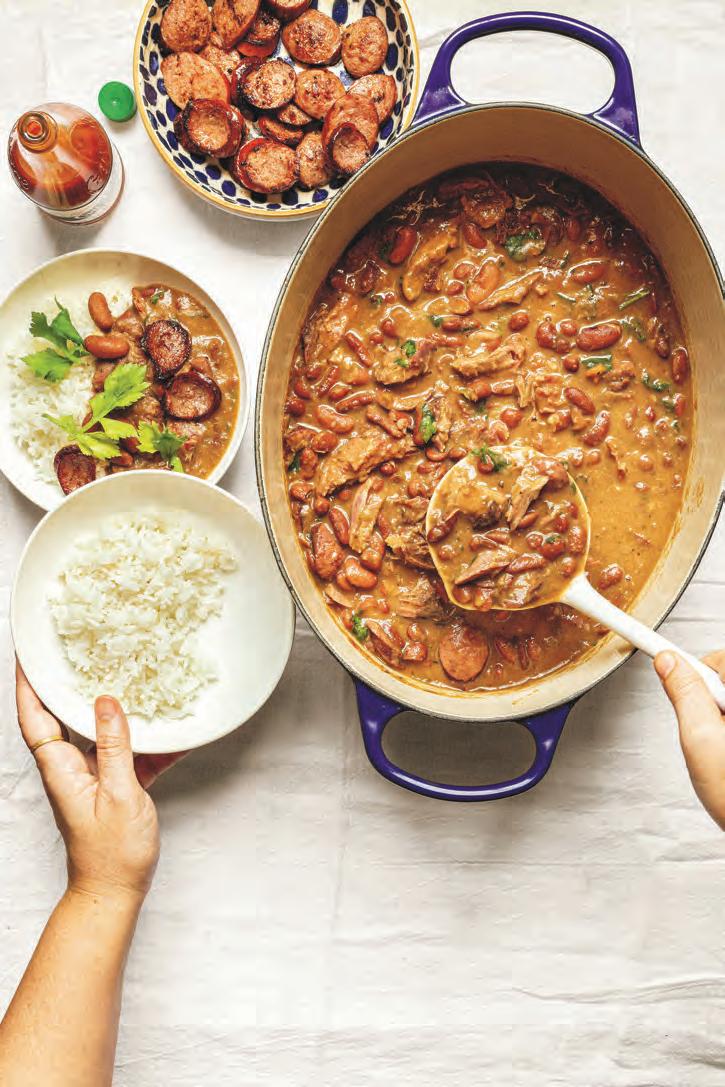
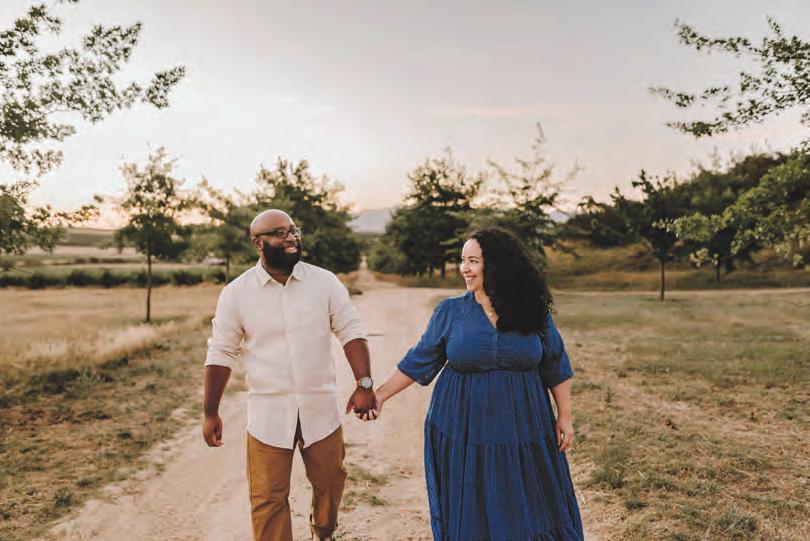
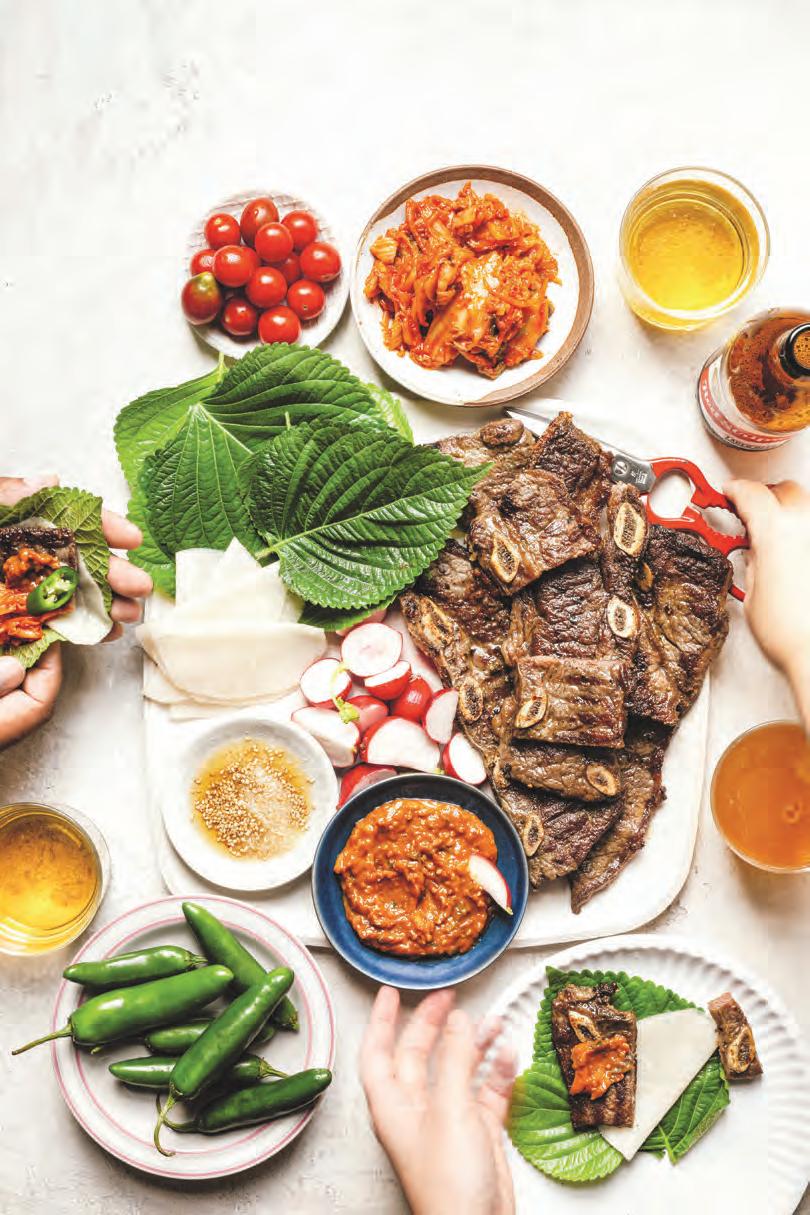
THREE SOUTHS, ONE TABLE
Global culinary traditions come together on Dale Gray's plate by Jordan LaHaye Fontenot
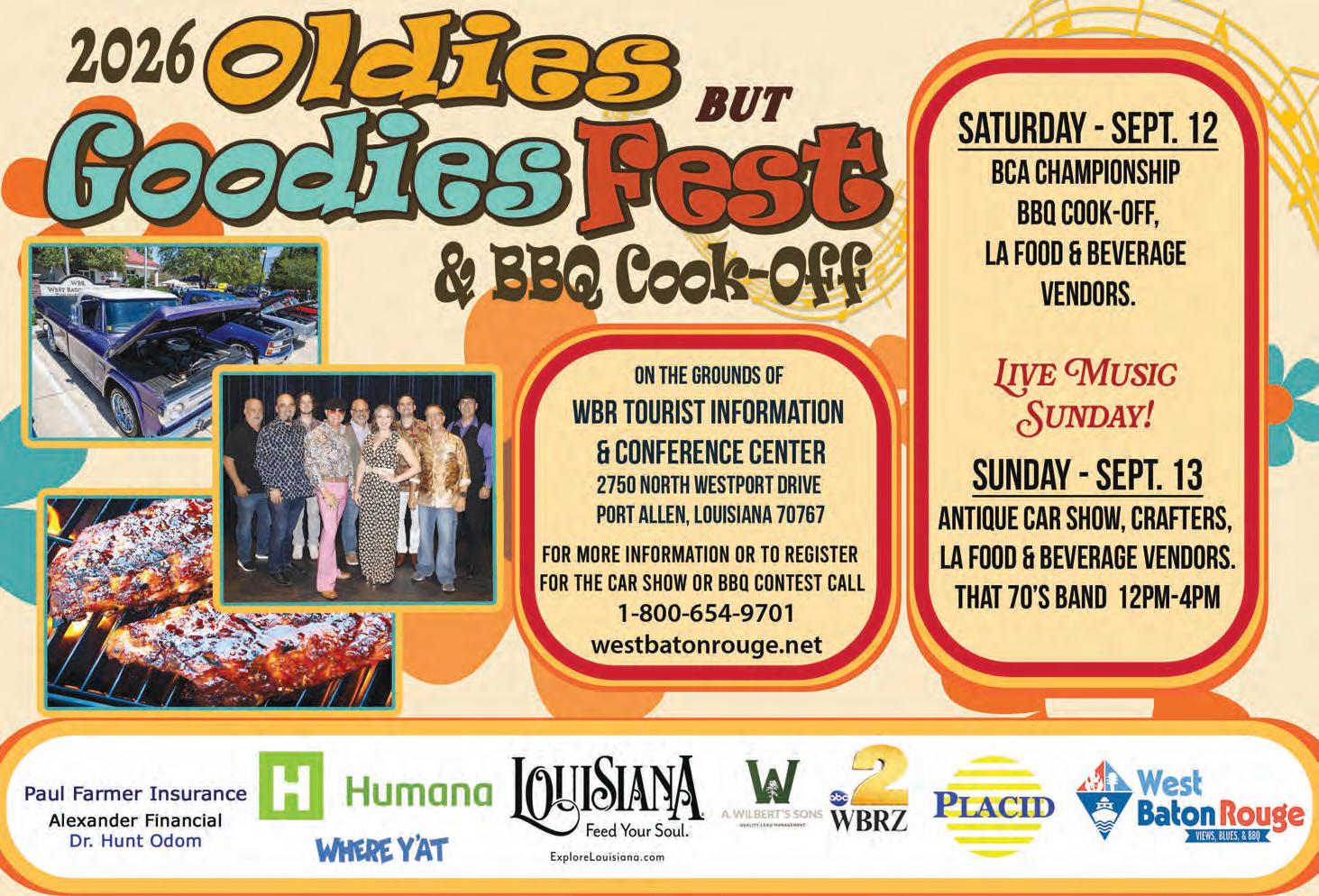
Get patriotic, get to the water, get to the cook-off 11
LET FREEDOM RING
Publisher James Fox-Smith
Associate Publisher Ashley Fox-Smith
Managing Editor Jordan LaHaye Fontenot
Arts & Entertainment Editor
Jacqueline DeRobertis-Braun
Editorial Intern Odessa Barattieri
36
America250, Gautreau's Chef Rob Mistry comes to St. Francisville & an Antiques Forum preview AT EASE, AT AUGUST
THE ANTI-CHICKEN
An unlikely culinary history of turtle soup by Chris Turner-Neal
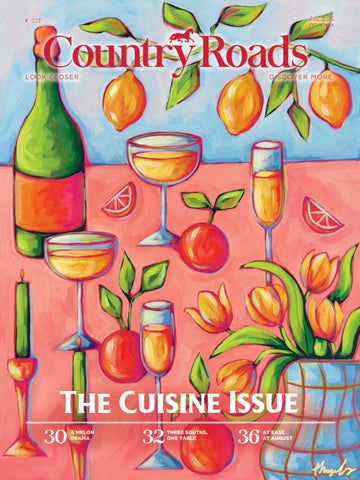
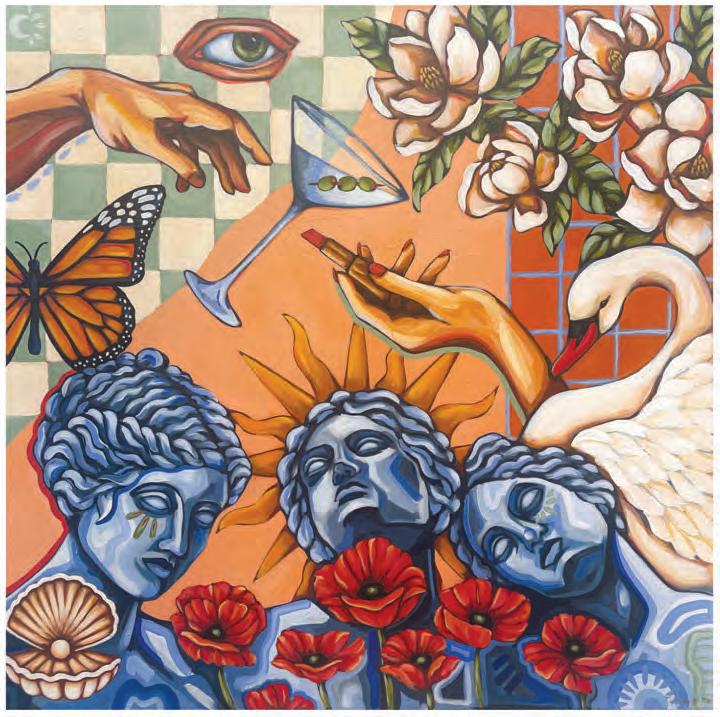
On the Cover
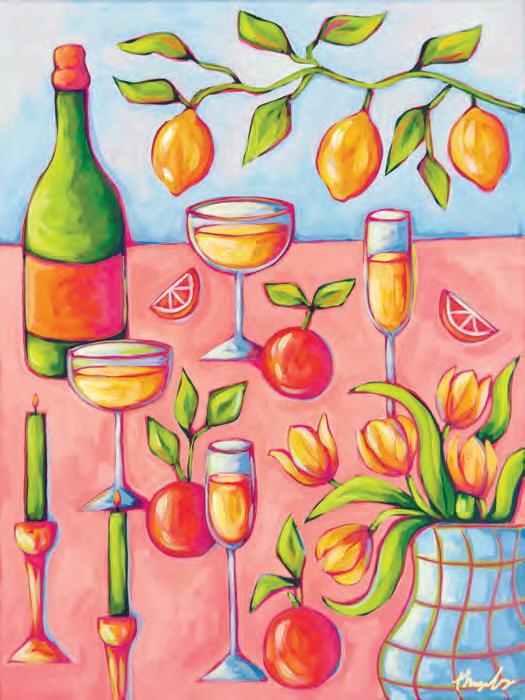
CHAMPAGNE STILL LIFE
18" x 24" acrylic on canvas by Morgan Gray
In 2024, Morgan Gray painted “Champagne Still Life” while experimenting with simpler compositions. “They were about being quick and fun and intuitive,” she said, “and not getting bogged down by the details.” Although a glance at her Instagram (@morganpaintsstuff, where she has amassed 129,000 followers) reveals work that incorporates all sorts of motifs—from celebrities to swans to classical statuary—the scene of a table set for entertaining is one to which she returns again and again. In a city, and indeed a state, where the quotidian acts of dining and drinking are elevated to an art form on a daily basis, perhaps it’s no surprise that a painter should be drawn to this subject matter. “When you’re in New Orleans there’s art everywhere, there’s food and drink everywhere," Gray observed. "I’m inspired by that environment—the playfulness, the interplay. Combining the two is my way of showing appreciation for the cuisine and the culture that I’ve grown up with.”
For this annual Cuisine issue, let that serve as a timely reminder that we are fortunate to dine, drink, and dwell among the vivid colors and flavors of the Gulf South. Read more about Morgan Gray’s work in the Perspectives column on page 58
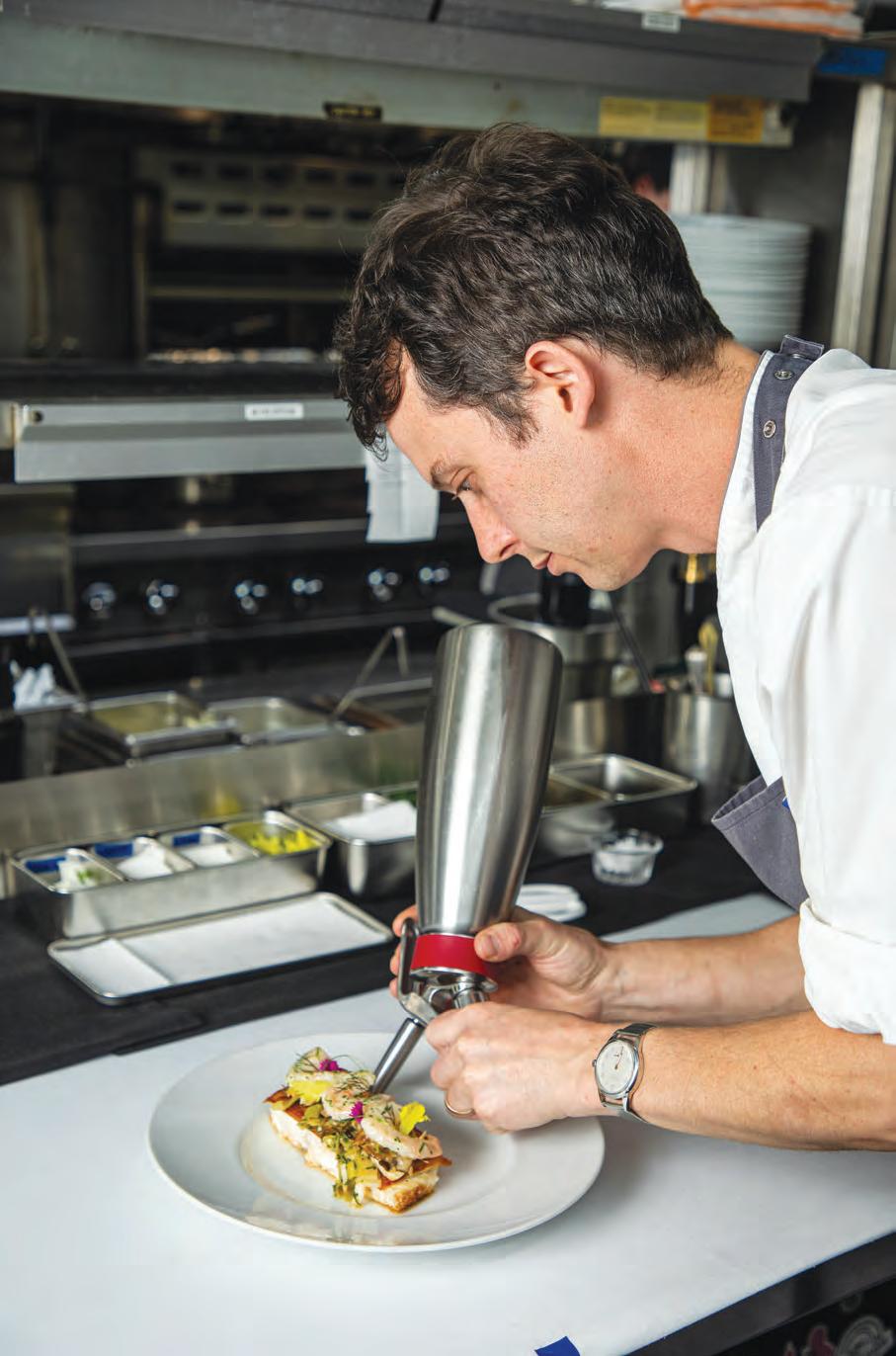
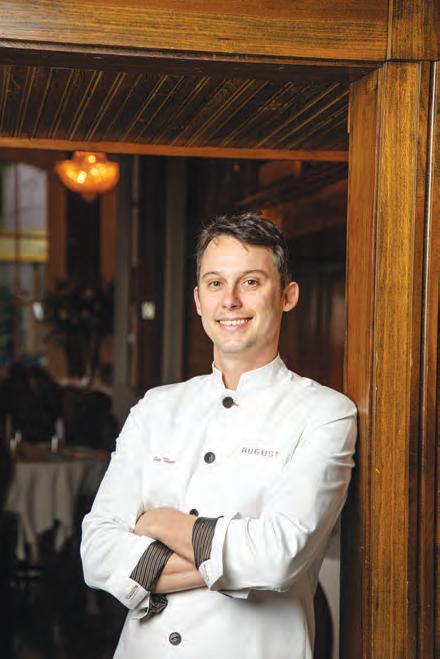
Under Chef Corey Thomas's hand, Restaurant August enters its 26th year by Beth D'Adonno
LUNCH AT THE PALACE
A no-frills Lake Charles landmark stands the test of time by Lauren Stroh
SOUPÇON
Carson's Table opens in Mandeville. Cat café comes to Baton Rouge. Bait shop goes gourmet by CR staff
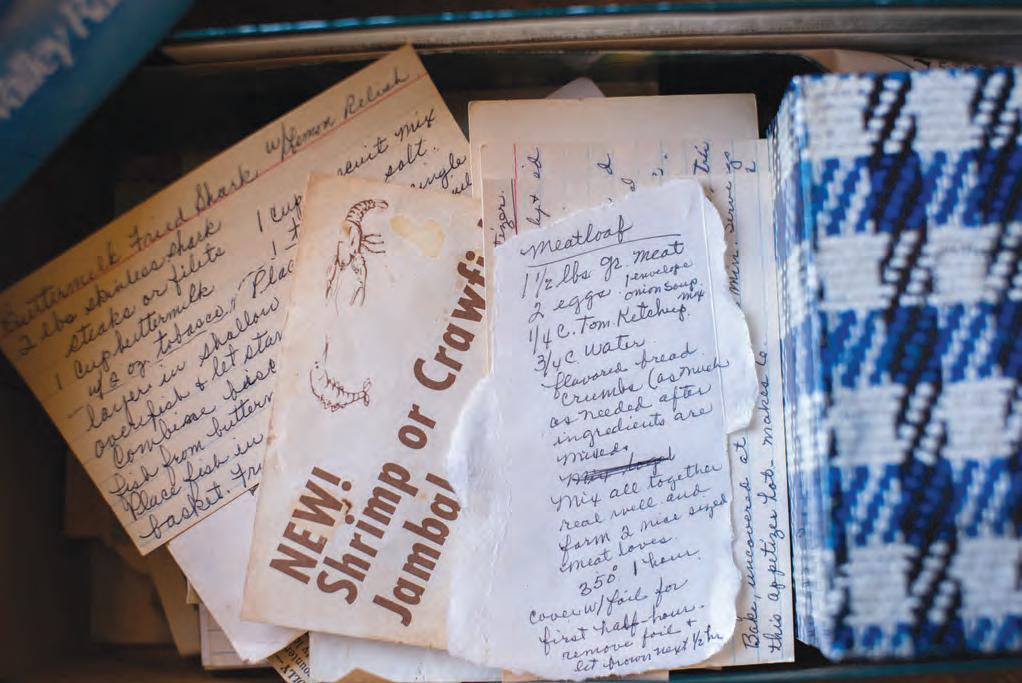
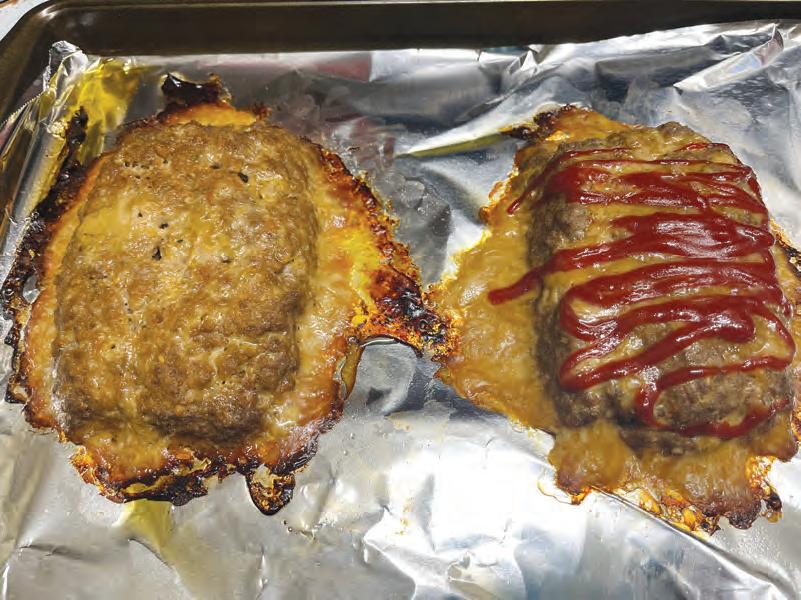
LURLINE'S MEATLOAF
A grandmother's recipe and the language of love by Christie Matherne Hall
Outdoors
52 MARRYING THE ENEMY
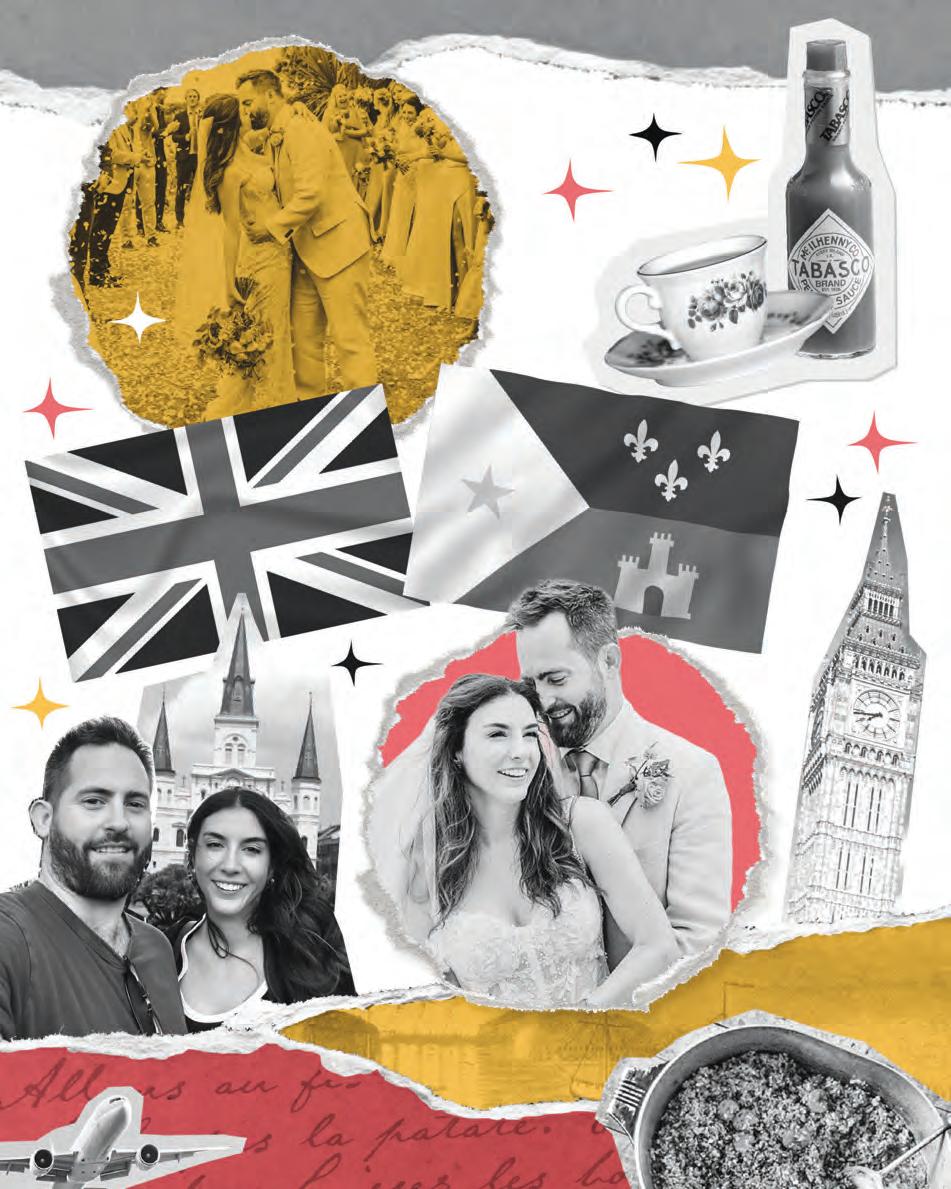
One year wedded to a Brit by Megan Broussard Maughan
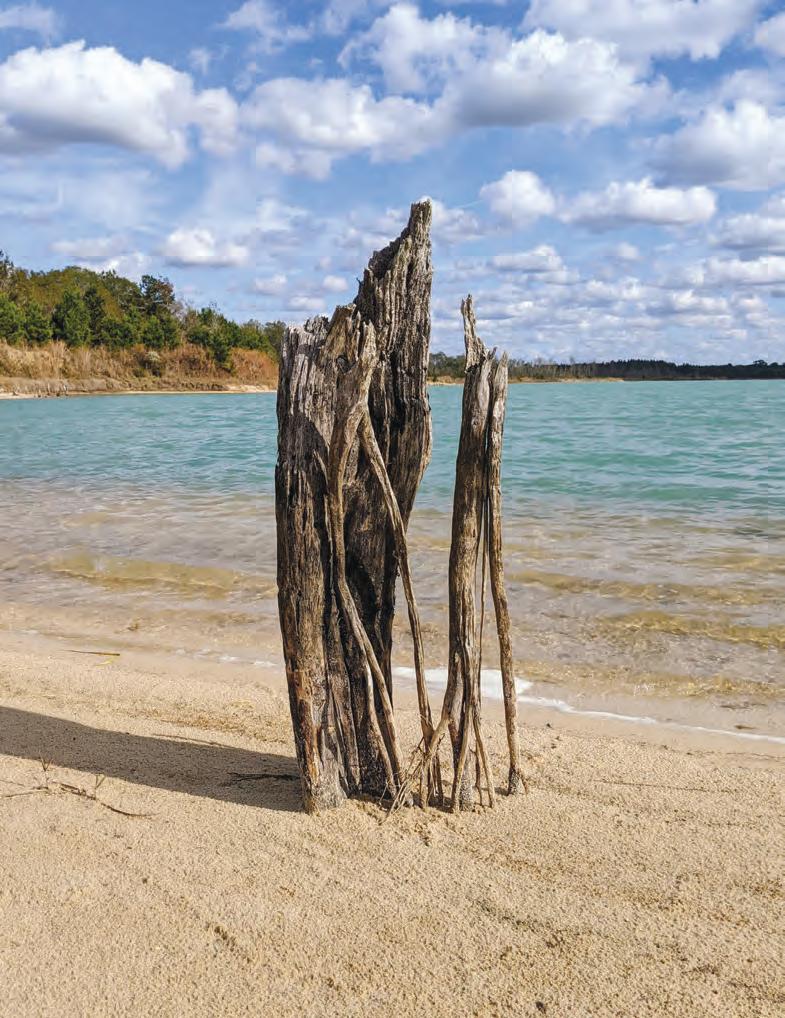
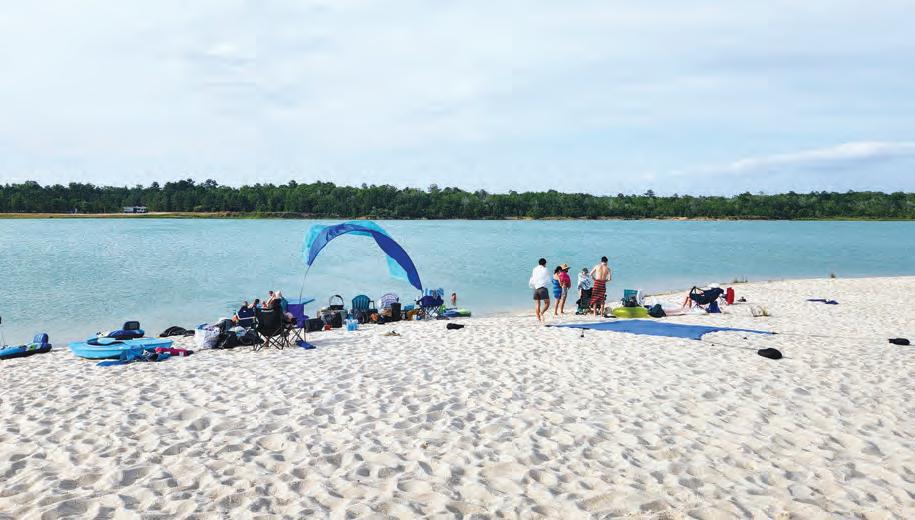
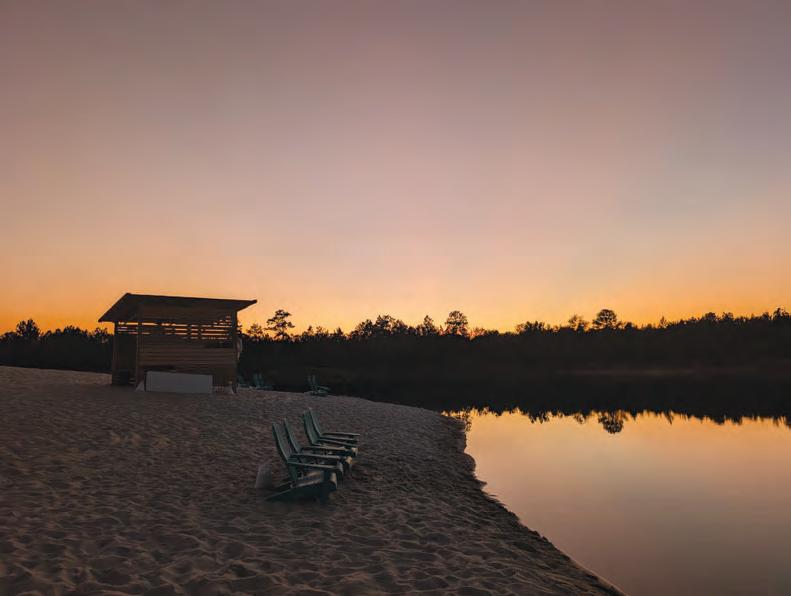
MIRACLE IN THE PINES Turquoise waters and white sand beaches … in Bogalusa by Mimi Greenwood Knight
Heather Gammill, Heather Gibbons, Mary Margaret Lindsey
Operations Coordinator Molly C. McNeal
President Dorcas Woods Brown
Country Roads Magazine P.O. Box 490 St. Francisville, LA 70775
Phone (225) 343-3714
hello@countryroadsmag.com
WWW.COUNTRYROADSMAG.COM
Reflections
FROM THE PUBLISHER
It’s raining again as I write this. Biblically. This week, the first tropical storm of 2026, named Arthur, has visited our part of the state and, judging by the days of rain, Arthur likes what he sees enough to stick around for a long, wet, nap. Since Monday, something like six inches of rain have fallen on St. Francisville, leaving the parking lot in front of our office behind the Magnolia Café looking like a marina, and the area’s impressive population of cats marooned on steps and lawn chairs, regarding the rising water with dismay.
While I enjoy a summer rainstorm as much as the next person, with a good book and a screened-in porch to sit on, one can have too much of a good thing. At home in my vegetable garden, the rain has wrought havoc on the early summer crops. The eggplants aren’t flowering, the peppers are succumbing to some sort of blight, and what looked set to be a bumper crop of tomatoes have all split open. Sure, this is a source of mild disappointment for me, but spare a thought for Louisiana’s stoic produce farmers, people like Sugartown watermelon farmer Jason Green (page 30), for whom a season with anything other than an average amount of
rain makes bringing the summer produce we cherish to backyard barbecues and picnic tables, just that much harder.
Things are all right for some. This summer our son, Charles, whose senior year of college is fast approaching, has somehow stumbled into a job working on an organic vegetable farm in Maine. During the past couple of weeks, he’s been sending photos of cornucopic mounds of onions, arugula, Swiss chard, and other leafy, cool-climate crops I can only dream of growing here. The photos arrive with requests for recipes (apparently a side benefit of working on a vegetable farm is the opportunity to take home produce deemed too lumpy or misshapen for sale). Having found himself surrounded by free vegetables (not to mention vegan hippie farm girls), Charles, an enterprising cheapskate whose culinary predilections have hitherto been those of your typical twenty-one-year-old Southern boy (steak, sausage biscuits, Sonic), has developed a sudden interest in vegetarian cuisine. “Hey Dad, how do you make tomato pasta sauce?” read a text that arrived the other afternoon, with photos of fresh-picked onions, garlic, Roma tomatoes, peppers, and
other ripe, somewhat deformed vegetables. I sent him various options, feeling the wistful pleasure of standing aside while your kids begin to discover how much the wider world has to offer for themselves.
Meanwhile, here below the thirtieth parallel, the waterlogged progress of Tropical Storm Arthur across South Louisiana serves as a reminder that it’s time to review our hurricane preparation amid what’s shaping up to be a wetter-than-usual summer. It seems like everyone in the Gulf South has their own hurricane prep ritual. In our household, the first sign of a named storm is my wife’s cue to rush out and buy an eclectic range of storm supplies that usually includes rice, dried beans, bottled water, Pringles, York peppermint patties, battery-operated lanterns, and gin, faster than you can say “cone of uncertainty.” I’m not complaining. Many years ago, as Hurricane Gustav set its sights on South Louisiana, she commanded me to go to the hardware store and buy a generator. We argued about this for several days, while the cone of uncertainty around Gustav’s path became progressively less uncertain. Eventually of course, I went to the hardware store and bought that genera-
tor, which we proceeded to run around the clock for the next two weeks. This is why I am still married. So, this weekend, I think I’ll stock up on generator gas, then harvest the remainder of my bulging, split tomatoes to make, and freeze, a bumper crop of homemade tomato sauce. That way, we’ll be able to continue enjoying the halcyon days of summer, long after summer is gone.
HNOC'S 2026 ANTIQUES FORUM EXPLORES THE GULF SOUTH'S OBJECTS, RITUALS, AND TRADITIONS
Ghosts undulate across a woven backdrop of iconic twentieth century tombs in St. Louis Cemetery. The words, “A Mon Cher Fils,” are stitched across a porcelain wreath, built to withstand the elements and forever honor an unknown maker’s son. Candlesticks, the Eucharist, and other Catholic iconography are embroidered on a sampler, stitched by a ten-yearold Ursuline student in 1815.
Each of these objects to be featured at the Historic New Orleans Collection’s (HNOC) Antiques Forum this August connects the divine with the tangible. Humans have long sought to understand a higher power. For the eighteenth annual Antiques Forum, this shared human experience will be explored through Catholic statuary, everlasting immortelles, synagogue artifacts, and Afro-Carribean ritual objects—interpreted when an impressive line-up of scholars and enthusiasts gathers to explore the theme Material Belief: Objects of Faith, Spirit, and Tradition
“Religion really underscores everything that happens in the South,” said Amy Williams, program manager of the event.
“From our earliest founding, the church has been the center of our social life and pleasure. This is where we celebrate each other, where we join together, where we meet and mourn.”
Beginning on Saturday, August 8, HNOC will showcase artifacts from the museum’s collection through a number of single-object lectures, giving attendees a chance to explore objects from intricate nineteenth-century immortelles to Jewish ritual objects, compared and contrasted with African diasporic Vodou, Ifa, and Orisha artifacts.
Among guest speakers will be Dr. Lily Higgins from The Walters Art Museum in Baltimore, highlighting some of the earliest embroidered samplers to arrive in Louisiana from the oldest continuously operating Catholic school in the United States.
Also on the docket is professor and director of the historic preservation pro-
gram at Tulane University, Heather Veneziano, who will explore the city’s rich material traditions surrounding death and mourning, including cemeteries, tombs, immortelles, and artifacts involved in New Orleans's iconic second-line funeral parades.
“[The programming is] like a whole visual feast,” said Sarah Duggan, manager of the Decorative Arts of the Gulf South (DAGS) project, an initiative that documents information about pre-1865 material life throughout the region. On Sunday, Duggan will present her research on the historic churches of Natchez, Mississippi.
The forum will wrap with a session on the material culture of multiple Black churches across the region by the esteemed architect and community leader, Dr. Christopher S. Hunter from Texas A&M University. Hunter will discuss how these churches were built, how the spirit of the South carries traditions from West Africa, and how these houses of worship have long served as havens for
Dishing It with Gautreau's Executive Chef
Black communities.
In a new addition, this year, the HNOC invites the public to a first-come, firstserved, free Friday lecture, during which LSU Professor Dr. Michael Mamp will discuss the profound role of ceremonial textiles––including baptismal dresses, wedding gowns, and mourning shrouds—and the evolution of styles throughout the eras, while also offering a sneak peak into the upcoming weekend’s schedule.
The forum offers an intersection between past and present, and a reminder of the generations of beliefs, rituals, and craftsmanship that have helped shaped the soul of the Gulf South and the city that New Orleans is today.
“What’s great about antiques is that anybody can own something historic and anybody can own a piece of the past,” said Duggan. “There is history in your backyard, in your community.”
The 2026 Antiques Forum will be held at the Williams Research Center from August 7–9. Tickets are $225; $114.50 for attendees ages twenty-one to thirty and museum professionals. For the full schedule, visit hnoc.org.
—Odessa Barattieri
CHEF ROB MISTRY ON BRINGING BOTH INNOVATION, AND HIS CULINARY HERITAGE, TO LOUISIANA TABLES
Tiucked into a leafy Uptown neighborhood, in a shopfront that once served as a family apothecary, Gautreau's has been part of the culinary and cultural fabric of New Orleans since 1982.
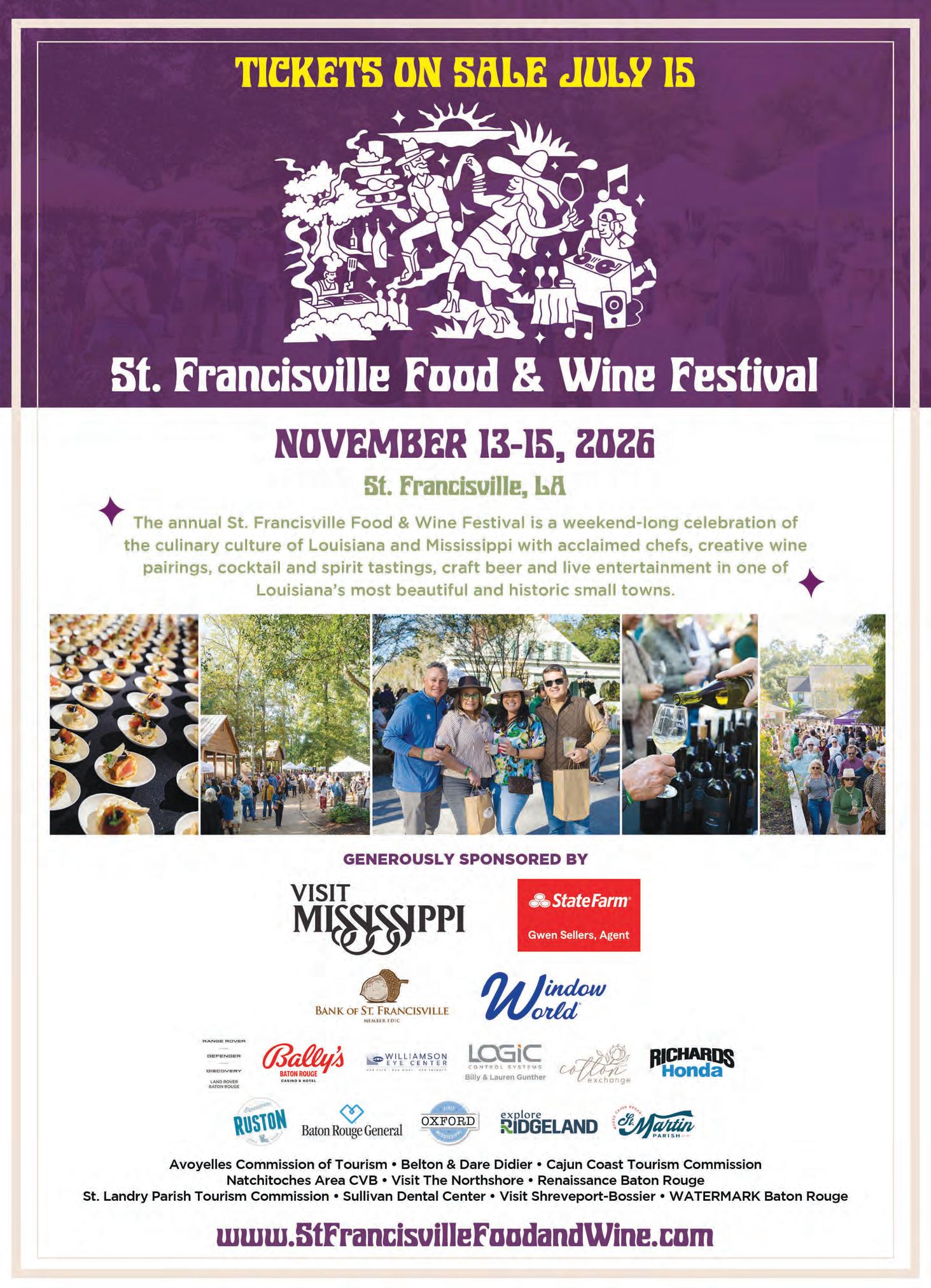
In October 2023, long-time owner Patrick Singley selected for the restaurant's executive chef Rob Mistry, who has since cemented the restaurant's reputation as a top-tier New Orleans dining destination. With his parents’ roots in Mumbai, a childhood spent in Charlotte, North Carolina, and cooking experience across the American South, Mistry has seen every side of the culinary world. He has staged at the Michelin-starred Alinea in Chicago, worked with Chef Sean Brock, and served as sous chef for the esteemed Commander’s Palace for more than four years. He offers patrons an elevated, yet “approachable” menu, fusing French technique and global influences with the impeccable seafood, produce, and seasonings of the Gulf South. Mistry is slated to appear as the Featured Chef for Restaurant 1796's Visiting Chef Dinner during the St. Francisville Food & Wine Festival on November 13. We reached out to Chef to hear more about his culinary background, imaginative approach to the cherished heritage of Gautreau’s, and plans for the upcoming festival.
When you took over as executive chef, you mentioned that you understood the reverence that loyal New Orleanians paid to Gautreau’s history, but that you wanted to “nudge the culinary bar up” a few notches. How do you decide which traditional dishes remain untouched and which elements are ready for your global touch?
At this point, I would say the bar has been nudged. We've kept one dish exactly the same (our very classic roasted chicken) and will always feature some form of duck confit and banana split on the menu as an homage to the culinary tradition of the restaurant. However, we've slowly drawn our guests further out of their comfort zone, which excites us. We always walk a balancing act—nothing too avant-garde or extraordinary—and every dish must reflect New Orleans's culinary spirit in some way.
Is your South Asian heritage ever discernible in your cooking? Are there any menu items that remind you of your parents or your childhood? I try to sneak in the flavors as much as possible. We keep a fully stocked spice cabinet and I'm constantly harassing our purveyors to stock more traditional
Indian items. We use many spices and curry-making techniques in our sauces. One of my favorite dishes that reminds me of my parents is our Pompano en Papillote with Coconut Soubise, Green Chutney and lentil-stuffed zucchini. It's our take on a very traditional celebration dish, but with Gulf ingredients.
At Restaurant 1796's Visiting Chef Dinner, do you anticipate developing a menu that will be reminiscent of Gautreau’s? Or does an off-site event provide the opportunity to take a different approach?
We plan to collaborate as much as possible with the kitchen at the Myrtles. We will definitely keep our Gautreau's style, but would love to see how both ingredients from St. Francisville and the chef's vision and team will play a role in the menu. We are very excited to visit some of our purveyors, such as St. Francisville Nursery and Maggie's Mushrooms.
Learn more about Gautreau’s enduring legacy and Chef Mistry’s imaginative cuisine at gautreausrestaurant.com.
—Odessa Barattieri
America's Birthday, Louisiana Style
THREE CELEBRATIONS TO HONOR OUR COUNTRY'S 250TH
Many Louisianans can trace their Gulf Coast ancestry back centuries, but this year, we're celebrating 250 years of also calling ourselves Americans. Across the country, we are joining fellow citizens in marking this historic milestone, reflecting on our nation’s past, and paying homage to our ancestors like never before. As the Fourth quickly approaches, here are three standout celebrations occurring around the state worth checking out.
Toledo Bend Boat Parade and Fireworks Show
July 4
Think blow-up eagles, bunting banners, and party barges—all decked out in red, white, and blue. Just in time for Independence Day, Toledo Bend Lake Country caps a free, week-long patriotic extravaganza filled with concerts, historical reenactments, and even a community time capsule with a patriotic boat parade and dazzling fireworks show across the waters of Toledo Bend. Between the south end of Toledo Bend Lake and Cypress Bend Park, spectators will enjoy a festive, family-friendly celebration of patriotism from both land and the water. This event will showcase Toledo Bend’s local heritage while celebrating 250 years of American independence. toledobendlakecountry.com/america250.
Avoyelles Arts and Music Festival
July 4
Born from a grassroots art initiative, this premier cultural celebration attracts thousands to Central Louisiana to celebrate the creativity, culture, and spirit of Avoyelles Parish—alongside America’s semiquincentennial. With this year being the nation’s landmark 250th birthday, there is no better time to join CenLa to celebrate the extraordinary milestone. On the Fourth, the fifteenth annual Avoyelle Arts and Music Festival returns to Paragon Casino Resort Festival Grounds, inviting families to spend the morning watching Louisiana’s longest running Fourth of July Parade, before festivities continue with live performances by artists including Jourdan Thibodeaux and TK Soul. In addition to the tunes, guests can look forward to local culinary creations, vendor booths selling handcrafted wares, a student art expo, and boudin and watermelon eating contests, a bake off, and a car show ($40 to enter). Of course, there'll be a patriotic fireworks display to end the night. Represented year-round by the festival pageant queens, this event proudly supports local arts education and youth programming. avoyellesarts.com.
America 250: The Soundtrack
July 11, 7 pm–9 pm
For more than four decades, the Lake Charles Symphony’s annual Summer Pops concert, hosting up to 1,500 guests, has remained one of Southwest Louisiana’s most anticipated summer music festivals. This year, the symphony invites the community to celebrate music, memories, and America’s 250th birthday in a sing-along celebration that promises to resonate with audiences of all ages. The evening kicks off with powerful American anthems, then embarks on a musical journey through generations of the country's top hits from the 1950s to today. With open seating options from $35 per person ($95 for individual floor seating), guests can enjoy the newly expanded orchestra alongside iconic performers like Gavin Hope and Jean Meilleur, performing a repertoire that includes songs by the Beach Boys, Bruce Springsteen, and Chris Stapleton. Complete with food and beverages provided by Mr. Gatti’s Pizza, it's the perfect setting for celebrating the spirit, sound, and story of our nation. lcsymphony.com/summer-pops.
This is by no means a comprehensive list of festivities celebrating the culmination of the American 250 milestone. Visit america250la.org to peruse more events surrounding the big day.
—Odessa Barattieri
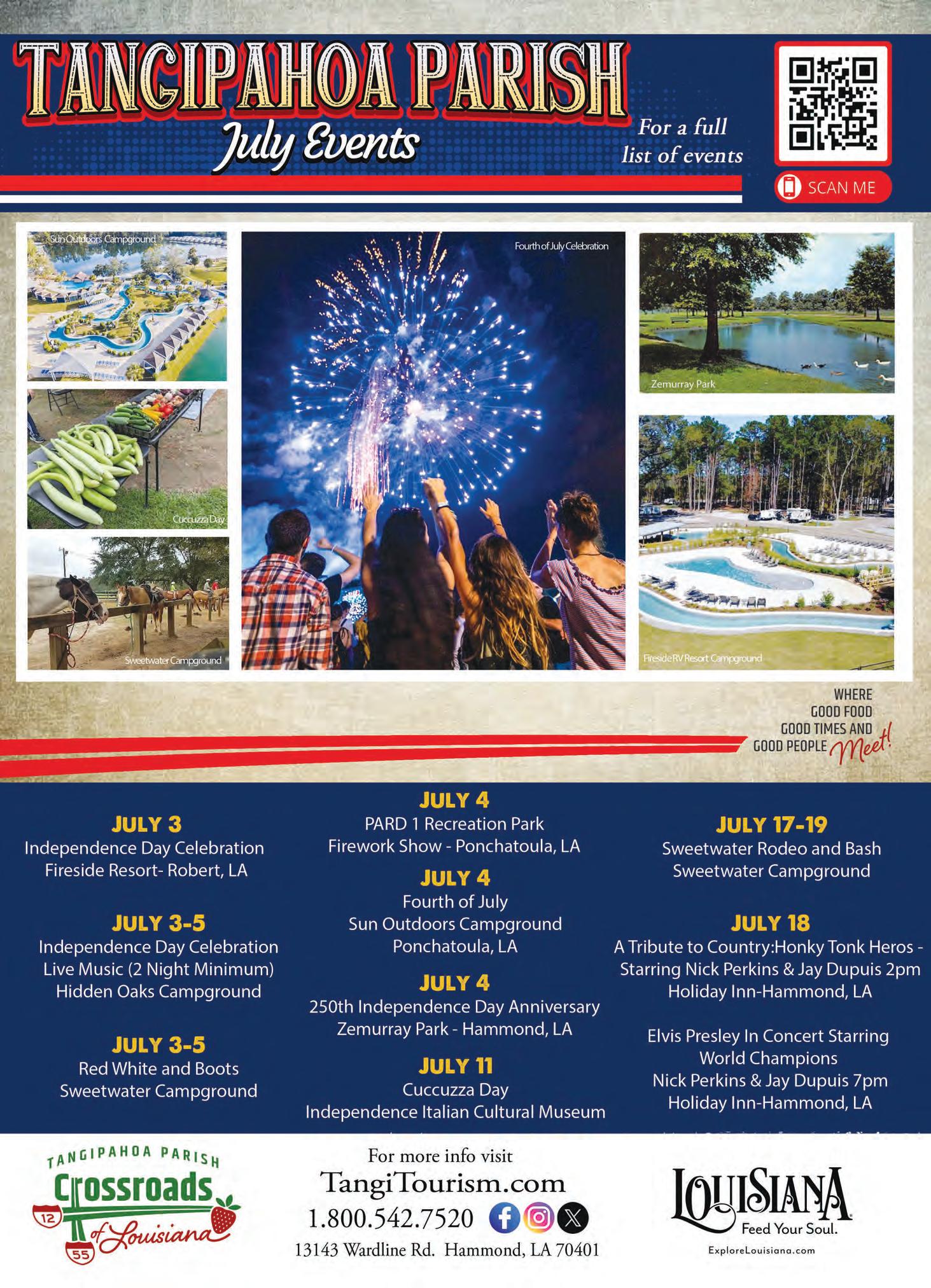
Independence Day Extravaganzas Across Louisiana & Mississippi
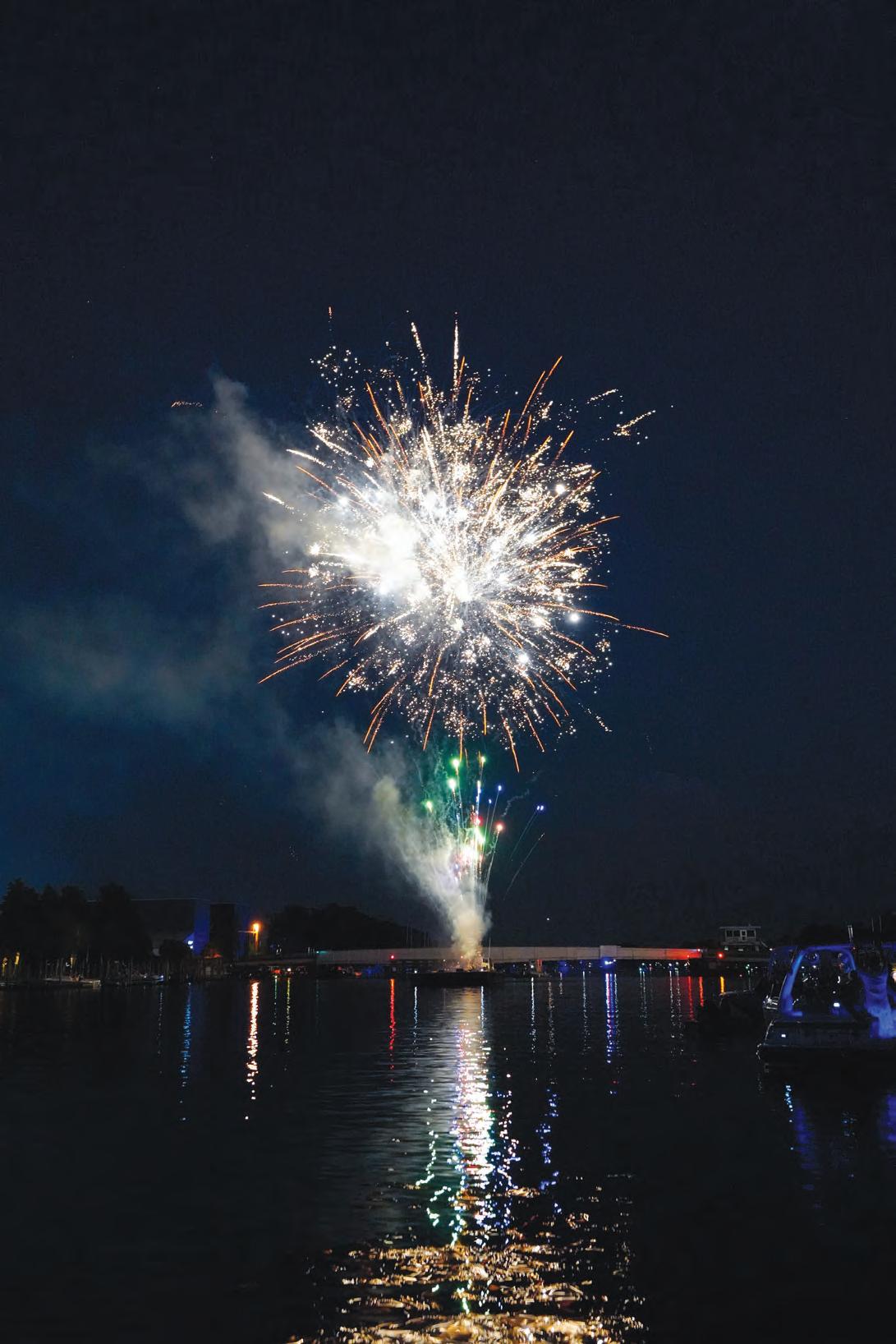
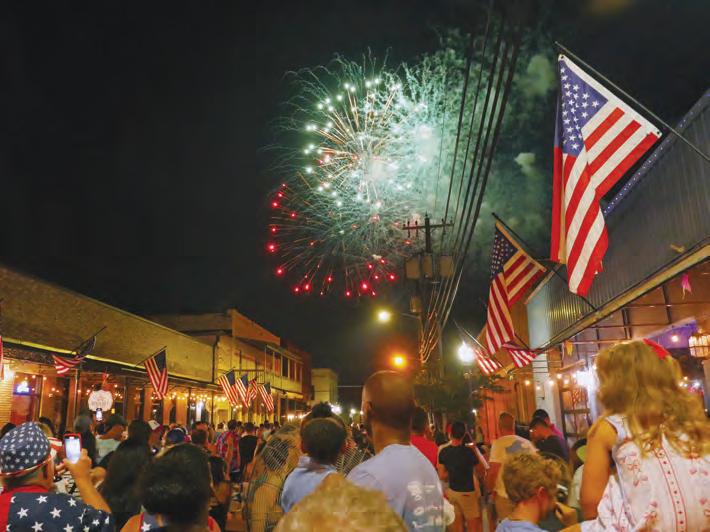
From the Northshore (pictured) to Cajun Country, New Orleans to Natchez, and everywhere in between, July 4 celebrations—and this year's national blowout in honor of America's 250th birthday—look a little different from town to town, city to city. Of course, it also looks the same, mostly involving fireworks. Peruse a sampling of how Louisiana and Mississippi let freedom ring this July. Then, read on for the many other events the summer has to offer.
night leading up to Independence Day, when the whole town gathers for tried and true summer festivities in the form of an early morning fun run, water fights, a parade, and, of course, a stunning fireworks display to close it all out. Free entry; fees for ride entry. erath4.com. 1
July 3
Red, White & Boom! Youngsville Independence Day Celebration: Gather at the Youngsville Sports Complex and, before lighting up the night in honor of the Fourth, enjoy music from Marc Broussard and DJ Digital, a kid zone, food, and fireworks to end the celebration. 5 pm–9 pm. Free. youngsvillesportscomplex.com. 1
Lake Charles Red, White, Blue & You Celebration: Voted one of the "STS Top 20 Events" for the month of July by the Southeast Tourism Society, this classic Independence Day celebration paints the town patriotic with a star-spangled street parade, concessions, face painting, and a huge fireworks display over the lake, all hosted at the Arcade Amphitheatre. This year's festivities are particularly patriotic to honor America's 250th birthday. Noon–10 pm. visitlakecharles.org. america250la.org. 1
Red, White, and Boom in Opelousas: Head on over to Yambilee Ag Arena for an evening of patriotic perfection, featuring music, food, and a family-
SWEET AND COLD
and picnic blankets to enjoy the show.
evening's light show at the Eunice Recreation Complex. 9 pm–10 pm. cajuntravel.com. 1
Fourth of July Lake Jam: Bring the boat (or the car) out to celebrate America Cajun Coast-style at Morgan City's Lake End Parkway with a boat parade, food trucks, live music, a kid zone, fireworks show finale at 9 pm, and more. This year's live performances lineup includes South 70 and No Idea Band. 3 pm–9 pm. Free. cajuncoast.com. 1
Broussard Independence Festival: Don't miss this big ole 250th birthday party for the nation, Broussard-style. Expect
Photo courtesy of Visit the Northshore.
Fourth ofJuly Events
an evening of plentiful family-friendly activities, a DJ, and fireworks at the St. Julien Park Sports Complex. 5 pm–9 pm. Free. lafayettetravel.com. 1
Krotz Springs Fireworks on the River : The name says it all—head out to the Atchafalaya for a sportsman's paradise fireworks show in Nall Park, 562 Front Street. The little town goes the whole nine yards with hot dogs, watermelon, and live local music in a patriotic, pitcture-perfect Independence Day celebration. 6 pm–8 pm. cajuntravel.com. 1
Fourth of CelebrationsJulyon the Northshore
July 3
Pearl River Independence Day
Celebration: Get in the America 250 patriotic spirit with small-town fun in downtown Pearl River, where crowds will be gathering with lawn chairs and blankets to enjoy the highly anticipated fireworks display. After an opening ceremony (6 pm), enjoy lawn games, a pie-eating contest, inflatables, a petting zoo, and free beverages and food. visitthenorthshore.com. 1
Covington Celebrates America 250 Concert: It's a pre-Independence Day warm-up for those who like to celebrate all weekend long with this free concert at the Covington Trailhead, featuring Cypress Creek. 5:30 pm–7:30 pm. visitthenorthshore.com. 1
July 4
Covington's Sparks in the Park : Celebrate the birth of our nation—and America 250—with Covington's Sparks in the Park annual festival. The event includes fireworks at dusk, live patriotic music, and fresh food made by local vendorst. The Rotary Club of Covington will keep the crowd hydrated with lemonade and water. So pull out those lawn chairs and blankets and head to Bogue Falaya Park. Free. 5:30 pm–9 pm. louisiananorthshore.com. 1
Olde Towne Slidell Fourth of July Celebration: Don your brightest reds, whites, and blues for this day of celebration in the 2200 Block of Carey Street, featuring delicious food, kids activities, live music across three locations, a hot dog eating contest, and a spectacular fireworks display—plus, cooling zones to
help ward off the summer heat. Games and live music begin at 4 pm. Be sure to pack the lawn chairs and blankets for the finale. visitthenorthshore.com. 1
Mandeville's Light Up the Lake: On the Mandeville Lakefront, the fireworks will be beautiful mirrored in Lake Pontchartrain providing a sure "fire" way to ring in the Fourth of July, and celebrate America 250. With patriotic tributes and live music, a kid's tent, games, face painting, a parade by the Mande Milkshakers, and food trucks, the fireworks are not the only thing to look forward to at this event. Fireworks begin at 8:45 pm and will be launched from a raised barge for great viewing all along the lakefront. Picnics are not only welcome, but encouraged. Free. louisiananorthshore.com. 1
Madisonville Old Fashioned Fourth of July Celebration: The Town of Madisonville and Keep Madisonville Beautiful invite you to the OldFashioned Fourth of July celebration of America's Independence (and part of the Northshore's America 250 celebrations) on the banks of the Tchefuncte River. Bring your chairs, coolers, and picnic baskets, and find a spot on the riverfront to enjoy the fun. Feel free to bring the kids along, as some of the activities include kids' games, cornhole and horseshoe tournaments, a Veteran's Salute,
watermelon eating and rooster crowing contests, a pie bake-off, and fireworks in front of Old Town Hall. The fireworks start at 8:45 pm around dusk. Free. louisiananorthsore.com. 1
Abita Springs Fourth of July
Celebration: The city of Abita Springs invites one and all to their elaborate annual Fourth of July celebration, part of Covington's America 250 festivities. The festival will bring patriotic joy to the whole family, with live music, fireworks, face painting for the the kids, and plenty of tasty food from favorite vendors. Free. 5 pm–9:30 pm. louisananorthshore.com. 1
Fourth of CelebrationsJulyin Central & North Louisiana
July 4
Shreveport KTBS Freedom Fest
Finale: Part of the nationwide America 250 celebration, scores of fireworks will be coming from towns throughout the region: in downtown Shreveport, South Bossier Park, Blanchard, Cypress Lake, Lake Claiborne, and Jefferson, Texas, and Longview, Texas. KTBS will be airing all of it on KTBS and KPXJ, but on the ground locals can celebrate with live performances, food trucks, children's
Fourth ofJuly Events
activities, and more. Fireworks begin at 9:30 pm. Free. ktbs.com. 1
The Sportspectrum Firecracker 5K Race in Shreveport: Don't miss the annual Firecracker 5K at Mall St. Vincent in Shreveport this year, proving patriotism one heated mile at a time as part of the America 250 celebrations. Kids can come too, with a half-mile fun run. 7:30 am. $30 for the 5K; $15 for the kids fun run. sbfunguide.com. 1
The Avoyelles Arts and Music Festival: "Louisiana’s July 4th Destination Festival" is getting bigger and better in honor of America's 250th birthday. This year's highly anticipated Avoyelles Arts and Music Festival heads to the Paragon Casino Resort for its annual celebration. With two stages for entertainment, the live music will continue all day long. Other events include a bake-off; an arts and crafts fair; a car, motorcycle, and jeep show; boudin, cherry pie, and watermelon-eating contests; and fun and games, with fireworks to follow. The evening kicks off at 7:30 am. $10; free for ages four and younger. avoyellesarts.com. 1
Independence Day Celebration in Monroe-West Monroe: The twin cities
of Monroe and West Monroe know how to celebrate America's 250th birthday in style, and this year things are bigger and better than ever before. Beginning at 9:30 am, head to Triangle Park for a patriotic children's parade, then stop by Louisiana Purchase Gardens & Zoo for Red, White, & Blue at the Zoo. And never fear, because yet another parade rolls at 11 am—Twin Cities 250th Anniversary Parade hosted by Krewe of Janus in Monroe, followed later that evening by the highly-anticipated fireworks display. Throughout the day, local vendors will be peddling their wares, and the streets will be filled with the sounds of live bands. Fireworks start at 9 pm, over the Ouachita River—best viewed from downtown West Monroe or Monroe, or on the West Monroe levee. Free. monroe-westmonroe.org. america250la.org. 1
Sabine Parish America 250 Boat Parade & Fireworks Show : Slap on some sunscreen, grab a baseball cap, and head to Toledo Bend Lake and Cypress Bend Park for an Independence Day/America 250 celebration on the lake featuring a festive boat parade (10 am), followed later in the evening by an unforgettable
fireworks show over Toledo Bend Lake at 9 pm. Free. america250la.org. 1
July 5
Town of Many Patriotic Parade: In downtown Many, this small but mighty Sabine Parish enclave celebrates the Fourth and America's 250th birthday with a community patriotic parade featuring local organizations, floats, music, and old-fashioned hometown spirit. 3 pm. america250la.org. 1
Stewart Family “God Bless America” Concert: At Many Community Center, enjoy an inspiring evening of patriotic and gospel music with the Stewart Family, all in honor of America's 250th birthday. 6 pm. america250la.org. 1
Fourth of CelebrationsJulyin
Greater Baton Rouge
July 3
Kenilworth Independence Day Parade: Having trinkets, candy, and other priceless treasures thrown at us from passing floats is a time-honored tradition in Louisiana, but why not bust it out for America's birthday, too?
Kenilworth celebrates its beloved annual Independence Day Parade in honor of America's birthday. Rolls at 6:30 pm.
For route information and more, visit kenilworthneighborhood.com. 1
July 4
USS KIDD’s Fourth of July Spectacular: Every year, for our nation's birthday, WBRZ lights up the sky above the Mississippi River for awestruck crowds. The fireworks can be viewed from anywhere along the levee, and from Downtown Baton Rouge, starting at 9 pm. downtownbatonrouge.org. 1
Baton Rouge Concert Band: Head to the Main Library at Goodwood for the annual patriotic concert by the Baton Rouge Concert Band. Bring lawn chairs and refreshments to enjoy an upbeat selection of American classics to celebrate independence, perfect for the whole family to enjoy. 7 pm. brcb.org. 1
Fourth of July Extravaganza : Louisiana's own castle—or rather, Old State Capitol—hosts a free, familyfriendly Independence Day celebration, complete with games, karaoke, crafts, and more. And don't miss the chance to view the original Louisiana Purchase document, on display through July 11. 9 am–5 pm. visitbatonrouge.com. 1
America 250 on the River Concert: Repentance Park throws a bash to remember in honor of America 250. This free concert features Amanda Shaw, Rockin Dopsie Jr., John Schneider, and
Wayne Toups—but stick around after the music ends for fireworks over the Mississippi River at 9 pm. 2 pm–9 pm. visitbatonrouge.com. 1
Fourth of July Fireworks Extravaganza at L’Auberge: L'Auberge Casino and Hotel hosts an Independence Day celebration in classic over-the-top style, with a free outdoor lawn party, live music featuring Jovin Webb, food trucks, and fireworks in partnership with Eagle 98.1. For $20, join the rooftop pool party experience for the best fireworks viewing around. 6 pm–11 pm. Fireworks begin at 9 pm. lbatonrouge.com. 1
City of Walker July Fourth
Celebration: The Fourth of July is not just a night to enjoy the (admittedly fantastic) fireworks displays across the country—in Walker, the crowds come from miles around for the Jeep Show and blessing of the Jeeps on July 4, in true Americana fashion. There will also be food trucks, live music, and, yes, fireworks to round out a patriotic evening. 5 pm–Dark. livingstontourism.com. 1
Fourth of CelebrationsJulyin
New Orleans
July 3
3rd of July in City Park : Yes, you can celebrate our great nation on July 4,
but you can also show your pride yearround—July 3 included, at City Park in New Orleans. Bring your chairs and blankets to enjoy patriotic music with Marine Forces Reserve Rock Band on the Goldring/Woldenberg Great Lawn and fireworks at the Peristyle. A dress code of red, white, and blue is definitely recommended. 6:30 pm— 9:15 pm. Free and open to to the public. neworleanscitypark.com. 1
St. Charles Independence Day
Celebration: In spectacular patriotic fashion, St. Charles Parish will hold its annual Independence Day celebration at West Bank Bridge Park, featuring performances by popular band The Electrix Band and food and drinks sold by local nonprofit organizations. Expect a riveting fireworks show to close out the night at 9 pm. 4:30 pm. Free. stcharlesparish.gov. 1
July 4
Go Fourth on the River: The Mississippi River has long linked the people of this region to the rest of America, and on our great country's birthday, the people of New Orleans invite all to Go Fourth in celebration. Come down earlier in the day to experience the fabulous attractions/ shopping along the Riverfront! Then,
starting at 9 pm on both sides of the Great Mississippi, fireworks will shoot and scream and burst in to the sky from the banks and from barges, accompanied by a medley of patriotic songs. Settle in between Governor Nichols St. Wharf and Canal St. Dock. Free. go4thontheriver.com. 1
Fourth of July on the Creole Queen: Celebrate independence on the open water, watching fireworks from the decks of the paddlewheeler Creole Queen. This dinner cruise—which sets sail complete with special buffet menu, open call brand bar, and live entertainment—offers the best seat in the house to view the "Dueling Barges" fireworks display that the City of New Orleans puts on above the Mississippi. $149 per adult, $69 for youth (ages 6–12), and $20 for children (ages 3–5). Boarding from 7 pm to 8 pm, located at Poydras St. Wharf/Spanish Plaza. The riverboat sets sail following the fireworks display. Reservations are required: creolequeen.com. 1
Fourth of CelebrationsJulyin the Felicianas, Natchez, & Pointe Coupée
July 3–4
Natchez Live at Five on the Fourth: Join the party at the Natchez Bluff to celebrate
Independence Day. This year, Natchez celebrates the patriotic spirit for two days stragiht with a Live @ Five lineup that includes Mira.Got.Soul., Cha Cha Boo, and The Remedy, plus a walking parade down Main Street to kick off the festivites on Friday led by Epic Funk Brass Band, all the way to the Bluff. There will be yard games aplenty, corn hole, bubbles, food and drinks, and a family-friendly atmosphere. Enjoy a booming fireworks show to end the night on the Fourth (9 pm). Free. visitnatchez.org. 1
July 4
Fourth of July on False River: The City of New Roads invites all to celebrate the birth of our nation this 4th of July on Morrison Parkway with the annual boat parade down False River, with boats dressed in vibrant shades of red, white, and blue. Don't miss live music, a golf cart parade, and fireworks to close out the celebration. Free. newroads.net. 1
St. Francisville's Fireworks at Parker Park : Once again leaning into its iconic small town spirit, St. Francisville celebrates the Fourth this year with live music by Trey & Lexi Pendley and Levee Road Revue, food trucks, and fireworks in Parker Park. Free. Details at stfrancisville.net. 1
Other Events
Beginning July 1st
UNTIL JUL 3rd
LGBTQ+ "EYECON" EXHIBITION
Baton Rouge, Louisiana
The Arts Council of Greater Baton Rouge presents EYECON, a juried exhibition at the Shell Gallery exploring Louisiana’s LGBTQ+ community. Highlighting the stories of resilience, activism, joy, and cultural impact, the exhibition features various visual mediums to honor both iconic and overlooked figures, movements, and milestones across this rich history. A closing reception will be held July 2 from 6 pm–9 pm. Free. artsbr.org. 1
UNTIL JUL 5th
MUSEUMS EXHIBITS
"SHELF QUEENS: MODEL TRAIN MASTERPIECES"
Baton Rouge, Louisiana
Miniature locomotives, sometimes displayed on shelves and referred to as "shelf queens," have long captured the creativity and imagination of model train enthusiasts. Once a children's toy in the late nineteenth century, model trains are now a fixture in collections owned by people of all ages. This display at the Louisiana Art and Science Museum features hand-picked model trains loaned by members of the Greater Baton Rouge Model Railroaders Club. lasm.org. 1
UNTIL JUL 11th
AMERICAN HISTORY
"BOUGHT FOR A SONG: A YOUNG NATION EXPANDS"
Baton Rouge, Louisiana
As part of the 250th anniversary of the signing of the Declaration of Independence, Louisiana's Old State Capitol displays the Louisiana Purchase agreement, signed by Napoleon Bonaparte. The 1803 agreement between the United States and France added 828,000 square miles to America's landscape for $15 million dollars. It is only the second time the document has been displayed at the museum. louisianaoldstatecapitol.org. 1
UNTIL JUL 11th
AFRICAN AMERICAN ART
"FROM STONO TO NOW: THE FIRE THIS TIME"
Biloxi, Mississippi
From Stono to Now: The Fire This Time, on view at The Ohr-O’Keefe Museum of Art in the Beau Rivage Gallery of
African American Art, delves into the proud legacy of resistance, creativity, and cultural identity across generations of African American voices. Paintings, mixed media, and other visual forms tell powerful stories of history, cultural memory, and the vital urgency of contemporary narratives. The exhibition features works by both historically significant and contemporary artists, and is presented in partnership with the Black Art in America Foundation. georgeohr.org. 1
UNTIL JUL 12th
PHOTOGRAPHY
"HERMAN LEONARD: IMAGES OF JAZZ"
New Orleans, Louisiana
Peruse the work of Herman Leonard— considered one of the most important photographers of Jazz musicians after World War II—at the Ogden. Leonard was born in Pennsylvania in 1923 and eventually, after a winding journey, moved to New Orleans in 1991. He spent fifteen years living in the city, during which his fame grew with several exhibitions of his work at A Gallery for Fine Photography in the French Quarter. ogdenmuseum.org. 1
UNTIL
JUL 18th
VISUAL ARTS
"5000 MORE YEARS" AT THE MASUR MUSEUM OF ART
Monroe, Louisiana
Summer Emerald, sometimes known as her alter ego, Salesforce Child, presents a solo exhibition at the Masur Museum of Art. An interdisciplinary artist based in northwestern Canada, Emerald is inspired by the intersection of digital cultural immersion and the immediate disconnect that happens when she leaves her remote cabin. Her work spans painting, video, performance, writing, drawing, and social media. masurmuseum.org. 1
UNTIL JUL 19th
VISUAL ARTS
"VICINAL VISIONS"
AT THE OGDEN
New Orleans, Louisiana
The Ogden Museum of Southern Art presents the works of Dusti Bongé, Ida Kohlmeyer, and Dorothy Hood from its extensive collection. In this exhibition, see how each Southern woman pushed
the boundaries of artistic abstraction to develop their own unique visual languages. The works capture a certain time period of experimentation and Modernist sensibilities—all expressed through the prism of each individual artist's place, identity, and interests. ogdenmuseum.org. 1
UNTIL JUL 19th
VISUAL ARTS
"THEN, AND NOW, AND ALWAYS: THE ART OF NICK BUSTAMANTE"
Baton Rouge, Louisiana
Then, and Now, and Always: The Art of Nick Bustamante, presented by the Louisiana Art & Science Museum, explores Bustamante's career-long inquiry into memory, identity, and inheritance. Through his art, Bustamante explores the progression of non-linear time, probing ancestral trauma, familial legacy, and other intimacies as co-existing with beauty, terror, presence, and absence. The paintings on display undergo a process of layering, including scumbling, glazing, and selective excavation. lasm.org. 1
UNTIL JUL 19th
AFRICAN AMERICAN ART "IN THE BELOVED" AT THE OGDEN
New Orleans, Louisiana
Through In the Beloved, by Alexis McGrigg, the artist explores Blackness as both a physical and metaphysical space. The solo exhibition delves into abstraction and spiritual inquiry, influenced by the wide-ranging muses of dance, film, literature and spiritual philosophy, including the writings of Octavia Butler, Malidoma Patrice Somé, Gary Zukav and Christina Lonsdale. ogdenmuseum.org. 1
UNTIL JUL 25th
VISUAL ARTS "NERVESCAPE" AT THE HILLIARD
Lafayette, Louisiana
In New York-based Icelandic artist Hrafnhildur Arnardóttir's Nervescape, the artist transforms the Hilliard Art Museum into a fictional forest. Resplendent in blues, pinks and yellows, the forest is comprised of thousands of bundles of synthetic hair resembling nerve cells and will serve as a backdrop for Hilliard events throughout its year-long installation. hilliardartmuseum.org . 1
UNTIL JUL 31st
VISUAL ARTS "POCKET SIZED" AT THE BAC Bossier City, Louisiana
The Bossier Arts council presents Pocket Sized, a showcase of miniature art selected from more than one hundred submissions. All artwork on display is at least three inches or smaller, with no limitations on material, medium, or subject matter. Be sure to peruse the exhibition with a mini magnifying glass, offered to visitors. bossierarts.org. 1
UNTIL AUG 2nd
ANIMALS & ART "MUSEUM MENAGERIE" AT THE NORTON Shreveport, Louisiana
Museum Menagerie draws from the R.W. Norton Art Gallery’s permanent collection to bring wildlife closer to home, featuring animal sculptures, drawings, paintings, prints, and more. The exhibition highlights the animal kingdom and how artists have observed, interpreted, and reimagined animals. rwnaf.org. 1
The fireworks display at the Olde Towne Slidell Fourth of July celebration. Photo courtesy of St. Tammany Parish Government. See more on page 12.
Events
Beginning July 1st
UNTIL AUG 9th
PHOTOGRAPHY
"AWKWARD FAMILY PHOTOS" AT WEST BATON ROUGE MUSEUM
Port Allen, Louisiana
The West Baton Rouge hosts national traveling exhibit Awkward Family Photos, a show that began in 2009 when Mike Bender noticed one of his own family photos framed and displayed at his parents' home. From "behind the awkwardness" stories to a "selfie station," visitors will be able to enjoy a good laugh while replicating the humor of these seemingly universal experiences. westbatonrougemuseum.org. 1
UNTIL AUG 30th
LOUISIANA HISTORY
NOAAM PRESENTS: "THE KATRINA LIST: AN UNTOLD STORY OF HURRICANE KATRINA"
New Orleans, Louisiana
The New Orleans African American Museum presents The Katrina List: An Untold Story of Hurricane Katrina,
highlighting the devoted efforts of R. Omar Casimire. After the levees broke during the hurricane, Casimire made the decision to stay in New Orleans to rescue survivors and document the names, faces, and stories absent in official accounts. His archive consisting of over 10,000 people stranded and abandoned was intended to form the basis of a lawsuit, but now has become a living memorial. The exhibition, which features testimonies, photographs, and artifacts, is presented by NOAAM and The Katrina National Memorial Foundation. noaam.org. 1
UNTIL AUG 30th
PHOTOGRAPHY
"REVISION: WOMEN IN PHOTOGRAPHY"
Baton Rouge, Louisiana
The LSU Museum of Art, in partnership with the Paul R. Jones Collection at the University of Alabama, presents ReVision: Women in Photography. The exhibition explores how women artists have shaped photography—and continue to influence the medium to this day. Themes include social justice, aging, feminism,
relationships, and feminine aesthetics. lsumoa.org. 1
UNTIL AUG 30th
HISTORY
“BECOMING LOUISIANA: BORDERS IN MOTION”
New Orleans, Louisiana
To celebrate 250th anniversary of the signing of the Declaration of Independence, Nous (The New Orleans Foundation for Francophone Cultures) presents Becoming Louisiana: Borders in Motion (1688–1812). The exhibition use historical maps reimagined in line art to examine the historical forces that shaped Louisiana’s on its path to becoming part of the United States. Through the stories these images tell and the ones they omit, the maps encourage visitors interrogate Louisiana's winding journey to statehood through a new lens. On display at 602 Toulouse Street. nous-foundation.org. 1
UNTIL SEP 6th
VISUAL ARTS
"SOUTH ARTS SOUTHERN PRIZE & STATE FELLOWSHIPS FOR VISUAL ARTS"
Baton Rouge, Louisiana
South Arts Southern Prize & State
Fellowships for Visual Arts at The LSU Museum of Art features a touring exhibition of artwork by the 2025 Southern Prize & State Fellowship for Visual Arts recipients. The program celebrates contemporary art in the American South, with this year's cohort specializing in a number of mediums, such as quilting and African maskmaking, and tackling universal narratives of migration, labor, and identity. southarts.org . lsumoa.org. 1
UNTIL NOV 28th
HISTORY
“REIMAGINING AMERICA: THE MAPS OF LEWIS AND CLARK” Baton Rouge, Louisiana
The Old State Capitol hosts a new exhibition titled Reimagining America: The Maps of Lewis and Clark, showcasing historic map reproductions of the famous Lewis and Clark expedition on loan from the Lewis and Clark Trail Alliance, Inc. History buffs and everyone else in between can explore how nineteenth-century science and geographic intelligence from Native Americans joined forces to create a richer understanding of the Louisiana Purchase. louisianaoldstatecapitol.org. 1
UNTIL DEC 19th
ON THE MAP
“EXCURSIONS, EXPEDITIONS, AND ‘DISCOVERIES:’ A YOUNG NATION EXPANDS”
Baton Rouge, Louisiana
In Excursions, Expeditions, and ‘Discoveries:’ A Young Nation Expands, Louisiana's Old State Capitol invites guests to step into journals of explorers William Dunbar and Dr. George Hunter, who were commissioned by President Thomas Jefferson to map the land west of the Mississippi River. Through contemporary landscape photography created in collaboration with Louisiana
State University School of Art students, the interactive exhibit juxtaposes their 1804 southern route with a modern perspective for an immersive experience. louisianaoldstatecapitol.org. 1
UNTIL JAN 1st
WWII
“HOLOCAUST SURVIVORS IN A NEW LAND: THE NEW AMERICANS SOCIAL CLUB OF NEW ORLEANS”
New Orleans, Louisiana
Holocaust Survivors in a New Land explores the story of Holocaust survivors who managed to make it to the United States following World War II. These
expats were welcomed by local Jewish communities and made new lives for their families in the American South. The exhibition gives special focus to the New Americans Social Club in New Orleans. Follow the stories of individual survivors and their lives before, during, and after the war, letters, and multimedia displays. msje.org. 1
UNTIL JAN 17th
HISTORY
"AMERICAN REVOLUTION: THE AUGMENTED EXHIBITION"
New Orleans, Louisiana
The Historic New Orleans Collection invites visitors to experience the American Revolution like never before—as if they were inside each experience themselves. Using an interactive tablet visitors can explore interactive 3-D reconstructions of defining moments in the war, allowing them to glimpse people, places, and events more closely. The exhibition is part of the national celebration of America's 250th birthday. Free. hnoc.org. 1
JUL 1st -
JUL 5th
ART AFTER HOURS
BATON ROUGE GALLERY JULY EVENTS
Baton Rouge, Louisiana
The Baton Rouge Gallery - Center for
Contemporary Art, known across the Capital Region for its support of local artists for decades, presents two events for the month of July:
• July 1: First Wednesday Opening Reception: Gaudet, Parker, Surtain— Celebrate the newest works of exhibiting artist members Mitchell Gaudet, Mary Jane Parker, and Brandon Surtain in a free, open reception with complimentary bites and beverages, along with music by Jovin Webb. 6 pm–9 pm.
• July 5: ARTiculate Artist Talk: Gaudet, Parker, Surtain —Enjoy a free, informal artist talk featuring artists Mitchell Gaudet, Mary Jane Parker, and Brandon Surtain. Hear about their techniques, processes, and inspirations, ending with a Q&A session. 4 pm–6 pm. batonrougegallery.org. 1
JUL 1st - JUL 31st
ART EXHIBITIONS
"THE SUMMER ESCAPE" AT GALLERY 600 JULIA
New Orleans, Louisiana
Gallery 600 Julia presents a group show celebrating the Fourth of July, titled The Summer Escape. Honoring the annual exodus from the city during the brutally hot summer months, exhibitors display views of the Northshore and Lake
Events
Beginning July 2nd - 10th
Pontchartrain, and highlight Louisiana country living. gallery600julia.com. 1
JUL
2nd - JUL 13th
DRAMATICS
TULANE
SHAKESPEARE FESTIVAL
New Orleans, Louisiana
Founded in 1993 by a handful of Tulane Faculty members, the New Orleans Shakespeare Festival at Tulane has become one of the most significant theatre events in the Gulf South. The months-long celeebration continues into July with the following events:
• Throughout July, see the Shakespearean masterpiece that is Hamlet, directed by Graham Burk. Performances will be held Thursdays–Sundays through July 12 (7:30 pm Thursdays–Saturdays; 1:30 pm Sundays). $27–$42.
• Finally, on July 13, you can also catch a one-night-only performance of a reimagined Molière masterpiece, The School For Wive, directed by Ryder Thornton. 7:30 pm. $22. All events will take place in Tulane's Lupin Theater.
neworleansshakespeare.org. 1
JUL 2nd - JUL 31st
TURN IT UP "CANVAS & CADENCE: HONORING BLACK MUSIC" AT BAC
Bossier City, Louisiana
The Bossier Arts Council presents Canvas & Cadence: Honoring Black Music, an art exhibition featuring artists Ron Smith and Karen La Beau. Through visual art, sound, and storytelling, and utilizing interactive installations and community participation, they honor and celebrate the legacy of Black music. bossierarts.org. 1
JUL 3rd - JUL 5th
THEATRE "POTUS" AT CITÉ DES ARTS
Lafayette, Louisiana
Cité des Arts presents POTUS , or Behind Every Great Dumbass Are Seven Women Trying to Keep Him Alive —an R-rated romp after an unwitting PR disaster hurls the White House's prime occupant into a global crisis. The seven brilliant woman the president relies on the most band together to keep the commanderin-chief from getting into further trouble. 7:30 pm; 2 pm on Sundays. The July 4 showing includes barbecue and cheap beer. $25. citedesarts.org. 1
JUL 3rd - JUL 5th
ICONIC CELEBRATIONS
ESSENCE FESTIVAL OF CULTURE
New Orleans, Louisiana
Some big acts are headlining Essence Music Festival in New Orleans, the annual showcase of African-American musical talent hosted by Essence Magazine, which brings some starstriking names to a city that isn't easily impressed by superstar musicians— including Cardi B, Latto, Patti LaBelle, Brandy & Monica, Kehlani, and plenty more. In additional to offering superb celebrity and music, the festival— which takes place at the Caesar's Superdome—provides inspirational and business-related seminars as well as arts markets to showcase the work of African-American writers, craftsmen and women, and visual artists. Evening concert and daytime experience ticketing options available at essence.com/essencefestival2026. 1
JUL 3rd - AUG 7th
ART EXCURSIONS
GROWN FOLK SUMMER CAMPS
Ocean Springs, Mississippi
Who says summer camps are only for kids? The Walter Anderson Museum of Art offers a series of adults-only art workshops for those looking to flex their creativity this summer.
• July 3 : Pixel Perfect: Smart Phone Workshops —Campers get a crash course in smart phone photography basics, including tips, tricks, and resources.
• July 10 : Pajaki Party: Polish Inspired Mobile— Campers learn how to create a traditional Polish chandelier/mobile made from rye straw and colorful paper.
July 17 : A Voluptuous Evening: Art of Still Life —Campers, inspired by a group still life, create art in the medium of their choice.
July 24 : Poly-Print Night: Linocut Printmaking —Campers try their hand at beginner linocut hand-press printmaking.
July 31 : Gelli-Roll: Monoprinting with Gelli Plates —Campers are introduced to gel plate printing using a variety of techniques.
design, and hand-stitching to create a custom coffee sleeve.
6 pm–9 pm. $300 for the whole series; $50 for individual camps; $40 for members. walterandersonmuseum.org. 1
JUL 4th
TURN IT UP
LEBEAU ZYDECO FESTIVAL
Lebeau, Louisiana
Immaculate Conception Church does it again, luring zydeco lovers back to this tiny Louisiana hamlet with a topnotch lineup of zydeco heavy-hitters. Bring your Toot Toot (and don't mess with mine) out to the home of legend Rockin' Sydney. The lineup includes Geno Delafose, Rusty Metoyer, Step Rideau, and J-Paul. $20 for adults; $10 for children. 1 pm–10 pm. cajuntravel.com. 1
JUL 8th
FAMILY FUN
LSU AGCENTER
WATERMELON FIELD DAY
Saint Gabriel, Louisiana
The LSU AgCenter invites one and all to a Watermelon Field Day at the LSU AgCenter Sugar Research Station for a family-friendly evening in the garden inspired by Louisiana's beloved summertime snack. Visitors will have the chance to explore demonstration plots, discover best practices for home gardening, and taste seasonal recipes. Kids' activities, recipe demonstrations, and hands-on gardening will be available for all ages and experience levels. 5 pm–7 pm. Free. lsuagcenter.com. 1
JUL 9th
GATHERINGS
SUMMER PORCH PARTY SERIES IN RIDGELAND
Ridgeland, Mississippi
The Ridgeland Craft Center at the Guild invites the community to gather on its back patio for a Summer Porch Party Series over several months. July's event is a movie night experience for the whole family. Bring a blanket or lawn chairs to enjoy a movie night featuring iconic summer classic, The Sandlot. Expect a food truck and cash bar, along with live music. 6 pm–9 pm. Free. mscrafts.org. 1
JUL
10th - JUL 11th
UP IN THE AIR
RED RIVER BALLOON RALLY
Bossier City, Louisiana
Head up to Bossier City to enjoy the Red River Balloon Rally. In this twoday celebration of hot air, catch music,
activities, food, tethered balloon rides, and more. Kids especially love the special shape balloons and the balloon glow night show, not to mention the fireworks display. $10 at the gate. Full information at redriverballoonrally.com. 1
JUL 10th - JUL 11th
SUMMER FAVES
WASHINGTON PARISH WATERMELON FESTIVAL
Franklinton, Louisiana
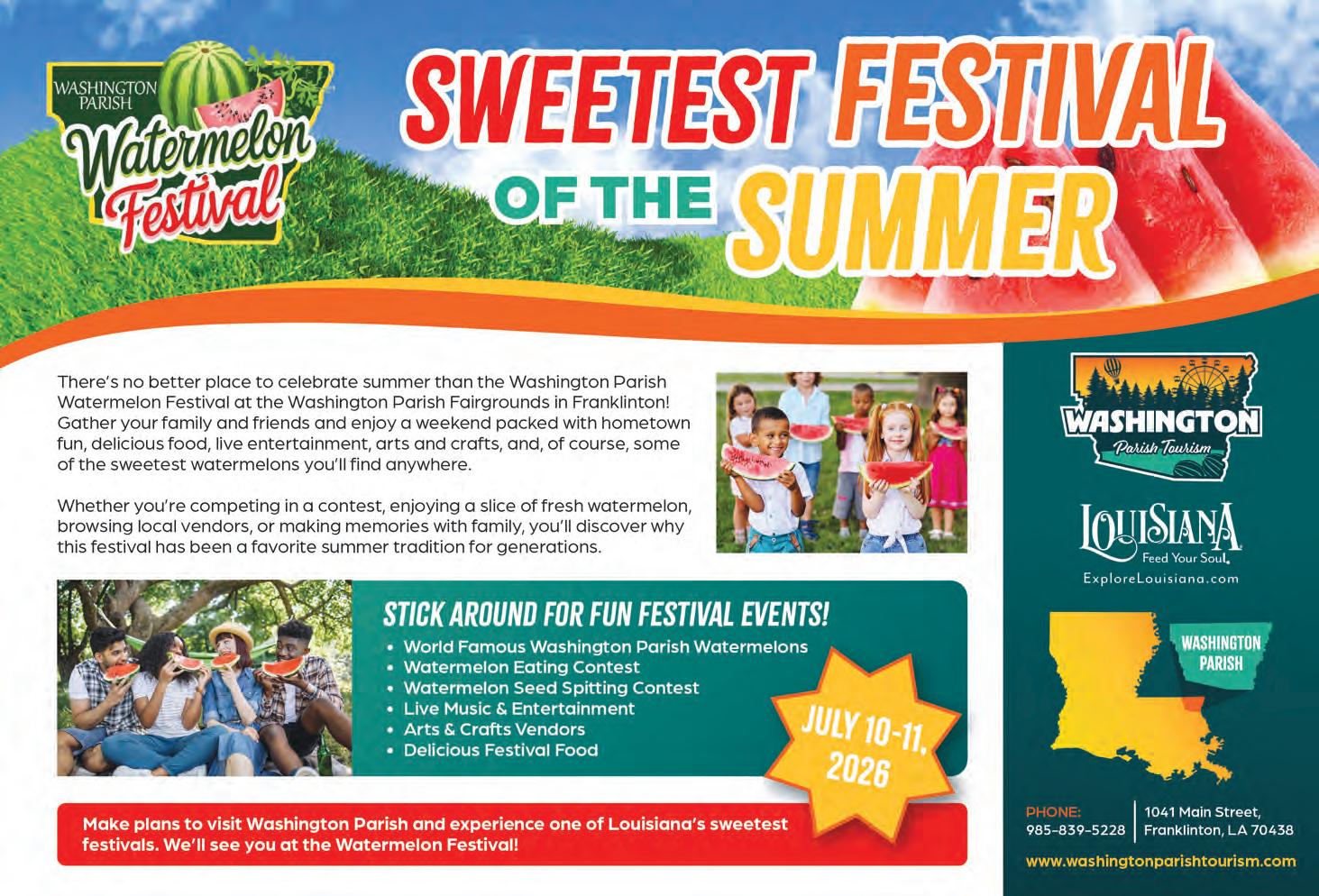
This summer, what could be sweeter than a festival dedicated to the delightful simplicity of a Louisiana watermelon? And in Louisiana, Washington Parish watermelons are legendary—and worth a celebratory two-day party filled with feasting. At this annual finger-lickin'good time at the Washington Parish Fairgrounds, expect a weekend of live entertainment, family fun, tasty food, contests, vendors, a car show, Bulls, Bronx & Barrels, a watermelon auction, and so much more. Learn more at the Washington Parish Watermelon Festival Facebook page. 1
JUL 10th - JUL 12th
RED FLAGS
NOLA RUNNING OF THE BULLS
New Orleans, Louisiana
The popular fiesta is modeled after the San Fermín fest ival and its running of the bulls in Pamplona, Spain. But releasing raging bulls through the streets of the French Quarter would be copying, so local organizers went for bat-wielding roller derby girls instead. Resplendent in horned helmets and armed with whiffle ball bats, the Big Easy Rollergirls unleash their fury on any slow-moving stragglers. "Bulls" are released at Gallier Hall at 6:30 am on Saturday, and wreak havoc until noon. Full slate of events at nolabulls.com. 1
JUL 10th - JUL 19th
MUSICALS "THE PIRATES OF PENZANCE" AT NORTH STAR THEATRE
Covington, Louisiana
Young Frederic sets sail on his quest to win the heart of a particular maiden under the watchful tutelage of a few salty pirates and one questionable nursemaid in Gilbert and Sullivan's beloved coming-of-age comedy, which is filled with recognizable tunes like "I Am A Pirate King" and "Modern Major General." Performed by North Star Theatre. 7 pm Fridays and Saturdays; 2 pm Sundays. $30; $25 for students. northstartheatre.org. 1
Events
Beginning July 11th - 12th
JUL 11th
DESIGN
KROTZ SPRINGS QUILTERS
GUILD SHOW
Krotz Springs, Louisiana
On Saturday morning, head over to the Gary Soileau Community Center at 216 Park Street for the annual Krotz Springs Quilters Guild Show, an impressive exhibition of art and craftsmanship. A display of handsome quilts for display and sale, a craft boutique, a silent auction, and various other crafty pastimes are on the docket. 10 am–2 pm. $2. (337)-948-8004. 1
JUL 11th
SOUND ON THE LAUREL BLUES FESTIVAL
Laurel, Mississippi
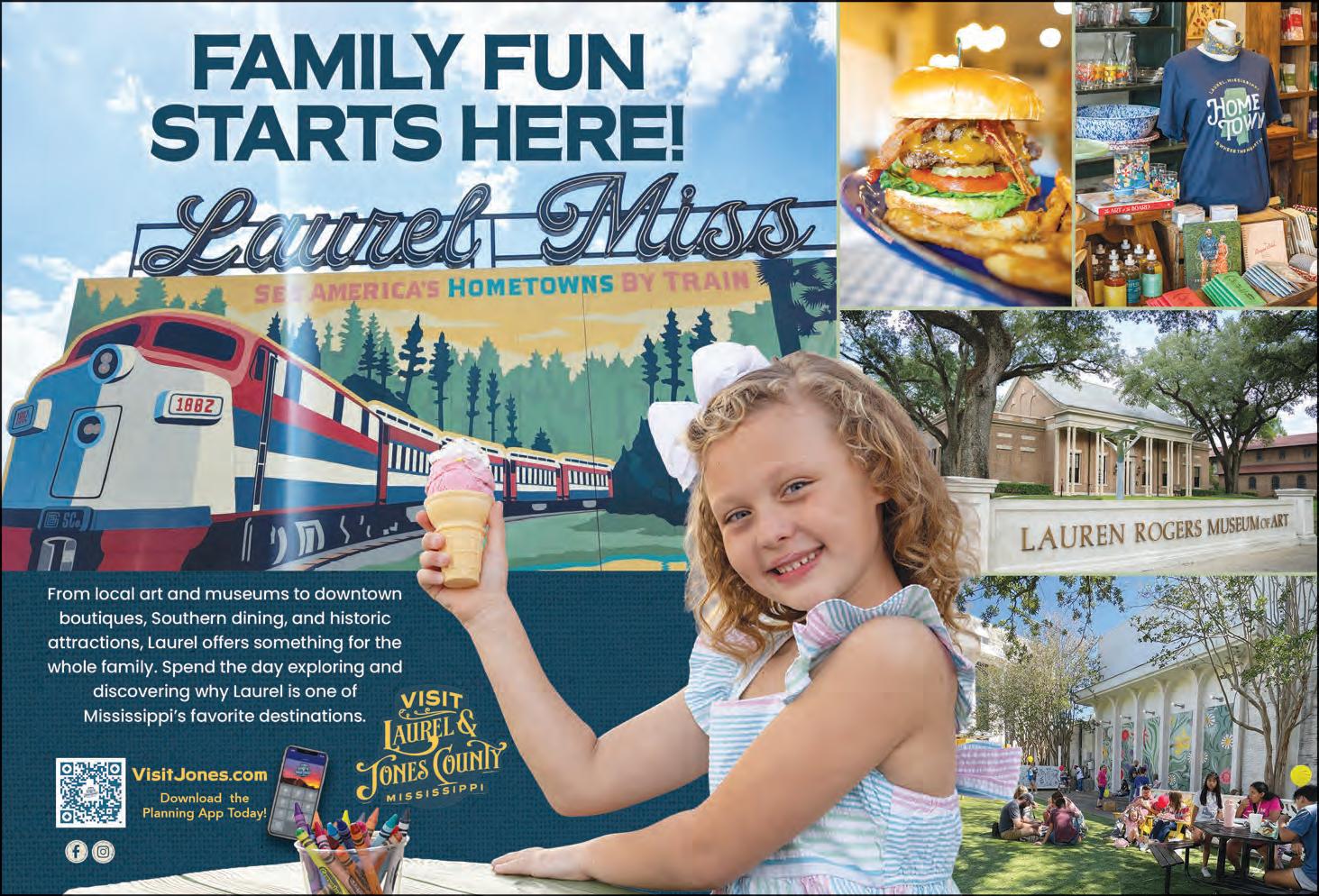
The Laurel Fairgrounds plays host to the inaugural Laurel Blues Festival, with a day chockfull of blues, soul, and fun featuring popular Southern soul artists. The lineup includes Cupid, Young Guy, Urban Mistique, Cecily Wilborn, and more. Gates open at 11 am; showtime
at 1 pm. Ticketing options available at laurelbluesfestival.com. 1
JUL 11th
RED, WHITE, & BLUE
DISCOVERY DAY AT THE CAPITOL PARK MUSEUM: INDEPENDENCE DAY
Baton Rouge, Louisiana
The Capitol Park Museum hosts a special Independence Day Discovery Day in honor of the Fourth of July. For discounted admission, enjoy a free educational craft, explore history, and take part in family-friendly, creative, patriotic fun. 9:30 am–1:30 pm. $5; free for children ages six and younger. louisianastatemuseum.org. 1
JUL 11th
LEI-ED BACK KOKOMO STROLL
Covington, Louisiana
Break out your flip-flops and coconut bras: Island living is coming to the Northshore. The Kokomo Stroll is Covington's leisurely, long-running
samples of signature bites and refreshing specialty drinks and craft beer, with live music carefully selected to complement the summer vibe. Attire is "tropical."
Think Hawaiian shirts, resort wear, etc. 6 pm–8 pm, rain or shine. Must be over 21 to attend. Free to stroll, but sampling cups must be purchased in advance. Tickets available at kokomostroll.com. 1
PLANETARIUM LASER SERIES
Baton Rouge, Louisiana
Prepare for a high energy, electrifying experience featuring laser light, music, and motion. The Louisiana Art & Science Museum (LASM) presents a Rock the Dome Laser Series at the Irene W. Pennington Planetarium throughout the summer and fall months.
The six-show lineup falls every second Saturday, inviting guests into a powerful, immersive, full-sensory experience set to musical favorites. July's show is called Laser Queen. 6 pm. $20 for general admission; $25 for VIP early seating; $100 for a Rock the Dome package. lasm.org. 1
JUL
11th - JUL 12th
GREEN THUMBS ORCHID SHOW AND PLANT SALE
Baton Rouge, Louisiana
The Baton Rouge Orchid Society hosts its annual Orchid Show and Sale, presenting hundreds of weird, wondrous, and exotic orchids exhibited by orchid societies and vendors from all over the region. Visitors get to ogle everything from plants with six-foot spikes of flowers, to leafless orchids consisting only of flowers and roots, to miniscule blooms best admired with a magnifying glass. Many orchids produce fragrances to attract pollinators, so visitors can also expect to encounter aromas of chocolate, grape, and other sweet or spicy smells. Members of the Baton Rouge Orchid Society will be on hand to greet guests, provide guidance in purchasing plants, and answer questions about orchid culture. Have an orchid to re-pot? Bring it and get a demonstration
from an experienced member (one plant per person, please). 9 am–4:30 pm Saturday, 10 am–3 pm Sunday at Burden Museum & Gardens, 4560 Essen Lane. Free. batonrougeorchidsociety.com. 1
JUL 11th - JUL 18th
FARM-TO-TABLE FRESH FEST
Baton Rouge, Louisiana
Throughout the early weeks of summer, when the spectacular bounty of Louisiana farms reaches its peak, the Red Stick Farmers Market sets into motion a series of themed events at its Saturday downtown markets. From local chefs demonstrating seasonal cooking tips to live music, art, and garden activities— each week will celebrate one of our regional crops. See the schedule below:
• July 11: Everything Eggplant
• July 18: Oh My Okra
More info at breada.org. 1
JUL 11th - JUL 26th
THEATRE
PLAYMAKERS PRESENTS "GILLIGAN'S ISLAND: THE MUSICAL"
Covington, Louisiana
Just sit right back and you'll watch a familiar tale unfold of seven beloved
castaways from an iconic 60's TV comedy show. Playmakers Theatre in Covington presents Gilligan’s Island: The Musical , a family-friendly musical version of shipwrecked hilarity, staged on a remote Pacific island. Filled with all the characters audiences know and love, the runtime promises laughs galore and memorable songs to boot. 7:30 pm Fridays and Saturdays; 2 pm Sundays. $33; $28 for seniors and military; $22 for children. bontempstix.com. 1
JUL 11th - SEP 12th
ART EXHIBITION
STAA SUMMER SHOW
Covington, Louisiana
For over fifty years running, the St. Tammany Art Association has organized the national juried art exhibition, the Summer Show. The show opens to the public on July 11 with a reception from 6 pm–9 pm and runs through September 12, closing with a reception from 6 pm–9 pm. Entrance to the gallery is free. sttammanyartassociation.org . 1
JUL 12th
PHOTOGRAPHY
"I STILL WAKE UP WITH THINGS TO TELL YOU" AT THE PEARL
Baton Rouge, Louisiana
Artist Kayla Rose explores the power of
grief, memories, and things never spoken in a debut solo exhibition titled I Still Wake Up With Things To Tell You at The Pearl in Baton Rouge, at 1439 Julia Street. Rose dedicates the exhibition to her late father, who passed away in 2020 on the same day her son was born. Through immersive photography and storytelling, Rose invites viewers into an intimate, deeply personal artistic experience. A public reception on Sunday welcomes visitors from Baton Rouge, New Orleans, and elsewhere in the Gulf South. 1 pm–6 pm. $15. ellemnop.art/thepearl. 1
JUL 12th
UP IN THE AIR
BALLOONS OVER DESOTO
Grand Cane, Louisiana
All ages are welcome to ooh and ahh at this hot air balloon spectacular, featuring live zydeco music, food and craft vendors, a virtual reality gaming truck, and a bounce house for the littles—all alongside the main event. For the daring, look forward to tethered hot air balloon rides, and for everyone else, enjoy an awe-inspiring balloon glow at night, followed by a fireworks display. Held at C.E. "Rusty" Williams Airport in Grand CaneFree. Gates open at 4 pm. explorelouisiana.com. 1
Events
Beginning July 15th - 24th
JUL 15th - JUL 29th
CHEERS
TASTE LIKE A SOMME
Baton Rouge, Louisiana
Explore wine through the eyes (and nose, and tastebuds) of a professional sommelier. "Taste Like a Somme," part of the BREADA summer culinary series, is led by Level Three Sommelier Scott Higgins, who will teach participants how to evaluate wine with intention. Attendees will also enjoy a curated charcuterie board featuring seasonal ingredients sourced from Red Stick Farmers Market vendors. 6:30 pm. Limited to twenty guests. $100 per person or $175 per couple. breada.org. 1
JUL 16th
CULTURAL STORIES
LECTURE ON THE SOUTHERN JEWISH EXPERIENCE
New Iberia, Louisiana
Shadows-on-the-Teche host speaker Kenneth Hoffman, executive director of the Museum of the Southern Jewish Experience in New Orleans. Hoffman
will lecture on the role of Southern Jewish communities in various freedom movements across the decades, from abolition to the Civil Rights era. At Shadows Visitor Center. 6 pm–7 pm. Free. shadowsontheteche.org. 1
JUL
16th - JUL 18th
TURN IT UP
ISLAND STRONG MUSIC FEST
Grand Isle, Louisiana
The fifth annual Island Strong Music Fest returns to the Tarpon Rodeo Pavilion this summer for a weekend of live music. The three-day festival celebrates Grand Isle's ongoing recovery from Hurricane Ida. Enjoy food, craft booths, and other local vendors—plus performances by 3rd Street, Shorts in December, Waylon Thibodaux, The Chee Weez, Ryan Foret & Foret Tradition, and many more. 5 pm–11:30 pm Thursday; 11:30 am–11:30 pm Friday; 11:30 am–midnight Saturday. $45 for weekend bracelet. $10 Thursday; $20 for Friday and Saturday; free for children twelve and younger. islandstrongmusicfest.com. 1
JUL 16th - JUL 18th
SOUND ON
(NEIGHBOR) HOOD FEST
Baton Rouge, Louisiana
Baton Rouge's third annual (Neighbor) Hood Fest comes to the East Baton Rouge Parish Main Library, devoted to building unity and celebrating Red Stick's diverse cultural communities. An event about neighborhood associations and what makes different parts of town interesting and vibrant places to live and work, the goal is to introduce new arrivals to Baton Rouge’s neighborhoods. Expect a vendor village and food court, live music, films, and film panels. Live entertainment includes Henry Turner Jr. & Flavor and the Listening Room All-Stars, King Solomon and Ervin “Maestro” Foster, Princess Teha, Uncle Chess, Louisiana Claude, and David Comeaux. Noon–8 pm. Free and family-friendly. A pre-party will be held at HenryTurner Jr.’s Listening Room on July 16, with a $30 entry fee that includes a buffet. ebrpl.com. 1
JUL 17th
LIVE MUSIC
WEST BATON ROUGE MUSEUM
JULY HISTORICAL HAPPY HOUR
Port Allen, Louisiana
The West Baton Rouge Museum's July Historical Happy Hour celebrates
America 250 with the old-time string band, Just a Trace, featuring band members include David Porter, Drew Rollins, and Marguerite Gravois. Inspired by the music common to colonial America, the band will highlight pieces that have endured. 6 pm–8 pm. Free. westbatonrougemuseum.org. 1
JUL 17th - JUL 31st
THEATRE "THE ADDAMS FAMILY MUSICAL" AT THE SULLIVAN Central, Louisiana
What happens when Wednesday Addams—known for her gloom and doom personality—happens to fall in love with a charming young man from a well-to-do family? Audiences will find out in Sullivan Theater's production of The Addams Family Musical. Hijinks ensue as the family known for being anything but ordinary hosts a fateful dinner for Wednesday’s perfectly normal boyfriend and his family. 7:30 pm Thursdays— Saturdays; 2 pm Sundays. $35; $25 for students. sullivantheater.com. 1
JUL 18th
GOOD EATS
TASTE OF AFRICA FEST
New Orleans, Louisiana
At this food fest presented at Culture Park
in New Orleans, come for the authentic food vendors from Nigeria, Ghana, Benin, Togo, Ethiopia, and Haiti—and stay for the vibrant musical lineup. Expect live music, DJ Sets, a Caribbean music experience, cultural dance performances, arts & culture masquerade performances, and much more. Noon–8 pm. $25; $14 for children. tasteafricafest.com. 1
JUL 18th
HOLLY JOLLY
CHRISTMAS IN JULY AT THE BILL WALLER CRAFT CENTER Ridgeland, Mississippi
It's Christmas in July at the Bill Waller Craft Center in Ridgeland, where participants can enjoy festive crafts, live artisan demonstrations, and the magic of the holidays in the heat of summer. 10 am–4 pm. Free. mscrafts.org. 1
JUL 23rd
ART WORKSHOPS
MUSEUM MAKERS: FUSION STUDIO—MIXED MEDIA ENCAUSTIC COLLAGE Lafayette, Louisiana
Kelli Martin Smith, drawing inspiration from Rachel Libeskind’s If There Be Nothing New, But That Which Is, leads
a workshop in which participants explore creative uses for fabrics, paper, and printed materials finished with an encaustic wax technique. 5 pm–8 pm. $75; $60 for members. Register at hilliardartmuseum.org. 1
JUL 23rd - JUL 25th
FISH FRENZY
GRAND ISLE TARPON RODEO
Grand Isle, Louisiana
Do you love to fish? The International Grand Isle Tarpon Rodeo is the oldest fishing tournament in the United States, with a reputation that's been making a splash since 1928. The event will be taking place at Grand Isle's Sand Dollar Marina. Food, live entertainment educational booths, children's crab races, vendors, and a $10,000 grand price drawing are just a few things to expect. 11 am—10 pm on July 23 and 24; 11 am—9:15 pm on July 25. tarponrodeo.org. 1
JUL 24th - JUL 25th
SMOKES
ANNUAL BAYOU BBQ
BASH IN MORGAN CITY
Morgan City, Louisiana
Slow and steady wins the race in this
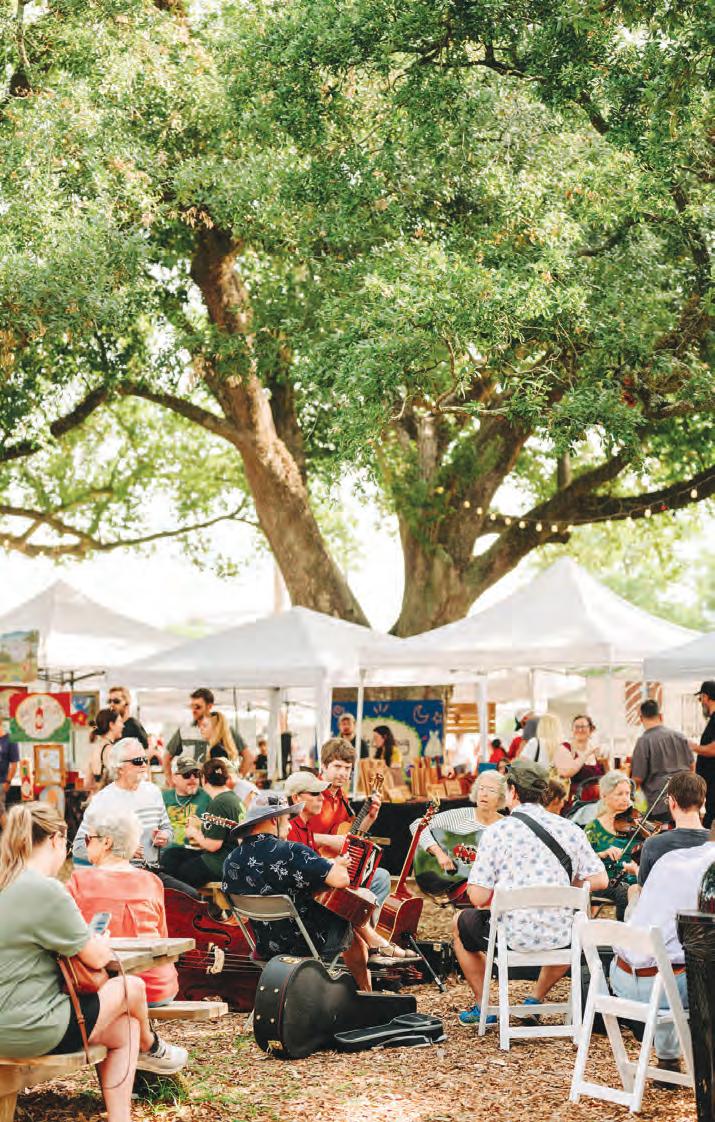
features a blend of local farmers selling fresh produce alongside artisans displaying handmade goods— plus a weekly Cajun jam. Photo courtesy of Moncus Park administration.
Events
Beginning July 24th - 31st
International Barbecue Cookers Association competition that sets the area beneath the Morgan City bridge to smoking. Competitors should come armed with their homemade rubs and marinades—and a thirst to prove themselves. (An appetite will come in handy, too.) Categories include pork spare ribs, brisket, and chicken. In addition to the competitive cooking events for corporations, teams, and kids, Saturday offers a full schedule of chances to devour tasty things from highly regarded barbecue vendors, booths for arts & crafts, live music in the evenings, and on and on. Kicks off Friday at 6 pm. Free. cajuncoast.com. 1
JUL 24th - JUL 25th
WINE & DINE
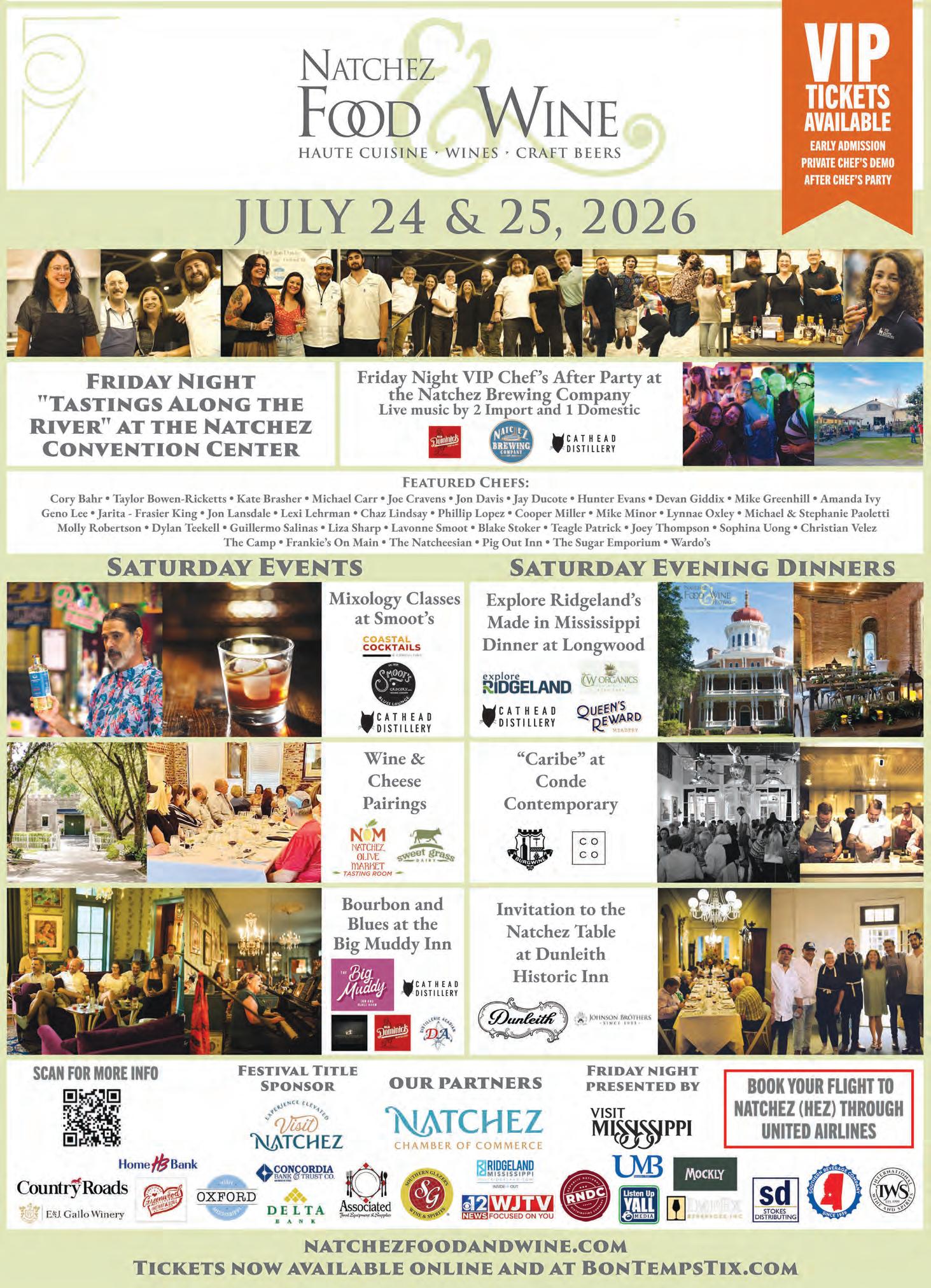
NATCHEZ FOOD & WINE FESTIVAL
Natchez, Mississippi
One of the most highly-anticipated culinary events in Mississippi, the Natchez Food & Wine Festival attracts top chefs and restaurateurs from across the Gulf South. Each summer, they come to the city on the Natchez bluffs to stage multiple-course dinners in historic mansions, progressive dining events, gourmet tastings, and casual social occasions that make the most of the city's spectacular riverside setting. Things begin on Friday night with the traditional (and huge) "Visit Mississippi Tastings Along the River" taster's fair, which brings scores of regional chefs, restaurants, and wine and beer purveyors to the Natchez Convention Center (it always sells out). The feast continues through Saturday evening, when the Invitation to the Natchez Table dinners bring top regional chefs to stage elaborate feasts in grand Natchez mansions. Other events on the agenda this year include:
• Mixology classes at Smoot's Grocery (11 am & 1 pm Saturday).
• A Wine & Cheese Tasting at The Castle Restaurant on the grounds of Dunleith Historic Inn (1:30 pm Saturday). This year, the festival's signature Invitation to the Natchez Table Wine Dinners bring multi-course menus by visiting chefs and winemakers to Dunleith Historic Inn (7 pm Saturday).
• “Caribe!” Dinner at Conde Contemporary Art Gallery (7 pm Saturday). It's a weekend-long chance to enjoy fine food, wine, and craft brews
in Natchez—the oldest permanent settlement along the Mississippi River and home to more than five hundred antebellum structures. Details for individual events and tickets at natchezfoodandwine.com and bontempstix.com. 1
JUL 25th
DINNER BELLS
AN EVENING AT MAGNOLIA COTTAGE—SUMMER SUPPER SERIES KICKOFF
Natchez, Mississippi
During Natchez's beloved Food and Wine Festival, Magnolia Cottage welcomes Chef Quincy Vidrine for a special dining experience to kickoff its summer supper series. The evening includes a four-course dinner served on heirloom china, two complimentary glasses of wine or champagne, coffee with dessert, an intimate dining experience, a tour of Magnolia Cottage, and a treat to take home. 6:30 pm–8:30 pm. $107. magnoliacottagebandb.com.
1
JUL 25th
OLDIES
"ROLL BOUNCE"
SOUL FOOD FESTIVAL
Slidell, Louisiana
Pack your roller skates and good vibes only. This family-friendly event at the Harbor Center brings together throwback fun, live music, and good eats, sponsored by KT’s House of Soul Food. Oldies to look forward to include a hula hoop contest, a game or two of "red light green light," and some back-to-school giveaways thrown in for good measure. Entry is $5, or five non-perishable food items to support families in need. 11 am–6 pm. visitthenorthshore.com. 1
JUL 26th
OLDEN DAYS
POWERING THE PAST: ANTIQUE ENGINES SHOWCASE
Baton Rouge, Louisiana
At the LSU Rural Life Museum, celebrate where horsepower and history collide at the Antique Engines Showcase and experience historic machinery in action. These include marine and flywheel engines, classic tractors and cars, an antique water pump and sugar cane grinder, rope-making and rural machinery demos, family-friendly displays, and more. Admission is included with general museum entry
($12); free for museum members. lsu. edu/rurallife. 1
JUL 27th
MONDAYS
UNITED WAY RED
BEANS 'N' RICE COOK-OFF
Covington, Louisiana
United Way will again celebrate the hallowed tradition of red beans on Monday at its annual all-you-can-eat Red Beans ‘N’ Rice Cook-Off. The event marks the official kick-off of the organization's St. Tammany Parish fundraising campaign. Proceeds support suicide prevention, mental health services, and other programs offered by United Way on the Northshore. So come gorge yourself for a good cause. 11 am–2 pm at Briggs Assembly Center at St. Paul’s. $10 for all-you-can-eat red beans. unitedwaysela.org. 1
JUL 27th
(FUN)DRAISERS
CHRISTMAS IN JULY CARD
PARTY AT THE WEST BATON ROUGE MUSEUM
Port Allen, Louisiana
Channel your holiday spirit (and all the cool air it brings) and spend the day with the West Baton Rouge Museum for its annual Christmas in July fundraising event. Taking place next door to the museum in the Port Allen Community Center, the event will include cards, lunch, and a cocktail, along with two separate drawings. 10 am–3 pm. $30, to be paid by July 20. wbrmuseum.org. 1
JUL 28th
DOWN TO EARTH
LOUISIANA HEALING GARDEN: MEDICINAL PLANTS FOR A SUSTAINABLE FUTURE
Baton Rouge, Louisiana
Hilltop Arboretum’s Discover Nature series presents Corinne Martin, an herbalist, educator, and author, who will lecture on her latest book, Louisiana Healing Garden: Medicinal Plants for a Sustainable Future. Her book functions as both an herb guide and celebration of Louisiana's ecological communities, drawing on the state's plants and their healing capacities during a time of extreme environmental and social upheaval. 6:30–8:00 pm. $15; $10 for students; free for Hilltop members. Register at lsu.edu/hilltop. 1
JUL 28th
STRETCHES
YOGA WORKSHOP AT THE WEST BATON ROUGE MUSEUM
Port Allen, Louisiana
Join nearly thirty-year veteran instructor
Elena Moreno-Keegan for a special yoga workshop at the West Baton Rouge Museum's Brick Gallery. MorenoKeegan will lead students of every age, shape, size, fitness and skill level in a stretching and breathing session as part of Port Allen Cultural District's wellness initiative programming. Bring a yoga mat, wear comfy clothes, and don't eat one hour before class. Held the last Tuesday of every month at 6 pm. Free. westbatonrougemuseum.org. 1
JUL 30th
AUTHOR TALKS LECTURE AND BOOK SIGNING WITH COLONEL DAVID COUVILLON Port Allen, Louisiana
The West Baton Rouge Museum welcomes Brusly native and author Col. David Couvillon for a lecture and book signing for his latest work, From U.S. Marine to Provincial Military Governor in Iraq. Couvillon tells the harrowing personal story of how Marine Reservists fared in Iraq after being assigned to oversee Wasit Province, facing many difficult challenges along the way. In this mission, Couvillon, now a decorated veteran, was appointed provincial military governor, without the experience for the job, in an assignment that would change his life. Noon. Free. westbatonrougemuseum.org. 1
JUL 31st - AUG 1st
SEASONAL SHOPPING CHRISTMAS IN JULY HOSTED BY MORGAN CITY MAIN STREET Morgan City, Louisiana
Hosted by Morgan City Main Street, the inaugural Christmas in July event at the Morgan City Municipal Auditorium features a holly jolly shopping extravaganza in the summer heat instead of the winter cold. Alongside craft vendors and art, peruse plenty of highquality boutiques and unique jewelry, then partake in delicious food while the kids stay occupied with ice skating, movies, crafts, and games. 10 am–7 pm. Learn more at the Morgan City Main Street Facebook page. 1
For more events visit countryroadsmag.com/eventsand-festivals.
VISIT NEW ROADS - COME FOR THE
Summer Fun, On the Water or On Foot
On False River, fishers, boaters, strollers, and diners can all count on a great day out by (or on) the water.
When summer tightens its grip on South Louisiana, the best thing is to get yourself beside, on, or better still, in, some cooling water. One of the most picturesque places to do that lies within easy reach of Baton Rouge, the Felicianas, and Lafayette. We’re talking about False River—where historic New Roads has been welcoming water lovers since its founding in the 1820s, after the Spanish built a “new road” connecting False River to the Mississippi to move Pointe Coupée parish’s agricultural products to market. Two centuries later, New Roads preserves a cultural tapestry that wears its French, Spanish, and African influences on its sleeve.
In summertime, fishers, boaters, water-skiiers, and fans of regional history, Creole architecture, and memorable dining all find reasons to love New Roads. In the heart of town, picturesque public waterfront area Morrison Parkway offers access to 10.5-mile-long False River via a free public boat launch, and fishing piers where landlocked anglers can try their luck with False River’s abundant bass, sac-a-lait, and catfish. Serious anglers can also test their skills by joining one of the regular False River fishing tournaments, which begin Tuesday and Friday nights from the boat launch alongside Morel’s Restaurant. Boat rentals are available from Falseriver.rentals and geauxoutdoors.stellarims.com.
No Boat? No Problem.
Off the water, anyone can take advantage of Morrison Parkway’s ample free parking to be within easy ambling distance of attractions, and restaurants and cafés offering classic Pointe Coupée dining experiences. From Morri-
son Parkway, early risers will be just steps from Dough & Joe’s (112 Richey St) huge menu of croissants, biscuits, waffles, fritters, donuts, and espresso coffee beverages. Right across East Main Street, RedStraw Specialty Drinks & Treats also does bang-up breakfasts, smoothies and blended drinks, and casual lunchtime options including cheese sticks, boudin balls and hearty pork chop sandwiches. Iconic Morel’s Restaurant (210 Morrison Pkwy), a lakeside tradition since 1926, which delights diners at lunch and dinner with a Louisiana Creole menu rich in fresh local produce and Gulf seafood. Same goes for Ma Mama’s Kitchen (124 West Main St.) where chef/owner Donna Ewing keeps her art-adorned, French-bistro-style dining room hopping with dishes like Ma Mama’s Turtle Soup and Oven-Roasted Duck with Crawfish Shitake Rice. Right on the water, The Landing on False River bar and grill (108 Main St) is a dockside favorite recently reopened by J.J. and Stephanie Ewing of Not Your Mama’s Restaurant. During summer, boaters tie up at The Landing for cold drinks and tasty bites in a casual atmosphere that stays open late, taking advantage of False River sunsets and evening breezes. Upstairs from The Landing, the Ewings are renovating space formerly occupied by Satterfield’s on the Riverwalk, with plans to launch a new, Mediterranean-style dining experience this fall.
New Roads On Foot
The Morrison Parkway promenade also makes a great jumping-off point for leisurely strolls, picnics, and enjoying the tranquil waterside setting. A few steps along the
lakeshore, St. Mary’s Kiwanis Park also provides public access to the lake. Sixty years ago, the local Kiwanis Club took it upon themselves to improve the site, adding a gazebo, General’s Plaza, lawn spaces, public boat docks, and restroom facilities. Today, the park makes a great spot for a leisurely family picnic; in July you might even encounter boatloads of excited kids taking part in the Louis J. Thibodeaux Youth Sailing Program’s Summer Sailing Camps, which provide sailing instruction to children ages 8–17 during summer.
New Roads and Old Rivers - A Walking Tour
Plenty more attractions lie within walking distance of Morrison Parkway. The coolest way to experience them all is by connecting to New Roads and Old Rivers, an app-based audio walking tour that introduces area landmarks from a local’s perspective. A collaboration between the City of New Roads, Visit False River, and the Pointe Coupée Historical Society, the tour introduces Pointe Coupée’s early French and Spanish influences, and delivers an audio guide to the Julien Poydras Museum & Arts Center, the Gothic-style St. Mary of False River Catholic Church, Romanesque Pointe Coupée Parish Courthouse, and historic LeJeune House, a classic Creole cottage and one of the oldest surviving homes in the parish. The location-enabled tour is available for free online and via the TravelStorys Audio Tours smartphone app, from travelstorys.com/tours/new-roads-and-old-rivers.
Visit www.newroads.net to learn more.
Features
TASTE OF SUMMER
Melon Drama
WOULD
A SUGARTOWN WATERMELON, BY ANY OTHER NAME, TASTE AS SWEET?
Story by Chris Jay
Sugartown, the oldest permanent settlement in Beauregard Parish, is a tiny community of homes and farms clustered near the intersection of State Highways LA-112 and LA-113, about sixteen miles east of Deridder. The unincorporated community takes its name from nearby Sugar Creek, and has long been regarded as home to some of Louisiana’s besttasting watermelons.
Local growers believe that watermelons grown in Sugartown taste sweeter than others because of the well-drained, sandy topsoil found in and around Beauregard Parish. Jason Green, the 48-year-old owner of Sugartown Watermelon Stand, said that the soil is “one of the key factors for the area.”
“It’s a real sandy soil that you only find in about a 40-mile diameter around Sugartown,” Green said. “It’s really good soil for growing watermelons.”
This kind of sandy, loamy topsoil isn’t unique to Sugartown. In every corner of
Louisiana, there is at least one small, agricultural community with similar topsoil that claims to be the source of Louisiana’s sweetest melons. In Northwest Louisiana, roadside vendors frequently market their watermelons as originating in the Village of Saline, where Louisiana’s oldest annual watermelon festival has been taking place since 1931. In the northeast, Farmerville melons are highly regarded, and that town’s annual watermelon festival dates back to 1964—the same year that growers in Sugartown began planning their own festival, which debuted in 1966. Franklinton launched its watermelon festival in 1985, which has since become the Washington Parish Watermelon Festival.
outstanding watermelons was well-established by the 1930s, when grocery advertisements promoting “Sugartown Watermelons” began turning up in Southwest Louisiana newspapers. In reality, the reputation of Sugartown melons had likely been in place for years before grocery stores began capitalizing on the name in newspaper ads.
town seals began turning up on watermelons from Shreveport to the Gulf.
The issue of phony Sugartown melons was such a well-known problem that politician T.J. Strother, who served in the Louisiana House of Representatives from 1960 until 1968, addressed the spread of counterfeit watermelons in his campaign ads.
But only one of Louisiana’s self-proclaimed watermelon capitals is named “Sugartown,” and the marketing boost provided by that name has set Sugartown apart from other watermelon-growing communities for the past hundred years.
The idea that Sugartown produces
As the popularity of Sugartown melons grew during the first half of the twentieth century, the issue of counterfeit Sugartown melons emerged—and it’s been a thorn in the side of Sugartown growers ever since. Counterfeiters became such a problem that growers from Allen and Beauregard Parishes banded together to form the Sugartown Watermelon Association in April, 1964, with a goal of marketing all of the members’ watermelons cooperatively and combating counterfeit melons. The association developed a seal of authenticity, which was placed on genuine Sugartown watermelons, but within months of its first use, counterfeit Sugar-
“I am told they are using the Sugartown trade name to help sell their foreign watermelons,” Strother wrote in a campaign ad presented as an open letter to Beauregard Parish voters. “We will put an end to this problem.”
But the problem persisted.
“It’s a fact,” one Sugartown resident told a reporter in 1989. “Signs go up saying ‘Sugartown Melons’ when they’re not even ripe here yet.”
Green, who has owned the Sugartown Watermelon Stand since 2014—and has worked in the local watermelon fields since 1999—said that decades later, the problem of counterfeit Sugartown water-
Sugartown, the oldest permanent settlement in Beauregard parish, has long been regarded as the source of some of Louisiana's best-tasting watermelons. There, 48-year-old farmer Jason Green grows and sells thousands of melons from the Sugartown Watermelon Stand each year.
melons is as much of a nuisance as ever. He blames dishonest watermelon peddlers for using deceitful marketing to sell cheap, early watermelons from Florida and Georgia under the guise of Sugartown melons.
“I have seen people as far away as North Carolina selling watermelons on the side of the road with a sign that says ‘Sugartown Watermelons,’” Green said. “I tell people that the only way you can
be assured that you’re getting a genuine Sugartown watermelon is to come to Sugartown.”
And they come. Green said that it can be difficult for both of his stands—he and his wife, Jamie, also own a produce stand in Leesville—to meet the demand for Sugartown melons. Over the course of a summer, the Greens will sell thousands of watermelons to customers from all over the South and as far away as
Washington State. Country music star George Jones visited in the 1990s. Just this past summer, Green sold three hundred watermelons to NBA legend Scottie Pippen. Pippen stood in one of Sugartown’s oldest watermelon fields, visiting and talking basketball for an hour before departing for Arkansas in an RV laden with Sugartown melons.
Could all this fuss over a watermelon possibly be justified? Could the watermelon really be that good? In a state where you can’t drive two hours in any direction without passing through a town famous for raising the sweetest watermelons, could Sugartown watermelons genuinely be in a league of their own?
In 1988, the Hammond Daily Star interviewed Sugartown watermelon grower Milford Lacy, who the paper called the “watermelon czar of this part of Beauregard Parish,” about the fervor surrounding Sugartown melons. Lacy, a second-generation grower, was adamant that there was actually nothing special about the watermelons he grew in and around Sugartown. The whole thing, he said, was just good marketing.
“What makes the Sugartown watermelons is the name,” Lacy told the Daily Star. “What I’m telling you is it’s the name and not the watermelon. If our name was Sour Holler or Bitter Creek, we wouldn’t have the reputation we have.”
Kerry Heafner is an associate extension agent with the LSU Ag Center. Heafner said that there is no special variety of wa-
termelon grown only in Sugartown.
“I think the common belief is that there is a watermelon variety called ‘Sugartown,’ but there isn’t,” Heafner said. “I believe that some of the varieties being grown in that area include things like Jubilee, Crimson Sweet, Dixie Queen, and maybe Summer Flavor 720, but I really don’t know for certain.”
It almost doesn’t matter what variety of melons Sugartown farmers grow. What matters is where they grow, how long they are allowed to ripen, and how many of those hours consist of the hot Louisiana sun beating down on their rinds, slowly sweetening the flesh inside.
Jason Green isn’t losing any sleep over the question of whether or not Sugartown watermelons deserve their notoriety. He has no qualms about other regions being proud of their watermelons, but, after twenty-seven years of selling them, he knows that Sugartown watermelons do have something special. It’s not just the name.
“These are the best watermelons anywhere in the world, bar none, and it’s not even close,” Green said. “That’s my true opinion.”
The Sugartown Watermelon Stand is open daily, 9 am to 6 pm, seven days a week during the summer, at 8136 Hwy 112, in Sugartown. They post crop updates to the Sugartown Watermelon Stand Facebook page, which Jamie Green manages. 1
Last summer, Sugartown Watermelon Stand owner Jason Green (center) sold three hundred watermelons to NBA legend Scottie Pippen (right).
One Table
GLOBAL CULINARY TRADITIONS COME TOGETHER ON THE PLATE
Not long after graduation, while navigating the struggles of the emotionally challenging social work field, she got the opportunity to join some friends who were traveling to South Korea to teach English. “I had to look on a map to see where South Korea was,” she said. “I didn’t know anything about the world. But it felt just right. This was what I was going to do.”
Immersed in a totally new culture, she found herself navigating her work through the kitchen, via cooking classes. Over meals, the kids were learning English, and Dale was learning how to prepare Korean food. “I just fell in love with it,” she said. “I became so fascinated with the culture and ingredients.” She began switching out her South African breakfast of oatmeal and semolina porridge for rice and miso soup with seared yellow croaker.
“In South Korea,” she said, “if you haven’t seen somebody in some time, they’ll ask you, ‘Have you eaten yet?’ Which is their way of saying, ‘Hey, how are you? Are you well?’ They’re not intending to feed you—this is how they express concern about your well-being, through food!”
Myspace was where Dale Gray first met @MrLouisiana. When she saw the handle, she laughed and thought “Oh my gosh. How cheesy.”
His real name was DJ Gray, and he was a native New Orleanian. As for Dale herself (then Van Der Merwe), she had come from the Cape Malay community in Cape Town, South Africa. The two encountered one another in the unlikely meeting place of South Korea, where DJ was stationed on his first tour of duty with the United States Army, and where Dale was teaching cooking and English to elementary school students.
On their first date, he told her, “My goodness, my mother would absolutely love you. You seem so Southern.”
“Southern?” she asked.
He was the first person she’d ever met from the American South. He told her all about where he was from, about why he felt she’d fit in as a woman who loves to cook, who teaches, who has such a gentle nature.
“Well, what is the food like over there?”
“Trust me,” he assured her. “You’re gonna love it.”
Meals have always been intertwined with family for Dale. She comes from a
long and diverse line of ancestors, many of whom were enslaved and transported to South Africa from places like Indonesia and Malaysia, as well as the area’s first European settlers, the Dutch. “A lot of my ancestors were actually cooks in wealthy landowners’ kitchens, and so cooking has remained an important part of our history,” she said. The Cape Malay regional cuisine is influenced by the dozens of cultures that made a home on the Western Cape, as well as the area’s agricultural products—fruits like grapes for wine and vinegar, apricots, peaches, and oranges. “We make a lot of sweet and sour things, like chutneys and sauces, a lot of hot sauce,” she said.
It is tradition, she went on, for young South African girls—whichever culture you might come from—to help their mothers and grandmothers in the kitchen. “The old recipes, techniques and things, are always passed down,” Dale said. Every Sunday, she and her sisters would report to the kitchen to take turns peeling potatoes and carrots, chopping garlic. “That’s how we learned to cook.”
Dale always imagined a career that incorporated her passion for cuisine in some way. At Stellenbosch University in South Africa, she originally majored in food science, before switching to social work after a couple days in chemistry class. “I was like, ‘nope!’” she laughed.
At the same time, amidst all this change, she often found herself missing home. During those times, she’d invite her friends over and would call her mom—staying on the phone with her while she prepared traditional South African dishes, like malva pudding. “I became kind of the go-to person to make foods we missed from home.”
Shared appreciations of family, home, and culture via cuisine were part of Dale and DJ’s instant connection. After six years in South Korea, seven months
of courtship, and a marriage proposal, she agreed to move with DJ back to the states. “I was scared,” she said, “but at the same time excited, because of all he had told me about living in the South.”
They started their lives in El Paso, Texas, where DJ was stationed. The topography reminded Dale of South Africa, and the Mexican cuisine of the region enthralled her. “It was a culture shock, still,” she said. “But that’s where I learned how to be a wife. To cook our meals, I kind of fused all these Mexican ingredients with my knowledge about South African and South Korean cuisines.”
Later, she carried that knowledge and spirit of adaptability with her to McComb, Mississippi, where DJ’s family had a house waiting for them. His service with the army concluded, he followed his dream of starting a trucking company—which left Dale home alone a lot of the time. “My task was to renovate the house, make it a home, adjust, and acclimate to this totally new place,” she said. “But I quickly started thinking—‘What can I do?’ I didn’t have any friends. I didn’t have any connection to Mississippi. What could I do to speed up that process?”
It was 2012, in the earliest days of the Instagram blogger era, when Dale started her account, @thedaleyplate. She began by simply sharing what she was making each day—drawing from her many culinary influences, sourcing difficult-to-find ingredients from the local Korean hairdressers and via special trips to Houston to the closest H Mart. She shared about her experience learning to prepare traditional Creole dishes from DJ’s mother, who grew up in Opelousas, Louisiana—étouffées, gumbos, jambalayas. Her early feed was a scroll
Dale Gray's debut cookbook South of Somewhere tells the author's globe-trotting story, divided between the three "Southern" countries she has called home.
Korea, vulnerable insights about her and her husband’s fertility struggles, admissions of loneliness, and how she fed herself and her loved ones through every up and down of life.
“People seemed to resonate with my story,” she said. “It was therapeutic for me, to unpack my upbringing and all those big life decisions. At the time, I had
to sauce company. “And from there, it
Today, Dale and DJ have made a home in Brookhaven, Mississippi—where Dale continues to share her daily plates, drawing from the cuisines that have influenced her journey, via her Instagram. These days, her audience of now almost 200,000 followers can take advantage of full-blown recipes, often shared in the captions, for dishes like South African “crispy chops” (lamb chops) and bobotie, Mexican coctel de camerones, Gulf shrimp étouffée, and even a grilled os-
“I REMEMBER THINKING TO MYSELF THAT EVEN THOUGH I WASN’T ACTIVELY PRACTICING SOCIAL WORK ANYMORE, HERE I WAS, LOVING PEOPLE THROUGH MY COOKING.”
—DALE GRAY
to do,” she said. “It’s something I’ve dreamt of, the apex of achievement for anyone who loves food. I totally manifested it.”
The cookbook, featuring Dale’s own photography (and plenty of shots of DJ helping out), begins with a three-part introduction that tells her globetrotting story, divided between the three “Southern” countries she has called home, and the cuisines that have most influenced her life. She offers a section on kitchen staples (along with flaky salt and peppercorns, she always has gochujang and curry powder on hand), as well as advice for reducing waste and making use of leftovers, and a moment to explain the South African concept of a Braai: a social tradition centered on open-fire cooking.
From there: the recipes, delivered with a side of story, as is Dale’s way. She tells us about how the brined Grape Leaf-Grilled Camembert is a tribute to the memory of smoking grapevines in her childhood town of Wellington, where at the end of the season the grape farmers would burn their vines to prevent disease. Her Tuesday Night Hot-Smoked Salmon Chowder recalls her mother’s tradition of preparing fish on Tuesdays, and in particular a neon orange smoked haddock poached in milk, and incorporates the flavors of an American southern seafood boil, with red potatoes, Creole spices, and holy trinity. Her version of Marry Me Chicken Soup draws inspiration from the Korean stew, dakdoritang—which she was preparing for DJ the night he proposed. The soup, as is the case with many of her Korean-influenced dishes, is flavored with Perilla, an anise-scented Korean herb that is difficult to find in the states, but which Gray now grows in her garden.
One book behind her, she’s already dreaming up the next, while also making moves to open a small cooking school for children in Brookhaven. “I’m really passionate about our underserved communities and making sure the kids have healthy ways to express themselves,” she said.
In the meantime, she’ll keep cooking, and she’ll keep telling stories. “That’s the thing, I’m a better storyteller even than I am a cook,” she said. More than the colors, more than the flavors, it’s the stories that continue to draw people to Dale’s plates— connecting us to each other through traditions and trials, and even across oceans. 1
Follow Dale Gray on Instagram @thedaleyplate, visit her blog at thedaleyplate.com, and order South of Somewhere at simonandschuster.com.
this small group of people online who were connecting with me and supporting me. I remember thinking to myself that even though I wasn’t actively practicing social work anymore, here I was, loving people through my cooking.”
A few years in, Instagram selected Dale’s account as a “featured user,” earning her around 50,000 followers overnight—“and everything changed from there,” she said. For the first time, she felt like maybe she could make a career as a food blogger. She started spending her days—eight to ten hours sometimes— practicing her photography skills and preparing new dishes, learning more about Southern cuisine. Soon, she had her first client as an influencer—an Italian toma-
trich tenderloin salad drizzled in gochujang. Sometimes, she’ll combine cuisines, though always carefully and with subtlety.
“I try to be respectful of traditions and don’t fuse in a major way,” she said. “But for instance, when I make a jambalaya, I might use a different protein than is typical in the South, or incorporate South African spices like coriander. When I make a spaghetti, I’ll add cloves and allspice— which is basically just the spaghetti I grew up eating.”
In 2023, the plate posts shifted from the screen and onto the page in Dale’s debut cookbook, South of Somewhere, published by Simon & Schuster. “Writing the book is something I’ve always wanted
The recipes in South of Somewhere are accompanied by Gray's own aesthetically-styled photographs, and reflections on her life as a transplant exploring different cultures through food. Image courtesy of Simon & Schuster
Today, Dale and DJ make their home in Brookhaven, Mississippi, where Dale continues to share daily plates that draw from the cuisines that have influenced her journey. Below are Gray's beef short ribs. Images reproduced courtesy of Simon & Schuster.
Bobotie
Recipe by Dale Gray
Serves 6
“
Bobotie, an egg custard–topped spiced casserole, is one of the finest examples of Cape Malay cookery in South Africa, a true representation of the melting pot of cultures that inspired our cuisine. Though the transition seems to be mostly undocumented, the original can be traced back to the Javanese dish bobotok, which first made its way to Cape Town as far back as the seventeenth century when my ancestors were brought to South Africa as slaves. Cape Malay cooks gradually adapted the bobotok by adding fruit and vinegar to tame the heat for a more fragrant, mildly spiced version—making bobotie what it is today, a richly comforting dish that’s savory, sweet, and spicy all at once. I like to make mine for guests who are curious enough to try something different and want to know more about the traditional foods I grew up eating."
—Dale Gray
1 teaspoon unsalted butter, for greasing
1 1/4 cups whole milk or coconut milk
2 slices white bread, roughly torn
1 tablespoon extra-virgin olive oil
1 large yellow onion, finely chopped
2 pounds extra-lean ground beef
6 large garlic cloves, minced
1/4 cup golden raisins or grated fresh apple
1/4 cup Mrs. H.S. Ball’s Peach Chutney (available online), District Six Apricot Chutney, or any fruit chutney
1 1/2 tablespoons mild curry powder (see note)
1 tablespoon Worcestershire sauce
1 tablespoon fresh lemon juice
2 teaspoons ground turmeric
2 teaspoons kosher salt
1 teaspoon freshly cracked black pepper
1/8 teaspoon ground cloves
6 fresh lemon leaves or bay leaves
2 large eggs
Toasted slivered almonds, for serving (optional)
Preheat the oven to 350°F with a rack in the center position. Grease a 9-inch round, or 21/2-quart, baking dish with the butter.
In a shallow bowl, pour the milk over the bread. Set aside and allow the milk to soak in.
In a large saucepan, heat the olive oil over medium heat. Add the onion and cook, stirring occasionally, until light golden brown, 4 to 5 minutes. Add the beef and garlic, and cook, stirring occasionally, until the meat is browned, 5 to 6 minutes. Pour off the excess fat.
Meanwhile, squeeze the excess milk out of the bread and add it to the skillet; reserve the milk. Add the raisins, chutney, curry powder, Worcestershire sauce, lemon juice, turmeric, salt, pepper, and cloves, and cook, stirring occasionally, and breaking up any lumps of beef or bread, until the flavors have melded and the sauce is thickened, about 5 minutes. Transfer to the prepared baking dish, then gently smooth the surface and arrange the lemon leaves in a pattern on top.
Beat the eggs into the reserved milk with a fork. Pour over the cooked beef, then bake until the custard is set and the edges of the bobotie just start to turn a light golden brown, about 30 minutes. Sprinkle with toasted slivered almonds, if desired. Your house should now be filled with the aroma that drifted through the narrow streets of my neighborhood every time someone decided to make this meal.
Note: Not all curry powders are created equal. Once you find a blend that you like, stash it in the freezer to keep it fresher for longer. I squirrel pounds of the good stuff away after trips to Cape Town, purchased from Atlas Trading in District Six, an established Cape Malay community on the slopes of Table Mountain. The bags keep for a year in my freezer, but I ran out during the pandemic when travel wasn’t an option. In my search for something equivalent from a US purveyor, I found the Vadouvan curry powder from The Spice House to be the closest to the fruity, mild blends used in South Africa. Alternatively, check Amazon or the international aisle of bigger grocery stores for Rajah curry and pick up the yellow box.
Anything made of meat has been fashioned into cuisine somewhere, and hthe stolid, armored turtles and tortoises of the world have joined their fellow beasts in stewpots. With rabbits and llamas, turtles occupy an uncomfortable space on the spectrum of animals that ranges from dogs (bosom companions who await us in Heaven) to scallops (born hors d’oeuvres). With its plodding, determined gait, curmudgeonly face, and ability to seal itself away, exciting the envy of introverts everywhere, the turtle can seem a bit too sympathetic for the table. Alas, they’re delicious, and they’re especially savored in a once-adored dish now a niche specialty of the Creole kitchen: turtle soup.
Previously enjoyed by Indigenous populations, turtle meat arrived on the European palate out of necessity: you could catch green sea turtles in the Caribbean and carry them on board a ship to feed the crew. Easier to transport and keep alive than most food animals (they even come in their own box), cold-blooded turtles and their slow metabolisms could store protein and calories until sailors needed them without requiring much feeding or care. From these mariners, turtle meat spread to feed those of both lower and higher status. Because it was locally abundant and cheap, it could be fed to those enslaved in the Caribbean; because it was exotic and spoke to the success of imperial trade, it began to grace the tables of the British well-to-do. (Scarcity due to the difficulty of getting a living turtle all the way to London also played a role.) From its origins in London society and on Caribbean plantations, turtle soup spread to Britain’s other colonies and to the continent, becoming a status marker in the emerging United States.
Turtle soup was so coveted that in some cities, restaurants would announce when a turtle arrived so diners could plan around the butchering and boiling. As the dish’s popularity grew, cooks expanded their options, both turning their attention to other turtle species and rebranding calf’s-head soup as “mock turtle.” (This taxonomically chaotic substitution is the origin of the “Mock Turtle,” complete with shell, hooves, and bovine head, as it appears in the original illustrations to Alice in Wonderland.) American industry worked to democratize the dish; from 1869, the Texas coast began selling canned turtle meat. Cookbooks, up to and including that great eminence The Joy of Cooking, offered recipes for the housewife eager to try her hand at the fabled stew. Canned mock and actual turtle soup became available, offering that most American contradiction: a quick, convenient luxury. All of these pressures,
Turtle soup au sherry, served at the Court of Two Sisters in New Orleans. Photo courtesy of the Court of Two Sisters.
except the calves’ heads, meant more and more turtles were pulled from waterways.
You know what happened next: populations of key turtle species crashed, leading to bans on the exploitation of species like the green sea turtle and the Chesapeake diamondback. U.S. turtle farming began in the early 1900s and has now replaced the harvesting of wild turtles, lessening pressure on those populations but running into red tape: because turtles are such good hosts for salmonella, of toilet-hugging fame, interstate trade of small turtles is tightly regulated, and much of the U.S. turtle production is instead earmarked for export, largely to Asian countries with their own turtle-based cuisines. For most people, it’s just as well: the American appetite for turtle soup has faded, with the once-aspirational dish joining aspic salads and lobster thermidor in the cobwebby recesses of the American menu. Mostly.
South Louisiana, a region where tradition is famously more reliable than the earth beneath your feet, boasts several old-line restaurants that still serve turtle soup (and some farms that stock their kitchens). At Commander’s Palace and Galatoire’s in New Orleans, along with Parrain’s in Baton Rouge and a fair
number of others, diners can still order and savor this grande old dame of the upmarket table.
Nevertheless, one can’t help but acknowledge the creativity and cando attitude of those first cooks who turned mariners’ necessities into duchess-tempting suppers. It’s hard to imagine being the first person to look at a turtle—cool to the touch, armored against the knife—and imagine a rich, warming soup, alive with flavor and booze. A mid-eighteenth-century recipe goes into necessary but grim detail about dressing the poor creature; one must scald the head and rinse all the blood from the lungs, as every bit of the luxury meat contributes to the stock, before describing a familiar flavor profile. Eggs, herbs, vegetables (including the Cajun trinity) join the turtle meat and stock in a pot populated with veal broth and a solid chug-a-lug of fortified Madeira wine, which we can imagine the cook having already turned to in order to steel herself for the butchery.
Modern recipes assume you won’t have to slay and section your own turtle, or at least leave that part unstated, but both Brennan’s and Emeril’s have boldly placed their recipes online, allowing us to see that they’re the clear descendants of the old one above, give or take
Worcestershire sauce and specific lung instruction. With no disrespect to these fabled institutions, it’s a soup recipe, with nothing outside the norm of your average capable home cook’s experience except, you know—the turtle. Which is what it all comes down to in the end: the turtle, and the sherry. Turtle is the anti-chicken, tasting not like generic “meat” but like itself and only like itself (ruefully for the turtles who’d prefer their meat inside their shells). A little aquatic but more solid than fish, more substantial than other seafood, it tastes like a wetland the way oysters taste like the ocean and good venison like the woods. One of the joys of trying new foods is having the new data point for future exploration and comparison, and while other things you try may— may —taste like turtle soup, turtle soup remains the reference, the revealed truth. The splash, or deluge, of sherry atop the dished-out soup breathes the final gift of life, of vivacity, into the dish, like a prince’s kiss. Technically optional, the sherry or equivalent is so critical that some food historians blame Prohibition for turtle soup’s decline in popularity in the United States. Turtle soup without sherry was like an orchestra without violas, hollow in the middle, and by repeal, diners had moved on.
Ultimately, turtle soup has a particular elegance only odd, old-fashioned things with a certain aura of ritual have around them—a sort of Zsa Zsa Gabor-like quality. Like lavender candy and raw oysters, turtle soup will not be for everyone, but we connoisseurs appreciate it as one of the many attainable luxuries that dress up a dinner out or a life well-lived.
One of my most location-specific “New Orleans” memories is of the morning after Hurricane Zeta whipped through, at a hair under Category 3 easily strong enough to knock out power for a while. With our homes dark, a friend and I went to the Quarter to seek out a restorative brunch and a phone chargeup at the great booze-and-breakfast mainstay, The Court of Two Sisters. Since it was something of an occasion, we treated ourselves to turtle soup, in defiance of our circumstances. We were disheveled and, brandishing our flickering phones, a bit mendicant, but we could play it off as gentlemen in distress over a serving of turtle soup (and an undisclosed number of Bloody Marys). Ham and eggs would have fed us as well and maybe even tasted as good, but they would never have crowned the memory like that well-remembered, sherry-topped breakfast of turtle soup. 1
IN THE KITCHEN
At Ease, At August
UNDER CHEF COREY THOMAS’S PRECISE HAND, RESTAURANT AUGUST CARRIES THE DELIGHTS OF FINE DINING INTO A TWENTY-SIXTH
Story by Beth D'Addono
YEAR
Restaurant August’s Red Snapper Pontchartrain is an iconic Creole dish, prepared with only the freshest five ounces of local fish. As is the case hwith every recipe on the esteemed restaurant’s menu, French technique meets locally sourced ingredients, and the attention to detail is what takes it to the next level. Tweezers come out to place lacy micro greens just so; the accompanying bearnaise is aerated to a light, buttery foam.
But ask Executive Chef Corey Thomas the real secret to the dish and he doesn’t miss a beat: “It’s the Bunny Bread.”
As far as Thomas knows, Restaurant August is the only dining institution in the city, maybe the state, with the license to use the trademarked Bunny Bread name. Instead of crisping the redfish’s skin on a hot grill—“Skin-on fish can be polarizing”—he uses a piece of the white bread, produced locally since 1966.
The secret, said the chef, is running the slice through a pasta machine, flattening and condensing its tender crumb into a thin sheet, which is then draped over the snapper, with a layer of tarragon butter bonding the two together. When the order is fired, it’s flipped bread-side down and pressed on the grill. It’s a brilliant move which creates a top crust for the firm, slightly sweet fish—and an inspired foundation upon which to pile morsels of locally sourced crab, shrimp, and oyster mushrooms, with a rich Bearnaise finishing the dish.
Creating joy at August
As executive chef, Thomas, thirty-nine, leads the August kitchen, where his team curates one of the most highly regarded tasting menus and fine dining experiences in the city, currently priced at $200 for four courses. Despite the restaurant’s many accolades, wine awards, and haute white tablecloth and chandelier setting, he sees his job as chief officer of joy.
“I love to offer guests something they've never had before, that’s both somewhat familiar and fun,” said the Shreveport native. “Taking something to the next level makes you curious, which is a good way to feel when it comes to food. I like to remain playful with our menu. It should be an expression of joy, rather than something to take so seriously.”
Take the barbecue shrimp croustade, for instance, a cold one-bite tease that spotlights shrimp grilled over Japanese charcoal, then tossed in a thick reduction of New Orleans butter and Worcestershire-driven barbecue sauce. “It’s familiar, but different,” said the chef.
Thomas never went to culinary school. He is a science guy who pursued a career in cancer and Alzheimer’s research, all the while cooking Louisiana-style food and experimenting with different kinds of cuisine for friends and family.
Over time, he found himself feeling increasingly isolated working in a lab. “I missed the social interaction, but I also have a natural draw towards management and leadership. I
Chef Corey Thomas prepares a Restaurant August icon, Red Snapper Pontchartrain. Image courtesy of Restaurant August.
like dialing into what drives people and how to keep them engaged.” Time and again, the people he fed told him he should be a chef. “I really hadn’t thought about that. But then I started considering it. I’ve always loved New Orleans culture and I was thinking about making that big move.”
In 2012, Thomas was consulting in Denver when he decided to take a leap of faith, right into the kitchen. “When my family came to New Orleans, we always ate at Commander’s Palace. I saw that they were hiring, and I figured, why not start at the top?”
Chef Tory McPhail hired him over the phone, despite the fact that he had zero restaurant experience or training. “He asked me how I made my gumbo,” recalled the chef. “The next thing I knew, I was packing up my stuff and driving to New Orleans.”
The education that commenced was life changing. “What's more effective than learning in a great restaurant from a great chef? Working under so many talented chefs taught me different styles of cooking and management.”
Thomas joined BRG Hospitality, owned by Chef John Besh and Octavio Mantilla, in 2015, first working at Shaya, then Domenica before joining the August team four and a half years ago as executive chef.
With a new team, culture, and menu redefining Restaurant August today, Chef Carson said he feels honored to be at the helm of a restaurant that has been so influential the past twenty-five years. To carry on the lofty standard, he works tirelessly to strike the right balance between training, empowering, and inspiring his team. And though he’s got a history of drumming in a New Orleans band, running a rock and roll kitchen isn’t his jam.
“I love Anthony Bourdain, but what he wrote about in Kitchen Confidential was of that time,” he said, referring to the uncompromising militaristic approach of the famed chef personality. “That doesn’t work now. That style of leadership used to be the norm, but from my experience, it’s not
healthy. That’s not the way to drive engagement and commitment. It just doesn’t line up.”
Stewarding his iconic restaurant, Thomas instead approaches his role as a craftsman with an easy-going demeanor and laser focus. “We have a lot of younger chefs on the team who are from here. I try to support them as they go on their journey, giving them the knowledge and experience they need to be successful. Hopefully they will pay that forward, helping others and creating industry change for the long term.” He went on, “Sure, there are times when we all fall short. I’ve tried dishes that didn’t quite work. But that’s part of the
process. I always encourage my team to push their boundaries, try new things. If we don’t fail, we don’t learn, we don’t create.”
Does Thomas ever worry that luxury dining will fall out of favor? “People, especially in New Orleans, are leaning towards quality dining instead of more frequent meals that are lackluster,” he said assuredly. “You can spend $100 on dinner at a Mexican chain restaurant. Why not cook at home and save for a dining experience that is truly memorable?” 1
restaurantaugust.com
A science guy trained in cancer and Alzheimer's research, Corey Thomas did not go to culinary school. But a lifelong passion for Louisiana cuisine eventually drew him out of the lab, and into kitchens at Commander's Palace, Shaya, and Domenica.
Lunch at The Palace
A NO-FRILLS LAKE CHARLES LANDMARK STANDS THE TEST OF TIME
Story by Lauren Stroh
ALouisiana sampler is heavy on homegrown agriculture, particularly seafood (oysters, crawfish, shrimp), crop (rice, sugar, corn, peppers), and animal husbandry (chicken, pork sausage). Along with the trinity (celery, onions, green bell pepper), these essentials of Cajun cuisine are freshest and most delightfully prepared in Southwest Louisiana, where the town of Crowley is known as the "Rice Capital of the World,"and crawfish ponds shimmer on unnamed parcels of land beside interstates, highways, and country roads—some of which lead to Lake Charles, where you can enjoy South Louisiana’s culinary and cultural output at a castle, open for dinner and lunch.
Don’t take it literally, otherwise you might be underwhelmed by appearances. A brick building painted over with a blue metal awning and fluorescent lighting, Seafood Palace is no architectural marvel. Inside, metal tables are topped with red vinyl tablecloths; the floor is checkered black and white tiles. Offerings of Tony Chachere’s, Heinz ketchup, and Tabasco sauce populate metal baskets (you’ll need them); paintings
on wooden pallets and beer and rum adverts adorn the walls. The Palace is unostentatious, a dining hall located on Enterprise Boulevard, not quite a bustling corridor for commerce in town. And yet the restaurant remains an institution, celebrating twenty-five years in business in 2026.
I expect this is because the Palace’s menu is as unchanging and dependable as bread and butter, what I would identify as the regional equivalent of a McDonald’s Happy Meal. In 2001, David Papania opened its doors, adapting its offerings from family recipes, with his brother Chris boiling seafood in the shed out back as the restaurant’s head cook. Today, you can still find David sitting at a table in the corner across from the front door, greeting old friends and new customers alike with welcomes and banter. Once seated, expect service by other familiar faces—employees are retained over decades and wear a uniform t-shirt with the logo of the proprietorship printed over the heart. You should already know what you’ll be having, having ordered it time and time again.
In March, April, or May, Seafood Palace serves the
best crawfish in town. The rest of the year, I would suggest a cup of chicken and sausage gumbo, its roux thin and oily, with a heaping of white rice served on the side. You should order a potato salad to go with it, so long as you promise you won’t scoop any of it into the bowl.
Seafood Palace is the type of restaurant indispensable to the social fabric of small towns: the sheriff walks around greeting patrons as they eat, and you can expect to witness excited run-ins with neighbors, family members, classmates, and long-lost friends. Its atmosphere is casual: you can watch the game on a flat screen TV; drink liquor, smoke, and gamble in the lounge; wear flip flops and blue jeans; and enjoy cokes in Styrofoam cups filled with ice and poured out of twenty ounce plastic bottles.
In spite of its familiarity and no-nonsense sensibility, or possibly because of it, dining at Seafood Palace remains a treat.
Excluding gratuity and local taxes, you shouldn't have to spend more than around $20 a head. 1
Top: Seafood Palace's chicken and sausage gumbo; Bottom right: Seafood Palace's seafood platter. Top right: the dining room is bright and unpretentious. Images courtesy of Lake Charles CVB.
Soupçon
A DASH OF DINING NEWS
By CR Editorial Staff
Carson’s Table Opens Near Mandeville Trailhead
This past May, Carson’s Table officially opened on Lafitte Street, at the foot of the Mandeville Trailhead, bringing scratch-made, elevated Creole cuisine to the thirtyone-mile Tammany Trace bicycle trail. Founded by Chef/owner Carson Wandell, the Northshore restaurant pairs his twenty years of award-winning culinary experience with thoughtfully sourced ingredients, hand-cut steaks, and house-made sauces, to bring comfortable, yet elevated dishes to the table in two artisanal dining spaces.
For those in search of a relaxed, woodsy affair, the downstairs dining room offers tableside cocktail service and an extensive cellar of sommelier-selected wines. Upstairs, a more formal ambiance is suited to celebrations held over intimate wine dinners.
Walk-in lunch service runs from 11 am to 2 pm Monday through Friday. Reservations for dinner are recommended. carsonstable.com
Historic L&N Train Depot transforms into Chandeleur Brew Pub
This summer, travelers will be able to step off Amtrak's Mardi Gras service in Pascagoula, MS, and right into on-site beer brewing, elevated bar food, and Southern hospitality. They're all just steps away at the Chandeleur Brew Pub, which is housed in Pascagoula's newly renovated, 120-year old L&N Train Depot.
At the Chandeleur Brewing Company’s second coastal location, Chef Austin Sumrall, owner of Biloxi's famed White Pillars and Gulfport's Siren Social Club restaurants, has built a menu that carries echoes of his James Beard Award-winning cuisine at White Pillars, elevating the brew pub experience with dishes like Korean barbecue pork belly buns and a coconut ceviche made with fresh Gulf fish.
The Brew Pub officially opened in early June, and welcomes locals and travelers with a dozen craft beers on tap, a full bar, and a game room, promising a family-friendly atmosphere and good times to Gulf Coast travelers. chandydepot.com
Shine On, You Crazy Country Store
For inhabitants of West Feliciana parish's northern latitudes, and especially the Lake Rosemound community, the institution known as the Lake Rosemound Store or Capt’n Doug’s Bait Shop was a bit of a lifeline. For decades, the little bait and tackle store at the corner of Rosemound Loop and Sligo roads was the only retail establishment for miles, which explains why, in addition to bait, it also stocked fishing camp essentials like beer, Frito Lays, wiener sausages, two-stroke engine oil, live crickets; or— for parents who’ve just driven a carful of hungry children ten miles past St. Francisville having forgotten to go by the grocery store—even a half-gallon of reasonably fresh milk. That came to an end in January, 2025, when Douglas Paul Kozan, aka “Capt’n Doug” passed away, leaving the little store dark, and absent-minded parents driving back to St. Francisville. So, last August, when Lake Rosemound residents Brent and Kory Hammatt purchased Capt’n Doug’s with plans to re-open a general store that would cater more, well, generally, to local residents, there was rejoicing. “The store was in pretty bad shape,” said Brent Hammatt in January, when the couple were knee-deep in renovations. “We’ve been cleaning it up, but trying to preserve some of the old history in the process.”
Preserve history they did. In late May, the new “Shiners Lake Rosemound General Store” opened, with everything good about Capt’n Doug’s still in place, plus a lot more besides. For fishermen, there were live minnows, crickets, and worms, artificial baits, monofilament, life preservers, and other essentials. The polaroid photos depicting folks holding trophy bass were still on the walls and beneath the counter glass. But it was in the refrigerators where the real transformation had taken place. One fridge held frisbee-sized muffulettas from Cannatella’s Grocery of Baton Rouge. In a freezer, frozen Cannatella’s chicken fettuccini, shrimp and tasso pasta, meatloaf and mac ‘n cheese shared shelf space with water buffalo ground meat from neighboring Bayou Sarah Farms. Fresh yard eggs were on the counter. Shelves held thoughtfully curated after-hours grocery staples—from peanut butter to ragu, canned tuna, jambalaya mix, and boxed and bottled wines. The beer fridges were full to overflowing. According to Brent Hammatt, muffalettas, to-go pizzas, Days deer burritos, ice cream treats, and Cannatella’s frozen meals are selling like hot cakes. This is exactly what the couple had in mind. “We reopened Shiners because we wanted the store to have a much better selection for the community,” Hammatt said, “but what we really wanted was to bring the community back to the store. We wanted to provide that gathering place where neighborhood people could come and have a cup of coffee, grab a sandwich, while sitting down at the same table and meeting someone new.” (225) 635-7258.
Lurline's Meatloaf
A GRANDMOTHER'S RECIPE, BUILT FROM THE LOGIC OF SCARCITY AND THE LANGUAGE OF LOVE
Story and photos by Christie Matherne Hall
Between my father’s deer hunting, bass fishing, and hcooking hobbies, I grew up eating really good.
We were a cooking family. I can count on two hands the number of times we went out for dinner before I turned fifteen. Mom cooked mostly on weekdays—eventually, I started helping: baked chicken, hamburger steaks, spaghetti with meat sauce, red beans and rice. Dad took over on weekends and when we had people over. On the most minor of special occasions, we ate homemade slow-braised beef roast, deer sausage gumbo, crawfish etouffée, bacon-wrapped deer backstrap roll-ups, fresh fried catfish, boiled peanuts, and classic brown jambalaya. Dad takes flavor seriously, often refining his seasonings and methods aloud at the dinner table, and always striving to make the next dish better than the last.
But of all the home recipes, there was one classic that never graced our table: meatloaf.
My dad hated meatloaf. It was more of a grudge—his mother apparently made a ketchuppy one so bad, and so often, that Dad banished all its variations from our household forever. Nobody made it on the maternal side of the family either, so I have exactly zero childhood memories involving meatloaf. I trusted my dad’s refined culinary opinion. In my young mind, meatloaf landed in the same pot as fruitcake—squarely in the “foods to groan at” category.
I finally ate my first bite in my early twenties, after working the Thursday lunch shift at Pinetta’s European Restaurant in Baton Rouge. If you were lucky enough to get a slice of the Thursday meatloaf at Pinetta’s before it closed in 2024, you’d know that it was the best on the planet, and you’d understand how it befuddled me. How could my culinary genius of a father banish this exquisite use of ground beef?
For several years after that first experience, I put myself through meatloaf college (I ordered meatloaf every time I saw it on a restaurant menu). I learned that not all meatloaf is as good as the Thursday special at Pinetta’s, but I didn’t encounter any loaves that made me want to damn the dish to hell. After experimenting with meatloaf at home, I concluded that it was fairly difficult to screw up such a thing, so I assumed my grandmother— who died when I was ten—must have been a not-so-great cook. Maybe that’s why Dad put so much effort into becoming a good cook, I thought. That would explain everything.
A Shoebox in Time
In 2019, I was home for the holidays, sipping wine and writing Christmas cards at my parents’ kitchen table, when my mom showed up with an old shoebox in her hands. It was my paternal grandmother’s recipe collection.
I’ve kept every sentimental scrap of paper anyone’s ever handed me, so not only did I accept the box, but I immediately
Lurline
Lurline’s custard pie recipe was a dud. It did not set in time for Christmas (or any holiday), but neither did my fascination with her recipe box. For all I knew, the box was full of recipes that, like the custard pie, didn’t work. But I had so few lived memories with her; this box seemed to hold more than all of them combined. Touching the delicate scraps of paper with her tiny, neat cursive felt like touching the other side of a century. (Well, not quite a century, but close.)
My grandmother was born in St. James Parish in 1913, near the onset of the first World War. She came of age during the Great Depression and was raising children by the time Hitler invaded Poland. Lurline married my grandfather and gave birth to six children across twenty years—my dad was the last, the 1956 caboose, destined to become an uncle at five years old.
dove into it, Christmas cards be damned. The first piece I saw was a recipe for buttermilk fried shark with lemon relish. I squinted at it, suspicious of its inclusion. I also thought that it sounded really good. Mom and I inspected at least half of the box that evening, hoping to find a good Christmas pie recipe. The recipes were mostly handwritten in my grandmother’s tiny script, scrawled on the backsides of receipts; or typewritten on index cards. Many were clipped from magazines and newspapers. The subject matter went all over the place, with certain hallmarks of mid-century cookery and a clear tendency toward Louisiana seafood: congealed salads, mock strawberry preserves (using figs instead), shrimp casserole, oyster fritters. Eventually, a custard pie recipe rose to the top of the pile for our Christmas table.
There were more than just recipes, though: a “Dear Polly” column about microwaving parsley to preserve it for the freezer and a remedy for soggy bottom pie crusts; a pamphlet of prayers from St. Dymphna Catholic Center, a hospital in Mandeville—its seven-digit telephone number at the bottom. There was an empty envelope with my grandmother’s name—Lurline Matherne—and her Baton Rouge address, postmarked January 21, 1992, right around the time she moved to a nursing home with an Alzheimer’s diagnosis.
And then, suddenly, there it was, neatly handwritten on a torn piece of an envelope: the meatloaf recipe.
Like most Americans from that era, Lurline’s life and habits were shaped by scarcity. I was told she could stretch a cup of beans to feed fifteen people. Her recipe box held evidence of this talent. For example, she took a grocery list written on a torn strip of paper, turned it upside-down, and wrote a recipe from the bottom up, using every last centimeter of white space. There’s another grocery list on the back, meaning she made sure the labored slip of paper got through two separate grocery trips and ended up in that shoebox at the end of the week. I’ve never considered reusing a grocery list in my life.
Whenever she copied recipes from other places, she took great care to note the origin on the index card, receipt, shred of envelope, etc. At least once, she sourced a recipe from a Winn-Dixie grocery bag—I know, because she credited it in writing.
Lurline was fond of the recipes that appeared in Baton Rouge’s long-running afternoon daily, The State-Times. I found at least twenty recipes clipped from those pages, many of them cakes and desserts. Enough of those had dates that I was able to conclude she was clipping State-Times recipes up until the paper merged with The Advocate in 1991.
The shoebox holds hundreds of recipes in total. If my grandmother wasn’t a great cook, as I had long assumed, she was at least a relentless one. I began to wonder if my assumption had been wrong. What bad cook would press on so long at something she’s no good at, right until the very end? And what bad cook—what cook at all, really—would bother to cite a source when the source is a grocery bag? Well, me. I would probably do that. Clearly, I had a meatloaf to make.
Meatloaves and Fishes
Meatloaf isn’t a monolith; it’s an entire universe unto itself, with endless iterations. You can cut it with pork, wrap it in bacon, or top it with an all-day Bolognese sauce. Add shredded cheddar or chopped
A glimpse inside the author's grandmother's shoebox of old recipes, including one for her (in)famous meatloaf.
trinity for some texture, or give it some smoky flavor on a grill.
Lurline didn’t do any of that. Her meatloaf recipe has six ingredients: ground beef, eggs, onion soup mix, ketchup, water, and flavored breadcrumbs. As I looked over the recipe before making my grocery list, I noticed there was no amount listed for the breadcrumbs—“as much as needed,” she writes—and based on the instructions, the ketchup is not on top. It’s mixed into the meatloaf.
Finally, the night before I talked to Dad about all this, I crafted the ancestral meatloaf with enough breadcrumbs to stretch the beef a bit, still hopeful that it wouldn’t be bad enough to strike meatloaf entirely from the mouths of one’s children. (I did make an auxiliary loaf with half of the beef, you know, just in case Lurline’s really was inedible.)
My honest review: On the meatloaf scale, I’d grade this recipe well-below-average. I think the ketchup might be responsible for the tender texture, but the dish is sweetened by the taste of plasticized, cooked ketchup—not an ideal flavor for a meatloaf, nor an ideal smell for a kitchen. Said ketchup, plus the onion soup mix and the breadcrumbs (I used Italian), are the only seasonings in the recipe. In my notebook, I wrote, “So this is what food in the sixties tasted like.” With its “as much as needed” amount of breadcrumbs, Lurline’s meatloaf definitely has the spirit of a Great Depression recipe. “Yeah,” Dad added, “and it was greatly depressing to eat that stuff.”
Over a long phone call, Dad told me stories of his mom’s scarcity mindset in the kitchen. She thought it was nuts to use the correct amount of oil for deep-frying, so her fried fish never turned out crispy. When one of Dad’s older brothers would unexpectedly show up to the house with his family for dinner (which he says happened often), Lurline would augment a would-be tasty dinner with whatever was available to
adequately feed everyone. “Mom really was a great cook,” my dad admitted. “It’s when she started stretching everything to feed more people that it could get unappetizing.”
The ketchup, though, was apparently added with love. “Kids like ketchup,” Dad remembers her saying, “so I put some in, so that maybe you’d like my meatloaf.” And the kicker—apparently Lurline’s tagline: “I made it just for you!” Teenage Dad would grumble back: “If you make it just for me, make something I like.”
As a result, Dad’s approach to cooking in adulthood focuses on flavor, combined with tried-and-true preparation methods. Cost is considered, but it does not have veto power. When Dad moved out on his own, he took up hunting and fishing, and fried his own catches with lots of oil. His mom loved it, but I imagine it was easier for her to visit my dad on fish fry-night than to pour five cups of oil in a pan for a single meal.
My grandmother’s recipe box is something of a gamble, but along with the busts, there’s a decent chance of landing on something incredible. My mom told me that her brother raved about Lurline’s shrimp casserole for years, and her crawfish bisque recipe was the stuff of legends. On the phone with Dad, when I rattled off some of the odder inclusions in the shoebox, such as the figgy recipe for mock strawberry preserves, he interrupted me mid-sentence: “That shit is delicious.”
For what it’s worth, my dad resolved his grudge against the meatloaf universe about ten years ago after he enjoyed a friend’s, and now he makes his own version at home. In fact, he made a meatloaf a few days after we talked about it.
My husband liked Lurline’s meatloaf better than my slightly jazzed-up version, and I’m still a little sore from that burn. Maybe one mark of a good cook is the ability to admit when your meatloaf just isn’t that great. 1
An exercise in ancestral recipe-following: meatloaf edition.
Outdoors
OUR SUSTAINABLE GARDEN
The Forager’s Feast
quire little effort to procure and prepare. In other words, they’re sustainable by definition.
AN INTRODUCTION TO EDIBLE PLANTS THAT ARE ABUNDANT, EASY-TO-PREPARE, AND DELICIOUS
On a recent job, in the fields of a local sheep and cut flower farmer, while discussing various sustainable agricultural practices I was reminded of a book that “sideswiped” (in the best way) my personal and professional life more than a decade ago. The book, The Third Plate: Field Notes on the Future of Food (Penguin Random House, 2015), was written by New York farm-totable chef Dan Barber, and it transformed the way I utilize my kitchen and how I view agriculture as a whole. The book is divided into four parts: “soil,” “land,” “sea” and “seed,” and chronicles stories and lessons from different ecological food systems, as well as trials undertaken at Stonebarns, Barber’s farm in upstate New York. While rereading The Third Plate, I was reminded of how influential this New York chef had been to my gardening practice. This was the book that led me to many imperative agricultural and naturalistic voices, including
In relating the approaches he has encountered during his quest for “sustainability,” Barber offers great hope. He prods his readers to think beyond unsustainable, post-World-War-II agricultural systems that our society has come to rely on, inviting us instead to improve our food production practices through a combination of innovative thinking, and a return to age-old, chemical-free practices that served previous generations well. Though Barber’s book is neither about native plants nor foraging, he illustrates and advocates for other ways of approaching our agricultural systems, and, ultimately, our plates.
With the return of this book to my life, and since this month’s issue is about cuisine, I thought it would be fitting (and fun) to profile some of my favorite edible plants—ones that are abundant, easy to access and re-
A majority of the plants we encounter in the wild and in our landscapes actually can be used as food or medicine—though not all are necessarily tasty. So, here’s my list of plants that are easily accessible in the wild (or perhaps in your neighbor’s garden), that can add either great flavor or aesthetic interest, upping your culinary game.
Please Note: Always take heed when consuming wild plants, and do your own due diligence when researching how to identify each, making certain you understand its potential effects. The following are offered based on my own experiences.
Rootbeer Plant, Piper auritum
This is a fun, slightly aggressive, tropical perennial that I love using in shade gardens. It lends tall, whimsical interest to any space, with its giant, heart-shaped leaves and bizarre, long, white spike flowers. The common name comes from its complex scent and taste, which is reminiscent of sassafras or tarragon. A friend from Mexico taught me to wrap fish in these large, softto-touch leaves for grilling over an open fire. It’s my absolute most beloved way to cook fresh-caught redfish.
Chaste Tree, Vitex agnus-castus
This small, bushy, deciduous tree native to the Mediterranean is an excellent choice for gardens in need of a pop of summer color. Its purple blooms produce berries that, when dried, are almost identical in taste to that of black peppercorns—grind and use as you would black pepper. This tree has a long and beautiful history in relation to women. To this day—used in capsules, tinctures, or teas—the berries play significant medicinal roles in female reproductive health, helping treat issues like cycle regulation, infertility, and relief from menstrual symptoms. Historically, the tree was at the center of Greek rituals and agricultural festivals honoring various goddesses. In modern day Israel, excavations at a temple complex in an ancient Philistine settlement identified as the biblical city of Gath, uncovered hundreds of preserved vitex berries. It is thought by archaeobotanists that the fruit was perhaps used to induce mind-altering states during religious rituals.
American Pokeweed, Phytolacca americana I used to grow and sell this bizarre “weed,” until it started to seed itself throughout my entire nursery stock. Still, I find its lanky, tall form and burgundy fruit and stems endlessly fascinating to the eye.
Pokeweed has a solid culinary history in the South that deserves to be revitalized and heralded at the chef's table. Its deep green leaves were traditionally used in “poke salad” (or, as it is sometimes called, “polk salad,” or “poke sallet”), which is actually a dish of cooked greens rather than a raw salad. Supposedly, pokeweed was once common enough to be sold canned in stores. The berries have a strong medicinal and culinary history among Native peoples, who used pokeweed to treat conditions ranging from acne to arthritis.
It's not everyday that you have a famous song for a native Louisiana perennial. If you don’t know it already, check out Tony Joe White’s “Polk Salad Annie.” I personally love Elvis’s cover.
Clockwise from top left: Elderberry, Jewels of Opar, Chaste Tree (photographed by Zoe Valdina), Rootbeer Plant.
Aldo Leopold, Rudolf Steiner, and Wendell Berry. Each
Story and photos by Jess Cole
“Down there we have a plant that grows in the woods and The fields
Looks somethin' like a turnip green
Everybody calls it polk salad”
Elderberry, Sambucus canadensis
This one may seem obvious, yet I still find it to be incredibly underused. The elderberry tree is a small, suckering tree (or ditch plant, however you want to see it) that seemingly never stops giving. It has medicinal qualities as a treatment for respiratory illnesses, and is super tasty, too. I harvest berries each year to make an Indian spiced elderberry syrup for my family, encouraging a strong immune system in all of us. But I’d love to see it more on the kitchen table. I also use the syrup in cocktails. The plant’s purple-black berries deliver tasty pops of flavor, and make an excellent garnish. A comrade, who is a ritualistic tea drinker, taught me to harvest the dainty white flowers before they fruit, then to either dry them or use them fresh to make a delicate hot tea.
Greenbriar, Smilax
Greenbriar is a native, thorny evergreen vine. Multiple species can be found throughout our woods. It can be seen as a nuisance, as it's difficult to eradicate. Still, it does have some positive attributes—my favorite being how yummy it is. Supposedly all parts of the plant are edible, but I only harvest the tender new shoots and tendrils. They taste almost identical to asparagus and are delicious when served raw, as a garnish, or in a salad, as well as sautéed with a bit of butter, salt, and lemon. Another fun fact is that this plant is a florist’s dream, since the vine stays green, without wilting, for days on end with zero water, making it a popular choice for decorating arbors, entryways, and the like. A friend jokes that I should harvest greenbriar from my woods as an Etsy side hustle, because this vine really does sell at top dollar and gets shipped from the southeast all over the country to grace weddings and beyond.
July Plant Spotlight American Basswood, Tilia americana
Photo by Jess Cole
Jewels of Opar, Talinum paniculatum
Having stumbled upon the American basswood in my St. Francisville woods, unaware that it even inhabited this area, it has become my newest tree sweetheart. It is of stunning beauty, with giant, heart-shaped leaves, almost weeping, cascading over the edges of my creek among beech, magnolias, and sugar maples. The basswood is a tall tree that grows faster than many other native hardwoods, and has endless uses for humans and critters alike. The flowers, called Linden flower, were historically used by humans in medicinal hot baths, beauty products, and (my only use thus far) hot tea. The wood is easy to work, therefore great for carving. Historically, the pliable inner bark was soaked to be made into rope and netting. The American basswood tree supports over one hundred butterfly species, and benefits countless other wildlife, including honeybees. In fact, it offers so much nectar that it has become a tree prized by beekeepers. I would love to see American basswood used in the South as a street tree, as I have seen utilized in northern states.
This is the coolest shade-loving native-ish tropical perennial—a petite plant with succulent leaves and whimsical flower spikes. The flowers begin as sparkly, red, tiny dots, then burst into star-shaped, pink blossoms. The plant reseeds readily, and I often plant it with cultivars of ajuga and the also-whimsical perennial Chocolate Plant (Pseuderanthemum alatum). Jewels of Opar is related to edible, more common, purslane and can be used similarly—raw in salads, as a garnish for warm meals, or sautéed or cooked like spinach, to which it tastes similar. American Beautyberry, Callicarpa americana
This common native landscape staple and borderline roadside weed is a better-known edible than most plants
on this list, but it's not the easiest flavor profile to work with. I believe there is great opportunity for experimentation with this plant. I added it to the list for its beauty. The berries’ deep purple color is tremendous. In my kitchen, I like to soak beautyberries in tequila or gin, which imparts a striking color when added to any cocktail. I have also created syrups by simmering the berries with honey or sugar, and have heard of tasty jams being made from the berries. More than anything, though, I use the plant’s leaves to infuse into a DIY bug spray; the plant has a long history of use by Native peoples for repelling mosquitoes. It works well for our family. 1
Read more entries of Jess Cole's column, “Our Sustainable Garden,” at countryroadsmag.com.
MUTUAL AID
Take & Eat
COMMUNITY FRIDGES FEED THE HUNGRY ACROSS LOUISIANA
Story by Jacqueline DeRobertis-Braun • Photos by Molly C. McNeal
The faith Fr. Michael Bordelon has in his congregation’s community fridge is not quite a Field of Dreams-esque—“If you build it, [they] will come.” No, it’s something more fundamental, a quiet assurance, something like the unspoken trust the disciples must have placed in Jesus when he fed the five thousand with just five loaves of bread and a couple of fish. There will be enough food. People will give. Keep the faith.
“Is it sustainable? Every time we have this conversation, four years in, we’re actually more sustainable than last year.
We could always use more, but it’s not a ‘we need more,’—it’s ‘golly, look how generous people are being,’ ” said Bordelon, Rector of St. Barnabas Episcopal Church in Lafayette. “[When people were afraid about the government pausing SNAP benefits during the shutdown last fall], we probably saw a month’s worth of people coming to the pantry in a week. They were scared. They didn’t know what they were going to do. But also the response to the church mimicked it, so a four-fold increase in giving happened. Talking about scarcity and abundance—the giving matched the need of
it. Because it always does.”
Community fridges like St. Barnabas’s have become—if not plentiful—increasingly common in Louisiana in the years since the COVID-19 pandemic, offering accessible, free, no-questions-asked food for the hungry. Often found in metropolitan areas, community fridges combat food insecurity and food waste by operating as a small, scrappy safety net for the individuals that local food banks and other outreach efforts miss. The concept of the community fridge resists the structure of those more formal institutions—purposefully fostering solidarity,
not charity. It’s a mutual aid model of collaborative, communal care that mobilizes a broad umbrella of neighbors to share what they can, when they can, and afford a little more dignity to those who are struggling.
The folks who run these fridges know they are not working on a macrocosmic scale—this isn’t an attempt to shift policy or advocate on a legislative level. Rather, they are simply here to meet the most basic of human needs: hunger.
“All I know is that they're hungry, and as long as they’re hungry, I’m going to
Two new fridges, and a new community fridge shelter, at The Red Shoes on Government Street. This summer, digital creator "Uncle" Jhonn Jackson, who was connected with The Red Shoes by the nonprofit First Tuesday, tore down and rebuilt the fridge and pantry shelter. Photo courtesy of The Red Shoes.
give them food,” Bordelon said. “Sure, there’s a lot more we could do to help out … [but] until those things happen, we’re going to feed the hungry.”
Baton Rouge
At the corner of Cane Street and North 38th Street, in a little pocket park in the Eden Park community, sits a fridge run by The Walls Project—a local nonprofit—and New Look Neighborhood Grocery, which is located across the street.
Dr. Ashlyn Harrison, executive director of The Walls Project, explained that in this neighborhood, access to food is not as reliable as it could be, and "definitely isn't equitable." This is the reality for families across America, who live in areas where grocery stores with fresh, whole foods don't exist; where transportation is a barrier; where cost is a barrier.
“The reality is that many families are navigating tough day-to-day financial decisions. At the same time, we’re also witnessing usable food going to waste,” Harrison said. “How could we bring it directly to [the] community? We created a community fridge to kind of bridge that gap and create a more powerful solution."
The food in the fridge is available for free, when people need it. It’s always unlocked and, critically, does not require those in need to sign forms or answer questions, with all the stigma those barriers bring. "It’s just community taking care of community.”
Still in its infancy at just over six
months old, the fridge is stocked regularly by the grocery, and The Walls Project works with Sprouts Farmers Market to fill the fridge with the store's leftover produce. Of course, members of the public can always donate to the fridge, too. When all else fails, The Walls Project harvests produce from its very own Baton Roots Community Farm at Howell Park.
"Something my mom used to always say to me is, ‘don’t be a product of your community—make your community a product of you,’" Harrison said. "When systems are built intentionally, I think it's really what breaks down those societal barriers … creating systems where we take ownership of our own spaces and are able to say, 'We will take care of us, together. We don't expect you to take care of yourself by yourself.'"
Less than two miles away, on Government Street, The Red Shoes, a local nonprofit, has hosted a community fridge since 2021. Housed in a pink-painted shed, the fridge and an adjacent pantry are available to anyone who is hungry. A comprehensive page on the organization's website thoughtfully lists food items that are allowed to be donated to the fridge. For instance, grab-and-go foods, such as sandwiches, are preferred to meals that require cooking, which can be a barrier for some people in need. Water is especially needed in the summer, and non-food items like toiletries are always welcome.
While all appropriate donations are accepted, there is one standard organiz-
—DORCAS BRANDON, ASSOCIATE DIRECTOR OF THE RED SHOES
ers stress: Do not give the almost-expired cans, the unusual food item opened and then ignored, something tried, then turned down. "If we give, we give our best," said Dorcas Brandon, associate director of The Red Shoes. "We give what we would want somebody to give us."
When it comes to those who are utilizing the fridge, though, Brandon doesn’t sweat about enforcing any rules. “People who are in survival mode—when they see food, they want to make sure they have enough,” she said. “I’m not here to judge how much someone takes because I’m not in their position. What I can control is how many people know about this fridge.”
Brandon, who has been involved with
the organization since 2023, developed a passion for the fridge's operation and upkeep after engaging time and again with community members who sought out the fridge, especially hungry children. She spends much of her time, energy, and effort lining up businesses and organizations to stock the fridge in any way they can. Fill the Fridge July, for instance, is an annual advocacy push to keep the fridge stocked for thirty-one days, coinciding with summer months when children may face the most acute food insecurity outside of school.
At its most basic level, the community fridge is an explicit, open invitation to "love your neighbor," according to Brandon.
“We're in a society that can be for [the] self," she said. "In giving, you don’t know whose life you have affected positively in that moment. You don’t know what mental state, emotional state a person may be in, and by giving to the fridge, you have imparted a part of hope, a piece of joy or promise, just by making the decision to give. It is from neighbor to neighbor. That is something special. It turns into community."
New Orleans
In a city like New Orleans, where the homeless population tallied more than 1,500 people in 2025 (the most recently available statistic from UNITY of Greater New Orleans), there are so many community fridges that the effort to fill them has evolved into truly a grassroots undertaking, existing outside of the local nonprofit or religious infrastructure. Homelessness aside, as inflation increases and food insecurity rises, approximately 70,000 residents living in the state’s most populous city are food insecure—nearly one in five New Orleanians.
The community has responded en masse. Rather than one or two dedicated fridges run by local churches or advocacy groups, New Orleans fridges can be found most everywhere—beside homes, businesses, and communal spaces. Filling them takes a village. Enter Nola Fridges (NOCF) - Community, a Facebook group harnessing more than 11,000 members to respond, as one, to the city’s hunger. Although the Facebook group began in 2022, the effort kicked off in 2020 during the height of COVID,
as thousands faced new economic uncertainty and food insecurity.
Scroll down the Facebook timeline and you'll find most people are posting the items they have cooked or donated to certain fridges, often accompanied by a photo, date, and time stamp so that anyone in need can be assured of the food's freshness—as well as to assure somewhat coordinated giving between members. In one post, a community member created an interactive map of the city's community fridges; in another, someone offered extra containers for anyone looking to cook a meal; in more, people ask, urgently, constantly, “how they can start their own community fridge?” Communication among members is critical to ensuring there is always enough food—that the fridges and pantries don't go empty when people need their items the most.
There is no headquarters, no executive director, no parish priest overseeing the distribution of food, the maintenance of the fridges. This is a coordinated mutual aid movement across the entire New Orleans community, bringing together anyone who has time or energy to volunteer in service of others. Apart from donating, volunteers clean the fridges, dispose of spoiled food, and organize the remaining items for easier access.
It seems in this online community, the only rule is generosity, at any level. Give what you can, and alert those who should know. With a great need comes an even greater response—the legion of footsoldiers fighting hunger one fridge at a time could tell you that. Decisions are made,
and, yes, bellies are filled, by the people who show up. Every little bit counts.
Lafayette
In late 2025, parishioners at St. Leo the Great Catholic Church in Lafayette led the charge to open a community fridge with a two-pronged mission in mind: reduce food waste, and build a better connection with those that are food insecure.
It's taken several months of trial and error to figure out the most effective location for the fridge (close to the parish office, it turns out, to build lasting relationships with those donating and those receiving), and to troubleshoot how to ensure the fridge is operating in a way that best serves everyone.
“Community is built around food, sharing meals,” said Reverend Joseph Kyle White, pastor at St. Leo. “We see that all throughout Scripture, but even outside of just religious communities, whenever you are able to share a meal together, there’s a strengthening in the community. Unfortunately, our food consumption has become very individualized with modern times. We’ve lost that connection between community and food… the fridge is teaching those in abundance how to share, and bring your leftovers to the fridge, and teaching those in scarcity how to share, and jump in, and take your part, but don’t take all of it. All that’s part of the beauty of sharing a meal, is that you are sharing.”
White added that giving to a community fridge or food pantry is a low-barrier way for anyone and everyone to get involved in service, without waiting for the next event, or handling a bunch of waivers to sign, or dealing with coordination and instruction from a supervisor: "Anybody can make a meal. It doesn’t matter how old you are—you can drop off the meal, and you’ve done something beautiful."
Serendipitously, the fridge has also created the perfect conditions for a necessary mixing and meeting of people across demographics—the givers, the receivers,
the members of the church staff helping to operate the fridge, the passersby on the parish campus. White believes the natural interactions between those dropping off food, and at the same time, people regularly walking to the fridge to see if they can find a meal have increased compassion for the "other" across the board—whoever that person may be. Unexpectedly, but with a heapful of much-needed grace, the church's net has widened; what began with food has grown into meaningful relationships.
"A healthy community is able to notice the other individuals in the community, and share," White said. "I think there’s something really powerful and transformative that can happen when there’s a community fridge, because it involves everybody."
Across town, at St. Barnabas, Bordelon has similarly watched as his congregation's community fridge has built strong, sustainable bridges in the neighborhood and surrounding area over the last four years.
"I think it's also kind of changing our own perception about how we see our neighbor," Bordelon said. "And starting those conversations with kids from a young age about who is our neighbor, and what do they look like, right? And then there's the mandate of 'love your neighbor.' Take care of your neighbor. How you treat your neighbors says a whole lot [about] how you love your God."
In addition to encouraging locals to put their leftovers in the fridge (labeled with the date and the contents of the meal), the church has stocked the fridge through partnerships with several institutions in the city, such as Social Southern Table & Bar, Park Bistro, Great Harvest Bread Co., Panera Bread, Whole Foods, and other caterers. "You might open the fridge and you’re actually getting some fine dining," Bordelon said. "Everything is welcome, from both sides of it."
Much like at St. Leo, the emphasis at St. Barnabas has been welcoming people from all walks of life, to either contribute or receive; to be a part of a community with-
out judgement or stigma attached, without expectation or score-keeping. Throughout the experience of hosting a community fridge, there has been a lot of active learning involved, Bordelon noted—misunderstandings about the realities of the scarcity mindset (where people who are food insecure might be desperate to stockpile items that are reliably available), and fears that people were hoarding goods or "stealing."
"It's not stealing if you give it away, right?" Bordelon said, smiling. "If you give it away, it can't be stolen."
Ultimately, Bordelon sees the community fridge (and pantry, and charging station for those experiencing electricity insecurity) as part of the broader mission of his church, and as the congregation's purpose-driven answer to a clear directive from the Gospels to feed the hungry. "Part of St. Barnabas is a place at the table," he said. "And we really focus a lot on feeding people—spiritually, bodily, and actually, literally, feeding people."
"The most unintended consequence of giving to the pantry is how much you feel for a stranger that you've never met," Bordelon added. "Do it for them, but do it for yourself...We want to love our neighbor better." 1
This is not, by any means, an exhaustive list of community fridge resources in these metropolitan areas. For those interested in learning more about the fridges mentioned in this article, visit the wallsproject.org, theredshoes.org, stleolafayette.com, stbarnabaslafayette.org, and Nola Fridges (NOCF) - Community on Facebook.
In Baton Rouge, The Walls Project maintains a Community Fridge in the neighborhood park at North 38th and Cain streets, right alongside a school bus stop.
IN SEARCH OF THE LOST TONGUE
Marrying the Enemy
A LOUISIANA GIRL'S FIRST YEAR WED TO A BRIT
Story by Megan Broussard Maughan
I, like many young girls, always dreamt of becoming a princess when I grew up. Of course, once I learned real life ones lived in Great Britain, I immediately grew fond of the country.
I was in eighth grade, in Mr. Arceneaux’s Louisiana history class, when I learned that the Brits are actually the enemy—specifically in the history of our Cajun origin story. They were the folks whose empire set off the chain of events that scattered my ancestors to various parts of the world, from Nova Scotia to Louisiana, and beyond.
And that, of course, was very uncool.
It didn’t stop me, though, from marrying one almost exactly one year ago. (Don’t worry I’m currently working through this in therapy.) The biggest surprise so far, I think, has not actually been our differences—those stereotypical distinctions, like his preference for tea over coffee, calling sweaters “jumpers,” or having an aversion to extremely spicy foods. There’s also the fact that he calls the closet a “cupboard,” or how when he sees a cardinal flying by he thinks “ah what a pretty red bird” not
“that’s probably my long-deceased grandfather checking in!” And I definitely wasn’t expecting the word “hayfever” to come out of his mouth when he said between sneezes that he needed to “pop into the shop for some tablets.”
Don’t worry, he has been equally perplexed by my Southern American idiosyncrasies—such as that one time I ate a scone with jam and cream like a Whopper in front of his mother.
The point is, the clash of the Americanisms vs. Britishisms did not shock me one bit; it’s actually been our many overlaps that have caused my jaw to drop onto the floor.
For one, we put the same emphasis on etiquette and politeness above all else. Yes, there are times when urgent business must be taken care of, but nothing, and I mean nothing (well, aside from situations that involve an ambulance) is too important not to say “hello, how are you” before ordering a milkshake or kicking off a Zoom meeting.
I’ve never had to explain to Rick the importance of
manners at the dinner table—unlike some Northerners I’ve dated, who in my experience also frequently failed to open doors and then let me go in first.
This leads me to a second commonality that, after unpacking it a bit, (See? Rick’s use of “bit” in place of the American “little” is rubbing off on me!) makes perfect sense: we both are masters at confrontation avoidance. I immediately think of the British sign you see in every London souvenir shop: “Keep calm and carry on.” These signs are remnants from those created to keep civilians going about their everyday lives while WWII bombs were dropping from the sky. I could totally see these posted in South Louisiana with a little tweak to the language: “Baby just keep on walkin’. That’s none of our business.”
Rick isn’t always up for dancing, but like me, he is always up for dancing around an uncomfortable conversation. And an “uncomfortable conversation” can also mean “direct conversation.” It’s something my passive-aggressive self really appreciates at the right time. For example, if I think he should switch lanes to get somewhere faster, I will simply ask whomever it concerns: “Do you think we should switch lanes?” I can’t help it; I get it from my momma.
Similarly, if Rick wants to broach a subject like oh, say, my never remembering to put the doggy-poop bags in the doggy-poop-bag bin at the door, he will simply say, with 100% commitment to gestures that convey true wonder and curiosity: “Any idea where the poop bags would have gone?” Even though we both know where they’ve gone. (In my coat pocket.)
The Louisianan and the Brit also both seem to prefer a slower pace. Neither one of us are city folk by nature; I’m from Youngsville and Rick from a little village called Pitton. Living in New York City has inevitably turned up our speed dials in the way we walk and talk now, compared with how we were raised. But at our core, we both still love to stroll in no particular direction and miss the way English and Southern servers never threaten to give your table to someone else if you don’t eat faster.
Speaking of food, would you believe that when I’ve visited Rick’s family in Dorset, that I have had, on many occasions, cracklin. That’s right. You read that right. CRACKLIN. Turns out, they fry pig fat as good as we do. Them’s fightin’ words, l know, but I stand by them. The British also serve something as close to boudin as I’ve ever encountered: black pudding. The consistency is different, and good boudin can really only come from what appears to be a deserted gas station, but the fact that the key ingredient in black pudding is blood really pulled on my heart strings. I immediately thought of its Louisiana sister: red boudin, or boudin rouge. I also take solace in knowing Rick’s people too are judged by outsiders because of the regional delicacies they enjoy.
This brings me to my final point. Rick and I each know well the tendency to be wary of outsiders. I’m not even talking about the UK as a whole. I mean, specifically, where Rick’s mum lives in Dorset, in a little seaside town called Swanage, which is where Rick and I got married. They have a local term for outsiders, for tourists (Or, as the rest of England may call them “hoilday-makers”); it isn’t used in any other part of England, just in Swanage, where they call people like me and my kin, “grockles.”
I’ve felt fortunate every day in this first year of our marriage that Rick picked this grockle.
In a world where we are constantly concerned about our differences, it feels good to be reminded how much more we have in common than we may think.
And anyway, grockle sounds a lot better than what I call him, which will always be, lovingly, the enemy. 1
Read more entries of Megan Broussard Maughan's column, “In Search of the Lost Tongue,” at countryroadsmag.com.
BEACH GAMES
Louisiana’s New Eco-Luxury Destination
Think about Louisiana waterways and you might envision a swamp, bayou, or muddy, slow-moving river. One privately-owned beach in Bogalusa, Louisiana, is challenging that narrative. Less than two hours from Baton Rouge or New Orleans, Lake Isabel Farm’s crystal clear water surrounded by white-sand beaches might just leave you imagining you’ve somehow stumbled into the Turks and Caicos Islands.
The crowning jewel of the farm is the water itself—a 125-acre man-made, artesian-fed lake. Its turquoise water stretches for a mile from end to end, plummets to a depth of forty-five feet, and maintains a constant seventy-eight degrees, even during the height of summer. Because the man-made sand bowl that forms the lake bed serves as a kind of filtration system, many even consider the water to be drinking quality.
This beach destination, which opened to the public last summer, is the brainchild of Chicago transplant, Anthony Sedlak, who first came to Louisiana to assist in clean-up after Hurricane Katrina. Instantly taken with the culture, Sedlak attended Loyola University and made New Orleans his home for twelve years. In 2021, he surprised family and friends by purchasing a large plot of land in Isabel, Louisiana, an unincorporated
THE SPRING-FED LAKE AND POWDER-SAND BEACHES OF LAKE ISABEL FARM
Story by Mimi Greenwood Knight
area of Washington Parish. What Sedlak bought was a 422-acre abandoned gravel mining operation. What he saw was a diamond in the rough.
He explained, “The land began as a mixed-hardwood forest like much of this area of the parish. But because the nearby Bogue Chitto River once ran through here, it held vast deposits of sand and gravel.”
In recent decades, sand and gravel mines of all sizes have popped up in this part of the parish. Some are small, family operations. Others are massive corporate endeavors taking over miles of former forest. The abandoned mine Sedlak purchased was of the latter variety.
“This mine was started in 1999 and grew large enough for miners to bring in a huge dredging barge to help dredge up sand and rock deposits,” Sedlak said. “Because sand is worth much less than gravel, they sifted out the rock and spread the unwanted sand around the site, essentially creating a desert. They sold the rocks primarily for concrete production, digging as deep as forty-five feet in search of more.”
As they dug, they not only carved out a 125-acre sand bowl, but also tapped into underground artesian springs, which filled the mine with crystal-clear water. Some have speculated that this water flows from the same aquifer that
provides Abita Springs with its renowned healing waters.
All that once-rejected sand has settled, forming the startling sight of miles of powder-white beaches, surrounding a bowl of turquoise water. Because the trees were the first thing to go, Lake Isabel Farm enjoys year-round breezes.
Still, it isn’t as though Sedlak strolled in, set up a few beach umbrellas, and opened for business. His initial vision was followed by years of sixty to seventy-hour work weeks—often more. Last summer, he felt like Lake Isabel Farm was finally ready for a soft opening.
“We opened with limited occupancy,” Sedlak said. “We wanted to learn from
In rural Washington Parish, Louisiana, a 125-acre artesian-fed lake atop a former gravel quarry is the crowning jewel of Lake Isabel Farm.
The lake's waters reach a depth of forty-five feet and never rise above 78 degrees, even at the height of summer.
visitors and listen to their feedback on any ways we could improve their experience.” Soft as the opening may have been, Summer 2025 saw more than three thousand visitors flock to Washington parish’s new eco-luxury beach.
Once there, guests were offered a white-glove beachside experience. Their day passes afforded them access to the beach and miles of walking trails that
well as the land itself, limiting access to a maximum 150 visitors per day.
Stewardship is part of the mission, after all. To begin reforesting the property, Sedlak is currently planting four thousand longleaf pine trees and has plans to host land conservation activities and educational classes.
Other plans are also underway: Currently, the first of what will be a dozen
surround the lake, as well as waterside structures and solar-operated cabanas for larger groups.
“We want to avoid any upcharges,” Sedlak said. “So, once visitors have bought their ticket—online, ahead of time—they have free access to an A-frame or cabana, beach chairs, kayaks with life jackets, a diving platform, beach volleyball court and other games, propane grills with cooking utensils, a covered grilling and dining area with shaded seating, and ice chests for larger groups. The 125-acre lake teems with bass and catfish and visitors are welcome to cast a line (from the lakeshore opposite the beach), and to keep whatever they catch.
Visitors are welcome to bring their own chairs, canopies, and paddleboards, which the Lake Isabel team will provide ATV service to haul to the beach. “We’ll help you set things up, provide sandbags for anything that might blow away, and haul it all back to your car at the end of the day,” Sedlak said. Still, he’s conscious of protecting the experience, as
vacation rental cabins is under construction. Each will feature its own private entrance, a dock for fishing and boats (electric-powered motors only). Sedlak also outlined plans for an event center for hosting waterside weddings, yoga retreats, corporate events, and parties. He’s designing a frisbee golf course, and eventually would like the onsite farm to host farm-to-table dinners, too.
Later this fall, Lake Isabel Farm will host its first major public event, the inaugural Lake Isabel Off-Road Triathlon—with a ten-mile, off-road bike ride around the lake, a 3.1-mile trail run, and a half-mile swim. 1
This summer, Lake Isabel Farm is open 10 am–sunset, Fridays–Mondays, with options for day passes ($55 for adults, $40 for children and seniors) and afternoon-only passes ($35). Reservations must be made online in advance. More details at lakeisabelfarm.com.
DIRECTORY OF MERCHANTS
Avery Island, LA Tabasco Brand 25
Baton Rouge, LA
AllWood Furniture 6
Baton Rouge Clinic 41
Blue Cross / Blue Shield 12
East Baton Rouge Parish Librar y 60
Elizabethan Gallery 55
Franciscan Missionaries of Our Lady University 7
Louisiana Public Broadcasting 56
LSU Online and Continuing Education 45
LSU Rural Life Museum 14
Pennington Biomedical Research Center 53
WRKF 89.3 FM Public Radio 56
Biloxi, MS Coastal Mississippi 2
Breaux Bridge, L A
St. Martin Parish Tourism Commission 19
Franklinton, LA Washington Parish Tourism Commission 18
Hammond, LA Tangipahoa Parish CVB 59
Hattiesburg, MS Visit Hattiesburg 24
Jackson, LA Galvez Rum 43
Jackson, MS Visit Jackson 35
Lafayette, LA AllWood Furniture 6 J & J Exterminating 39
Laurel, MS Visit Laurel & Jones County 31
Mansura, LA Avoyelles Commission of Tourism 34
Morgan City, LA Cajun Coast CVB 43
Natchez, MS
Natchez Chamber of Commerce 27
Natchez Olive Market 55
Stedman Ulmer 22
Natchitoches, LA Natchitoches Area Convention & Visitors Bureau 10
New Iberia, LA Iberia Parish Convention and Visitors Bureau 49
New Orleans, LA
Historic New Orleans Collection 21 Visit Jefferson Parish 51
New Roads, LA
B.E. Boutique 29
Catholic of Pointe Coupee 29
City of New Roads 28
Fontaine Lumber 29
Ma Mama’s 29
Parish Home & Farm 29
The Pointe Mercantile & More 29
Opelousas, LA St. Landry Parish Tourist Commission 22, 55
Oxford, MS Visit Oxford 13
Plaquemine, LA Iber ville Parish Tourism Department 9
Port Allen, LA West Baton Rouge CVB 23 West Baton Rouge Museum 11
Ridgeland, MS Explore Ridgeland 5
Scott, LA Bob’s Tree Preservation 45
Shreveport, LA
Visit Shreveport / Bossier 17
St. Francisville, LA
Bank of St. Francisville 3
Poppin’ Up Plants 55 Southern Garden Symposium 47 South of the Border 37
St. Francisville Food & Wine Festival 57
Town of St. Francisville 37
West Feliciana Animal Humane Society 43
Vicksburg, MS Visit Vicksburg 15
Zachary, L A
Zachary Lumber and Hardware 29
Morgan Gray’s Painted Table: Cuisine, Culture, and the Art of Living Well
A RISING LOUISIANA ARTIST TURNS EVERYDAY RITUALS OF GATHERING INTO WORKS OF VISUAL POETRY
Story by Cayman Clevenger
In New Orleans, the act of gathering around a table has always been about more than sustenance. It is ritual. It is theatre. It is memory layered over with memory. And in the work of rising Louisiana artist Morgan Gray, cuisine becomes something more still: a painterly language through which the pleasures of everyday life are elevated to luminous, contemporary still lifes that mirror the beauty of our shared culture.
At just thirty years old, Gray has developed a singular visual voice that is rooted in her surroundings and still resonates far beyond them. Her compositions reimagine everyday tablescapes as windows into an eccentric, distinctly feminine mystique. Using motifs like citrus, vintage glassware, wine, shells, and classical sculpture, Gray constructs a visual poetry that is at once distinctly Southern and all her own. A collection of food and thrifted objects on a table becomes a celebration of life.
Social media, she acknowledges, has played an essential role in her pursuit of a full-time career as an artist. “My advice to younger artists is just to put yourselves out there,” Gray says. “It can be scary, but you never know who will see it or connect with it.” In an age increasingly defined by digital discovery, Gray has emerged as one of the most visible living artists in Louisiana, commanding a social media
audience of well over 350,000 followers. Her short-form videos—offering intimate glimpses into the processes of studio experimentation, painting, and thrifting for materials—have garnered millions of views across platforms, introducing a global audience to a uniquely Southern visual vocabulary.
The still lifes she’s best known for, such as “Wednesday Morning” or “Champagne Problems,” are often simply how her table was arranged at a given moment, an unvarnished mirror of her aesthetic sensibilities. A bowl of lemons on a kitchen counter. A thrifted wine glass catching morning light. A shell collected on a trip to the Gulf Coast that she found on a walk along the beach. This is where her process truly begins, in this ongoing ritual of collection and curation that occurs before paint ever meets canvas.
In each piece, complex arrangements are refined into a unified, complementary palette, and simpler forms—the bust of a goddess, a bouquet of flowers—are brought to life in interlocking patterns and layers of vivid color. It’s an approach that breathes fresh air into the still life genre—which has a reputation for dreary palettes, single light sources, and brooding piles of fruit, rendered with technical mastery but often little emotion. But there is nothing stuffy or impersonal about Gray’s tables. The mass appeal of her images hinges not on beauty alone,
but on a curiosity invoked regarding their maker and stories behind the objects she depicts. Looking at Gray’s work makes you want to sit down at her table.
Some of Gray’s most popular works push the tradition even further, reinterpreting the concept of mirroring life by incorporating thrifted frames into her art. Rescuing discarded materials and transforming them into objects of desire, she taps into a broader cultural yearning for reinvention and conservation.
“I do feel like that’s why a lot of my thrifted paintings resonate,” she notes. “There are so many frames just sitting in thrift stores waiting to go into a landfill. The idea of recreating something so it can be beautiful again is something people really appreciate.”
Gray’s subject matter and painting styles span as far as her diverse personal and aesthetic interests. She gravitates towards certain motifs: suns, moons, swans, checkerboards, classical busts. She taps into ancient Greek and Roman imagery as a source of timelessness and gravitas, the weight and reverence of antiquity reanimated in expressive color. It’s at once nostalgic, whimsical, and distinctly modern. She also pays homage to her icons in the form of portraiture, depicting Lana del Rey and Frida Kahlo, their faces dreamscapes of looping, swirling patterns, rippling like the surface of a technicolor pool.
Her abstract paintings and painted collages wash the viewer in floods of color and emotion, taking them somewhere between memory and dream where one can nearly feel the ocean air coming off “Amalfi” and taste the salty olive garnish of the martini in “Garden Party.” But it is her tablescapes that bring Gray back home, that situate her most clearly in New Orleans.
A native of Berwick who has spent much of her career in the epicenter of the Crescent City’s creative heart, Gray finds inspiration all around her every day, and especially in local restaurants. Cuisine itself, for Gray, is as much about atmosphere as flavor. Nights out at favorite New Orleans restaurants often translate directly into palette choices and compositional strategies, like those at the French-Japanese restaurant N7’s hidden garden outdoor dining room, which transports patrons to the French countryside, in the verdant tropical courtyard of neighborhood taco stand Barracuda, or on the sweeping porches of The Columns with its historic architecture and St. Charles Avenue charm. Each of these experiences has sparked new visual di-
rections. “When I find a place where the vibe and the art and everything works just as well as the food, that’s my ideal restaurant,” she reflects.
Gray and her work will soon ascend beyond the city she calls home to participate in the European Cultural Centre’s prestigious curated exhibition during the 2026 Venice Biennale, widely regarded as the “Olympics of the art world.” For a young artist still in the early chapters of her career, the invitation represents both validation and a profound cultural responsibility.
“It’s such an amazing opportunity,” she says. “Especially being able to have a painting that represents Louisiana culture alongside other artists from here. It’s very surreal and I’m very honored.” Her work, “Tomorrow’s Chief,” featuring a young, female Black Masking Indian, honors a tradition rooted in New Orleans and the people who work to pass it on to future generations.
This summer, the artist is also excited to unveil a major new body of work at Orleans Gallery during White Linen Night, the city’s largest annual art celebration. More than 30,000 visitors are expected to move through the exhibition, which will place her paintings in dynamic dialogue with those of fellow artists Kloé Donley and Denise Hopkins.
For Gray, the moment represents both a continuation and an evolution. Her first White Linen Night exhibition was exhilarating but intimidating, a whirlwind debut that revealed the emotional power of seeing months of creative labor assembled on gallery walls for the first time. This year, she is intent on pushing further.
“I’m in a discovery era right now,” she says. “I want it to be bigger and better. I’m experimenting with patterns, larger canvases, maybe incorporating thrifted fabrics and jewelry. Just trying different things and seeing what works.” That spirit of experimentation mirrors the improvisational genius of Southern cooking itself. Recipes evolve. Ingredients shift.
Gray’s work reminds us that the act of gathering, whether around a literal table or a gallery wall, still holds transformative power. Her paintings are feasts for the eye, celebrations of community, and affirmations that beauty, like good food, is meant to be shared. 1
See more of Gray’s work at morganpaintsstuff.com.
Morgan Gray. “Garden Party.” Image courtesy of Orleans Gallery.