St. Helens set for silver screen, again
Originally published in The Chronicle Vol. 141
June 21, 2023
WILL LOHRE Country Media, Inc.
The historic Riverfront District in St. Helens will feature on the silver screen again, adding to the rich history of St. Helens as a cinematic setting.
A Massachusetts based production, Test Screening the Movie, LLC took over part of downtown on June 9 and 10. While not much is known about the details of this movie at this time, we do know how and why St. Helens was chosen as the filming location.
Choosing St. Helens
When a production company wants to film in Oregon, one of its first calls is to the Oregon Film and Video Office. When production companies reach out to Oregon Film, they generally know what type of town or location they are looking for.
“They either send us a script and, or a breakdown of the locations needed and oftentimes will attach reference photos and descriptions. Based on what they are looking for, we will create a location package for them from the thousands of locations that we have in our location database, which is constantly evolving,” Strategic Initiatives & Community Project Strategist for Oregon Film and Video Office Jane Ridley said. “There is often added research and information to send on potential locations that may not be listed in our database.”
Oregon Film is a semistate agency that exists to attract production to the state.
Their mission is to promote the development of the film, television, commercial, and interactive industry in Oregon and to enhance the industry’s revenues, profile, and reputation within Oregon and among the industry
internationally, according to Ridley.
When Test Screening the Movie, LLC reached out to the Oregon Film and Video Office; they had specific ideas surrounding locations and towns they wanted to film at. St. Helens was one of the suggested filming locations for several reasons.
“They were going for a small-town feel and had specific locations that pertained to the movie that might have been a good fit,” Ridley said. “St. Helens has been “film friendly” in the past and is best known for Halloweentown, and Twilight, among others.”
Upon deciding to use St. Helens as its filming location, Test Screening the Movie, LLC applied for a Special Use Permit with the city to film in the Riverfront District. City departments reviewed the permit, and staff worked with the company to ensure traffic control requirements were met and to help identify parking options, according to St. Helens Communications Officer Crystal King.
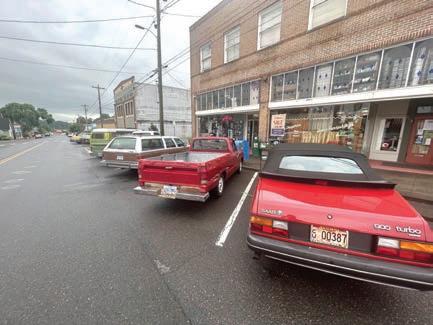
On June 8, the production company began preparing South First Street for its set. By the time the movie started shooting on June 9, the Riverfront District was transformed into a scene straight out of the ‘80s, with retro cars up and down the block and retro-styled storefront designs surrounding the Columbia Theater.
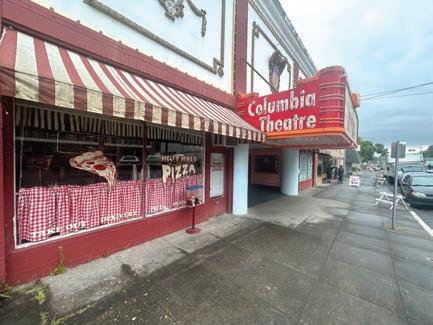
While it was a drizzly day, the cast, crew, and production workers went through their shoots despite the weather, observed by curious downtown goers and business owners.

Benefits of the Big Screen
The timeline by which this film will be completed is unclear, but the benefits of having a movie set in a small town can be substantial.
These are the three primary ways, according to Ridley:
1. Filming provides economic benefits and development to a town location by utilizing services, stores, paying for parking fees, permit fees, etc. Sometimes it can even provide jobs. Often a production will leave a location better than when they found it by making improvements that were necessary for production. Occasionally they may donate items, such as set pieces, or props, etc., to local schools and the like.
2. It galvanizes pride in the community - there is nothing quite like see-
ing your hometown playing a part on the big or little screen.
3. Exposure always provides the potential to attract new visitors. “Film Tourism” is a very fast-growing sector and can reach beyond the confines of traditional RDM or DMO tourism advertising; it is an exciting sector to embrace.
When asked about the economic value of allowing films to shoot in St. Helens, King’s response for the City echoed Ridley’s answers. King said that such projects
are a good way to increase tourism and visibility.
“Depending on how well a film does, being a filming location brings recognition to St. Helens and can create a tourism draw for people who want to visit popular movie filming locations,” King said. “We have seen this happen in St. Helens with Halloweentown and Twilight. Local businesses may also see a benefit from the production company shopping or dining at businesses while they are in the area.” St. Helens signature event, The Spirit of Hal-
loweentown, is held each fall, as the town leans into its spooky side during an event that draws people from around the country to tap into the Halloween spirit. The event began after St. Helens was featured in the Disney Channel Halloween classic Halloweentown in 1998. This year the Spirit of Halloweentown will last from September 16 - October 31.
Find more details about this upcoming movie in future editions of the Chronicle and online at thechronicleonline. com.
ODOT announces bridge closure projects
Originally published in The Chief Vol. 132 June 23, 2023
STAFF REPORT
Country Media, Inc.
Nightly single lane clo-
sures of the Lewis and Clark Bridge will begin Monday night June 26, as crews prepare for full closure of the bridge in July that could last for as long as eight days, according to the Oregon Department of Transportation (ODOT).

The night single lane closures are a major step in the project to replace two expansion joints and a fractured floor beam on the 93-yearold bridge between Rainier and Longview, Washington.
Closing the only bridge across the Columbia River between Astoria and Portland may create hardships for communities along the river and require residents to reschedule medical and other important appointments.
During the night lane closures, northbound and southbound traffic, controlled by flaggers, will share the open lane and alternate crossings.
The lane closure schedule:
• 8 p.m. to 7 a.m. Sundays through Fridays.
• 8 p.m. to 8 a.m. Fridays to Saturdays
• 8 p.m. to 9 a.m. Saturdays to Sundays.
Single lane closures will resume after completion of the July 16 full bridge closure.
No lane closures will take place over the Fourth of July holiday weekend, Friday, June 30 through Tuesday
July 5, or on Saturday, July 8 for Rainier Days. The five-week construction schedule of nighttime lane closures and the bridge closure of up to eight days shortens the construction timeline for this $1 million preservation project. It also avoids months of daytime single lane closures that would create congestion throughout Southwest Washington and Northwest Oregon.
Last April 12, bridge inspectors discovered a fractured floor beam resulting in an emergency 12-hour closure. Prior to that discovery, the bridge was scheduled to close for up to six days for the expansion joint replacement work. Because of the April 12 discovery, the closure has been extended to
accommodate the additional work of installing a new floor beam.
“Safety is our number one priority during the closure of this critical bridge, for travelers, construction crews and those who need access across the river for life-saving medical care,” said WSDOT Southwest Region Administrator Carley Francis. “We are asking the public to avoid use of the low-capacity Wahkiakum County Ferry in order to prioritize its use for first responders, healthcare workers and patients needing medical care who can’t wait.”
Construction schedule
The full closure of the Lewis and Clark Bridge for up to eight days begins at 8
p.m. on Sunday, July 16.
Emergency vehicles –including only ambulances with active critical medical needs or law enforcement emergency response – can use the bridge during the closure except when crews install the new floor beam.
This work will take place soon after the start of the July 16 closure. Due to safety, no park and ride facilities are available. There will be no single lane closures during the Fourth of July holiday weekend, Friday, June 30 to Tuesday, July 4, or Saturday July 8 for Rainier Days.
For the safety of travelers and the construction crew, the work zone will have reduced speed limits.
Plan for longer travel times
During the following times travelers should expect longer delays and congestion due to nighttime single lane closures:
• 8 p.m. to 7 a.m. Sunday through Friday.
• 8 p.m. to 8 a.m. Friday to Saturday.
• 8 p.m. to 9 a.m. Saturday to Sunday.
Plan ahead for lengthy detours
During the closure, all traffic crossing the Columbia River will detour to either U.S. 101 AstoriaMegler Bridge between Astoria and Megler, Washing-
ton or the Interstate Bridge on Interstate 5 between Vancouver and Portland. Ferry service
The Wahkiakum County Ferry between Cathlamet, Washington and Westport will run twice an hour, 24 hours a day while the bridge is closed. This ferry has extremely limited capacity and its use should be reserved for urgent matters that do not require an ambulance. A priority lane will be established and enforced to accommodate ambulances and first responders on return trips from the hospital in Longview; healthcare and first responder commutes to work; and medical needs like chemotherapy or other critical but non-emergency medical appointments.
All other travelers should expect hours of lengthy wait times and long lines.
Medical access
Depending on where people begin and end their travel, using the detour routes can add upwards of two and a half hours of travel time. People who use the SR 433 Lewis and Clark Bridge to access scheduled medical services should plan their travel time with this in mind and contact their providers to confirm or reschedule their appointments.
The traveling public can stay up-to-date on bridge repair news and closure dates may subscribe to email alerts for this project.
For real time traffic updates in Oregon go to TripCheck.com.
2023
Wednesday, June 28,
Free
Will Lohre / Country Media, Inc.
Production crew keeping the talent and filming technology dry with umbrellas and plastic wrap during the movie shoot.
Will Lohre / Country Media, Inc.
Melty Mike’s Pizza isn’t a new pizza joint in town, it’s just one of the store fronts installed by production for the film.
Will Lohre / Country Media, Inc.
Retro cars filled the block of South First Street, giving downtown an ‘80s vibe in line with the film’s goals.
Nightly lane closures begin Monday, June 26 in preparation for a full bridge closure of up to eight days starting July 16.
Courtesy photo from ODOT
BTU










Page 2 Wednesday, June 28, 2023 News Advertiser Columbia County Classifieds Listings are updated daily at thechronicleonline.com and thechiefnews.com Waterman Garage DoorsCCB#204858 SALES, SERVICE INSTALLATION 503.819.6715 St. Helens, OR 97051 Scott Waterman Owner Advertise your business in the Business & Service Directory. Call 503-397-0116 for more information YOUR AD HERE Columbia County BUSINESS & SERVICE DIRECTORY www.thechronicleonline.com Get your ad in the paper and reach out to potential customers. Call 503-397-0116 to place your ad in the newspaper and online. Garage Sale Special! Advertise your garage sale in the paper and online for only $10 for up to 14 lines! Email chronicleclassifieds@countrymedia.net to advertise! 312 Events 502 Help Wanted 104 Landscaping J.J. LANDSCAPING 360-241-6889 or 360-762-9220 Gardening needs, lawn maintenance, clean ups, bark, soil, planting, pruning, aeration, fertilization, weed control, retaining walls, patios, sprinkler systems, installation/ repair/maintenance, plant trees, blackberry removal, free estimates and I have references. 301 Health & Nutrition Alcoholics Anonymous Info-line, (503) 366-0667 www.pdxaa.org H21776 Sat., Aug. 26 & Sun., Aug 27 Looking for Vendors If interested contact Patty Watson 503-201-9912 or Beverly Anderson 503-300-9013 Regular vendors $50 Food vendors $150 Bay City Pearl & Oyster Music Festival 502 Help Wanted Corrections Sergeant Columbia County, OR EOE Deadline 7/14/2023 Apply at ColumbiaCounty OR.gov. Department Secretary Columbia County, OR EOE Deadline 7/14/2023 Apply at ColumbiaCounty OR.gov. Immediate Opening Sewing, taping, etc. Part-time 6-Noon, M-Th. Apply in person only. 33550 SE Santosh St. Scappoose, OR 97056. Pre Trial Services Specialist Columbia County, OR EOE Deadline 7/14/2023 Apply at ColumbiaCounty OR.gov. TRAINING & CERTIFICATION COORDINATOR Columbia 9-1-1 Communications District (C911CD) is conducting
Training
Apply
11.com/careers. Additional
on
702 Garage Sales For Sale Frigidaire
10,000
window unit air conditioner. Recently serviced. $150.00. Vintage kitchen table with 1-inch thick oak tabletop $175. 503-4109432. Moving Sale 43 years of collectibles, furniture, clothes, glass, plants and pots, antiques, dolls, TVs, animal cages, quilts and more. 6/30-7/3 from 9-4 at 33049 Stone Rd in Warren. Tea & Treasures community yard sale Saturday, July 8 from 10-3 at Christ Episcopal Church, 35350 E. Division Road, St. Helens. Tons of treasures to be found at multiple vendor tables! Bake sale with a huge variety of delectable treats. One day only! 502 Help Wanted 702 Garage Sales Paid Vacation Excellent pay D.O.E Yearly Bonus Steady Year Round Work Monday Thru Friday Paid Holidays HELP WANTED Quarry-Crushing Foreperson • Utility-Loader Operator Dump/Pup Driver • Equipment Mechanic/Operator BCX1996@gmail.com Rainier, Oregon 360.431.5599-Craig Send subscription info to PO Box 1153, St. Helens OR 97051 Card No. __________________________________________ Exp. Date _________________ Name ______________________________________________________________________ Address ____________________________________________________________________ City __________________________________ State ________________ Zip _____________ Phone Number ______________________________________________________________ Enclosed is my check for $70.00 Bill my VISA/Mastercard Subscribe me to the: The Chronicle The Chief $70 a year in Columbia County, $90 a year for outside county SUBSCRIBE TO YOUR FAVORITE LOCAL COUNTY NEWSPAPER AND GET FREE ACCESS TO ONLINE NEWS Advertise in the newspaper! Email Jon at chronicleads@countrymedia.net or call 503-397-0116. The Chronicle will be closed on July 4 in celebration of Independence Day. Please submit any classified ads by Thursday, June 22, by 5 p.m. and legal notices by Friday, June 23, by 12 p.m. July 4th updated deadline dates The Chronicle 503-397-0116 1805 Columbia Blvd. St. Helens, OR 97051 check the classifieds online at www.thechronicleonline.com to find your perfect job offer Need a job?
a hiring process for a
& Certification Coordinator.
online at www.columbia9
information can be found
our website or by calling 503-3696978.
Energy Star Certified














Wednesday, June 28, 2023 Page 3 News Advertiser Columbia County NEW TO THE CHRONICLE Online Insert Flipp Interactive Exclusive Deals from Fred Myer and more! go to thechronicleonline.com/inserts NEW TO THE CHRONICLE Online Insert Flipp Interactive Exclusive Deals from Fred Myer and more! go to thechronicleonline.com/inserts Hosting a ? Contact The Chronicle at 503-397-0116 or chronicleclassifieds@countrymedia.net to get your garage sale in the classifieds. 503-397-0116 1805 Columbia Blvd., St. Helens, OR 97051 The Chronicle Local news online Keep up to date on local stories, events, and ads by visiting thechronicleonline.com. Below is a list of WHERE to pick up a FREE copy of the print edition of the News-Advertiser. Also available every week at: thechronicleonline.com and at thechiefnews.com CLATSKANIE • CLATSKANIE SAFEWAY • HI SCHOOL PHARMACY IN CLATSKANIE • CLATSKANIE MARKET SCAPPOOSE • ROAD RUNNER GAS & GROCERY • JACKPOT 76 • ENGSTROM CHEVRON • B&B MARKET • FRED MEYER • SMOKE SHOP • NELSON NEIGHBORHOOD MARKET • ACE • GROCERY OUTLET ST. HELENS • CHUBB’S CHEVRON • SHERLOCK’S • YANKTON STORE • ZATTERBURG’S • MARKET FRESH • WALGREENS • BEST WESTERN • MOLLY’S MARKET • ACE • DON’S RENTAL DEER ISLAND • DEER ISLAND STORE COLUMBIA CITY • COLUMBIA CITY GROCERY & GAS RAINIER • ALSTON STORE • DOLLAR GENERAL WESTPORT • THE BERRY BATCH RESTAURANT • WEST MART STORE thechiefnews.com 503-397-0116 The Chief Read The Chief online Visit thechiefnews.com to get access to local news daily. Available on your home computer, tablet, and smart phone. Enjoy live access to local classifieds, obituaries, sports, and traffic news. Let us know what YOU think EMAIL YOUR LETTERS TO: CHRONICLENEWS@COUNTRYMEDIA.NET

Page 4 Wednesday, June 28, 2023 News Advertiser Columbia County
