



Since 2000, in most years the federal government has sent around half a million dollars a year to Tillamook County as part of the Secure Rural Schools Act, to account for decreased harvests in the Siuslaw National Forest.
But for the past two years, the act has not been renewed, reducing the county’s income from the land to just over $70,000 last year, and even that reduced funding is now in jeopardy after the Big Beautiful Bill removed revenue sharing of harvest receipts with counties.
Tillamook County Commissioner Erin Skaar said that representatives from Oregon counties that depend on the revenues are working with members of Oregon’s congressional delegation to restore the funding, which represents a contract between the federal government and western counties to account for decreased property tax payments.
“This was an agreement made by the federal government in order to help the states of the west be able to provide for education and general government,” Skaar said. “They knew that they were going to have to do something and so this was their contract with us and the federal government has essentially rewritten that contract without our approval.”
The origins of the Secure Rural Schools Act (SRS) date back to 1866, when the federal government granted four million acres to the Oregon and California Railroad to build a rail link between the two states. After that project’s completion, the government sold off what excess land it could in 1926 with the Stanfield Act, before establishing a revenue-sharing model for revenues from the land in 1937 with the Oregon and California Railroad Act.
For decades, counties received a portion of the revenue from timber harvests on the railroad lands, until the 1980s when repeated lawsuits from environmental groups led to drastic cuts in timber harvests. The ensuing cuts to county budgets led to the passage of SRS in 2000, giving counties a choice to either receive a portion of timber revenues or a payment unrelated to the amount harvested. As a bill with budget impacts, SRS must be renewed every two years, and except for 2013, it had been in the past.
In 2024, Tillamook County received $663,607 in SRS payments, while last year it received just $70,000 in income from its portion of harvest receipts. In both cases, those funds were split with local school districts, with 75% going towards county roads and 25% to schools.
Making matters worse, not only has congress not reauthorized SRS, but as part of the Big Beautiful Bill, they removed provisions allowing for the split of timber receipts with the counties, meaning the county


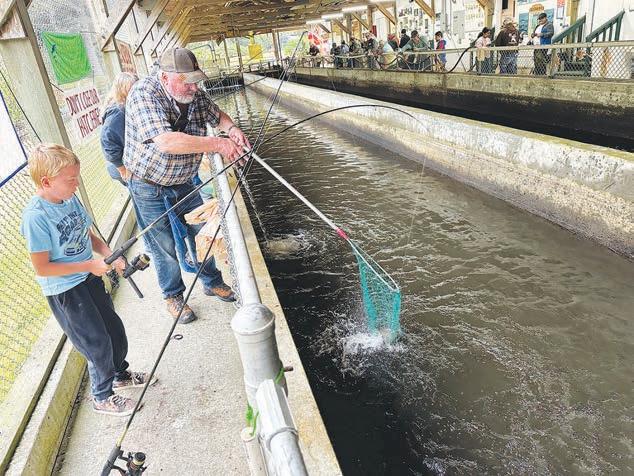
Families with members with intellectual and developmental disabilities from across the state converged on the Whiskey Creek Fish Hatchery on September 13, for the Tillamook Anglers’ 37th annual Kids and Adults with Disabilities Fishing Day.
In conjunction with staff from the Oregon Department of Fish and Wildlife, volunteers from the anglers helped to stock more than 900 rainbow trout from a Nehalem hatchery at Whiskey Creek and give participants the thrill of fishing.
“It’s a work of love really, you talk to all these guys that volunteer, and they all love it,” said Jerry Dove, a founding member of the Tillamook Anglers.
The idea for a disabled fishing day arose in the second year of the Tillamook Anglers’ existence in 1988, and Dove works with hospitals and charitable groups from across the state each year to get the word out about the event.
Designed to give people of all abilities easy access to an opportunity to fish, the day is one of the anglers’ two big events of the year, with the other being a finclipping day in the spring that
sees more than 100,000 spring Chinook salmons’ adipose fins clipped.
At the disabled fishing day, participants were allowed to catch up to three trophy trout
weighing two pounds or more, which are raised at a hatchery in Nehalem and transported to Whiskey Creek by Oregon Department of Fish and Wildlife staff, who release any excess
fish into Cape Meares Lake following the event. There were also free coffee and doughnuts at the event’s beginning, complimented later by a BBQ lunch and Tillamook Ice Cream.
County commissioners from across Oregon, other elected officials and staff from state agencies traveled to Tillamook County for a tour of natural resource industry sites hosted by the Tillamook Working Lands and Waters Cooperative on September 18.
Attendees toured the Martin Dairy, inspected a timber harvest in the Short Creek watershed on Cape Meares and visited the Trask River Fish Hatchery, focusing on
the importance of and steps taken to protect water quality in each industry.
Tillamook Working Lands and Water Cooperative (TWLWC) is a group made up of representatives from Tillamook’s natural resource industries that works to educate the public on the sustainable practices being used to manage the county’s resources. TWLWC hosts annual field tours for different groups to give locals and people from across the state a firsthand look at industry practices.
September’s tour started at the
Tillamook office of the Oregon department of forestry, with Tillamook County Commissioner Erin Skaar welcoming attendees and leading a round of introductions.
The group then proceeded to the Martin Dairy, where they were treated to a tour by fifth-generation dairy woman Taryn Martin. The Martin Dairy is home to around 700 Jersey cows and recently completed a $1.8-million transition to robotic milking equipment for its herd.
On the tour, participants got a look at the milking machines, which monitor milk quality and
quantity throughout thrice daily milkings of the cows. The dairy has nine robots, each capable of milking 60 to 70 cows.
Martin also discussed the importance of nutrition at the dairy, describing the mixing of various nutrients including grass, corn and soybeans to maximize the herd’s milk yield.
Tour attendees were then given an opportunity to spend some time with the dairy’s calves. The Martin
See LANDS, Page A2
Tillamook City Council voted unanimously to approve an 18% increase in the city’s water rate, which will see the residential base rate rise from $15.04 to $17.75 in October or November, at their meeting on September 15.
Council declined to approve matching 18% increases for each of the next four years, as recommended by a water rate study completed earlier this year, saying they instead preferred to revisit rates annually and adjust as necessary.
The water rate raise question has been on the horizon since May, when preliminary results from the then ongoing rate study revealed that a 15% rate increase would be necessary this fiscal year to meet the city’s water needs. Council declined to raise rates then, saying that they preferred to see a completed rate study before deciding.
In August, City Manager Sean Lewis brought the results of the

rate study to the council, revealing that an 18% increase in water rates would be needed each of the next five years to avoid the water fund becoming insolvent. Council declined to take a vote on the increase at their September 2 meeting, owing to the absence of Mayor Aaron Burris and Councilor

Brian Reynolds and returned to the question on the 15th. At the meeting, Lewis delved deeper into the reasons driving the need for increased rates, primary among them the project to replace the city’s water main line that runs through the Port of Tillamook Bay and under its runway. Originally


budgeted at $18 million and funded through the American Rescue Plan Act of 2021, the cost of the project has since escalated with inflation, leaving the city more than $7 million shy of the current projected budget.
Lewis said that the city had been unable to get loans to cover that gap because of the fund’s financial status due to low rates. However, in the first week of September, Business Oregon’s board approved a line of credit to bridge the shortfall, but only on the condition that the city’s water fund remain solvent through rate increases.
Lewis emphasized the criticality of the project and pointed out that if the city were not to proceed with it, they would be on the hook to repay more than $3 million already spent on design and engineering for the project to the federal government.
Lewis also stressed that the
Staff REPORT
Oregon Department of Transportation projects on Miami-Foley Road and the Tillamook River Bridge on Oregon Highway 131 are both nearing completion in the coming months.
The Miami-Foley project, replacing two temporary bridges installed after culverts washed out at Crystal and Dry Creeks in a 2023 storm, is on pace for completion this winter. Crews closed the road on September 8, removing the old beams from the Crystal Creek span, and are planning another
project and rate study both preceded his tenure with the city and that his recommendation to raise the rates was following the council’s guidance and the water rate study to implement rates that
closure in the week of September 29, to place the final new beams. An Oregon Department of Transportation representative said that the project was on schedule and on track for completion in winter 2025. Preservation work on the Tillamook River Bridge on Highway 131 is also on schedule, with bearing pads being replace and concrete being repaired on the center span in addition to a complete repainting of the structure to extend its service life. Work began in late May and should be complete in October or November.
would solve the water fund’s solvency issues. Lewis said that he understood citizens’ frustrations about the proposed increases and that the council could decide to increase the rates for just one year if they desired. In conclusion, Lewis said the main line replacement project could be completed by next year, and that raising rates was crucial to achieving the project and keeping the

On Tuesday, September 9, 2025, at 8:25 a.m., the Oregon State Police responded to a single-vehicle fatal crash involving a pedestrian on Highway 6 near milepost 30 in Tillamook County.
The preliminary investigation indicated a white Freightliner semi-truck, operated by Scott Lee Gotchall (64) of Portland, was traveling eastbound on Highway 6 near milepost 30 when a pedestrian, Jaime Cristobal Aguilar Herrera (25) of Beaverton, entered the lane of travel for an unknown reason and was struck by the semi-truck.
The pedestrian (Aguilar Herrera) was pronounced deceased at the scene.
water utility operating.
“We have failing infrastructure,” Lewis said. “We are obligated to provide clean water to our residents and to our customers. We have to have a fund that is solvent. We cannot continue to deficit spend on our water.”
Burris said that he was willing to commit to revisiting the rates every year for the next five years for the increases and that he favored doing so in case a

way to make the increases smaller was identified, which Councilor Nick Torres agreed with. Councilor Sylvia Schreiber said that she would be comfortable with approving increases for one to three years but that she felt five was too much, while Councilor John Sandusky said that he favored ripping the band aid off and approving the five-year increase. Reynolds moved to approve the increase for one

The operator of the semitruck (Gotchall) was not injured.
The highway was impacted for approximately 3.5 hours during the on-scene investigation. OSP was assisted by the Tillamook County Sheriff’s Office, Tillamook Fire and the Oregon Department of Transportation.
year and the council voted in favor unanimously. Lewis said that the increase would take effect in either October or November, with the base rate going from $15.04 for 4,000 gallons to $17.75 for 2,000 gallons, with each additional 1,000 gallons consumed going from a cost of $10.93 to $12.90.
At the end of the meeting, Lewis addressed the vacancy of the Ward 2 city council seat, which has been absent
since the spring. Lewis said that nobody has applied for the position, despite the city advertising it and sending mailers to all residents of the ward.
According to the city’s charter, councilors must reside in the ward they represent—Ward 2 is on the west side of town—and Lewis asked councilors to try to recruit a candidate.
flowing to the counties and Skaar said that a lobbyist for the Oregon and California Railroad counties is also trying to marshal support for reauthorization.
Skaar said that she hoped the change to revenue sharing had been an oversight in a hectic legislative process and that legislators would listen to the lobbyist and a group of commissioners who visited last week but said that she was not planning on it as part of the budgeting process.
“We hope the legislators hear their message and that they’ll be willing to take it up,” Skaar said, “but it’s just hard to say and in the conservative sense, we just don’t plan for it.”
funding

Dairy sees about 700 calves birthed annually, with bulls sold, while cows spend the first five to six months at the dairy, before traveling to Boardman until they have their first calve at around 18 months and begin giving milk.
After leaving the dairy, the tour moved on to a timber harvest on Cape Meares in the Short Creek watershed. There, John Wehage from Stimson Lumber, discussed the steps the company takes to preserve water quality in watersheds where it operates and coordination with local water managers.
Wehage said that Stimson’s logging operations are governed by four layers of rules and regulations, starting with the company’s own bylaws, sustainable forestry rules monitored by an outside auditor, the private forest accords developed with the Oregon Department of Forestry and a final set of rules from the Oregon Department of Agriculture.
At the harvest, Wehage discussed how the private forest accords adopted in 2021 had increased riparian buffer zones and expanded protections to new classes of fish-bearing waterways. He also detailed how Stimson works with land managers from local water utilities to alert them of operations and address any potential concerns.
In Tillamook County, Stimson manages forestland in watersheds that provide drinking water to seven different communities, and representatives from five of those communities’ water utilities were present on the tour and briefly discussed their watersheds. Stimson gives those managers advanced notice of any harvesting or herbicide applications in their watersheds and the managers said that they ap-
preciated the open channels of communication with the company.
Finally, the group traveled to the Trask River Fish Hatchery, where they first stopped at the hatchery’s fish passage barrier, which helps to prevent the spread of disease by limiting the territory the fish have access too. The barrier is also next to the hatchery’s upper tanks and the intake on the Trask River that supplies the hatchery’s lower tanks. Ryan Fenwick from the hatchery discussed how the source water was clean and cool thanks to Stimson’s management of the watershed above it, providing ideal conditions for fish to spawn.
Trask River Fish Hatchery was founded in 1914 and is operated by the Oregon Department of Fish and Wildlife (ODFW), currently producing 150,000 fall chinook salmon, 400,000 spring Chinook salmon, 100,000 brood stock coho salmon for the Trask River and 150,000 wild brood stock steelhead annually.
Next, the tour visited the hatchery’s upper fish tank
where 150,000 steelhead smolt were currently resident, and Fenwick discussed how the fish’s adipose fins would soon be clipped in an automated process in a special trailer owned by ODFW.
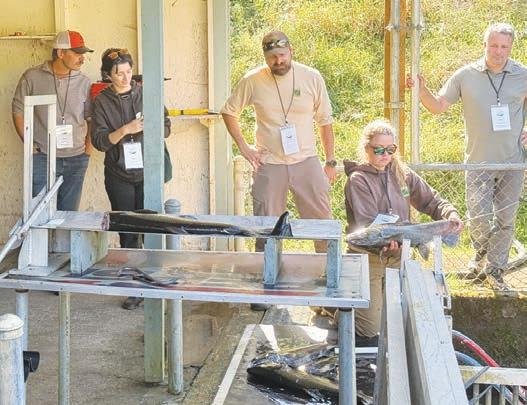
The tour then moved on to the lower part of the hatchery. There, spring coho were being gathered as they returned up the Trask before staff scan them for tags placed by fisheries and harvest eggs from the female fish.
Hatchery team member Amy Bennet demonstrated the method used to measure the fish and recover the tags, which consists of chopping off the portion of their snouts with a tag and sending them to another hatchery for analysis. The tags help the Oregon Department of Fish and Wildlife to track the fish’s returns and the amount of time they spend in the ocean.
Finally, the group entered the hatch house, where fertilized eggs were currently on racks of trays while the fish gestated before they will later be transferred into larger tanks. The group then



moved to the hatch house’s second story and examined the facility’s filtration system that removes sediment from water and used UV light to treat it before it is used for spawning, concluding the tour.


















By CHELSEA YARNELL Guest Contributor
When someone learns to garden, the whole neighborhood gets zucchini. And Country Squire customers have been treated to dishes from the fall harvest, including grilled zucchini in veggie bowls and banana zucchini bread with honey butter, each made even better by the fact that the featured ingredient was grown in the chefs’ garden.
Owners of Country Squire food cart, Amanda and Patrick King grow some of the produce used in their dishes at their micro farm: Country Squire Acres.
The Kings’ idea for a farm won the first season of LevelUp Tillamook hosted by the Economic Council of Tillamook County with support from Tillamook Bay Small Business Development Center in January 2024. Their winning proposal resulted in a $10,000 prize that they then used to transform their front yard into an abundant garden.
“Through communicating with city planning, we found out that our property is multizoned, and we can do agriculture on it,” Patrick said. “We’re focusing on a micro farm and working on the infrastructure. It’s a smaller scale than we planned, but
it’s even more perfect.”
Their first growing season produced various berries, cucumbers, herbs, peas, carrots, lettuces and lots of zucchini; a bounty that was creatively utilized in their food offerings at the food cart.
“The competition really kicked off our farming dream. We wouldn’t have been able to do it without it,” Amanda said. “It was a lifesaver and created a real path with resources towards our goal. It took our five-year plan to a one-year plan. It definitely helped us a lot.”
Expanding their farm-totable practices is not the only thing that has changed since winning the LevelUp competition. The Kings relocated their food cart from Garibaldi to Tillamook in January, and Country Squire now sits on de Garde Brewing’s property on Ivy Avenue.
Their new partnership is symbiotic for the two businesses: customers can eat food inside de Garde Brewing’s indoor dining area and pair a drink with their meal.
“In the winter, Garibaldi was a little slow for us and was hard to get through. So, we started looking for places closer to home and found this location with Trevor and Lindsey,” Patrick said. “Our sales are already up 20 percent compared to last year.”

Country Squire features a simple menu with three items, three different ways. Pick: sandwich, wrap or rice bowl; with chicken, pork, or veggies.
“It’s fresh, flavorful, and filling,” Patrick said. “We’re doing something that people can grab quickly.”
With a simplistic menu, it keeps the execution of each order flawless every time and frees up creative space for their specials.
“We run up to five specials at a time,” Amanda said. “That way we don’t get bored.”
As a skilled pastry chef, Amanda often stocks the food cart with her specialty baked goods, recently featuring the produce from their micro farm.
As the Economic Development Council of Tillamook County looks to host future LevelUp competitions, the Kings encourage entrepreneurs to participate but has some advice.
“Break down your numbers and make sure that you have everything listed. The judges that we had really liked seeing our spreadsheets and how thorough everything was,” Patrick said.
“We also had business logo stickers on our shirts and hats and that showed we were invested,” Amanda said.

The couple also noted that competition fostered some great resources.
“LevelUp provided so many connections and so much encouragement,” Patrick said. “The EDC and SBDC doesn’t do your business for you, but they are someone in your corner and have been our biggest cheerleaders.”
Try dishes featuring
produce from Country Squire Acres at the Country Squire food cart, open Thursday, Friday, Saturday, noon – 7 p.m., Sunday 11 a.m. – 5 p.m., or until sold out. This series is provided by the Economic Development Council of Tillamook County to highlight thriving businesses in Tillamook County. The EDCTC works to strengthen and grow
the economy of Tillamook County by working together with public and private partners. The EDCTC works to attract new business, grow and retain existing businesses while supporting entrepreneurship and innovation. For more information, or to reach out to the EDCTC, visit edctc.com.
WILL CHAPPELL Headlight Editor
On August 28, deputies from the Tillamook Sheriff’s Office have worked with staff from the Departments of Public Works and Community Development, and Solid Waste Program, as well as













Burden’s Towing to remove four abandoned RVs, three cars and a flatbed trailer from roadsides across the county.
Building on that momentum, the office then had an inspector come out and test ten RVs in their possession for asbestos, which is still used in RV construction, a necessary step in the process of having the RVs destroyed. That testing and resulting remediation costs combined with the costs of towing and storing the vehicles and the difficulty of tracking down a registered owner for them make their removal a particular challenge for the county, but one that Tillamook County Commissioner Paul Fournier is working to tackle. Fournier said that the recent spate of removals had been motivated by community members asking him why the county was allowing RVs to sit abandoned, especially along particular roads like Miami-Foley and Hobsonville Point. Fournier sought an answer and found that while the county had funding for code enforcement services, it was split between funds for two halftime positions in the community development department and solid waste program. This division has meant that the roles were usually filled by retired sheriff’s deputies who did not have the time to deal with complex processes such as removing abandoned RVs and cars from county rights of way, and exacerbating matters both positions are currently vacant.
To address the underlying issue, Fournier plans to work with the involved departments to identify a suitable home for a full-time code enforcement officer.
In the interim, Fournier reached out to Public Works Director Chris Laity, Solid Waste Program Manager Justin Weiss, Community Development Director Sarah Absher and Sheriff Josh
Brown to work on a solution.
“I went to solid waste, went to public works, and talked to them to see what their capacity was, went to the sheriff’s office,” Fournier said, “he was already sick of it because he was getting tons of calls.”
One of the main bottlenecks stalling action was a lack of available space in the county’s storage lot at the Port of Tillamook Bay, where impounded vehicles need to sit for 30 days in most situations before they can be scrapped. Don G. Averill Recycling, which takes impounded cars from the county free of charge, also leaves those vehicles in the lot until scrap metal prices are favorable for their junking.
The other sticking point for the removals is the cost of removing and undertaking required inspections of the RVs. According to Fournier, towing an RV to the lot costs between $200 and $800, depending on the vehicle’s condition and location, paying for an inspector to visit the county costs $290 per RV and remediating any asbestos found can cost up to $5,000.
The sheriff’s office’s budget includes $10,000 annually to deal with abandoned vehicles, sufficient to pay for the recent removals, and after shuffling some vehicles around, space was found for the RVs and cars.
Deputies first tagged the identified the vehicles, giving 24-hour notice of towing, before having them towed on the 28th. After an appraisal, an inspector visited the lot and tested the four RVs and six that were already present, with three identified as having or probably having asbestos, while the other seven were cleared.
Fournier said that he, Brown, Laity, Absher and Weiss have formed a task force to build on the recent success, cut down on the
costs associated with removal and make the process as efficient as possible. “We’re looking to have a process in-house to get these problems taken care of quicker,” Fournier said.
To cut down on costs, Fournier said that he hoped to train a county employee to perform the necessary asbestos inspections on RVs, which would reduce the cost of testing from $290 to $90. Fournier said that the group was also discussing the possibility of public works transporting abandoned RVs and destroying them following inspection, solid waste taking care of their disposal and where a full-time code enforcement officer should be housed in the county government.
Fournier said that Absher is also in the process of updating ordinances for code enforcement and that he was working on an ordinance that would limit parking in pullouts to eight hours.
Beyond the logistical and financial questions, Fournier said that the problem is also challenging simply because of the range of departments and processes involved. For example, vehicles parked in rights of way are the purview of the sheriff’s office whereas those on private property are the responsibility of the property owner, unless they become a nuisance at which point they fall under the purview of solid waste, which must initiate a hearing process to deal with them. In the past, this has led to abandoned RVs and other code enforcement issues slipping through the cracks, but Fournier said that he believes the members of the task force are committed to addressing the issues and is optimistic that they will bring positive results to bear.
“We finally have depart-
When we think about reinvigorating our gardens, we usually think of doing so in the spring. And that’s not a surprise because after a long, rainy winter, who isn’t ready for a trip to the nursery on a nice day in May when the shelves are stocked with all sorts of wonderful offerings?
But the smart gardener will realize that autumn is just as good a time to shop, and for certain plants, may be even better. Garden soil has had all summer to warm up and the compost we have spread in April and May has continued to feed the soil for 4 or 5 months. Plants require healthy root growth to thrive, and the warm soil allows them to do just that. When we plant a new plant that has been grown in a pot, we want to gently “tickle” the roots so they can more easily spread out and not continue to grow in circles. (This is true any time we plant from a nursery pot, not only in the fall.)
While we haven’t had a particularly warm summer on the coast, the cooler fall days can be less stressful on new plants than the hot summer sun. The cool days also inspire improved root growth. By this time of the year, many plant pests and diseases have diminished, too, making the use of pesticides or insecticides less necessary. The exceptions are slugs and snails which will thrive in the cool, wet weather for a few more weeks and will need slug bait until the ground cools again. My favorite reason for fall planting, though, is that most local nurseries and garden centers will be holding fall sales, allowing our dollars to go farther. I have noticed a dramatic increase in the cost of plants over the last couple of years. And since very few plants are imported from abroad (except for bulbs), we can’t blame that on tariffs. I think the prices are reflecting the increase in costs for growers in developing new plants and hiring people to work in the fields. But whatever reason, it’s nice to have a sale now and then.
For those of us lucky enough to have sun to grow some vegetables, fall is a great time to plant those fastgrowing crops like carrots, spinach, lettuce and kale. The lettuces can be planted now and harvested before the first frost and carrots can

CARLA ALBRIGHT

be allowed to grow – albeit slowly – over the winter, harvesting as needed. Garlic is another great fall-planted crop that will be harvested next summer.
A lot of perennials can be planted now, too. Rudbeckia, Salvia, bee balm (Monarda), hardy chrysanthemums and asters will add structure as well as fall color to your garden. Bare-root roses, however, will need to be planted a couple of months before the first frost to establish themselves before they go dormant. (Well, as dormant as roses get on the coast.)
And if you are looking for a new tree or shrub, Autumn is the absolute best time to add them to your garden. They will establish their roots easier and be ready to go next Spring. Consider planting hydrangea, peonies, fruit trees, lilacs or forsythia. Of course, spring-blooming bulbs should go into the ground now, too. Tulips, crocus, daffodils, hyacinth and allium will all put on a show-stopping spring display if planted in the fall. All require the cooling-off period of Winter to trigger blooming next year. Be sure to follow instructions for planting on their labels as some bulbs like to be planted deeper than others.
Mid-September is a good time to start prepping the garden for planting. Clear out the summer annuals and vegetable crops and deal with the weeds to make room for new plants. Since I have a lot of hosta and astilbe in my garden and they die back in the Winter, I mark each plant as I cut them back, so I know not to plant anything on top of them. Bamboo stakes work great for this.
I use a Sharpie or pencil to write on the stake what is planted below.
Once you have everything located and planted, be sure to water the new additions, at least until fall rains come. Then you can turn that chore over to Mother Nature.
By JUSTIN AUFDERMAUER Executive Director Tillamook
Chamber Of Commerce
At the Tillamook Chamber, one of our key strategic priorities is Business Growth. That goal is broad and often looks different depending on the project or season. Sometimes it means ongoing programs that support local businesses, and other times it’s unique initiatives that bring long-term value to our community. Earlier this spring, we launched one of those special projects in partnership with the Tillamook Coast Visitors Association: installing pedestrian wayfinding signs in downtown Tillamook.
The Chamber was
LETTERS TO THE EDITOR Letters to the editor should contain at most 350 words. The Headlight Herald reserves the right to edit, condense, or reject any letter to the editor. Letters published in The Headlight Herald will also be published online.
Letters to the editor and guest columns must include your first and last name, city or town or residence, and phone number for verification purposes.
Letters endorsing candidates or campaign issues must be received no later than ten days before an election. Letters written by candidates will not be accepted. Letters to the editor should be the author’s work.
We strongly discourage and will attempt to weed out form letters, letters mailed to other news outlets, or letters written and edited by a third party, including but not limited to political parties.
We try to restrict the printing of one submission per author per month. We do not publish anonymous letters, personal attacks, personal complaints, poetry, consumer complaints, or letters written in bad taste.
Letters need to be submitted by 4 p.m. Wednesday the week prior to publication.
While we strive to publish all viewpoints, Headlight Herald and Country Media reserve the right to refuse to publish any letter or guest editorial.
OBITUARIES
Obituaries need to be submitted by 4 p.m. Wednesday the week prior to publication.
SUBMISSIONS
Submissions may be sent in by:
• Email: Editor Will Chappell at headlighteditor@ countrymedia.net
• Mail: Headlight Herald P.O. Box 444, Tillamook, OR 97141
• Stop by our office: 1906 Second St. Tillamook, OR
actually the first to partner with TCVA and Partners in Design back in ___. Their vision was to create a coordinated signage system that welcomes and guides visitors throughout the county. We developed a multi-phase plan – with the first phase focused on gateway or “Welcome” signs—those attractive markers placed at community entrances. Here in Tillamook, those gateway signs were completed in 2019 and have since been installed in other parts of the county as well. Now we’re moving into phase two: pedestrian wayfinding. This system of signs and maps is designed to help people confidently navigate a city on foot. As residents, we often take our landmarks for granted. We drive past
the kayak launch, the veterans memorial, or even another brewery without giving them a second thought. But for a visitor, discovering these places often requires a simple sign pointing the way. For example, if someone is enjoying an afternoon at Pelican Brewery & Taproom, wouldn’t it be helpful to direct them just a block away to another brewery, or to show them that a paddle on the river is just steps away?
Every time I encounter wayfinding signs in other cities, I feel instantly welcome. Their presence says: we care that you’re here, and we want you to explore what makes this place special. That feeling matters. Visitors who feel oriented and encouraged to explore are
more likely to stay longer, shop, dine, and return. And the reality is, many of our local businesses rely on that support. While these signs are designed with visitors in mind, I am also proud of what they represent for us as residents. They are a visible investment of lodging tax dollars, supporting not only tourism but also building community pride. They remind us that Tillamook is worth showing off. This fall, keep an eye out for a dozen new highquality wayfinding signs in downtown. They will serve our visitors, support our businesses, and remind us all that Tillamook is a community worth exploring.




“Meet you at the box,” the post said. And on September 13, more than 30 did—Cape Meares residents and friends interested in looking at the new Container Express (Conex) box that is now a keystone of emergency preparedness efforts here. The Cape Meares Emergency Volunteer Corps (CMEVC) was awarded the box after a great deal of hard work applying for a grant from the Oregon Department of Human Services’ Office of Resilience and Emergency Management earlier this year. More work came after that: CMEVC had to scramble to get the box
Thanks to Melanie Merryman for word that South Tillamook County Library Club Board Members will host an open house to celebrate our library building’s 30th Anniversary. It’s scheduled for 10 a.m. through 2 p.m. on Sunday, September 28 at the library. Besides refreshments, visitors can view a presentation of the history of the library and its thrift shop. South Tillamook County Library is located off Brooten Road on Camp Street in Pacific City. This event occurs in conjunction with the last Pacific City
Wow, we certainly had a hot day last Tuesday, my thermometer read 91 degrees and along with that strong east wind, it was a day to stay out of the sun for sure. Glad it only happens occasionally, our normal coastal weather is so much more pleasant, and we just aren’t used to the heat. Even though we had the hot day, fall is definitely in the air, leaves are beginning to turn, and plants are giving us their last bursts of color, especially dahlias.
My youngest son, Thor, is
Well, those tomatoes in my garden are still pretty green, so I’ve decided to make green ketchup. My niece has a commercially made green ketchup on hand that I found pretty tasty, so I’m hoping I can make something similar. (anybody got a good recipe?) There are still beets to harvest and make into pickled beets; still rhubarb, tomatillos and
legally placed and outfitted in time to meet the grant’s parameters. Tillamook County Commissioner Erin Skaar was on hand at this box event; she is one of the key individuals who helped CMEVC cut through the red tape to get the unit installed. The box is stocked with water, meals-ready-to-eat (MREs), and other emergency prep supplies. Security is tight at the site, with motion detector cameras and fences topped with barbed wire. Also at the box event, Capt. Pete manned a “gobag” table, handing out lists of things to put in a grab ’n go bag and displaying all

Farmer’s Market for this season, which runs during the same hours in the library’s parking lot. South Tillamook County Library hosts a story time at 3:30 p.m. on second and
here visiting this week from Colorado Springs. Apart from the long list of chores I have for him to help me with, I’ll be giving him some breaks to enjoy our area. We will walk at Kilchis Point, proudly show him our new Booster Club Park and we’ll take some time to kayak and go to the beach. The Riverbend Players will be presenting The Invisible Man, a live radio play at NCRD in Nehalem, from 9/26 through 10/12, with performances on Friday and Saturday at 7 p.m., and on
straggling green beans. And more tomatoes.
This old lady made it to Kyler’s Big Heart event last Saturday. It was a beautiful evening, not too chilly. There were games (heads and hinnies) and some fun auctions – like going to the trailer after the show to hear Jacqui sing a new song or having Stee come up for a duet. There were two food trucks

the items that fill his own bag. Pete is a neighborhood captain with CMEVC. To find out who your neighborhood captain is, visit https:// capemeares.org/emergencypreparedness/map-yourneighborhood/. Next up for
fourth Wednesdays (September 24 and October 14). All ages are welcome. Story time includes “reading and singing and moving about.” Directions to the library are provided above.
Kiawanda Community Center (KCC) serves senior lunches at 11:30 a.m. on Tuesdays (September 23) and Wednesdays (September 24) weekly for $3 each. (Others may partake for $6.) They also host Bingo from 1-3 p.m. on Thursdays, weekly. My source describes buy-in as low as $5 with cash prizes awarded to winners in several catego-

Sundays at 2 p.m. The H.G. Wells classic sci-fi thriller will be performed in the oldtime radio style, complete
with Mexican and Seafood options. Beverages had been donated for the event. And it was family friendly; there were kids of all ages in attendance.



emergency preparedness: The ShakeOut drill on October 16 at 10:16 a.m. Thank you, CMEVC, for everything you do to protect our community and prepare us for possible disasters. Earlier this month, Cape Meares welcomed a group of shape-note singers for their annual sacred harp singing here in our Barbara Bennett Community Center. Sacred harp, or shape-note, singing uses special musical notes that differ in shape from traditional musical notation and designate specific syllable sounds (fa, sol, la, etc.). An unusual type of communal and typically religious sing-
ries. The address is 34600 Cape Kiawanda Drive in Pacific City. Community Action Resource Enterprise (CARE) will host a drop-in legal clinic from 10 a.m. until noon and from 1-3 p.m. on the last Friday, monthly. For September, the date is this Friday, September 26. Oregon Law Center staff the event. Low-income households can receive advice on civil matters (domestic violence, employee’s rights, public benefits, and tenant’s rights). They don’t assist with criminal matters. CARE’s address is 2310
with live Foley sound effects performed on stage. This show will give you edge of the seat suspense. Tickets are available online at RiverbendPlayers.org
Hairspray will be the final musical movie to be shown in September at the Tillamook main library, then it’s bring on the spooky season, the main Tillamook library will be showing some Halloween inspired movies on movie nights, each Wednesday in October, all shows will be beginning at 6p.m. Many of the films are

By the time Stee came on, the event tent was pretty full of folks, mingling, eating, dancing. Stee, bless his heart, started with a Motown favorite from Marvin Gaye (My Girl) and just kept go- ing from there. (I grew up in Motown.) Now, my feet and my knees, they just don’t really dance anymore. But I can move in a chair in time to the music. And I did.
Both Stee and Jacqui Roar were The Voice Season 24 finalists. And while Stee captured by Motown heart, Jacqui Roar was also stellar. She was like the heart of rock and roll. And can she belt out a tune. It was a good thing that chair of mine stayed in one place. She sang the song that helped her win her finalist spot - Stevie Nicks’ The Chain. Mid-set, Stee came up on stage for a duet – they sang Billie Jean, by Micheal Jackson. It was a great concert here in Garib-
ing, shape-note singing has its origins in 11th-century Italy and was subsequently popularized in America’s South. This particular group of shape-note singers has been meeting here in Cape Meares for years. They sang all day on the Saturday after Labor Day, and they have always invited the neighborhood to come listen and/ or sing with them. We were glad to have you here once again, shape-note singers. The sun shone brightly on Tillamook Bay on September 16. The Burkes, full-time Cape Meares residents, trailered their boat up and over the cape to get around to the Memaloose boat launch to go salmon fishing. They trolled up and down the bay, bemused that the hot day had at least one fisherman fishing shirtless, and they saw a few fish boated. Kevin told Kathy that he thought he had forgotten what it was like to have a fish on when, bam, a fish hit. Kevin played that fish for quite a while as Kathy reeled up, put away her rod, and got the net. Finally, he brought it to the boat and Kathy scooped it up: a 15-pound hatchery Chinook. On Kevin’s birthday. Happy birthday fish, Kev.
First Street in Tillamook. Nestucca Water District has alerted their customers of a “Level 1 Water Shortage.” Until further notice, water use within the district should be limited to drinking, cooking, hygiene and interior household cleaning, only. Customers must not water gardens, wash their home, outbuilding/s, or vehicle/s, fill wading pools, or run sprinklers for water play. We’re being asked “not to use water excessively for any reason.” Should the issue progress to a “Level 2 Water Shortage,” each household will be
classics, starting with the 1931 Dracula on October 1, Creature from the Black Lagoon 10/8, 1973’s The Creeping Flesh on 10/15, the 1974 production of Young Frankenstein on 10/22 and closing the month the 1961 film, The Innocents. On September 25th at 10 a.m. the Bay City Library will hold Family Story Time, always a fun event to take your little ones to. Bay City is in the early stages of planning the Trunk or Treat on Halloween. Last year’s first-time event was
aldi.
According to Amanda Cavitt, people have been reaching out saying it was an incredible night, and they can’t wait until next year. I would agree. Donations are still rolling in, so if you’d like to contribute to help save a life, reach out to Amanda or Dennis Cavitt at either the Portside Bistro, or the Bar View Jetty Store.
Garibaldi’s Fire Department personnel were there also, and volunteer firefighter “Dr. Tom” came up on stage to explain what an AED was; he had one with him. These life saving devices will be where we and tourists frequent, so if the need arises, help will be available. That was the point of this benefit event. To provide life saving devices – AEDs – for our community and our visitors. AEDs, or Automated External Defibrillators, are portable medical devices that can be used to treat sudden cardiac arrest (SCA). They save lives by providing immediate treatment for SCA, increasing the chances of
limited to a specific amount of water per person, per day. Meters will reportedly be checked daily for excessive use which can result in fines or shut off.
birthday this week
a huge success and attended by lots of folks, both local and from the surrounding areas. This was a really fun time and great to see all the costumes and efforts people had made to really get into the sprit. The Booster club will be providing some refreshments and helping with decorating. You can set up a tent, decorate your vehicle, dress up and delight attendees with some spooky fun. If you’d like to take part or volunteer to help in any way, please contact city hall.
survival by restoring blood flow to the body. The devices are easy to use, providing life-saving intervention in emergency situations.
I missed the Garibaldi Business Association meeting this week, but heard they discussed parking now that the streets have been updated. Problem seems to be that there are bike lanes on both sides of the highway, making parking more difficult. While it looks like there is room to park between the bike lane and the curb, when you see a car there, the tires are in the bike lane. Unfortunately, in order to be federally compliant, ODOT had to put those bike lanes in. Solutions are being sought.
And finally, from our favorite librarian, a reminder that there is a new Tillamook County Library system website: https://catalog.tillamook.org/home available for a sneak preview. The site will go live on October 1, 2025. Check it out to see all the services the library has to offer.
Fournier also urged residents to call Tillamook dispatch if they saw somebody who appeared to be preparing to abandon a vehicle at the roadside and to take pictures of RVs they saw that looked as though they were ready for abandonment in case they were later left at the roadside.







Linton Jonathan Whittles was born May 16, 1943 in Bridgeport, Ct. to Ray and Harriet (Carley) Whittles, and passed into glory September 9, 2025 surrounded by his family in Sandlake, Oregon. He was 82.
Linton graduated from high school in Bridgeport and then attended Baylor University in Waco, TX, completing a BA in Biblical Studies.
After graduating from university, he became an officer in the Marine Corps. He served as an artillery officer and forward observer in Vietnam. Linton married his wife Wynne, in June of 1967.
After leaving the Marine Corps, Linton and Wynne used their last military move and shipped all their belongings to Tillamook, OR, “sight unseen” at the behest of a Marine Corps buddy. In the 1970s, they purchased the former Sandlake Creamery Company property, and made it into their home. Some of Linton’s first jobs included helping to build and manage the chum salmon hatchery in Sandlake. He also had a small business cutting lumber with several different sawmills.
For many years, Lin-
ton was a chaplain for the Tillamook County Sheriff’ Department and also the Nestucca Fire Department. He enjoyed participating in the annual ‘Blessing of the Fleet’ ceremony for the Pacific City Dorymen, and he was a beloved and faithful pastor for 50+ years; first in Oretown, then at Blaine Community Church. It was the utmost priority in his life to share the good news of Jesus Christ and he loved every opportunity he had to do so.
Linton had many unique hobbies. He was interested in many things and had a great love of learning! He was a falconer; caring for many birds of prey. He enjoyed the entire process of trapping, training, and hunting with various hawks and falcons. He loved pistol/ target shooting, tree climbing, diving, bowhunting, hang-gliding, duck hunting, razor clamming, and all kinds of fishing especially in the marsh. Lastly, and loved most deeply, was his life-long studies of the Scriptures.
Linton is survived by his wife Wynne Whittles of Sandlake, OR.; their son Jonathan Whittles of Sandlake, OR., and daughter Amy Block of Lansing, MI.; 10 grandchildren: Kali Villarreal of Lansing, MI., Torin Lowdell of Redmond, OR., Hunter Block of Cincinnati, OH., Rebekah Jerschina of Sandlake, OR., Jordan Whittles of Orlando, FL., Nolin Lowdell of Fresno, CA., Dawson Block of Grand Rapids, MI., Rachel Whittles of Bozeman, MT., Weston Block of Grand Rapids, MI., Jacob Whittles of Bozeman, MT.; and 8 great-grandchildren.
A celebration of life was held at the Nestucca Grade School, followed by burial at Blaine Community Cemetery.
The City of Tillamook’s Public Works Department will be conducting a sewer project on Miller Avenue near 11th and 12th Street this week, which will require lane closures and may cause delays. Please review the following details to plan your travel accordingly: Date and Time of Lane Closures:
• Tuesday, September 23rd, 7:00am –5pm We anticipate completing the project in one day, but work may extend into Wednesday, September 24th, if necessary.
Affected Location:
• A one lane closure will impact Miller Avenue between 11th-12th Street.
Traffic will be restricted to one lane, and flaggers will be present to direct traffic.
Impact on Local Residents, Tillamook High School, Tillamook Early Learning Center, Head Start, Hampton Lumber Mill, and Businesses near these areas:
• This area experiences heavy traffic, so drivers should expect some delays due to the lane restriction. Flaggers will be positioned at 11th and 12th Street to help manage traffic flow.
Safety Notice: Drivers are encouraged to exercise caution when traveling through the area and to follow posted signage and flagger instructions.

Owen was called home to be with the Lord on September 8, 2025. He was born in Salt Lake City, Utah and grew up in Denver, Colorado. He enlisted in the Navy at the age of 17 and became a Sonarman on Destroyer Escort USS Reynolds DE-42 operating in the South Pacific. His ship was involved in 8 battles, sank 2 Japanese submarines, and was in Tokyo Bay when the Japanese surrendered to end WWII. Owen kept a diary hidden in the back of his foot locker, which was the basis of a book he published later in life “Tour of Sea Duy April 8, 1943 – February 15, 1946. After the war, Owen attended University of Colorado, majoring in Business and graduating in 3 years while playing football and wrestling. It was there that he met his beloved wife Constance Ann Doremus, to whom he was married for 66 years before Ann’s passing in 2016.
His career took him to Utah (Mine & Smelter Co), California, Arizona, and Oregon (Anaconda Wire & Cable Co), and Texas (Condumex Wire & Cable Co) where he opened the first US office of this Mexican company.
Owen was always involved in the commu-
nity including homeowner associations, High School Dad’s Club, PTA, and many professional organizations. After retiring in Manzanita, Oregon, Owen became a life member of Manzanita Links, co-founded with Ann the Nehalem Bay Historical Society, chaired the City of Manzanita Planning Commission, and served on the boards of Nehalem Bay Wastewater Agency, Rinehart Clinic, and the Mudd-Nick Foundation. He was named (along with Ann) the Manzanita Person of the Year in 2004 and the Mudd-Nick Foundation Person of the Year in 2013.
Above all, Owen was devoted to his family. He coached his 3 sons in Pee Wee, Little League, and Babe Ruth baseball. He was an OSU football season ticket holder for 50 years to spend time with Ann and the boys. Family events and vacations were always his priority.
Owen is survived by his 3 sons Doug (Michele), Jim (Lynda), and Bill (Kathy); grandsons Eric (Sara), and Spencer (April); and greatgrandchildren Stephen, Jeffrey, Gavin, and Adalyn.
Our family would like to thank the many good friends who supported Owen throughout his nearly 101 years and the loving caregivers who helped him live at home the past 7 years.
A Celebration of Life will be held on Sunday November 9 at 2 p.m. at the North County Recreation District Performing Arts Center in Nehalem, OR.
In lieu of flowers, donations may be made to the Mudd-Nick Foundation at muddnickfoundation.com or P.O. Box 250, Manzanita, OR 97130.
A Celebration of Life will be held on Sunday November 9 at 2 p.m. at the North County Recreation District Performing Arts Center in Nehalem, OR.
Stuart Hoffman March 11, 1951 - July 17,

Stuart Hoffman, 74, passed away on July 17, 2025, after a brief battle with cancer. He was surrounded by family in his final days. Born on March 11, 1951, to Eldon and Beverley Hoffman, Stuart grew up in Worthington, Minnesota, and later in Simi Valley, California. He eventually made his home in Tillamook, Oregon, where he built his career as a forester with the Bureau of Land Management, combining his lifelong love of nature with his work. Stuart lived with energy and passion. He enjoyed fishing, staying active with fitness, and loved playing pickleball and handball.



Robert L. Mackey

Robert L Mackey, born 07/14/34, passed away peacefully on 09/14/25 in Portland, OR. He was preceded in death by his mother, Evelyn and father, Guy Robert and by his spouse, Dolores J. Mackey.
He is survived by sons Robert and Carl of Atascadero, CA and by his stepson Dave Johns and stepdaughter Victoria Halverson of Nehalem, OR.
Growing up in Downers Grove, Illinois, Robert had several brothers and sisters. He graduated from Downers Grove High school on 03/15/53 and joined the US Air Force where he served honorably
from 05/18/53 to 03/22/57. His Air Force Career had stops in Amarillo, TX, Denver, CO and ultimately, he was sent to Japan which many know Bob was very proud of being one of first units assigned there. He was an avionics technician, working on F86 Jet radar systems. After the Air Force, he embarked upon a highly successful college career, attending Milwaukee school of engineering, then San Jose State where he earned a B.S. in industrial technology, followed by stops at Stanford while studying Production operation and California Berkeley. He finished up at UCLA, earning a masters and studying business admin/ management. He worked managerial jobs after college and became Vice President of operations at Meda Sonic, a Doppler medical equipment company in Fremont, CA.
Bob was an avid golfer with many of fine outings at Manzanita golf course and others. He was a great supporter of charitable foundations and proud of his military/professional career . Family oriented also, he had many nieces, nephews and grandchildren. There will be no services but it is asked that for those interested, please support Alzheimer’s/ Dementia research. Bob will truly be missed.
BASIC OBITUARY: Includes name, age, town of residency, and funeral services info - No Cost.
CUSTOM OBITUARY: Cost is $100 for the first 200 words, $75 for each additional 200 words.
PREMIUM OBITUARY: Several photos and a longer announcement - cost varies by length of announcement.
He also had a special fondness for flying RC airplanes, which reflected his playful and adventurous spirit. His warmth, humor, and strength touched all who knew him.
He is survived by his children, Amy, Laurell, and Paul; his grandchildren, Brian, Bradley, and Alexa; and his greatgrandchildren, Paisley and Wesley. Stuart’s greatest joy was his family, and his legacy of love will carry on through them.
A celebration of life will be held on Saturday, October 4, 2025, from 11:00 a.m. to 1:30 p.m. at the Officers Mess Hall at the Port of Tillamook Bay. This will be a potluck gathering in honor of Stuart, and all who knew him are welcome.
He will be deeply missed and forever remembered.






On
2024, Planning Commission meeting about Planned Unit Development (PUD) 24-1, this month’s meeting addressed the application which was placed on remand by the Land Use Board of Appeals (LUBA), No. 2025-01, on July 2, 2025.
“The city council will conduct a de novo review in which city council will accept new evidence and argument limited to the two assignments of error on which LUBA remanded to the city,” said Mayor Charles McNeilly to open the special meeting. The two assignments of

error related, respectively, to the application of the Special Area wetland zone and the application of a condition of approval of the 2008 PUD to the second phase of the PUD.
“LUBA concluded that the remand is appropriate to allow the city to adopt more adequate findings,” Mayor Charles McNeillyr said. City Planner Abram Tapia gave an extensive, detailed, and rigorously researched presentation on “the history of how we got here,” followed by an evaluation of the remand, “what exactly LUBA asked us to do as a city,” and “a brief summary of staff findings for Assignment of Error 1 and Assignment of Error 2.”
Tapia’s summary: “LUBA returned the decision to the City Council to adopt additional findings, as LUBA did






ROCKAWAY BEACH
SCOTT FISHER

sfisher71@yahoo.com
not have enough information to either sustain or reverse city council’s previous decision.” The September 9 meeting, Tapia explained, was intended to review “additional findings that will support a new conclusion based on the two assignments of error.”
Regarding the first assignment of error, Tapia said, “LUBA asked that the city determine which parts of the property are subject to the special area wetland zone, and whether any portion of
the 2024 proposed lots are in the SA zone” (Special Area Wetland Zone). “LUBA was clear in their remand that the Special Area Wetland Zone is a base zone which does not list residential development as either permitted or conditional use in that zone.”
At issue: the 2008 maps were found to have inconsistencies and inaccuracies about important features (including the location of the railroad and Highway 101).
Today, the city uses a GIS tool created by Tillamook County in 2015 “to help us line the physical location with our zoning map” (Tapia). Using this more accurate and updated mapping tool, it was determined that the proposed lots are located in areas mapped as the SA zone.
The second assignment of error asked whether the original 2008 PUD approval was valid, specifically whether
the second phase of the PUD as modified in 2008.
A one-year review period began when the city issued its conditional approval for the modification in July 2008. The conditions were not met by July 22, 2009.
“Because the condition of approval was not met, we find that the underlying 2008 decision is no longer valid.”
Tapia went on to say,
“The staff report is a lot more extensive than this presentation is,” adding, “The staff support the conclusion to reverse the Planning Commission’s July 18, 2024, decision on the application for the PUD, and in doing so deny the application.”
After lengthy public testimony, the council adjourned for four minutes. On resuming, Mayor McNeilly proposed that Council make a motion: “Based on the facts and evaluations presented in the city staff report and evi-
dence presented, that the City Council reverse the Planning Commission’s July 18, 2024 decision on PUD 24-1, and in doing so deny application PUD 24-1, and direct staff to prepare findings and conclusions consistent with this decision and authorize the mayor to sign an order to that effect.” It was moved and seconded, and city council passed the motion unanimously. On a much more festive note, Saturday, September 27, is the date for the traditional push-in ceremony for Rockaway Beach Fire & Rescue’s new 78-foot ladder truck, 270 S. Anchor Street, at 11 a.m. This ceremony dates back to horse-drawn fire engines. Activities include hot dogs and ice cream, a contest to win a free gobag, and for kids 5-12, there will be a coloring contest and a chance to win a ride on the truck.
MARY FAITH BELL
important policy issues. Oregon State Representative Cyrus Javadi announced his defection from the Republican Party to the Democratic Party on September
5. He eloquently described his reasons in an essay titled, Had Enough? I Have, published on Substack under Javadi’s page, A Point of Personal Privilege. It is well


worth reading, as are Javadi’s other essays chronicling his controversial votes in the 2025 long legislative session, and legislative special session on transportation, and why he voted the way he did.
Javadi has received an unending raft of hate from Republican constituents for not toeing the party line, culminating in a recall effort and a broken window in his business.
I’ve been thinking about how difficult that decision must have been and reflecting on the political conditions that led to this point.
It wasn’t that long ago that Representative Javadi could have been at home in the Republican Party as a political maverick. Indeed, some of Oregon’s most illustrious politicians and my political heroes were Republican political mavericks.


As a young voter in the 1980s I was impressed by United States Senator Mark Hatfield, who bucked the norms of his party with his single-minded belief in the sanctity of human life. Hatfield had served in the U.S. Naval Reserve in the Pacific in WWII, participating in the invasions of Iwo Jima and Okinawa, before witnessing the devastating consequences of nuclear war in Hiroshima a month after the atomic bomb was detonated. Hatfield returned from the war a changed man and spent the entirety of his 46-year career in office dedicated to upholding the sanctity of life. As governor he helped pass a measure to repeal the death penalty; he ran afoul of Lyndon B. Johnson and the national Republican Party when Hatfield alone among 50 governors cast a ‘nay’ vote in opposition to the President Johnson’s Vietnam War policies. He was labeled a traitor for opposing the president but nevertheless won a seat in the U.S. Senate. There he opposed Cold War defense spending, the buildup of a nuclear arsenal, and every military authorization bill from Vietnam to the Persian Gulf War, often being the only Republican to do so. Hatfield’s anti-abortion stance brought him into focus for me. Sanctity of life was primary for Hatfield, and that included opposition to abortion, war and the death penalty, that is, all loss of human life. His opposition to war and the death penalty put him at odds with his party, but he never wavered in his votes or his belief. I did not agree with Hatfield about women’s reproductive rights, but I respected the integrity of his values. In 2024 Representative Javadi began writing newsletters and publishing them on Substack. This is where I registered his commitment to the constitution and to his oath of office, and the fact that his votes reflect his

Will CHAPPELL Headlight Editor
Tillamook High School’s football team ended their non-league schedule with a home loss to the number one ranked Cascade High School Cougars 35-7 at home on September 19.
The Cheesemakers were overwhelmed by the Cougars in the first half, falling behind by 35 and triggering the running clock for an uneventful second half with only one touchdown, courtesy of the Mooks.
Cascade received the opening kick and started at their own 20, quickly picking up more than 20 yards on a screen pass on the first play from scrimmage. The drive continued as the Cougars advanced inside Tillamook territory to the 33 on a rush and scored on the next play on a catch and run, converting a two-point conversion to go ahead 8-0 with 10:18 remaining.
Tillamook took over at their own 30 but Hurliman threw an interception on second down, giving the Cougars back possession at Tillamook’s 34. A quick drive for Cascade was capped by a rushing touchdown from 11 yards out, putting the Mooks behind 14-0 with 8:40 left in the first after a failed two-point attempt.
A short kickoff gave Til-
lamook good field position at their own 39, but two stifled rushes and an incomplete pass brought the punt team onto the field moments later. A good punt and favorable role pinned Cascade inside their own 10. The Cougars quickly advanced to Tillamook territory but looking for the end zone on a third and long Griffyn Boomer came up with an interception at the two-yard line. The Cheesemaker offense finally picked up some steam after a pass interference penalty took them off the goal line, advancing to their own 40 before a turnover on downs. Cascade tacked on another rushing touchdown from the 12 on the ensuing drive, stretching their lead to 21-0 with ten minutes remaining in the half.
Tillamook took over at their own 40 but Hurliman immediately tossed another pick on first down and after a return the Cougars took over at the Mooks’ 29, whence they struck with another rushing touchdown to push the score to 27-0 with just under nine to play in the second.
Another Cheesemaker three and out was followed by a Cougar touchdown and successful two-point conversion pushing their lead to 35-0. Tillamook drove from its own 30 to the Cougar

40 but the drive stalled, and Tillamook turned the ball over on downs sending the game to the half. Tillamook started the second half at their own 45 and pushed into Cougar territory on the ground with Aden Garcia and Methias Tuiolemotu sharing the load.
Boomer came up with a
big third-down reception to push the Mooks to the 20, followed by a Garcia rush to the five for a first and goal, but the Cheesemakers could not find the end zone, turning the ball over at the ten.
Cascade went three and out and the Cheesemakers took over at the Cougar 35 after a punt as the fourth quarter began.
A Drew Boomer reception took Tillamook to the ten before Garcia converted on a receiving touchdown with just over eight minutes left in the game, cutting the lead to 35-7. Cascade took the air out of the ball with a grinding drive that stalled out and ended with a turnover on downs just inside Cheesemaker territory before the game ended after three Tillamook plays. Tillamook has a bye next week before starting their Cowapa league schedule with a home matchup against the St. Helens Lions on October 3.
By MIKE WEBER
For The Headlight Herald
The Nestucca High School Bobcats football team started their hot, notching two impressive nonleague victories at home in their first contests. The Bobcats (2-0 SD1) recorded a 40-34 win over the Toledo High Boomers in their September 5 season opener. Nestucca senior quarterback Jaxon Jensen had an outstanding performance with 207 yards rushing and five touchdowns to help lead the Bobcats to the win. Jensen threw one
touchdown pass, rushed for three touchdowns and scored a defensive touchdown when he returned a fumble for a score. Nestucca, guided by firstyear head Coach Michael Ward and assistants Frank Elasser, Jim Kiser and Kenny Hurliman, maintained their momentum and followed up with a 50-12 win over the Central Linn High Cobras September 12. Jensen had another strong game with 100 yards rushing and two touchdowns versus the Cobras.
“I’m happy with the team and the players have all been
working really hard throughout the summer and we’ve had two good outcomes to start the season,” said Ward.
“Things have come together for us and we were able to win a couple of games. The kids are continuing to push themselves, they’re still working hard in practice and we’re looking forward to having a good season.”
Jaxon Jensen, junior Jace Jensen, junior Owen Love and senior Eli Love have been key players, contributing outstanding performances on the field to lift the Bobcats. Junior Brady Hurliman, junior Kenji Nixon and
Jace Jensen have been the key defensive leaders for the Bobcats.
“Jaxon, Jace, Owen and Levi have really been producing well and they’re doing a good job for us,” said Ward. “Our offensive line has really been blocking pretty well, and our defense has been playing lights out. We still have some things to work on, such as some special teams’ issues. We’re working on that and it’s a work in progress and we’re just trying to do everything we need to do to help us be successful.”
Nestucca sought a third
straight win in a nonleague home game September 19 versus the Colton High Vikings (results unavailable). The Bobcats play their next game Friday at 7 p.m. at home in a Tillamook County rivalry matchup versus the Neah-Kah-Nie High Pirates (0-2).
“I’m really proud of all the boys,” said Ward. “We’re changing the culture of things at Nestucca and I’m really happy with the way everything is coming along. We’re not where we want to be just yet, but we’ll continue to work hard so that our team will continue to improve.”
Friday’s contest versus Neah-Kah-Nie marks the start of a six-game SD1 schedule for both area teams and it’s the fourth consecutive home game for the Bobcats. The Bobcats won 38-0 over the Pirates in last year’s area rivalry game on Sept. 20, 2024, at Neah-Kah-Nie High School in Rockaway.
The Bobcats are in a three-way battle for first place in the seven-team SD1 standings with the Knappa High Loggers and the Clatskanie High Tigers. Both of those squads also started the season with two consecutive wins.
By MIKE WEBER For The Headlight Herald
Everything was going well for the Nestucca High Bobcats after seven non-league games, culminating in a three-game win streak, capped by an impressive 3-1 home win over the No. 10-ranked East Linn Christian High Eagles (5-4) on September 4 to improve to 3-4. Unfortunately, that momentum evaporated as the Bobcats lost their first three Northwest League matchups, opening their league schedule on September 8 with 3-0 road loss to the defending league champion
and No. 9-ranked Portland Christian High Royals.
The Bobcats, guided by thirdyear Coach Megan Deam, then faced another highly regarded opponent in their next contest on September 11, losing 3-0 to the No. 5-ranked Clatskanie High Tigers at Clatskanie High School.
“Our first two league games were against highly ranked teams, and they were both on the road, so those were really two tough opponents we played to start off the season with for sure,” said Deam.
Nestucca almost notched their first league win in a thrilling five set tiebreaker matchup at home Sept.
16 versus the Gaston High Greyhounds (1-1 NWL, 3-4 overall).
The two evenly matched teams split the first four sets before the Greyhounds pulled out a close 3-2 victory in a 15-10 fifth set win.
“We thought for sure that we had a good chance to win against Gaston, but unfortunately the outcome wasn’t in our favor,” said Deam. “We definitely have to win some of our upcoming games to give ourselves a chance to finish in the top four of the league standings and qualify for district playoffs.”
The Bobcats have three freshmen starters on their team with setter Carly Wisehart, outside
hitter Natalie Blackburn and libero Guadalupe Mendez-Reyes. Despite their young age, the trio have had a big impact for the Bobcats on the court. A quartet of seniors Hana Alexander, Taylor Knight, Ari Alexander and Maddie Nielsen are providing solid leadership for the Bobcats.
“The talent level that our freshmen have is definitely something that is very exciting to see and we’re looking forward to seeing how they will continue to improve and get stronger in the next three years,” said Deam. “Natalie, Carly and Guadalupe have really been playing very well and they’re mak-
ing key contributions in helping our team improve this year.” Nestucca has a grueling schedule this week, with three games in five days. The Bobcats were hoping to start out the week with a win in Tuesday’s 6:30 p.m. road contest versus the Vernonia High Loggers (1-3 NWL, 2-8 overall). The Bobcats then play a 6:30 p.m. road matchup Thursday against the Knappa High Loggers (2-2 NWL, 2-7 overall), followed by a 12:30 p.m. Saturday home game against Clatskanie.
TRASK RIVER HIGH SCHOOL
Earlier this year, guests of the Portland Art Museum had the opportunity to vote on finalists for the 2025 PDX Jazz in the Schools Poster Contest. When the votes were tallied, one of the two winners was Andre, a student at Tillamook School District’s Trask River High School.
Trask River serves youth at the Oregon Youth Authority’s youth correctional facility and transition program. Over half of all youth in OYA facilities have received special education (compared
to roughly 15% in public schools). These young people have attended school inconsistently and are often credit deficient, which adds up to a poor sense of themselves as learners.
Educators, then, explore creative ways to help youth believe in their ability to learn and achieve. For Trask River’s Lisa McCready, one way of doing that is this poster contest.
McCready has woven this contest into her classroom for several years, pairing it with lessons about the history of jazz. She says contests matter because they show
her students that their work belongs in the wider world.
“Sometimes they get the feeling they’re in a prison school and nobody cares,” she said. “But contests show them they’re just like all the other kids out there.” That message is especially powerful when a student wins, said McCready. And for most people, Andre isn’t a justice-involved youth: he’s just, “some high school kid making beautiful art about jazz.” Actually, Andre’s piece reflects his love for another genre: the blues. Andre plays guitar and is learning bass
guitar and has long thought of music as “my art.” Visual art, by contrast, never came easily. He still recalls his grandmother sitting him down as a child to draw a cartoon character. “I really butchered the drawing,” he said with a grin, and he avoided drawing for years afterward. His siblings never stopped encouraging him, though, insisting creativity was “in the genes.” Andre mostly brushed them off, until McCready’s assignment gave him the chance to try again. This time, he invested real effort and saw results. “I got
something that was really cool,” he said. That shift— choosing to approach art with the same energy he gives music—made all the difference.
The contest also tied into McCready’s larger teaching philosophy: using art and music as vehicles for learning. She often blends history lessons with music of the time, drawing connections her students might not otherwise see. Few of them arrive knowing jazz icons like Duke Ellington or Louis Armstrong. But once she links those traditions to the genres and artists youth know better, the connections spark
curiosity. “Art and music are the way to get to most of our students,” she said.
Andre’s winning poster is no longer in the Portland Art Museum, but you can see it online alongside past winners from across Oregon – tangible proof that he can do more than he initially thinks. For McCready, it affirms that creative outlets can open new possibilities. Contests aside, that is the truest victory any educator or learner could win.
On September 24, 2025, the Tillamook Board of County Commissioners will consider entering into a purchase and sale agreement for the commercial property at 4610 Third Street in Tillamook, which formerly housed the Bureau of Land Management (BLM). This property offers the county a unique opportunity to solve its longstanding space and security needs for Tillamook County Circuit
Court, a department of the state, and county departments housed in the courthouse. Tillamook County is obligated by Oregon State law to provide suitable and sufficient court facilities (ORS 1.185). Many efforts have been made in the past 25 years to address the needs of circuit court, including plans for a new justice facility on Long Prairie Road, and building an annex on county property.
Those concepts were scrapped or postponed for lack of funds. Other efforts have been successful, such as the courthouse remodel in 2022 which created a suitable and sufficient second courtroom for circuit court by converting the commissioners’ meeting room into courtroom 224. This was a good interim solution but did not address all of circuit court’s space needs. In addition to unmet
circuit court needs, some county departments are overcrowded, and their workspaces are inefficient. Earlier this year, the county engaged a contractor to do a courthouse needs assessment, the result of which identified a shortage of 13,000 square feet. The property for sale at 4610 Third Street is 13,000 square feet. The building is ADA accessible, out of the flood hazard zone, adjacent to other county properties
including the Tillamook County Fairgrounds, and close to other government and community services including Oregon Department of Human Services, Oregon Department of Forestry, Oregon Department of Fish and Wildlife, Tillamook Bay Community College, 4-H OSU Extension Service and North West Senior & Disability Services. The possible purchase represents a cost-effective
investment compared to the price for building new office space of similar size. Acquisition of the property will serve county employees, and citizens of Tillamook County for years to come, and will provide Tillamook County Circuit Court with the needed space for expansion in the courthouse.
The inaugural Manzanita Film Festival is set to debut this October 4th, celebrating the vibrant spirit of independent filmmaking from across the Pacific Northwest. Held at the historic Pine Grove Community House in the heart of Manzanita, the festival will showcase a curated selection of short films across three programs: Live Action, Animated, and Documentary. Doors will open at 11 a.m., with screenings running from 12 p.m. to 5:30 p.m. on Saturday, October 4. Tickets are available now at manzanitafilmfestival. com for $10.
Featuring a diverse group of filmmakers from across
Bell from
From Page A8
deeply held values. It became clear that Javadi is unafraid to cross party lines to vote his conscience. I respect that.
I may not agree with all his positions, but I don’t need to.
Speaking of revered Republican political mavericks let’s reflect for a moment of Governor Tom McCall, who served from 1967 to 1975. McCall is famous for the Oregon Beach Bill (1967),


the Pacific Northwest — including several hailing from Portland and Manzanita — the Manzanita Film Festival aims to spotlight both emerging voices and established creatives telling stories rooted in place, community and imagination. “We’re excited to bring together filmmakers and film lovers to celebrate storytelling and the rich film culture of the Pacific Northwest,” said festival director Justin Graham. Audiences can expect thought-provoking documentaries, engaging live-action narratives and imaginative animated shorts — all in a single-day, communitydriven event just steps from the Pacific Ocean.
landmark legislation which established public ownership of Oregon beaches, widely recognized now as one of Oregon’s best public policies, demonstrating McCall’s great foresight and vision for protecting Oregon beaches for Oregonians. Conservative Republicans, coastal developers and private property owners vehemently opposed the bill, viewed it as a threat to property rights and sought to restrict public access to the beaches. Nevertheless, McCall persevered. McCall was also responsible for the Oregon Bottle Bill, anti-litter legislation and
The festival will include 24 films ranging from 57 seconds to 25 minutes in length, including these shorts from Portland and Manzanita filmmakers:
- The award-winning animated short Les Bêtes by Michael Granberry. A mysterious rabbit with a set of magic keys summons a host of strange creatures to entertain a wicked king and his decadent court in this dark stop-motion animated fantasy.
- The premiere of Emmy award-winning filmmaker and cinematographer Jesse Andrew Clark’s powerful environmental documentary Free to Grow. Rural Oregon families have taken up the fight against aerial herbicide
a public education campaign which dramatically reduced garbage in public places and changed the mindset and behavior of Oregonians. This cannot be overstated. McCall, an ardent Republican environmentalist, changed the culture of Oregon. McCall was my childhood governor. I vividly recall how trash used to line Oregon highways and streets. Garbage was everywhere. People unwrapped a stick of gum and dropped the wrapper. We all did; it was normal. Pulled the cellophane from a pack of cigarettes and dropped it on the ground. Left bottles and cans on the beaches because we were done with them. Threw garbage into the rivers. Ground out cigarettes on grocery store floors.
spraying by the forestry industry for over 50 years –but has public safety around these substances even improved?
- The mind-bending liveaction short Controlling the Narrative directed by Eva Moss, who is a co-founder of Catalyst Film Collective, a non-profit dedicated to supporting underrepresented people in film. A cutthroat Hollywood producer develops a “cinematic dissociative disorder” after her estranged mom dies. To avoid getting stuck in a Rom-Com, she must learn the only way to control her narrative is to let go of what she can’t control.
- The documentary The Invisible Enemy directed by
Republican political maverick who votes his conscience over partisanship and insists on independent thinking.
As a moderate Democrat, I welcome Representative Javadi to the Party. I hope he finds a supportive home here. I hope the Ds treat him better than the Rs have lately.
But polarization is happening on both sides of the aisle. The Oregon Democratic Party in recent years has been intolerant of political maverick Democrats. For example, in 2021 Blue Dog Coalition Democrat and 14-year Congressman Kurt Schrader was blatantly gerrymandered by his own party, out of his moderate district, into a progressive district where he lost in the primary to a progressive Democrat in 2022.
Mark Shapiro and Douglas Brian Miller, with executive producer Matthew Modine. During tours of duty in Nevada, enlisted men and women were repeatedly exposed to lethal radiation at the world’s largest nuclear test site. But because exercises were “top-secret,” the U.S. government continues to conceal official records of their ever having served there. Now cancer-stricken and ineligible for benefits because of their classified designation, veterans are mobilizing to prove they served and to secure basic healthcare for themselves and their families.
About the Manzanita Film Festival The inaugural Manzanita
not pursued to oust former Senator Betsy Johnson from her Oregon State Senate seat. Johnson was (until she left the party) a firebrand, conservative, pro-business Democrat, beloved in her district. There was a tremendous outcry about the proposed gerrymandering, and the map was rejected. But the die was cast. Johnson knew that Democrats wanted her out, and she left the party in 2021 to launch an independent campaign for governor.
And here in House District 32, the Oregon Democratic Party opposed conservative pro-timber Democrat Tim Josi in his bid for State Representative in 2018. As a former state representative and a 5-term county commissioner, Josi was eminently qualified and electable.
Film Festival is dedicated to celebrating the rich cinematic heritage of the Pacific Northwest region. A one day in-person event held in the picturesque coastal town of Manzanita, Oregon, this festival aims to showcase films that capture the essence, culture, crafts, and stories unique to the Pacific Northwest with a special consideration for the Oregon coast. By highlighting the creative achievements of filmmakers from our region, we aim to foster community pride, inspire creativity, and provide a platform for local filmmakers to share their work with a broader audience. Learn more at manzanitafilmfest





All of that changed in a relatively short period of time with environmental policies and legislation, and powerful education campaigns led by Governor McCall that inspired people of all ages to want to keep Oregon clean and beautiful. It is hard to imagine a more influential governor than Tom McCall, or a Republican governor more at odds with property rights groups, the business community and anti-environmentalist concerns.
Now, in Oregon, there is no room in the party for a
That was the plan, and it backfired spectacularly. The progressive Democrat who beat Schrader in the primary lost to conservative Republican Lori Chavez-DeRemer in the general election. ChavezDeRemer served for one term, lost her bid for reelection, and now serves in the Trump administration as U.S. secretary of labor.
Democrats provided Chavez-DeRemer the ladder to a national platform by pushing Schrader out of office.
A similarly gerrymandered map was proposed but
The seat should have been his to win or lose. But the party chose to back a young, inexperienced, progressive, Tiffiny Mitchell, over Josi, based largely on his support of the timber industry as a county commissioner, and his opposition to environmental organizations that sought to reduce timber harvest in the Tillamook State Forest.
The Oregon Democratic Party spent a lot of money attacking and discrediting Tim Josi and promoting Mitchell. As a Dem, it was disheartening to see my party deliberately pushing a maverick
Democratic elder statesman with deep experience and leadership skills off the playing field in favor of an inexperienced progressive. Mitchell was elected in 2018 and did not seek reelection in 2020. Ultimately, the Democrats handed over the seat to the Republicans by backing Mitchell over Josi. Republican (now Senator) Suzanne Weber won the office in 2020 and then went on to make a successful run for state senator. Cyrus Javadi won the office in 2022. It is a small world. With Javadi switching, the Democrats have now retaken House District 32, which they previously held from 2002 to 2020. I hope that the Oregon Democratic Party embraces Javadi as a values-driven legislator who is unafraid to cross party lines and vote his conscience on important issues. We need political mavericks now more than ever, to do the risky work of crossing back forth between trenches, brokering solutions. While the far right and the far left are growing in fury and outrage, it is imperative that people in the middle hold their ground, and that neither party eat their own.














By NCCWP
On September 9, it was standing room only during a hearing of Rockaway Beach City Council concerning a proposed housing development in the Nedonna Beach neighborhood. The topic of the hearing was whether the City would (again) approve the development after an appeal to Oregon Land Use Board of Appeals (LUBA) remanded it to the City. Nedonna Development LLC, received approval in 2008 from the City for a phased 28-lot development. The majority of this development was never completed. In 2024,
they applied to plat Nedonna Wave Phase 2, which the City approved. More on history surrounding this case is in RB City Planners’ report: https://corb.us/wp-content/uploads/2025/09/StaffReport-with-Appendices.pdf With grassroots support from North Coast Communities for Watershed Protection, this 2024 approval by the City was challenged by Oregon Shores Conservation Coalition (https:// oregonshores.org) and legal counsel, Crag Law Center (https://crag.org/standingup-for-coastal-communities). Some history: before taking it to LUBA, an appeal of the
approval was made to City Council which voted against it. So, the case was brought before LUBA. They sustained Crag’s argument that the City made two errors, and remanded the case to the City to adopt more adequate findings. First assignment of error related to the City’s interpretation of the Special Area Wetlands Zone. Second assignment of error related to whether an expiration date on the 2008 PUD approval was clearly defined. Prior to the hearing, twenty-three comments by people opposed to the development were submitted. At the hearing, fifteen people
testified in opposition. The applicant’s attorney was the only one to testify in favor. A range of concerns related to the two assignments of error were expressed: loss of freshwater, forested/shrub wetlands; endangerment to drinking water in the aquifer used by the City; increased flooding risk; fish-bearing stream harm; wildlife habitat loss. Others testified mapping of the area was unclear, and that since the original project approval in 2008, there’ve been significant changes to wetland areas and ordinances.. The hearing concluded with the Council voting to
deny the developer’s application. This is critical to protecting the region’s natural resources. The developer still could appeal to LUBA . NCCWP thanks Oregon Shores, Crag, all who submitted testimony in opposition to this development, and everyone who attended City Council meetings in support of saving Nedonna wetlands. NCCWP thanks the RB City Council for their decision and for listening to their constituency.
We need to make protection of wetlands permanent. This latest denial of the developer’s application was significant, but it’s not the
end of the story. We must remain vigilant. Everyone’s invited to the monthly meetings NCCWP holds the last Tuesday of each month between 6:00 and 7:00 p.m. at St. Mary by the Sea Parish Hall; 275 S. Pacific Street; Rockaway Beach. The next meeting will be September 30. Help NCCWP safeguard drinking watersheds. www. healthywatershed.org | www. facebook.com/NCCWATERSHEDPROTECTION More information: contact rockawaycitizen.water@ gmail.com
TILLAMOOK COAST
VISITORS ASSOCIATION
Investing in local businesses and nonprofits is a goal of the city of Rockaway Beach. In the 2024-25 fiscal year, the city awarded more grants in the community than any other city in the county—and on the Oregon Coast. Through four grant programs, 14 businesses and 9 nonprofits benefited from the city’s lodging tax and general
budget funds. The grants include:
- Façade Improvement Grant, designed to enhance and upgrade storefronts to encourage new businesses to invest in the city. Total awarded: $282,733 from lodging tax.
- Marketing Grant to help with advertising and outreach, particularly in off-season. Total awarded: $9.000 from lodging tax.
- Large Community Grant to nonprofits that serve com-
munity needs and events. Total awarded: $57,206.42 from general budget.
- Small Community Grant to support nonprofits for various needs. Total awarded: $17,793.58 from general budget.
“Rockaway Beach has made a commitment to invest in businesses in order to encourage economic development, and that has proven to be successful, with five new businesses opening this year,”
said Mayor Charles McNeilly.
“We also want to support organizations that serve our residents, create new experiences, and enhance livability.”
Those receiving Façade Improvement grants included Troxel’s Rock Garden, Joe’s Snacks & Beer, Seaquest Treasures, Sea Breeze, Pete Anderson Realty, 126 LLC (Hope Chest Thrift Shop), Sand Dollar Restaurant, Old Oregon Smokehouse, International Police Museum,
Pho Real and Tillamara (Rockaway Beach Resort and Conference Center).
Marketing grants were awarded to Green Coast Market, Jiu Jitsu 101 and Neah-Kah-Nie Coast Arts, Music and Cultural Foundation (NCAM).
Large Community Grant recipients include Meals for Seniors, Fulcrum Community Resources/Rockaway Beach Business Association, and Neah-Kay-Nie Coast Arts,
Music and Cultural Foundation (NCAM).
Small Community Grants were awarded to Tillamook County Developmental Disabilities, Rockaway Beach Business Association, Friends of Rockaway Beach Library, Neah-Kay-Nie Coast Arts, Music and Cultural Foundation (NCAM), and the International Police Museum. For more information, contact City of Rockaway Beach at 503-374-1752.
SAMMY’S PLACE
Work should begin shortly on a new model for housing on the north Oregon Coast as Sammy’s Place is set to break ground as early as late September on the Thompson Springs affordable accessible housing community in Nehalem.
The land use and permitting process is progressing, allowing for site work to begin as early as September. This first step in construction will include site prep in hope to be completed by December. Vertical construction will then be set to
begin in Spring 2026.
“We have a great team assembled to move this housing community forward,” said Julie Chick, Executive Director of Sammy’s Place. “We are so pleased with the work of our architect, Jones Architecture; developer, Owen Gabbert, LLC; and our local general contractor, Cove Built, - we are excited to be moving into this next phase. Concurrent with the construction process, Sammy’s Place continues the work of preparing prospective buyers for homeownership and fundraising to make several of these
units more affordable and accessible to families in our community.
An initial investment of Oregon Home & Community Services (OHCS) LIFT funds will allow for 8 of the 10 units to be affordable down to residents making 80% of the area’s median income (AMI).
Other major funders at this stage include the Tillamook County Housing Commission, the Kuni Foundation, The Fairview Trust, the Collins Foundation and the Oregon Department of Environmental Quality. “We are so grateful to all our funders for coming
together to address this urgent need for affordable, accessible housing on the Oregon Coast,” said Leah Halstead, the Sammy’s Place Board Chair. “We look forward to partnering with more of our community to make homeownership a reality for more people living on the Oregon Coast, and now is the time to give to make this possible for more of your friends and neighbors.”
The goal is to make units affordable for qualified buyers, including people with intellectual and developmental disabilities (IDD), down to 40% AMI. This is an important
step in making homeownership available to more of our lowincome families, especially people with IDD who face far greater housing insecurity than the general population.
The goal is to not only make these 10 units affordable and accessible, but to make homeownership generally more accessible to more people, including people with IDD. That comes through increasing homeownership readiness, especially for people for whom homeownership was never a real option.
PIONEER MUSEUM
A lot has changed since the Tillamook County Pioneer Museum’s (TCPM) founding in 1935. New history, exhibits, and staff. But something remains the same: TCPM’s commitment to preserving the history of Tillamook County.
As TCPM looks to the future, they’re asking the community to be a part of the process.
“The Tillamook County Pioneer Museum Board is deeply committed to ensuring the museum grows alongside our community,” TCPM Board of Directors President Ryan Weber said. “We envision the museum as a vibrant gathering place where neighbors, families, and visitors can come together to connect with the history of our county in meaningful ways.”
TCPM is currently developing a five-year strategic plan to help guide the future of the museum.
“By embracing museum best practices and creating experiences that are both accessible and relevant to today, we aim to honor the past while inspiring the future,” Weber said. “These are the very reasons we are undertaking a five-year strategic planning process. We want to chart a thoughtful path forward that reflects our community’s voice and ensures the museum remains a place of pride for generations to come.”
The public is invited to participate in a community survey about TCPM. The survey can be found at: surveymonkey.com/r/TCPM2025 About the Tillamook County Pioneer Museum
Founded in 1935 by Tillamook Oregon pioneers, the Tillamook County Pioneer Museum offers 19 display areas that focus on the history of the North Oregon Coast. The museum’s mission is to preserve and interpret the Cultural Heritage of the North Oregon Coast and to foster appreciation and respect of the North Oregon Coast’s environment. The current collection includes 55,000 items and 20,000 photographs ranging from prehistoric specimens to modern-day.
The Tillamook County Pioneer Museum is open to the public Tuesday-Saturday, 10 am - 4 pm. Admission is $7 for adults, $5 for seniors, and free for children under the age of 10. The research library can be accessed by appointment only. You need






DIRECTV OVER INTERNET
Get your favorite live TV, sports and local channels. 99% signal reliability! CHOICE Package, $84.99/mo for 12 months. HBO Max and Premium Channels included for 3 mos (w/CHOICE Package or higher.) No annual contract, no hidden fees! Some restrictions apply. Call IVS 1-855602-2009.
DIVORCE $130. Complete preparation. Includes children, custody, support, property and bills division. No court appearances. Divorced in 1-5 weeks possible. 503-772-5295. www.paralegalalternatives.com legalalt@msn. com.
Donate your car, truck, boat, RV and more to support our veterans! Schedule a FAST, FREE vehicle pickup and receive a top tax deduction! Call Veteran Car Donations at 1-866-695-9265 today!
Get a break on your taxes! Donate your car, truck, or SUV to assist the blind and visually impaired. Arrange a swift, no-cost vehicle pickup and secure a generous tax credit for 2025. Call Heritage for the Blind Today at 1-844-533-9173 today!
Get Boost Infinite! Unlimited Talk, Text and Data For Just $25/mo!
No more cleaning out gutters. Guaranteed! LeafFilter is backed by a no-clog guarantee and lifetime transferrable warranty. Call today 1-855-536-8838 to schedule a FREE inspection and no obligation estimate. Plus get 75% off installation and a bonus $250 discount! Limited time only. Restrictions apply, see representative for warranty and offer details.
Portable Oxygen Concentrator May Be Covered by Medicare! Reclaim independence and mobility with the compact design and long-lasting battery of Inogen One. Free information kit! Call 855-839-0752.
Prepare for power outages today with a Generac Home Standby Generator. Act now to receive a FREE 5-Year warranty with qualifying purchase. Call 1-877-5571912 today to schedule a free quote. It’s not just a generator. It’s a power move.
Safe Step. North America’s #1 Walk-In Tub. Comprehensive lifetime warranty. Top-of-the-line installation and service. Now featuring our FREE shower package and $1600 Off for a limited time! Call today! Financing available. Call Safe Step 1-833-395-1433.
The bathroom of your dreams in as little as 1 day. Limited Time Offer - $1000 off or No Payments and No Interest for 18 months for customers who qualify. BCI Bath & Shower. Many options available. Quality materials & professional installation. Senior & Military Discounts Available. Call Today! 1-844-847-9778.
Tillamook Movers Locally owned by Trent Buchler & Connor Christensen. Reliable, careful moving services across Oregon. Call\~ 503-812-6083
We buy 8,000 cars a week. Sell your old, busted or junk car with no hoops, haggles or headaches. Sell your car to Peddle. Easy three step process. Instant offer. Free pickup. Fast payment. Call 1-855-980-4382.
We Buy Houses for Cash AS IS! No repairs. No fuss. Any condition. Easy three step process: Call, get cash offer and get paid. Get your fair cash offer today by calling Liz Buys Houses: 1-866249-8679.
If you care about someone who drinks too much, Al-Anon can help. 503-842-5094
2 Buildings Full!
8 a.m. - 4 p.m. Sat., Sept 27 • Sun., Sept 28 Tools, Kitchen Items, Storage Rack, Blue Jeans, Hand Truck, AC Units, Folding Table , Bike, Coolers, Fiberglass door. Coats, Jewelry Chest, Fishing Poles & Tackle & Much More! 2000 Blum Lane Tillamook off Wilson River Loop H25836
Moving Sale, LOTS of tools, fishing gear, household items, designer handbags & furniture. 14620 Misty Dr, Cloverdale Friday, Sept. 26, 9-3, Sat. Sept. 27, 8-3
Ryan Family Estate sale. 9/26 - 28th 8-5 pm daily. Everything 4sale: tools, fishing, hunting, & antiques. 18919 Inglis Rd, Clatskanie OR 97016
& Firewood
Cord

made to that certain Trust Deed made by, SHANE M CLOSE as Grantor to TICOR TITLE COMPANY OF OREGON as Trustee, in favor of MORTGAGE ELECTRONIC REGISTRATION SYSTEMS, INC., as designated nominee for FINANCE OF AMERICA MORTGAGE LLC, Beneficiary of the security instrument, its successors and assigns, dated as of August 23, 2021 and recorded on August 30, 2021 as Instrument No. 2021-07385 and the beneficial interest was assigned to Lakeview Loan Servicing, LLC and recorded March 26, 2025 as Instrument Number 2025-01105 of official records in the Office of the Recorder of Tillamook County, Oregon to-wit: APN: 123789 THE WEST 28 - 1/2 FEET OF LOTS 6 AND 7, BLOCK 1, SUNNYMEAD ADDITION TO TILLAMOOK, IN THE CITY OF TILLAMOOK, COUNTY OF TILLAMOOK AND STATE OF OREGON Commonly known as: 1702 10TH STREET, TILLAMOOK, OR 97141 Both the Beneficiary, Lakeview Loan Servicing, LLC, and the Trustee, Nathan F. Smith, OSB #120112, have elected to sell the said real property to satisfy the obligations secured by said Trust Deed and notice has been recorded pur suant to Section 86.752(3) of Oregon Revised Statutes. The default for which the foreclosure is made is the Grantor’s failure to pay: Failed to pay payments which became due Total Month ly Payment(s): Total Monthly Payment(s) from 06/01/2024 to 07/01/2025 at $14,167.32 To tal Late Charge(s): Total Late Charge(s) at $160.10 By this reason of said default the Benefi ciary has declared all obligations secured by said Trust Deed im mediately due and payable, said sums being the following, to-wit: The sum of $181,694.04 together with interest thereon at the rate of 2.875% per annum from May 1, 2024 until paid; plus all accrued late charges thereon; and all Trustee’s fees, foreclosure costs and any sums advanced by the Beneficiary pursuant to the terms of said Trust Deed. Wherefore, notice is hereby given that, the undersigned Trustee will on December 17, 2025 at the hour of 09:00 AM, Standard of Time, as established by Section 187.110, Oregon Revised Statues, Near the South Entrance, Tillamook County Courthouse, 201 Laurel Avenue, Tillamook, Oregon 97141 County of Tillamook, sell

Certified:





• Special Education Teacher (Grades 2-3) @ SP (432)
• Social Studies Teacher @ TJHS (459)
Classified:
• SpEd/Special Care Educational Assistant, 7.5 hrs/day, 183-day calendar @ THS (397)
• Temporary Food Service Helper @ Liberty (464)
• SpEd Youth Transitions Educational Assistant, 7.5 hrs/day, 183-day calendar @ THS (470)
• SpEd/Special Care Educational Assistant, 7.5 hrs/day, 183-day calendar @ TJHS (472)
Extra Duty:
• Assistant Girls Basketball Coach - 2 Positions @ THS (410)
• Basketball Coach, 8th Grade Boys A-Team @ TJHS (473)
• Basketball Coach, 7th Grade Boys A-Team @ TJHS (474)
• Diverse Educator Connector/Affinity Group Leader @ THS (475)
• Speech and Debate Head Coach @ THS (476)
Substitute:
• Substitute Teacher (318)
• Support Staff Substitute (319)
To view job details, qualifications and more job postings, visit our website
at public auction to the highest bidder for cash the interest in the said described real property which the Grantor had or had power to convey at the time of the execution by him of the said Trust Deed, together with any interest which the Grantor or his successors in interest acquired after the execution of said Trust Deed, to satisfy the foregoing obligations thereby secured and the costs and expenses of sale, including a reasonable charge by the Trustee. Notice is further given that any person named in Section 86.778 of Oregon Revised Statutes has the right to have the foreclosure proceeding dismissed and the Trust Deed reinstated by payment to the Beneficiary of the entire amount then due (other than such portion of said principal as would not then be due had no default occurred), together with the costs, Trustee’s or attorney’s fees and curing any other default complained of in the Notice of Default by tendering the performance required under the obligation or Trust Deed, at any time prior to five days before the date last set for sale. Without limiting the Trustee’s disclaimer of representations or warranties, Oregon law requires the Trustee to state in this notice that some residential property sold at a Trustee’s sale may have been used in manufacturing methamphetamines, the chemical components of which are known to be toxic. Prospective purchasers of residential property should be aware of this potential danger before deciding to place a bid for this property at the Trustee’s sale. In construing this notice, the masculine gender includes the feminine and the neuter, the singular includes plural, the word “Grantor” includes any successor in interest to the Grantor as well as any other persons owing an obligation, the performance of which is secured by said Trust Deed, the words “Trustee” and “Beneficiary” includes their respective successors in interest, if any. Dated: 07/24/2025 By: Nathan F. Smith, OSB #120112 Successor Trustee Malcolm & Cisneros, A Law Corporation Attention: Nathan F. Smith, OSB #120112 c/o TRUSTEE CORPS 17100 Gillette Ave, Irvine, CA 92614
where NATIONS DIRECT MORTGAGE, LLC is Plaintiff v.
THE ESTATE OF ROBERT E. HENRY; THE UNKNOWN HEIRS, ASSIGNS AND DEVISEES OF THE ESTATE OF ROBERT E. HENRY; MARY HENRY; DANNY HENRY; DEBRA HENRY; AND ALL OTHER PERSONS OR PARTIES UNKNOWN CLAIMING ANY RIGHT, TITLE, LIEN, OR INTEREST IN THE REAL PROPERTY COMMONLY KNOWN AS 1047 S EASY ST, ROCKAWAY BEACH, OR 97136, is defendant. The sale is a public auction to the highest bidder for cash or cashier’s check, in hand, made out to Tillamook County Sheriff’s Office. For legal description and more information on this sale go to:www.oregonsheriffssales.org
9/9/25 9/16/25 9/23/25 9/30/25
HH25-451 PURSUANT TO ORS CHAPTER-819 Notice is hereby given that the following vehicle will be sold, for cash to the highest bidder, on 9/29/2025.
The sale will be held at 10:00am by MENEFEE WELDING REPAIR & TOWING 31665 HWY 101 S CLOVERDALE, OR. 2020 FORD EXP LL VIN = IFMSK8FH3LGB99924
Amount due on lien $7371.80. Reputed owner(s) > CASEY E. & ALLYSSA M. PUGMIRE OREGON COMMUNITY CREDIT UNION.
9/16/25 9/23/25
HH25-452 PUBLIC NOTICE:
Home and the Vehicle are located at Idaville Trailer Park, 7475 Alderbrook Rd, Space 12, Tillamook, OR 97141. The Home and the Vehicle are being sold on an “as is” and “with all faults” basis. This will be a private sale. The minimum bid that will be accepted is $10,509.70. Potential purchaser will be responsible to pay any back property taxes that are not included in the above sale price. If potential purchaser wishes to keep the Home at the Park, they must apply and be approved for occupancy. If not, the Home and the Vehicle must be removed from the Park within 30 days upon purchase. Additionally, the potential purchaser will be responsible for applying for the title change of the Home and the Vehicle once the sale is concluded. We will accept sealed written bids until Friday, October 3, 2025. Please call Jay Teninty at 503-842-5005 for appointment to see the home. Please submit sealed bids to William D. Miner, Davis Wright Tremaine LLP, 560 SW 10th Ave, Suite 700, Portland, Oregon 97205.
9/23/25 9/30/25
HH25-454 PURSUANT TO ORS CHAPTER 819 Notice is hereby given that the following vehicle will be sold, for cash to the highest bidder, on 10/7/2025. The sale will be held at 10:00am by MENEFEE WELDING REPAIR & TOWING 31665 HWY 101 S CLOVERDALE, OR
2017 FORD C-M 4D VIN = IFADP5FU9HL104345. Amount due on lien $26172.60
Reputed owner(s) > PATRICK N. & VICTORIA R. SMITH
949-252-8300 NPP0477339 To: HEADLIGHT HERALD
09/02/2025, 09/09/2025, 09/16/2025, 09/23/2025
HH25-447 NOTICE OF SHERIFF’S SALE
On 10-14-2025 at the hour of 10:30 AM at the Tillamook County Sheriff’s Office, 5995 Long Prairie Road, in the City of Tillamook, Oregon, the defendant’s interest will be sold, subject to redemption, in the residential real property commonly known as 1047 S. Easy St. Rockaway Beach, OR 97136,


The following listed individuals have left items in storage at Tillamook Mini Storage, 3510 3rd St. Tillamook, OR 97141. 503-8426388 Noe A Mendez#362,Jessica Johnson#504,Betty R Hostetler#25,Nikolaus J Anacker#37g,Kenny Lee Kirk#713,Mary Ann Walton#20,if any of the above wish to settle their accounts, and collect their belongings they need to do so by 5:00pm on September 30th 2025. All items which remain after that time will be sold at auction to the highest bidder online at www. storageauctions.com on September 30th 2025 at 5:00pm. 9/16/25 9/23/25
HH25-453 INVITATION TO BID:
Abandoned properties of Jimmy Dean Meisch, Sr., and Teddy Ray Merrill. For Sale, a 1981 Freedom/Skyline manufactured home, Serial No. 03950384P, HUD No. ORE 084896, Home ID No. 235848 (the “Home”), and a 1999 Toyota Camry, Vehicle Id No. 4T1BG22K8XU895198, Title No. 1726268518, OR Plate No. 606JSD (the “Vehicle”). The
9/23/25 9/30/25
HH25-455 PURSUANT TO ORS CHAPTER 819 Notice is hereby given that the following vehicle will be sold, for cash to the highest bidder, on 10/6/2025.
The sale will be held at 10:OOam by MENEFEE WELDING REPAIR & TOWING 31665 HWY 101 S CLOVERDALE, OR. 2019
MAZD CXS LL VIN = JM3KFBCM4K0515899, Amount due on lien $7690.64
Reputed owner(s) > JEAN MCGREGOR WALKER JPMORGAN CHASE BANK NA
9/23/25 9/30/25
HH25-456 NEHALEM BAY
FIRE AND RESCUE DISTRICT Request for Proposals Resilient Solar Power Project. Nehalem Bay Fire and Rescue (District) is seeking Proposals from qualified Contractors to provide designbuild services for the design and subsequent construction of a 25 kW rooftop solar photovoltaic ar-


ray (System) and accompanying 90kWh battery storage system (Battery), at the District’s main station located at 36375 Highway 101 N., Nehalem, Oregon. Copies of the Request for Proposals, contract terms, conditions and specifications may be viewed at https://www.nbfrd.org between September 17, 2025 and October 12, 2025. No hard copy of the RFP documents will be available. The District will hold a preproposal meeting on Tuesday, September 30th, 2025 at 10:00 a.m. at Nehalem Bay Fire and Rescue , 36375 Highway 101 North, Nehalem, Oregon or via Zoom at https://us02web.zoom. us/j/81030172165. Attendance at this meeting is highly recommended but not required. Statements made by District representatives at the preproposal meeting are not binding on District, unless confirmed by written addendum. Proposals must be received no later than Monday, October 13, 2025, at 4:00 p.m. Pacific Time. Proposals not received by that time will be rejected as non-responsive and returned unopened. Proposals must be submitted in sealed envelopes and plainly marked on the outside, “Request for Proposals\emdashResilient Solar Power Project; Attention: Frank Knight.” Proposals may be submitted by mail or in person to Nehalem Bay Fire and Rescue District, Frank Knight, Fire Chief, 36375 Highway 101 North, Nehalem, OR 97131. Faxed and emailed Proposals will be rejected as non-responsive. Proposals will be publicly acknowledged as received by the District at the bid closing deadline. The contents of proposals will not be made public until a contract has been agreed to between the District and the successful Proposer or the District rejects all proposals and terminates the procurement. No prequalification will be required for submittal of a Proposal. This Contract will be for a public work, subject to ORS 279C.800 to 279C.870.
9/23/25
HH25-457 NOTICE OF BUDGET COMMITTEE WORKSHOP. The Tillamook County Budget Committee will attend a Tillamook County Board meeting on October 6, 2025, 12:00 p.m., at the Tillamook County Courthouse, 201 Laurel Avenue, Commissioners Room 106. Audio capabilities are listen-only and are offered on a best effort for the public. Workshop: Dial 971-254-3149, Conference ID: 866 914 607#. Any person may provide public comment at publiccomments@tillamookcounty.gov. A copy of the agenda may be obtained at Agendas & Minutes | Tillamook County OR. This notice is also posted on Tillamook County’s website at: https://www.co.tillamook.
or.us/news. This is a public meeting where discussion among the Budget Committee will take place. Shawn Blanchard, County Treasurer & Budget Officer
9/23/25
HH25-458 IN THE CIRCUIT COURT OF THE STATE OF OREGON FOR THE COUNTY OF TILLAMOOK Probate Department Case No. 24PB10281. NOTICE TO OF TIME TO FILE OBJECTIONS.






















Bay City
BAY CITY UNITED METHODIST CHURCH
A warm and friendly congregation.
NEHALEM BAY UNITED METHODIST CHURCH 36050 10th Street, Nehalem, OR (503) 368-5612
Pastor Celeste Deveney + Sunday service 11 a.m.
Food Pantry Open Friday, Saturday & Monday 10 a.m. to 2 p.m. Wednesday March - October 2 p.m. to 6 p.m.
November - February noon to 4 p.m.
Nehalem Senior Lunches
Tuesday & Thursday served at noon email: nbumcnsl2020@gmail.com
NETARTS FRIENDS CHURCH
4685 Alder Cove Rd. West, (503) 842-8375
Email: friendschurchnetarts@gmail.com
Website: www.netartsfriends.org
Pastor Aaron Carlson, Adult & Youth
Worship Service: 9:30 a.m.
Children’s Sunday School: 9:30 a.m.
Nursery available Handicap Accessible Small Groups All are welcome!
Pacific City
NESTUCCA VALLEY PRESBYTERIAN CHURCH
35305 Brooten Road, (503) 965-6229
Rev. Ken Hood
www.nestuccavalleypc.org
Weekly Bible study group Fridays at 10 a.m.
Open communion the first Sunday of each month
Regular services Sunday 10 a.m.
Everyone is welcome
PACIFIC COAST BIBLE CHURCH
35220 Brooten Road
(Adjacent Post Office)
Pastor Dan Mason (503) 926-8234
Sunday Worship: 9:30 a.m.
Sunday School 11:15 a.m.
Website: pacificcoastbiblechurch.com
All are welcome!
ST. MARY BY THE SEA
CATHOLIC CHURCH
275 S. Pacific St. (mailing: P. O. Box 390) Rockaway, OR 97136 (503-355-2661)
e-mail: stmarys1927@gmail.com
Administrator: Fr. MacDonald Akuti
Mass Schedule: Saturday (5 p.m.)
Sunday (8:30 a.m.) (10:30 a.m.)
Weekdays: Monday (9:30 a.m.)
Wednesday thru Friday (9:30 a.m.)
Confessions: Saturday (4 p.m.)
BETHEL BAPTIST CHURCH (CBA)
5640 U.S. 101 South 2 miles south of Tillamook (503) 842-5598
https://bbc-tillamook.faithlifesites.com
9:45 a.m. Sunday School for all ages
11a.m. Morning Worship
6 p.m. Evening Service Nursery provided for all services Everyone Welcome
TILLAMOOK NAZARENE 2611 3rd, (503) 842-2549
Pastor Josh Myers Sunday: Growth Groups: 9:30 a.m.
Worship Service: 11 a.m. Tuesdays: Celebrate Recovery
Youth
-
p.m. A place for the whole family to Connect, Grow and Serve.
REDEEMER LUTHERAN CHURCH (LCMS)
302 Grove Ave. (503) 842-4823
LIFECHANGE CHRISTIAN FELLOWSHIP 3500 Alder Lane, Tillamook, OR
ST. PETER LUTHERAN CHURCH (ELCA) 401 Madrona at 4th Street (503) 842-4753

Pastor Mary Peterson 10 a.m. Worship Everyone is Welcome EMMANUEL MISSIONARY BAPTIST CHURCH
Sunday: 10 a.m. Sunday School 11 a.m. Church Service Wednesday: 7 p.m. Midweek Service 1906-A 3rd Street, Tillamook, OR 97141
Pastor Sterling Hanakahi (503) 842-7864
FIRST CHRISTIAN CHURCH
2203 4th St., (503) 842-6213
Senior Pastor: Dean Crist
Sunday Prayer at 8:45 a.m.
Worship Celebration at 9:15 a.m. Classes for all ages at 11 a.m. Casual attire. Nursery facilities and handicapped accessible. Programs available for youth of all ages. Travelers and newcomers welcome.
OCEAN BREEZE BAPTIST CHURCH
2500 Nielsen Road, (503) 842-1446
Pastor Kevin Birdsong
Sunday School 10 a.m.
Sunday Morning Service 11 a.m.
Sunday Evening Service 6 p.m.
Wednesdays: Prayer Meeting, King’s Kids and Teen Power Hour 6 p.m. “The end of your search for a friendly church.” www.oceanbreezebaptist.com ST. ALBAN’S EPISCOPAL CHURCH