

Headlight Herald

Work underway on Sand Lake Road
that oc-
in December’s storms began on February 12, and should be complete by late March or early April.
The initial repair will reopen a single lane of traffic, with a signal regulating traffic flow, while work on repairing both lanes of the road is undertaken, with completion expected in fall 2025.
A 175-foot section of Sandlake Road located just south of the unincorporated community of Tierra Del Mar washed out during heavy rains on December 6.
Tillamook County Public Works Director Chris Laity said that staff in his department had quickly realized that fully repairing both lanes would be an extensive process and decided to take a multi-phase approach to the project.
The first phase of the project began on February 12, and is being overseen by Geostabilization International, with Advance Excavation from Garibaldi working alongside. This phase will cost $700,000 and allow for the northbound lane of traffic to reopen after the slope underneath it is stabilized.
That stabilization will be achieved with the placement of 30-foot-long screws that are drilled into the earth to anchor a drain mat and rebar mat, which serve as the base for a stabilizing, shotcrete wall.
Once that work is complete, concrete barriers will be installed along the abrupt edge and tempo-

rary signals placed to regulate the flow of traffic. Laity said that the $700,000 budget includes funds for the county to purchase the temporary signals, as it is a more costeffective option than renting.
Laity said that the lane’s shoulder may be widened and graveled to allow easier transit for wide
vehicles and that the signals will be solar-powered and operate on a time delay. There will be no load restriction on the road.
Funding for the work will initially come from the public works contingency fund, before reimbursement is sought from the Oregon Department of Transporta-
tion and Federal Highway Administration (FHA). Both the state and federal governments declared a state of emergency in response to the storm, freeing up money to pay for projects like the one on Sandlake Road. Once the temporary fix is complete, focus will turn to a perma-
nent solution to reopen both lanes of traffic on the road.
Currently, engineers at Haley Aldrich and Dowl are working on conceptual designs for the project, which they will then submit to the FHA. The FHA will then use those conceptual designs as a basis to field bids for final engineering and construction work on the project.
Laity said that the engineers working on the conceptual designs recently provided two potential approaches for the project’s base, a slope with reinforced soil for increased stabilization or a mechanically stabilized earth (MSE) wall. The slope-stabilization option has a preliminary cost estimate of $1.9 million, while the MSE wall would carry a projected price tag of $2.7 million. Laity said that both options would offer relatively similar stability and that the decision on which to employ would come down to several factors, including cost, environmental impacts and land use restrictions.
The road’s alignment, which will remain the same following the repairs, runs through a piece of Oregon Parks and Recreation Department land, meaning that department will need to be consulted. So too will the Department of Land Conservation and Development, whose approval would be needed for an exception to Oregon’s 18th land use planning goal regulating beaches and dunes to allow for bank stabilization along the shore should the slope-stabilization option be pursued.
Laity said that he hopes the second phase of the project will be complete by fall 2025.
County Commissioners apply for RAISE grant
WILL CHAPPELL Headlight EditorTillamook’s board of county commissioners applied for a $25 million grant through the federal Rebuilding American Infrastructure with Sustainability and Equity program at their meeting on February 21. If awarded, the funds would go towards the construction of a three plus mile section of the Salmonberry Trail in Rockaway Beach.
The board also announced their intent to award a contract for more
than $500,000 in electrical work at the fairgrounds, was briefed on childcare in the county, accepted a $25,000 grant from the state for the county’s family court program, and approved the purchase of two new pickup trucks for the parks department.
RAISE grant application
The Rebuilding American Infrastructure with Sustainability and Equity (RAISE) program is part of the Biden administration’s infrastructure rebuilding efforts
A legislative update from Senator Weber
WILL CHAPPELL Headlight Editor
Oregon State Senator Suzanne Weber recently sat down for a brief conversation with the Headlight Herald to discuss the ongoing legislative session and what she has been working on. Like many legislators in Salem, Weber is supportive of efforts to recriminalize certain drugs and is also prioritizing maintaining local control of schools, conducting a study of issues with Highway 30 and restoring recreational immunity across the state.
Weber, who sits on the senate’s education committee, said that one of her focuses in that committee has been opposing senate bill 1583, which aims to stop school boards from using discriminatory policies when selecting books. Weber said that the bill was redundant with other state laws already on the books and that it raised concerns about

diminishing local control of schools, which she opposes.
“We still have small school districts, people who are interested in the people who live in their school districts and the people that come to their school districts and I think they need to be acknowledged,” Weber said. “I think that local control needs to be maintained in a lot of different areas, how do you get buy in if you don’t have local control?”
Regarding Measure 110, which decriminalized the possession of small amounts of hard drugs in 2020, Weber said that she agrees with her fellow Republican lawmakers’ desire to reinstate criminal penalties. Weber said that she was “completely in line” with law enforcement and district attorneys who wanted to see possession recriminalized.
“I think that we have to take a stand rather than just fluff this up and I the way to go is a class A
See LEGISLATIVE, Page A7
and invests in projects enhancing road, rail, transit and port projects.
Rockaway Beach’s proposed trail would run between Washington and Beach Streets for just over three miles and lie immediately adjacent to the railroad tracks owned by the Port of Tillamook Bay and utilized by the Oregon Coast Scenic Railroad.
Salmonberry Trail Foundation Communications and Development Director Gavin Mahaley appeared at the meeting to discuss the grant application and told the commissioners that the RAISE program
had more funds available than many others that could be used for the trail. With that in mind, staff at the foundation had identified the Rockaway Beach project as being the best match along the 82-mile pathway of the trail. Rockaway Beach’s city government has already won two grants in the past, one for $60,000 that helped to collect community feedback on the project last summer and another for $750,000 from the Oregon Department of Transportation that will pay for 30% of the project’s design costs.
The proposed pathway would add dedicated pedestrian facilities to large sections of the city where the only current option for pedestrians is to walk on the shoulder of Highway 101. Its north end at Beach Street would be adjacent to Neah-Kah-Nie Middle and High Schools and seven new crossings of Highway 101 would be added, including one at the schools.
Mike Sellinger, a senior planning associate from Alta Design, also appeared at the meeting to
FTLAC briefed on HCP process
The
Oregon Department of Forestry staff detailed the reasons for pursuing the new conservation plan, which they say will give more certainty to the department’s harvest sales and reduce the risk of lawsuits.
The meeting began with State Forester Cal Mukumoto briefly addressing the assembled committee members. Mukumoto told them that he was in the final stages of developing his recommendation on approval of the habitat conservation plan (HCP), which he plans to share next week ahead of the board of forestry’s meeting on March 6 and 7.
Mukumoto said that during three recent listening sessions he had held with the public to gather feedback on the HCP, responses divided generally into two groups:
conservationists in support of the HCP and those who depended on timber revenues and opposed it. Coos County Commissioner John Sweet said that he felt conservationists’ pleasure with the proposed plan signaled that it was not a good compromise and that it should be revised with more consideration given to economic impacts.
Mukumoto did not give any indication as to what he was planning to recommend but said that he would share a copy of his recommendation with county commissioners when it is complete. Following the opening remarks, State Forest Division Chief Mike Wilson and Resource Support Unit Manager Nick Palazotto began their presentation about the history of the HCP. Wilson shared a brief timeline of conservational lawsuits and developments that have affected the state forests since the 1980s. HCPs have been a contentious subject throughout that period and there have been three distinct processes involving them, including the current one. An HCP was adopted and in force in the Elliott State Forest
in southern Oregon from 19952001, before updates to the list of protected species rendered it moot. A proposed HCP was developed for all western Oregon state forests between 1998 and 2009 before its passage eventually failed.
That failure left the department operating under employing takeavoidance management style on the forests, which Wilson said leads to significant costs. Take avoidance entails performing regular surveys of forestlands to determine the location of endangered species and create plans to avoid incidentally taking, or harming, them.
Increasing protections for the two terrestrial species of concern in western Oregon state forests, the northern spotted owl and marbled murrelet, have caused increased surveying costs for those species. Wilson said that updates to the marbled murrelet survey protocol in 2003 and spotted owl survey protocol in 2013 had doubled costs, and that a new protocol coming for murrelets in 2026 was expected to double those costs again.
Wilson said that the current ap-
See FTLAC, Page A4
Wednesday Thursday Friday Saturday Sunday Monday Tuesday High 48° Low 43° High 49° Low 41° High 48° Low 38° High 46° Low 38° High 47° Low 41° High 48° Low 42° High 47° Low 41°
WILL CHAPPELL Headlight Editor
Tierra
Work to repair the washout on Sand Lake Road just south of
Del Mar
curred
IN THIS ISSUE Send us a news tip at tillamookheadlightherald.com | Your message could be the first thing our readers see! Weather News A2-4 Opinion A5-6 Obituaries A7 Sports A9-10 Classifieds A11-16
Menacing Muffin Dragons end season in Philomath Page A2 Sappington Wins State Championship Page A10 $1.50 Tuesday, February 27, 2024 | Vol. 136, Issue 08 www.TillamookHeadlightHerald.com See COUNTY, Page A4 PHOTO COURTESY TILLAMOOK PUBLIC WORKS DEPARTMENT. Workers blasting shotcrete onto the rebar mat base beneath the lane of Sandlake Road that will be reopened in late March or early April.
WILL CHAPPELL Headlight Editor
Forest Trust Lands Advisory Committee met on February 23, to discuss their testimony at an upcoming board of forestry meeting
the habitat
servation
for western Oregon state
and hear a presentation about the development of
con-
plan
forests.


COAST GUARD WEEK 2024

Presented by the Garibaldi Business Association
SCHEDULE OF EVENTS: COAST GUARD WEEK March 4-10
Come celebrate Garibaldi’s Coast Guard Week!
Monday, March 4th: Come see our Coast Guard exhibit at the Garibaldi Maritime Museum! 50% off admission. $2 regular admission, $1.50 seniors. 10 a.m. - 4 p.m.
Tuesday, March 5th: Coast Guard City designation ceremony. Garibaldi will receive the prestigious Coast Guard City designation at the Old Mill Event Center in Garibaldi at 10 a.m. We are proud to become the 34th Coast Guard City!
Wednesday March 6th: All ages welcome to Garibaldi Branch Library for a CG Auxiliary Flotilla 63 meet and greet at 2 p.m. Learn all the ways the auxiliary supports the Coast Guard and our community. Create a card for local Coast Guard members!
Thursday March 7th: Pat Patterson Day! The Garibaldi Maritime Museum will host our first annual “Enlisted Person of the Year” ceremony at 10 a.m. The museum will also present a showing of Disney’s “The Finest Hour, The Impossible Rescue” at 1 p.m.
Friday, March 8th: Stroll down the longest pier in Oregon and visit the Historic U.S. Coast Guard Boathouse. Free admission and docent tours available during this special off season opening 2 p.m. - 5 p.m.


Saturday March 9th: Lions Club Annual Crab Races... 50% off admission for all Coast Guard families! (ID required)
Sunday March 10th: Lions Club Annual Crab Races... 50% off admission for all Coast Guard families! (ID required)





Upcoming Spring Events March 19 23rd Annual Children’s Clean Water Festival April 13 Surplus Sale from Our Native Plant Nursery April 20 Celebrate Bounty of the Bays Annual Fundraiser Learn more at tbnep.org H23232 H23233 Tami’s Barber Shop 401 Garibaldi Ave 503-322-2228 “Tallest Barber in Garibaldi” Come in to the Myrtlewood Factory Outlet, 903 Garibaldi Ave., Garibaldi. 10% off all TURTLE items in honor of Coast Guard appreciation week! March 4-10 2024 (503) 322-3224 • Open seven days a week H23241 Dealer for Yamaha Outboards, Honda Outboards, Boulton Powerboats, Marlon Boats, and EZ Loader Boat Trailers with certified mechanics available for service. 409 E Garibaldi Ave Garibaldi, OR 97118 (503) 322-3643 H23242 510 Garibaldi Ave., Garibaldi, OR Info@BeachBeaglePrint.com www.BeachBeaglePrint.com 503.374.9004 Your North Coast Printing & Shipping Destination “If you can imagine it, We can Print it!” FedEx, UPS, DHL & USPS Shipping Setting the Stage for Lasting Memories Let us help you organize the perfect event! We can help with everything from event planning and rentals to providing event staffing, if needed. Laura Schmidt oregoncoasteventco@gmail.com https://oregoncoasteventco.godaddysites.com/ 503-606-6094 H23346 H23243 202 S. 7th Street Garibaldi, OR 97118 Valerie Schumann Roger Cooper Berkshire Hathaway Home Services NW 406 Garibaldi Ave. Garibaldi, OR 97118 Office: 971-265-1070 Office License # 201210652 Celebrating Garibaldi’s COAST GUARD CITY DESIGNATION! Join us for Coast Guard Week activities and the 37th Annual Crab Races! H23244 503-842-9148 307 MOORING BASIN DR., GARIBALDI WWW.PORTSIDEBISTRO.COM HOURS: 11:30 AM TO 8 PM, WED-SAT H23345 Thank you to all of our Coast Guard Members and Happy Pat Patterson Day! To show our appreciation we are extending our friends and family discount to all current members and veterans during CG Week!
H23269
invite you to experience our delicious food while you are in town for Coast Guard Week
We
Garibaldi Avenue, Garibaldi H23292 Fresh bagged ice available 24/7
1004
Menacing Muffin Dragons end season in Philomath
KATHRYN HARMON Neah-Kah-Nie Librarian and Robotics Coach
The Menacing Muffin Dragons attended the Second Chance Robotics Tournament in Philomath, Oregon on the weekend of February 17-18. The team’s name was adored by the announcers, the other teams and audience, the emcee actually had to pause and collect himself after reading the team name out loud - and this was during a competition with a lot of creative team names.
This tournament provided a last opportunity to qualify for the State Tournament for teams from around the State who didn’t quite make it during their league qualifying tournaments.
After winning all their qualification rounds - including a tournament high 153 points with the first ranked team as their alliance partner, the Menacing Muffin Dragons were in second place going into Alliance

selection. The League that NKN Robotics participates in,
called Silicon Forest, was an extremely competitive environment for teams this year.
5 teams from Silicon Forest made it to the finals at the Second chance tournament
including the 1st, 2nd, 5th, 9th and 12th ranked teams out of 24 teams.
Alliance selection is the process where teams are chosen for the finals.
MMD chose the 3rd place Dread Pirate Robots from Coos Bay and the 9th place Pac-Bots as their Alliance partners for the finals. MMD was particularly excited to partner with the Dread Pirates as they are a coastal team that shares our school mascot, and the robots and game strategies worked quite well together.
This was an extremely competitive Alliance that beat the 3rd alliance in the semi-finals and won one of three finals matches against the first place Automated Skeletons and their alliance.
After some very competitive play during the first and second rounds of the finals MMD ended in second place in the tournament. The team came home with a second place Innovate Award trophy, and a larger trophy
for Finalist Alliance Team Captain. They were very close to earning one of the four coveted tickets to the State Competition.
Two members of the Menacing Muffin Dragons Jay Johansen and Michael Troxel are graduating this spring, and the remaining youngest members of the Menacing Muffin Dragons are excited to return next season armed with the experience and knowledge they gained this year.
Many thanks to NKN Robotics sponsors-- MuddNick Foundation, Eugene Schmuck Foundation, Tillamook County Creamery and ORTOP.
Many thanks to our coaches and mentorsKathryn Harmon, James Johansen, Kirk Dickey, Evan Solley, David Hummel, and our tournament volunteer and mentor Katie Green.
Many thanks to the parents who attended Second Chance and cheered on our teams.
Port of Tillamook Bay continues to grow economic impact
WILL CHAPPELL Headlight Editor
An analysis of the economic benefits and needs of Oregon public ports recently released by the University of Oregon’s Institute for Policy Research and Engagement revealed that the Port of Tillamook Bay brought more than 200 jobs to the county.
Port General Manager Michele Bradley said that the report would help to communicate the port’s economic importance to legislators at the state and federal levels and secure more future funding.
“Most of it was so that the ports themselves could go to our legislators to say look at the impact of the ports in your district,” Bradley said.
As for the exact number of jobs created by the port and its businesses, Bradley said that she wasn’t sure which methodology the team creating the report had used and detailed the difficulties determining that figure. The port itself has 26 employees, but determining which employees of other port tenants owe their jobs to port facilities is difficult.
For example, employees at Stimson Lumber’s mill at the port were counted, but Bradley was unsure whether the truck drivers who transported logs and wood products to and from the mill were.
Regardless, more than 100 businesses and other tenants call the port home and the report said that the port directly generated 235 jobs and helped to support 438 jobs in total.
The Port of Tillamook Bay is home to an impressive variety of businesses and is looking for ways to continue expanding.
In addition to Stimson Lumber, the port’s largest tenant, the port hosts extensive criminal justice facilities, storage for local businesses and businesses themselves.
Among the businesses at the port are Near Space Corporation, which develops weather balloons and other unmanned aircraft systems, Oregon Coast Wasabi, the largest wasabi distributor in the United States and Tillamook Biogas, which processes manure from nearby dairy farms, removing the methane and using it for power generation before returning the manure to dairies for fertilization.
The port is in the process of expanding its footprint as it looks to build a new industrial park facility east of the port’s main office at the corner of Long Prairie and Brickyard Roads. Werner Brewing Company and Braxling and Braxling have each bought ten-acre parcels of the property and constructed warehouses, while Oregon Coast
Wasabi is harvesting wasabi on four acres.
Bradley said that the port has received a grant from Business Oregon for site planning on the property, with the plan to add a road.
Work is also underway on maintaining the airport, which sees around 5,000 general aviation flights annually. Bradley said that the geography around the port would not allow for it to be upgraded to a higher classification but that the port was working on a master plan and fuel depot renovation. Bradley also noted that the airport’s location six miles from the coast meant that it would likely survive a Cascadia subduction zone event and that it can be used as a drop zone or communications hub in that event or in other emergencies.
The port’s expansive facilities also include a disc golf course, grain mill, World War II blimp hangar and more than 80 miles of railway track.
The hangar is the only of its kind still open to the public and is home to the Tillamook Air Museum. It needs extensive repairs to its roof and superstructure, with an estimated price tag of $5 to $7 million for a total repair, and the port’s board and the nonprofit group Friends of Tillamook Air Museum are in the early stages of discussing
a possible bond question to fund the repairs.
The port’s rail line has been inoperable since 2007, when a winter storm caused more than $50 million in damage to the tracks in the coastal range. The port’s board elected to spend money awarded by the Federal Emergency Management Agency on upgrades to the port’s infrastructure in Tillamook rather than fixing the rails.
Following that decision, a group of locals in Tillamook and Washington Counties coalesced around the idea of converting the disused railbed into a community path, and thus the Salmonberry Trail was born. Since then, the port has leased the railroad’s right of way through the mountains to the Salmonberry Trail Intergovernmental Agency and work has begun, with seven miles of rail removed in Washington County in recent years.
Even as the Salmonberry Trail project moves ahead, the railroad continues to generate around $100,000 annually for the port in crossing and other fees.
Bradley, who has worked at the port since 1997 and been general manager since 2008, adroitly handles the wide sweep of responsibilities that fall under her purview and said that her focus re-
Charity Drive sets new fundraising record
freshmen Terrance Madsen and Sadie Vermilyea. Half of the funds raised during Charity Drive, minus
expenses, were donated at the game to a representative from Doernbecher Children’s Hospital, while the rest will

Those


be split between donations to community organizations and a scholarship fund for members of the senior class.


mains on generating jobs and positive economic impacts.
“We’re here to be able to promote businesses to locate
out here,” Bradley said. “The stuff that we’re doing is just trying to bring jobs and economic value.”


RE:CURRENT 2015 2ND ST, TILLAMOOK
1st Annual Bag Sale March 8-10
DAY 1 $40/BAG DAY 3 $20/BAG DAY 2 $30/BAG kick-off event
Friday March 8th from 4-7pm
We're starting a new tradition - an annual clearance bag sale! Find outfits for all seasons with no limits on how many standard size grocery bags you can take home. Expect to see name brand and designer items - this is different from our sidewalk sales and their "everything goes out" mentality - here you will find items that passed our stringent quality guidelines but simply didn't sell quickly. Join us for our kick-off event on Friday March 8th from 4-7pmReCurrent’s 5th Birthday! We will have cupcakes, champagne, special discounts, and a gift with purchase!
The Tillamook Headlight Herald | February 27, 2024 A3 NEWSNEWS • Custom Design & Installation • Natural Rock Work • Retaining Walls • Tree Work • Paver & Flagstone Patios & Paths • Fences & Decks • Night Lighting • Water Features • Pruning & Mowing • Creekside Restoration • Lot Clearing and more Serving The Central Coast P.O. Box 102, Pacific City, OR 97135 Licensed • Bonded • Insured 503-398-5586 “No Job Too Big or Too Small” Free Estimates CB#8710 CCB#183477 COMMERCIAL & RESIDENTIAL H23061 Landscaping & Lawn H23285 IN HONOR OF GOD, FLAG AND NATION: I pledge allegiance to the flag of the United States of America and to the republic for which it stands, one nation under God, indivisible with liberty and justice for all. Kourtnie Zwald (503) 801-0272 Odger Rawe Jr. (503) 260-0534 Carolyn Decker cell (503) 801-0935 615 Main, Tillamook • (503) 842-8271 E-mail: 2deckerrealestate@gmail.com www.deckerrealestate.net OVER 14 ACRES! This one is in the Hemlock area, South of Tillamook. Easy access to this parcel. This parcel is zoned RR-2. You will see a meadow surrounded on two sides with a forest. There is a well on the property and access into the property. MLS #21-378 $599,000 ACREAGE PRICE REDUCED! Fourteen acres with Foss Creek running through it. It is a forest with a variety of trees, some marketable, some just pretty, some old growth. It is in a vicinity of a County Park on Foss Road MLS #23-234 $387,000
STAFF REPORT Country Media, Inc. Tillamook High School’s 71st annual Charity Drive raised $223,446.39 between February 9 and 19, breaking the previous fundraising record and pushing the total raised by students to almost $4.4 million.
the second consecutive year, the class of 2026 won the friendly competition for most money raised, bringing in $68,261.83 to edge out the senior class, which raised a total of $66,149.03.
For
results were announced on February 21, following an alumni basketball game and preceding the coronation of the Charity Drive court.
prince and princess were from each of the four classes were honored at the coronation ceremony, with the seniors selecting Kenneth Lopez and Kylie Burden, the juniors Noel Gutierrez and Audrey Miler, the sophomores Ryan Sheets and Haydon Upton and the
A
FtLAC
briefed on HPC process
From Page A1
proach left department staff “constantly chasing things over the landscape” and that it led to uncertainty in future harvest levels should more species be listed or protections change. “Without an HCP it (harvest) is unknown,” Wilson said. Wilson also gave a brief overview of lawsuits that
County
Commissioners apply for RAISE grant
From Page A1
discuss the cost-benefit analysis of the project, which his firm conducted. That analysis projected that over 20 years, the project would generate $55 million in benefit, generating a 1.51:1 benefit to cost ratio. Those benefits would come in large part from safety improvements facilitated by the new path, which would decrease fatal and critical pedestrian accidents on Highway 101 and generate a projected $39.8 million in benefit. The remaining benefit would come from increased physical activity on the trail, with an estimated
had been brought to pressure enforcement, including a 2001 Portland Audubon suit that had led to a conservation agreement for Strum Creek in the Astoria district and the 2018 Centers for Biological Diversity suit that was settled last year when the department agreed to follow riparian and aquatic protections put forth in the draft HCP. Wilson also mentioned a case involving land that used to be in the Elliott State Forest, which was recently enjoined from harvest due to a lawsuit regarding marbled murrelets. Wilson stressed that
80,000 bike and pedestrian trips expected annually.
Sellinger said that the project’s high cost-benefit ratio would make it “very competitive” and Mahaley noted that the high cost for the trail was coming from the need to widen the railway’s berm to accommodate the new path.
Commissioner Erin Skaar said that the City of Rockaway Beach’s participation in the process, including approving a letter of support at their February council meeting, was also in the application’s favor.
Fairground electrics
The commissioners also announced their intent to award an almost $540,000 contract to Franham Electric Construction for major updates to the Tillamook County Fairground’s electri-
these legal actions carried injunctive relief, meaning that harvest would be forced to cease should similar suits succeed in state forests.
Palozatto then described the process that had been used to develop the HCP, beginning with the setting of biological goals and objectives which were then used to develop conservation strategies.
The goals and objectives included increasing the habitat available to both terrestrial and aquatic species in the forest, and to increase passage for fish. Strategies to reach these
goals for aquatic species included the institution of riparian conservation areas around the streams, better management of the road system, enhancement of streams and removal of barriers to fish passage. For terrestrial species, the goals will be accomplished by creating habitat conservation areas, where forestry activities are proscribed or limited.
Of the almost 300,000 acres in western Oregon state forests, approximately 43% of the total permit area would fall into conservation areas, with 37% for upland

cal connections. Electrical lines connecting the buildings on the west side of the fairgrounds to the electrical grid are currently
above ground, presenting a hazard during the fair and at other high traffic times. The project will move the power lines serving the


species and 6% for riparian protection areas.
A further 10% of the forest is inoperable for geographic or other reasons, which would leave around 47% of the land available and operable, according to Palozatto, while 12% of the forest falling inside the habitat conservation areas would be open to limited management. Following the presentation committee members asked questions of Wilson and Palozatto and began to discuss the testimony they will offer at the March board meeting.
livestock pavilion, riding barn, 4-H dormitory and tennis courts underground and upgrade the system’s capacity by adding threephase power and numerous underground vaults. These updates will more efficiently direct power around the fairgrounds, as well as increasing overall capacity, which is currently maxed out, according to Fairgrounds Manager Camy VonSeggern. The update will pave the way for an envisioned future expansion of the livestock pavilion in addition to increasing safety.
Funding for the project is coming from two sources, with $277,777 from the state government as part of its facilities maintenance program for fairgrounds across the state, and up to $250,000 coming from county transient lodging tax fund tourism facilities grant.


Several commissioners asked about the process of changing the proposed HCP and how much change would require review by the federal agencies involved in the process. Wilson said that he was not certain what would trigger a new review but said that should that happen, the delay would be “significant.”
Clatsop County Commissioner Courtney Bangs said that she was still skeptical of the science being used to craft the HCP and that she wanted the committee to renew its opposition to the plan’s passage.
VonSeggern said that the project will use the funding from the state first before making use of the county’s grant.
Childcare report
Eva Manderson, director of Northwest Regional Child Care Resources, briefed the commissioners on the state of childcare in the county, telling the board that Tillamook County is a childcare desert.
Figures from a 2022 study conducted by Oregon State University, showed that only 5% of children aged zero to two years and 20% of children aged three to five years have access to a childcare slot in the county. According to Manderson, anything under 33% accessibility is considered a desert. Tillamook is far from alone in its paucity of childcare in Oregon, with 35 of 36 counties qualifying as deserts for kids between zero and two and 18 of 36 for kids aged three to five.
Encouragingly, the number of counties qualifying as deserts for the three-to-five-year-old group decreased from 27 when the study was last conducted in 2018, reflecting increasing recognition of the problem, according to Manderson.
One of the counties that improved from desert status was Clatsop, which Manderson’s agency also oversees and which achieved the improvement through a new grant program. That grant program has directed $371,000 over the last two years towards helping to open new childcare facilities in the county, using funding from the American Recovery Plan Act as well as donations from local businesses and foundations.
Tillamook County currently has 20 active childcare programs and Manderson said that her office provides training and administrative help to lower the costs of obtaining licensure necessary for opening new facilities. Manderson also said that she has been working closely with the Tillamook County Creamery Association, which is interested in finding solutions for the crisis.
Family court grant and parks trucks
The commissioners also accepted a grant for just over $25,000 from the state of Oregon to help pay for the county’s family treatment court. The program helps to support parents of children in department of human services custody get their kids back through a collaborative process that lasts at least a year and usually focuses on sobriety.
Judge Mari Trevino oversees the program and said that she appreciates the opportunity to help families.
Trevino said that $20,000 of the money was dedicated to a staff member at the Tillamook Family Counseling Center who serves as a clinician for the program, while the remaining $5,000 is divided between purchasing materials for the program and paying for Trevino and the program coordinator to attend an annual conference.
The two pickup trucks whose purchase was approved will be used by the parks department and had been in the department’s budget for several years while supply chain issues delayed their procurement. The county will spend just over $48,000 on an F-250 at Northside Ford and just under $30,000 on an F-150 at
A4 The Tillamook Headlight Herald | February 27, 2024
Tillamook Ford. OPINION Drive A Little Save A Lot! T2368 23T57 23T26 501 & 708 Main Avenue, Tillamook • 503-842-4475 • 800-927-4476 Tillamook Ford North • Next To Pizza Hut On Hwy 101 in Tillamook • 503-842-1202 www.tillamookmotors.net TILLAMOOK FORD H23267 For low interest rates buyer must use Ford Motor Credit financing. Selling price does not include license, title, tax and doc. fees. Incentives are subject to change without notice. Buyers are subject to lenders credit approval. Not all buyers will qualify. Reduced Pricing expires 03/04/2024. Advertised vehicles are subject to prior sale. Contact dealer for complete details. 2023 Bronco Sport Outer Banks AWD List Price $43,195.00 Dir. Discount $2995.00 Rebate $1,000.00 Sale Price $39,200.00 Incl’s low interest financing with Ford Credit 2022 Ford Mustang Mach-e Premium AWD List Price $54,000 Dir. Discount $3,995.00 Rebate $1,000.00 Sale Price $49,005.00 Incl’s low interest financing with Ford Credit 2023 Ford Bronco WildTrak 4X4 List Price $71,595.00 Dir. Discount $5,495.00 Sale Price $66,100.00 23T63 22F2 23T38 2023 Ford Escape PHEV Hybrid FWD List Price $45,985.00 Dir. Discount $3,520.00 Sale Price $42,425.00 2023 Ford F-150 XLT 4X4 List Price $70,065.00 Dir. Discount $5,365.00 Rebate $1,500.00 Sale Price $63,200.00 2023 Ford F-350 Lariat 4X4 Diesel List Price $86,930.00 Dir. Discount $6,280.00 Sale Price $80,650.00 Incl’s low interest financing with Ford Credit Incl’s low interest financing with Ford Credit Ask about 0% financing for up to 5yrs on select vehicles 501 & 708 Main Avenue, Tillamook • 503-842-4475 • 800-927-4476 Tillamook Ford North • Next To Pizza Hut 101 in Tillamook • 503-842-1202 www.tillamookmotors.net TILLAMOOK FORD
Forest roads and the PFA
JON WEHAGE Forester
Significant efforts are underway across coastal privately-owned forestlands due to changes in the Private Forest Accord (PFA) of 2022. Forest managers bear the responsibility for not only trees, but also roads, bridges, and streams. Indeed, forestry is about far more than tree management. Forest engineers start researching and designing harvest plans two years before a scheduled harvest. Foresters traverse the terrain, identify water resources, steep gradients, soil conditions, and habitat characteristics. Collaboration with wildlife biologists, hydrologists, and other specialists is commonplace in formulating these plans.
A big part of any harvest plan is the transportation infrastructure. Logging roads provide access for harvest operations, reforestation, fire management, and recreational access, all of which are components of forest management. Forest Engineers design roads with safety and function in mind.
They must account for water management both on the surface and beneath forest roads. Incorporating quality rock material, sound engineering, and seasonal precautions helps mitigate sediment runoff from forest roads. However, a significant part of protecting water resources in forestland is the installation and maintenance of culverts that allow for water flow under roads. Foresters inspect, document, and maintain culverts to guarantee their functionality and freedom from debris, thereby mitigating flooding risks, preserving the integrity of roads and trails, and facilitating unimpeded fish passage. The Private Forest Accord (PFA) of 2022 announced updates to existing forest practices, including rules that related to the construction and maintenance of forest roads. Although professional foresters and logging crews are accustomed to regulation and meticulous harvest prescriptions, the revisions brought about by the PFA introduce a more intricate framework
LEGISLATOR’S LETTER
with set timelines for implementation.
Due to the PFA, criteria for culvert size and installation in fish-bearing streams have been updated to create additional safeguards against obstruction of upstream fish migration. In short, most culverts will need to be enlarged to allow for increased fish passage and meet flow standards for 100year flood events. A newly established Forest Roads Inventory and Assessment requires forestland owners to assess and upgrade all culverts on their property to meet the new standards by 2044. How many forest culverts are there in Tillamook County? Thousands. While this undertaking may seem daunting, particularly for small woodland owners, those with less than 5,000 acres can access financial assistance through the Family Forestland Fish Passage Program (OFFPP), ensuring the timely completion of this essential work. These efforts will complement decades of work that has been done on local timberlands to improve water quality, safety, and fish passage.
An Update from Rep. Cryus Javadi
CRYUS JAVADI
Headlight Herald Guest Column
We have passed the halfway mark in the 2024 legislative session. Measure 110 is taking up most of the oxygen in the room. After months of speculation, we now have specific proposals on Measure 110 reforms. Although there are rumors of a Measure 110 deal, details on what it would entail are limited. Let’s start with Measure 1110 –There are three main proposals out there: House Bill 4002 (the Democrat bill), House Bill 4036 (the House Republican bill), and Senate Bill 1555 (the Senate Republican bill). I am proudly sponsoring HB 4036 because reforming Measure 110 isn’t enough. We must fundamentally transform the way we approach addiction in Oregon. This bill won’t just help get drugs off the street but will also get people sober and into long-term recovery.
Other proposals, like HB 4002, would fail to cast a transformative vision for Oregonians struggling with addiction. New data from the
WRITE TO US
LETTERS TO THE EDITOR
We want to hear from you and encourage you to write letters to the editor.
Because of space limitations, shorter letters have a better chance of being printed. We may edit your letter for style, grammar and clarity, although we do as little editing as possible. Letters longer than 300 words will not be printed. Letters can be on any topic, but letters on local issues will be given preference.
Letters to the Editor that attack or challenge private individuals or private businesses will be refused. Challenges to public officials may be permitted. Only one letter per writer will be published on a single topic each month.
Thank you letters are limited to mentioning individuals and non-commercial organizations and cannot exceed 200 words.
Letters need to be submitted by 4 p.m. Wednesday the week prior to publication.
We also welcome longer guest editorials. These might be columns written
CDC this week shows that since 2019, opioid overdoses in Oregon have risen by a staggering 1,500%. Measure 110 doesn’t provide the tools to control this horrible trend. Currently, when someone is doing hard drugs – like meth or heroin – on the street, the only thing law enforcement can do to help is issue a $100 ticket with a hotline number to call and hope they decide to get help. Under proposals like HB 4002, Measure 110 would be left largely intact. Power over treatment would remain centralized in Salem, lax penalties for hard drug use would continue to fail in incentivizing people to get into effective treatment, and there is little accountability to ensure people actually get sober. A main difference between the Democrat and Republican proposals is the penalties for hard drug use. Democrats have proposed a Class C Misdemeanor (up to 30 days in jail and/or a $1,250 fine), while Republicans have proposed a Class A Misdemeanor (up to a year in jail and/or a $6,250 fine). For reference, it is a Class C Misdemeanor to steal something worth
less than $50, while a Class A Misdemeanor is on par with drunk driving. I believe smoking fentanyl, meth, or heroin on the side of the road is much more akin to drunk driving than petty theft. The Oregon Association of District Attorneys, League of Oregon Cities, Oregon Association of Chiefs of Police and Oregon State Sheriffs’ Association support a Class A Misdemeanor.
But the goal is never to lock up people struggling with addiction. The goal is to get them sober. HB 4036 makes it clear that our goal is to get people sober. By treating drug use like drunk driving, we can use proven programs like diversion and drug courts to get people into treatment. In the event when people refuse help, we need to ensure there is accountability because drug use isn’t a victimless crime.
While HB 4002 would maintain the Salem bureaucracy’s grip over treatment funding, HB 4036 would give power to county governments that have proven track records of getting people clean and sober. If we want to make
See UPDATE, Page A7
Leaping ahead

MATTERS

be my tool of choice for cutting up limbs that are too big to move by myself. By cutting them into pieces and moving the smaller pieces to the brush pile, they will also break down into compost faster. I have a large bucket –maybe 20 gallon – that I use for moving bunches of sticks to the brush pile, but I also have my handy canvas sheet with handles that makes it easier to haul small branches. While I have my mini chainsaw out, I will also see if there are any large branches still on shrubs or small trees that need to be removed. These will be the ones that I know are dead or are crossing other branches. Most of these I can cut with loppers or even pruners, but the chain-
saw does come in handy for ones that are 3 to 4 inches in diameter. And after that, I need to pull all the little bittercress weeds that seem to sprout every other day or so. You may not know them by name, but they are the little weeds whose little oval leaves grow in a basal rosette. This plant has little white flowers and when they go to seed, the seeds pop and spread all over. Thus, the need to pull them before they go to flower.
Also, on my Spring to-do list will be lifting the pathway pavers and resetting them. After a rainy winter, they seem to sink and shift so I try to reset them about every year or two just to keep the paths neat and tidy. This is also when I check for cracks to see if any pavers need to be replaced. Sometimes this project involves spreading a little more gravel underneath before I set them. The chipmunks really did a job on the paths last year, so I do need to get after that before someone (me) trips and falls. There are fun projects,
too. I know it might sound strange, but I love constructing features like rock gardens or walls. This is something I learned many, many years ago from Gary’s father who was a master at building drystacked rock retaining walls. I don’t do anything quite as dramatic as Pappy did, but I have a couple of smaller walls (about 10 inches high) that need to be rebuilt so that would be a fun project as well as reminding me of a sweet man who was always willing to help and to teach me. Pappy taught me a lot about using rocks in the landscape but also about gardening as he was a dedicated and excellent vegetable gardener. My mantra for several years was “What would Pappy do here?”
If I am being honest with myself, I figure any of these projects alone would take up most of my extra day. But if, by any chance, I still have time and energy, I will sort out the pots in the potting shed and give them a good cleaning so they will be ready for planting time.
I must learn to balance my time between projects I want to do and chores I need to do. Not always easy because who among us wouldn’t prefer to accomplish something fun over something boring but necessary?
Now all that must happen is for Mother Nature to cooperate and give us a sunny, windless Leap Day so I can get something done.
by newsmakers, public officials or representatives of local organizations. These can run a little longer in length.
To verify authenticity, all letters and guest editorials must be signed and include your address and daytime phone number. We won’t print your street address of phone number. Any guest opinion may appear on the Headlight Herald website. While we strive to publish all viewpoints, Headlight Herald and Country Media reserve the right to refuse to publish any letter or guest editorial.
OBITUARIES Obituaries need to be submitted by 4 p.m. Wednesday the week prior to publication.
SUBMISSIONS Submissions may be sent in by:
• Email: Editor Will Chappell at headlighteditor@ countrymedia.net
• Mail: Headlight Herald P.O. Box 444, Tillamook, OR 97141
• Stop by our office: 1906 Second St. Tillamook, OR




The Tillamook Headlight Herald | February 27, 2024 A5 OPINION
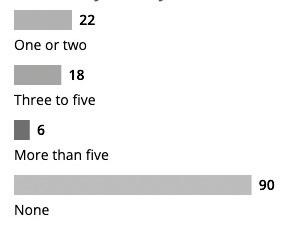
The Headlight Herald is part of the Country Media family of newspapers. The Headlight Herald is published weekly by Country Media, Inc. at 1906 2nd St., Tillamook, OR 97141 • USPS 238-300 (503) 842-7535 Deadline for Display Ads, Obituaries, Classified Liners and Legals/Public Notices: Wednesdays 4 p.m. Steph Baumgart Graphic Designer sbaumgart@countrymedia.net Sarah Thompson Office Manager/ Classifieds & Legals classifieds@orcoastnews.com legals@orcoastnews.com Katherine Mace Advertising Account Executive headlightads@countrymedia.net Will Chappell Editor headlighteditor@countrymedia.net Annual subscription rates: $70 in Tillamook County $90 out of county POSTMASTER: Send address changes and notice of undelivered copies to Headlight Herald, P.O. Box 444, Tillamook, OR 97141. Periodicals Postage paid at Tillamook, OR 97141 and at additional mailing offices. © 2024 by the Headlight-Herald. No portion of this newspaper may be reproduced in any manner without prior written permission from the publisher. All rights reserved. ABOUT US Headlight Herald LEGALS/PUBLIC NOTICES Send notice to classifieds@orcoastnews.com or call 503-842-7535 for more information. Due by 4 p.m. on Wednesdays for the following week’s edition. Frank Perea, Publisher Joe Warren, Executive Editor Frank Perea, Director of Sales Stay connected to us! Check out next week’s poll at TillamookHeadlightHerald.com Results from our online poll: How many Charity Drive activities did you attend? GARDENING MATTERS We have an extra day this month, 2024 being a leap year. I always look for something special to do on Leap Day, and this year I hope the weather is nice enough to be in the garden. There are so many projects I want to tackle and having an extra day to do them will help. I have been making a to-do list since November and maybe this is a good time to start crossing things off that list. First on the list is picking up sticks, more of a chore than a project. After so many windy days, the alders have dropped all sorts of branches, from twig-size to limb-size and everything in between. Last summer I bought myself a small hand-held, batteryoperated mini chainsaw.
will
That
CARLA ALBRIGHT
GARDENING
FENCEPOSTS
Errands with my roommate on President’s Day culminated with a meal at Kitty’s Food and Spirits. We each enjoyed a well-prepared cocktail with hamburgers and fries for lunch. My burger had grilled onions and mushrooms with a slice of melty jack cheese.
Lenny’s had peanut butter and pickles; we both raved about the food. We’ll definitely be back. They’re located at 204 ½ Main Avenue in Tillamook. Open hours are 11 a.m.-11 p.m. Monday through Thursday, 11 a.m.-12 a.m. Friday and Saturdays, closed on Sundays. It’s not too late to banish the gloom of winter with one of Marilyn Burhardt’s art classes. “Nature Paint-
t was another terrific effort by Tillamook High School students and their supporters, raising thousands of
-
ing” will be the theme from 1-3:30 on Sunday, March 10. Making art from leaves, feathers and other found (and flat) objects will be the focus. The fee is $45. The class will happen at Burkhardt Gallery, 34395 U.S. Highway 101 South. It’s the intersection of U.S. Highway 101 and Bridge Street in downtown Cloverdale. For more information or to reserve a space contact Marily at 503-8129866 or email burkhardtmab@gmail.com. AARP (The American Association of Retired Persons) will offer a Smart Driver course from 9 a.m. until about 4:30 p.m. on Tuesday, March 12. The venue is room 102 at the main campus of Tillamook Bay Community
In support of the Charity Drive, Cape Meares friend and neighbor Kathy Burke bought a singing telegram for me as a birthday gift. What a surprise! In a nod to the Eras movie Kathy and I saw last fall, a couple of THS choir students sang Taylor Swift’s “Love Story” to me. It was fabulous—and likely the only singing telegram I will have in my lifetime. Thank you, Kathy and THS troubadours. The rocks were what first drew us to Cape Meares. We had been at a motel in Rockaway and I had spotted a bowlful of polished agates at the front desk. I asked
GTHS Charity Drive.
aribaldi Coast Guard Week officially has something to do every day of the week, March 4thMarch 10th, 2024. To recap the full schedule: Recently added: Monday, March 4, Garibaldi Maritime Museum has Coast Guard exhibit admission specials from 10 a.m.-4
p.m. Come see the history of the Coast Guard along Tillamook Bay. It will set the tone for the week.
Then, as reported, the Coast Guard City designation ceremony is on March 5 at 10 a.m. at the Old Mill Event Center. Recently added: The next added event is Wednes-


SOUTHCOUNTY
 MELONIE FERGUSON
503-812-4242 mossroses@yahoo.com
College. The address is 4301 3rd Street, in Tillamook. The curriculum takes six hours to present; time will be allowed for breaks and a bring-yourown sack lunch. Tuition is $20 for AARP members and $25 for non-members. Registration is limited to twenty participants; call 503-871-
CAPE MEARES

the proprietor where he had found those lovely rocks, and he said, “Cape Meares. Right down the road, around the bay.” So, we drove to Cape Meares and, lo and behold, rock beds covered the beach.
day, March 6 at 2 p.m.: Garibaldi Branch Library will have a meet and greet with Coast Guard Auxiliary’s Tillamook Bay Flotilla 63. Representatives from the “Flotilla 6-3” will be there to answer questions and provide insight into their support of the Coast Guard.
For more information, please visit: https:// wow.uscgaux.info/content. php?unit=130-06-03
On March 7 at 10 a.m., the Historic U.S. Coast Guard Boathouse will host the “Enlisted Person of the Year” ceremony and reception, then back to the Museum for the showing of “The Finest Hour,” at 1 p.m.
Recently Added: Friday, March 8, 2 p.m.-5 p.m., the Historic U.S. Coast Guard Boathouse will have free admission to explore the landmark.
March 9 and 10, starting 10 a.m. each day: The iconic Garibaldi Crab Races


2816 to register. Are you or is someone in your orbit looking for work?
Tillamook Worksource is partnering with the Economic Development Council of Tillamook County to hold their annual Job fair. It’s slated from 10 a.m.-2 p.m. on Wednesday, March 6 at Tillamook Bay Community College (address above). Active Parenting and Tillamook Family Counseling Center are teaming up to provide parent education via Zoom. The training will occur from 6-8 p.m. on Mondays for three weeks starting March 4. The curriculum is appropriate for folks parenting 5-12 year olds and course materials are included. The series is free of charge to
Jasper of all colors, agates and quartz…a rockhound’s delight. That was almost 40 years ago. We soon discovered that the rock beds get covered by sand, then blasted free from wind on a regular basis; it’s always a thrill to find them uncovered. Just the other day, rock beds were exposed all up and down Cape Meares beach…and we did find a few treasures. East winds have been howling. Two good-sized trees have fallen on a storage shed on Bayocean Road; it’s a good thing that shed is actually a steel cargo container and appears to have withstood the blow. So far in
residents of Clatsop, Columbia and Tillamook Counties. For more information or to register send email to Melissacs@tfcc.org. Remember that Tillamook County Library is partnering with neighborhood food banks County-wide for a “Have a Heart Food Drive.”
It runs from now through March 2. Our South Tillamook County Library is collecting shelf-stable items including tuna, canned chicken or soup, and canned meals such as ravioli or chili. We can donate during the library’s open hours daily, except Sunday. South Tillamook County Library is located on Camp Street, south of Chester’s Market off Brooten Road in Pacific City.
this current storm, no power outages here in Cape Meares. Keeping our fingers crossed.
The winter weather is tough on roads, too. Thanks to locals Ted Rinker and Shad Coulson for getting gravel delivered and spread on local side streets, and to the Tillamook County Road Dept. for patching some potholes the other day. We’ll muddle (or is that puddle?) through. Keeping a lookout for spring, don’t miss picking up free vegetable and flower seed packets at the Tillamook County Library as long as supplies last. Patrons are asked to limit themselves
Oregon Coast Bank, located south of downtown Pacific City on Brooten Road, is also gathering food donations this month to benefit the food “Backpack Program” in local schools. Needed are granola in bag or bar form, protein or breakfast bars and individually packaged handheld snacks. These may be donated during the bank’s business hours which are Monday through Friday, weekly.
Happy birthday this week to: Glenn Brassfield, Justin Buford, Mickey Earwood, Jodi Green, Logan Kellow, Chad Larimore, Laurie Limbaugh, Skyler Simnitt, George Sisson, Ginger Slavens, Landon Slavens and Pierce Trent.
to no more than 10 packages per person. Now is the time to start thinking about planting your 2024 garden. Bring your craft projects to the Barbara Bennett Community Center this coming Monday, March 4, and visit with your neighbors while you work. The building will be open from 10 a.m. to 2 p.m. for the Cape Meares craft group that day. Beverages will be provided; please bring your own sack lunch. Also at the community center, Tuesday mornings are exercise time: yoga from 9-10 a.m.; tai ji from 10:3011:30 a.m. All are welcome.
GARIBALDI

at the Old Mill Event Center. 50% off admission for Coast Guard families (ID required).
“Semper Paratus.”
She’s always down to party, and always knows the best recipes for success. She’s Garibaldi’s favorite local librarian, June Ekborg: “We’ve moved Family Fun Time to Fridays. Now, families can enjoy time to hang out and have storytime all on the same day. We hope this will make it easier for those with young children to enjoy both on the same day. We hope to see you
On February 7, the Rockaway Beach Emergency Preparedness group held a meeting to discuss communication. The evening started with a presentation from Bill Hassell of the city planning commission about power outages.
On the Coast, our winter storms knock down trees and power poles, causing outages for anything from a few homes to most of the county. This affects phones, cable, wifi, and nearly every other method of communication.
One important point Bill addressed was the cell tower, originally built more than 20 years ago with its own dedicated generator. But a lightning strike rendered that generator useless years ago. And as most of us know, the battery backup at the tower expires in three hours.
Mayor Charles McNeilly and Fire Chief Todd Hesse have both spent hours trying to get the generator repaired or replaced. At this meeting, Bill shared one reason it’s been such a challenge: the tower is managed by not one, but three different companies, T-Mobile, Verizon and AT&T. Cooperation has been difficult, to say the least.
The present strategy is to install a new generator with remote-start capability. An article from industry publication “Inside Towers” from Nov. 14, 2023, reports that a permanent replacement is scheduled to be installed in 2024.
But Bill had good news for cell phone users in Rockaway: if even one of the three services has connection, you can call 911 on your cell phone regardless of which provider you have. “Even deactivated phones can get through to 911,”
Friday.” Lastly, Garibaldi City Council’s monthly meeting was pushed back to Tuesday, February 27, 2024. Council came to consensus to allow Mayor Katie time to get back from being by her sister’s bedside as we prepare to bring another niece into the world. As of this past Friday, the day of her delivery went from a scheduled date to “to be determined.”
Thank you to everyone who continues to provide kind words and thoughts as the family goes through an exciting, yet stressful time.
PS: To distract ourselves from the stress, the NeahKah-Nie School Board President Sandra Tyrer and I got into an academic debate as to the best ways to introduce charities into these influx of events along the coast.
I noted that the average age of the village is 56, so having more senior pro-
grams to donate to would be beneficial.
She noted that not only are rising house prices affecting the retired, but the housing supply is affecting families all the more. Especially children. Tyrer suggested I inquire further.
I reached out to Garibaldi Grade School Principal Janmarie Nugent. She got me in touch with Ashley Carr, the school’s Family Resource Coordinator.
Ashley coordinates programs including the Weekend Backpack Program, which sends prepared meals, snacks, fruit, and dairy to help children get through the weekend. According to her, “Our Weekend Backpack program supports over 35% of our student population.”
That’s a lot of kids in need.
It’s been an eye-opening conversation to say the least, and I’ll have more on that next week.

he explained. But as 911 is reserved for actual emergencies, Fire Captain Geoff Grace shared the non-emergency line: (503) 842-0911. Rockaway also has a growing “yellow radio” network, which I discussed in my January 2 column.
Captain Grace said, “This is one of my projects after the CERT class,” referring to the Community Emergency Response Team course for emergency volunteers. These are short-range radios, typically capable of communicating within about a mile of one another, so it’s important to get a network that extends the length and breadth of Rockaway Beach. The yellow radio team includes about 20 Rockaway residents who receive training on Sunday evenings to be ready for an extended outage. Another source of communication: subscribe to Nixle alerts. Nixle serves 4600 government organizations in all 50 states, providing emergency communication services to police and fire departments. These include announcements of service outages, severe weather events, and tsunami information among others. You can subscribe to Nixle by texting your ZIP code to 888777. You will then receive text messages about issues near home.
One of the best uses of Nixle is to let people know when a potential storm is coming. When you get notification, “Charge up all your batteries and get everything ready,” said Captain Grace. This includes bringing in any camping gear you may have in the garage, battery-operated lamps, and extra blankets and cold weather gear.
Captain Grace also mentioned that the city is in the process of setting up a Nixle listing for Rockaway Beach specifically.
Perhaps the best suggestion: “Know your neighbors.” Especially if you have elderly neighbors with mobility issues, check in on them in an extended outage. Keep a list of important phone numbers in your home with names of people to contact and post it on your refrigerator. “Emergency responders look there for what to do and who to call,” Captain Grace said. He also recommended keeping a copy in your go-bag.
The meeting closed with a note about plans to expand the CERT program. Currently at about 20 people, CERT graduates receive training in basic first aid, search-andrescue techniques, and other important roles in the event of an emergency or mass casualty situation. CERT training takes about 20 hours total, with online and inperson components, and does not require physical strength as does firefighter training.
“Anyone can sign up for CERT,” Captain Grace said.
“There are only so many first responders,” he added. “Having a group like this in the community can make a huge difference.” To find out more, call the non-emergency line at (503) 842-0911.
A6 The Tillamook Headlight Herald | February 27, 2024
OPINION
TILLAMOOK 1845 Main Avenue N., (503) 842-7555 Valid only at above location. Present coupon at time of service. One per vehicle. Not valid with other offers. Not valid on Select Conventional oil. Expires 3/12/2024 TILLAMOOK 1845 Main Avenue N., (503) 842-7555 Valid only at above location. Present coupon at time of service. One per vehicle. Not valid with other offers. Not valid on Select Conventional oil. Expires 3/12/2024 AUTOMATIC TRANSMISSION FLUSH, POWER STEERING FLUSH OR GEAR BOX SERVICE FAMOUS 20-POINT FULL-SERVICE OIL CHANGE Save $10 Save $7 H23168 Get ready for Spring Driving Use this money-saving coupon today! Bring your vehicles in for a Valvoline instant oil change in Tillamook to ensure they’re ready for the Spring weather ahead. We provide a variety of convenient services, including: 4 Cooling System Flush 4 Windshield Wiper Replacement 4 Light Bulb Replacement 4 Gearbox Fluid Service 4 Automatic Transmission Flush 4 C/Power Steering Fluid Flush was Edward in Norfolk, ated was two few before 1991 stationed long she Wilson 1996. of that churches loved Jesus. kamp 1934, to man) peacefully her by 2024, at Benjamin January lamook Mr. Army first later and mook start she into would
dollars in
Charity Drive.
to benefit local chari
ties, Doernbecher Hospital in Portland, and to fund
scholarship for
seniors. Car washes, theme dinners, cake auctions, sports competitions, rummage sales, raffles, singing telegrams and more—these kids worked hard/
so
many others behind the scenes.
great place to live,
the least for its big heart. Congrats to
involved
2024
I
their 71st annual
The money goes
a
THS
And
did
Tillamook is a
not
all
in the
ELLEN STEEN ellensteen2@gmail.com
NATHAN “FINN” FINDLING finn@natfinn.com
SCOTT FISHER
ROCKAWAY BEACH sfisher71@yahoo.com
Nancy Lynne Wilson
March 11, 1967 ~ Feb.
Nancy Lynne Wilson was born March 11, 1967, to Edward and Geneva Schular in Virginia. She grew up in Norfolk, Virginia, graduated from high school and was in college parttime for two years. Nancy spent a few years working in Ohio before joining the Navy in 1991 and served four years stationed in Virginia. Not long after her naval service she married Raymond Lee Wilson in Aloha, Oregon in 1996. Nancy was a member of a Christian singing group that would sing at other churches in the area and she loved her Lord and Savior Jesus. Nancy also spent time
12, 2024

as a Tri-Met Bus driver and maintenance operator for 10 years before retiring in 2013.
Nancy was an avian enthusiast and loved taking care of exotic parrots and other birds. She also liked craft projects and doing word puzzles.
Nancy is survived by her sister, Gail C. Dake of Strasburg, Colorado. She is preceded in death by her husband, Raymond Lee Wilson and her parents, Ed and Geneva.
Nancy passed away February 12, 2024, in Tillamook, Oregon and was interred with her husband at Sacred Heart Cemetery. Memorial Contributions and be made out to the Tillamook Animal Shelter.
Netha Corrine Oldenkamp
Jan. 24, 1934 ~ Feb. 13, 2024
Netha Corrine Oldenkamp was born January 24, 1934, in Aztec, New Mexico to Thomas and Lucy (Tatman) Smith and passed away peacefully in the comfort of her home with loved ones by her side on February 13, 2024, in Tillamook, Oregon at the age of 90 years.
Netha married Herbert Benjamin Oldenkamp on January 31, 1951, at the Tillamook Nazarene Church.
Mr. Oldenkamp was in the Army so Netha made their first home in Georgia. They later moved to Philadelphia and then returned to Tillamook in 1953.
Netha loved to garden and start flowers from bouquets she received, nurturing them into growing plants. She would provide flowers for
pdate from Rep. Cyrus Javadi
From Page A5
progress on our drug crisis, it’s essential to invest in proven, local solutions.
The other hot topic this session is housing –
The Governor has proposed a $500 million housing package this session, but through the committee process, it got slimmed down to $350 million. I am cautiously optimistic about the proposal, but I am skeptical that it will be enough to achieve the Governor’s target of building 36,000 housing units per year.
The Governor’s proposal largely subsidizes the building of housing. We have spent billions of dollars in the last decade to address the housing problem. The problem with thinking that government spending will solve this problem is that you eventually run

the church sanctuary every Sunday and Christmas decorations for many years. Netha and Bert taught Sunday School for the kindergarten class and worked with the youth group. She also planned elaborate ban-
out of money. That’s why last month, the Governor’s Housing Production Advisory Council floated a proposal to raise taxes by more than $3 billion, including a sales tax, an increase in the income tax, raising taxes on wages, and even doubling the state gas tax. Kotek has tried to distance herself from those proposals by saying she doesn’t plan to include any tax increases in her 2024 agenda. Given this Governor’s history with rubber-stamping tax increases, this kind of cagey language should give Oregonians pause that she or others will back these proposals next year.
Finally, I have written a lot about the Habitat Conserva-
quets for the senior adults at the church for many years.
Netha’s love language was giving gifts and cooking on the farm for family and friends. Her Christmas list included 64 people growing every year with more great great grandchildren.
Netha is survived by 4 children; Jerry Oldenkamp (Joyce), Dave Oldenkamp (Cindy), Debby Wolfe (Ron) all of Nampa, ID. and Joe Oldenkamp (Sheri) of Tillamook, OR. 24 grandchildren, 30 great grandchildren and 2 great great grandchildren.
A celebration of life will be held on Saturday, March 2nd at 11 a.m. at the Tillamook Church of the Nazarene. Interment was held at Sunset Heights Memorial Gardens.
tion Plan. Unfortunately, it looks like there is little chance of stopping the HCP in its current form. So, I am looking forward to how our local communities can adapt to this plan once it goes into effect. We know the impacts will be dire, and they are already starting to rear their ugly head with the recent Banks mill closure.
That’s why I introduced legislation, HB 4106, this session to provide some good government accountability over the HCP once it goes into place. It does nothing to change the way our forests are managed, nor does it stop the HCP from going into effect. It would simply require the ODF to tell us how they are going to manage the land and allow us





Sharon Gail Kesterson
March 26, 1946 ~ Feb. 9, 2024
Sharon Gail Kesterson passed away peacefully at home with her family, on Friday, February 9, 2024, in Vancouver, WA.
Sharon was born on March 26, 1946, to William and Hazel Fornas in Astoria, Oregon, she was raised in Astoria with her sister and brother. After Astoria High School ( the Fighting Fishermen) she worked for the Astoria Job Corps in administration. While attending classes at Clatsop College Astoria, she met a classmate from a neighboring town, Rockaway Beach, Oregon, (her future husband) Steve Kesterson. Courtship and marriage followed and in the early 1960’s the couple moved to Vancouver, Washington where they had three wonderful sons and lived for the next 60 years. Working, boating, fun, animals and life.
Sharon was a transcriptionist for Clark County Court House, Juvenile Division. A Color Consultant show casing current trends, psychological and visual effects of colors for individuals and demographic statistics. She loved to travel and went on many cruises with her aunt to Hawaii, Alaska, Mexico and the Caribbean. She loved her devoted husband, her family and friends, her precious animals, fashion, design, sparkles and life.
Sharon is survived by her husband of 60 years, Steve, their three sons: Terry Kesterson (Brenda), grandsons, Cole and Adam of Puyallup, WA. Michael Kesterson
to hold them to it. While it didn’t pass this session, I was thankful that Chair Helm allowed us to bring our concerns up in a public hearing. I will continue to push for transparency and accountability when it comes to managing our forests.
As always, I welcome your feedback and input. It helps me better represent our community. Email me at Rep. CyrusJavadi@oregonlegislature.gov or call my office at 503-986-1432.


(Lucas) of Vancouver, WA. Gregory Kesterson (Janna), grandsons Peyton and Parker of Puyallup, WA, her brother, William (Bill) Fornas of Astoria, Oregon and her Aunt Linda Ladzick (Rick) of Normandy Park, WA.
She was preceded in death by her parents, William and Hazel Fornas, her sister Marsha Zalk, Grandparents, aunts, uncles, cousins, and her precious Zipper and Sophie. A Celebration of Sharon’s life will be held at a later date.
We will miss her forever. Her grace, guidance, gentle manner, knowledge, and dedication to the love of her family.
Arrangements are entrusted to Evergreen Memorial Gardens. To share memories or to leave condolences for the family please contact them at the phone number or address below.
360-892-6060
1101 N. E. 112 Ave
Vancouver, WA 98684
Celebration of Life
Sylvia (Wynia) Goeres






The Tillamook Headlight Herald | February 27, 2024 A7 OPINIONOBITUARIES H23099 Scott Barbur, Partner Laura Laskey, Partner Spring Break Camp F/ Art+Theatre March 25-26,27-28 12-4 p.m. each day Fairview Grange, 5520 3rd St, Tillamook Call For Registration: 503-801-0603 FREE - NO FEES Art Camp for Kids & Family March 25+26 Theater Camp (Ages 6-18) Parents can Attend Limited Registration 27th + 28th H23207 Tillamook PUD offers a rebate to customers that purchase and install a qualifying Level 2 EV charging station at their residence For more he rebate or call rts at PO Box 433 1115 Pacific Ave Tillamook, OR 97141 503 842 2535 www tpud org EV EV CHARGER CHARGER REBATES! REBATES! NEW LISTING 4785 Netarts Hwy W Netarts OR 97143 (503) 965-9777 (503) 842-9090 (503) 842-9092 Pacific City (503) 965-9777 Tillamook (503) 842-9092 Main Office Netarts - Oceanside (503) 842-9090 4785 Netarts Hwy W Netarts OR 97143 (503) 965-9777 (503) 842-9090 (503) 842-9092 Kristi Bertrand 503.812.2471 Steph Poppe 503.812.8087 Kristi Moore 503.801.4533 Sarah Dentel 503.812.2816 Debbie Carr 503.812.8728 Jacqueline Huseby 503.812.2321 Jen Strohmaier 503.812.6078 Dusty Trost 503.801.2326 Cyndi Lewis 503.842.0254 Macy Thompson 503.812.7669 Live the country life on this level 2 acre lot located on the outskirts of town. Entry level gives you access to the large shop, equipped with a wood burning stove, workbenches and an upper loft, providing you with ample space for your toys. Open concept living/dining/kitchen invites you upstairs. A building site, rocked with pit-run, is located on the property. Septic installed, elevation certificate and 400 amp meter main for future residence. MLS#24-38 Sydney $475,000 BAY FRONT paradise located in Pearl Point Condos. Views from Cape Lookout to Oceanside! Seller is offering a 2/1 buydown of approx 10K (final details to be negotiated with an offer as is dependent on rates, down payment, & loan type) Private access with a trail to the sand. MLS#23-287 Kristi M. $510,000 Welcome to a unique opportunity to own a piece of picturesque paradise along Foley Creek! Imagine the soothing sounds of rippling water and the beauty of nature integrated with the sounds of wildlife. As you explore the nearly one-acre expanse, envision the potential to transform this canvas into your dream retreat. MLS#24-64 Debbie $150,000 H23286 Oceanview lot, just steps from the beach in the popular gated community of Kiwanda Shores in Pacific City. This is a prime location close to Cape Kiwanda and popular amenities, with private streets and a private beach trail. Water, sewer and power are in the street and annual HOA dues are low. Building plans for the lot are included in the purchase. Unique setbacks allow building up to the property line if desired. MLS#24-56 Coley $175,000 Loving our Clients and Community since 2006 www.RobTrost.com ONE LEVEL HOME in Netarts with Bay and Ocean view from the deck & main bedroom. Located in a lovely neighborhood situated just 1/4 mile from Netarts Bay where clamming, crabbing and kayaking are just a few of the outdoor activities to enjoy. Vaulted great room features large windows to showcase the views, propane fireplace, deck, plus an open kitchen with breakfast bar and tile countertops. MLS#24-57 Cyndi $489,000 Coley Trost 503.812.0791 Sydney Collett 503.812.1786 Morgan Werner 503.812.7536 NEW LISTING VISIT www.RobTrost.com Check out our LIVE BEACH CAMS overlooking Netarts Bay and the Three Arch Rocks in Oceanside NEW LISTING BACK ON THE MARKET Nestled within the picturesque Nehalem Point subdivision, this .24 acre residential lot presents an incredible opportunity to build your dream home in a serene coastal community. Surrounded by the natural beauty of the Oregon coast, this property offers a perfect blend of tranquility and adventure for those seeking a peaceful retreat or an active lifestyle. MLS#24-58 Jacque $45,000 NEW LISTING NEW LISTING Dentel Live the country life this level acre lot located the outskirts of town. Entry level gives you access to the large shop, equipped with a wood burning stove, workbenches and an upper loft, providing you with ample space for your toys. Open concept living/ dining/kitchen invites you upstairs. A building site, rocked with pit-run, is located on the property. Septic installed, elevation certificate and 400 amp meter main for future residence. MLS#24-38 Sydney $475,000 BAY FRONT paradise located in Pearl Point Condos. Views from Cape Lookout to Oceanside! Seller is offering a 2/1 buydown of approx 10K (final details to be negotiated with an offer as is dependent on rates, down payment, & loan type) Private access with a trail to the sand. MLS#23-287 Kristi M. $510,000 Welcome to a unique opportunity to own a piece of picturesque paradise along Foley Creek! Imagine the soothing sounds of rippling water and the beauty of nature integrated with the sounds of wildlife. As you explore the nearly one-acre expanse, envision the potential to transform this canvas into your dream retreat. MLS#24-64 Debbie $150,000 H23286 NEW LISTING Oceanview lot, just steps from the beach in the popular gated community of Kiwanda Shores in Pacific City. MLS#24-56 Coley $175,000 ONE LEVEL HOME in Netarts with Bay and Ocean view from the deck & main bedroom. Located in a lovely neighborhood situated just 1/4 mile from Netarts Bay where clamming, crabbing and kayaking are just a few of the outdoor activities to enjoy. Vaulted great room features large windows to showcase the views, propane fireplace, deck, plus an open kitchen with breakfast bar and tile countertops. NEW LISTING NEW LISTING BACK ON THE MARKET Nestled within picturesque Nehalem Point subdivision, this .24 acre residential lot presents an incredible opportunity to build your dream home in a serene coastal community. Surrounded by the natural beauty of the Oregon coast, this property offers a perfect blend of tranquility and adventure for those seeking a peaceful retreat or an active lifestyle. MLS#24-58 Jacque $45,000 NEW LISTING
join
at
CELEBRATE
Please
us on Saturday, March 9, 2024
2pm to
the life of our Mom, Sylvia (Wynia) Goeres (3/10/29-1/1/24). The service will be held at the Nazarene Church on 3rd St. in Tillamook, OR.
U
OBITUARY POLICY: BASIC OBITUARY: Includes the person’s name, age, town of residency, and funeral services info - No Cost. CUSTOM OBITUARY: You choose the length, the wording of the announcement, and if you want a small photo included - Cost is $75 for the first 200 words, $50 for each additional 200 words. PREMIUM OBITUARY: Often used by families who wish to include several photos and a longer announcement, or who wish to run a thank-you list of names - cost varies by length of announcement.
March Artist of the Month
Friday, March 1 from 5-7 p.m., join us at The Bay City Arts Center for a special gallery reception featuring the work of two local artists, including artwork by Tam Hulburt
Peaceworks and Teresa Mahannah SPiRiTsHAUS. This monthly event is free and open to the public. This special night will include original guitar compostations played by Clyde Zeller and Charlie Wooldridge’s delicious chocolate cake. Tam Hul -
burt Peaceworks is intuitive explorations of color, shape and whimsy in acrylic and oil and cold wax. Teresa Mahannah SPiRiTsHAUS’ work includes acrylics, sculpture, photography, and block prints. This monthly event is free and open to the public. To read more
about the artist, visit our website at Artist of the Month.
Jazz concert with John Stowell and Dmitri Matheny
Saturday March 2 at 7 p.m., join us as the Bay
Legislature advances bill that aims to stem violence against hospital workers
House Bill 4088 would step up the penalty for attacking a hospital worker and create funding for hospitals to prevent violence
LYNNE TERRY Oregon Capital Chronicle
A bipartisan proposal to step up penalties for assaulting hospital workers has advanced in the Legislature despite opposition from advocates for people with disabilities.
House Bill 4088 would make it a felony to knowing-ly and intentionally attack a hospital worker, create a pot of money to help hospitals adopt prevention measures and require hospital signage about the law. The proposal follows several high-profile attacks against hospital staff in recent years, including the fatal shooting of a security guard inside Legacy Good Samaritan Medical Center


in northwest Portland in mid-July. Attacks on hospital staff, especially those who care directly for patients, are widespread, health care workers told the House Committee on Judiciary at a public hearing last week.They included one of the main sponsors of the bill, Rep. Travis Nelson, D-Portland and a nurse for 20 years.
“During my time at the bedside, I’ve been hit, spit on and punched too many times to count,” Nelson said.
According to a 2022 survey from the Oregon Nurses Association, 70% of emergency department nurses reported being assaulted on the job and 30% said they had been assaulted up to three times in the past year. And many attacks go unreported, experts say. “This issue concerns real people who dedicate their lives to caring for others yet continue to face risks of harm in the workplace,” Nelson said. “It’s time we stand up for them.”
Rep. Shelly Boshart


Davis, R-Albany, has championed bills aimed at preventing violence against health care workers for several years, and is also a driving force behind this one. She said in testimony her campaign has been spurred by stories of workplace violence recounted by her sister, a nurse at Salem Hospital for 20 years. “I was shocked at the stories I heard that I’ve compiled over the years of working this bill,” she said. “This should not be their reality.”
Under the bill, someone found guilty of intentionally attacking a hospital worker could face a class C felony, which carries up to five years in prison and a $125,000 fine. Hospitals would be required to post signs in five languages about the law and report incidents to the Department of Consumer and Business Services. Hospitals also would be prohibited from forcing employees to wear identification badges with their last names on them and required to allow union representatives to participate in worker safety meetings and committees, something that Nelson said was a problem.
The funding – which has not been set – would be aimed at helping rural and critical access hospitals that have emergency services and fewer than 26 beds, Nelson said. They could use the money to install metal detectors, train staff and add other protective measures. The bill would exclude mental health care facilities, where about half of hospital attacks take place, according to a 2008 study. That means the Oregon State Hospital would be excluded.
“I strongly believe that House Bill 4088 adopts a comprehensive approach to addressing workplace violence, a step that is long overdue,” Nelson said. “This is the step Oregon needs to safeguard our health care workers and by extension our entire community.”
The House Committee on Judiciary approved the proposal with a 9-1 vote in favor, sending it to the Joint Committee on Ways and

Means, which determines budgetary decisions.
Number of organizations oppose
Despite the strong bipartisan support, not everyone agrees the bill is the right approach. Several lawyers and advocates for people with disabilities who testified against the proposal said it would harm their clients. Among them was Beth Brownhill, managing attorney for Disability Rights Oregon.
“Enhancing the assault crime to a felony would have a disparate impact on people with disabilities,” Brownhill testified. She said it would create a barrier to accessing health care, discourage hospital administrators from training staff to work with people with disabilities and criminalize having a disability.
“Many people with disabilities don’t access medical care until it’s an emergency or crisis,” Brownhill said. “This can create a Catch 22. Lack of care culminates in a crisis and being in a crisis complicates their muchneeded care. Caregivers for individuals with disabilities will be less likely to help them seek care if they might face a felony for behavior that manifests from a crisis.”
Mae Lee Browning, legislative director for the Oregon
METRO CREATIVE CONNECTION
Criminal Defense Lawyers Association, also testified against the bill.
“Our state mental health system is broken,” Browning said. “Sadly, the criminal justice system is routinely used as a substitute. Turning mentally ill folks into felons will only exacerbate the problem. It will also make them ineligible for subsidized housing and some other government benefits that they need.”
Submitted testimony on the bill is split, with 33 in favor and 27 against. The ACLU of Oregon, Oregon Developmental Disabilities Coalition and National Council on Severe Autism oppose it while the Oregon Nurses Association, Hospital Association of Oregon, Oregon District Attorneys Association, Oregon Medical Association, Service Employees
International Union Oregon State Council and American Federation of State, County and Municipal Employees Council 75 are in favor.
Oregon Capital Chronicle is part of States Newsroom, a network of news bureaus supported by grants and a coalition of donors as a 501c(3) public charity.
Oregon Capital Chronicle maintains editorial independence. Contact Editor Lynne Terry for questions: info@ oregoncapitalchronicle.com.
emotional playing style pair beautifully with Stowell’s guitar mastery. Treat yourself to an evening of world-class jazz for $20 general admission and $10 for students. Doors open at 6:30 p.m. We look forward to seeing you there. Get you tickets in advance on our website. Be kind to your sweet heart
often take our heart
granted,
but


Legislative update from Senator Weber
From Page A1
Restoring recreational immunity was also a priority mentioned by Weber, who said she favored a bill that applied statewide to one that would require municipalities to update their ordinances to fix the issue.
Weber also said that she has been trying to impress upon her colleagues the need for infrastructure improvements on the coast to pave the way for new housing to be developed.
A8 February 27, 2024
ANNOUNCEMENTS
City Arts Center welcomes acclaimed guitarist John Stowell and flugelhorn player Dmitri Matheny. Known for his innovative guitar work and collaborations with top jazz artists, Stowell’s compositions entrance audiences during live performances. Matheny’s technique and Special art opening and live jazz at Bay City Arts Center SPORTS To schedule an appointment: (503) 842-3938 (800) 528-2938 TTY 711 Se habla español 801 Pacific Avenue, Tillamook, OR www tillamookchc org
when it comes to your heart health, every day is a fresh start. To reduce the risk of heart disease it’s important to know your numbers - blood pressure cholesterol and A1C Healthy habits like a well-balanced diet and exercise can help as well Our primary care providers are experts in your health and wellness Make an appointment now to start your journey to a lifetime of healthy habits Your sweet heart will thank you #hearthealth Jacob Torres Bilingual Real Estate Broker I’m your friendly neighbor, born and raised in Tillamook 503-436-5596 jacobtorreshomes@gmail.com 1812 Third Street, Tillamook OR 97141 Office: 503-842-2800 • Fax: 503-842-4660 Each office is independently owned and operated H21918 All land or lots, offered for sale, improved or unimproved are subject to land use laws and regulations, and governmental approval for any zoning changes or use. H21057 www.KingRealtyBrokers.com Dylan Landolt Real Estate Broker 503-457-8725 drlandolt@hotmail.com 2507 Main Ave. N. Suite A Tillamook, OR. 97141 Serving Tillamook County since 1956 KING REALTY KING REALTY (503) 842-5525 T: 971-247-3047 · prestigecare.com/fiverivers Heart disease is the number one cause of death for older adults, but at Prestige Senior Living, we’re here to help. VISIT PrestigeCanHelp.com to download our free Guide To Heart Health for older adults, which includes common heart health risks and information on how nutrition, fitness, sleep and stress management can promote heart health. FREE Heart Health Guide For Older Adults
We
for
misdemeanor,” Weber said. She also acknowledged that continuing to bolster treatment options for those with substance use disorders was critical. “We have got to continue to build the facilities for addiction,” Weber said.
Weber mentioned that she was working to advance a bill to fund a study of Highway 30 that would mirror one conducted last year for Highway 6 to identify issues with the roadway.
Pirates win league, advance in state tourney
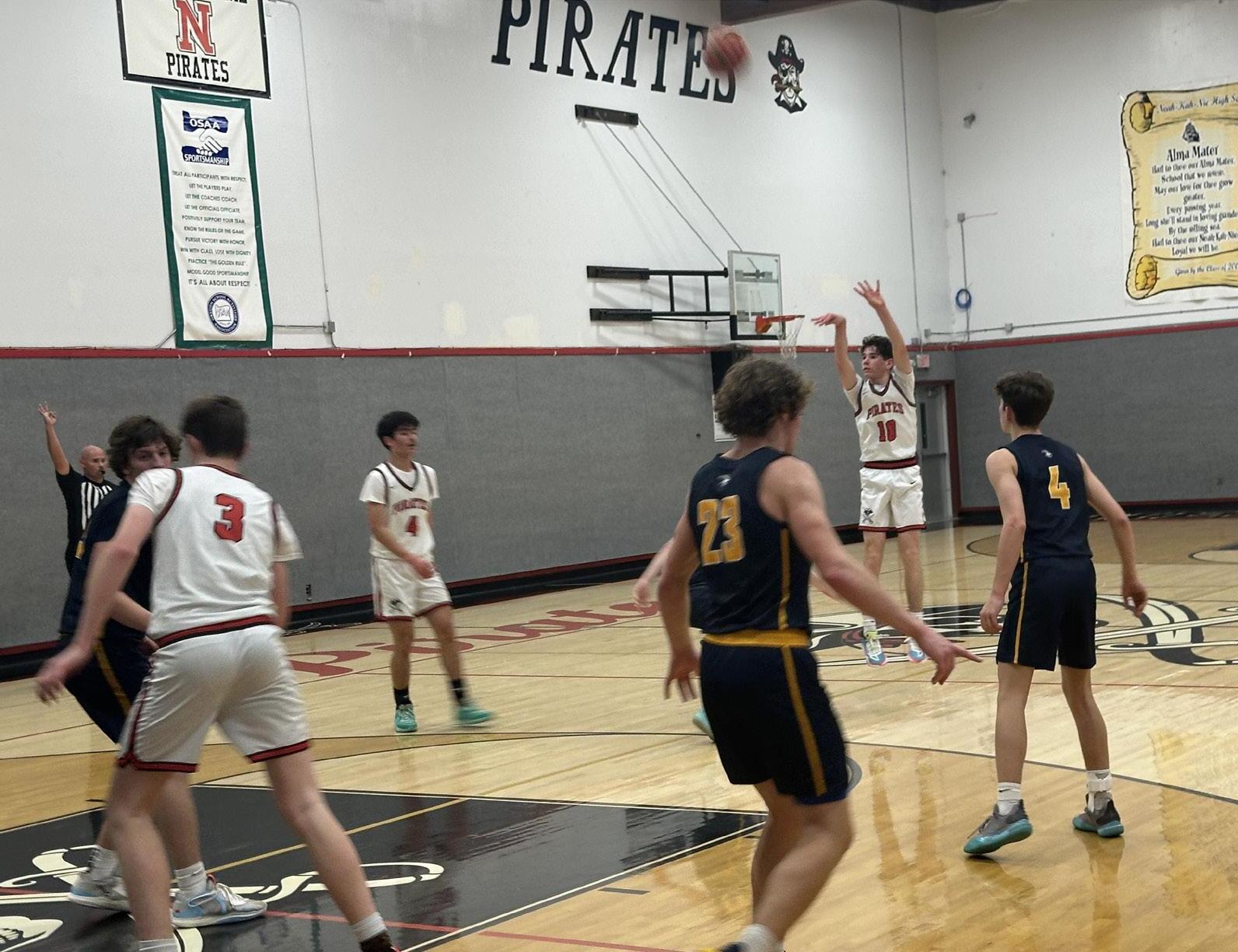
and 13 in the half. Behind this offensive performance and the interior deterrence of his brother on the defensive end, Neah-Kah-Nie’s run continued, with the lead growing to 33-24 with a minute and a half left before the Billies finally scored again. By the break, the Pirates led 35-26.
Neah-Kah-Nie started the second half much as the first with four quick turnovers, leading to two Pleasant Hill baskets and a free throw that cut the lead back to four. The Pirates’ scoreless streak continued until an Allen layup with just under two minutes gone, which settled the team and allowed them to push the lead back to 41-35 halfway through the quarter.
a timeout from Neah-KahNie.
Ivan Dante drew a foul on a drive to the basket on the next possession and went one for two from the line, pushing the lead back to five and putting the Pirates into the bonus. On their next possession, Allen was fouled and went one for two before a Hanson layup pushed the lead back to five with a minute left. Allen fouled out on the ensuing possession and Pleasant Hill hit two free throws to cut the lead back to three. Another Hanson layup gave the pirates a five-
point cushion with thirty seconds remaining before yet another Billies layup cut it back to three.
At the line, Lewis drained two and Clayton Dante stole the ensuing inbound pass, before missing two free throws. But another steal from Jonathan Dana sealed the win as the Pirates held on 66-61.
The win was the ninth straight for Neah-Kah-Nie and sent them on to next weekend’s tournament in North Bend, where they will take on the number one seed Westside Christian Eagles on Thursday at 1:30 p.m.
First, the Pirates won the Coastal Range League tournament on February 16, with a 52-51 victory over Warrenton at home in the championship game. The win capped a 10-2 campaign in the Coastal Range League by the pirates and set them up for the first-round matchup with the Pleasant Hill High School Billies on the February 23.
In that game, the Pirates won a memorable, hardfought 66-61 matchup in front of an enthusiastic home crowd. Ethan Hanson led the
way for Neah-Kah-Nie with 16 points, while Anthony Allen and Clayton Dante each chipped in 15 and Ivan Dante added 11 in a backand-forth game characterized by hot and cold streaks from each team. Neah-Kah-Nie started the game with two quick turnovers but Pleasant Hill failed to capitalize and Allen got the Pirates on the board with a pair of free throws on their third possession. Trouble reared its head moments later with the score tied at two when Allen picked up two fouls on charge calls on back-to-back possessions sending him to the bench. The Billies took a lead with two threes moments later and stretched it to 12-2 halfway through the quarter as Neah-Kah-Nie continued to struggle to take care of the ball. Jordan Lewis snapped the scoreless streak
for the Pirates with a three a minute later and with two more quick baskets NeahKah-Nie trimmed the deficit to three with two minutes left. With Pleasant Hill cold from deep and Ivan Dante making his presence felt with four blocks in the first quarter alone, only two late layups allowed the Billies to preserve an 18-15 lead after one.
After a layup from Pleasant Hill, the Pirates scored five straight to tie the score at 20 before the Billies responded with four straight of their own. The Pirates responded with another run, quickly reeling off six to take a lead at 26-24 with four minutes remaining in the half.
Clayton Dante stepped up on the perimeter with Allen back on the bench following a third foul call early in the quarter, chipping in eight in the quarter
Lady Bobcats heading to Pendleton
WILL CHAPPELL HeadlightEditor
The Nestucca High School girls’ basketball team won their first-round matchup in the OSAA 2A state tournament, outlasting the Colton Vikings to advance with a suspenseful 34-33 win.
The game was back and forth throughout, with Taylor Knight leading the scoring for the Bobcats with 14 points and sister Taylor chipping in eight, and after four scoreless minutes in the final quarter, a Hailee Knight layup lifted Nestucca to victory.
Both teams got off to a slow start and with four minutes gone the Bobcats held a narrow 4-2 advantage as neither team could establish an offensive rhythm. Nestucca was pressing as they looked to penetrate against the Vikings and Colton was off the mark on repeated corner three attempts.
With the score still the same, Nestucca Head Coach Tevin Gianella called a timeout with just under three minutes to go in the quarter. After the pause, both teams continued to struggle, with Colton taking its first lead at 8-7 after a foul call on a last second three led to two made free throws.
Colton’s lead grew with a three pointer on the first possession of the second quarter and both teams went cold after that for several minutes. The Bobcats offense came back to life with two Hurliman layups with around four minutes left to play in the half cut the deficit to 13-11.
Hailee Knight followed up shortly later with two inside baskets of her own to tie the game at 15, before a third gave Nestucca a 17-15 lead.
A layup from Makayla Webber and three from Chloe

Love in the last minute and a half pushed the lead to seven, but a buzzer beating Viking layup made the score 22-17 at the break.
Colton reeled off four quick points to start the second half and cut the lead to one, before a Taylor Knight three stemmed the run and a free throw pushed the lead back to five midway through the third quarter. The Vikings cut the lead back to two with a three pointer before Taylor Knight hit another three, followed shortly after by a three from Rylee Armstrong to put the Bobcats ahead 3124 with a minute left in the quarter. With Colton in the bonus, two late foul calls against the Bobcats allowed the Vikings to narrow the lead to 31-28 entering the fourth.
The Vikings drew the score level at 32 shortly into the fourth, triggering another timeout from Gianella. Turnovers hampered the Bobcats
Happy 68th wedding anniversary to Robert and Joan Lichner, formaly of Garibaldi!
Congratulations on the legacy you’ve demonstrated “to have, and to hold from this day forward, for better or for worse, for richer, or poorer, in sickness and health, to love and to cherish, till death do us part.”
You are loved by your Family and friends.
offense, allowing the Vikings to take a one-point lead on a free throw with five minutes to play.
Neither team scored for the next four minutes sending the game into the final minute with Colton up 3332. A Viking travel with 25 seconds remaining gave Nestucca possession and Hailee Knight drove to the lane and converted on a layup with 5 seconds left to give the Bobcats a one-point lead. The Vikings final attempt on a drive from behind the backboard missed everything and Nestucca won 34-33.
Nestucca’s 18th straight win set up a quarterfinal showdown on February 29 at 3:15 p.m. at the Pendleton Convention Center against their Northwest League rival Knappa Loggers. It will be the fourth time the teams have squared off this season, with the Bobcats winning each of the previous matchups by single digits.


The strong play continued for the Pirates as the lead grew to double digits moments later but the Billies again responded, scoring eight straight to cut the lead to 45-43 entering the fourth.
The Billies tied the game on the first possession of the final frame and took a twopoint lead from the line on the ensuing possession.
Finally, Hanson stopped the run with a three on the Pirates next trip down the floor, after which both teams’ offenses went silent for several minutes until an Allen layup pushed the lead to 51-47 with five minutes remaining.
The Pirates’ defense was giving Pleasant Hill problems and Allen, who had picked up a fourth foul in the third quarter, finally came alive with 11 points in the quarter, including seven straight that extended the advantage to 58-49 as two minutes ticked past. Following a timeout from the Billies, they reeled off five straight to cut the lead back to four with a minute and a half remaining, triggering


The Tillamook Headlight Herald | February 27, 2024 A9 Jason Averill Broker/Owner 1812 Third Street, Tillamook OR 97141 Office: 503-842-2800 • Fax: 503-842-4660 Cell: 503-801-1223 email: jasonaverill@remax.net www.jasonaverillhomes.com Each office is independently owned and operated H49377 Member FDIC | fsbwa.com Ask your banker for more details! ¹ APY (Annual Percentage Yield) is effective 2/20/2024. Minimum opening deposit for the 9-month Sweetheart Special Promo requires $10,000 in new money and can be combined with other funds on deposit at the Bank. New Money is defined as funds from another institution (not 1st Security Bank). Maximum opening deposit for this certificate of deposit is $240,000.00 per account. Fees may reduce earnings on your account. Early withdrawal penalty may apply. ² Relationship is defined as opening and using a consumer or business checking account with 1st Security Bank. Limited Time Offer Feb 20 - Mar 8, 2024! 9-Month CD 5.05 APY1 % relationship rate2 Sweetheart CD Special SPORTS WILL CHAPPELL Headlight Editor
Neah-Kah-Nie Pirates boys’ basketball team are league champions and headed to the second round of the OSAA 3A State Tournament in North Bend following two victories on consecutive Fridays.
The
Be a Know-It-All Subscribe Today! In Print and Online Call 503-842-7535 www.tillamookheadlightherald.com • 1906 Second St., Tillamook, OR 97141 Headlight Herald
Clayton Dante’s 15 points off the bench, including three three-pointers, helped lift the Pirates to victory over the Knappa Hill Billies on February 23.
Lady Bobcats win league tournament
WILL CHAPPELL Headlight EditorThe Nestucca High School girls’ basketball team won the Northwest League tournament in Vernonia on February 17, beating the Knappa loggers 48-42.
The Bobcats came out red hot and built a big lead early, holding on as the Loggers unsuccessfully attempted to mount a comeback. Hailee Knight scored 17 points for the Bobcats, while Kyla Hurliman and Makayla Webber each chipped in 10.
Nestucca secured a double bye and spot in the championship game after winning the regular season league title and faced off against the Loggers for the third time on the season, with the first two contests won by a combined 10 points by the Bobcats.
Nestucca was scorching hot out of the gates, jumping all over the Loggers and leaping out to a 19-0 lead.
By the time the first quarter ended, the Bobcats had drilled four three pointers and held Knappa’s offense in check to lead 22-4.
The Bobcats cooled down in the second quarter as the Loggers found their pace, managing to trim the lead to 33-20 at the half.
Knappa continued to chip away at the lead in the second half, narrowing it to 4435 heading into the fourth.
Nestucca’s offense struggled mightily in the last quarter, only managing four points as they clung to their advantage, but in the end, the deficit proved insurmountable for the Loggers and Nestucca won the game with a final score of 48-42.
The win marked the 17th straight win for Nestucca
and improved their record to 22-3 on the season heading into their first-round home matchup against Colton on February 24 (see separate story for result).
Following the game, the team were presented medals to recognize their accomplishment and individual awards were given to allleague honorees.
Hailee Knight and Webber were selected to the all-league first team, while Taylor Knight and Kyla Hurliman were named to the second team, and Chloe Love received honorable mention.
Taylor Knight was named Defensive Player of the Year and named to the league’s all-defensive team, as was Webber. Head Coach Tevin Gianella was selected coach of the year for the league, his second consecutive season receiving that honor.

Sappington Wins State Championship


DAVID RICHMOND
Tillamook High School Swim Coach
Jack Sappington is a state champion. The senior captain led from start to finish in the 100 breaststroke to win the first boy’s individual swimming title since 1987. Sappington solidified his name amongst the elite swimmers in school history this past Saturday at the state meet in Beaverton. Swimming in lane 3, Sappington made sure there was no doubt who was the best breaststroker in the state this year. Sappington dominated the race, winning by over six seconds and setting one final school record (1:00.27) in his last race as a Cheesemaker. He did it the only way he knows how, swimming aggressively and
confidently.
There has been a lot of buzz around Tillamook all season about this team.
I know people have been reading and talking about Tillamook swimming locally, regionally, and statewide. The number one reason has been because of Jack. His passion and energy for swimming is contagious. He rises to all challenges and accomplished a major goal he’s been laser focused on for a year. It’s the kind of story that inspires others and shows you the talent that resides in this local community. He’s helped bring this program back to the forefront and we plan to build on the momentum he’s helped generate this year. There were many more
highlights at the state meet as well. Sappington also earned another All-State honor and a bronze medal in the 50 freestyle. He was a key leg on helping the 200 Medley Relay make the state finals where they earned All-State honors and were a finalist in 6th place. The quartet of Landon Munly, Sappington, Wyatt Swart, and Brandon Hudgeon entered the meet ranked 11th and true to form they made the relay race dramatic in prelims. Swimming in the first heat in lane 6, the Cheesemakers looked like they might only swim on Day 1. However, Swart, a freshman swimming the butterfly leg, had a spectacular leg in a two second personal best to give Hudgeon and the team
a shot at finals. Hudgeon came up big again, passing a Marist swimmer and sprinting down the home stretch and out touching Molalla by 0.01. It is the smallest margin of victory you can have. Would you expect anything less from this group?
Hudgeon finished his senior season with a 9th place finish in the 100 freestyle and 11th in the 50 freestyle. Landon Munly, also a senior, had a remarkable individual race, moving up from 12th to 9th place in a three second personal best in the 100 backstroke. Munly finished his swimming career the way you want everyone to, with four personal bests in all his races at state. It was an impressive finish to a remarkable season.


A10 The Tillamook Headlight Herald | February 27, 2024 SPORTS
For more information about recycling or hazardous waste disposal: Call (503) 815-3975 or visit our website at www.co.tillamook.or.us/solid-waste 503 Marolf Loop, Tillamook, OR 97141 Tillamook County Solid Waste LEARN MORE: VISIT PAINTCARE.ORG OR CALL (855) PAINT09 All PaintCare sites accept up to 5 gallons per visit (some take more). Please call ahead to confirm business hours and ask if they can accept the type and amount of paint you would like to recycle. PaintCare sites do not accept aerosol coatings, leaking, unlabeled, or empty containers. Tillamook County HHW 1315 Ekloff Rd Tillamook (503) 815-3975 9 a.m.–1 p.m. on this date: Saturday, March 2, 2024 https://www.co.tillamook.or.us/solid-waste True Value 34995 River Ave Pacific City (503) 965-6295 Manzanita Transfer Station 34995 Necarney City Rd Manzanita (503) 368-7764 Recycle Your Paint There are over 180 PaintCare sites in Oregon where households and businesses can recycle or dispose of unwanted paint, stain, and varnish all year round, including these sites in Tillamook County: Paint Recycling Made Easy H23299 Focus on paper recycling Producing one ton of recycled paper uses 64% less energy and 58% less water than producing the same paper products from virgin wood pulp. It also creates 74% less air pollution and 35% water pollution. You can recycle paper (and other materials) at these locations:
1-833-395-1433.
SERVICES:
SERVICES:
rid of your timeshare! Free consultations. Over 450 positive reviews. Call 844-4870221.
SERVICES: Stroke and Cardiovascular disease are leading causes of death, according to the American Heart Association. Screenings can provide peace of mind or early detection! Contact Life Line Screening to schedule your screening. Special offer - 5 screenings for just $149. Call 1-844-655-0972.
MISCELLANEOUS: Make a tax-savvy move this holiday season and year-end! Donate your car, truck, boat, RV, and more to champion our veterans. Arrange a swift, no-cost vehicle pickup and secure a generous year-end tax deduction. Call Veteran Car Donations at 1-866-6959265 today!

MISCELLANEOUS: Get your deduction ahead of the year-end! Donate your car, truck, or SUV to assist the blind and visually impaired. Arrange a swift, no-cost vehicle pickup and secure a generous year-end tax credit. Call Heritage for the Blind Today at 1-844-533-9173 today!
300
Announcements
If you care about someone who drinks too much Al-Anon can help. 503-842-5094
Help build a better future for children in foster care in Tillamook County with CASA for Children! Volunteers urgently needed. Learn more: https://www.casahelpskids.org/infosessions
312
Events
Oregon Coast Children’s Theatre & Oregon Coast Children’s Center for the Arts -PRESENTS-
Spring
Flea Market
Fri 22 + Sat 23 March, 2024 Fairview Grange 5520 3rd St, Tillamook
To reserve tables contact us at 503-801-0603 or occt.youthartprograms@ gmail.com 1 for $10, 2 for $16
Donations accepted Fundraiser for grange restoration H23206

Help Wanted 502


NCRD seeks full-time Finance Manager, $28.43 - $38.00/hr, excellent benefits. Role includes recordkeeping, accounting, and administration. ncrd.org | (855) 444-6273 | 36155 9th St, Nehalem
Tillamook County Circuit Court is hiring a Full-Time Court Operations Specialist. Salary $4,363$6,769/Month. To learn more, follow this link: http://tinyurl.com/ bdx76ktf
Domestic Autos 618
Health forces sale of my fishing truck. ‘01 F-150 2WD StepsideStretch cab, small block Triton V8-5-speed manual. Runs great, new clutch package, new tires and wheels. Does not use oil and very straight body. Reduced to $6,500! 135,000 miles. 541-980-0098-before 7PM.
Import Autos 620
For Sale-2009 Mini Cooper Clubman, John Cooper Works. Has $5,000 worth of mechanical work. Asking $8,000. To inquire, call 503-842-8964
Apts Unfurnished 804
munity Development. The Tillamook County Courthouse and Port of Tillamook Bay Conference Center are handicapped accessible. If special accommodations are needed for persons with hearing, visual, or manual impairments who wish to participate in the hearing, please contact 1-800-488-8280 ext. 3412, at least 24 hours prior to the hearing in order that appropriate communications assistance can be arranged.
If you need additional information, please contact Lynn Tone, DCD Office Specialist, at 1-800488-8280 ext. 3412 or email lynn. tone@tillamookcounty.gov.
Tillamook County Department of Community Development Sarah Absher, CBO, CFM, Director
HH24-039 IN THE CIRCUIT COURT OF THE STATE OF OREGON FOR THE COUNTY OF TILLA-
MOOK
PROBATE DEPARTMENT
In the Matter of the Estate of:
ALBERT G. HAAS, Deceased. No. 24PB01390
NOTICE TO INTERESTED PERSONS NOTICE IS HEREBY GIVEN that the party stated below has been appointed and has qualified as the personal representative of the estate. All persons having claims against the estate are hereby required to present the same, with proper vouchers, within four months after the date of first publication of this notice, as stated below, to the personal representative at 2308 Third Street, P.O. Box 939, Tillamook, Oregon 97141, or they may be barred. All persons whose rights may be affected by the proceedings in this estate may obtain additional information from the records of the court, the personal representative or the attorney for the personal representative.
Independent Living Apartments
Independent Living Apartments
With Independent Living, you get to live life on your terms while we take care of the details. Say goodbye to cooking and cleaning, and spend more time pursuing your interests and passions!
With Independent Living, you get to live life on your terms while we take care of the details. Say goodbye to cooking and cleaning, and spend more time pursuing your interests and passions!
Call (971) 247-3047 or visit prestigecare.com/fiverivers
Call (971) 247-3047 or visit prestigecare.com/fiverivers
Public Notices 999
HH24-036
of Commissioners, which will occur no sooner than April 17, 2024. The criteria applicable to review of this Ordinance Amendment are: Tillamook County Land Use Ordinance Article IX (Text Amendments). This document is available for review at the Department of Community Development or at https://www.tillamookcounty. gov/sites/default/files/fileattachments/community_development/ page/27173/article_9_amendment.pdf. The proposed ordinance amendment can be viewed online beginning February 27, 2024, at https://www.tillamookcounty.gov/ commdev/landuseapps. The proposed amendment is also available for inspection at the Department of Community Development. To request a copy, please contact staff at 503-842-3408 ext. 3423 or email Lynn Tone, DCD Permit Technician, at lynn.tone@ tillamookcounty.gov. Copies can also be provided at a cost of $0.25 per page. The hearings will take place inperson at the specified locations stated in this notice with option for virtual participation. For instructions on how to provide oral testimony virtually at the hearings, please visit the Tillamook County Community Development homepage at https://www. tillamookcounty.gov/bc-pc for instructions and protocol or email Lynn Tone, Permit Technician, at lynn.tone@tillamookcounty. gov. The virtual meeting link for each hearing will be provided at the DCD homepage address the day prior to each hearing as well as a dial in number for those who wish to participate via teleconference but are unable to participate virtually.
Written testimony may be submitted to the Tillamook County Department of Community Development, 1510-B Third Street, Tillamook, Oregon, 97141 prior to 4:00 p.m. on the date of the March 14, 2024, Planning Commission hearing. If submitted by 4:00 p.m. on March 5, 2024, the testimony will be included in the packet mailed to the Planning Commission the week prior to the March 14, 2024, hearing. Failure of an issue to be raised in a hearing, in person or by letter, or failure to provide sufficient
Dated and first published:F February 21, 2024. Michael Haluska
Personal Representative P.O. Box 939 Tillamook, Oregon 97141
CHRISTOPHER M. KITTELL
ALBRIGHT KITTELL PC Attorneys at Law
2308 Third Street P.O. Box 939 Tillamook, Oregon 97141
HH24-023
PUBLIC NOTICE
PUBLIC NOTICE hereby is given that the two-year period for the redemption of real properties included in the 2021 delinquent tax lien foreclosure proceedings instituted by Tillamook County, Oregon, on August 24, 2021, in the Circuit Court of the State of Oregon for Tillamook County, Suit No. 21-CV33737, and included in the judgment entered therein on March 17, 2022, will expire on March 17, 2024.
All properties ordered sold under the judgment, unless redeemed on or before March 17, 2024, will be deeded to Tillamook County, Oregon, immediately upon expiration of the period of redemption, and every right and interest of any person in such properties will be forfeited to Tillamook
LISTINGS ARE UPDATED DAILY AT TILLAMOOKHEADLIGHTHERALD.COM CLASSIFIEDS Services, etc. Jobs Autos 100 - 400 500 600 700 800 900 Items for Sale Rentals Real Estate To place an ad Call 503-842-7535 Or go to www.tillamookheadlightherald.com Headlight Herald Deadline for display ads, Classified liners and legals: 4 p.m. Wednesdays Page A11 Tuesday, February 27, 2024 www.tillamookheadlightherald.com/classifieds ALL IN 1 GUTTER CLEANING AND ROOF MAINTENANCE FREE ESTIMATES GUTTER REPAIR 503-302-8171 LLC 200272292 INS CSUO198795 H21372 Landscape Maint. 111 Pacific Lawn Service: Pruning, cutting, yard cleanup & haul away, power wash, gutter cleaning. Free estimates (503)8017948 Accepting new customers Misc Services 150 H23183 (503) 457-3089 sightunseenshredding@gmail.com We provide CONFIDENTIAL DOCUMENT SHREDDING for home or business Locally Owned, Member of Tillamook Chamber of Commerce SIGHT UNSEEN SHREDDING, LLC License #20-480 Spring Cleaning? We’re here to help. SERVICES: Rickreall Gun Show. Saturday, March 9th, 9am-5pm. Sunday, March 10th, 9am-3pm. Admission $8.00. Polk County Fairgrounds. 520 S. Pacific Hwy. W., Rickreall. SERVICES: DIVORCE $130. Complete preparation. Includes children, custody, support, property and bills division. No court appearances. Divorced in 1-5 weeks possible. 503-772-5295. www.paralegalalternatives.com legalalt@msn. com. SERVICES: Is 2024 your year? We’re here for it and here for you. Reach your goals this year with WeightWatchers. Get started with THREE months FREE, visit www. weightwatchersoffer.com/39. SERVICES: Alaska, Europe, Hawaii plus dozens of other popular trips! Starting at $1649 per person (double occupancy req’d.) YMT Vacations plans everything, leaving you to relax and enjoy. Call 1-877-230-4828 for more details. Use promo code YMT2024 for $250 off. Limited time only. SERVICES: Eliminate gutter cleaning forever! LeafFilter, the most advanced debris-blocking gutter protection. Schedule a FREE LeafFilter estimate today. 15% off Entire Purchase. 10% Senior & Military Discounts. Call 1-855-536-8838. SERVICES: Call LeafGuard and say goodbye to gutter cleaning for good. No cleaning. No leaking. No water damage. No more ladder accidents. Get LeafGuard today and be protected for life. FREE estimate. Financing available. 20% off total purchase (Restrictions may apply.) Call 1-844-345-1537. SERVICES: Prepare for power outages today with a Generac Home Standby Generator. Act now to receive a FREE 7-Year warranty with qualifying purchase* Call 1-877-557-1912 today to schedule a free quote. It’s not just a generator. It’s a power move. SERVICES: The Generac PWRcell, a solar plus battery storage system. SAVE money, reduce your reliance on the grid, prepare for power outages and power your home. Full installation services available. $0 Down Financing Option. Request a FREE, no obligation, quote today. Call 1-844-9892328. SERVICES: Get Boost Infinite! Unlimited Talk, Text and Data For Just $25/mo! The Power Of 3 5G Networks, One Low Price! Call Today and Get The Latest iPhone Every Year On Us! 844955-3417. SERVICES: Switch and save up to $250/year on your talk, text and data. No contract and no hidden fees. Unlimited talk and text with flexible data plans. Premium nationwide coverage. 100% U.S. based customer service. For more information, call 1-877-916-0803. SERVICES: Get DISH Satellite TV + Internet! Free Install, Free HD-DVR Upgrade, 80,000 On-Demand Movies, Plus Limited Time Up To $600 In Gift Cards. Call Today! 1-866-373-9175. SERVICES: DIRECTV OVER INTERNETGet your favorite live TV, sports and local channels. 99% signal reliability! CHOICE Package, $84.99/mo for 12 months. HBO Max and Premium Channels included for 3 mos (w/ CHOICE Package or higher.) No annual contract, no hidden fees! Some restrictions apply. Call IVS 1-855-602-2009.
Portable Oxygen Concentrator May Be Covered by Medicare! Reclaim independence and mobility with the compact design and long-lasting battery of Inogen One. Free information kit! Call 855839-0752.
Safe Step. North America’s #1 Walk-In Tub. Comprehensive lifetime warranty. Top-of-the-line installation and service. Now featuring our FREE shower package and $1600 Off for a limited time! Call today! Financing available. Call Safe Step
SERVICES:
SERVICES:
as
Limited
Offer
$1000 off
No Payments and No Interest for 18 months for customers who qualify. BCI Bath & Shower. Many options available. Quality materials & professional installation. Senior & Military Discounts Available. Call Today!
9778.
The bathroom of your dreams in
little as 1 day.
Time
-
or
1-844-847-
Timeshare
Over
timeshare debt and fees cancelled in 2019. Get free informational package and learn how to get
Wesley Financial Group, LLC.
Cancellation Experts.
$50,000,000 in
Cloverdale Sanitary District Public Meeting Notice The Cloverdale Sanitary District Board of Directors will hold its regular monthly business meeting on Wednesday March 13, 2024 at 7:00pm in the Districts meeting room located at 34540 Highway 101 South, Cloverdale, Oregon. We will be completing the first reading of CLOVERDALE SANITARY DISTRICT ORDINANCE 24-01 SEWER USER RATE ORDINANCE. The public is welcome and urged to attend. HH24-038 NOTICE OF PUBLIC HEARING TILLAMOOK COUNTY PLANNING COMMISSION Public hearings will be held by the Tillamook County Planning Commission at 7:00p.m. on Thursday, March 14, 2024, at the Port of Tillamook Bay Conference Center, 4000 Blimp Boulevard, Tillamook, OR 97141 and at 10:00am on Wednesday, April 17, 2024, by the Tillamook County Board of Commissioners in the Board of County Commissioners Meeting Room 106 in the Tillamook County Courthouse, 201 Laurel Avenue, Tillamook, OR 97141 to consider the following: #851-24-000072-PLNG TCLUO Section 3.010: Rural Residential 2-Acre & 10-Acre Zone: Legislative text amendment request to amend Section 3.010 of the Tillamook County Land Use Ordinance (TCLUO) to establish use and development standards for construction of an Accessory Dwelling Unit (ADU) and siting of a Recreational Vehicle on residentially zoned properties located within the Rural Residential 2-Acre and 10-Acre zone. The Planning Commission may take action at the hearing on March 14, 2024, or may continue the matter to a date and time announced at the hearing. The Planning Commission will ultimately make a recommendation to the Board of County Commissioners who will hear this matter at 10:00am on Wednesday, April 17, 2024. Ordinance Amendment request #851-24-000072-PLNG will become effective upon adoption by the Tillamook County Board
specificity to afford the decision-maker an opportunity to respond to the issue precludes appeal to the Land Use Board of Appeals on that issue. Please contact Lynn Tone, DCD Permit Technician, Tillamook County Department of Community Development, lynn. tone@tillamookcounty.gov as soon as possible if you wish to have your comments included in the staff report that will be presented to the Planning Commission. The record is available for public inspection on the Tillamook County Department of Community Development website (https://www. tillamookcounty.gov/commdev/ landuseapps) or at the Department of Community Development office located at 1510-B Third Street, Tillamook, Oregon 97141. The staff report will be available for public inspection on February 27, 2024. Please contact Lynn Tone for additional information lynn.tone@tillamookcounty.gov or call 1-800-488-8280 ext. 3412. In addition to the specific applicable review criteria, the Tillamook County Land Use Ordinance, Tillamook County Comprehensive Plan, and Statewide Planning Goals which may contain additional regulations, policies, zones and standards that may apply to the request are also available for review at the Department of Com-
County, Oregon. Saundra Gollon Deputy Tax Collector Tillamook County HH24-031 TS No. OR09000029-23-1 APN 177873 TO No 230389270-ORMSI TRUSTEE’S NOTICE OF SALE Reference is made to that certain Trust Deed made by, DAVID RAMIREZ AND JULIA S RAMIREZ, AS TENANTS BY THE ENTIRETY as Grantor to TICOR TITLE COMPANY as Trustee, in favor of MORTGAGE ELECTRONIC REGISTRATION SYSTEMS, INC. (“MERS”), as designated nominee for FAIRWAY INDEPENDENT MORTGAGE CORPORATION, Beneficiary of the security instrument, its successors and assigns, dated as of October 28, 2022 and recorded on November 3, 2022 as Instrument No. 2022-06677 and the beneficial interest was assigned to LAKEVIEW LOAN SERVICING, LLC and recorded June Public Notices 999 Public Notices 999 INSIDE More Help Wanted & Real Estate Misc Services 150 Misc Services 150 102 Home Repair Help Wanted 502 Get updates on Facebook Businesses for Sale 402 Contact David (208) 989-9938 H23093 FOR SALE Surf’s Up Salon Netarts, Oregon In business almost 20 years with established clientele IT’S EASY to advertise in the Classifieds go online to tillamookheadlightherald.com CLICK! Days a Week7 Fairview Trucking Company has F.T Maxi-Driver & F.T. Log Truck Driver Positions available No weekends, willing to train on flatbeds. Must have Class A CDL with doubles endorsement. Benefit package plus no accident/no ticket bonuses. To apply, contact Robert Obrist (503) 801-0675 or in person at: Fairview Trucking Company 7725 Trask River Road Tillamook, OR H23164
the said Trust Deed, together with any interest which the Grantor or his successors in interest acquired after the execution of said Trust Deed, to satisfy the foregoing obligations thereby secured and the costs and expenses of sale, including a reasonable charge by the Trustee. Notice is further given that any person named in Section 86.778 of Oregon Revised Statutes has the right to have the foreclosure proceeding dismissed and the Trust Deed reinstated by payment to the Beneficiary of the entire amount then due (other than such portion of said principal as would not then be due had no default occurred), together with the costs, Trustee’s or attorney’s fees and curing any other default complained of in the Notice of Default by tendering the performance required under the obligation or Trust Deed, at any time prior to five days before the date last set for sale. Without limiting the Trustee’s disclaimer of representations or warranties, Oregon law requires the Trustee to state in this notice that some residential property sold at a Trustee’s sale may have been used in manufacturing methamphetamines, the chemical components of which are known to
of which is secured by said Trust Deed, the words “Trustee” and “Beneficiary” includes their respective successors in interest, if any. Dated: January 18.2024
By: Nathan F. Smith, Esq., OSB #120112 Successor Trustee Malcolm & Cisneros, A Law Corporation Attention: Nathan F. Smith, Esq., OSB #120112 c/o TRUSTEE CORPS 17100 Gillette Ave, Irvine, CA 92614 949-2528300 NPP0446067 To: HEADLIGHT HERALD 02/20/2024, 02/27/2024, 03/05/2024, 03/12/2024
HH24-033
IN THE CIRCUIT COURT OF THE STATE OF OREGON FOR THE COUNTY OF TILLAMOOK PROBATE DEPARTMENT
In the Matter of the Estate of:
SUE ELLEN BEAUDIN, Deceased. No. 24PB00594
NOTICE TO INTERESTED PERSONS
NOTICE IS HEREBY GIVEN that the party stated below has been appointed and has qualified as the personal representative of the estate. All persons having claims against the estate are hereby required to present the same, with proper vouchers, within four months after the date of first publication of this notice, as stated below, to the personal representative at 2308 Third Street, P.O. Box 939, Tillamook, Oregon 97141, or they may be barred.
All persons whose rights may be affected by the proceedings in this estate may obtain additional information from the records of the court, the personal representative or the attorney for the personal representative.
Dated and first published: February 20, 2024.
PHILLIP A. LILJESTRAND
Personal Representative
P.O. Box 939 Tillamook, Oregon 97141
CHRISTOPHER M. KITTELL
ALBRIGHT KITTELL PC
Attorneys at Law 2308 Third Street P.O. Box 939 Tillamook, Oregon 97141


HH24-026
IN THE CIRCUIT COURT OF THE STATE OF OREGON FOR THE COUNTY OF TILLAMOOK PROBATE DEPARTMENT
In the Matter of the Estate of: JOAN M. TRUSTY, Deceased. No. 24PB00787
NOTICE TO INTERESTED PERSONS NOTICE IS HEREBY GIVEN that the party stated below has

Certified:
Tillamook School District No.9 9
• Temporary Music Teacher 1.0 FTE, 2023/24 School Year @ South Prairie
• Temporary SpEd Teacher, 1.0 FTE, 2023/24 School Year @ South Prairie (51T-24)
• Temporary SpEd Teacher, 1.0 FTE, 2023/24 School Year @ Liberty (52T -24)
• Advanced Math Teacher, 2024/25 School Year @ THS (01T-25)
• Music Teacher, 2024/25 School Year @ South Prairie and Liberty (02T-25)
• Elementary Teacher, 2024/25 School Year @ Liberty (03T-25)
• Social Studies Teacher, 2024/25 School Year @ TJHS (04T-25)
Classified:
• School Bus Driver @ Transportation (14-24)
• SpEd/Special Care EA, 7.5 hrs/day, 1.0 FTE @ THS (36-24)
• Ed. Tech – District Latino Family Liaison @ DO (56-24)
• SpEd/Special Care EA, 7.5 hrs/day, 1.0 FTE @ South Prairie (61-24)
• SpEd/Special Care EA, 7.5 hrs/day, 1.0 FTE @ South Prairie (62-24)
• Preschool Educational Assistant, 7.5 hrs/day, 1.0 FTE @ WRS (63-24)
Extra Duty
• Childcare Provider for Parent English Classes, 2 Positions @ WRS (75X-24)
• Assistant Football Coach @ THS (01X-25)
• Cross Country Coach @ THS (02X-25)
• Head Wrestling Coach @ THS (03X-25)
Substitues
• Certified Substitute Teacher (01S-23)
• Support Staff Substitute- EAs, Bus Drivers, Food Service, Secretarial, Custodial (02S-23)
To view job details, qualifications and more job postings, visit our website www.tillamook.k12.or.us
Questions? Contact: Hannah Snow Roberts, snowh@tillamook.k12.or.us, (503) 842-4414, ext. 1200
Full time employees are entitled to excellent benefits, including health insurance and retirement benefits (PERS). Tillamook School District is an equal opportunity educator and employer. All employees must pas s a criminal background/fingerprint check.


POSITIONS:
District-wide
Neah-Kah-Nie High School
2024-25 Math Teacher, Posting #504





Monday, March 4, 2024


Assistant Softball Coach, Posting #506
Garibaldi Grade School
Head Custodian, Posting #505
SUBSTITUTES NEEDED – PLEASE CONTACT ESS.COM
Teacher Substitutes
Classroom, Secretarial, Cafeteria, and Custodial Substitutes Needed
To apply for any substitute position please go to ESS.com, click on Job Seeker, then type in Neah-Kah-Nie School District and follow the application process.
To apply for any of the positions, except for substitute positions, go to TalentEd at https://neahkahnie.schoolrecruiter.net/
For More Information Contact:
Kathie Sellars, Administrative Assistant
Neah-Kah-Nie School District PO Box 28/504 N. Third Avenue Rockaway Beach, OR 97136
Phone (503) 355-3506
Vacancy announcements can be found on our website at www.nknsd.org
Neah-Kah-Nie School District is an Equal Opportunity Employer
Click on this QR code to go straight to our current vacancies.





A12 Tillamook Headlight Herald • February 27, 2024 27, 2023 as Instrument Number 2023-02741 of official records in the Office of the Recorder of Tillamook County, Oregon to-wit: APN: 177873 A PARCEL OF LAND LOCATED IN SECTION 5, TOWNSHIP 2 SOUTH, RANGE 10 WEST, WILLAMETTE MERIDIAN, IN THE COUNTY OF TILLAMOOK AND STATE OF OREGON, MORE PARTICULARLY DESCRIBED AS FOLLOWS: BEGINNING AT A POINT 640.00 FEET NORTH AND 16.6 FEET WEST OF THE SOUTHEAST CORNER OF THE NORTHEAST QUARTER OF THE NORTHWEST QUARTER OF SAID SECTION 5, SAID POINT ALSO BEING THE SOUTHEAST CORNER OF LOT 1 , BLOCK 2, BISHOPS SUBDIVISION (UNRECORDED); THENCE WEST 100 FEET; THENCE NORTH 108.70 FEET; THENCE EAST 110.29 FEET, MORE OR LESS, TO THE 1/16TH SECTION LINE; THENCE ALONG THE 1/16 SECTION LINE SOUTH 0° 28 57” EAST 108.70 FEET TO A POINT WHICH IS EAST OF THE POINT OF BEGINNING; THENCE WEST 11.21 FEET, MORE OR LESS, TO THE POINT OF BEGINNING. EXCEPTING THEREFROM THAT PORTION OF THE ABOVE DESCRIBED TRACT CONVEYED TO TAMARA Z. HULBURT AND CLYDE C. ZELLER BY QUITCLAIM DEED RECORDED JUNE 2, 2022 AS INSTRUMENT NO. 2022-003536, TILLAMOOK COUNTY RECORDS. Commonly known as: 4615 HUGHEY ST W, TILLAMOOK, OR 97141 Both the Beneficiary, Lakeview Loan Servicing, LLC, and the Trustee, Nathan F. Smith, Esq., OSB #120112, have elected to sell the said real property to satisfy the obligations secured by said Trust Deed and notice has been recorded pursuant to Section 86.752(3) of Oregon Revised Statutes. The default for which the foreclosure is made is the Grantor’s failure to pay: Failed to pay payments which became due Total Payment(s): 1 Monthly Payment(s) from 04/01/2023 to 01/31/2024 at $15,883.80 Total Late Charge(s): 1 Monthly Late Charge(s) at $269.80 By this reason of said default the Beneficiary has declared all obligations secured by said Trust Deed immediately due and payable, said sums being the following, to-wit: The sum of $221,130.27 together with interest thereon at the rate of 6.12500% per annum from March 1, 2023 until paid; plus all accrued late charges thereon; and all Trustee’s fees, foreclosure costs and any sums advanced by the Beneficiary pursuant to the terms of said Trust Deed. Wherefore, notice is hereby given that, the undersigned Trustee will on May 29, 2024 at the hour of 01:00 PM, Standard of Time, as established by Section 187.110, Oregon Revised Statues, at the southern front entrance to the Tillamook County Courthouse, 201 Laurel Ave, Tillamook, OR 97141 County of Tillamook, sell at public auction to the highest bidder for cash the interest in the said described real property which the Grantor had or had power to convey at the time of the execution by him of
be toxic. Prospective purchasers of residential property should be aware of this potential danger before deciding to place a bid for this property at the Trustee’s sale. In construing this notice, the masculine gender includes the feminine and the neuter, the singular includes plural, the word “Grantor” includes any successor in interest to the Grantor as well as any other persons owing an obligation, the performance
been appointed and has qualified as the co-personal representatives of the estate. All persons having claims against the estate are hereby required to present the same, with proper vouchers, within four months after the date of first publication of this notice, as stated below, to the co-personal representatives at 2308 Third Street, P.O. Box 939, Tillamook, Oregon 97141, or they may be barred. All persons whose rights may be affected by the proceedings in this estate may obtain additional information from the records of the court, the co-personal representatives or the attorney for the co-personal representatives. Dated and first published: February 13, 2024. Linda E. Walker Brian R. Trusty Co-Personal Representatives P.O. Box 939 Tillamook, Oregon 97141 HH24-004 TRUSTEE’S NOTICE OF SALE T.S. No.: OR-23-962799-BB Reference is made to Public Notices 999 Public Notices 999 Public Notices 999 Public Notices 999 Public Notices 999 Public Notices 999 INSIDE More Help Wanted & Real Estate
and Liberty (50T-24)
Classified • Eaglet Program Child Care EA, .5 FTE @ Wilson River School Campus (38-23) • English Learner Development EA, 1.0 FTE @ Tillamook High School (84-22) • Bilingual Campus Connection Coach, 1.0 FTE @ Tillamook High School (63 -22) • Title I EA, .5 FTE @ Liberty Elementary School (03-23) • Title I EA, .5 FTE @ South Prairie Elementary School (25-23)
General Educational Assistant, .5 FTE @ South Prairie Elementary (18 -23) • General Educational Assistant, 1.0 FTE @ South Prairie Elementary (19 -23) • General Educational Assistant, .5 FTE @ Liberty Elementary School (04 -23) • SpEd/Special Care Ed. Assistant, 1.0 FTE @ Multiple Schools Extra Duty • Head Tennis Coach @ Tillamook High School (16X-23) • Drama Club Advisor @ Tillamook High School (17X-23) • Volleyball Coach @ Tillamook Junior High School (07X-23) To view job details, qualifications and more job postings, visit our website www.tillamook.k12.or.us Questions? Contact: Renee Aufdermauer aufdermauerr@tillamook.k12.or.us (503) 842-4414, ext. 1200 Full time employees are entitled to excellent benefits, including health insurance and retirement benefits (PERS) Tillamook School District is an equal opportunity educator and employer All employees must pass a criminal background/fingerprint check Tillamook School District No. 9
•
3600 Third Street, Suite A Tillamook OR 97141 (503) 815-8283 Fax (503) 815-8005 www.tillamookbus.com Meetings are held at the Transportation Building located at 3600 Third Street, Tillamook unless otherwise indicated. Persons requiring physical or visual accommodations or who would like a copy of the meeting agenda may contact the District office at (503) 815 -8283 before noon, meeting day. Agendas are also available on the District website at https://www.nwconnector.org/tillamook -transportation-board-meetings/
Transportation Advisory Committee Stakeholder Meeting This is a Transportation Advisory Committee and stakeholder meeting for the purpose of the Coordinated Public Transit – Human Services Transportation Plan. Key objectives for the meeting are to communicate the work that has been completed and approve the Plan for recommendation to the TCTD Board of Directors The public is encouraged to attend. Participants are welcome to join this meeting virtually. To attend by phone, please dial: +1 (253) 215-8782 Meeting ID: 8 79 0 213 9051 To attend virtually, please use this link: https://us02web.zoom.us/j/87902139051 HH24-037 Price per person based on double occupancy plus $299 tax service/gov’t fees. Ask your Travel Consultant for terms & conditions. Add-on airfare with transfers available from most major gateways. Call for details. 12 DAYS: MAY-SEPT 2024 DEPARTURES Starting at $2149 $1899 Grand Alaskan Cruise & Tour USE PROMO CODE: YMT2024 1-877-230-4828 8AM-8PM EST MON-FRI Call 877-557-1912 to schedule your free quote! *Includes product and labor; bathtub, shower or walk-in tub and wall surround. This promotion cannot be combined with any other offer. Other restrictions may apply. This offer expires 3/31/24. Each dealership is independently owned and operated. **Third party nancing is available for those customers who qualify. See your dealer for details. ©2024 BCI Acrylic, Inc. The Bath or Shower You’ve Always Wanted IN AS LITTLE AS A DAY (844) 847-9778 CALL NOW OFFER EXPIRES 3/31/2024 $1000 OFF No Payments & No Interest For 18 Months AND Brought to you by DISH Get Boost Infinite 1-844-955-3417 Plans starting at $25/mo Unlimited Talk, Text and Data America's Smartest Network Smart Switching Between 3 Wireless Networks Get the latest iPhone every year with unlimited wireless for �60/mo Phone 15 included with no trade-in needed to get started Unlimited Talk, Text and Data Free upgrade to the latest iPhone EVERY YEAR. EXCLUSIVE LIMITED TIME OFFER! Promo Code: 285 FREE GUTTER ALIGNMENT + FREE GUTTER CLEANING* CALL US TODAY FOR A FREE ESTIMATE 1-855-536-8838 Mon-Thurs: 8am-11pm, Fri-Sat: 8am-5pm, Sun: 2pm-8pm EST CLOG-FREE GUTTERS FOREVER **Wells Fargo Home Projects credit card is issued by Wells Fargo Bank, N.A., an Equal Housing Lender. Special terms for 24 mo. apply to qualifying purchases of $1,000 or more with approved credit. Minimum monthly payments will not pay off balance before end of promotional period. APR for new purchases is 28.99%. Effective - 01/01/2023 subject to change. Call 1-800-431-5921 for complete details.2The leading consumer reporting agency conducted a 16 month outdoor test of gutter guards in 2010 and recognized LeafFilter as the “#1 rated professionally installed gutter guard system in America.” *For those who qualify. One coupon per household. No obligation estimate valid for 1 year. Offer valid at time of estimate only. See Representative for full warranty details. Manufactured in Plainwell, Michigan and processed at LMTMercer Group in Ohio. AR #0366920922, CA #1035795, CT #HIC.0649905, FL #CBC056678, IA #C127230, ID #RCE-51604, LA #559544, MA #176447, MD #MHIC148329, MI # 2102212986, #262000022, #262000403, #2106212946, MN #IR731804, MT #226192, ND 47304, NE #50145-22, NJ #13VH09953900, NM #408693, NV #0086990, NY #H-19114, H-52229, OR #218294, PA #PA069383, RI #GC-41354, TN #7656, UT #10783658-5501, VA #2705169445, WA #LEAFFNW822JZ, WV #WV056912. SENIORS & PURCHASE + + 0 10 15% % % OFF OFF & Donate Your Car Imagine the Di erence You Can Make Vehicle donations are fully tax-deductible and the proceeds help provide services to help the blind and visually impaired. Help Prevent Blindness Get A Vision Screening Annually FREE TOWING & TAX DEDUCTIBLE a $200 restaurant voucher ✔ ✔ a 2-night, 3-day hotel stay at one of 50 locations Call 1-844-533-9173 When you donate your car, you’ll receive: MADE IN THE U.S.A. 1.855.483.1089 FREE ESTIMATE Expires 3/31/2024 Make the smart and ONLY CHOICE when tackling your roof! Before After TAKE AN ADDITIONAL Additional savings for military, health workers and first responders 10% OFF ON YOUR INSTALLATION 50% OFF Limited Time Offer! SAVE! New orders only. Does not include material costs. Cannot be combined with any other offer. Minimum purchase required. Other restrictions may apply. This is an advertisement placed on behalf of Erie Construction Mid-West, Inc (“Erie”). Offer terms and conditions may apply and the offer may not available in your area. If you call the number provided, you consent to being contacted by telephone, SMS text message, email, pre-recorded messages by Erie or its affiliates and service providers using automated technologies notwithstanding if you are on a DO NOT CALL list or register. Please review our Privacy Policy and Terms of Use on homeservicescompliance.com. All rights reserved. License numbers available at eriemetalroofs.com/erie-licenses/. Up to
@ 5:30pm
the date last set for sale. Other than as shown of record, neither the beneficiary nor the trustee has any actual notice of any person having or claiming to have any lien upon or interest in the real property hereinabove described subsequent to the interest of the trustee in the trust deed, or of any successor in interest to grantor or of any lessee or other person in possession of or occupying the property, except: Name and Last Known Address and Nature of Right, Lien or Interest RUTH KISER 30550 HWY 101 S CLOVERDALE, OR 97112 Original Borrower For Sale Information Call: 916-939-0772 or Login to: www.nationwideposting.com In construing this notice, the singular includes the plural, the word “grantor” includes any successor in interest to this grantor as well as any other person owing an obligation, the performance of which is secured by the trust deed, and the words “trustee” and “beneficiary” include their respective successors in interest, if any. Pursuant to Oregon Law, this sale will not be deemed final until the Trustee’s deed has been issued by QUALITY
SERVICE CORPORATION. If any rregularities are discovered within 10 days of the date of this sale, the trustee will rescind the sale, return the buyer’s money and take further action as necessary. If the sale is set aside for any reason, including if the Trustee is unable to convey title, the Purchaser at the sale shall be entitled only to a return of the monies paid to the Trustee. This shall be the Purchaser’s sole and exclusive remedy. The purchaser shall have no further recourse against the Trustor, the Trustee, the Beneficiary, the Beneficiary’s Agent, or the Beneficiary’s Attorney. If you have previously been discharged through bankruptcy, you may have been released of personal liability for this loan in which case this letter is intended to exercise the note holders right’s against the real property only. As required by law, you are hereby notified that a negative credit report reflecting on your credit record may be submitted to a credit report agency if you fail to fulfill the terms of your
obligations. Without limiting the trustee’s disclaimer of representations or warranties, Oregon law requires the trustee to state in this notice that some residential property sold at a trustee’s sale may have been used in manufacturing methamphetamines, the chemical components of which are known to be toxic. Prospective purchasers of residential property should be aware of this potential danger before deciding to place a bid for this property at the trustee’s sale.
NOTICE TO TENANTS: TENANTS OF THE SUBJECT REAL PROPERTY


essary. If the sale is set aside for any reason, including if the trustee is unable to convey title, the Purchaser at the sale shall be entitled only to a return of the monies paid to the Trustee. This shall be the Purchaser’s sole and exclusive remedy. The purchaser shall have no further recourse against the Trustor, the Trustee, the Beneficiary, the Beneficiary’s Agent, or the Beneficiary’s Attorney. Also, please be advised that pursuant to the terms stated on the Deed of Trust and Note, the beneficiary is allowed to conduct property inspections while there is a default. This shall serve as
notice that the beneficiary shall be conducting property inspections on the referenced property. Without limiting the trustee’s disclaimer of representations or warranties, Oregon law

crued late charges thereon; and all trustee’s fees, foreclosure costs and any sums advanced by the beneficiary pursuant to the terms of said deed of trust. The principal sum of $190,214.45 together with the interest thereon at the rate 4.5000000% per annum from 10/01/2022 until paid; plus all accrued late charges thereon; and all trustee’s fees, foreclosure costs and any sums advanced by the beneficiary pursuant to the terms of said deed of trust. Whereof, notice hereby is given that the undersigned trustee will on 06/05/2024 at the hour of 9:00 AM, Standard of Time, as established by Section 187.110, Oregon Revised Statutes, at the front entrance of the Courthouse, 201 Laurel Avenue, Tillamook 97141 County of Tillamook, State of Oregon, sell at public auction to the highest bidder for cash the interest in the said described real property which the grantor had or had power to convey at the time of the execution by him of the said trust deed, together with any interest which the grantor or his successors in interest acquired after the execution of said trust deed, to satisfy the foregoing obligations thereby secured (and the costs and expenses of sale, including a reasonable charge by the trustee). Notice is further given that any person named in Section 86.778 of Oregon Revised Statutes; has the right to have the foreclosure proceeding dismissed and the trust deed reinstated by payment to the beneficiary of the entire amount then due (other than such portion of said principal as would not then be due had no default occurred), together with the costs, trustee’s and attorney’s fees and curing any other default complained of in the Notice of Default by tendering the performance required under the obligation or trust deed, at any time prior to five days before the date last set for the sale. In construing this, the masculine gender includes the feminine and the successor in interest to the grantor as well as any other person owing obligation, the performance of which is secured by said trust deed; the words “trustee” and “beneficiary” include their respective successors in interest, if any. Pursuant to Oregon Law, this sale will not be deemed final until the Trustee’s deed has been issued by The Mortgage Law Firm, LLC. If any irregularities are discovered within 10 days of the date of this sale, the trustee will rescind the sale, return the buyer’s money and take further action as nec-

Healthcare Program Coordinator
Full-Time, Full Benefits $47,972 - $68,396/Year
Based on a 1,992 hour work year.
Senior Accountant Full-Time, Full Benefits $58,310 - $83,137/Year
Based on a 1,992 hour work year.
Business Office Clerk
Temporary, Part time $19.81 - $26.59/Hour
TBCC Offers Excellent Benefits, Extra Days Off, Tuition Waiver, Full Employer Paid PERS Full job description and application available at: https://tillamookbaycc.edu/about-tbcc/jobs/


Tillamook Headlight Herald • February 27, 2024 A13 that certain deed made by, RUTH KISER as Grantor to FIRST AMERICAN TITLE INSURANCE COMPANY OF OREGON, as trustee, in favor of AMERICAN GENERAL FINANCE, INC., as Beneficiary, dated 5/18/2001, recorded 5/21/2001, in official records of TILLAMOOK County, Oregon in. in Book 426 Page 112 and subsequently assigned or transferred by operation of law to WILMINGTON SAVINGS FUND SOCIETY, FSB, NOT IN ITS INDIVIDUAL CAPACITY BUT SOLELY AS OWNER TRUSTEE OF CSMC 2020-RPL5 TRUST covering the following described real property situated in said County, and State. APN: 258777 4S1012C000101 1301258777 A TRACT OF LAND SITUATED IN THE SOUTHWEST QUARTER OF THE SOUTHWEST QUARTER OF SECTION 12, TOWNSHIP 4 SOUTH, RANGE 10 WEST OF THE WILLAMETTE MERIDIAN, IN TILLAMOOK COUNTY, OREGON, MORE PARTICULARLY DESCRIBED AS FOLLOWS: BEGINNING AT THE INTERSECTION OF THE EAST RIGHT OF WAY LINE OF HIGHWAY 101 AND THE NORTH LINE OF THAT TRACT OF LAND SETFORTH AS PARCEL I IN THAT DEED TO LEO HURLIMAN AND DORA LEE HURLIMAN, RECORDED NOVEMBER 25, 1968, IN BOOK 214, PAGE 285 DEED RECORDS, TILLAMOOK COUNTY; THENCE NORTH 89° 30’ WEST, 275 FEET; THENCE SOUTH 150 FEET; THENCE SOUTH 89° 30’ EAST TO THE WESTERLY LINE OF U.S. HIGHWAY 101; THENCE NORTHWESTERLY ALONG SAID HIGHWAY TO THE POINT OF BEGINNING. Commonly known as: 30550 HWY 101 S, CLOVERDALE, OR 97112 The undersigned hereby certifies that based upon business records there are no known written assignments of the trust deed by the trustee or by the beneficiary, except as recorded in the records of the county or counties in which the above described real property is situated. Further, no action has been instituted to recover the debt, or any part thereof, now remaining secured by the trust deed, or, if such action has been instituted, such action has been dismissed except as permitted by ORS 86.752(7). Both the beneficiary and the trustee have elected to sell the said real property to satisfy the obligations secured by said trust deed and notice has been recorded pursuant to Section 86.752(3) of Oregon Revised Statutes. There is a default by grantor or other person owing an obligation, performance of which is secured by the trust deed, or by the successor in interest, with respect to provisions therein which authorize sale in the event of such provision. The default for which foreclosure is made is grantor’s failure to pay when due the following sum: TOTAL REQUIRED TO REINSTATE: $21,654.28 TOTAL REQUIRED TO PAYOFF: $62,413.86 Because of interest, late charges, and other charges that may vary from day-to-day, the amount due on the day you pay may be greater. It will be necessary for you to contact the Trustee before the time you tender reinstatement or the payoff amount so that you may be advised of the exact amount you will be required to pay. By reason of the default, the beneficiary has declared all sums owing on the obligation secured by the trust deed immediately due and payable, those sums being the following, to- wit: The installments of principal and interest which became due on 8/1/2022, and all subsequent installments of principal and interest through the date of this Notice, plus amounts that are due (if applicable) for late charges, delinquent property taxes, insurance premiums, advances made on senior liens, taxes and/or insurance, trustee’s fees, and any attorney fees and court costs arising from or associated with the beneficiaries efforts to protect and preserve its security, all of which must be paid as a condition of reinstatement, including all sums that shall accrue through reinstatement or pay-off. Nothing in this notice shall be construed as a waiver of any fees owing to the Beneficiary under the Deed of Trust pursuant to the terms of the loan documents. Whereof, notice hereby is given that QUALITY LOAN SERVICE CORPORATION, the undersigned trustee will on 5/23/2024 at the hour of 1:00 PM, Standard of Time, as established by section 187.110, Oregon Revised Statues, At the southern front entrance to the Tillamook County Courthouse, 201 Laurel Ave, Tillamook OR 97141 County of TILLAMOOK, State of Oregon, sell at public auction to the highest bidder for cash the interest in the said described real property which the grantor had or had power to convey at the time of the execution by him of the said trust deed, together with any interest which the grantor or his successors in interest acquired after the execution of said trust deed, to satisfy the foregoing obligations thereby secured and the costs and expenses of sale, including a reasonable charge by the trustee. Notice is further given that any person named in Section 86.778 of Oregon Revised Statutes has the right to have the foreclosure proceeding dismissed and the trust deed reinstated by payment to the beneficiary of the entire amount then due (other than such portion of said principal as would not then be due had no default occurred), together with the costs, trustee’s and attorney’s fees and curing any other default complained of in the Notice of Default by tendering the performance required under the obligation or trust deed, at any time prior to five days before
LOAN
credit
HAVE CERTAIN PROTECTIONS AFFORDED TO THEM UNDER ORS 86.782 AND POSSIBLY UNDER FEDERAL LAW. ATTACHED TO THIS NOTICE OF SALE, AND INCORPORATED HEREIN, IS A NOTICE TO TENANTS THAT SETS FORTH SOME OF THE PROTECTIONS THAT ARE AVAILABLE TO A TENANT OF THE SUBJECT REAL PROPERTY AND WHICH SETS FORTH CERTAIN REQUIREMENTS THAT MUST BE COMPLIED WITH BY ANY TENANT IN ORDER TO OBTAIN THE AFFORDED PROTECTION, AS REQUIRED UNDER ORS 86.771. TS No: OR-23-962799BB Dated: 1/10/2024 Quality Loan Service Corporation, as Trustee Signature By: Jeff Stenman, President Trustee’s Mailing Address: QUALITY LOAN SERVICE CORPORATION 108 1 st Ave South, Suite 450, Seattle, WA 98104 Toll Free: (866) 9250241 Trustee’s Physical Address: Quality Loan Service Corporation 2763 Camino Del Rio South San Diego, CA 92108 Toll Free: (866) 925-0241 IDSPub #0190390 2/13/2024 2/20/2024 2/27/2024 3/5/2024 HH24-030 IN THE CIRCUIT COURT OF THE STATE OF OREGON FOR THE COUNTY OF TILLAMOOK Department of Probate In the Matter of the Estate of No. 24PB00986 THOMAS KENNETH CARDOZA, SR, NOTICE TO INTERESTED PERSONS Deceased. NOTICE IS HEREBY GIVEN that Andrew E. Teitelman has been appointed personal representative. All persons having claims against the estate are required to present them, with vouchers attached, to Andrew E. Teitelman, personal representative at 250 Princeton Avenue, Suite 201, Gladstone, Oregon 970272, within four months after the date of first publication of this notice, or the claims may be barred. All persons whose rights may be affected by the proceedings may obtain additional information from the records of the court, the Personal Representative, or the attorney for the Personal Representative, Andrew E. Teitelman, 250 Princeton Avenue, Suite 201, Gladstone, Oregon 97027. Dated and first published February 13, 2024. Andrew E. Teitelman Personal Representative HH24-013 TRUSTEE S NOTICE OF SALE TS No.: 168779 APN: 50937 Reference is made to that certain deed made by Anthony A. Dart as Grantor to Ticor Title Company of Oregon, as Trustee, in favor of Mortgage Electronic Registration Systems, Inc. as designated nominee for Caliber Home Loans, Inc. as Beneficiary, dated 08/18/2017, recorded 08/23/2017, in the official records of Tillamook County, Oregon as Instrument No. 201705029 in Book xx, Page xx covering the following described real property situated in said County and State, to wit: LOTS 3, 4 AND 5, LESS THE NORTH 3.86 FEET OF EVEN WIDTH OF LOT 3, ALL IN BLOCK 61, ROCKAWAY BEACH, IN THE CITY OF ROCKAWAY BEACH, TILLAMOOK COUNTY, OREGON Commonly known as: 121 S. Falcon Street, Rockaway Beach, OR 97136 The current beneficiary is U.S. BANK NATIONAL ASSOCIATION pursuant to assignment of deed of trust recorded on 8/1/2023 as Inst No. 2023-03388 in the records of Tillamook, Oregon. The beneficiary has elected and directed successor trustee to sell the said real property to satisfy the obligations secured by said trust deed and notice has been recorded pursuant to Section 86.752(3) of Oregon Revised Statutes: the default for which the foreclosure is made is the grantor’s failure to: Make the monthly payments commencing with the payment due on 11/01/2022 and continuing each month until this trust deed is reinstated or goes to trustee’s sale; plus a late charge on each installment not paid within fifteen days following the payment due date; trustee’s fees and other costs and expenses associated with this foreclosure and any further breach of any term or condition contained in subject note and deed of trust. 1. By the reason of said default the beneficiary has declared all obligations secured by said deed of trust immediately due and payable, said sums being the following, to wit: Principal balance of: $190214.45; 2. Interest through 1/9/2024 in the amount of: $10887.12 3. Escrow Advances in the amount of: $3948.17 4. Accum Late Charge in the amount of: $370.79 5. Accum NSF Charges in the Amount of: $15.00 6. Recoverable Balance in the amount of: $1718.23 7. Together with the interest thereon at the rate 4.5000000% per annum until paid; plus all ac-
requires the trustee to state in this notice that some residential property sold at a trustee’s sale may have been used in manufacturing methamphetamines, the chemical components of which are known to be toxic. Prospective purchasers of residential property should be aware of this potential danger before deciding to place a bid for this property at the trustee’s sale. NOTICE TO RESIDENTIAL TENANTS The property in which you
H23275
Public Notices 999 Public Notices 999 Public Notices 999 Public Notices 999 Public Notices 999 Public Notices 999 INSIDE Real Estate Administrative/Accounting Assistant Wanted Full-Time Position Great Benefits Tillamook Estuaries Partnership (TEP) Garibaldi, OR This position is the hub of our office and is accountable for ▪ Front office reception with welcoming atmosphere • Smooth communications for our Executive Director and Board of Directors • Office processes, supplies, & equipment • Accounts Payable Apply before 5:00pm, Thurs, Feb 29th, 2024 Check out our website for m ore info: https://www.tbnep.org /news Administrative/Accounting Assistant Wanted Full-Time Position Great Benefits Tillamook Estuaries Partnership (TEP) Garibaldi, OR This position is the hub of our office and is accountable for ▪ Front office reception with welcoming atmosphere • Smooth communications for our Executive Director and Board of Directors • Office processes, supplies, & equipment • Accounts Payable Apply before 5:00pm, Thurs, Feb 29th, 2024 Check out our website for m ore info: https://www.tbnep.org /news H23254 H23217 The 2024 seasonal positions are now posted all in one for the Tillamook Visitor Center. Follow the QR code to apply. 2024 Seasonal Positions: Ice Cream Scooper - 14 years or older Retail Associate - 14 years or older Warehouse Associate - 16 years or older Cafe Associate - 14 years or older
Custodian - 14 years or older Prep Cook - 16 years or older Line Cook - 16 years or older Dishwasher - 16 years or older Brand Ambassador - 16 years or older *Inordertostayincompliancewithstate andfederallaws,youmustbethelistedageabove to be considered for eachposition.* Please check out our website for more information on these and other great opportunities www.tillamook.com or contact scunningham@tillamook.com H23265 Great opportunities at Tillamook
OperatorSwing (Tillamook) - $22.90 Ice Cream Operator (Tillamook) - $22.90 Commercial Truck Driver –Class A (Tillamook) - $27.32
·
Cheese


info@winemachurch.net
Sunday School 9:30 a.m.
Worship 10:45 a.m.
Garibaldi
NORTH COAST CHRISTIAN CHURCH
309 3rd St., (503) 322-3626
Pastor Sam McRae
Sunday Worship Service 10:30 a.m.
We invite you to join us.
HIS GATHERING
111 Driftwood Ave Garibaldi, OR 97118
www.hisgathering.net
Sundays at 10:30 a.m.
Nehalem
NEHALEM BAY
UNITED METHODIST CHURCH
36050 10th Street, Nehalem, OR (503) 368-5612
Pastor Celeste Deveney + Sunday service 11 a.m.
Food Pantry Open Friday, Saturday & Monday 10 a.m. to 2 p.m.
Wednesday March - October 2 p.m. to 6 p.m.
November - February noon to 4 p.m.
Nehalem Senior Lunches
Tuesday & Thursday served at noon email: nbumcnsl2020@gmail.com
Netarts
NETARTS FRIENDS CHURCH
4685 Alder Cove Rd. West, (503) 842-8375
Email: friendschurchnetarts@gmail.com
Website: www.netartsfriends.org
Pastor Aaron Carlson, Adult & Youth
Worship Service: 9:30 a.m.
Children’s Sunday School: 9:30 a.m.
Nursery available
Handicap Accessible
Small Groups
All are welcome!
Pacific City
NESTUCCA VALLEY PRESBYTERIAN CHURCH
35305 Brooten Road, (503) 965-6229
Rev. Ken Hood
www.nestuccavalleypc.org
Weekly Bible study group Fridays at 10 a.m.
Open communion the first Sunday of each month
Regular services Sunday 10 a.m.
Everyone is welcome
PACIFIC COAST BIBLE CHURCH
35220 Brooten Road (Adjacent Post Office)
Pastor Dan Mason (503) 926-8234
Sunday Worship: 9:30 a.m.
Sunday School 11:15 a.m.
Website: pacificcoastbiblechurch.com
All are welcome!
Rockaway Beach
ST. MARY BY THE SEA
CATHOLIC CHURCH
275 S. Pacific St. (mailing: P. O. Box 390) Rockaway, OR 97136 (503-355-2661)

Pastor
SACRED
email: sacredheart2405@gmail.com
website: sacredheartchurchtillamook.org
Pastor: Rev. Angelo Te
Mass Schedule: Saturday (5 p.m.)
Sunday (8:30 a.m.) Spanish (12:30 p.m.)
Weekdays: Tuesday (5 p.m.)
Wednesday thru Friday (9:30 a.m.)
Wednesday (Spanish) (5 p.m.)
First Saturday each month: (10:30 a.m.)
Confessions: Saturday (3:30 – 4:30 p.m.)
ST. JOHN’S UNITED CHURCH
A14 Tillamook Headlight Herald • February 27, 2024 are living is in foreclosure. A foreclosure sale is scheduled for 06/05/2024 (date). The date of this sale may be postponed. Unless the lender that is foreclosing on this property is paid before the sale date, the foreclosure will go through and someone new will own this property. After the sale, the new owner is required to provide you with contact information and notice that the sale took place. The following information applies to you only if you are a bona fide tenant occupying and renting this property as a residential dwelling under a legitimate rental agreement. The information does not apply to you if you own this property or if you are not a bona fide residential tenant. If the foreclosure sale goes through, the new owner will have the right to require you to move out. Before the new owner can require you to move, the new owner must provide you with written notice that specifies the date by which you must move out. If you do not leave before the move-out date, the new owner can have the sheriff remove you from the property after a court hearing. You will receive notice of the court hearing. PROTECTION FROM EVICTION IF YOU ARE A BONA FIDE TENANT OCCUPYING AND RENTING THIS PROPERTY AS A RESIDENTIAL DWELLING, YOU HAVE THE RIGHT TO CONTINUE LIVING IN THIS PROPERTY AFTER THE FORECLOSURE Public Notices 999 Public Notices 999 Public Notices 999 Public Notices 999 Public Notices 999 Public Notices 999 Tillamook County Church Services Bay City BAY CITY UNITED METHODIST CHURCH A warm and friendly congregation. 5695 D Street, Bay City, OR, (503) 377-2679, Pastor David Hurd. Worship Service 10 a.m., Fellowship downstairs afterwards. https://www.facebook.com/BayCityOregonUMC Open Hearts, Open Minds, Open Doors! Cloverdale ST. JOSEPH’S CATHOLIC CHURCH 34560 Parkway Dr., (mailing: P.O. Box 9) Cloverdale, OR 97112 Pastor: Rev. Angelo Te Mass Schedule: Saturday No Mass Sunday (10:30 a.m.) Weekdays: Friday (11 a.m.) Confessions: By appointment WI-NE-MA CHRISTIAN CHURCH Wi-Ne-Ma Campground. 5195 Winema Road, 7 miles south of Cloverdale Kyle French, Minister. (971) 237-2378
e-mail: stmarys1927@gmail.com Administrator: Fr. MacDonald Akuti Mass Schedule: Saturday (5 p.m.) Sunday (8:30 a.m.) (10:30 a.m.) Weekdays: Monday (9:30 a.m.) Wednesday thru Friday (9:30 a.m.) Confessions: Saturday (4 p.m.) Tillamook BETHEL BAPTIST CHURCH (CBA) 5640 U.S. 101 South 2 miles south of Tillamook (503) 842-5598 https://bbc-tillamook.faithlifesites.com 9:45 a.m. Sunday School for all ages 11a.m. Morning Worship 6 p.m. Evening Service Nursery provided for all services Everyone Welcome CHURCH OF CHRIST TILLAMOOK 2506 1st Street, (503) 842-4393 Preacher: Larry Owens Sunday: Adult Classes & Children’s Sunday School 10 a.m. Worship Service: 11 a.m. Everyone is welcome! Enter to worship…Leave to serve. TILLAMOOK NAZARENE 2611 3rd, (503) 842-2549 Pastor Josh Myers Sunday: Growth Groups: 9:30 a.m. Worship Service and Children’s activities: 9:30 a.m. and 11 a.m. Tuesdays: Celebrate Recovery 5:30 p.m. Wednesdays: Youth Group 6:30 p.m. - 8 p.m. A place for the whole family to Connect, Grow and Serve. REDEEMER LUTHERAN CHURCH (LCMS) 302 Grove Ave. (503) 842-4823 Sunday Services: 9:30 a.m. Adult Bible Class and Sunday School 10:30 a.m. Divine Worship Where love transforms hearts and lives. Pastor K.W. Oster LIFECHANGE CHRISTIAN FELLOWSHIP 3500 Alder Lane, Tillamook, OR 97141 (503) 842-9300 www.lifechangefellowship.com Pastor Brad Smith Bible Study 9:30 a.m. Sunday morning followed by Worship and Message at 11 a.m. Come worship with us, enjoy the live music. Bible studies and an assortment of activities throughout the week. Let’s worship our Lord together. We will show you how much WE CARE! ST. PETER LUTHERAN CHURCH (ELCA) 401 Madrona at 4th Street (503) 842-4753 Pastor Mary Peterson 10 a.m. Worship Everyone is Welcome EMMANUEL MISSIONARY BAPTIST CHURCH Sunday: 10 a.m. Sunday School 11 a.m. Church Service Wednesday: 7 p.m. Midweek Service 1906-A 3rd Street, Tillamook, OR 97141 Pastor Sterling Hanakahi (503) 842-7864 FIRST CHRISTIAN CHURCH 2203 4th St., (503) 842-6213 Senior Pastor: Dean Crist Sunday Prayer at 8:45 a.m. Worship Celebration at 9:15 a.m. Classes for all ages at 11 a.m. Casual attire. Nursery facilities and handicapped accessible. Programs available for youth of all ages. Travelers and newcomers welcome. OCEAN BREEZE BAPTIST CHURCH 2500 Nielsen Road, (503) 842-1446 Pastor Kevin Birdsong Sunday School 10 a.m. Sunday Morning Service 11 a.m. Sunday Evening Service 6 p.m. Wednesdays: Prayer Meeting, King’s Kids and Teen Power Hour 6 p.m. “The end of your search for a friendly church.” www.oceanbreezebaptist.com ST. ALBAN’S EPISCOPAL CHURCH Co-Rectors: The Revs. Ali and George Lufkin 2102 6th St, Tillamook, OR 97141 (503) 842-6192 email: stalbanstillamook@gmail.com 10 a.m. Worship Sundays & Wednesdays Everyone is welcome; Bienvenidos TILLAMOOK CHRISTIAN CENTER 701 Marolf Loop Rd, Tillamook, OR 97141 (503) 842-6555 www.tillamookchristiancenter.com 9:30 a.m. Sunday School 10:30 a.m. Worship Service (Sunday) 3 p.m. Bi-Lingual Service (Sunday) Bible Studies and small groups available during the week. TILLAMOOK SEVENTH-DAY ADVENTIST CHURCH 2610 1st St., (503) 842-7182 tillamookadventist.net
Tim Mayne Kid’s Program: Saturdays 10 a.m. Sabbath Service: Saturdays 11 a.m. or live on church FB page Weekly Bible Study: Tues 7 p.m. Lower Level & on FB Community Services: Tues & Thurs, 10 a.m.-2 p.m. Christian Radio Station: KGLS-LP 99.1 FM Handicap accessible All are Welcome!!
HEART CATHOLIC CHURCH 2411 Fifth St. (mailing: 2410 Fifth St.) Tillamook, OR 97141, (503) 842-6647
OF CHRIST No matter who you are or where you are on life’s journey, you are welcome here.” 602 Laurel Ave., Tillamook, OR 97141 (503) 842-2242 Sunday Worship 10:30 a.m. Office Hours Mon-Thurs 9 a.m. to 2 p.m. Follow us on Facebook: St. John’s UCC Tillamook Handicapped accessible TILLAMOOK UNITED METHODIST CHURCH Sunday Service 11 a.m Pastor AJ Wollf/Lynne 3803 12th St., (503) 842-2224 Office Hours: 10 a.m. to 2 p.m. Mon./Tues./Wed. ADA accessible. Contact the church office (503) 842-2224 if transportation is needed. Worship online www.TillamookUMC.org. All are welcome and cherished here. Call 503-842-7535 or email headlightads@countrymedia.net to list your church in this directory Crossword answers on page A15 T.C.C.A. FARM STORE Front & Ivy Tillamook (503) 842-7566 Hwy. 101, Cloverdale (503) 392-3323 Service • Furnaces • Heat Pumps Call, email or stop by the office today to set up an appointment. FREE ESTIMATES! 503-842-7765 “A Tillamook Family Tradition since 1974” Licensed • Bonded • Insured CCB#144376 customerservice@pandlheating.com 2711 3rd Street • Tillamook, OR H43805 ADVERTISE YOUR BUSINESS HERE Call 503-842-7535 or email headlightads@ countrymedia.net for details Cell (503) 812-2520 judysbythesea@gmail.com 1812 3rd St, Tillamook, OR 97141 Judy Sours HomeSource H20145 “Hi, you remember us, the identical triplets, Tut, Neferkitti, and Sheba. This is our momma. Isn’t she pretty. She’s very sweet and loving, but she’s a little shy. She has a heightened flight response. You learn that when you grow up on the streets. If she gets startled, she will run and hide for a few minutes. Then she will peek out to see if it’s safe. Then she will come out for pets and loves. She loves the lap and being held. She sleeps with her foster mom. Monkey was a great momma and will be great in her forever home, just like we are. Fill out and submit this app.” https://unitedpaws.wordpress.com/ online-adoption-application Just fill out the online adoption application. https://unitedpaws.wordpress.com/ adoption-application/


Tillamook Headlight Herald • February 27, 2024 A15 Call 503-842-7535 or email headlightads@countrymedia.net to sign up in the Business & Service Directory! Plumbing Cyber Security Highlight of the Week Business Service Directory & Real Estate Cabinets and more Exteriors Kourtnie Zwald (503) 801-0272 Odger Rawe Jr. (503) 260-0534 Carolyn Decker cell (503) 801-0935 43 years of personalized service and professional representation. Your patronage is never taken for granted. Our aim is to please and satisfy your real estate needs. WE CARE! 615 Main Tillamook (503) 842-8271 MEMBER OF BETTER BUSINESS BUREAU E-mail: 2deckerrealestate@gmail.com www.deckerrealestate.net H23091 Stop by our Showrooms TILLAMOOK 1910 First St & GEARHART 3470 Hwy 101 North #104 WWW.PNWCABINETS.COM • Phone 503-354-2787 EMAIL - INFO@PNWCABINETS.COM INSTALLATIONS AVAILABLE. CCB - OR-226639 H23264 FLOORING Lvp, Lvt, Carpet, Vinyl, Marmoleum Ceramic and Porcelain Tile, Cork, Bamboo, Solid Wood and Engineered Wood, Mohawk, Tas, Hallmark, Shaw CABINETS Canyon Creek, Durasupreme, Starmark, Bertch, Articraft BLINDS Celular, Roller, Wood, Vinyl, Shutters, Drapes, Lightfiltering to Blackout COUNTERTOPS Silestone, Dekton, Caesarstone, MSI Stratus, Pental, Cambria, Viatera info@gagecontractors.com 503-919-0764 gagecontractors.com WEATHER READY EXTERIORS CCB# 240117 • SIDING • WINDOWS • DECKS • CUSTOM NEW BUILDS • POLE BARNS • CONCRETE H23252 GAGE Contractors are experts for all your exterior needs. Landscaping H43646 • Barkdust (Fir & Hemlock) • Bark Nuggets • Red Rock • Compost • Potting Soils • Flagstone U-Haul or Delivered 5755 Alderbrook Loop Road 503-801-1214 or 457-6023 Engineering H40844 20 Years Experience in Tillamook County 503-801-6016 H40844 20 Years Experience in Tillamook County 503-801-6016 Recycling and Auto Facility Don Averill Recycling Auto Facility H40973 Certified Dismantler Serving Tillamook County 503-457-6023 503-842-4588 Flooring Astro & Odie FREE EST MATES MARMOLEUM • LAMINATE FLOORS CORK FLOORING • BAMBOO RECYCLED (Polyethylene) CARPETS WOOL CARPETS • CERAMIC/PORCELAIN TILE NATURAL STONE TILE Open Tuesday - Friday 10-5 • Saturday 10-4 653 Manzan ta Avenue Manzan ta CCB# 128946 N20571 503-368-5572 H64713 36180 HWY 101, Manzanita • CCB#128946 MARMOLEUM • LAMINATE FLOORS CORK FLOORING • BAMBOO RECYCLED (Polyethylene) CARPETS WOOL CARPETS • CERAMIC/PORCELAIN TILE LUXURY VINYL FLOORING Computers Tillamook Computer Sales Service Solutions Apple 503 815 8433 TillamookComputers.com Droid Gilbert Davis M.C.S.E. A VETERAN OWNED BUSINESS Insurance Roofing Auto/Home/FArm CommerCiAl/WAterCr AFt r eCreAtionAl VeHiCle Safeco Insurance Company Liberty Mutual Progressive • Foremost Locally owned and operated since 1953 1700 FourtH Street • P.o. Box 298, tillAmook 503-842-4407 TONY VELTRI INSURANCE SERVICES H22800 ProteCt Your Future Rick Lofton General Contractor Certified Master Roofer / Consultant Direct: 503-544-2716 Office: 503-801-0769 P.O. Box 121, Netarts OR 97143 Email: lofton.rick@gmail.com H22606 CCB#:232796 Electrician Heating & Sheet Metal H40971 Haltiner Heating Tillamook Fireplace 503-842-9315 503-842-5653 1709 1st Street • Tillamook • www.haltinerheating.com Open Mon-Fri 8am - 4:30pm • Sat 10am - 2pm • Traeger BBQ’s & Accessories • Custom Flashing • Continuous Gutters • Trane Heating Systems • Mitsubishi Ductless Systems • Wood, Pellet and Gas Stoves • Energy Logs and Pellets Full Service Department Painting Full Color Paint, LLC Bonded-Insured CCB #208834 Interior/Exterior Painting Drywall Repair Pressure Washing FREE ESTIMATES 503-801-0757 fullcolorpaint2480@gmail.com H46894 Call 503-842-7535 or email headlightads@countrymedia.net to sign up in the Business & Service Directory! Excavating John Malcom Site Prep • Utilities • Land Development and Clearing Septic Systems • Demo • Retaining Walls • Concrete CCB# 187215 Licensed • Bonded • Insured JM Excavating, LLC Email • Malcom.10@live.com 503 801 5599 John Malcom Site Prep • Utilities • Land Development and Clearing Septic Systems • Demo • Retaining Walls • Concrete CCB# 187215 Licensed • Bonded • Insured JM Excavating, LLC Email • Malcom.10@live.com 503 801 5599 H63957 DEQ Installer #38804 John Malcom Site Prep • Utilities • Land Development and Clearing Septic Systems • Demo • Retaining Walls • Concrete CCB# 187215 Licensed • Bonded • Insured JM Excavating, LLC Email • Malcom.10@live.com 503•801•5599 Pressure Washing K & J NORRIS PRESSURE WASHING LICENSED AND INSURED 503-377-4139 GUTTER CLEANING SEWER CLEAN-OUT Using professional STEAM or cold cleaning and SPIDER SPRAYING Commercial and residential houses All types of siding Driveways, concrete, sidewalk, decks, RVs and more YOU WANT IT CLEANED AND WE CAN CLEAN IT!! Katrina Norris 9635 13th St. Bay City, OR 97107 Free estimates 503-812-3160 H21191 Media Shop Local! Subscribe and claim your FREE online access. www.TillamookHeadlightHerald.com/ subscribe or call 503-842-7535


A16 Tillamook Headlight Herald • February 27, 2024 SALE FOR: • 60 DAYS FROM THE DATE YOU ARE GIVEN A WRITTEN TERMINATION NOTICE, IF YOU HAVE A FIXED TERM LEASE; OR • AT LEAST 30 DAYS FROM THE DATE YOU ARE GIVEN A WRITTEN TERMINATION NOTICE, IF YOU HAVE A MONTH-TO-MONTH OR WEEK-TO-WEEK RENTAL AGREEMENT.If the new owner wants to move in and use this property as a primary residence, the new owner can give you written notice and require you to move out after 30 days, even though you have a fixed term lease with more than 30 days left. You must be provided with at least 30 days’ written notice after the foreclosure sale before you can be required to move. A bona fide tenant is a residential tenant who is not the borrower (property owner) or a child, spouse or parent of the borrower, and whose rental agreement: • Is the result of an arm’s-length transaction; • Requires the payment of rent that is not substantially less than fair market rent for the property, unless the rent is reduced or subsidized due to a federal, state or local subsidy; and • Was entered into prior to the date of the foreclosure sale. ABOUT YOUR TENANCY BETWEEN NOW AND THE FORECLOSURE SALE: RENT YOU SHOULD CONTINUE TO PAY RENT TO YOUR LANDLORD UNTIL THE PROPERTY IS SOLD OR UNTIL A COURT TELLS YOU OTHERWISE. IF YOU DO NOT PAY RENT, YOU CAN BE EVICTED. BE SURE TO KEEP PROOF OF ANY PAYMENTS YOU MAKE. SECURITY DEPOSIT You may apply your security deposit and any rent you paid in advance against the current rent you owe your landlord as provided in ORS 90.367. To do this, you must notify your landlord in writing that you want to subtract the amount of your security deposit or prepaid rent from your rent payment. You may do this only for the rent you owe your current landlord. If you do this, you must do so before the foreclosure sale. The business or individual who buys this property at the foreclosure sale is not responsible to you for any deposit or prepaid rent you paid to your landlord. ABOUT YOUR TENANCY AFTER THE FORECLOSURE SALE The new owner that buys this property at the foreclosure sale may be willing to allow you to stay as a tenant instead of requiring you to move out after 30 or 60 days. After the sale, you should receive a written notice informing you that the sale took place and giving you the new owner’s name and contact information. You should contact the new owner if you would like to stay. If the new owner accepts rent from you, signs a new residential rental agreement with you or does not notify you in writing within 30 days after the date of the foreclosure sale that you must move out, the new owner becomes your new landlord and must maintain the property. Otherwise: • You do not owe rent; • The new owner is not your landlord and is not responsible for maintaining the property on your behalf; and • You must move out by the date the new owner specifies in a notice to you. The new owner may offer to pay your moving expenses and any other costs or amounts you and the new owner agree on in exchange for your agreement to leave the premises in less than 30 or 60 days. You should speak with a lawyer to fully understand your rights before making any decisions regarding your tenancy. IT IS UNLAWFUL FOR ANY PERSON TO TRY TO FORCE YOU TO LEAVE YOUR DWELLING UNIT WITHOUT FIRST GIVING YOU WRITTEN NOTICE AND GOING TO COURT TO EVICT YOU. FOR MORE INFORMATION ABOUT YOUR RIGHTS, YOU SHOULD CONSULT A LAWYER. If you believe you need legal assistance, contact the Oregon State Bar and ask for the lawyer referral service. Contact information for the Oregon State Bar is included with this notice. If you do not have enough money to pay a lawyer and are otherwise eligible, you may be able to receive legal assistance for free. Information about whom to contact for free legal assistance is included with this notice. OREGON STATE BAR, 16037 S.W. Upper Boones Ferry Road, Tigard Oregon 97224, Phone (503) 620-0222, Toll-free 1-800452-8260 Website: http://www. oregonlawhelp.org NOTICE TO VETERANS If the recipient of this notice is a veteran of the armed forces, assistance may be available from a county veterans’ service officer or community action agency. Contact information for a service officer appointed for the county in which you live and contact information for a community action agency that serves the area where you live may be obtained by calling a 2-1-1 information service. The Fair Debt Collection Practices Act requires that we state the following: this is an attempt to collect, and any information obtained will be used for that purpose. If a discharge has been obtained by any party through bankruptcy proceedings: This shall not be construed to be an attempt to collect the outstanding indebtedness or hold you personally liable for the debt. This letter is intended to exercise the note holders right’s against the real property only. The Successor Trustee, The Mortgage Law Finn, LLC, has authorized the undersigned attorney to execute the document on the Successor Trustee’s behalf as allowed under ORS 86.713(8). Dated: 1/23/20204 The Mortgage Law Firm, LLC By: Jason L. Cotton, Attorney The Mortgage Law Firm. LLC 650 NE Holiday St., Suite 1600 Portland, OR 97232 Phone number for the Trustee: (971) 270-1230 A-4807842 02/06/2024, 02/13/2024, 02/20/2024, 02/27/2024 HH24-040 Notice of Public Hearing The Tillamook School District Board of Directors will conduct a public hearing before the Local Contract Review Board at their next regularly scheduled board meeting. The intent of this hearing is to review the findings and receive public comment. In the Matter of Exemption Request of Tillamook School District Tillamook JR high School Classroom wing Seismic Rehabilitation FINDINGS OF FACTORS 279C.335(1) requires, with certain exceptions, that all Public Improvement contracts be based on competitive bids and, under ORS 279C.375, awarded to the lowest responsive and responsible bidder. ORS 279C.335(2) permits the Local Contract Review Board, as the Tillamook School District contract review authority, to grant, under certain conditions, specific exemptions from the requirement for competitive bidding upon the approval of specified findings. OAR 137-049-0620, division 249 allows the Local Contract Review Board to exempt a Public Improvement contract from the requirements to be competitively bid, provided written findings supporting the use of non-competitive bid process show compliance with OAR 137-049-0600 to 137 049-0690 and applicable statutes. The written findings report is available for review at the School District prior to the public hearing. Please contact Amber Schonbrod at (503) 842-4414 Ext. 1025 for a copy of the findings. The hearing for review of these findings will be held at 5:30 PM on March 11th, 2024 at the District Office Board Room located at 2510 1st St, Tillamook, OR 97141 as published in the public notice section in Tillamook Headlight Herald On February, 27th 2024, and the Daily Journal of Commerce on February, 26th 2024. Public Notices 999 Public Notices 999 Public Notices 999 Public Notices 999 Public Notices 999 Public Notices 999 2507 Main Ave. N. Suite A Tillamook, OR. 97141 KING REALTY KING REALTY All land or lots, offered for sale, improved or unimproved are subject to land use laws and regulations, and governmental approval for any zoning changes or use. VIEW MORE PROPERTIES @ www.KingRealtyBrokers.com (503) 842-5525 www.KingRealtyBrokers.com H23290 4520 Salmon Street, Bay City, OR 97107 MLS#24-17 $845,000 19TH CENTURY BAY FRONT CHARMER! A unique opportunity to own a very well maintained 1880s home on nearly one acre of Bay Front property. On the property you’ll find a work shop, plus a yurt which is being used as a successful short term rental. The home was remodeled in 2012, however you’ll still find many of the original features, such as the stained glass entry way doors, window/door trim work and more. Downstairs you’ll find a very spacious master suite, while upstairs you have 3 bedrooms plus a half bath. Propane fire place and ductless heat pump in the living room ensure that you’ll stay warm on the cold winter days. The yurt is complete with a full kitchen, bathroom, propane fireplace and hot tub. Amazing views of Tillamook bay and all it has to offer! Call today for more details! Call Dylan Landolt, Real Estate Broker @ 503.457.8725 Or Marilyn Hankins, PC, GRI, CRS, Principal Broker @ 503.812.8208 PRICEREDUCED