2016 Fallon Co. The
SUMMER 2016
A COUNTRY MEDIA PUBLICATION
Fair Page 10
One trainer’s story of endurance, passion and determination
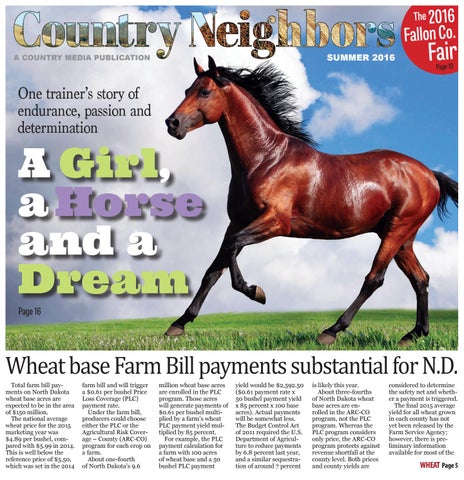
A Girl, a Horse and a Dream Page 16
Wheat base Farm Bill payments substantial for N.D. Total farm bill payments on North Dakota wheat base acres are expected to be in the area of $150 million. The national average wheat price for the 2015 marketing year was $4.89 per bushel, compared with $5.99 in 2014. This is well below the reference price of $5.50, which was set in the 2014
farm bill and will trigger a $0.61 per bushel Price Loss Coverage (PLC) payment rate. Under the farm bill, producers could choose either the PLC or the Agricultural Risk Coverage – County (ARC-CO) program for each crop on a farm. About one-fourth of North Dakota’s 9.6
million wheat base acres are enrolled in the PLC program. Those acres will generate payments of $0.61 per bushel multiplied by a farm’s wheat PLC payment yield multiplied by 85 percent. For example, the PLC payment calculation for a farm with 100 acres of wheat base and a 50 bushel PLC payment
yield would be $2,592.50 ($0.61 payment rate x 50 bushel payment yield x 85 percent x 100 base acres). Actual payments will be somewhat less. The Budget Control Act of 2011 required the U.S. Department of Agriculture to reduce payments by 6.8 percent last year, and a similar sequestration of around 7 percent
is likely this year. About three-fourths of North Dakota wheat base acres are enrolled in the ARC-CO program, not the PLC program. Whereas the PLC program considers only price, the ARC-CO program protects against revenue shortfall at the county level. Both prices and county yields are
considered to determine the safety net and whether a payment is triggered. The final 2015 average yield for all wheat grown in each county has not yet been released by the Farm Service Agency; however, there is preliminary information available for most of the
WHEAT Page 5
Page 2
COUNTRY NEIGHBORS
Summer 2016
Farmland values continue steady decline
In the Northern Plains, a diverse region comprised of high quality, tillable farmland, grassland and recreational property, land values for high quality land continued to decline by $400 per acre average in North Dakota from June 2015 to June 2016, by $100 per acre average in South Dakota and by $900 average by acre in Minnesota. “Land values continue to slide off their peak in North Dakota,” said Brian Mohr, area sales manager for Farmers
Bonnie Anderson, DDS Dr. Caitlin Jacquot and Dr. Weston Hafner
FAMILY DENTISTRY
Bowman
20 First Ave. SW • Bowman, ND
701-523-5651
Office: 701-523-4845 • Toll Free: 1-866-523-4845 l your For al Fishing ng & Hunti eds! ne
Newby’s
National Company in Garretson, S.D. “In the majority of the Red River Valley, prices range between $4,000-$5,000 per acre for high quality land. This would be down 15 to 20 percent from 2014-2015.On marginal land outside the area, we are seeing steeper declines of 20 to
35 percent depending on how bad the flaws are on the land. Prices range between $1,500 -$2,500 for poorer quality land.” Land values for top quality land in the southeast portion of South Dakota has remained stable from 2015 until now. Even recent auctions for land in this state have shown a slight increase. “Well attended public auctions are the norm with prices up to $10,000 per acre,” Mohr said. “As you move west, the prices drop significantly once you get past the Missouri River pheasant belt.” The central portion of western Minnesota sees land values down from their high point, but interest remains strong and top quality land has sold well at auction, Mohr said. A recent sale of 2,000 acres set values at more than $4,100,” he said.
■
Southwest Abstract & Title Co. 27 South Main ■ BowMan, nD
701-523-2922
CUSTOM SAUSAGES, MEATS & FRESH PRODUCE! Guns, Ammunition, Licenses & Scopes AVAILABLE HERE!
HigHway 12 | Bowman, nD
701-523-9818
701-523-3152 | 104 S Main, Bowman, ND
Summer 2016
COUNTRY NEIGHBORS
Page 3
eWith temps in 100s, prepare for heat stress in cattle
Heat stress could become a problem for livere stock because of a pocket ge of slow-moving hot air 0 that is forecast for the .” upper Great Plains next week. h- “The greatest impacts Da- of heat stress come when ble cattle are exposed to a combination of elevated or temperature and humidity over a period of e. time,” says North Dakota State University Extension Service beef cattle specialist Carl Dahlen. “Hot and humid condive tions during the day can stress cattle, but cooler get temperatures at night r serve as a relief from the heat of the day. “If forecast models are of s correct, daytime highs in the upper Great Plains will be in the mid-90s, g
with lows in the mid to upper 70s,” he adds. “These conditions present danger to cattle, and as we progress into the hottest part of the summer, a quick review of steps producers can take to manage and monitor conditions for heat stress is in order.” NDSU Extension meteorologist Daryl Ritchison expects late July to be the warmest days. “With the high heat also will come high dew points, meaning it will be both hot and humid,” he says. “Heat indexes over 100 degrees may occur, especially on Wednesday and Thursday. The good news is that those extremes are only expected to last a couple of days, with
other days more typical of this time of year, with maximums in the 80s.” Being proactive is the best way to deal with heat stress in cattle, according to Gerald Stokka, NDSU Extension veterinarian. He recommends producers actively monitor temperature
and humidity forecasts to anticipate when heat stress conditions will be developing. “Once cattle are in a severe state of heat stress, you may be too late to help them,” Dahlen cautions. “Having a solid management plan in place to address
heat stress could pay big dividends in the form of maintained animal performance during periods of heat and in avoiding death losses in severe cases.” Heat stress occurs when cattle are not able to dissipate heat. “Mammals have involuntary methods of regulating their internal body temperature, including shivering and sweating to maintain ‘homeostasis,’ or a constant, stable environment,” Stokka says. “Signs that animals are trying to maintain homeostasis include an increasing respiration rate, increased heart rate and increased panting. While animals are using extra energy, their feed intake declines.”
Dahlen and Stokka recommend producers take the following steps to protect cattle from heat stress: For pasture cattle, evaluate the condition of water supplies and ensure plenty of high-quality drinking water is available. Identify animals that are most susceptible to heat stress. They include feedlot animals closest to the market endpoint, very young and very old animals, and those with dark hides. Know when to intervene. A combination of factors, including temperature and humidity, drives heat stress. Develop an action plan to deal with heat stress.
■
n,
0 e
■
Your Medical Home • Primary Care Services for all ages • Diabetic Care Education • Lab services • Radiology Services • Comprehensive Care Coordination •Sliding Fee Scale Available to Qualifying Patients • Certified Application Counselors on Hand for Assistance Finding Affordable, Quality Health Insurance
Your Health, Our Priority!
Lori Jepson, FNP
Cassandra Altringer, FNP
Join us in welcoming Cassandra Altringer, FNP to the CCCHC Killdeer Clinic! Cassandra is now accepting new patients. Call to schedule an appointment today!
(701) 764-5822
CCCHC Killdeer Clinic 150 Central Ave North Killdeer, ND 58640
Monday - Friday 8 a.m. - 4:30 p.m. MT
Page 4
COUNTRY NEIGHBORS
Summer 2016
Drought like conditions threaten livestock
While some parts of North Dakota have received ample rainfall during the early growing season, other areas have not and are experiencing
reduced hay crops and lack of pasture regrowth. In addition, these areas are having water quality issues in places where rainfall is needed to
refresh stock ponds and watering holes. “There are reports of areas in the southwest and parts of central North Dakota that are
Off Sale Beer & Wine Java Shop • Broasted Chicken Schwans & Blue Bunny Ice Cream
•Truckers Lounge w/ shower •Wells Fargo ATM •Dyed Off - Road Fuel •High Speed Diesel Pumps · DEF Pumps · Touchless Car Wash
OPEN 24 HOURS
BUY 10 GET 1 FREE!
705 Hwy 12 West • Bowman, ND 58623 Phone 701-523-4737 • Fax 701-523-4740
having water quality issues in stock ponds and watering holes where cattle have no other options for water,” says North Dakota State University Extension Service livestock environmental stewardship specialist Miranda Meehan. Poor water quality can impact livestock health negatively, according to Gerald Stokka, NDSU Extension veterinarian and livestock stewardship specialist. “At a minimum, it can result in decreased water consumption, reducing feed intake and gains,” he adds. “However, elevated levels of some salts and bacteria can result in severe illness and even death.” NDSU veterinary toxicologist Michelle Mostrom says water sources should be tested for total dissolved solids (TDS), sulfates and nitrates. TDS measure salts. These levels should be less than 5,000 parts per million (ppm) for most classes of grazing livestock. Elevated levels of TDS may not be harmful to livestock health.
“However, due to our geology in North Dakota, water with high TDS often has high sulfate levels,” Mostrom says. Sulfate recommendations are less than 500 ppm for calves and less than 1,000 ppm for adult cattle. High levels of sulfate can reduce copper availability in the diet. Elevated levels of sulfates may cause loose stool, whereas very high levels of sulfate can induce central nervous system problems and polioencephelomalacia, a brain disorder found in cattle. Nitrate is not toxic to animals, but at elevated levels, it causes nitrate poisoning. Water sources that receive runoff from fields and confined feeding locations that contain elevated levels of nitrogen are at risk of contamination. Water with elevated nutrient levels also are at a higher risk for blue-green algae blooms in periods of hot, dry weather. Some species of blue-green algae (cyanobacteria) contain toxins that can be deadly when livestock and wild-
co B life consume them. ND “Monitoring water cia quality throughout of the grazing season is AR important because it “ changes in response to ra climate and environsa mental conditions,” de Meehan says. “What is A especially important is rec to keep a close eye on in water quality during ab drought when using a yie shallow water source lik and sources with a L history of water quality sh issues.” ba Many commercial lab- S oratories and the NDSU on Veterinary Diagnostic of Laboratory provide test- red ing for livestock water mi quality and specialized 20 testing. 20 The cost of a basic water quality test is approximately $25. Contact an NDSU Extension office for a list of commercial laboratories in the state. If concerned about livestock diseases caused by contaminated drinking water, contact your local veterinarian, the NDSU Extension veterinarian or the NDSU Veterinary Diagnostic Laboratory at 701-231-8307.
■
With over 91 channels of watchTVeverywhere, there’s something for the whole family! From your laptop or smartphone!
For instructions visit www.ctctel.com
Summer 2016
COUNTRY NEIGHBORS
WHEAT
FROM PAGE 1
counties. Based on this information, Andrew Swenson, NDSU Extension Service farm management specialist, estimates that producers in about one-third of North Dakota counties will receive the maximum ARC-CO payment. “Depending on the county, the payment could range between $18 and $36 per wheat base acre,” says Swenson. “The maximum payment per acre under ARC-CO varies by crop, county and year.” About one-third of North Dakota counties will not receive a wheat ARC-CO payment because high yields in 2015 offset the low price and provided revenue above the revenue guarantee. However, the high 2015 yields should increase revenue guarantees and the likelihood of payments in future years. Lastly, about one-third of North Dakota counties should receive some ARC-CO payments on wheat base acres but less than the maximum payment. Swenson adds, “I expect total farm bill payments on North Dakota wheat base acres to be in the area of $150 million, after the assumed 7 percent payment reduction due to sequestration, compared with $7 million paid last year. These payments, based on the 2015 crop year, will be made sometime after Oct. 1, 2016.”
■
Communities Against Violence & Abuse, Inc. Box 29~Lemmon, SD 57638
Office 605-374-5823
Crisis Line 605-244-SAFE
Offering Crisis Intervention to Women & Children affected by Domestic Violence
CAVA......WE CARE!
Page 5
18 WHEELER TRUCK & TRAILER SALES Exit 61, south of Cabelas 605.737.7861 | TOLL FREE 866.339.3752
LIVESTOCK TRAILERS COMPLETE LINE OF STEEL STOCK TRAILERS! CALL 2016 NEVILLE, 53X102, GROUND LOAD, TANDEM, AIR RIDE, 4 COMPARTMENTS, FULL REAR SWING W/HALF SLIDE CALL....ALSO AVAILABLE W/ROLL UP REAR DOOR AND ADJUSTABLE RAMP FOR GROUND LOAD OR CHUTE ENTRY, CALL 2015 S&S DURALINE, GSN STK TRLR, 24 FT., 3 COMPARTMENTS, 7’ TALL, REAR SWING W/HALF SLIDE, $11,750 2015 S&S DURALINE, GSN STK/COMBO, 24FT., FRONT DRESS W/SADDLE RACKS, STUD WALL GATE, REAR SWING, $14,900 1980 TRAILET, VAN HORSE TRLR, WEEKENDER LQ, TACK/FEED COMPARTMENT, 6 HORSE COMPARTMENT, REDUCED TO $10,900.00 2016 WILSON, ALUM GSN STK TRLR, 8X24, 3 COMPARTMENTS, FULL REAR SWING W/HALF SLIDE, CALL 1995 WILSON, 53X102, CATTLE POT, TRIPLE AXLE D-D-S, NOSE DECK, COUNTERBALNCE, DOG HOUSE, CALL 2010 MERRITT, CATTLE POT, 53X102, TRIPLE AXLE, D-D-D, SPRING RIDE, GOOD FLOOR, NOSE DECK, COUNTERBALANCE, DOG HOUSE, CALL
FLATBEDS AND DROP DECKS
1995 WILSON, TRIPLE AXLE, GRAIN TRAILER, ROLL TARP, REBUILT KING PIN, CALL
2005 TRANSCRAFT, STEEL FLBD, 53X102, CLOSED TANDEM SLIDER, WINCHES, A/R, CALL
2013 TIMPTE, AHT, TANDEM, AIR RIDE, ROLL TARP, 40X72X96, CALL
2001 TRANSCRAFT,COMBO DROP DECK, 53X102, BEAVER W/FOLD UP RAMPS, $24,900.00 2006 FONTAINE, COMBO DROP DECK, SPREAD, A/R, BEAVER TAIL W/ RAMPS, $26,900.00 1998 JET, 48X102, COMBO DROP DECK, 48X102, ALUM WHLS, SPREAD, A/R, CALL 1989 EAST, ALUM FLBD, 48X96, SPREAD, A/R, WINCHES, BOXES, CALL 1998 TALBERT, 48X102, DROP DECK, SPREAD, A/R, CALL 1992 TRAIL KING, RGN, TRIPLE AXLE, 53 FT. $27,900.00
PETERBILT TRUCKS
1998 WILSON, 50X102, LVSTK DECK, 50X102, CLOSED TANDEM SLIDER, 3 COMPARTMENTS. GOOD FLOORS, CALL
2003 PETE 379, STAND UP SLPR, O/H’D CUMMINS, 13 SPD W/3.55 RATIO, 270” W/B, STEERABLE PUSHER AXLE, ALI-ARC BUMPER, SHARP!!! REDUCED TO $49,900.00
1995 WILSON, CATTLE POT, 48X102, TANDEM, SPRING RIDE, NOSE DECK, COUNTERBALANCE, DOG HOUSE, 30-40% FLOORS, $23,900.00
2012 PETE 386, PLATINUM 70” SLPR W/ LEATHER, 376K MILES, 455HP, 18 SPD, FULL LOCKERS, NEW RUBBER, $71,900.00
2000 WILSON, CATTLE POT, 50X102, TANDEM AXLE, D-D, CALL 1996 WILSON, CATTLE POT, 53X102, TRIPLE AXLE, D-D-D, CALL 1987 CHARMAC, GSN, BULL STK TRLR, 7X18, ROAD READY, $4,900 2017 CIMARRON, SLANT STK COMBO, SADDLE RACKS/MATS, EXTRAS, 7’X24’ CALL
GRAIN TRAILERS
2005 Cornhusher, Aht 42X96x72, Aht, Air Ride, Ag Hoppers, Call
2016 NEVILLE, DROP DECK, 53X102, BEAVER TAIL W/RAMPS, CALL
1998 PETE 379 EXHD, DAY CAB, 3406E CAT 475 HP, 13 SPD W/NEW CLUTCH AND NUMEROUS UPDATES, CALL
1999 TIMPTE, AHT, 49X96X72, TRIPLE AXLE, REBUILT KING PIN-REAR SUSPENSION-NEW BRAKES-NEW SUPER SINGLES, CALL
KW TRUCKS 2004 KW W900L, AERO FLAT TOP, 530HP CUMMINS, 10 SPD TRANS W/3.55 RATIO, 265” W/B, $47,900.00 2006 KW, W900L, CAT POWER, 13 SPD W/3.55, STUDIO SLPR, $51,900.00 REDUCED $39,900 2009 KW T660, ADAC SLPR, 475HP, AUTOSHIFT, NEW RUBBER, UPDATES INCLUDING DPF FILTER-CLUTCH-TURBO-ETC, $42,900.00
FREIGHTLINER TRUCKS 2011 FTL, CORONADO 132, 545K, 550HP DETROIT, 18 SPD W/3.55 RATIO, 265”W/B, NEW RUBBER AND TURBO, $58,900.00 2003 FTL COLUMBIA, MID ROOF, 500HP DETROIT, 13 SPD W/3.73 RATIO, NICE TRK! CALL!
WESTERN STAR TRUCKS
2006 WESTERN STAR, STRATO SLPR, 550HP DETROIT W/30K ON O/H, 18SPD W/3.07 RATIO, STEERABLE PUSHER AXLE, WET KIT, FULL LOCKERS, 275”W/B, $62,900
WINNEBAGO 2009 WINNEBAGO, 340HP DIESEL MOTOR HOME , 2 SLIDES, ALL EXTRAS!, $110,000
Buy • Sell • Trade • Consign Randy dickson - 605.484.9988 | JeRRy MilleR - 605-484-5132 see ouR entiRe inventoRy at: www.18Wheelertruckandtrailer.com
ARENA WEST TRAILERS SADDLE & TACK ARENAWESTTRAILERS.COM
605-791-2400 ACROSS I90 (EXITS 60-61) FROM CABELA’S
2016 WILSON FOREMAN/8’ WIDE, 24’ LONG/16K PKG/3 COMP/CALL
SADDLES/TACK/WATER CADDIES/HAY NETS/ MORE!
270# Feeder
Page 6
COUNTRY NEIGHBORS
Summer 2016
Grown Together: The concept of intercropping By RONDA ADDY
When two or more crops are cultivated at the same time on a field, the process is called intercropping. The theory behind intercropping is
that the crops planted aren't likely to be plagued by the same insect pests and diseases, raising the potential for growth. The concept of intercropping has been around for some time. In
Honda West
the South, velvet beans or cowpeas were planted in standing corn in rows wide enough to let the sunlight in. The beans or peas would climb the cornstalks, allowing them to be harvested
745 West Villard • Dickinson, ND 58601 701-225-2803 • 888-483-7990 www.hondawest.us
together in the fall and saving on manual labor. Deciding what crops to plant in intercropping requires careful consideration of a number of factors, including the climate and soil. The crops used can be from different plant families or different varieties of the same crop species as long as they don't compete with each other for water, nutrients, sunlight or space. One crop will be more important than the other due to its contribution to food production. However, because one crop will mature before the other,
the competition between the two will be reduced. There is more than one method of intercropping. Some of these include: • Mixed or multiple intercropping, in which two or more crops are
B AKER A GRONOMY C ENTER FULL SERVICE AGRONOMY PLANT Fertilizer Spreading Preplant Bur n Down Chemicals Seed Treating • Bulk Fertilizer Grower-owned company helping to achieve success in the field. Stop in or give Parker a call at 406-778-2929
grown on the field at the same time without any row arrangement. • Relay intercropping, in which the second crop is planted with the first crop in its reproductive stage but before harvesting. • Row intercropping, in which two or more crops are grown at the same time with at least one of them planted in rows. • Strip intercropping, in which two or more crops are planted together in strips wide enough to allow machine crop production but close enough to interact. There are two types of strip intercropping. Contour strip cropping follows the layout of a rotational sequence and the contour of the field during tillage. Field strip cropping follows the general slope of the land with strips of the same width. The benefits of intercropping are numerous. Some of these include: • Reduction of insect pests • Reduction of plant diseases • Reduction of weeds • Reduction in hillside erosion • Increased topsoil protection • Attraction of beneficial insects • Better use of farm area • Better production and profitability Although intercropping is most common on farms, it can also be done in backyard gardens through companion planting. Planting flowers or herbs among vegetables with the same nutrient and moisture needs can add color to the garden and attract more beneficial insects than harmful ones.
■
Summer 2016
COUNTRY NEIGHBORS
Page 7
Products of the Prairie offers retail venue By SHERRY VOGEL Country Media
BAKER, Mont. — Have you cultivated a hobby and are now creating a product that you feel would be a marketable commodity? You’d like to take things one step further but just don’t know how to go about it? Then Products of the Prairie is just what you’ve been looking for. This grass roots Farmer’s and Crafter’s Market has been organized with you in mind. Your opportunity to bring your produce or handmade items to the marketplace has arrived. On Sept. 10 a southeastern Montana Farmer’s and Crafter’s Market will take place for the first time ever at the Fallon County Fairgrounds in Baker. The market will run from 10 a.m. to 4 p.m. in conjuction with the Baker Chamber of Commerce & Agriculture Fall Festival. The marketplace extends an invitation to include vendors from rural communities on the prairies of Montana, North Dakota, South Dakota and Wyoming. The impetus for this retail venue came as a
brain child of the Fallon /Carter County Extension Service and the Fallon County Resource Conservation Service. There was a joining of forces of like minds, with a common goal, to bring to the local area a venue for Montanans to sell Made in Montana products. Products of the Prairie was officially organized on Jan. 27, 2016. Various ideas were brainstormed which quickly became a joint vision. This led to the formulation of a mission statement and then cultivated itself into sound purpose. The purpose is to create an opportunity to strengthen the local economy and encourage healthy lifestyles, create a self-reliant community, increase knowledge of agriculture, and inspire small locally-owned family businesses to market products. The plan for the first Products of the Prairie event is to offer a family friendly event with kid’s activities, educational booths and produce and craft vendors. Vendors are encouraged to participate in this marketplace if they meet certain guidelines.
See Us For
All products sold shall be of good quality and must be grown, produced, or manufactured locally. A definition of “produced” or “manufactured” will follow the Made in Montana guidelines: A finished product shall have been created, made, produced, or enhanced. Products may be made from components made elsewhere, but in the hands of the local resident, they are transformed and now have at least 50 percent or more added value. In addition to the marketplace, the orga-
nization will be hosting a Soil-to-Skillet Dinner program the night before the market. A meal will be served consisting of foods from local produce and meats. The highlight of the evening will be keynote speaker, Sarah Calhoun, owner of Red Ants Pants. Come ready to be inspired. Sarah will share a story of triumph, as she tells how she developed a healthly and thriving business in White Sulfur Springs, Mont. Come hear how she designed a marketable product that was created when
Products of the Prairie
Southeast Montana Farmer’s & Crafter’s Market Saturday, September 10 • 10:00 a.m. - 4:00 p.m. Fallon County Fairgrounds, Baker, MT Vendor applications due August 15
Contact
P.O. Box 850 • Baker, MT 59313 Phone: 406-778-7110 • Fax: 406-778-3431 info@productsoftheprairie.com productsoftheprairie.com Facebook: Products of the Prairie
Double J Horse Sales All Breeds Consignment Horse Sale
uctsoftheprairie.com or stop by the Fallon/ Carter Extension office at the Fallon County Courthouse in Baker. You may also call 406778-7110.
■
Haley J. Evans
Accounting & Tax Service 123 Main Street Hettinger, ND 701-567-2856
Look to a neighbor you can trust: America Needs Farmers & Ranchers
Precision Parts & Supply
Open 7 a.m - 6 p.m. Monday - Friday Open 8:00 a.m. - 1:00 p.m. Saturday YOUR LOCALLY OWNED STORE 406-778-2219 • Baker, MT Hydraulic hose made while-u-wait!
We specialize in Ag Lending
“We don't sell the most; we try to sell the best.”
SATURDAY, SEPTEMBER 10, 2016 Stockmen’s Livestock Exchange Dickinson, ND Consignment Deadline: July 30 Ranch Horse Competition 8 a.m. MDT Sale 12 Noon MDT
FREE DELIVERY of all Tempur-Pedic sets
she identified a need for better fitting work pants for women. To get more information on the market or to receive an application form go to info@prod-
For a catalog or more info:
701-230-3044 • 701-720-6674
or www.doublejhorsesales.com e-mail: horsesale@nccray.com
Loaning money to area farmers is our business. We work hard to keep up with the latest developments in agriculture so we can do a better job of serving our customers. If you’re looking for a good ag bank, stop in and see us.
First State Bank Beach: (701)872-4444 Golva: (701)872-3656 Medora: (701)623-5000 24-Hour ATM in Beach & Medora Lobby Online banking at fsbofgolva.com Member FDIC
Page 8
COUNTRY NEIGHBORS
Summer 2016
Jenkins to headline Wibaux Co. Fair
A look at the 2016 Wibaux County (Mont.) Fair schedule, Aug. 25 to Aug. 28 at the fairgrounds. Thursday Aug. 25 7 a.m. - Exhibit Halls Open 8 a.m. - 4-H & Open Class Horse Show (Exhibit halls will be
closed promptly at 8:30 a.m.) 3 p.m. - Exhibit Halls Open 5:30-6:30p.m. - 4-H & FFA Livestock Weigh-In 6:30 p.m. - All 4-H and FFA Market Livestock to be in place Friday, Aug. 26
8:30 a.m. - 4-H, FFA and Open Class Livestock to be in place 9 a.m. - Livestock Judging Begins 9 a.m.-2 p.m. - Exhibit Halls Open 2-4 p.m. - Exhibit Halls Close 4 p.m. - Exhibit Halls Open 5-7 p.m. - Chicken Dinner for a Dollar 7 p.m. Night Show Opening Act: Jared Sherlock 8 p.m. – Night Show Main Attraction: Charley Jenkins, country singer/ songwriter Saturday, Aug. 27 8 a.m. - Rodeo Slack begins 8 a.m. - Dog and Cat judging
IT’S ROOFING SEASON! Owens Corning™
Duration TruDefinition Shingles
Country singer/songwriter Charley Jenkins will headline the 2016 Wibaux County Fair at 8 p.m. Aug. 26 in Wibaux, Mont. 10 - Rabbit & Poultry judging 3-8:30 p.m. - Inflatable
Fun Zone 4 p.m. - Stick Horse Rodeo
O’ Fallon Historical Museum 723 S. Main • Baker, MT Open 8 a.m. - 5 p.m. 7 days a week 406 - 778 - 3265
SureNail® Technology Designed for maximum holding power against winds up to 130 mph. We can help find an installer.
~LIMITED LIFETIME WARRANTY~ LARGE SELECTION OF COLORS IN STOCK
J & M LUMBER Monday - Friday 7:30 a.m. - 5:30 p.m. Saturday 8 a.m. - 4 p.m. 406-778-2030 • 8426 E. Hwy 12 • Baker, MT
Indian Trail Ranch Realty, LLC
406-778-2402 Baker, MT For all your
Residential, Ranch and Commercial needs
Jim Hurley
Judy Brown
hurleyranch2000@yahoo.com
coco@midrivers.com
Broker, Owner Home: 406-778-3735
Sales Home: 406-778-2786
4:30-8:30 p.m. - Monkey Motion/Climbing Wall 4:30-8:30 p.m. - Pippi the Clown 5-7 p.m. - Barbeque For A Buck 6:30 p.m. - Saddle Bronc Calcutta 7 p.m. - NRA/NWRA/ NRCA/NDRA Rodeo Sunday, Aug. 28 9:30 a.m. - Community Church Service at City Park 11 a.m. - Parade Noon-6 p.m. - Inflatable Fun Zone 12:30 p.m. - 4-H & FFA Livestock Sale 1 p.m. - Horses may be removed from the ground 1-5 p.m. - Monkey Motion/Climbing Wall 2-6 p.m. - Pippi the Clown 2 p.m. - Demolition Derby/Bump-N-Run
Summer 2016
COUNTRY NEIGHBORS
Page 9
a r o up f enge? l l a ch Test your farming trivia knowledge Farming is a time-honored tradition that has evolved a great deal over the years. Think you know a little something about some of the changes that have taken place in farming? Take this agricultural challenge and find out.
2) Who was known as the father of soil conservation? A) Hugh Hammond Bennett B) John Deere C) Charles Newbold D) Thomas Jefferson
3) What was perfected in 1854? A) Self-governing windmill B) Two-horse straddle-row cultivator C) Gang plow D) Steam tractor 4) When was the cotton gin invented? A) 1803 B) 1786 C) 1793 D) 1810
5) Who wrote a Farmer’s Almanac? A) Jethro Tull B) Luther Burbank C) Joseph Glidden D) Benjamin Banneker 6) When was the first successful light tractor developed? A) 1905 B) 1918 C) 1926 D) 1930
7) What was developed for the High Plains in 1926? A) Seed drill B) Cotton-stripper C) Self-polishing cast steel plow D) Barbed wire 8) Who invented the grain elevator? A) Joseph Dart B) John Lane C) Leonard Andrus D) Ed Nolt
How did you do? If you scored seven or more correct, you’re quite the agricultural buff. If you scored between five and seven, you know your agricultural history well. If you scored less than that, don’t feel too bad. Unless they have studied agriculture, most people don’t know a lot about the evolution of farming.
r
nc
r-
10) Who put 3,000 twine binders on the market in 1880? A) William Deering B) Harold Innes C) John L. Mason D) Benjamin Holt
OVER 100 FLATBEDS AND DUMP TRAILERS IN STOCK!
ey
e
9) When did silos come into use? A) 1890s B) 1900s C) 1850s D) 1870s
Answers: 1) B, 2) A, 3) A, 4) C, 5) D, 6) C, 7) B, 8) A, 9) D, 10) A
1) Who invented the mechanical reaper? A) Eli Whitney B) Cyrus McCormick C) George Washington Carver D) Joseph Dart
OVER 100 STOCK TRAILERS TO CHOOSE FROM!
Page 10
COUNTRY NEIGHBORS
Summer 2016
Country Nights and Carnival Lights Getting ready for the 2016 Fallon County Fair
By SHERRY VOGEL Country Media BAKER, Mont. — The highlight of the entire summer is the Fallon County Fair and rodeo in Baker, Montana. This five day event, Wednesday through Sunday, Aug. 17-21, will feature exhibits, livestock, a parade, carnival rides, free daily entertainment, commercial displays, food vendors, a demolition derby, rodeos and nightly entertainment. Horse and trail classes will kick off the fair Wednesday morning followed by llamas and alpacas. The goat trial, cat and dog shows will
be held in the afternoon. Livestock judging will continue Thursday and Friday with the 4-H/ FFA Market Beef Show Friday evening. Open Class Trailer shows will be Saturday morning with the 4-H/FFA Livestock Sale scheduled for Saturday afternoon. Family friendly amusement will be provided by Funtime Carnival Thursday through Sunday. A variety of spinning rides, skill defying games and tantalizing carnival food will be offered on the midway. Snails and Tails Utah, an entertaining, educational and interactive reptile show will kick off
The Eli Young Band the entertainment Thursday evening. Fairgoers will be able to get a close up look at a variety of snakes, alligators, turtles, etc. Some lucky volun-
teers may even have the chance to interact with the animals. The animated country-rock band Jagertown will be playing on the fairgrounds patio this year. Shortly after joining the scene with the release of their self-titled album “Jagertown” and selling thousands of CDs within weeks, Jagertown gained traction and started opening for several major country headliners across the west. They will provide dancers a chance to kick off their boots and have fun each Thursday through Saturday night. The cowboys and cowgirls get into action Friday morning as the steer roping competition gets underway at 8:00. That evening is something new to the fair this year as men, women and kids gather together to compete in the Indian/ Relay Race at 6:00. If you don’t place and want to have another go at it, don’t fear because the race will take place again at the start of each rodeo at 12:45 for a 30 minute show. That’s right, dust off your hats and pull on your boots for PRCA rodeo action Saturday
and Sunday afternoons. Following the races, the action will begin as the rough stock, cowboys and cowgirls provide an afternoon of tough and exciting competition. Saturday’s festivities kick off when the streets of Baker are the backdrop for the best Fair Parade in Fallon County. This event starts at 11 a.m. After the parade, head back out to the fairgrounds, grab a bite to eat and head to the rodeo for another full day of fair fun. Pippi the Clown, a brightly dressed joker with a cartful of surprises will provide daily entertainment to the young and young at heart. Pippi, (Jean Thomas) based out of Red Lodge, has toured the world but is thrilled to “clown around” at local fairs and festivals. She is an accomplished balloon artist and incredible face painter and brings great joy to children. There is always a good dose of free entertainment for the family at the fair. This year Double Vision Magic will make people laugh and marvel
at the wonders of comedy magic. Identical twins Mitchell and Michael provide professional, unique and clean comedy magic. Six Appeal is a world class vocal ensemble infused with impeccable comedic timing and the energy and vitality of a rock band. The award winning vocal band takes you on a journey that spans decades of music, performing classic oldies, current chart toppers and catchy original tunes - completely a cappella. Despite their cheeky group name, the antics of these six young gentlemen provide a good natured atmosphere for their electrifying performance. The Freckle Farm Pony Rides and Petting Zoo promise to thrill the pint sized fair-goers as they try their hand at riding the range and have an opportunity to get close up with farm animals. Dominating the entertainment scene Saturday night is the Eli Young Band. They will galvanize the stage for one concert only, Saturday, August 20. This Academy of Country Music Award winning foursome will light up the star studded summer evening with a contemporary country music sound. The Texas country band entered the country music scene in 2008 with their debut album “Jet Black and Jealous” which permiered their first hit, “Always the Love Songs”. They went on to win the Country Music Academy’s Song of the Year with “Crazy Girl”, which they released in 2011. This double plat-
Summer 2016
COUNTRY NEIGHBORS
dy
dy Jagertown, above, and Six Appeal, right, will be appearing at the 2016 Fallon County Fair, Aug. 17-21. e inum single became the number one most played country song of the year es on Billboard’s 2011 year end chart. Their sec, ond number one single es, was certified platinum and was titled “Even If es It Breaks Your Heart”. Their very popular recent number one hit “Drunk of Last Night” resonated with fans and sold out arenas and stadiums r nationwide. Eli Young
band members, Mike Eli, James Young, Jon Jones and Chris Thompson have developed a camaraderie and creativity
that has fused them into an intoxicating cocktail of entertainment. The final day of the fair begins at 10 a.m.
Sunday with a nondenominational church service held in the grandstand next to the outdoor arena. The Cowboy Church service draws area folk together as they worship while singing old favorite hymns and praises. It isn’t unusual for the preaching to be done on horseback. The grand finale of the weekend is the Sunday evening Demolition Derby. Be thrilled as daring derby drivers put their pimped out rides through a challenging feat of cunning and endurance in their quest to be the last derby running. As the final days of summer drift into autumn, come celebrate this annual community event as family and friends gather to enjoy world class entertainment and family oriented fun. Tickets for all events
Page 11 and entertainment will be available from the fairgrounds ticket office. For more information or questions, contact: falco-
as your locally owned tire store! We are excited to “roll” out two new programs for our customers.
Price Match Guarantee CHECK OUT OUR NEW PRICE MATCH GUARANTEE PROGRAM when you shop for your next set of tires. We will match any apples to apples prices of any competitor or you can receive a gift card from us.
Enhanced Road Hazard Warranty YOU HAVE ASKED FOR IT, NOW HERE IT IS! Check out our new Enhanced Road Hazard Warranty Program. We will replace up to 4 tires if a tire is damaged beyond repair. Please contact any of our four locations for details and restrictions.
TRUCK AND AUTO SERVICE
e
dan e
ze rt
d
s he
all-
he t
ed at-
• Corral Panels • Walk-In Panels • Gates • Bale Feeders • 1/4 Circle Maternity Pen • Squeeze Chutes • Confinement Pens • Handling Systems - portable & stationary • Automatic Headgates • Portable Loading Chute 800-881-3457 realtuff@westriv.com Jerry Ohman 605-845-3456 Fax: 605-845-7232 28726 US Hwy. 12 Mobridge, SD 57601
■
Celebrating 30 YEARS of serving Easter n MT
-
ay
fair@midrivers.com or call 406-778-2451, and be sure to like the Fallon County Fair Facebook page.
605 N Baler
Like all Vermeer products, the new 605N Vermeer balers are built to last. With a sleek new design, these balers may look different but what hasn’t changed is the high-performance and reliability they have to offer. Boasting durable, heavy-duty components and the ability to perform at a high capacity, the 605N Vermeer baler works hard to help you run smoothly and efficiently.
Baker • 406-778-TIRE (8473) Glendive • 406-377-TIRE (8473) Miles City • 406-874-TIRE (8473) Miles City • 406-234-4838
Page 12
COUNTRY NEIGHBORS
Summer 2016
A collection decades in the making By COLE BENZ/Country Media
One of Lanny Vail’s antique tra
ctors.
BOWMAN, N.D. — You can take the boy out of the farm, but you can’t take the farm out of the boy. That’s the inspiration behind Lanny Vail and his collection of antique tractors. A Bowman County native, Vail grew up on a farm but made his living operating a service shop and later in the furniture business. His collection of tractors keeps him close to his farm-living
roots. Vail has eight vintage tractors, and one custom rig, in his collection, which he stores in shops on property he owns. His antique collection includes: 1947 International Farmall Cub, 1940 Double A, 1942 A, 1948 Farmall B, 1948 Farmall C, 1947 IHC WDG, 1951 IHC WD9, and a 1951 Co-op No. 3 Propane. Vail did all the restoration work himself. From engine rebuilds, to body work and paint jobs, he took care of it all, though finding parts
was sometimes a challenge. The usual practice amongst antique tractor enthusiasts is to buy broken down rigs to take parts. “Usually you get a ‘parts tractors,’” Vail said. He also said that there are companies that recreate parts specifically for antique farm equipment, which helps Vail out when he couldn’t find a genuine part from a broken down tractor. Vail’s most rare and valuable tractor is his propane-fueled 1951 Co-op No. 3. It’s so rare he has
• Land Auctions • Real Estate • Farm Land Management • Machinery Auctions
Featured Listing:
Featured Auction:
3,087.27 +/- Acres Mckenzie Co. & Golden Valley Co., ND
Andy Mrnak
1,981.85 +/- Acres McKenzie County, ND Sept. 28, 2016
Call Pifer’s Bowman Office Today!
701.206.1095 andy@pifers.com
Jim Sabe
701.523.6283 jsabe@pifers.com
701.523.7366 www.pifers.com
Summer 2016
COUNTRY NEIGHBORS only seen two, and one of them is in his possession. “They made very few of them,” Vail said. “I’ve seen one on tv, and one in person, and this is the one.” The engine runs on propane, and few were made because propane wasn’t as accessible as gasoline. Even farmers who filled their tractor with propane tanks heating their homes found that they couldn’t fill the tank in a timely manner. Throughout the years Vail hasn’t had to travel very far to add to his collection. Mostly he has inherited the rigs or found sales near his home in Bowman County. The furthest he has had to venture out was Ekalaka, Mont., which is only about 80 miles from Bowman. There he purchased his ’48 Farmall C. Though Vail’s collection is a site to behold,
the machine that gets the most heads to turn is the dual-engine tractor he custom built from essentially four different rigs. Started in the fall of 1988, he finished the project the following
spring in 1989. The idea was inspired by a similar machine he saw when he was a kid in the late 40’s and early 50’s, Vail said. He built the side-byside from a Farmall B tractor he already owned
and another junk B tractor he acquired. A third piece to the puzzle was from an A Farmall tractor he bought. When he got into the heart of the project he realized he was still missing some
Page 13 pieces, so a fourth tractor was bought from a salvage company. The custom tractor has two separate engines, fuel tanks, clutches, throttles, and transmission shift levers. It has a single steering wheel, brake pedal, pto, and belt pulley. Vail said it is easy to drive and synchronizes the motors by the sound of the mufflers. His one desire for the project, after making it functional, was to make it look like it came off the assembly line. “I did try real hard to make it look like it came from International,” Vail said. “It took a lot of effort to make it look like a factory-built machine.” Vail’s design has attracted eyes locally and nationally. He said that over the years he has sent blueprints all over the country for others to duplicate the design.
“Someone said ‘what’s it good for,’” Vail said. “I said ‘absolutely nothing.’” Though the custom tractor is pretty good at turning heads, especially when Vail rides it through the tractor parade each year in Bowman. The collection has taken him decades to grow, and he’s spent many hours making them function and making them look like they just came from the factory. Storage space and time might dictate whether he invests in another antique tractor. And after all these years he might consider his collection finished. Vail is a member of Yesterday’s Farmers and you can see one of his tractors or one of his other custom built projects driving in parades in Bowman County.
■
Page 14
Windy’s Bar Olymp COUNTRY NEIGHBORS
Summer 2016
There’s no way around it...
It’s a gross job butesomebody has to do it an
B ranch’s bovine embryo ShuffleAn ‘inside’ look at a Bowman County transfer program B
By BRYCE MARTIN Country Media BOWMAN, N.D. — You may driven around North Dakota and noticed a business that features the word “genetics” in its name. Well, behind the doors of that business is most likely a large freezer full of a vital item for today’s ranchers: bull
MARMARTH, ND
701-279-9843
semen. But a large cattle ranch in southern Bowman County is proceeding beyond the process of artificial insemination in an attempt to mass-produce the best genetics possible. As Terry Mrnak, co-owner of Mrnak Herefords in Bowman, N.D., says, human insemina-
PASTIME CLUB & STEAKHOUSE
bag toss
tion through artificial means has always been considered a miracle when nine months later a child arrives. What many don’t know is that some ranchers, including the Mrnaks, have been conducting such processes on their cattle for decades. In fact, the original artificial insemination of a livestock dates back to the early 1800s. What Mrnak’s ranch is doing, however, is more advanced. They are implanting heifers with an already fertilized embryo through their embryo transfer program. Embryo transfer, abbreviated as ET, is an
advanced reproductive technology and a progressive tool that helps produce more offspring from an elite cow and can extend the impact of outstanding cattle genetics, according to the American Embryo Transfer Association. The bovines essentially become surrogate mothers. “It’s a long process,” said Wayne Mrnak as he herded cattle into a barn on a hot July day at his family’s substantial ranch. The female donor cows undergo artificial insemination with quality bull semen then the fertilized embryos are implanted
board
into female black cows that will, in the spring, give birth to purebred Hereford calves. The reproductive potential of each normal newborn calf is enormous. There are an estimated 150,000 potential “eggs” or ova in female bovines and countless billions of sperm produced by each male. By natural breeding, only a fraction of the reproductive potential of an outstanding individual can be realized, according to a 2007 study on ET authored by Dr. Steve Blezinger, a management and nutritional consultant from Texas. But the initial process of artificial insemination is just as important to many modern-day ranchers. Artificial insemination, which could be described as messy at best, may be used for many reasons, including to allow a male to inseminate a much larger number of females, to allow use of genetic material from males separated by distance or time, to overcome physical breeding
Hu
difficulties, to control the paternity of offspring, to synchronize births, to avoid injury incurred during natural mating, or to avoid the need to keep a male at all. Insemination of cattle, and other livestock, is very common in today’s agriculture industry, especially for breeding dairy cattle, which accounts for 75 percent of all insemination, according to Trans Ova Genetics, recognized as a source of superior reproductive expertise. Though western North Dakota doesn’t see too many dairy cows. Embryo transfer, which became popular and more affordable in the early 2000s, takes the process further to ensure that the bovines produced are of top quality. About 50 head of cattle are rounded up at a time and chuted through to a massive “hugging” device that keeps a single heifer still using firm yet harmless pressure. The person implanting the embryo, while wearing a thick glove
Saturday, September 1
Sign ups from 11 a.m. to 1 p.m. Tournament starts at 1 p.m. s t Dar • Play until we have a winner • Two person teams
701-523-5344 Top teams will receive cash prizes; payou Shop/Office 510 3rd Ave. NE positions depend on number of teams PO Box 483 Bowman, ND 58623 rwelding@ndsupernet.com
First place team will also receive a set o Brad Hlebechuk Chad Hlebechuk Volbeat/Five Finger Death Punch tickets 701-523-2264 701-206-0627
Windy’s Bar & Pizza
206 S Main St Bowman, ND
701-523-5753
$20/team en Bar will add prize m
Hair Design ▪ Advanced Coloring ▪ Facials Hair Removal ▪ Manicure ▪ Pedicure Hair Extensions ▪ Special Occasions ▪ Weddings
(701) 523-5673
111 South Main St. ▪ Bowman, ND
Monica Mosbrucker owner/stylist
Tessa, Stephi & Jordyn stylists
Summer 2016
COUNTRY NEIGHBORS
Page 15 (Left) A heifer is loaded into the “hugging” machine that applies firm pressure to keep cattle from moving during the embryo implantation procedure. The process only takes a few moments from the time the young, female cow is loaded into the device. It’s then harmlessly released. (Photo by Bryce Martin)
that stretches to his or her shoulder (you can imagine why), performs rectal palpation on the heifer then implants the embryo using a long rod. The egg catches into the cow’s uterus. It only takes a couple minutes then the heifer is sent on her way, hopefully with a bun in the oven. The ordeal is noisy, dirty and sometimes dangerous if close attention is not paid, but it’s nothing today’s ranchers aren’t familiar with. With artificial insemination it is possible to exploit the vast numbers of sperm produced by a genetically superior bull, however the reproductive potential of the female has been largely unutilized, according to Blezinger. A typical heifer will produce an average of eight to 10 calves in her entire lifetime under normal management programs. Like artificial insemination has done for the bull, embryo transfer is a technique
that can greatly increase the number of offspring that a genetically important cow can produce. It has been said that to dramatically improve the genetic base of a given cow herd it will take 10 to 20 years to accomplish using only natural
service. By incorporating artificial insemination, these improvements can be seen in seven to eight years. Blezinger noted that through the use of an aggressive ET program this change is accelerated to four to five years, which means more
Look For In Store Specials!
Mon. - Sat.: 6 a.m. - 7:30 p.m. Sunday: 8 a.m. - 7:30 p.m.
Farmers Union Oil Company
Fuel • Food • Automotive Service Animal Health • Seed • Feed • Oil Tires • Agronomy Products • Batteries
Bowman, ND
701-523-3268 1-800-662-3268
Rhame, ND
701-279-5571
Buffalo, SD
605-375-3303
cattle at a faster rate for Mrnak’s ranch.
■
Wayne Mrnak, above, is one of the owners of Mrnak Hereford ranch just south of Bowman, N.D. Mrnak, along with his brother Terry Mrnak and Terry’s son Brent Mrnak, run the reputable farm and ranching operation. (Photo by Bryce Martin)
Discover the Beautiful Discover the Skin Beautiful Skin Within Within
JOB #
OBAGI PRODUCT
PIECE
OBPT4
Blue Peel
Eblast
SIDE
ATTRIBUTES
LOCATION
1/1 Non-Customizable, Non-Promo
All States
VERSION
DATE
PF3 01/23/15
CREATED BY
STATUS
AH
REVIEW
Obagi® Blue Peel RADIANCE® and Original Blue Peel ®— Two Peels. Spectrum of Patients.skin one layer at a time.*,† Reveal Aclearer, younger-looking Obagi® Blue Peel RADIANCE® and Original Blue Peel®— Reveal clearer, younger-looking one layer peel at a time.* - Blue Peel RADIANCE isskin a superficial with salicylic acid that provides tighter, smoother,
brighter-looking skin after just 1 peel1,‡ B L U E P E E L® - Original Blue Peel is a medium-depth chemical peel that dramatically improves the complexion2
For more information about other Obagi products, visit www.obagi.com. *For professional use only. Except as otherwise indicated, all product names, slogans and other marks are trademarks of the Valeant family of companies. Distributed by OMP, Inc.
Contact our office today to see if Blue Peel RADIANCE or Original Blue Peel is right for you!
©2014 Obagi Medical Products, Inc., a division of Valeant Pharmaceuticals North America LLC. DM/BLP/14/0002 10/14
Complete Healthcare For more information about other Obagi products, visit Today www.obagi.com. for a Better
Bowman, ND
(701) 532-3226
Tomorrow.
Page 16
COUNTRY NEIGHBORS
Summer 2016
A girl, a horse and a dream Horse trainer eyes chance to compete against world in her ‘own backyard’
By BRYAN GALLEGOS Country Media
HALLIDAY, N.D. — Some say horse racing is the most exciting three minutes in sports. But for Dante LaPierre, horse
racing is the most exciting hours in sports. LaPierre, a Halliday horse trainer, competes in endurance racing, an event that is a timed test of an individual horse/ rider team’s ability
to traverse a marked, cross-county “trail” over natural terrain consisting of a distance of 50 to 100 miles in one day. And the 36-year-old LaPierre is pretty good at it, having recently won a variety of races of different lengths around the state in the Montana and Wyoming over the past several months. But she has her eyes on a bigger prize. She is racing for a spot in the 2018 FEI World Equestrian Games in Bromont, Quebec, Canada. The Games are administered by the Federation Equestre Internationale and
Dante LaPierre has been juggling married life in Halliday with her husband, Clayton, daughter Katya, and a career in horse training and endurance racing. She hopes to compete in the World Equestrian Games in Bromont, Quebec, Canada in 2018. are the major international championships for equestrianism. They’ve
been held every four years since 1990. Endurance riding was
DICKINSON MUSEUM CENTER Lose Track of Time!
WHAT’S A SECOND OPINION WORTH?
Open MondaySaturday 9:00 am to 5:00 pm
A lot—when it comes to your investments. As a Thrivent Financial Associate, I can look at your portfolio with fresh eyes to determine if it is aligned with your goals. No matter which way the financial markets are going, together we’ll determine whether any changes are needed to help keep your investment plan on track. Contact me today for a complimentary portfolio analysis.
Thrivent Financial was named one of the “World’s Most Ethical Companies” by Ethisphere Institute 2012–2015.
Bryan Clendenen CLTC®, FIC Financial Associate 112 N. Main Street Bowman, ND 58623 701-523-3953
Securities and investment advisory services are offered through Thrivent Investment Management Inc., 625 Fourth Ave. S., Minneapolis, MN 55415, a FINRA and SIPC member and a wholly owned subsidiary of Thrivent Financial, the marketing name for Thrivent Financial for Lutherans, Appleton, WI. Thrivent Financial representatives are registered representatives of Thrivent Investment Management Inc. For additional important information, visit Thrivent.com/disclosures. For additional important information, visit Thrivent.com/disclosures. Appleton, Wisconsin • Minneapolis, Minnesota • Thrivent.com • 800-847-4836
28506 N7-15
Featuring:
$6 Adults $5 Seniors $4 Children 2-12
• Dinosaur and History exhibits • Pioneer Machinery Museum • Educational Programs • Special Events • Prairie Outpost Park • Classes • Demonstrations
first developed in the early 1900s as a military test for cavalry mounts. Horses were required to go on a 5-day, 300-mile ride carrying at least 200 pounds. The cavalry test became a civilian sport in the early 1950s, according to endurance web sites. In 1978, FEI, the international governing body for World and Olympic equestrian events, recognized endurance riding as an international sport. In 2006, more than 353 FEI endurance competitions were held in Europe, Asia, and the American continents incorporating over 49 countries worldwide, according to endurance web sites. This will be the first time the Games will be
Summer 2016
COUNTRY NEIGHBORS held in Canada. They were held in the United States in 2010 with previous sites include Sweden, Netherlands, Italy, Spain, Germany and France. “When I saw it was going to be held in Canada, I told myself, ‘I have to go for it,’” LaPierre said. “It’s going to be in my back yard.” That’s a big dream for a small-town girl. LaPierre lives in a cozy little home that is draped in “Old West” charm with her husband, Clayton, and their 4-year-old daughter, Katya. On the outskirts of town, the couple has corrals and a barn where they keep the horses she rides and trains. With her cowboy boots, worn jeans, braided hair and a “never-quit” attitude, LaPierre has that small-town look. But she’s definitely not your typical small-town girl. LaPierre has been called a compact inferno of energy. And why not? She’s up before the sun hits the horizon and doesn’t stop working until well after the sandman
makes his last call. “I’m still excited about this,” she said, during a rare quiet moment in her day where she was able to enjoy a hot cup of coffee. “It’s hard work. My days are not just sitting around watching TV and doing my nails.” She rides the open range every day for hours in the morning, conditioning her Arabians for the rugged distances of her sport. She has nine horses of her own of which three are competing at this time, and another that she is training for a customer. She rides each horse an average of 65 miles per week. And she also does conditioning work for herself, changing her boots for running shoes and runs three-to-eight miles a day. And when she has time, LaPierre competes in half-marathon races. What does running in half-marathons have to do with endurance racing? Sometimes the riders have to jog alongside the horse during an endurance race. Confusing? Maybe.
But not to LaPierre. She has been racing – riding and running – for more than two decades. LaPierre is from Capetown, South Africa, and her background in horses is rich. She has ridden professionally for her country, trained horses for sheiks in Dubai, and competed in hundreds of flat races throughout Europe. Of course, that was all before she met and married Clayton in 2011 and moved to Halliday. She has ridden more than 15,000 miles during her career, one that started when she was eight years old when she rode her first competition in South Africa. She honed her riding
Page 17
skills and learned the ins and outs of training the horses during an apprenticeship in England. That experience allowed LaPierre the opportunity to train and race horses in Dubai. Four years ago, LaPierre made it to the big show in regards to her riding career. At the age of 29, she was selected to the Springboks riding team, the professional South African endurance riding team. It consisted of the top five riders in the country. However, an arrow – Cupid’s arrow – changed her life dramatically. She fell in love and became involved in the classic love story. You know
Stop ina for pizz & a ge! bevera
the story: Girl meets boy, they fall in love, get married and live happily ever after. She met her husband, “a cowboy from North Dakota” through a mutual friend and after corresponding with each other via e-mails, they became friends. And when they
finally met face-to-face during a hunting trip Clayton took to South Africa, the sparks truly began to fly. It wasn’t difficult for LaPierre to give up her spot on the Springboks riding team in South
HORSE Page 18
Next Door Pizza Main Street • Scranton, ND
701-275-9200 Hours:
Mon - Thurs: 3:30 - 9 pm Fri - Sat: 3:30 - 10 pm Sun: Noon - 9 pm
y
o e 00 t in -
ry
Morland Financial Services 15 S Main St. Bowman, ND
701-523-5696
“Stop by Lasting Visions and enjoy sharing flowers, coffee & friendship.”
Flowers & Cappuccino By Lasting Visions 19 North Main • Bowman, ND 701-523-3833
CheCk us out on FaCebook!
n-
e
e
SW Select Broke Horse Sale May 22nd, 2016
Woodley’s Construction Supply Inc.
Horse Preview begins at 8 a.m. Sale begins at 1 p.m.
Harry Kerr, Owner | 701-523-5666 (Home) Wayne Miller, Fieldman | 701-279-6649 (Home)
701-523-3217 115 4th St. NW ◆ Bowman, ND
Page 18
COUNTRY NEIGHBORS
Summer 2016
HORSE
FROM PAGE 17
Africa for another team in Halliday, North Dakota. Although she gave up her spot in the spotlight, she never lost the love for the sport. And with her stable of Arabians, she continued to ride and run with her horses. “It was a whole new ball game when I came to North Dakota,” she chuckled. “They laughed at me and my little Arabians.” Still, she endured with a smile. And now her goal is to reclaim a spot on the South African team to participate in the World Games. “I still have to make the
701-579-4887
team,” she said after taking the last gulp of her coffee. And that means more work, more training, and more riding. Because you see, endurance riding is more than riding a horse fast across the finish line like the Kentucky Derby. The winner is determined by a combination of speed and the horse’s recovery rate during required veterinary examinations during the race. Riders can mount any breed of horse, but Arabian horses generally dominate the top levels because of the breed’s stamina and natural endurance abilities, according to endurance web site. Before each race, horses are examined by a veterinarian to
1-800-459-4887
525 Main St.
New England, ND 58647
New England, ND • 701-579-4191 Providing electrical service to the rural areas of Adams, Bowman, Hettinger & Slope Counties.
ensure they are fit to perform in the ride. The race is divided into sections and the length of those loops are determined by the distance of the race, LaPierre said. After each section, horses are stopped for an examination, where they are checked for soundness and dehydration, with their pulse and respiration taken. To continue the race, the horse must pass the examination, including reducing its heart rate below that specified for the event, typically 64 beats per minute or below, she said. The riders’ time keeps running until their horses reach the required target. The examination usually takes
about five minutes, LaPierre said, which includes checking hydration, metabolism and muscle tone. If the horse fails the inspection, it is eliminated from further competition. LaPierre said after the check-up, the horse is held for an additional hold time, usually between 40 to 60 minutes, at which time it is fed and watered. This procedure is followed for every section. Riders set their own strategy for the pace during the competition, adjusting to the terrain and their mount’s condition. Riders must be familiar with pace, when to slow down or speed up during the ride, and the signs of the horse tiring. The average speed to ride
for endurance is 7 mph. This is about the speed of a medium trot for almost all breeds of horses and ponies, according to endurance web site. That’s where LaPierre’s fitness comes into play. When she says the signs of her horse tiring, she’ll climb out of the saddle to ease the load for her horse and to help keep the heart rate slow. She’ll run beside the horse, often talking to the mount in a calming voice. But she must be mounted when she comes to the end of the loop or at the end of the race. That strategy has worked in the past, giving her the most exciting hours in racing.
■
A horse, of course You may love them, but are you ready for one? By TRESA ERICKSON You fell in love with horses as a young child, and now that you are older, you would like to get one of your own and perhaps even start breeding them. If you are planning to purchase a horse inside the United States, you will probably encounter few obstacles. If you are planning to purchase a horse from abroad, however, you may run into some difficulties. Before you purchase one, you should be aware of the rules of the U.S. Department of Agriculture (USDA) governing the importation of horses. According to the guidelines put forth by the USDA, all horses imported into the United States must be examined by a full-time veterinary officer of the government of the exporting country. During the examination, the officer must ensure the horse meets certain health requirements and complete a veterinary health certificate attesting to that fact. The requirements are: • The horse must have been kept in the exporting country for the 60 days prior to importation. If not, then a veterinary officer of the government of each country where the
horse was kept within the 60 days must issue a health certificate. • The horse must be free of ectoparasites and contagious diseases and must not have been exposed to contagious diseases within the 60 days prior to importation. • The horse must not have been vaccinated with a live, attenuated or inactivated vaccine the 14 days prior to importation. • The horse must not have been kept in or exposed to any areas where African horsesickness, contagious equine metritis, dourine, epizootic or ulcerative lymphangitis, equine infectious anemia or piroplasmosis, glanders, surra, Venezuelan equine encephalomyelitis or vesicular stomatitis has occurred within the 60 days prior to importation. • The horse must not have been kept in a country where contagious equine metritis is known to exist or have contact with any horses from such country the 12 months prior to importation. All horses must meet the health requirements above in order to be imported. In addition, the horse must be quarantined for a certain period of time at the U.S. port of
entry. The length of time is determined by the exporting country. Horses from Italy, for example, must be quarantined for three days, while horses from Mexico must be quarantined for seven days and horses from Saudi Arabia, a country known to be infected with African horsesickness, for 60 days. During the quarantine, horses will be tested for certain diseases. Any horse that tests positive for the disease will be denied entry into the United States. Owners will be responsible for all quarantine fees. In addition to the USDA requirements, some states have their own health requirements for the importation of horses. To ensure you meet all of the requirements, check with the USDA and the state government where you live for complete information. Importing a horse can be expensive. Don't go into it unprepared. Contact the appropriate authorities and familiarize yourself with the importation process and the health requirements your horse must meet in order to be admitted to the United States.
■
Summer 2016
COUNTRY NEIGHBORS
is
g
Beef production needs to think outside the box By KRIS RINGWALL NDSU Beef Specialist
Forward thinking is important in beef prop duction. ’ll The focus in beef production is how to m- raise the best, most marketable, most tender, best-tasting beef and, f in some cases, simply another beef cow or bull. At the end of the day, the n word “production” needs to be replaced with the word “business.” Good business concepts help with the dollars, but production methods still seem to take up a lot of the discussion. Among producers, beeves are being discussed and the outcome will be the best final product. That is, until producers step from their pastures - into the bigger picture. For some, beef production is fine in its present form with no need for alternative production models. Yet many producers are seeking proedduction models that will 0 stand the test of time. Sustainability, to support, to withstand or . to bear the forces applied, is critical within the developing models of ill beef production. Defining sustainability, however, seems to cycle in a pattern similar to the beef eir cattle cycle. Producers
, te
n-
d
Page 19
have work to be done, data to be collected and knowledge to grow when the beef industry speaks of sustainability. Where is beef going to go? Perhaps a look at agriculture in general would be good. Ideally, production agriculture will continue in its present role, but too often the words “sustainable” and “appeasement” are used side by side. The status quo is sufficient. However, given current data and trends, the sustainability of current systems is a subject of spirited discussion, particularly if community and population trends are added to the equation. Expandable and, we hope, more sustainable systems need to be evaluated to assess current trends. In a word, that’s diversification. For the future, all avenues for additional revenue streams need to be explored to enhance the economic viability for beef producers and the rural areas associated with beef production. This compensation may come from not only beef but also synergistic crop production. For example, small-grain production systems can integrate rotational cropping practices, high-residue manage-
White Drug WITH A COMMITMENT TO THE COMMUNITIES WE SERVE Wide selectio of gifts, novelties and health & beauty aids. We also have the bridal registry. Stop by the Pharmacy for available Immunization needs. Alaina Staheim-Olson Pharmacy Doctorate Pharmacy Manager
112 S. Main Street PO Box 750 Hettinger, ND Phone: (701) 523-4115
ment and annual forages (with attention to wildlife habitat enhancement) to diversify income while opening the door to other value-added opportunities for beef production in concert with crop production. Agriculture is no longer simply production agriculture; it involves increased urban and recreational components as well. This multiple approach to a dynamic agriculture also provides opportunity for enhanced economic sustainability for rural
producers. The Dickinson Research Extension Center, as part of North Dakota State University, takes seriously the need for sustainable beef systems in the world of agriculture. The center is striving to develop sustainable and integrated production strategies that match conditions of western North Dakota and surrounding regions. The inclusion of forages into traditional cropping systems can provide the resources necessary for the development of
integrated production strategies that increase sustainability and profitability. Forage-based cropping systems come closer to the native plant community present when homesteaders first arrived in this region. A need exists to develop agro-ecosystems that optimize the balance between forage-based and grain-based crop/ livestock systems reflective of the many individual ecosystems. These integrated systems must be synergistic to, or enhance, the native and
agronomic plant communities, thus providing the base for future beef production. In addition, marketing and obtaining a fair value for commodities produced from forage-based systems is key. Because the general population requires protein, a need met by meat and high-protein crops, meeting this demand is a unique opportunity that a forage-based system integrated with crop production can respond to in addition to current cropland use.
■
CRANE, ROSELAND, PIKOVSKY & MELLING, P.C. crhlaw@ndsupernet.com Hettinger: 701-567-2418 Adams County Courthouse
Attorneys at Law Licensed in North Dakota, South Dakota and Minnesota
David M. Crane | Aaron W. Roseland | Amy Pikovsky | Erin Melling
Lyle Haberstroh 701.567.4380 Owner “You bend‘em — we mend’em”
Lyle’s Body Shop • Auto Body Repair & Refinishing • • Auto Glass Installation • • Damage - Free Towing • 103 Highway 8 South Hettinger, ND 58639
Page 20
COUNTRY NEIGHBORS
Summer 2016
DID YOU KNOW: Farming by satellite By TRESA ERICKSON
It’s Sunday afternoon, and you’re getting ready for the game. You’ve got the remote, the chips and the soda. You flop into the recliner and
switch on the TV. Miles away, a satellite dish receives a signal from a satellite in space and transforms it into the game you are about to watch. At a farm across town, a similar event is
West River Veterinary Clinic 203 US Hwy 12 E~Hettinger, ND~701-567-4333
E.A. Andress, DVM L.K. Henderson, DVM J.L. Innes, DVM B.M. Johnson, DVM D.L. Safratowich, DVM L.B. West, DVB
Dakota Packing Company
taking place. A combine antenna receives a signal from a satellite in space and transfers it to a computer, providing the farmer with information about his fields, including the exact location of the combine. The farmer is engaged in precision farming. In precision farming, satellites collect data about a farm and transfer it back to the farmer on his computer. The farmer can then analyze the data himself or hire a company to do it for him. Some farmers have already benefited from the use of this technol-
ogy. Images from the satellites Landsat and SPOT have been used to identify areas that are under stress on a farm. However, the cost to obtain these images is high. To monitor by satellite the conditions of a typical 2,500 acre farm in the Midwest, a farmer would have to pay $3,500 every two weeks. Most farmers cannot afford this, so researchers are looking into ways to make the technology more affordable. Because it is so costly, precision farming is more popular in the West where farms are
Specializing in Oil Changes & Lube Jobs JuJu’s Pit Stop
701-927-1001 19 Central Ave, Killdeer, ND
24 Hour Car Wash
-Custom Processing -Smoked meats
“ The first in smoked and -Wild Game Processing fresh meat”
East Highway 12 Hettinger, ND
(701) 567-2422
-Jerky
-Summer sausages -House cured bacon
KENNEDY’S Fresh Foods & Bottle Shop 200 N Main St Hettinger, ND 58639
(701) 567-2404
have only produced 150 I du bushels per acre. The of farmer can then test th the soil in each of the so squares to determine the reason for the differ- th Y ent yields. The square lot that produced more, for example, may have int more nutrients than the bo one that produced less. fam ton The typical farmer has too many acres to pr test, but with precision ble “ farming, he can pinpe point areas that need testing and then adjust for his practices to meet the Ga an needs of those areas. For example, after dis- for covering that a particu- St lar square produced less sio because it lacked nutri- pr on ents, he can take that F knowledge and apply it to the crops in the fall. gu Armed with a comput- th en erized soil map of his field and satellite signals isn indicating where he is in tab the field, the farmer can tod th add more fertilizer to the area of the field that gr needs it when he comes ca F to it. va to Jerel Seamands | Agent to 220 S. Main Street gr ca P.O. BOX 351 co Hettinger, ND 58639 wh 701-567-4358 ma “ de be ins foo po ve United Grain Corporation th an an 305 6th Street NW be Hettinger, ND 58639 su I 701-567-6751 lea of tox up an
larger. There, most farmers use Global Positioning Sensing (GPS), a series of military satellites that identify the location of farm equipment within a meter of the actual site in the field. Pinpointing the location of a piece of equipment can help farmers determine the quality of the land in that location. In the spring, the farmer’s fields are mapped out on a computer, and each field map is transformed into a field grid. At harvesttime, satellite signals determine the location of the combine on the field grid. Meanwhile, the combine’s computer gathers yield data for each square in the grid. As the data is analyzed, the farmer may discover a difference in yields among the squares in the grid. While one square may have produced 175 bushels of beans per acre, another might
■
Summer 2016
COUNTRY NEIGHBORS
Page 21
Preserve your garden’s bounty with free resources If your garden is producing a bountiful crop of vegetables, you may be thinking about canning some to eat later, such as this winter. You‘ve probably found lots of recipes on the internet and in old cookbooks, and friends and family have offered you tons of advice on how to preserve those vegetables. “Most of those recipes haven’t been tested for safety,” says Julie Garden-Robinson, food and nutrition specialist for the North Dakota State University Extension Service. Extension provides free information on food preservation. Food preservation guidelines have changed through the years as scientists learn what is and isn’t safe. Plus, the vegetable varieties available today are not the same as those grown when your great-grandmother was canning. For example, tomato varieties have been bred to be less acidic to appeal to our modern tastes. So great-grandma’s famous canned tomato recipe could have dire results when using current tomato varieties. “The acidity of a food determines how it should be canned,” Garden-Robinson says. “Low-acid foods such as meat, poultry, seafood, soups, vegetables (except those that have been acidified) and mixtures of acidic and low-acid foods must be processed in a pressure canner.” Improper canning can lead to the development of deadly bacteria and toxins. This is why using up-to-date equipment and research-tested
If you are using a research-based recipe, follow it carefully. Substituting ingredients and changing proportions can be a recipe for disaster. “Remember this: When you preserve food at home, especially by canning, you are a scientist,” Garden-Robinson cautions. “Food preservation isn’t the time to put on your ‘creative’ hat.” Selecting the right container for preserving your garden’s bounty is just as important. “Mason-type jars are the best choice for canning,” Garden-Robinson says. “Some people like to re-use glass mayonnaise or salad dressing jars. The National Center for Home Food Presermethods when preserving food is vital, according to Garden-Robinson. That means canning in an oven or microwave is not safe.
What if you invent your own salsa recipe? Freezing it is the best way to preserve salsa made from a recipe that hasn’t been research-tested.
vation says that is OK if new two-piece lids are used. However, they have a narrower sealing surface and are tempered less than Mason jars, so expect more seal failures and breakage when reusing jars that once held commercial products. Don’t process mayo jars in a pressure canner,
though.” To seal jars, use self-sealing lids that consist of a flat lid and a screw band. Tighten the screw band with your fingers, not your muscles, because overtightening can lead to seal failures. You can reuse screw bands, but don’t reuse lids.
■
We Do Ag and Personal Lending Bowman: 701•523•5479 New England 701•579•4708 www.dakotawestcu.com
Need a building?
West River Insurance Agency Pam Weaver Agent
Lisa Beckman Agent
701-567-9378~PO Box 70, N.D. Located on lower level of Dakota Western Bank Providing Notary Services
Services Include:
~Farm ~Business ~Home ~Auto ~Crop ~Health
Fall post-frame building specials available now. Call or stop in for details.
Crews are available!
Page 22
COUNTRY NEIGHBORS
Summer 2016
Bait and tackle with hot food makes for pleasurable fishing experience
By BRYAN GALLEGOS Country Media DUNN CENTER, N.D. — “Cheeseburger and a side order of worms to go, please.” “Hot dog with extra leaches.” “Can of pop and a cup of minnows.” Sound like something out of “The Walking
Dead,” right? Well, it’s not. You can get all that at Skip’s Bait Box and Concessions at the Little Missouri Recreation Area north of Dunn Center. Shawn Willis and his wife Kylene of Dunn Center opened the little shop at the mouth of the boat launch on Memorial Day Weekend. And
1006 6th Ave W PO Box 237 Lemmon, SD 57638 fax 605.374.3772 donselectric@sdplains.com
they’ve becoming accustomed to those unusual combination, even if some are in jest. “We’ve heard it all,” chuckled Willis. “We’re doing this for the locals.” Working out of a red fifth-wheel that is parked at the mouth of the boat launch offer hot food and cold drinks and bait and tackle for would-be
100 Alkali Way, Killdeer
boaters and fishers. This service is provided from Thursday evening to Sunday evening, Shawn said. “I’ve heard so many stories from locals of how it used to be down here. I want to get it back like it was,” Shawn said, while cooking a couple of hamburgers on his oversized George Foreman
701.764.7363
Mon - Sat: 9 a.m. - 9 p.m. | Sun: Noon - 7 p.m.
KILLDEER HIGHLANDS
Rodeo Drive Apartments
One, Two, and Three Bedrooms Available
CALL FOR NEW RATES! Developed By:
Managed By:
For more information please contact Prairie Property at 866-955-2337 or www.prairiepropertymgt.com
138 Rodeo Drive, Killdeer, ND 58640
Fully furnished apartments available for weekly or monthly rental. ** Only 4 units available, Act Now! ** Contact Stacy at 509.424.7873
grill. Decades ago there used to be tackle shops and concessions and other amenities that made fishing and boating much more pleasurable. Those services were discontinued and recreationists were forced to bring their own food, drinks and bait and tackle. “People talk about what it was like years ago, and they get this look in their eyes and smile. I want that smile back,” he said. The concession stand menu is limited to comfort food such as: hamburgers, cheeseburgers, hot dogs, chili cheese dogs, brats, nachos, breakfast burritos and biscuits and gravy. They have cold soda and water in over-sized ice chests. There’s also ice cream and popsicles available. And on the other side of the aisle, they sell lures and all sorts of tackle, including hooks, swivels, crawler harnesses, worms, leaches and minnows. “It’s been so-so so far. We’ve had some good day and some not-so-
good day,” Shawn said. He expects things to pick up when people learn they don’t have to haul in all that gear to have fun. One boater, dressed for a day on the lake, carried a cooler of drinks in one arm, a bag of munchies in the other and a back pack of other goodies. Her husband followed with a couple fishing rods, and two tackle boxes. “This is a great day for time on the water,” the lady said, looking over to the concession stand. “Next time, we won’t bring all this stuff. We can just go there (to the stand).” Another couple stepped to the concession stand before they headed for the boat launch. They were a couple wise guys looking to squash their hunger with some food and some jocularity. “How are the leaches today?” one joked. Another customer turned and said: “They’re good if you get them medium rare.” They both laughed. So
Flower Box 313 Main Ave Lemmon, SD 605-374-5911 ~Fresh Flowers ~Coffee shop
Now delivering to Hettinger daily
Summer 2016
COUNTRY NEIGHBORS
Page 23 (Left) Shawn Willis explains the menu at Skip’s Bait Box and Concessions to a couple of customers recently. Willis and his wife, Kylene, opened the stand over Memorial Day Weekend.
Howe Seeds, Inc. CERTIFIED WHEAT: Howard, Faller, RB07 Brick. BARLEY: Malting & Forage. PEAS: Field & Forage, OATS, FLAX, TRITICALE CHICKPEAS. Alfalfa & Grasses. Garst/Mycogen Corn & Sunflowers. Certified On-Farm Scale. PO Box 496 McLaughlin, SD 57642 Phone: (605) 823-4892 Fax: (605) 823-4892 Cellular: (605)848-1301
Evanson Jensen Funeral Home 501 7th Avenue West Lemmon, South Dakota 57638 605-374-3805 800-643-9163 “Funeral Homes of Caring”
Evansonjensenfuneralhome.com tions with those coming off the water. Plans are also in the works for a fishing tournament over Labor Day Weekend with the proceeds going to the Rape and Crisis
Center, Toys for Tots or local Food Bank. “We just want to have things available that make it more pleasurable for fishing,” Shawn said.
w
■
701.483.1730
Home For Sale on 5 Acres ONLY $269,000!!
Cobblestone Inn
“Big City Quality, Small Town Values” AMENITIES INCLUDE:
Continental Breakfast Indoor Heated Pool & Hot Tub Wireless Internet In-room Fridges & Microwaves D2202
did Shawn. They settled for a couple of cheese burgers, chips and two cold pops. They sat in the shade and gobbled their grub in surprising silence. “This was good,” the joker said. “We’re going to have to come back.” “Still want those leaches?” his bubbled his buddy. While others may joke about the services, Shawn and Kylene are serious about their new venture at the lake. However, their initial idea was to open a bait and tackle shop and pup that offers food in Dunn Center. But there were alerted of the potential for similar services – except for the pub part – at the lake. “It just came up and we decided, ‘yeah, let’s do it,’” Shawn said. The couple has set up a Facebook page and gives updated fishing reports based their conversa-
(701) 764-2200 158 Rodeo Dr., Killdeer, ND
Brand new 3,000 SQ FT($90 per SQ FT) modular home features 3 bedrooms. 2 bathrooms, chocolate cabinetry throughout, large kitchen island, distinctive kitchen package and built in entertainment center.
BAKER
MONTANA