Landslide disrupts Highway 30 north of Clatskanie
The Repair
The Oregon Department of Transportation (ODOT) reopened a portion of U.S. Highway 30 between 4 p.m. to 8 a.m. Sunday, Dec. 4 for nights only while crews continued removing hazardous rock from a massive landslide that closed the highway north of Clatskanie Nov. 29.

As of early Tuesday, Dec. 6, ODOT did not have an estimated time for reopening the highway dur
This week crews were working down the cliff side to remove large sections of loose rock left by the landslide. This hazardous rock scal ing work must be done during day light and coordinated with cleanup at the highway surface to keep crews safe, according to ODOT Maintenance District 1 Manager Mark Buffington. “It is too dangerous and compli
in another team of scalers Tuesday, Dec. 6, hoping to double the repair and cleanup efforts.
Drivers are urged to slow to an extra cautious speed when entering the slide area, watch for flaggers and expect a delay at the work site. For daytime travel between Port land and the coast, ODOT recom mended U.S. Highway 26.
Don’t use less developed roads you may find on your GPS device because these routes are dangerous,
suspected cause of the landslide that occurred Tuesday night, Nov. 29. At least 10 truckloads of rock and mud slid onto both lanes of the highway about 10:30 p.m. Material still was sliding down from the hillside as of Thursday, Dec. 1.
“This section of US Highway 30 crosses an area where landslides have long been part of the geology, often triggered by heavy rainfall,” the ODOT release states. “So, this part of the road has long had land
The slide started about 10:30-11 p.m. Tuesday about 100 feet above the roadway, likely due to rain and strong winds on trees with roots deep in rocky hillside, ODOT stat ed. The slide is about 110 feet wide and sent at least 1,800 cubic yards of mostly rock onto the highway.
Federal judge makes ruling on ballot Measure 114
WILL LOHRE Country Media, Inc.
Under the weight of three lawsuits and protests from local law enforcement, Sunday, Dec. 4 Oregon’s Department of Justice (DOJ) asked a federal judge in Port land to postpone implementing part of Measure 114.
Tuesday, Dec. 6, Federal Judge Karen Immergut granted a onemonth stay on the permit process and denied the motion for a preliminary injunction against the measure.
Immergut ruled that the plaintiffs had not proved the case’s merits and failed to make a case on limiting large-capacity (more than ten rounds) magazines. However, according to Portland media outlets, Immergut did say that the plaintiffs could return
with further information and request another hearing to reconsider the injunction.
In partial accordance with the DOJ’s request, the postponement will prevent the requirement of a permit to purchase a firearm from coming into effect for 30 days to give local law enforcement time to establish infrastructure and processes to enact the full measure.
Background
The Oregon Association Chiefs of Police (OACP) issued its concerns about the impact of the measure in a statement Dec. 5.
“We, and our 125 member agen cies, are committed to following the rule of law and are doing everything we can to meet the requirements set forth in this measure,” the statement
reads in part. “It is a challenge. BM 114 is scheduled to take effect on December 8, yet the infrastructure, processes and resources necessary to make that happen do not exist.”
The OACP also expressed con cerns about proper safety training needed under the measure.
“We are not aware of any cur rent training program that meets the requirements of Measure 114,” the statement reads. “OACP believes that every person wishing to obtain a per mit, including our law enforcement officers, will first have to complete training that does not yet exist.”
The DOJ requested postpone ment will prevent the requirement of a permit to purchase a firearm from coming into effect for two months to give local law enforcement time to establish infrastructure and processes to enact the full measure.
Measure 114

Measure 114, which seeks to make sweeping gun control regula tions, narrowly passed in Oregon by a 50.7% majority. The measure would require a permitting process to purchase a weapon; ban the sale, manufacturing, and transfer of maga zines holding more than ten rounds; and background checks that must be completed before a gun may be sold or transferred. Part of the permit process would require safety training and a demonstration in the presence of a police chief or sheriff.
Three legal suits seek to chal lenge Measure 114. The suits were brought against the state by NRA’s Oregon Affiliate, the Oregon State Shooting Association, Mazama Sporting Goods, Former State Rep resentatives Katrina Eyre and Tim
Freeman, and the National Shooting Sports Foundation.
The suits assert the permit pro cess is unconstitutional and obstructs Oregonian’s Second Amendment rights. They also believe that the measure violates the right to due process.
In a letter to U.S. District Judge Karin Immergut, who will handle all three challenges to the measure, DOJ stated that it would provide a “limited window” where Oregonians can purchase firearms without a permit. DOJ made this concession after local law enforcement officials made it clear they would need more time to be prepared to execute parts of the measure by the effective date
Community comes together to help unattended teens
WILL LOHRE Country Media, Inc.
T he holidays are a time for giving and also a time to give back to the community.
This year, the Kiwanis Day breakers are reigniting their Teen Support Program to aid ‘unassist ed’ teens in the St. Helens School District. Since 2015, Monica Cade and Kiwanis Daybreakers have
teamed up with the school district and other partners in the commu nity to help teens in need within the St. Helens area.
Unattended teen is a term that refers to students who are not in the physical care and custody of a parent or guardian. Some of these students “couch surf,” and live with friends or families that can host them. Some live in tents. Others live in shelters within the district.
Through the McKinnieVento Homelessness Act of 1987, resources are available to help underprivileged students in the St. Helens District. The program serves about 100 or so students in St. Helens a year.
Some 21 students in St. Helens are what McKinnie-Vento refers to as unattended teens. To help these students, Monica Cade began an initiative around the holidays in 2015 that assists these kids in

meeting basic needs year-round.
“Daybreakers Kiwanis is committed to providing support whenever possible, to help these kids to help them graduate and just so they don’t have to struggle with their basic needs,” Cade said. “We like to send them posi tive messages; we want them to know that the community cares about them, and regardless of the circumstances that have led them to where they are in life, there are people that care.”
Cade began the initiative in 2015 when she saw her son’s
of living through adolescence without a guardian. In the first year, Cade had the idea of giving the teens “Fab-packs.” These were personal care items so the teens could help feel their best.
The program has grown enough to provide items to teens before the long breaks from school in the winter, spring, and summer. Cade’s program acts as Santa around the holidays and is also involved with helping spon sor kids at prom and graduation as well. The donations that are col
lected now are helpful year-round.
“Just because your family has dire circumstances, you should still get to participate in some of these wonderful events that we all remember,” Cade said.

While unaccompanied teens can get support from the Com munity Action Team and the district for housing, Cade and the Daybreakers are trying to meet the other needs the students may have. Through donations from

Tribute to Nonprofits Inside Search for Earth’s oldest ice Page A9 Vol. 140, No. 49 Opinion ..................... A4 Poll ............................ A4 Community Calendar A4 Obituaries ................. A5 Classified Ads ......... A6 Crossword ............... A6 Legals ....................... A7
Courtesy photo from ODOT
The landslide occurred Nov. 29 along Highway 30 north of Clatskanie and closed the roadway for several days.
See LANDSLIDE Page A2
JEREMY C. RUARK Country Media, Inc.
It really touches my heart and amazes me, year after year, the support out there in the community.
~ Monica Cade
Kelli Nicholson / Country Media
See DAYBREAKERS Page A8
From left to right, Linda Bolen, Jennifer Bartocci, Beth Paschall, Peggy Howell, Amy Trull and Monica Cade together at John L. Scott Realty in Scappoose to support the unattended teens project.
See MEASURE 114 Page A9 Presented by The Chronicle NONPROFIT GIVING GUIDE 2022 Columbia County
1 resident, 1 pet rescued from house fire
STAFF REPORT Country Media, Inc.


Fire
police crews rushed to the 52000 block of NE 2nd Street Wednes day, Nov. 30 to a report of a structure fire.
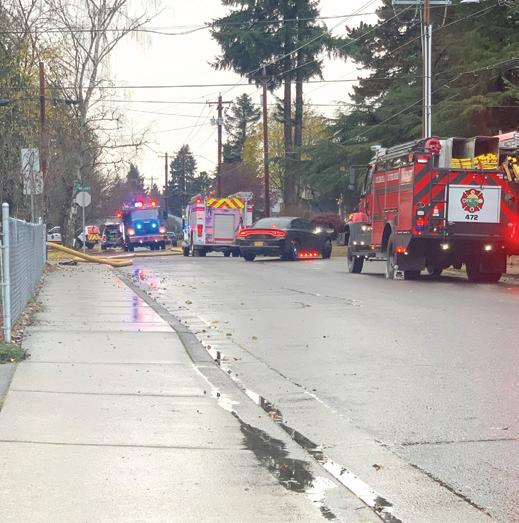
Crews arrived to find smoke showing from the structure with reports of a victim inside. A victim was located at the front door of the structure and was treat ed and released on scene. Crews were able to locate a pet inside the structure and
safely removed it from the building.
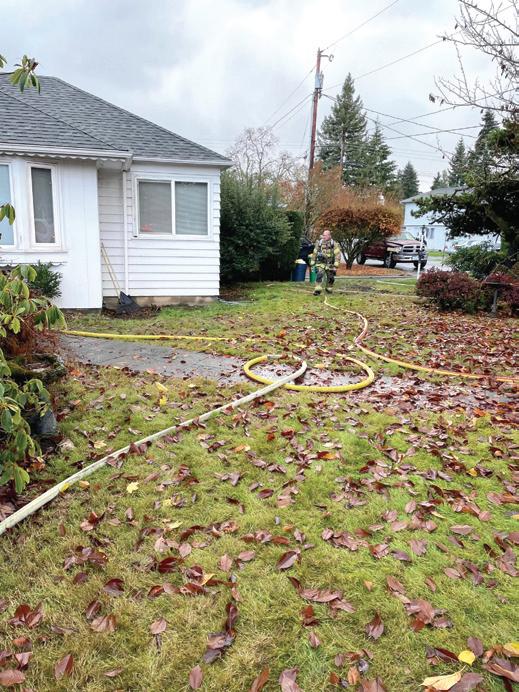
The fire was successfully contained and extinguished by Scappoose firefighters.
Three engines, two chief officers and an ambulance were on scene. The cause of the blaze and the estimated amount of damages were not immediately available.
Columbia River Fire & Rescue, Scappoose Police, Scappoose Public Works, Columbia River PUD, and Columbia 9-1-1 Communi cations District assisted in the fire investigation.
The holiday season can be joyous, but can also be a time for fraud
UMPQUA BANK Chronicle Guest Article
Tips on how to avoid popular scams
As the holiday season swings into full gear, shop pers need to maintain their vigilance in guarding against fraud. While consumers navi gate the tighter budgets this year due to higher inflation, fraudsters are likely doing the same, and will be extra desperate – and motivated – to take advantage of the seasonal rush.

Holiday fraud is a big business, and criminals stand to generate hundreds of mil lions of dollars in illicit gains during the shopping season. Combined retail sales for No vember and December could top $960 billion, according to a forecast by the National Retail Federation (NRF), an industry trade group. Fraud sters will be tapping into this volume.
Just for card payments alone, fraud rates in recent years have hovered around 7 cents per $100 of volume worldwide, according to the Nilson Report. By that mea sure, for every $100 billion in card volume during the holidays, thieves will siphon off $70 million.
The gap between self-perception and



or are unsure that online retailers such as Amazon and eBay will request login infor mation to provide customer support, according to a No vember report by AARP. And 53% incorrectly believe or are unsure that payment apps such as Cash App, Zelle, or Venmo have the same con sumer protections as credit cards. About 4 in 10 said they believe (incorrectly) that ads for merchandise on social media online are trustworthy.
“Fraudsters are always working to outsmart consum ers, but during the holidays, their fervor is especially acute,” Umpqua Bank Executive Vice President and Head of Global Pay ments and Deposits Kathryn Albright said. “Criminals exploit this time of year to prey on busy individuals who are pressed for time, luring them into traps and robbing them of their hard-earned money. But taking some simple precautions will help thwart these schemes.”
Individuals need to be especially aware of com mon holiday tricks used by thieves, such as:
Gift card payment scams
donate to bogus enterprises. They mimic real charities and often use terms such as “federal” or “national.”


Criminals sometimes pose as religious leaders, preying on the generosity of others by telling a story about people in need.
Non-delivery and non-payment crimes
ers also should carry fewer cards in their wallets when they shop and store the others in a safe place at home.
Don’t click on email links
and steer clear of any cor respondence containing this messaging.
Stay on top of deliveries
Almost three in 10 (27%) of consumers reported having a package stolen outside their door, according to a Novem ber fraud report by AARP. Consumers should track vari ous items for delivery. When consumers won’t be at home, they should call the retailer or delivery service and try to delay the shipment or arrange to have it sent to an office or designated receiving loca tion, such as Amazon Hub Locker.
Avoid clicking on ads



Use cards rather than payment apps
Cards offer more protec tions. Those using major brands offer $0 liability for unauthorized charges. Peerto-peer apps such as Venmo, Zelle, and CashApp process payments immediately, just like cash. These transactions cannot be reversed.
Use caution when buying gift cards
reality
Consumer gullibility turbocharges the payday for fraudsters. Nearly half (48%) of consumers globally are confident they can recognize a scam, according to a 2022 fraud report by Visa Inc. Yet almost three in four (73%) typically respond to terms or phrases scammers commonly use in emails and text mes sages, such as “Win online gift card” and “Act now.”
The vulnerability of the general population is still high: 63% incorrectly believe
Gift cards are a preferred method of choice for crimi nals, who convince consum ers to pay a bogus financial obligation by purchasing gift cards and handing over the numbers to the fraudsters. Criminals also scam retailers by returning stolen merchan dise to stores and receiving gift cards since they don’t have a receipt. They then sell those cards online at a discount. For the 12 months ended June 30, 74% of retail ers reported this practice, according to the NRF.
Charity scams
Fake charities use the holidays to lure victims to
are on the verge of sliding and large enough to block the entire highway.
In non-delivery scams, buyers pay for goods and services online, but never receive the items. For nonpayment scams, it’s the mer chants who are the victims, with goods and items shipped but are never paid. Losses for these two types of fraud amounted to $337 million in 2021, according to the In ternet Crime and Complaint Center (IC3), a division of the FBI.
Tips to reduce the risk of fraud
Review your account activity regularly.
Everyone should review personal financial accounts often for activity to make sure there aren’t any suspi cious transactions. Consum
area / debris field when the remaining debris continued to fall, according to OSP.
Fraudsters are getting bet ter at impersonating retailers. But even when it seems real, it’s better just to go to the website via a browser. Bad links take consumers to fake portals, which typically ask for credit card information.
Don’t give out sensitive information

When you receive a call, email, or text from someone claiming to represent your bank, or another company, do not give them your user ID or password. No legitimate company will ever ask you for this information.
Watch for key fraud terms
Consumers fall for a variety of phrases, according to a report by Visa, includ ing “Win online gift card,” “Exclusive deal,” “Act now,” “Click here,” “Limited time offer,” “Urgent,” “Action needed,” and “Free/give away.” Be on the lookout
Malvertising is mali cious advertising that often takes the form of pop-up ads. Similar to erroneous email links, these ads can lead you to sites that ask for personal information and credit card numbers. They can also infect your device with mal ware and make the season anything but merry.


Don’t shop on public Wi-Fi networks
If you’re shopping online, do it at home using your own private, secure network. Cybercriminals can easily tap into public Wi-Fi, so you don’t want to input pass words and visit your bank account when browsing on these networks.
Use fraud alerts
Fraud alerts can be very helpful to consumers in stay ing on top of any suspicious activity regarding their ac counts. Alerts can be tailored to transaction size, and are delivered via phone (voice), text, and email. Update any new contact information to
Don’t buy gift cards outside of retailers and established companies. Look to make sure the protective stickers on the card are not tampered with. Also check to see that the PIN number on the back isn’t showing. Keep your receipt, which will help identify the card in case it is stolen.
“The holidays can be a stressful time of year, but don’t let the pressures get in the way of common-sense shopping,” Albright said. “Taking the time to safeguard your shop ping and payment information online and in person will go a long way toward prevent ing anguish, and real losses to your household budget.”

What do if you have been compromised
Take action immediately
Call the merchant and credit card bank to report the issue. For gift card scams, reporting to the retailer might help recoup the loss if the card hasn’t been used.
Notify regulators and law enforcement
IC3 tracks internet crimes, and the Federal Trade Com mission monitors gift card scams. It also helps your com munity to report an incident to the state attorney general and
Late last week ODOT is sued the following progress toward reopening:
• Debris removal has be gun on the roadway surface.
• Commercial truck has been removed from the debris but still needs to be towed.
• ODOT geologist found two car-sized sections of hillside that need to be removed because they are large enough to block the highway again when they fall.
Work remaining
• Removal of the two large sections of hillside that
• Clearing enough debris on the road surface to allow reopening a single lane and provide space for crews to continue work and to catch any new smaller rockslides.

• Repairing any pave ment damage and setting up a single lane detour with flaggers.

State police
Oregon State Police (OSP) troopers were noti fied of the rockslide and a vehicle crash on Highway 30 near milepost 74 Tuesday night, Nov. 29. Preliminary investigation revealed an eastbound commercial motor vehicle (CMV) attempted to drive around the initial slide

The debris covered all lanes of Highway 30 and collided with the passing CMV. The driver selfextricated. No injuries were reported. The CMV was left at the scene within the debris, according to OSP.
Check Tripcheck.com for updates for this and other road and weather situa tions in Oregon. Follow this developing story at the chronicleonline.com and in the Wednesday print editions of The Chronicle.
www.thechronicleonline.com Wednesday, December 7, 2022 A2 Columbia County’s trusted local news source WE’RE HIRING! • Competitive Salary with 4-Tier Pay Progression • Profit Sharing Bonuses • Full Health Care Package $1,500-$2,000 SIGN-ON BONUS Become part of the Berry family around the globe. We foster workforce development to support and encourage our knowledgeable enployees. With more than 295 locations- we are pushing the limits of innovation and moving our industry forward. APPLY AT: WWW.BERRYGLOBAL.COM/CAREERS 33520 SW EDWARD LN., SCAPPOOSE, OREGON 503-543-3530 SCAPPOOSECINEMA7.COM ALL SHOW TIMES VALID EVERYDAY, unless otherwise specified All showings before 6pm are Matinees = $8.00 per person All showings after 6pm are General Admission = $10.00 per person Children under 11, Seniors 62 and over, and Military with ID are all $8.00 per person *Specials: On Tuesdays tickets are $5.00 Open 365 days a year, Doors Open 15 minutes before the first show
and
Courtesy photo from Claire Walton
First responders at the fire scene on NE 2nd Street in Scappoose.
Courtesy from Scappoose Fire Firefighters laid water hoses to the scene of the blaze.
Metro Creative Connection
Combined retail sales for November and December could top $960 billion, according to the National Retail Federation.
LANDSLIDE
Page A1
From
Courtesy from ODOT
A crew works alongside the high cliff during the landslide repair process.
Editor’s Note: The follow ing is the most current eco nomic research of the North west Oregon timber harvests presented in the column below.
Timber harvests fell for the second year in 2019 in North west Oregon.

The 2019 harvest fell by 11% from 2018 and was down 15% from 2017. The total harvest in 2019 was about 9% below the average of the previous 10 years. Employ ment in the timber industry decreased a bit in 2019 and was about 20 jobs below the average employment of the previous 10 years.
Columbia County
The timber harvest in Columbia County dropped by 9% in 2019. The total harvest was 149,145,000 board feet. It was the worst year since 2011, and 8% below the average of the previous 10 years. During much of the 1980s and 1990s Columbia County used to punch above its weight when it came to timber produc tion. Harvest levels routinely matched or exceed nearby Lincoln and Tillamook coun ties, but that hasn’t been the case since the Great Reces sion. Columbia County is the smallest county in Northwest Oregon, with only 657 square miles. About 75% of the county is zoned as forest land.
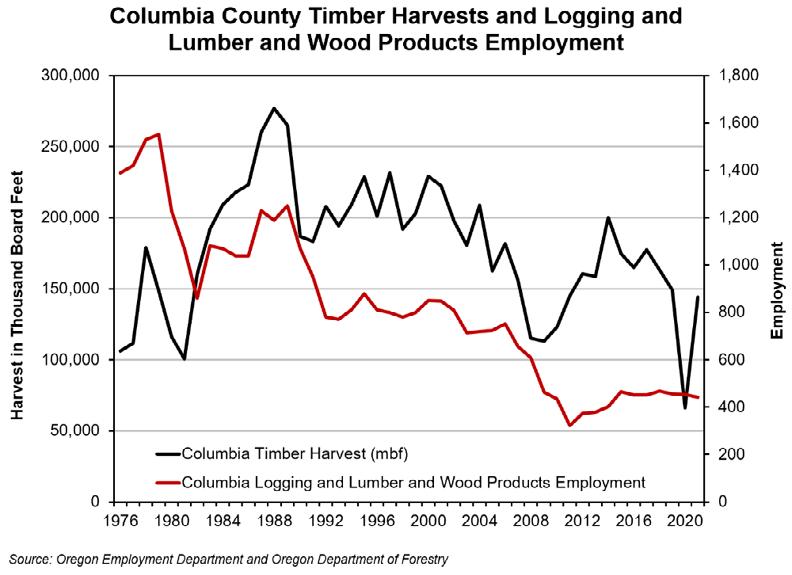
Employment in logging, forestry, and lumber and wood product manufactur ing slid by 11 in 2019 to 457.
Employment in logging and lumber and wood product manufacturing is up by more than 100 jobs from the depths of the recession and was 9% higher than the average of the previous 10 years. Unfortu nately, this is only a little more than half its level of the early
2000s.

In 2019 there were six lumber mills and 28 forestry and logging businesses in the county.

Clatsop County
The timber harvest was down 17% in Clatsop County in 2019. The harvest in 2019 was 215,784,000 board feet, which was the lowest since 1998. This also was 20% be low the average of the previ ous 10 years. Clatsop County is 827 square miles, putting it squarely in the middle of the pack by size of Northwest Oregon counties. About 85% of the county is forest land, and it includes most of Clatsop State Forest.
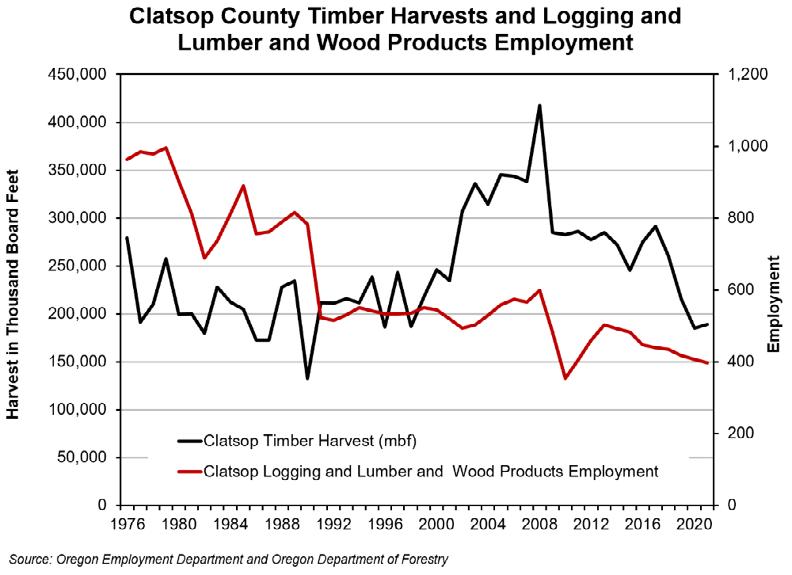
Logging, forestry, and lumber and wood product manufacturing employment in Clatsop County fell slightly with the loss of 15 jobs.
Employment was about about 6% jobs below its average of the past 10 years. Somewhat smaller harvests in the 1990s supported more than 500 jobs. There were four wood product mills in the county in 2019 and 16 forestry and log ging firms.
Lincoln County
The timber harvest fell 17% in Lincoln County in 2019. The harvest was 155,354,000 board feet. The 2019 harvest was the lowest since 2010 when the county was mired in the Great Reces sion. Lincoln County is the second largest in northwest Oregon at 980 square miles. About 90% of the county is forest lands.
Employment in the log ging, forestry, and lumber and wood product manufactur ing industry was essentially unchanged in 2019 – down eight jobs from 2018 and was just a handful of jobs below its level before the Great Recession. There were 14 log
ging and forestry businesses in the county. Wood product manufacturing is a confidential industry in Lincoln County.
Tillamook County
The timber harvest in Tillamook County rose about 1% in 2019. The total harvest was 197,902,000 board feet. The recent low harvest in Tillamook County was 142,018,000 board feet in 2009, so the 2017 harvest remained an improvement over that year and was still above the average for the past 10 years.
Tillamook County is 1,102 square miles and is the largest of the five counties in North west Oregon. About 85% of the county is zoned as forest land. The county is also home to the Tillamook State Forest.
Employment in logging, forestry, and lumber and wood product manufacturing fell by 23 jobs in Tillamook County in 2019 to 554 jobs. The county shed about 240 jobs from the industry during the Great Recession. One reason for the drop was the loss of mills. The county had seven mills in this industry in 2006, only four in 2013, and was back up to five mills in 2019. The logging portion of the industry remained relatively stable during the recession and
Benton County
Timber harvests fell 13% in 2019 to 109,502,000 board feet, the lowest level since 2014. Benton County produc es less timber than any of the other four counties in North west Oregon. Benton County is the second-smallest county in the region and about 57% is forested.
Employment in the
Metro Creative Connection
harvests, Benton County is in the middle of the pack in the region for timber-related jobs. The small loss continued a long-term trend of declining timber industry jobs in the county and Northwest Oregon.
By way of comparison, a simi lar level of harvests supported nearly 1,050 jobs in 1996. The county remained home to 10 wood product mills and 27 forestry and logging busi nesses.
Economic recovery

Northwest Oregon has re covered some timber industry jobs from the depths of the Great Recession, but the re gion seems unlikely to regain all the jobs. Technological and market changes are working to reduce timber jobs across the state.
Labor demand was about as strong as it could get in 2019. Logging employ ment fell sharply during the pandemic recession and has rebounded, but not completely back to pre-pandemic levels. The story is similar with wood product manufacturing.
Although these industries may not grow much in the future, the region will have hundreds of job openings in the timber industry due to turnover and retirements. Northwest Oregon will con tinue to produce timber and timber workers for years to come.
See more graphs with this column at thechronicleonline. com. Erik Knoder is a regional economist with the Oregon Employment Department. He may be reached at 541-3515595.
When family caregiving follows you to work
When family caregiving roles conflict with work and career obligations
Part 6 of 9: I have been answering a list of questions that come via email to the weekly virtual seminar that I cohost. The weekly seminar is called GOING HOME, STAY ING HOME.

Q: If I am hiring a private caregiver for my parents, should I do a background check for every applicant? Are there other tips for making sure a possible helper is a good fit?
A: Yes, you should do a background check with good caregiving work ref erence verifications. There are two ways to conduct a background check. One way is to use the potential helper’s name, address, date of birth and social security number and run
them through an online criminal background check system. The second way uses the name, fingerprints, social security and date of birth. It is best to use the second method because fingerprints are unique to each person and the margin of error is slim to none. If a potential helper’s name or date of birth is typed incorrectly, that person could erroneously pass a background check. The local sheriff, police and the state bureau of criminal investigation offices are the best places to obtain fingerprinting services from. It is a cumbersome process for individuals, but all home care agencies have established standards for obtaining background checks as required by the state licensing bureau. Three other tips for hiring
an appropriate home helper include; #1. Ask for an updated resume or written work history to be sure that the potential helper is actively employed or has an explainable break in work history. #2. Ask for a verifiable copy of a ten panel drugs screen. Many occupational health clinics and lab testing companies offer drug tests to individ uals. #3. Request at least three previous caregiv ing work references. Ask the references about the strengths and weaknesses of the potential helper. I do assist families with find ing, screening and manag ing care, so if I can be of help to you in the area of screening, please call or email.

www.thechronicleonline.com Wednesday, December 7, 2022 A3
news source
Columbia County’s trusted local
New report outlines Oregon’s timber harvesting economics
ERIK KNODER Chronicle Guest Article
Courtesy from the Oregon Employment Department
Viewpoints Opinion

Understanding the impact of sleep on diabetes
for developing diabetes and make pre-existing diabetes more difficult to control.
Diabetes is a chronic health condition that af fects more than 30 million Americans and is the seventh leading cause of death in the United States.
Most of us know how important weight control, exercise, and nutrition are in controlling blood sugars. What impact does sleep have?
Body maintenance
Sleep is extremely important in maintaining our body’s performance, not only physically and mentally, but also down to the body’s chemical balances. Diabetes, whether type 1 or 2, comes down to an imbalance of the insulin and blood sugar relationship.
The right amount of sleep is needed to keep the endocrine system working well so insulin and blood sugar stays balanced. Stud ies have shown that too little sleep (less than 6 hours) or too much sleep (greater than 9 hours) can increase the risk
Some research suggests a 40% increase in the risk of developing diabetes if sleeping less than four hours per night. The human body is very complicated, and it needs just the right amount of sleep to work properly. The recommendation of about 7-8 hours a night comes from years of research to evaluate the amount sleep needed for our bodies to function at their best.
Even if your body is getting the right amount of sleep, the sleep needs to be quality sleep. Quality sleep is needed to make sure your body is truly rested with good oxygen levels, few awakenings, and can achieve deep sleep. If the sleep qual ity is poor, blood sugars will rise and the insulin produced will be less effective, leading to prediabetic conditions or making diabetes difficult to control.
Common sleep disorders
The most common sleep disorders affecting diabetes
are Sleep Apnea and Restless Leg Syndrome. Sleep apnea is when the back of your throat keeps collapsing dur ing sleep and oxygen levels fall, leading to disturbed sleep and lack of deep sleep. Restless Leg Syndrome is a when the legs are moving around a lot during sleep because of pain or tingling and numbness leading to disturbed sleep and lack of deep sleep.
Both these conditions cause a rise in blood sugars, increased insulin resistance, increase in stress hormones such as cortisol and the hunger hormone, ghrelin, all which contribute to diabe tes. Treatment of these sleep disorders will help balance these hormones and help manage and decrease the risk of diabetes.
Not only does poor sleep affect your blood sugars at night, but in the daytime your energy levels will be low leading to poor blood sugar metabolism, lack of exercise, and weight gain over time. In short, poor sleep will af fect night and daytime blood sugars and insulin effective ness.
Progress, accomplishments in Scappoose
Editor’s Note: The fol lowing letter to Scappoose residents appears in the De cember City of Scappoose Newsletter.
This past fall has been a very productive time for the City and I am happy to share our progress and ac complishments with you as we prepare to welcome in the new year.
• The City held our first ever Adventure Fest. It was widely attended, and a lot of positive feedback was received regarding the focus on family friendly activities, local bands and vendors.
• The Urban Renewal Agency has received multiple applications for its newly established grant programs. Thus far, two awards have been made, the Healthy Smiles Project received $15,000 and Cathe dral Coffee received $7,000. There are other applications still being considered for funding and the process remains open for additional applications.
• New conceptual plans for Grabhorn Park have been completed and shared with the Parks and Recre ation Committee. Addition ally, they have been made available to the consultant Team, MIG, who is com pleting the City’s Parks Master Plan update. The Committee voted to incor porate further discussion on development of this park space into the Master Plan process rather than conduct ing it as a parallel process. There will be ample oppor tunities for the community to engage in the Parks Mas ter Plan process including a survey, in-person outreach at community events, inter cept surveys at local parks during recreation events, the Annual Town Meeting, City website and the City’s social media accounts.
• Completion of the Peace Candle has been delayed due to supply chain issues related to the res toration of the wick. That said, the Candle has been repainted and all electrical work has been completed to ensure proper lighting.
• The Police Depart ment hosted a Hallow een Drive-Thru Event on
October 31st and handed out candy and gift bags.
These are just a few of many projects City Staff have been working on over the last few months. If you ever have questions about a specific project, please feel free to contact me and or schedule a time to meet.
With the new year we are also welcoming in a new Council. I would like to ac knowledge the contributions of the outgoing members and wish them well as they move on to pursue other endeavors. Additionally, I would like to congratulate and welcome all the new members of Council, I look forward to working with this group come January 2023.
Finally, I want to ac knowledge and thank City Staff for all their hard work and dedication in imple menting the vision of Coun cil and addressing the City’s day to day needs.
I hope you enjoy a safe and wonderful holiday sea son! Happy New Year!
Alexandra Rains is the Scappoose City Manager. She may be reached at 503543-7146.
Community eVents
December 10 St. Helens
Band Patrons Lions Holiday Bazaar
The bazaar will be held from 10 a.m. to 4 p.m. at the St. Helens High School Com mons, 2375 Gable Road in St. Helens.
December 10 Santa, Ships, and Singing at Caples House
Starting at 5 p.m. Santa will arrive to listen to kids tell their Christmas wishes. Then watch the Christmas Ships sail by from Caples warm vantage point. End the eve ning with carols and cookies. This event is free at 1925 1st St., Columbia City. For more details, call 503-397-5390.
December 17 Spirit of Christmas in Scappoose
The Christmas market will be open from 9:30 a.m. to 3:30 p.m. in the Scappoose annex gym, 52256 Columbia River Highway in Scappoose. Santa and the Grinch will attend the event throughout the day.
December 17 and 18 Holiday Bazaar
The Columbia River Fire & Rescue Volunteer Associa tion Holiday Bazaar from 10 a.m. to 4 p.m. at Columbia County Fairgrounds Pavil ion, 58892 Saulser Road in St. Helens. Door prizes on Saturday and a visit from the Grinch from noon to 2 p.m. on Sunday.
December 17 to 18 Fund raiser for the St. Helens High School Class of 2023 Safe and Sober Party
This Holiday Bazaar will be held from 9 a.m. to 4 p.m. on Saturday and 9 a.m. to 3 p.m. on Sunday at Columbia City Community Hall, 1850 2nd Street in Columbia City.
Several vendors. Breakfast and photos with Santa Satur day, with raffles throughout the weekend.
Ongoing Events
Lower Columbia River Watershed Council Meets at 7 p.m. every other second Tuesday. Meetings are currently held elec tronically by Zoom. For more information, contact Council Coordinator Allan Whiting at E-mail: allan@whitingenv. com, or call 503-789-9240 Visit the council’s website for agenda postings and Zoom at www.lowercolumbiariver. org/events-page.
Resonate Recovery Meets at 7 p.m. to 8 p.m. Wednesday - Sundays. This is a Bible based, Christ-cen tered spiritual recovery meet ing for those struggling with addictions and compulsive behavior at 220 S. 1st Street in St. Helens. Everyone is loved and welcomed. Free childcare available. For more information call Debbie at 503-560-0521 or check the

Resonate Facebook page.
Columbian Toastmasters Promoting positive learn ing and leadership through public speaking. Anyone is welcome! Meeting virtu ally via Zoom from 12 p.m. to 1 p.m. every Thursday. Call 503-369-0329 for more information.
Overcomers Outreach
Meetings are held every Sat urday at 9 a.m. at Creekside Baptist Church, 51681 SW Old Portland Road in Scap poose. Call Fred 971-7576389.
Celebrate Recovery
For anyone struggling with addiction, hurts, habits, and hang-ups. Doors open at 6:30 p.m. for coffee, snacks, and fellowship. The meet ing starts at 7 p.m. The first Monday of each month at 6 p.m. the doors open for a free dinner. Yankton Com munity Fellowship, 33579 Pittsburg Road in St. Helens. 503-396-7091. Childcare is available. www.yanktoncom munityfellowship.com
To list an event in the Com munity Calendar, email details with a phone number that may be published for anyone that might have questions, to jruark@coun trymedia.net or chronicle classifieds@countrymedia. net, or call 503-397-0116.
Complex relationship
The relationship between sleep and diabetes is com plex. Not only do you need good quantity and quality of sleep for better diabetes con trol and decrease risk of dia betes, but if you have poorly controlled diabetes it will af fect your sleep. This stresses the fact that the approach to diabetic management is a multi-approach program including good sleep, nutri tion, exercise, weight loss, and medication as directed by your physician.
Making your sleep health a priority will not only help you cut down your diabetes risk or better manage your diabetes, it will help with your overall well-being, including managing other chronic health conditions.
Steps to healthy sleep include:
• Have a regular sleep and wake time
• Bedtime routine: wind down, read, no TV, keep bed room dark, cool, quiet
• Avoid eating 2-3 hours before bed
• Avoid nicotine, alcohol, or caffeine close to bedtime
• In the daytime avoid napping less than 45 minutes, stay active, and exercise
Think of healthy sleep as priority in your health man agement as it can help you avoid unnecessary medica tions and health complica tions. Healthy sleep equals a healthy body.
If you have wellness ques
tions, email them to info@ tillamookcountywellness.org.
For more local health and wellness information, visit www.tillamookcountywell ness.org or follow Tillamook County Wellness on Face book and Instagram.
Kam Atwal is a Doctor of Osteopathic Medicine Pulmo nary / Critical Care / Sleep Medicine at Adventist Health Tillamook.
dropped off at the office.
Letters policy: This news paper’s letters to the editor are limited to a maximum of 250 words and will be edited for grammar, spelling and blatant
inaccuracies. Unsubstantiated or irresponsible allegations, or personal attacks on any indi vidual, will not be published. Letters containing details presented as facts rather than opinions must include their sources. Writers are limited to one published letter per month.
All submissions must include the author’s full name, local street address and telephone number (only the name and city of residence will be published). By submitting a letter, writers also grant permission for them to be posted online.
Opinions expressed on this page are the writer’s alone and do not represent the opinion of the newspaper or its parent company, Country Media, Inc.
www.thechronicleonline.com Wednesday, December 7, 2022 A4
Vote online at thechronicleonline.com Will you be celebrating this holiday season with a real Christmas tree or with an artificial tree? Real Artificial Weekly Online Poll Last Week’s Results Will you be spending more, less, or about the same for Christmas gifts this holiday?
Columbia County’s trusted local news source
KAM ATWAL Chronicle Guest Column
Metro Creative Connection Sleep is extremely important in maintaining our body’s performance, not only physically and mentally, but also down to the body’s chemical balances.
RAINS Chronicle Guest Column The Chronicle The Chronicle (USPS 610-380) is published weekly by Country Media, Inc. 1805 S. Columbia Blvd., P.O. Box 1153 St. Helens, Oregon 97051 Periodicals postage paid at St. Helens, OR 97051 POSTMASTER: Send address changes to The Chronicle PO Box 1153 St. Helens, OR 97051-8153 SUBSCRIPTION RATES: One month in county: $8 One month out of county: $10 One year in county: $60 One year out of county: $80 Joe Warren Publisher Jeremy C. Ruark Regional Executive Editor Jon Campbell Advertising Sales Kelli Nicholson Office Manager
Yang Creative Director
Lowrance Driver Editorial policy: Opinions expressed on this page are independent of The Chronicle views and are solely those of the writers expressing them. Write to us: We want to hear from you and encourage you to write letters to the editor. Because of space limitations, shorter letters have a bet ter chance of being printed. We may edit your letter for style, grammar and clarity, although we do as little editing as possible. If you don’t want your letter printed under those conditions, just let us know. Thank-you letters are limited to a general thanks and sum mary of an issue or action. We reserve the right to exclude
and businesses. Letters
may
be
time for the
paper.
must
signed
ALEXANDRA
James
Jon
lists of people, organiza tions
received after noon on Friday
not
in
fol lowing Wednesday’s
To verify authenticity, all letters
be
and include your address and daytime phone number. We won’t print your street address or phone number (just your city of residence). Submissions may be emailed to chronicle news@countrymedia.net, sent via mail, or
9.3% More 60.5% Less 30.2% About the same
Stephanie was born in Longview, Washington on Feb. 7, 1972 to Mary Cramer. Stephanie went to school in Longview, Washington and attended high school at Rob ert A Long. She graduated in 1990.
Stephanie was the only child and had lots of friends that she considered as her own family. Her mom passed away in 2012. She never got to know her real dad. Stepha nie got married to her loving husband Larry Volk on Jan.
obituaries

Stephanie Jo Cramer Volk Feb. 7, 1972 ~ Oct. 29, 2022
17, 2017.
Stephanie’s hobbies were reading, playing video games, talking with friends and listening to country music. She was a volunteer at the Bean in Longview, Wash ington (2015). Stephanie did not have any children of her own. Her husband Larry has three kids and a few grand kids. Stephanie was a very loving and giving person and we will always remember her fondly.

Stephanie and Larry
were on a trip with a couple friends who were so gracious and paid for their trip. Sadly, Stephanie passed away on Oct. 29, 2022. The autopsy said COVID was the cause of death. Rest in Peace Mrs. Stephanie Jo Cramer Volk.
No funeral arrangements are set in place. Her husband is still trying to raise money to get her body and or ashes returned to Oregon. Dona tions can be made to Bank of the West in Stephanie’s name.
The St. Helens Band patrons
Patrons supplement the fi nancial needs of the School District Band & Guard Programs.
The St. Helens Band Patrons may be best known for all the cans they have collected over the years.
The nonprofit group conducts recycling as well as other projects to help raise funds for the St. Hel ens High School Band and Guard Program.
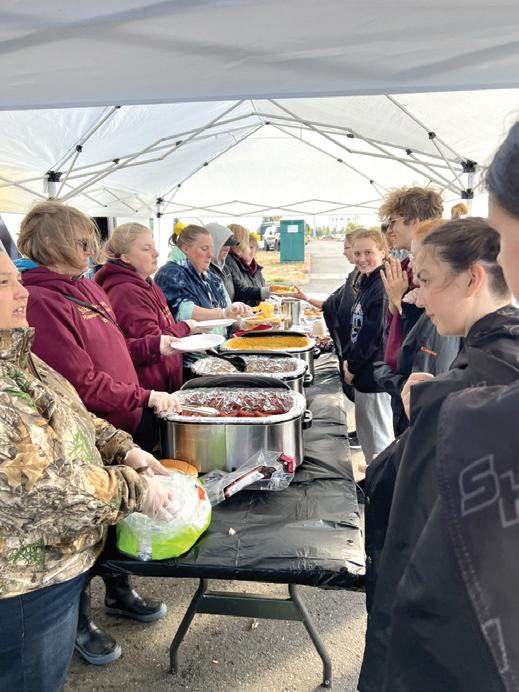
To gain insight into this nonprofit, we reached out to the Patron’s spokesperson, Lisa Scholl.

The Chronicle: What is the mission of the St. Helens Band Patrons?
Lisa Scholl: The pur pose of this organization is to support the St. Helens School District Band and Guard Program by:
• Communicating the needs of the School District Band & Guard Program to the students, parent(s), guardian(s), and the com munity, as desired by the Director(s).
• St. Helens Band
• St. Helens Band Pa trons support Director(s) in their role as the head of the School District Band & Guard Programs.

The Chronicle: When did this nonprofit first began and why?
Scholl: It began in 2005 to support the St. Helens School District Band and Guard Program.
The Chronicle: Over the years, what has the Band Patrons accomplished for St. Helens High School students?
Scholl: Fundraising op portunities to cover program and trip fees, communica tion of the program, and support for the Band Direc tors.
The Chronicle: What are the Band Patrons current projects and how do these projects assist in the group’s overall goals?

include:
drives; wreath sales (presales are over, but additional wreaths can be purchased at the Bazaar); Lions Holiday Bazaar at St. Helens High School on Dec. 10, 10 a.m.- 4 p.m.; Christmas Tree Lot Sales in Partnership with Peninsula Optimist Club.

• Holiday concerts on Dec. 8 and 13 at St. Helens Middle School.



The fundraisers are essen tial to help the program remain affordable for all students to participate, as well as offering
Scholl: We would love community support with fundraisers, attending concerts, and cheering the Pep Band on during football and basketball games. Upcoming events and fundraisers are posted on our public Facebook page at https://www.facebook.com/ sthelensbandprogram.
Candlelight Service of Remembrance

From St. Helens: Follow Pittsburg Rd. to Yankton School, stay on Pittsburg Rd., follow signs 7 miles to Trenholm Valley, Rt. On S. Canaan, 200 yards on left.
From Deer Island: Up Canaan Rd., 7 miles, first left after Pinkney Rd on S. Canaan – 2-1/2 miles on the right.
www.thechronicleonline.com Wednesday, December 7, 2022 A5
Columbia County’s trusted local news source
Please accept my donation to the Scappoose Share & Care $12 helps feed a family of 1 $24 helps feed a family of 2 $36 helps feed a family of 3 $48 helps feed a family of 4 $60 helps feed a family of 5 $15 helps provide gifts for 1 child $30 helps provide gifts for 2 children $45 helps provide gifts for 3 children $60 helps provide gifts for 4 children $___ other amount to donate This supplements the food we receive from local food drives and toys that are donated directly Name: Mailing Address: City/State/ZIP: Please make check payable to: SCAPPOOSE SHARE & CARE PO Box 625 Scappoose, OR 97056 You will receive a receipt. We are a 501C3 non-profit thru the Scappoose Volunteer Firefighters Association Donation TICKET Donation TICKET This Holiday Season We Can Make a Difference. Your donation will help provide a Christmas food basket to local Scappoose and Warren families in need. Christmas baskets include a turkey or ham, potatoes, stuffing, bread, soups, milk and other canned goods. Please fill in the donation ticket below and send it with your special gift today. Thank you!
This Holiday Season We Can Make
Difference. Your donation will help
and
If you’re a lover of Noble Firs Come visit our farm and see the hand pruning techniques we use to retain the Natural Beauty of the Northwest Noble We have a large selection with many nobles 10 ft/up OPEN NOV. 23RD DEC. 16TH M F N o o n D a r k We e k e n d s 9 a m D a r k P R E M I U M N O B L E S AT W H O L E S A L E P R I C E S 5 0 3 3 9 7 3 3 6 9 A R e i n h o l d t Fa m i l y Tra d i t i o n From St Helens: Follow Pittsburg Rd to Yankton School stay on Pittsburg Rd follow signs 7 miles to Trenholm Valley, Rt on S Canaan, 200 yards on left From Deer Island: Up Canaan Rd 7 miles, first left after Pinkney Rd on S Canaan 2 1/2 miles on the right 503-397-3369 A Reinholdt Family Tradition If you’re a lover of Noble Firs – Come visit our farm and see the hand-pruning techniques we use to retain the Natural Beauty of the Northwest Noble. We have a large selection with many nobles 10/ft./up DUE TO COVID • Trees $60 regardless of size • Large trees-bring crew • Bring your own handsaw • Limited manual support. Open Nov. 25th – Dec. 20th M-F Noon-Dark, Weekends 9am-Dark *Cash or Checking Only!
Scappoose Share & Care
a
provide a Christmas food basket to local Scappoose
Warren families in need. Please fill in the donation ticket below and send it with your special gift today. Thank you!
Crossword solution Solution for the Nov. 30, 2022 crossword puzzle
See a special Tribute to Nonprofits in this edition of The Chronicle.
Courtesy photos from Lisa Scholl
This photo show the Band Patron’s various community events and fundraisers.
STAFF REPORT Country Media, Inc.
Kelli Nicholson / Country Media, Inc.
The Columbia Funeral Home held its annual Candlelight Service of Remembrance at 621 Columbia Boulevard, Dec. 3. “For the past couple of years, we had to make the tough decision to hold off on our holiday activities due to the COVID-19 pandemic,” the funeral home’s Facebook post stated. “We are delighted to invite you to join us at our facility for our Candle Lighting Ceremony, which is to be followed by a reception with refreshments. The holidays can be a difficult time, especially with the recent loss of someone you love. We hope that by coming together, it can help to alleviate some of the heaviness this coming season may hold. Whether you choose to come or stay home, we wish you the best and are thinking of you during this time.”
For information leading to arrest and conviction of hit and run driver, on 10/21/2022 at approximately 10:30 pm involv ing a motorcycle.
Anyone with in formation contact: St. Helens Police Department 503397-3333, case # 220044551.
Alcoholics Anonymous Info-line, (503) 366-0667 www.pdxaa.org CHIEF FINANCIAL

OFFICER
Columbia 9-1-1 Communication- s District (C911CD)
is conducting a hir ing process for a Chief Financial Of ficer. Apply online at www.columbia9 11.com/careers. Additional informa tion can be found on our website or by calling 503-3666978.
Clatskanie Park & Recreation District is now accepting applications and resumes for a Pool Manager. Respon sibilities: Train, manage and evalu ate approximately 20 lifeguards; be ginning in Febru ary and continuing into September. Plan, organize and schedule programs offered at our sea sonal outdoor pool.
Be responsible for scheduling ad equate staff for the safety, supervision, cleanliness, water chemistry and me chanical operation of the pool for youth and families in our District. Maintain pool and employee records. Perform such other duties as assigned by the District Manager and/or Board of Di rectors from time to time. Knowledge and Skills: Strong administrative skills, recreational aquatic program ming skills, lead ership and mana gerial skills, pool maintenance and water chemistry skills and good public relation skills are a must. Thor

ough knowledge of policies, proce dures and equip ment used in daily outdoor pool opera tions helpful. Work with pool related chemicals and be familiar with State and Federal regu lations regarding outdoor pool oper ations. Experience and Training: Ex perience preferred. Or the willingness to work within an agreed upon time frame between ap plicant and Board of Directors to ob tain the required and suggested certifications for the position; FirstAid, CPR, AED certifications, Life guard Instructor and Training, Water Safety Instructor
and CPO (Certi fied Pool Operator) certifications. You can request an ap plication by phone at 503- 728-2757, by email at csp@ cni.net or on our website www. clatskanieparksan drecreation.com. Applications and resumes can be returned by mail to: Clatskanie Park & Recreation Dis trict, PO Box 737, Clatskanie OR 97016 or by email to csp@cni.net. If you have any ques tions, please leave message at 503728-2757. Applica tions with resumes will be accepted through January 31, 2023.

Immediate Opening Sewing Part-time 6-Noon, M-Th. Apply in per son only. 33550 SE Santosh St. Scap poose, OR 97056.

The City of St. Helens is hiring a POLICE OFFICER Lateral & Entry Level. Regular Fulltime. See website for details www. sthelensoregon. gov. Open Until Filled. First Review: 1/3/23. Equal Op portunity Employer
The City of St. Helens is hiring a Public Works Utility Worker I Regular Full-Time. Apply online at www.sthelensore gon.gov. Deadline to apply: 12/22/22.

Equal opportunity employer.
The City of St. Helens is hiring an Engineer I Regular Full-Time. Apply online at www.sthelensore gon.gov. Deadline to apply: 1/20/23. Equal opportunity employer.
700 Misc/Trade
Bargain Corner

FREE good condi tion, electric reclin er chair, fits smaller adult, color is blue/ grey. For sale: Commercial pipe ladder for $150. Fi ber glass, two sec tions, plus or minus 20 feet, working length 30-36 feet.
Please leave a message at 503429-0115.

820 Mobile/Manuf. Homes
For Rent 65 years old or older. Manufac tured home. 2 bed, 1 bath. Large addi tion. $920/month. No smoking. No pets. $15 rental ap plication fee. 32678 Scappoose Verno nia Hwy. One mile from Hwy 30. 503543-2250 or 503396-9212.
Need a job?
www.thechronicleonline.com Wednesday, December 7, 2022 A6 Columbia County’s trusted local news source Classifieds Listings are updated daily at thechronicleonline.com Waterman Garage Doors Scott Waterman Owner Advertise your business in the Business & Service Directory. Call 503-397-0116 for more information YOUR AD HERE Columbia County BUSINESS & SERVICE DIRECTORY www.thechronicleonline.com Get your ad in the paper and reach out to potential customers. Call 503-397-0116 to place your ad in the newspaper and online. Garage Sale Special! Advertise your garage sale in the paper and online for only $10 for up to 14 lines! Email chronicleclassifieds@countrymedia.net to advertise! ACROSS 1. Use a bayonet 5. *Late Saget 8. Greek salad staple 12. Meal in a shell 13. Lowest brass 14. Like daytime energy 15. *2022 16. Van Gogh’s famous flower 17. Poodle minus d 18. *Late Queen 20. Volcano off Sicily coast 21. Leaves out 22. Elf’s distinctive body part 23. *Olympic host 25. *Russia’s target 29. Black sheep sound 30. Treat badly 33. Reason for Thanksgiv ing 34. Carl Jung’s inner self 36. “But I heard him exclaim ‘___ he drove out of sight, “Merry Christ mas...” 37. Pick on 38. Pro ____ 39. Bank, usually 41. Driver’s aid 42. Jalopy 44. Back of the neck, pl. 46. Finish line 47. Fur of the marten 49. Paul Bunyan story, e.g. 51. *Economic woe 55. Faultfinder 56. Tropical edible root 57. Soreness 58. Irretrievable loss 59. Gator’s cousin 60. *Super Bowl winners 61. Undertaking 62. “For ____ a jolly good..” 63. Archaic form of do, second person singular DOWN 1. Eyelid affliction 2. Asian weight unit 3. Smoothie bowl flavor 4. Russian hunting sight hound 5. Chemistry lab measur ing device 6. Parting words 7. New Year’s Eve gettogether, e.g. 8. Running competition 9. *Twitter’s new propri etor 10. Western Samoan money 11. “____ you ready?” 13. Relating to shinbone 14. Asparagus unit 19. Amnion, pl. 22. Barely obtain 23. Erie or Suez 24. Port-au-Prince country 25. Like something vin tage, usually 26. About to explode 27. Olfactory organs 28. Athos’ or Porthos’ weapon 29. Throw up 31. Lecherous look 32. Funereal container 35. *Tom Cruise’s callsign 37. “____-____-la” 39. Type of Christmas lights 40. All together 43. T-shirt style 45. Small bomb 47. Rabbit trap 48. 1970s big dos 49. “Musical” constella tion 50. Dollar bills 51. 7-year affliction 52. International Civil Aviation Org. 53. Electrical resistance units 54. Egg holder 55. 100 lbs. STATEPOINT CROSSWORD THEME: YEAR-IN-REVIEW Crossword puzzle
Solution to crossword in next week’s issue of The Chronicle. $1000 REWARD
301 Health
& Nutrition
502 Help Wanted 502 Help Wanted 502 Help Wanted 502 Help Wanted 311 Announcements 502 Help Wanted 700 Misc/Trade 502 Help Wanted check the classifieds online at www.thechronicleonline.com to find your perfect job offer
Public Notices
PROTECTING YOUR RIGHT TO KNOW
CH22-1002
Reference is made to that certain Trust Deed made by, JOSEPH SATCHELL AND KASEY SATCH-ELL, AS TENANTS BY THE ENTIRETY. as Grantor to TICOR TITLE INSURANCE COMPANY as Trustee, in fa vor of MORTGAGE ELEC TRONIC REGISTRATION SYSTEMS, INC. (“MERS”), as designated nominee for USA DIRECT FUNDING, NMLS: 3240, Beneficiary of the security instrument, its successors and assigns, dated as of August 5, 2020 and recorded on August 7, 2020 as Instrument No. 2020-07824 and the beneficial interest was assigned to CMG MORT GAGE, INC. and recorded April 6, 2022 as Instrument Number 2022-03299 of of ficial records in the Office of the Recorder of Columbia County, Oregon to-wit: APN:
CH22-1004
10043 THE SOUTHEAST ERLY 14 FEET OF LOT 15 AND THE NORTHWEST ERLY 46 FEET OF LOT 16, BLOCK 96, CITY OF ST. HELENS, COLUMBIA COUNTY, OREGON. Com monly known as: 175N -177 11TH ST, SAINT HELENS, OR 97051 Both the Benefi ciary, CMG Mortgage, Inc., and the Trustee, Nathan F. Smith, Esq., OSB #120112, have elected to sell the said real property to satisfy the ob ligations secured by said Trust Deed and notice has been recorded pursuant to Section 86.735(3) of Oregon Revised Statutes. The default for which the foreclosure is made is the Grantor’s failure to pay: Failed to pay payments which became due Monthly Payment(s): 1 Monthly Payment(s) from 11/01/2021 to 11/30/2022 at $27,264.32
Monthly Late Charge(s): 300.65 By this reason of said default the Beneficiary has declared all obligations secured by said Trust Deed immediately due and pay able, said sums being the following, to-wit: The sum of $356,677.68 together with interest thereon at the rate of 2.75000% per annum from October 1, 2021 until paid; plus all accrued late charges thereon; and all Trustee’s fees, foreclosure costs and any sums advanced by the Benefi ciary pursuant to the terms of said Trust Deed. Wherefore, notice is hereby given that, the undersigned Trustee will on March 21, 2023 at the hour of 01:00 PM, Standard of Time, as established by Sec tion 187.110, Oregon Revised Statues, Front Entrance, Columbia County Court house, 230 Strand Street, St.
Helens, OR 97051 County of Columbia, sell at public auction to the highest bidder for cash the interest in the said described real property which the Grantor had or had power to convey at the time of the execution by him of the said Trust Deed, together with any interest which the Grantor or his successors in interest acquired after the execution of said Trust Deed, to satisfy the foregoing obligations thereby secured and the costs and expenses of sale, includ ing a reasonable charge by the Trustee. Notice is further given that any person named in Section 86.753 of Oregon Revised Statutes has the right to have the foreclosure proceeding dismissed and the Trust Deed reinstated by payment to the Beneficiary of the entire amount then due (other than such portion of
CH22-1227
said principal as would not then be due had no default occurred), together with the costs, Trustee’s or attorney’s fees and curing any other default complained of in the Notice of Default by tender ing the performance required under the obligation or Trust Deed, at any time prior to five days before the date last set for sale. Without limiting the Trustee’s disclaimer of representations or warran ties, Oregon law requires the Trustee to state in this notice that some residential property sold at a Trustee’s sale may have been used in manufac turing methamphetamines, the chemical components of which are known to be toxic. Prospective purchasers of residential property should be aware of this potential danger before deciding to place a bid for this property at the Trust
ee’s sale. In construing this notice, the masculine gender includes the feminine and the neuter, the singular includes plural, the word “Grantor” includes any successor in interest to the Grantor as well as any other persons owing an obligation, the performance of which is secured by said Trust Deed, the words “Trustee” and “Beneficiary” includes their respective successors in interest, if any. Dated: No vember 10,2022 By: Nathan F. Smith, Esq., OSB #120112 Successor Trustee Malcolm & Cisneros, A Law Corpo ration Attention: Nathan F. Smith, Esq., OSB #120112 c/o TRUSTEE CORPS 17100 Gillette Ave, Irvine, CA 92614 949-252-8300 Order Number 87223, Pub Dates: 11/23/2022, 11/30/2022, 12/7/2022, 12/14/2022, CHRONICLE
IN THE
CIRCUIT
COURT OF THE STATE OF OREGON FOR THE COUNTY
COLUMBIA Probate Department In the Matter of the Estate of MARGARET E. BROWN, Deceased. Case No. 22PB09973 NOTICE TO INTERESTED PER SONS NOTICE IS HERE
BY GIVEN that the under signed has been appointed personal representative of this estate. All persons
CH22-1005
having claims against the estate are required to present their claims, with vouchers attached, within four months after the date of the first publication of this notice to the personal representa tive at 52490 SE 2nd Street, Suite 100, Scappoose, OR 97056, or the claims may be barred. All persons whose
OF
rights may be affected by the proceedings may obtain additional information from the records of the Court, the personal representative, or the attorney for the personal representative. DATED and first published, Novem ber 23, 2022. Stephen W. Brown, Personal Represen tative
IN THE CIRCUIT COURT OF THE STATE OF OREGON FOR THE COUNTY OF COLUMBIA
Probate Department In the Matter of the Es tate of KATHLEEN RAE STRANDBERG, Deceased. Case No. 22PB09931 NO TICE TO INTERESTED PERSONS NOTICE IS HEREBY GIVEN that the undersigned has been ap pointed personal representa tive of this estate. All per
sons having claims against the estate are required to present their claims, with vouchers attached, within four months after the date of the first publication of this notice to the personal rep resentative at 52490 SE 2nd Street, Suite 100, Scappoose, OR 97056, or the claims may be barred. All persons whose
rights may be affected by the proceedings may obtain additional information from the records of the Court, the personal representative, or the attorney for the personal representative. DATED and first published, November 23, 2022. Kenneth L. Strand berg, Personal Representa tive.
ST. HELENS SCHOOL DISTRICT NO. 502 NOTICE OF SOLE SOURCE PROCUREMENT
Pursuant to its adopted local public contracting rules, no tice is hereby given that St. Helens School District No. 502 intends to adopt written findings in support of award ing a sole source contract for video production to Journal istic Learning Initiative (JLI). The findings and award will be considered at a meeting of the Board of Directors, acting as the District’s Local Con
CH22-1224
tract Review Board, at 6 p.m. on Wednesday, December 21, 2022. The meeting will be held via Zoom and displayed on the District’s YouTube Channel (https://us02web. zoom.us/webinar/register/ WN_4CyE3rlHSwSPiOv3s 8eyaA). Any affected proposer may submit a written protest of the award no later than 4:00 PM on Monday, December 19th, 2022, to
Jessica Seay, Director of Fis cal Services, at 474 N. 16th Street, St. Helens, Oregon 97051. The protest must be signed and must state that the contract should be competitively bid. Anyone desiring to attend the meet ing virtually must contact Kristi Ward at 503.366.7220 no later than 2:00 PM on Monday, December 19th, 2022.
IN THE CIRCUIT COURT OF THE STATE OF OREGON FOR THE COUNTY OF COLUMBIA

Probate Department In the Matter of the Estate of DONALD THOMAS SWANSON, Deceased. Case No. 22PB09279 NOTICE TO INTERESTED PER SONS NOTICE IS HERE BY GIVEN that the under signed has been appointed personal representative of this estate. All persons
having claims against the estate are required to present their claims, with vouchers attached, within four months after the date of the first publication of this notice to the personal representa tive at 52490 SE 2nd Street, Suite 100, Scappoose, OR 97056, or the claims may be barred. All persons whose
rights may be affected by the proceedings may obtain additional information from the records of the Court, the personal representative, or the attorney for the personal representative. DATED and first published, November 30, 2022. Nancy K. Huff man, Personal Representa tive.
New OSU research designed to empower epilepsy patients
Researchers in the Or egon State University (OSU) College of Engineering have taken a key step toward im proving the lives of patients with epilepsy.
The researchers have de veloped a sensor system for quickly testing the patient’s saliva to see if they have the correct level of anti-epileptic medicine in their system.
The study, funded by the National Institutes of Health and published in the Journal of Applied Electrochemistry, is important because roughly 3.5 million people in the United States have epilepsy, including nearly half a mil lion children, the authors note.
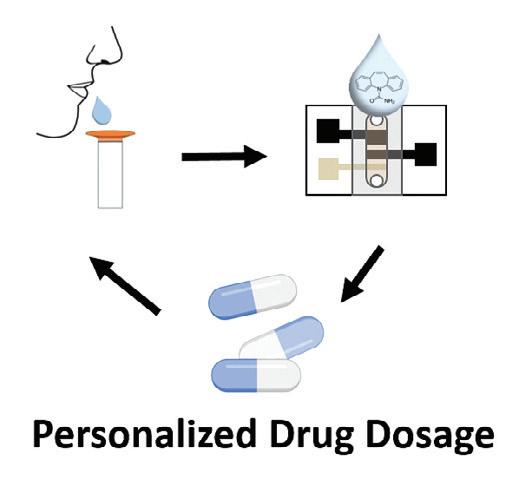
“With further develop ment, our system could be used to empower epilepsy patients by letting them mon itor their anti-seizure drug levels from home,” OSU postdoctoral researcher Lael Wentland said. “From the data our sensor can generate, a personalized drug dosage can be determined, reduc ing the chances of toxic side effects from too-high doses and seizures from ineffective low doses.”
Epilepsy is a neurologi cal disorder characterized by muscle spasms, convulsions and loss of consciousness in addition to seizures, and its
negative impacts to physical and mental health are numer ous, including a suicide risk that’s much greater than that of the general population.
Elaine Fu is an associate professor of bioengineering who co-led the research with Wentland.
“It’s exciting to be making progress toward a medical tool that people with epilepsy can use to improve their therapy and quality of life,” Fu said.
Hand-held system
Fu, Wentland and fellow Oregon State researchers Stephen Ramsey, Matthew Johnston, Jacob Cook and Jade Minzlaff built and demonstrated a hand-held, microfluidic-based system that can detect a seizurepreventing drug from saliva without the saliva first being subjected to a lengthy pre treatment process.
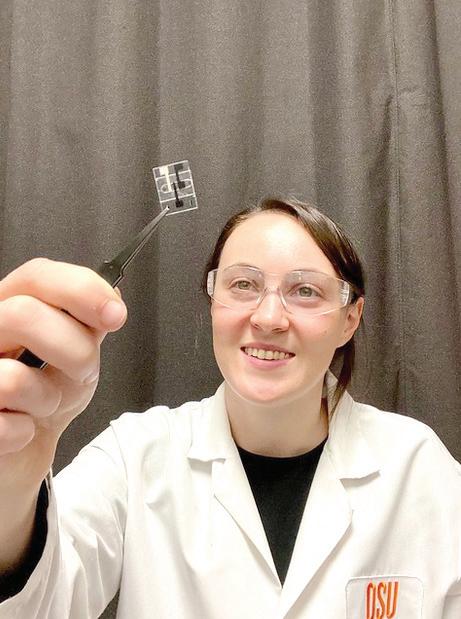
Microfluidics refers to how fluids behave as they travel through or are confined in microminiaturized devices equipped with channels and chambers.
Anti-epileptic drugs, or AEDs, have been available for more than a century but the optimal dose – high enough to control seizures and low enough not to cre ate other problems – var ies widely from patient to patient, Wentland said.
“As one example, the often-prescribed drug carba mazepine, or CBZ, interacts strongly with other AEDs and also with antibiotics,” Wentland said. “Also, the way it moves through the body varies a great deal from one person to the next, and above a very narrow thera peutic range it’s toxic to the point of causing poor muscle control, disorientation, hal lucinations and even coma.”
The standard way of mea suring how much of a drug is in a patient’s system is with a blood test conducted in a laboratory, but the long lag –
it can be as much as several days from the time blood is drawn until the results are in – greatly limits the test’s use fulness for people on AEDs, the researchers point out.
Aiming to drastically shorten the turnaround time, the researchers looked in stead to saliva.
“Saliva, which is easily and non-invasively accessed, has terrific potential for health monitoring, and it’s already been shown that the concentration of CBZ in sa liva correlates with the con centration of the drug in the bloodstream,” Fu said. “But
saliva also presents a chal lenge for the electrochemical detection of the drug because saliva has a complex compo sition that can result in signal interference.”
Detailed research
Wentland and Fu led the development of a disposable, electrochemical flow cell that enables the detection of ther apeutic levels of CBZ from a small amount of saliva.
Ramsey, associate profes sor of computer science and biomedical sciences, spear headed the creation of a new signal processing algorithm
for the quantification of the electrochemical signal. Johnston, associate professor of electrical and computer engineering, led the develop ment of the system’s minia ture potentiostat.
A potentiostat is an ana lytical instrument that con trols the working electrode’s potential in an electrochemi cal cell that has multiple electrodes.
Lundeberg is a researcher and writer for Oregon State University Relations and Marketing. He may be reached at steve. lundeberg@oregonstate.edu
www.thechronicleonline.com Wednesday, December 7, 2022 A7
news source
Columbia County’s trusted local
Late submissions are not guaranteed to make it into the paper.
The Public Notice deadline is Fridays by noon.
TS No. OR07000171-22-1 APN 10043 TO No 220467019-OR-MSI TRUSTEE’S NOTICE
OF SALE
Steve
STEVE LUNDEBERG Chronicle Guest Article
Courtesy from OSU
A researcher with one of the sensor system devices.
Courtesy from OSU
Oregon Moms Union wants 2023 to be ‘Year of the Student’

group is pressing the state to make 2023 ‘the Year of the Student.’
“Many parents across Oregon have made prog ress working with their school boards to implement positive changes,” Oregon Moms Union President MacKensey Pulliam said. “Parents also helped vote in candidates who will priori tize our students. Now, it’s time for parents to work alongside these legislators to push for positive changes in the school system to prioritize our students, put academics over political agendas, and get our kids back on track. It’s time to make 2023 the year of the student!”
elect joined the Salem effort.
“I’m here today to make it clear to Oregonians that those of us in the legislature will be working hard to respect our kids, to respect our parents, and to respect our families in the education process,” House District 21 Representative-Elect Kevin Mannix said.
“I’m here to say I’m listening, and my priority in the capitol next year is giv ing our kids the education they deserve and restoring trust with parents,” House District 22 RepresentativeElect Tracy Cramer said.
The 2023 legislative ses sion will begin in January, and there will be several bills introduced addressing
tions. School board elections will also take place in May of 2023, where parents and community members can help elect candidates who respect the rights of parents and support prioritizing stu dents’ academic needs.
About Oregon Moms Oregon Moms Union, formed in early 2021 in the wake of COVID-19 school shutdowns and distance learning, seeks to empower parents to advocate for a student-first K-12 educa tion system. It currently has more than 90 volunteer School District Captains serving in more than 75
the community, Cade and organizations in the St. Helens area provide a vari ety of items the teens have requested.
This year, kids have re quested items as essential as toothbrushes, pencils, toilet paper, bedding, and deodor ant. Some students need gas cards to fill their tanks if they have a car. They also provide students with food bags that offer the teens easy-to-make food. Through COVID, the program has begun to provide more gift card-based “Fun-packs” so teens can shop for them selves.
After collecting the donations, Cade and the Daybreakers work with the school district directly to deliver the donations anonymously. As minors, the confidentiality of teens is of the utmost importance. Ensuring anonymity helps the teens exist in the com munity without bearing the burden of people knowing their situations.
Jennifer Bartocci, the McKinnie-Vento Liai
son, Foster Care Point of Contact, and the Federal Programs Secretary, acts as the primary go-between for volunteers, the school district, and teens.
“I often have students that are attending school regularly, doing well aca demically, participating in activities, and holding down a job,” Bartocci said. “And doing all of this on their own. It’s incredible.”
Bartocci is passionate about not only providing essentials so the students can get by now but also so they can also thrive after graduation. Bartocci says she remains in contact with many teens even after they graduate and no longer have access to some federal resources.
“I have never met more resilient, strong, capable humans than these teenag ers,” Bartocci said. “Every single one of them has the capacity to make choices; for a lot of their life, they didn’t get to make decisions for what they wanted in life. And being able to talk about their choices and their goals has to be the best part.”
Some of the organiza tions in the community
that assist are John L. Scott Realty, Christ Episcopal Church, First Lutheran, St. Helens Kiwanis, Columbia Food Bank, and Wauna Credit Union.
John L. Scott allows Cade to use the facility to assemble food bags and wrap gifts. There are giv ing trees at First Lutheran, Christ Episcopal, St. Fred eric Church, and Wauna Credit Union. John L. Scott in Scappoose and St. Helens are also collecting donations. To reach Monica Cade to make a donation or find out how to help, email her at: monicacade@msn. com.
It’s a community effort to help these teens, and Cade wants to make sure that the teens understand they are cared for.
“It really touches my heart and amazes me, year after year, the support out there in the community. And how many people really care about these kids,” Cade said. “And I really hope that that feeling is conveyed to those youth, that there are people that really care about them, about their success, and to help them achieve greatness in life.”
THE FIRST MERCHANTS’ TOY N JOY AUCTION
‘twas the year of THE CABBAGE PATCH KID. In January, the May’s were in Seattle at a toy show and Kathy, their Coleco rep, pulled Randy aside to show him the hottest toy of the year. Randy didn’t buy the hype, nor did he buy the dolls. come in looking for the cabbage patch doll and the May’s had a list of about 35 people who wanted one if they were able to get their hands on one. Randy had Mondays off and he offered to go to Portland to pick up wrapping supplies. While in town, he drove by Kathy’s office and decided to stop in to say hello. Sitting on a shelf were SIX Cabbage Patch Dolls. Randy looked at her in his most endearing manner and said Kaaaathy.... She answered with “I will sell you three.” As Randy turned on Columbia Blvd he saw John Brewington outside what is now Emmert Motors and stopped to show him his treasure. The conversation when something like this:
Randy: Hey John! Look what I just got my hands on!
John: Cool!
Randy: Now I have a dilemma, I have 35 people on a list who want one of these dolls, how do we sell them? To the top three? Have a drawing among the 35? What’s fair?
John: I’ve heard people are auctioning them.

Randy: Then what do I do with the money?
John: Find a charity and donate it.
Randy: Great idea!
Randy took the dolls to work and set them up in the office then called his dad in. Dan’s eyes got big “Where did you get these”
Randy: Kathy had six, let me buy three.
Dan: How do we sell them?
Randy: John Brewington suggested an auction and we donate the proceeds to charity.
Dan: Great idea, who should we get to be the auctioneer.
Randy (pulling a business card out of his pocket): Curt Comack was the auctioneer at the Ducks Unlimited event I was at, he’s pretty good.
Where should the donation go?
Dan (who was on the board of the St. Helens Fire Department): The firefighters’ Toy N Joy program.
The date was set and they advertised the auction in the paper. People began coming into May’s to purchase toys and then gave them back to be added to the auction. One day Dan says “Randy you go this way up Columbia Blvd and I will go that way, we will ask the other businesses if they would like to donate to our auction, this will be a MERCHANTS’ AUCTION for Toy N Joy.
Three firefighters were at the first auction to hold the dolls, they were the first models unbeknownst to them. Jim Sampson was one of the three and he later became the president of our Merchants’ Benefit organization. Cody, one of the dolls, sold for $210 to Alice Holbrook. Alice donated Cody back... and purchased him again. For 10 years. The final year Cody was up for auction Jim and Randy won the bid then delivered him to Alice asking her to retire him from the auction. 40 years later, we have donated over $670,000 to benefit our community with toys, clothing, and food.
Thank you very much for your contribution to our Ruby Jubilee! The Joy of Christmas is shared through your donations. Merchants’ Toy N Joy Benefit, Inc




Scan here to make a donation

www.thechronicleonline.com Wednesday, December 7, 2022 A8
news source
Columbia County’s trusted local
2Cs Vendor Mall Ace Hardware Alliance Automotive and Exhaust Anytime Fitness Beaver Bark Betsy Johnson Big River Taproom Broadway Books Cathedral Ridge Winery Chubb’s Shell City of St. Helens Columbia Acupuncture Columbia County Habitat for Humanity Restore Columbia NW Heating & Air Conditioning Columbia River Carpet One Columbia River Jewelers Columbia River Natural Medi cine LLC Columbia River Piecemakers Quilt Guild Cornerstone Cafe Country Financial CrossFit St. Helens Craig & Judy Abercrombie Cruise Planners - Becky Bozart Dari Delish Digital Graphiti Printing Don & Linda Kielblock Dr Auto Eaton’s Tire Center Diane Ebert Eggers Equipment Rental Eisenschmidt Pool El Tapatio Elves of Toy N Joy Emmert Motors Enchanted Forest EZ Mow Family Fun RV, Inc. Family Vision of Oregon Flora Designs Freeland Spirits Fultano’s Pizza George Hafeman Grabhorn Farms Harrington’s Clothing Heather Hoad Henry HeimullerDutchman Services Lindsay Herold Highway 30 Cruisers Hometown Pizza of Rainier Hudson Garbage Service Ichabod’s Restaurant IGA - Market Fresh Infusions & Injections InRoads Credit Union Jay & Lynne Tappan Jeff’s Custom Detailing Judy Shadley Kim Walker Kiwanis Club KJ Security Solutions & Locksmith Knife River Koelzer Construction KOHI Koss, Pete & Val Kozy Korner Les Schwab - Scappoose Les Schwab Tire Center - St. Helens Linda Bolen - John L Scott Lindsey Jones, RD Lions Club Lisa Galovich - Edward Jones Longfellows Inn Lotus of Bangkok Lower Columbia Engineering Lower Columbia Law Group Luanne Ripley KreutzerArtist Luna Fiberworks M E Moore Construction Margaret Magruder Mark & Luanne Kreutzer Marvelous Mosaic Material Magic McMenamins Pubs and Breweries Northwest Plumbing Services Oregon Hill Farms Oregon Shakespeare Festival OS Systems Pacific Athletic Club Pacific Stainless Patty Rismoen Paulson Printing Peggy Pense Pizza Vendor Port of Columbia County Portrait Homes Northwest Pro Automotive & Diesel Pure Serenity Health Spa Reinke Studios LLC ReMax PowerPros - Lea Chitwood Rich Bailey Construction, LLC Richardson’s Furniture and Mattress Gallery Safeway Sass at Home Scandalous Hair Design Scappoose Business & Tax Scappoose Sand & Gravel Co. Scappoose Smoke Shop Shadley’s Express Lane Espresso Shelly Paulson Signature Window Treatments Stacy Austin Stan’s Refrigeration & Air Conditioning State Farm InsuranceKamron Whitley St. Helens Auto Center St. Helens IGA Market Fresh St. Helens Senior Center State Farm InsuranceJoel Avina Swine and Cheese Tap Into Wine The Beauty Lounge The Chronicle/The Chief The May Family Van Gordon Monroe Dentistry Waste ManagementColumbia County Wheel of Fortune Wigwam
Windermere
Yankton
Yoga
LLC
Tavern
Charitable Giving
Store
Younion
The Oregon Moms Union is mounting an effort to fix what the group calls
are
problems within the Oregon education system.
Members
met in front of
the
Oregon Department of Education building in Salem Nov. 30 to announce the
Courtesy photo
The Oregon Moms Union met in Salem to announce efforts to make 2023 the ‘Year of the Student.’
From Page A1
DAYBREAKERS
Kelli Nicholson / Country Media
Donation bin at John L. Scott in Scappoose.
COLDEX: OSU Search on for Earth’s oldest

miles down from the conti nent’s surface.
A team of 22 scientists from the Oregon State Uni versity-led Center for Oldest Ice Exploration, or COLD EX, is headed to Antarctica for the first field season in its pursuit of the Earth’s oldest ice and the climate records preserved in it.
COLDEX is a National Science Foundation-funded Science and Technology Center formed in 2021 and funded through a five-year $25 million grant.

The project’s goal is to find, collect and analyze some of the planet’s old est ice, which provides an important record of Earth’s climate and environmental history and signals how the planet may respond to the current increases in green house gases in the atmo sphere.
Antarctic ice – and the dust and tiny ancient air bubbles trapped inside –was buried over millions of years as snow fell and today provides scientists with important data about the atmospheric changes Earth has experienced. Scientists collect ice cores by drilling
The cores are transferred to the NSF Ice Core Facil ity in Denver. From there, sections of the cores are sent to the labs of COLDEX researchers, where they conduct chemical and other analysis to learn more about climate conditions over time.
During the field season, the researchers will explore areas of Antarctica that have not seen much scientific activity before, said COL DEX Director Ed Brook, a paleoclimatologist in OSU’s College of Earth, Ocean, and Atmospheric Sciences.
As part of the project’s public outreach effort, sci entists also will be sharing more about their work from the field as they are able to during the season.
Much of the work will be focused on the Allan Hills in East Antarctica, an area located where the ice sheet meets the Transantarctic Mountains. In the 2019-2020 field season, researchers now associated with COLDEX found ice as old as two to three million years in “blue ice.”
Blue ice is blue in color due to the way light reflects off the solid ice. The blue
and potential obstruction to the Second Amendment. Already, Sheriff’s concerns
ice is located in areas near the ice margin, where very old ice has been pushed to the surface by glacial flow. One field team will return to this site to drill for more of this ice.
A second team will explore nearby areas using ground-based ice-pene trating radar. These radar methods will characterize the structure of the region and help researchers identify possible areas for drilling of an approximately 1,100 meter-deep ice core.
A third team will be based at the South Pole, where the deep ice is still comparatively unexplored. This team will collect data by aircraft by flying multiple missions to and from the South Pole station.
“These scientists will be flying specialized radar that images the interior of the ice sheet as well as deploying magnetometers and gravity meters to help understand the geological terrain under the ice,” Brook said.
The data collected by this team will help COL DEX researchers identify potential areas for drilling a 1.5-million-year-old ice core in future field seasons, which would be the oldest
of December 8.
“Postponing the permit requirement by approxi mately two months should give Oregon law enforcement time to have a fully functional permitting system in place. If Judge Immergut agrees to the postponement, then starting in February anyone who pur chases a gun in Oregon will be required to have a permit,” At torney General Ellen Rosen blum said in a statement.
Concerns from local law enforcement stem from the state’s lack of direction on implementing the permitting process, lack of electronic infrastructure to process per mits, staffing to ensure proper training under the measure,
Regarding Measure 114, Columbia County Sheriff Brian Pixley, said: “I am sincerely concerned about the effects of Mea sure 114. The Oregon State Sheriff’s Association did a conservative cost study, and it’s estimated that it will cost over $49 million statewide each year while only bring ing in around $19.5 million. That leaves a gap of nearly $30 million yearly that cities and counties will have to find a way to finance. For CCSO, that could mean diverting our already meager resources to meet the requirements of this new measure. Most importantly, I believe that
Measure 114 restricts the 2nd amendment right to bear arms for law-abiding citizens. Legal challenges are already underway. While I am hopeful this measure will be stayed or found unconstitutional, CCSO is actively working to ensure that law-abiding citizens will still be allowed to purchase firearms after December 8.”
Pixley’s concerns about the financial imbalances that the measure will incur were similar to those raised by the Oregon State Sheriffs’ As sociation director Jason Myers in court on Friday before Judge Immergut.
Sheriffs in Coos County, Tillamook County, and Curry County all shared similar concerns. Though each noted that they must enforce the laws in the state, the measure as currently constructed will be impossible to carry out by
continuous ice core to date if the effort is successful.
After a delay this month due to a COVID outbreak at Antarctica’s McMurdo Station, members of the ex pedition have finally started to arrive on the continent. The two-month field season roughly corresponds with the peak of Antarctica’s summer.
Peter Neff, a University of Minnesota glaciologist and climate scientist who serves as COLDEX’s direc tor of field research and data, will serve as the primary COLDEX liaison at Ant arctica’s McMurdo Station, where he will provide sup port to all three field teams.
Neff, who runs a popular TikTok account, @icy_pete, will also lead public out reach and engagement efforts. He uses social media to chronicle his research and field work and has amassed nearly 200,000 followers on TikTok. He plans to share updates on this year’s expe dition throughout the field season.
In addition, COLDEX researchers expect to post weekly updates on the proj ect’s website, www.coldex. org. In the past, researchers have had very little Internet
the impending deadline of December 8.
“I took an oath to support and uphold the Constitution of the United States and to enforce its laws and the laws of the State of Oregon. It is getting very difficult to do so when unconstitutional laws keep getting passed. What I will say that when it comes to the ban of the 10 round plus magazines that I believe it is unconstitutional and this law will be challenged and found unconstitutional. Until it gets all figured out or even after, it will not be one of our priori ties to enforce,” John Ward of Curry County said.
In a statement on Face book, Sheriff Joshua Brown of Tillamook County said that he “opposed” the measure and believes it will change how “Oregonians can hunt, recre ate, and transport firearms.”
connectivity from the field. This year, the team acquired a Starlink satellite terminal that they hope to deploy at field sites. That could allow for more outreach while the work is underway, Brook said.
Collaboration is foun dational to the work of COLDEX, which is bringing together experts from across the United States to work to gether and share knowledge about Earth’s climate system and its impacts, Brook said. Enhancing diversity in the field of Earth science through support of research experiences for undergradu ate and graduate students and post-doctoral scholars is another key component of the project.
The team for the field season reflects those aims, Brook said. The field teams and their members are:
Allan Hills ice core drilling team:
Julia Marks Peterson, a graduate student at Oregon State; Sarah Shackleton and Yuzhen Yan, postdoc toral scholars at Princeton University; Austin Carter, a graduate student at Scripps Institute of Oceanogra
“They passed something that none of the groundwork was done for; we have till De cember 8 to fix this so citizens can utilize their constitutional rights. But there’s no way it can get done in that time. It was poorly written, poorly worded, poorly conceived,” Sheriff Craig Zanni of Coos County said, “I don’t think it’s even going to come close to hitting the target of what they wanted, other than totally disrupting, if that was their goal, anybody possessing or being allowed to purchase a firearm.”
Gun sales
As the measure is met with opposition both legally and from local law enforce ment, gun purchases are also skyrocketing in the face of the new measure. The Firearm
phy; Elizabeth Morton and Michael Jayred of the U.S. Ice Drilling program; and Jonathan Hayden of Princ eton, who will serve as camp manager.
Ground-based geophysics team:





Research Professor How ard Conway and graduate students Annika Horlings, John-Morgan Manos and Margo Shaya of the Univer sity of Washington.
Airborne geophysics team: Duncan Young, Gonzalo Echeverry and Dillon Buhl of the University of Texas Institute for Geophysics; graduate students Kristian Chan, Megan Kerr and Shra van Kaundinya of the Uni versity of Texas; researchers John Paden and Bradley Schroeder of the University of Kansas; and Jamin Green baum of the Scripps Institute of Oceanography.
Michelle Klampe is a writer-news researcher at Oregon State University Re lations and Marketing. She may be reached at michelle. klampe@oregonstate.edu or at 541-737-0784.


Instant Check System, which conducts background checks on Oregonians hoping to purchase firearms, released a statement that they are experiencing an “unprec edented” volume of firearms transactions as people rush to buy guns before the measure comes into effect.
The goal of the measure was to clamp down on gun violence and homicide rates in Oregon. According to a court document filed in response to an emergency motion last Wednesday, Attorney General Ellen Rosenblum believes the measure will help prevent “horrific deaths and devastat ing injuries due to mass shoot ings, homicides and suicides.”
Follow this developing sto ry at thechronicleonline.com and in the Wednesday print editions of The Chronicle.
www.thechronicleonline.com Wednesday, December 7, 2022 A9 Columbia County’s trusted local news source * © Kubota Tractor Corporation, 2022. $0 Down, 0% A.P.R. financing for up to 60 months on purchases of new Kubota BX series equipment from participating dealers’ in-stock inventory is available to qualified purchasers through Kubota Credit Corporation, U.S.A.; subject to credit approval. Example: 60 monthly payments of $16.67 per $1000 financed. Some exceptions apply. Offers expire 12/31/22. Terms subject to change. This material is for descriptive purposes only. Kubota disclaims all representations and warranties, express or implied, or any liability from the use of this material. For complete warranty, disclaimer, safety, incentive offer and product information, consult your Dealer or KubotaUSA.com. † For complete warranty, safety and product information, consult your local Kubota dealer and the product operator’s manual. Power (HP/KW) and other specifications are based on various standards or recommended practices. K1383-24-147261-6 501 S. PACIFIC AVE • KELSO, WA • (360) 423-7220 • 800-858-7220 100 PORT AVE • SAINT HELENS, OR • (503) 397-1012 • 800-606-1012 watkinstractor.com 'Tis the Season for a New Kubota! $0 DOWN, 0% A.P.R. FINANCING FOR UP TO 60 MONTHS ON SELECT NEW KUBOTAS* BX1880 • 16.6 Gross HP,† 3-Cylinder Kubota Diesel Engine • 4WD with Rear Differtential Lock Standard • Category I, 3-Point Hitch BX2680 • 24.8 Gross HP,† 3-Cylinder Kubota Diesel Engine • 4WD with Rear Differential Lock Standard • HST Transmission • Category I, 3-Point Hitch BX23S • 21.6 Gross HP,† 3-Cylinder Kubota Diesel Engine • Fully Integrated Tractor/Loader/Backhoe • Swift-Connect Backhoe • Foldable ROPS L3902 • 37.5 Gross HP,† 3-Cylinder Kubota Diesel Engine • Hydrostatic (HST) or Gear-Drive Transmission • 4WD • Improved, Comfortable Suspension Seat LX2610SUHSD • 24.8 Gross HP,† E-TVCS, Liquid-Cooled, 3-Cylinder Kubota Diesel Engine • 3-Range Hydrostatic (HST Transmission
MICHELLE KLAMPE Chronicle Guest Article
ice
MEASURE 114 From Page A1
Provider may also contract with other plans. Other providers are available in our network. Humana is a Medicare Advantage HMO, PPO and PFFS organization with a Medicare contract. Enrollment in any Humana plan depends on contract renewal. Humana Inc. and its subsidiaries comply with applicable Federal Civil Rights laws and do not discriminate on the basis of race, color, national origin, age, disability, sex, sexual orientation, gender, gender identity, ancestry, marital status or religion. English: ATTENTION: If you do not speak English, language assistance services, free of charge, are available to you. Call 877-320-1235 (TTY: 711). Español (Spanish): ATENCIÓN: Si habla español, tiene a su disposición servicios gratuitos de asistencia lingüística. Llame al 877-320-1235 (TTY: 711).




www.thechronicleonline.com Wednesday, December 7, 2022 A10 Columbia County’s trusted local news source
注意:如果您使用繁體中 文 ,您可以免費 獲得語言援助服務 。請致電 877-320-1235 (TTY:
。 Y0040_GHHLNVMEN23_C Together for your peace of mind Humana’s in-network providers do more than just diagnose issues. They listen to your goals, help you develop achievable plans, and stick with you to help you achieve it. Teaming up to care for the whole you. OHSU accepts Humana’s Medicare Advantage plans 877-239-2054 (TTY: 711) Call a licensed Humana sales agent Daily, 8 a.m. – 8 p.m. ¡Hablamos Español! Humana.com/Network Scan to see if your doctor is in network OHSU Primary Care Clinic - Scappoose 51377 Old Portland Road Scappoose, OR 97056 www.ohsu.edu/healthcare-now FPO OHSU Health offers: • A professional care team that listens • Doctors specialized in caring for adults 65+ • Virtual appointments form your phone or computer available
繁體中文 (Chinese):
711)
