
Courtesy photo from Scappoose Fire
Local first responders used their skills and determination during an unusual rescue in the Columbia River.Scappoose Fire posted the fol lowing details of the Aug. 31 event on the fire agency’s Facebook page. Scappoose Fire received a request from our friends at the Near Space Corporation in Tillamook. They needed help coordinating the recovery of a weather balloon that had landed in the middle of the Columbia River. The balloon that has a height taller than a three-story building, was being challenged by a lo cal change in weather conditions. Unfortunately, the balloon was not able to be brought down on land. The professionals that over see the launch and mission of weather balloons use many tools and systems to know where the balloon is at all times. The bal loon was followed by a fixed wing plane as it got close to Scappoose. This plane helped to guide us to the specific location. As added safety for aircraft in the area, the balloon was fixed with a special transmitter that identifies the balloon’s location so that other aircraft can see it as normal air traffic.
Economists are on recession watch.The combination of slower economic growth, high inflation, and rising interest rates has histori cally been problematic. That said, despite the crosscurrents in the economic data so far this year, the U.S. economy is unlikely to have entered into a recession. Employ ment and industrial production continue to Personalgrow.income and consumer spending are rising quickly but struggling to outpace the fastest inflation the U.S. has experienced since the early 1980s. While this may be reassuring today, the risks to the outlook are real. Inflation remains the key issue. Even as
Special Report
Penalties for DUII in Oregon

Oregon’s
Weather balloon lands in Columbia River
Once the balloon landed in the water, the recovery of the electron ics became a focus as well as the largeToballoon.prevent the balloon from being a significant river hazard; Scappoose Fire reached out to Clark-Cowlitz Fire Rescue, Sauvie Island Fire District and U.S. Coast Guard Sector Columbia River to help with the recovery and no tify the boaters on the water. This recovery was successful because of theirAfterassistance.aboutthree hours, the recovery effort was completed, and the electronic equipment was returned to the Near Space Corpora tion staff. Due to the mix of water and the balloon fabric, what would normally be very light was hun dreds of pounds. This was a great opportunity to test out communication plans and equipment in a low stress environ ment while having to think outside the box with this operation. Additional thanks to the com munity members Tom Morton and Lance Scrivens for assisting us pull the balloon higher on the shore and transporting staff and equipment in the hard-to-reach area. For those that thought they were seeing an alien craft over Scappoose and the Columbia River today, it was just a challenged weather balloon.

A10
The average cost for a first-time DUII in Oregon is $4,500; however, drunk driving challenge

The latest state revenue forecast delivered in Salem Aug. 31, states that the outlook is essentially a coin flip between the soft landing and a recession.See KICKER Page
Over the past holiday weekend, law enforcement agencies joined a national crackdown against drunk drivers. Local results were pending at press time. Driving Under the Influence of Intoxicants (DUII) continues to be a leading cause of motor vehicle crash injuries and deaths throughout the nation. In partnership with the National Highway Traffic Safety Administration, the Oregon Depart ment of Transportation (ODOT), and Oregon Impact, the enhanced enforcement efforts are designed to curb drunken driving, decrease crashes, reduce injuries, and save lives.In February, The Chronicle pub lished information from an ODOT report detailing the sobering impact of drunk driving in our state. By the numbers According to ODOT, every two minutes, someone is injured by a drunk driver and every 51 minutes someone is killed by a drunk driver. In 2019, Oregon experienced 2,336 substance-involved crashes in which 318 people died and 334 peo ple sustained life-alerting injuries. From 2018- 2019, substanceinvolved fatalities increased 1%, of note is for the first time since 2014 drug only fatalities saw a decrease 17%, alcohol only involved fatalities (fatality is one person rather than one crash) saw a 5% increase and fatalities involving either alcohol or drugs decreased Poly-substance9%.fatalities, which have increased every year since 2014, saw a 30% increase from 2017-2018.InOregon, overall substance involved crashes increased 1% from 2017-2018. Fatal and serious inju ries (people) as a result of substanceinvolved crashes increased 6%. From 2017-2018, substance involved crashes that resulted in a fatal or serious injury increased from 15% to 17% and of note, substance involved fatal and serious injury crashes account for 25% of all fatal and serious injury crashes, accord ing to the ODOT report. Marijuana affects psychomo tor skills and cognitive functions critical to driving including vigi lance, drowsiness, time and distance perception, reaction time, divided attention, lane tracking, coordina tion, and Opioidsbalance.cancause drowsiness and can impair cognitive function. After alcohol, marijuana is the drug most often found in the blood of drivers involved in crashes. Tests for detecting marijuana in drivers measure the level of delta-9-tetrahy drocannabinol (THC), marijuana’s mind-altering ingredient, in the blood. But the role that marijuana plays in crashes is often unclear. THC can be detected in body fluids for days or even weeks after use, and it is often combined with alcohol. The vehicle crash risk as sociated with marijuana in combina tion with alcohol, cocaine, or benzo diazepines appears to be greater than that for each drug by itself. Several studies have shown that drivers with THC in their blood were roughly twice as likely to be responsible for a deadly crash or be killed than drivers who hadn’t used drugs or alcohol. However, a large NHTSA study found no significant increased crash risk traceable to marijuana after controlling for driv ers’ age, gender, race, and presence of alcohol. More research is needed. Along with marijuana, prescrip tion drugs are also commonly linked to drugged driving crashes. In 2016, 19.7% of drivers who drove while under the influence tested positive for some type of opioid, the ODOT report foiund.
JEREMY C. RUARK jruark@countrymedia.net See DRIVING Page A5

Big ‘kicker’ for taxpayers, caution about recession
Metro Creative Connection Law enforcement officials warn that those convicted of DUII can face thousands of dollars in fines and jail time.
STAFF REPORT chroniclenews@countrymedia.net SHHS Football Page A10 Pixie Memories Page A2 See DRIVING Page A5
nomic and Revenue Forecast shows the projected personal kicker is $3.5Overall,billion.the forecast shows the state will see an estimated $600 million in additional surging tax revenues.Thereport by the Oregon Department of Administrative Ser vices issued Aug. 31 to Oregon’s legislators, also comes with a warn ing about a national recession. “The risks are real. The outlook is essentially a coin flip between the soft landing and a recession,” the state revenue forecast’s eco nomic outlook states. Governor Kate Brown issued the following statement about the state’s September revenue forecast: “Thanks to the fiscally respon sible decisions the State of Oregon has made over the last several years, we are well positioned with significant reserves to weather any economic challenges that lie ahead. Now, we must continue to make investments to benefit Oregon’s working families, so that all Orego nians can feel the benefits of our strong economic recovery.”
JEREMY C. RUARK jruark@countrymedia.net
Revenue Forecast SummaryExecutive
Serving Columbia County since 1881 thechronicleonline.com $1.50SeptemberWednesday,7, 2022 Vol. 140, No. 36 Opinion ..................... A4 Poll ............................ A4 Community Calendar A4 Obituaries ................. A5 Classified Ads ......... A6 Legals ....................... A7 Crossword ............... A7 Sports ..................... A10 Oregon taxpayers are in line to receive a share of the projected state revenues in the form of a tax credit, called the ‘kicker.’ The September Oregon Eco
Crews work to get the downed weather balloon out of the Columbia River.
“And, thanks to the work of Oregon’s congressional delegation and the Biden-Harris administra tion to pass the Inflation Reduction Act and the Bipartisan Infrastruc ture Law, we can continue to invest federal dollars to lower costs and create jobs for working families.”
“With rising costs of living con tinuing to impact Oregon families and businesses, the Legislature can, in the budget for the next biennium, build on the investments we made in the last session––particularly in housing, workforce development, behavioral health, and child care.”
Courtesy photo

A video documentary about a former Oregon Coast amusement park has gener ated high views on social media and renewed memo ries of what life was like park, from its earliest inspira tion to its long-lasting impact on the local community.” The Chronicle talked with Dibble about the documen tary.
Courtesy from the Kiwanis Club of Lincoln City
One of the attractions at Pixieland.
The Chronicle: Are you surprised by the reaction after it was released on Facebook?
Dibble: When I was getting ready to release the documentary on YouTube, I was expecting a hand ful of people to say they they remember about the park. I think my favorite comments are the people who have said they only had vague childhood memories of an amusement park in Oregon but had gone most of their life without knowing what it was called or where it was located—and now fully committed to which one will be next. For the moment I’m just taking a break and enjoying the response to the Pixieland video. Dibble attended film school several years ago, but he ended up taking a different career path. Over Dibble said he started the duction in April and finished duce, funded by donations to
Efird’s comments echo those of ODEQ Director Richard Whitman, who wrote a guest editorial in the Oregonian highlight ing how “renewable fuels production and refining are burgeoning industries in Oregon creating hundreds of new, high paying jobs.” NEXT’s facility is ex pected to create 3,500 green jobs during construction and 240 long-term green jobs during operation. Fore casts show that the facility will generate more than $45 million in annual tax rev enue for the State of Oregon and Columbia County. Tax revenues could be used for public safety, comvisitonneers.U.S.ActEnvironmentalingcompanyRemovalDepartmentapprovalsreceivedotherinfrastructure,education,libraries,andpublicservices.NEXThasalreadycountylanduseandanOregonofStateLandsFillpermit.ThecontinuesadvancthroughtheNationalProtectionprocessoverseenbytheArmyCorpsofEngiFormoreinformationthecleanfuelsproject,www.nextrenewables.
NEXT response Michael Hinrichs Director NEXTCommunicationsofRenewable Fuels
The Chronicle: Why did you decide to the Pixieland Documentary?
The overwhelming ma jority of those who testified at the DEQ hearing from the Port Westward com munity spoke in opposition to the project. Many argued that DEQ was downplaying the community’s concerns about smog-forming and toxic air pollution from the NEXT refinery, impacts from its 400-foot flare stack, and the project’s sig nificant fracked gas use. “Our community de serves to be heard, and so far DEQ is ignoring us, dismissing our concerns, and irresponsibly giving priority to the interests of a huge refinery,” said Brandon Schilling, a farmer near the proposed refinery. “DEQ is responsible to pro tect us, not a Houston-based company with a poor track record. Shouldn’t our per spectives matter, as those who would breathe NEXT’s pollution and live in the shadow of this refinery and its flare stack? Though we are rural, agriculturallybased, and far from DEQ’s headquarters in Portland, we can see NEXT’s over whelming influence on DEQ’s decision from here.” “The proposed refinery would pose a major pol lution risk for the Port Westward community as well as those downwind and downstream from the refinery and rail yard,” said Dan Serres, Conserva tion Director for Columbia Riverkeeper. “DEQ should think twice about approving a polluting refinery—with major spill risks and air emissions—in the Columbia RiverDEQEstuary.”acknowledged the refinery would gener ate over 1 million tons of carbon dioxide pollution each year, consume large amounts of fracked gas, and generate smog-forming pollution. Despite concerns raised by local residents, including a nearby Zen Buddhist Monastery, DEQ considered the project a minor source of emissions.
JEREMY C. RUARK jruark@countrymedia.net
“The refinery’s volatile organic compound (VOC) emissions will contribute to the formation of groundlevel ozone (also known as smog) in the area,” said Dr. Theodora Tsongas, mem ber of Oregon Physicians for Social Responsibility. “Ozone is a potent lung ir ritant and increases the risk of exacerbation of asthma, the most prevalent chronic disease in children in the U.S.”The future of the project remains uncertain. The Army Corps of Engineers will conduct an EIS that must consider all of the combined impacts of the project, with a draft EIS ex pected in early 2023. Addi tionally, project opponents are challenging a Columbia County permit for NEXT’s proposed 400-car rail yard to the Oregon Land Use Board of Appeals (LUBA). DEQ cannot legally issue a permit for the project if LUBA remands or reverses the County’s approval of NEXT’s controversial 400car rail yard on agricultural land.
DEQ approves NEXT air quality permit
JEREMY C. RUARK jruark@countrymedia.net
Pixieland documentary refreshes memories

The Oregon Department of Environmental Quality has approved a required air quality permit for the proposed $2 billion NEXT Renewable Fuels project at Port“ThisWestward.permit is being issued in accordance with the provisions of ORS 468A.040 and based on the land use compatibility find ings included in the permit record,” according to the DEQ’s issued permit on the state agency’s website. “The key criteria used to approve a permit is that all state and federal rules that apply to the facility and its emissions generating equip ment have been applied and that there are sufficient inspection, reporting, record keeping, and monitoring requirements have been ap plied to ensure compliance with those requirements,” DEQ Public Affairs Special ist Lauren Wirtis said. “The permit for NEXT includes all of the applicable require ments and robust compli anceWirtisrequirements.”saidthere is an appeal process to the permit approval, which provides 20 days to contest the DEQ’s decision.“Additionally, anyone may also submit a petition for reconsideration within 60 days per OAR 137-0040080,” Wirtis said. “DEQ may then determine whether to grant or deny none, part or all of the petition. See this example of DEQ’s deci sion related a petition for reconsideration from 2020 for Columbia Pacific BioRefinery.” NEXT still has addi tional permit requirements through the DEQ, according to Wirtis.“NEXT has applied for a 401 water quality certification,” she Wirtis. “DEQ is awaiting additional information from NEXT to inform the certification de cision. NEXT will also have to get a stormwater con struction (1200-C) permit for managing stormwater during facility construction and an industrial storm water (1200-Z permit) for ongoing stormwater man agement.”TheChronicle has gathered responses concern ing the latest DEQ permit approval from NEXT and from key members of those opposing the proposed project.

Courtesy photo from NEXT is planned for Post Westward.
Courtesy from the Kiwanis Club of Lincoln City The little train that rolled on tracks surrounding Pixieland.

The proposed renewable fuels development

Let us know what YOU think EMAIL YOUR LETTERS TO: CHRONICLENEWS@COUNTRYMEDIA.NET
This photo shows Pixieland when it was in operation.
Follow this developing story online at thechron icleonline.com and in the Wednesday print editions of The Chronicle.
The Oregon Department of Environmental Quality (ODEQ) has approved the air quality permit for NEXT Renewable Fuels’ $2 billion clean fuels project. The ap proval is a significant mile stone and key state permit for developing the renew able diesel and sustainable aviation fuel facility at Port Westward in Columbia County, Oregon. The air permit was awarded after ODEQ performed an exhaustive 18-month review. The extended review period included a host of new and novel requirements that NEXT worked to meet and exceed. As such, ODEQ ac knowledged that the NEXT facility does not have an appreciable impact on local air resources. In its approval, agency leadership stated, “NEXT Renewable Fuels Oregon, LLC is not a major source of EPA-listed hazardous air pollutants,” and “DEQ has concluded the potential emissions meet health risk standards for the com munity and do not require additional controls to be protective of public health.” The NEXT project is a tangible investment in making Oregon’s climate protection goals a reality, especially because it is ex pected to reduce greenhouse gas emissions by 7 million tons each year. ODEQ has stated that “using renew able diesel can cut lifecycle greenhouse gas emissions up to 85%.” With no need for engine modification, renewable diesel creates an immediate environmental and human health benefit while curbing reliance on fossil“It’sfuels.imperative that we transition away from fossil fuels towards a cleaner fuels economy as quickly as possible,” emphasized Chris Efird, NEXT CEO and Chairperson. “Our proj ect accelerates green job creation and helps Oregon reach its aggressive decar bonization goals.”
“DEQ is entrusting our community’s health and safety to a company whose backers left a toxic mess behind at a failed biofuels facility in Odessa, WA,” said Carroll Sweet, a Columbia County resident and member of Envision Columbia County. “DEQ has additional decisions to make, and we urge DEQ to rethink its approach in the future, carefully considering water pollution risks from adding more than 1 million barrels of diesel, jet fuel, and feedstock onto liquefi able soils next to the Lower Columbia River.”
www.thechronicleonline.com Wednesday, September 7, 2022A2
Opposition response Dan ConservationSerres Director Columbia Riverkeeper
Courtesy from the Kiwanis Club of Lincoln City
Dibble: The most surpris ing thing to me has just been the sheer number of people who still fondly remember the Pixie Kitchen and Pixie land. Partnering with some folks in Lincoln City really helped me understand the extent of that. If I had stuck solely to online research, I

The updated boosters are a single dose that can be administered at least two months after completion of an initial two-dose series of the Pfizer or Moderna vaccine, or a single dose of the Johnson & Johnson vac cine, or two months after a monovalent booster of the Pfizer or Moderna vaccine.


www.thechronicleonline.comWednesday, September 7, 2022 A3
COVID-19
The Oregon Department of Emergency Management (OEM) has issued a disaster planningPeopleadvisory.inOregon continue to feel the impacts of a chang ing climate, through larger wildfires, hotter days, intense storms and worsening drought conditions, according to the OEMTheseadvisory.recurring events, coupled with the ever-present threat of a 9.0+ magnitude Cascadia Subduction Zone earthquake and a resulting tsunami, emphasize the urgent need for everyone in the state to beSeptemberprepared.is National Preparedness Month, and the state’s theme – Plan Today. Ready Tomorrow. – urges everyone to take active steps to plan and prepare today to be ready for future emergen cies and “Everydisasters.Oregonian can be ready for emergencies, and it doesn’t have to be expensive or happen all at once,” OEM Director Andrew Phelps said “I know it can feel over whelming, but it’s about do ing what you can, where you are, with what you have, to keep yourself and your family safe.”Phelps said being ready means having an emergency plan, staying informed and aware of risks, and knowing how to get information during an emergency.According to OEM, there are many effective low-cost and no-cost actions Orego nians can take today to be ready for tomorrow, includ ing signing up or updating contact information for local emergency alerts, reviewing community evacuation routes, enabling Wireless Emergency Alerts (WEA) on cell phones, making copies of impor tant documents, watching preparedness videos, learning how to perform first-aid, and getting to know neighbors and community resources. “A big part of OEM’s mission is to empower Or egonians to be as prepared as possible in an emergency,” Phelps said. “A disaster can happen anywhere at any time, and once it occurs, it may take days or even weeks for responders to reach everyone impacted. For every one per son that’s prepared, that’s one less person first responders need to assist, saving precious time and allowing them to prioritize life-threatening situ ations and our most vulner able people. Doing our part to ready ourselves and our loved ones truly helps save the lives of others.”OEMsuggests people with disabilities and their caregivers consider individual circumstances and specific needs when planning for emergencies and create a sup port network of people who can help during a disaster. Part of being ready involves neighbors helping neighbors. People should talk to others in their community to determine who has what supplies and who might need extra help in an emergency, according to Phelps.OEM’s “2 Weeks Ready” program recommends Or egonians have an emergency plan and enough food, water and supplies to survive for at least two weeks following any large-scale accessibledownloadablethemarginalizeddisproportionatelyKnowingemergency.disastersaffectcommunities,departmentoffersseveralequitableandreadinessresources to help inform all Oregonians of their risks and ways to help one another prepare. People are encouraged to contact their county emergency management office to request printedOEMcopies.ispartnering with Gov. Brown’s Office – which has proclaimed September as National Preparedness Month in Oregon – and fellow state agencies and key partners to message National Pre paredness Month throughout September.Phelpssaid the agency is also teaming up with the American Red Cross Cas cades Region to promote its Emergency: Alerts app. Learn more at OEM’s website and social media platforms.
Columbia County’s trusted local news source
The boosters can be administered regardless of which vaccine series a per son received. The Moderna bivalent booster is autho rized only for persons 18 years of age and older; the Pfizer booster can be given to persons at least 12 years or older.Thenew boosters began arriving in Oregon on Thursday and continued with more shipments today. Additional shipments are anticipated next week. OHA recommends ev eryone interested in receiv ing the new booster check with their provider first, to see when the booster is available, or check the OHA COVID-19 blog or the Get Vaccinated Oregon site for locations around the state. new booster shots available
The new updated biva lent COVID-19 boosters can be administered in Or egon now that the final step in the review and approval process has occurred, ac cording to the state’s top health officer. “With much apprecia tion to the Western States Scientific Safety Review Workgroup for its ongoing commitment, I am pleased to say the group met last night and reaffirmed the authorization of the new updated bivalent booster by the Food and Drug Admin istration (FDA) and the Centers for Disease Control and Prevention (CDC),” said Dean Sidelinger, M.D. MSEd, health officer and state epidemiologist at Oregon Health Authority (OHA). “With that agree ment, we can begin to offer the booster. We expect a full statement from the work group in the coming days.” The updated boosters are a single dose that can be administered at least two months after completion of an initial two-dose series of the Pfizer or Moderna vac cine, or a single dose of the Johnson & Johnson vaccine, or two months after a mon ovalent booster of the Pfizer or Moderna vaccine. “With recommendations from the FDA, CDC and the Western States Scientific Safety Review Workgroup, Oregonians can rest assured that the latest Pfizer-BioN Tech and Moderna booster shots are safe and effective at fighting both infections and severe illness caused by the Omicron variant,” said Governor Kate Brown. “Vaccines continue to be a critical tool in protecting yourself and your family against COVID-19, and I encourage all eligible Or egonians to get their booster as soon as possible. While COVID-19 has receded in recent months, it remains the third leading cause of death in the United States, and vaccines are the most effective tool for preventing severe illness and death.”
STAFF REPORT chroniclenews@countrymedia.net GeneralDriversShippingEmployeeMechanicalPowderTigSupervisorsMaterialSalesSalesIncluding:AdministratorCoordinatorHandlerWeldersCoatersAssemblyDevelopmentShopHelp STARTING WAGE RANGE $15/HR TO $34/HR DOE AND ABILITY THC FRIENDLY GeneralDriversShippingEmployeeMechanicalPowderTigSupervisorsMaterialSalesSalesIncluding:AdministratorCoordinatorHandlerWeldersCoatersAssemblyDevelopmentShopHelp APPLY AT WWW.PACIFICSTAINLESS.COM503-366-8265

OEM urges disaster preparedness STAFF REPORT chroniclenews@countrymedia.net Courtesy photo from OEM Advertise in the newspaper! Email Jon at chronicleads@countrymedia.net or call 503-397-0116.

Metro Creative Connection

• The OSU Extension Of fice is fully open from 8 a.m. -5 p.m.
Opinion
Ongoing Events Back to School Supply Drive It’s that time of year - Back to School! And Columbia County is hosting a Back to School Supplies Drive. Students often need basic school supplies such as pencils, markers, crayons, glue, scissors, paper, fold ers, notebooks, and back packs. Your contributions will stay within the county to help local students prepare for a success ful school year. Donation boxes are located at the Columbia County Court house on Strand Street, the Columbia County Sheriff’s office on Port Avenue, or at the Public Works Depart ment on Oregon Street in St. Helens. Donations will be accepted until Sept. 9.
September 10 Logging Event Rainier Oregon Historical Museum Annual event will feature local historian Jerry Kelly from 12 p.m. until 3 p.m. at the Rainier City Chamber Room at Rainier City Hall, 106 W B Street in Rainier. First show at 12:30 p.m. Second show at 1:30 p.m. Kelly will discuss vari ous logging items, high lighting different types of axes, springboard, whistle punks’ bug, log cannon, undercutter and top ping saw. A power point presentation showing over 150 logging industry views is also planned. A log ging exhibit will be in the museum on the third floor. The movie, “God’s Country and the Woman” will be playing throughout the day. Kids will have fun loading logs onto a log truck with a remote-controlled grappler. Something for everyone! For more information, call 360-751-7039.
MelissaSupportsBusch
Resonate Recovery Meets at 7 p.m. to 8 p.m. Wednesday - Sundays. This is a Bible Resonate503-560-0521formationavailable.welcomed.Everyone220andstrugglingrecoveryChrist-centeredbased,spiritualmeetingforthosewithaddictionscompulsivebehavioratS.1stSt.,St.Helens.islovedandFreechildcareFormoreincallDebbieatorchecktheFacebookpage.
Gutted. Betrayed. En raged.That’s how I felt when the Supreme Court stripped away a woman’s right to make her own reproduc tive healthcare decisions. Stripped away a fundamental right to bodily autonomy. Many of us shared a stunned disbelief that a right that women have held for 50 years was just taken away in an instant with one court ruling. Decisions about your body now lie with state legislatures and politicians. Oregon state law currently protects a woman’s right to abortion, but Republican candidates have made it clear that they will overturn these protections, given the chance. We cannot let that happen.That’s why I am voting for Melissa Busch for State Senate and other Democrats up and down the ballot. Melissa will protect wom en’s rights. Democrats will protect women’s rights. Republican candidates have told us what they intend to do to women and their rights. We must believe them. Your rights and free doms are on the ballot. Use the power of your vote to protect the rights and free doms of Oregonians. Join me in voting for Melissa this November. BebeGearhartMichel VoiCes of the Community
Costly and potentially harm ful mistakes can be made by using outdated canning recipes and instructions. You can find free publications at the Columbia County Exten sion office located at 505 N. Columbia River Highway in St. Helens. If you have questions, phone the office at 503-397-3462. You can download for free all our food preservation publica tions at –through354-7319)PreservationExtensionuga.edu/nchfp.Preservationtionalgreatpreservation.oregonstate.edu/fch/food-http://extension.AnadditionalresourceistheNaCenterforhomeFoodathttp://www.TheOSUStatewideFoodHotline(1-800-isopenMondayFridayfrom9a.m.4p.m.throughOctober.
The Oregon State Uni versity Extension office in Columbia County publishes a monthly newsletter on gardening and farming top ics (called County Living) written/edited by yours truly. All you need to do is ask for it and it will be mailed or emailed to you. Call 503397-3462 to be put on the list. Alternatively, you can find it on the web at http:// letters.columbia/extension.oregonstate.edu/andclickonnews

To list an event in the Community Calendar, email details with a phone num ber that may be published for anyone that might have questions, to net,classifieds@countrymedia.chronicleorcall503-397-0116.
Sept. 10 AdventureScappooseFestival
Food Questions?preservationOSUExtensionServicehasanswers
• You can also drop your canner lid off to have it tested without an appointment. But, please be prepared to leave it for two to three days to be tested. We will call when it is ready to pick up.
Sept. 24 Scappoose His torical Society will honor E.P. (Mike) Dering Noon – 2 p.m. at the Scap poose Historical Society Watts House memory garden. Mr. Dering is an internationally known nurseryman with ties to Scappoose. He founded Peterson and Dering Nurs ery, a 150-acre commercial rose nursery, operating from 1933 until 1963 when he retired.
Columbian Toastmasters Promoting positive learn ing and leadership through public speaking. Anyone is welcome! Meeting virtually via Zoom from 12 p.m.-1 p.m. every Thursday. Call 503-369-0329 for more information. Overcomers Outreach Meetings are held every Saturday at 9 a.m. at Creekside Baptist Church, 51681 SW Old Portland Rd., Scappoose. Call Fred 971-757-6389.
Guest Column
POSTMASTER:
Are you planning to pre serve food from your garden or purchased from a farm this summer? If so, call or visit the OSU Extension Ser vice office before you start canning, freezing, or drying.
• The Extension Service offers its programs and mate rials equally to all people. Have questions?
The Chronicle (USPS 610-380) is published weekly by Country Media, Inc. 1805 S. Columbia Blvd., P.O. Box 1153 St. Helens, Oregon 97051 Periodicals postage paid at St. Helens, OR 97051 Send address changes to The Chronicle PO Box 1153 St. Helens, 97051-8153OR One month in county: One month out of county: One year in county: One year out of county: (503) 397-0116 397-4093 ads: chronicleads@countrymedia.net
SUBSCRIPTION RATES:
$80 The Chronicle CONTACT US • Phone:
Website: www.thechronicleonline.com • Editorial: chroniclenews@countrymedia.net ADVERTISE WITH US: Display
Classified ads: chronicleclassifieds@countrymedia.net FOLLOW US • facebook.com/sthelenschronicle or twitter.com/shchronicle Weekly Online Poll Are you ready for the change from summer to fall?
The 20th season of the Scappoose Market 9 a.m. to 2 p.m. Saturdays. For more information, scappoosefm@gmail.com.contact Lower Columbia River Watershed Council Meets at 7 p.m. every other second Tuesday. Meet ings are currently held electronically by Zoom. For more information, contact Council Coordina tor Allan Whiting at er.org/events-page.atagendathecallallan@whitingenv.com,E-mail:or503-789-9240Visitcouncil’swebsiteforpostingsandZoomwww.lowercolumbiariv
10 a.m. – Midnight at Scappoose Veteran’s Park, 52590 Captain Roger Kucera Way. Free admis sion! Enjoy recreation, sportsman, handmade and service marketplace vendors, nighttime con cert and beer garden, axe throwing, family games and entertainment, food trucks and vendors, car show and more. For more information go to pooseAdventureFest.com.Scap
• Donate extra garden produce and/or money to the food bank, senior centers, or community meals programs. It is greatly appreciated.

Viewpoints
September 11 Home town Heroes of Columbia County 2nd Annual 9/11 Remembrance 8:30 a.m. – 7 p.m. The event will start at 8:30 a.m. at the St. Helens Centen nial Flag & Fountain in the lower parking lot on the river side. The reading of the names starts at 8:46 a.m. Organizers invite any one from the community to attend, and if you would like, assist in reading the names. There will be roses and ribbons available for members of the public to place on the fence in remembrance. The remem brance display will remain in place until 7:00 p.m. for all to see. For more infor mation, please call Vivan Rupe at 503-929-1523.
$8

• Make sure the canner lid is clean of dust and residue before bringing it in. Gauges can be left attached to the lid.
• The gauge will be tested using calibrated equipment. You will receive a completed pressure gauge test report and printed canning informa tion, if needed.
Important notes
If you have questions on any of these topics or other home garden and/ or farm questions, please contact Chip Bubl, Oregon State University Extension office in St. Helens at 503397-3462 or at chip.bubl@ oregonstate.edu. The office is open from 8 a.m. – 5 p.m. Monday through Friday. Free newsletter
Contact information
Garden Plots: Garden Observations
While this has been a slow but good tomato year (so far), there have been several concerns that have been different from previous years. First, the wet weather created some hot spots of early blight that continued to affect tomato leaves long after the rains had stopped. I think the high humidity days had something to do with it. Second (and this might also be related to the early rains) I have never seen so many under-fertilized tomato plants. Their color is a rather anemic green rather than the deep color we would like to see.It is possible that the March-June rain pushed much of the nitrogen through the soil before the roots could capture it. Finally, tomatoes seem to be maturing a more slowly than I would have expected.Itisimportant to under stand that compost is not a nitrogen-rich fertilizer. This is especially important for annual crops like veg etables. These crops require a lot of quickly available nitrogen. When compost is made, either at home or by a commercial facility, most of the nitrogen is lost in the composting process. In fact, if the material is not com pletely composted, applying it to the soil without added nitrogen can actually result in a nitrogen tie-up of what you already had there. The soil microorganisms gobble up your nitrogen to complete the compost ing process. This is not to say compost is bad to add. It has a positive impact on soil structure and will, after repeated applications, be able to “bank” some N and other important minerals for your plants. It also improves the biological life of the soil which is important for dis ease and insect suppression. But you will need to add N in relatively available forms to perk up your vegetables and annual flowers. Colorado blue spruce tops are showing feeding injury from the white pine weevil. This is an annual problem on spruce until the trees finally get high enough to out run these insects. Control is dif ficult at best. It does change the shape of the trees from a Christmas tree form to one that is more like a wigwam. Pruning figs These glorious fruits should be more widely planted. In severe winters, figs may freeze back to ground level but re-sprout vigorously the next spring. Normally, they come through winters unscathed. Pruning figs is a puzzle. They bear their fruit, at least in our climate, on growth produced the previous season. If you prune hard to control shape in the winter, you may cut off most of the fruit buds. If you wait to prune after fruiting in the summer, you may soft growth that will not be cold hardy in the winter. It is possible to do some pinching during the early summer. The best advice seems to be to prune in February but not to prune the whole tree hard. Pick an area you wish to prune (either for size con trol or to stimulate branching or both) and go at it. The pruned part of the tree will probably not bear much fruit that summer. However, since you have left most of the tree, you should have enough figs. Pruning this way over a couple of years and then repeated should bring the tree into good form.
• Call our office to make an appointment with Jenny in advance. 503-397-3462
$60
Columbia County’s trusted local news source Vote online at
Oregon State University Extension Service – Colum bia 505CountyN.Columbia River HighwaySt.Helens, OR 97051 503-397-3462
• Fax: (503)
Yesthechronicleonline.comNo
Farmers Market
CHIP BUBL Chronicle
www.thechronicleonline.com Wednesday, September 7, 2022A4
If you are concerned about your pressure gauge, but are unable to bring it in for testing, we recom mend that you convert your dial gauge to use a 3-piece weighted pressure regulator for canning. See the manu facturers’ website for infor mation and how to order the weights.
Community eVents
Pressure canners with a dial gauge need to be tested every year before you use them for accuracy. Canning with a gauge that is not ac curate can result in underprocessing of home canned foods, which is unsafe. The OSU Extension office can test your dial gauges for free. Please follow these instructions when you bring in your canner.
$10
Free pressure canner gauge testing
•
• Lane safety • Impaired driving • Distracted driving
w/sausage & eggs
Traffic crashes
The share of Oregon adults who drink excessively is more than 1 in 5, according to the“MostOHA.people in this group are not affected by alcoholism or an alcohol use disorder,” the OHA release states. “However, by drinking excessively, people increase their odds of developing an alcohol use disorder later in life. It’s not just a problem for high school and college kids: people in their 30s and 40s binge drink at close to the same rates as younger people.”TheOHA said it uses the Centers for Disease Control and Prevention (CDC) defini tion of excessive alcohol use. Excessive drinking includes both heavy drinking and binge drinking:Heavy drinking, which can lead to chronic diseases and other problems over time, is eight or more drinks per week for women or 15 or more drinks per week for men. Binge drinking is consum ing four or more drinks on one occasion for women or 5 or more drinks on one occa sion for men. The CDC numbers are different for men and women because their bodies process alcohol differently, accord ing to the OHA, which states points out that the CDC num bers refer to cisgender males and females. “Cisgender” means that the gender you identify with matches the sex assigned to you at birth. When it comes to gender nonconforming individuals, more research is needed to assess the impact of excessive drinking.
CHRONICLEOBITSPleasessubmitobituariestoTheChronicleatchronicle countrymedia.net.classifieds@ Call 503-397-0116 if you have any questions. Submit by Mondays by Noon, late maysubmissionsnotmakeit into the paper.
Per permanent regula tions, wild jack coho may be harvested on days when wild coho retention is al lowed within a basin, with a bag limit of one fish per day. Hatchery coho may be retained as part of the adult and jack salmon daily bag limit in areas currently open to angling for Chinook salmon or steelhead. In contrast to wild coho, this year’s wild Chinook forecast is poor in several basins and some are closed to wild Chinook retention or to salmon fishing entirely. Wild chinook have a dif ferent life cycle than coho and those returning this year went to sea at a time when ocean conditions were still poor. See the Recreation Report / Fishing Report for the SW or NW zones and click Regu lation Updates for regula tions on fall coastal salmon fishing for both wild coho and wild Chinook.
Columbia County’s trusted local news source
Lee E. Enneberg passed away at the age of 91, in Forest Grove, Oregon on July 20, 2022. Lee was born on Febru ary 8, 1931, in Mist, Or egon, to Ora (McGee) and Carl Enneberg. As a child he attended Mist Grade School, later graduated from Vernonia High School, and went on to attend Port land Television College. At the age of 21, Lee served our county in the United States Army from 1952 to 1954 in the Korean War. He had several jobs throughout his life includ ing working for the family business at Enneberg Sons Logging, Burns & Hines TV, and Bureau of Land Management, and went on to work into the Mobile Radio Communications in dustry for General Electric Mobile Radio and Old Tim ers Saw & Radio Shop. Lee loved spending time outdoors, and enjoyed going hunting, fishing, camping, traveling, and bringing all his family in for big gettogethers. He was a member of the Elks, American Le gion, Korean War Vet Asso ciation, Vernonia Museum, Oregon Logger Association, and was even a Boy Scout leader.Lee was a lifetime resi dent of Oregon, and lived all over the state, including Mist, Birkenfeld, Burns, Vale, Beaverton, Scap poose, Vernonia, Columbia City, and eventually Forest Grove. He met and made many friends through the years.He is preceded in death by his parents, Carl and Ora Enneberg; and brother, Joe Enneberg. Lee’s first wife and mother of his children Barbara Kiest also preceded him in death. Lee is survived by his loving wife, Bettina “Betts” Enneberg; children, Ken neth Enneberg, Kathy Squires, and Karen Rob erts; stepchildren, Shawna Baxter, Susan Stuller, and Clifford Baxter; eleven grandchildren; columbiafh.comonlineOregon.PMSeptembermissedGilAnitagreat-grandchildren;twenty-threeniece,Hunt;andnephewEnneberg.Hewillbebysomany.Aservicewillbeheld17,2022,at1:00atNatalGrangeinMist,Pleasesignourguestbookatwww.
• 2019 = 195 • 2020 = 200 • 2021 = 234 OSP Lt. Steve Mitchell said in both enforcement and education efforts, state troopers and partner public safety agencies focus on what is called the Fatal 5 driving behaviors, which Mitchell said contributes to most of all motor vehicle crashes. Fatal 5 driving habits: Speed • Occupant safety
The
Rethink the Drink
It’s also true that for some people, drinking any alcohol is too much. And no matter who you are, drinking less is better for your health than drinking more. “We need a new way to think about alcohol,” OHA’s Public Health Director Rachael Banks said. “Many cross the line into drinking too much, partly because society makes it so easy. We aren’t telling people to stop drink ing; we are asking that they pause for a moment, learn about how much drinking is harmful, and think about the way alcohol is prevalent in their lives and communities.” During the pandemic, the policy environment changed across the nation and in Oregon to allow for cocktailsto-go and expanded home delivery of alcohol.
GRANGE BREAKFAST

and
From
WARREN
www.thechronicleonline.comWednesday, September 7, 2022 A5
By the numbers
Gail Ann Parker May 26, 1952 ~ Aug. 24, 2022 obituaries

Lee E. Enneberg Feb. 8, 1931 ~ July 20, 2022
The Chronicle also outlined what Oregon State Police (OSP) classified as ‘an alarming trend’ in the increasing fatal traffic crashes on highways and roads across the states. That story appeared in the Aug. 24 editions. Drunk or impaired driving has been one of the factors in the fatal crashes.OSP documents show the number of fatal crashes on the rise.
Space donated by Columbia Funeral Home Serving Columbia County since the early 1900’s • 503-397-1154

Pancakes, sausage and eggs At Fairgrounds 4-H Building
STAFF REPORT chroniclenews@countrymedia.net
Data reveal the unjust harms of excessive drinking National data show that al cohol consumption increased during the pandemic as people coped with the stress and changes to daily life caused by the virus. This was exac erbated as alcohol became more easily available due to policy changes, according to the OHA. Certain popula tions experience more unjust stressors and disadvantages due to racism and discrimina tion, which has led to higher rates of alcohol-related harms. These include Black and Indigenous communities, as well as people with lower incomes and less education. Excessive drinking causes health harms that include increased risks for cancer, liver failure, heart disease and depression. Beyond the health harms to the individual, excessive drinking affects the entire community, costing Oregon $4.8 billion per year from lost earnings for workers and revenue for businesses, health care expenses, criminal justice costs, and car crashes. That’s $1,100 for every per son in Oregon, according to a report by ECONorthwest. “We recognize that the alcohol industry provides thousands of jobs for Orego nians and that we make some of the world’s finest beers, wines and spirits,”
Pancakes,
Gail Ann Parker, 70, of Columbia City, Oregon passed away in Portland, Oregon Aug. 24th after suffering a fall and a short illness. Gail was born May 26, 1952 in St. Helens, Oregon to Bill and Donna Jensen. She attended Yank ton elementary and gradu ated from St. Helens High School.Gail attended beauty school and became a hairdresser. She then went to work for a local Title Co. where she became proficient in all aspects of property titles. With that knowledge she started her career with the Columbia County Clerks Office. She worked with the Clerks office recording property titles, marriage licenses, dog licenses and election results. If a document need ed recording in the county Gail did it. She retired from Columbia County after 18 years of service. Gail had a few passions in life and was committed to them with all her heart. Besides her husband Scott, her first and biggest passion were her family and her six grandchildren. They were her time and gave her much Oregon State, but she sup ported and promoted the Beavers whole heartedly. She also enjoyed the many car shows and car races the family participated in. Gail loved people and she loved to travel. She made friends all over the world. It didn’t matter what language was spoken she made friends everywhere. You never for got Gail. She was truly one of a kind and will be missed by all who knew her. Gail was predeceased by her parents, Bill and Donna Jensen; and her sister Geri Jensen.She is survived by her husband of 19 years, Scott Parker; brothers, Greg and Gary Jensen of St. Helens; children, Kris and Josi Long and Alex and Jamie Long of Yakima, Wash ington, Dawn and Matt Bierbaum of Oregon City, and Dana and Christine Parker of Scappoose; six grandchildren, Anistyn, Olivia and Alexandra Long of Yakima, Tate Parker of Milwaukie, and Maddie and Blake Benson. A celebration of Gail Parker’s life will be held at 3 p.m. on Sept. 11, 2022 at the Columbia County Fairgrounds pavilion. In lieu of flowers and knowing Gail’s passion for animals the family asks that a dona tion in Gail Parker’s name can be made to the Colum bia Humane Society, 2084 Oregon St., St. Helens, Oregon, 97051. Please sign our online guest book at www.columbiafh.com and share your thoughts and prayers about Gail.
OHA’s Deputy State Health Officer and Deputy State Epidemi ologist Dr. Tom Jeanne said. “At the same time, excessive drinking carries heavy costs for all of us, whether we drink or not. It affects everyone from children and families to businesses and taxpayers. This effort encourages people to consider whether we could be handling alcohol use in dif ferent ways than we are now.” If you or someone you care about is suffering from alcohol dependence or an alcohol use disorder, free confidential resources and support are available online or by calling or 1-800-923435.
Following The Chronicle story about the increasing traffic crash fatalities, we conducted a poll asking read ers what they believed the solution is to the rise of fatal traffic crashes. 20% of those responding said improved driver behavior; 18.2% said more law enforcement patrols; 10.9% said increased penal ties for traffic violators; and 50% said all of the options listed.
it can be as much as $10,000 and even more if someone is injured or killed, according to ODOT and law enforcement officials. In the State of Oregon, Driving Under the Influence of Intoxicants (DUII) is either a Class A misdemeanor or a Class C Felony. Misdemeanor DUII is punishable by a maxi mum sentence of one year in jail and a fine of $6,250. Felony DUII is punishable by a maximum sentence of five years in prison and a fine of $125,000.InOregon, DUII is a misdemeanor crime unless you have three or more prior DUII convictions in the past 10 years. If convicted of mis demeanor DUII, your Oregon driving privileges will be suspended for one year, three years, or revoked for life, depending on your driving record. If convicted of felony DUII, your driving privileges will be revoked for life. In addition to the charge of DUII, additional charges may be filed against the violating driver including Reckless Driving, Recklessly Endangering Another Person, Criminal Mischief, and other charges. Violations such as Careless Driving, Violation of the Basic Rule, Failure to Obey a Traffic Control De vice, Failure to Drive Within Lane, and other violations are punishable by a fine only and very rarely a license suspen sion.If someone is injured or killed by an impaired driver that driver may also face man slaughter and assault charges. DUII convictions also im pact insurance rates and can impact your ability to even obtain insurance. If convicted of a felony, that conviction stays on your record for life and can affect your ability to find employment.
DRIVING Page A1 passed away peacefully in her sleep at home in Deer Island, Oregon on Aug. 25, 2022. She was 83. 1938 in Astoria, Oregon to parents Oluf and Dorothy Iversen. She graduated from Astoria High School. Lee of Astoria, Oregon on Sept. 13, 1956. They had six children together. She spent much of her adult life working at Astoria Seafood cannery and left from there in her 50s. She and her husband moved to Deer Island, Oregon in 2003 with their daughter Donna Holdridge. Her husband passed away Oct. 31, 2012. They had been married 56 years. Christian with deep faith in the lord. She was loved by many. She had a peaceful spirit and kind heart. Her eyes and smile were hard to miss. She was a beautiful woman inside and out. Karen is preceded in death by her parents, Oluf and Dorothy Iversen, her spouse, Kenneth Lee, sons Ronnie and Ricky Lee, and brother, Billy Iversen. She is survived by her sister Joanne Clark of Washington, sister Fay Hamilton of California, brother Richard Iversen of Astoria, Oregon, children Donna Holdridge of Deer Island, Oregon, Kenneth Lee and spouse Jodi Lee of Columbia City, Oregon, Tommy Lee of St. Helens, Oregon, Debbie Collins of Vancouver, Washington, and many grandchildren and great grandchildren. A service will be held on Sept. 17, 2022 at 1 p.m. at Deer Island Community Church. Potluck to follow.

Courtesy from Oregon State University Coho salmon spawn in an Oregon river. Several coastal river basins, including Nehalem, Tillamook, Nestucca, Siletz, Yaquina, Beaver Cr., Alsea, Umpqua, Coos will be open to wild Coho harvest this year beginning as early as Sept. 10, according to the Oregon Department of Fish and Wildlife (ODFW). The ODFW said this will be the second year in a row of some wild coho reten tion in coastal rivers. Coho returning this year went to sea last year, when ocean conditions had improved considerably, so even more basins are open this year—a definite improvement from 2016-2020 when all wild coho retention was closed in coastalThisrivers.year’s wild coho abundance is still less than the high returns seen from 2008-2014 so not all basins are open for retention, ac cording to the ODFW. Some basins, such as Nehalem Bay, Nestucca Bay and Tillamook Bay, will only be open to wild coho retention Wednesdays and Saturdays from Sept. 10 through Oct. 15 to allow for an extended fishing season. Beaver Creek and Alsea have shorter seasons, but other basins are open for wild coho retention from Sept. 15 - Oct. 15. Anglers should check the regulation updates for their zone for the open season, open areas, and bag limits of the basins they will be fishing. All open NW zone rivers will have a season bag limit of one wild adult coho from that basin and under perma nent rules, no more than five wild adult coho salmon may be taken in aggregate, from all SW and NW waterbodies open, per year. In the SW Zone, the seasonal bag limit for wild adult coho is three fish in the Coos Basin and two fish in the Umpqua.

•
“With those changes to Oregon law, the education en vironment and tools available must evolve too,” Oregon Alcohol and Drug Policy Commission Executive Direc tor Dr. Reginald Richardson said. “That’s why this effort to start a new conversation about excessive alcohol use is so crucial.”
In July of this year, The Chronicle detail a new state wide effort called Rethink the Drink. Oregon is the first state in the nation to launch what has been described by the Or egon Health Authority (OHA) as an aggressive campaign to shift thinking about drinking alcohol.TheOHA’s effort is designed to build healthier communities by calling atten tion to the harms caused by excessive alcohol drinking. According to the OHA’s release, People living in Or egon may be drinking exces sively and not realize it.
Saturday Sept. 10th 2022, 7:30 am - 10:30 am $10.00 sausage & eggs, OR Biscuit Gravy Kids under 10: $5.00
Selected coastal basins opening for Coho harvesting
résumé,
hr@clatskaniepud.com. This
The City of St. Helens is hiring a Librarian I (Youth Librarian) $4,439 (Step 1) to $5,245 (Step 5). Apply online at oregon.gov.www.sthelens Open until filled. First re view deadline: 9/ 9/22. Equal oppor tunity employer.
Clatskanie People’s Utility District is seeking an Accountant. This position will be responsible for assisting with the annual external financial audit, monitoring and reconciliation of bank accounts, as well as, payroll and accounts payable processes. The successful candidate will have the opportunity to influence the strategic direction and fiscal performance of our hydro-powered, locally-owned electric utility and will be given the chance to develop professionally. Ideal Candidate! We’re looking for someone who is driven, organized, and passionate about handling the numerical storybook of a mission-focused organization! Do you aspire to become a CPA? Do you love Excel unconditionally? Are you looking for a 4/10 schedule in the beautiful PNW in an industry that provides essential services to its local community? Give us a chance, apply today! will be based on qualifications and experience. Clatskanie PUD offers a competitive benefit package. An application and full job description can be found on our website under About Us/Employment Opportunities at clatskaniepud. com. Submit completed application, and cover letter to Human Resources, PO Box 216, Clatskanie, OR 97016, secure fax 503-308-4884, or email: position remains open until pm

PDT, October 3, 2022 or until filled, with a flexible start date in October 2022. If you have questions or need additional information, please contact Lynn Donner: 742 Fertilizer 706 Estate Sales Moving? Advertise your estate sale! Contact the newspaper at 503-397-0116 to get your estate sale in The Chronicle, The Chief, The news/advertiser and online. ClassifiedDeadline:Ads Mondays by noon. Late submissions may not make the paper. Send subscription info to PO Box 1153, St. Helens OR 97051 SUBSCRIBE TO YOUR FAVORITE LOCAL COUNTY NEWSPAPER Card No. __________________________________________ Exp. Date _________________ Name PhoneCityAddress____________________________________________________________________________________________________________________________________________________________________________State________________Zip_____________Number______________________________________________________________ Enclosed is my check for $60.00 Bill my VISA/Mastercard Subscribe me to The Chronicle for one year. ONLY $60 a year!* *In Columbia County. Outside County $80.00/year



www.thechronicleonline.com Wednesday, September 7, 2022A6
105 Cleaning Services

TWIN OAKS FARM, SAUVIE IS LAND ($1,650.) 42 acres long es tablished club. On Gilbert River, 3 lakes, club house with lockers. Call Allison (971) 2272287 gmail.comCramers3@

The City of St. Helens is hiring a Recreation Pro gram Specialist Full-Time, Termlimited. $3,414 (step 1) to $4,417 (step 5). Apply online at portunityFilled.gov.sthelensoregon.www.OpenUntilEqualOpEmployer. 702 Garage Sales Multi-FamilyYardSale Fri. 9/9 9 am-5 pm. Sat. 9/10 9 am-4 pm. 35201 Firlok Park Blvd, St. Helens. Lots of misc things. Too much to list. Estate Sale Sept. 9, 10, 11 from 9 am-5 pm on Slavens Rd in War ren. Follow signs from Hwy 30. No earlies. Cash only. Family on site. VINTAGE: bikes,

Columbia County’s 502 Help Wanted
311 Announcements HUNT MEMBERSHIPSCLUBAVAILABLE

Classifieds
stereo console COMPOSTFREE Horse manure. We load, U Haul. Please call for 503-543-7406Info: 790 Misc Wanted Wanted cedar boughs and noble fir. Willing to pay for branches only. Do not damage trees. Call Cesar 360-241-6889 360-425-0738or Kelso. LANDATTENTIONOWNERS! ASPHALT PAVING Offering Quality Asphalt Paving Services to Columbia County and surrounding areas. Call todayJimat (503) 509-8657 Quality Workmanship At Affordable Prices COMMERCIAL • RESIDENTIAL • INDUSTRIAL Driveways Roadways Subdivisions Parking Lots City, County, State Specification Products EstimatesFREE Waterman Garage Doors Scott WatermanOwner Advertise your business in the Business & Service Directory. Call 503-397-0116 for more information YOUR AD HERE Columbia County BUSINESS & SERVICE DIRECTORY www.thechronicleonline.com Get your ad in the paper and reach out to potential customers. Call 503-397-0116 to place your ad in the newspaper and online. GarageSpecial!Sale Advertise your garage sale in the paper and online for only $10 for up to 14 lines! Email chronicleclassifieds@countrymedia.net to advertise!
trusted local news source
We buy CEDAR and NOBLE boughs. What we pay depends on the quality of your trees. We do all the work and won’t damage your trees. LANDATTENTIONOWNERS For more information contact Jorge Martinez (360) 751-7723 301 Health & Nutrition www.pdxaa.org(503)AnonymousAlcoholicsInfo-line,366-0667

updated daily at thechronicleonline.com
5:00

Compensation
Listings are
To help extend the life of Clatskanie PUD power poles, Davey Resource Group has been contracted to conduct our pole test and treat program for 2021. They will be working on our poles on the following roads and the surrounding areas: Swedetown Rd, Olson Rd, Alder Grove Rd, Lindberg Rd, Cedar Grove Rd, & Lost Creek. For questions or concerns, please call 503 728 2163.

CH22-1170
NOTICE AUCTIONOF
PROTECTING YOUR RIGHT TO KNOW
CH22-1176
www.thechronicleonline.comWednesday, September 7, 2022 A7
THE
PUBLIC NOTICE is hereby given that the two-year period for the redemption of real properties included in the 2020 delin quent tax lien foreclosure proceedings instituted by Columbia County, Oregon, on August 19, 2020 in the Circuit Court of the State of Oregon for Columbia Coun ty, Case No. 20CV28801, and included in the General Judgment entered therein on September 21, 2020 will expire on September 21, 2022. All properties ordered sold under the General Judg ment, unless redeemed on or before September 21, 2022 will be deeded to Columbia County, Oregon immediately on expiration of the period of redemption, and every right and interest of any person in such properties will be for feited forever to Columbia County, Oregon. Mary Ann Guess Columbia County Tax Collector.

NOTICE OF REDEMPTION EXPIRATION
CH22-1174
Rainier Storage Place, LLC will hold a foreclosure auction at 29098 Dike Rd., Rainier OR 97048 of the con tents of the following storage units: B11 (10x28) Krista Warren 11:00 a.m. on Saturday, September 24th, 2022. Publish dates: September 7th, 14th & 21st, 2022.
The Port of Columbia County invites proposals from licensed insurance agents or brokers to act as the Port’s “Agent of Record” to perform insurance services, including the securing of competitive proposals from insurance car riers. Interested parties may obtain the proposal specifica tions and requirements from our website at 2888.Brittanylumbiacounty.orgwww.portofcoorbycallingScottat503-397-Submissionsmustbe received at the Port Office by 4:00 p.m. on September 23, 2022.
THE
Reference is made to that certain Trust Deed made by, CALVIN L BROWN AND JESSICA D BROWN as Grantor to COLUMBIA COUNTY TITLE & ES CROW SERVICES, INC. as Trustee, in fa-vor of MORT GAGE ELECTRONIC REG ISTRATION SYSTEMS, INC. (“MERS”), as desig nated nominee for SIERRA PACIFIC FORNIACOMPANY,MORTGAGEINC.,ACALICORPORATION
NMLS: 1788, Beneficiary of the security instrument, its successors and assigns, dated as of April 13, 2021 and recorded on April 23, 2021 as Instrument No. 202105010 of official records in the Office of the Recorder of Columbia County, Oregon to-wit: APN: 11479 LOT 41, CARSON MEADOWS PHASE 3, IN THE CITY OF ST. HELENS, COLUMBIA COUNTY, OREGON. Com monly known as: 17 RED CEDAR STREET, ST HEL ENS, OR 97051 Both the Beneficiary, Sierra Pacific Mortgage Company, Inc., and the Trustee, Nathan F. Smith, Esq., OSB #120112, have elected to sell the said real property to satisfy the obligations secured by said Trust Deed and notice has been recorded pursuant to Section 86.735(3) of Oregon Revised Statutes. The default for which the foreclosure is made is the Grantor’s failure to pay: Failed to pay payments which became due Monthly Payment(s): 1 Monthly Payment(s) from 06/01/2021 to 08/31/2022 at $34,667.27 Monthly Late Charge(s): By this reason of said default the Beneficiary has declared all obliga-tions secured by said Trust Deed immediately due and pay able, said sums being the following, to-wit: The sum of $434,343.00 together with interest thereon at the rate of 2.75000% per annum from May 1, 2021 until paid; plus all accrued late charges thereon; and all Trustee’s fees, foreclosure costs and any sums advanced by the Beneficiary pursuant to the terms of said Trust Deed. Wherefore, notice is hereby given that, the undersigned Trustee will on December 27, 2022 at the hour of 01:00 PM, Standard of Time, as established by Section 187.110, Oregon Re-vised Statues, Front Entrance, Columbia County Court house, 230 Strand Street, St. Helens, OR 97051 County of Columbia, sell at public auction to the highest bidder for cash the interest in the said described real property which the Grantor had or had power to convey at the time of the execution by him of the said Trust Deed, together with any interest which the Grantor or his successors in interest acquired after the execution of said Trust Deed, to satisfy the fore going obligations thereby secured and the costs and expenses of sale, including a reasonable charge by the Trustee. Notice is further given that any person named in Section 86.753 of Oregon Revised Statutes has the right to have the foreclosure proceeding dismissed and the Trust Deed reinstated by payment to the Beneficiary of the entire amount then due (other than such portion of said principal as would not then be due had no default occurred), together with the costs, Trustee’s or attorney’s fees and curing any other default complained of in the Notice of Default by tender ing the performance required under the obligation or Trust Deed, at any time prior to five days before the date last set for sale. Without limiting the Trustee’s disclaimer of representations or warran ties, Oregon law requires the Trustee to state in this notice that some residential property sold at a Trustee’s sale may have been used in manufacturing methamphetamines, the chemical components of which are known to be toxic. Prospec tive purchasers of residential property should be aware of this potential danger before deciding to place a bid for this property at the Trustee’s sale. In constru ing this notice, the mascu line gender in-cludes the feminine and the neuter, the singular includes plural, the word “Grantor” includes any successor in interest to the Grantor as well as any other persons owing an obligation, the performance of which is secured by said Trust Deed, the words “Trustee” and “Beneficiary” includes their respective successors in interest, if any. Dated: 8/24/2022 By: Nathan F. Smith, Esq., OSB #120112 Successor Trustee Malcolm & Cisneros, A Law Corpora tion Attention: Na-than F. Smith, Esq., OSB #120112 c/o TRUSTEE CORPS 17100 Gillette Ave, Irvine, CA 92614 949-252-8300 Order Number 85130, Pub Dates: 9/7/2022, 9/14/2022, 9/21/2022, CHRONICLE9/28/2022,
CH22-1175
CH22-1168
NOTICE
To: All Electors, Free holders and Taxpayers of Co lumbia County, Oregon and other interested persons. Bob Wiggins, Don Hooper, Jean nie Mustola, Merle Gillespie, and Stephen D. Petersen, the Directors of Clatskanie People’s Utility District (the “District”), an Oregon People’s Utility District, have filed a PETITION IN REM (pursuant to ORS 33.710 and ORS 33.720) for the judicial examination and judg ment of the Court as to the validity and enforceability of Resolution No. 22-03. At its regularly scheduled meeting on July 20, 2022, the District adopted Resolution 22-03, which amends District Policy No. 113 to require that an Advanced Meter be installed at each service location as a condition of receiving elec tric service from the District. An “Advanced Meter” is an electric meter that is capable of two-way communications between the meter and the District’s advanced metering infrastructure. The petition is pending in Columbia County Circuit Court as Case No. 22CV26653. The District has asked the court to set a time and place for a hearing on its petition to enter a judgment as to the authority, regularity, and legality of Resolution 22-03. This notice will be published in the St. Helens Chronicle on August 24, August 31, and September 7, 2022, and in the Clats kanie Chief on August 26, September 2, and September 9, 2022. ANY PERSON IN TERESTED MAY APPEAR AT ANY TIME BEFORE THE EXPIRATION OF TEN DAYS AFTER THE FINAL PUBLICATION OF THIS NOTICE AND CONTEST VALIDITY OF PROCEEDINGS, OF OF ACTS OR THINGS THEREIN.ENUMERATED OF PETITION FOR JUDICIAL VALIDATION
County’s trusted local news source
Public Notices
THE
Columbia
OR
ANY
PROPOSALS FOR AGENT OF RECORDS
TS No. OR12000005-22-1 APN 11479 TO No 220432886-OR-MSI TRUSTEE’S NOTICE OF SALE The Public Notice deadline is Fridays by noon. Late submissions are not guaranteed to make it into the paper. ACROSS 1. The Sweet’s hit “Ball room ____” 6. Farm cry 9. Schooner pole 13. Barrel racing meet 14. *”____ Quiet on the Western Front,” 1920s 15.novelMove sideways 16. Southeast Asia org. 17. Hula dancer’s garland 18. Like the Vitruvian 19.Man*New type of movie in the 1920s 21. *Jack Dempsey’s sport 23. Triple ____ liqueur 24. Prep flour 25. “Hamilton: An Ameri can Musical” singing style 28. Floppy data storage 30. Smack 35. Not much (2 words) 37. *Prolific playwright ____ Coward 39. Sacrum, pl. 40. “Nana” author …mile 41. Flash of light 43. Not kosher 44. Convex molding 46. *Football legend Gra ham, born in 1921 47. Furniture wood 48. Not wholesale 50. Aquatic snakes 52. Reggae precursor 53. Animal den 55. CafÈ alternative 57. *Assassinated Villa 60. *St. ____, 1928 Olym pic site 63. East Asian peninsula 64. Nope 66. “Bite the bullet,” e.g. 68. Relating to Quechuan 69.peopleB&B, e.g. 70. Foul smell 71. Challenge 72. Langley, VA agency 73. Decorates, as in Christmas tree DOWN 1. Type of undergarment 2. *Like generation de scribed by Gertrude Stein 3. Brain wave 4. Shades of blue 5. Very tired 6. “The Fighter” actor Christian ____ 7. Bass or Redhook 8. Defendant’s excuse 9. Longer then mini 10. Port in Yemen 11. Smelting waste 12. ____ Aviv 15. 6 equal parts of 6 20. Cake layer 22. Short for oftentimes 24. Mosquito, slangily 25. Schick’s product 26. Beyond’s partner 27. *Amelia Earhart, e.g. 29. *Like Charles Lind bergh’s 1927 transatlantic flight 31. W on a bulb 32. TV classic “Green 33.____”Floorboard sound 34. *”The Trial” and “The Castle” author Franz ____ 36. Samoan money 38. Not on time 42. Much, in Italy 45. Tin Man’s prop 49. Follows soh 51. Confession, archaic 54. Not Doric nor Corin 56.thianDowny duck 57. Kind of cornbread 58. Rainbows and such 59. Like a drink in a 60.snifterMimicking bird 61. ____caca, South American lake 62. Type of modern meet 63.ing *American Girl char acter born in 1923 65. American cuckoo 67. Robinson to “The Graduate” STATEPOINT CROSSWORD THEME: THE 1920s Crossword puzzle Solution to crossword in next week’s issue of The Chronicle.

www.thechronicleonline.com Wednesday, September 7, 2022A8
The report on benefits of the Inflation Reduction Act Medicare drug pric ing provisions for Oregon’s First District residents can be found with this story at thechronicleonline.com.
The urgent need for these reforms was demon strated by the Committee on Oversight and Reform’s landmark drug pricing in vestigation, which revealed how the Bonamici.forgougingingindustry’spharmaceuticaluninhibitedpricpracticesleadtopriceandrunawaycostsAmericans,accordingto

• More affordable pre scription drugs for Medicare recipients.
9075 or TTY 711 Resources to help meet basic needs • Find a food foodfinder.oregonfoodbank.pantry: org • Learn about government programs and community resources for older adults and people with disabilities: Ag ing and Disability Resource Connection of Oregon at 1-855-673-2372 or www. adrcoforegon.org. • Dial 2-1-1, or text your zip code to www.211info.org898-211, • Find local resources and support by contacting your local Community Action Agency: www.caporegon. org/find-services/•OregonDepartment of Human Services COVID-19 help center $69 million in addition SNAP food benefits STAFF REPORT chroniclenews@countrymedia.net Metro Creative Connection Having a Garage Sale? Contact The Chronicle at 503-397-0116 or chronicleclassifieds@countrymedia.net to get your garage sale in the classifieds.

Oregon U.S. Congress woman Suzanne Bonamici visited Columbia County Thursday, Sept. 1 with a stop at the Columbia Pacific Food Bank in St. Helens, and earlier in the day, a tour of the Deer River Coopera tive Mobile Home Park in Clatskanie.Priorto her visit, Bon amici released two reports detailing how, under the Act, thousands of people in NW Oregon will soon spend less on health care. Bonamici said the sav ings will be in two areas:
Most Oregonians who receive Supplemental Nutri tion Assistance Program (SNAP) benefits will receive emergency allotments in September.Thefederal government has approved emergency allotments every month since March 2020. This gives SNAP recipients ad ditional support during the COVID-19 pandemic. These emergency benefits are a tem porary support that Oregon can provide because of the federal COVID-19 public health governmentBecauseemergency.thefederalapprovedthese emergency benefits for Sep tember, Oregon will also be able to issue them in October. However, the emergency benefits are expected to end when the federal public health emergency ends. In September, approxi mately 433,000 SNAP house holds will receive approxi mately $69 million in extra food benefits in addition to their regular SNAP benefits. “We know that many rely on these additional emergen cy food benefits to get enough healthy food for themselves and their families,” said Jana McLellan, interim director of the Oregon Department of Human Services (ODHS) Self-Sufficiency Programs Interim Director Jana McLel lan said. “We also know that many Oregonians are still struggling to meet their basic needs and we encourage them to contact our partners at 211, the Oregon Food Bank and their local Community Action Agency for support during this difficult time.”
• By
The Inflation Reduc tion Act finally allows the government to negotiate lower drug prices with the pharmaceutical industry, ac cording to Bonamici. If the Inflation Reduction Act’s drug pricing provisions had been fully in effect in 2020: • The total cost of prescriptions filled by Medicare beneficiaries in the district could have been about $31 million lower. • Medicare beneficiaries in the district could have saved about $10 million in reduced premiums and outof-pocket costs.
WORSHIP SERVICES SUNDAY AT 10:00 am
•

Lowerdrugprescriptioncosts

BETHANY LUTHERAN CHURCH, NALC, WARREN, OR
• Lower health insurance premiums for people who get their coverage through the ACA Bonamicibeenpressureandencemake“Thesemarketplace.savingswillameaningfuldifferinthelivesoffamiliesindividuals,easingtheofcoststhathavetoohighfortoolong,”said.
The Inflation Reduction Act caps Medicare benefi ciaries’ annual out-of-pocket costs for prescription drugs covered by Medicare Part D at $2,000 per year starting in 2025. An estimated 4,000 Medicare Part D benefi ciaries in the district had out-of-pocket costs above $2,000 in 2020. For the estimated 6,900 Medicare beneficiaries receiving insulin in the district, the new law will cap monthly copayments for insulin products at $35 per month, saving about $1,300 per person per year depend ing on the prescription.
Clean Woodwaste Recycling BEAVER BARK Yard Debris & Clean Wood Waste Recycling $15 per yd Clean = No press re treated, pai t or stai Quality Bark at Competitive Prices Sold by yard or Unit for pick up or Delivery • Variety of Fir & Bark Dust • Mulch & Potting Soil • Cedar Chips & Trail Mix Welcome

Columbia County’s trusted local news source
The report on benefits of the Inflation Reduction Act health coverage provisions for Oregon’s First District residents can be found with this story at thechronicleon line.com.
STAFF REPORT chroniclenews@countrymedia.net
Current SNAP house holds will receive emer gency allotments on Sept. 13. Emergency allotments will be issued Sept. 30 or Oct. 4 for households who did not receive benefits in the first monthlySNAPissuance.recipients do not have to take any action to receive these supplemental benefits as they will be issued directly on their EBT cards. More information about emergency allotments is available at Emergency-Allotments.aspx.FOOD-BENEFITS/Pages/egon.gov/dhs/ASSISTANCE/https://www.orQuestionsaboutyour SNAP benefits should be di rected to the ONE Customer Service Center at 1-800-6999075.If your household receives SNAP and your income or the number of people in your household has changed, it could impact your benefits. It is important to make sure ODHS has the most up-todateYouinformation.canreport any changes to your income or household in many ways: Online at: ONE.Oregon. gov mail at: ONE Customer Service Center, PO Box 14015, Salem, OR 97309 fax at: 503-378-5628 phone at: 1-800-699-
• By
Federal act to lower health care cost
Courtesy photo Oregon U.S, Congresswoman Suzanne Bonamici and Columbia Pacific Food Bank Executive Director Alex Tardif stand in front of a new painted mural on the side of the food bank building on Columbia Boulevard in St. Helens.

• By
Inflation Reduction Act benefits for residents of Or egon’s First Congressional District include: Affordable Health Care By extending critical tax credits set to expire this year, the Inflation Reduction Act will help about 21,000 people in the district cur rently enrolled in subsidized marketplace health insur ance coverage through the Affordable Care Act save an average of $1,290 in premi ums starting next year. Under the Inflation Re duction Act, a family in the district with two adults, two children, and a household income of $75,000 could save $2,832 on their premi ums next year. A single-parent house hold with one adult, one child, and a household in come of $30,000 could save $1,260 on their premiums nextAyear.household of two adults over the age of 60 with a joint income of $70,000 could save $14,772 on their premiums next year.
www.thechronicleonline.comWednesday, September 7, 2022 A9
trusted local news source
Columbia County’s

The St. Helens High School varsity football team heads to Woodburn for a non-league gridiron battle Friday evening, Sept. 9. This week the Lions are working on drills, includ ing defensive and offensive plays.St. Helens, hosting La Salle Prep Sept. 2, domi nated the game and took a 37-0“We’vevictory.been working hard at staying in shape,” Lions coach Cory Young said after the game. He added that drills in all phases of the game helped keep penalty yards down for St. Helens while fouls plagued the visiting Falcons throughout the game. Young said the visitors from Milwaukie, young as they are, have shown good potential, and he made sure his players watched out for it. The Lions’ offensive ef fort involved Skyler Bjorn strom, Tyler Tolles, Garrett Smith, and Ethan Smith. Young praised Daniel Ben net, Mason Erickson, Trevor Hjort, and Mitchell Barroso for their “Defensively,defense. they “can play in three spots,” he said of several of his players. Asked how his team would prepare for the Woodburn game, Young said, “We’ll just get back to work, watch films, see what we have to work on.” Early in the first quar ter, Bjornstrom started the scoring with a run from the La Salle eight-yard line and added two points with a run. Later in the period, Bjorn strom repeated his perfor mance, this time from the Falcon 20. The score as the quarter ended was 16-0. La Salle held off the Lions through most of the second quarter, but with less than half a minute left in the first half, a 90-yard pass play from Tolles to Garrett Smith added a St. Helens touchdown. A run for two more points failed, and half time score read 22-0. Several penalties pushed La Salle back early in the third quarter. After ground gains by Ethan Smith and Jordan Johnson, Tolles threw a touchdown pass to Ethan Smith and ran for two more points. Late in the pe riod, with St. Helens on the La Salle 3, Tolles ran in for one more Lion touchdown. Garrett Smith successfully made the kick boosting the score to 37-0. In the fourth quarter, the Falcons improved their play enough to keep the Lions from adding any points, but more penalties kept the visitors away from the goal line.The Lions meet Wood burn at 7 p.m. Sept. 9, host Hillsboro Sept. 15 and travel to Ft. Vancouver Sept. 23. The SHHS first league game is at 7 p.m. Sept. 30 at Astoria. Follow game results at OSAA.com.
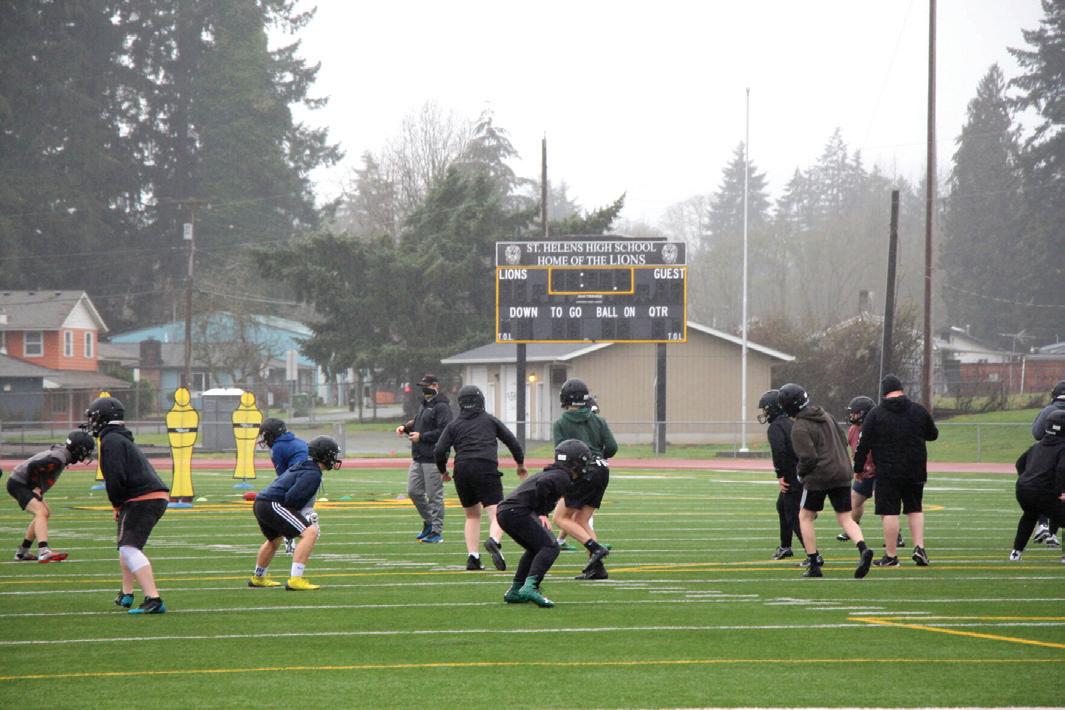
Meg came to the shelter as a stray and remains unclaimed - so she’s ready for her forever home. She’s between 8-10 years old, 15lbs and in really great shape for an ‘older lady.” She does well with other dogs, especially smaller, male dogs. She’s not a fan of car rides, but LOVES short walks. Meet Meg

Lions prepare for game 2 after 37-0 victory
KICKER From Page A1 Pet of the Month 253 S. 1st Street, St Helens, OR 97051 503.329.7269 mobile urbanpacificrealestate.com urbanpacific REALESTATE

Jeremy C. Ruark / The Chronicle Lions at Doc Ackerson field for game drills.
www.thechronicleonline.com Wednesday, September 7, 2022A10 Columbia County’s trusted local news source Sports & Outdoors Quilt ShowSept. 17 - 18, 2022 10 AM to 3 PM McBride Elementary School, St. Helens, Oregon Admission - $5, Children under 12 - Free $1 off with canned food donation door Prizes Artisan Market - Vendors For more information crpqg@outlook.comcontact Columbia River Piecemakers Quilt Guild


Crossword solution

HERBERT SWETT Chronicle Guest Article

1805503-397-0116Columbia Blvd. St. Helens, OR 97051 The Chronicle Local news, every online.day, Keep up to date on local stories, events, and ads by thechronicleonline.com.visiting
Solution for the Aug. 31, 2022 crossword puzzle headline inflation slows in the months ahead, the under lying inflation trend is likely to remain above the Federal Reserve’s target. As such, the Fed is raising interest rates further to cool the economy. Given the impact of rate increases is generally felt one to two years down the road, getting policy just right is extremely difficult. In our office’s recent forecast advisory meetings there was a strong consensus that the risk of recession was uncom fortably high. The outlook is essentially a coin flip between the soft landing and a recession. For now, our office is keeping the baseline, or most prob able outlook as the soft land ing and continued economic expansion.Employment, income, and spending continue to grow, but at a slower pace than assumed in previ ous forecasts. This slower growth is needed for infla tion to subside. However, if inflation does not slow as expected, and the Federal Reserve raises rates even fur ther, our office’s alternative scenario of a mild recession beginning in late 2023 is moreHeadinglikely. into the budget development season, growth in Oregon’s primary revenue instruments continues to outstrip expectations. Both personal and corporate tax collections remain strong, in keeping with income gains seen in the underlying econ omy. The forecast for the current 2021-23 biennium has been revised upward. Al though the near-term forecast calls for additional revenue, this is offset in future budget periods by a more pessimis tic economic outlook. Growth in spending and wages will need to slow to tame inflation, which trans lates into less state revenue growth across a broad range of taxes. The potential reces sion would weigh heavily on revenues over the next several years. However, even if the economic expansion persists, General Fund rev enues are due for a hangover in 2023-25.General Fund resources have continued to expand in recent years despite large kicker credits being issued. This growth is expected to pause in the near term, as nonwage forms of income return to earth and gains in the labor market slow. Re cent gains in reported taxable income have been driven by taxpayer behavior as well as underlying economic growth. Investment and busi ness income are not always realized for tax purposes as the same time they are earned in the market. Late 2021 was a great time to cash in assets, with equity prices and business valuations high, and poten tial federal tax increases on the horizon. Income reported on tax returns last year grew at more than double the rate of economic measures of in income. After so much income was pulled into tax years 2020 and 2021, less will be realized in the near term. And with recessionary risks rising, profits and gains could turn into losses, and a smaller share of filers could be subject to the top rate. The bottom line is that the unexpected revenue growth seen this year has left us with unprecedented balances this biennium, followed by a record kicker in 2023-25. The projected personal kicker is $3.5 bil lion, which will be credited to taxpayers when they file their returns in Spring 2024. The projected corporate kicker is $1.1 billion, which will be retained for educa tional spending. If current balances are not spent, net General Fund revenues for the upcoming 2023-25 bien nium will be reduced by $24 million relative to the June 2022 forecast. Forecast history The Oregon economic forecast is published to provide information to plan ners and policy makers in state agencies and private organizations for use in their decision-making processes. The Oregon revenue fore cast is published to open the revenue forecasting process to public review. It is the basis for much of the budget ing in state government. The report is issued four times a year; in March, June, Sep tember, and December. Columbia County Division
The