$1.50 Wednesday,
Serving
JEREMY C. RUARK Country Media, Inc.
During a tour in Columbia County March 22, Kotek met with Scholl.
~ Tina Kotek, Oregon Governor
“I thanked the Governor for her work to support our community,” Scholl told The Chronicle following the meeting. “We discussed our 2019 Housing Needs Analysis results and the infrastructure projects that we have identified that are needed to support housing. St. Helens is growing. We have available, buildable land, but we need state partnerships to build sufficient infrastructure to support growth.”
Scholl also discussed with Kotek, the St. Helens Waterfront Redevelopment Project and economic development, including the Streets and Utilities Extension Project, Riverwalk Project, Central Waterfront, and activation of the St. Helens Industrial

Business Park.
key focus of the city to support future economic growth, provide cohesive connection between city districts, improve the environment, and create overall sustainability for St. Helens,” Scholl said.
The meeting was critical in helping the governor better understand the needs of St. Helens, according to Scholl.
priorities. The governor’s visit created a connection and better understanding of St. Helens and our county. We appreciate that she reached out to us to learn about St. Helens and listen to our needs apart from any political differences.”
Courtesy photo from Gov. Kotek’s Office
part of Kotek’s One Oregon Listen ing Tour in which she participated in three community conversations about education, mental health and recovery, and housing and homelessness.
“I heard from some of our youngest Oregonians who care about each other and their future,” Kotek said.
“It puts a fine point on the need to invest in our children’s education, so they have the chance to thrive. I was also impressed by the community service providers working hard to help their neighbors despite resource challenges and a large service area. They make up for those challenges through strong relationships across the community and their incredible ingenuity.”
The day started at Vernonia Elementary School where Kotek met with first graders, read the picture book “Be Kind,” and discussed the importance of reading and kindness with the students. She also met with and took questions from a fourth-grade class about the work the governor does, ways she can help, and more. Kotek then led a roundtable discussion with school administrators and teachers. The discussion centered on efforts she is making to fund summer education and enrichment programs, with a focus on improving childhood literacy, and the increased mental health challenges facing students.
In St. Helens, Kotek toured Columbia Community Mental Health (CCMH), including a crisis stabilization center being developed on the organization’s campus.
CCMH offers holistic wraparound services from crisis intervention to residential and community services. In a subsequent behavioral health discussion, area providers noted the positive impact of the Measure 110 funding they received to expand service capacity, the successful work their outreach teams are doing, and the workforce challenges in a rural
See KOTEK Page A4
Broadleaf Arbor moving in first round of tenants
T
Courtesy photo from Jena Green.
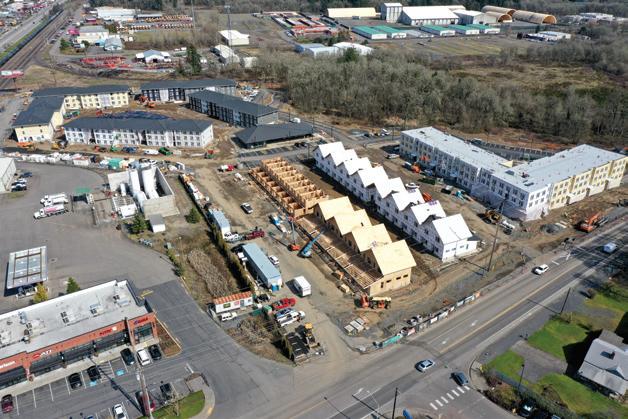
Construction began in August 2021. More than a year and a half later, the first tenants are moving into Building E as part of Broadleaf Arbor’s plan to move in people in phases as each building is finished, according to the Communications Manager for Broadleaf Arbor, Jena Green. Building E is the first building for residential use; however, the Community Building and Resident Services/Management offices have been open since February.
he new housing community Broadleaf Arbor is moving in its first wave of tenants this month and expects to see new residents each month until the project’s completion in October.The overall housing development is made up of 16 acres and 239 one, two, and three-bedroom homes available to individuals and families. Located at 2250 Gable Road at the intersection of Gable Road and Columbia River Highway, the housing community seeks to serve residents of all ages and backgrounds. “Broadleaf Arbor is a Community for All Ages (CFAA), meaning we put people first by creating spaces and programming that connects residents across generations,” their website states.
The 11-building complex provides homes for households making up to 60% of the area’s median income (AMI) levels ($63,900 for a family of four), according to its website. While developers expected the first building to be finished in
Fall of 2022, delays complicated the process.
“The primary cause for delay has been supply chain, specifically a backlog on electrical equipment,” Green said. “The final building, Building A, expects to be completed by the end of October.”
Over the next ten months, new residents will move in as each of the 11 buildings becomes inhabitable. In a market where affordable housing is scarce, applications for the community are already through the roof. There is already a waitlist to get a household.
“[There are] 269 one-bedroom applicants, 149 two-bedroom applicants, and 106 three-bedroom applicants,” Green said. “If folks
Oregon distributes $170M in food benefits
STAFF REPORT Country Media, Inc.
The Oregon Department of Human Services (ODHS) was to begin issuing $170 million in Pandemic EBT (P-EBT) food benefits to 434,000 students and young children in Oregon beginning this week.
A P-EBT card containing $391 in food benefits, which is different

from a regular electronic benefit transfer (EBT) card, will be sent by mail to each eligible child. Cards are being sent in batches from late March to the end of May 2023.
“We are grateful to be able to provide these food benefits to eligible students and families with young children in Oregon,” ODHS Self-Sufficiency Programs Interim Director Claire Seguin said. “As communities continue to be affected by COVID-19 and the rising cost of food, we know that many families are experiencing hardship and are struggling to get enough healthy food for themselves and their children. We encourage anyone who is struggling to meet their basic needs to contact our partners at 211, the Oregon Food Bank and their local Community Action Agency for support during this difficult time.”
pieces of mail addressed to them:
• A letter notifying them they are eligible to receive P-EBT benefits.
............... A9 Sports
Who is eligible for P-EBT food benefits
Children are eligible for Summer 2022 P-EBT if they:

• Were eligible to receive free or reduced-price National School Lunch Program meals during school year 2021-2022 or attended a Community Eligibility Provision school.
• Were under the age of 6 and enrolled in SNAP during the summer 2022 months.
Between March and May 2023, each eligible child will receive two
• A separate envelope with their P-EBT card that has $391 of food benefits on it.
Households with multiple eligible children will receive individual letters and cards for each eligible child. Households will start receiving notification letters at the end of March and P-EBT cards will begin arriving in April.
These additional food benefits are part of the P-EBT program, a temporary COVID-19 response program meant to provide additional food support for children whose access to adequate and quality food re-
Courtesy photo
ceived through school programs may have been impacted by COVID-19.
Visit pebt.oregon.gov for more information about the P-EBT program.
Families with specific questions about their child’s eligibility or P-EBT card can contact the P-EBT Call Center at (844) ORE-PEBT or (844) 673-7328. The P-EBT Call Center is available Monday through Friday 8 a.m. to 5 p.m. Pacific in English, Spanish, Russian, Vietnamese, Somalian, Mandarin and Cantonese. Callers may also request a translator for additional languages.
• P-EBT does not replace any child nutrition program already offered and families are encouraged to continue to participate in meal programs in their schools and com-
munities.
• P-EBT food benefits are issued in addition to regular SNAP benefits. P-EBT benefits are not considered in a public charge test.
Resources to help meet basic needs
• Find food resources in your community: needfood.oregon.gov

• Find a food pantry: foodfinder. oregonfoodbank.org
• Learn about government programs and community resources for older adults and people with disabilities: Aging and Disability Resource Connection of Oregon at 1-855-673-2372 or www.adrcoforegon.org
• Dial 2-1-1, or text your zip code to 898-211, www.211info.org
• Find local resources and support by contacting your local Community Action Agency: www. caporegon.org/find-services/
• Oregon Department of Human Services COVID-19 help center About P-EBT
P-EBT is part of the response to the COVID-19 pandemic. P-EBT is money for children whose access to adequate and quality food may have been impacted by COVID-19. Learn more about P-EBT from our FAQ for Families flyer. P-EBT is a program in partnership with the ODHS and the Oregon Department of Education (ODE).
Columbia County since 1881 thechronicleonline.com
March 29, 2023 Waterfront development adjustments Page A2 SHHS sports Page A10 Vol. 141, No. 14
.....................
............................
WILL LOHRE Country Media, Inc. .................
Opinion
A4 Poll
A4 Community Calendar A4 Obituaries
A5
.........
Classified Ads
A6
Legals .................... A6-8
.....................
Crossword
A10
Oregon Gov. Tina Kotek has returned to her state capitol building office with what St. Helens Mayor Rick Scholl hopes is a better understanding of the needs of his city.
Governor listens, gives hope during state tour
St. Helens Major Rick Scholl points out to Gov. Kotek, the city’s planned waterfront development along the Columbia River.
We love this state and know things can be better, no matter what the challenges. We signed up for this. We are here to solve problems.
Pandemic EBT (P-EBT) is part of the response to the COVID-19 pandemic. P-EBT is money for children whose access to adequate and quality food may have been impacted by COVID-19.
Walk-up style apartment buildings, townhomes, a senior housing building, and a central community and resident services building make up the 11-building complex. See BROADLEAF Page A8
Riverwalk, streets and utilities projects expanding
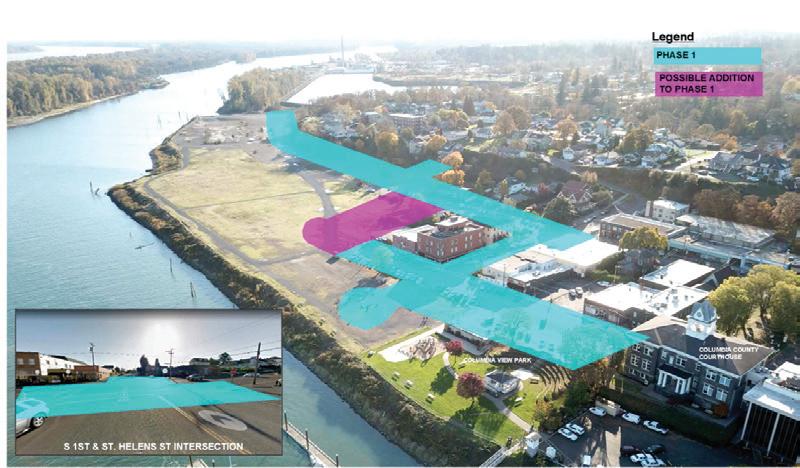
The city of St. Helens is adjusting the planned Riverwalk Project Phase I and the Streets and Utilities Extension Project to update designs for the Columbia View Park Amphitheater and a new gateway project at South 1st Street and St. Helens Street, respectively.
Columbia View Park Amphitheater
Under Phase I of the Riverwalk Project, the city entered an agreement with Mayer/Reed in March of 2021. Mayer/Reed is a Portland-based landscape architecture firm, and under the 2021 agreement, the council tasked that firm with providing the following services:
• To prepare full plans, specifications, estimates, permitting, and bid assistance for the Riverwalk Project Phase I and the Columbia View Park Amphitheater.
• Prepare plans, specifications, and estimates for Riverwalk Project Phase II at 30 percent design.
• Bid assistance and construction management services for Riverwalk Project Phase I and Columbia View Park Amphitheater.
An amendment to the agreement was decided in the March 15 regular council session to confirm that the new stage placement is correct in Columbia View Park as part of the Riverwalk Project Phase I work. The estimated cost for the additional services was $7,150. Mayer/Reed
recently provided the council with the rendering.
The city council has received the project rendering.
“The purpose of the rendering was to create an updated visual image of what the new stage would look like in its proposed location. St. Helens Communications Officer Crystal King said. “We want to ensure that the location meets the needs of our growing community.”
The scope of work in the Mayer/Reed agreement from March 15 included the following:
• Visiting the site and staking stage location based on 90% design plans.
• Taking site photography to be used as a basis for a “before” and “after” rendering, with a focus on the change to the stage location relative to the amphitheater seating.
• Creating a 3D site model that includes the stage, dance
floor, berm, and Riverwalk railing. Align the model with site photos to show the proposed design in perspective.
• Photorendering a model with material colors and textures. The rendering style will match renderings created for Dec. 2021 Riverwalk public open house.
“The design was created to accommodate a larger audience, include a hard surface dance floor and storage structure for equipment, and retain views of the river,” King said. “The intimacy provided by the two-seat walls for small events balances with the need for additional capacity during large events.”
After reviewing the new design, the project will move into final construction documents in anticipation of bidding on the project this spring, with construction to begin after the 2023 13 Nights on the River concert
series concludes, King said.
“City staff is currently gathering feedback from the city council, planning commission, and parks and trails commission about the rendering. The city council will discuss the project at its April 5 meeting,” King said.
Gate Project
In the same March 15 council meeting, the City Council approved an agreement with Lower Columbia Engineering, LLC, to design a gateway arch feature at South 1st Street and St. Helens Street. “No date is set yet to review proposed designs, but the proposal will be reviewed during a public meeting, and community feedback will be taken as part of the design process,” King said. “Through the design process, the city will engage with a stakeholder group for design
feedback from a wide range of community members.”

Construction of the gateway feature is part of the Streets and Utilities Extension Project which includes improvements to the South 1st Street and St. Helens Street intersection, including underground electrical utilities to illuminate a future gateway feature, King said. The gateway arch is meant to mark the significance of the riverfront district.
“It will be a gateway feature; we hope it signals to anybody coming into the area that they are entering a space that’s specifically special,” King said.
Lower Columbia Engineering has estimated the scope of work to cost $12,000 to $18,000, with billing being charged on a “time and materials basis,” according to the personal services agreement.
The scope of work includes:
• Site-visit, information gathering, and review of all existing plans for the area in order to fully understand the atmosphere of the improved downtown area.
• Up to four design meetings with the city’s Gateway Arch Committee. This will likely include a kickoff meeting, 30% design review meeting, 90% design review meeting, and a pre-construction meeting that includes the selected contractor.
• Development of 30% design plans for Gateway Arch and Sign.
• Development of 60% plans that address review comments and discussion at the 30% design meeting.
• Perform structural engi-
neering that includes wind, seismic, and gravity load analysis based on the Oregon Structural Specialty Code and an overall code summary that includes review and compliance with the St. Helens Municipal Code.
• Development of 90% design plans and updated cost estimates based on engineering analysis and any additional input from the team.
• Develop artistic rendering of the proposed design.
• Provide review and administrative assistance with the city’s bidding and contractor selection process.
• Provide one-round of value-engineering adjustments, if necessary, once actual pricing is received from the fabrication and installation team to ensure the project can be installed on budget.
• Develop Final design documents for permit approval.
• Provide basic construction administration assistance and documentation. This will include any necessary inspections/engineering observations and developing As-built plans.

While there is no concrete date for its completion, it is anticipated to be completed by September 2024 to coincide with the conclusion of the Streets and Utilities Extension Project Phase I, according to King.
Follow this developing story at thechrionicleonline. com and in the Wednesday print editions of The Chronicle. For more information about the Waterfront Redevelopment Project, also visit https://www.sthelensoregon. gov/waterfront.
$27.3B state budget framework going public
The co-chairs of the Oregon Legislature’s Joint Committee on Ways and Means have released their budget framework for the 2023-2025 biennium, outlining priorities for the state budget.
The 2023-25 current service level budget represents a $27.3 billion total funds, or 25.5%, increase over the 201921 current service level and reflects the addition of 4,792 positions, according to the Ways and Means co-chairs.
General Funds and Lottery Funds make up $6.1 billion of this growth. This increase has been driven by significant investments over the past two biennia in early learning, K-12 education, housing, behavioral health, emergency management, and wildfire response, among others. Continued support for these vital programs and services is central to the Co-Chair budget framework.
The framework includes $9.9 billion for the State School Fund to help give schools stable and sufficient funding to improve literacy and graduation outcomes.
The co-chairs said the proposed budget also makes meaningful and targeted investments in key priorities like housing and homelessness, health care, and behavioral health.
The framework allocates money to address several critical workforce shortages in key sectors, as well as addresses initiatives aimed at making sure Oregonians who got on the Oregon Health Plan during the pandemic are still able to access the coverage and care they need.
Although the March 2023 Oregon Economic and Revenue forecast showed improvement and an increase in available resources over the prior forecast, significant uncertainty still exists, according to the co-chairs.


“The considerable growth in the current biennium revenues that has contributed to the projected General Fund ending balance of $4.6 billion has also resulted in an estimated personal income tax kicker of $3.9 billion, which reduces available 2023-25 revenues.” the co-chairs write in their budget framework report. “Following two biennia of considerable investments through one-time federal relief funding and strong revenues, the 2023-25 budget will focus on supporting the continued funding of ongoing programs, agencies, and state personnel.”
The Oregon Constitution requires the Oregon Legislature pass a balanced budget for each biennium. The framework is a starting point for the legislative process of developing and passing the finalized budget for the upcoming 20232025 biennium. The process will take place over the course of the 2023 legislative session and conclude by the end of June.
“At a moment when Oregonians are unified around common priorities such as housing and homelessness, behavioral health, educational outcomes, and addressing multiple workforce shortages, our north star is clear,” Rep. Tawna Sanchez (D-Portland), Co-Chair of the Joint Ways and Means Committee said. “We must spend wisely to make sure state government can deliver for all Oregonians on the most pressing issues facing our state.”
“This is a very uncertain time for Oregon’s economy. Oregonians deserve to know their tax dollars are funding the state’s highest priorities,” Sen. Elizabeth Steiner (D-Portland), Co-Chair of the Joint Ways and Means Committee said. “Our framework budget focuses on maintaining critical services for Oregonians while also protecting our reserves in case of economic downturn. The last few years have been good for Oregon, but rain clouds could still be on the horizon.”
Read the full Ways and Means Committee Budget Framework with thjis story at thechronicelonline.com. The next step in the legislative budget process is a series of public hearings at various locations across the state where members of the public will have the opportunity to testify regarding their perspectives and priorities on the state budget.
Be engaged
The Oregon Legislature’s Joint Ways and Means Committee has scheduled a series of public hearings about the state budget.
Members of the public will have the opportunity to testify at each of these scheduled hearings regarding their perspectives and priorities around the state budget.
The series of hearings will start on April 8, at Portland Community College- Sylvania Campus. Members of the committee will take public testimony from community members from 10 a.m. to 12 p.m.
To testify, members of the public will be able to access
sign up links on the Ways and Means Committee’s webpage on OLIS, the legislature’s website. Sign up links will be available online in the next week.

Public hearings schedule
• 10 a.m. - 12 p.m. Saturday, April, 8 Portland
Portland Community College - PAC Auditorium, Sylvania Campus, 12000 SW 49th Ave. Portland
• 5 p.m. - 7 p.m. Friday, April 14 Newport
Newport Performing Arts Center, 777 W Olive St. Newport
• 5 p.m. - 7 p.m. Friday, April 21 Roseburg
Umpqua Community College, 1140 Umpqua College Rd. Roseburg
• 5 p.m. - 7 p.m. Friday, April 28 Ontario
Four Rivers Cultural Center, 676 SW 5th Ave. Ontario
Metro Creative Connection
The 2023-25 current service level budget represents a $27.3 billion total funds, or 25.5%, increase over the 2019-21 current service level and reflects the addition of 4,792 positions, according to the Ways and Means co-chairs.
www.thechronicleonline.com Wednesday, March 29, 2023 A2 Columbia County’s trusted local news source WE’RE HIRING! • Competitive Salary with 4-Tier Pay Progression • Profit Sharing Bonuses • Full Health Care Package $1,000+ SIGN-ON BONUS Become part of the Berry family around the globe. We foster workforce development to support and encourage our knowledgeable enployees. With more than 295 locations- we are pushing the limits of innovation and moving our industry forward. APPLY AT: WWW.BERRYGLOBAL.COM/CAREERS save more. STAY FLEXIBLE . Ask about our rates on money market accounts, checking, IRAs, & more 800.773.3236 waunafcu.org FEDERALLY INSURED BY NCUA
WILL LOHRE Country Media, Inc.
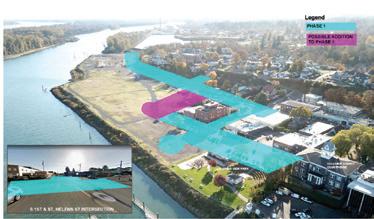
Courtesy photo from the City of St. Helens This flyover shows the proposed St. Helens waterfront redevelopment site.
JEREMY C. RUARK Country Media, Inc.
Beer, wine price hike proposal killed
The Oregon House Behavioral Health & Health Care committee chose not to schedule a hearing for HB 3312, the Alcohol Harm Reduction Act by the Friday, March 17 deadline, effectively overlooking and killing the legislation.
Sponsored by Rep. Tawna Sanchez, Rep. Travis Nelson and Rep. Lisa Reynolds, the Alcohol Harm Reduction Act was designed to reduce Oregon’s alcohol addiction rate from 12% to 5% by temporarily and marginally raising beer and wine taxes to fund immediate access to detox and treatment, pay for primary prevention programs and provide law enforcement with increased resources to address Oregon’s addiction crisis. Oregon’s beer and wine taxes are second lowest in the nation and have not been raised by the Legislature in over 40 years, according to Oregon Recovers.
Oregon has the 5th highest alcohol addiction rate in the country and six Orego-
nians die each day due to alcohol. That is the equivalent to three constituents dying each month in each House district,” Oregon Recovers Executive Director Mike Marshall stated in a release.
It’s a sad day in Oregon when the Legislature has an opportunity to address one of the largest Behavioral Health crises affecting our residents and does not give it the time of day.
~ Teri Morgan, Oregon Recovers Co-Chair
“Big Alcohol, organized by lobbyists for the beer and wine distributors, actively opposed the legislation, fearing it would diminish their profits,” Marshall said.

“Comparatively, the House is moving forward with legislation to promote distilled liquor consumption and reimburse liquor store owners for diminished profits due to
efforts to reduce underage and binge drinking.”
Alcohol is a toxic, addictive carcinogen and binge drinking costs the state economy $4.8 billion annually, according to the release.
“The state is in a crisis due to alcohol and it’s time for the Oregon Legislature to acknowledge that they have a drinking problem,” Marshall said. “Our elected leaders are ignoring that their constituents are dying from alcohol at alarming rates and instead spending their limited time advancing legislation to financially benefit Big Alcohol.”
“This decision once again demonstrates that the Oregon Legislature is not serious about dealing with the profound racial health inequities in this state,”
Cielo Treatment Center Executive Director Solara Salazar said. “Native Americans die at 2 and half times the rate of white people due to the consumption of alcohol. Black and Latino Oregonians are more prone than white Oregonians to developing cirrhosis of the liver due to alcohol consumption. The bottom line
is the decision to kill this important bill prevents the state from saving lives.”
The House Committee on Behavioral Health & Health Care has argued that there was not time to have a hearing on the Alcohol Harm Reduction Act, given the volume of legislation they are considering. The Committee did schedule hearings on the following bills:
• HB 3140, removes requirement Public Employees Benefit Board & Oregon Educators Benefit Board solicit new bids for actuarial or technical support every three years.
• HB 2420, directs Oregon Health Authority to adopt rules allowing county registrar to issue and sell records of live births and deaths occurring in any county.
While both are important issues neither bill is designed to address a crisis and save Oregonians’ lives.
At the request of the alcohol industry, the legislature has held hearings and voted to advance the follow
ing bills:
of Oregon Distillers Guild, will redirect General Fund resources to promote liquor consumption and block Governor Kotek’s effort to raise the current bottle fee from $0.50 to $1.
• HB 2502, will entitle liquor store operators to significant public funds if any laws designed to lower harmful alcohol consumption reduce their sales.

• SB 616, at the request of Oregon Brewers Guild, more than doubles the amount of beer and cider
Metro Creative Connection
“It’s a sad day in Oregon when the Legislature has an opportunity to address one of the largest Behavioral Health crises affecting our residents and does not give it the time of day,” Oregon Recovers Co-Chair Teri Morgan said. “People are dying and we have a strategic way to start changing that laid out in this bill. Honestly, this should be one of their TOP priorities. It makes no sense to me.”
How the Oregon CHIPS bill with help the state
and manufacturing jobs are well-paying, stable careers that often do not require four-year degrees.
An estimated 26,000 jobs would be created by a new semiconductor manufacturing facility in Oregon and could generate billions in
“This is a great first step, but phase two begins now. Oregon has work left to do to attract business and invest in our future shared prosperity,” said Rep. Kim Wallan (R-Medford) said. “I look forward to continuing to work with this power-
“OR CHIPS is a game changer for Oregon,” Senate Majority Leader Kate Lieber (D-Beaverton and Southwest Portland) said.
ary that meets the project’s needs.
Any land brought into the urban growth boundary must be used for semiconductor manufacturing purposes. If a project does not receive federal money
through the federal CHIPS Act, the governor can then remove the land from the urban growth boundary.
Any legal challenges must be initiated within 60 days and will be directed to the Oregon Supreme Court to ensure due process
is respected and Oregon does not miss out on any manufacturing opportunities due to a protracted legal process. Senate Bill 4 now moves to the Joint Ways and Means Committee for consideration.

The Oregon Legislature’s Joint Committee on Semiconductors has approved the Oregon CHIPS Bill, Senate Bill 4.
The bill is the Oregon Legislature’s first step toward securing the future of Oregon’s semiconductor economy.
The bill is designed to empower Oregon businesses to apply for a share of $52 billion in federal money from the CHIPS and Science Act. This money represents a once-in-ageneration opportunity to solidify Oregon’s place as a global leader in semiconductor development and manufacturing.
“This is a crucial first step towards securing Oregon’s semiconductor future. This legislation will create good-paying, longterm jobs in every corner of our state, keep Oregon’s economy stable and competitive in the 21st Century, and protect America’s critical semiconductor supply chain,” Sen. Janeen Sollman (D-Hillsboro) said.
The bill allocates $190 million to the Oregon CHIPS Fund to be distribut-
ed via grants and loans for:
• Development and acquisition of a site for semiconductor manufacturing
• Semiconductor research and development
• Workforce development, including internships and apprenticeships
An additional $10 million is dedicated to the newly established Industrial Lands Loan Fund for financial assistance to local governments to prepare sites for semiconductor industrial development. The University Innovation Research Fund will also receive $10 million for public universities to leverage federal research grants.
“Oregon is a world class hub for semiconductors, and with SB 4, we are making our first move to draw in federal CHIPS Dollars and solidify Oregon’s status,”Rep. Janelle Bynum (D-Clackamas) said. “I am so proud of the work of this committee.”
The bill requires that projects funded by OR CHIPS commit to creating permanent, full-time jobs and have a net positive impact on local and state revenues.
Semiconductor research
“It will open up billions in funding for local businesses and innovators, create thousands of family-wage jobs, and put Oregon families in every corner of this state on the path to prosperity.
“There is still more work to be done, but I applaud the urgency and effectiveness of this committee in passing such a consequential piece of legislation this early in session.”
The bill also establishes a balanced land use solution that respects Oregon’s 50-year-old land use system while allowing flexibility so the state can attract multibillion-dollar manufacturing centers. Under Senate Bill 4, the governor will have the authority to site a maximum of eight new areas outside of current urban growth boundaries.
The authority to issue an executive order is limited by clear guardrails within the bill.
Before issuing an executive order, the governor must:
• Conduct one public meeting near the site,
• Accept public comments for at least 20 days following the public meeting, and
• Determine that there is not an existing site within the urban growth bound-

www.thechronicleonline.com Wednesday, March 29, 2023 3 Columbia County’s trusted local news source
-
STAFF REPORT Country Media, Inc.
STAFF REPORT Country Media, Inc.
Metro Creative Connection
The bill allocates $190 million to the Oregon CHIPS Fund.
When giants fall, we need to listen
JOE STONE Chronicle Guest Column
In just two years, wildfire has killed an estimated 13 to 19% of all mature giant sequoia trees. These most massive of trees grow only on certain western slopes of the Sierra Nevada, the mountain range that divides California’s Central Valley farmland from the Great Basin Desert. The loss of so many “big trees,” as conservationist John Muir called them, is unprecedented.
Visting the forest
Many of the best-known stands of giant sequoias grow more than 6,000 feet above sea level in three national parks — Sequoia, Kings Canyon and Yosemite. A visit to these immense trees typically begins with a drive up from Fresno. From the valley floor, Highway 180 curves into foothills, then winds onto steep, treecovered mountainsides where cooler temperatures
and higher humidity take the edge off the California sun. The road passes through Kings Canyon National Park, where visitors get their first impression of the big trees. As Muir acknowledged, words aren’t sufficient to convey the awe of that first encounter with giant sequoias: “No description can give anything like an adequate idea of their singular majesty, much less of their beauty.” He added, “Nothing hurts the big tree.” Except in our time: severe wildfire and the chainsaw.
Muir’s words helped inspire the national parks that have protected many sequoia groves from logging, but our concern about wildfires led to government-mandated fire suppression for more than 100 years. Through a federal agency’s zeal, the big trees are in trouble. In the Sierra Madre’s fire regime, developed over centuries, sequoia groves burned every 6 to 35 years. Wildfire thinned the smaller trees and converted
fine fuels into soil nutrients.
Forest fires
Without fire, sequoia cones don’t open and spread their seeds. The same fire also creates openings in the forest canopy, giving seedlings the sunlight they need to survive.
Research shows that giant sequoia populations were “stable or increasing” from 500 B.C. through the 1800s. Then came the 1900s, when “there was a massive failure of giant sequoia reproduction.” Without fire, sequoia seeds stopped sprouting, while the buildup of highly combustible fine fuels on the forest floor, and the greater density of smaller trees, increased the risk of catastrophic wildfire.
As scientists began to understand the problem, the National Park Service implemented a prescribed burning program in giant sequoia groves. Evidence from recent wildfires indicates the program has been
Community EvEnts
April 8 Scappoose Kiwanis Easter Egg Hunt
10 a.m. Scappoose Kiwanis will hold their Easter Egg Hunt at Grant Watts playground, 52000 SE 3rd St. in Scappoose.
Ongoing events
Lower Columbia River Watershed Council
Meets at 7 p.m. every other second Tuesday. Meetings are currently held electronically by Zoom. For more information, contact Council Coordinator Henry Franzoni ar 360-353-0937 or email to hjfranzoni3@gmail.com. Visit the council’s website for agenda postings and Zoom at www.lowercolumbiariver. org/events-page.
Resonate Recovery
Meets at 7 p.m. to 8 p.m. Wednesday - Sundays. This is a Bible based, Christcentered spiritual recovery
From Page A1
community, according to a release from Kotek’s office.
Kotek ended the day with the Community Action Team (CAT), a community organization that works to provide supportive services for veterans, help people pay rent, find permanent housing for people experiencing homelessness, and more. CAT has 16 housing units on site to support Oregonians transitioning out of unsheltered homelessness and has successfully supported 45 individuals to reach permanent housing.
Kotek heard about how CAT delivers services, followed by a roundtable discussion with regional service providers about the intersection between behavioral health and homelessness, social determinants of health, and the need to support veterans.
Lincoln County tour
During a visit to Lincoln County Friday, March 24, Kotek said she expected this week to sign the historic affordable housing and homelessness solutions package approved by the Oregon Legislature.

Kotek acknowledged the multimillion-dollar package is part of the effort to deal with what has been described as the state’s top priority. She said the next step is gaining recommendations from members of the state’s housing advisory council, which expects to submit recommendations in the beginning of April.
“They are going to be coming up with a plan, saying removing the red tape, bring more people into the finances and the construction,” Kotek told reporters during media
meeting for those struggling with addictions and compulsive behavior at 220 S. 1st Street in St. Helens. Everyone is loved and welcomed. For more information call Debbie at 503-560-0521, Daniel Grant at 714-7689327 or check the Resonate Facebook page.
Columbian Toastmasters
Promoting positive learning and leadership through public speaking. Anyone is welcome to visit! Lunch meetings at Warren Country Inn, 56575 Columbia River Hwy, Warren, OR 97053 from 12 p.m. to 1 p.m. every Thursday. Call 503-3690329 for more information.
Overcomers Outreach
Meetings are held every Saturday at 9 a.m. at Creekside Baptist Church, 51681 SW Old Portland Road in Scappoose. Call Fred 971-7576389.
Celebrate Recovery
For anyone struggling with addiction, hurts, habits, and hang-ups. Doors open at 6:30 p.m. for coffee, snacks, and fellowship. The meeting starts at 7 p.m. The first Monday of each month at 6 p.m. the doors open for a free dinner. Yankton Community Fellowship, 33579 Pittsburg Road in St. Helens. 503-396-7091. Childcare is available. www.yanktoncommunityfellowship.com.
Watch Spring on Fridays
2 p.m. to 4 p.m. Have tea and a sweet in Caples’ Cottage, 1925 1st Street in Columbia City. $5.
To list an event in the Community Calendar, email details with a phone number that may be published for anyone that might have questions, to jruark@countrymedia.net or chronicleclassifieds@countrymedia. net, or call 503-397-0116.
stressed the need for adequate statewide child care. Gray also urged the governor to seek out an experienced educator from Oregon as the next deputy state school superintendent.
“We need a person who won’t back off, Gray said, “and supports diversity, equality and diversion, and someone approachable,” Gray said.
Next step
successful. Areas treated with prescribed fire burned less intensely, mature sequoias did not die, and sequoia seedlings have since sprouted.
God has cared for these trees …but he cannot save them from fools.
~ John Muir
Clearly, sequoias need fire to survive.
The challenge is avoiding catastrophic wildfire, a challenge made difficult by today’s dense groves.
According to Alexis Bernal, a researcher with the University of California at Berkeley, Sierra Nevada forests typically held about 20 sequoias per acre before 1860. Since then, fire suppression has allowed the growth of as many as 120 to 160 trees per acre.
Proposed solutions
Bernal advocates extensive logging before fire can resume its natural role. Emergency logging by government agencies has already begun in forests with sequoia groves, including clearcuts along roadways in Yosemite National Park.
Not everyone agrees that logging is the answer. Forest ecologist Chad Hanson, with the John Muir Project, calls Bernal’s approach an excuse to continue commercial logging of public lands. He believes sequoia deaths have been far lower than official estimates and that new trees can sprout even after severe fires.
Unfortunately, Congress has gotten involved. Kevin McCarthy, R-California, introduced the Save Our Sequoias Act in 2022 in the House. Dianne Feinstein, DCalifornia, later introduced the act in the Senate. The bill would expedite mechanical “fuel treatments” by bypassing environmental
laws. We’re just lucky that record snowfall in the Sierra Madre threw a wet blanket on the initiative by reducing fire risk, as the bill has yet to be re-introduced in the current legislative session. While the unprecedented threat to these priceless trees might be a rare instance in which “mechanical treatment” is justified, chipping away at environmental protections has rarely, if ever, proven beneficial for the environment— especially when politicians try to call the shots.
Giant sequoias need all the help they can get, but that help needs to be informed by good science.
Joe Stone is a contributor to Writers on the Range, writersontherange.org, an independent nonprofit dedicated to spurring lively conversation about the West. He is the editor of Forest News, the publication of Forest Service Employees for Environmental Ethics.
gathering following the Lincoln County tour. “I am very impressed by the collaboration of the legislature. It’s pretty impressive. We all have to pull together.”
Kotek said beyond affordable housing and homelessness, there is the connective piece of mental health and addition that Oregon will need to address.
“We need to make sure if you are suffering or you are addicted, that you have a place to go,” Kotek said.
The state also needs to focus on schools and students, on literacy and to make sure students can catch up on reading, according to Kotek.
“So, we are very much focused on that,” she said. “The opportunities and the challenges are always the same. If you can bring the right people together, and seek their ideas, and have the resources, that’s the effort. So, part of my job is to make sure that all the money that we do have is working and going in the same direction so we can help people. Sometimes it is about coordination. Sometimes it is about resources.”
Earlier in the day during the governor’s visit to Newport, Lincoln County School District Superintendent Karen Gray met with Kotek and
Kotek said beyond her commitment to visit every Oregon county in her first year in office, she wants to hear from Oregonians.
“I am a governor for the whole state,” she said. “If people email me and let me know that they need help, I see those, I get reports from staff, we do the best we can to make sure they are connected to the services they need in every part of the state. That’s my job. Working hard to make it all happen.”
Kotek said she is also taking away value learning opportunities with her statewide visits.
“That is very good feedback for me so I can go back to our state agencies with those details,” she said. “Our job is good customer service. These little pieces that come to be in these conversations are very important.”
As she left Lincoln City, Kotek said she is inspired.
“The First Lady and I are inspired, and we are excited. That’s why we got into this job,” Kotek said. “We love this state and know things can be better, no matter what the challenges. We signed up for this. We are here to solve problems.”
Follow this developing story at thechronicleonline.com and in the Wednesday print editions of The Chronicle.
Editorial policy: Opinions expressed on this page are independent of The Chronicle views and are solely those of the writers expressing them.
Write to us: We want to hear from you and encourage you to write letters to the editor. Because of space limitations, shorter letters have a better chance of being printed. We may edit your letter for style, grammar and clarity, although we do as little editing as possible. If you don’t want your letter printed under those conditions, just let us know.
Thank-you letters are limited to a general thanks and summary of an issue or action. We reserve the right to exclude
lists of people, organizations and businesses. Letters received after noon on Friday may not be in time for the following Wednesday’s paper.
To verify authenticity, all letters must be signed and include your address and daytime phone number. We won’t print your street address or phone number (just your city of residence). Submissions may be emailed to chroniclenews@countrymedia.net, sent via mail, or dropped off at the office.
Letters policy: This newspaper’s letters to the editor are limited to a maximum of 250 words and will be edited for grammar, spelling and blatant
inaccuracies. Unsubstantiated or irresponsible allegations, or personal attacks on any individual, will not be published. Letters containing details presented as facts rather than opinions must include their sources. Writers are limited to one published letter per month. All submissions must include the author’s full name, local street address and telephone number (only the name and city of residence will be published). By submitting a letter, writers also grant permission for them to be posted online.
Opinions expressed on this page are the writer’s alone and do not represent the opinion of the newspaper or its parent company, Country Media, Inc.
www.thechronicleonline.com Wednesday, March 29, 2023 A4 Columbia County’s trusted local news source The Chronicle The Chronicle (USPS 610-380) is published weekly by Country Media, Inc. 1805 S. Columbia Blvd., P.O. Box 1153 St. Helens, Oregon 97051 Periodicals postage paid at St. Helens, OR 97051 POSTMASTER: Send address changes to The Chronicle PO Box 1153 St. Helens, OR 97051-8153 SUBSCRIPTION RATES: One month in county: $8 One month out of county: $10 One year in county: $70 One year out of county: $90 One year online only: $60 CONTACT US • Phone: (503) 397-0116 • Fax: (503) 397-4093 Website: www.thechronicleonline.com • Editorial: chroniclenews@countrymedia.net ADVERTISE WITH US: Display ads: chronicleads@countrymedia.net Classified ads: chronicleclassifieds@countrymedia.net FOLLOW US • facebook.com/sthelenschronicle or twitter.com/shchronicle Opinion Vote online at thechronicleonline.com Given the sting of inflation, are you saving more, or less for the future? More Less Weekly Online Poll
Kelli
Joe Warren Publisher Jeremy C. Ruark Regional Executive Editor Will Lohre Associate Editor Jon Campbell Advertising Sales
Nicholson Office Manager James Yang Creative Director Jon Lowrance Driver
KOTEK
Jeremy C. Ruark / Country Media, Inc. Kotek outlined her objectives during a meeting.
Crossword solution
Solution for the March 22, 2023 crossword puzzle



SOLVE celebrates Earth Day



Columbia County residents and visitors have an opportunity to make an environmental difference April 22.
SOLVE’s Oregon Spring Cleanup, coincides with Earth Day and is presented by Portland General Electric.
With the support of SOLVE, community leaders and partner organizations host restoration events, urban litter cleanup projects, and beach cleanups.
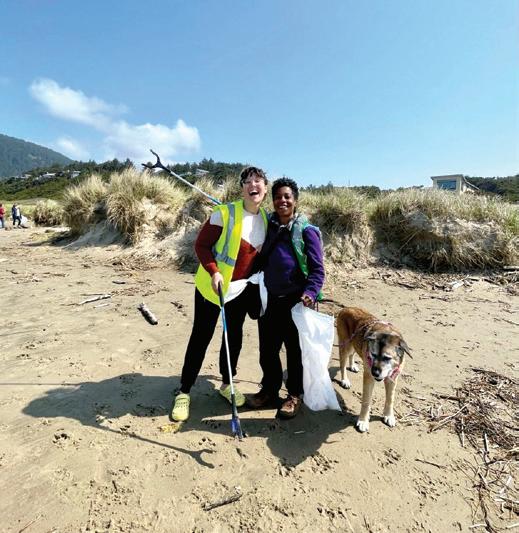
Volunteer registration is now live, and all Oregonians are encouraged to sign up for this statewide cleanup event.
Most Oregon Spring Cleanup events will occur on Earth Day, April 22, but SOLVE will be highlighting community events occurring between April 15-23.
allows you to see a map of Oregon and helps to easily locate projects near you! All necessary tools and supplies will be provided. The Oregon Spring Cleanup presented by PGE is a great way to connect with family members, coworkers, and neighbors, all while collectively giving back to some of Oregon’s most beautiful places.
About SOLVE
















Tualatin Valley
Tualatin Valley FUNERAL ALTERNATIVES










PGE has been supporting SOLVE’s mission to take care of Oregon’s natural spaces for more than thirty years. Each volunteer project is aimed at caring for one of Oregon’s most precious resources, our water, from source to sea. Removing invasive plant species, nurturing native plants,
and collecting litter are all easy ways volunteers can create a positive impact on Oregon’s water quality. Last year, during the 2022 Oregon Spring Cleanup, over 3,500 volunteers removed 44,000 pounds of litter and debris statewide. Sign up to volunteer today and let’s continue to build upon the momentum of last year’s events.
Each piece of litter collected prevents it from entering a nearby river, waterway, or storm drain, where it will eventually make its way to the sea and contribute to our global marine debris crisis.
Interested community members are encouraged to visit www.solveoregon.org to see a list of volunteer projects and sign up. The website
SOLVE is a statewide non-profit organization that brings Oregonians together to improve our environment and build a legacy of stewardship. Since 1969, the organization has grown from a small, grassroots group to a national model of volunteer action. Today, SOLVE mobilizes and trains tens of thousands of volunteers of all ages across Oregon to clean and restore our neighborhoods and natural areas, and to build a legacy of stewardship for our state. Visit solveoregon.org for more information.
$38M for wildlife conservation, outdoor access
STAFF REPORT Country Media, Inc.





Oregon is receiving nearly $38 million for fish and wildlife conservation and outdoor access.
The U.S. Fish and Wildlife Service (USFWS) will be awarding the Oregon Department of Fish and Wildlife (ODFW) $28,513,417 from the Wildlife Restoration fund for wildlife habitat restoration projects and research aimed to better manage wildlife species, and $9,229,182 from the Sport Fish Restoration (SFR) fund to support important fisheries, monitoring, and education programs throughout Oregon.
The funding has been announced by Oregon’s U.S.

Senators Jeff Merkley and Ron Wyden.
“As Chairman of the Interior Appropriations Subcommittee, which funds the important conservation efforts of the USFWS, I understand how integral it is to protect lands and waters so the vibrant ecosystems that support countless species and enhance our lives are there for future generations,” Merkley said. “I’m pleased these federal funds will be used to manage and protect Oregon’s wildlife areas around the state, and to help Oregonians access and enjoy the great outdoors through outstanding recreation opportunities such as fishing.”
“This federal investment in our state will help to protect the wildlife that in-


spires Oregonians of all ages with the wonders of nature, and also supports Oregon’s world-renowned recreational offerings,” Wyden said. “I’m gratified that communities statewide will benefit from these federal resources to support fishing and the love of the outdoors that’s in Oregonians’ DNA.”
USFWS is providing over $1.6 billion through the Wildlife Restoration Program, the nation’s oldest and most successful wildlife restoration program, to support states, commonwealths and territories in their efforts to connect people with nature and conserve fish, wildlife and their habitats.
ODFW utilizes the Wildlife Restoration funds to supports the operation and


Thomas L. Lund
April 15, 1947 ~ Jan. 27, 2023












Thomas “Tom” Lund a former resident of Columbia County passed away suddenly on Jan. 27, 2023 at OHSU in Portland, Oregon.



Tom was born on April 15, 1947, in Salem, Oregon, to parents, Irvin and Isabel Lund.

He grew up in Yakima Valley and Vancouver, Washington, graduating from Hudson Bay High School in 1965.
In 1966 he enlisted in the US Army. He trained at Ft. Ord, California and Ft. Devens, Massachusetts. He served in Vietnam and Germany. He was an active





member in the Milwaukie, Oregon American Legion Post 180 and Oregon City VFW Post 1324.


In 1972 he became a working shareholder at Multnomah Plywood and became a homeowner in Scappoose, Oregon. He worked at the mill until it’s closing in 1992. Tom was instrumental in opening and running the Retail Store at the mill. He also served on the board.


After closing of the mill he repurposed his life by training to be an appliance repairman. He eventu-


maintenance of 17 wildlife areas and 7 regional habitat programs which are designed to provide technical assistance and enhance wildlife habitats on public and private lands.
ODFW also uses the SFR funds to support fisheries while ensuring wild stocks are adequately protected, to keep a finger on the pulse of several of our iconic salmon/ steelhead populations, including those in the Rogue, Deschutes, Willamette, and Umpqua rivers and along the Oregon Coast, and support the Salmon and Trout Enhancement Program, which engages volunteers throughout the state in education, habitat restoration, monitoring, and fish propagation activities.
ally moved to Portland and started his own business Tom Tech Appliance Repair. He enjoyed being his own boss. He had commercial, residential and many repeat customers.






Tom enjoyed being a resident of the Columbia County community for 20 years. He created many longtime friendships. Although he moved to the Portland area; he kept ties with friends in Scappoose and St. Helens. Tom is survived by his wife Nancy and his sister Patricia.

www.thechronicleonline.com Wednesday, March 29, 2023 A5 Columbia County’s trusted local news source
ORDER TODAY & RECEIVE A $100 GIFT CARD Offer for new and qualifying former customers only. 3-year price guarantee requires credit qualification and 2-year commitment and covers core programming, local networks, and equipment. Early termination fee of $20/mo. remaining applies if you cancel early. Offer ends 4/12/23. 99% signal reliability based on data from set-top boxes. Not a guarantee of signal in all weather conditions. *Thursday Night Football: Internet connected Hopper and a Prime Video subscription required. A TV PRICE YOU CAN RELY ON 3-YEAR TV PRICE GUARANTEE A TV Price you can rely on - only from DISH ONLY FROM DISH 1-866-373-9175 *Restrictions Apply 3-Year TV Price Guarantee Multi-Sport with NFL Redzone from NFL Network 99% Signal Reliability, now backed by our Reliability Guarantee *To qualify, consumers must request a quote, purchase, install and activate the generator with a participating dealer. Call for a full list of terms and conditions. REQUEST A FREE QUOTE CALL NOW BEFORE THE NEXT POWER OUTAGE (877) 557-1912 $0 MONEY DOWN + LOW MONTHLY PAYMENT OPTIONS Contact a Generac dealer for full terms and conditions Prepare for power outages today WITH A HOME STANDBY GENERATOR FREE 7-Year Extended Warranty* A $695 Value! Now’s the Right Time Take advantage of the new 30% Solar Investment Tax Credit (ITC) with PWRcell, Generac’s fully-integrated solar + battery storage system. PWRcell will help you save money on your electric bill and be prepared for utility power outages. Plus it’s compatible with most existing solar arrays. SAVE 30% WITH THE SOLAR TAX CREDIT Call to request a free quote! (844) 989-2328 ^Consult your tax or legal professional for information regarding eligibility requirements for tax credits. Solar panels sold separately. Promo Number: 285 *For those who qualify. One coupon per household. No obligation estimate valid for 1 year. **Offer valid at time of estimate only. 2The leading consumer reporting agency conducted a 16 month outdoor test of gutter guards in 2010 and recognized LeafFilter as the “#1 rated professionally installed gutter guard system in America.” Manufactured in Plainwell, Michigan and processed at LMT Mercer Group in Ohio. See Representative for full warranty details. Registration# 0366920922 CSLB# 1035795 Registration# HIC.0649905 License# CBC056678 License# RCE-51604 Registration# C127230 License# 559544 Suffolk HIC License# 52229-H License# 2102212986 License# 262000022 License# 262000403 License# 2106212946 License# MHIC111225 Registration# 176447 License# 423330 Registration# IR731804 License# 50145 License# 408693 Registration# 13VH09953900 Registration# H-19114 License# 218294 Registration# PA069383 License# 41354 License# 7656 DOPL #10783658-5501 License# 423330 License# 2705169445 License# LEAFFNW822JZ License# WV056912 1-855-536-8838 CALL US TODAY FOR A FREE ESTIMATE BACKED BY A YEAR-ROUND CLOG-FREE GUARANTEE Mon-Thurs: 8am-11pm, Fri-Sat: 8am-5pm, Sun: 2pm-8pm EST % % OFF OFF 20 + YOUR ENTIRE PURCHASE SENIORS & MILITARY! 10 FREE GUTTER ALIGNMENT + FREE GUTTER CLEANING* C ONN E C T S FREE INTERNET Qualify today for the Government Free Internet Program CALL TODAY (877) 390-0458 YOU QUALIFY for Free Internet if you receive Housing Assistance, Medicaid, SNAP, WIC, Veterans Pension, Survivor Benefits, Lifeline and Tribal. Bonus offer: 4G Android Tablet with one time co-pay of $20 ACP program details can be found at www.fcc.gov/affordable-connectivity-program-consumer-faq Call today and receive a FREE SHOWER PACKAGE PLUS $1600 OFF With purchase of a new Safe Step Walk-In Tub. Not applicable with any previous walk-in tub purchase. Offer available while supplies last. No cash value. Must present offer at time of purchase. CSLB 1082165 NSCB 0082999 0083445 1-833-395-1433 33520 SW EDWARD LN., SCAPPOOSE, OREGON 503-543-3530 SCAPPOOSECINEMA7.COM ALL SHOW TIMES VALID EVERYDAY, unless otherwise specified All showings before 6pm are Matinees = $8.00 per person All showings after 6pm are General Admission = $10.00 per person Children under 11, Seniors 62 and over, and Military with ID are all $8.00 per person *Specials: On Tuesdays tickets are $5.00 Open 365 days a year, Doors Open 15 minutes before the first show
Valley FUNERAL ALTERNATIVES Direct Cremation $895 Cremation Services Provided By Hoyt Crematory, Forest Grove Direct Burial $1095 Plus Casket and Cemetery Costs Beaverton Location (across from post office) 12270 SW First Street Beaverton, Oregon 97005 503-641-9060 office@fuitenrosehoyt.com Fax: 503-357-4421 Hillsboro Location (across from Bruce Chevrolet) 1050 SW Baseline Street, Ste. A8 Hillsboro,Oregon 97123 503-693-7965 office@fuitenrosehoyt.com Fax: 503-357-4421 tualatinvalleyfa.com
obituariEs
Tualatin
FUNERAL
Direct Cremation $895 Cremation Services Provided By Hoyt Crematory, Forest Grove Direct Burial $1095 Plus Casket and Cemetery Costs Beaverton Location (across from post office) 12270 SW First Street Beaverton, Oregon 97005 503-641-9060 office@fuitenrosehoyt.com Fax: 503-357-4421 Hillsboro Location (across from Bruce Chevrolet) 1050 SW Baseline Street, Ste. A8 Hillsboro,Oregon 97123 503-693-7965 office@fuitenrosehoyt.com Fax: 503-357-4421 tualatinvalleyfa.com
ALTERNATIVES
Direct Cremation $895 Cremation Services Provided By Hoyt Crematory, Forest Grove Direct Burial $1095 Plus Casket and Cemetery Costs Beaverton Location (across from post office) 12270 SW First Street Beaverton, Oregon 97005 503-641-9060 office@fuitenrosehoyt.com Fax: 503-357-4421 Hillsboro Location (across from Bruce Chevrolet) 1050 SW Baseline Street, Ste. A8 Hillsboro,Oregon 97123 503-693-7965 office@fuitenrosehoyt.com Fax: 503-357-4421 tualatinvalleyfa.com tualatinvalleyfa.com
CHRONICLE OBITUARIES Submit obits to The Chronicle at: chronicleclassifieds@countrymedia.net
Courtesy photo from SOLVE
cations will be accepted until 11:45 pm on April 28th, 2023. Columbia River PUD a communityowned utility is hiring a Customer Accounts Representative I/II
Salary: $23.86$36.05/hr DOQ. Deadline: 4/20/

2023 by 5:30 p.m.
If you are interested in becoming a part of the Columbia River PUD team, please visit our website at www.crpud.net/ jobs to view and apply for open positions or
NOTICE OF PUBLIC HEARING FOR ANNEXATION
the City of St. Helens Location: 58927 Firlok Park Street Map No: 4N1W8BB-2000 Testimony from the public in either oral or written form is invited. The hearings will be conducted in accordance with those procedures found in the City Development Code (SHMC
Title 17) Chapter 17.24 and any rules of procedure adopted by the City Council. The Planning Commission is authorized to make a recommendation to the City Council who is authorized to approve, deny, or approve this application with conditions, based on the following criteria: St. Helens Municipal Code (SHMC) 17.08.040, 17.28.030, and 17.112.030
As part of this Annexation proposal, the city will address related amendments to its Comprehensive Plan Map and Zoning Map for this approximate 0.56 acre site. The anticipated Com-
prehensive Plan designation upon annexation is General Residential (GR). The only City zoning that could be applied upon annexation is Apartment Residential (AR). Whether the site will be annexed as an established or developing area (if applicable) as provided by SHMC 17.112.020 will also be determined. Failure to raise an issue, including constitutional or other issues relating to any proposed conditions of approval, at a hearing, in person, or by letter, or failure to raise an issue accompanied by statements or evidence sufficient to afford
the approving authority an opportunity to respond to the issue precludes appeal to the applicable appellate jurisdiction (e.g., the Land Use Board of Appeals, LUBA) on that issue, and precludes an action for damages in circuit court. The application file is located at City Hall (265 Strand Street, St. Helens, OR) and all documents in the file are available for inspection. A copy of the staff report will be available for review at least seven (7) calendar days prior to each hearing. There is no cost to inspect the file or staff report; copies are available
at a reasonable cost. The report for this application will also be available on the City’s website at https:// www.sthelensoregon.gov/ meetings. Questions should be directed to the City Planning Department by phone: 503-397-6272, e-mail: jdimsho@sthelensoregon. gov, mail: 265 Strand Street, St. Helens, OR 97051, or in person at City Hall. Anyone needing special assistance should contact City Hall at least 72 hours in advance to ensure the necessary assistance is available. The Council Chambers are fully accessible.

CH23-1298

NOTICE OF PUBLIC HEARING FOR

NOTICE IS HEREBY
GIVEN that a public hearing will be held before the City of St. Helens Planning Commission on Tuesday, April 11, 2023 at or after 6:15 PM and before the City Council on Wednesday, May 17, 2023 at or after 6:40 PM in the City Council Chambers, located in the City Hall building at 265 Strand Street, St. Helens, OR. Access into City Hall for these hearings will be from the plaza side entrance. Zoom will also be available to participate. Virtual access information to join the hearing will be available on the applicable

agenda. Agendas can be found on the City’s website: https://www.sthelensoregon. gov/meetings. The purpose of these hearings is to consider an application as follows: File No: Annexation A.2.22 Applicant: Travis Jenkins Request: Annexation of property to the City of St. Helens Location: 35082 Maple Street Map No: 4N1W-8BC-1900 Testimony from the public in either oral or written form is invited. The hearings will be conducted in accordance with those procedures found in the City Development Code (SHMC Title 17)
Columbia County’s trusted local news source
Chapter 17.24 and any rules of procedure adopted by the City Council. The Planning Commission is authorized to make a recommendation to the City Council who is authorized to approve, deny, or approve this application with conditions, based on the following criteria: St. Helens Municipal Code (SHMC) 17.08.040, 17.28.030, and 17.112.030 As part of this Annexation proposal, the city will address related amendments to its Comprehensive Plan Map and Zoning Map for this approximate 1.18 acre site. The anticipated Comprehensive Plan
designation upon annexation is Suburban Residential (SR). The zoning that could be applied upon annexation are Moderate Residential (R7) or Suburban Residential (R10) zones. Whether the site will be annexed as an established or developing area (if applicable) as provided by SHMC 17.112.020 will also be determined. Failure to raise an issue, including constitutional or other issues relating to any proposed conditions of approval, at a hearing, in person, or by letter, or failure to raise an issue accompanied by statements or evidence sufficient to af-



ford the approving authority an opportunity to respond to the issue precludes appeal to the applicable appellate jurisdiction (e.g., the Land Use Board of Appeals, LUBA) on that issue, and precludes an action for damages in circuit court. The application file is located at City Hall (265 Strand Street, St. Helens, OR) and all documents in the file are available for inspection. A copy of the staff report will be available for review at least seven (7) calendar days prior to each hearing. There is no cost to inspect the file or staff report; copies are available
at a reasonable cost. The report for this application will also be available
www.thechronicleonline.com Wednesday, March 29, 2023 A6
Classifieds Listings are updated daily at thechronicleonline.com
the
www.sthelensoregon.gov/ meetings.
jdimsho@sthelensoregon. gov, mail: 265 Strand Street, St. Helens, OR 97051, or in person at City Hall. Anyone needing special
should contact City Hall at least 72 hours in advance to ensure the necessary assistance is available.
Council Chambers
accessible.
on
City’s website at https://
Questions should be directed to the City Planning Department by phone: 503-397-6272, e-mail:
assistance
The
are fully
ANNEXATION Waterman Garage Doors Scott Waterman Owner Advertise your business in the Business & Service Directory. Call 503-397-0116 for more information YOUR AD HERE Columbia County BUSINESS & SERVICE DIRECTORY www.thechronicleonline.com Garage Sale Special! Advertise your garage sale in the paper and online for only $10 for up to 14 lines! Email chronicleclassifieds@countrymedia.net to advertise! 502 Help Wanted 502 Help Wanted 110 Hauling We haul scrap and that’s no crap! Dump runs $75 and up. Senior discount. Scrap metal hauled free, including appliances. Call 503-550-3184. 301 Health & Nutrition Alcoholics Anonymous Info-line, (503) 366-0667 www.pdxaa.org 502 Help Wanted 9-1-1 COMMUNICATIONS SPECIALIST Columbia 9-1-1 Communications District (C911CD) is conducting a hiring process for fulltime Dispatchers (Communications Specialists). Additional information and job description can be found on our website at www.columbia911. com/careers or by calling 503-3666978. Online appli-
call us at (503) 397-1844 to have an application packet mailed to you. The City of St. Helens is hiring a Utility Worker I Regular full-time. Starting at $3,780/ month. Apply online at www.sthel ensoregon.gov. Deadline to apply: 3/31/23. Equal Opportunity Employer. Sweeper Truck Driver To the local retired, night owl’s, and those with extra time who want a simple income: Help keep our local lots clean by driving sweeper truck routes at night! We offer a set and predictable schedule, consistent income, and a relaxed and independent job with nothing to worry about! All that we ask for is an insurable driving record, a minimum age of 25, consistency and attention. Please send your information to anoasphalt@gm ail.com and we will follow up. 502 Help Wanted Vendors wanted Contact Jon at 503-397-0116 Columbia County The Chronicle The Chief PRESENTED BY At the Columbia County Fairgrounds: 58892 Saulser Rd. St. Helens, OR 97051 Saturday, May 20, 10 a.m. to 5 p.m. & Sunday, May 21, 11 a.m. to 3 p.m. SPONSORED BY Public Notices PROTECTING YOUR RIGHT TO KNOW CH23-1297 NOTICE IS HEREBY GIVEN that a public hearing will be held before the City of St. Helens Planning Commission on Tuesday, April 11, 2023 at or after 6:30 PM and before the City Council on Wednesday, May 17, 2023 at or after 6:50 PM in the City Council Chambers, located in the City Hall building at 265 Strand Street, St. Helens, OR. Access into City Hall for these hearings will be from the plaza side entrance. Zoom will also be available to participate. Virtual access information to join the hearing will be available on the applicable agenda. Agendas can be found on the City’s website: https://www.sthelensoregon. gov/meetings. The purpose of these hearings is to consider an application as follows: File No: Annexation A.1.23 Applicant: Toni & Robert Loveland Request: Annexation of property to
Advertise in the newspaper! Email Jon at chronicleads@countrymedia.net or call 503-397-0116.
Public Notices
PROTECTING YOUR RIGHT TO KNOW
CH23-1303
NOTICE OF PUBLIC HEARING FOR ANNEXATION
NOTICE IS HEREBY
GIVEN that a public hearing will be held before the City of St. Helens Planning Commission on Tuesday, April 11, 2023 at or after 6:00 PM and before the City Council on Wednesday, May 17, 2023 at or after 6:30 PM in the City Council Chambers, located in the City Hall building at 265 Strand Street, St. Helens, OR. Access into City Hall for these hearings will be from the plaza side entrance. Zoom will also be available to participate. Virtual access information to join the hearing will be available on the applicable
CH23-1305
agenda. Agendas can be found on the City’s website: https://www.sthelensoregon. gov/meetings. The purpose of these hearings is to consider an application as follows: File No: Annexation
A.1.22 Applicant: James & Illine May Request: Annexation of property to the City of St. Helens Location: 35046 Maple Street Map No: 4N1W-8BC-1800 Testimony from the public in either oral or written form is invited. The hearings will be conducted in accordance with those procedures found in the City Development Code (SHMC Title 17)
Chapter 17.24 and any rules of procedure adopted by the City Council. The Planning Commission is authorized to make a recommendation to the City Council who is authorized to approve, deny, or approve this application with conditions, based on the following criteria: St. Helens Municipal Code (SHMC)
17.08.040, 17.28.030, and
17.112.030 As part of this Annexation proposal, the city will address related amendments to its Comprehensive Plan Map and Zoning Map for this approximate 1.04 acre site. The anticipated Comprehensive Plan
NOTICE OF PUBLIC HEARING
NOTICE IS HEREBY GIVEN that a public hearing will be held before the City Council on Wednesday, April 5, 2023 at or after 6:15 PM in the City Council Chambers, located in the City Hall building at 265 Strand Street, St. Helens, OR. Access into City Hall for these hearings will be from the plaza side entrance. Zoom will also be available to participate. Virtual access information to join the hearing will be available on the applicable agenda. Agendas can be found on the City’s website: https://www.sthelensoregon. gov/meetings. The purpose of this hearing is to consider the renaming of Mill Street in the Riverfront District. Mill Street is the current street stub along the south side of the property addressed as 330 S. 1st Street. There is no sign with this street name, but historical documents confirm the use of this name in the early half of the 20th century. The City of St. Helens proposes to rename this street as it will be developed and extended as part of redevelopment in
CH23-1296
the area. Testimony from the public in either oral or written form is invited. A copy of the staff report will be available for review at least seven (7) calendar days prior to each hearing. There is no cost to inspect the file or staff report; copies are available at a reasonable cost. The report for this application will also be available on the City’s website at https://www. sthelensoregon.gov/meetings. Questions should be directed to the City Planning Department by phone: 503-3976272, e-mail: jgraichen@ sthelensoregon.gov, mail: 265 Strand Street, St. Helens, OR 97051, or in person at City Hall. The meeting location is accessible to persons with disabilities. A request for an interpreter for the hearing impaired or for other accommodations for persons with disabilities should be made at least 48 hours before the meeting to City Hall at 503-397-6272. CH231306 IN THE CIRCUIT COURT OF THE STATE OF OREGON FOR THE COUNTY OF COLUMBIA In the Matter of the Estate of
Floyd Kent Mullett, Deceased. Case No. 23PB01627
NOTICE TO INTERESTED
PERSONS NOTICE IS
HEREBY GIVEN that James
E. Mullett Jr. and Susan D. Mullett have been appointed personal representatives for the will and estate of Floyd Kent Mullett. All persons having claims against the estate are required to present them, with vouchers attached to the undersigned personal representatives within four months after the date of first publication of this notice, or the claims may be barred. All persons whose rights may be affected by the proceedings may obtain additional information from the records of the Court or the personal representative. Dated and first published on March 29, 2023. Susan Mullett, Co-Personal Representative.
Personal Representatives:
Name: James E. Mullett Jr.,
Address: 11635 SW Royal Villa Dr., Tigard, OR 97224, Phone No. (503) 858-9776.
Name: Susan D. Mullett,
Address: 9201 NE 43rd Ave., Vancouver, WA 98665, Phone No. (360) 281-4154.
NOTICE OF BUDGET MEETING & PUBLIC HEARING
City of St. Helens
Notice of Budget Meeting & Public Hearing Fiscal
Year 2023-2024 Budget
Committee Meeting The St. Helens Budget Committee will meet on Thursday,
CH23-1289
April 13, 2023, beginning at 5 p.m. The purpose of the meeting is to receive the 2023/24 budget and hold an open public forum regarding spending of State Shared Revenue. Join
Zoom Meeting https://zoom.us/j/920 30417841?pwd=aDR2aX ZnUlhkdE9JeWtKMVEzWTkyZz09 Meeting ID: 920 3041 7841 Passcode: 168757.
designation upon annexation is Suburban Residential (SR). The zoning that could be applied upon annexation are Moderate Residential (R7) or Suburban Residential (R10) zones. Whether the site will be annexed as an established or developing area (if applicable) as provided by SHMC 17.112.020 will also be determined. Failure to raise an issue, including constitutional or other issues relating to any proposed conditions of approval, at a hearing, in person, or by letter, or failure to raise an issue accompanied by statements or evidence sufficient to af-
CH23-1285
ford the approving authority an opportunity to respond to the issue precludes appeal to the applicable appellate jurisdiction (e.g., the Land Use Board of Appeals, LUBA) on that issue, and precludes an action for damages in circuit court. The application file is located at City Hall (265 Strand Street, St. Helens, OR) and all documents in the file are available for inspection. A copy of the staff report will be available for review at least seven (7) calendar days prior to each hearing. There is no cost to inspect the file or staff report; copies are available
at a reasonable cost. The report for this application will also be available on the City’s website at https:// www.sthelensoregon.gov/ meetings. Questions should be directed to the City Planning Department by phone: 503-397-6272, e-mail: jdimsho@sthelensoregon. gov, mail: 265 Strand Street, St. Helens, OR 97051, or in person at City Hall. Anyone needing special assistance should contact City Hall at least 72 hours in advance to ensure the necessary assistance is available. The Council Chambers are fully accessible.
IN THE CIRCUIT COURT OF THE STATE OF OREGON FOR THE COUNTY OF COLUMBIA PROBATE DEPARTMENT
In the Matter of the Estate of CHRISTINE LOUISE DEASON, Deceased. No. 22PB10485 NOTICE TO INTERESTED PERSONS NOTICE is hereby given that the undersigned, Eric Dane Nelson, has been appointed personal representative of the above estate. All persons having claims against the estate are required to present the same within four months
CH23-1286
from this date at the office of VanNatta, Petersen & Anderson, P.O. Box 748, St. Helens, Oregon 97051; and if not so presented, they may be barred. All persons whose rights may be affected by the proceeding may obtain additional information from the records of the Court, the personal representative or the attorneys for the personal representative.
First published: March 15, 2023. Erick Dane Nelson
Personal Representative.
Personal Representative: Eric Dane Nelson c/o VanNatta, Petersen & Anderson P.O. Box 748 St. Helens, OR 97051 Attorney for
Personal Representative: Mary Anne Anderson VanNatta, Petersen & Anderson P.O. Box 748 St. Helens, OR 97051 Phone: (503) 397-4091.
CIRCUIT COURT OF OREGON FOR COLUMBIA COUNTY Estate of EUNICE M. CHASE, Deceased. No. 23PB01176 PROBATE NOTICE TO CREDITORS ORS 113.155
The Personal Representative named below has been appointed as Personal Representative of this estate. Any person having a claim against the decedent must, before the time the claim would be barred by any otherwise applicable statute of limitations, present the claim in the manner as provided in ORS Chapter 115 by serving on or mailing to the Personal Representative or the Personal Representative’s attorney at the address stated below a
copy of the claim and filing the original of the claim with the court. All persons having claims against the estate must present them within four months after the date of the first publication of the notice to the Personal Representative at the address designated in the notice for the presentation of claims or they may be barred. All persons whose rights may be affected by the proceeding may obtain additional information from the records of the court, the
Personal Representative, or the attorney for the Personal Representative. Date of First Publication: March 15, 2023. DANIEL F. CHASE Personal Representative, 18 Gibbs Lane, Longview, WA 98632. Attorneys for Personal Representative: MICHAEL A. CLAXTON OSB #961375 WALSTEAD MERTSCHING PS, Civic Center Building, Third Floor, 1700 Hudson Street, PO Box 1549, Longview, Washington 98632-7934, Telephone: (360) 423-5220.
TS No. OR08000009-23-1 APN 16561 TO No 230012276-OR-MSI TRUSTEE’S NOTICE OF SALE
Reference is made to that certain Trust Deed made by, DOUGLAS J HAYES as Grantor to NORTHWEST TRUSTEE SERVICES, INC.. as Trustee, in favor of NAVY FEDERAL CREDIT
UNION as Beneficiary dated as of August 3, 2017 and recorded on August 4, 2017 as Instrument No. 201707171 of official records in the Office of the Recorder of Columbia County, Oregon to-wit: APN: 16561 BEGINNING AT THE SOUTHEAST CORNER OF PAR-
CEL 3, PARTITION PLAT NO. 1994-37, AS PER PLAT ON FILE AND OF RECORD IN THE CLERK`S OFFICE OF COLUMBIA COUNTY, OREGON;
THENCE NORTH 6*03`23”
EAST A DISTANCE OF 209.41 FEET TO THE NORTHEAST CORNER THEREOF AND THE SOUTH LINE OF PARCEL 2 OF SAID PARTITION
CH23-1295
PLAY; THENCE NORTH 69*48`53” EAST A DISTANCE OF 210.29 FEET TO THE SOUTHEAST CORNER OF SAID PARCEL 2 AND THE WESTERLY RIGHT OF WAY LINE OF OLIVER HEIGHTS LANE; SOUTH LINE OF TRACT 3 OF PARTITION PLAT NO. 1991-02 AS PER PLAT OF FILE AND RECORDS IN THE CLERK`S OFFICE OF COLUMBIA COUNTY, OREGON; THENCE SOUTH 66*51`10” WEST ALONG SAID SOUTH LINE A DISTANCE OF 238.27 FEET TO POINT OF BEGINNING. Commonly known as:
59745 OLIVER HEIGHTS, SAINT HELENS, OR
97051 Both the Beneficiary, NAVY FEDERAL CREDIT UNION, and the Trustee, Nathan F. Smith, Esq., OSB #120112, have elected to sell the said real property to satisfy the obligations secured by said Trust Deed and notice
has been recorded pursuant to Section 86.735(3) of Oregon Revised Statutes. The default for which the foreclosure is made is the Grantor’s failure to pay: Failed to pay payments which became due Monthly Payment(s): 1
Monthly Payment(s) from 06/01/2022 to 03/31/2023 at $40,014.43 Late Charge(s): Late Charge(s) 1283.65 By this reason of said default the Beneficiary has declared all obligations secured by said Trust Deed immediately due and payable, said sums being the following, to-wit: The sum of $646,325.68 together with interest thereon at the rate of 4.87500% per annum from May 1, 2022 until paid; plus all accrued late charges thereon; and all Trustee’s fees, foreclosure costs and any sums advanced by the Beneficiary pursuant to the terms of said Trust Deed. Wherefore, notice is hereby given that, the undersigned
NOTICE OF PUBLIC HEARING
Pursuant to ORS 477.250, notice is hereby given that a public hearing will be held at the Oregon Department of Forestry, Forest Grove District Office, 801 Gales Creek Road, in Forest Grove, Oregon, on Wednesday, April 12, 2023, at 3:00 pm, to receive from any interested persons suggestions, advice, objec-
tions or remonstrance’s to the proposed budget for the Forest Protection District. A copy of the tentative budget for the Forest Protection District may be inspected during normal working hours. To ensure the broadest range of services to individuals with disabilities, persons with disabilities requiring special
Trustee will on July 21, 2023 at the hour of 12:00 PM, Standard of Time, as established by Section 187.110, Oregon Revised Statues, at the west entrance to the Columbia County Courthouse, 230 Strand St., Saint Helens, OR 97051 County of Columbia, sell at public auction to the highest bidder for cash the interest in the said described real property which the Grantor had or had power to convey at the time of the execution by him of the said Trust Deed, together with any interest which the Grantor or his successors in interest acquired after the execution of said Trust Deed, to satisfy the foregoing obligations thereby secured and the costs and expenses of sale, including a reasonable charge by the Trustee. Notice is further given that any person named in Section 86.753 of Oregon Revised Statutes has the right to have
CH23-1301
arrangements should contact Renae Shippey, at 503-3597424 or 503-530-0271, or by email at renae.shippey@ odf.oregon.gov at least two working days in advance of the scheduled hearing.
OREGON DEPARTMENT OF FORESTRY, CAL MUKUMOTO, STATE FORESTER.
the foreclosure proceeding dismissed and the Trust Deed reinstated by payment to the Beneficiary of the entire amount then due (other than such portion of said principal as would not then be due had no default occurred), together with the costs, Trustee’s or attorney’s fees and curing any other default complained of in the Notice of Default by tendering the performance required under the obligation or Trust Deed, at any time prior to five days before the date last set for sale. Without limiting the Trustee’s disclaimer of representations or warranties, Oregon law requires the Trustee to state in this notice that some residential property sold at a Trustee’s sale may have been used in manufacturing methamphetamines, the chemical components of which are known to be toxic. Prospective purchasers of residential property should be aware of
this potential danger before deciding to place a bid for this property at the Trustee’s sale. In construing this notice, the masculine gender includes the feminine and the neuter, the singular includes plural, the word “Grantor” includes any successor in interest to the Grantor as well as any other persons owing an obligation, the performance of which is secured by said Trust Deed, the words “Trustee” and “Beneficiary” includes their respective successors in interest, if any.
Dated: 3/8/23 By: Nathan F. Smith, Esq., OSB #120112 Successor Trustee Malcolm & Cisneros, A Law Corporation Attention: Nathan F. Smith, Esq., OSB #120112 c/o TRUSTEE CORPS 17100 Gillette Ave, Irvine, CA 92614 949-252-8300
Order Number 90098, Pub
Dates: 3/22/2023, 3/29/2023, 4/5/2023, 4/12/2023, CHRONICLE
NOTICE OF PROPOSAL REQUESTS
The Columbia County Area Agency on Aging (AAA) requests proposals from contractors interested in providing USDA meals that meet Older American’s Act standards for senior meals (lunches, 5 days per week) in Columbia County. Community Action Team, acting as staff to the Area Agency on Aging seeks to
have subcontractors provide congregate meals in up to 5 specific cities in Columbia County to include Clatskanie, Rainier, Scappoose, Saint Helens and Vernonia. The AAA also seeks contractors to provide home delivered meals to home bound seniors in the county or some portion of the county. Meals can be prepared on site or prepared
in another kitchen and transported, but all facilities must meet USDA standards. Interested contractors should request an RFP packet from: Community Action Team, Inc., 125 N. 17th Street, St. Helens, OR 97051, 503-3666584, jdavis@cat-team.org. The deadline for submission of RFP packet is 5pm on May 31, 2023.
www.thechronicleonline.com Wednesday, March 29, 2023 A7 Columbia County’s trusted local news source
Public Notices
CH23-1291
BEFORE THE BOARD OF COUNTY COMMISSIONERS FOR COLUMBIA COUNTY, OREGON NOTICE OF PUBLIC HEARING
NOTICE IS HEREBY
GIVEN
The Columbia County Board of Commissioners will hold a public hearing on Wednesday, April 12, 2023, at or after 10:00 a.m. at the Courthouse Annex, 230 Strand Street, Room 310, St. Helens, Oregon 97051. The purpose of this hearing is to consider an amendment to the Columbia County Zoning Ordinance to develop land use standards in response to Senate Bill 391 and ORS 215.495 related to
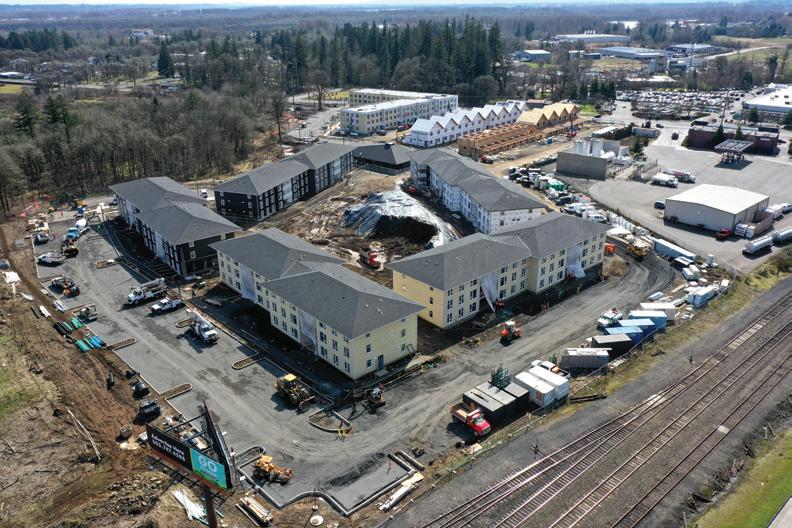

CH23-1309
Accessory Dwelling Units within Rural Residential zones. This involves amending existing sections of the Zoning Ordinance as well as developing a new Section 224.2 to allow for Accessory Dwelling Units outside of Urban Growth Boundaries. Local file number TA 23-02. This hearing is to afford interested parties an opportunity to be heard on the following matter. Any comments you wish to provide will be appreciated; however,
Oregon law requires that testimony and evidence must be directed toward the decision criteria. You may present testimony at the public hearing or provide written comments to the Board of County Commissioners to jacyn.normine@columbiacountyor.gov prior to 5:00 p.m. on April 11, 2023. The Columbia County Board of Commissioners is the final local decision-maker for all County Plan and Ordinance amendments. Applicable de-
BEFORE THE BOARD OF COUNTY COMMISSIONERS FOR COLUMBIA COUNTY, OREGON
Possible Quorum Notice
Notice is hereby given that the Board of County Commissioners, possibly constituting a quorum, may attend the City /County Quarterly Dinner on Tuesday, March 28, 2023, at 5:30pm. This event will be held at the
CH23-1308
St. Helens Elk Lodge. The purpose of this event is for invited local leaders to come together to share what is happening their jurisdictions. The Board of County Commissioners will not deliberate towards nor make decisions at this event. Dated this 27th
cision criteria are contained in ORS 215.495; CCZO 1606; CCZO 1607; CCZO 1611; the Oregon Statewide Planning Goals; the Comprehensive Plan; and any other statute or ordinance determined to apply. The specific criteria applicable to this request is listed and evaluated in the staff report. This hearing will be held in accordance with the provisions of the Zoning Ordinance. For more information contact Hayden.Richardson@colum-
CH23-1306
biacountyor.gov; or phone 503-397-1501. A copy of the application, all documents and evidence relied upon by the applicant, and the staff report will be available for at https://www.columbiacountyor.gov/Hearings at least 7 days prior to this hearing.
Written comments on the issue can be submitted via email to Jacyn.normine@ columbiacountyor.gov or you can send comments via U.S. Mail to Columbia County, Board of Commissioners c/o
Jacyn Normine, 230 Strand Street, St. Helens, OR 97051. You may participate in this hearing in person or virtually. To attend virtually go to https://global.gotomeeting. com/join/357054141 or call United States (Toll Free): 1 866 899 4679. The meeting access code is: 357-054-141. The Board of Commissioners reserves the right to continue the hearing to another date and time. If the hearing is continued, no further public notice will be provided.
IN THE CIRCUIT COURT OF THE STATE OF OREGON FOR THE COUNTY OF COLUMBIA
day of March 2023
FOR THE BOARD OF COUNTY COMMISSIONERS FOR COLUMBIA COUNTY, OREGON
BY: Jacyn Normine/Jn_ Jacyn Normine, BOC Office Administrator
PUBLIC NOTICE - INVITATION TO BID
Asphalt Repair COLUMBIA RIVER PUD Notice is hereby given that Columbia River People’s Utility District (PUD) will receive sealed bids for Asphalt Repair in Deer Island, OR. Bids will be received by the PUD, 64001 Columbia River Highway, Deer Island, Oregon 97054 until 3:30 p.m., pacific prevailing time, on April 27, 2023, at which time the bids will be publicly
CH23-1294
opened. The bids will be available for public inspection at the PUD office after the bid opening. The bid documents may be examined at the office of the PUD, 64001 Columbia River Highway, Deer Is-land, Oregon 97054. Paper or electronic copies of the bid documents may be obtained by sending a written request to Columbia River PUD. P.O. Box 1193, St. Helens, Oregon,
97051, or by visiting the PUD Website at https:// www.crpud.net/my-pud/ bid-documents/. Columbia River PUD reserves the right to reject any and all bids that are not in compliance with the bid documents and prescribed public bidding procedures and to reject, for good cause, any or all bids upon a finding by the PUD that it is in the public interest to do so.
CH23-1304
Columbia City Trenching COLUMBIA RIVER
PUD Notice is hereby given that Columbia River People’s Utility District (PUD) will receive sealed bids for Trenching in Columbia City, OR. Bids will be received by the PUD, 64001 Columbia River Highway, Deer Island, Oregon 97054 until 3:30 p.m., pacific prevailing time, on April 20, 2023, at which time the bids
PUBLIC NOTICE OF A HEARING FOR A STREET VACATION
A public hearing before the St. Helens City Council will be held at 6:45 PM on Wednesday, April 5, 2023 in the St. Helens City Council Chambers in City Hall located at 265 Strand Street, St. Helens, OR 97051. The purpose of this hearing is to receive public input as to the proposed vacation (i.e. giving up a public interest) of the following described right-of-way: A parcel of land located in the N ½ of the NE ¼ of Section 4, Township 4 N., Range 1 W., Willamette Meridian, Columbia County, Oregon, more specifically described as follows: Beginning at a point, which is the Southeast corner of Lot 19, Block 95 of the St. Helens Subdivision, St. Helens, Columbia County, Oregon; Thence, Northwesterly along the East line of said Lot 19 to a point that is 1 foot from the Southeast corner of said Lot 19 and the True Point of Beginning; Thence, Northwesterly along the East line of said
Lot 19 and continuing along the East line of Lots 18, 17, 16, 15, 14, 13, and 12, Block 95 of said St. Helens Subdivision to the Northeast corner of said Lot 12; Thence, Southwesterly along the North line of said Lot 12 to a point that is 17 feet from the Northeast corner of said Lot 12; Thence, Northeasterly to a point along the right-of-way centerline of N. 11th Street (Franklin Street) that is 1 foot Southeast from where the original right-ofway centerlines of Wyeth Street and N. 11th Street (Franklin Street) intersect; Thence, Northeasterly and parallel to the original rightof-way centerline of Wyeth Street to a point on the East line of the N. 11th Street (Franklin Street) right-ofway, said East right-of-way line resulting from the vacation of a portion of Wyeth Street by City of St. Helens Ordinance No. 2839, as recorded June 8, 2001 under Columbia County Clerk Fee No. 01-06033, Records of
Columbia County, Oregon; Thence, Southeasterly along the West line of the vacated portion of the Wyeth Street right-of-way vacated by City of St. Helens Ordinance No. 2839, as recorded June 8, 2001 under Columbia County Clerk Fee No. 0106033, Records of Columbia County, Oregon, and continuing along the West line of Lots 11, 10, 9, 8, 7, 6, 5, and 4, Block 92 of said St. Helens Subdivision to a point that is 25 feet Southeast from the Northwest corner of said Lot 4; Thence, Southwesterly to the True Point of Beginning. This includes portions of the N 11th Street right-of-way and Wyeth Street right-of-way between the 200 and 300 series of addresses of 12th and 11th Streets generally, lying east of the middle school property. The City Council approved a motion to initiate this vacation on January 18, 2023 at their Regular Session. A map of the proposed vacation and affected areas is
available for review at City Hall. All written comments should be submitted to the city at least seven days prior to the hearing but can be accepted any time before or at the hearing. Testimony is welcome at the hearing. Zoom will also be available to participate. Virtual access information to join the hearing will be available on the applicable agenda. Agendas and the staff report for this can be found on the City’s website: https://www. sthelensoregon.gov/meetings within the week prior to the public hearing Questions about this vacation can be directed to the City Planning Department at 503-397-6272 or jgraichen@sthelensoregon.gov. The meeting location is accessible to persons with disabilities. A request for an interpreter for the hearing impaired or for other accommodations for persons with disabilities should be made at least 48 hours before the meeting to City Hall at 503-397-6272.
are required to present them, with vouchers attached to the un-dersigned personal representatives within four months after the date of first publi-cation of this notice, or the claims may be barred. All persons whose rights may be affected by the proceedings may obtain additional information from the records of the Court or the personal representative. Dated 29, 2023. Susan Mullett, CoPersonal Representative. Personal Representatives: Name: James E. Mullett Jr., Address: 11635 SW Royal Villa Dr., Tigard, OR 97224, Phone No. (503) 858-9776. Name: Susan D. Mullett, Address: 9201 NE 43rd Ave., Vancouver, WA 98665, Phone No. (360) 281-4154.
and first published on March
PUBLIC NOTICE - INVITATION TO BID
will be publicly opened. The bids will be available for public inspection at the PUD office after the bid opening. The bid documents may be examined at the office of the PUD, 64001 Columbia River Highway, Deer Island, Oregon 97054. Paper or electronic copies of the bid documents may be obtained by sending a written request to Columbia River PUD. P.O. Box
CH23-1288
NOTICE TO CREDITORS IN THE ESTATE OF ROBERTA ANNE SEASTONE, LATE OF SAINT HELENS, OR.
Any and all claims against above estate, verified by the administrator, must be sent no later than April 15, 2023 to the following address: Myrna Dorn, PO Box 366, Echo, OR 97826. Administrator of above estate.
CH23-1302
NOTICE OF MEETING
McNulty Water PUD Board meeting will be held April 4, 2023, at 7pm. Located at 34240 Millard Road, Warren, Oregon 97053.
1193, St. Helens, Oregon, 97051, email to engineering@crpud.org or by calling (503) 366-3244. Columbia River PUD reserves the right to reject any and all bids that are not in compliance with the bid documents and prescribed public bidding procedures and to reject, for good cause, any or all bids upon a finding by the PUD that it is in the public interest to do so.
CH23-1300
NOTICE OF PUBLIC AUCTION
Karlan Mini Storage will be having a public auction on Saturday, April 8, 2023 at 10 a.m. Amber Kruger #31. CASH ONLY.
CH23-1307
STATEMENTS
OF PROCEDURE
The statement of procedures for Columbia County are available for review at the Columbia County Courthouse and https:// www.columbiacountyor.gov/ departments/Finance/Expenditures.
The Public Notice deadline is Fridays by noon. Submit notices to chronicleclassifieds@countrymedia.net. Late submissions are not guaranteed to make the paper.
ODOT reminds drivers of studded tires deadline
With the start of spring comes the annual deadline to remove studded tires. Oregon drivers must remove studded tires from their vehicles by Friday, March 31.
“We encourage drivers to not wait until March
BROADLEAF
From Page A1
want to sign up, they can access the waiting list here: https://www.broadleafarbor. com.”
Community amenities will include common area gathering spaces, such as a teaching kitchen and library, laundry facilities, an expansive lawn and playground, car parking and bike storage, gardens, and a trail system along existing wetlands. A dedicated on-site resident services and programming team will also be available for residents.
EngAGE Northwest (EngAGE) will be the lead services provider, hosting
31 to remove their studded tires, especially if they aren’t driving in the mountain passes between now and then,” Oregon Department of Transportation (ODOT) State Maintenance and Operations Engineer Galen McGill said.
on-site wellness and creativity programs that are specifically designed to foster intergenerational connection and community building. In addition to EngAGE, a community-wide collaboration of service providers, including Latino Network, Community Action Team, St. Helens Senior Center, Columbia Pacific Food Bank, and Columbia Community Mental Health, will work to connect residents to services that support family stability through educational and employment programs that include financial stability, school enrollment, and food assistance.
Broadleaf Arbor is being co-developed by Community Development Partners
Drivers with studded tires on their vehicles after the March 31 deadline may receive a citation from law enforcement for a Class C traffic violation, which carries a presumptive fine of $165.
(CDP) and Northwest Oregon Housing Authority (NOHA). Broadleaf Arbor was designed by MWA Architects and is being built by LMC Construction. PSU’s Center for Public Interest Design(CPID) conducted pre-development community engagement and outreach. Lower Columbia Engineering assisted with aspects including environmental permitting and design. The community is managed by Guardian Real Estate Services. Construction of the entire project will be completed by October 26, 2023, according to Green.
To apply for housing at Broadleaf Arbor, visit https:// www.broadleafarbor.com.
While studded tires are allowed in Oregon from Nov. 1 through March 31, drivers are urged to use alternatives, such as traction tires and chains. A 2014 study showed studded tires cause about $8.5 million in damage each
year to state highways.
ODOT maintenance crews continue to monitor highways and weather forecasts and work to remove any late season snow or ice as soon as possible.
Whenever you travel,
ODOT urges drivers to plan for the weather and visit TripCheck.com for road condition information. After March 31, use other types of traction tires or chains if needed, or postpone your travel until conditions improve.
Courtesy photo from Jena Green.
www.thechronicleonline.com A8 Columbia County’s trusted local news source
In the Matter of the Estate of Floyd Kent Mullett, Deceased. Case No. 23PB01627 NOTICE TO INTERESTED PERSONS NOTICE IS HEREBY GIVEN that James E. Mullett Jr. and Susan D. Mullett have been appointed personal repre-sentatives for the will and estate of Floyd Kent Mullett. All persons having claims against the estate
73. German surrealist Max
DOWN
1. “General Hospital” network

2. Crop of a bird
3. Zeus’ sister and wife
4. Two under par on a golf hole

5. Meat-cooking contraption
6. Winglike
7. *Predominant color of Mars
8. Type of membranophone
9. Like never-losing
Steven
10. Town
11. *Primary color

12. ___ Juan, Puerto Rico
15. 7th planet from the sun
20. Chosen few
22. Nicki Minaj’s genre
24. Not womenfolk
25. *Number

www.thechronicleonline.com Wednesday, March 29, 2023 A9 Columbia County’s trusted local news source
ACROSS
____”
of
Grazing
Soft palate hanger
Boatload
Wood-shaping tool
Old episode
*Alice of “Color Purple” fame
*Fruit and color 23. Long reef dweller 24. Sound of pain 25. Math class total
Excessively abundant 30. *”Royal” color 35. Arrival times, acr.
*Color quality 39. Shininess 40. White House “sub”
Spritelike 43. Cupid’s counterpart 44. Serengeti grazer 46. *Feeling blue
Hokkaido native 48. *Color wheel inventor 50. Walk with a hitch
“Malcolm X” (1992) movie director
Stare open-mouthed
Napoleon of “Animal Farm,” e.g.
*Between blue and violet
acr.
1. Partner of pains 6. “Raiders of the Lost
9. Opposite of flows 13. Flesh
fish 14.
area 15.
16.
17.
18.
19.
21.
28.
37.
41.
47.
52.
53.
55.
57.
60. *____phobia, intense fear of colors 63. Opposite of cathode 64. North American country 66. Run ____ of the law 68. Geography class book 69. Local area network 70. It’s firma 71. Has divine power 72. Banned insecticide,
of colors in a rainbow 26. Of service 27. Colorful parrot 29. *The LumiËre brothers’ colorful creation 31. “Cheers” actress Perlman 32. Jeopardy 33. Sergio of Spaghetti Westerns fame 34. Follow as a consequence 36. Email folder 38. Cone-shaped quarters 42. Naiad or maenad 45. Motherless calves 49. Old horse 51. Long John Silver, e.g. 54. Modified “will” 56. Bottom-ranking employee 57. Opposite of “out of” 58. Hall of Fame Steelers’ coach 59. June 6, 1944 60. “____ Buy Me Love” 61. Between dawn and noon 62. Yours and mine 63. Expression of pleasure 65. Melancholy 67. Latissimus dorsi, for short STATEPOINT CROSSWORD THEME: COLORS Solution to crossword in next week’s issue of The Chronicle. Vendors Wanted Contact Jon at 503-397-0116 chronicleads@countrymedia.net At The Columbia County Fairgrounds: 58892 Saulser Rd. St. Helens, OR 97051 $3 admission at the gate Call 503-397-0116 to request free tickets May 20 Saturday 10am - 5pm May 21 Sunday 11am - 3pm PRESENTED BY The Chronicle The Chief Columbia County SPONSORED BY
sPorts

Back on the greens, back on the track
In our continuing coverage of spring sports at St. Helens High School (SHHS) this week, we will look at the early progress of the track and field team and girls golf as their seasons have kicked into full gear this month.
The season’s early stages are a good time for athletes to get back into the swing of things and connect as a group. It also gives the coaches a good idea of the areas for improvement.
Girls Golf
The Lions got off to a roaring start in their first league tournament of the season, finishing in first place. Other programs competing at Glendoveer Golf Course during the competition were Valley Catholic, who finished second, and Scappoose, who finished third. Scappoose, Astoria, Catlin Gabel, Seaside, and Tillamook were also in attendance, according to OSAA.org.
Head Coach Jared Phillips has high hopes for his team as St. Helens transitions from the 5A to the 4A classification, now competing in the Cowapa League.
“We are looking to compete for a league championship and finish in the top two teams at the Special District (regional) Tournament to qualify for state as a team,” Phillips said.
The team has 14 golfers on its roster and is bolstered by its returning team members. Phillips is excited about the team’s leaders.
“Junior Piper Carlson returns, who earned 2nd team all-league NWOC honors last year as a sophomore,” Phillips said. “Senior Samantha Kent is also a returning varsity golfer after a solid campaign as a junior. Danielle Martin(sr), Dakota Harris(jr), Kayla

Trenaman(sr), Cylie Yeager(jr) are all returning upperclassmen that will be competing for spots at the varsity level.”
Beyond his goals for the season on the golf course, Phillips also wants to help his athletes learn lessons beyond the greens and fairways.
“My goal is to develop the characteristics of integrity, hard work, resilience, and a lifelong love for the game,” Phillips said.
Track and Field
The St. Helens track and field team has commenced its season, and the new beginning is bringing about the natural excitement of a fresh slate.
“It’s always busy at the start of the season. It will be nice to get some times and marks so we can set goals and really get to work,” Head Coach Neil Ford said.
Ford is coaching both the boys and the girls teams, and the program is benefitting from a robust number of participants.
“Our team has grown since last year - we have over 60 athletes out this season,” Ford said. “It seems like a really fun group, and we’re all looking forward to competing. Still looking to grow our numbers over the coming years.”
Some of the standouts for the Lions this year will be returning athletes who participated in the state meet last year. Ford said some standouts include: Noah Vanderzanden (300m Hurdles), Kallee Kester (100m Hurdles), and two of the Girls 4x400m relay members, Hayden Moore and Keely Scoville.

Like the golf and other sports programs at St. Helens, the track and field programs will be competing in the 4A Cowapa League as opposed to the 5A NWOC. While they will be competing with smaller schools, Ford said success will still need to come through the team’s hard work.
“We want to send a large contingent of athletes to the state meet. Not entirely sure what that looks like yet, but we want our athletes to compete in whatever league we’re part of,” Ford said.
“We’re coming from a really solid track and field district in the NWOC, but being back in the Cowapa league doesn’t automatically make us a strong team. Our athletes will still have to work hard.”
At their most recent event, the St. Helens High School Duals, the Lions competed with Estacada, Rainier, and Vernonia. They competed well, with St. Helens athletes placing first in the mens varsity 100 meters, 200 meters, 800 meters, 1500 meters, 110m hurdles, 300m hurdles, the 4x100 relay, 4x400 relay, high jump, and triple jump. In the womens division, St Helens took first in the 100 meters, 100m hurdles, 300m hurdles, the 4x100 relay, and were the only program with a 4x400 relay squad.
Ford has high hopes for the season, and the culture around St. Helens track and field is well-established. With help from alumni of the program coaching, Ford hopes to teach his athletes lifelong lessons beyond sport.
“St. Helens has a long tradition of track and field. Our coaching staff are all alumni of the program and know we understand how track & field instills hard work,discipline, and a competitive spirit,” Ford said. “We want our athletes to have a positive experience, build friendships, and feel connected to something special when they graduate.”
Follow SHHS track and field results at www.athletic. net/team/240/track-and-fieldoutdoor/2023, and follow our feature coverage of SHHS sports at thechronicleonline. com and in the Wednesday print editions of The Chronicle.
Scappoose Peace Candle gets new shine
Position: Dental Hygienist









Position Summary: In our practice, our hygienists are often the first place our patients receive compassionate and necessary healthcare. Our hygienists do not simply clean teeth; they are instrumental in achieving optimal health.
About Us and Who We Want to Join Our Team:
Healthy Smiles of Scappoose is a fixture of the local community. We have been serving patients for over 50 years throughout the area. Our patients know us, and we know them. We are recognized as the go-to family dental practice because of our loyal team and our commitment to health.

Due to growth and expansion we are looking for a hygienist to join our cohesive team. This is a full-time position (4 days/week, ~32 hours/week) working Monday through Thursday but we are willing to split the days into 2 part time positions. We have long-term employees at our practice. Some of our employees have worked for us for decades. This demonstrates our commitment to our employees. This is not just “a job” but rather a livelihood. We are committed to employee appreciation, kindness, understanding, and a positive mindset.
The Scappoose Candle stands approximately 50-feet. It is a




18-feet in diameter and once was covered with real candle wax.
WILL LOHRE Country Media, Inc.
The Scappoose Peace Candle will be burning brightly soon as the project to renovate the local icon nears completion.
A new “Welcome to Scappoose” sign has been added, and the neon flame replica will be installed this week. The completion of site landscaping, final electrical work, and the informational pedestal is slated for later in April, according to Huell Whitehaus, assistant to the Scappoose Public Works Director.
“The Candle has now stood for over 50 years – and is one of – if not the – most recognizable structures along Highway 30 as you enter [ or] leave Columbia County,” Whitehaus said.
The candle has received a fresh coat of red paint, a color that was selected following a survey the city published in May of last year, which received over 1,300 responses, according
to Huell. The revitalization of the candle has been a Scappoose City Council goal since 2015. The project would not have been possible without donations from organizations and individuals. Some of the contributors were Mark Madden, WDC Properties, The Grabhorn Family, NessCampbell Crane + Rigging, CHS Painting, and Nunnally Industrial LLC, according to city officials.
Candle history
First built in 1971, candle creator Darrell Brock and Oregon Governor Tom McCall dedicated the wax-covered silo as the “Peace Candle of the World.”
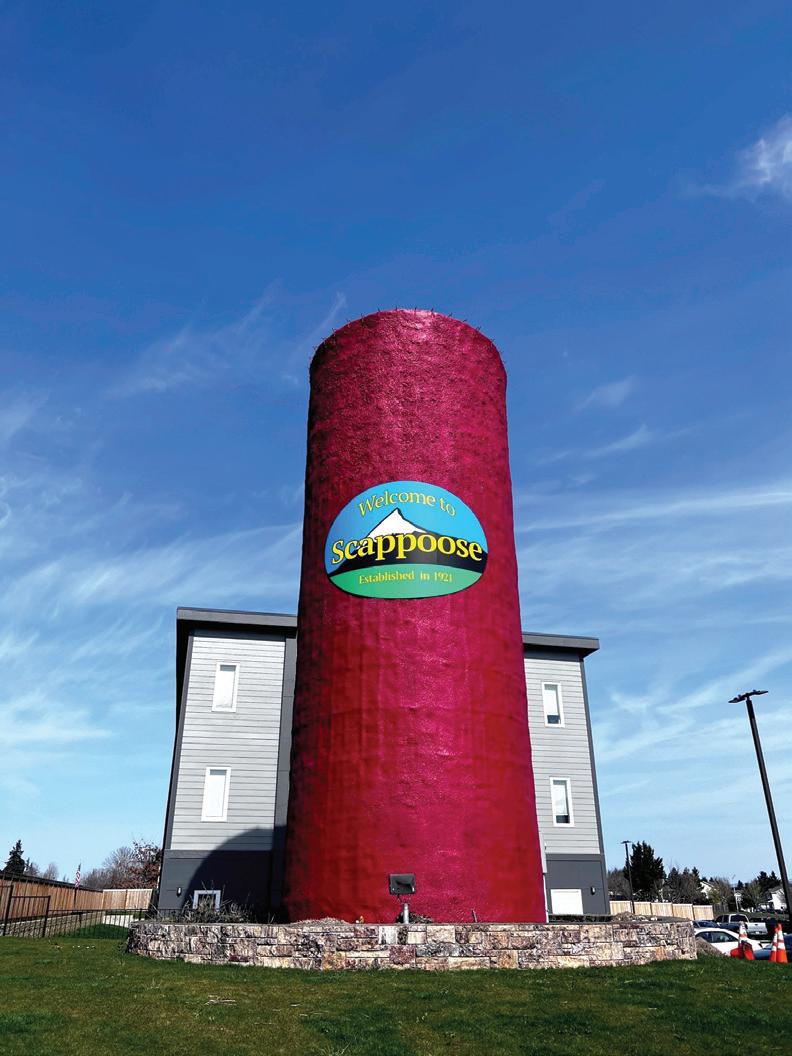
“A crowd estimated at 7,000 attended the dedication ceremony,” Whitehaus said.
“Originally, the Candle silo was wrapped in wire mesh and coated in candle wax.”
In 1997 the candle was renovated, red paint replaced the wax coating of the candle, and a custom neon
flame replaced the original gas flame. Another change for the candle over the past half-decade has been the changing of ownership of the property.
“The property, which is home to the candle, was put up for sale almost five years ago,” Whitehaus said. “Fortunately, the developer that purchased the property wanted to make sure that the candle could stay and even developed their design around the candle, so long as the city would renovate and maintain the candle moving forward.”
With new paint, flame, and property ownership committed to keeping the candle standing, the Scappoose landmark has been invested in by the community and city government. Full repairs are slated to be completed in April.
Follow this developing story at the thechronicleonline.com and in the Wednesday print editions of The Chronicle.
Our overriding goal is to first find a person who will enjoy being a member of our team, both as part of the organization as a whole and specifically with our incredible team of dental professionals.
Characteristics that we are looking for include:
• Team collaborative outlook,
• Patient-centric and solutions/problem solving approach,
• Fun-natured and a sense of humor,
• Good communication skills (written and verbal),
• Self-motivated attitude,
• A desire to make a difference
We are committed to each employee’s success. As such, we invest time, energy, and money in onboarding and training to ensure competency and confidence with the type and kind of patients we serve. This, combined with your qualifications, represents a winning formula for long-term professional success.
Additional Information:
Our practice offers a relaxed work environment, places a high value on work/life balance, and located in Scappoose.
This position offers an excellent benefit package that includes PTO, paid holidays, medical insurance, dental services for you and your immediate family, and a retirement plan. Starting salary will depend on experience and qualifications.
If you believe this opportunity represents a fit for you, please send a cover letter and an up-to-date resume to: jessica@healthysmilesofscappoose.com
www.thechronicleonline.com Wednesday, March 29, 2023 A10 Columbia County’s trusted local news source
Courtesy photo from Huell Whitehaus
cylindrical structure
WILL LOHRE Country Media, Inc.
Courtesy from OSAA
The SHHS Girls Golf Team has 14 athletes ready to hit the links this season.
Courtesy from OSAA
The SHHS Boys and Girls Track and Field Program has grown to more than 60 athletes this season. Credit OSAA.