Eisenschmidt Pool to close for repairs
WILL LOHRE Country Media, Inc.
Eisenschmidt Pool will be closing in February to undergo repair of two of the pool’s filter pits.
According to the pool’s website, the repairs could take up to three weeks. Pool operators have slated the closure from Feb. 20 through Mar. 11.
Finding the leaks
General Manager Anne Scholz said the pool will close in February to repair the filter pits, allowing the Scappoose and St. Helens High School swim teams to conclude their seasons with access to the pool. Scholz said she noticed leakage from the pool in December.
“They started leaking after this little freeze we had before Christmas, so I don’t know if that caused my problem,” Scholz said. “I check on the pool every single day, and because of that freeze, and because I drive a pickup that’s not really reliable in icy weather, I didn’t check on it on Christmas Eve, and then when I showed up on Christmas morning to check on it, we were a foot and a half low on the water. So, we have a huge leak.”
After discovering the leak, Scholz started isolating systems to figure out where the leak was. Scholz brought in a Scuba instructor at the Portland Scuba Academy, David Waite, to do leak-checking. Using red food coloring in a syringe, Waite would swim around, squirt the coloring into the water, and see where the leak would suck it out.
While investigating the bottom of the pool for leaks, the diver also discovered a 35-foot crack in the pool. Using some “underwater epoxy putty” to patch the crack, Waite temporarily fixed it. Unfortunately, a more permanent fix for the damage will only be possible once management can drain the pool in September.
The upcoming repairs
The repairs in February will address two leaks in two of the pool’s three filter pits. Pools can’t be drained in the winter; fortunately, these repairs can be made without emptying the water. The repair will include replacing the piping under six feet of rock, pebbles, and sand. Scholz estimated the price of this project could reach around $80,000.
“Right at the beginning of COVID, I had to rebuild one of my filter pits, and that cost me about $33,000. And so, going double that is $66,000. But then there’s inflation from COVID, so I think we’re going to approach $80,000, but I’m not positive,” Scholz said.
Luckily, Scholz suspected something like this may happen and has budgeted with these potential repairs in mind. However, the St. Helens High School swim program is trying to organize a “swimathon” to help raise funds for the pool repairs. Details about the fundraiser were pending at press time.
What’s next for St. Helens’ swimmers
According to Scholz, about 100
to 150 people use the Eisenschmidt Pool daily. For those looking to swim during the closure, Rainier, Astoria and Portland are the closest locations that have facilities. Scholz also emphasized that the pool may not be closed for the entire three-week estimate and that the facility will reopen “as soon as possible.”

During the routine September closure, crews will drain the pool that normally holds 230,000
gallons of water, and address the 35-foot crack.
Eisenschmidt Pool was originally built in the summer of 1939 as a life-saving measure for residents of St. Helens, after three drownings occurred in the Columbia River in the summer of 1936.
The Chronicle will update this story as new details become available. Follow the repairs and pool closure at http://sthelenspool.com.
Fast Facts
Eisenschmidt
Fentanyl use, dealing, overdoses spiking in Oregon
WILL LOHRE Country Media, Inc.
Columbia County Sheriff concerned

Oregon is facing an overdose crisis.
According to Oregon Health Authority (OHA), unintentional and undetermined drug overdose deaths in Oregon more than doubled between 2019 and 2021. Illicitly manufactured Fentanyl (IMF) is at the heart of this crisis and has now surpassed methamphetamine as the most frequent drug involved in overdose deaths.
An issue briefing from the OHA to the Oregon Governor’s Office revealed staggering statistics on the crisis.
“Fentanyl overdose deaths increased nearly 600% between 2019 and 2021, from 71 to 509, respectively. In 2021, more than half (54.6%) of overdose deaths involved more than one drug and/or alcohol,” the report said.
What is Fentanyl
Fentanyl is a synthetic opioid that is 50 times stronger than heroin, and 100 times stronger than morphine, according to the CDC website. Doctors prescribe phar-
maceutical fentanyl to treat severe pain, especially after surgery and for advanced-stage cancer. Its illicit form is often added to other drugs to make them more potent, cheaper to make, and more addictive.
“To process the drugs in a pill form takes minimal effort,” Oregon State Police media relations representative Captain Kyle Kennedy said. “Equally, the inability of users to obtain prescription medications with Narcotic Analgesic properties, such as OxyContin, etc., has increased the demand.”
Fentanyl is often used in conjunction with other stimulants and substances. It also is commonly consumed by mistake, with the user believing they are using a different substance, according to the CDC website.
“Powdered fentanyl looks just like many other drugs. It is commonly mixed with drugs like heroin, cocaine, and methamphetamine and made into pills that are made to resemble other prescription opioids. Fentanyl-laced drugs are extremely dangerous, and many people may be unaware that their drugs are laced with fentanyl,” the CDC states.
Where is it coming from?
IMF is typically made in Mexico and trafficked to the United States, where illegal drug markets distribute it more widely. Kennedy
detailed how the drug is imported and distributed.
“Most of the fentanyl we seize comes from the southwest border of the United States, originating in Mexico,” Kennedy said. “Once the fentanyl is smuggled into the US, our investigations, along with other Law enforcement agencies, have determined it is stored in “stash houses” in southern California, Arizona, and Texas before being shipped to its final destination throughout the United States. In Oregon, common traffic corridors utilized are Interstates 5 and 84, as well as Highway 97.”
Columbia County Sheriff Brian Pixley reported that there has been a “significant” rise in both dealing and fentanyl use countywide. The county has also had deaths due to the drug. Pixley also gave reasons why the drug is becoming more common.
“We are seeing a sharp spike in fentanyl being used in the production of fake oxy pills and as an additive to other illegal substances,”
Local linemen aid California utilities following storms
WILL LOHRE Country Media, Inc.

Following torrential rain and wind around the New Year that knocked out power to thou-

sands in Northern California, four linemen from the Columbia River People’s Utility District (CRPUD) drove down to assist Pacific Gas and Electric (PG&E) in restoring power in Central Valley.

Emergency response
On Jan. 4, California Governor Gavin Newsom declared a state of emergency across the state to help mobilize emergency personnel and resources.
“California is mobilizing to keep people safe from the impacts of the incoming storm,” said Governor Newsom. “This state of emergency will allow the state to respond quickly as the storm develops and support local officials in their ongoing response.”
Activating the state of emergency was critical for California to address this storm and other storms this coming winter. The “atmospheric river” storms from the Pacific Ocean that have hit California have strained the state’s flood preparations.
As part of this relief, out-of-state
utility workers, like Jesse Hutchins and the three other Columbia River PUD linemen were called in to give their support. The four linemen began their 18-hour drive down to Stockton Jan. 3. After being waylayed briefly in Medford, they arrived in California Jan. 4.
“We were held up in Medford because California wouldn’t let us come in until it was declared an emergency,” Hutchins said. “Once it was declared an emergency, we were able to go into California.”
The linemen were also in California when some of the worst outages occurred from continued storms throughout their time there. The crew primarily worked in the Napa area, which was also heavily affected. According to Hutchins, there was “a lot of damage” in Napa and to the north. The linemen helped with typical repairs that come about with inclement weather.
“We replaced a pole, did a couple of underground services that went bad because of the rain, and replaced some cross arms, just your average storm stuff,” Hutchins said.
According to KCRA in Sacra-
mento, at the peak of their power outages, 345,000 customers were without power Sunday, Jan. 8. That same day, California Governor Gavin Newsom submitted a request for a Presidential Emergency Decla ration to secure additional resources and personnel to fight the damage. Biden approved the proposal on Monday, Jan. 9, which supports emergency relief.
Supplying mutual aid
These emergency response positions are voluntary. According to Hutchins, there is a list of people who can respond to these situations, and if linemen don’t want to or can’t go, the next person on the list is asked.
Traveling to help out of area utilities is something the CRPUD has done before, but primarily in Oregon. Hutchins said that they have responded to calls in Eugene, Portland, West Oregon, and Florence but that it was “the first time that the CRPUD has gone down to California and helped out.”
Being part of a mutual aid
Local
California.
group, the CRPUD is now going further beyond its typical area of operations than they have before. The linemen returned Thursday, Jan. 12, after 10 days away from home.
Serving Columbia County since 1881 thechronicleonline.com $1.50 Wednesday, January 25, 2023 No pets Page A4 Shooting investigation Page A2 Vol. 141, No. 4 Opinion ..................... A4 Poll ............................ A4 Community Calendar A4 Obituaries ................. A5 Classified Ads ......... A6 Crossword ............... A6 Legals ....................... A7 Sports ..................... A8
Courtesy from Lincoln City Police
See FENTANYL Page A3
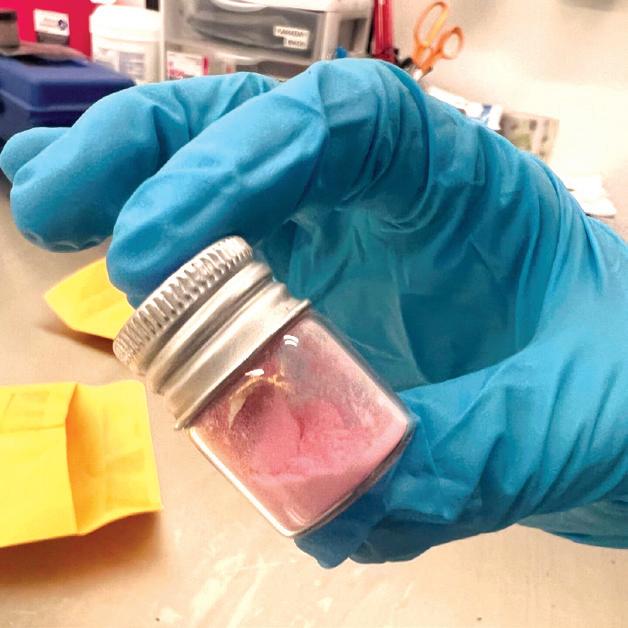
Law enforcement agents are finding powered fentanyl in drug investigations across the state.
Jeremy C. Ruark / Country Media, Inc.
Eisenschmidt Pool is located at 1070 Eisenschmidt Lane in St. Helens.
Metro Creative Connection
linemen from Columbia County helped restore power in Central Valley,
Pool was built in 1939. The pool holds 230,000 gallons of water. Before the COVID pandemic, the pool attracted an estimated 500 visitors daily during peak seasons.
The
Dead body found in local park
STAFF REPORT Country Media, Inc.
A death investigation by St. Helens Police began Jan. 16 following the discovery of a body at a local city park.
At approximately 10:22
a.m Monday, Jan. 16, police responded to the report of a suspicious circumstance at Campbell Park on McMichael Avenue in St. Helens.
Officers found a deceased male with a gunshot wound inside a vehicle.
“While the investigation is still ongoing, the gunshot
wound is believed to be self-inflicted, and there is no danger to the public,” a release from St. Helens Police states. “Out of respect for the deceased individual and the family, the St. Helens Police Department is not releasing additional details at this time.”

Shooting sends 1 to hospital, 1 to jail
Fewer waterway fatalities
The Columbia River and other waterways in Columbia County continue to draw boaters, kayakers and others seeking recreation.
A new report from the Oregon State Marine Board finds 2022 was a safer boating year than 2020 and 2021, but the number of fatalities is still high.
In 2021, there were 19 recreational boating fatalities, and in 2020, there were 26, which was the highest number since 1993 with 25. 2022 ended with 16 boating fatalities.
“Most of the fatalities came down to people not wearing life jackets,” Oregon Marine Board Boating Safety Program Manager Brian Paulsen said.
Eleven fatalities involved non-motorized boats (i.e., rafts, kayaks, SUPs, a canoe and a sailboat without auxiliary power).
Five of the motorized fatalities included a PWC and smaller open motorboats. Ten victims out of the 16 were not wearing a life jacket.
“Everyone needs to be prepared, no matter where they are boating or how long they’ve been boating,” Paulsen said. “Accidents happen and no one can predict them. Wearing a life jacket will increase your odds of survival.”
Inflatable life jackets are popular with many boaters, but Paulsen says they are not for everyone.
“We investigate incidents where life jackets fail to inflate. What we generally find is that the owner didn’t service the life jacket properly or it wasn’t armed with a CO2 cartridge.” Paulsen said. “Inflatable life jackets are machines that must be tested and maintained.”
Every person who uses an inflatable life jacket should routinely test it to make sure it’s working correctly, according to Paulsen.
water dynamics, according to Paulsen.
The Marine Board and American Canoe Association recommend wearing a quick-release leash on moving water, especially on rivers with obstructions.

Paulsen said a quickrelease leash differs from an ankle leash and attaches to the paddler’s life jacket.
always be helpful.”
The Marine Board and access providers continue to see a diversity of boaters in both motorized and non-motorized watercraft on Oregon’s waterways.
One person has been arrested following a shooting in the area of Hods Lane near St. Helens.
The investigation by the Columbia County Sheriff’s Office (CCSO) unfolded Monday, Jan. 16. The Columbia County Major Crimes Team (MCT) was also dispatched to the scene to investigate the shooting.
The shooting victim has been identified as 67-year-old Thomas Norman Barker of St. Helens. Barker was taken by Life Flight to Legacy Emanuel Medical Center Hospital in Portland with life threatening injuries. His condition was not immediately at press time.
The suspect has been located and is cooperating with law enforcement, according to CCSO. He is identified as 42-year-old Jamie Leigh Sumpter of St. Helens.
Sumpter was taken into custody and lodged in the Columbia County Jail on the charges of Assault II, Assault III, Unlawful Use of a Weapon and Reckless Endangering.
Columbia County Sheriff Brian Pixley told The Chronicle Monday, Jan. 23, that details about what promoted the shooting and what the relationship, if any, is between the suspect and the victim could not be released due to the ongoing investigation.

“There are also hybrid life jackets available with foam flotation and an inflation mechanism,” he said. “Hybrid life jackets provide immediate flotation if you fall overboard and if you need more flotation for the conditions, you can manually activate the inflation.”
Another popular boating trend is stand up paddleboarding. Stand up paddleboarders (SUPs) may not know the importance of wearing the appropriate leash for the
“For example, if the paddler is on a river with swift current and is unable to paddle away from a strainer in time, they can pull the release mechanism from their life jacket,” he said. “This will detach them from the leash which stays with the board so that they won’t get entangled. The leash and board may get caught up on the strainer, but the paddler will be able to stay afloat and self-rescue.”
SUPs are defined as boats by the US Coast Guard and paddlers are required to carry a properly fitting life jacket and sound-producing device, like a whistle.
“Safety equipment in boating is just like any other activity,” Paulsen said. “The right gear at the right time will
“Anyone new to boating is encouraged to take a boating education class to learn about how to be safe through pre-trip planning and preparation,” Paulsen said. “Consider joining a club to learn ways to build skills with others and don’t boat on waterways that exceed your skill level.”
Fatalities occurred in all types of waters in 2022, in all types of watercraft. The average age was 43 years old. Three of the victims were female and 13 were male.
“Before you get on the water, check to see if you have the required and appropriate equipment, check the weather, and always wear a life jacket,” Paulsen said. “Safe boating is easy if you take the time for planning and preparation.”
Recreational boating data and annual summaries are available
Dead whales wash ashore on Oregon beaches
 JEREMY C. RUARK Country Media, Inc.
A fourth whale has washed ashore along Oregon’s coast.
This latest incident comes days after three other whales washed up along the south and north coasts of Oregon.
The Seaside Aquarium reports that the fourth whale, a gray whale, had been spotted by the Coast Guard floating about a mile offshore.
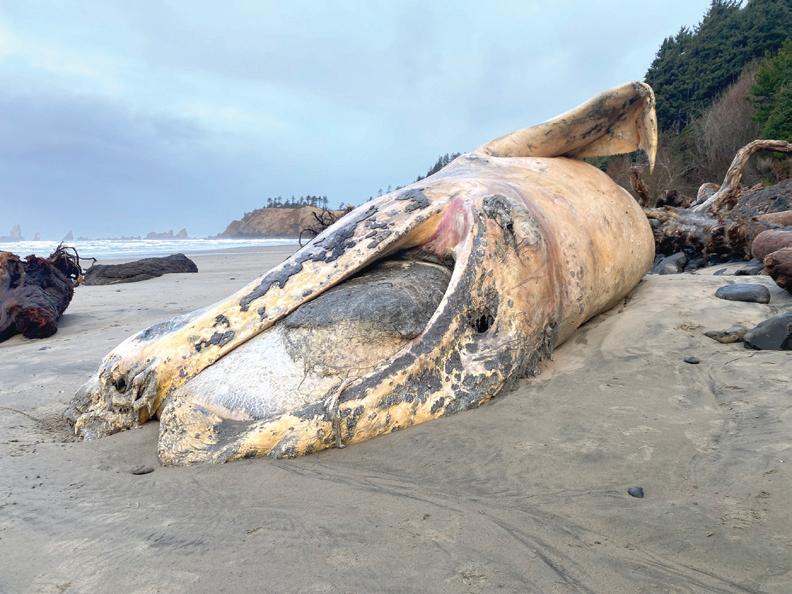
Saturday afternoon, Jan. 21, the whale washed ashore on Crescent Beach, located in Cannon Beach.
“While all these whale strandings may seem concerning, there is no connection between them,” the Seaside Aquarium states in a Facebook post. “It is purely a coincidence.”
Recent weather patterns, coupled with strong westerly winds, dead marine mammals that have been floating offshore get pushed onto
the beach, according to the Aquarium
The most recent whale has been dead for at least a month, maybe two, according to the Aquarium, which added its state of decomposition makes it difficult to determine the cause of death.
“We did notice a sizable shark bite which occurred after the whale died,” the Facebook post states. “The whale’s location is going to make a full necropsy nearly impossible.”
A crew did reach the whale on Monday, Jan. 23, to take a closer look and take some external measurements.
Other incidents this month
Three other whales have washed ashore along Oregon’s coastline in separate incidents over the past few weeks.
The first, a gray whale, was spotted on the beach Jan. 11 at Winchester Bay near Reedsport on the Southern Oregon Coast. The Marine Mammal
Stranding Network said the whale was likely killed by orcas.
Within days of that incident, two large whales washed ashore along the North Oregon Coast near Astoria.
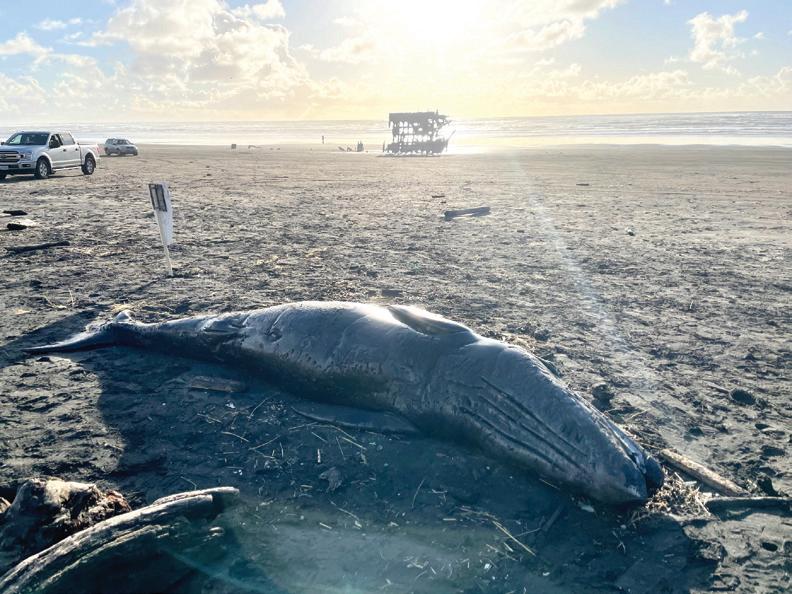
A 40-foor sperm whale was discovered on the beach near the shipwreck Peter Iredale Saturday, Jan. 14. Biologists said that whale died after being stuck by a ship at sea, according to the Associated Press.
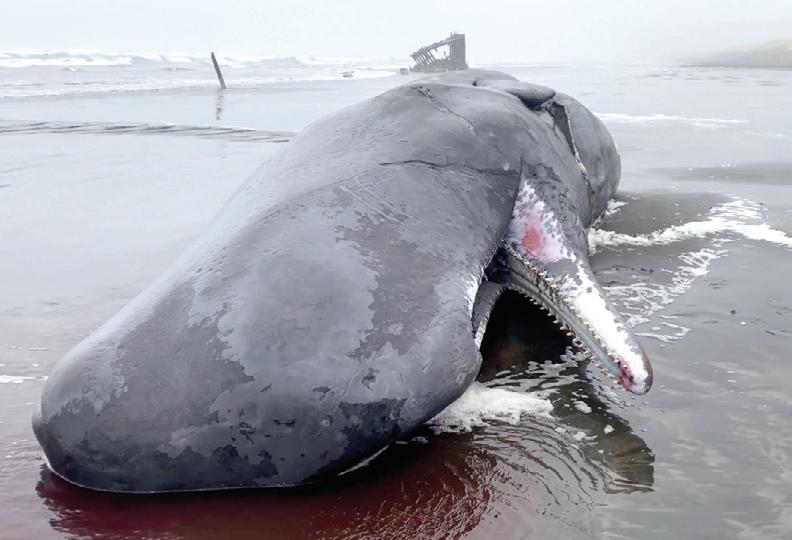
The Seaside Aquarium reported that the whale had been dead for a while before washing ashore and that there were a few large gashes on the whale. See video of the whale with this story at thechronicleonline.com.
Crews from the Seaside Aquarium and state parks removed the whale’s lower jaw so that the teeth remained intact for scientific purposes, the Aquarium said in a Facebook post. The whale is believed to be a juvenile male.
reach nearly 60 feet and weigh well over 40 tons. They have been known to live up to 60 years, with males maturing around the age of 50 at a length of approximately 52 feet. They feed on deep water species, such as squid, sharks, skates, and fish, according to the Seaside Aquarium.
still considered endangered.
A gray whale washed ashore Jan. 18 approximately 100 yards north of the sperm whale. The Seaside Aquarium reported the baby gray whale was about 12-feet in length.
“Like the sperm whale, it had been dead for a while
post. “There are no indications that this whale was struck by a ship or died from human interaction. Most likely, this is a case of failure to thrive.”
Gray whales are currently migrating south to their birthing and breeding grounds near Baja.
www.thechronicleonline.com Wednesday, January 25, 2023 A2
Columbia County’s trusted local news source
Jeremy C. Ruark / Country Media, Inc.
Sheriff Brian Pixley said specific details about the shooting could not be released due to the ongoing investigation.
JEREMY C. RUARK Country Media, Inc.
Jeremy C. Ruark / Country Media, Inc.
investigation began Jan. 16 after a body was discovered at Campbell Park.
from the Marine Board’s website.
Courtesy photo from the Oregon Marine Board
Most accidents and fatalities on Oregon’s waterways are due to falling overboard, collisions, operator error/misjudgment, and reckless behavior, according to the Oregon Marine Board.
Courtesy photo
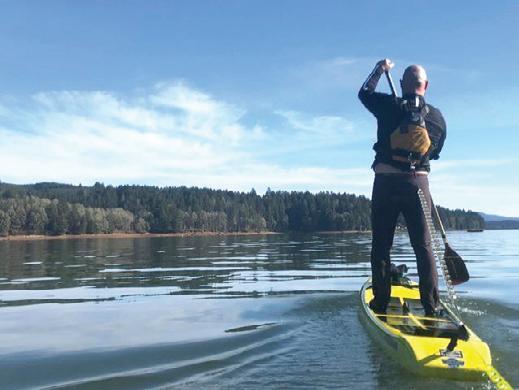
Stand Up Paddleboarder Andrew Hanson wears a life jacket with a quick-release leash.
STAFF REPORT Country Media, Inc.
Courtesy photo from the Seaside Aquarium
This baby Gray whale, about 12-feet in length, washed ashore near Astoria Wednesday, Jan. 18.
Courtesy photo from the Seaside Aquarium
This 40-foot sperm whale washed ashore Jan.14 near Astoria. In the background is the Peter Iredale shipwreck.
Courtesy photo from the Seaside Aquarium
This whale washed ashore on Crescent Beach, in Cannon Beach, Saturday, Jan. 21.
State takes action against Oregon’s largest towing operation
Inc.
The Oregon Department of Justice (ODJ) Consumer Protection Section has filed a lawsuit against Retriever Towing, one of the largest towing operations in Oregon.
The lawsuit, filed at Multnomah Circuit Court, alleges the company illegally towed vehicles from parking facilities without signed authorization from the owner of the parking facility.
History
In 2017, the Oregon legislature passed towing reforms that prohibit towing vehicles from parking facilities (with limited exceptions like blocking an emergency vehicle) unless the towing company received signed authorization to tow the specific vehicle from the owner of the parking facility or the owner’s agent. Retriever Towing contracts with property owners and property management companies who manage parking facilities and charges fees to the owner of the towed vehicle or sells the vehicle at auction.
The ODJ opened an investigation in 2018 into allegations that the company was not complying with Oregon law. At the time, the
Hotline offering reproductive rights guidance
STAFF REPORT Country Media, Inc.
The Oregon Reproductive Rights Hotline is now in operation.
The Hotline is a collaborative initiative spearheaded by the Oregon Department of Justice (Oregon DOJ) and staffed by local law firms.
Oregon Attorney General Ellen Rosenblum said the Hotline will provide free legal advice to anyone in need of guidance after the U.S. Supreme Court’s recent decision in Dobbs v. Jackson Women’s Health, overturning the long-standing constitutional right to abortion that was declared in Roe v. Wade in 1973.
“Even in a state like ours, where abortion is legal, confusion and fear has ensued since the U.S. Supreme Court struck down the constitutional right to obtain an abortion last June,” Rosenblum said. “The Hotline will fill an important need in our state for callers to understand the status of our reproductive health laws, including issues related to abortion access. This is especially important because we share a border with Idaho, which has a near-total abortion ban. I am so grateful to this fantastic group of local lawyers who are energized and ready to help answer callers’ questions and help them navigate
this post-Roe era.”
The Oregon Reproductive Rights Hotline number is 503-431-6460.
The Hotline’s team of lawyers will return calls within 48 hours after the call is received through the Oregon State Bar’s Lawyer Referral Service, Rosenblum said in a release. Legal questions will be answered on a pro bono (cost-free) basis by attorneys in participating law firms.
The law firm of Tonkon Torp is serving as the anchor firm for the initiative, with the assistance of other local firms, including Markowitz Herbold, Perkins Coie, Stoel Rives, McDowell Rackner Gibson, and Pickett Dummigan McCall. All firms are participating pro bono, at no cost to callers or to the state.
Anna Sortun, a partner in Tonkon Torp’s Litigation Department, said the firm is looking forward to supporting the effort “to respond
Pixley said. “I believe this is becoming more common because of its potency. Users do not need to use an much fentanyl to get [and] maintain their high. It is also relatively cheap.”
Who’s at risk?
According to the OHA, overdose deaths involving fentanyl increased from 227 in 2019-2020 to 509 deaths in 2020-2021. Unfortunately, the OHA could not provide data on the use of the drug overall. However, the OHA, OSP, and Sheriff Pixley all agreed that fentanyl dealing and use have increased. OHA data showed an increase in fentanyl seized from 690 dosage units (counterfeit pills) in 2018 to more than 2 million so far in 2022.
“Drug overdose deaths are highest among middle-aged people, males, Black individuals, American Indian/Alaska Native people, and people experiencing houselessness,” according to the OHA issue briefing.
Authorities are attempting educational outreach to battle the increase in use and overdoses. OHA emphasized that people should know that even small doses of fentanyl can be fatal. They also urged people who use opioids, or
are close to those who do, to carry naloxone. Also known as Narcan, naloxone is an “easy-to-use, life-saving drug.” It can reverse the effects of an overdose if administered in time.
What is the state doing to help?
Oregon is utilizing a variety of ways to address the growing crisis of opioids within its borders. OHA has implemented two legislative initiatives addressing substance use disorders and overdoses: Ballot Measure 110 (the Drug Addiction Treatment and Recovery Act), passed in 2019, and 2022 House Bill 4098 (Opioid Settlement Prevention, Treatment and Recovery Board).
Measure 110 makes screening, health assessment, treatment, and recovery services for drug addiction available “to all those who need and want access to those services.” House Bill 4098 is a settlement between the State of Oregon and four companies that manufacture and distribute opioids. Starting in 2022, $325 million will be awarded to Oregon over 18 years through the settlement. Per the OHA website, these funds can be used for “a wide variety of opioid prevention, treatment, and recovery strategies.”
The OHA has also invested $1.35 billion from the 2021-2023 biennium to
constructively to the confusion and difficulties caused by the Dobbs decision.”
“When the law changes suddenly, a hotline like this helps support our community by answering questions about critical access to health care, and we’re glad to help,” Sortun said.
As a reminder
Broad access to abortion remains protected in states that recognize reproductive freedom, including in Oregon. The Dobbs case (which overturned Roe v. Wade) did not change any Oregon laws protecting a person’s right to obtain an abortion in Oregon. For example, in Oregon there are no gestational limits, no waiting periods, and medication abortion (abortion pills) can be accessed by mail. Immigration status or ability to pay does not prevent someone from accessing abortion in Oregon.
“We are excited for participating law firms to help callers understand the status of abortion-related laws and assist with their legal questions about reproductive rights and access to health care,” Rosenblum said.
For more information, visit the Attorney General’s Reproductive Rights, or call the Hotline at 503-431-6460.
address behavioral health system transformation. In 2020, the OHA also put forward a four-year improvement plan called Healthier Together Oregon, which acts as a “blueprint for Oregon’s public health system modernization.”
In their briefing to the Governor’s Office, the OHA outlined the following tactics to address the complex systemic transformation Oregon needs to address drug use and overdoses:
1. Leadership from the Oregon Governor’s Office to implement a cross-agency, multi-sector governance structure to further align and leverage prevention, harm reduction, treatment, and recovery strategic plans, initiatives, and key strategies.

2. Integrated harm reduction approaches across the SUD continuum of prevention, care, treatment, and recovery and increased culturally specific resources and services.
3. Community-level prevention interventions that address intergenerational substance use and root causes of factors that contribute to substance use and overdose, including racism, stigma, and the many forms of trauma.
Follow this developing story at thechronicleonline. com and in the Wednesday print editions of The Chronicle.

company promised to make reforms, but never did.
“The purpose of the 2017 towing reforms was to put an end to predatory towing practices that cost consumers hundreds of dollars just to recover their car,” Rosenblum said. “Retriever told us it was reforming its business practice, but it never did. We hope this lawsuit will send a message to all towing companies around the state that they’ll be held accountable for violating the law.”

Since the 2018 law went into effect, the ODJ has received 261 complaints against Retriever Towing. Over the last 20 years, approximately one quarter of all consumer complaints received by the ODJ related to towing concern Retriever Towing’s practices.
Oregon’s towing law
By requiring signed authorization for a private property tow, Oregon’s 2018 law prohibited the practice of towing cars for relatively minor parking violations (like back-in parking next to an apartment building) unless the property owner or its agent was willing to authorize the tow.
Details of the law
• Since Jan. 1, 2018, a
tower needs to get signed authorization from the owner of the parking lot before towing the vehicle. The tower needs to keep a copy of the signed authorization for at least two years and provide a copy upon request at no additional charge.
• The tow truck operator must also take a picture of your vehicle to show how it was parked in violation of a prohibition posted on a sign at the lot.
• Unless the tow truck operator is towing your vehicle for a road service company, they may not attempt to solicit your business at the scene of an accident.
• If you are present at the time of the tow and the hookup is not complete, the tower must release the vehicle at no charge. If the hookup is complete, they may charge a hookup fee, but not the price of a tow.
• If the towing company accepts cash, you will get exact change no later than the end of the next business day. (Not all towers carry sufficient change in their trucks.)
Consumers who have information about Retriever’s Towing practices or want to make a consumer complaint can contact the Attorney General’s Consumer Hotline at www.OregonConsumer.gov or at 1-877-877-9392.
www.thechronicleonline.com Wednesday, January 25, 2023 A3
Columbia County’s trusted local news source
STAFF REPORT Country Media,
Metro Creative Connection
The ODJ lawsuit alleges the company illegally towed vehicles from parking facilities without signed authorization from the owner of the parking facility.
Courtesy photo
FENTANYL From Page A1
No pets allowed School district community letter
ST. HELENS SCHOOL DISTRICT Chronicle Guest Column
Editor’s note: The St. Helens School District has issued the following health and safety advisory about pets at the school’s athletic fields and playgrounds.
Dear St. Helens Community, The St. Helens School District believes our fields and playgrounds are community assets and we want and encourage community members to use them.
As a community member, we know that you take great pride in St. Helens schools, just as our staff and students do. We have incredible custodial and maintenance crews who work diligently to maintain the grounds and make it a safe and welcoming place for all.
Busy turf field
As many of you know, with the high school construction, our gyms are not currently available for student use, so many athletic classes are being moved outside to our
turf field.
We have so many of our students using our turf fields for classes, practices, and games in addition to outside facility usage.
The issue we are currently facing is pet waste (urine & feces) being left on the turf field where our students are playing. This is not only timeconsuming for our staff to try to address, but it is unsafe for our students to play on.
Health concerns

Pet waste can be very toxic. Animal feces can make people sick from salmonella, E. coli, and other infections. The Environmental Protection Agency estimates “animal waste is one of the many seemingly small sources of pollution that can add up to big problems for water quality and even human health.”
There are many diseases transmissible to humans from pets. Urine can transmit leptospirosis, which can cause kidney disease. Feces can transmit roundworms and hookworm, along with bacterial contaminants such as E. coli or Campylobacteria, and protozoal organisms like Giardia and Cryptosporidium. Roundworms can cause severe internal organ damage and ocular damage, causing blindness (more common in children). Hookworms can travel through the skin, causing intense itching.

Artificial turf holds urine odor, and ammonia pockets will build up, making it hard to remove the smell. This could even worsen because of the rubber and the particular type of glue in artificial turfs, added by the heat from sunlight.
District request

We ask that anyone using our facilities not allow pets on our school premises and help us keep our schools and fields safe for student and community use.
The St. Helens School District may be reached at 503-397-3085.
Answering why won’t my plant bloom?
CHIP BUBL Garden Plots Chronicle Guest Column
after flowering, don’t allow the bulbs to replenish their reserves.
Daylilies: Deer ate the flower buds just before they opened. They love daylilies.
When plants don’t bloom there could be several possible causes.
First, they are in the wrong place, usually one too shady. This is very common as the trees in landscapes mature and start to shade shrubs and other plants.
Second, a frost nipped the blooms before they fully opened. Third, the plant is still vegetative. This is a problem on some woody plants that require a certain age before they will start flowering. Heavy pruning slows that maturation process. Fourth, pruning at the wrong time removed floral buds.
Don’t confuse failure to bloom with failure to set fruit. An apple tree may bloom vigorously yet not get flowers pollinated due to poor pollination weather (poor bee activity, late frost, wet-weather diseases). Here are common problems:
Daffodils: Bulbs need dividing to produce bulbs large enough to bloom; and foliage cut too early, right
Lilac: Not enough sun – this is quite common as landscapes mature - the only choice is to thin the trees or move the lilac; some varieties take a long time (10+ years) to flower; summer, fall, or winter pruning removed flower buds (prune after blooming).
Dogwood: Not enough sun; tree is an un-grafted seedling which means it will take longer to bloom; pruning in summer/fall; previous summer very dry.

Peony: Not enough sun; planted too deeply; botrytis blight killed flower buds.
Tulips: A warm winter; bulbs too small to bloom; mice ate the bulbs; poor drainage; not enough sun; bulbs are too old and should be replaced; various diseases.
Wisteria: The vine may have been propagated from seed and not grafted – it may take years to bloom; fertilizing with nitrogen that stimulates vegetative growth vs. floral buds; not enough sun; excessive pruning in the summer.
Bee wise
What’s the value of a bumblebee? One estimate of

the value of pollination pro vided by native bees is four to six billion dollars per year! And the pollinators work long hours for free. However, many studies show declining numbers of native bees and other pollinators.
poppy, columbine, Oregon and Douglas iris, bleeding heart, and asters.
Woody natives abound, including red flowering currant, oceanspray, salal, red huckleberry, and Pacific ninebark. There are some good ornamental flowers, as well, including; basil, lavender, mint, coneflower and rosemary.
nests to create and provision brood cells. In the wild, bees use bare ground, dead trees, and untidy tangles of rough grass, all the places we tidy gardeners want to clean up. So, help them out by building some nest sites such as nesting blocks for mason bees. About 70% of the native bees nest in the ground, so keep some bare or partially vegetated ground.
Interested in doing more? Here are a couple of good sources of information. The Xerces Society (www.xerces. org) has a mission to protect wildlife through conservation of invertebrates and their habitats. Pollinator conservation is an important focus for them and they have a ton of information you can use.
produce and/or money to the food bank, senior centers, or community meals programs. It always is greatly appreciated.
• The Extension Service offers its programs and materials equally to all people.
Have questions?
If you have questions on any of these topics or other home garden and/or farm questions, please contact Chip Bubl, Oregon State University Extension office in St. Helens at 503-3973462 or at chip.bubl@oregonstate.edu. The office is open from 8 a.m. to 5 p.m. Monday through Friday.
Free newsletter
So what should a sustainable gardener do? Pollinators need two things that we can provide in our gardens –flowers for nectar and pollen and a place to nest.
The first is a natural for gardeners. Even if you are primarily a vegetable gardener, there’s always room to include some flowers around your plantings. And the kind of flower is important, too.

Native bees evolved with native plants, so plant natives as your first choice. And what a wealth of plants
But, if you’re planting for the bees, avoid many of the popular and beautiful, but highly modified flowers. Many of our most popular ornamentals today are double flowers (or more), which are nice to look at, but all those extra petals aren’t so good for the bees. The double flower mutations usually cause the male parts of the flowers, the part that makes pollen, to develop into petals instead. The old dahlia variety, Japanese Bishop, is avidly visited by bumblebees but other more complex dahlia types are not. So think simple flowers for the bees. We can assist bees with their second big need as well – nesting sites. Bees make
Finally, one of the most important urban flowers for early season pollinators are true dandelions (the ones without the hairy leaves). So put off killing that wonderful weed. Lightly edited by Chip Bubl from Robert Reynolds, former OSU Extension Service faculty member.
Food Preservation:
You can get up-to-date and accurate answers to your food preservation questions by calling our office at 503-397-3462 and ask to speak to Jenny Rudolph.
Important notes
• The OSU Extension Office is fully open from 8 a.m. to 5 p.m.
• Donate extra garden
The Oregon State University Extension office in Columbia County publishes a monthly newsletter on gardening and farming topics (called County Living) written/edited by yours truly. All you need to do is ask for it and it will be mailed or emailed to you. Call 503-397-3462 to be put on the list. Alternatively, you can find it on the web at http://extension.oregonstate. edu/columbia/ and click on newsletters.
Resource contact
Oregon State University Extension Service – Columbia County 505 N. Columbia River Highway St. Helens, OR 97051 503-397-3462
www.thechronicleonline.com Wednesday, January 25, 2023 A4 Columbia County’s trusted local news source Vote online at thechronicleonline.com 39.5% More 60.5% Less Are you changing your diet because of the increasing price of eggs and other foods? Yes No Weekly Online Poll Last Week’s Results Are you exercising more or less with age? The Chronicle The Chronicle (USPS 610-380) is published weekly by Country Media, Inc. 1805 S. Columbia Blvd., P.O. Box 1153 St. Helens, Oregon 97051 Periodicals postage paid at St. Helens, OR 97051 POSTMASTER: Send address changes to The Chronicle PO Box 1153 St. Helens, OR 97051-8153 SUBSCRIPTION RATES: One month in county: $8 One month out of county: $10 One year in county: $70 One year out of county: $90 One year online only: $60 CONTACT US • Phone: (503) 397-0116 • Fax: (503) 397-4093 Website: www.thechronicleonline.com • Editorial: chroniclenews@countrymedia.net ADVERTISE WITH US: Display ads: chronicleads@countrymedia.net Classified ads: chronicleclassifieds@countrymedia.net FOLLOW US • facebook.com/sthelenschronicle or twitter.com/shchronicle Opinion
Metro Creative Connection
Crossword solution Solution for the Jan. 18, 2023 crossword puzzle
Metro Creative Connection
-
erosion and the frequency of

Editor’s note: The Chronicle has provided coverage of local landslides over the years, the dangers of the slides and how homeowners and drivers can be prepared for such events.
Most recently, we reported details about the Highway 30 landslide north of Clatskanie in Columbia County. In the following, guest writer Steve Lundeberg gives us insight into new landslide research at Oregon State University (OSU).
A long-term Pacific Northwest study of landslides, clear-cutting timber and building roads shows that a forest’s management history has a greater impact on how often landslides occur and how severe they are compared to how much water is coursing through a watershed.
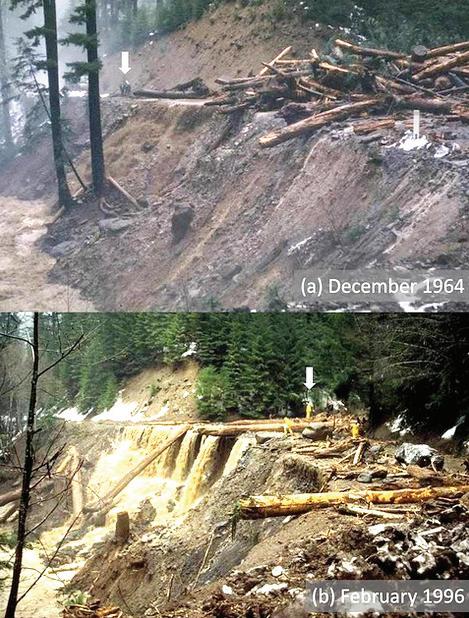
Findings of the research, led by associate forest engineering associate professor Catalina Segura and graduate student Arianna Goodman of the Oregon
Critical study
Probing the factors behind landslide frequency and magnitude is crucial because slides occur in all 50 states, causing an average of more than 25 deaths per year, according to the United States Geological Survey. The USGS puts the total annual average economic damage resulting from landslides at greater than $1 billion.
“Understanding the long-term effects of forest practices like logging and road building is critical to sustainable forest management,” Segura said. “This requires observations on time scales that capture responses to past and ongoing management practices – looking at the timing of floods, landscape susceptibility to landsliding and the delivery and movement of wood.”
Focusing on the Lookout Creek watershed in western Oregon, a research team that included Julia Jones of the OSU College of Earth, Ocean, and Atmospheric Sciences and Frederick Swanson of the U.S. Forest Service examined a decades-long history of old-growth clear-cutting and associated road construction and how those practices affected flooding, landslides, big pieces of wood jamming up waterways, and channel change.
Debris flows
Debris flows contribute huge quantities of sediment and large wood to streams, Segura said. Those inputs control, for decades, a channel’s response to large flows
largely ceased by the 1980s, enabling the scientists to track forest management practices’ impact on slides and floods during and after the period of active management.
Study timeline
Researchers studied five time periods: 1950 to November 1964 (initial logging and road building; December 1964 to January 1965 (first major flood); February 1965 to 1995 (betweenfloods period); 1996 (second major flood); and 1997 to 2020 (post-flood period).
The scientists note that three zones of distinct and contrasting geologic history comprise the Lookout Creek watershed: one zone with relatively smooth terrain and U-shaped valleys; another characterized by irregular topography, rough surfaces and moderate steepness; and a third featuring V-shaped valleys, steep slopes and narrow drainages.
“In each of the five time periods, the frequency of landslides and debris flows depended on the conditions created by management practices during prior time periods,” Segura said. “Watershed responses did differ somewhat among the zones, as would be expected – places that were once glaciated and have broad valleys are less vulnerable to landslides and debris flows than steep terrain with weak, erodible rock.”
Even small floods caused landslides and stream channel changes during the first 15 years of road construction and logging, and amid ongoing logging in the early part of the time period between large flood events, she said.
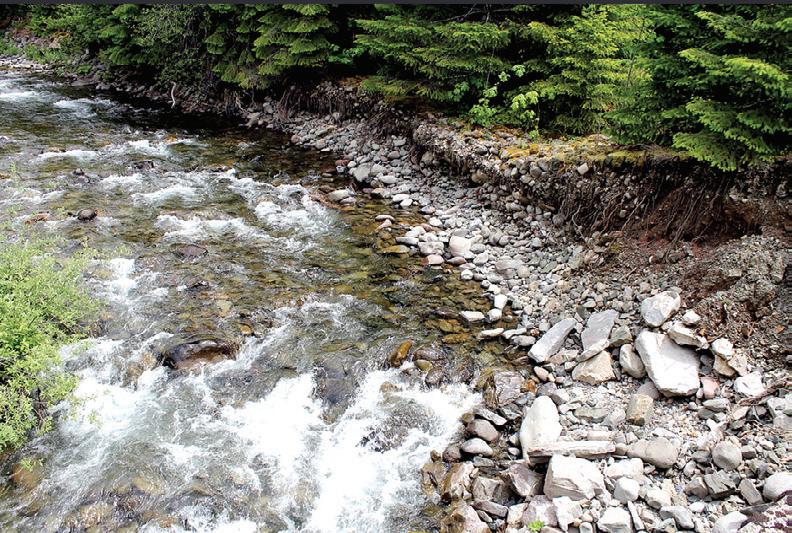
“Big flooding in 196465, when harvesting was taking place, produced much larger geomorphic responses than the large flood of 1996, more than a decade after logging stopped,” Segura said.
Landscape effects were negligible in 2011 for the third largest flood event on record, the researchers found; by that time clear-cut areas of the forest had been replanted and the new trees were 20 to 70 years old.
Steve Lundeberg is a researcher and writer for Oregon State University Relations and Marketing. He may be reached at steve. lundeberg@oregonstate.edu
Fast Fact
Landslides occur in all 50 states, causing an average of more than 25 deaths per year, and an annual average economic at greater than $1 billion, according to the United States Geological Survey.
Highway 30 travel update
coast range,” ODOT District 1 Maintenance Manager Mark Buffington said.
U.S. Highway 30 is open to two-way traffic as landslide repair continues between Astoria and Clatskanie, according to the Oregon Department of Transportation (ODOT).
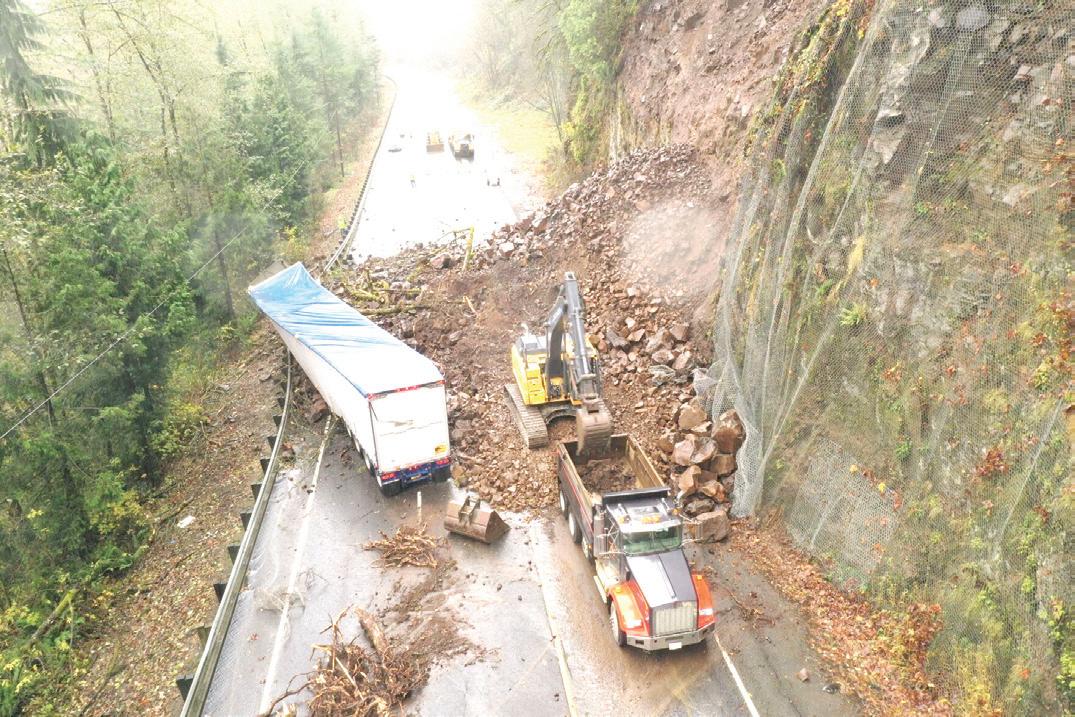
Crews had cleared enough landslide debris and scaled enough loose rock from the hillside to open a second lane Friday, Jan. 20. One lane with flaggers had been open since early December after a significant landslide Nov. 29, 2022.
“This was a large landslide compared to other landslides that we get in the
“The rock was definitely larger than what we are used to. We usually just get mud and trees.”
There is no estimated date when ODOT can reopen the third lane nearest the hillside and resume use of a passing lane, according to Buffington.
“Crews will continue to remove debris and restore barriers to slides for at least the next several weeks,” he said. “Please continue to drive with caution and watch for crews if you travel between the Portland area and Northern Oregon Coast.”
obituaries

Oct. 13, 1960 ~ Jan. 4, 2023
Cheryl Ann Loupe, 62, of Columbia City, passed away on Jan. 4, 2023, at her home. Cheryl was born Oct. 13, 1960, in Portland, Oregon to Forrest and Alice Viles. poose, Oregon and graduated from Scappoose High School in 1978. She worked for over 40 years in various roles at Toyota Logistic Services in St. Johns until she retired in 2019. Cheryl moved to the St. Johns neighborhood shortly after graduating high school and lived there for over 20 years before moving to Columbia City in 2006.
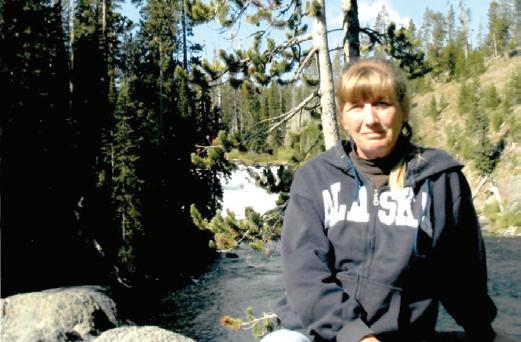
Cheryl loved to garden,
go on road trips, take cruises,
Before you travel, visit TripCheck.com
ODOT posts road and weather conditions, highway closures, crash locations, traffic speeds and more as quickly as possible on Tripcheck.com. You can also see traffic camera views at that online site.

“No matter where you travel in Oregon, please slow down in wintry weather and leave plenty of space between you and other vehicles,” ODOT states in a release. “Remember, it takes longer to stop in winter conditions. Also bring traction devices if you cross snow zones and know how to use them.”
was best known for her kind and loving heart, smart aleck sense of humor, long blonde hair, and unforgettable laugh. She is survived by her husband Ray; daughters, Sarah and Stacy; grandchildren, Ethan, Samantha, William, Eleanor and Joel; and siblings, Diane, Rick, Gary and Brian.
Her family and friends will miss her dearly but cherish the great times they had with her. Services will be held at 1 p.m. on Feb. 3, 2023 at Columbia Memorial Gardens, followed by a pot-
James Joseph Kemp
June 15, 1964 ~ Dec. 31, 2022
James Joseph Kemp, age 58, of St. Helens Oregon, residing at 2405 Columbia Blvd. #8, passed on Dec. 31, 2022, at approximately 4:30 p.m. PST.


Born in Des Moines, Iowa on June 15, 1964, James was recently in pursuit of recapturing his dream to become a high school chemistry teacher (contrasting from past college studies in computer programming languages such as: COBOL, FORTRAN, and Basic).
James built circuit boards at Lucidyne Tech., managed heavy equipment operations at Salmon Bay Steel, crane operations at Gunderson, installed cabinets throughout Columbia


and Multnomah counties, and made deliveries into Canada. At his heart, he was a true “railroader” for Union Pacific.
In the mid-80’s, he served his country in the



Army. His travels took him into Alaska, Georgia, and Hawaii.
He was an outdoorsman and photographer. James J. was an avid board game player of backgammon, Gomoku, and Monopoly. A Canasta master continually “freezing the pile.” Online gamer. Pittsburgh Steelers, and Oregon Trailblazers fan. He excelled at growing his continually blooming cactus: “Little One.”
Surviving him are his two daughters; four grandchildren; parents; three brothers; nieces; nephews; and his extended family of aunts, uncles, cousins, and innumerable friends.
Rest in peace, brother.
Richard Charles Kirtland Jr.
March 25, 1941 ~ Jan. 14, 2023
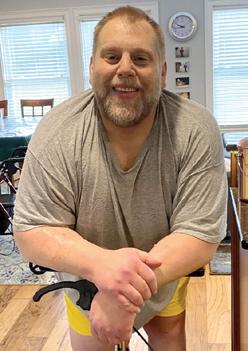
Richard Charles Kirtland Jr., of Scappoose, passed away on Sat., Jan. 14, 2023 at the age of 81. He passed of Parkinson’s disease. Richard was born to Evalyn and Richard Kirtland on March 25, 1941.

He graduated from Scappoose High School and went on to work in the finance and business sector most of his life. He loved the outdoors. He enjoyed fishing and hunting and spending time in the San Juan Islands.
Richard is preceded in
death by his father Richard Sr.; mother Evalyn; and brother Fred.
He is survived by his ex-wife and best friend Leah Kirtland; son Craig Kirtland; daughter-in-law Rhonda Kirtland; grandson Evan; daughter Danielle Grossi; and son-in-law Vic Grossi.
A celebration of life will be held at 1 p.m. on Jan. 26, 2023 at Columbia Funeral Home. Please sign our online guestbook at www. columbiafh.com.
www.thechronicleonline.com Wednesday, January 25, 2023 A5
news
33520 SW EDWARD LN., SCAPPOOSE, OREGON 503-543-3530 SCAPPOOSECINEMA7.COM ALL SHOW TIMES VALID EVERYDAY, unless otherwise specified All showings before 6pm are Matinees = $8.00 per person All showings after 6pm are General Admission = $10.00 per person Children under 11, Seniors 62 and over, and Military with ID are all $8.00 per person *Specials: On Tuesdays tickets are $5.00 Open 365 days a year, Doors Open 15 minutes before the first show 05-02-12 1x9D SootBusters:Layout 1 4/30/12 11:31 AM Page 1 The 05-02-12 1x9D SootBusters:Layout 1 4/30/12 11:31 AM Page 1 05-02-12 1x9D SootBusters:Layout 1 4/30/12 11:31 AM Page 1
Columbia County’s trusted local
source
Cheryl Ann Loupe
Courtesy photo from ODOT
This was the scene shortly after the landslide on Highway 30 in late November. All lanes of traffic are now open following the cleanup and hillside repair.
STAFF REPORT Country Media, Inc.
State University College of Forestry, were published in the journal Earth Surface Processes and Landforms.
Forest management impact on landslides
Courtesy photo from OPSU
A research team examined a decades-long history of old-growth clear-cutting and associated road construction on Lookout Creek and how those practices affected flooding, landslides, big pieces of wood jamming up waterways, and channel change.
STEVE LUNDEBERG Chronicle Guest Article
Courtesy photo from OSU
Even small floods caused landslides and stream channel changes during the first 15 years of road construction and logging.









www.thechronicleonline.com Wednesday, January 25, 2023 A6 Classifieds Listings are updated daily at thechronicleonline.com ACROSS 1. COVID tester 5. Pep rally syllable 8. To overlay with thin gold coating 12. Sky bear 13. Abundant 14. Worrier’s worry? 15. Fishing spot 16. Blackhearted 17. Full of coral 18. *2023 Super Bowl stadium sponsor 20. Research facil. 21. Egg cell 22. King Charles to Prince Harry 23. Thief’s target 26. *2023 Super Bowl Halftime Show star 30. Mozart’s “L’____ del Cairo” 31. Bob Marley’s music 34. Yarn spinner 35. “The Poky Little ____” 37. Skedaddle 38. 18-wheelers 39. “Guilty,” e.g. 40. Fabric inset 42. One of the sibs 43. *Super Bowl advertiser’s purchase 45. Anatolian language 47. Decay 48. “There it is,” ‡ Paris 50. “Hold on!” 52. *Home of the Ravens, for both Super Bowl appearances 56. Cuckoo for these puffs! 57. Curved molding 58. Medicinal plant 59. Court orders, e.g. 60. Sonny & Cher and Abbott &Costello 61. Talk like a drunk 62. Actor Danson and character Lasso 63. “Owner of a Lonely Heart” band 64. *Star of the mostwatched Super Bowl Halftime Show DOWN 1. Paddleboarding acronym 2. Court order 3. Between ports 4. Hungarian composer Bela ______ 5. *Either one of the opposing Super Bowl teams 6. FlambÈ 7. Position of leadership 8. *2023 Super Bowl AZ location 9. Frosts, as a cake 10. Hit the road 11. Like certain humor 13. Disprove 14. Dickens’s Heep 19. Each and all 22. One of a set of dice 23. Father, colloquially 24. Round openings 25. Pickled garnish 26. *Last year’s Super Bowl winners 27. Nimbus, pl. 28. Nigerian money 29. Torcher’s crime 32. Elmer’s, e.g. 33. Found at the pump 36. *Team with most Super Bowl appearances 38. Signing tool at the cash register 40. Greenwich-related acronym 41. Superior ones 44. Itsy-bitsy bits 46. Patterned table linen 48. Lacking clarity 49. Bread spreads 50. Donned 51. As opposed to base in chemistry 52. Snatchers’ quest 53. Cantina pot 54. *Overwhelming Super Bowl defeat 55. Fear-inspiring 56. 100 lbs. STATEPOINT CROSSWORD THEME: SUPER BOWL Crossword Puzzle Solution to crossword in next week’s issue of The Chronicle. Alcoholics Anonymous Info-line, (503) 366-0667 www.pdxaa.org 502 Help Wanted Immediate Opening Sewing Part-time 6-Noon, M-Th. Apply in person only. 33550 SE Santosh St. Scappoose, OR 97056. Support Services Clerk Columbia County, OR EOE. Deadline: Open Until Filled. Apply at ColumbiaCounty OR.gov. Administrative Billing Specialist The City of St. Helens is hiring Administrative Billing Specialist Regular Full-Time Monthly wage: $3,856 (Step 1) Apply online at www.sthelensor egon.gov. Deadline to Apply: 02/10/23 Equal Opportunity Employer. 712 Furniture For sale Couch with recliner on each end. Love seat with recliner on each end w/ cup holder. Like new, $500 each. Cash only. Please call 503-397-0643. Room for rent in house in St. Helens. $600 per month. No smoking. No pets. Please call 503-793-4324. 820 Mobile/Manuf. Homes For Rent Manufactured home. 2 bed, 1 bath. Large addition. $920/month. No smoking. No pets. $15 rental application fee. 1st & last months rent due at move in. 32678 Scappoose Vernonia Hwy. One mile from Hwy 30. 503-543-2250 or 503-396-9212. Waterman Garage Doors Scott Waterman Owner Advertise your business in the Business & Service Directory. Call 503-397-0116 for more information YOUR AD HERE Columbia County BUSINESS & SERVICE DIRECTORY www.thechronicleonline.com Get your ad in the paper and reach out to potential customers. Call 503-397-0116 to place your ad in the newspaper and online. Garage Sale Special! Advertise your garage sale in the paper and online for only $10 for up to 14 lines! Email chronicleclassifieds@countrymedia.net to advertise! 502 Help Wanted 502 Help Wanted 301 Health & Nutrition 815 Rooms for Rent 820 Mobile/Manuf. Homes thechronicleonline.com The Chronicle Reach local readers by advertising in The Chronicle’s online classifieds section. Call 503-397-0116 for info. Advertise online check the classifieds online at www.thechronicleonline.com to find your perfect job offer Need a job? Let us know what YOU think EMAIL YOUR LETTERS TO: CHRONICLENEWS@COUNTRYMEDIA.NET
Public Notices
PROTECTING YOUR RIGHT TO KNOW
CH23-1246
NOTICE OF PUBLIC HEARING
Monday, February 6, 2023, NOTICE IS HEREBY GIVEN the Port of Columbia County, represented by Lower Columbia Engineering, has submitted an application, for a site design review. The proposal in the application is to build a maintenance building with construction of associated infrastructure such as parking and utilities. The property is identified by tax number 4108-D0-01000 and is zoned Heavy Industrial, has 11.84 and is located on old Portland Rd. NOTICE IS
HEREBY GIVEN that Zack Watson, has submitted an application, to have a home business. The proposed uses will be automotive repair services, such as tire repairs engine repairs and general maintenance for cars and light duty trucks. The property is zoned Rural Residential (RR-5), identified as tax map number 5226-D0-01700 and located at 32707 Berry Hill Ln. This application is being referred to a Public Hearing before the Planning Commission via the provisioners of the Columbia County Zoning Ordinance Section 1601.3 SAID PUBLIC HEARING will be held before the Columbia County Planning Commission on Monday, February 6, 2023 starting at 6:30 p.m. During the COVID-19 global pandemic, the Columbia County Planning Commission will be hosting their public hearing via online webinar. Please use the links below if you wish to participate in the public meeting. February 6, 2023 Planning Commission Meeting Mon, Feb 6, 2023 6:30 PM - 9:30 PM (PST) Please join my meeting from your computer, tablet or smartphone. https:// meet.goto.com/295783757 You can also dial in using your phone. United States
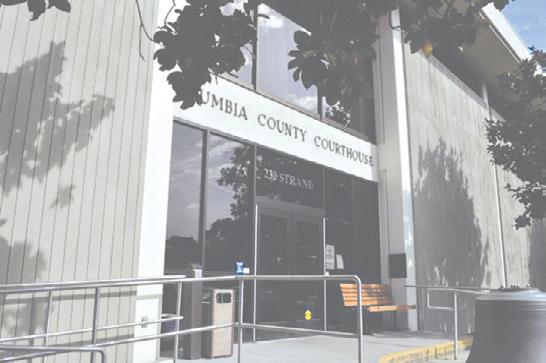
(Toll Free): 1 866 899 4679 United States: +1 (571) 317-3116 Access Code: 295783-757 Get the app now and be ready when your first meeting starts: https://meet. goto.com/install If you have any questions or concerns regarding access to the meeting or need accommodation, please call the Land Development Services office at (503) 397-1501. The criteria to be used in deciding these requests will be found in some or all of the following documents and laws, as revised from time to time: Oregon Revised Statutes ORS 197.763; Oregon Administrative Rules; Columbia County Comprehensive Plan; Columbia County Zoning Ordinance. The specific criteria applicable to this request is listed and evaluated in the staff report. A copy of the application, all documents and evidence relied upon by the applicants, and the staff reports are available for inspection at no cost and will be provided at reasonable cost, at the Land Development Services office, at least 7 days prior to the Planning Commission hearing. Written comments on the issue can be submitted via email to Planning@ columbiacountyor.gov or you can send comments via U.S. Mail to Columbia County, Department of Land Development Services, 230 Strand Street, St. Helens, OR 97051. If additional documents or evidence are provided in support of the applications, prior to or during the hearing, any party shall be entitled to a continuance of the hearing to allow review of the new evidence. If a participant requests a continuance before the conclusion of the evidentiary hearing, the record shall remain open for at least seven
days after the hearing. The “hearing will be held in accordance with the provision of the Zoning Ordinance” At each hearing, the applicant has the burden of presenting substantial evidence showing that the application meets all of the applicable criteria. Following presentation of the staff report, the applicant and other persons in favor of the application will be allowed to address the commission, explaining how the evidence submitted meets the applicable criteria. Following the applicant’s presentation, any person in opposition to the application may present evidence and argument against the application. The applicant will then have the opportunity to rebut any evidence or arguments presented in opposition. After the presentation of evidence and arguments, the public hearing record will be either left open or closed by the Planning Commission. The Commission will then make a tentative decision to be followed by approval of a written order and a statement of findings and conclusions supporting the decision, which will be mailed to all parties at a later date. The Commission may, at its discretion, continue the hearing from time to time at the request of the parties or on its own motion as necessary to afford substantial justice and comply with the law. Additional information about this application may be obtained from the Planning Division of the Land Development Services Department, at (503) 397-1501 or you can go to the County website www.columbiacountyor.gov/departments/ LandDevelopment/Planning. January 25, 2023 THE PLANNING COMMISSION Dan Magnia, Chairman
CH23-1251
IN THE CIRCUIT COURT OF THE STATE OF OREGON FOR THE COUNTY OF COLUMBIA PROBATE
In the Matter of the Estate of GORDON PHILLIP DRISCOLL, Deceased. No. 22PB11517 NOTICE TO INTERESTED PERSONS NOTICE is hereby given that the undersigned, Michelle M. Low, has been appointed personal representative of the above estate. All persons having claims against the estate are required to present the same within four months
CH23-1247
DEPARTMENT
from this date at the office of VanNatta, Petersen & Anderson, P.O. Box 748, St. Helens, Oregon 97051; and if not so presented, they may be barred. All persons whose rights may be affected by the proceeding may obtain additional information from the records of the Court, the personal representative or the attorneys for the personal representative. First
NOTICE OF MEETING
The CCMH Board of Directors meeting will be held 2/6/2023 at 4:45pm. The Directors would love to hear feedback from clients and community members! This will be a hybrid meeting and if you would like to join physically, please meet
CH23-1250
in the Community Room at our Creekside location on McNulty. To attend the meeting via phone, please call in using the following number: +1 323-486-1906 Conference ID: 847 420 41#. CCMH is an equal opportunity employer.
SEEKING PROPOSALS
“REQUEST FOR PROPOSALS: STRATEGIC BUSINESS PLAN RFP” The Port of Columbia County is seeking proposals to assist the Port in updating its Strategic Business Plan. Interested and qualified firms may obtain the RFP documents on the Port’s website at https://www.portofcolum-
biacounty.org/rfps; from the Port Office located at 100 E Street, Columbia City, OR, from 8:00 am to 5:00 pm Monday-Friday; or via email at sisco@portofcolumbiacounty.org. Submissions must be received by 5:00 pm on Monday, February 13, 2023. For questions, please call 503-397-2888.
published: January 25, 2023. Michelle M. Low, Personal Representative. Personal Representative: Michelle M. Low c/o VanNatta, Petersen & Anderson, P.O. Box 748, St. Helens, OR 97051. Attorney for Personal Representative: Mary Anne Anderson, VanNatta, Petersen & Anderson, P.O. Box 748, St. Helens, OR 97051. Phone: (503)-397-4091.
CH23-1249
NOTICE OF MEETING
McNulty Water PUD Board meeting will be held February 7th, 2023, at 7pm. Located at 34240 Millard Road, Warren, Oregon 97053.
CH23-1242
NOTICE OF AUCTION
Rainier Storage Place, LLC will hold a foreclosure auction at 29098 Dike Rd., Rainier OR 97048 of the contents of the following storage units: CY15 (8x40) Robert Killough Warren 11:00 a.m. on Saturday, January 28th, 2023.
The Public Notice deadline is Fridays by noon.
Reducing the wildfire risk in Oregon, Washington
STAFF REPORT Country Media, Inc.
There are new federal efforts and investments to ease the risk of wildfires in Columbia County, across Oregon and Washington.
U.S. Department of Agriculture (USDA) Secretary Tom Vilsack has announced expanded efforts to reduce wildfire risk across the western U.S., directly affecting national forests in Oregon and Washington.
The investments, made possible through the Biden Administration’s Bipartisan Infrastructure Law (BIL) and the Inflation Reduction Act (IRA), will directly benefit at-risk communities and critical infrastructure across 11 additional landscapes in Arizona, California, Idaho, Nevada, Oregon, Utah and Washington, according to a release from the USDA.
“It is no longer a matter of if a wildfire will threaten many western communities in these landscapes, it is a matter of when,” Vilsack said. “The need to invest more and to move quickly is apparent. This is a crisis and President Biden is treating it as one. Today’s announcement will bring more than $490 million to 11 key landscapes across the western United States, and will be used to restore our national forests, including the restoration of resilient old-growth forest conditions.”
In the Forest Service Pacific Northwest Region, the Mount Hood National Forest in Oregon and the Colville National Forest in Washington were selected for increased funding.
The Mount Hood is being funded $4.5 million and the Colville is being funded $2.16 Million of from the Inflation Reduction Law.
The Mount Hood landscape covers one million acres in northwest Oregon and includes three firesheds,
several wilderness areas, and the Bull Run watershed, which furnishes drinking water to nearly a million people in Portland and surrounding communities. More than a third of all Oregonians depend on water from this landscape.
The Colville landscape is on 1.6 million acres adjacent to the Colville Reservation in northeastern Washington. It includes critical infrastructure like State Routes 395 and 20 and large energy facilities. In addition, the landscape has vital habitat for species listed or proposed for listing under the Endangered Species Act, including Canada lynx, grizzly bear, whitebark pine, woodland caribou, and bull trout.
The Fremont-Winema National Forest in southern Oregon will be working with the Forest Service’s Pacific Southwest Region to support the Klamath River Basin landscape. This landscape covers more than 52,000 acres in Oregon and Northern California and is being funded $35.4 million.
This announcement complements the agency’s 10 landscape projects announced in 2022 and the agency’s broader strategy to address critical infrastructure, community protection, and forest resilience at risk to catastrophic wildfire.
Combined with the initial investment landscapes, these actions will span nearly 45 million acres across 137 of the 250 high-risk firesheds in the western U.S., with a total investment of $930 million on 21 landscapes across 26.7 million acres in 2023. This work will mitigate risk to approximately 200 communities within these landscapes.
“Today’s announcement is great news for Oregon and Washington and our Pacific Northwest National Forests,” U.S. Forest Service Pacific Northwest Regional Forester Glenn Casamassa
said. “These investments will allow us to do more work with tribes, the states, and our partner organizations to increase the health and resiliency of our forests and reduce the potential for devastating wildfires.”
To meet this moment, Vilsack is also authorizing the Forest Service to utilize a new emergency authority in the Bipartisan Infrastructure Law, combined with strategic implementation of existing authorities. Doing so will enable the agency to move more quickly in applying targeted treatments to highrisk firesheds identified in the agency’s Wildfire Crisis Strategy, as well as post-fire recovery areas most impacted the past several years. These actions are required to be conducted in an ecologically appropriate manner that maximizes the retention of large trees, considers historically underserved communities and tribes, and is done collabora-
tively with communities and partners.
“Doing this work in the right place, at the right time, and at the right scale, combined with the use of emergency authorities, will accelerate our planning, consultation, contracting, hiring and project work to reduce wildfire risk and improve forest health and resilience,” U.S. Forest Service Chief Randy Moore said. “Collaboration with Tribes, communities and partners will remain a priority, and we will continue to use the best available science when carrying out this important work.”
Forest Service Wildfire Crisis Strategy
The announcement comes on the anniversary of the launch of the Forest Service’s Wildfire Crisis Strategy, which debuted Jan. 18, 2022. In April, the agency introduced the initial 10 fire-prone landscapes that
are now funded for the next five years through Bipartisan Infrastructure Law funds.
Since releasing its Wildfire Crisis Strategy one year ago, the Forest Service and its partners have used the best available science and data to identify the highest risk landscapes for treatment projects.
The Forest Service found that around 80% of the wildfire risk to communities is concentrated in less than 10% of “firesheds,” or areas where wildfires are likely to threaten communities and infrastructure. These targeted investments focus on firesheds of the highest risk, where projects are ready to begin or to expand.
The 10-year strategy calls for treating up to 20 million acres on national forests and grasslands and up to 30 million acres of treatments on other federal, state, Tribal, private and family lands.
Over the past 20 years, many states have had record
catastrophic wildfires, devastating communities, lives and livelihoods, and causing billions of dollars in damage. More than 10 million acres – more than twice the size of New Jersey – burned each year across the U.S. in 2020, 2017 and 2015.
The Wildfire Crisis Strategy builds on current work, leverages congressional authorities and partnerships to support the department’s work to mitigate wildfire risk, and restore forest health over the next decade. In addition to State Forest Action Plans, the strategy also aligns with the Collaborative Forest Landscape Restoration Program, Tribal Forest Protection Act, Good Neighbor Authority, Joint Chiefs’ Landscape Restoration Partnership and Shared Stewardship agreements.
In June 2022, USDA released the Secretary’s Memorandum on Climate Resilience and Carbon Stewardship of America’s National Forests and Grasslands.
The Secretary’s memo builds on previous actions on climate change, equity, and forest resilience, but provides more specific and timebound actions to integrate into agency programs. The Forest Service used the guidance in the Secretary’s memo to better inform the selection criteria for projects under the Wildfire Crisis Strategy, including equity, source water protection, community infrastructure, and wildlife corridors.
Recognizing that insects, disease, and wildfire are among the most significant threats to mature and old growth forests, in alignment with the Administration, the Forest Service will be targeting hazardous fuels reduction projects to address these threats to promote the recruitment, protection and restoration of mature or oldgrowth forests.
www.thechronicleonline.com Wednesday, January 25, 2023 A7
Columbia County’s trusted local news source
Late submissions are not guaranteed to make it into the paper.
Courtesy photo
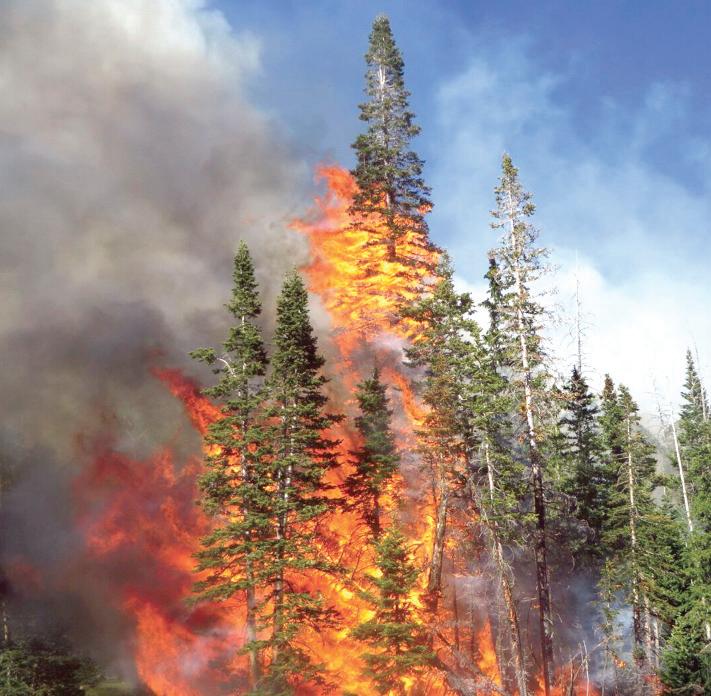
The overall 10-year strategy calls for treating up to 20 million acres on national forests and grasslands and up to 30 million acres of treatments on other federal, state, Tribal, private and family lands.
St. Helens High School Wrestlers making the mats home
Boys wrestling at St. Helens High School are off to a flying start this season, and a mix of great coaching, veteran leadership, and tenacious youngsters are at the heart of their success.
Veteran coaching
Though this is Paul Connelly’s first year as head coach of the program, he has been involved in St. Helens’ wrestling for the past eight years. After six years of working with the middle school program, Connelly coached the girls wrestling team in 2021. This season, Connelly has taken the head coaching reigns for the boys squad, and they have outmuscled the competition.
I hope that the wrestlers take away that hard work pays off. Wrestling is the last bastion of a meritocracy.
~ Paul Connelly, Head Wrestling Coach
“We have a pretty big group of wrestlers this year which really helps in tournaments. We are usually the biggest team anywhere we go,” Connelly said.
Last season, under head coach Greg Gadbois, the boys and girls wrestling teams finished tied for 9th in
SHHS Game Schedule This Week
Boys Basketball
• 6 p.m. Jan. 25 vs. Seaside at St. Helens Middle School
• 6 p.m. Jan. 27 vs. Scappoose at St. Helens Middle School
Girls Basketball
• 7:30 p.m. Jan. 25 vs. Seaside at St. Helens Middle School
• 7:30 p.m. Jan. 27 vs Scappoose at St. Helens Middle School
Boys Swimming
• 4 p.m. Jan. 26 Quad Meet Tillamook YMCA
• 2:30 p.m. Jan. 31 Last Chance at Lincoln City Community Center Pool

Girls Swimming
• 4 p.m. Jan. 26 Quad Meet Tillamook YMCA


• 11 a.m. Jan. 31 Last Chance Lincoln City Community Center Pool
Wrestling
• 9 a.m. Jan. 28 Joe Stewart Invitational Putnam High School
• TBN Feb. 1 Seaside
the State Championships for the 5A classification. Last year’s success has continued into this season, with the program competing in the 4A-1 Cowapa League.
“So far, this season has gone really well. We have a lot of new freshmen this year, which is great for the program. We also have a mix of seasoned veterans that are great leaders for our team, “Connelly said. “We have won three tournaments, including the Pac Rim tournament in Seaside. We won the duels against Molalla and Colton. We have taken second in the last two tournaments that we participated in. We had a tough duel against Scappoose; we wrestled well but came up short in the end.”
Outstanding Freshmen
Participation in wrestling at St. Helens High School is up, and the program seems primed to continue to
perform for years to come. According to Connelly, the Tigers have had a number of talented freshmen come into the team this year.
“We do have an outstanding Freshman, Greg Hall, who is having a great and successful year which is tough for a freshman,” Connelly said. “Some of our other outstanding freshmen are Dustin Harris, Carter Stewart, and Landon Hall.”
Upper classmen stepping up
While the younger players have stood out, part of their success is a testament to the veteran leaders of the program stepping up and leading by example. The captains of the team have helped set the standard for others to follow.
“Our Captains, Evan Willis, Josh Duhaime, Aden Oehlert, have led the team this season in practice and during meets. They all do a great job leading the younger
wrestlers and keeping everyone on track,” Connelly said. However, veteran leadership doesn’t end with the captains. Kyle Dey, Tyler Smith, Will Herrington, and Colton MacDannald are each in the midst of impres-
sive seasons. At 220 pounds, senior Daniel Bennett is also giving opponents a handful. Connelly also lauded the performance of several other wrestlers leading the charge.
“We also have Carson Jackson, who is a very successful wrestler with a lot of experience. Michael Cobabe has been outstanding at 106 pounds,” Connelly said. “Our heavyweight, Trevor Hjort, does a great job finishing up our lineup. Sean Long is another stand out with his hard work; he helps our freshmen during practice to get them up to speed with basic technique.”
Beyond the mats

The season is fast approaching its conclusion, with the team slated to compete in two more meets before the State Championships in February, and the team is looking to build
momentum down the home stretch. However, success on the mats isn’t the only thing Connelly hopes to pin down. Connelly also wants the wrestlers to understand that talent isn’t the only thing that matters.
“I hope that the wrestlers take away that hard work pays off. Wrestling is the last bastion of a meritocracy,” Connelly said. “You get exactly out of wrestling what you put into it. It doesn’t matter your body type or your athletic ability. If you work hard enough, you will be a successful wrestler.”
As the team wraps up its season, we’ll see if they can make some noise at their final meets and give themselves something to hang on to as they prepare for the pinnacle of their season in February.
To follow St. Helens wrestling, visit https://www.osaa. org/teams/47696.

Love, your son, Byron Looking forward to our tennis match in Heaven


www.thechronicleonline.com Wednesday, January 25, 2023 A8
trusted local news source Sports Hudson Employees and Families ABS Services Carla Sharp Simply Pictures by Jennifer Woolf Glen & Susan Hiatt Rich Bailey Construction General Equipment Knife River Karen & Mark Catlow Brenda Hudson Nancy Hudson Columbia County Transfer Station Customers Grocery Outlet Pour House JC Mechanical Repair Schnitzer Teevin Brothers Brad Berger Michael Haile Portrait Homes Barlow Bikes Kiwanis Hudson Garbage Service would like to thank the following people and companies that made it possible to purchase 131 bikes & helmets for Hudson’s Annual Bike Build 2022. .12% 5 on a 13 month certificate with one time bump-your-rate option* A NNUAL P ERCENTAGE Y IELD 800.773.3236 ● waunafcu org *APY: Annual Percentage Yield. This special Certificate Account is open to New Money only; funds currently on deposit at Wauna Credit Union are not eligible. Minimum balance required to open account and earn the APY: $500. The published APY is compounded and credited Monthly and is accurate as of January 11, 2022. Bump Rate feature: During the account term, if the product is offered at a higher rate the owner may request a one-time bump to the higher rate. A penalty may be imposed for early withdrawal. Fees may reduce earnings. Other account restrictions may apply. Membership with Wauna Credit Union is required. Federally insured by NCUA. Thank you dad for always loving me Thank you for always supporting me You
me about life You
me
You
Columbia County’s
taught
were with
through difficulties
gave me courage May God bless you Rest in Peace. 1:20:22
WILL LOHRE Country Media, Inc.
Courtesy photo by Angie Oehlert
St. Helens boys wrestling team celebrates taking first at Pac Rim, where many of the individuals placed.
