WILL CHAPPELL Citizen Editor
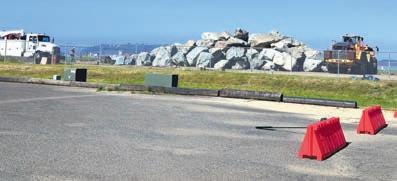
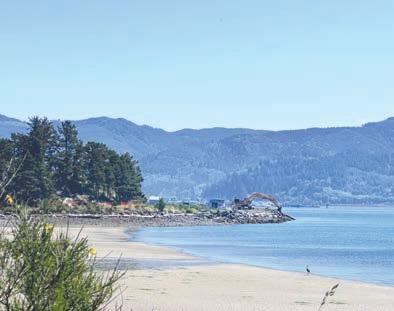
After building up a stockpile of six-to-ten-ton rocks at the Port of Garibaldi through May and early June, contractors working to repair the south jetty at the entrance to Tillamook Bay have started transporting rocks across the bay to Kincheloe Point.
Andy Leavitt, project manager and president of Trade West Construction, the company performing the work, said that crews would begin placing stones near the root of the jetty within the month, at
which point work will speed up. Up to this point, stones have only been arriving at the staging area at the Port of Garibaldi in the early hours of the morning but as work ramps up, they will become common during the day.
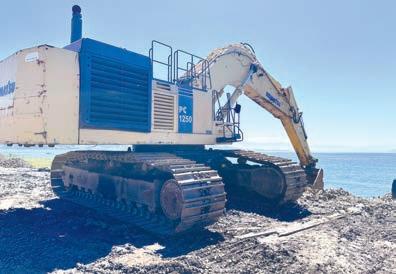
Leavitt said that they hope to place between 500 and 600 tons of stone a day once they are operating at full capacity. Throughout the entire project, crews will place around 100,000 tons, or between four and six thousand individual rocks, helping to repair two, separate sections of the jetty near its root and head.
Initially, the stones are being transported from the Port of Garibaldi staging area to Kincheloe Point directly on the deck of the barge but they will soon be placed in the backs of transport trucks that will drive onto the barge and then directly to the jetty upon offload.
Before any of this work could begin, crews spent months preparing the area at Bayocean County Park between Kincheloe Point and the root of the south jetty to support the repair. Those efforts included constructing a portion of new road and improving another
section of existing road to accommodate the large transport trucks in the mile between the offload site and jetty. Crews also cleared a 10-acre site near the root of the jetty to be used for secondary staging of the stones, although Garrett Bryner, a quality control manager for Trade West, said that ideally rocks would move straight from the barge to the jetty.
Workers also installed a temporary scale that will weigh the rocks for final payment to the contractor. Two or three teams of stone
See JETTY, Page A6
WILL CHAPPELL Citizen Editor
Members of the Oregon State Legislature’s Joint Transportation Committee spent the day in Tillamook on June 18, as part of a series of tours around the state to gather community feedback on Oregonians’ transportation needs. The Oregon Department of Transportation is hosting the tours, with the Tillamook visit marking the second stop with ten more scheduled before the end of September.
During the day, committee members took a bus tour of various project sites around the central part of the county that demonstrated transportation infrastructure challenges on the north coast. They then participated in a roundtable discussion with local leaders before hosting a public meeting in the evening to gather citizen input.
The committee’s tour began at the red barn at the Tillamook Creamery and Oregon Department of Transportation (ODOT)
Director Kris Strickler welcomed committee members and local leaders as the bus


departed. Strickler said that the purpose of the tours was to give ODOT officials and the committee members the opportunity to hear about the local needs across the state. While there would be some variation in the needs expressed in different areas, Strickler said that he expected a consistent theme across the state would be negative impacts caused by resource shortages at the department. Strickler thanked the legislators for the infusion of $19 million into ODOT’s coffers late last year, which he said had
been critical to allowing them to deliver the level of service Oregonians expect during the winter months. Savannah Crawford, director of ODOT’s region two that includes Tillamook, then took over as the bus continued on its way towards milepost 10 of the Wilson River Highway. Crawford discussed how the culvert routing Zig Zag creek under the highway at that point was failing and noted that it would need to be replaced by a bridge that will cost $14-16 million. The culvert is almost a century old, like many others along Highway 6,
and maintaining them is an ongoing challenge for the department.
On the way back towards Tillamook, Crawford talked about safety issues on the highway and the study that was commissioned by State Senator Suzanne Weber to delineate them. Crawford said that the highway had seen 428 vehicle crashes between 2016 and 2020, which led Weber to sponsor a bill funding the study in 2022.
That study, conducted in 2023, detailed a range of options for upgrading safety on the highway from initiatives like restriping the
‘Unprecedented’ paralytic shellfish poisoning outbreak closes shellfish harvests on coast
WILL CHAPPELL Citizen Editor
For nearly a month, the harvesting of shellfish on the Oregon coast has slowed to a crawl as mussels, clams and oysters have been inundated with toxins that cause paralytic shellfish poisoning in humans. The outbreak occurred exceptionally quickly, striking at least 31 people ill, including several who were admitted to the hospital, and at least one who was put on a ventilator.
Matthew Hunter, shellfish program leader at the Oregon Department of Fish and Wildlife (ODFW), said that the outbreak had occurred at a pace and on a scale that had never been recorded in Oregon before.
Paralytic shellfish poisoning is caused by saxitoxins or domoic acid produced in algal blooms by phytoplankton, with a genus known as alexandrium responsible for the most recent outbreak. Those phytoplankton produce saxitoxin and are always present in algal blooms, but Hunter said that shifting wind, solar and nutritional conditions cause overstimulation and increased activity, leading to spikes in their prevalence. In turn, the phytoplankton are ingested by filter feeders such as mussels, clams and oysters, which are not impacted by the toxin but accumulate it in their flesh. Then, when a human consumes the impacted shellfish, they are unable to process the toxin and become ill. Hunter said that symptoms start within an hour of ingesting affected seafood and can start with tingling in extremities, stomach cramps, vomiting or diarrhea and extend to strokelike symptoms or inability to breathe, depending on the volume of toxin ingested. There is no treatment for the condition, but those who are affected should go to a hospital for monitoring.
highway for extra visibility all the way up to adding passing lanes. Crawford said that restriping would cost an estimated $7 to $9 million, while adding passing lanes would cost between $45 and $133 million and stabilizing a selection of high priority slopes at risk of slides between mileposts 28 and 37 would run $50 million.
The tour then made a brief stop at the weigh station outside Tillamook where Strickler discussed the work of ODOT’s commerce and compliance division, which is responsible for running weigh stations and checking for chain compliance in winter months.
The bus then headed north to Garibaldi, where the committee members exited the bus for a short presentation on the soon-tobegin project there.
Bill Jablonski, director of ODOT’s area one, said that the $10 million project would see a complete overhaul of Highway 101 between First and 12th streets in the city. In addition to repaving the roadway, new sidewalks featuring ADAaccessible crossings, street lighting and six new transit stops will be added during the project, which is scheduled to start later this summer.
The committee then returned to the red barn for a roundtable with local officials, after which the committee reconvened at
The current outbreak at the Oregon coast began in late May, with the first warning coming when six people fell sick shortly after consuming shellfish on the Sunday before Memorial Day.
Officials from ODFW conduct regular testing of mussels and razor clams on the coast for both saxitoxin and domoic acid, but Hunter said that the speed at which levels increased outpaced the testing. Samples are colleted every ten days when tides are low and transported to a lab in Wilsonville, where it takes about five days tor results to become available.
However, in the current outbreak, Hunter said that levels of saxitoxin detected in mussels at Cape Meares were 75 times higher in mussels given to the department by one of the people who fell ill than in those gathered five days before by department staff from the same rock. Hunter said that this meant the bloom had occurred so quickly and with such intensity that the increase in saxitoxin on each day would have been sufficient to cause sickness.
After receiving word of the outbreak, department staff sprang into action, dispersing across the coast to gather samples from various species of shellfish.
This temporarily led to the closure of harvesting for mussels, bay and razor clams, and oysters on the entire coast. Hunter said that such outbreaks usually did not impact razor clams, but that with the larger number of people harvesting and consuming them compared
WILL CHAPPELL
CITIZEN EDITOR
Tillamook local Mackenzie
Mitchell was named the 2025 Oregon Dairy Princess Ambassador by the Oregon Dairy Women in March and has since been travelling the state promoting the dairy industry.
Mitchell said that she hopes to increase young peoples’ understanding of the industry and advocate for its interests with local and state leaders.
Born in Linden, Washington, Mitchell moved to Tillamook in seventh grade and graduated from Tillamook High School in 2020, before matriculating at Tillamook Bay Community College. She is studying political science and plans to transfer to Corbin University in Salem after finishing her associate’s degree for a bachelor’s in political science, before attending Willamette University for law school.
Mitchell said that she is interested in studying environmental law and hopes to stay in the state and be involved in advocating for agricultural interests with state legislators.
“I’m interested in staying in Oregon, working a lot with our state legislature to make sure that we’re passing laws

that are helping our agricultural community,” Mitchell said. “Because right now it seems that our representatives
don’t always have a very big background when it comes to agriculture, and so they need someone who’s kind of push-
July 12th 11 a.m. to 3 p.m.
RTI Customers get ready for some summer fun! Our annual appreciation day which always holds so much fun is around the corner.

Free Giveaways, and as alway’s pick your lucky duck!
7th Street Nehalem Oregon

ing for the bills they should be voting on rather than the things that are going to hurt our farmers.”
Mitchell started down the path towards the Dairy Princess Ambassador position by competing in Future Farmers of America competitions in high school, showing heifers and honing her public speaking skills.
Last year, she was selected by the Tillamook County Dairy Women to serve as the 2024 Tillamook County Dairy Princess.
As her tenure in that position
was drawing to a close this March, Mitchell traveled to Salem for the Oregon Dairy Farmers Association annual convention. Over two days, Mitchell participated in subject matter and personal interviews, delivered a speech and attended other events where she mingled with judges making the selection.












At the end of the convention, Mitchell was crowned the 65th Oregon Dairy Princess Ambassador, while Rebecca Noordam of Marion County was named Alternate Oregon Dairy Princess Ambassador
“As soon as I was selected, I was just like, I don’t know, on cloud nine is I guess the only way to put it, and it still hasn’t fully sunk in,” Mitchell said of her selection.
As Oregon Dairy Princess Ambassador, Mitchell is receiving a stipend from the Oregon Dairy Women and travelling the state to increase knowledge and awareness about the industry.
During the spring, Mitchell’s efforts were focused on outreach to schoolchildren as she traveled to Irrigon and Pendleton to host farm to market events for grade schoolers.
“Those are always a lot of fun because you’re getting to educate kids from a young age and that’s the best way to do it is get them interested about the dairy industry, educate them on where their food comes from,” Mitchell said.
This summer her focus has shifted to fairs and other events, attending the Tillamook Dairy Days this past weekend with plans to go to the Tillamook, Malheur, Coos, Klamath and state fairs, among others. In addition to continuing educational efforts in the fall and winter, Mitchell will also have opportunities to meet with state and local leaders to discuss issues facing the industry, with Mitchell pointing to rising costs as a major point of concern.
“You’re judged on everything,” Michell said. “The judges will look at you the entire time, you’re essentially always on as the princess, and so they’re looking for your etiquette, just how you speak to other people, how social you are, your networking capabilities.”
STAFF REPORT
Continuing a longstanding tradition, Rockaway Beach has a full day of activities planned to celebrate America’s Independence Day, from a parade in the morning to fireworks display in the evening.
The parade kicks off the day at 11 a.m. and will wind
Road Tour
From Page A1
the Port of Tillamook Bay in the evening to hear public comment about transportation needs on the north coast. Several dozen commenters addressed the committee over the course of one and a half hours and several major themes arose across comments.
Representatives of the trucking industry requested that the committee fund promised projects in Portland’s Rose Quarter and on Oregon 217 and interstate 205, telling the committee members that those projects were critical to their industry. A Columbia County Commissioner, the Lincoln
its way through downtown, led by Grand Marshal Bill Hassell.
After the parade, head to Phyllis Baker City Park at 1 p.m. for the 17th Annual Firecracker Wiener Nationals to watch a group of dachshunds race, with all proceeds going to the Tillamook Animal Shelter.
After the Dachshund Races head back to the Wayside for airsoft paintball and a flyover by the national guard, and check out the bake and plant sale being hosted by the Rockaway Lionesses throughout the day. Cap the day off with the fireworks display, which will start shortly after dusk, around 10 p.m.
County Public Works director and several commenters rose to speak in favor of the current funding model that sees 50% of road funding directed to ODOT, 30% to counties and 20% to cities.
As the department faces funding challenges from decreasing revenues, there have been discussions about directing a larger proportion towards ODOT. But the commenters all emphasized the importance of the funding to rural counties tasked with maintaining extensive road networks without a large property tax base.
A handful of Tillamook locals addressed the committee and voiced their support for the Salmonberry Trail, the proposed 82-mile, rails-totrails path that would connect Tillamook to Banks. Commenters asked the committee to continue funding grants,
like the community pathways grant, that could be used to support construction of portions of the trail.
Tillamook County Transportation District General Manager Brian Vitulli and Board of Directors Chair Mary Johnson asked that the committee continue funding the statewide transportation improvement fund at the same levels, noting that it supported the district’s operations.

Other floated a mixed-use path connecting Tillamook, Netarts and Oceanside, extolled the virtues of the state’s rest areas and asked that their funding be maintained, asked for alternate means for counties to raise revenues for public works and pushed for transportation funding to be more distributed based on where people reside, rather than work.

WILL CHAPPELL
CITIZEN EDITOR
The Tillamook County Board of Commissioners approved a $670,000 contract with DOWL for the design and construction engineering phases of the Shiloh Levee Project.
Rehabilitation of the 72-year-old levee that holds water back above Highway 101 north of the City of Tillamook will cost a projected $4.3 million total.
County officials had been aware of issues with the levee dating back at
least a decade and a 2018 survey by the United States Army Corps of Engineers gave the levee a rating of minimally acceptable due to shortcomings in the riverward slope and erosion. Funding for the project has so far come from two grants from Business Oregon, one for $1.3 million and the other for $400,000. Tillamook County Chief of Staff Rachel Hagerty said that she is investigating further grants to support the project and that Business Oregon has a loan program that could also be used to fund the project, if
none are available.
DOWL will manage the design and construction engineering phases of the project, including a wide variety of survey and model work, environmental assessments, and local, state and federal permitting.
The firm will also be responsible for developing a plan for the work and helping to put the project out to bid in March 2025.
Commissioners also approved adding the new veterans’ memorial coming to downtown Tillamook to the county’s insurance policy
at a cost of $250 annually.
The new memorial is scheduled for installation in the last week of June and will feature a seven-foottall granite plinth topped by a bronze bald eagle situated in the triangle property between Pacific and Main Avenues and First Street. The front of the monument will bear an inscription memorializing veterans, while the right side will feature a POW MIA logo and the left an image of boots, a rifle and a helmet in honor of soldiers who died in combat.
The memorial cost
around $83,000 on its own, while the overall budget for the project including pathways to the memorial, the foundation for the memorial and landscaping will be over $200,000. Late
Tillamook City Councilor Doug Henson spearheaded the project, raising funds and in-kind contributions to construct the memorial in 2023.
Tillamook City Councilor Nick Torres has taken over the project since Henson’s passing in late April and said that the memorial needed insurance provided through a government en -
tity, with the county being the most logical partner.
Commissioners unanimously approved the request and voiced their appreciation for the monument’s addition. Commissioners also approved the installation of a French drain at the site of Community Action Resource Enterprise’s forthcoming homeless shelter on First Street in Tillamook and a $59,450 contract with Praxis Political to promote the campaign for a November bond in support of a new emergency radio system for the county.
WILL CHAPPELL CITIZEN EDITOR
A group of governments and other organizations from around Tillamook Bay have come together to form the Tillamook Trails Coalition, with an eye towards coordinating efforts to enhance recreational opportunities in the area.
Dan Haag, the Tillamook Coast Visitors Association’s director of trails, is spearheading the effort and said that the group is working to assess the local trail inventory and will soon be gathering community input.
Haag came up with the
idea of forming a coalition last fall, after meeting a member of a similar coalition in Sisters at an Oregon Trailkeeper’s conference. Haag had been working on an inventory of trails and recreational assets across the county for a year and a half prior to that meeting and said that the idea of a coalition immediately struck him as a good way to address challenges facing groups trying to build trails in Tillamook.
According to Haag, the biggest challenge facing governments and other groups that want to build trails is a lack of resources and fierce competition for

those scarce dollars. Haag said that by forming the coalition members would stop competing against each other for the same grants and that the organizations awarding those grants liked to see interagency cooperation.
“The idea is for these organizations that we pooled together to get together and look at potential project we might want to work on in terms of trails,” Haag said.
The coalition is starting with a focus on the area around Tillamook Bay north of Bay City up to Rockaway Beach and the initial members are the Tillamook Coast Visitors Association, Port of Tillamook Bay, Port of Garibaldi, the Tillamook County Pioneer Museum, Tillamook County Wellness and Parks Department, the cities of Rockaway Beach and Bay City, and the Oregon Coast Scenic
Railroad. The coalition held its first meeting in early June, at which it discussed what the organization should look like and how they could collaborate.
Haag said that currently the member organizations are working on inventories of their ongoing projects and outstanding grant applications. The coalition will then host a series of listening sessions to solicit public input on the coali -
tion’s direction. Haag said that while he expects the coalition to grow and partner with other groups, like the Oregon Trailkeepers and Salmonberry Trail Foundation, in the future, the group is starting small to make sure it doesn’t overreach.
“I think we have the right initial players at the table here, so it’s really to see it come together,” Haag said.









Serving North Tillamook County since 1996
Deadline Noon Mondays for Advertising, News, Classifieds, Legals/Public Notices, Obituaries
Director of Publications Joe Warren
Director of Revenue Frank Perea II
Editor Will Chappell, email headlighteditor@countrymedia.net
Advertising Katherine Mace, email headlightads@countrymedia.net
Classifieds & Legals/Public Notices
Due by Noon on Mondays the week of publication. Send notice to classifieds@orcoastnews.com or call 503-842-7535 for more information.
Ad Production Steph Baumgart
PHONE 503-842-7535
EMAIL editor@northcoastcitizen.com
WEBSITE northcoastcitizen.com
The North Coast Citizen (15503909) is published biweekly by Country Media, Inc. 1906 Second Street, P.O. Box 444, Tillamook, OR 97141
SUBSCRIPTION RATES
$60.00 annually in-county; $72.00 annually out-of-county.
$50.00 for online only. Periodicals Postage paid at Tillamook, OR. POSTMASTER
Send address changes to P.O. Box 444, Tillamook, OR 97141
Member Oregon Newspaper Publishers Association (ONPA) © 2024 by the North Coast Citizen. All rights reserved. LETTER POLICY
The Citizen welcomes letters that express readers’ opinions on current topics. Letters may be submitted by email only, no longer than 300 words, and must be signed and include the writer’s full name, address (including city) and telephone number for verification of the writer’s identity. We will print the writer’s name and town of residence only. Letters without the requisite identifying information will not be published. Letters are published in the order received and may be edited for length, grammar, spelling, punctuation or clarity. We do not publish group emails, open letters, form letters, third-party letters, letters attacking private individuals or businesses, or letters containing advertising. Deadline for letters is noon Thursdays. The date of publication will depend on space. Obituaries
The North Coast Citizen has several options for submitting obituaries.
• Basic Obituary: Includes the person’s name, age, town of residency, and information about any funeral services. No cost.
• Custom Obituary: You choose the length and wording of the announcement. The cost is $75 for the first 200 words, $50 for each additional 200 words. Includes a small photo at no additional cost.
• Premium Obituary: Often used by families who wish to include multiple photos with a longer announcement, or who wish to run a thank-you. Cost varies based on the length of the announcement.
All obituary announcements are placed on the North Coast Citizen website at no cost.
Misc Services 150
SIGHT UNSEEN SHREDDING, LLC License #20-480 from
(503) 457-3089
sightunseenshredding@gmail.com
We provide CONFIDENTIAL DOCUMENT SHREDDING for home or business
Locally Owned, Member of Tillamook Chamber of Commerce
TILLAMOOK COUNTY SHERIFF’S OFFICE
On Thursday June 6, 2024, TCSO Deputies, Nehalem Bay Fire & Rescue and Tillamook Ambulance were dispatched by Tillamook 911 to a report of a possible drowning on the Nehalem River just downstream from the MiamiFoley bridge.
“There were two adults, a man and a woman, in a canoe floating down the river when they hit an obstruction, got sideways, and both people were
ejected from the boat into the water,” said TCSO Marine Deputy Dennis Greiner. “The woman started to swim to shore, but when she looked back, the male was face-down in the water not moving. She went back to get him and bring him to shore”
The woman’s cries for help were heard by residents nearby, who then called 911. Neighbors quickly responded to the scene and began CPR on the man until first responders arrived. Tragically, despite the heroic rescue
and resuscitation attempts by the woman, neighbors and first responders, the 49-year-old Nehalem man was pronounced deceased on scene. Our thoughts are with his friends and family.
“It is imperative that PFD’s (personal floatation devices) are readily accessible, but preferably worn and fastened correctly,” said Deputy Greiner. “Even though you might be a lifelong boater or expert swimmer, one never knows what might happen when you hit the water during a boating incident.”
From Page A1
to mussels, slightly elevated levels of saxitoxin had led ODFW to close their harvest out of an abundance of caution.
Results from a second round of sampling after the outbreak began were released on June 13 and showed that saxitoxin levels had dropped in all species across the coast.
The drop gave ODFW officials confidence to reopen razor clam harvesting on the coast from Yachats to the Washington state line and oyster harvesting in Tillamook and Netarts Bays.
Another round of testing results released on June 21, led to the reopening of razor clam harvesting on the entire
coast and bay clam harvesting from Cascade Head to the Washington state line. Currently, mussel harvesting remains closed across the entire coast and bay clam harvesting is closed from Cascade Head to the California border.
Hunter said that the level of saxitoxin in this outbreak was the highest ever recorded by ODFW and that the scope and complexity of the impacts has been “unprecedented.”
A new set of samples was gathered over the weekend and test results will be released later this week.
Hunter said he was hopeful that the lower levels in the most recent results indicated that the phytoplankton activity in the fungal bloom had died down but cautioned that the situation could recur if conditions shifted. Hunter noted that the department
The June 12 meeting of Rockaway Beach City Council included passage of a number of resolutions, but the highlight for many was the selection of the Grand Marshal and Volunteer of the Year for the Fourth of July parade.
Bill Hassell of the Planning Commission was selected as Grand Marshal. Of particular note in many of the nominations were Bill’s work on the Old Growth Cedar Trail, his championing of ADA accessibility throughout the city, and his leadership and fairness.
Ronnie Duckworth’s selection as Volunteer of the Year was also accompanied by praise from many residents. They called out his work with Meals for Seniors, mowing lawns for community members who can’t, his work with feral and injured animals and much more.
Significant resolutions
has a program to monitor saxitoxin levels in coastal waters but said that the position overseeing it had been vacant since shortly before the outbreak. Hunter also said that even as the phytoplankton’s activity subsided, it would take time for the shellfish to process and expel the saxitoxins. Hunter explained that the department’s monitoring program relied on homogenized studies that sampled more than 20 individual shellfish per site and that safety thresholds were set at one tenth of the level of saxitoxins that would trigger illness. Given the multiple layers of complexity, Hunter said that he could not hazard a guess as to when the fisheries would reopen. He said that the next round of sample results had been collected over the weekend and will be released later this week.



sfisher71@yahoo.com
included passing a budget for the next fiscal year and amending the intergovernmental agreement with the Tillamook County Sheriff’s Office. Resolution 202430 ensures that TCSO will continue to provide locally centered law enforcement services through June 2028. This includes a local satellite office where deputies can file reports and other administrative duties without requiring a round trip to Tillamook.
Resolution 2024-32 approved a Letter of Intent and non-disclosure
Thank you Mayor Charles McNeilly
My wife and I went to the Memorial event for veterans at the Rockaway Beach Wayside. Mayor McNeilly shared some interesting comments on the history of Memorial Day. He thanked veterans for their commitment and
sacrifice to our nation. We appreciated the time and effort Mayor McNeilly and others put into the ceremony to thank current service members and veterans while remembering those who are no longer with us.
Thank you, Mayor McNeilly. John Goertzen Rockaway Beach
agreement with Nuveen Natural Capital to pursue the purchase of the lower portion of the Jetty Creek watershed. Daniel Wear of Sustainable Northwest gave a remote presentation on this issue. Daniel explained that this step makes Rockaway Beach eligible for several state and federal grants to fund the acquisition, including the Forest Legacy Program which has an application date of June 28.
Mayor Charles McNeilly called this “a monumental step in an important direction.” He went on to thank Nancy Webster of North Coast Communities for Watershed Protection “for priming the pump” on community awareness.
Resolutions 2024-34, 35, and 36 ensured reserve funds for the city and declared the city’s election to receive state revenues.
Mayor McNeilly explained that the reserve funds are
intended to compensate for possible downturns in tourist income, and that the funds could only be appropriated by city council. State revenues of approximately $28,000 will be used to fund our community grants.
Resolution 2024-33 gives City Manager Luke Shepard authority to acquire the Granicus software package for management and tracking of short-term rental (STR) businesses. Granicus has been in use by Tillamook County for some time and has helped them recover revenue that had not been accounted for previously. It simplifies the process of renewal and registration of STR licenses. It also centralizes and streamlines the complaint process in the event of noise or other problems that affect residents. Granicus includes a complaint hotline that runs 24/7. This number (which
I will publish when available) promises day or night accessibility, a 30-minute response to complaints, and automatic “three strikes” tracking of repeated complaints to individual STRs. Upcoming events include a pair of Salmonberry Trail walks led by Councilor Mary McGinnis. The Salmonberry Trail project, which I covered extensively during initial discussions in 2023, has now entered the design phase. Councilor McGinniss will lead two walks along one of the proposed sections of the trail on Saturday, June 29 and Sunday, June 30. The walks will accompany discussion on some of the proposals and issues around the trail’s construction. For details, call City Hall at (503) 374-1752 or email at cityhall@corb.us.
On June 22, North Coast Communities for Watershed Protection will hold the first of an international seminar
series titled “Deciduous Heroes.” Speakers James Steidle, Deke Gundersen, and Ryan Branstetter will speak on the importance of removing pesticides from forests and watersheds, and on the importance of biodiversity to the healthy recovery of forests damaged by decades of clearcutting. This talk will be held at St. Mary by the Sea, 275 S Pacific, from 2 -3:30 p.m. on June 22. Future talks from British Columbia, Canada will be held on June 27 and July 3 and will be available on Zoom. Contact rockawaycitizen.water@ gmail.com for more information.
Finally, I misinterpreted a comment about the planned location of David’s chair in my April 30 Fencepost. The chair (a powered, treaded wheelchair) will be located at St Mary by the Sea. I plan to cover this in more detail in a future column.





Nehalem Nehalem Bay


United Methodist Church 36050 10th Street, Nehalem, OR (503) 368-5612


Pastor Celeste Deveney + Sunday service 11 a.m. Food Pantry





10 a.m. to 2 p.m. Wednesday




Open Friday, Saturday & Monday


March - October 2 p.m. to 6 p.m.



November - February noon to 4 p.m.
Nehalem Senior Lunches


Tuesday & Thursday served at noon email: nbumcnsl2020@gmail.com

To feature your spiritual organization on this panel:


Contact Katherine at (503) 842-7535, headlightads@countrymedia.net


months, but that rain alone would not impede their work, only waves overtopping the jetty or winds exceeding safety limits.
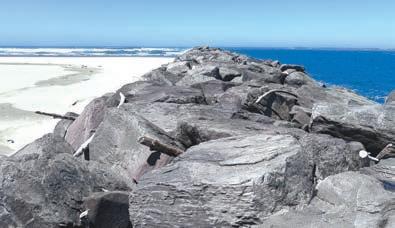
In addition to repairing the two sections of the jetty, the $52.7-million project will see the jetty’s head reestablished with a 40-foot width at the end. All areas around the worksite will also be restored to their pre-project state, including the removal of the one-mile section of road.
barge into the jetty in Coos Bay in under an hour.
Work will begin on a 600-foot section of the jetty near its root this year, before focus moves to an 800foot section near the head at the end of the jetty. Relatively smaller rocks will be used on the root section, while larger rocks, some weighing up to 40 tons, will be used near the head. The two sections are separated by a 3500-foot section of jetty on which crews will construct a temporary road for hauling the stones.
Leavitt said that the team had budgeted for work stoppages during the winter
Leavitt said that the team was doing what it could to minimize the impacts of the project on locals and to leave the community better than they found it. To that end, workers have performed maintenance and upgrades at the Tillamook Elks RV Campground, where they are staying.
Contractors are also monitoring a population of western snowy plovers that have a nesting site near the 10-acre staging area that was cleared near the end of the jetty. In addition to installing stakes to discourage the birds from taking up residence in the active construction area, workers are also driving around the
site daily to check for their presence.
Access to the work site is restricted to authorized personnel. Although there are no barriers to entry, the contractors said that so far, a public outreach campaign including signage at the Bayocean County Park parking area has kept most people from wandering through. They stressed that as the large stones start moving it will be critical that members of the public give the workers a wide berth in the bay and on the beach.
The United States Army Corps of Engineers is managing all aspects of the project and responsible for ensuring Trade West’s compliance with safety, quality, environmental, schedule and cost provisions in its contract. The project is being funded by the Infrastructure and Jobs Act of 2021 and aims to restore the jetty’s functionality to maintain the navigability of the entrance to Tillamook Bay.

To receive updates on the project and impacts to Bayocean County Park, email cenwp-construction@usace. army.mil.