











WILL CHAPPELL Citizen Editor
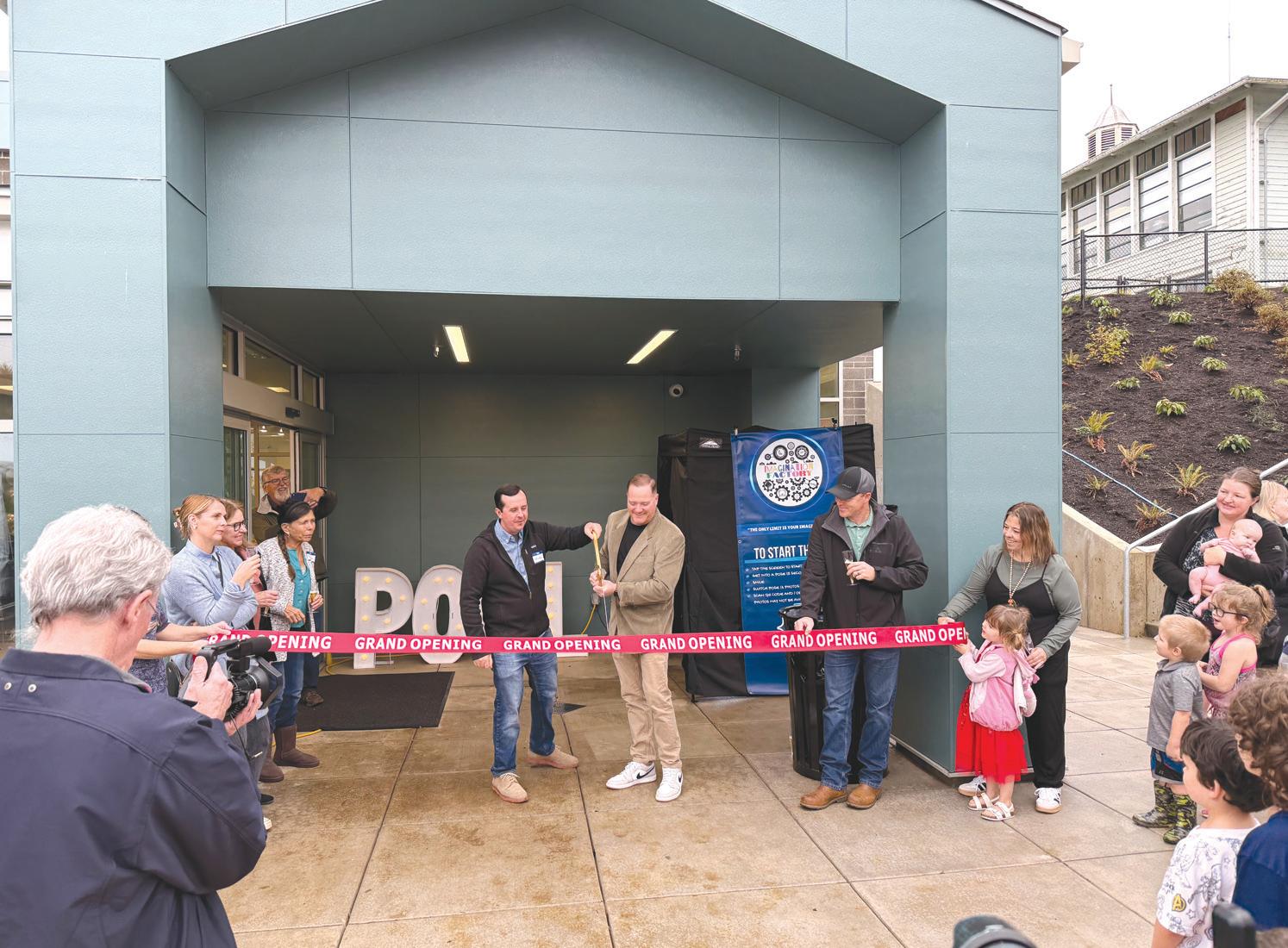
Members of the north county community gathered on November 15, for a ribbon-cutting ceremony for the new pools at the North County Recreation District in Nehalem.
At the ceremony, former North County Recreation District (NCRD) Executive Director Barbara McCann, Board Chair Michael House and current Executive Director Justin Smith all spoke, lauding the community’s support of the project that builds on nearly a century’s legacy of teaching children in the community to swim.
“This facility represents more than water and walls; it marks a new beginning for NCRD,” said Smith. “We honor nearly a century of memories from the old pool and step boldly into the future with this new, state-of-the-art one. So today, as we cut this ribbon, let’s celebrate not just the project being finished, but the future of what we’ve begun.”
McCann, a former board member who served as executive director for several years before Smith’s arrival earlier this year, spoke first at the ceremony, giving a history of the district and its mission to teach local youth to swim.
The community’s commitment to swimming education started in 1929, when, after the drowning deaths of two youth, community members asked the local school board to include a pool in the upcoming expansion of the Nehalem Elementary School. The school board agreed and built a pool in the basement of the new wing of the school.
“Even though it was the Great Depression, the community felt the pool was a necessity and not a luxury,” McCann explained. “They believed in our community, surrounded by water, every child should learn to swim as part of their basic education to prevent future drowning.”
For almost 60 years, the
pool remained an asset for the school district, until in the late 1980s, they consolidated their primary education efforts in the current Nehalem Elementary School building down the hill from the school with the pool. At that point, the Tillamook Board of County Commissioners stepped in to administer the pool, but their funding ran short in 1995, and local community members were informed they would need to find an alternate funding source by the end of June or see the pool shuttered. At that point, a group of locals, including McCann, came together to form the nonprofit Friends of the Nehalem Pool and raised funds to cover operating expense for two years to give them time to craft a long-term solution.
That solution was forming NCRD, for which the group sought voter approval with ballot measure 29 in November 1996, receiving 60% support from voters, allowing the district to begin operations on July 1, 1997.
McCann said that at first, district leaders planned to upgrade the existing pool to continue the swim education program in conjunction with the Neah-Kah-Nie School District, but that it became apparent over time that replacing the pool would be necessary. Progress towards the replacement began in earnest under Executive Director Peter Nunn, who led the district from 2008-2014, and hired pool architect Carl Sherwood to create a conceptual design for the new pool, which was unveiled in 2013. McCann said that the design did not generate community support at the time and Nunn decided to instead renovate the district’s auditorium to build more support.
After the completion of that project and with a new executive director, David Wiegan, leading the district, focus shifted to the pool project in 2016, with Wiegan kicking off a capital campaign to support the project and eventually advancing an $8.2-million bond
question to the ballot in 2020. That bond measure passed with nearly 60% community support, but the timing proved inopportune as the coronavirus pandemic exploded, causing massive inflation and pushing the estimated cost of the project from $12 million to $16 million.
At that point, McCann had taken over the executive directorship of the district and, along with the board, decided that the project would be broken into three phases to get construction started and prevent further cost escalations, while trusting that the balance of the funding would be found.
“We proceeded by faith,” McCann said, “if you build it, the money will come.”
See NCRD, Page A3
WILL CHAPPELL Citizen Editor
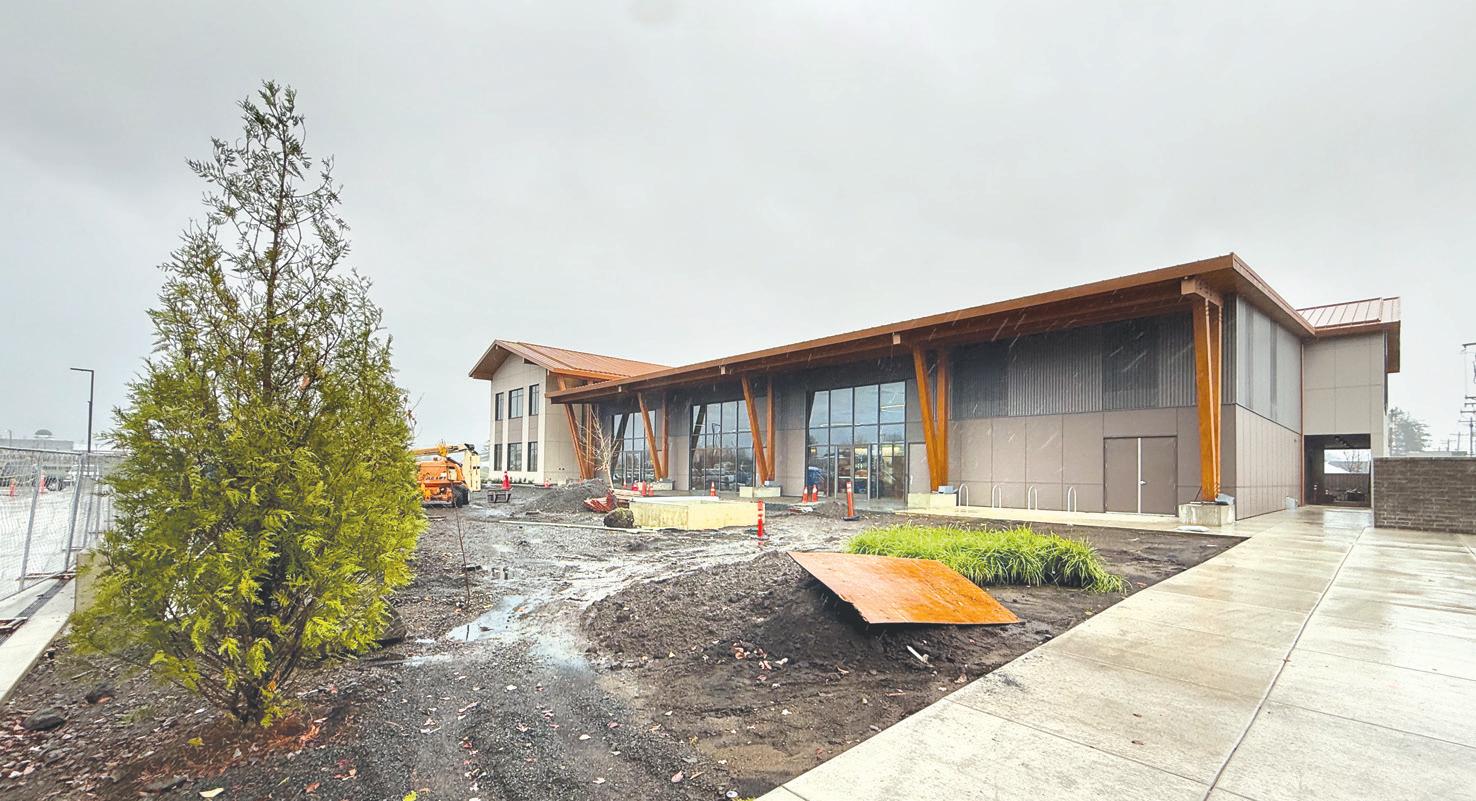
With less than a month remaining until substantial completion on December 8, the new Healthcare Education Building at Tillamook Bay Community College is rapidly nearing the finish line.
As equipment and technology go in and finishes begin to be installed, Tillamook Bay Community College (TBCC) President Paul Jarrell said that he is excited for the college to gain not only a beautiful new building, but a true campus feel.
“The way I think about it is the bond funding of this building, $14.4 million from the community and $8 million from the state in matching money, that allowed us to build this building,” Jarrell said. “But what it really allowed us to do was create a campus, because we’re investing in tying in these four (buildings), the community center together with the plaza, close proximity to the fairgrounds, to create a greater sense of community.” On a recent tour of the facility with the Headlight Herald, Jarrell took a moment to reflect on the history of the college as he gazed over the new plaza between the under-construction building and TBCC’s main classroom building.

Jarrell recounted that TBCC had been founded as a satellite campus for Clatsop Community College in the mid-1980s and operated as a satellite for that institution and later Portland Community College until 2014,
when the school gained independent accreditation. Originally housed in the old mortuary on First Street that now houses the Tillamook School District, TBCC moved into its current home at the corner of Third Street and Marolf Loop Road adjacent to the fairgrounds in 2010 after voters approved a bond to build the facility. Further expansions came with the construction of the Partners for Rural Innovation building in 2017, and 2020 purchase of the Center for Industrial Technology, both located across Third Street from
TBCC’s main building. Progress towards the healthcare education building began during a staff brainstorming session at the Tillamook County Creamery Association in 2018, which identified the need for a new building to continue expanding the college’s mission. With a new facilities master plan incorporating that feedback in hand by April 2020, TBCC’s board approached the state legislature
Sammy’s Place prepares to break ground on Thompson Springs
With millions of dollars raised, land use permission granted and permits for site work issued, Nehalem-based charity Sammy’s Place is set to begin construction on its Thompson Springs project as soon as weather allows. Sammy’s Place Board Member Kevin Shluka told the Headlight Herald that while fundraising will continue to help lower the cost of mortgages for future residents of the community, the team was eager to break ground on the project.
“We’re excited to tell you that we’re on the cusp of breaking ground,” Shluka said, “it’s been a long, difficult journey and we’re there, and we’re super excited about that.”
The journey towards building Thompson Springs began in 2019 when the Tillamook County government donated a piece of land on Thompson Lane in Nehalem to the nonprofit, which focuses on supporting those in the community with intellectual and developmental disabilities (IDD). After Oregon’s Department of Environmental Quality and the United States Environmental Protection Service donated staff time to remediate environmental concerns, planning began for a housing development on the site.

state matching funds and fully funding the project, with a $1.4-million bond premium also going towards the budget.
funding
further developed the plans, deciding that the building should be dedicated to healthcare education based on community feedback, and were awarded $8 million by the legislature in the summer of 2021. The final piece of the puzzle fell into place when Tillamook County voters approved a $14-million bond in May 2022, securing the
In anticipation of the new facility, TBCC began a nursing program in January 2024, with the first students graduating this summer.
Work on the new building began last June with a groundbreaking ceremony and has progressed on schedule for an early December substantial completion date.
Jarrell said that furniture will begin to be delivered in early December and that administrative staff will begin moving to a new office suite on the building’s second floor over Christmas break. Student-facing staff will remain
in their current location in the college’s main building, while the president, TBCC foundation, institutional research, human resources, marketing, business, facilities and information technology offices will be relocated.
Once administrative staff have moved in by early in the new year, they will focus on final preparations in the building before welcoming students in April for the spring term, with a ribbon-cutting ceremony also being planned for that month.
While the 28,000-squarefoot facility’s first floor will be split between labs for nursing students and emergency medical technicians (EMTs) and a large community room de-
signed for events, the second floor will feature classrooms for other disciplines in addition to a smaller community meeting room and the administrative offices.
“We want to make sure people don’t just feel like this is the Health Sciences and administration building, we want to have other fields of study have class over here,” said TBCC Foundation Executive Director Britta Lawrence.
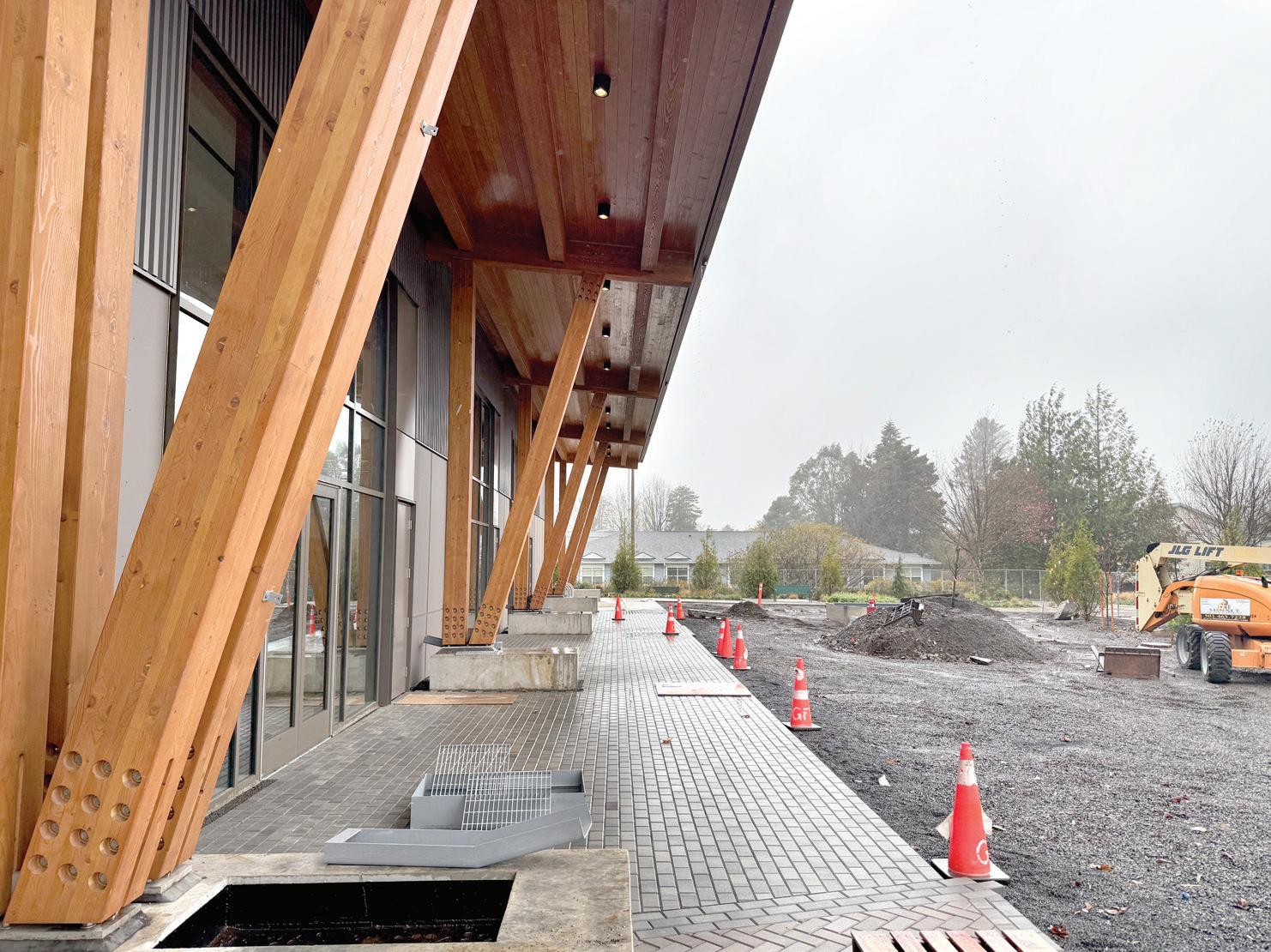
As of mid-November, bricks had been installed on the building’s exterior walkways, the building’s elevator was installed and its main staircase was in place. Information technology cables and advanced training equipment and technology were sched-
uled for installation in the downstairs labs in the coming weeks before final ceiling panels will be installed. When complete, the labs will feature state-of-the-art simulators, hospital beds, a light x-ray room and ambulance bay, in addition to teaching space.
The event center space will be capable of holding between 400 and 500 people in a stadium style seating arrangement, Jarrell estimated, while it will accommodate 250-300 at tables, depending on the configuration. The room can also be subdivided into three smaller rooms, two of which can be further divided, and anchors for large tents in the plaza off the event center will allow events to spill outside as
necessary. A catering kitchen also adjoins the room, with cold, heating and frozen storage and steam appliances for heating food.
Jarrell said that final work to complete the plaza might have to wait until the spring depending on the weather but said that he expects for it to also become a community asset capable of hosting a variety of events.
In addition to the larger facilities, Jarrell was also enthusiastic about the range of smaller quality of life improvements the building will provide, from a break room and multiple study spaces for students to a lactation room and gender-inclusive restroom design.
At a special virtual meeting on November 18, Oregon’s board of forestry discussed updated harvest projections provided by Oregon Department of Forestry staff after running new management models for Oregon’s state forests.
The new models, generated as part of the development of a forest management plan (FMP) that will govern forest management for ten years, projected that by departing from an even flow of timber, state forests could see between 205 and 230 million board feet (mmbf) of annual harvest.
The projections represented a significant increase from the 165 to 182.5 mmbf of harvest projected when the board controversially finalized a habitat conservation plan (HCP) for western Oregon state forests last March.
The meeting began with public comment with representatives from the Association of Oregon Loggers, Stimson Lumber and several local residents speaking in favor of adopting the newly projected harvest


figures as performance estimates, as the board was scheduled to consider. Meanwhile, representatives from environmental groups, including the Wild Salmon Center and the Seven Capes Bird Alliance, argued that the choice needed to be delayed and that setting performance measures related to specific harvest levels was illegal.
Tillamook County Commissioner Erin Skaar, speaking on behalf of the Forest Trust Land Advisory Committee (FTLAC), made






up of representatives from the counties that receive state forest revenues, said that the updated projections were welcome after discussions with the governor’s office about ways to replace lost revenues have gone nowhere. Skaar said that given the fact that 55% of state forests were already managed for conservation of threatened and endangered species, FTLAC members believed instituting additional constraints, such as requiring an even flow was unnecessary, and asked there be no cap on allowable harvest levels.
Mike Wilson, the Oregon Department of Forestry’s (ODF) State Forests Division Chief, then spoke about how the updated

after a June meeting with the board and FTLAC, staff had integrated county feedback that having an even flow of timber over the 70year course of the HCP was not a priority and that they would prefer to have higher harvest levels in coming years to better prepare for later decreases.
Smith and two other ODF staffers then discussed the details of three different scenarios presented to the board, with projected harvest levels between 205 and 230 mmbf. Wilson said that all the models met the conditions placed on
concluded by saying that staff would bring the board updated projections before they make a final decision on the FMP next June.
After the staff presentation, Board Chair Jim Kelly kicked off discussion among the board, saying that he wanted guidance from the Oregon Department of Justice on the legality of setting performance targets related to specific harvest levels.
Board Member Liz Agpaoa said that she wanted to hear more input from foresters about the alternatives and that the higher projected harvests were welcome as counties and ODF’s state forest division,





which relies on revenues from state forest timber harvests, face a budget crunch.
Board Member Heath Curtiss said that he was concerned about the difference between the projected figures and how much timber would eventually be harvested but said that he favored the scenario with 230 mmbf of projected harvest.
Board Member Ben Deumling said that he had no strong feelings about the difference between the scenarios but that he would like to have more clarity on how the increase impacted
was happy to see departures from even flow on the table.
Board Member Brenda McComb said that she felt she did not have enough information to decide on harvest volumes, requesting more information on the impacts increased harvests would have on other performance measures and voicing concern about the legality of the move.

Finally, Board Member Joe Justice said that all the alternatives presented at the meeting were a big win for the department and counties and that he agreed with arguments for a departure from even flow. Kelly said that he felt the strategy would give counties and the department a good opportunity to transition from the status quo to a scenario with well-managed forests, and that he believed there would be widespread support for that.
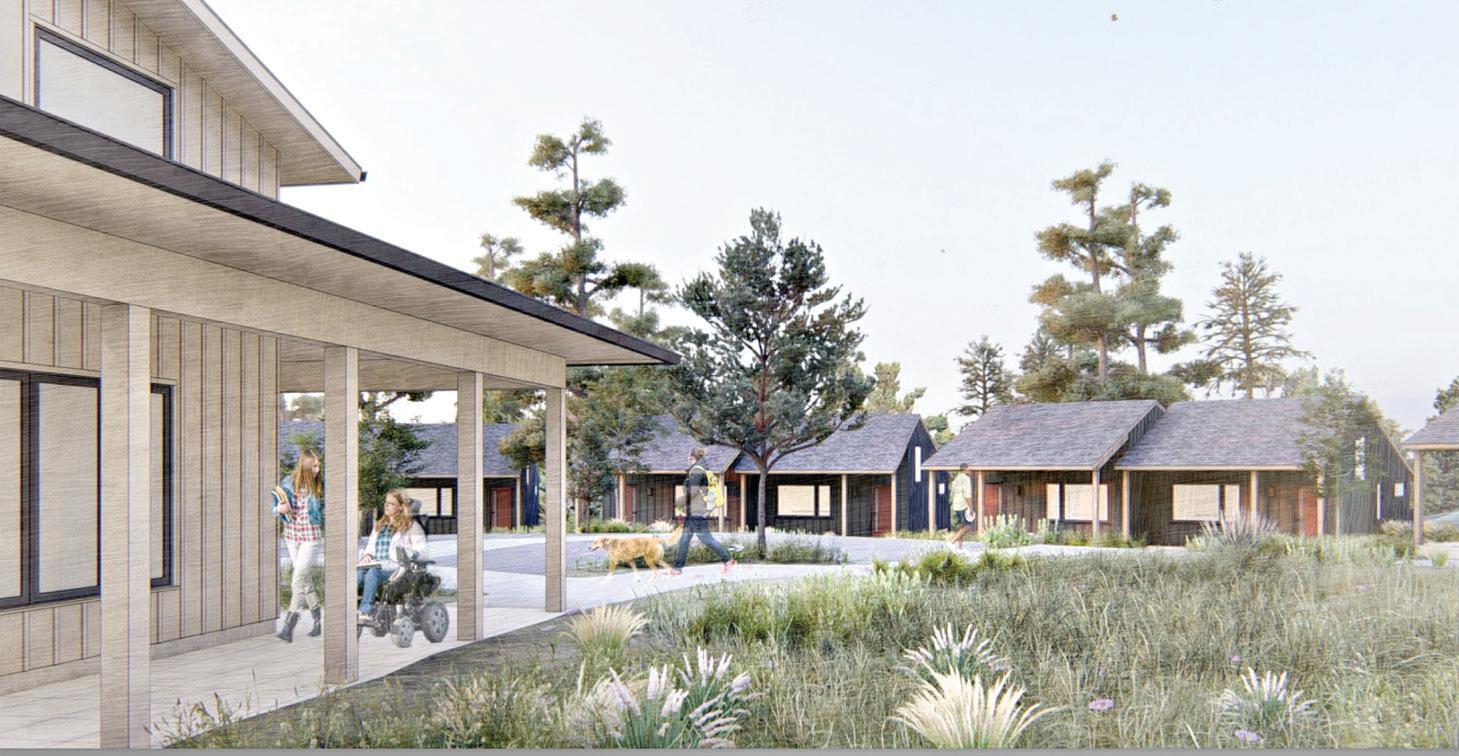
What emerged was a plan to construct six onebedroom and four twobedroom homes that will be available for purchase at affordable levels, with five units designated for people with IDD. Eight of the units will be affordable to people making 80% of the area’s median income or less, while the final two units will be affordable to those making 120% of that figure or less.
Fundraising in support of the project began this year and has progressed successfully, with almost $4 million already raised, with Oregon Housing and Community Services granting $1.8 million, the Fairview Trust $1.2 million and the KUNI foundation $840,000.
With those funds secured and initial permitting complete, Sammy’s Place’s leadership and the project team decided to start construction while working to raise more money. “It’s a little bit of a complicated step-by-step process, but we are excited
From Page A1
And it did.
Donors large and small across the community supported the project, which broke ground in 2023, with Adventist Health Tillamook donating $500,000 in support of the facility’s therapy pool in June 2024, and the Tillamook Board of County Commissioners rounding out the needed funding with the award of $1.7 million in transient lodging tax funds to the project in December 2024. After recounting the history behind the pool, McCann handed the microphone over
that we finally get to start really moving forward on that process,” Shluka said. “However, we still need to raise some money.”
Thompson Springs is being constructed as a planned unit development, which will allow each of the ten dwellings to be individually sold to residents and requires the completion of site preparation work and platting before final construction approval. Shluka said that crews from Cove Built LLC will begin working on site improvements as soon as weather allows and aim to complete the work by early next summer, allowing construction to go vertical, after which he said it will take about 14 months to complete. While construction progresses, Sammy’s Place will continue raising funds to help lower the cost of purchase for future residents of the homes.
Currently, the one-bedroom homes are projected to cost between $88,000 and $160,000, while the two-bedroom homes will cost between $110,000 and $220,000.
Those prices are already significantly lower than other homes in the area, but Sammy’s Place Executive Director Julie Chick said
to House, who spoke briefly, thanking the community for its support of the project.
“Thank you to all of our patrons and taxpayers that voted to help fund this project and our district in general, and thank you to our many, many donors both large and small, every dollar counts,” House said. “The generosity and support of this community never ceases to amaze me.”
Finally, Smith addressed the crowd, detailing the support that had made the project possible, which totaled 591 donations. Smith said that 153 families had donated a total of $1.7 million, individuals had bought 404 commemorative bricks raising $80,000, 20 foundations and charities had given $2.78
that community members with IDD have restricted incomes and would struggle to afford a mortgage for a home at those prices.
Chick said that most adults with IDD rely on social security payments of $967 a month to cover all their expenses, and that even for those who work, like her son, income is usually limited to a couple hundred dollars a month, making further reducing the cost of the homes critical. To that end, Sammy’s Place is planning to begin
a capital campaign around Giving Tuesday so that private individuals can increase the project’s affordability.
“The whole purpose of this project is to give people in our region an opportunity they have never been afforded before, literally” Chick said.
Chick also explained that donations to help defray the cost of home ownership would have lasting impacts and effectively stay with the home as a silent, second mortgage,
helping to lower costs for all future residents, not just the first homeowner.
Work on the first phase of the project will include connecting a dead-end water transmission line in the area to the nearby mainline, completing a circuit, as well as grading at the site.
A third of Thompson Lane will also be paved during the project and Shluka said that they plan to have a formal groundbreaking ceremony sometime in the spring.
Shluka also shared that

the $16-million budget. “As you can imagine, with 591 donations, (district
WILL CHAPPELL
Citizen Editor
Amid a statewide budget crunch with departments asked to present options to cut 2.5% and 5% of their expenses, representatives from the Oregon Youth Authority and Oregon Department of Corrections shared lists of potential cost saving measures that included the closure of three Tillamook County facilities.
Oregon Youth Authority (OYA) Director Mike Tessean said that if the department cut its budget by 5% both the Tillamook Youth Correctional Facility and Camp Tillamook, collocated at the Port of Tillamook Bay, Oregon Department of Correction (ODC) Director Mike Reese said the South Fork Prison Camp would be on the chopping block should his agency need to cut their budget.
Tessean and Reese testified along with five other agency heads before the joint interim committee on ways and means’ subcommittee on public safety on November 17, as part of the Oregon legislature’s legislative days. Heading into the week, August’s revenue forecast from the state’s office of economic analysis predicted there would be a shortfall of $372.7 million for the state government.
That prompted lawmakers to ask department heads across the government to create proposals for cutting 5% of their departments’ budgets, which in total would reduce the state’s budget by $276.6 million.
At the hearing, Representative Paul Evans, subcommittee co-chair, began by saying that the legislature’s job over the next two years was to determine how to make cuts to the state’s budgets while still meeting the needs of Oregonians, which he said would be a delicate process. He then welcomed the heads of OYA, ODC, the Oregon Judicial Department, Public Defense Commission, State Police, Department of Justice and Criminal Justice Commission to testify for ten minutes.
When invited to testify, Tessean detailed OYA’s portfolio, which includes five correctional facilities and four transitional camps that provide an intermediate step between incarceration and freedom for youth to learn how to work a job and other life skills.
Tessean said that after struggling for years with maintaining consistent staffing levels, OYA has made lots of progress recently on recruiting and retaining staff, which he said has a positive impact on youth in custody who benefit from strong relationships with adults.
As part of the budgeting reduction exercise, Tessean said that he and his team had looked at ways to increase the agency’s efficiency and decrease bottlenecks, but that the needed reductions could not be accomplished without cutting positions.
Tessean said that OYA’s correctional facilities are essential to the authority’s mission, while the camps are not, and that given the size of the needed budget reduction, staff had identified their Tillamook campus, which houses both a camp and correctional facility, and Camp Florence as the most appropriate options. Camp Tillamook employs 18 staff, while the Tillamook Correctional facility has 47, and the facility is in the design phase of an update, the cancellation of which would return significant savings.
While Tessean said that closing the three facilities would be necessary to meet the 5% reduction goal, he stressed that it was not a step that should be taken lightly. Tessean explained that reducing intermediary steps available to youth by closing camps would reduce the department’s options to slow releases and mean keeping youth in higher expense facilities for longer, or risking releasing them too soon and increasing the burden on law enforcement agencies across the state.
Tessean also cautioned that the overall decrease in beds would lead to an increase in
crowding at other facilities, including the MacLaren Youth Correctional Facility that holds around half of the authority’s roughly 375 detained youth, decreasing youth safety and increasing the risk of staff burnout and turnover.
Reese described a similar situation at the DOC, where delaying hiring, reducing contract positions, especially nurses and doctors and delaying maintenance and capital improvement projects, would have a significant impact, but not meet the requested 5% figure.
To do so would require the closure of the South Fork Forest Camp, located in the Tillamook State Forest and the Oregon State Correctional Institution. South Fork Forest Camp has 125 adults in custody and is run jointly by around 50 staff from DOC and Oregon Department of Forestry, with adults in custody training and working as wildland firefighters. Representatives from the other departments shared similarly grim outlooks for their offerings should 5% cuts be necessary.
The Oregon Judicial Department, unable to decrease the pay of judges, would be forced to reduce funding for passthrough services to counties including mediation, legal aid and law libraries, and close courthouses for up to 26 days a year, representatives said.
Also potentially impacting Tillamook County, such a budget reduction would necessitate the suspension of the department’s program providing matching funds for courthouse updates, which has been mentioned as a potential source of funding as county leaders look to upgrade the aging courthouse.
For state police, a 5% budget reduction would require cutting 57 positions and the closure of forensics labs in Bend and Pendleton, as well as a reduction in the number of medical examiners, according to Superintendent Casey Codding.

both Owen Gabbard LLC and Jones Architecture were working at reduced rates to help with the project and said that everybody working on the project was committed to getting residents in the homes promptly.
“We just want to get these homes built and people inside them,” Shluka said.
“That’s when returns really start to happen and so any path forward that we can forge ahead as soon as possible is the path we’re going to take.”
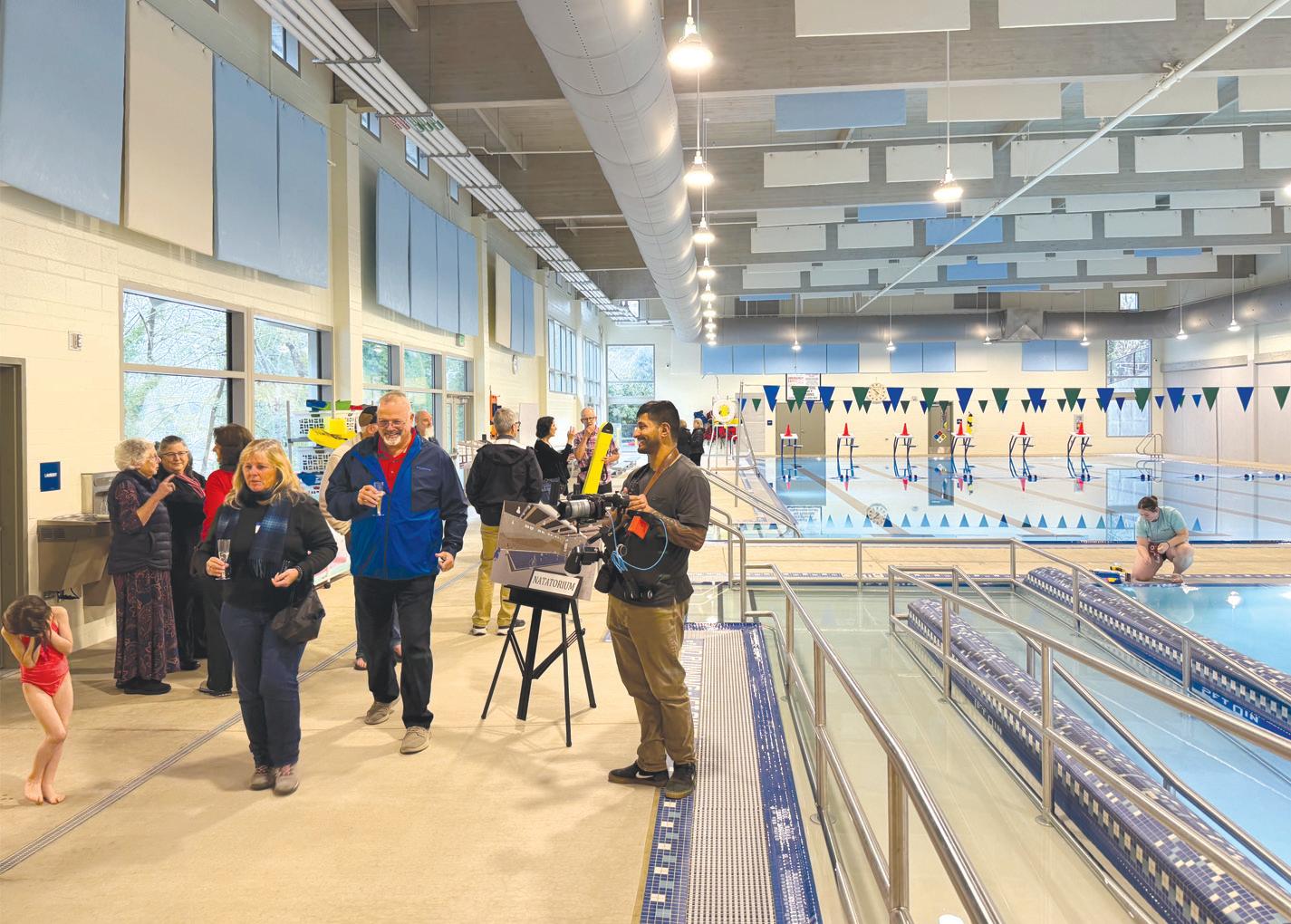
staffer) Kylie would always make the joke this building was built five dollars at a time, and honestly, it couldn’t be more true,” Smith said. “As a result, we have a 15,000-square-foot aquatic center, with a 145,000-gallon lap pool, a 30,000-gallon therapy pool and an outdoor patio to be enjoyed next summer.”
Smith then invited event attendees to grab a flute of sparkling apple cider from the building’s foyer, and the crowd toasted the new facility before Smith and House cut the ribbon to open the facility, which has been open to swimmers since September. Tours were then offered, as well as games for kids, a photo booth and snacks, before a free, open swim.






WILL CHAPPELL
CITIZEN EDITOR
Tillamook Early Learn -
ing Center and Tillamook
Head Start students were treated to a special Friendsgiving event on November 12, with Food Roots helping teach the students to prepare three dishes before they sampled them.
The event included food from local producers and gave students an opportunity to learn about food preparation and locally sourced, healthy food options.
At the event, Food Roots
Executive Director Lindsay Ward, Tillamook Head Start Center Manager Hallie Edgmon and Tillamook
Early Learning Center (TELC) Executive Director Vanessa Cham led students
through the activities. Cham first read students a book to prepare them for the food preparation process, before they washed their hands and got down to business in the school’s cafeteria.
Students were split into two groups, with a classroom from TELC and Head Start being paired to form each. In the cafeteria, students were split into three groups to rotate through stations to prepare the elements of their meal. At the first station, kids were asked to strip kale and spinach from their stems and rip them into bite sized pieces. At the second, Ward showed kids how to combine berry jam with vinegar and olive oil to create a vinaigrette dressing. And at the third,
students were asked to mash cooked squashes.
Several grants, including one from the Kiwanis Club of Tillamook, made the event possible and students’ parents were also invited to participate. The greens and squash for the event came from Fawcett Creek Farms and Josi Farms, both of Tillamook, while the berry jam for the salad dressing was provided by Gingifer’s Kitchen out of Otis.
After preparing the food, the kids enjoyed the fruits of their labor and at the end of the day were sent home with a bag full of supplies and an instruction sheet so they could repeat the activity at home.
After completing their dishes, students were able to sample.



WILL CHAPPELL
CITIZEN EDITOR
Members of the Tillamook Pickleball Club gathered at the Tillamook County Fairgrounds’ tennis courts on November 12, to celebrate the installation of new lighting at the facility, which they use daily. At the celebration, Tillamook Pickleball Club President Roger Miller, Tillamook County Fairgrounds Manager Camy Von Seggern and Tillamook County Commissioner Paul Fournier gave short remarks and cut a ribbon to celebrate the project’s completion.
“This is exactly what we should be spending transient lodging tax money on, in my opinion,” said Fournier. “It’s something that benefits visitors, but also locals.”
The need for the project became apparent in recent years as pickleball fever
swept the county and the fluorescent lighting in the fairgrounds’ tennis courts showed its age and inadequacy, with dark spots and poor illumination.
Earlier this year, the club applied for a transient lodging tax (TLT) facilities grant through Tillamook Coast Visitors
Association, but when commissioners were asked to approve the grant, they instead elected to use a different pot of TLT money to pay for the project, since the fairgrounds belongs to the county.
Commissioners allocated $45,900 to the project in June, with the Pickleball
Club chipping in several thousand more in proceeds from their first annual Cowbell Classic tournament in June. The new lights feature blue light and eliminate dark spots on the facility’s four courts, creating ideal conditions for the club’s 70 members to play.
WILL CHAPPELL
CITIZEN EDITOR
Manzanita’s city council unanimously adopted a vision statement on November 5, as part of the ongoing process to update the city’s comprehensive plan. The vision statement was developed by a citizen committee and lays out a vision for where the city will be in 20 years, with an emphasis on fostering an inclusive community with transparent and active collaboration.
Linda Kuestner, chair of the Comprehensive Plan Advisory Steering Committee, which helped develop the vision statement, spoke about the process that led to its creation. Kuestner said that work on the statement dated to 2022, when the Envision Manzanita process began to gather public feedback for the comprehensive plan update. That initial work was
completed in 2023 and the information generated saved. The six-person committee then went through a series of interviews with interested stakeholders in the community before creating a draft statement. That statement was presented to the public, who were given an opportunity to provide feedback through a survey that received more than 160 responses, which were then incorporated in the statement.
Mark Adamcin from the committee then shared the introduction to the vision statement, which read: “By 2045, Manzanita has strong community support. Manzanita fosters a vibrant, inclusive community where every voice can be heard through transparent and active collaboration. We aim to create a city where individuals of all backgrounds, identities and perspectives can contrib-
ute to shaping the future. We are committed to cultivating community involvement by ensuring that civic activities are accessible, equitable and driven by mutual respect and shared progress to build a more connected and welcoming community.”
Adamcin then discussed other elements of the extended statement, which included commitments to creating diverse housing types, preserving the natural environment and fostering flourishing local business while maintaining a smalltown feel.
After the presentation, council voted to approve the statement, which will be used to guide forthcoming work to update Manzanita’s comprehensive plan.
Council also unanimously passed a resolution affirming that the design for the Classic Street project, which due to physical constraints
will see the road limited to a width of 20 feet in places, was legal under the city’s ordinances. Concerns about the street’s width had arisen among community members given the city ordinance’s recommendation that streets be built to a minimum width of 22 feet.
However, City Manager Leila Aman clarified that the code read that streets “should” be built to that width, rather than outright requiring it, and explained that due to geotechnical concerns and budgetary constraints, it was not feasible for the entirety of Classic Street to be that wide.
Manzanita Public Works Director Rick Rempfer also gave a presentation on the capital improvement projects his department has accomplished since he took over the role a year ago. In that time, the city’s well site has been upgraded with a new
metering system that manages chlorine levels in the system, a new security system and a Starlink receiver to increase connectivity, a new generator was added to the city’s reservoir, play structures at the city park were overhauled with new structures also added, and a major renovation to the public works building is nearing completion.
Finally, council approved a change in salary schedules to allow Nina Crist to become the city’s finance director. Aman explained that she had been preparing Crist to assume the role and that doing so would allow her to
take a more active role in the budgeting and policy-making processes, reducing Aman’s workload in those arenas.
Aman said that the city would also begin recruitment for a finance and administrative assistant, who will support Crist in her new role and learn the duties of the city’s utility clerk so that they can cover the position as needed.



BY CHELSEA YARNELL Guest Contributor
Before the space fills with diners, Bay City Kitchen owners Kathy High and Derek McCarthy are each focused on their own domain. McCarthy switches back and forth between tending to a sauce on the stovetop and chopping ingredients.
High’s mixer is buzzing away in her bakery space. One egg, two egg. The mixer’s contents get creamier.
The finals results will be plates of food and pastries so popular that they sell out on a regular basis.
“At the end of the day, we’re just having fun with food and having people enjoy what we’re doing,” McCarthy said.
The two owners opened
Bay City Kitchen on July 20, 2023, right off Hwy 101 in Bay City. The restaurant’s menu features offerings from Chef McCarthy and baked goods from Chef High that utilize seasonal, local ingredients. Their menu consists of lunch and dinner items that are ever-changing, adapting to what’s available and what guests are craving.
“We’ve made some great connections with the local food producers like the farmers that we work with,” Derek said. “We communicate with them about what’s coming up and what’s ready for the season. It’s all based on seasonal ingredients and putting flavors together. That’s the whole concept and idea.”
With decades of restaurant experience between them, the pair draws inspiration for
dishes from their experience and the environment around them. Like duck leg confit or wok fried shishito peppers. And in the bakery case: chocolate moelleux and huckleberry financiers.
“Once you’ve been doing it for a long time, you have an understanding of how to balance ingredients and flavor profiles. The world of possibilities really opens up to you,” McCarthy said. “I’ve been fortunate enough to learn from a lot of amazing chefs and worked with some amazing people. I have taken a lot of notes, written a lot of recipes, and I’m still excited about creating more things. We have the biggest cooking library on the coast I would bet. We eat, sleep and breathe food.”
Four days a week, customers can peruse the menu
ordering anything from classical mac & cheese to house-smoked fish toast. And one day a week, the focus is heavily placed on coming together. Sunday Supper at Bay City Kitchen is a weekly three course prix fixe menu that has turned into a popular community gathering time.
“In part, it’s because of the way we’ve structured the meal because no one is worrying about spending 20 minutes looking at a piece of paper deciding what to order,” McCarthy said. “Instead, you’re turning to your neighbor and asking, ‘How’s your week been?’ It’s been delightful in really unexpected ways. To see how we have been able to become a place that for so many people in ways that are really meaningful for us as well.
We’ve invested in the people as much as they are invested in us.”
Even if you don’t have time to sit and stay for a meal, Bay City Kitchen’s grab-andgo freezer is stocked with healthy, hearty meals.
“We’ve always maintained that we want to make it easy for people to eat well,” High said. “It has been so well received by the people who see it.”
Whether you stop in for a meal, or need it to-go, Bay City Kitchen has a meal prepared with the guest in mind.
“There is something magical about this space in general,” High said. “It seems like we have a lot of people who just sort of show up at the right time for us. We would not exist without local support plain and simple. And every time we see new
faces we’re excited about it.”
“We’re just two people cooking good food and trying to feed the people,” McCarthy said. “We just want to support our little happy world and make others happy; that’s all we want to do.” This series is provided by the Economic Development Council of Tillamook County to highlight thriving businesses in Tillamook County. The EDCTC works to strengthen and grow the economy of Tillamook County by working together with public and private partners. The EDCTC works to attract new business, grow and retain existing businesses while supporting entrepreneurship and innovation. For more information, or to reach out to the EDCTC, visit edctc.com.
WILL CHAPPELL
CITIZEN EDITOR
Bay City City Council and the board of the Tillamook Fire District both approved and supported a petition to seek voter approval to join the district and Bay City’s fire department in a new fire district on November 18. The proposed district, to be known as the Tillamook Bay Fire & Rescue Rural Fire Protection District, would help to alleviate longtime budget concerns at the Tillamook district by allowing the institution of a new taxation rate and help Bay City save on administrative costs and take advantage of efficiencies presented by
combining resources with the larger entity. Voter approval for the new district will be sought in next May’s primary election with a proposed permanent tax rate of $1.49 per $1,000 of assessed property value.
Bay City City Manager David McCall detailed the proposal at Bay City’s city council meeting, saying that in August, council and the fire district’s board had approved the formation of a steering committee to begin working on documents related to the proposal. That committee consisted of members of both governing bodies, members of the public and other stakeholders, had 15 members and

met every other Thursday since being formed to work through a list of necessary documents prepared by Bay City Fire Chief Alan Christensen, who is also serving as the Tillamook District’s acting operations chief. The committee finished its work earlier this month, allowing the resolutions in support of the ballot measure to come before the council and board.
McCall explained that the electoral process would consist of two different votes, with the first being a question to voters in the Tillamook Fire District seeking to dissolve the district. If approved, the second question will seek approval from those voters as well as those
in Bay City to form the new district.
The proposed $1.49 per thousand dollars of assessed property value tax rate would match the existing rate paid by Bay City residents for their department, while representing a significant increase from the Tillamook Fire District’s current rate of 69 cents per thousand dollars of assessed value. That taxation rate has been the same since 1993, causing significant budgetary issues for the district, and attempts to gain voter support for levies to supplement it have failed, most recently in May 2024.
If approved, the new district would begin operations on July 1, 2026, with
a new, five-person board of directors selected on the May ballot.
McCall told city council that before approving the petition they needed to decide how they wished to proceed with the department’s current location in city hall should they move forward. McCall said that the building could either be subdivided into separate tax lots for the city hall, fire district and library, a process that would cost between $10,000 and $14,000, or the council could agree to a long-term lease with the new district.
Councilors quickly agreed that a lease was the better option and approved moving forward with a 50-year lease for $1 annually, should the district be approved. Christensen then spoke, saying that he had been mulling the idea since last fall before kicking into high gear this July to get the steering committee convened and work done. He lauded committee members’ hard work, saying that hundreds of hours had gone into the paperwork to expedite a process that usually took two years, according to staff at the Special Districts Association of Oregon.
Christensen said that the Tillamook Fire District was not viable in its current form and that he believed the move would be mutually beneficial to both entities.