NeCarney bridge work on track for mid-October completion
WILL CHAPPELL Citizen Editor
Following a 37-hour closure September 21 and 22, Oregon Department of Transportation crews plan to complete a new sidewalk and guardrail sometime in the next two weeks. During the closure, a crane was used to remove the old guardrail and sidewalk and a department official said that another closure is not expected.
Manzanita water billing detailed ahead of referendum
Manzanita City Manager Leila Aman gave a presentation on the city’s water utility system at a city council work session on September 11, ahead of a November referendum on the frequency of billing.
Aman discussed the history of rates and billing cycles in the city and said that moving to quarterly billing would necessitate a higher base rate than the current monthly cycle.
Aman picked up the history in 2008 when city council adopted a base rate of $34.50 for 6,000 gallons for residential customers. Following that update, rates in the city stayed flat for the next seven years, until the council raised the rate by $5 and cut customers’ allowance to 4,000 gallons in 2015. The change was made following a rate study, although it was a smaller increase than recommended.
In 2021, the city contracted an update to its water master plan and in July 2023, the council used those data to again revise the base rate and allowance, providing customers with 2,000 gallons for $47.56 a month. The council also voted to change the city’s billing frequency to monthly from its previous quarterly period, with the change taking effect last October.
The bridge was originally damaged sometime on August 30, with a passing motorist reporting damage to the 1937 structure’s concrete sidewalk and guardrail in the afternoon. This triggered a temporary closure of the bridge until inspections showed that it could handle one lane of traffic, allowing Oregon Department of Transportation (ODOT) officials to reopen one lane of traffic with a flagger that evening. The September closure allowed crews to remove the damaged concrete sidewalk as well as a section of tubular guardrail that had been installed in 2008 and been damaged in the same incident that caused the sidewalk damage.
See BRIDGE, Page A5
Garibaldi council eyes acquisition of Coast Guard buildings
WILL CHAPPELL Citizen Editor
Garibaldi’s city council approved a letter of intent to acquire a disused station house and officer’s quarters in the city from the United States Coast Guard at their September 16 meeting. While nonbinding, the letter marks a step toward the city taking control of the building that the Coast Guard plans to declare surplus. The two buildings stand above Highway 101 at the West End of Acacia Avenue on Coast Guard property. The station house was the second housing built for members of the guard in the county, opening in 1943, and replacing the original station in Barview, which had opened in 1907. Located directly across Highway 101 from the guard’s historic boathouse, the location was active until the current station opened in 1981. Garibaldi City Manager Jake Boone said that the Coast Guard had contacted the city about the possibility of taking control of the buildings and that he and Mayor Katie Findling and members of the fire department had done a walkthrough of the property recently. That walkthrough revealed that the building appeared to be in good shape
and asbestos had apparently been remediated, though aesthetically there were many issues. Boone said that the facility could serve as a replacement for Garibaldi’s city hall, with staff having outgrown the current space shared with the fire department and library. The station house is currently laid out with a lot of bedrooms that Boone said could be converted to offices and there would probably be excess space on the
letter of intent will serve as notice to the Coast Guard that the city is serious
Earlier this year, city staff recognized a problem with the ordinance regulating the billing frequency, according to Aman, and sought and received council approval to correct the error in early April.
The update triggered a 90-day period for citizens to demand a referendum on the ordinance and on April 8, Randy Kugler filed a petition for the referendum, sending the decision to voters in November.
Aman said that with the possible reversion to quarterly billing on the table, a new rate study had been necessary to determine the impacts of the proposed change.
The study found that using quarterly billing would decrease the number of rate payers that went over base allowances for water used, as overages in any given month would be offset by lower use in the others.
The study found that covering the difference in lost overage charges would require a quarterly base rate of $150, versus $142.68 per quarter with a monthly billing cycle.
Public safety committee briefed on deflection programs
Tillamook County’s Local Public Safety Coordinating Committee met on September 16, with a professor giving a presentation about the state’s new deflection program system for individuals in possession of hard drugs.
Counties across the state has either already established or, like Tillamook County, is in the process of establishing their own deflection program to steer those with substance use disorders into treatment rather than the criminal justice system, after hard drugs’ recriminalization, which took effect September 1.
Dan Hoover, a member of the addiction medicine faculty at Oregon Health Sciences University (OHSU), discussed the program’s underlying philosophy and the practical implementation methods that other counties across the state are employing.
Hoover began by discussing the difference between deflection programs and diversion programs that have existed for the past several decades.
In diversion programs, people contacted by law enforcement are arrested or booked before being diverted to a specialty program, like drug court, that diverts them away from jail.
Deflection, on the other hand, aims to entirely forego contact with the criminal justice system by having law enforcement officers refer people in possession of hard drugs to treatment programs rather than arrest them. Hoover stressed that deflection was a community-based approach that would rely on law enforcement working with public health
Tillamook County hosts emergency preparedness summit
help network among the various groups and establish communications and plans for emergency situations.
Tillamook County Commissioner Mary Faith Bell welcomed the attendees in the morning and said that groups across the county had begun to work on building a network to respond to disasters before covid and that it was time to get back to it after being waylaid by the pandemic. Bell said that the county needed to build a collective foundation of emergency preparedness, foster relationships among the agencies responsible for responding to emergencies, help those groups understand their roles and identify gaps in preparedness. After doing this, the information gleaned could be used to develop a
for future improvements and the group would strat
egize on communicating
the
ager for the City of Eugene then Lane County before taking her current role at the state. In her time in Eugene and Lane County, Winningham had faced flooding, snowstorms, wildfires and finally, the coronavirus pandemic. Winningham said that in her various positions she had learned the importance of establishing plans for emergencies on blue sky days so that responders weren’t left scrambling in emergent situations.
After Winningham spoke, groups from around Tillamook County gave presentations on their operations.
Presenters included Tillamook County Emergency Manager Randy Thorpe, Tillamook County Community Health, Oregon Emergency Management’s Northwest Region Coordinator Tom Jenkins and volunteers from the Emergency Volunteer Corps of Nehalem Bay, South Tillamook County Emergency Volunteer Corps and the newly established Garibaldi Emergency Volunteers.
Following the presentations and lunch, attendees broke into smaller groups to discuss roles and communications in emergencies.
Budget work group discusses possible funding fixes
WILL CHAPPELL
CITIZEN EDITOR
In their third monthly meeting on September 11, members of the Tillamook County budget work group began to flesh out ideas to cover the county’s budget shortfall in coming years.
A possible hiring freeze emerged as a possible solution to this year’s $400,000-plus gap while the group identified a handful of other proposals
to explore further going forward.
Tillamook County Commissioner Doug Olson led the meeting and kicked things off by asking the assembled county department heads if they had identified any non-mandated services that their departments were providing.
Sheriff Josh Brown said that operating a patrol fleet on county roads was not mandated by state or federal law but noted that
he did not think that cutting the service would be prudent or popular with county residents.
Tillamook County Clerk
Christy Nyseth volunteered that her office could stop processing passport applications but said that the program was popular with county residents and mostly covered its own costs.
Olson then moved the discussion on to a list of potential revenue-generat -
ing and cost-cutting ideas that smaller groups had investigated and discussed in the previous month. He first reviewed the budgetary situation, saying that the group needed to find about $400,000 this fiscal year, $3.1 million next year and $4 and $6 million the following two years.
Cost Cutting
The first group to present had reviewed possible changes to labor costs and Tillamook County Human Resources Director Jodi Wilson discussed those ideas.
Wilson said that cutting employees’ work week to four days would save the county around $2.2 million annually, while reducing workdays to seven hours would generate a $1.3-million savings and cutting them to six would yield $6.2 million. However, Wilson cautioned that the group had agreed that taking any of these steps should be a last resort for the county, as they would come at the direct expense of its employees.
A more palatable option the group discussed was a temporary freeze on filling new positions.
Foster estimated that given average recruitment times the county was likely to save around $411,000 this year on salaries for positions that are currently unfilled and noted that this figure would cover the projected budget shortfall.
This possibility had the added benefit of dovetailing with the natural recruitment and hiring process, which Foster said took around three months on average for county employees and closer to six months for sheriff’s deputies given extra screening requirements.
Foster said that the group had also discussed the possibility of a more formal hiring freeze and said that leaving the currently vacant positions open for six months would generate more than $900,000 in savings. However, Foster said this approach would require leaving some departments short-staffed and deciding which positions to freeze would be difficult.
Other possibilities discussed by the group included restructuring employees’ benefits, which Foster said was a top priority, and restricting or restructuring employee travel, which Foster said was a lower priority as the county wanted to support its staff.
Short-term Revenue
Discussion then moved on to the group that had discussed possible means of boosting revenue that could be achieved by county action alone.
Tillamook County Chief of Staff Rachel Hagerty spoke on behalf of this group and started by mentioning the ongoing plans to seek an increase to the county’s transient lodging tax next year. The tax levied on overnight lodging stays is currently 10% and county leaders plan to ask voters to increase it to 15% in May 2025, which would generate an additional $1 million in revenue annually.
Preliminary plans call for those funds to go to the sheriff’s office and Brown said that he hoped that if the increase were approved the funds would supplement his current budget, not be used to replace its current funding sources.
Another possibility for monetizing visitors to the county that the group discussed was increasing fees in county parks. Hagerty said that this could be done with a board of commissioners’ order and that the group had mostly discussed overnight camping fees and had also begun investigating the possibility of different fees for out-of-county residents.
Hagerty said that the group had also considered the possibility of asking lodging operators to collect an optional public safety donation or adding a $1 fee to charges at parks directed to the general fund, which would yield around $150,000 annually. Also discussed by the group were adding a franchise fee to monthly Tillamook People’s Utility District bills, which would require approval by the utility’s board, increasing fees for cities using the county’s justice court, which would require approval by the cities, and instituting dog licensing fees, which could be done by commissioners’ board order.
The group had also examined the idea of adding paid electric vehicle charging stations around the county. Hagerty noted that the county had recently installed charging stations in Cape Kiwanda but said that the revenue they generated was not significant. To see meaningful revenue, the county would need level three charging stations, but these cost seven figures to install, according to Hagerty.
Hagerty said the group
had also touched on the possibility of seeking voter approval for a serial levy to support the sheriff’s department or to fund road maintenance through a moribund county road service district that was formed in 2007.
In addition to the list of ideas for new revenue, the group had also considered the possibility of the county selling some or all the land that it owns for a cash infusion. Hagerty said that the county currently has some 280 properties, ranging from tiny slivers of land to parcels of several hundred acres, that cover a total of around 5600 acres. These properties could be sold or developed pursuant to an order of the board of county commissioners.
Long-term
revenue
Finally, longer term and more complicated revenue generating ideas were detailed, with Hagerty again serving as spokesperson for the group that had discussed these ideas. The first of the options this group had discussed was selling carbon credits against unharvested timber in the Tillamook State Forest. Hagerty said that commissioner-elect Paul Fournier had discussed the possibility with Tillamook State Forester Kate Skinner, who had told him that there might be obstacles to the scheme. Hagerty noted that the Oregon Department of Forestry was entitled to two-thirds of any revenue generated by the forest and said that the plan would need a champion to advance it. A home vacancy tax on unoccupied properties was another option discussed by the group and Hagerty said that while it would be complicated to enforce such a tax, the possibility was very interesting.
The group had also discussed seeking voter approval for a vehicle registration tax, of which 60% would go to the county and 40% to cities. Lastly, the group had talked about trying to spur state legislative action to increase the county’s permanent property tax rate to $2 per $1,000 of assessed value or eliminate the 3% discount for early payment of property taxes. Olson then said that he wanted to start working towards making decisions on the short-term proposals the group had discussed in the coming months. He asked the smaller working groups to meet in the next month and sort their options into three categories based on their projected timelines.
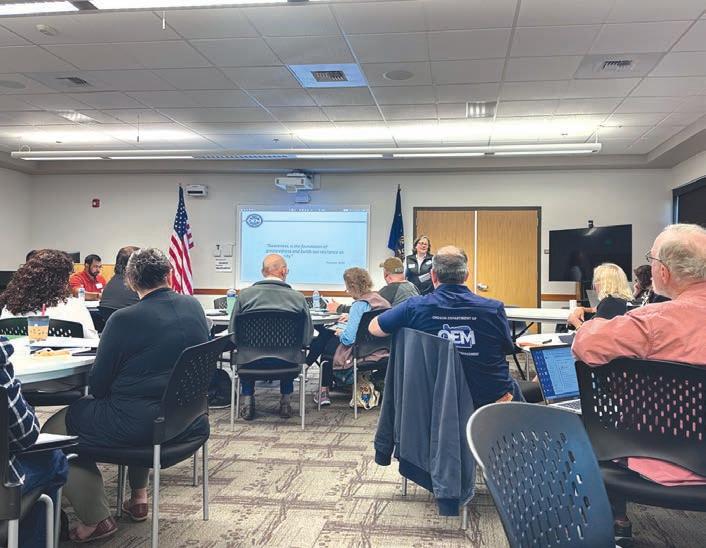
Patence Winningham from the Oregon Department of Emergency Preparedness addresses the Tillamook County emergency preparedness summit on September 13.
Coastal Squeeze presentation
details Oregon shore armoring procedures
WILL CHAPPELL CITIZEN EDITOR
In an informational webinar hosted by the Surfrider Foundation and Oregon Shores Conservation Coalition on September 26, state officials detailed regulations around shore armoring under Oregon’s land use regime. The webinar marked the beginning of the organizations’ Oregon Beaches Forever campaign that seeks to protect and preserve the state’s coastline for future generations.
Kevin Herkamp, Oregon Parks and Recreation Department’s (OPRD) ocean shore program coordinator, and Rhianon Bezore, a coastal shores specialist with the Oregon Department of Land Conservation and Development (DLCD), discussed the program that regulates beach development, which their departments jointly oversee.
Herkamp started the presentation with a history of state policy regulating beaches. The first step towards protecting public access came with the 1913 classification of Oregon’s beaches as a state highway. That designation lasted until 1965, when the beaches were reclassified from a highway to a state recreation area.
In 1966, a Cannon Beach hotel owner blocked a portion of the city’s beach with driftwood, raising concerns about public access and triggering the 1967 Beach Bill, which established a proscriptive right for the public to access the state’s beaches.
Bezore then discussed the restrictions on beach development established under the state’s land use planning goals, adopted in the 1970s. Goals 16, 17, 18 and 19 all relate to various coastal resources, with 18 regulating beaches and dunes
and being the focus of the presentation. Bezore said that goal 18 established a development prohibition on the beach and called for the conservation of vegetation and limits to dune grading. As part of the goal’s aim to preserve beaches and dunes, OPRD and DLCD officials try to limit shorefront armoring, which helps to protect beachfront properties but also carries significant drawbacks, according to Bezore. Bezore said that properties with development or improvement completed before January 1, 1977, were allowed to install structural armoring like riprap, but that properties developed after that date needed to go through a long and expen-
sive exception process to do the same. Regardless a property’s status, however, the owner must assess the viability of nonstructural solutions before applying to build a structural one.
Bezore then discussed different types of nonstructural armoring that can be used to protect beachfront properties. One is using a biodegradable fabric base to establish vegetation on beach front dunes to prevent their erosion. Another is dumping cobblestones on rocky beaches, an easily applicable solution, according to Bezore.
However, both approaches have similar drawbacks, limiting north-south access along beaches, altering the landscape and breaking the
into the Tillamook
and photo
Send us your images by November 1, 2024 We are looking for bright and colorful high-quality vertical photos from Tillamook County at least 300 dpi and 8 inches wide For more information, call Katherine Mace at 503-843-7535 or email headlightads@countrymedia.net
link between terrestrial and aquatic habitats, disrupting sedimentation as waves are prevented from wearing cliffs into sand further narrowing the beach and detracting from beaches’ aesthetic appeal.
Herkamp said that beach narrowing was a focus for OPRD and that the dual factors of sea level rise and the frequency and intensity of storms on Oregon’s coast were running into development along the shore to cause beach loss. Herkamp said that OPRD officials were working with counterparts in other coastal states to address these issues and balance protecting properties with additional armoring against preserving beaches.
by Peggy McDaniel
Tillamook County criminal convictions
On August 19, Lee Alan Matthews, 62, pled guilty to one count of criminal trespass in the second degree, a class C misdemeanor, committed on or about September 15, 2023. Matthews was sentenced to 15 days in jail.
On August 20, Chad Michael Haderly, 38, pled no contest to one count of assault in the fourth degree constituting domestic violence, a class A misdemeanor, committed on or about August 7. Haderly was sentenced to ten days in jail and two years’ probation, and his driver’s license was suspended for six months.
On August 27, Jeremiah Terrance McKay, 46, pled guilty to one count of driving under the influence of intoxicants, a class C felony, committed on or about January 1. McKay was sentenced to 25 months in prison and two years of post-prison supervision, and his driver’s license was revoked for life.
On August 29, Jeffrey Steven Heidenreich, 29, pled no contest to one count of theft in the first degree, a class A misdemeanor, committed on or about December 8, 2023, and one count of criminal trespass in the second degree, a class C misdemeanor, committed on or about August 10, 2024. Heidenreich was sentenced to 30 days in jail and 18 months’ probation.
On August 29, Rosalie
D eflection
Program
From Page A1
and nonprofit partners to achieve success. Hoover then discussed the practicalities of a deflection program. He said that the process began when an officer contacted a person in possession of drugs, at which point, instead of charging them with a crime, they would instead reach out to the deflection team to initiate treatment. The deflection team will ideally be made up of mental healthcare professionals, case managers, peers in recovery, social services providers, substance use disorder specialists and crisis responders. Hoover said that assembling all those elements could be challenging and
From Page A1
Landers Stevens, 52, pled guilty to one count of assault in the fourth degree constituting domestic violence, a class A misdemeanor, committed on or about July 1. Stevens was sentenced to 18 months on probation.
On August 29, Wayde Tanner Farstad, 20, pled guilty to one count of attempting to commit the class C or unclassified felony of encouraging child sexual abuse in the second degree, a class A misdemeanor, committed on or between December 30 and 31, 2023. Farstad was sentenced to ten days in jail and two years’ probation.
On August 30, Annaliza Faye Schmidlin, 27, pled no contest to three counts of driving under the influence of intoxicants, a class A misdemeanor, with one count committed on or about April 16, another on or about May 19, and the final on or about July 13. Schmidlin was sentenced to 122 days in jail, four years’ probation and her driver’s license was revoked for life.
On August 30, Emmanuel Mendez Macias, 30, pled no contest to one count of theft in the first degree, a class C felony, committed on or about August 20, 2022. Macias was sentenced to one week in jail and 18 months’ probation and ordered to pay $1,765 in restitution to two individuals.
On August 30, Jill Dee Ann Lekas admitted to
that other counties were taking a phased approach and planning to expand their deflection teams as their programs matured. Hoover said that when setting up a team, Tillamook County leaders should think about the various resources that exist in the community that could contribute to deflection and work to coordinate those. After referral to the deflection team, Hoover said that an individuals’ progress through the deflection program could be imagined like crossing a bridge, starting with a screening to determine needs, followed by an assessment and referral to treatment, monitoring and reporting on progress, and ending with recovery support. Hoover then discussed the way that programs look in practice in other counties that have already rolled them out.
David House, an ODOT spokesman, said that the removal of the concrete sidewalk had been the biggest and most hazardous task undertaken by workers over the weekend. House said that the crane had needed the entire width of the bridge to operate and that the bridge was incapable of supporting the weight of traffic in addition to the crane, leading to the closure. With removal of the old guardrails and sidewalk
being in contempt of court and was sentenced to 40 days in jail.
On September 6, Dylan Leland Stephens, 32, pled no contest to one count of theft in the third degree, a class C misdemeanor, committed on or about April 19. Stephens was sentenced to two years’ probation and ordered to pay $178.93 in restitution to Fred Meyer.
On September 6, Cristian Patricio Lopez Sanchez, 26, pled no contest to one count of criminal driving with a suspended or revoked license, a class A violation, committed on or about July 5. Lopez Sanchez was assessed a $440 traffic fine.
On September 9, Thevuth Oum, 39, pled guilty to one count of driving under the influence of intoxicants, a class A misdemeanor, committed on or about December 30, 2023. Oum was sentenced to nine days in jail and three years’ probation, and his driver’s license was suspended for one year.
On September 10, Eli Forrest Culver, 30, pled guilty to one count of burglary in the second degree, a class C felony, committed on or about May 10. Culver was sentenced to ten days in jail and 18 months’ probation.
On September 11, Katherine Marie Cavnor, 57, pled guilty to one count of resisting arrest, a class A misdemeanor, committed on or about August 26. Cavnor was sentenced to
In Jackson County, the Medford Livability Team patrols a greenway that is frequented by homeless people and when they encounter a person with drugs, reach out to the deflection team to meet them and initiate contact with the person.
In Clatsop County, law enforcement officers can choose to call a deflection team member or drop an individual off at the county’s rapid access clinic when they encounter someone in possession of drugs. They can also issue a citation to appear at the clinic within 72 hours if they make contact outside of regular business hours.
Hoover said that OHSU will be assigning a deflection coach to help the county set up the program in the coming months, with funding available from a state grant to help with startup costs through next June.
complete, work will now move on to building a new guardrail and sidewalk for the bridge, which House said should take about two more weeks. During that time, traffic on the bridge will continue to be flagged but House said that the department does not expect to fully close the bridge again.
20 days in jail.
On September 12, Michael Darin Clark, Jr., 39, pled guilty to two counts of sexual abuse in the second degree, a class C felony, with one committed on or about August 12 and the other committed on or between July 15 and August 11. Clark was sentenced to 30 days in jail and five years’ probation.
On September 13, Ernesto Miguel Chacon admitted to being in contempt of court and was sentenced to 15 days in jail.
On September 13, Dustin Anthony Matthews, 37, pled no contest to one count of conspiracy to commit the class A felony of delivery of heroin, a class A felony, committed on or about November 14, 2021. Matthews was sentenced to six months in prison and two years’ postprison supervision.
On September 16, Chase Garrett Kowalski, 21, pled no contest to one count of driving under the influence of intoxicants, a class A misdemeanor, committed on or about December 11, 2022. Kowalski was sentenced to two days in jail and two years’ probation, ordered to pay $2,251 in fees and fines, and his driver’s license was suspended for one year.
On September 16, Daniel Abram Bradley, 50, pled guilty to one count of assault in the fourth degree, a class A misdemeanor, committed on or about June 21. Bradley was
sentenced to two days in jail and 18 months’ probation and ordered to pay a $100 fine and $153 in attorney fees.
On September 18, Justin Lloyd Darby, 48, pled no contest to one count of theft in the first degree a class C felony, committed on or about March 18, 2023. Darby was sentenced to 13 months in prison, one year of post-prison supervision and ordered to pay $5,000 in restitution to Tillamook NAPA.
On September 20, Cordon Edward Jewell, 34, pled no contest to one count of harassment, a class A misdemeanor, committed on or about July 1, 2019. Jewell was sentenced to 360 days in jail and five years’ probation.
On September 23, Charles Matthew Sinclair, 28, pled no contest to one count of criminal driving with a suspended or revoked license, a class A misdemeanor, committed on or about July 2. Sinclair was sentenced to 14 days in jail.
On September 23, Michael Noah Rhoads, 23, pled guilty to one count of criminal driving with a suspended or revoked license, a class A misdemeanor, committed on or about July 1. Rhoads was sentenced to two days in jail.
On September 23, Joel Jesus Lobato-Vieyra, 30, pled no contest to one count of driving under the influence of intoxicants, a class A misdemeanor, com -
mitted or about December 4, 2022. Lobato-Vieyra was sentenced to two years’ probation and his driver’s license was suspended for 12 months.
On September 23, Wendy Janelle Williams, 58, pled guilty to one count of driving under the influence of intoxicants, a class C felony, committed on or about May 15, 2023. Williams was sentenced to 93 days in jail, two years on probation and her driver’s license was revoked for life.
On September 23, Brian David Roelle, 49, pled no contest to one count of felon in possession of a restricted weapon, a class A misdemeanor, committed on or about August 3. Roelle was sentenced to time served in jail and assessed a $1,000 fine and $368 in attorney fees.
On September 23, Amanda Sue Boquist, 34, pled guilty to one count of driving with a suspended or revoked license, a class A misdemeanor, committed on or about January 10. Boquist was sentenced to two days in jail.
On September 24, Jose Antonio Oseguera, 49, pled guilty to one count of driving under the influence of intoxicants, a class A misdemeanor, committed on or about July 24. Antonio Oseguera was sentenced to two days in jail and two years’ probation, his driver’s license was suspended for a year, and he was ordered to pay $1,255 in fees and fines.
Advertising
Help protect your community this flu season by getting vaccinated at our walk-in flu vaccine clinics for all ages beginning September 30.
Medical Office – Manzanita
10445 Neahkahnie Creek Road, Manzanita
Mondays, 8 a.m. – 4 p.m.
Medical Office – Plaza
1100 Third St., Tillamook
Mondays and Wednesdays, 8 a.m. – 4 p.m.
Women’s and Family Health
1011 Third St., Tillamook
Monday – Thursday, 8 a.m. – 4 p.m.
Medical Office – Pacific City
38505 Brooten Road, Suite A, Pacific City Wednesdays, 8 a.m. – 4 p.m.
No appointment needed. Bring your medical insurance card and a valid ID.
Learn more about the 2024–2025 flu season and COVID at cdc.gov/flu.
Kate and The Crocodiles return to the NCRD on November 2nd
Kate and The Crocodiles return to the NCRD Performing Arts Center on November 2nd at 7 pm. This Northwest trio presents stunning indie rock originals and covers, early jazz and jazz standards, reinventions of ‘70s and ’80s rock as ballads, classical art songs mixed with rock (yes, really), and
other surprises from far and wide. If the spectrum sounds broad, it is all held together by a signature sound informed by classical training and a respectful blending of many genres. It’s like a warm conversation with a good friend. An evening with Kate & The Crocodiles has been called “A perfect combination of musical talent and intimate, unforgettable entertainment.” Tickets are available for $26 at TicketTomato.com or call 971-308-0309. You can also purchase tickets at the door for $28. Doors open at 6:30 pm. For more information, visit kateandthecrocodiles. com.
Kate Morrison (vocalist), Craig Bidondo (keyboard), and Gavin Bondy (trumpet, French horn).