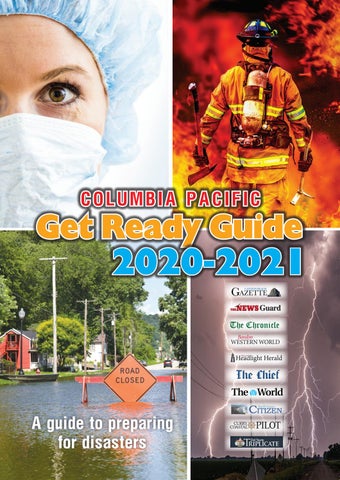
Sa Salute to the U.S C O L U M B I Ato P IC Salute theA C I FCoast U.S. Gu Salute Get Guide U.S.Ready Coast Guard U.S. Coa Salute to the 2020-2021 Salute to the U.S. Coast Guard U.S. Coast Guard The Chief
The Chief
The Chief
The Chronicle
Publi
Published by Country Media, Inc.
The Chronicle
The The Chief Chief
The The Chronicle Chronicle
Published by Country Media, Inc.
The Chief
The Chronicle Chronicle The
A guide to preparing The Chronicle The Chief Published by by Country Country Media, Media, Inc. Inc. for disastersPublished Published by Country Media, Inc.
Published Published by by Country Country M M
2 – Columbia Pacific Get Ready Guide 2020 - 2021
Columbia Pacific Get Ready Guide 2020 - 2021 – 3
The importance of being 2 Weeks Ready Wildfire season in Oregon is underway. Coronavirus case numbers are on the rise. There’s the constant threat of a Cascadia Subduction Zone earthquake and tsunami. Many of us are experiencing a feeling of powerlessness and fear. But the conventional wisdom during these times is to focus on what you can control. That’s why now, more than ever, it is important to be 2 Weeks Ready. The 2 Weeks Ready campaign began here in Oregon when the Oregon Office of Emergency Management (OEM) implemented a recommendation from the Oregon Resilience Plan, which found that after a Cascadia subduction event, citizens having enough supplies to survive for two weeks on their own would greatly increase lives saved. “The adage of hoping for the best and preparing for the worst means being 2 Weeks Ready,” said Andrew Phelps, director of the Oregon Office of Emergency Management. “At OEM, we constantly train and plan for all types of emergencies and disasters. But it’s not enough to prepare. When rivers rise, the earth shakes or pandemic
spreads, we need to be selfsufficient for up to two weeks.” Simply put, 2 Weeks Ready is having enough supplies and a plan to be able to survive on your own for at least 14 days. This is the amount of time it may take for emergency responders to reach you after a large-scale event like Cascadia. In the case of COVID-19, having a two weeks supply of food, medications and sundries means being safely and adequately prepared for a twoweek quarantine. “Each day that we don’t have a disaster is one more day to prepare,” says Phelps. “Having enough supplies for two weeks for each member of the family, as well as pets and livestock, is a task that can seem daunting. But, it is an achievable goal. A good strategy is to integrate a culture of preparedness into your daily lifestyle. A culture of preparedness is more than acquiring ‘stuff.’ It is about resources you may have access to during a disaster, such as alternate water sources or products to purify water in emergency situations. It’s about having a plan to communicate
By Andrew Phelps,
Director Oregon Office of Emergency Management and get information to loved ones to let them know you are safe or need help. It’s about how to take basic life-saving actions like first aid, CPR, or shutting off utilities after a significant winter storm, tornado or major earthquake. In the early stages of COVID-19 we saw that though there wasn’t a true shortage of sanitation and hygiene products, there was a strain on the distribution channel’s ability to keep pace with demand. Make sure you cover your basic needs when you start preparing. Avoid waiting until the disaster or pandemic hits to have a little extra stored up. This has been a challenging year for many Oregonians, and uncertainty about the future can add to our already increased levels of anxiety. But we all need to look at what we can control and start small. Think about the needs of your family and how you can start to prepare for disasters and emergencies today. While we cannot eliminate every hazard, each step we take today will mitigate the effects large-scale disasters have on our families and communities tomorrow.
4 – Columbia Pacific Get Ready Guide 2020 - 2021
CLATSOP COUNTY Safety and Emergency Resources
If you are having an emergency, please call 9-1-1 immediately. Non-Emergency Dispatch 503-325-8635 Columbia Memorial Hospital 503-325-4321 2111 Exchange St. Astoria, OR 97103 Providence Seaside Hospital 503-717-7000 725 S Wahanna Rd. Seaside, OR 97138 Oregon Poison Center 800-222-1222
Medix Ambulance Service 503-861-5554 Dispatch: 503-861-1990 2325 SE Dolphin Ave. Warrenton, OR 97146
Cannon Beach Police Department 503-436-2811 163 E Gower Ave. Cannon Beach, OR 97110
Clatsop County Emergency Management 503-325-8645 800 Exchange St., Suite 400 Astoria, OR 97103
Cannon Beach Rural Fire Protection District 503-436-2949 188 E Sunset Blvd. Cannon Beach, OR 97110
Clatsop County Sheriff’s Office 503-325-8635 1190 SE 19th Warrenton, OR 97146
Brian C Zartner
IRT-1848F-A
Financial Advisor
65 N Hwy 101 Suite 202 Warrenton, OR 97146-9371 503-861-2244
edwardjones.com
Member SIPC
Columbia Pacific Get Ready Guide 2020 - 2021 – 5
Table of Contents OEM Director’s Message .....................3
Earthquake......................................18-19
Clatsop County Emergency Numbers.............................4
Tsunami............................................20-21
Columbia County Emergency Numbers.............................6
Lincoln City Tsunami Evacuation Maps............. 22–23
Never turn your back on the ocean.....7
Tillamook County Emergency Numbers...........................24
Wildfire................................................8-9
Power Outage......................................25
Flood............................................... 10–11
Coos County Emergency Numbers...........................26
Landslide.........................................12-13 Lincoln County Emergency Numbers......................14-15 Del Norte County Emergency Numbers......................16-17
Pandemic..............................................27 Build a Kit.............................................28 Curry County Emergency Numbers...........................29 Make a Plan..........................................30
The 2020-2021 Get Ready Guide is a regional publication of the Cannon Beach Gazette, Clatskanie Chief, The Chronicle, North Coast Citizen, Lincoln City News Guard, Tillamook Headlight Herald, Coos Bay World, Bandon Western World, Curry Coastal Pilot in Brookings and Del Norte Triplicate in Crescent City.
Salute to the U.S. Coast Guard
It is designed to offer critical information and resources to help residents and visitors in our communities best prepare for disasters. Publishers: Advertising: Graphic Design:
Ben Kenfield, Joe Warren, Jeremy Ruark Nicole Clarke, Katherine Mace, Amy Trull, Patricia Wilson, Monica Ichtertz and Dallas Brown Stephania Baumgart, Joe Warren, James Yang and Kimberly Hagner
The Chief
The Chronicle
Published by Country Media, Inc.
6 – Columbia Pacific Get Ready Guide 2020 - 2021
COLUMBIA COUNTY The following are physical addresses, non-emergency phone numbers, and websites for Columbia County law enforcement, fire departments and PUD’s.
If you are having an emergency, please call 9-1-1 immediately. Columbia County Sheriff 901 Port Ave., St. Helens 503-366-4611 www.co.columbia.or.us/sheriff/ Clatskanie Sheriff Substation 12525 Highway 202, Clatskanie 503-755-2637 www.co.columbia.or.us/sheriff/ Rainier Police Department 106 W B St., Rainier 503-397-1521 www.cityofrainier.com/ St. Helens Police Department 150 S. 13th St., St. Helens 503-397-3333 www.ci.st-helens.or.us/police Scappoose Police Department 33568 E. Columbia Ave, Scappoose 503-543-3114 www.ci.scappoose.or.us/police Vernonia Police Department 1001 Bridge St., Vernonia 503-429-7335 vpd.vernonia-or.gov
Columbia City Police Department 1840 Second St., Columbia City 503-397-4010 www.columbia-city.org/ menupages/departments/ police.html Oregon State Police 35851 Industrial Way #A, St. Helens 503-397-0325 www.oregon.gov/osp/pages/ index.aspx Columbia River Fire and Rescue 105 S. 12th St., St. Helens 503-397-1014 www.crfr.com
Stations St. Helens 105 S. 12th Rainier 211 W. 2nd St. Fairgrounds Station 58798 Saulser Rd, St. Helens Deer Island 3371 Canaan Rd Columbia City 405 E St. Goble 69321 Nicolai Rd., Rainier Fern Hill 73153 Doan Rd., Rainier
Clatskanie Rural Fire Protection District 280 SE Third St. 503-728-2025 www.clatskaniefire.org
Stations Clatskanie 280 SE Third St. Delena 76015 Atkins Rd. Quincy 79704 Quincy Mayger Rd. Scappoose Fire 52751 Columbia River Hwy., Scappoose 503-543-5026 www.srfd.us Vernonia Rural Fire Department 555 E. Bridge St., Vernonia 503-429-8252 www.vernonia-or.gov/Services/ Fire.asp CRPUD 64001 Columbia River Hwy., Deer Island 503-397-1844 www.crpud.net Clatskanie PUD 495 E Columbia River Hwy, Clatskanie 503-728-2163 www.clatskaniepud.com Western Oregon Electric Cooperative, Inc 503-429-3021
Columbia Pacific Get Ready Guide 2020 - 2021 – 7
Never turn your back on the ocean A trip to the beach should be fun. Unfortunately, many people are injured or killed along our nation’s beaches by hazardous sneaker waves, rip currents and high surf. On the Oregon Coast, many people have died along the beaches from the ocean’s unpredictable fury. Many more have been injured. Their stories are tragic tales of being dragged out with the tide, being rolled over by a log or getting stuck in a current that pulled them out to sea. For much of the West Coast, sneaker waves kill more people than all other weather hazards combined. It’s important to be informed about what you need to stay safe on beaches and in coastal areas and surf zones so you leave the beach with good memories. Beware the Sneaker Wave and Lurking Log They´re called sneaker waves because they appear without warning, often surging more than 150 feet up on the beach with deadly force, and they are impossible to predict. Sneaker waves also carry a
ADVANCED
SECURITY SYSTEMS “Delivering Peace of Mind”
Security for Home
Security for Business Call for a free security review for your home or business!
Security for Life Northern California & Southern Oregon’s Security Leader since 1971!
707-464-1975
www.advancedsecurity.us
ALARM LIC #ACO2883, CA CONT 527700, OR CONT 144207
large amount of sand that can saturate your clothes, weighing you down and making escape difficult if not impossible. The ocean is strong enough to pick up even the biggest log and plop it down on top of you. Some logs may look small, but even the tiny ones can be waterlogged and weigh tons. If you see a log in the surf or on wet sand, stay off it. Individuals who are dragged off the beach into the frigid waters of the Northwest are in danger of becoming victims of cold water paralyses, which can affect the limbs within minutes. Dangerous Rip Currents Rip currents are strong currents of water that rush out to sea. They are stronger than even the best swimmer. These currents can swiftly sweep unwary beachcombers and waders off their feet and out to sea. Parents, keep your kids close when playing in the ocean. If caught in a rip current, don’t panic. Swim parallel to the beach until you are out of the current, then head for the beach.
In times of need, you can count on the Devereux Center:
♦
We want to make sure that people know we offer the following services to anyone at no cost:
♦ Showers ♦ Laundry ♦ Breakfast (MTWF - 9am) ♦ Lunch (MTWF - Noon) ♦ Computer and Telephone Access ♦ Clothing Closet ♦ Waffle Sandwiches (Th, 10-12) Weekend Meals 12-12:30 ♦ Social Service Navigation
♦
♦
Our hours for client services are MTWF from 9am to 2pm. If you have questions or emergent needs, please call 541-888-3202 M-F 7:30 to 3pm.
PO Box 3519, 1200 Newmark Ave, Coos Bay, OR 97420 541-888-3202 • info@thedevereuxcenter.org
8 – Columbia Pacific Get Ready Guide 2020 - 2021
Wildfire D
id you know that wildfires can move at speeds of up to 14 miles an hour? Oregon and Washington are prone to deadly wildfires. Droughts and dry conditions throughout the year increase wildfire risk. Careless use of fire in highly wooded areas can also dramatically increase the chance of a wildfire, which can then quickly spread across trees and dry brush and threaten homes and businesses in the vicinity.
it touch your house, deck or porch. • Prune trees so the lowest branches are 6 to 10 feet from the ground. • Choose building materials and plants that resist fire. • Identify and maintain an adequate water source outside your home, such as small pond, cistern, well or swimming pool. • Gather household items that can be used as fire tools such as a rake, ax, saw, bucket and shovel. • Keep a garden hose that is long enough to reach any area of the home and other structures on the property.
Before
• Learn about the wildfire risks in your area. • Make an escape plan and build a kit. • Clear leaves and other vegetative debris from roofs, gutters, porches and decks. • Screen-in areas below patios and decks with wire mesh to prevent debris and combustible materials from accumulating. • Remove flammable materials (wood piles, propane tanks, etc.) from within 30 feet of your home’s foundation and outbuildings, such as garages and sheds. If it can catch fire, don’t let
During
• Be ready to leave at a moment’s notice. • Listen to local radio or television stations for the latest emergency information. • Gather an emergency supply kit and be ready to leave. • Arrange for temporary housing at a friend or
Get ready. Build a kit.
Put together a basic emergency supply kit with the items listed below. Find additional suggestions at crpud.net/kit. • •
• • • • •
1 gallon of water per person per day for at least 3 days At least a 3-day supply of non-perishable food items that require little or no cooking Flashlight, radio & fresh batteries Battery-operated clock Lantern or candles & matches Blankets, sleeping bags & warm clothes Camp stove or barbecue for outdoor cooking
• • • •
First aid kit Prescription medication Playing cards, games & books to help pass the time Cell phone, charger & extra battery
Consider making a smaller kit for your vehicle. If you have pets, make sure they’re accounted for as well.
Columbia Pacific Get Ready Guide 2020 - 2021 – 9
pollution, such as candles, fireplaces and gas stoves. Avoid vacuuming. • If you have asthma or another lung disease, follow your health care provider’s advice. • Dress to protect yourself; wear cotton/woolen clothing including long sleeved shirts, long pants and gloves. • Back your car into your garage for easier evacuation.
If Outdoors
relative’s home outside the threatened area. • Confine pets to one room so you can find them if you need to evacuate quickly. • Watch for and listen to air quality reports and health warnings about smoke. • Keep indoor air clean by closing windows and doors to prevent outside smoke from getting in. • Use the recycle or recirculate mode on the air conditioner in your home and/or car. • When smoke levels are high, do not use anything that burns or adds to indoor air
After
Nehalem Bay Ready mix mohleR SaNd & GRavel, llC • • • •
Hot Water Prompt Deliver y Crushed Rock Fill Material
• • • •
Drain Rock Rip Rap Decorative Boulders Bark
Call in advance for Saturday delivery.
20890 Foss Road, Nehalem
503-368-5157
H46423
CCB #160326
• If you are trapped outdoors, crouch in a pond, river or pool. • Do not place wet clothing or bandanas over your nose or mouth.
• Let friends and family know you’re safe. • Do not re-enter your home until fire officials say it is safe to do so. • Use caution when entering burned areas as hazards may still exist, including hot spots that can flare up without warning. • Avoid damaged or fallen power lines, poles and downed wires. • Wear leather gloves and heavy soled shoes to protect hands and feet.
10 – Columbia Pacific Get Ready Guide 2020 - 2021
Flood
Did you know that floodwaters as little as six inches deep can be strong enough to sweep a person off their feet? Floods are among the most frequent and costly natural disasters. When heavy or steady rain saturates the ground over several hours or days, flood conditions may occur. Flash floods occur suddenly due to rapidly rising water along a stream or low-lying area.
Before
• Know your flood risk and locations where flooding may occur. • Make an escape plan and build a kit. • Listen to area radio and television stations and a NOAA weather radio for possible flood warnings and reports of flooding in progress or other critical information from the National Weather Service (NWS). • Because standard homeowner’s insurance does not cover flooding, it’s important to have protection from floods associated with hurricanes, tropical storms, heavy rains and other conditions that impact the U.S. For more flood safety tips and information on flood insurance, please visit
the National Flood Insurance Program website at FloodSmart.gov. • Raise your furnace, water heater and electric panel to floors that are less likely to be flooded. An undamaged water heater may be your best source of fresh water after a flood. • Install check-valves (valves that allow fluid to flow through in only one direction) in plumbing to prevent floodwater from backing up into the drains in your home. • Seal walls in basements with waterproofing compounds to avoid seepage through cracks. • If a flood is expected, some communities might offer free sandbags to residents. Listen to the news or contact local emergency management agencies to learn more about these resources. • Fill your car’s gas tank in case you need to evacuate. • Move your furniture and valuables to higher floors of your home. • Move livestock to higher ground. If using a trailer to evacuate animals, move animals sooner rather than later.
LEARN HOW TO BETTER PREPARE, RESPOND AND RECOVER FROM AN EMERGENCY AND/OR DISASTER. • Protect your employees and their families. • Return quickly to your business after an emergency or disaster. • Access tools, materials and resources if an emergency or disaster is imminent or occurs. • Connect to available resources to meet emergency and disaster needs.
COLUMBIA COUNTY EMERGENCY MANAGEMENT 230 Strand Street, St. Helens, Oregon 97051 503-366-3931
Columbia Pacific Get Ready Guide 2020 - 2021 – 11 contaminated with sewage or contain dangerous insects or animals. • Dispose of any food that has come into contact with floodwater.
After
During
• When a flood or flash flood warning is issued for your area, head for higher ground and stay there. Avoid walking or driving through floodwaters. As little as six inches of moving water can knock you down, and two feet of moving water can sweep a vehicle away. • Stay away from floodwaters. If you come upon a flowing stream and the water is above your ankles, stop, turn around and go another way. • If you encounter a flooded road while driving, turn around, don’t drown. If you are caught on a flooded road and waters are rising rapidly around you, get out of the car quickly, and move to higher ground. • Avoid contact with floodwater. It may be
Honoring the Memory of Your Loved Ones
• Let friends and family know you’re safe. • Do not enter your home until officials say it is safe to do so. • Report downed power lines to your utility company and do not step in puddles or standing water. • Wear protective clothing, including rubber gloves and rubber boots, and be cautious when cleaning up. • Wear protective clothing, including rubber gloves and rubber boots, and be cautious when cleaning up. • Disinfect anything that flood water touches. More information about repairing your flooded home is available online at www.redcross.org. Additional information, including maps about flooding, are available on the Oregon Department of Geology and Mineral Industries (oregongeology. org) or Washington Department of Natural Resources (dnr.wa.gov) websites.
Pacific West Ambulance wants you to be prepared for any natural disaster. • Have a “Go Bag” Ready • Keep Emergency Contact Information Close • Plan Meet-up Locations for Family/Friends • Visit the Lincoln County Emergency Management website www.co.lincoln.or.us/emergencymanagement/ page/plan-and-prepare
Serving Lincoln, Tillamook, Polk & Yamhill Counties
Guinevere Tolbert Location Manager, Licensed Mortician Oregon license no. CO3830
P.O. Box 854, Lincoln City, Oregon 97367 2164 NE East Devils Lake Road, Otis, Oregon 97368 Phone: 541-994-4662 | Fax: 541-614-0746 www.pacificviewmemorialchapel.com
2801 NE 22nd St., Lincoln City, OR 97367 (541) 994-6690
12 – Columbia Pacific Get Ready Guide 2020 - 2021
Landslide
Did you know that landslides take place most often where they’ve occurred in the past? They’re also more common in areas that have recently been burned by a wildfire.
Before
• Make an escape plan and build a kit. • Be aware of warning signs of possible landslides: > Increased pooling of water or newly wet ground. > New cracks or unusual bulges in the ground, street pavements or sidewalks. > Soil moving away from foundations. > Tilted or bent trees. > Sagging or taught utility lines. > Sunken or broken road beds. > Leaking or broken water pipes. • Reduce the chances of landslides by: > Draining water from surface runoff,
downspouts and driveways well away from slopes. > Planting native groundcover on slopes. > Refraining from adding water to steep slopes. > Avoiding placing fill soil and yard debris on steep slopes.
During
• If you suspect imminent danger, evacuate immediately. Inform affected neighbors if you can, and contact your public works, fire or police department. • Listen for unusual sounds that might indicate moving debris, such as trees cracking or boulders hitting one another. • If you are near a stream, be alert for any sudden increase or decrease in water flow and notice whether the water changes from clear to muddy. Such changes may mean there is
At Clatskanie PUD, safety is our top priority. We work hard to provide our customers reliable, efficient, safe, and low cost electric power in a financially and environmentally responsible manner.
503-728-2163 clatskaniepud.com
Stay Alive - Stay Away If you see a line down or a tree tangled in power lines, STAY AWAY! The line may still be energized, and could be deadly!
Columbia Pacific Get Ready Guide 2020 - 2021 – 13
debris flow activity upstream so be prepared to move quickly. • Be especially alert when driving—watch for collapsed pavement, mud, fallen rocks and other indications of possible debris flow. • If you are ordered to or decide to evacuate, take your animals with you.
After
• Stay away from the slide area. There may be danger of additional slides. • Check for injured and trapped persons near the slide without entering the direct slide area. Direct rescuers to the person’s location. • Listen to local radio or television stations for
the latest emergency information. • Watch for flooding, which may occur after a landslide or debris flow. Floods sometimes follow landslides and debris flows because they may be started by the same event. • Look for and report broken utility lines to appropriate authorities. Reporting potential hazards will get damaged utilities turned off as quickly as possible, preventing further hazard and injury. • Check the building foundation, chimney and surrounding land for damage. Signs of damage may help you assess the safety of the area. • Replant damaged ground as soon as possible since erosion caused by loss of groundcover can lead to flash flooding. Additional information about landslides is available on the Oregon Department of Geology and Mineral Industries (oregongeology.org) and the Washington Department of Natural Resources (dnr.wa.gov) websites.
We can help in the event of a disaster!
We Rent:
Teevin Bros Terminal True multi-modal connectivity… rail, marine and highway. 29191 Dike Road PO Box 247, Rainier OR 97048 www.teevinbros.com • 503.556.0410
Generators Heaters & Fans Dehumidifiers Pumps for flooding While you are here, stock up and refill your Propane tanks. 2274 Columbia Blvd. | St. Helens 503-397-0585 | www.donsrental.com
14 – Columbia Pacific Get Ready Guide 2020 - 2021
LINCOLN COUNTY Safety and Emergency Resources If you are having an emergency, please call 9-1-1 immediately. North Lincoln Fire & Rescue 541-994-3100
Samaritan Pacific Communities Hospital 541-265-2244
Samaritan North Lincoln Hospital 541-994-3661
Newport Fire and Rescue 541-265-4231
Lincoln County Emergency Management 541-265-4199
US Coast Guard Station - Newport 541-265-5381
Lincoln County Sheriff Office 541-265-4277
Newport Police 541-574-3348
Lincoln City Police 541-994-3636
Depoe Bay Fire & Rescue 541-764-2202
Oregon State Police 800-442-0776
US Coast Guard Station - Depoe Bay 541-765-2124
Charlotte Lehto Insurance Agency, Inc. Personal & Commercial Insurance
Autos • Homes • Renters • Condos • Vacation Properties • Flood & Earthquake • Contractors • Bonds • Restaurants • Retail • Apartments • HOA’s • Non-Profits • Life Insurance
We Specialize In Senior Services!
Medicare Supplements Advantage & Prescription Drug Plans Long Term Care & Critical Illness Pre-Need, Funeral & Final Expense Plans
Healthcare Planning for Life
Health Insurance On and Off the Federal Health Insurance Marketplace • Short Term Medical • Dental • Vision
Serving The Oregon Coast For Over 20 Years 4270 NE Highway 101, Lincoln City, OR 97367
541-994-2884 Charlotte Lehto
Send me an E-mail at: clehto@farmersagent.com or charlotte@insurancestores.com
Columbia Pacific Get Ready Guide 2020 - 2021 – 15
Oregon Department of Transportation Newport 541-265-2373 Oregon Red Cross Willamette Chapter 503-585-5414
Pacific Power 888-221-7070 Charter Spectrum 1-833-780-1880
Oregon Poison Center 800-222-1222 Oregon Office of the State Fire Marshal 503-378-3473 Oregon Department of Environmental Quality 800-452-4011 National Weather Service 503-261-9246 alerts.weather.gov/cap/wwaatmget. FEMA (Federal Emergency Management Agency) 1-800-621-3362 www.fema.gov NW Natural Gas Service 541-994-2111
Excellent care close to home From surgical services to emergency care, we have you covered. To find a medical provider or service in Lincoln County, call 800-863-5241 today.
samhealth.org/Newport
samhealth.org/LincolnCity
16 – Columbia Pacific Get Ready Guide 2020 - 2021
DEL NORTE COUNTY
Safety and Emergency Resources
If you are having an emergency, please call 9-1-1 immediately. Law Enforcement Services
• Bertsch-Oceanview Station
Del Norte County Sheriff’s Office
175 Humboldt Road, Crescent City, 707-464-2421
Erik Apperson, Sheriff
• City Station
650 Fifth St., Crescent City, Phone: 707-464-4191
520 I Street, Crescent City, 707-464-2421
http://www.co.del-norte.ca.us/departments/sheriffdepartment
• Cooper Station 550 E. Cooper Avenue, Crescent City, 707-464-2421
City of Crescent City Police Department
Fort Dick Fire Protection District
Richard Griffin, Chief of Police
• Station 1, Kings Valley Station
686 G St., Crescent City
6534 Kings Valley Road, Crescent
https://crescentcity.org/police.html
• Station 2, Lake Earl Station
California Highway Patrol
4190 Lake Earl Drive, Crescent City
1630 Summer Lane, Crescent City, 707-218-2000 http:www.chp.ca.gov
Gasquet Fire Protection District
Crescent City / Crescent Fire Protection District
100 Firehouse Road, Gasquet , 707-457-3332
• Crescent City Fire and Rescue, Washington Headquarters
Klamath Fire Protection District
255 W. Washington Blvd., Crescent City, 707-464-2421
• Command Building, 16081 Highway 101, Klamath
TREE PROBLEMS? We Have The Answers!
WALKER’S CONTRACT CUTTING, INC.
Can Provide You With A Free Estimate And Professional Service For Your Tree Service Needs: TREE TOPPING, PRUNING, FALLING, LIMBING, REMOVAL & VIEW ENHANCEMENT FREE WOOD CHIPS AVAILABLE CALL FOR DELIVERY!
Call David Walker
503-812-1457 • 503-842-4176 Licensed • Bonded • Insured CCB#175983
Stay Prepared, Stay Safe Columbia Funeral Home & Cremation Center Columbia Memorial Gardens
Every Life Celebrated Family Owned and Operated. Serving Columbia County since the early 1900s.
Funerals, Cremations, Memorial Services, Grave markers, Pre-Arrangement Plans, Cemetery/Mausoleum Space
H47970
681 Columbia Boulevard St. Helens 503.397.1154 • www.columbiafh.com
Columbia Pacific Get Ready Guide 2020 - 2021 – 17 • Station 33 (Klamath Glen), 360 Terwer Riffle Road, Klamath • Station 34, 104 Redwood Drive, Klamath • Station 35 (Hunter Creek), 19 Weber Drive, Klamath 707-482-3311 Smith River Fire Protection District • Smith River Station 245 Haight Ave, Smith River, 707-487-5621 • Hiouchi Station 105 Dunklee Lane (on Highway 199), Hiouchi
Wildland Fire Protection
California Dept. of Forestry and Fire Protection (Cal Fire) • Humboldt-Del Norte Unit Headquarters 118 Fortuna Blvd., Fortuna, 707- 725-4413 Del Norte County Cal Fire stations • Station #1, 1025 Highway 101 North, Crescent City, 707- 464-5526 • Station #2, Klamath Station, Klamath, 707-482-7355 • Station #3, Elk Camp (Orick*) 707-499-2240 United States Forest Service, Six Rivers National Forest Some stations are staffed seasonally • Redwood Park Service, 707-465-7335 Station #1, Wolf Creek Fire Cache, north of Orick Orick Volunteer Fire Department, 707-834-6162 • Station #2, Hiouchi Station, Hiouchi
Ambulance Service
Del Norte Ambulance • Station One in Crescent City • Station Two (and headquarters), 2600 Moorehead Road, Crescent City (Fort Dick) • Air ambulance service is based at McNamara Field within the Crescent FPD, and provided by Del Norte Ambulance and CAL-ORE Life Flights (based in Brookings, Oregon). 707-487-1116
Other Emergency Services
Del Norte County Office of Emergency Services 918 H S., Suite 240, Crescent City, 707-464-7255 County Disaster Plan http://www.co.del-norte.ca.us/departments/administration/ emergency-services/disaster-plans Prepare Del Norte website https://www.preparedelnorte.com/ Community Alert sign-up https://www.preparedelnorte.com/del-norte-community-alertsystem Poison Control 1-800-222-1222, https://calpoison.org/ Road Conditions 1-800-427-7623, https://roads.dot.ca.gov/ Tsunami Warning West Coast Tsunami Warning Center https://ntwc.ncep.noaa.gov/
Serving Tillamook County for 50 years
541-994-3200
1603 SE East Devil’s L Lincoln City, OR 9736 www.garagedoorsale
• • • • • •
If the water looks too deep, don’t go through it Coast KDEP 105.5 FM • KTIL 95.5FM • KTIL 1590 AM Road & weather info dial 511 or 1-800-977-6368 TripCheck.com or Tripcheck.com/mobile for road conditions Know your cell phone # and location Ask your insurance agent to add towing & Roadside Service to your insurance policy for your piece of mind
BURDEN’S MUFFLER TOWING & CRANE SERVICE INC.
H49551
Tips For Emergencies:
18 – Columbia Pacific Get Ready Guide 2020 - 2021
Earthquake
Did you know that during a major earthquake you may be without utilities for weeks or even months?
Before
• Make an escape plan and build a kit. • Identify safe places in each room of your home, workplace and/or school. A safe place could be under a piece of sturdy furniture or against an interior wall away from windows, bookcases or tall furniture that could fall on you. • Practice “drop, cover and hold on” in each safe place. If you do not have sturdy furniture to hold on to, sit on the floor next to an interior wall, and cover your head and neck with your arms. • Keep a flashlight and sturdy shoes by your bed in case an earthquake strikes in the middle of the night. • Make sure your home is securely anchored to its foundation. • Bolt and brace water heaters and gas appliances to wall studs. • Bolt bookcases, china cabinets and other tall furniture to wall studs. • Hang heavy items, such as pictures and mirrors, away
from beds, couches and anywhere people sleep or sit. • Brace overhead light fixtures. • Install strong latches or bolts on cabinets. Large or heavy items should be close to the floor. • Learn how to shut off the gas valves in your home and keep a wrench handy for that purpose. • Learn about your area’s seismic building standards and land use codes before you begin new construction.
During
If you are inside when the shaking starts • Drop, cover and hold on. Move as little as possible. • If you are in bed, stay there, curl up and hold on. Protect your head with a pillow. Don’t try to get under your bed. • Stay away from windows to avoid being injured by shattered glass. • Stay indoors until the shaking stops and you are sure it is safe to exit. When it is, use stairs rather than an elevator in case there are aftershocks, power outages or other damage. • Be aware that fire alarms and sprinkler systems frequently go off in buildings during an earthquake, even if there is no fire, but take appropriate precautions if an alarm sounds.
Columbia County Public Works THE ROAD IS CLOSED FOR A REASON! TO KEEP YOU SAFE!
DO NOT GO BEYOND THIS SIGN!
Columbia Pacific Get Ready Guide 2020 - 2021 – 19
After
If you are outside when the shaking starts • Find a clear spot (away from buildings, power lines, trees, streetlights, etc.) and drop to the ground. Stay there until the shaking stops. • If you are in a vehicle, pull over to a clear location, and stop. Avoid bridges, overpasses and power lines if possible. Stay inside your vehicle with your seatbelt fastened until the shaking stops. Then, if you can, drive carefully, avoiding bridges and ramps that may have been damaged. • If a power line falls on your vehicle, do not get out. Wait for assistance. • If you are in a mountainous area or near unstable slopes or cliffs, be alert for falling rocks and other debris. • Landslides are often triggered by earthquakes.
• After an earthquake, the disaster may continue. Expect and prepare for potential aftershocks, landslides or even a tsunami. • Look for and extinguish small fires. Fire is the most common hazard after an earthquake. • Each time you feel an aftershock, be sure to drop, cover and hold on. Aftershocks frequently occur minutes, days, weeks and even months following an earthquake. • Check yourself for injuries and get first aid, if necessary, before helping injured or trapped persons. • Put on long pants, a long-sleeved shirt, sturdy shoes and work gloves to protect against injury from broken objects. • Look quickly for damage in and around your home, and evacuate everyone if your home is unsafe. • Listen to local radio or television stations for the latest emergency information. • Check to see if telephones are working. Make brief calls to report life threatening emergencies. • Use text messaging to communicate with friends and family members. • Clean up spilled medications, bleach, gasoline or other flammable liquids immediately.
20 – Columbia Pacific Get Ready Guide 2020 - 2021
Tsunami
The states in the U.S. at greatest risk of tsunamis are Alaska, California, Hawaii, Oregon and Washington. Tsunamis are series of large ocean waves caused by major earthquakes or landslides beneath the ocean. When the waves enter shallow water, they may rise several feet or, in rare cases, near 100 feet, striking the coast with devastating force. Tsunamis can be local or distant. A local tsunami can arrive within minutes of an earthquake. A distant tsunami can take four to 12 hours to arrive on shore. If you feel the ground shake while at the beach or a low coastal area, move on foot inland and to higher ground as quickly as possible.
Before
• Find out if your home, school, workplace or other frequently visited locations are in tsunami hazard areas. • Make an escape plan and build a kit. • Plan evacuation routes from your home, school, workplace and other places you could be where tsunamis present a risk. If possible, choose evacuation locations 100 feet above sea level. If you cannot get this high, go as high as you can.
You should be able to reach your safe location on foot within 15 minutes. • Learn the evacuation plan where your child attends school. Find out if the plan requires you to pick your children up from school or from another location. During a tsunami watch or warning, telephone lines may be overloaded and routes to and from schools may be jammed. • Practice your evacuation routes. Familiarity may save your life. Be able to follow your escape route at night and during inclement weather. Practicing your plan will allow you to jump into action during an actual emergency. • When visiting the coast, familiarize yourself with the nearest tsunami evacuation routes.
During
• If an earthquake occurs while you are on the coast and indoors, drop, cover and hold on. If you are outdoors, avoid falling objects. • When the shaking has stopped, move quickly inland and to higher ground. Go on foot if possible. • Take a pre-prepared go-bag filled with emergency
Electrical Emergency?
CALL US NOW!
RESIDENTIAL-COMMERCIAL-INDUSTRIAL North Bend 541-756-0581• Bandon 541-347-3066 reeseelectric.com CCB#23563
Columbia Pacific Get Ready Guide 2020 - 2021 – 21
supplies, but don’t delay leaving. • If a tsunami watch is issued, listen to a NOAA weather radio, a Coast Guard emergency frequency station or other reliable sources for updated emergency information. Be ready to evacuate. • Remain inland and on higher ground until an “all clear” announcement is made by local officials.
After
• Continue listening to a NOAA weather radio, a Coast Guard station or a local radio or television station for the latest updates. • Return to lower ground only after local officials tell you it is safe to do so. A tsunami may consist of a series of waves and could continue for hours. Do
not assume that after one wave the danger is over. The next wave may be larger than the first one. • Check yourself for injuries and get first aid as needed before helping injured or trapped persons. • If someone needs to be rescued, call professionals who have the right equipment to help. Many people have been killed or injured trying to rescue others. • Assist people with access and functional needs who require assistance, such as infants and children, as well as the elderly, the disabled and those without transportation. • Avoid disaster areas. Your presence might interfere with emergency response operations and put you at further risk from the residual effects of the tsunami. • Use texts to communicate with friends or family. Phone calls should only be made if absolutely necessary. • Stay out of buildings surrounded by water. Tsunami water can cause floors to crack or walls to collapse. • Use caution when re-entering buildings or homes. Tsnunami evacuation maps and other resources are available at nvs.nanoos.org/TsunamiEvac.
Free Estimates RESIDENTIAL CONTRACTOR
There’s nothing natural about a disaster.
Home Repairs Home Remodels Custom Projects
503-919-0764
As your local Allstate Agents, we understand how a disaster can turn your world upside down. We are here to help you through the recovery process and get your life back to normal as quickly as possible. Contact us today to learn more.
Shane Isham LSP
jsholzgrafe@gmail.com
gagellcconstruction.com
Shaun Isham LSP
Isham & Sprague Insurance 541-994-3600
© 2019 Allstate Insurance Co.
10896480
2730 NE Highway 101 Lincoln City
CCB# 222261
22 – Columbia Pacific Get Ready Guide 2020 - 2021
TSUNAMI EVACUATION MAP LINCOLN CITY-NORTH MAP SYMBOLS / SÍMBOLOS DEL MAPA
IF YOU FEEL AN EARTHQUAKE: • Drop, cover, and hold • Move immediately inland to higher ground • Do not wait for an official warning
Evacuation route / Ruta de evacuación
A
A
ASSEMBLY AREA
Bridge / Puente School / Escuela
O RE GO N
ÁREA REUNIÓN
SI USTED SIENTE EL TEMBLOR: • Tírese al suelo, cúbrase, y espere • Diríjase de inmediato a un lugar más alto que el nivel del mar • No espere por un aviso oficial
Assembly area / Área reunión
MAP LOCATION
OUTSIDE HAZARD AREA: Evacuate to this area for all tsunami warnings or if you feel an earthquake.
ZONA DE PELIGRO EXTERIOR: Evacue a esta área para todas las advertencias del maremoto o si usted siente un temblor.
LOCAL CASCADIA EARTHQUAKE AND TSUNAMI: Evacuation zone for a local tsunami from an earthquake at the Oregon coast.
MAREMOTO LOCAL (terremoto de Cascadia): Zona de evacuación para un tsunami local de un temblor cerca de la costa de Oregon.
DISTANT TSUNAMI: Evacuation zone for a distant tsunami from an earthquake far away from the Oregon coast.
MAREMOTO DISTANTE: Zona de evacuación para un tsunami distante de un temblor lejos de la costa de Oregon.
Fire department / Bomberos
DISTANT TSUNAMI EVACUATION ZONE
Hospital / Hospital
SCALE / ESCALA 0.25 mile 0.25 km
T
O
EO L O GY AN F G
D
AL
G O N D E PA R
101
LOCAL TSUNAMI EVACUATION ZONE
21’
M
ER
TM
S
O
IE
RE
IN D UST R
OUTSIDE HAZARD AREA
1 93 7
NOTICE
d rR
N
This tsunami evacuation zone map was developed by DOGAMI for the purpose of evaluating the most effective means to guide the public in the event of a tsunami evacuation. The map is based on preliminary data and should not be used for site-specific planning. This map adopts recommendations from the Oregon Tsunami Advisory Council. The evacuation routes were developed by local emergency officials and reviewed by the Oregon Department of Emergency Management. MAP REVISED 04-22-13
se
N
75’
IN
E
N
Elevation, in feet / Elevación, en pies
Fr a
35’
18 aze Fr
NE 74th St
NW Logan Rd
ptune Dr NE Ne
k ree rC
A
re
ek
NE 69th St
C
Ro
y
wd
DISTANT TSUNAMI EVACUATION ZONE
NE 66th St
21’
Dr
PACIFIC OCEA N
A
NE
Roads End State Park
Cl
a
aSe aD
r
t
Sa l-L
r NE Po
N
67’
y Rd nc
27’ NE
ROADS END
Log n Creek a
101
NE Port Ln
Rd
d
St 50
th
W es
NE 50th St
NE
NE
Av e
A
NE N e
NW 44th St
u ots
NE 50 t h St
D
e
NE 45th St
hn s t
22’
Boat Ramp
Rd olmes NE H
NW In let D r
ree C
Ro
LOCAL TSUNAMI EVACUATION ZONE
10 th
Lak e
Rd
29’
1 s t St
ev il s
Boat Ramp
st Ea
D
s t St
NE
ve
SE 1
NE
St
st
East Devils Lake State Park
erm
an
bi
Ca
NE
evil s La ke
OUTSIDE HAZARD AREA
O
D River State Park
ast D
e sL vil St
Dr
Devils Lake State Park
c
k
NW 12th St
ak
L
NE 15 th Regatta Park
De
OUTSIDE HAZARD AREA
e ak
e st D evils
NE Port Ave
NE Oar Ave
N E 19th St
NE 11th St
21’
k
N E Stev ens Rd
Rd
NE W
NW Lee Ave
NE 21 st St
NE 14th St
6 th
NE E
NW Inlet Ave NW Jetty Ave
NW Inlet Ave
Dr
A
21’
NE 22nd St
Community Center
A
NE Surf Ave
NW 19th St
38’
Ln
NE 26th St
NW 22nd St
NW 17th St
NE
Pa rk
Dr
ake
NW 26th St
75’
101
LINCOLN CITY
p
Sand Point Park
L NE
NE 28th St NE 28th St
NW 15th St
o Lo
A
NW 28th St
NW 21st St
22’
Holmes Rd Park
NE
Rd
NW Inlet Av e
NW 33rd St
NW 30th St
DISTANT TSUNAMI EVACUATION ZONE
t
Pl 5th
NW 34th St
as EE
o Th
A
N E
3 NW
St
NE 40th St
NE
Rd NW Jetty
S 37th
Boat Ramp
nd 42
NE J oh ns Lp
NE 36th Dr
NW
NE
p son C re ek
NW 39th St
Jo
N
A
NW 40th St
W est Devils Lak
30’
e Rd
NE
101 81’
iver sR vil De
D e vils Lake Rd
22’ Av
21’
LOCAL TSUNAMI EVACUATION ZONE
22’
d
e yag Vo
NW 50th St
tD ev i
NE
ls
L ake
OUTSIDE HAZARD AREA
r
ga n
Bl v
Lo
a ke R il s L NE Ea s t Dev
NW Jet ty Ave
NE 58th St
NW
d nd R hla Hig
n
Rd
m
La
Columbia Pacific Get Ready Guide 2020 - 2021 – 23
NW Inle
r ke D
NE 28th St
NW 25th St
NE 26th St
TSUNAMI EVACUATION MAP LINCOLN CITY-SOUTH NE 22nd St
LINCOLN CITY
City Hall / Municipalidad
IN D UST R IE S
1 93 7
NOTICE
SW Ebb Ave S
SE
71’
R
k ee
R ock Cr
La ke
De vil s
Ro c O
Rd
18’
d eR Lak
SE Oar Ave
SE 14th St
S
SE 19th St
d
SE
SW Dune Ave
st Ea
East Devils Lake State Park
d ll R Hi
SE Quay Pl
SW Coast SW A nchor Av e S W Anem one Ave
B ard
A
SW 14th St
SW Harbor Ave
Ave
es Cr eek Agn
SW
vils t De Eas
SW 12th St
67’
21’
SE 3rd St
SE Neptune Ave
SE Inlet Ave
SE Jetty Ave
SW 9th St
W 11t h S t
DISTANT TSUNAMI EVACUATION ZONE
NE
47’
SW 7th St
Canyon Drive Park
Rd abin man C ster
ev il s
Boat Ramp
ek
ek
G O N D E PA R
L
1 s t St
s t St
AL
RE
e st D evils
29’
OUTSIDE HAZARD AREA St
Rock Cre
SE 1
Devils Lake
Devils Lake State Park
SE Tide Ave
TM
NE 10 th
ER
O
MAREMOTO DISTANTE: Zona de evacuación para un tsunami distante de un temblor lejos de la costa de Oregon.
D
NE
M
This tsunami evacuation zone map was developed by DOGAMI for the purpose of evaluating the most effective means to guide the public in the event of a tsunami evacuation. The map is based on preliminary data and should not be used for site-specific planning. This map adopts recommendations from the Oregon Tsunami Advisory Council. The evacuation routes were developed by local emergency officials and reviewed by the Oregon Department of Emergency Management. MAP REVISED 04-22-13
PACIFIC OCEA N
MAREMOTO LOCAL (terremoto de Cascadia): Zona de evacuación para un tsunami local de un temblor cerca de la costa de Oregon.
Dr
SE Port Ave
D
D River State Park
IN
E
EO L O GY AN F G
6 th
SE Mast Ave
21’
SCALE / ESCALA 0.25 mile 0.25 km
O
LOCAL CASCADIA EARTHQUAKE AND TSUNAMI: Evacuation zone for a local tsu-
DISTANT TSUNAMI: Evacuation zone for a distant tsunami from an earthquake far away from the Oregon coast.
NE 15 nami from an earthquake at the Oregon coast. th St
NW In let D r
NE
Elevation, in feet / Elevación, en pies
T
ZONA DE PELIGRO EXTERIOR: Evacue a esta área para todas las advertencias del maremoto o si usted siente un temblor.
Lak e
38’
Law enforcement / Policía
N
OUTSIDE HAZARD AREA: Evacuate to this area for all tsunami warnings or if you feel an earthquake.
101
Fire department / Bomberos
N
Rd A aÁREA REUNIÓN ke
k C re
School / Escuela
ASSEMBLY AREA
HAZARD AREA
SI USTED SIENTE EL TEMBLOR: NW 15t St • Tírese al hsuelo, cúbrase, y espere NE 14th • Diríjase de inmediato a St un lugar más alto que el nivel del mar • No NW espere 12th St por un aviso oficial
Assembly area / Área reunión Bridge / Puente
35’
NE Surf Ave
A
NE 21 st St
101
IF YOU FEEL AN EARTHQUAKE: NW 19th St N E 19th St •22’ Drop, cover, and hold • Move immediately inland to higher ground NW 17th St • Do not wait for an official warning OUTSIDE
Evacuation route / Ruta de evacuación
O RE GO N
N E Stev ens Rd
NW 21st St
MAP SYMBOLS / SÍMBOLOS DEL MAPA
MAP LOCATION
21’
NE W
NW Jetty Ave
NW Lee Ave
NW Inlet Ave
DISTANT TSUNAMI EVACUATION ZONE
75’
Baldy C
2 3 rd D r
reek
101
A
Be ach
Av e
SW 28 th S t SW 29th St
SW
52’
SW 32 nd St
32 nd
St
t hS 3 5t
Fleet Av SE e
SW
SE
NELSCOTT
72’ SE
A Hig
hS
ch oo
lD
r one c ho SS
ree
LOCAL TSUNAMI EVACUATION ZONE
d kR
Sc hoon er C
57’
49’
r eek
St 3rd
Pl th 10’
DISTANT TSUNAMI EVACUATION ZONE tS
t
48
In l et
13’
Av
e
kR
SW 50th St
e
54 th
101
13’
S Drift Creek
40’
Siletz Bay
A
SW Harbor Ave
lock SW
SE
th 64
St
S Gorton R d
SE Hem
St rd 63
9’
LOCAL TSUNAMI EVACUATION ZONE
9’
amp R d
kC
CUTLER CITY
tC ree
Rd
S Drift Creek
SW Inlet Ave
SW 65th St
SW Fleet Ave
Salis
han D r
SW
t
Rd
Drift Cr eek
Dr
47’ S nd 62
Anders o nC ree k
SE
Salishan Spit
S D r ift C reek Rd
Sc ho
13’
Av
on er
C re
S An der son
ek
Cr ee
SW 51st St
DISTANT TSUNAMI EVACUATION ZONE
10’
SW 69th St
reek Dr ift C
9’
S
SW 48th St
d
SE
TAFT
Siletz Bay Beach
SE 51s
A
A SE
21’
SW Beach Ave
LOCAL TSUNAMI EVACUATION ZONE
SW Coast Ave
SE 4
71’
rC
Dr
if
24 – Columbia Pacific Get Ready Guide 2020 - 2021
TILLAMOOK COUNTY Safety and Emergency Resources
If you are having an emergency, please call 9-1-1 immediately. Non-Emergency Dispatch 503-815-1911 Adventist Health Tillamook 503-842-4444 1000 Third St. Tillamook, OR 97171 Adventist Health Tillamook Medical Office – Plaza 503-842-5546 1100 Third St. Tillamook, OR 97141 Care Inc. 503-842-5261 2310 First St. #2 Tillamook, OR 97141 Oregon Poison Center 800-222-1222 Tillamook Ambulance 503-815-2369 1000 Third St. Tillamook, OR 97141 Tillamook County Emergency Management 503-842-3412 5995 Long Prairie Rd. Tillamook, OR 97141 Tillamook County Sheriff’s Office 503-842-2561 5995 Long Prairie Rd. Tillamook, OR 97141 Oregon State Police 503-842-2899
Tillamook Police Department 503-842-2522 207 Madrona Ave. Tillamook, OR 97141 Tillamook Fire District 503-842-7587 2310 4th St. Tillamook, OR 97141 Tillamook People’s Utility District 503-842-2535 or 800-422-2535 1115 Pacific Ave. Tillamook, OR 97141 Emergency after hours: 503-842-2122 or 800-842-2122
NORTH COUNTY Manzanita Police Department 503-368-7229 Adventist Health – Manzanita Primary & Specialty Care 503-368-6244 10445 Neahkahnie Creek Rd. Manzanita, OR 97130 Nehalem Bay Fire and Rescue 503-368-7590 36375 Hwy 101 N. Nehalem, OR 97131 Rockaway Beach Fire Department 503-355-2291 276 Hwy 101 S. Rockaway Beach, OR 97136
Rockaway Beach Police Department 503-374-1726 216 Hwy 101 N. Rockaway Beach, OR 97136
CENTRAL COUNTY Bay City Fire Department 503-377-0233 9390 4th St. Bay City, OR 97107 Garibaldi Fire & Rescue 503-322-3635 107 6th St. Garibaldi, OR 97118 Netarts-Oceanside Fire & Rescue 503-842-5900 1235 5th St. Loop W Tillamook, OR 97141
SOUTH COUNTY Adventist Health Medical Office – Pacific City 503-965-6555 38505 Brooten Rd. Pacific City, OR 97135 Nestucca Rural Fire Protection District 503-392-3313 30710 Hwy 101 S Cloverdale, OR 97112
Columbia Pacific Get Ready Guide 2020 - 2021 – 25
Be prepared for a power outage Power outages are most commonly caused by bad weather, trees contacting electric lines or equipment, motor vehicle crashes affecting electric equipment, equipment failure or damage caused by animals. Faulty wiring and equipment in your buildings can also cause a localized power outage.
Investigate your home or business to determine if any electrical hazards are present. If there are, notify your local power company. If you see or smell any signs of an electrical flash or fire, call 911. Look to see if your neighbors are also without power. Streetlights may be the best indication of this. Prepare in advance: assemble an emergency preparedness kit, with supplies such as water, nonperishable food, a flashlight, extra batteries, first aid kit and more; create a household evacuation plan that includes your pets; and stay informed abut your community’s risk and response plans. Protect yourself during a power outage: keep freezers and refrigerators closed, only use generators outdoors and away from windows and understand the risks of carbon monoxide poisoning, do not use a gas stove to heat your home, disconnect appliances and electronics to avoid damage from electrical surges, and check on neighbors, use flashlights instead of candles, eliminate unnecessary travel. To keep your food from spoiling during a power outage, keep a cooler, ice and a digital thermometer on hand. Have at least a half tank of gas in your car and fill extra containers. If power is out for an extended time, gas supply may be limited. . Be safe after: throw away food that has been exposed to temperatures 40 degrees or higher for two hours or more, or that has an unusual odor, color or texture; if the power is out for more than a day, discard any medication that should be refrigerated, unless the drug’s label says otherwise.
Information was gathered from Tillamook PUD, Department of Homeland Security, and American Red Cross.
Electric Lift Chairs Assist With: Pain & Weakness Mobility Issues Unaided Standing
Call us for assistance: Astoria (503) 325-9906 Surgery Recovery Tillamook (503) 842-8755 Seaside (503) 738-4043 Positioning & Comfort Lincoln City (541) 996-5102 Alternate Sleeping Newport (541) 265-2888 Options Florence (541) 997-9495 (888) 271-8078 Toll Free Independent Living www.NCHC.net
To report a power outage, call your local electric service.
“Providing Quality Service for your Home Medical Equipment needs since 1985”
H49556
If electrical power lines are down, do not touch them. Report downed lines to your utility company.
26 – Columbia Pacific Get Ready Guide 2020 - 2021
COOS COUNTY Safety and Emergency Resources If you are having an emergency, please call 9-1-1 immediately. City of Bandon
City of North Bend
Police: 541-347-2241
Police: 541-756-3161
Fire: 541-347-3560
Fire: 541-756-8581
Public Works Department:
Public Works: 541-756-8525
541-347-2437, ext. 232 Southern Coos Hospital:
City of Port Orford
541-347-2426
Police: 541-332-3681 x 280
City of Coos Bay
Fire: 541-366-4577 Public Works: 541-253-8002
Police: 541-269-8911 Fire: 541-269-1191
City of Powers
Public Works Department: 541-269-8918
Police: 541-439-3331
Bay Area Hospital: 541-269-8111
Fire: 541-439-3331
Bay Area Hospital Emergency: 541-269-8085 City of Coquille
City of Reedsport Police: 541-271-2100
Police: 541-396-2114
Fire: 541-271-2423
Fire: 541-396-2232
Public Works: 541-271-3603
Public Works: 541-396-2115, ext. 205
Lower Umpqua Hospital: 541-271-2171
Coquille Valley Hospital: 541-396-3101
Coos County Sheriff’s Office: 541-396-7800 Douglas County Sheriff’s Department:
City of Lakeside
541-271-4802
Fire: 541-759-3931
Curry County Sheriff’s Office: 541-247-3244
Public Works: 541-759-3011 City of Myrtle Point
County Fire Departments Bandon Rural Fire Protection District: 541-347-3560
Police: 541-572-2124
Dora-Sitkum Fire Protection District: 541-572-5944
Fire: 541-572-5422
Gardiner Rural Fire Protection District: 541-271-3515
Public Works: 541-572-2626
Hauser Rural Fire Protection District: 541-756-7222 North Bay Fire: 541-756-3501 Winchester Bay Fire: 541-271-3808
Columbia Pacific Get Ready Guide 2020 - 2021 – 27
Preparing for a pandemic Max Kirkendall newsguardeditor@countrymedia.net
Pandemics and large-scale outbreaks can claim millions of lives, disrupt societies and devastate economies. Whether it’s COVID-19 (Coronavirus) or some variation of Influenza, it is worth being prepared so that you can be comfortable staying home if you or someone in your family does get sick and needs to remain in isolation, or if you’re unable to easily purchase supplies at short notice. According to Lincoln City Emergency Management Coordinator Ken Murphy, preparing for a pandemic is much like peeping for any other natural disaster. His goal is to make sure citizens are always 2-weeks ready for disaster, and that includes a pandemic. “Disasters can happen anytime, anyplace and generally without warning,” Murphy said. “Think of all the things we’ve done to get ready for COVID-19. How ready would you be if we had an earthquake and we didn’t have weeks to prepare?” On a national level, different countries will usually have their own policies and public health programs to contain pandemics and protect their citizens from infection, either targeting specific threats or by issuing general advice. But here are a few things you can do to help prepare specifically for a pandemic. Make a plan of what you’ll do if you or someone in your family becomes sick. Will you keep kids at home with you? Who will look after you? Your pets? Prepare for disruption to the kinds of services that are most vulnerable in your community stocking up on two weeks of drinking water and preserved food is a good start. The rule of thumb is around 3.7 liters (1 gallon) of clean drinking water per person per day for cleaning, cooking, and drinking. Canned foods and a manual can opener could be helpful. Buy things you know you’ll eat, including snacks, protein, carbs, fruits, and vegetables. Don’t forget pet food if you
have animals to take care of. There’s no need to be excessive or hoard supplies, you can simply buy a few extra items each time you go to the supermarket. Have ready access to necessary medical records and details on your personal health needs, if possible in a hard copy. Ensure essential prescription drugs are topped up. While you’re at it, check your first aid kit and make sure you’ve got a good supply of non-prescription medications - ibuprofen and paracetamol could make you feel a lot less sick if you do become unwell. Stock up on cleaning supplies, as well as sanitizers and tissues. If a suitable vaccine is publicly available and recommended by local health authorities, get it. When disease breaks out, you should already be practicing proper hygiene. It shouldn’t take a pandemic to prevent a pandemic. But here are some tips to stop the spread of infections disease. Cover your mouth and nose when you sneeze and cough, preferably with a tissue you can then discard hygienically, or with your elbow. If you choose to wear a face covering, keep in mind its effect depends on the type of material, and is probably not as effective at protecting you (or others) as you might think. Wash your hands properly and frequently, preferably with an alcohol-based sanitizer. If you get sick, do everything you can to avoid passing it on to work colleagues, community members, and loved ones. Isolate yourself if possible, and if you need to be out, do your best to keep your hands to yourself, and stay at least 6 feet away from other bodies. This is when wearing a mask can be useful - if you do need to go out in public, wearing a mask can stop droplets reaching others. “When properly pursued, preparedness is a way of life, it is not a sudden spectacular program,” says Murphy.
28 – Columbia Pacific Get Ready Guide 2020 - 2021
Build a Kit
In Oregon and Southwest Washington, there is a high probability of a 9.0 Cascadia Subduction Zone earthquake. The Red Cross recommends that you have enough supplies to be self-sufficient for at least two weeks. We recommend that you have an emergency supplies kit in each location that you spend considerable time (i.e., at home, in the car and at work).
Household Emergency Supplies Kit
Keep two weeks’ worth of emergency supplies for your household in a portable container that you can use at home or take with you if you evacuate. Start with these items: • Water: one gallon per person (and pets) per day, for drinking and basic hygiene. • Food: items that aren’t perishable or don’t need to be cooked (e.g., peanut butter, canned meats, energy bars, canned fruits and vegetables, beans or soup.) • First aid kit with essential prescription and over-the-counter medications.
Additional Supplies
• Flashlight (battery or alternative-powered) • Radio (battery or alternative-powered) • Extra batteries • Solar charger • Extra cords for electronics • Copies of important documents • Emergency contact information and copy of household emergency plan • Cash in small denominations • Pet supplies • Multipurpose tool and work gloves • Comfort items, such as toys, games and family photos • Manual can opener • Duct tape and plastic sheeting • Hygiene and sanitation supplies
Vehicle and Work Emergency Supplies Kits
Your vehicle and workplace emergency supplies kits should contain a minimum of three days of supplies. Keep the supplies in a backpack or sturdy container with a lid. • Blankets or sleeping bag • Bottled water (use a heavy plastic bottle specifically made for water storage and fill with tap water) • Nonperishable food items • Cell phone charger • Emergency flares or reflective triangle (vehicle only) • First aid kit and reference guide • Ice scraper • Jumper cables and tool kit (vehicle only) • Manual can opener • Prescriptions (if applicable)
Go Bag for Tsunamis
If you live in or are visiting a coastal location which may experience tsunamis, your go bag for tsunamis should be readily accessible to grab as you will likely evacuate on foot. Keep the supplies in a bag that can be easily carried. • Radio (battery or alternative-powered) • Water bottle and water treatment supplies capable of providing one gallon of water per person per day • Nonperishable food items • Small radio (battery or alternative-powered) • Local evacuation map • Jacket to protect you from the rain and/or cold • Personal first aid kit and reference guide • Prescriptions • Sun protection • Hand sanitizer • Whistle • Illumination (headlamp / flashlight / light sticks) • Candles and waterproof matches or a lighter • Blanket
“By the Bed” Mini Kit
Keep a sturdy pair of shoes, a flashlight and an extra pair of glasses (if you wear them) in a bag attached to the head or foot of your bed. If an emergency strikes at night, you’ll be able to walk across debris and see where you’re going. Review your supplies kit every six months. Replace any items nearing their expiration dates. Assemble your own kit or purchase a starter kit at redcrossstore.org.
Columbia Pacific Get Ready Guide 2020 - 2021 – 29
CURRY COUNTY The following are physical addresses, non-emergency phone numbers, and websites for Curry County law enforcement, fire departments and PUD’s.
If you are having an emergency, please call 9-1-1 immediately. Law Enforcement Services
Curry County Sheriff John Ward, Sheriff 541-247-3242, 1-800-543-8471 https://www.co.curry.or.us/government/county_ sheriff/index.php Brookings Police Department Kelby McCrae, Chief of Police / Director of Public Safety 541-469-3118 https://www.brookings.or.us/134/Police-Services Gold Beach Police Department Tracy Wood, Chief of Police 29592 Ellensburg Ave., Gold Beach 541-247-7029 https://www.goldbeachoregon.gov/police Port Orford Police Department Hank Hobart, Chief of Police 555 20th St., Port Orford 541-332-3581 Oregon State Police Southern Command Center, non-emergency number 1-800-442-2068 https://www.oregon.gov/osp/Pages/contact. aspx
Fire Services
Agness Illahe Rural Fire Protection District Brookings Fire & Rescue 898 Elk Dr., Brookings
Phone: 541-469-1142 https://www.brookings.or.us/132/Fire-Rescue Cape Ferrelo Rural Fire Protection District 96349 Cape Ferrelo Rd, Brookings Phone: 541-661-2128 Cedar Valley-North Bank Rural Fire Protection District Gold Beach-Wedderburn Rural Fire Protection District Gold Beach Fire Department Harbor Rural Fire Protection District Langlois Rural Fire Protection District Ophir Rural Fire Protection District Pistol River Rural Fire Protection District Port Orford Rural Fire Protection District Upper Chetco Rural Fire Protection District United States Forest Service, Rogue RiverSiskiyou National Forest Some stations are staffed seasonally
Ambulance Service Cal-Ore
Other Emergency Services
Curry County Office of Emergency Services County Disaster Plan Community Alert sign-up Poison Control Road Conditions Tsunami Warning West Coast Tsunami Warning Center https://ntwc.ncep.noaa.gov/
30 – Columbia Pacific Get Ready Guide 2020 - 2021
Make a Plan
After a disaster, everyday services may be unavailable. Plan for power outages, limited communication, road closures and difficulty accessing clean water. In the event of a major catastrophe, a delay in help from emergency responders is inevitable. Your pre-established emergency plan will help you to be safe and comfortable and may allow you to help others before help arrives. There are several no cost steps you can take today to begin building your household’s preparedness plan.
Talk
Your plan needs to be tailored to and account for the specific needs of your household. Developing a plan for you and your household requires buy-in and agreement from everyone. Include your entire household in the planning process. Your plan should consider the following: • Does anyone have food sensitivities or other dietary needs? • Does anyone require access and functional needs equipment to remain independent (e.g., hearing devices, glasses, mobility devices, etc.)? • Are there specific medical supplies or equipment that are critical for anyone? • Are there unique needs if your household is separated when a disaster occurs (e.g., a disaster occurs while you or other members of your household are at work or school)? • Identify each person’s role in the event of a disaster, and plan to work together as a team. • Talk with your neighbors to learn what resources they have and how they might be pooled to help the community (e.g., generator, chain saw, medical skills, etc.)
Plan
• Pre-identify at least two places to meet up after a disaster. One should be near your home, in case of a local emergency like a house fire. A second should be outside your neighborhood, in case your neighborhood becomes unsafe or inaccessible following a disaster. • Identify an out-of-state contact. Everyone in your family should have the contact’s phone number to be able to check in as safe. After
a disaster, local phone lines may be down or jammed. It may be easier to make a long-distance call than a local one. Use text messages, as texting might work even when voice calls cannot be made. • Following an emergency, friends and loved ones will want to know you are safe. If you use social media, share that you are safe. You can also register yourself as “Safe” through the Red Cross Safe and Well service by visiting redcross.org/safeandwell. • Update your cell phone with emergency contact information. • For individuals without a smartphone or cell phone, be sure to write down important contacts to be notified in the event of an emergency on a piece of paper, and store these numbers in your wallet. • Consider keeping a corded landline phone for use during emergencies, since these phones do not require electricity to operate. • Create a paper copy of important contacts and information and keep it with your emergency supplies kit. • Purchase insurance coverage. Your standard residential insurance policy may not cover damage caused by a disaster. • Include your pets and/or livestock in your disaster planning. • If you have children in school, ask about the school’s emergency plans. • If you know someone in an assisted living facility, ask about the facility’s emergency plans.
Practice
• Practice household earthquake and fire drills at least twice a year. A good time to practice is each time you change your clocks for daylight savings time. • When you practice your earthquake drill, after you drop, cover and hold on, perform an assessment of your home. Review where the gas and water shut off valves are. Discuss where your household (including pets) will go if you have to evacuate. • Make practicing fun for kids by having a picnic with your emergency supplies and replace those that are used.
H49550
Columbia Pacific Get Ready Guide 2020 - 2021 – 31
32 – Columbia Pacific Get Ready Guide 2020 - 2021