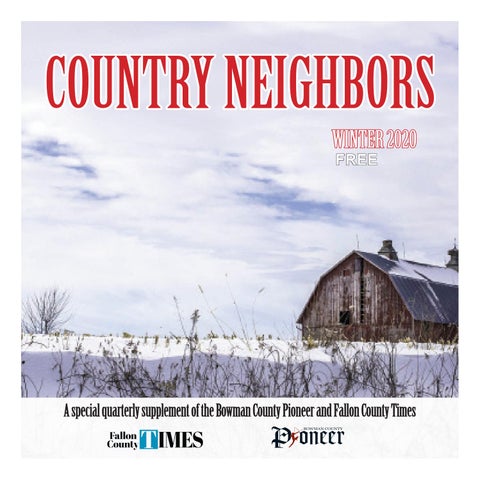
COUNTRY NEIGHBORS WINTER 2020 FREE
A special quarterly supplement of the Bowman County Pioneer and Fallon County Times
C h a d H e t z l , A s t . M g r • 7 0 1 3 7 8 3 7 4 8 Bad roads in Dakotas spark desire for national road ClintEnret,FieldRepr sentaive•406-7 8-328 or406-7 2-5 2 COUNTRY NEIGHBORS | WINTER 2020
BY BRAD MOSHER bmosher@countrymedia.net
The Yellowstone Trail may have been born in South Dakota more than a century ago with cars carrying wooden planks to drive on wet and muddy roads, but it soon stretched completely across the United States. For some of the early travelers, it was marked by yellow markers painted on trees, poles, the sides of barns and even yellowpainted rock piles. Some of those markings still exist along the route,
while others have been lost to time. Eventually, it would become marked by a yellow circular sign with Yellowstone inside the upper perimeter and Trail inside the lower perimeter. Inside a second circle on the sign would often have an arrow pointing the direction of the route. It reportedly started with a 25-mile stretch of road in South Dakota between Ipswich and Aberdeen in 1912 when Joe
Look to a neighbor you can trust: America Needs Farmers & Ranchers
Precision Parts & Supply Open 7 a.m - 6 p.m. Monday - Friday 8:00 a.m. - 1:00 p.m. Saturday
YOUR LOCALLY OWNED STORE 406-778-2219 • Baker, MT Hydraulic hose made while-u-wait
Parmley gathered a group of people from five counties that surrounded his Ipswich home. Later that year, the Yellowstone Trail Association was created in a meeting in Lemmon on the North DakotaSouth Dakota border. The association would lobby Trail Day workers near Hettinger and the border between North Dakota and South Dakota. Ccourtesy of John Ridge. counties to build roads that would interconnect with neighboring communities. It would quickly expand, eventually stretching from the Massachusetts coastal city of Plymouth to Seattle. That was by design, since the association had wanted to build a road from Plymouth Rock to the Puget Sound, according to the history of Workers create the Yellowstone Trail on Trail Day (June 20, 1914) near Marmarth on the North DakotaMontana border. Ccourtesy of John Ridge. the association. Another guiding principle was the desire to attract tourists to ments. to cross their states with across the United States Yellowstone National Park Instead as the sections relative ease – for the early at a time when few would and pushing for increases coalesced and combined part of the 20th Century. actually make the trip in building roads that to make the Yellowstone The Yellowstone Trail completely across the would be funded by the Trail whole, it also prowas one of four major state and federal governRoad Page 3 vided motorists with a way transcontinental routes
w .lem onlivestock.om
LEMMON LIVESTOCK, INC. Box 477 • Lemmon, SD 57638 Phone 605-374-8853 or 1-800-822-8853
Windshield, Glass, Chip & Machine Repair
406-778-PLUS
Paul Huffman, Owner • 605-374-5875 or 605-645-2483 Chad Hetzel, Asst. Mgr • 701-378-3748 Field Representative • 406-978-2520 Clint Curt Enret,Williams, Field Representative • 406-778-3282 or 406-772-5522
(7587)
Del Espinosa - Owner/Operator
www.lemmonlivestock.com
Cell call 406-891-0091 email: delmc@midriver.com
PAGE 2
COUNTRY NEIGHBORS | WINTER 2020
From Rhame to Marmarth and the Montana border, the Yellowstone Trail moves from Bowman County into Slope County.
Map courtesy of John Ridge.
Continued from Road Page 2 country. There also were the Lincoln Highway (Times Square in New York to Lincoln Park in San Francisco), the Great Northern (Olympia National Park in Washington straight east to Maine) and the National Old Trails Highway (from Baltimore to California). But the Yellowstone Trail started in October 1912 when with a meeting in Lemmon of people who wanted first to create a road that would cross the state of South Dakota and, with ambition, the country. Actually, by 1915, it was connected from Chicago to Seattle and two years later, connected to Boston. In addition, the group was behind the building of a bridge across the Little Missouri River at Marmarth in North Dakota or getting a road built through the Standing Rock Reservation in South Dakota as ways to improve travel across the states. It’s growth happened to coincide with the impact of automobiles in American culture and society.
It was even used for a cross-country timed relay race from Chicago to Seattle. The race covered 2,445 miles and was won with a best time of 97 hours – and average of 25 miles per hour. Much of the cross country path highlighted by giant yellow markings a century ago has disappeared or been lost. But the Yellowstone Trail is still there for people following Highway 12 across South Dakota, North Dakota and Montana. Some can find pieces and signs in the small towns along the route – or by checking their local museums and libraries. Montana and the Dakotas also were part of another cross country route which was initiated in 1916. The National Parks Highway Association started in 1916 with a plan for a 3,100 mile route to connect Seattle with Chicago. By 1926, it was called U.S. Highway 10 and in 1971 Interstate 94 took over the route. Old Highway 10 was called the “Main Street of Montana”
at one time and went through the communities of Miles City, Terry, Glendive and Wibaux along the current Interstate 94 route. The Old Highway 10 route can be found also along the interstate in North Dakota near Dickinson and Bismark. The National Parks Highway name was part of a promotion for the Washington side of the route, with plans to join the Yellowstone Trail at Terry in Montana. But, the Northwest/National Parks Highway would eventually branch off to cross North Dakota through Dickinson and Bismark on its way to Chicago. In Hettinger, there is a display marking the trail and its history, along with one of the stone obelisks which had been used to mark the trail directions with a large yellow and black arrow sign.
P: (701) 567-2418 F: (701) 567-4290
602 Adams Ave Suite 101 PO Box 390 Hettinger, ND 56839
www.mrlawpc.net mrlawpc@mrlawpc.net
• Corral Panels • Walk-In Panels • Squeeze Chutes • Gates • Bale Feeders • Confinement Pens
1/4 Circle Maternity Pen
Handling Systems • Portable & Stationary • Automatic Headgates • Portable Loading Chutes
800-881-3457
The Yellowstone Trail headed north through Bowman.
Map courtesy of John Ridge.
A display in Hettinger recounts the history of the Yellowstone Trail which passed through the city as the road eventually connected Puget Sound and Plymouth Roack across the United States before 1920. Photo: Traci Bluha
PAGE 3
realtuff@westriv.com Jerry Ohman 605-845-3456 Fax: 605-845-7232 28726 US Hwy. 12 Mobridge, SD 57601
COUNTRY NEIGHBORS | WINTER 2020
Fallon County rancher named state ‘Cattlewoman of the Year’ By BRAD MOSHER bmosher@countrymedia.net
Wanda Pinnow got her Christmas surprise early. She was named Montana Cattlewoman of the Year on Dec. 11 in Billings. “It was definitely a surprise,” the current president of the American National Cattlewomen explained. “I went to the awards session and they called my name. I
was totally shocked,” she said, noting it was the first time the Montana Cattlewomen organization had given the award. Pinnow has lived in the area all of her life and has been involved with the Baker CowBelles since the 1990s. “I have been really busy (with the national group),” she said, noting that her term as president of the group will end in February.
Evanson Jensen Funeral Home Hettinger ~ Mott ~ Elgin ~Lemmon ~ Faith 1-800-643-9165 “Funeral Homes of Caring” Evansonjensenfuneralhome.com
3651 Eagle Lane • Baker, MT Offering Price Match Guarantee Price Match Guarantee and Enhanced Road CHECK OUT OUR PRICE MATCH GUARANTEE PROGRAM Hazard Warranty
when you shop for your next set of tires. We will match any apples to apples prices of any competitor or you can receive a gift card from us.
Rolling Rubber now provides
Poly-fil Enhanced RoadTire HazardFlat Warranty Proofing Products
YOU HAVE ASKED FOR IT, NOW HERE IT IS! Tires with Poly-fil® will not deflate due to Check outorour Enhanced Road Hazard Warranty puncture sidewall cuts, thereby cutting your Program. We will replace to 4 tires. tires if Great a tire isfor equipment downtime due up to flat skidsteers, loaders, fork lifts, farm & ag damaged beyond repair.
equipment, lawn mowers, and so much more. Contact us for more information and to Serving eastern Montana for over 31 Years. schedule your poly-fil.
24-Hour Roadside Field Service Please contact any of and our three locations 406-874-TIRE for details and restrictions.
Baker • 406-778-TIre (8473) Glendive • 406-377-TIre (8473) Miles city • 406-874-TIre (8473) Truck and auTO ServIce
“Our Business Is Built On Service”
But she knows who was responsible for the December surprise in Billings, she said. “It is because the Baker CowBelles nominated me for this position, it is the reason I got it. They wrote letters explaining why they thought I should win the award,” she said. The letters focused on what she had been doing for the Montana Cattlewomen and the Baker CowBelles, according to Pinnow. A longtime secretary/ treasurer for the Baker CowBelles, she said that she only found out about the state award when they called her name at the awards ceremony. “As president of the American National Cattlewomen, I have traveled to 15 states and I have helped put on a WIRED (Women In Ranching Education Development) event in Billings for the Montana Cattlewomen. It was a hands-on educational symposium for women and young collegians. It was a full-day thing at the Miller Horse Palace in Laurel (Yellowstone County). We had a whole day of education. We started with some classroom education, how to mix a live vaccine, the proper mixing of a live vaccine and the proper storage of a live vaccine. We also learned about what certain medicines are for, where to give the medicine, the proper way of giving the medicine to the livestock. “It included hands-on chute education, the proper way to get cattle down the alleyway and into a chute and the proper way of setting up your alleyway,” she explained. The group at the event was also shown the way to get cattle into the corner gate with no yelling or talking. “Just by walking slowly towards them,” she explained. “It was one of our exercises.” In addition, the event pro-
vided education on the ways to properly perform branding, castration, vaccination and worming, along with the chute handling, Pinnow said. The participants also used cadaver ears to practice putting hormone implants on the ears. In the classroom, the group also learned about grazing techniques. “How, in a dry year, what is it that you can do to get the most out of your pasture. When to pull your cattle out of the pasture. What are good grasses, what are bad grasses,” Pinnow said. “We also learned about minerals and why cattle need a mineral. It depends on your pasture and the type of mineral that your cattle needs.” The WIRED event had 40 people participating, even including a mother-daughter from North Carolina who happened to be visiting in Montana, she added. “They were here for the Angus tour the week before and just stayed over the next week to do our class (in September).” It was a brand new program set up by the American National Cattlewomen, Pinnow said. “They are bringing it to each state. It is one of their womens leadership education programs. We had national sponsors backing us and we had the third event (in Montana) backed by the American National Cattlewomen of that series. This is something that we would like to continue as a yearly event, but we’ll have to find sponsors to help us. We had five of the major drug companies there (this year) as our sponsors and answering our participants questions and educating us.” Misconceptions The fact that she was able to visit so many states as the president of the national organization was very important to Pinnow. “I was able to visit with other cattle pro-
PAGE 4
ducers and find out how they do things and we do things, and make people aware there is a national American Cattlewomen organization. We are a group that does education, leadership, promotion and legislation,” she said. One of the biggest misconceptions Pinnow has found about cattlewomen is recognizing just how many are involved in the industry. “They don’t realize that about 40 percent of all ranchers in the United States are women. Women alone are the owner-managers.” “The biggest misconception with the public is they do not understand we are not factory farms. We don’t have factory farms. We are just a family on a farm/ranch, raising cattle with our family.” “We take it to our heart and soul that these cattle are going to be raised in a good safe environment because we want to produce a good and safe wholesome product - beef,” she explained. She admits that ranchers need to educate the public, noting there is a bill currently in the U.S. Senate about factory farms. “It is a presidential candidate who is putting this bill forward. He thinks if you own over a hundred head of cattle, he wants to label us as a factory farm,” she said, noting that the candidate has been offered opportunities to come out to see an active ranch, but has declined the opportunity so far. Important “It is important to educate women and show that it is important to belong to these groups (Montana Cattlewomen, American National Cattlewomen), if you want to see education going forward,” she explained. “If you want to see promotion and education, we have a program where we’ll get to the schools (the Perfect Cheeseburger). We offer to
buy beef for schools in the food and consumer science classes in the high schools “The Montana Cattlewomen, through the help of the beef checkoff, provide meat for our schools. We provide educational materials,” she explained. It is also important to expand the number of people involved at every level, from the local CowBelles, to the state cattlewomen and the national organization, Pinnow stressed. “We need more members because we are getting so sparse that we can not do it all. We need people to realize the importance of being a member of the Montana Cattlewomen. That is my most important thing. Our CowBelles have only 20 members and we have way more ranchers in Fallon County than that. We need more women to help spread the education. Even though we are a ranching and farming community in Montana, there are still so many kids that don’t understand all of the byproducts that come from beef and all of the important things that come when you have beef in your diet,” Pinnow said. “There is only so many of us and we are spread so thin. We need more members. They need to realize what we do and how important it is to be a member to help do that,” she added. The Montana Cattlewomen and other groups have also provided resources online for the public and teachers to use in the classroom, Pinnow explained, noting that the Montana Department of Agriculture is just one of the resources available to the public and teachers. In addition, there are a number of videos on YouTube about agriculture in Montana, along with a variety of state and regional websites.
COUNTRY NEIGHBORS | WINTER 2020
Yellowstone Trail starts BY BRAD MOSHER bmosher@countrymedia.net
The signs are still there. In Bowman, the distinctive yellow sign is part of the Pioneer Trails Regional Museum rock garden. Inside, they have a reproduction of the Yellowstone Trail pamphlet which was printed almost a century ago. In the Bowman Region Public Library, they have several books marking the history of the route and how it cut through the extreme southwestern corner of the Peace and Garden State. The library has a copy of “On the Road to Yellowstone” written by Harold Meeks. They also have a smaller paperback “The Yellowstone Trail” written by Alice and John Ridge. The books tell part of the story about how a South Dakota man started a movement which would eventually reach far beyond the small town of Ipswich where he lived.... and how eventually the impact of the Depression and the construction of state and
in the Dakotas
national highways would relegate the routes to a historical, albeit regional, footnote. There is also a trail sign and one of the trail’s stone obelisks which was also used to mark parts of the Yellowstone Trail in places like Haynes and Hettinger on the North Dakota portion. The Yellowstone Trail had several routes through South Dakota to the border near White Butte. Travelers can also find a yellow metal sign telling passage was often deterto build roads that connect- Petrified Wood Park and them they are traveling on mined by the weather and ed and went somewhere museum has a large sign the Yellowstone Trail just a the condition of the roads. across South Dakota. The and also few blocks east of downIn Oct. 1912, there was Twin Cities-AberdeenIn North Dakota, it town Baker in Montana. a two-day organizational Yellowstone Park Trail was would eventually become Just before the Montanameeting of people wanting born in Lemmon. The Highway 12 and connect North Dakota border, there is a yellow-painted sign on nd Highway 12 as it leaves the small town of Marmarth. In many ways, the genesis of the route would begin in the South Dakota border town of Lemmon which even straddles the state line between North and South Dakota. Now, Highway 12 is the Yellowstone Trail route, but when it began more than a century ago it was POLE BARN PACKAGES built upon dirt roads and
See Us For
FREE DELIVERY of all Tempur-Pedic sets
www.bakerfurnitureandappliances.com
42 Annual Glendive Agri-Trade Exposition
Friday & Saturday February 14 & 15, 2020 EPEC Center • Glendive, MT Friday • 9 a.m. - 6 p.m. Saturday • 9 a.m. - 4 p.m. Seminars held Friday, February 14.
Raffle will be held for a firearm, a beautiful bronze and a Traeger Grill. Lunch Served both days by the Gateway CowBelles For further information call Les at 406-939-1705 or Travis at 406-989-0642 Or visit our website
www.gatexpo.com PAGE 5
Map courtesy of John Ridge.
from Haynes through Marmarth and into Montana. Along the way, it connected Haynes, Hettinger,
Dakotas Page 6
Ready for a new
Shop, barn or multi-purpose building? Residential • Commercial • Agricultural 40’ X 64’ • 12’ sidewalls 40’ X 80’ • 14’ sidewalls 60’ X 120’ • 14’ sidewalls
See Store for Details
Need something specific? Bring in your measurements & specs for a quote!
COUNTRY NEIGHBORS | WINTER 2020 Continued from Dakotas Page 5 Bucyrus, Reeder, Gascoyne, Scranton, Buffalo Springs, Bowman, Rhame and Marmarth on its way through the state. In reality, the Yellowstone Trail followed a decidedly rural route through the southwestern edge of the state, following section lines along the way. The original route reportedly went from Haynes, then going north to connect with presentday Highways 12 and 8 and went west into Hettinger. From Hettinger, the early route zig-zagged along Main Street, Second Avenue, Airport Road, Third Street or Fourth Street to Fifth Avenue to Bucyrus. Then it went north on Eighth Street to Seventh Avenue, Tenth Street to Eighth Avenue and into Reeder and Gascoyne.
From Gascoyne, the original trail went north on 130th Avenue to 88th Street into Scranton. From Scranton, the earliest portion of the route continued on 88th Street then went north on 124th Avenue to connect with what is the current Highway 12 route into Bowman. That route existed for five years, but was switched, going north on Main Street in Buffalo Springs and meeting up with the Highway 12 route earlier from 1920 until 1930. According to maps posted online, travelers coming out of Bowman, the route originally went north on Main Street, then going west on Sixth Street north of the town. From there, the route went west, connecting with either 146th Avenue or 147th Avenue north to connect with 83rd Street on its way to Rhame. From Rhame, it followed
FGolva i r s t s tat e B a n k • Beach • Medora
We Understand Agriculture And We Know This Area
Our loan officers are specially trained to keep up with the latest developments in agriculture and they work hard to understand each customer’s financial needs.
If you’re looking for a bank that understands agriculture, come see us.
The small community of Haynes has a new sign for the Yellowstone Trail. Marmarth would become Railroad Street and went the new part of the Yelnorth on 154th Avenue. lowstone Trail. The route eventually conThe then-booming Slope nected with 160th Avenue. County city even hosted a From there, the route Yellowstone Trail Associawent west on what is now tion meeting in 1923 for 74th Street SW, eventually the North Dakota District. meeting 167th Avenue, At that time the city 76th Street SW and 121st residents were celebrating Avenue on its way into the straighter route from Marmarth. Rhame which followed But crossing the Little the railroad, according to Missouri River to get to accounts published in the Marmarth was often a “On the Yellowstone Trail” problem for the early travbook written by Harold elers along the route. Meeks. When the river was low, “Coming on to Marmthe travelers would ford arth, we find one of the the river near the railroad difficult bridge. In the 1920s, the Repeat Outlet • ABLE, Inc.propositions of the Yellowstone Highway 12 route 101into N. Main • Bowman, ND Trail....” The 701-523-5844 • Monday - Friday • 8 a.m. - 5 p.m.
Golva: 701-872-3656 Beach: 701-872-4444 Medora: 701-623-5000
24-hr. ATM in Beach & Medora lobby
description noted that the Little Missouri River could be an obstacle to overcome if the river level was high, Meeks explained in his book. At that time, Marmarth was a busy place with the railroad, a daily newspaper, a large business district which included a theater and a “Yellowstone Hotel.” Leaving Marmarth, the route used from 1914 to 1930 used a little of what is Camp Crook Road before cutting due west south of the current Highway 12 route, but much of that section of the route into Montana has disappeared
over time. Now, the travelers on Highway 12 can find a trail marker as they enter the small city of Baker and from there, they would need to visit the ghost town of Westmore and the small communities of Ismay and Mildred on the way to Terry. At Terry, the Yellowstone Trail merged with the National Parks Highway to the state of Washington. But for a brief period more than a century ago, the Yellowstone Trail was one of the few ways people could drive completely across the United States.
Howe Seeds, Inc. SEED FOR SALE: SALE: SEED FOR
In addition to making ag loans, we offer a full-range of financial services.
www.fsbofgolva.com
Photo/Brad Mosher
Mycogen Seed Corn,
Conventional Alfalfa
Sunflowers, And Soybeans Full LineNOW Of Cover Crop Seed BOOK YOUR CORN, SOYBEAN, AND SUNFLOWERS FOR BEST DISCOUNTS! Certified Hrsw Custom Mixes, Totes MYCOGENCertified AND LEGEND CHICKPEAS: Field SEEDS: Peas Available FRONTIER, ORION Certified ChickpeasAND CertifiedRICHLEA, On Farm Scale SEED CORN, SUNFLOWERS, LENTILS: PENNELL Verdesian Legume Inoculants Sm-18018 LEGUME INOCULANTS, SOYBEANS VERDESIAN Certified Oats, Forage Barley Meridian Hopper Bins CERTIFIEDForage SPRING WHEAT: BOOST, SPRING TRITICALE, COMMON Peas, Rr Alfalfa Conveyors, Aeration Systems Seed Corn, Conventional Alfalfa SURPASS,Mycogen LANG MN, SY605CL ALFALFA, ALFOREX BRAND ALFALFA, Sunflowers, Full Line Of Cover If weAnd don’tSoybeans have it, we would be happy to help you findCrop it. Seed FORAGE BARLEY: LAVINA GRASS SEED, FULL LINE OF COVER Certified Hrsw Custom Call Howe Seeds Inc. Mixes, Totes 4010 FORAGE PEAS, AUSTRIAN SEED, CUSTOM MIXES AND Certified Field Peas McLaughlin,CROP Available SD 57642 Certified Chickpeas Certified On Farm Scale WINTER PEAS, TOTES AVAILABLE, ON SITE SEED (605) 823-4892 | info@howeseeds.com Verdesian Legume Inoculants Sm-18018 CERTIFIED ON FARM OATS: GOLIATH, HAYDEN TREATING, Certified Oats, Forage Barley Meridian Hopper Bins FIELD PEAS: CARVER, COMMANDER SCALE, SM-20018 Forage Peas, Rr Alfalfa Conveyors, Aeration Systems
Howe Seeds, Inc.
Specializing in Bowman quilts, woven rugs, 101 N. Main ND 58623 novelty bags, pot holders, pillows, aprons, baby701-523-5844 items and much more. Specializing in quilts, woven rugs, novelty bags, aprons, pillows and A SALUTE TO SENIORS, OUR UPSCALED muchYOUNG more. PEOPLE
PAGE 6
SEED FOR SALE:
If we don’t have it, we would be happy to help you find it. Call Howe Seeds Inc. McLaughlin, SD 57642 (605) 823-4892 | info@howeseeds.com
COUNTRY NEIGHBORS | WINTER 2020
Wide open spaces move into
Montana
BY BRAD MOSHER bmosher@countrymedia.net
between a pair of Montana cities - Miles City and Glendive. An article in the Glendive newspaper was quoted in a book by Alice and John Ridge (The Yellowstone Trail). “Those Miles City business men would better quit flirting with the Yellowstone Trail Association, which is vainly seeking to bring the transcontinental automobile trail into Montana along the Milwaukee (Road) right of way, and get in line with Glendive on this proposition. If Miles is ever on that route, it will only be when the road comes through Glendive, either directly from Dickinson (North Dakota) or else branching off from the Great Northern right of way at MonDak … it behooves all Northern Pacific points to work together. The road
mountains
will assuredly never enter Montana via Ismay and Baker.” But that is the route the Yellowstone Trail took into Montana, crossing from North Dakota near Marmarth and proceeding through Baker, Plevna and Ismay on its way to Terry and Miles City as it headed west. It was following the Milwaukee Road Railway which handled cattle shipping for the region from
Ismay at the time. One advantage Ismay had at the time was a railway, allowing the travelers to be close to a railroad if they broke down or needed help. That was a principle the Yellowstone Trail Association tried to follow as much as possible when they were trying to put together a route through a sparsely populated area. Ismay had more than a
Dakota Plains Federal Credit Union
When travelers leave Marmarth along the North Dakota/Montana border, they see a reminder they are on the Yellowstone Trail. When the Yellowstone Trail moved west into Montana, it started with Baker, then moved through or near Plevna, Westmore, Ismay, Mildred, Fallon and Terry before merging with the main east-west route at Miles City. That was somewhat of a return to the Treasure
State. The first annual convention for the Yellowstone Trail Association was held in February 1913 in Miles City. The meeting was focused on organizing the association and developing a series of local “Trailmen” along the route to focus the attention on each section of the proposed
trail. One of the trailmen was Judge C.J. Dousman of Baker. The Montana Historical Society reportedly has a number of his papers, some of which describe how the trail was maintained locally in the 1919 and 1920 era. The route through eastern Montana was also part of an intense rivalry
Fallon County Veterinary Service, PC 8 Pennel Rd • Baker, MT 406-778-3532
Ultrasound Service • Large & Small Animals
Liam Robbins, DVM Nathan Beck, DVM Don Beck, DVM
221 S. Main • P.O.Montana Box 1020 Page 8 Hettinger, ND 58639
Phone: 701-567-2153 We do ag loans! Fax: 701-567-4692
Always have, Hours: Monday-Friday always will... 9:00 a.m.- 4:00 p.m. Drive up:
53 Annual Production Sale February 9, 2020 Bowman Auction Market
8:30bya.m.p.m. Stop our4:30 Hettinger branch to speak with one of our ag lending specialists!
www.mrnakherefords.com
221 S. Main Street 701-567-2153
rd
Terry 701-574-3193 Wayne 701-574-3172
Brent 701-206-0604 Andy 701-206-1095
PAGE 7
COUNTRY NEIGHBORS | WINTER 2020 Continued from Montana Page 7
Back when it was designed, there were no interstates, so the oldest route in Montana went south from Ismay railroad to help its chances in getting along 11 Mile Road to Knowlton and Map courtesy of John Ridge. the trail. One of its residents was Mizpah before heading towards Miles heavily involved in creating the YelCity. Now, that is called an alternate lowstone Trail. route that approximates a route folThe first president of the Yellowed by Michael Dowling in 1913. lowstone Trail Association was J.E. When the Yellowstone Trail entered Prindle of Ismay. Montana on the western border of It was advertised nationally North Dakota, Highway 12 didn’t exas a “Good Road from Plymist. Instead, the route was even more outh Rock to Puget Sound.” It rural, following a zig-zag pattern from was that for the times, as long 1914 through 1930 south of the curas there was good weather and rent highway route. Eventually, the the roads were dry. two routes would merge before entering Baker. Heading west from Baker, the old route followed private roads before From Ismay evennorth, the Yellowtustone Trail went through Mildred toward Fallon, but ally that was only one of the routes available to the travelers. The Baker Woman’s Club operated a tourist and rest stop for travelers along the From Plevna, the Yellowstone Trail moved to Ismay and north toward Mildred.
Map courtesy of John Ridge.
Yellowstone Trail, where people could cook, wash and camp.
connecting with Tonquin Trail and Cougar Road near Plevna. From there, the routes were chosen depending on the local road and weather conditions. The road between Westmore and Ismay is called Yellowstone Road now. There were several routes between Ismay and Terry. One, used in 1914, followed a route towards Terry through a series of passes west of Mildred. Another route was used from 1914 to 1930 which went through Mildred and mostly followed what is now Highway 340 and west from Fallon along Old Highway 10 (now I-94) to Terry. The years of the Yellowstone Trail with its yellow obelisks and yellow directional signs may have passed or been relocated, but there still is interest in the road, according to Ridge. The husband and wife team of authors plan to release an updated book on the historic trail in 2020. “We hope to be finished sometime in the summer,” he said in a recent phone interview.
Photo postcard property of the O’Fallon Historical Museum.
Beach Cooperative Grain Company Beach, ND 701-872-3761 Baker, MT 406-778-2226 Grain • Feed • Seed • Chemical • Fertilizer
Call us and ask about our new processing plant for peas, lentils, and chickpeas! PAGE 8
COUNTRY NEIGHBORS | WINTER 2020
Farm Bureau to address mental health concerns, farmer stress Recognizing the high levels of stress affecting America’s farmers and ranchers, Farm Credit, American Farm Bureau Federation and National Farmers Union have partnered on a program to train individuals who interact with farmers and ranchers to recognize signs of stress and offer help. Based on the farm stress program Michigan State University Extension developed for the U.S. Department of Agriculture’s Farm Service Agency, this combination of online and in-person trainings is designed specifically for individuals who interact with farmers and ranchers. It provides participants the skills to understand the sources of stress, learn the warning signs of stress and suicide, identify effective communication strategies, reduce stigma related to mental health concerns and connect farmers and ranchers with appropriate mental health and other resources. The Montana Farm Bureau has been addressing the mental health issue closer to home. At their convention in November, Darla Tyler McSherry talked about what to
look for with depression and encouraged farmers and ranchers to visit her website, askinearnest. org. The Lewis & Clark County Farm Bureau hosted a speaker promoting mantherapy.org which provides a lighter way to address the fact that it’s okay to talk about mental health. In addition, Montana Farm Bureau is actively working with other groups and agencies as a part of the statewide Farm/Ranch Stress Prevention Council and preparations are being made to provide materials and support to Montanan’s facing stress and mental health issues. AFBF President Zippy Duvall said, “Farm Bureau is a family, and when a member is hurting, we all feel it and are eager to help. But we may not always know how to spot the warning signs that someone is overwhelmed. This training program will help our members recognize the warning signs and empower them to get help for their friends, family, neighbors or even themselves. We’re honored to partner with Farm Credit and Farmers Union to strengthen rural resilience in farm communities.”
In a national Morning Consult poll commissioned by AFBF in April 2019, a strong majority of farmers and farmworkers said financial issues (91%), farm or business problems (88%) and fear of losing the farm (87%) impact the mental health of farmers and ranchers, and nearly half of rural adults (48%) said they are personally experiencing more mental health challenges than they were a year ago. “Many of us think of farms as idyllic,” said Jeff Dwyer, director of MSU Extension. “And what is portrayed is ideal, but what is not often shown is how hard farming is on both the body and the mind.” Research also shows that while farmers experience higher levels of psychological distress and depression than the general population, they are less likely to seek help for mental health issues. Even for those who do seek help, resources may not be readily available, as 60% of rural Americans live in areas with mental health professional shortages. Early feedback from the FSA trainings showed
strong results. Ninety-one percent of participants indicated that the training improved their ability to serve customers experiencing stress, and 80% said it improved their ability to manage their own stress. “Things have been really tough for farmers for several years now, and it’s taking a significant toll on their mental well-being,” said NFU President Roger Johnson. “But between stigma, a lack of mental health care in rural communities and poor broadband access, there are so many barriers to getting help. By training trusted neighbors and friends to recognize and address stress, this program will bring help closer and make it more accessible when farmers really need
Montana Department of Revenue: Livestock Owners Must Report by March 1 Helena – The Montana Department of Revenue is reminding all livestock owners that they need to report their livestock to the department by March 1, 2020. The numbers of livestock owned as of February 1 can be reported online at ReportYourLivestock.mt.gov. About 16,000 livestock owners who reported last year have already received noti-
it.” In response to the many economic and environmental challenges confronting farmers, National Farmers Union compiled financial, legal and mental health resources at its online Farm Crisis Center. The organization’s partnership with Farm Bureau and Farm Credit will build on that project by
further increasing farmers’ access to the information and services they need to get through financial and personal emergencies. Resources may also be accessed on MSU Extension’s “Managing Farm Stress” website. The trainings, which will begin in the coming weeks, are funded by a grant from Farm Credit.
36th Annual SALERS FOCUS BULL SALE
30 Purebreds Sell Silent Auction • Feb. 17, 2020 Stockmen’s Livestock Dickinson, ND Big Sky Salers, Bill Helm 406-557-6259
Just in Time For Calving 12’ X 20’ Industrial Calf Shelters $2350.00
4500# Guaranteed not to blow away! Windbreak super steel sheets 3’ x 24’6” $88 each 24’ Freestanding Windbreak Panels We have a large selection of Stur-D Feeders and Feed bunks, Continuous Fence Panels Used Pipe (1 7/8” up to 36”) and sucker rod. Call for Prices.
fication to report. Livestock per capita fees, set by the Montana Department of Livestock, are due May 31, 2020. All livestock owners may pay these when they report. Otherwise, they will receive their bill in early May. For more information, visit MTRevenue. gov or contact us at 406-444-6900 or DORCustomerAssistance@mt.gov.
406-778-2710
3642 Hwy 7 N. • Baker, MT PAGE 9
COUNTRY NEIGHBORS | WINTER 2020
O’Fallon Museum is bringing BY SHANNON JOHNSON Fallon County Times Last winter the O’Fallon Historical Museum in Baker, Montana welcomed a new Museum Curator to their staff. Melissa Rost, the fifth generation Fallon County resident, has a passion for artifacts and the stories that they hold. “My great great grandpa homesteaded between Baker and Ollie,” she explained. As the curator, Rost will be doing a little bit of everything from housekeeping, to giving tours, to marketing, and Rost has never considered herself a history buff, but she has always found herself intrigued by stories. “Everything in my house, all of my furniture and everything on my walls has a story and I
love that. I come from a long line of story tellers,” Rost laughed. “To be able to be here and to hear other people’s stories as they come in and pass them on and just learn about the history and be able to pass on those stories is just absolutely fascinating.” Rost has found herself intensely interested in the history of the area. “It’s so impressive how hardy people had to be,” she exclaimed. “There were some strong people that came here to be able to set out with no roads and no lights and those things and what it meant to homestead here, to build your house in the literal middle of nowhere with
Slope Electric Cooperative, Inc. Your Touchstone Energy Cooperative
PO Box 338 New England, ND 58647 701-579-4191 or 800-559-4191 www.slopeelectric.coop
Providing electrical service to the rural areas of Adams, Bowman, Hettinger & Slope Counties.
history to life
no amenities. That impresses me.” This level of intrigue along with her creativity have brought about several new events happening at Fallon County’s museum. During the summer the museum held an event to celebrate Steer Montana’s 96th birthday. “It was like a birthday party/spa day for Steer Montana,” laughed Rost. Along with the cake and coffee that was enjoyed by the public in celebration of his birthday, Jenn Hall of the Carter County Museum came down to do some taxidermy work on him. “Jenn Hall began working on taxidermy and taking classes in Los Angeles at Prey Taxidermy. She volunteered at Moore Lab of Zoology at Occidental College training under their head taxidermist. She is currently working on her master’s degree in Museum Studies and works at the Carter County Museum as their Marketing Communications Coordinator and resident artist and also does taxidermy restoration there,” explained Rost. Hall cleaned up the newly 96-year-old and repaired cracked and exposed skin. All the work that was done
on Steer Montana is both professional and reversible. The public was able to come in and see the work that Hall was doing, a great learning experience for those who have never been around taxidermy. Steer Montana has quite the history. The Roan Polled Short Breed cow was born on March 23rd, 1923 on a ranch just east of Baker. Steer Montana, as owner Jack Guth affectionately referred to him as, grew to be an exceptional cow, with a height of 5’9”, a length of 10’4”, and a girth of 9’2” he weighed in at 3,980 pounds. He lived to be 15 years and 4 months. At his incredible size, Steer Montana was dubbed “The World’s Largest Steer”. Old Ben, a steer born earlier in the 1900s in Kokomo, Indiana had outweighed Steer Montana, weighing over 4,500 pounds and standing 6’4” tall. At the time, Steer Montana was technically the largest living steer, however that difference has been lost as the time passes. Although they didn’t quite measure up, Steer Montana had two brothers that grew to an incredible size as well.
Dakota Auto Parts 1000 1st Ave. W. - Lemmon, SD Phone 605-374-7688 Store Hours: Monday - Friday • 8 am - 5:30 pm Saturday • 8 am - 1 pm
PAGE 10
Brother Spot weighed in at 3,230 pounds while Brother Bulgy fell in between the two in size at 3,580 pounds. Old time ranchers told the tale
that Steer Montana and his brothers grew to be so massive because Jack fed them grain mash, a byproduct of bootlegged liquor.
COUNTRY NEIGHBORS | WINTER 2020
Montana Aerial Applicator Darrin Pluhar elected 2020 NAAA President The National Agricultural Aviation Association (NAAA) is pleased to announce Montana native Darrin Pluhar has been elected its president for 2020. Pluhar owns Plu’s Flying Service Inc., an aerial application business in Ekalaka, Montana, that operates three aircraft. Since establishing the business in 1996, he has been servicing producers across southeastern Montana for more than 20 years. Pluhar hires pilots as needed but does most of the spraying himself. He primarily applies herbicides to winter wheat and spring wheat, but he also treats a great deal of pasture
and alfalfa, with some safflower, sunflowers and corn. His season starts in April and ends in November. Besides Montana, Pluhar is licensed as a pesticide applicator in eight other states, including
North Dakota, South Dakota, Wyoming, Nebraska, Iowa, Minnesota, Wisconsin and Texas, where he has performed boll weevil eradication applications. Pluhar has been an active member of the Association of Montana Aerial Applicators (AMAA) and NAAA for years. He has served on AMAA’s board since 2000. In 2008-2009, he went through the NAAA/Syngenta Leadership Training Program, which develop new leaders and advocates for the agricultural aviation industry. Pluhar served as AMAA’s president in 2010-2011. He joined NAAA’s board of directors
as AMAA’s state representative in 2013 and has served on several key committees, including NAAA’s finance, government relations and safety/federal aviation regulations committees. He served as NAAA’s treasurer in 2016 and as its vice president in 2019. Besides being an aerial applicator, Pluhar is a certified flight instructor. He believes safety should always be the aerial application industry’s top priority and is a strong proponent of NAAA’s efforts to improve ag pilot recurrent training. To that end, he became a PAASS presenter in 2016 and has served since
then as one of about a dozen presenters who deliver the Professional Aerial Applicators’ Support System safety education program, known as the PAASS Program for short, at state and regional ag aviation conventions around the country. Serving alongside Pluhar on NAAA’s 2020 officer team are Vice President Mark Kimmel, owner of Dixie Dusters Inc. in Itta Bena, Mississippi; Secretary John “JT” Helms,
vice president of Old Republic Aerospace Inc. in Kennesaw, Georgia; and Treasurer Mike Rivenbark, owner of Moore’s Aerial Applicators in Clinton, North Carolina. Pluhar is honored to serve alongside his fellow officers. “It is a privilege to have been chosen by the NAAA board of directors to represent this great organization as president for 2020,” he said. “I am humbled beyond belief.”
Oilseed Growers Petition MDA to Create Advisory Committee Meeting set for February 14, 2020 in Glendive
The Montana Department of Agriculture (MDA) has received a verified petition from 25 Montana oilseed growers to create an advisory committee. MDA will hold a listening session to receive additional grower input regarding the proposal in Glendive on Feb. 14 at the Glendive Agricultural Trade Exposition (GATE). Meeting information details are provided below. Growers will have the opportunity to learn about the process for creating a commodity advisory committee and provide input
regarding its composition, crops to be included, and rate of assessment. Based on feedback received during the legislative session, MDA will decide whether to propose an oilseed research and market development program for adoption by administrative rule. Oilseed Listening Session •February 14, 2020 - Glendive, MT, 11 am - Glendive Agri-Trade Exposition (GATE), Sobotka Conference Room (313 S. Merrill Ave. Glendive, MT) Montana ranks second in
canola production nationwide. Canola production in Montana totaled a record high 200 million pounds in 2019 which is a 54 percent increase from Montana’s 2018 crop. Flaxseed production totaled 1.34 million bushels and more than doubled from 2018 according to the Annual Crop Summary conducted by the U.S. Department of Agriculture (USDA) National Agricultural Statistics Service (NASS). MDA currently administers the Montana Potato Advisory Committee and the Montana Alfalfa Seed
Committee along with the statutorily enabled Montana Wheat and Barley Committee and Montana Pulse Crop Committee. In total, these programs annually contribute over $8 million in checkoff funds towards research, marketing, and education. The Montana Department of Agriculture’s mission is to protect producers and consumers, and to enhance and develop agriculture and allied industries. For more information on the Montana Department of Agriculture, visit agr. mt.gov.
Baker Agronomy Center Full Service Agronomy Plant Solid recommendations and farm service geared around your operation!
See us for all your chemical and fertilizer needs. Fertilizer spreader available during winter months. Grower-owned company helping to achieve success in the field.
Stop in or give Parker a call at 406-778-2929
PAGE 11
COUNTRY NEIGHBORS | WINTER 2020
WILSON
In Stock: 24’, 26’, 28’, 30’ & 32’
Over 40 Used Stock & Flatbed Trailers on hand!! 12’ - 40’ ABU
TITAN CLASSIC
Flatbeds & Dump Trailers 10’ - 40’ In Stock!!
20’, 24’, 26’, 30’, 32’ In Stock!
PAGE 12