Farmer to step down as ORCCA director Will continue to serve on Coos Bay City Council
BY BREE LAUGHLIN
The World
Oregon Coast Community Action’s Executive Director Drew Farmer recently announced his resignation from his position. Deputy Director Alexis Barry will be serving as the interim executive director for the organization.
"We are left in great and capable hands, and the work for creating positive change for thriving communities will continue," said Oregon Coast Community Action (ORCCA) Board Chair Tamie Kaufman.
It was with a "heavy heart and gratitude," Kaufman announced Farmers' departure.
"Throughout Mr. Farmer’s time served with ORCCA, he has helped lay some groundwork for leading ORCCA through a period of growth and development. His dedication to helping people in need has not only had a profound effect on ORCCA, but it will also serve him well in his future endeavors, including his continued work for our communi-
ty," Kaufman stated. Farmer reported that he plans to stay in the community he grew up in and continue his work on the Coos Bay City Council.
"It seemed a like a good time to step back and look at what I'm doing and decide what I'm going to do next," Farmer said. "What I do next will probably involve some time off and perhaps doing some consulting work, and perhaps help other agencies that have problems to stabilize."
Kaufman assured that she and other representatives from ORCCA’s Board of Directors were dedicated to guiding and supporting ORCCA staff through this transition.
"We are thankful for Mr. Farmer’s dedication, passion, and enthusiasm he has given ORCCA over the past year. We wish him the best of luck as he leaves to pursue other professional career opportunities," Kaufman said.
Farmer said he was first attract-

Please see FARMER, Page A2
Hoyle working to bring shipping port to Coos Bay
BY BREE LAUGHLIN
The World
Just months into her new role in Congress, Democrat Representative
Val Hoyle visited Coos County to connect with voters, speak at local schools and update the community on her progress in Washington D.C.
During her visit, she told The World newspaper staff that bringing the Pacific Coast Intermodal Project into fruition is at the forefront of her priorities. She said it would transform the Port of Coos bay into a major distribution hub and provide solutions for serious issues in the supply chain.
“It can reduce the supply chain congestion on the West Coast from 10 to 12 percent,” Hoyle said.


Hoyle describes the project as a local issue of national importance and a “game changer” for the Coos community. Locally, she said the project could employ about 8,000 jobs within Coos, Douglas and Lane counties.
Hoyle, along with Oregon’s U.S. Senators Jeff Merkley and Ron Wyden, issued a joint statement in January of this year, expressing disappointment that the Port of Coos Bay’s major funding request of $1.25 billion for the project was not
Please see HOYLE, Page A2
Microplastics increase as U.N. signs ocean treaty
 BY BOB ATIYEH Country Media

The worldwide production of plastic has increased rapidly over the past two decades, and there are now an estimated 82 to 358 trillion plastic particles floating in the top 12 inches of the world's oceans, or an estimated average of 21,000 pieces of ocean plastic for each one of the 8 billion people on earth. Researchers found that the amount of plastic in the world's oceans began to skyrocket around 2005, reflecting the exponential increase in plastic production, with the amount doubling about every 6 years. The increase in ocean plastic reflects the increase of plastic found on the world's beaches. The
worldwide production of plastic is now 1 trillion pounds a year, with production predicted to more than triple by 2050.

Less than 10% of the plastic ever produced has been recycled, with the remaining 90% ending up in landfills, incinerated or washed directly into rivers and ocean. These plastics eventually break down into smaller and smaller particles, called microplastics. These tiny plastic particles are eaten by microscopic marine animals called zooplankton, and fish larvae consume these plastic particles when they eat the zooplankton. Microplastics have been found in shellfish, such as clams, crabs and mussels. Some seabirds are suffering from the
Please see PLASTIC, Page A3
Serving Oregon’s South Coast Since 1878 | FRIDAY, MARCH 24, 2023 | theworldlink.com | $2 FIND US ONLINE: TheWorldLink.com EMAIL US: WorldCirculation@CountryMedia.net CALL US: (541) 266-6047 Serving Oregon’s South Coast since 1878 • A Country Media Newspaper • Copyright 2023 Follow us: facebook.com/theworldnewspaper twitter.com/TheWorldLink instagram.com/theworldlink Obituaries A4 Opinion A5 Sunday Comics A15 Classifieds A11 Police Blotter A5 Calendar A8
File photo
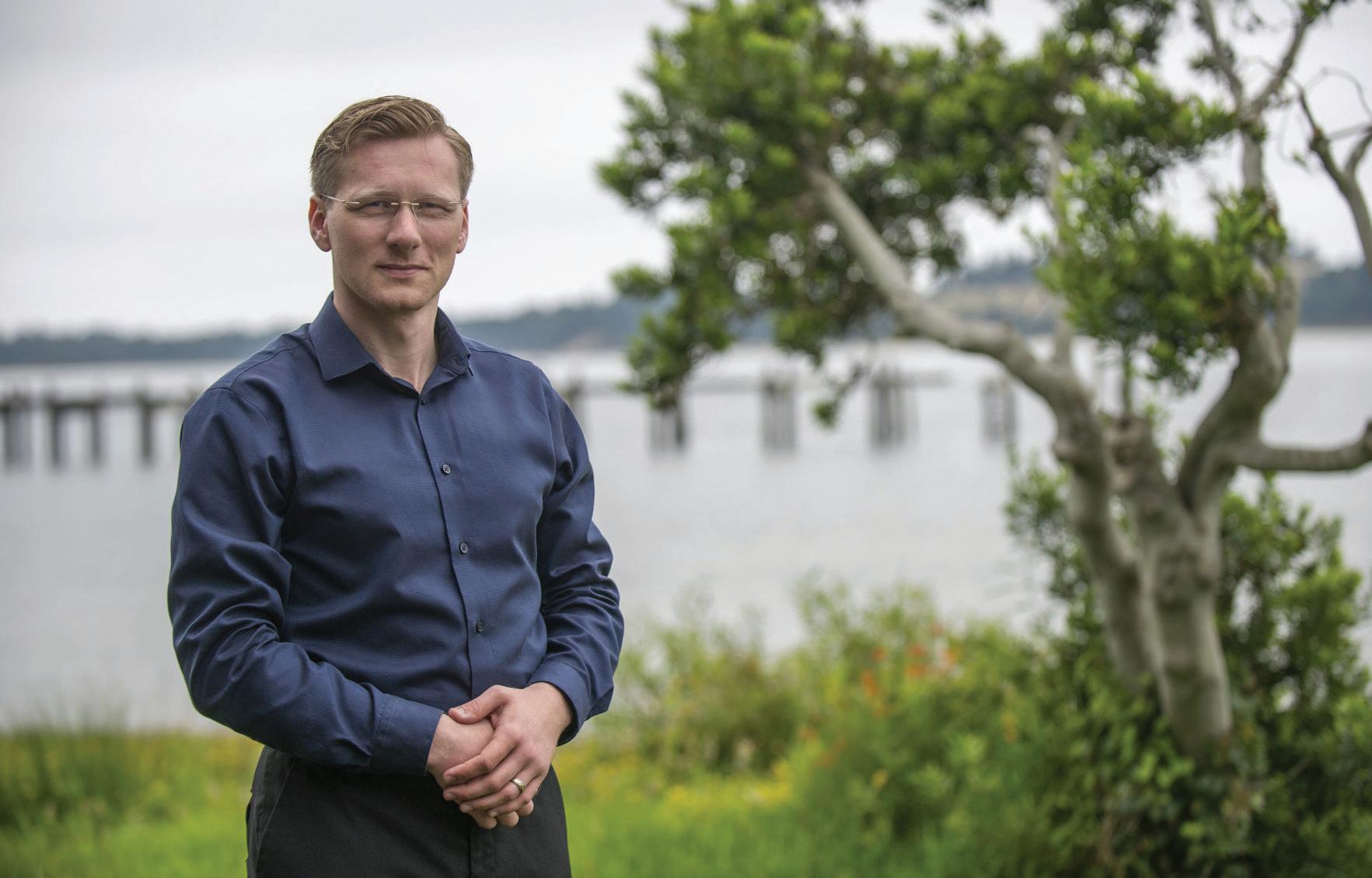
Drew Farmer announced recently that he was stepping aside as the executive director of ORCCA but will continue to serve on the Coos Bay City Council.
Photo by David Rupkalvis/For The World
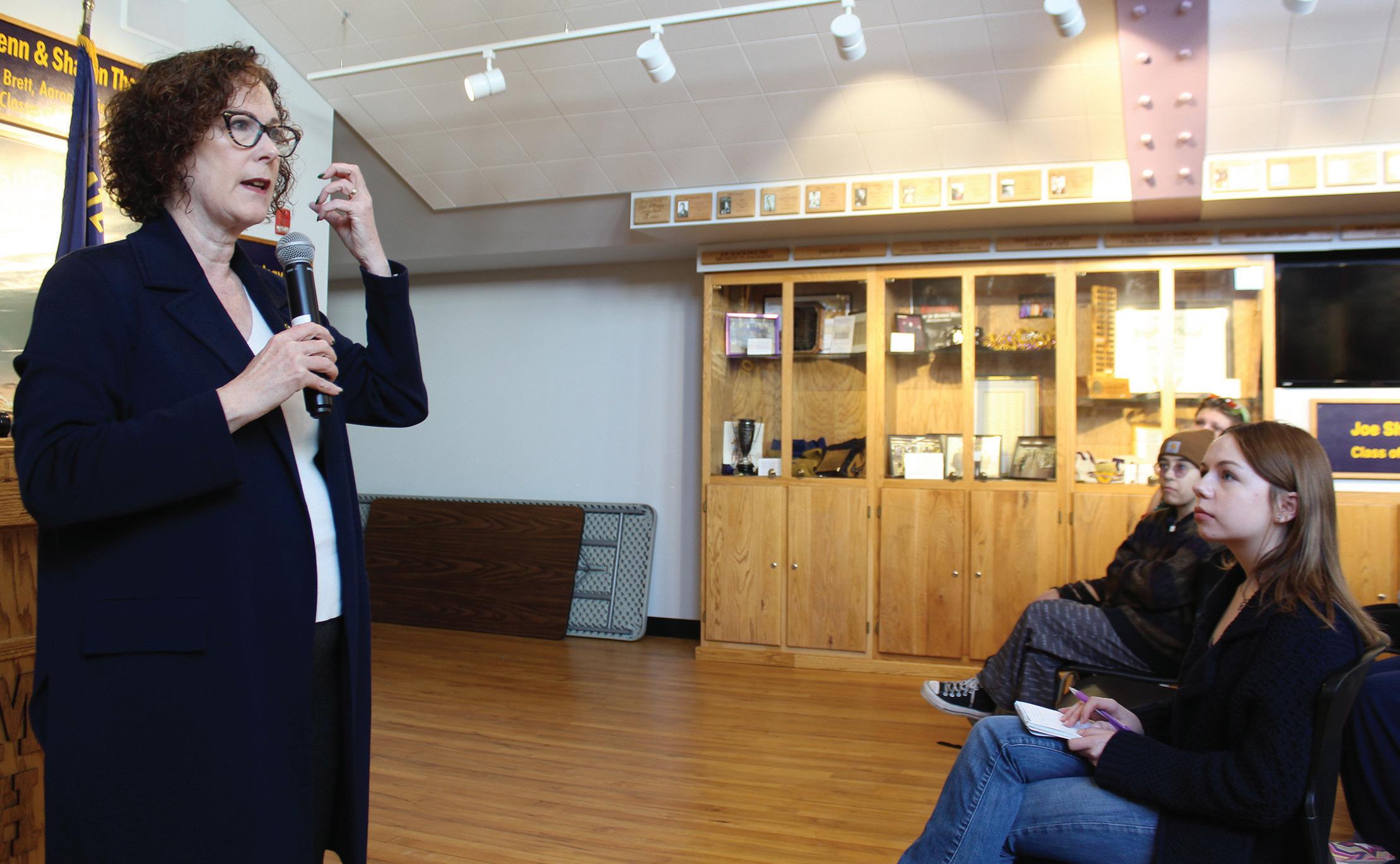
U.S. Representative Val Hoyle talks to students at Marshfield High School while visiting Coos County last week. Hoyle told the students her top priority in Congress was to get funding to bringing a shipping facility to the Port of Coos Bay.
Contributed photos In Oregon and around the globe, the amount of plastic being seen on beaches and in the ocean is increasing.
Poetry reading set at North Bend Library
On Saturday, April 15 at 1 p.m. the North Bend Public Library, in partnership with Airlie Press, will be hosting a poetry reading entitled “Airlie Press Presents: Poetry from the Pacific Northwest.” The reading will feature PNW poets Carey Taylor, Kelly Terwilliger, and Connie Soper who will share selections from their latest works.

Carey Taylor is the author of The Lure of Impermanence. She is a Pushcart Prize nominee and winner of the 2022 Neahkahnie Mountain Poetry Prize for her poem “Birthday Fires.” Carey currently lives in Portland, Oregon, but as a child, she lived at the Coos Bay Lifeboat Station in Charleston, Oregon. She has said that the years she spent on the Oregon coast were instrumental in instilling in her a sense of place, which is a theme that frequently appears in much of her poetry.
Kelly Terwilliger is also a Charleston native. Her

childhood home overlooked
Joe Ney Slough, and she spent her childhood roaming the local beaches, mudflats, and tidepools with her marine biologist parents. She has lived in Eugene for the past 25 years but still considers the coast her home.
Connie Soper grew up in Coos Bay and spent her childhood visiting the beaches of the Oregon coast. She hiked the Oregon Coast Trail in its entirety over three summers and wrote about her experience in her nonfiction book Exploring the Oregon Coast Trail. Soper is a poet and hiker who finds inspiration from nature. Her first book of poetry A Story Interrupted invites readers to “wander the trails of Oregon's lush and fertile forests, and to celebrate its beaches, coastal cliffs, and headlands.”
For more information about this event, contact the library at (541) 756-0400 or email nbservices@northbendlibrary.org.
172 Anderson Avenue, Coos Bay P.O. Box 1840, Coos Bay, OR 97420 ©2023 Country Media, Inc.
Office 541-266-6047
NEWS DEPARTMENT
Publisher David Thornberry dthornberry@countrymedia.net
Executive Editor — Jeremy Ruark jruark@countrymedia.net

Regional Editor Emeritus — David Rupkalvis worldeditor@countrymedia.net

Associate Editor, Reporter — Will Lohre reporter1@countrymedia.net


Sports worldsports@countrymedia.net
Obituaries worldobits@countrymedia.net
ADVERTISING

— Colleen DeCamillo worldsales1@countrymedia.net
& Coffee Break westernworld@countrymedia.net
Service worldcirculation@countrymedia.net
Dawn Smith worldlegals@countrymedia.net
Hoyle
From A1
selected for the first round of funding.
“This essential project — which has an unprecedented broad base of bipartisan support — is the perfect fit for the program that was established to fund critical large projects that would otherwise be unachievable without assistance,” the release stated.
Representative Hoyle and Senators Merkley and Wyden continued, saying; “It is clear we need to modernize our nation’s port infrastructure without delay to address this crisis, just as it is clear the underutilized Port of Coos Bay provide a perfect solution.”
As the largest deep-water port between Puget Sound and San Francisco, expanding the Port of Coos Bay’s container capacity
Farmer
From A1
ed to the executive director position at ORCCA because of the important work that the
could immediately increase West Coast port capacity by about 10 percent, they said. Nowhere else along the coast has that ability.
Hoyle and her counterparts promised not to give up on the project and continue to be champions for future funding opportunities.
In her latest visit to Coos County, Hoyle said she has been doing just that.
One of her major achievements to spotlight the project, she said, was to join the Transportation and Infrastructure Committee.
“Transportation and Infrastructure is the largest committee in Congress. It is also one of the most bipartisan committees because it's led by both Republican Sam Graves (MO) and Democrat Rick Larsen (WA)," Hoyle said.

"It used to be (previous Oregon U.S. Representative) Peter Defazio, and he handled it the same way.”
organization does. "There are a number of programs that impact the communities' health – from early childhood education, to providing food to most all of the food banks in Coos and Curry County, energy assistance, weatherization and housing – things that touch most every aspect of someone’s life when they are in need," Farmer said. The executive director reported his biggest challenge during his time with ORCCA was navigating the agency out of COVID. "It was an agency coming
“They firmly believe that infrastructure and investment should not be a partisan issue – even if we have different ideas about how to do it. So, it's truly one of the most functional committees in Congress,” she said.
The Oregon representative said it is also one of the most desired committees in congress.
“There were only six seats for ‘freshmen,’ and I worked really hard to get one of them, because I knew that I could advocate for the Port from that committee,” Hoyle said.
The newly-elected Oregon congressional representative recounted a photo opportunity she had with President Joe Biden.

“I said, 'President Biden, It's very nice to meet you. I need to talk to you about the Coos Bay Port.’
He said, ‘Yes, I love the Coos Bay Port,’ and I said, ‘I know you support it. We
out of COVID with so many complex pieces. Some of the pieces got out of place. So, the biggest challenge was identifying what pieces had fallen out of place and then to put them back in place," he said.
"The greatest accomplishment was fixing a five-month backlog in state funding so that we could pay people's energy and housing bills, and re-staffing the agency, as well as the collaborative relationship we have developed with Advanced Health," Farmer added.
He said as new leaders
didn't get the mega-grant – and we need this for our community, and we need this for our country.”
He said, ‘I like this project,’ and I said ‘We need this federal investment so we can move this forward.’”
Representative Hoyle said her background in trade, manufacturing and distribution gives her a lot of knowledge about the supply chain and how it works, and a unique skill set that positions her to talk about how the Pacific Coast Intermodal Project would work.
In the next issue, Hoyle will discuss more details about why she thinks the project is so important, and Port of Coos Bay’s Director of External Affairs and Business Development Margaret Barber will introduce key components of the project and how she says it would promote economic development in the area.
come into the organization, he hopes that they continue to foster that relationship.
"I'd really like to see that relationship with Advanced Health continue," Farmer said. "There is a lot of opportunity for receiving increased funding for energy assistance, housing assistance and food assistance, and those are programs that ORCCA has run for years. It could be a good asset to Advanced Health if they would like ORCCA to support the delivery of those services. I think that would maximize the impact in this community."
Welcomes New Owner
Jason Reid
Jason Reid has purchased Modern Floors located at 1910 Northwest Ocean Boulevard in Coos Bay, Oregon. Jason is also the owner of West Coast Fencing, located right across the street from Modern Floors! “Coos Bay faced a lot of hardship in the ‘80s and I can see it starting to blossom,” Reid said. “I want to get involved with the community and help with this development. I acquired Modern Floors because I wanted to get more involved with the retail end of construction projects and Modern Floors seemed like a good fi t because of its longevity in the area.”
f t h e M o n t h
“We want to get more involved with the Bay Area community and help it grow.”

Reid was raised in rural Idaho and moved to Ashland, Oregon out of high school. Later Reid moved to Portland, Oregon where he worked in the masonry and remodeling industry.
“I started doing masonry, and then started with a remodeling company,” Reid said.

“I became a project supervisor and then a general manager. At that point I decided to start my own company, and started acquiring construction businesses.”
“I love helping these businesses and providing people with opportunities to grow and find their careers,” Reid said.
Reid currently resides in Portland with his son Elliot, and two dogs Jankers, a hound dog, and Lucy, a golden retriever. In his free time he enjoys science, skiing and flying planes.
“I have my pilot’s license and enjoy giving
people plane rides,” Reid said. “I also like traveling to remote locations. During one of my layovers, I was able to get out [of the airport] and explore Iceland. It was one of my favorite vacations.”
Modern Floors offers free in-home measures, free estimates, professional installations by licensed and insured professionals, and other flooring needs. The store also carries a selection of window coverings.

“We are here to help our customers in any way we can and encourage our customers to try DIY projects,” Reid said. “It is one of the things that sets us apart from most flooring companies.”
Modern Floors can be reached at 541-8885531 and information can be found on their website modernfloorscoosbay.com. The store is located at 1910 Ocean Boulevard Northwest in Coos Bay and is open Monday through Friday 8 a.m. to 5 p.m. and by appointment on Saturday.
ID Tips:
The Coos Watershed Association (541) 888-5922 x309


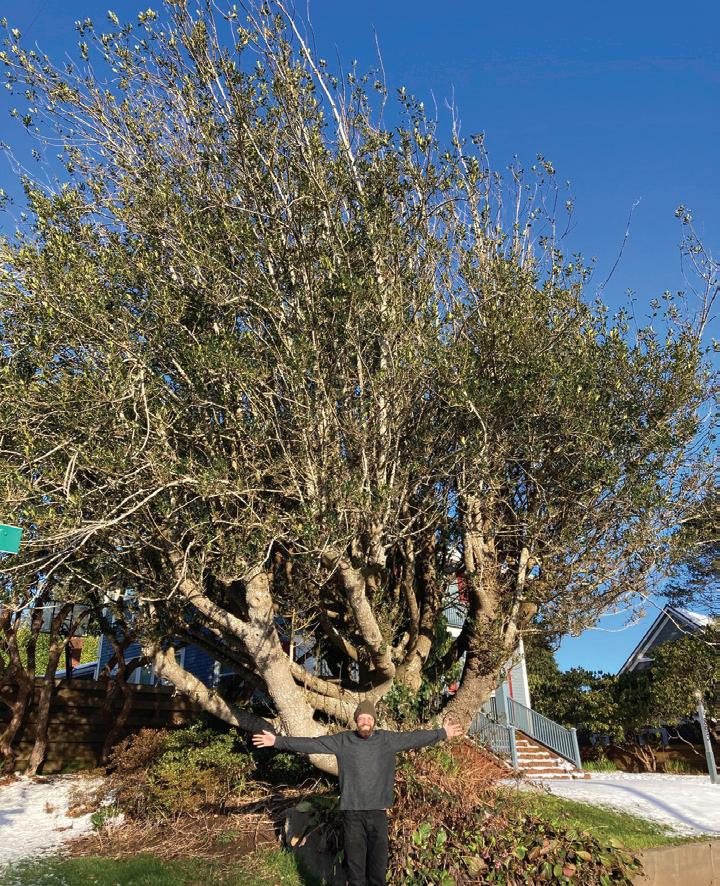
weeds, that prefer sunny, disturbed habitat, Holly can thrive in the deep, dark interior of our native conifer forests There the plants can grow into full-blown trees, displacing native species and eventually forming thickets While chopping down a tree doesn't kill it, it will stop it's spread by berries
Want

A2 | FRIDAY, MARCH 24, 2023 The World
Classifieds
Customer
Legal
SUBSCRIBER SERVICES Subscription rates: EZ Pay: $24.00 per month or 52 weeks $192.00. Billing will continue beyond the initial order period unless you contact The World Newspaper by calling 541-266-6047. Rates may change after any introductory offer period. Postmaster: Send address changes to: The World, P.O. Box 1840, Coos Bay, OR 97420-2269. The World (ssn 1062-8495) is published Tuesday and Friday, by Country Media, Inc. AD DEADLINES Tuesday’s issue Approved and paid for by: Classifieds: Legals: Obituaries: Wednesday Wednesday Wednesday 3:00pm 3:00pm 3:00pm Friday’s issue Approved and paid for by: Classifieds: Legals: Obituaries: Monday Monday Monday 3:00pm 3:00pm 3:00pm
e e
o
n g l i s h H o l l y - I l e x a q u i f o l i u m
Advertising
Advertising
W
d
E
South Coast Cooperative Weed Management Area Presents: Leaves are thick, glossy, dark green and wavy 13 inches long The Coquille Watershed Association (541) 396-2541 Holly spreads primarily by birds transporting the seeds Do you have a mature holly tree on your property that produces berries? Chop it down and keep those seeds out of our forests! Talk to your Local Watershed Weed Expert. Save our Forests! Chop Down Holly!! Flowers are small whitish and sweetly scented Bunches of red yellow or orange berries, poisonous to people and pets but not to birds Unlike many of our noxious
to help
this
from our public lands? Join the Second Saturday Stewards at Millicoma Marsh for an invasive weed event from 10-12 on March 11th. Lunch Provided.
remember the legends, NOW SEE THEM LIVE! (541) 516-0190 www.KingstonTrio.com Fans of the folk icons The Kingston Trio can re-discover their timeless music all over again as they perform their best-loved songs, “Tom Dooley” and “Where Have All The Flowers Gone?”
1202 11th St SW, Bandon, OR 97411 APRIL 11 7:00PM
remove
plant
You
LIVE AT THE
SPRAGUE THEATER
Photo by David Rupkalvis/For The World
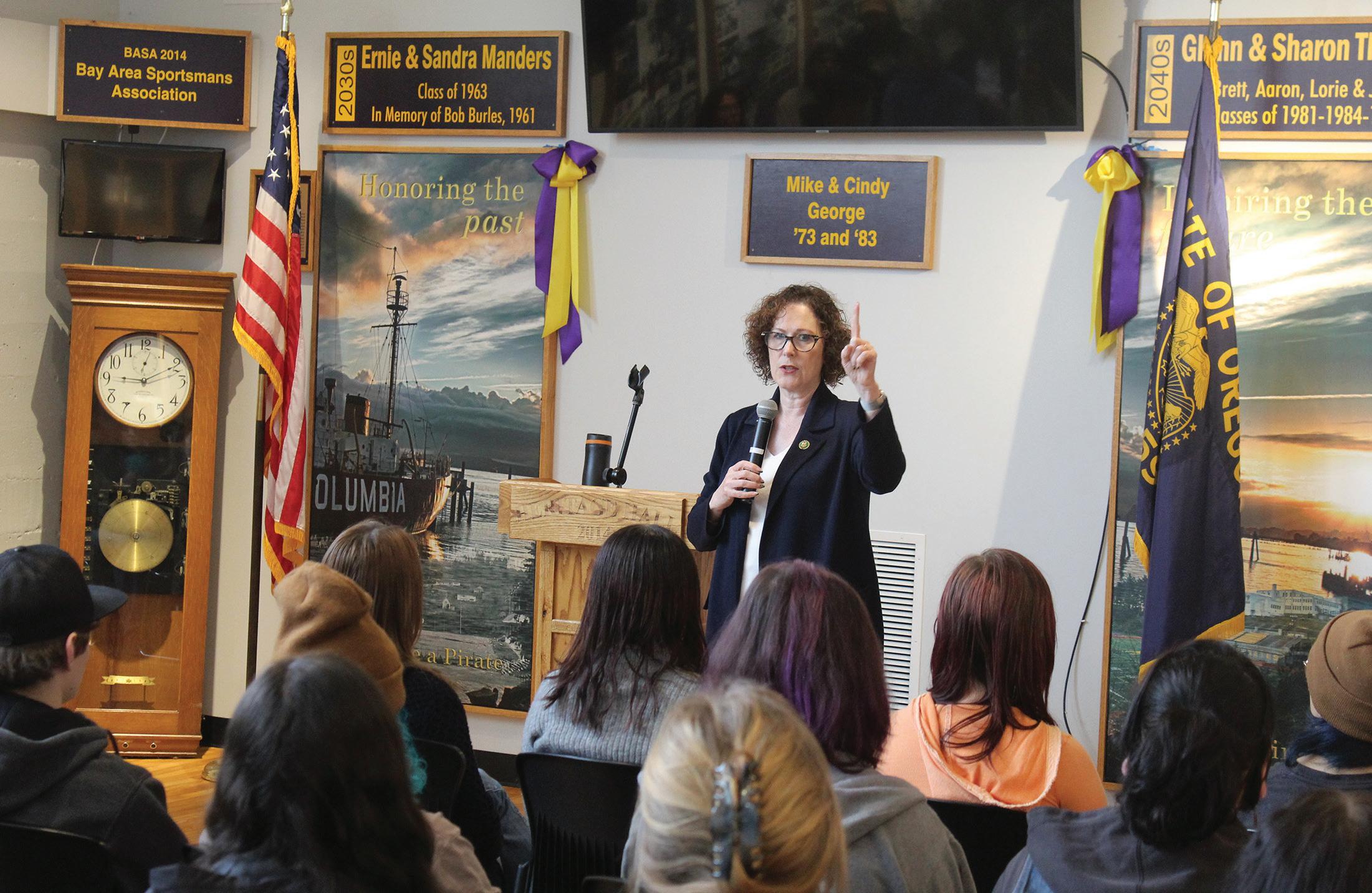
U.S. Representative Val Hoyle explains how her first three months have gone as a new representative in Congress.
“My goal with all of my companies is to become number one in the area by providing outstanding customer service and giving back to the community,” Reid said.
(541)888-5531 • 1910OceanBlvd.NW,CoosBay www.ModernFloorsCoosBay.com
Pacific Council says rescind Oregon OSW call areas





The Pacific Fishery Management Council (Council) acted last week to join a chorus of voices recommending the Bureau of Ocean Energy Management (BOEM) rescind the current Oregon call areas designated for floating offshore wind energy development. The council also recommended BOEM start the siting process over using a spatial mapping tool focused on identifying deconflicted areas suitable for wind energy development.
A St. Patrick's Day party in North Bend









The North Bend Ice Skating Rink was transformed into a rockin' concert hall for Saturday's free Saint Patrick's Day Events.

Captain Blue kicked off the fun with a free concert hosted by the City of North Bend. The danceable Rock and Roll band played from 3 to 6 p.m. Spirit drinks were provided by the Back Alley Pub and Grill and food trucks were on sight including The Muncheria and Papas Doggs. After the event, community members were invited to participate in a Clover Pub Crawl with participating businesses. Pictured are the Captain Blue band performing, and 4-year-old North Bend Resident Clancy Hulbert getting down dancing to the rock and roll in the early afternoon during Saturday's events.

Plastic


From A1









effects of consuming plastic particles, with birds and their chicks starving to death due to the amount of plastic in their stomachs, which they mistake for food while foraging. Plastics are not just in the oceans, but are polluting every biome on earth. Plastic particles have been found near the summit of Mt. Everest, in mountain streams far from civilization, in the soil, and in the deepest ocean trenches. Microscopic particles of plastic, known as nanoplastics, are small enough to penetrate human cells, and have been found in human lung tissue, the bloodstream, the GI tract,
placentas and in infant's first feces.




Negotiators at the United Nations are working on a legally binding global plastics treaty by 2024, which would regulate all aspects of the lifecycle of plastics, including the types of chemicals used in plastics, and whether they can be easily recycled. In the meantime, people can help by reducing their use of "single-use" plastics; by limiting or refusing to purchase any products packaged in plastic that is thrown away after just one use. The only types of plastics that have any market for recycling are labeled #1 and #2. Most other types of plastic are either incinerated, dumped in a landfill or ultimately end up in the ocean.
New Ocean Treaty Signed by Almost 200 Countries at U.N. Headquarters in New York
In what has been called "the biggest conservation agreement in the history of the world", in early March, almost 200 countries signed a legally binding agreement at the United Nations to protect the world's oceans. The "High Seas Treaty" aims to protect 30% of the world's oceans by 2030. The agreement protects biodiversity in international ocean waters, which cover around 40% of the earth's surface. The high seas have suffered years of overexploitation from rampant overfishing, mining, and chemical and plastic pollution The treaty will create a frame-
work to manage conservation of ocean life and establish marine protected areas. These protections will also help to protect coastal biodiversity and economies. Nations typically control the ocean waters and sea floor within 200 nautical miles of their shorelines, but the remaining international waters, or "high seas", consist of almost twothirds of the world's oceans, and are not under the jurisdiction of any government. Just over 1% of these waters are currently protected. The world's oceans are home to 94% of the planet's wildlife, absorb about 25% of human-generated carbon emissions, produce 50% of the oxygen in the atmosphere, and absorb about 90% of the atmosphere's excess heat.
Instead of using this approach to consider appropriate areas along the entirety of the Oregon coast, BOEM has been using the mapping tool only to analyze the call areas identified last year. Members of the fishing industry, environmental groups, tribes, and several of the council’s advisory bodies provided testimony to the council supporting a more widespread use of the mapping tool. The motion also included sending the same letter to Oregon’s new Governor, Tina Kotek.
"The Council's action sends a strong signal to BOEM that fisheries leaders do not want to risk losing our productive fisheries, the scientific surveys on which our fisheries management depends, or the health of our ocean ecosystems due to offshore wind," WCSPA Deputy Director and Co-Chair of the Council’s Marine Planning Committee Susan Chambers said. "The California Current is one of the most productive ecosystems in the world. We need to get this right."
Seven Council advisory bodies provided detailed statements voicing concerns

about the current process, with several bodies calling to rescind the current Oregon call areas. These advisory body statements were buoyed by oral public comment from 10 organizations and businesses, including the environmental organization, Oceana, as well as individual fishing businesses and fishing trade associations.
Heather Mann, executive director of the Midwater Trawlers Cooperative and one of the leaders of the informal coalition Protect US Fishermen said, “we hear the climate crisis is so severe that collateral damage to birds, whales, the California current ecosystem, food security, even to fisheries, fishermen and rural community economies is an accepted part of the transition to cleaner energy. That is an unacceptable premise to me, and I hope it is to you as well.”
The motion passed unanimously (10-0) with four abstention votes cast by the state representatives for Oregon, Washington, and California as well as the NMFS representative. Tribal representative and Council member Joe Oatman reiterated concerns that have been expressed frequently about the lack of proper government to government consultation with tribes.
“Tribal concerns are not being given the due consideration that they deserve,” Oatman said. “Many potential impacts on the California current ecosystem and the aquatic resources on which they depend have not been adequately identified or addressed by BOEM.”



The World FRIDAY, MARCH 24, 2023 | A3 Located at the heart of Coos Bay Oregon, the Blue Heron Bistro is a small-town German restaurant serving traditional German food, local seafood, and now Memphis style BBQ (yeah it’s that good). Here at the Blue Heron, we believe in serving homemade, well-prepared meals to our customers. We shop as local as possible when possible using farmers markets and farm to table products . We make our very own desserts, French bread, and dark German sourdough rye and buttermilk bread right here in the restaurant. In addition, our German bratwurst and Kasseler Rippchen are made and smoked right here in house.. We have also started smoking our very own meats Memphis BBQ style .. By using drippings from our meat dishes, we make our own gravies from scratch. Our restaurant has been serving these authentic, wholesome meals since 1976. 100 W. Commercial Ave, Coos Bay, OR 97420 www.BlueHeronBistro.com • BlueHeronBistro1@gmail.com DON’T FORGET ABOUT OUR FANTASTIC BRUNCH SUNDAYS ONLY FROM 10AM TO 2 PM MARGARITAS Mexican Grill 825 Central Ave. , Coos Bay • 541-267-5480 Favorite Mexican Food Take-Out & Drive Thru! 63058 HWY 101, Coos Bay, OR 97420 541-808-9696 MEXICAN RESTAURANT Promo Number: 285 *For those who qualify. One coupon per household. No obligation estimate valid for 1 year. **Offer valid at time of estimate only. 2The leading consumer reporting agency conducted a 16 month outdoor test of gutter guards in 2010 and recognized LeafFilter as the “#1 rated professionally installed gutter guard system in America.” Manufactured in Plainwell, Michigan and processed at LMT Mercer Group in Ohio. See Representative for full warranty details. Registration# 0366920922 CSLB# 1035795 Registration# HIC.0649905 License# CBC056678 License# RCE-51604 Reg2106212946 License# MHIC111225 Registration# 176447 License# 423330 Registration# IR731804 License# 50145 License# 408693 Registration# 13VH09953900 Registration# H-19114 License# 218294 Registration# PA069383 License# 41354 License# 7656 DOPL #10783658-5501 License# 423330 License# 2705169445 License# LEAFFNW822JZ License# WV056 1-855-536-8838 CALL US TODAY FOR A FREE ESTIMATE BACKED BY A YEAR-ROUND CLOG-FREE GUARANTEE Mon-Thurs: 8am-11pm, Fri-Sat: 8am-5pm, Sun: 2pm-8pm EST % % OFF OFF 20 + YOUR ENTIRE PURCHASE SENIORS & MILITARY! 10 FREE GUTTER ALIGNMENT + FREE GUTTER CLEANING*
Photos By Breeana Laughlin
When giants fall, we need to listen
By JOE STONE
“God has cared for these trees …but he cannot save them from fools.”
— John Muir
Letters to the editor
"There but by the grace of God go I"
I walked out of Walmart yesterday morning and saw a man standing in the corner by the trash can. I knew right away he was one of our local bums but something made me turn around. This man was standing in the pouring rain with no shoes on- bare feet- no coat- just a shirt and some shorts. He was drenched to the bone and shivering.
I asked him," do you need anything?" and he said , " I have a friend who's in the store right now getting me some shoes and socks." I said," are you sure?". He said,"yes."; I said," well at least stand under the awning here and get out of the rain "and he said ,"okay". As soon as I left, I look back and he was still standing there shivering. I didn't see anyone helping him and he didn't go under the awning like I told him to. I can only assume that he was standing to the side of the awning because a Walmart employee ran him away from inside the door. He probably told me someone was getting him some shoes, but he may have been just telling me that to keep from bothering me. I can tell you that I broke down in tears later on.
I am not a bleeding heart but I also do not have heart of stone and if he had wanted anything from me I would have given it to him at that point because by the grace of God there go I. I would tell you that I work for a living and I'm not lazy but there are some people out there who are completely incapable of taking care of themselves and they could use just some help , a hand, a smile.
Toni Griffin Coos Bay
Our disabled veterans are grossly under-compensated. Why?
Since June of 2009 our disabled veterans, their advocates and their family and friends have contacted Congress and/or various Administrations daily asking for fair and adequate compensation. So far there has not been significant action on this issue. The COLA that they receive every year is not sufficient. Our government simply does not respond. There is nothing but silence from Congress or the Administration on this issue.
I am warning anyone and everyone who reads this. Once our young people become fully aware that if they should enlist in the armed forces and subsequently receive serious injuries or illnesses that they will spend their rest of their lives in near poverty as disabled veterans then at that point our armed forces will disintegrate. In fact, this is already starting to happen. Enlistments have fallen off precariously. This is a very serious national security situation. The fact is that huge Elitist greed is putting all of us in very real danger. Here is the raw data.
In FY2023 a totally disabled veteran with no dependents is compensated at the ridiculous rate of $43,463.40 dollars annually. The National Average Wage Index (NAWI) for 2021 was $60,575.07 dollars per annum and the median income for 2021 was $70,784. The per capita GDP in 2021 was $69,288 dollars, among the highest in the world. This rate of compensation to disabled veterans is deliberate and cruel especially considering that we live in the wealthiest nation that ever
The police blotter is a public record of incidents as reported by law-enforcement agencies. All individuals arrested or charged with a crime are innocent until proven guilty. The information printed is preliminary and subject to change.
Monday 03/06:
North Bend
• 8:49 am, 40 year old male cited result of traffic stop, 2300 block of Tremont Ave.
• 9:14 am, dispute, 1700 block of Virginia Avenue.
• 9:29 am, 47 year old male lodged at Coos County jail on warrant, Virginia and Hamilton.
• 11:59 am, 44 year old male transported to Coos County jail on criminal trespass II and probation violation detainer, 1600 block of Virginia Avenue.
• 12:05 pm, 44 year old male transported to Coos County jail on criminal trespass II and probation violation detainer, 1700 block of Virginia Avenue.
• 4:48 pm, theft of cameras, 2000 block of Public Square Center.
• 5:35 pm, 36 year old female
was.
Disabled veterans have been asking various Administrations and Congresses for fair compensation since the end of WWI in November 1918. That was 104 years ago!
This longstanding abuse must end now. Congress must compensate these broken former troops properly. This is a national disgrace.
Tax the investment wealth of the Investor Class that received the most benefit from the protection afforded to them by our troops who are now broken and compensate disabled veterans fairly. At the present time they contribute virtually nothing to the disabled veterans who protected Investor Class interests at great cost to themselves.
Be warned!
Justin DeVore Oregon City
One-sided press release or news story?
The long, huge, scary, inflammatory headline screamed from the page: “Senate Republicans Criticize Extreme Bill Allowing Convicted Felons Including Murderers and Rapists to Vote While in Prison.” Once again, I feel compelled to point out what seem to be press releases from the Oregon Republican Party, printed again as news stories, this time in the March 14 edition of The World newspaper.
The shocking headline is followed by an article that, in the first paragraph refers to SB 579 as “extreme” without crediting that assessment to a specific person or group, or even putting that word in quotes. This is not publishing a news report, but rather an opinion piece. The rest is pretty much all in quotes, but only quotes from Republicans opposed to the bill, with no statements from the Democrats who sponsored the bill.
I understand that The World, along with so many other “local” newspapers is in difficult financial situations. It is challenging to hire any reporters, much less investigative reporters. It’s much easier just to print what is submitted and to re-print nationally syndicated articles. But I subscribe to this paper to get local news and read opinions from multiple perspectives, and there seems to be less and less of that. It’s not an unreasonable expectation.
At least the headline of one of the other apparent Republican Party press releases (similar to ones that have come from the Democratic Party) which appeared in that paper: “Boice Announces His Opposition to SB 603” is pretty clear that that is what it is. But that “article” also does not include an explanation of the bill from those who sponsored it and their reasons for doing so.
Neither of these bills has been passed. As with any legislation under consideration, citizens should have an opportunity to express their views on it. Personally, I don’t know anything about either of these bills, nor whether I would be in favor of, or opposed to them. And I couldn’t possibly make a decision about either without reading the assessments of people on both sides of the issues.
Donna Leveridge-Campbell Bandon
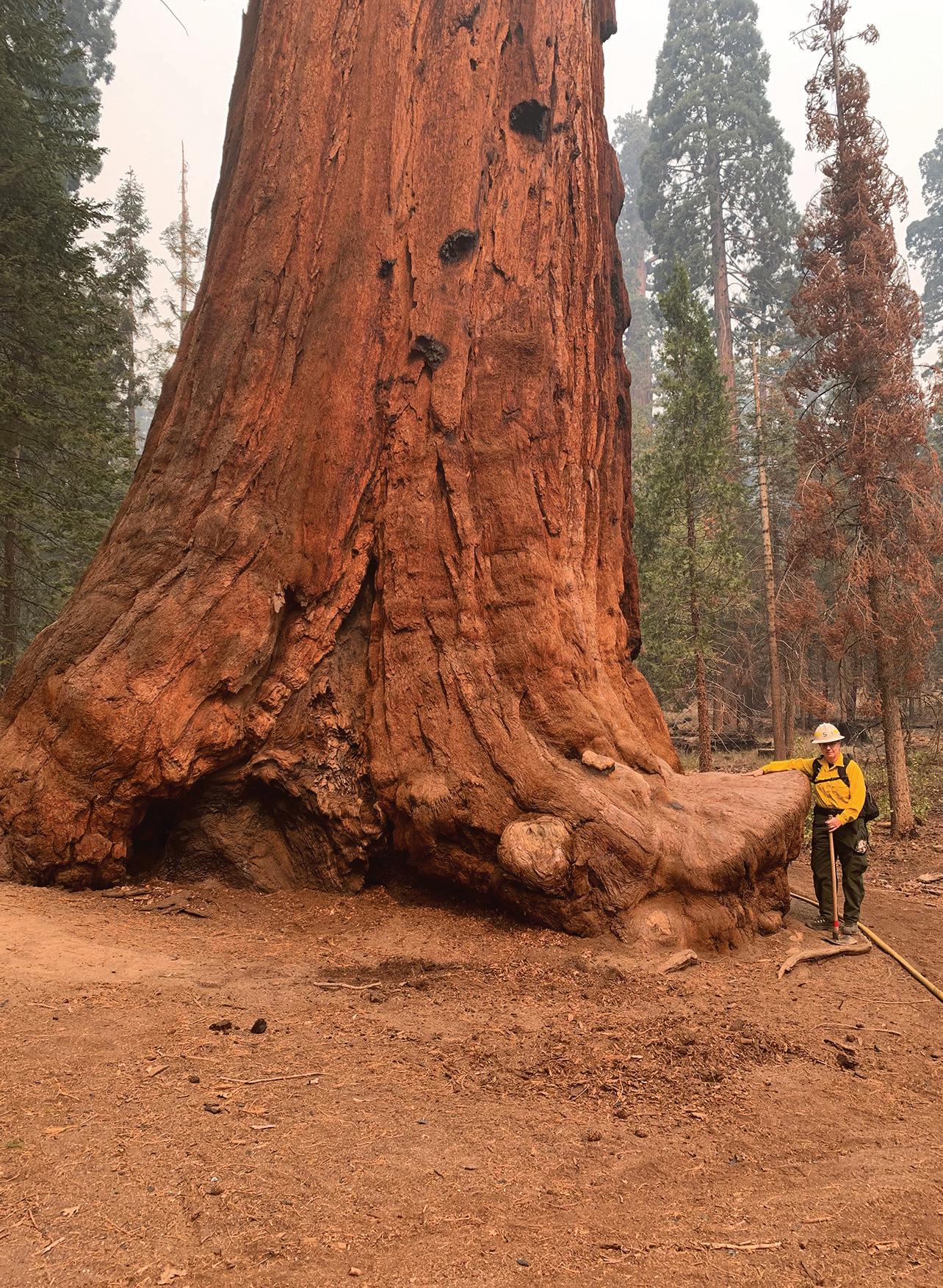
In just two years, wildfire has killed an estimated 13 to 19% of all mature giant sequoia trees. These most massive of trees grow only on certain western slopes of the Sierra Nevada, the mountain range that divides California’s Central Valley farmland from the Great Basin Desert.
The loss of so many “big trees,” as conservationist John Muir called them, is unprecedented.
Many of the best-known stands of giant sequoias grow more than 6,000 feet above sea level in three national parks — Sequoia, Kings Canyon and Yosemite. A visit to these immense trees typically begins with a drive up from Fresno. From the valley floor, Highway 180 curves into foothills, then winds onto steep, tree-covered mountainsides where cooler temperatures and higher humidity take the edge off the California sun.
The road passes through Kings Canyon National Park, where visitors get their first impression of the big trees. As Muir acknowledged, words aren’t sufficient to convey the awe of that first encounter with giant sequoias: “No description can give anything like an adequate idea of their singular majesty, much less of their beauty.”
He added, “Nothing hurts the big tree.” Except in our time: severe wildfire and the chainsaw.
Muir’s words helped inspire the national parks that have protected many sequoia groves from logging, but our concern about wildfires led to governmentmandated fire suppression for more than 100 years. Through a federal agency’s zeal, the big trees are in trouble. In the Sierra Madre’s fire regime, developed over centuries, sequoia groves burned every 6 to 35 years. Wildfire thinned the smaller trees and converted fine fuels into soil nutrients.
Without fire, sequoia cones don’t open and spread their seeds. The same fire also creates openings in the forest canopy, giving seedlings the sunlight they need to survive.
Research shows that giant sequoia populations were “stable or increasing” from 500 B.C. through the 1800s. Then came the 1900s, when “there was a massive failure of giant sequoia reproduction.” Without
Police Blotter
cited result of traffic stop, Harris and Washington.
• 5:47 pm, civil problem, 1700 block of Waite Street.
• 7:17 pm, dispute, 2900 block of Ash Street.
• 9:26 pm, disorderly conduct, 1900 block of Meade Avenue.
Coos Bay
• 12:51 am, dispute, 900 block of E Street.
• 7:07 am, criminal mischief, 300 block of S 2nd Street.
• 7:18 am, dog at large, S Broadway and Johnson Ave.
• 7:45 am, animal neglect, 200 block of Hull Street.
• 9:51 am, 33 year old male transported to Coos County jail on warrant, Anderson and 10th Street.
• 11:37 am, theft, 2000 block of Newmark Avenue.
• 12:26 pm, Albany Police served 44 year old on Coos Bay Police warrant, 1100 block of SE Jackson Street.
• 1:22 pm, criminal mischief, 200 block of W Market Street.
• 1:40 pm, disorderly conduct, Bayshore and Front.
• 2:10 pm, shoplifter, 2000 block of Newmark Avenue.
• 2:28 pm, dog at large, 800 block of S 1st Street.
• 2:44 pm, 47 year old male transported to Reedsport jail on disorderly conduct II and probation violation detainer, 1300 block of N Bayshore Dr.
• 2:54 pm, civil problem, 300 block of S 5th Street.
• 3:22 pm, 43 year old female cited for theft II and criminal trespass II/57 year old male cited for theft III and criminal trespass II, 2000 block of Newmark Avenue.
• 4:18 pm, civil problem, 300 block of S 5th Street.
• 6:07 pm, theft of keys, 300 block of Ackerman Avenue.
• 6:48 pm, disorderly conduct, Michigan and Sunset School.
• 6:53 pm, elderly abuse, 1400 block of Highland Ave.
• 7:14 pm, theft, Empire Lakes/John Topits Park.
• 8:53 pm, Curry County Sheriff served 40 year old female on Coos Bay Police warrant, 29800 block of Ellensburg Ave.
• 10:05 pm, 39 year old male transported to Coos County jail for domestic harassment, 700 block of Newmark Ave.
• 10:27 pm, loud noise, Wallace Street.
Coquille
• 1:40 pm, burglary, 60 block of W 2nd Street.
fire, sequoia seeds stopped sprouting, while the buildup of highly combustible fine fuels on the forest floor, and the greater density of smaller trees, increased the risk of catastrophic wildfire.
As scientists began to understand the problem, the National Park Service implemented a prescribed burning program in giant sequoia groves. Evidence from recent wildfires indicates the program has been successful. Areas treated with prescribed fire burned less intensely, mature sequoias did not die and sequoia seedlings have since sprouted.
Clearly, sequoias need fire to survive.
The challenge is avoiding catastrophic wildfire, a challenge made difficult by today’s dense groves.
According to Alexis Bernal, a researcher with the University of California at Berkeley, Sierra Nevada forests typically held about 20 sequoias per acre before 1860. Since then, fire suppression has allowed the growth of as many as 120 to 160 trees per acre.
Bernal advocates extensive logging before fire can resume its natural role. Emergency logging by government agencies has already begun in forests with sequoia groves, including clearcuts along roadways in Yosemite National Park.
Not everyone agrees that logging is the answer. Forest ecologist Chad Hanson, with the John Muir Project, calls Bernal’s approach an excuse to continue commercial
logging of public lands. He believes sequoia deaths have been far lower than official estimates and that new trees can sprout even after severe fires.
Unfortunately, Congress has gotten involved. Kevin McCarthy, R-California, introduced the Save Our Sequoias Act in 2022 in the House. Dianne Feinstein, D-California, later introduced the act in the Senate. The bill would expedite mechanical “fuel treatments” by bypassing environmental laws.
We’re just lucky that record snowfall in the Sierra Madre threw a wet blanket on the initiative by reducing fire risk, as the bill has yet to be re-introduced in the current legislative session. While the unprecedented threat to these priceless trees might be a rare instance in which “mechanical treatment” is justified, chipping away at environmental protections has rarely, if ever, proven beneficial for the environment— especially when politicians try to call the shots.
Giant sequoias need all the help they can get, but that help needs to be informed by good science.
Joe Stone is a contributor to Writers on the Range, writersontherange.org, an independent nonprofit dedicated to spurring lively conversation about the West. He is the editor of Forest News, the publication of Forest Service Employees for Environmental Ethics.
Tuesday 03/07:
North Bend
• 9:46 am, dispute, 1600 block of Virginia Avenue.
• 11:11 am, loud noise, 2200 block of Sherman Avenue.
• 12:46 pm, theft, 1700 block of Lincoln Street.
• 2:19 pm, juvenile problem, 1600 block of Virginia Ave.
• 3:05 pm, ID theft, 1900 block of Channel Street.
• 3:51 pm, civil problem, 800 block of California Avenue.
• 4:32 pm, 44 year old male transported to Coos County jail for to counts criminal trespass II and probation violation, 1900 block of McPherson Ave.
Coos Bay
• 12:33 am, 61 year old male cited result of traffic stop, Morrison and Salmon.
• 4:57 am, 42 year old female cited for disorderly conduct II, S Broadway Street and Anderson Avenue.
• 6:49 am, 29 year old male and 42 year old female cited result of violation city code, Empire Lakes/John Topits Pk.
• 7:17 am, 41 year old female cited result of traffic stop, Highway 101 and Ivy Hills.
• 12:06 pm, Bend Police arrested 44 year old male on warrant and lodged in Deschutes County jail, 500 block of NE 15th Street.
• 12:09 pm, 30 year old cited result of traffic stop, Broadway and Ingersoll.
• 1:34 pm, 27 year old male transported to Coos County jail for probation violation, 2000 block of N 12th Street.
• 2:05 pm, 82 year old male cited result of traffic stop, Koos Bay and Teakwood.
• 2:58 pm, 31 year old male cited on warrant, 1000 block of S 1st Street.
• 3:04 pm, burglary to storage unit, 200 block of E Lockhart.
• 3:55 pm, injured animal, Commercial and 13th.
• 5:00 29 year old male lodged in Coos County jail on a warrant, theft II, criminal trespass II and two counts of theft I, 2000 block of Newmark Avenue.
• 8:23 pm, 36 year old male cited for driving while suspended, 1000 block of Newmark Ave.
• 8:38 pm, 34 year old male cited for driving while suspended, Newmark and LaClair.
• 8:53 pm, disorderly conduct,
Woodland Drive and Ocean Blvd.
Coquille
• 9:04 am, dispute, 200 block of N Baxter Street.
• 12:41 pm, harassment, 300 block of N Central Blvd.
• 3:59 pm, theft of bike, weedeater and cans, 1100 block of N Baxter Street.
• 5:19 pm, 18 year old transported to Coos County jail for violation of restraining order. Reedsport • 2:04 pm, animal problem, 2200 block of Arthur Drive.
• 3:36 pm, trespassing, Fir Grove Motel.
• 7:40 pm, civil dispute, 500 block of Regents Place.
• 8:38 pm, disturbance, COHO RV Park and Marina.
Wednesday 03/08:
North Bend
• 8:08 am, disorderly conduct, South Coast Hospice Thrift Store.
• 8:44 am,
A Country Media Newspaper 172 Anderson Ave., Coos Bay, OR 97420 WorldEditor@CountryMedia.net | TheWorldLink.com/opinion Opinion The World FRIDAY, MARCH 24, 2023 | A5
Writers
the range
on
Image courtesy of Joe Stone Sequoia National Forest
33 year old male cited result of follow up, 1200 block of Newmark Avenue. • 10:16 am, harassment, 2200
Continued on page A9
The World FRIDAY, MARCH 24, 2023 | A7 SATURDAY
CLASSIC PEANUTS FRANK
MONDAY
AND ERNEST CLASSIC PEANUTS FRANK AND ERNEST
As I See It: Repurposing after the fire
Rock.
BY MARY SCHAMEHORN
The first photo I am sharing this week has ties to the feature I shared last week on the Ocean Drive home of Otto and Geneva Shindler.
Bo Shindler said he was reminded by Emily Capps Hall that the original windows and shutters for the Shindler's post 1936 fire home came from the lighthouse keeper's home (first picture) that was located across the river and upstream a little way from the lighthouse.
"A lot of people repurposed building materials, especially bricks, after the fire. Emily and her siblings packed bricks from the lighthouse keeper's home to help her folks (Edgar and Mary) build their home on Ocean Drive. I remember hours of using a hatchet to remove grout from used bricks for our house on River Road as well as projects for Frank and Linda Jarvis' Seven Devils home and 'Chief' Kimble who lived out on Highway 42," said Shindler.
The lighthouse keeper's house was torn down in 1939, but obviously parts were still available some years later to be repurposed by the locals.
The second photo, taken from the hill behind the Masonic building, where Bandon Inn now sits, shows you what the waterfront looked like before it was developed into what it has become today.
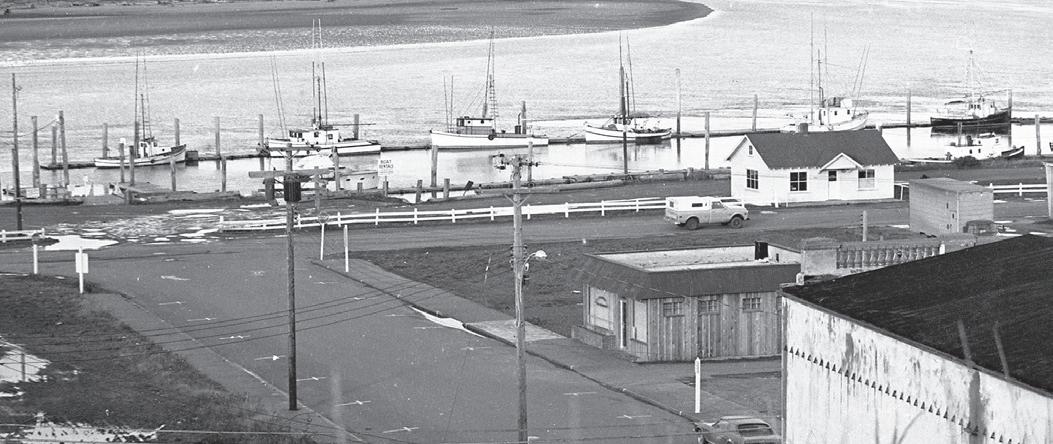
The white building on the waterfront was the first Port of Bandon office, which was later replaced by the High Dock building (now The Loft restaurant). Later, the Port moved its offices to the old Coast Guard building, which they own.
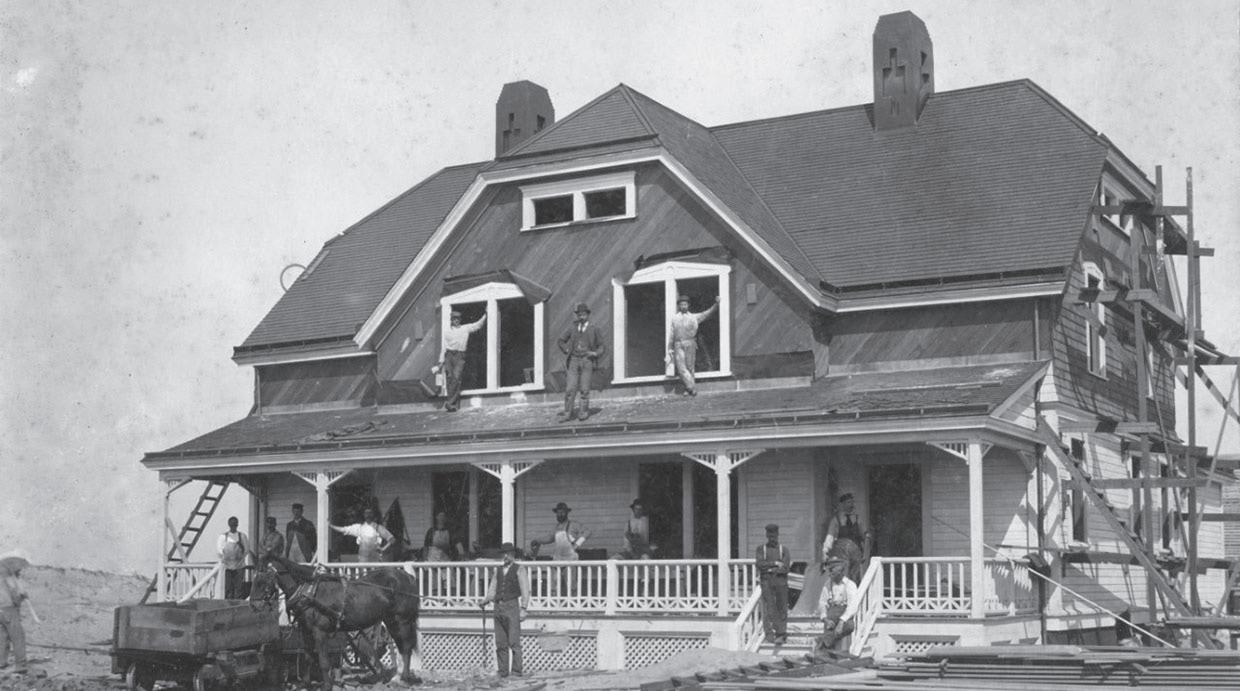
I understand they are building a new office on the High Dock, just north of The Loft and Butler's charter office.
The building in the second picture has recently been purchased by Dave Hisel from Tony Roszkowski and is part of the Tony's Crab Shack complex, one of the most popular eating places in Bandon.
I also want to apologize because the price of the sale was actually $1.5 million and not $1.2 million as I wrote in some issues of my column last week.
This picture was obviously taken after M&L Grocery
burned down as you can just see a corner of the property next to what was then W.H. Johnston's office (and is now a building owned by Ed Landucci that is currently vacant). Also, the Arcade Tavern had not yet been built.
Although not technically history, it really is because the Bandon Booster Club recently honored Bandon native Gary Chrismon, 68, by naming the east Bandon baseball field in his name, "Chrismon Park Baseball Field." A long-time coach, Gary has maintained the field for many years and in spite of painful back issues, he can most often be seen working at the field to get it ready for game day.
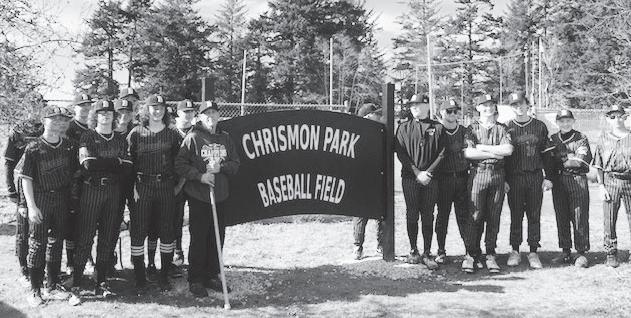
Chrismon, at left, is pictured with members of the high school baseball team. At the beginning of the program, Booster Club president Briana Hutchens introduced Tom Lakey, who spearheaded the movement to name the field after Gary. The sign was funded by donors and the efforts of the Booster Club.
"I have never seen anyone more dedicated to baseball in Bandon than Gary," said Lakey, whose remarks brought a big round of applause.
Chrismon is a 1972 graduate of Bandon High School, where he was a member of the baseball team.
A friend of mine, who is planning to come to Bandon a weekend in August for her class reunion, was shocked at the price of a motel room. She had planned to stay at Bandon Inn, which overlooks the river and Old Town, and the price of a single room for two nights was $750 ($350 for Friday and $400) for Saturday, plus the transient occupancy tax of 9.5 percent and any other fee which might apply.


People who have stayed there say that the cost of the rooms has greatly increased since Peggy Backholm sold the motel to the present owners.
The cost to stay at The Inn at Face Rock for the same August weekend was $339 a night, and at Table Rock Motel it was $184 a night for a king, but she was told that as soon as the new addition is open, the rates will be $269 a night. She booked with Table
* * *
I saw a post on Facebook March 16 that a Bandon man, Dale Pike, was badly injured in a tractor accident and is now in the hospital. His wife, Mary Jane, posted that on March 9, Dale "was outside working when he fell and his tractor ran over his chest breaking eight ribs on the left and (others) broken in two places." Sunday she posted that he was out of ICU, and was getting therapy to walk. She said he would be in the hospital a few more days.
* * * I learned that two women with ties to Bandon have died recently.

JoAnn Cox Owens died March 3 at the age of 75. JoAnn, who was previously married to the late Bob Owens, was active in the VFW, as was Bob. She is survived by her daughter Peggy; grandchildren, Christopher and Danielle; seven greatgrandchildren; brother, Fred; and sisters, Geri and Sandra. A celebration of life for JoAnn will be held at the VFW Hall on June 3 at 1 p.m.
Pat Collins Cagley, who was raised in Bandon, died March 5. She attended school locally and was in the Class of 1959. She spent most of her adult life in Coquille where her former husband, Orville Cagley, owned a barber shop. She taught in the school district. They had three children, including Brad Cagley, Brian Cagley, and the late Brenda Rick, who died in 2015.
* * *
Several weeks ago, I mentioned a price discrepancy between the two grocery stores, with Ray's being higher on two of the items that I buy the most of: an organic oat breakfast cereal and a certain brand of yogurt.
I continue shopping there because I love their meat department, and their employees, and they are a great source of gourmet items.
You can imagine my surprise when I checked on the cereal price, and discovered that it had been dropped to its original price, which was the same as I
had found at McKay's and mentioned in my column. Then I went over to look at the yogurt and found the price had also been lowered but not quite as much. I wondered to myself if they had read my column.
And it turns out they had, and several of their customers had brought a copy of the column into the store and asked about it. In a subsequent visit, the store manager came over and asked if he could talk with me. Of course, I knew what he wanted to talk about, but I was amazed at how kind and gracious he was, and particularly the fact that they had listened.
He did say that the price of the yogurt that the other store was selling was actually less than they were paying for it, but he did lower it substantially. And they lowered the cereal by over $2.
We are fortunate to have two grocery stores in Bandon, and at some point there may even be a third, but the cost of construction may derail that option. But most of all, I was impressed that rather than get upset with me .... they listened.
* * *
There are several events scheduled for April, including Project Graduation's annual Bash for Cash, which will take place Saturday, April 8.
"Since 1985, volunteer parents and guardians of the graduation class from Bandon High School have organized an all-night, safe and sober graduation party for eligible seniors as they share and celebrate the excitement of reaching this huge milestone. We are proud to state that since our formation, there has not been a single fatality on graduation night due to drugs and alcohol," said a Project Graduation spokesman.
I know this is a very popular event and it may well be sold out, but if you have questions you can contact Paula McMillen at 541-530-0731 or Karrie Devine at 559-246-4749.
The Lions Easter Egg Hunt is scheduled for Saturday, April 8, at 1 p.m. at Bandon City Park. Parents are reminded to bring baskets
for their children.
The Kingston Trio will be at the Sprague Theater on Tuesday, April 11, at 7 p.m. General admission is $50 and tickets are on line.
Not sure exactly what this is, but I saw it advertised on Facebook. The Bandon 5K Colorful Bunny Run in Bandon City Park will be held from 3 to 5 p.m. on Saturday, April 15. People can choose to walk or run eight laps at the park, and they are urging you to wear a white shirt and bunny attire.
For more information you can contact events@ bandon.com or call 541-3479616, according to Margaret Pounder, president/CEO of the Bandon Chamber of Commerce.
"This is a fundraiser to help in the overall event production that the Bandon Chamber undertakes every year. The cost is $10 a person or $25 for a family.
* * *
A group of elected officials, including several
mayors, city managers, county commissioners, police chiefs and port of Coos Bay officials were invited to meet with our new Congresswoman Val Hoyle last week at the Coos Bay council chambers. She is easy to talk with, understands rural communities, and I think she will be a great representative for this area. Not sure she or anyone else can navigate the gridlock which seems to have taken over Washington, D.C., but we can hope for a brighter future.
During the round table discussion, I mentioned BM110 (the decriminalization of hard drugs) and she assured me she had not voted for it. I mentioned how unfortunate it was that our former Governor and other state leaders had not openly opposed it. Now we just have to figure out who will lead a citizen referendum so that the issue can be returned to the ballot .... and sent to where it belongs: the graveyard of bad legislation.
Bandon Police Blotter
INSURANCE AGENCY
INSURANCE AGENCY



“FortheserviceYOUdeserve!” 541-347-3211
“FortheserviceYOUdeserve!” 541-347-3211
1075AlabamaAve.SE

Yourlocal independentagent
Yourlocal independentagent
P r v i i n i n u r n f r :
A u t o • H o m e • L i f e • H e a l t h
B u s i n e s s • F a r m s • R a n c h e s
s • R a n c h e s
FRIDAY,
| theworldlink.com/bandon
MARCH 24, 2023
* * *
Contact us: 541-266-6079 • worldsales1@countrymedia.net Seventh-Day aDventiSt church Head Elder Allan Cram 541-297-6575 Church & Fellowship Center Worship - Sat. 11am/Tues. 7pm PACIFIC COMMUNITY CHURCH Pastor Ron Harris 49967 Hwy 101 • 541-347-2256 (3 miles South on Hwy 101) Sunday Breakfast - 8:30 a.m. Sunday School - 9 a.m. Worship - 10:15 a.m. Thursdays AWANA starts Sept. 17, 6:30-8 p.m. This could be your church information. Advertise your worship services and events in the Bandon Western World! Holy trinity catHoliccHurcH Fr.AnthonyAhamefule 355 Oregon Ave. • 541-329-0697 Office: Tuesday, Thursday and Friday. www. HolyTrinityBandon .org Wednesday: 5:00pm Thursday: Noon Friday Mass: Noon Sunday: 10:30am Saturday Vigil Mass: 5:00pm 1st Saturday Mass: 9:00am (No Christmas Day Services) BANDON CHRISTIAN Photos courtesy of Mary Schamehorn collection After the fire in 1936, many people repurposed items that were not destroyed in the blaze. The lighthouse keeper’s home was one area where bricks and other items were collected for use. Monday 03/06: • 10:42 am, harassment, 60 block of 10th Street SE. • 12:58 pm, civil problem, 300 block of Klamath Avenue NE. • 3:59 pm, harassment, 1500 block of Harvard Street SE. • 4:03 pm, harassment, 900 block of 2nd Street SE. Tuesday 03/07: • 8:44 am, threats, 1100 block of 10th Street NE. Wednesday 03/08: • 12:12 am, civil problem, 300 block of Highway 101. • 2:02 pm, fraud, 86400 block of Croft Lake Lane. • 4:15 pm, harassment, 60 block of 10th Street SE. • 7:06 pm, disturbance, 1600 block of Oregon Avenue SW. Thursday 03/09: • 8:02 am, disturbance, 1600 block of Oregon Avenue SW. Friday 03/10: • 7:38 am, theft, 400 block of 8th Street SW. • 6:34 pm, criminal mischief, 1300 block of 11th Street SW. • 9:57 pm, disturbance, 56300 block of Prosper Junction Road. Saturday 03/11: • 1:05 pm, elude, 2nd Street SE and Michigan Avenue SE. • 6:34 pm, unauthorized use of motor vehicle, 600 block of 8th Street SW. Sunday 03/12: • 8:54 pm, civil problem, 1000 block of 7th Street NE.
for as low as $5.36 per ad! 541-266-6079 • WorldSales1@CountryMedia.net Bandon Business Directory Advertise with us in the BANDON BUSINESS DIRECTORY INSURANCE AGENCY “FortheserviceYOUdeserve!” 541-347-3211 1075AlabamaAve.SE P r o v i d i n g i n s u r a n c e f o r : A u t o • H o m e • L i f e • H e a l t h B u s i n e s s • F a r m s • R a n c h e s Yourlocal independentagent INSURANCE AGENCY “FortheserviceYOUdeserve!” 541-347-3211 1075AlabamaAve.SE P r o v i d i n g i n s r a n c e f o r : A u t o • H o m e • L i f e • H e l t h B u s i n s s • F a r m s • R a h e Yourlocal independentagent INSURANCE AGENCY “FortheserviceYOUdeserve!” 541-347-3211 1075AlabamaAve.SE P r o v i d i n g i n s u r a n c e f o r : A u t o • H o m e • L i f e • H e a l t h B u s i n e s s • F a r m
1075AlabamaAve.SE P
A
•
• L
•
B
• F
• R
Yourlocal independentagent INSURANCE AGENCY “FortheserviceYOUdeserve!” 541-347-3211 1075AlabamaAve.SE P
c e f o r : u t o • H o m e • L i f e • H e a l t h B s i n e s s • F a r m s • R a n c h s Yourlocal independentagent 1075AlabamaAve.SE P r o v i d i n g i n s u r a n c e f o r : A u t o • H o m e • L i f e • H e a l t h B i n F r m R n h Yourlocal Mon.-Fri.•8:30-5:00 985BaltimoreAve.SE,Bandon 541-347-2886 Auto-Home-Life-Business-Health-Farm-Ranch JesseSweetAgency Personal&ReliableService Mon.-Fri.•8:30-5:00 985BaltimoreAve.SE,Bandon 541-347-2886 Auto-Home-Life-Business-Health-Farm-Ranch JesseSweetAgency Personal&ReliableService Mon.-Fri.•8:30-5:00 985BaltimoreAve.SE,Bandon 541-347-2886 Auto-Home-Life-Business-Health-Farm-Ranch JesseSweetAgency Personal&ReliableService Mon.-Fri.•8:30-5:00 985BaltimoreAve.SE,Bandon 541-347-2886 Auto-Home-Life-Business-Health-Farm-Ranch JesseSweetAgency Personal&ReliableService Mon.-Fri.•8:30-5:00 985BaltimoreAve.SE,Bandon 541-347-2886 Auto-Home-Life-Business-Health-Farm-Ranch JesseSweetAgency Personal&ReliableService INSURANCE
r o v i d i n g i n s u r a n c e f o r :
u t o
H o m e
i f e
H e a l t h
u s i n e s s
a r m s
a n c h e s
r o v i d i n g i n s u r a n
PATRICK MYERS TREE SERVICE. Certified arborist, 50 yrs. exp. Free estimates. 541-347-9124 or 541-290-7530. Lic. #116632. Stump grinding, hazardous removal, pruning hedges and brus h clipping. Serving Bandon area since 1995.
Gorse/Brush Mowing
Mini Excavator w/Mower
Head
Let me help you gain more access to your property
-Create Pathing through your forest

-Roadsides and Driveways
-Clear the underbrush from your meadows
-Hillsides and steep inclines
-Create a safe fire barrier from your home
-Rain or Shine
Fast, Efficient, Experienced BellHurst LLC, CCB: 24501 541-254-4848

The Best Western Inn at Face Rock is now hiring:
Front Desk Agents Housekeepers

BE PART OF A GREAT TEAM!
Earn a minimum of $16.00 per hour (depending on experience) in a variety of our open positions
We offer referral bonuses and all Best Western employees are eligible for reduced rates at select Best Westerns across the United States and Canada


We are proud to be an Equal Opportunity Employer (EOE)
Summer bonus programs
Please stop by anytime to pick up an application at 3225 Beach Loop Drive, Bandon, OR
Coos County Circuit Court is hiring a full-time Release Assistance Officer. Salary $4,017 - $6,534/month. To learn more and apply, please follow this link: https://tinyurl. com/3atc9afp
SPINNAKER DR
J. Eichelberger Oceanside
Masterpiece High Ceilings, wood floors, pride of ownership Wood shades, huge great room with top of line appliances beautiful main suite $820,000
12.5 acres Beach Loop 40 lots + 10 acres Opportunities galore! $775,000
Industrial Shop near Museum and Face Rock
Creamery 2400 sq ft
$250,000
ONE ACRE Seabird Drive
Can divide $350,000 Broker
Owned
Fred Gernandt, Broker David L Davis Real Estate 1110 Alabama SE 541 290 9444
PACIFIC PROPERTIES
Principal Broker Dan Cirigliano will be at the Bandon office on Tuesdays and Thursdays. Call or come by the office for all your Real Estate needs. Contact Dan to give you a no obligation Market Analysis/Opinion of Value of your real estate.
Pacific Properties has offices in Bandon, Coos Bay, North Bend and Coquille to conveniently service your real estate needs. Contact Dan at 541.297.2427
NOTICE OF PORT OF UMPQUA BUDGET COMMITTEE MEETING

A public meeting of the Budget Committee of the Port of Umpqua, Douglas County, State of Oregon, to discuss the budget for the fiscal year July 1, 2023 to June 30, 2024, will be held at 1841 Winchester Ave, Reedsport, OR 97467. The meeting will take place on Wednesday April 19, 2023 at 6:00 PM. The purpose of the meeting is to receive the budget message and to receive comment from the public on the budget. This is a public meeting where deliberation of the Budget Committee will take place. Any person may appear at the meeting and discuss the proposed programs with the Budget Committee. A copy of the budget document may be inspected or obtained on or after April 11, 2023 at the Port office 1877 Winchester Ave, Reedsport OR between the hours of 10:00 AM and 4:00 PM. This notice of budget committee meeting may also be found on the Port of Umpqua web site: www. portofumpqua.net
Published: March 24 and April 14, 2023
The World & ONPA (ID:358954)

IN THE CIRCUIT COURT OF THE STATE OF OREGON FOR THE COUNTY OF COOS
In the Matter of the Estate of:
Michael D. Culbertson, Deceased.

Union County Case No. 23PB01240
NOTICE TO INTERESTED PERSONS
NOTICE IS HEREBY GIVEN that the undersigned has been appointed Personal Representative. All persons having claims against the Estate are required to present them with vouchers attached, to the attorney for the Personal Representative:
RILEY M. MAKIN 1606 SE Glenwood Street, Portland, Oregon 97202, within four months after the date of first publication of this notice, or the claims may be barred. All persons whose rights may be affected by the proceeding may obtain additional information from the records of the Court or the attorney for the Personal Representative. Dated and first published March 24, 2023. Lezlie A. Beach, Personal Representative ATTORNEY FOR PERSONAL REPRESENTATIVE:
Riley M. Makin, OSB # 123822
Attorney at Law 1606 SE Glenwood Street Portland, Oregon 97202
(971) 222-3395
NOTICE OF BUDGET COMMITTEE
MEETING
WINCHESTER BAY RFPD
A public meeting of the Budget Committee of the Winchester Bay Rural Fire Protection District, County of Douglas, State of Oregon, to discuss the budget for the fiscal year July 1, 2023 to June 30, 2024 will be held at the Winchester Bay Fire Hall, 6th & Broadway, Winchester Bay, OR 97467. The meeting will take place on April 10, 2023 at 6:00 p.m. The purpose of the meeting is to receive the budget message and to receive comment from the public on the budget. A copy of the budget document may be downloaded from the District’s website: www.winbayfire.com or by calling Jamie Swafford: 541-361-6111. The April 10, 2023 meeting is a public meeting where deliberations of the Budget Committee will take place. Any person may appear at the meeting to discuss the proposed budget with the Budget Committee.
Published. March 24, and March 31, 2023
The World & ONPA (ID:360541)
In the Circuit Court of the State of Oregon For the County of Coos Probate Department.
Now is the time to clear that Gorse! Big Foot Stump Grinding LLC does Gorse and Brush Clearing. Stump Grinding, Tractor Services, Landscape Maint. We are Licensed, Bonded and Insured. LCB#9933 Serving Bandon and Surrounding Areas, Find us on FB. Big Foot Stump Grinding LLC (541) 366-1036
Misc Services 150
PAHLS FAMILY DENTISTRY offers single-visit crowns, dental implants and sedation dentistry. Accepting new patients. Call to reserve your appointment today. 541.396.2242, Coquille
Pete’s Wood Furniture Repair & Refinish. We pick up & deliver in Bandon area. 480-415-5419.
Lost & Found 308
Found something of value in Bandon on March 3rd. Call to identify (925) 899-1047.

Announcements 311
$1 NEWSPAPER BUNDLES
The World is selling past newspaper bundles for $1 each. 172 Anderson Ave. Coos Bay, 541-266-6047
Employment Opps 515
Bandon Inn is accepting applications for ALL positions:
Front Desk Position (All shifts)
Continental Breakfast
Servers
Laundry Attendant
Housekeepers Maintenance
If you are professional, a team player, honest, reliable, dependable and flexible, please pick up an application at the front desk. Experience desired, but not necessary. Positive and team player attitude is a must! We offer a competitive wage and benefits. Apply at front desk.
Seeking experienced & reliable motel assistant to help with daily work, including; general housekeeping, customer service, phones, etc. Need references pls.
Apply: Shooting Star Motel in Bandon. (541) 347-9192

Recreational Vehicles 604
BUYING RVs. Gib's RV is looking for clean pre-owned RVs to buy/consign. No fee consignments. We make house calls. 541-888-3424.
Vans 614
1993 Plymouth Voyager Van 85,670 miles
Seats 7, new stereo, new tags & low mileage!
Needs: hood latch, AC belt & paint job. Rough looking, but runs great! $1,000. 541-294-8562
Estate Sales 706
Sat March 25: I’m clearing, you’re selling. Lump sum best offer by 3 PM takes everything. No clothes, no junk. Rain by 9 AM postpones until following Sat. 280 Ackerman

Pets 736
ANIMAL CREMATORY The Bay Area’s only pet crematory with COOS BAY CHAPEL. 541-267-3131 coosbayareafunerals.com
FOX/Welsh/ TERRIER PLUS PUPPIES. 9 WEEKS OLD, UTD ON VAC-WORM-VET CK WITH HEALTH CERT. ASKING 500 CALL/TEXT FOR MORE INFO AND REF. 5412959685
Misc Wanted 790
Wanted: radio tubes, hamradio equip., antique radios, tubes stereo, lg speakers. 503-999-2157.




Storage 860
BANDON MINI-STORAGE. Temp. controlled RV & boat storage. 50317 Hwy. 101 South. 541-347-1190.
BANDON E-Z STORAGE. Affordable plus Boat/RV. 370 11th St. SE, 541-347-9629.

BANDON MINI-STORAGE, temp controlled, 88371 Hwy. 42S, 541-347-5040. Ask for Manager's Special.
1.23 acres just east of town. End of the road. Completely private and lush. If you like close in, yet private, with lots of trees - this is the building site for you! Offered at $180,000. Call Keeli Gernandt, David L Davis Real Estate 541-297-9535.
IN THE CIRCUIT COURT OF THE STATE OF OREGON FOR THE COUNTY OF COOS
In the Matter of the Estate of CARMEN ANN BUTLER, Deceased. Case No. 23PB01730

NOTICE TO INTERESTED PERSONS
NOTICE IS HEREBY GIVEN that the undersigned has been appointed personal representative of the above estate. All persons having claims against the estate are required to present them to the undersigned personal representative at Lawrence Finneran LLC, Attorney at Law, 405 North Fifth Street, PO Box 359, Coos Bay, Oregon, 97420, within four months after the date of first publication of this notice or they may be barred. All persons whose rights may be affected by this proceeding may obtain additional information from the records of the court, the personal representative, or the attorney for the personal representative. DATED and first published this 17th day of March, 2023.
Carmen Ann Rakosi
Personal Representative
Published: March 17, March 24 and March 31, 2023
The World & ONPA (ID:360397)
Published: March 24, March 31 and April 7, 2023
The World & ONPA (ID:360578)
NOTICE OF PUBLIC HEARING
Pursuant to ORS 477.250, notice is hereby given that a public hearing will be held at the Coos Forest Protective Association (CFPA) Headquarters, 63612 Fifth Road, in Coos Bay, Oregon, on April 19, 2023, at 2:00 p.m., to receive from any interested persons suggestions, advice, objections or remonstrance’s to the proposed budget for the forest protection district.
A copy of the tentative budget for the Forest Protection District may be inspected during normal working hours. To ensure the broadest range of services to individuals with disabilities, persons with disabilities requiring special arrangements should contact Dominique Ray, at 541-2673161or dominique.c.ray@ odf.oregon.gov at least two working days in advance of the scheduled hearing.
OREGON DEPARTMENT OF FORESTRY CAL MUKUMOTO, STATE FORESTER
Published: March 17 and March 24, 2023
The World & ONPA (ID:358951)



In the Matter of the Estate of Jane Louise Hanson, Deceased. (No. 23PB01913)


Estate of Jane Louise Hanson
Notice to Interested
Persons
Notice is hereby given that Mark L. Hanson has been appointed as personal representative of the above estate. All persons having claims against the estate are required to present them to the undersigned personal representative in care of the undersigned attorney at: 9250 SW Tigard St., Tigard, Oregon 97223 within four months after the date of first publication of this notice, as stated below, or such claims may be barred. All persons whose rights may be affected by the proceedings in this estate may obtain additional information from the records of the Court, the personal representative or the attorney for the personal representative.Dated and first published March 17, 2023.
Mark L. Hanson, Personal
Representative c/o Stephanie Carter, OSB No. 093064 HILARY CARTER LAW Attorney for Personal Representative 9250 SW Tigard St. Tigard, OR 97223 Published: March 17, March 24 and March 31, 2023 The World & ONPA (ID:360385)
The World FRIDAY, MARCH 24, 2023 | A11
Too
stuff
closet? Sell it with The
much
in your
World
www.theworldlink.com/classifieds • 541-266-6047 Legal Notices 999 Legal Notices 999 Legal Notices 999 Garage Sale PACKETS $500 each Includes: 3 Garage Sale Signs 140 Pricing Labels Successful Tips: 2 Sign Stakes or Get One Garage Sale Packet FREE when you advertise your garage sale in The World Newspaper. Helps make your event “Hassle Free” Landscape Maint. 111 Employment Opps 515 Real Estate/Trade 900 AA Meetings Interested in Bandon AA meetings? Contact: (541) 347-1720 AA-District30-Area58.org/ bandon.htm Friday: 12:00pm: Survivors Group Holy Trinity Catholic Church 355 Oregon Ave SE 6:00pm: Women's Meeting Holy Trinity Catholic Church 355 Oregon Ave SE Saturday: 12:00pm: Survivors Group Holy Trinity Catholic Church 355 Oregon Ave SE 3:00pm: The Broad Highway" Group Holy Trinity Catholic Church 355 Oregon Ave SE 6:30pm: Survivors Group Candle Light Meeting Holy Trinity Catholic Church 355 Oregon Ave SE
TRUSTEE’S NOTICE OF SALE OF COMMERCIAL


LOAN T.S. No.: OR-23952352-BB Reference is made to that certain deed made by, TIFFANY





L. ROWLAND, AN


UNMARRIED PERSON as Grantor to MATTHEW M.
CHAKOIAN, ATTORNEY AT LAW-OREGON STATE BAR, as trustee, in favor of VERISTONE MORTGAGE, LLC, as Beneficiary, dated 12/2/2021, recorded 12/8/2021, in official records of COOS County, Oregon as fee/file/instrument/microfilm/ reception number 2021-13573 and subsequently assigned or transferred by operation of law to VERISTONE MORTGAGE, LLC covering the following described real property situated in said County, and State. APN: 23S1220-BA-03100

0000029602 1304 - 29602

THE LAND REFERRED TO IN THIS GUARANTEE IS SITUATED IN THE CITY OF LAKESIDE, COUNTY OF COOS, STATE OF OREGON, AND IS DESCRIBED AS
FOLLOWS: A PORTION OF THE NE 1/4 OF THE NW 1/4 OF SECTION 20, TOWNSHIP 23 SOUTH, RANGE 12
WEST OF THE WILLAMETTE
MERIDIAN, COOS COUNTY, OREGON, DESCRIBED AS FOLLOWS: BEGINNING AT A POINT ON THE NORTH LINE OF SAID SECTION 20 THAT IS NORTH 87° 15’
EAST 1875 FEET FROM THE NORTHWEST CORNER OF SAID SECTION 20; THENCE
SOUTH 946.7 FEET TO THE TRUE POINT OF BEGINNING OF THE TRACT TO BE
DESCRIBED AND ALSO THE NORTHEAST CORNER OF A TRACT CONVEYED TO






RAYMOND E. GLASS BY DEED RECORDED APRIL 5, 1955, IN BOOK 240, PAGE 718, DEED RECORDS OF COOS COUNTY, OREGON;



THENCE SOUTH 54° 43’



WEST 216.83 FEET; THENCE


SOUTH 30° 14’ WEST 69.67
FEET; THENCE SOUTH 34°

47’ 20” WEST 59.59 FEET TO AN IRON PIPE ON THE LOW WATER LINE OF SHUTTER’S

ARM OF TEN MILE LAKE;
THENCE WESTERLY AND NORTHERLY ALONG THE LOW WATER LINE TO A POINT THAT IS WEST OF THE TRUE POINT OF BEGINNING; THENCE
EAST 32 FEET, MORE OR LESS, TO AN IRON PIPE THAT IS 204.7 FEET WEST OF THE TRUE POINT OF BEGINNING; THENCE


CONTINUING EAST 204.7
FEET TO THE TRUE POINT OF BEGINNING. Commonly known as: 2973 S TEN MILE LAKE, LAKESIDE, OR 97449
The undersigned hereby certifies that based upon business records there are no known written assignments of the trust deed by the trustee or by the beneficiary and no appointments of a successor trustee have been made, except as recorded in the records of the county or counties in which the above described real property is situated. Further, no action has been instituted to recover the debt, or any part thereof, now remaining secured by the trust deed, or, if such action has been instituted, such action has been dismissed except as permitted by ORS 86.752(7). Both the beneficiary and the trustee have elected to sell the said real property to satisfy the obligations secured by said trust deed and notice has been recorded pursuant to Section 86.752(3) of Oregon Revised Statutes. There is a default by grantor or other person owing an obligation, performance of which is secured by the trust deed, or by the successor in interest, with respect to provisions therein which
authorize sale in the event of such provision. The default for which foreclosure is made is grantor’s failure to pay when due the following sum: TOTAL REQUIRED TO REINSTATE: Not applicable due to loan maturity TOTAL REQUIRED TO PAYOFF: $251,472.83
PLEASE BE ADVISED THAT REINSTATEMENT WILL NOT BE AN OPTION AT THIS TIME, AS THE ENTIRE BALANCE OF THE DEBT IS OWED AND DUE. Because of interest, late charges, and other charges that may vary from day-to-day, the amount due on the day you pay may be greater. It will be necessary for you to contact the Trustee before the time you tender reinstatement or the payoff amount so that you may be advised of the exact amount you will be required to pay. By reason of the default, the beneficiary has declared all sums owing on the obligation secured by the trust deed immediately due and payable, those sums being the following, to- wit: The loan has matured and all balances due under the terms of the promissory note dated 12/2/2021 have not been paid, including the balance of principal and interest, along with late charges, foreclosure fees and costs, any legal fees, and/or advances that have become due. Nothing in this notice shall be construed as a waiver of any fees owing to the Beneficiary under the Deed of Trust pursuant to the terms of the loan documents.

Whereof, notice hereby is given that QUALITY LOAN SERVICE CORPORATION F/K/A QUALITY LOAN SERVICE CORPORATION OF WASHINGTON, the undersigned trustee will on 7/6/2023 at the hour of 10:00 AM, Standard of Time, as established by section 187.110, Oregon Revised Statues, Inside the main lobby of the Coos County Courthouse, located at 250 N Baxter St, Coquille, OR 97423 County of COOS, State of Oregon, sell at public auction to the highest bidder for cash the interest in the said described real property which the grantor had or had power to convey at the time of the execution by him of the said trust deed, together with any interest which the grantor or his successors in interest acquired after the execution of said trust deed, to satisfy the foregoing obligations thereby secured and the costs and expenses of sale, including a reasonable charge by the trustee. Notice is further given that any person named in Section 86.778 of Oregon Revised Statutes has the right to have the foreclosure proceeding dismissed by payment to the beneficiary of the entire amount then due (other than such portion of said principal as would not then be due had no default occurred), together with the costs, trustee’s and attorney’s fees and curing any other default complained of in the Notice of Default by tendering the performance required under the obligation or trust deed, at any time prior to five days before the date last set for sale. Other than as shown of record, neither the beneficiary nor the trustee has any actual notice of any person having or claiming to have any lien upon or interest in the real property hereinabove described subsequent to the interest of the trustee in the trust deed, or of any successor in interest to grantor or of any lessee or other person in possession of or occupying the property, except:
LAKE LAKESIDE, OR 97449
Original Borrower For Sale
Information Call: 916-939-0772 or Login to: www.nationwideposting.
com In construing this notice, the singular includes the plural, the word “grantor” includes any successor in interest to this grantor as well as any other person owing an obligation, the performance of which is secured by the trust deed, and the words “trustee” and “beneficiary” include their respective successors in interest, if any. Pursuant to Oregon Law, this sale will not be deemed final until the Trustee’s deed has been issued by QUALITY LOAN SERVICE CORPORATION F/K/A QUALITY LOAN SERVICE CORPORATION OF WASHINGTON. If any irregularities are discovered within 10 days of the date of this sale, the trustee will rescind the sale, return the buyer’s money and take further action as necessary. If the sale is set aside for any reason, including if the Trustee is unable to convey title, the Purchaser at the sale shall be entitled only to a return of the monies paid to the Trustee. This shall be the Purchaser’s sole and exclusive remedy. The purchaser shall have no further recourse against the Trustor, the Trustee, the Beneficiary, the Beneficiary’s Agent, or the Beneficiary’s Attorney. If you have previously been discharged through bankruptcy, you may have been released of personal liability for this loan in which case this letter is intended to exercise the note holders right’s against the real property only. Pursuant to ORS 86.797(4) an action for deficiency may be brought after a trustee’s sale of a nonresidential trust deed. Without limiting the trustee’s disclaimer of representations or warranties, Oregon law requires the trustee to state in this notice that some residential property sold at a trustee’s sale may have been used in manufacturing methamphetamines, the chemical components of which are known to be toxic. Prospective purchasers of residential property should be aware of this potential danger before deciding to place a bid for this property at the trustee’s sale. NOTICE TO TENANTS: TENANTS OF THE SUBJECT REAL PROPERTY HAVE CERTAIN PROTECTIONS AFFFORDED TO THEM UNDER ORS 86.782 AND POSSIBLY UNDER FEDERAL LAW. ATTACHED TO THIS NOTICE OF SALE, AND INCORPORATED HEREIN, IS A NOTICE TO TENANTS THAT SETS FORTH SOME OF THE PROTECTIONS THAT ARE AVAILABLE TO A TENANT OF THE SUBJECT REAL PROPERTY AND WHICH SETS FORTH CERTAIN REQUIRMENTS THAT MUST BE COMPLIED WITH BY ANY TENANT IN ORDER TO OBTAIN THE AFFORDED PROTECTION, AS REQUIRED UNDER ORS
IN THE CIRCUIT COURT OF THE STATE OF OREGON FOR THE COUNTY OF COOS CASE NO.: 22CV44078 SUMMONS FOR PUBLICATION VILLAGE CAPITAL & INVESTMENT LLC, Plaintiff, vs. THE UNKNOWN HEIRS AND DEVISEES OF GARRY R SQUIRES, A DECEASED INDIVIDUAL; SHEILA COTTOM AS POTENTIAL HEIR OR DEVISEE OF GARRY R SQUIRES; STATE OF OREGON, DEPARTMENT OF HUMAN SERVICES, ESTATE ADMINISTRATION UNIT; AND ALL OTHER UNKNOWN PARTIES CLAIMING ANY RIGHT, TITLE, LIEN OR INTEREST IN THE REAL PROPERTY COMMONLY KNOWN AS 1225 N LAUREL ST, COQUILLE, OR 97423, Defendants.
To: THE UNKNOWN HEIRS AND DEVISEES OF GARRY R SQUIRES, A DECEASED INDIVIDUAL TO THE DEFENDANT/ RESPONDENT(S) ABOVE NAMED: You are hereby directed and required to appear in, and defend against, this legal action within 30 days after the first date of publication of summons, which is the 3rd day of March, 2023, and defend the above entitled action in the above entitled court, and answer the complaint of the plaintiff VILLAGE CAPITAL & INVESTMENT LLC, and serve a copy of your answer upon the undersigned attorneys for plaintiff, ZBS LAW, LLP, at their office below stated; and in case of your failure so to do, judgment will be rendered against you according to the demand of the complaint, which has been filed with the clerk of said court. This is a Complaint for Judicial Foreclosure of Deed of Trust. You must “appear” in this case or the other side will win automatically. To “appear” you must file with the court a legal paper called a “motion” or “answer.” The “motion” or “answer” must be given to the court clerk or administrator within 30 days along with the required filing fee. It must be in proper form and have proof of service on the plaintiff’s attorney or, if the plaintiff does not have an attorney, proof of service on the plaintiff. If you have any questions, you should see an attorney immediately. If you need help in finding an attorney, you may contact the Oregon State Bar’s Lawyer Referral Service online at www.oregonstatebar. org or by calling (503) 684-3763 in the Portland metropolitan area. If you are a veteran of the armed forces, assistance may be available from a county veterans’ service officer or community action agency. Contact information for a local county veterans service officer and community action agency may be obtained by calling a 2-1-1 information service.
DATED: February 23, 2023

ZBS LAW, LLP




By: /s/ Amber L. Labrecque Amber L. Labrecque, OBS No. 094593 alabrecque@zbslaw.com


Attorneys for Plaintiff
Published: March 3, March 10, March 17 and March 24, 2023
The World & ONPA (ID:359514)
IN THE CIRCUIT COURT OF THE STATE OF OREGON FOR THE COUNTY OF COOS
In the Matter of the Estate of: ARLO TANNER HARWOOD, Deceased. Case No. 23PB01528
INFORMATION TO INTERESTED PERSONS NOTICE IS HEREBY GIVEN that ARITA HARWOOD has been appointed personal representative. All persons having claims against the estate of ARLO TANNER HARWOOD are required to present them, with vouchers attached, to the personal representative at 96845 North Big Creek Ln., Lakeside, OR 97449, or through her attorney, Nathan B. McClintock, at PO Box 1178, Coos Bay, OR 97420, or in person at 936 Central Avenue, Coos Bay, Oregon, within four months after the date of first publication of this notice, or the claims may be barred. All persons whose rights may be affected by the proceedings may obtain additional information from the records of the Court, the personal representative, or the lawyer for the personal representative, Nathan B. McClintock. Dated and first published on March 10, 2023.
/S/Nathan B. McClintock, OSB #841520
Attorney for Personal
Representative
Personal Representative:
Arita Harwood 96845 North Big Creek Ln. Lakeside, OR 97449 541.759.3231
Lawyer for Personal
Representative: Nathan McClintock PO Box 1178 Coos Bay, OR 97420
Phone: (541) 269-1123
Fax: (541) 269-1126
Email: nmcclintock@epuerto. com
Published: March 10, March 17, March 24 and March 31, 2023
The World & ONPA (ID:359910)

IN THE CIRCUIT COURT OF THE STATE OF OREGON FOR THE COUNTY OF COOS
In the Matter of the Estate of EDWARD J. LANDAY JR. Deceased.
Case No. 23PB01581






NOTICE TO INTERESTED PERSONS
NOTICE IS HEREBY GIVEN that the undersigned has been appointed personal representative of the above estate. All persons having claims against the estate are required to present them to the undersigned personal representative at Lawrence Finneran LLC, Attorney at Law, 405 North Fifth Street, PO Box 359, Coos Bay, Oregon, 97420, within four months after the date of first publication of this notice or they may be barred. All persons whose rights may be affected by this proceeding may obtain additional information from the records of the court, the personal representative, or the attorney for the personal representative. DATED and first published this 17th day of March, 2023.
Denise Reiber
Personal Representative
Published: March 17, March 24 and March 31, 2023


The World & ONPA (ID:360399)



ADVERTISEMENT FOR BIDS
CITY OF COQUILLE
HUNDRED ACRE WOOD TRAILS PARKING LOT
Sealed bids for the construction of the Hundred Acre Wood Trails Parking Lot for the City of Coquille (Owner) will be received by 2:00 pm PDT April 19, 2023. A virtual bid opening will be held at the day and time of the bid closing utilizing GoToMeeting™ . Bids received after this time will not be accepted. All interested parties are invited to attend. The Issuing Office for the Bidding Documents is: The Dyer Partnership (541) 2690732. Bidding Documents are available at www. questcdn.com QuestCDN Project No. 8425945. Bids will ONLY be received and accepted through QuestCDN. Prospective bidders must be on the QuestCDN planholders list for bids to be accepted and receipt of Addenda. Bidders must prequalify five (5) days prior to the bid opening with the Owner. The project consists of: Construct new paved and gravel parking lot with ADA parking, curb, new storm drainage, connection into existing sewer manhole with outside drop, new sewer line, and new sewer manhole with outside drop at the Hundred Acre Wood Trails site on South 1st Street. Bids not fully completed in accordance with the Instructions to Bidders will not be considered. A Bid Security executed in favor of the Owner in the amount of not less than 10% of the total amount of the Bid is required.
Per ORS 279C.385 (2), Bid Security is to be forfeited as fixed and liquidated damages should the Bidder neglect or refuse to enter into a Contract and provide suitable insurance certificates, bonds, and other required documents for the faithful performance of the work in the event the Bidder is awarded the Contract. All bidders must be equal opportunity employers, provide proof of an employee drug testing program, be registered with the Construction Contractors Board and comply with all state and federal laws. A PreBid Conference will not be held. Each Bidder must submit a First-Tier Subcontractor Disclosure Form, Evidence of Authority to Sign Bid, and Evidence to do Business in the State within two working hours of the time for receipt of the Bid. Contractors and all subcontractors shall pay at least the state prevailing rate of wage as determined under ORS 279C.815. ORS 279C.800 to 279C.870 will be administered and enforced in accordance with state law and regulations. No Bid will be received or considered by the Owner unless the Bid contains: 1) a statement that Bidder will comply with the provisions of 40 USC 276a and ORS 279C.840 and 2) a statement as to whether the Bidder is a resident .Bidder as defined in ORS 279A.120. The Owner reserves the right to reject any or all Bids, to waive all informalities, and to accept such Bids that in the opinion of the Owner are in the best interest of the Owner. Dated this 13th day of March 2023.
Owner: City of Coquille
By: Forrest Neuerburg
Title: City Manager
Published: March 24, 2023

The World & ONPA (ID:360822)
Narcotics Anonymous Daily Meetings


Wednesday:
Monday: 7:00pm

Interested in Bandon NA meetings? 7:00pm
Students receive C. Wylie Smith III forestry scholarships

(541)267-0273

www.CoosBayNA.org
Two Oregon State University students from Coos and Douglas Counties were awarded C. Wylie Smith III Memorial Scholarships in February.
The two recipients are Cooper Lynn and Carson Burris.
Cooper Lynn is a graduate from North Bend High School and Carson Burris is a graduate from North Douglas High School.
Both are majoring in Forest Management.
The C. Wylie Smith III Memorial Scholarship was established in 1973 in memory of C. Wylie Smith III, who lost his life in an industrial accident at the age of 29. He was the son of C. Wylie Smith II, one of the founders of Coos Head Lumber Company which had milling operations in Coos Bay. He was a 1966 Oregon
State University graduate from the College of Forestry in Forest Engineering. This scholarship fund is administered by the Oregon State University Foundation and the Coos Chapter Society of American Foresters. Recipients of this scholarship must be fulltime undergraduate students enrolled in the College of Forestry with majors in Forest Engineering, Forest Management, or Wood Science and Engineering. First preference is given to students from Coos, Curry, or Douglas counties. Selection is based on proven scholarship performance, potential for success in the profession, and financial need.
Congratulations to Cooper Lynn and Carson Burris on their outstanding accomplishment.

A12 | FRIDAY, MARCH 24, 2023 The World Keep up to date in print and online at: TheWorldLink.com FREE INTERNET Qualify today for the Government Free Internet Program CALL TODAY (877) 390-0458 YOU QUALIFY for Free Internet if you receive Housing Assistance, Medicaid, SNAP, WIC, Veterans Pension, Survivor Benefits, Lifeline and Tribal. Bonus offer: 4G Android Tablet with one time co-pay of $20 ACP program details can be found at www.fcc.gov/affordable-connectivity-program-consumer-faq Call today and receive a FREE SHOWER PACKAGE PLUS $1600 OFF With purchase of a new Safe Step Walk-In Tub. Not applicable with any previous walk-in tub purchase. Offer available while supplies last. No cash value. Must present offer at time of purchase. CSLB 1082165 NSCB 0082999 0083445 1-833-395-1433 Now’s the Right Time Take advantage of the new 30% Solar Investment Tax Credit (ITC) with PWRcell, Generac’s fully-integrated solar + battery storage system. PWRcell will help you save money on your electric bill and be prepared for utility power outages. Plus it’s compatible with most existing solar arrays. SAVE 30% WITH THE SOLAR TAX CREDIT Call to request a free quote! (844) 989-2328 ^Consult your tax or legal professional for information regarding eligibility requirements for tax credits. Solar panels sold separately. ORDER TODAY & RECEIVE A $100 GIFT CARD Offer for new and qualifying former customers only. 3-year price guarantee requires credit qualification and 2-year commitment and covers core programming, local networks, and equipment. Early termination fee of $20/mo. remaining applies if you cancel early. Offer ends 4/12/23. 99% signal reliability based on data from set-top boxes. Not a guarantee of signal in all weather conditions. *Thursday Night Football: Internet connected Hopper and a Prime Video subscription required. A TV PRICE YOU CAN RELY ON
TV PRICE GUARANTEE A TV Price you can rely on - only from DISH ONLY FROM DISH 1-866-373-9175 Call us now! *Restrictions Apply 3-Year TV Price Guarantee Multi-Sport with NFL Redzone from NFL Network 99% Signal Reliability, now backed by our Reliability Guarantee
3-YEAR
Last
Address and Nature of Right, Lien or Interest TIFFANY ROWLAND 2973 S TEN MILE
Name and
Known
86.771. TS No: OR-23952352-BB Dated: 2/22/2023 Quality Loan Service Corporation f/k/a Quality Loan Service Corporation of Washington, as Trustee Signature By: Jeff Stenman, President Trustee’s Address: Quality Loan Service Corporation f/k/a Quality Loan Service Corporation of Washington 2763 Camino Del Rio South San Diego, CA 92108 Toll Free: (866) 925-0241 IDSPub #0184220 3/24/2023 3/31/2023 4/7/2023 4/14/2023. Published: March 24, March 31, April 7 and April 14, 2023 The World & ONPA (ID:359502)
Legal Notices 999 Legal Notices 999 Legal Notices 999 Legal Notices 999 Legal Notices 999 Legal Notices 999


THE WORLD FRIDAY, MARCH 24, 2023 | A13 SPORTS Advertise Your Business for 2 Days in The World, and 5 Days in The World today to get your custom Advertise Your Business for $20 per week. 2 Days in The World, and 5 Days in The World Online! Call today to get your custom ad started! 541-266-6079 • TheWorldLink FREEESTIMATES FREEINSTALATION BlindRepair Knox andGinnyStory 541-271-5058 Coastal W indow Coverings QualityProducts atCompetitive Prices Available CoosCountyFamilyOwned CrushedRock Topsoil Sand ServingCoosBay,NorthBend, Reedsport,Coquille, MyrtlePoint&Bandon Kentuck 541-756-2623 Coquille 541-396-1700 CCB#129529 W indow Coverings 541-266-6079 541-266-6079 FREEESTIMATES FREEINSTALATION BlindRepair andGinnyStory 541-271-5058 Coastal W Coverings QualityProducts atCompetitive Available FREEESTIMATES FREEINSTALATION andGinnyStory QualityProducts atCompetitive Available Advertise and today 541-266-6079 FREEESTIMATES FREEINSTALATION andGinnyStory W Coverings QualityProducts atCompetitive 541-266-6079 FREEESTIMATES W Coverings QualityProducts 541-266-6079 FREEESTIMATES FREEINSTALATION BlindRepair andGinnyStory 541-271-5058 Coastal W Coverings QualityProducts atCompetitive Available 541-266-6079 FREEESTIMATES FREEINSTALATION andGinnyStory Coverings QualityProducts atCompetitive 541-266-6079 FREEESTIMATES FREEINSTALATION BlindRepair andGinnyStory 541-271-5058 Coastal W indow Coverings QualityProducts atCompetitive Available 541-266-6079 FREEESTIMATES FREEINSTALATION BlindRepair andGinnyStory 541-271-5058 Coastal W Coverings QualityProducts atCompetitive Advertise Your Business for $75 per month. Up to 8 runs in The World, and 5 Days in The World Online! Call today to get your custom ad started! 541-266-6079 • www.TheWorldLink.com Advertise Your Business for $20 per week. 2 Days in The World, 541-266-6079 FREEESTIMATES FREEINSTALATION BlindRepair Knox andGinnyStory 541-271-5058 Coastal W indow Coverings QualityProducts atCompetitive Prices Available Coos County Family Owned Crushed Rock Topsoil Sand Serving Coos Bay North Bend, Reedsport, Coquille, Myrtle Point & Bandon Kentuck 541-756-2623 Coquille 541-396-1700 CCB# 129529 www. midwestcoastflooring .com Open Mon-Fri 8:00am-5:00pm • Carpet • Vinyl • Linoleum • Hard Wood • Ceramic Tile 1195 Newmark Ave. Suite C, Coos Bay, OR 97420 (541)-808-3866 in 5 indow Coverings QualityProducts Serving Coos Point & Bandon .com Vinyl Advertise Your Business for $20 per 2 Days in The World, and 5 Days in The World Online! Call today to get your custom ad started! Advertise Your Business for $20 per week. 2 Days in The World, and 5 Days in The World Online! Call today to get your custom ad started! 541-266-6079 • www.TheWorldLink.com FREEESTIMATES FREEINSTALATION BlindRepair Knox andGinnyStory 541-271-5058 Coastal W indow Coverings QualityProducts atCompetitive Prices Available CoosCountyFamilyOwned CrushedRock Topsoil Sand ServingCoosBay,NorthBend, Reedsport,Coquille, MyrtlePoint&Bandon Kentuck 541-756-2623 Coquille 541-396-1700 Open Mon-Fri 9:00am-4:00pm •Carpet •Vinyl •Linoleum •Hard Wood • Hard • Ceramic Tile 2 Days in The World, and 5 Days in The World Online! Call today to get your custom ad started! FREEESTIMATES BlindRepair 541-271-5058 Coastal W QualityProducts CoosCountyFamilyOwned CrushedRock ServingCoosBay,NorthBend, Reedsport,Coquille, MyrtlePoint&Bandon Kentuck Coquille CCB#129529 9:00am- :00pm •Carpet •Vinyl •Linoleum •Hard 2 today your custom ad started! FREEINSTALATION BlindRepair CoosCountyFamilyOwned CrushedRock ServingCoosBay,NorthBend, Reedsport,Coquille, MyrtlePoint&Bandon Mon-Fri :00pm •Carpet •Vinyl •Linoleum •Hard • • Advertise Your Business for $20 per week. 2 Days The World, and 5 Days in The World Online! Call today to get your custom ad started! 541-266-6079 • www.TheWorldLink.com FREEESTIMATES FREEINSTALATION BlindRepair Knox andGinnyStory 541-271-5058 Coastal W indow Coverings QualityProducts atCompetitive Prices Available CoosCountyFamilyOwned CrushedRock Topsoil Sand ServingCoosBay,NorthBend, Reedsport,Coquille, MyrtlePoint&Bandon Kentuck 541-756-2623 Coquille 541-396-1700 CCB#129529 Open 9 •Carpet •Vinyl •Linoleum •Hard Wood • Hard • Ceramic Tile Advertise Your Business for $20 per week. 2 Days in The World, and 5 Days in The World Online! Call today to get your custom ad started! 541-266-6079 • www.TheWorldLink.com FREEESTIMATES FREEINSTALATION BlindRepair Knox andGinnyStory 541-271-5058 Coastal W indow Coverings QualityProducts atCompetitive Prices Available CoosCountyFamilyOwned CrushedRock Topsoil Sand ServingCoosBay,NorthBend, Reedsport,Coquille, MyrtlePoint&Bandon Kentuck 541-756-2623 Coquille 541-396-1700 CCB#129529 Open Mon-Fri 9:00am-4:00pm •Carpet •Vinyl •Linoleum •Hard Wood • Hard • Ceramic Tile Advertise Your Business for $20 per week. 2 Days in The World, and 5 Days in The World Online! Call today to get your custom ad started! 541-266-6079 • www.TheWorldLink.com FREEESTIMATES FREEINSTALATION BlindRepair Knox andGinnyStory 541-271-5058 Coastal W indow Coverings QualityProducts atCompetitive Prices Available CoosCountyFamilyOwned CrushedRock Topsoil Sand ServingCoosBay,NorthBend, Reedsport,Coquille, MyrtlePoint&Bandon Kentuck 541-756-2623 Coquille 541-396-1700 CCB#129529 Open Mon-Fri 9:00am-4:00pm •Carpet •Vinyl •Linoleum •Hard Wood • Hard • Ceramic Tile 1640 Maple St., Suite B North Bend, OR 97459 (541) 808-3866 midwestcoastflooring After-hour appointments available



A14 | FRIDAY, MARCH 24, 2023 The World If you’re going through it, we’ve navigated it. At New Horizons In-Home Care, our dedicated caregivers and skilled nursing staff provide comprehensive in-home care for seniors who want to continue living at home, individuals with disabilities, and medically fragile children. Whether you need a little help or around-the-clock support, we can take care of you. Schedule a free in-home care assessment. 1-877-NH-CARES | NHcares.com
Dear Abby:
Dear Abby Abigail Van Buren
By
I lost my husband of 20 years a little over two years ago. Last year, I moved to another state to be close to family. I rented an apartment, and my best friend moved with me. Shortly after, I met a much younger man. He was immediately interested in me. He's sweet, kind and very handsome. It took me months to realize that I'm also interested in him. We began spending time together, including bedroom fun. He has told me at least twice he loves me, and I told him the same. His demeanor and expressions match his words, and we agreed for the time being to be friends with benefits. Three months ago, he met someone much closer to his age. But even in front of her he holds me close and tells me he loves me. She has now slapped a ring on his finger and is pushing him for marriage. He keeps saying he's not ready. We feel that until the day he says "I do," it's OK for us to continue our bedroom fun. I'm new to the dating world, and he's my first since my husband passed. Am I doing the right thing?
LOVING THE FUN IN WASHINGTON
DEAR LOVING:
It is extremely difficult to hit a moving target. No one "slaps a ring" on another person's finger unless that person holds still for it. You are NOT doing the right thing by continuing to sleep with this man. In fact, you may be heading for a painful fall. When he marries his fiancee, you will be history once she realizes you are more than a good friend he "loves" but also a former bed partner.
Dear Abby is written by Abigail Van Buren, also known as Jeanne Phillips, and was founded by her mother, Pauline Phillips. Contact Dear Abby at www.DearAbby.com or P.O. Box 69440, Los Angeles, CA 90069.
Our family has a thrilling story in its history about our grandfather and his brothers rescuing the family's player piano from their burning house. The house burned to the ground, and they lost nearly everything but the piano, which is now shuffled among family members' homes. It's not particularly attractive, and it's certainly not playable even as a regular piano. It's one of the cheap, mass-produced, no-name models that were popular in the 1920s. There are relatives who are desperate to keep it in the family, but who don't have the space to store it or the money to refurbish it.
I'm not sentimental. If it were dumped on me, I'd throw it out. I told them they should take lots of photos of it and get rid of it. If some family members rescued a giant TV set from a fire, it wouldn't make sense to keep it around for 100 years. I'm sure they enjoyed the player piano as a source of entertainment in its time, but that time has passed. My question is, how do you get people to let go of material possessions that have become a huge burden?
Dear Abby: — UNFINISHED SONG IN NEW JERSEY












DEAR UNFINISHED:


You stated that if someone gave you that old piano, you would junk it. If someone wants to give it a home, that is where it should go. I'm having trouble understanding why the fate of that instrument is your problem. Make it clear to your relatives that you want nothing to do with that piece of furniture and let it go.

THE WORLD FRIDAY, MARCH 24, 2023 | A15
--
To
“How
order
to Write Letters for All Occasions,” send your name and mailing address, plus check or money order for $8 (U.S. funds) to: Dear Abby -- Letter Booklet, P.O. Box 447, Mount Morris, IL 61054-0447. (Shipping and handling are included in the price.)






A16 | FRIDAY, MARCH 24, 2023 The World Everyone, Anywhere, Anytime Newspapers keep us connected, no matter what. www.TheWorldLink.com
