MICHIGAN COUNTRY LINES
Tapping into the Sweet Tradition of Michigan’s

Tapping into the Sweet Tradition of Michigan’s
Rising Demand
Solar Shines In Onaway
PIE&G Connect Update


and it can provide you with total home comfort
You may not realize it, but your home is sitting on a free and renewable supply of energy. A WaterFurnace geothermal comfort system taps into the stored solar energy in your own backyard to provide savings of up to 70% on heating, cooling, and hot water. And with a 5 Series hydronic unit, you can get radiant floor heat that’s just as comfortable as the air for total home comfort. That’s money in the bank and a smart investment in your family’s comfort. Contact your local WaterFurnace dealer today to learn how to tap into your buried treasure. YOUR LOCAL WATERFURNACE DEALERS
Allendale Allendale Htg & Clg (800) 327-1937 allendaleheating.com
Berrien Springs
WaterFurnace Michiana (269) 473-5667 gogreenmichgeothermal.com
Big Rapids
Stratz Htg & Clg, Inc. (231) 796-3717 stratzgeocomfort.com
Cadillac Wilder Htg & Clg (231) 645-4822 wilderheatingandcooling.com
Filion/Bad Axe
Air-O-Dynamic Htg & Clg (989) 582-0137 aod-hvac.com
Gaylord Family Plmb & Htg (989) 732-8099 familyplumbingandheating.com
Grand Rapids
Bel Aire Htg & Clg 1-888-235-2473 belaire.com
Hart
Adams Htg & Clg (231) 873-2665 adamsgeothermal-mi.com
Holland
G.H.P. Systems Inc. (616) 396-5833 ghpsystems-inc.com
Indian River M&M Plmb & Htg (231) 238-7201 mm-plumbing.com
Lansing Candor Mechanical (517) 920-0890 candormechanical.com
Michigan Center Comfort 1/Aire Serv of Southern Michigan (517) 764-1500 airserv.com/southern-michigan/
Mt Pleasant Walton Htg & Clg (989)772-4822 waltonheating.com
Muskegon TMC Mechanical LLC (231)865-1114 www tmcmechanicalllc.com
Portage Bel Aire Htg & Clg 1-888-235-2473 belaire.com
Portland ESI Htg & Clg (517) 647-6906 esiheating.com
Sparta West Michigan Geothermal (616) 887-1290 westmigeothermal.com
Sunfield Mark Woodman Plmb & Htg (517) 886-1138 mwphonline.com
Three Rivers
Bel Aire Htg & Clg 1-888-235-2473 belaire.com
Traverse City Geofurnace Htg & Clg (231) 943-1000 geofurnace.com
CO-OP REBATE INCENTIVES
$2,250 rebate available through your co-op.
MICHIGAN COUNTRY LINES
EXECUTIVE EDITOR: Casey Clark
EDITOR: Christine Dorr
GRAPHIC DESIGNER: Karreen Bird
RECIPE EDITOR: Christin Russman
COPY EDITOR: Yvette Pecha
CONTRIBUTING EDITOR: Emily Haines Lloyd
PUBLISHER: Michigan Electric Cooperative Association
Michigan Country Lines, USPS591-710, is published monthly, except August and December, with periodicals postage paid at Lansing, Mich., and additional offices. It is the official publication of the Michigan Electric Cooperative Association, 201 Townsend St., Suite 900, Lansing, MI 48933.
Subscriptions are authorized for members of Alger Delta, Cherryland, Great Lakes, HomeWorks Tri-County, Midwest Energy & Communications, Ontonagon, Presque Isle, and Thumb electric cooperatives by their boards of directors.
POSTMASTER:
Send all UAA to CFS.
ASSOCIATION OFFICERS:
Chris O’Neill, HomeWorks TriCounty Cooperative, chairman; Gabe Schneider, Cherryland Electric Cooperative, vice chairman; Shaun Lamp, Great Lakes Energy Cooperative, secretary-treasurer; John Kran, president and CEO.
CONTACT US/LETTERS TO EDITOR: Michigan Country Lines 201 Townsend St., Suite 900 Lansing, MI 48933 248-534-7358 editor@countrylines.com
CHANGE OF ADDRESS: Please notify your electric cooperative. See page 4 for contact information.
The appearance of advertising does not constitute an endorsement of the products or services advertised.
MICHIGAN’S ELECTRIC COOPERATIVES


See details on page 10. Grilled to Perfection, due April 1; Chill Out! No-Cook Recipes, due May 1. Win a $100 bill credit!
GUEST COLUMN
See details on page 18. Share your fondest memories and stories. Win $200 for stories published!
MYSTERY PHOTO
See details on page 18. Win a $100 bill credit!
To enter contests, submit reader content & more, visit countrylines.com/community
6 UNDERSTANDING POWER SURGES
How to safeguard your home electronics from unexpected voltage spikes.
10 MI CO-OP KITCHEN
Global Comfort Foods: Taste the world, from home.
14 TAPPING INTO THE SWEET TRADITION OF MICHIGAN’S MAPLE SYRUP SEASON
The rhythm and rewards of sugaring season.
18 GUEST COLUMN
Sounds of the Past: A journey through summer sounds from a bygone era.
By Allan Berg, President & CEO
Sandy Borowicz, Chairperson
231-627-9220 • Term Expires 2027
Daryl Peterson, Vice Chairperson
989-742-3145 • Term Expires 2027
Gerald Smigelski, Secretary 989-306-3750 • Term Expires 2026
Brentt Lucas, Treasurer 989-766-3678 • Term Expires 2028
John Brown
231-625-2099 • Term Expires 2026
Kurt Krajniak
989-884-3037 • Term Expires 2028
Sally Knopf
989-734-4196 • Term Expires 2027
Chris Nagel
616-240-8727 • Term Expires: 2026
Michael Libby
989-306-1730 • Term Expires 2028
President & CEO: Allan Berg aberg@pieg.com
Chief Marketing Officer: David Eiben deiben@pieg.com
Co-op Editor: Sommer Poquette spoquette@pieg.com
Presque Isle Electric & Gas Co-op 3149 Main Street (M-211) Onaway, MI 49765
Business Office & Billing: 989-733-8515
Toll-Free: 800-423-6634
Gas Emergency Toll-Free: 800-655-8565
PIE&G natural gas rates and charges are not regulated by the Michigan Public Service Commission.
Presque Isle Electric & Gas Co-op is an equal opportunity provider and employer.

As a not-for-profit, member-owned cooperative, our work is guided by five strategic pillars: Reliability, Safety, Member Trust, People, and Financial Stewardship. Of those, financial stewardship is the foundation that supports everything else. When we manage costs wisely and operate efficiently, we can invest where it matters most—keeping the lights on, protecting our crews, and serving members with integrity.
That commitment to maximizing the value of every dollar is driving many of the behind-the-scenes improvements we’re making today. The investments outlined in our Securing Our Future plan (available at PIEG.com/our-future) are about strengthening our system for the long term while operating as efficiently as possible today. Reliability and affordability aren’t competing goals—they go together.
Reliability will always be our top priority. You count on us during Northern Michigan’s toughest weather, which means continuing to invest in our grid and preparing for storms. But reliability and affordability must go hand in hand. The more efficiently we operate and manage costs, the more resources we can dedicate to improving service while protecting your bill.
That’s why we’re focused on working smarter across our organization by improving how we respond to outages, deploy crews, and maintain our system. Here are just a few steps we’re taking:
• Restructuring two-person on-call crews so teams live closer together and are positioned strategically across our service territory, improving response times and reducing fuel costs.
• Completing more fiber make-ready pole replacements in-house instead of relying solely on contractors.
• Using our Outage Management System (OMS) more effectively to track outages, improving efficiency and lowering costs.
• Calling in additional crews sooner during major storms to restore power faster, reducing extended shifts and limiting overtime.
• Completing as many work plan projects as possible with our own crews to improve quality control and save money.
• Investing in new mapping & data analysis software to better analyze trouble spots, target maintenance, and prevent future outages.
These internal improvements may not be flashy, but they directly benefit our members. Faster response times mean fewer hours without power. Smarter planning means fewer repeat trips. And doing more work in-house helps every dollar go further.
As a member-owned cooperative, our mission is simple: provide reliable power at the lowest reasonable cost. Every decision we make is guided by what’s in the best interest of our members.
Thank you for the trust you place in us every day. We’re committed to earning it through transparency, responsibility, and service.
pieg.com /PIEGCooperative /PIEGCooperative
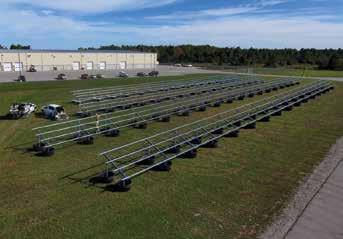
A new 200-kilowatt solar array is being installed in front of PIE&G’s Onaway headquarters, providing members with a local connection to clean, renewable energy. This project, part of Wolverine’s SpartanSolar program and built by J. Ranck Electric, was fully funded by a $200,000 USDA grant dedicated to its construction—there is no cost to PIE&G members. This is the first ballasted SpartanSolar array, utilizing concrete supports to accommodate the rocky terrain near PIE&G’s headquarters. Expected to be completed by end of Spring 2026, the project highlights

• Approved Quarterly Write-Offs
• Accepted Team Reports

Set up on-time, every time, automatic credit card payments for peace of mind. It’s free, secure, and ensures your payment is made on time. Get started today with any of these four options.
• Online at pieg.com/payment-options
• The MYPIE&G mobile app (available on Google Play or the App Store)
• Our automatic phone system by calling 855-939-3541
• In person at our office located at 3149 Main Street, Onaway, MI 49765



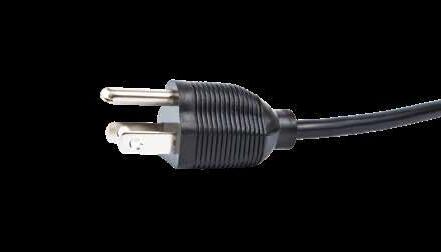
A power surge is an unexpected increase in voltage, and it can occur from a variety of sources. Regardless of the cause, power surges can majorly damage electronic devices and equipment in your home.
Let’s take a look at common causes of power surges and how you can protect your sensitive electronics.
One of the most common causes of a power surge is lightning.
Most of us have experienced this during a severe thunderstorm. When lightning strikes an electrical system, the excess current must be channeled somewhere— unfortunately, in many cases, it’s sent through a home. Your best bet is to unplug all unused devices and electronics during severe thunderstorms.

Another common cause of power surges is electrical overload.
This happens when devices or appliances are plugged into an outlet that can’t handle the required amount of voltage, or if multiple devices are plugged into one outlet through an extension cord. If you’re experiencing power surges due to electrical overload, it’s time to call a qualifi ed electrician to evaluate your home’s circuits and electrical needs.
Faulty wiring in a home can also cause power surges. Damaged or exposed wires can cause spikes in voltage, creating a potentially dangerous situation. If you notice signs of faulty wiring, like visible burns on outlets, buzzing sounds from outlets, or frequently tripped circuit breakers, your home may be due for electrical wiring repairs and updates.
Surges can also occur after a power outage. Sometimes, when electricity is being restored and reconnected, it’s common to experience a quick surge in current. Similar to advice for a surge caused by lightning, it’s best to unplug sensitive electronics during the outage— then wait to plug them back in after power is fully restored.
Aside from unplugging devices when you suspect a power surge, there are two ways you can take additional precautions to protect electronics in your home.
Point-of-use surge protection devices, like power strips, can protect electronics during most surges. But remember, not all power strips include surge protection, so read the packaging label carefully before you buy, and don’t overload the power strip with too many devices. You can also install specialized electrical outlets that offer additional surge protection. Talk to a trusted electrician to learn more.
protection prices vary based on the size of the home and suppressor. Whole-home suppressors should always be connected by a licensed electrician, so consider the cost of installation as well.
Another option is a whole-home surge protector, which can help protect your home from larger, more powerful surges. In most cases, whole-home suppressors are connected to your home’s service panel and include features like thermal fuses and notifi cation capabilities that indicate when a device has been impacted by a surge. Whole-home surge
Occasional power surges are inevitable, but by unplugging devices when you think a surge may occur and using additional levels of protection like power strips or wholehome suppressors, you can better safeguard your sensitive electronics and devices.
Scammers and cybercriminals look for weak points to exploit before software companies can fix them. Update software programs on your computer, tablet, and mobile phone as soon as possible when a newer version becomes available. Software updates often contain critical patches and protections against security threats. Turn on automatic updates to automatically update your security software, internet browser, operating system, and mobile apps.
Source: consumer.ftc.org
A regular air conditioning tune-up is one of the best ways to prepare your home for warmer weather. Even when your system appears to be running normally, routine maintenance can improve performance, efficiency, and reliability before summer demand puts extra strain on your equipment.
Over time, normal wear and tear can reduce your system’s performance, even if everything seems to be working fine. A professional tune-up ensures your A/C is operating efficiently before the hottest months of the year. Scheduling an air conditioning tune-up is one of the simplest ways to protect your comfort and your investment.
When components are clean, properly adjusted, and running smoothly, your system doesn’t have to work as hard to cool your home. This improved efficiency can reduce energy use, which may lead to lower electric bills.
During a tune-up, a trained technician can identify minor issues before they turn into major, costly repairs. Catching problems early can help avoid inconvenient system failures when you need cooling the most.
Regular tune-ups can extend the life of your air conditioning system. Just like a car that receives routine maintenance, an A/C system that’s properly cared for tends to last longer and perform more reliably. This can delay the need for a costly replacement and help you get the most value from your equipment.
To make routine maintenance even more worthwhile, qualifying A/C tune-ups are eligible for a rebate credited directly to your electric bill. This incentive helps offset the cost of maintenance while encouraging energy-efficient operation.
Visit pieg.com/energy-optimization-rebates/ to learn more about all the rebates and energy-savings incentives Presque Isle Electric & Gas is offering.
Get your system ready for warmer days and earn a rebate on your energy bill!
Benefits of regular maintenance include:
• Improved system efficiency
• Reduced energy use
• Fewer unexpected and costly breakdowns
Complete a qualifying A/C tune-up this spring and receive a rebate credited directly to your Presque Isle Electric & Gas bill. Visit pieg.com/energy-optimization-rebates/ for more information on rebates and to view all available energy-saving incentives!

Scan the QR code to view eligible rebates or visit pieg.com/energy-optimization-rebates/










1. MOST VOTES Black Lake sunset, the old-fashioned way. Shelly & Jon Bison
2. Sunset surf on Mullett Lake. Heidi Chandler
3. Sunset on Lake Geneva at Canada Creek Ranch, Atlanta. Kimberly Bonacorsi
4. Sun & freighter—go gracefully west together. Kathryn Scoon
5. Best friends on Hubbard Lake!! Mel Douglas
6. October sunset on Black Lake. Loretta Cordell
7. Soft sunbathing morning. Lawrence Johnson
8. A golden hour sunset. Gloria Zalewski
9. Sunrise in the ridge. Roy Wekwert
10. Snyder Lake, Lewiston MI. Robert Cwynar
Enter to win a $50 energy bill credit!
Submit your Birds photos by March 25 for the May issue! Submit your best photo and encourage others to vote! The photo receiving the most votes in our photo contest will be printed in an issue of Country Lines, along with some of our other favorites.
To enter the contest, visit pieg.com/photocontest. Enter your picture, cast your vote, and encourage others to vote for you as well. If your photo is printed in Country Lines during 2026, you will be entered into a drawing for a chance to win one of four $50 credits on your January 2027 bill.
Taste the world, from home.

Watch a video of this month’s winning recipe at micoopkitchen.com/videos

Adrienne Kral, Presque Isle Electric & Gas Co-op
1 (16-ounce) bag wide egg noodles
6 tablespoons butter, divided
1 pound kielbasa, cut into thin, round slices
1 large yellow onion, fi nely sliced or chopped 1 medium head green cabbage, 2–3 pounds, cored and roughly chopped
2 cloves garlic, minced
1 cup cottage cheese, optional
½ teaspoon salt (or to taste)
¼ teaspoon freshly ground black pepper (or to taste)
Cook egg noodles to al dente, according to package instructions. Drain, reserving ¼ cup of pasta water and set aside. To a large skillet or Dutch oven over mediumhigh heat, add 2 tablespoons butter and melt. Add kielbasa and cook until browned, 3–4 minutes, stirring occasionally. Remove slices with a slotted spoon and set aside (keeping any remaining liquid in the pan). Reduce heat to medium, and add 2 more tablespoons of butter and the onions. Sauté until the onions are translucent. Add cabbage and garlic. Cook 8-10 minutes until cabbage reaches desired tenderness, stirring occasionally. Add the cooked noodles, kielbasa, remaining 2 tablespoons of butter, and reserved pasta water. Mix well and cook until heated through. Stir in cottage cheese, if using. Season with salt and pepper, to taste. Serve immediately.
Grace Nelson, Cherryland Electric Cooperative
2 tablespoons canola oil
1 large onion (or 2 small), peeled and chopped into large cubes
1 medium/large potato, peeled and cut into large cubes
3 carrots, peeled and cut into round chunks
2 stalks celery, fi nely diced
2 cups water
1 cup brown or green lentils, rinsed
3 cups vegetable or beef broth
2 tablespoons apple cider vinegar (or white wine or balsamic)
1 tablespoon fresh chopped thyme (or 1 teaspoon dried)
2–3 German-style sausages (bratwurst, etc.), cut into chunks
• salt and pepper, to taste
2 tablespoons fresh chopped parsley (or 2 teaspoons dried)
• Tabasco sauce (red), a few drops
In a large skillet over medium heat, sauté the onions in canola oil for a few minutes until soft. Add the potato, carrots, and celery and continue to sauté, adding more canola oil if necessary. Add the water and lentils and bring to a light boil. Simmer until the lentils start to absorb the water. Add the vegetable broth, vinegar, and thyme. Bring back to heat, then allow to simmer until the lentils are soft to taste, about 35 to 45 minutes (green lentils will take longer to cook). Add the sausage and bring to heat. Simmer an additional 4–5 minutes, or until the sausage is thoroughly cooked. Season with salt and pepper, to taste. Sprinkle with parsley. Serve with tabasco sauce and crusty bread.
Julie Kenney, Great Lakes Energy
1 cup raisins
1 cup dried cranberries
½ cup Irish Mist whiskey (or whiskey of your choice)
½ cup (1 stick) butter, softened (for brushing/greasing)
8 slices fresh bread (not day-old)
2 cups heavy whipping cream
6 large eggs
½ cup white sugar
½ cup packed brown sugar
1 teaspoon Irish mixed spice (see right)
2 teaspoons pure vanilla extract
Whiskey sauce:
• reserved whiskey from soaking fruit
1 cup sugar
¾ cup heavy whipping cream
1 teaspoon pure vanilla extract
½ teaspoon Irish Mixed Spice
Katie Schneider, Midwest Energy
Rice:
2 cups jasmine rice
2½ cups water
¼ teaspoon salt
Curry:
2 tablespoons coconut oil
1 onion, diced
4 cloves garlic, minced
2 tablespoons curry powder
1 teaspoon ground turmeric
1 teaspoon ground coriander
1 teaspoon ground ginger
1½ pounds boneless chicken thighs, cut into bite-size chunks
1 (13 ½-ounce) can full-fat coconut milk
1 cup chicken broth
1 tablespoon brown sugar
1 tablespoon soy sauce
1 red bell pepper, sliced
1 cup sliced carrots
1 cup fresh baby spinach
• juice of ½ lime
• salt, to taste
• black pepper, to taste
• chopped cilantro for garnishing, optional
Rinse the jasmine rice until the water runs clear, then combine it with the water and salt in a medium saucepan. Bring to a simmer, cover, and cook for about 15 minutes, or until the water is absorbed and the rice is tender. Remove from heat and set aside. Meanwhile, heat the
Irish mixed spice (makes more than needed):
1 tablespoon ground cinnamon
1 teaspoon ground coriander
1 teaspoon ground nutmeg
1 teaspoon ground allspice
½ teaspoon ground cloves
½ teaspoon ground ginger
½ teaspoon mace (optional, for extra warmth) Combine the cinnamon, coriander, nutmeg, allspice, cloves, ginger, and mace (if desired) to make the Irish mixed spice mix; set aside. Soak the raisins and cranberries in the whiskey for several hours or overnight, then drain the fruit and reserve the soaking liquid for the sauce. Preheat the oven to 400°F and butter a 7x11-inch baking dish, then butter both sides of the bread slices and cut them diagonally. In a medium bowl, whisk together the heavy cream, eggs, white sugar, brown sugar, Irish mixed spice, and vanilla extract. Layer the bread and soaked fruit in the prepared dish, pour the cream mixture over the top, and press gently so all the bread is well soaked. Place the filled dish into a larger

coconut oil in a large skillet or wide saucepan over medium heat. Add the diced onion and cook for about 5 minutes, until softened, stirring occasionally. Then add the garlic and cook for 1 minute, stirring frequently. Stir in the curry powder, turmeric, coriander, and ginger and cook for 1 to 2 minutes, stirring constantly, until fragrant. Add the chicken pieces and stir to coat them in the spices, cooking for 3 to 4 minutes until the chicken begins to turn opaque. Pour in the coconut milk, chicken broth, brown sugar, and soy sauce, stirring to combine, then add the bell pepper and carrots. Simmer uncovered for 15 to 20 minutes, stirring occasionally, until the chicken is fully cooked and the sauce thickens slightly. Stir in the baby spinach just until wilted, remove from heat, add the lime juice, and season with salt and black pepper to taste. Spoon the curry over the cooked jasmine rice and garnish with chopped cilantro if desired.

9×13–inch pan, carefully add hot water to the larger pan until it reaches halfway up the sides of the smaller dish, and bake for 40–50 minutes until set and lightly golden. While the pudding bakes, combine the reserved whiskey, sugar, heavy cream, vanilla, and Irish mixed spice in a saucepan, bring to a boil, and cook for 1–2 minutes. Remove from heat and let stand. Once the pudding is done baking, slowly pour the warm whiskey sauce over the hot pudding a little at a time, pressing gently to help it absorb the sauce. Allow it to cool slightly before serving.

Order your copy and share the gift of community and care. Each purchase supports two deserving Michigan charities— Feeding America Local Food Banks and Cooperative Family Fund.
Just scan the QR code or go to amazon.com and search “Michigan Country Lines Cookbook.”
Grilled to Perfection, due April 1; Chill Out! No-Cook Recipes, due May 1. Submit your favorite recipe for a chance to win a $100 bill credit and have your recipe featured in Country Lines with a photo and a video. Submit your recipe at micoopkitchen.com, or send it via email (include your full name and co-op) to recipes@countrylines.com
Across the U.S., the demand for power is climbing at one of the fastest rates in decades As the economy becomes more reliant on electricity and data centers continue to sprout up in many parts of the country, electric cooperatives are preparing to meet the challenges that skyrocketing demand brings.
The North American Reliability Corporation—the watchdog for the U.S. electric grid—recently released the 2025-2026 winter reliability assessment, which echoed other recent reports, including longer-term outlooks that expect sufficient energy resources during normal conditions but potential supply shortfalls and outages under more intense weather conditions.
Extreme weather coupled with additional factors that are driving increased demand creates challenges for electric utilities, including cooperatives, in their mission to provide reliable power around the clock.
Several key factors are driving increased demand—including economic growth, expanded manufacturing, data center development, and increased electrification in transportation. Together, these trends are reshaping how much electricity we consume and how quickly utilities like Presque Isle Electric & Gas Co-op must adapt to meet future needs.
One of the biggest drivers of rising demand is increased electrification. More homes and businesses are transitioning to electricity for home heating, water heating, and transportation. EVs are becoming more common on the road, and many states are offering incentives to help consumers make the switch. Additionally, electric heat pumps are replacing traditional furnaces in many
homes due to their efficiency. These transitions mean more energy use and pressure placed on our electric grid.
Data centers are another major contributor to rising demand. As AI, cryptocurrency, and cloud computing technologies grow, the need for data processing and storage has skyrocketed. Data centers require huge amounts of power to operate servers and cooling systems 24/7. Tech companies are building new facilities nationwide—many of which are in electric cooperativeserved areas—and these regions are experiencing multi-year surges in electricity demand as a result.
Economic and manufacturing growth are also contributing to higher electricity use. As businesses expand and new industries take root, especially in rural and suburban areas, the demand for reliable, high-capacity power is increasing. The resurgence of domestic manufacturing has led to major facility construction. These facilities often require substantial energy loads, and many operate continuously to keep production lines running. This growth brings jobs and investment, but it also puts new pressures on the electric grid.
Population growth and housing development are also contributing to rising demand in many regions, and everyday life is becoming more energy dependent, too. Smart appliances, connected devices, home offices, and entertainment systems are adding to overall consumption, even as efficiency improves.
While increased demand presents new challenges for electric utilities, it also has the potential to create significant opportunities for co-ops and the communities they serve, such as job growth, steady revenue, and improved infrastructure. Electric co-ops are responding by planning carefully

for the future—investing in grid modernization and offering programs and services to help co-op members conserve energy.
In 2026, Presque Isle Electric & Gas Co-op will create the most robust system possible by expanding our use of reliability analyses, targeting grid enhancement projects, and increasing right-of-way clearing. We’ll also be adding more advanced monitoring tools to provide real-time visibility into the grid. And finally, we’re making organizational investments, like new software and improved internal systems. Strategic planning is critical to ensuring the grid can support everything from EV charging to largescale manufacturing plants.
Electricity powers nearly every aspect of today’s economy, and its role will only grow stronger. As electrification accelerates, long-term planning becomes more important than ever.
Presque Isle Electric & Gas Co-op is ready to meet rising demand in our local communities. Through innovation, investment, and collaboration, we are preparing for a more reliable and resilient energy future.
Source: NRECA is the national trade association representing nearly 900 local electric cooperatives. From growing suburbs to remote farming communities, electric co-ops serve as engines of economic development for 42 million Americans across 56% of the nation’s landscape.
Behind the scenes, a network of people and facilities works together to ensure you have electricity when you flip the switch.
The amount of electricity generated and how much is sent to where it’s needed are typically coordinated and monitored by regional grid operators that essentially act as energy tra c managers.
Electricity is generated at a power plant, then sent across the grid to homes, schools, and businesses.
As electricity demand varies throughout the day, grid operators, power plant operators, and electric utilities work to forecast, plan, and purchase enough electricity for everyone.
Ensuring communities have the exact amount of electricity they need is a challenging task, but behind the scenes, a network of industry experts makes it happen every day.
Factors tha t Impact Electricity Supply and Demand
• Demand Surges
• Extreme Temperatures
• Infrastructure Costs and Availability
• Supply Chain Challenges
• Fuel Costs
• Federal and State Regulations

By Cassondra Scott
As spring begins to emerge in Michigan, a sweet seasonal tradition takes center stage—maple syrup production. It’s a time when communities, farmers, and producers gather to tap maple trees, harvesting nature’s satisfying reward. Whether it’s visiting a sugar shack, attending a festival, or enjoying a stack of pancakes drizzled with fresh maple syrup, Michiganders celebrate the simple pleasures of maple syrup season, one drop at a time.
Maple syrup production is the oldest agricultural enterprise in the United States, a process dating back to the earliest Native Americans. It’s not only the fi rst farm crop of the year but an integral part of the state’s agricultural heritage. Maple sugaring contributes millions of dollars to the state’s economy, from agriculture to tourism. Michigan produces an average of 136,000 gallons of syrup per year, maintaining its status as fifth in the nation for maple syrup production.
Collecting Liquid Gold
The state’s forests are rich with sugar maple trees, providing the perfect
environment for this age-old practice. As spring days grow longer, more sunshine brings warmer temperatures, and sugar maple trees begin to release their sap. With a natural sugar content of about 2%, sugar maples are the star of Michigan’s syrup season.
Sugaring season is short but sweet, typically lasting just four to six weeks. In southern Michigan, producers may begin tapping trees as early as February, while the season can stretch well into April in the Upper Peninsula. Timing matters, and no two seasons are exactly alike.
Maple syrup depends on Michigan weather doing what it does best— changing its mind.
Alternating warm days and freezing nights create pressure inside the tree, encouraging sap to fl ow. Each freezethaw cycle can trigger a steady drip for eight to 15 hours, continuing as long as the temperature pattern lasts.
But the window is narrow. Once buds begin to form on the trees, sap production stops and the fl avor changes, signaling the end of the season. For producers, it becomes a race against the calendar and the forecast.
Producing maple syrup blends generations-old tradition with modern effi ciency. Michigan is home to an estimated 500 commercial producers, along with roughly 2,000 hobbyists and backyard sugar makers who tap trees for personal use.
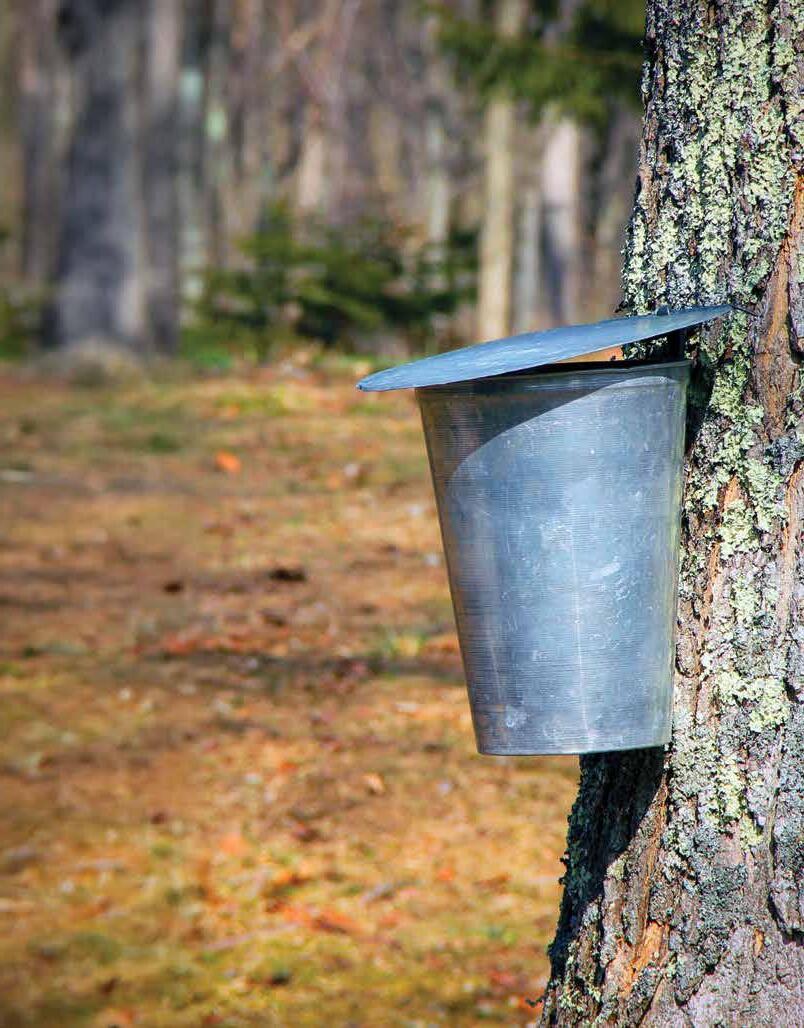
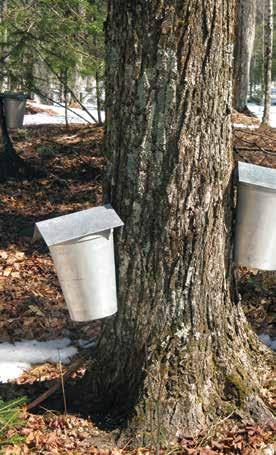
The process begins with a small hole drilled into a sugar maple and a tap, also called a spile, inserted into the trunk. Clear, watery sap is collected in buckets or tubing systems and transported to a sugarhouse for processing. It takes about 40 gallons of sap to make just one gallon of syrup. In an average season, each tap yields roughly 10 gallons of sap, enough for a single quart of syrup.
That sap, which is about 98% water, becomes syrup when it is boileddown at 219 degrees Fahrenheit. This evaporation removes excess water, leaving behind the thick, golden sweetness Michigan families know well.
Many modern sugarhouses use advanced tools such as reverse osmosis machines and high-
effi ciency evaporators to speed up the process. Others stick with wood-fi red boilers and traditional techniques, valuing the hands-on approach and the fl avor it produces.
As sap begins to flow and syrup makers fi re up their boilers, communities across Michigan celebrate a tradition that blends agriculture, history, and a bit of springtime magic. Maple syrup festivals invite visitors to experience the sights, smells, and tastes of the season fi rsthand.
Mary Ann Hayes, co-president of the Vermontville Maple Syrup Festival—the longest running maple syrup festival in the state—has been involved in the planning of their annual event for 20 years. Her husband Steve, president of the organization, has been involved even longer since a random day when he offered help to some men building a platform for the upcoming festival in the 1990s. She’s watched the event grow from maple syrup stands, a pageant, and a fl ea market to a juried arts and crafts show, vendor market, food trucks, and fair rides.
“We love that we’ve been able to grow the festival, but also keep it free for our community,” said Mary Ann. “We have this great opportunity to celebrate maple syrup and all the amazing people who make the industry so great.”
From forest to festival, maple syrup season is a reminder that some of Michigan’s best traditions arrive quietly, one drip at a time. Whether touring a sugarhouse, attending a local festival, or pouring syrup over a stack of pancakes at home, each golden drop reflects patience, craftsmanship, and the sense of community that defines spring in Michigan.


Multiday festivals draw thousands each year with pancake breakfasts, parades, craft shows, and live entertainment, including:
• Vermontville Maple Syrup Festival (since 1940), April 24–26 syrupfest.org
• Shepherd Maple Syrup Festival, April 23–26 shepherdmaplesyrupfest.org
Sixteen sugarhouses across the state will also open their doors during Michigan Maple Syrup Weekends, giving visitors the chance to tour sugar bushes, see tapping demonstrations, learn how sap becomes syrup, and sample pure Michigan maple products.
Michigan Maple Syrup Weekends 2026 michiganmaple.org
• Southern Lower Michigan, March 21–22
• Northern Lower Michigan, March 28–29
• Upper Michigan, April 11–12
Meet the sugar makers who work their maple magic, discover new recipes, and even learn how to try sugaring yourself.

Cassondra Scott is a content creator, writer, and social media influencer at Cassondra Wanders—sharing small businesses and sights to see all over the state of Michigan.

The spinning circle of death. The frozen screen. You hit play on a video or movie, and it spins. This is called buffering, and it is a common frustration. We’re here to help you better understand why it happens and to help you determine if it is a simple hiccup or if it’s time to upgrade your internet plan.
When you experience a frozen screen, aka buffering, it means your device is not receiving data fast enough for whatever you are trying to watch or listen to. When you play video or music on a device, it streams in chunks: your device plays a portion, then loads the next chunk in the background. When your internet speed lags, playback pauses until more data loads. When you experience this pause, it is called buffering. The next chunk of your video or music cannot play.
1. Internet speed. If you are streaming a high-definition video, you need a steady data flow. A slow connection means the stream cannot keep up.
2. Too many devices. When a home has multiple phones, Smart TVs, laptops, tablets, computers, and a security system, and they’re all using the internet at the same time, they share the same bandwidth, which can slow everything down.
3. Wi-Fi signal strength. If you are far from your router or dealing with walls and interference, your device—such as a tablet, smartphone, or smart TV—may not be getting a strong enough signal, even if your internet plan is solid.
Why the Right Internet Plan Helps
The key to reducing buffering is choosing the right internet plan. A home with a single person who checks emails and
occasionally browses the internet requires a different plan than a family with teenagers and gamers. Not all plans are created equal when it comes to bandwidth and handling what your household needs for working from home, staying connected, or balancing work, school, and entertainment.
This is why PIE&G Connect has created plans for all users, from the light user to power users and tech-savvy households.
1. Limit the number of devices streaming at once.
2. Move closer to your router or reposition it.
3. Occasionally, restart your router.
For PIE&G Connect members, if you experience technical difficulties, call our 24/7 support team at 1-888-803-3453.
If you are experiencing buffering even during simple tasks, it may be a sign that your internet plan does not meet your household’s needs. As more devices are added to your home, it is common to experience buffering because your internet plan cannot handle the data flow. Upgrading to a plan that better fits your home’s internet needs will make a noticeable difference.
Buffering is not only an annoyance; it is also your internet telling you it is struggling to keep up. To upgrade, call 1-800-423-6634 and learn more about PIE&G Connect’s home internet plans to find the right fit for your needs at piegconnect.com.
We continue to make strong progress expanding fiber service across our community.
To date, we have completed 7,335 total services and 2,022 miles of fiber. Phases One and Two are now 100% complete, and Phase Three is 80% complete.
Phase Three includes the following areas: Posen, Grand Lake, Alpena, Hillman, and Avalon.
Here is how you will know when your Phase Three zone opens:
• You will receive automated emails and phone calls when your zone opens.
• All members receive a postcard when their zone opens.
• Zone openings are announced on Facebook and Instagram.
You can also find your zone information in the topright corner of your bill.
Visit piegconnect.com to learn more about our plans, check availability, and sign up online.


By Martin Stec, a Presque Isle Electric & Gas Cooperative member
The following story is based on the memories of Marty Stec of Parrot’s Point and was composed by his daughter, Nicole Heggelund.
These days, the sound of Mullet Lake on a summer afternoon is the growl of an outboard motor or the drone of a jet ski. But it was not always this way. The sound I remember from my childhood on Mullet Lake is the sleepy, rhythmic creak and splash of wooden oars at sunset.
It was the summer of 1947, and I was 6 years old. The creaking oars belonged to Mr. and Mrs. Schrek of Parrot’s Point, a kind elderly couple who hosted me for a season on the east side of Mullet Lake. In the evenings, Mr. Schrek would ready his rowboat, and Mrs. Schrek, her oversized sun bonnet a dash of color against the sky, would climb in, ready for the sunset fishing trip.
As the dusk deepened, home they would return, Mrs. Schrek’s bonnet hid her face, and he patiently pulled the oars. Waiting by the shore, the strained croak of oar against oarlock was the only sound other than the gentle lapping of waves at the shore.
As night fell, I would lie in bed and listen to the low rumble of Mr. Schrek’s rocking chair against the old floorboards. Next to him was the brass spittoon, and occasionally a ping sounded from within, courtesy of Mr. Schrek’s chewing tobacco. The kerosene lamp flickered, and to these sights and sounds, I drifted to sleep.
Morning would arrive, and the lake glimmered in buttery August light.
The sound of a stainless steel can opener popping the seal on a can of sweet PET milk signaled that breakfast had arrived. In this way, dreamy summer days passed until the arrival of fall.
School days at the one-room Koehler Township schoolhouse on Hackleberg Road had a unique soundtrack. I remember working on arithmetic at my desk while listening to the iron clang and squeal of the water pump. Under the watchful eye of our teacher, Mrs. Hackleberg, my classmates and I would take turns filling the class water pail and hauling it to the tank that supplied our faucet.
Oct. 31 had a sound all its own. On that magical night, when the wind smacked gray waves to the shore, and the leaves rustled, I would rub rosin on a string, preparing to surprise our neighbors, who would gamely pull their shades and wait for their prank. Outside their window, I ran my fi ngers along the rosined string, creating an unearthly howl. From inside, the mock terrifi ed shout of “Halloweeners!” could be heard. Moments later, they opened the door to distribute treats to the “monster” waiting outside.
More than 70 years have passed since those days, and now, along with the sound of motorboats and the pop of fi reworks, I hear my grandchildren splashing and playing in Mullet Lake. I appreciate these sounds, but some evenings I wish I could, once again, fall asleep to the sounds of an earlier time and hear that old rowboat come home once again.
GUEST COLUMN Win $200 for stories published! Share your fondest memories and stories. Win $200 for stories published. Visit countrylines.com/community to submit.

About the Author: Martin is a former Wayne County Deputy Sheriff, retired after 33 years of service. He enjoys fishing and swimming on Mullet Lake. His family has been a customer of PIE&G since electricity came to Parrot’s Point on Mullet Lake.

MYSTERY PHOTO Win a $100 energy bill credit! Identify the correct location of the photo above by March 25 and be entered into a drawing to win a $100 electric bill credit. Enter your guess at countrylines.com/community
JANUARY 2026 WINNER! Our Mystery Photo winner is Crystal Fox, a Thumb Electric Cooperative member who correctly identified the photo as the bear statue outside of Wood Winds Restaurant in Onaway, Michigan.

Our hybrid design makes the most e cient heating & cooling technology a ordable for rural homeowners.
Our hybrid design makes the most e cient heating & cooling technology a ordable for rural homeowners.


Attaches to your home’s existing heating system, it does not replace it.
Delivers 90% on average of your home’s heating needs and 100% of your home’s cooling needs.
If you have a well and are heating with propane, fuel oil, electric, or wood, your current heating and cooling cost is likely greater than it would be to fully finance and heat & cool with a Well-Connect.
Installs in one day, any time of year. No drilling required.