•The Full Circle Impact of Shopping Local—Wilderness Treasures Also Inside:
•Manager’s Message: Building a Stronger System for Our Members
•Generating Reliability: Cloverland’s 2025-2028 Capital Work Plan
•Mackenzie Paul shares ‘This is What it Feels Like’
UP TO $2,000 IN REBATES AVAILABLE
4.9 ⭐⭐⭐⭐⭐
Check Out Our Google Reviews
“We’re extremely happy with our Well-Connect. We didn’t go through a full propane tank all winter. In fact, our propane company asked if we were heating with wood or shut down our home for the winter. Best part — our house is so comfortable. We recommend Well-Connect to all of your friends, it’s a very honest company and they make sure it will save you money before it is installed. The system pays for itself!” — Matthew
“The system, which uses my well water, has virtually eliminated my reliance on fossil fuel and has cut my heating and cooling costs considerably. It will pay for itself in 4-5 years. Needless to add, I am one happy camper.” — Kirk
to 70%
your home’s heating costs.
more comfortable and quiet home, year-round.
installation, any-time of the year.
cloverland
CONNECTIONS
January | February 2026
VOL. 11, NO. 1
MEMBER SE RVICE CENTER
2916 W. M-28
Dafter, MI 49724
Hours: Monday-Friday, 8 a.m.-4:30 p.m.
Phone: 906-635-6800
800-562-4953
PUBLISHER: Cloverland Electric Cooperative
EDITOR: Allie Brawley, Director of Communications & Member Relations
Cloverland Connections is published bimonthly with postage paid at Sault Ste. Marie, Michigan. It is the official publication of Cloverland Electric Cooperative, a not-for-profit, member-owned electric utility established in 1938. POSTMASTER: Send address changes to Cloverland Connections, 725 E. Portage Ave., Sault Ste. Marie, MI 49783. The appearance of advertising does not constitute an endorsement of products or services advertised. Cloverland Electric Cooperative is an equal opportunity provider and employer.
roasted, packaged and shipped nationwide. What began as a passion for fresh, locally roasted coffee has grown into a regional brand celebrated for quality, creativity and community collaboration across the EUP.
reflected on their
MACKENZIE PAUL SHARES ‘THIS IS WHAT IT FEELS LIKE’
of
cloverland.com.
cloverland Manager’s Message
CONNECTIONS
BOARD OF DIRECTORS
Email: board@cloverland.com
District A
Jason St. Onge
231-420-0462 | Mackinac Island Term: 2022-2025
William LaLonde, chairperson
906-298-1406 | St. Ignace Term: 2023-2026
Gerald Nettleton
906-430-0910 | DeTour Village Term: 2024-2027
District B
Carmine Bonacci Jr., secretary/treasurer
906-440-4063 | Sault Ste. Marie Term: 2022-2025
John Sawruk, vice chairperson
906-630-1287 | Sault Ste. Marie Term: 2023-2026
Patrick Egan
906-437-5526 | Brimley Term: 2024-2027
District C
Kevin Vanatta
906-450-4310 | Newberry Term: 2022-2025
Virgil Monroe
906-341-8808 | Manistique Term: 2023-2026
Ronald Provo
906-341-5300 | Manistique Term: 2024-2027
PRESIDENT & CEO
Mike Heise
BOARD MEETINGS
Visit cloverland.com for the board meeting schedule, agendas, call-in details and past meeting minutes. Cloverland members are welcome to participate in person or by phone.
BUILDING A STRONGER SYSTEM FOR OUR MEMBERS
By Mike Heise, President & CEO
Mike Heise President & Chief Executive Officer
As a cooperative, Cloverland is committed to fairness, transparency and ensuring that our rates accurately reflect the true cost of delivering power to our members. One of the most important tools we rely on is the Cost of Service Study (COSS).
A COSS is a detailed financial and engineering analysis that evaluates how much it costs to serve each rate class: residential, commercial and industrial customers. Power supply, infrastructure needs, operations and member service expenses are allocated based on how each rate class uses our system. This study is a standard procedure for cooperatives, typically conducted every two to three years, to ensure that rates remain fair, equitable and aligned with actual costs. It prevents one group of members from subsidizing another and provides an objective foundation for the board’s decisions.
Our most recent COSS confirms what we are seeing across the industry: rising
power supply costs, higher material prices and the need to strengthen our aging infrastructure. These findings guide the proposed rate adjustments that the board of directors will vote on in February, with implementation beginning in April. The proposal is driven by three key factors:
1. Power Supply Costs—The cost of generating and purchasing electricity continues to rise and remains the single largest portion of Cloverland’s expenses.
2. Increased Material Costs—Prices for poles, wire, transformers and essential equipment have surged due to supply chain challenges and inflationary pressures.
3. Capital Work Plan—Our $75 million, four-year plan replaces aging infrastructure and strengthens our system to support long-term reliability.
Without these investments, reliability would decline, outages would increase and restoration times would lengthen. These projects are essential to maintaining dependable service for the future and are guided by our FORGING strategic plan, which prioritizes Financial stability, Organizational excellence, Reliability, Growth, Innovation and Nurturing our employees and community.
We recognize that any rate increase impacts our members and the board does not take this decision lightly. The purpose of this adjustment is not to generate profit. As a not-for-profit, member-owned cooperative, our goal is to cover expenses responsibly and continue the investments that keep our communities safely and reliably powered every day.
YOUR VOICE MATTERS
Member input is central to how we plan and make decisions. As a not-for-profit, member-owned cooperative, we invite you to learn more, ask questions and share your feedback on the proposed rate adjustment at our upcoming community meetings:
• Jan. 27, 6 p.m.—District B: LSSU Arts Center, Sault Ste. Marie
• Jan. 29, 6 p.m.—District A: Little Bear East, St. Ignace
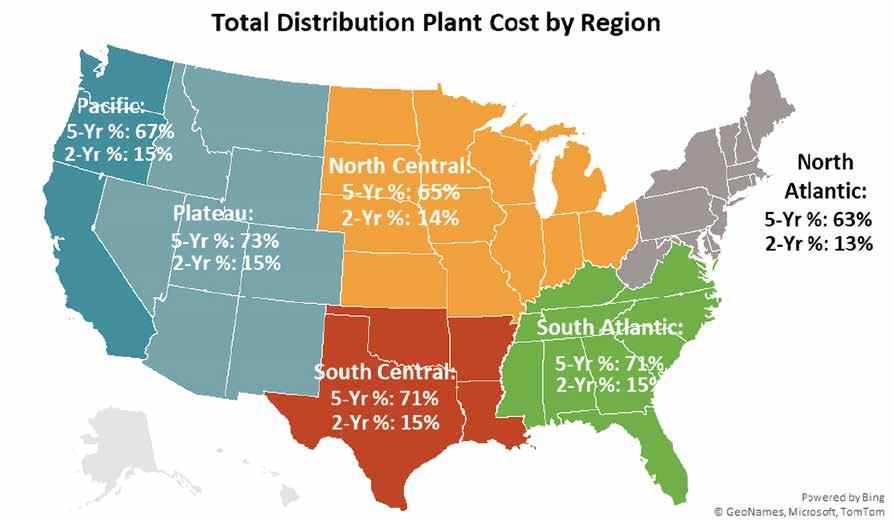
Above: Rising construction and material costs are a challenge facing utilities nationwide. This map highlights the significant two- and five-year increases in distribution plant expenses across all regions—context for the cost pressures Cloverland must navigate.
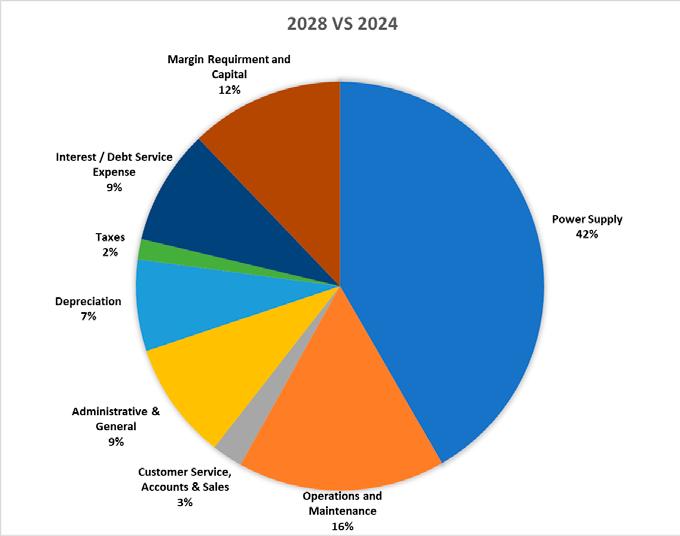
Right: This pie chart illustrates the key drivers behind Cloverland’s projected cost increases from 2024 to 2028. Each slice represents the portion of the total rise in revenue requirements attributed to major expense categories, highlighting which operational and infrastructure-related costs—such as power supply, operations and maintenance—are contributing most to future needs.
Cloverland Electric Cost Drivers, 2028 vs. 2024
Chairperson's Corner
STRENGTHENING OUR COOPERATIVE THROUGH PLANNING AND PARTNERSHIP
As your elected board of directors, our responsibility is to make decisions that protect the long-term health of the cooperative while ensuring Cloverland continues to deliver safe, reliable and affordable power. Two important updates are at the forefront of our work.
First, the board has reviewed the results of the Cost of Service Study at our December meeting. This study outlines the financial and operational drivers behind the proposed rate adjustment that will come before the board for a vote on Feb. 24. Member feedback is essential to this process, and we encourage you to attend one of our January community meetings to learn more about the rate proposal and the board’s vision for Cloverland’s future.
• Jan. 27—6 p.m., District B: LSSU Arts Center, Sault Ste. Marie
• Jan. 28—6 p.m., District C: Comfort Inn, Manistique
• Jan. 29—6 p.m., District A: Little Bear East, St. Ignace
Second, with board approval, Cloverland has been invited to rejoin the Michigan
Electric Cooperative Association (MECA), a statewide organization that represents Michigan’s electric cooperatives with a unified voice on legislative and regulatory matters. MECA membership strengthens Cloverland in several key ways:
• Access to mutual-aid crews during extended outage events.
• Legislative advocacy in Lansing on issues impacting cooperatives, such as FEMA relief after the ice storm.
• Education, training and collaboration with other cooperatives—valuable opportunities for our department directors to share ideas, strategies and solutions for the challenges we commonly share in Michigan, such as regulatory goals on renewable energy.
Additionally, MECA membership gives Cloverland the option to participate in Country Lines, a statewide cooperative magazine. This publication offers significant cost savings compared to producing our own bimonthly magazine and provides high-quality content
about energy efficiency, Michigan communities, local food and more— including recipe and photo contests that many members enjoy.
Together, these efforts strengthen Cloverland’s foundation and support our commitment to serving members with excellence today and into the future.
POWERING THE EASTERN UPPER PENINSULA
Cloverland Electric Cooperative proudly serves one of the most expansive and rural regions in Michigan. Our 4,000-plus miles of line reach members across five counties of the Eastern Upper Peninsula—stretching from Drummond Island to St. Ignace, Newberry to Naubinway, and every rural road and shoreline in between. Maintaining and upgrading this system is central to keeping your power reliable.
Our system includes:
• 34,280 members across five counties
• 43,948 meters
• 4,066 miles of distribution line
• 38 substations
• 58 islands served
Every pole, transformer and mile of wire on the map represents ongoing maintenance, upgrades and reinvestment. This is the system your cooperative strengthens year after year to keep our communities connected in every season.
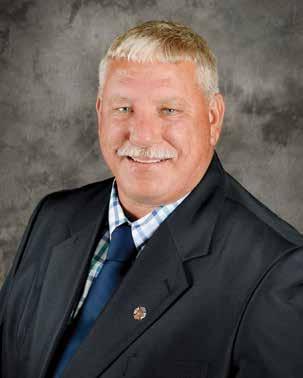
Willie LaLonde Chairperson, Cloverland Electric Board of Directors
–
Willie LaLonde
CO-OP PEOPLE POWER
June - December 2025
PROMOTION
Josh Curtis
DAFTER DIVISION MANAGER
October
CERTIFICATIONS
TRANSFER
Ray Arbic SYSTEM CONTROLLER
December
RETIREMENT
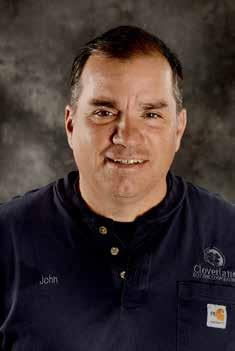
John Paquette DAFTER DIVISION MANAGER
November—celebrating 34 years of service!
• Duck DuVall (Hydro Plant Repairman) received certification as a Certified Mobile Crane Operator through the National Commission for Certification of Crane Operations.
John began his career as an apprentice lineman in 1991 and steadily advanced, becoming a journeyman lineman in 1993, a line foreman in 1997 and, ultimately, division manager in 2018. Trusted as the person who could answer any question and tackle any task, John’s dependable, can-do spirit will be greatly missed at the co-op. We wish him all the joy and fulfillment of retirement!
• Kerry Micolo (Billing Supervisor) earned the National Rural Electric Cooperative Association’s Supervisor and Manager Development Certificate.
• Jim Bennin (Director of Information Technology) earned the National Rural Electric Cooperative Association’s Management Internship Program Certificate.
LEGAL NOTICES
NOTICE TO MEMBERS OF CLOVERLAND ELECTRIC COOPERATIVE Cloverland Electric Cooperative’s (the “Cooperative”) Board of Directors (the “Board”) desires to adopt new rates for electric service, effective April 1, 2026.
The Cooperative desires to revise its rates for electric service based on a recent Cost of Service Study (COSS) completed by GDS Associates Inc. Engineers & Consultants and subsequently presented to the Board of Directors on Dec. 10, 2025. The last COSS conducted by the Cooperative was in 2022, which resulted in a rate change in 2023.
A Cost of Service Study is recommended every few years to evaluate inflation of costs compared to revenue, financial lending requirements, as well as revenue requirements to meet future construction work plans. This analysis collectively represented a need to increase rates for all rate classes. Key factors contributing to rising costs include increasing power supply costs and increased operations and maintenance costs. A multi-year rate plan was
COMMUNITY MEETINGS
Learn more about rate increase plans and ask questions with President and CEO Mike Heise:
• Jan. 27, 6 p.m.—District B: LSSU Arts Center, Sault Ste. Marie
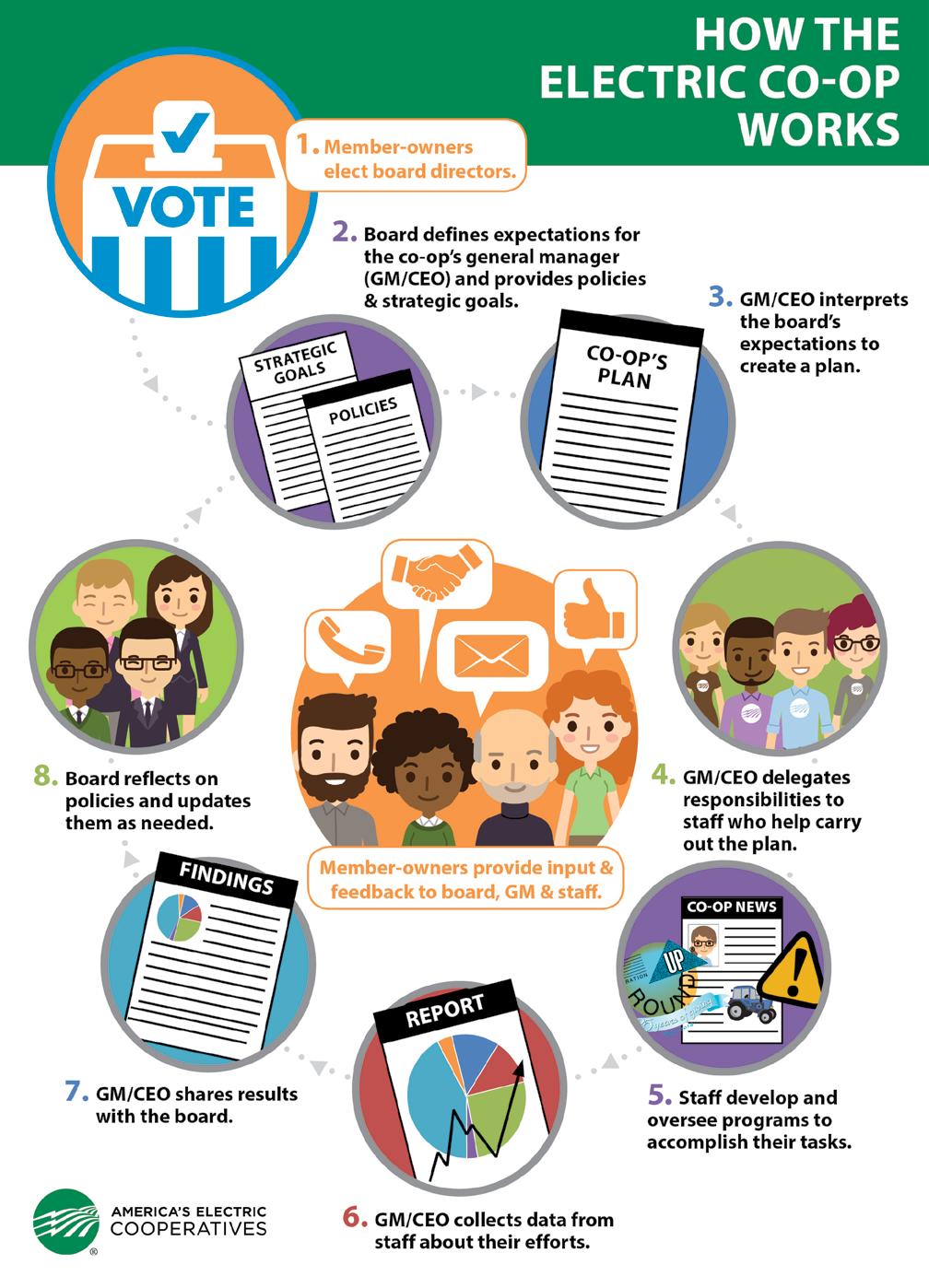
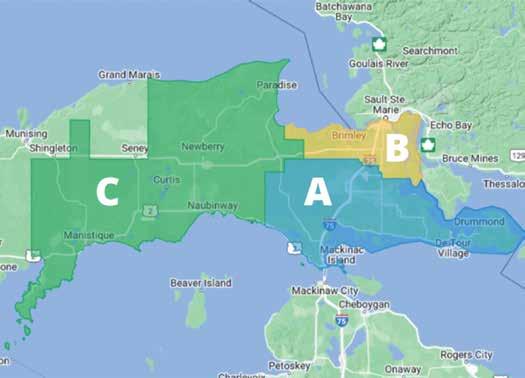
Cloverland Electric Cooperative is a not-for-profit electric utility owned and democratically controlled by the members it serves. As a memberowner, you have a voice in the co-op through the members you elect to serve on the board of directors. Our service area is divided into three districts. Each district is represented by three directors elected by the members of that district to serve a three-year term.
INTERESTED IN SEEKING ELECTION TO THE BOARD?
Director candidates must meet the director qualifications outlined in Cloverland’s bylaws—available on cloverland.com—and file a petition for nomination with valid signatures of at least 25 members from his/her district.
For a petition and information packet, please leave a message at 906-632-5143. Nominating petitions and supporting documents must be electronically submitted or returned to the co-op’s administration office at 725 E. Portage Ave. in Sault Ste. Marie by 4:30 p.m. on Friday, Feb. 27.
A business or other entity—association, corporation, partnership or governmental unit—must designate the representative authorized to cast a vote on behalf of the entity and file the designation on its letterhead with the cooperative by the date of record, March 27, 2026.
Ballots mail April 27, and voting ends May 29. Members can vote by mailed ballots or electronic voting. Director candidate information will be presented on Cloverland.com, Cloverland’s social media channels and the May|June Connections. Election results will be presented at the annual meeting of the members Thursday, June 4.
Energy Insights
recommended with a step-in rate each year for the next three years, known as the “rate plan.”
Residential members can expect a rate increase of approximately 6.5% in year one (2026), followed by stepped adjustments in years two (2027) and three (2028).
Commercial and nonresidential members can expect a collective rate increase of approximately 9.6% in year one (2026), followed by stepped adjustments in years two (2027) and three (2028).
The Board will review and consider a vote to approve its new “rate plan” at the Feb. 24, 2026, board meeting in Sault Ste. Marie. The Board will also review and consider a vote to approve an increase to the Maximum PSCR Factor. The current rates and the new proposed “rate plan” can be reviewed at the Cooperative’s website: cloverland.com. Rate tariffs will be filed with the Michigan Public Service Commission upon adoption. A 30-day notice to members prior to the rate(s) taking effect will be published if approved.
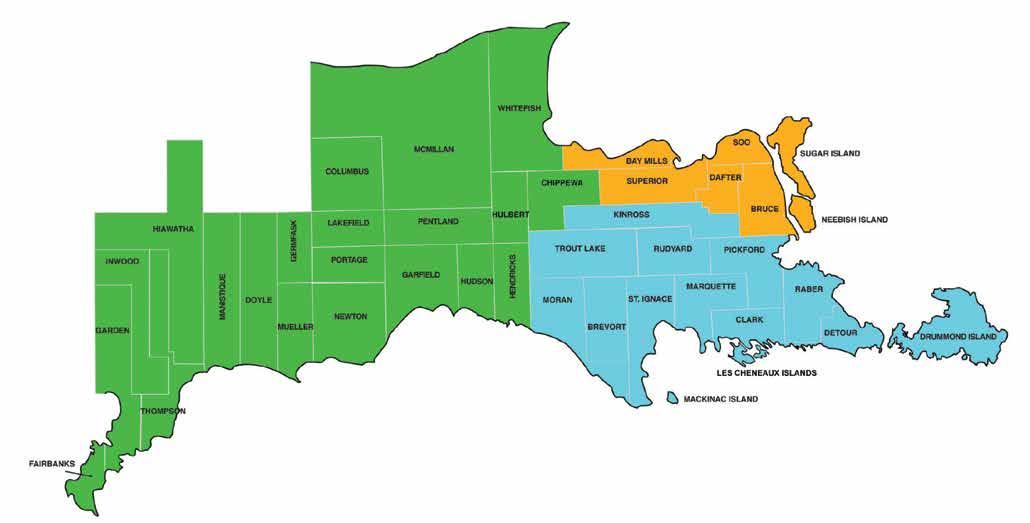
OUR SERVICE TERRITORY
Cloverland's service territory is divided into three districts with approximately 11,500 members each.
Generating Reliability: Cloverland’s 2025-2028 Capital Work Plan
In the last issue of Connections, we shared how Cloverland’s $75 million capital work plan strengthens the distribution system— from substation upgrades to line rebuilds across the Eastern Upper Peninsula. While those projects improve how power is delivered, an equally important piece of the plan focuses on where power begins. In this second installment of Cloverland’s capital work plan, we examine the hydroelectric generation facilities and the long-term investments needed to keep a century-old plant reliable for the future.
A cornerstone of Cloverland’s capital work plan is the multiyear effort to restore the 2 ¼-mile-long power canal. Building on earlier maintenance completed over the past decade, Cloverland
is now following a phased strategy to strengthen and reline the canal walls, addressing the structural impacts of more than 100 years of continuous water flow. This year’s work focuses on the area east of the Ashmun Street Bridge and will extend westward as each phase is completed.
Much of the generation work in the capital plan involves extensive planning and engineering for long-range projects that span multiple work plan cycles. Many efforts underway today are behind the scenes—developing designs, coordinating timelines and preparing budgets before construction begins. Because the plant and canal operate as a unified system, many projects must follow a precise sequence. Completing one initiative often sets the stage for the next, creating a layered approach that keeps all components working together.
“Everything we do is about increasing operational safety and efficiency. By using sound engineering principles and monitoring costs, we are making sure every dollar spent ensures the long-term sustainability of the plant,” says Roger Line, Cloverland’s Director of Generation.
The power canal and hydro plant remain critical in controlling power supply costs—Cloverland’s largest expense. Without the hydro plant’s output, the cooperative would face over $1 million in additional purchased power costs each month.
Not all capital work involves heavy construction. Many projects quietly support public safety, employee well-being and long-
New canal fencing installed between Bingham and Johnston streets marks the first phase of a multiyear safety upgrade along the power canal.
term reliability. One such initiative is the continued replacement of the canal fenceline. The segment between Bingham and Johnston streets was completed this summer, with additional sections planned for future years.
Another milestone was the installation of new steel boom logs at the canal intake. Designed to stop winter ice and debris from entering the canal, the boom logs support more efficient water flow in cold weather and replace the aging wooden logs previously in use.
Inside the plant, environmental cleanup and remediation efforts continue to remove aging materials and improve overall working conditions, ensuring a safer space for employees.
About every five years, Cloverland updates its longrange plan for hydroelectric generation. These engineering evaluations identify priorities, assess plant condition and guide future capital work plans, ensuring that Cloverland is not reacting to issues, but proactively preparing for the plant’s future.
For the Generation Department, the mission remains clear: Safeguard Cloverland’s historic energy assets while preparing it for the energy needs of tomorrow.
Powerful Facts:
• Renewable hydroelectric power accounts for about 40%-50% of Cloverland’s power supply annually. Cloverland’s hydro plant generates about 30% of the hydroelectric power. An additional 20% is generated by the U.S. Army Corps of Engineers’ hydro plant located in the Soo Locks.
• The hydro plant consists of 74 three-phase generators. Each 60-cycle generator operates at 4,400 volts, 180 RPM. Each turbine supplies enough power for roughly 250 average homes.
• A team of 14 keeps the hydro plant operational. The team includes nine repairmen, a foreman, two electricians, a welder and a machinist. Most of the parts used at the hydro plant are made in-house!
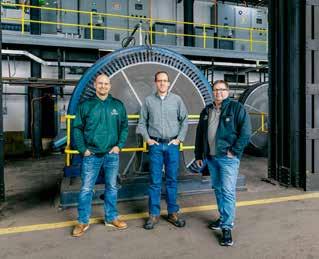
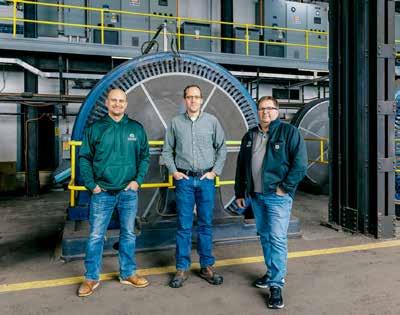
Project Manager Scott Ellis, left, Hydro Plant Manager Michael Panik, center, and Director of Generation Roger Line lead the generation projects in the capital work plan.
Aerial view of realigned and strengthened canal bank walls between Ashmun and Bingham Streets
Canal work was completed in 2025 at the previous House of Bargains building location.
In communities across the Eastern Upper Peninsula, the ritual of morning coffee is more than a simple daily habit—it is a shared experience that connects neighbors, supports local businesses and celebrates craftsmanship. For two local roasters, Superior Coffee Roasting Company in Sault Ste. Marie and Les Cheneaux Coffee Roasters in Cedarville, coffee is a way to root themselves in place while elevating what is available to residents and visitors alike. Though their paths are unique, both companies emerged from a desire to fill a regional gap, create an exceptional product and honor their communities. Their stories—grounded in passion, quality and a sense of purpose—reflect the full aroma of what it means to brew local.
Superior Coffee Roasting Company: Crafting a Regional Brand with Heart
beans fill the
When Ron Kurnik returned to Sault Ste. Marie in 2012 after years spent across the U.S. and overseas, he was ready to start something new. The idea took root from childhood memories. “My mom used to roast coffee in the kitchen, which gave me an appreciation for fresh roasted coffee.” He quickly noticed the EUP lacked fresh, locally roasted beans—so with a business background and a passion for marketing, branding and packaging, he seized an opportunity.
Superior Coffee Roasting Company began with a focus on quality but has evolved into a missiondriven brand attentive to sustainability and water conservation. Even as the global coffee market has seen drastic price increases—from $1.72 per pound a year ago to more than $4 today—Ron says demand remains steady. “Coffee is consistent,” he notes. “People value it even through shifting economies and the pandemic.” Today, Superior sources beans from Colombia, Mexico, Ethiopia and Southeast Asia, selecting regions known for soils, climates and elevations that shape each bean’s character.
Ron’s intuition about branding—choosing “Superior” for its Great Lakes resonance—helped build a product line deeply tied to local identity. From Mariner’s True North Roast to Sailor’s Sunrise, their blends honor the region without relying on artificial flavors. For flavored coffees, Superior partners with a specialty flavoring company, offering favorites
at
What began as roasting grew into a cafe venture: first through a subleased location in 2016, then into their standalone Portage Street cafe in 2019. Recently, Superior opened a campus cafe inside Considine Hall at Lake Superior State University. Each location features homemade baked goods and sandwiches—a natural extension of the roastery’s commitment to freshness.
Today, Superior’s largest focus comes from wholesale distribution and rapidly growing online sales and subscriptions. Its collaborations span the region: in-room coffee at Kewadin Casinos, Mission Point Resort on Mackinac Island and shelves in local UP grocers. All roasting, packaging and distribution occurs at their Ashmun Street headquarters.
“In 13 years, I’m proud of our staff (around 20), our production manager and having a brand known across the U.S.,” Ron says. “We ship everywhere—from Alaska to the Florida Keys. People discover us when visiting or Coast Guard families who transfer and want to take Superior Coffee with them.”
Learn more at superiorcoffeeroasting.com.
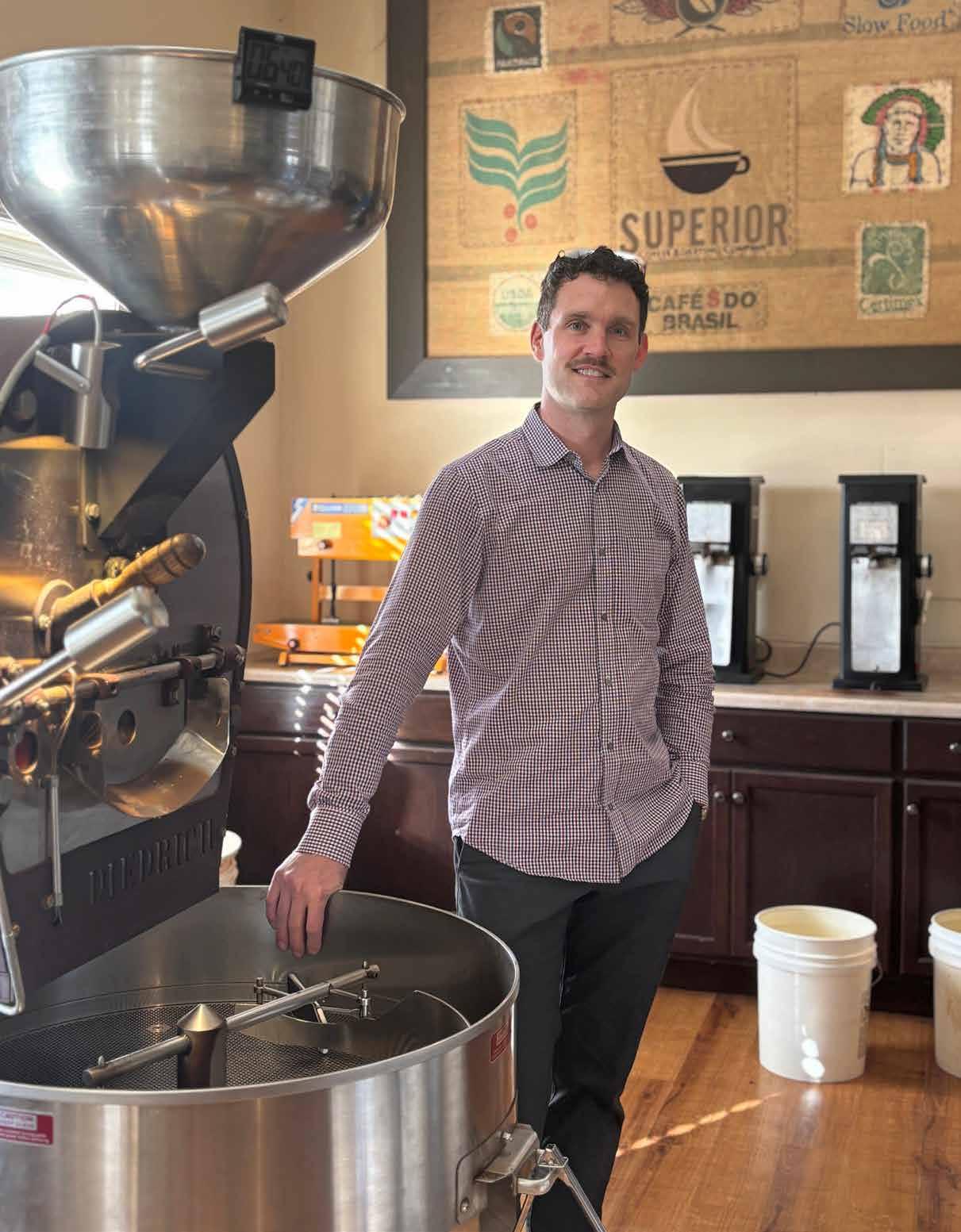
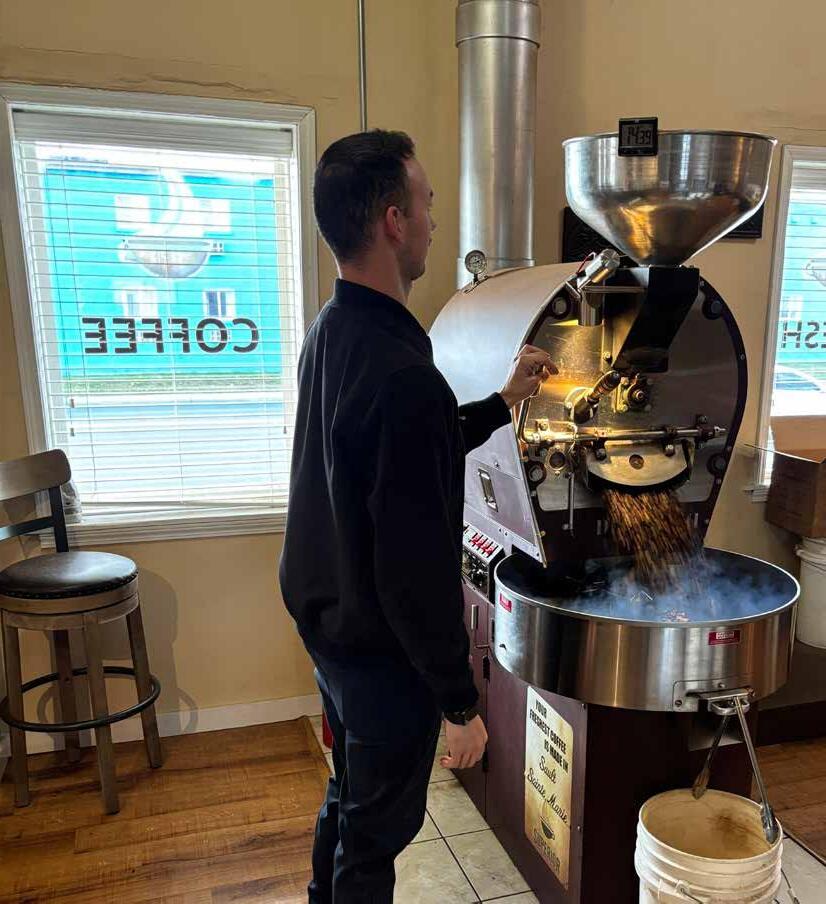
Owner Ron Kurnik stands inside Superior Coffee’s Ashmun Street roastery, where beans are roasted, packaged and shipped across the country. What began as a passion for fresh, locally roasted coffee has grown into a regional brand known for quality, creativity and collaboration throughout the EUP.
like Mackinac Island Fudge, Michigan Chocolate Cherry and Crème
Freshly roasted
air
Superior Coffee’s Sault Ste. Marie headquarters, where small-batch roasting brings out peak aroma and flavor.
Les
Coffee Roasters: Coffee with Intention, Ethics and Community
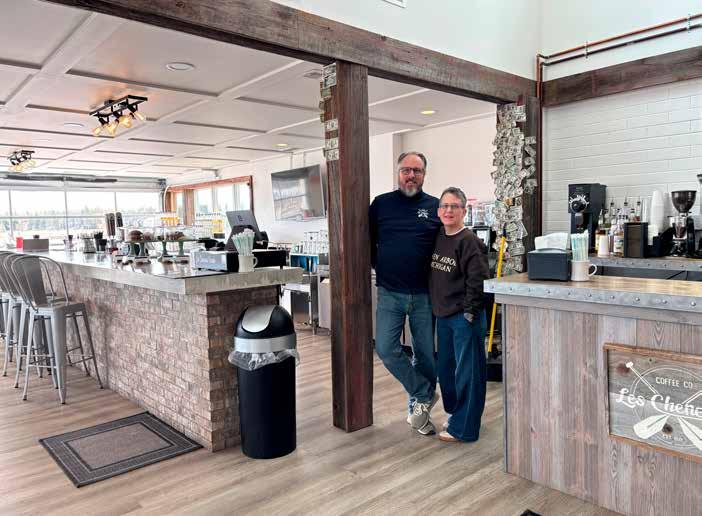
For Dave and Jen Gough, coffee started as a shared interest and a dream of running a business together. When the couple moved to Cedarville and saw the need for specialty coffee, the idea became real. They began roasting in 2016 and selling at the Hessel farmers market before opening their cafe in April 2018. The cafe has grown since opening and it recently moved into the Tipper Room in collaboration with Les Cheneaux Distillers. The location along Hodek Street’s waterfront now serves as a cozy community hub offering homemade pastries, breakfast sandwiches and other items crafted by Jen, and a full coffee and espresso bar.
“The philosophy and science of roasting has really evolved,” Dave explains. “Our approach is to buy the best quality beans we could afford—ethically harvested, organic and, when possible, fair-trade certified to help offset gender inequities in the coffee industry.” They go a step further by sourcing from Women Producer Programs when available, including 100% womenowned and operated farms in Sumatra. “We pay a premium for those beans and receive reports about how the funds help farmers—whether improving farming practices, accessing organic resources or supporting education in remote areas.”
Les Cheneaux Coffee Roasters currently sources beans from Ethiopia, Brazil, Mexico, Sumatra, Guatemala, Costa Rica and Colombia. It produces 11 coffees—five blends and six singleorigin varieties. Its bestseller, Huron Jewel, is a medium breakfast roast crafted in partnership with the Drummond Island Tall Ship Company.
For Dave, the reward is immediate: “The biggest measure of success is seeing a smile when someone tastes our coffee. We want people to discover something comforting and enjoyable.”
Education is woven into the mission as well—helping customers
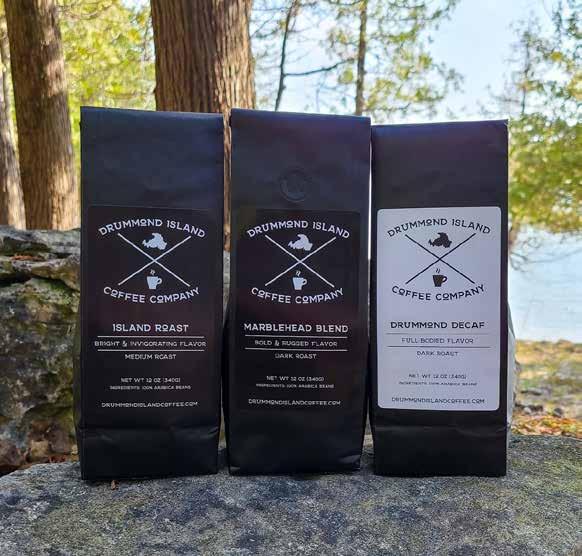
Drummond Island Coffee Company was founded with a simple dream: to share the feeling of island life, one smooth, memorable cup at a time.
“We wanted to provide coffee that not only fuels adventures but also creates lasting memories,” says owner Carly Guggemos, who spent summers on the island growing up and relocated to Drummond in 2021 with her husband and co-founder, Tyler.
Though the beans aren’t roasted on the island itself, they are roasted in the EUP in small batches to maintain balance, consistency and the character of Drummond’s rugged beauty. Inspired by the island’s fresh waters,
cedar forests and rocky trails, each blend is crafted to feel like a breath of the outdoors. The company’s bestselling Island Roast has become a favorite for its smooth, everyday drinkability.
One blend in particular reflects the Guggemoses’ commitment to giving back: the 911 Roast, available November through winter, with 20% of every bag supporting local first responders on Drummond Island.
Whether at farmers markets, shops across the EUP or online, the Guggemos family hopes each cup helps people slow down, savor a moment and feel connected to the island they love.
Drummond Island Coffee Company
Cheneaux
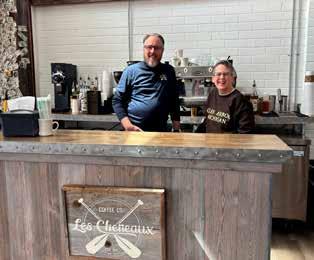
Husband-and-wife team Dave and Jen Gough at their Cedarville cafe, where they roast ethically sourced specialty coffees and serve homemade pastries and espresso drinks. Their mission blends craftsmanship, community connection and a commitment to supporting small farmers around the world.
Mackenzie Paul Shares ‘This Is What It Feels Like’
By Allie Brawley
Mackenzie Paul didn’t set out to become a writer. When life took an unexpected turn, words became both a refuge and a lifeline. Her raw, candid and courageous poems reveal her emotional journey with a truth that resonates far beyond her own story. She invites readers into the fragile, fierce, faith-filled moments that have shaped her life as a cancer patient.
A three-sport athlete who earned 12 varsity letters in crosscountry, basketball and soccer—which earned her a Division II basketball scholarship—Mackenzie had long known her body as capable and strong. Newly married and in her second year of medical school, she felt like the whole world was in her hands— until the day she fainted in a patient’s room.
Lab results and a bone marrow biopsy confirmed the diagnosis she feared most: acute myeloid leukemia.
“For the first time in my life, everything was out of my control,” Mackenzie writes. “Cancer doesn’t care how hard you work, how often you work out, how much you study, how good of a person you are, or how much money and success you’ve achieved. So I surrendered it all to God—the one true King who holds the world in His hands.”
During a leave from medical school, she endured two rounds of chemotherapy and a stem cell transplant. When remission came, she moved forward with hope and determination. She ran a 5K, adopted a puppy and began studying again, intent on returning to the life she’d imagined.
Six months later, her cancer returned. She was referred to MD Anderson Cancer Center in Houston where a new chapter of treatment began. As part of her fight to reclaim what had been taken, she began documenting her experience online, always anchoring posts with the theme: “day 325 of taking back what cancer took from me.” Her videos shared the painful realities of treatment—from unrelenting nausea to mouth sores—and revealed the vulnerable, unfiltered highs and lows of a life turned upside down.
Mackenzie describes herself as a “child of God, wife, dog mom, artist, writer, medical student, runner, daughter, sister, friend and last, but certainly not least … cancer patient. Of all my identities, this is my least favorite. Unfortunately, it is also the one that has shaped my life the most. Cancer has taken so much from me, but I refuse to let it take my voice.”
Mackenzie Paul shares her courageous journey through cancer with honesty, faith and a creative voice that continues to inspire all who follow her story. Her poems and artwork offer an unfiltered look at the reality of cancer—and the strength to fight with faith and heart.
That brave and piercing voice comes through powerfully in her book of poems, “This Is What It Feels Like.” But her artistry doesn’t stop at language. Throughout the book, Mackenzie pairs her poems with simple, striking black-andwhite drawings that distill emotions too complex for words alone. Minimalist yet evocative, her artwork mirrors the vulnerability and honesty of her writing. Each illustration offers a visual pause—a moment for readers to reflect and feel the weight, or the hope, held in each poem.
In her acknowledgements, she thanks her Lord and Savior first, followed by her family, friends and the more than 7,000 people who have walked with her through her social media posts. “To the many strangers who have followed my journey, thank you for your love, encouragement and prayers … I smile knowing I have an army of prayer warriors behind me.”
Her greatest strength shines in the poems and illustrations that share the raw reality of a deeply personal experience few can fully grasp—especially at age 25. She writes, “Living with cancer is like living on another planet. My hope is that my poems can help others see what our world is like—that it’s normal to lose hope, to dream again, to cry, to laugh, to want to quit, to fight harder than ever, to lose faith, to praise God and to lose yourself. But above all, to know this: You are not alone.”
For anyone seeking to understand the emotional and spiritual terrain of cancer, Mackenzie’s words and art are both compass and companion. Through her courage, honesty and creative voice, she has shaped a legacy that will continue to touch lives and remind others that even in the hardest chapters, no one walks alone.
Follow Mackenzie’s journey on Facebook and Instagram @kenziepaul3. Ask for Mackenzie’s book at your favorite local bookstore or wherever books are sold.
Hope
Poem and illustration by Mackenzie Paul
When disappointment endures and you’re at the end of your rope
My greatest warning to you is to never lose hope
Trust me I’ve been there, so please take my word
Feeling like God has abandoned you will make your perceptions blurred
The world tends to kick you down when you’re at your low
There are things the enemy doesn’t want you to know
When you’re angry with God, still tell Him how you feel
Handing Him your pain is the only way to heal
Don’t give up on prayer, even if you don’t feel heard
Sometimes the best way to find answers is spending time in His word
Filling your mind with gratitude will take the anxiety away
Finding joy in the little things will carry you through tough days
God didn’t intend for you to carry the weight alone
There are so many who love you and will answer the phone
Even though your friends and family don’t want to see you in pain
Hiding behind a smile will drive you insane
I promise it will get better and hope will be restored
By surrendering your burdens and placing your hope in the Lord
Amplifying Member Awareness
CLOVERLAND ELECTRIC COOPERATIVE
SEPTEMBER 30, 2025, REGULAR MEETING OF THE BOARD
CALL TO ORDER
A regular meeting of the board of directors was held on Tuesday, September 30 at 9:30 a.m. The board met in person at LSSU’s Crow’s Nest and the membership was able to attend in-person or by using the call-in number.
Chairperson LaLonde called the meeting to order at 9:30 a.m.
ROLL CALL
Roll call was taken and the following directors were in attendance: Chairperson LaLonde, Vice Chairperson Sawruk, Secretary/Treasurer Bonacci and Directors Monroe, Provo, Egan, Nettleton, St. Onge and Vanatta.
President and CEO Mike Heise, COO Pat Frazier, Executive Coordinator Julie Chadwick, Director of Finance Jillian Tomkinson and board attorney Evashevski were also in attendance.
AGENDA
A motion was made by Vice Chairperson Sawruk, supported by Director Vanatta to approve the agenda as presented. A roll call vote was taken, all directors voted in favor and the motion passed unanimously.
MINUTES
A motion was made by Director Provo, supported by Director Monroe to approve the minutes from the August board meeting. A roll call vote was taken, all directors voted in favor and the motion passed unanimously.
PUBLIC COMMENT
A member requested improved community involvement with decisions regarding Cloverland.
Ms. Witucki asked that members complete the form for public comment before they come to the board meetings. Cloverland has this form in use, it’s currently on our website for members to use when they want to address the board.
Director of Energy Services Mark Perman introduced Cloverland’s new Energy Services Team.
BOARD CONCERNS
Vice Chairperson Sawruk had members reach out and involved the CEO in resolving those issues.
Secretary/Treasurer Bonacci had a member reach out and wanted to express his excellent service by Cloverland’s MSR team.
Director Egan also had a member call to say what a great call they had with CEC’s MSR team.
PRESIDENT AND CEO REPORT
Mr. Heise reviewed his report as previously presented to the board of directors. Mr. Heise also discussed Cloverland’s involvement and the pros/cons with joining Michigan Electric Cooperative Association. Mr. Heise reviewed the PSCR report as previously presented.
CHIEF
OPERATING OFFICER REPORT
Mr. Frazier reviewed his report as previously presented to the board of directors.
DIRECTOR OF FINANCES
REPORT
Ms. Tomkinson reviewed the financial reports as previously presented to the board of directors. There are currently 91.6 percent of the membership are current on their bills, with 0.6 percent that are over 90 days past due.
CONSENT AGENDAS
A motion was made by Vice Chairperson Sawruk, supported by Director Provo to approve the consent agendas as presented. All directors voted in favor and the motion passed unanimously.
CHAIRPERSON OF THE BOARD REPORT
Chairperson LaLonde thanked staff for all their hard work.
ATTORNEY REPORT
Ms. Evashevski will give her report in executive session.
OLD BUSINESS
Mr. Heise updated the board on the state mandated LIEAF program and discussed the winter disconnection process. Ms. Brawley provided an update to the board from the informational calls regarding this program.
A motion was made by Director Vanatta, supported by Secretary/ Treasurer Bonacci to follow the current policy of winter protection during winter disconnects. A roll call vote was taken, all directors voted in favor and the motion passed unanimously.
NEW BUSINESS
A motion was made by Director Vanatta, supported by Director St. Onge to approve the estate retirements in the amount of $6,554.86. A roll call vote was taken, all directors voted in favor and the motion passed unanimously.
A motion was made by Director Vanatta, supported by Director
St. Onge to approve Resolution 2025-08, debt limit increase. A roll call vote was taken, all directors voted in favor and the motion passed unanimously.
NEXT REGULAR MEETING OF THE BOARD
The next regular meeting of the board will be Tuesday, November 4 at 9:30 a.m. at the Cloverland admin building.
EXECUTIVE SESSION
A motion was made by Director Monroe, supported by Director Vanatta to enter into executive session at 10:33 a.m. All directors voted in favor and the motion passed unanimously.
The board took a 10-minute break before entering executive session. Executive session started at 10:50 a.m.
REGULAR SESSION
A motion was made by Vice Chairperson Sawruk, supported by Director Monroe to enter into regular session at 1:39 p.m. All directors voted in favor and the motion passed unanimously.
ADJOURNMENT
A motion was made by Director Vanatta, supported by Director Egan to adjourn the meeting at 1:40 p.m. All directors voted in favor and the motion passed unanimously.
RESTORING POWER SAFELY after a storm
When the power is out, crews are doing all they can to safely and efficiently restore it so that you can get back to life as usual.
Depending on the extent of storm damage, restoration can be a complex process. There are many steps in the assessment and restoration process:
1. 2. 3.
STAYING SAFE
DURING AN OUTAGE
We work hard to provide the most reliable service possible. Rest assured, if the power is out, we are on it!
The length of time it takes to restore your power depends on several factors, including the:
Extent of the storm’s destruction
Clearing downed power lines
Restoring power to public health and safety facilities Repairing transmission lines
Severity of utility equipment damage
Number and extent of outages
Accessibility to damaged equipment
STAY SAFE UNTIL POWER IS RESTORED
Stay far away and keep others away from downed power lines, which could be live and deadly.
If you come across a downed line, immediately call 9-1-1 to report it.
4. 6.
5.
Checking power stations and transformers Repairing distribution lines
Getting power restored to homes and businesses
Remember, a neighbor may have power while you do not. Your home might be on a different feeder or transformer or the service line to your home may be damaged.
Never plug a portable generator into a wall outlet, which could cause power to backfeed into the overhead lines that utility crews are working on.
Regardless of the extent of an outage, safety always comes first.
Never enter a flooded room; the water could be energized.
If you are standing in water, do not turn on/off power or flip a switch.
Prepare for a storm by gathering these items:
Bottles of water
Non-perishable food
Portable phone charger
Prescriptions
Battery-operated radio
Flashlights
Extra batteries
Pet supplies
Blankets
Warm clothing
First-aid kit
Hand sanitizer
THANK YOU for your patience during outages. When the lights go off, we are working safely and efficiently to restore power. The safety of our employees, as well as those we serve, is our TOP priority.
CULINARY CURRENTS: EUP FAVORITES
Grilled Lake Trout or Salmon
• 4 lake trout or salmon fillets, skin on Marinade:
• 3 tablespoons olive oil
• 2 tablespoons lemon juice or cider vinegar
• 1 large garlic clove, minced
• 4 tablespoons herbs: fennel, parsley, chives
• ½ teaspoon salt
Instructions:
Place fillets in marinade for 4 hours. Rotate once. Grill over medium heat—approximately 5 minutes per side.
—Dianne Clark, Paradise
Blueberry Cobbler
• 1 cup flour, sifted
• 1 ½ teaspoons baking powder
• ¼ teaspoons salt
• ¼ cup butter
• ½ cup sugar
• 1 egg, slightly beaten
• ½ cup milk
• 1 ½ teaspoons vanilla
• 1 ½ cups blueberries
• 1 tablespoon lemon juice
Instructions:
Sift flour, baking powder and salt; set aside. Cream butter until soft, gradually adding sugar. Add dry ingredients alternately with combined egg, milk and vanilla. Beat well after each addition. Pour blueberries into buttered/greased 8-inch square baking dish. Add lemon juice. Spoon on batter. Bake at 375 F for 35-40 minutes.
—Barbara Merchand, Hessel
Scalloped Corn & Rice Casserole
• 1 17-ounce can whole-kernel corn, drained
• ½ cup cooked instant rice or Minute Rice
• 2 tablespoons flour
• 4 tablespoons sugar
• 3 tablespoons butter, melted
• 1 cup milk
• 2 eggs, beaten
• ½ teaspoon salt
• Dash pepper
Instructions:
Combine ingredients and pour into an 8-by-8-inch oven dish. Bake at 350 F until browned and center is set—typically 30 minutes (or 1 hour if doubling the recipe for a 9-by-13-inch oven dish).
—Johanna Wiltfong, Pickford Cloverland’s Easements and Permits Liaison
Ranger Cookies
• 1 cup butter
• 1 cup brown sugar
• 1 cup white sugar
• 2 eggs
• 1 teaspoon vanilla
• 2 cups flour
• ½ teaspoon salt
• 1 teaspoon baking soda
• 2 cups quick oats
• 1 cup coconut
• 2 cups Rice Krispies cereal
Instructions:
Culinary Currents depends on your submissions to share with members!
March | April Pizza party! Share your favorite special crusts, favorite toppings, kid-friendly “build your own” pizza ideas. Deadline Jan. 15.
Submit recipes to connections@cloverland.com or Cloverland Connections, 725 E. Portage Ave., Sault Ste. Marie, MI 49783. Members whose recipes are printed in 2026 Connections are eligible for a $100 electric bill credit (one winner per year).
Cream butter and sugars until smooth, then add eggs and vanilla. Add flour, salt and baking soda and mix well. Add oats, coconut and cereal. Form into balls and place on cookie sheets lined with parchment paper. Bake at 350 F for 10 minutes or until just beginning to brown. Tip: Best when slightly underbaked. Let cookies sit for several minutes before moving to cooling rack.
—Johanna Wiltfong, Pickford
Congratulations to our 2025 recipe winner, Thomas Cayia of Manistique! His five-hour stew recipe appeared in the January | February Connections. Our co-op staff voted his recipe the top contribution for the year.
THE FULL CIRCLE IMPACT OF SHOPPING LOCAL—WILDERNESS TREASURES
By Allie Brawley
This article is the first in a series about the impact of buying local to support small businesses across the EUP.
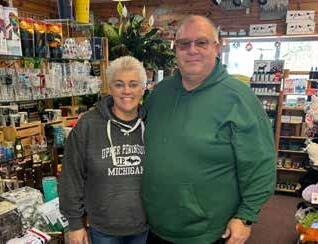
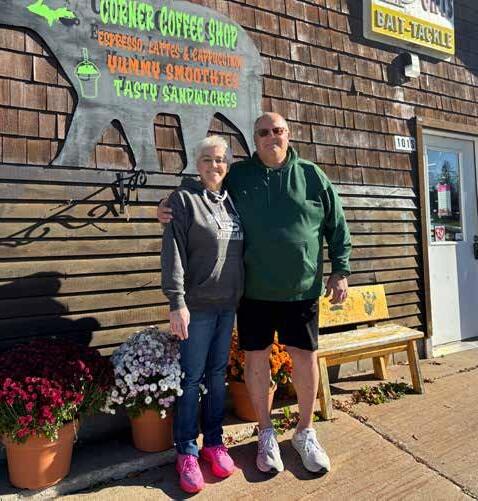
For 25 years, Carley and Tom Ball of Wilderness Treasures have built far more than a business in Pickford—they’ve built a gathering place, a service hub and a heartbeat for families across the Eastern Upper Peninsula.
What began as a humble gift shop and bait-and-tackle store has grown steadily through four expansions, each prompted by one simple question: What does our community need? Over the years, Wilderness Treasures has added a floral shop, a gun shop and even sublet space to a local shoe store. When Carley noticed there wasn’t a place for kids to grab something to eat after school, they opened a cafe serving sandwiches, smoothies, snacks and warm coffee drinks.
“Everything has evolved to make sure the community is covered,” Carley explains. It’s a philosophy that has guided every decision the Balls have made since day one.
Surviving—and thriving—as a small business in a rural region for 25 years is no small feat. For Wilderness Treasures, the key has always been the local community.
“Eighty percent of our business is local,” Carley says. “So, we keep our inventory changing all the time, and we make it a fun and happy place. Good prices are key. We also take care of the school to make sure our kids are happy—make sure the kids are fishing so it ensures the next generation of fishermen.”
Their commitment doesn’t stop at the shop doors. The Balls organize and run two annual ice fishing tournaments and a popular community craft show. If they’re not spearheading a local event, they’re behind the scenes supporting it.
In this way, “local” doesn’t just mean Pickford. Their customers and community stretch from Cedarville to Sault Ste. Marie and the many communities in between. Customers come not only for the products but for the personal connection.
Carley puts it simply: Supporting local businesses sustains the very community residents care about.
“If you want us, as a business, to support the community—whether it’s kids’ school events or donating to benefit dinners and golf scrambles— if people don’t support us as a business, we can’t support them when they’re trying to raise funds,” she says. “It all comes back full circle. If you want us to help you, you gotta help us.”
Then she adds with a laugh, “I’m pretty sure Amazon doesn’t care whether little Johnny has a jersey for next week’s football game. I, however, will embroider his name on it for you!”
It’s that blend of practicality, generosity and humor that has cemented Wilderness Treasures as a rare constant in a changing world of business.
Reflecting on 25 years, Carley’s gratitude is unmistakable.
“We are so thankful for 25 years of support from our community. It’s been an absolute roller coaster ride,” she says. “There is no other community I’d rather be in than the east side of the UP!”
Wilderness Treasures’ story is the perfect beginning to this series on the impact of buying local—because it shows what happens when a community supports its small businesses, and those businesses give back tenfold. Across the EUP, these relationships fuel resilience, traditions and opportunities that can’t be found in any online shopping cart.
Learn more at wildernesstreasures.net
Carley and Tom Ball of Wilderness Treasures have spent 25 years growing a small Pickford shop into a community hub—proving that when neighbors support local businesses, those businesses give back tenfold.
PHOTO CONTEST
WINTER WONDERS
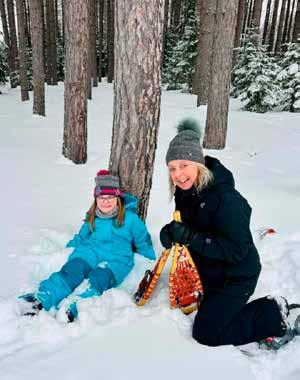
1. My granddaughter, Kadie, enjoying the winter sunshine.
—Cossondra George, Newberry
2. Our dogs, Murphy and Rosco, love to run through our winter wonderland on the Sandridge.
—Pat Feldhake, Pickford
3. My granddaughter, Eleanor, and I snowshoeing in beautiful Barbeau.
— Debra Caroll, Barbeau
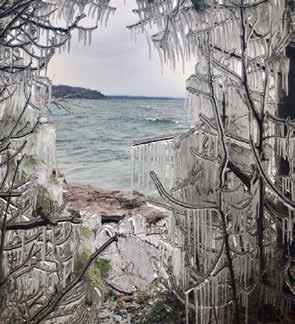
4. An icy walk along the shoreline of Lake Superior.
—Emily Taylor, Manistique
5. The Sault Ste. Marie Country Club the morning after a fresh snowfall.
—Lisa and Adam Rutledge, Sault Ste. Marie
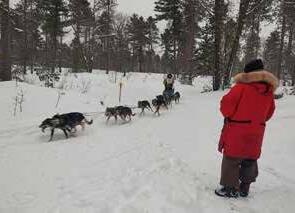
6. Winter fun at the Tahquamenon Country Sled Dog Race!
—Brenda Ransom, Sault Ste. Marie
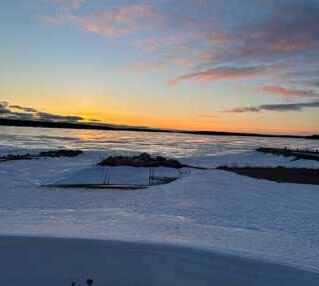
7. A beautiful winter sunrise over our lake and evergreens.
—Bonnie Vrchota, Manistique
8. Winter view of the ice at the Mackinac Bridge.
—Judy Umlor, Trout Lake
9. This buck is enjoying the first dusting of snow.
—Raeona Armstrong, Barbeau
10. Uncle Chris and Tater enjoying the snow fort they made.
—Kristan Brady, Kinross
11. While snowshoeing on the lakeshore out at Rocky Point, we saw a coyote trail frozen in the snow, heading across the bay toward Roach Point.
—Cathie Chenoweth, Raber
12. My best pal, Argo, and I at Point Iroquois Lighthouse during a snowstorm.
—Steve Earl, Barbeau
13. Winter view from our deck near Garlinghouse Lake.
—Fran Bjork, Rudyard
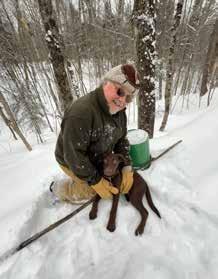
14. My dad, Ken, and dog, Dilly, walking in the snowy woods.
—Matty Lockhard, Sault Ste. Marie
15. Evening grosbeaks enjoying a winter snack.
—Ashley Geisz, Goetzville
16. Penny and the deer.
—Joan Smith, Hessel
17. Peaceful swans on Forks Creek.
—Jan Barrett, Curtis
18. Winter's warmth!
—Shirley McDonough, Manistique
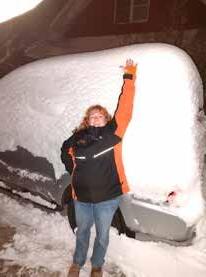
19. We were out of town last Thanksgiving and came home to this massive snowfall!
—Brenda Ransom, Sault Ste. Marie
20. A beautiful winter evening on Drummond Island.
—Treasa Schultz, Drummond Island
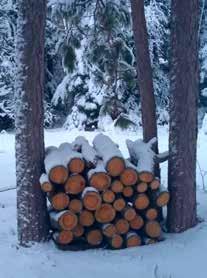
From snowy landscapes to frosty family fun, Cloverland members shared winter moments from across the Eastern Upper Peninsula.
1 2 6 7 4 5
3
8
Impactful Rebates Available
5-Minute Easy Online Application
We’re
Earn Rebates for Appliance Upgrades
Recycle
Business & Farm Rebates*
The EO program gives you the resources and rebates to improve
LIGHTING
Fluorescent Relamping with TLEDs $1 - $10/tube
LED Exit Signs $14 each
Fluorescent Delamping $5 - $10/lamp
Signage Lighting
$0.20 - $0.50/Watt reduced
Interior Non-High Bay Fixture Replacement
$0.20 - $0.60/Watt reduced
High Bay Lighting
Exterior Lighting
$0.30 - $0.60/Watt reduced
$0.30/Watt reduced
Parking Garage Lighting $0.60/Watt reduced
Occupancy Sensors and Controls
$0.06 - $0.25/Watt controlled
NON-LIGHTING
Variable Frequency Drives $25 - $75/HP controlled
Electric Chiller Tune-Up $6 - $12/ton
Heat Pump Systems $250 - $1,000
Computer Room Air Conditioning $3.50 - $30/MBH
Other HVAC Equipment Rebates vary
Commercial Refrigeration and Lighting Rebates vary
Food Service Equipment $50 - $1,650
Industrial Equipment Rebates vary
Miscellaneous Equipment Rebates vary
COMPRESSED AIR
Air Compressors
$20 - $100/HP
Air Dryer Equipment
$0.40 - $5/SCFM
Engineered Nozzles $150/nozzle
Air System Energy Audit and Leak Repairs $15 - $20/HP
Miscellaneous Equipment Rebates vary
CUSTOM PROJECTS
Residential Rebates*
Save energy and money and enjoy the comforts of your home or farm. The EO program offers rebates to make energy-efficient upgrades.
APPLIANCES
Portable Room Dehumidifier $50
Room Air Conditioner $50
Room Air Purifier $50
Clothes Washer $50
Clothes Dryer $50 - $100
Refrigerator $50
Chest or Upright Freezer $50
Computer $50
Smart Power Strip $15
HEATING & COOLING
Central Air-Source Heat Pump $250 - $500
Central Air Conditioner $100 - $200
Mini/Multi-Split Air-Source Heat Pump $1,000
Air-to-Water Heat Pump $500
Ground-Source Heat Pump $1,000
Desuperheater for Ground-Source Heat Pump $100
A/C Tuneup $50
Wi-Fi Enabled Thermostat $50
Heat Pump Water Heater $500
Whole-Home Dehumidifier $100
Efficient Circulation Pump $150
FARM EQUIPMENT
Dairy Equipment Rebates vary
Ventilation and Irrigation Equipment Rebates vary
Agricultural LED Lighting $0.40/Watt reduced
Indoor Agriculture $0.10 - $0.45/Watt
Miscellaneous Equipment Rebates vary
725
Power Line Pruning—Trimming for Safety & Reliability 2026 TREE - TRIMMING PLANS
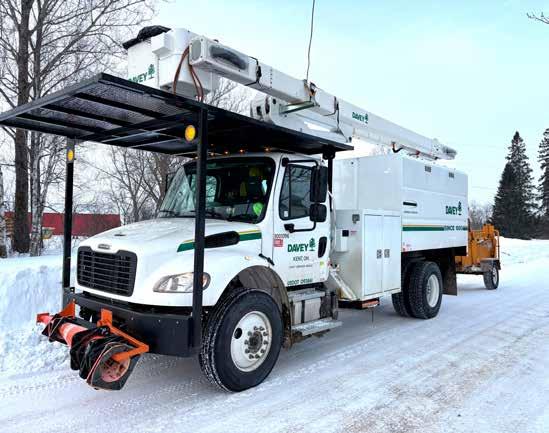
Cloverland’s contractors, Chop Tree Service, Wright Tree Service and Davey Tree, will clear rights of way along high-voltage power lines. Cloverland maintains a total of 4,056 miles of line, with approximately 300 miles scheduled for clearance in 2026 across our Eastern Upper Peninsula service territory.
Scheduled work will occur in Clark, DeTour, Drummond Island, Marquette, Pickford and Raber townships. Additional maintenance work may occur across Cloverland’s service territory.
Safe clearances are maintained by removing select trees and pruning limbs along power lines. Crews are identified by the company logo on their vehicles and identification badges.
Contact Cloverland at 800-562-4953 if you are concerned about vegetation in proximity of your service line.
Our tree-trimming process involves two phases to ensure efficient and thorough work.
Trimming: The first crew trims the limbs and branches, leaving them in piles. Chipping: The second crew follows to chip the trimmed branches.
There may be a two- to four-week gap between phases, so you may notice branches accumulating during this period. Thank you for your understanding and patience.
Members affected by 2026 tree-trimming plans will be notified in advance by email and automated phone message. Call 800-562-4953 to update your email or phone number to stay informed.