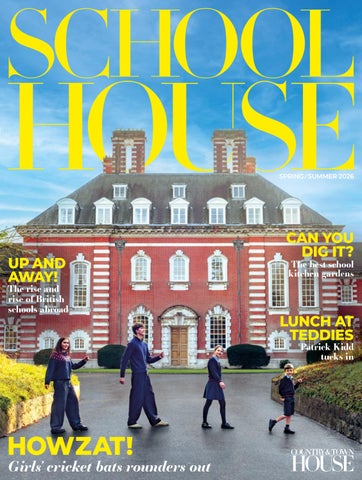
School House Spring/Summer 2026

Page 1


Tailored not uniform

When it comes to a good education, one size does not necessarily t all. MPW is one of the UK’s leading independent fth- and sixth-form college groups, offering a distinctive alternative to traditional schools. Our colleges blend a highly exible curriculum and unparalleled individual support with a socially relaxed, mature environment.

A levels and GCSEs in over 40 subjects, plus Easter Revision courses, retakes and Year 12 transfers

Outstanding 1:1 academic and pastoral support

Oxbridge-style tutorial groups with nine students or fewer

Excellent results and progression to top tier universities

Easter Revision courses

Best in class inspection reports from the Independent Schools

Inspectorate (ISI)

Discover MPW for yourself

Visit www.mpw.ac.uk or call us to book your visit.

30 March - 17 April

Find out more

SPRIN G / SUMMER 2026

CONTEN TS

UP FRONT

LUNCH WITH SCHOOL HOUSE

Patrick Kidd stops by the St Edward’s dining hall for a meal with the head INSIDE THE KITCHEN

How to make the popular Saint Ronan’s rocky road OFF GAMES

Behind Glenalmond’s love of climbing SO YOU WANT TO BE A... DIPLOMAT

Former ambassador Sir Sherard Cowper-Cowles on his 32-year career

REGULARS

PREP NEWS

SENIOR NEWS

SCHOOL HOUSE AWARDS HEADS OF SCHOOL

Four outstanding students at Worth BEHIND THE GATES

Frances Glover discovers what makes St Swithun’s special THE TRAILBLAZER

e love story behind the family-run omas’s schools, by Elizabeth Ivens

HOW TO TALK TO YOUR CHILD ABOUT… DIFFICULT FEELINGS

Psychotherapist Emily Samuel gives her professional advice THE BEST SCHOOL… KITCHEN GARDENS

Evie Calver spotlights eight budding outdoor spaces INSIDERS’ GUIDE

Experts share everything you need to know about studying art and design

FEATURES

EYE ON THE BALL

Rachel Hosie discovers why cricket for girls is soaring for six GOING ARTIFICIAL

Alice Smellie investigates how schools are encouraging ethical use of AI HOME COMFORTS

Cold, bleak boarding houses are a thing of the past, nds Esther Walker ABROAD IN BLOOM

Susie Mesure looks into the growing appeal of international schools COME ONE, COME ALL Why are so many schools going coeducational? By Eleanor Doughty

SCHOOL’S

OUT CULTURE KIT

School House’s pick of the best things to see and do this spring and summer DIARY OF A SEND MOTHER

Our new columnist Flora Watkins re ects on her coping strategies

LIBRARY CORNER

School librarians recommend their favourite books for children and teens THE TOWN BEHIND THE SCHOOL

Annabelle Spranklen’s guide to visiting Oakham in Rutland, home to Oakham School

STANDING PROUD

Eleanor Doughty nds England’s best stately homes for a family day out Q&A: ADELE PARKS e bestselling author on writer’s block, imagination and divorce

DIRECTORY

NURSERIES

LONDON SCHOOLS

Bryanston School in Dorset. Photographed by Hester Marriott

LISTENING TO Gyles Brandreth’s Rosebud podcast, featuring wonderful interviews with a range of public figures from Sir Gary Oldman to Dame Mary Beard.

Ihave written for School House for over a decade and it is my pleasure to take over its editorship from my colleague and mentor Victoria Lambert. It is always an exciting time to be involved with independent school education, but now more than ever as the sector faces questions about its future – and, like it or not, the fact that VAT on school fees is now a lingering dinner party conversation and something for many to chew over. But here at School House, we are feeling cheerful – and very excited to bring this issue to you, with a host of new regular features and a fresh stable of writers. On page 14, former political sketch writer for e Times Patrick Kidd turns his hand to our new agship interview, Lunch with School House, for which he sat down in the dining room – pupils and all – at St Edward’s School, Oxford for lunch with its warden, Alastair Chirnside. It’s an absolute cracker. Child psychotherapist Emily Samuel brings her wisdom to School House, and each issue she will consider a new hot topic in her column (p40). Travel supremo Annabelle Spranklen visits Oakham for her new series on the towns behind the schools on page 92, and we introduce Flora Watkins’ rst column exploring life with her young family in Norfolk – and how not every farmhouse peopled with dogs, cats and ponies is truly the backdrop to a Beatrix Potter tale (p88). Flora writes movingly and powerfully about the challenges faced by her daughter Romy; theirs is a story very much worth telling and I am proud to host them here.

Editor’s LETTER

ere’s plenty, too, that will feel familiar to regular readers. Our Insiders’ Guide (p46) considers schools with a particular artistic bent, while Elizabeth Ivens meets David and Joanna omas, founders of their eponymous school empire, for e Trailblazer (p36). I, too, am very pleased not to have hung up my pen and notebook just yet – I spent two enjoyable mornings interviewing career diplomat Sir Sherard CowperColes KCMG LVO about his life in the Foreign O ce (p21), and the 25-time novelist Adele Parks MBE about disappearing into her imagination and where she gets her ideas from for our back-page interview on page 96. Both were a huge pleasure and I hope you’ll get as much from them as I did.

READING I am inclined to read old, out of print books – as a historian, it’s an occupational hazard – but in pursuit of my next book project, I am re-reading Cecil Beaton’s diaries, which are simply magical.

WEARING

My new Blundstone 550 boots – I can’t get them off my feet. They’re perfect for long walks with my lovely spaniel, Meg.

CONTRIBUTORS

EMILY SAMUEL

A UKCP-accredited child psychotherapist, Samuel has been working with children and adolescents for over 14 years and was previously a clinician at the Yale Child Outpatient Psychiatric Clinic for seven years. She co-hosts the erapy Works podcast with her mother Julia Samuel and sister Sophie Samuel (also an accredited psychotherapist) and is a member of the Royal Foundation Centre for Early Childhood advisory group.

ESTHER WALKER

e lifestyle journalist and author has written for e Times , The Sunday Times , e Telegraph, Grazia and others, and her debut novel, Well, is Is Awkward , is out now, published by Bedford Square. Walker is working on her second novel and lives in London with her husband and two children. For this issue of School House, she wrote about how prep school boarding has entered its new much more comfortable era (p64).

PATRICK KIDD

A national newspaper journalist for 25 years, much of Kidd’s career has been at e Times, where he was its political sketch writer. Now freelance, he still writes features and reviews for e Times as well as pieces on sport, politics, culture and religion for e Telegraph, e Observer, e Spectator and e Critic. A collection of his writing, e Weak are a Long Time in Politics: Sketches from the Brexit Neverendum, was published in 2019.

CONTRIBUTORS

RACHEL HOSIE

A freelance journalist specialising in health, lifestyle and travel, Hosie has written for publications including e Times, e Telegraph, Women’s Health, Business Insider and e Independent. A keen champion of women’s sport and tness, she spends her free time lifting weights and trying to enjoy running, and for this issue writes about the upswing in girls’ cricket (p53). She lives in France with her husband and a healthy croissant habit.

SCARLETT FLAHERTY

The former pupil of St Edward’s, Oxford, is now a student and developing artist completing an extra A level during her gap year. In preparation for an art degree later this year, she is focussed on expanding her portfolio and further developing her artistic style. For this issue, she sketched her former headmaster Alastair Chirnside for Patrick Kidd’s Lunch with School House (p14).

SUSIE MESURE

A freelance feature writer, interviewer and literary critic based in south London, Mesure writes about a wide range of topics for publications such as the Financial Times, Prospect and The Telegraph , with recent work including an investigation into the reading crisis and how silence is the ultimate luxury. She spends most of her time wondering which book to read next and trying to learn how to solve cryptic crosswords.

UK BOARDING SCHOOL OF THE YEAR 2025 & 2026

THE SUNDAY TIMES

UK CO-EDUCATIONAL SCHOOL OF THE YEAR 2025 & 2026

PREP SCHOOL | COLLEGE | INTERNATIONAL FOR BOYS AND GIRLS AGED 3 TO 18

ELEANOR DOUGHTY EDITOR

CAMILLA VAN PRAAGH

PUBLISHER

EDITORIAL DIRECTOR LUCY CLELAND

DEPUTY EDITOR LUCINDA BARING

JUNIOR SUB EDITOR & PRODUCTION ASSISTANT EVIE CALVER

CREATIVE & PRODUCTION DIRECTOR PARM BHAMRA

DESIGN & PRODUCTION MANAGER MIA BIAGIONI

CONTRIBUTING EDITORS

PATRICK KIDD, FRANCES GLOVER, ELIZABETH IVENS, EMILY SAMUEL, RACHEL HOSIE, ALICE SMELLIE, ESTHER WALKER, SUSIE MESURE, FLORA WATKINS, ANNABELLE SPRANKLEN

DIGITAL DIRECTOR REBECCA COX

DIGITAL EDITOR ELLIE SMITH

DIGITAL CULTURE EDITOR OLIVIA EMILY

DIGITAL STYLE EDITOR CHARLIE COLVILLE

DIGITAL ASSISTANT ISABEL DEMPSEY

SOCIAL MEDIA MANAGER MCKENZIE MULLANY

PUBLISHER (COUNTRY & TOWN HOUSE) ELLIE RIX

HEAD OF FASHION EMMA MARSH

HEAD OF BEAUTY BANDI MANZINI

SENIOR ACCOUNT DIRECTOR, HOMES & INTERIORS OLIVIA MCHUGH

ACCOUNT DIRECTOR SERENA KNIGHT

ACCOUNT MANAGER COSIMA WOODARD

DIGITAL BUSINESS DEVELOPMENT DIRECTOR JOEY GOLDSMITH

PROJECT MANAGEMENT & SALES SUPPORT EXECUTIVE CHARLOTTE RYAN

TECHNICAL DIRECTOR MARK PEARSON

CHIEF FINANCIAL OFFICER GARETH MORRIS

FINANCE CONTROLLER LAUREN DELGADO

FINANCE ADMINISTRATOR RIA HARRISON

ACTING FINANCE ADMINISTRATOR KLODI SADE

HUMAN RESOURCES CONSULTANT ZOE JONES

CHIEF COMMERCIAL OFFICER TIA GRAHAM

CHIEF OPERATING OFFICER JAMES THROWER MANAGING DIRECTOR JEREMY ISAAC

EDITORIAL ENQUIRIES eleanor@schoolhousemagazine.co.uk

ADVERTISING ENQUIRIES camilla@schoolhousemagazine.co.uk

SCHOOL HOUSE is a biannual magazine published with Country & Town House magazine and distributed to AB homes in Barnes, Battersea, Bayswater, Belgravia, Brook Green, Chelsea, Chiswick, Clapham, Coombe, Fulham, Hampstead, Highgate, Holland Park, Kensington, Knightsbridge, Marylebone, Mayfair, Notting Hill, Pimlico, Putney, Richmond, South Kensington, St John’s Wood, Wandsworth and Wimbledon. It is also on sale at selected WHSmith, Sainsbury’s, M&S, and Waitrose stores and independent newsagents nationwide. School House is published by Country & Town House Ltd, Studio 2, Chelsea Gate Studios, 115 Harwood Road, London SW6 4QL (tel: 020 7384 9011). Registered number 576850 England and Wales. Printed in the UK by William Gibbons and Sons Ltd, West Midlands. Paper supplied by Gerald Judd. Distribution by Letterbox.

Copyright © 2026 School House. All rights reserved. Reproduction in whole or in part without written permission is strictly prohibited. Materials are accepted on the understanding that no liability is incurred for safe custody. The publisher cannot be responsible for unsolicited material. All prices are correct at the time of going to press but are subject to change. While every care is taken to ensure all information is correct at the time of going to press, it is subject to change, and School House takes no responsibility for omissions or errors.

WHAT TO DO WITH SCHOOL HOUSE WHEN YOU’VE FINISHED READING IT...

Ideally, we’d love you to pass it on to a friend or a community place which might enjoy it (doctor or dentist surgery, community centre etc), but you can also rest assured that your issue can be recycled. The magazine (including cover) can be disposed of in your paper waste recycling bin.

Co-curricular passions

Academic excellence

To make your first entrance into an extraordinary education from 3 to 18, come and meet us.

Book a visit to one of our schools: thomas-s.co.uk/admissions

IMAGINE

a place where your child can truly thrive

At Haileybury, we believe in discovery, connection and joy.

Our outstanding academic results are just the beginning; from world-class sport and adventurous outdoor learning to drama, music, and scientific research, we want every pupil to feel inspired and empowered to develop their potential in a vibrant, supportive community.

“ The co-curricular and academic enrichment programme is a significant strength of the school.”

ISI Inspection Report - October 2025

UPFRONT

SCHOOL PET

guinea pig at Lancing Prep Worthing

Nugget may be small, but he’s making a big impact on pupils’ wellbeing at Lancing Prep. O cially Chicken Nugget – a name drawn from a hat among other food-related suggestions – he joined the school family in 2023 as an emotional support animal for the children.

‘It’s really helpful having an animal they know is there for them,’ says Amie Bennet, assistant head, SENCo and DSL. Nugget lives in the Hive, the school’s wellbeing room, and is cared for by pupils both in and out of term time. ‘If the children are nding it di cult to express themselves, it helps them to talk to Nugget and open up that way. Or if they’re having a busy day, they pop in to see how he’s doing and give him a cuddle. You

see their shoulders go down immediately. Nugget makes them feel so calm.’

While he is a laid-back animal that loves being held, Nugget regularly tips his wooden house upside down and gives it a nibble – a cheeky trick that never fails to makes the children laugh. He also loves his greens – particularly lettuce, celery and mint – and when not spending time with pupils or sta , he is content in his cage with his very own cuddly guinea pig toy.

Nugget turns three in July and as is tradition, pupils will be making him cards and decorating his cage to celebrate. ‘He is absolutely adored by the children and we genuinely see him as a really big, important part of our school community,’ adds Bennet. ‘We’re all very team Nugget!’ Evie Calver n

Nugget,

HOUSE

St Edward’s School LUNCH WITH SCHOOL

Over a bite in the Teddies dining hall, Patrick Kidd chats to head Alastair Chirnside about alumni, career changes and charity work

It’s not often you have lunch in a school beneath a Grand National winner – especially when the memorial is for exploits with a hockey stick rather than a horse. But there he is, Sam Waley-Cohen, star of the Teddies rst XI in 2009, the future jockey’s name up on a shield above my chicken schnitzel. ‘Incredibly nice man,’ says my companion when I point him out. It takes one to know one.

Alastair Chirnside has been warden at St Edward’s, Oxford, since 2021, the headmaster’s formal title re ecting its origins as a place to educate the sons of clergy. e rows of colourful shields on the dining hall walls, representing XVs, XIs and VIIIs both ancient and modern, likewise nod to that Victorian virtue of muscular Christianity when sports teams were given Roman numerals like they were legions and young men were sent out into the world with a Bible in one hand and a ball or a blade in the other. e school tradition of painting over a shield once everyone on it is dead has ended – ‘a bit ghoulish,’ Chirnside says – and they now show sisters-in-arms as well as brothers, since Teddies has been fully coeducational for 29 years. Women had an in uence on the school right from the start, Chirnside notes, which he honoured by asking the school’s head of art, Adam Hahn, to paint a portrait of Felicia Skene, prison reformer and founding fundraiser for Teddies. e artwork hangs in his drawing room opposite Algernon Barrington Simeon, the rst warden in 1877.

Unlike his three immediate predecessors, Chirnside lives on site, making him a boarder like 82 percent of his pupils – including his two daughters and Pixie the black labrador. ‘One of the happiest and most ful lling times in my career was running a boarding house at Eton,’ he says. ‘When we came here, we wanted to be right in the middle of it at all hours.’

On the wall of the dining hall, by the door to Chirnside’s house, is a mural of a river scene from e Wind in the Willows by Kenneth Grahame, another old boy. Messing about in boats has given Chirnside great joy.

Alastair Chirnside, drawn by St Edward’s alumna and artist Scarlett Flaherty

As a student at Merton College, where he took a rst in classics and French, he rowed for Oxford in the Lightweight Boat Races and later coached rowing during 12 years teaching at Eton. St Edward’s, too, has a long and proud rowing tradition, with alumni going on to compete locally, nationally and even in the Olympics.

Over a canteen lunch of breaded chicken (crisp, not oily), potatoes and salad, plus elder ower cordial with mint and lime, the warden explains how he arrived in education after working as a fund manager with Schroders. ‘I enjoyed it and was moderately successful, but I didn’t totally love it,’ he recalls. ‘I’d always had in mind that I might become a teacher of Latin and Greek and after ve years, that’s what I wanted to do.’ After starting at Eton, his alma mater, he went on to Harrow, where he was director of studies and then deputy head.

Chirnside still teaches classics, taking one set for the whole of year nine, where everyone does Latin, and the other shell sets in rotation for a few weeks each, so he gets to know all the new pupils. ‘It’s really important for the head to be in the classroom,’ he says. ‘It’s good for visibility and keeping in touch with what’s going on.’

Located in the Summertown area of north Oxford, St Edward’s has the city’s second biggest quad (the rst is at Christ Church), as well as the largest auditorium in its 960-seat Olivier Hall. It also has an art gallery and the North Wall studio theatre – both open to the public – and 100 acres of playing elds. Yet Chirnside is keen for his pupils to enjoy the busy university city that’s just over a mile away from the school. ‘ ere are great boarding schools in the countryside and great day schools in cities,’ he says. ‘But we’re a boarding school in an amazing city. It bene ts us culturally, for the concerts, museums and galleries, as well as academically.’ Some DPhil students are o ered part-time teaching by the school, while university professors often give talks.

Over dessert – fruit yoghurt for him, chocolate cake for me – I ask Chirnside brie y to describe Teddies’ character. ‘Ambitious, friendly and fun. It’s a warm and welcoming community where you can achieve anything.’

With the roll increasing from 770 in 2020 to about 815 this academic year, the warden has plans to expand the sporting facilities and build a new science complex with 14 labs and rooms for robotics and engineering. ere are also discussions about opening an outpost in Japan, the Middle East, ailand or Germany, which will help to pay for more bursaries. e school is strongly international, with 46 countries represented – well above Chirnside’s target of 30. ‘What you don’t want is a community within a community,’

he says. ‘ is is a wonderful mix.’  His greatest ambition, though, is to do with the wider community beyond the school walls. Beyond a ordability, he says, the bigger challenge for independent schools is that parents won’t want to pay for them – that they will see these schools as producing arrogant, entitled children who grow up in a bubble. ‘One of the rst things we did when I started was to put partnership work for every lower sixth pupil into the timetable,’ he says. ‘Before we scheduled any lessons, I reserved 90 minutes a week for work in food banks, care homes, charity shops, local primary schools. at’s made possible by the fact that we’re in Oxford.’ at focus on charity work has expanded into other years, taking the school’s ethos back to its roots. ‘From the beginning of their time at Teddies, children learn that this is an unbelievable school and they’re incredibly lucky,’ he says. ‘And they know they also need to play their part in society and help other people. e hope is that over time, that becomes what they do with their life.’ is ties into what drove him out of the City and into teaching: the desire to do good. ‘ e more you put into teaching, the more you get out,’ he says. ‘We won’t know whether what we are doing has had a bene cial impact on our pupils as people for a long time – until they are properly grown up – but that is why it is so exciting and makes this, for me, a totally amazing job.’ n

FROM TOP: St Edward’s School is located in Summertown, north Oxford; the school has a long and successful tradition of rowing

INSIDE THE KITCHEN

ROCKY ROAD

Here’s how to make this sweet treat the Saint Ronan’s way

SCHOOL: Saint Ronan’s, Kent

SNACK: Ronan’s rocky road

CHEF: Richard Goodman

At Saint Ronan’s School in Hawkhurst, rocky road is a hardworking pudding. At Friday lunchtimes, pudding is accessed on a graband-go basis and can be anything from rocky road to homemade chocolate chip cookies to brownies. e rest of the week, pudding comes in a nice, shiny bowl. Rocky road is a keen favourite – not just for on-the-run lunches, but for hospitality events the school hosts, for match teas, school shows, or afternoon teas. ‘You can cut it into nice, bite-sized pieces,’ says Goodman. ‘It’s so exible.’

e children love it and it is guaranteed to vanish in an instant. ‘ ere’s never any wastage; anything chocolatey, children will like,’ laughs Goodman, who has worked at St Ronan’s for 18 years and is very much part of the family. It’s rare that he has any left over, ‘but if there was a tiny bit left, it can be very easily frozen.’ It is more of a winter pudding, he adds. ‘I don’t tend to put it on the summer menus because it just melts and covers children in chocolate.’

When Goodman is making it at school, he is using ve kilograms of chocolate at a time, he laughs, and ‘packs of butter – but I’m catering for 400 children’. He refers readers to the GoodFood website for recipes with domestic-level quantities of ingredients. In the past, Goodman’s recipe has appeared in the school newsletter.

‘It’s a basic recipe and it can be adapted to how you like. After melting your high percentage dark chocolate in a bain-marie, combine it with your butter and golden syrup. e more syrup you add, the chewier the rocky road becomes. Into that mixture, you fold in either digestive biscuits or ginger nut biscuits. en you can add whatever you like – fudge pieces, marshmallows, honeycomb. Some people put popcorn in it, and dried fruit works well. After that, you leave it to set and chill.’

As for his own ideal rocky road? ‘ e more bitter, dark chocolate the better; plenty of syrup so it’s chewy; and a lovely honeycomb in there with some fudge pieces.’ n Eleanor Doughty

RECIPE METHOD

200g digestive biscuits

135g butter or margarine

200g high percentage cocoa dark chocolate

2-3tbsp golden syrup

100g mini marshmallows

Icing sugar, for dusting

1. Grease and line a 18cm tin with baking paper.

2. Crush 200g disgestive biscuits with a rolling pin until they’re broken into pieces of various sizes.

3. In a saucepan, melt the butter or margarine with the dark chocolate and golden syrup over a gentle heat until no lumps remain. Leave to cool.

4. Take the biscuits, marshmallows and up to 100g of any other ingredients of your choice and stir into the chocolate mixture.

5. Pour into the baking tin and chill for at least two hours before dusting with icing sugar. Serve and enjoy.

Illustration by St Ronan’s pupil Annie W

OFF GAMES

Climb Ev’ry Mountain

Glenalmond College’s head of outdoor learning Tom Mason celebrates the school’s penchant for climbing

Up here in Highland Perthshire, we are uniquely situated to enjoy everything that Scotland has to o er, with Glencoe to the north west and the Cairngorms to the north east.

I’ve been at the school for eight years and in my time, there’s always been a Munro club dedicated to exploring those mountains with a summit over 914m. Mike Je ers, one of our main instructors, is a maths teacher but also a quali ed mountaineering instructor. He’s been at Glenalmond for 26 years and has been taking pupils out into the hills for all of that time, come summer or winter.

At Glenalmond, rather than making climbing just a club that pupils can sign up to,

we have tried to formalise the experience so we can make sure every child has the opportunity to join in if they wish. We never make any child climb a Munro if they don’t want to. e old-fashioned concept that you should build pupils’ character through tough experiences is not our perspective at all. Saying that, every child at Glenalmond should climb a Munro, every child at Glenalmond should go rock climbing outside on natural rock, and every child at Glenalmond should get the chance to experience our landscape and connect with it in a slightly di erent way.

Within our wide-ranging co-curricular programme, we also run the Duke of Edinburgh’s Award and there is a strong

Combined Cadet Force, but it’s really important there is a non-uniform path into the outdoors. Some children don’t want to spend ve nights camping for their gold award and would rather focus on becoming better at rock climbing – pupils get the chance to pick their adventure.

We don’t call it outdoor education; it’s outdoor learning, and from the third form, pupils begin enjoying this with kayaking in the pool and orienteering on site. We run four adventure days for them a year: one is to climb a Munro, one is rock climbing, one is canoeing and the last is completing a conservation project for the council. e year group is divided into four and so everyone’s experience is slightly di erent. ough the activities are the same, the stories never are.

All these activities are for everyone. Our climbing club has always had far more females in it than males. Climbing massively attracts girls as a sport. ey love it, and see it as a place where they can shine and thrive and own the space. In my experience, if you make everything hard straight away, you put girls o . If you change the access points and make the rst Munro a two-and-a-half-hour walk, – or o er climbing locally or indoors – they’ll have a good time and realise they can do it. en they will come back to do another one and this is true for all of our pupils.

Not all Munros are made equal. On our Munro Day, we grade them like ski runs, with greens, reds and blacks, and the pupils can select which one is most appropriate. Not every Munro is very challenging; for some, you start 600m up in the car park. When climbing or mountaineering, the pupils learn so many transferable skills while they’re planning and enjoying the walks – the soft skills of organisation and management, but also how to look after their kit. ey don’t take their phones and have to get themselves up and organised.

e mental wellbeing element is key, too. While climbing a Munro won’t sort out everyone’s mental health challenges, there is a core group for whom it is really bene cial. As a school, we try to give outstanding pastoral care and pupils’ wellbeing is supported by the number of outdoor opportunities they get.

Every week, thanks to our location, they have the chance to go and climb a Munro or go for a short walk and have a hot chocolate. ere’s a rotation of activities pupils can sign up for, and these all teach them that they’re not just doing it to get to the top, but because it builds them up as a person. e way I see it, outdoor education doesn’t build character alone, but contributes to this alongside a range of educational experiences that Glenalmond has to o er. Eleanor Doughty n

In November, Glenalmond pupils took a winter mountaineering trip in the Cairngorms

AGES 3-18

Another world awaits

Established for over 430 years | High academic reputation

75+ co-curricular activities | Unrivalled facilities

Over 37 pupil nationalities | 1,000 acre estate

Days in February & March

Co-ed 3-18 | Boarding & Day | Jesuit, Catholic School

Diplomat SO YOU WANT TO BE A...

Sir

Sherard Cowper-Coles, former ambassador to three countries, tells Eleanor Doughty about his 32-year career

WHAT DID YOU WANT TO BE WHEN YOU WERE GROWING UP? A diplomat – from about the age of 12, when a friend of my grandfather’s said, ‘I think young Sherard should go into “the diplomatic”.’ All through school and at Oxford, my priority was to join the diplomatic service.

WHERE DID YOU GO TO SCHOOL? First, prep school in Kent and then Tonbridge School. My father had been at Harrow and he wanted my brothers and me to go to Eton, but then he died suddenly in the spring of 1968. Tonbridge was close to where we lived and I had ve incredibly happy years there.

WHAT KIND OF SCHOOL WAS IT? It was Athens, not Sparta. ough there were some parts of the school that were obsessed with sport, it was a very liberal, tolerant place. We had the great reforming headmaster Michael McCrum, who abolished fagging at Tonbridge After him came a wonderful headmaster called Robert Ogilvie. He was a classicist who loved Scotland and walking but drank very heavily.

DID YOU ENJOY SCHOOL? Yes, I thrived from the start. I was hopeless at sport and once lost at ves to a friend who had an arti cial leg, but I still ended up as head boy. ere have been three institutions in my life that I’ve loved: Tonbridge, the Foreign O ce, and HSBC, where I worked very happily for 12 years.

WHAT DID YOU DO AFTER LEAVING SCHOOL? I went up to Oxford to read Classics. Robert Ogilvie had been a classics don there, and Hertford College needed a classics scholar. Next thing I knew, I got a telegram from Hertford saying, ‘Congratulations on your open scholarship’. Hertford was quite rough. I remember arriving in 1973 to nd a notice from the dean that was headed: ‘Vomit – I want to see less of this around college this term.’ I loved the rst year there; I went beagling, I joined the three political clubs, I spoke in the Oxford Union, but it went to my head. My tutor told me I needed to get down and work, so I did for my last two years.

WHAT WAS YOUR PATH TO THE DIPLOMATIC SERVICE? Hundreds of us sat the civil service tests, held in the examination schools in Oxford. In the last few months at university, we went down to London for one-on-one interviews, and the nal board was in the Old Admiralty Building overlooking Horse Guards Parade. In later years, I was to sit on the board myself.

HOW DID YOUR CAREER BEGIN? I took the language aptitude test and was told that I could learn Chinese, Japanese or Arabic. I chose

Arabic. Ironically, because I learned Arabic rather than Chinese, I was chosen to be the last head of the Hong Kong department in the Foreign O ce before the handover because [the governor] Chris Patten didn’t like what he called ‘sinological claptrap’.

HOW DID YOU STUDY ARABIC? I bought a Mini with a Foreign O ce loan and drove to Lebanon for two years of Arabic training. After that, we were sent to Syria to travel around by ourselves; we weren’t allowed to speak English for a month at a time. At the end of the course, I lived with an Egyptian family for four months and by the end, I was uent in colloquial Egyptian-Arabic.

WHAT ADVICE WOULD YOU GIVE A WOULD-BE DIPLOMAT? e Foreign O ce doesn’t want geeks. It wants people who are able, adaptable and get on with others. Don’t spend your time doing umpteenth masters degrees in international relations; do what interests you and enjoy it.

WHAT WOULD SURPRISE PEOPLE ABOUT DIPLOMACY? It isn’t a life of Ferrero Rocher chocolates and champagne – it’s hard work. I was ambassador in Israel during the second intifada; when I was ambassador in Saudi Arabia, I found myself going to mortuaries to identify the bodies of Britons who had been killed; and then in Afghanistan, it was a full-scale war. But from the day I started to the day I left, I had 32 incredibly happy and ful lling years.

ARE YOU ALWAYS A DIPLOMAT OUTSIDE WORK? Only when I need to be; I am quite impatient. Perhaps I wasn’t always as patient with my children as I should have been!

Sir Sherard Cowper-Coles KCMG LVO is vice president and corporate secretary of the Asian Infrastructure Investment Bank n

Sir Sherard attended Tonbridge School and was head boy

REGULARS

Rohan Mehta, 17, Latymer Upper School

‘After nine years at Latymer, I am proud of the person I have become,’ says Rohan. e year 13 student is aiming high for his future, with plans to study economics at university after completing A levels in maths, further maths, economics and Spanish.

But Rohan isn’t waiting until higher education to start making his mark on the world. Aged 15, he founded In e Bag (in-the-bag.net), an initiative supporting south west Londoners in need. rough partnerships with local charities, it distributes sustainable hygiene kits and job-seeking resources to those sleeping rough in the area. ‘In e Bag has shown me the real power of small ideas when they’re driven by

purpose,’ says Rohan. e initiative was born from his desire to understand how economic systems truly a ect people; in the future, he wants to ‘pursue a career where economics can be used to create practical and positive change’.

Until then, he plans to get as much out of his time at Latymer as possible. To date, he has been a prefect, head of peer mentoring, leader of the South Asian Society and head of the Economics and Finance Society – roles that he says have grown his con dence and broadened his world perspective.

‘At Latymer, academic success doesn’t come at the expense of kindness or collaboration,’ Rohan adds. ‘I’m so grateful for the sense of purpose the school has given me as I look ahead to what comes next.’ Evie Calver n

PREP NEWS

Evie Calver highlights what prep schools have been up to, from competitions to celeb visits

OPENING DOORS

In celebration of its 120th anniversary this year, Burgess Hill Girls has launched a new scholarship exclusively for talented state school pupils. Named after the school’s founder, the Beatrice Goode Award recognises potential, ambition and character and will provide transformational support for girls in years three to ve who would otherwise not have access to a Burgess Hill education.

FOOTBALL FIENDS

Sport is for everyone at St Helen’s College: this academic year, the school received an award recognising its commitment to providing equal opportunities to girls in football. Presented by Hillingdon Borough Council and supported by England Football, the Equal Access School Award praises St Helen’s for encouraging girls to play the sport in PE lessons and cocurricular clubs, and for taking the girls’ team to events designed to further their skills and love of the sport.

A WORLD OF CHOICE

Development of a new lower school is underway at the Bede’s senior campus, due to open in September 2027. At year seven, pupils will have the freedom to choose between staying at the existing prep campus and moving up to the new lower school on the senior campus, depending on the environment that suits them best.

MAKING A DIFFERENCE

Last term, the annual Beaudesert Park charity fair raised £10,000 for sick children in the south west. In addition to a shopping fair, pupils ran funfair stalls including face painting and a ‘splat the teacher’ game. The total was enough for The Grand Appeal – the Bristol Children’s Hospital charity – to buy seven ambulatory pumps, allowing children with cancer to administer medication from the comfort of their own homes.

COOKING UP A STORM

Plant-based chef, cookbook author and founder of Bettina’s Kitchen, Bettina Campolucci Bordi, recently visited St James Prep to introduce pupils to the colourful world of vegan cooking. Bordi taught the children how to make energy balls, helping them understand the enjoyment of cooking meals from scratch and the importance of fuelling their bodies with fresh, whole foods.

PARTY TIME

Prep pupils at had an exciting day last term as they met author Jeff Kinney, best known for Diary . His surprise visit –the last stop on a tour promoting Partypooper –featured a party-game-filled show and inspirational words from Kinney about the importance of reading. ‘When I was a kid, I never met any authors and didn’t envision myself in that profession,’ Kinney reflected. ‘So I hope there’ll be a kid whose career ambitions were sparked from this event.’

HEADS ON THE MOVE

Alex McCullough joins Orwell Park School from Perrott Hill in September 2026.

Belhaven Hill School welcomes Neil Tomlin OBE from Hall Grove in August 2026.

Iona Carmody joins Lady Eleanor Holles (Junior) from The Queen’s School (lower) in September 2026.

Previous interim head of Hall School Wimbledon Jack Tyson has become permanent head.

Beeston Hall welcomes Dougal Lyon from Craigclowan School in September 2026.

THINKING HARD

Year seven Notting Hill Prep pupil George recently achieved full marks in the Bebas Challenge, a computational thinking competition entered by over three million pupils across the globe each year. George’s logical thinking and problem-solving skills placed him in the top one percent nationally, with a number of other Notting Hill Prep students placing in the top ten percent.

SENIOR NEWS

These students have been busy in sport, conservation, music and more, says Evie Calver

PIPE DREAM

New Hall School has become the first Catholic independent school in the UK to be accredited by the Royal College of Organists (RCO). The accreditation, which recognises schools with the highest standards of organ tuition and performance opportunities, means that students at New Hall now have access to specialist training, masterclasses and mentoring through the RCO.

CLIMATE CHANGERS

At the end of 2025, Haberdashers’ Monmouth and Monmouth Comprehensive pupils took centre stage at COP30 to present how young people in Wales are driving a deforestation-free future. Joining via video call, the pupils told global leaders how they are working with their schools, local climate charities and the Welsh Government to campaign for deforestation-free food supply chains.

HEADS ON THE MOVE

Brighton College Rome welcomes James Hodgson from Bedford School in September 2026.

William Doherty joins Stonyhurst College from Xavier College, Melbourne in May 2026.

Former England cricketer Lucy Pearson joins Oakham School in September 2026.

Alistair Tighe joins Ardingly College from Wells Cathedral School in September 2026.

Churcher’s College welcomes Will Scott from Dame Allan’s Schools in September 2026.

A NEW LEASE OF LIFE

A former sanatorium on the St Peter’s York campus has been refurbished into a dedicated sixth form space. Featuring its original Victorian tiles and stained glass windows, the building has been part of the school since 1937 and has also served as a boarding house. e sixth form centre will be fully completed in 2027 and will include a café and research hub alongside the newly-opened classrooms.

GIRL POWER

A female leadership event organised by Leighton Park and charity The Female Lead was a big success last term, teaching girls from six Reading secondary schools how to recognise and tackle sexism. Activist Laura Bates shared personal experiences and statistics of misogyny and institutional sexism, with the girls then working together to brainstorm ideas for activism campaigns and female empowerment school societies. ‘Hearing Laura’s struggles showed us we aren’t alone,’ said Reading Girls’ School student Sahara, ‘and that we can do anything if we put our minds to it.’

TOP OF THE FORCE

At a special ceremony at the home of the RAF, Brentwood School student Jonathan was recognised as the top Combined Cadet Force cadet in the country for 2025. He was honoured with the Sir John omson memorial sword, which is presented annually to the cadet judged to be the best based on their leadership skills, dedication and achievements.

LIGHTS, CAMERA, DRAMA

British actor Jude Law recently visited Hampstead Fine Arts College to officially open its new performing arts space. The 120-seat Law Theatre is located on the college’s second campus in Belsize Park, with Law saying it was ‘an honour to open a dedicated space that will take performing arts to the next level, enabling students to express human experience, develop empathy and collaborate’.

HELPING HOGS

Haberdashers’ Monmouth alumnus Dylan has been awarded a place on Springpod’s Future Makers: 20 Under 20 list for his wildlife conservation work. The honour recognises Dylan’s founding of Hedgehog Aware – a campaign tackling the decline of British hedgehogs – and the Hedgehog First Response Unit in Monmouth, which provides rapid assistance for hedgehogs in distress. ‘As young people, we have the potential to make a real difference and achieve change in a sometimes challenging and resistant world,’ said Dylan.

SWIMMING TO STARDOM

Upper sixth Mill eld student Filip was named Emerging Athlete of the Year at the 2025 Aquatics GB Awards in November. Aged only 18, his achievements last year included gold medals in the 100m and 200m breaststroke at the World Aquatics Junior Swimming Championships in Romania, breaking four world records in the process. In December, he also broke the European junior 200m breaststroke record twice in two days while competing at the European Short Course Championships in Poland.

SCHOOLHOUSE MAGAZINE SCHOOLHOUSE MAGAZINE 2026 AWARDS

Our annual awards launch this issue – it’s time for schools to get their entries in

The British independent school is famed and admired around the world, and increasingly its techniques exported. Nowhere else in the world has an education system quite like ours.

Here at School House, we always want to celebrate the very best of what we are lucky enough to see and nd on our travels through independent education. We want to give a pat on the back to those schools where critical mental health support is being given, those who respect the importance of external partnerships, those going above and beyond for charity. We want to raise a glass to those who really work with their alumni and those whose sustainability strategy makes a real impact – and we want to give a big cheer to those

with a genuinely extraordinary pastoral care plan, as we know what a di erence it can make for growing children and teenagers.

Last year, winning schools ranged from London single-sex senior schools to country prep schools, and all were delighted to be named winners. But for us, the awards aren’t just about the winners – they’re also about having the opportunity to be wowed by the breadth and depth of amazing work going on in independent schools across the country, often under the radar.

School leaders nationwide will now be preparing to submit their entries for this year’s awards, the results of which will be announced in our Autumn/Winter issue, published in September. We absolutely cannot wait to be impressed.

SUSTAINABILITY CHAMPION

Our champion in this category will be a school where environmental awareness is a verb, not a noun. With an astonishing range of eco endeavours underway, the winning school will have to impress the judges with a really innovative plan that puts sustainability and green concepts at the heart of the operation.

LOCAL PARTNERSHIPS & COMMUNITY CHAMPION

Independent schools are rightly collaborating more often with local state schools, sharing resources of all kinds to justify their place in the community. is trend is a powerful signi er of change in the sector and we know that many independent schools are justly proud of how much they have achieved and their plans to widen their charitable purpose. In today’s world, it’s more important than ever before.

CHARITABLE WORK CHAMPION

Students at many schools enjoy working in and supporting settings that take them out of their comfort zone – be it an orphanage in Cape Town or an inner-city care provider. We’re interested in exploring the concept of service – what it means to do good for others and to serve your community, and to see the results that it has on students, sta and everyone around them.

THE CATEGORIES

ANIMAL SUPPORT CHAMPION

We believe animals of all shapes and sizes belong in our schools – from the headmaster’s dog who’s always available for cuddles, to classroom pets or farm animals that support children’s wellbeing and teach them about responsibility. For this award, we are looking for stories of how animals are used in the most interesting educational way s, and how creatures great and small enhance the communities of which they are part.

ALUMNI RELATIONSHIPS CHAMPION

e power of the school network is celebrated in this award and we’re looking for schools that have built a devoted base of former pupils. e winning school’s alumni scheme will have led to a valued working relationship between current and former pupils that supports young people as they enter the world of work, as well as celebrating a good dollop of community spirit and shared memories.

HOW TO ENTER

PASTORAL CARE CHAMPION

Raising con dent young people ready to live up to their potential requires attention to more than their education.We’re looking for entries from schools whose pastoral care system exceeds expectations – whether it’s a one-to-one tutoring system that can spot problems like bullying before they develop, or a network of support that wraps around students to make sure they are thoroughly supported in mind, body and spirit.

SOCIAL MOBILITY CHAMPION

is award goes to the school doing genuinely transformational work for children from disadvantaged backgrounds, for whom an independent school education would otherwise have been unattainable. is isn’t about exam results, but the life-changing power of a rounded and supportive education. We want to celebrate schools really going the extra mile in this area for the betterment of society and for their communities in and outside of the school gates.

MIND CHAMPION

Most parents’ number one concern is whether their child is feeling OK. e pressures of the modern world and social media are leading to worrying increases in the amount of children reporting anxiety and depression. We’d like to hear about brilliant systems that ensure students who are struggling get the best possible support, and how these work from every perspective.

Schools can enter as many categories as they like, submitting details and photos of what they are achieving in the relevant area via our awards Google form. Entries are now open and will close on 6 July 2026. The winners will be announced in the Autumn/Winter issue of School House, published in September. To find out more and to enter, visit countryandtownhouse.com/school-house/awards2026

PHOTO:

BAREFOOT BY DESIGN

A conversation with the couple behind Peligoni in Zakynthos, Greece

TAKE US THROUGH PELIGONI’S UNIQUE STORY...

Ben: It’s been a long journey. My parents fell for this corner of Zakynthos back in the mid-90s – cheap flights, no roads, no power. They bought the club when it was on the brink of fading and at 18, I spent a few seasons behind the bar and on the boats before it became my full-time life. Our aim has always been simple: to preserve the original spirit – uncontrived, friendly, and unmistakably human – as we grow thoughtfully into the future.

WHAT MAKES PELIGONI DIFFERENT?

Bella: It’s barefoot, unpolished and designed around real family life. Families stay in private villas scattered through the hills, with the club acting as a relaxed hub that you can dip in and out of as and when it suits you. Our timetable simply shows what’s available, from watersports and yoga to children’s activities, tennis and evening feasts. There’s no pressure to do any of it. Children enjoy the gentle structure and independence, while parents get the freedom to properly switch off. Some families do everything; others choose very little. Both feel completely at home here.

WHAT’S THE BOOKING PROCESS LIKE?

Ben: We’ve just launched a new website designed to make it easy to pick your villa or cottage, book a weekly membership, and you’re in. Our amazing sales team are on the other end of phone for any questions.

WHAT DOES A TYPICAL WEEK LOOK LIKE?

Bella: Mornings might begin with sunrise yoga, paddleboarding or perhaps a class with one of our PACE wellness experts. Afternoons could be tennis clinics or launching a dinghy from the pontoon. Evenings call for long tables, great wine and sunsets that won’t quit.

ANY FAVOURITE MEMORIES?

Bella: Seeing kids grow up here, from wobbling on paddleboards to leading their own adventures. We love getting to know our guests and seeing them return each year.

WHAT’S NEW THIS SUMMER AT PELIGONI?

Ben: This summer marks our biggest sport and wellness season yet. Five Olympic legends are joining us across the school holidays, including Rebecca Adlington leading a children’s swim school and Sir Chris Hoy headlining cycling at PACE.

Bella: Plus, our PACE wellness weeks have never been stronger: wellness, fitness, breathwork and creative workshops, great for parents looking for a break with friends outside of school holidays.

BEST TIME TO VISIT?

Ben: May and October for calm and connection; high summer if you want total buzz. There’s no wrong time!

Peligoni is open from May to October. Book your family holiday at peligoni.com or 020 8740 3001 n

Ben & Bella Shearer
FROM LEFT: Florrie Jacob, 17; Eddie Clifford- Jones, 18; Hayson Hung, 17; Grace O-Donnell, 18

HEADS OF SCHOOL

WORTH SCHOOL, SUSSEX

Florrie Jacob, head girl

Florrie, 17, is studying biology, history and religious studies and hopes to study biology at university after a gap year. As a head pupil, she says, ‘one of the things we’ve learnt is helping people to feel more comfortable’. is re ects the school’s six values: community, stewardship, service, worship, humility, and silence – to listen more than you speak. Like Eddie, Florrie is a day student, and when not studying, she loves to play netball. ‘Seeing the girls’ sport ourish here has been a privilege,’ she says. She also enjoys drama. ‘We have a brilliant theatre. Everyone gets involved and included. You don’t have to be on stage – there are lots of opportunities behind the scenes.’

Eddie Clifford-Jones, head boy

When Eddie, 18, joined Worth in year nine, he was struck by how welcoming it felt. Hoping to study business management at university, he has been used to leadership pressures as captain of the rugby team. He is already feeling the bene ts of being head boy: ‘Getting to know the head has been great. e school has nearly 700 students so it’s like a big business, and you get an understanding of how things run.’ When Worth recently refurbished its refectory, all the prefects – including Eddie – appreciated being walked through each stage of the new development so they could then share the excitement with younger students.

Hayson Hung, deputy head boy

Hayson, 17, is studying for the International Baccalaureate, his subjects including economics, politics, maths, Spanish, chemistry and English. He hopes to read politics, philosophy and economics at university. Arriving from Hong Kong in year nine was a culture shock, he says, but a positive one. ‘I’ve met people from all over the world. It’s given me new perspectives interacting with di erent cultures and learning new languages. It’s such a close community.’ is chimes with the school’s philosophy of ‘who you are, not what you are’. Hayson adds that before he joined, he’d ‘never touched a rugby ball, but now I’m playing in the rst team. It’s been surreal’.

Grace O’Donnell, deputy head girl

Spending more time with friends encouraged day student Grace, 18, to board for sixth form. ‘I love it,’ she says. ‘You can get more involved and I feel it’s a stepping stone to university.’ ere is also structured time for homework; Grace is studying A level French, Spanish and Religious Studies alongside AS Maths, with a view to reading philosophy with economics or French for her degree. She too enjoys sport; as well as being captain of the hockey rst team, she plays netball, tennis, and girls’ football and rugby. ‘You have so many opportunities, yet the school is relaxed and inclusive.’

BEHIND THE GATES

ST SWITHUN’S

This academic powerhouse underpinned by a warm, laid-back ethos is inspirational, says Frances Glover

Alongstanding xture at the top of the national academic leaderboards, St Swithun’s, established in 1884, is justly known for attracting clever all-rounders. But what perhaps sets it apart from its peers is its strikingly laid-back atmosphere.

Girls who attend this independent day and boarding school – located on the beautiful Magdalen Hill Down, overlooking the city of Winchester, Hampshire – are encouraged to believe in a world without limits. is attitude is founded on a positive learning philosophy that assures students they will be safe and respected being their authentic selves at St Swithun’s, thus enabling them to develop con dence for life. No wonder the school bustles with busy girls lling the halls with happy chatter.

WHO’S THERE? About 700 pupils make up the preschool, prep and senior school – with boys allowed only in the preschool– but the well laid out buildings mean the campus never feels overcrowded. Approximately 20 percent are international and represent 24 di erent countries, while British boarders hail from all over the UK. About 45 percent board –some on a weekly basis – with the remaining 55 percent day pupils. Many have brothers at Winchester College; there is a strong, enduring relationship between the two schools. Boarders and day pupils are integrated with care.

WHAT ARE THEY LEARNING? St Swithun’s o ers a broad curriculum, with many students favouring science and maths in sixth form. But all tastes are catered for, including at A level, with subjects ranging from Greek to product design.

St Swithun’s is registered as a High Performance Learning (HPL) World Class School and is a member of the Fellowship and Global Community of HPL Schools. is translates to a teaching and learning style that is based on research into cognitive psychology, education and neuroscience. e aim is for every child to develop the skills and con dence to increase their brain power.

In 2025, the school achieved 37 percent grade 9 and 60 percent 9-8 (A*) in GCSEs and a 72 percent rate for A*-A grades at A level, with 92 percent earning A*-B.

WHAT ABOUT COCURRICULAR? Plentiful opportunities to enjoy music are on o er –including three choirs, ve rock bands and three orchestras in addition to ensembles that re ect the girls’ interests at the time. e

‘Girls who attend St Swithun’s are encouraged to be their authentic selves and believe in a world without limits’

biannual rock show is a huge draw. Sports available range from lacrosse, cricket, netball and football to strength and conditioning. ere is a full-sized indoor pool.

Students also take part in sessions and clubs on subjects such as biology, maths, chemistry, linguistics and debating – and the school is part of the Model UN programme.

Trips include a winter ski week and a summer sailing and water sports week on the Isle of Wight as well as European destinations such as Paris and Berlin.

WHAT’S ON THE MENU AND IN THE BEDROOMS?

Year seven boarders have their own house, and for the following ve years have individual rooms in warm, welcoming houses where they’re never too far away from a cosy sitting room to chill out or play games in. Year 13s have their own house where the vibe is more independent, helping them prepare for moving on to university.

e food is exceptional: there’s a wide range of choices, with soups and salads featuring daily as well as hot dishes and proper puddings.  Boarders have cooking facilities and the chance to learn how to bake bread and make sushi.

WHO’S IN CHARGE? e school’s head, Jane Gandee, read French and Spanish at Cambridge before beginning her education career at Lord Wandsworth College, followed by Oakham, Queenswood and City of London Girls’. Having led St Swithun’s since 2010, she is a keen runner and can be spotted on her daily route around the school playing elds. Gandee is a passionate enthusiast for all-girls education, especially for the way it reduces the notion of gender stereotypes. St Swithun’s students are encouraged to follow their ambitions, wherever that might lead. She is also a rm believer in the power of good humour and encourages her students to learn to laugh at themselves.

WHO GETS IN? Year seven and year nine applicants take the ISEB Common Pre-Test, plus online cognitive assessments. At sixth form level, the application process is highly competitive, with candidates attending an assessment weekend for CAT4 tests and written papers in the their chosen A level subjects. e school is clear it is looking for students who are the right academic t, as this ensures they will have a happy and fruitful experience.

Fees in the senior school are £18,332.40 per term for boarders and £10,846.80 per term for day girls For the prep school, they start at £5,638.80 per term in reception and rise to £7,657.20 per term in year six. All fees include VAT.

Scholarships include academic, art, drama, mathematics, music and sport – and the school has a means-tested fees scheme to support scholars who would otherwise not be able to attend. e Bramston Foundation o ers transformational bursaries for boarding places to girls from very disadvantaged circumstances or who are on the edge of needing to access UK social care.

FAMOUS ALUMNI INCLUDE... Philosopher Baroness Warnock; actor Emma Chambers, radio presenter Fi Glover; fashion designer Arabella Pollen; and Emma Walmsley, CEO of GlaxoSmithKline. More recent alumni include tech entrepreneur Claire Trant and barrister Camilla Bingham KC.

WHERE NEXT? About ten percent of sixth form leavers head to Oxbridge, with the majority of the rest choosing Russell Group universities. Gandee notes a new interest in the US, Europe and Asia for further study. About 20 percent of leavers take up places in medicine or veterinary science.

DON’T FORGET… St Swithun’s has three fabulous racing cars in development in its design and technology lab this year for the annual Greenpower challenge, held at Goodwood Motor Circuit. e school has been involved with the scheme for 25 years. n

FROM FAR LEFT: Lacrosse is just one of many sports played at the school; a broad curriculum means senior girls can explore their personal interests; impressive facilities at St Swithun’s include a thoroughly stocked library

The Trailblazer

Thomas’s is a schools group built by family and defined by innovation, finds Elizabeth Ivens

Achance meeting on a dark lane between a budding actress and a dashing army o cer could easily form the opening scene of any romance lm. But sometimes, life is even stranger than ction. Not only did this actress and this o cer fall in love, but they also made their own very special fairytale as pioneering founders of one of the most successful school groups in the independent sector. ey are David and Joanna omas, and their empire, omas’s – now a ve-school group with outposts in Battersea, Clapham, Fulham, Kensington and Richmond – is, quite literally, t for a (future) king. e couple didn’t know it when they met, but they had enjoyed remarkably similar upbringings. David was born in Lahore in 1937, where his father was working as a military advisor to the Indian State Forces, and Joanna in Calcutta in 1940. ‘I am a Punjabi and she’s a Bengali,’ David laughs. ‘I spoke better Hindi than English when I went to Perrott Hill for prep school.’

David went on to Wellington College before following in his father’s footsteps at the Royal Military Academy Sandhurst and joining the Wiltshires and, later, the Gurkha Ri es. Joanna dreamt of being a ballerina and, following an education at Manor House, an all-girls’ school in Surrey, went to train in Paris aged 17. After returning to England, she was working in her rst job in a rep company in Kent when she met David. ‘He stopped in his car and asked the way to the pub, and then asked me out for a drink,’ she remembers. ‘After that, he picked up me every night for the next six weeks, and we fell in love.’

When David was posted to Cyprus, it became a long distance love a air. After the couple married in 1962 – while David was on leave from a tour in East Asia – Joanna gave up work to travel the world with him, and over the next few years, they moved from Hong Kong to Singapore to Borneo, having their two elder children, Bianca and Tobyn, en route. David left the army in 1969 and the family – by now ve of them, with youngest son Ben having come along – moved to London, where they found a house on Ranelagh Grove in Pimlico. David began work for a television company, and soon after, Joanna had an idea: perhaps she could open a kindergarten.

But in the rst instance, we just needed to survive.’

Within four years of the Cadogan Gardens site opening, the omases had enough demand to support a second branch. Located in Kensington’s Cottesmore Gardens, this school, too, soon lled up. ‘ e theme of our schools was “be kind”,’ David explains. ‘And also “be happy and don’t run”! e idea was that children should enjoy what they were doing and we should be able to make it enjoyable for them.’ is, he says, was quite a revolution for the time. ‘It just wasn’t done like that in those days; children were supposed to – as Shakespeare wrote – creep like snails unwillingly to school. We weren’t going to have that.’ An ardent believer in the importance of physical exercise, David felt strongly that every day, ‘every child should do something active so they weren’t just sitting learning in a classroom all day’.

‘The most essential thing about a school is that you have teachers who are happy to talk to the children, and children that are happy to talk to the teachers’
JOANNA THOMAS, CO-FOUNDER OF THOMAS’S

And what an idea. e Ranelagh Kindergarten – later omas’s Pimlico Kindergarten – of which Ben, aged two, was a founding member, opened in the hall of St Barnabas Church in 1971. It quickly became a roaring success, amassing a long waiting list. Galvanised by her success, Joanna began to consider opening a school and sought help from Josephine Ingham, headmistress at her sons’ school, Eaton House, who taught her about school administration.

In 1977, the omases acquired their rst school premises on Cadogan Gardens in Chelsea, selling their house to help fund it and devising a way of nancing the rest by introducing what would become the rst school deposit scheme in London. ‘We asked all the parents to pay £300 each, which started the idea of a deposit,’ David remembers. ‘We de nitely brought in innovations that were adopted by other schools.

Soon enough, it became clear that the omases had another market to consider. Parents were increasingly coming across the river to omas’s from burgeoning property hotspots in south London. Could they expand southwards, too? ey could – and in 1990, omas’s moved from its original Chelsea site to Battersea High Street, where omas’s Battersea opened on the former site of Sir Walter St John’s School. is was closely followed by omas’s Clapham on Broomwood Road in 1993, and in 2005, omas’s Fulham became the fourth prep school location when it opened on Hugon Road.

Twenty years later, September 2025 saw the opening of omas’s College, a day and exiboarding school for pupils aged 11 to 18. e family’s partnership with private equity rm Oakley Capital in 2023 enabled the opening of the college. ‘Our ambitions were limited by funding, but having a good backer has enabled us to do much more,’ says David. ‘ omas’s is still innovating.’

e family ethos that had made it so natural for David and Joanna to work together as a couple – at a time when most wives were left at home – has since become a wider family business. eir son Ben has worked as head of both omas’s Kensington and Battersea and is now principal and chief executive of omas’s. He now leads the business following his brother Tobyn’s retirement aged 60; the two worked together and shared the business for 30 years. David and Joanna stepped back from the omas’s frontline in 2000. Now in their 80s, they remain closely linked with the schools they founded and help Ben in an advisory capacity. ‘If we have an idea, we will put it forward,’ says David. ey were thrilled when Prince George joined omas’s Battersea in 2017, followed two years later by his sister Charlotte. With this, the school’s popularity exploded. ‘It wasn’t a big decision for us,’ says Joanna, re ecting on that opportunity. ‘If you’re o ered the future king, you don’t say no!’

e essence of the school that she dreamt up in that church hall remains – along with the dose of family magic that led parents there in the rst place. ‘ e most essential thing about a school is that you have teachers who are happy to talk to the children, and children that are happy to talk to the teachers,’ she says. ‘It’s as simple as that.’ n

CLOCKWISE FROM TOP: An old class at the original site in Chelsea; Thomas’s College; pupils learning art at Thomas’s Kensington; Joanna teaching in the 70s; a class in the 80s; Joanna and David celebrating the 50th birthday of Thomas’s; David and Joanna’s wedding

Like any strong family, we balance confidence with care, encouragement with independence. Across the Mill Hill Education Group, each school has its own character, style and rhythm, yet all share a compelling sense of belonging that connects pupils, staff and families.

This is a community that values individuality while drawing strength from being part of something larger. Our pupils are supported to develop in every sense; academically, emotionally and socially. They know where they belong, while remaining free to think for themselves, ready to step forward with curiosity, resilience and confidence in a world that is constantly changing.

Instilling values, inspiring minds.

Belmont,

Mill Hill School

1729 Maths School

Mill Hill International

Abbot’s Hill

Cobham Hall

Bligh House at Cobham Hall

Hertford Prep

Heathfield School

Keble Prep

Kingshott School

Lyonsdown School

Westbrook Hay

Mill Hill Short Courses

Grimsdell, Mill Hill Pre-Prep
Mill Hill Prep
Mill Hill International School, Thailand

WORKING TOGETHER

Mill Hill Education Group’s inter-school approach means better opportunities for all

Since Mill Hill School was founded in 1807, Mill Hill Education Group has built a reputation for excellence through a shared mission to inspire minds, instil values and prepare its pupils for life in an ever-changing world.

Today, the group continues to grow as one of the UK’s most forward-thinking educational groups, offering pupils, staff and families opportunities that go far beyond those of a single school.

With schools spanning from London to as far as Thailand, the group’s strength lies in collaboration, says CEO Antony Spencer. ‘We combine academic excellence, rich cocurricular opportunities and a global outlook. As we grow, so does the power of our collective expertise, enabling every school to flourish while retaining its unique identity.’

The belief that schools achieve more when they work together is at the heart of the group’s success. Pupils benefit from exceptional academic enrichment, joint trips and access to specialist coaching and facilities across the schools. From inter-school science days and collaborative art projects to elite sports coaching and prep school ski trips, every child enjoys a richer, broader educational experience.

Teachers and leaders are equally empowered. The group’s culture of collaboration ensures best practice is shared widely, from early years expertise to inspection preparation. Staff enjoy access to world-class professional development, including conferences led by national education experts and emerging training on topics such as AI in the classroom. Leadership development is embedded at every stage, with opportunities for growth across schools and into group-wide roles.

For heads and leadership teams, the support is transformative. Centralised expertise in safeguarding, HR, finance, operations and marketing allows school leaders to focus on what truly matters: their pupils and their community.

A strong peer network gives heads a unique space to share ideas, solve challenges and lead with confidence.

Growing partnerships further strengthen the group’s charitable mission. Collaborations with organisations such as The Football Association, London Mavericks, Saracens RFC, Swim@ and the Chiltern Way Academy Trust are creating lifechanging pathways and meaningful community impact.

Mill Hill Education Group offers a model of modern education that is collaborative, ambitious and deeply values-driven. For families seeking exceptional teaching, enriched opportunities and a nurturing vision for the future, Mill Hill Education Group represents education at its strongest. Together, we provide security and expertise for our schools, growth for our staff and greater opportunities for our pupils.

Explore our schools by visiting millhilleducationgroup.com n

TALK

Difficult Feelings

It’s crucial we teach our children that uncomfortable emotions are natural, says child pyschotherapist Emily Samuel

As parents, one of the most unbearable things is to see our children struggle – to feel sad, worried, or nd friendships hard. It’s natural to want to make our children feel better and x whatever is bothering them. But if we do that too much, we can send the message that those feelings are not okay –that they’re intolerable or there’s something wrong with having them. This impulse to fix is particularly pressing now. In my practice as a child psychotherapist, I’ve seen a growing tendency for young people – especially teens – to self-diagnose. ey come in and tell me they have depression, anxiety or OCD. My job is not to tell them they’re wrong, but to understand the meaning behind their words; what does the term ‘anxiety’ mean to them, and what helps? Of course, sometimes they do meet the clinical threshold for diagnosis. But it raises an important question: are we living in an era of pathologising feelings?

What we need to do as parents is to normalise the discomfort of emotions. If we can do this, our children are more likely to grow into teens who can frame uncomfortable feelings as just that. at sadness can come for no ostensible rhyme or reason. at anger in and of itself is not inherently bad, it is what you do with it that matters. Feelings are like weather – they don’t stick around permanently.

When we show that emotions are safe and temporary, we give our children the confidence to feel

you’re feeling X. I get it, it sucks to have to go to bed/not be invited to your friend’s party.’ en move into problem-solving mode. Second, model all sorts of feelings and their OK-ness. e other day, I was showing my children photos of a loved one who died before they were born, and I began to tear up. Instead of saying ‘ Mummy’s ne’, I said, ‘I’m feeling really sad because I loved this person very much and I miss them.’ I was showing that it’s ok to feel sad, to feel more than one thing at a time, and that sadness doesn’t last forever.

irdly, try to normalise feelings in everyday life. is can be as simple as labelling your own, being curious about the emotions of characters in books or lms, or wondering aloud about your child’s feelings. And nally, build resilience through supported struggle. is grows when children face experiences that are hard but manageable with support. Life won’t always go smoothly, and the more children experience setbacks with help rather than rescue, the more they learn they can cope. In the end, our job isn’t to take our children’s di cult feelings away, but rather to sit beside them while they feel them. When we show that emotions are safe, understandable, and temporary, we give our children the con dence to feel – and to know that feelings, however hard, are part of being human.

But how can we normalise those tougher feelings?First, don’t try to immediately x your child’s feelings.Validate rst: ‘I can see

Emily Samuel is a child and adolescent psychotherapist based in Bath; emilysamuelpsychotherapy.com n

REGULARS

THE BEST SCHOOL...

Kitchen Gardens

These outdoor spaces are perfect for growing fruit, veg, and confidence, finds Evie Calver

HIGHFIELD & BROOKHAM

HAMPSHIRE

‘Gardening starts early at High eld and Brookham,’ says nursery manager Rosie Snagge. Growing and planting activities take place throughout the year in the nursery, with young children involved in planting, watering, weeding and harvesting vegetables and fruits in the garden’s raised beds. As well as teaching pupils about the natural world, these activities ‘foster responsibility, patience and care for the natural world’, Snagge explains. When the crops are ready, pupils use them in cooking and baking (vegetable soup, strawberry jam and tomato mu ns are all rm favourites), helping the children understand where food comes from and how it contributes to a healthy body.

PINEWOOD SCHOOL

WILTSHIRE

‘At Pinewood, we believe food should nourish both body and mind,’ says headmaster Neal Bailey. ‘Our kitchen garden brings this philosophy to life.’ Both pre-prep and prep children tend to the garden, growing seasonal vegetables, fruit and herbs in raised beds, on trees and inside a 30ft polytunnel. is fresh produce is regularly used in school meals prepared from scratch by school chefs, with seasonal menus developed alongside a child nutritionist. A popular tradition at Pinewood is the annual pre-prep potato growing competition; while only one class is declared the winner of the heaviest vegetable, roast potatoes are enjoyed by all for lunch the next day.

WESTBOURNE HOUSE

WEST SUSSEX

e 100-acre outdoor space at Westbourne House is important for supporting children’s wellbeing, with the school’s Friday gardening club giving year threes and fours a calm activity to focus on at the end of the week. ‘Perhaps they are struggling with friendships or just need a bit of quiet, mindful time,’ says head of science Dan Brown. ‘ ey always walk away with a smile on their face.’ Growing food also teaches pupils that reward is born from e ort and patience. From collecting berries in the autumn, to harvesting tomato seeds, to eating freshly made apple crumble or pumpkin soup, children from nursery to age 13 are constantly getting stuck into what the school’s gardens have to o er.

Sandroyd pupils are involved in foraging as well as growing, harvesting and cooking food

SANDROYD SCHOOL

WILTSHIRE

Five hundred acres of lush grounds give Sandroyd pupils plenty of space to grow all kinds of fresh produce. Apples and pears from the walled garden are squeezed into juice or turned into stewed desserts, while vegetables like broad beans, peas, garlic and radishes are grown in raised beds. ‘ ere’s huge excitement at harvest time,’ says head of outdoor learning Karen Campbell Hill.

‘Even the pickiest eaters are eager to try new avours when they’ve grown the food with their own hands.’ Pupils of all ages are involved in growing, harvesting and cooking their crops, with nursery children often making lunch on the camp re after spending the morning foraging mushrooms or collecting blackberries. Older children are taught how to whittle their own knives and tools and learn how use them to prepare food in the wild.

DOWNSEND SCHOOL

SURREY

e garden at Downsend is as much for learning as it is a space for pupils to relax and play with friends. Children enjoy digging, painting stones and making dens, and the garden is also a valuable resource for understanding life cycles and healthy eating.

‘A key bene t of growing vegetables from seeds is the children are really keen to try what they have grown,’ says eco lead Natasha Ludlam. ‘Kale salad suddenly becomes very exciting when you grew it yourself.’ Year threes keep a bean diary to keep track of the seed germination process, before planting the beans in the school garden or at home.

WALHAMPTON SCHOOL

HAMPSHIRE

Walhampton pupils grow fruit, vegetables and herbs in a variety of ways: in raised beds, in the school greenhouse, on espalier trees and in keyhole gardens. ere are three beehives, from which the children harvest honey as part of a beekeeping programme. All this fresh produce is regularly used in school lunches as well as in the curriculum, helping pupils understand healthy eating, food chains and the life cycle of plants. ere are also mental health bene ts. ‘Gardening is an invaluable opportunity to have side-by-side conversations, which contribute massively to mental wellbeing,’ explains sustainability lead and head of science Amy Marshall. ‘And our boarders love to be involved on weekends, especially if they’re many miles from their garden at home.’

Hampton Court House pupils showed off their plants by creating a ‘fairy wonderland’ bug barrel
Pinewood pupils grow a variety of vegetables in the school garden

DOLPHIN SCHOOL

LONDON

ere are three raised beds in the Dolphin School garden, with each class taking care of half a bed. Pupils grow a wide variety of fruits and vegetables – beetroot, potatoes, beans, peas, strawberries and apples, to name a few – as well as herbs like sage, rosemary and thyme. ‘ is gives opportunities to talk about the medical and healing properties of herbs,’ explains garden coordinator Vivienne Benson, ‘and engenders real gratitude to have such plants in our world bene tting humanity.’ As well as eating the crops when they ripen, pupils from nursery to year six enjoy the process of planting and watering, and are enthusiastic about sharing their knowledge with each other. ‘ e garden is also wonderful for children who need some space from the classroom,’ Benson adds. ‘It’s a real calming environment amid nature.’

HAMPTON COURT HOUSE

LONDON

e community garden at Hampton Court House was established in 2022 by two parents who share a love of gardening and the environment. Built using recycled materials, the garden follows a no-dig approach, which reduces carbon release and enhances biodiversity in the soil. As part of a dedicated gardening club, pupils aged ve to 11 use the garden to grow foods including courgettes, cucumbers, raspberries and plums. ese fresh crops are used from time to time in school meals. Plants from the garden really became the star of the show last summer when, as part of an RHS Hampton Court Garden Festival exhibition, pupils created a ‘fairy wonderland’ bug barrel complete with various shade-loving species they had grown themselves.

Pupils at Walhampton harvest honey from three beehives on the school grounds
Pumpkins are just one of the many fresh crops that children grow at Westbourne House School

INSIDERS’ GUIDE

Eleanor Doughty consults four experts on the ins and outs of art and design subjects and how students can get involved

THE PANEL

Andrew White

Head of design and technology, Haberdashers’ Monmouth School

Rebecca Nieuwoudt

Head of textiles, Haberdashers’ Monmouth School

Angela Farrugia

Head of art, Heath eld School

Alex McNaughton

Head of the art and design faculty, Bedales School

How do art and design subjects complement traditionally academic subjects? Art and design may look practical and hands-on, but the skills they nurture run straight through the heart of academic learning. Textiles students become used to

unpicking stitches, redrafting patterns and revisiting ideas that didn’t behave as expected. at quiet, persistent determination transfers e ortlessly to analysing poetry, tackling algebra or revising for a science exam. Pupils often become more grounded and methodical through their creative work, discovering that careful thinking is just as valuable as bold ideas. ese are academic skills in disguise –and ones championed by our patron of fashion, design and textiles, Professor Jimmy Choo. Rebecca Nieuwoudt

How do you encourage those who might not think the arts are for them? Art is an inclusive and ever-present subject, woven into so many aspects of daily life that students

often don’t realise they are engaging creatively. It’s found in the precision of mathematical modelling, the storytelling power of English literature, the innovation of STEM projects and the strategic thinking developed on the sports eld. By providing a wide range of accessible creative opportunities, we nd our students are keen to have a go and discover that, much like learning a new sport, developing creative skills takes time, patience and practice, but the rewards are endless. Angela Farrugia

Do teaching staff generally have a background in art and design? All our design and technology teachers hold degrees in the eld – whether industrial design and technology or product design – bringing

a wealth of real-world experience to their teaching. As a department, we are proud to have such a highly trained and experienced team who actively model the creativity, precision and professionalism we seek to instil in our pupils. Sta regularly attend professional and personal development courses to further re ne their skills, such as CAD and 3D printing, staying up to date with exam board moderation, or exploring new design technologies. Andrew White

How does the art department collaborate with other departments?

In the last three years, we have engaged with a range of other subjects in a wide variety of avenues, collaborating on themes and subject

matter both at a whole class level and at an individual student level. We have collaborated with biology via dissection of sh for fashion design; used dance and drama productions for photography students to enhance their practical skills; and product design has bene tted from working with maths in generating complex compound angle equations. Alex McNaughton

Which more academic careers can benefit from having a grounding in an artistic subject? Employers today seek individuals who think critically, adapt creatively and bring originality to every challenge. rough our forward-looking curriculum, Heath eld students develop these essential skills, blending creative exploration with real-

world application. ey leave us con dent and well equipped, ready to lead in elds ranging from architecture, engineering, fashion, journalism and ne art to design, lm, TV, digital production and beyond. Angela Farrugia

What opportunities do pupils have to showcase their work? Annual design exhibitions and open day showcases allow parents, pupils and visitors to experience rst-hand the innovation taking place in our workshops. Externally, candidates regularly have their work exhibited in the WJEC Innovation Awards, while in recent years, pupils have entered and won prizes at the Triumph Design Awards competition. ese events not only celebrate the outcomes of

LEFT: Professor Jimmy Choo is patron of fashion, design and textiles at Haberdashers' Monmouth School
RIGHT: Art students at Bedales can explore a variety of disciplines, from painting, to jewellery, to architecture

Heathfield School has a strong reputation for excellence in fashion and design

pupils’ projects, but also highlight their ability to think critically, create sustainably and present professionally. Andrew White

What kind of art and design trips are taken to maximise interest and variety for students? Our trips are planned to make the most of both long-standing exhibitions and shorter-term opportunities to museums, galleries, factories, studios and private collections. We also invite external inspiration into the school and each year, we host multiple visiting speakers and current practitioners to deliver enriching, industryrelevant content. Speakers deliver skill-driven masterclasses, Q&A sessions and higher education portfolio advice, as well as a diverse range of lectures. Alex McNaughton

Can students access and spend time in the art department outside of school hours? e art department is a constant and vibrant hub of activity and creativity. Each day, various cocurricular clubs are available

for students to explore new techniques, try new things, re ne their skills and pursue personal projects beyond the classroom.

Our GCSE and A level students bene t from extended access to the studios, with the opportunity to work independently outside regular lesson times. is fosters responsibility, independence and artistic growth. Angela Farrugia

Is there a limit to the kinds of art and design interests a student can have? One of the driving principles of our faculty is that of the range and diversity of process, philosophy and outcome; we avoid using a house style or prescriptive approach. is is not an easy path, but it is far more individually rewarding and personalised. Students can study disciplines such as fashion, furniture, product/industrial, jewellery, and architecture and engineering, and our art department encourages diversity of thought, process and interrogation.

Alex McNaughton

LAST WORD FROM THE ART ROOM
What advice would you give to parents with a child interested in the arts?

You’re looking at the right place with Heathfield! We have a strong reputation of excellence in fashion and design and our alumnae include some of the industry’s most influential figures, among them the legendary editor Isabella Blow, acclaimed interior decorator Nina Campbell, and Tamara Mellon, co-founder of Jimmy Choo. Angela Farrugia

When touring a school, look beyond the prospectus and into the studios themselves. Good signs include industry exposure and a culture of curiosity. Most of all, leave behind the idea that textiles or fashion is just about sewing. In reality, these subjects combine engineering, chemistry, maths, aesthetics and narrative, all stitched together to help pupils think in ways that traditional subjects alone can’t.

Parents and pupils should look for a school that values range, diversity and collaboration in art and design. Dedicated and well-equipped facilities, external engagement and freedom from prescriptive styles are key. The most rewarding environments are those that foster inquiry, encourage individuality and connect students to both industry and higher education pathways. Alex McNaughton n

From aspiring asset managers to product designers, we have been educating creative thinkers for 25 years. We invite you to see how our handcrafted education could help shape your future.

FEATURES

SCHOOL HERO

Rob Froud, head of grounds, woods and gardens, Bryanston School

When 14-year-old Rob Froud realised in 1999 that he probably wouldn’t make it as a professional sportsman, he decided to do some work experience at Bryanston School as a groundskeeper. Taking care of the turf and playing elds nurtured his love for sport, and joining Bryanston was a no-brainer – he had grown up just around the corner from the school in the small Dorset town of Blandford Forum, and his mother had worked there in the early 1990s.

Twenty- ve years later, Froud is still loyal to Bryanston. With an apprenticeship in groundsmanship and four promotions under his belt,

he knows the school’s 500-acre site inside out and takes care of it daily while managing a team of 12. ‘ e playing elds are my bread and butter,’ he says, ‘but I’m responsible for the whole estate. Sometimes I’ll be marking and cutting the pitches; sometimes I’ll have a chainsaw and be giving the lads a hand in the woods.’

Bryanston is more than just a job for Froud. In 2011, he got married at the school’s church, and both his children were christened there. ‘It’s a big part of my life,’ he says. What’s the school community like? ‘It’s very friendly. Quite a lot of the sta are from Blandford like me, where everyone knows each other. Everyone’s close; it’s a good community.’ Evie Calver n

Eye On The Ball

Whatever happened to rounders? Rachel Hosie investigates the boom in girls’ cricket

When Jenny Burton-Johnson, 33, revisited her former prep school in Hertfordshire as a potential option for her baby, she delighted in pointing out her old haunts to her husband, Matt. ‘ at’s where we played rounders,’ she smiled as they passed a pitch. e year eight pupil showing them around looked puzzled. Rounders was no longer on the timetable, she explained. ese days, girls and boys both play cricket. Rounders? Relegated to informal play in quads and parks. New parents reflecting on their schooldays may find themselves bowled over by this news. Traditionally, independent schools have o ered cricket for boys in the summer term and rounders, tennis or athletics for girls. But times change and so, too, has the games schedule; it may seem small,

but it speaks volumes about how school sport has evolved. ‘Rounders is a banned word here,’ says Matilda Callaghan, director of cricket at Eastbourne College in East Sussex. ‘ ere’s no progression in rounders. Cricket o ers girls a real career now. Professional women’s cricket has soared, becoming a serious career choice for girls.’ Many of today’s professional women’s players had to play for boys’ teams at school because cricket simply wasn’t an option for them. Often they’d get into cricket through a brother, and even if they made it to the England women’s team, they had to t training in around other jobs to make a living.

Tash Farrant, 29, started playing cricket with her brothers before joining boys’ teams at Sevenoaks School in Kent. ‘When I started playing for England in 2013, all the girls had similar stories of changing in toilets and wearing boys’ kit,’ she says. ‘It toughens you up.’ For a long time, girls were forced to play with pads and bats that were too big for them and were labelled as ‘boys’. Sure, it might only be a label – but that label sent a clear message about who cricket is for. ankfully, things have changed. ‘Cricket is probably the second most lucrative women’s sport after football, so for it to be a career path, it has to be in schools,’ Farrant says.

One of the biggest players encouraging girls’ cricket is Lydia Greenway, a former England cricketer who founded Cricket for Girls in 2017. e organisation works with schools to develop girls’ cricket programmes. ‘We initially launched Cricket for Girls to work with the girls themselves, but we quickly realised we needed to be working with the teachers so they can inspire and train the girls,’ Greenway explains.

She attributes the rise in girls’ cricket to a few factors. For one, rounders was taken o the PE GCSE curriculum in 2015, which meant cricket became the default. In 2017, England won the ICC Women’s World Cup, and since then, mainstream channels have started broadcasting women’s games more and more. ‘Coverage of the women’s game has really increased in the last few years, which

At Bede’s School, girls of all ages are encouraged to play cricket
‘There’s no progress in rounders. Cricket offers girls a real career now’

COLLEGE

makes it seem more accessible,’ says Greenway.

At Godolphin and Latymer School in west London, cricket has been an extracurricular for over 20 years and has gradually grown in popularity. A few years ago, cricket replaced rounders in the KS3 curriculum, meaning all girls are introduced to the sport at a young age.

Meanwhile, at Bede’s in East Sussex, girls’ cricket is encouraged from reception where, explains the prep school’s cricket lead Jamie Hall, ‘we work on young pupils’ hand-eye coordination, putting a ball on a cone and catching’. By the time pupils reach the senior school, girls’ cricket is key to the sports o ering – and an academy even allows pupils to exchange a GCSE for a cricket performance programme. is has paid o : since 2010, 28 Bede’s pupils have played rst-class cricket, and in 2022, two girls were awarded England Women central contracts. O the pitch, director of cricket and former Sussex cricketer Neil Lenham’s department hosts tours, training camps and professional masterclasses, with a strength and conditioning programme that boosts both mental and physical wellbeing.

Since 2023, Eastbourne College has expanded its cricket output from one to ve girls’ teams and even held its rst girls’ tour to Dubai in 2025. ‘Year on year, it’s getting easier to nd xtures and schools that are about the same level as us,’ says Callaghan. Eastbourne makes a point of promoting the girls’ matches as much as the boys’. e boys are presented with a cap on their debut for the rst team, so the girls are, too. ‘Obviously, the boys’ cricket here has a great history, but I wanted to make sure that the girls have equal opportunity,’ Callaghan says.

Gradually, buzz around girls’ cricket is catching up to the level of boys’, and it helps that the boys are used to having a female coach. Some argue that cricket needs to shake o its traditional image to be more accessible; while girls’ cricket is taking o in independent schools, cricket on the whole is still thought of by many as a sport played only in fee-paying schools.

But charities such as Chance to Shine are helping to widen access, introducing cricket to hundreds of state schools and launching community clubs. ‘We reach 600,000 young people a year, half of them girls,’ says the charity’s communications director, Ross Jeavons. e charity’s glow-in-the-dark cricket sessions are a particular hit with teenage girls, who nd the format fun and con dence-boosting.

Adolescence is often when girls stop playing sport; a 2022 Women in Sport survey found that 43 per cent of teenage girls who once considered themselves sporty stop exercising after primary school. Many schools are making strides to change this by o ering a range of ways to keep t, from spinning to to yoga. If it helps girls stay active, it’s all for the good – but solo activities don’t develop teamwork and leadership skills like team sports do. Girls are often introduced to cricket by playing with a soft ball so it doesn’t seem so intimidating – or, at least, to give them a chance to bed in with the game rst. At Sherborne Girls’ School in Dorset, hard balls are used as much as possible for junior level cricket but it is challenging to

CLOCKWISE FROM FAR LEFT: Eastbourne College has five girls’ cricket teams; Chance to Shine is introducing cricket to hundreds of thousands of girls across the UK; cricket is a popular curricular and extracurricular activity at Godolphin and Latymer

nd enough opponents who want to do the same, says Ben Watts, the school’s head of cricket and swimming. ‘Our junior girls get annoyed at me when I o er softball xtures,’ he adds. Sherborne Girls’ rst introduced girls’ cricket as a club in 2018 because one girl was really keen to play, and this eventually evolved to girls’ cricket being a formal sports o ering. Now, 80 percent of girls at the school play the game.

For Callaghan, holding on to traditional cricket – long games, hard balls – is important. ‘Shorter games have done wonders for promoting women’s cricket and they’re easier to organise during exam term, but I want to see the girls playing longer-format cricket, too. ere are some traditions that we want to get rid of, like certain opinions, but we should also try to hold on to the values that cricket can teach you,’ she adds. One change from tradition that has worked very well for girls is replacing all-white out ts with colourful kit, which is what professional women wear. ‘It keeps girls playing. If you send a girl out in a white pair of trousers during her period, you’ll lose her,’ Callaghan says.

e growth of girls’ cricket has undoubtedly brought logistical challenges – more transport, catering and time in an already busy summer term – but few would argue the results aren’t worth it. ‘I love it,’ says Amelie, recent Sherborne Girls’ leaver and former cricket co-captain. ‘Having been lucky enough to grow up at a time when sports are being degendered, I’ve embraced cricket. I think it’s important we keep progressing as a culture towards equality in the sports industry.’

A new generation of girls are putting their own spin on what was once dismissed as a boy’s game, and they’re ready to knock the world for six. n

TOP: Chance to Shine reaches 600,000 young people every year, half of them girls
BOTTOM: Recent Sherborne Girls’ leaver Mabel was cricket co-captain alongside classmate Amelie

A NEW ERA FOR EATON HOUSE

Renowned pre-prep Eaton House Belgravia welcomes its new head in September

Eaton House Belgravia is delighted to announce that its new headmaster from September 2026 is Dr Christopher Halls. Currently at Dulwich Prep and taking over from current head Ross Montague, Halls’ appointment is a key one for Eaton House Schools. Educating boys since 1897, Eaton House Belgravia is known as the most successful academic pre-prep in London. It boasts a long line of distinguished alumni such as children’s author Phillip Pullman, Oscar winner Sir Laurence Olivier, and former prime minister Harold Macmillan.

For the past 12 years, Dr Halls has been at Dulwich Prep, one of the most successful prep schools in the country. He has held a number of leadership roles, including head of year and assistant head of middle school where he helped parents navigate their way through the 11+ and the ISEB pre-test process. As current head of early years, Dr Halls leads a thriving area of the school and has been responsible for developing various successful initiatives, including a new phonics scheme and a new wholeschool assessment.

Dr Halls’ academic background makes him a perfect fit for a dynamic pre-prep like Eaton House Belgravia. After attending the London Oratory School, he went on to read German with International Studies at the University of Warwick, where he also completed a postgraduate certification in education. He then obtained a master’s degree in teaching and learning at Oxford, and finally completed a doctorate at Cambridge with a dissertation focused on literacy development and phonics.

Outside of his career, Dr Halls has a two-yearold son with his wife, who is also a teacher. In his spare time, Dr Halls plays the cello, enjoys singing in choirs and loves playing sports – particularly water polo and swimming.

Mrs Alison Fleming recently joined Eaton House Schools as principal and is spearheading an exciting new era for the group. She believes Dr Halls is ‘exactly the right person to lead Eaton House Belgravia at this point in its history. He is passionate about outstanding teaching that is led by research, and his particular interest in literacy and how young boys learn to read is exciting. I am confident that his appointment as our new head represents an exciting and defining moment in the school’s life’. n

THE RESULTS ARE IN

Eaton House Belgravia achieved 14 7+ offers to Westminster, St Paul’s and King’s Wimbledon in 2025. At sister school Eaton House The Manor, pupils won 40 scholarships and awards, including the King’s Scholarship at Westminster, the John Colet Scholarship at St Paul’s Boys’, and the Millennium Scholarship at Brighton College.

GOING ARTIFICIAL

How are schools dealing with what has been called the ‘biggest event in human history’? Alice Smellie investigates

Whether you embrace it or fear it, arti cial intelligence is embedded into every part of modern society, and the education system is racing to keep up with technology that’s evolving as fast as a sci- plot twist.

Historian and founding director of Wellington College Education, Sir Anthony Seldon, has long warned of this lag. In his 2018 book e Fourth Education Revolution , he dubbed AI in education the ‘Cinderella subject of AI’. He explains: ‘AI is developing apace in business, nance, medicine, law, travel and retail. Britain is a long way behind other countries in systematically planning for how the bene ts of AI can be maximised to the full, and the dangers and the risks, which include cheating, safeguarding and infantilisation, are minimised.’

So how are schools stepping up to the challenge of ensuring AI is used ethically and intelligently? ‘AI has been part of education for over a decade,’ says Mike Lambert, global education director at Inspired Education, an international schools group. ‘As such, our role is now to ensure we harness its power with intentionality.’ He explains that schools have been using machine learning platforms and tools such as Century Tech since 2013, but ‘when ChatGPT burst into the mainstream in 2022, generative AI became part of our everyday lives overnight’. Perhaps unsurprisingly, students have wasted no time in adopting AI. Last year, a survey of more than 1,000 students at a wide range of UK schools, conducted by Jane Basnett, director of digital learning at Downe House School in Berkshire, revealed that 77 percent admitted to using AI to complete homework. In October, research conducted by Oxford University Press found that 80 percent of young people are

‘The brain is a muscle; if we don’t use it, it will atrophy. We haven’t yet worked out how to build challenge into AI so it doesn’t do all the heavy lifting’

ABOVE: Inspired Education focuses on

using AI tools, and one in three wish to see more use of AI resources in the classroom. Tellingly, more than half are unable to spot AI misinformation, and 60 percent are concerned that it encourages copying. And as if more proof were needed of AI’s ubiquity, in June last year, prime minister Sir Keir Starmer launched a new £187m digital and AI skills programme. Part of TechFirst, TechYouth aims to get one million UK senior school students ‘con dent with AI’.

Dr Alexandra Read, ed-tech consultant and former head of learning technology for the Girls’ Day School Trust (GDST), a network of 26 girls’ schools in the UK, says that AI is embedded in most school subjects. ‘I work very closely with all the schools across the GDST on strategic ways of preparing our girls for an AI-powered future, with a values-led approach that focuses on ethical integration as well as teacher empowerment, student safety and addressing a lot of the gender disparities that AI brings up,’ she explains.

Such questioning of the technology is one re ected by many schools, ensuring pupils don’t rely solely on the sometimes unreliable sources still cited by programmes that are trying to keep up with themselves. ‘Our pupils don’t want to use AI as a crutch but rather as a support in some of their academic endeavours,’ adds Dr Read. e role of educators is vital. ‘Our superpower is our network of teachers,’ Dr Read says. ‘Professionals sharing with each other across the di erent age groups and communities is at the core of our AI teaching. We discuss what’s emerging, what’s working and get feedback.’ Security is also at the heart of GDST’s systems; all its teachers use secure AI platforms.

‘We have devised a code to guide how we use AI in learning and teaching,’ says Leo Winkley, headmaster of coeducational Shrewsbury School in Shropshire. is code of conduct has been implemented to encourage ethical use. ‘We tra c-light all academic tasks so that pupils and sta are clear as to whether AI may be used, must be used or may not be used for a speci c piece of work,’ he says. ‘We have an academic honesty policy that outlines the ethics of authenticity and guards against techno-plagiarism and misrepresentation.’

As AI gets more sophisticated, so do the methods of ensuring it isn’t misused. ‘Pupils need to be aware that sophisticated tracking systems are in place in schools, universities and workplaces to vet and screen submissions,’ Winkley adds.

He emphasises that AI is a tool, not a replacement for human intelligence. ‘AI is an accelerator. It can harvest information instantly. e human mind can then hone and apply the information. AI can suggest a position, a potential opinion or judgement, but the human behind the keyboard must own and direct this judgement.’ At Shrewsbury, all year nine pupils explore and consider how best to use AI by following a bespoke IT literacy programme called EQUIP.

At North London Collegiate School (NLCS), which educates girls aged four to 18, the new Ideas Hub for pupils and teachers focuses on promoting innovation across the school. NLCS has implemented what it calls an AI driving licence, guiding students in navigating the responsible and e cient use of AI in easy-to-follow, bite-sized modules.

Robin Street, the school’s director of innovation, describes how NLCS sees AI as ‘a tool to be used judiciously, ethically and transparently, by both sta and students. It’s vital that students approach AI as something

they choose to use for the right purpose, while remaining critical and fully informed about both the opportunities and risks it presents.’

Street explains that teachers maintain open discussions with students about appropriate AI use, working with a transparent sliding scale that helps clarify when and to what extent AI is suitable for di erent tasks. ‘It’s about having honest conversations about t for purpose. We encourage teachers to be explicit about expectations, de ning when AI might enhance learning and when work needs to be entirely the student’s own thinking. Transparency is key.’

e school’s AI driving licence is a bespoke, in-house accreditation designed to encourage safe, thoughtful, and intelligent use of AI, akin to learning to drive a car responsibly and safely. All pupils will eventually complete this accreditation, with the programme currently being rolled out from year seven upwards, alongside sta development opportunities.

Of course, AI has risks and downsides: data privacy, online safety, environmental impact. ‘Young people need to be aware of the broader conversation around AI, understanding both its potential and its limitations,’ Street says. ‘Our aim is to develop informed, critical thinkers who can harness AI’s power responsibly.’

Inspired Education recommends applying the basic – but amusingly monikered – CRAAP test to AI. ‘ is approach asks: is it current, reliable, accurate, authoritative and purposeful?’ explains Lambert. ere are, he points out, advantages of AI in education. ‘For the rst time in history, every human with access to Google Gemini or ChatGPT can essentially have a personal tutor with them at all times. Pick any topic and you have a tutor in your pocket, for free.’

As with its other educational facilities, Inspired is creating exams and coursework that ensures students use their brains. ‘Either we assume students are using AI and spend our time trying to catch students cheating, or we assume students are using AI and spend our

time asking students to integrate AI responses into their answers, with marks awarded for their critical evaluation of the value of the AI contributions,’ explains Lambert. ‘By requiring students to use AI and critically evaluate and supplement their responses, we are furthering their AI literacy.’

But there are valid concerns that misuse of AI is negatively a ecting our IQs. ‘ e brain is a muscle. If we don’t use muscles, they atrophy,’ says Sir Anthony. ‘We haven’t yet worked out how to build in challenge to AI so it doesn’t do all the heavy lifting.’

When it comes to the future, there is no question that there are concerns from pupils and parents alike about how, and where, AI is going to a ect the job market. ‘I think the job market will change considerably, and there will be a time of transition where we move from the current to the new model,’ says Sir Anthony. ‘ ere will be di erent jobs with di erent skills.’

His advice? ‘Don’t rush into a job, and be prepared to work your way up. Do all the di erent things at school – play musical instruments, take part in debating and act in the plays, because there will be jobs for those who are personable, can work in groups and work under pressure.’

is, of course, is why the speci c learning that’s being put in place now is so crucial, alongside the importance of a broader education. anks to schools’ considered approaches, there’s a future generation of young people who will understand exactly what the new technology can, and cannot, do – and are able to use it ethically and intelligently. n

TOP: The AI driving license at NLCS teaches students how to use AI safely and thoughtfully BOTTOM: Teachers at Inspired schools set tasks that encourage students to critically evaluate AI responses

We should celebrate unapologetic expression

‘I’ve rolled through life in tutus and skates, turning corridors into stages. Here at school, I’ve fearlessly expressed my creativity with flamboyance. I want to channel innovation into practical art, building sets for film and theatre. Di erence is strength, e ort is alchemy and I am irreplaceable.’

It begins at Bryanston

Bryanston is an award-winning, co-educational boarding and day school for pupils aged 3-18, set in more than 400 acres of Dorset countryside

Boarders at Ludgrove live in cosy bedrooms and take part in activities like pottery, camping and squash

Home Comforts

There’s no place like home – but boarding schools today come a close second, finds Esther Walker

Boarding schools have always been a peculiarly British thing. And choosing to send children away to board as young as six has always been used as a stick to beat a certain sort of British person. We seem to like our dogs, the rest of the world jokes, far more than we like our children.

Boarding school boomtime coincided with the height of Empire: while Mater and Pater were away administering to state interests in the Cape or Calcutta, children needed somewhere to be. If they were turned into excellent little British people –and proto-civil servants – in the meantime, then so much the better. e order of the day was building character so that pupils would grow up to withstand the hardships of foreign service. is meant bad food, cold showers, corporal punishment and hard beds. Famously, to this day, mid-century boarding school leavers who have ended up in prison haven’t found it to be that much of a culture shock.

And so it has been hard for prep schools to shake o a bleak reputation. But, in fact, the modern prep boarding school is miles away from the cold, grey environs of the Dickens hellhole Dotheboys Hall.

Claire Fuller and her husband travel extensively for work and visited boarding prep schools for her son, Max, without seriously considering them as an option. ‘We just went to have a look,’ she says. ‘We were having to think about everything. I was expecting lino oors and thin curtains, but it was completely di erent. ere were cosy living spaces, very comfy beds in the dorms, quite often a dog, really good food and loads of things to make the boys feel at home.’ Max boarded at Summer Fields in Oxford and is now at Eton.

Claire’s reaction is not unusual, with parents braced for iron bedframes and horsehair mattresses. Ben Wood, head of prep at Farleigh School near

Andover, regularly notices parents’ surprise. ‘ ey say, “Crikey, this is nice.” ey notice all the posters and personal photos and quite often remark it’s more homely than home.’

Ed Benbow, headmaster of Hazlegrove Prep in Somerset, boarded at a prep school himself and reminisces about the di erent experience for pupils today. ‘ e key thing we do here is encourage all boarders to come and spend time at the school well in advance of starting,’ he says. ‘ ey spend the day with a buddy and a timetable and get used to the evening routine. When they get here, they’ve already done it; there’s no scary unknown in terms of friends and teachers, where your bed is and what home clothes you need. e boarding houses are a soft and warm environment, with modern beds and tons of storage.’

His own memories of prep school bedtime feature a ‘poky pantry’ in which a glass of milk was drunk by all. Today, at Hazlegrove, ‘each house has sofas and beanbags, a dedicated house parent and matron and a lovely area in which you can go and chill. What really blew me away when I arrived at Hazlegrove was the huge amount of choice of activities after supper – from active things like swimming, tennis, basketball, cycling, pool and skateboarding to showing movies in the art room’.

Ludgrove, near Wokingham, has a similar principle, o ering camping and outdoor games as well as art, carpentry, pottery, tennis, golf, squash and swimming – or just an informal hang with Quila the labrador.

e USP of a boarding school – particularly for active children whose primary residence is either in town or very remote – is the ease of after-school fun without having to get in the car or tackle a rush hour. e facilities have always been there in country prep schools, but providing supervision and structure to make sure pupils make the most of them is reasonably new.

Old Buckenham Hall in Su olk goes one step further. ‘We have a dedicated weekend housemaster,’ explains headmaster James Large, ‘who is responsible for arranging outings for the boarders. ese include going to the beach, only 45 minutes away; visiting Clacton for the traditional end-ofpier attractions; going to London to climb the O2 and visit the Harry Potter studios; and punting in Cambridge.’

e cultural change in all boarding schools is signi cant but relatively recent. Charlie Fairfax attended a prep school in Sussex from 1989 to 1993 and is now a criminal barrister. ‘My prep boarding school would have been very familiar, I’m sure, to a pupil from the 40s. It was always cold. e food was awful. ere was compulsory letter-writing home every Sunday. No phone calls. We were 15 to a dorm room, and once a week, there was a bedtime story read to us over a PA system.’ Despite this, he says, these were very happy years. ‘My parents were divorcing in the most unpleasant way possible. School was a lifesaver, despite all the privations. If it had been nicer, I would have refused to leave at the end of term.’

Mary Hazelet attended a prep boarding school in Kent from 1993 to 1998 and experienced a similarly bleak pastoral o ering. ‘ e lack of privacy was terrible and you

weren’t allowed any of your own things, bar one photograph on your bedside table and one book. No tuck box or anything, and your life was ruled by bells: a bell to wake up, for breakfast, for lessons, for free time. I can hear that bell in my head now. e food was dreadful and there was hardly any of it. We were all extremely thin.’ Yet she, too, has broadly fond memories of the experience. ‘I look at my children, who are 11 and eight, and I just can’t help thinking how much better prepared for life they would be if they had some experience of boarding.’

But then the whole of society shifted suddenly and fundamentally. Major changes came with the Health and Safety Act of 1974 and the banning of corporal punishment in private schools in 1998. Schools were inspected every three years, instead of every once in a while, and regulatory scrutinising tightened up. ‘It was high time,’ says Benbow. ‘ e tightening up of everything and the scrutiny makes it administratively harder, of course, but it was much needed.’

Financial necessity has also played its part. Society now takes children for granted in most aspects of our lives, rather than preferring them to be seen and not heard. ey are welcome in pubs for Sunday lunch and in hotels; leaving them to fend for themselves at home, or with dodgy childcare while parents

Parents are braced for iron bedframes and horsehair mattresses. But those who visit Farleigh School quite often remark that the boarding house is more homely than home
LEFT: Girls at Old Buckenham Hall make the most of the school’s extensive outdoor area BELOW: Farleigh boarders enjoy a big variety of after-school activities, including dodgeball

whoop it up or just live their lives, is no longer the norm. Boarding school started to feel archaic and needed to modernise quickly and dramatically. e VAT thumbscrews don’t help: prep schools are vying for a diminishing pool of prospective pupils and the o ering has to be top-notch – not just a replacement for home, but actively miles better.

Hilary Phillips is the head of Hanford Prep in Dorset. ‘I attended a prep boarding school and loved it because I was so active,’ she recalls. ‘I didn’t actually notice that it was all a bit tatty. e changes that have come in mean that a prep boarding school can appeal to a far wider range of children, not just the ones who are naturally pretty robust.’

At Hanford, the pastoral additions extend far beyond the standard upgrades of better food and radiators that work; the school does a turn-down service in the evening, much like a parent might do at home. ‘We shut the shutters and pull the curtains before bedtime so the room is ready for them,’ says Phillips. ‘If the day’s been a hot one, we’d have kept it cool and vice versa. ey know someone has bothered.’ is sort of oversight is particularly critical at a prep school, as small children often don’t think to do that kind of self-care for themselves. It’s the kind of parental touch that matters almost more than movie nights and pet dogs. n

Well, is is Awkward by Esther Walker is out now (Bedford Square, £16.99)

FROM TOP: Hanford girls sleep in comfortable, cosy bedrooms; pool is one of many after-school activities at Hazlegrove; Old Buckenham Hall pupils go for runs with the headmaster

“(our son) has accepted o ers to study biomedical science at university next year which is something we never imagined would happen. Keep doing what you are doing - it works...” -Parent

Senior School Open Morning

Saturday 7 March 2026

9.30am to noon

Boys and girls 13 to 18

(Entry at 13 and 16)

HMC – Boarding and day

To register or to arrange a personal visit, please contact: admissions@bedes.org

T 01323 356609

Prep, Pre-Prep and Nursery School Open Morning

Saturday 14 March 2026

9.30am to noon

Boys and girls 3 months to 13 years

IAPS – Boarding and day

To register or to arrange a personal visit, please contact: prep.admissions@bedes.org T 01323 356939

Abroad In Bloom

As the international school sector steps up, economic pressures are encouraging UK parents to consider what they might get for their money elsewhere. By Susie Mesure

Lucy Ketchlove was living in a small village in the south of Portugal with her husband and young family before they moved to Lisbon a few months ago. e couple picked the Portuguese capital rather than returning to the UK so their two small children could bene t from an international and creative education at one of the schools in the city.

‘We wanted more of a work-life balance than we would have had in Britain,’ Ketchlove says. But, she admits, ‘I am little bit nostalgic for the curriculum of the UK.’

At United Lisbon International School, which is part of UK-based global schools group Dukes Education, Ketchlove knew her children would bene t from an international approach to teaching that draws on the International Primary Curriculum and the International Baccalaureate programme. ‘It was important to have that consistency if we ever move again,’ she explains.

Ketchlove and her husband were ahead of the curve. Back in the UK, rising frustration at the cost of living – exacerbated by the government’s imposition of 20 percent VAT on independent education last year – and the knowledge that a better life may await in mainland Europe is prompting many families to consider following the Ketchloves’ example. ‘People come to Greece for the living costs and the quality of life. Most of the time, they are working remotely,’ says Dr Christina Tsibiridis, who heads the International School of Athens, also part of Dukes Education and the only English-speaking IB Continuum school in Athens.

In the past, families moving from the UK might have had to leave their children behind – for part of the year at least –in a British boarding school, but high quality international schools in cities such as Rome, Madrid and Lisbon means this is no longer the case.

For those seeking a more direct replica of British education, Brighton College is expanding into continental Europe, becoming the rst British independent school to open outposts in the Italian, Spanish and Portuguese capital cities. Admissions opened in January for September 2027 entry for boys and girls aged 13 to 18.

‘ e biggest worry when parents get a job outside of the UK is about schooling,’ says Richard Cairns, CEO and group principal of the Brighton College family of schools. ‘ e UK is still the number one education brand and UK independent schools are regarded as the best in the world. It’s a real struggle for most British and European parents when they look at the options available to them and nd that they don’t match what they have experienced in the UK.’

Interest from Spanish families has been particularly strong, says Cairns, with a ‘huge’ number of people from Madrid contacting the group. ‘Having a British-style school is providing popular already,’ he adds. British schools have long been an attractive alternative to local schools in Spain; a recent report by the British Council found there are almost as many British schools in Spain as there are in all other EU countries put together.

Neil Tetley, executive principal of e British School of Barcelona, which is part of global schools group Cognita, says that among Spanish families, British education ‘is prized more than a generic international education in Spain’ because existing schools are so well established. ‘In general, international education is booming. ere has been a massive change in terms of the credibility of international schools in the past eight years since I moved to Spain. It’s no longer a career

cul-de-sac [to teach abroad].’ e arrival of schools like Brighton College ‘brings competition, but that is healthy and drives up standards’, he adds.

Selina Boyd, international editor at the Good Schools Guide, sees how relocating has become a no-brainer for many families with links to the continent through, for example, one parent being Spanish. ‘If you can get as good an education for your children as you can in the UK and they can still follow the British curriculum with the option of taking A levels or the IB in sixth form, while your family has a wonderful, luxurious lifestyle – that sunshine, the beach life, the European city living – plus better tax or business opportunities, then why wouldn’t you move?’

Brighton College’s decision to open European satellite schools has helped to highlight that you can get a world-class education outside of the UK, Boyd says. But, she adds, ‘there are plenty of very good local not-for-pro t schools’ – schools with charitable status that reinvest any money they make, such

CLOCKWISE FROM ABOVE: The English Montessori School is located in sunny Madrid; Brighton College has outposts all over the world, including Abu Dhabi; The British School of Barcelona educates boys and girls aged two to 18

as e British School of Milan, founded in 1969. ‘We review over 100 schools across Europe; many were founded more than 50 years ago. ese are really good, really long-standing schools of world-class excellence,’ says Boyd.

A few hours west, incentives in Portugal such as the Golden Visa scheme, which grants non-EU citizens a Portuguese residence permit after making a qualifying investment, make the country a popular destination for foreigners.

Martin Harris is principal of United Lisbon, which became Dukes Education’s rst international school partner in 2022, laying the foundation for further growth in Europe. In the past year, Harris has seen a ‘steady increase’ in the number of British families interested in moving to Lisbon and sending their children to United Lisbon. ‘It saddens me as a Brit, but I think having a British person working for a British group is a reassurance for families looking to move,’ he says. ‘It takes a little bit of anxiety out of an international move.’

At Brighton College, the school had noticed the ‘recent mobility’ of many British and European professional families. ‘A lot of people have left London for [places such as] Dubai, Milan, Madrid,’ says Cairns, where they may stay for up to ve years. is spurred him to extend the school’s existing network, which stretches from

Singapore and ailand to Vietnam and the Middle East, with a handful of European outposts. ‘We want something they can recognise whether they are in Dubai or Rome or Milan. ere is signi cant demand for that.’

e new schools will o er the same cocurricular possibilities as children get in Brighton. ‘European parents love the fact that dance, drama, soccer etc. all happen within the school day. at’s very di erent from in continental Europe,’ says Cairns. Existing Brighton College pupils will bene t in a range of ways, including from opportunities for exchanges and overseas sporting xtures. Cairns believes the school will become a more attractive place to work if teachers can take mini sabbaticals in the enlarged group’s overseas schools. ‘A few of them have gone for a couple of years with the guarantee of a place back here on their return,’ he says. Meanwhile, the alumni association, Brighton College Connect, straddles the globe and continues to grow. ‘Our young alumni are also very transient these days,’ he adds.

Opening new schools, which will cater for a mix of day and boarding pupils, also makes nancial sense due to pressure on the independent sector. ‘We can’t simply keep charging parents more money in fees. is is a really good way to generate signi cant extra money for bursaries,’ says Cairns. Brighton College fees in cities such as Rome and Madrid will be in the ‘upper quartile of the local market’, but won’t include VAT so will be cheaper than the original school, which charges up to £66,000 a year for British boarding pupils and up to £82,000 for those from overseas.

RIGHT: Students from both Greece and abroad study at the International School of Athens BELOW: IB Continuum taught in English is a big draw to the International School of Athens

FEATURES

At United Lisbon, Harris points to ‘an aspiring and growing Portuguese middle class’ who are increasingly keen on giving their children an international education. It’s the same story in Madrid, where Jonathan Gunzi heads the English Montessori School, which has been part of the city’s international education landscape for more than 50 years. ‘We attract hard-working families, not necessarily wealthy families,’ he says. e school’s pupils range in age from one to 18, putting its intake in a di erent bracket to newer international arrivals such as Brighton College. While some parents may be drawn to a recognised brand, Gunzi says, his school has grown steadily through reputation and word of mouth. ‘It takes a long time to be able to build that up.’

e one unifying appeal of international schools is that they teach in English; additional languages vary from country to country. ‘Families want English as a universal language,’ says Dr Tsibiridis in Athens. ‘Greek families want their children to go and study abroad, so they need English, as do international families who move around a lot.’ It also helps to follow a curriculum that allows for pupils to move between di erent schools in di erent countries. ‘If families move often, they choose schools that o er the IB,’ she adds, echoing one of the reasons United Lisbon appealed to the Ketchlove family.

Surely, in the case of Brighton College, wouldn’t it be simpler if families moving abroad enrolled their children as boarders instead of uprooting them? Cairns says no. ‘Weekly boarding is really popular, but full boarding is less and less popular,’ he says. Plus, families like staying together; one reason the Ketchloves chose Lisbon over the UK was a better work-life balance.

‘Families want a day option where they are going,’ says Cairns. And in the future, that could mean a British independent school – just not one in Britain. n

ABOVE:

A HOLY HERITAGE

Historic Jesuit school St John’s Beaumont is now flourishing under Intellego Education

Established in 1888 as the oldest purpose-built prep school in the UK, St John’s Beaumont has seen its fair share of history. Pope Leo XIII sent an English oak to the school to celebrate its opening, and its beautiful buildings – designed by John Francis Bentley, architect of Westminster Cathedral – have hosted figures such as Mother Teresa, Queen Victoria, Queen Elizabeth II, King Alfonso XIII and King Carlos I. It is even said that the school’s original Beaumont blazer inspired the iconic 1924 Chanel suit, as Coco Chanel’s nephew was a pupil at St John’s.

Today, St John’s Beaumont educates boys and girls aged three to 13. Well located near London and Heathrow, the school is set in nearly 50 acres of lush countryside grounds that incorporate multiple sports pitches and a forest school.

After 137 years of Jesuit ownership, St John’s was acquired in 2025 by Intellego Education, led by celebrated educationalist Dr Stephen Spurr. As a new chapter in the school’s long and proud history begins, it remains dedicated to academic excellence; each year, it sends more than 50 percent of pupils onto the likes of Eton, Harrow, Winchester, Westminster and Wellington. How does Intellego plan to build on the school’s distinguished reputation and strong educational offering? One aim is to further refine its current educational framework. St John’s has already experienced curricular and cocurricular improvements since joining Intellego: public speaking is now

offered for all year groups; there is a better modern languages programme; and sailing and horse riding will be introduced from September 2026 alongside the existing 50+ clubs and exceptional sports programme.

Since the acquisition, Intellego has bolstered the school’s senior leadership team and strategic advisory board with a number of significant appointments. This process has been par for the course for Dr Spurr, who has appointed more than 100 senior leaders globally since stepping back as head master of Westminster and entering international education. Intellego and St John’s are fully aligned with the school’s mission: to maintain its position as one of the leading prep schools in the country.

The school is also taking on its most ambitious renovation project in its 138-year history. As well as brand new boarding dorms that will feel like a true home from home, pupils will benefit hugely from a new dedicated STEAM centre and maker space, upgraded dining and learning resource spaces, new dance studios, and a black box theatre. These enhancements will see St John’s more resembling an Oxbridge college than a prep school.

For Dr Spurr, these improvements will allow St John’s to not only offer pupils the best education possible, but will ‘act as a beacon to parents who still believe that British education maintains the gold standard globally’. He adds: ‘We welcome all parents who want their children to not only know how to think, but how to care – about themselves, others and the world around them.’

Looking forward, children at St John’s will experience unparalleled cultural opportunities abroad thanks to Intellego’s recent partnership with Brighton College to open three new schools in Europe. ‘Our pupils will be able to spend time at our schools in Rome, Madrid and Lisbon, learning ancient history at the Roman Forum, examining Goya’s masterpieces in Madrid or learning the rhythmic structure of a fado in Lisbon,’ explains Intellego CEO Christopher Stacey. ‘Joining St John’s will allow day pupils and boarders alike to experience the full breadth of European history and culture without compromise.’

Book a spot on the next open day (Friday 13 March, 9.00-11.00am) or an individual tour at sjbwindsor.uk n

Come One, Come All

In the last 50 years, many schools have turned coeducational. Eleanor Doughty investigates the benefits

Fi fty-two years ago, as the country was in the middle of the three-day week, David Cope, the new, young headmaster of Dover College, addressed the governors by candlelight. Perhaps, to transform the fortunes of the school, which had been founded just over a century before, it could become coeducational. e following September, the rst girls arrived into years nine, ten and the lower sixth. Cope left Dover in 1981 as a sensation – the man who had championed coeducation and won.

e journey Dover College went on in the mid-70s is one that many schools have been on since, with others still in the midst of it. But what are the bene ts of this journey – not just to the schools, but to the girls who, in most cases, are the trailblazers that join them?

Cope believed then, and still believes now, that ‘life is coed – led by men and women’. Appointed master of Marlborough College in 1986, he took this belief with him when he encountered its ‘completely male-dominated environment’. ough girls were welcome in the sixth form, they were ‘accommodated in boys’ boarding houses run by men’. He worked his magic again and in 1989, the rst 13-year-old girls arrived at Marlborough and happily led into their own, newly established houses. One of Cope’s last appointments, in 1992, was of a classics teacher called Louise Playfair – who now, as Louise Moelwyn-Hughes, is the rst female master of Marlborough, presiding over ‘a highly successful, very distinguished coeducational school’.

e advantages to the girls at Dover and Marlborough in those early years were legion, says Cope. ‘In almost every kind of workplace, you’re going to have to collaborate constructively with people of a di erent gender. If you’ve always done that, it is going to be easier.’

Cope, now retired from teaching, is not alone in his passion for coeducation. In north London, David Benson leads Mill Hill School, where in recent years, the percentage of A*s achieved at A level has risen by 14 percent. ‘ e school has become more academic and the coeducational basis is a big part of it,’ says Benson. But it’s not all about results. ‘ e di erent perspective that you get in a coed environment helps develop healthy relationships. We o er an all-through journey from reception to year 13 and have a critical mass of boys and girls who have known each other for a long time.’

Girls’ schools heads rightly champion how

con dent their girls are for being in an all-female environment. For Benson, ‘con dence is about being prepared in di erent settings, and the best preparation for a coed university, apprenticeship or professional environment is a coed secondary school. Con dence doesn’t come from separating girls and boys; it comes from the positive experience that girls have alongside boys.’

Like many others, Mill Hill began as a boys’ school, becoming fully coeducational in 1997. Benson reaps the rewards of this transition day to day, and ‘it resonates with families’, he says. ‘ e girls really hold their own here and we champion their success.’

Other heads remain at the coalface of the coed journey, among them Dr Gareth Lloyd, the outgoing headmaster of Malvern St James School in Worcestershire. For over 130 years a girls’ school, it welcomed boys for the rst time in September last year – almost 20 years after the 2006 merger of Malvern Girls’ College and St James’s School. ‘An independent school is a business,’ says Dr Lloyd. ‘My heart was in all-girls education but my head said, “ is is really tough.”’

e decision was made that Malvern St James would become coeducational to bene t both girls and boys. Speaking to girls and parents about it, Dr Lloyd enthused about sharing the school’s core values. ‘I said, “ is is an opportunity, girls, to shape a generation of boys.” For decades girls have had, by necessity, many positive role models, but for boys, those are few and far between.’

ere is no sense that the Malvern St James girls will ‘civilise’ their male peers as many schools have either inadvertently or explicitly done in generations past. is idea, Dr Lloyd says, is ghastly. ‘When schools bring in girls, it should be to give them the best education possible. Anything else is patronising.’ In going coed, he hopes only to do good for both girls and boys. ‘It’s

FAR LEFT:
Malvern St James welcomed boys for the first time in September 2025 BELOW: Mill Hill School became fully coed in 1997
‘Confidence doesn’t come from separating girls and boys; it comes from the positive experience girls have alongside boys’

a golden opportunity that a girls’ school shouldn’t miss,’ he says. ose all-girls schools that move to take boys are rare; particularly within the boarding sector, the predominating journey has been in reverse. is is ongoing at two of the world’s most famous schools: 644-year-old Winchester College and Westminster School, which can trace its history back to the 14th century. In 2022, Winchester College began accepting girls into its sixth form, where they will be able to board from this September, and in 2028, Westminster School (which includes Westminster Under School) will take girls at four, seven and 11+ entry points. Entry at 13+ will begin in 2028, completing Westminster’s journey to full coeducation that began with the opening of a coed sixth form in 1973. e two schools are distinct from one another and yet as a pair distinct within the sector for their shared passion for what Winchester’s headmaster Elizabeth Stone calls the ‘deep culture’. is is so embedded, say both Stone and Westminster’s headmaster Dr Gary Savage, that girls can only add to it, the move to coeducation at each school being that its respective provisions should be available to more children.

Dr Savage’s passion for coeducation is infectious. He accepts that not every child will suit his highly selective school, but encourages all that suit it: ‘Boys, girls, Londoners, international kids, all sorts of children with all sorts of pro les. Why should we deny an education at one of the best schools in the world to half the population?’

It isn’t only the gender make-up of schools that matters, he says. ‘It’s to do with sta , history, expectations, locations. Put those together and then you create the unique, special thing that makes the school ourish.’ At Westminster, that specialness is there for those who seek it. ‘ e culture here is of academic enquiry; everyone does four A levels and is very ambitious in terms of their university applications. e life of the mind is

alive and well, and the kind of girls who come here are the kind of girls who want to be part of that. My philosophy is to welcome girls to this special place that would cease to be special if I changed it according to some spurious notion of having to accommodate girls.’

e deep culture is critical to Winchester, too – and that girls have been welcomed by old boys is proof, says Stone. e school, she says, ‘has always valued you for who you are. We take people from so many di erent backgrounds. Winchester is a remarkably accepting place and when girls come in, it’s just another way of relating to people.’ is is embedded throughout school life. ‘We talk about immersive learning; about being in a learning community and the learning spills out of the classroom. It’s about human interaction and none of that has to do with boys and girls, but everything to do with the health of the relationships.’

e rst intake of Winchester girls, says Stone, ‘should be proud of themselves. ey signed up for an adventure and they had it.’ She is keen to encourage girls to consider Winchester. ‘We’re hungry for high-quality applicants,’ she says. ‘We have a very generous bursary programme; if we nd the right kid, they can come.’ A new founder’s scholarship gives 25 percent remission without means-testing.

In a recent survey of its community, the school found its happiest sub-group were the girls. ‘It has really worked,’ adds Stone. ‘I’m not going to pretend that every hour of every day for every child is perfect – but that’s life, and we’re not backing away from that.’ n

cohort of sixth form girls joined Winchester College in 2022

SCHOOL’S OUT

OUT AND ABOUT

Step into spring at Borde Hill, a family-run garden in West Sussex

Jay Goddard has much to be excited about. After working in public relations for 20 years she took over as chatelaine of Borde Hill, her family’s 2,300-acre estate in Haywards Heath, in 2023. Now, she spends most of her time outside, taking in the sights and smells of the garden. is year at Borde Hill marks several exciting moments: the 30th anniversary of the rose garden, named in Goddard’s honour; the opening of the Stables Café in the old Victorian stables; and the launch of Borde Hill Summer Series – several nights of open-air music in the Grade II*-listed parkland. New head gardener Mark Bobin will showcase the camellias and a collection of over 150 magnolias at Borde Hill before

the bulbs break from their hibernation, and then it’s rose season. ‘We’re delighted to be celebrating 30 years,’ says Goddard. ‘ e rose garden is one of our show gardens and it’ll be looking its most gorgeous in June.’ In the Stables Café, most produce will be from the estate’s biodynamic farm. ‘It’s all about hyper-local, seasonal dishes in a very joyful setting,’ says Goddard. Given the global outlook, ‘it’s important to o er guests of all ages little pockets of joy in the day – and there’s nothing more joyful than the garden.’ Eleanor Doughty

Borde Hill’s 2026 season opens on 14 February; bordehill.co.uk n

SCHOOL’S OUT

CULTURE KIT

Put these activities in your calendar as the weather warms up

ON STAGE

HORRIBLE HISTORIES: THE CONCERT

If you thought you’d never have the chance to catch King Henry VIII himself on stage, you were terribly mistaken. e infamous Tudor has joined the cast of this unmissable Horrible Histories musical, which is touring the UK until April. Experience the ultimate star-studded line-up, with Queen Elizabeth I, Queen Victoria and Shakespeare also appearing alongside Cleopatra and Boudicca – complete with a live band and a host of catchy songs from the original CBBC programme. Until 18 April. Tickets from £13.50 at various UK venues, atgtickets.com

PINOCCHIO AT THORINGTON

Watch the magic of toymaker Geppetto’s world come to life on the open-air wooden stage at orington eatre, nestled in the Su olk countryside near Saxmundham. Children will be entranced as they enjoy the journey of famous puppet Pinocchio – with his nose that just grows and grows – along his road to becoming a real boy, snuggling down in this beautiful theatre lovingly built in a WW2 bomb crater and enclosed by woodland. 27 May. Family tickets for two adults and two children are £85, thoringtontheatre.co.uk

ON SCREEN

BALAMORY

What’s the story in Balamory? We don’t know about the story, but the news is it’s back – the BAFTA-winning BBC children’s programme about a colourful, ctional town on the Isle of Mull, returns to our screens this spring. Two new series are set to include some of the original characters. is includes Julie Wilson Nimmo – nursery teacher Miss Hollie in the original show – who described how Balamory’s return was the ‘craziest and best news ever’. For Patricia Hidalgo, director of BBC children and education, Balamory is ‘a perfect example of public service TV made for UK children to re ect their world, their culture and their community’. On BBC in April 2026

THE

MAGIC

FARAWAY TREE

is modern adaptation of Enid Blyton’s fantastical children’s book has been in the works for ten years – and with big names on board like Claire Foy and Jennifer Saunders as well as the writer of Paddington 2, it vows not to disappoint. e story follows three siblings who stumble upon an enchanted tree with magical lands that come and go at the top of its trunk, from the Land of Do-As-YouPlease to the Land of Topsy-Turvy. Moonface (Nonso Anozie) is just one beloved character that will be coming to life on the big screen. In cinemas from 27 March

PHOTOS: RICHARD SOUTHGATE; BBC

1

G LOWORM FESTIVAL

ink festivals are only for grown-ups?

Guess again with Gloworm, a weekend of super family fun at orseby Park in Nottingham that is designed, as Gloworm puts it, ‘so you can be a YES parent’. What could be better? On the bill is live music and dancing; meet and greets with Mr Blobby, Elphaba and Glinda; and a whole range of activities for the whole family to enjoy – from skateboarding and parkour to junk modelling, pond dipping, birds of prey displays and a creepy-crawly club. Camp for the weekend or pop down for the day, with plenty of food on site or bring your own. 7-9 August. Day tickets from £44 for children aged two to 15, glowormfestival.co.uk

2

G ORDON RAMSAY COOKING CLASSES

Get messy in someone else’s kitchen – since you won’t be required to do the washing up – at the Gordon Ramsay Academy in Woking, where the junior chef mornings promise lots of mess and some tasty treats at the end. Children aged six to ten will enjoy learning to mix up batters and doughs, and there will be a box of delicious baked goods to take home and show o to the whole family. For those looking for something more savoury, check out the roster for other morning sessions that cover a range of cuisines throughout the spring and school holidays – from Easter specials to sushi making. Course prices and dates vary, gordonramsayacademy.com

WHAT TO DO

3

C IRCUS AFTERNOON TEA

Jam or cream rst? Debate the age-old question over a circus-themed tea at Vintry & Mercer, an experience both theatrical and delicious enough for all ages. Indulge in fresh popcorn and popping candy apples before a cloud of dry ice reveals the main event: three tiers of nger sandwiches, buttermilk scones and a parade of pastries, including a Bobo the Clown cheesecake and a balancing elephant cake pop. Top it all o with a choice of delicate teas from all around the globe – or an alcoholic tea pot tail, like the Ringmaster, with popcorn-infused rum.

From £54.50 per adult and £39.50 per child, vintryandmercer.com

4

B LENHEIM PALACE JOUSTING TOURNAMENT

Step back into medieval England at Blenheim Palace, where the annual jousting tournament returns over the rst May bank holiday weekend. Chivalrous knights clad in colourful costumes, chainmail and armour battle it out on horseback – a recreation of the spectacular sporting tournaments that originated in the 1100s, turning humble men into idolised champions. e contests are held on the South Lawn of the 12,000-acre Oxfordshire estate, with other old English traditions like falconry, jester shows and birds of prey displays also taking place throughout the weekend. 2-4 May. Entry with a day ticket to the estate, from £31 per adult and £15 per child, blenheimpalace.com

DIARY OF A SEND MOTHER

One Day At A Time

Raising a neurodivergent child means clinging onto your coping strategies, says

OFlora Watkins

nce, I was in front of a therapist (young, male, no kids) who asked me what I had in my ‘tool kit’ for when things got tough at home.

‘Well,’ I said, counting on my ngers. ‘I’ve got beta blockers, cigarettes, gin. e gins in tins are good…’ I trailed o as I clocked his expression on the other end of the Teams call. is was a year or so after Covid, when the NHS was still insisting on conducting everything it could – even my daughter’s crucial physiotherapy – online. Clearly, that was not what he’d meant.

My husband, my two boys, my daughter and I bolted from London after the lockdowns in 2021 to a farmhouse in north Norfolk with an orchard and a bookcase that swings open to reveal a secret staircase. ‘It’s like a Beatrix Potter book,’ visitors say, but anyone who knows their Potter knows there is a sinister side to that world – a thread of unpredictability.

For us, that unpredictability comes in the form of my brilliant badass of a daughter and her growing smorgasbord of neurodevelopmental conditions. When in the throes of a neurodivergent meltdown, she can scream like Roger Daltrey at the end of Won’t Get Fooled Again – only she can keep going for two, three, four hours at a time and nothing can soothe her.

I can’t remember what kicked o this morning’s meltdown. It could have been any one of the usual triggers: brushing her hair, pouring cereal into the wrong bowl, pouring cereal when she wanted toast, the colour of my top, the way one of the boys looked at her, the way the wind is blowing. It doesn’t matter; it is academic by now as my ribcage burns and tightens with every spurt of adrenaline and my temples hammer with tension. e boys shout at her to shut up and I nd myself yet again engaged in the Sisyphean screaming and pleading to stop, to eat up, to be a good girl, all the while angry crying great blobby tears, ghting the dark thoughts that wind themselves around my neck like bindweed. It wasn’t meant to be like this. I didn’t sign up for this. Won’t someone wave a magic wand? Why me? Why her? Why us?

e therapist tries again. When you’re in a crisis, name ve things you can see, he says. I see the daughter I longed for, whom I love more than life itself but could cheerfully nd some respite care for, at this moment, to give us all a break. I see my boys distressed. I see a family that I am letting down. Casting about, I see a letter on the dresser from the NHS discharging my daughter from speech therapy because she has completed her block of six, never mind that she is at least 18 months behind her peers and her di cult y communicating is fuelling these episodes. I see a wraith in the doorway walking away from me, the woman I should have been at this stage of my life – editing a magazine, except that I’d had to turn it down, lacking the village or the bandwidth. I see a bunch of stu you couldn’t begin to imagine that I want to say, but instead I just shake my head.

Can you walk away, get yourself out of this situation? he asks. I’m sorry, this isn’t working for me, I say, and shut my laptop down. I walk out into the garden and light my fth cigarette of the day. n

1PREP PICKS

Four school literature staff share their must-reads for younger children

SHRAPNEL BOYS

by Jenny Pearson is story centres around two brothers living in London in 1939, as told by 12-year-old Ronnie. Although he is initially excited by the outbreak of war, collecting shrapnel after bombing raids, things take a turn when Johnny arrives in their mother’s life. Ronnie is suspicious, particularly when his brother is being manipulated by Johnny. Ronnie and his Jewish friend, Lugs, race to expose Johnny’s schemes and his links to the Blackshirts before it’s too late. ere are many themes subtly woven into this thrilling adventure alongside the historical ones – friendship, loyalty, loss, courage and bullying are but a few. Usborne, £7.99

Fiona Shu ebotham, librarian, Beaudesert Park School

2

I WAS A RAT!

by

When choosing books to share in class, I always look for something that is funny, mysterious and full of adventure, but also has some unique and thoughtprovoking teaching points. I Was a Rat!  ts the bill perfectly. I recommend this book because it’s imaginative, humorous and full of heart; you can’t help but root for Roger as he faces danger and discovers the truth about himself. e book is best for readers eight to 12, though older readers who enjoy fairy tale retellings will love it too  It’s also a superb introduction to Philip Pullman that will hopefully inspire children to explore his other amazing titles. Pu n, £7.99

Sara Edgar, head of English, Aysgarth School

3 THE LAST BEAR

by Hannah Gold

Imagine the freezing Arctic and a polar bear standing there, gazing at you with his dark chocolate eyes. e Last Bear has inspired my class of eight and nine year olds to take on the question of whether a polar bear is a cuddly creature or one of the planet’s most dangerous predators. April, the heroine, is a character they can all relate to and when Bear becomes April ’s friend, a very special atmosphere appeared in our classroom. What follows is an adventure that requires huge courage and recognises that a wild creature cannot be tamed, but must be allowed to return to its rightful habitat. HarperCollins, £7.99

Mandy Parks, librarian, Belhaven Hill School

4 THE WOLVES OF WILLOUGHBY CHASE

by Joan Aitken

A popular choice of class book every year, e Wolves of Willoughby Chase follows Bonnie and Sylvia as they are forced to overcome adversity with bravery and resilience. Aitken’s vividly engaging prose and well-paced narrative brings the girls’ courageous journey to life as they travel across unfamiliar landscapes and outwit cunning villains. Her ability to weave intricate, imaginative plots and craft-compelling character development makes this a thrilling must-read historical fantasy adventure for children aged nine to 12. Vintage, £8.99

Sarah Woodbridge, head of English, Bassett House School

LIBRARY CORNER

SENIOR PICKS

Four school librarians share their top book recommendations for teens

1 THE SAME BACKWARD AS FORWARD

A young adult romance in the Inheritance Games series, this is the backstory of Hannah Rooney and Tobias II from their perspectives. eir lives become intertwined one night when Jackson, a sherman, pulls Tobias from the sea and asks Hannah to look after him. is is the sixth book in the series, which follows the lives of four brothers who expected to inherit their gameloving grandfather’s fortune and the young girl who unexpectedly does. e series has many twists and turns and is ideal for those who enjoy puzzles, riddles and codes. Penguin, £16.99

Catherine Dixon-Barker, librarian, Yarm School

2

HAPPYHEAD

Teenagers struggle with happiness – it ’ s a fact. Fortunately, the HappyHead wellness programme promises enduring happiness. Who wouldn’t want to be chosen to take part? is book is an uncomfortably close to reality, dystopian story where teenagers are pushed to their limits. It nudges the reader to re ect on the pressures young people already face to appear positive and successful and raises uncomfortably familiar questions around control and power, freedom and truth. Take on the challenge, read this book, and begin to raise questions about how far society might go in the name of wellbeing. Simon & Schuster, £4.99

Dr Rebecca Jones, head of library and enrichment, Malvern St James School

3 SUNRISE ON THE REAPING

by CollinsSuzanne

As The Hunger Games continues to top our most-borrowed books list, prequel Sunrise on the Reaping was always going to have a long list of people keen to read it – and they have not been disappointed. What do they love about it? e tense storyline of what happened to Haymitch when he was younger draws them in, takes them on an emotional rollercoaster and throws them out the other end understanding exactly why he acts how he does. ey love the greater meaning it adds to Katniss’ story – but only after they’ve nished mourning the boy Haymitch once was. Scholastic, £19.99

Lucy Breag, head of library, Oakham School

4 CROSSING THE LINE

by Tia Fisher

Last academic year, we had the pleasure of hosting Tia Fisher for a captivating talk on her book  Crossing the Line e book ’s subject, county lines, quickly became one of our most popular issues, and Tia’s talk continues to receive high praise. is powerful verse novel explores the challenges of peer pressure, loyalty and gang culture, told with honesty. e verse format makes it highly accessible, yet it remains un inching in its portrayal of choices and consequences. It’s a thought-provoking read and one I believe should be essential for all young adults. Hot Key Books, £7.99

Haylee Kimberley-Taylor, head of research, information and library services, Rugby School

The Town Behind The School

Annabelle Spranklen visits Oakham, Rutland, the charming market town home to Oakham School

There is something refreshingly unshowy about Oakham. Recently named one of the UK’s best places to live, this historic market town in the heart of England’s smallest county has a knack for tting a great deal into its small, well-ordered frame: restaurants worth travelling for, a high street peppered with zzy independent shops, and the wide, weather-changing presence of Rutland Water reservoir just beyond the rooftops.

At the centre of town, the gates of Oakham School open straight onto the marketplace. For more than 440 years, the school has been woven into the rhythm of the town, a relationship that continues to shape Oakham today.

WHAT TO SEE AND DO

Oakham is best taken on foot, with time to wander. Begin at Oakham Castle, where the Norman great hall still quietly dominates the town. From the castle gates, wind your way past the marketplace to the Rutland County Museum. Drop in for an exhibition, monthly lecture or cinema night, then cut back across the castle grounds – a reliably calm spot – for a pause before moving on.

e school has a gentle cultural presence here, too. During

A LOCAL’S FRIDAY

‘My perfect Friday starts with pilates at Excellence Physio, then coffee and a light breakfast at Otters with a friend. I’ll stop at Leeson for pork pies and Lily & Honey for sweet treats before browsing Walkers Bookshop. Later, it’s either a walk on the Hambleton Peninsula or time at Barnsdale Gardens. Fridays finish with a drink by the fire at The George, a Sarpech takeaway and a quiet evening at home.’

Rachel Fairweather, parent of two boys at Oakham School

term time, Oakham School’s music scholars perform free weekly lunchtime concerts at All Saints Church on Church Street, an easy way to slip live music into the middle of the day. Beyond town, the school’s in uence stretches further still.

Old Oakhamian James Hunt, former director of Sky Arts, now presides over the Nevill Holt Festival, bringing international music, art and performance to the elds just outside Oakham each summer.

A short drive from the centre, the town gives way to water. At Rutland Water, take the Hambleton Peninsula path for wide, uninterrupted views across the reservoir. Cyclists loop the shoreline as kayaks splish-splash around the surface. Claim a bench and watch the light shift, ask of tea and book in hand.

WHERE TO EAT AND DRINK

Co ee at Fikais the morning move, paired with some carb-loading bano ee French toast to set you o nicely. Otters Fine Foods is the place to pick up picnic favourites; equal parts deli, café and social exchange, this is where half the town seems to regroup mid-morning. Don’t miss the Rutland pippins at Hambleton bakery – homemade pastry tarts lled with ham hock, sausage meat, Stilton and apple sauce – and for bucketlist buns, head to Lily & Honey

Make a beeline to the nearby 17th-century Finch’s Arms for lunch, where seasonal local dishes are washed down with epic watery views of Rutland Water. Meanwhile back in town, you’ll nd locals sipping ales and afternoon G&Ts at watering

hole e Admiral Hornblower. For something special, nab a table at Hambleton Hall, proud owner of the UK’s longestretained Michelin star, or Hitchen’s Barn for its nationally famous, twice-baked Red Leicester and Lincolnshire Poacher cheese sou é.

WHERE

TO STAY

Snuggle down at e George Inn, right on the marketplace, where the town’s daily comings and goings play out beyond the windows. oughtful restoration has kept its 17th-century character intact, though there’s plans for a spa, boutique cinema and new dining spaces coming soon. Meanwhile, the Wisteria Hotel is a cosy home-from-home bolthole and a reliable favourite of visiting parents. A couple of miles out of town, e Barnsdale, an 18th-century former hunting lodge, has a knockout new spa with a heated outdoor pool, sauna and wood red hot tubs, with chic bedrooms worth lingering in.

WHERE TO SHOP

Independent retail still pulls its weight in Oakham – and nowhere more so than Mill Street. Start at Walkers Bookshop, where it is easy to lose an hour, then drift on to ceramics, records and haberdashery, with Connie Taylor Ceramics, Rocka-Buy Records and Darn Knit all rewarding an unhurried mooch. Wednesday and Saturday markets keep the marketplace busy, with a monthly farmers’ market and a steady run of food-led and seasonal events lling the gaps. n

CLOCKWISE FROM TOP: Oakham School; British inn The Admiral Hornblower; Michelinstarred restaurant Hambleton Hall; Normanton Church, on Rutland Water reservoir

Standing Proud

Visit these awe-inspiring stately homes for your next family day out, says Eleanor Doughty

Burghley House

Lincolnshire

Burghley House has stood proud right on the edge of beautiful Stamford since the late 16th century, when it was built by William Cecil, 1st Baron Burghley, chief advisor and spymaster to Elizabeth I. Today’s custodians Miranda and Orlando Rock – Miranda the granddaughter of the late Olympic hurdler David Cecil, 6th Marquess of Exeter – have made Burghley a happy home for their four children. e world-famous Burghley Horse Trials come to the estate every September, while the park is open year round for visitors to walk right up to the house as it glints in the sunlight.

In 2023 Burghley opened Hide & Secrets, an adventure play area in a patch of woodland previously unseen by the public. e build was inspired by the famous Lord Burghley, of Elizabeth I’s court, and the multi-level play setting by the famous roo ine architecture of the house itself, creating intrigue for children of all dispositions. A toddler and pre-schooler area is open at a lower level so that littles don’t miss out, with the whole scheme having been designed with accessibility in mind. Inside the house, explore the extraordinary art collection within the 18 state rooms, learn about Burghley’s involvement in ve centuries of English history and marvel at the old kitchen with its evocative Tudor interior, hung with copper pots and pans.

Hide & Secrets opens on 14 February and Burghley House on 14 March for the 2026 season; burghley.co.uk

Raby Castle

County Durham

ere are castles in name and castles in nature –and Raby Castle in County Durham is certainly the latter. is great medieval structure – one of the most impressive intact castles in the country – was built in the 14th century by the Neville family, and was the scene in 1569 for the plotting of the Rising of the North – when the Nevilles tried to overthrow Elizabeth I. It has been owned since 1626 by the Vane family, who started as Kentish gentry and rose to prominence in the court of Charles I, and today remain one of England’s great landowning families.

In 2024, current custodian Harry Vane, 12th Baron Barnard and his wife Kate completed e Rising, their ambitious renovation programme at Raby. It includes a reimagined, ve-acre walled garden remodelled by Lady Barnard; a new visitor centre; and retail, culinary and historical interpretative spaces in redeveloped estate buildings. In 2022, Raby’s adventure playground opened; named e Plotters’ Forest, this outdoor area is nestled within a Christmas tree plantation and crafted from sustainable materials derived from the castle’s own woodland. Children can run, jump and play to their heart’s content in the treetop tunnels, taking in views of the parkland and spotting the herd of red deer gallivanting around.

e deer park and walled gardens at Raby are open daily, and e Plotters’ Forest is open weekends from 7 February and daily during school holidays; raby.co.uk

Tumblestone Hollow is a playground paradise at Stonor Park
Burghley House was built in the late 16th century

Bowood House

Wiltshire

Stonor Park

Oxfordshire

It was at Bowood in Calne in 1774 that Joseph Priestly discovered oxygen. Back then, Bowood was considerably bigger than it is today – a palace, truly, and home to the same family, the Fitzmaurices, since 1754. It survived as such until shortly after the Second World War when, nding the house full of dry rot, George Petty-Fitzmaurice, 8th Marquis of Lansdowne pulled down the larger part of Bowood – nicknamed the Big House – leaving only the Little House, formerly the service wing. is is more than enough today for his grandson Simon Petty-Fitzmaurice, Earl of Kerry and his young family, who warmly welcome visitors to the house and its parkland designed by Lancelot ‘Capability’ Brown. is year’s exhibition focuses on the 250th anniversary of US independence, exploring the role played in it by former prime minister William Petty, 2nd Earl of Shelburne.

Outside in the arboretum, a tree trail engages the whole family in nature – spotting and hearing red kites, great spotted woodpeckers and house martins – while a sensory space forms part of the four-acre walled garden. At the heart of Bowood’s adventure playground is a life-sized pirate ship with aerial walkways and zip-wires, and for younger visitors, the Partridge Play Pen has boat swings, a ball pit and a jumping pillow to get stuck into.

e Bowood house and gardens open for the 2026 season on 27 March; bowood.org

Stonor, in Henley-on- ames, has been owned by the same family for 850 years and today is home to William Stonor, 8th Baron Camoys, his wife Ailsa and their three children. e Camoys’ children are the 30th generation of the Stonor family to live at the house and, accordingly, are the inspiration for the latest chapter of Stonor’s story: a very 21st-century playground, which opened in 2021. e aim of the area was to bring more families to Stonor to enjoy the outdoor space that so many had been missing during the Covid lockdowns. Based around a stone circle, the playground is named Tumblestone Hollow. e rst mention of Stonor was ‘Stanora Lege’, meaning ‘stony hill’, in 774 AD; the idea for Tumblestone Hollow came from the house’s setting on the site of a prehistoric circle of standing stones. Built from chestnut, Tumblestone Hollow is nestled into the parkland with climbing nets and look-out points. Back inside, explore Stonor’s ancient beginnings and learn about the Catholic Stonors’ turbulent history before having a bite in e Pantry café, located in the 13th-century hall.

Tumblestone Hollow is open from 14 February for half term and afterwards at weekends and over the school holidays until October half term; stonor.com

Heirs and Graces: A History of the Modern British Aristocracy by Eleanor Doughty is out now (Hutchinson Heinemann, £30) n

The grounds at Raby Castle are a wonderful play space for children
TOP & BOTTOM: Bowood House and gardens open in March for 2026

Q&A: Adele Parks MBE

The English novelist has penned 25 books in as many years. She tells Eleanor

Doughty about her writing life

YOU HAVE BEEN WRITING FOR 25 YEARS. DID YOU EVER WANT TO DO ANYTHING ELSE? I was seven or eight when a librarian said to me, ‘You read more than anyone else, do you think you might like to be an author?’ It really swung the pendulum for me – that was the job I wanted to do. I didn’t know how to go about doing it; I’m from the north east of England, I had never met a writer in my life and I didn’t know anyone in publishing.

WHAT PATH DID YOU TAKE TO THAT POINT? After I graduated from the University of Leicester, where I did English, I taught English in Italy and then worked in advertising. I was good at those jobs but in the back of my mind, all I wanted to do was write books and be published. It’s a compulsion.

WHERE DOES YOUR IMAGINATION COME FROM?

I don’t know, but from being a very little girl I would dive into my own imagination and take myself away from reality. My sister and I were often late to school because I would trail along telling my mum what the blackbird was saying to me. She encouraged that – she never shut it down or thought it was irritating or unfocused.

DO YOU STILL DREAM LIKE THAT TODAY? Yes. My husband thinks it’s quite funny that while on holiday having a glorious time, we can be in a lift, say, and when somebody gets out I’ll say, ‘I’m glad they got out and they didn’t take us hostage!’ It’s just the way my brain works.

WHAT BOOKS DID YOU READ AS A CHILD? As a child, I read every day of my life – every Enid Blyton, Good Wives by Louisa May Alcott, I loved Heidi [by Johanna Spyri]. I quickly started reading my mum’s books; I remember at 12 years old reading Flowers in the Attic by Virginia Andrews. Because there wasn’t a young adult section in those days, you just went from children’s books to whatever was lying around, so I read Jilly Cooper, Joan Collins – and Jane Austen for balance.

WHAT IS YOUR WRITER’S LIFE LIKE? I treat it like a nine to ve; I sit and plot and interrogate character, and I enjoy doing that. I approach it in quite a structural way. Six to eight months of the year I write 1,000 to 2,000 words a day, Monday to Friday. When I hit 2,000 words, even if I’m ying I stop, because experience has shown me that if I stop I will still be excited the next day. If it means cancelling fun things then I cancel fun things, but writing is my job. It is a job I love, but it is my job.

DO YOU EVER GET WRITER’S BLOCK? No – there are days when I am not feeling quite as perky but I am a big believer in showing up. I’m concerned about the way the world is turning, that we give ourselves excuses for not pushing through. Life isn’t easy, but you can make it easier

for yourself if you know how strong you are. I would be embarrassed to say I had writer’s block when I knew that there were doctors out there saving lives.

HOW HAS THE WOMEN’S FICTION SCENE CHANGED DURING YOUR CAREER? e fact that we still call it ‘women’s ction’ rather than ‘ ction’ is terrible – nobody talks about ‘men’s ction’! I have no problem with genre ction; I am proud to be part of it, and proud to be an entertainer, but I don’t think we should genderise it.

WHICH BOOKS ARE YOU LOOKING FORWARD TO IN 2026? In February, You & Me and You & Me and You & Me by married couple Josie Lloyd and Emlyn Rees is out – a sort of time-travel book. I found that extraordinarily exciting. In March, People Pleaser by Bryony Gordon is out – her rst novel, and I loved it. I look for fun in the books I read – or certainly entertainment. I don’t mind being scared.

WHAT IMPACT DO YOU HEAR YOUR BOOKS MAKING ON PEOPLE? ere are things in my books that are very me, but other people read them and say they’re very them and that is the biggest joy. If other people read them and say, ‘ at feels like you were on my shoulder’, then I’ve succeeded. Hundreds of women have told me that when they were going through their divorce, somebody recommended my book e Other Woman’s Shoes

WHAT IS THE BEST PIECE OF ADVICE YOU HAVE EVER BEEN GIVEN? During my divorce, my dad said that in divorce and in life, people often ght about money. ‘Look, Adele,’ he said, ‘money just comes and goes in life, but time only goes. Which is the most valuable?’

WHAT IS THE BEST PART OF YOUR JOB? at I love it. People ask me how I’ve written 25 books in 25 years, and I say, ‘How would I not?’

Our Beautiful Mess by Adele Parks is published in paperback on 12 March (HarperCollins, £9.99) n

Adele Parks MBE decided she wanted to be an author when she was a child

BUILDING A FAMILY LEGACY

Experience exclusive family adventures with Steppes Travel

Afamily holiday isn’t simply about getting away together. It’s about stepping into experiences that shape stories, bridge generations and build a legacy that lingers long after the return home.

We don’t design family holidays as distractions or crowdpleasers. We create journeys that honour curiosity at every age, from wide-eyed wonder to seasoned perspective, giving space for children, parents and grandparents to feel part of the same adventure.

Time together is precious; at Steppes Travel, we help you use it well. That might mean tracing turtle tracks across a moonlit beach, hearing migration stories from Maasai elders, or learning how to forage in the Amazon. We believe in journeys that give everyone a role, making each family member feel not just included, but essential to the experience.

This isn’t about ticking off landmarks. It’s about creating shared moments: tracing the tracks of pharaohs, kayaking with your teens

in Croatia, laughing together on a river raft or sitting in stillness while the night sky unfolds above. Moments that deepen bonds create memories to be recounted time and again.

Our long-standing relationships with guides and hosts mean that family trips aren’t just holidays –they’re opportunities to connect with people who make places come alive. From conservationists to storytellers, scientists to artists, we match you with those who inspire across generations.

Travelling as a family can sometimes feel complicated, but with over 30 years of experience, we know how to create journeys that balance pace, comfort and wonder. Whether it’s a villa on a private island, a safari camp in the wild or a homestay in the mountains, we ensure every detail allows you to focus on what matters most: each other.

Steppes provides conscious luxury: not opulence, but enrichment. Travel that feels good not just for you, but for the communities and landscapes you encounter. Better experiences create better memories and in turn, better outcomes for the world your children will inherit.

When you return home, you’ll carry more than photographs. You’ll return with a deeper sense of connection, to place, to people and, most of all, to each other. So travel – not just together, but deeper. Strengthen the ties that bind.

See the world better with steppestravel.com n

BEYOND THE IVY LEAGUE

What are the Ivy Plus universities and could they be right for your child?

For many UK families exploring higher education in the US, the Ivy League often serves as the starting point. Harvard, Princeton and Yale are familiar names with long histories and international reputations that naturally attract global applicants. Yet the Ivy League represents only a small portion of the country’s most selective universities. Increasingly, students are looking towards a broader group of institutions often referred to as the Ivy Plus.

The Ivy League comprises eight universities, each respected for academic quality and distinctive campus identities. However, other institutions match these universities in rigour, research output and global influence. The Massachusetts Institute of Technology (MIT) and Stanford University are among the most recognisable examples, both consistently positioned at the very top of world rankings.

Alongside these institutions sit others such as Duke, Johns Hopkins, Northwestern and the University of Chicago. These institutions are frequently placed in the US top ten and are widely regarded for their specialist strengths. UChicago, for instance, is known for its intellectual intensity and its impact on fields such as economics and political thought. Duke and Johns Hopkins are leaders in scientific and medical research, while Northwestern balances excellence in engineering with highly regarded programmes in journalism, the arts and social sciences.

For families considering an application to the US, the key is to view selectivity and prestige through a wider lens. Many students will find that their academic interests, preferred learning environments and long-term goals are better served at an Ivy Plus university than at one of the traditional Ivies. Understanding the breadth of options available and the particular strengths of each institution allows students to make informed decisions and to pursue universities that complement both their ambitions and their individual learning style.

Find out more at crimsoneducation.org.uk n

NURSERIES

Noah’s Ark Nursery is part of Dolphin School in south west London

20 YEARS OF MISS DAISY’S

The

London nursery schools

group celebrates two decades of quality education in 2026

At Miss Daisy’s, excellence in early years education is not just a tradition – it’s a living philosophy that has guided families for over two decades. Rooted in warmth, curiosity and attentiveness, our nurseries offer a beautifully considered start to your child’s educational journey, honouring the wonder of these formative years while laying the foundations for confident, lifelong learning.

Childhood is celebrated in all its richness at Miss Daisy’s. Our calm, welcoming environments are thoughtfully curated to inspire exploration, independence and imagination. Through a play-based approach, children learn naturally, developing creativity, problemsolving skills and resilience in ways that feel joyful and meaningful. Every space is designed to feel both homely and stimulating, ensuring children feel secure enough to try, to question and to discover.

Our educational ethos is strong and forwardthinking. We teach not only academic foundations but also essential life skills: confidence, empathy, collaboration and adaptability. Our highly trained head teachers bring exceptional knowledge of future school expectations, guiding each child at a pace that feels natural and empowering while preparing them for the next steps in their learning journey.

Diversity and inclusivity are at the heart of our approach. We celebrate individuality and foster respect for different cultures, perspectives and abilities, creating an environment where every child feels valued and understood. This commitment extends to our mixed age learning model, which mirrors family and community life, encouraging younger children to learn from older peers and older children to develop leadership and empathy.

Strong relationships with families and community values define Miss Daisy’s. We believe children flourish most when home and nursery work hand in hand, creating continuity, reassurance and shared purpose. This partnership builds a warm, engaged community rooted in trust and mutual belief in early years education that is thoughtful, joyful, and deeply personal. For two decades, families have chosen Miss Daisy’s for its consistent excellence, gentle pastoral care, and ability to create environments where every child feels truly cherished. More than a nursery, it is a place where childhood is honoured, individuality embraced, and potential nurtured with confidence and care.

missdaisysnursery.com

registrar@missdaisysnursery.com

+44 (0)20 7730 5797 n

MORE THAN A SHOW

Performing arts enrich every child’s bilingual journey at L’Ecole de Battersea

Every year at L’Ecole de Battersea, all our pupils – from the youngest in nursery (age three) to CM2 (year six) – take part in six highly praised bilingual shows in French and English. Performed for an audience of enthusiastic families, these productions are shining examples of our unique curriculum, embodying what makes our school so special.

Our dedicated and imaginative teachers craft original scripts that are creative and meaningful. These stories blend humour, clever twists and rich historical and cultural echoes drawn from both French and British traditions. Whether it’s the much-loved Shakespeare show, a cabaret or a lively Tudor or Roman musical, we explore an impressive variety of themes and artistic styles. Throughout the process, pupils collaborate with their teachers to create and build props and beautiful costumes, paying remarkable attention to detail.

On stage, our young actors bring these productions to life with striking enthusiasm. They fully inhabit their characters, memorising and delivering lines with clarity and emotion, switching naturally from one language to the other. They sing confidently, dance in beautifully timed choreographies and perform with a generosity of spirit that captivates audiences.

Beyond the joy and excitement of the final performance, these shows provide powerful learning experiences. Acting develops deep and long-lasting skills that are essential for children’s growth. Memorisation strengthens focus and cognitive flexibility. Public speaking builds articulation, presence and the ability to connect with others – skills that prove invaluable far beyond the stage. Performing in front of an audience cultivates self-confidence, helping children learn how to manage emotions, embrace challenges and take pride in their achievements.

Creativity flourishes as pupils imagine scenes, interpret characters and contribute ideas to staging and performance choices. Teamwork and collaboration become daily practice: children learn to listen actively, support one another and work toward a shared goal. Physical expression – through movement, gesture, rhythm and coordination – further enhances body awareness and motor skills, reinforcing the mind-body connection in joyful and meaningful ways.

Every day at L’Ecole de Battersea is a celebration of talent, imagination and multilingual expression. Through our annual bilingual shows, pupils grow not only as learners but as confident, perceptive and creative individuals. They leave us well-equipped to thrive, communicate and succeed in the years ahead.

Want to discover the enchanting realm of our bilingual environment, where confidence grows in two languages? Find us at lecoledebattersea.co.uk or book a school visit via +44 (0)20 7371 8350 or admissions@lecoledebattersea.co.uk n

Noah’s Ark Nursery Schools (Dolphin School Trust)

ADDRESS: London SW11 6QW (Dolphin); SW18 2QQ (West Side)

FOUNDED: 1986

PUPILS: 37, aged 2-5

TERMLY FEES: £2,909

HEAD TEACHER: Mrs Lucy Price

RELIGIOUS AFFILIATION: Christian ENTRANCE PROCEDURE: Non-selective

SCHOOL VISITS: Individual visits available

THE CURRICULUM: Noah’s Ark follows the EYFS Development Matters and Birth to 5 Matters curriculum guidance. e nurseries use in-the-moment planning, which responds to children’s interests, stretching those who need greater challenges and supporting those who need to embed basic skills. Teachers use visual aids, songs, rhymes, picture books and Bible stories and prepare children for primary/prep school.

SPORT & THE ARTS: Children receive weekly PE lessons with a specialist teacher. ere are also weekly rhythm and movement sessions, where children respond to songs with voice, instruments and movement. Art materials are plentiful and aim to develop creative air.

PASTORAL CARE: A current parent said: ‘Noah’s Ark is a wonderful nursery that genuinely cares about bringing out the best in each and every child. e sta are incredibly kind and nurturing, and the smaller class sizes mean every child gets the support they need.’ Teachers know each child well and they know that they are loved. Noah’s Ark provides a great framework for character development. Excellent behaviour is modelled at every turn; kindness that supports each other is communicated with grace. Positive interaction with peers and adults is key to the nursery.

HEAD TEACHER’S PHILOSOPHY: To truly care for the individual and support each child to foster a love of learning. We have a caring and supportive community of sta , parents and children and encourage the children to have a real sense of independence in themselves, their minds and learning.

Kew Green Nursery

ADDRESS: 85 Kew Green, Richmond TW9 3AH

FOUNDED: 2022

PUPILS: 45, aged 2-4

TERMLY FEES: £3,100-£6,632

HEAD TEACHER: Rowena Heaton

RELIGIOUS AFFILIATION: None

ENTRANCE PROCEDURE: Non-selective

SCHOOL VISITS: Private tours available on request

THE CURRICULUM: Kew Green Nursery follows the EYFS, o ering a broad, play-based curriculum that nurtures curiosity, independence and early skills. rough the nursery’s ‘learning in full bloom’ approach, children explore language, maths, art, music, physical development and the natural world. Engaging indoor and outdoor activities help build con dence, communication and a lasting love of learning.

SPORT & THE ARTS: e nursery blends active sports with creative arts to help young children thrive. Specialist PE lessons build balance, coordination and con dence, while art, music and imaginative play in well-resourced studios and outdoor spaces inspire expression and curority. is mix nurtures physical growth, creativity and strong early communication skills.

PASTORAL CARE: Kew Green Nursery places children’s wellbeing and happiness at its heart. Dedicated, quali ed sta – including a SENDCO head of nursery – focus on nurturing each child’s self-esteem and personal growth. Children enjoy a safe, supportive environment where they feel they belong. Communication with parents is strong; home visits, regular updates via the Famly app, parent meetings and workshops ensure everyone shares in the child’s progress.

HEAD TEACHER’S PHILOSOPHY: To nurture children through warmth, respect and curiosity, creating an environment where every child feels safe, valued and inspired to explore, learn and grow with con dence.

The Little Courtiers at Hampton Court House

ADDRESS: Hampton Court Road, East Molesey KT8 9BS

FOUNDED: 2001

PUPILS: 43, aged 2-5

TERMLY FEES: £5,993-£6,936

HEAD TEACHER: Katherine Vintiner (principal) and Imogen Stone (head of early years at Hampton Court House)

RELIGIOUS AFFILIATION: Non-denominational

ENTRANCE PROCEDURE: Selective; candidates invited to trial days SCHOOL VISITS: Open mornings held fortnightly during term-time

THE CURRICULUM: e Little Courtiers o ers a bespoke, childcentred curriculum where every child is motivated to learn through their interests. Sta combine the EYFS with the Forest School approach and draw from Montessori and Reggio Emilia pedagogy, which focus on the holistic child as an individual. Small class sizes, broken down further in lessons such as phonics, enable every child to learn at their own pace from an early age. An early French immersion programme to year four enhances language literacy, cognitive development, problem solving and creativity.

SPORT & THE ARTS: Set within beautiful parkland, Hampton Court House o ers a place where children can be children, with outdoor play and learning woven into daily life. Sport and the arts ourish through specialist PE, music and ballet lessons from the earliest years, nurturing physical, emotional and cognitive growth. Clubs such as mini athletics, art and design, Lego and LAMDA begin at age four, inviting students to explore, create and thrive.

PASTORAL CARE: rough close partnership with parents, the school takes a uni ed approach grounded in the EYFS, positive behaviour guidance and the Jigsaw PSHE programme. Every child is recognised as unique, learning to express themselves con dently, regulate emotions, resolve con ict kindly and use their voice with respect. Safeguarding underpins all that sta do, forming the foundation of the school’s attentive and thoughtful pastoral care.

HEAD TEACHER’S PHILOSOPHY: To place the child and their family at the centre of every decision we make. At e Little Courtiers, we think of early years as a nurturing springboard to ensure children have the best start in life. It is our responsibility to foster a sense of awe and wonder of the world.

Little Shells Nursery at St James

ADDRESS: 14 Gorleston Street, West Kensington W14 8XS FOUNDED: 1975

PUPILS: 25, aged 2-4

YEARLY FEES: £12,600-£25,200

HEAD TEACHER: Mrs Hilary Wyatt

RELIGIOUS AFFILIATION: Non-denominational ENTRANCE PROCEDURE: Non-selective; interview with the head SCHOOL VISITS: Open events and individual tours available year round

THE CURRICULUM: A varied curriculum and specialist teaching in performing arts, cooking, language and more means children get to develop their own unique talents alongside tailored, short-burst learning sessions that provide them with early access to phonics, maths and literacy skills. Children bene t from their own forest school and an outdoor area with a sand pit, mud kitchen and climbing frames, which allow them to run and play whatever the weather. ey also bene t from the facilities at St James Prep, like a fully equipped teaching kitchen.

SPORT & THE ARTS: Children play with trikes, bikes and push cars, and climb to develop physical and gross motor skills. In forest school twice a week, children play, run and explore. Crafts, sensory play, getting messy and using clay helps strengthen ne motor skills.

PASTORAL CARE: Developing a strong and personal bond with each child provides a solid foundation, helping children grow in independence and become con dent learners. Children also feel safe knowing that they have someone to talk to if they feel unwell or sad. Little Shells knows that children are unique and that their learning should re ect this individuality. Children receive individual focus from trained teachers who tailor their programme to re ect the child’s needs.

HEAD TEACHER’S PHILOSOPHY: To o er children an inspirational and fun introduction to school life, with a balanced education and focus on holistic wellbeing to nurture their unique potential. is blend encourages an overall love of learning and peace of mind, leaving children with happy memories of their start at school.

CREATING HAPPY LEARNERS

Each Pippa Pop-ins nursery is a

home from home in the heart of London

Since 1992, Pippa Pop-ins has stood as one of London’s most trusted and admired beginnings for young children, offering families a nurturing, beautifully homely start to early education. Guided by a sense of warmth and thoughtful intention, our nurseries provide an environment where children are encouraged, understood and celebrated.

Situated across some of London’s most distinguished neighbourhoods, each Pippa Pop-ins setting is carefully designed to feel both elegant and inviting. Every nursery brims with lightfilled rooms, charming outdoor areas and purposefully chosen resources, creating an atmosphere where children can explore, play with meaning and confidently discover new interests.

At the heart of Pippa Pop-ins is our wonderful teaching team. Qualified and committed to early years education, our staff foster each child with gentle expertise that allows independence and curiosity to flourish. Children are encouraged to progress at a pace that feels natural, while supported kindness, independence and friendship.

Throughout the day, children encounter a rich curriculum full of experiences that encourage both confidence and wonder. They enjoy music and movement, drama through language and stories, French, physical development and outdoor discovery, as well as engaging phonics, expressive arts, early numeracy, practical life skills and outdoor discovery. Each moment is shaped with intention, allowing children develop confidence, creativity and independence in an environment where every achievement is noticed and celebrated.

The home-from-home style of nursery life is complemented by nutritious meals prepared by our on-site chefs, creating shared moments that encourage healthy habits and offer gentle opportunities to practice manners, responsibility and care for others. This same sense of attentiveness extends to our relationship with families, which remains a treasured part of the Pippa Pop-ins experience. Through regular updates, open communication and a warm sense of partnership, parents feel welcomed into the daily life of the nursery, creating a reassuring continuity that supports each child as they grow.

For over 30 years, families have chosen Pippa Pop-ins for its longstanding reputation for education and care. Our commitment to nurturing confident, capable and happy young learners ensures our children are ready for their next school steps. Pippa Pop-ins is a beautifully considered beginning, crafted with care, elegance and a deep understanding of what truly matters in the early years.

pippapopins.com

admissions@pippapopins.com +44 (0)20 3540 1086 n

LONDON SCHOOLS

Ravenscourt Park Prep School is located in the heart of west London

South London’s finest co-educational day school is

NOW OPEN NORTH OF THE THAMES

IN REGENT'S PARK

Where curious minds thrive through innovative teaching, exceptional pastoral care, expert 11+ preparation and an incredible cocurricular programme. A school where every child is supported to become all they can be .

From September 2026, children can begin their Alleyn’s journey from age 3, as our new Pre-Reception opens.

To arrange a visit or apply for a place visit

alleyns-regentspark.org.uk

Bassett House School

ADDRESS: 60 Bassett Road, London W10 6JP

FOUNDED: 1947

PUPILS: 150, aged 2-11

TERMLY FEES: £8,896-£9,179

HEAD TEACHER: Mr Christopher Woodward

RELIGIOUS AFFILIATION: Non-denominational ENTRANCE PROCEDURE: Priority to siblings and children of alumni; taster and assessment morning for all children

SCHOOL VISITS: Regular stay and plays and personal tours available

THE CURRICULUM: e school o ers a bespoke, future-focused Bassett Baccalaureate curriculum, which is taught by specialists for the best outcomes. Much-loved traditions meet innovation in the curriculum; it is crammed with creativity, critical thinking, communication and collaboration. Small class sizes are combined with expert sta committed to making learning memorable. Academic scholarships are available.

SPORT & THE ARTS: Bassett House is an arts-rich school that places huges importance on the learning of art, drama and music. e teaching of these three subjects by specialist teachers engages children with the arts from the age of two. Scholarships are o ered in music and sport.

PASTORAL CARE: e school has a homely feel and it is a place where parents say their child is more nurtured, known and seen. Sta consider it a privilege to educate the children and ‘communication stations’ support pupils who need a boost.

EXIT DESTINATIONS: Year seven leavers go on to some of London’s most academically selective schools, including Latymer Upper and St Pauls’ Girls. Bassett House prepares children for a wide range of di erent senior schools, mostly in London but some further a eld, such as Marlborough.

HEAD TEACHER’S PHILOSOPHY: To focus on what children can do, because we know that achievement comes in all forms. At Bassett, we proudly celebrate our most academically able pupils and we also celebrate those for whom success is richly deserved in many and multiple other ways.

Dolphin School (Incorporating Noah’s Ark Nursery Schools)

ADDRESS: 106 Northcote Road, London SW11 6QW

FOUNDED: 1996

PUPILS: 142, aged 2-11

TERMLY FEES: £2,909-£7,511

HEAD TEACHER: Mrs Lucy Price

RELIGIOUS AFFILIATION: Christian ENTRANCE PROCEDURE: Non-selective

SCHOOL VISITS: One open day per term, with individual visits available

THE CURRICULUM: Smaller class sizes enable Dolphin School to get to know its children extremely well, so that teachers can not only set speci c and individualised academic targets, but also discover how they learn best. English and maths are prioritised, but the school o ers a holistic programme including science, geography, history, Spanish, computing, gardening and a vast array of extracurricular activities, clubs and outings.

SPORT & THE ARTS: Pupils are trained in the arts (drama, music, painting, drawing, clay and DT) with specialist teaching and a plethora of performing and exhibiting opportunities. Children are also coached in a wide range of sports (football, tag rugby, hockey, netball, cricket, dance, athletics and cross-country running) through dynamic teaching and a superb xture list.

PASTORAL CARE: Dolphin School is committed to giving time and care to growing children’s character on their journey from nursery to year six. Dolphin children are known to be caring, compassionate, supportive, funny, ambitious, ‘give it a go’ people who value integrity and truth and go the extra mile to inspire others to achieve.

EXIT DESTINATIONS: Leavers go on to top schools including Alleyn’s, Dulwich College, Emanuel, Epsom College, Francis Holland, Ibstock Place, JAGS, Kew House, King’s College, Royal Russell, St John’s, Radleigh, Streatham and Claphan High, Trinity, Whitgift and Woldingham.

HEAD TEACHER’S PHILOSOPHY: To value children for who they are and to appreciate that they have di erent intelligences that need opportunities to be developed. is is necessary if we want children to be the best they can be, whether academically, artistically, in sport or as people.

FINALIST, INDEPENDENT SCHOOLS OF THE YEAR AWARDS

Eaton House Schools (Eaton House The Manor, Eaton House Belgravia)

ADDRESS: 58 Clapham Common Northside, London SW4 9RU

FOUNDED: 1897

PUPILS: 757, aged 2-13

TERMLY FEES: Details from admissions

HEAD TEACHER: Alison Fleming (principal, EHS); David Wing eld (EHTM Prep); Claire Fildes (EHTM Girls); Roosha Sue (EHTM Nursery); Ross Montague (EHB)

RELIGIOUS AFFILIATION: Non-denominational, Christian ethos ENTRANCE PROCEDURE: Non-selective at 4+; English and maths assessments for other age groups

SCHOOL VISITS: Open mornings and weekly visits available

THE CURRICULUM: Eaton House Schools is the gold standard in academic education in Belgravia and Clapham. Children soar academically, with unlimited opportunities in a caring culture where excellence is supported by wellbeing. is has led generations of pupils to top schools across the country.

SPORT & THE ARTS: Sport is an integral part of life at the school. Specialist sta nurture a love of sport and nearly 75 percent of children play a musical instrument, with many winning awards and scholarships. Weekly drama lessons lead to lavish theatrical productions in which all shine. Children can also take special New Era drama examinations.

PASTORAL CARE: Pastoral care is the schools’ fundamental cornerstone. e form tutors and house system provide the structure for pastoral care, while a buddy system helps integrate pupils into the schools. e head of wellbeing supports all pupils and parents in the wellbeing hub.

EXIT DESTINATIONS: In 2025, pupils won three of the top UK scholarships: the King’s Scholarship (Westminster), the John Colet Scholarship (St Paul’s) and the Millennium Scholarship (Brighton College). Other destinations include Eton, King’s College Wimbledon, Dulwich College, Winchester, Wycombe Abbey, Godolphin and Latymer, JAGS, Downe House, Tonbridge and Marlborough.

HEAD TEACHER’S PHILOSOPHY: To ensure children love coming to school and leave us poised to take advantage of all the opportunities their senior schools will o er them. I want pupils to learn holistically, with happiness at school going hand in hand with academic success. (Alison Fleming)

Hampton Court House School

ADDRESS: Hampton Court Road, East Molesey KT8 9BS

FOUNDED: 2001

PUPILS: 360, aged 2-18

TERMLY FEES: £5,993-£9,816

HEAD TEACHER: Katherine Vintiner

RELIGIOUS AFFILIATION: Non-denominational

ENTRANCE PROCEDURE: Selective from prep to sixth; English and maths assessments and interviews; reports and head references required SCHOOL VISITS: Open mornings held weekly during term-time

THE CURRICULUM: Hampton Court House School blends academic rigour with experiential learning, artistic exploration and exceptional language provision, including a LabelFranc-accredited French immersion from years one to four and courses in Latin, Mandarin and Spanish. Small classes enable a personalised education, with tailored support from passionate subject specialists who inspire curiosity and con dence in every learner. A level results in 2025 were 35 percent A*-A and 61 percent A*-B. GCSE results were 40 percent 8-9 and 61 percent 7-9, with 28 percent achieving above what was projected.

SPORT & THE ARTS: Sport and the arts are integral to daily life at the school. A nalist for a national arts and music award in 2025, Hampton Court House School o ers rich drama, instrumental and vocal tuition, ensembles and productions year-round. Sport includes weekly lessons, clubs and xtures. From early years swimming and ballet to senior rowing and expert coaching, the sport provision blends choice (over 70 clubs), quality facilities (on-site and nearby St Mary’s University and Excel Sports Hub) and exceptional sta .

PASTORAL CARE: e school’s behaviour policy and awardwinning pastoral care re ect its ethos as sta always ‘seek rst to understand’, investing time in conversations with students and families. e tutor and house system ensures each individual is known and supported to ourish personally and academically. e school’s e orts were recognised when it won the National Education Choices Developing Student Voice award in 2025.

EXIT DESTINATIONS: Leavers achieve o ers from leading universities, including Oxbridge and Russell Groups. ere is a 100 percent success rate for medical applicants.

HEAD TEACHER’S PHILOSOPHY: To place child-centred learning and relationships at the core of our teaching, fostering curiosity and joy. When students are fully engaged, they ourish both academically and personally, ready for a changing world. is has led to the school being nominated as a nalist for London Independent School of the Year in 2025.

Heathfield House School

ADDRESS: Heath eld Gardens, Chiswick W4 4JU

FOUNDED: 2004

PUPILS: 160, aged 4-11

TERMLY FEES: £4,791-£5,229

HEAD TEACHER: Mrs Caroline Goodsman

RELIGIOUS AFFILIATION: Non-denominational ENTRANCE PROCEDURE: Reception non-selective, then assessment SCHOOL VISITS: One-to-one tours o ered throughout the year

THE CURRICULUM: As a school, Heath eld House aims to provide a stimulating, well-balanced and varied education, helping each child to develop their full potential intellectually, socially and physically. e school’s strength lies in its family-run, nurturing and vibrant community, in which each child’s individual needs, strengths and interests are recognised and valued in a secure, supportive and caring environment. Small class sizes allow pupils to achieve well across the curriculum, with tailored support for all abilities.

SPORT & THE ARTS: Children experience a range of sports during PE lessons, including weekly swimming lessons all year round. Creativity is encouraged, with art, drama and music all playing a large part in the curriculum. One-to-one peripatetic music lessons are o ered and there are Christmas and summer productions.

PASTORAL CARE: At the heart of Heath eld House School lies a well-developed pastoral system. Children ourish when they feel valued, safe, secure and happy. e school ethos is based upon the ‘keys to success’, which sta feel are required to lead successful, ful lling lives. Across the school, a growth mindset is developed by giving children the opportunity to experience new challenges, reviewing ways to approach problems and fostering resilience. e school is committed to nurturing the full potential of each child.

EXIT DESTINATIONS: Recent scholarships have been gained to Emanuel, Francis Holland Sloane Square, Hampton, Ibstock Place, Kingston Grammar, Notting Hill and Ealing High, St Benedict’s and Kew House School.

HEAD TEACHER’S PHILOSOPHY: To provide a caring, familyrun environment where every child can develop the con dence needed to succeed in all aspects of their lives – academically, socially and physically. We foster an environment where each child feels valued and supported throughout their precious primary school years.

Old Vicarage School

ADDRESS: 48 Richmond Hill, Richmond TW10 6QX

FOUNDED: 1931

PUPILS: 240, aged 3-11

TERMLY FEES: £3,300-£6,990

HEAD TEACHER: Mrs Clare Strickland

RELIGIOUS AFFILIATION: Non-denominational ENTRANCE PROCEDURE: Non-selective

SCHOOL VISITS: Private tours available all year round

THE CURRICULUM: Latest research helps inform best teaching practices, creating an exciting learning environment where the girls learn through collaboration and problem-solving, promoting skills of critical thinking, communication and teamwork – essential soft skills vital for living in the 21st century. ere is a focus on the breadth of the curriculum, with specialist teachers for all subjects in years three to six. A post-11+ programme includes an entrepreneurial project, a theatre production and a trip to France.

SPORT & THE ARTS: Sports include netball, cross-country, hockey, football, rugby, tennis, athletics and cricket, with opportunities for local and national competitions. All pupils have weekly swimming lessons. e school o ers performing arts, visual arts and DT, which includes textiles, ceramics and creative design using advanced 3D printers. A wide range of extracurricular clubs – from music technology and debating to yoga, mindfulness and more – enriches every girl’s experience at Old Vicarage School.

PASTORAL CARE: e school is a welcoming and supportive community where girls learn, play and grow together, creating the best possible start in life. Teachers are expertly trained in the Girls on Board approach, helping pupils understand the complexities and dynamics of friendships. e school council, buddying system, and year six prefects are at the heart of the school’s inclusive ethos promoting kindness, leadership and a strong sense of belonging for every girl.

EXIT DESTINATIONS: e class of 2025 comprised 28 girls who went on to 17 di erent schools and gained a total of 29 scholarships, which included academic, STEAM, computer science, sport, art, music and drama.

HEAD TEACHER’S PHILOSOPHY: To teach the girls that there are no limits in what they can achieve. As they journey through the school, they continue to be challenged in all areas; being ambitious and aiming high is embedded into the ethos of the school. e girls leave the school equipped with the skills to face the challenges of the modern world.

Parsons Green Prep School

ADDRESS: 1 Fulham Park Road, London SW6 4LJ

FOUNDED: 2001

PUPILS: 135, ages 4-11

TERMLY FEES: £9,264-£9,984

HEAD TEACHER: Dr Pamela Edmonds

RELIGIOUS AFFILIATION: Non-denominational ENTRANCE PROCEDURE: Selective

SCHOOL VISITS: Saturday open days in May and September, and individual tours available during term-time

THE CURRICULUM: An early years’ curriculum through to the 11+ enables rapid progress and pertinent challenge, leading to high attainment. Specialist teaching in French, music, art and PE with STEAM and an all-embracing core curriculum maximises pupils’ progress. Advanced French programme is o ered for uent speakers.

SPORT & THE ARTS: Pupils compete in national ISA and IAPS tournaments and local xtures in football, netball, tag rugby, cricket, hockey, swimming and skiing. Alongside a creative art curriculum, there is an art club and exhibitions, and pupils enter national art competitions. Instrument lessons and LAMDA examinations are o ered.

PASTORAL CARE: e children have fun, are happy, make friends and learn in a personalised, secure and safe environment. A deeprooted culture of e ective pastoral care and focus on pupils’ mental wellbeing is recognised as a signi cant strength of the school. In May 2025, the ISI said: ‘ e school’s wellbeing and mental health programme supports pupils’ deep understanding of emotional wellbeing very e ectively. As a result, they have a secure and very mature understanding of how to regulate their own emotions, while also recognising and supporting the emotional wellbeing of others.’

EXIT DESTINATIONS: Pupils have been awarded academic, ballet, sport and art scholarships to selective schools in London.

HEAD TEACHER’S PHILOSOPHY: To promote a strong culture of kindness and wellbeing. At Parsons Green Prep School, there is a drive for academic excellene within an adaptive ethos that enables high achievement. We encourage pupils to balance the school’s broad curriculum with co-curricular activities and make intellectual connections, think critically and have the con dence to collaborate and communicate e ectively.

Kew Green Preparatory School

ADDRESS: Layton House, Ferry Lane, Richmond TW9 3AF

FOUNDED: 2004

PUPILS: 210, aged 4-11

TERMLY FEES: £7,758-£8,631.60

HEAD TEACHER: Mr Aidan McLaughlin

RELIGIOUS AFFILIATION: None

ENTRANCE PROCEDURE: Non-selective

SCHOOL VISITS: Multiple open mornings per term, with individual visits available upon request

THE CURRICULUM: Kew Green Prep delivers a broad, balanced curriculum that blends strong academics with specialist-taught art, music, sport, languages and computing right from the start. ere is a ‘high challenge, low threat’ ethos and an emphasis on building a lasting love of learning. Pupils progress from creative exploration to structured study, building con dence, collaboration and independence while preparing for the 11+. Oracy and philosophy elements complement the core subject o ering.

SPORT & THE ARTS: Children build core physical skills early on, progressing to competitive team sports on the green, at the excellence facilities of the Ealing Trail nders Rugby Club, or on the annual sports tours. Specialist spaces for music, drama and D&T nurture creativity, with every pupil learning an instrument in the school’s musical pods. Many also join choirs or ensembles and go on European choir tours. Recently formed clubs include animation, robotics and fencing.

PASTORAL CARE: Pastoral care at Kew Green Prep centres on knowing every child well and supporting their emotional, social and academic wellbeing. Sta nurture con dence, empathy and resilience through close relationships, a broad curriculum, clubs and trips. Children are valued as individuals, encouraged to contribute to the community and given balanced support from the school’s progress centre, even during 11+ preparation.

EXIT DESTINATIONS: Pupils progress to top schools including St Paul’s Boys’ and Girls’, King’s Wimbledon, Latymer Upper, Kingston Grammar, and Kew House School. Many earn academic, sport and arts scholarships.

HEAD TEACHER’S PHILOSOPHY: To nurture and value every child as an individual, balancing academic ambition with creativity, con dence and wellbeing. I believe pupils thrive when known and supported, so school life at Kew Green is warm, challenging and lled with opportunities to grow.

Growing character. Blowingminds.

t ew reen rep, children grow with confidence, creativity and character. Whether in the classroom or beyond, they’re encouraged to express themselves, explore their talents, and enjoy learning. Together we grow through every note, idea and adventure. Don’t just take our word for it—come and experience it for yourself.

St James Preparatory School

ADDRESS: Earsby Street, London W14 8SH

FOUNDED: 1975

PUPILS: 130, ages 2-11

TERMLY FEES: £8,615

HEAD TEACHER: Mrs Hilary Wyatt

RELIGIOUS AFFILIATION: Non-denominational

ENTRANCE PROCEDURE: Selective; test, interview and taster day

SCHOOL VISITS: Open events throughout the year and individual visits also available by appointment

THE CURRICULUM: A stimulating, creative curriculum gives pupils the con dence to open doors for themselves in the future. St James Prep balances academic, pastoral, sporting, creative and spiritual activities to create a vibrant learning environment. Specialist subject teachers support learning from nursery upwards, working with class teachers to give the curriculum an edge. e school’s Academic, Interested and Motivated programme ensures pupils have opportunities to excel and be challenged.

SPORT & THE ARTS: An impressive programme of sports is o ered through the school’s well-equipped gym and use of facilities at King’s House, Barn Elms and Fulham pools. St James Prep punches high at ISA regional and national tournaments and also hosts inter-school events. ere is specialist teaching in all arts, with performances including a Shakespeare festival, and an art department including pottery. Performing arts is very highly regarded, with many pupils progressing to specialist schools and developing careers in the arts.

PASTORAL CARE: e school’s award-winning holistic wellbeing provision actively o ers opportunities for pupils to succeed. By celebrating and sharing pupils’ joy when they do succeed, the school provides pupils with a sense of assurance and the ability to care for themselves and others. Sta are strongly supported in their pastoral role. All pupils are valued and valuable members of the community and are encouraged to speak about their worries, no matter how small, through healthy relationships and a nurturing environment.

EXIT DESTINATIONS: In recent years, pupils have received scholarships from schools including Notting Hill and Ealing High School, Francis Holland, Kew House, omas’s College and the St James senior schools.

HEAD TEACHER’S PHILOSOPHY: To ensure children have fun as they learn, because we know happy children succeed. St James’ unique educational approach combines creativity and philosophy with specialist teaching, and as a result, pupils leave at the end of year six as kind, generous, con dent and well-balanced individuals.

St Philip’s School

ADDRESS: 6 Wetherby place, London SW7 4NE

FOUNDED: 1935

PUPILS: 100, aged 4-13

TERMLY FEES: £8,760-£9,840

HEAD TEACHER: Mr Alexander omas

RELIGIOUS AFFILIATION: Catholic

ENTRANCE PROCEDURE: Selective; play day for reception entry and assessment day for other year groups. Priority given to siblings SCHOOL VISITS: Regular open days and individual tours available

THE CURRICULUM: St Philip’s is imbued with a real and valuable sense of fun combined with an ambitious curriculum – unashamedly classical, liberal, and challenging in scope and style. A strong emphasis is placed on the building blocks of literacy, numeracy and the ability to think critically and clearly. We work to capitalise on the boys’ natural enthusiasms and curiosity. e curriculum incorporates an exciting and challenging early years programme through to all subjects required for Common Entrance and scholarship level.

SPORT & THE ARTS: Sport is central to life at St Philip’s and we make good use of 30 acres of maintained games elds in Barnes. Games are played for the entire afternoon twice a week; approximately 20 percent of the curriculum is dedicated to sport. Music is an integral part of school life – not least the scholar cantorum, which sings regularly at e Little Oratory chapel. ere are plenty of extracurricular activities available. e school-wide annual production is always much anticipated, and many an art competition ercely contested.

PASTORAL CARE: e school focuses on its Catholic values, at the centre of which lies a consistent call to treat one’s fellow being with respect, dignity and kindness. e sta and parents embody these values, and while St Philip’s provides stellar academic results, it must allow its boys to explore their creativity and enjoy a proper childhood despite being in a very competitive part of London. e school believes this approach sets it apart, with St Philip’s boys encouraged to act ‘with joyfulness and kindness’ – the school motto.

EXIT DESTINATIONS: Most boys go onto highly selective senior schools including Eton, Harrow and Dulwich, but St Philip’s aims to identify the school that suits each boy individually.

HEAD TEACHER’S PHILOSOPHY: To create an atmosphere that is light, airy and optimistic to ensure the boys have as much fun as possible. We treat our boys with kindness and respect and work hard to provide them with opportunities to explore and cultivate their interests and talents in as many ways as possible.

The White House Prep

ADDRESS: 24 ornton Road, London SW12 0LF FOUNDED: 1985

PUPILS: 230, aged 3-11

TERMLY FEES: £7,340-£7,958

HEAD TEACHER: Joe Knight

RELIGIOUS AFFILIATION: Non-denominational ENTRANCE PROCEDURE: Non-selective; places allocated in order of registration. Settling-in day for younger children SCHOOL VISITS: Weekly show-rounds available by appointment

THE CURRICULUM: e White House o ers an excellent education that delivers strong literacy, maths, extracurricular lessons and activities. Children relish challenges, enjoy working together to solve problems, have an excellent attitude to learning and are both enthusiastic and eager to participate.

SPORT & THE ARTS: PE is an integral part of the curriculum and all pupils enjoy sports lessons four times a week, including swimming and gymnastics from reception to year six and traditional sports such as netball, football, hockey, rugby, cricket and tennis. e annual drama production and art exhibition are highlights in the school calendar, illustrating its commitment to performing and creative arts and involvement of all children in these activities.

PASTORAL CARE: e school provides an outstanding education, which is shown through excellent 11+ results and achievements from pupils throughout the year. e children are happy and are encouraged to develop emotionally as well as intellectually, with the ISI recently commenting that pupils’ personal and moral development was excellent. Dedicated and experienced sta work closely with parents to enable all children to excel as people with con dence. e school has two ELSAs to support children’s emotional needs.

EXIT DESTINATIONS: Over 50 percent of pupils receive academic, music, sport and all-rounder scholarships to top London day and boarding schools at 11+. Exit schools include Dulwich College, Alleyn’s, Benenden, JAGS, Emmanuel, Brighton College, City of London Boys’, Westminster and Francis Holland.

HEAD TEACHER’S PHILOSOPHY: To encourage and support independent thinking. Smaller class sizes ensure there is no ‘forgotten middle’ and the school feels like one big family, developing strong selfesteem in pupils who are con dent but without arrogance.

Ravenscourt Park Prep School

ADDRESS: 16 Ravenscourt Avenue, London W6 0SL

FOUNDED: 1991

PUPILS: 420, aged 4-11

TERMLY FEES: £8,631.60

HEAD TEACHER: Carl Howes MA (Cantab) PGCE

RELIGIOUS AFFILIATION: Non-denominational

ENTRANCE PROCEDURE: Entry by ballot; priority given to siblings

SCHOOL VISITS: By appointment or open event

THE CURRICULUM: Ravenscourt Park School believes that children learn best when challenged, and the classrooms are mistake-friendly environments that enable each child to ful l their individual potential.

SPORT & THE ARTS: e school o ers a plethora of opportunities for pupils to immerse themselves in music, art and sport. Ravenscourt Park pupils participate in competitive sporting xtures, perform in regular concerts or learn an instrument. Pupils frequently take part in external competitions.

PASTORAL CARE: e wellbeing and pastoral care of the children is at the heart of everything the school does. An ‘open door’ policy re ects the strong and genuine partnership between teachers and parents, creating a welcoming, family-like atmosphere that is immediately felt by all who visit.

EXIT DESTINATIONS: Recent scholarships and places have been awarded at Kew House, Ibstock Place, Lady Eleanor Holles, Francis Holland Regent’s Park, Notting Hill & Ealing, Putney High School, St Benedict’s, Emanuel, Cranleigh, omas’s College, Hampton, Kingston Grammar and St Augustine’s.

HEAD TEACHER’S PHILOSOPHY: To nurture con dent, curious learners who embrace challenge and see mistakes as part of their growth. At RPPS, our values of kindness, respect, courage, integrity and consideration for others shape a culture where every child develops a positive self-esteem and a lifelong love of learning.

To find out more about how a enscourt ark reparatory School can make a difference to your child, please join us at one of our next Open Mornings.

Thomas’s Battersea

ADDRESS: 28-40 Battersea High Street, London SW11 3JB

FOUNDED: 1990

PUPILS: 600, aged 4-13

TERMLY FEES: £9,697-£10,962

HEAD TEACHER: Rupert Hawkins

RELIGIOUS AFFILIATION: Christian, open all faiths or none ENTRANCE PROCEDURE: Selective; assessed entry group assessments for reception and taster day for other year groups. Siblings given priority SCHOOL VISITS: Tours take place throughout the year

THE CURRICULUM: Re ecting the school’s history, the curriculum combines traditional excellence with ambitious innovation. It adopts a four-dimensional approach, enabling pupils to apply knowledge, skills, character and metacognition on a daily basis. Knowledge is relevant, contemporary and engaging; skills span scholastic and societal development; and character is rooted in strong values. Metacognition is developed through dynamic teaching that encourages re ection, adaptability and an understanding of how pupils learn.

SPORT & THE ARTS: e broad curriculum nurtures children’s development in sport, art and the performing arts, alongside a strong range of cocurricular subjects including music, drama and dance.

PASTORAL CARE: Wellbeing sits at the heart of life at omas’s Battersea. It is the responsibility of every member of sta , who are committed to ensuring every child feels safe, valued and supported. Robust structures are in place to ensure no pupil’s needs are overlooked. e deputy head of safeguarding and wellbeing works closely with the heads of school, form teachers and learning assistants to monitor and support pupils so every child feels a strong sense of belonging.

EXIT DESTINATIONS: Pupils progress to top UK schools at 11+ and 13+, with over 40 scholarships awarded last year.

HEAD TEACHER’S PHILOSOPHY: To help every child ourish in their education, with kindness, a breadth of experience and excellence at the heart of everything we do. omas’s Battersea has soul whereby every child is encouraged, supported and challenged to nd their something, and every child achieves the best outcomes through hard work and resilience so that they may ultimately become compassionate contributors to society and courageous shapers of the future.

Thomas’s Clapham

ADDRESS: Broomwood Road, London SW11 6JZ

FOUNDED: 1993

PUPILS: 653, aged 4-13

TERMLY FEES: £8,984-£10,247

HEAD TEACHER: Nathan Boller

RELIGIOUS AFFILIATION: Christian, open to all faiths and none ENTRANCE PROCEDURE: Ballot entry at reception; selective entrance at year 7 and for occasional places available in other year groups SCHOOL VISITS: Five tours per term to meet leadership and prefects

THE CURRICULUM: e omas’s Clapham curriculum is dynamic and transdisciplinary, fostering critical thinking across subjects. e school’s priority is to balance innovation with academic rigour, ensuring all pupils receive the support they require to achieve. Pupils are empowered to explore diverse disciplines while achieving high standards through inclusive, personalised and challenging learning experiences. From year ve, the Future Schools team helps families navigate the process of continuing their child’s academic journey into senior school.

SPORT & THE ARTS: e school o ers a vibrant PE and games provision for all pupils. Music, drama, dance and DT encourage creativity, teamwork and wellbeing. Pupils engage in diverse opportunities to perform, from the school’s rock and pop concert at Clapham Grand to its chapel choir tour.

PASTORAL CARE: Pupils wellbeing is the school’s highest priority and is built on strong relationships and cultivating a sense of belonging. Every child is known and supported through a clear pastoral structure, regular data-led wellbeing meetings, and a relational approach. Guided by four school rules – be safe, be kind, be calm, be ready – sta promote a positive, inclusive community. e PSHE curriculum and leadership opportunities empower pupils, nurturing con dence, kindness and responsibility.

EXIT DESTINATIONS: In 2025, pupils went on to over 50 leading London day and boarding schools at 11+ and 13+, with pupils securing 50+ scholarships and awards each year.

HEAD TEACHER’S PHILOSOPHY: To nurture kind, academically successful pupils who are grounded in a culture of thinking. e omas’s Clapham philosophy fosters emotional literacy, resilience and self-awareness. We develop young people with an attitude of awareness, ready to engage thoughtfully with others and the world through purposeful choice and meaningful action.

Thomas’s Fulham

ADDRESS: Hugon Road, London SW6 3ES

FOUNDED: 2005

PUPILS: 400, aged 4-11

TERMLY FEES: £9,390-£10,507

HEAD TEACHER: Annette Dobson

RELIGIOUS AFFILIATION: Christian, open to all faiths and none ENTRANCE PROCEDURE: Assessed entry group assessments for reception and taster day for other year groups. Priority given to siblings SCHOOL VISITS: Weekly tours with head and school captains available

THE CURRICULUM: With values at the core, the curriculum focuses on cocurricular breadth and academic excellence. e school’s pedagogy cultivates creative, curious and playful learners, ensuring deep understanding and meaningful skill development. Sta empower children to explore, question and think independently, preparing them for excellent outcomes within a supportive and engaging learning environment.

SPORT & THE ARTS: Sport provision promotes wellbeing and is complemented by competitive xtures, excellent facilities and well-used lesson time. Music is a notable strength, drama is exceptional and dance is thriving with growing boys’ participation. Art remains a rich and distinctive strand, strengthened by strong collaboration across the arts.

PASTORAL CARE: Wellbeing is central to school life, supported by robust pastoral systems and values that shape a culture of care. e school’s Learning for Life programme begins in reception. ere is a school counsellor and strong ELSA provision for early support as well as MHFA-trained practitioners, strengthening the expertise of the pastoral team.

EXIT DESTINATIONS: 2025 leavers achieved excellent results to 11+ and 13+ entry schools, with 34 percent awarded scholarships, including a top academic scholarship to King’s Wimbledon.

HEAD TEACHER’S PHILOSOPHY: To nurture children who are interested, engaged and well-supported, allowing them to achieve the best outcomes. At omas’s Fulham, academic rigour sits within a broad, values-driven curriculum, where the way we teach nurtures creative, curious and playful learners and prepares them for future success.

Thomas’s Kensington

ADDRESS: 1 St Albans Grove, London W8 5PN

FOUNDED: 1971

PUPILS: 350, aged 4-11

TERMLY FEES: £10,883-£11,545

HEAD TEACHER: Alex Matthews

RELIGIOUS AFFILIATION: Christian, open to all faiths and none ENTRANCE PROCEDURE: Assessed entry group assessments for reception and taster day for other year groups. Priority given to siblings SCHOOL VISITS: Weekly tours with head and school captains available

THE CURRICULUM: At omas’s Kensington, children are encouraged to become curious, con dent and ambitious learners. As a NACE Challenge Award-accredited school, high expectations are paired with encouragement and support, ensuring every child is both challenged and understood. e curriculum is broad, balanced and intellectually ambitious, o ering rich opportunities for children to explore ideas, ask questions and make meaningful connections across subjects. Learning is guided by strong values and a belief that curiosity, challenge and self-belief help children grow both academically and personally.

SPORT & THE ARTS: e school’s purpose-built site, opened in November 2025, o ers a learning environment that allows children to truly ourish. Facilities include a sports hall, dance studio, theatre, science lab and specialist art rooms, creating daily opportunities for performance, experimentation and physical excellence. Sport and the arts are integral to school life, fostering teamwork, discipline, creativity and self-expression.

PASTORAL CARE: Children thrive at omas’s Kensington because they are known, understood and supported. Pastoral care is woven into daily life, with form teachers, a senior pastoral team and school counsellor working closely to ensure every pupil feels secure and valued. High expectations are balanced with warmth and compassion, creating a culture of kindness in which pupils feel con dent to take risks, embrace challenges and develop resilience.

EXIT DESTINATIONS: Strong outcomes at 11+ and 13+ see children securing places and scholarships at many of the UK’s leading senior schools.

HEAD TEACHER’S PHILOSOPHY: To spark curiosity, build courage and open doors through education. At omas’s Kensington, children are challenged and supported to think deeply, speak with con dence and act with integrity. Guided by strong values and high academic standards, learning balances ambition with kindness and creativity, enabling pupils to discover their strengths, pursue what excites them and understand the positive contribution they can make to the world.

NURTURING POTENTIAL

At Sarum Hall School we believe that the spirit of every child should be nurtured; that happiness gets results; and that success is ensuring every pupil achieves their personal best.

We are a modern, independent girls prep school in London’s Belsize Park. We focus on each pupil as an individual, and inspire them to fulfil their potential and encourage them to achieve excellence.

Individual talents are nurtured, and we instil a strong sense of purpose to every pupil, allowing them to explore our wonderful world with confidence. The foundations set at Sarum Hall School will last a lifetime.

Miss K Coles - Headmistress

Sarum Hall School 15 Eton Avenue, London, NW3 3EL 020 7794 2261 admissions@sarumhallschool.co.uk www.sarumhallschool.co.uk

11+

11+

registrar@fhs-nw1.org.uk

“A dynamic learning environment with no limits, where intellectual curiosity is the norm.”

The

Kew House School

Schools Guide, 2025 cityo ondonschool.org.uk See for yourself at

ADDRESS: 6 Capital Interchange Way, London TW8 0EX

FOUNDED: 2013

PUPILS: 540, aged 11-18

TERMLY FEES: £10,508.40

HEAD TEACHER: Mr Will Williams

RELIGIOUS AFFILIATION: None

ENTRANCE PROCEDURE: Selective; all applicants are interviewed

SCHOOL VISITS: Multiple open mornings per term, with individual visits available upon request

THE CURRICULUM: Kew House School stands out with 90-minute lessons, a three-year GCSE pathway that encourages deeper learning, and a strong focus on personal development through its Individuals in Society programme. Small classes, continuous tutor support and an open, community-minded ethos create a more personalised and modern educational experience.

To advertise in the next issue of School House Magazine, or on our website www.countryandtownhouse.com/schools, please email Camilla van Praagh on camilla@schoolhousemagazine.co.uk

SPORT & THE ARTS: e school o ers standout sport and arts opportunities, with access to elite facilities and a wide range of activites from netball, football and rowing to dance and tness. Creative spaces – studios, music suites and a full theatre – encourage exploration in art, music, design and drama, helping students discover and develop their talents in a vibrant, supportive environment.

PASTORAL CARE: Kew House School’s pastoral care is build on continuity and connection. Each pupil has the same personal tutor from year seven to year 13, ensuring steady guidance and support. Peer mentors, an open-door culture and strong parent involvement create a warm, collaborative enviornment where students’ emotional and academic wellbeing is closely nurtured.

EXIT DESTINATIONS: Students progress to top UK universities, drama schools, music conservatoires and competitive apprenticeships such as Amazon and Dyson. Students have also secured rowing scholarships at US universities.

HEAD TEACHER’S PHILOSOPHY: To help young people ourish by ensuring they feel known, supported and inspired. At Kew House School, we pair strong pastoral care with rich opportunities in academics, sport and the arts, helping every student grow in con dence and discover their unique strengths.

Growing minds. Explodingmagnesium.

At Kew House School, curiosity is sparked and ideas come to life. Our students are encouraged to question, experiment and explore—with confidence and creativity. Together we grow through discovery, challenge and ambition. Come and see how learning here goes beyond the expected—we’d love to show you around.

A Life in Balance

Maida Vale School

ADDRESS: 18 Saltram Crescent, London W9 3HR

FOUNDED: 2020

PUPILS: 210, aged 11-18

TERMLY FEES: £10,508.40

HEAD TEACHER: Magnus Bashaarat

RELIGIOUS AFFILIATION: Non-denominational; all faiths welcome ENTRANCE PROCEDURE: Interview and entrance exam

SCHOOL VISITS: Regular open events and individual visits available

THE CURRICULUM: MVS o ers an innovative curriculum with project-based learning at KS3, a three-year GCSE programme at KS4 and expertly structured 90-minute lessons that provide time for creative and critical thinking. e sixth form o ers an array of traditional subjects alongside future-ready courses such as digital media production that prepare students for life beyond the classroom. e teaching values aim to educate both intellect and character, helping students nd their strengths while developing a love of learning. MVS’ More Able programme nurtures pupils with high potential.

SPORT & THE ARTS: MVS punches well above its weight in sport, where inclusion comes rst. Students enjoy at least four and a half hours each week, and over 80 percent represent the school in more than 100 annual xtures, including traditional sports as well as innovative clubs such as parkour and esport. Several national athletes ourish at MVS, backed by an ambitious, supportive school community. Creativity ows through the school, from an industrylevel DT lab and food tech kitchen to the top oor music suite, theatre and light- lled art studio.

PASTORAL CARE: Strong, personalised pastoral care sits at the heart of MVS, where the happiness and wellbeing of every student is paramount. Personal tutor groups meet each morning and are vertically mixed across years, giving students the opportunity to spend time together. Sixth form peer mentors are paired with younger students to act as big brother or big sister gures. Parents are welcomed into the school through an open-door policy, and the school hosts regular parent workshops focused on topics such as parenting in the digital age.

EXIT DESTINATIONS: Leavers progress to Russell Group universities, top art schools and leading US institutions.

HEAD TEACHER’S PHILOSOPHY: To treat education like a shared journey between pupils, parents and the school. At Maida Vale, we look beyond academic ability, seeking curiosity, enthusiasm and a spark of passion in every child.

COUNTRY SCHOOLS

Hanford Prep educates girls aged seven to 13 in Dorset

Benenden School

ADDRESS: Cranbrook, Kent TN17 4AA

FOUNDED: 1923

PUPILS: 550, aged 11-18

TERMLY FEES: £14,165-£19,738

HEAD TEACHER: Ms Rachel Bailey

RELIGIOUS AFFILIATION: Church of England

ENTRANCE PROCEDURE: Selective; ISEB, entrance tests, interviews

SCHOOL VISITS: Information on upcoming open days and events can be found on the school website below

THE CURRICULUM: Benenden’s unique academic programme aims to encourage a lifelong enthusiasm for learning and discovery. e curriculum blends the very best of educational tradition with an innovative, enquiry-based, cross-curricular approach that allows students to make connections, synthesise knowledge and develop advanced research skills. Benenden o ers every student a complete education in which she realises her academic potential, grows as an individual and is well prepared for life beyond school.

SPORT & THE ARTS: e co-curricular programme is a key pillar of the complete education provided at Benenden. With more than 150 di erent weekly activities to choose from, the provision is extensive. ere are plenty of ways for pupils to try something new, extend their enthusiasms and develop lifelong interests. Participation in sport is encouraged and traditional barriers to engagement addressed so that the proportion of students who take part in some form of sport is particularly high. Music and drama are highly regarded, supported and valued and there are multiple performance and enrichment opportunities.

PASTORAL CARE: Benenden prides itself on giving bespoke pastoral care to all students and on supporting their family ties. Pastoral care begins with an underlying ethos of consideration and kindness and is promoted when the sta work collaboratively for the good of the students. Pupils have a team of sta who o er them emotional, academic, social and practical support. Sta set out to develop rm, meaningful, nurturing relationships, beyond the normal realm of adult/student contact seen in many schools.

EXIT DESTINATIONS: In 2025, two students were awarded Oxbridge choral scholarships and one received an organ scholarship.

HEAD TEACHER’S PHILOSOPHY: To work with every girl to discover and nurture the passion that will drive whatever path she might want to follow. We will support her in achieving more than she would have thought possible when she rst entered the school, and by that, instil within her the self-belief that she can embrace her future with con dence.

Bedales School

ADDRESS: Church Road, Steep, Peters eld, Hampshire GU32 3DG

FOUNDED: 1893

PUPILS: 720, aged 3-18

TERMLY FEES: £3,576-£18,357

HEAD TEACHER: Will Goldsmith

RELIGIOUS AFFILIATION: Non-denominational

ENTRANCE PROCEDURE: Selective; assessment and interview

SCHOOL VISITS: Next open mornings 7 February and 9 May (senior), 6 March (years 4-6) and 7 March (years 7-8)

THE CURRICULUM: From the very youngest, students are encouraged to think critically through an innovative, intellectually challenging curriculum that fosters curiosity and purposeful learning. In the senior school, students take core IGCSEs alongside the school’s own university-recognised Bedales Assessed Courses (BACs) such as Global Perspectives, Digital Game Design and Sports Science. Sixth formers follow a tailored programme of A levels and enrichment courses that support individual academic aspirations and future pathways.

SPORT & THE ARTS: Bedales aims to create a positive and engaging sporting environment that enables students to develop the con dence and competence to succeed in a wide range of sports, both individually and within a team. Tennis, hockey, netball, football and cricket are the main sports, with the school competing regionally and nationally. Bedales is acclaimed for its creativity and arts, with vast opportunities for theatre, dance, art and music and award-winning performance and practical spaces.

PASTORAL CARE: Educational welfare was a core founding principle of Bedales, and to this day, wellbeing remains at the heart of school life. Each student is recognised as an individual and encouraged to be themselves within a nurturing, collaborative and authentic community. e use of rst names re ects the atmosphere of mutual respect and connection that underpins all relationships. Mixed-age dormitories encourage communication and shared experience across the years.

EXIT DESTINATIONS: Students go on to study at a range of prestigious educational and artistic destinations, including Oxbridge and other QS top 100 universities, music conservatoires, art colleges and overseas institutions.

HEAD TEACHER’S PHILOSOPHY: To nurture the individual as well as the community, aligning with Bedales’ motto: ‘work of each for weal of all’. Students are known, supported and inspired and become rounded learners as a result of a diverse curriculum that encourages intellectual endeavour and creativity.

HMC Independent Day and Boarding School for boys & girls aged 4 to 18 years

Academically, Caterham is up there with the big guns... all achieved without any undue stress. If Caterham isn’t on your list already, it most certainly should be.’

SCHOOLS GUIDE

Cumnor House Boys’ School

ADDRESS: 168 Pampisford Road, South Croydon CR2 6DA

FOUNDED: 1931

PUPILS: 222, aged 2-13

TERMLY FEES: £5,771-£7,065

HEAD TEACHER: Emma Jane Edwards (executive head, Cumnor House schools) and Cameron Jones (head, Cumnor House Boys’)

RELIGIOUS AFFILIATION: Multi-denominational

ENTRANCE PROCEDURE: Non-selective

SCHOOL VISITS: Open mornings and private tours available

THE CURRICULUM: Cumnor House follows the National Curriculum Plus, where pupils work ahead of the age-related expectations. From a young age, they are taught by specialist teachers in music, Spanish, sports and swimming as well as Mandarin from year three. As they reach the upper school, specialist teachers continue to be introduced in all subjects.

SPORT & THE ARTS: Pupils perform musical theatre productions each year, with a large cast of pupils from year three to eight. e school also hosts an annual art exhibition, and its sports teams have secured victories in both regional and national competitions. Cumnor House ranks among the top 50 schools for cricket in the country and pupils are national swimming champions in IAPS, the London League Grand Final and Croydon Schools and ESSA competitions.

PASTORAL CARE: Children learn to be empathetic, have self-belief, be brave, do their utmost with earnestness and build strong moral principles. e school’s guiding values of compassion, belief, courage, endeavour and integrity are embedded throughout the school from kindergarten to year eight. Teachers pride themselves on putting the wellbeing of the child rst. With exceptional class and form teachers, pupils are happy and excited to come into school.

EXIT DESTINATIONS: In 2025, 43 scholarships were awarded at 10+, 11+ and 13+ to independent senior schools.

HEAD TEACHER’S PHILOSOPHY: To live with compassion and kindness. All pupils know that they are valued, and we care for them by supporting their pastoral and academic needs, fostering an exciting and inspiring environment in which they will thrive. Everyone at Cumnor House is part of this special community.

Cumnor House Girls’ School

ADDRESS: 1 Woodcote Lane, Purley CR8 3HB FOUNDED: 2010

PUPILS: 133, aged 4-11

TERMLY FEES: £5,771-£7,065

HEAD TEACHER: Emma Jane Edwards (executive head, Cumnor House schools) and Shawn Bolton (head, Cumnor House Girls’)

RELIGIOUS AFFILIATION: Multi-denominational ENTRANCE PROCEDURE: Non-selective but high academic standards

SCHOOL VISITS: Open mornings and private tours available

THE CURRICULUM: Cumnor House follows the National Curriculum Plus, where pupils work ahead of the age-related expectations. From a young age, they are taught by specialist teachers in music, Spanish, sports and swimming as well as Mandarin from year three.

SPORT & THE ARTS: e annual school production casts all year six pupils and is performed at a local theatre. e school also hosts an annual art exhibition and its sports teams have secured victories in both regional and national competitions.

PASTORAL CARE: Children learn to be empathetic, have self-belief, be brave, do their utmost with earnestness and build strong moral principles. e school’s guiding values of compassion, belief, courage, endeavour and integrity are embedded throughout the school from kindergarten to year eight. Teachers pride themselves on putting the wellbeing of the child rst. With exceptional class and form teachers, pupils are happy and excited to come into school.

EXIT DESTINATIONS: In 2025, 33 scholarships were awarded at 11+ to independent senior schools.

HEAD TEACHER’S PHILOSOPHY: To live with compassion and kindness. All pupils know that they are valued, and we care for them by supporting their pastoral and academic needs, fostering an exciting and inspiring environment in which they will thrive. Everyone at Cumnor House is part of this special community.

Farleigh School

ADDRESS: Red Rice, Andover, Hampshire SP11 7PW

FOUNDED: 1982

PUPILS: 450, aged 2-13

TERMLY FEES: £2,430-£13,890

HEAD TEACHER: Fr Simon Everson

RELIGIOUS AFFILIATION: Roman Catholic, welcoming all or no faiths

ENTRANCE PROCEDURE: Non-selective

SCHOOL VISITS: Multiple open mornings per year, with upcoming dates Saturday 16 May and Saturday 26 September

THE CURRICULUM: e stimulating curriculum is broad and tailored to individual needs. It is creatively delivered in a nurturing environment by subject-specialist teachers, ensuring all children thrive both academically and personally and are well prepared for the next stage of their education. High standards are achieved in and out of the classroom and excellent academic results are the norm for pupils.

SPORT & THE ARTS: Sport, art, DT, music and drama are pupilcentred and inclusive, with countless opportunities to develop interests and discover talents beyond the classroom. Outstanding facilities include an all-weather pitch; a purpose-built music school with 12 practice rooms, a recital hall, rehearsal room, soundproof rock room and recording studio; a theatre with tiered seating, adaptable staging and built-in LED lighting; a drama/dance studio; a sports hall; a 22m heated indoor swimming pool; tennis courts; and a food tech room.

PASTORAL CARE: Farleigh is renowned for its pastoral care and the strength of the relationships between sta and pupils as well as the pupils themselves. e school recently received a prestigious ‘signi cant strength’ commendation from the ISI, which said: ‘Pupils’ understanding of the dignity of the human person is evident in the way they respect and are demonstrably kind to each other. eir positive behaviour, which strongly re ects the school’s ethos, is a signi cant strength of the school.’

EXIT DESTINATIONS: In 2025, more than a third of year eight pupils gained a scholarship or award to their chosen destination. ese included academic, art, DT, drama, music, choral, sport and all-rounder scholarships to Ampleforth, Canford, Cheltenham, Dauntsey’s, Marlborough, Radley, St Mary’s Ascot, St Swithun’s, Sherborne Girls’ and Wellington.

HEAD TEACHER’S PHILOSOPHY: To create an educational environment full of energy, spirited enquiry and warmth in which all pupils thrive, giving them a strong foundation for senior school and a ful lling life beyond.

MAKING

WAVES

OPEN EVENTS

FRIDAY 27 AND SATURDAY 28 FEBRUARY

MAKING

WAVES

FEBRUARY

SENIOR SCHOOL WORKING OPEN MORNING

Farringtons School, Perry Street, Chislehurst, BR7 6LR

Where true confidence takes flight

World-class education that empowers girls to thrive

Worth School

ADDRESS: Paddockhurst Road, Turners Hill, Crawley RH10 4SD

FOUNDED: 1959

PUPILS: 630, aged 11-18

TERMLY FEES: £6,993-£15,236

HEAD TEACHER: Mr McPherson

RELIGIOUS AFFILIATION: Catholic

ENTRANCE PROCEDURE: Selective

SCHOOL VISITS: Individual family visits and introduction days available

THE CURRICULUM: Worth inspires curiosity and creativity through a blend of tradition and innovation. Teaching is research-led, combining technology with pen and paper to focus on what works. Small classes and strong tutor support help every pupil reach their potential. Pupils join Austin House in year seven to eight before progressing to the middle school (years nine to 11) for GCSEs or the Pre-IB course for international pupils. e choice of A levels or the IB is o ered in the sixth form.

SPORT & THE ARTS: ere is a dynamic drama and music scene, with a vibrant programme of exhibitions, concerts, productions and excursions. Art and photography blend tradition with technology, with studios, 3D printers and digital suites inspiring creativity and self-expression. As well as mainstream sports, there are 21 others on o er such as horse riding, sailing and golf. Worth believes sport builds character, connection and lifelong memories; the school’s ethos –‘participation, progression, performance’ – is a lived experience driven by passion. Excellent facilities include pitches, courts, a golf course, gym and sports hall.

PASTORAL CARE: Each pupil is a member of a house and has a personal tutor who monitors progress and assists the housmaster/ housemistress. e house support structure also includes a matron. Parents are integral to the school: there are regular points of contact such as parent-teacher consultations, social events and active support from the Friends of Worth parents’ association as well as an online parents’ portal with a wellbeing hub. A phone-free campus and the weekly worship at Worth Abbey foster respect, re ection and real connection. Pupils grow into kind, con dent and community-minded individuals.

EXIT DESTINATIONS: Past Worth scholars have earned university awards including Trinity College, Cambridge.

HEAD TEACHER’S PHILOSOPHY: To prepare young people for happy, ful lled lives with ambition, kindness and con dence. At Worth, we combine academic excellence with spiritual grounding –education with heart and soul. Rooted in six core values, we honour tradition, embrace innovation and inspire every pupil to thrive.

Pennthorpe School

ADDRESS: Church Street, Rudgwick, West Sussex, RH12 3HJ

FOUNDED: 1930

PUPILS: 172, aged 2-13

TERMLY FEES: £3,524-£8,127

HEAD TEACHER: Mr Jon Marler

RELIGIOUS AFFILIATION: None

ENTRANCE PROCEDURE: Non-selective

SCHOOL VISITS: Termly open days, with individual visits available

THE CURRICULUM: At Pennthorpe, learning is inspiring, supportive and rooted in strong relationships. A curriculum shaped by kindness, con dence and ambition blends academic rigour with creativity, sport and discovery. Small classes and specialist teaching help pupils feel known and supported, encouraging curiosity, resilience and self-belief as they prepare for the next stage of education and beyond.

SPORT & THE ARTS: Sport and the arts are central to life at Pennthorpe. rough music, drama, art and a broad sport programme, pupils build con dence, teamwork and creativity. Every child has the opportunity to represent the school is competitive matches, learning to celebrate success and show resilience. Specialist teaching encourages children to try new challenges, build self-belief and develop interests that last well beyond the classroom.

PASTORAL CARE: Pastoral care is at the heart of Pennthorpe life. Children are known and supported through strong, trusting relationships, including their own Pennthorpe champion – an adult chosen by the child whose role is simply to listen, encourage and champion them. Wellbeing, con dence and personal growth are woven into everyday school life alongside clear expectations built on kindness and respect. is nurturing approach helps pupils feel secure, valued and con dent to grow.

EXIT DESTINATIONS: Pupils move on to a wide range of senior schools, with most joining local independent schools. Pennthorpe is part of the Hurst family of schools, so many pupils progress to Hurst as well as destinations including Worth, Ardingly, Seaford and Brighton College. In 2025, pupils secured nine scholarships, representing 30 percent of the cohort.

HEAD TEACHER’S PHILOSOPHY: To ensure happy children can learn and succeed by placing wellbeing at the heart of school life. Every child feels known, valued and inspired; is supported by kindness, trust and strong relationships; and is enriched by an education that helps them discover their strengths and grow with con dence.

worthschool.org.uk 01342 710200 admissions@worth.org.uk

Walthamstow Hall Junior School

ADDRESS: Holly Bush Lane, Sevenoaks, Kent TN13 3UL

FOUNDED: 1838

PUPILS: 50, aged 7-11

TERMLY FEES: £7,379

HEAD TEACHER: Ms Louise Chamberlain

RELIGIOUS AFFILIATION: Christian non-denomination

ENTRANCE PROCEDURE: Selective

SCHOOL VISITS: September and March open mornings; co ee with the headmistress, taster days and individual visits available

THE CURRICULUM: A broad and well-balanced curriculum taught by committed teachers. Lots of learning outside the classroom. Whole-school themed learning days – like community day and courage day – are cornerstones of the creative curriculum.

SPORT & THE ARTS: Pupils are taught by dedicated sports, art, music, dance and drama specialists. Sport curriculum includes netball, cricket, football and year-round weekly swimming lesssons for all pupils. An extensive co-curricular programme encourages participation in a diverse range of activities, from Lego and chess clubs to tennis.

PASTORAL CARE: Strong and e ective pastoral systems and open communication underpins a supportive and harmonious community. e school’s size ensures that all pupils are known and seen. Pupils play an active role as peer mentors.

EXIT DESTINATIONS: In 2024, scholarships were awarded at Walthamstow Hall Senior School, Sevenoaks School, St Paul’s Girls’ School, Woldingham School, Radnor House, Kent College and grammar schools.

HEAD TEACHER’S PHILOSOPHY: To o er pupils tremendous scope for discovering who they could be, and sta with an enthusiastic commitment to accompanying that voyage of discovery. Walthamstow Hall sta see each pupil as an individual capable of shining in their own distinct way.

Walthamstow Hall Senior School

ADDRESS: Holly Bush Lane, Sevenoaks, Kent TN13 3UL

FOUNDED: 1838

PUPILS: 400, aged 11-18

TERMLY FEES: £10,063

HEAD TEACHER: Ms Louise Chamberlain

RELIGIOUS AFFILIATION: Christian non-denomination

ENTRANCE PROCEDURE: Selective

SCHOOL VISITS: September and March open mornings; co ee with the headmistress, taster days and individual visits available

THE CURRICULUM: O ers unusual breadth and choice. Teachers are enthusiastic experts who nurture intellectual curiosity and aim their expectations high. In ve of the last six years, Walthamstow Hall has ranked in the top ve percent of independent schools for value added at GCSE.

SPORT & THE ARTS: An embedded culture of getting involved and taking risks combined with a timetable with built-in co-curricular time means high participation levels in sport and the performing and creative arts. Walthamstow Hall is the biggest Trinity drama centre in the UK and a designated DofE centre. Pupils excel at regional and national levels in sport. In 2023, U14 netballers took silver in national nals, and swimmers and badminton players took national titles.

PASTORAL CARE: Strong and e ective pastoral systems and open communication underpins a supportive and harmonious community. e school’s size ensures that all pupils are known and seen. Pupils play an active role as peer mentors, prefects and Diana Award antibullying ambassadors.

EXIT DESTINATIONS: e majority of pupils go on to university, with over half going to Russell Group. Apprenticeships have also been gained at Barclays, Laing O’Rourke and Unilever.

HEAD TEACHER’S PHILOSOPHY: To o er pupils tremendous scope for discovering who they could be, and sta with an enthusiastic commitment to accompanying that voyage of discovery. Walthamstow Hall sta see each pupil as an individual capable of shining in their own distinct way.

Westbourne House School

ADDRESS: Coach Road, Chichester, West Sussex PO20 2BH FOUNDED: 1907

PUPILS: 305, aged 2-13

TERMLY FEES: £5,296-£9,150, plus extra for boarding

HEAD TEACHER: Martin Barker

RELIGIOUS AFFILIATION: Church of England

ENTRANCE PROCEDURE: Non-selective

SCHOOL VISITS: Termly open days and individual visits available

THE CURRICULUM: A culture of kindness enables every child to try their best at all the enriching opportunities on o er. e school has a ‘brave, not perfect’ ethos, giving children the con dence to question, explore and challenge ideas. It is a fun, happy place where imagination roams free, friendship grows and mistakes are simply part of the adventure. is approach allows the school – a place that does not assess academics on paper at entry – to send many pupils to top senior schools, often with scholarships.

SPORT & THE ARTS: e sport and arts curriculum is 100 percent inclusive, with passionate teachers of sport, art, drama and music helping pupils nd their strengths. Facilities include a 25m pool, AstroTurf, a climbing wall, pitches, courts and a lake for canoeing. Every child is in a team and active. An exciting rotation in textiles, ceramics, robotics, art and food technology brings art to life. Five annual shows, involving every year group, give pupils the chance to shine on stage, and there are over 15 choirs, ensembles, bands and orchestras. Westbourne House was named the best independent school for music by e Week in 2021.

PASTORAL CARE: Kindness at Westbourne House is not just a poster on the wall – it is the foundation of how children learn, how teachers guide and how every member of the community interacts with one another. Sta nurture the whole child, building emotional intelligence, self-belief and positive overall wellbeing. Pastoral systems are proactive and there is an extensive peer mentoring programme. A dedicated social, emotional and behavioural coach provides support. In 2025, the school was a nalist in the Talk Education Awards’ Pastoral Care and Wellbeing category.

EXIT DESTINATIONS: In 2025, 34 scholarships were awarded to year eight pupils for academics, music, drama, art, sport and all-round attainment to Brighton, Charterhouse, Churcher’s, Hurst, King’s Canterbury, Lancing, Portsmouth Grammar and Seaford.

HEAD TEACHER’S PHILOSOPHY: To nurture pupils to be happy, engaged and dare to try – a philosophy I see in action every day as I walk around the school. At Westbourne House, every child ourishes when provided with inclusive, enriching opportunities and the encouragement to take risks. We don’t fast-track excellence, but rather ignite the spark that allows each child to blaze their own trail.

Reed’s School

ADDRESS: Sandy Lane, Cobham, Surrey KT11 2ES

FOUNDED: 1813

PUPILS: 850, aged 11-18

TERMLY FEES: £9,265-£14,595

HEAD TEACHER: Mr Mark Hoskins BA MA MSc

RELIGIOUS AFFILIATION: Church of England but open to all faiths

ENTRANCE PROCEDURE: Selective

SCHOOL VISITS: Two open mornings per year, with smaller group visits also available

THE CURRICULUM: e forward-looking educational curriculum at Reed’s provides as broad an education as possible. e curriculum in each year is designed to lead naturally into the next stage of a pupil’s education, with subjects taught by specialist teachers at all levels. e philosophy behind the Reed’s curriculum is based on three dimensions: core knowledge, skills and values. e ability to impart information, share knowledge and make connections across multiple disciplines is crucial.

SPORT & THE ARTS: Cocurricular life is an essential part of the educational experience o ered by Reed’s. Hockey, rugby, cricket and netball are the major sports, with academies in tennis, ski racing, golf and swimming, plus a wide range of additional sports. Access is o ered to the highest quality sporting opportunities, aiming to generate a lifelong love of sport. Drama, music, ne art, graphic design and photography all nurture self-expression, spark imagination and build con dence while instilling a lifelong appreciation for creativity.

PASTORAL CARE: e bedrock of a Reed’s education is the quality of the pastoral care given. It underpins the very essence of school life and places pupils at the heart of the school, with an emphasis on values and character to provide a rounded education. Reed’s believes this is critical to produce happy and secure children who will thrive in and outside the classroom. e house system and boarding infrastructure provide the wrap-around care that bene ts all pupils.

EXIT DESTINATIONS: e majority of pupils go on to Russell Group or prestigious overseas unversities to study a vast range of courses. In recent years, record numbers of places have been o ered to study medicine and veterinary medicine.

HEAD TEACHER’S PHILOSOPHY: To provide an excellent education that inspires pupils to achieve their full potential and prepares them for a rapidly changing world with the ability to think critically. Instilling values of compassion, curiosity, resilience, responsibility and independence means they leave Reed’s as rounded individuals.

FROM PR PREFECT TO PROMOTING FEMALE FUTURES IN FINANCE.

Xylona Lam, CESGA®, alumna 2013, Asia Equity Sales, ESG Specialist and D&I Mentorship Working Group, Nomura, HK

Self-belief from St Cat’s stcatherines.info

Discover Ollie’s story

Record-breaking exam results summer 2025 – 49% Grades A* & A at A Level

Excellent ISI Inspection October 2025 – awarded a ‘signi cant strength’ in leadership

Launching September 2026 - new day provision and bus network for local families

www.brad eldcollege.org.uk admissions@brad eldcollege.org.uk 0118 964 4500

SCHOOLHOUSE MAGAZINE

Elstree School

ADDRESS: Woolhampton, Reading, Berkshire RG7 5TD

FOUNDED: 1848

PUPILS: 305, aged 2-13

TERMLY FEES: £5,580-£13,530

HEAD TEACHER: Sid Inglis

RELIGIOUS AFFILIATION: Church of England

ENTRANCE PROCEDURE: Non-selective

SCHOOL VISITS: ree open mornings per year, with individual visits also available

THE CURRICULUM: Academically ambitious, Elstree encourages pupils to stretch themselves and ful l their potential to the best of their individual ability. e broad curriculum is supported by small class sizes and specialist teaching, allowing pupils to be both challenged and supported. is personalised approach builds con dence, curiosity and resilience, encouraging a genuine love of learning and a strong foundation for future success.

SPORT & THE ARTS: Set on 150 acres, Elstree’s exceptional sporting facilities inspire adventure, teamwork and lifelong memories. e new art centre, modern music school and versatile performance spaces ensure creative arts thrive at every level, celebrating each child’s unique talents and encouraging expression, exploration and con dence.

PASTORAL CARE: Elstree values the privilege and responsibility of supporting pupils’ physical and emotional wellbeing. Exceptional sta collaborate daily to build each child’s character and con dence. e school takes pride in its nurturing, encouraging atmosphere; fostering kindness and resilience; and preparing children to thrive in an everchanging world.

EXIT DESTINATIONS: Pupils go on to top senior schools including Brad eld (sport and academic scholarships), Eton, Downe House (Head’s Award and academic scholarships), Marlborough, Radley (academic scholarship), Wellington and Winchester.

HEAD TEACHER’S PHILOSOPHY: To give children a proper childhood and rst-class education. Learning at Elstree combines rigour and ambition with opportunity, adventure and friendship. We support each pupil individually, nurturing their unique character and strengths so they can contribute to the world with con dence and kindness.

Christ Church Cathedral School

ADDRESS: 3 Brewer Street, Oxford OX1 1QW

FOUNDED: 1546

PUPILS: 130, aged 3-13 (boys) and 3-7 (girls)

TERMLY FEES: £5,910-£9,006 (£5,660 for cathedral choristers)

HEAD TEACHER: Richard Murray

RELIGIOUS AFFILIATION: Church of England

ENTRANCE PROCEDURE: Non-selective; process varies by entry point SCHOOL VISITS: Termly open days, nursery stay and plays and individual visits throughout the year

THE CURRICULUM: e Montessori-inspired coeducational nursery prepares boys and girls for the school’s early years and pre-prep setting. Boys in years three to eight experience a rich and challenging curriculum, with rst-class teaching in small classes tailored to the individual. An enrichment programme o ers opportunities in a diverse range of cultural and physical activities. Sta aim to ensure every child gets the best from each lesson and is prepared for entry to a variety of senior schools, with the school working with each family to identify the best path for their child.

SPORT & THE ARTS: Pupils have opportunities ranging from core sports such as rugby, football and swimming to Bikeability, real tennis, archery and fencing. Other clubs include chess, robotics and embroidery, with new activities added regularly. e school is widely recognised for its musical standard, providing choristers for Christ Church Cathedral, Worcester College Chapel and Pembroke College Chapel. With over 150 music lessons every week, the school’s instrumental and vocal output results in consistently high achievements and accolades.

PASTORAL CARE: e school has a warm and nurturing ethos where every child is noticed and feels part of the CCCS family. e tutor system ensures each prep boy has someone looking out for him over and above the care he receives from every sta member. e pastoral team includes learning support, a full-time school matron and a quali ed school counsellor. e headmaster’s door is always open.

EXIT DESTINATIONS: Many leavers achieve awards, which include a recent King’s Scholarship to Eton, golf scholarship to Harrow and several music scholarships.

HEAD TEACHER’S PHILOSOPHY: To always have high expectations of pupils; to take any other approach is an insult to those in our care. Our teachers are exceptional and it is their inspiration that sows the seeds of a love of learning. Good manners are seen as an outward sign of kindness, thoughtfulness and self-con dence.

ADDRESS: 333 Banbury Road, Oxford OX2 7PL

FOUNDED: 1977

PUPILS: 625, aged 11-18

TERMLY FEES: £8,995-£11,795

HEAD TEACHER: Patrick Horne

RELIGIOUS AFFILIATION: None

ENTRANCE PROCEDURE: Non-selective

SCHOOL VISITS: Regular open days, with individual visits also available

THE CURRICULUM: Academic life at d’Overbroeck’s is vibrant, rigorous and personalised. In 2025, 70 percent of A level grades were A/A* in key subjects, with 45 percent of students achieving three or more A*/A grades. GCSE and IGCSE results were equally strong, with nearly half of the grades at 9-7. Students bene t from expert teaching, a broad curriculum and tailored pathways including supercurricular programmes, helping them ourish and gain places at leading universities worldwide.

SPORT & THE ARTS: Students enjoy a wide range of sports including football, netball, rugby, hockey, swimming, squash, trampolining and tennis, with access to top facilities like the University of Oxford’s sports centre and North Oxford Tennis Club. e arts centre o ers specialist spaces for ne art, textiles, photography and drama, and there is a 200-seat theatre (Cohen Hall). Students have recently achieved competitive team wins and delivered stand-out performances in music and drama productions.

PASTORAL CARE: Students feel con dent, supported and happy at d’Overbroeck’s. e nurturing environment enables many to earn scholarships and thrive at top universities, conservatoires and global destinations.

EXIT DESTINATIONS: Many students have secured scholarships to top universities including the University of Cambridge, the University of Oxford and University College London (UCL).

HEAD TEACHER’S PHILOSOPHY: To ensure education inspires curiosity, con dence and compassion. At d’Overbroeck’s, we nurture a love of learning through expert teaching, mutual respect and joyful experiences, helping every student ourish, achieve their personal best and enjoy their academic journey.

cccs.org.uk

Papplewick

ADDRESS: Windsor Road, Ascot, Berkshire SL5 7LH

FOUNDED: 1947

PUPILS: 200, aged 6-13

TERMLY FEES: £8,262-£16,836

HEAD TEACHER: Tom Bunbury BA PGCE

RELIGIOUS AFFILIATION: Church of England ENTRANCE PROCEDURE: Non-selective; interview with head SCHOOL VISITS: Next termly open days Friday 1 May 10.00-12.00 and Saturday 16 May 09.30-11.30. Individual visits also available

THE CURRICULUM: Papplewick is known for its strength on the academic front while supporting those who need additional help. Class sizes are 13 on average. ere is a strong emphasis on reading, writing and numeracy for boys in year two to four, but the curriculum also includes science, French, history, geography, drama, music, ICT, PE and DT, with Latin introduced in year ve and Greek in year six. e curriculum has a close reference to the National Curriculum, CE and public school scholarship syllabuses. Papplewick believes teachers are there to inspire, not just deliver.

SPORT & THE ARTS: ere is sport for all abilities, including water polo, swimming, golf, cross-country, skiing, trampolining, hockey and gymnastics. e three major sports at Papplewick are football, rugby and cricket. e school o ers nearly 1000 xtures per years in multi-sporting events, giving every boy an opportunity to play from A to D teams. Music, art and drama are equally strong with 14 ensembles, regular art exhibitions and numerous productions put on each year.

PASTORAL CARE: e school has a very strong tutor system, with houseparents also caring for boarders. Two-thirds of sta live on site and pupils can go to any member of sta if they have any problems. ey also meet with their tutors regularly to discuss all aspects of school life, and there is a school counsellor. STEER Tracking, a tool to track and improve young pupils’ mental health, is used.

EXIT DESTINATIONS: Papplewick has a very strong scholarship record to top UK public schools such as Eton College and Harrow, with regular King’s Scholarships won to Eton College. Pupils also gain music, art, sport and DT scholarships.

HEAD TEACHER’S PHILOSOPHY: To celebrate the natural spark and individuality of prep-age boys, who thrive on high expectations and challenge. Happiness comes rst at Papplewick; at the end of the year, the most highly valued award goes to the boy who has demonstrated the greatest enthusiasm for life, has contributed the most to his community and has shown the most kindness to others.

Ludgrove

ADDRESS: Ludgrove, Wokingham, Berkshire RG40 3AB

FOUNDED: 1892

PUPILS: 186, aged 8-13

TERMLY FEES: £13,920

HEAD TEACHER: Simon Barber

RELIGIOUS AFFILIATION: Predominantly Church of England

ENTRANCE PROCEDURE: Non-selective in year 4 only

SCHOOL VISITS: Open days in May and September; individual visits by appointment with the registrar

THE CURRICULUM: e main focus at Lugrove is to build rm academic foundations and encourage a love of learning. Sta aim to realise the highest academic expectations for all the boys with rst class teaching and small classes.

SPORT & THE ARTS: e school o ers a vibrant extracurricular programme with exposure to music, drama, the creative arts in a 350-seat theatre, and many sports, making the most of the 130-acre site with playing elds, cricket nets, tennis, ves and squash courts, AstroTurf and a 20m indoor swimming pool. e school has one of the nest facilities for science, coding, art, CDT and ceramics in a prep school anywhere in the country.

PASTORAL CARE: ere is an outstanding body of sta who get to know the boys incredibly well, with Sophie Barber, the headmaster’s wife, overseeing the pastoral care. Alongside Mrs Barber, the resident matrons, school nurse, two sets of on-site boarding house parents and all other sta are committed to ensuring a child’s con dence is nurtured at every opportunity. Two of the matrons have trained as ELSAs to help the boys understand their emotions, cope with life’s challenges and feel happy and secure.

EXIT DESTINATIONS: Recent scholarships awarded to leavers include a King’s Scholarship at Eton; academic scholarships at Harrow and Radley; an art scholarship at Radley; a drama scholarship at Radley; a drama exhibition at Radley; and an art scholarship at Marlborough.

HEAD TEACHER’S PHILOSOPHY: To develop the boys’ con dence, character and creativity in a caring and supportive environment. Each boy is valued as an individual, enabling them to ourish and make friends for life along the way. We are unashamedly ambitious at Ludgrove, and are proud of our strong academic and scholarship record.

“All our children have thrived in their own own way. From academic and sporting success, to art and drama triumphs, they have all found something that has given them confidence in themselves and led them to professional and personal success. We couldn’t be more proud.”

-An Oratory Parent

Flexi, full boarding & day placements available: admissions@oratory.co.uk

Open Mornings

Friday 20th March, Saturday 16th May

Open Fridays

6th February, 12th June

Minibus routes: Oxford, Stratford-upon-Avon, Leamington Spa, Chipping Norton, Towcester, Brackley and surrounding villages.

Wykham Park, Banbury, Oxfordshire OX16 9UR www.tudorhallschool.com @tudorhallschool

TEAMWORK

A Stowe education maximises each pupil’s academic achievement and ensures that all pupils can flourish.

OPEN-MINDEDNESS

Our pupils are called Stoics. They are encouraged to be academically ambitious, intellectually curious and socially responsible. Stoics think independently, fulfil their potential, overcome obstacles, stay calm under pressure and strive to become wise and good.

To be a Stoic is to be part of something more powerful than the individual.

INQUISITIVENESS

We are Change Makers

CREATIVITY

STAYING POSITIVE

Badminton School

ADDRESS: Westbury Road, Westbury-on-Trym, Bristol BS9 3BA

FOUNDED: 1858

PUPILS: 520, aged 3-18

TERMLY FEES: £3,610-£19,582

HEAD TEACHER: Mrs Jessica Miles

RELIGIOUS AFFILIATION: Non-denominational ENTRANCE PROCEDURE: Selective

SCHOOL VISITS: Next open mornings Friday 27 Feburary and Friday 1 May; individual visits also available

THE CURRICULUM: e emphasis at Badminton is on a holistic education, not narrowly academic. e curriculum and timetable are constructed to create balance between academic achievement, personal development, life skills and enriching extracurricular activities. In 2025, 50 percent of pupils achieved A*-A grades at A level, with 73 percent of grades awarded being A*-B.

SPORT & THE ARTS: e Badminton Creative Arts Centre provides pupils with the inspiration and facilities to excel in various mediums of art. Music and sports are a large part of school life. e wide variety of activities on o er means every pupil nds her passion and gets fully involved.

PASTORAL CARE: Badminton knows that a student’s wellbeing is the foundation of everything they achieve, both in the classroom and beyond. e school is committed to nurturing the whole individual, o ering a pastoral care system that ensures every student feels supported, valued and understood. One of the most important ways the community care for each other is by truly looking out for one another. e pastoral team is led by the deputy head pastoral and designated safeguarding lead, who is always around to support, guide and empower every student.

EXIT DESTINATIONS: Leavers pursue studies at a wide range of world-class universities, music conservatoires, drama schools and other further education institutions. In 2025, 65 percent progressed to Russell Group, with 5 percent securing places at Oxbridge. Each year, a small number also choose to study overseas, typically in the US, Hong Kong or Europe. Leavers choose a diverse range of courses; in 2025, this included animal therapy, dental surgery, crimonology and business management, fashion marketing and medicine.

HEAD TEACHER’S PHILOSOPHY: To nurture pupils’ natural curiosity and fuel their passion for learning. At Badminton, we believe in practically engaging with the subjects and really getting under the skin of them. e excellence that Badminton girls achieve stems from the positive atmosphere and holistic approach to education.

Hazlegrove Prep School

ADDRESS: Sparkford, Yeovil, Somerset BA22 7JA

FOUNDED: 1519

PUPILS: 371, aged 2-13

TERMLY FEES: £4,011-£13,288

HEAD TEACHER: Mr Ed Benbow

RELIGIOUS AFFILIATION: Church of England

ENTRANCE PROCEDURE: Taster day and assessment

SCHOOL VISITS: Termly open days and visitors always welcome by appointment

THE CURRICULUM: Hazlegrove’s broad and balanced curriculum inspires curiosity through creative teaching, outdoor learning and sustainability. With a strong focus on practical skills and hands-on exploration, pupils develop a questioning mindset. Trips, visits and projects enrich learning and nurture individual interests. From classroom experiences to real-world engagement, every child is encouraged to explore, discover and grow in con dence across a wide range of subjects and opportunities.

SPORT & THE ARTS: Pupils take part in major sports each term, including rugby, hockey, netball, athletics, swimming and cricket alongside options such as football, tennis, squash and martial arts. e dynamic music curriculum features pop, rap, gospel, Indian ragas and gamelan. Pupils sing, compose and perform in choirs, DJ lessons and bands, with older children collaborating with King’s School, Bruton to enrich their musical experience.

PASTORAL CARE: Pastoral care is central at Hazlegrove, with all sta supporting pupil wellbeing. Tutors and the pastoral team meet regularly to address concerns. Emotional development is nurtured through assemblies, PSHE and support groups like Time to Talk. e Zones of Regulation approach provides a shared language for emotional awareness. Calm spaces, including a nurture room and wellbeing areas, o er pupils safe environments for re ection and support.

EXIT DESTINATIONS: Over the last four years, 116 scholarships and awards have been gained to 16 di erent schools.

HEAD TEACHER’S PHILOSOPHY: To celebrate childhood and nurture curiosity, creativity and con dence. At Hazlegrove, children thrive through outstanding pastoral care, a vibrant curriculum and a strong community, growing into kind, self-assured individuals ready for life.

Canford School

Wimborne Dorset BH21 3AD www.canford.com

NEW Headmaster from September 2025

Scan to book your place SATURDAY 25TH APRIL 2026

downside SCHOOL

• Co-educational day & boarding school for pupils aged 11-18

• New Sixth Form Centre opened in September 2024

• Full daily minibus service available from Bath and surrounding villages

• Set in an outstanding Somerset location near Bath & Bristol and with easy access to London

• Awarded ‘Outstanding’ in all categories by Catholic Schools Inspectorate May 2024

• Organ, choral, music, art, drama, sports, academic, product design & all-rounder scholarships available + means-tested bursaries

www.downside.co.uk Downside School, Stratton-on-the-Fosse, Somerset, BA3 4RJ call issy hartnell on 01761 235103 or email admissions@downside.co.uk to book a private visit OPEN MORNINGS: 7 March & 16 May 2026

At

Pre-Prep & Nursery Open Morning (For 3-7 years)

Thursday 12th April 2026

Junior School Open Morning (For 7-11 years)

Thursday 12th April 2026

Please register at kesbath.com or call 01225 820 399

Pinewood School

ADDRESS: Bourton, Swindon, Wiltshire SN6 8HZ

FOUNDED: 1875

PUPILS: 400, aged 3-13

TERMLY FEES: £4,060-£9,380, plus £2,525 weekly boarding fee

HEAD TEACHER: Mr Neal Bailey

RELIGIOUS AFFILIATION: Ecumenical, accepting children of any faith ENTRANCE PROCEDURE: Non-selective; taster days for year 3 and up SCHOOL VISITS: Next open morning ursday 12 March, with private tours also available by appointment

THE CURRICULUM: Education is not con ned to the classroom walls at Pinewood, recognising the value brought by a broad extracurricular programme. e SKILLS programme o ers over 50 diverse activities with academic, pastoral and social bene ts, from mountain biking to mosaics.

SPORT & THE ARTS: e extensive 84-acre grounds are home to a state-of-the-art sports hall, two multi-use AstroTurfs, a nine-hole golf course, tennis courts, and a refurbished swimming pool. A purposebuilt music school supports the arts, with excellent successes achieved in art and drama.

PASTORAL CARE: At the heart of Pinewood is a family atmosphere and a support structure has been created to re ect this, with huge importance placed on pastoral care. Mental health is prioritised from an early age and there is a dedicated wellbeing and emotional support department. e school’s focus is on nurturing and educating happy children in a safe space and helping to develop personal charactistics such as resilience, self-awareness and con dence.

EXIT DESTINATIONS: Leavers in 2025 achieved 21 scholarships to 13 di erent schools, including Radley, Marlborough, Downe House and Cheltenham.

HEAD TEACHER’S PHILOSOPHY: To build an environment at Pinewood where every child is seen, valued and empowered; where kindness, friendship and shared support are daily habits; and where we strive humbly for excellence and are never complacent, always improving, ambitious yet prudent, and responsible and united.

St Mary’s Calne

ADDRESS: Curzon Street, Calne, Wiltshire SN11 0DF

FOUNDED: 1873

PUPILS: 340, aged 11-18

TERMLY FEES: £14,520-£19,470

HEAD TEACHER: Mrs Anne Wake eld

RELIGIOUS AFFILIATION: Church of England

ENTRANCE PROCEDURE: Selective; assessment and interview

SCHOOL VISITS: Open days in October and May and open mornings in February and March, with individual visits also available

THE CURRICULUM: In an all-girls environment, the school balances academic rigour with exceptional care, empowering every pupil to embrace challenges and win their own race. St Mary’s encourages broad and deep thinking, personal growth, and independence, helping girls become con dent, socially aware, tech-savvy learners ready for academic success and future careers.

SPORT & THE ARTS: Sport and the creative arts are central to school life. Girls thrive through participation, teamwork and personal challenge in activities from lacrosse to dance. Drama, music, art, languages and humanities spark curiosity, self-expression and cultural awareness, helping pupils grow con dent, creative and ready to embrace new perspectives. Athletes compete at county, national and international level, while creatives regularly achieve recognition at national competitions.

PASTORAL CARE: Wellbeing drives school life at St Mary’s. rough whole-school programmes and personalised care, the closeknit community ensures every pupil is known, valued and supported. Pastoral guidance, tutors and wellbeing teams help girls navigate academic and personal challenges, while mindfulness, re ection and physical activity foster balance. Pupils leave the school con dent, independent and ready to thrive in all aspects of life.

EXIT DESTINATIONS: In 2025, 93 percent of pupils gained Russell Group o ers, with 98 percent going on to attend their chosen university. Popular destination include Oxbridge, Russell Group, London universities and global institutions such as NYU, Rice and Trinity Dublin.

HEAD TEACHER’S PHILOSOPHY: To deliver education that is both ambitious and personally tailored, nurturing each girl to become her most con dent, capable and curious self. As a girls’ education specialist, I believe learning is a journey of discovery where academic excellence and personal growth go hand in hand.

Let’s see who you are...

Boarding at Framlingham offers stability and continuity in a welcoming home-away-from-home environment. Our Flexi, Weekly and Full boarding options are tailored to suit the needs of the modern family. From age 7 (Year 3) to 18 (Year 13), our boarding provision provides a vibrant, supportive environment where every pupil can grow, thrive, aspire and achieve. START YOUR CHILD’S JOURNEY TODAY

Join us for an Open Day or arrange a personal visit to experience us for yourself.

DIRECTORY

Bede’s School is set on two sites in Eastbourne and the Sussex countryside

Nurseries

38 Abbot’s Hill Nursery Bunkers Lane

Hemel Hempstead

Hertfordshire HP3 8RP T: 01442 240333 abbotshill.herts.sch.uk

123 Alleyn’s Hampstead 65 Rosslyn Hill

London NW3 5UD T: 03436 611619 alleyns-hampstead.org.uk

57 Eaton House

110 Belgravia Nursery 3-5 Eaton Gate

London SW1W 9BA T: 020 7730 9343 eatonhouseschools.com

57 Eaton House

110 The Manor Nursery 58 Clapham Common Northside

London SW4 9RU T: 020 7924 6000 eatonhouseschools.com

38 Grimsdell, Mill Hill Pre-Prep Winterstoke House Wills Grove, Mill Hill

London NW7 1QR T: 020 8959 6884 grimsdell.millhill.org.uk

102 Kew Green Nursery

103 85 Kew Green

Richmond TW9 3AH T: 020 8948 5999 kewgreennursery.com

101 L’Ecole de Battersea Trott Street

London SW11 3DS T: 020 7924 3186 lecoledebattersea.co.uk

101 L’Ecole des Petits 2 Hazlebury Road

London SW6 2NB T: 020 7371 8350 lecoledespetits.co.uk

104 The Little Courtiers at Hampton Court House The Little Courtyard Hampton Court House Richmond KT8 9BS T: 020 8614 0857 hamptoncourthouse. co.uk

104 Little Shells Nursery at St James 14 Gorleston Street

London W14 8XS T: 020 7348 1793 stjamesschools.co.uk

100 Missy Daisy’s Belgravia 28 Eccleston Street

London SW1W 9PY T: 020 7730 5797 missdaisysnursery.com

100 Miss Daisy’s Brook Green 69-71 Brook Green London W6 7BE T: 020 7730 5797 missdaisysnursery.com

100 Miss Daisy’s Chelsea St Luke’s Church Crypt Sydney Street

London SW3 6NH T: 020 7730 5797 missdaisysnursery.com

100 Miss Daisy’s Hyde Park The Long Garden, Albion Street, St George’s Fields, London W2 2AX T: 020 7730 5797 missdaisysnursery.com/ hyde-park

100 Miss Daisy’s Knightsbridge

St Simon Zelotes Church Hall, Milner Street

London SW3 2QF T: 020 7730 5797 missdaisysnursery.com

102 Noah’s Ark, Dolphin School 106 Northcote Road Battersea

London SW11 6QW T: 020 7924 3472 dolphinschool.org.uk

102 Noah’s Ark, West Side West Side Church Melody Road London SW18 2ED T: 020 7924 3472 dolphinschool.org.uk

105 Pippa Pop-ins, 430 Fulham Road

London SW3 2QF T: 020 7730 5797 missdaisysnursery.com

105 Pippa Pop-ins, 5 Kensington Place

London SW3 2QF T: 020 7730 5797 missdaisysnursery.com

105 Pippa Pop-ins, 91-93 Princedale Road

London SW3 2QF T: 020 7730 5797 missdaisysnursery.com

105 Pippa Pop-ins, 165 New King’s Road

London SW3 2QF T: 020 7730 5797 missdaisysnursery.com

105 Pippa Pop-ins, 233 New King’s Road

London SW3 2QF T: 020 7730 5797 missdaisysnursery.com

121 Rosemead Nursery and Pre-Prep 40A Thurlow Park Road

Dulwich

London SE21 8HZ T: 020 8761 1307 rosemeadprep.org.uk

London

PREPARATORY

123 Alleyn’s Hampstead

65 Rosslyn Hill

London NW3 5UD T: 03436 611619 alleyns-hampstead.org.uk

107 Alleyn’s Regent’s Park Prep 1 Gloucester Avenue

London NW1 7AB T: 0343 660 1619 alleyns-regentspark. org.uk

108 Bassett House School 60 Bassett Road

London W10 6JP T: 020 8969 0313 bassetths.org.uk

38 Belmont Mill Hill The Ridgeway Mill Hill Village

London NW7 4ED T: 020 8906 7270 belmont.millhill.org.uk

109 Brighton College Prep Kensington 10, 13 Prince’s Gardens

London SW7 1ND T: 020 7591 4620 brightoncollegeprep kensington.co.uk

115 Charterhouse Square School 40 Charterhouse Square, Barbican London EC1M 6EA T: 020 7600 380 charterhousesquare school.co.uk

108 Dolphin School 106 Northcote Road

London SW11 6QW T: 020 7924 3472 dolphinschool.org.uk

57 Eaton House Belgravia

110 3-5 Eaton Gate

London SW1W 9BA T: 020 7730 9343 eatonhouseschools.com

57 Eaton House

110 The Manor Boys’ 58 Clapham Common Northside

London SW4 9RU T: 020 7924 6000 eatonhouseschools.com

57 Eaton House

110 The Manor Girls’ 58 Clapham Common Northside

London SW4 9RU

T: 020 7924 6000 eatonhouseschools.com

67 Eltham College Grove Park Road

Mottingham London SE9 4QF T: 020 8857 1455 eltham-college.org.uk

122 Francis Holland Preparatory School

15 Manresa Road

London SW3 6NB T: 020 7352 7077 francishollandprep.org.uk

110 Hampton Court House

Hampton Court Road, Richmond-uponThames KT8 9BS T: 020 8614 0857 hamptoncourthouse. co.uk

111 Heathfield House School

Heathfield Gardens

Chiswick

London W4 4JU

T: 020 8994 3385 heathfieldhouse.co.uk

120 Hornsby House School

Hearnville Road, London SW12 8RS

T: 020 8673 7573 hornsbyhouse.org.uk

38 Keble Prep Wades Hill

Winchmore Hill

London N21 1BG

T: 020 8360 3359 kebleprep.co.uk

112 Kew Green

113 Preparatory School

Layton House, Ferry Lane Richmond TW9 3AF T: 020 8948 5999 kgps.co.uk

38 Lyonsdown School 3 Richmond Road

New Barnet, Barnet London EN5 1SA T: 020 8449 0225 lyonsdownschool.co.uk

111 Old Vicarage School

48 Richmond Hill, Richmond TW10 6QX

T: 020 8940 0922 oldvicarageschool.com

101 L’Ecole de Battersea

Trott Street, SW11 3DS

T: 020 7924 3186 lecoledebattersea.co.uk

101 L’Ecole de Petits

2 Hazlebury Road

London SW6 2NB

T: 020 7371 8350 lecoledespetits.co.uk

112 Parsons Green Prep School

1 Fulham Park Road

London SW6 4LJ

T: 020 7371 9009 parsonsgreenprep.co.uk

116 Ravenscourt Park

117 Preparatory School

16 Ravenscourt Avenue

London W6 0SL T: 020 8846 9153 rpps.co.uk

121 Rosemead Preparatory School

70 Thurlow Park Road

Dulwich SE21 8HZ

T: 020 8761 1307 rosemeadprep.org.uk

120 Sarum Hall School 15 Eton Avenue, Belsize Park, London NW3 3EL T: 020 7794 2261 sarumhallschool.co.uk

121 St Dunstan’s College Junior School

Stanstead Road, London SE6 4TY T: 020 8516 7200 stdunstans.org.uk

114 St James Preparatory School Earsby Street

London W14 8SH

T: 020 4538 1687 stjamesschools.co.uk

114 St Philip’s School 6 Wetherby Place

London SW7 4NE

T: 020 7373 3944 stpschool.co.uk

118 Thomas’s Battersea 28-40 Battersea High Street

London SW11 3JB T: 020 7046 1457 thomas-s.co.uk

118 Thomas’s Clapham Broomwood Road

London SW11 6JZ T: 020 7326 9300 thomas-s.co.uk

119 Thomas’s Fulham 49 Hugon Road

London SW6 3ES T: 020 7751 8200 thomas-s.co.uk

119 Thomas’s Kensington 17-19 Cottesmore Gardens

London W8 5PR T: 020 7361 6500 thomas-s.co.uk

116 The White House Preparatory School 24 Thornton Road

London SW12 0LF T: 020 8674 9514 whitehouseschool.com

SENIOR

38 1729 Maths School The Ridgeway Mill Hill Village London NW7 1QS

123 Alleyn’s Hampstead 65 Rosslyn Hill

London NW3 5UD T: 03436 611619 alleyns-hampstead.org.uk

125 Blackheath High School Vanbrugh Park

London SE3 7AG T: 020 8853 2929 blackheathhighschool. gdst.net

128 City of London School 107 Queen Victoria Street, London EC4V 3AL T: 020 3680 6300 cityoflondonschool.org.uk

124 Collingham College (A level) 23 Collingham Gardens London SW5 0HL T: 020 7244 7414 collingham.co.uk

124 Collingham College (GCSE) 16 Young Street London W8 5EH T: 020 7584 7196 collingham.co.uk

122 DLD College London 199 Westminster Bridge Road, London SE1 7FX T: 020 7935 8411 dldcollege.co.uk

67 Eltham College Grove Park Road Mottingham London SE9 4QF T: 020 8857 1455 eltham-college.org.uk

122 Francis Holland School, Regent’s Park Ivor Place London NW1 6XR T: 020 7723 0176 fhs-nw1.org.uk

122 Francis Holland School, Sloane Square

39 Graham Terrace

London SW1W 8JF T: 020 7730 2971 fhs-sw1.org.uk

6 Godolphin and Latymer Iffley Road, Hammersmith London W6 0PG T: 020 8741 1936 godolphinandlatymer.com

110 Hampton Court House

Hampton Court Road Richmond KT8 9BS T: 020 8614 0865 hamptoncourthouse.co.uk

128 Kew House School

129 6 Capital Interchange Way, London TW8 0EX T: 020 8742 2038 kewhouseschool.com

126 Latymer Upper King Street

Hammersmith W6 9LR T: 020 8629 2024 latymer-upper.org

84 London Park School Clapham 7-11 Nightingale Lane

London SW4 9AH T: 020 8161 0305 londonparkschools.com

84 London Park School Hybrid

106 Piccadilly

London W1J 7NL

T: 020 7491 7393

londonparkschools.com

84 London Park School Mayfair 106 Piccadilly

London W1J 7NL

T: 020 7491 7393 londonparkschools.com

84 London Park School Sixth

79 Ecclestone Square

London SW1V 1PP

T: 020 7491 7393 londonparkschools.com

130 Maida Vale School

131 18 Saltram Crescent

London W9 3HR

T: 020 4511 6000 maidavaleschool.com

52 Merchant Taylors’ School

Sandy Lodge, Northwood HA6 2HT T: 01923 820644 mtsn.org.uk

38 Mill Hill

39 The Ridgeway Mill Hill Village

London NW7 1QS T: 020 8959 1176 millhill.org.uk

38 Mill Hill International

Milespit Hill, Mill Hill Village London NW7 2RX T: 020 3826 3333 international.millhill.org.uk

38 Mill Hill Short Courses

Milespit Hill, Mill Hill Village London NW7 2RX T: 020 3826 3333 short-courses.millhill.org.uk

IFC MPW London

1 90–92 Queen’s Gate

London SW7 5AB

T: 020 7835 1355 mpw.ac.uk

124 Queen’s Gate

Senior School

131-133 Queen’s Gate

London SW7 5LE

T: 020 7589 3587 queensgate.org.uk

127 St Dunstan’s College Stanstead Road

London SE6 4TY T: 020 8516 7200 stdunstans.org.uk

50 Thames Christian School 12 Grant Road

London SW11 2FR T: 020 7228 3933 thameschristianschool. org.uk

11 Thomas’s College Queen’s Road, Richmond Hill, Richmond TW10 6JW T: 020 7978 0902 thomas-s.co.uk

126 Whitgift School

Haling Park

South Croydon CR2 6YT T: 020 8688 9222 whitgift.co.uk

Home Counties South

133 Aldro Lombard Street Shackleford, Godalming Surrey GU8 6AS T: 01483 810266 aldro.org

133 The Beacon Amersham Road Chesham Bois Amersham HP6 5PF T: 01494 433654 beaconschool.co.uk

134 Bedales Church Road Steep, Petersfield

Hampshire GU32 2DG T: 01730 300100 bedales.org.uk

70 Bede’s Prep School Duke’s Drive, Eastbourne East Sussex BN20 7XL T: 01323 734222 bedes.org

70 Bede’s Senior School Upper Dicker East Sussex BN27 3QH T: 01323 843252 bedes.org

134 Benenden Cranbrook Kent TN17 4AA T: 01580 240592 benenden.school

38 Bligh House SEND

141 Centre at Cobham Hall Brewers Road, Cobham Kent DA12 3BL T: 01474 823371 cobhamhall.com

9 Brighton College Eastern Road

Brighton BN2 0AL T: 01273 704200 brightoncollege.org.uk

9 Brighton College Prep School Walpole Lodge Walpole Road

Brighton BN2 0EU T: 01273 704 210 brightoncollege.org.uk

135 Brighton College Prep Handcross

London Road, Handcross West Sussex RH17 6HF T: 01444 400526 brightoncollegeprep handcross.co.uk

137 Caterham School

Harestone Valley Road

Caterham

Surrey CR3 6YA T: 01883 343028 caterhamschool.co.uk

41 Charterhouse Godalming, Surrey GU7 2DX T: 01483 291500 charterhouse.org.uk

7 Christ’s Hospital Horsham

West Sussex RH13 0LJ T: 01403 211293 christs-hospital.org.uk

136 Churcher’s College, Junior Ramshill, Petersfield Hampshire GU31 4AS T: 01730 263033 churcherscollege.com

136 Churcher’s College, Senior Midhurst Road, Liphook Hampshire GU30 7HT T: 01730 236870 churcherscollege.com

139 City of London Freemen’s School Ashtead Park Surrey KT21 1ET T: 01372 822400 freemens.org

38 Cobham Hall

141 Brewers Road, Cobham Kent DA12 3BL T: 01474 823371 cobhamhall.com

136 Cottesmore School Buchan Hill Pease Pottage West Sussex RH11 9AU T: 01293 520648 cottesmoreschool.com

140 Cumnor House School For Boys 168 Pampisford Road, South Croydon CR2 6DA T: 020 8660 3445 cumnorhouse.com

140 Cumnor House School For Girls

1 Woodcote Lane, Purley CR8 3HB T: 020 8763 6050 cumnorhouse.com

143 Downsend Sixth Guildford Road

Leatherhead Surrey KT22 9UT T: 01372 372311 downsend.co.uk

138 The Duke of York’s Royal Military School (DOYRMS) Dover, Kent CT15 5EQ T: 01304 245023 doyrms.com

142 Eastbourne College Old Wish Road Eastbourne BN21 4JY T: 01323 452300 eastbourne-college.co.uk

142 Farleigh School Red Rice, Andover Hampshire SP11 7PW T: 01264 710766 farleighschool.com

144 Farringtons Perry Street, Chislehurst Kent BR7 6LR T: 020 8467 0256 farringtons.org.uk

138 Frewen College Brickwall Northiam, Rye East Sussex TN31 6NL T: 01797 252494 frewencollege.co.uk

OBC Hurtwood House Holmbury St Mary Dorking Surrey RH5 6NU T: 01483 279000 hurtwoodhouse.com

2 Lancing College Lancing West Sussex BN15 0RW T: 01273 452213 lancingcollege.co.uk

145 Mayfield School The Old Palace Mayfield East Sussex TN20 6PH T: 01435 874600 mayfieldgirls.org

146 Pennthorpe Church Street

Rudgwick West Sussex RH12 3HJ T: 01403 822391 pennthorpe.com

148 Reed’s School Sandy Lane, Cobham Surrey KT11 2ES T: 01932 869044 reeds.surrey.sch.uk

150 Royal Alexandra and Albert School

Gatton Park, Reigate Surrey RH2 0TD T: 01737 649000 raa-school.co.uk

142 St Andrew’s Prep Meads, Eastbourne East Sussex BN20 7RP T: 01323 733203 standrewsprep.co.uk

149 St Catherine’s School, Bramley Station Road, Bramley Guildford GU5 0DF

T: 01483 899665 (prep)

T: 01483 893363 (senior) stcatherines.info

144 St Edmund’s School

Portsmouth Road Hindhead Surrey GU26 6BH

T: 01428 604808 saintedmunds.co.uk

144 St Swithun’s

Alresford Road, Winchester Hampshire SO21 1HA

T: 01962 835750 (prep)

T: 01962 835700 (senior) stswithuns.com

151 Tonbridge School

High Street, Tonbridge Kent TN9 1JP T: 01732 365555 tonbridge-school.co.uk

150 Tormead School

Cranleigh Road

Guilford, Surrey GU1 2JD T: 01483 796073 (prep)

T: 01483 575101 (senior) tormeadschool.org.uk

144 Walhampton School

Lymington Hampshire SO41 5ZG

T: 01590 613300 walhampton.com

147 Walthamstow Hall, Junior (Blackburn House)

Bradbourne Park Road

Sevenoaks TN13 3LD

T: 01732 453815 walthamstowhall.co.uk

147 Walthamstow Hall, Senior Holly Bush Lane

Sevenoaks TN13 3UL

T: 01732 451334 walthamstowhall.co.uk

19 Wellington College Crowthorne Berkshire RG45 7PU T: 01344 444000 wellingtoncollege. org.uk

148 Westbourne House School

Shopwyke, Chichester West Sussex PO20 2BH T: 01243 782739 westbournehouse.org

146 Worth School Paddockhurst Road Turners Hill West Sussex RH10 4SD T: 01342 710200 worthschool.org.uk

Home Counties North

38 Abbot’s Hill School Bunkers Lane

Hemel Hempstead Hertfordshire HP3 8RP T: 01442 240333 abbotshill.herts.sch.uk

28 Berkhamsted Boys’ Castle Street, Berkhamsted Hertfordshire HP4 2BB T: 01442 358000 berkhamsted.com

28 Berkhamsted Girls’ Doctors Commons Road, Berkhamsted, Hertfordshire HP4 3DW T: 01442 358201 berkhamsted.com

28 Berkhamsted Prep Kings Road, Berkhamsted, Hertfordshire HP4 3BG T: 01442 358166 berkhamsted.com

151 Bradfield College

Bradfield, Berkshire RG7 6AU

T: 01189 644500 bradfieldcollege.org.uk

153 Christ Church

Cathedral School

3 Brewer Street, Oxford OX1 1QW T: 01865 242561 cccs.org.uk

153 d’Overbroeck’s 333 Banbury Road, Oxford OX2 7PL T: 01865 638 305 doverbroecks.com

49 Elstree School

152 Woolhampton, Reading Berkshire RG7 5TD T: 01189 713 302 elstreeschool.org.uk

12 Haileybury

Haileybury, Hertford SG13 7NU

T: 01992 706200 haileybury.com

22 Heathfield School

London Road, Ascot, Berkshire SL5 8BQ

T: 01344 898343 heathfieldschool.net

38 Hertford Prep

St Mary’s Lane

Hertingfordbury

Hertfordshire SG14 2LX

T: 01992 513810 hertfordprep.org.uk

38 Kingshott School

St Ippolyts, Hitchin Hertfordshire SG4 7JX T: 01462 432009 kingshottschool.com

154 Ludgrove School

Ludgrove, Wokingham, Berkshire RG40 3AB T: 01189 789881 ludgrove.net

156 New Hall School The Avenue, Boreham, Chelmsford, Essex CM3 3HS T: 01245 236 098 newhallschool.co.uk

155 The Oratory Woodcote, Oxfordshire RG8 0PJ T: 01491 683500 oratory.co.uk

8 Oxford Science Studies

29 Harpes Road, Oxford OX2 7QJ T: 01865 240637 oxss.co.uk

158 Pangbourne College

Reading Berkshire RG8 8LA T: 01189 842101 pangbourne.com

154 Papplewick

Windsor Road, Ascot Berkshire SL5 7LH T: 01344 621488 papplewick.org.uk

5 St Edward’s Oxford Woodstock Road Oxford OX2 7NN T: 01865 319204 stedwardsoxford.org

158 St George’s Ascot Wells Lane, Ascot Berkshire SL5 7DZ T: 01344 629900 stgeorges-ascot.org.uk

78 St John’s Beaumont

79 Priest Hill, Old Windsor Berkshire SL4 2JN T: 01784 432428 sjbwindsor.uk

157 Stowe School Stowe, Buckingham MK18 5EH T: 01280 818000 stowe.co.uk

156 Tudor Hall Wykham Park, Banbury Oxfordshire OX16 9UR T: 01295 263434 tudorhallschool.com

38 Westbrook Hay London Road Hemel Hempstead Hertfordshire HP1 2RF T: 01442 256143 westbrookhay.co.uk

159 York House Sarratt Road Croxley Green Rickmansworth WD3 4LW T: 01923 772395 york-house.com

South West

160 Badminton School

Westbury Road

Bristol BS9 3BA T: 01179 055200 badmintonschool.co.uk

63 Bryanston

Blandford Forum

Dorset DT11 0PX T: 01258 452411 bryanston.co.uk

161 Canford School

Wimborne

Dorset BH21 3AD T: 01202 841254 canford.com

161 Downside School

Stratton-on-the-Fosse

Radstock

Somerset BA3 4RJ T: 01761 235100 downside.co.uk

45 Hanford Prep

Child Okeford

Blandford Forum

Dorset DT11 8HN T: 01258 860219 hanfordschool.co.uk

160 Hazlegrove Prep School

Sparkford

Somerset BA22 7JA T: 01963 440314 hazlegrove.co.uk

162 King Edward’s School, Bath North Road

Bath BA2 6HU T: 01225 464313 kesbath.com

162 Marlborough College

Bath Road, Marlborough Wiltshire SN8 1PA T: 01672 892200 marlboroughcollege.org

164 Millfield Prep School

Glastonbury

Somerset BA6 8LD T: 01458 832446 millfieldschool.com

164 Millfield Senior School

Butleigh Road, Street

Somerset BA16 0YD T: 01458 442291 millfieldschool.com

163 Pinewood School

Bourton, Shrivenham Wiltshire SN6 8HZ T: 01793 782205 pinewoodschool.co.uk

45 Sherborne Boys’ School

Abbey Road, Sherborne Dorset DT9 3AP T: 01935 812249 sherborne.org

45 Sherborne Girls’ School

Bradford Road, Sherborne Dorset DT9 3QN T: 01935 812245 sherborne.com

45 Sherborne Prep

Acreman Street

Sherborne Dorset DT9 3NY T: 01935 812097 sherborneprep.org

163 St Mary’s Calne

63 Curzon Street, Calne SN11 0DF T: 01249 857200 stmaryscalne.org179

164 Taunton School

Staplegrove Road, Taunton

Somerset TA2 6AD T: 01823 703703 tauntonschool.co.uk

10 Wells Cathedral School

The Liberty, Wells

Somerset BA5 2ST T: 01749 834200 wells.cathedral.school

Eastern, Ireland, Scotland, Central and Northern

166 Campbell College

Belmont Road

Belfast BT4 2ND T: 02890 763076 campbellcollege.co.uk

168 Framlingham College Prep School

Brandeston Hall

Brandeston

Suffolk IP13 7AH T: 01728 685331 framlinghamcollege.co.uk

168 Framlingham College Senior School

College Road

Framlingham, Woodbridge Suffolk IP13 9EY T: 01694 731631 framlinghamcollege.co.uk

166 Glenalmond College

Glenalmond, Perth Perthshire PH1 3RY T: 01738 842000 glenalmondcollege.co.uk

168 King’s Ely Barton Road, Ely, Cambridgeshire CB7 4DB T: 01353 660700 kingsely.org

75 Concord College

Acton Burnell Hall Acton Burnell Shrewsbury SY5 7PF T: 01694 731631 concordcollegeuk.com

17 Rugby School

Lawrence Sheriff Street

Rugby Warwickshire CV22 5EH T: 01788 556216 rugbyschool.co.uk

165 Shrewsbury School The Schools

Shrewsbury SY3 7BA T: 01743 280500 shrewsbury.org.uk

20 Stonyhurst Prep (St Mary’s Hall)

Clitheroe Lancashire BB7 9PU T: 01254 826242 stonyhurst.ac.uk

20 Stonyhurst College

Clitheroe

Lancashire BB7 9PZ T: 01254 826345 stonyhurst.ac.uk

167 Stephen Perse

Cambridge, Junior Shaftesbury Road

Cambridge CB2 8AA T: 01223 346140 stephenperse.com

167 Stephen Perse

Cambridge, Senior Union Road

Cambridge CB2 1HF T: 01223 454700 stephenperse.com

165 Town Close School 14 Ipswich Road Norwich NR2 2LR

T: townclose.com 01603 620180

International

38 Mill Hill International School, Thailand 117 Moo 8 San Pu Loei Doi Saket, Chiang Mai Thailand 50220 T: +66 53 965989 millhillthailand.ac.th

77 United Lisbon International School Avenida Marechal Gomes da Costa No 9 1800-255 Lisbon T: +351 211 161110 unitedlisbon.school

PLAN YOUR CHILD'S FUTURE

IN PARTNERSHIP WITH

• Meet the leading day & boarding independent schools.

• Over 40 heads speaking.

• Work out the next steps for your child…

SATURDAY 28 FEBRUARY 10:00-16:00 THE ROYAL HORTICULTURAL HALLS, LINDLEY HALL,SW1

Meet senior staff from top day and boarding schools, learn about key transition points including Senior School and Sixth Form, and explore alternative and online pathways. Through expert talks and one-to-one conversations, gain practical insights into choosing a school that matches your childʼs strengths, interests and ambitions.

Bring your children, ask questions, and leave feeling informed, reassured, and ready to make the right move at the right time.

FREE ADVANCE TICKETS SCHOOLSSHOW.CO.UK

...that she left it too late to apply for Hurtwood House, because it ’s simply the best for acting, dancing, singing, film making - “A utopia for creative minds ” - as the Good Schools Guide says.

Turn static files into dynamic content formats.

Create a flipbook
Issuu converts static files into: digital portfolios, online yearbooks, online catalogs, digital photo albums and more. Sign up and create your flipbook.