


Your design year ahead Restaurateur
JOIN THE CLUB
Jeremy King’s next move Dylan Jones on the best private members’ clubs













































































































MAR APR 2026

— 24
Alice B-B enters a portal into a magical world in Austria (p24) and broadcaster and author Emma Barnett shares her most humiliating moment (p27)
— 31
The health of your gym gear is concerning Ti anie Darke (p32), while Juliet Herd pops to Paris to see the new collections from the world’s most famous jewellery houses (p36). In the UK Avril Groom nds The Royal Mint doing something entirely di erent (p38)
— 43
From desirable rain gear (yes, it is possible) to Eighties-inspired watches, via rebooted Ivy League style, Shane C. Kurup takes us on a sartorial spring journey (from p53) Plus, satirical in uencer Gstaad Guy shares his style secrets (which involves a lot of Loro Piana) (p64)
— 67
Hockney is coming to Hyde Park (p68), while over in Hackney, Conrad Shawcross shows Olivia Cole around his studio (p70). In the world of literature and TV, Belinda Bamber talks to Leïla Slimani about her new book I’ll Take the Fire (p72) and Olivia Emily previews the BBC’s The Other Bennet Sister (p76). In our interview pages, Lisa Grainger meets Raakhi Shah, CEO of The Circle (p78), and Charlotte Metcalf sits down with retail powerhouse Mary Portas (p80)
— 82
Bridgerton’s Hannah Dodd is on the cusp of her own stardom, says Lucinda Baring (p82) William Sitwell meets London’s best beloved restaurateur, Jeremy King, who is back with Simpson’s in the Strand (p92). Dylan Jones surveys London’s private members’ club scene and nds it very healthy indeed (p96) and Tessa Dunthorne reports on why landowners are turning to alternative healers (p102)









— 107
Giles Deacon shares the rst thing he does each morning MAR APR 2026
Olivia Falcon cures her husband’s grumpiness while sorting her own rosacea (p108) and Nathalie Eleni recommends the stem-cell products that can help tackle the signs of ageing (p110) Camilla Hewitt nds ways to cultivate and conserve energy (p112) and Dr Federica Amati says good skin really starts in the kitchen (p113)
— 115
Fresh from Paris, Busola Evans shares the design objects of desire she discovered (p129), Hatta Byng tells us why comfort should always trump aesthetics (p142) and we nose around Farrow & Ball ambassador Patrick O’Donnell’s colourful home (p148) Plus, garden design advice (p160) and a chat with our House Guest, Vinterior founder Sandrine Zhang Ferron (p156)
— 163
India needs time to unveil itself, but our writers discover parts through culture, wellness, walking and cycling (p163). In Morocco, Katie Glass nds a hotel doing things di erently with the local community (p176) and Francesca Syz gets a fresh perspective of Nantucket by visiting in shoulder season (p180). In Ireland, Margaret Hussey visits the former seat of the Guinness family, Ashford Castle (p184) and Tessa Dunthorne sni s out tru es in France (p188)
— 192

ON THE COVER Dress: Stella McCartney. Necklaces: FOPE Flex’it in white and yellow gold. Earrings: FOPE gold and diamond studs. Ring: FOPE Prima Twins Flex’it gold with diamonds (all available at FOPE, 1A Old Bond Street, London W1. fope.com)
Fashion Director: Nicole Smallwood
Photography: David Reiss



Usually in winter, you’ll nd me solemnly chewing a stale bread roll at least 20 times in a fasting clinic in Europe. Not this time though: oh no, I chose the pure chilled air of the Lower Himalaya and pulled on my walking boots instead – much more nourishing for both body and mind. India is a country I’m always desperate to spend more time in, so I hope our India Travel Special whets your appetite to seek out something extraordinary – including cycling through tiger country and immersing yourself in Ayurveda (from page 163).
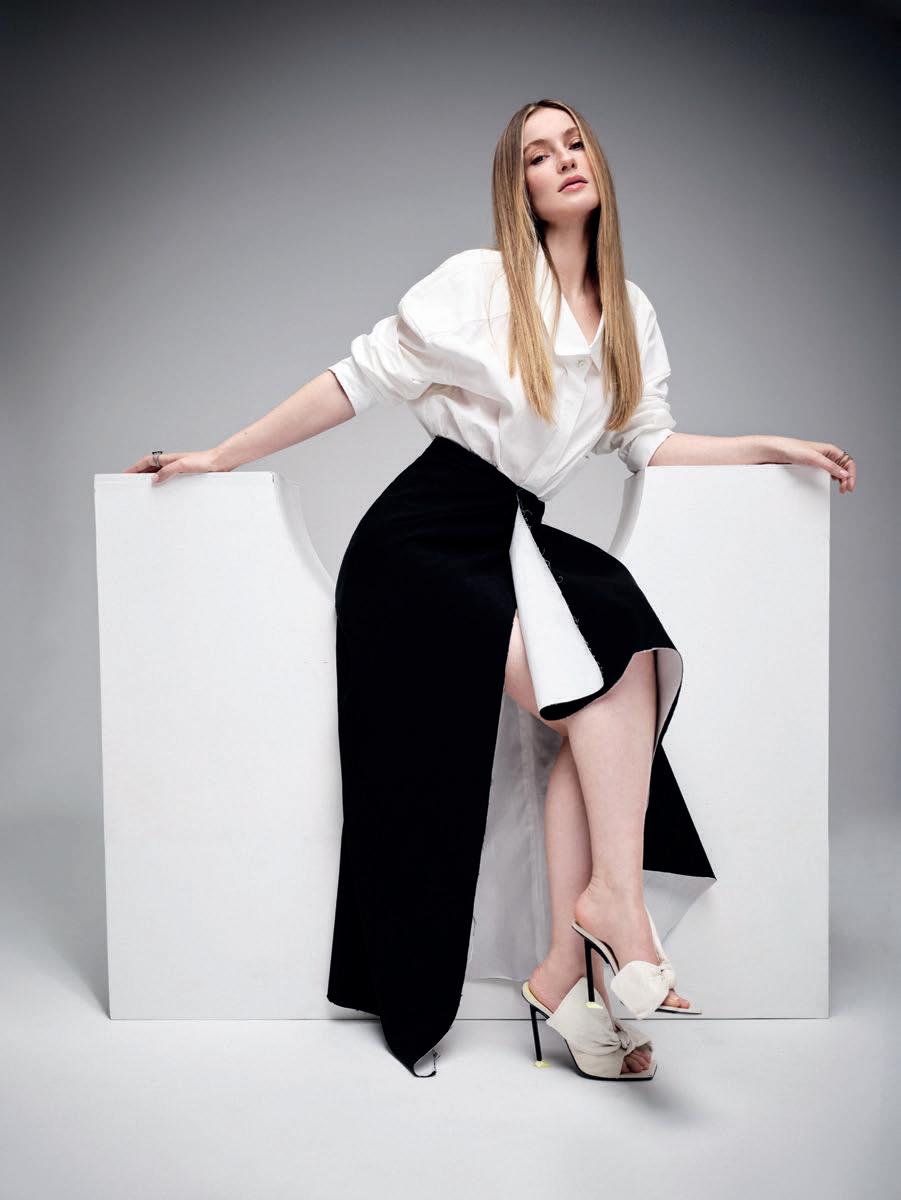
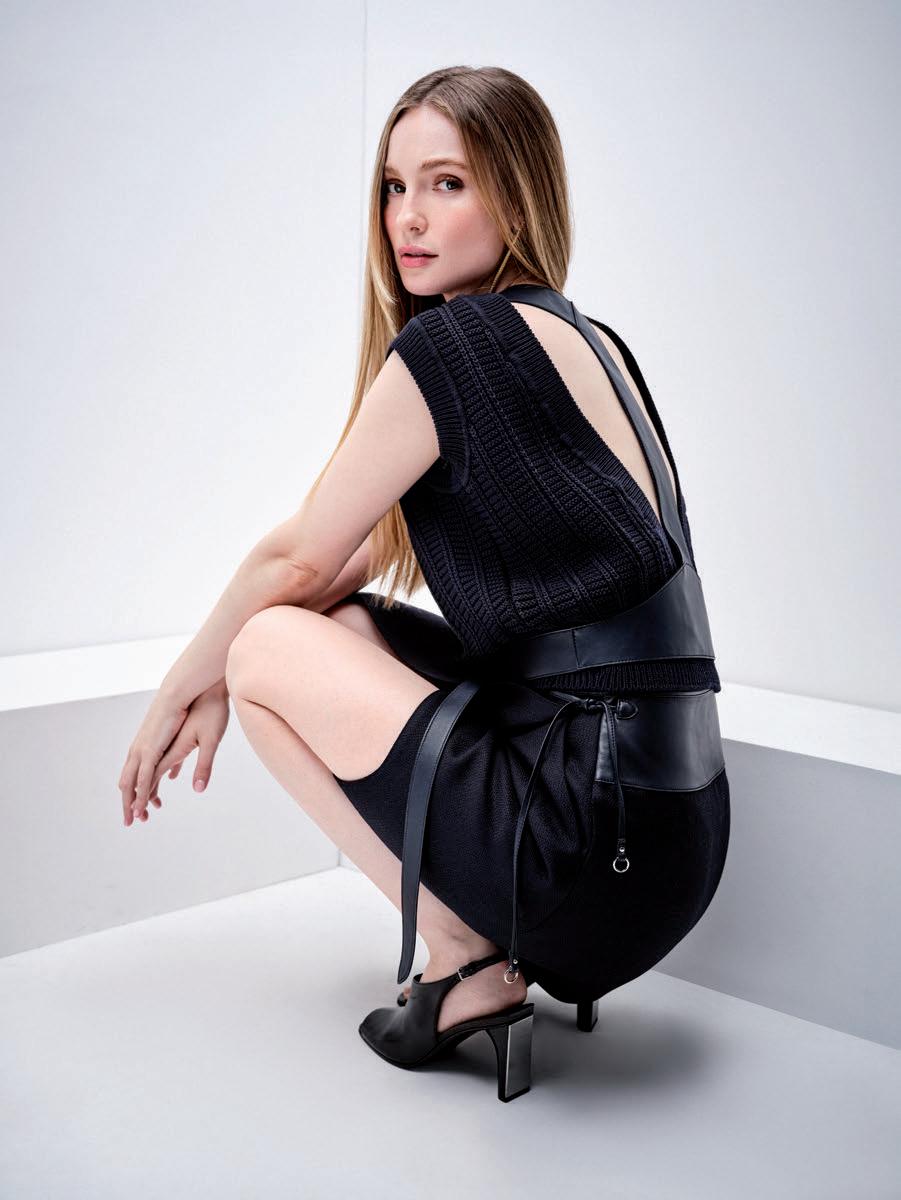
Seeking ‘something’ is what Hannah Dodd’s character Francesca Bridgerton in Season 4 of the Net ix hit show is famous for. Currently, a ‘pinnacle’ (orgasm) eludes her, but that doesn’t mean the love isn’t real, says Dodd in her cover interview with Lucinda Baring, on page 82. Will she nally get there? Of that we have no doubt (although, tantalisingly, you’ll have to wait ’til Season 5).
Bringing things more up to date, we’re waiting with bated breath for the most hyped restaurant opening of the year. Jeremy King’s newest venture is transforming London institution Simpson’s in the Strand. But what really went on behind the scenes when he was ousted from his former business Corbin & King. He gets a few things o his chest with William Sitwell on page 92.

You might of course prefer supper among your own sort – in your private members’ club. Dylan Jones certainly isn’t averse to having a few sleek cards in his wallet, but which one to go to, he muses on page 96. And they’re not just in London – Long Lane, the rst alcoholfree members’ club is opening this spring in West Sussex, and already has a waiting list. Times they are a-changin’.
Elsewhere, we’re head down in design with our 50-page interiors special, bringing you our hot picks from the Paris design shows (p122), plus new C&TH contributing editor Hatta Byng explains why comfort should overrule everything (p142).
I couldn’t agree more.




The proli c interiors journalist is also co-author of interior designer Nicola Harding’s debut book, Homing Instinct, published by Rizzoli.
Person you’d most like to have a cocktail with? Michelle Obama. She seems to have had a real energy shi since leaving the White House. Restaurant you’d book for your last supper? Chishuru in Fitzrovia, a Michelin-starred West African restaurant with a modern twist on many of the dishes I grew up with. How do you nd balance? I pray every morning and prioritise my family.

One of Britain’s leading food writers, Sitwell is restaurant critic, author and co-owner of The White Hart in Wiveliscombe, West Somerset.
Person you’d most like to have a cocktail with? Rachel Reeves – to see if there’s any light between the eyes and ask her why she’s screwing hospitality. Restaurant you’d book for your last supper? The Su olk in Aldeburgh. Oysters, veal, lobster, gallons of white Burgundy and I’ll let the waves take me. How do you nd balance? I don’t. I just work, write, eat, drink and stress. It’s perfect.

Part of the Shakti Himalaya team since 2010, the guide and photographer brings 17 years of dedication and experience to his role.
What do you like most about spring?
A er the dry season of [an Indian] winter, there’s suddenly a bloom of colours, bringing a fresh sense of life and vibrancy that renews my spirit. What view would you like to wake up to every day? A mountain view. The city just doesn’t give me the peace I crave. How do you nd balance? Photography is my anchor. It lets me share the beauty of the world.
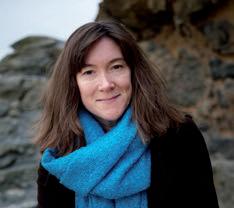
The Telegraph’s consultant luxury travel editor also writes for a few of her favourite publications, including this one.
Person you’d most like to have a cocktail with? Francesca Albanese. She gives me hope for humanity. Restaurant you’d book for your last supper? Manzi’s in Soho. A dozen oysters would set me up for the other side. What view would you like to wake up to every day? The main harbour in Symi.

The creative consultant and former editor of House & Garden is a highly respected voice in the design world.
Person you’d most like to have a cocktail with? Chloe Dalton. Raising Hare has stayed with me more than any other book I’ve read for a long time. How do you nd balance? Not easily. Slowing my breath is a good reset. What view would you like to wake up to every day? Down a lush green valley.

Lucy Cleland Editorial Director
Deputy Editor Lucinda Baring
Editor-At-Large Alice B-B
Associate Editor Charlotte Metcalf
Junior Sub Editor & Production Assistant Evie Calver
Fashion Director Nicole Smallwood
Beauty Director Nathalie Eleni
Interiors Director Carole Annett
Culture Editor Ed Vaizey
Wellness Editor Camilla Hewitt
Executive Retail Editor Juliet Herd
Men’s Style Editor Shane C. Kurup
Food & Drink Editor / Features Writer Tessa Dunthorne
Sustainability Editor Lisa Grainger
Property Editor Anna Tyzack
Motoring Editor Jeremy Taylor
Digital Director Rebecca Cox
Digital Editor Ellie Smith
Digital Culture Editor Olivia Emily
Digital Style Editor Charlie Colville
Digital Assistant Isabel Dempsey
Social Media Manager Mckenzie Mullany
Creative & Production Director Parm Bhamra
Design & Production Manager Mia Biagioni
The Editor editorial@countryandtownhouse.co.uk Advertising advertising@countryandtownhouse.co.uk
Country & Town House is a bi-monthly magazine distributed to AB homes in Barnes, Battersea, Bayswater, Belgravia, Brook Green, Chelsea, Chiswick, Clapham, Coombe, Fulham, Hampstead, Holland Park, Kensington, Knightsbridge, Marylebone, Mayfair, Notting Hill, Pimlico, South Kensington, Wandsworth and Wimbledon, as well as being available from leading country and London estate agents. It is also on sale at selected WHSmith, Waitrose, Marks & Spencer and Sainsbury’s stores and independent newsagents nationwide. It has an estimated readership of 150,000. It is available on subscription in the UK for £39 per annum. To subscribe online, iPad, iPhone and Android all for only £9.99/month, visit: exacteditions.com/read/countrytownhouse. For subscription enquiries, please call 020 7384 9011 or email subscribe@countryandtownhouse.co.uk. It is published by Country & Town House Ltd, Studio 2, Chelsea Gate Studios, 115 Harwood Road, London SW6 4QL (tel: 020 7384 9011). Registered number 576850 England and Wales. Printed in the UK by William Gibbons and Sons Ltd, West Midlands. Paper supplied by Gerald Judd. Distribution by Letterbox. Copyright © 2026 Country & Town House Ltd. All rights reserved. Reproduction in whole or in part without written permission is strictly prohibited. Materials are accepted on the understanding that no liability is incurred for safe custody. The publisher cannot be responsible for unsolicited material. All prices are correct at the time of going to press but are subject to change. While every care is taken to ensure information is correct at time of going to press, it is subject to change, and C&TH Ltd. takes no responsibility for omissions or errors.
Publisher Ellie Rix
Head of Fashion Emma Marsh
Head of Beauty Bandi Manzini
Head of Interiors Emma Redmayne
Senior Account Director, Homes & Interiors Olivia McHugh
Account Director Serena Knight
Account Manager Cosima Woodard
Digital Business Development Director Joey Goldsmith
Project Management & Sales Support Executive Charlotte Ryan
Managing Director, C&TH Events Louise Close
Events Director, C&TH Events Josie Williamson
Marketing Manager, C&TH Events Dominic Christie
Technical Director Mark Pearson
Chief Financial O cer Gareth Morris
Finance Controller Lauren Delgado
Finance Administrator Ria Harrison
Acting Finance Administrator Klodi Sade
Human Resources Consultant Zoe Jones
Chief Commercial O cer Tia Graham
Chief Operating O cer James Thrower
Managing Director Jeremy Isaac
Contributing Editors
Belinda Bamber, Hatta Byng, Ti anie Darke, Simon de Burton, Fiona Duncan, Olivia Falcon, Daisy Finer, Avril Groom, Lauren Ho, Annabel Jones, Dylan Jones, Francisca Kellett, Juliet Kinsman, Emma Love, Mary Lussiana
Accounts accounts@countryandtownhouse.co.uk
Subscriptions subscribe@countryandtownhouse.co.uk

What to do with Country & Town House when you’ve nished reading it
Ideally, we’d love you to pass it on to a friend or a community place which might enjoy it (doctor or dentist surgery, community centre), but you can also rest assured that your issue (including cover) can be disposed of in your paper waste recycling bin.




idyllic mountain
Eriro. Write that name down. Because this nine-bedroom refuge in the Tyrolean Alps is a life-changer, a portal into a magical world, a place where everything is simple but nothing is ordinary.
I arrived in early June. The last leg of the journey is in a gondola and then it’s a short walk to the wood-clad hotel, beneath Germany’s highest mountain, the Zugspitze. I was instantly bewitched – frisky cows high from their diet of sweet meadow grass, Ha inger horses and their foals gambolling free, steppingstone paths leading who knows where.
Inside, Eriro is like a so blanket for the nervous system. The owners, Amelie and Dominik Posch, have brought all the best bits of nature inside for an instant grounding e ect. I found myself rubbing my cheek against the woollen walls and stroking the bathtub made from a hollowed-out tree trunk.
In the day, I hiked through pine forests spotting wildlife from tiny salamanders to skittish mountain goats; swam in icy lakes; foraged with head chef Axel; did a bit of woodcarving. I ate food that made me weep tears of joy (local, biodynamic, seasonal) and did something like yoga but cooler and more intuitive.
In the a ernoons I lay on my balcony, listened to jazz on the record player and gazed at the view. What I didn’t do was watch TV (there isn’t one) or stare inanely at my phone. There is wi , but most people opt out. Some even hand over their phone when they arrive.
I had a massage I would travel back to Austria for, in probably the most enchanting wellness space I’ve set

foot in. I lounged on infrared reclining chairs in a straw-lined meditation room, sweated in the huge sauna, then rocked in a wool hammock.
And my favourite bit: three onsen pools that lead you on a meditative journey, beginning in a dark room – the inner journey – where canopies hold you suspended while a gong above reverberates through the warm water. The next pool is built into the stone, with a tiny sliver of a window tantalising what lies beyond. The nal pool is where the outer world is fully revealed – a 180° view of the mountains, as if theatre curtains have been pulled to reveal nature in all its beauty.
My days at Eriro are imprinted on my nervous system. When I feel wound up by London life, I close my eyes and I’m back there. I go through the portal into a world of tinkling cow bells, mountain air and log res, and the feeling of bliss comes ooding back. suites.eriro.at ■
THIS MONTH I’LL BE...
PREPARING my arms for the summer reveal with The SCULPT arm compound from UBeauty (theubeauty.co.uk).
↓ SLIPPING into spring with Cecilie Bahnsen (ceciliebahnsen.com).

↓ BRIMMING with energy thanks to my daily AG1 supplement (drinkag1.com).

THE SHOPS, DINING & EXPERIENCES












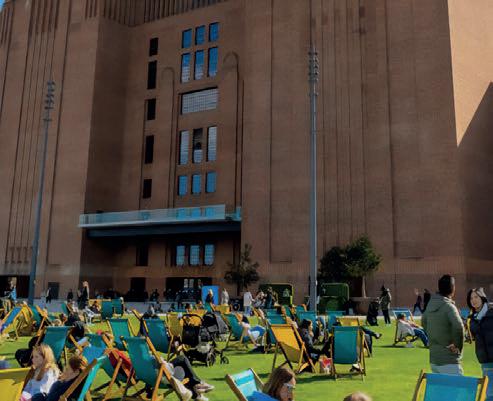


OVER 150 FLAGSHIP STORES


THE CHIMNEY LIFT EXPERIENCE


DESTINATION DINING















Join Chelsea’s Luxury Automotive Garden Party 16–18 APRIL 2026 | ROYAL HOSPITAL CHELSEA LONDON ROYAL HOSPITAL CHELSEA 16–18 APRIL 2026

Experience Salon Privé London 16–18 April 2026, as the historic Royal Hospital Chelsea is transformed into the capital’s most elegant automotive and luxury spectacle.
Emma Barnett on hair, homelessness and the joy of a great playlist
What’s bringing you joy at the moment? My children, my husband, and better health than I’ve had for a long time.
What’s annoying you most right now? Lack of sleep. It’s an occupational hazard.
Advice you’d give to your 15-yearold self? Be a human being, not a human ‘doing’.
What keeps you awake at night? Pain. I su er from endometriosis and adenomyosis, which can cause the kind of bone-grinding pain that keeps you up.
I now have my hair blowdried once a week and then I use dry shampoo the rest of the week. Barnett by name, Barnett by nature

Best life hack? Learn how to have good hair. I now have my hair blowdried once a week and then I use dry shampoo the rest of the week. Barnett by name, Barnett by nature. I want all women to learn how to spend as little time on their hair as possible but still feel as good as they can.
A conversation that changed everything? I was introduced to my husband when I was 20 by a friend. I was about to have the budget cut for my theatre, and my friend said: ‘He knows what he’s doing, he’s good looking, and he’s single’. I asked him out on the spot.
What’s the best way to put a smile on your face? Give me a big kiss and a hug (provided I know you). I’m a very tactile person.
Can you tell us something no one else knows? I really like watching snooker.


Where do you go to escape? Anywhere with a good cup of tea, or into music. I make lots of playlists – I am queen of the digital mixtape.
What would your epitaph say? ‘She came, she danced, she loved. And drank lots of tea.’
What book inspires you most? Viktor E. Frankl’s Man’s Search for Meaning. He’s a Holocaust survivor who realised the only thing that can’t be taken from you is your ability to choose how you respond in a certain moment. From di cult times in my own life through to interviewing a lot of people, I’ve learnt when people have survived something very di cult, they o en come to the same conclusion.
Your greatest failure? Impatience. I also give myself a very hard time.
Your greatest triumph? Having two children a er seven rounds of IVF. It took perseverance and luck.
What is your greatest treasure? My engagement ring. The diamond was worn by my great grandmother, my grandmother, my mother, and now by me.
What do you keep by your bed? Lip balm, magnesium butter for my feet, and the three or four books I have on the go.
If you could change one thing? To make homelessness a thing of the past.
What has been your most embarrassing moment? Early on in my journalism career, I was coming o stage having won an award, and my husband’s colleague – who was senior to him – came over to give me a hug. Somehow I managed to put my whole hand into her mouth. I just totally missed her neck and her mouth was open really wide and I felt my hand go in. I still relive it. Every time I tell that story, I die. I was so morti ed I couldn’t move for an hour.
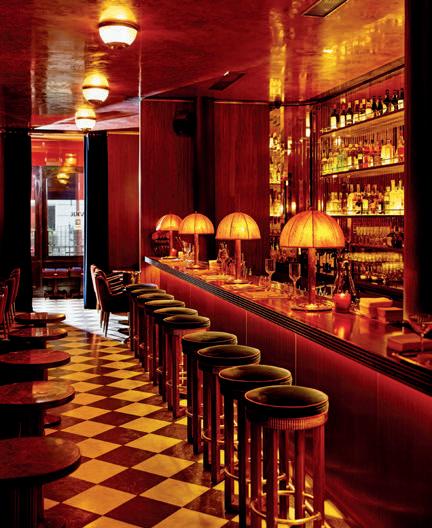
What drink do you order repeatedly? A dry vodka martini with an olive. You only need one, maybe two. They’re efficient and cut through sometimes very difficult pain and get me into a better space when I’m out socially, even if my body pays for it later. My husband makes a great one, and so does The Dover.

Best way to spend a weekend in Britain? Gorgeous restaurant on Friday night. A great breakfast on Saturday and then a big, big walk so you’ve earned your lunch. A snooze, curled up with the papers, and then rally for a nice evening with more food and talking. And a sauna somewhere; I love heat.
What do you love best about Britain? Our culture, our sense of humour, our irreverence. The fact we don’t take ourselves too seriously.
What should we bring back to Britain? Free cups of tea everywhere. Was that ever a thing? And if not free, then tea that costs 30p, versus what we pay today.
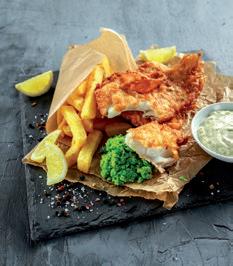
What is your comfort dish? Chippy shop chips. With salt and vinegar.

Emma Barnett’s new podcast, Ready to Talk with Emma Barnett , is available on BBC Sounds and major podcast platforms. Her Colour Your Streets colouring books, launched with her husband Jeremy Weil, are available at colouryourstreets.co.uk
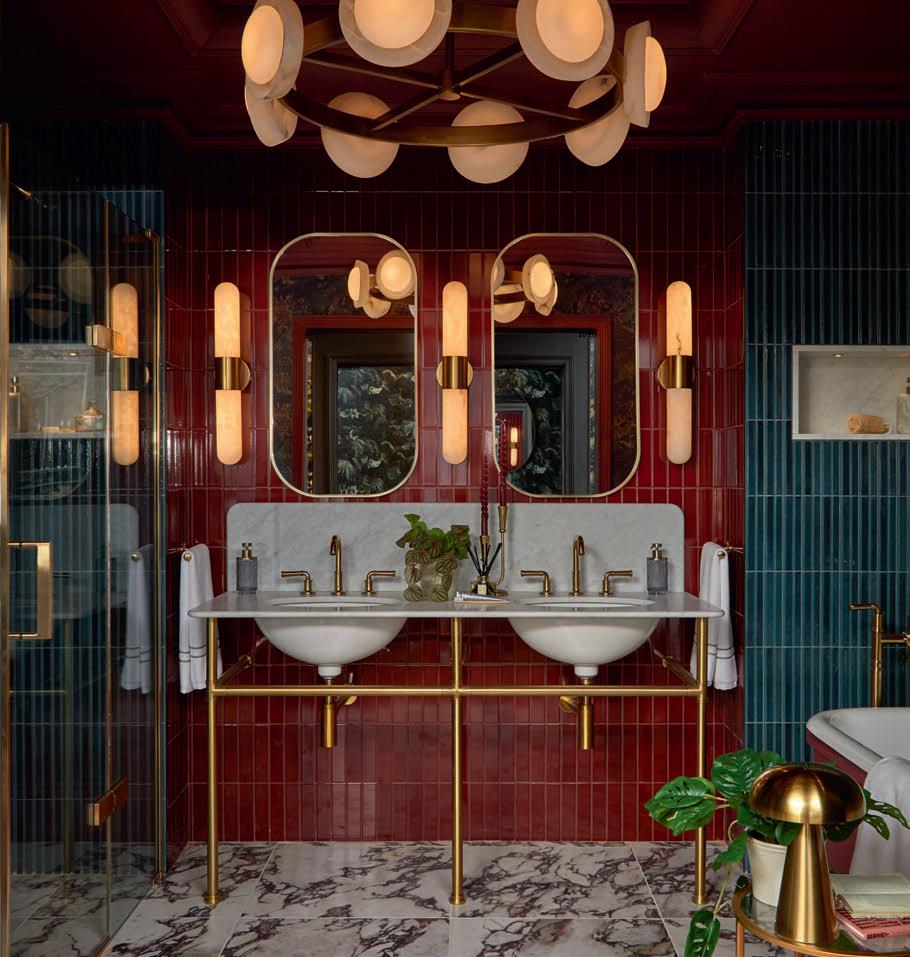

BATHROOMS | TILES | WELLNESS | DESIGN & INSTALLATION
Create a bathroom that’s anything but ordinary. It begins with booking an appointment.
SPEAK WITH OUR EXPERTS










Your gym gear may look natty, but is it full of nasties?
Tiffanie Darke knows where to find the alternatives
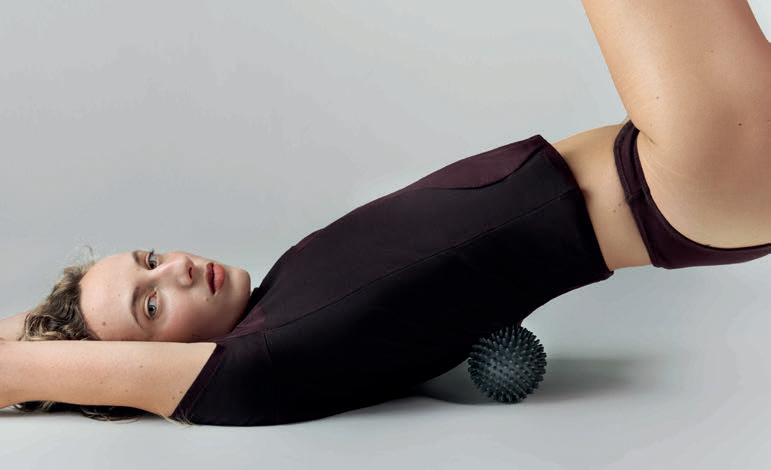
Yoga bunnies, ski enthusiasts and surf lovers may want to look away now. That endorphin rush you get from a good workout, the slight smugness from paying attention to your health? Turns out your clothes may be doing you more harm than good – particularly when it comes to sportswear. Our understanding of the skin microbiome has increased dramatically in the last ve years. A porous membrane, the skin has a microbiome much like the gut. Many textiles incorporate heavy metals, antimicrobials, chlorine bleach and formaldehyde in the production process, which can disrupt this natural ecosystem. Sportswear is o en tight, we sweat in it, and the abrasive nature of workouts means clothing rubs against the skin. Most sportswear is synthetic, which tends to harbour more pathogenic bacteria than natural material, and is nished with even more chemicals, designed to wick moisture and odour, repel water and prevent staining. The good news? Once you have worked out in wool or cotton, it’s hard to go back. Icebreaker o ers a wide range of merino options, and Community Clothing’s sportswear line is made entirely of cotton. Mover’s plastic-free outdoor gear comes at a price, but it’s hard to argue with
its innovative weaving technology. With biomaterials o ering an alternative to petroleum-derived polymers, Pangaia’s 365 seamless activewear range features pieces made of renewable raw materials like castor beans (and nished with a natural, peppermint antiodour treatment). Cellulose bres such as viscose and bamboo are better environmental options, but check the chemistry of the nishing – I recommend BAM (bamboo). But we can go further. SKIN SERIES – founded by Rosie Broadhead, former head of sustainability at Perfect Moment – thinks clothing could actually be positive to human health. Operating on the understanding that the skin microbiome can be ‘supplemented’ with probiotics, the London-based brand has developed textiles from soya and seaweed in which native bacteria become activated when in contact with skin. These probiotic treatments replace antimicrobial ingredients to prevent odour, and the brand claim they ‘encourage cell renewal and improve the skin’s immune system’. In some garments, stretch is achieved not with elastane but with clever panelling – resulting in a collection of tank tops, leggings and bodysuits that could help you exit the gym feeling just that little bit more smug. ■

From floral prints to fragrances, nature is this season’s muse, says Juliet Herd
Kicking o celebrations for its 100th anniversary is iconic sleepwear label Derek Rose’s new resort collection, featuring luxurious lightweight fabrics, vibrant colours and playful prints. We’re smitten with these rose-speckled cotton Batiste PJs, £245. derek-rose.com
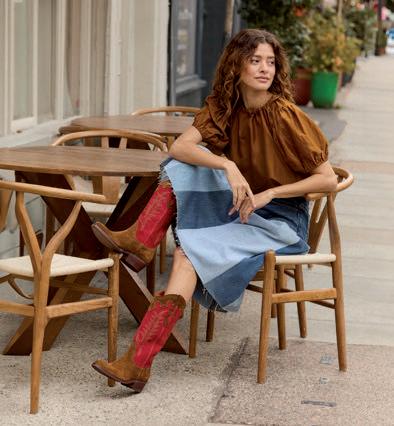
↑ ENGLISH AESTHETIC
Fans can now dress head to toe in Penelope Chilvers as the brand launches its rst clothing collection with a focus on ‘buy less, buy better’ essential pieces. One-o recycled denim skirt, from £189; gold silk bow blouse, £225; Jolene cowboy boots, £359. penelopechilvers.com



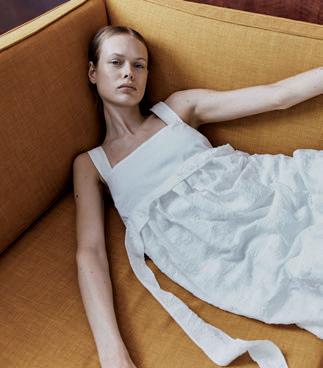
Synonymous with California cool, US brand Vince presents scallopededged shirts, pintucked dresses and pocketed cardigans that combine lyricism with geometric precision. Fil coupe mixed media dress, £450. vince.com
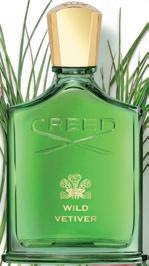
Take a walk on the wild side with this decadent fragrance evoking the ‘untamed elegance’ of an English garden. Key notes include zesty timur berries, rose and woody vetiver. Wild Vetiver, 100ml, £310. creedfragrances.co.uk


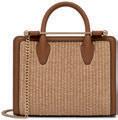
Each piece in this considered capsule carries a texture or tone evoking nature’s subtle stirrings. Rose trench, £795; large Flora bag, £395. bamford.com
Finisterre celebrates underwater orals from seaweed to algae in organic cotton and extra ne Merino wool. Floral Marine Yarrel jacket, £145, and shorts, £80. nisterre.com
Think pink for spring
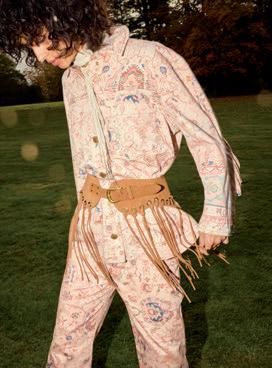
hayleymenzies.com
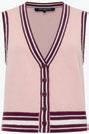
£59. frenchconnection.com



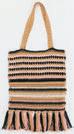
→
This playful and uid piece featuring milkygreen chrysoprase, cabochons and red spinels represents the free- owing movement of jelly sh. Such is the vivid imagination behind Cartier’s designs. Part of the third chapter of the En Équilibre collection, the transformable tassel necklace represents a masterclass in precision and symmetry.
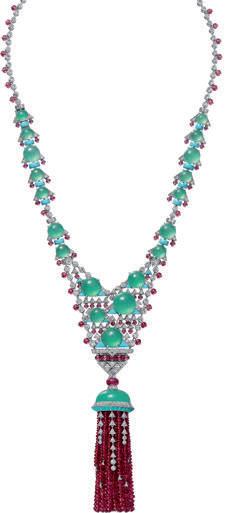
Juliet Herd previews the new high jewellery collections at Couture Week in Paris
SPLENDOUR →
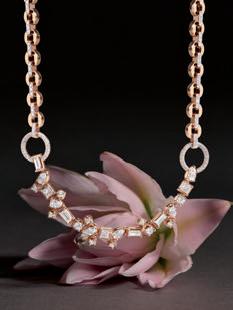
Drawing inspiration from Teatro alla Scala, Pomellato presents this reimagining of a 1970s chain in rose gold illuminated by a continuous thread of 266 brilliant-cut diamonds.


‘I pay homage to Frédéric Boucheron by sketching his portrait through four major pieces,’ says creative director Claire Choisne. Realising founder Boucheron’s fascination with ivy is the dramatic Untamed question mark necklace, a trailing branch of diamond leaves and rock crystal fruits that can be worn in multiple ways.
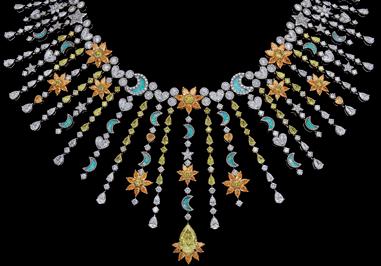
Radiant suns in yellow diamonds, sparkling stars in white diamonds and turquoise quarter moons carved from black opal doublets sit in the mini cosmos that is this dazzling bib necklace. Part of the new Belle Dior collection, it pays homage to Christian Dior’s fascination with all things celestial.
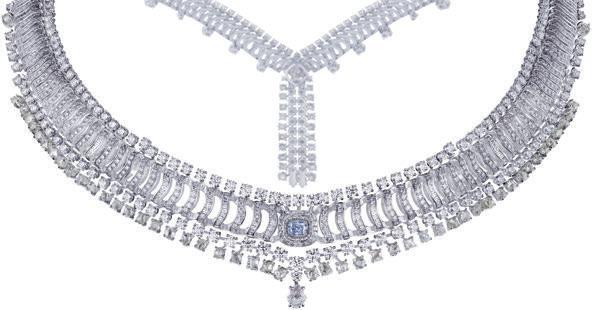
Inspired by Namibia’s Fish River canyon, the Echo necklace transforms into six unique jewels in a feat of technical wizardry. Showcasing a rare 1.12 carat fancy intense blue diamond and more than 193 carats of white diamonds, it drapes across the neck like a river traversing a canyon.
Water and wings inspired these blue-hued pieces
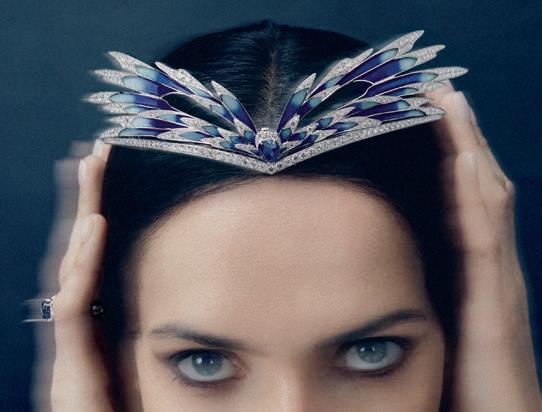
Visitors to the Place Vendôme archives were invited to marvel at the inspiration behind Chaumet’s new capsule: a tiara in the form of a pair of exible wings embellished with thousands of diamonds and translucent enamel, once owned by Vanderbilt heiress Gertrude Payne Whitney. This multi-tasking aigrette tiara can be dressed up or down – either with its grand feu enamel and brilliant-cut pavé diamond wings (as shown above) or just with its central 3.92 carat Madagascan sapphire.
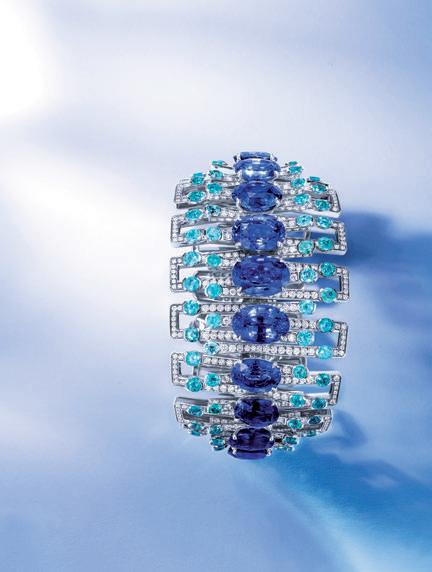
In a nod to the moving parts of an abacus, this bangle blazes with a mix of unheated Ceylon and Madagascan sapphires and electric-blue Brazilian Paraíba tourmalines.
Evoking the moment a single droplet hits the water, clusters of pear-shaped diamonds and sapphires create a ripple e ect across the choker’s diamond base. Deceptively supple, it took 400 hours to make.


Once defined by coinmaking, The Royal Mint is creating a new kind of treasure transforming e-waste into jewellery, finds Avril Groom
We all know The Royal Mint is where our coins are created, and that for nearly half of its millennium-plus history, it was situated close to the Tower of London. In 1968, it moved to a 32-acre, purpose-built site in Llantrisant – a historic south Wales hill town overlooking the Vale of Glamorgan – to make the millions of coins needed for 1971’s decimalisation. Less known, perhaps, is its highly original and symbolic jewellery range, designed by one of British jewellery’s best thinkers, Dominic Jones, and created with innovative methods that put sustainability front and centre. The Royal Mint is understandably cagey about gures, but its chief growth o cer Sean Millard admits that ‘currency coinage is now the smaller part of our output’.
886, named for The Royal Mint’s founding year (it is Britain’s most longestablished maker), began quietly in 2022 in the a ermath of the pandemic with faultless, though conventional, pieces. It grew quickly in pro le and design con dence and now has a suitably historic store in Burlington Arcade, further stockists at home and abroad, and thriving online sales.
With long experience in precious metal processing, Millard says the Mint was well-placed to explore sustainable options. ‘We were already looking at new processes for extracting these metals from the vast amounts of e-waste globally that are burnt or go to land ll, creating devastating pollution.’
The company was already working with a partner to extract silver from used X-ray plates; next, it partnered with a Canadian start-up that invented a chemical process to remove metals from e-waste at room temperature, reducing electricity usage. Last year The Royal Mint Reformation Metals plant opened at Llantrisant, which removes individual precious and rare earth elements from e-waste and reduces the remaining plastic to a powder that can be used in anything from buildings to packaging. ‘We are upscaling to process 8,000 tonnes of e-waste this year, and we aim to take the plant model global,’ says Millard. ‘This will hopefully create consumer demand and mass change.’
The Mint had tried selling jewellery before, unsuccessfully. ‘We knew we needed a more luxury range but didn’t
know how to achieve it,’ says Millard. ‘We were introduced to Dominic [Jones] for some advice. With declining currency work, we had a skilled workforce happy to train in more delicate jewellery-making.’
Jones researches deep in the milleniumlong, on-site archives. ‘Isaac Newton was master of the Mint in the late 17th century and turned it into a modern operation,’ he says. ‘In some way, his obsession with alchemy is now a reality. 886 is forward-looking, with sustainability at its heart.’
Every range Jones designs has its own symbols – some obviously linked to the Mint, some more personal (and secret until you know). The rst was inspired by the beautiful hallmarking and smooth shape of bullion bars; the next, the Tutamen range, by the 17th-century redesign of coins. ‘I was drawn to the old £1 coin with its engraved Latin rim inscription “Decus et Tutamen”, which means “an ornament and safeguard”. It ts with my idea of Royal Mint jewellery being decorative but also holding value, a safeguard of investment.’ The range features this motto as well as the coins’ milled edge, and in some pieces, ne coils illustrate the illegal act of coin clipping – shaving the edges of coins to collect the metal – which necessitated their redesign.
Jones says there is no plan to his inspiration. ‘It happens organically, just what captures my attention at one moment – though the resulting pieces must be future heirlooms, durable enough to pass down the generations. O en there are hidden details, like poem cu s engraved with the words of Walter de la Mare or Thomas Hood.’ One of the latest includes both a secret and a highly scienti c process. ‘It uses caustics, where a subtle pattern on a surface can be manipulated into creating a much clearer re ection when the object is in sunlight. For the wearer, it’s a secret they can reveal by harnessing a ray of light.’
The Mint developed caustics as a potential hidden security detail for precious, limitededition coins. With jewellery, it’s a delightful personal surprise. The rst piece – a heart pendant created in 2023 – carries an indistinct struck design that, when the wearer moves,

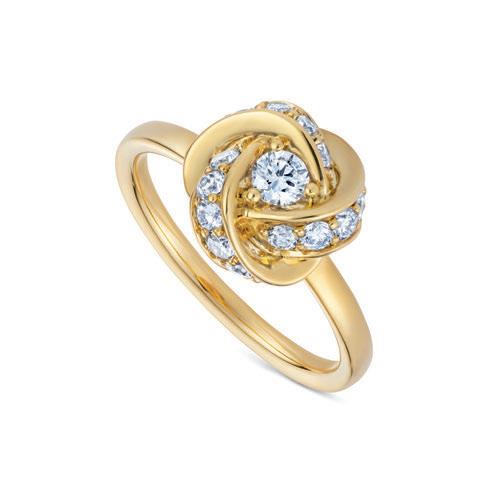

re ects in focus on any well-lit surface. The newest range of this bestselling design features each astrological symbol, in silver or gold.
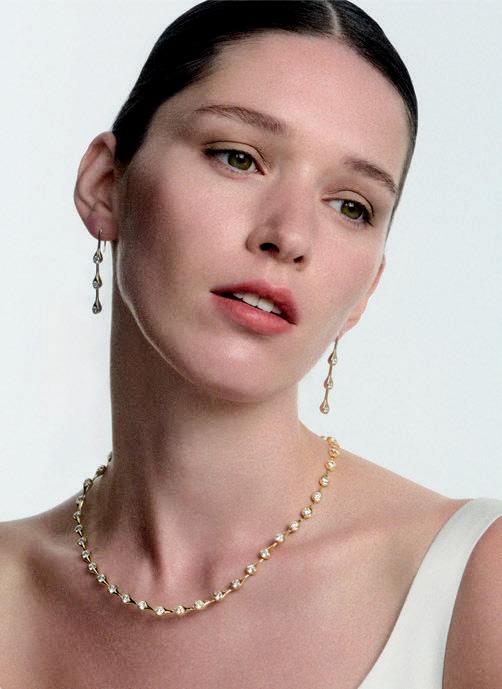
For a collection founded on sentiment, bridal jewellery is an obvious success. Teardrop is beautiful and poignant, inspired by tears of joy shed at a wedding, with lab-created diamonds linked into tennis bracelets, set on hoop earrings, or suspended from a long chain necklace. The range is designed to complement engagement rings and each piece comes with a silver sixpence, recalling the old tradition of putting a sixpence in a bride’s shoe to symbolise future prosperity.
Jones says the Mint’s history has provided him with a wealth of inspiration – and it’s not done yet. New sustainability projects and a landmark collection are in the works for later this year but are under wraps, like many aspects of this necessarily security-conscious business. But li ing the lid on another new-minted range should be more cause for celebration at a precious institution. ■






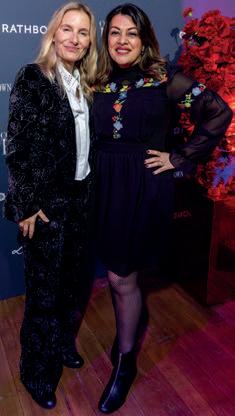


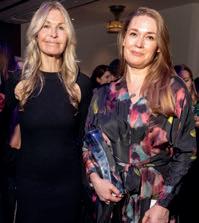
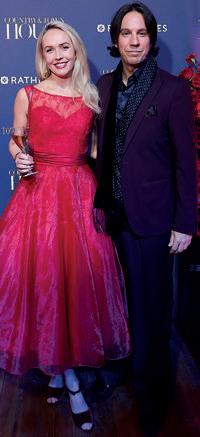
British brands were out in force for the GBB Awards

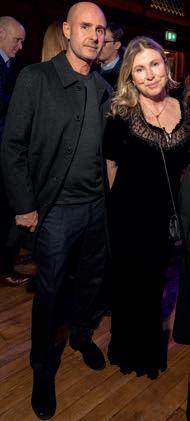
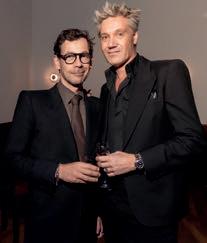
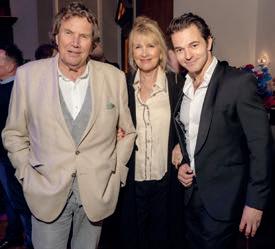
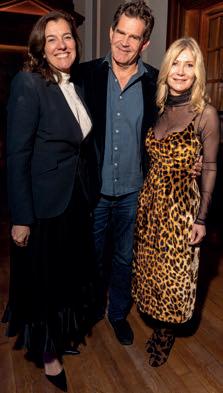
The who’s who of British luxury gathered on 12 February at London’s coolest new venue, Town Hall by Bottaccio, to honour the Great British Brands 2026 award winners. Surrounded by exclusive artworks by British contemporary multidisciplinary artist Lauren Baker, with thanks to MTArt Agency, more than 300 guests came together to celebrate the cra smanship, creativity and enduring strength of British enterprise. Hosted by editor-at-large Dylan Jones, guests were welcomed on behalf of headline sponsor Rathbones, with this year’s cover –created with Burberry against the iconic South coast chalky cli s – capturing the spirit of modern British luxury. Winners took home silver trophies by Thomas Lyte and owers by Blooming Haus. With DJ Becky Tong, L éoube sparkling wine and Eight Lands cocktails, there was every reason to toast British success. ■









Edited by SHANE C. KURUP



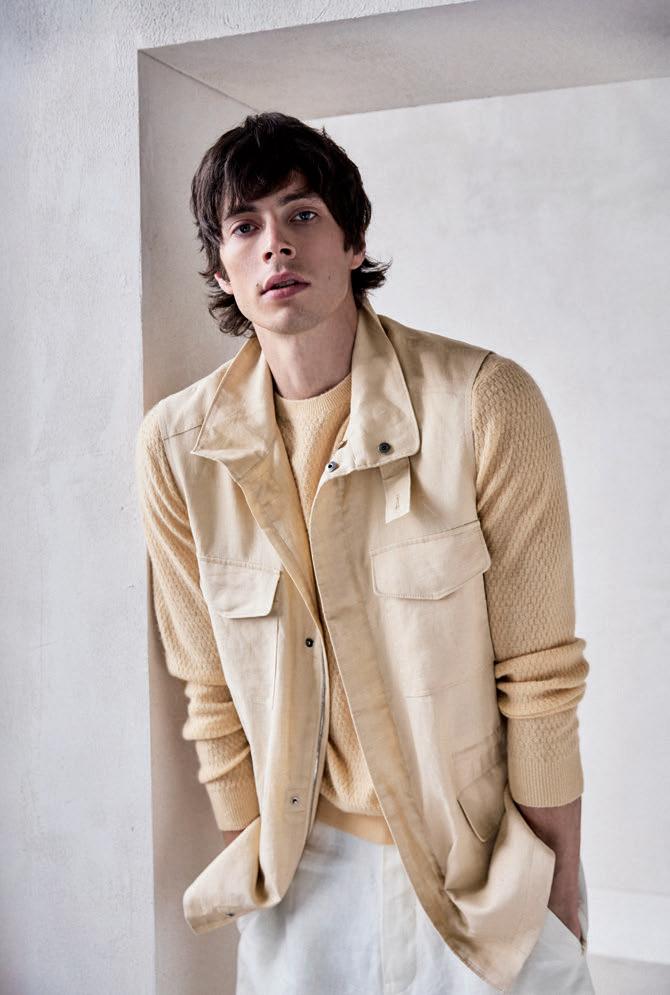
SPRINGTIME STROLL




| City of London | St
Cambridge, Opening April 2026
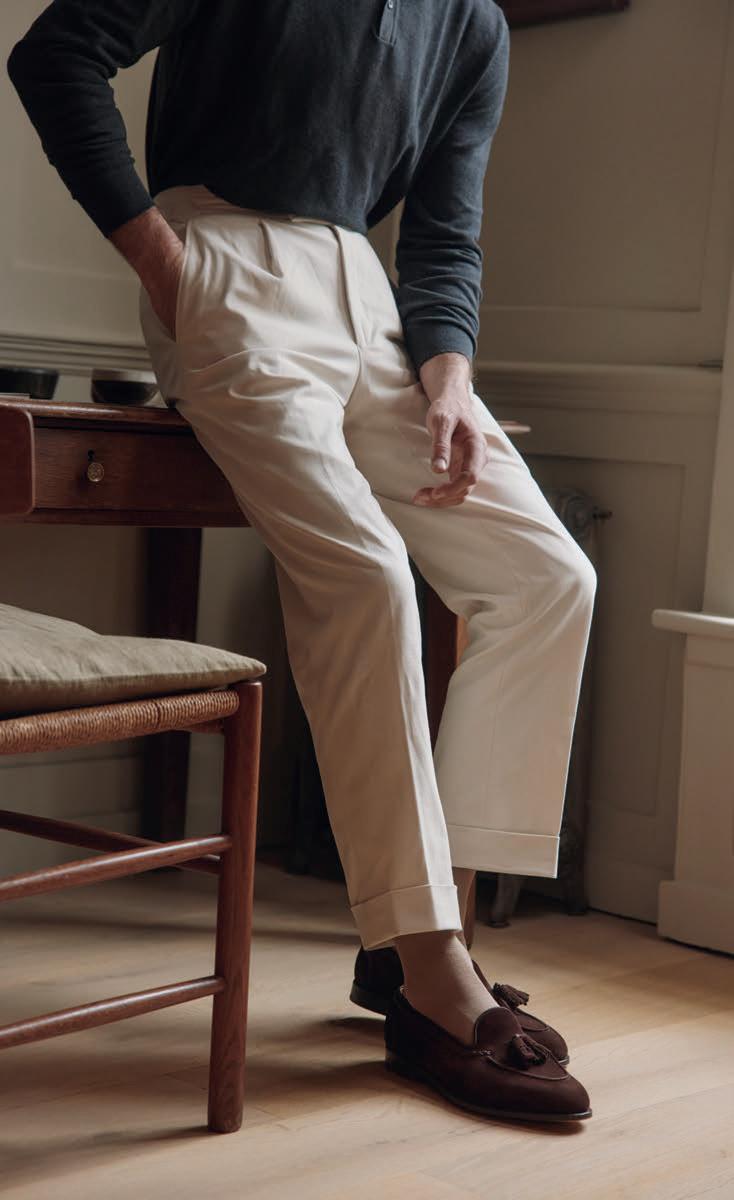
↑ EASY DOES IT

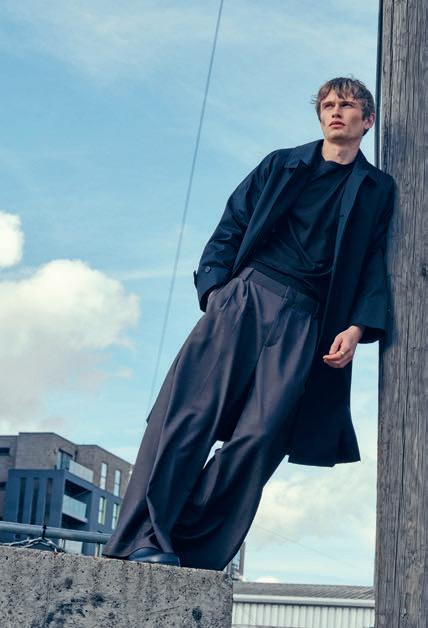
With all the capacious, uid tailoring that’s been seen on both runways and store rails, it’s the perfect time to revisit the late Giorgio Armani’s legacy. The SS26 collection showcases the fabled designer’s easy silhouettes that came to de ne 80s louche, with low-fastening double-breasted jackets, voluminous tear-drop pleat trousers and perforated leather bombers that feel ever more relevant for the way we dress now. armani.com

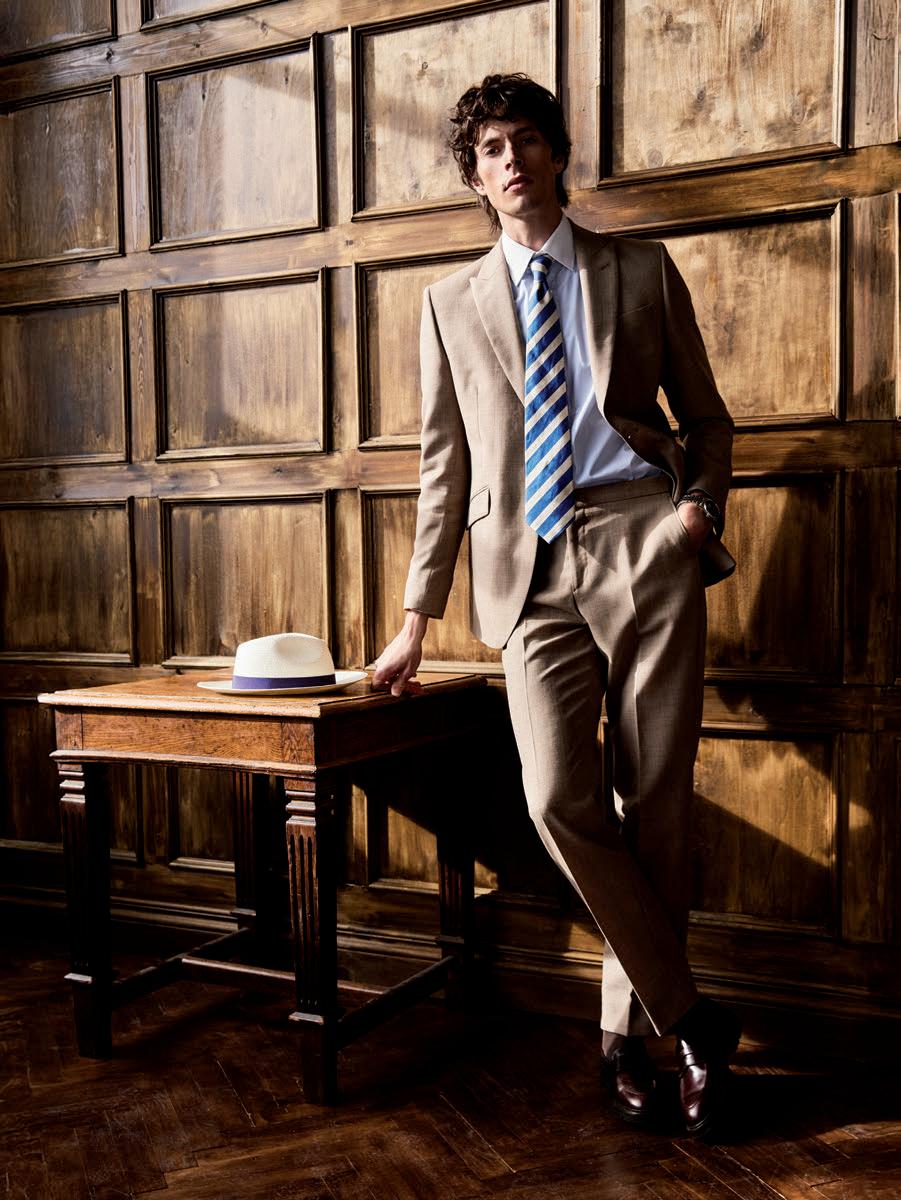
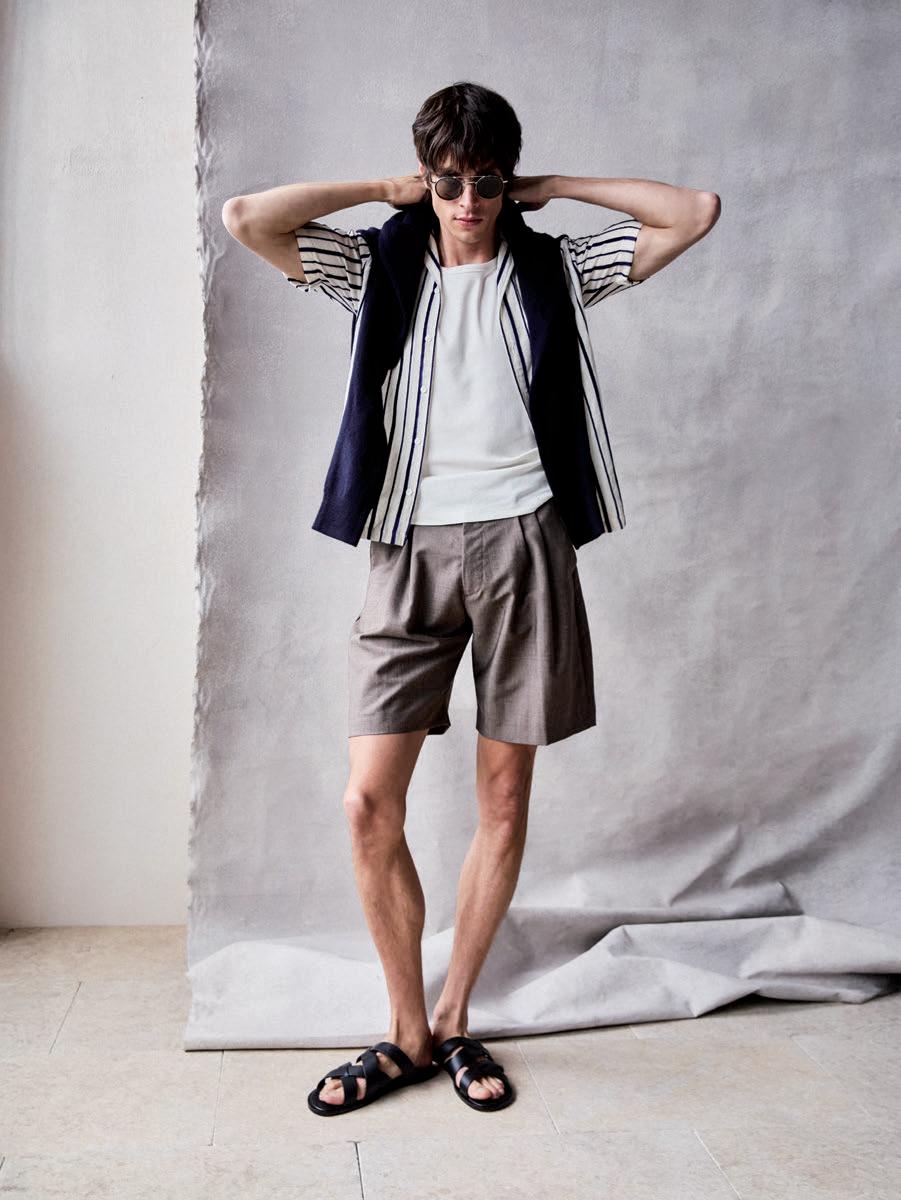
This spring’s menswear hits all the right notes, says Shane C. Kurup
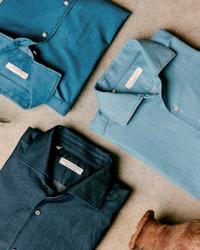
↑ SOFT TOUCH
In our 24/7 culture, we expect our clothes to work as hard as we do. Luca Faloni knows this all too well, which is why one of its core collections is loomed in Italy from a plush, 70/30 mix of cashmere-silk, o ering a cloud-so feel and superb thermoregulation to see you through any seasonal shi . lucafaloni.com
Let these products do the heavy lifting as you sleep




Japan has long been known for innovative design, but accessing its cutting-edge fashion can be as mysterious as a Shinto ritual, with many brands not exporting beyond the motherland.
London-based Future
Present aims to bring our wardrobes closer to the shores of Nippon, with its considered curation of Japanese and East Asian labels, including Ssstein, Ujoh and JieDa. futurepresent.london

King & Tuck eld co-founder Stacey Wood has built her label on enduring mid-century shapes and her grandfather’s sense of style. For SS26, she has designed a four-piece capsule of denim, tees and knitted polos in partnership with Steve McQueen’s granddaughter, Molly McQueen, as a fresh interpretation of what the silver screen icon might wear today. kingandtuck eld.com
Oliver Dannefalk and Carl Pers, founders of Stockholm-based Rubato, seek perfection down to the last stitch. From texturerich sweaters loomed from rare ed camel wool to Italian milled sports jackets and Japanese selvedge denim, their enduring pieces reinterpret the functional elegance of mid-century menswear. atemporubato.com








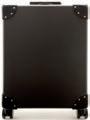

In 1955, Jaguar introduced the most celebrated and competitive derivative of the D-Type, with the striking “Longnose”. In 2025 The Glenturret celebrate the 70 anniversary of this classic car with a limited edition release of only 270 bottles worldwide. th
The whisky is a minimum age of 35 years old and drawn from 6 casks. 3 Pedro Ximenez sherry-seasoned European oak hogsheads impart RICH FRUIT and WARM SPICES while 2 olorososeasoned American oak casks bring VANILLA and CINNAMON, finally an American oak refill hogshead delivers delicate LIGHT OAK notes.
RICH DRIED FRUITS, TOFFEE APPLES dusted with CINNAMON. Warm notes of GINGER and NUTMEG interwoven with GREEN APPLE. A warm but subtle finish –hints of RESINOUS WOOD, FRUITS and a slight oily texture.

Natural Colour and Non-Chill Filtered.
The mac, trench and cagoule have been turned into objects of desire,
ince time immemorial, mankind has sought to outwit the elements. The ancient Chinese made raincoats from straw, making the wearer look like a walking thatched house, while in the 1750s Jonas Hanway faced ack from hansom cab drivers for being the rst man to wield an umbrella on the streets of London, fearing their trade would be decimated on damp days by these newfangled ‘portable roofs’. Fast forward a few centuries and the trench coat, mac and cagoule have become staples for anyone living in a locale where forecasts are a game of meteorological roulette –and brands are responding with technical and design details that blend fashion and function.
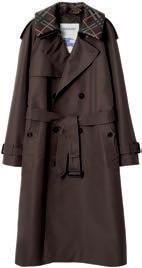
This season, Burberry, the self-styled king of the trench – now under the guise of design virtuoso Daniel Lee – has recast the standard issue garment in a louche silk-cotton blend shell, with a detachable collar made from intricately handstitched leather in the house’s signature check.
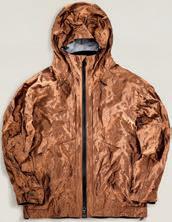
Mackintosh – another stalwart of the genre –combines its British sensibility with Japanese acumen and has recently teamed up with cult outerwear label C.P. Company for an urban spin on the mac. The coats incorporate C.P.’s trademark goggles into the hood –just the thing when it really starts hammering down (or if you’re just a statement-maker). For sci- levels of weatherproo ng, Vollebak’s Full Metal jacket is a totally impervious yet breathable futurist shield made from 11km of copper, which makes its surface uninhabitable to viruses and bacteria.

If your mantra is ‘less is more’, Antwerp-based KASSL Editions combines clean-cut simplicity with intelligent engineering that speaks for itself. Taped seams and coated treatments ensure the brand’s designs can withstand the deluge – but their contemporary elegance means they’re ideal for wearing even when there are no clouds in sight. ‘Rainwear should be e ortless and integrated enough to replace a blazer or an overcoat,’ explains KASSL Editions co-founder Ilse Cornelissens. ‘It should feel like a natural extension of personal style.’ Norwegian Rain, which hails from Bergen – o cially the rainiest city in Europe – cra s rainwear that combines Japanese and Ghanaian design elements and is chock-full of practical features. Its padded Raincho, for example – which looks like it deserves a display
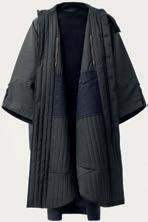
case in MoMA – is lled with Norwegian wool and incorporates a magnet-fastening collar, cashmere lining and a windstopper in the hood to cocoon the wearer from the elements.
But how do you know whether a designled raincoat is about substance and not just style? ‘Check whether the fabric is breathable – otherwise you’re going to sweat and be wet on the inside,’ explains T-Michael, co-founder and head of design at Norwegian Rain. He favours recycled Japanese technical fabrics that are highly water resistant, but breathable. ‘Also check the seams are heat sealed for water tightness. Feel them with your nger. If they’re slightly more pronounced or sti , they’re good.’
Rainwear should protect you from the elements without ever looking technical or overdesigned, adds Cornelissens of KASSL Editions. ‘We start with a design that feels architectural and timeless and then quietly integrate performance. Finishing is key – clean bonding, durable stitching – and a sense of restraint throughout. The best raincoats don’t shout about functionality; they simply perform.’
With pickings this rich, you’ll be willing dark clouds to appear on the horizon. ■

Ivy League style is back in a more rebellious class, says Shane C. Kurup
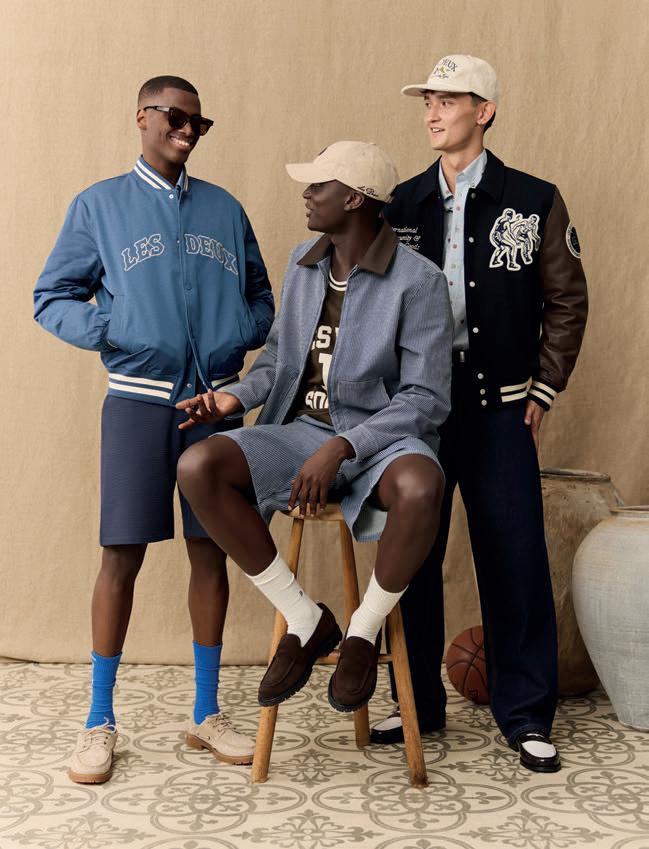
Varsity – the look born on Ivy League campuses on the US East Coast – has simmered as a popular school of menswear since it rose to prominence in the Fi ies. Now it has come full circle with a major resurgence in a new class – one that respects established collegiate codes but blends them with a kind of dissidence more likely to land you in hot water at the Dean’s o ce.
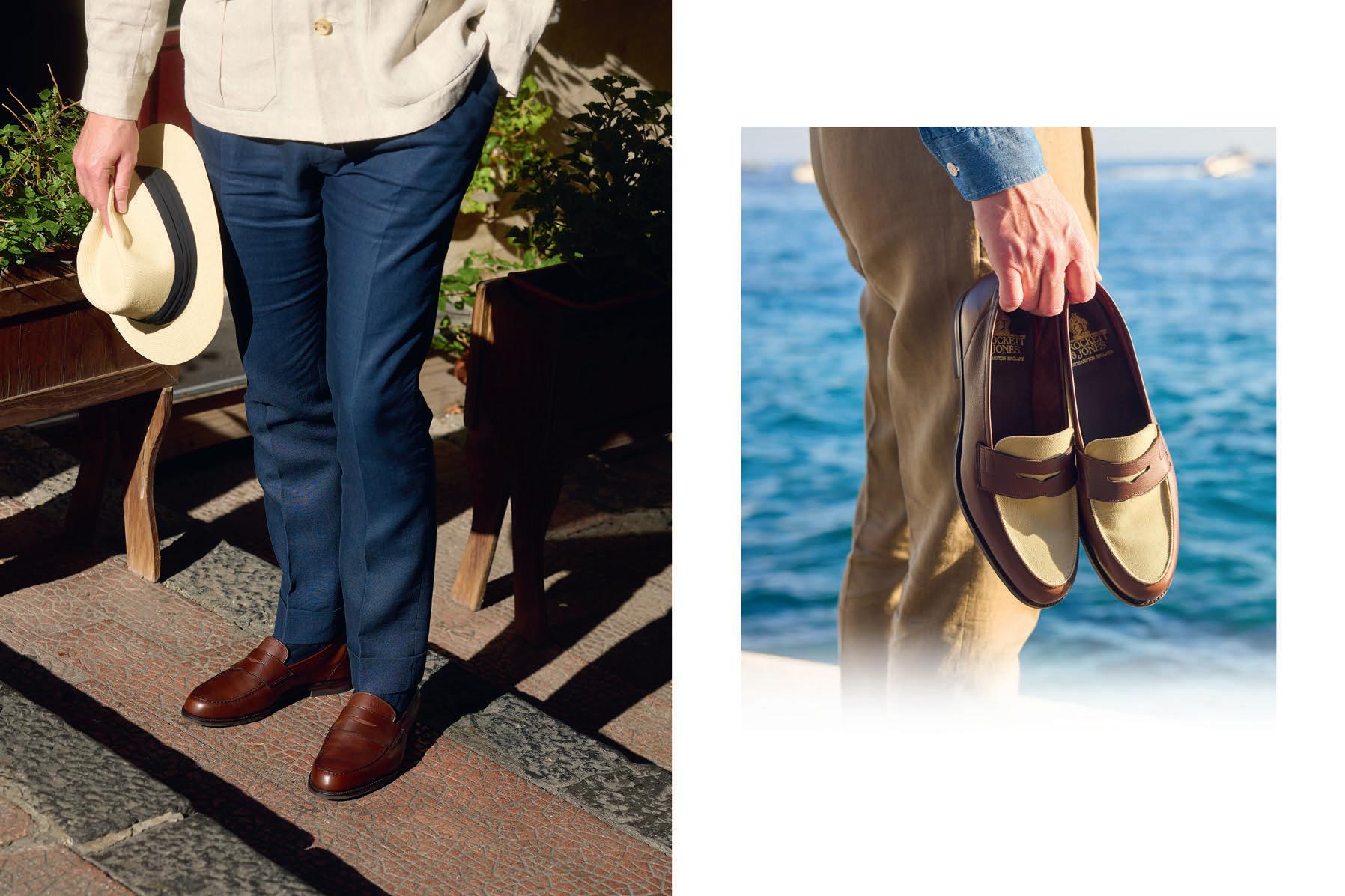
The style of dress, de ned by public school staples like rugby shirts, boating blazers, penny loafers and patched jackets, was once the preserve of the educated – and served as a identi er for those that belonged to this elite club. Now designers are turning this symbolism on its head. ‘The way it is being reinterpreted now feels more relaxed and personal,’ says Daniel Kearns, chief creative o cer of Kent & Curwen, a British heritage brand with collegiate codes woven into its design DNA. ‘There’s a growing appetite for clothes that carry heritage and meaning, but don’t feel rigid or overly polished.’
Too-cool-for-school US labels, Aimé Leon Dore and Kith, which blend classic varsity with streetwear and outdoorsy Gorpcore, are prime examples of brands skewing its conventional image, giving the one-time uniform of privilege a grittier, sexier appeal.
Andreas von der Heide, co-founder of Les Deux, which combines Ivy design with sportswear (and speci cally basketball kit) also concedes that varsity’s multifaceted nature has ensured its continued presence in the menswear canon – and its evolution. ‘It’s gone from freshman to everyman, from being a xed identity to a code that’s more open,’ observes von der Heide. ‘Part of what makes that possible is that varsity draws on contrasts. It’s preppy, but also sporty. It can be technical in nylon; richer when it’s done in leather and wool; classic in heritage weaves like herringbone; and even a little workwear-leaning in corduroy. This versatility suits the way guys dress now.’
Kent & Curwen is also reworking Ivy League for a new generation of sartoriallyuent men. ‘For SS26, we looked at the Royal Parks as a meeting point where sport, leisure, elegance and everyday life intersect. That idea naturally lent itself to blending classic varsity references with so er tailoring, technical sportswear and more expressive elements,’ says Kearns. ‘It’s not about dressing for a single identity, but allowing yourself to express multiple parts of you.’
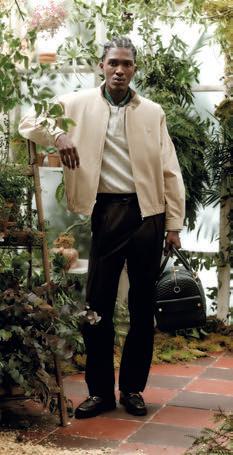

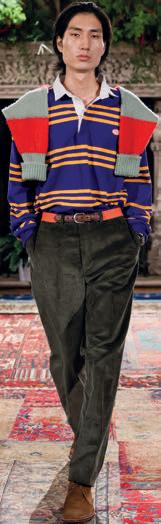

Even Paris powerhouses Dior and Louis Vuitton have taken lessons from the Ivy exercise book. Vuitton’s pre-fall SS26 collection blends penny loafers and navy blazers with luxe leather accessories and stripy polo knits, while Jonathan Anderson’s rst collection for Dior features tweed blazers, striped Oxford shirts and regimental ties paired with hi-tops and baggy skater denim. With this blending of genres, the way we wear varsity gear has shi ed on its axis too. Instead of looking like an extra in Dead Poet’s Society, it’s about mixing opposing elements. ‘It’s less about head-to-toe styling and more about integrating one or two varsity pieces into an everyday wardrobe,’ says Kearns. ‘Pair something recognisably varsity with pieces that feel unexpected, such as a classic rugby shirt with technical trousers and modern footwear. Above a certain age, of course, there’s the risk of looking like an overgrown freshman if you get it wrong. ‘If you’re north of 30, I’d avoid mixing a sporty varsity jacket with jersey joggers and trainers. Varsity works best when it’s grounded in maturity,’ says von der Heide. Conversely, for Jack Carlson –creative director of US heritage Ivy League brand J.Press, which was founded at Yale in 1902 – preserving the bona de blueprint of varsity, and keeping tradition alive in our age of generic mass-production, is part of its resurgence. ‘My goal is to get back to the most authentic version of Ivy style. Today, that kind of authenticity is the “fresh spin”. True Ivy style has been watered down over the years; production has largely moved away from traditional makers; styles have become more generic,’ explains Carlson.
‘We work with master cra smen and make in very old workshops in New York, Massachusetts, Pennsylvania, the UK, Canada and Norway. We are stewards of this aesthetic.’ Carlson advises avoiding skinny ts, wearing an item that adds a ash of colour, and sticking to the classics: ‘Most real Ivy League staples are among the most versatile pieces of clothing a man can own: a blue and white Oxford shirt, a navy blazer, a great pair of khakis.’
Despite this newfound expression in the genre, perhaps varsity’s prevailing in uence on menswear is emotional – in times of turmoil, we seek what is comforting. And maybe the carefree days of college life – and the notion the world is your oyster – is part of the draw.
‘A varsity jacket represents e ort and ambition. It has a story. And for me, that’s the di erence between the clothes you wear and the clothes you keep,’ says von der Heide. Perhaps its time we went back to class – just don’t forget to unbutton your uniform. ■







The Eighties are ticking back into fashion, says Shane C. Kurup
We o en take comfort in retrospection, viewing the past with a halcyon, rosetinted glow, which explains why trends have a habit of coming full circle. This sense of nostalgia is evident in watchmaking, with maisons constantly mining their archives to resurrect forgotten hits of yesteryear. It was only a matter of time before the era of gargantuan shoulder pads, neon shell suits and the yuppie returned to the spotlight.
‘There’s a real draw to the era’s bold expression and unapologetic con dence, fuelled by pop culture,’ says Jack Stephens, watch expert at pre-owned specialist Watch nder & Co. ‘The Eighties was a period where brands – spurred on by the quartz crisis and industry competition – continued to push boundaries. We saw the rise of bold, geometric designs and the popularity of two-tone watches.’ From Bulgari to Omega, here’s my top ten 1980s-vibe watches.
1
OMEGA
Although it first graced wrists in the 1950s, the OMEGA Constellation was revamped in the 1980s. A contemporary tribute to Eighties excess, this patented fade-resistant 18-karat gold alloy edition features a genuine meteorite dial treated with a Moonshine gold PVD coating. OMEGA Moonshine gold Constellation, £40,000. omegawatches.com
2
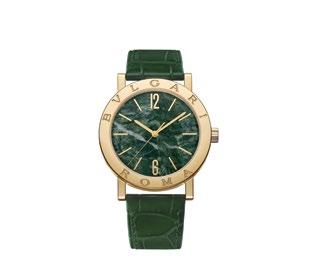
BULGARI
That 1980s sense of excess – driven by Wall Street Gekko types running riot on the trading floor – gave rise to the mania for labels and logos. The Bulgari Bulgari, with its letter-stamped bezel, defines that bravura. Bulgari Bulgari, £POA. bulgari.com
3 PIAGET
Tipping a brim to the 1980s taste for mixing precious metals, Piaget has just released a limited bitone gold version of its Polo 179. Piaget white gold and yellow gold Polo 179, £POA. piaget.com


6 SEIKO
The 1980s was when digital watches first came to the fore and it was Japanese behemoth Seiko that led the charge with its sought-after Rotocall, favoured by NASA astronauts. Its newest iterations in stainless steel with a red bezel stay true to the original, but come with better battery life. Seiko digital quartz, £480. seikoboutique.co.uk
4
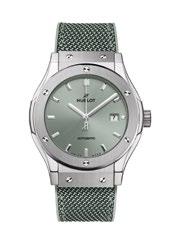
HUBLOT
Hublot was established in the 1980s and its Classic Fusion – with its clean lines and patented precious metal blends – embodies the era’s sense of bold confidence and offers a distinct point of difference.
Hublot Classic Fusion, £7,300. hublot.com

‘There’s a real draw to the era’s bold expression and unapologetic confidence, fuelled by pop culture’
5

7
RICHARD MILLE
Perhaps the most colourful, athletic collection of the genre, Richard Mille’s is a series of candycoloured ceramic models that pay tribute to the vivid 1980s Memphis Design movement. Richard Mille RM 07-01 Coloured Ceramics, £POA. richardmille.com
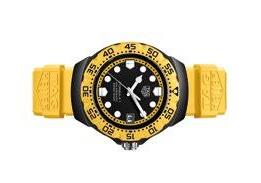
TAG HEUER
At the sportier end of the spectrum, TAG Heuer – long known for its ties to motoring – has pushed the ignition on its 1980s F1 collection and recently dropped its latest models in bold, pop-art hues. This time around, they have Solargraph technology, with their movements powered by light. TAG Heuer Formula 1 Solargraph, £1,650. tagheuer.com
Jack Stephens, Watchfinder & Co.



10
8 BREITLING
Also flying the dual-tone flag with its new 18-karat red gold and steel Chronomat, Breitling first developed this model in 1984 for the Italian Air Force. Breitling Chronomat, £7,600. breitling.com
9 RADO
Rado recently reworked its 1983 Anatom, which was immortalised on canvas by Andy Warhol. The newest iterations feature striking ombré dials in highlighter hues and bi-tone designs in plasma high-tech ceramic. Rado Anatom, £4,200. rado.com
While better known for its tanks – with the curved-case Santos Galbée being a cult 1980s classic – Cartier recently released a new skeletonised Pasha de Cartier, a model with a soft, circular case and numerals which, on its introduction in 1985, broke away from the signature quadrilateral cases of the maison. Pasha de Cartier, £POA. cartier.com

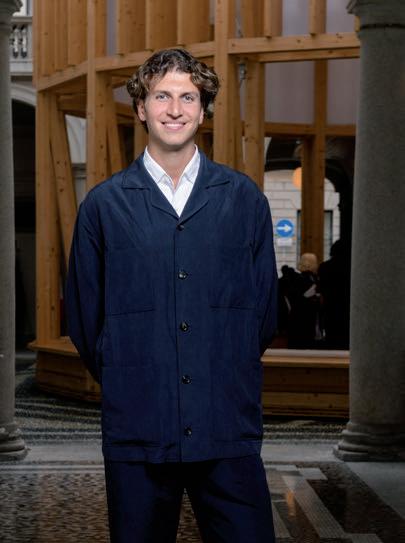



Grooming staples? Mostly Acqua di Parma for everything from fragrance to shaving. For skincare, I mix in Augustinus Bader, Le Roche-Posay and La Mer.
Night out? Typically a simple Loro Piana sweater, maybe with a jacket or blazer. Sometimes I’ll add some brown to switch things up.
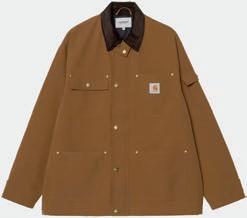
Under-the-radar labels? The Elder Statesman; Swiss ski and golf brand Kjus; Carhartt; Veilance by Arcteryx. Not under-the-radar, but I also like Uniqlo.
Style crush?
Sergio Loro Piana – for his ability to make the formal seem simple and e ortless, and the casual seem dressedup and elegant – and Gianni Agnelli.
Timeless or trend-led? Timeless, all the way.
Instagram and TikTok
satirist Gstaad Guy shares his wardrobe heroes

Daily uniform? Navy blue, head to toe. Typically Loro Piana. It’s elegant, calming, presentable.
Country style aesthetic?
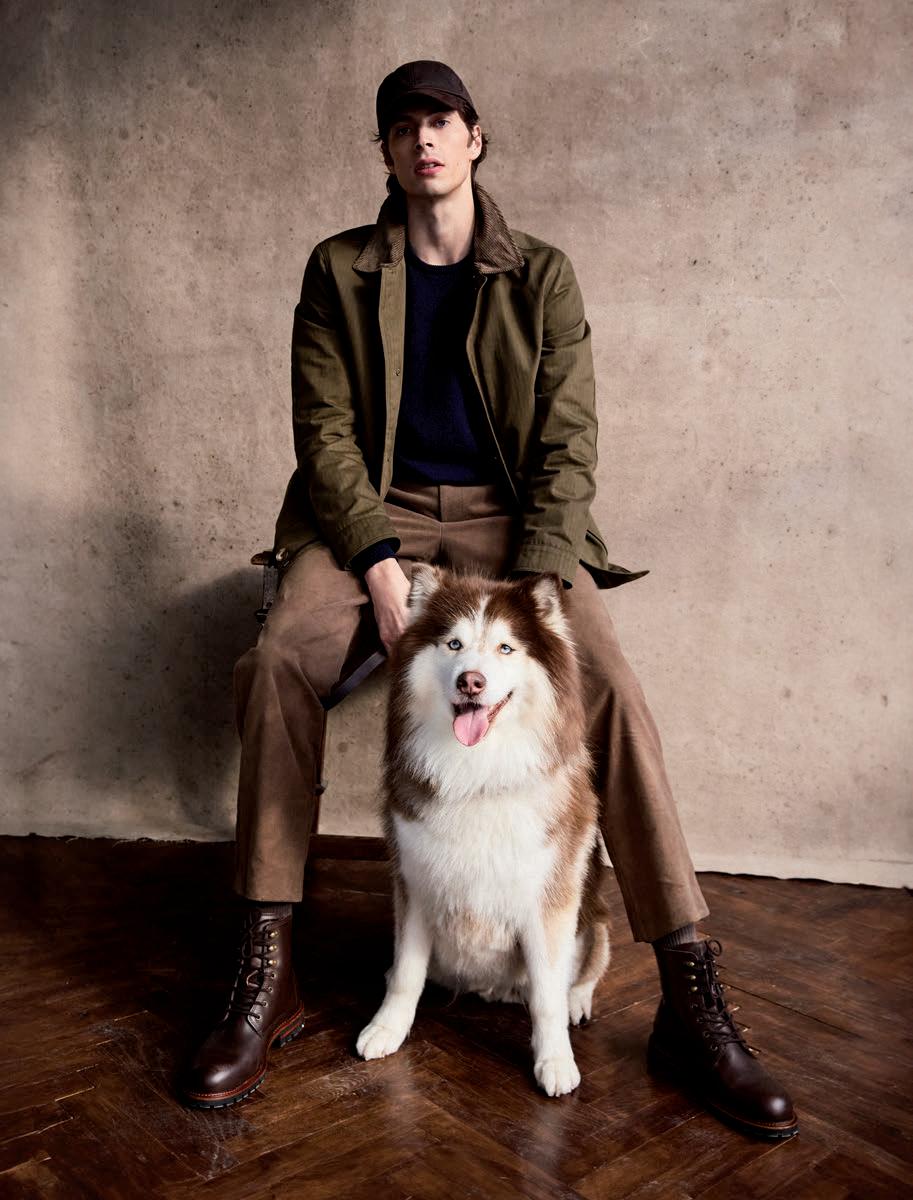
Shades of dark green and brown, boots that can handle the mud, and an umbrella that’s ready to be used and tucked away a few times in a day.

Favourite accessories? I think people over-accessorise these days, particularly before they’ve got the base right. It’s like putting lots of e ort into the icing, but the cake hasn’t even nished baking yet. I never take o my Poubel bracelets – they add a touch of colour and fun.

Style hacks? Don’t dress like a mannequin. I think true style comes from achieving 95 percent perfection – making sure the whole look works, matches and ts well – with ve percent controlled chaos. People who like that quiet luxury look will nearly always throw in a touch of craziness: bracelets they pick up while travelling, a tie-dye beanie from a brand like The Elder Statesman, or some crazy running shoes. Whereas those who simply follow a trend will look like they asked ChatGPT what someone should wear to a country club, with a quarter-zip on. ■
1. Swaine London beechwood handle collapsible umbrella, £360. swaine.london
2. La Mer The Treatment lotion, £115 for 100ml. cremedelamer.co.uk
3. La Roche-Posay Hyalu B5 eye serum, £33.50. laroche-posay.co.uk
4. Carhartt WIP Clapton canvas jacket, £225. carhartt-wip.com
5. Poubel cigar and bateau gold bangle, £380. poubel.com
6. Crockett & Jones Argyll wax calf boots, £625. crockettandjones.com
7. Loro Piana jacket, £4,215; turtleneck, £1,480; trousers, £880; beanie, £450; loafers, £945. loropiana.com
David Gandy is the first ever face of Jaeger Menswear
Marks & Spencer has appointed David Gandy as the rst o cial face of its Jaeger menswear, opening a new chapter for the retailer’s premium o er.
Few gures are more closely associated with the modern British man’s wardrobe than Gandy. As the world’s rst male supermodel, his two-decade career has spanned continents and been de ned by sharp tailoring – and enduring style. As the face of M&S’s Jaeger, he will don a collection built on exactly that: elevated wardrobe staples and timeless occasion-wear.
This follows the launch of @marksandspencerman, which has to date gathered a community of over 48,000 sartorially engaged men. It re ects a broader shi , too. Menswear has outpaced womenswear growth over the past decade – in the broader context of the UK market – as men seek to curate cohesive wardrobes that transition across work and life, and are, crucially, made to last. Jaeger serves this crowd, with forwardlooking designs that hint at British heritage, all cra ed out of premium fabrics.
In parallel, Gandy’s own label, David Gandy Wellwear, will launch as part of M&S’s men’s brand roster this spring. The collection combines comfort and quality with innovative fabric technology that centres wellbeing in the wardrobe – at no cost to style – and is available online from 18 March.

Discover M&S’s menswear embodied via Gandy and a community of well-dressed men at @marksandspencerman. To buy online, visit marksandspencer.com




Bayeux fever is sure to grip Britain this year, says Ed Vaizey, starting with Hockney’s homage
Twenty years ago, one of my rst visits as the Tory arts spokesma n was to the Serpentine Galleries, the small but perfectly formed arts venue in the middle of Hyde Park. I sat down with its then director, the legendary Julia Peyton-Jones, to talk about arts funding. Peyton-Jones pointed out that the Serpentine got very little support from the Arts Council. As a gallery bene ting from wealthy donors, she felt they were being punished for their success. A er the meeting, I sent her as T shirt I had made with the slogan ‘Punish My Success’. It felt suitably Tory boy-ish.
Hockney has created a 90-metre site specific digital panorama of the Normandy countryside. The homage is easy to spot – to the millenniumold Bayeux tapestry
The Serpentine has continued to thrive under the tenure of long-time artistic director Hans Ulrich Obrist, a man with owl-like spectacles, a thick German accent, and an almost shaman quality when it comes to the arts. He has pushed the Serpentine to move towards technology and the digital arts. In 2024 it held a major show of the Turkish artist Re k Anadol,
whose mesmeric works have also been projected onto a wall at Davos, a stadium in Vegas, and the Guggenheim in Bilbao. Now the Serpentine combines old and new, with its rst ever show of work by David Hockney, Britain’s most-loved living male artist. I have only met Hockney once, at a creative industries do during the London Olympics in 2012. The poor Queen was standing on a podium in front of us, where for an hour she received the great and the good of the arts world. We both marvelled at her stamina. Last year I had a chance to pay indirect homage, by staying with friends at the French homestead where Hockney painted his rst swimming pool painting.
Like the Serpentine, Hockney has pushed himself to become more digital, creating art on an iPad. In 2023, he pioneered an immersive show at London’s Lightroom. Now he has created a 90-metre site-speci c digital panorama of the Normandy countryside for the Serpentine. The homage is easy to spot – to the millennium-old Bayeux tapestry.
Hockney, of course, has spoken out against the tapestry coming to the British Museum in September, arguing that moving it will risk irreparable damage to this hugely fragile artwork, surely one of the masterpieces of the modern world. I disagree. It is a risk worth taking, if only to revive interest in this extraordinary piece – and perhaps to remind Brits of our European heritage.
In any event, Hockney’s homage is a masterpiece in itself. As the exhibition is free, I envisage queues round the block to see the work in the modest housing of the Serpentine Galleries. Good practice for the autumn at the British Museum. ■
David Hockney: A Year in Normandie and Some Other Thoughts about Painting, 12 March to 23 August (serpentinegalleries.org)

From his revamped factory in Hackney, Conrad Shawcross is working on his most ambitious works to date, says Olivia Cole
British sculptor Conrad Shawcross rst acquired his studio – a ruined factory – in the noughties, when Hackney was still an a ordable part of London. It had been stables (in the days when buses were pulled by horses), then a taxidermist, then a sheet metal bending factory kitting out kebab shops and chippies in the 1970s. He lived in a kind of ‘blissful squalor’ with artist friends.
The work Shawcross made here has now been exported around the world, from Hong Kong to Provence to Philadelphia, and is an established part of the British cultural landscape. When he became a Royal Academician in 2013, aged 36, he was the youngest member ever to be elected. His work is a regular feature of the Royal Academy Summer Exhibition and on Greenwich Peninsula, The Optic Cloak transforms the riverbank. Outside the Francis Crick Institute in King’s Cross, his 14m-high Paradigm sculpture has found another showstopping location.
In 2014, the nature of his old factory transformed again, becoming a purpose-built centre of operations for both his work and his wife’s, multidisciplinary artist Carolina Mazzolari. He dug down and built up, creating both a home and a vastly expanded studio. ‘It’s full of creativity,’ he says, but as far as the family are concerned, it’s just home. ‘One day they’ll realise it’s quite an unusual environment in which to live.’
The new space has enabled the scale of his sculptures to grow. Shawcross has always been drawn to the lonely endeavour of inventors and thinkers, but with
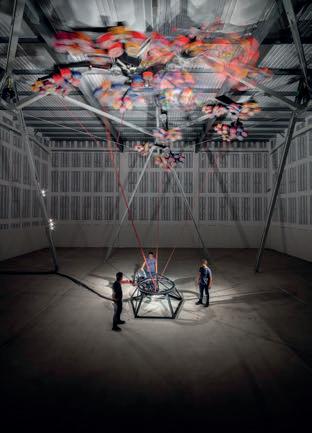
The Nervous System (Umbilical) is a spinning sculpture suspended from the ceiling, designed to suggest the sun’s passage through the solar system
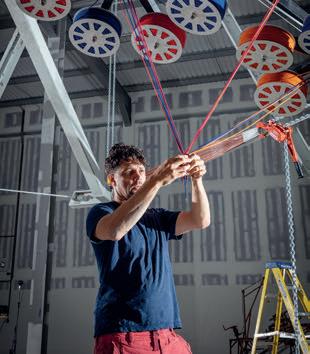
his most recent ‘rope machine’, he took the idea to a whole new level. The Nervous System (Umbilical) – commissioned by David Walsh, founder of The Museum of Old and New Art in Tasmania – is his most ambitious and complex work to date: the spinning sculpture suspends from the ceiling, with woven dyed wool ropes like umbilical cords and movements designed to suggest the sun’s passage through the solar system. The work was on display at Here East in London’s Olympic Park until November last year and now moves to Tasmania.
‘David and I hatched the idea of this machine that would never come back to the same point. I think he thought what I was proposing was impossible,’ Shawcross remembers. Twelve years on, the nished sculpture is spectacular to witness, both in terms of its ideas and meticulous, delicate execution. ‘It starts at zero and will never return to the same cosmology. So in that way, it’s analogous to our solar system, which is innately repetitive but never actually repeats.’
‘We’ve limped back to shore,’ he says, ‘but like every great odyssey, you think it’s over and it's not, because now I’ve got to build a space for it at MONA.’
Back in the studio, everything stops for lunch. ‘I used to make it myself every day, but now we take it in turns.’ And to really decompress, Shawcross explores the forests in Sussex on his mountain bike. Both are simple rituals and reminders of the humanity at the centre of this argonaut’s dazzling investigations into our fragile place in the universe.
conradshawcross.com ■






What’s the story of I’ll Take the Fire? Mia and Inès are third-generation sisters who leave Casablanca for Paris in this nal book of The Country of Others trilogy, which is about a family settling in Morocco against a background of historic change.
What’s the signi cance of the title? Mehdi tells his daughter, Mia: leave Morocco and take the re with you. Don’t look back, don’t dwell on your childhood or your country. Fire is the dream that drives us forward, the ame inside us that must not die.
How did your own family history inspire the story? I have no idea how my grandmother felt when she arrived in Morocco or what my father went through in prison. But ction is a strange process, a falsifying of reality that allows us to get closer to a kind of truth.
Did writing it illuminate your own immigrant experience? I wanted to detach myself and convey something universal through Mia: the heartbreak that all immigration brings, the feeling of loneliness, the e ort required to belong to a new country.
What’s the signi cance of Mia’s sexuality? When I arrived in Paris aged 18, having had my

sexuality oppressed in Morocco, I built my life thanks to queer culture. Mia is homosexual, contrary to what some horrible conservatives claim – that homosexuality doesn’t exist in Morocco and is a Western perversion.
What has changed for Moroccan women?
An enormous amount. In 1945, the vast majority were illiterate; now, girls are doing much better than boys in engineering, medicine, politics. But major challenges remain – the patriarchy still controls women at every level.
Why is violence a theme of your work?
A great contradiction of the human condition is our desire to belong and our desire to be free. We all seek to channel our rage. I confront my own violence by transforming it into language.
What disappoints you? Becoming an adult means being disappointed, and that’s what I’ve written about: the disappointment of sexuality in Adèle, the disappointment of motherhood in Lullaby, the disappointment of exile in The Country of Others. Our youthful fantasies and ideals are constantly swept away by reality.
What feels more e ective in challenging prejudice, your novels or your journalism? I’m convinced the tenderness and empathy we feel for a ctional character can transform us more profoundly than facts and gures.
How does being multilingual a ect you? English is increasingly important to me; I was moved and honoured to chair the 2023 International Booker Prize. I’m learning Portuguese because I live in Lisbon with my French husband and two children. Arabic unfortunately dri ed away when I moved to Paris – I have always felt great shame and sorrow about this.

How would you like to be remembered by your own grandchildren? By the meals I prepared! I enjoy cooking for the people I love and organising dinners where we share the joy of being together. ■
Read the full interview at countryandtownhouse.com/ culture/cth-book-club

For his Costa awardwinning novel A Place Called Winter (2016), Patrick Gale researched his own family history to tell the ctionalised story of his great-grandfather, a man who emigrated to Canada in the early 1900s to escape a gay scandal, leaving behind his wife and daughter. Gale’s new standalone novel revisits Harry Cane in the 1950s, now an elderly wheat farmer in Saskatchewan grieving the secret love of his life, Paul. Returning to England, he reconnects jaggedly with his long-lost daughter, Betty. As ever, Gale powerfully evokes the push-pull of family ties, the anguish of secrets and his belief in true love – whatever its name. BB
Published on 26 March (Tinder Press, £20)








Was it Mary Bennet with whom Jane Austen felt most aligned? A new BBC drama puts the bookish middle sister centre stage
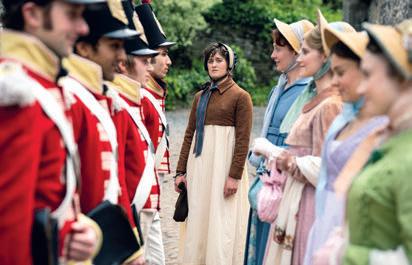
Last year may have been the 250th anniversary of her birth, but Austen fever is far from waning. As Net ix works on a new version of Pride and Prejudice by Dolly Alderton, the BBC is delving into a lesser-known Bennet sister.
Based on Janice Hadlow’s 2020 novel, The Other Bennet Sister is a revisionist origin story centring on Mary, the middle Bennet daughter. North Yorkshire rising star Ella Bruccoleri takes the title role, with Richard E. Grant and Ruth Jones as her inimitable parents.
While the story opens on familiar terrain, it soon whisks Mary into a radical beyond. Taken under the wing of her uncle and aunt, Mr (Richard Coyle) and Mrs Gardiner (Indira Varma), Mary becomes a governess to their three children and nds two love interests in the form of Mr Hayward (Dónal Finn) and Mr Ryder (Laurie Davidson).
Bruccoleri, who was raised on the Brontës, is now on her own Austen odyssey (learning calligraphy, playing piano and Regency dancing) – but her Mary isn’t an Austen heroine that will feel familiar. She is fraught with a sort of ‘self-hatred’, the actress re ects, reciting the adage that ‘Elizabeth Bennet is who Jane Austen wants to be, and Mary Bennet is who she’s scared she really is. It’s essentially her journey trying to nd love, human connection, independence and, I think most importantly, self-acceptance.’

Three more stories worth staying in for Olivia Emily has hot picks for the season ahead


← HOOKED by Asako Yuzuki
A er the whopping success of Polly Barton’s 2024 translation of Butter, she brings Japanese author Asako Yuzuki back to British bookshelves with another deliciously disturbing tale of an obsessive relationship. Out 12 March (Fourth Estate, £14.99)
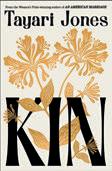
← KIN by Tayari Jones
From the Women’s Prize-winning author of An American Marriage comes Kin , a resonant novel about mothers, daughters and lifelong friendships –backdropped by racially segregated 1950s Louisiana. Out 26 March (Oneworld, £18.99)
← MY YEAR IN PARIS WITH GERTRUDE STEIN by Deborah Levy Hot Milk author Deborah Levy pierces through the constraints of ction to paint a portrait of the avantgarde godmother of feminism in this dazzling depiction of 20th-century Paris. Out 16 Apr (Hamish Hamilton, £18.99)
← WATCH In The Drama , Emma (Zendaya) and Charlie (Robert Pattinson) are days away from saying ‘I do’ when a game sends everything awry. Rom-com this is not – and it wouldn’t be a Pattinson lm without a disturbing twist. In cinemas 12 Apr

← SEE The V&A East Museum is nally here, with ve storeys for exhibitions, festivals, talks, performances and evening events. It opens with a landmark exhibition celebrating 125 years of Black British musicmaking. Opens 18 Apr (vam.ac.uk)
GO HowTheLightGetsIn returns to Hay-on-Wye for another weekend of philosophy, comedy and music, with Zarah Sultana, Michael Gove and Kathleen Stock on the bill. 22-25 May, howthelightgetsin.org
THE RETURN OF…




17–20 September 2026
A Weekend of Arts & Culture: Inspiring Talks, Performances & Outdoor Entertainment



Day
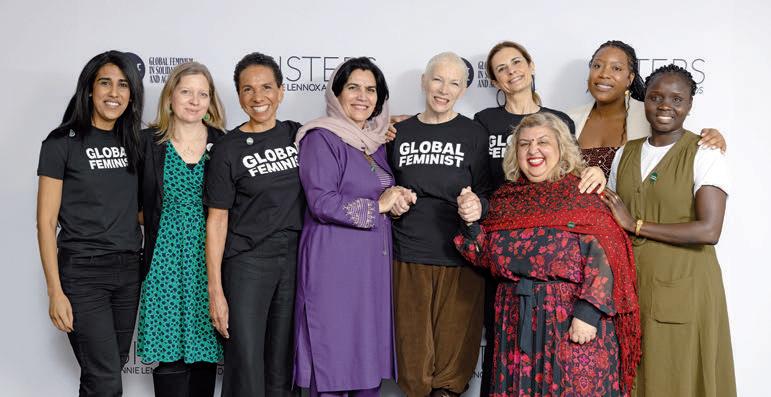
In the UK, Annie Lennox is best known as a pop star who has sold more than 80 million records, won eight Brit Awards, four Grammys and an Oscar. But to many women around the world, she is a champion of female rights who not only speaks out, but acts. In 2008, she founded The Circle, an NGO created to encourage women – and men – to stand in solidarity and support women everywhere.
Like many great ideas, The Circle began, says its CEO Raakhi Shah, at a dinner table. Between tours, Lennox had travelled with organisations such as Oxfam, visiting some of the world’s most disadvantaged communities. While inequality was visible at home, elsewhere it was far more extreme. One statistic appalled her: one in three women globally will experience gender-based violence in their lifetime. Lennox gathered a small gang, including activist Livia Giuggioli, journalist Lucy Siegle and Melanie Hall KC, at Julie’s restaurant in Notting Hill to join her in creating change.
Thirty years on, The Circle has grown into one of the world’s most in uential advocates for women’s equality, counting Mary Robinson, playwright V and lm producer Barbara Broccoli among its members.
can get back on their feet’. In Afghanistan, it enables women to access education online; in the Middle East, it incubated the Marie Colvin Journalists’ Network to support female war correspondents. In 2024, The Circle raised awareness of the war in Sudan, where over 14 million people have been displaced and sexual violence has surged.
Much of The Circle’s funding goes directly to grassroots organisations, amplifying women already leading change in their communities
Its work is both practical and immediate. During Covid, when thousands of Bangladeshi garment workers lost their livelihoods overnight, The Circle provided care packages and support with dismissals. In South Africa, where rates of sexual violence remain devastatingly high, it funds a refuge ‘where women
Much of The Circle’s funding goes directly to grassroots organisations, amplifying women already leading change in their communities. One such leader is South Sudanese activist Grace Dorong, who became a refugee at age ve. With The Circle’s support, her Roots of Generations initiative has grown into a lifeline, providing trauma support, business training and start-up kits. ‘When a woman is healthy in mind and secure,’ she says, ‘she can do anything to take care of the family.’
For Shah, ‘while it’s great that women in the UK campaign still against the glass ceiling – which we all should – we don’t want to forget there are still millions of marginalised women out there’.
Today, following aid cuts by Trump, it’s more important than ever for us to join together, Shah urges. ‘We have International Women’s Day on 8 March and March is Women’s History Month,’ she reminds us. ‘Launch an appeal. Have a dinner. We all need to create a circle so no one is le behind.’ ■
thecircle.ngo
CTH2026 20% OFF USE CODE FOR TICKETS






Retail revolutionary Mary Portas tells Charlotte Metcalf why she has never been afraid of change
PHOTOGRAPHY —— ALEXANDRA DAO
‘What were you really expecting me to be like?’ asks Portas.
I admit I had been worried her formidable success might make her forbidding. Yet the severe red bob is gone and we’ve been chatting away for over two hours, during which she has proved warm, open, excitable, fearlessly outspoken and very funny.
She has a mighty reputation, with six books to her name (her latest is I Shop, Therefore I Am), hundreds of newspaper columns, over half a dozen TV series and an OBE to boot, awarded in 2024 for services to business, broadcasting and charity –all the more impressive given her beginnings.
Portas was born in Watford, the fourth of ve children to Irish parents – her Catholic mother, ‘a ery, beautiful redhead’, and her Protestant father. Their home was ‘full of love, warmth, food and dogs barking’ until her mother died suddenly of encephalitis when Portas was 16. Two years later, her father remarried and moved out, leaving her with her younger brother. The following year he died of a heart attack, and their home passed to his new wife.
‘I hope that wasn’t deliberate and he just hadn’t got round to changing his will,’ she says. ‘I felt no anger, just fear. We had nothing.’
Family friends took them in, and although Portas won a place at RADA, she turned it down. ‘How would I nance it all? Where would I live?’
Instead, encouraged by her sister Tish, she enrolled at Watford College of Art. Miserable at rst, her direction crystallised when a fellow student found work at Harrods. ‘I thought, now that’s where I want to be!’ She rang every day for six weeks until the display manager nally gave her a job.
The rest is, almost, history. Aged 28, Portas went to Harvey Nichols – then on its last legs – serving a handful of ‘desultory Sloanes’. She collaborated with artists to create installations and partnered with models and actors, famously
getting Ab Fab to be lmed there. The store became a major cultural destination and the global press came ocking. By 32, she was a board director. However, ‘when a nancial director’s wife disliked my windows, I thought, “That’s why they’re so bloody good,” and knew it was time to go. Besides, I’m not afraid of change.’
With two small children, Portas set up her eponymous brand consultancy. She soon scooped up a shopping column for The Telegraph and a TV shopping series, Mary Queen of Shops. In 2009, Portas launched her successful Living & Giving charity boutiques in partnership with Save the Children, and was later called into Downing Street to advise Cameron’s government on how to revive our ailing high streets.
She was expected to work miracles, but the government didn’t implement her radical advice. Now, small shops are taxed out of existence and towns are ‘hollowed out’. So, what’s the answer?
‘People!’ she says. ‘Never forget that we hold the power. The government now has a Pride in Place scheme and communities have a right to buy and say no to another vape shop or faceless foreign bank taking over an empty building.’
As co-chair of the Better Business Act, Portas wants laws amended to ensure businesses step up their ESG responsibilities. ‘We’ve always been a nation of shopkeepers. As a country, we’re creative and have brilliant designers but we lack the storytelling, the push and the belief that our brands can compete. Brands must nd a way of connecting with people, creating those human and spiritual experiences and sense of place that make people really feel a brand and invest in it emotionally. It can be done – look how Ralph Lauren inhabited Sloane Square last Christmas.’
It’s clearly an uphill task but as we leave, I feel sure if there’s one person capable of galvanising communities to adapt their high streets and advising British brands how to grow and thrive, it’s Mary Portas. Her reign is by no means over. ■
A BOOK THAT CHANGED ME
The New Earth by Eckhart Tolle. We are really messing with our planet.
STYLE ICON
Inès de la Fressange. She has that French, louche con dence that her clothes are part of who she is.
FAVOURITE DESIGNER
Marques’Almeida, a husband-wife team that believes fashion is about attitude, not hemlines.
IDEAL DINNER COMPANION
William Morris –what a divine, soulful genius.
DESERT ISLAND DISC
Elton John’s Tiny Dancer
FAVOURITE PIECE OF CLOTHING
Rifat Ozbek’s boneinspired army jacket, which I gave away and regret.

‘Brands
must find a way of connecting with people, creating those human and spiritual experiences and sense of place that make people really feel a brand’
Mary Portas


earest Gentle Readers, if you have not yet binged the final four episodes of newseason Bridgerton , look away, for spoilers lie ahead.
Francesca Bridgerton does not achieve her pinnacle – certainly not at the hands of her husband John (RIP) and not, alas, in the arms of cousin Michaela either. Fans may be disappointed as series four does not include the lesbian romp we’ve all been waiting for.
For anyone not immersed in the Bridgerton world, Hannah Dodd plays Francesca, the sixth of eight Bridgerton siblings. Each series in the smash hit Net ix drama – based on the eight books by US writer Julia Quinn – follows the love trials and tribulations of a di erent sibling as Regency London society swirls around them, pulled on a string by the whims of the capricious (and fabulous) Queen Charlotte (Golda Rosheuvel).
While the love matches of her siblings are de ned by agonising, pent up, drawn-out desire, rewarded, when marriage is nally wrangled, by rapturous sex – in carriages, against trees, on a ladder in the library at Cliveden – and orgasms galore, Francesca’s experience falls at. ‘There’s this narrative of “she’s not having an orgasm, that means she’s not in love”, but Francesca’s is obviously a very normal female experience,’ Dodd laughs. In Quinn’s book about Francesca – When He Was Wicked , published in 2004 – her husband John dies in chapter one and we see nothing of their relationship. ‘We have gone in another direction to show a di erent type of love. It might not be reworks and passion like the other Bridgerton couples, but there is so much love between these two people, and anything that happens a er doesn’t negate it. It is just as valid.’
What happens ‘a er’ is her awakening with her deceased husband’s cousin Michaela (a Net ix liberty, as the character in Quinn’s book is male), which unfolds – along with h sibling Eloise’s love story – across Bridgerton’s next two series. Dodd can’t share any juicy details – she hasn’t even received the script yet; lming begins later this year – but her career could be about to go stratospheric.
We meet on a frigid February morning in a rehearsal space in Soho. She arrives – early –wearing double denim and Adidas trainers, her pale skin, great bone structure and long blonde hair in high relief against the grey day.
On paper, her path to Bridgerton looks gilded. Growing up in Colchester, the middle child of three, Dodd wanted to be a dancer. ‘I went to a very normal school but I had some very passionate
performing arts teachers. Without them, I don’t think I would have pursued it or even understood dancing was a job.’ Her dance classes were paid for by her modelling. Her parents, whose privacy she is at pains to protect, were supportive but it was not a privileged household. ‘They’re not stage parents, making things “happen”.’ She was rst spotted by fashion and beauty photographer Catherine Harbour while modelling for a local hairdresser. ‘I was quite against it at first. I was like, “No, I’m going to be a dancer.” I didn’t understand how opportunities like that can help.’
Her big break came aged 18 when she was cast in a Christopher Bailey-era Burberry campaign with Romeo Beckham. ‘I’m quite short for a model so I had been doing shoots for Primark and Tammy Girl.’ She got the Burberry gig because they wanted a dancer, auditioning at Pineapple Studios for an ‘unknown project’. Are she and Romeo friends? ‘No, I can’t say we’ve spoken,’ she says dryly. ‘He was only 11 at the time…’
By the time Dodd started dance college later that year, she already had an acting agent and juggled her tuition with auditions. ‘Burberry was a big moment because there was a huge set and crew, and being part of a team to tell a story felt really good. But dance college was the dream at that point – and I knew it would have to be a very special role to make me drop out of something I’d been working towards my entire life.’
She graduated and the parts rolled in: rst as a lead in Hulu’s Find Me in Paris, a children’s TV show, ‘the perfect environment to ask questions and learn how to read a call sheet and hit a mark’. Then came smaller parts in projects alongside screen royalty – Harlots with Samantha Morton, Lesley Manville, Liv Tyler; the Chloé Zhaodirected Marvel lm Eternals with Angelina Jolie, Salma Hayek, Kit Harington (‘I had two days on set with Chloé but you still eat everything up’); Jack Thorne’s Enola Holmes 2 with Millie Bobby Brown, Helena Bonham-Carter, Henry Cavill (‘Enola was a special one. I just remember walking into that table reading, and thinking, “What?! All of these people are ridiculous”’); and Anatomy of a Scandal , Dodd playing the younger version of Sienna Miller’s Sophie Whitehouse.
‘There’s not really a ladder in this career, but those steps helped prepare me for this.’ Did anyone impart great wisdom? ‘People give you stu all the time, but it’s also seeing how they behave on set and what kind of actor they are, whether they keep it really loose or come in with speci c ideas. That’s what you end up taking away. I sometimes wish I could go back and ask more questions, but I was also terri ed and trying not to take up too much space.’
In 2019, Dodd auditioned for the part of Daphne Bridgerton (the lead in series one); it came down to her and Phoebe Dynevor. ‘When you come
‘Bridgerton is a sexy show but those scenes tend to be well written to the point that it is an extension of that character’s story arc’


‘I learnt so much, but I don’t know if it was the wisest idea’
very close to something, you can think, “well, I’m not going to watch it”. But I loved those initial scripts so I did watch it and I loved it.’ Still, a series that turns a period drama into a hypercolourful, intentionally inclusive, alternative history so porno, despite being produced by Shonda Rhimes, was a risk – one that paid o : Bridgerton is among Netflix’s most popular television shows ever (signi cantly surpassing its estimated audience), and series four achieved 39.7m views in four days. ‘It came out at the time the world broke and we all just needed that escape,’ Dodd says. Its success lies also in its lack of cynicism and reliable happy endings (both kinds).
When Ruby Stokes, the actress originally cast as Francesca, had to bow out due to scheduling issues, Dodd had her second chance. She felt inevitable imposter syndrome, joining a cast a er two series but says they couldn’t have been more welcoming. ‘A er minutes it felt like she had been there forever,’ says Claudia Jessie (who plays Eloise), Dodd’s Bridgerton bestie. ‘Hannah feels like my sister in real life. It was the biggest joy having her join us.’
Last year, while filming series four, Dodd ful lled a long-held ambition, landing the part of Cabaret ’s Sally Bowles in the West End – following in the footsteps of Jessie Buckley, Aimee Lou Wood and Self Esteem – thanks to a seed planted by Jonathan Bailey in Bridgerton ’s green room. She messaged Luke Newton (who plays Colin Bridgerton) to ask if she was crazy to consider doing both roles concurrently. ‘These bloody Bridgerton brothers – Jonny manifesting it and then Luke telling me to go for it, silly boy.’
The schedule was gruelling: she had only three weeks to rehearse the part of Sally and she lmed her Bridgerton funeral scenes the same day Cabaret opened. Both characters are going through huge emotional upheaval, Sally and Francesca equally fragile and on the brink of cracking open. ‘I had to cry every day for four months,’ Dodd says, but conversely it was Francesca’s stoicism and poise in the face of tragedy that she found hardest to convey. Is she – and I ask this cautiously, considering her
character’s implied autism – like Francesca, in her quest for order and perfection? ‘I am, in many ways,’ she says. ‘But I’m more emotional.’
Dodd still su ers from what she calls ‘selfanxious days’ and admits to putting herself under enormous pressure. ‘Because Cabaret is in the round, the audience is so close I could see everybody’s faces, but if you’re in your head, you start wondering what are they thinking. You need to zone out and get into your little space but there are certain nights that’s easier than others.’
It sounds like the intensity took a toll. ‘It was incredible and I learnt so much, but I don’t know if it was the wisest idea.’ Was she burnt out by the end? She takes a moment to consider. ‘Yes, I think I was,’ she says quietly.
For now, some fun lies ahead. While Dodd’s sex scenes so far have been vanilla – ‘not much was expected of us so there was a lot of laughing on those days’ – the next series will surely require more work with the show’s intimacy coordinator Lizzy Talbot. ‘Lizzy is so good at reading people and seeing who needs to be able to laugh at it and when to take it really seriously. Bridgerton is a sexy show but they are always willing to listen to what you’re comfortable with. And those scenes tend to be well written to the point that it is an extension of that character’s story arc and not always there for the sake of being there.’ Dodd had the privilege of watching the steamy bath scene between ‘Benophie’ – Benedict (Luke Thompson) and Sophie (Yerin Ha) – ahead of cast screenings. ‘When Yerin was sent that one to approve, she asked me to watch it with her. So the rst time she saw it wasn’t in a room with everybody else.’
In an unexpected turn, there is a new Lady Whistledown, a self-appointed successor to Penelope Bridgerton, who promises to keep the Ton alive with salacious gossip. Is it Francesca? Or is the smart money on Michaela? Could it be the Queen herself? All we know is that ‘Francaela’ is coming into focus and sure to get the Ton’s tongues wagging – we can be certain Francesca will nally achieve her pinnacle. ■
Bridgerton S4 is available on Net ix now

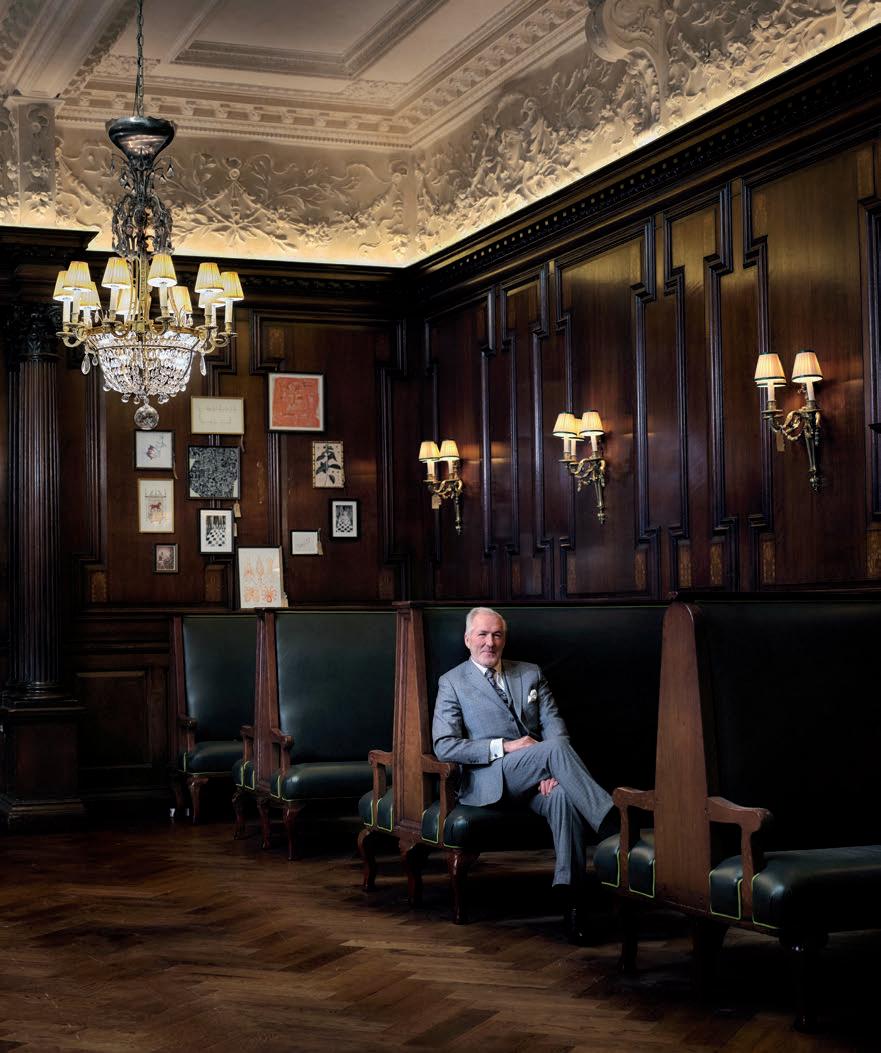

Legendary restaurateur Jeremy King is back doing what he does best – turning venerable rooms into adored restaurants. What happened, though, after his dramatic ousting from Corbin and King? He sets the record straight with William Sitwell
eremy King sits across from me on a cheap chair, by a dusty table, in a halfnished dining room in central London. In a few weeks this will be the Assembly Room, one of the capital’s grandest private events spaces. A dining room, a ballroom or a wedding location, it’s one of several wondrous parts of the great restaurateur’s latest project, Simpson’s in the Strand.
Dressed impeccably as ever, today in a thick three-piece tweed suit, the man who has overseen some of the UK’s most famous restaurants is doing what he loves the most: gearing up to open a place.
And this wise 70-year-old is both contemplative and energised and, as we speak, I’m clutching his recent autobiographical book, Without Reservation. It is both a treasure trove of anecdotes and a manual on running restaurants.
But for the man who created such gastronomic titans as The Ivy, Le Caprice and The Wolseley I have, rst, one fundamental question and a need to address the elephant in the room of his career. It’s a subject he has declined to address in interviews and brushes over in his book. That is, his scrap with Minor International.
Twenty years a er King and his long-term business partner Chris Corbin had sold Caprice Holdings to Luke Johnson (who went on to sell to Richard Caring), Minor International became investors in Corbin & King, which had establishments such as The Wolseley, The Delaunay, Brasserie Zédel and Colbert. Minor is a Thai multi-national company with a focus on hospitality and when they invested in Corbin & King, industry observers, people like me, assumed they had an eye on rolling out the brand, doing a Richard Caring (an Ivy in every big town, branches in Dubai, et al).
And that is exactly what, in 2022, Minor attempted to do. But, to put it mildly, King didn’t like it. ‘I found myself in a massive dispute [with them],’ he writes. Minor attempted to put the company into administration to wrest control, King fought back by seeking nance to acquire the business himself but didn’t succeed. Minor was not thwarted. ‘I was stripped of my phone, my laptop, my email accounts – everything – and unceremoniously but e ectively thrown out onto the streets.’
The big question being, how on earth did he not see that coming? King breathes in, brushes dust o his sleeve, waits for a builder to exit the room and, for the rst time, prepares to tell me.
I wonder if this charming man is about to dispense a lesson in humility. His profession is, a er all, one of extraordinary complexity. King, born in Burnham-onSea in Somerset, was a shy but bright child who won a scholarship to a West Sussex boarding school at the age of nine. The son of a man whose company made protective coatings for buildings, he went to Cambridge University before entering banking, a profession he quickly regretted, quitting it for a job at Joe Allen, the Covent Garden establishment beloved of theatre and royalty.
Within 15 years, as he puts it, ‘We [King and Corbin] had the Ivy, it really was the restaurant of the 90s, it was extraordinary.’
It was also a manifestation of his philosophy to, as he explains, ‘create restaurants that people actually want to go to.’ It’s why this most famous of restaurateurs doesn’t attract Michelin stars, his approach to food and service being the opposite of what the late, great critic Adrian Gill would call the ‘50-thank-yous’ meal, where the diner spends much of the time thanking a waiter for their interruptions.
It’s not surprising that such places became iconic although King also states that his approach to creating places is, he says, ‘reactive. I’m not a proactive person. I’m stirred. I see somewhere – a restaurant should be determined by the building – and I say, “Oh yes”, and my mind kicks in.’ And, he adds, ‘the fun is the creating, the fun is seeing it come to fruition. You see, it’s easy to open a restaurant – the di culty is running them.’
As we talk I take particular note of his sage advice for how to deal with some of the di culties. ‘You must invest to make money, rather than cut costs,’ he says, ‘the cost of an extra waiter compared to what they can generate is massive.’
‘It is most important that a restaurant is suitably capitalised to see out problems,’ he tells me, citing an example of having a quiet night and the next day, ‘the suits come in, look at the numbers and cut the sta . The next night you’re full. And screwed.’
‘But don’t be in thrall of the money,’ he adds, ‘you must maintain control. Restaurants go wrong when they are controlled by the board.’
Speaking of which, it’s time for that revelation.
‘When I came across Minor, we were looking at di erent investors,’ he re ects, ‘and what attracted me was they theoretically understood hospitality. They said they would love to buy a position in us. But I said, “No”, as all they’ll want to do is roll out my restaurants and it’s not going to happen. They promised and promised that that wasn’t the case. I reiterated that my fear was they wanted to roll it out. They said, absolutely we are not going to do it. I said that even if I came to you in three years and said (which I wouldn’t), “I want to roll out ten Colberts”, then you must say, “No”. I asked them. “Can you live with that?” and they said “Yes”.’
‘I was stripped of my phone, my laptop, my email accounts – everything – and
unceremoniously thrown out on to the streets’
But Minor did of course, fairly quickly, announce an intention to roll out The Wolseley. King says, ‘It would be fair to say they couldn’t curb their natural desire to expand. I have some sympathy because they panicked during Covid.’
King said, no, and assumed his position would sustain because, ‘they controlled the purse, but I controlled the company.’ However, he concedes one area of what he calls, ‘naivety’: that ‘they were able to renew the loan note, which meant they had control.’ The killer blow was to put the rm into administration. King lost. ‘It was insult and ignominy and, yes, I regret that we got into that position but it was then an emancipation’.
And today that emancipation is a joy to behold, with Le Caprice reborn as Arlington, The Park in Bayswater and now Simpson’s. The latter a vast mix of restaurants and bars centering on The Grand Divan with its famous trolley and, with vast sums spent on a total refurb, as King puts it, ‘So people who knew it can come in and say, “Yes, that’s how it was”.’
I, of course, ask King about the current travails in hospitality (so-called government death taxes) which he acknowledges but says, ‘I remember dealing with the IRA hanging bombs in the grates of one of my restaurants, so I can deal with things like rates and Ozempic.’
And with a reflective book out and the emphatic opulence of Simpson’s, is this place his swansong? ‘Is this my apotheosis? Is this my last restaurant?’ he asks, ‘Well yes. Until I nd the next one.’ ■
simpsonsinthestrand.co.uk
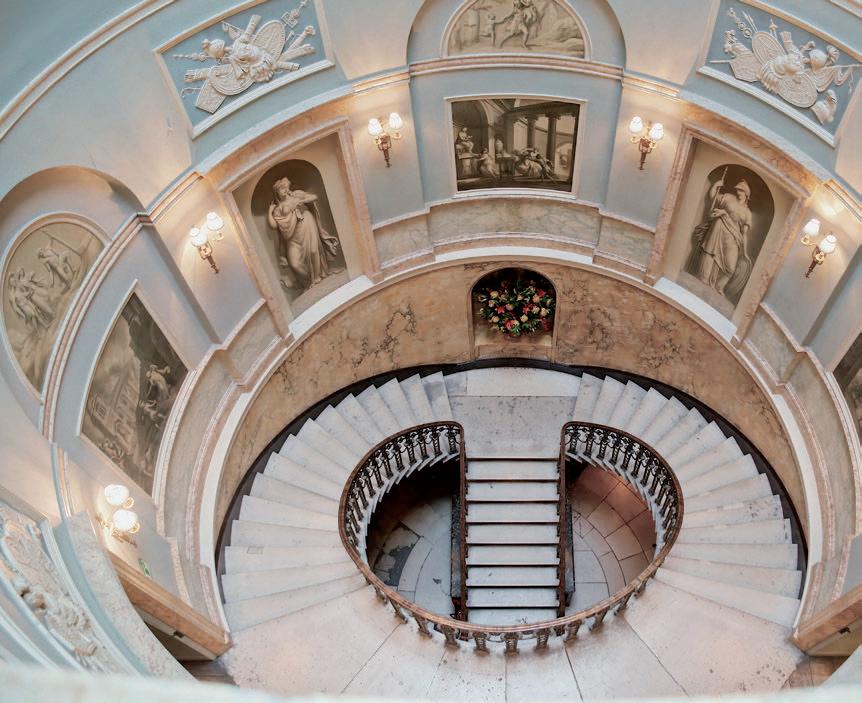
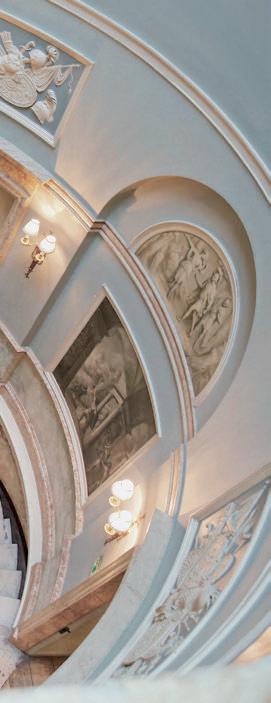
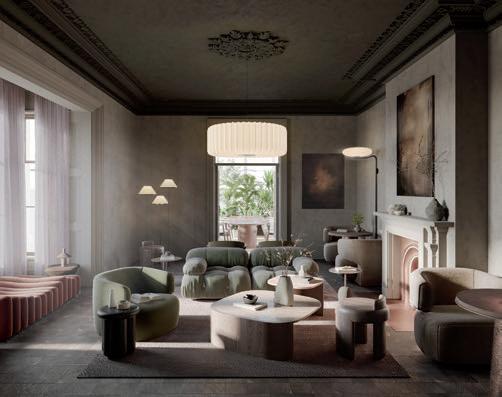
As the proliferation of private members’ clubs hurtles ever onwards, Dylan Jones takes us behind the velvet rope
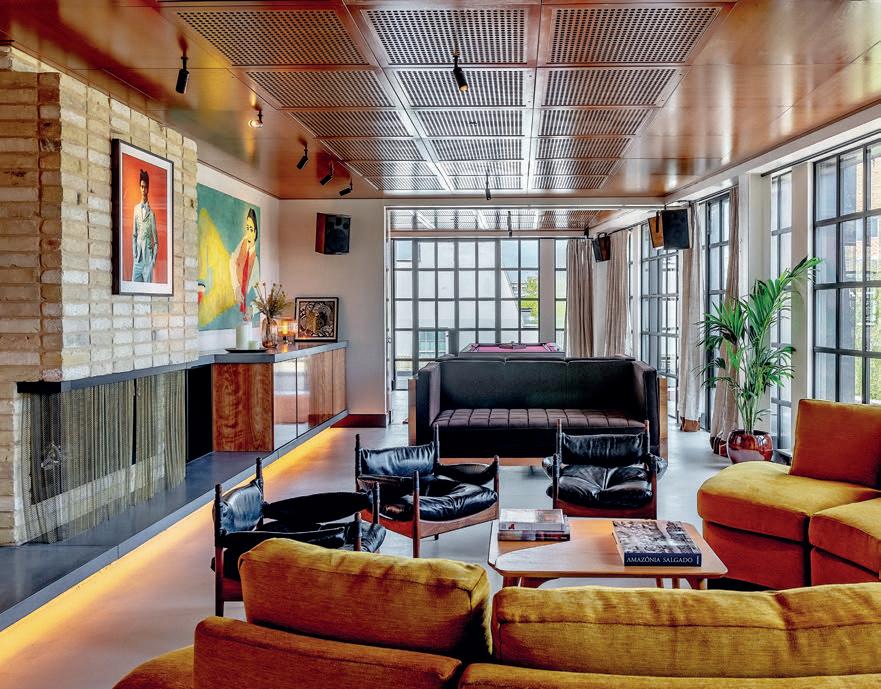
few years ago, I was nding it hard to sleep, and so instead of counting sheep, I did what any self-respecting boulevardier would do: I started counting private members’ clubs (PMCs) in London, from The Garrick and Annabel’s to 5 Hertford Street. I got to 50 before I started surreptitiously looking at my phone to try and complete the job.
I had just commissioned someone to write a piece on the proliferation of PMCs in town, and the idea was preying on my mind. But that night, having got to 70, I slipped o to the land of nod – thinking that The Land of Nod might be a very reasonable name for my own club, should I ever get around to opening one. Which I probably will do eventually.
Not only does London have a greater density of PMCs than any other city in the world, but with very few exceptions (AllBright, the women-only club, didn’t make it, and neither did Bungalow 8, the celebrity-heavy club inside the St Martins Lane hotel), they all become successful, o en immediately.
I still remember the rst time I went to The Groucho Club, back in 1985. I was meeting the iconic music journalist Jon Savage, as I wanted him to leave The Face and join me at i-D. Throughout our conversation, Jon kept his eyes on the door as new members walked in. ‘Hate her,’ he said under his breath. ‘Really hate him,’ he then said, a little louder this time, as another newbie walked in. Christ, I thought to myself, this is the place to be.
And it was. I was soon on nodding terms with everyone else in the club, whether they were an enemy of Jon Savage or not. I wanted in. And the only way to get in was to become a member. In the 40 years since then, a new PMC has opened every month – or at least, it feels that way.
Recently there has been a little griping about the way in which Soho House has expanded its brand, but because it listens to its members, the problems have been addressed (being slightly more circumspect with new members and hugely improving the food). Plus, it opened Soho Mews House just o Bond Street, which immediately became the hottest ticket in town; the only snag is, you have to be a Soho House member of 20 years’ standing to get in.

Throughout our conversation, Jon kept his eyes on the door as new members walked in.
‘Hate her,’ he said under his breath. ‘Really hate him,’ he then said, a little louder this time,
as another newbie walked in. Christ, I thought to myself, this is the place to be
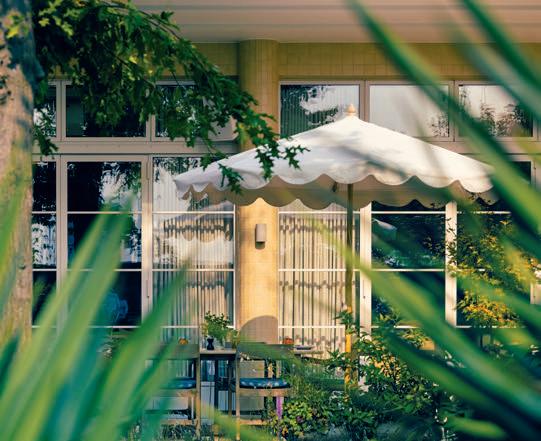
Along with Soho Mews House, the latest clubs that have startled the capital are Maison Estelle, The House of KOKO, and the rebooted and resuited Roof Gardens in Kensington (which even Mick Jagger joined before Christmas).
But if this sector has a problem, it’s the fact that there are so many great places to go in London right now. And it never ends. Ex-Soho House boss Nick Jones is opening the St Clement Hotel, a new 90-room property just behind 180 The Strand, and in March, Jeremy King is nally reopening Simpson’s in the Strand, which will probably be the most important restaurant launch of 2026 with a vibe that will have ‘private members’ club’ written all over it. This year will also see the launch of the mammoth Pembroke Club in Belgravia’s Grosvenor Place, as well as 16 Charles Street, a Mayfair townhouse operated by the French group behind Loulou Paris.
And it’s not just London; Oxfordshire continues to act like the capital’s older, slightly more feral big sister. Next year, The Ned is opening right next to Soho Farmhouse, and then, in something of a bold move, Long Lane will become the UK’s rst fully alcohol-free members’ club. They’re calling it the ‘Soho House for the sober generation’, although the last time I looked, it was perfectly possible to order a virgin mojito in the Farmhouse. Tucked away in the West Sussex countryside and opening next summer, it already has a waitlist for membership.
As always, there is a new kid on the block – somewhere that promises to revitalise the King’s Cross area and
cater for all the music and tech heads surrounding Coal Drops Yard. Occupying 60,000sq/ within the historic Camden Town Hall, Town Hall by Bottaccio is a new space where art, ideas, innovation and humanity converge. Its interiors have been fancified by Tom Dixon; its stewardship comes courtesy of Bottaccio, the international hospitality group founded by Elio D’Anna; and of course it has a PMC component, Town Hall Society, run by the wonderful Romy Westwood who previously headed Blacks in Soho.
In the club’s own words, it will deliver a ‘membership community rooted in connection, curiosity and creativity’. No, this isn’t quite what The Garrick Club was promising when it opened in 1831 as a space for ‘actors and men of re nement to meet on equal terms’, but in essence it’s not so far away. While Londoners like to proclaim their adherence to tolerance, community and inclusivity, there does seem to be a lot of us who get rather excited when someone brings out a velvet rope.
I went to visit the Town Hall Society space a few months ago, and it’s sensational – like walking into a New York lo in the 1980s, complete with grand windows and hyper-urban views (in this case, Euston Road). Because I like anything new and particular, I will undoubtedly join up and enjoy sipping negronis as I look over at the Google building and wonder what it is those people do all day.
But, like every other member, I will be enjoying the fact that a lot of other people can’t get in. ■
THE CHELSEA ARTS CLUB
Established in 1890; in its Old Church Street home since 1902. chelseaartsclub.com
SOHO MEWS HOUSE
The most di cult Soho House to get into (it’s in Mayfair, if you can nd it), and consequently the most exclusive. sohohouse.com
5 HERTFORD STREET
You don’t need your own hedge fund to become a member, but it certainly helps. 5hertfordstreet.com
THE GROUCHO CLUB
In terms of the ‘new’ breed, The Groucho is the original, and occasionally still the best. thegrouchoclub.com
LITTLE HOUSE
The Soho House cubby-hole for those media barons who want a little peace and quiet. sohohouse.com
THE HOUSE OF KOKO
Restaurants, a roof terrace, a couple of cocktail bars, a speakeasy and secret gigs. thehouseofkoko.com
THE ARTS CLUB
Nestled in Dover Street, with its satellite partner Lanserhof across the road. theartsclub.co.uk
THE ROOF GARDENS
Made Kensington cool again. Too exclusive to have a public website.
HOME HOUSE
This grand former private home has one of the best gyms in the capital. homehouse.co.uk
THE HURLINGHAM CLUB
Don’t bother applying – the waitlist is closed forever. hurlinghamclub.org.uk
BY THE BOTTACCIO GROUP


In King's Cross, behind the grand facade of a neo-classical building that first opened its doors in 1937, something remarkable is taking shape. Town Hall, a landmark reimagined for the 21st century, represents one of London's most ambitious cultural projects: a ten-year restoration that transforms a historic civic building into a new kind of space where legacy and innovation collide.
TOWN HALL SPACES
A sequence of vast, dramatic and meticulously crafted event spaces designed for grand spectacles and quiet revolutions. Vision Hall, the Grade II listed main space, accommodates launches and performances. Inner Space provides flexibility for exhibitions and tech summits. The Network creates intimacy for salons and private gatherings. All supported by world-class partners in Rhubarb Hospitality Collection's culinary expertise and Pixl Evolution's cutting-edge AV infrastructure.

TOWN HALL PRESENTS
Perhaps the most ambitious aspect of the project: a living programme of progressive talks, performances and exhibitions, bringing together the most influential voices shaping art, music, technology and culture today. Events span five tracks (Culture, Innovation, Impact, Community and Big Ideas), creating what is described as radical acts of programming, designed to challenge and connect.
TOWN HALL SOCIETY
In 2026, Town Hall will further extend its cultural mission with the launch of Town Hall Society, a membership community rooted in connection, curiosity and creativity. A 21st-century sanctuary shaped from within, the Society will provide privileged access to Town Hall’s cultural ecosystem, premium dining experiences, dedicated meeting salons, and a global network of innovators and thought leaders.

Before felling two trees at 42 Acres in Somerset, Russell Rigler sought a secondary opinion – from the trees.
Rigler, who works as the regenerative estate’s lead ornamental gardener, contacted Bríd Walsh, the resident land energy healer. She possesses, she says, the ability to commune with nature.
‘We needed to fell some non-native holm oaks, as they were crowding out the native oaks,’ explains Walsh. ‘Before we coppiced them, we entered into a negotiation with the trees, explaining our needs as humans and embarking on a listening journey. Once communication was clear, nature was more than willing to support our actions.’
Walsh, who is from Cork, has a soothing, earthy presence and a conversational tendency to wander. She describes herself as a ‘multi-sensory’, someone who can read the subtle energies of the earth. Her role at 42 Acres was not to reverse a decision to remove the oaks – this had been made on safety and ecological grounds – but to guide how and when it happened, like nature’s mediator.
This might seem alternative but, according to landscape architect Marian Boswall, it’s something people have been doing for years –‘only now they are doing it in the open’. Everyone from duchesses to British Water engineers are employing dowsers, shamans, druids and crystal healers who claim to have extraordinary, extrasensory abilities to help heal our lands.
Boswall, who runs a leading design practice based in Kent, has a special interest in land energy healing thanks to training with a Feng Shui master early in her career, and is particularly fascinated by sacred geometry and geomancy. Her book, The Kindest Garden , argues the case for regenerative planting – in conjunction with carefully deployed land energy healing.
‘Some clients are very le -brained and would nd these beliefs uncomfortable,’ she says, but this is changing: ‘I used to say I was a bit like a Trojan horse – I would go in and create what looked like a beautiful garden but I’ve also been doing these [energetic] things underneath. I no longer have to do that; people are receptive.’ She cites a ‘high achiever’ who runs an institute in New York ‘who asked me straight away how I felt about sacred geometry’. A few years ago, she created a garden labyrinth ‘which works as an ampli er for positive energy’ for Sophie Nevill, daughter of the Marquess of Abergavenny.
In the UK, there are an estimated 30,000 healers, of which 1,400 are registered with o cial bodies like the British Alliance of Healing Associations. The fascination is longstanding, with healers dating back to pre-Roman society, but this particular strand of spiritualism – which includes mediumship and energy healing – was popularised in the 19th century.
There are, according to Walsh, many types of nature-focused practitioners. There are extraempathetic multisensories like her, whose work is similar to shamanism; druids, who come from particular ancestral lineages; and then there are healers who work more conventionally – think reiki practitioners but for the land, or dowsers who seek water with metal rods. King Charles is an advocate of sacred geometry; his 2010 book Harmony discusses the spiritual power of platonic solids and spirals.
These healers are more familiar, perhaps, inside the home. Smudging and saging is not a wholly uncommon practice, nor is domestic blessing (Roman Catholics have long asked priests to bless their thresholds). Where globally ‘mind, body and energy healing’ – including yoga, meditation and acupuncture – is growing, it’s not surprising there is increasing appetite for holistic wellness for our land, too.
Elizabeth Peterson, who works as both a domestic and land energy healer, says the increasing trend for shamanism owes its rise to a political and physical climate that leaves people ‘lost’. ‘People are distraught at what’s happening to Mother Nature,’ she says. ‘We can’t ignore it. There’s ooding, earthquakes, natural disasters. We have this growing sense of our own impact, and shamanism is appealing because it subscribes to older, more holistic worldviews.’ Boswall agrees: ‘When your friends [in nature] are dying, you notice.’
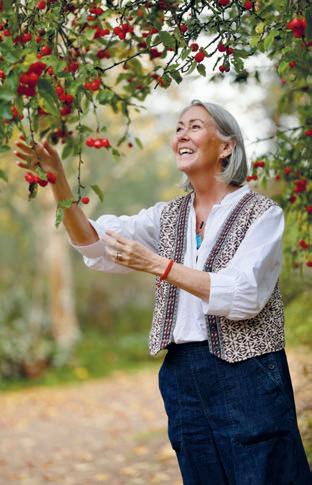
Brid Walsh’s role was not to reverse a decision to remove the oaks – this had been made on safety and ecological grounds – but to guide how and when it happened, like nature’s mediator
Census data re ects a rise of British pagans. In 2021, 74,000 Britons identi ed as pagans, while 8,000 identi ed as shamans (up from 57,000 and 650 in 2011). Both spiritual beliefs are strongly linked to animism, which is the belief in the energy and sentience of all natural phenomena.
It is hard, of course, to put a concrete measurement on the outcomes of land energy healing. ‘As we didn’t take a baseline, I haven’t observed anything in a measured way,’ Rigler, a traditionally trained gardener, admits. For him, though, it’s not about concrete evidence. Before working with Walsh, his gardening followed established frameworks, rooted in baseline monitoring and measurable outcomes. Now, he says, the emphasis

is on observation and trust, on spending time with the land before intervening.
‘Brid’s work complements rewilding practice,’ he says. ‘You can do a lot for the land in the name of rewilding that’s less bene cial than you think. Sowing the wrong wild ower mix, for example. If you haven’t stopped to really understand the land, you might not do the best thing for nature.’
Is it all a bit ‘woo-woo’? ‘That’s de nitely the word people would have used,’ admits Walsh. ‘If it’s not proven by science, then it’s not real. Now what’s happening is that science is catching up with indigenous traditions, proving what we already knew.’
‘Germ theory was disrespected until it was proven,’ agrees Boswall. ‘Now, plant sentience is beginning to be understood.’ Recent scientific discoveries give this more credibility: we now know that trees communicate through underground fungal networks, and LSE’s animal sentience research has provided evidence that many sh and crabs experience more complex inner lives than we had previously thought.
Energy practice might be a harder push to prove – and there’s further tension to these conversations: a conspiracist thread of climate change denial. ‘If you look at the history of the planet, you will see that the earth has always experienced cycles,’ says Walsh. ‘The last mini ice age in the UK and Ireland was 250 years ago.
‘Let me put it this way: turning on the news every night, we give our consciousness and life force to the story we’re being told. This contributes to the energetics of it. If a situation advocates fear, it helps control the population.’
Peterson emphasises that this is not what most of the energy healing community believe. Her take is one of the value of debate, ‘that maybe the earth is doing its own thing; it’s just a natural turn of a cycle. Either way, it’s still impacting people’s thoughts and how we treat the earth.’
Many land energy healers also borrow the language of conservationists and rewilders: they speak of ‘recovering’ and ‘rebalancing’, focusing on how we must repair a damaged land while making space for nature. Their politics feel at odds with the output of their work, which is almost always climate-positive.
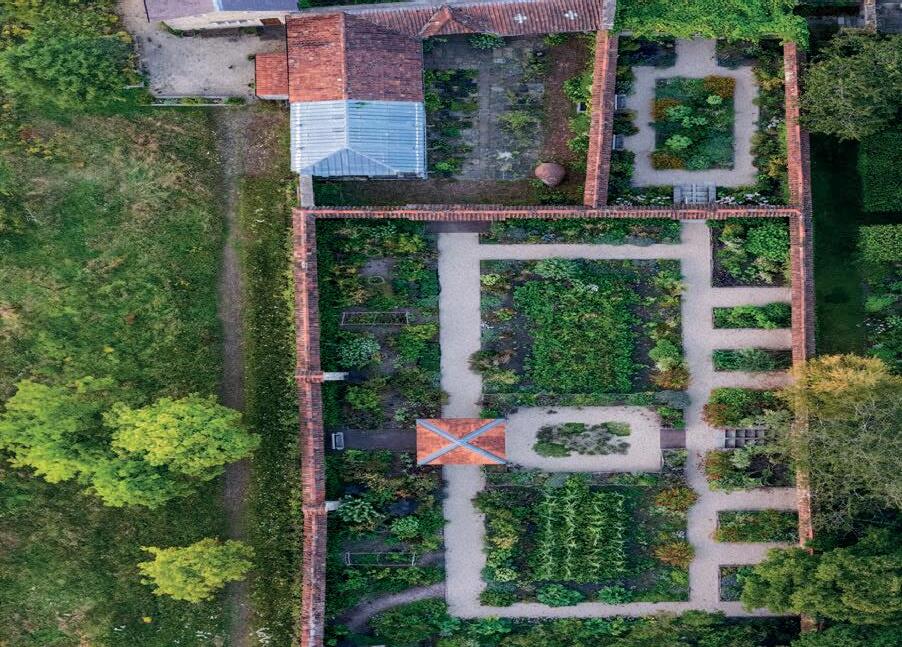
At 42 Acres, the team will continue to marry rewilding and land energy healing as they create a free- ying ock of white storks. Walsh has blessed the space to welcome the storks before they come in. ‘Imagine,’ says Walsh, ‘if we give nature a chance. Can I hold the natural world in my heart? And say: “I’m going to send you so much love.”’ ■



















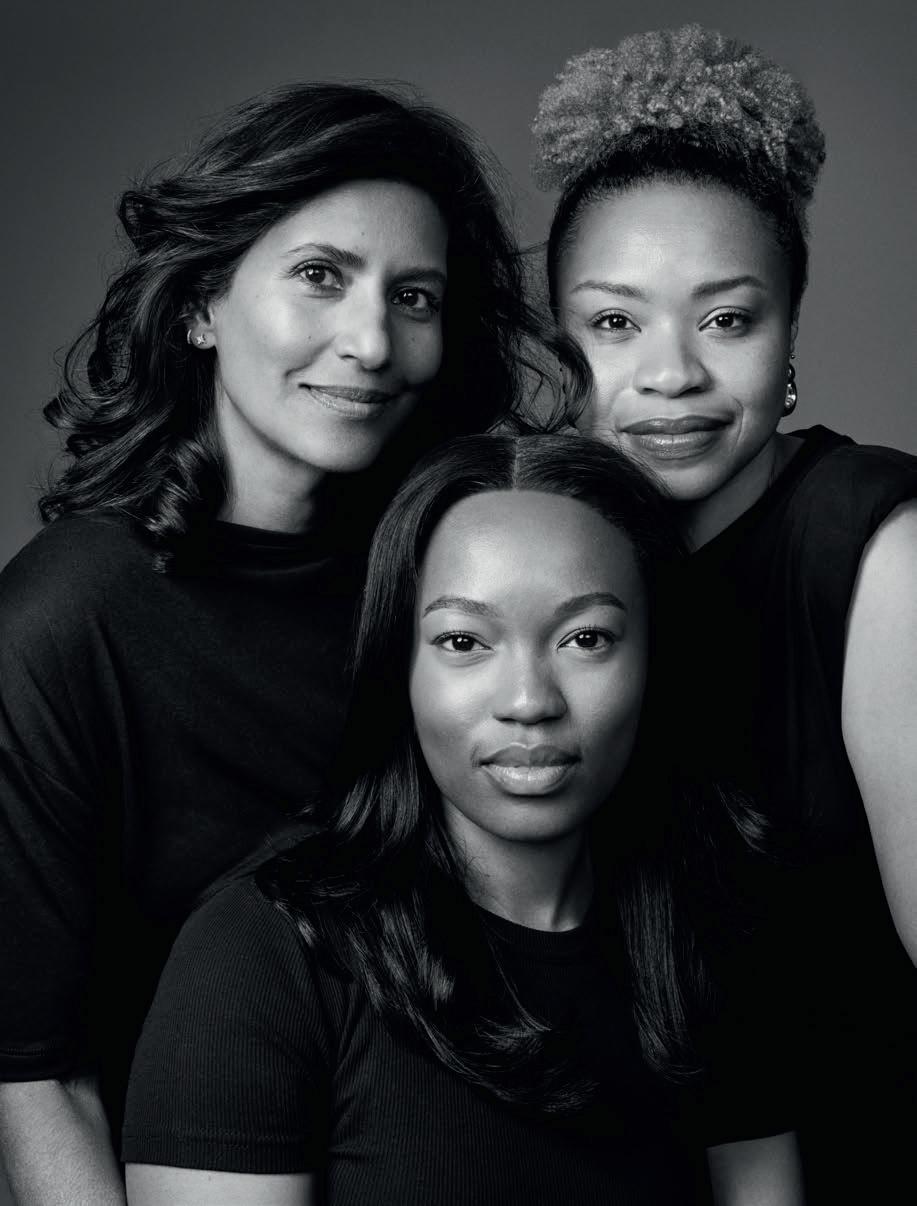
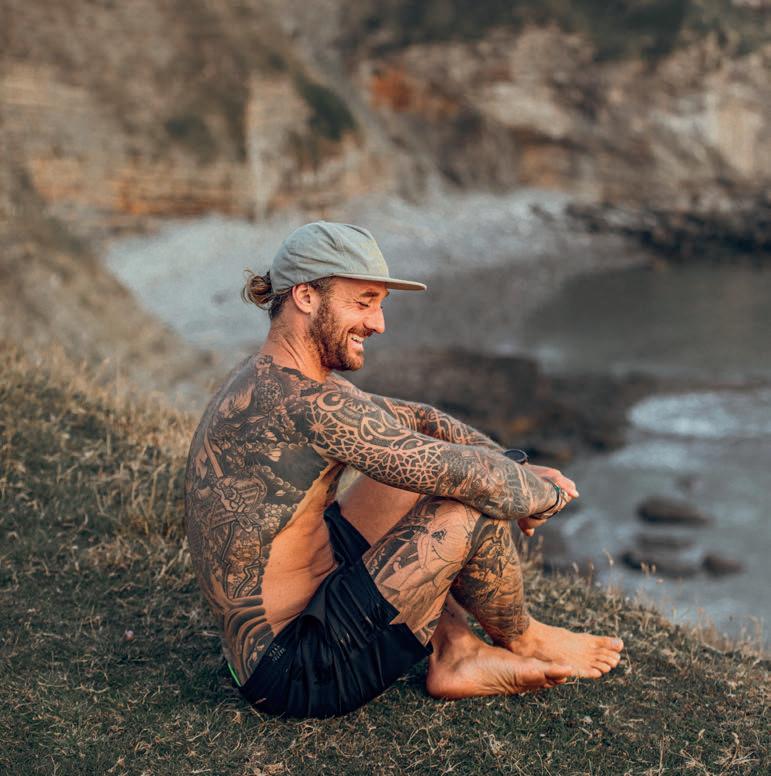
Feeling burnt out? Former professional rugby player
Richie Norton helps high performers (City slickers, overloaded entrepreneurs, athletes, actors) steady and sharpen their focus and rebuild their energy (p112).
Want a less grumpy husband? Get into biohacking, says Olivia Falcon
In my opinion, the biohacking bandwagon is truly overloaded with charlatans. So when you discover someone who really knows what they are talking about – and puts people before pro t – it’s worth taking note.
Step forward Viviana Botoaca, owner of the Geneviv Clinic ( genevivclinic.com). This place is such a nd, with an o ering that ranges from DNA testing and brain health therapies for neurodegenerative diseases, to bespoke IV boosts and exosome protocols to treat hair loss. You needn’t schlep to an Austrian medi-spa to reboot – it’s all right here in SW1. I also love that the clinic donates to 4Ocean, a charity that removes plastic waste from the sea and repurposes it into bracelets.
I have been visiting for vanity, trialling the Rexonage 3 machine (£3,000 for a course of six sessions) – a futuristic way to rejuvenate skin tissue without needles, heat or downtime. It uses Quantum Molecular Resonance technology, which utilises high-frequency waves to re up mitochondria (our cells’ battery packs) to reboot skin for radiant glow. I had to try it a er seeing my friend Alice’s before and a er photos. Alice is outdoorsy and had swollen, red knuckles and fat loss on her hands, which were completely transformed a er ten sessions.
I have tackled my face and noticed

The team at Geniviv works with Premiere League footballers to help rehabilitate injuries

Wholy[me] muscle and joint relief salts
While there is still a nip in the air, nothing soothes more than a warm bath filled with these magnesium-rich Epsom salts that are designed to calm the nervous system and invite deep rest. £16, wholyme.com

UltraViolette Ski Screen SPF duo Whether slaying the slopes or sinking an Aperol, snow can reflect up to 80 percent of UV radiation. This set combines a new highperformance SPF 50 that resists sweat and moisture for up to two hours with a protecting lip balm in a choice of pretty tints. £35, ultraviolette.co.uk

that even a er two sessions, my rosacea was noticeably better. The treatment uses a handheld device that sucks up skin to re an alternating electrical signal into the tissues below, and is followed by a massage using silverthreaded gloves that deliver energy into the skin. It is like a facial and a full cellular reset combined, repairing laxity, improving skin texture and reducing in ammation – whatever your skin type.
My husband has also been visiting the clinic, as he had been hobbling around for months (he has been told he needs two knee replacements). A er an MRI, Botoaca recommended Geniviv biohacking physiotherapy (from £3,000), a painless, technology-led approach designed to support rehabilitation and reduce pain (the team works with Premiere League footballers to help rehabilitate injuries).
Visiting the clinic twice weekly for six weeks, his treatment includes Emerald laser therapy (a painless cold green laser that speeds up fat metabolism), QPhysio (which uses Quantum Molecular Resonance technology to regenerate tissue), and the Tesla chair (which res up muscles without joint strain to build strength). The results have been life changing; I have a new man who can hike and hold a yoga pose. He’s also less grumpy. Amen to that. ■
Feel Iceland bone supplement
Protecting joint health and bone density in midlife and beyond, these capsules are sustainably sourced from the bones (usually discarded) of the purest Icelandic cod. £33, feeliceland.co.uk

Refy mini lip gloss trio
Pucker up with these vegan glosses that hit just the right note of shine without stickiness –the triumvirate includes clear, rose and topaz shades. £22, refybeauty.com


9



Internationally recognised consultants – delivering elite care across the full spectrum of ophthalmic subspecialties.
150



Years of combined consultant experience – a depth of knowledge that only decades of practice can create.
50K
Successful operations - a track record built on precision, safety, and consistently outstanding outcomes.



50+
National and international prizes – recognised globally for innovation, research, and clinical excellence.



A £multi-million facility with leading technologies delivering bespoke eye health by our team of world-renowned surgeons
SEON Vision is the premier destination for vision correcting and cosmetic eyelid surgery in London. Forged by the union of internationally recognised expert eye surgeons, SEON Vision combines cutting-edge technology with a personalised approach.
Nestled in the heart of the Royal Borough of Kingston, this dedicated multi million-pound centre has invested in technology not seen elsewhere in the UK. An example is the Light Adjustable Lens, which is a game changer in cataract surgery providing tailored vision for patients wanting true independence from spectacles. Chief Operating O cer, Mr Peter Stone, explains: “We wanted SEON Vision to be the place we would trust for our own family – a centre where clinical excellence meets genuine care”.
SEON Vision provides a comprehensive range of treatments from advanced laser vision correction and premium cataract surgery to re ned eye li procedures. With extensive expertise in glaucoma, retina and corneal surgeries, SEON o ers same day, urgent care for those in need.
Every detail matters. Our focus is simple: exceptional outcomes, delivered with surgical mastery.
One patient re ected: We cannot recommend them highly enough…the entire experience was professional, reassuring and truly patient-centred.
SEON Vision o ers more than treatment. It o ers con dence, and vision as it should be.
+44 (0)20 3411 1820; seonvision.com; enquiries@seonvision.com

Plant-derived stem cells extracted from resilient botanicals such as apples, grapes, and alpine plants can help defend against environmental stress and support collagen production.
Here are seven hard-working products that give real results.
1 CALECIM ® Advanced Hair System
Get bouncy hair back without drugs or downtime. This patented blend of stem cell–derived growth factors wakes up fatigued follicles and improve density. £295, calecimprofessional.com
2 DR LEVY Eye Booster Concentrate
For subtly li ting results around the eyes, this mix of botanical stem cells, ca eine, peptides and hyaluronic acid tightens, hydrates and smooths this notoriously delicate area. £165, cultbeauty.co.uk
3 BIOEFFECT EGF Power Serum
A punch-packing serum has just 12 ingredients, led by Icelandic-grown epidermal growth factors which support collagen and improve density. £169, bioe ect.com
4 SARAH CHAPMAN Platinum Stem Cell Elixir
This serum-oil hybrid combines botanical stem cells and growth factor technology to re ne contours and restore plumpness particularly along the jawline. £162.95, sarah chapman.com


Stem cell technology is one of beauty’s most intelligent responses to ageing skin, says Nathalie Eleni



5 CHANTECAILLE Bio Lifting Cream+
For visible li , this velvety cream infused with plant stem cells is also deeply hydrating. £324, chantecaille.com
6 KORA ORGANICS Plant Stem Cell Retinol
Alternative Serum
Ideal for sensitive skin, these botanical stem cells and antioxidant-rich oils smooth and brighten without irritation. £74, cultbeauty.co.uk
7 MZ SKIN Reviving Bio-Placenta & Stem Cell Serum
For a well-rested look this peptides and botanical cell stem extracts-packed serum works during sleep to improve elasticity. £275, spacenk.com
THE STEM CELL ASSISTED FACELIFT
If you’re ready for something more transformative than a face cream, Tunc Tiryaki’s Stem-Cell Assisted Faceli is a ‘faceli ’, but not as you know it. A small amount of fat is taken from your own body where the stem cells are extracted, prepared and reintroduced into the face or neck. Because they’re entirely your own, there’s no risk of allergic reaction and they integrate seamlessly, working with your tissue rather than sitting on top of it like a ller. Results are extremely natural and the nish so er and more harmonious, with a short downtime. From £25,000; tunctiryaki.co.uk
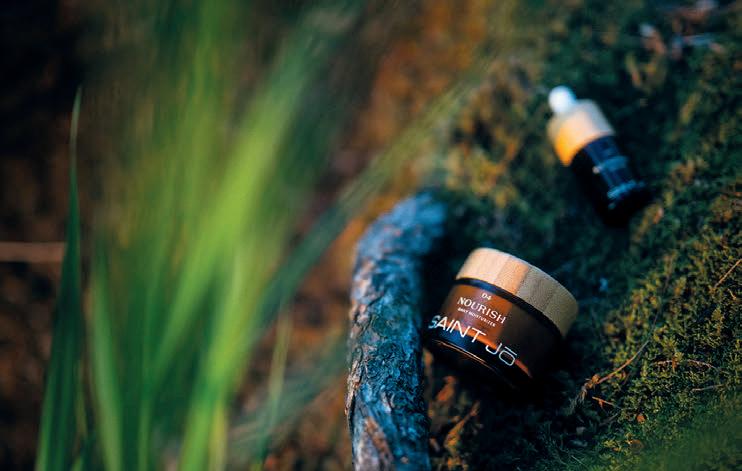
Plant-based beauty has quietly become the industry’s smartest investment. Consumers today demand more from their skincare: clinical results without irritation. And now, thanks to advanced research, biotechnology and clinical testing, one brand is on a mission to bridge the once-vast gap between e cacy and natural skincare with a routine that delivers results while being completely non-toxic.
It was while working in product development that Allyse Cirillo, founder of beauty brand SAINT Jō, clocked onto the power of plants. ‘I was working on a naturopathic doctor’s brand and realised there was more that could be done to make the formulas more e ective by adding active ingredients.’ The company didn’t want to invest in it, so she set out to do it herself.
Cirillo’s plant philosophy centres around using natural ingredients that our body will recognise, but with a cautious eye. ‘Not every plant is meant to go on your face or into your body, but there’s enough science out there for us to do the research.’
One of SAINT Jō’s hero actives – found in its Brighten serum – is a vitamin C derived from Kakadu plum, an Australian citrus plant that Cirillo says ‘gives the purest and most stable form of vitamin C, unlike most vitamin Cs that come from a synthetic source and are therefore
not good for sensitive skin’. But it’s also about the nonactives – the ‘ ller’ ingredients. ‘O en with synthetics, our body doesn’t know how to process them, which can cause breakouts or a burning sensation,’ she says. ‘If ingredients come from the soil, they are more likely to be recognised and well-tolerated.’
The question, then, is whether plant-based formulas can genuinely work for all skin types. Initially Cirillo had concerns – a er all, the industry has long operated on the construct of di erent skin types requiring di erent solutions. But the results have spoken for themselves. ‘We are nding success with di erent skin types and age groups: women going through pre-pregnancy hormonal shi s, postpartum, perimenopause, menopause, post-surgery and even those with chronic eczema.’
SAINT Jō’s seven-step ritual is designed to take the guesswork out of skincare. Using each step ensures no contraindications between ingredients, and its supplementation (steps six and seven) o ers support from the inside out. ‘One of our taglines is “who says we can’t have it all?”’ says Cirillo. ‘We can. We can have beautiful products that work and don’t cost the earth.’
SAINT Jō is available at John Bell & Croyden and at shopsaintjo.com
Cultivate and conserve your energy for the things that matter, says Camilla Hewitt
On 17 February, we galloped into the Year of the Horse, a period associated with fresh energy and forward momentum. Whether or not you follow the Chinese zodiac, you may have started the year feeling invigorated only to nd that as the weeks pass, that initial spark becomes harder to sustain.
While sweeping lifestyle changes aren’t always realistic, small, intentional micro-habits can help replenish and protect your reserves, giving you the stamina to make it through the rest of the year.
‘From a Traditional Chinese Medicine (TCM) perspective, it’s about spending qi – vital energy –wisely and protecting the organs responsible for generating, circulating and storing it,’ says Ada Ooi, integrative Chinese medicine clinician and founder of 001 London (001london.co.uk).
Even at rest, the body is far from idle. For most adults, around 60 to 75 percent of daily energy
expenditure is simply devoted to keeping the lights on – the brain processing, the liver metabolising, the heart and kidneys pumping and ltering, and the muscles remaining in a state of readiness. Digestion alone accounts for around ve to ten percent of daily energy use, and this is where Ooi’s advice comes in. Avoid constant grazing ‘to keep digestion within its normal energy demands’, and prioritise warm, cooked foods. ‘Cold or raw foods require extra energy just to be brought up to temperature before digestion can begin.’ Maintaining body temperature is another quiet drain on our reserves. This is particularly relevant for women, as monthly hormonal uctuations place added strain on temperature regulation (try the 001 London thermal hormone balance AcuPatch, which provides targeted herbal warmth). Layered on top of these physiological demands are some very modern drains that keep the nervous system revved. Ooi suggests batching noti cations and emails into set windows rather than checking them constantly, reducing the hundreds of energydraining micro-shi s in attention throughout the day. ‘Creating intentional mental quiet allows the nervous system to reset and lowers background energy expenditure.’ Protect sleep and the overnight repair window the body relies on to restore energy. ‘Consistent sleep and wake times, along with a digital sunset one to two hours before bed, supports an e cient overnight recharge.’
‘The real luxury today isn’t having more energy, but leaking less’
Ada Ooi

Social connection can also play a role. ‘Calm, grounded company helps the nervous system settle, allowing the body to enter a more restorative state,’ Ooi says. Even your daily movement should support energy ow. Prioritise low to moderate daily exercise that improves circulation and mitochondrial e ciency. ‘If you enjoy intense workouts, anchor them to times when you’re well fed and well rested.’
Her closing thought brings science and TCM into alignment: ‘The real luxury today isn’t having more energy, but leaking less, designing your day so digestion, sleep and the nervous system use only what they need, leaving your qi for the things that genuinely light you up.’ ■
RICHIE NORTON
Sustained stress can quietly drain energy reserves. Richie Norton created his breathwork practiCe to address this at the source by signalling to the nervous system that it’s safe to relax. As circulation improves and oxygen delivery becomes more e cient, energy once consumed by stress is freed to support immunity, recovery and mental clarity. richie-norton.com

TONIQ
With studios in Bath and Bristol, TONIQ o ers movement, recovery, and restorative practices all under one roof. The ‘Q’ in TONIQ stands for ‘qi’, and every element of the studio experience is shaped around cultivating, circulating and conserving this energy. toniqlife.com
As spring hits its stride, we’re all keen to rejuvenate our skin. Damaged by frigid air and central heating, it’s time to get our glow back. A good skincare regime is all very well, but there is a simpler way to support our skin health: we need to work with our gut-skin axis.
A key way in which the gut microbiome can in uence our skin is via in ammation. While it’s a vital part of our immune system, when in ammation persists in the long haul it causes damage to our cells and tissues, including our skin. Dysbiosis (an unbalanced gut microbiome) can increase levels of in ammation in our gut, and the chemicals that drive this in ammation can enter the blood and in uence distant parts of the body. In some cases, pro-in ammatory microbes can actually migrate from the gut to the skin, potentially contributing to issues like acne.
A happy and diverse gut microbiome is rich in shortchain fatty acids (SCFAs), wonderful compounds that reduce in ammation in the gut and further a eld. SCFAs also help strengthen the gut lining, preventing it from becoming compromised – or ‘leaky’ – and allowing bacteria and toxic compounds to sneak through into the blood. There’s also evidence that SCFAs produced by ‘good’ bacteria in our gut can reach our skin and support its barrier function.
Diet can really help manage in amed skin, and the key is to avoid excess sugar and highly processed foods. Foods like pastries, biscuits, white bread and white rice lead to a sharp rise in blood sugar levels, triggering the release of androgens. This leads to an increase in sebum production, worsening acne.
Plants (or the polyphenol that plants use to protect themselves from infections and UV rays) have antioxidant and anti-in ammatory e ects that can support skin health. Polyphenols are found in abundance in co ee, berries, dark chocolate, nuts, olive oil, and many other colourful fruits and veg. Flavonoids (a type of polyphenol that occur in strawberries, raspberries and blackberries) and carotenoids (found in carrots, as the name suggests, but also a wide range of plants including tomatoes, leafy greens, pumpkins, spinach and peppers) can help reduce your blood sugar responses a er eating and tamper in ammation. Vitamin C can also help maintain healthy skin. Making sure you have adequate amounts helps promote wound healing and skin regeneration through collagen production. The best food sources include oranges, grapefruits, peppers and kiwi.
Great skin starts in the kitchen, says Dr Federica Amati
Finally, let’s talk about fats; the polyunsaturated kind, like omega-3s, are essential for health and can support the skin’s defensive barrier. Omega-3s may even reduce symptoms of eczema and psoriasis. Find them in oily sh like mackerel and sardines as well as ax seeds, chia seeds and walnuts. The health bene ts of omega-3 are one of the reasons I created ZOE’s Daily30+, a simple way to add bre, antioxidants and healthy fats to your favourite dishes.
A diet designed to maintain healthy skin – plenty of bre-rich plants and healthy fats – also looks a er our gut. The skin is a window onto our overall health. Look a er the inside, and the outside takes care of itself. If you focus on bre and diversity, you’ll be glowing all spring long. ■







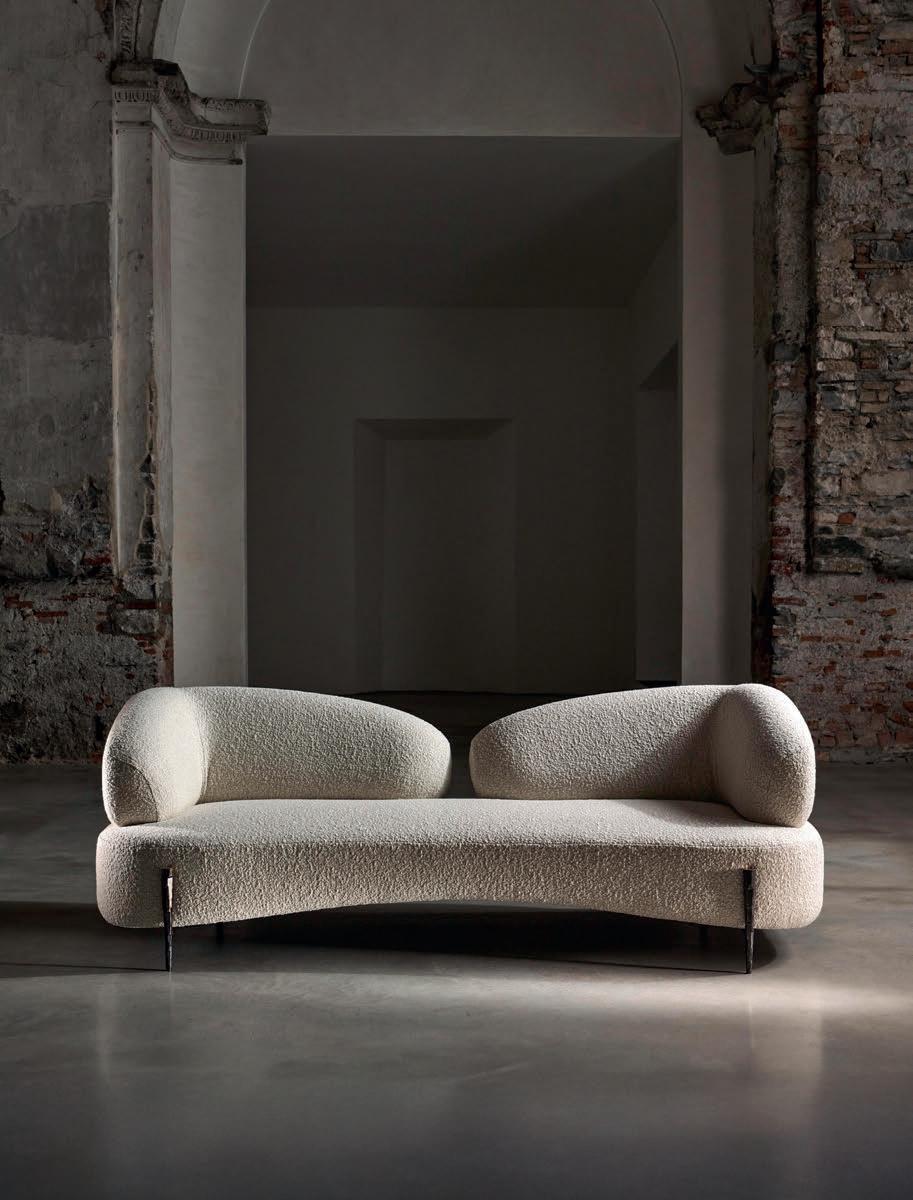
Edited by Carole Annett
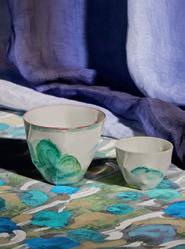
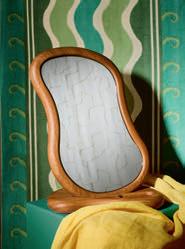

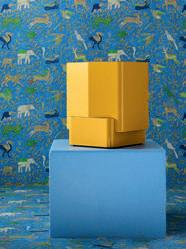
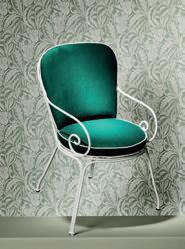
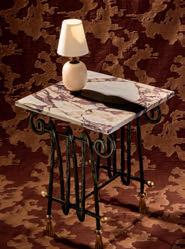

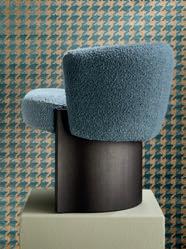
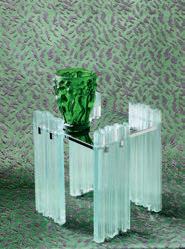
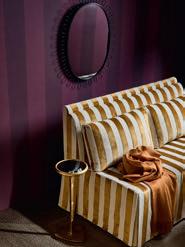
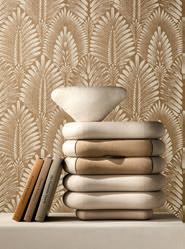
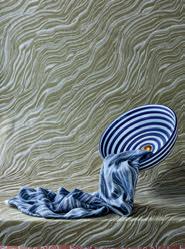
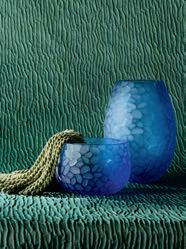




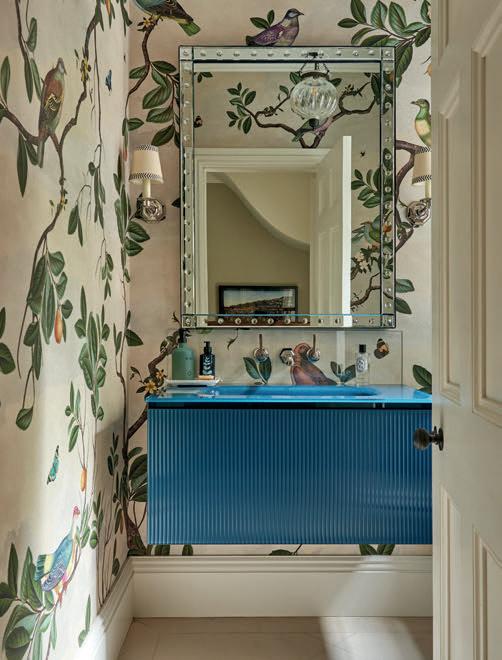



Spring is nally here, and with it an invigorating sense of renewal across the world of design and interiors. It re ects our own excitement at C&TH as we welcome new team members and a beefed-up interiors o ering. Busola Evans kicks things o with her round up of the recent Paris design shows, which sets the tone for the year ahead. From sculptural furniture to boldly textured materials, Paris con rmed creativity has no limits (p129)
I’m delighted to welcome Hatta Byng as contributing editor: her rst column suggests taking an honest approach to how a room is to be used, to maximise comfort before even thinking of colour and pattern (p142). I had the opportunity to chat with both artist Gergei Erdei, one of the design world’s exciting new faces (p158), and Sandrine Zhang Ferron as she celebrates ten years of Vinterior (p156). For house inspiration, take a look at how Paddy O’Donnell, an ambassador for Farrow & Ball, has used bold hues to create an upli ing backdrop to modern country life in Worcestershire (p148). And… drum roll please… don’t miss the new Design Emporium Collective on Fi h, just opened last week at Design Centre Chelsea Harbour, bringing together emerging brands and established names in a space that celebrates cra and collaboration. It’s a must-visit for anyone seeking inspiration and pieces with personality.

1. Enter the kaleidoscopic world of Adam Ellis at the new Design Emporium Collective on Fifth. dcch.co.uk
2. Exciting times at Joro with the launch of fabrics by Surface Studio. jorohome.com
3. I adore the beach-house vibe of Paolo Moschino’s Spire shell table lamp. paolomoschino.com
4. Pure elegance comes from this new Heritage Collection rug. jennifermanners.co.uk
5. Spring is calling: new Viretta tables designed by Sebastian Herkner for Janus Et Cie. janusetcie.com
Lastly, if you are an interior designer, do enter our annual 50 Finest Interior Designers (via countryandtownhouse. com now). The results are published in our C&TH Interiors special in July – this year reimagined and the not-to-bemissed interiors bible of 2026/7.
Here’s to a season of fresh perspectives, creative air, and homes that truly feel alive.
LONDON CRAFT WEEK
When: 11-17 May. londoncra week.com
THE DECORATIVE FAIR
When: 12-17 May and 29 Sept-4 Oct. decorativefair.com
WOW!HOUSE 2026
When: 2 June-2 July. dcch.co.uk/wowhouse/
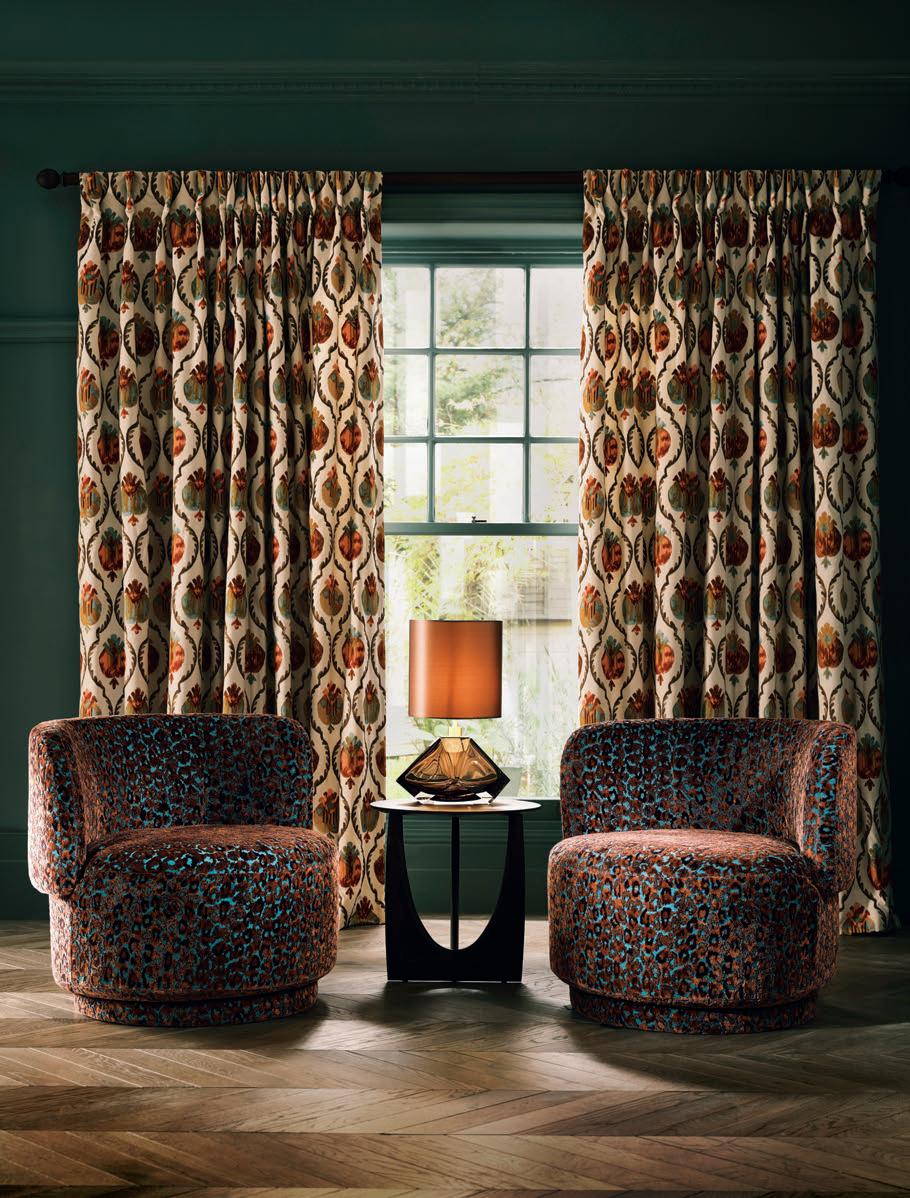
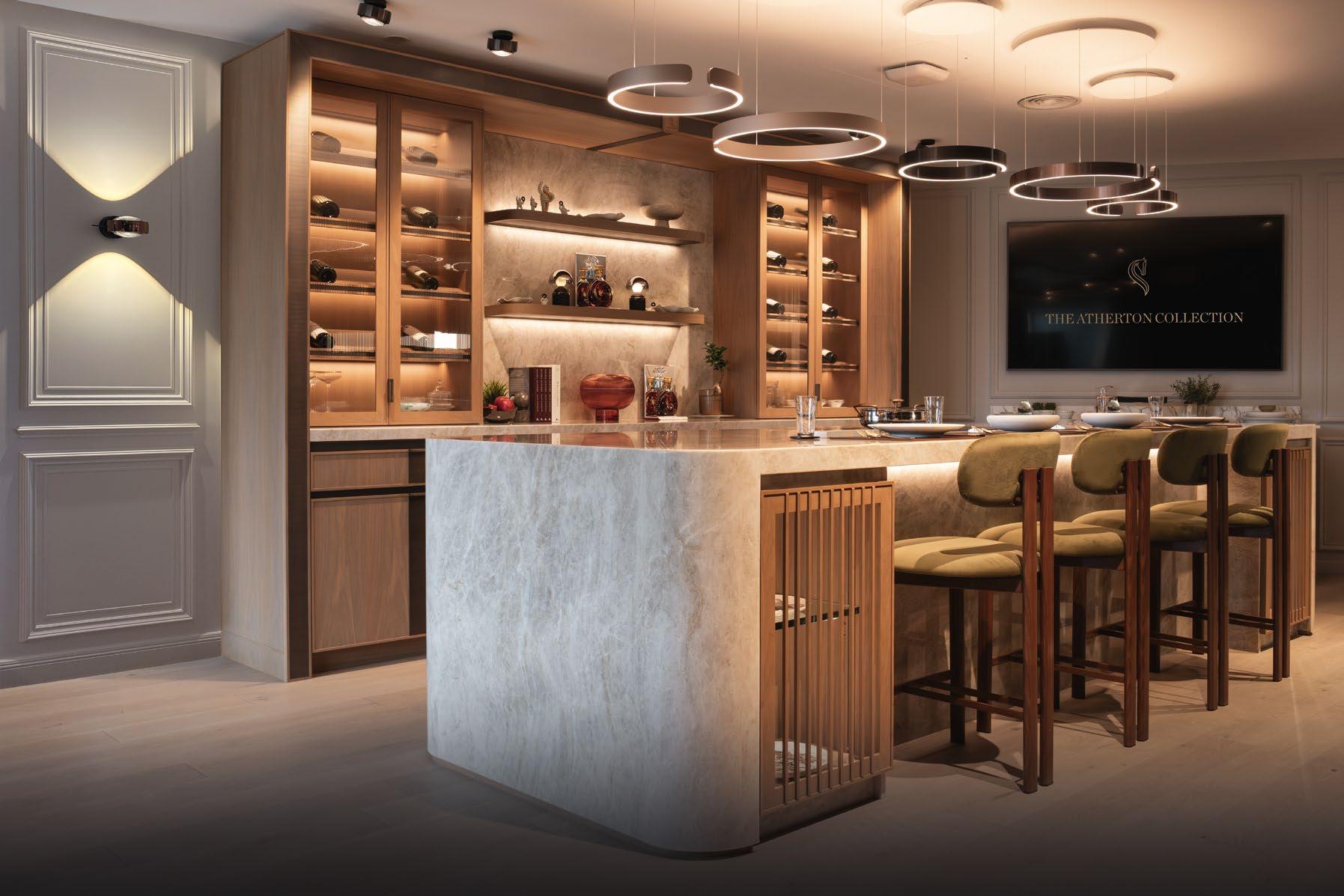





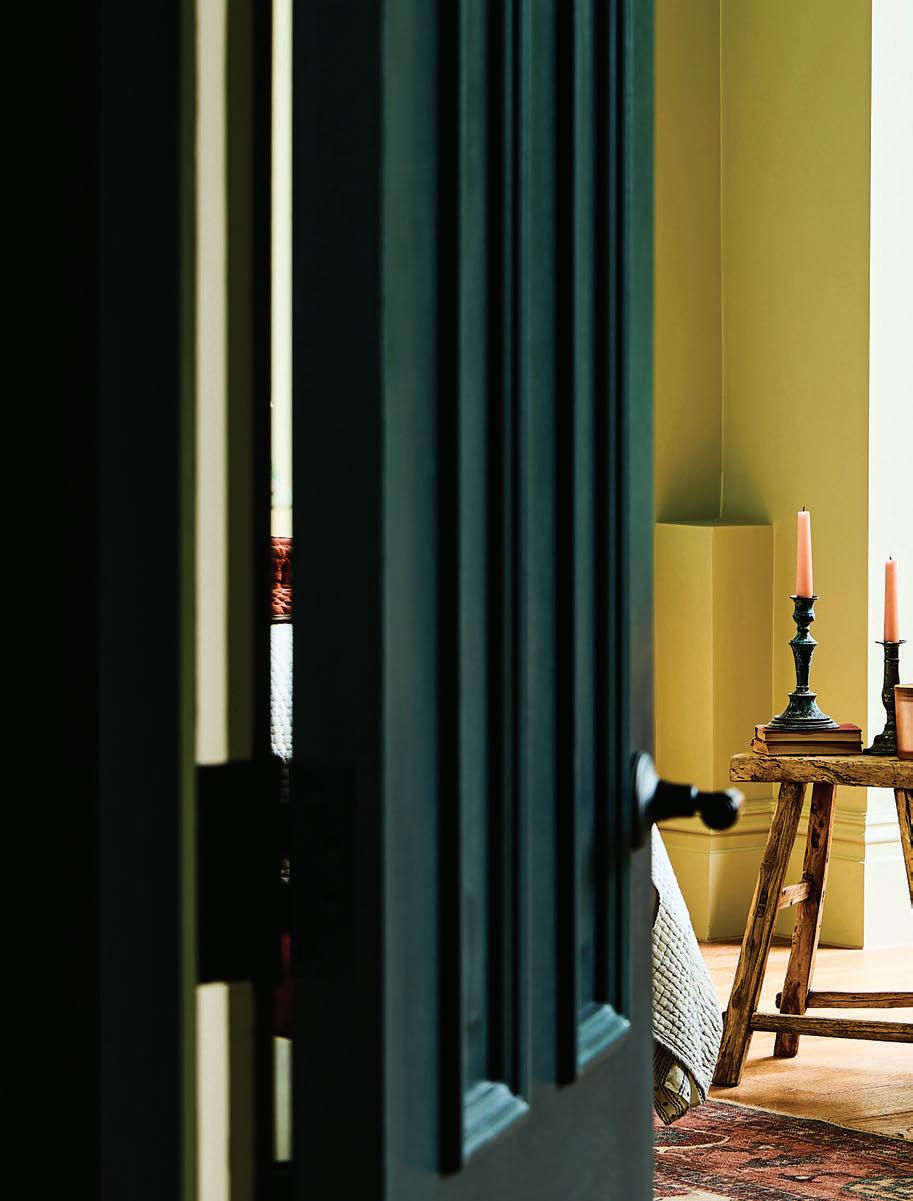
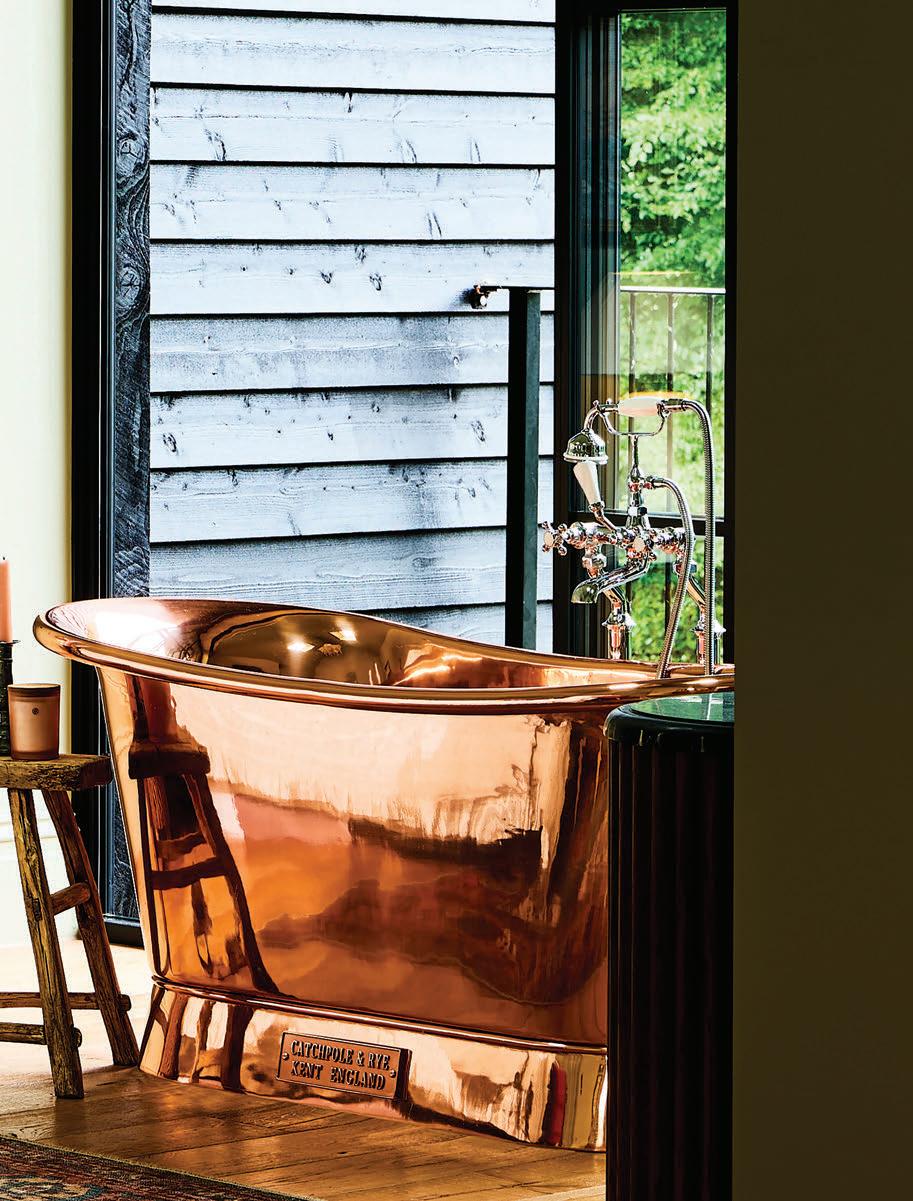



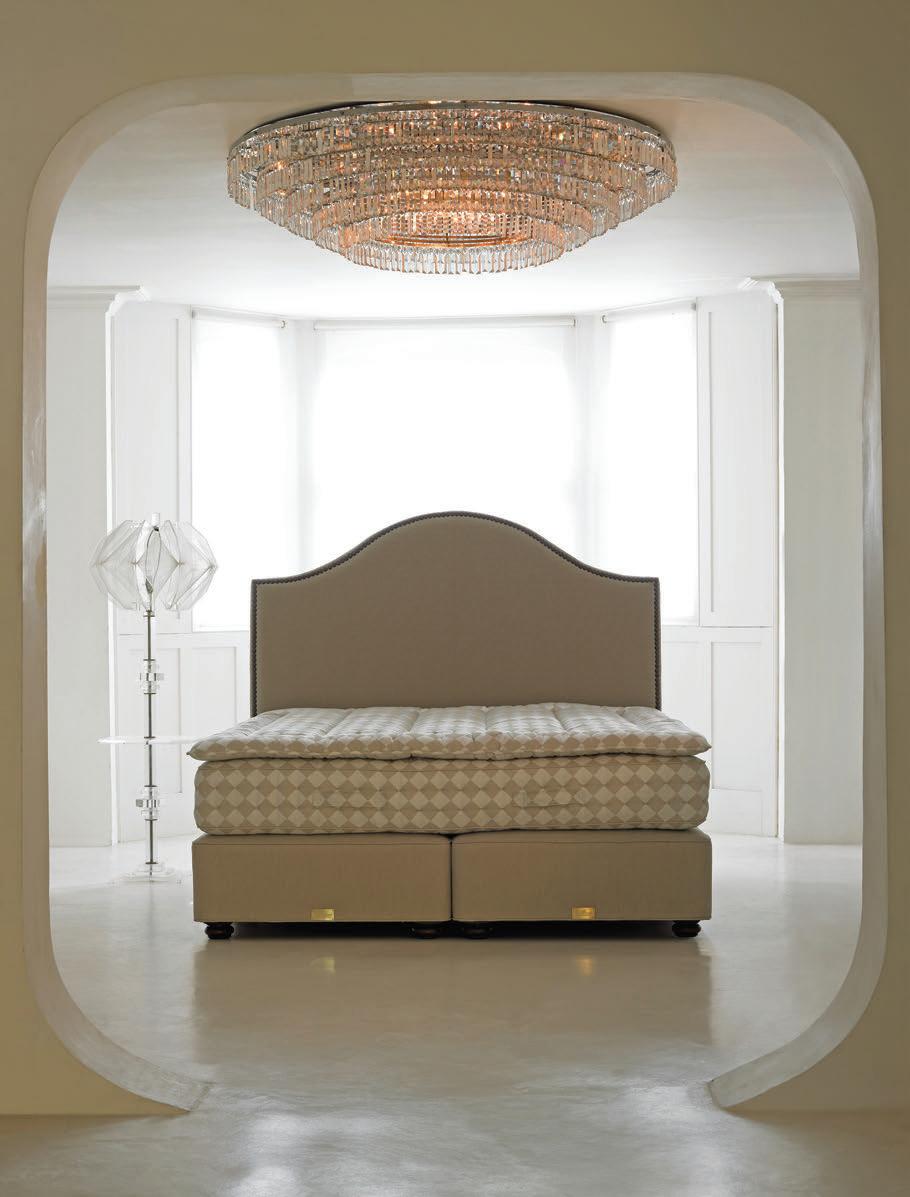
Busola Evans spotlights the best of Paris Déco Off and the design trends sure to shape the year ahead
For many of us, January is at best tolerated and at worst endured. But not so in the design world. In a month that is so o en about reining things in, Paris Déco O unfurls itself indulgently across the French capital and turns into a winter playground for interiors obsessives.
With more than 150 brands showcasing new collections of fabric, wallpaper, furniture and lighting in showrooms, galleries and private apartments, designers and design-lovers alike are treated to a delightful preview of where interiors are heading next.
This year the message was crystal clear: decoration is back at the centre of interior design, with cra and storytelling at its heart. We saw a surge in deeply textured surfaces from the likes of Arte, which unveiled a collection that includes 3D artistry. Soane Britain showcased traditional rattan weaving at the iconic Le Bristol hotel with a mother-and-daughter duo from their Leicestershire workshop, while elsewhere heritage techniques were reimagined through a contemporary lens.
Curvilinear shapes were recurrent, whether that was in lighting or furniture. On the walls, the mood was expressive with scenic murals and botanical designs, including Little Greene’s new In The Garden wallpapers, a collaboration with the National Trust. Colour also played a crucial role, with less emphasis on neutrals; instead, warm earthy tones – o en layered for depth – appeared across numerous collections.
Perhaps most striking was the focus on narratives and personal stories. Maison Lelièvre made a memorable statement with Escales Lointaines, a collection inspired by far- ung landscapes where basket weaves and subtle metallic threads evoke a sense of travel. Like many o erings, it invited homeowners to create spaces that feel lived-in, a shi that aligns with a wider movement across the design world this year where authenticity and cra smanship is prized over eeting interiors.
Here is what to expect in 2026 and beyond…
Walls were anything but at this year and Arte led the charge with seven new designs that invite you to touch. Memphis is a collection of 3D wallcoverings inspired by architectural masterpieces and natural wonders from Ancient Egypt, while Corium includes wallcoverings in hand-stitched nubuck leather and a satin leather nish base with hand embroidery. The textured mood was also emphasised by Paris-based online furniture brand Monde Singulier, which created an installation of blue faux fur-clad walls to mark its collaboration with design studio NECCHI Architecture.
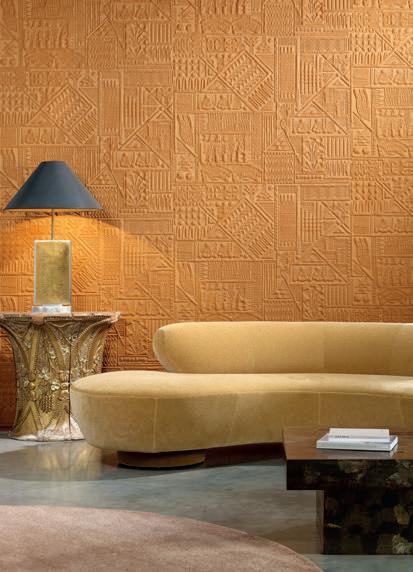
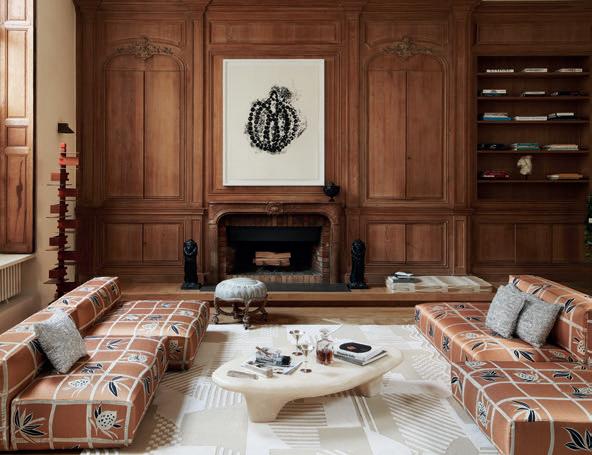
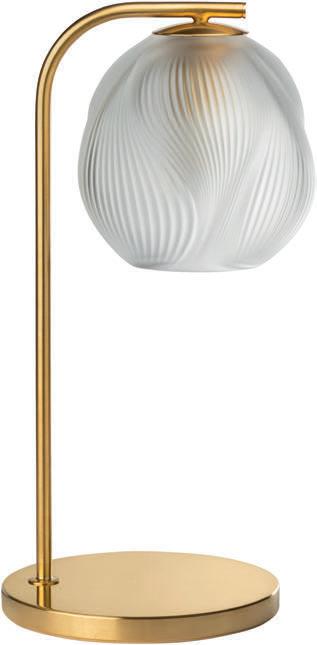
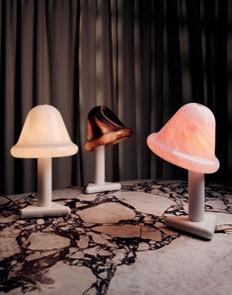
← CACAO AND WARM RUSTS ARE THE COLOURS DU JOUR
If beige once reigned supreme, Paris Déco O con rmed that brown is its richer, more interesting successor, creating interiors that feel grounding and comforting. At Pierre Frey, its new indoor-outdoor collection Bar eur has graphic motifs in woody tones; Schumacher’s Atelier Paris features the reversible Skyline Stripes in Americano, Dune and Burnt Orange; and Nordic Knots showcased its signature Grand collection in Pecan. Loro Piana explored tobacco and chestnut hues in re ned cashmere blends, proving that brown, when handled expertly, is anything but dull.
Lighting has never been just about illumination. This year calls for lamps with a striking presence and soft rounded shapes
← LIGHTING GOES ROUND
Lighting has never been just about illumination, and this year calls for lamps with a striking presence and so rounded shapes. One of the standouts came from Lalique, which previewed its forthcoming lighting collection Alizé, including table lamps, wall sconces and ceiling installations. Created from crystal, the pieces give the illusion of pleated, so fabric. Bringing in a playful element is the new collaboration between British lighting brand Original BTC and Buchanan Studio. The handcra ed glass shades have a swirling marble e ect and sit on a triangular base with a humorous tilt to the side. They look good enough to eat, thanks to their delicious trio of colours – strawberry, vanilla and chocolate.

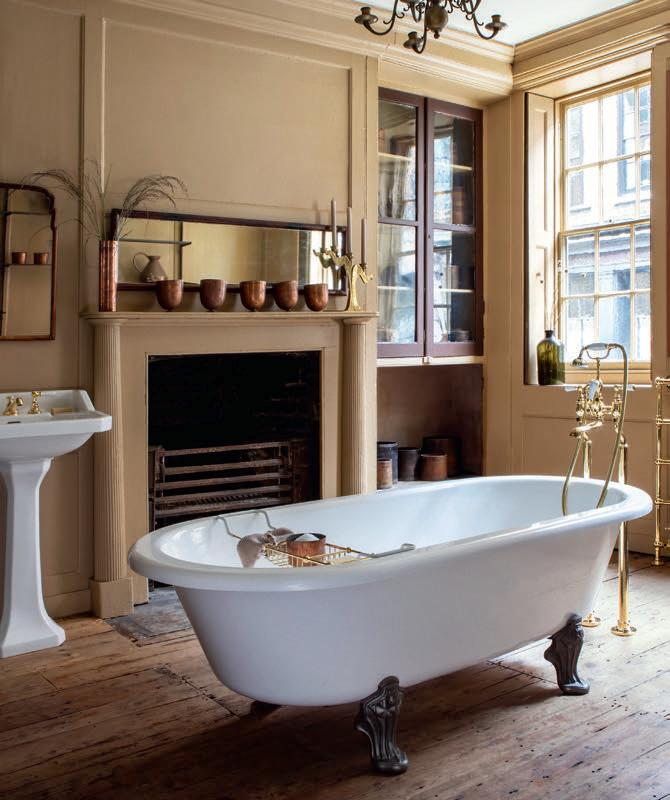
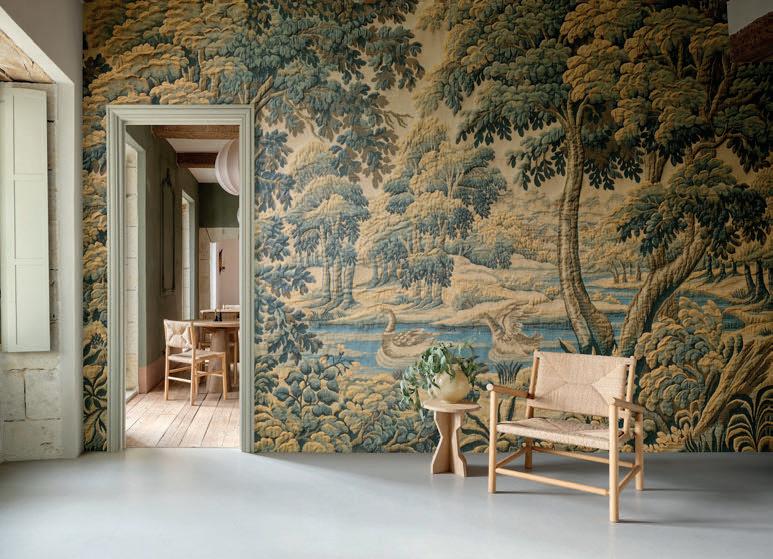
Tapestry was at the heart of Déco Off, redefined for modern interiors
Tapestry was also at the heart of Déco O . Arte’s Les Tapisseries takes in uence from sumptuous wallhangings in the castles and manor houses of the 14th- to 18th-centuries and rede nes it for modern interiors. The Floraison, for example, is designed a er an original 18th-century tapestry from Aubusson while the Bucolique was inspired by a 17th-century tapestry depicting an idyllic scene in which two elegant swans take centre stage. Iksel’s new collections include Patinir Landscape, which also nods to tapestry roots.
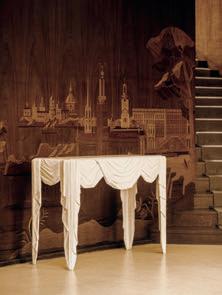
Drapery came o the windows and onto centre stage with so and gathered folds echoed across various forms. Cue London-based Gergei Erdei who unveiled his new collaboration with lighting and furniture-makers Porta Romana. The Teatro wall light and console are inspired by the spectacle of Roman palazzos and theatres. Made of cast composite, each piece is individually handcra ed from a prototype originally draped from fabric. Meanwhile Phillip Je ries’ new mural wallcovering, Drama, features large-scale drapery folds in Trompe-l’œil style.

British Design and Craftsmanship, creating pieces of lasting beauty


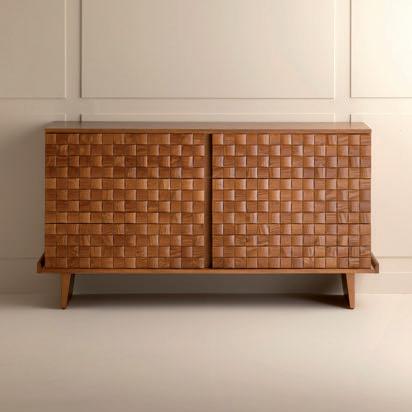
Heritage was a recurring theme at Déco O and a case in point is Liberty, which has unveiled The House of Liberty wallpaper collection, inspired by more than 60,000 archival designs, to celebrate the brand’s 150th anniversary.
Luxury fabric house Tassinari & Chatel introduced two historical designs, Les Roses and Dahlia Perlé, re ning the scale and so ening the colour to suit the current mood. And at French design gallery Ecart, Pierre Yovanovitch has reissued a collection by American-Hungarian designer Paul László, including his 1950s Avondale sideboard.
Velvet has shed its delicate reputation and is emerging tougher and more tactile than ever. The new velvet is truly designed to live with – robust yet still luxurious. This shi was embodied by Zinc Textile’s collaboration with Dieter Vander Velpen, an Antwerp-based architectural and design rm, which imagines velvet with a sculptural edge. Dense piles, elaborate ribbing and deep tones give the fabrics a sense of weight and presence, proving that so ness and strength can happily co-exist.
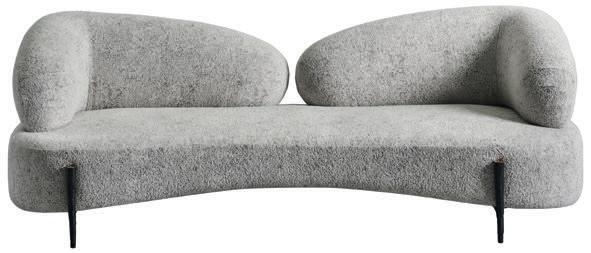
Furniture was increasingly shapely as seen with Tom Faulkner’s Cloud sofa – the maker’s rst foray into so furnishings – which made its Paris debut at a pop-up on Rue de Seine. Its organic shape is inspired by the rocks that line the beaches of north Devon, an area Faulkner returns to o en. Nearby, Ginori 1735’s Domus collection, designed by Luca Nichetto, came with an architectural edge. Its pieces include the LaVenus chair which fuses classical references with contemporary curves.
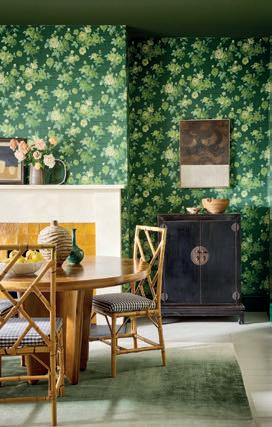
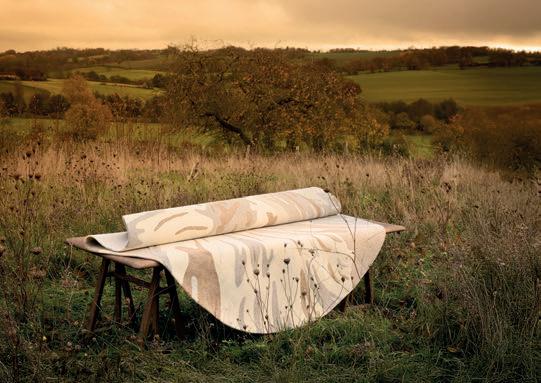
the predictable, led
→ WHIMSICAL WILDLIFE
COMES ALIVE
Storytelling took a sense of purpose as seen with Jim Thompson’s Wild, a striking new textile collection created in collaboration with architect and conservationist Bill Bensley. Inspired by the lush biodiversity of Cambodia’s Cardamom Mountains – one of Southeast Asia’s last great unfragmented rainforests – and its endangered wildlife, the collection translates Bensley’s bold, panoramic illustrations into richly detailed fabrics for both interiors and outdoor spaces. Part of the proceeds go to the Shinta Mani Foundation to help fund their conservation and wildlife projects in the Cardamom rainforest.
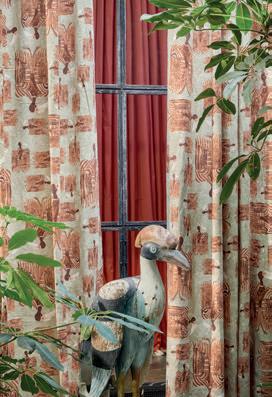
↑ FLORALS, REIMAGINED
Florals took a con dent step away from the predictable, led by Little Greene’s In The Garden collection. Created in collaboration with the National Trust, the eight eclectic wallpaper designs have been drawn from grand gardens, individual plants and historical oral artefacts. The collection includes Rose Garden, which is inspired by the walled rose garden at Mottisfont Abbey in Hampshire. In addition, French designer Sam Baron continues to explore the oral motif in a new collection with his longterm collaborator, luxury carpet makers Tai Ping. The Floræ Folium series is made of ten rugs developed in di erent shapes and features petals and foliage in various forms (available in the UK from May).
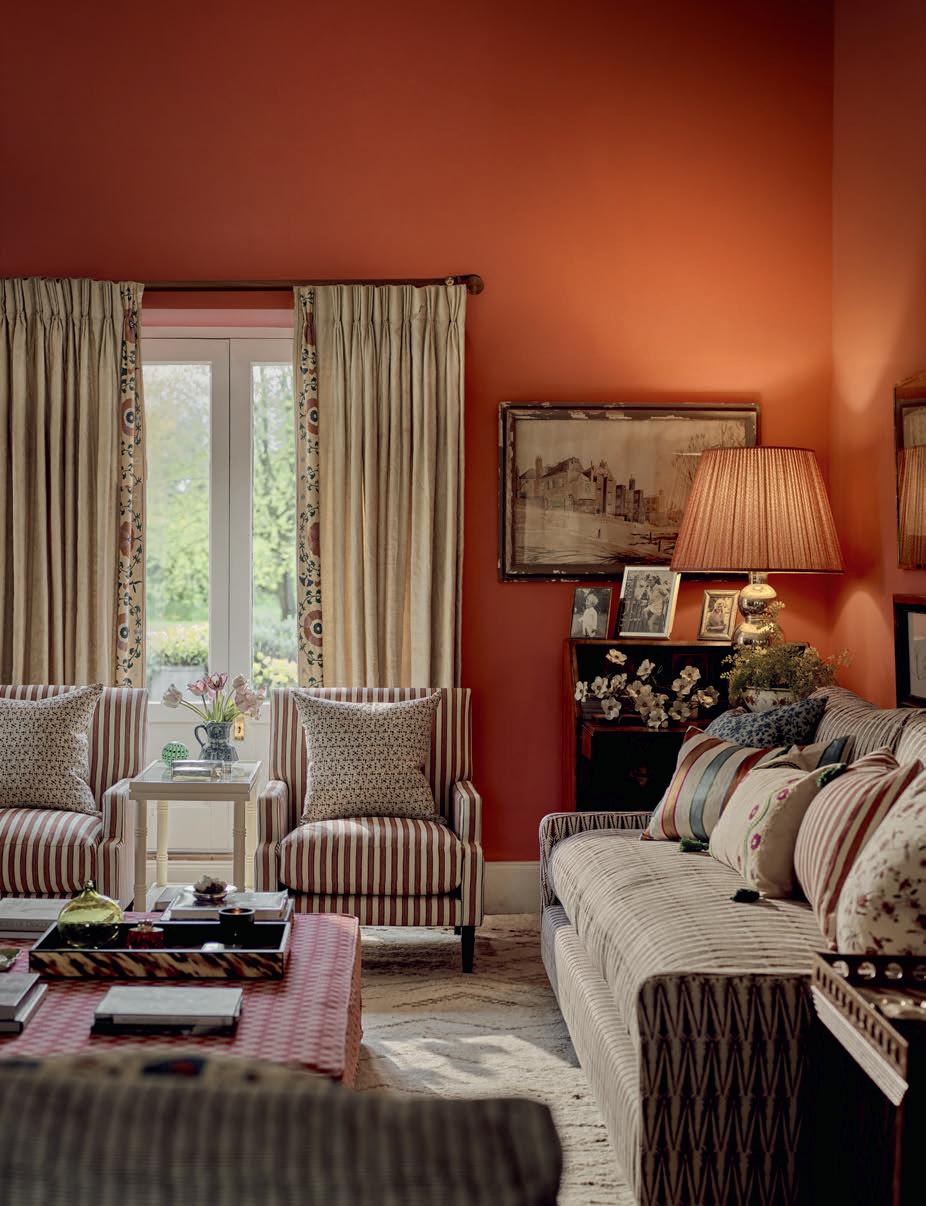
Boura & White, West End Flower Farm, Alton, GU34 4JG bouraandwhite.co.uk info@bouraandwhite.co.uk @bouraandwhite & The Design Emporium Collective, Fi h Floor, Design Centre East, Chelsea Harbour, London, SW10 0XF
→ THE THRILL OF THE FRILL Trimmings enjoyed their moment in the spotlight, thanks to a lively new launch from Samuel & Sons, in collaboration with celebrated interior designer Martin Brudnizki and his And Objects co-founder Nick Jeanes. Inspired by the romanticism and artistry of the Pre-Raphaelites, fringes, tassels, borders, and rosettes are treated as design statements in their own right. Drawing on Brudnizki’s theatrical yet disciplined aesthetic, the collection, called Romaunt, plays with scale, texture and colour – from oversized bullion fringes to graphic borders designed to frame upholstery, drapery and walls.
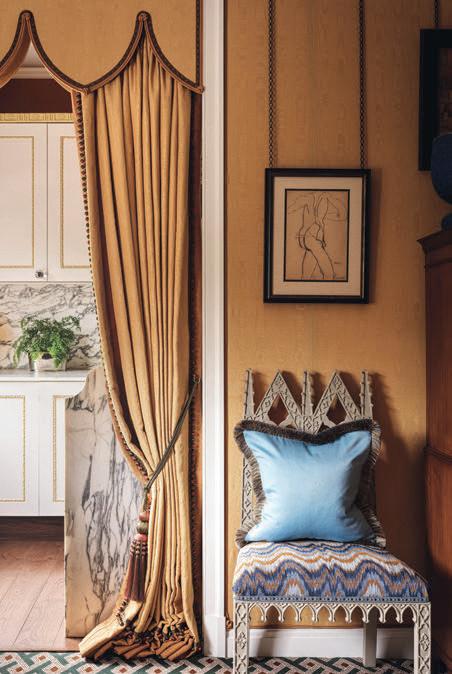
Embroidery emerged as a key theme, signalling a renewed appreciation for detail and cra smanship. The muchanticipated second collaboration between GP & J Baker and Kit Kemp draws on the brand’s rich archive while infusing it with Kemp’s unmistakable sense of colour and pattern. Playful embroideries in lively hues give the collection a fresh, contemporary twist. At Ralph Lauren Home, the new Meadow Lane collection introduced delicately stitched orals and motifs, while there was intricate embroidered wallpaper at de Gournay. ■
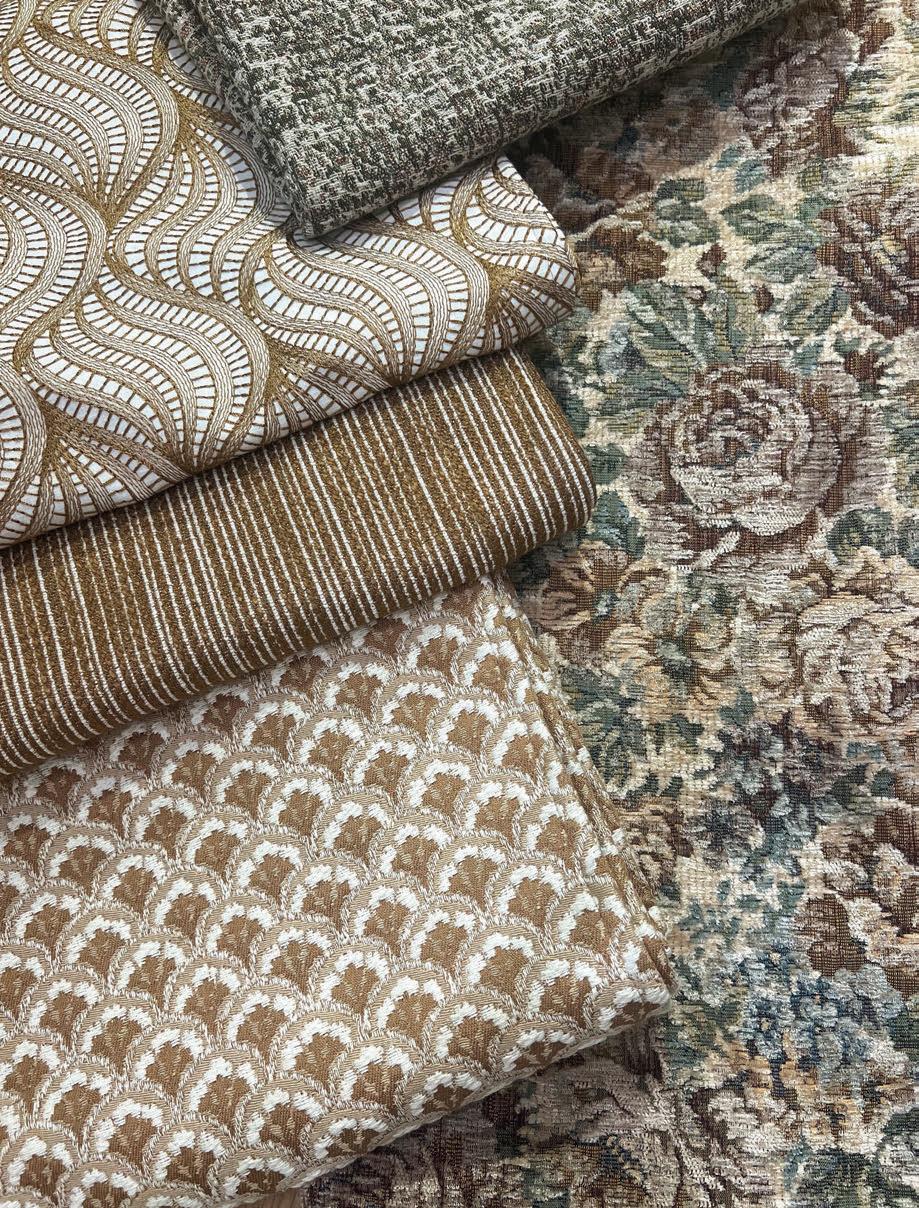


Hand-knotted rugs inspired by England’s finest homes
Forget Insta-perfect rooms – it is how a room makes you feel that matters, says Hatta Byng
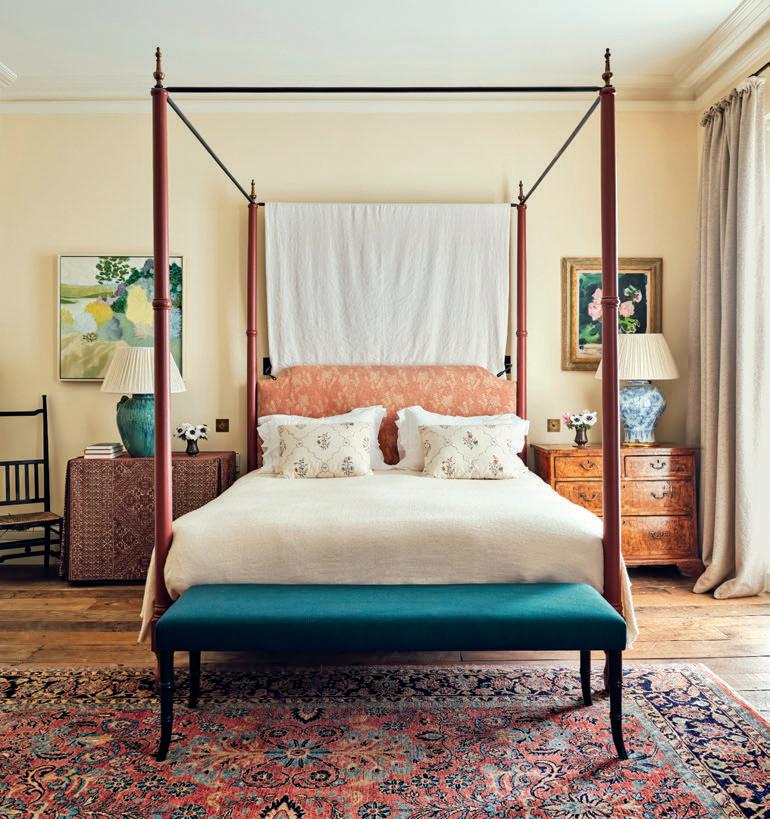
With the excitement of a new project it’s all too easy to get swept up in choosing paint colours and pulling together Pinterest boards of glorious inspiration. But have you really thought about whether your room is actually going to work for your needs or – more nuanced but equally vital – how it will make you feel?
Of course beautiful things give us pleasure and make a room inviting. But as designer Rita Konig urges in her course for Create Academy, we must start with being honest with ourselves as to how we will use a room and what sort of life we lead. You may have visions of yourself sipping cocktails with friends on your white linen sofas in an elegant drawing room, but if you live in a small at with two young children who are also using the space, it is not going to work. It will be deeply disappointing when sticky hand prints appear on the sofa and you are tripping over bits of Lego more o en than you are enjoying a dirty martini. When I ask designer Lucy Hammond Giles – who to my mind creates very beautiful, special rooms – if there is ever a case to put aesthetics before comfort she replies emphatically ‘never’. She is adept at nding the most elegant – or fun – solutions for the trickiest problems.
Obviously one person’s idea of comfort can be very di erent to another’s. Veere Grenney talks about the importance of harmony and balance in a room and its e ect on its inhabitants. Others want colour,
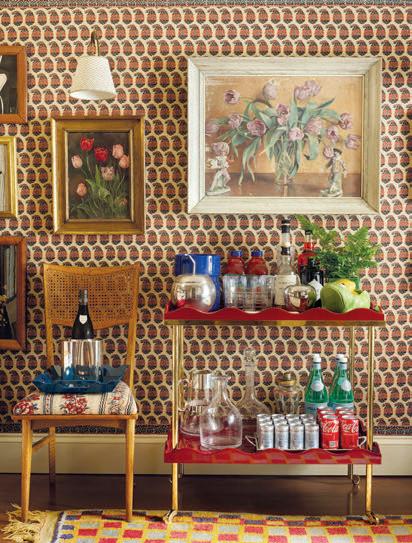
‘An ugly table can be jolly useful,’ says Rita Konig. ‘It is better to have an ugly table than nowhere to put your drink.’ So don’t get rid of your less-loved furniture too quickly
patterns and layers to feel cocooned and nurtured, things which make the architect William Smalley, who strives for ‘quiet’ in the buildings he creates, feel positively uncomfortable. But while Smalley may prefer more pared back interior design, comfort is still vital. ‘Possibly the whole point of architecture is to provide comfort, to make spaces that are comfortable to be in and answer the simple question for a client: “Do I like being here?”’ He suggests everyone needs a window to sit at. ‘In fact I think more architecture should be about sitting at windows.’
I am a huge admirer of the peace Smalley creates within his buildings. But I realise where I feel most comfortable, most ‘at home’, is in a rather di erent sort of room – lying legs up on a shabby sofa in front of a roaring re, watching telly with our dogs curled up beside me. The size of the television (chosen by my husband) is a constant source of angst and in the cold light of day the sagginess of the sofa irks me too. It is far from perfectly decorated but there is comfort in the fact that I really don’t worry about the dogs or the children doing whatever they want in this room. And the overall feeling of the room – if you avert your eyes from the television – is one of prettiness and warmth. The wallpaper is Camellia – a muted oral – by Flora Roberts for Hamilton Weston and it makes me feel happy and
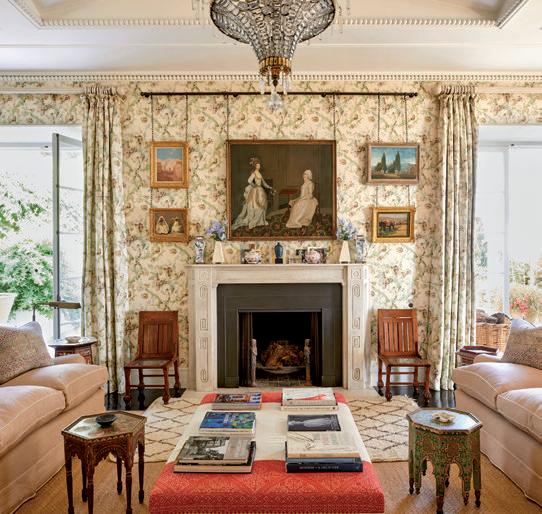
the curtains are made of a wonderfully so cotton check that a friend kindly had woven for me in India. It is – to answer Konig’s brief – a room that works for us, and – to answer Smalley’s – it makes us feel good.
While this all may sound intangible, there are some obvious stepping stones to comfort. ‘Start with the furniture plan’ is Konig’s mantra as it becomes the building blocks for everything else. Making sure there are enough places for guests to perch in your sitting room (be that a sofa, a fender or the ottoman), ensuring there is somewhere to put a drink and a lamp where you need it and so on, are all considerations that make a room work. ‘An ugly table can be jolly useful,’ Konig points out. ‘It is better to have an ugly table than nowhere to put your drink.’ So don’t get rid of your lessloved furniture too quickly.
Hammond Giles draws my attention to the fact that lighting is also key to how we experience a room and a useful tool for manipulating mood. You must make it work for how you want to use a room, she stresses. Too much light is uneasy making, and too little light to
read a book in your chosen armchair is infuriating. She advises having layers of lighting – lamps and wall lights, and a sparing use of overhead lighting – on di erent circuits that can be turned on and o as needed. And warm bulbs (2200k to 3000k), always.
Obviously at a certain level, comfort can cost a lot of money: cashmere throws, ne Italian linen, down llings for cushions. Hammond Giles suggested a mix of feather and down when she helped me with our smarter sitting room. It is double the price of standard llings though, so sadly in the end only one sofa got such luxurious treatment. There is no doubt, however, that if people are with us for any length of time, this is the one they gravitate to.
Budget aside, the simple message is that an Instagram-worthy room is no good at all if it is uncomfortable. Work out what you want from a space, how you will use it, and what makes you feel happy before you start picking up the paint chart or gathering fabric swatches. Comfort – be that the sofa you sit on or the feeling you get as you walk into the room – is crucial. ■
↑ ARBITERS OF STYLE
Capturing modern French sensibility through 21 of the top Paris designers working today, from rising star Marine Bonnefoy to Jacques Granges and Jean-Louis Deniot. (Phaidon, £54.95)

↑ THE ENCHANTING INTERIORS OF BUNNY MELLON
A gem of a book. Mellon had a unique way of mixing great art with informality and the very personal to create magical places. (Rizzoli, £45)

↑ THE HOUSE RULES For anybody restoring an old building or historic home, this book by the talented, ne-artist trained, interior designer Patrick Williams, should be your bible. (Quadrille, £40)
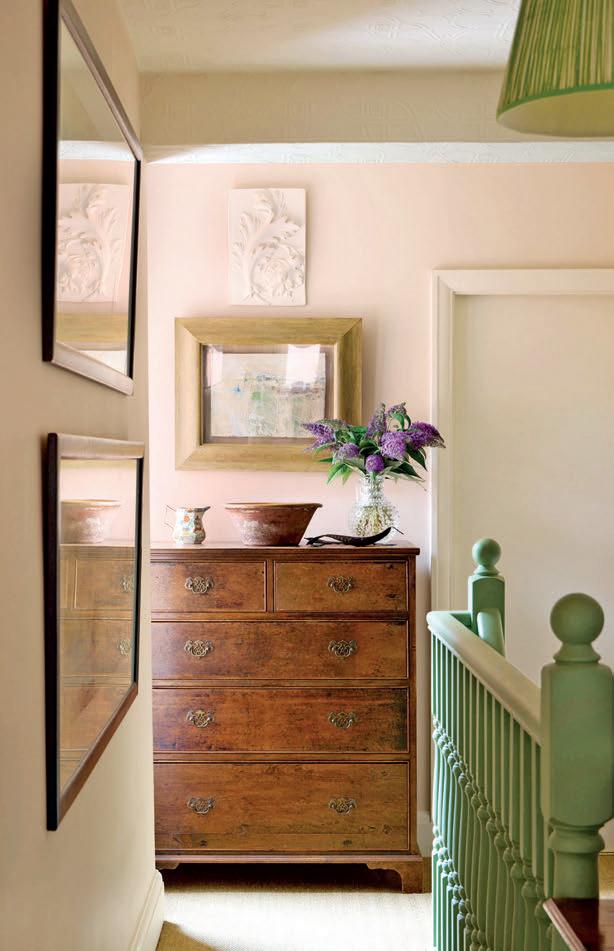
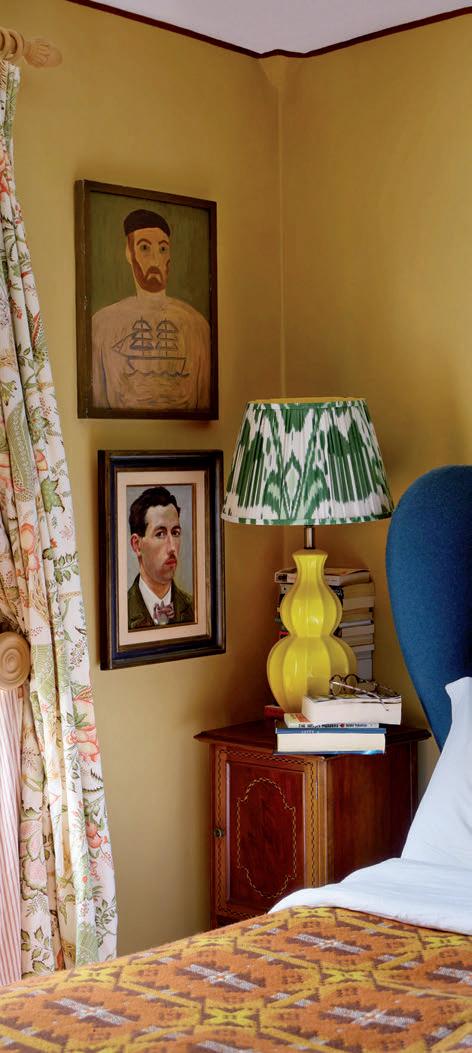
NEAR LEFT: The yellow in the bedroom is Cane from the F&B archive palette. ‘It’s a good foil for all the overscaled brown furniture and truly comes into its own as the nights draw in but is cheerfully sunny on brighter days.’
FAR LEFT: The hallway paint is Pink Ground by F&B. ‘I wanted something gentle but with a little warmth, as the space is all diffused light coming in from other rooms.’
Interior consultant Patrick O’Donnell is incredibly skilled at doing decorator-y things for less. He never takes things too seriously in a room – a Nancy Lancasterism – and the way he hangs art and objects on walls creates playful architecture where there might not be any. Look up in his warm and cosy Worcestershire home and you’ll see plates exhibited above doorways. Art, candle sconces and brackets are arranged on the wall in a way that sets a tone of togetherness through precisely chosen colours – a language he understands so very well as a brand ambassador for Farrow & Ball.
Turn a corner in O’Donnell’s house and the interior scenery changes. Chromatic values shi , open up, and suddenly invite new patterns, furniture and energy. For visitors, it becomes a curated and comforting maze to explore. Almost too much, and de nitely not too little. Though colour is his life, O’Donnell stands by the notion that ‘di erent looks will naturally dictate di erent palettes and considerations’. He encourages clients to think very deeply about their aesthetic ambitions for a room and all the elements to be used in the space, from ooring to fabrics, tiles and more. The vibe will a ect how colour appears; the same colour will feel di erent in a more minimalist room than in a layered, textural space full of pattern and print. Ultimately, O’Donnell suggests bringing in colour later in the design process. ‘You don’t want to be constrained by your colour choice. I always talk of colour in the room as the glue that unites everything, rather than the star of the show.’
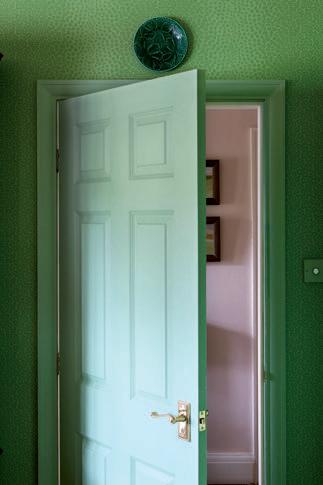
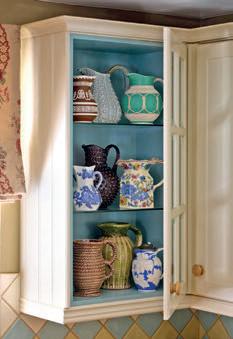
‘You don’t want to be constrained by your colour choice. I always talk of colour in the room as the glue that unites everything, rather than the star of the show’
Patrick O’Donnell
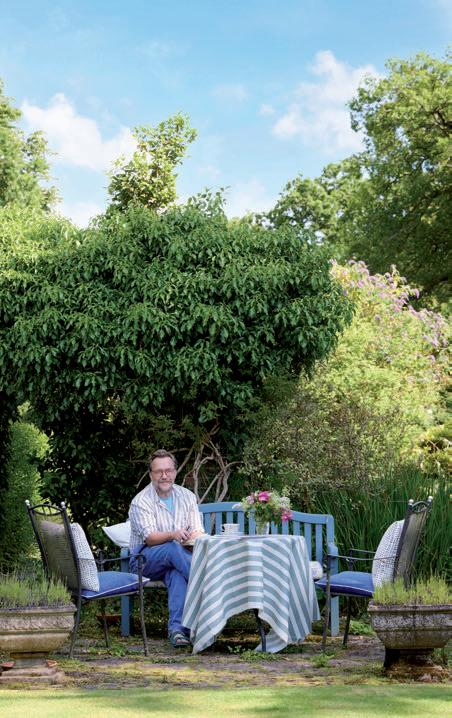
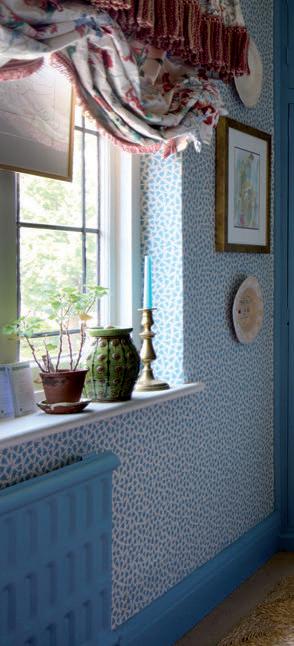
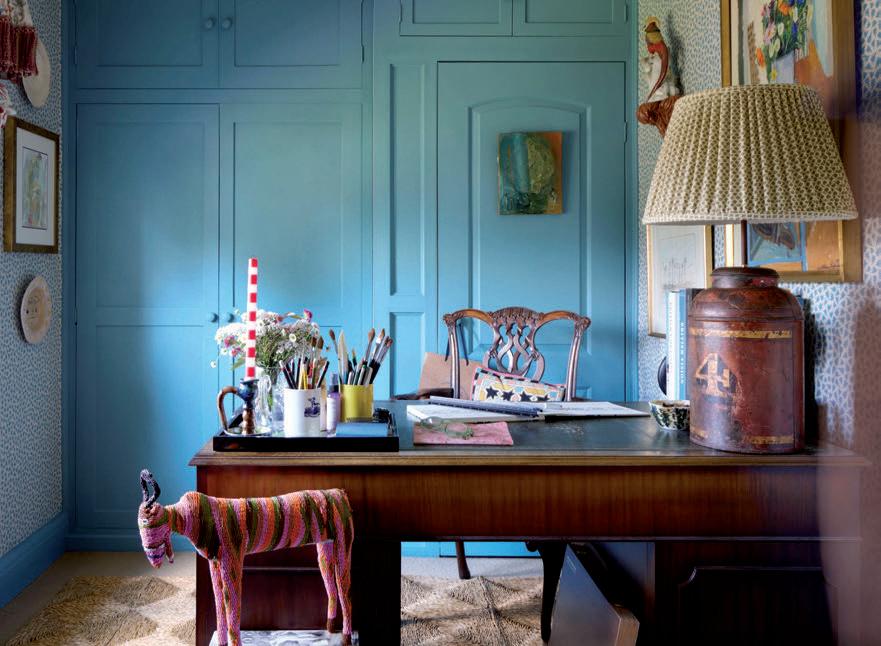
Save colour for last... The rooms people decorate for themselves tell very personal stories, and colour doesn’t need to dictate the narrative from the get-go. Colour is also very personal, but save it for last to give you more freedom with everything else.
Focus on the undertones in white paint... When choosing colours, use whites that share a similar undertone to the wall colour or vice versa.
Be adventurous... Bolder colour choices can be great fun, especially with the h wall, aka the ceiling. No longer an a erthought, the ceiling is very much part of the decorating repertoire. At the more subtle level, painting in a white that complements the wall colour or going o -piste with a bolder accent colour
done well can be a triumph, and makes a wonderful design statement. You can even mix up the nish, using full gloss instead of the go-to emulsion like at or eggshell.
Zone in... If the room contains a niche for books, china or a piece of sculpture, adding a colour within the niche will help the piece shine. On a bookshelf, consider applying two colours, one for the exterior framework and a contrasting colour on the interior. Beyond creating visual interest, it is o en just a subtle consideration when shelves are dressed with books and objets.
How to get colour to ow in your living spaces... Pin down a colour family – this is a grouping on most colour cards from a paint manufacturer. Pick out some
stronger colours that complement the chosen family to avoid the space feeling too bland.
Three principles for using colour... Lighter woodwork and darker walls. Darker woodwork and lighter walls. One colour all over, aka colour drenching. ■ The Layered Home by Benjamin Reynaert is published on 17 March (Clarkson Potter, £30)

↓ NINA CAMPBELL
Wisteria Walk linen from the Bourton collection, launching 8 April, by Nina Campbell for Osborne & Little, £95/m. osborneandlittle.com
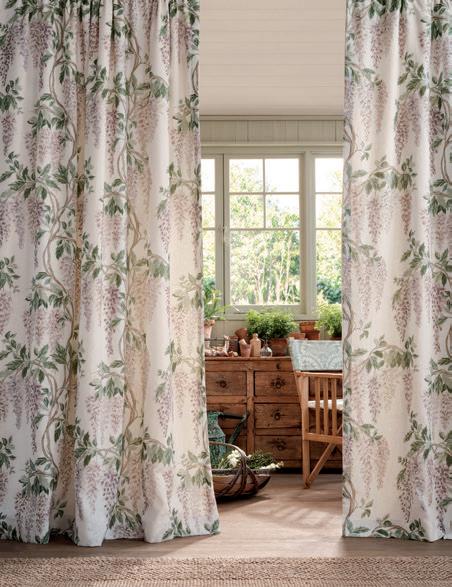

↑ CHRISTOPHER FARR
German artist Olaf Hajek is known for creating scenes where nature and arti ce are combined. On designing a fabric collection for Christopher Farr Cloth, he says, ‘It was joyful to do something more abstract while staying within the idea of something oral and natural. The design celebrates the beauty of form itself, beyond realism, between order and playful liveliness.’ Dancing Vines linen, £195/m. christopherfarrcloth.com
Florals for spring?
Carole Annett takes her pick
↑ BOURA & WHITE
Sophie chair, £1,812; upholstered in Ayanda Floral by Vanrenen Hanbury, £3,132. bouraandwhite.co.uk
↑ KATHRYN IRELAND
Bukhara Suzani from Jewels of the East collection, £453.60/m. tissusdhelene.co.uk


















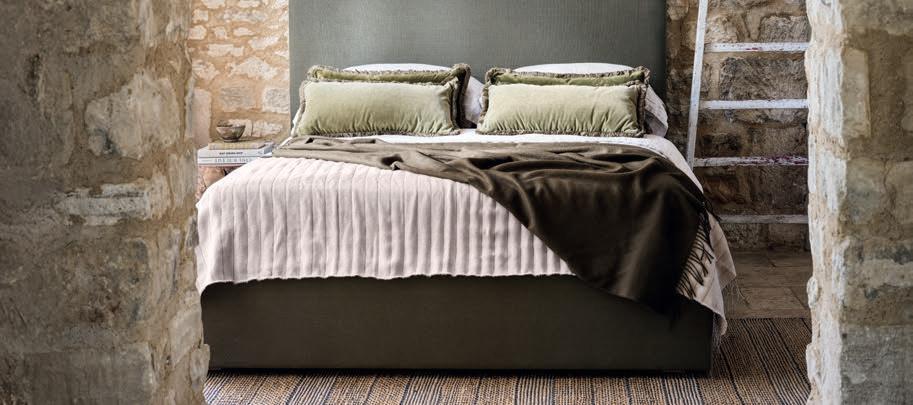
Most mattresses promise the perfect night’s sleep. But they can’t. Not when they’re made from synthetic materials that trap heat, restrict airflow and disrupt the very thing they promise.
At Naturalmat, we promise something different. All our beds, mattresses and bedding are made from natural, organic and sustainable materials. Handcrafted in our Devon workshop, offering you breathable, supportive, healthier rest that others try to imitate, but only we can deliver.
It’s a promise we’ve kept for over 25 years. And one we’ll continue to keep, because great sleep starts with what you’re sleeping on.
local. sustainable.
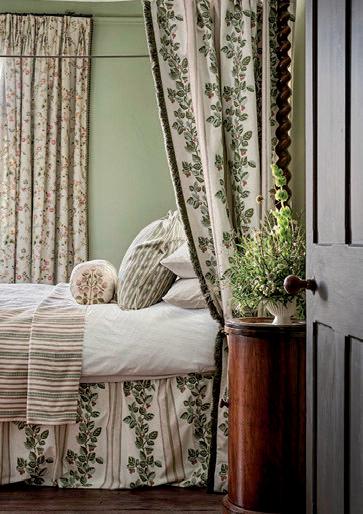
EVITAVONNI →
Inspired by the romance of the English moors and named a er Jane Eyre ’s Thorn eld Hall, this richly woven jacquard velvet is layered with painterly blush, damson and so enedgreen roses. Thorn eld in Rosewake, £360/m. evitavonni.com
Sanderson introduces its second collaboration with the National Trust, celebrating Brockhampton Estate in Herefordshire. Marking 600 years of the estate, the collection draws on Brockhampton’s living heritage, from its medieval manor to its ourishing orchards. A percentage of the sale of the collection goes to the National Trust. Bed curtains, Cobnut Stripe, £90/m, with Sanderson Norton fringe, £40/m; throw, Barneby Stripe, £74/m. All from Sanderson x National Trust Volume II collection. sanderson.design
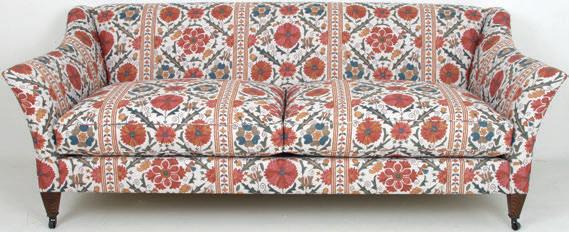
↑ COLEFAX AND FOWLER
Kingcome Fairfax sofa upholstered in tamarind and antique red, £8,145. colefax.co.uk












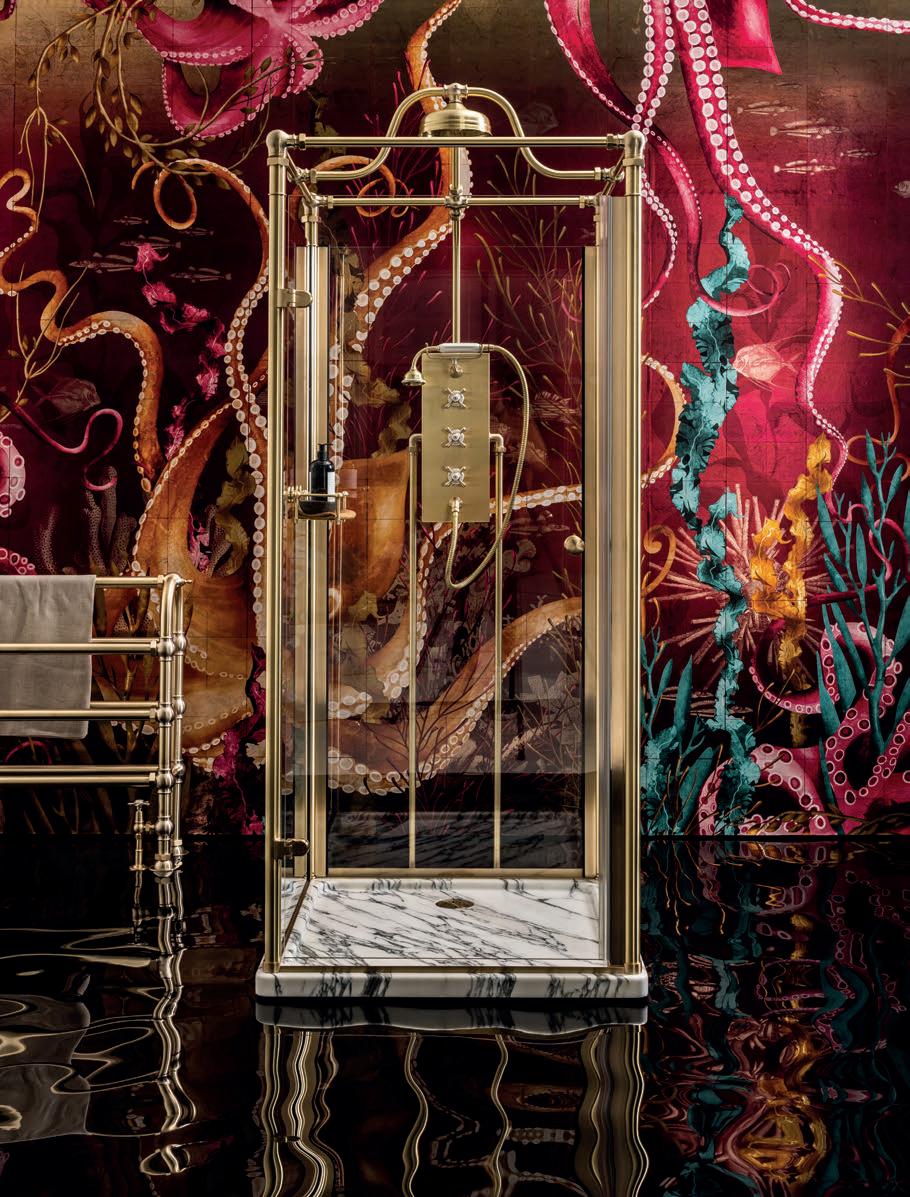
Sandrine Zhang Ferron
Remind us how it all began? I had a very good job in nance but I wanted a challenge, something exciting. We had just moved from a at in Shoreditch to a Victorian house in Islington, our forever home. There is so much great quality furniture out there, but it takes so much time to nd it. I thought, let’s do something about it.
You taught yourself to code. Why? I like to learn. And I’m really glad I took that decision because we are a tech business. Tech is fundamental to how we create a better experience for our clients.
Who is Vinterior for? We work with interior designers, hospitality groups, property companies but the majority of our customers are people who really care about their home. They want design that will last, and that is di erent.
Has demand changed over the decade? When I started talking to investors, everyone said, ‘That’s so niche’. They thought it would be just for collectors or antique a cionados. But consumer behaviour has shi ed dramatically. Buying secondhand is now desirable.
What’s been key to making that shi work? Trust. It’s a critical part of the company. People have been burnt. From day one, we focused on vetted professional sellers and on quality and authenticity. Buyers hate bad surprises.
Are people willing to buy expensive furniture unseen? Yes, and that was surprising. Buyers of all ages are willing to spend four or ve gures on designer pieces. Recently we’ve seen a strong increase in Art Deco and in branded furniture. Everyone said brown furniture was dead, but it’s coming back. There’s a nostalgia to it. It feels grounding.
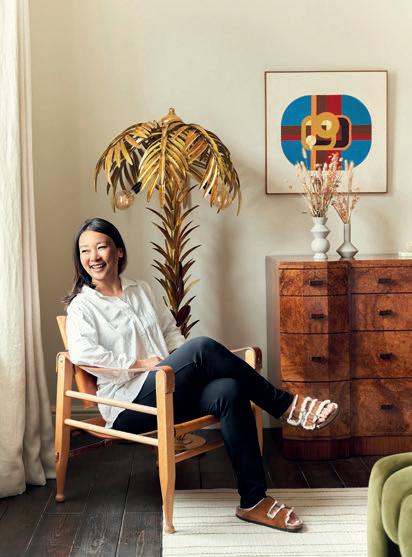

What shaped you personally? I was born in China and grew up in France. The Chinese side gave me a strong work ethic; France gave me a sense of taste and cra smanship. Growing up, beauty wasn’t a buying decision, but travelling and staying in beautiful places made me realise how important design is.
What do you love most about running Vinterior? Learning. I love reading, podcasts, applying mental models. I love systemising things that are not easy to explain.
Did you imagine this success? No. I had no plan, no business model. I just thought, ‘I don’t want to be in nance anymore. I’ll give it a go.’
Do you ever stop and take it in?
More and more. I’m 40, I have a great business, a great team, a healthy family. That’s a pretty great life. ■
For the full interview, listen to C&TH’s interiors podcast House Guest, hosted by Carole Annett and available on all good platforms





















































































































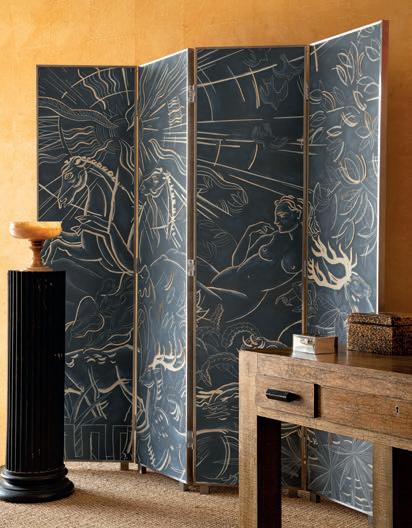
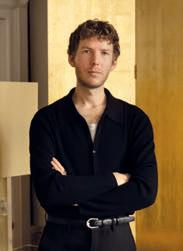
From
Gucci to de Gournay, artist Gergei Erdei is
a man on a mission, says Carole Annett
When Gergei Erdei speaks about creativity, he does so with the clarity of someone who knows what he wants and has the courage to change direction the moment something no longer feels right. From Budapest to London, from women’s tailoring at Gucci to collaborations with de Gournay and Porta Romana, his career is like a beautifully presented pop-up picture book, unfolding at each page with a romantic tableau.
Erdei began his studies at Moholy-Nagy University of Art and Design in Hungary before continuing at the London College of Fashion. The contrast between the two institutions was transformative.
‘Two metres tall and dramatic, the screens block out the outside world so you can create your own universe’
‘In Hungary, everything had to have a function,’ he says. ‘It was very strict, very conceptual.’ When he arrived in London, the experience felt explosive. ‘It was pure creativity.’ It was here Erdei found not only creative freedom, but technical grounding. Fashion informed his early career, rstly with Mary Katrantzou and then at Gucci, where his focus was on pattern cutting and embroidery design. ‘I knew it wasn’t what I wanted for a lifetime. It requires total devotion.’ A er a year, he switched to interiors and launched his eponymous brand during Covid, creating and photographing prototypes before sending them to buyers including Natalie Kingham at Matches. The response was immediate: a rst order of 550 pieces quickly sold out.
As the world reopened, consumer priorities shi ed. ‘It stopped being fun,’ Erdei admits, ‘and I couldn’t put in the level of cra smanship I wanted.’ So he pivoted again, this time toward collaborations with artisans whose technical mastery matched his vision, such as lighting and furniture company Porta Romana. His six-piece, made-to-order collection is layered and theatrical, each one an antique of the future.
As the clamour for his artistry grows, Erdei is busy juggling commissions, including painting murals for brands like Diptyque and a soonto-open, highly anticipated private members’ club, and making monumental folding screens in collaboration with de Gournay. Made of pinewood, they deliberately retain a rustic imperfection and will be on show at PAD Paris in April. ‘They’re incredibly heavy,’ he laughs. ‘Two metres tall and dramatic, they block out the outside world so you can create your own universe.’ If you want one, you’d better be quick; my guess is he won’t be doing them for long – rugs, textiles and a Mayfair gallery are on his future wishlist. ‘What matters most to me is evolution. Every project should feel slightly di erent; you should recognise it’s mine, but see growth.’ I can’t wait to see what’s on the next page of Erdei’s picture book. ■
gergeierdei.com . PAD Paris 8-12 April, padesignart.com

Henry Bartlam has created a Dragon’s Den-approved recipe for a great garden, finds Tessa Dunthorne
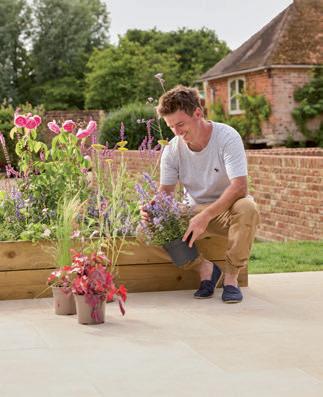
Dig Club is a millennial brand. We make instant ower beds for people who don’t have the con dence and time to do the research and garden centre fa ng. Dig Club is Hello Fresh for gardens.
Gardening has a steep learning curve. Seventy percent of the plants people buy will die in years one or two, because many of us don’t know how to look a er them or where they should go. It’s easy to get wooed by something that looks pretty in a garden centre and then looks crap in the ground.
If you want your garden to succeed, take time to understand the light. A south-facing garden doesn’t automatically mean good light; you have to account for trees, fences, other houses. Once you know how much or little light
We make instant flower beds for people who don’t have the confidence and time. Dig Club is Hello Fresh for gardens
your garden gets, you can be con dent about placing plants.
A soil test sounds menacing –it’s really not. It’s worth digging some up. If it sticks together, it’s probably clay, and you need plants that don’t mind having wet feet. If it’s really sandy, you need drought-tolerant ones.
The Dragons were erce in person. They’re not all interested in gardening, so we had to win them over with business and strategy. You only see ten minutes; in reality it was a demanding two and a half hours but it was worth it. Our sales went up ten times in a month.
I began my career in advertising at Ogilvy. But I’ve always had a passion for gardening; I just never thought it could be my vocation. That time gave me a good understanding for how to make brands appeal to people, which has been invaluable.
There’s a book coming. It’s a beginner’s guide, with colour-coded planting plans for beds, planters and pots. Less theory; totally practical.
Spring is the perfect time to prep. Start planting –the worst of the frosts are behind us. Cut away dead growth, remove damaged plants from last year, clear the space and make sure the soil is ready. March and April is the best time to get plants into the ground –they’ll have time to settle in, and will be really blooming by summer. ■
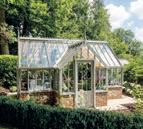
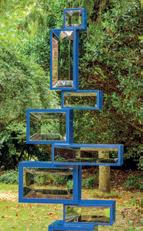

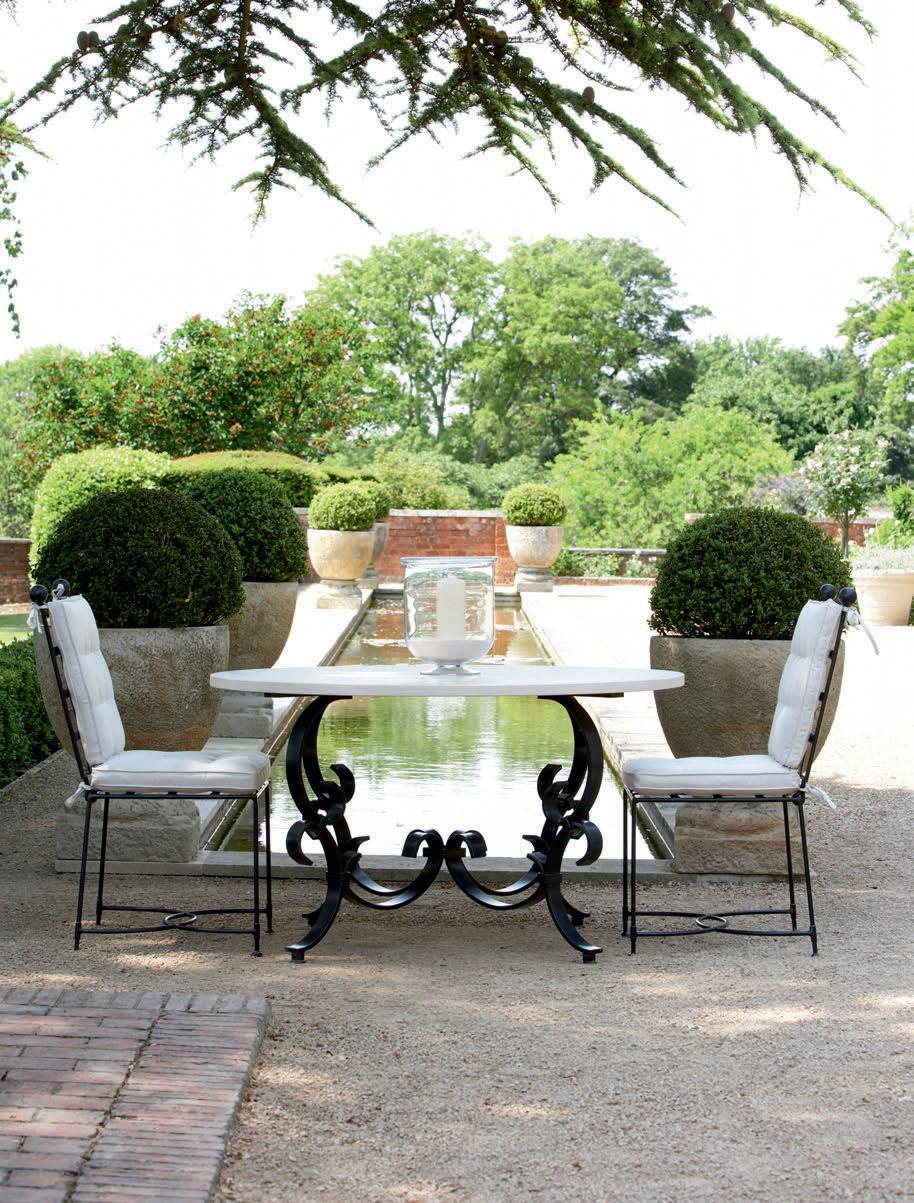

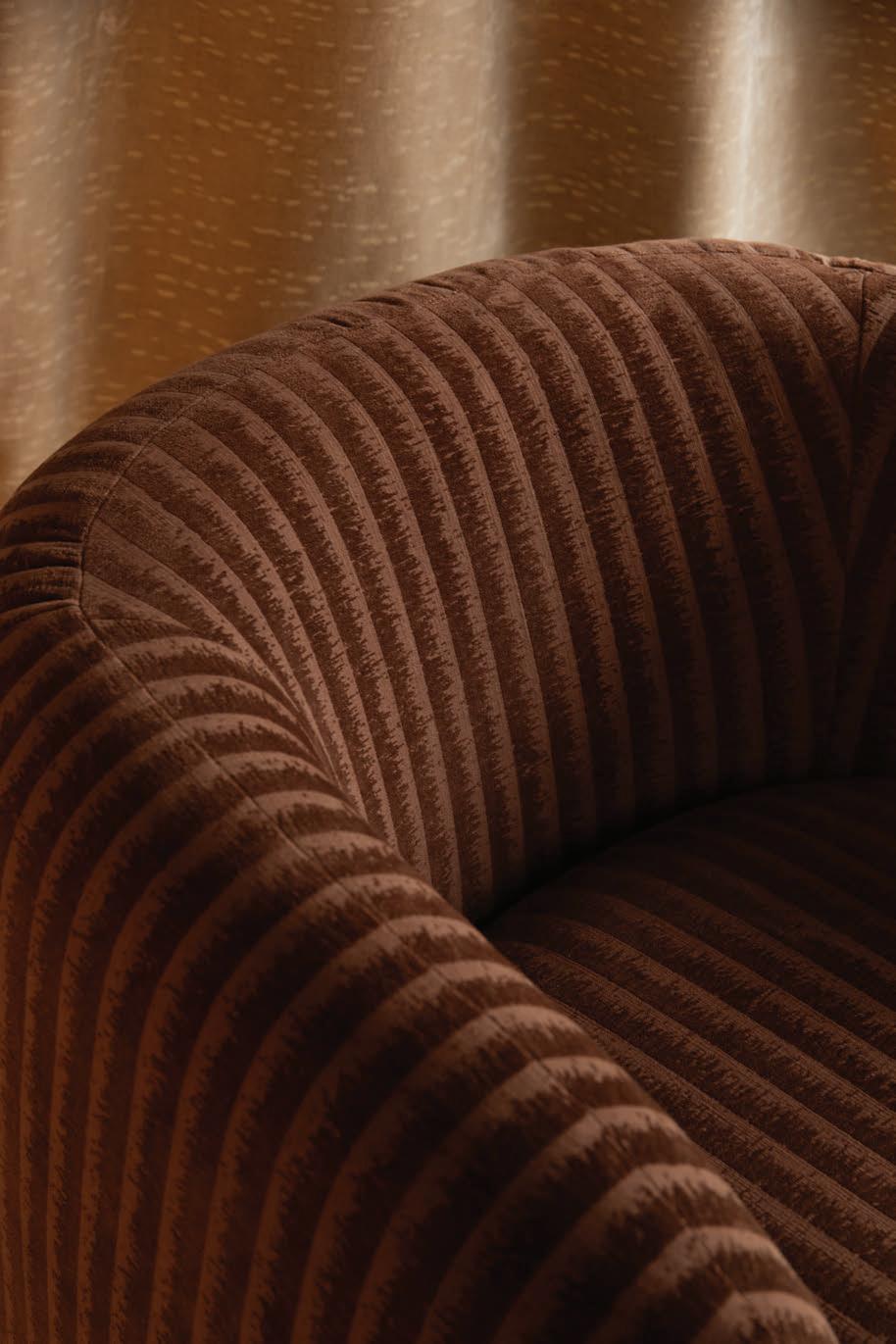


On the winding slopes of the Lower Himalayas, Shakti invites us to slow down, walk far and encounter communities untouched by modern tourism, says Lucy Cleland
Vomiting up a bright orange laddu on the Almora-Bageshwar road is not the most auspicious way to begin a Himalayan adventure. Yet there I was, only an hour into a ve-hour drive along looping hairpins, my roadside lunch from Udupiwala projected onto the tarmac. The spicy masala dosa had been excellent, but the st-sized ghee pudding was a mouthful too far.
We were racing the light. Fog had delayed my ight from Delhi – so common an occurrence that Shakti, the company I am travelling with, books both train and plane tickets for every guest, just in case. Now we were due to arrive at our rst destination, Panchachuli, deep in the foothills of the Himalayas of Uttarakhand, well a er dark. From the nal drop-o point it would still be a steep, 20-minute climb on narrow paths to reach my longed-for bed. But that is the point of Shakti. Its homesteads – beautifully renovated village houses or newly built stone, wood and glass cottages – are chosen to be gloriously inaccessible.
When I nally reach my cottage, a wood stove burns bright in the corner and the nausea ebbs away – a ginger tea just the tonic. Outside the picture window, the sky is devil black and pricked with stars, though you can still make out the looming shapes of the mountains.
Shakti is the vision of Jamshyd Sethna, one of India’s most respected hospitality entrepreneurs, better known for founding Banyan Tours. This project, which started some 20 years ago, is something quite di erent: a collection of intimate homestays in remote places untouched by tourism, of which both Panchachuli and Prana, where I am heading the following day, are the newest. Some of the houses’ locations allow guests to walk between villages; all o er encounters –utterly unforced – with locals and an experience of a way of life rarely glimpsed by outsiders.
The mountains here tell their own story. The Himalayas are the youngest in the world; once ocean oor, they are still slowly being thrust upwards as the Indian and Eurasian plates nudge against one another. The geology, though, is so er, rich in quartz and limestone, and prone to landslides come the lengthy monsoon season. Pine trees, planted by the British from the 1890s onwards for their resin and sap, are ubiquitous. Quick-growing and dangerously ammable, they suck up a lot of water and thick layers of their fallen needles sti e the growth of other plants. Indigenous oak, cherry and silk cotton do still ourish though, and come spring, the mountains are a riot of red and pink rhododendron owers.
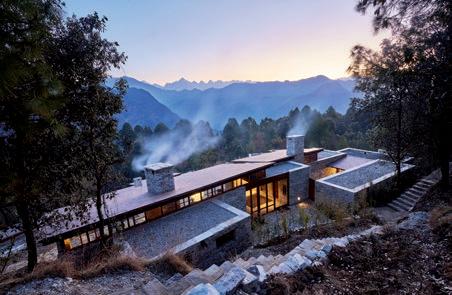
The landscape acts as a living medicine cabinet for the villagers. Pujan, my guide, tells me that they chew the rhododendron petals for sore throats, burn mugwort as an antiseptic, and inhale the smoke of dried boneset seeds as a make-do anaesthetic for toothache.
At dawn, bed tea arrives. Is there a more beautiful custom than this? A gentle knock, and a tray of spicy, sweet masala chai and biscuits is placed carefully on the bed, and the stove relit. Still snuggled in my duvet, sipping the warm tea, I watch the mountains turn a gentle pink.
Walking is the rhythm of life here, and walking is why people come. Our rst route winds down through the village of Vasudev, where women – always women – move along steep paths in jewel colours with catlike balance, branches or straw piled high on their heads. We stop to pay respects to an 11-day-old baby whose naming ceremony has brought both sides of the family together. Soon the father will return to his job at a Delhi warehouse, not seeing his home – or baby – again for months.
Pujan points out the smallholder gardens where carrots grow beside marijuana plants –used, he explains with a grin, to settle animals’ stomachs. Agave spikes serve as ear piercing tools for village girls. Cactus crowns on roo ops are believed to ward o evil and, even more mythically, to act as lightning conductors. Every object has its use.
Four hours further north-east lies Prana, the starriest Shakti property, opened recently a er an 11-month building project. Reaching it involves another serpentine four-hour drive and a 45-minute uphill walk. Seven dry-stone cottages sit on a ridge with views so vast it is hard to take it all in. Newness too arrives in the form of a wood- red sauna – utterly blissful a er a long day’s walk – and a yoga pavilion.
Sta have worked for Sethna for 17, 19, 20 years – they are its lifeblood. He tries, as far as possible, to nd local people, giving them


At dawn, bed tea arrives. Is there a more beautiful custom than this? A gentle knock, and a tray of spicy, sweet masala chai and biscuits is placed carefully on the bed, and the stove relit. Still snuggled in my duvet, sipping the warm tea, I watch the mountains turn a gentle pink
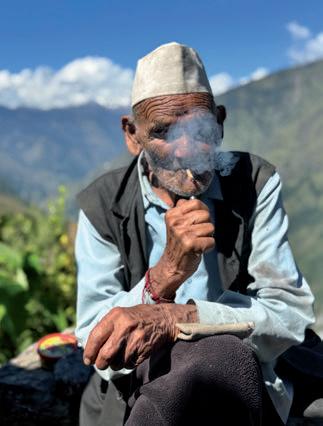
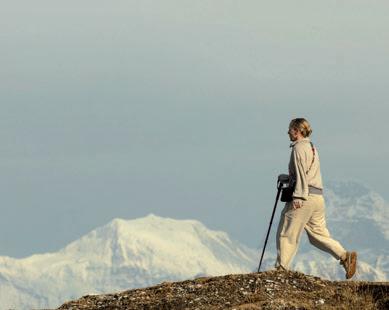
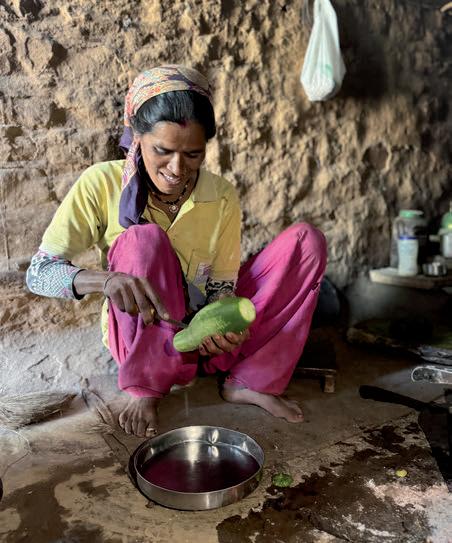
re. Smoke curls towards the ra ers as she stirs in the freshly made buttermilk. She shows me how to make Pahadi namak, a condiment made of chilli, garlic, mountain salt and coriander that can be eaten on anything. We smother it gluttonously on sweet lemons. She pushes a bowl of rice and kadhi into my hands, which I eat from a spotless stainless steel bowl. It is quite simply delicious.
a reason to stay near their villages rather than dri o to Delhi. The young can’t see a way to survive in the mountains, unlike their parents. There are small signs of change, though: Pujan tells me that some young people who ed to cities have returned since the pandemic, nding new ways to earn a living at home. Kiwi plantations are beginning to appear on once-abandoned terraces. Tourism, handled delicately like the Shakti exemplar, can provide income without uprooting communities.
On another walk, I meet Kushal Singh, 87, a former soldier of the Kumaon Regiment who fought in con icts against China and Pakistan in the 1960s and 70s. He has lived in his twostorey house since 1975; at night, his goats and cows are herded into the ground oor rooms, their bodies heating the upper oor where he and his wife, Chandra Devi, sleep. For the past 50 years or so, his army pension has paid him 45,000 rupees – around £365 – a month, enough to survive on. Chandra Devi has never travelled further than Bageshwar, 50 miles away. ‘She has so much to do,’ chuckles Kushal in Hindi, nodding towards his wife, who, at 75, is handwashing clothes in a bucket. ‘I just sleep.’ Later, in her lean-to kitchen with its earthen oor, I squat with Radha Devi – another villager – to watch her cook radish kadhi over an open
In fact, all the food is outstanding, homemade with fresh ingredients every day. Carrot and orange soup, an unctuous mutton and apricot curry, lentil dhal, cardamom rice pudding – all delicately spiced and eagerly devoured a er hours on the mountain. At 1am the night before our 16km walk, a storm explodes directly overhead. Rain drums on the copper roof, electricity dazzles the sky and it is as though the mountains are being cracked apart. By dawn, though, the highest peaks show o a dazzling new coat of snow and the sky is a peerless blue. We start out high on a ridge and make our way gradually lower, scrambling down old, rocky goat-herder paths and up tu ed mountain pastures, wrapping and switchbacking towards the river valley. We stumble across a prayer ceremony in the trees. A pundit is chanting mantras and blowing a conch shell to produce an extraordinary noise in front of a small re garlanded with marigolds. Two women make puris as an o ering to the nāgas – snake gods – to protect them. They let me help them make the bread, pushing out the dough with my thumbs and slapping it between my hands before tossing it into the boiling oil. Much smiling is done, and I laugh when this surreal vignette is interrupted by a Nokia ringtone. The government was prescient enough to realise it was far cheaper to install phone masts in the mountains than try to build miles of landlines. No two days here are the same. No two guests’ experiences are identical. Nothing is prescribed. You are at the mercy of the mountains – and you must make of them what you will. ■
BOOK IT: Shakti Himalaya o ers a ve-night Village Walk experience, including three nights at Shakti Prana and two nights at Shakti Panchachuli from £4,785 per person (based on two sharing). Taxes and ights are not included. shaktihimalaya.com
Lucy’s return ights from London Heathrow to Delhi had a carbon footprint of 2,815.3kg of CO2e (ecollectivecarbon.com)
INDIA SPECIAL
In landscapes that were Kipling’s inspiration for The Jungle Book, Fiona Duncan cycles effortlessly into the heart of rural India
In a tent by a river, with a hot water bottle to ward o the chill night air, midnight strikes and I notch up yet another year of my life. Though I’m the opposite of young and no more than passingly t, I’ll be cycling 50km today and 250km in total on this magical, immersive, sometimes thrilling, always illuminating week-long tour in Central India. The route takes in tiger reserves, wildlife forests, farmland, paddy elds and villages splashed with jewel-like colour thanks to dazzling saris and turquoise, lime and white-painted mudbuilt homes, each with cattle shed in front, where we watch the farming life of the local Gond tribespeople played out. Their warmth is infectious: like a Silk Road caravan we streak through their villages, 14 of us, plus tour leader, two guides and two support jeeps, while they smile, wave and take photos in return. They think we’re potty – nowadays only children and the old use bicycles: everyone else has upgraded to scooters.

How can it be that at 72, having not cycled for years, I am able to take part in this unique low-impact dive into tourist-free rural India? It’s all thanks to the combination of electric bikes and creature comforts – including superb food, cooked in situ at our temporary night-time camps – delivered by the Oxfordshire-based Slow Cyclist travel company. And to the two men, Julian Matthews and Vishal Singh, who run TOFTigers, dedicated to sustainable, nature-based tourism and tiger conservation and who devised the occasionally challenging and always exhilarating route between Pench and Kanha National Parks. At the start and nish of the journey, we stay in comfortable eco lodges with organic gardens near each park and take early morning game drives to spot The Jungle Book ’s characters for real, plus dozens of bird species. It’s hard to nd Shere Khan but when he majestically appears, glowing in his orange and black fur coat, it’s a once in a lifetime thrill.
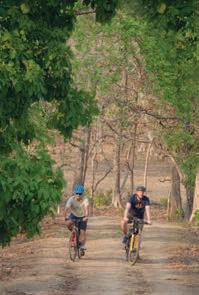
Never have I bonded so easily with fellow travellers; you don’t cycle on Day One through Pench Tiger Reserve, passing pugmarks and fresh scat (‘look, it’s got hair and deer hoof in it’) without feeling camaraderie. The combination of being so well looked a er, slog-free adventure and Indian life at its most rhythmic is addictive. I’m a Slow Cycling convert – only next time I’ll wear not one but two pairs of padded cycle pants under my baggy shorts. ■
BOOK IT: Seven nights from £4,600 per person. A £250 donation to TOFTigers (TOFTigers.org) is also included, to support conservation work. theslowcyclist.com
Fiona’s return ights from London Heathrow to Nagpur had a carbon footprint of 2,563.6kg of CO2e (ecollectivecarbon.com)
We so often find ourselves in a food battle. At Ananda in the Himalayas, it’s the healing hero, finds Lucy Cleland
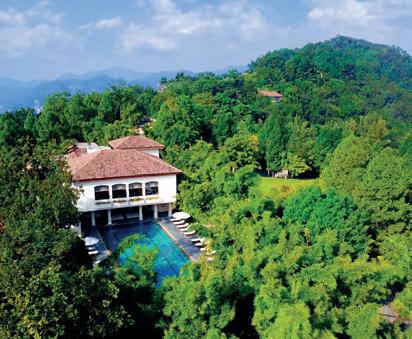
When the Beatles came to Rishikesh, on the bank of the great Ganges river, in 1968 to nd spiritual emancipation and ended up writing much of the White Album , they were just the latest pilgrims in a long human line looking for something more. Twenty- ve years ago, that same spirit drew Ashok Khanna – whose grandfather had founded the mighty Oberoi brand – and his family to create Ananda. One of the rst destination wellness retreats of its kind anywhere in the world, it is set high above the sacred river in the former palace estate of Narendra Nagar. The pillars were clear from the start: Ayurveda, yoga, spirituality and food. B efore even arriving, you're asked to share what state (shape, colour, smell) your poo is in, which gives you some indication as to the detail into which Ananda goes. My issues? Fatigue,

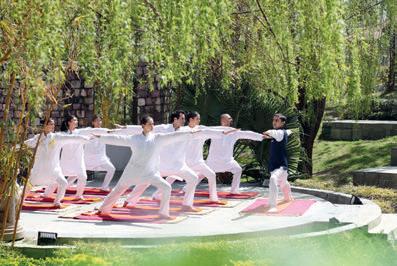
being hungry all the time, being really annoyed with myself as I’d got very t last summer but had just as quickly sabotaged it – and piled on the hard-lost kilos. Perimenopause, an always-in-a-rush mode and sleep issues mean I’m constantly reaching for the reset button. But rather than starve myself at an Austrian bootcamp and nibble on stale rolls, I wanted to work with food, not against it.
‘Food is neither good nor bad,’ con rms Dr Naresh on my rst day in this blissful sanctuary, as I blame my frenzied state on everything from Cadbury's chocolate to salted pistachio nuts. It feels a radical thing to hear in our confused food times. We are so used to health shaming
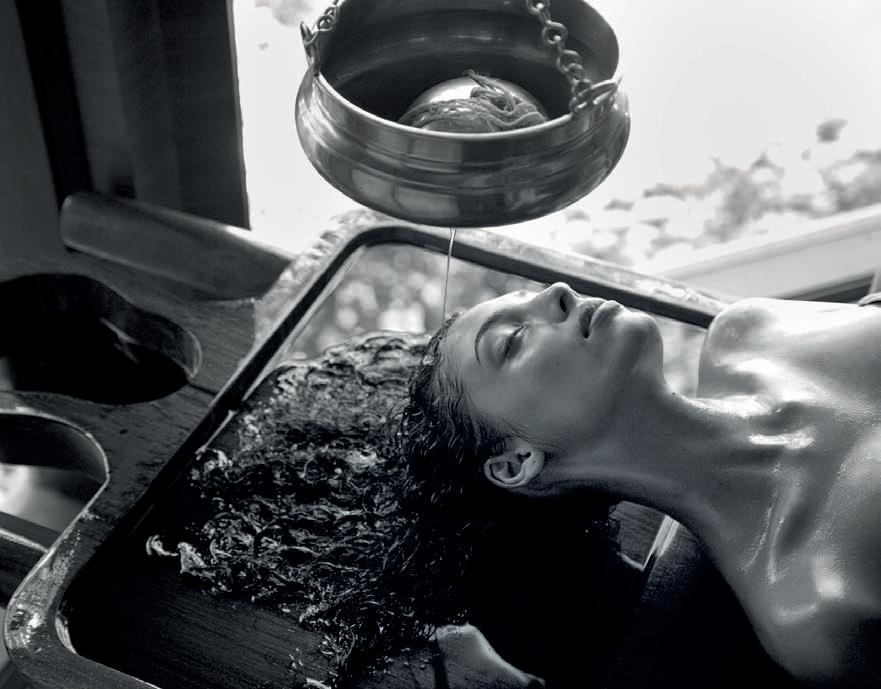
entire food groups: fats, carbs, sugar. Yet at Ananda, the approach is pragmatic – and all about balance, which in Ayurveda depends on your dosha . This is determined by the questionnaire but also a feel of the pulse, a look at the tongue and body shape, among other indicators. I’m told that I’m a classic pitta , with a vata imbalance.
There are many things in the Ayurvedic toolbox to help, and food is just one element. Pitta is associated with re and when it’s out of whack, we can become prone to anger and irritability. Moi? I couldn’t possibly comment.
Food, then, needs to act as a calming balm – avoiding too much spice and foods that ‘heat’ (bye bye, co ee). It is not about less; it is about when and what, and being consistent – everything that passes my lips is nourishing, fresh, beautifully presented and feels like eating goodness.
Pitta is associated with fire and when it’s out of whack, we can become prone to anger and irritability? Moi? I couldn’t possibly comment
Food, of course, supports the body, but Ananda has been conceived to support the mind, heart and head too. Yoga is one of the practices it is most famous for (a private
session with Malati Mehrish is worth travelling for alone). However, it is also the emotional healing (where you just get to talk, cry and get some incredibly sage re ections back), the Traditional Chinese Medicine, and the Vedanta (one of the world's most ancient spiritual philosophies) talks that wrap their holistic arms around you, while at the same time cracking open crevices both emotionally and physically. These ssures are then lled with knowledge that ensures you come away with a deeper understanding of the interconnectedness of all parts of yourself – and with a new cookbook to boot. Twenty- ve years of Ayurvedic recipes poured into The Healing Plate means you can nd that balance at home too. Don't leave without it. ■
Book it: Seven-night programmes from £6,043. anandaspa.com
Lucy’s return ights from Heathrow to Delhi had a carbon footprint of 2,815.3kg of CO2e (ecollectivecarbon.com)
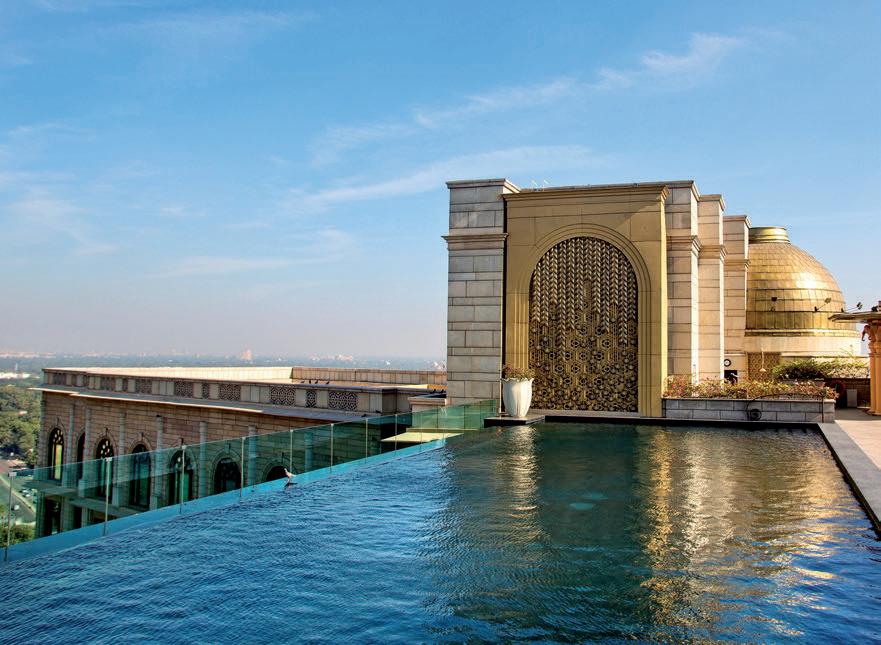
Juliet Herd receives princely hospitality as she discovers how modern India is reviving its heritage for a new generation

‘If you are driving in India, you must have three things,’ our chau eur, who is ferrying us from the airport to The Leela Palace New Delhi, smiles. ‘A good horn, good brakes and good luck.’ He’s not wrong. Entering the city, you’re assailed by a cacophony of beeping horns that somehow prevents the swirl of vehicles and loose livestock from colliding. India is as contradictory as it is compelling. Ancient traditions and superstitions rub alongside rapid modernisation; social inequalities remain glaringly rife yet a ‘jugaad’ (do-ityourself) mindset prevails. But, how does the world’s most populous nation – 1.45 billion people and counting – preserve its heritage while embracing change? This is what Leela Palaces, Hotels and Resorts is hoping to unveil as a part of its bespoke north/south ‘Palace Trail’ routes, where I gain an insight into how the country’s heritage is being reimagined by a new generation of creatives.
Located in the capital’s smart diplomatic enclave and built to resemble a modern maharaja’s residence with acres of marble ooring and soaring Lutyensstyle colonnades, The Leela Palace New Delhi serves exceptionally good masala chai. Our chai wallah veteran, Bhuvan, brews the hottest, sweetest and spiciest tea, poured in a seemingly never-ending milky stream from a brass teapot.
This simple ritual is just one example of how the ‘intrinsically Indian’ luxury brand promotes age-old customs in each of its 13 heritage-inspired properties.
Over dinner at the hotel’s elegant Le Cirque restaurant, dancer Shivani Varma explains how she is reintroducing ancient Kathak dance to the country’s urban elite, who, she says, look to the West for their cultural xes. ‘They have lost touch with their own culture,’ says Shivani. ‘Part of my work is to rede ne dance and make it more relevant.’
On a tour of the city’s historic heart, we marvel at the blend of Mughal and
colonial architecture and lose ourselves in the labyrinthine and pungent Khari Baoli wholesale spice market, where dried spices, fruits and exotic herbs are piled high, traders and tourists jostle for space, and everyone from errand boys to money lenders play their part in maintaining this thriving centre of commerce.
A er sampling fresh parathas in Old Delhi’s legendary Paranthe Wali Gali lane, we’re driven at speed by electric rickshaw to meet renowned calligrapher Ameen Ur Rehman, who conducts workshops to inspire new generations.
‘It’s important to preserve these art forms,’ he says, while helping us to produce our own scribbles.
Later, as we sip cocktails in the hotel’s Library bar, voted one of India’s top 30, and dine like a Maharaja on a modern version of the traditional Thali feast in Jamavar restaurant, the thread between classic and contemporary is pulled that little bit tighter.

When Prince Albert visited Jaipur during his grand tour of India in 1876, Maharaja Ram Singh II was so keen to impress that he painted the entire town pink. It’s an enduring legacy for the so-called Pink City that boasts more palaces and havelis than anywhere else in Rajasthan, from the sprawling City Palace to the 953-windowed Hawa Mahal, the pinkest of them all.
Under the beating midday sun, colourful Kalbelia dancers give us a
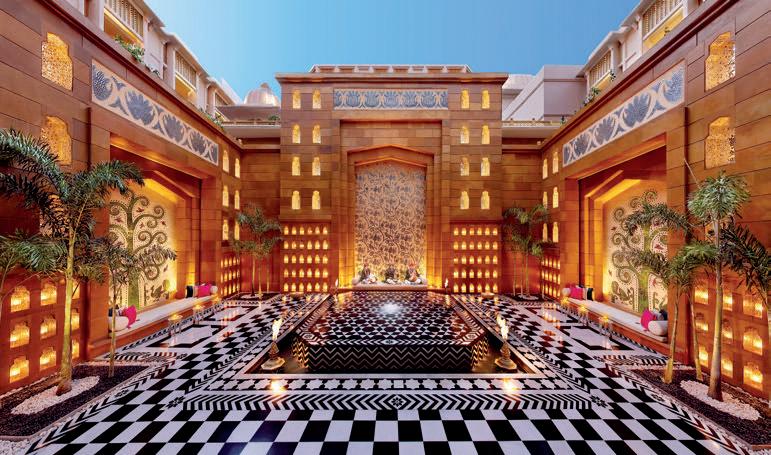
royal welcome on the gleaming marble courtyard of The Leela Palace Jaipur, a lush oasis in the Aravalli foothills. We have arrived in the middle of the Navaratri festival, honouring Goddess Durga, representing feminine power and motherhood.
At magni cent 16th-century Amber Fort, a fusion of Hindu and Mughal styles and a UNESCO World Heritage site, thousands of barefoot, mostly female, worshippers in sa ron and fuchsia saris pour through the gates seeking temple blessings. ‘More than 100,000 people will pray here today,’ says our guide. ‘They are raised in patience,’ he notes of the respectful throng.
With its wealth of arts and cra s, from block printing and gemstone cutting to marble carving and miniature painting, Jaipur plays a pivotal role in preserving and adapting artisanal skills. We’re treated to a Kathputli puppetry show and bangle-making session at The Leela, which regularly hosts local artists and is one of the partners of the Jaipur Literature Festival. The hotel’s décor pays homage to Rajasthani artistry with hand-cut thikri mirror mosaics (the candlelit Jamavar restaurant is illuminated by no fewer than 350,000), Shekhawati frescoes and hand-carved details in its 200 rooms and villas.
Gliding across the glassy expanse of Lake Pichola in an electric boat helmed by a red-turbaned captain is a pinch-me White Lotus moment. In Udaipur, former capital of the Mewar Kingdom and set around a series of arti cial lakes dotted with royal residences, the pace is gentler, the vistas greener and the weather cooler. It is like coming up for air.
Local cra s are celebrated by fashion enterprises such as Aavaran, which is reviving the region’s 500-year-old Dabu mud-resist printing and dyeing
techniques. Watching these labour-intensive processes is a humbling experience.
One of The Leela’s most sustainable properties, the romantic lakeside Leela Palace Udaipur, operates on mostly green power and adheres to a strict zero-waste policy. Like its sister palaces, it supports holistic wellbeing through a balanced ‘Aujasya’ cuisine that features seasonal produce, some of which is grown on its own farm.
‘Renew and restore’ is the goal, and a er three days of mindful activities here, including sunrise yoga, Ayurvedic treatments and a joyful Hindu service at the 17thcentury Shri Jagdish temple, I leave this magical, mysterious country imbued with a deep sense of peace and a more nuanced understanding of its heritage. And, naturally, some masala chai teabags. ■
BOOK IT: Rooms at The Leela Palaces, Hotels and Resorts start from £140 a night. theleela.com
Juliet’s return ights from London Heathrow to Delhi had a carbon footprint of 1990.7kg of CO2e (ecollectivecarbon.com)

Beyond Marrakech’s famed souqs lies a landscape of mountains, coast and desert, each o ering distinct experiences for families, couples and solo travellers alike. Steppes Travel is the key to unlocking Morocco’s hidden depths.
Sitting less than an hour from the capital, the Atlas Mountains rise above all. Walk with local guides through Berber villages, picnic on hillsides or dri over the dramatic landscape in a hot-air balloon. Take the Tizi n’Test pass for a thrilling self-drive adventure ending at the historic town of Taroudant. Settle for the night in a converted kasbah and browse markets teeming with artisans whose skills have endured for generations.
The Atlas’ southern slopes so en into the edges of the Sahara. Stay overnight and experience the desert a er dark, when a vault of stars replaces clear blue skies. Short on time? The Agafay Desert near Marrakech o ers lunar landscapes to contrast the Sahara’s sweeping dunes. Embark on an exhilarating buggy ride as an alternative to the classic camel trek.
Fez feels di erent again, its whitewashed walls and olive-strewn countryside closer in spirit to southern Spain than to Morocco. The medina of Fez el-Bali is amongst the best preserved in North Africa; lose yourself in narrow alleys that lead to squares lled with ancient tanneries and palaces, before returning to a quiet riad each evening for a truly immersive stay. To the north, Tangier sits where sea meets culture. From this cosmopolitan harbour you can slip inland to mountain hamlets or follow the coast to small shing towns. West of the country, Essaouira brings wind, wide sands and a gentler pace — perfect for surf lessons, slow lunches and a calmer end to an active trip. Steppes’ local contacts and long-standing partners mean you do more than visit; you belong for a moment. Morocco is varied by region and pace, rewarding those who dive beneath the surface. Explore beyond the obvious with Steppes Travel.
See the world better – discover extraordinary. Visit steppestravel.com or contact us on 01285 880980 and inspireme@steppestravel.com
Lauren Ho has all the latest travel news from across the globe
If you don’t have three months to circumnavigate the world by rail, luxury operator Adventures By Train has made its agship Around the World by Train in 100 Days itinerary more accessible. Now, travellers can now book individual sections of the epic journey. Departing London on 14 March 2027, the original route spans 14 countries across Europe, Asia and North America, combining rst-class rail travel, sleeper trains, luxury hotels and a Cunard transatlantic crossing. Now, six standalone legs are available –from a 31-day Silk Road adventure between London and Uzbekistan to a dramatic 22-day crossing of North America from Vancouver to New York aboard iconic Amtrak routes. Prices start from £9,950 per person. adventuresbytrain.com
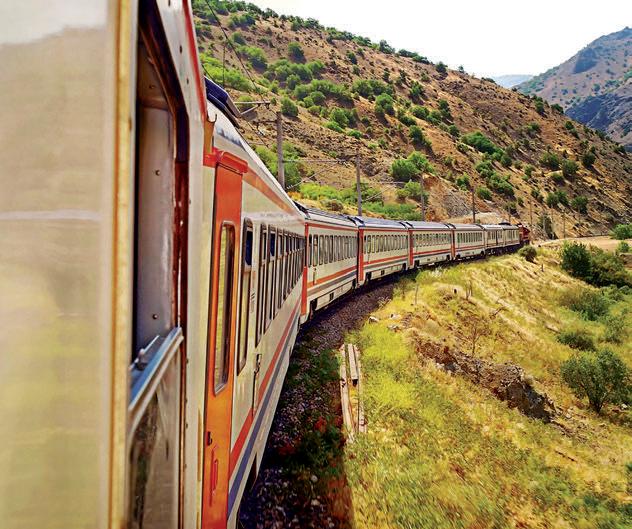
WATER’S EDGE
On Lake Como’s west shore, a 19th-century palazzo reopens as Lake Como EDITION with 148 rooms by Neri & Hu, including two penthouses, a restaurant by Mauro Colagreco, and a Longevity Spa editionhotels.com

INN THE KNOW
In East Hampton the historic Hedges Inn has been revamped by the owners behind Palm Beach’s The Colony Hotel, with Swi y’s, the classic New York restaurant, taking over the dining room. thehedgeseasthampton.com

Set between Mount Kenya and the forested Aberdare Range, JW Marriott’s newest property –Mount Kenya Rhino Reserve Safari Camp – brings 20 tented suites with plunge pools and immersive safaris to Laikipia. marriott.com

TENTED THAILAND
On Koh Phangan’s northeastern coast, Kaia is Cloud Collective’s low-impact beachfront camp, where 31 ocean-facing tents, open- re cooking, local cra and a DIY tree bar replace party-scene excess. kaiaresorts.com

With its towering sandstone canyons, lush palm oases and a history that traces back millennia to incense trade routes, it’s no surprise Saudi Arabia has singled out AlUla as the focal point of its arts ambitions under Vision 2030. What began as a handful of sitespeci c commissions has grown into a fully edged cultural calendar, with the AlUla Arts Festival now in its h edition. This year the programme ranged from large-scale Desert X installations threaded through the canyons to an exhibition curated by the soon-toopen contemporary art museum, together with Paris’ Centre Pompidou. Together, it o ers a snapshot of what’s coming next, including Wadi AlFann, a permanent land-art valley set to anchor AlUla’s long-term cultural ambitions, with large-scale commissions by the likes of James Turrell and Agnes Denes embedded directly into the desert landscape.
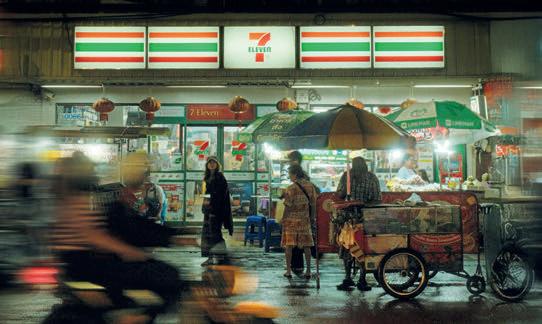
From Japan’s beloved 7-Elevens, where travellers ock to stock up on egg sandos and green tea KitKats, to European supermarkets with shelves lined with beautifully packaged tinned sh or wine priced like water, grocery stores are becoming the new souvenir shops. For many, a slow browse through a local supermarket is a fascinating and rewarding glimpse into everyday lives and o ers a way to experience a destination authentically. And, of course, there’s nothing better than discovering an oddity that stops you short, whether it’s the cucumber- avoured Lay’s chips in Hong Kong or the unboxed biscuits and sweet treats in Uzbekistan, laid out like a pick ’n’ mix.
Claude Bosi , chef-director at the two Michelin-starred Brooklands by Claude Bosi at The Peninsula, London

1
What makes a good restaurant great?
A good restaurant can have a moment, but a great restaurant proves itself over time. Longevity means it earns trust and a ection, not just attention.
2
How has British produce evolved over the years?
There is a real sense that small producers and farmers are thriving more visibly than ever and their exceptional work inspires the clearer, natural, productled way I cook today at Brooklands.
3
What do diners misunderstand about ne dining? That ne dining must be formal, time-consuming or rigid. At its best, it’s relaxed and built around quality, so we o er an à la carte menu, giving people the freedom to shape their own experience.
4
What matters more now than it did earlier in your career?
Listening to guests while staying true to who we are matters most now. Experience taught me that dialogue strengthens our common values.
peninsula.com
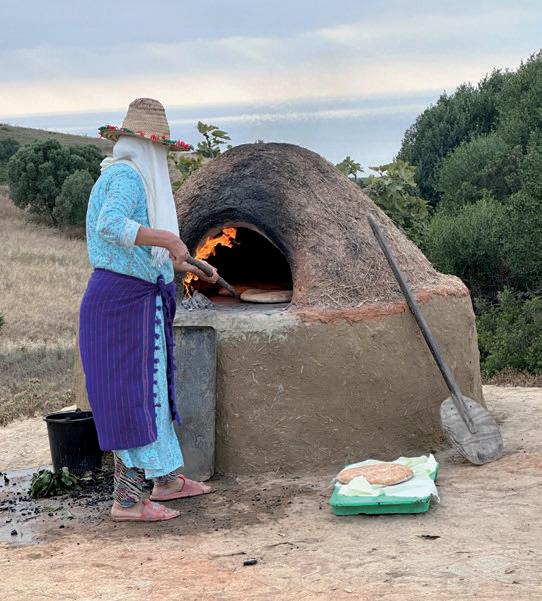
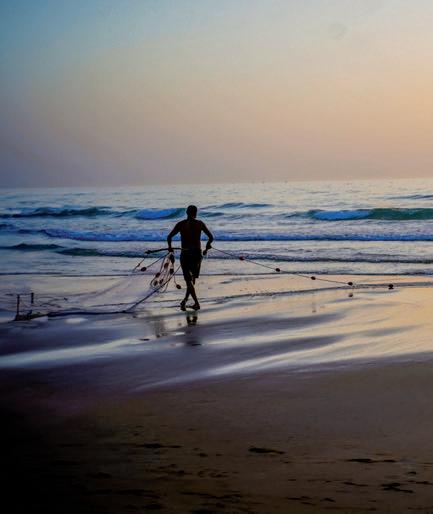
When a hotel merges with a community, magic happens, says Katie Glass, who found that intoxicating mix at La Fiermontina Ocean in Morocco

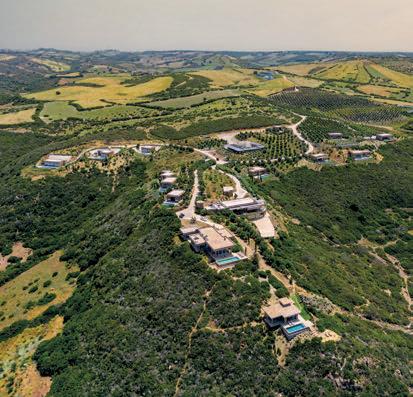
We have driven an hour south of Tangier, along Morocco’s west coast, heading for La Fiermontina Ocean, a hotel perched on a rugged cli overlooking the vast North Atlantic Ocean, with nothing beside it but the tiny village of Dchier.
Our car weaves through 150 acres of parkland, where scorched ochre earth has been newly planted with lavender bushes and olive trees, part of the hotel’s plans to establish a natural park here. But obtaining such a designation is as much about what is being done on the land as the hotel’s work with the local community. La Fiermontina’s ambitions extend far beyond being an exceptional luxury hotel, to a holistic project unlike any destination I have seen. I’m here with Steppes Travel –to experience an example of what truly great travel looks like when it works in deep harmony with its environment.
The La Fiermontina Ocean project was imagined by Italian-Moroccan siblings Fouad Giacomo and Yasmina Antonia Filali, whose mixed heritage is felt in their ambitions: to create a destination where La Dolce Vita glamour is enhanced by working alongside local people.
La Fiermontina Ocean project was imagined to create a destination where La Dolce Vita glamour is enhanced by working alongside local people
Giacomo initially bought this remote outcrop overlooking the Khemis Sahel dune without knowing what he would do here. He rst built ve houses, since extended to 11 Ocean Suites and a grand three-bedroom Akhazane Villa. He worked with the architects behind his other properties –Palazzo Bozzi Corso and Fiermonte Museum in Puglia, and La Fiermontina Vendôme in Paris – alongside native builders to create low buildings that seem to rise from the land. Revelling in their spectacular positions, like Bond villain lairs, the oor-to-ceiling windows and in nity pools o er views across rugged, olive-tree-dotted hills undulating down to the wild coast.
Unlike the frantic souks of Tangier, this rugged strip of coast is of yet undiscovered. The morning air, sweetly scented with rosemary and lavender, sings with the brush of waves and chattering birds.
At every turn, the hotel amalgamates with its environment. Plush villas, dressed by French interior designers Charles-Philippe and Christophe of Laboratoire Design, embrace indigenous materials: bright Berber rugs and Atlas Mountain textiles.
The hotel’s boutique stocks locally-made produce –there’s clay tagine pots, for example, and embroidered clothes by Migrants du Monde, a brand whose pro ts go directly to the foundation Filali created in 1994. It funds a hospitality school in nearby Larache.
This foundation is the start of the real story here, a symbiotic relationship between the hotel and the nearby village so genuine and profound it led Steppes to bring their Morocco itineraries here, inspired by the way the hotel has gone beyond the super cial to forge a unique relationship with its community.
Initially, the relationships grew from dependence. Building in this sparsely inhabited outcrop, Giacomo
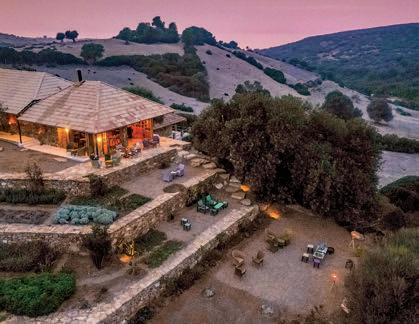
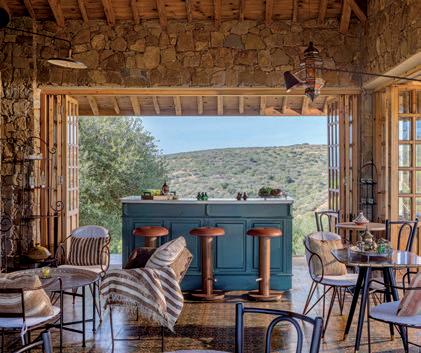
knew the lodge’s success depended on local support. He invested early in improving infrastructure in Dchier – building road access, bringing water and electricity to the area, and o ering locals jobs at the hotel.
Giacomo asked the locals what resources they needed. Education and healthcare, they replied. The hotel began supplying regular visits from medical vans. They cleaned up the village, introduced bins, paid the municipality to bring rubbish lorries here and extended the local school.
The intention, Giacomo explains, was never to control their neighbours but to enable them, giving them opportunity and, most signi cantly, a reason to stay here.
Initially the hotel worked happily alongside its neighbours, but a signi cant shi came
with the innovative idea to ask villagers if they would host hotel guests for breakfast in their homes.
It is a short, bumpy drive down a dusty road from the hotel to Dchier village, past herdsmen driving goats and women returning from picking olives, swaddled in bright clothes. Homes sit in small compounds with tin roofs and sun-bleached blue walls, where lazy dogs sleep in sunny courtyards. We enter the home of a local woman named Fatna, who stands holding a brass jug to wash our hands, with a little girl hiding behind her skirts. The local women host these breakfasts; the men are out with the cows.
Welcoming us into her home, sitting on stone benches in her simple courtyard, Fatna serves us a feast on brightly painted terracotta plates: local olives, so white Moroccan jben cheese, chunky homemade peanut butter, a delicious soup of fava beans and hot, freshly cooked pancakes drizzled with dark local honey.
Hotel translators accompany guests to enable them to connect with locals, and for the meal to become a literal chance to break bread – to chat, learn from each other and simply connect on a human level so o en lost in modern travel. Giacomo tells me Moroccan guests have emerged from the experience with tears in their eyes, moved by how disconnected they have become from their own people.
As these breakfasts have evolved, the relationship between the local people and the hotel has grown, and with it trust. Villagers have now welcomed the creation of four newly built village rooms, set on the very edge of their conurbation, just 20 yards from where they sleep.
These village rooms are set around Café Maure, a traditional-style café with spectacular views across the surrounding wheat elds, and a hammam where tailor-made treatments are o ered by local women.
As the collaboration between the hotel and village grows stronger, Steppes sees La Fiermontina Ocean as exemplifying how great travel could and should look: a destination where visitors consider where their money is going, and where travel doesn’t take from a place but enhances it. ■
BOOK IT: Steppes Travel o ers a seven-day bespoke tour of northern Morocco from £5,995pp (excluding ights from the UK). steppestravel.com
Katie’s return ights from London to Tangier had a carbon footprint of 549.1kg of CO2e (ecollectivecarbon.com)
The top independent Greek villa agents - the luxury of choosing from the best enquiries@fivestargreece.com www.fivestargreece.com


Off-season Nantucket has charm and low key luxury in spades, finds Francesca Syz
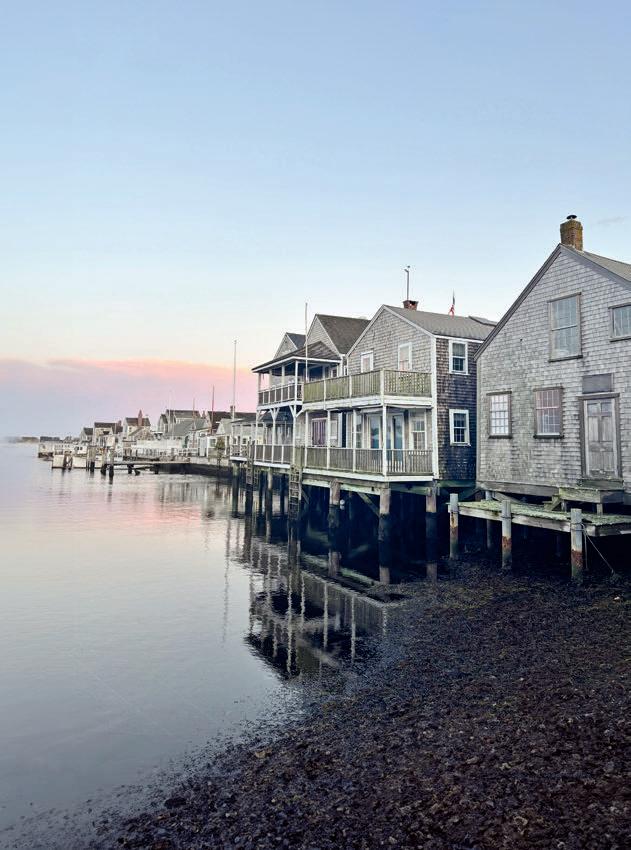
At the risk of sounding eccentric, my 14-year old daughter Eva and I share a love for the atmospheric melancholia of autumn: the ever-darkening a ernoons, the crunch of leaves under foot, the chance to wrap up in our favourite winter coats. So we are both thrilled by a sudden dramatic downpour as we huddle in the little clapboard ticket o ce in Hyannis, Cape Cod, waiting to board our one-hour ferry to Nantucket. By the time we’ve clambered up the gang plank and found two seats in the steamy main cabin alongside an assortment of fellow outof-season holidaymakers, shermen and island workers, the rain has been replaced by a heavy fog, so we see nothing of the place until we’re pulling our suitcases over the cobbles towards our hotel.
Originally named Natocke (‘the faraway island’) by its native Wampanoag inhabitants, boomerang-shaped Nantucket, with its mild summers and wet, windy winters, is New England in a bottle: long, wild beaches, pretty lighthouses, historic villages, cranberry bogs and rolling moors. Its sweet spots are April and May, but also October, when lots of shops and restaurants are closed but enough are not and you can almost hear the island exhaling.
We are staying right in Nantucket town, in a pretty whitewashed cottage belonging to the waterfront White Elephant Hotel (whiteelephantnantucket.com), where we nd a roaring re and copies of Moby Dick by the bed. There are, of course, some spectacular rentals around, like the one Kourtney Kardashian booked for her family holiday or the one they used to lm the televised version of local writer Elin Hilderbrand’s novel, The Five Star Weekend , starring Jennifer Garner, Regina Hall and Chloe Sëvigny, which was shot just before we got there. But those don’t come cheap.
Nantucket’s year-round population of about 14,000 – artists, farmers, shermen, builders, and those working in businesses that maintain all those fancy houses – swells to around 80,000 in the summer. I grew up spending Augusts on Cape Cod so know rst-hand the ‘crazy’ of summer and the queues for a co ee.
Heading out for our rst early evening stroll, we catch the most amazing pink sunset over the harbour before heading up Main Street, past the world’s prettiest branch of Polo Ralph Lauren in an 1830s brick townhouse and the only major chain (apart from the supermarket Stop & Shop) given permission to open on the island. Many locals see Nantucket as a salt-inyour hair, sand-in-your-sneakers type of place, but given average house prices in 2025 hovered around $4.7m and last year there were about 75 billionaires on-island, Ralph Lauren doesn’t seem that out of place.
Nantucket’s rst wealth surge came in the mid-18th-century when it became the global centre of the whaling industry, and merchants and ship owners built the island’s rst Greek
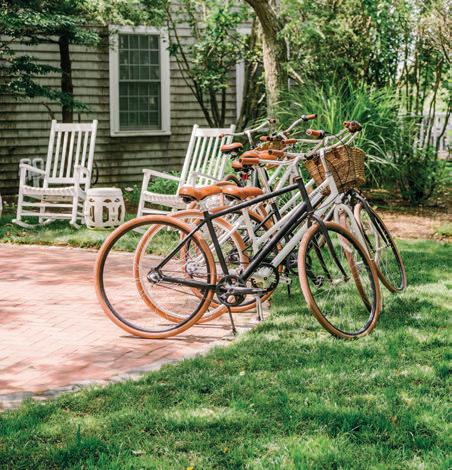
Revival houses. By the late 19th century, tourism had replaced whaling, and artists, actors, and writers began building homes.
Nantucket is New England in a bottle: long, wild beaches, pretty lighthouses, historic villages, cranberry bogs and rolling moors
One summer in the 1890s, a band of Broadway actors decamped to Siasconset (’Sconset), a pretty little village on the eastern tip of the island, when their sti ingly hot theatres closed for the summer. Some of them clubbed together and built a ‘hall of amusement’ they called Sconset Casino, with tennis courts, a bowling alley and a theatre where elaborate summer productions are staged to this day. Writer and humourist Robert Benchley began spending family holidays in Sconset in the 1930s; in 1974, his grandson Peter’s novel Jaws was published, inspired by his summers there.
Today, the island’s tourist season kicks o with the Nantucket Da odil Festival in April, which includes a fancy dress vintage car parade, and ends in December with the Christmas Stroll, when town is transformed into one big Christmas market. In the middle (June) is the Nantucket Film Festival, run
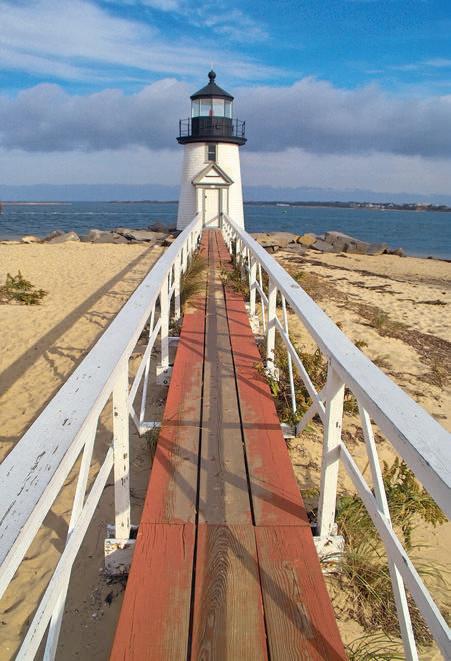
by Ben Stiller and friends, which has attracted everyone from Meg Ryan to Woody Allen.
We visit the excellent Whaling Museum and do a downtown walking tour. We also explore the shops. My favourite is Commonwealth, selling secondhand designer clothing (Prada stilettos, Balenciaga bags, Armani jumpers) and really great wine. Nantucket Looms is a wonderful interiors shop, lled with elegant baskets and bowls and shawls, much locally produced, with a working weaving studio upstairs. Then there’s Murray’s Toggery, home of the island’s famous Nantucket Reds –terracotta canvas trousers that fade over time to a fabulous dusty pink.
We transfer ten miles north to White Elephant’s sister hotel, the Wauwinet (wauwinet. com), a beautiful Cape-style inn with a renowned seafood-leaning restaurant, Toppers, local art-and-booked lled drawing rooms, roaring res, and complimentary daily sherry and cheese at 4pm. It sits on a sliver of land so narrow you can see the sea on either side of you: Nantucket Sound (great for kayaking and shing) at the foot of the garden and the Atlantic right behind. The Wauwinet also o ers free bikes, an hourly shuttle service into town and cruises with knowledgeable local, Captain Rob, in the hotel’s motorboat.
On my last day, I cycle to Bartlett’s Farm, the island’s best produce shop, to sample their tangy cheddar, then to the Cisco Brewery for Whale’s Tale pale ale. Both are open year-round. There’s one place I regrettably don’t make it to: The Chicken Box, a refreshingly raucous sounding dive bar I’m told by absolutely everyone is the out-of-season port in a storm. Next time. ■
Francecsa’s return ights from London Heathrow to Boston had a carbon footprint of 1,549.6kg kg of CO2e (ecollectivecarbon.com)
New England’s sophisticated summer spots each attract a slightly different crowd
WHO GOES: Joe Biden, Ben Stiller, Drew Barrymore, Amy Poehler
VIBE CHECK: Preppy, understated and elegant, Nantucket attracts billionaires and birdwatchers alike. The island’s discrete old money atmosphere has been somewhat diluted by a ashier tribe, gliding in by private jet. Otherwise it’s an eight-seater ight or a one- to two-hour ferry from the Cape, so it takes e ort to get here, helping keep it exclusive.
WHO GOES: The Obamas, Spike Lee, Ted Danson and Mary Steenburgen, Larry David, Mia Farrow, Carly Simon
VIBE CHECK: If billionaires go to Nantucket, millionaires go to Martha’s Vineyard. Long a haven for liberal A-listers, writers, activists and academics, Nantucket’s neighbour has always had an exclusive yet inclusive, laid-back atmosphere and is twice as big.
WHO GOES: Beyoncé and Jay-Z, Jerry Seinfeld, Gwyneth Paltrow, Jennifer Lopez, Alec Baldwin, Robert de Niro
VIBE CHECK: Old money summer retreat-turned-new money party place, this eastern tip of Long Island has long been a playground for wealthy New Yorkers. A string of villages, each has a di erent atmosphere: Southampton (old money), East Hampton (new money), Montauk (surfy).
WHO GOES: Jay Leno, Larry Ellison and Jason Schwarzman
VIBE CHECK: The original onepercenter capital and summer playground for the Vanderbilts and Astors, who built their Gilded Age mansions here. It is now a year-round hub for tech and nance titans. Historically a centre for the transatlantic slave trade, it has a unique cultural heritage and is home to the legendary Newport Jazz Festival.














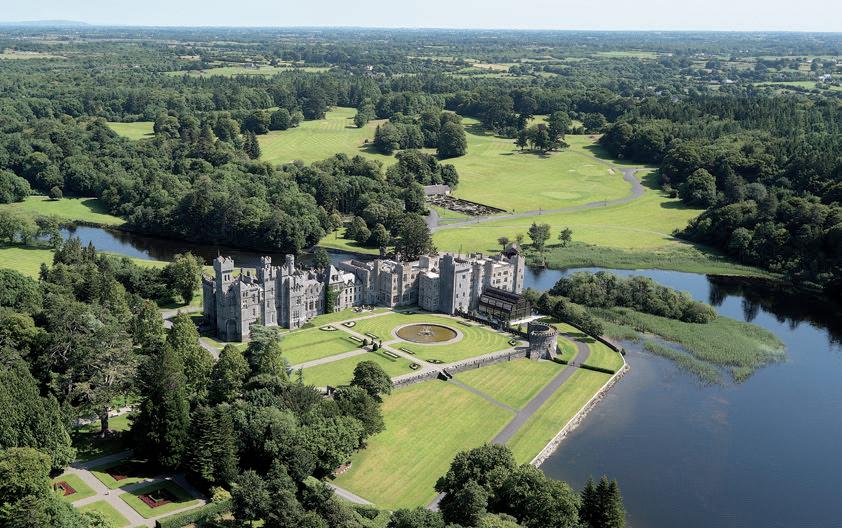
Ashford Castle, the former Guinness family seat in County Mayo, is winning deserved accolades, says Margaret Hussey
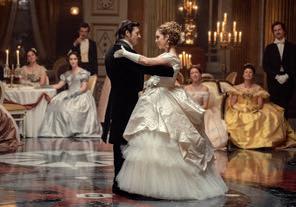
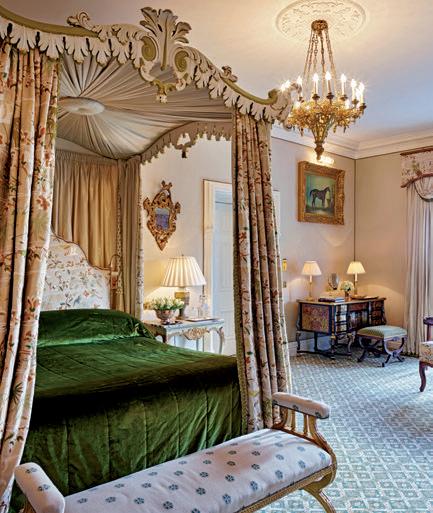
When the Tollman family bought Ashford Castle in 2013, they quickly spotted that as well as taking on one of the most historic buildings in Ireland, they also had one other priceless asset: the sta . During the castle’s two-year, multi-million-pound restoration, hotel teams were kept on, some living in the shell of the property and others mucking in to help out.
That sense of pride and love for the 800-year-old castle continues today, creating ve-star Irish hospitality with a twinkle. Since reopening in 2015, the hotel is Forbes ’ only ve-star hotel and spa in Ireland as well as being highly commended as the best seasonally inspired restaurant in the Country & Town House x Polestar Sustainable Hotel of the Year Awards 2025
Back in my room, I was ready for that four-poster bed. The fire had been lit, the lighting dimmed, quiet music playing
The castle in County Mayo is the former home of the Guinness family, whose story has been brought to life in Net ix’s House of Guinness Remnants of that era are everywhere, from oil paintings and old photographs to the George V dining room, named a er the then-Prince of Wales, who visited in 1905. Here, the delicious tasting menu includes cured organic salmon, Galway Stracciatella cheese and Slieve Aughty venison. There is a big emphasis on ingredients supplied by local farmers and shermen; Ashford is on the shores of Lough Corrib, and Galway Bay is just 40 minutes away.
The castle also serves the most delicious a ernoon tea named a er Lord and Lady Ardilaun, the last Guinness residents who hosted Oscar Wilde and George Bernard Shaw here before the family sold it in 1939. Like everything about Ashford, the portions are Irish-style, and that generosity continues in the room with a welcome chocolate wolfhound made by superstar chocolatier Paula Stakelum. Her desserts are also on the a ernoon tea menu and are simply sublime.
Ashford also has a huge wine cellar, and a tasting with head sommelier Paul Fogerty was a real eye-opener into Irish-owned wine and viniculture. We sampled a delicious burgundy by Róisín Curley, a fabulous Château La Coste rosé from Patrick and Mara McKillen, and a Château Léoville Barton burgundy from the Barton estate. At the very cosy Cullen’s at the Cottage in the grounds, you can enjoy a pint of Guinness and some of the best seafood in the west of Ireland.
Sustainability is hugely important here: the castle has been partnered with Winnow, which uses AI to measure (and thereby help reduce) food waste, since 2019. Every bit of le over food or ingredients is repurposed, with breakfast croissants turned into bread and butter pudding and fruit and veg turned into stocks, syrups, kombucha and marinades.
The no-dig, no-pesticide garden, led by head gardener Alex Lavarde, is striving to become fully self-su cient, its vegetable beds and edible owers sitting alongside fruit trees, a tru e grove and beehives. Ashford has also partnered with EarthCheck to achieve net zero emissions by 2050. Another lovely touch is the bird boxes made from fallen larch trees dotted around the woodland and 350-acre estate, numbered a er the 83 rooms, suites and private boathouse. There is so much to do across the estate. Every morning you can join wolfhounds Molly, Mulligan and Dougal – as well as Ruby and the red and white setter Shay – on a walk.
Wolfhounds were nearly extinct in 19th-century Ireland, so it’s great to witness the breed so prominent here, both in real life and in the form of stone wolfhounds at the hotel’s entrance and Stakelum’s chocolate creations.
We took a boat trip with Frank Costello, who tells us his grandfather worked on the estate for the Guinness family from 1917. Costello, who was born here, is also a ghillie and leads shing trips for salmon, trout and pike. He built the beautiful boat we travelled in and told stories about the area and the castle and its journey from medieval fortress to today’s grand retreat. Frank moored up and we were welcomed with a roaring re and glass of champagne.
My room had a four-poster bed with swags of character and theatre, plus the com est pillows and bed linen. The bathroom was huge and well stocked, and it was lovely to see the mini bar lled with lots of local Irish products, like Drumshanbo Gunpowder gin and Achill Island sea salted nougat.
Authenticity is key to Ashford and this is hugely apparent at its spa, the rst and only in Ireland to o er Augustinus Bader treatments and where I had the most incredible facial. If it rains – and surely it will – the hotel has a 32-seater cinema complete with a popcorn machine and posters of John Wayne. The classic 1952 lm The Quiet Man was lmed here and Wayne’s co-star Maureen O’Hara was a regular visitor. Not that anyone is fazed by celebrities at Ashford; they have seen everyone from Rory McIlroy to Pierce Brosnan, Sharon Stone and Brad Pitt. Every guest is treated the same, and it’s a testament to the happy sta that they have had multigenerational families working here and relationships cemented into marriages.
Back in my room, tired a er a day of wolfhound walking, epic food and falconry –it was a privilege to have a hawk on my arm and see her plumage up close – I was ready for that four-poster bed. The re had been lit, the lighting dimmed, quiet music playing. Thoughtful and meaningful – and so very Ashford Castle. ■
BOOK IT: From €496 for a double room B&B, ashfordcastle.com
Margaret’s return ights from London Heathrow to Shannon had a carbon footprint of 179kg CO2e (ecollectivecarbon.com)
Jeremy Taylor whispers through the Cotswolds in a McLaren Artura Spider
What have the Romans done for us? Well, they built the Fosse Way, a 230mile road from Exeter to Lincoln that today o ers travellers one of the most exhilarating routes across the Cotswolds. Lorries and herds of tourists might diminish a driver’s delight, but the scenery on one of the straightest of straight roads is undeniably beautiful. Make time to slip o the main drag and quintessential Britain is waiting for you.
Such a drive deserves an exemplary sports car. The Artura Spider may look like just another McLaren, but what makes it special is what sits beneath that svelte aluminium exterior. Gone is the company’s roary V8 petrol engine, replaced instead with a hybridised V6 and a modest 7.4kWh battery pack.
O cially, this is the most e cient McLaren ever, returning up to 59mpg; the downside is its range is a piddling 21 miles. There is an upside: this is a 200mph+ supercar that will start silently in the morning without waking the neighbours. And while some poseurs like to shout with twin exhausts, there’s nothing cooler than cruising through a peaceful Cotswolds village – quietly.
The Spider – an open-top version of the Artura coupé – is also the best McLaren I’ve driven. Not just because it’s fast, agile and infused with an illustrious F1 heritage, but also because this is also the most usable of the marque’s ever-

expanding range. You don’t need the driving skills of Lando Norris, either; it’s possible to race the Spider like an F1 ace, or just pootle about country lanes of Gloucestershire in supreme comfort.
Today, I’m doing the latter. The driver-focused cockpit design is lowslung and sporty but still o ers great visibility, with most of the controls operated via a touchscreen. Various drive mode switches sit atop a no-nonsense instrument binnacle, conveniently located directly in front of the driver. I’ve sat in more complicated hatchbacks.
My destination is the new Hyll hotel, a restyled beauty of a manor house not far from Chipping Campden. To negotiate the driveway, I actuated the Artura’s suspension raise system for extra ground clearance, and as rain clouds loomed, the electric hard-top shuts in just 11 seconds.
If you demand a spa with bathrobe and matching slippers, Hyll isn’t the place – its new owners lled in the swimming pool and rejected the idea of a gym. Instead, a guide book in my bedroom is titled Do Nothing. A matching Do Something booklet is available, if you must.
Hyll’s philosophy, then – like Artura’s – is full on, or full o . Tear around the Cotswolds seeing the sights, or slip into comfort mode – amble in the gardens, si through the hotel’s collection of vinyl LPs. I know which one I prefer, and why this McLaren is my supercar of choice. ■

↑ STAY
Knock out the ZZZs on a superlative Hyll bed. Every mattress is handcra ed by Naturalmat in the company’s solarpowered Devon workshop using natural and organic bres. You may not wake up in time for supper. hyllhotel.com
Shop till you drop at the Cotswolds’ most discerning emporium of loveliness, just 14 miles from Hyll and so within e-range, and enjoy some people-watching too – the Beckhams, Kate Moss and Taylor Swi all visit Daylesford. daylesford.com
Like to tune into a podcast while out walking? Channel Lando Norris, who wears the latest Bowers & Wilkins Px8 S2 McLaren Edition headphones in the pitlane. £729, bowerswilkins.com

Create unlocks access to the creative arts for those who need it most
It’s no secret that art enriches our lives in countless ways. But as research continues to show that engaging with arts and culture has an overwhelmingly positive impact on wellbeing, access to creative opportunities is shrinking for marginalised groups across the UK.
Making art accessible for everyone, regardless of background and personal circumstances, is the beating heart of multi-award-winning creative arts charity Create. Since 2003, it has been o ering free, inclusive workshops to society’s most disadvantaged and vulnerable people.
Create believes that ‘everyone should have access to the power of creativity’. To make this possible, the national charity focuses on working with eight key groups, including carers, disabled children, and older people with dementia. Participants explore art forms from songwriting to sculpture, learning directly from professional artists. They also discover new ways of expressing themselves, improve their teamwork and
communication, and build relationships with others in their group. Many of the programmes end with a nal sharing, giving participants the chance to celebrate their creations.
The positive lasting impact of Create’s work is undeniable. Out of more than 2,000 participants in 2024/25, 90 percent said the charity’s projects improved their wellbeing, while 87 percent said they felt more connected to others. People of all ages have reported feeling more con dent and less lonely – a testament to the power of creative expression.
As the charity continues to run workshops through 2026, it is also gearing up for Create Week (1-7 July), an annual, nationwide campaign designed to introduce the bene ts of creativity to as many people as possible. Free activities designed by professional artists encourage us all to take a moment to tap into our imagination.
Create is C&TH’s charity partner for 2026. Explore your creative spark and sign up for Create Week at createweek.org

Visiting Provence in the low season might just reward you richly – if you’re prepared to dig for it, says Tessa Dunthorne
Nemo the tru e dog stops for a moment, bows his head, and sni s. Bated breaths from the seven of us on his trail. Silence falls – has he found black gold? Tru es in this part of Provence sell for upwards of €1,200/kg, pending quality. Is he about to stumble upon a mother lode? The moment stretches on… Nemo li s his leg and urinates.
In sunny Cotignac, a tradition of tru ing is being introduced to hotel guests across each of their ve senses at eco-luxury estate Lou Calen. The tru eto-table experience promises that guests will spend a day in the tru ères digging about, before bringing back their fragrant ndings to Michelin-green-starred chef Benoît Witz. It’s a delicious o er for out of season guests, running between December to March, all the more complemented by Witz’s unique, improvisational approach to cooking at his restaurant, Le Jardin Secret. Here, there’s no menu, meaning total reactivity to the ingredients du jour – including tru es.
‘The ingredient always leads,’ says Witz. ‘If tru es arrive unexpectedly, the menu adapts around them that same day. The dish is built instinctively and with restraint, so the tru e remains the voice of the plate.’
On the eld, Nemo is the expedition lead, but his nose is directed by the Canuts, a local family who have spent 25 years and three generations hunting tru es. Patrick Canut’s daughter Lisa is slowly beginning to take the
reins, but she has competition in her eight-year-old child, a blur of a boy in Spider-Man socks who has an uncanny knack for predicting a dog’s ndings perfectly. There’s also Alba, an energetic puppy who is apprentice to Nemo, although she is as interested in eating the tru es as she is seeking them out (she eats three, which must total over €100 down her gullet). As the dogs nd a tru e, they tap the ground to alert the Canuts, then dig before handing over to Patrick, who uses a thin chisel to free the bulb from the ground.
Most, if not all, tru e oils in the UK are arti cial. It’s impossible to grasp this until you hold the real thing in your hands. Even caked in mud, the heady, earthy scent carries. And its freshness diminishes at pace; an experience like the one by Lou Calen is a rare opportunity to taste it within hours of discovery. For our part and hard work (more like mere rambling behind the expert pups), we are rewarded with a freshly prepared olive and tru e tapenade alongside the Canuts’ home blend of olive oil. I am le frankly drunk from the taste.
This experience has been on o er since 2024. It matters now, perhaps, more than ever. Lisa says it has been one of the worst years for the hunt in her memory (‘très mauvaise année’); her father echoes this, expressing frustration at the lack of ndings by the dogs. In late January, when I visited, there should be ripely sized ndings –so when we unearth only six tubers, it is surprising. And it’s the weather to blame. Or more speci cally, that beast called climate change.
‘Having a Michelin green star is not a badge,’ says Witz. ‘It is a responsibility – a daily reminder that sustainability is about choice and respect. Cooking the way we do, with these ingredients, helps guests understand that luxury can be simple, and deeply connected to place.’
Awareness-raising or not, Witz’s food is stellar. Le Jardin Secret and Lou Calen’s more casual diner, Le Bistrot, o er tight, punchy menus completely rooted in the region. Beyond tru es, Witz handles game with impeccable skill. The suprême de pintade à l’estragon (tarragon guinea fowl supreme) is served with another local favourite, polenta – and of course there’s a table stacked with treats like tarte tatins, mille-feuilles and other patisserie. Brunch at the bistro is an even more dramatic a air: there’s a honey-glazed whole leg of pork hoisted onto the table as well as beef Wellington to enjoy with your croissants. Guests, like me, will take home a lot more than an extra kilogram of body mass; no doubt they will uncover a new appreciation for one of the most quintessentially luxe ingredients in the world, and how global warming is making it rarer. It’s a nice touch that, through the hotel’s extended sustainability e orts and by o ering an out of season view of Provence, it makes a slight chip at that problem, too. ■
Doubles from £175; tru e experiences from €35, loucalen.com
Tessa’s return ights from London Stansted to Marseilles had a carbon footprint of 305.1kg of CO2e. ecollectivecarbon.com
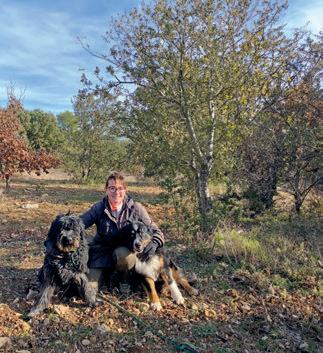
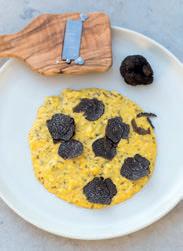
Chef Benoît Witz, Le Jardin Secret
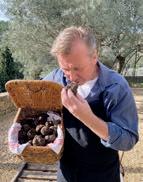
What’s your food philosophy? Cooking begins with listening to nature. I do not ask what the guest wants, I ask what the garden wants. My role is to respect the ingredient, its rhythm and its integrity, without forcing it.
What was the rst dish you learnt to cook?
A herb-crusted rack of lamb by François Kiener. It taught me discipline, respect for technique and the importance of restraint.
What’s your favourite in-season ingredient and why? Autumn ingredients, particularly tru es, mushrooms and root vegetables. They invite deeper avours and a more generous, comforting style of cooking.
Your go-to throw-it-together dinner? Something simple and honest. A roast chicken or a well-prepared vegetable dish. Cooking should nourish and comfort.
IN THE GREEN Le Jardin Secret has held a Michelin green star since 2023, and the Lou Calen hotel more broadly invests in environmental and local sustainability. It addresses energy needs through the use of colourful, photovoltaic skylights and has invested in heritage preservation projects such as the restoration of the Saint Martin Chapel and the two Saracen Watchtowers, all built in the 12th century.
What’s in your fridge right now? Oysters, skate wing, condiments, seasonal fruit and vegetables, and ginger.
When you’re not in the kitchen, where are you? In nature. Cutting wood in the forest, walking the land, or spending time with our producers. These moments inform my cooking more than any book.
What’s your favourite comfort snack? Tourte vigneronne. It reminds me of family meals.
Lavoratti 1938 works with Ecuador’s nest cacao plantation to produce its award-winning Mediterranean chocolates. Its blood orange tru es make good use of the Sicilian seasonal staple. £16.99 for 200g, selfridges.com
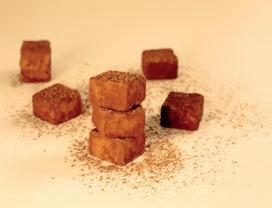
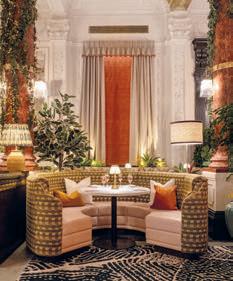
Kensington Olympia will reopen in spring following a £1.3bn faceli – with swanky new dining spots in tow in its Grade-II* Pillar Hall. Restaurateur Des Gunewardena has poached Samantha Williams from Café Murano to lead Idalia (pictured above), a modern British restaurant located in the grand, ground- oor ballroom and terrace, while Pepperbird, a basement speakeasy, will o er a naughty ode to Olympia’s rock heritage. olympia.co.uk

Whether battered, fried, sashimi-ed, or baked, from a counter or a tin, Brits are enamoured of fish. And apparently our tastes are getting weirder; the Waitrose 2026 food and drink report declares that ‘forgotten cuts’ are hitting our plates – with, for example, a 21 percent uplift in ray wing sales over the past year.
The Carousel team has just opened Cometa, a new Mexican in Fitzrovia that promises a zest-fest with its ‘citrus bonanza’. Its trifoliate orange sorbet is topped with buttermilk ice cream and bergamot curd. carousel-london.com
↓ SESAME SEASON
Bite down any cynicism: black sesame is the new matcha, according to Google trend data. The dark superseed is gaining ground due to reported health bene ts –which, should any follicularly-challenged gentlemen read this, include hair growth – and the mainstreaming of Japanese cuisine. Keep an eye out for black sesame lattés popping up this spring: GAIL’s is set to launch a take in April, but to try one now, head to WA Café, the little Japanese patisserie in Covent Garden, Marylebone and Ealing. wacafe.co.uk

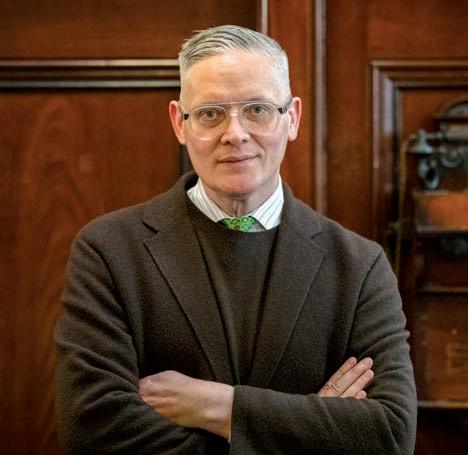
I really can’t stand noise for the sake of noise. Excellence rarely needs to shout
First thing in the morning I… draw the curtains and check the light. I get up very early and relish those hours enormously. It sets the tone for the day and my wardrobe choices.
I am grounded by… early morning walks, whether in the country or in town. I have taken an early morning photographic diary for years.
I feel unhinged by… too much stillness. I need the radio, the sounds outside, dogs, the sense that there is life moving.
I treat myself by… allowing time to linger, letting the imagination run wild.
I escape by… working, drawing, painting. I am happy when there are daunting possibilities.
I let my hair down by… walking without destination, full of surprises and serendipitous endings.
My greatest vice is… an obsession with detail. I can feel or see if something is wrong from across a eld.
My greatest virtue is… curiosity. It is a discipline disguised as wonder.
My relationship with my phone is… tentative yet practical. I prefer paper and pencil but can’t live without it now.
I wish I could… paint light. And paint more. It’s something I will allocate more and more time to.
I really can’t stand… noise for the sake of noise. Excellence rarely needs to shout.
Last thing at night I… mentally re-edit the day and watch the light change, hopefully listening to animals outside. Foxes or birds.
My greatest luxury is... time and space, especially the unstructured kind with a few days ahead of me.
I had an ah-ha moment when… an idea became reality, discovering anything is possible.
I will pay it forward by… backing makers who value skill over speed.
A wise person once told me… ‘If you’re going to do it, do it properly.’ It sounded simple, until I realised it applied to absolutely everything. ■
Artist and designer Giles Deacon is creative director of James Purdey & Sons

BEGIN YOUR OWN TRADITION