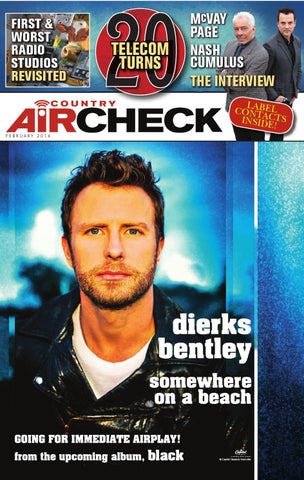
FIRST & WORST RADIO STUDIOS REVISITED
TELECOM TURNS
MCVAY PAGE NASH CUMULUS THE INTERVIEW LABEL CONTA CTS INSIDE !
DB_AirchkCvr_CRS2016_r2_Layout 1 1/15/16 5:08 PM Page 1
FEBRUARY 2016
GOING FOR IMMEDIATE AIRPLAY! from the upcoming album,
black
© Capitol Records Nashville
st & 1 WORST
Remembering Radio’s Glamorous Side
G
uns, snakes and rodents ... welcome to radio. For some, getting a start in the business meant shaky technology, dilapidated buildings and strange situations. In hindsight, those first or worst studios sure make for great stories. WQHK/Fort Wayne, IN OM Dave Michaels: In 1986, I took a job doing mornings in Arkansas. The first day there, I was being shown around the town by the PD, who had a six-pack on the dash and one in his hand during the tour. When we got to the station, I knew I was in trouble. Not only was the equipment mostly trash, but there was a hornets nest in the studio. When I asked about it I was told, “Leave them alone and they’ll leave you alone.” I was lucky to be out of there with a new gig in three weeks. KEEY/Minneapolis morning host Chris Carr: My first station was WFSH/ Niceville-Valparaiso, FL. I think we had a Gates board with big red and green knobs
and slider things that never really stuck in the spot they were supposed to be in. The board in the production room was the station’s old control board. It had to be at least 30 years older and regularly shorted out ... we’d hit the top of it to make it work. That board saved my life. One of our part-timers was having an affair and his wife found out while he was on the air. She showed up at the station and confronted him in the control room, right across the glass from the production room. I had just gotten off the air and was doing prod behind “Old Ironsides” when I saw them yelling at each other. I thought I would just whip out this :30 real quick, get out of there and come back later. As I was doing the spot, the board shorted out and even after giving it a whack on the top, it still wouldn’t work. Then I started smelling smoke. I thought the board had finally died. Come to find out, while I had the headphones cranked doing a spot, our night guy’s wife tried to shoot him! She missed, the bullet went through the wall and right into that old board in front of me. I had absolutely no clue what happened until hours later when the cops called my house to do a report. The next day, our engineer fixed it. That same station had its transmitter site in a bog and/or swamp. Every few years when the FCC came to inspect it, we gave them a big stick before opening the gates to the facility. My boss would say, “See all those trees? They’re full of snakes and you may want to keep that stick handy.” I don’t recall the FCC guy venturing in, but we did receive a fine for what he deemed an inaccessible transmitter site. WDRQ/Detroit PD Robby Bridges: When telling radio stories, we’ll all often say, “Oh man, that studio was a closet.” When I did nights at WPRO/Providence in 2001-02, one of our sister stations at the time was ’80s hits WZRI; it was literally in a former closet in the famed Brine Broadcasting Center. The console was sideways on a table arm, so you had to turn against the wall to twist into the chair. At 6’4” I was always glad to be down the hall at ‘PRO! I also worked in WODS’ (then Oldies 103) great studio in the WBZ/Westinghouse building in Boston. The only hinky thing was that the off button was the top red button on each pot, and the on/fire button was on the bottom. I’ve never seen any other console like that. It took you months of shifts to get used to firing the right one! KTTS/Springfield PD Mark Grantin: The original WWQM building in Madison was just outside the city limits in the middle of cornfields and a swamp. The AM towers were outside the old brick building that held the transmitter. They built sections as the stations grew for studios and offices. The production room was huge with orange shag carpeting on the walls for soundproofing, ugly wooden paneling elsewhere and a huge stone fireplace. I guess it was the original GM’s office at some point. The entire building was built with a crawl space underneath. Animals would come out from the swamp and die under the building. One of our part-timers would be enlisted to crawl under and pull the carcass out with a shovel or pitchfork. One time, it had to have been a fairly big animal that died right under the production room. Nobody would crawl that far under the building. As the carcass decomposed the smell got worse and worse. Even though we put air fresheners in the room, it was almost unbearable to try and record commercials for at least a month.
PAGE 3 • FEBRUARY 2016
st & 1
through the ceiling all over the floor. I grabbed a garbage can to try and catch it, but it filled completely up in like two seconds. It was the most water you’ve ever seen pouring into a room – like the ocean was coming in. They actually condemned the building after that because the roof completely collapsed. We had to move Star 105 and the Sports station to what is now the Cumulus building in Toledo.
WORST
Country Aircheck’s Russ Penuell: The company I first worked for owned two radio stations: KORI/ Logansport, LA where I spent most of my time, and KJVC/Mansfield, LA, which was about 20 minutes away. In the fall, it was my job to drive to Mansfield and put the local high school football game on the air. Getting there meant driving about a half mile down an awful and often muddy dirt road, usually at night, and crossing a narrow cattle gap to get into the pasture. Then you’d bounce past bovines the last quarter-mile to the tiny, uninsulated metal building at the base of its tower. I was pretty shocked when I opened the door to find nothing more than a metal folding chair, an old four-pot board on a card table, a single desk lamp for light and a handheld microphone for reading the legal ID. No running water, no bathroom. To make it more interesting, the station simulcasted its sister – even during football games. We were in stereo, of course, so they had the bright idea of keeping the simulcast going on one side while broadcasting the football game in the other. I can’t help but wonder if listeners ever figured out what they were listening to. That mic brand was JVC, by the way. The boss was a big fan of their audio gear, so he named the station after it. WQNU/Louisville MD/morning co-host Jess Tyler: The first place I ever worked, they had a charity auction where clients donated items like a limo ride, siding, spa services, etc. You’d think that would be to donate to a favorite charity, but it wasn’t – all the money went to help them meet their sales budget! The station was also housed in a modular home and the traffic director’s son was on the air, the GM’s kid worked there, and the engineer lived in a house next door – so you had to walk over and knock on the door to see if he was home anytime there was an engineering problem.
Volume 11, Issue 1, February 2016
PAGE 4 • FEBRUARY 2016
“
It had to have been a fairly big animal that died right under the production room.
WYCD/Detroit PD Tim Roberts: When I was in Antigo, WI, I had to work in a studio that toggled back and forth between AM and FM, as well as production. Of course that’s easy now with technology but you can’t imagine what it was like going right toggle on the FM and left toggle on the AM while live and a song is playing and you’re cutting a spot on the recorder. It made you dizzy! The building was in the woods, which were heavily populated by deer. So on the first day of hunting season it was like you were in ’Nam. I’m getting there one morning just before sunrise – cold, dark and foggy and I’m a little sleepy. All of a sudden I hear bam, bam, bam, bam! As I’m walking inside I realize bullets are hitting the building! There were no windows and it was made of brick so I’m sure bullets just bounced off, but it sure wasn’t comforting as I started the show. Another time, I was overseeing Star 105 [Cumulus Hot AC WWWM] in Toledo at what we called The Pickle Palace because it was on Pickle Road. It was the original Dickey Broadcasting building and unbeknownst to us a ton of ice had built up on the building’s flat roof over the winter. The ice started to melt and form this massive pocket of water. As I was walking through what was a traffic area I started to hear this weird noise. As I rounded the corner I saw what was like a swimming pool of water just pouring
914 18th Avenue, South Nashville, TN 37212 615-320-1450
Chris Huff, KILT/Houston: I’ve been very lucky to work in some top-notch studios over the years, which helps make up for the fact that my first job at KBEC/ Waxahachie, TX meant being in a studio that was frequently shared with rats. Digging through the records (yes, vinyl albums) in the library would mean brushing aside the occasional rat droppings. The rats had an uncanny ability to time their dashes through the studio to coincide with the mic being on, which made for what were probably some very entertaining breaks. I doubt many people, if any, heard those breaks though, since we had to power down to 65 watts after sunset. We couldn’t monitor our air signal at night because the Mexican station on our frequency would bleed into our signal – despite our towers being in the field behind the studios!
Publisher/CEO Lon Helton lon@countryaircheck.com
”
Consultant Phil Hunt: It was 1979, and as a new resident to Nashville and student at Belmont College, I needed a job. I was hired at WAGG/Franklin, TN and the station facilities were just horrible. When the producers of Coal Miner’s Daughter went looking for a 1950s-era radio station to film the infamous “baloney interview” scene, guess where they found one? Bingo! The station had an old RCA board – complete with a ribbon microphone, behemoth turntables and a patch bay that looked like something Clark Griswold would design. As most control rooms of that era, the windows were duel paned in the studio with an inch or so air space in between so one pane wouldn’t conduct sound to the other. We played the music loud in the studio, but once an hour things got quiet as we delivered the news. The break in volume was the green light for the mice in the building to move on their rodent highway via the air space in the control room windows. The first time I saw one I was in a newscast and shouted out like it was the zombie apocalypse. That was followed by 10 seconds of dead air while I regained my composure. That was more than 30 years ago, but every time I hear “Coal Miner’s Daughter,” I have to smile.
WPAW/Greensboro APD/morning co-host Clay JD Walker: When I was in high school I got lucky enough to work for a small company in Buckhannon, WV. By the time I was a senior I became the Production Director. I worked at night putting commercials together and I had a little office. The company also owned a public access TV channel. Without any warning, the company brought the public access TV channel over to the building where the radio stations were, demolishing my office for their studio. I came in one night to find all the walls knocked down and my desk drawers turned upside down and all the production work laying on the floor. We didn’t have a Marti receiver, but we had a Marti. We found you could pick up a Marti over a police scanner, so we set one up on the front porch, punched in the frequency, put the antenna on the side, and we could get a really bad audio connection back to the console and turned it up to do live broadcasts. I’m grateful for that experience, because now I know how to fix things with no budget. We were in a metal pole building, which was finished on the inside with small offices, and there’d be many instances where you’d be working and see birds flying in the building through the eaves. On Sunday mornings I was running all the preacher programs, and this kid I went to high school with would come in at noon to run The Crook & Chase Countdown. We were standing in the back talking and a copperhead came through a small gap on the bottom of the back metal door. We chased it out with a broom. The next week I found that the other guy had taken a piece of cardboard and duct tape to make a snake seal across the bottom of the door. He wrote “Snake Seal” in big letters and drew a picture of a snake. As far as I know, until the day they moved that station out of the building, that piece of cardboard was laying there on that door to keep copperheads from coming in while we were on the air. KCYE/Las Vegas PD Kris Daniels: I literally had to four-wheel drive up a back road to my first station. We had a reel-to-reel for running a gospel show on Sundays, but the person who recorded it didn’t do it at the right speed, which drove me nuts. So I spent 30 minutes trying to push it along with my hands so it would be up to speed. When it snowed, we had to go outside with a broom and sweep the snow off the dish. Remember having to sign off at midnight? I had to be the engineer and go shut us down, and I was always afraid I was going to blow the whole thing up. There was no lock on the door and, of course, I did nights and overnights because it was my first gig. At one point a wanted criminal was on the loose somewhere in the area. So I said, “I’m bringing my gun.” Since the door didn’t lock, and you had to sit with your back to the door, I told everyone, “My gun is pointed at the door, so you’d better call before you come down here.” Country Aircheck’s Jess Wright: One of my first stations was owned by a woman who got it in a divorce from her husband, the mayor. We were constantly in danger of having the electricity shut off because she couldn’t pay the bills and had to wait until after 2 pm on payday to take our checks to the bank. Even then they didn’t always clear. She hired a guy with no experience to be our engineer, because he would work cheap. He had no idea what he was doing, as evidenced by the sea of duct tape you’d see if you opened up the board. It was one of the old ones with turn pots, and if you clicked them into cue, even if the pot was turned off, they went live. Even the mic! We learned quickly not to swear in the studio. The owner also rationed everything, which included keeping the toilet paper locked in a closet. One time when I asked her for a roll, she said, “Well, where is it all going?” I had to break it to her we were just flushing it all down the toilet. CAC Got a great “first or worst” radio story? Drop us a line at news@countryaircheck.com.
VP/GM Chuck Aly chuck@countryaircheck.com
Managing Editor Wendy Newcomer wendy@countryaircheck.com
Associate Radio Editor Jess Wright jess@countryaircheck.com
Coordinator/Graphics Shelby Farrer shelby@countryaircheck.com
VP/Sales & Marketing April Johnson april@countryaircheck.com
Radio Editor Russ Penuell russ@countryaircheck.com
Manager/Graphics & Administration Kelley Hampton kelley@countryaircheck.com
Art Direction Jerry Holthouse jerry@countryaircheck.com
WE KNOW MUSIC
MEDIA BASE.CO M ©2015 MEDIABASE. ©Mscore. ©Rate The Music. All Rights Reserved. All marks and logos are trademarks or registered trademarks of their respective companies.
DANCE WITH YA DEBUT SINGLE AT RADIO NOW • ON TOUR WITH GRANGER SMITH
IN THE STUDIO NOW COMING IN 2016
W
TELECOM TURNS
20
REVISITING CONSOLIDATION’S CATALYST
Sign Of The Times: President Bill Clinton (l) electronically signs The Telecommunications Act of 1996 as Vice President Al Gore looks on. The event happened live over the internet, making it “the first law to be signed in cyberspace.”
T
wenty years ago this month the business of broadcast radio and virtually every other aspect of communicationsrelated commerce in the United States was redefined with the passage of the Telecommunications Act of 1996. Not since the creation of the FCC during the Great Depression had American telecommunications policy been so extensively addressed. The goal of the ‘96 law, according to the FCC, was “to let any communications business compete in any market against any other.” Proponents say it has done exactly that. Opponents argue the opposite. Others use the bipartisan legislation to illustrate the power of special interests in the halls of American government. In any case, Telecom transformed every business it addressed, and nowhere have the changes been more striking than in radio. By Russ Penuell Alpha Chairman Larry Wilson remembers the Making Change: The seismic shift for broadcast period well. Wilson founded the company that would radio came with the act’s elimination of national become Citadel in 1984, the same year the FCC station ownership limits and the implementation raised station ownership limits from seven of a tiered local ownership model. The AMs and seven FMs nationally to 12 of FCC had been experimenting in those each. No more than one AM and one FM areas since the mid ‘80s in response to an were allowed in a given market. “It was an increasingly anemic industry. From 1989okay business, but it was really hard to get 90 alone, AM and FM profits dropped by any critical mass,” he recalls. “And it was 50% and 33%, respectively, according to really hard to provide meaningfully for one study by the FCC. “The late ‘80s and advertisers in specific demographics.” early ‘90s were a very challenging time for “It’s like we were selling one section of radio,” notes Texas Tech College of Media Todd Chambers the local newspaper,” explains independent & Mass Communications Associate Dean owner/operator Jim Martin, who now leads PMB Todd Chambers. “And they were basically trying to Broadcasting/Columbus, GA. “Having another station figure out ways to support the industry.”
would’ve made things much more manageable.” More experimentation was on the way. In 1990 the FCC ruled Citadel could operate a third station in its Colorado Springs market via LMA, a first for radio and a practice that quickly caught on across the industry. “Some have said that was a precursor to deregulation,” Wilson says. “When we got that ruling, I remember my lawyer Peter O’Connell saying it could mean a lot for the industry; if you can do these LMAs, he said, that means at some point they’ll probably let you own them. So we did the LMA with an option to purchase and as soon as they let us, we did.” Wilson’s LMA purchase became possible in 1992 when the FCC raised the market limit to two AMs and two FMs, as long as they did not account for more than 25% of the total listening audience. The national limit, meanwhile, was raised to 18 and 18, which became 20 and 20 two years after that. Larry Wilson More comprehensive changes to radio ownership and American communications generally would require an act of Congress, a process that by 1992 had actually been underway for almost two decades. Retired U.S. Senator Larry Pressler (R-SD) authored the l996 law and the original signed copies hang on the wall of his Washington office. “I worked on it for the 22 years I was in Congress,” he says. “It takes that long to pass a major piece of legislation. There were so many interest groups and it was a struggle. We had sort of a magical moment in late 1995 when all the parties seemed in agreement. I personally visited all 100 U.S. Senators to get their input and to explain the need to pass it on a bipartisan basis, which we finally did.” Pressler’s bill passed 91-5 in the Senate and 41416 in the House on February 1, 1996. “As of now the Berlin wall of telecommunications has been
PAGE 9 • FEBRUARY 2016
Major Acquisitions Leading Into Clear Channel SFX BROADCASTING COMMODORE MEDIA
CLEAR CHANNEL
OSBORN COMMUNICATIONS PATTERSON BROADCASTING BENCHMARK COMMUNICATIONS
AMFM CHANCELLOR BROADCASTING EVERGREEN MEDIA
CHANCELLOR MEDIA
VIACOM RADIO PROPERTIES
CLEAR CHANNEL
NATIONWIDE COMMUNICATIONS
JACOR
CITICASTERS REGENT BROADCASTING
PAXON COMMUNICATIONS U.S. RADIO RADIO EQUITY PARTNERS
Pre-1994 holdings and miscellaneous
1994
1995
1996
1997
1998
1999
2000
2001
2002
Source: Fine-Tuning In The Markets? An Event Study Of Radio Station Transactions, 1995-2009. Eric Aiese, 2011.
TELECOM TURNS 20
demolished,” declared one closely involved Senator as President Clinton signed it into law a week later. “And we can go forward now to an era of competition rather than monopoly.” Consolidation: The elimination of national ownership limits and relaxation of local rules allowing companies to own up to eight stations in some markets created a buying frenzy marked by bold purchase offers. Five years after its passage Clear Channel (now iHeartMedia) owned an extraordinary 1,216 radio stations, according to Broadcasting & Cable. Rounding out the top five station owners were Cumulus (270), Citadel (216), Infinity (185) and Entercom (104). Martin recalls Cumulus paying more than 14 times cash flow for his Columbus, GA stations in 1998. “A typical deal back then,” he says. Despite appearances, the prospect of excessive consolidation loomed large as the legislation was being crafted. “I was afraid of too much consolidation,” Pressler recalls. “People suggested that would be addressed with antitrust enforcement, but no recent president of either party has enforced antitrust laws. That’s part of the problem. It’s not the Telecom Bill. We’d be better off if we didn’t have so much consolidation, but wiser men made those anti-trust decisions.” The government has challenged consolidation on antitrust grounds since Telecom, but has generally done so with respect to local economics.
PAGE 10 • FEBRUARY 2016
Most cases result in a company divesting a station or two to prevent majority control of a market’s advertising revenue. Proponents of more aggressive antitrust enforcement argue that challenges should also consider national aspects, the relationship between ad representation firms and media operators (iHeartMedia owns Katz, for example) and the social and political effects of consolidation.
“
I was afraid of too much consolidation. People suggested that would be addressed with antitrust enforcement, but no recent president of either party has enforced antitrust laws.
”
–Senator Larry Pressler (1979-1997)
Inadequate antitrust enforcement, Pressler says, can be laid at the feet of special interests. “It’s the power of big business and big labor,” he argues. “We had to get the support of big labor on Telecom and they were in on a whole bunch of stuff; things like no outsourcing of telephone numbers so they didn’t have to compete as other industries do.” Lawmakers also needed the support of the Communications Workers of America, a union Pressler says is second in power only to teachers unions. “They were as equally greedy as any of the companies were,” he continues. “So I’ve
got a bad flavor in my mouth that we’ve allowed so much consolidation.” Pressler’s unease was shared in part by President Clinton, who after leaving office discussed the law at the 2001 Radio & Records Convention in Los Angeles. “There’s no question that when it comes to radio stations it’s facilitated consolidation,” he acknowledged during a Q&A with then-Publisher/ CEO Erica Farber. “And we had a big argument about it. Vice President Gore and I tried to argue for a more pro-competition provision in the act and we lost. I did the best I could. I got a lot of changes in the act. But it passed over whelmingly and I felt it would do more good than harm, so I signed it. But I have not been surprised by the increased consolidation. And I have mixed feelings about it.” Cost Cutting: Consolidation gave radio an economic shot in the arm, but the growing pains were substantial. As individual stations converged into clusters, jobs disappeared. “If you own seven stations, you may not need seven different production directors,” Chambers explains. “There were definitely changes to the human element after the law.” He witnessed some of them himself. Returning home to Lubbock after college in 1999, a friend invited him to the local radio station where they had once worked. “He’s now the market manager for a cluster in Dallas, but at the time he was still here doing mornings,” Chambers recalls. “He said, ‘Todd, come down
“THAT DON’T SOUND LIKE YOU” - Top 20 Digital Sales up 56% LIFE OFF MY YEARS Tour with Tyler Farr & Dylan Sco Career Sales over 10 Million Five Career #1 Singles ACM Winner - Single Of The Year
Named to Bobby Bones’ list of WHO WILL BLOW UP IN 2016 "One of the strongest male vocalists to come along in a some time” - Billboard
The hit single everyone is talking about, “CRAZY OVER ME” 100k digital singles already sold On tour with Lee Brice & Tyler Farr Named in Spotify’s Spotlight on 2016 Country A ists
TELECOM TURNS 20
to the station, I want to show you your replacement.’ And I’ll never forget it. I went in and there was no one in the studio; just a computer.” Martin points to three stations in a nearby small market operated today by one of the country’s biggest broadcasters. “They have three announcers running those three radio stations,” he says. “And I guarantee you revenue is down on every one of them. That can’t happen and there still be success.” Pressler believes he can hear a Jim Martin difference in his native South Dakota. “We have lost our local news and weather reporting in a lot of smaller communities, but not so much in the urban areas,” he contends. “Outside of Sioux Falls or Rapid City, for example, we have almost no local news people anymore.”
“
few types of formats,” he says. “But the economics tell us that a monopolist isn’t interested in just going after 70% of the market; they want to try to attract 100% of the market. So things haven’t gotten as bad from a diversity perspective as was once feared.” A 2011 study authored by Chambers and published by the Broadcast Education Association supports that claim at the local level. The research examined station ownership and programming characteristics for 2000, 2004, 2007 and 2010 across 32 randomly chosen markets and the results indeed showed stability in the number of differing formats. There was significant growth in News/Talk from 2000 to 2004, however, and growth in all four years for Sports formats. Pressler hears plenty of diversity in America’s larger markets. “We have all kinds of choices in Washington D.C., Northern Virginia and Southern Maryland,” he argues. “You can listen to classical music on public radio and get news and weather all day on local stations. And there are minority stations; every language group seems to want its own radio station. So we’ve made some gains and some losses in radio.”
There was an initial euphoria that said ‘My God, if we own all these stations we can get rid of a lot of people,’ And we could; your backroom stuff like traffic could be consolidated down to a much more workable situation. But the widespread voice-tracking? That’s not good radio –Alpha’s Larry Wilson
Wilson concedes some of the cost cutting after Telecom was problematic. “There was an initial euphoria that said ‘My God, if we own all these stations we can get rid of a lot of people,’” he remembers. “And we could; your backroom stuff like traffic could be consolidated down to a much more workable situation. But the widespread voice-tracking? That’s not good radio.” Wilson’s Alpha uses voice-tracking, but in weaker dayparts like overnights. “You’ve got to interface and mingle with the people and have great live and local personalities on the air,” he continues. “If there’s one place where all of the cost-cutting backfired on us, that’s it.” Programming Diversity: Fewer programming choices was another concern with the passage of Telecom, though Chambers says it never materialized. “My big fear initially was we were just going to have a
Year 1994
View From The Top Excerpts from President Clinton’s statement after signing the new law: “The Telecommunications Act of 1996 will strengthen our economy, our society, our families and our democracy. It promotes competition as the key to opening new markets and new opportunities. It will help connect every classroom in America to the information superhighway by the end of the decade. It will protect consumers by regulating the remaining monopolies for a time and by providing a roadmap for deregulation in the future. I am pleased to have signed this historic legislation... “This law also recognizes that with freedom comes responsibility. Any truly competitive market requires rules. This bill protects consumers against monopolies. It guarantees the diversity of voices our democracy depends upon. Perhaps most of all it enhances the common good.”
PAGE 12 • FEBRUARY 2016
”
Good Deal: Pronouncements of doom and gloom have been easy with Telecom, but there have been positives. The rise of station clusters have allowed radio to serve the community in ways that were once impossible. “When the terrible flooding hit Columbia, SC last fall, our EVP/Eastern Region Bill McElveen jumped on it right away,” Wilson says. “We combined with local TV stations and raised something like $750,000 in three days for that community. In the old days we would never have been able to do that with two radio stations.” President Clinton took note of radio’s sustained commitment to community during his 2001 R&R keynote when discussing Telecom. “If you put a dollar value on all the radio and television airtime given free of charge and add the money raised by stations for charity, needy individuals through disaster relief, it is greater than the combined charitable
LARRY PRESSLER
A Rhodes Scholar and attorney from Humboldt, SD whose public service career includes two terms in the U.S. House of Representatives (1975-79) and three in the U.S. Senate (197997). He is the first Vietnam veteran to become a U.S. Senator and the only known member of Congress to decline a bribe from undercover FBI agents during the Abscam investigations dramatized in the 2013 film American Hustle. Pressler lost his re-election in 1996 to a Democrat whose campaign focused in part on Pressler’s support for Telecom.
Station Deals 1994-2010 Value ($billions)
Stations Traded
1995
3.0
1,255
1996
5.0
1,259
1997
14.3
2,157
1998
18.0
2,250
1999
9.0
1,740
2000
28.5
1,705
2001
24.9
1,794
2002
3.8
1,000
2003
5.4
769
2004
2.4
925
2005
1.9
859
2006
2.8
877
2007
22.9
2,100
2008
2.8
1,488
0.7
769
0.4
682
0.4
869
2009 2010
Source: Fine-Tuning In The Markets? An Event Study Of Radio Station Transactions, 1995-2009. Eric Aiese, 2011.
10
TOP
1995
OWNERS BY REVENUE SHARE 1.10% 1.2% 1.2% 1.3% 2.0%
Revenue (000) Stations
CBS Radio
$497,750
39
Infinity
$459,950
42
Evergreen
$285,850
35
ABC/Disney
$269,800
21
Chancellor
$207,400
41
Clear Channel
$137,200
36
Jacor
$124,250
20
CBS Corp.
$121,500
12
Bonneville
$119,400
17
SFX
$117,350
99
1.1%
2.6% 2.7% 4.4%
4.7%
All Others
77.7%
1.3%
2000
1.4% 1.5% 1.6% 19.5%
2.0% 2.4% 2.4% 2.5% 13.1%
All Others
52.3%
Revenue (000)
Stations
Clear Channel $3,517,265
1,157
CBS Radio
$2,353,950
181
Cox
$452,900
81
ABC/Disney
$434,100
54
Entercom
$423,450
96
Citadel
$358,475
210
Emmis
$285,300
24
Radio One
$272,375
49
Hispanic
$248,600
45
Susquehanna
$234,850
29
Source: BIA/Kelsey
TELECOM TURNS 20
contributions of the top 100 American corporations,” he asserted. And Telecom made radio more attractive to advertisers. “It’s been a real plus in that they don’t have to deal with 10 different companies to get a good cross-section of the demos they want,” Wilson says. “They get better results and they make more money. Deregulation fueled that.” Fans of high-speed Internet, cable and wireless phone service and streaming services might also thank Telecom. “Allowing various communications industries to compete in each others’ spaces spurred technological innovation,” Chambers says. Scholars seem to agree that by removing various regulatory hurdles, the law encouraged an astounding level of investment in communications infrastructure. Broadband investment since 1996 tops $1.4 trillion, according to the U.S. Telecom Association. Pressler believes the positive aspects of Telecom far outweigh the negatives. “I’m pretty satisfied,” he contends. “I did the best I could and I think it’s a great piece of legislation. It divided up the pie in ways it hadn’t been before and let more people get more pieces of it.”
PAGE 14 • FEBRUARY 2016
Pressler is not bothered by criticism that the law gave too many breaks to big companies. “It takes a big company to put up a satellite or lay fiber optic cable to India,” he explains, both of which have been aided by the relaxed regulations in the law. “We tried to create a whole host of opportunities for other businesses.”
“
If you put a dollar value on all the radio and television airtime given free of charge and add the money raised by stations for charity, needy individuals through disaster relief, it is greater than the combined charitable contributions of the top 100 American corporations. –President Bill Clinton in 2001
”
LOOKING AHEAD: Chambers helped relaunch Texas Tech’s storied 35kW Class C2 radio station a few years ago and admits spending more time these days counseling students who are worried about job prospects. “The challenge from the academic side is
in trying to explain that the skills they’re learning at the college radio station do have value in the modern media marketplace,” he says. “That may be a radio station, but it could also be a TV station or lots of other things. Do they want to be a deejay? I can’t promise them that. But the broader skills they are learning are still very valuable.” Wilson remains an optimist on radio, big and small. “If you’re a good operator, you can still be very successful,” he argues, using longtime AC WBEB/Philadelphia owner and Broadcasting and Cable Hall of Famer Jerry Lee as an example. The single station Lee owns is consistently ranked No. 1. “The guy gets it,” Wilson continues. He knows radio as good or better than anybody I know and has survived very well.” If revenues are any indication, radio as a whole is sur viving well. The industry has held steady in recent years to the tune of $14.9 billion, according to BIA/Kelsey. The company forecasts modest growth with revenues reaching $16.2 billion in 2019. “We’ve seen some change, but not like what some of the doomsayers predicted in ‘96,” Chambers says. “They were saying radio would be dead. Radio is not dead.” CAC
WELCOMES YOU TO
CRS 2016 FAT MONDAY
THE ULTIMATE CRS MARDI GRAS KICK-OFF PART Y MONDAY 2/8 - DOORS OPEN AT 9:30PM STEVEN TYLER & FRIENDS - Country Music Hall Of Fame & Museum Event Hall Featuring A THOUSAND HORSES, THE CADILLAC THREE & DRAKE WHITE RSVP TO YOUR BMLG REP
[ OR ]
RSVP@BMLG.NET
...STOP FOR A DRINK AT THE REPUBLIC NASHVILLE
HAPPY HOUR
Tuesday 2/9, featuring BRETT YOUNG accompanied by his producer Dann Huff | 5:45PM & CASSADEE POPE | 6:15PM The Palm | 140 5th Ave S. Nashville, TN 37203 RSVP TO CRSHAPPYHOUR@BMLG.NET
..."STAY" FOR WHAT IS SURE TO BE
A MEMORABLE HOUR OF MUSIC
Wednesday 2/10 - Noon sharp
JENNIFER NETTLES, JUSTIN MOORE & TARA THOMPSON CRS Official Luncheon Event - Omni Ballroom
ENTRY WITH VALID CRS REGISTRATION
...AND HEAR ABOUT A SUPERSTAR'S
"DAMN COUNTRY MUSIC" JOURNEY
Wednesday 2/10 - 3PM Transcending / Evolving with TIM McGRAW Presentation Hall, Legends, 2nd Floor Omni
ENTRY WITH VALID CRS REGISTRATION
Things get real when you want a record deal
B
ehind most recording contracts is a unique and often life-changing story of how it came to be. We spoke to some of Nashville’s top label execs, past and present, to find out some of their favorite signing stories and discuss the art of the deal. LET’S DO LUNCH UMG/Nashville SVP/A&R Brian Wright didn’t plan on offering his friend of 14 years a record deal during lunch. In fact, he’d tried to sign Mercury’s Chris Stapleton years ago and it didn’t work out. But one day the timing was finally right. “My usual morning routine is publisher meetings every 30 minutes,” he explains. “I kept hearing the same songs. Drum loops and dirt roads. All of a sudden someone played a demo with Chris’ voice on it. I was like, ‘God, I miss that so much.’ I called Chris and he said his Brian Wright writing appointment had just canceled, so I asked him to lunch. We went to J. Alexander’s and talked for an hour and a half about kids, life and everything. I finally just looked at him and said, ‘You need to make a country record. Let’s make one.’ He said, ‘Um, are you offering me a record deal?’ and I said, ‘Yeah, I guess I’m offering you a record deal.’ “I didn’t plan it when I went to have lunch with him,” Wright admits. “We were just going as friends and talking. I remember getting in the car going, ‘Wow, I just offered Chris a record deal.’ He didn’t say yes; he said he’d talk to his wife Morgane. But halfway down West End Avenue, Morgane called and said, ‘I cannot believe this just happened. Chris and I were just talking about this two weeks ago and I told him he needed to call you.’ Later that afternoon Chris said, ‘Alright, let’s do it.’”
POKER FACE When there’s a buzz around an artist, it sometimes pays to act like you don’t hear it. BBRMG EVP Jon Loba played that game and won with Wheelhouse’s Granger Smith. Loba had been watching Smith, who’d come to Nashville, gotten a publishing deal and then had trouble getting a record deal. Smith returned home to Texas and with the help of his manager brother, DIY-ed a successful indie career. “When we signed him, he was on an 84-city tour selling out venues nationally, not just regionally,” says Loba. “I actually had a couple radio stations calling me – who had no idea we were in negotiations with him – saying, ‘This guy is amazing.’ Brian Michel in Atlanta [WUBL] said, ‘You’re a flipping idiot if you don’t sign this Granger Smith kid. I’m getting great research; he’s selling out shows and out-selling half the artists on my playlist.’ I just said, ‘Yeah, I hear he’s pretty good.’ I didn’t want anybody knowing we were chasing, so I kept pretty quiet about it. When the deal was done and the press release came out, I got e-mails from Jon Loba people at several other labels saying, ‘Gosh darn it, we wanted him.’ You have to be careful in that sense.” URBAN RENEWAL Label execs usually listen to potential signees in their offices, cars or a club. Warner Bros. EVP/A&R Scott Hendricks might win the award for most unique
location: tractor. “One of my favorite things to do every weekend was get on my tractor and bush hog,” says the then-Capitol Pres./CEO. “Our business affairs person Ansel Davis sent me home one weekend with a cassette of a guy he said was off-the-charts talented. So one Saturday, I was bush hogging and put the tape in – and it was Keith Urban’s band, The Ranch. We went to see them and it was love at first sight. I knew right then and there he had to be on Capitol Nashville. He said, ‘I’m on Warner Bros. But you know, I’ve cut 33 sides and nothing’s happened.’” Hendricks called his friend and mentor, then-Warner Bros. Pres. Jim Ed Norman. “I said, ‘Jim Ed, you guys have spent all this time and money on The Ranch and Keith. I love Keith. Scott Hendricks Please, sell him to me.’ I bought all 33 sides and the rights for Keith Urban and The Ranch, knowing at the time Keith was still searching for his ultimate direction. But talent is talent, and I had the hope that he would figure it out. We can all safely say he has now. I’m very proud of that one.” 40 IS THE NEW 20 Producer Harold Shedd played then-RCA President Joe Galante two K.T. Oslin songs – “Do Ya” and “’80’s Ladies.” “Normally people would hit you with a picture, a little bio, but there was nothing – just a cassette,” says Galante. “I said, ‘I love this. I’m blown away. Tell me about her.’ He said, “Well, she’s a little bit older.’ I didn’t even ask the question. Does older mean 28, 32? I asked, ‘Why don’t you have a picture?’ He said, ‘Well, I just didn’t get a chance to do that.’” Galante flew to New York City to meet Oslin, whose background was more Broadway than honky-tonk. “If you were checking the boxes of ‘42-year-old woman’ in a format, oh my God, no you don’t want to do that,” says Galante. “Someone from New York? No. Broadway background? No, you don’t want to do that. But we did. It wasn’t just about the songs. The music by itself without her? No. It was sexy, but classic. It was
PAGE 17 • FEBRUARY 2016
Signing Bonus a woman. It wasn’t a girl. She had lived life and you were getting that experience and that connection.” ARE YOU TALKIN’ TO ME? UMG/Nashville VP/A&R Stephanie Wright had already heard the name “Sam Hunt” twice in one week at song pitch meetings. When she met Hunt a few days later at a Warner/Chappell Music event and asked for a hold on one of his songs, he told her he’d rather keep it for himself. “I said, ‘Wait, what? You want to be an artist?’” recalls Wright. After Hunt’s performance of “Come Over” and “Ex To See,” she texted her fellow UMG A&R Stephanie Wright execs, VP/A&R Joe Fisher and Brian Wright. “I said, ‘We have to be in the Sam Hunt business. We need to sign this kid.’ I felt so strongly about what I had heard. It was so unique.” Wright says she nearly messed up the official offer, which she made at the UMG offices after she and label execs had taken Hunt to lunch and introduced him to the staff. “As I was coming around back toward Brian’s office he said, ‘You better offer him a deal.’ I said, “Now? Oh my god, I’m so unprepared.’ I walked over to Sam and said, ‘So, now that you’ve seen the whole building and met some staff, we’d really love it if you were making music for us.’ He just looked at me. I said, ‘I mean, we want you to be on our roster. We’re offering you a record deal.’ He’s like, ‘Oh my God!’ We all looked at each other, confused – and Brian laughed and said, ‘Well, you just messed that up.’ Later, I texted Sam and said, ‘I’m such a rookie. I totally screwed up your big moment.’ He laughed and said it actually added to the moment because it was his first offer and my first time making an official offer.” SPANX A LOT “Jeff Bates was a hell of a singer, but he had some issues,” says Galante of the admittedly recovering addict whose voice recalled Conway Twitty. Although he had the voice, Galante says he thought Bates could stand to lose a little weight. Unbeknownst to the label head, Bates had crafted a unique and quite thrifty way to disguise the extra pounds. “We went through the whole interview and I could tell he was uncomfortable,” says Galante. “I just didn’t feel good about it – but again, he was an unbelievable singer and had a compelling story. I had a real sense of what we wanted to get done with him. “A couple days later, I was talking to him on the phone and I said, ‘I just want to find out, were you okay in the interview?’ And he said, ‘Well I gotta tell ya, I knew I was a little bit big, so I wrapped myself in Saran Wrap.’ He was sitting there the entire time perspiring, baking like a turkey. I mean, he was completely wrapped up, his whole body. I guess he was the original forerunner of Spanx.”
THE VOICE Hendricks once found more than his bags at the Nashville airport. He ran into then-Arista publicist Rhonda Forlaw, who introduced him to her boyfriend, Trace Adkins. “Trace said hello,” recalls Hendricks, “and I literally said, ‘Do you sing with that voice? I gotta hear you sing.’ Because I’d never heard a voice like that just talking. That weekend, I went to go see him sing somewhere in the middle of nowhere at some club, and signed him on the spot. He was so good.” DATE NIGHT Galante says adding Lorrie Morgan to the RCA roster happened not in his office but over dinner with then-RCA star Keith Whitley, whom Morgan later married. “We were with [producer] Blake Mevis talking about Keith’s record,” he recalls, “and Lorrie was with us. Suddenly, Keith looks over at me and says, ‘I think you ought to sign Lorrie.’ I knew she was a great singer, but it didn’t really cross my mind at that moment. I said, ‘Uh, Keith, I think we can do another pitch another way’ and he said ‘No, you need to tell me you’re going to sign her.’ Keith was charming and sweet, and had that little Kentucky twinkle in the eye that was just enough of a nudge. “It wasn’t a normal A&R signing process where some-
“
It was like, ‘I’m on a date and you’re going to sign my date.’ -Joe Galante
”
one comes in and sings and we talk about their career,” says Galante. “It was like, ‘I’m on a date and you’re going to sign my date.’ But certainly, he should have been given an override on the damn thing, because it was a really successful signing. Lorrie went on to have a remarkable career and those records were just spectacular.”
IT’S NOT YOU, IT’S ME Sometimes no matter what lengths an A&R exec goes to in order to entice an artist, they choose another label. “I really wanted to sign Sarah Buxton,” says Galante. “It was Randy [then-Lyric Street President Randy Goodman] and I in competition and I absolutely loved her. I thought I knew what to do with her.” Even when an artist signs, there’s no guarantee it’s the right fit at the right time. “We had Taylor Swift,” says Galante. “We did demos on her. She wasn’t ready to make her record and certainly there wasn’t a thing called MySpace when we had her. Then Scott [BMLG Pres./CEO Scott Borchetta] did an amazing job with her.”
“Sometimes it takes an entirely different A&R team,” echoes Loba. “We’ve been a really good example of artists that have had a successful run with other labels, but they cease to be a priority or they’ve had things in their lives that got in the way of them putting their best foot forward, or they just got caught up in internal politics,” he says, naming Randy Houser and Joe Nichols as examples. “We’ve had a nice track record. It’s [about] trying to find that right song and producer, that right sound that married with where the artist was in their life at the time. It can sometimes take a change in perspective to have that happen.” Stephanie Wright resorted to Japanese poetry to ensure UMG/Nashville signed Hunt. “It was kind of a staff joke where we’d talk in haiku,” she says. “There were a couple [labels] that had also offered him a deal and I remember at one point, I sent Mike Dungan a haiku that said, ‘Please don’t let him go somewhere else.’ And I took a snapshot of that first text mesJoe Galante sage I sent to Joe and Brian and sent it to Sam. I said, ‘See, I wasn’t joking. I literally wanted to work with you from day one.’” “Without saying names,” says Hendricks, “there are times where we have literally thrown roses at their feet and perfumed the air and everything you could imagine to the nth degree. Gone to New York and had them meet the international team. Spent lots of money trying to get this artist to fall in love with us and feeling like we are falling in love, only to be left at the altar. I don’t think any label is immune from that. Our take on that is, it obviously wasn’t meant to be for that artist to be here and we will march on.” ANALYZE THIS These days, an artist is just as likely to be discovered on Spotify or YouTube as at a writer’s night. Hendricks says Warner Bros. has a person on staff now whose job it is to scour the internet for artists who are already social media stars. “We’ll see if that pays off or not,” he says. “Pop finds artists like that a lot, seemingly, in that fashion. Country’s a little different. Usually for us, it’s a word of mouth thing.” Indeed, as much as the record deal game has changed, it’s also stayed the same. “This town is still based on relationships – publishers, producers, writers,” agrees Brian Wright. “We go to writer’s nights and attend showcases. We put interns on social media and our digital department does a great job [monitoring] things like Spotify and artists who may have high numbers. But it’s always been about relationships, whether it’s artists or songs.” “All I hear today are the analytics, the analytics,” says Galante. “But what were the analytics on Chris Stapleton? They probably weren’t very good. I’m just taking a wild guess in terms of what was coming at the label. But the man walked up onstage [at the CMAs] and rocked the house and the format. And continued to do it. We’ve all gotten comfortable with analytics, but at the end of the day, it’s still [about making] that connection.” CAC Got a good signing story for us? Let us know at news@countryaircheck.com.
JUSTIN MOORE PRESENTS
WITH SPECIAL GUESTS
LOCASh
and
Ben Gallaher
At the Great American Outdoor Show | Harrisburg, PA | Feb 13, 2016 www.nracountry.com U P N E X T: N R A C O U N T RY P R E S E N TS TO BY K E I T H P OW E R E D BY F O R D F S E R I E S LO U I S V I L L E , KY M AY 2 0 1 6
T
he CRS 2016 New Faces of Country Music Show is one of the most life-changing stages an artist can play. This year’s lineup gave Country Aircheck a backstage pass into the last year and reflected on career highlights, steak, barbecue and how to travel like a star.
Kelsea Ballerini Black River’s Kelsea Ballerini broke the glass ceiling with her debut single “Love Me Like You Mean It” and followed it up by calling “Dibs” on CMA nominations for New Artist and Female Vocalist. Where did you get the news – and what does it mean to you to be in the New Faces Show? I was on my bus when I found out. My first thought was, “I’d better not mess up!” I’ve been to it the last two years and watched some of my friends have these moments onstage with all of Country radio in front of them. It was so on my goal list to be a New Face. What tricks do you use to remember names/stations/call letters? I took a selfie with every PD. I’d print them out, write their names, call letters and the city on the back and use them like flash cards. How good are you at packing for the road? I’ve learned you really just need the basics: a good pair of jeans, a couple shirts – classic, basic stuff that goes with everything so you can mix and match. When you have a station meal, what’s your go-to on the menu? Normally I’ll try to be healthy and get a salad, especially if it’s my first time eating with someone. But if I’m friends with them, I’ll get a burger. What’s something you hope you never have to eat again? I’m like a garbage disposal. I like everything. What’s one lesson you learned while on radio tour? Radio genuinely just wants a relationship with you. When you have a real relationship with someone, you’re going to fight for them. Once I stopped trying to impress them and started a friendship, that’s when I really enjoyed my radio tour. Which station mascot do you identify with the most? The Wolf. My first stop on my radio tour was at KNTY/Sacramento. I had to do liners and howl. I gave the weakest, girliest howl I’ve ever done and that’s what they used. It was so funny! Highlights from last year? CMA nominations, not only in the New Artist category, but also Female Vocalist. That was a huge deal. Also, I didn’t know there hadn’t been a female debut at No. 1 since Carrie Underwood until after “Love Me Like You Mean It” did it. Personally and for our team, it was a huge victory. Play tour guide for folks coming to CRS. Where’s one place they have to go? There’s a speakeasy called Patterson House. It doesn’t have a sign out front. It’s dark when you walk in and it looks like a library. That’s my favorite spot. What’s the most memorable selfie you’ve ever taken? Last year at the White House Christmas tree lighting, Reese Witherspoon, Tori Kelly and I took a selfie backstage – and President Obama was photo bombing in the background. I’m pretty proud of that.
If you could switch places with someone in radio, what would you like to experience? During what moment would you have them walk in your shoes? I would love to be able to hear all the new music first. And I wish they could feel what it’s like when you go from playing a conference room to a club, and the whole place sings along – and it’s because of [radio]. That’s a rare kind of joy.
PAGE 23 • FEBRUARY 2016
Brothers Osborne TJ and John Osborne’s performance of their single “Stay A Little Longer” during last year’s CRS garnered a standing ovation – and the EMI Nashville sibling duo kept the momentum going all year long. Where did you get the news – and what does it mean to you to be in the New Faces Show? TJ: We were in the middle of writing when we heard. It’s awesome to have the opportunity to play with other artists we really respect. What tricks do you use to remember names/ stations/call letters? TJ: The hardest thing is when you’re performing. You’re like, “I’m pretty sure I know the call letters but the last thing I want to do is say, “What’s up, Cleveland!” and you’re not there.
How good are you at packing for the road? John: The night before, you pack everything that needs to be packed. You don’t want to lose 10 minutes of sleep trying to find your damn boxer shorts. When you have a station meal, what’s your go-to on the menu? TJ: It’s about finding the local places that have something specific to that town. If we’re in Kansas City we’re going to Joe’s and get barbecue. If we’re in Nebraska we’re going to get beef. What’s something you hope you never have to eat again? John: This is the biggest first-world problem on the planet – but you eat so many steaks on radio tour. Eventually you’re like, “I just want a damn salad with some vegetables.” But if you’re making money playing music, you should be thankful you get to eat, period, because you’re the luckiest person ever.
What’s one lesson you learned while on radio tour? TJ: Be patient. We played for five people at a Tin Roof in Louisville. But the next time there were 100 people. Now we could pack the club. It’s about being patient and realizing your efforts aren’t going to waste. Which station mascot do you identify with the most? John: The dogs. Someone said TJ is like a Doberman because he’s always on guard. And I’m like a Golden Retriever because I’ll do what anyone asks me to do. Highlights from last year? TJ: Playing the Ryman at CRS and getting a standing ovation. George Strait, Vince Gill and Little Big Town were watching us sidestage. All the radio stations were watching. It was just the two of us in a do-or-die moment. What’s the most memorable selfie you’ve ever taken? John: We should move from selfies to “somebody else-ies.” Everyone has a magnificent story that is entirely different from your own, but you’ll never notice if you’re taking a damn picture of yourself all the time. Play tour guide for folks coming to CRS. Where’s one place they have to go? TJ: Santa’s Pub. It’s a karaoke bar in a trailer. You will smell like smoke when you leave. And there’s no liquor, just beer. It’s cash only and you can’t cuss in front of the ladies. Santa is a sweetheart – unless you cuss in front of the ladies. If you could switch places with someone in radio, what would you like to experience? During what moment would you have them walk in your shoes? TJ: I would love to be like Kix Brooks, who has his own radio show. And I would love for anyone in radio to experience what it’s like to play a free show.
TJ and John Osborne
Cam Add Arista’s Cam to the growing list of female artists breaking through in country music. She closed out 2015 with her debut single “Burning House” in the top five. What does it mean to you to be in the New Faces Show? It’s really exciting because I feel like there’s a lot of great new talent that comes out every year. I feel really honored. What tricks do you use to remember names/stations/call letters? Everywhere I’ve gone on my radio tour, I’ve taken pictures and posted them on Instagram. That really helps. How good are you at packing for the road? I hate packing. It ends up being a mess no matter what I do. I take a steamer everywhere with me because my clothes are always wrinkly. I also pack a humidifier because I spend so much time in planes and hotels and all that recycled air loses a lot of humidity. When you have a station meal, what’s your go-to on the menu? I order a salad because I’m trying to stay on the straight and narrow. But I’ll also get a coke. What’s something you hope you never have to eat again? I never really ate a bad meal, but there was a lot of barbecue. What’s one lesson you learned while on radio tour? You learn your body can handle a lot more than you think. I’ll say, “Oh it’s too much,” before my body actually gets there. You can push yourself a little bit farther than you thought. It’s a badge of honor. Whether you like their music or not, you should always give a new country artist a hug – because they are tired and working their butts off. Which station mascot do you identify with the most? One time I was singing “Burning House” at a car dealership and one of the Frog mascots – whose costume had a permanent smile – was watching. Everyone else had a normal, kind of sad expression. I’m panning the crowd and I get to that frog and I just burst out laughing. I had to stop singing. The woman inside the costume said she was nearly in tears – but all I saw was this huge smile. Highlights from last year? Sam Hunt invited me to do a surprise appearance at his street party in Nashville. It wasn’t my show so I wasn’t sure if anyone would know who I was. So I got up there and everyone knew every single word to “Burning House.” That was like, “Whoa.” It doesn’t fully compute yet. Play tour guide for folks coming to CRS. Where’s one place they have to go? If you’re not exhausted, go to Leiper’s Fork. It’s outside of Nashville but if you have some free time to get away, it’s so beautiful. If you could switch places with someone in radio, what would you like to experience? During what moment would you have them walk in your shoes? It’d be so cool to be the one who brings new music to your community. You’d be like Santa. I’d like them to experience being onstage and seeing everyone feel the same emotions you’re feeling, about a song you wrote. I wish everyone could know what that feels like – to be connected to so many people at once.
PAGE 24 • FEBRUARY 2016
John: And then travel the next day and do another show for nothing. And then you get home and you’re like, “I’m hungry. I don’t have any money. Good thing I ate four days of steak to last me the rest of the month!”
Chris Janson Warner Bros./WAR’s Chris Janson is your typical overnight success – that is, if one night lasted 10 years. After a decade, he broke through in 2015 with his first No. 1, “Buy Me A Boat,” and its follow-up, “Power Of Positive Drinkin.’” Where did you get the news – and what does it mean to you to be in the New Faces Show? I was sitting in my business management office with my wife and a closing attorney when I found out. We’d just sold the little cracker box house we were living in and were signing papers on it. I started out in Nashville 10 years ago. Sleeping in my car, dreaming about being on the radio. Playing at Tootsie’s downtown, just doing anything I could to make it. Country radio changed my life and the way my family lives. I will forever be grateful for that. How good are you at packing for the road? I am really good at it. I hate checking bags; I like to carry them on. I hate traveling with a toothbrush. I would rather buy a brand new toothbrush every time I brush my teeth – which I do, by the way. I know that sounds a little weird, but I think it’s gross to overuse a toothbrush. Also, you definitely don’t want to pack guns or knives in your backpack. I know the consequence of that. What’s one lesson you learned while on radio tour? Be honest. Carry positive vibes, because nobody wants to hear negative. Keep your head up. Smile. And just be real.
Which station mascot do you identify with the most? A wolf, because wolves are majestic. They are hunters. Who wouldn’t want to be a wolf? Highlights from last year? My wife and I released “Buy Me A Boat” independently and had aspirations of maybe selling a couple hundred and booking more shows, at most. We had no idea it would blow up like it did. From my debut album coming out, from playing [The Tonight Show Starring] Jimmy Fallon to playing the Today show, that No. 1 opened up so many doors I can’t even count them all. Every time I get to play the Grand Ole Opry, it’s huge for me. My kids are healthy and my wife loves me. Everything else is icing on the cake. Play tour guide for folks coming to CRS. Where’s one place they have to go? Sperry’s. It’s old school southern and my favorite restaurant. I like the original Belle Meade location but I live in Franklin so I love that one the best. And everybody needs to go to the Opry. It isn’t just a tourist attraction, it’s a musical event. If you could switch places with someone in radio, what would you like to experience? During what moment would you have them walk in your shoes? Anybody who carries a stick in radio has the opportunity to change the artist’s life, the songwriter’s life. One person can provide a livelihood for so many people across the chain. If I could switch jobs I’d want to do that. If somebody was going to switch with me, shoot, I’d tell them just try to be the drummer in the band – the less stressful position. I’m kidding! I’d say treat people as you want to be treated. And let the music lead.
Geoff Sprung, Trevor Rosen, Matthew Ramsey, Brad Tursi, Whit Sellers
Old Dominion RCA’s Old Dominion’s debut “Break Up With Him” was a love match with Country radio. It topped the charts and paved the way for their second single, “Snapback.” Matthew Ramsey sits for the interview:
How good are you at packing for the road? The trick is being organized. The good thing about being a guy is, five t-shirts and a couple pairs of jeans is pretty much all you need for about two months.
radio. That blows me away. We’ve been a band for a long time, playing for nobody. Now people know the words and they show up early and line up outside the door.
When you have a station meal, what’s your go-to on the menu? It depends on where we’re eating. It seems like we go to a lot of steak houses these days. A filet is always good.
Play tour guide for folks coming to CRS. Where’s one place they have to go? I’d take them to a coffee shop that’s over on the west side of town called Dose. I love that place. The coffee is amazing. They have a rosemary cheddar biscuit that is unbelievable.
What does it mean to you to be in the New Faces Show? It’s an honor. We know the importance of that show and what it can do for artists, and what it means to have the support of the industry and radio. We don’t take it lightly.
Radio tour is like being in school. What lessons did you learn? Work harder than everyone and be nice to everyone. There’s no reason to have a pretentious attitude towards these guys. They’re your partners. It’s been invaluable to take that lesson and apply it to our careers.
What tricks did you use to remember names and stations on your radio tour? We are lucky to have a tour manager. And we’re a band of five, so someone is going to remember.
Which station mascot do you identify with the most? It’s a macho bus. So probably the bull because we’re a little bit reckless and because of the way we charged through this last year.
What’s something you hope you never have to eat again? Everybody in this country thinks they have the best barbecue. They’ll go, “You’ve never had barbecue like this before.” Every time someone said that we were like, “I bet it is better than the barbecue we had yesterday!”
Highlights from last year? We keep hitting those moments where we look at each other and go, “I can’t believe this is happening.” We’re selling out shows and people are paying money to see us play. When it really hits me is when they sing the words to our songs that aren’t on the
PAGE 26 • FEBRUARY 2016
What’s the most memorable selfie you’ve ever taken? I took one with a giraffe last year. I was on a deck above a giraffe exhibit at the Columbus Zoo. If you could switch places with someone in radio, what would you like to experience? During what moment would you have them walk in your shoes? They get to hear a lot of music before anyone else does. To be on the forefront of what’s next would be exciting. And this sounds cheesy, but if they could know what it’s like to step onstage and feel the impact it has on our lives, that would be awesome. You can tell immediately what cities have been playing your song. That is a crowd energy like no other. CAC
LABEL
ABBREVIATION KEY: A Assistant AC Accounts AD Artist Development AP Audio Production AR A&R B Business CEO Chief Exec. Officer CM Country Music CO Coordinator CT Central D Director DM Digital Marketing EA Executive Assistant EC East Coast EVP Exec. Vice President GM General Manager LR Label Resources
PROMOTION CONTACTS Boone, Bryan Mayer, Justin Mason, Lavendine, Lauren Lizabeth
P SVP/PRM/NE VP/SP DPRM/SE DPRM/WC
Larry Pareigis Jeff Davis Kevin Mason Judy Griffin Dallas Rogers
615-332-5511 615-260-4975 615-974-1999 404-713-3737 412-606-5660
larry@ninenorthmail.com jeff@ninenorthmail.com kevin@ninenorthmail.com judy@ninenorthmail.com dallas@ninenorthmail.com
Boone, Bryan Mayer, Justin Mason, Lavendine, Lauren Lizabeth GM D/PRM MG/PRM
Kevin Mason 615-974-1999 Jessica Cohen Banish 615-339-5598 Angel Jennings 864-423-0803
kevin@edgehillmusic.com jessica@edgehillmusic.com angel@edgehillmusic.com
Colt Ford, The Lacs, Moonshine Bandits, Charlie Farley, Lenny Cooper, Sarah Ross, Demun Jones, Twang and Round, Cypress Spring, Trailer Choir CEO VP/PRM DM, SP RP/SE, NE
Shannon Houchins Tony Morreale Nathan Thompson Wix Wichman
615-733-9983 615-733-9983 615-733-9983 615-972-2326
shannon@averagejoesent.com tony@averagejoesent.com nathan@averagejoesent.com wix@averagejoesent.com
SVP/PR VP/M MG/NSRS PRSC
Carson James JoJamie Hahr Chelsey Flick James Wesley
615-610-2108 615-610-2126 615-610-2106 615-823-0771
carson@bbrmusicgroup.com jojamie@bbrmusicgroup.com chelsey@bbrmusicgroup.com james@bbrmusicgroup.com
Jason Aldean, Dustin Lynch, Jackie Lee, Jordan Rager, Kristy Lee Cook
VP/PR D/NPR RP/SW RP/WC RP/SE CO/PR
Lee Adams Jim Malito Dawn Ferris Layna Bunt Scotty O’Brien Carly Ronayne
615-500-2961 ladams@brokenbowrecords.com 480-203-4808 jmalito@brokenbowrecords.com 214-924-1020 dawn@brokenbowrecords.com 615-473-9010 layna@brokenbowrecords.com 615-610-2124 scotty@brokenbowrecords.com 615-610-2134 carly@bbrmusicgroup.com
M MG MM MP MR MW N NE NS P PA PB PM PR PRM PRSC RD
P ND D/PRWC D/PRSE D/PRNE D/PRMW
Clay Hunnicutt Stacy Blythe Dave Kirth David Clapper Nikki Jimenez Roger Fregoso
615-329-2729 615-887-9860 831-915-7617 404-441-9947 901-378-2346 760-532-8521
clay@bigloudrecords.com stacy@bigloudrecords.com dave@bigloudrecords.com clapper@bigloudrecords.com nikki@bigloudrecords.com roger@bigloudrecords.com
Taylor Swift, Tim McGraw, Rascal Flatts, Danielle Bradbery, The Cadillac Three, Seth Alley SVP/PR ND/PR D/SEPR,M D/WCPR, M D/SW,CTPR,M CO/PR
Jack Purcell Erik Powell Jeff Davis Brooke Diaz Alex Valentine Justin Newell
615-324-7773 615-324-7774 615-324-7776 615-324-6074 615-324-7785 615-345-4528
jack.purcell@bmlg.net erik.powell@bmlg.net jeff.davis@bmlg.net brooke.diaz@bmlg.net alex.valentine@bmlg.net justin.newell@bmlg.net
Maddie & Tae, Steven Tyler, Drake White, Ashley Campbell, Tucker Beathard GM VP/PR D/PRSW D/PRSE D/PRWC D/PRNE,MW CO/PR CO/LR EA-GM
Chris Stacey Kris Lamb James Marsh AJ Calvin Bill Lubitz Michelle Tigard Kammerer Brooke Nixon Mallory Allgood Bernadette Gibbons
615-498-7548 615-418-0580 713-927-6302 615-846-7749 702-580-6886 615-846-7751 615-846-7753 615-846-7748 615-846-7746
chris.stacey@bmlg.net kris.lamb@bmlg.net james.marsh@bmlg.net aj.calvin@bmlg.net bill.lubitz@bmlg.net michelle.kammerer@bmlg.net brooke.nixon@bmlg.net mallory.allgood@bmlg.net bernadette.gibbons@bmlg.net
Reba, Martina McBride, Ronnie Dunn, Hank Williams, Jr Jim Weatherson
615-324-7777
jim.weatherson@bmlg.net
Joe Nichols, Chase Bryant, Brooke Eden, Craig Campbell Renee Leymon Shelley Hargis Kendra Whitehead Caitlyn Gordon Hilary Hoover Nicole Nehrbas
615-417-7484 615-429-2600 408-316-2534 319-750-3296 317-695-9971 480-329-0718
renee@redbowrecords.com shelley@redbowrecords.com kendra@redbowrecords.com caitlyn@redbowrecords.com hilary@redbowrecords.com nicole@bbrmusicgroup.com
Randy Houser, Parmalee, Thompson Square, Lindsay Ell, David Fanning, Adam Craig VP/PR D/NPR RP/WC RP/MW RP/NE CO/PR
Chris Loss Heather Propper Matt Vieira Stan Marczewski Penny Mitchell Carly Ronayne
615-610-2117 chris@stoneycreekrecords.com 615-610-2116 heather@stoneycreekrecords.com 916-844-7821 matt@stoneycreekrecords.com 615-610-2122 stan@stoneycreekrecords.com 303-646-3629 penny@stoneycreekrecords.com 615-610-2134 carly@bbrmusicgroup.com
Trace Adkins, Granger Smith, Runaway June VP/PR D/NPR RP/NE RP/SE RP/WC CO/PR
Teddi Bonadies Jennifer Shaffer Brittany Pellegrino Kimmie Trosdahl Bill Snickers Nicole Nehrbas
615-496-6352 teddi@wheelhousebbrmg.com 904-386-5050 jennifer@wheelhousebbrmg.com 248-420-1125 brittanyp@wheelhousebbrmg.com 615-598-0175 kimmie@wheelhousebbrmg.com 206-261-0588 bill@wheelhousebbrmg.com 480-329-0718 nicole@bbrmusicgroup.com
Florida Georgia Line, The Band Perry, Cassadee Pope, A Thousand Horses, Brett Young, Savannah Keyes P VP/PR SD/RP D/PRSE D/PRNE D/PRSW CO/PR
Jimmy Harnen Matthew Hargis Lois Lewis Liz Santana Angie Coonrod Lauren Longbine Leah Fisher
615-324-7790 immy.harnen@republicnashville.com 615-324-7902 matthew.hargis@republicnashville.com 615-324-7907 lois.lewis@republicnashville.com 772-473-8116 liz.santana@bmlg.net 615-324-7904 angie.coonrod@republicnashville.com 615-324-7906 lauren.longbine@republicnashville.com 615-345-4531 leah.fischer@republicnashville.com
Justin Moore, Brantley Gilbert, Eli Young Band, Thomas Rhett, RaeLynn, Levi Hummon, Tara Thompson, The Mavericks SVP/PR/MW D/PRNE D/PRWC D/PRSW D/PRSE CO/PR
George Briner Bradford Hollingsworth Amy Staley Brad Howell Ashley Sidoti Ellen Mundy
615-324-7782 george.briner@valorymail.com 615-846-7679 bradford.hollingsworth@valorymail.com 615-324-7064 amy.staley@valorymail.com 615-324-7793 brad.howell@valorymail.com 615-574-7827 ashley.sidoti@valorymail.com 615-324-7787 ellen.mundy@valorymail.com
Olivia Lane VP D/NPR D/NPR
Dennis Kurtz Ann Weaver Price Jim Dorman
GM VP/NPR SD/NPR,S ND/WC D/PRNE D/PRMW D/PRSE CO/PRM
Greg McCarn Mike Wilson Bill Macky Steve Pleshe Jane O’Malia Joe Carroll Megan Boardman Taylor Weil
Radio Mktg. & Media Regional Promotion Radio Strategy Radio Tour Strategy Secondary Sr. Director Southeast Social Media Secret Projects Specialist Senior Vice President Southwest Texas Vice President West Coast
615-283-7484 dk@bigsparkmusic.com 214-907-4922 queenanne@bigsparkmusic.com 615-601-6436 jdorman@bigsparkmusic.com
615-243-1276 greg@blackriverent.com 615-557-8884 mike.wilson@blackriverent.com 615-202-8135 macky@blackriverent.com 559-307-8148 steve@blackriverent.com 412-480-4871 jane@blackriverent.com 615-779-8382 joe@blackriverent.com 615-579-4355 megan@blackriverent.com 203-554-7897 taylor@blackriverent.com
Drew Baldridge, Rae Solomon
615-324-7765 john.zarling@bigmachinemail.com 317-362-2211 katherine.susemichel@bmlg.net
SVP/PM, PRS John Zarling MG/PRS Katherine Susemichel
RMMe RP RS RT S SC SD SE SM SP ST SVP SW TX VP WC
Craig Morgan, Kellie Pickler, John King, Kelsea Ballerini, The Raging Idiots
Chris Lane
GM
VP/PR D/NPR MG/PRWC D/PRSE D/PRNE CO/PR
Marketing Management/Manager Major Market Managing Partner Music Row Midwest National Northeast National Syndication President Partner Publicity Partnership Marketing Promotion Promotion & Marketing Secondary Promotion Regional Director
P VP/PR NPR D/RP D/RP D/RP MG
Pete O’Heeron Jim Dandy Mary Lynne O’Neal Bill Heltemes Taylor Eschbach Kellie Longworth Marie Wapelhorst
281-961-0481 pete@coldriverrecords.com 615-483-4250 jim@coldriverrecords.com 903-926-0625 marylynne@coldriverrecords.com 859-653-1345 bill@coldriverrecords.com 757-374-9705 taylor@coldriverrecords.com 937-232-0574 kellie@Coldriverrecords.com 402-719-8942 marie@coldriverrecords.com
P
Pam Newman
615-356-0535
pamelajillnewman@aol.com
Dave Russell P/CEO SVP/PR
Michelle Cupit Dan Hagar
615-731-0100 x10 615-731-0100 x13
michelle@cupitmusic.com dan@cupitmusic.com
Lee Brice, Rodney Atkins, Mo Pitney, American Young, Ashley Gearing, Wynonna, Rachel Holder, Sweetwater Rain, Dylan Scott, Ruthie Collins, Tim Dugger, Jackson Michelson, Little Feather VP/PR D/NPR MG/PRNE MG/PRSE MG/PRWC NCO/PR
Ryan Dokke Mike Rogers Annie Sandor Nathan Cruise Lori Hartigan Samantha DePrez
615-690-4207 615-690-4217 954-529-3380 615-496-6356 760-929-1019 615-690-4218
rdokke@curb.com mrogers@curb.com asandor@curb.com ncruise@curb.com lhartigan@curb.com sdeprez@curb.com
Tyler Steel P/CEO PR
Mark Steel Nick Parker
615- 731-0100 emeraldmusicgroup@yahoo.com 615-731-0100 nickalos.p14@gmail.com
VP/RMMe
Jill Tomalty
615-300-3239
jill@grapevinepromotion.com
Major label and leading independent artists O/NPR/S O/PRMR VP/PR D/MMPR MG/PRMR VP/M,SM MG/SMAC MG/PRSC MG/RT MG/B,AP D/PR,TX CO/PR
Nancy Tunick Teresa Johnston Renee McClure Greg Stevens RJ Jordan Jim Alderdice Joe Fensler Lauren Mason Shawna Chatfield Scott Whitehead Dawn Gardin Kellie Yano
615-403-6121 nancy@grassrootspromotion.com 615-456-0187 teresa2@grassrootspromotion.com 615-646-3912 renee@grassrootspromotion.com 214-488-3590 greg@grassrootspromotion.com 615-335-0718 rj@grassrootspromotion.com 615-268-9876 jim@grassrootspromotion.com 330-260-0659 joe@grassrootspromotion.com 615-307-9494 lauren@grassrootspromotion.com 615-243-0119shawna@grassrootspromotion.com 615-429-7476 scott@grassrootspromotion.com 817-964-0955 dawn@grassrootspromotion.com 615-490-4731 kellie@grassrootspromotion.com
PAGE 31 • FEBRUARY 2016
LABEL
Mark Leach, Anita Cochran, SaraBeth P
Chris Allums
615-300-5321
PROMOTION CONTACTS Rachele Lynae, Matt Gary, Rainey Qualley, Farewell Angelina, Backroad Anthem, Anderson East
P VP ND MG/PR
Dale Connone Cat Collins Jamice Jennings Lana Abruscato
212-425-4100 404-307-8828 615-243-6779 913-768-3203
dale@in2unemusic.com cat@in2unenashville.com jamice@in2unenashville.com lana@in2unenashville.com
Jamie O’Neal Jimmy Murphy Alicia Wurm Dave Sholin Harry Bud Nelson John Christian Tim Burrus
eimajon@aol.com 615-406-6650 jimmy@momentumlabelgroup.com 360-319-6049 itsaliciaw@comcast.net 650-303-6460 yourduke@aol.com 207-281-3314 harrybudnelson@gmail.com 310-270-0257 john@nostopent.com 404-556-5906 tgbcrazy@yahoo.com
allums@quarterbackrecords.com
CEO/AR P VP/M D/NPR
Dean Scallon Patti Olsen-Garafols Jennifer McKillop Rosey Fitchpatrick
615-254-2053 615-254-2053 615-254-2053 615-944-7033
dean@ssmnashville.com jen@ssmentertainment.com patti@ssmentertainment.com rosey@ssmentertainment.com
P EVP/GM SD/PR D/PR
Michael Powers Matt Corbin Brad Helton Chris Borchetta
615-438-6372 mpowers@starfarmnashville.com 615-330-2863 mcorbin@starfarmnashville.com 615-400-3269 bhelton@starfarmnashville.com 323-208-1166 cborchetta@starfarmnashville.com
Blackjack Billy, LoCash, Lucas Hoge SVP/PR ND/NE RP/MW RP/SE RP/WC CO/PR
Rachele Lynae, Jamie O’Neal CEO MP SVP PRNW PRNE PRWC PRSE
Branch & Dean, Alexandra Demetree, Wes Hayden
Gator Michaels David Shaw Kim Stephens Amara Hall Dave Collins Hayley Cowoski
615-400-6957 401-219-1139 404-229-6712 615-854-1185 480-223-8337 717-802-5419
gator@revivermusic.com davids@revivermusic.com kim@revivermusic.com amara@revivermusic.com dc@revivermusic.com hayley@revivermusic.com
Toby Keith, Krystal Keith
GM VP/PR RP RP RP RP
George Nunes Rick Moxley Jean Williams Greg Sax Lisa Owen Chris Waters
Austin Webb, Jaida Dreyer, Dakota Bradley, Kristian Bush 615-324-7780 george.nunes@showdogmail.com 615-324-7766 rick.moxley@showdogmail.com 615 473-6846 jean.williams@showdogmail.com 214-676-7833 greg.sax@showdogmail.com 310-376-2258 lisa.owen@showdogmail.com 615 300-1590 chris.waters@showdogmail.com
P/CEO RP/WC RP/SW RP/SE
Steve Richardson Jon Conlon Rick Hughes Theresa Ford
813-810-5018 818-399-1885 615-210-8581 615-504-4865
srichardson@streamsound.com jon@streamsound.com rick@streamsound.com theresa@streamsound.com
Gord Bamford, Blackjack Billy, Kristian Bush, Emerson Drive, Alissa Griffith, Arabella Jones, Brett Kissel, Heather Longstaffe, Hudson Moore, Stereo Specter, Tebey O O RD RD RD RD RD
Rob Dalton Jeff Solima Maurisa Pasick Doug Baker Joe Schuld Joe Putnam Rocco Cosco
615-331-9631 rob.dalton@newrevolution.us.com 615-294-4787 hitsquadmn@aol.com 615-428-9708 maurisa.pasick@newrevolution.us.com 615-496-5236 doug.baker@newrevolution.us.com 913 579-9385 joe@newvisionent.net 615 491-7688 joeputnam@newvisionent.net 615 438-8030 roccocosco@newvisionent.net
P VP/PRAD SVP/PR VP/PR D/RM MG/RMS A/PR
Royce Risser David Friedman Donna Hughes Chris Schuler Sarah Beth Watson
615-524-7588 royce.risser@umusic.com 615-484-6866 david.friedman@umusic.com 615-524-7584 donna.hughes@umusic.com 615-524-7517 chris.schuler@umusic.com 615-524-7566 sarahbeth.watson@umusic.com
Keith Urban, Lady Antebellum, Luke Bryan, Little Big Town, Darius Rucker, Dierks Bentley, Jon Pardi, Mickey Guyton
EVP/PR,AD MG/PR,AD D/PR
Steve Hodges Jenny Shearin RG Jones
615-301-4420 615-301-4375 615-301-4412
steve.hodges@sonymusic.com jenny.shearin@sonymusic.com rg.jones@sonymusic.com
Kix Brooks, Cam, LanCo, Logan Mize, Brad Paisley, Carrie Underwood VP/PR D/NPR RP/NE RP/WC RP/SW RP/SE RP/MW ST/PR
Lesly Simon Andy Elliott Abi Fishbone Lauren Thomas Rusty Sherrill Ali O’Connell Luke Jensen Olivia Laster
615-301-4436 lesly.simon@sonymusic.com 615-858-1311 andy.elliott@sonymusic.com 615-301-4416 abi.fishbone@sonymusic.com 615-301-4421 lauren.thomas@sonymusic.com 615-301-1361 rusty.sherrill@sonymusic.com 404-861-5757 ali.oconnell@sonymusic.com 615-301-4362 luke.jensen@sonymusic.com 615-301-4423 olivia.laster@sonymusic.com
VP/PR RP/NE RP/MW RP/SE RP/WC RP/SW CO/PR
Norbert Nix RJ Meacham Cliff Blake Dave Dame Mark Janese Sam Borenstein Bo Martinovich Mary Allison
615-301-4311 norbert.nix@sonymusic.com 615-301-4458 rj.meacham@sonymusic.com 603-749-6790 cliff.blake@sonymusic.com 866-505-9410 dave.dame@sonymusic.com 214-763-7816 mark.janese@sonymusic.com 615-301-4494 samantha.borenstein@sonymusic.com 615-858-1364 bo.martinovich@sonymusic.com 615-301-4418 mary.allison@sonymusic.com
VP/PR RP/SE RP/WC RP/SW RP/NE RP/MW CO/PR
Jimmy Rector Trudie Daniell Ron Bradley John Trapane Mike Krinik Chris Fabiani Jamie Graves
Keith Gale Josh Easler Dan Nelson Elizabeth Sledge Matt Galvin David “Bubba” Berry Larry Santiago Parker Fowler
615-301-4357 615-301-4368 603-626-9898 615-301-4465 615-301-4384 214-695-9777 818-290-3104 615-301-4417
keith.gale@sonymusic.com josh.easler@sonymusic.com dan.nelson@sonymusic.com liz.sledge@sonymusic.com matt.galvin@sonymusic.com david.berry@sonymusic.com larry.santiago@sonymusic.com parker.fowler@sonymusic.com
PAGE 32 • FEBRUARY 2016
shane.allen@umusic.com diane.lockner@umusic.com brent.jones@umusic.com bobby.young@umusic.com paige.elliott@umusic.com jeremy.guenther@umusic.com ashley.laws@umusic.com
615-524-7565 770-253-1784 702-334-1898 830-613-3255 615-524-7590 615-524-7571 615-524-7538
jimmy.rector@umusic.com trudie.daniell@umusic.com ron.bradley@umusic.com john.trapane@umusic.com mike.krinik@umusic.com chris.fabiani@umusic.com jamie.graves@umusic.com
VP/PR RP/NE RP/MW RP/SE RP/WC RP/SW CO/PR
Katie Dean Michelle Tyrrell Donna Passuntino Louie Newman Anna Johnson Miranda McDonald Julianna Vaughn
615-524-7553 katie.dean@umusic.com 810-326-1770 michelle.tyrrell@umusic.com 847-531-6164 donna.passuntino@umusic.com 404-449-3376 louie.newman@umusic.com 615-983-0610 anna.johnson@umusic.com 615-524-7537 miranda.mcdonald@umusic.com 615-524-7591 julianna.vaughn@umusic.com
Pamela Newman Denise Roberts Ken Rush Traci Gholson
615-664-1167 x31pamelajnewman@thirtytigers.com 818-679-5479 deniseroberts@thirtytigers.com 214-616-3047 ken@thirtytigers.com 804-833-9692 tracigholson@thirtytigers.com
SVP/NPR VP/NPR,M EA
Kevin Herring Chad Schultz Julie Jones
615-214-1537 214-335-2534 615-214-1430
Damon Moberly Sally Green Jack Christopher Jill Brunett Charlie Dean Summer Harlow Nick Kaper
615-524-7520 615-524-7770 615-524-7720 615-351-8273 612-404-1311 931-638-3954 615-524-7514
damon.moberly@umusic.com sally.green@umusic.com jack.christopher@umusic.com jill.brunett@umusic.com charlie.dean@umusic.com summer.harlow@umusic.com nick.kaper@umusic.com
kevin.herring@wmg.com chad.schultz@wmg.com julie.jones@wmg.com
Charlie Worsham, Dan + Shay, Frankie Ballard, Gloriana, Jana Kramer, Chris Janson, The Last Bandoleros VP/NPR D/NPR RP/MW, NE RP/SW RP/WC RP/SE CO/PR
Chris Palmer Tom Martens Anna Cage Ray Vaughn Raffaella Braun Tom Starr Jessica Rouse
615-214-1424 615-214-1417 615-214-1459 214-683-7298 973-930-9118 636-527-8806 615-214-1486
christian.palmer@wmg.com tom.martens@wmg.com anna.cage@wmg.com ray.vaughn@wmg.com raffaella.braun@wmg.com tom.starr@wmg.com jessica.rouse@wmg.com
Michael Ray, High Valley, Ryan Kinder VP/NPR D/NPR RM/W RM/N RM/E RM/S CO/PR
Lauren Alaina, Easton Corbin, Billy Currington, Julianne Hough, Scotty McCreery, Kacey Musgraves, Canaan Smith, Chris Stapleton, Sugarland, Shania Twain VP/PR RP/NE RP/SE RP/SW RP/MW RP/WC CO/PR
johnettinger@ttamusic.com ryan@ttamusic.com
VP/PRAD ND/PR, D/PRW D/PRSW D/PRE
Gary Allan, Vince Gill, Kip Moore, David Nail, George Strait, Josh Turner, Sam Hunt, Clare Dunn
Garth Brooks, Miranda Lambert, Old Dominion, Jake Owen, Dee Jay Silver, Trisha Yearwood, Chris Young SVP/PR D/PRN RP/NE RP/SE RP/MW RP/SW RP/WC ST/PR
615-524-7544 615-524-7592 615-524-7528 615-524-7555 703-346-5233 501-590-4878 615-524-7541
615-499-4694 615-414-4665
Aaron Watson, Aubrie Sellers, Clint Black, Jason Isbell, Josh Abbott Band, Love And Theft, Lucinda Williams, Mary Chapin Carpenter, Randy Rogers Band, Sunny Sweeney, The Jayhawks, Turnpike Troubadours, William Clark Green
Eric Church, Alan Jackson, Eric Paslay, Kelleigh Bannen, Brothers Osborne, Haley Georgia
Kenny Chesney, Tyler Farr, Maren Morris, Chase Rice
VP/PR D/NPR RP/NE RP/WC RP/SW RP/SE RP/MW ST/PR
Shane Allen Diane Lockner Brent Jones Bobby Young Paige Elliott Jeremy Guenther Ashley Laws
John Ettinger Ryan Barnstead
Jordan Pettit Adrian Michaels Pat Surnegie Shari Roth Diane Monk Stephanie Holzer Blake Nixon
615-979-5203 615-477-0545 818-953-3465 312-590-3229 310-663-4151 610-883-0533 615-498-0988
jordan.pettit@wmg.com adrian.michaels@wmg.com pat.surnegie@wmg.com shari.roth@wmg.com diane.monk@wmg.com stephanie.holzer@wmg.com blake.nixon@wmg.com
Ashley Monroe, Blake Shelton, Brandy Clark, Brett Eldredge, Cole Swindell, Hunter Hayes, The Railers, William Michael Morgan VP/NPR D/NPR RP/NE,MW RP/SE RP/SW RP/WC CO/PR
Kristen Williams Katie Bright Mallory Opheim Lou Ramirez Mark Neiderhauser Rick Young Branden Bosler
615-479-2470 615-788-2203 615-815-5478 210-240-4001 214-914-6550 818-926-8189 615-214-1525
kristen.williams@wmg.com katie.bright@wmg.com mallory.opheim@wmg.com lou.ramirez@wmg.com markn@wmg.com rick.young@wmg.com branden.bosler@wmg.com
Mike McVay & Tommy Page C umulus’ October 2015 transition to new CEO Mary Berner inaugurated what looked to be a cultural transformation. Early reports employed words like “autonomy” and “local.” She was quoted saying, “Programming is the oxygen of Cumulus.” Support for Country and Nash was indicated in an early visit to the company’s Nashville properties. But it was a company-wide webinar in December that left no doubt about how dramatic a shift she intends. At the forefront of the structural changes supporting this new culture was the creation of an Office of Programming co-led by SVP/Content & Programming Mike McVay. Concurrently, the company’s Tommy Page – whose career has ranged from recording artist to stops at Warner-Reprise (A&R and promotion), Billboard and Pandora – was named SVP/Brand Partnerships & Nash. Country Aircheck sat down with both executives in January for a deeper look at Berner’s vision, their roles in its implementation and what that means for Country radio and country music.
A Culture Of Commitment
Country Aircheck: Mike, you’re well known in the business, though maybe more for your work in other formats. What is your history with Country? Mike McVay: I was very lucky early in my career that then-Country WHN/ New York PD Ed Salamon was one of my mentors. Charlie Cook was his APD. By being in that stream of Ed’s kids, which included Joel Raab and Dene Hallam, I could not have avoided Country if I wanted to. I learned a lot about their programming theories – creating great radio that just happens to play country. As McVay Media started to grow, I brought Charlie Cook in as my partner and Country became our second biggest format. When deregulation hit and people suddenly went
THE INTERVIEW from owning four stations to 12, we brought more people into the company for Country and it ended up being much like America – our biggest format. Along the way, I consulted artists – Reba for about five years, as well as working with artists crossing over, including Martina McBride and Lonestar. Tommy, what is your connection to the format? TP: I also have touch points not only as an artist, but co-writing with big country writers like Victoria Shaw. I was involved with the pop side of country artists like Faith Hill and Big & Rich while at Warner Bros. During my few years as publisher of Billboard, country was a huge vertical for us. I ran the country summit here, booking artists and associated events. We did lots of tributes to people in the country business space and created power lists. I love country, I’m a BMI songwriter and I have relationships with the Nashville music community. And I’m really excited about the opportunity to get even more bonded with the genre. How well did you guys know each other before this partnership? TP: When I was signed to Sire Records in 1987, my first single “A Shoulder To Cry On” took like a year-and-a-half to get going. At the time, Mike was consulting. My manager, the late Ray Anderson, was a real legend in the promotion business. He had been at Columbia when the book Hit Men came out, then exited after that whole scandal and went independent. As a young artist, I knew radio was the answer for my career. I didn’t dream of being on the Madison Square Garden stage, I just wanted Z100 to play my song because I lived in New York. My love of radio and the magic of radio were everything to me. I remember hearing the name Mike McVay and others like Jeff McClusky and Charlie Minor. I idolized these players in the business. Ray would take me to the Gavin conventions, I would get that little blue book and put a yellow highlighter through a name every time someone added one of my records. So Mike is someone I have always loved, respected and saw regularly at conferences. About four years ago, he had just started working at Cumulus and I became publisher at Billboard. I went up to him at Alissa Pollack’s City of Hope dinner to talk about doing countdown shows and someone got a great picture of us. When I got to Cumulus, he was the very first person to call. We had drinks the next time he came to New York, which was the City of Hope dinner again. We had a connection before we were officially made partners. My joke is that we’d already found each other. MM: It’s a great collaboration. Mary, by being a no-bullshit person, has created an environment where everyone can say things and not worry about it being political or offending anyone. In the meeting Tommy and I recently had with the Nash staff outlining our roles, I told them we’ll be knocking each others’ walls down and running in and out of each others’ offices, which is very welcome. If Cumulus programming changes are a baseball game, what inning is it? MM: Top of the first. One of the things I said in this meeting is we’re both in love with Mary as our CEO, in that she expects and wants more out of everybody. What might have been the previous administration’s ceiling or eighth story of a 10-story elevator ride, for her is just being in the lobby getting started.
Tommy Page Mike McVay
PAGE 35 • FEBRUARY 2016
That’s where we all feel we are. There’s a lot to do yet – reorganization, getting our structure in place and building it up from a business standpoint so we can run fast and hard. We’ve done a lot in 90 days. There’s been a lot accomplished, but we’re still in that first inning. What have you accomplished? MM: The biggest thing is reorganizing the corporate programming platform with a somewhat unorthodox organizational structure. It will be
THE INTERVIEW much more consultant like – things I’ve learned in my 20 years of consulting. We’re able to apply those so that corporate programming becomes a resource, not top-down management. As the two people running the office of programming, Bob Walker and I are on a line to the SVPs, but work collaboratively with those below. No longer is a PD getting a call from a corporate programmer and feeling as if the boss just called. We’re resources. Obviously there will be situations where some stations need more attention than others, but it’s really about looking for the highest and best use of our human and financial resources. The other thing we’ve accomplished is here with Nash. If I’m on that part of it that includes America’s Morning Show, Kickin’ It With Kix and NASH Nights Live, Tommy has Nash Country Weekly, artist promotional events, Nash Next, Nash Bashes and so on. Can you explain that partnership, Tommy? TP: It’s programs, events and custom content for advertisers and brands. I’m like the publisher of Nash, he’s the editor. Content and what’s coming out of the speakers is coming from the editor, but how it’s sold, how it’s packaged and all of the experiential things we do outside traditional radio and NTR dollars is my team. We’ve already started to do this. Events are not something that happened since I’ve been here. We have 454 radio stations and most of them are doing events. What I came here to do with the team I have now built is to create multi-layer experiential opportunities for our advertisers on a national scale. Not just a concert, but also custom content with social and digital integrations. I’m excited because we have the world at our fingertips ... more than 6,500 people work at this company – so much talent and so many assets. Beyond our 225 million weekly uniques, we are the exclusive partner to the biggest award shows in the business – the Grammys, the ACMs, the ACCAs, the Billboard Music Awards and American Music Awards. In addition to that, Westwood One is the official partner to all the biggest brands in sports – the NFL, the Olympics, the NCAA Final Four. When advertisers want to be associated with these major brands, that’s us. You mentioned the office of programming earlier. Can you define how you and Bob Walker will share those responsibilities? MM: I am SVP/Content & Programming, Bob is SVP/ Operations. He is the administrative side of programming and interfaces with the other SVPs. I’m the programming person. I’m on the art side of the busi-
PAGE 36 • FEBRUARY 2016
ness. We’re equals with specific jobs who both report directly to Mary. An example might be if we’re talking about a format switch in a particular market. Bob and I are going to have a conversation with the market manager and the programmers, but he’s going to look at the budgets and come at it from that standpoint of impact on sales and expenses. I’m going to come at it from the standpoint of researching the product, focusing on content and talking to the right air talent. Top to bottom, how does that work? MM: The SVPs are managers for the market managers. There are 10 format VPs – VP/Country, VP/ Rock, and so on. There are four VPs/Programming Operations, two for Diary and two for PPM. They will be given buckets of markets and charged with looking at Kansas City, for instance, to say we have a huge No. 1 Rock station, a Jack and a Classic Hits. Well, they’re competing, so is there a better way to utilize them? Think of a King Solomon with the wisdom to ask, is this the highest and best use of these radio properties? Format VPs will be called into action by the VPPO to focus on the individual stations. When it’s all said and done, the market manager’s opinion and vote becomes significantly stronger, so we have
“
If you are a PD, you should be playing songs that are right for your radio station’s competitive situation. The format VP should be providing information, not saying,‘Why are you adding that song?’ –Mike McVay
”
to have really good market managers. That’s an area the SVPs are evaluating. My initial challenge will be de-programming those corporate programmers from the old school to understand the new process of being a resource and not a boss. How big of a challenge has that been? MM: Not that big, to be honest. It’s kind of a microcosm of society. First off, 80% of what I say is heard, but we are bringing in new people as well. Having people who didn’t have that old training makes it easier. TP: A lot of our people have worked at other companies where this might have been the style, so it’s not a culture shock. With any kind of shake-up, you have some things that are fixed instantly and you have a few things that will take a few steps backward before they move forward. In the four months Mary has been here, we are finding our lanes and identifying redundancies. What I’ve been doing is creating departments, defining leaders and sharing resources so that two plus two equals five. In a very short amount of time, we’ve been able to break down those walls.
Is it correct to say that is at the core of Mary’s plan? MM: Vertical integration is very important. We’re trying to get all these different parts that [former CEO Lew Dickey] and [EVP John Dickey] assembled to speak with each other, which Mary’s been great at. In a recent meeting, I looked at her and said, “I don’t know what I’m going to do for the rest of my career, but I’m going to be a better manager [for having worked with you].” She was very kind to say Cumulus should be the rest of my career, but she’s making us better managers. She has an amazing style – blunt and direct. Who doesn’t want that? TP: It’s all about transparency. She created an acronym for our company – FoRCE, which is Focus, Responsible, Collaborative and Empowered. It sounds very simple, but when I was at Billboard, we screamed to each other in a conference room for an entire week to write one sentence. This acronym is very important for us. Those are strong words for defining our culture. We’re all going to adapt to them, live by them and move forward with them. Tommy, what’s your approach within the short time you’ve been involved with Nash? TP: Our plan is to execute the original vision of our forefathers, which has Nash as a lifestyle, 360 solution for brands. We have print with Country Weekly, all of our radio stations, our programming, live events, Nash TV and we’re going to be doing merchandise. The goal is for advertisers who want to touch on and brand themselves in country to think we’re the destination. One thing I was very clear about with the staff is that Nash is a top priority. When the change happened, all kinds of crazy things were being written about Mary shutting it down, but we believe in this. We have the best talent in the business and the music industry has embraced us. That’s one of the reasons I wanted to come to Cumulus, to be true partners with the music industry and make a difference in the lives of songwriters and artists. When Cumulus, Westwood One and Nash embrace an artist, it can change a life overnight. That is a very powerful partnership. For Nash, that means getting really strong metrics against all of those great ideas so that we can drive revenue, affect the lives and the careers of musicians, and help brands connect. If you look at the perfect triangle of experiential – I think MySpace came up with this in the early 2000s – it’s bands, brands and fans. When you connect those, you have the best business model ever and everybody benefits. Back to the baseball analogy, what inning is Nash in, and what is its potential? TP: Tommy Page is in the top of the first, but the brand is much further along. We have a lot of people on base and we’ve already hit some home runs. We just did a massive undertaking called Malibu Mansion Live around the American Music Awards. It had a little bit of Nash with Cam doing a beautiful acoustic private performance. What’s really incredible about Mike and his team is they can see things before they happen. When we booked Cam in July, she wasn’t very well known. Now, I’m so proud to have been able to have her for that event. How will we identify tomorrow’s stars? We all will. Mike’s team, obviously, makes the decision as to when
MUSICIAN. SINGER. STAR.
they go on the air, but everyone feeds off each other. Artists will do our events, go on the air, reach our audiences and the audience gives us feedback. That’s what programming decisions are based on – feeling it come back from requests, YouTube hits, the priority the label gives it, the artists themselves and their chemistry with our personalities and listeners. All of this is coming together and all of us are coming together. Our top competitor has been the biggest
THE INTERVIEW in the business for 12 or 14 years. Cumulus has only been big for three to four years. We’re going to get there, but we’re going to do it differently. We are going to be the best in the business. That’s the goal. My job is to keep making it bigger and better ... and don’t fuck it up. During her webinar, there was a good bit of applause when Mary said corporate music mandates are gone. What is the vision for the music selection process? How much is collaborative and how much will be local? MM: When Mary did what she called Project Whirlwind visiting different markets, she heard over and over, “I have no control over my own music.” That was a big negative, so it was important to her to determine how this should be done. What we looked at is, if you are a PD, you should be playing songs that are right for your radio station’s competitive situation. That may mean you’re going to be newer or not as new depending on your market’s realities. The format VP should be providing information, pointing to songs that are doing really well, but not saying, “Why are you adding that song? Don’t add it.” If it’s something highly unusual, yeah, we would ask if there is a reason for the support. Is the artist coming to town? You know, some of the nationals I have heard from don’t like corporate adds unless it’s their song. My line to them has been, “Wow, this is going to mess you up. Your people have to call stations again, go visit them and take them to lunch or dinner.” That’s the reality. Who oversees America’s Morning Show, Nash Nights Live and Kix, and has that changed? MM: I do. Previously I consulted them, but it was really John [Dickey] who oversaw those shows. We’re really excited with the evolution we’ve been able to bring to the platform since October 1. Kelly Ford has joined America’s Morning Show. We’re going to launch a brown bag version of Nash Nights Live where you can add your own music. We’re creating a new feature that Terri Clark will do on Nash Icon. We have more products we are going to be creating and all designed to be best in class. Are there plans for adding more affiliates for those shows across Cumulus? MM: I can’t say definitely where, but we’re remaining committed to it. What we’re trying to avoid is corporate cram-downs, so that means we’re not going to walk in and say, “You will take ‘insert this network show’ here” unless it makes sense. What we really want to do is encourage more of the other companies to take our programming and spread it across the country.
PAGE 38 • FEBRUARY 2016
How is Country doing in New York City? MM: I’m excited about it. We’re seeing good individual weeklies again. John Foxx is not a Country programmer by nature. He comes from Top 40 and is really focused on the sizzle and excitement of playing the big hit artists over and over again. I feel very good about it. TP: Our inventory has been really strong, too. Advertising has gone up – a trend that is reflecting the ratings. Where is Nash Icon as a format and, Tommy, are you working with it as a brand? TP: With the record label, yes. We’re working with Big Machine and are really proud that our first artist, Reba McEntire, debuted with a No. 1 album. We have a series of artists coming out – Martina McBride, Hank Williams, Jr. and Ronnie Dunn – and the new music we’ve heard is really great. MM: As a format, we’re very much committed to Nash Icon. I’ve moved them apart just slightly so there’s a little more differentiation, but it’s not a Classic Country format. As you know, Nash Icon has been the bigger performing Country station in Nashville, so there’s real value to playing those older songs along with some new songs. Your new boss’ direct style was addressed earlier. Are their other aspects to her approach or personality that maybe we haven’t seen in public yet? MM: She is head down, super focused, not playing games – clearly on a mission. You see and hear it immediately whenever she speaks. She is very social,
“
Our top competitor has been the biggest in the business for 12 or 14 years. Cumulus has only been big for three to four years. We’re going to get there, but we’re going to do it differently. –Tommy Page
”
but conversations with Mary never start with, “Hello, how are you?” Not even, “Mike ...” It’s a statement or question. “Why are we doing this?” She’s right into it and that’s easy to work with. She’s also not opposed to pushback. She’ll debate it if she feels you’re wrong, but I’ve never had her come from the top and say you can’t do something. TP: She’s had moments where someone called her out and she’s admitted she said the wrong thing or made a mistake and thanked them for calling her on it. That’s the kind of person you want to work for. She has so much energy and moves so fast. When I’m with her, it’s almost like playing Ping-Pong. To Mike’s point, she is laser focused, makes decisions very, very quickly and she’s wicked smart. She also has media experience, which I love. MM: She is the coach with a stopwatch saying, “Mike, you did a four-second 40 ... you can run faster than that.” I can hit her with something I think is absolutely brilliant and she’s not opposed to asking if it is the highest and best use. She’s challenging all of us.
Have you gotten feedback from people outside the company reacting to the culture change? Do you sense people, particularly those in radio, are thinking about Cumulus in a new way? TP: Yes. This actually came up in a senior leadership meeting. Companies will hire external marketing, spend hundreds of thousands of dollars to come up with an acronym that describes the company culture. Mary certainly brought a vision to us, but she’s also created it with us. We started with white boarding on her first day, talking about our point of departure. It was really brilliant – like writing a song. Then we started writing where we want to go. Next was mapping out the strategy that gets you from where you’re departing from to where you want to go. This morphed and evolved over the first couple of months until she rolled it out in our town hall meeting. And it was written like an Oscar-winning movie script. When it was over, there was such a charge. Now Mike and I as leaders are redirecting that vision to everybody else and you see how it really does start at the top. One leader can change a corporate culture. Everybody is feeling it. MM: On the programming side, it feels like we’re becoming a destination. People from other companies are reaching out and saying it looks like we have a lot going on. If you look at the trades, yours included, every week we’ve got something happening. At a time when the rumor mongers say we should be going the other way, we’re growing. We’re adding people. We’re building this company. You recently had meetings with the Nashville labels. What is the story you’re telling and what’s the feedback you’re getting? TP: That we want to be fully involved in their artists’ careers and help them move the needle. We also want to create content together – artists, personalities and program creators – that connect with and grow the audience, ratings and revenue. That’s pretty simple and something every platform is wanting to do, but I think the music community is feeling it as all these new team players come aboard. I give Lew and John great credit for bringing a lot of really talented recruits to Cumulus over the last year and a half. People wondered why Tommy Page would leave streaming and go back to broadcast radio. Besides Lew Dickey and getting to work with Mike McVay, a major reason is radio is still the No. 1 reach media and the best way artists can change their careers overnight. I wanted to be a part of that. We have the power to change lives and that’s the excitement and energy I feel from rights holders and artists. MM: What Lew and John envisioned was Nash being to country what ESPN is to sports. So it’s letting everybody know that the first visit Mary made was to Nashville to show that we’re totally committed not only to Nash, but to country. What I’ve been doing is underscoring our commitment to the format and the music. The way we’re collaborating amongst ourselves is the same way we want to collaborate with labels and artists. We’re also cutting to the chase. You don’t have to fly 20 of us to Cancun to hear a new song. We’ll save you a lot of money. Send us the new song, we’ll listen to it. We want to make it about the music, not about the funny business. Tommy got me on a call with [songwriter] Diane Warren recently and I told her, “I always feel like I have to start by saying thank you for helping me get listeners.” And that’s where we are with country music. CAC
ct40.com
Tuesday, Feb. 9, 2016 7:00 p.m. The Omni in Nashville Legends Ballroom (level 2)
Great Songwriters O N S T A G E There is a story behind every hit song . . . Songwriters: Rhett Akins Rodney Clawson Ross Copperman Andrew Dorff Josh Kear Shane McAnally
See you there!
Make plans now. LIMITED SEATING AVAILABLE
Heather Morgan Tim Nichols Josh Osborne Jonathan Singleton Jimmy Yeary
2016 marks my fifth consecutive year of presenting Acoustic Alley at CRS, and it has been a wonderful experience. Our performing songwriters provide amazing insight into the music we hear on the radio. This year should top them all! — BOB KINGSLEY A F F I L I A T E
S A L E S :
Shawn Studer | 8 1 7 . 5 9 9 . 4 0 9 9 x 2 2 3 8
FIRST & WORST RADIO STUDIOS REVISITED
TELECOM TURNS
MCVAY PAGE NASH CUMULUS THE INTERVIEW LABEL CONTA CTS INSIDE !
FEBRUARY 2016
DB_Airch
IMPACTING RADIO NOW FROM HIS UPCOMING MCA RELEASE
DOWN TO MY LAST BAD HABIT AVAILABLE 2.12.16
c 2016 MCA Nashville, a Division of UMG Recordings, Inc.