Vol. 34, No. 1 | Winter 2026
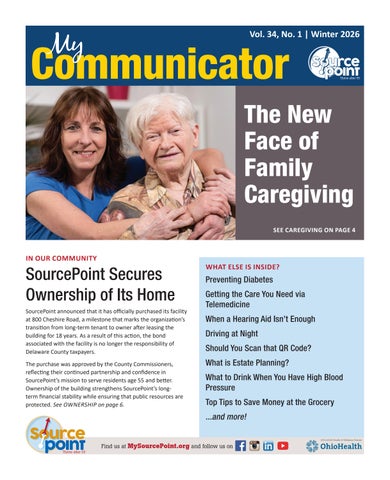
The New Face of Family Caregiving SEE CAREGIVING ON PAGE 4
IN OUR COMMUNITY
SourcePoint Secures Ownership of Its Home SourcePoint announced that it has officially purchased its facility at 800 Cheshire Road, a milestone that marks the organization’s transition from long-term tenant to owner after leasing the building for 18 years. As a result of this action, the bond associated with the facility is no longer the responsibility of Delaware County taxpayers. The purchase was approved by the County Commissioners, reflecting their continued partnership and confidence in SourcePoint’s mission to serve residents age 55 and better. Ownership of the building strengthens SourcePoint’s longterm financial stability while ensuring that public resources are protected. See OWNERSHIP on page 6.
WHAT ELSE IS INSIDE?
Preventing Diabetes Getting the Care You Need via Telemedicine When a Hearing Aid Isn’t Enough Driving at Night Should You Scan that QR Code? What is Estate Planning? What to Drink When You Have High Blood Pressure Top Tips to Save Money at the Grocery
...and more! Find us at MySourcePoint.org and follow us on
WINTER CONTENT 01 SourcePoint Secures Ownership of Its Home In Our Community
03 SourcePoint Announces Two New Board Members In Our Community
04 The New Face of Family Caregiving Feature
08 Preventing Diabetes
SourcePoint 800 Cheshire Road, Delaware 740-363-6677 | MySourcePoint.org EIN 31-1354284 SourcePoint is a nonprofit 501(c)(3) organization that provides professional expertise, services, and programs for Delaware County adults who want to thrive after 55, as well as family caregivers. Services and programs are supported by the local senior services levy, private and corporate donations, grants, and the Central Ohio Area Agency on Aging.
17 Sudoku
2026 Board of Directors President: Pamela Foster, Orange Township Vice President: Cheri Thompson, Delaware Secretary: Annie Horstman, MD, Delaware Treasurer: Michael Tucker, JD, Delaware Eleanor Biddulph, Westerville Randy Bournique, Delaware Bill Brown, Delaware Adrienne Corbett, Delaware Todd Everingham, MBA, Dublin Ron Fantozzi, Columbus Beth Fligner, JD, Dublin Alice Frazier, MD, Delaware Liz Gitter, MSSW, Delaware Beth Long-Higgins, MDiv, Delaware Heidi Reed, Sunbury Jodie Wegmiller, BSN, MBA, Delaware
18 SourcePoint Awards Nearly $500,000 in Grants to Strengthen Services for Older Adults
The board typically meets the last Wednesday at noon for six months out of the year. Members of the public who wish to attend may call the chief executive officer at 740-363-6677.
Health & Wellness
10 Getting the Care You Need via Telemedicine Health & Wellness
12 When a Hearing Aid Isn’t Enough Health & Wellness
14 From the Source
SourcePoint News, Programs, and Resources
16 Driving at Night
Transitions in Aging
16 Should You Scan that QR Code? Technology
Fun & Games
In Our Community
19 What is Estate Planning? Key Steps to Protect Your Family and Finances Personal Finance
20 What to Drink When You Have High Blood Pressure Health & Wellness
24 Wheelchair? Hearing Aids? Yes. ‘Disabled?’ No Way. Transitions in Aging
26 Top Tips to Save Money at the Grocery Personal Finance
28 The Edie Balser Scholarship Fund In Our Community
My Communicator is published quarterly and is made possible through advertisers, donors, and volunteers. About 5,000 copies of each edition are printed and distributed throughout Delaware County. My Communicator is available for pick-up at SourcePoint and 50 other locations, such as libraries, senior living communities, health care facilities, and other nonprofit organizations. To find a nearby pickup site, contact SourcePoint at 740-363-6677. Read My Communicator online at MySourcePoint.org/publications. To advertise or submit educational content for consideration, contact Chief Advancement Officer Alison Yeager at alison@MySourcePoint.org. The appearance of advertising does not represent an endorsement by SourcePoint. We reserve the right to refuse any advertising that conflicts with our mission.
Winter 2026
3
IN OUR COMMUNITY
SourcePoint Announces Two New Board Members SourcePoint has announced the appointment of two new members to its volunteer board of directors and the full slate of officers and board members who will serve in 2026. Eleanor Biddulph and Heidi Reed have joined the board, bringing a combined background in leadership development, senior living, and community service. Eleanor Biddulph of Westerville is a leadership coach with a long history of community involvement. She has served in volunteer and advisory roles with the Westerwood Senior Living Board of Trustees, Ohio Diversity Council, Ohio Business Week Foundation, Genoa Township Communication Advisory Board, Crestline Walton Lake Company Board, and Otterbein University’s Leadership Studies Advisory Committee. Biddulph holds a bachelor’s degree in leadership studies from Otterbein University.
SourcePoint’s 2026 board of directors includes 16 members: President Pamela Foster, Vice President Cheri Thompson, Secretary Annie Horstman, Treasurer Michael Tucker, Past President Alice Frazier, Eleanor Biddulph, Randy Bournique, William Brown, Adrienne Corbett, Todd Everingham, Ron Fantozzi, Beth Fligner, Liz Gitter, Beth Long-Higgins, Heidi Reed, and Jodie Wegmiller. The SourcePoint board of directors is responsible for establishing the organization’s mission and ensuring it is carried out with legal, ethical, and financial integrity. The board sets strategic direction, provides fiscal oversight, and employs a chief executive officer to supervise staff, implement policy, and oversee day-today operations.
Heidi Reed of Sunbury is the director of assisted living at Willow Brook Christian Communities. Her commitment to older adult services dates back to her volunteer support of the county’s first senior services levy. Reed has also volunteered with the Alzheimer’s Association, American Cancer Society, LifePoint Church, and Stockhands Horses for Healing. She is both a Certified Dementia Practitioner and a Certified Executive for Assisted Living.
SPEAKERS BUREAU
SourcePoint, the comprehensive aging services provider in Delaware County, provides free presentations to community groups and employers. Our aging experts are available for in-person or virtual events and can customize presentations based on your needs.
Aging Services Caregiver Support Falls Prevention & Safety Health & Wellness Medicare Education Nutrition Volunteering Learn more and reserve a speaker today at
MySourcePoint.org/speakers MySourcePoint.org | 740-363-6677
4
Caregiving From page 1
I’ve been a family caregiver my entire adult life. It began at age 21 when my parents moved from Ohio to Arizona, and I started helping more with my grandparents in Indiana. My grandparents in South Bend faced Alzheimer’s and other health challenges, and, although I didn’t think of myself as one, I became a long-distance caregiver—arranging home health aides, Meals on Wheels, and visiting as often as possible. I also helped my other grandmother in Indianapolis, giving my aunt, uncle, and cousins a respite break—driving her to church, shopping, and socializing. At 62, my mom had a major stroke that left her with chronic pain, aphasia, and lasting disabilities. My dad became her primary caregiver while still working full-time as chair of the Communication Department at Arizona State University and caring for his parents long-distance. Thanks to donated leave from my new job at the Ohio Department of Aging, I flew to Arizona to advocate for Mom, and my background in adult day services and nursing homes helped us find the right rehab facility. Once settled, my sisters and I rotated visits. She regained enough independence to be home alone for short periods, though she never drove or cooked full meals again. In time, my grandparents passed away, and Dad retired. He remained physically active, traveled with Mom, and volunteered. He did all the right things, yet about a decade later, early signs of dementia appeared. We gradually increased support for him and Mom while maximizing his independence.
Winter 2026 Two years later, I left my full-time job option—for quality and budget—was with AARP in Washington, DC, to become for them to move back home with me. a consultant and gain flexibility. Six Around the same time, my eldest sister, months later, it was clear Dad needed Karen, became seriously ill with Cushing to stop driving and Mom’s health was syndrome from a pituitary tumor. Living declining. At age 48, I moved to Arizona, 2,000 miles away in Maryland, I served keeping a small rental in DC for work as her power of attorney and primary trips. Embarking in a very long-distance caregiver. relationship with my boyfriend ‘Caregiving has shaped every part of my life— underscored personally, professionally, and financially.’ how completely caregiving had reshaped my life. I was stretched to my limits—torn My parents moved into a nearby senior between caregiving for my parents and my community, and I moved into their home. sister, managing work, maintaining two For three years, I spent time with them homes, and sustaining my relationship. every day when I wasn’t traveling for Sleep was scarce, and my health began work—coordinating healthcare, managing to fray. Feeling inadequate was common finances, shopping, and ensuring social and some days I felt like I was running on engagement. fumes; I wanted to clone myself! Mom endured repeated falls, chronic UTIs, and many rounds of therapy. After a devastating fall fractured her spine, she had surgery and multiple complications—C. diff, AFib, pneumonia, heart failure, and sepsis. She was hospitalized for 40 days, and I was almost constantly by her side, working remotely and advocating for her care. Her recovery was remarkable. Despite a heart attack in rehab, after months, she learned to walk again and returned home. Soon after, Dad became ill with a prostate problem and aspirated in the hospital, leading to pneumonia. He needed throat surgery and a short-term feeding tube, which frequently clogged, landing us in the hospital multiple times. Once both parents recovered, they needed round-the-clock care. The best
Finances became another source of strain. I stopped saving for retirement, drained my savings for daily expenses, and used my parents’ funds for paid caregivers while I worked and I covered everything else, eventually relying on credit cards for a time to get through the month. A year after Mom and Dad moved in with me, she died suddenly when a UTI led to sepsis. We were devastated. After so many years of fighting for her health, losing Mom so suddenly left us shocked and stunned. Dad was lost without her, and his cognitive abilities declined more rapidly in grief. Then, in 2014, we lost Karen at age 62. As executor of her estate, I managed to empty and sell her Maryland home— spending thousands I never recovered— while still caring for Dad in Arizona. We had also lost my 19-year-old niece to suicide in 2012; she had lived with bipolar illness. The losses stacked up. Grief became a constant companion, even as we kept moving forward for Dad.
740-363-6677 | MySourcePoint.org
Winter 2026 Dad lived with me for five more years, supported by my sister Linda and her sons, who moved from Ohio to help. My sister Susie came from California whenever she could. Together, along with paid caregivers, we cared for Dad at home until he passed peacefully in 2018 at age 94. In the years since, I’ve faced bankruptcy—a painful aftermath of more than a decade of intensive caregiving for multiple people. I continue to rebuild, slowly and purposefully. Caregiving has shaped every part of my life—personally, professionally, and financially. Even so, I’m grateful. I love my work supporting family caregivers, which fuses my 40 years in the field of aging with my lived experience as a caregiver.
5 When I moved to Arizona, I was 48, the average age of a family caregiver at the time. But that age is increasing, now it stands at age 51. Sixty-one percent (61%) of these caregivers are women and 38% are men. In terms of race and ethnicity, caregivers are: 61% non-Hispanic white, 16% Latino/Hispanic, 13% non-Hispanic African American/Black, 6% Asian American/Native Hawaiian/ Pacific Islander, and 6% another race or ethnicity.
Despite the challenges, I have no regrets. Caregiving has given me purpose, resilience, and deep understanding. My work allows me to help other family caregivers find strength, compassion and practical solutions—because I’ve been there, too.
Who We Care For • 29% are Sandwich Generation caregivers, caring for aging parents and children
I am just one of 63 million family caregivers in the United States in 2025, each with unique stories, challenges and complications. Our numbers have increased by 20 million since 2015— nearly a 50% rise. The latest Caregiving in the U.S. 2025 data from AARP and the National Alliance for Caregiving illustrates how family caregivers are changing.
• 89% care for relatives, mostly parents or parents-in-law (47%), and 15% for a spouse/partner
• 11% care for someone with Alzheimer’s or another dementia • 24% care for multiple people
• The average care recipient is age 70; nearly half are ages 75 or older • Most recipients live in their own home (44%), or with their caregiver (40%)—up from 34% in 2015 • 10% are long-distance caregivers (an hour or more away), while 35% live within 20 minutes
• 30% have provided care for more than five years • 66% assist with at least one activity of daily living (ADL), 84% with three or more instrumental ADLs • 55% provide medical/nursing tasks • 44% provide highintensity care • 70% monitor health conditions Some Caregivers Are Being Paid For the first time, Caregiving in the U.S. 2025 documented 11.2 million family caregivers receiving payment, most providing unpaid and paid care via Medicaid waivers, Veterans Affairs programs, or other state programs. Toll on Caregivers • 70% of working-age caregivers are employed, with more than half experiencing work impacts • Nearly half experience financial impacts; 31% stop saving, 24% use short-term savings, 23% took on more debt, 9% delay retirement • 64% report moderate to high emotional stress, 24% report loneliness • 45% experience physical strain • 1 in 5 rate their health as fair or poor, nearly 25% struggle with self-care
Who Are Family Caregivers I started caregiving in my 20s in the early What Caregivers Want and Need 1980s, when there were fewer • Respite care is the caregivers like me. Now, 18% most requested service are ages 18–34 (Gen Z and ‘Family caregivers provide 27 hours of care (39%),(although only 13% have Millennials), 26% are ages 35– used it). per week on average: 30% have provided 49 (Millennials and early Gen care for more than 5 years.’ X), 33% are ages 50–64 (Gen See NEW FACE on page 7. X and tail-end Baby Boomers), 14% are ages 65–74 (Baby Care Provided Boomers), and 8% are ages 75 and older • Caregivers provide 27 hours of care (including Silent and Greatest Generation). per week on average
MySourcePoint.org | 740-363-6677
6
Winter 2026
Ownership From page 1
“This is a meaningful and responsible step forward,” said Fara Waugh, CEO of SourcePoint. “Owning our building allows us to plan with confidence, invest thoughtfully in our space, and continue serving older adults without placing an ongoing bond obligation on taxpayers. We are grateful to the County Commissioners for their leadership and support.” The building has been SourcePoint’s home since it opened in 2007 and has grown into a vibrant hub for older adults across Delaware County. Each day, the facility supports wellness, learning, and connection through activities such as fitness and aquatics programs, arts and lifelong learning classes, and social engagement, as well as access to information, assistance, and inhome support services. Demand for SourcePoint’s services has increased significantly over time. Average daily visits to the facility have grown by 67% since 2016, reflecting both the changing needs of the community and the trust residents place in SourcePoint. To meet that demand, the organization has made strategic improvements to the building, including the addition of the Cheshire Room, redesign of the Independence Room, and the creation of new lower-level program spaces to ensure flexibility, accessibility, and readiness for the future. The purchase also provides an opportunity to recognize the vision and stewardship behind the building. The facility was made possible through the foresight of Founding Executive Director Bob Horrocks, who envisioned a single, welcoming location where older adults could access services, programs, and community support. Today’s milestone reflects the lasting impact of that vision. SourcePoint also acknowledged the ongoing dedication of Facilities Manager Scott Early, who has cared for the building since it opened. His commitment to safety, maintenance, and continuous improvement has ensured that the facility remains welcoming, functional, and reliable for members, staff, volunteers, and families. “As we move to ownership, we do so with deep appreciation for our partnership with Delaware County,” said Waugh. “We are committed to maintaining this building responsibly and ensuring it remains a place where older adults can find help, hope, and community for many years to come.”
740-363-6677 | MySourcePoint.org
Winter 2026
7
New Face From page 5
• Caregivers express interest in professional assessment of their care needs (33%), help addressing emotional or physical stress (30%), information about keeping loved ones safe at home (27%), and help navigating paperwork (26%). • Most caregivers favor financial support from tax credits (69%), direct payment for at least some of the hours they provide care (68%), and partially paid leave from work (55%). Higher-income caregivers tend to favor tax credits while lower-income caregivers prefer direct payment. The Upside Despite challenges, more than half (51%) feel a sense of purpose or meaning from caregiving—something I’ve felt
throughout my experiences. For many of us, that purpose keeps us going. For some it’s an act of love. For others it’s a choice they make out of a sense of responsibility and a lack of other viable options. What I Hear from Caregivers While the face of family caregivers is shifting, the primary needs I’ve been hearing about for the past 40 years remains the same: they need daily help providing care. Many struggle alone, unaware of local supports like Area Agencies on Aging, VA benefits, aging life care experts, or adult day services. Many cannot afford paid help, validating Caregiving in the U.S. 2025 findings that about a third have no paid or unpaid assistance.
or financial security. Caregivers are the invisible backbone of our health- and long-term care systems, yet too often are isolated and unsupported. As their numbers grow, our healthcare and other support systems are threatened. That reality demands action. Supporting caregivers with services and policies is essential to strengthening families and communities alike. It’s time to treat family caregiving as the cornerstone of our health and social systems—not an afterthought. Source: Generations by the American Society on Aging. Read more at generations.asaging.org.
Conclusion Caring for family and friends shouldn’t require losing your health, livelihood
Take Care of Yourself as a Caregiver Take a short walk outside. Go to sleep a half-hour earlier.
Try a yoga class. Meet a friend for lunch.
Make time for a hobby you enjoy. Activities like these can lower your stress, boost your mood, and help make you a better caregiver, too.
Learn more about caregiving at www.nia.nih.gov/caregiving. MySourcePoint.org | 740-363-6677
Join a support group.
8
Winter 2026
HEALTH & WELLNESS
Preventing Diabetes Chances are, you know someone who has diabetes. It might even be you. Diabetes is one of the most common disorders in the U.S. It affects about 1 in 9 Americans. Diabetes raises your risk for serious health problems. It can damage the eyes, kidneys, nerves, and heart, and it is linked to some types of cancer. Now, what if you learned that there’s a low-cost, scientifically proven way to greatly reduce your chances of getting type 2 diabetes, the most common type? Would you give it a try? More than two decades ago, a landmark NIH-supported study, called the Diabetes Prevention Program (DPP), released its results. It found that people at high risk for diabetes were much less likely to get the disorder if they lost a little weight through healthy eating and physical activity. Their risk of getting diabetes dropped by nearly 60% compared to people who did not aim to make healthy changes. For those over age 60, the results were even more striking. Their risk of getting diabetes dropped by 71% when they made healthy changes. The benefits were so clear that the study ended a year early, after just three years. Participants in the comparison group were encouraged to also make the healthy changes to reduce their diabetes risk. DPP has had a lasting influence on medical care in the U.S. and around the world. Since its initial results were reported, lifestyle change programs based on the findings have become widely available across the country. A 10-year follow-up study showed that people in the original treatment group delayed diabetes by about four years. A later study found benefits even 22 years after the study began, with people in the lifestyle-change group having about a 25% reduced risk of developing diabetes. “Even though the initial treatments lasted only three years, participants did have longer-term health benefits,” says Dr. William Knowler, an NIH diabetes expert.
NIH-supported researchers continue to study new and proven ways to help people prevent or delay type 2 diabetes. But we already know that taking steps to prevent or manage diabetes can lower your risk of developing diabetesrelated health problems.
Are You at Risk?
Diabetes is a disease that occurs when your blood glucose, also called blood sugar, is too high. Glucose is your body’s main source of energy. Normally, a hormone made by the pancreas called insulin helps glucose get into your cells to be used for energy. If you have diabetes, your body doesn’t make enough insulin or use insulin properly. Glucose then stays in your blood and doesn’t reach your cells. Anyone can get type 2 diabetes, even children. But certain factors can raise your risk. You’re more likely to develop type 2 diabetes if you are at least 35 years old or have a family history of diabetes. Black Americans, Hispanic/Latino Americans, American Indians, and Asian Americans are also at higher risk. People who are overweight or have obesity and people who don’t get enough physical activity are also more likely to develop the disease. But these are changeable factors. About 1 in 3 American adults has a condition called prediabetes. It occurs when your blood sugar is higher than normal, but not yet high enough to be called diabetes. Most people with prediabetes don’t realize they have it. That’s because prediabetes tends to have few symptoms, and many people don’t get screened. “We can diagnose prediabetes and diabetes with a very simple blood test known as a hemoglobin A1C. You don’t need to fast to do this test,” says Dr. Tannaz Moin, a physician and diabetes researcher at the University of California, Los Angeles. The A1C test reflects your average levels of blood sugar over the past three months.
740-363-6677 | MySourcePoint.org
Winter 2026
9
N TYPES OF DIABETES
COMMO
“Prediabetes is viewed as a very strong risk factor for type 2 Because GLP-1 drugs are still relatively new, it’s not entirely clear diabetes. But not everyone with prediabetes goes on to develop how outcomes will change if people stop taking the drugs. And T PE 1 Body doesn t ake enough insulin type 2 diabetes,” Moin adds. “That’s why it’s important to be possible side effects of long-term use are still uncertain. screened and talk with your medical providers about your risk Healthy Changes That Last factors and things that you can do to prevent type 2 diabetes if 5-10%lifestyle changes is hard. So it’s 1¥,000 “Making important to get the you’re at risk.” support you need to make the changes last,” says Dr. Joshua A Role forCMedications J. Joseph, a physician and diabetes at Ohio State In adults, type 1 diabetes Justresearcher over 18,000 youth No known way an develop Although making lifestyle changes effective accounts University. “You can get that support through programs for approximately diagnosed each year in like the to prehas ventproven it at any ahealthy ge 51 0% of all diagnosed 2014 and 2015 for preventing diabetes, it doesn’t work for everyone. For those CDC’s National Diabetes Prevention Program (NDPP).” cases of diabetes. people, medications may help. NDPP is based on the findings of NIH’s DPP study. It aims to NIH’s DPP study looked at whether the diabetes drug metformin help people make long-term lifestyle changes that prevent or T PE Body an t use insulin ro erly might also prevent or delay diabetes onset. It found that the drug delay diabetes. could reduce the risk of developing diabetes by about 30%. For nearly senior centers, and Local hospitals, health departments, libraries, some patients, a combination of metformin and lifestyle changes faith-based or seminars 90-95% organizations may also offer programs 3 might be best. to help prevent type 2 diabetes. For physical activity, look for In recent years, a class of drugs called GLP-1 drugs has become activities that you enjoy. Experts recommend brisk walking for a Most cases can Nearly 6,000 youth Can develop In adults, type 2 diabetes widely available for weight management and diabetes treatment. low-cost activity. Working out with others can be motivating for b e pre v ente d diagnosed each year at any age accounts for approximately These drugs have proven effective at reducing weight and Consider group classes likeand Zumba in 2014 2015or Pilates. 90-95%some of allpeople. diagnosed cases of diabetes. keeping blood glucose in check. Some studies hint that they “It’s important to think of diabetes prevention throughout the might also help to prevent or delay diabetes. lifespan. So, it’s just as critical to work with children on healthy Risk factors for type 2 diabetes: “Body weight is an important factor that determines the risk eating and healthy behaviors as it is to work with older people,” of getting type 2 diabetes. So the potential here is great,” says Joseph explains. “If we work life course, it could lead 1.across the illion Knowler. “But the problem is, as with any new drugs, it takes to large reductions in the development of diabetes in the U.S. People 18 years or many years to know how effective and safe they will be. And a and around the world.” older diagnosed with huge problem with any kind ofHaweight it, not diabetes in 2021 Being ving aloss is sustaining Being physically Being 45 Source: News in Health. Read more at newsinhealth.nih.gov. achievingoit.” verweight family history inactive or older
’ m
Y
?
Y
2
c
’
p p
5, 00
2M
WHAT CAN YOU DO? You can prevent or delay type 2 diabetes
at healthy Be more a¿ti攀 Lose weight
Work with a health professiona l Eat health y Stay active
E
Learn more at www.cdc.gov/diabetes-prevention/ or speak to your doctor
REFERENCES C n f D
e ters or isease Control and Prevention. National Diabetes Statistics Report. Atlanta, GA: Centers for Disease Contro l nd Prevention, US Dept of Health and Human Services; 2022 . American Diabetes Association. Standards of Medical Care in Diabetes—2021. Diabetes Care. 2021 Jan 1; 44 (Supplement 1À . American Diabetes Association . Economic costs of diabetes in the US in 201¯. Diabetes Care. 201®; 41(À:¬1¯Ñ¬2® . Trends in cause speciifc mortality among adults with and without diagnosed diabetes in the USA: an epidemiologica l analysis of linked national survey and vital statistics data. Lancet. 201®;¦¬1(101¦®À:24¦0Ñ2440.2. a
MySourcePoint.org | 740-363-6677
You can manage diabetes
Learn more at www.cdc.gov/diabetes/livi`g^wits/ or speak to your doctor
CDC’s Division of Diabetes Translation works toward a world free of the devastation of diabetes.
U.S. Department of Health and Human Services Centers for Disease Contro an re ention
10
Winter 2026
HEALTH & WELLNESS
Getting the Care You Need via Telemedicine Access to telemedicine has increased in recent years, providing convenient new ways to interact with our care team and stay on top of our health. Since the pandemic, a growing number of older adults are opting for telemedicine— according to the U.S. Department of Health and Human Services (HHS), 25% of Medicare fee-for-service users took part in this type of service in 2024.
a chronic condition that requires frequent checkins, or have difficulty getting to and from appointments.
What is telemedicine? Telemedicine (also called telehealth or “virtual visits”) means interacting with your health care provider(s) by phone, email, or video call.
What’s another benefit of telemedicine? It helps you stay in touch with your care team while lowering your risk of exposure to illnesses like COVID or the flu. This is particularly important during winter virus season and when cases are spiking in your community.
Telehealth visits can be used for: • Regular checkups and follow-ups • Managing ongoing health conditions • Getting new prescriptions and/or refills • Asking your provider questions
Does Medicare cover telemedicine? Yes. Original Medicare covers telehealth services under Part B. You are responsible for 20% of the Medicare-approved amount for your health care provider’s services.
What are the benefits of telemedicine? Telemedicine offers many advantages if you’re an older adult: • It saves you a trip to the doctor’s office, which means less time traveling and waiting. • You can talk with your provider from the comfort of your home using a phone, tablet, or computer. • It makes it easier to manage any chronic conditions you have, get prescriptions, and ask health-related questions. • It gives you easier access to a broad variety of health care services and specialists.
Some examples of Medicare-covered telehealth benefits include preventive health screenings, post-surgical followup, and treatment of recurring conditions (e.g., migraines or urinary tract infections). Medicare also provides coverage for mental health treatment, including online therapy and counseling.
Virtual visits are especially helpful if you live far away from your providers, have
How do I prepare for a telemedicine visit? Preparing for a telemedicine visit is similar to prepping for any health care visit. But there are a few important extra steps you’ll want to take to get the most out of your time with your health care provider. Here are four key tips to help make your telemedicine visit as beneficial as possible:
1. Get ready • Check your technology to ensure it can accommodate a telehealth visit. If you don’t know how to navigate this, ask a technologysavvy friend or family member for help. • Write down a list of your symptoms and concerns; be specific. • Practice what you want to say to your provider. That way, you won’t leave anything out. • Write down a list of all medications you’re currently taking (prescription and non-prescription), along with the dosage. 2. Find a quiet space • Turn off background noise such as TVs and radios. • Ask others in your home to keep the noise level down. • If you live with other people, find an empty room to have your virtual visit and close the door. Consider using headphones during the call for added privacy. 3. Tell your health care provider everything • Summarize your condition, list all symptoms, and explain your concerns. • Share any changes in your medical history and any major life events like a serious illness or surgery. • If you use home health monitoring devices, you might be asked to share readings with your provider (e.g., 740-363-6677 | MySourcePoint.org
Winter 2026
11
blood pressure, pulse, oxygen levels, temperature). This often involves using a dedicated patient portal or smartphone app. Your provider may use this information to adjust treatment plans and monitor your health remotely. 4. Agree on a treatment plan • After your doctor explains your treatment plan, repeat it back in your own words. This helps confirm you understood the instructions correctly. It also gives your provider a chance to clear up any confusion or explain things more simply, so you feel confident about your care plan. • Take notes and ask questions such as: What are the risks/benefits of treatment? Are there other ways to treat my condition? Will insurance pay? Will I need medication? If so, what are the potential side effects?
• Ask your doctor for resources that can provide additional information about your condition and treatment. Schedule a follow-up visit, if necessary. As with any health care visit, you may prefer to have a trusted friend or family member by your side. That person can be responsible for taking notes so you can focus fully on your conversation with your provider. Telemedicine offers a practical way to stay connected to the care you need to age well. By making the most of virtual visits, you can manage your health, get timely support, and rest easy knowing help is just a call (or click) away. Source: National Council on Aging. Read more at ncoa.org.
MEDICARE Mastery Class Take charge of your Medicare decisions with this free, comprehensive, two-part workshop designed to educate and empower. Available Saturday, Feb. 7, March 7, or April 4, 9 a.m.–noon. at SourcePoint. Learn more and register at
MySourcePoint.org/ insurance Bring a complete list of your prescription medications, full names of your doctors, your Medicare card, and a tablet or laptop. 614-276-1439
modlich-monument.com
MySourcePoint.org | 740-363-6677
12
Winter 2026
HEALTH & WELLNESS
When a Hearing Aid Isn’t Enough Kitty Grutzmacher had contended with poor hearing for a decade, but the problem had worsened over the past year. Even with her hearing aids, “there was little or no sound,” she said. “I was avoiding going out in groups. I stopped playing cards, stopped going to Bible study, even going to church.” Her audiologist was unable to offer Grutzmacher, a retired nurse in Elgin, Illinois, a solution. But she found her way to the cochlear implant program at Northwestern University. There, Krystine Mullins, an audiologist who assesses patients’ hearing and counsels them about their options, explained that surgically implanting this electronic device usually substantially improved a patient’s ability to understand speech. “I had never even thought about it,” Grutzmacher said. That she was 84 was, in itself, immaterial. “As long as you’re healthy enough to undergo surgery, age is not a concern,” Mullins said. One recent Northwestern implant patient had been 99. Some patients need to ponder this decision, given that after the operation, clearer hearing still requires months of practice and adaptation, and the degree of improvement is hard to predict. “You can’t try it out in advance,” Mullins said. But Grutzmacher didn’t hesitate. “I couldn’t go on the way I was,” she said in a postimplant phone interview — one that involved frustrating repetition, but would have been impossible a few weeks earlier. “I was completely isolated.” Hearing loss among older adults remains vastly undertreated. Federal epidemiologists have estimated that it affects about 1 in 5 people ages 65 to 74 and more than half of those over 75. “The inner ear mechanisms weren’t built for longevity,” said Cameron Wick, an ear, nose, and throat specialist at University Hospitals in Cleveland. Although hearing loss can contribute to depression, social disconnection, and cognitive decline, fewer than a third of people over 70 who could benefit from hearing aids have worn them.
For those who do, “if your hearing aids no longer give you clarity, you should ask for a cochlear implant assessment,” Wick said. Twenty-five years ago, “it was a novelty to implant people over 80,” said Charles Della Santina, director of the Johns Hopkins Cochlear Implant Center. “Now, it’s pretty routine practice.” In fact, a study published in 2023 in the journal Otology & Neurotology reported that cochlear implantation was increasing at a higher rate in patients over 80 than in any other age group. Until recently, Medicare covered the procedure for only those with extremely limited hearing who could correctly repeat less than 40% of the words on a word recognition test. Without insurance — cochlear implantation can cost $100,000 or more for the device, surgery, counseling, and follow-up — many older people don’t have the option. “It was incredibly frustrating, because patients on Medicare were being excluded,” Della Santina said. (Similarly, traditional Medicare doesn’t cover hearing aids, and Medicare Advantage plans with hearing benefits still leave patients paying most of the tab.) Then, in 2022, Medicare expanded cochlear implant coverage to include older adults who could identify up to 60% of words on a speech recognition test, increasing the pool of eligible patients. Still, while the American Cochlear Implant Alliance estimates that implants are increasing by about 10% annually, public awareness and referrals from audiologists remain low. Less than 10% of eligible adults with “moderate to profound” hearing loss receive them, the alliance says. Cochlear implantation requires commitment. After the patient receives testing and counseling, the surgery, which is an outpatient procedure, typically takes two to three hours. Many adults undergo surgery on one ear and continue using a hearing aid in the other; some later go on to get a second implant. The surgeon implants an internal receiver beneath the patient’s scalp and inserts electrodes, which stimulate the auditory nerve, 740-363-6677 | MySourcePoint.org
Winter 2026
13
into the inner ear; patients also wear an external processor behind the ear. (Clinical trials of an entirely internal device are underway.)
score, compared with 36% presurgery. Studies that focus on people in their 80s and 90s have shown that those with mild cognitive impairment also benefit from implants.
Two or three weeks later, after the swelling recedes and the patient’s stitches have been removed, an audiologist activates the device.
Nevertheless, “we’re cautious not to overpromise,” Wick said. Usually, the longer that older patients have had significant hearing loss, the harder they must work to regain their hearing and the less improvement they may see.
“When we first turn it on, you won’t like what you hear,” Wick cautioned. Voices initially sound robotic, mechanical. It takes several weeks for the brain to adjust and for patients to reliably decipher words and sentences. “A cochlear implant is not something you just turn on and it works,” Mullins said. “It takes time and some training to get used to the new sound quality.” She assigns homework, like reading aloud for 20 minutes a day and watching television while reading the captions. Within one to three months, “boom, the brain starts getting it, and speech clarity takes off,” Wick said. By six months, older adults will have reached most of their enhanced clarity, though some improvement continues for a year or longer. How much improvement? That’s measured by two hearing tests: The CNC (consonant-nucleus-consonant) test, in which patients are asked to repeat individual words, and the AzBio Sentence Test, in which the words to be repeated are part of full sentences. At Northwestern, Mullins tells older prospective patients that one year after activation, a 60% to 70% AzBio score — correctly repeating 60 to 70 words out of 100 — is typical. A Johns Hopkins study of about 1,100 adults, published in 2023, found that after implantation, patients 65 and older could correctly identify about 50 additional words (out of 100) on the AzBio test, an increase comparable to the younger cohort’s results.
A minority of patients feel dizzy or nauseated after surgery, though most recover quickly. Some struggle with the technology, including phone apps that adjust the sound. Implants are less effective in noisy settings like crowded restaurants, and since they are designed to clarify speech, music may not sound great. For those at the upper end of Medicare eligibility who already understand roughly half of the speech they hear, implantation may not seem worth the effort. “Just because someone is eligible doesn’t mean it’s in their best interests,” Wick said. For Grutzmacher, though, the choice seemed clear. Her initial testing found that even with hearing aids, she understood only 4% of words on the AzBio. Two weeks after Mullins turned on the cochlear implant, Grutzmacher could understand 46% using a hearing aid in her other ear. She reported that after a few rough days, her ability to talk by phone had improved, and instead of turning the television volume up to 80, “I can hear it at 20,” she said. So she was making plans. “This week, I’m going out to lunch with a friend,” she said. “I’m going to play cards with a small group of women. I have a luncheon at church on Saturday.” Source: KFF Health News. Read more at kffhealthnews.org.
Participants over 80 showed roughly as much improvement as those in their late 60s and 70s. “They transition from having a hard time following a conversation to being able to participate,” said Della Santina, an author of the study. “Decade by decade, cochlear implant results have gotten better and better.” Moreover, an analysis of 70 older patients’ experiences at 13 implantation centers, for which Wick was the lead author, found not only “clinically important” hearing improvements but also higher quality-of-life ratings. Scores on a standard cognitive test climbed, too: After six months of using a cochlear implant, 54% of participants had a passing
MySourcePoint.org | 740-363-6677
Skilled Nursing & Therapy Services Providing personalized care with compassion since 1985
Call to schedule a tour today!
4 New Market Drive Delaware, Ohio 43015 740-369-6400 delawarecourt.com
14
Winter 2026
FROM THE SOURCE The latest news, programs, and resources available at SourcePoint.
Fitness & Wellness
Transitions in Aging
DROP-IN OPTIONS ComPASS members may now drop in for the fitness center or land/water exercise classes on days they visit without prior registration. To drop in, members must: 1. Confirm available openings with Customer Service. 2. Pay the $5 drop-in fee.
DRIVER SAFETY: AARP “DRIVING AT NIGHT” WORKSHOP Tuesday, Feb. 10, 11:30 a.m.–12:30 p.m. Presented by the Delaware County SAFE Coalition, Ohio Department of Transportation, and Age-Friendly Delaware County. Discover how to make nighttime driving safer, easier, and less stressful. In this engaging session, you’ll learn about age-related vision changes, the latest headlight and safety technologies, and assistive driving tools that can help you stay independent and confident on the road. You’ll also hear real-life stories and expert tips to help you feel informed, prepared, and ready to enjoy the road—day or night!
PUMP TO THE BEAT NEW! Tuesdays with Gina, 1–1:45 p.m. Intermediate-advanced. This music-driven workout fuses strength training and cardio intervals to upbeat hits that keep you moving and motivated. Each track targets different muscle groups that build strength, stamina, and total body fitness. Using dumbbells, kettlebells, resistance bands, and bodyweight exercises, you’ll enhance muscles, increase cardiovascular fitness, build endurance, and regulate body composition all to the beat of your favorite hits from the ‘50s to the ‘80s. Fee: $50 for the series. TAI CHI: CHAIR NEW! Thursdays with Mimi, 1–1:45 p.m. Beginner‒advanced. This is your chance to experience the slow, graceful movements of Tai Chi right from the comfort and stability of a chair! It’s the perfect, low-impact exercise if you have limited mobility or are simply looking for a gentle workout. You’ll focus on mindful breathing and posture through smooth movements to instantly improve your flexibility, boost your coordination, and find a genuine sense of relaxation—all while staying safely seated. Fee: $50 for the series. TWIST & TARGET NEW! Tuesdays with Gina, noon–12:45 p.m. Beginner-Intermediate. This low-impact class blends classic dance moves—like the twist, grapevine, and cha-cha—with light resistance training using dumbbells, bands, and body weight. Move to the timeless hits of the ’50s through the ’80s while improving balance, coordination, muscle strength, and cardiovascular fitness. It’s fun, energizing, and the perfect way to stay active and strong while dancing down memory lane! Fee: $50 for the series.
EASY WALKERS GROUP Tuesdays, 9–10 a.m. Research shows community walking programs not only improve physical and mental well-being but also foster social connections. SourcePoint offers a walking program that provides a supportive environment for various fitness and mobility levels. The Easy Walkers Group is a self-paced activity designed to meet individuals where they are while providing encouragement to improve walking stamina and distance. The Easy Walkers Group will gather on Tuesday mornings to warm up and stretch together, then have the option of walking outdoors or indoors, depending on personal preference and the weather. The session will finish with a group cool down and stretches. Tools for walking safety and tracking your progress are included. GRANDPARENTS AS PARENTS MONTHLY MEETUP Fourth Friday of each month, 11 a.m.‒noon. Join this casual group of older adults, holding space for other grandparents acting as second-time parents. This group aims to support one another through shared life experience as well as help individuals get connected with resources in their communities.
Register for these programs and more at
MySourcePoint.org/EC
740-363-6677 | MySourcePoint.org
Winter 2026
15
Learning
Social Connections
ARTIFICIAL INTELLIGENCE… TODAY AND MAYBE TOMORROW NEW! Thursday, Feb. 19, 1‒2:30 p.m. Are you wondering about the who, what, when, where, how, and why of Artificial Intelligence? Here’s a “primer” on a constantly evolving AI that impacts your life. It may improve our healthcare, customer interactions, and our competitive edge in the world’s economy. It also has the potential to harm us. We still can shape AI’s future. Explore where AI is today and the factors that influence where it goes tomorrow. Fee: $5.
DANCE MARATHON PARTY Tuesday, March 31, 5:30–7:30 p.m. While we won’t dance ‘til we drop, we will have a fun night with friends. Wear your favorite workout clothes and let’s party while dancing to the music of the Juke Jammers. Feel free to bring in your own snack and beverage of choice.
THOUGHT SPARKS NEW! First Wednesdays of each month, 1‒2 p.m. Thought Sparks stimulates reflection on thought-provoking questions that capture life’s ebbs and flows, detours and roundabouts, peaks, and valleys. Questions like: “If you could have one superpower, what would you want it to be?” Members share their adventurous, courageous, creative, insightful, intense, passionate, and stirring perspectives. The dialogues elicit cerebral canons, cheerful chortles, nodding noggins, subtle surprises, and more. Register to avoid FOMO (Fear of Missing Out). Fee: $3 for series.
MOVIE AND BYO DINNER NEW DAY! Tuesdays, Jan. 6, Feb. 3, and Mar. 3, 5–7:30 p.m. You bring your dinner and beverage; we bring the movie and the big screen! Jan. 6: Downton Abbey: The Grand Finale Feb. 3: Springsteen: Deliver Me from Nowhere March 3: Wicked: For Good SUPERBOWL PARTY LUNCHEON Friday, Feb. 6, 11 a.m.–1:30 p.m. Kick off your Super Bowl celebrations with lunch at SourcePoint. The talented kitchen staff will prepare a spread to enjoy as you “tailgate” with friends in Cafe 55. Also, wear your team’s colors and stop by our photo booth to get some pics with your besties. Sponsored by K. Hovnanian’s Four Seasons at Addison Farms, LLC.
The Arts
Overnight Trips
NATURE SKETCH EVENT NEW! Monday, Feb. 2, noon–1:30 p.m. Unleash your creativity where art meets wildlife! Get up close with a live box turtle as you sketch its unique features and learn fascinating facts during an in-depth nature talk. Whether you’re an experienced artist or just love to doodle, this relaxing session blends observation, education, and inspiration straight from nature. Fee: $3.
HOLLAND TULIP TIME May 6–9, 2026 (4 days/3 nights). Registration and a deposit of $500 per person is due to World of Travel to secure reservation with the balance due by Feb. 27. Fee: $1,599 per person based on double occupancy. Other rate info available in flyer.
WEAVING WELLNESS Thursdays, Feb. 5 or March 5, 10 a.m.–noon. Learn how crafting can be healing. ANXIOUSLOOMERS offers a gentle introduction to loom knitting and mental wellness strategies. Each session combines hands-on winter hat crafting with discussions about stress management and healthy coping skills. Experience the meditative rhythm of looming while building friendships in a supportive, judgmentfree environment. Fee: $20.
MySourcePoint.org | 740-363-6677
CAPE COD & THE ISLANDS May 25–31, 2026 (7 days/6 nights). Registration and a deposit of $500 per person is due to World of Travel to secure reservation with the balance due by March 6. Fee: $2,999 per person based on double occupancy. Other rate info available in flyer. FRENCH LICK GETAWAY Aug. 24–26, 2026 (3 days/2 nights). Registration and a deposit of $300 per person is due to World of Travel to secure reservation with the balance due by June 1. Fee: $999 per person.
16
Winter 2026
TRANSITIONS IN AGING
Driving at Night Did you know that 50% of traffic fatalities occur after dark, even though only 25% of driving occurs during that time? It is a normal part of aging to experience vision challenges with night driving. Do any of these quotes from mature drivers apply to you when driving at night? • “I don’t see as well as I used to, I know that.” • “The ability to get the light into my eyes at night doesn’t work as well as it used to.” • “The roadway just isn’t quite as bright.” • “I do not see as much contrast on the roadway when it is dark out.” • “It feels like what should be clear is less clear.” • “At night, I’m not as confident at driving in the community that I’m so familiar with.” • “Sometimes its glare on the windshield. Sometimes it’s just glare in my eyes from being a little bit dry. I’m not quite sure how to deal with that glare.” • “It tires me out more to drive at night than it does during the daytime because I have to hyperfocus. Watching out
for pedestrians and cyclists takes extra attention than during day.” You might be interested in registering for an AARP Driver Safety workshop on “Driving at Night.” This workshop will be offered at SourcePoint on Tuesday, Feb. 10 from 11:30 a.m. to 12:30 p.m. The workshop will cover how vision changes with aging. It will also highlight the nuances of different types of headlights available in today’s cars, address specific nighttime driving concerns of mature drivers, and discuss assistive safety technologies. You will learn about driving and maintenance habits and other general tips that may help you mitigate your night driving concerns. The SAFE Delaware County Coalition invites all drivers to participate in older driver safety programs at SourcePoint and to contact coordinator Jackie Bain for additional information on how to keep you driving longer safely at jbain@delawarehealth.org or 740-203-2083.
TECHNOLOGY
Should You Scan That QR Code? You see them everywhere. They are flashed on your TV during an advertisement. They are in the magazines you get. They are on cereal boxes and pop cans. They are Quick Response codes or QR codes. The QR code example in the image above I created. Scanning it with your smartphone camera will open your web browser to the Google website. It’s simple to use and, in this case, it is safe. However, what would happen if, instead of the Google website, it took you to a malicious website? Any number of bad things could happen, and as you can imagine, that is what’s happening. Essentially, there are now three possible outcomes when you use your smartphone to “scan” a QR code. Your smartphone camera
will look for a QR code. When it finds it, a frame will appear around the code. This is where things happen. The best outcome is that your web browser will open a legitimate and safe website. You’ll then be able to get a discount, see a menu, register a new device, unlock a streaming service, etc. That’s what QR codes were built to do. They were intended to make your use of your smartphone more efficient and easier. Well, as you can imagine, someone realized that they could make a QR code that opened a website that was not what you expected, but what they wanted you to open. It could have been a website designed to look like the real thing, but that asked for your security credentials. Or it could have been 740-363-6677 | MySourcePoint.org
Winter 2026 a website that asked you to install an application to get a gift or discount. The common element here is the QR code, wanted you to interact with the site so they could steal from you. The new threat is even worse because it contains embedded scripts that can take over login pages or install key-loggers that can capture your keystrokes or activate other exploits. This is bad because it impacts your security and may do it undetected.
17 FUN & GAMES
Sudoku EASY
So, what should you do (or not do)? Do not scan an unknown or unsolicited QR code (or click an unknown link). Do not scan a QR code if you are not expecting one. Do not scan a QR code in an email or text that has a sense of urgency. Contact the sender directly if you think there is cause for concern. Do not provide login or other credentials after scanning a QR code unless you are certain it is a legitimate website that needs the information. Do be suspicious of a QR code with anything that seems threatening with a time deadline. Finally, do not rely on your anti-virus or anti-malware to protect you. Do not think that because you have an iPhone that it will protect you. You must protect yourself. This type of threat is not going away. In fact, the more successful it is, the more it will be used. Stay safe out there! Jarren Ringle is a member of SourcePoint and a volunteer instructor. SourcePointers come to Jarren for tutelage on their tablets, laptops, and the most popular of all devices – cell phones. He teaches various technology classes throughout the year including one-on-one sessions and group classes. Jarren also volunteers at the Delaware County Office of Homeland Security and Emergency Management. With many years of project management experience in various technology fields, he enjoys helping others with technology.
HARD
Technology 1:1 Assistance: Jarren Ringle provides guidance on technology in a 45-minute time slot. Do you have questions regarding a cell phone, PC, laptop or tablet? Share what the device is and what your question is upon registration so that Jarren can be better prepared to help. Schedule your 1:1 at MySourcePoint.org/EC or call 740-363-6677.
See Sudoku Solutions on page 23.
MySourcePoint.org | 740-363-6677
18
Winter 2026
IN OUR COMMUNITY
SourcePoint Awards Nearly $500,000 in Grants to Strengthen Services for Older Adults SourcePoint continues its commitment to strengthening the local network of care for older adults and family caregivers by approving $496,402.15 in grant funding for 19 programs across Delaware County. By strategically investing in nonprofit and government partners that fill service gaps, SourcePoint helps ensure essential support is accessible, coordinated, and responsive to the evolving needs of the community. Grant applications are reviewed annually by a diverse committee of SourcePoint board members, staff, and community representatives. The committee prioritizes organizations that address unmet needs and fill service gaps, helping to strengthen a coordinated and responsive system of care for older adults and family caregivers throughout the county. Grant recipients for 2026 include the following: The Alzheimer’s Association $49,810 to provide supportive services to individuals living with dementia and their caregivers. Catholic Social Services $21,600 for the Senior Companion Program, which addresses social isolation among homebound older adults. Central Ohio Area Agency on Aging $10,000 for the Volunteer Guardian Program, which advocates for the rights of older adults who are unable to do so themselves. Central Ohio Symphony $2,225 to transport older adults with mobility issues to and from symphony concerts on the Ohio Wesleyan University campus. Common Ground Free Store $23,297 to support a portion of operating expenses for the agency providing food, clothing, and household items to lowincome county residents. Delaware County Guardianship Services Board $25,000 to provide exemplary guardianship services to individuals 55 and older who do not have appropriate guardian candidates in the community. Delaware Speech and Hearing Center $80,000 to expand and enhance hearing and speech health services to older adults and their caregivers.
First Presbyterian Church $9,000 for the Laundry Love Program, which provides free laundry services to individuals who may otherwise be unable to afford such services. Friends of Wornstaff Memorial Library $2,500.15 to support the Wornstaff Walkers program, which promotes wellness and social connectedness, as well as the purchase of large-print books. Grace Clinic $39,000 to expand hours of operation to increase accessibility of low-cost health care and services to older adults. Habitat for Humanity of Delaware and Union Counties $40,000 to support critical home repair expenses for older adults in the county. HelpLine of Delaware and Morrow Counties $49,500 for continued support of the Connections Volunteer Program; $44,550 to support management and oversight of volunteer matches and client referrals for the Senior Companion Program; and $7,500 to expand Sages & Seekers, an evidencebased, intergenerational program that brings together older adults and high school students. Humane Society of Delaware County $10,000 for the Pet Care Assistance Program, which provides vaccines, medication, surgeries, and grooming for pets in olderadult households. Lutheran Social Services $20,000 to support operations and food costs for older adults at the local food bank. National Alliance on Mental Illness Delaware and Morrow Counties $29,000 to support recovery and educational programming for individuals with mental illness and their families. OhioHealth Grady Memorial Hospital $25,000 for the Driver Rehabilitation for Instruction and Vehicle Education (DRIVE) program intended to improve driver safety. Unity Community Center $8,420 to expand free older adult programming that supports physical fitness, balance, and social interaction. 740-363-6677 | MySourcePoint.org
Winter 2026
19
PERSONAL FINANCE
What Is Estate Planning? Key Steps to Protect Your Family and Finances Planning for the future can feel both comforting—and a little overwhelming. While most people know they need to plan for retirement, there’s one vital area that often gets pushed aside: estate planning. In an estate planning survey by Caring.com and YouGov, only 24% of respondents (age 18 to 55+) said they have a will, and just 13% said they had a living trust. Estate planning is not just a matter of dividing up property or signing a ream of legal documents. It’s about having the peace of mind your family won’t be burdened with stress or financial hardship later on down the road. It’s also about ensuring your personal, financial, and health care choices are honored when you’re unable to make them yourself. Before we dive into the essentials of estate planning, let’s talk about exactly what it means. What is estate planning? Estate planning is the process of deciding how your assets and personal wishes will be managed, distributed, or carried out if you become incapacitated or after you pass away. While most people think of a will when they hear “estate plan,” in reality it can cover much more—from who makes medical decisions on your behalf to how your grandchildren’s inheritance is protected. Why is having an estate plan so important? Here are a few key reasons: • It fosters peace of mind for both you and your loved ones.
MySourcePoint.org | 740-363-6677
• It helps shield your finances and property from mismanagement or disputes. • It ensures your health care preferences are respected. • It gives you added reassurance, knowing all these matters will be handled according to your wishes. “Imagine being able to pass down your home to your children without delays… or eliminate confusion and anxiety about your medical care should you become seriously ill,” said Josh Hodges, NCOA’s Chief Customer Officer. “Estate planning helps make those things possible and gives you that added sense of security.” What are the basic parts of an estate plan? An estate plan can range from basic to highly extensive and detailed. But below are some of their core components. 1. Will A will is the cornerstone of most estate plans. It’s a legal document that outlines who inherits your assets—such as your home, retirement savings, and personal belongings—after your death. Your will can also name guardians for minor children or dependents (even beloved pets). And it allows you to choose who will make sure your instructions are followed (an executor).
When someone passes, their will typically goes through probate, a court process that confirms a will is present and valid and manages the distribution of assets. A clear, well-written will can make probate faster and easier for your family. A will can be changed at any time, and the most recent version is the one that should be enforced. Make sure you share an updated copy of your will with your family—or at least your executor—when you make changes. This can help minimize issues later on. 2. Trusts A trust provides legal protection for your assets and ensures they’re dispersed as you intend. It can also help your estate avoid probate, reduce taxes, shield assets from creditors, and specify how and when your beneficiaries (e.g., minor children) receive their inheritance. The two main categories of trusts in estate planning are revocable and irrevocable: • Revocable living trust: Also called a revocable living trust, this flexible type of trust can be changed or revoked (cancelled) during your lifetime—for example, if you go through a divorce. • Irrevocable trust: Once you establish an irrevocable trust, it cannot be changed. These are often used to shield assets from creditors or estate or gift tax. See ESTATE on page 22.
20
Winter 2026
HEALTH & WELLNESS
What to Drink When You Have High Blood Pressure To keep high blood pressure at bay, there are a few habits that can help, including avoiding excess weight gain, quitting smoking, engaging in regular physical activity, and eating right. If you have high blood pressure—or even if you don’t—you’ve likely heard about certain foods that can help you lower it naturally. These foods offer heart-healthy nutrients, fiber, antioxidants, fats, antiinflammatory compounds, and more. But what about things you can drink? Do certain beverages help to lower blood pressure, too? As it turns out, the answer is “yes.” And many of these drinks are available in the aisles of your local grocery store, at the farmer’s market, convenience store, or bodega. Just remember that natural sugars are found in fruit, vegetable, and milk-based drinks. Watch out for added sugars in sweetened beverages such as energy drinks, regular sodas, and flavored teas, which may increase blood pressure and heart disease risk. Ready to give it a try? Changing what’s in your glass or tumbler can be a simple, straightforward way to get your blood pressure under control. It may even prevent you from having to take blood pressure medication. Just be sure to ask your health care provider before adding any new drink to your routine. That’s because some common beverages such as those made with citrus may blunt the effect of medications or just don’t mix well with certain prescription drugs.
What is high blood pressure?
High blood pressure, or hypertension, happens when the force of your blood against the walls of your arteries is too great. It’s known as the silent killer that quietly harms blood vessels and leads to health problems. Hypertension has many causes, including lifestyle choices, genetics, and certain other risk factors such as race, age, gender and medical conditions. When left untreated, it can lead to heart attack and stroke.
In order to check your blood pressure and see whether it’s too high, your doctor uses an arm cuff to measure two things: Your systolic pressure, and your diastolic pressure. You’ve likely seen or heard these readings yourself, which show up as two numbers such as “110/70,” spoken out loud as “one-ten over seventy.” The top number is your systolic pressure; the bottom is your diastolic pressure. You can also check your levels with a home blood pressure monitor. In adults, normal blood pressure spans a range. However, if your two numbers are consistently higher than 120/80, it’s likely that you have hypertension. To avoid developing or help manage high blood pressure: • Choose whole and minimally processed foods as often as possible • Cook more food at home to avoid typically high-sodium restaurant fare • Limit intake of highly processed foods • Flavor foods with herbs and spices rather than salt • Read food labels so you can choose the lowest sodium products
What beverage choices might help lower blood pressure?
When it comes to hypertension, some beverages are better than others. Here are 5 research-informed ideas for what to drink that may help lower your blood pressure (BP): 1. Apple juice A recent scientific review showed that drinking apple juice in moderation provides heart-healthy advantages. That’s because the juice contains high levels of beneficial compounds, including antioxidants and polyphenols, that help reduce cholesterol and inflammation within the blood vessels. Because high cholesterol and hypertension are closely linked, it makes sense that lowering one can reduce the other. Be sure to choose unsweetened, “cloudy” juice, or cider, which retains polyphenols that otherwise might be filtered out. Any juiced apple variety will do, though another recent report 740-363-6677 | MySourcePoint.org
Winter 2026 concluded that Gala and Fuji contain the highest levels of beneficial antioxidants. Although whole apples are always better than apple juice, drinking moderate amounts of cider could be a convenient way to add a tasty drink to your dietary pattern and may contribute to a reduction in your BP. 2. Beet juice Fruits and vegetables such as colorful beets are recommended as part of the DASH (Dietary Approaches to Stop Hypertension) eating pattern, and for good reason. They’re low in calories, high in vitamins such as vitamin C, and loaded with nitrates, which studies have shown to significantly reduce systolic and diastolic blood pressure. If you don’t like the texture of beets, you’re in luck. Raw or roasted, you can blend them into a juice yourself, or you can buy beetroot juice at the grocery store (check the natural foods aisle if you don’t see it next to more common choices). 3. Milk (low-fat or fat-free) Milk contains important nutrients your body needs, such as potassium, calcium, and magnesium—all of which play an important role in bone mineral density and maintaining healthy blood pressure. And new research strongly suggests that drinking low-fat milk over a period of weeks has a blood pressure lowering effect in middle aged, overweight adults. While these studies did not examine the effects of drinking full-fat milk, the DASH eating plan recommends sticking to low-fat or fat-free choices. On the other hand, for older adults trying to maintain weight, reduced fat milk (2% fat) or whole milk can help prevent unintended weight loss. Milk is a good source of high-quality protein, too. Try adding your favorite milk to your morning coffee, tea, cold cereal, or oatmeal. Or consider drinkable yogurt, either for breakfast or as a snack. (Just be sure to avoid options that are high in added sugars). 4. Pomegranate juice Pomegranate is a fruit that contains many nutrients is high in fiber, full of antioxidants and, like milk, potassium. But let’s face it: These bright red beauties are tough to peel, and the juicy seeds can be messy and hard to eat. That makes them an ideal choice for juicing. Not only is pomegranate juice tasty, but drinking it also can lower blood pressure—sometimes quickly. Pomegranate juice is fairly easy to find in most grocery stores. As with apple and beet juice, be sure to incorporate a new juice slowly in your daily routine, having one serving a day as your body adjusts. Always read labels to avoid brands that have added sugars.
MySourcePoint.org | 740-363-6677
21 5. Water This one falls into a gray area. Many older adults lose the sensation of thirst until they are dehydrated. If you’re dehydrated—which causes blood pressure to rise—drinking water or any fluid can help you hydrate and bring your BP back into a normal range. On the other hand, if your blood pressure is low for any reason, drinking more water can actually increase it. The main message here? Drinking water won’t magically cure hypertension if you have it. But staying hydrated is key for overall health.
What drinks should I avoid with high blood pressure?
There’s one big no-no, and you’ve probably heard it: alcohol. Consuming more than one alcoholic beverage per day (women) or more than two per day (men) can lead to elevated blood pressure, according to the Mayo Clinic. It can also reduce the effectiveness of blood pressure medications you already may be taking. And for some people on BP medications, alcohol can lower BP and cause dizziness, which can lead to falls and other problems. Other beverages to avoid or limit include those that are high in: Salt Too much dietary sodium can lead to high blood pressure, and many drinks contain lots of salt—including some popular tomato juice brands and diet sodas. Be sure to read labels. Caffeine While the jury is out on whether too much caffeine is bad for you, it’s generally a good idea to pay attention to how much you consume—especially if you already have high blood pressure.
The bottom line
If you have hypertension, there are effective ways to manage it. Lifestyle changes, such as following a heart-healthy diet and getting enough exercise, can help you lower your blood pressure without medication. Not everyone will respond to these changes, however, which is why it’s important to work closely with your health care provider to let them know what is working and what is not. They can help you find the approach that’s right for you. Source: National Council on Aging. Read more at ncoa.org.
22
Estate
From page 19 Within those two buckets, there are many different types of trusts, including: • Marital trust: Set up by one spouse to ensure assets transfer smoothly to the other partner when the first spouse passes away • Charitable trust: Allows you to support a cause or organization you care about while still providing for your family • Special needs trust: Helps provide for a child, parent, or sibling who is living with a disability— and does so without compromising their ability to collect government benefits Trusts can be especially useful if you want to maintain privacy, reduce taxes, or manage assets for your children or grandchildren over time. Since they’re much more complicated to set up than a will, it’s best to seek professional support (ideally an estate planning attorney) who can help you establish your trust and fully understand how it operates. 3. Power of attorney A power of attorney (POA) is a legal document that gives someone else (your “agent”) the authority to act on your behalf in certain matters. There are several types of POAs, including: • General power of attorney: This gives your agent broad authority to act on your behalf in financial, legal, or real estate-related matters—but it’s typically for short-term use only (e.g., you’re traveling overseas for a month). • Durable power of attorney: This type
Winter 2026 stays in effect even if you lose the ability to make decisions for yourself. A durable POA offers more protection than a general one. It ensures someone can continue managing your affairs without interruption when you need it most. • Health care (or medical) power of attorney: This type of POA allows your agent to make medical decisions for you if you’re unable to express your preferences due to illness, injury, or cognitive decline. It does not allow them to make decisions related to your finances or other areas.
1. Make a will on your own or with help from an estate lawyer or online willand trust-making service.
Choosing the right person for these roles is critical. It should be someone you trust who knows you well personally and understands your intentions. That way, you can be sure they’ll act in the best interests of you and your family.
8. Decide on your funeral or memorial preferences and write them down.
What is an advance health care directive (living will)? An advance directive, or living will, helps tell your health care providers the kind of care you want—or don’t want—if you can’t speak for yourself due to serious illness or a condition like dementia. It can include your preferences about treatments like resuscitation, life support, pain management, and feeding tubes. Having these directions in writing helps your loved ones make difficult decisions with confidence, knowing they’re doing what you wanted. Estate planning checklist: How to get started Developing an estate plan may sound complicated, but it’s easier to manage when you take it step by step. Here’s a simple, high-level estate planning checklist to guide you:
2. Establish a living trust (optional, but helpful) with help from an estate planning professional. 3. Create powers of attorney for your finances and health care. 4. Prepare an advance health care directive. 5. Gather key documents like property titles, insurance policies, bank accounts, and retirement accounts. 6. Name your beneficiaries for all accounts and policies. 7. Make an inventory of your assets and debts.
9. Store all these documents safely and securely. 10. Discuss your plan with your family or caregivers. Even a simple estate plan is far better than none at all. It provides a solid foundation that can be updated and expanded as your needs and circumstances change. How much does estate planning cost? The costs of estate planning vary depending on how complex your situation is and whether you hire professional help: • A basic will can cost anywhere from free (for a handwritten, DIY will) to $200 for an online will-making service to $1,500 or more for a comprehensive will drafted by an estate lawyer. • Setting up a trust is more labor- and time-intensive. You can create a basic trust online for a few hundred dollars, while hiring an attorney can cost between $1,000 and $4,000 or more, depending on the complexity, type of trust, and state laws. 740-363-6677 | MySourcePoint.org
Winter 2026 There are pros and cons to both DIY estate planning and hiring a professional. An experienced lawyer can ensure your plan is thorough and legally sound, but the trade-off is it often costs more. Online or DIY tools are more affordable but might miss important details specific to your state or personal circumstances. Look at estate planning like an investment in your legacy: spending a little more now can prevent much bigger costs later— such as legal disputes, tax penalties, or a drawn-out probate process that causes delays and aggravation for the people you care about. To keep your estate planning costs under control: • Learn the basics first: Spend a little time learning about the estate planning process. That way, you can ask focused questions when speaking to lawyers, which saves you both time and money. • Gather your documents early: Bring important papers (e.g., bank statements, property records, and insurance information) to your first meeting to help your lawyer work more efficiently. • Ask for an estimate up front: During your initial consultation (often free), ask for a clear outline of costs— whether flat fee, hourly rate, or package pricing. This helps you budget. • Shop around: Talk with several lawyers to compare their experience and fees before deciding who is the best fit for your needs. • Explore online document tools: If your estate is small and straightforward, you can create basic documents—such as a will, power of attorney, or living trust—at a lower cost using online DIY platforms like LegalZoom, Trust & Will, Nolo, FreeWill, and Rocket Lawyer.
MySourcePoint.org | 740-363-6677
23 Common misconceptions about estate planning Many people delay estate planning because of myths or misunderstandings about the process. Let’s clear up a few: Myth: “Estate planning is only for the wealthy.” Fact: Anyone who owns property, savings, or personal possessions—and cares about who receives them—needs an estate plan. This is especially true if you have dependents who are minors or who have special needs. Myth: “My assets will automatically go to my family.” Fact: Not necessarily. Without a will or trust, the courts (and state laws) determine who inherits your assets. And that may not line up with what you want. Myth: “All I need is a will.” Fact: A will is a great start to estate planning. But it only names who receives your assets after you pass away. It doesn’t cover matters like your medical preferences or powers of attorney.
your plan should, too. Take another look at your documents every 3-5 years or whenever major changes occur—like a marriage, divorce, birth, death, or big move to another state. Make sure beneficiary designations on your accounts and insurance policies are current. It’s also wise to talk with your family or caregivers about your plan. Open conversations now can help avoid stress and conflict later. No estate plan? It’s not too late If you haven’t started your estate plan yet, you’re not alone—and it’s never too late. The most important step is to start (see our estate planning checklist above). “Putting an estate plan in place today means fewer worries and surprises tomorrow,” said NCOA’s Hodges said. “It’s an opportunity to make sure your voice is heard when you can no longer speak for yourself. And it’s one of the most thoughtful and caring things you can do for the people you love.” Source: National Council on Aging. Read more at ncoa.org.
Updating and maintaining your estate plan Your estate plan shouldn’t be “one and done.” Life evolves and changes, and
Sudoku Solutions EASY
HARD
24
Winter 2026
TRANSITIONS IN AGING
Wheelchair? Hearing Aids? Yes. ‘Disabled’? No Way. In her house in Ypsilanti, Michigan, Barbara Meade said, “there are walkers and wheelchairs and oxygen and cannulas all over the place.” Barbara, 82, has chronic obstructive pulmonary disease, so a portable oxygen tank accompanies her everywhere. Spinal stenosis limits her mobility, necessitating the walkers and wheelchairs and considerable help from her husband, Dennis, who serves as her primary caregiver. “I know I need hearing aids,” Barbara added. “My hearing is horrible.” She acquired a pair a few years ago but rarely uses them. Dennis Meade, 86, is more mobile, despite arthritis pain in one knee, but contends with his own hearing problems. Similarly dissatisfied with the hearing aids he once bought, he said, “I just got to the point where I say, ‘Talk louder.’” But if you ask either of them a question included on a recent University of Michigan survey — “Do you identify as having a disability?” — the Meades answer promptly: No, they don’t. Disability “means you can’t do things,” Dennis said. “As long as you can work with it and it’s not affecting your life that much, you don’t consider yourself disabled.” Their daughter Michelle Meade, a rehabilitation psychologist and the director of the Center for Disability Health and Wellness at the university, accompanies her parents to medical appointments and tends to roll her eyes at their reluctance to acknowledge needing support. Working with other researchers on the recent national poll has shown her how often older adults feel that they are not disabled despite ample evidence to the contrary. The survey looked at nearly 3,000 Americans aged 50 and older and found that only a minority — fewer than 18% of participants over 65 — saw themselves as having a disability.
Yet their responses to the questions that the Census Bureau’s American Community Survey uses to track disability rates told a different story. The survey asks whether respondents have difficulty seeing or hearing, limitations in walking or climbing stairs, difficulty concentrating or remembering, trouble dressing or bathing, difficulty working, or problems leaving the home. In the university’s survey, about a third of those aged 65 to 74 reported difficulty with one or more of those functions. Among those over 75, the figure was more than 44%. Moreover, when respondents were asked about several additional health conditions that would require accommodations under the Americans with Disabilities Act, including respiratory problems or speech disorders, the proportion climbed even higher. Half the 65-to-74 group reported disabilities, as did about two-thirds of those over 75. Yet only a sliver — fewer than 1 in 5 — of older adults had ever received an accommodation from their health care providers to which they are legally entitled under the ADA. Even among the small minority who identified as disabled, only a quarter had asked for an accommodation (though a third received one, whether they asked or not). “It’s a familiar story,” said Megan Morris, a rehabilitation researcher at NYU Langone Health and director of the Disability Equity Collaborative. When it comes to the way people describe themselves, “many people still feel like ‘disability’ is a dirty word,” she said. It’s almost an American value to decline to seek help, even when the law requires that it be available, Michelle Meade added. Faced with a disability, she said, “we’re supposed to toughen up and battle through it.”
740-363-6677 | MySourcePoint.org
Winter 2026 That may be particularly true among older Americans whose attitudes formed before the landmark ADA became law in 1990, or even before the 50-year-old Individuals With Disabilities Education Act, which guaranteed access to public education. “It’s going to be hard for that older generation,” Morris said. “Disability was something that was locked away. Younger folks are more open to seeing disability as being part of a community.” In the University of Michigan survey, for instance, among people over 65 who had two or more disabilities, about half identified as a person with a disability. In the younger cohort, aged 50 to 64, it was 68%. Why does that matter? “It greatly assists in health care settings if you disclose a disability and know to request an accommodation and support,” said Anjali Forber-Pratt, the research director at the American Association of Health and Disability. Such accommodations “can make a stressful situation easier,” she added. They include mammography and X-ray machines that allow patients to remain seated, scales that wheelchair users can roll onto, examination tables that rise and lower so that patients don’t have to step onto a footstool and swivel around. Health care providers may also offer amplification devices for people with hearing loss, as well as magnifiers and large print materials for the visually impaired. Buildings themselves must be accessible. Practices can send a staff member with a wheelchair to help patients traverse long distances. Even with a disability parking placard, “you hike in, you wait for the elevator, you hike to the office,” said Emmie Poling, 75, a retired teacher in Menlo Park, California. Because of arthritis and spinal stenosis, “I can’t walk with an upright posture for more than a few minutes” without pain, she said. “I basically live on Tylenol.” Yet when she makes an appointment and the scheduler asks if she will need assistance, Poling replies that she won’t. “My personal voice says, ‘Come on, you can do it,’” she said. Identifying as a person with a disability provides other benefits, advocates say. It can mean avoiding isolation and “being part of a community of people who are good problem-solvers, who figure things out and work in partnership to do things better,” Meade said. Government programs and private organizations like the National Disability Rights Network, the Americans with Disabilities Act National Network, and the National Association of Councils on
MySourcePoint.org | 740-363-6677
25 Developmental Disabilities help connect people with services and supports in their communities. Several studies have found, too, that patients who identify as disabled have less depression and anxiety, higher self-esteem, and a greater sense of “self-efficacy” than disabled people who don’t. For years, despite a lifetime of surgeries for congenitally dislocated hips, as well as joint replacements and cancer treatment, Glenna Mills, an artist in Oakland, California, told herself that she was not disabled. “I suffered a lot by denying that I couldn’t walk very far,” she recalled. Although walking caused pain in her knees, hips, and shoulders, “I didn’t want people to see me as someone who couldn’t keep up,” she added. But about 10 years ago, “I stopped worrying about that,” said Mills, 82. “I was more willing to say, ‘I can’t do that activity. I can’t walk that far.’” She bought a scooter that allowed her to take walks with her husband and dog, and to spend time in museums. “I’m happier now,” she said. More often, older Americans resist a label that could help improve their care. Even those who do request accommodations may find that enforcement of the ADA remains spotty, in part because patients don’t always report violations. The Meades, after years of pleading from their children, have made appointments to see an audiologist about new hearing aids. But Poling intends to struggle on without seeking or accepting assistance. “I know that point will come,” she said. “I’ll attempt to surrender as gracefully as possible, given my personality.” Until then, she said, “the mental picture that’s acceptable to me is not wanting to look like I’m disabled.” Source: KFF Health News. Read more at kffhealthnews.org.
26
Winter 2026
NUTRITION
Top Tips to Save Money at the Grocery Keeping your fridge and pantry filled with healthy, delicious food isn’t always easy—especially on a fixed income. Now that funding for the Supplemental Nutrition Assistance Program (SNAP) is back to normal, things are a bit more stable, but grocery prices remain high. The good news? A few smart strategies can help your budget go further. Here are some practical tips to help you stretch your dollars at the store.
11 ways to save money when grocery shopping 1. Check with your state First things first: if SNAP benefits are delayed, your state might have some emergency support to help fill the gap. A few states have already rolled out temporary funding, and others are working on it. The easiest way to find out? Give your local SNAP office a quick call. (In Delaware County, thats the Dept. of Job and Family Services: 844-640-6446.) Even if there are delays or benefits are a bit smaller than usual, it’s worth checking—every little bit helps stretch your grocery budget. 2. Take full advantage of store and brand coupons The promotional inserts tucked into the Sunday newspaper can get overwhelming. But instead of tossing them, mine them for food coupons you think you’ll use. Not only will they save you money, but they also can help guide your meal planning during the week.
Below are more ideas to help you save money at the grocery store with coupons: • Some stores may periodically double (or triple) the value of any coupons you have. Keep an eye out for those promotions. • Skip buying items you normally wouldn’t buy (like a jumbo pack of sugary cookies) even if you have a high-value coupon. • Find out if your favorite store matches competitors’ coupons (just stop by the customer service desk or call ahead to ask). • Many stores send standalone flyers in the mail that contain valuable coupon savings. You can also type “food coupons” into your internet browser and see what comes up. • Make the most of your coupons by creating an organizing system that’s easy and convenient for you. You could tuck them into a regular envelope or use an accordion-type folder and categorize them by type. Bonus money-saving tip: Look for “hidden” coupons such as those on the back of your grocery store receipt. Some products even have peel-off coupons stuck to their packaging that you can use immediately. 3. Join store loyalty programs Many grocery stores offer loyalty or reward programs that cost nothing to join. When you sign up, you can receive generous members-only discounts and electronic coupons. In some cases, your purchases earn you points that you can
redeem later for store credit. This is a good option if you tend to shop at the same store regularly. Bonus money-saving tip: Download your store’s mobile app for an easy way to clip e-coupons and track your rewards points. 4. Give generic brands a chance Most of us have favorite brands. But buying store-brand versions (or “house” versions) can save a good amount of money on groceries. Generic brands are almost always cheaper than brand-name items, and in many cases the quality is just as good. Bonus money-saving tip: For cereal, condiments, cleaning products, snack foods, and staple foods (e.g., flour and sugar) in particular, it’s worth checking out the store brand. 5. Make and follow a grocery list A shopping list is among the very best ways to save money on grocery shopping. It focuses your efforts and helps avoid buying items you don’t truly need. Write down all the food items you need for the week, whether on your cell phone or a piece of paper. Bring this list with you when you visit the store—and buy only what’s on it. Bonus money-saving tip: Another tip to help you spend less at the grocery store? Try not to shop on an empty stomach. Having a snack or a glass of water before you venture out—and sticking only to the grocery store aisles that have what you need—can help you avoid impulse-buying. 6. Make fewer shopping trips The more often you visit the grocery store, the more money you’re likely to spend. Plan for one weekly trip and stick to it to curb the chances of impulse purchases. 740-363-6677 | MySourcePoint.org
Winter 2026 7. Pay attention to price per unit Many grocery items are priced by the ounce, pound, or gram. But this isn’t always obvious. Check the price ticket displayed on the shelf for the unit cost. You may discover that the same product— say, a condiment or box of cereal—is actually less expensive overall if you buy a bigger size that seems pricier. 8. Seek out weekly sales and deals It seems obvious, but in a busy supermarket, it can be easy to overlook in-store promotions. Check your store’s weekly flyer or website to uncover deals (such as 2-for-1) that can help you save money on the staples you buy most often. Sale items are often prominently displayed at the ends of store aisles and at the entrance. Bonus money-saving tip: The sales cycle for most stores repeats every six weeks. Make a point of tracking prices on the products you buy frequently. After a while, you’ll be able to identify rock-bottom sale prices—and that’s the prime time to stock up. Most grocery stores start running their sales promotions in the middle of the week. 9. Find “hidden” clearance items Look closely, and you may find unadvertised deals in the store. Check the meat and produce sections for items with “manager’s special” stickers (or similar). Often, stores will deeply discount perishable food that’s close to its expiration date. Note that it only makes sense to buy if you know you can consume (or freeze) these items right away. Also check around lesser-trafficked areas of the store for special discount racks. Often, but not always, these are tucked into a back corner. You may find items ranging from day-old bread to personal hygiene products to dented canned goods for a significant markdown.
MySourcePoint.org | 740-363-6677
27 Bonus money-saving tip: Remember to ask about senior discounts at the register, too. Many national chains like Albertson’s, Fred Meyer, Walmart, and others (and some local stores) offer additional savings for those of us age 55+—sometimes on top of existing sales and coupons. Beyond the grocery store, there are dozens of other available discounts that can free up money you can put toward food.
nonperishables like paper towels and toilet paper. Before you commit, make sure you have enough storage space for bulk purchases.
10. Grocery shop online Walmart, Target, and many other retailers and grocery stores allow you to shop onlinefor groceries and then pick them up or have them delivered.
If you’re trying to make every dollar count, SNAP could be a helpful boost. This federal program helps people with low income buy the nutritious foods they need—everything from fruits and vegetables to meat, poultry, and even snacks. The average benefit for a oneperson senior household is $188 per month, and it’s available to anyone who meets the eligibility rules, which can vary by state.
Doing your food shopping from the comfort of home has money-saving advantages. First, it helps cut down on impulse buys since you won’t be visiting aisles and displays you weren’t planning on. What’s more, before you place a grocery order online, you can check to see exactly what’s in your fridge. This can help you stick just to the items you need right now. Bonus money-saving tip: Many stores and online food delivery platforms offer curbside pickup or delivery for free—as long as you meet the minimum order value. Otherwise, you may be charged a delivery fee. When it comes to saving money on groceries online, you want to avoid extra fees, since they cut into any savings. With Walmart+, Walmart’s membership program, you pay an annual fee and get unlimited grocery pickup and delivery with no fee. 11. Join a wholesale club If you have a large household, consider buying a membership to BJ’s Wholesale Club, Costco, or Sam’s club (depending on what’s in your area). While you will pay an annual fee, you may be able to save money overall by buying items in bulk at lower costs. If you go regularly, wholesale clubs may be an economical choice for things like frozen foods and
Bonus money-saving tip: Look for special membership incentive deals around the holidays or the start of the year.
See if SNAP can help stretch your grocery budget
The government shutdown may be behind us, but it’s still worth seeing whether you qualify. A little extra support can go a long way. Just ask Cora Jones, 74, who discovered SNAP through a brochure at her local senior center. After getting help with her application, she was approved— and says it’s been life-changing. Linda, 60, is another great example. When her work hours were cut, she started burning through her savings. After applying for SNAP through one of NCOA’s Benefits Enrollment Centers, she qualified for $204 a month. “I would not have done it without everyone encouraging me and having a specialist guide me through the process,” she explained. Finding out if you’re eligible is fast and easy with NCOA’s online tool. Visit BenefitsCheckUp.org, enter your ZIP code, and explore programs that can help you live well and stay healthy. You can even get step-by-step guidance to complete your SNAP application. Source: National Council on Aging. Read more at ncoa.org.
The Edie Balser
SCHOLARSHIP FUND
Making programs available to all!
Thanks to the contributions of donors, the Edie Balser Scholarship Fund helps individuals with modest incomes participate in a variety of rewarding programs and activities.
There is no annual fee for Delaware County residents ages 55 and better to join the enrichment center. A free community pass provides access to the center, as well as numerous free activities. Select programs, including some fitness, arts, and education classes, require a fee. For qualifying individuals, scholarship awards help with those program fees. There are 25%, 50%, 75%, and 100% scholarships available depending on need. A maximum of $250 will be awarded once per calendar year for fitness, arts, education, and social activities. Please note that trips and personal training are limited to 50% assistance with a maximum award of $100 once per calendar year. Scholarships are awarded once per year and expire at the end of the year. You can reapply for the following year for your scholarship to continue.
The scholarship fund is named in honor and memory of Edith “Edie” Balser, a longtime employee and dedicated community volunteer.
Applying is easy!
For more information or to apply for a scholarship, simply visit the customer service desk at SourcePoint or go to MySourcePoint.org/scholarship. To donate to the scholarship fund, go to MySourcePoint.org/give.
800 Cheshire Road, Delaware, Ohio 43015 | 740-363-6677 | MySourcePoint.org