



I’vetried to rewrite this letter five times already. I keep typing and then deleting, then typing, and finally I just shut my laptop and try to forget about it, because honestly — I didn’t really know where to start with this one. I could begin by saying it’s a start to an end, that it’s my final semester at SMC before I transfer schools. That my time at The Corsair will come to a close in the few months ahead of me. While that’s true, I don’t want this letter to be framed around the end, when at least for now, I can pretend like it’s not near.
I’ve talked about myself in my letters before, but I’ve mostly elaborated on my mental health struggles and the confusing grip I have on my identity. I do run this publication — I am the face of it. Putting a name to a face is helpful, but it only does so much when to readers, I am simply words on a screen. So in part of this letter, I will tell you about myself. The unapologetic, messy, outrageously loud me. And I hope this isn’t too selfish. If it is, I’m sorry. My hair is partly pink, but I’ve dyed it at least 15 times or more. I am sorry to the lovely woman who’s been doing my hair since I was like, four years old. I write. A lot. Not specifically articles but fiction — because characters are my outlet for a lot of things. I have an irrational fear of ladders and the ocean, and I sort of have a caffeine addiction I don’t care to fix. And one last thing; I really wish I was a butterfly. One with really pretty wings.
I also recently got diagnosed with Endometrosis, a chronic disease with no cure. I say this because this digital edition is published as Endometriosis awareness month begins. If you’re not familiar with it, it causes painful periods, as well as chronic pain, and overlaps with basi

cally every symptom of IBS in my case. Although my case is minimal and stage 1, I have seen my mother struggle with stage 4 pain from the time I was a kid. It’s underresearched, and takes up to 10 years for a diagnosis. There’s more to this disease than what I’ve described; but to lay out each symptom and reality of having it, this letter might have to be three pages long, and I don’t have that much room.
Although I was lucky to be diagnosed within two years, many women are not — especially women of color. Black women are frequently misdiagnosed, and treatment for this disease is usually delayed. Systematic racism should not still be rooted in healthcare. It is a broken system that needs repairing. As Black history month comes to an end as I write this, I believe it’s important to recognize the achievements and resilience Black people have shown throughout years of systemic oppression.
Katie Easterson
Corsair Editors
Editor in Chief
Katie Easterson
Managing Editor
Sofia Kieser
Photo Editor
Elizabeth Bacher
Assistant Photo Editor
Tom Rosholt
News Editor
Kayjel J. Mairena
Arts & Entertainment Editor
Kyla Downey
Culture Editor
Nastassia Melendez
Opinion Editor
Jaqueline Martin
Sports Editor
Ciara Burris
Copy Editors
Scarlett Mendez
Harley Morgan
Maria Lebedev
Design Editor
Scarlett Mendez
Multimedia Editors
Jenna Tibby
Tim Sim
Raphael Lopez
Social Media Editors
Jeffrey Berrios
Mollie Bishop
Newsletter Editor
Harley Morgan
Staff Writers
Front Cover
Santa Monica College (SMC) Corsair (35) Jodi Shuler (cq) looks back at the fans during their game against Los Angeles Valley College Monarchs on Thursday, Feb. 26, 2026, in the John Adams Middle School softball pitch in Santa Monica, Calif. Corsairs were defeated by the Monarchs 25-15 in 5 innings. Guillermo De La Barreda | The Corsair
Inside Cover
Santa Monica College (SMC) Psychology and Dance major Venice West Gonzales incorporates martial arts moves into his dancing at Naomi Hutchinson - Dancing Well: Embodying Wellness Through Movement and Mindfulness on Thursday, Feb. 26, 2026, in the Core Performance Center (CPC) in Santa Monica, Calif. Photo by Maria Lebedev | The Corsair
Back Cover
Knight Lili Smith (13) (L) of the San Diego City College Women’s Beach Volleyball team reaches up to block Santa Monica College (SMC) Corsairs’ Stella Moritz (4) (L) who spikes and attacks the ball during a pre-season match against San Diego City College on Wednesday, Feb. 25, 2026, at Ocean Park Beach Volleyball Courts in Santa Monica, Calif. Corsairs defeated Knights 5-0. (Silke Eichholz | The Corsair)
Harley Morgan, Alexandra Gorgij, Kollin Zullo, Malaika Kamau, Christine Muñoz, Leo Williams, Izabel Enrique, Natalia Zabala, Addison Koepke, Kayvon Nili-Esfahani, Cam Brewster, Sean Mendoza,Caelen Perkins, Maria Isabel Carias, Victoria Cue, Vicki Mehdizadeh, Joanna Rivas, Paola Carrasco, Alejandro Contreras, Milca Lopez
Photographers
Andrew Starnes, Victoria White, Jinhao Tian, Guillermo De La Barreda, Silke Eichholz, Karina Custodio, Jordi Garcia Sosa, Michael Diebert, Tori Campbell, Juliana Frame, Maria Lebedev, Katelynne Dubeau, Gregory Hawthorne, Kantapong Wongjirasawad, Masie Najafi, Danny Sanchez, Ada Greatrix, Masanori Aguayo
Social Media Staff
Roxanne Solar, Clarissa Moreno, Cayman Carter, Donnisha Mukes, Gia Rush, Darlene Cabanillas, Seandrea Brady, Tiwana Floyd

Advisors
Gerard Burkhart || Photo Advisor
Sharyn Obsatz || Writing Advisor
Samantha Nuñez || Social Media Advisor
Director of Governmental Relations and Institutional Communications
(Elizabeth Bacher

SMC to eliminate more than 70 jobs despite pushback from staff, students
The Santa Monica College Board of Trustees passed a resolution to elimate more than 70 positions to aid wiwith its $17.4 million budget crisis on Tuesday
The Santa Monica College Board of Trustees adopted two resolutions on Tuesday to reduce its workforce by more than 70 positions to help solve the college’s budget crisis. The layoffs will primarily consist of classified, or non-academic, employees, such as custodians, tutors and assistants, according to the meeting agenda.
The agenda states that the equivalent of 57 classified full-time employees will be laid off, citing a “lack of work and/or lack of funds.” Four administrative positions and 13 vacant jobs will also be abolished. SMC will notify laid-off employees on March 15, Superintendent and President Kathryn Jeffery said in a Feb. 4 memo to the campus community.
Before the board passed the resolutions, board chair Dr. Sion Roy amended both items to include sending all classified managers and academic administrators March 15 layoff notices.
Roy said that he does not necessarily intend to eliminate all of these positions, but wants to allow the college to consider it while restructuring
Kayjel J. Mairena || News Editor in the coming months.
Around 20 people made public comments at the Tuesday meeting, which ended close to midnight.
The board passed the resolution reducing classified staff 4-3, with trustees Rob Rader, Nancy Greenstein and Margaret Quiñones-Perez voting “no.” The other resolution, which abolished certain management positions, passed 6-1, with Rader being the only opposing vote.
Chris Bonvenuto, Vice President of Business and Administration, said during a quarterly budget presentation at the meeting that SMC is facing a structural deficit of $17.4 million for the 2026-27 year. In a Jan. 29 memo sent to staff and obtained by the Corsair, Jeffery stated that the college isn’t alone; other California Community Colleges are also facing financial pressure caused by revised state and federal funding, as well as enrollment declines.
Rader said that the current budget crisis was foreseeable, citing raises given to the administration and a lack of ongoing revenue, with only one-time revenue used to cover ongoing expenses.
“I wish I’d been more, frankly, obnoxious about having this position earlier on,” said Rader.
“This is a slow-moving train, and there’s plenty of blame for all of us to accept — but we must come together now,” Rader said.
Other board members said at the meeting that they were sad about the cuts, but added that they thought they were necessary.
Cindy Ordaz, chief negotiator and president of California School Employees Association Chapter 36, which represents classified staff at SMC, raised concerns during public comment about SMC’s manner of fixing the budget. She criticized how the college did not address staffing concerns leading up to the current deficit.
“The (Strategic Enrollment Management) plan acknowledges that resident credit FTES (Full Time Equivalent Students) has dropped 19%. Non-resident FTES has declined 42%, and that recovery remains uncertain even across the five-year horizon,” she said. “Yet, during that same period, and I have documented this repeatedly, we saw no meaningful restructuring.”
Ordaz said structural concerns noted by staff included the college’s dependence on estimated future growth and lack of a staffing plan aligned with enrollment realities, while the college simultaneously expanded management.
“That’s not fiscal strategy, that is risk deferral, whereas some might say just kicking the can down the road,” Ordaz said.
To remedy the crisis, the board is pursuing cost-reduction measures through negotiations, salary reductions, and furloughs, the Jan. 29 memo states.
Many of the jobs eliminated by the board are maintenance and student support jobs, according to the agenda.
“The proposal to lay off 57 classified professionals compared to only four managers is deeply inequitable, especially when classified employees, particularly custodians and grounds workers, are among the lowest paid in the district,” said Kennisha Green, a CSEA negotiator and the 2nd Vice-President, during public comment.
Green pleaded with the board to reconsider the layoffs and explore alternative solutions. She added that many full-time faculty banked their winter pay to raise money for the budget and asked the board what sacrifices they had made for the college.
“Accountability starts with this board,” Green said.

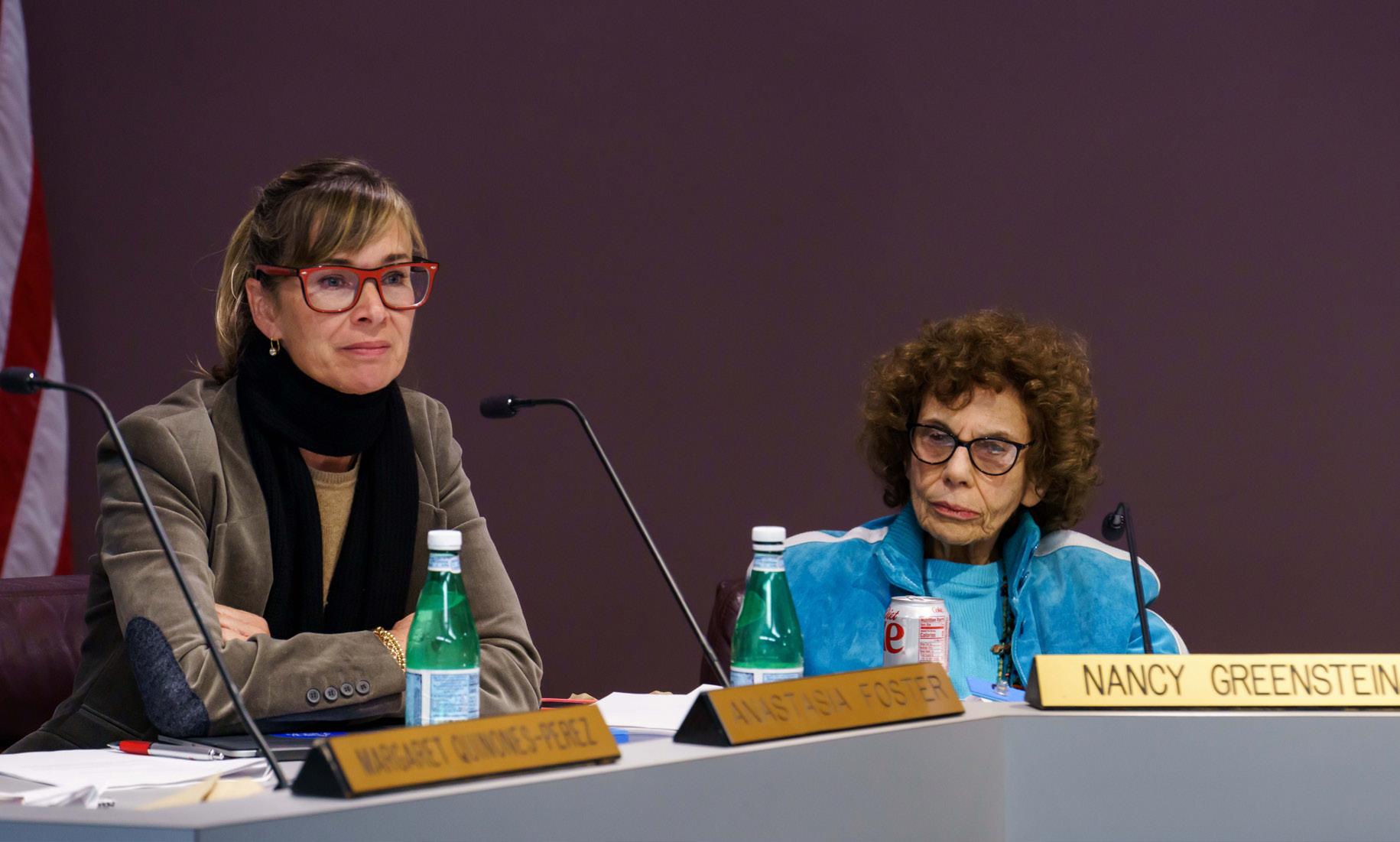



“Approving this resolution does more than signal agreement. It cosigns a decision made without fully exploring all options. Let’s do the right thing, instead of cosigning an agreement and exploring all options.”
Among the eliminated positions were student and faculty favorites Annmarie Leahy and Daniel Rocha, a career advisor and math tutor, respectively. Multiple students — many from the Adelante Program and Black Collegians — spoke in defense of Rocha during public comment. They expressed gratitude towards him and concern for their fellow students and SMC maintaining its status as the No. 1 transfer college to the University of California system.
Students around the school shared concerns about potentially losing the Maximizing Achievement in STEM Program, the effect releasing tutors would have on their education and how the losses might hurt their peers.
“It would affect not only me, but certainly a lot of disadvantaged college students that come here,” said Massimo Keyes, a freshman at SMC.
“If it wasn’t for Daniel I’d probably — I don’t know how I would have made it this far in business calculus,” Keyes said.
The college notified Leahy, who has worked for SMC for a decade, that she will be released through email as part of the layoff plan, prior to the board passing the resolution, Leahy said during a public comment.
“We are driven by student needs. We work for them, show up for them and continue to grow professionally for them,” said Amanda Garcia, a counselor at the Center for Media and Design. “A person like Annmarie cannot simply be replaced.”
After public commenters spoke about Leahy or Ro-
cha, attendees in the meeting’s overflow room would cheer, bang on the wall or stomp their feet. Many went over their two-minute time limit, advocating for their colleagues and voicing grievances. Erica Adams, an administrative assistant in the photography and fashion department, spoke for over a minute after being told her time was up by security.
Adams voiced her disapproval about the staff not receiving raises at the same rate as management and spoke in defense of Leahy.
During her comment, she said, “I’ve watched executive boards time and time again hand themselves and their little buddies in management handsome raises, and then finance what I can only describe as some kind of greed, with cost-cutting measures that are as swift and violent as the guillotine.”
“Earlier this year, my fellow union members and I were asked to accept a raise in contract negotiations that I wouldn’t even
call measly, because at least when you get the measles, you get something, okay?” Adams said. “Offering us something that little and then blindsiding us with these layoffs on top of it — it’s terrible. I’m asking all of you (trustees) to not just walk around with your heads hanging low, looking like kicked dogs.”
Before the board voted on the resolution eliminating classified staff, Roy spoke about the public commenters, saying, “Many people came up here eloquently showing us… these aren’t numbers on a piece of paper. These are people, these are people who live in our community, people who are our neighbors, people who have their own families that rely on them.”
“When pay raises were given (in the past)… ‘kicking the can down the road’ is probably the right way to think about it, because it’s not a can, it’s people and families,” Roy said.
“Since I’ve been on the board, we haven’t come to this point, this unfortunate point, and there’s nothing positive to be said about the decisions that are being contemplated, that are being made. There’s nothing positive for any of the lives that are being affected,
whether it’s classified staff, whether it’s the students that are affected, or the whole campus
community,”
he said.
“I’m sorry that it’s come to this point,” Roy added.
The Corsair reached out to Jeffery for an interview after the board meeting and was told to email SMC’s Public Information Officer, Grace Smith, with questions about the resolutions. The Corsair emailed Smith about the process and data used for furlough selection, and how the college plans to retain students with reductions in class schedule, faculty and student support. Smith responded by referring the Corsair to Jeffery’s emailed memo to the campus community sent on Feb. 4.

The Feb. 4 memo claims that affected employees will receive an official notice outlining the process and “providing an array of resources.”
“SMC has to take the necessary steps to safeguard our fiscal viability and ensure that the College’s life-changing mission can continue to be made real, for years to come. Difficult conversations lie ahead, and our students will continue to remain at the center of every conversation related to our fiscal challenges,” the memo states.
“The upcoming months will, without a doubt, be one of the most excruciating chapters in the history of this institution. Beyond the impact to the College, we are painfully aware of the personal, human impact on our colleagues and their loved ones. Every effort will be made to keep you informed and to assist everyone affected in the days ahead.”


Santa Monica College (SMC) women’s beach volleyball team had a perfect matchup against San Diego City College for its final preseason game on Wednesday, Feb 25. SMC will be heading into the conference with an even 4-4 record. Spirits are high within the team as one of their pairs from last season won the California Community College Athletics Association Championship (3C2A).
SMC has a strong presence in beach volleyball, as Annah Legaspi and Nicole Lankton from last season were crowned champions for California. Now, sophomores Sadie Town and Eden Loirin are filling the shoes for Legaspi and Lankton as the No. 1 pair for the school. “It is big shoes to fill,” said Town after being asked which of the team’s double pairings — each competing on its own court during the match — she will be playing on for the season. Town said she wants to win the entire conference championship.
women’s volleyball team had against San Diego City College.
|| Photographer
The Corsairs won all five matches played against San Diego’s pairs. Freshman Mia Whitlock played two matches as the No. 2 pair, with Stella Moritz and Ava Salvo as the No. 3 pair in the matchup.“I’m excited…” said Whitlock. “...I am a little nervous to go into games that matter, like playoffs, but I’m excited.”
Women’s beach and indoor women’s volleyball head coach Christian Cammayo revealed that this matchup was important for the team. “We just need to get on track because we’re about to start conference play…” said Cammayo. “This is a proud program, getting everything out of our system, getting ourselves fully ready for conference.”
The Corsairs are getting ready to face off against Santa Barbara City College and Moorpark at their first conference game at Santa Barbara South Beach on March 6 2026, at 11 a.m.


After a small lead in the fourth inning non-conference game, The Corsairs took a big loss against The Monarachs, ending 25-15.
Harley Morgan and Sofia Kieser || Staff writer & Managing Editor
Santa Monica College’s softball team fell in a high-scoring game to Los Angeles Valley College at home on Thursday evening.
SMC had back-and-forth scoring well into the second inning, with Danaly Santos, Meridian Cordova, Mandi Yamada and Yoselin Hernandez and LAVC’s Leilani Gurrola, Priscilla Lopez, Haylie Lopez and Haley Wolfson all scoring across the first two innings to bring the score to 4-4 near the end of the second.
Soon after, Corsairs’ center fielder Jodi Shuler hit deep into center field for a bases-loaded grand slam to bring the score to 8-4.
At the top of the third, LAVC evened the score as multiple of their runners crossed the plate. SMC responded as Dayanara Velazquez, Alexa Escobar, Santos and Hernandez all scored to close out the third inning with a lead of 4 points 12-8.
Come the fourth inning, both SMC and LAVC evened the score out again to a comfy 15-13, SMC in the lead aided by 2 Runs Batted In (RBIs) from third baseman Katrina Olmedo.
SMC head coach Christine Druckman said a strong defense and steady improvement remain the focus for early in the season. She noted that Olmedo, as well as catcher Meredian Cordova, were key players to look out for in the game.
“My catcher has been swinging the bat really well at practice, and my third baseman as well,” Druckman said. “My outfielders are on fire. Nothing’s getting through them. They’ve just been catching everything,
chasing everything down. I think that, and keeping our pitching on point, will be a really big strength for us.”
Through the fourth and fifth innings, LAVC took control of the lead, scoring 12 runs across the two innings. Multiple runs were scored in the last inning, with Monarch’s Briana Fierro recording two RBIs, and Tarryn Macias hit deep into left field for three RBIs, helping seal the 25-15 win.
After a season-opening loss to Rio Hondo and two postponed games due to rain, Druckman said the lack of early-season play put SMC slightly behind.
“We wished we had a few more games under our belt before we played this team because we’re normally pretty well matched with L.A. Valley,” she said. “Unfortunately, they’ve already got a bunch of games ahead of us. So we’re a bit of the underdog, but it is what it is. We’re moving forward.”
On the opposing side, LAVC associate head coach Robert Marcial said his team’s early experience helped them stay composed.
“I think we’re already 18 games in — today’s game 19,” Marcial said. “Just the experience helps. We have 11 girls, but five of them are freshmen, so getting their feet wet definitely helps us out because we’ve kind of been there, done that.”
The Corsairs face the Monarchs again on Tuesday, March 3, at LAVC, before returning home to play Ventura college in their first conference game on Thursday, March 5.
Santa Monica College (SMC) Corsair (5) Alexa Escobar (cq) focuses before getting ready to bat during their game against Los Angeles Valley College
on Thursday, Feb. 26, 2026, in the John
were defeated by the Monarchs 25-15 in 5

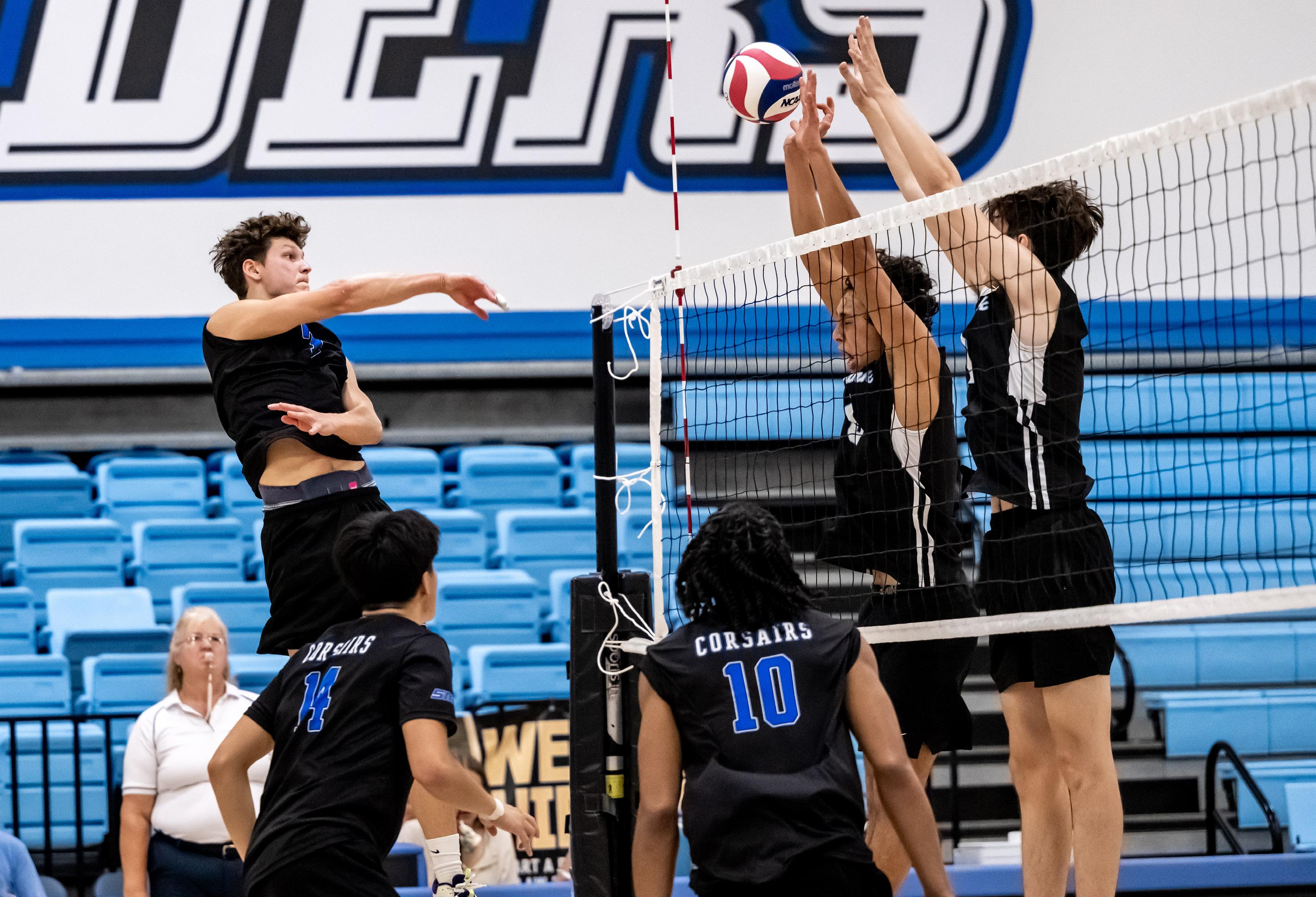
Men’s volleyball step on to the Moorpark court, with high hopes to stay on the winning side of their 6-5 ledger.
The Santa Monica College Corsairs men’s volleyball team brought the energy Friday night, defeating the Moorpark Raiders in a four set game. (27-25, 17-25, 25-21, 25-23)
The match opened with a statement: a powerful block by SMC sophomore middle blocker Soorya Raman, followed by a strategic dump from sophomore setter Ethan Lo. Sophomore outside hitter RJ Carroll sealed the first set with a set-point ace. The energy and excitement on the court surged, setting the tone for the night. SMC claimed the first set, 27-25.
“What happened doesn’t have to determine what happens,” said SMC head coach Chris Chown. Following Wednesday’s loss to
Addison Koepke || Staff Writer
Northern Region opponent, Santa Barbara City College Vaqueros (3-1), the Corsairs were determined to reset and respond.
Hungry and eager, multiple Corsairs answered that call.
This game was pivotal, a tone setter for the direction of the season. During the second set Moorpark scored a kill for the first point. SMC was out of rotation during a serve. After taking the first set with intensity, SMC saw a slight dip in the second, allowing Moorpark to even the match (25-17).
“Tonight, honestly, the biggest thing was just people being ready to step in. We played a lot
of different guys at different moments, and they were ready to try and make an impact for the team.” Chown said.
Jayden Lyons, who rotates between middle blocker and opposite, took the court with a commanding presence. Although he had a slow start to the evening, he settled in and found rhythm. Lyons finished with four kills on eight swings, hitting an efficient .500 while adding four total points. In the pivotal third set, Lyons brought in some stability which helped reinforce the team’s rhythm when it mattered most.
During a timeout Chown asked “Who else is going to step up?”



Demian Anisimov is SMC’s aggressive and strategic outside hitter, delivered. The offensive engine of the team tallied 21 kills on 51 attempts, hitting .294 and totaling 23.5 points. Bringing the energy and power to help the Corsairs regain momentum. The third set was wrapped up with a set point kill by Anisimov, which swung the energy firmly back to SMC’s side.
Whether it was a pre game backflip from Samanu Hannemann, who contributed three kills and 3.5 points, or the constant shouts of encouragement from players like Soorya Raman, who added six kills and seven total points. The Corsairs fed off the energy around them and turned it into an effective performance on the court. As a team, SMC
totaled 37 assists, 53 digs, eight block assists and 13 service errors.
Closing out the match by victory in the fourth set, 25-23, the Corsairs proved resilient.
Despite the victory, coach Chown’s primary focus remains on sustaining the team’s growth and maintaining their strength when competing against top level opponents. On Wednesday, March 4, the Corsairs will step onto their home court at the Corsair Gym to take on the LA Pierce Brahmas.
“We’ll push forward and be better next time we come out,” said Chown.
“What happened doesn’t have to determine what happens”
Head Coach Chris Chown
The SMC Photography Department opened a two-week exhibition in the Photography Gallery in Drescher Hall to celebrate the life and work of longtime photography professor, Blue Fier.
Eichholz || Photographer


Faculty, alumni, family and friends gathered at Santa Monica College on Saturday, Feb. 28, 2026, to celebrate the life and artistic legacy of longtime photography professor Blue Fier during the opening night of the Blue Fier — Celebration of Life Exhibit at the SMC Photography Gallery in Drescher Hall. In his honor, all guests were asked to wear something blue.
The exhibition — open every Tuesday, from 2 p.m. to 5 p.m. through Sunday, March 15, 2026 — invites students and the broader campus community to experience more than four decades of Fier’s creative work as a writer, sculptor and photographer.
Fier taught photography at SMC for more than 25 years before retiring in 2020. Fier is known for his nonjudgmental teaching style, sharp sarcasm and encouragement of experimentation; he influenced generations of student photographers.
Fier advised his fellow colleagues not to be an authority, but rather a guide. He passed away in September 2025 at age 75 after living with Parkinson’s disease for nearly two decades.
SMC photography professor Craig Mohr and photography professor Ed Mangus, spearheaded the installation of the exhibition honoring his longtime colleague. Zack Reed Fier, Fier’s oldest son, said he rediscovered his dad’s catalog while curating the show.
Before Fier was a photographer, he was a sculptor for 20 years and exhibited his work all across the world. The challenge became not so much how to fill the space, but which ones were the most important pieces to display.
When asked if he has a favorite photo by his father, Zack Reed Fier said, ”I would love to say I do, but I don’t … I rediscovered how cool his body of work is. There is one of the Grand Canyon and I remember being there with him as a kid when he was shooting that location. There is so much memory attached to all this.”
Mohr emphasized that Fier’s panoramic and landscape photography best represents his vision of photography in the exhibition.
Among the prints is an image featuring an orange wall and a note by Blue Fier reading, “Notice how the person leaning against the wall adds scale to the image. My older brother Johnny, seen here, always felt he was pushing up against the walls of society.”
Another highlight for visitors is Fier’s participation in the collaborative Daily Photo Game, described as a visual dialogue between 10 photographers responding to one another through imagery in 24 hours. Students visiting the gallery encounter not only photographs but also other elements. Guests interacted with The Sound Walk, a brass scale model connected to Fier’s pyramid sculpture exhibited in San Francisco Airport and various museums, illustrating how his work extended beyond traditional photography. Others were following a display showing a video of Fier’s legacy, “Blue Fier — A Documentary.”
Fier had a deep interest in Photography History, which inspired him to coordinate the SMC Free Family Portraits Project after the Woolsey Fire in 2018. Mohr remembers this project as one of his proudest moments he experienced while working with Fier and as a photographer.
Mohr said, “After the Woolsey Fire, he was setting up bringing in all the families who’ve lost all of their belongings and their photographs, to come here and have their portraits done. And so he organized the cosmetology department, the fashion department, and the photography department to photograph these people. The stories were heartbreaking.” Faculty members, friends, and former colleagues like Ford Lowcock,
Chair of the photography department at that time, gathered throughout opening night, sharing memories while guiding visitors through the prints and installations.
Earlier in the day, a memorial service held in the Professor Harvey Stromberg Lecture Hall brought together family, colleagues and alumni.
Fier’s wife, Kim Saunders, performed the song “Night and Day”, and his brother, Tom Fier, shared a feeling of a missing piece through losing his identical twin brother. Fier’s longtime friend, Victor Raphael, shared the inspiration behind the creation of a documentary for Fier’s sons, Zack Reed Fier and Easton Fier. The film followed his 45-year legacy of creative life. The documentary is displayed as an installation at the Celebration of Life Exhibit and can also be viewed on YouTube.
Stories were shared about Fier’s love of 70% dark chocolate, the care of his chickens, Terra and Luna, and his endless visits to The Apple Pan.
Blue Fier’s quote, “May good light follow you wherever you go,” closed the Memorial Service.
Offering more than a memorial, the exhibition functions as an educational opportunity for current art and photography students who are discovering Fier’s work for the first time. From panoramas and landscapes to conceptual exchanges and deeply personal notes attached to prints, the gallery reveals how Fier approached photography.
Visitors moved through images that reflect travel, family life, humor and observation. It was a chance to study not only photographs, but a teacher who encouraged others to see differently.



Fier
the youngest son of Blue
shares information and memories with gallery visitors during the Opening Night of the
in
Tuesdays from 2-5 pm until March 15,
Black Mental Health workshop spotlights stigma, support and solidarity
Christine Xolotl Muñoz || Staff Writer

“All are welcome,” said Santa Monica College media and communications student, Jana Craig while introducing Planned Parenthood’s three golden rules. SMC Basic Needs, Black Collegians and Planned Parenthood hosted a Black Mental Health workshop on Feb. 19.
The goal of the workshop was to help students to learn about the stigma, signs, and strategies related to how people of color experience mental health challenges. Illustrations By Jenna
Tibby
“Teaching on Black Mental Health during Black History Month makes it feel more special,”
said Craig. Having experienced her own mental health struggles, she says mental health education was always in the cards for her. At 16, Craig participated in a peer education program through Black Women for Wellness. Three years later, she became a Community Health worker, providing services through community outreach through Black Health Initiative.
“Everytime that there was a time in my life that I was down or going through a bad phase in my life I had my peer education to fall back on,” Craig said. “I was only 16 and was going through so much in my life being able to open up and talk about it made me feel not as alone.”
Craig led an extensive discussion on understanding Adverse Childhood Experiences (ACEs). Students reviewed a case study involving a 35-year-old Black woman named Michelle. The group was asked to identify ACEs that she faced and strategies to support someone who may be experiencing the same.
The office of the California Surgeon General released a video that breaks down the impact on ACEs.
ACEs include racism, oppression, violence, abuse, mental health problems or substance use. The more frequently a child’s physical and emotional safety systems are activated, the greater the build up of toxic stress. Body chemistry meant to protect us in harmful situations can produce toxic stress, which may affect our biology and be passed down through our DNA.
“It made me quite emotional, I may not have said a lot but I felt a lot as we were ex plaining things like depression or ACE. How a child may receive trauma or symptoms from the parents behavior. I was there. I felt like I was 10 again, frankly,” said Takara Yaegashi. Yaegashi is the president of the Black Colle
gians program and has been studying accounting since 2019 at SMC. Her father is a U.S. veteran who served as a naval officer in Guam.
“It’s very scarring for a person to strategize how to hurt another human. It was damaging to his humanity,” said Yaegashi.
Her father’s experience in special operations left its mark on his mental stability, and he coped by drinking alcohol.
“I’m grateful that my brother and I turned out to not be alcoholics, but we definitely had a huge chance of being so because we were reflective of how our dad behaved in our youth. It’s very common in the Black community to have an alcoholic parent.”
According to the State of Black Los Angeles 2023 - 2025 Trend Analysis report Black/ African American adults were 36% less likely than U.S. adults overall to have received mental health treatment in the past year.
The small, intimate group setting gave students the opportunity to be vulnerable and share their unique experiences navigating mental health and mental illness. A key point was that mental health does not mean mental illness; however, the two concepts coexist. Abel Orihu, a student at SMC, attended the workshop with a friend. He said having the workshop take place during Black History Month was a good opportunity to prioritize mental health during a time when resources are needed.

“The illusion is that there isn’t any time to slow down,” Orihu said. “So it was really nice to have a space to slow down, check in and talk about the importance of not just mental health, but resources available outside of that for sex education and other things that aren’t usually talked about within Black households.”
He looks forward to seeing more events on campus that remind Black students of “self belonging”.
“Many times we all live lives that are not our own. We live personalities and identities made up of other people’s expectations a lot of times, especially growing up we don’t have the space to discover ourselves especially given that we are born in the age of technology,” Orihu said.
He hopes future events will encourage socialization among other students of color, con necting in person to build community as an act of resistance to the grind-and-hustle mentality some embrace as a form of survival.
It’s Xenia Porter’s second semester at SMC, where she is studying Theater and Psychology. She serves as the treasurer of the Black Collegians and accompanied Orihu, who reminded her that he would be attending the event.
“I think there is always more than can be done,” Porter said. “As a club we are trying to work on making more events and stuff. I think continuing to be persistent and speaking about it and showing it to students, like we’re here to help y’all out…we have resources, you just need to pull up.”
Porter said stigma runs rampant in Black communities and it’s a very different experience, the toll it takes on the body, and challenges with medical coverage or insurance.
Before SMC, Porter was attending Fordham University in New York. She said while she attended school on the East Coast, her California-based health insurance did not cover her treatments. “I had to go to urgent care, I wasn’t able to get my ADHD meds, and I wasn’t able to get med management cause I also take other medication.”
Craig’s presentation had a special emphasis on mental health, focusing on the Black experience. Not all participants who attended were Black, emphasizing the diverse community seeking mental health resources.
In the 2025 State of Black Los Angeles trend analysis reports include Black/African American depression rates decreased, from 15.3% to 11.4% other groups saw increases.
Craig shared that Planned Parenthood health centers in Inglewood, Compton and Baldwin Hills Health Centers offer free therapy for up to four months, totaling 16 sessions.
Participants said the conversations during the workshop fostered a sense of solidarity, similar to the solidarity seen across marginalized communities throughout U.S. History including the civil rights movement, the Black Lives Matter movement and recent protests against ICE.
“There’s too much politically going on…It is a bigger problem than we perceive it is,” said Yaegashi. “We need more unity amongst each other to say this is not just one community’s problem.”
SMC students explore the connection between dance, wellness and creativity in a masterclass led by dancer, holistic healer and yoga instructor Naomi Hutchinson.
Dani Brambila || Staff Writer


In the midst of the usual hustle and bustle at Santa Monica College, soft music fills a room at the Core Performance Center of Santa Monica College, while dancers lie quietly on the floor with their eyes closed. Naomi Hutchinson walks among them, guiding the students through becoming aware of their bodies and breathing.
The masterclass, hosted by the SMC Dance Department, was held for dancers to explore the connection between movement and wellness. Through a series of breathwork, stretches, reflection and dance, Hutchinson taught the students how to approach dance as a way to understand and care for their bodies and minds.
For Hutchinson, the founder of the hybrid community platform for well-being, Healthy+Well, the idea behind the workshop was rooted in her own experience.
“My inspiration was very personal,” she said. “I’ve been falling back in love with dance for myself, and I realized that the wellness component was something that was lacking.” Even though traditional dance classes often emphasize technique and precision, Hutchinson believes there is also a need for
“You start noticing the things that aren’t aligned within you that you may need to heal through physical movement.”
spaces where dancers can take a moment to connect with their feelings and physical well-being.
“There’s plenty of dance classes where you can go and learn technique or choreography,” Hutchinson said. “But there’s not always a place where you can embody well-being. Dancers carry so much emotionally. It makes our dance better because we’re able to express it, but we also need to be taken care of.”
The class began with a group exercise where students introduced themselves to each other, expressed how they were feeling in that moment, and what “dancing well” meant to them. Small groups formed around the room, creating bubbles of conversation as students shared their unique perspectives.
An SMC student shared that dancing well is all about caring for their body in every aspect of their daily routines, and that for one another, it means being conscious of what your body is going through.
“I think dancing and wellness make you more aware of your

body,” said SMC student Gigi Rodriguez. “You start noticing the things that aren’t aligned within you that you may need to heal through physical movement.”
After the introductions, the room moved on to breathing exercises and stretches that prepared the students for some guided improvisation. Hutchinson had the students move across the room to explore their emotions through the simple action of walking.
In one exercise, students walked across the room toward their goals, with purpose and urgency. Right after, they did the same thing, this time imagining a personal fear of theirs was standing in their way. This was a way for them to see how the same motion, such as walking, could still vary depending on circumstances.
The room exploded with movement a moment later.
The dancers slid across the floor, spinning through the space as they expressed and experimented with their own interpretations of different prompts provided by Hutchinson. Some movements were expansive and energetic, while others were slow and deliberate. A few students crossed the room alone, while others found a collaborator along the way. As the exercises continued, layers of clothing were shed as people became more confident. For Christopher Devant, a student dancer at SMC, the experience offered something rare: a peaceful break.
“It kind of takes you away from reality for a minute,” Devant
said. “When you're dancing and giving your all, you're just in the moment.”
Other students were grateful for the chance to step away from the usual structure and discipline that often accompany dance training.
“It strips away the rigidness,” said SMC student dancer
Taryn Key. “Instead of focusing on choreography or style, it becomes about your lived experience. And being a soul, being a person, and living in your mind.”
Hutchinson hopes to encourage dancers to think differently about their relationship with movement.
“Good is the dance where you feel your spirit dancing, it’s beyond just your body movement,” she said to the students.
“That spirit connection, that soul.”
Additionally, she emphasized the importance of wellness practices, such as meditation or journaling, for dancers to process the stress and emotional experiences that often become stored in the body.
The class ended the same way it began: in stillness. Sitting quietly on the floor, dancers closed their eyes and returned to their breath, followed by a brief discussion about the importance of incorporating wellness into their lives and how to do it.
“Everyone deserves to be well,” Hutchinson said. “To be well means having joy and being in tune with yourself.”

Microdosing or macrodosing: Has a cultural shift and increased medical interest led to a growing trend of psychedelic use in America?
Patrick Conlon | Staff Writer
On Jan. 28, in Sherman Oaks, around two dozen men and a handful of women attended the Psychedelic Symposium at The Green Room. Plush leather sofas and high-top tables surrounded a stage in a dimly lit, green room. The event was hosted by the Psychedelic Institute of Los Angeles (PILA), which holds monthly meetings on various topics. This month’s focus was “Microdosing Over 50.”
Psychedelics are not new — all of the “magic mushrooms” brought up at the symposium have been taken by humans since our species was still hunter-gatherers. What is new is the growing trend of “microdosing” and the increased research from the medical community into new approaches to psychedelic-assisted psychotherapy to treat various mental illnesses.
According to the RAND Corporation, a global policy think tank, “Approximately 10 million U.S. adults microdosed psilocybin, LSD or MDMA in the past year.” A 2024 study by Eric Leas, an epidemiologist at the University of California, San
Diego, found that Google searches for “microdosing” skyrocketed nearly 1,250% from 2015 to 2023.
As of publication, the Food and Drug Administration is reviewing three psychedelics in various stages of clinical trials for combined use with psychotherapy, including MDMA for post-traumatic stress disorder, psilocybin — the active ingredient in “magic mushrooms” — for anxiety and depression, and LSD for anxiety. Ketamine has recently been FDA-approved for treating depression, which has opened the door for medical interest in drugs once associated with hippies and ravers for recreational use.
Clinical trials are slow, and the FDA’s approval process can take years, along with the time needed for the American Psychiatric Association to develop guidelines. This has led to some self-ascribed “underground therapists”— unlicensed professionals, who administer and guide users through sessions they say address trauma — distributing what they call “medicine” and evangelizing their homemade treatment plans.
Enter the PILA, founded by Paul Karasik during the COVID-19 pandemic in 2020. Karasik said after getting diagnosed with a serious illness in late 2019, he took DMT, a powerful yet short-lasting psychedelic. Karasik said that experience inspired him to start the institute and form a community centered on spreading the word of psychedelics’ potential healing properties.
“The message was that I should move forward with this, and get the medicine to people, and speak on it, and take a leadership role,” Karasik said.
The initial PILA meetings consisted of Karasik and his friends doing psychedelics at their beach houses and exchanging various mind-altering drugs. Over the years, Karasik expanded his reach to a monthly meetup open to newcomers.
Attendees on Jan. 28 were mostly older and there to learn about the event topic of microdosing over 50. Many shared their experiences with psychedelics and recommended different treatments to anyone who asked.
One attendee, who requested anonymity in fear of retaliation from his employer and will be referred to as T, said the first time he used drugs was in October 2024 to deal with depression after a friend referred him to an “underground therapist.” He said he took MDA, sometimes referred to by its street name “sass,” an amphetamine related to MDMA; it’s a more hallucinogenic plant-derived drug that produces similar euphoric feelings to MDMA.
T said the experience helped him to start the healing process in a way past treatments failed, “The first time I got to, I would say, release a lot of trauma, a lot of things that I have been holding on to for many, many years. I feel like I let go of it.” He later did seven more guided trips with either MDA or other psychedelics.
T’s story, of seeking treatment outside what is currently FDA-approved yet shows promise in clinical trials, is echoed by Karasik during the symposium. “Iboga is coming up, generally all over the place in terms of its potential. The research is coming in now. It’s amazing,” Karasik said. Iboga is a plant from Central Africa in which a powerful psychedelic, Ibogaine, is synthesized. Ibogaine is currently being studied for treating patients with opioid addictions.
Karasik said reducing stigma around psychedelics is what “the Psychedelic Institute is active about, and that’s our activism, and is to destigmatize, and that’s by bringing it out into the public.”
However, Professor David Shirinyan, who teaches Physiological Psychology at SMC, worries that psychedelic use — similar to cannabis use — becoming normalized could lead to negative unforeseen public health issues. “It is critical that the wider population not take these research endeavors as an invitation to engage in widespread use. We are seeing a version of this phenomenon play out with cannabis. Many, particularly young, people are seeing the emergence of new or worsening mental health symptoms with widespread use of potent cannabis.”
“I am in equal parts excited about the promise of these chemicals as treatments for treatment-resistant, severe psychiatric disorders, and terrified about the normalization and widespread use of these powerful chemicals,” Shiriyan said.
He believes the rise in psychedelic use in America and the trend of microdosing go alongside other health and wellness trends, stating, “I think the increase in interest in psychedelic chemicals tracks very well with the rise of the wellness and functional medicine/health optimization trends. There are celebrities and celebrity scientists who speak openly about their use of these chemicals. Self-diagnosis and self-treatment is much more in the zeitgeist today.”
Shirinyan, who holds a doctorate in behavioral neuroscience, said his research on the neurobiological processes in schizophrenia informs his concerns about people trying psychedelics outside of a medical setting. “I know for certain that my work in the area of schizophrenia likely makes me extra worried about powerful psychoactive and mind-altering substances. I worry that the people most vulnerable, the young and those with predisposition to mental illness, are the ones who are most intrigued by these substances.”
Shirinyan also warns that federal approval does not eliminate risk. “When an extreme, psychoactive treatment becomes FDA-approved, trouble follows. See opiates, opioids, amphetamines, benzodiazepines, barbiturates.”
As clinical trials continue and psychedelics are decriminalized in a growing number of states, only time will tell what the effects of their widespread use on the population will be.

but not
Deck: In January, Minnesotans pushed back against Immigration and Customs Enforcement operations using Los Angeles tactics.

Minnesotans will feed you if you’re hungry, and take offense if you deny their generosity. They’ll give you clothes off their backs to ensure you’re warm in hair-freezing, frostbite-causing, record cold temperatures. So when immigration agents rolled into the Twin Cities, people marched on frozen streets with signs held high, reading, “Minnesota nice, but not to ICE.”
Resisting tyranny isn’t new to Minnesota. Many of its early governors were Union soldiers, and it was the first state to take up arms for America in the Civil War. To this day, the Minnesota Historical Society still possesses the 28th Virginia battle flag, and they refuse to give it back. “Why? I mean, we won… We took it, that makes it our heritage,” said former Gov. Jesse Ventura in 2000 after denying another request for the trophy to be returned.
Angelenos and Minnesotans share many similarities. Those include a hatred of Immigration and Customs Enforcement,
and a love of a good fight. When the Department of Homeland Security started Operation Metro Surge, an immigration crackdown, in the Twin Cities, residents used a few tactics I’ve seen in Los Angeles and raised hell with a good amount of mutual aid in between.
I flew to Minnesota on Jan. 28 with an ungodly amount of credit card debt, clothes fit for a Siberian winter and the protective gear required in a war zone.
A gas mask is necessary — in my experience, sometimes just standing near a fence pointing a camera is enough to incur a DHS agent’s wrath — but armored plates seemed excessive. Until law enforcement gunned down two U.S. citizens.
Jonathan Ross, an ICE officer, fatally shot 37-year-old Renée Nicole Good on Portland Avenue near East 34th Street in Minneapolis on Jan. 7, after she tried driving away as authorities pulled her door handle, trying to get into her
vehicle. After shooting her, he muttered “fucking bitch” towards her dying body and walked away.
Alex Pretti, an intensive care unit nurse who worked at the Department of Veterans Affairs hospital, confronted a Customs and Border Protection agent for pushing a woman on Nicollet Avenue near East 26th Street on Jan. 24, and it cost him his life. CPB pepper-sprayed, beat and subdued Pretti; then two federal agents — identified as Jesus Ocha and Raymundo Gutierrez by ProPublica — shot him.
“It’s a lot of overreach. There’s — I mean, it’s a list at this point,” said Tomas Hunter, a U.S. Navy veteran at the Pretti memorial on the street where he died. “It’s like the first, second, fourth, tenth amendment. I mean, on a regular basis, these guys are trampling on, you know, what we swore an oath to.”
I went to Pretti’s memorial before picking up my colleagues from the airport; I needed a moment alone to process the images ingrained in my mind of the state violence committed in Minnesota. I’ve seen the Los Angeles Police Department attack and leave people as dying, bloody pulps — beaten within inches of their lives — but at least they have the dignity to do it without a mask.
At Pretti’s memorial, there’s a black banner strung between a tree and a lamp post that states, “Rest In Power Alex Any Righteous Person Would Have Done The Same.” Underneath, the pavement is covered in vases with multicolored flowers, posters that read “Justice For Alex,” and white half-burned candles.
The crowd size at Pretti’s memorial fluctuates, but someone’s always there, standing underneath a solemn cloud that hangs over

the site, offering handwarmers, food and company. Many people cried while praying over candles at the site, and some just wore thousand-yard stares, looking at the ground in disbelief.
I wanted to conduct interviews, but my knees felt weak, and I appeared to be a shivering, cold, anxious wreck; so I left to collect myself and find some sleeping aids.
Slowly waddling through the crisp, skin-burning Minnesota breeze to a dispensary, I noticed how much Minnesotans hate masked federal agents seizing people in their neighborhoods. Almost every storefront has a red and white rectangle sign depicting a snowplow pushing law enforcement that states “I.C.E OUT OF MINNEAPOLIS,” and if you mistakenly stare at someone long enough, you’ll be questioned if you’re an officer.

The budtender, a tall woman with bronze skin and curly, thick hair taught me this after a tense exchange at the dispensary. After some light-hearted chit-chat, she marked me as an out-of-towner and suddenly dropped her customer service voice.
With her hands of steel clenched and ready to rumble, the budtender straightened her back and, with her whole chest, said, “That’s cool, where you from?”
Stunned, flabbergasted even. Five words transported me back to LA, and I didn’t know whether to be alarmed or insulted that she’d assume I was law enforcement.
I started stuttering and bumbling my words, but eventually I was able to string together, “Me? Oh, I’m a journalist from LA here to cover — well, everything.”
For a second, we stared at each other with heavyweight championship bout animosity, locked in and facing down. Whoever blinks first loses.
The budtender unclenched her hands, relaxed her back and as if she didn’t just terrorize me, said, “Phew, that’s a relief. I thought you were ICE.”
“No,” I said, skin turning pale blue. “I was fit enough for the Navy at 17, and now I do this.”
She laughed and raised a hand to her mouth to hide her smile. “Here, take these,” she said, tossing me a bag of gummies with a smile slowly growing across her face. “You don’t need to pay. You’re doing the Lord’s work.”
I thanked her and skedaddled to pick up my colleagues.


On Jan. 29, I started my day at a cafe, Modern Times, that switched to a donations-only model for the duration of Operation Metro Surge. “Until this occupation is over, we are Post Modern Times,” the owner, Dylan Alverson, wrote on Instagram. “Post Modern Times is free for all with the exception of our occupiers!”
At this newly-christened finger in the face of capitalism and government reliance, people waited bundled up inside for their name to be called from the 30-minute wait list, but few seemed to mind. I stepped outside for my morning cigarette, and down the street I saw another form of Minnesota resistance.
Huddled around a blazing campfire on the intersection of East 32nd Street and Columbus Avenue, community patrollers sat in a

makeshift circular post constructed of traffic barricades, flipped trash cans with white banners that say “Neighbors Say ICE Out!” and an old beat-up mattress with “Protect Neighbors” spray-painted on the back.
Minnesotan community patrollers, like in Los Angeles, canvas their neighborhood for law enforcement, but they’ve also arranged posts in gridded neighborhood intersections and roadblocks on main streets, looking for and reporting ICE vehicles to encrypted Signal chats and StopIce.net.
“They (ICE) seem scared,” said Rosie Averrit, a community patroller checking license plates at a roadblock on East 32nd Street and Cedar Avenue. “When they see us, they try to turn around. They try to drive off really quick, and I think all of these little
disruptions from many different people in all different directions are going to be what continue to push ICE out of Minneapolis.”
Minnesota needs ICE out of the Twin Cities; Operation Metro Surge is strangling the economy blue. At least 30 of the 35 businesses at Mercado Central on East Lake Street in Minneapolis are shuttered. It's an abandoned ghost town with a few lonely store owners sitting and resting their heads on their storefront gates, emptily staring down once-lively passageways.
I asked an elderly Mexican woman selling lion-printed blankets what happened, and through her exhausted, silent stare, she said in Spanish, “You already know, son.”

Demonstrators dance next to The Common on Portland Avenue in downtown Minneapolis on Friday, Jan. 30, 2025, after an anti-ICE protest demanding the Immigration and Customs Enforcement agency cease operations in Minnesota.
Kayjel J. Mairena | The Corsair

Immigrants are like engineers on a U.S. Navy war vessel: a wildly underappreciated hardworking bunch that’s keeping the stinking thing afloat. According to a 2026 study from the libertarian think tank Cato Institute, from 1994 to 2023, migrants generated more in taxes than they received in benefits — across all levels of government — and contributed a cumulative fiscal surplus of $14.5 trillion to the economy, possibly preventing a fiscal crisis.
Twenty-three-year-old YouTuber Nick Shirley is at the center of the whole Minnesota debacle. In December 2025, he set forth to prove that Somali immigrants were committing widespread fraud by barging into daycares, demanding to see children.
Shirley’s video went viral. President Donald Trump, Vice President JD Vance and tech-billionaire Elon Musk all re-shared the reporting, and it garnered millions of views on social media.
According to a CBS News investigation, two of the daycares featured in Shirley’s video had been shut down earlier in 2025, and all
active daycares he mentioned had licenses, with state regulator visits done within the last six months.
Still, it was enough to convince the Trump administration that Minnesota needed a visit from DHS.
At an ICE staging location outside the Bishop Henry Whipple Federal Building in Minnesota on Jan. 30, I witnessed an old man with a brown wooden cane and a vintage rubber gas mask shout, “They can’t kill us all,” as Hennepin County Sheriffs pushed protesters back.
Protesters have clashed with authorities outside the federal building multiple times since Jan. 8, the day after Good was killed. Ironically, Whipple was an Episcopal priest and an indigenous rights advocate who stood against forced separation and violence forced upon native people in the 1800s, said Kelly Sherman-Conroy, a pastor at All Nations Church in Minneapolis and a theologian at St. Olaf College.
“What he stood for, and what it is now, is everything that he fought so hard against,” she said. “That’s important to understand, that history of the Whipple building, because he fought for people’s rights.”
My NB-100 tactical gas mask with a 40-millimeter N-B-1 defense filter fogged up as soon as authorities started waving around kinetic projectiles and pushing the crowd. I couldn’t see, but heard chaos and smelled panic — that’s the direction my camera needs to be.
Approximately 100 people stood outside the federal building that Friday, a seemingly manageable number for law enforcement. But at 2 p.m., an angry giant stormed through downtown Minneapolis shaking windows while shouting, “El pueblo unido jamás será vencido.”
For more, read the rest on our website.