4. WHAT WE LEARNED
The following is a summary of the feedback received through the online survey and comment box.
Property Owner Survey
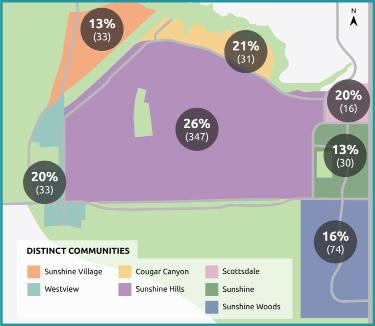
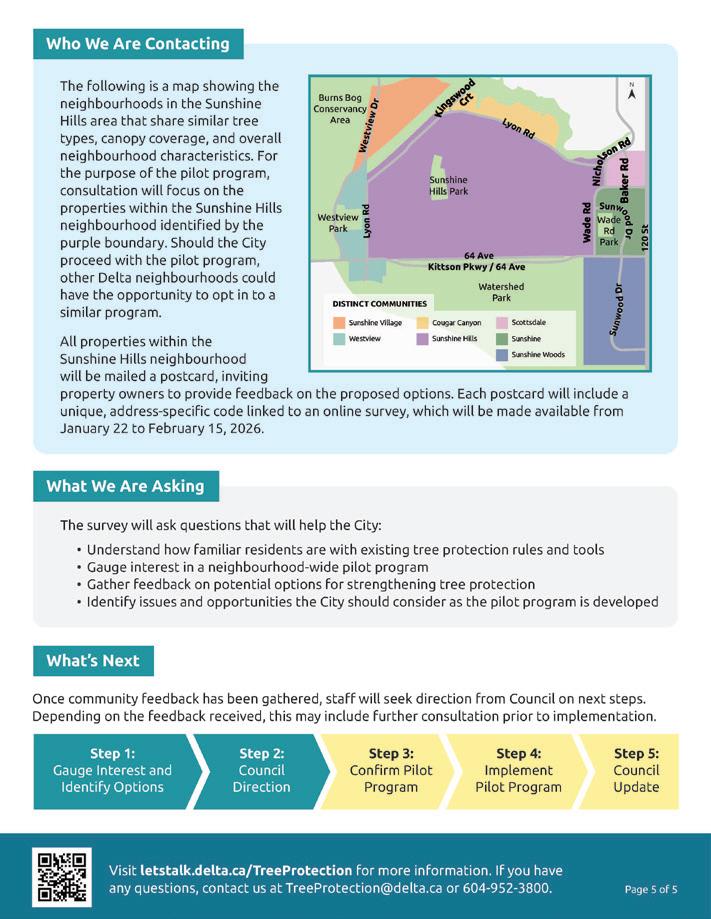
Q1: Please review the map and identify the neighbourhood in the Sunshine Hills area where you own property.
Responses indicate that Sunshine Hills neighbourhood property owners had the highest level of participation across the Sunshine Hills area. This is likely reflective of the relative size of the neighbourhood compared to the other six within the engagement area.
I do not own property in the Sunshine Hills area
Q2: How long have you owned this property in the Sunshine Hills?
Results suggest the survey primarily captured feedback from long-term property owners within the neighbourhood, with over 3/4 indicating they have owned their property for more than 11 years.
Q3: How many trees do you have on your property?
Responses are consistent with the established tree canopy and mature landscape characteristics associated with the Sunshine Hills area, with 48% reporting six or more trees on their property and 28% reporting three to five trees. The survey did not include an option to select zero trees. This question was asked to understand if participants would be personally impacted by changes.
Q4: Council has received numerous emails from residents in the Sunshine Hills area expressing concern about the removal of mature trees on private property. What is your level of concern about protecting mature trees on private property in your area?
Levels of concern regarding the protection of mature trees on private property were high across the engagement area (69% very concerned), though responses varied by neighbourhood. The highest proportion of respondents indicating they were “very concerned” was in Cougar Canyon (84%), followed by Westview (73%) and Sunshine Hills (73%). In comparison, Sunshine Woods reflected the lowest overall level of concern at 22%. These results reflect the views of respondents within each neighbourhood who completed the survey and are based on the number of responses received, not the total number of properties in each area. As such, the findings indicate relative levels of concern among participants and do not represent the views of all property owners within each neighbourhood.
Continued on next page.
Q4: Council has received numerous emails from residents in the Sunshine Hills area expressing concern about the removal of mature trees on private property. What is your level of concern about protecting mature trees on private property in your area? (continued)
Westview
Cougar Canyon
Sunshine Hills
Scottsdale
Q5: Briefly share your main concerns for wanting to protect mature trees on private property in Sunshine Hills?
All respondents commented and several interrelated concerns were identified. The most frequently cited themes being preserving neighbourhood character (42%), climate resilience and air quality (29%), and wildlife and biodiversity benefits (23%), along with concerns that redevelopment and increased density are accelerating clear-cutting to maximize building footprint (18%).
Neighbourhood Character, Identity & Uniqueness
• Concern regarding the loss of mature trees and large canopy that define the character and identity of Sunshine Hills, with respondents noting that widespread tree removal is altering the established look and feel of the neighbourhood — a key reason many chose to live in the area.
Environmental, Climate, and Biodiversity Benefits
• Concern regarding the environmental and climate impacts of removing mature trees, including the loss of carbon storage, air purification, shade, and natural cooling benefits leading to increased air conditioning use for both individual properties and the neighbourhood overall.
• Concerns that clear-cutting disrupts ecosystems and contributes to habitat loss and reduced biodiversity, including impacts on birds, pollinators, and wildlife species such as eagles, owls, and songbirds.
• Concern regarding the loss of mature trees that take decades or generations to replace, with skepticism that replacement ratios, saplings, or cash-in-lieu payments can meaningfully compensate for long-term canopy and environmental loss.
Densification and Clear-Cutting
• Concerns that housing policy changes are accelerating canopy loss in the neighbourhood and perceptions that redevelopment prioritizes maximizing building footprint over tree retention which leads to clear-cutting.
• Repeated references to oversized or “edge-to-edge” housing that reduces greenspace and available space for mature trees, with perceptions that increased density limits opportunities for tree retention.
Privacy, Livability, and Property Value Impacts
• Recognition that mature trees serve as natural visual and sound buffers that support neighbourhood livability, with concerns that their removal reduces privacy between properties and increases exposure to highway and road noise.
• Statements that mature trees contribute to higher property values, neighbourhood desirability, and curb appeal, supporting long-term community investment value.
Safety Benefits
• Emphasis on balancing tree protection with safety considerations, including support for the removal of diseased or hazardous trees.
• Concerns that the removal of surrounding trees increases windthrow risk and may weaken root systems that support slope stability and prevent erosion.
• References to the role of mature trees in stormwater absorption and reducing runoff, with comments linking canopy loss to potential flooding and groundwater impacts.
Opposition to Additional Restrictions
• Support for property owner flexibility, with comments indicating that tree removal should remain under existing regulations.
Q5: Briefly share your main concerns for wanting to protect mature trees on private property in Sunshine Hills? (continued)
Other
• Perceptions that fines and penalties are insufficient deterrents for tree removal and clearcutting and treated as a cost of doing business for developers, with skepticism regarding the monitoring and enforcement of replacement requirements.
• References to mature trees as part of the historical fabric of the neighbourhood, with occasional mention of their Indigenous and long-standing ecological significance.
Q6: Are there specific types of trees or characteristics that are most important to you to protect?
Approximately 3/4 of the 495 comments identified all mature trees, regardless of type, as important to protect. A majority also highlighted the need to preserve trees that provide significant canopy coverage (55%) and those above a certain size or diameter (48%). Overall, results suggest a preference for protection approaches focused on mature trees, canopy contribution, and overall landscape value, rather than limiting protection to specific species alone.
Trees above a certain size or diameter
Groups or clusters of trees of any species
“Other” responses reflected interest in protecting trees that are not hazardous and that contribute to neighbourhood character, including native conifer species such as Douglas fir, western red cedar, and hemlock. Trees that provide habitat, shade, privacy, noise buffering, cooling, improved air quality, and fruit-bearing value were also noted in tandem with those that protect property perimeters and are from the original development-era.
Q7: Please indicate your level of familiarity with each of the following existing tools and regulations.
Responses indicate high awareness of Delta’s Tree Protection and Regulation Bylaw No. 7969, with 92% of respondents reporting they were very familiar (45%) or somewhat familiar (47%). In contrast, familiarity with the Heritage Register and Restrictive Covenants was lower, with 64% and 66% respectively indicating they were not familiar with these tools.
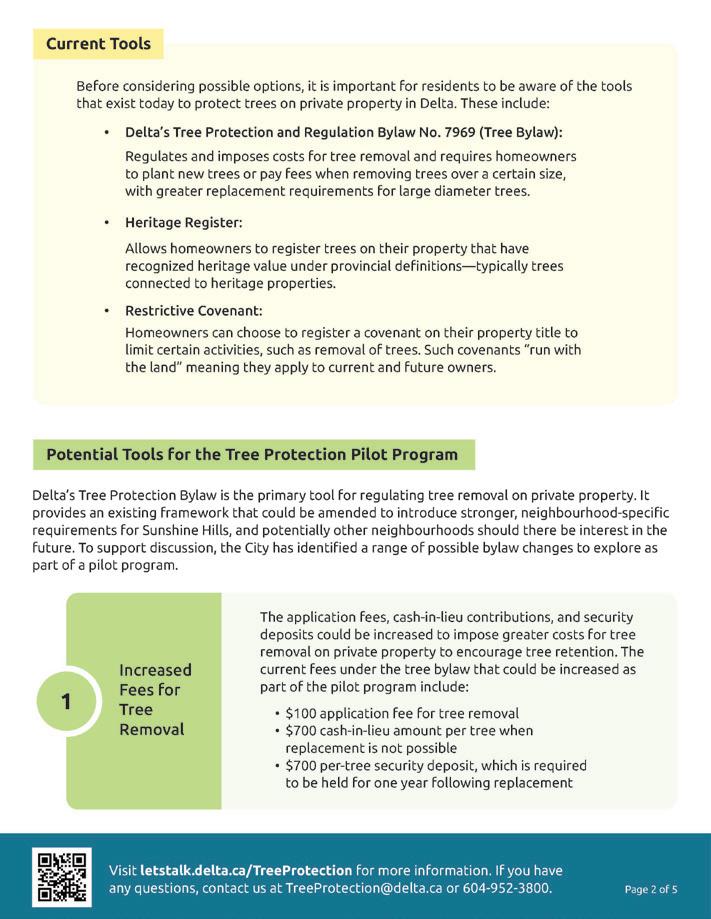
Delta’s Tree Protection and Regulation Bylaw No. 7969: Regulates and imposes costs for tree removal and requires homeowners to plant new trees or pay fees when removing trees over a certain size, with greater replacement requirements for large diameter trees.
Heritage Register: Allows homeowners to register trees on their property that have recognized heritage value typically trees connected to heritage properties.
Restrictive Covenants: Homeowners can choose to register a covenant on their property title to limit certain activities, such as the removal of trees. Such covenants “run with the land,” meaning they apply to current and future owners.
Q8: Recognizing that this could increase costs and add requirements if you ever need to remove trees on your property, would you be willing to register a Restrictive Covenant on your property title?
Interest in registering a Restrictive Covenant on respondents’ properties as a tool for enhanced tree protection was mixed.
Q9: Before today, were you aware that provincial law limits a municipality’s ability to require trees to be kept if doing so would prevent development that is otherwise allowed?
A majority of respondents (59%) were not aware of provincial constraints on municipal tree protection authority related to development. This indicates an opportunity to increase awareness of the legislative context and clarify the limits of municipal authority when considering potential policy options.
Q10: Do you agree that increasing fees will help discourage tree removal in neighbourhoods that participate in the pilot program?
Responses were divided on whether increasing fees would discourage tree removal with just over half agreeing that it would, or that it could with some changes.
Continued on next page.
Q10: Do you agree that increasing fees will help discourage tree removal in neighbourhoods that participate in the pilot program? (continued)
Please provide your comments and suggestions.
A large portion of the 564 comments expressed skepticism that fee increases alone would influence tree removal related to developer behavior (37%), suggesting they may be treated as a cost of doing business and are not a standalone solution. Comments also emphasized the importance of enforcement, safety-based exemptions, and complementary measures, while a smaller number raised concerns related to property rights and affordability.
Fees Not a Deterrent for Developers Unless Significantly Increased
• Skepticism about the effectiveness of increased fees as a deterrent, particularly for developers, with perceptions that higher fees may be treated as a cost of doing business and absorbed into project budgets.
• Perceptions that financial penalties alone would meaningfully reduce clear-cutting associated with redevelopment
Need for Significantly Higher Fees, Penalties, and Enforcement
• Support for substantially increasing fees (e.g., into the thousands or tens of thousands) to create a stronger financial disincentive with suggestions to apply fee multipliers for each additional tree removed, or to scale fees based on tree size, age, or maturity to create a more meaningful financial deterrent.
• Suggestions for higher penalties for unauthorized removals.
• Perception that monitoring and compliance oversight are more important than fee increases alone, with calls for stronger enforcement mechanisms in addition to or instead of higher fees.
Exemptions for Safety or Diseased Trees
• Emphasis on maintaining flexibility and exemptions for legitimate safety or property protection concerns, such as hazardous, diseased, or structurally unsafe trees, with suggestions that safety-based removals should not be financially penalized.
Property Rights and Cost Concerns
• Concerns that increasing fees impacts property rights and individual autonomy with perceptions that increased fees or regulatory measures represent government overreach.
• References to taxation impacts and cost-of-living pressures as reasons for opposing higher fees.
Need for Measures Beyond Fees
• Comments indicating that fee increases should be one component of a broader strategy and are not effective on their own.
• Suggestions for non-financial tools such as stricter permitting requirements (e.g. regulating building footprint), higher replacement standards, or development-related restrictions (e.g. limiting clear-cutting, restricting mega homes.
• Interest in education, incentives, or proactive canopy planning.
Q11: How much should the tree removal fees be increased?
While earlier responses to whether fee increases would effectively discourage tree removal were divided, 72% of respondents indicated support for doubling fees or increasing them by more than double. This suggests interest in substantially higher financial measures, even where views on their effectiveness may differ.
Less than double the current amount (e.g., up to 100 percent increase)
Double the current amount (e.g., 100 percent increase)
More than double the current amount (e.g., more than 100 percent increase)
The fees should not be increased
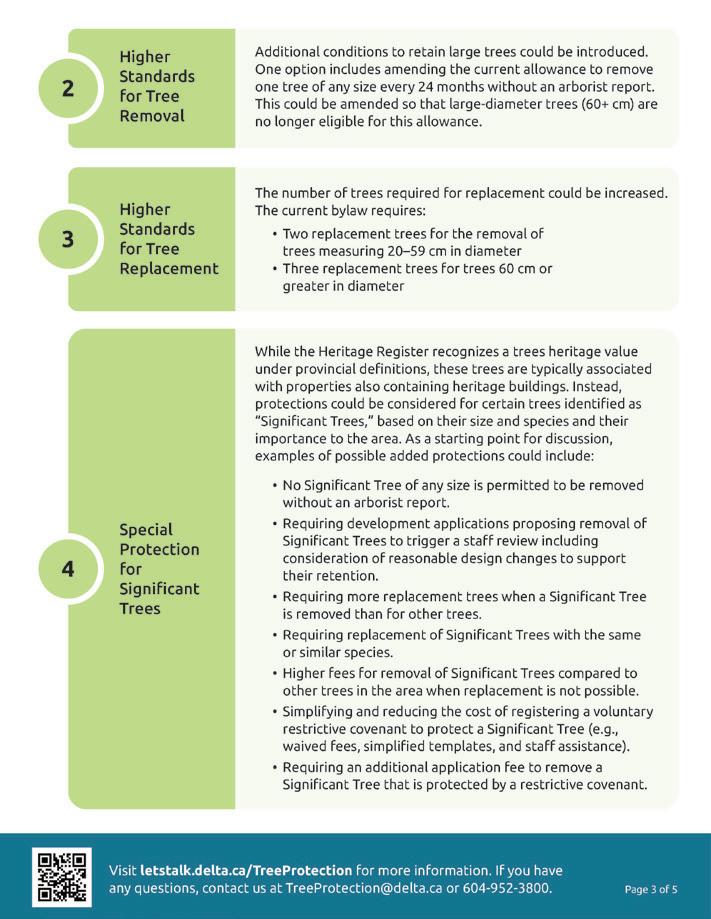
Q12: Do you agree that increasing the number of replacements required for medium and large-diameter trees will help discourage tree removal in neighbourhoods that participate in the pilot program?
Responses indicate that a majority of respondents (55%) do not agree that increasing replacement requirements would help discourage tree removal.
Please provide your comments and suggestions.
Across 564 responses, a recurring theme was that preserving mature trees is preferable to post-removal replacement, noting limited planting space on smaller lots and questioning whether higher replacement requirements would meaningfully deter redevelopment-related removals. While some felt stronger replacement rules could help offset canopy loss if properly enforced, many emphasized that young trees cannot replicate the canopy, environmental, and neighbourhood benefits of established trees for decades, if at all.
Preference for Preservation of Mature Trees Over Replacement
• Emphasis that mature trees cannot be meaningfully replaced by multiple young saplings and that restoring equivalent canopy, shade, and habitat benefits would take decades, with a preference for protecting existing mature trees rather than relying on replacement plantings.
• Comments that development should be planned around existing trees rather than relying replanting after removal.
• Skepticism that increased replacement ratios would discourage developers, with perceptions that such requirements may be treated as a cost of doing business.
Continued on next page.
Q12: Do you agree that increasing the number of replacements required for medium and large-diameter trees will help discourage tree removal in neighbourhoods that participate in the pilot program? (continued)
Enforcement and Monitoring Concerns
• Concerns that replacement requirements are not consistently enforced, with calls for stronger monitoring, survival requirements, or deposit-based systems to ensure compliance.
• Perception that trees may be planted to satisfy inspection requirements and later removed or neglected
Tree Size, Species Selection, and Lot Constraints
• Views that larger trees with environmental value should require proportionally greater replacement requirements
• Concerns about the size and quality of replacement trees, including requests for minimum caliper standards and like-for-like species replacement (e.g., conifer for conifer), alongside skepticism that smaller or ornamental species provide comparable canopy benefits
• Comments noting limited growing space and potential long-term conflicts with infrastructure, with concerns that higher replacement ratios could lead to overcrowding on smaller lots
• Suggestions for site-specific assessments rather than fixed ratios
• Concerns that redevelopment leaves insufficient space for meaningful replanting
• Concerns that higher ratios may be unrealistic given lot size constraints
Safety, Infrastructure, and Property Impact Concerns
• Support for flexibility where trees pose legitimate risks Recognition that some removals are necessary for safety or structural reasons
• Concerns about root damage to foundations, driveways, and utilities due to overcrowding
Other:
• Comments suggesting a one-to-one replacement ratio is sufficient
Q13: How much should tree replacement requirements be increased?
The top responses were that tree replacement requirements should not be increased (35%) and that they should be increased substantially (30%). This suggests replacement rules are not widely seen as effective deterrents, but among supporters, there's a preference for significant changes over incremental adjustments.
Q14: Would you support redefining what counts as a “large” tree, which would mean higher fees and more replacement trees for a greater number of trees?
A majority of respondents expressed support for redefining what qualifies as a “large” tree, with 50% indicating support for the change and an additional 16% expressing support with modifications.
Please provide your comments and suggestions.
Comments from the 564 respondents reflected mixed views. Some supported maintaining the 60 cm threshold, citing fairness and property rights (12%), while others supported lowering it to strengthen deterrence (10%). Across responses, exemptions for hazardous trees, the importance of species and canopy value, enforcement, and limited space for replacement planting were recurring considerations.
Broadening Tree Protections for Large Trees and Increasing Financial Deterrents
• Support for lowering the threshold to 30–50 cm so that canopy-forming or older trees that do not meet the current 60 cm diameter threshold, despite contributing to neighbourhood character and environmental value, can be included.
• Views that stronger financial disincentives are necessary, particularly for redevelopment projects, and that removal costs for “large” trees should be increased to a level sufficient to influence behavior.
• Emphasis on flexibility and exemptions where trees pose risks to foundations, utilities, or occupants, including hazardous, diseased, or structurally unsafe trees.
• Suggestions that diameter alone is insufficient to define a “large” tree with calls to consider species, height, canopy spread, ecological value, or age.
Cost Impacts, and Property Rights Concerns
• Views that the existing 60 cm threshold is reasonable and consistent with other jurisdictions.
• Preference to maintain the current bylaw framework, with concerns that redefining the threshold could introduce unnecessary complexity and increase financial burden on homeowners.
• Perception that higher fees represent government overreach or revenue generation and property owners should retain control over trees on private land.
Ineffective Deterrent to Developer Clear-Cutting
• Skepticism that redefining tree size will meaningfully address redevelopment-related clearcutting
• View that the primary issue is lot redevelopment and large home construction, and that redefining “large” trees does not directly address this concern.
• Comments suggesting that permitting practices or building footprint controls are more relevant solutions
Replacement & Monitoring Concerns
• Concerns about replacement tree size, species equivalency, and long-term survival
• Calls for monitoring, deposits, or bonding requirements
• View that redefining tree size must be paired with effective follow-up
Q15: Would you support removing this allowance for large-diameter trees and requiring an application and an arborist report?
The results indicate majority support (62%) for removing the current allowance that permits a largediameter tree to be removed without an arborist report, including 45% who support the change and an additional 17% who support it with modifications.
Please provide your comments and suggestions.
Of the 564 residents who provided comments, the top recurring theme was opposition to removing the 24-month allowance (12%) percent describing it as an unnecessary, unfair or ineffective, while a nearly equal share expressed support for the change (10%). An additional 7% indicated conditional support for exemptions for safety, disease, or property damage would apply.
Current 24-Month Rule is Adequate
• Preference to retain the existing one-tree-per-24-months allowance with the view that current rules provide reasonable homeowner flexibility
• Comments suggesting the issue lies elsewhere rather than with individual homeowner removals
• Views that this tool can be effective if enforcement is improved.
Could Support Canopy Retention
• View that professional assessment ensures removals are justified and not discretionary, with documentation requirements adding accountability and transparency.
• Perception that eliminating the 24-month allowance would strengthen oversight and slow unnecessary canopy loss.
• Suggestions that arborist requirements include clear replanting obligations be paired with replacement guarantees or deposits.
• Requests for more systems to ensure tree replacement and survival.
Safety / Disease / Property Damage Exemptions
• Support for arborist requirements, provided exemptions are included for hazardous, diseased, wind-damaged, or structurally compromising trees, with flexibility where trees impact foundations, utilities, driveways, roofs, or pose fire risk.
• Requests for streamlined or lower-cost processes where risk is obvious.
Impacts Homeowners Unfairly
• Concerns about added costs and administrative burden for homeowners, alongside the view that property owners should retain discretion over trees on private land.
• Perception that additional requirements may unfairly impact long-term residents rather than developers
• Perceived infringement on private property rights.
Continued on next page.
Q15: Would you support removing this allowance for large-diameter trees and requiring an application and an arborist report? (continued)
Focus Should Be on Developers and Clear-Cutting
• Assertion that redevelopment-related clear-cutting is the primary issue with calls for stronger controls tied specifically to new builds and lot redevelopment.
Concern About Biased / Fraudulent Arborist Reports
• Concerns that privately hired arborists may produce biased reports, with requests for Cityassigned, City-approved, or otherwise independent arborists.
• Suggestions for audits, quality control, public access to reports, or penalties for falsified documentation.
Q16: Which of these, if any, do you think should be considered “Significant Trees” and receive added protection beyond the current bylaw requirements?
Overall, the results suggest broad interest in the proposed species-specific protections of conifers, with the highest levels of support being Douglas fir (73%), western red cedar (72%) and giant redwood (70%) closely followed by Norway spruce (62%) and Himalayan cedar (59%).
Douglas Fir (Pseudotsuga menziesii)
Western Red Cedar (Thuja plicata)
Himalayan Cedar (Cedrus deodara)
Norway Spruce (Picea abies)
Giant Redwood (Sequoiadendron giganteum)
(12%)
“Other” responses reflected interest in expanding the Significant Tree definition beyond the proposed species list, including additional native and deciduous trees such as maples, dogwoods, oaks, cherry trees, magnolias, spruce, hemlock, yew, and other long-lived canopy species. Several respondents indicated that all large or mature trees, regardless of species, should be considered significant, while others emphasized protecting native, culturally important, or ecologically valuable trees. Comments referenced flowering and boulevard trees, as well as shrubs and bushes that contribute to neighbourhood character. Others highlighted the importance of considering tree health, safety risks, and invasive status when determining significance.
Q17: The proposed definition for a Significant Tree is a tree that has a trunk diameter of 70 cm or greater, measured at 1.4 m above the base of the tree (diameter at breast height), or has a combined diameter of 70 cm or greater when the three largest trunks or stems are measured at 1.4 m above the base, and is one of the following 5 species: Douglas Fir, Western Red Cedar, Himalayan Cedar, Norway Spruce and Giant Redwood. Do you agree with the description of the size of a Significant Tree?
Responses indicate strong majority support for the proposed definition of a Significant Tree.
Please provide your comments and suggestions. All respondents provided comments on the proposed definition of a Significant Tree and with mixed feedback regarding the list of species, with suggestions both to add and remove species. Comments also noted that the definition should consider factors beyond diameter, including age, height, ecological value, as well as clarity around measurement and enforcement. Some responses reflected uncertainty and a lack of expertise to comment.
70 cm Threshold as Appropriate:
• Perception that the proposed 70 cm diameter threshold reflects the size of many defining trees in Sunshine Hills and appropriately captures mature, canopy-forming trees.
• Comments that the definition is reasonable, sufficient, or consistent with protecting neighbourhood character and supports stronger protection for large conifers.
Lower the Diameter Threshold
• Suggestions to reduce the threshold to capture more mature trees before removal (e.g., 30–60 cm) with concerns that trees may be removed just before reaching 70 cm.
• View that smaller native trees contribute significant canopy and should qualify even if their diameter does not reach the threshold.
Increase the Diameter Threshold
• View that 70 cm is too low and may over-regulate with suggestions to increase the threshold to apply only to very large or old-growth trees.
• Concerns about limiting homeowner flexibility.
Include Additional Species
• Requests to expand the species list beyond the proposed conifers with specific references to include Maples, Dogwoods, Cherry trees, Hemlock, Oak, Arbutus, Birch, Magnolia, Sycamore, Yew, Monkey Puzzle, Beech, Zelkova, Spruce and other native or established species.
• View that canopy contribution and neighbourhood presence should guide inclusion.
Continued on next page.
Q17: The proposed definition for a Significant Tree is a tree that has a trunk diameter of 70 cm or greater, measured at 1.4 m above the base of the tree (diameter at breast height), or has a combined diameter of 70 cm or greater when the three largest trunks or stems are measured at 1.4 m above the base, and is one of the following 5 species: Douglas Fir, Western Red Cedar, Himalayan Cedar, Norway Spruce and Giant Redwood. Do you agree with the description of the size of a Significant Tree? (continued)
Definition Should Consider More Than Diameter
• Suggestions that diameter alone is insufficient with calls to include age, height, ecological function, habitat value, slope stability, or canopy contribution.
• Requests for a more flexible or multi-criteria approach and views that size and maturity matter more than species.
• Support for protecting all large trees that contribute to canopy, habitat, and neighbourhood character, with comments that any tree reaching significant size provides environmental and aesthetic value.
Safety, Fire Risk, and Property Damage Concerns
• Concerns regarding windthrow, root damage, foundation impacts, and fire risk, alongside the view that hazardous or structurally problematic trees must remain eligible for removal, with flexibility where significant trees impact safety or infrastructure.
Property Rights Over-Regulation
• View that homeowners should retain authority over trees on private property, with concerns that added restrictions could affect resale, insurance, or property use, and that blanket rules may not account for individual circumstances.
Enforcement and Measurement Concerns
• Questions about who measures trees and how diameter is verified, with concerns regarding consistency, clarity of measurement standards, and bylaw enforcement.
Q18: Would you like to see a Significant Tree Definition created as part of the pilot program?
Creation of a Significant Tree definition received the highest level of support among the presented options with a total of 78% of respondents indicating support or support with changes.
Please provide your comments and suggestions. Of the 564 comments, many supported the proposal as a way to strengthen protection of mature canopy trees and provide clearer guidelines. Concerns centred on property rights, cost, over-regulation, and the need for flexibility where safety or infrastructure risks exist. Conditional support often included lowering diameter thresholds, expanding species, or incorporating ecological criteria. Some questioned whether a definition alone would address redevelopment-related tree removal. Overall, feedback supports clearer protections, with an emphasis on fairness and practicality.
Effective Tree Protection Enhancement
• Support for establishing a formal Significant Tree definition as part of the pilot program with comments indicating the definition would provide an additional layer of protection against discretionary removals.
• View that a defined category would strengthen protection of mature canopy-forming trees and help preserve neighbourhood character and environmental benefits.
• View that a defined category would provide clearer guidance to homeowners, developers, and staff.
• Comments that clearer definitions improve transparency in permitting and enforcement
• Support for the definition as an educational tool to raise awareness of canopy value.
Broaden Species, Lower Diameter and Include More Trees
• Suggestions to lower the diameter threshold to protect more trees before removal and to include additional species, including deciduous and native trees that provide greater long-term environmental benefit.
• Calls for inclusion of trees that support habitat, canopy coverage, erosion control, ecological function, cultural significance, or watershed value.
• Requests to prioritize native or Indigenous-significant species within the definition.
Continued on next page.
Q18: Would you like to see a Significant Tree Definition created as part of the pilot program? (continued)
Concerns for Over-Regulation and Increased Cost
• View that additional classification will increase regulation, limit homeowner flexibility, introduce added costs, administrative burden, or impact resale value, and that tree management on private property should remain primarily with the homeowner.
• Concerns that a Significant Tree designation could restrict removal of hazardous or structurally problematic trees, with references to wind risk, root damage, fire risk, and impacts to infrastructure.
• Requests for exemptions or streamlined removal processes where safety concerns are evident.
Skepticism It Will Not Affect Developers or Clear-Cutting
• View that a Significant Tree definition alone may not address redevelopment-related tree removal.
• Perception that developers may continue removals under other regulatory pathways.
• Suggestions that development controls or building footprint limits are more effective solutions.
Requests for Monitoring, Inventory & Enforcement
• Calls for mapping and inventorying significant trees, along with monitoring and reporting mechanisms to support compliance and oversight.
Q19: Which of the following added protections would you like to see considered for a Significant Tree in Sunshine Hills?
Results indicate strong overall support for the majority of potential enhanced protections for Significant Trees. The most supported measures are requiring staff review of development applications to assess whether tree retention is feasible (84%), suggesting particular concern about developmentrelated removals, as well as requiring an arborist report for any removal of a Significant Tree (71%).
“Other” responses reflected interest in stronger and more comprehensive protections for Significant Trees, including further limiting removal for redevelopment purposes by restricting removal unless a tree is deemed hazardous or diseased and that amenities or convenience were not viewed as legitimate. Suggestions included large penalties for illegal removal, annual tax implications for removed trees and eliminating fee-in-lieu options to ensure payments do not become a substitute for preservation. Respondents also suggested expanding species lists, lowering size thresholds, and applying protections to City-owned trees. Others called for independent arborist oversight or environmental and community review committees, as well as tax incentives or ongoing property tax adjustments to discourage removal. A few respondents raised concerns about safety risks associated with large or unstable trees and questioned the effectiveness of fee-based approaches alone.
Continued on next page.
None
Q20: Based on the proposed definition of a Significant Tree, how many trees on your property would be considered significant?
Responses suggest the proposed definition could affect a substantial share of properties, with a majority indicating they have at least one tree that would meet the criteria. At the same time, 31% were unsure how many trees on their property would qualify, highlighting the need for education on what constitutes a significant trees should the definition be implemented.
Q21: Do you have any other suggestions for the protection of trees on private property in addition to those suggested previously?
401 respondents' additional ideas emphasized developing mechanisms that focus on discouraging developers and clear cutting rather than individual homeowners. Other suggestions included strengthening monitoring and enforcement, enhancing bylaw provisions, and increasing oversight during redevelopment. Some respondents also emphasized education and incentives over punitive measures, as well as opportunities for community-led stewardship initiatives.
Redevelopment and Development Controls
• Comments suggested prioritizing or expediting redevelopment applications that retain existing tree canopy and requiring new developments to plant significant tree species with adequate growing space and long-term maintenance provisions.
• Calls to apply stronger requirements to developers to retain mature trees, treating redevelopment differently from individual homeowners, revoking permits where unauthorized removal occurs, and capping the proportion or number of significant trees that may be removed from a lot.
• Comments that significant trees should be treated as fixed site constraints in development applications, with requirements for alternatives analysis before removal is considered and the introduction of refundable tree protection bonds to address post-construction mortality.
• Suggestions that development permits be paused until any updated tree protection bylaw is implemented and lot splitting be minimized.
• Suggestions to encourage more vertical building forms, including underground parking, to preserve existing trees while meeting provincial density requirements.
• Suggestions to prohibit removal of trees located on property boundaries or on City-owned lands and ban clear cutting on private property.
• Suggestions that limits be placed on the proportion or number of significant trees that may be removed from a single lot, such as capping removal at a defined percentage.
• Calls to limit building footprint, lot coverage, or “edge-to-edge” construction.
• View that development standards should prioritize tree retention over maximum build-out.
Continued on next page.
Q21: Do you have any other suggestions for the protection of trees on private property in addition to those suggested previously? (continued)
Stronger Monitoring and Enforcement
• Calls for stronger monitoring enforcement measures should apply during redevelopment, including scheduled visits, clearly defined root protection zones, protective fencing, and meaningful penalties for damage to retained trees.
• Suggestions to develop a comprehensive inventory of significant trees and publish annual reporting on tree fee revenue, planting locations, and reinvestment plans to improve transparency.
• Views that the review process for tree removal applications should be strengthened or reassigned to other staff to ensure greater independence and oversight.
• Recommendations to suspend or prohibit contractors who remove trees without permits and apply significant penalties for fraudulent arborist reports or failure to complete required tree replacements.
• Suggestions to require surety bonds or refundable deposits to ensure retained and replacement trees meet survivorship targets, with funds returned only upon successful establishment.
• Recommendations that trees on redevelopment properties be photographed and documented, with random audits conducted either proactively or in response to complaints.
• Comments supporting a City-approved list of certified arborists, standardized review processes, and incorporating arborist review costs into building permits or expanding in-house expertise.
Incentives and Education
• Suggestions to encourage voluntary tree retention through tax rebates, expanded education and resources, and partnerships with local contractors to provide discounted tree maintenance services promoted on the City’s website.
• Suggestions to incentivize tree planting and retention through free or low-cost tree programs and modest property tax reductions (e.g., $100–$200 annually) for registered significant trees retained on private property.
• Suggestions for public awareness campaigns and neighbourhood signage to highlight the environmental, property value, and character benefits of preserving mature trees, including educational initiatives in schools
Further Bylaw Changes:
• Suggestions that replacement requirements be based on equivalent cumulative trunk diameter, requiring multiple smaller trees to collectively match the diameter of any large tree removed.
• Suggestions to further restrict tree removal allowances, such as limiting removal to one tree every 3–4 years unless confirmed unhealthy, and introducing mandatory planting requirements at regular intervals (e.g., every 10 years), including smaller trees or shrubs where space is limited.
• Recommendations to extend replacement tree deposit periods up to three years post-occupancy, with City verification prior to refund to confirm successful establishment.
• Suggestions to structure removal fees based on overall canopy density, with higher costs where removal would significantly reduce limited tree cover on a property.
• Suggestions that replacement trees be required to be planted at appropriate distances from buildings to support healthy growth, reduce maintenance costs, and maintain livability.
• Comments requesting that topping of significant trees be restricted or prohibited to prevent damage to mature canopy.
• Requests for enhanced options to be applied on a case-by-case assessment
• Recommendations that tree-related fee revenue be reinvested locally into tree maintenance and support, including addressing impacts to foundations and underground services.
Continued on next page.
Q21: Do you have any other suggestions for the protection of trees on private property in addition to those suggested previously? (continued)
Community-Led Approaches
• Suggestions that neighbourhood-level consultation or voting processes be considered prior to the removal of certain trees, alongside broader views that residents should be actively consulted and engaged in any changes to tree protection regulations affecting private property.
• Ideas for community-led tree stewardship programs, where neighbours collaborate to care for, monitor, and help maintain mature trees.
Environmental Protection
• Suggestions to provide subsidized tree health assessments and proactive care programs for vulnerable species, including Western red cedar, to reduce financial or safety concerns for homeowners.
• Requests to ban installation of artificial turf or plastic landscaping materials, citing environmental impacts such as microplastics entering soil and groundwater.
• Recommendations to expand water bag or tree-watering support programs to assist young and vulnerable trees during drought conditions.
• Suggestions to incorporate wildlife protection provisions, including safeguards for bird nests, habitat, protected species, and significant native trees.
Q22: Do you understand that these changes could mean higher costs and additional requirements should you need to remove trees on your property for any reason?
A clear majority of respondents indicated they understand that the proposed changes could result in higher costs and additional requirements if they need to remove trees on their property.
Q23: Based on the suggestions included in this survey, would you like your neighbourhood (e.g. Westview, Cougar Canyon, Sunshine Woods, etc.) to participate in a Tree Protection Pilot Program?
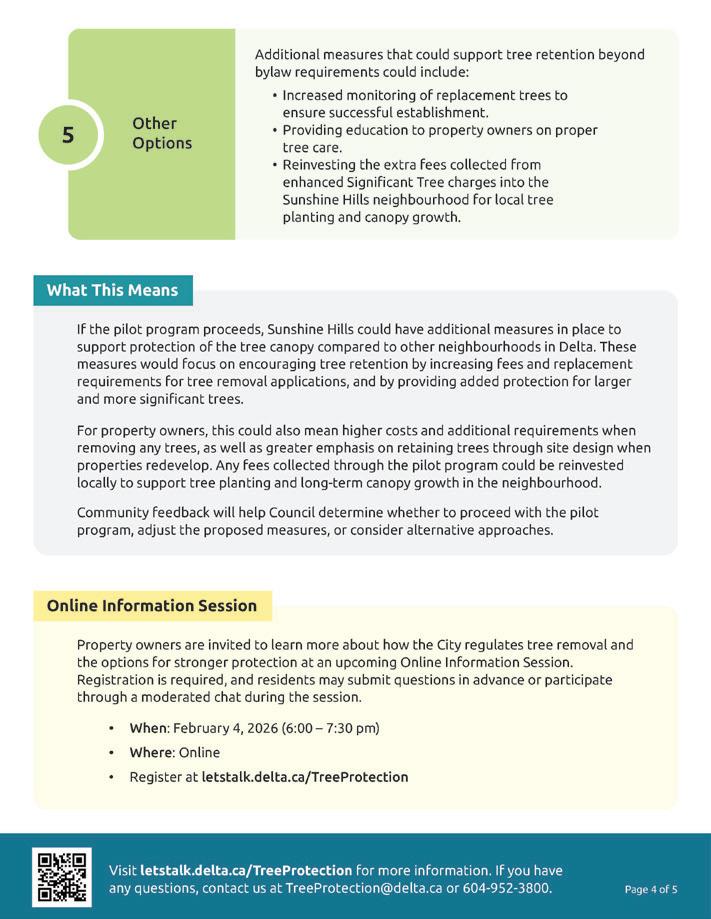
Based on the completed surveys, the level of interest in participating in the pilot program varies by neighbourhood. The highest levels of support (yes) were recorded in Cougar Canyon (87%), Sunshine Hills (76%), and Scottsdale (75%). In contrast, the lowest levels of support (No) were observed in Sunshine Woods (35%), Westview (24%), and Sunshine (23%). These results reflect the views of respondents within each neighbourhood who received the survey and are based on the number of survey responses received, not the total number of properties in each area. As such, the findings indicate relative levels of support among participants, rather than representing the opinion of all property owners within each neighbourhood.
Sunshine Hills
Cougar Canyon
Sunshine Village Westview Sunshine Woods
Q24: Do you have any additional comments about the proposed Neighbourhood Tree Protection Pilot Program that have not been captured in the survey?
Of the 328 respondents who provided comments, views were mixed and largely reiterated perspectives expressed throughout the survey. These included concerns about regulatory overreach, the need to preserve homeowner autonomy, and the potential for increased costs—particularly for properties with multiple mature trees and for senior residents on fixed incomes. Other comments emphasized ongoing concern regarding developer clear-cutting and oversized redevelopment, with calls for stronger monitoring and enforcement, sensible exemptions, tighter development controls, and more immediate action to preserve canopy and neighbourhood character. Some respondents expressed a preference for incentives and education over punitive measures, while others advocated for applying protections more broadly across the city, along with enhanced monitoring and accountability measures.
Below are the general themes of comments that were not captured earlier in the report:
• Support for applying the program more broadly across North Delta or city-wide.
• Inequity concerns with neighbourhood-specific rules.
• Questions regarding municipal liability for damage caused by retained trees.
• Requests for clearer communication about rules and approval processes.
• Frustration with current maintenance of boulevard or City-owned trees and requests for improved pruning, inspection, and care of public trees.
• Concerns that the area is already heavily treed or overgrown, questioning the need for additional measures where they affect food gardening, infrastructure, and property use.
• Requests to allow periodic removal without substantial penalties where tree density is significantly higher than surrounding properties.
Public Comment Form
A total of 23 comment forms were received from residents across Delta, and including residents from Sunshine Hills, Cougar Canyon, Scottsdale, other North Delta neighbourhoods, Boundary Park, Ladner, and Tsawwassen. This distribution indicates that interest in tree protection extends beyond the defined Sunshine Hills engagement area and reflects broader concern across the municipality. Respondents expressed interest in providing feedback for a range of reasons, including general interest in neighbourhood planning, environmental stewardship, and broader canopy protection.
Concerns were largely related to ongoing canopy loss associated with redevelopment and expressed support for expanding enhanced tree protection measures beyond Sunshine Hills. There was emphasis on the environmental, ecological, and neighbourhood character benefits as well as impact on climate resilience, protection from the sun, stormwater management, flood mitigation, slope stability, wildlife habitat, and long-term community livability. Frustration was with large new homes that maximize lot coverage and remove most or all mature trees was noted, with some questioning the adequacy of current permit review and enforcement processes. While there was support for stronger protections, including higher or tiered removal fees and developmentrelated restrictions, the importance of safety exemptions for hazardous trees and wildfire risk mitigation was also raised. Concerns were also expressed regarding fairness between developers and long-term homeowners, the effectiveness of replacement planting, and the need for improved oversight, transparency, and communication regarding current enforcement practices.