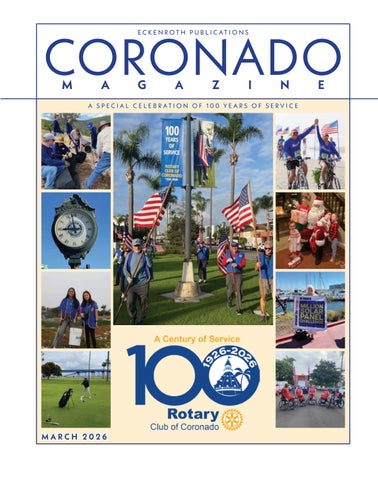
CORONADO MAGAZINE
A SPECIAL CELEBRATION OF 100 YEARS OF SERVICE


![]()


Become a Friends Member, receive a free event ticket, and take home a signed copy of Landon Donovan’s book.

APRIL 11, 2026
5:30 PM


Join us for this one-night-only Adventures by the Book® event, hosted in partnership with the Coronado Public Library. This special evening benefits the Friends of the Coronado Public Library and our work supporting The Exceptional Families Program.
FRIENDS MEMBER SIGNED COPIES ARE LIMITED. SCAN THE QR CODE TO BROWSE MEMBERSHIP OPTIONS.

CORONADO
Visit our News & Events page to stay up to date on upcoming activities, special events, and initiatives we support and host in partnership with the Library. WWW.CORONADOFOL.ORG


Coronado is more than a destination it’s a way of life def ined by timeless architecture, coastal elegance, and meaningful moments shared across generations.
At Del Coronado Realty, we specialize in curating exceptional opportunities across the island’s most iconic properties f rom historic estates and bespoke residences to exclusive ownership at the legendary Hotel del Coronado
Whether buying, selling, or investing, our approach is deeply personal. We believe luxury means understanding each client, anticipating every detail, and delivering an experience that exceeds expectations
Discover what makes Coronado extraordinary


The
PUBLISHER
Dean Eckenroth publisher.eaglenews@gmail.com
ASSOCIATE PUBLISHER


Dean K. Eckenroth Jr. editor.eaglenews@gmail.com
ROTARY CENTENNIAL ISSUE COORDINATING EDITOR
Alessandra Selgi-Harrigan alessandra.eaglenews@gmail.com
Lauren.eaglenews@gmail.com
kel.eaglenews@gmail.com
Christine Johnson christine.eaglenews@gmail.com
Brooke Clifford eaglenewsbrooke@gmail.com
PHOTOGRAPHER
Hattie Foote
BUSINESS DEVELOPMENT
ADVERTISING DIRECTOR
Patricia Ross patricia.eaglenews@gmail.com
PRODUCTION
Andrew Koorey
PRINTING
Reed
DISTRIBUTION
Roberto Gamez
Copyright ©2025 Eagle
All
Hi! I’m Natalie Bailey, president of the Coronado Rotary Club, and I’m so excited to welcome you to our club’s centennial magazine issue! In the next few pages you’ll learn all about what makes the Coronado Rotary Club such a special part of our community. I couldn’t be prouder of the important work our members do, the lives we get to change for the better, and the fellowship created here.
Now, I may be biased because this club has been a major part of my life since I was born, but we have a saying here that I truly believe. We call ourselves the greatest (Rotary) club in the UNIVERSE, and we are overjoyed to show you why. I hope you enjoy this issue and find some inspiration. And, hey, if you’re inspired enough to join us in our efforts, we would be thrilled to see new faces at our meetings, events and projects!
I’d like to thank Dean Eckenroth and the entire Coronado Eagle/Coronado Magazine team for making this issue happen, Kris Grant for coordinating the articles, the Rotary 100 Committee for making this year so much fun, and all of the club members for taking the time to write about the projects and various facets of our club that they are passionate about.
I get asked a lot, “What is Rotary?” I’m still working on perfecting my elevator pitch, but I’ll give it a shot. The best way to explain Rotary is that it’s an international and community service organization, and our motto is “Service Above Self.” What that means to me is this: most of the time, people are focused on their own lives, careers, families, and obstacles. But the true magic in life happens when we go beyond thinking only of ourselves and come together to make the world a better place in whatever way we can.
My Rotary story started when I was born here in Coronado. My mom, Dr. Suzanne Popp, had been a Rotarian since she was 29. My grandpa was a Rotarian, and so was my great-grandfather. I was brought to my first club meeting when I was just ten days old, so I really had no choice in the matter! I grew up seeing my mom doing service projects on weekends and traveling to places like Africa to bring computers to schools for children who had never seen one before.
My childhood consisted of watching magic tricks by Paul Plumb at Rotary Pancake Breakfasts, getting visits from Santa on Christmas Eve, riding bikes on the beach with my dad on Father’s Day at the Low Tide Ride & Stride, getting to leave school at lunchtime with the other Rotary kids for the Christmas party (sorry, Village Elementary, maybe that was frowned upon!), and witnessing the eye-
opening prosthetic limb fabrication for people in serious need at Rotary’s Limbs of Freedom clinic in Ensenada.
I got involved with Midderact (Middle School Rotary) and Interact (High School), adding up hours of beach cleanups and selling bracelets made by kids in Uganda as a fundraiser to send money back so they could buy school supplies. Yes, at the time it was probably more of a college résumé booster, but it still pushed me to value service and giving back, and I think both things can be true at once.
I went on a life-changing youth exchange through Rotary to Turkey when I was 15. When I was 16, I met one of my best friends, still to this day, on a six-week youth exchange to Germany. Marina and I still travel together annually! Rotary may not have “changed” my life since it was always there, but it certainly paved the direction I was going.
When I moved back to Coronado after graduating from dental school, I immediately joined the Rotary Club of Coronado (and beer club!), and I’ve never looked back. Some people say I’m too young for Rotary, but since when is there an age requirement for service projects and building community connections?
I’ve met some of my favorite people through this club. I’ve developed professional and personal friendships that I never would have otherwise. Rotary is one of the many aspects of our community that makes Coronado one of the most idyllic places in the world to live.
I am so proud to be part of this club and this community, and you’re about to understand why.
Enjoy this special edition, and learn what it means to live “Service Above Self.”
Yours in service, Natalie

By Suzanne Popp, Rotary 100 Chairperson and Past President
Rotary Club of Coronado is proudly celebrating a remarkable milestone: 100 years of service, fellowship, and community leadership.
Founded on March 8, 1926, the club has spent a century advancing Rotary’s guiding principle of “Service Above Self” while playing an integral role in the civic, charitable, and social fabric of Coronado. To honor this legacy, the Club embarked on a thoughtfully designed, year-long centennial celebration—three years in the planning—that reflects both its history and its enduring commitment to the community it serves.
The centennial effort began with the creation of a commemorative Rotary 100 logo, establishing a unifying visual identity for the entire celebration, with kudos to club member Kathy MacDonald for her creativity and leadership in developing the logo, which became the foundation for all centennial branding. Building on that momentum, centennial banners were created and displayed along Orange Avenue in the Fall, with plans for a possible return this Spring. These banners brought the celebration into the heart of Coronado, making Rotary’s 100-year presence visible to residents and visitors alike. Special thanks to Sarah Kulke.
The first official centennial event took place on July 11, 2025, with a Beach Day celebration open to Rotarians and their families. A beachside barbecue and crazy bonfire created a relaxed, fun atmosphere that reflected the spirit of Coronado. Fellowship was front and center, with laughter, shared stories, and a spirited Corn Hole contest adding


friendly competition to the day. The event set the tone for the year ahead by emphasizing connection, family, and Rotary camaraderie.
In October, the celebration continued at Spreckels Park with a 1920s-themed Ice Cream Social, paying homage to the decade in which the Rotary Club of Coronado was founded. The entire city of Coronado was invited. Sponsored by Rotarian Carol Sommer, the event featured ice cream provided by beloved local shop Moo Time Creamery and its owner, David Spatafore. Period-inspired décor, classic flavors, and a strong sense of nostalgia made the gathering both festive and meaningful, while reinforcing Rotary’s deep ties to the Coronado community. This could become an annual event.
One of the most visible and lasting centennial initiatives is the planning and imminent construction of an iconic Coronado sign at Tidelands Park, positioned against the stunning backdrop of the Coronado Bridge. The sign will include a brick base recognizing
Rotarian sponsors and will stand as a lasting symbol of Rotary’s commitment to Coronado. This ambitious project was spearheaded by former Coronado City Councilman Bill Sandke, whose tireless dedication and countless hours of effort have been instrumental in bringing the project to fruition. A formal sign dedication will be held upon completion.
This month, the centennial celebration turns toward history and reflection with a special Rotary Club of Coronado exhibit at the Coronado Historical Association. This outstanding exhibit is the result of the leadership and collaborative efforts of Steve Duermeyer, his team of Rotarians, and the Coronado Historical Association. Their work has produced an exhibit that thoughtfully documents Rotary’s century of service and impact. A public dedication and celebratory

toast will take place on March 8, 2026, the Club’s official 100th anniversary, complete with a large commemorative cake.
The centennial year will conclude with a casual, Rotarians-only gathering intentionally designed to be fiscally responsible and environmentally conscious in lieu of an expensive gala. This final celebration reflects Rotary’s values by emphasizing fellowship, gratitude, and stewardship rather than extravagance.
The centennial is not only about honoring the past. Over the next six months, the Rotary Club of Coronado will also complete 100 Acts of Service, reinforcing that service remains at the heart of Rotary’s mission and defining the Club’s second century of impact.
The success of the Rotary Club of Coronado’s 100th anniversary celebration is the result of the dedication of many. Sincere thanks are extended to the entire Rotary 100 Committee.

By Steve Duermeyer and Kris Grant


In the spring of 1905, Paul P. Harris, a young Chicago attorney, felt the sharp pangs of urban loneliness. Harris was a man of keen intellect and idealistic vision, practical in his work yet restless for deeper connection. Though he enjoyed his law practice, he longed for a circle of friends from different professions—men who could exchange ideas, encourage character, and find camaraderie in a city that often felt cold and impersonal.
He envisioned a club where equality, integrity, and practical fellowship mattered more than status or wealth. He wanted a gathering of professionals who could support one another personally and ethically, while also using their skills to benefit their community.
On Feb. 23, 1905, Harris invited three friends—a coal dealer, a merchant, and a mining engineer—
into his modest law office. Harris spoke earnestly of the need for friendship, of the value of broadening one’s perspective, and of the satisfaction that comes from helping others while strengthening oneself. Those who knew him described Harris as warm and disciplined, idealistic but pragmatic, and capable of inspiring others to think beyond their narrow professional circles.
The four men agreed to meet regularly, establishing the first Rotary Club, so named because the meetings would rotate among members’ offices. Harris insisted on this rotation to ensure equality, a physical symbol of his belief that every member mattered equally. The gatherings were simple, yet meaningful: men of different trades sharing experiences, discussing ethical challenges, and exploring ways to apply their skills for practical benefit in the community.
Word spread quickly. More men joined, drawn by Harris’s vision and the club’s blend of fellowship and practical engagement. Harris had a magnetic energy, and challenged members to be better citizens, better professionals, and better friends, believing that ordinary people could achieve extraordinary impact together.
By 1910, the idea had grown beyond Chicago, with new clubs forming across the United States. Rotary expanded rapidly — within about twenty years there were more than 2,200 Rotary clubs in 35 countries.
Just over a decade after the first Rotary Club was formed, Rotary leaders recognized the need to pool resources for broader humanitarian

work. In 1917, under the leadership of Arch C. Klumph, Rotary International established the Rotary Foundation. Originally an endowment fund with a modest beginning—only $26.50 contributed by early clubs—the Foundation was created to fund projects that would “do good in the world.” It would later support scholarships, international service projects, disaster relief, and global health initiatives, becoming Rotary’s primary philanthropic arm. In 1957, Rotary established the Paul Harris recognition program. Rotary International funds six types of scholarships including Ambassadorial Scholarships. Rotary is the world’s largest privately funded international scholarship provider. Funds come from Rotarians who are “Paul Harris Fellows,” with each fellowship bestowed for $1,000 in funding. Rotary Club of Coronado has raised a club lifetime total of more than $1 million in Paul Harris Fellowships.
Over the decades, the Foundation grew to fund tens of thousands of projects worldwide, from literacy programs to clean water initiatives. Its most famous undertaking began in 1985 with the launch of the PolioPlus program, aiming to eradicate polio globally.
In 1989, Rotary International officially adopted the motto “Service Above Self,” reflecting the guiding principle that had inspired Paul Harris’s vision from the beginning.
One of the world’s most widely printed and quoted statements of business ethics is The Four-Way Test, which was created in 1932 by Rotarian Herbert J. Taylor (who later served as RI president) when he was asked to take charge of a company that was facing bankruptcy. This 24word test for employees to follow in their business and professional lives became the guide for sales, production, advertising, and all relations with dealers and customers, and the survival of the company is credited to this simple philosophy. Adopted by Rotary in 1943, The FourWay Test has been translated into more than a hundred languages and published in thousands of ways. It asks the following four questions:
Of the things we think, say or do:
1. Is it the TRUTH?
2. Is it FAIR to all concerned?
3. Will it build GOODWILL and BETTER FRIENDSHIPS?
4. Will it be BENEFICIAL to all concerned?
Rotarians: 1.2 million
Clubs: 45,000+
Districts: 528
Countries: 220
Rotaract Members (ages 18 – 30): 200,000 approximately
Interact Members (ages 12 – 18): 300,000 approximately
Rotary Club of Coronado Members: 267
Office address:
956 Orange Avenue Suite 200 Coronado, CA 92118
Mailing Address:
P.O. Box 180487 Coronado, CA 92178 (619) 435-8334
www.coronadorotary.org
Rotary District 5340
(San Diego and Imperial counties) 57 Rotary Clubs; 7 Rotaract Clubs
Coronado Rotary Club Presidents who became District Governors:
Arch Archibald (1966-67)
Ben Clark (1976-77)
Don Stockdale (1979–1980)
Howard Mason (1987-1988)
Ron Beaubien (1994-1995)
Bill Sturgeon (2001-2002)
Bob Watson (2005-2006)
Dan Gensler (2021-2022)

Sharp HealthCare is proud to support the Rotary Club of Coronado’s mission to serve our community.
By Steve Duermeyer
The late Albert H. Foret, editor, manager and part owner of the Coronado Journal in the 1920s, must be given credit for revealing a wonderful glimpse into the early history of the Rotary Club of Coronado.
Foret was not one of the club’s charter members, but he was an active Rotarian during that era and, thankfully, he was a man who loved to observe and record local history.
Foret describes Coronado in the Fall of 1925 as a lovely community –quiet, little traffic, no traffic signals, no condominiums or high-rises, and lots of open space that included many vacant lots. Because of their vast holdings of businesses and land in Coronado, including the Hotel del Coronado, the Spreckels Companies were very powerful in the city. This caused some resentment among local citizens who were not part of the Spreckels’ sphere.
Foret became concerned about a possible serious conflict. He conceived the idea of a businessmen’s weekly luncheon meeting to promote better understanding, fellowship and friendship. He contacted many businessmen including A. E. Holloway, a Coronado resident and an officer at San Diego Gas & Electric Company. Holloway was a member of the wellestablished San Diego Rotary Club, the 33rd Rotary Club, that was founded in 1911. He suggested that Foret organize a Rotary Club in Coronado to promote Foret’s goals for the city. Exhibiting his typical diligence, Foret started to organize by inviting eight Coronado businessman to meet with him to learn about Rotary. Foret’s proposal to form a Rotary Club of Coronado was

received with great enthusiasm and the vote to organize was unanimous. Twenty members were required to be granted a charter, so more businessmen and professionals were recruited. In all, 22 Coronadans became the official charter members of the Coronado Rotary Club, and the application for charter was sent to Rotary International’s headquarters in Evanston, Illinois, just north of Chicago, in November 1925.
The new charter, dated March 8, 1926, was presented by Rotary District Governor Tom Bridges of Oakland, California, at a dinner at the San Diego Yacht Club on Monday evening, April 19, 1926. The yacht club then met in the historic boathouse building of the Hotel del Coronado, which is now Bluewater Boathouse. The dinner included some 30 members from San
Diego Rotary and other Rotary clubs in California. The new Rotary Club was officially welcomed to Coronado by Dr. Humphrey J. Stewart on behalf of the city trustees. This original charter is framed on the wall of the Rotary office today.
Rotarians, then and now, are listed in membership in accordance with their classification, or occupation. The classifications of the charter members varied widely and, in some cases, reflected what was then considered normal commerce in the roaring ’20s in Coronado. They included ice distribution and gasoline sales, automobile sales and service, banking, realty, insurance, pharmacy, homebuilding, plumbing, clergy, photography, high school administration, dentistry, gas and electric power, produce retail, building


contracting, bungalow rentals, lumber retail, law, sheet metal fabrication, printing, and meat retail.
The club’s organizing meetings were held weekly at the Blue Lantern Café, at 1017 Park Place, the site now occupied by Hotel Marisol Coronado. The café was owned by Nellie Madden, and it was leased by Mesdames Mariani and Esrey who
were the café operators. Because of the quality of its food and service, the café was a popular place, with its culinary art rivaling that of the Hotel del Coronado. However, Madden sold the building, and it was moved to 915 H Avenue and converted to a home. That is when the Rotary Club of Coronado had to move also, with the first move to the San Diego Yacht

Coronado Rotary’s banners, which have changed several times over a century, are exchanged with visiting Rotarians from clubs throughout the world.
Club on Glorietta Bay. It was there that the first official photograph of the club founders was captured in May 1927. That photograph is on the Coronado Rotary Club website and also hangs in the Rotary office.
In April 1929 the club moved again to the Coronado Country Club, with its 18-hole golf course, tennis courts and polo grounds, and where lunch was catered by the Hotel del Coronado. By that summer, club membership had risen to 40 Rotarians, all of whom thought the hotel’s food and service at the country club were quite good. Not surprisingly, members asked about moving their meetings to the hotel. That was accomplished by April 30, 1930, with the club meeting in the Silver Grill, which is now called the Coronet Room. For the next 90 years, the club held its weekly lunch meetings at the world-famous hotel. Since the COVID pandemic, the club has met regularly at the Coronado Yacht Club and Coronado Cays Yacht Club, and occasionally at the Nautilus Room of the Coronado Community Center on Glorietta Bay, and at Hotel del Coronado.
The lunch meetings were originally held on Fridays, and meals cost $1. Annual dues were $25, but were reduced to $18 by 1933 as the Great Depression took a grip on members. In the first few decades of Rotary, District Governors would visit clubs in their territories and issue written reports to Rotary International, and they live on in the association’s archives. Early reports about the club were mostly glowing – commending the club on its work with Boy Scouts, feeding the needy at Christmas, high school scholarship awards, and international service projects in conjunction with the Rotary Club of Tijuana. In 1944, notes indicated “From 8,000, this place has grown to 18,000 since Pearl Harbor. A rather odd situation exists here. We have in this club a retired Admiral and a retired General. Mixed with the regular businessmen, this gives the club a unique flavor.”
The club’s weekly publication, The Corotator, which was originally known as The Coroto, was first published on Feb. 15, 1927, and was published irregularly through Jan. 28, 1932, when it was terminated due to the expense of publication. It was revived for a short time when member Fred Boyer had access to a new mimeograph machine, but it could not be sustained. Then in the 1937-38 term of club president R. E. Archibald and with Neil Taylor as editor, the newsletter was put back on its feet and has been published regularly ever since, going to a totally online edition beginning in 2010.
As Rotary moved into the 21st century, Rotary International expanded its original four “avenues of service” – club, vocational, community and international – to include three more areas of focus – youth, new generations and environmental service.
It is nearly impossible to document


Above: One of the earliest fundraisers for Rotary Club was the annual pancake breakfast, first held on Mother’s Day. Rotary has often participated in Arbor Day tree plantings and (below) sponsored a wheelchair tennis camp for disabled veterans in the Coronado Cays.
all the projects that Coronado Rotary has undertaken in each focus area, many of which are covered in this Centennial publication.
Over the years on the international front, a few of the projects that Coronado Rotary has funded include supplying wheelchairs in Malawi, funding several projects at the Missionvale Care Center in South Africa (with visits from 17 Coronado Rotarians) and Thousand Smiles, a cross-border nonprofit founded in part by former Coronado Rotarian Jim Vernetti and offering comprehensive cleft palate, dental and hearing programs at a permanent clinic in Mexico. More projects have included funding of Shelter Boxes that provide immediate relief to victims of natural disasters as well as funding for the Pan American Institute, a secondary school in Tijuana, and Quench and Connect, a San Diego-based nonprofit seeking to help developing nations with clean water.
In and around Coronado, community projects have supported the Barrio
Logan College Institute and San Pasqual Academy, a first-in-thenation residential educational campus designed for foster teens. More projects include Camp Able, an aquatic day camp for youth and adults of all mental and physical abilities on the Silver Strand that also includes a wheelchair tennis camp. Additional community endeavors have included CCAT Emergency Preparedness Training and, during the pandemic, Rotarians staffed a COVID Vaccine Clinic in partnership with the city of Coronado and Sharp Coronado Hospital.
Under the club’s vocational service activities, Coronado Rotary has held several career days for Coronado High School students and recognizes the City Employee of the Year, the Navy Base Coronado Sailor of the Year, and in 2022 providing financial support for its first Rotary Peace Fellow, a Rotary International program that trains leaders to promote peace, resolve conflict and foster understanding worldwide.

1926-1927 William A. Lambert
1927-1928 J. Leslie Cutler
1928-1929 Thomas P. Blair
1929-1930 Harold A. Taylor
1930-1931 Charles D. Howe
1931-1932 Neil B. Taylor
1932-1933 J. Warde Hutton
William L. Lambert
1933-1934 Edwin A. Ingham
1934-1935 Carl W. Ince
1935-1936 Fred A. Boyer
1936-1937 Fred G. Fuhrman
1937-1938 R.E. Archibald
1938-1939 William H. Gray
1939-1940 Harry L. Perkins
1940-1941 Martin Wicarius
1941-1942 Charles C. Latham
1942-1943 Henry G. Weston
1943-1944 Robert L. Hemming
1944-1945 Albert Bram
1945-1946 Harwood H. Fawcett
1946-1947 Merrill H. Duncan
1947-1948 Clarence T. Anderson
1948-1949 Alexander J. Gray
1949-1950 William T. Booth
1950-1951 Harold E. Niedermeyer
1951-1952 Elwin T. Anderson
1952-1953 Alfred Laing
1953-1954 Arthur L. Chytrus
1954-1955 Robert T. Plumb
1955-1956 Robert A. Bradt
1956-1957 William Paul Vetter
1957-1958 Leo E. Hanson
1958-1959 Courtland C. Baughman
1959-1960 James P. Vernetti
1960-1961 Ben H. Clark
1961-1962 Paul W.N. Smith
1962-1963 Robert P. Steed
1963-1964 Charles G. James
1964-1965 Robert W. Faulkner
1965-1966 Alfred G. Laing
1966-1967 H.L. Rose
1967-1968 James Mushovic
1968-1969 Donald C. Stockdale
1969-1970 Jon R. Duringer
1970-1971 Newell Sparks
1971-1972 John E. Godin
1972-1973 John N, Hauser
1973-1974 Martin Wicarius
1974-1975 Allan A. Ovrom
1975-1976 Richard W. Parker
1976-1977 Howard P. Mason
1977-1978 George A. Bauslaugh
1978-1979 Gerald J. Easton
1979-1980 William D. Kalt
1980-1981 John N. MacInnes
1981-1982 Joseph W. Weaver
1982-1983 Joseph W. Cook
1983-1984 William Kinzler
1984-1985 Ronald L. Beaubien
1985-1986 Raymond R. Silver
1986-1987 Patrick G. Malone
1987-1988 Gregory Walker
1988-1989 Jack Phelan
1989-1990 Robert Worchesek
1990-1991 Rae Madson
1991-1992 Lawrence Wade
1992-1993 William L. Vetter
1993-1994 Edward Lohlein
1994-1995 William McClelland
1995-1996 Paul Plumb
1996-1997 William McLaurin
1997-1998 Marshall Saunders
1998-1999 William Sturgeon
1999-2000 Suzanne Popp
2000-2001 Bob Watson
2001-2002 Dan Orr
2002-2003 Ken MacLeod
2003-2004 Les Arndt
2004-2005 Steve Duermeyer
2005-2006 Bill Sandke
2006-2007 Dan Gensler
2007-2008 Scott Metzger
2008-2009 Al Ovrom
2009-2010 Dan’l Steward
2010-2011 Tim Cusick
2011-2012 Steve Haley
2012-2013 Walt Heinecke
2013-2014 John Ovrom
2014-2015 Mary Griffin
2015-2016 Suzanne Manuel
2016-2017 Tom Mitchell
2017-2018 Kevin Rugee
2018-2019 Ivan Dunn
2019-2020 Tami Sandke
2020-2021 Robin MacCartee
2021-2022 Rob Taylor
2022-2023 LuAnn Miller
2023-2024 Bob Rutherford
2024-2025 Pat Starke
2025-2026 Natalie Bailey


Rotary’s contributions to Coronado and the world are truly meaningful!

By Kris Grant
For most of its early history, Rotary International was an all-male organization. By the mid-20th century, however, the role of women in business and community leadership was changing and pressure grew for Rotary to open its doors. The issue came to a head in the 1980s when women began applying for membership in several clubs. Some clubs admitted women locally, leading to legal and organizational disputes. The landmark moment came in 1987, when the United States Supreme Court, in Rotary International v. Rotary Club of Duarte (California), affirmed that Rotary clubs could not exclude women from membership. By the late 1980s, women were being elected to leadership roles within clubs worldwide.
Coronado Rotary admitted its first female members in 1988 – attorney Christine Pate and the late Carol Burke Couture, who served as principal at Coronado High School, were the first female inductees. Pate’s father, Paul Vetter, served as club president in 1956-57 and was the club’s first Rotarian of the Year in 1970, and her brother Loc Vetter was president in 1992-93. Pate relinquished her membership upon her election as a judge a year later, in compliance with judicial ethics regulations. Ginger Cox, Kris Grant and Suzanne Popp were among the club’s first female members and have retained their memberships to this day.
When Cox became a member in June of 1988, Larry Wade, her sponsor, assured her that she had experiences and interests that aligned

Coronado Rotarians Jane Simeral and Carol Sommer visited Rotary International’s Office of the President during the 2022-2023 tenure of Jennifer E. Jones – Rotary International’s first female president.

with the mostly male membership.
“I had always been a ‘joiner,’ having grown up in a military family that moved frequently,” Cox said. “I learned early, in order to belong to my community, whether it was school or a neighborhood, that I needed to
connect with people.
“I felt welcomed by the majority of the club as I already knew many of the Rotarians who were friends and colleagues from my work with the Coronado Schools Foundation and a variety of volunteer groups.
From the start, I thought of myself as a Rotarian, my gender, notwithstanding.”
Popp was Coronado’s first woman president, and her daughter, Natalie Bailey, is this year’s president. She remembers being a new member in March of 1991. “I was nervous walking into my first few meetings. I didn’t know where to sit. Some tables were welcoming and some were not. One Wednesday I sat at a table with several seasoned Rotarians. They said hello, but started in on why women shouldn’t be in Rotary – as if I wasn’t there. I finally spoke up and let them know that my father and grandfather were both in Rotary and also didn’t approve of women in Rotary, but they knew it was too late. The guys had to laugh at that.
Popp continued: “I remember attending an installation dinner with a horrible, insulting comedian. I was sitting in the back, very pregnant, and after one particularly offensive remark, I picked up a dinner roll and lobbed it at him, hitting him squarely in the head. Everyone laughed uproariously and applauded me, and that was the moment I knew I was accepted.”
Today, women make up about 40 percent of the club’s membership and eight women have been honored as Rotarians of the Year. Rotary International elected its first female president, Jennifer E. Jones from Rotary Club of WindsorRoseland, Ontario Canada, for the 2022-2023 term and the second, Stephanie A. Urchick of Rotary Club of Lower Merion-Penn Valley, Pennsylvania in 2024-2025.
OF THE YEAR is the highest honor bestowed upon a member by the Coronado Rotary club.
The annual award is determined by past Rotarians of the Year who are active members of the club. The member selected is presented a “Green Jacket” as a symbol of the honor before the membership on a special occasion near the conclusion of the Rotary year.
All nominations originate with the active member past Rotarians of the Year who serve as the committee of the whole for considerations of those nominated. Club and community participation, ethical performance of business or professional responsibilities and advancing the ideals of Rotary through singular actions of service are the primary criteria for selection.
The award recognizes a Rotarian demonstrating, over a continuous period of time, a unique commitment to Service Above Self.
1970 W. Paul Vetter
1971 Jack R. Lewis
1972 James P. Vernetti
1973 James Caterina
1974 Ben H. Clark
1975 Howard P. Mason
1976 M. Pattor Davis
1977 Wilson F. Humphreys
1978 John MacInnes
1979 No Recipient
1980 Alexander S. Goodfellow
1981 Horace B. West
1982 Martin W. Wicarius
1983 George Bauslaugh
1984 Michael G. Rutter
1985 Gregory Walker
1986 Robert G. Odiorne
1987 Douglas A. Weisbarth
1988 J. Ronald Vernetti
1989 Ron Beaubien
1990 William Kinzler
1991 Marshall Saunders
1992 Gerald Easton
1993 Joseph Rizza
1994 Lawrence Wade
1995 Sharon Considine
1996 Rae Madsen
1997 Jack Phelan
1998 John Daly
1999 Bob Watson
2000 Bill McLaurin
2001 Ed Lohlein
2002 Suzanne Popp
2003 Ginger Cox
2004 Dan Gensler
2005 Lew Barnum
2006 John Ovrom
2007 Steve Haley
2008 Dave Johnson
2009 Debby Syverson
2010 Jerry Winter
2011 Bob Plumb
2012 Bill Sturgeon
2013 Bill Gise
2014 Suzanne Manuel
2015 Mary Ann Berta
2016 Tim Hodges
2017 Gary Kennedy
2018 Paul Plumb
2019 Tom Mitchell
2020 Ivan Dunn
2021 Karen Strabala
2022 Dan’l Steward
2023 Jim Kaufman
2024 Jane Simeral
2025 David Lowenberg

Rotarians of the Year, wearing their Green Jackets, are front and center in the Club’s Millennial photo.


Rotary Legacy Sponsor
Carol Sommer
Rotary Change-maker Sponsors
Arlene Inch
Dan Gensler
Pat Starke
Ron Beaubien Sponsors
Janice Lowenberg
Roger Clapp
Service Above Self Sponsors
Fred Eckert
Kitt Williams
Friends of Rotary Sponsors
Dave Knop
Ed Lohlein
Sharon Raffer
Jeff Tyler
Donald Woolfolk
The Coronado Historical Association
Exhibit Sponsors
Craig Blakey
Jane Braun
Ginger Cox
Steve Duermeyer
Tim Hodges
Jim Kaufman
Helen Kupka
Kathy Macdonald
Sharon Raffer
Jane Simeral
Rotary 100 Committee Members

Natalie Bailey • Cliff Bee • Mary Ann Berta • Jeanmarie Bond • Ginger Cox • Steve Duermeyer
John Duncan • Ivan Dunn • Fred Eckert • Suzanne Frontz • Kris Grant • Arlene Inch • Chris Kleber
Sarah Kulke • Kathy MacDonald • Suzanne Manuel • John Matthews • LuAnn Miller
Juliane Morris • Suzanne Popp (Chairperson) • Sharon Raffer • Bob Rutherford • Sue Ryan
Bill Sandke • Jane Simeral • Carol Sommer • Patrick Starke • Karen Strabala • Sara Stillman

Anne Stockdale • Rob Taylor • Brittany Teeter • Kitt Williams
Special Thanks to Bill Sandke for getting the sign approved through the City of Coronado and the Port of San Diego!


The Coronado Chamber of Commerce wishes a very


Did you know? Many Chamber members, Chamber board members, and staff are Coronado Rotarians.
Many thanks to Ron and Betsy Vernetti for all you have done for me, my family, Father Joe’s Villages, our community and so many other people worldwide.


Ron and Betsy you are truly the epitome of service above self.
Your self sacrifices, humble natures and extraordinary wisdom are indelible in our hearts and minds forever.
With love always, Rob, Virginia and the Bayer Family


ALWAYS INSPIRATIONAL AND A ROTARIAN MODEL FOR US ALL TO EMULATE
By Steve Duermeyer
One community project that is dear to all ages in Coronado is the Coronado Rotary Club Christmas Tree, a stately star pine that stands at the intersection of Orange and Isabella avenues and Park Place. In 1936, Coronado Rotary funded and planned the transplanting of the then 15-foot tree from the Glorietta Boulevard home of Emily T. Thompson, who donated the tree in memory of her late husband, Rotarian Charles Thompson. City arborist Louis C. Bandel supervised the planting.
In the early years, the area around the tree came to be known as Rotary Park, and beginning around 1938 on Christmas Eve day, Santa Claus would hold court under its boughs, giving children a last-minute chance to tell him what they most wanted for Christmas. Santa always listened with care, then delighted the children with handfuls of candy and sent them on their way with warm wishes for a Merry Christmas.
Today, Santa Claus continues to be a presence at what is now officially Coronado Rotary Plaza, but now he shows up much earlier in the month – always on the first Friday in December, after the conclusion of the annual Chamber of Commerce Christmas parade. As throngs of families fill the streets that are closed to vehicular traffic for the evening, Santa descends from his esteemed perch atop the antique Coronado fire engine and makes his way to the plaza in the heart of the city.
There Santa throws the lights on the Rotary tree – which has grown magnificently over the past 90 years. In 2022, its modest light strands were substantially upgraded with thousands of LED lights, allowing brighter and more extensive lighting that dramatically enhances its appearance. Funding initially came from the City of Coronado, the Chamber of Commerce and Coronado MainStreet, and now continues with funding by the City and Discover Coronado, and the lights now sparkle brilliantly throughout the month of December.


The plaza, too, has grown over the decades both in square footage and with added amenities.
On Feb. 23, 2005, Coronado Rotary Club celebrated Rotary International’s 100th birthday, marking the occasion with the gift of a beautiful town clock to the City of Coronado. The Rotary International Centennial planning committee club president Steve Duermeyer, past president Ken MacLeod and members Jeff Alison, Langdon Smith and Bill Gise.
The clock is the classic New England style as seen in many small towns in America’s Northeast. Installed in the center of Coronado Rotary Plaza, the clock stands in perfect time, enduring as a symbol of unity, friendship and service.
The project was christened in a ceremony on Rotary International’s birthday, with distinguished guests including Rotary District 5340 Governor Sandi Rimer. City of Coronado Mayor Mayor and Rotarian Tom Smisek and Coronado City Council members in attendance, along with many club members and enthusiastic residents. At the ceremony, a symbolic key to the clock was presented by Duermeyer
to Mayor Smisek. Although the clock is electric, the key is prominent in city archives.
In 2008-2009, the Orange and Isabella avenues and Park Place intersection was realigned to allow for the expansion of Rotary Park, as part of the city’s Business Area Improvement Plan. At that time, the area was formally renamed Coronado Rotary Plaza with new seating, pathways, a new drinking fountain, and a magnificent, sculpted fountain featuring several cascading water spouts. The fountain was dedicated in 2009 to honor the memory of longtime Rotarian James P. Vernetti. Dr. Vernetti devoted 56 years of dedicated service to Coronado, including his successful effort to bring Little League to Coronado in 1954.


By Doug Weisbarth and Bill Gise
On eleven national holidays each year, the Orange Avenue median is transformed into a stirring display of patriotism, bedecked with 180 United States flags from the wee hours of the morning until just before sundown.
It is a grand sight to behold—and a labor of love for the Coronado Rotarians who gather at 8 a.m. to hoist the Stars and Stripes, then return in the late afternoon to carefully remove them.
The Flags on the Avenue project was the brainchild of the late Rotarian Bob Watson. First mounted in 1994, the flags line both sides of the grassy median from First Street to the Hotel del Coronado.
In its early years, the operation was far from streamlined. Each flag was stored in an individual burlap bag and inserted into narrow lengths of PVC pipe capped at ground level. “They were hard to spot,” recalled Doug Weisbarth, Flags on the Avenue committee co-chair along with Bill Gise. “Every cap had to be removed, stored somewhere, and then put back at the end of the day. Over time the caps shifted in the ground. It was a bit of a Rube Goldberg operation.”
A major improvement came in 2006, after Gise—a former City of Coronado public works fleet manager —retired and joined Rotary. Gise proposed replacing the PVC pipes with wider containers that would securely anchor the flagpoles. As often happens with Rotarians, a work party quickly followed. Club members cut concrete sleeves from a product called


sonotube, which were inserted into the ground using a city auger.
Then Gise asked Weisbarth if he knew where they could get a trailer for permanently storing and hauling the flags down the avenue. “Lo and behold, Doug went out and bought a trailer frame and donated it to the club,” Gise said.
“It arrived unassembled in about six


early
boxes,” Weisbarth remembered. “But that was no problem for Bill. Not only did he put it together, but he also built sides and a roof and a roller for the flags. Then he embellished it with the Rotary logo and even installed a sound system. Now, when Rotary volunteers march down Orange Avenue pulling flags from the trailer, they’re accompanied by the rousing marches of John Philip Sousa.”
The trailer, safely housed in its off hours in the underground garage below the Coronado Police Station, is pulled by Weisbarth and others during the procession, which includes a City of Coronado police escort. Weisbarth estimates it takes about 35 minutes to complete the route. Typically, two
a
dozen Rotarians take part, quietly turning a simple median strip into one of Coronado’s most enduring holiday traditions.
In addition to every recognized national holiday, the flags proudly fly on Patriot Day (September 11) and Pearl Harbor Remembrance Day (December 7). Occasionally, at the request of the City of Coronado, flags are raised in conjunction with the return of Aircraft Carrier Groups, such as when USS Carl Vinson—a Nimitz-class aircraft carrier and flagship of Carrier Strike Group 1—sailed back into Naval Base Coronado on August 14, 2025, following a nine-month overseas deployment.
Every display of the Flags on the Avenue is more than a visual tribute –it’s a community ritual that resonates emotionally with residents and visitors alike. As the Rotary Club trailer rolls down the avenue carrying the carefully prepared flags, the crew of volunteers moves with purpose and pride. Soon the avenue is turned into a river of red, white and blue. Passersby often pause their routines to watch, taking photos, waving, or saluting. Children will cheer while local veterans sometimes stand quietly, visibly moved by the tribute. For many, it is a tangible reminder of national holidays, service and sacrifice, sparking feelings of unity and patriotism.

Not only is Rotary Club well into its fourth decade installing flags on Orange Avenue, it also has erected permanent distinctive flagpoles at prime spots within the city.
At Third and Orange, the main intersection for those entering Coronado, Bill Gise, working with the city’s public works department, designed and erected a gaff-rigged flagpole with spreaders displaying the California state flag and the City of Coronado flag. The flagpole follows worldwide naval tradition, with the country’s ensign positioned at the highest point. “Positioning the city and state flags a bit lower allows them to be readily seen from cars at the busy intersection,” Gise noted.
The flags are complemented by a wrought-iron service club sign, also designed by Gise. “The first sign held positions for nine service clubs,” Gise said. “I enlarged it a few years later due to demand from additional community organizations that wanted representation. It was a nice problem to have – a testament of Coronado’s rich civic life and the many groups that contribute to the community’s service and local culture.’
At Star Park Circle, the site of the city’s annual Memorial Day services, Rotarians funded a 35-foot flagpole, complete with six spreaders. It displays a large American flag at the apex with six flags – Army, Marine Corps, Coast Guard, Navy, Air Force and MIA/POW –on halyards. City staff installed the flagpole, which, like the flag on Orange Avenue, is lit at night.
Through Flags on the Avenue and these permanent displays, Rotary Club of Coronado continues to honor veterans, celebrate patriotism, and foster community pride—one flag at a time.


Proud

Happy 100th birthday, Coronado Rotary! It's the best club in the Universe! Cheers! Kitt Williams and Suzanne Frontz


ROTARY GIVES ME WAYS TO GIVE BACK TO THE COMMUNITY, WITH TIME, ROTARIANS AT WORK DAYS AND DONATIONS. “SERVICE ABOVE SELF” IS THE MOTTO TO LIVE BY. GRATEFUL TOO FOR THE WONDERFUL COMARADERIE.


By Dr. John Pedrotty
Each year a highlight of Coronado’s 4th of July parade is the Coronado Rotary float – so much so that when it made its debut in 2013, it won the Division Title and then captured the overall 4th of July parade Sweepstakes Ribbon for best float in the parade of over 140 entries for 10 years in a row.
It was Club President Walt Heinecke who asked me to chair a float committee shortly after I joined Coronado Rotary in August 2012. The club had not had a float in the parade since the one celebrating our 30th anniversary in 1956!
Paul Little, a retired Marine Aviation maintenance officer, lent his Army EOD flatbed to be the centerpiece of what our committee calls “the float ensemble.”
That first year, and in the many years to follow, the float is topped with a giant Rotary wheel and brings to life our club’s major donation recipients and major fundraisers such as our annual golf tournament, Low Tide Ride & Stride, and former pancake breakfast.
Each year our incoming president stands on the top of the truck representing a historical patriotic figure, such as Presidents Abraham Lincoln, Theodore Roosevelt, Harry Truman or The Statue of Liberty.
Costumed Rotarians follow the float and have included Low Tide Ride & Stride bicyclists and runners, beach cleanup crews armed with buckets and trash reachers and yours truly, dressed as a 1920’s golfer to promote

Rotary’s annual golf tournament.
A Rotary banner and marching majorettes precede the ensemble while stirring patriotic march music in the tradition of John Philip Sousa booms from our famous “Flags on the Avenue” truck that carries the American flags our volunteers hoist into place on each national holiday.
We have had our own Uncle Sam waving at the crowds. Each year the flatbed trailer pulled by the truck has featured different themes and characters including Betsy Ross sewing a flag, folks flipping pancakes high in the air to the crowd’s delight, and even a USS Harry S. Truman aircraft carrier mockup.


Each year costumed Rotarians such as (from left) Kevin Rugee, Bob Rutherford and John Pedrotty add to the float’s personality.
But the biggest draw has been the six to eight nationally ranked wheelchair basketball players who shoot hoops onto a backboard constructed on the rear of the flatbed. We can thank Sandy Lehmkuhler, CEO of the Wounded Warrior’s Foundation in San Diego, one of the beneficiaries of our Low Tide Ride & Stride, for making these arrangements. These entertaining and amazing wheelchair athletes representing our armed forces demonstrate their skills for the entire two-mile trek up First Street and down Orange Avenue and no doubt help us win parade recognition annually.
The 4th of July float is a labor of love and a splendid example of “Service Above Self” of the 25+ Rotarians who serve each year on the 4th of July float committee. The chair for last year and into the future is Mark Fleming. He and his committee are carrying on with our most popular traditions and introducing new concepts. Stay tuned!

Rotary Club last appeared in the 1956 Independence Day Parade, commemorating the club’s 30th anniversary. The 2025 Rotary float ensemble commemorated the club’s first century of service.

By Jane Simeral
The Rotary Club of Coronado established its Endowment Fund in 2001, with the purpose of ensuring the Club’s ability to support charitable causes within our community for generations to come. Through the earnings generated by the fund, Rotary is able to create a sustained impact well beyond any single year.
To encourage participation, the club created a recognition level for members contributing $1,500 to the Endowment, designated as a Crown Fellow—a level that remains unchanged today. In recent years, additional recognition tiers have been added within the Crown Fellow designation. Today, our Endowment proudly includes 45 Crown Fellows, reflecting the generosity and commitment of our members.
When the Endowment Fund was first established, the Board
determined that once the Fund reached $250,000, the Club would begin taking an annual distribution of 4 percent of its value to support charitable efforts within the Coronado community. That milestone was achieved in 2014, and since that time the annual distribution has been used for what we now call Impact Giving— projects chosen for their ability to make a meaningful and lasting difference.
The Endowment Fund continues to grow through direct contributions from Club members, as well as through a portion of the proceeds from Rotary fundraising events each year.
Two years ago, the Club set an ambitious goal: to reach an Endowment balance of $1 million by our 100th birthday in March 2026. Thanks to the extraordinary generosity of our members, that goal
was achieved ahead of schedule—in November of last year.
Since 2014, the Endowment Fund has supported two major Impact Gifts. From 2014 to 2016, the Club contributed $40,000 to YMCA Camp Surf to help build a new cabin on its premises. Located on the Silver Strand, YMCA Camp Surf provides overnight camps, outdoor education, and community recreation programs for youth and families throughout San Diego County.
Our second Impact Gift was made to the Coronado Hospital Foundation, with a commitment of $100,000 over ten years (2016–2025) to support the Payne Family Outpatient Pavilion at Sharp Coronado Hospital. The Pavilion has expanded surgical services to meet the growing need for outpatient care, resulting in a 25 percent increase in surgical volume. The robotics program within the


Pavilion has played an important role in that growth. This gift reflects the Rotary Club of Coronado’s long-standing partnership with the Coronado Hospital Foundation.
This Rotary year, under the leadership of President Natalie Bailey, the club established an Impact Giving Committee. The Committee is charged with identifying, evaluating, and presenting charitable proposals to the Rotary Club of Coronado Board of Directors. Its mission is to recommend projects that best fulfill Rotary’s Impact Giving objective: creating significant, sustainable benefits for our local community. Community members who are not Rotarians but who share our commitment to charitable causes are also welcome to support the Endowment Fund. Those interested in contributing are invited to contact Jane Simeral at jsimeral@pacbell.net for more information.
As we celebrate 100 years of Rotary in Coronado, the Endowment Fund shows how past and present Rotarians work together to ensure our club can continue serving the community well into the future.


Saturday, April 18, 2026 | 10 AM – 4 PM
Outside the Coronado Public Library


Great Books. Great Friends. Great Bargains.


Celebrate one of Coronado’s most cherished traditions with thousands of books at exceptional prices. Explore outdoor selections and discover even more titles in our Lobby Bookstore and Second Hand Prose Store. Be sure to look for our popular prewrapped books and ready-to-give gift items — perfect for any occasion. The Family Corner returns with face painting, temporary tattoos, balloon art, and refreshments— making it a fun-filled day for the whole family.

All proceeds support Coronado Public Library programs.
Founded in 1970, the Friends of the Coronado Public Library (FOL) is a nonprofit organization dedicated to enriching our community. Learn more at www.coronadoFOL.org


Ron and son, Layne

Ron joined Rotary in 1976. He was Coronado Club President in 1984-5, District Governor in 1994-5, and named to the International Board of Directors 2003-5. He was Coronado “Rotarian of The Year” in 1989.


Bill joined Rotary in 1980 . He was Coronado Club President in 1994-5. Bill was also a Captain in the United States Navy, and retired in 1993. His wife, Karol, joined Rotary in 2017 and will also serve as President of the Coronado Rotary Club 2026-27.
Ron Beaubien joined Goodenough Insurance in 1969, becoming a partner in 1972. In 1980, Bill McClelland was named a partner. In 1995 Ron and Bill established Island Insurance Services, Inc. and rebranded the company to Crown Island Insurance (CII).
In 2010, Layne Beaubien joined the firm. He was named a partner in 2016 and took over sole ownership of the firm in 2018.
CII has been an independent, family-owned and operated firm of insurance agents, brokers, and fee-for-service advisors since its inception. Through Ron and Bill, and now Layne, it remains a supportive element - both through financial and personal involvement - for many non-profits and community organizations in the City of Coronado and the greater San Diego and Southern California area.


By John Duncan
On an early summer morning in Coronado, the beach becomes a starting line. Cyclists roll their fat tire bikes to the water’s edge. Runners and walkers stretch on the firm, wet sand revealed by the receding tide. Families in matching shirts pin on race bibs and mount their bikes. At the signal, hundreds surge south along the Pacific shoreline.
This is the Low Tide Ride & Stride—a Coronado tradition that has grown from a bold idea into one of the
region’s most beloved and impactful fundraisers. Hosted each year by the Rotary Club of Coronado, the event has raised more than $3 million since its inception, the majority of it supporting military veterans and first responder causes.
The story begins with Rotarian Bob Kranz (1944–2017), an avid outdoorsman whose life revolved around motion and open air. Bob loved biking, hiking, and hang gliding, and he was always looking for ways to blend adventure with service.
In 1997, he proposed an idea to his fellow Rotarians that was as imaginative as it was practical: a charity ride and run held right on the beach, timed with low tide so bicycles, runners, and walkers could travel on the hard packed sand. It would be uniquely Coronado— showcasing the island’s spectacular shoreline with views to Mexico, appealing to residents and visitors, and raising money for worthy causes. The club embraced the concept.


Working with local agencies and the U.S. Navy, Coronado Rotary launched the inaugural Low Tide Ride & Stride in June 1998. The event was an immediate hit: a race that felt like a community festival, welcoming participants of all ages, with the rare experience of riding and running along a wide stretch of ocean front at the water’s edge.
In its early years, the Low Tide Ride & Stride followed an 8.2-mile course that felt like a coastal adventure. The route started in Imperial Beach at low tide, continued north along the Silver
Strand, crossed into Navy property and then extended all the way to Coronado’s Dog Beach. Participants enjoyed the long, sweeping route and the unusual opportunity to pass through normally restricted areas.
Over time, however, conditions changed. Heightened security at military installations as well as environmental concerns made the public event passing through a restricted military base impractical. In response, the Rotary Club of Coronado worked to rethink the course. The route was shortened and
redesigned so that the event could remain fully on accessible beach areas.
The current course is a timed down-and-back 5K, retaining the essence of what made the event special: participants running, riding, and walking directly on the beach, timed precisely to low tide, with Coronado’s iconic shoreline as the backdrop. The Ride & Stride uses the same race course that Navy SEALs use in their BUD/S training – from North Beach to the Amphibious Base boundary and back.
Today’s Low Tide Ride & Stride is literally defined by the tide chart. Organizers schedule the event to coincide with a negative or very low tide, when the sand is naturally firm and wide. On race morning, the beach becomes a broad, level track where participants can ride beach appropriate bicycles, run competitively, or simply jog and walk at their own pace.
The crowd often includes military units, first responder teams, local businesses, school groups, families, and visitors.
At the finish, Sunset Park transforms into a festival ground. A lively post event celebration brings together booths from local organizations, nonprofits, and sponsors, along with music, food, refreshments, and a spirited awards ceremony honoring overall winners and age group medalists.
I first joined the Low Tide Ride & Stride in 2014 as a cyclist. That year, it became a three generation family affair: my father and son both entered as runners. Members of my extended family have participated in the event ever since. After joining Rotary in 2020, I’ve served as chair or co-chair of the event, and this year my cochair for the past three years, Rotarian Stephanie Anderson, chairs the 2026 event.
From the outset, the Low Tide Ride & Stride has been a serious engine


for philanthropy. In a city where the Navy’s presence and the contributions of law enforcement, firefighters, and EMTs are part of everyday life, funds from the Ride & Stride not only provide military and veterans’ support, they also have supported equipment, training, and cancer support for first responders.
The most recent 2025 event underscored how powerful this model has become. Last year, 734 participants took part as riders, runners, and walkers, and the event raised $177,000. For a single lowtide morning, those numbers are remarkable. Stretched over nearly three decades, they tell the story of a community consistently choosing to turn recreation into meaningful impact. The four main beneficiaries last year were Wounded Warrior Homes, STEP - Support the Enlisted Project, Texas Fire Fighters Home, and Warrior Foundation Freedom Station.
Generous sponsorships by corporations and Coronado Rotarians have helped create the event’s amazing profits, while keeping entry prices low for all participants. The 2026 Low Tide Ride & Stride is scheduled for Saturday, July 18. Registration opens in late spring at www.lowtideride.com. Sponsorship information can be obtained at the same website.
The event captures many of the qualities that have defined Coronado Rotary across a century: an innovative spirit in embracing Bob Kranz’s unconventional idea of a beach-based race anchored to the tide; a commitment to partnership through collaboration with the Navy, environmental agencies, city leaders, sponsors, and community groups; and, above all, a focus on impact. As Coronado Rotary enters its second century, the Low Tide Ride & Stride is poised to remain one of the community’s defining events—low tide underfoot, high purpose in every stride and every turn of the pedals.


By Pat Flynn
Rotary Club of Coronado’s annual End Polio Now wine tasting party has grown into one of the most celebrated philanthropic events in Coronado, bringing together Rotarians, community members, wine enthusiasts, and supporters of global health. The event’s primary goal is to raise funds to eradicate polio, a mission that Rotary International has championed for decades. Now in its 16th year, the party has become not only a social highlight of the Rotary year, but also a critical fundraising mechanism for the worldwide End Polio Now campaign.
I began serving on the EPN Committee when I joined Rotary in 2014, and I’m thrilled to say that our club has raised nearly $1.5 million toward the eradication of polio worldwide. Since our contributions are matched two-for-one by the Gates Foundation, that represents almost $4.5 million raised for the eradication of this dreaded disease, a disease I know well since I am myself a polio survivor. More on that in a moment…
Held each September, the wine tasting party precedes Rotary International’s Polio Awareness Month in October, highlighting the club’s proactive support for global health. In earlier years, the wine tasting event was held in the backyard of Rotarian Jim Kaufman’s home and, although it was a beautiful setting, the event had to be limited to 140 Rotarians due to space constraints.

“We’re
this close” to a polio-free world… and Coronado Rotary won’t stop till we get there!
In 2020, amid the COVID-19 pandemic, the End Polio Now event went virtual. Wines from the Paso Robles region were pre-delivered to Rotarians’ homes, and three winemakers—Austin Hope of Austin Hope Winery, Gary Eberle of Eberle Winery, a longtime member of the Paso Robles Rotary Club, and Janell Dusi of J. Dusi Winery—participated live via Zoom. The novel format brought a sense of fun during a very un-fun time and still managed to raise $75,000 for polio eradication that year.
The following year, in September 2021, during the Rotary District 5340 Conference at the Hotel del Coronado, the End Polio Now event was held on the Windsor Lawn at the Del.
Last year the event was moved to
the historic Coronado Mansion on A Avenue, which was once known as the Hansen Mansion and was owned for several decades by the late Rotarian Leo Hansen. The goal of moving the event was to eventually open it to the general public; at present it is open to Rotarians and their invited guests.
The event features curated selections from California’s finest vineyards, paired with gourmet hors d’oeuvres. Attendees enjoy an elegant evening of wine, conversation, and the opportunity to learn about the latest developments in the fight against polio. Each pour is complemented by inspiring stories of Rotary’s impact in communities across the globe, creating a tangible connection between guests and the cause they are supporting.
The financial impact of the Coronado event is substantial. In 2025, the wine tasting party raised $154,000 for End Polio Now, with funds coming from generous sponsors, the gate, and three auctions – onsite silent and live auctions and an online auction. Again, the significance of these funds is amplified by the fact that contributions to Rotary’s polio eradication program are matched two-for-one by the Gates Foundation, meaning the local contribution has a multiplied global impact.
In addition to supporting polio eradication, the 2025 event also benefited a second local charity, SAFE Harbor Coronado, which received $40,000. Safe Harbor Coronado offers mental health resources, counseling, and community programs to support youth, families, and the community’s well-being. Ongoing, event organizers say they plan to continue to involve secondary local charities, allowing the event to benefit causes both worldwide and at home.
The event is meticulously organized by a dedicated committee of Rotarians who devote months to planning, securing donations, coordinating volunteers, and ensuring that each detail contributes to a seamless experience for guests.
The 2025 co-chairs, Rotarians Sara Cheverton and Jacqueline Trapp, and this year’s co-chairs, Rotarians Anne Stockdale and Julianne Morris, all are bringing new energy and creativity to the event, ensuring an engaging experience for all attendees.


Polio, or poliomyelitis, is a viral disease that can affect the nervous system, causing paralysis or even death. In the early 20th century, outbreaks of polio caused widespread fear, particularly in the United States. Children were most vulnerable, and thousands were left permanently paralyzed each year. The iron lung, a large mechanical respirator, became an iconic symbol of the fight against polio, keeping victims alive when the virus paralyzed their chest muscles and prevented normal breathing.
One of the most notable figures in raising awareness of polio was President Franklin D. Roosevelt. FDR himself contracted polio in 1921, which left him with significant paralysis. He went on to found the National Foundation for Infantile Paralysis (now known as the March of Dimes), which played a pivotal role in funding research and supporting polio patients. His personal experience and advocacy helped galvanize public and private efforts to combat the disease.
Thanks to the development of effective vaccines in the 1950s and 1960s, including the Salk and Sabin vaccines, polio cases in the United States and much of the world plummeted. Today, polio remains endemic in only a few countries, including Afghanistan and Pakistan, although outbreaks occasionally occur in areas with low vaccination coverage. Rotary International, through its PolioPlus program, has been at the forefront of global eradication efforts, contributing more than $2 billion and countless volunteer hours toward immunization campaigns and education programs.

Yes, I, Pat Flynn, am a polio survivor. I believe I caught the virus from a Texas swimming pool in 1953. My father was a medical doctor in the U.S. Navy and was out on a hospital ship during the Korean War, so he was not at home to help my mother with this terrifying news.
My sister Marilyn and my mother and I were in transition, moving from Texas to Los Angeles when Mother recognized my stiff neck as a sign of polio diagnosis. I was also extremely light sensitive – so much so that my eyes were closed most of the time. I underwent an excruciatingly painful spinal tap at Los Angeles County General Hospital. The doctors came out and told my mother that they had placed a bet on whether I had the virus. The winner bragged, “I won –she’s crawling with it!” How was that for good bedside manners?!?
I was immediately admitted to the isolation ward at the hospital where I had to stay over Christmas and my birthday the following January. It turned out that I had not one but two kinds of polio – bulbar and spinal. Bulbar polio is a rare but serious form of poliomyelitis in which the virus attacks part of the brainstem that control functions like swallowing,
speaking, breathing and heart rate regulation.
I started physical therapy as soon as I was able to be transferred to Kabat Kaiser Rehabilitation Hospital in Santa Monica and they did a fabulous job rehabilitating me. I had some facial and spinal paralysis but with hard work I overcame both of those problems. While in that facility, I was interviewed to become the March of Dimes poster child, but because I was not wheelchair bound or needing the use of forearm crutches, they determined I “didn’t look sick enough” to inspire donations to the cause. Lots of Hollywood celebrities stopped by the hospital for visits, which I, of course, enjoyed while I was there.
I am one of the very fortunate few polio survivors who did not sustain permanent paralysis, nor did I ever get the dangerous post-polio syndrome. I am forever grateful to Rotary and the Gates Foundation for their philanthropic endeavors to End Polio Now. Rotary’s dedication to ending worldwide polio was the very reason I joined Coronado Rotary and ended up co-chairing our important annual Winetasting to End Polio. We MUST keep up the fight until final worldwide eradication is achieved!


For 100 years, Coronado Rotary has brought together neighbors, leaders, and changemakers dedicated to strengthening our island community.

Strong communities are built through connections
Youth thrive when surrounded by support
Service creates lasting impact Service creates lasting impact


ON 100 YEARS, CORONADO ROTARY CLUB
With gratitude and partnership, With gratitude and partnership,
By Suzanne Manuel
As Coronado Rotary celebrates our 100th year of “Service Above Self” to the community and the world, we continue to support our foundation and endowment and build a club full of caring, friendly and charitable members.
The annual Coronado Rotary Golf Tournament is an all-hands event that raises significant funds for our many projects. This popular March event (this year March 13) is celebrating its 30th year and has raised over $2 million supporting our projects, including youth sports, military support, the Imperial Beach Food Pantry, Coronado Historical Association, Coronado Hospital Foundation and many more. This is all possible because of our generous hole sponsors, donors and players.
This is one of the more fun events you’ll ever participate in. Golfers, near and far, look forward to this tournament every year. In addition to lunch before and happy hour after, entry fees include green fees, beverages, “goodie bags “and great prizes. You can win a $10,000 holein-one prize on the 9th hole or sink a putt from 50 feet to be entered in a drawing for $10,000. You can also win prizes for closest to the flag on par threes. Take advantage of the early bird special: one person from each of the first ten teams to register will have a shot at winning a $100,000 prize in a hole-in-one contest. Registration is $250 per player, $1,000 per team.
For many years, the event was known as the “Jim Laslavic Charity Golf Tournament.” It was chaired by


Jim Laslavic (Laz) and Bob Plumb. Jim was instrumental in inviting many sports figures, including San Diego Chargers, Padres and tennis greats including my personal favorite Rod Laver (winner of 11 grand slams). Laz brought his enthusiasm, charm and friendly personality to the event. One particularly fun event was the lifesize cutout on the driving range of Jim. Players would try to hit it, which provided a lot of cheers when the ball made contact. Note: Laz was not injured in any of these drives.
Now the event is known as the Coronado Rotary Golf Tournament, with the same exciting atmosphere. Of course, we have a complimentary beverage cart driving around because… you know… golfers get thirsty! The photographers capture the action and fun on the course. Bill Sandke takes the professional shots and the rest of us capture everything else. It’s a great way to compile a history of the tournament.
This fundraiser requires dozens of volunteers and months of planning and preparation. The time, work and collaboration are worth all the effort as we raise funds for Coronado Rotary’s worthy projects. Register for the golf tournament at coronadorotarygolf.com.


By Sue Ryan
Every month Coronado Rotarians provide much needed food to low-income individuals and families through a partnership with the Imperial Beach Neighborhood Center (IBNC) Food Pantry. Recipients represent all ethnic groups and ages, including young families, enlisted military, seniors and those living on the streets.
This partnership began in 2022 when former Coronado Rotary President LuAnn Miller formed a committee to help fill the shelves at the Food Pantry in Imperial Beach. The committee currently has 30 members and is led by Jenny Johnson and Ginger Cox, a dynamic team passionate about providing food assistance.
“We work hand-in-hand with Food Pantry staff to determine what food is most needed,” says Cox. “Our shopping teams purchase the items and then deliver the food twice a month. It’s gratifying to know we’re helping stock the shelves.”
Johnson notes that, “Our Rotarian volunteers love this opportunity to assist our Imperial Beach area neighbors. We enjoy the camaraderie of shopping, delivering food, and chatting with staff and volunteers, knowing we are helping people who truly need a helping hand.”
Johnson notes that Rotary budgeted $12,000 for the Food Pantry this year, and that sum is boosted to almost $34,000 with donations from Rotarians and community members. The funds purchase canned and nonperishable foods including cereal, vegetables, fruit, pasta, meats and more.
“Coronado Rotary is our biggest


angel and we’re so grateful for the support,” says John Griffin-Atil, IBNC Executive Director. “The need is rising. We’re seeing people who never thought they would need help putting food on their tables.
“Rotarian volunteers exemplify the club’s motto of Service Above Self, connecting with our organization to help those struggling to make ends meet. We greatly appreciate the consistent source of much needed food, and the new relationships we’ve created through Rotary contacts.”
One of the partnerships GriffinAtil cites is the Christmas in October program initiated in 2024 by Rotary Past President Pat Starke. That year Starke recruited and coordinated the efforts of seven local organizations to collect and deliver food totaling $10,000. Last fall the demand for food was high due to the government shutdown and concern about SNAP benefits. Starke expanded the program to include 18 organizations that collected $30,000 of food.
“Residents experiencing food insecurity hear about the Food Pantry through word of mouth,” says Griffin-Atil. “We distributed free food to approximately 500 households and 1,800 individuals each month last year. In December we were able to serve 850 households and 3,000 individuals, due in part to the Christmas in October program.”
He says the Food Pantry is not just about food. He credits Manager Debra Benson with building a community and sense of belonging by warmly welcoming people in need.
“Some of those who use the Food Pantry become volunteers themselves, finding joy and satisfaction in helping their neighbors.”

Under the leadership of husband and wife duo Robert and Mary Griffin, Coronado Rotary assists residents at Father Joe’s Village in San Diego and Fisher House at Naval Medical Center San Diego.
“Feed the Needy committee member serve breakfast twice a year to 300 residents at Father Joe’s Village in San Diego,” says Committee Chair Robert Griffin. “Our club provides funds to cover the cost of the meals we serve. We also perform other service projects at the facility as needed. Coronado Rotary has been active at Father Joe’s for more than 30 years. “
Coronado Rotary Past President Mary Griffin chairs Rotary’s Fisher House Committee. She notes that the facility provides free lodging for families of Wounded Warriors, as well as families with children and infants being treated at Naval Medical Center.
“We’re proud to support this
program,” she says. “In the past our committee supplied guests at the houses with lasagna dinners once a month. Due to COVID restrictions, we shifted our efforts to purchase and deliver requested food items, as well as pizzas for each family every month.”
At the end of the fiscal year, committee members use remaining budget funds to purchase items such as bed blankets and pillows, lawn furniture and outdoor table umbrellas.
“Working with the families of patients at the Naval Medical Center has been a rewarding experience. It’s a privilege to give back to those who have given so much for our country.”


By Amy Steward
Rotary International’s Seventh Area of Focus — Protecting the Environment — has deep and meaningful roots in Coronado.
In 2007, Coronado Rotarian Marshall Saunders founded the Citizens’ Climate Lobby (CCL), which has since grown to 528 districts worldwide, including 450 in the United States. Saunders and fellow Rotarians soon became involved with the Environmental Sustainability Rotary Action Group (ESRAG), one of Rotary’s 25 Action Groups, representing more than 37,500 members in 150 countries.
Through persistent advocacy, ESRAG successfully championed the creation of a new Rotary Area of Focus, and Rotary International’s Seventh Area of Focus was born, creating a formal pathway for funding, volunteer engagement, and global collaboration in support of environmental stewardship.
“Coronado Rotary has led the charge in Coronado and throughout the San Diego region to protect the environment,” said Ivan Dunn, who has been involved with the club’s environmental efforts since its inception. “In 2020, the club formally established the Committee to Protect the Environment to focus and expand this work.”
During the challenges of the COVID pandemic, Zayanne Thompson became the committee’s first chair. Under her leadership, the committee organized weekly cleanups around the bay and on the Silver Strand. In the first six months the Committee to protect

Frequent bayside cleanups along the Silver Strand are part of the Committee to Protect the Environment’s project work.

the Environment hosted 27 cleanups, logged almost 300 volunteer hours, and removed 268 five-gallon buckets of trash that otherwise would have ended up in the bay. Rotary’s commitment to hands-on service was unwavering even during uncertain times.
“It was fun to work with our members to create our statement of
purpose and decide how to get things going,” said Thompson. We planned educational moments on our weekly Zoom meetings with members presenting information on a range of topics. We also created Rotary Green Guidelines for club activities.”
Today, Coronado’s Committee to Protect the Environment is at the forefront of one of Rotary

The Committee to Protect the Environment is at the forefront of one of Rotary International’s most ambitious environment initiatives to encourage new solar installations.
International’s most ambitious environmental initiatives — the Million Solar Panel Challenge. This global effort encourages Rotary clubs to document installed solar panels, encourage new solar installations, educate their communities about renewable energy, and commit to solar projects.
Rotary Club of Coronado currently leads the world in the number of logged solar panels, placing Rotary District 5340 first among more than 530 Rotary districts globally.
Solar energy not only reduces electric bills, but also significantly lowers carbon emissions. Aggressive, intentional, and rapid transition to renewable energy is essential to addressing the global climate crisis — and Coronado Rotarians have accepted the challenge to lead the way.
If every one of the 1.2 million Rotarians worldwide installed just one solar panel, the impact would be extraordinary:
• Equivalent to planting 14 million mature trees
• Saving more than $5 billion annually in electricity costs
• Preventing 10 million tons of carbon dioxide from entering the atmosphere each year Looking ahead, the Committee to Protect the Environment is exploring a solar panel project for the Imperial Beach Neighborhood Center and Food Pantry (IBNCFP). The Rotary Club of Coronado intends
to complement its current support of IBNCFP efforts to reduce food insecurity — twice-monthly food collection, purchases, and donations — with donation of solar panels. A true “two-fer” initiative.
“We contribute enough food to stock the shelves for one full week, serving seniors, unhoused individuals, military families, and others in need,” said Ginger Cox, co-chair of the Food Pantry Committee. “The need has grown exponentially, nearly doubling the number of households we serve in just one year.”
Reducing rising electricity costs through solar power will help the food pantry keep the lights on, expand services, and redirect resources to helping those in need — all while reducing its environmental footprint.
Additionally, the Committee to Protect the Environment is reintroducing the Sustainability Spotlight — a monthly, one-minute environmental education feature and call to action during Rotary meetings. These brief educational interludes reinforce concepts of sustainability and recommend small steps that everyone can take to collectively yield big impacts.
The committee feels strongly that protecting the environment is tantamount to ensuring our grandchildren and future generations inherit a safe, bountiful, and beautiful world -- as Rotarians and citizens of the world, there is nothing more important.
In direct support of the 7th Area of Focus of Rotary International, The Rotary Club of Coronado joins Rotarians around the globe committed in supporting activities that strengthen the conservation and protection of natural resources, advance ecological sustainability, and foster harmony between communities and the environment. The club empowers communities to access grants and other resources, embrace local solutions, and spur innovation to address the causes and reduce the effects of climate change and environmental degradation. The Rotary Club of Coronado is dedicated to direct action, education, advocacy, and service projects that support the environment. Areas of interest include reduction of waste (recycling, composting, eliminating single-use plastics), sustainable energy, clean water, clean air, food/resource distribution, and reduction of our global footprint.


Dreaming up the ideal retirement is your job. Helping you get there is ours.
We’re excited to hear from you


By Paul Laedlein
For over 30 years, Rotary Club of Coronado has been cleaning Coronado’s beaches. It has been a steady tradition of service, bringing club and community members together with a shared purpose: protecting the natural beauty that makes Coronado such a special place to live and visit.
The Coronado Rotary Beach Cleanup Committee was formed in 1995 as a community service project in support of Rotary International’s interest in “preserving the planet” and since 2020, it directly supports Rotary’s 7th area of focus, “Protecting the Environment.” Its efforts often include collaboration with other local groups like Emerald Keepers.
One of the club’s most popular service projects, it’s also one of the easiest committees to join, particularly for new members looking for an easy, fun, and productive local community service project.
Once a month Coronado Rotary members scour the city’s beautiful beaches to preserve Coronado’s most famous natural feature. The group meets on the second Saturday of each month at 7:45 a.m. on the corner of Ocean Boulevard and Isabella Avenue across from Central Beach. At 8 a.m. volunteers, wearing bright blue-and-gold Rotary vests, take to the beach with buckets and trash reachers.
Particular emphasis is placed on removing as much plastic waste as possible, even tiny bits. Recyclable items like bottles and cans are separated and put in the blue bins on the beach. Along with the normal beach picnic trash, various flotsam and jetsam that wash up or are blown onto the beach, the group finds all


the kinds of things that people lose at the beach: toys, sunglasses, shoes, underwear, money, keys, unopened bottles of beer, and more.
Each month the group’s participants include an eclectic mix of Rotarians, Interactors, Rotaractors, National Honor Society students, family members, guests, and even the occasional passerby who wants to volunteer. The Beach Cleanup service project also serves an ancillary purpose of providing a visibly active Rotary Club presence, fostering community goodwill. Often passersby, residents and visitors stop and ask about Rotary, compliment the participants on their efforts, and sometimes volunteer to help. All are welcomed!
The Beach Cleanup team wraps up by 8:45 a.m. and the volunteers are invited to stick around for coffee and doughnuts at Coronado Rotary Plaza. John Klinker and Paul Laedlein are committee co-chairs with Karen Laedlein organizing the follow-up fellowship gathering. The committee currently has 95 members. Perfect weather is always unconditionally guaranteed. It’s not always perfect sunny weather. We sometimes have perfect cloudy or foggy or windy weather, but it’s always perfect. Not once in the past ten years has a beach cleanup been cancelled. Even during the 2020-2021 pandemic restrictions the patrols continued, adapting with smaller, socially distanced and targeted
cleanups.
“It’s a great excuse to get in an early morning walk and keep our beautiful Coronado beach litter-free,” said Laedlein. “If you’re not already a regular, join us anytime.”

By Rainier Trinidad
As April comes to a close, members of the Rotary Club of Coronado prepare for one of our most impactful traditions. Rotarians-at-Work Day usually takes place on the last Saturday of April. On this day, we trade our meeting badges for work gloves and our podiums for paintbrushes to put the “Service Above Self” motto into practice.
This event has a special place in our history because it originated right here in our club. The late Bob Watson, a Coronado Rotarian and Past District Governor, founded Rotarians-at-Work Day in 2006. His vision was a unified day of hands-on service across the district. Since then, the concept has become a worldwide event, with thousands of clubs adopting his idea.
I was fortunate to take over the chairmanship of this Rotary committee from Kevin Rugee, and after leading this effort for a decade, I handed the reins to our new chairperson, Rhonda Hosler, last year. I know firsthand that our success relies on collaboration with our community partners across our three historical focus areas: San Pasqual Academy, our local Coronado schools, and YMCA Camp Surf.
Support for San Pasqual Academy
Our partnership with San Pasqual Academy, a unique residential education campus in Escondido designed specifically for teens in the foster-care system, is an enduring regional effort. Coronado Rotarians join forces with other clubs, schools, and corporations to support the campus. Together, we have cleared acres of weeds, painted facilities, and nurtured their organic farm by planting trees and vegetables.
We saw the results of this work firsthand through Debby Syverson, a fellow Coronado Rotarian and the academy’s Director of Development. Debby often brought crates of fresh

produce from the academy to our meetings, which was a delicious reminder of the growth we supported on campus.
Closer to home, we support the Coronado Unified School District. For many years, Karen Strabala was instrumental in coordinating these efforts. Our volunteers visit Village and Strand Elementary, Coronado Middle School, and Coronado High School to tackle beautification. We spend the morning weeding planters and refreshing the landscaping to ensure our schools are as beautiful as the rest of our city. Our teams also head indoors to support the faculty by refreshing the teacher’s lounges across the campuses.
Our third site, YMCA Camp Surf in Imperial Beach, involves extensive physical labor. Working closely with camp leadership, including former director Zayanne Thompson, we have tackled everything from maintenance to significant construction. Over the years, we have built wooden walkways to replace sand trails, connected cabins with new paths,
assembled furniture for common areas, and built cabin decks.
The work is constant and varied. Volunteers have stained Gaga courts, sanded picnic tables, and installed irrigation lines for the community garden. We have cleared land to create new hangout spots and assembled many of the benches used throughout the facility. These projects ensure the camp remains a welcoming place for the youth who visit.
While the work is demanding, the best part happens when the shift ends. Each site operates for a focused four-hour window, concluding with a group lunch. This is where the camaraderie shines. Working in the dirt alongside a fellow Rotarian creates a unique bond, and the stories shared over lunch are always a highlight.
As we celebrate this Centennial year, Rotarians-at-Work Day stands as a testament to the handson legacy of the Rotary Club of Coronado. We show up, roll up our sleeves, and work together to leave our community better than we found it.
By Dan’l Steward
The Bob Watson Citizenship Award — previously designated the Bob Watson Service Above Self Award — is the most prestigious honor bestowed by the Rotary Club of Coronado on a non-Rotarian Coronadan. It is awarded to individuals whose actions or efforts exhibit the highest standards of citizenship through volunteerism, leadership, and/or dedication to improving our community, thus fulfilling the motto of Rotary International and its 1.25 million members worldwide — Service Above Self.
Born in Iowa in 1944, Bob Watson was raised in California, attended Long Beach State, and joined the US Army in 1964 with the intent of becoming a Green Beret. Unfortunately, two accidents during his initial training resulted in an honorable discharge.
Pivoting to a career in the hospitality field — a decision perfectly fitting his effusive personality — Bob began an itinerant lifestyle, first working for a leading restaurant chain (and moonlighting teaching skiing) in Aspen, Colorado. Invited to join a family sailing around the world, he disembarked in the South Pacific and spent the next several years building and managing restaurants in Hawaii as well as a hotel in Tahiti. His wanderlust unabated, Bob embarked on a series of adventures — staying in a Buddhist monastery in Hong Kong; traversing Russia on the TransSiberian Railway; travelling through Europe in a VW van; and exploring the Australian continent. He then decided to settle in California, married, and started a family. Arriving in Coronado in 1987, Bob realized he had found his true home and hung up his real estate shingle.
Until his death in 2008, Bob’s contagious bigger-than-life, cando, and selfless personality and

enthusiasm touched virtually every aspect of life in Coronado. A tireless volunteer and consummate organizer, he served as president of the Coronado Schools Foundation, the Coronado Chamber of Commerce, the Coronado Association of Realtors, and the Rotary Club of Coronado; organized wheelchair camps for disabled athletes and undertook a myriad of other initiatives.
It was as a Rotarian that Bob truly excelled. Rotarian of the Year in 1999; leading the effort that raised more than $1.1 million toward Rotary international’s Polio Eradication Campaign; and, while serving as District Governor of the 57 Rotary Clubs in San Diego and Imperial counties, organizing and implementing his dream: a RotariansAt-Work Day. This last brought

hundreds of Rotarians from all the clubs to work collectively on volunteer projects in their neighborhoods. Bob’s vision and drive are reflected in the annual Rotarians-At-Work Day that now occurs around the world, involving hundreds of thousands of Rotarians and other volunteers.
Tireless, selfless, and inspiring, Bob Watson epitomized what it means to be a Rotarian. He shunned the moniker many affectionately offered of “Mr. Rotarian.” While taking unabashed pride in his service with Rotary, that pride was never about himself but always about being of service to others.
Fittingly, the Bob Watson Citizenship Award is awarded not on any scheduled basis but rather whenever a Coronado Rotarian nominates a deserving member of the community and the Club membership favorably endorses that nomination. Past awardees have ranged from mayors to teachers, artists to military personnel, and city workers to local benefactors — all “can do” Coronadans who demonstrated selflessness, leadership, and dedication to improving the community in meaningful ways and exemplified the values that Bob Watson himself championed.
Note: the author had the privilege and honor of being sponsored into the Rotary Club of Coronado 26 years ago by Bob Watson.


In Loving Memory of Jim Vernetti
• Proud Member of the Coronado Rotary Club 1950-2007
• 56 Years Perfect Attendance
• Club President 1959-1960
• Rotarian of the Year 1972
• Christmas Eve Rotary Santa 30 Years The Vernetti Family


Detox
Lymphatic
Renew


By Chris Keyes, Jacqueline Trapp, and Karen Strabala
For nearly a century, the Rotary Club of Coronado has shaped generations of young leaders and has a long history of actively engaging with Coronado’s youth.
Coronado Rotary’s commitment to young people dates back to 1928, when Rotary launched its first Youth Service effort by sponsoring local Boy Scout troops. The Student Rotarian program was established in the 1930s and the club has recognized student athletes for the past 80 years. Today, Youth Service in Coronado is a dynamic, far-reaching network that touches students from middle school through young adulthood.
The program now spans nine active committees, operating in two high schools, the middle school, three college campuses, and a community-based Rotaract Club. Together, they offer young people hands-on opportunities to develop ethical leadership, build confidence, collaborate across differences, and embrace service as a lifelong value.
At its core, Rotary Youth Service is service in action.
This service looks like students sharing art and laughter with children at an orphanage in Tijuana. It’s teenagers debating clean water access at a Model United Nations conference. It’s 350 high school juniors stepping outside their comfort zones at a leadership camp in Idyllwild. It’s sharing the love of music in front of a roomful of strangers and a panel of judges. It’s running in Halloween costumes to raise wildfire recovery funds and showing up in the early morning to place American flags along Orange Avenue or clean Coronado’s beaches.
While no single article can capture

the full scope of Rotary’s youth initiatives, several programs stand out. Interact Club has long been one of Coronado High School’s most popular student organizations. Members design and lead their own service projects, supporting causes both locally and internationally. A few favorite projects include visits to the Corazon de Vida orphanage in Tijuana where Interact members spend the day sharing activities with the children as well as donating toys, books and games they’ve collected. Another involves building water purification devices for global populations with little access to safe drinking water. Throughout the year, Interact members volunteer at many community events such as the Flower Show and the Halloween Carnival. “I enjoy the environment
where you can get to know everyone, have a good time, and truly make a difference,” said Interact member Jersey Cunningham. Current Interact President Nick De Sena added, “Interact showed me the true meaning of Service Above Self and opened my eyes to perspectives beyond the bubble of growing up in Coronado.”
Another flagship program is the Rotary Youth Leadership Award (RYLA) which originated with Rotary International in 1972. Locally, it recognizes top student leaders from El Centro to Oceanside. Leadership, Ethics, Aspiration and Determination (LEAD) was established in 2009 as a similar program for 8th grade students. Each year, Coronado sponsors up to 16 high school juniors from Coronado and Mar Vista High

Schools for a leadership camp in Idyllwild as well as two Coronado Middle School students for a similar experience in Cuyamaca. Participants engage with nationally recognized speakers, tackle ethical and social issues, and return home inspired to take on additional leadership roles with confidence. “It was an amazing, eye-opening experience. I learned so much about advocacy and mutual respect. The lessons I learned are irreplaceable,” said Addison Nesbitt, CHS student, RYLA 2025. Fellow participant Leah Camaisa echoed that sentiment, saying RYLA gave her “a whole new perspective in life” and inspired her “to face new challenges.”
Rotary’s long-standing Student Rotarian of the Month program continues the professional organization’s founding ideals of integrity, goodwill, and service. Selected students who exemplify community service and leadership are paired with Rotarian mentors who provide guidance and insight as they pursue academic,
vocational, and professional goals. Student Rotarians are invited to attend Rotary meetings to experience the projects and fellowship that define Rotary. Club members, in turn, learn about the student when they address the membership with a “Who Am I” presentation. As Rotary founder Paul Harris once said, “We get where we are in life on the shoulders of others.”
Modeled after the United Nations, Rotary supports the Model U.N. international organization which was founded in 1945. Coronado High School students gain real-world experience in diplomacy, global affairs, and respectful debate, building skills in teamwork, negotiating, public speaking and conflict resolution. Team member Mason Patterson expressed that he has always been interested in diplomacy and how the world works together, so joining Model U.N. was a perfect fit. “The team exposes us to critical thinking, public speaking, and above all else, negotiation and cooperation skills that extend well beyond the classroom.” Fellow teammate, Brooklyn Parma, added, “I joined Model
U.N. to try something new and push me out of my comfort zone.”
The Club also nurtures talent in the arts and public speaking through its Music Competition and 4-Way Test Speech Contest, giving students the opportunity to perform and present before large audiences and a panel of judges. Past speech winner Nick De Sena credits the program with teaching him how to communicate with confidence and purpose in the presence of others and “to make every word I say sound meaningful.”
The parent of Music Competition contestants Mirren and MacKenzie Fallon expressed her gratitude for “the time and support Rotarians invest in young musicians” and that the opportunity meant “a great deal to our family.”
Beyond high school, Rotary’s reach continues through Rotaract, which serves college students and young professionals ages 18 to 30.
Sponsored Rotaract clubs at SDSU, UCSD, USD, and Pacific Beach are dedicated to service in their local communities and work alongside

Rotarians on projects such as RYLA, LEAD, Low Tide Ride & Stride, and End Polio Now fundraising efforts. Erin Mulligan, President of the Pacific Beach Rotaract Club, is inspired by Coronado Rotary due to its deep commitment to the community, commenting, “We strive to serve and improve our neighborhood in the same capacity that Coronado Rotary has done in theirs over the past 100 years.”
Finally, Rotary reinforces its commitment to service through scholarships and student athlete recognition, awarding two $5,000 “Service Above Self” scholarships annually to graduating Coronado High School seniors and honoring student athletes for excellence on and off the field.
The young people who are active in Rotary Youth programs are incredibly uplifting, wise, open to new ideas and unafraid of a challenge. They are an inspiration to all Rotarians as the up-and-coming leaders who are ready and able to take hold of the future.
The Rotary Youth Exchange Program offers students a life-changing opportunity to explore the world, experience new cultures, and develop a global perspective. Coronado Rotary has proudly participated in the Youth Exchange Program for more than 30 years. Although the program paused for a period due to the COVID-19 pandemic, Rotary clubs worldwide— including Coronado—have been steadily rebuilding and revitalizing this extraordinary exchange network.
Since its introduction to our community more than three decades ago, the program has continued to thrive, welcoming hundreds of students whose lives have been forever shaped by the experience. From hosting both long-term and short-term exchange students to organizing immersive summer camps, Coronado Rotary has facilitated more than 500 international exchanges.
Through these opportunities, students from around the world travel beyond their borders—exploring new countries, learning new languages, experiencing diverse cultures, and forming lifelong friendships. Beyond the journey itself, the program fosters independence, leadership, and a broader global perspective, empowering participants to grow into confident and engaged global citizens.
One former long-term exchange student, Abbie Strabala, shared the lasting impact of her experience:
“My year in Barcelona through Rotary Youth Exchange opened doors to experiences I still cherish today. I learned to speak Catalan and Spanish, discovered the thrill of skiing in the Swiss Alps, and even mastered the art of mushroom hunting in Northern Spain. To this day, I’m a devoted fan of the siesta and refuse to eat dinner before 8 p.m.
“Ultimately, it was the people and their perspective on life that left the greatest impression. The Spanish

have an incredible passion for bringing people together—usually over a meal—and a relaxed belief that everything will work out in the end. It’s okay to stop and smell the roses. Coming from a small town in Southern California, this philosophy was a striking contrast to the hustle of American consumerism.
“My host family welcomed me not as a guest, but as one of their own. The Rotarians in my district became mentors who showed me what global citizenship truly means. Rotary didn’t just give me a year abroad—it gave me a lifelong love of travel and a global network of friends. The bonds formed through Rotary Youth Exchange continue to shape my perspective and remind me every day that the world is both vast and surprisingly connected. Happy 100th birthday Coronado Rotary!”
Through Rotary Youth Exchange, students can participate in either long-term or short-term exchanges. A long-term exchange lasts a full academic year, during which students

attend a local school and live with multiple host families. Short-term exchanges range from several weeks to a few months and often take the form of family-to-family exchanges or international camps, without school attendance.
The program sponsors students ages 15–18 for long-term and short-term exchanges and ages 15–25 for summer camps in more than 100 countries worldwide. By participating in Youth Exchange, students and families gain meaningful opportunities to experience new cultures, explore other countries, and build lifelong friendships. Hosting inbound exchange students is another rewarding way for families to become involved.
One former Host Mom, Debbie McBride, had this to say about her experience:
“My family and I had a great experience hosting two boys for two weeks this past summer. We loved sitting around the table talking to them about their lives and how they
differ from life in America. We got a lot of joy watching them experience things for the first time (golf carts driving on the streets, Cybertrucks, In-N-Out Burger, Costco, the variety of things in our grocery stores). It was such a fun time. I would recommend it to anyone!”
As highlighted in the Rotary Youth Exchange Annual Report, Rotary Youth Exchange ignites the potential of young leaders, empowering them to become lifelong champions of peace and social justice in their communities and across the globe. This transformative program thrives because of the unwavering dedication, leadership, and passion of tens of thousands of volunteers— Rotary members and nonmembers alike—whose commitment turns international exchange into lasting global change.
For anyone interested in becoming a Coronado Rotary Youth Exchange student or a host family, please visit https://youthexchange5340.org/.


For the Rotary Club of Coronado, international service has long meant stepping beyond borders to address urgent human needs. Here are two ongoing projects where club members demonstrate “Service Above Self” on an international level.
Coronado Rotary partners with Calafia Rotary to create a Limb Camp in Ensenada
For more than 20 years, the Rotary Club of Coronado in California and the Ensenada Calafia Rotary Club of Ensenada, Mexico have partnered on a humanitarian project that has transformed the lives of hundreds of amputees in Baja California. The initiative, broadly known as Limbs of Freedom, brings volunteer medical professionals and technicians together to serve individuals who otherwise lack access to prosthetic care.
The project began over two decades ago when Rotary clubs from both sides of the U.S.–Mexico border saw the need for prosthetic services among economically disadvantaged people in the Ensenada region. In partnership with the Mexican Government Family Health Group Rehabilitation Center (DIF), the clubs initiated periodic prosthetic clinics known locally as Limb Camps.
Instead of constructing a dedicated building, the Limb Camp operates as a clinic within an existing DIF Rehabilitation Center in Ensenada. As the rehabilitation demand grew, there was a need to increase the size of the building, and the Ensenada Calafia and Coronado Rotary Club joined forces to build a new wing.
Coronado Rotarian John Ovrom, who owned a construction firm at the


time, led the Rotary groups’ effort to build the clinic. Both clubs stepped up to the challenge to design and build the new wing in a single-day effort. Starting at 6 a.m. on a Saturday morning, 50-plus Rotarians started with a concrete slab and pile of wood. By 6 p.m. that evening, the walls had siding and roofing, and windows and doors were installed. The keys for the new wing were turned over to the rehab center. Rotary’s contribution included funding equipment, tools, materials, and logistical support for prosthetic fabrication, as well as arranging food and accommodations for volunteers. Coronado Rotary and Ensenada Calafia Rotary work in cooperation with the Mexico government’s rehabilitation facility, pooling resources and expertise to make each camp successful.
Rotarians coordinate three to four clinics per year, depending on funding and volunteer availability. During these clinics, teams travel to Ensenada from the United States and other regions, bringing prosthetic components and tools necessary for measuring, constructing, fitting, and adjusting custom limbs.
The primary services provided at the Limb Camps include evaluations of amputees to assess needs and determine appropriate prosthetic design; custom fitting and adjustments, fabrication and construction of limbs onsite, including modifications and realignment over time and refitting and follow-up care for recipients whose needs have changed due to growth, wear or physical changes.
In recent years, the team has incorporated 3-D printed single-


piece prosthetic limbs, which can be precisely aligned and often manufactured overnight, greatly increasing speed and reducing cost.
To date, more than 1,000 prosthetic limbs have been created for people in need, offering them renewed mobility and independence.
Limbs of Freedom is more than a clinic – it’s a binational example of humanitarian cooperation. Rotarians embody Rotary International’s motto of “Service Above Self” by voluntarily donating their time, expertise, and resources to improve quality of life for people who might otherwise never have access to prosthetic care.
In recognition of the project’s impact in promoting goodwill and peace through service, the Rotary Club of Coronado awarded Limbs of Freedom the 2023 Peacemaker Award – an honor given to initiatives that significantly further Rotary’s mission of building international understanding and goodwill.
Through Project Mercy Baja, Coronado Rotarians have worked shoulder to shoulder with fellow clubs to provide safe, permanent housing for Tijuana families living in extreme poverty.
Mercy House is part of the mission of Project Mercy Baja, a San Diego–based nonprofit founded in 1991 by Paula Claussen. The organization was created after Claussen witnessed the dangerous living conditions endured by many families in Tijuana’s hillside colonias – homes constructed from discarded materials, with little protection from weather or health risks. Over more than three decades, Project Mercy Baja has built more than 1,600 homes, offering families stability, dignity, and a foundation for a better future.
Coronado Rotarian Dan Gensler, who served as District Governor for Rotary District 5340 during the

2021–2022 Rotary year, played a key role in strengthening Rotary’s districtwide involvement with Project Mercy. During his governorship, Gensler championed hands-on international service and helped mobilize clubs throughout Southern California and northern Baja to participate in largescale Mercy House builds.
Under his leadership, Rotary clubs across the district – including Coronado – joined forces in major construction efforts. One notable build in December 2021 brought together more than 150 Rotarians and volunteers from more than 20 Rotary clubs, resulting in multiple homes being constructed in a single day near Tijuana and Tecate.
More recently, the Rotary Club of Coronado continued its direct involvement through a double Mercy House build in the Los Pinitos colonia, working in partnership with the Rancho Bernardo Sunrise Rotary Club. Again, Coronado Rotarian John Ovrom played a central role in this project, helping lead the Coronado team and ensuring the build moved efficiently from planning to completion. Ovrom’s involvement
exemplified Rotary’s hands-on ethic –participating directly in construction while coordinating volunteers and resources.
Coronado Rotary plans to build two additional houses in April of this year. Thirty Coronado Rotarians, including Ovrom, will travel south to perform the build.
“There is not a better feeling than seeing the face on the family receiving the key to their house for the first time. They are out of dirt and the weather, and safe in a home with concrete, walls, roof and windows,” said Ovrom.
“We are so blessed to live in the United States, and these opportunities to change lives with just a day of effort is so extremely rewarding for all of us who participate.”
Mercy House builds are intentionally designed to be simple, efficient, and transformative. Volunteers typically pre-assemble components before crossing the border, allowing a solid, weather-resistant home to be completed in a single day. For recipient families, the impact is immediate and profound: a secure home replaces years of instability and exposure.


MOLLY HAINES MCKAY
BROKER ASSOCIATE
619.985.2726
DRE# 01876062


MollyHainesMcKay@gmail.com
CARRIE MICKEL
SALESASSOCIATE
619.630.3570
DRE# 01999494
CarrieMickel@bhhscal.com


LINDSEYLYONS
SALESASSOCIATE
619.405.9208
DRE# 01993229
LindseyBLyons@gmail.com


By Tinsel Twinkletoe, Santa’s official elf reporter
’Twas the night before Christmas In Coronado so bright Rotary Santas were beginning Their rounds of this night
At the firehouse they donned White beards and red suits Then traveled the streets In their black shiny boots.
Santa knocked on each door And they opened up wide Little faces amazed At the jolly man outside
He knew every child’s name And had a gift just for them He brought laughter and wonder And smiles without end.
For seven decades now, Coronado Rotary Santa Clauses have been making the rounds of the Crown City’s streets, alleys, high-rises, Navy bases, and even a hotel or two. This tradition grew from an earlier one, when Santa would hold court on Christmas Eve beneath the tree at Coronado Rotary Plaza.
In recent years, Santa Claus has been accompanied by Mrs. Claus and a bevy of elves. In a narrow window of just two hours, from 5 to 7 p.m. on Christmas Eve, Santa comes a-knockin’. Most of the time, the children have no idea that a certain special visitor is about to appear, but parents make sure the kids are ready – whether dressed in holiday finery or just jammies.


Last year, 15 Rotary Club Santas delivered 330 gifts to 110 homes in the two-hour window. How’d they do that? Rotarians Bob Syverson and Tim Hodges now handle logistics from their North Pole headquarters.
The first and most important step, said Syverson, is for families that wish to have Santa call upon their home, to drop off the gifts they wish to have delivered by Santa to the Rotary station inside Chase Bank a few days before Christmas, usually beginning on the 19th but no later than three days before the big event. Gifts must be wrapped and have the child’s name and address firmly attached.
Syverson, who was a Santa Claus for several years beginning in the 1990s, commended the Coronado Fire Department for its long-term participation in the program, including a staging area (one of the firehouse’s bays) and changing rooms for the Santa Clauses.
Two days before the big event, Syverson and Hodges map out the routes of each Santa, using a computer program. “We usually have about a dozen Santas, although we have 17 plush Santa Claus outfits,” Syverson said.
The routes include the Village, the Shores and the Cays, and all Navy
housing. Each car or truck, pardon me, “sleigh,” is carefully loaded with the gifts and addresses for its route. Santa is accompanied by a driver, often Mrs. Claus but sometimes a helpful elf, and off they go.
This year Santa also delivered to children staying at the Navy Lodge at North Island, and Syverson expects that more deliveries will be made there in years to come, with notices of the special Santa service to appear next year at the lodge’s check-in desk. Presents can be large or small. No, Santa can’t deliver puppies, Syverson admits, although there was a special occasion back in the 1960s when arrangements were made to deliver a pony to young Jimmy Cahill. Santa made a stop to a horse trailer parked not far from the Cahill’s residence on Alameda Boulevard, then walked the pony up to the front door of the residence.
At many stops, it’s not just the children who are there – Grandma and Grandpa often join in, along with aunts and uncles, and neighborhood kids. “One time a Santa delivered 20 presents to one family, not just the kids, but everyone,” said Syverson. Families receive a call when they are scheduled for the next delivery, so that they can let their kids answer


the door. “We suggest that they have a chair ready for Santa with room around it to gather for photos. Mom or Dad can put the child on Santa’s knee, if they wish, and then Santa will give them their gift,” Syverson explained. “Lots of times, Santa is given cookies, but, of course, he can’t eat them because of his beard, so he’ll say, ‘Oh, thank you! I’m going to take them back to the North Pole where I’ll enjoy them with the elves.’ Sometimes the family gives him carrots that he can give to the reindeer.”
Syverson said the heartwarming stories are endless.
“A few years back, a young girl was staying with a Coronado family who told us that she had just gotten out of Ukraine and was worried that Santa would not find her. We assigned her stop to a senior Santa who researched Christmas traditions in Ukraine and was able to say Happy Christmas to her in Ukrainian.”
One time, a Navy dad who had just transferred to Coronado, rushed down to the fire station to say his family was staying at the Best Western, and his kids were sure Santa wouldn’t know they were there. He asked if Santa could make a stop there. “All the Santas had left the fire station and Tim was wrapping up for the night,” Syverson said. “But then a Santa returned to pick up more candy canes and added the stop to

his route. The kids were ecstatic that Santa had found them!”
Scott Syverson, Bob’s son, first took on the role of Santa in 2002 when his dad came down with the flu. “Scott was a high school junior but was already six foot six. He delivered to two high school teachers’ families, and they never recognized him,” said the elder Syverson. “He’s been a Rotary Santa every year since that he’s been in San Diego and has now delivered to his buddies’ kids.”
In balmy Coronado, there hasn’t been a year yet when Santa has faced sleet nor snow, but last year the Santa brigade suited up as heavy rain pounded the Coronado fire station. Then, at the appointed hour, Mother Nature gave Santa a break and the
rain stopped. “It was as if she knew we were coming,” Syverson said.
Being part of the Rotary Santa program has become a family affair with Coronado Rotary. Not only are sons taking on the role of Santa, but daughters, granddaughters and spouses are signing up as elves and reindeer.
While families on the receiving end of a Santa visit are most appreciative, it’s the Rotarians who volunteer time each Christmas Eve who say they experience the true meaning of Christmas. “The delight on young children’s faces and the astonishment that Santa ‘found them’ is priceless,” said Syverson. “Visits from Santa is a tradition that has a long bright future in Coronado.”

To the thousands who have participated in gift giving and receiving for over the decades!

To the hundreds of volunteer Rotarian Santas and Elves, Reindeer, Dressers, and support crews!
To our Coronado Fire Department for playing a big part in sustaining this wonderful event!
To JP Morgan Chase Bank for allowing us to keep our gifts safe and secure for delivery!

You are the ones who have made every year possible !


And Thank You to the CHILDREN whose expressions of joy and excitement made every Rotary Santa delivery a magical memory of giving for everyone involved!


Thank You Coronado!
Nancy & Tim Hodges and Debby & Debby’s Husband Bob Syverson


The 22 Rotarians who gathered for the first meeting of Rotary Club on March 8, 1926, probably never envisioned that their fledgling club would grow to become one of the largest Rotary Clubs in the world.
Our club has grown to 267 dedicated men and women involved in a wide variety of community, international, vocational, club, and special activities. But at the crux of all those activities – at last count Coronado Rotary had 71 separate committees – is the weekly club meeting held promptly at noon on Wednesdays.
The club meets these days at either the Coronado Yacht Club or the Coronado Cays Yacht Club. Occasionally we meet at other facilities – we’ve even met on an aircraft carrier – and on a few special
occasions returned to Hotel del Coronado.
The “Del” acted as the club’s meeting place for nearly 90 years, beginning in 1930 and ending at the COVID pandemic. Fortunately, the two yacht clubs have both been splendid partners for Rotary, providing excellent service, venues and delicious buffet luncheons at reasonable prices.
Meetings are a vital part of Rotary because they provide the foundation of fellowship and communication. To keep up on the full calendar of Rotary activities, we’ve increasingly relied on our “Tech Team” who sets up slide shows at each meeting and supports Zoom operation. Beyond logistics, Rotary meetings reinforce a sense of belonging and shared purpose, inspiring members to stay engaged, develop leadership skills and
collectively make a positive impact on their community.
Members arrive a few minutes before noon and are welcomed by assigned “Greeters.” They then grab their name badge with their enlarged first name so that it can be read across a table. Everyone – from doctors, lawyers, to retired admirals – is on a first name basis. Members are free to grab a seat at any table, but Rotarians are encouraged to sit with members they have not yet met. (exception: Wisconsin natives, or “Cheese Heads” gather at their own table often). For the first half hour of the meeting, it’s time to enjoy the meal, greet old friends and get acquainted with new friends.
To give you a feel for a Rotary meeting, here’s a play-by-play of how the second meeting of this calendar year took shape:

Rotarians recite the Pledge of Allegiance to begin a meeting at the Coronado Cays Yacht Club.
President Natalie Bailey rang the bell at 12:30 p.m. to open the meeting and welcome all those present as well as those attending by Zoom. Prez Natalie announced that it was Suzanne Manuel’s birthday and all bestowed greetings (thankfully not sung). Sarah Kulke inspired us with her invocation and led us in the pledge to our nation’s flag. Next, Visiting Rotarians were introduced followed by guests of Rotarians. There were many including a young guide dog-intraining introduced by Rotarian Carrie Siegenthaler.
At each meeting in her presidential year, running from July 1, 2025 – June 30, 2026, Prez Natalie has been giving us a “Centennial Moment.” Today, she asked the club if they knew the most popular name for a man in 1926. Answer: “Robert.” The microphone went to our Robert Syverson for a recap of the previous Christmas Visits from Santa Program. Bob reported that Rotary Santas delivered 316 gifts to Coronado children and, for the first time, made deliveries to North Island Naval Air Base housing.

Some meetings are filled with humor – such as the time when President Ed Lohlein took on the role of psychic mind-reader Karnac the Magnificent.
Prez Natalie recognized Juli Gallagher and Kelly Kindorf for managing the club’s wonderful holiday party, complete with face painting, balloon man, and crafts, along with the best Santas ever and a rousing performance by the Rotary Rockettes. The club’s standing ovation for Juli and Kelly showed all agreed it was the best party yet.
Time ran short, so Prez Natalie didn’t have time to fine anyone. She made up for it at the very next meeting by fining Dave Landon $100 for his recent write-up in the Coronado Eagle in which he extolled Emerald Keepers and the Chamber of Commerce but didn’t mention our club and didn’t wear a Rotary pin in his photo! She then fined former president Ken MacLeod when his cell phone went off during the meeting. Fining is a way to raise money for the club’s many services. Fines are voluntary and agreed to at year’s start. Rotarians can also “confess” their experiences such as years of wedded bliss, a new grandchild or return from a cruise.
The program came next. Guest speakers cover topics from police presentations, child advocacy groups, to youth musical contests. Today’s program – a financial market forecast, has been an annual event for the past ten years, and has packed the house.
Prez Natalie introduced Dan Gensler, a past president of our club and a former District Governor. Dan moderated the annual financial market forecast by our panel of experts, including fellow Rotarian Brandon Mather, vice president and financial advisor for Wealth Enhancement Group, Rotarian Rainier Trinidad, president, Parabolic Asset Management and Dr. Yaoyi Xi, PhD, associate professor of finance, Fowler College of Business at San Diego State University. We were fortunate to gain insights for 2026 from such experienced market strategists and academic experts.
Alternative meetings are held monthly on the last Thursday evening of the month at the Sharp Coronado Hospital Auditorium. The programs often feature club members, and the $20 fee includes pizza and beer or wine. One popular gathering was a wine tasting with Rotarian Susie Owen who was national sales manager for St Supéry Wines, and another featured Taylor Stockdale (his wife Anne is a Rotarian) who talked about his trip to Hanoi where his father, the late VADM James Stockdale, was held POW for 7 years. Another great topic was Dan’l Steward (Rotarian and former Navy Seal) and Jim Jamison (former Marine) who shared information about Coronado’s Avenue of Heroes program.
Club meetings have extended into occasional monthly get-togethers hosted by Rotarians at their homes. The club hosted a social event at the Coronado VFW (Post 2422), providing a casual, evening venue for members to connect, network, and strengthen community ties in a relaxed setting. Whether it’s attending a weekly meeting, viewing via Zoom, enjoying an Alternative meeting or socializing at Rotarians’ homes, the aim is the same: to build relationships, strengthen bonds and discover ways we can practice “Service Above Self.”


Rotarians find many lasting friendships as they work with other businesses and professional people serving their communities. By working together, they feel they can accomplish more than one person alone.
An invitation
There are many ways you can become involved with Rotary Club of Coronado. Anyone may join the club’s monthly beach cleanups and help is always welcome in placing flags on the avenue.
Your personal and financial support of Rotary’s efforts is always welcomed and appreciated. Financial contributions can be mailed to the club office and earmarked, if you wish, for particular projects.
Membership
Membership in Rotary is by invitation. That said, we are always looking for potential Rotarians – people who believe in Service Above Self.
Rotary’s membership classification systems ensures that a club’s membership represents a variety of the community’s professional men and women, including leaders in business, industry, the arts, government, sports and military. Recently the classification system was broadened to include “community volunteer,” recognizing the valuable contributions of volunteer activists.
Rotary clubs are nonpolitical, nonreligious and open to all cultures, race and creeds. For more information about membership, ask any Coronado Rotarian or contact the Rotary office.


California avocados reach peak season in Southern California in March, when the fruit is at its creamiest and most flavorful. Local groves benefit from the region’s mild coastal climate, producing avocados that are rich, buttery, and perfect for everything from everyday snacks to special recipes. Because they’re in season, you’re more likely to find fresher avocados that have spent less time in transit, which can mean better taste and texture. Choosing California-grown avocados also supports local farmers and reduces the distance your food travels. Beyond their great flavor, avocados are packed with nutrition. They’re a source of heart-healthy monounsaturated fats, which can help support healthy cholesterol levels when eaten in place of saturated fat. They also provide fiber, potassium, folate, and vitamins C, E, and K. There are countless ways to enjoy them: sliced on toast with a sprinkle of sea salt and lemon, mashed into classic guacamole, diced into salads or grain bowls, or blended into smoothies for extra creaminess. You can even use avocado as a substitute for butter or mayonnaise in sandwiches and spreads. During the peak March season in Southern California, it’s the ideal time to get creative and make avocados a regular part of your meals and snacks.


Albaca At Marriott (619) 435-3000
Amalo Brew 640 Orange Ave. (619) 537-9011
Avenue Liquor & Subs 878 Orange Ave. (619) 435-4668
Babcock & Story Bar At the Hotel Del (619) 435-6611
Balsamico Italian Kitchen 791 Palm Ave., Ste 101 , IB (858) 294-3183
Bay Books Cafe 1007 Orange Ave. (619) 435-0070
Beach & Taco Shack At the Del (619) 522-8100
Better Buzz 1305 Orange Ave (619)866-6896
Blanco 1301 Orange Ave (858) 399-4040
Bluewater Boathouse
701 Strand Way (619) 435-0155
Brigantine
1333 Orange Ave (619) 435-4166
Burger Lounge 922 Orange Ave. (619) 435-6835
Calypso Café
505 Grand Caribe Isle (619) 423-5144
Central Liquor & Deli 178 Orange Ave. (619) 435-0118


Chez Loma 1132 Loma Ave. (619) 435-0661
Clayton’s Bakery & Bistro 849 Orange Ave (619) 319-5001
Clayton’s Coffee Shop 979 Orange Ave. (619) 435-5425
Clayton’s Mexican Take Out 1107 10th St. (619) 437-8811
Cocina 35 Ferry Landing (619) 996-3035
Cold Stone Creamery Ferry Landing (619) 437-6919
Coronado Brewing Co. 170 Orange Ave. (619) 437-4452
Coronado Cays Lounge 4000 Coronado Bay Rd. (169) 424-4000
Coronado Coffee Co. Ferry Landing (619) 522-0217
Coronado Fire Staton Venue 126 Orange Ave (619) 928-2977
Coronado Tasting Room Ferry Landing (619) 534-5034
Crack Taco Shop 1009 Orange Ave (619) 673-8887
Crown Landing at Loews Bay Resort 4000 Coronado Bay Rd. (619) 424-4444
Crown Bistro 520 Orange Ave. (619) 435-3678
Culinary Kitchen Catering & Events 126 Orange Ave. (619) 798-8477
Danny’s Palm Bar & Grill 965 Orange Ave. (619) 435-3171
Dive Coronado 1417 Orange Ave (619) 605-6000
Domino’s 1330 Orange Ave. (619) 437-4241

Donut Beach 1339 Orange Ave. Ste 1
ENO Pizzeria & Wine Bar At Hotel Del (619) 522-8546
Feast and Fareway 2000 Visalia Row (619) 996-3322
Filippis 285 Palm Ave., IB (619) 754-6650

Garage Buona Forchetta 1000 C Ave. (619) 675-0079
Gelato Paradiso 918 Orange Ave. (619) 629-5343
Habaneros Mexican Food 900 Orange Ave Ste 101 (619) 996-3003
High Tide Bottle Shop & Kitchen 933 Orange Ave. (619) 435-1380


www.coronadotastingroom.com www.vomfasscoronado.com


Il Fornaio 1333 1st St. (619) 437-4911
Jolie 126 Orange Ave. (619) 704-2467
KFC/Taco Bell 100 B Ave. (619) 435-2055
Lil’ Piggy’s BBQ Ferry Landing (619) 522-0217
Little Frenchie 1166 Orange Ave. (619) 313-6003
Check our Schedule for Live Music!
Lobster West 1033 B Ave. #102 (619) 675-0002
A place to enjoy good wine, whiskey and tequila, craft beer and charcuterie plates in a bright, friendly and relaxed atmosphere.
McP’s Irish Pub 1107 Orange Ave. (619) 435-5280
Miguelito’s 1142 Adella Ave. (619) 437-8578
619-534-5034 1201 First Street #101 Ferry Landing
www.coronadotastingroom.com www.vomfasscoronado.com
Miguel’s Cocina 1351 Orange Ave. (619) 437-4237
Mootime Creamery 1025 Orange Ave. (619) 435-2422
Nado Gelato Cafe 1017 C Ave. (619) 522-9053
Nado Republic 1007 C Ave. (619) 996-3271
Nicky Rotten’s Bar & Burger Joint 100 Orange Ave. (619) 537-0280


Night & Day Café 847 Orange Ave. (619) 435-9776
Panera
980 Orange Ave. (619) 437-4288
Parakeet Cafe 1134 Orange Ave. (619) 675-0104
Park Place Liquor & Deli 1000 Park Place (619) 435-0116
Peohe’s Ferry Landing (619) 437-4474
Roppongi 800 Seacoast Dr, IB (619) 631-4949
Rosemary Trattoria 120 Orange Ave. (619) 537-0054
Saiko Sushi 116 Orange Ave. (619) 435-0868
Sammy's Restaurant & Bar 800 Seacoast Dr., IB (619) 631-4949

1001 C Ave. (619) 435-8110
Tartine 1106 1st St. (619) 435-4323
Tavern 1310 Orange Ave. (619) 437-0611
The Henry 1031 Orange Ave. (619) 762-1022
The Little Club 132 Orange Ave. (619) 435-5885
Trident Coffee 942 Orange Ave (619) 522-4905

Serea at the Del (619) 522-8100
Silver Strand Exchange At Loews Resort (619) 424-4000
Spiro’s Greek Café Ferry Landing (619) 435-1225
Stake Chophouse + Bar 1309 Orange Ave. (619) 522-0077
Subway 1330 Orange Ave. (619) 435-8272

Villa Nueva Bakery Cafe 956 Orange Ave. (619) 435-1256
Village Pizzeria Bayside Ferry Landing (619) 437-0650
Village Pizzeria 1206 Orange Ave. (619) 522-0449

Vom Fass Ferry Landing (619) 534-5034
Which Wich 926 Orange Ave. (619) 522-9424
Yummy Sushi 1330 Orange Ave. (619) 435-2771


Scott Aurich
619.987.9797
AurichMathews.com
Scott@AurichMathews.com
DRE #00978974


Tyler Mathews
619.992.0808
AurichMathews.com
Tyler@AurichMathews.com
DRE #01997577
Elyse Rugee
619-417-6640
Director of Marketing
elyse@aurichmathews.com
DRE #02127634
Shelly Klessinger (619) 519-3925
shellyklessinger@gmail.com
DRE#01355449
Beth Aiello (619) 300-3577
realtybybeth@gmail.com realtybybeth.com
DRE#01775191
Mariane Abbott (619) 301-2452
marianeabbott@yahoo.com
DRE#01438122
Lorena Saenz-Ruiz (619) 252-0828
lorena92118@gmail.com
DRE #02102063
Luna Dominguez (619) 319-1212
luna@sellingsandiego.com
DRE #02245063
Chris Torres (619) 517-0474
thechristorres@gmail.com
DRE #02250988
AURICHMATHEWS.COM
Pacific Sotheby’s International Realty
1200 Orange Avenue, Coronado 92118


Charles Ahern
cahern@bhhscal.com
DRE#01262309
Berkshire Hathaway HomeServices CA Properties (619) 823-6220
Jaime Bea (619) 357-5581 jaimebea.ccr@gmail.com
DRE#01387894
Coronado Cays Realty
Whitney Benzian
619-261-5374
whitney@whitneybenzian.com
DRE#01890260
Douglas Elliman
Jeff Brummitt
619-208-1342
JB@JeffBrummitt.com
DRE#00663912
Islander Realty
Fran Carrigan (619) 852-3898
francescarrigan2@gmail.com
DRE#01017971
Berkshire Hathaway HomeServices CA Properties

Charlotte Rudowicz (619) 865-0794
DRE#01435710
Frances MacCartee (619) 312-7466
DRE#0200954
Berkshire Hathaway HomeServices CA Properties

Jan Clements (619) 806-7052
Jan@JanClements.com
DRE#01120956
Lennie Clements (619) 894-0033
LennieClements@yahoo.com
DRE#01864061
Chris Clements (619) 203-8538
Christopher.L.Clements@gmail.com
DRE#01877934
ClementsGroupRE.com
Compass Real Estate


Lisa Storey
Sales & Rentals
Lisa@CoronadoPremier Properties.com
DRE#01185272
Herlinda Sandoval-Ryan (619) 917-8888
Hablo Español
Herlinda@CoronadoPremierProperties.com
DRE#0120853
Kina Fowler (619) 823-6725
Sales & Rentals
Kina@CoronadoPremier Properties.com
DRE#01991990
Tazzie Treadwell (619) 888-6401
Sales & Rentals
Tazzie@CoronadoPremier Properties.com
DRE# 02022372
CoronadoPremierProperties.com
CoronadoRentals.com
Hablamos Español (619) 997-3112
Coronado Premier Properties

Stacy Bell
Begin (619) 200-9184
DRE#02014995
StacyBegin619@gmail.com

Felicia Bell (619) 920-9124
DRE#00429681
FeliciaFBell@gmail.com
www.Shorelifeluxury.com
Coronado Shores Company


Myssie McCann (619) 435-6238
myssie@coronadoshoresco.com
DRE#02145422
Martha Kuenhold (619) 987-7725
mkuenhold@gmail.com
DRE#01369875
CoronadoShoresCo.com
Coronado Shores Company


Monique Fuzet (619) 994-4453
fuzetpmonique@gmail.com
DRE#00949513
Berkshire Hathaway HomeServices CA Properties


Ruth Ann Fisher (619) 733-4100
rfisher@delcoronadorealty.com
DRE#01909797 Broker
Stephanie Basden (619) 708-6768
stephanie@delcoronadorealty.com
DRE#01783387
Broker Associate
Cassandra Goldberg (619) 820-8477
cassandra@delcoronadorealty.com
DRE#02100680
Realtor
Nellie Harris-Ritter (619) 540-0111
nellie@delcoronadorealty.com
DRE#02077055
Realtor
delcoronadorealty.com
Del Coronado Realty

Apua Garbutt (619) 372-2777
apuareagent@gmail.com
DRE#01859903

Carrie
arakoubeserian yahoo.com


(619) 813-7193

Tina Gavzie (619) 778-0955
tinagav@aol.com
MovetoCoronado.com
DRE#01205962
Compass Real Estate
Caroline Haines
(619) 435-5200
chaines@bhhscal.com
www.sellcoronadorealestate.com
DRE# 00953131
Berkshire Hathaway HomeServices CA Properties (619) 339-9736
DRE#0045410 ryankoubeserian@yahoo.com
DRE#01738738 Coronado Shores Company


Adrienne Dente
adriennedd@aol.com
DRE#00932112
Berkshire Hathaway HomeServices CA Properties (619) 850-2880
eXp Realty Julia M. Elassaad
jelassaad@cbwhomes.com
DRE#01937427

justgl@coronadobeach.com
DRE#01274657
Sotheby’s


Kathleen K. Hanlon
(619) 339-6536
Mobile
kathleen.hanlon@yahoo.com
DRE#01386879
Berkshire Hathaway HomeServices CA Properties
Herrick (619) 865-2085
kate@katieherrickgroup.com
www.ktherrick.com
DRE#01800357
Compass Real Estate
Francine Howard (619) 302-0234
francinehowardrealtor@gmail.com
DRE#01802654
California Outdoor Properties


Vicki Inghram (619) 204-3400
BestofCoronado.com
DRE#01293521
Richard Inghram (619) 301-7766
ringhram@gmail.com
DRE#01377744
Compass Real Estate

The Koop Group (619) 435-8722
Kathy Koop (619) 985-8722
DRE#00460840
Karrie Koop Gilby (619) 857-7665
DRE#01465419
Allison Koop Rice (619) 490-9049
DRE#01818903
www.KathyKoop.com
Berkshire Hathaway HomeServices CA Properties


DRE# 02199979


Maryellen McMahon

Nancy Parrett (619) 368-1898
Nancyparrett@sd-realtor.com
DRE#01256239
At Home Realty
Karen Lee (619) 861-4133
DRE# 00962910
Willis Allen Real Estate karenlee.realtor@gmail.com
Kari Lyons

karisellscoastal.com
kari@karisellscoastal.com
DRE#01475331
Park Life | Compass (619) 884-4193

maryellen.mcmahon@elliman.com maryellenmcmahon.elliman.com
DRE#01992431
Douglas Elliman (619) 252-4778
Haines
985-2726
MollyHainesMcKay@gmail.com


Carrie Mickel (619) 630-3570
carriemickel@bhhscal.com
DRE#01999494

Dino Morabito (619) 987-3066
Dino@TheMorabitoGroup.com
DRE#01415017
Cheryl Morabito (619) 987-6678
Cheryl@TheMorabitoGroup.com
DRE#01183389
Karen Hust (619) 838-7021
karen@themorabitogroup.com
DRE#01708516
Better Homes & Gardens Real Estate Napolitano & Associates
Lindsey Lyons 619.405.9208
lindseyblyons@gmail.com
DRE# 01993229


Renee@parklifeproperties.com
www.parklifeproperties.com (619) 518-7501
DRE #01192858
Ed Noonan
(619) 252-1232
enoonan12@aol.com
CoronadoCays LuxuryHomes.com
Noonan Properties
Mike Oliva (619) 736-2541
michael.oliva@exprealty.com
DRE# 01758213
www.OrdersAndOpportunities.com eXp Realty


Scott@parklifeproperties.com
DRE #01391946
DRE#00993300 (619) 847-4282
| Compass


Ken Pecus
619-977-8419
Ken@KenPecus.com
DRE#: 01056969
Barbara Legg
619-572-1144
Barbara@TeamLegg.com
DRE#: 01429976


Barbara Wamhoff
619-517-8880
BarbaraWamhoff1@Gmail.com
DRE#: 01225350
Carol Stanford
619-987-8766
Carol@CarolStanford.com
DRE#: 01390529
Doni Corcoran
858-922-0978
corcoran.doni@gmail.com
DRE# 01951522


Nicole Latham
619-729-6010
NicoleCLatham@gmail.com
DRE#: 02147343
Ryan Wamhoff
619-865-1925
RyanWamhoff@aol.com
DRE#: 02076106
Tiffany Trost
619-504-8264
Tiffany@TiffanyTrost.com
DRE#: 01297577
The Pecus Group at MatchPoint Brokered by eXp Realty of California 1019 Isabella Ave., Coronado, CA 92118
Edith Salas (619) 905-5780
edith@salasproperties.com
DRE#01966248

Evan Piritz (619) 600-7817
evan@salasproperties.com
DRE#02022374
Anne Trombley (619) 318-6259
anne@salasproperties.com
DRE#02168533

Josh Barbera (619) 957-5357 josh@salasproperties.com
DRE#02053563

Heather Vidal (619) 571-1700
heather@salasproperties.com
DRE#02150791

Greg Roberts (858) 731-6101 greg@salasproperties.com DRE#02191947


Roberto Cornejo (619) 548-6306
roberto@salasproperties.com
DRE#01204327
Stacie Bales (619) 370-2467
stacie@salasproperties.com
DRE#02060775


Ken Nagel (619) 952-4486
ken@salasproperties.com DRE#01946378
Shirley Smith
(619)559-6548
shirley@shirleysmith.com www.shirleysmith.com
DRE #02046865
Coldwell Banker West

Yvonne Piritz (626) 390-4953
yvonne@salasproperties.com
DRE#01821777
Sergio Munoz (619) 751-3415
sergio@salasproperties.com
DRE#02211855
Minerva Alvarez (619) 653-0288
minerva@salasproperties.com
DRE#02195687

Carol Stanford (619) 987-8766
carol@carolstanford.com
BuyCoronado.com
DRE#01390529
eXp Realty


Olga Stevens (619) 778-8011
Olgaminvielle1@gmail.com
OlgaCoronado.com
DRE#01105050
Compass Real Estate
Tom Tilford (619) 300-2218 tom@tomtilfordre.com
DRE#01897051
Better Homes & Gardens Real Estate Napolitano & Associates


Suzanne Fahy (619) 841-5870 seashorepropertiescoronado@gmail.com
DRE#01454055
Lisa Davenport
DRE#01422713 (619) 261-5963 lisadavenport007@gmail.com

(619) 520-7799 Brunilda Zaragoza
DRE#00840495
ZaragozaRealtors.com ZaragozaRealtors@gmail.com
Hope Baker
DRE#02030667 (480) 221-0516 hopebake4@aol.com
Seashorepropertiescoronado.com Seashore Properties


Chris Toogood Jeanmarie Gallagher
DRE#01882388 chris@christoogood.com jeanmarie.gallagher1@gmail.com DRE # 02065457
Toogood Realty (619) 520-3100 ToogoodRealty.com (619) 865-3334

Zulema Ugarte 619-254-2934
DRE#: 01420331 ZulemaM@bhhscal.com
Berkshire Hathaway HomeServices CA Properties


By Emily Fridlund
Fourteen-year-old Linda lives with her parents in the beautiful, austere woods of Northern Minnesota, where their nearly abandoned commune stands as a last vestige of a lost counterculture world. Isolated at home and an outlander at school, Linda is drawn to the enigmatic, attractive Lily and new history teacher Mr. Grierson. When Mr. Grierson is charged with possessing child pornography, the implications of his arrest deeply affect Linda as she wrestles with her own fledgling desires and craving to belong. And then the young Gardner family moves in across the lake, and Linda finds herself welcomed into their home as a babysitter for their little boy, Paul. It seems that her life finally has purpose, but with this new sense of belonging, she is also drawn into secrets she doesn’t understand. Over the course of a few days, Linda makes a set of choices that reverberate throughout her life. As she struggles to find a way out of the sequestered world into which she was born, Linda confronts the life-and-death consequences of the things people do - and fail to do - for the people they love.
By Percival Everett
A brilliant, action-packed reimagining of Adventures of Huckleberry Finn, both harrowing and darkly humorous, told from the enslaved Jim’s point of view.
When Jim overhears that he is about to be sold to a man in New Orleans, separated from his wife and daughter forever, he runs away until he can formulate a plan. Meanwhile, Huck has faked his own death to escape his violent father. As all readers of American literature know, thus begins the dangerous and transcendent journey by raft down the Mississippi River toward the elusive and unreliable promise of the Free States and beyond.
Brimming with the electrifying humor and lacerating observa tions that have made Everett a literary icon, this brilliant and tender novel radical ly illuminates Jim’s agency, intelligence, and compas sion as never before.
By John Steinbeck
In his journal, Nobel Prize winner John Steinbeck called East of Eden “the first book,” and indeed it has the primordial power and simplicity of myth. Set in the rich farmland of California’s Salinas Valley, this sprawling and often brutal novel follows the intertwined destinies of two families—the Trasks and the Hamiltons—whose generations helplessly reenact the fall of Adam and Eve and the poisonous rivalry of Cain and Abel.
The masterpiece of Steinbeck’s later years, East of Eden is a work in which Steinbeck created his most mesmerizing characters and explored his most enduring themes: the mystery of identity, the inexplicability of love, and the murderous consequences of love’s absence. Adapted for the 1955 film directed by Elia Kazan introducing James Dean and read by thousands as the book that brought Oprah’s Book Club back, East of Eden has remained vitally present in American culture for over half a century.
By Gabrielle Zevin
From the best-selling author of The Storied Life of A. J. Fikry: On a bitter-cold day, in the December of his junior year at Harvard, Sam Masur exits a subway car and sees, amid the hordes of people waiting on the platform, Sadie Green. He calls her name. For a moment, she pretends she hasn’t heard him, but then, she turns, and a game begins: a legendary collaboration that will launch them to stardom.
These friends, intimates since childhood, borrow money, beg favors, and, before even graduating college, they have created their first blockbuster, Ichigo. Overnight, the world is theirs. Not even twenty-five years old, Sam and Sadie are brilliant, successful, and rich, but these qualities won’t protect them from their own creative ambitions or the betrayals of their hearts.
Spanning thirty years, from Cambridge, Massachusetts, to Venice Beach, California, and lands in between and far beyond, Gabrielle Zevin’s Tomorrow, and Tomorrow, and Tomorrow examines the multifarious nature of identity, disability, failure, the redemptive possibilities in play, and above all, our need to connect: to be loved and to love.