A new year invites intention and t he oppor tunity to inves t in wha t truly las t s Shore House a t t he Hotel del Coronado of fers a rare ownership experience rooted in his tor y, lifes tyle , and enduring value .
Loca ted in t he hear t of Coronado, Shore House blends timeless coas t al architec ture wit h modern comfor t, paired wit h t he legendar y ser vice and cura ted amenities of he el. ach residence is whole ownership wit h limited use , t houghtfully designed to of fer a refined approach to ownership — allowing you to arrive , relax , and enjoy wit h ease .
From oceanfront mornings to holiday traditions and mul tigenera tional g a t herings, Shore House is a place families return to year af ter year. A home t ha t marks t he beginning of somet hing meaningful and endures for genera tions to come
Nellie
Photo by Joe Ditler
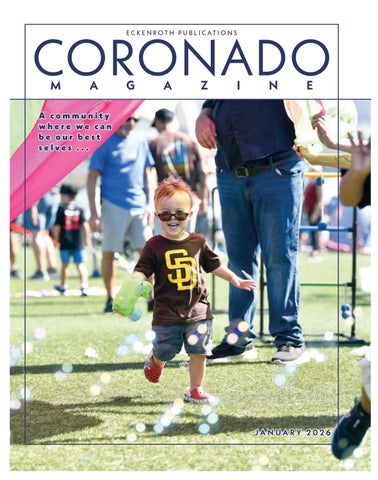
Ready-or-not, here it comes, and here comes the January 2026 issue of the Coronado Magazine.
This month, Hattie encourages us all to try something new this year … pickleball has been her choice. But, if you’re anything like me, that just offers the promise of a visit to the ER - I think sourdough might be more up my alley.
Camp Able is celebrating 45 years of offering a place filled with happiness and belonging, and across Coronado there are groups dedicated to building a community within our community where everyone can be their best selves. Chris offers us a salve for all our bad decisions, that and a Jimmy Buffett tune can see us through to the other side, and PAWS is building bridges for animals and community
We meet this months Island Icons, the Dong family, with roots dating back to the 19th century, and Joe takes us on a journey filled with the promise of treasure lurking just beneath the sands of Coronado … you just have to wait until low tide to catch a glimpse of the mother lode.
And, for all those with a touch of wanderlust to open the New Year, Kris takes us on a journey along Route 66, traveling an American Icon across the heart of the country.
Wether you’re trying something new in spirit of the New Year, giving your time and effort to those in our community who need a hand, or just taking a long-awaited trip … together, let’s make 2026 a year dedicated to being our best selves.
Thank you for being part of the special community that is Coronado … and remember, don’t blame me for the pickleball accidents - I’m baking sourdough!
At the heart of our community through the Library. As we welcome the new year, there’s no better time to refresh your shelves and share the stories you love. The Friends of the Coronado Public Library invite you to donate books, DVDs, audiobooks, and other materials to support our community through Second Hand Prose, the Friends’ bookstore.
“Currently, we welcome clean, undamaged classic titles, children’s hardcover and paperback books in good condition, and rare or exceptional books.”
If you love books as much as we do, consider volunteering—you’ll meet fellow readers, help raise funds for the Library, and be part of a welcoming, vibrant community.
Bookstore Hours
Monday-Saturday: 10:00 AM - 4:00 PM
Sunday: 1:00 PM - 4:00 PM
For more info visit: www.coronadofol.org
Start the year off by sharing your stories. Drop off your books at the main storefront, located behind the Library on D Avenue, opposite the high school, which is open daily.
Help make 2026 a year full of discovery, learning, and connection. Donate today!
Dink Dink, Attention Please
By HATTIE FOOTE
Every generation has a stereotype, and they can range from hilariously spot on to offensively off the mark, depending on who you are talking to. As a proud millennial, I will own some of our charming behaviors, but I take umbrage with the millennial cringe accusations. Okay, so we overuse emojis and occasionally still wear skinny jeans, sue us! However, long gone are the days of us wearing office attire to the clubs; we are middle-aged with sore backs and favorite teas. But to be clear, we can still get down to Get Low by Lil Jon.
I recently saw a meme about when you hit middle age, you are sorted into one of four houses. The houses were pickleball, sourdough, gardening, and running. The older I get, the more I think this is pretty accurate. For me, I really enjoy eating sourdough, but baking a loaf does not interest me in the slightest.
I tried gardening in our COVID era, and aside from a few jalapeños and a rogue pumpkin patch, I discovered my thumb was not green. And running? Absolutely not. Which left me one house that I was meh on until recently.
I remember first hearing about pickleball on my beloved Real Housewives shows. It was more often an activity they would participate in while arguing loudly about betrayals and rumors, of course. I thought it sounded lame if I’m being honest, so I was surprised when it kept gaining popularity. Before I knew it, my husband Chris was playing for hours a week, even getting private lessons to hone his craft. He started to host Coronado Fitness Club pickleball outings, and I must admit I started to feel left out of the fun, so I finally agreed to give it a go. I loved it, absolutely loved it. I enjoyed how lighthearted and fun it was, how there
were so many different ages and skill levels on the courts. In fact, we started bringing our kids to play, and that has been such an unexpected family bonding activity. It’s so fun to play girls versus boys or parents versus kids. There is light trash-talking and wagering going on, and I am honestly so impressed with how good they have gotten.
While skinny jeans are generally frowned upon on the court, the outfits, accessories, and gear can be so fun. You can get personalized paddles with photos of family, friends, or pets. Many high-end stores carry cheeky sport hats and sweatshirts. I have also seen many cute gifts for the pickleball enthusiast in your life at Seaside Papery and Bungalow 56. Impact Activities is a wonderful local resource; on their website, you can join “The Dink List,” which connects you with neighbors of all skill sets to
play with. It is such a great way to get involved in the community, work up a sweat, and have some fun. So, whether it be baking, running, gardening, pickleballing, or something completely different, I encourage you to try something new this year! Except wearing office attire to the club, speaking from experience we don’t need to try that again! Wishing you all a healthy and happy new year. See you on the courts!
Sculpting
Detox
Advanced
Lymphatic
Dermaplane
Renew
Advanced
COMMUNITY: CHRISTINE JOHNSON
by Ed Clemente Photography
What do we want for ourselves, our friends, and our family? We all wish for a safe and supportive community, where we can be our best selves. This is just what CAMP ABLE has been providing for 45 years. This is your feel-good story for 2026 – a story about bringing happiness and a sense of belonging to families with special needs challenges.
In the late 1970’s, Robert F. Hanson, a professor of
Photos
... building a community within a community ...
Recreation Administration at San Diego State University (SDSU) and an advocate of camping experiences for youth, discovered that recreational opportunities for disabled children were significantly lacking in the greater San Diego County and southern California area.
Bob’s dream was to create a summer camp for disabled children regardless of the child’s disability. With Bob’s persistence, SDSU established Camp Able as a service project under the SDSU Campanile Foundation a (501(c)(3) nonprofit organization). The Campanile Foundation acts as the sponsoring nonprofit and provides the necessary insurance for the camp. However, Camp Able must raise all the funds for operations through grants and donors’ generosity.
For 45 years, Camp Able has offered 6-weeks of summer camps for special needs families at Fiddler’s Cove in Coronado. Regardless of disability or age, Camp Able accepts everyone and has had participants from 3 years old to 81 years young. Summer camp activities include sailing, canoeing, swimming, crafts, music and hikes. Structured support by well-trained, safety-conscious staff ensures that all campers enjoy their day to the best of their ABLEities.
Jenelle Nettles has been the camp director and prime-mover for 25 years. She manages all the planning and operations while maintaining her position as a recreational therapist at Rady’s Children’s hospital. Jenelle says “I love what I do. It just fills my cup to see the joy on a camper’s face when they experience sailing, accomplish a craft or swim with an aide for the first time”.
COVID made camp impossible for two years, but due to Jenelle’s persistence and the families loyalty Camp Able survived and is now thriving. Kate Carinder, who is now the organization’s Board Chair, discovered Camp Able while out for a bike ride. She was struck by how professionally and compassionately the counselors and staff cared for the campers. She says “I later learned Camp Able is an outreach program of San Diego State University. The more I discovered about Camp Able, the more I knew I wanted to be part
of it.” She adds “Volunteering has been so easy thanks to Camp Director Jenelle Nettles. Her passion and commitment are contagious and the sheer amount she accomplishes is nothing short of remarkable.”
In early 2024, the Coronado Community Foundation reached out to Jenelle about creating monthly events for special needs families. The spark for the idea came from our own Sacred Heart church. The church is very inclusive and welcoming to all but felt that more local opportunities for these very special families was needed. Through support from the Coronado Community Foundation (CCF) and the Friends of the Library, Camp Able launched the Exceptional Families Program (EFP). Starting on Earth Day in 2024, monthly themed events have included everything from going to hear the San Diego Symphony practice, story-telling at the library, kite-flying in the Cays, beach cleanups and a holiday party. More local families now know each other and plan get togethers. Camp Able families come to town for monthly events and more local families attend Camp Able summer camps. Samanth Coover says it well – “Camp Able and the Exceptional Families Program have been wonderful, not only for my son but for our whole family. We know we will always be welcome without judgment. It so nice to be surrounded by people who understand disability and value all people’s lives”.
The Exceptional Families Program has help Camp Able grow in capability and outreach as this year’s attendance reached a total of over 725 campers over the six weeks. Jenelle said “From our first meeting to today, Camp Able could not have anticipated how much CCF would help us grow and make such an impact on our campers and families.”
Camp Able is celebrating their 45th anniversary this year. The organization should be considered a source of pride for Coronado as they are truly building a community within our community.
Mona’s Eyes
By Thomas Schlesser
Book Corner
WHAT PEOPLE ARE READING THIS MONTH
While the doctors can find no explanation for Mona’s brief episode of blindness, they agree that the threat of permanent vision loss cannot be ruled out. The girl’s grandfather, Henry, may not be able to stop his granddaughter from losing her sight, but he can fill the encroaching darkness with beauty. Every Wednesday for a year, the pair abscond together and visit a single masterpiece in one of Paris’s renowned museums. From Botticelli to Basquiat, Mona learns how each artist’s work shaped the world around them. In turn, the young girl’s world is changed forever by the power of their art. Under the kind and careful tutelage of her grandfather, Mona learns the true meaning of generosity, melancholy, love, loss, and revolution. Her perspective will never be the same—nor will the reader’s.
Among The Burning Flowers
By Samantha Shannon
Yscalin, land of sunshine and lavender, will soon be ablaze.
It has been centuries since the Draconic Army took wing, almost extinguishing humankind.
Marosa Vetalda is a prisoner in her own home, controlled by her cold father, King Sigoso. Over the mountains, her betrothed, Aubrecht Lievelyn, rules Mentendon in all but name. Together, they intend to usher in a better world.
A better world seems impossibly distant to Estina Melaugo, who hunts the Draconic beasts that have slept across the world for centuries.
And now the great wyrm Fýredel is stirring, and Yscalin will be the first to fall . . .
A story of human resilience in the face of dire circumstances, Among the Burning Flowers leads readers through the gripping and tragic events that pave the way for the opening of the million-copy bestseller The Priory of The Orange Tree.
One Dark Window
By Rachel Gillig
Elspeth needs a monster. The monster might be her. Elspeth Spindle needs more than luck to stay safe in the eerie, mist-locked kingdom she calls home—she needs a monster. She calls him the Nightmare, an ancient, mercurial spirit trapped in her head. He protects her. He keeps her secrets.
But nothing comes for free, especially magic.
When Elspeth meets a mysterious highwayman on the forest road, her life takes a drastic turn. Thrust into a world of shadow and deception, she joins a dangerous quest to cure the kingdom of the dark magic infecting it. Except the highwayman just so happens to be the King’s own nephew, Captain of the Destriers…and guilty of high treason.
He and Elspeth have until Solstice to gather twelve Providence Cards—the keys to the cure. But as the stakes heighten and their undeniable attraction intensifies, Elspeth is forced to face her darkest secret yet: the Nightmare is slowly, darkly, taking over her mind. And she might not be able to stop him.
Venetian Vespers
By John Banville
1899. As the new century approaches, struggling English writer Evelyn Dolman—a hack, by his own description—marries Laura Rensselaer, daughter of an American oil tycoon. Evelyn anticipates that he and Laura will inherit a substantial fortune and lead a comfortable, settled life. But his hopes are dashed when a mysterious rift between Laura and her father, just before the patriarch’s death, leads to her disinheritance. The unhappy newlyweds travel to Venice to celebrate the New Year at the Palazzo Dioscuri, ancestral home of the charming but treacherous Count Barbarigo. From their first moments in the mist-blanketed floating city, otherworldly occurrences begin to accumulate. Evelyn’s already jangled nerves fray further. Where has Laura disappeared to? How to explain the increasingly sinister circumstances closing around him? Could he be losing his mind?
Venetian Vespers is a haunting, atmospheric novel from one of the most sophisticated stylists of our time.
Across Coronado, from city-hosted recreation programs and summer camps, to school-based services, faith-based ministries, and family-driven initiatives, there are many ways to support individuals with special needs and the families who love them. Through volunteering, advocacy, and financial contributions, these programs continue to create friendships, foster independence, and ensure that every member of our community feels welcomed, valued, and connected.
Coronado Community Group Program through The Arc of San Diego Beyond Camp Able and the Exceptional Families Program, Coronado offers additional pathways of connection and belonging for children, teens, and adults with special needs. One such program started by local parents of children with special needs who gathered years ago to help create a Coronado Community group program through The Arc of San Diego. The goal was to provide a resource for their family members to remain “on the island” and contribute to the community they lived in. The Arc of San Diego is the largest, most comprehensive provider of services for people with disabilities in San Diego County. Founded in 1951 by parents and other community members concerned about the lack of services for people with disabilities and their families, The Arc provides services at more than 20 locations throughout the county, including a dedicated program in Coronado. Through these programs, The Arc offers support to people with disabilities in living independent and fulfilling lives. Participants in the local program continue to share experiences many grew up enjoying together: volunteering at the Coronado Fire Department and Second Hand Prose, taking cooking classes, gathering for lunch at neighborhood restaurants, and staying active at the Coronado Community Recreation Center. These shared experiences foster long-term friendships and a deep sense of belonging.
City of Coronado - Community Center A-Team Program
The Coronado Community Center also hosts A-TEAM (All Together Experiencing Amazing Moments), a weekly youth program that creates space for fun, friendship, and exploration. From cooking and arts and crafts to paddling and outings to local attractions, A-TEAM offers participants opportunities to connect, build confidence, and enjoy time together in a supportive environment.
Sacred Heart’s Open Heart Ministry
Sacred Heart Catholic Church’s Open Hearts Ministry welcomes children and adults of all abilities, along with their families. Through caregiver support groups, Open
HeARTS—a monthly fellowship and arts gathering—and bi-monthly faith-sharing opportunities for teens and adults with special needs, the ministry creates a space rooted in inclusion, creativity, and community. More information on these programs and the schedule can be found at sacredheartcor.org.
Coronado Unified School District’s Adult Transition Program
As students move into adulthood, Coronado Unified School District’s Adult Transition Program helps young adults with disabilities, ages 18–22, navigate the transition from public school into adult life. The program emphasizes independence across living, working, and community engagement, tailoring support to each participant’s abilities and goals. Students gain hands-on experience through job training and supported employment, while also developing daily living skills such as budgeting, money management, and public transportation use. Based at the CUSD District Office, the program also offers opportunities for meaningful interaction with staff and community members, strengthening social skills and self-confidence along the way.
CHEERS: CHRISTINE JOHNSON
“... enjoy this ride on your trip around the sun”
The year 2025 is coming to a close and a brand new one filled with surprises and challenges is knocking at your door.
Have you ever made bad decisions at the end of a year? Thinking it will change everything and place negativity in the rear-view mirror. Questions……
Did you decide to move at the end of the year?
Do you have a 23-year-old college graduate in your house with 20 pairs of cowboy boots, 30 hoodies and 40 jelly cats?
Three dogs ages 14, 10 and 8 – all weighing 100 pounds?
Only moved to a larger house in order to store the cowboy boots, hoodies, and stuffed animals?
And finally – but certainly NOT the last of it – the three large dogs are crying because you moved them away from their doggie friends!
Parents try to do the best they can for their families. Sometimes circumstances force hard decisions and someone is simply unhappy. While moving one mile away is not the end of the world, I marvel at our military families who uproot their lives all the time. Changing schools, jobs, houses, cities, states. These are the real heroes at the start of a new year and any year.
As Jimmy Buffett wrote: “Just enjoy this ride on your trip around the sun”. He had a way of encouraging everyone to enjoy life’s journey and accept unpredictability, with a license to chill.
Great advice for 2026.
Blueberry Limoncello Martini
INGREDIENTS
*2 ounces vodka
* 1 ounce limoncello
*1 ounce blueberry puree
*1/2 ounce lemon juice
Optional: fresh blueberries and a lemon twist for garnish
MIXOLOGY
PREPARE THE BLUEBERRY PUREE
Wash fresh blueberries
Blend until smooth
Strain through a mesh container
TIP: Freeze some whole blueberries for garnish
CHILL & PREP THE GLASS:
*Chill martini glass in freezer
*Rim glass with lemon juice and sugar
SHAKE & SERVE YOUR MARTINI
*Fill shaker with ice
*Add vodka, limoncello, blueberry puree, and lemon juice
*Shake vigorously till very cold
*Strain into glass & garnish with fresh blueberries & lemon twist
Park Place Liquor & Deli 1000 Park Place (619) 435-0116
Peohe’s Ferry Landing (619) 437-4474
Roppongi
800 Seacoast Dr, IB (619) 631-4949
Rosemary Trattoria
1330 Orange Ave. (619) 435-8272
Swaddee Thai 1001 C Ave. (619) 435-8110
Tartine 1106 1st St. (619) 435-4323
Tavern 1310 Orange Ave. (619) 437-0611
The Henry 1031 Orange Ave. (619) 762-1022
The Little Club 132 Orange Ave. (619) 435-5885
Trident Coffee
Villa Nueva Bakery Cafe
Village Pizzeria Bayside
Local Dining
In Southern California, leeks reach their peak season during the cooler winter months, with January being an ideal time to enjoy them fresh. As part of the allium family, which also includes onions and garlic, leeks thrive in the region’s mild winter climate. They are prized for their long white stalks and green tops, offering both farmers and home cooks a versatile, nutrientrich vegetable during a season when gardens can be less bountiful.
Nutritionally, leeks are a powerhouse, low in calories yet packed with vitamins and minerals. A single cup of raw leeks contains about 32 calories, 1 gram of protein, 2 grams of fiber, and is an excellent source of vitamin K, vitamin A, and manganese. Leeks also deliver smaller amounts of folate, vitamin C, and iron.
Their flavor is much milder and sweeter than onions, making them an ideal base for soups, sautés, and casseroles.
In the kitchen, leeks can be simmered in stocks, braised, grilled, roasted, or even sliced thinly and eaten raw in salads. Their gentle flavor enhances a range of dishes, from potatoleek soup to savory tarts, making them a seasonal staple in winter cooking.
Building Bridges for Animals and Community
By PAWS of Coronado
Community partnership in action
— How collaboration strengthens animal welfare and the people of Coronado.
At PAWS of Coronado, we believe strong communities care for one another—and that includes the animals who share our lives.
Guided by the idea that a rising tide lifts all boats, our work is rooted in collaboration, shared responsibility, and a deep commitment to care. By building strong bridges across public agencies, nonprofits, and local businesses, we are better able to serve the animals and residents of Coronado.
Community Collaboration at the Heart of Our Mission
PAWS of Coronado is a proud 501(c)(3) nonprofit organization, and our mission is strengthened through close collaboration with the City of Coronado, fellow area nonprofits, and local businesses. These partnerships allow us to share resources, align goals, and expand our collective impact—ensuring that animals and people alike receive the support they need.
Collaborating with the City, Public Agencies, and Local Military
Our close collaboration with the City of Coronado begins with our core municipal animal shelter services. We work closely with the Coronado Police Department, for example, to manage stray, surrendered, and injured animals. Reuniting distraught Coronado pet owners with their lost pets is one of the greatest joys for PAWS staff.
Beyond these essential services, PAWS is honored to provide emergency boarding, vaccination clinics, animal licensing services, and ongoing animal welfare education
and resources on behalf of the City of Coronado. Through this work, we serve the people of Coronado while ensuring animals are treated with compassion, dignity, and professionalism.
PAWS and the City also engage in creative and fun collaborations, including the rotating annual Canine Mayor and Cat City Manager campaigns. These initiatives raise awareness and funds for PAWS while providing a platform for the City to educate residents about the importance of local animal welfare and pet control programs. Just this year, PAWS also collaborated with the City’s Recreation Department on a “Puppies and Tennis” day, bringing residents and visitors to the Coronado Tennis Center, promoting the redesigned dog park at the Coronado Cays, and educating the community about the importance of following local leash laws and dog behavior guidelines.
This year, PAWS entered into a partnership with San Diego County Public Health to collaborate on education and advocacy programs focused on pet- and animal-related public health issues, including rabies and other communicable disease prevention, disaster preparedness, and other vital regional initiatives.
In 2025, PAWS also reached out to local military entities to explore opportunities for partnership and support. Already, PAWS has participated in numerous educational, resource, and pet-focused activities for military members and their families; launched a collaboration with SEALKids to provide regular activities for the children of Navy SEALs; and began developing additional partnerships to support military members, veterans, and their pets during challenging times such as deployments, transitions, and the need for assistance services.
Engaging Local Businesses to Expand Our Reach
Community impact is amplified when local businesses step forward as partners. We are grateful for collaborations with businesses such as The Bower Hotel, whose support has helped increase visibility for our adoptable animals while raising vital funds for our programs. Through these partnerships, PAWS is able to invest in behavior training that gives animals a stronger foundation for success in their new homes. This training not only improves the quality of life for the animals but also helps build lasting, positive relationships between pets and the families who welcome them.
Advancing Animal Care Through Trusted Medical Partnerships
Providing exceptional medical care is central to everything we do. Our partnership with Coronado Animal Hospital enables us to deliver comprehensive veterinary services— from preventive care to urgent medical support—under the direction of Dr. Barbour, DVM, Veterinary Services Manager at PAWS of Coronado. This collaboration ensures that every animal in our care receives the highest standard of medical attention.
Looking ahead, we are hopeful to expand our network of care through a new partnership with Purple Paws of Coronado, further strengthening our ability to meet the evolving medical and behavioral needs of the animals we serve through local partners and resources.
Building True Community
In 2025, PAWS maintained a laserfocused commitment to building relationships with the many nonprofit and community groups that make Coronado such a vibrant place. Just a few of our numerous collaborations this year include: participating in and supporting Coronado Rotary’s annual Low Tide Ride and Stride fundraiser and its Christmas in November food drive; partnering with the iconic Coronado Island Film Festival (CIFF) to provide adorable Furry Cele ity Guests at Beach Bash Movies and special star appearances during the Film Festival; regularly bringing gentle, social dogs to Coronado Retirement Village (CRV) to provide comfort and smiles to residents; partnering with the Coronado Floral Association (CFA) and Friends of the Public Library on activities such as Petals and PAWS—adorning leashes, collars, and bandanas with floral arrangements— and reading to cats and dogs.
Additional collaborations include
working with Coronado public and private schools to support programs and fundraisers through PAWS Furry Friend appearances, hosting visits to PAWS for animal welfare education, and providing a regular visitation and activity program for special needs students; collaborating with Safe Harbor to support a mental health education campaign by sharing resources and research on the positive impact pets and comfort or service animals can have on human health and wellness; and engaging local Coronado musicians in our Concerts in the BARK program to provide soothing music and enriching experiences for our shelter animals.
These collaborations—and many more—demonstrate that PAWS is a true community asset. Together, these partnerships, both large and small, help bolster the incredibly rich and generous Coronado community.
Powered by People, United by Community
Behind every successful partnership are people who care deeply and choose to act—individuals and organizations with the means, expertise, and compassion to make a difference. From city leaders and nonprofit partners to veterinarians, business owners, volunteers, fosters, adopters, and generous donors, each plays a vital role in our shared success. While our roles may differ, we are united by one purpose: doing what’s best for the animals. Our standard
response to comments and compliments about our work says it all: It’s All for the Animals!
By working together, supporting one another, and keeping our focus on compassion and collaboration, PAWS of Coronado is proud to stand alongside our partners in service to the animals and people of Coronado. Together, we are building a stronger, more connected community—and a better future for every animal in our care.
MOLLY HAINES MCKAY
BROKER ASSOCIATE
619.985.2726
DRE# 01876062
MollyHainesMcKay@gmail.com
CARRIE MICKEL
SALES ASSOCIATE
619.630.3570
DRE# 01999494
CarrieMickel@bhhscal.com
LINDSEY LYONS
SALES ASSOCIATE
619.405.9208
DRE# 01993229
LindseyBLyons@gmail.com
Island Icons:
The Dong Family
By KAREN SCANLON and KIMBALL WORCESTER
The Dong family is a multigenerational Coronado family with roots dating back to the 19th century. John was born in Canton, China, and came to the U.S. to work on the construction of the Southern Pacific Railway. He and his wife, Chun Shee, welcomed six children. Two boys, Lloyd Yee (1905) and George (1907), were born while the family was living in Bakersfield. John Dong later found work locally, working at the Quan Mane Store in downtown San Diego, and then as a gardener for John D. Spreckels alongside Japanese immigrants.
His son Lloyd began working as a truck farmer, providing fruits and vegetables for the Hotel del Coronado. In 1934, he turned to commercial tuna fishing, operating out of San Diego Bay and San Pedro. The business was unfortunately short-lived. His fishing career ended three years later when his boat burned and sank. Lloyd then followed in his father’s footsteps and became a gardener in Coronado. He also operated some side businesses installing sprinkler systems, sharpening lawn mowers, and painting automobiles.
The Dong family at a gathering. Date unknown. Courtesy of the Dong Family.
Lloyd married Margaret Chew, whose family operated a farm in Coronado at the turn of the century, close to where Cutler Field is located today. During an interview with the Coronado Eagle in 1991, Lloyd said, “I guess you could call it a truck farm, but they did not have trucks in those days. Just a horse.”
Lloyd and Margaret took up residence in a house on C Avenue, which had long been a rental and was owned by the Thompson family, well-known Black residents who also owned the next-door stable (which was replaced with the Coro-Isle Apartments in 1956). This arrangement between the Thompsons and the Dongs greatly benefited the latter, who faced housing discrimination due to their Chinese heritage. Ultimately, Lloyd and Margaret bought the house from the Thompsons and lived in Coronado for decades, raising their four children there during WWII and after. The couple was generous to the community, and in 1956, they donated three palm trees from their property to the City. Then-Superintendent of Parks Jerry Keene supervised moving the palms to the Orange Avenue median strip between Sixth and Seventh Streets. Lloyd loved birds. A parakeet was buried under one of the trees, and later in life, Lloyd was often seen with his beloved parot, Laing Jai.
The four Dong children—Jeanette, Ronald, Lloyd Jr., and Jacquelyne— attended Coronado schools as honors students and notable athletes. Memories of growing up in Coronado include recollections of their family doctor, Dr. William Booth, who served many in San Diego’s Chinese
The Dong family poses for a formal portrait (from left) father John, a ten-year-old Lloyd, mother Chan Shee, and eight-year-old George. 1915. Coronado Eagle & Journal.
Commander George Dong (left) with VFW Ladies Auxiliary President Viola Dominguez (right) during a Loyalty Day Parade. 1953. Coronado Historical Association
American community; buying model kits at Captain Hatch’s Hobby Shop; and, of course, Holland’s Bikes. Ron was a Cub Scout in Coronado’s Pack 75. Ron recalls his gratitude to El Cordova Garage, which allowed him to work there on his 1947 Ford Club Coupe while a junior in high school. Lloyd Jr. is nostalgic for the small-town feel of that time. They both remember when the Japanese American families were sent away from Coronado during WWII, and how a bicycle was suddenly available as a family was unable to take it with them into internment.
The war also saw Lloyd Sr.’s brother George become an assistant crew chief in the U.S. Army Air Force in charge of the B-24H bomber Witchcraft in the 467th Bombardment Group, 790th Bombardment Squadron (BS) of the Eighth Air Force. George’s service in the ETO over Germany is reflected in his selection
as a commander of Coronado’s VFW Post 2422 in 1953.
The Dong children left Coronado for college and military service, and all ended up living as adults elsewhere in California. The house on C Avenue reverted to a rental when Lloyd Sr. died in 1994. By 2024, the family decided to sell the property, wanting to highlight and celebrate the generosity of the Thompson family, who gave their parents the opportunity to raise their family in Coronado so many years ago. A significant amount of the sale proceeds was earmarked as a donation to the Black Resource Center at SDSU, which was renamed in honor of Emma and Gus Thompson.
To some degree, the Dong children owed their Coronado childhood to the Thompson family. Their repayment of the debt and acknowledgment of the Thompsons’
vision is a noteworthy example of civic pride and appreciation, confirming their position as Island Icons. Now the Dong Family joins the Thompson Family in this distinction.
True to its mission to serve as Coronado’s primary center for community history, the Coronado Historical Association (CHA) conducts special oral history interviews with Coronado natives and long-time residents. This special, ongoing project is called “Island Icons.” Oral history is critical to capturing local history because it helps us record information and stories that might otherwise go undocumented. Local history is not included in national textbooks or history books, so it is up to organizations like CHA to collect these important first-hand accounts and memories for the future. Island Icons stories are permanently archived at CHA. More information about the program can be found at coronadohistoryexhibit.org.
(Left to Right) Janice and her husband, Ron, with Lloyd Jr. and his wife, Girina. 2024. SDSU.
Lloyd Dong, 86, with Laing Jai at his C Ave home. 1991. Coronado Eagle & Journal.
Calvary ChapelCoronado
Bridging the gap in prayer from our Island to the World Come join us as we teach the entire counsel of God's Word
Sunday Service 9:30am Wed. Evening Bible Study - 7pm
Saturday Morning Breakfast Fellowship - 9:00am
Pastor Gary Boggs Live Streaming on www.calvarychapelcoronado.com cccoronadolwf@gmail.com
Waters Fellowship 1224 Tenth Street, Coronado, CA 92118 619.435.8233
Shipwreck Monte Carlo Lurks Just Beneath The Sand
Rumors of Gamblers’ Silver Persist
By JOE DITLER
CORONADO – Like rusted metal fingers of a Venus Flytrap, the bones of the shipwreck Monte Carlo reach up to grab her quota of swimmers and surfers every spring.
It’s been so long since the Monte Carlo took up permanent residence on Coronado’s South Beach that most who see her know nothing of her past.
Recently two tourists and a local were overheard arguing about whether it was a stolen boat run aground, a pirate ship, or an old fishing barge. “My husband says it was a stolen boat,” demanded one woman, “and he grew up here!” Bzzzzzzz. None of the above.
The real story of the Monte Carlo is far more interesting, and it begins New Year’s Eve, 1936, while the rest of the world was celebrating. The Monte Carlo was a heavily laden gambling ship, fighting and tugging at her moorings three miles offshore, the victim of a vicious winter storm.
On board were all the accouterments to party – booze, gambling machines, mirrored ceiling – but the only signs of
Above: This photo was taken by a photographer from the San Diego Union. It is early on the morning of January 1, 1937. The Coast Guard cutter, Itasca, can be seen steaming away after successfully removing the two caretakers from the doomed, floating gambling casino, as residents from Tent City wait for the sea to toss up more rewards. Photo courtesy Coronado Public Library.
Monte Carlo lay on her side, as she was launched … on her side. With each passing storm more of her would wash up on the beach until eventually only her cement superstructure could be seen. Atop Point Loma the only structure is the lone Cabrillo Lighthouse. Photo courtesy Coronado Public Library.
life were two caretakers. And it was all they could do to just hunker down and ride out the storm.
Early on January 1, 1937, the 300-foot “sin ship” – the floating gambling casino Monte Carlo – broke the massive mooring chains that had secured her to the ocean bottom. First the bow chain parted, then the stern. Helplessly, she was at the fate of wind and tide.
Through the dark and stormy night Monte Carlo sailed on, eventually running hard aground on Coronado’s Tent City Beach at the break of day. This harrowing shipwreck tale has become one of Coronado’s greatest legends, and a mystery that has defied time.
Today, many Coronado residents know nothing of the story. Visitors walk the beach describing the wreckage as
everything from a Japanese submarine to a pirate ship. In 2005 a local writer/ historian named the beach, “Shipwreck Beach,” and now, all these years later, the wreck continues to give up its secrets one at a time.
In 1936 every preacher in the land had been praying for Monte Carlo’s demise. When the end came, every one of them took credit for it. What the law couldn’t do, God and Mother Nature did.
That day, and in subsequent years, ownership of the Monte Carlo remained unknown. Hence, everything of value not already absconded with by people on the beach, was collected by city officials. The hull was left to rot in our surf line, where it remains today. No one stepped forward to claim ownership, or to take responsibility for removing the old hulk.
From 1927-1939 as many as ten gambling ships dotted the coast between San Diego and Long Beach – ships named the Lux, the Rex, the Johanna Smith, the Rose Isle and the Monte Carlo
They were reconfigured working ships, designed strictly for the purpose of gambling, prostitution and drinking. The gambling ships had previous lives. Some were former military vessels. There was a
five-mast barkentine, lumber schooners and even a former Alaska Packer ship, the four-mast Star of Scotland (San Diego’s tallship, the Star of India, was a former Alaska Packer ship).
Everything written to date about the Monte Carlo and that infamous shipwreck of 1937 has come from local newspaper articles at the time of the wreck, and a handful of interviews with people who had either visited the casino in International waters, or were on the beach when she met her fate.
I’ve been fortunate to interview many.
Katherine Carlin talked about what it was like on board the Monte Carlo; Bud Bernhard shared tales of swimming to the wreck and retrieving hundreds of silver dollars; Bruce Muirhead the elder’s remembrances of having to truck gambling paraphernalia from the beach for the City of Coronado, but keeping enough wood to build his pigeon coops. There was Dick Kenney’s tale of woe as he and his brother drove their Model A on to the beach in the excitement of that New Year’s morning only to have their car fall victim to soft sand and an
This aerial of the shipwreck shows the bow already starting to separate. Tent City can be seen in the background. Tents by now (1937) had already been replaced with wooden rental homes, and Tent City’s popularity had begun to seriously decline. It would be gone in another two years.
Photo courtesy Ernest Marquez.
This aerial was captured from atop El Camino tower, at the Coronado Shores. There is nothing ghostlier, or more mysterious than a shipwreck.
Photo by Joe Ditler.
This photo shows racks of silver dollars inside the S.S. Monte Carlo before the shipwreck. How many racks like this, or how much silver remains, no one knows. Notice the handgun on the lower shelf.
Photo courtesy Ernest Marquez.
incoming tide; and perhaps the best one, Ralph Mitchell’s attempt to claim the ship under the Rule of Admiralty Law (as it pertains to abandoned ships) just before she hit the beach, only to be yelled off the ship by the caretakers.
Now, thanks to the work of author Ernest Marquez, author of “Noir Afloat,” the bigger picture is seen. It’s a tale of opportunistic, small time gangsters eager to make a buck. While the entire operation is traced to gangster, bootlegger and gambler Tony Cornero, the presence of Al Capone in Coronado at that time raises speculation that he either had a stake in the gambling ships, or wanted to.
To lure customers offshore, Cornero offered free water taxi rides, a free drink, and even free dinner just to put guests in
the mood to gamble. Orchestras played music while guests dined and gambled. Rooms were available as well. Few people came back without trying their luck. No one made money, except the owners of the ships and the syndicate that ruled them.
The Monte Carlo was built in 1921 at Wilmington, North Carolina, as a government-sponsored experiment in ship construction. She was built of concrete. She served two years in the U.S. Quartermaster Corps as Tanker No. 1. Then, in 1923 she was acquired by the Associated Oil Company of San Francisco and renamed the McKittrick. That work found her operating along the Pacific Coast for nearly a decade.
In 1932 she was sold, filled with cement to reduce motion on board, converted
Each ship had its own dice. They were weighted, and edges dulled, to increase the odds that the House would win, and not the gamblers. Photo courtesy Joe Ditler.
The spacious interior of Monte Carlo offered up dinning, drinking, gambling, prostitution and rooms to take your business private. In her prime, Monte Carlo hosted 15,000 people a week and the fleet of gambling ships brought in upwards of $3 million a year. Photo courtesy Ernest Marquez.
Even though Monte Carlo had a short career in San Diego, this ad was a familiar sight in the Coronado newspaper.
This coffee table book, by Santa Monica historian Ernest Marquez, is a must have for anyone interested in the shipwreck Monte Carlo and that era of our history. There is an entire chapter dedicated to the Monte Carlo.
into a gambling ship and named Monte Carlo. At 300 feet she was the largest gambling ship in the fleet. In her prime she hosted 2,000 visitors on weekends, and 15,000 a week. This is estimated to have paid off syndicate owners to the tune of nearly $3 million a year from the floating casinos. This, keep in mind, all took place at the end of Prohibition and smack dab in the middle of the Great Depression.
Her grand opening took place May 7, 1932, in anticipation of the ‘32 Los Angeles Olympic Games, and the hope they would attract tens of thousands of people to Gambling Ship Row. She was moored three miles offshore of Long Beach, with two other gambling ships of the fleet.
Billed as “the world’s greatest pleasure ship,” Monte Carlo was owned by Ed V. Turner and Marvin Schouweiler, according to news reports of the time.
That fateful day in 1937, a small group of men stood off to the side as a feeding frenzy of pillaging took place by Coronado residents and guests of Tent City and the Hotel Del. The men, dressed in long, black trench coats, asked a young man, Bud Bernhard, to swim out and climb aboard. They offered him $20 if he would survey the damage on board and report back to them.
Bud saw destruction – overturned gambling machines, booze bottles floating in seawater, and the sort of mess you would expect in the wake of a great flood, a hurricane … or a shipwreck. But he also saw overturned money drawers and piles of silver dollars.
He grabbed a whisky bottle and made his way down the anchor chain and back to the beach, where he reported to the men that it was a complete disaster, and nothing of value survived, except that whisky bottle. Bud would describe, years later, that the men represented the ship’s owners, and that after his report,
they quickly left the beach, never to be heard from again. They determined it to be a total loss.
Bud continued to raid the wrecked ship for weeks, filling his pockets with silver dollars. I have one of the silver dollars Bud retrieved, and it’s a proud possession.
While few remain from the gambling ship days, we have a pretty good picture of what took place on board. Games of chance on Monte Carlo included craps
tables, blackjack tables, roulette tables and wheels, chuck-a-luck and Chinese lottery, poker games and slot machines.
Gambling on fights and horse (and dog) racing took place through new wireless devices on board. Dice were either weighted or edged to increase the house odds, and were etched with the name of the ship.
Monte Carlo became part of San Diego’s landscape in 1936. She was towed here from Long Beach and anchored three
Above, young Aubrey Laine Baker, is seen exploring what must have appeared quite frightening to him at the time - the remains of the shipwreck Monte Carlo, suddenly visible after months of being covered by sand. Photo by Joe Ditler.
Colonel Dick Kenney, who was on the scene the morning S.S. Monte Carlo became a permanent part of Coronado’s landscape, retrieved these silver Morgans from a dealer’s table he found in the surf line.
Photo by Joe Ditler.
miles offshore. For eight months she operated between Coronado and the Coronado Islands with slightly less success than she had seen in Long Beach, despite rumored visits from such Hollywood luminaries as Clark Gable and Mae West.
The San Diego District Attorney was helpless to stop what went on aboard Monte Carlo as she was moored in international waters. However, he could levy extreme taxes and permit
requirements on the water taxis that carried people out to the ship, and he did. On November 1st, after hosting a gala party on board, Monte Carlo closed for the winter.
On December 30th a storm began to punish the region. By the next night, 15-foot open-ocean swells battered the old ship and swept over her decks. The two caretakers on board – John Miller and Art Gillespie – tied down what they could and then found a place to brace
themselves until the storm passed, firing flares into the air to attract help.
By daylight the ship was fast approaching Coronado beach. She hit hard. A Coast Guard cutter got close enough to launch a skiff, and the two caretakers precariously jumped from a Jacob’s ladder into the tiny skiff, timing their move so the rescue boat was on top of the swell.
Before long the upper deck had washed onto the beach, which was soon littered with roulette wheels, gambling tables and bottles of booze. Perhaps the greatest treasure to be found on the beach that day was the lumber – piles of first growth, long leaf Oregon fir – used to build the new upper deck dining room with mirrored ceilings. Residents hauled it away as quickly as possible, and a few house additions in Coronado benefited from it – a real prize during the Great Depression.
Some of those houses still display the wood in makeshift add-ons, fencing and repairs. The Coronado Historical Association has a chair that washed up onto the beach that fateful day.
One comment from the late Bud Bernhard still haunts treasure seekers. “I’m convinced there is $100,000 in gold and silver coins deep in that wreck,” said the man who retrieved hundreds of silver dollars from the shipwreck as a teenager. And when the wreck is visible, a small army of overweight, middle-aged men with metal detectors can be seen pacing the sand in search of some of that lost treasure from the shipwreck Monte Carlo – a true piece of Coronado history.
-- Author’s Note: Most years, after an onslaught of winter storms have lashed South Coronado Beach, the sand recedes to reveal what’s left of the shipwreck Monte Carlo. Last year most of her 300-foot hull could be seen in two pieces. Lifeguards were continually warning visitors to stay off the wreckage, but to no avail. To date, there have been no silver dollars found at the wreck site since she washed ashore all those years ago.
A typical winter scene at Coronado Shores Beach, where the shipwreck lies hidden most of the year, exposing herself only after a series of vicious storms remove the sand. Photo by Joe Ditler.
The author can sometimes be found sitting on the remains of Monte Carlo’s aft deck, in this case, reading a good book. Photo courtesy Joe Ditler.
Stronger Together
City of Coronado
County of San Diego
Rotary Club of Coronado
Coronado Junior Womans Club
Coronado Community Foundation
Soroptimist International Coronado FOCUS
Coronado Lions Club
Coronado Womans Club
Coronado Optimist Foundation
Coronado USD
Sacred Heart Parish School
Christ Church Day School
NOSC of SD Charitable Fund
Joint Tactics & Technologies
Christian Rice Architects, Inc.
Katie Herrick Group
Mullins Orthodontics
Coldwell Banker West
The Bower
Salas Properties
Brady's Menswear
Holland's Bicycles
Boney's Bayside Market
High Tide Bottle Shop
Emerald Spear Tequila
Starbucks
The Hotel Del
b Long Modern Pilates
Commitment to Mental Health & Well-Being
Safe Harbor Coronado exists because an entire community believes in caring for one another.
. Together, we create a community where support is visible, help is accessible, and no one navigates life’s challenges alone.
Thank you for standing with Safe Harbor Coronado; today and into the future.
New Year, New Friends: Celebrating Community and Connection
by HANNAH ARKIN
Greetings and Salutations!
As we welcome 2026, it’s inspiring to reflect on the energy, generosity, and creativity that make the Friends of the Coronado Public Library (FOL/ Friends) such a vital part of our community. Over the past months, I’ve had the pleasure of connecting with volunteers, donors, and Library staff, seeing firsthand the dedication that keeps our prograams thriving and our Library at the heart of Coronado life. From bustling book sales to engaging community events, it’s clear that the Friends are stronger because of the people who make it possible.
Celebrating Our Community
2025 was a remarkable year for us. Thanks to the support of our members and donors, we were able to expand programming, host events that brought neighbors together, and provide resources that enhance access to knowledge and culture for residents of all ages. Our bookstore, Second Hand Prose, continued to be a hub for book lovers, while communitycentered events—from author talks to family-friendly activities—offered opportunities for connection, learning, and fun. Each event reminded us that when our community rallies around the Library, incredible things happen.
Photo by Olivia Rakowski for the Friends
Photo by Savana Ashlea Biren
Looking Ahead to 2026
This year, the Friends are focused on building on that momentum. Our goal is to strengthen the Library experience while continuing to provide meaningful opportunities for our community to engage. Plans for 2026 include a refreshed Library lobby and bookstore, expanded funding for programs that serve children, families, and lifelong learners, and events designed to foster learning, creativity, and connection across Coronado.
Every donation, every hour of volunteer time, and every shared story contributes to this vision. By giving your gently read books a new home, volunteering in the bookstore, attending, or helping with events, you’re making a tangible difference. The generosity of our supporters allows the Library to thrive as a center for civic life, education, and cultural enrichment.
Let’s Be Friends
The Friends have been championing the Coronado Public Library for 55 years, and our mission remains as vital as ever. This year, we invite you to join us— whether by donating books, volunteering at our bookstore, Second Hand Prose, or attending our programs and events. Together, we can ensure the Library continues to inspire curiosity, foster learning, and bring our community together.
Start the new year by connecting, giving, and sharing the joy of reading. With your support, 2026 promises to be a year full of discovery, engagement, and meaningful connection.
Get Involved
I welcome you to reach out to me directly so that we can work together to strengthen this vital community resource we all love so much. My cell phone is (760) 504-4109 and my email is executive@coronadofol.org. Please don’t hesitate to contact me—I would love to hear your ideas and discuss opportunities for getting you more involved with the Friends of the Coronado Public Library.
All the best, Hannah Arkin
Photo by Jena Willard for the Friends
Photo by Olivia Rakowski for the Friends
Financial Steps to Prepare for Alzheimer’s and Dementia
By Hayley Beard, CFP®, Financial Advisor
More than 7 million Americans have Alzheimer’s disease, according to a 2025 report from the Alzheimer’s Association. The emotional toll of watching a loved one struggle with the memory loss, depression, anxiety, and cognitive decline is already overwhelming — but the financial burden can be significant too. Hopefully, this disease will never touch your family, but it’s important to be financially prepared just in case. By planning to cover long-term care costs and creating a financial strategy for caregivers, you can help protect your family’s financial well-being.
Expenses related to Alzheimer’s and other forms of dementia can be extensive. Families often face ongoing medical treatment costs, medical equipment purchases, home safety modifications, prescription drugs, and personal care supplies. Longterm care represents one of the largest health care costs not covered entirely by traditional Medicare, making advanced planning crucial.
Here are a few essential planning steps to consider:
Plan for care costs and identify insurance coverage
Start by understanding your family’s health insurance options, including Medicare, supplemental policies, and veterans’ benefits if applicable. Determine coverage for adult day care services, in-home care services, full-time residential care, and other longterm care options. Confirm whether you or your loved ones have long-term care policies or other insurance with long-term care riders. In some states, Medicare offers Special Needs Plans (SNPs) for people living with dementia, including Alzheimer’s. These plans specialize in care and coverage for beneficiaries with dementia, and only those diagnosed can enroll.
Identify assets and debts
Create a comprehensive picture of your family’s financial position, including bank accounts, investments, property, and debts such as credit cards, mortgages, or lines of credit. You’ll need this if you take over financial management for a loved one.
Ensure legal documents are in place
Consider a living trust
Consider protective measures for early stages
Look for tax benefits
Caregivers who pay care costs out of pocket may aqualify for tax credits and deductions. These benefits vary by state, so consult with a tax advisor about your eligibility.
A living trust can hold financial assets and property while a successor trustee, like a trusted family member, manages money and makes investment decisions. While complex, these trusts can provide valuable protection for families dealing with a parent or older relative experiencing dementia. Work with an attorney to establish crucial documents like a durable power of attorney for finances and health care decisions. These documents should be created before someone is diagnosed or when they’re just starting to show early signs of Alzheimer’s, so they can understand what they’re signing. Waiting until cognitive ability declines makes the process more challenging and may require court procedures for conservatorship.
If a loved one is showing signs of Alzheimer’s or other dementia, you may want to set up auto-pay for bills, open joint checking accounts, freeze credit reports at major bureaus, consolidate or cancel credit cards, and monitor financial activities closely. This can help keep financial responsibilities flowing smoothly and prevent exploitation by scam artists. A qualified financial advisor can help evaluate your family’s overall situation and recommend appropriate strategies to prepare for potential dementia-related costs. They can work with your legal and tax professionals to help you put comprehensive protection in place. While an Alzheimer’s or dementia diagnosis will change everyone’s life in your family, taking proactive financial steps can help ease the burden and provide greater confidence for the journey ahead.
For more information, visit www.alz.org.
This article was written by Edward Jones for use by your local Edward Jones Financial Advisor. Edward Jones, Member SIPC. Edward Jones, its employees and financial advisors cannot provide tax or legal advice. You should consult your attorney or qualified tax advisor regarding your situation.
The Gensler Team
Dan Gensler, Bri a Ferguson, Brandon Mather 120 C Ave, Ste 170, Coronado, CA 92118
Route 66
Still Kicking in its Centennial Year Route 66 Still Kicking in its Centennial Year
Part One: Road trippin’ from Chicago to Oklahoma City
Story and Photos by KRIS GRANT
This year marks the 100th anniversary of Route 66 – the storied road that travels “from Chicago to L.A.” That is reason enough to add this road trip to your 2026 calendar.
To John Steinbeck it was “The Mother Road;” to songwriter Bobby Troup it was “the highway that’s the best.”
Bob Waldmire was an artist and cartographer who drew countless maps, postcards and murals of the highway. In his signature tiny print on one postcard, he summed up the history and allure of the highway as follows: “Route 66 was certified in 1926 when the nation adopted a numbered system of crosscountry interstate roads. Fully paved by 1936, Route 66 became an important and legendary highway, immortalized in literature, music and on television. Gradu-
ally “replaced” by huge homogenous “interstates,” 66 was decertified in 1985, ceasing to exist “officially,” but well over 80% of the back road is still drivable. So, travel back in time and leave the stress behind… Small is beautiful. Old is beautiful. Slow is beautiful. Safe is beautiful.”
Route 66 covers 2,448 miles and traverses eight states: Illinois, Missouri, Kansas, Oklahoma, Texas, New Mexico, Arizona and California. “Historic Route 66” signs mark preserved parts.
Give yourself a good two weeks for a fabulous Route 66 adventure. You’ll be able to incorporate some side trips, like a day or two in Santa Fe, New Mexico (part of the original loop) or a trip to the Grand Canyon, just 54 miles north of the Route 66 town of Williams, Arizona.
I’ve traveled portions of the route many times, but in 2023, on the way back to California from Maine, I picked up my cousin Barbara at Chicago O’Hare Airport and, armed with Route 66 maps and guides, we set out to travel the road and see its quirky sites all the way to L.A. It was like a giant scavenger hunt across the western states. Such fun!
To get into the proper mindset, I watched the animated Disney-Pixar movie, Cars (2006), that follows the adventures of Lightning McQueen, a “one-man show on the race car circuit” who has to make it to Los Angeles in one week for a three-car match race. McQueen gets bounced off the interstate
in the town of “Radiator Springs” where its animated scenery reminded me of the red-rock region surrounding Gallop, New Mexico, and where, come to think of it, I once had to have a fanbelt replaced in my old RV. Here, Lightning is forced to repair the road he damaged, and in that one week he develops friendships with the townspeople – his first real friendships. He comes to realize that while the interstate is a place to make great time, if you slow down and look around, you can have a great time.
Side note: Cars was Paul Newman’s final feature role, and also included the voices of Owen Wilson, George Carlin, Cheech Marin, Bonnie Hunt, Larry the Cable
Guy, Tony Shalhoub, Richard Petty, John Ratzenberger, Michael Keaton, Bob Costas and even a cameo by Jay Leno.
So, fasten your seats belts and hang on to your hats as we start our engines and “motor west.”
It’s time to get our kicks on Route 66!
From left: Pop’s Giant Soda Bottle in Arcadia, Oklahoma; advertising billboard, Ambler’s Gas Station, Dwight, Illinois; Burma Shave road sign outside Pontiac, Illinois; Illustration (below) of Route 66 in its entirety is an example of Route 66 historian Bob Waldmire’s intricate art and mapmaking.
They call Chicago the Windy City, and it did not disappoint. I grabbed hold of the “Beginning Route 66” sign (78-98 Adams St., just west of Michigan Ave.) and hung on as a bracing wind off Lake Michigan whipped my hair into a ravishing new ’do.
Then I headed to Lou Mitchell’s, which has been serving breakfast and brunch in its present location (565 Jackson Blvd.), since 1949 and is generally regarded as the first stop on the highway. The restaurant serves the “World’s Finest Coffee” and it goes well with the complimentary donut holes served upon arrival. Here, motorists can fuel up with generous portions of American comfort foods like pancakes, waffles, French toast and omelets, or, like me, enjoy corned beef hash with eggs along with homemade breads and house marmalade. The restaurant’s exterior neon sign was only half functioning, but a quick call to the establishment assured me that it is fully lit today, ready for the Route’s centennial year. If you’re heading to Lou Mitchell’s, be advised, they close at 2 p.m. and are closed on Mondays and Tuesdays.
Next, it was off to Chicago O’Hare to pick up my cousin Barbara who flew in from LAX to join me in the Route 66 adventure, and we started heading south and west.
There are many ways to approach a Route 66 trek. Some travelers chase nostalgia, pulling over for restored neon signs, vintage gas stations and the occasional antique shop. Others lean into kitsch – hunting down the world’s largest, longest, tallest something-or-others. History lovers, meanwhile, will find the Mother Road lined with museums that chronicle everything from westward migration to the rise of the automobile.
Barbara and I decided to tackle all of it – nostalgia, kitsch and history alike –in the name of full-on, no-holds-barred Route 66 reconnaissance, with a dash of lunacy on the side.
Our first stop was the Gemini Giant in Wilmington, Ill. Wilmington is located along the banks of the Kankakee River
On a typically windy Chicago morning, I began my Route 66 journey west, sporting a lovely new hairdo.
OFF!
The Railsplitter Covered Wagon was recognized in 2001 by the Guinness Book of World Records as the largest covered wagon in the world.
and follows the original 1926 route of Illinois Route 66. The giant is a classic Muffler Man – a 30-foot fiberglass advertising statue, originally built in 1964. Up until 2024, he stood outside the Launching Pad Drive-in Restaurant, holding a silver rocket, a nod to NASA’s Gemini space program, while sporting an astronaut’s helmet that looked to me more like a welder’s mask. Both the statue and restaurant looked like they were on their last legs, but there was good news ahead.
A distinguishing feature of the city is a large island in the Kankakee River that earned the city the nickname “the island city.” The year after we visited, the Launching Pad restaurant closed, and the statue was purchased by the Joliet Area Historical Museum, renovated, and
relocated to the city’s South Island Park at 201 Bridge St.
In Dwight, Ill., we visited the first of several restored gas stations along Route 66. Ambler’s Texaco Gas Station (417 W. Waupansie St.), built in 1933, operated continuously as a fueling and service station for 66 years – one of the longest-running stations on the Mother Road. After closing as a gas station in 1999, the building was donated to the city of Dwight. With support from the National Park Service’s Route 66 Corridor Preservation Program, it underwent careful restoration from 2005 through 2007 to reflect its original 1930s – 1940s appearance. Today, it’s a Route 66 Visitor Center, complete with vintage pumps, interior displays of old tools, advertising
and memorability. It’s listed on the U.S. National Register of Historic Places. There was no mistaking that we had entered Lincoln, Ill., when we happened upon a giant covered wagon, piloted by no less a figure than Abraham Lincoln.
The Railsplitter Covered Wagon at 1750 5th Street in front of the Best Western Lincoln Inn measures 40 feet in length and 25 feet in height. A 12-foot-high Lincoln, reading a law book, pays homage to the future president and his history as a circuit-riding lawyer along Illinois Roads – long before the coming of Route 66. The prairie schooner was hand built by local craftsman David Bentley in 2001 to commemorate the 75th anniversary of Route 66 and later donated to the community.
This is how the Gemini Giant appeared in 2023; he has since been spiffed up with a bright green suit and moved to the city of Wilmington’s South Island Park.
The former Ambler Gas Station in Dwight, Illinois is now a visitor center and features the garage’s period gas pumps, tools used during the ’30s and ’40s, and this vintage service truck, perfect for souvenir photo ops.
At Ambler’s Gas Station, I hopped aboard a vintage 1940’s service truck. Now a Visitor Center, Ambler’s features vintage pumps and period advertising.
Lou Mitchell’s has been serving delicious breakfasts and brunches from its present location on Route 66 since 1949.
SPRINGFIELD, ILLINOIS: THE HEART OF THE MOTHER ROAD
Springfield, Ill. is one of the most celebrated stops along Route 66, offering travelers a distinctive blend of the Mother Road’s classic Americana and the legacy of Abraham Lincoln. I recommend a two-night stay here.
The highway runs right through the heart of the city. A cornerstone of any visit is the Abraham Lincoln Presidential Library and Museum, located on the route at North Sixth St. This worldclass museum combines immersive exhibits, interactive displays and theater presentations that bring to life the story of Lincoln’s rise from frontier lawyer to president, the Civil War and Lincoln’s assassination and funeral procession.
Just a short walk away, tucked above the Lincoln Home Visitor Center, is the site of Lincoln’s former law practice. Nearby stands the Old State Capitol, a beautifully restored Greek Revival building where Lincoln served in the Illinois Legislature and delivered his historic “House Divided” speech during the 1858 U.S. Senate Campaign. Free guided tours are offered Tuesday through Saturday from 9 a.m. to 5 p.m.
Not far from downtown, the Illinois State Capitol building rises majestically with its Renaissance Revival design and soaring glass dome. Free tours showcase the ornate legislative chambers, marble floors and historical artwork.
The Lincoln Home National Historic Site preserves the modest home where Lincoln lived with his wife Mary Todd Lincoln and their children from 1844 until his departure for the presidency in 1861. Managed by the National Park Service, the site includes the restored residence and the surrounding fourblock neighborhood. Park rangers offer guided tours.
Legends Neon Sign Park at the Illinois State Fairgrounds is open 365 days a year, just inside Gate 2 on the corner of Route 66 at 801 E. Sangamon Ave. Re-creations or restorations of neon signs from longdefunct Route 66 businesses now glow at the park, including signs from the
A. Lincoln Motel, the Coliseum Ballroom, Chain of Rocks Motel and Bel-Air Drive-in theater. It’s fun and it’s free.
Route 66’s heritage also lives on in classic eateries. A beloved stop is the Cozy Dog Drive-in, credited with inventing and popularizing the corn dog, but I think the Cozy Dog on a Stick is a cut above any corn dog you’ll find at a county fair – or anywhere for that matter. I think Barbara might visit Springfield again just to have another Cozy Dog. While serving in the Army Air Corps, Ed Waldmire was inspired by batterdipped hot dogs he encountered abroad,
and he developed a faster, batter-fried version that became the Cozy Dog. He and his wife Virginia perfected the recipe, she created the Cozy Dog logo, and the couple opened their drive-in in 1946. The current Cozy Dog, located next door to the original, has been around since 1949 and is now run by Buz and Josh Waldrine. It was Buz who told me all about his nephew, Bob Waldmire, who was Ed and Virginia’s son. Bob Waldmire (1945 – 1990) became a popular artist and cartographer, known for his whimsical hand-drawn maps, postcards and murals that celebrated
One of the many three-dimensional vignettes at the Abraham Lincoln Presidential Museum recreates a Cabinet Room discussion centered on the proposed language for the Emancipation Proclamation.
Cozy Dog’s Buz Waldmire, left, and Josh Waldmire, grandson of the founders, display artwork by Bob Waldmire, Buz’s nephew; the original Cozy Dog logo is hanging on the wall behind them.
Route 66, and who helped shape the modern visual identity of the historic highway. Bob traveled the highway extensively, often living out of converted vehicles. Along with much of his art, his “Road Yacht,” a converted old school bus, and his 1972 Volkswagen Type 2 Camper Van (which was the inspiration for the “Fillmore” character in Cars) are on display at the Illinois Route 66 Hall of Fame and Museum in Pontiac, Illinois.
There is no shortage of Route 66-themed restaurants in Springfield, including the Route 66 Mother Road Diner, Lulu’s Diner, Charlie Parker’s (known for the iconic Springfield “horseshoe,” an open-faced sandwich layered with meat, fries and cheese
sauce and featured in Guy Fieri’s Diners, Drive-ins and Dives) and the Star 66 Café.
My favorite (outside of Cozy Dog) is the Route 66 Motorheads Bar, Grill & Museum. This massive entertainment complex with a Route 66 and carculture theme is housed in a renovated building that originally opened as a 1970s Stuckey’s roadside stop. In 2016, owners Ron and Pat Metzger saved the structure from demolition and began transforming it into a destination for Route 66 lovers and car buffs. Here I was surrounding by a treasure trove of memorabilia – classic motorcycles, race cars, and memo rabilia, all the while dining on some excellent Route 66-themed offerings, detailed on the “Own er’s Manual – Menu.” It’s often the site of car rallies and special events.
As we headed toward Missouri, Barbara and I made two more stops to photograph a couple of roadside legends. In Livingston, Ill. we snapped a shot of the Pink Elephant. The original Pink Elephant dates to the early 1950s, when it was erected as a bold attentiongetter to a local trading post and souvenir shop. Time and weather eventually took their toll, but in 2015 a new Pink
Elephant was constructed, closely modeled on the original, and it now directs motorists to the Pink Elephant Antique Mall and Trading Post. It represents the lighter side of Route 66 culture – when the era of oversized mascots and handpainted signs valued fun over polish. In Route 66’s era before smartphones and GPS, bright and unexpected visuals were impossible to ignore.
In Collinsville, Ill., just east of St. Louis, we encountered the World’s Largest Catsup Bottle. Built in 1949, the 170-foot-tall Brooks Catsup Bottle was originally built as a water tower for the G. S. Suppiger ketchup bottling plant, which at the time was a major bottler of Brooks brand catsup. Designed to look exactly like a giant glass ketchup bottle, it held about 100,000 gallons of water, but was drained in the early 1960s after the plant was shut down. Saved from demolition and fully restored, the catsup bottle now stands as a symbol of Route 66 Americana. And by the way, is it catsup or ketchup, you ask? For much of the 19th and 20th centuries “catsup” and “ketchup” were interchangeable. “Ketchup” became dominant after World War II. And now you’re caught up on ketchup.
The Pink Elephant
The Route 66 Hall of Fame and Museum in Pontiac, Illinois features Bob Waldmire’s artwork along with one of his vintage home-on-wheels, a converted school bus.
The Brooks Catsup Bottle once held 100,000 gallons of water.
Missouri delivers one of the most varied and satisfying stretches of Route 66, with engineering marvels and some of the Mother Road’s best-loved places to stay and eat.
The route’s eastern gateway is the Gateway Arch, rising 630 feet above the Mississippi River. About 30 years ago, I rode to the top of the arch in a tiny elevator that operates more like a tram as it navigates the arch’s angles. You can see out through narrow windows at the top, and then it’s time to descend. But on this visit, on a beautiful fall afternoon, we were content to just photograph the structure from the ground.
The Gateway Arch Museum, which was completely redesigned in 2018, tells the story of westward expansion and transportation, and the role St. Louis played as the nation’s great jumping-off point.
In St. Louis, I stayed at the Cheshire Inn, a historic boutique hotel in the Richmond Heights area, about four miles off Route 66. The hotel embraces an Old World/British-inspired design, with themed rooms, cozy common spaces, fireplaces and whimsical touches that set it apart from typical chain hotels. Many rooms are named after famous British authors and carry literary references. Its onsite Fox & Hound Tavern and Italian-influenced Basso restaurant are both excellent, and its complimentary breakfast buffet is among the best I’ve experienced anywhere. I’ll aim to stay here on future visits to St. Louis.
I love frozen custard and was delighted to stop in at Ted Drewes Frozen Custard; its Chippewa Street location on Route 66 opened in 1942. Ted Drewes, Sr., started the business in 1929, introducing a new style of rich “concrete” custard – so thick that it can be served upside down without spilling. The Chippewa location typically draws long lines in the summer months, where a stop there is like a summer ritual, just like Cardinals baseball or gooey butter cake. Longtime owner Ted Drewes Jr.
(son of the founder) was a beloved figure in the community until his death in 2024 at age 96, and today family members and longtime partners continue the operation. The shop features a small gift shop on the Chippewa property site selling Route 66 memorabilia.
The Crown Candy Kitchen is St. Louis’s oldest soda fountain and right on Route 66 at 1401 S. Louis Ave. Founded in 1913 by Macedonian immigrants Harry Karandzieff and Pete Jugaloff, the kitchen has been serving handmade chocolates, classic lunch fare and oldfashioned soda and malts for more than a century. Imagine a 24-ounce malt or shake made with three scoops of ice cream, fresh milk and old-fashioned malted milk powder. Pair it with an oversized BLT. Step inside and go back in time with antique booths, marble counters and an old-fashioned candy counter.
Although not on Route 66 itself, The National Museum of Transportation at 2933 Barrett Station in Kirkwood, Mo. is frequently included in trip itineraries for travelers exploring the automotive and railroad heritage of the St. Louis region. It offers a hands-on glimpse into how transportation shaped America and is one of the largest and most comprehensive transportation museums in the U.S. In recent years, the museum has acquired and installed neon signs from the historic Westward Hotel –a former Route 66 motel – in its automotive center, adding another layer of Mother Road nostalgia for visitors.
Just north of downtown St. Louis is another essential Route 66 stop, the Old Chain of Rocks Bridge. Built in 1929, the bridge famously spans the Mississippi River between St. Louis, Missouri and Madison, Illinois and is named after a natural rock formation in the river. The “Chain of Rocks” refers to a series of rocky ledges and shoals in the river at that location that made navigation difficult and hazardous for river traffic. The bridge itself includes a sharp 22-degree bend midway across the river that help boaters safely pass the rocky area. Now closed to cars, the bridge is open to walkers and cyclists, offering sweeping river views and a powerful sense of Route 66’s engineering ingenuity. I walked across the expanse and was essentially above a protected habitat. I was parallel with a tree canopy of cottonwoods, sycamore, and silver maples. These towering
The Gateway Arch rises high above little ‘ol me in St. Louis.
Crown Candy Kitchen has been serving candy, soda fountain drinks and more since 1913.
The Old Chain of Rocks Bridge is now open to pedestrians and cyclists only.
hardwood forests that are home to herons and egrets, white tailed beer and raccoons, gradually yield to marshes and backwaters that are home to beavers and otters, which in turn flow into the broad expanse of the Mighty Mississippi. It was a peaceful pause amid the bustle of the big city.
As we headed west, Missouri’s roadside personality began to take center stage. One of the most delightfully unexpected sights is the World’s Largest Rocking Chair in Fanning. This giant wooden rocking chair towers over travelers and practically demands a photo stop. It’s pure Route 66 whimsy – oversized, absurd and completely irresistible – the type of attraction that just makes you smile.
We made a stop at the Munger Moss Motel in Lebanon for a peek inside one of the highway’s most iconic surviving motels. Opened in 1946, Munger Moss is famous for its glowing neon sign, tidy
rooms and welcoming hosts. Lebanon is also home to the Route 66 Car Museum, a surprisingly rich collection that showcases classic cars, Route 66 memorabilia and pop-culture vehicles tied to American road travel, pre-World War I brass-era vehicles, sports cars and movie and pop-culturethemed vehicles. One of the most popular attractions is a 1979 Gotham Cruiser, a custom Lincoln Continental styled to resemble the classic Batmobile from the 1960’s Batman TV show. There are also replicas of Ghostbusters ECTO-1 and a Back-to-the-Future-style DeLorean.
Further west, in Cuba, Missouri, is one of the state’s strongest concentrations of Route 66 nostalgia. The town is known as the “City of Murals” for its 14 colorful outdoor murals. In Springfield, Mo. (not to be confused with Springfield, Ill.), we stayed at the Rockwood Motor Court, a classic stone-and-stucco motor court
that feels frozen in the golden age of road travel. Barbara and I stayed in the motor court’s former garage and the interior décor was loaded with 1950s flashbacks: a Rotary dial phone, oil drum trash cans, a classic clock radio above our Philco antique refrigerator and a sign on the bathroom door that read: Restroom is locked. Ask Attendant for key.
Yes, that’s me again at the foot of the Route 66 Rocker, giving you a bit of perspective.
Cuba, Missouri is known as the “city of murals” including this one that commemorates actress Bette Davis’s 1948 visit to the town.
We stayed in a cleverly restored and converted Shell Gas Station garage at the Rockford Motor Court Motel.
A 1979 Gotham Cruiser, also known as a Batmobile, is one of the highlights of the Route 66 Car Museum.
OKLAHOMA: HOME TO THE LONGEST STRETCH OF ROUTE 66
Crossing into Oklahoma after a 13mile sliver of Kansas is a quiet affair, but another 10 miles puts you in Miami, Ok. (pronounced my-AM-uh), which takes its name from the Miami Tribe, whose history is inseparable from this corner of northeastern Oklahoma.
Here Route 66 doesn’t skirt town – it is Main Street, threading past early 20th century storefronts that once catered to Model Ts and Dust Bowl migrants alike. Anchoring downtown is the magnificent Coleman Theatre, a lavish 1929 movie palace that once promised small-town audiences big-city glamour.
A few blocks away at 915 N. Main St., travelers still gather at Waylan’s Ku Ku Burger where burgers, shakes and kitsch have been served under the watchful eye of the famous Ku-Ku clock for generations.
Westward, the road carried us toward Claremore, where Route 66 intersects with the life of one of Oklahoma’s most enduring figures. Will Rogers – cowboy, humorist, actor and philosopher – was born in Indian Territory in 1879 and was a citizen of the Cherokee Nation. His father, Clem Rogers, was a respected Cherokee leader and judge, and Will grew up immersed in ranch life and tribal culture. That heritage shaped his humor and his humanity; Rogers disarmed audiences with wit, but beneath the jokes was a lifelong commitment to fairness, humility and speaking the truth across cultural lines. Even at the height of his fame, he identified himself first as a cowboy and a Cherokee.
His story is presented at the Will Rogers Memorial Museum in Claremore, where galleries trace his journey from
At Pop’s 66 Soda Ranch, you can fill up your gas tank and your own tank with one of more than 700 types of soda pop at the convenience store, all the while watching the changing LED lights on the 66-foot-tall pop bottle.
The elegant lobby of the Coleman Theater.
Indian Territory to international celebrity. The museum sits near land he chose for his retirement, preserving his legacy in photographs, film and words that still resonate. That legacy feels especially poignant today as Rogers’ former California home and ranch in Los Angeles were destroyed last January in the Palisades fire. Leaving Claremore, the road widens, the scenery slowly flattens, but more roadside wonders are to be found ahead. One is the Blue Whale of Catoosa, just off the highway near Tulsa. Originally built in the 1970s as a swimming hole by a local family, the whale has since become a Route 66 icon. For our next icon, we made sure to visit at night when the Pop’s Giant Soda Bottle at 660 W. Highway 66 in Arcadia, Oklahoma puts on quite a show, changing from hot pink to blue to green to a myriad of colors.
The 66-foot-tall sculpture was built fairly recently with the architect choosing the height to honor Route 66’s number. It is not neon but made of steel hoops outfitted with thousands of LED lights. The Pops 66 Soda Ranch is more than a gas stop – it carries over 700 kinds of soda from around the world. Oklahoma City offers a blend of solemn reflection, captivating museum experiences, and a vibrant energy that weaves together its rich past, dynamic present and promising future.
I’ve visited the Oklahoma City National Memorial three times over the past few years. It is a profoundly moving tribute to the victims of the 1995 Alfred P. Murrah Federal Building bombing. The Field of Empty Chairs, the reflecting pools, the two clock towers and the Survivor Tree create a contemplative space that honors
The smiling Blue Whale of Catoosa, Oklahoma is yet another icon to check off on our Route 66 scavenger hunt.
The Will Rogers Memorial Museum is a must stop in Claremore; it will carry you back to Rogers’ heyday in the 1930s.
loss while celebrating resiliency. Nearby, the First Americans Museum immerses visitors in the diverse histories and contemporary lives of Native peoples across Oklahoma with exhibits that educate and inspire. The third cornerstone of the city’s cultural offerings is the National Cowboy & Western Heritage Museum, which celebrates the heritage of cowboys, Native Americans and the broader Western experience through art, artifacts and interactive exhibits. These three sites together offer a full spectrum of OKC’s rich history – from tragedy and survival to heritage and culture.
Route 66’s playful side comes into view with Braum’s Milk Bottle on a tiny triangular patch of land at 2426 North Classen Blvd. The 350-square-foot commercial store was built in 1930 in the middle of a busy roadway not as a stylistic choice so much as a response to the land available. It was known as the Triangle Grocery and functioned like an island of commerce; in 1948 a giant sheet-metal milk bottle was perched on its roof. Since the 1990s, the bottle has advertised Braum’s Dairy, an OKC dairy and restaurant chain.
Several Route 66 Robots, a collection of whimsical, mechanical figures are scattered along the highway, celebrating OKC’s connection to innovation plus fun.
Looking for great eats, shopping and nightlife? Head over to Bricktown, OKC’s lively entertainment district, just a mile or so off Route 66. Maybe take a short scenic water-taxi ride through renovated warehouses and take in a baseball game at Chickasaw Bricktown Ballpark.
And there I’ll leave you until next month, when we’ll venture into Texas, take on New Mexico, glide across Arizona and end our Route 66 journey back home in California. Buckle up!
“End of the Trail” is a powerful sculpture at the National Cowboy & Western Heritage Museum. It depicts a weary Native American warrior slumped over his exhausted horse, symbolizing the hardship and displacement faced by Native Americans.
Braum’s Milk Bottle
One of many Route 66 robots.
Boaters take in the sites of OKC’s Brickyard District on a canal boat.
The Oklahoma City National Memorial’s Field of Empty Chairs honors each of the 168 victims of the 1995 bombing.
RECOMMENDED ROUTE 66 ONLINE TRAVEL GUIDES AND BLOGS:
Roadtrippers –the Ultimate Route 66 Guide
Detailed guide with interactive map, highlights of notable stops. www.roadtrippers.com/the-ultimate-guide-route-66
Route 55 Road Trip
Offers free downloadable PDF travel guides for states and cities www.route66roadtrip.com
The Route-66.com Travel and Trip Planner
Includes one-week trip plans and maps for each segment of the route. www.theroute-66.com
Reddit – Route 66 Community
Traveler discussions, maps and tips for hidden gems along the route. www.reddit.com/r/route66
Route 66 passes through only 13 miles and three towns in Kansas – from east to west, they are Galena, Riverton and Baxter Springs. The Old Riverton store, opened in 1925, is the oldest continuously operating business anywhere on Route 66. Plus, it’s got a soda fountain. Photo of Old Riverton Store
Oklahoma: www.travelok.com www.visitokc.com
RECOMMENDED
Springhill Suites by Marriott
Springfield, Illinois
I’ve stayed here twice and found it to be one of the most comfortable and accommodating “chain” hotels. Right across the parking lot is one of my favorite dining spots in Springfield: Engrained Brewery & Restaurant. www.marriott.com
Cheshire Inn
St. Louis, Missouri
Wonderful tavern and ambiance throughout; excellent complimentary continental breakfast that’s more like a full breakfast. In the Richmond Heights area of St. Louis.
www.cheshirest.com
Munger Moss
Lebanon, Missouri
Cute as a button vintage motel.
www.mungermoss.com
Rockwood Motor Court
Springfield, Missouri
It’s where we stayed; I loved the vintage vibe. www.rockwoodcourt.com
The Ambassador Hotel, Autograph Collection
Oklahoma City, Midtown
It’s where I stayed. Great rooftop cocktail bar. www.ambassadorokc.com
Classen Inn
Oklahoma City, just off Route 66
Built in 1963 in classic mid-century Googie motel style; retroinspired rooms with quirky art and colors and a small Superette on site.