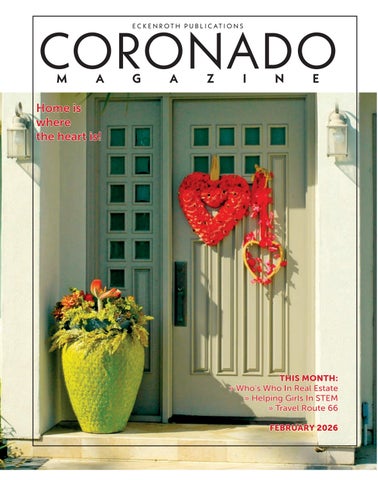
CORONADO Magazine - February 2026

Page 1


BUYING | SELLING | PROPERTY MANAGEMENT

Dear Shore House,

You have a way of making time slow down

Of turning mornings into rituals and evenings into memories

You remind us that luxury doesn’t need to shout that it lives in light-filled rooms, ocean air drifting through open doors, and the quiet comfort of knowing everything is taken care of You hold history with grace, pairing timeless architecture with effortless modern living

You are where families gather, traditions begin, and moments linger just a little longer. A place that feels personal, yet perfectly managed. Familiar, yet always special.

You are not just where people stay. You are where they return year after year.

XOXO, Del Coronado Realty

Residences from $2.5M

Ocean, Bay, and Resort Views

1-3 Beds/Baths

Whole-ownership, limited-use with strong income potential

Your Convenient Neighborhood Pharmacy

While we can’t go back to simpler times, living in Coronado is probably as close as you can get

Island Icon: Kyle Montague

Fifty years ago, students had a very different experience at

There’s Nothing Better than coming home ...

... and there’s no better place to come home to than Coronado.

In February we highlight those who help us bring the dream of a home-in-Coronado to life ... our local Realtors! There’s nothing better than coming home from vacation. As exciting and refreshing as traveling can be, the moment we step back into our own space brings a sense of comfort that no hotel, beach, or destination can replace.

Home has a way of wrapping us in familiarity. Even the most luxurious of trips can feel exhausting after a while, that’s why returning home feels so rewarding. Our own bed, our favorite couch, and the quiet routines we didn’t realize we missed suddenly feel priceless.

Coronado is that home for us, the things that once felt boring: coffee at the Coffee Cart, walking down Orange Avenue, or simply greeting familiar faces ... travel shows us the world, but home reminds us that Coronado is where we belong.

So join us this month for a little touch of home with the annual Coronado Flower Show, some real-life “Stranger Things” with Hattie Foote, and a little support of our furry friends with PAWS ...

.. and don’t miss the chance to get to know our Realtors a bit better.

February is also Valentine’s month, and Christine Johnson reminds us of a crazy little thing called love.

Our home is also rich with history. Joe Ditler takes us on a walk with a local Pied Piper, and Island Icon Kyle Montague talks CHS ... from 1976!

Brooke Clifford shows us how Coronado Robotics are helping our daughters thrive in STEM ... and Kris Grant takes us on the final leg of a journey along Route 66 .. all the way home to California.

Travel is a refreshing escape, but the experiences from vacation will always feel more meaningful when we return to a place that anchors us.

Coronado is where our lives continue.

Dean K. Eckenroth Jr. (still suffering

Editor & Associate Publisher

CORONADO MAGAZINE

PUBLISHER

Dean Eckenroth

publisher.eaglenews@gmail.com

ASSOCIATE PUBLISHER

Dean K. Eckenroth Jr.

editor.eaglenews@gmail.com

EDITORIAL

Alessandra Selgi-Harrigan

alessandra.eaglenews@gmail.com

Lauren Curtis

Lauren.eaglenews@gmail.com

Kel Casey

kel.eaglenews@gmail.com

Christine Johnson christine.eaglenews@gmail.com

Brooke Clifford eaglenewsbrooke@gmail.com

PHOTOGRAPHER

Hattie Foote

BUSINESS DEVELOPMENT

ADVERTISING DIRECTOR

Patricia Ross

patricia.eaglenews@gmail.com

Callie Pavia

callie.eaglenews@gmail.com

PRODUCTION

Andrew Koorey

PRINTING

Reed

DISTRIBUTION

Roberto Gamez

Copyright

All

Lift & Sculpt:

Sculpting Facial Massage

Buccal I Myofascial Massage

Detox & Glow:

Advanced Custom Facials

Lymphatic Drainage Facial Dermaplane

Renew & Restore: Stem Cell Technology

Advanced Peels

STRANGER THINGS,

REAL LIFE

“Siri play ‘Running up that Hill,’ play ‘Should I Stay, or Should I Go,’” a car full of 12-year-old girls demands from me as we are driving to volleyball practice. I was stunned; they couldn’t possibly mean the 80s songs? Alas, the whole 6th grade is very into the show Stranger Things and being introduced to the tubular jams of that rad decade. It’s not just the music they are infatuated with; it’s the way of life. The giant walkie-talkies, the clothes, the freedom. It was a simpler time, one I and I’m sure many of you long for. No social media! Imaginations and shoulder pads! While we can’t go back, I explained to the girls that living in Coronado is probably as close as you can get.

Just tonight we were making pizzas on our patio, and the doorbell rang. We opened the gate to discover nobody was there. A quick look at our Ring camera showed a gaggle of boys on bikes, ding-dong-ditching us; we could hear them hooting and howling as they took off into the sunset. Innocent, mischievous fun. Prank calls are still a favorite at sleepovers; however, egging and toilet papering homes seem to have lost popularity, thankfully. Nado Lore is an Instagram account where people submit photos from the days of yore. One of my favorite posts is a photo of a home that just got absolutely blasted by toilet paper, among other shenanigans. It’s a fun peek into another moment in time, and if you have any memories to share, you can submit them to the account!

When friends and family come to visit us in Coronado, they always comment on how it’s like traveling back in time, whether it be the Village Theater, Claytons, or the kids flying down the streets on bikes. I wonder how many communities are left in America that have the same charm and nostalgia. It is something that I cherish and appreciate as we raise our family here. A place where borrowing a cup of sugar from a neighbor is a very real occurrence. Homemade muffins on a doorstep, a helping hand to cross the street. It’s a special thing we have going on here, and when the world can feel like it is on fire, I hope we treat each other with kindness and respect. I know we preach this to our kids, but it seems some adults could use a gentle reminder. Just check Facebook, yikes!

Imagine explaining Facebook fights to people in the 80s… talk about Stranger Things!

Seeing as this is the Real Estate issue, my thoughts are for those considering a move here, what you’re really buying into isn’t just a location, but a lifestyle. There’s no way to recreate another decade, and maybe that isn’t the point. So no, Coronado isn’t the 1980s.

There’s Wi-Fi, Ring cameras, and, unfortunately, Facebook. But it is a place where community still matters, kids still roam, and neighbors still look out for one another. Turns out, what we miss about the 80s isn’t the decade, it’s the way life felt before everything needed a password. So. Many. Passwords.

The Quiet Art of Sitting Still:

Karen Dwinell and the Gift of Trust

Every day at PAWS of Coronado, amid the routines of care, cleaning, feeding, and adoption, there is a quieter ritual unfolding—one that requires no clipboard, no timetable, and no expectation of quick results. It begins when Karen Dwinell pulls up a chair.

Karen once worked formally at PAWS, but titles and schedules have long since fallen away. What remains is something far more rare: a steady, unwavering presence. Day after day, she returns— not because she has to, but because certain cats need her. The shut-down ones. The difficult ones.

The salty, frightened souls who have learned that the safest place in the world is invisibility.

Karen is a familiar, almost iconic fixture at PAWS of Coronado. She is a wealth of institutional knowledge, feline intuition, and calm reassurance for staff and volunteers alike. In a pinch, she is also an equal-opportunity cuddle buddy—perfectly content to offer comfort to a nervous dog or an attention-seeking puppy if that’s where she’s needed in the moment.

But it is with cats that her quiet work truly shines.

These are the cats who won’t come forward for visitors, who flatten themselves into corners or hide behind litter boxes, who refuse food and water because fear has closed every door inside them. They are easy to overlook. Karen never does. She will sit with a cat for as long as it takes—days, weeks—asking nothing in return. No touching. No forcing. No agenda beyond simple coexistence. Sometimes she simply reads aloud, letting the steady cadence of her voice fill the room, giving frightened cats something safe and predictable to anchor to. She understands something fundamental about cats that cannot be taught quickly: trust is not requested, it is earned.

Recently, one such cat arrived so shut down that staff were deeply concerned. The cat would not eat. Would not drink. Would not engage with the world at all. Karen began the slow work. For nearly ten days, progress meant nothing more than being able to sit in the same space without panic. That was the victory.

And then, quietly, something shifted. Food was accepted. Eye contact lingered. A body that had been

clenched in fear began to loosen its grip on survival mode. Within 30 days, that once-silent cat—who had seemed unreachable—was adopted into a home.

This is Karen’s gift: the patience, experience, and emotional fluency to meet cats exactly where they are. Cats are masters of disappearance. Unlike dogs, they do not demand attention or make their pain obvious. They retreat. They wait. And without someone like Karen, they can remain hidden far longer than they should.

At PAWS of Coronado, we do not rely heavily on cat fosters except in cases like newborn kittens. Cats, paradoxically, are often more adoptable when they are visible— when potential adopters can see their personalities emerge. A dog in foster can be leashed and shown off. A cat in a new home may hide under a bed for weeks. That’s why what happens inside our shelter matters so deeply. Karen brings cats out of their scared places and gently builds them into social, healthy, adoptable companions. Her work changes outcomes. It saves lives—not dramatically, but profoundly.

And while not everyone can give time the way Karen does, there are many ways to help. PAWS always needs cat litter, litter boxes, and toys. You can virtually foster by choosing a cat, sharing photos and updates on your social media, and helping expand our audience. You can take an interest in a specific cat and fundraise on their behalf. You can visit. You can volunteer.

PAWS of Coronado is a 501(c)(3) nonprofit, and every form of support matters. Donations help us provide in-house and external medical treatment, spay and neuter services, care for injured cats who come through our doors, and assistance with placement services that lead to permanent homes.

Karen Dwinell reminds us that sometimes the most powerful act of compassion is simply staying. Sitting still. Offering patience instead of pressure. Reading a story outloud. Offering a lap. And believing—quietly, persistently—that healing will come. Because with the right person and enough time, even the most hidden cat can learn to trust.

WHO’S WHO IN CORONADO REAL ESTATE 2026

Charles Ahern

DRE#01262309

Beth Aiello

Broker

Scott Aurich

American Dream TV Coronado Host

DRE#01775191

“Local, Experienced, and Dedicated.’”

DRE #00978974

Specializing in Coronado Real Es tate Since 1989

I have been a broker in Coronado for over 35 years, offering deep local expertise paired with the global reach of Pacific Sotheby’s International Realty. Most recently, I joined forces with Tyler Mathews to form Aurich Mathews & Associates, a boutique team within Pacific Sotheby’s International Realty focused on elevated representation and results. Whether buying or selling a beach cottage or a coastal masterpiece, it would be a privilege to represent you.

DRE#

DRE# 01994278

“Tour Homes by Boat”
Bea
DRE# 01387894 Coronado Cays Realty

Brown Je Brummitt

Bri Gomes

DRE #01917466

“ oughtful service. Trus ted guidance. Coronado focused.”

DRE #01800357

We are recognized as the top 0.5% nationw ide

Caroline Haines Kathleen Hanlon

DRE#01386879

DRE# 01377744

Katie Herrick
Rick Inghram

Vicki Inghram

DRE# 01293521

“I ’ll Make it Happen for You!”

Olga Lavalle

DRE#01724705 (619) 995.6259

Maria Garate-Lavalle

DRE#02090976 (619) 991.5073

“Your perts at e Shores.”

Shelly Klessinger

Broker Associate DRE # 01355449

“Specializing in Luxur y and Coas tal Real Es tate.”

DRE#00460840

DRE #01997577

I bring a thoughtful, client-focused approach to buying and selling real estate in Coronado and coastal San Diego. As a partner of Aurich Mathews & Associates, a boutique team within Pacific Sotheby’s International Realty, I work alongside Scott Aurich to deliver elevated representation, strategic marketing, and confident negotiation. Whether guiding buyers or sellers, we are committed to achieving exceptional results.

McKay & Associates

DRE#01876062

“Trus t - Integrit y - Relationships”

e Morabito Real Estate Group

DRE#01415017

“More than Real Es tate, A Commitment to Coronado” Samantha & Mark O’Brien

DRE#02077676

DRE#02057804

R W Scott Grimes

DRE#01192858

DRE#01391946

renee@parklifeproperties.com scott@parklifeproperties.com www.parklifeproperties.com

Mike Napolitano

BRE#00867086

“Your Coronado Real Es tate Specialis ts” Rudowicz MacCartee Group

DRE# 00200954

Gina Schnell Group
Shirley Smith

Chris Toogood DRE # 01997872 DRE # 02065457

Zulema

DRE#01420331

DRE# 01225350

DRE# 00849495 DRE# 01826683

Time to Tee Off!

Please join us for The Rotary Club of Coronado’s 30th annual Charity Golf Tournament Friday, March 13, 2026, 10:30 a.m. at the Coronado Municipal Golf Course

Grab your golf buddies to play Coronado’s beautiful course and see if you can take home bragging rights and cash prizes. You can win a $10,000 Hole-in-One prize on the 9th hole or sink a putt from 50 feet to be entered in a drawing for $10,000. You can also win prizes for closest to the flag on par threes.

While you’re having fun, you’re also supporting Rotary’s more than 60 community projects, including Camp Able, Safe Harbor Coronado, Feed the Needy and Wounded Warriors.

One player from each of the first 10 teams to register can participate in a shot to win $100,000 in a hole-in-one contest.

Registration is $250 per person which includes greens fees, a luncheon, and a golf-worthy goody bag, plus a cocktail party at the finish.

To register, go to www.coronadorotarygolf.org or use this QRcode:

2025 Real Estate Annual Report

In Southern California, February is a prime time to enjoy fresh kiwis, as they are typically in peak season during the winter months. Locally grown kiwis are often at their sweetest and juiciest this time of year, benefiting from the region’s mild winter climate. This means better flavor and better texture. Choosing fruit that yields slightly to gentle pressure and has smooth, unwrinkled skin will usually give you the best eating experience.

Kiwis are not only delicious but also highly nutritious. They are rich in vitamin C (often providing more than an orange per serving), vitamin K, fiber, and antioxidants that support immune function, digestion, and heart health. A medium kiwi is relatively low in calories but offers a good amount of dietary fiber, which can help with satiety and gut health. You can eat kiwis simply by cutting them in half and scooping out the flesh with a spoon, slicing them into fruit salads, blending them into smoothies, or using them as a topping for yogurt, oatmeal, or desserts. They can also be used in salsas over fish or chicken, added to green salads for a sweet-tart contrast, or mashed slightly into a quick, fresh sauce thanks to their naturally tenderizing enzymes.

Photo by SAMMY JOHNSON

“... embrace this crazy little thing called love”

The shortest month of the year is upon us. Twenty-eight ticks on the calendar to get everything done and make big plans for February 14th

I often reflect on the meaning of love. Does “love” require a husband, wife, or partner in your life? Maybe it’s just the things you do for those close to you that defines love in its truest form. Some of us have lost the person we love and must go on without our soulmate. Others spend months and years away from loved ones as they serve our country. Some lose love through problems that can’t be solved. Fear not, there are so many things we can do to bring love into our

lives and give it back to many who need it. Coronado Island has endless options to spread kindness. Wonderful organizations that appreciate your time to help those in need. Puppies who are looking for a new home. Children who want a mentor for guidance and understanding. Seniors who require some assistance in their daily lives. So many of these teams are highlighted in the Eagle every week informing the community how to help.

Whether you have found the love of your life, are still looking for it, or just like red and chocolates on Valentine’s Day, sit back and relax with the Valentine’s Sour and embrace this crazy little thing called LOVE.

Valentine’s Sour

INGREDIENTS

*2 ounces vodka or gin

*1 ounce lemon juice

*1 egg white

*1/2 ounce strawberry syrup (recipe below)

*4-6 raspberries

*2-3 strawberries, quartered Ice

*1/2 cup sugar

*1/2 cup water

*1 cup chopped strawberries

MIXOLOGY

In a shaker, muddle the berries and lemon juice together. Add the rest of the ingredients (NO ice) for about 20 seconds until well mixed. Now add ice and shake again for about 20 seconds. Strain into a chilled coupe or martini glass and garnish with a strawberry or raspberries.

STRAWBERRRY SIMPLE SYRUP:

Add all the ingredients into a pot and bring to a boil. Let simmer for about 20 minutes until the strawberries are soft. Do NOT mash them. Strain the syrup into a container. Can be stored in fridge for up to two weeks.

Dining

Albaca At Marriott (619) 435-3000

Amalo Brew 640 Orange Ave. (619) 537-9011

Avenue Liquor & Subs 878 Orange Ave. (619) 435-4668

Babcock & Story Bar At the Hotel Del (619) 435-6611

Balsamico Italian Kitchen 791 Palm Ave., Ste 101 , IB (858) 294-3183

Bay Books Cafe 1007 Orange Ave. (619) 435-0070

Beach & Taco Shack At the Del (619) 522-8100

Better Buzz 1305 Orange Ave (619)866-6896

Blanco 1301 Orange Ave (858) 399-4040

Bluewater Boathouse

701 Strand Way (619) 435-0155

Brigantine

1333 Orange Ave (619) 435-4166

Burger Lounge 922 Orange Ave. (619) 435-6835

Calypso Café

505 Grand Caribe Isle (619) 423-5144

Central Liquor & Deli 178 Orange Ave. (619) 435-0118

Chez Loma 1132 Loma Ave. (619) 435-0661

Clayton’s Bakery & Bistro 849 Orange Ave (619) 319-5001

Clayton’s Coffee Shop 979 Orange Ave. (619) 435-5425

Clayton’s Mexican Take Out 1107 10th St. (619) 437-8811

Cocina 35 Ferry Landing (619) 996-3035

Cold Stone Creamery Ferry Landing (619) 437-6919

Coronado Brewing Co. 170 Orange Ave. (619) 437-4452

Coronado Cays Lounge 4000 Coronado Bay Rd. (169) 424-4000

Coronado Coffee Co. Ferry Landing (619) 522-0217

Coronado Fire Staton Venue 126 Orange Ave (619) 928-2977

Coronado Tasting Room Ferry Landing (619) 534-5034

Crown Landing at Loews Bay Resort 4000 Coronado Bay Rd. (619) 424-4444

Crown Bistro 520 Orange Ave. (619) 435-3678

Culinary Kitchen Catering & Events 126 Orange Ave. (619) 798-8477

Danny’s Palm Bar & Grill 965 Orange Ave. (619) 435-3171

Dive Coronado 1417 Orange Ave (619) 605-6000

Domino’s 1330 Orange Ave. (619) 437-4241

Donut Beach 1339 Orange Ave. Ste 1

ENO Pizzeria & Wine Bar At Hotel Del (619) 522-8546

Feast and Fareway 2000 Visalia Row (619) 996-3322

Filippis 285 Palm Ave., IB (619) 754-6650

Garage Buona Forchetta 1000 C Ave. (619) 675-0079

Gelato Paradiso 918 Orange Ave. (619) 629-5343

High Tide Bottle Shop & Kitchen 933 Orange Ave. (619) 435-1380

Il Fornaio 1333 1st St. (619) 437-4911

Island Pasta 1202 Orange Ave. (619) 435-4545

www.coronadotastingroom.com www.vomfasscoronado.com

Jolie 126 Orange Ave. (619) 704-2467

KFC/Taco Bell 100 B Ave. (619) 435-2055

L'Orangerie 1100 Orange Ave (619) 571-3367

Lil’ Piggy’s BBQ Ferry Landing (619) 522-0217

Little Frenchie 1166 Orange Ave. (619) 313-6003

Check our Schedule for Live Music!

Lobster West 1033 B Ave. #102 (619) 675-0002

A place to enjoy good wine, whiskey and tequila, craft beer and charcuterie plates in a bright, friendly and relaxed atmosphere.

McP’s Irish Pub 1107 Orange Ave. (619) 435-5280

Miguelito’s 1142 Adella Ave. (619) 437-8578

619-534-5034

1201 First Street #101 Ferry Landing

www.coronadotastingroom.com www.vomfasscoronado.com

Miguel’s Cocina 1351 Orange Ave. (619) 437-4237

Mootime Creamery 1025 Orange Ave. (619) 435-2422

Nado Gelato Cafe 1017 C Ave. (619) 522-9053

Nado Republic 1007 C Ave. (619) 996-3271

Nicky Rotten’s Bar & Burger Joint 100 Orange Ave. (619) 537-0280

Night & Day Café 847 Orange Ave. (619) 435-9776

Panera

980 Orange Ave. (619) 437-4288

Parakeet Cafe 1134 Orange Ave. (619) 675-0104

Park Place Liquor & Deli 1000 Park Place (619) 435-0116

Peohe’s Ferry Landing (619) 437-4474

Roppongi

800 Seacoast Dr, IB (619) 631-4949

Rosemary Trattoria 120 Orange Ave. (619) 537-0054

Saiko Sushi 116 Orange Ave. (619) 435-0868

Sammy's Restaurant & Bar 800 Seacoast Dr., IB (619) 631-4949

Subway 1330 Orange Ave. (619) 435-8272

Swaddee Thai 1001 C Ave. (619) 435-8110

Tartine 1106 1st St. (619) 435-4323

Tavern 1310 Orange Ave. (619) 437-0611

The Henry 1031 Orange Ave. (619) 762-1022

The Little Club

132 Orange Ave. (619) 435-5885

Trident Coffee 942 Orange Ave (619) 522-4905

Villa Nueva Bakery Cafe 956 Orange Ave. (619) 435-1256

Village Pizzeria Bayside Ferry Landing (619) 437-0650

Serea at the Del (619) 522-8100

Silver Strand Exchange At Loews Resort (619) 424-4000

Spiro’s Greek Café Ferry Landing (619) 435-1225

Stake Chophouse + Bar 1309 Orange Ave. (619) 522-0077

Village Pizzeria 1206 Orange Ave. (619) 522-0449

Vom Fass Ferry Landing (619) 534-5034

Which Wich 926 Orange Ave. (619) 522-9424

Yummy Sushi 1330 Orange Ave. (619) 435-2771

Local Dining

Edith Salas (619) 905-5780 DRE #01966248

Josh Barbera (619) 957-5357 DRE #02053563

Sergio Muñoz (619) 751-3415 DRE #02211855

Anne Trombley (619) 318-6259 DRE #02168533

Ken Nagel (619) 952-4486

DRE #01946378

Yvonne Piritz (626) 390-4953

#01821777

Stacie Bales (619) 370-2467

DRE #02060775

(619) 653-0288

“POP” MILLAR “POP” MILLAR

The Pied Piper of Coronado The Pied Piper of Coronado

The owner of the candy store surprised a child stuffing his pockets with candy and chewing gum. He waited for just the right moment. The child had filled his pockets and, thinking he had gotten away with the goods, had a smile on his face of confidence at his trickery.

Meanwhile, the owner stood silently behind him, arms folded. Finally, he shook his head and said, “Now, what would Pop think, young man?”

Caught, the boy stopped mid-grab and lowered his eyes in shame. He put the candy back on the shelf one piece at a time, and walked quietly out of the store.

This was one of endless tributes to Shelby E. “Pop” Millar, juvenile officer of the Coronado Police Department, whose kindly ways had endeared him to every kid in town, and set an example that has yet to be equaled in this generation.

This photo shows Pop Millar leading his young charges down Orange Avenue to a Saturday movie matinee at the Strand Theater. Free Bros. Market can be seen in the background. Photo courtesy Coronado Public Library.

The year was 1947. Here’s what Coronado looked like then:

The population of Coronado was 6,932. There was a train and a water tower. Trolleys ran up the median strip of Orange Avenue and down Pomona and the Silver Strand. There were no traffic lights, no one-way streets, and dips in intersections indicated who should yield.

A giant dirt field sat where the Coronado Shores are today. Ferryboats carried cars and people across the bay. There was no traffic, little-to-no crime, Navy aircraft still were powered by propellers, and the city virtually shut down at 9 p.m.

Later that year the city of Coronado would react to crooner Frank Sinatra’s announcement on the Jimmie Fidler Radio Show that Pop Millar had been selected as, “The American in the News.” Jimmie Fidler was an American columnist, journalist and radio and television personality, and wrote a popular Hollywood gossip column. His radio show had a national audience, and suddenly, the entire country knew who Pop Millar was.

Locals responded with a parade down Coronado’s main street and named March 8, 1947 as “Pop Millar Day.”

Jimmie Fidler himself, known as “The Voice of America,” presented Pop with a gold watch that day.

Pop’s generosity and kindness were suddenly in front of everyone in those post-WWII years. He was featured on newsreels, heard on radio shows, and newspaper headlines proclaimed his deeds. It was a time for heroes, and Pop was ours.

Life Magazine did a feature article on Pop with five classic Life Magazine photographs. That article ran in the April 7, 1947 edition of the iconic magazine,

A smiling Pop Millar in his Coronado Police Department unit.
Photo by Tommy Lark, courtesy Coronado Public Library.
Pop, surrounded by his young fan club during a parade honoring him. Photo courtesy Coronado Public Library.

Pop,” exclaimed the signs

introducing our “Pop” to Americans from coast to coast.

Forty-five years earlier, at the age of 10, Shelby “Pop” Millar was orphaned and learned some things he would never forget. Clearly those life lessons drove his desire to work with children later in life, to the good fortune of Coronado residents.

“People just don’t appreciate how tough it is to be an orphan,” he would say. “I’ve always felt that an orphan is out of place in this world. A deputy sheriff in Louisiana years ago took me under his wing. I decided maybe I could repay him in some way, someday, even if he didn’t live long enough to know about it.”

The late Bruce Muirhead shared this document, which he cherished his entire life.

Such was the impact Pop Millar had on Coronado’s young children.

Photo courtesy Coronado Public Library.

“Here’s
decorating the Oldsmobile ushering Pop Millar down Orange Avenue on Pop Millar Day. Photo courtesy Coronado Public Library.

Millar’s love for children didn’t stop with orphans. He worked with numerous youth groups from Cub Scouts to Junior Traffic Patrol over the years, using his position to instill in children the difference between right and wrong. He was a super hero among mortal men, on a mission to do good. Just ask anyone who was here.

Pop was best remembered as “the Pied Piper of Coronado.” That name he earned for leading large groups of Coronado children down Orange Avenue every month to the Strand Theater (now Lamb’s Players Theater) for an afternoon movie matinee. That same year, 1947, the Coronado Village Theater opened, giving Pop and his “kids” a new location to enjoy those monthly movie experiences.

Can you imagine seeing all those children walking down the median strip along Orange Avenue, led by an aging police officer in full uniform? Everyone wanted to be close to Pop, so he had his hands full keeping order in the ranks.

For years Pop paid movie admission for his army of children out of his own pocket. But as the group of young moviegoers continued to grow he had to find other ways to pay for their monthly visits to the theater. He began to hold paper drives to compliment his meager salary as a juvenile police officer. Eventually parents realized this, and they began to help through donations, but not before Frank Sinatra and Jimmy Fidler discovered him.

On Pop Millar Day more than 1,800 children and adults walked along behind him in the parade waving signs such as the one attached to the handlebars of a young boy’s bike exclaiming, “Big or Small, Pop’s for All!”

A cherished award to anyone lucky enough to earn one, the Pop Millar Safety Award was indeed a proud prize. Courtesy Coronado Public Library.

His status might be likened today to a super hero. Everyone wanted to walk close to Pop in the big Oldsmobile convertible in which he rode. Parade officials tried to establish some order in the march, but children and adults began to yell, “We want Pop,” as they broke through the perimeter and huddled around the parade car in one large clump, just to bask in Pop’s glow.

And, Pop loved every minute of it.

Pop Millar is truly one of the colorful threads that make up the marvelous tapestry of Coronado’s enviable past. Coronado’s Pied Piper died November 1, 1962 but will be remembered as long as there are children in Coronado and people to write about him.

Coronado Robotics Helping Girls in STEM Thrive

Since 2015, February 11 has been recognized as a day of global celebration of women and girls in science. “From Vision to Impact: Redefining STEM by Closing the Gender Gap” is the focus for 2026, and is something the Coronado Robotics program has been excelling at since its inception.

Roberta Lenert, M. Ed. serves as the Director of CUSD Robotics and it was Lenert’s daughter, Kailani Lenert (CHS Class of 2023), who was the original driving force behind the efforts to start a FIRST (For Inspiration and Recognition of Science and Technology) Lego League Robotics team at Coronado Middle School and, later, Coronado High School. Since then, the program has seen more female student applicants each year. Currently girls now outnumber the boys in the program.

“There aren’t that many all-girls teams or female coaches in the leagues,” Roberta Lenert said of her experience as a coach of FIRST Lego League (FLL)

CMS HackHERS Madeline Ruddick, Blair Gabbard, Temperance Barnes, Tidyn Zuloaga, and Amelia Friedman at the qualifying competition last fall.
The HackHERS built bots “Indy” and “Marion” and various arm attachments to complete the archaeology-themed challenges the Robot Game portion of competitions.

and FIRST Tech Challenge (FTC) at the middle school and high school competition levels. “My goal is for girls to never feel like they don’t have a voice and aren’t a hundred percent a part of this team. They can do anything they want to do, whether that’s 3D print, code, business team, the engineering portfolio – the answer is always, ‘Yes.’”

While CUSD Robotics has helped all of its student participants grow, Lenert also described how it impacts the selfconfidence of girls, in particular. “A lot of the girls come in to the interview (we do an application and a five person panel interview process for the team) are very shy. They know they want to be a part of the program but they don’t know where they fit. They maybe haven’t had a leadership role yet or haven’t had the opportunity to be on a team yet.”

“To see them go from the first day in the lab being very unsure but wanting to be there, to leading the lab, having the confidence and leadership skills to lead their teams, to host a STEM event and connect with the City, to give presentations to the school district… it’s incredible. And every one of my girls, middle school and high school, can and will do that.

“As they progress through the program and they learn how to speak publically; never have they shied away from speaking at an event or in front of adults, leaders, and experts,” she continued. “They start asking us, ‘How can I be a better robotics student? How can I be team captain? How can I excel and have more of a leadership role? How can I get on the Dean’s List?’ And they’re asking us these questions because they have more goals and ambitions.”

One of the two all-girls teams within CUSD Robotics this year are the CMS HackHERS (Madeline Ruddick, Tidyn Zuloaga, Temperance Barnes, Amelia Friedman, and Blair Gabbard). Ruddick and Zuloaga are the Robotics veterans on the team, with Barnes, Friedman, and Gabbard as newcomers to the program.

Madeline Ruddick and Blair Gabbard prepare for their team’s Robot Game run at competition.

The HackHERS qualified for the FLL regional competition after a strong showing at their first competition this school year and being awarded first place in Core Values. Much of that success stems from the team’s dedication and collaboration wherein they are continuously strategizing how to maximize their points for the Robot Game portion of the competition. They’ve designed and built two bots, each with specialized coding and attachments to be able to accomplish missions on the playing field.

“We have our robots Marion and Indy, which will start on either side [of the field] and we have them coded for different runs,” Ruddick explained. “We’re coding everything on the mat that we can possibly code so that, if everything works 100 percent, we’ll earn the maximum points.” Runs will include challenges such as getting your robot to operate and maneuver switches or collect playing pieces and bring them back to your base.

Last

year CUSD Robotics partnered with the Navy to experience remotely operated underwater vehicles in tandem with the year’s ocean theme. Madeline Ruddick (pictured) hopes to combine her love of robotics and marine biology in the future.
The HackHERS team pose with their coaches and mentors, Ashli Fabrey, Sean Wilbur, Kaitlin Zuloaga, and Jamie Friedman.

A big part of being successful in competitions is perseverance and creativity. The HackHERS practice six days a week. They talk through new designs for attachments for their robots, how to approach a challenge, create the coding to allow the robots to achieve that outcome, and so on.

“These girls are a prime example of cooperation,” Lenert said of the team. “And our eighth graders this year are some of the most confident female engineers and coders that I’ve ever seen. They’re quick to help code at their table but they’re also quick to hop over to another table if they see someone struggling or someone who has a question, without hesitation.”

Another big component of the competition is the team’s innovation project, which this year asked students to use robotics to create a solution to challenges in the field of archaeology. The HackHERS came up with the “Centiroach 5000,” a robotic insect that can get to hard-to-access places at dig sites and provide light or other tools in such situations.

Mentors are an important part of CUSD Robotics and include coaches, CHS graduates, community members, and experts in a wide variety of fields. CHS graduate and archaeologist, Chloe Schutt, stepped in with this year’s theme to teach the students about life at dig sites for their innovation projects.

“It can go in and act as a scout, and there would be a bunch of sensors on it, like light detection and ranging and ground-penetrating radar,” seventh grader Zuloaga explained. “I think that our innovation project is really fun this year because there’s been a lot of crafting involved. We made our prototype with Styrofoam balls, trash bags, rope, and stuff like that.”

The team is using LEGO SPIKE Prime to be able to program the robot to move, and are also continuing to finesse its design as they build and test its maneuverability.

For eight grader Ruddick, that constant striving for improvement is something that’s really drawn her to

An important part of every FIRST competition is for teams to demonstrate the League’s driving philosophies throughout the season.

the coding aspect of robotics. “One reason I like coding is because there’s a lot of testing, seeing if something works and, if it doesn’t work, figuring how to go about it in a different way.”

Gabbard, a sixth grader in her first year in CUSD Robotics, has put more focus on the design of their robots.

“One of my favorite things is using all of our ideas to come up with new attachments, come up with our innovation project, and our strategy. I was also homeschooled during fifth grade and at first I was kind of terrified because I didn’t know anyone, but once we all got to know each other it got really fun and this experience has been really great.”

Friedman, who couldn’t be there when I spoke with the team, is also a sixth grader. She had been looking forward to applying to the program, following her older brother, James Friedman. “[James] was a part of Triton Tribe, our retired, award

winning CMS team that went to States twice, and he’s now on our high school FTC team, Sentinel,” Lenert explained. “So she’s watched him for years and we’ve been waiting for her to finally be old enough to try out, and she’s been amazing.”

Barnes started as a student at CMS after tryouts for CUSD Robotics had taken place last year, but joined the team this year as an eighth grader.

“I have two favorite parts,” she said. “The first one is teamwork and how all of us communicate, and just hanging out every day with each other while learning how to do all of this together. My second one is working on attachments. I love how we get to change them depending on the code, and change the code depending on the attachment.” She added that robotics really lets the team get creative and take chances through their design and engineering.

The HackHERS now enjoy getting

Kailani Lenert was the first Coronado student to graduate from the CMS and CHS programs, and was the driving force behind starting a FIRST team in Coronado.

to share their knowledge with other teams and students. The team recently held a STEM workshop at the Coronado Library to introduce elementary students to robotics and show them what they do.

They’re also helping the program evolve based on their experiences. Ruddick gave an example of how they’ve put a bigger focus on everyone learning and experiencing each element, such as coding. That helps the team communicate and work seamlessly together as they code, observe the robots’ responses, and give feedback to each other on how to adjust the coding, all in real time.

Inspiration comes from each other and combines their passions. The Centiroach 5000 was heavily inspired by Zuloaga, who loves insects and has two pet Madagascar hissing cockroaches. Now, Zuloaga has an interest in pursuing engineering as

either a way to help animals and insects or through other creative outlets such as animatronics and prop-making for films.

Last year the team’s innovation project revolved around helping to preserve coral reefs, which was right up Ruddick’s alley as she hopes to combine engineering with her interest in marine biology one day.

Being part of the Robotics team has opened up new avenues for Barnes, who loves music and is also interested in marine biology, while Gabbard wants to pursue becoming a pilot. “I just love the way that something the size of this room can go that fast,” Gabbard said.

Many of CUSD Robotic’s girls have

gone on to join other clubs and programs geared towards women in STEM. Every student that has applied for the Fleet Science Center’s BE WiSE (Better Education for Women in Science and Engineering) and UC San Diego’s EDGE (Empowerment & Development for Girls in Engineering) has been accepted, and Robotics students have started up new SWE (Society of Women Engineers) clubs at CHS and at their universities after graduating.

These programs are designed to connect girls with women who are or have had careers in the STEM fields, opportunities for exposure to STEM careers, and lifelong membership to a community of women supporting

one another.

As a program, CUSD Robotics students are also getting to lead the way as an example in this space that has, in the past, been largely male-dominated. “I think just the fact that we have an inclusive community here sets a precedent for other communities, as well –that they can include girls in all of this and it’s working out just fine (we’ve done pretty good in the last few competitions),” CHS junior and Robotics student, Grace Messner, said. “I think it sets an example and also proves to the younger girls when they come to practice that they can see us here and know that they have a future here as well.”

Anika Talavera, a CHS senior on the FTC team, agreed. “Just being able to show that at the high school, middle school, or even elementary school levels that having a sense of equality with a blend of girls and guys collaborating together is really important. It’s showing that it’s not just, ‘Oh, guys have all of these ideas and all of these strengths, and girls have all of these separate ones.’ It’s important we combine those and that we respect each other’s strengths and differences.”

“When we go to events, our girls are doing everything alongside our boys,” Lenert added. “Our girls are making a huge impact in, not only the robotics world, but the engineering world. It’s so fun to see that spark, and to see them thriving in an environment that they love, that’s open to them and supportive.

“We’re very lucky to have so many mentors and coaches who volunteer to help out, including many women who are an inspiration for our students. I think it’s so important to have those role models and we want our girls to feel like there are never any limitations. We are nine teams, one family and we support each other 100 percent to help each other thrive and find the best, most successful path forward.”

Roberta Lenert, M. Ed. serves as the Director of CUSD Robotics and has helped the program grow to nine competition teams across the high school, middle school, and elementary schools.

Kyle Montague Island Icon: Kyle Montague

Imagine slipping past a naval base fence to surf, only to return and find Marines waiting to arrest you while you’re shuffling your feet through the water, hoping a stingray doesn’t sting you. This is one of the vivid memories that Kyle Montague remembers about his senior year in high school in 1976. Fifty years ago, students had a very different experience at school; in some ways, more risk and more freedom, but in other ways, less than today. I’m an intern for the Coronado Historical Association and Coronado Public Library, working on the America250 project, a project celebrating the nation’s 250th anniversary. 2026 is the 250th anniversary of the U.S., and to learn more about how America has changed, I interviewed Kyle Montague, a CHS alumnus who graduated during America’s bicentennial in 1976.

Fifty years ago, during the Bicentennial, high school was very different, with students knowing less about national events. Kyle couldn’t recall the Bicentennial much at first, recalling that neither did his classmates. After some thought, he did remember that graduating in the Bicentennial class seemed cool back then, saying, “We thought we were pretty cool and special, you know.”

Later, he remembered seeing the Freedom Train, which traveled across America and stopped in San Diego, showcasing important documents and

Kyle also mentioned feeling relieved

revolved around dances. Kyle remembers there being a lot of dances, “Dances were very popular in ‘76.” They were held in different areas, like the multipurpose room. They also had pool dances, maybe once a month, and everybody loved them. He explained how people tried to sneak in by climbing the walls. Dances were also held in a place called The Reservation. Kyle said it was like a hangout for the kids, always having live music. Finally, Kyle mentioned there were dances in the El Cortez hotel in the summer where all high school kids would come. Kyle said, “They had two levels, and they had maybe four different bands playing in it, and you’d meet girls from other high schools, and get their number and hook up later.” Overall, Kyle said dances were really popular in people’s social lives. Dances still exist, though they’re not as common or popular with students today.

When I asked Kyle about senior traditions, he talked to me about the senior trip. At the end of the year, the students went out to the Colorado River, where they camped and stayed for the whole weekend. The Friday that everyone left, Kyle had a baseball game. The teachers and chaperones were checking everybody, so they couldn’t bring booze or other contraband. But Kyle’s team brought everything since their baseball coach, Leroy, didn’t check them after the game. Kyle said, “We brought everything. We brought the pot, we brought the booze.”

Kyle and his friends would also go surfing at Point Loma, but they had to sneak through the Naval Base to get there. On the way back, the Marines were waiting for them since they weren’t supposed to be there, so they had to walk on the sand in the water with a chance of getting stung by stingrays. Since we live on an island, surfing is still popular with students today. Of course, my friends and I don’t sneak past a fence on the naval base to do it, though.

Fifty years ago, American students were shaped by national events such as the Vietnam War, and social activities, whether it was a dance or more risky experiences like sneaking past the Naval Base. Today, students don’t have as much going on as they did back then. They aren’t shaped by a war, and yes, there are still dances, but they seem less popular than they once were. I think the biggest similarity we have is risks. Students today still like to take risks, whether

it’s trespassing on places, vaping, or doing other things they probably shouldn’t. However, it seems like they are experiencing the same going into America’s 250th anniversary as Kyle’s class did during the Bicentennial. Maybe we’ll know a bit more because of social media, but otherwise, it’s not very well known. Thanks to the America250 project, we are able to preserve these memories of being a teenager during momentous years.

Diego Ibarra, a Freshman at Coronado High School, likes to surf and hang out with friends around Coronado. The America250 Project is a special edition of the Coronado Historical Association’s Island Icons Oral History Program, in partnership with the Coronado Public Library. America250 is a once-in-a-generation oral history project to mark the 250th anniversary of the United States. Current Coronado High School students were paired with CHS graduates from the Class of 1976, who came of age during America’s 200th birthday. The goal was not just to record an interview—but to create a conversation across time, offering a rich dialogue about youth, community, and civic identity. The project allowed students to explore the similarities and differences between high school life 50 years ago and today.

MOLLY HAINES MCKAY

BROKER ASSOCIATE

619.985.2726

DRE# 01876062

MollyHainesMcKay@gmail.com

CARRIE MICKEL

SALES ASSOCIATE

619.630.3570

DRE# 01999494

CarrieMickel@bhhscal.com

LINDSEY LYONS

SALES ASSOCIATE

619.405.9208

DRE# 01993229

LindseyBLyons@gmail.com

New Tax Laws for 2026 That You Should Know

The new year brings more than resolutions and fresh starts; it also ushers in several tax changes that could affect your wallet. Whether you’re saving for retirement, funding your child’s education, or supporting your favorite charity, here are a few things you need to know about the tax landscape in 2026.

More room to save for retirement and healthcare.

There’s good news for savers: Contribution limits for retirement accounts are going up. If you’re under 50, you can now contribute up to $7,500 to an IRA, which is up from $7,000 in 2025. Those 50 and older can contribute an additional $1,000, for a total of $8,600.

The limits for 401(k), 403(b), and governmental 457(b) plans are also increasing, with workers younger than 50 able to defer up to $24,500. Visit IRS.gov and search “401k limit increases” for an article outlining the details.

Health savings account limits are rising, too.

In 2026, individual coverage increased to $4,400 and family coverage to $8,750. If you are age 55 or older and are not enrolled in Medicare, you can contribute an additional $1,000 as a catchup contribution. The start of the year is an ideal time to review your contributions and consider increasing them, even by small amounts, which can add up over time.

A catch-up rule for high earners.

If you’re 50 or older and earned more than $150,000 last year, there’s a new wrinkle in your retirement planning. You can still make catch-up contributions to your workplace retirement plan, but they must now be Roth contributions rather than traditional pre-tax contributions. This includes 401(k), 403(b) and 457(b) plans. While you won’t get an immediate tax break, Roth contributions offer tax-free income in retirement and can provide a tax-free legacy for your heirs.

Expanded benefits for 529 education plans.

Families using 529 plans to cover K-12 expenses will see the annual federal distribution limit double from $10,000 to $20,000 per student. The definition of qualifying expenses has also expanded to include curriculum, books, certain tutoring expenses, and testing fees. This change provides more flexibility for families with overfunded plans and increases options for managing education costs across multiple children or beneficiaries.

New charitable giving provisions.

The rules around charitable deductions are shifting in two directions. Taxpayers who take the standard deduction can now deduct up to $1,000 in cash donations ($2,000 for joint filers) to qualified organizations. However, those who itemize deductions face a new threshold: only charitable contributions exceeding 0.5% of adjusted gross income are now deductible. Donors may want to consider bunching strategies or using donor-advised funds to maximize their tax benefits.

Getting help.

Navigating these tax changes can be challenging, but you don’t have to go it alone. A qualified financial advisor and tax professional can help you understand how these and other changes affect your specific situation. Together, you can develop strategies to make the most of new opportunities while minimizing your tax burden.

This article was written by Edward Jones for use by your local Edward Jones Financial Advisor. Edward Jones, Member SIPC. Edward Jones, its employees, and financial advisors cannot provide tax or legal advice. You should consult your attorney or qualified tax advisor regarding your situation.

Texas to California Texas to California

The Big Texan Steak Ranch announces itself with a towering steer out front, then delivers inside where brave diners tackle the legendary steak-eating contest while the kitchen fires up rib-eyes by the dozens.

Story and photographs by KRIS

Part Two of my Route 66 journey began big—because in Texas, everything is big. Just outside Amarillo, my cousin Barbara and I stopped for dinner at the Big Texan Steak Ranch.

Here, the signature attraction isn’t just the steaks on the menu: it’s the huge steak-eating challenge: Eat an entire 72-ounce steak (4½ pounds of top sirloin) and all the sides –which include a baked potato, salad, shrimp cocktail, dinner roll and butter – within 60 minutes and it’s free.

Only about 10,000 of the 90,000 contestants have been successful. We chose not to compete, but the 10-ounce rib eye was among the best steaks I’ve tasted anywhere.

A few miles down the road, the landscape shifted from kitsch to counterculture at Cadillac Ranch. Ten Cadillacs, buried nose-first in the earth, still point skyward in silent rebellion. Installed in 1974 by the art collective Ant Farm, the cars were once pristine symbols

of American luxury, arranged to reflect the evolution of Cadillac tailfins. Today, they barely resemble the originals. Layers upon layers of spray paint—names, hearts, slogans, protests—have transformed them into a constantly changing public canvas.

The fact that you can buy spray paint right there, handed over like an invitation to participate, feels exactly right. This isn’t art you observe from a distance; it’s art you’re meant to touch, alter, and leave a piece of yourself behind on.

Crossing into New Mexico, nostalgia took the wheel.

Tucumcari appeared like a postcard from another era, glowing with vintage neon and the echo of a thousand road trips. The Blue Swallow Motel was the highlight—an icon of Route 66 hospitality. Its bright blue neon sign flickered on at dusk, and suddenly it felt like we had been swept back into the 1940s. This was a place built for motorists, lovingly preserved, where each room once had its own garage.

I got swept back in time at the

At Cadillac Ranch, visitors add their own layer of color, turning a row of half-buried Cadillacs into an ever-changing public art project.
Blue Swallow Motel, a treasured stop along Route 66 in Tucumcari.

ALBUQUERQUE: ROUTE 66’S LONGEST DOWNTOWN STRETCH

Albuquerque is home to the longest continuous stretch of Route 66 running through a downtown—along Central Avenue for mile after mile. Much of the older stretch of Central Avenue shows signs of transition, with many former storefronts still bearing covered windows, though pockets of revitalization are underway as the city works to breathe new life into historic Route 66 buildings. At the heart of downtown stands the KiMo Theatre, a 1927 Pueblo Deco landmark that has been repeatedly restored and updated and now serves as a venue for performances, films, and cultural events. Next, Central Avenue passes through Nob Hill, a lively district anchored by vintage neon signs, boutique shops, and restaurants along the old route. Nob Hill is one of Albuquerque’s most walkable historic neighborhoods and has long been a gathering place for locals and travelers alike. Not far from here at 1405 Central NE, you’ll also find the Route 66 Diner, a classic retro-style eatery built in 1997 to celebrate the Mother Road, serving hearty American breakfasts and lunches in a playful 1950s- inspired setting. Continuing past Nob Hill, Central Avenue runs straight past the University of New Mexico, where traditional adobe-style architecture meets the vibrant energy of student life, providing a unique contrast to the mid-century roadside nostalgia along the route.

I stayed at The Imperial, one of Albuquerque’s newly revitalized Route 66 motels. The property has been tastefully restored to celebrate its midcentury roots, with retro neon signage, vintage-inspired décor, and a welcoming mix of modern comforts. Beyond the rooms, the motel offers a lively indoor food hall and bar area, making it a hub for both travelers and locals. I spent an evening at the cocktail lounge, enjoying a drink while soaking in the playful retro ambiance — a mix of classic Route 66 nostalgia and contemporary energy.

Opened in 1952 on Central Avenue, the Dog House Drive-in continues to serve its signature chili dogs: messy, hearty and delicious.

Neon lights beckon outside while a juicy burger, thick milkshake and fries rewarded this traveler inside the Route 66 Diner.

The atmosphere perfectly captured the spirit of the Mother Road: a place where history, design, and community converge.

I also popped into the El Vado Motel, a beautifully refurbished classic that perfectly balances old and new. Vintage touches—original signage, retro colors, and midcentury details—gave it soul, while the modern updates made it effortlessly comfortable. A lively food court buzzed with conversation and the clink of plates, turning the motel into a gathering place rather than just a place to sleep. It’s right across the street from some of Albuquerque’s biggest attractions: the ABQ BioPark Aquarium and the ABQ BioPark Botanic Garden.

ALBUQUERQUE… BEYOND

THE MOTHER ROAD

Albuquerque has much to offer beyond the Mother Road and I chose to stay an extra day to explore further.

About a mile and a half north of Central Avenue, Old Town Plaza is an easy side trip that’s well worth the time. Founded in 1706, it’s the oldest part of Albuquerque and is laid out in a traditional Spanish colonial style. The central plaza is surrounded by low adobe buildings, galleries, and small shops, with San Felipe de Neri Church anchoring one side of the square. The plaza features shaded walkways, and a compact, walkable layout. Dozens of small shops sell Native American jewelry, Southwestern art, and local crafts, and there are multiple long-standing New Mexican restaurants clustered around the plaza.

One of the most unforgettable detours is the Sandia Peak Tramway. The tram ascends from the edge of the city up the steep face of the Sandia Mountains, climbing over 4,000 feet in less than three miles. It’s one of the longest aerial tramways in the world, and the ride itself is a slow acknowledgment of how dramatically the land changes here. As the car rises, Albuquerque spreads out below in a soft grid of adobe tones, while the Rio

Grande cuts a green ribbon through the valley. At the top, the air is cooler, and a pine scent greets you. From the observation deck, the view stretches for miles and miles and Route 66 is reduced to one small thread in a much bigger landscape. Back at ground level, another worthy stop adds a different kind of altitude: The Anderson-Abruzzo Albuquerque International Balloon Museum celebrates the city’s deep connection to hot air ballooning. Albuquerque is known worldwide for its

ideal ballooning conditions, and each October hosts the largest balloon festival in the world. The museum, located near Balloon Fiesta Park, tells that story with hands-on exhibits, fullsize balloon baskets, and immersive displays that explain how ballooning works, why it thrives here, and how it evolved from experimental flight to global spectacle. Interactive simulators let you experience the sensation of lifting off, while exhibits trace the science, artistry, and daring behind lighter-than-air flight.

From my descending Sandia tram, I caught the other tram ascending, with Albuquerque stretching out below.
The Old Town Plaza gazebo (above) anchors Albuquerque’s historic square surrounded by shops offering vibrant New Mexican arts and crafts (below, left).

GALLOPING INTO GALLUP AND ONTO ARIZONA

Gallup, New Mexico is a town often called the “Heart of Indian Country.” Set against dramatic sandstone cliffs and mesas, Gallup has been a trading and transportation hub for centuries. Its historic downtown along Route 66/Coal Avenue is part of the Gallup Commercial Historic District, featuring early 20th-century brick and adobe buildings, vintage theaters, and long-standing trading posts. The landmark El Rancho Hotel, built in 1936, is famous for hosting Hollywood stars filming Westerns in the area. At the Gallup Cultural Center, located in a restored railway building, travelers can learn about Navajo Code Talkers, Southwestern art, and local history.

As you head west into Arizona, travelers encounter the Painted Desert, a stunning expanse of colorful badlands. Even without entering Petrified Forest National Park, it’s easy to capture the dramatic mesas and layered cliffs from the highway or roadside pullouts.

The Painted Desert’s vibrant colors create a striking contrast to the flat, open desert plains that dominate much of the journey.

Next comes Holbrook, a small town that retains the character of classic Route 66 travel. Historic motels, diners, and neon signs line the main street, offering a glimpse of the mid-20th-century road trip experience. Holbrook is a convenient

stop for food, gas, and souvenirs, with a small-town atmosphere that has endured despite changes in travel patterns over the decades. Its location on the high desert makes it a natural waypoint for travelers heading further west. Holbrook is also home to several classic motels with vintage neon, like the Wigwam Motel, where guests can sleep in concrete teepees—a playful nod to roadside Americana. While I didn’t stop at this Wigwam, I did head to San Bernardino’s Wigwam, a sister property built in the same concrete teepee motif. (I thought both were a little weird; I would much have preferred the real thing.)

The Painted Desert glows in rust, pinks and lavender hues, sprawling just off historic Route 66 near Holbrook, Arizona.
Just off I-40 in the little community of Allentown, near historic Route 66 east of Holbrook, Indian City’s exterior welcomes motorists while inside shelves brim with handcrafted Native American arts and crafts, particularly jewelry, rugs and pottery.

STAND ON A CORNER IN WINSLOW AND THEN TOUR LA POSADA

Traveling west into Arizona, one of the first iconic stops is Winslow, a small city forever linked to American pop culture through the Eagles’ classic “Take It Easy.” The song immortalized a line about “standing on a corner in Winslow, Arizona,” and today, Standin’ on the Corner Park marks that exact spot. The park features a life-sized bronze statue of a man with a guitar (Glenn Frey of the Eagles), murals depicting 1970’s downtown Winslow, and there is usually a flat-bed Ford parked alongside. This corner has become a pilgrimage site for Route 66 enthusiasts, celebrating both the song and the town’s historic role as a stop on America’s Main Street. Souvenir stores flank the opposite sides of the intersection.

But what I really enjoyed discovering in Winslow was the La Posada Hotel, built in 1929 by the famed railroad magnate Fred Harvey. Designed by Mary Colter, the architect behind many of the Fred Harvey Company’s most iconic Southwestern buildings and the El Tovar Hotel at the Grand Canyon, La Posada combines Mission Revival and Spanish Colonial styles with a distinctive blend of art, craftsmanship, and regional materials.

The property had fallen into disrepair after decades of decline, but in the late 1990s, Allan Affeldt, a restaurateur and preservationist, purchased and meticulously renovated La Posada. Affeldt restored the guest rooms, public spaces, and gardens, reviving the hotel as a fully functioning boutique property while preserving its historic charm.

A centerpiece of the renovation

is the original Harvey House dining room, where guests can now enjoy meals surrounded by the hotel’s original Mission-style details, polished wood, and historic furnishings. Today, La Posada is more than a place to stay—it’s a living museum, showcasing Mary Colter’s artistry, early 20thcentury Southwestern design, and the rich history of the Fred Harvey Company.

Route 66 intersects Winslow, Arizona at the Standin’ on the Corner Park, where a sculpture pays tribute to the late Glenn Frey of the Eagles.
Arched hallways and vibrant gardens highlight the historic architecture at La Posada Hotel, which has been lovingly restored.

ROUTE 66’S HIGH POINT: FLAGSTAFF

I’ve traveled through Flagstaff at the foot of the San Francisco Peaks a number of times, and on one visit during my RVing days, stayed a few nights at a KOA campground on the edge of the largest ponderosa pine forest in the world. It was a cool respite on a hot summer day. But do beware if you’re traveling Route 66 in the winter: Flagstaff sits at 6,909 feet in elevation, so check road conditions for snow and ice.

As Barbara and I made our Route 66 journey west into Flagstaff, we stopped into the Museum Club, a nightclub on the eastern outskirts of town that has been swinging to live music since the 1940s. Inside, the walls hum with history, from old concert photos to neon signs. Alas, we were there during the afternoon hours, so the joint was not yet jumping. But I will definitely take in a concert the next time I’m in Flagstaff and will most likely stay downtown at Hotel Monte Vista, which opened Jan. 1, 1927; the 73-room motel was specifically built to handle the increase in motorists that came with the opening of Route 66 the previous year. It’s now listed on the National Register of Historic Places.

In the late afternoon, I popped into the Flagstaff Visitor Center, housed in the historic train depot right on the Mother Road. Built in 1926 by the Atchison, Topeka & Santa Fe Railway, the depot retains its classic railroad architecture while offering maps, exhibits, and visitor information. The tracks outside are still active, with freight trains ambling through each day and the Amtrak Southwest Chief stopping daily at the station, keeping Flagstaff’s rail history alive. Hmmm… maybe I should take the train here on my next visit?

From its log-built exterior to its lived-in interior, the circa-1931 Museum Club in Flagstaff reflects nearly a century as an ever-popular dance hall and roadhouse on the Mother Road.

WILLIAMS, ARIZONA: ROUTE 66 CHARM + GRAND CANYON GATEWAY

Heading west along Route 66 from Flagstaff, our next stop was Williams, a small town often called the “Gateway to the Grand Canyon.” This was one of my favorite stops on the route, filled with colorful souvenir stores, antique shops, and diners decked out in neon signage, all designed to evoke the nostalgia of the Mother Road. Several gas stations have been refurbished to resemble their historic counterparts, offering a fun glimpse into how road trips once looked and felt in the 1940s and ’50s.

Williams is also the boarding town for the Grand Canyon Railway, a historic line that takes passengers on a scenic ride from the town straight to the South Rim of the Grand Canyon. This vintage train journey, complete with old-fashioned locomotives and period-themed entertainment, provides a charming and convenient way to experience one of America’s most iconic natural landmarks without the hassle of driving the full route. For travelers planning to visit the Grand Canyon, Williams is an ideal overnight stop. You can explore the town’s

shops and eateries in the evening, then take the railway or a short drive the next morning to the park.

If your goal is simply to see the Grand Canyon in a day, it’s definitely possible from Williams. The South Rim is about an hour-and-a-half drive each way, or about two hours by train. While a day trip won’t allow for extensive hiking or backcountry

exploration, it’s enough to enjoy the main viewpoints, walk along the rim trails, and take in the breathtaking vistas that make the canyon so famous. Many visitors choose this option if they’re on a tight schedule or want to combine a Route 66 road trip with a glimpse of the Grand Canyon’s grandeur.

From old pumps to classic signs and souvenirs, the Route 66 Museum and Gift Shop showcases the heritage of the Mother Road in Williams.
Bold Route 66 shields mark Addicted to 66 Deals in Williams, a lively stop for Mother Road souvenirs.

SELIGMAN… PLANTING THE SEEDS FOR ROUTE 66’S

Further west along the desert highway lies Seligman, a tiny town that embodies the story of Route 66’s revival. By the late 20th century, Seligman had been nearly abandoned when Interstate 40 bypassed it, leaving once-bustling motels, diners, and service stations quiet and shuttered. The town’s fortunes changed thanks to Angel Delgadillo, a local barber who recognized the historical and cultural importance of the Mother Road. In the 1980s, Delgadillo founded the Historic Route 66 Association of Arizona and began advocating for tourism along the old highway. His efforts sparked the modern Route 66 renaissance, and today, Seligman is a hub for travelers seeking retro Americana. Streets are lined with colorful souvenir shops, neon signs, classic diners, and restored motels, offering visitors an authentic glimpse into the small-town charm that once characterized the highway.

Seligman also captures the playful, quirky spirit of Route 66. Tourists can take photos in front of vintage cars, shop for Route 66 memorabilia, and enjoy meals in diners that still serve classic American fare, echoing the road’s mid-20th-century heyday. The town’s revival is a testament to the dedication of locals like Delgadillo, who preserved the highway’s legacy and reminded the world that Route 66 is more than a road—it’s a cultural treasure.

At Angel & Vilma’s Gift Shop in Seligman, the spirit of Route 66 lives on through Angel Delgadillo, the local barber whose passion helped preserve the Mother Road for future travelers.
The Roadkill Café in Seligman leans into Route 66 humor, serving hearty comfort food with a wink.
Seligman’s welcome sign nods to the town’s role as inspiration for Disney-Pixar’s 2006 animated film, Cars, featuring two of the film’s iconic vehicles.

OATMAN: WHERE GOLD-RUSH HISTORY WALKS THE TOWN ON FOUR HOOVES

Nestled in the rugged Black Mountains of northwestern Arizona, Oatman is one of the most unusual stops along Historic Route 66. The drive to Oatman is an adventure in itself, especially approaching from Seligman, about 120 miles to the east. The road winds through desert plains, rocky outcrops and the increasingly steep inclines of the Black Mountains. I found myself navigating sharp switchbacks and narrow canyons, with the occasional Joshua tree on the desert landscape. Arriving in Oatman felt like a step back in time. The town’s main street is lined with rustic wooden facades that evoke the Old West. The air carries a faint scene of sagebrush and dust – was this once a movie set? No, Oatman began as a gold mining settlement in the early 20th century. Its origins trace to 1915, when prospector Ed Oatman discovered rich gold veins in the Black Mountains. By the 1920s, Oatman had grown into a bustling mining town of 3,500 residents, numerous businesses and its own school. Mining declined sharply during the Great Depression and today only small-scale claims still exist in the local mountains.

The town’s most famous residents are its wild burros. These friendly, free-roaming donkeys are the descendants of pack animals used by the early miners. They wander Oatman’s streets freely, greeting visitors not only on the roadways but also on the raised wooden sidewalks. Visitors are encouraged to feed the burros carrots and apples that can be purchased from local vendors. One of Oatman’s most curious landmarks is the Oatman Hotel Restaurant whose walls and ceilings are covered in dollar bills. The tradition reportedly began decades ago when a miner tipped a waitress by tacking a bill to the wall. How rude!

Oatman’s historic buildings line the old mining town’s street, where free-roaming burros are part of everyday life.

CALIFORNIA: HERE I COME, RIGHT BACK WHERE I STARTED FROM...

Continuing west, I passed through Needles without stopping, and then reached Barstow, which today functions more as a modern travel hub than a vintage Route 66 town. Much of the area around the highway is dominated by fast food outlets, chain motels, and traveler services rather than preserved midcentury roadside character. That said, Barstow still offers a couple of worthwhile stops for history and rail fans. The historic Harvey House Railroad Depot, originally built in 1911 as Casa del Desierto, now houses the Western America Railroad Museum, a nonprofit museum dedicated to railroading history in the Pacific Southwest. Its campus includes outdoor displays of locomotives and cabooses that visitors can view up close. Inside, there are exhibits of uniforms, tools,

timetables, and railroad memorabilia documenting the region’s rail heritage. Admission is free.

In San Bernardino, you’ll find a classic piece of Americana: the site of the first McDonald’s, which opened in 1940 and helped launch one of the world’s most famous fast food franchises. The building, which frankly has seen better days, is now a privately owned small Route 66 museum. San Bernardino is also home to the Wigwam Motel, one of the classic examples of “novelty architecture” designed to catch travelers’ attention during the highway’s heyday.

Route 66 continues west through Pasadena, where wider boulevards and early 20th century architecture hint at the highway’s integration into Southern California’s

urban landscape. Historic signage and older commercial buildings recall an era before freeways dominated travel.

Finally, the Mother Road reaches its official western terminus at the intersection of Lincoln Boulevard and Olympic Boulevard in Santa Monica, just a block from the Santa Monica Pier. The pier — with its rides, restaurants, and Pacific Ocean views — marks the iconic finish line of the journey that began thousands of miles away in Chicago, a fitting and nostalgic endpoint to a classic American road trip.

And guess what? It was nearly as windy there at the finish line as it was back in Chicago.

Another bad hair day.

Route 66 rolls through Barstow before reaching San Bernardino, home to the Original McDonald’s Site and Museum, built on the location of the first McDonald’s restaurant, and the nearby Wigwam Motel, where concrete teepees offer one of the Mother Road’s most iconic overnight stays.
I made it to the End of the Trail on the Santa Monica Pier!

When You Go...

State Tourism & Route 66 site

Texas

www.visitamarillo.com www.route66oftexas.com

New Mexico

wwww.visitalbuquerque.org ww.rt66nm.org

TexAs

Amarillo

Arizona

www.visitarizona.org www.flagstaffarizona.org www.historic66az.com

Recommended Hotels

Big Texan Motel www.bigtexan.com/motel

Route 66 Inn www.route66innamarillo.com

new MexiCo

Tucumcari

Blue Swallow Motel

Beloved 1939 motor court www.blueswallowmotel.com

Motel Safari www.themotelsafari.com

Albuquerque

The Imperial

It’s where I stayed; great retro vibe. www.theimperialabq.com

El Vado

Vintage Route 66 landmark www.elvadoabq.com

Gallup

Historic El Rancho Hotel

I stayed there long ago; movie stars haunt the halls. www.elranchohotelgallup.com

ArizonA

Winslow

La Posada Hotel

Beautifully restored property; be sure to dine in the former Harvey House restaurant, now The Turquoise Room. www.laposada.org

Williams

The Historic Grand Canyon Hotel www.thegrandcanyonhotel.com

California

www.visitcalifornia.com www.route66ca.org

ArizonA cont.

Grand Canyon Railway Hotel Elegant and historic, steps from downtown. www.thetrain.com (then click on hotel name)

The Lodge on Route 66 www.thelodgeroute66.com

Flagstaff

Americana Motor Hotel Flagstaff www.americanamotorhotel.xcom

Hotel Monte Vista

Historic downtown hotel near Route 66 www.hotelmontevista.com

Seligman

Aztec Motel and Gift Shop www.theaztecmotel.com

The Postcard Motel www.thepostcardmotel.com

CAliforniA

Pasadena

Two hotels in the heart of Old Pasadena and close to Colorado Boulevard (Old Route 66):

Hotel Dena

Stylish boutique property www.marriott.com

AC Hotel Pasadena

Sleek, European, restaurant onsite www.marriott.com

Santa Monica

You’re so close to home, but if you want to celebrate the end of the trail, I recommend a stay at the Regent Santa Monica Beach (formerly Loews Santa Monica Beach Hotel), about three-tenths of a mile south of the Santa Monica pier.

Regent Santa Monica Beach www.ihg.com

(Then enter Regent Santa Monica)

La Posada Hotel
El Vado Motel
The Imperial

A R B R onnection

tio I B h ld l

SAFE HARBOR CORONADO INITIATIVE

ecause no one should feel alone.

Scott Aurich

619.987.9797

AurichMathews.com

Scott@AurichMathews.com

DRE #00978974

Tyler Mathews

619.992.0808

AurichMathews.com

Tyler@AurichMathews.com

DRE #01997577

Elyse Rugee

619-417-6640

Director of Marketing

elyse@aurichmathews.com

DRE #02127634

Shelly Klessinger (619) 519-3925

shellyklessinger@gmail.com

DRE#01355449

Beth Aiello (619) 300-3577

realtybybeth@gmail.com realtybybeth.com

DRE#01775191

Mariane Abbott (619) 301-2452

marianeabbott@yahoo.com

DRE#01438122

Lorena Saenz-Ruiz (619) 252-0828

lorena92118@gmail.com

DRE #02102063

Luna Dominguez (619) 319-1212

luna@sellingsandiego.com

DRE #02245063

Chris Torres (619) 517-0474

thechristorres@gmail.com

DRE #02250988

AURICHMATHEWS.COM

Pacific Sotheby’s International Realty 1200 Orange Avenue, Coronado 92118

Charles Ahern

cahern@bhhscal.com

DRE#01262309

Berkshire Hathaway

HomeServices CA Properties (619) 823-6220

Jaime Bea (619) 357-5581

jaimebea.ccr@gmail.com

DRE#01387894

Coronado Cays Realty

Whitney Benzian

619-261-5374

whitney@whitneybenzian.com

DRE#01890260

Douglas Elliman

Jeff Brummitt

619-208-1342

JB@JeffBrummitt.com

DRE#00663912

Islander Realty

Fran Carrigan (619) 852-3898

francescarrigan2@gmail.com

DRE#01017971

Berkshire Hathaway HomeServices CA Properties

Charlotte Rudowicz (619) 865-0794

DRE#01435710

Frances MacCartee (619) 312-7466

DRE#0200954

Berkshire Hathaway HomeServices CA Properties

Jan Clements (619) 806-7052

Jan@JanClements.com

DRE#01120956

Lennie Clements (619) 894-0033

LennieClements@yahoo.com

DRE#01864061

Chris Clements (619) 203-8538

Christopher.L.Clements@gmail.com

DRE#01877934

ClementsGroupRE.com

Compass Real Estate

Lisa Storey

Sales & Rentals

Lisa@CoronadoPremier Properties.com

DRE#01185272

Herlinda Sandoval-Ryan (619) 917-8888

Hablo Español

Herlinda@CoronadoPremierProperties.com

DRE#0120853

Kina Fowler (619) 823-6725

Sales & Rentals

Kina@CoronadoPremier Properties.com

DRE#01991990

Tazzie Treadwell (619) 888-6401

Sales & Rentals

Tazzie@CoronadoPremier Properties.com

DRE# 02022372

CoronadoPremierProperties.com

CoronadoRentals.com Hablamos Español (619) 997-3112

Coronado Premier Properties

Stacy Bell

Begin (619) 200-9184

DRE#02014995

StacyBegin619@gmail.com

Felicia Bell (619) 920-9124

DRE#00429681

FeliciaFBell@gmail.com

www.Shorelifeluxury.com

Coronado Shores Company

Myssie McCann (619) 435-6238

myssie@coronadoshoresco.com

DRE#02145422

Martha Kuenhold (619) 987-7725

mkuenhold@gmail.com

DRE#01369875

CoronadoShoresCo.com

Coronado Shores Company

Ara Koubeserian Ryan Koubeserian

(619) 339-9736 (619) 339-2383

arakoubeserian yahoo.com

DRE#0045410 ryankoubeserian@yahoo.com

DRE#01738738 Coronado Shores Company

Adrienne Dente

adriennedd@aol.com

DRE#00932112

Berkshire Hathaway HomeServices CA Properties (619) 850-2880

(619) 573-8350

Monique Fuzet (619) 994-4453

fuzetpmonique@gmail.com

DRE#00949513

HomeServices CA Properties

Ruth Ann Fisher (619) 733-4100

rfisher@delcoronadorealty.com

DRE#01909797

Broker

Stephanie Basden (619) 708-6768

stephanie@delcoronadorealty.com

DRE#01783387

Broker Associate

Cassandra Goldberg (619) 820-8477

cassandra@delcoronadorealty.com

DRE#02100680

Realtor

Nellie Harris-Ritter (619) 540-0111

nellie@delcoronadorealty.com

DRE#02077055

Realtor

delcoronadorealty.com

Del Coronado Realty

DRE#01274657

Fives Pacific Sotheby’s International Realty (619) 813-7193 justgl@coronadobeach.com

Apua Garbutt (619) 372-2777

apuareagent@gmail.com

DRE#01859903

eXp Realty

(619)

Tina Gavzie (619) 778-0955

tinagav@aol.com

MovetoCoronado.com

DRE#01205962

Compass Real Estate

Caroline Haines

(619) 435-5200

chaines@bhhscal.com

www.sellcoronadorealestate.com

DRE# 00953131

Berkshire Hathaway HomeServices CA Properties

Kathleen K. Hanlon

(619) 339-6536

Mobile

kathleen.hanlon@yahoo.com

DRE#01386879

Berkshire Hathaway HomeServices CA Properties

kate@katieherrickgroup.com

www.ktherrick.com

DRE#01800357

Compass Real Estate

jelassaad@cbwhomes.com

DRE#01937427 Katie Herrick (619) 865-2085

Julia M. Elassaad Coldwell Banker

gina.falletta@elliman.com

lisa.poli@elliman.com

thefallettagroup.com (619) 987-2297 Lisa Falletta

Francine Howard (619) 302-0234

francinehowardrealtor@gmail.com

DRE#01802654

California Outdoor Properties

Vicki Inghram (619) 204-3400

BestofCoronado.com

DRE#01293521

Richard Inghram (619) 301-7766

ringhram@gmail.com

DRE#01377744

Compass Real Estate

The Koop Group (619) 435-8722

Kathy Koop (619) 985-8722

DRE#00460840

Karrie Koop Gilby (619) 857-7665

DRE#01465419

Allison Koop Rice (619) 490-9049

DRE#01818903

www.KathyKoop.com

Berkshire Hathaway HomeServices CA Properties

Maryellen McMahon

Nancy Parrett (619) 368-1898

Nancyparrett@sd-realtor.com

DRE#01256239

Karen Lee (619) 861-4133

DRE# 00962910

Willis Allen Real Estate karenlee.realtor@gmail.com

Kari Lyons

karisellscoastal.com

kari@karisellscoastal.com

DRE#01475331

Park Life | Compass (619) 884-4193

maryellen.mcmahon@elliman.com maryellenmcmahon.elliman.com

DRE#01992431

Douglas Elliman (619) 252-4778

Dino Morabito (619) 987-3066

Dino@TheMorabitoGroup.com

DRE#01415017

MollyHainesMcKay@gmail.com

DRE#01999494

lindseyblyons@gmail.com

DRE# 01993229

Ed Noonan

(619) 252-1232 enoonan12@aol.com

CoronadoCays LuxuryHomes.com

DRE#00993300

Noonan Properties

736-2541

michael.oliva@exprealty.com DRE# 01758213 www.OrdersAndOpportunities.com eXp Realty

Cheryl Morabito (619) 987-6678

Cheryl@TheMorabitoGroup.com

DRE#01183389

Karen Hust (619) 838-7021

karen@themorabitogroup.com

DRE#01708516

(619) 518-7501 Renee Wilson Scott

(619) 847-4282

Renee@parklifeproperties.com Scott@parklifeproperties.com

DRE #01192858

DRE #01391946

www.parklifeproperties.com

Edith Salas (619) 905-5780

edith@salasproperties.com

DRE#01966248

Evan Piritz (619) 600-7817

evan@salasproperties.com

DRE#02022374

Anne Trombley (619) 318-6259

anne@salasproperties.com

DRE#02168533

Roberto Cornejo (619) 548-6306

roberto@salasproperties.com

DRE#01204327

Josh Barbera (619) 957-5357

josh@salasproperties.com

DRE#02053563

Stacie Bales (619) 370-2467

stacie@salasproperties.com

DRE#02060775

Carol Stanford (619) 987-8766

carol@carolstanford.com

BuyCoronado.com

DRE#01390529

eXp Realty

Suzanne Fahy (619) 841-5870

seashorepropertiescoronado@gmail.com

DRE#01454055

Lisa Davenport

Heather Vidal (619) 571-1700

heather@salasproperties.com

DRE#02150791

Yvonne Piritz (626) 390-4953

yvonne@salasproperties.com

DRE#01821777

Greg Roberts (858) 731-6101

greg@salasproperties.com

DRE#02191947

Ken Nagel (619) 952-4486

ken@salasproperties.com

DRE#01946378

Jeanne Schnese (619) 346-8476

DRE# 02182699

jeanne.schnese@compass.com

Compass Real Estate

Sergio Munoz (619) 751-3415

sergio@salasproperties.com

DRE#02211855

Minerva Alvarez (619) 653-0288

minerva@salasproperties.com

DRE#02195687

lisadavenport007@gmail.com

DRE#01422713 (619) 261-5963

Hope Baker

DRE#02030667 (480) 221-0516

hopebake4@aol.com

Seashore Properties

Olga

(619) 778-8011

Olgaminvielle1@gmail.com OlgaCoronado.com

DRE#01105050 Compass

DRE#01882388

DRE#: 01420331

ZulemaM@bhhscal.com

DRE#01897051

Better Homes & Gardens Real Estate Napolitano & Associates Tom Tilford (619) 300-2218 tom@tomtilfordre.com Barbara Wamhoff (619) 517-8880

barbarawamhoff@gmail.com

The Original Daughter

Book Corner

WHAT PEOPLE ARE READING THIS MONTH

Before Arin, Genevieve Yang was an only child. Living with her parents and grandmother in a single-room flat in working-class Singapore, Genevieve is saddled with an unexpected sibling when Arin appears, the shameful legacy of a grandfather long believed to be dead. As the girls grow closer, they must navigate the intensity of life in a brutally competitive place where the insistence on achievement demands constant sacrifice. The sisters become inextricably bound as they spurn outside friendships, leisure, and any semblance of a social life in pursuit of academic perfection and passage to a better future.

When a stinging betrayal violently estranges the sisters, Genevieve must weigh the value of ambition versus familial love, home versus the outside world, and allegiance to herself versus allegiance to the people who made her who she is. In this story of a family and its contention with the roiling changes of our rapidly modernizing, winner-take-all world, The Original Daughter is a major literary debut, imbued with equal parts emotional clarity and searing social insight.

Cudi: The Memoir

Cudi: The Memoir is Scott Mescudi’s most personal work yet. Across a trailblazing career, he’s turned pain into poetry with anthems like “Day ’N’ Nite,” “Pursuit of Happiness,” and “Mr. Rager.” His music gave voice to the unheard and hope to the unseen. But while he was ascending to cultural dominance, he was quietly unraveling.

Written during a time of deep self-discovery, Cudi is a story of survival through depression, addiction, isolation, and doubt. In his own words, Scott charts the journey back to himself, offering hard-earned lessons on vulnerability, reinvention, and the courage to keep going.

The Lost City of the Monkey God: A True Story

Since the days of conquistador Hernán Cortés, rumors have circulated about a lost city of immense wealth hidden somewhere in the Honduran interior, called the White City or the Lost City of the Monkey God. Indigenous tribes speak of ancestors who fled there to escape the Spanish invaders, and they warn that anyone who enters this sacred city will fall ill and die. In 1940, swashbuckling journalist Theodore Morde returned from the rainforest with hundreds of artifacts and an electrifying story of having found the Lost City of the Monkey God, but then committed suicide without revealing its location.

Three-quarters of a century later, bestselling author Doug Preston joined a team of scientists on a groundbreaking new quest. In 2012, he climbed aboard a rickety, single-engine plane carrying the machine that would change everything: lidar, a highly advanced, classified technology that could map the terrain under the densest rainforest canopy. In an unexplored valley ringed by steep mountains, that flight revealed the unmistakable image of a sprawling metropolis, tantalizing evidence of not just an undiscovered city but an enigmatic, lost civilization.

The Wise Man’s Fear

Discover #1 New York Times-bestselling Patrick Rothfuss’ epic fantasy series, The Kingkiller Chronicle.

“I just love the world of Patrick Rothfuss.” -Lin-Manuel Miranda

“He’s bloody good, this Rothfuss guy.” -George R. R. Martin

“Rothfuss has real talent.” -Terry Brooks

Day two: the wise man’s fear… “There are three things all wise men fear: the sea in storm, a night with no moon, and the anger of a gentle man.” My name is Kvothe. You may have heard of me.

So begins a tale told from his own point of view - a story unequaled in fantasy literature. Now in The Wise Man’s Fear, Day Two of The Kingkiller Chronicle, Kvothe takes his first steps on the path of the hero and learns how difficult life can be when a man becomes a legend in his own time.

Turn static files into dynamic content formats.

Create a flipbook
CORONADO Magazine - February 2026 by Coronado Magazine - Issuu