The Corne¬ Daily Sun
By DYLAN McDEVITT Sun Sports Editor
David Eldredge ’81, the winningest head coach in Cornell Athletics history who has led the men’s and women’s polo teams to 15 national championships, has been placed on leave by Cornell, according to an assistant polo coach and two other people familiar with the decision.
Steve Kraus, the volunteer coach of the first-year polo team and a clinical sciences lecturer, said in an email that Eldredge is on leave and that the timing of the leave is bad for the team.
“We fully support David and are not happy with how the Athletic Dept. has handled this situation, especially the timing, at a critical time
of our beginning of our season,” Kraus said, adding that he expects to be able to share more next week.
“There are some parts of this issue that [need] to be kept private for another week while David is on leave,” he said.

Kraus said Cornell has tapped Anthony Condo, a laboratory manager at the Center for Materials Research and a support specialist in chemistry and chemical biology, to serve as interim coach. Condo did not respond to a request for comment on Wednesday morning.
and Wilde, who are married and are close to the polo program, said they spoke with Eldredge earlier this week about Cornell’s action.
“[We] are not happy with how the Athletic Dept. has handled this situation, especially the timing.”
Ann Michel ’82, one of Eldredge’s former teammates, and Phil Wilde ’73 told The Sun that Cornell Athletics recently directed the decorated coach to retire before a certain date. Michel
By MARYAM ZAFAR
Staff Writer
Student organizations should now anticipate accounting for security fees in their Student Assembly Funding Committee budgets, in accordance with new event registration changes implemented July 1. A new cost-estimation chart
categorizes events by level of security needed and by the venue size.
Security fees are determined on a case-bycase basis by Cornell Police, Office of Risk Management and Insurance — which reports to the division of environmental health and safety — and the Event Management Planning Team, which is overseen by the Campus Activities Office.
Security estimates are “based on myriad factors,” according to the website, including physical

By
Morrill Hall is currently undergoing a roof replacement that began in
mid-June and is slated to be completed by December. The 2-million-dollar construction project will primarily improve the drainage system of the 150-year-old building, according to Andrew Magre, associate vice president of engineering and project management.
The roof replacement will help prevent water leakage down from the roof to the ground-level See MORRILL page 5
Wilde said Eldredge told him he’s “being forced to retire” and that Cornell Athletics has him “over a barrel.” Wilde also added that Eldredge described himself as a “thorn in the University’s side.” Eldredge is still listed as the head coach on the University website.
Steve Kraus
Wilde said Eldredge has not been allowed at the
By MIGUEL SOTO Sun Staff Writer
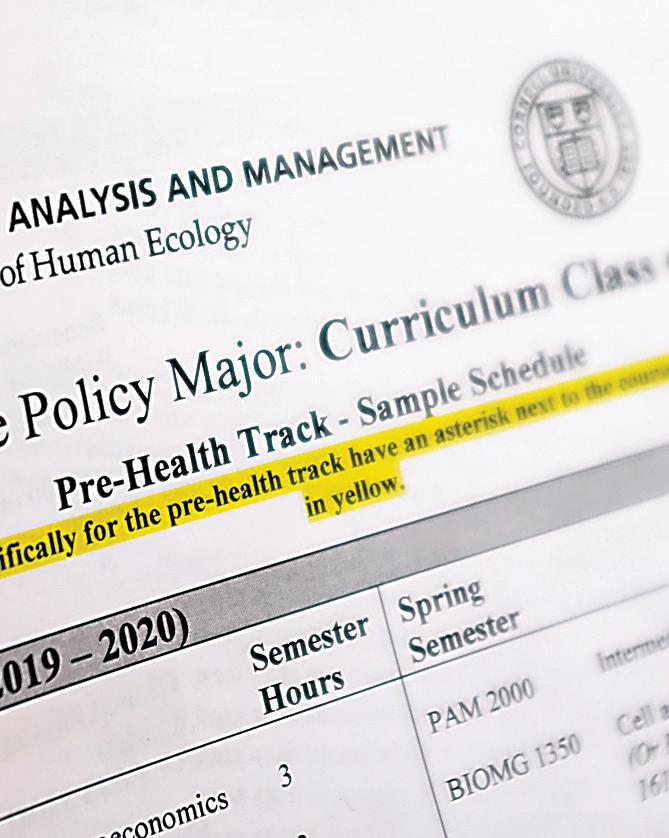
The brand-new health care policy major will begin accepting transfers this semester to fill an “important niche” of educating future health administrators.
The major, located within the College of Human Ecology in the Department of Policy Analysis and Management, will primarily recruit from the freshman and sophomore class. However, juniors and seniors will be accepted into the major if they can layout their plan to graduate on time.
Students can choose between two tracks, a “standard track” and a “science-intensive (prehealth) track,” and can switch between them to find the one that better suit their interests.
The major intends to be a “social sci-
ence-based major that uses required and elective courses to build in-depth knowledge of health care and policy,” according to the official website of the HCP major.
The major differentiates itself from the PAM major in that it requires more natural science courses and
less economics courses, but is also distinct from more biology-focused majors offered by the division of nutritional sciences, according to the major’s webpage.
Prof. Tom Evans, policy analysis and management, said one
See MAJOR page 4

The Cornell Portal
9:00 a.m. - 5:00 p.m., Olin Library
Gatty Lecture: “Challenging the Map” 12:00 p.m., Kahin Center
Undone By Decline: Status Anxiety and Partisan Animosity in the United States 12:15 - 1:30 p.m., G08 Uris Hall
Energy Engineering Seminar: Russ MacAdam 12:20 - 1:10 p.m., 203 Phillips Hall
Stimulating Better Flowering to Hasten Cassava Crop Improvement Seminar
12:20 - 1:10 p.m., 135 Emerson Hall
Neurobiology and Behavior Seminar Speaker: Asaf Keller
12:30 - 1:30 p.m., 215 Tower Road
Institute for African Development Seminar 2:30 - 4 p.m., G08 Uris Hall
Work Authorization for International Students
3 - 4 p.m., B02 Warren Hall
Understanding and Tailoring Materials for Electrocatalytic Prssocesses
4 - 5 p.m., B11 Kimball Hall
An Introduction to Bloomberg 4:30 - 5:30 p.m., Stone Classroom Mann Library
VBMA Dinner Lecture with Dr. Keith Richter 5:30 - 6:30 p.m., LH4, College of Veterinary Medicine
Friday
Portraits of Progress: Confronting Indian Malnutrition through Field-Based Research
8 a.m. - 5 p.m., Mann Library
“We’re Not Anti-Science, We’re Anti-AnotherTelescope”
11:15 a.m. - 1:10 p.m., 400 Caldwell Hall
Strategy and Business Economics Workshop 11:40 a.m. - 12:55 p.m., 333 Sage Hall
The Works in Progress Seminar 12:10 - 1:10 p.m., 488 Uris Hall
Biological Systems and Automatic Control Some Results, Difficulties, Challenges and Opportunities 12:15 p.m., 253 Frank H. T. Rhodes Hall
Non-Academic Careers in the Changing Corporate Landscape of Plant-Biotech 12:20 p.m., 404 Plant Science Building



Two of the University’s programs have been awarded four-year grants by the U.S. Department of Education. The South Asia Program will receive approximately $1.6 million, and the Southeast Asia Program will receive approximately $1.9 million.
The award is partially related to the centers’ designations as National Resource Centers, and partially under the Foreign Language and Area Studies fellowship, which will provide for nine students to study intensive language, and will cover the tuition and stipend of 14 graduate students.
The Ithaca Regional Airport will soon begin its Phase I renovations following a Tuesday Tompkins County vote to support the Streeter Associates’ $7.6 million bid. This phase will include adding space to the terminal, update airline offices and utilities, move equipment and improve the lobby flow.
According to the airport manager, by the end of 2019, the project should be completed. The entire airport renovation project is projected to cost above $24 million. Tompkins County has also accepted a grant from New York State, and is looking to secure grants to cover the remainder of $8 million.
Wednesday marked the first day of the confirmation hearings of Brett Kavanaugh, President Trump’s nominee for the Supreme Court.
Kavanaugh was nominated after Justice Anthony Kennedy retired. Justice Kennedy was known for his swing-vote status.
Before senators had heard a substantive word from the nominee, most made it clear where they stand on the president’s nominee.
Kavanaugh’s hearing was marked by Democrat and prochoice protestors, who protested both vocally and silently, in- and outside the chamber. Democrats are concerned that Kavanaugh will restrict abortion rights or even aim to overturn Roe v. Wade , ease gun restrictions, and protect the president.
Compiled by Maryam Zafar ’21
By RONNI MOK Sun Staff Writer
Following the high campus demand for flu shots in the spring that caused a 36-hour shortage of vaccinations, Cornell Health anticipates an even higher demand this fall, according to Anne Jones ’04, director of medical services at Cornell Health.
To strengthen Cornell’s vaccine service to address ever-growing demand, Cornell Health is partnering with Wegmans Pharmacy this fall to provide free flu shots for all current students, staff, faculty, retirees and student spouses who are on the Student Health Plan, as it did in previous years.
To prevent another vaccine shortage, the supply of vaccinations will be continually monitored in relation to demand to ensure that the appropriate quantity of vaccines are ordered, as “it is always a moving target to anticipate how bad the flu will be in a given year,” according to Jones.
Wegmans Pharmacy was selected for partnership after a competitive bidding process was conducted in collaboration with employee Benefit Services, a section of the human resources division that funds employee vaccinations, according to Chris Payne MHA ’97, director of administrative services at Cornell Health.
“In the past, we have staffed our fall flu vaccine clinics with Cornell Health nurses, which has meant we had to decrease our nursing services here at Cornell Health on clinic days,” Payne told The Sun.
“Partnering with Wegmans Pharmacy allows us to do double-duty — to continue providing our full range of care at Cornell Health while having increased flu shot providers at our flu vaccine clinics,” he said.
Also starting this fall, family members over the age of three of the Cornell community are eligible for receiving flu shots at vaccination clinics. Members of the public are also welcomed to get vaccinated at the clinics for a price depending on the individual’s insurance.
“Our goal is to make vaccination desired, convenient and a positive experience for as many people as we can.”
Additionally, students under the age of 18 who wish to receive flu shots at the vaccination clinics are required to bring three copies of the parental consent form at the request of Wegmans Pharmacy, but are not required to do so at Cornell Health.
Chris Payne MHA ’97
Vaccine clinic hours will continue to provide vaccinations to staff, faculty, and retirees, while Cornell Health in-clinic appointments will be reserved for students and their partners since Cornell Health serves as their primary care provider.
“Our goal is to make vaccination desired, convenient and a positive experience for as many people as we can, and believe our partnership with Wegmans Pharmacy will allow us to achieve this,” he said.
This newly established partnership will increase the staffing at the vaccine clinics with Wegmans employees, which may reduce the waiting time for those who wish to receive flu shot while maintain the regular level of staffing at Cornell Health, according to Payne.
Two vaccine clinics will be provided on Sept. 11 from 10 to 3 p.m. at Bartels Hall in the hallway by Lynah Rink and on Sept. 13 from 10 to 3 p.m. in the Memorial Room of Willard Straight Hall. Clinic locations later in the semester also include Mann Library, the Lab of Ornithology and Robert Purcell Community Center.
Ronni Mok can be reached at rmok@cornellsun.com.

Assembly award | The Employee Assembly discusses nominations for the staff recognition award Wednesday, of which Cornell Health, Cornell IT and Cornell Dining are some of the contestants.
By
The Employee Assembly gathered Wednesday afternoon to discuss the nominations for the Assembly-organized staff recognition award. Cornell Dining, Cornell Health and Cornell IT, among others, are in the contention.
This award was previously awarded until 2015 and is being reinstated this year.
Cornell Dining was nominated by Craig Wiggers, former chair and veteran representative at-large of the E.A. Staff Recognition, Awards & Events Committee, for its continuous service at Okenshields Dining Room during its renovation.
“Cornell Dining prepared a team effort with Cornell Catering, transportation services, and through the Robert Purcell dining facility, providing all meal services uninterrupted to Willard Straight Hall,” Wiggers said.
Nomination of the construction workers on campus was discussed. Andrea HaelinMott, the infrastructure, properties & planning representative, noted the difficulty of representing this diverse group of people working in different companies and projects. “Quite often, there are so many different Cornell employees that are managing the construction process. They may be outside groups,” she
noted.
Tanya Grove, the division of human resources representative, advised the assembly to be specific about what they were recognizing. “When we are thinking construction, be careful in thinking about the whole Does Cornell Care thing and Maplewood,” she said.
Since mid-August, members of a local construction union group have been gathering in eight locations around campus wearing bright red T-shirts that said “Does Cornell Care” in response to the University’s decision to move away from hiring local workers in student housing projects, such as the construction of Maplewood Apartments, The Sun previously reported.
The nomination for Cornell IT came from Kristopher Barth, research & technology transfer representative at-large. He noted projects such as the implementation of Duo Security, a two-factor authentication tool used to secure logins to Cornell accounts.
“Yeah it might have been painful, you might not like that you have to do it all the time, but it’s protecting your paychecks and your retirement and your enrollment,” he emphasized.
David Hiner, the LGBTQ+ representative at-large who could not be present at the meeting, conveyed to the committee of his nomination of Cornell Health, crediting
their staff for doing great work despite being understaffed.
However, Wiggers pushed back on recognizing Cornell Health. “One issue that I think we should be cognizant of with regards to Cornell Health that there are … still some discussions about how mental health issues are being addressed [on] campus,” he said.
Carrie Sanzone, the representative at-large and vice chair for communications, nominated Cornell Brand Communications, a “dedicated in-house creative team committed to university-level communications priorities and strategies,” according to its official web page.
Taking note of the cautionary comments made by Wiggers and Grove, Gina Giambattista, director of the office of the assemblies, reminded E.A. members that “what this award does is that it recognizes our colleagues.”
“I’m speaking from really in the weeds on this because our office is pretty close to a lot of these conflicts. I would ask you to consider the colleagues and your teams separate from any other campus climate issues,” Giambattista added.
The vote for the winner of the award will take place in October, according to Sanzone.
By AVARAHAM SPARAGEN Sun Staff Writer
A Cornell professor lamented on Wednesday that the United States is abandoning its humanitarian tradition by limiting the number of refugees it resettles in the country during the first “Chats in the Stacks” book talk of the semester.
Maria Cristina Garcia, the Howard A. Newman Professor of American Studies, history, and author of The Refugee Challenge in Post-Cold War America explained that the word refugee derives from the French verb se réfugier, meaning to seek shelter from danger. However, its “meaning under U.S. domestic law is much more precise,” she said. “There are strict limits on who can be granted admission into the country.”
The United States policy of discriminating against migrants goes back to the early 20th century when “racist national origins quotas were in place,” Garcia said. These quotas were later reversed by the 1965 Immigration and Nationality Act, which was amended in 1980 to include the United Nations definition of refugees. This law changed the criteria for entry, opening the doors to a greater number of displaced persons, according to Garcia.
“Detention has become a multibillion dollar industry. It is no wonder that the stock prices of theses companies rose by 43 percent after Trump’s election.”
Prof. Maria Cristina Garcia
However, with the September 11 attacks, “America as a place of refuge” was drastically impacted, Garcia said. Whereas during the Cold War, U.S. policymakers advocated for the admission of refugees — among them was Joseph Stalin’s daughter — as a “powerful symbol, choosing capitalism over communism,” in the post-9/11 world a “fear of accepting refugees from areas believed to be incubators of terrorism” pervades, she argued.
Garcia described researching the United States’ treatment of refugees after the War on Terror as “very chal-

lenging and depressing work.” The vetting process for refugee applicants can take between 18 and 24 months, with no guarantee that an entry permit will be granted upon completion, according to Garcia.
The U.S. also “discourages asylum claims by resorting to methods such as expedited removal, indefinite detention, and withholding work authorization permits,” Garcia said.
“It is a very capricious system wherein decisions are rendered ad hoc,” she said. “With no oversight, the Illegal Immigration Reform and Immigrant Responsibility Act, IIRAIRA, gives immigration officials extraordinary authority to remove people from the country on the spot.”
Many apprehended immigrants are held in prisons owned by private companies. “Detention has become a multibillion dollar industry,” Garcia said. “It is no wonder that the stock prices of these companies rose by 43 percent after Trump’s election.”
The concern about refugees in the post-Cold War era is one of “national security,” Garcia explained. “While understandable, the data does not back it up.”
She pointed to a CATO Institute study that calculated the risk of being killed by a refugee at 1 in 3.6
billion a year. As a point of comparison, Garcia cited the likelihood of being shot by a gun — 1 in 25,000 a year.
“The 70 million refugees worldwide are the most vetted population,” Garcia said. “Upon taking office, however, Donald Trump reduced the number of refugees to be absorbed by the United States from 110,000 to 50,000.”
In 2015, the United States led the world in refugee resettlement. “Three years later, the U.S. is projected to take in the lowest number of displaced persons since the immediate aftermath of 9/11,” Garcia said. “We are committed to 45,000 for the 2018 fiscal year, yet we haven’t even reached half of that yet.”
Garcia attributes declining U.S. refugee intake figures to “compassion fatigue” and warned that the American national character is at grave risk. She urged audience members to exert “moral pressure” to ensure “our responsibilities as a nation are met.”
“We have always prided ourselves on being a place of refuge,” Garcia said. “It would be sad if we continue to lose sight of this in the years to come.”
Avraham Sparagen can be reached at asparagen@cornellsun.com.
of the reasons the HCP major was created was because it seemed like “an attractive major” for students, as the new major gives students studying in the PAM department an opportunity to approach the discipline from a scientific angle.
The major also aims to prepare students for entering both the health care industry and the pharmaceutical industry — two growing sectors — according to its website.
In regards to the health care industry, the new major addresses the deficiency of administrative leaders with strong science backgrounds in healthcare by creating a
curriculum that better prepares students for those administrative roles effectively.
“The HCP major prepares students whose strong training in natural sciences will make them better health care administrators and policy makers” in an “important niche that is poised to grow faster,” the introduction for the HCP major reads.

Judge Brett Kavanaugh, President Trump’s nominee for the U.S. Supreme Court, adjusts his name card during his confirmation hearing at Capitol Hill on Wednesday.
According to Prof. Nicolas Ziebarth, policy analysis and management, the new major will “combine policy with a strong foundation of natural sciences for students who may think about pre-med requirements but are not entirely certain about it.”
Evans said that the major will hopefully raise business leaders with scientific knowledge that can meet “halfway on their [healthcare industry] turf.”
“There are a lot of sectors within healthcare that would really value people who have a strong science background,” he said.
Prof. Sean Nicholson, policy analysis and management, director of the Cornell’s Sloan Program in Health Administration, elaborated that studying health care allows students to both earn gainful employment and do socially-impactful work.
“Something that a lot of Sloan students and a lot of Cornell undergrads like about health is they can get a secure job that pays well, but they can also feel really good about what they do on a daily basis,” Nicholson said.
Nicolson called the new HCP major a “nice marriage of financial security and idealism.”
In addition to the new requirements for the new major, students will have access to one and two-credit courses through the Sloan program that are “very specialized [and] ... taught by industry practitioners,” Nicolson said.
New regulation sets prices for events of diferent security levels
public, the presence of alcohol and if it is “controversial.”
According to the campus engagement website, a “controversial” event is one that has caused disruption in the past, has been involved with litigation, or if “your gut [tells] you this event might be controversial.”
“Last year, we were not able to budget for these fees through SAFC funding because they were a complete surprise, imposed a few weeks before,” said Michael Johns ‘20, president of Cornell Republicans and a columnist for The Sun. “This year is no different: I have no impression on what the rules are relating to the use of SAFC funding toward security fees under the new policy.”
The Cornell Republicans had previously paid $5,000 out of their own pockets to fund security when they hosted Rick Santorum, The Sun reported in 2017.
“I
The changes, while implemented on July 1, were not publicized to student organizations in the Fall until a week before SAFC budgets were due. The new guidelines were announced in the spring, The Sun previously reported.
The Event Management Planning Team, composed of staff members across University departments, will decide how to categorize the event, and subsequently assign the security fee. None of the members are students, according to the webpage.
Jeong noted that according to an August 29 meeting held between the SAFC co-chairs and individuals from the Dean of Students office, organizations can negotiate their estimate with CUPD.
According to Jeong, “There will be a lot of clubs that get by without putting this on their budget, but they are at the risk of the police catching them and shutting their event down. “
SAFC budgets are due Friday at 4 p.m. Organizations should plan a line-item for security in their budgets so that the SAFC can account for those costs, according to Jeong. SAFC funding covers security fees, according to the commission’s guidelines. Those who neglect to plan for security will have to pay out of their organizations’ pockets.
have no impression on what the rules are relating to the use of SAFC funding toward security fees under the new policy.”
Michael Johns ’20
Events that are at the lowest security level, like meetings or classes, do not require security, regardless of size. Minimal security events, which include a cappella groups and late-night events, can range from $290 to $610 depending on how many attendees are anticipated.
According to Michael Jeong ’19, co-chair of the SAFC, a cappella groups have previously not been required to have security at their concerts. Jeong is also the president of the male a capella group Last Call.
The next level of security is noted as “Elevated Security,” which includes famous entertainers. Costs for security range from $660 to $1444. The highest level, called “High-Level Security,” includes a “VIP with high protection needs,” for which costs can go as high as $3848.
For those who ask for funding for security, but end up not needing it, Jeong suggested finding another place to use that money so that organization retain their “Tier,” or ranking based on funding, at the end of the year. Organizations that spend less than 85% of their allotted budget are demoted a tier, according to the SAFC Tier guidelines.
The SAFC will be hosting a help session Thursday at 5 p.m. in Goldwin Smith Hall G76 to answer budget questions.
The other major change is the Event Registration Forms, which must be filed four weeks in advance — one week more than notice required previously — according to the campus engagement website. Jeong was “frustrated” that no reminder email was sent to students about the new guidelines until his meeting with the Dean of Students office, and that the reminder email was sent Friday, just a week before the SAFC budget was due.
Maryam Zafar can be reached at mzafar@cornellsun.com.
Renovation aims to respect 150-year-old Morrill Hall’s ‘architectural signifcance’
road, according to Henry W. Crans, Jr., the facility director and College of Arts and Sciences representative on the project.
The budget for the construction — which is $2,175,000 — will go toward “modified bitumen and slate shingles at the lower roofs, liquid resin at the integral gutter, slate shingles at the lower mansard roof, and standing seam metal roof panels at the high mansard roof,” Magre told The Sun.
“Additionally, the dentil molding, frieze board, cornices and ornate dormer woodwork assemblies will be refurbished where they’ve been negatively impacted by 150 years of exposure to our climate,” Magre said.
Morrill Hall, built in 1868 as
the first building on the Arts Quad according to the City of Ithaca, was designated as a national historic landmark in 1965, making it crucial for the construction to be “respectful of Morrill Hall’s architectural significance in preserving the original architecture,” according to Magre.
Magre explained that a new standing seam metal roof assembly at the upper mansard roof will replace the current non-historic asphaltic material to help the building resemble what it looked like in the 19th century.
“The restoration of the scrolled window blocks and casings at the base of the windows and the keystones atop each dormer assembly will have been designed to mimic historic photographs,” Magre said.
No linguistics professor working in Morrill Hall has reported

being disturbed by the ongoing construction, according to Michael Weiss, chair of the department of linguistics, which is located on the second floor and basement.
The construction is run by the Facilities and Campus Services with Patrick Conrad serving as project manager. The Elmirabased Charles F. Evans Company is the general contractor. Bell & Spina Architects from Syracuse also respectfully took into account Morrill Hall’s historical significance when they created the construction documents for the project, according to Magre.
Moving forward, Magre said that rainy weather might slow down the construction, which they hope “is now behind us.”
Victoria Moore can be reached at vmoore@cornellsun.com.


JACOB S. KARASIK RUBASHKIN ’19 Editor in Chief
JOHN McKIM MILLER ’20
Business Manager
KATIE SIMS ’20
Associate Editor
VARUN IYENGAR ’21
Web Editor
MEGAN ROCHE ’19
Projects Editor
EMMA WILLIAMS ’19
Design Editor
JEREMIAH KIM ’19
Blogs Editor
AMOL RAJESH ’20
Science Editor
BREANNE FLEER ’20
News Editor
YUICHIRO KAKUTANI ’19
News Editor
NICHOLAS BOGEL-BURROUGHS ’19 City Editor
LEV AKABAS ’19 Arts & Entertainment Editor
SARAH SKINNER ’21
Assistant News Editor
ANNE SNABES ’19
Assistant News Editor
JOHNATHAN STIMPSON ’21
Assistant Sports Editor
EDEM DZODZOMENYO ’20
Assistant Photography Editor
PETER BUONANNO ’21
Assistant Arts & Entertainment Editor
CHENAB KHAKH ’20
Assistant Science Editor
JULIAN ROBISON ’20
Layout Editor
HELEN HU ’21
Graphics Editor
GIRISHA ARORA ’20
Managing Editor
HEIDI MYUNG ’19
Advertising Manager
ALISHA GUPTA ’20
Assistant Managing Editor
DYLAN McDEVITT ’19
Sports Editor
MICHAEL LI ’20
Photography Editor
GRIFFIN SMITH-NICHOLS ’19
Blogs Editor
JACQUELINE QUACH ’19
Dining Editor
SHRUTI JUNEJA ’20 News Editor
ANU SUBRAMANIAM ’20
News Editor
JUSTIN J. PARK ’19
Multimedia Editor
PARIS GHAZI ’21
Assistant News Editor
MEREDITH LIU ’20
Assistant News Editor
JONATHAN HARRIS ’21
Assistant Sports Editor
RAPHY GENDLER ’21
Assistant Sports Editor
BORIS TSANG ’21
Assistant Photography Editor
VIRI GARCIA ’20
Assistant Arts & Entertainment Editor
CATHERINE HORNG ’21
Assistant Dining Editor
LIZ CANTLEBARY ’21
Snapchat Editor
ALICIA WANG ’21
Sketch Editor
Working on Today’s Sun
Ad Layout Krystal Yang ’21
Design Deskers Emma Williams ’19
Lei Lei Wu ’20
Krystal Yang ’21 Simon Chen ’21
News Deskers Yuichiro Kakutani ’19
Meredith Liu ’21
Arts Desker Peter Buonanno ’21
Photography Desker Boris Tsang ’21
Production Deskers Emma Williams ’19
Krystal Yang ’21
WE MUST COMMEND THE COLLEGE OF ENGINEERING for achieving gender parity in its enrollment. The engineering college is the last of Cornell’s constituent parts to reach parity, and in doing so, it positions itself as a national leader among institutions of higher education. We hope that our peer colleges take note of the decades-long concerted effort undertaken by Cornell to achieve this milestone; parity neither happened overnight nor on its own.
Because things need to change. Somehow, in the year of our lord 2018, women only make up 22.9 percent of engineering students nationwide. And until that number rises significantly, women will continue to operate at structural professional disadvantages in the engineering field. So while Cornell is right to celebrate its own achievement, it must recognize the fight is far from over, and that the methods employed by Cornell over the past decade must be exported across the country. Twenty years ago, only 21.6 percent of Cornell engineering students were women. That we are today is proof that things can change.
And we shouldn’t stop there. Underrepresented minorities still enter engineering (and STEM fields more generally) at lower rates, and often have not seen the same growth as have female undergraduates. For instance, according to the latest data from the National Science Foundation (from 2014), the share of black students awarded undergraduate engineering degrees has largely remained stagnant (and even decreased slightly, from 4.5 to 3.8 percent) over the past two decades. In 2017, Cornell reported that 17.5 percent of engineering undergraduates were underrepresented minorities; according to the National Science Foundation, in 2014 underrepresented minorities made up 25 percent of bachelors in engineering awardees. So there’s clearly room for Cornell (and the nation) to grow.
Cornell should embrace the approach of Prof. David Bindel, computer science, who served as admissions chair for Cornell’s computer science PhD program this spring, and whose Twitter thread on his outreach efforts went viral in May. Bindel’s final report, “Diversifying Cornell CS Ph.D. Admissions” is worth a read, and perhaps the University should consider taking some of his approach to graduate admissions and applying it to undergraduate as well.
So yes, celebrate the achievements we make, but let us not forget that there is much work yet to be done.
Whether this is an aggressive reminder for upperclassmen, or painfully true advice for freshman, learning how to really cheat at Cornell is essential. You don’t need to type all of the answers in your fancy calculator the night before the test to cheat at Cornell, and you definitely don’t need to become friends with a little blue or orange pill. You don’t need to write formulas on your fingernail or notes on the inside of your water bottle.
when you woke up. You probably will still dress wrong in the transitional seasons. Make sure to always check the weather, and carry a sweater in your bag. Dress in layers, and maybe even join the secret Canada Goose cult during the winter.
Nothing is more addictive than skipping class.
To really get ahead of your friends here, it is all about knowing the right resources, knowing the right people and knowing the right study spots. First thing first, know no one cares if you were top of your class, valedictorian, student body president or captain of Mathematics Olympiad. Chances are, so were at least five people in your hall. Be humble and don’t bite off more than you can chew. College is a much different realm then high school. It is not always going to be a breeze.
If you really want to excel at Cornell, you need to kiss ass. Yea it may feel like a violation of your hardened pride, and your professor may level up in conceitedness, but it is not a bad thing. It is important to build a relationship with your professors, but it also important to not follow all of their ideas and to challenge their opinions. Visit their office hours with questions or comments about class content or future reading, and try to participate as much as you can in class.
Second, go to class!
Cocaine is listed as the most addictive drug in the world but nothing is more addictive than skipping class. During my freshman year, when I got the taste of freedom and skipped my first 8 a.m. class at Corson-Mudd Hall, I entered a downward spiral of absences (that I luckily recovered from when I realized the implications). Even though laziness is the father of invention, don’t get to comfortable with it.
Manage your BRBs and swipes. Unless you have a BRB sugar daddy to buy you meals at Trill, put down that Kombucha — you don’t need it. Also, please don’t spend all of your student loan money on CTB drinks and salmon on cream cheese at Bus Stop Bagels.
Don’t wait the night before to study, and don’t pull all nighters unless it is productive. I go by this mantra: If you don’t know it by 2 a.m. you don’t know it at all.
Make sure you have fun, but do your work before you turn up. You don’t want to be dancing at a party and then get hit with a wave of impending doom when you realize your reading response was due at midnight.
The most important cheat to making it through Cornell is making friends — especially in your classes. Network with people who have resources that will make you succeed. Be the one in your class who offers to make a GroupMe where you can ask each other questions or share homework answers. Asking for help is also key whether it be from your friends or professors.
Unless you have a BRB sugar daddy to buy you meals at Trill, put down that Kombucha.
Don’t procrastinate, JUST DO IT. DON’T LET YOUR DREAMS BE DREAMS.
Sleep. This becomes so much of a luxury that when you close your eyes it actually feels like your cheating.
The weather is not your friend in Ithaca. The winters are grueling and depressing and the summer heat is spiteful. It doesn’t matter if it was beautiful and sunny or cold and rainy
Stay on top of your work and do it when you get it. Nothing is worse than having all your work pile up and playing catch up the entire semester. Another thing students need to realize is that your GPA does not matter as much as you think it does. Shocker. But instead of reaching for that 4.0 (which is a good aspiration to have), make sure you spend a lot of effort outside of the classroom. Chances are, when you are applying for jobs in the future, they are more interested in the experience you have gained rather than in a few numbers. To close; free stuff is the best stuff. Make a to do list. Take risks. College is a opportunity that so many people don’t get to have. Be grateful. If all else fails, apply to Harvard, I heard it’s easier to get A’s.
Aminah Taariq is a sophomore in the College of Agriculture and Life Sciences. I Spy runs every other Wednesday this semester. She can be reached at ataariq@cornellsun.com

pletely ignores a lot of activity, and in the second people in the LGBTQ community might never be able to get off second. So I’ve taken it upon myself to definitively define the college sex bases in a way that is inclusionary and accurate to (at least my) college experience.
First Base: Drunk Hook Up
Hook up is the only term I can use to describe the incredibly wide range of sexual activity college students partake in on a night out. Hook up can be whatever you want in this instance: a dance-floor make out, a quickie in the fraternity bathroom, or even a blow job in the bushes. When it comes to first base, whatever you’re doing sexually, you’re doing it at least a little bit tipsy, because that’s the best way to convince yourself to have sex with someone when you have no intimate connection to them.
Second Base: Sober Hook Up
Taking away the alcohol, and perhaps even the darkness of night, is the first true hurdle in many a college fuck buddy partnership. I didn’t even make it to second base until after freshman year. When you take away the alcohol, that’s when you know you’re consciously making the decision to get with this person. So you have to like them enough to stand by this choice. I had a friend drunkenly hook up with a boy I used to hook up with, and it didn’t bother me. But then she did it soberly, and I was annoyed. At Cornell, where there is both a large drinking and hookup culture, the distinction between first and second base is quite clear.
Let’s Talk About Not-Sex
Life is different when you can’t have sex. Not for religious reasons. Not even for pro-abstinence reasons. Just for a I-was-born-with-a-pain-conditionand-can’t-have-sex reason.
I thought my life was effectively over. I was 3 months away from starting college, and my hopes about hooking up and dating vanished. Even binge watching Jane the Virgin didn’t help, so I knew I hit rock bottom.
After a while, I felt comfortable confiding in close friends and family. I routinely asked if they thought someone would want to be with me, even if we couldn’t have sex. The most frequent response? “He’d have to really love you.”
Don’t get me wrong, my condition is a great way to vet out guys who would otherwise not care for me. But a part of me wants guys that don’t care about me and guys I don’t want to care about. I want to hook up — I mean really hook up — with a boy whose name I may not remember. I want to know that I can have casual relationships. I don’t want it to be automatically serious because someone has to already “really love” me.
So is this it? For everyone who chooses not to have sex, who doesn’t want to have sex, who physically cannot have sex, is this life for us? So much of me fights to say no. I’ve dated a boy who was able to look past all this, who I had a sex life with even if we weren’t technically having sex. We had our first date, our first kisses, basically all of our first anythings with each other. And
just like we navigated our relationship, we also figured out what our version of sex would be, even if it wasn’t the traditional penis-in-vagina sex that most other people seem to think of it as.
I’ve also hooked up with boys who I had no intention of starting a relationship with, solely because they were fun. I’ve been able to casually date boys, some of who immediately needed to know if I wanted to have sex and others who were just trying to get to know me better. And in my own way, I’ve been figuring out how to do what I want.
As I’m becoming more comfortable sharing my experiences and reaching out for help, I’m also learning how others define sex and how important they think it is to a relationship. Here are some of my most memorable conversations:
With a male friend:
Me: “Do you think you could date a girl who can’t have sex?”
Friend: “That depends. Can I eat ass? If I can, sure. If not, then no.”
With a different male friend and his girlfriend:
Me: “What would you do if your girlfriend couldn’t have sex anymore?”
Friend: “It would be... very hard to manage.”
Me: “Really? Even if you could do everything else?”
Friend’s girlfriend: “Who even does anything else?”
With yet another male friend:
Me: “I have something to say. I can’t
Third Base: Extended Texting
Once you have made the conscious decision to have a sober hook up with someone, it can be a slippery slope into third base. Extended texting means texting for a longer period of time, anything more than 30 minutes, about anything other than when the two of you will next meet to hook up. I won’t say you can’t count texting about classes and work, because then they might finally know what your major is.
Home Run: Public Interaction
Public interaction means not avoiding eye contact or conversation in whatever dining hall, library or dorm where you’ve run into them. It goes without saying that this interaction must be sober, preferably witnessed by mutual friends and occuring the during the daylight hours. I hooked up with a boy for two years and never made it to this step. This final base can be difficult to reach for a number of reasons. Maybe you’re in the same friend group, and you don’t want the circle to know. Or maybe they’re older and more established, and you don’t have the confidence to say hello. If you’ve gotten to public interaction then you’ve made it much further than most.
According to the rules of baseball I looked up for this article, you can only run in one direction. Luckily, in college you don’t have to listen to the rules of baseball. Feel free to skip bases, run backwards or choose not to play entirely.
The Uptight Tart is a student at Cornell University. Slutty Endeavors appears monthly this semester.
have sex. It’s too painful for me.”
Friend: “Oh wow.”
Me: “Yeah, I don’t know if I’ll ever date anyone again.”
Friend: “There’s so much more to a relationship than sex. It’ll be okay.”
With basically any of my female friends:
Me: “I can’t have sex. It’s been really hard.”
Them: “I’m so sorry. It’ll be okay! You’ll be okay.”
And lastly, with a friend who had been around for the entirety of my last relationship.
Friend: “So, did you two ever have sex?”
Me: “Um, I don’t know hzzzow to explain that. I guess from your perspective, we didn’t.”
Friend: “Wow, I can’t believe I went farther in one night than you two did in three years.”
But it wasn’t for lack of trying.
Through all these conversations and more, I realized sex isn’t what we always make it out to be. For the majority of my life, I have been looking at sex one-dimensionally. It was always black and white, virgin or not a virgin, penetration or bust. But sex can be anything I want it to be. Sex is anything a partner (or partners) and I define it as, and it doesn’t have to impossi
ble because of what genitalia we have or how well they’re functioning. Because you know what really gets me off? Someone who actually responds to my texts in a reasonable amount of time. Someone who communicates their feelings. Someone who gives me answers to a problem set. Really, I’m not asking for much here.
So I’m here to have sex on Thursday. Or Wednesday. Or any day of the week any way I want to do it. And I can’t wait to finish Cornell off with a bang.
Sexless in Seattle is a student at Cornell University. The Virgin Diaries appears monthly this semester.



By EMMA FREIMAN Sun Contributor
“Can he really cook?” I, along with millions of other viewers, wondered as Antoni Porowski, the food and wine expert on Netflix’s Queer Eye , made a grilled cheese one week and hot dogs the next.
Following this spring’s reboot of Queer Eye , everyone had an opinion of Antoni’s cooking skills — or lack thereof. Such skepticism is most likely the result of consuming a culture of food TV in which a minimum of three multistep recipes are whipped up within 20 minutes.
While I find comfort in watching old episodes of Barefoot Contessa on YouTube when I am especially homesick, I rarely find the time or energy to then go roast a chicken and serve it alongside a panzanella salad with a peach cobbler for dessert.
meals that I can recall for their deliciousness, one being a tomato sandwich devoured on my living room couch. Perhaps, there is no greater testament to the power of simple fare than a thick slice of an heirloom tomato on toasted bread. It needs little else than a scraping of mayo and a sprinkle of salt.
“In celebrating food that works for the individual, Antoni reminds us that a meal thrown togeher in a matter of minutes can still be mouthwateringly delicious, energizing and satisfying.”
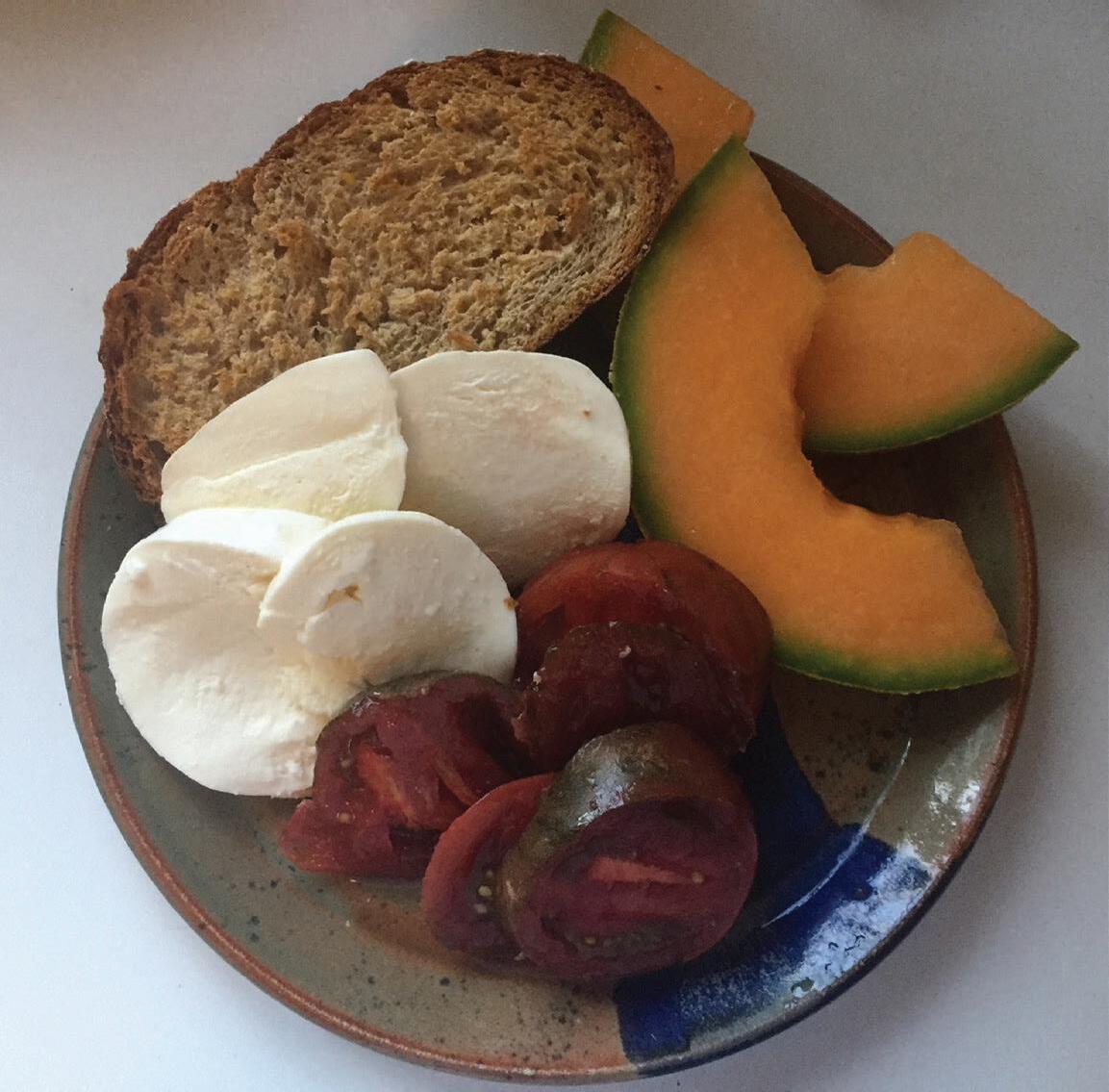
Since it’s already September, I suggest you get your hands on as many late-summer tomatoes as possible. Embracing the Porowski style of almost non-recipe recipes, I recommend a tomato, corn and bacon salad or a tomato and mozzarella toast served alongside slices of perfectly ripe cantaloupe. Although they require just a handful of ingredients, these meals are particularly refreshing during these 80-degree days, and most importantly, they can be prepared within a 30-minute study break.
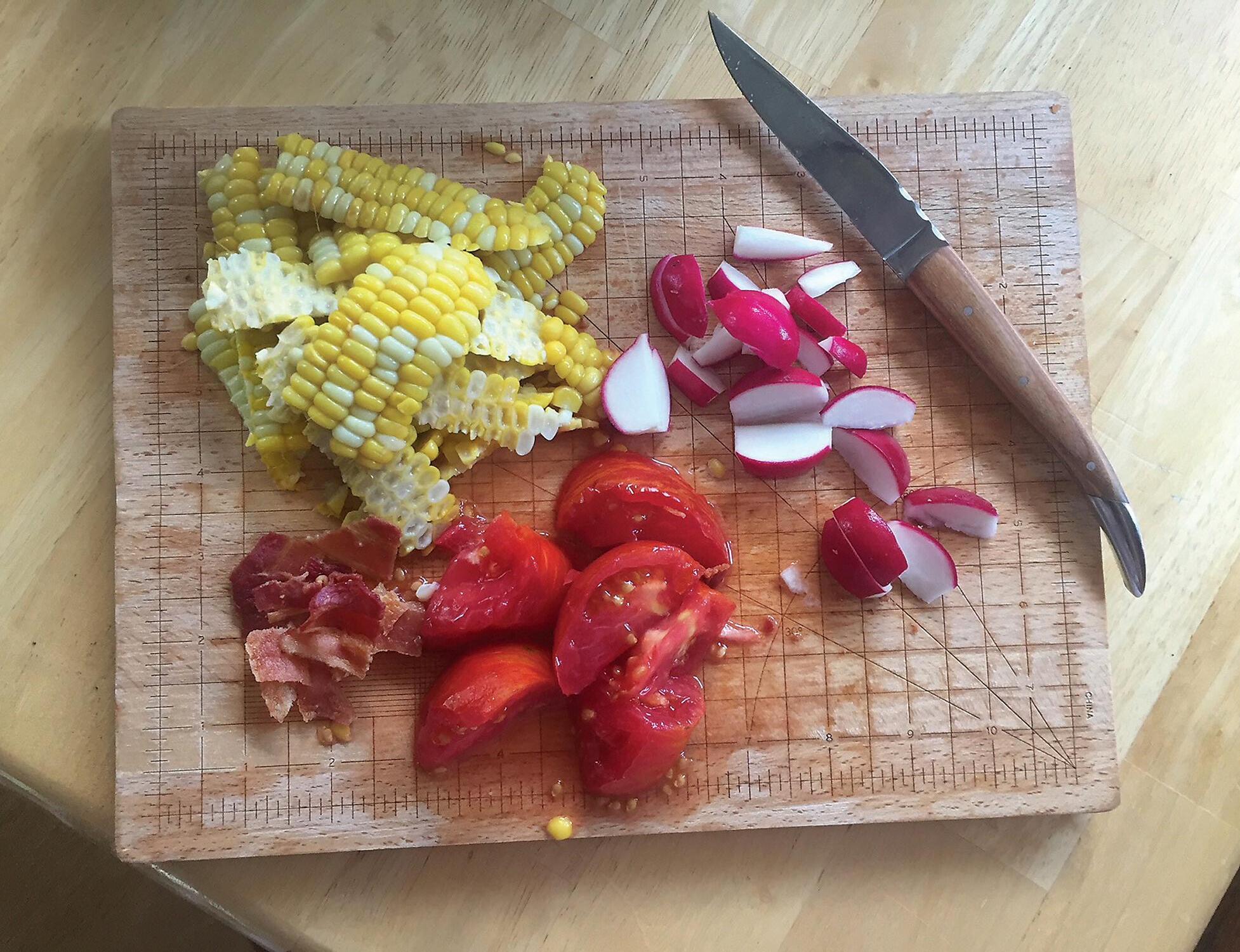
When we watched Antoni throw together a guacamole, designating it as an important addition to Tom’s recipe repertoire, we were witnessing the realities of daily life entering the realm of a television kitchen. It was unnerving at times to watch Antoni break the fourth wall with his food by showing us that he understands we will not be spending our entire evening in the kitchen. Nevertheless, in celebrating food that works for the individual, Antoni reminds us that a meal thrown together in a matter of minutes can still be mouthwateringly delicious, energizing and satisfying.
There are only a handful of
Tomato, Corn And Bacon Salad
Ingredients:
1 small head of leafy lettuce
1 medium-sized heirloom
tomato
1 ear of corn, steamed 3 - 4 radishes
1 - 2 crisp strips of bacon your favorite vinaigrette or a splash of olive oil and vinegar salt and pepper to taste
The only cooking involved for this recipe is steaming the corn and crisping the bacon. In fact, I often steam multiple ears of corn at the same time so that
I can have this salad throughout the week. You may need to break the corn in half, depending on the size of your pot. No need to worry if you are vegetarian or simply do not like to handle raw meat; the bacon is a completely optional addition.
1. Place an ear of corn in a few inches of water, place on the lid and bring to a boil. Steam for 10 to 15 minutes; adding additional water if necessary.
2. Optional: Heat a frying pan over medium heat, and add the bacon when the pan is hot. Fry until crispy or for 10 to 15 minutes. Or place the bacon between two paper towels and microwave until crisp.
3. Wash and rip the lettuce into bite-sized pieces.
4. Slice up the tomato into about eight pieces.
5. Cut the radishes into eight wedges.
6. Combine the lettuce, tomatoes, corn, radishes and bacon in a large bowl.
7. Drizzle with your favorite vinaigrette and toss.
Tomato and Mozzarella Toast with Melon
Ingredients:
1 - 2 slices of a hearty bread
1/2 mozzarella ball
1 medium-sized heirloom
tomato
1 small melon olive oil, salt and pepper to taste
1. Start by toasting the bread.

2. Then slice the tomato and mozzarella.
3. Layer on the mozzarella and tomato, alternating after each slice.
4. Drizzle with olive oil, and sprinkle on salt and pepper.
5. Slice the melon in half lengthwise. Scrape out the seeds, and cut each half into four lengthwise pieces for a total of eight slices. To cut into pieces, make a handful of vertical cuts across the slice, and then run your knife between the orange flesh and green skin. Serve alongside the toast.


During events like homecoming or reunion weekend, I love listening to the older alumni of my fraternity tell stories about their time at Cornell. I suppose that I’m a nostalgic person — an old soul — and I really enjoy trying to discern the similarities and differences between the campus dynamics of now and then. Some of them, the “’80s brothers,” share memories of their flippant college years, of wild parties, inside jokes and ridiculous traditions. All of their memories conjure in my mind an image of Cornell, 1984, like some Richard Linklater movie where boys will be boys and chase girls, Van Halen is always playing in the background, Ronald Reagan is president and it’s morning in America again – think Everybody Wants Some!!.
still see a lot of those old, less-than-equitable dynamics at work.
Yeah. I don’t think that the game has really changed; even if some of its teams have gained a bit of power over the years, the rules and stipulations might not have evolved much. I suppose I’m alluding to heteronormative courtship here, its zero-sum ways and all, but I may be in over my head in discussing such matters that may possibly be answered more adequately by contemplations of human nature. However, one thing I’m sure about is that fraternities, significant remnants from earlier times, are still thriving, quietly if not boldly, despite all of the recent allegations and expulsions.

Of course, this world excluded a lot of people, dismissed much of the agency of women, and cast away individuals of minority cultures to mere supporting roles. My mother, who attended Rutgers during the 1980s, can offer a different perspective from the one highlighted above, one that paints all of these antics in a different light. What is fun for a few is certainly not fun for all when most people have less of a say than the dominant group. Have things really changed since this time? Looking from the outside in, things appear almost eerily similar to the ’80s. For one, there is another arch-conservative in office, one who actually borrows a great deal of imagery and glory from his ’80s predecessor. Walking around Collegetown, into Hideaway or some other locale, you can
The title of this piece refers to the art-frat aesthetic. While some of you may know exactly what I’m talking about, I’ll avoid writing in broad generalizations and explain what I mean. Fraternities often bring to mind thoughts of the machismo, of hyper-masculinity, of cold, insensitive hazing and Keystone abuse, and ultimately, a gritty, who-cares mentality. Let’s call this the conventional frat aesthetic. The art-frat aesthetic, meanwhile, operates under a different guise. It’s the house of musicians, of guitarists and DJs who produce music. It’s the party hosted by English majors and architecture students. It’s when you walk into a frat boy’s room and instead of an American flag and letters on the wall, you find a Joy Division poster and a van Gogh painting (guilty as charged). This latter group does indeed practice the same traditions as the former, but it merely trades the tank top for the ec-

centrically printed, button-down shirt while it takes part in it all.
From the outset, it may seem great that fraternities are liberalizing and progressing their images in such a way. Something about it certainly looks more inclusive. Frankly, I think the more conventional frat aesthetic is waning and is more of a stereotype at this point in time. I remember feeling rather surprised by the whole thing when I rushed; I was shocked to learn that talking about my favorite Miles Davis albums actually made me seem cooler than the guys who just wanted to mention the girls and partying they had experienced. On one hand, I am tempted to deem it an entirely good thing that some of these groups are embracing such an aesthetic, allowing young men to express themselves where in many other spaces they might not find the opportunity to do so. Nevertheless, there is a specter at work here, as the aesthetic may be nothing but an added layer. Under the artsy image there exists the old
potential for the same conversations, the same homogenous viewpoints, the same dismissals and objectifications of women.
I don’t mean to castigate anyone, especially those individuals who have a true love for what they do. To them, I urge you to continue being genuine. I certainly don’t believe that all or even most members of fraternities are like this, nor do I assert that fraternity members are the only ones capable of feigning artistic profundity, objectifying people and exploiting heteronormative inequities just to get what they want. Rather, I simply do not want to see certain institutions mistook for being something that they are not. Keep up the art aesthetic, but at least acknowledge, if not with a little irony, that it’s there.
Swan is
“All of us are living in a country where we have to deal with people telling us we don’t understand, how divided we are, and how bad shit is getting and how we gotta deal with this fucking idiot that’s in office. They’ll sit there and tell us this country is falling apart because of us,” Drake said at his August 31 show. “But tonight we got 16,000 people from all different backgrounds inside one building and all we’re doing is chilling and having a good time. This is how the country should be.”
See that’s the thing about music. No matter where you’re from, what language you speak, what you are or who you are, you are able to understand. To feel. The Drake and Migos show on August 31 at Barclays Center was undoubtedly a performance that got the whole audience “in their feelings.”
Migos, who were named the number one hip-hop group in the world after tying The Beatles for most simultaneous entries on Billboard Hot 100, opened for the superstar. They excited the audience
with their staple pieces, including “Narcos,” “Stir Fry” and “MotorSport” from Culture II. The group certainly didn’t forget the album that truly sparked their fame, Culture, singing hits like “T-Shirt,” “Bad and Boujee,” “Slippery” and a personal favorite, “Kelly Price.” The Migos really did an impressive job covering all of their bases. And although the Migos began their night radiating chill vibes, their performance was hype in the sense that they played hit after hit without deviating from their brand. Walking laps around the stage garbed in neon tracksuits and ice, they couldn’t have kept it more nonchalant.
As an enormous scorpion figure suddenly appeared on the stage, it was clear that Drake had arrived. Whether it’s giving his massive crowd a political pep-talk or transforming his stage into an iPhone screen, he always manages to stay hot, relevant, and on his feet. Literally. His ongoing sprints across his “digital” stage, which he turned into a pool, Instagram and even a basketball court, proved to his fans that at 31, Drake isn’t done yet ... and is probably in way better shape than most.
The rapper opened with hits from
Side A of his newest album Scorpion, which broke streaming records within 24 hours of its release. Drake belted “Can’t Take a Joke,” “Emotionless” and “Nonstop.” “Nonstop” especially excited the crowd as they chanted, “this a Rolly not a stopwatch!” Side A was to give his fans the hardest of Drake; rapper Drake. To give his fans glitz and glam and hope and nastiness all at once.
Side B then flashed on the screen, and Drake went from “Emotionless,” to very emotional. Singing an absolutely stunning acoustic version of his controversial yet highly popular “Don’t Matter to Me,” featuring Michael Jackson. He brought the audience down to earth and to heaven all at once. He then performed a tribute to Michael, singing the one and only “Rock With You,” and it’s safe to say that Drake’s performance of this record was one of the most beautiful things I have heard in a long time. Drake then brought Migos out for “Walk It Talk It,” which was definitely an iconic moment for the entire audience. Watching both artists perform simultaneously was truly a sight for sore eyes.
Drake later showed off his high-tech stage set-up, transforming the stage into
a full basketball court — even inviting a fan on stage to take her shot in the hopes of winning a hefty cash prize. To the audience’s dismay, the fan missed. Drake then prepared to take his own shot. “Do y’all think I can make this?” he pumped up the crowd. I, in addition to the rest of the audience, had no doubts in our minds. Of course Drake could make the shot. He could surpass The Beatles’ record on Billboard’s Top 10, he could reach the highest number of single-day streams and he could sell out New York for over a week straight. He missed.
That’s the beauty of Drake though. He is able to make us think that he is superhuman and then bring us back to his raw, real self. He is able to show us that he too faces this 21st century political frustration — that he too strives for peace in this country. A video montage began, showcasing his beginnings with producer 40, Future and Oliver. “Me and you built this together,” Drake said. “It’s not just me.”
Juliette Rolnick is a junior in the College of Arts and Sciences. She can be reached at jr798@cornell.edu.
BY MICHAEL CHANG Sun Staff Writer
Pigeons Playing Ping Pong kicked off the month performing at The Haunt on Saturday. I arrived half an hour early to a crowd that nearly filled the venue to capacity. The mood was light and the venue was intimate. Concert-goers gathered around the bar, awaiting the night’s performance. As I pushed through the crowd, scouting out the area, it became quickly apparent that “The Flock,” the name of the band’s tour following, was ready to have a blast. One member of “The Flock,” referred to simply as Drew, drove down to Ithaca from Syracuse, described past concert experiences as “a category of their own,” stating that “the Pigeons never fail at bringing the crowd on a musical journey that they won’t want to end.” The chirping whistles along with the lyrics sung in falsetto made it clear that the Pigeons were in town.
The opening act was the band, “Goose.” They set the mood, performing covers of songs such as Foster the People’s “Pumped Up Kicks” and Bruce Hornsby’s “The Way It Is.” Goose successfully engaged with concert-goer and enticed them the sing along and dance in unison. The rudiments of their music were diverse, with influences of funk, psychedelic rock, rock and roll, and reggae. After they got off stage, I was able to catch up with a band multi-instrumentalist, who described the crowd
as “welcoming of fun and new music.” He explained to me that the night was a good opportunity to expose their music to a young, college audience.
The Pigeons took the stage without warning, jokingly hyping up the crowd while they tuned their instruments. Pigeons Playing Ping Pong was loose and lackadaisical, just like the crowd that came to watch them. They took the stage behind dazzling lights, jumping to the rhythm of their own instrumentation. Regardless of the content and creative differences between the songs that night, the generally up-tempo nature invited dancers to get their grooves on.
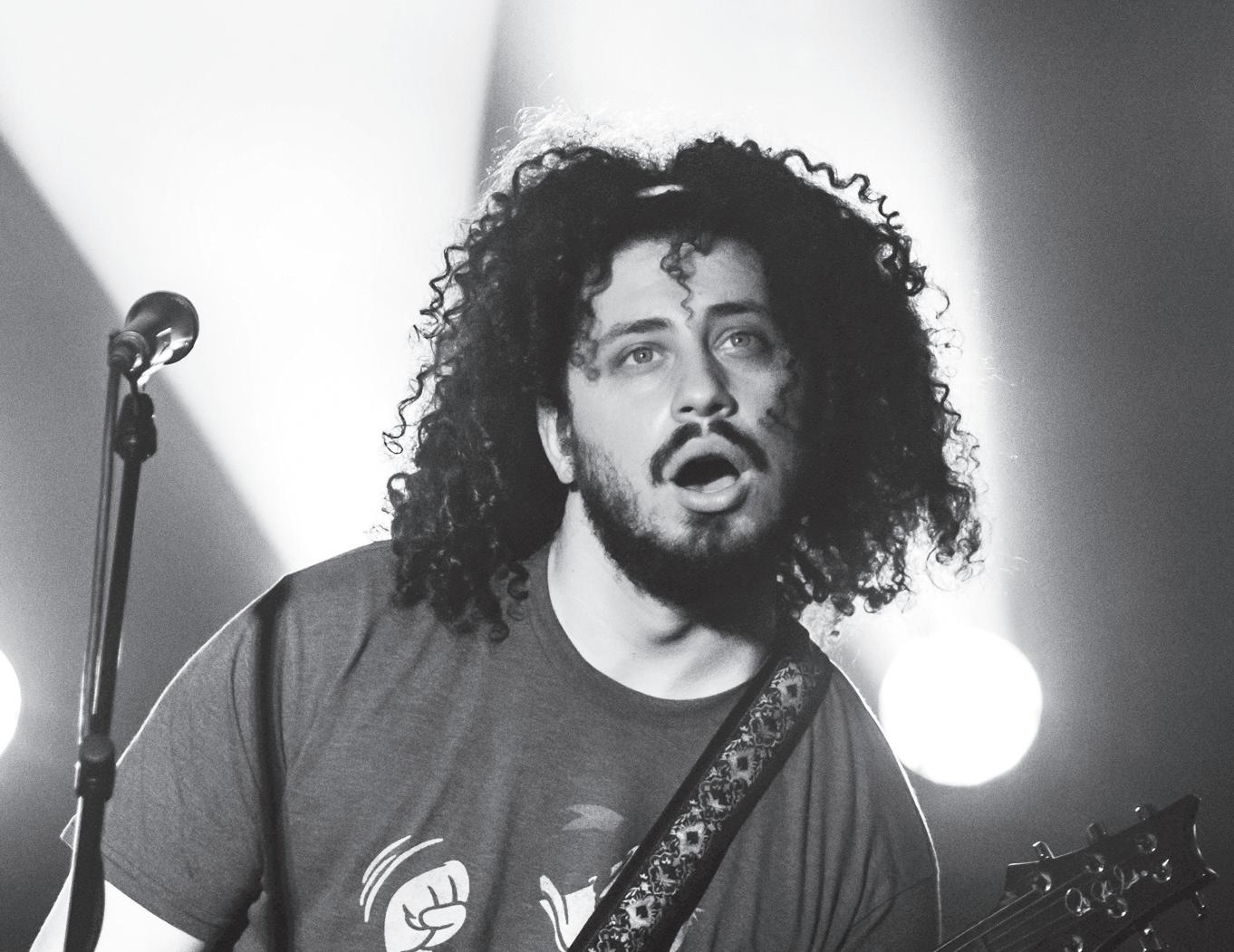
One song that peaked my interest that night was “Porcupine,” off their 2017 album Pizzaz . The group’s chemistry on this California-inspired track was inspired. Guitarist and singer Greg Ormont delivered a skillful guitar solo that captured my imagination, reminding me of similarly great performances from bands like The Red Hot Chili Peppers. Hypnotically shaking their frizzly hair, the band created a strongly visual experience, keeping my eyes open for some eccentric stunt. Another high energy song was the comical “Say Cheese.” The Pigeons jokingly rambled about cheese over smooth guitar and bass riffs. Halfway through the song, Ormont stopped the music, delivering a monologue about the futility of cheese in cuisine. It was rather goofy, and the crowd responded with sarcastic boos and whistled chirps.
Along with these commercially released songs, Pigeons debuted a new song “Snake Eyes,” which featured the same funky consistency of their album Pizzaz. The band described this song as a prelude to more new music to come, as they prepare for an upcoming national tour.
By the time the Pigeon experience was over, The Haunt was still very much alive. Fans stayed behind to min -
gle, making the best of what was still a young night. The performance fed into everyone’s pursuit of happiness and, for a moment, brought out the wild side of everyone. I will be looking forward to more inspired material from this young and imaginative band.
Michael Chang is sophomore in the college of Arts and Sciences. He can be reached at mdc279@cornell.edu.


Fill in the empty cells, one number in each, so that each column, row, and region contains the numbers 1-9 exactly once. Each number in the solution therefore occurs only once in each of the three “directions,” hence the “single numbers” implied by the puzzle’s name. (Rules from wikipedia.org/wiki/ Sudoku)








Continued from page 16
The women’s team will open their season this Friday at Penn State, at a small but competitive meet which includes Division I powerhouses such as Syracuse. The Red is prepared to compete after a summer of intensive training.
“Cross country is a summer sport that we play in the fall,” said Head Coach Artie Smith ’96, “And so much of the success that we’re going to have in the next two months is going to be built upon the work that people did this summer. And I was very happy with that.”
The team’s top returner is sophomore Gabrielle Orie, who was the Red’s second finisher at last year’s Ivy League Championship, garnering First Team All-Ivy Honors. Orie and her classmates Leya Salis and Raisa Kochmaruk will likely be key contributors this season.
The team’s returning seniors include captains Briar Brumley and Gracie Todd along with track captain Annie Taylor, who had a breakout season this past spring, and long distance specialist Eve Glasergreen, who returns strong after a semester abroad. In her time off the field, Todd is also a Sun staff sports writer.
“The seniors have really stepped up,” said Smith. “The five of them have come back in great shape with great positivity—they’ve each overcome a lot of different obstacles, and they’re doing really, really great things.”
World class triathletes juniors Taylor Knibb and Kyleigh Spearing will continue to gain ground this fall, along with fellow classmate Audrey Huelskamp, all of whom finished in the top 75 at last year’s Ivy League Championships.
Like the men’s team, the women have a large class of freshmen which promises to play a major role in team success this season.
“We’re really excited to see how the freshmen will contribute,” said Brumley. “They’ve all come in healthy and fit. As we lost several top runners last year, there are key spots open for freshmen and/or other underclassmen to fill.”
Men’s and Women’s Cross Country will look to keep improving at their next meet, the U.B. Stampede Invite, at the University of Buffalo on Sept. 14.
Mary Barger can be reached at mbarger@cornellsun.com.

By SMITA NALLURI Sun Staff Writer
This transcript has been lightly edited for content and clarity
Sun staff writer Smita Nalluri spoke with senior co-captains Carla Sganderlla and Kara Rogers to discuss Cornell women’s volleyball and their upcoming season. Sganderlla and Rogers gave thoughts on the 2017-18 season, expanding their team chemistry, and a catchy new motto.

Smita Nalluri: What are the main takeaways from last season?
Carla Sganderlla: The main takeaway from last season is to continue the upward trend we’ve had in the Ivy League the past couple of years. We’ve been able to continue improving — going from finishing eigth in 2015 to third last season. This is our year to show other schools in the Ivy League that Cornell Volleyball is a competitor for the Ivy title.
Kara Rogers: Last year we went undefeated at home against every Ivy League team. This year, we want to take the style of play that we had at home on the road with us. In our gym, we played confident and disciplined and we were a well-oiled machine. If we do this during away games as well, we should be very successful.
S.N.: After graduating a strong senior class last year, how is the chemistry of the team this season?
C.S.: The chemistry of the team is still very strong regardless of graduating so many seniors. They left a strong legacy behind that enabled the current senior class to step in and maintain the chemistry, which, in my opinion, is visible on the court and not always present with certain teams. The six freshmen that came in also quickly joined in on maintaining such a strong relationship between the team.
K.R.: Although we’ll miss our seniors dearly, the chemistry this year is just as strong. We have some great freshmen this year, and the returners communicate extremely well and we all trust each other on the court. We are really focusing on holding each other accountable this season.
S.N.: Have you guys made any significant changes, either physical or mental, to your game since last season?
C.S.: I wouldn’t say we’ve made significant changes, but we've definitely tried to improve as a team both mentally and physically. Physically, I think we pushed ourselves in the spring in position practices as well as team lifts. We knew that every hour of work we put in would help us in season. Over the summer, we continued with that mentality and came back in great shape/ ready to play.

your team motto this year?
K.R.: Our “as one” motto comes from the idea that we all want to take our teammates with us. Everyone has to be on the same page. We all have to be 100 percent in to win a match and an Ivy League Championship. This includes our starters and those on the bench. If someone is excelling in practice or in a game on a particular day, we want them to bring everyone else with them and get the entire team on the same level that they’re on. It will take all 22 of us to do something great this season.
“Our end goal this season is to win an Ivy League Championship and make it to the NCAA tournament.”
Senior Kara Rogers
C.S.: Sophia [Beaudoin], a junior on our team, brought it up at our first team meeting. She was describing the idea of bringing your teammates with you on and off the court. This motto was quickly supported by all the players and coaches. Since every year we put a motto on a shirt, we shortened the saying to “As One” and have been following that motto since the season started.
Mentally, we’ve really focused on having a positive attitude. Volleyball is a game of errors and it's easy to get discouraged, but our team has such great chemistry that we help each other out. That’s what’s amazing about this team. Last season, our away record wasn’t where we wanted it to be, so I’m looking forward to implementing our positive attitude these next three weekends to see what we as a team can do to improve.
K.R.: We want to make things consistent this year to ensure our at home and away play go hand in hand. We’re in great physical shape after working hard this spring and summer, so now we really want to find a stable and strong mental state that we can have both away and at home.
S.N.: How did you guys come up with "As One" for
We also came up with “253” which is all of our numbers added together and I think that’s cool because it really exemplifies the “As One” mentality. We are a team of 22 which is pretty big for a normal D1 volleyball team, so I think this is a strong mentality to have because we’re going to need everyone’s full support.
S.N.: What are your goals for the season?
C.S.: Some of our goals for this season are to win the Ivy League, win every Ivy home game and improve our away record. We also have some statistical goals for the season such as increasing our number of digs per set, improving our overall hitting percentage as a team, and improving our block percentage.
K.R.: Our end goal this season is to win an Ivy League Championship and make it to the NCAA Tournament… We have a real special group of girls this year that love each other and work insanely hard. We’re ready to do something special.
Smita Nalluri can be reached at snalluri@cornellsun.com.
coach, 365 more than Dick Blood, the second-winningest coach in Cornell history who led the softball team for 20 years.
with Cornell polo in over four years, since David and I separated, and I discontinued coaching,” she said.
Oxley Equestrian Center since at least the summer showing of horses, which began in June.
Eldredge has not responded to multiple phone calls requesting comment.
It is unclear what led the University to place Eldredge on leave. Jeremy Hartigan, a spokesperson for Cornell Athletics, declined to comment on what he described as a “personnel matter.”
The move has been shrouded in secrecy, and the team atmosphere has grown increasingly tense in recent weeks and months, according to Wilde, Michel and a current member of the team. Other current and former members of the team declined to comment, with some saying they had been explicitly instructed not to do so.
Wilde and Michel said Cornell Athletics placed Eldredge under a “gag order,” requiring that he not share anything about the circumstances of his departure, even with those involved with the polo program.
Wilde and Michel also said Eldredge demurred when they asked him about his future as the head coach of Cornell polo, which won its most recent national title in 2016.
As a student, Eldredge served as captain of the polo team for three years and went on to become an assistant coach immediately after graduation. He was named head coach in 1985 and has served in the role ever since.
Under Eldredge’s leadership, the men’s and women’s polo teams have appeared in a combined 37 national championships. Eldredge has won 988 games as head
Eldredge has coached many athletes to national championships, including his ex-wife Karen ’90 and their daughters, Kailey ’14 and Emma ’17. Karen served as an assistant coach for the women’s team for 23 seasons until the couple’s separation over four years ago.
Karen declined to comment in an email to The Sun. “I haven’t been involved
The Oxley Equestrian Center, near East Hill Plaza, houses the more than two dozen horses that Cornell polo uses in its competitions. Over the course of his tenure, Eldredge has secured donations of high-class horses to the program in part because of his pedigree, according to Wilde.
“These are world-renowned polo
ponies,” Wilde said.
Wilde and Michel said they are worried that Eldredge’s departure could severely impede the program’s ability to continue to receive donations of the animals used in competition — the only method by which they are acquired.
“I am very concerned about the future of the program,” Wilde said.

By JONATHAN HARRIS
Sun Assistant Sports Editor
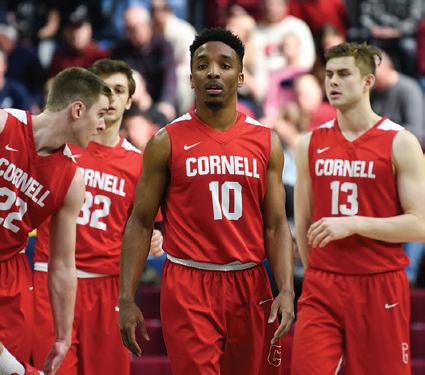
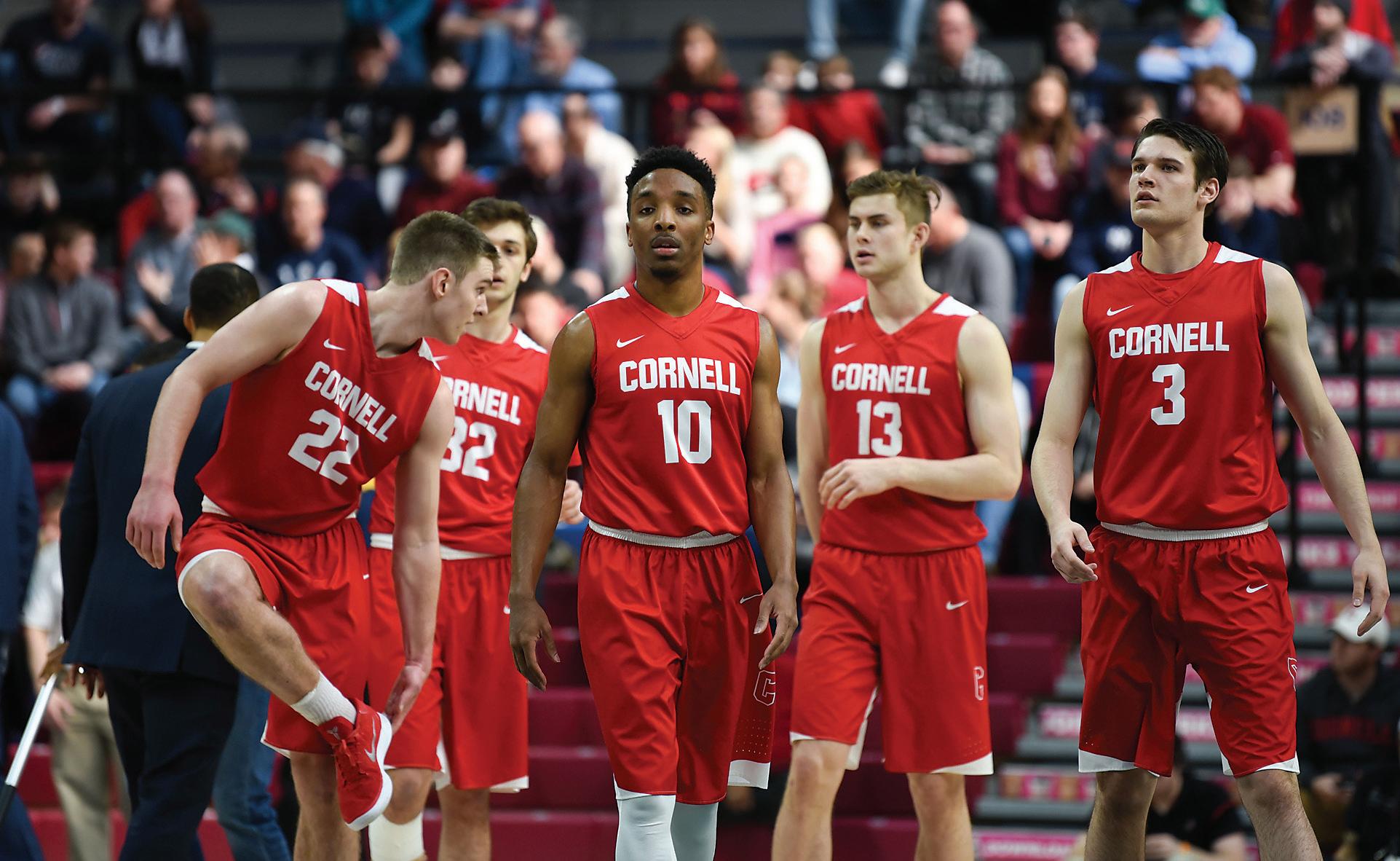
Cornell men’s basketball kicks off its regular season in two months. Here’s a look at the Red’s slate of games in and out of the Ivy League.
Non-Conference Schedule
After a preseason tournament — the first ever Central New York Classic including Binghamton, Colgate, New Jersey Institute of Technology, and Division III SUNY Canton — the Red will embark on its non-conference schedule, which is significantly stronger this year than in past seasons. Games against Duquesne, Wyoming and Northeastern have been traded for matchups with UConn on Nov. 20, Wake Forest on Jan. 2, Southern Methodist
CROSS COUNTRY
University on Dec. 22 and Towson on Jan. 9. Most of Cornell’s big-time non-Ivy games will take place away from Ithaca — the Red has five straight road games between Nov. 17 and Dec. 16.
The daunting schedule aims to help the Red face tough competition in preparation for Ivy League play.
The Red will kick off Ivy League play with a home bout against Columbia Jan. 19 before traveling to Columbia to play the Lions in New York City Jan. 26. After this, Ivy schedule highlights include hosting the defending conference champions, Penn, in Ithaca on Feb. 1 with Princeton, head coach Brian Earl’s alma mater, coming to Newman Arena the next night.
Seven of the Red’s first eight Ivy contests are at home, the
Full Schedule (Home games appear in bold)
Nov. 6 at Binghamton (CNYC)
Nov. 8 SUNY Canton (CNYC)
Nov. 11 Colgate (CNYC)
Nov. 15 Delaware
Nov. 17 New Jersey Institute of Technology (CNYC)
Nov. 20 at Connecticut
Nov. 28 at Lafayette
Dec. 1 at Syracuse
Dec. 16 at Niagara
Dec. 17 Longwood
Dec. 19 at Toledo
Dec. 22 at Southern Methodist
Dec. 30 Navy
Jan. 2 at Wake Forest
Jan. 5 Johnson & Wales
Jan. 9 at Towson
Jan. 19 Columbia
Jan. 26 at Columbia
Feb. 1 Penn
Feb. 2 Princeton
Feb. 8 Dartmouth
Feb. 9 Harvard
Feb. 15 Brown
Feb. 16 Yale
Feb. 22 at Princeton
Feb. 23 at Penn
March 1 at Yale
March 2 at Brown
March 8 Harvard
March 9 Dartmouth
March 16-17 Ivy League Tournament
lone road matchup being the early-season trip to Columbia. Cornell will hope to rack up some Ivy wins in Ithaca before four straight on the road at the end of February and beginning of March, a trip that includes the perennially tough Quakers and Tigers.
Harvard, who ousted the Red from last year’s Ivy League Tournament semifinals, will come to Ithaca March 8, at the tail end of the season, before the Red closes out the regular season against Dartmouth.
If the Red again finishes in the top four in the Ancient Eight, the Ivy League Tournament will take place at Yale — not the Palestra at Penn as in past years — March 16 and 17.
Jonathan Harris can be reached at jharris@cornellsun.com.
Five of team’s top 7 finishers at season opener were freshmen

By MARY BARGER Sun Staff Writer
Last year, Cornell’s men’s and women’s cross country teams finished fourth and fifth, respectively at the Ivy League Championships, and were led throughout the 2017 season by their dominant senior classes. The two teams head into the 2018 season with the common goal of rebuilding their scoring fives and heading into their championship seasons stronger than ever. Both teams are bolstered by a slew of young talent in their incoming classes. The impact of the men’s freshman class was demonstrated at their season opener this past weekend at the Bucknell Bison Open. Five of the team’s top seven finishers were freshmen, implying an incredible potential for growth over the course of the season, as the team’s youngest members continue to gain experience racing at the collegiate level.
“We have a pretty large freshman class that’s loaded with talent that can contribute on race day in a big way,” said Reimer. “Many of them didn’t take long to acclimate to the college lifestyle and have shown a good deal of maturity in terms of keeping themselves organized and staying on top of their work.”
“We have a pretty large freshman class that’s loaded with talent.”
Senior Tomas Reimer
At last year’s Ivy League Championship meet, all five of the men’s scorers were seniors. The team doesn’t need to fill a few holes this season, it needs to fill its entire bracket of top runners — but it has rookies and veterans alike who have already begun to solidify a new top five.
“This team wants to score big at Heps this season,” said Reimer. “A few people have pointed out that we are not ranked as high as we think we should be, and it would bring us all a lot of satisfaction to prove those rankings wrong.”