The Corne¬ Daily Sun
Discusses youth involvement in politics in exclusive Sun interview
By SARAH SKINNER Sun Assistant News Editor
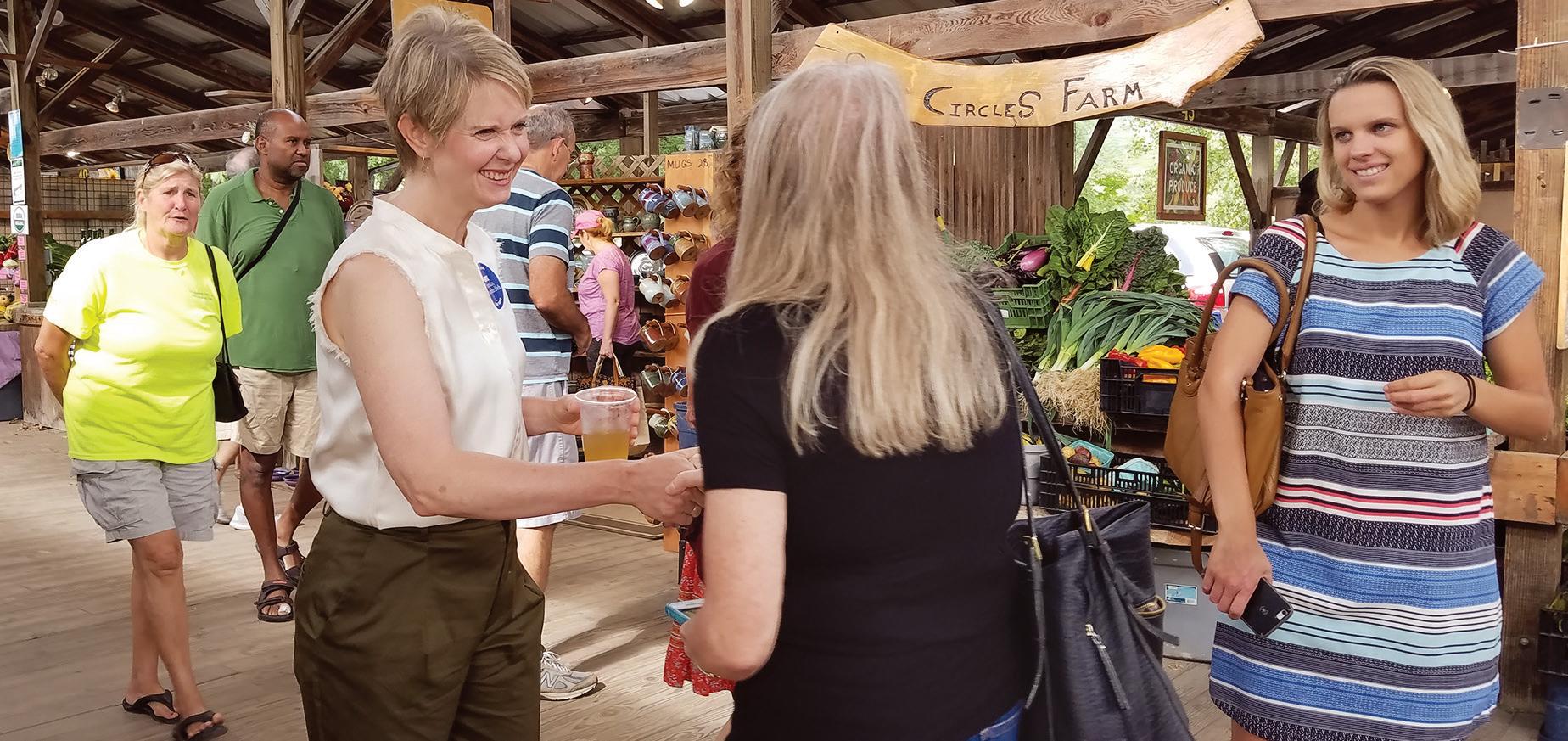
Cynthia Nixon, a candidate for the Democratic party nomination for New York State governor, announced her intent to convert the Cayuga Power Plant into a renewable energy facility at a political rally in downtown Ithaca on Saturday morning. At the rally, which advertised a “major environmental announcement,” Nixon slammed opponent Gov. Andrew Cuomo’s (D-N.Y.) policy record on environmental and social issues and promised a 100 percent transition to renewable energy in the state if elected.
“Being a leader in renewable energy is ... a growing industry that New York needs to be on the ground floor of.”
Cynthia Nixon
Nixon, a former Broadway and television actress, is seeking nomination — in her first political campaign ever — against incumbent Cuomo in the Sept. 13 primary.
“Being a leader in renewable energy is not only good for our health but a growing industry that New
York needs to be on the ground floor of,” Nixon told a crowd of over 200 supporters at The Space @ GreenStar. She promised that, while the Cayuga Power Plant would never run on fracked gas, “banning fracking is only the first step.” Nixon vowed to enact a “polluters’ tax” if elected,
By EMILY YANG Sun Staff Writer
Students and members of the community filed into Bailey Hall for a night of racy humor with comedian Michelle Wolf on Saturday.
Anthony DeVito, a comedian who has appeared on The Late Show with Stephen Colbert and Comedy Central, opened for Wolf, cracking jokes about his ambiguous ethnicity.
Wolf is a former contributor for The Daily Show and star of the Netflix series
Michelle Wolf. The Cornell University Program Board, which sponsored the event, has previously booked comedians with The Daily Show-experience, including Trevor Noah last year and Stephen Colbert in 2007, and felt that Wolf would be a good fit.
“Comedians like Michelle can get very famous very quickly — and we wanted to strike while the iron was hot, essentially,” said Daniela Manzano ’19, CUPB executive chair, in an email to The Sun.
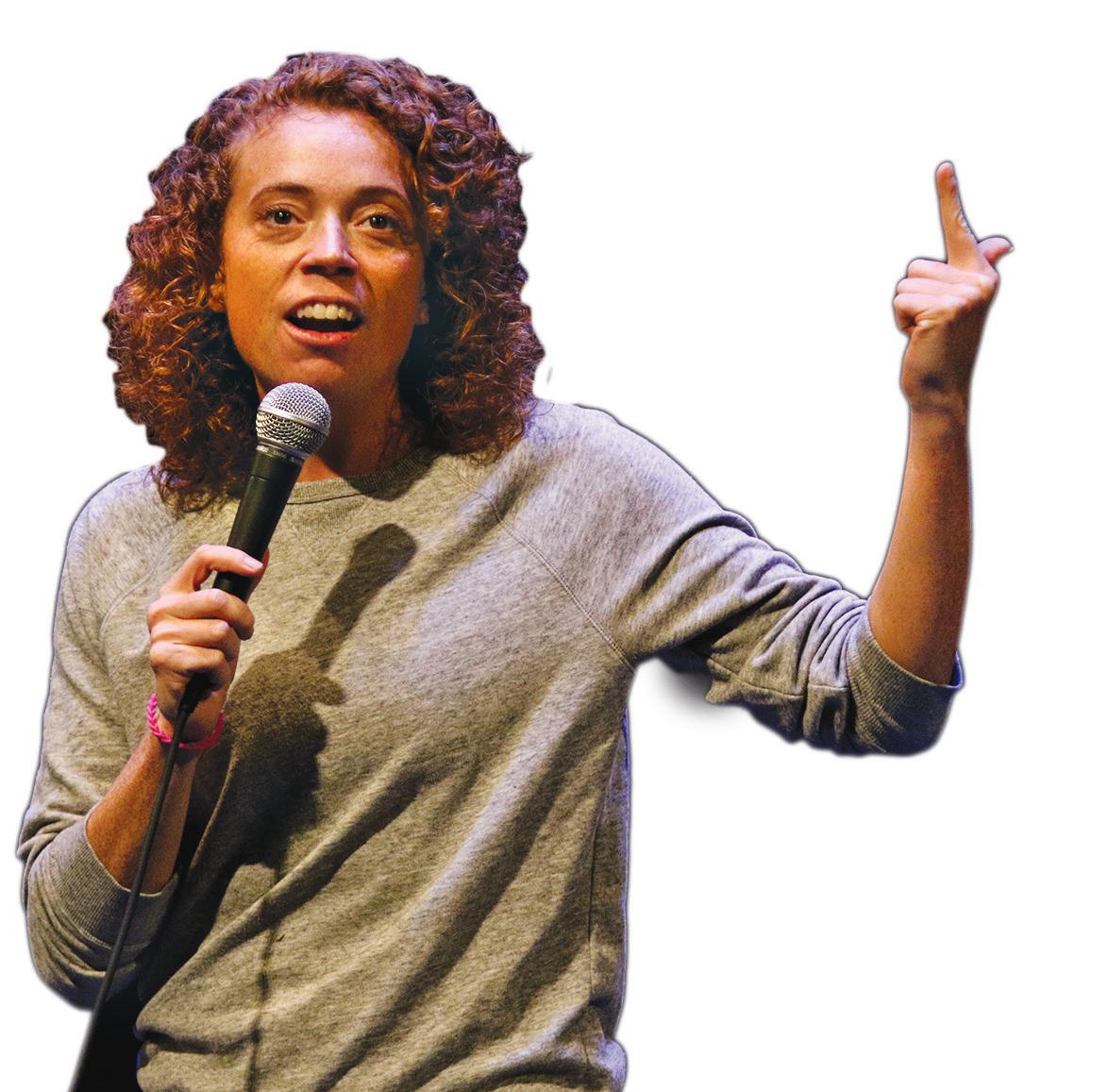
Wolf’s routine mostly avoided mention of specific political figures and instead dealt with larger issues, including abortion, immigration and gender equality.
Speaking from her own experience with getting an abortion, Wolf discussed birth and women’s bodies. She also com-
projecting a $7 million payout in the first year which her administration would use to “turbocharge” the push toward clean energy.
She also advocated for the the Climate and Communities
By MATTHEW McGOWEN Sun Senior Editor
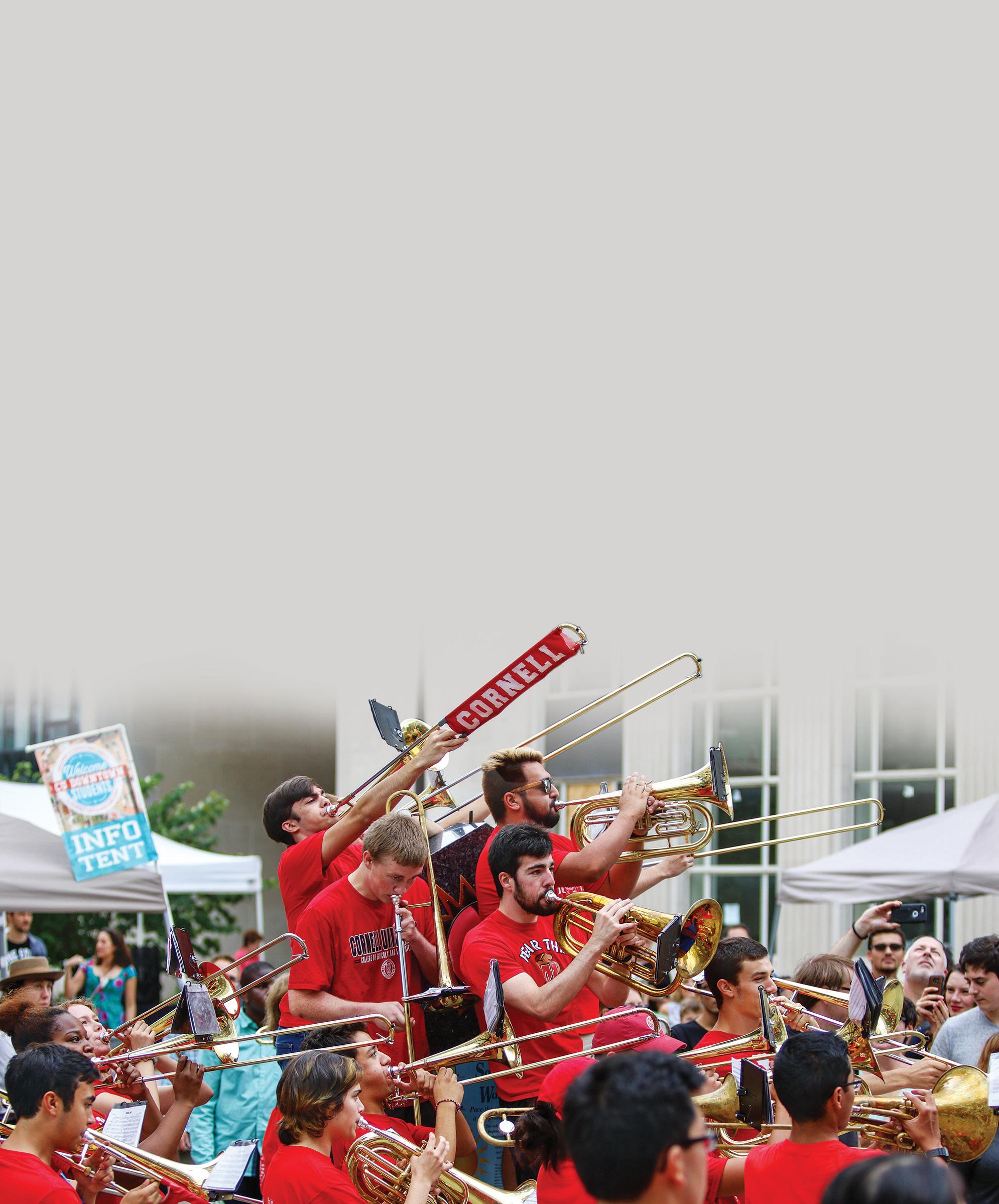
Whether it is the weather or the hills or yet another problem set, Cornellians have a reputation for isolation from their very own college town. C.U. Downtown, now in its third year, sought a rare day of mutual celebration by bringing quintessentially Cornell acts from a cappella to Bhangra onto the Commons for Ithacans and students alike to enjoy on Saturday.
Margherita Fabrizio, the Jack and Rilla Neafsey Director of the Carol Tatkon Center, co-founded the first C.U. Downtown three years ago to help students learn more about their adoptive hometown.
“I’ve always wanted to help new students see that downtown is close, easy to get to, and a fun place for those much needed study breaks,” Fabrizio said in an email to The Sun. “I’ve heard too many seniors say they wished they had discovered Ithaca sooner in their time here so C.U. Downtown is an attempt to remedy that.”
Starting shortly after 1 p.m., Cornell student groups began showcasing a diverse selection of acts. A cappella made a strong showing, with performances from The Touchstones, The Men of Last Call and After Eight A Cappella. The opening act, Tarana South Asian A Cappella, cancelled shortly before they were set to begin.
Tuesday, September 4, 2018
Mann Library New Student Welcome 11:30 a.m. - 1 p.m., Mann Library Lobby
Econometrics Workshop: Vincent Boucher 11:40 a.m. - 1:10 p.m., 498 Uris Hall
Teaching and Learning Reading Group Noon - 1 p.m., 309 Clark Hall
Hands On: Fitness Equipment Orientation 4 p.m., Helen Newman Hall, Fitness Center
Cornell Engineering Project Showcase 4:30 - 6:30 p.m., Duffield Hall
Information Session: New Health Care Policy Major 4:30 - 5:30 p.m., 3301 Sloan Suite Room, Martha Van Rensselaer East
A&S Finance for First Years 4:35 - 6 p.m., Uris Hall, First Floor Terrace
Back in the 19th Century: C.U. Music 8 p.m., Barnes Hall Auditorium
Wednesday
Diversity Week: “My Story, Our Story” Photo Shoot 10 a.m. - 2 p.m., Warren Hall, Lobby
Joint Industrial Organization and Public Economics Workshop: Karam Kang 11:40 a.m. - 1:10 p.m., 498 Uris Hall
AASP and A3C Wednesday Lunch Series Featuring Barbara Oh Noon - 1 p.m., 429 Rockefeller Hall
Africana Palaber Series, Prof. Siba N’Zatioula Grovogui Noon - 1:30 p.m., Africana Library, Hoyt Fuller Room
Decoding Cornell 4:30 - 5:30 p.m., 102 Mann Library
The Refugee Challenge in Post-Cold War America 4:30 - 5:30 p.m., 107 Olin Library
Global 1968: Panel With Cornell Faculty 4:45 - 7:15 p.m., Goldwin Smith Hall, Lewis Auditorium
Certificate in Engaged Leadership Orientation 5 - 6 p.m., Kennedy Hall, 3rd Floor
The Sioux Chef: The Evolution of the Indigenous Food Systems of North America 7:30 - 8:30 p.m., Statler Auditorium

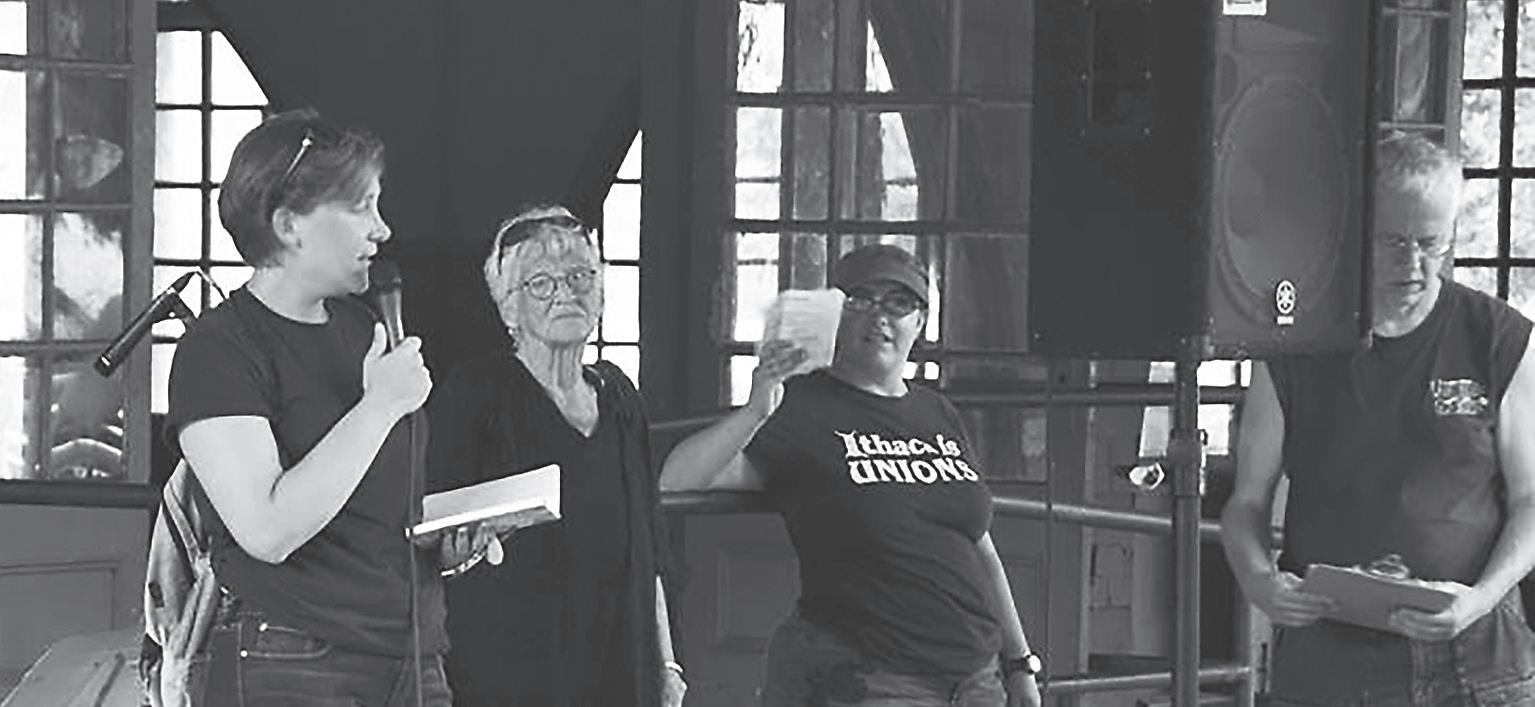
At the 35th Annual Labor Day Picnic in Ithaca, Cornell University received the Goat of Labor award, which goes to an employer that allegedly offends workers’ rights, due to its treatment of construction workers on the Maplewood Project.
According to a Tompkins County Workers’ Center press release, the award is given to an “especially egregious offender of workers’ rights and/or the value of labor to our common good.”
The Tompkins-Cortland Building & Construction Trades Council, a group of AFL-CIO-affiliated construction trades unions, recently created a petition that asks the University to require that local workers are used for construction of all future student housing projects, The Sun previously reported.
Jerry Morley, a business agent for the United Association
Plumbers and Steamfitters, told The Sun in August that 90 of his 240 members were unemployed over the winter and about 50 over the summer. He said having the Maplewood project would have resulted in full employment for his members.
Alessandro Powell grad, member of the Cornell Graduate Students United organizing committee, and David Blatter grad, CGSU secretary, presented Cornell’s Goat of Labor award and delivered a short speech at the picnic.
Blatter called Cornell’s treatment of local community workers “reprehensible,” but emphasized that even though the Goat of Labor award was given to the University, the “bond and relationship between … the ILR school at Cornell, between the Workers’ Center and various other unions, is still there.”
“The Goat of Labor award is a tool that we hope can improve relations and spread awareness about these practices as well as creating solidarity around the issue,” Blatter said. “Cornell has a great deal of responsibility as by far the big-
gest employer in Ithaca and as a huge owner of property.”
Blatter said that Cornell’s “policies really contradict” its reputation, “at least amongst students, as being a progressive, liberal institution.” He said he would like to “point that out to students.”
“We need to hold [Cornell] accountable to practicing what they preach and really walking the talk,” Blatter said. “It’s important that Cornell University is an exemplar to other institutions locally, where labor practices are a huge problem, especially if Cornell is to be a voice and a critic of these organizations, these labor farms and dairy producers that have atrocious labor policies.”
The University did not respond to a request for comment late Monday night.
The picnic was held in Ithaca’s Stewart Park Main Pavillion and was attended by 300 to 400 people, according to Pete Meyers, coordinator at the Tompkins County Workers’ Center. The center, the Midstate Central Labor Council, AFL-CIO and Tompkins/Cortland Labor Committee organized the picnic, and the theme of this year’s event was ‘Why a Union? Why a Living Wage?’
Over 15 organizations set up booths at the event to spread awareness about labor rights, and free burgers, hot dogs, ice cream and beverages were served at the event. The Mother Jones, Joe Hill and Friend of Labor awards were also presented to people “for their activism, organizing, and sacrifice at work,” according to the Workers’ Center press release. Live music was performed by Alexander Bradshaw.
“This event is really about building the labor movement more than anything for those who are already in unions and those who aren’t,” Meyers said. “It’s also about helping workers realize that we have to fight for our rights ourselves because no one else will.”
Powell said he thinks the event was “definitely a success.”
“I’m glad to see so many people from the University and the community at the same place at the same time,” Powell added. “It speaks to the solidarity of the region that we have and the relations that we continue to have.”
By
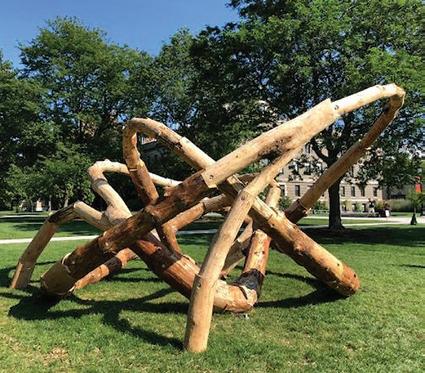
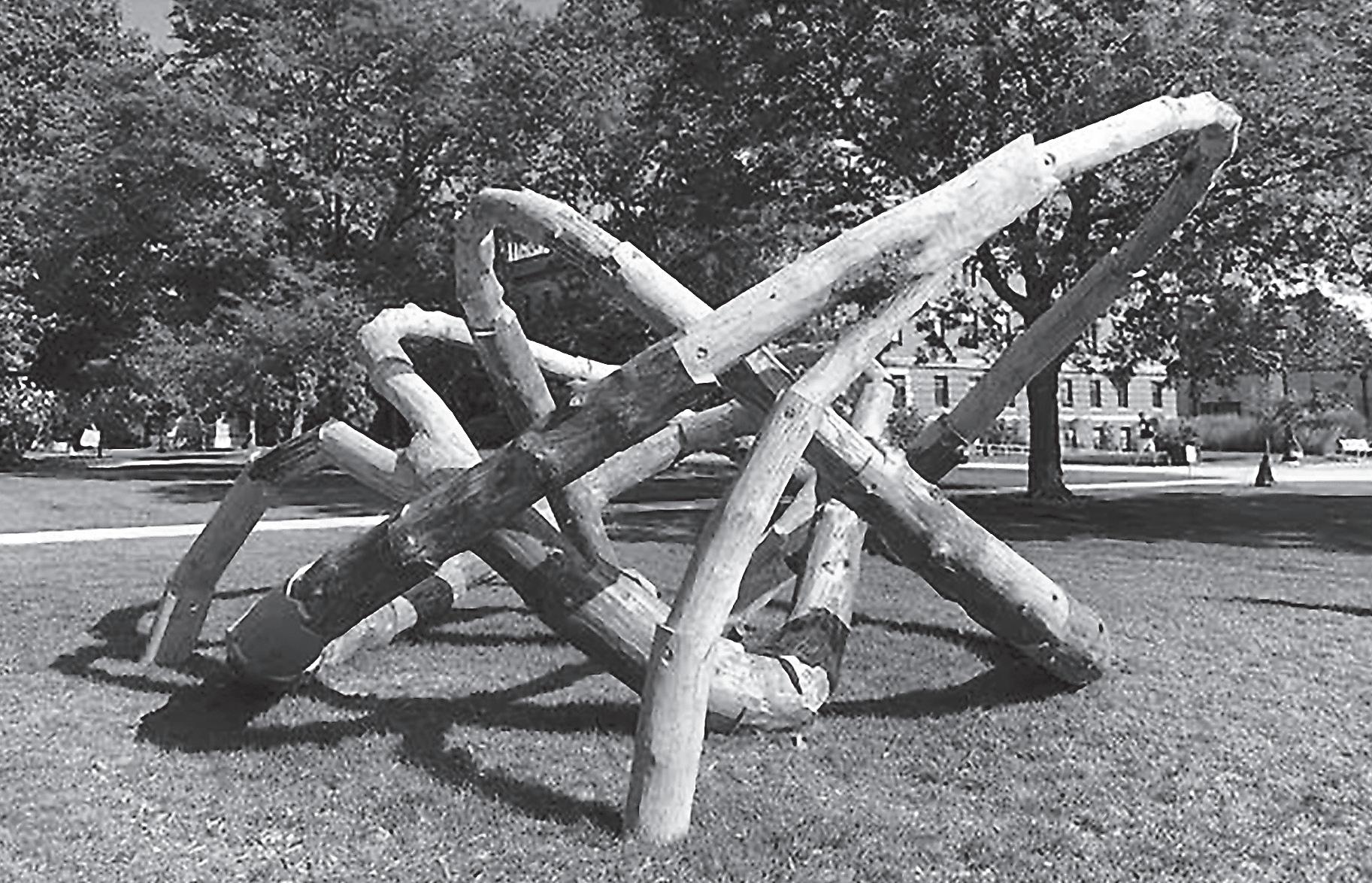
Looping around itself on the Ag Quad stands LOG KNOT — On Perpetual Wood Cycles and Forest Processes, a new installation built with robotic technology and made of wood that would usually be discarded.
The project, located near Caldwell Hall on the Ag Quad, features a collection of irregularly-shaped logs linked together in a twisting design that reaches high above the ground. LOG KNOT was created by the Cornell Robotic Construction Laboratory in collaboration with Cornell’s 4,200-acre Arnot Teaching and Research Forest and is part of the Cornell Council for the Arts 2018 Biennial.
Prof. Sasa Zivkovic, architecture, director of RCL and the main leader of the project, explained in an email to The Sun that the project’s goal was to “create an infinite singular loop of wood, taking a tree (a line) and ‘bending it’ around itself to form a spatial experience.”
tion for the work was taken from structures created by 20th century architect Isamu Noguchi.
After applying for a grant from CCA and receiving an invitation to participate in the 2018 Biennial, Zivkovic and Havener spent the spring and summer of this year working on their project, Zivkovic said.
“It takes a large and dedicated research team to design and complete an architectural installation like LOG KNOT,” he told The Sun. “Final assembly on the Ag Quad was comparatively fast and took only three days.”
“It takes a large and dedicated research team to design and complete an architectural installation like LOG KNOT.”
Prof. Sasa Zivkovic
Todd Petrie ’19, a research assistant on the five-person RCL project team for LOG KNOT, focused on the process of robotically milling each log. According to Petrie, cutting all of the joints in the estimated 65 to 70 logs took over two weeks, even with a morning and night crew working every day.
theme of “Duration: Passage, Persistence, Survival.” According to the CCA website, for this year’s biennial, “the aim is to stage artistic environments that might provoke conversation about the persistence of passage, from environments to communities, while emphasizing the challenge of survival in hostile socio-ecological climates.”
Zivkovic explained that LOG KNOT “addresses this theme on multiple levels,” connecting the project to natural processes like “environmental cycles, birth, growth, and decay” that take place in forest ecosystems.
“The infinitely looping sculpture is an interplay between archaic natural geometry, advanced computation, and stateof-the art digital fabrication,” he said. “By questioning how we currently use the forest as a resource, the LOG KNOT project provides a critical commentary on various perpetual wood cycles: economic, environmental, and cultural in nature.”
Drawing attention to the limitations of sawmills currently used to cut logs for construction, Zivkovic pointed out that an average of only 35 percent of a tree’s wood ends up being used. For him, “robotic fabrication technology” like that used to build LOG KNOT offers a way “to process highly irregular tree geometries which are normally discarded or used as firewood.”
Both Zivkovic and Petrie agreed that the technology used to create LOG KNOT could be applied in the future.
“In terms of how the project aims to advance and optimize the usage of trees in construction, my take is that this project is an early step in what could become a really interesting and intuitive way of constructing buildings or other structures,” Petrie said.
He called Log Knot a “sort of trial run” that tests what is “possible” in
“At the most basic level, our goal was to ‘bend’ tree trunks,” he said. “Also, we like pretzels!”
Zivkovic noted that the project began in January 2017 in a studio course he taught in the College of Art, Architecture and Planning. The studio, he said, purchased an $8,000 used KUKA industrial robot on eBay that would be used to cut the logs.
According to Zivkovic, the system connecting the ends of the logs was developed by Brian Havener M.Arch. ’17, project co-leader and research associate for RCL. Zivkovic said that inspira-
Petrie estimated that “the process of centering the log on the metal stand, checking the [robot] files, copying them over, and then running the files took about 3 hours per log on average,” adding that the crew could finish about five logs “on a good day.”
Petrie told The Sun that he found it “most rewarding” to learn about the robot, which he had not used before.
“It was a challenge to work through this time-intensive process because the robot requires a great deal of attention and focus,” he said. “It’s an extremely powerful machine and we had to be sure it was working safely and cutting the wood effectively.”
As part of the CCA 2018 Biennial, the LOG KNOT installation falls under the
NIXON
Continued from page 1
Protection Act, which mandates a full transition to renewable energy by 2050. The act was passed by the state assembly in April and is currently in committee for the state senate.
Sandra Steingraber, a local biologist who was a visiting scholar at Cornell from 1999 to 2003, also decried the “public health menace” of the local Cayuga energy plant in an introductory endorsement, calling it a “dinosaur power plant that is [Cuomo’s] legacy.”
This was a common theme throughout the rally, as Nixon linked systematic New York State issues to Cuomo’s policy record and the influence of corporate donors.
“We are not accepting a dime of corporate contribution,” Nixon told the crowd, in opposition to the millions raised by Cuomo’s campaign. “We cannot be bought.”
She described her run for governor as a “David and Goliath” effort, with her small-donor voting base against Cuomo’s eight years in office and his legacy as former Gov. Mario Cuomo’s (D-N.Y.) son.
Nixon voted for Cuomo eight years ago because she remembered his father, she told the room, but feels the younger Cuomo has “governed like a Republican” both politically and fiscally, including accepting David Koch’s $87,000 contribution to his campaign in 2010.
Nixon also used the time to unpack her platform on social issues, including advocating for the legalization of recreational marijuana, which she described as a “racial justice issue.”
“[Marijuana has] effectively been legal for white people for a long time,” Nixon said, pointing to statistics of black and Latino users comprising over 80 percent of New York marijuana arrests. If elected, Nixon aims to transform marijuana into an economically productive industry as well as to release convicted users from jail and expunge their records.
She also promised sweeping reform in “over-policing” and mass incarceration, especially among communities of color.
“Black Lives Matter can’t just be a slogan,” she said to rousing cheers. “We have to actually do something about it.”
Akeem Browder, a social activist for prison reform, endorsed Nixon’s bid for office at the rally. Browder’s brother Kalief Browder was incarcerated in Rikers Island Prison for three years, much of it in solitary confinement, his brother said, after being accused of stealing a backpack at the age of 16. Kalief Browder committed suicide two years after his release and was the subject of a 2017 Netflix documentary series.
Browder endorsed Cuomo in the last election cycle but told the crowd that the incumbent governor had failed to enact real change despite his two terms in office.
“We just keep putting him in office, but isn’t that the definition of insanity?” Browder asked. “Doing the
same things over and over and expecting a different result?”
During her speech, Nixon promised to close the Rikers Island facility.
Nixon, a “proud public school graduate,” also advocated education reform at the rally and in an interview with The Sun.
“New York schools are the second most unequally funded in the nation. You’ve got a $10,000 spending gap per pupil between the richest and the poorest areas,” she told The Sun. “That is partly to do with white kids in underfunded areas but it’s overwhelmingly to do with how we underfund our black and brown schools.”
Zephyr Teachout, current candidate for New York State attorney general, endorsed Cynthia Nixon at the rally as well. Teachout lost the 2014 gubernatorial nomination to Cuomo.
“This is a really really serious moment for our state … and for our country,” Teachout told the crowd. “We are up against some of the most terrifying forces at the national level and big money on the state level. They’ve got fear and big money, and we’ve got love and community.”
Nixon echoed this sentiment to The Sun, advocating the importance of student and youth organization in instituting change.
“What we’ve seen, what we’re seeing, is young people involved in in unprecedented way, maybe not since the Vietnam War,” she told The Sun. “Young people realize what’s at stake, and people realize how much our establishment leaders in both parties have let us go so far astray from the path we should be on.”
Nixon’s campaign has ignited support among the far left throughout the state, many of whom are students and millennials. Prior to the rally, Nixon visited the Ithaca Farmers’ Market to shake hands with local business owners, take photos with supporters and sample fresh tomatoes and pesto.
Andrew Kohler ’20, a “big Cynthia fan,” told The Sun at the farmers’ market that he supports Nixon because of her support of union strikes, which Nixon discussed in Wednesday’s debate with Cuomo.
Leah Moore ’20 agreed with Kohler, extolling the importance of non-establishment candidates.
“We’re just excited someone’s shaking things up,” she said.
Both Kohler and Moore are from New York State and plan to vote for Nixon in the upcoming primary.
Despite Nixon’s growing grassroots support, she still trails Cuomo by over 30 points as the Sept. 13 primary approaches, according to RealClearPolitics.
“We know what a hunger there is for a progressive alternative to Andrew Cuomo,” Nixon told The Sun. “But in order to make that happen, we have to do everything we can in the next 12 days.”
Sarah Skinner can be reached at sskinner@cornellsun.com.
LOG KNOT Continued from page 3
robotic cutting.
Zivkovic added that, while people might consider wood a familiar construction material and “assume that we know its possibilities and limits,” technological advances can change perceptions.
“New technological paradigms such as robotic-based fabrication radically challenge our understanding of wood as
a building material,” he said.
“Wood is an exciting and highly advanced building material
“We have yet to take better/full advantage of wood as a ... material for construction.”
Prof. Sasa Zivkovic
and we have yet to take better/ full advantage of wood as a sus-
tainable and smart material for construction.”
LOG KNOT is sponsored by CCA, the architecture college, the AAP Department of Architecture and FARO Technologies. According to Zivkovic, the installation will remain in its place on the Ag Quad through December until the end of the CCA 2018 Biennial.
BreAnne Fleer can be reached at bfeer@cornellsun.com.
DOWNTOWN Continued from page 1
Students and Ithacans arrived in a steady stream and rounded the stage while snacking on free apple cider doughnuts from Littletree Orchards and cider from Wegmans.
The slate of acts reflected diversity in both form and cultural background, representing music and dance from all corners of the globe.
Absolute Zero Breakdance Crew, a hip hop group, lead the first dance routine, followed by Cornell Big Red Raas, Cornell Lion Dance and Cornell Bhangra, which are inspired by traditional Gujarati, Chinese and Punjabi styles respectively.
Musically, the performers also showed quite a range, including the Hawaiian-shirt-clad Cornell Ukulele Club, the Big Red Marching Band and prohibition-era Jazz from the Cornell Original Syncopators.
Joelle Tancredi ’22 came with a contingent of new students from Low Rise 7 and expressed surprise at what downtown Ithaca had to offer. She noted that, while at first she was not sure there would be “as much to do here” as she thought “Ithaca looked like very woodsy and rural,” she found the city “really nice.”
Krista Saleet, the new director of the Cornell Public Service Center, recently moved to Ithaca from Syracuse. She and her husband went downtown to acclimate their children, both of whom sported enormous balloon sculptures courtesy of Brandon Axelrod ’21, to life in the new town.
While tying a princess Ariel balloon for a young girl, Axelrod, who also goes by the stage name The Magic Brandini, said he has practiced magic since he was five and began working with balloons when he was 12. Axelrod said he was invited by the Tatkon Center to join the event.
“The students were especially appreciative once their balloon was sculpted, and as I worked, I took the time to get to know some of the eager freshmen Cornellians,” Axelrod said.
Unlike in years past, the weekend also included a similar celebration for Ithaca College and Tompkins Cortland Community College on Sunday.
In the planning of the event, the Tatkon Center worked closely with the Downtown Ithaca Alliance, a nonprofit organization that works to improve and develop downtown Ithaca. Allison Graffin, marketing director for the Alliance, communicated with TCAT to ensure frequent shuttles and the extension of the typically single-day event into a whole weekend.
“[Fabrizio] came to me with an idea, and we kind of said this has real potential so let’s make it into a whole weekend,” Graffin told The Sun. “We knew that transportation was an important piece so we brought TCAT on board.”
The Downtown Ithaca Alliance provided information to students and Ithacans including maps of downtown businesses, tips on riding the TCAT and a calendar of future downtown events like the Apple Harvest Festival, Wizarding Weekend and Ice Fest.
“We have a lot of events that we host here every year, so our goal is to help them find out about some of these weekend events and get them down and get them outside of the books for a day and help them feel comfortable in their new town,” Graffin told The Sun.
The Downtown Visitor Center on the Commons benefited from the increased foot traffic near their office, giving out “Ithaca is Gorges” stickers and tourist information. Josh Brooks, a senior at Ithaca College, tabled for the center and mentioned the importance of building community with Cornell students.
“I think having events like this and fostering this community kind of in the middle of nowhere gives people an incentive to stay after they graduate, and it’s working,” Brooks told The Sun. “There’s a pretty high rate — and it’s increasing — of graduates that end up staying [in Ithaca].”
Some business owners on the Commons, while not directly tabling or participating in C.U. Downtown, claimed that events and festivals on the Commons are good for business and for getting Cornell students to visit the shops.
Trader K’s, a thrift store, has been on the Commons for 24 years, according to co-owner Jay Sciarabba. Though he said that festivals “aren’t a huge money-maker,” he said his shop enjoys benefits down the road.
“A lot of people on the Commons say festivals and events draw people away because they don’t shop as much, but we see a boost all the time,” Sciarabba said. “They might not be spending the dollars now, but residually, they’ll come back.”
Matthew McGowen can be reached at mmcgowen@cornellsun.com.
WOLF Continued from page 1
pared men and women, joking that women are “better at being human” than men.
Wolf is known for her perfomance as the featured entertainer of the 2018 White House Correspondents’ Dinner.
Controversies emerged over
Wolf’s remarks at the Dinner, particularly for her comments on White House Press Secretary Sarah Huckabee Sanders, Ivanka Trump and President Donald J. Trump’s personal counselor Kellyanne Conway, according to The New York Times. The Times reported that Wolf labeled Sanders “an Uncle Tom but for white women who disappoint other white women,”
called Ivanka Trump “as helpful to women as an empty box of tampons” and joked about a tree falling on Conway.
Lolia Briggs ’19, CUPB promotion chair, said Wolf “stuck out” to the board because of “what she did at the Correspondents’ Dinner.”
“We do try to get diverse names that people will be interested in,” Briggs said. “We try to get people
who we know will fill a house and be a good conversation for the campus to have.”
Anekha Goyal ’21, who attended the event with her friends, described Wolf as “incredible.”
“[Wolf] kept saying we just wanted to have a fun time tonight, and that made sure she was able to talk about certain topics that other comedians wouldn’t broach,” she said.
Abby Lerner ’21 said she liked that Wolf spoke about “divisive issues” while still managing to “make it funny and inclusive.”
“I think that no matter what your political leaning is, it’s definitely something everyone can enjoy,” said Christina Lu ’21.
Emily Yang can be reached at eyang@cornellsun.com.
Independent Since 1880
136th Editorial Board
JACOB
S.
KARASIK RUBASHKIN
’19
Editor in Chief
JOHN McKIM MILLER ’20
Business Manager
KATIE SIMS ’20
Associate Editor
VARUN IYENGAR ’21
Web Editor
MEGAN ROCHE ’19
Projects Editor
EMMA WILLIAMS ’19
Design Editor
Working on Today’s Sun
Ad Layout Josh Girsky ’19
Design Deskers Julian Robison ’20
Lauren Roseman ’21
Megan Roche ’19
News Deskers BreAnne Fleer ’20
Anne Snabes ’19
Arts Desker Lev Akabas ’20
Photography Desker Michael Li ’20
Production Deskers Sarah Skinner ’21
Katie Reis ’21
Istill remember how ecstatic I was when I landed an opinion column my first semester at Cornell — an over-eager, naive freshman who was still unsure about her purpose and existence in Ithaca had made it into the newspaper! The future looked bright.
And if you’ve followed my journey these last few years, then I applaud your voracity, commitment, support and skepticism. Because you, like me, are most likely still trying to figure out what the hell you’re doing with whatever you’ve been given.
Three years later, and I am nowhere closer to finding the answers I sought so eagerly when I was a freshman. But looking back on my “young” self (and I say young just to distance myself from the girl who ate at Okenshields at one point and actually went to the Homecoming fireworks), I can pinpoint events and people in my college career that have significantly impacted me, in ways that make me feel that what I’m actually doing is making some kind of small — at times, even infinitesimal — difference.
It’s these experiences throughout this short time that give me a sense of relief that what might be coming my way isn’t as frightening and daunting as it seems. The endless stretch of time ahead that isn’t marked by any important milestones anymore, as the sweet sixteens and twentyFUNs have passed, suddenly becomes a time to build a career and, according to conventional norms that as much as we try to avoid seems like a mosquito that has constantly been biting us since we entered this institution, move up the ladder. Success, as a blanket cover for many things, was landing the job you had hoped for while you wrote a 10-page paper on a topic you knew you would forget in 24 hours or sat through a grueling prelim.
And I know this idea of success comes from my own upbringing, but I also know many students can relate to this notion of what it means to “make it,” to feel like they have succeeded in one way or another.
Because don’t we want to make our parents proud? Don’t we want people to view us as successful? Don’t we want to think of ourselves as having achieved something great?
And if we can get that job we pined for, sustain ourselves and our habits, feel like we have made something of ourselves, then haven’t we done it?.
But if these past few years have taught
GIRISHA ARORA ’20
Managing Editor
HEIDI MYUNG ’19
Advertising Manager
ALISHA GUPTA ’20
Assistant Managing Editor
DYLAN McDEVITT ’19
Sports Editor
MICHAEL LI ’20 Photography Editor

me that Zeus soups will heal all things, they’ve also taught me that this type of success is a modern-day depiction of Yves Klein’s Leap into the Void.
Because when we follow all these howto steps of success, then what comes next when we finally reach it?
Throughout my struggles with trying to understand my future, grappling with this entity that seems to fluctuate and exist in a constantly transient state, someone close to me sent me some writing about what it means for a life to be successful. The bottom line was that if you are able make someone breathe a little easier, if you can lighten the burden of an existence, you have succeeded. Maybe it’s my way of defending myself from academic failures or future career opportunity losses to come, but on the most personal level, my idea of “succeeding” in life is what the Gaby who entered Donlon Hall didn’t know, or wasn’t able to understand.
Maybe what I’m trying to say is that we shouldn’t look for some kind of golden pinnacle of success, for a breath of relief when we think that we’ve done it. By showing kindness, by sympathizing with people I care about, and even those I dislike or have disappointed me, that’s how I find success: I’ve felt the most fulfilled and closest to understanding my purpose in this world that has been walked on over and over, by women and men who have discovered life-changing solutions, who have fought and talked well and loved deeply and made a mark. And by showing this compassion for life, success happens everyday. It’s getting out of bed when Trump has wronged us again and knowing that there are people out there who need me to keep going. It’s forgiving someone. It’s understanding that my mental health is just as important as my physical health and it’s okay to take a day off for my mind. It’s letting myself be vulnerable when I didn’t think wholeness was a possibility again.
And when we see these seemingly small things as successes, then we don’t have to keep chasing some idealized version of what our future might be. And when you don’t land that dream job, or you don’t find yourself in a place where others can see and praise you, you can’t be crushed. Because you have succeeded a hundred times before already.
Gabrielle Leung is a senior in the College of Arts and Sciences. She can be reached at gleung@ cornellsun.com. Serendipitous Musings appears alternate Fridays this semester.
Once my depression hit rock bottom last January, I couldn’t bear to write about it as I opened the Google Doc and ultimately still continue to bear witness to the clusterfuck that is my life. I quit. I just fucking quit. I needed to get “treatment” I guess. But what does “mental health” even mean? What does it mean when I receive
I needed to get “treatment” I guess. But what does “mental health” even mean?
all these messages from I don’t know how many administrators affirming their commitment to improving mental health services, while the Cornell Chronicle profiles the incoming class as one made up of extremely talented, brilliant students destined to be the leaders of society. Do I even have to say that it’s not exactly becoming of a future leader of society to undergo rounds of talk therapy and drug trial and error just to get through the day?
But even the obituaries published in The Sun which profile the individual still mark students who committed suicide as “exceptional.” The elephant in the room, of course, is how campus culture might have influenced their decision. I’m not a conspiracy theorist, but the fact is students and the administrators do have a lot in common in the way we associate with Cornell.
See the hypocrisies that normalize pain. I’m a Gemini so it’s hard to nail me down, because I’m two-faced by nature. I see them on a personal level too. I see you with your Facebook statuses about how important mental health is while you scroll over another emotional status by that crazy bitch. I’m referring to myself. Shoutout to everyone who offered support only by saying they would, and/or couldn’t take the fact that someone with severe mental illness actually thinks they have something to offer. Shoutout to Claudia who was the exact opposite and got me through last semester.
What I am gesturing toward is a culture at Cornell that creates a fertile ground for mental illness to fester and literally develop mental health issues through the very “commitment” to mental health. If such commitment isn’t grounded on a genuine concern over student wellbeing and is mostly a superficial front to create the impression of it, then students who buy into it will perhaps leave more broken than before their decision to seek help. One popular example is getting prescribed medication that actually worsens suicidality, and there isn’t enough intervention to properly address it throughout the semester for the overworked student and staff psychiatrist.
The injustice that pervades our very eyes. “Mental health,” as I’ve experienced it, is a superficial term that seeks to disengage the conversation from the fact that this society is designed to traumatize nearly everyone, going so deep as to create personal identities of trauma just to survive it. I’m not saying I don’t have comorbid and severe OCD and
depression, but reliving deep shame every time I see someone who humiliated me almost a year ago like it just happened (unfortunately a daily ordeal) is how I’d describe my illnesses. So is ruminating over whether the fact that it broke 10 times meant I was clenching too hard and maybe I should’ve said something, kicking myself until I feel it and enduring the meta-trauma of lying about how traumatic my mental health leave was just to end it. My psychiatrist just prescribed me what she basically described as mild Xanax to keep me swallowing. From my scaling down of university-wide issues to my own issues earlier in this column, I hope it’s clear what the bigger picture is.
The first column I ever wrote for the Sun was a Guest Room called “The Disease.” It talked about my own experience with mental illness, and how it was important for us to create an environment where doing exactly what I did in that column would benefit everyone. It had some pretty language in it but it was ultimately bullshit. One incident I cited in it was when my friend noticed a text from my mom asking me about drugs, and my pre-med ass said some shit like “oh I told her about a lab in chemistry where we had to design drugs and she’s just asking me how it went.”
Now I’m like, wow they expected me to become Sanjay Gupta with my fucked up brain. They still don’t realize no neurosurgeon can fix me unless they can erase my memories and their psychological effects. Who truly stuck the knife in first? Me, them or who we’ve truly become after having been forced to suppress our thoughts and subsequent actions? Who can relate? How the fuck is Counseling and
What I am gesturing toward is a culture at Cornell that creates a fertile ground for mental illness to fester.
Psychiatric Services going to help me with this shit? Or more importantly, does it even have the power to given the context it operates within?
Ultimately, just talking about “The Disease” did nothing but make me feel like I was real for a hot second. I’ll say it again, self-making is bankrupt. If we were to organize on the basis of our collective experience of being commonly oppressed by something or the other, and boldly lean into the tensions that erupt as a result, we can form something called a “coalition.” I hate that word because I feel like the work required to even come together like this is just way too much than it needs to be. But it’s the reality. Even if this approach is bound to be as messy as me, if it at least succeeds in preventing a single suicide, then it will have succeeded in saving us all. Stopped mine, so it’s worth a shot.
Sarah Lieberman | Blueberries for Sal
Ileft a time capsule in the closet of my first home, a shoe box filled with things that I loved as a six-year-old and notes of encouragement for the person I would become years, and years, and years down the line.
I watched Bo Burnham’s new movie Eighth Grade last night, which hesitates around the idea of time capsules — but, even more specifically, around the idea that there is some better, cooler you, waiting around the bend of a few years. The idea that we are just a few years away from shedding this crippling loneliness, or crippling social anxiety, or crippling anxiety — whatever it might be; this pain is temporary.
My brother started his freshman year of college a few days ago. He’s doing great, he really is. He goes to the social events, he does his homework, he uses Piazza — he’s a natural. However, I’ve been thinking a lot about the start of my own freshman year, and how not great I was doing. I didn’t go to any events. I cried over homework. I had no friends. I had my roommate, and I sort of had her friends. But really, I had no friends.
I sat alone in the dining hall, for weeks. I was there, in Robert Purcell Community Center, sitting at the end of a long table, alone, dribbling tears into my pancakes.
I thought that this would be it. This would be my life at Cornell. I was the kid who sat alone at lunch. I knew all the best places to cry on campus. I called my mom three times a day. We had to get a better phone plan. I sat alone in my dark Donlon room and just waited until my roommate would come home from class, so I could wring out a day’s worth of social interaction from her. She was so wonderful, I really should thank her more often. I thought this would
be my life at Cornell.
This didn’t end up being true. When you’re in the moment, it feels so real — so painful — that you believe that another happier version of yourself can’t be any closer than years and years away. If I had made a time capsule my freshman year, it would be filled with crumpled up tissues and notes I took while in office hours. It would address the future me, the me after college, and it would thank myself for waiting out all this pain in order to become someone better — someone successful with clear skin.
You are learning how to be happier here, but you are also learning how to be sad.
Okay, here’s the big idea: first-years, there is no better, happier you, waiting on the other side of time. Things don’t really radically change. Life doesn’t just decide to cut you a break. Your life becomes so much better, but it’s not just the time that passes — you can’t just try to stay inside to wait out the storm. You will be happier in the future, you will have more friends, or different friends, you will get better at asking professors for help, you will live only with the people you want to, you will understand Piazza.
But you will also be sad in the future, maybe even sadder than you are right now. You will be lonely again. The loneliness doesn’t just disappear. School will still be hard; it might even get harder. There is no better, happier you, waiting on the other side of time.
The start of every new school year brings with it a rush of emotions: excitement, anticipation, motivation and a slew of other positively-connotated feelings.
Constantly carrying the burden of speculation isn’t ideal, desirable or even acceptable.
O-Week rewards us prematurely with waves of blissful ignorance and the chance to bask in ironic nonchalance at a rigorous institution. The shrewd among us manage to reign over Add/Drop so supremely that they might not have a real class for weeks (kudos!). At the advent of Senior Year, though, I find myself grappling with a different set of emotions — impatience, urgency and agitation prime among them.
At the heart of this agitation is the paradox of choice. What now? Will you work? Will you travel? Will you devote time to civic responsibility? Will you plunge deeper into academia or retreat to your hometown?
Suppose, after what may as well be eons of thought, you timidly choose to enter the workforce. The task of translating an undergraduate degree into a tangible career with an upward trajectory, with an acceptable work-life balance, that generates a sustainable source of income is daunting, to put it gently. Rewind a little further if passion is lacking or an occupation that justifies compromise remains elusive. Finally, throw the millennial search for fulfillment into the mix and it sometimes feels like there is not a viable option in the world.
Surprisingly, even having a confirmed destination after college does not seem to dull the sense of apprehension. Planting roots firmly in the soil of Company X

But you will be able to handle it. You will have done this before. You will have felt this before. You will know where on campus to go to cry. You will know how important it is to reach out, to call your mom, to go to CAPS, to use Piazza. You will have a steadier foundation, more confidence in your stride; you are still you — with the same skin, and the same feelings and the same desire for things to just get better. But it’s not about things just getting better, it’s about getting better at handling them. So, freshmen, or anyone, welcome this loneliness. Yes, do everything people are telling you to do to cure it — join clubs, chat with people on your floor, put yourself out there. But also, just look at the loneliness, acknowledge that it’s there and in all likelihood will come back, sometime in college or beyond, but you, right now, at this moment are already that better version of yourself that you picture on the other side of time. You are learning how to be happier here, but you are also learning how to be sad. Even if it feels like you are floundering, or failing, or completely alone, you should be so proud of yourself because you are still here, and you are just learning how to be sad. Your future you will thank you, and you will be so proud of you.
Sarah Lieberman is a senior in the College of Arts and Sciences. Blueberries for Sal runs every other Tuesday this semester. She can be reached at slieberman@cornellsun.com.
Batra | Guest Room
is quite appealing from the perspective of a new graduate, but too soon the trials of industry have the power to displace all other pursuits. Nearly the same can be said for other typical post-graduate branches, be it higher education, research or entrepreneurship. The lifestyle of curiosity and exploration, advertised and encouraged all throughout youth, is violently overthrown by a sudden, innate demand for stability.
Constantly carrying the burden of speculation isn’t ideal, desirable or even acceptable. Lodging ourselves in a place of doubt, hypothesizing and forecasting distant consequences, is no way to transition out of a formative four-year experience. One of the simplest yet most exasperating pieces of guidance I’ve received — from friends, mentors and www.tumblr.com/tagged/inspirational-quotes alike – is to live in the moment. Sure, this meets with resistance from every fiber of my being. Sure, it’s much more intuitive to treat college as a means to a better end. Still, if implemented correctly and fully, an investment in the present day proves to be fairly beneficial, both in the short-term and long-term.
and joys amounts to something impressive and valuable.
Some folks embrace uncertainty and others, like me, are plagued by it. Occupying the latter demographic offers a few perks — you’ve mentally scanned all possible scenarios and are only rarely confronted by unforeseen events — but from a planning standpoint, you still have very few answers. To this, my slightly pessimistic yet somewhat comforting response is that it’s alright, perhaps even expected, to have a period of restlessness and turbulence, especially at the beginning of a professional or personal journey. Likely, this will result in ambition, or at least, it will catalyze the movement into more gratifying paths.
Some folks embrace uncertainty and others, like me, are plagued by it.
So, where does this leave us, the young leaders of tomorrow? Per consensus of the wisest philosophers and bloggers of this age, it is morally sound to enjoy the current moment, with all its current thrills and current confusions.
The question of what comes next — pressing as it is — will wait. Things will fall into place right on cue. Trust me on this — if you haven’t even registered for your swim test because maybe, given enough time, the requirement will die, or humans will evolve enough to turn swimming obsolete — you’re using this logic right.
It’s a well known fact that we have been surrounded by technology in almost all aspects of our lives. With buzzwords such as AI, deep learning, blockchains coming every month, technology now commands a lot of attention. And not in a good way. By surrounding, I mean a constant bombardment. By commanding attention, I mean controlling us. Ironically, we are at the mercy of the a tiny, human device, which was designed to keep us in touch and does anything but that now on a deep level.
Any reader of this line who disagrees and tells me they have over 1000 Facebook friends and/or Instagram followers should carefully consider the superficiality of their assertion. All social media today is an endless bottom pit of posts that reflect how obsessed as a society we are with ourselves and showing off. Enjoying an unexpected, thrilling moment is no longer as fun as trying to recreate an Instagram Boomerang of what just happened. Why are we concerned with showing off to a bunch of people, 90 percent of whom we don’t interact with on a daily basis? Is it an issue of self-worth, that we find joy in knowing that we are a part of someone who has ‘liked’ our post? Whatever it is, it is eating our society, and fast. We are constantly on our devices — I have noticed friends “meeting” for a meal only to be on their respective phones the entire time, and watched the new normal, which is a family of four all on their gadgets while having dinner. There is conversation — but of the kind that even a third grader would understand. Besides making me feel extremely embarrassed and saddened, I reminisce of a time when dinnertime had some value, and when people actually talked about their lives openly during a meal.
In the scope of daily life, there are more frequent opportunities to feel satisfied in reaching smaller milestones. On a larger scale, there is the promise that the aggregate of ordinary ventures
Will I follow my own advice, you ask? Well, that’s for future me to know and present me to find out.
Priya Kankanhalli is a senior in the College of Arts and Sciences. Matters of Fact runs every other Tuesday this semester. She can be reached at pkankanhalli@cornellsun.com.
I do not deny that I have occasionally made mistakes of the kinds that I have stated above and that I am above this. What is different about them is that I have come to develop a conscious understanding of what I am doing, and as a result I have refrained from a lot of these activities. It is important to know this because a lot of times being surrounded by screens makes people irritated when they return to the real world without their realizing, and this causes them to fixate more on their gadgets. It is easy to blame tech companies for our addiction, and in part it is true — our social media accounts have been carefully designed by people who sit in rooms and plan on how we can spend more time on their devices so that they can make more money. However, if we are not careful to realize this, it may be too late. After all, we must realize that it is we who are in control of the device, and not the other way around. So who are the humans we deal with everyday? Are they the people we know or have they just applied a filter of some kinds on themselves?
Raghav Batra is a senior in the College of Arts and Sciences. Guest Room runs periodically. Comments can be sent to opinion@cornellsun.com
BY LEV AKABAS
Arts and Entertainment Editor
BlacKkKlansman is oozing with 70s vibes, from the afros to the costumes to Terence Blanchard’s rich, R&B-based score. And yet director Spike Lee is hyper-aware of the history that preceded the film’s central story as well as the time period in which it is being told. The first character to appear on screen is a right-wing propagandist bumbling through his lines, played by none other than Alec Baldwin, who impersonated President Trump himself on Saturday Night Live. Like the film as a whole, the casting choice is more than a little bit on the nose, but it is also suitable for a 2018 political climate that doesn’t exactly call for subtlety.
In that same vein, an opening title card tells us that “Dis joint is based on some fo’ real, fo’ real shit” — the story is so nuts that we probably wouldn’t believe it were true otherwise.
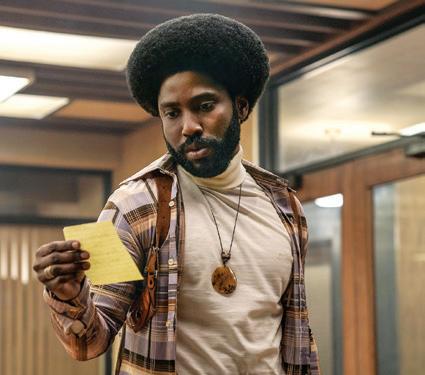
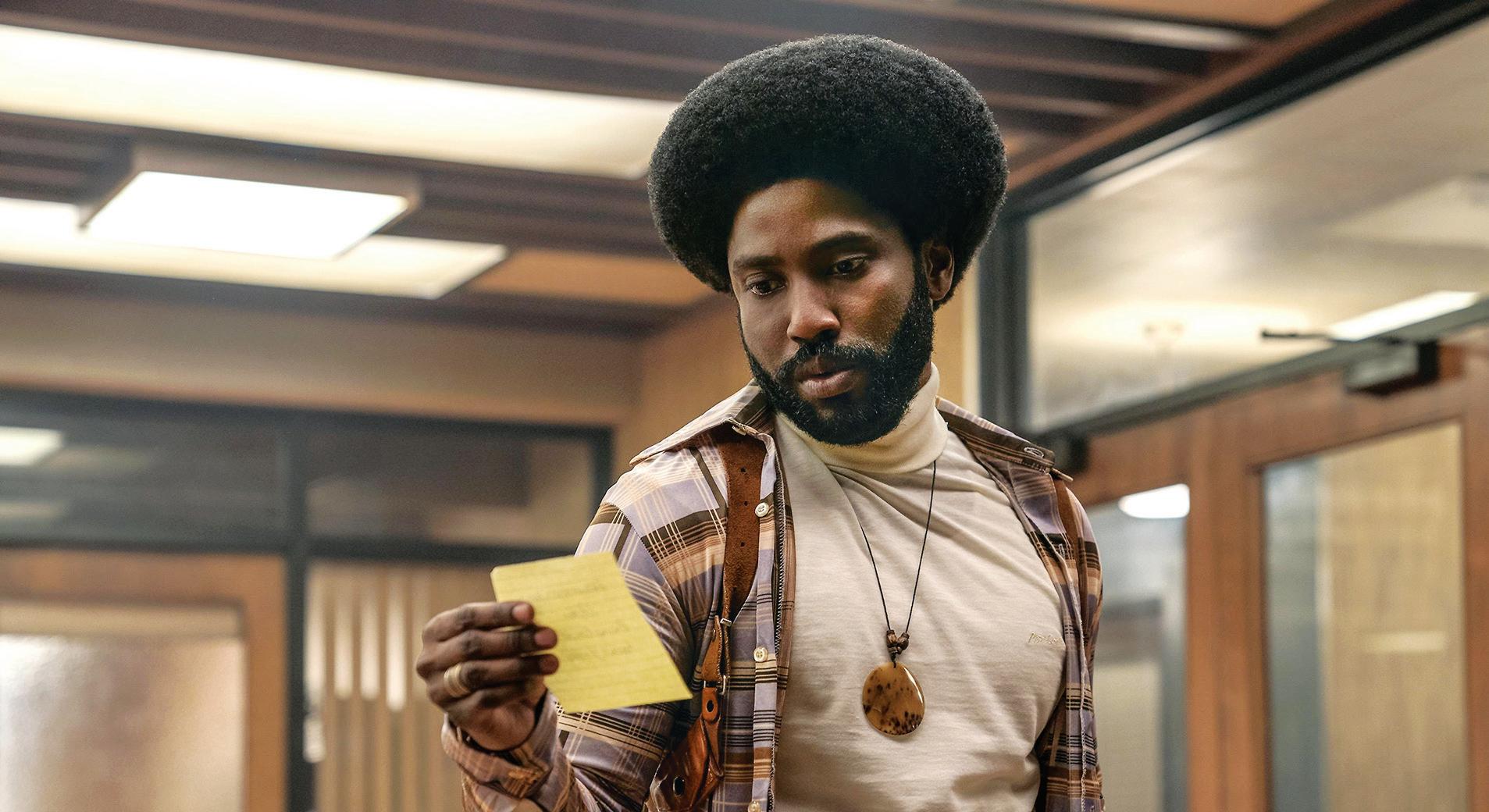
Ron Stallworth (John David Washington), the first AfricanAmerican cop in the Colorado Springs Police Department, attempts to infiltrate the Ku Klux Klan by talking to them over the phone with the hopes of eventually becoming a member. There’s only one problem — he’s black — so he enlists his fellow detective, the white, Jewish Flip Zimmerman (Adam Driver), to play him for an in-person meeting with the Klan.
The actors not only have to make their characters believable, but also their false identities, because if we, the audience, don’t buy that the Klan can’t see through their respective facades, then the entire premise falls apart. The film rests on the abilities of its two leads, and they deliver with Oscar-worthy performances.
Washington, son of Denzel, inherited his father’s command of the screen and ability to give emphasis and weight to every one of his lines. His phone conversations with the Klan, including Grand Wizard David Duke, are outright hilarious. Washington’s exaggerated pronunciation of the “h” in “white” rivals that of Frank Underwood in House of Cards for absurdity. Every utterance of “God bless white America” by Washington sent the audience into laughter, albeit a somewhat nervous one, which I imagine was Lee’s intention.
Driver is also terrific at every turn. His character is more conflicted initially about the merits of the investigation versus the risk, and Driver shows his nervousness when maintaining his front in interactions with the Klan. In the movie’s tensest scene, an especially slimey and bigoted Klan member, Felix (Jasper Pääkkönen), attempts to interrogate Zimmerman in his base-
ment with a lie detector machine. The acting by both Driver, a non-Jew playing a Jew playing an anti-Semite, and Pääkkönen, a Finnish actor playing an American white-supremacist, is impeccable.
BlacKkKlansman is admittedly a bit sloppy, particularly in its pacing. Several scenes drag on far past when they’ve made their point, causing the movie to clock in at a slightly bloated 2 hours and 16 minutes. Additionally, some might find Lee’s in-yourface style to be exhausting, although I found it appropriate for the subject matter. In one dialogue sequence, characters directly discuss the possibility of a racist becoming president and using that power to pass policies that harm disenfranchised Americans. It’s cringeworthy in its straightforwardness, but Lee certainly gets his point across.
Whatever criticisms you may have of Lee, though, you can’t deny his ability to conjure powerful, striking images, and BlacKkKlansman features plenty of them. In many ways, much of the movie is about the way that societal images of different groups of people alter our perceptions of them. During a rally thrown by Civil Rights organizer Kwame Ture, Lee’s camera focuses on the gorgeously lit black faces in the audiences. The fact that these portraits are shown while Ture speaks about going to the movies as a child and seeing people who look like him playing uncivilized caricatures makes them all the more meaningful.
In a memorable climax and the ensuing finale, Lee pulls out his signature double-dolly shot, in which both the camera and the characters are moving with respect to their background. The result is a surreal image of Ron and his girlfriend Patrice, plucked straight from 70s blaxploitation poster, floating down a hallway. Again, an awesome visual moment is directly tied to the script itself — in a previous scene, Ron and Patrice debate the benefits and drawbacks of the blaxploitation genre and its representation of blacks on the screen.
The most impactful images in BlacKkKlansman, however, may not be the ones generated by Lee himself but the existing footage that he cleverly recontextualizes. The film opens with a famous shot from Gone With the Wind in which Scarlett O’Hara walks through a yard of fallen Southern Civil War soldiers as the camera pans upward to reveal a Confederate flag flapping in the wind. When viewed as part of the 1939 classic, the clip is not as overtly problematic as when it’s presented at the beginning of a modern day movie about the Klan. At the outset of a film that takes place entirely in the 1970s, Lee forces the audience to question the ways that popular culture
has contributed to a reality in which the Klan is able to carry out its hateful actions.
Later on, he shockingly uses footage from 2017 to pose another question about how far we’ve really come since the true events of the film. Such a bold and direct reference to current events threatens to date the movie in a desperate attempt at being “timely,” but Lee’s synthesis of different
eras in our country’s history brilliantly shows that there is nothing particularly “timely” about these themes at all. This country used to be racist. It was racist in 1979. And it is still racist.
BlacKkKlansman, despite its flaws, is a passionate and inspired reminder of those facts, while serving up plenty of comedy along the way. It reminds me of a genius Saturday Night Live
sketch the week after the election of Donald Trump, in which a white character declares, “This is the most shameful thing America has ever done!” The two people of color in the skit, Dave Chappelle and Chris Rock, simply turn to each other and laugh.
Lev Akabas is a senior in the College of Arts and Sciences. He can be reached at la286@cornell.edu.







Any person, any study, anywhere!
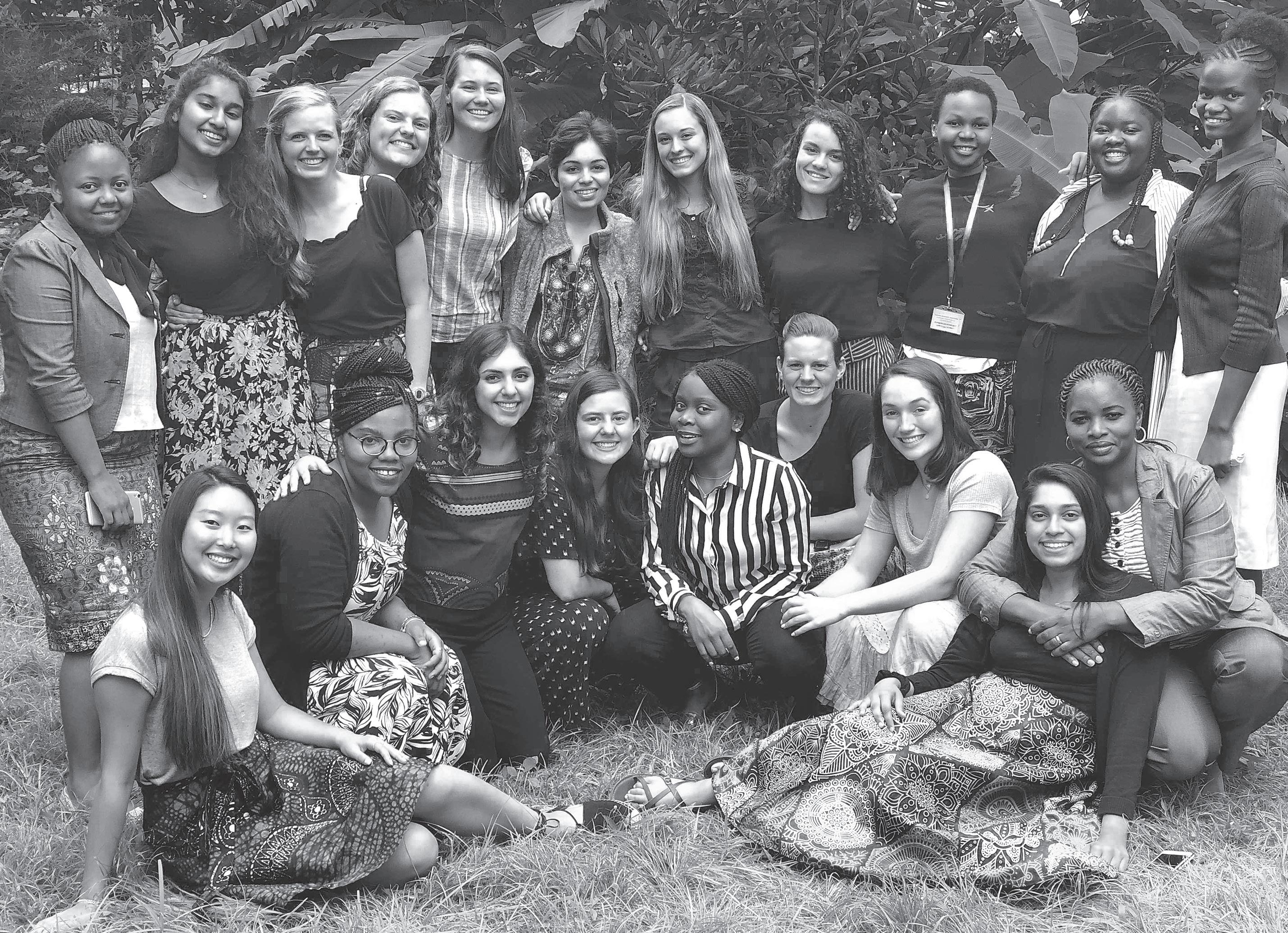
This past summer, 16 students were selected to spend eight weeks in a cross cultural exchange after undergoing an application and interview process through the College of Human Ecology’s Nutritional Science Department.
The Global Health Program in the Division of Nutritional Sciences provides students across colleges with opportunities to engage, explore, and learn in Tanzania, Zambia, the Dominican Republic and India.
For the first four weeks of the program in Moshi, Tanzania — which is near Mount Kilimanjaro — the students
The initial four-week course at Kilimanjaro Christian Medical University College was structured around not only teaching important global health issues that exist in Tanzania, but also providing students with a hands-on opportunity to work with local medical students on policies that influence many of those health issues. Students worked collaboratively with two medical students on a health policy to improve the local community by collecting data in addition to conducting stakeholder interviews.
The final part of the project focused on sustainability issues pertaining to the policy — a key pillar of many of Cornell’s global health programs.
“We researched the ways in which doctors interact with their patients, and the quality of care being provided at health facilities in Moshi.”
Kalin Ellison
’19
lived with local families and enrolled in a course at Kilimanjaro Christian Medical University College. The second four weeks had students working 40 hours per week at a local non-governmental organization or hospital and engaging in service projects that related to their individual interests in global health.
“My group researched healthcare professionalism in Moshi,” said Kalin Ellison ’19. “Specifically, we researched the ways in which doctors interact with their patients, and the quality of care being provided at health facilities in Moshi. After talking to stakeholders and conducting literature reviews, we discovered that gaps in policy exist surrounding patient feedback systems and medical school curricula resulting in doctors not receiving proper training in soft skills and bedside manner.”
Ellison also said that completing the case improved her skills in scientific writing, while also giving her detailed policy
knowledge of a different health system.
During the last four weeks of the program, students worked on a sustainable service project with a local hospital, non-governmental agency or governmental agency according to their personal global health interest. Leading and learning through community engagement at this leg of the program, students were provided with firsthand experience surrounding pivotal global health issues. The projects ranged from shadowing doctors in rural hospitals to working with the Network Against Female Genital Mutilation, an organization that aims to stop child marriage and female genital mutilation in the Kilimanjaro region of Tanzania.
Ellison, who worked at NAFGEM for her service placement, explained that the organization used a variety of approaches to combat these issues, including providing education, economic empowerment of women and refuge for at-risk girls.
“I specifically worked at a shelter for at-risk girls in Moshi. For four weeks, I helped develop educational materials to spread awareness about the dangers of female genital mutilation and helped teach music and English to the girls living at the shelter,” Ellison said.
Meanwhile, other students, including Anum Hussain ’19, Katie Sattherwaite ’19 and Erin Kim ’20, shadowed doctors at Machame hospital, a low-resource hospital near the base of Mount Kilimanjaro.
“It was an awesome experience — very different from any U.S. hospitals,” Hussain said. “We shadowed in every department including OB/GYN and orthopedics.”
While in Moshi, the students lived in a homestay with local Tanzanian families. Students learned about daily Tanzanian life while forming relationships in the Moshi community.
“Living in my homestay was by far the best part of my experience,” Ellison said. “The homestay was the environment in which I learned the most about the culture and language while in Tanzania. I got to experience traditional Tanzanian food, learn Swahili slang and completely immerse myself in a different way of life.”
Cassie York ’20 discussed the atmosphere and strong bond with her homestay family.
“It was amazing, I loved my homestay mama, and there were six to eight children in our house at any given time,” York said. “It was so sad saying goodbye to them at the end of the program.”
In preparation for the eight-week stay in Tanzania, students had to complete several required courses and training. These requirements included a PreDeparture Seminar and Elementary Swahili.
Chenab Khakh can be reached at ckhakh@ cornellsun.com and Eleanor Bent can be reached at ebent@cornellsun.com.
Fill in the empty cells, one number in each, so that each column, row, and region contains the numbers 1-9 exactly once. Each number in the solution therefore occurs only once in each of the three “directions,” hence the “single numbers” implied by the puzzle’s name. (Rules from wikipedia.org/wiki/ Sudoku)




Opportunities squandered |
By GRACIE TODD
Sun Staff Writer
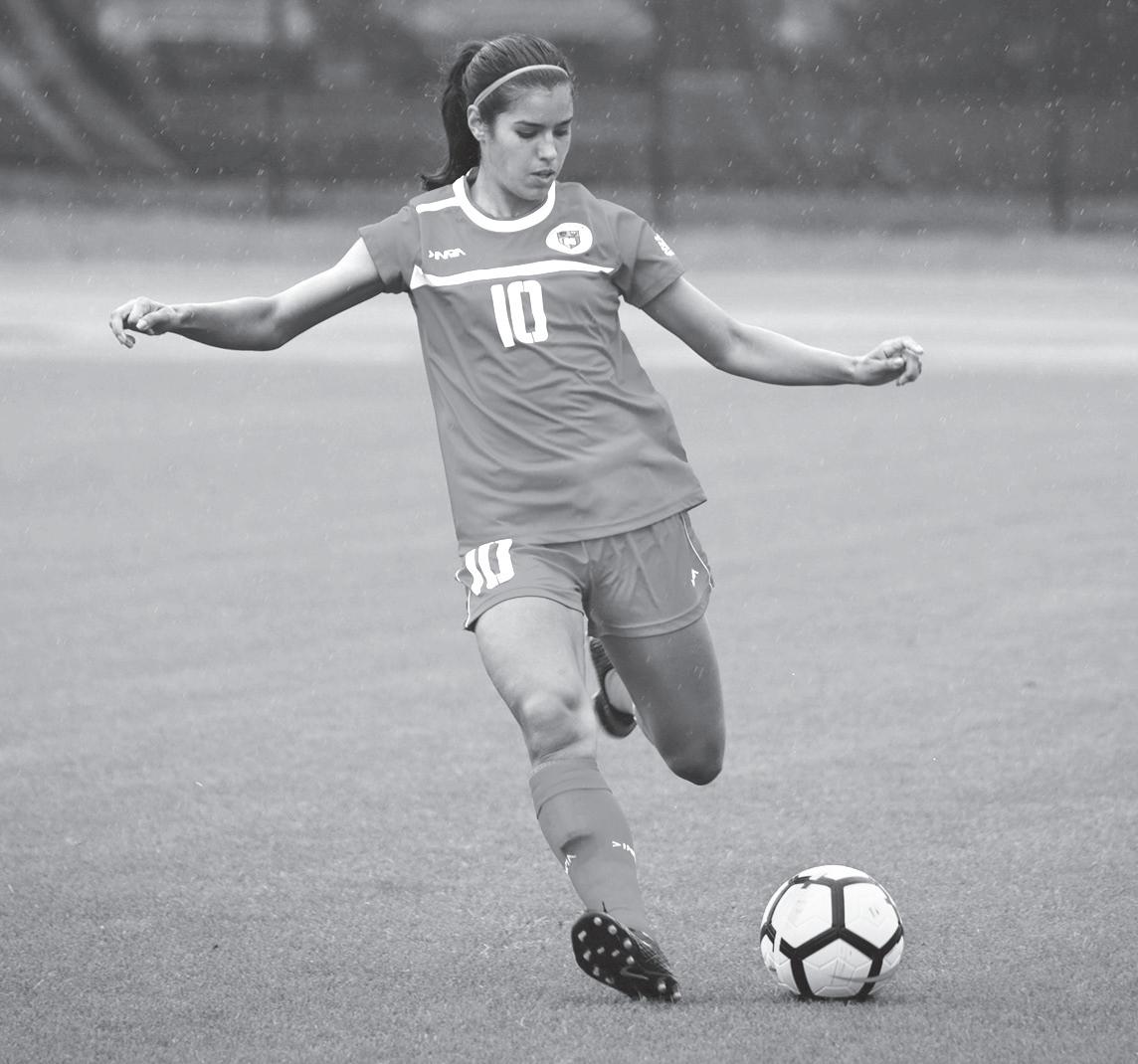
Struggling to convert shots into goals, Cornell fell to the University at Buffalo 0-2 in its first home game on Friday night.
While the Bulls (2-1) scored both of their goals in the second half, each team managed to stay busy on both sides of the ball throughout the game.
“Everyone on the team was locked in for the entire 90 minutes,” said senior captain Jessica Ritchie. “We worked hard and put Buffalo under significant pressure, so that is something to definitely be proud of.”
While it did not manage to clinch victory, Cornell (1-1) indeed generated consistent pressure. In terms of both shots and shots on goal, the Red came out on top, with 15 and nine, respectively, to the Bulls’ 14 and seven.
“We were effective in creating chances all game long,” said head coach Dwight Hornibrook.
Despite the Cornell’s shooting advantage, the Bull’s goalkeeper made nine total saves to thwart each of the Red’s endeavors. Buffalo now holds a 4-3-2 historical advantage over Cornell.
Notably, the earliest shot on goal of the game came from junior midfielder Karli Berry, who returned to the field after a year sidelined by an injury.
“It is great to have Berry back,” Hornibrook said. “She embodies the spirit of this group with her passion to compete and win.”
While the Red excelled in opening up scoring opportunities, the loss serves as a reminder that the team will need to work on better capitalizing those offensive chances.
“We will continue to learn the importance of taking advantage of chances when they come,” Hornibrook said. “We must also be more careful in our own end with the ball.”
Gracie Todd can be reached at gtodd@cornellsun.com.
Continued from page 12
As one of the largest teams in D1 volleyball, with 22 players, Cornell has adopted an “as one” mentality this season as it hopes to continue building momentum.
“Volleyball is a game of errors,” Sganderlla said. “You’re going to have
ups and downs, so the ‘as one’ mentality will definitely help us this season.” The Red will hit the road as it heads to Houston to compete in the Flo Hyman Collegiate Cup this weekend.
Smita Nalluri can be reached at snalluri@cornellsun.com.
By JONATHAN HARRIS Sun Assisant Sports Editor
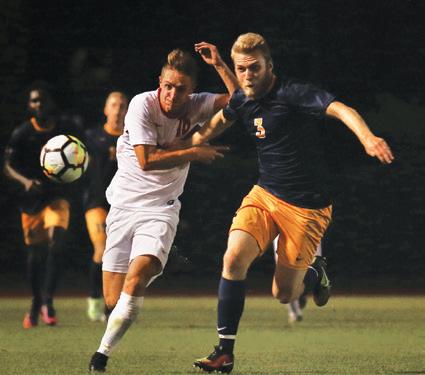
After finishing last season with a middling, sub-.500 record, Cornell men’s soccer opened this season on strong footing, comfortably downing Binghamton and St. Francis on the road.
Heading into the weekend, how the Red would grapple with its relatively inexperienced roster — 21 of the team’s 28 players are underclassmen, with only a single senior — loomed large. Facing a shortened preseason due to scheduling changes, head coach John Smith had to quickly ready the team’s 11 incoming freshmen for the demands of D1 soccer.
While the transition continues to be a work-in-progress, the Red’s decisive pair of wins put any lingering concerns regarding the team’s youthfulness to rest.
“For us, it’s a fantastic start,” Smith said. “With the shortened preseason we had, it’s important that you prep as best as you can by cramming stuff in. We filled these guys with a lot of information … but they retained a heck of a lot of it and we were deserved winners in both games.”
Though prepping for the rigors of a long NCAA season involves plenty of strenuous, physical training, Smith’s coaching philosophy is defined equally by preparing players mentally in order to better face adversity.
“The ones who made it through the dark times, the tough times will be the ones who laid the bedrock for future successes,” Smith said.
That approach appeared to pay dividends in both games, but the Red’s depth and determination was on
particular display in its matchup against St. Francis.
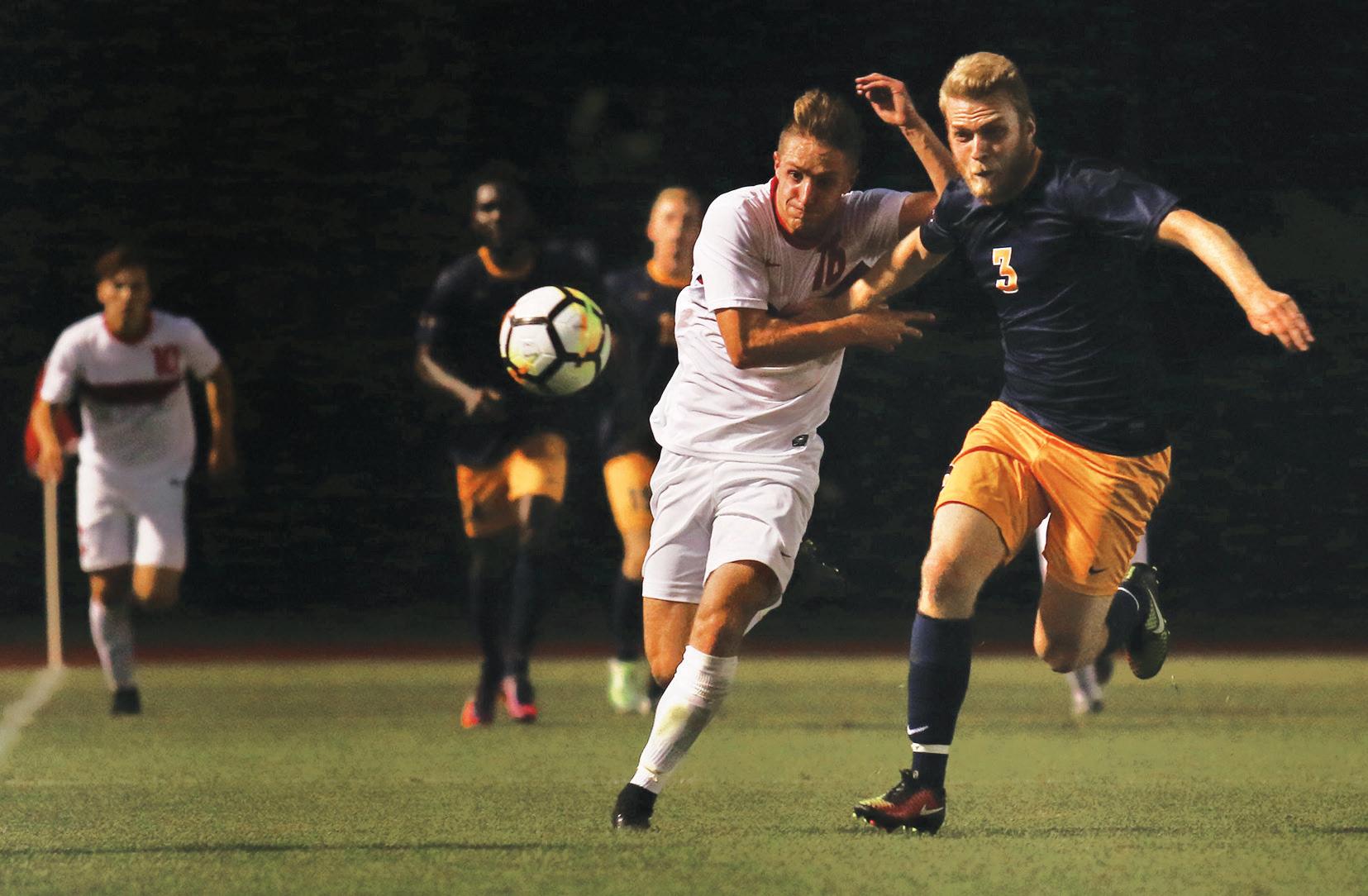
Despite trailing the Terriers for the first 40 minutes, Cornell freshman Emeka Eneli scored his second collegiate goal, followed two minutes later by a goal from lone senior and captain Ryan Bayne, to bring the half time tally to 2-1. Two more goals, combined with junior goalkeeper Ryan Shellow’s five saves, ultimately notched Cornell a 4-2 victory over St. Francis.
“The game was really unsettled in the first 15 minutes but once we got our feet underneath us there was never
any question about who was going to come out on top,” Bayne said. “With turf, there’s a lot more physical battles because the ball is bouncing around a lot more and so you have to be up for that battle. The guys were just warriors [and] that’s why we beat [St. Francis].”
The Red will travel to Easton, Pennsylvania, where it will kick off against Lafayette College this Friday at 7 p.m.
Volleyball looked prime to continue building on last year’s third place conference finish in this weekend’s home opener — winning against the University of Buffalo and Siena College, before finally falling to St. John’s University.
The Red (2-1, 0-0 Ivy) handed the Bulls (5-1, 0-0 MAC) its first loss of the season in a close match that spanned five games on Friday night. Cornell fell
to Buffalo, 19-25, in the first game, but came back to win the next two games, 25-21 and 25-20 respectively. While Buffalo won the fourth game, 20-25, to force another game, Cornell stayed calm under pressure to claim the fifth game, 15-13, and clinch the match.
Highlights from the match included 22 kills from senior captain Carla Sganderlla, who made her triumphant return to the court after a season-ending ACL injury last year. Juniors Samanta Arenas and Jada Stackhouse also had 14
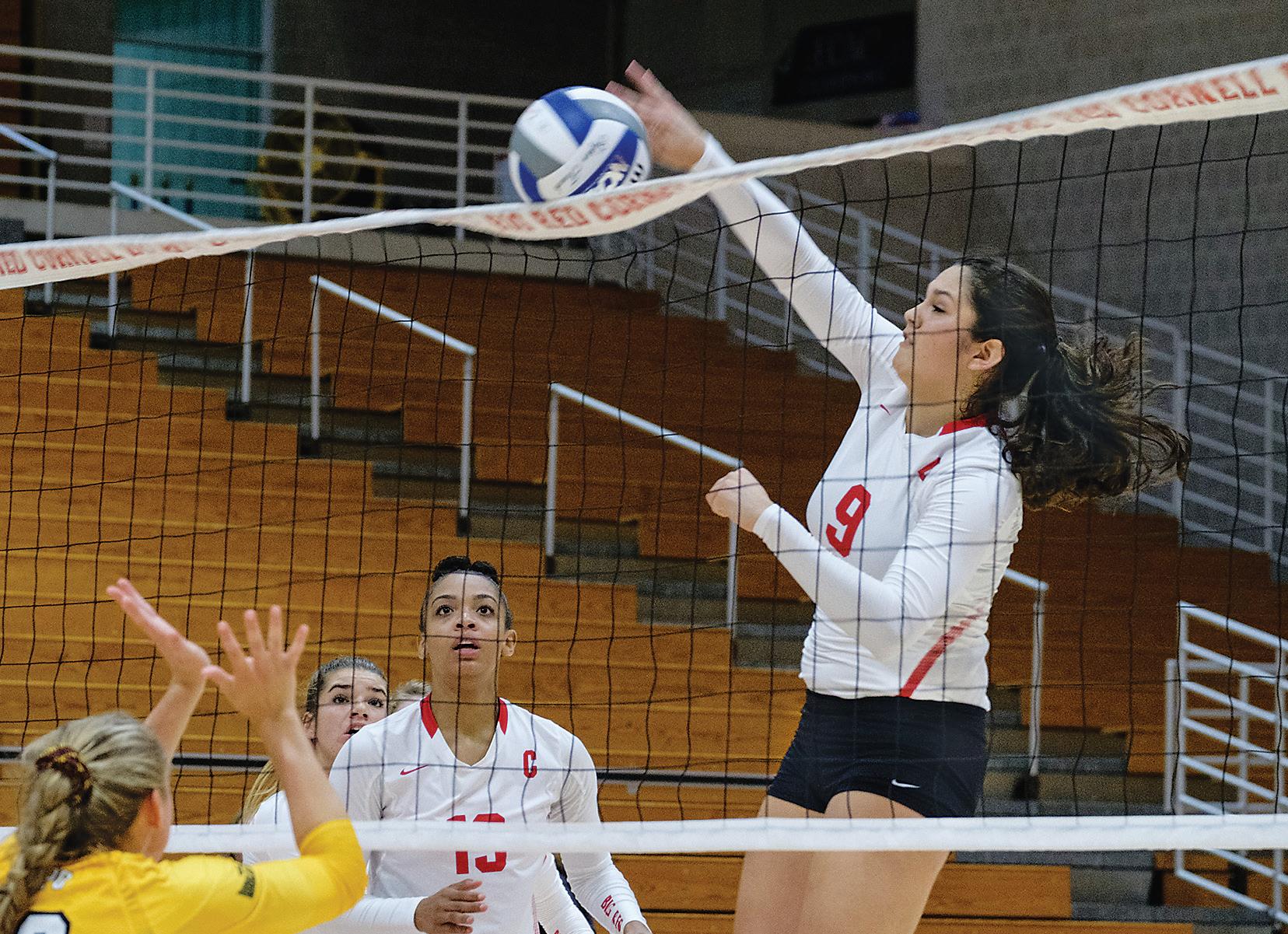
and 10 kills, respectively, while junior Lily Barber put up 26 digs.
The hosts were back in action on Saturday morning as they faced the Siena Saints (0-5, 0-0 MAAC) and bested them in five games. After handily defeating the Saints 25-12 and 25-19 in the first two games, the Red used the opportunity to utilize its deep bench. Although the Red dropped the next two games 18-25 and 23-25, it maintained its composure to rock the Saints 15-8 in the last game to come away with the win.
assists and 10 digs.
The Red returned to Newman Arena for the final match of the tournament, where it took on reigning champions, the St. John’s Red Storm (6-1, 0-0 Big East). Unfortunately, the Red Storm
“We have so much depth in each position. If we ever need to make any subs, we can without a problem.”
Senior Captain Carla Sganderlla
“We have so much depth in each position,” Sganderlla said. “If we ever need to make any subs we can without a problem. It was really nice to see the team all come together. Regardless if we
proved too much for Cornell to handle as the Red succumbed in three consecutive games. Despite failing to eke out a win, the Red still put up a valiant fight in keeping each game close (20-25, 21-25, 24-26).



had different players coming in, we still maintained our focus.”
Freshman Avery Hanan’s 15 kills and junior Sophia Beaudoin’s 11 played a large part in the Red’s defeat of the Saints. Notably, sophomore setter Zoe Chamness and junior setter Katie Randolph both had double-doubles — with Chamness tallying 30 assists and 10 digs and Randolph recording 18
While the Red, Buffalo, and St. John’s each ended the weekend with a record of 2-1, St. John’s sweep of Cornell meant the Red Storm finished the tournament with the highest set winning percentage (.727), and with it, its second consecutive Big Red Invitational title.
Both Barber and Sganderlla were awarded all-tournament team honors for their part in the Red’s pair of weekend victories.
“It being our first weekend, it was really nice to get the jitters out and try new lineups and new things to see how it all works out,” Phelps said.