By ANGELA BUNAY and KATHERINE ESTERL Sun Contributors
Ithaca’s annual celebration of all things apple is happening — now with pandemic precautions. Instead of the all-day Apple Harvest Festival, a 38-yearold tradition, this year’s “Apple Festive” brings fall spirit to the Commons through a six-day, socially distanced farmer’s market.
Starting on Monday Sept. 28 and lasting through Sunday Oct. 4, from noon to 4 p.m., the event features six vendors per day who
Barrett Pick Sparks Supreme Court Debate
Profs weigh in on court vacancy
By FAITH FISHER Sun Staff Writer
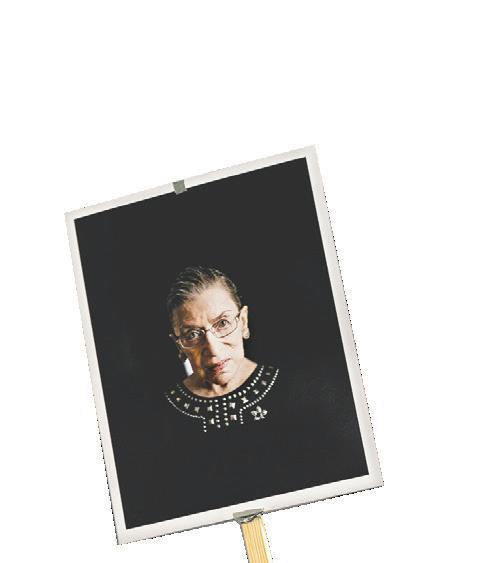
The scramble to fill the Supreme Court vacancy left by late Justice Ruth Bader Ginsburg ’54 has ignited a national discussion — and Cornell has become entrenched in it.
Cornell’s involvement was inevitable: Not only is Ginsburg one of its most celebrated alumni, but Kate Comerford Todd ’96 was among those President Donald Trump initially considered to fill the seat.
On Saturday, however, the president nominated Judge Amy Coney Barrett of the United States Circuit Court of Appeals for the Seventh Circuit in Chicago to replace Ginsburg.
an unprecedented move.
President Barack Obama nominated Judge Merrick Garland to fill the vacancy left by Supreme Court Justice Antonin Scalia in March 2016, also an election year. However, the Republicancontrolled Senate refused to confirm Garland, arguing that the seat should be chosen by the elected president.
“There was no rule regarding the filling or not filling of Supreme Court vacancies during an election year prior
Ithaca ‘Apple Festive’ Rings in Fall Spirit
will sell produce and fall favorites, including apple cider and doughnuts.
The event will be much smaller than previous festivals, which have included
Cider Trail, which will take participants through various restaurants and shops in the Commons that have apple and cider themed menus prepared.
“We’re doing everything we can to honor the tradition, being able to enjoy apple cider ... to see a selection of apples.”
Allison Graffin
200 vendors and drawn 35,000 to 70,000 visitors for a carnival-like weekend. It will also include a socially distanced Apple
“We’re doing everything we can to honor the tradition,” said Allison Graffin, marketing director of the Downtown Ithaca
Alliance, “being able to enjoy apple cider, being able to see a selection of apples, being able to shop in the stores and see a variety of fall gifts.”
This year’s public health guidelines mean fewer vendors will line the Ithaca Commons, alongside mandated masks, markers to reduce crowding and the absence of carnival rides or attractions.
Graffin said the Apple Festive is both a great Ithaca community tradition and an important
it seem like it is consistent with the past practice.”
Unlike in 2016, however, Republicans now control the White House and the Senate.
“Public opinion about the Supreme Court is highly politicized ... And that has been true for a very long time.”
Prof. Michael Dorf
The nomination comes just weeks before the 2020 presidential election on Nov. 3. Despite the closeness between the nomination and the upcoming election, filling a Supreme Court vacancy during an election year is not
to the Republican Senate’s refusal to consider Merrick Garland in 2016,” said Prof. Michael Dorf, law. “That is really because Supreme Court vacancies happen [so] infrequently that you can always — depending on how you characterize the past practice — come up with some account of what you’re doing that makes
“There are many instances of presidents filling a Supreme Court vacancy in an election year where the president’s party also controlled the Senate,” said Prof. William Jacobson, law. “That is the situation here, unlike when President Obama nominated Merrick Garland.”
Senate Majority Leader Mitch McConnell (R-Ky.) has indicated that he is looking to confirm Barrett before the election takes place. Barrett’s confirmation hearing is set to start on Oct. 12,
Cornell Peer Ambassadors Model Public Health Measures
By SYDNEY BROWNE Sun Staff Writer
About a month into the fall semester, Cornell has seemingly slowed the spread of COVID-19, reporting just a handful of new cases in recent weeks.
While mask-wearing and biweekly surveillance testing are a few of the reasons for the decline, another factor has helped: Cornell’s peer ambassadors.
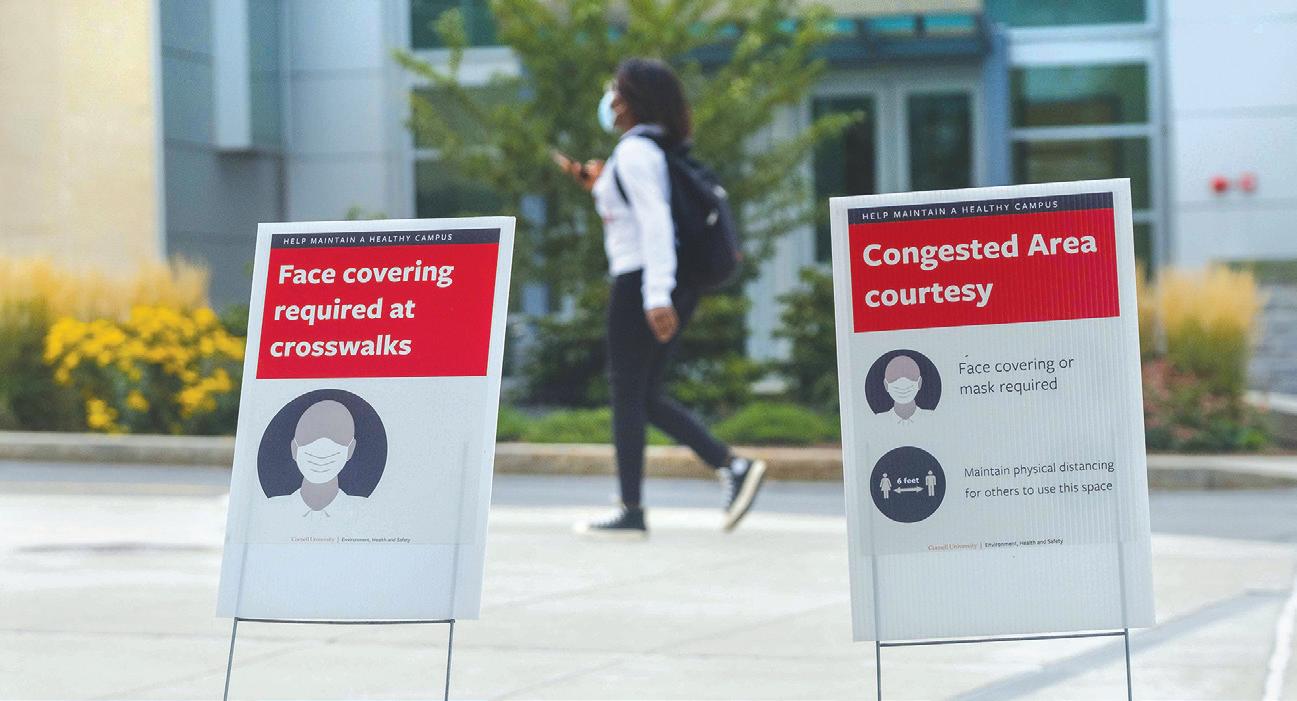
This group of students has been present on campus since move-in on Aug. 23, distributing personal protective equipment and promoting model behavior by encouraging students to socially distance and to wear masks.
With that phase of campus reopening behind them, their stationary supply tents will soon become mobile.
“For our second round, we’re going to have people walking around with
bags, handing things out and telling people to just live smarter,” said peer ambassador Samantha Noland ’23.
But as students get increasingly comfortable on campus, ambassadors want students to remain diligent, continue to mask up and follow physical distancing measures.
“As ambassadors, we want to get past the social barrier of COVID as agents of change. Sometimes people would try to avoid [us] at all costs, but [we’re] not scary. Just take the mask — you can never have too many,” said peer ambassador Bianca Santos-Declet ’23.
To advance the program beyond distributing supplies, Cornell launched a group of COVID-19 peer consultants, a second group of volunteers that
MICHAEL SUGUITAN / SUN STAFF PHOTOGRAPHER
RBG | The country mourns the late justice’s death.
ANNA MONEYMAKER / THE NEW YORK TIMES
Daybook
Tuesday, September 29, 2020
A LISTING OF FREE CAMPUS EVENTS
Today
Reopening European Hotels: The Recovery and Investment Landscape
10 - 11 a.m., Virtual Event
Labor Relations: Contract Language and Interpretation
10 a.m. - 1 p.m., Virtual Event
Cornell Wellness Virtual Walk To Run Class
11:30 a.m. - 12:30 p.m., Virtual Event
Joint Behavioral Economics and Public Economics Workshop
11:30 a.m. - 1 p.m., Virtual Event
Cornell Wellness Golden Orb Meditation
Noon - 12:30 p.m., Virtual Event
Tatkon Center Zoom Room — Ask Us Anything! Noon - 10 p.m., Virtual Event
Exploring the Genetic Basis of Seed Coat and Nutritional Quality Phenotypes in Common Bean and Maize
12:20 p.m., Virtual Event
Financing Food Systems Entrepreneurs — CDFA Food System Webinars
2 p.m., Virtual Event
Introduction to SPSS Programming
4 - 6:30 p.m., Virtual Event
Exploration and Robustness in Policy Gradient Learning
4:15 p.m., Virtual Event
American Sign Language Conversation Hour
4:30 - 5:30 p.m., Virtual Event
Cornell in Washington Virtual Q&A Session
4:30 - 6 p.m., Virtual Event
Language, Identity and Education in South Asia
4:30 p.m., Virtual Event
Visual Culture Colloquium With Betty Hensellek
4:30 p.m., Virtual Event
Border Environments: Toward A Political Ecology of the Edges Of the World
5 p.m., Virtual Event
How to Be Engaged in Community Service as a Cornell Student 5 - 6 p.m., Virtual Event
LGBTQ+ Welcome Reception
5 - 6 p.m., Virtual Event
PAM Virtual Student Internship Panel
5 - 6 p.m., Virtual Event
Apple Fest to Continue Tradition in Socially Distanced ‘Apple Festive’
Market will be spread out over six days and feature local products
people visit to “connect to local agriculture,” but isn’t sure what to expect.
event for local businesses and farmers to connect with a myriad of customers.
“The Apple Harvest Festival was a big event for them in years past, and so we were trying to do something to help them as well by connecting them to people that want to buy their products,” Graffin said.
Alan Teeter, the owner of A.J. Teeter Farm just south of Ithaca, plans to pack their stand with apple cider, grapes, pumpkins, ornamental gourds and lots of sanitizers.
“We’re saddened that it’s not the festival that we’re used to, which was a really huge event,” said Teeter, who has attended Apple Fest for 27 years.
“Obviously this one’s going to be much smaller scale, but we’re glad to at least be there.”
“It’s hard to know if students will come down,” Steinkraus said. “It’s hard to know if community will come out.”
However, she’s still glad the event is on and is able to get community members out of the house for something fun.
“It’s really important that we still have these human interactions where we’re coming together to celebrate and support the community.”
Allison Graffin
The Downtown Ithaca Alliance originally canceled the event in July, concerned about the spread of the coronavirus.
However, local vendors and farmers in the area expressed high interest in holding some version of the event and wanted to keep the tradition alive.
“That it’s happening at all is a testament to the resiliency of the community,” Steinkraus said.
“Obviously this one’s going to be much smaller scale, but we’re glad to at least be there.”
Alan Teeter
Littletree Orchards, another vendor, plans to sell its apple ciders, sauces, butters and vinegars at the event. Manager Amara Steinkraus said she hopes
For Teeter and Steinkraus, the Apple Festival was a large source of income that will likely be absent this year.
“I’m guessing we won’t come anywhere near to what we make on a normal year,” Steinkraus said.
“It’s really important that we still have these human interactions where we’re coming together to celebrate and support the community, and so I’m grateful that that is happening,” Steinkraus said.
Graffin added that everyone can look forward to pre-packaged cider donuts being sold starting Wednesday. But even as vendors gear up to sell apple fall favorites, some of them said they’ll miss the spirit of the old festival.
“It does feel kind of like a sendoff from the summer and fall into the coming winter,” Steinkraus said. “I think that will be sad to not have that fullness of experience.”
Angela Bunay can be reached at anb75@cornell.edu.
Katherine Esterl can be reached at estkatherine1@gmail.com
Cornell Alumnus Founds Mental Health Center
Service meant to provide more specialized care than existing Cornell Health treatment options
By Faith Fisher Sun Staff Writer
Despite the range of Cornell’s mental health services, alumnus and Ithaca native Dr. Aaron Rakow ’01 has set his sights on filling gaps in the University’s treatment options. College students are especially prone to mental health concerns, and pandemic-induced stressors have only deepened these anxieties.
To meet growing demand for treatment, Rakow and his colleagues launched the MindWell Center, a mental health treatment center in Ithaca’s South Hill, offering a range of mental health services to New York residents.
On campus, Counseling and Psychological Services and primary care medical service teams within Cornell Health provide mental health support to Cornell students. Even so, some Cornell students said the University’s mental health services weren’t sufficient, according to Rakow.
“We are hearing from so many Cornell students that there is a need and there isn’t necessarily as many providers as they would like to be readily available,” Rakow said. “We are happy to fill that, and we are excited about moving into the Ithaca area.”
MindWell’s approach to mental health care follows the Cognitive
Behavioral Therapy model, a type of treatment that aims to develop a deep understanding of the causes that contribute to a patient’s psychological struggles. The model centers itself on the way that an individual’s thoughts, emotions and behaviors affect one another.
“CBT is a highly effective, time-limited, skill-based form of intervention,” Rakow said. “While it seems like anti-depressants are the most commonly used treatment for things like social anxiety disorder, new research has suggested that CBT is actually more effective. And unlike medication, it can have long lasting effects after treatment is done.”
Cornell’s and MindWell’s services, however, are mutually supportive. Some students require more specialized and intensive care than CAPS and Cornell Health can offer; these campus service providers have referred many students to MindWell to fill that gap, Rakow said. Groups that manage mental health care for Cornell faculty and staff have also referred patients to MindWell.
As a component of MindWell’s “simplified approach to mental health care,” the center offers patients in-person and virtual treatment options.
Even before the COVID-19 pandemic, the center offered telehealth
appointments to patients as a matter of convenience and comfort.
“We have always had teletherapy as a component of our model because we want to provide as many levels of convenience for the clients we serve,” Rakow said. “Some clients feel more comfortable engaging with us from the comfort of their dorm room, apartment or their home.”
Professors Discuss SCOTUS Politics
SUPREME COURT
Continued from page 1
which would put the confirmation vote on schedule for Oct. 26, less than a week before the election.
Even before the death of Ginsburg, Supreme Court appointments were a salient voting issue for Americans in 2020. While in the past Republicans have generally energized their voter base around the issue of filling courts, polling shows that Democrats care about the courts more in the 2020 election year. It is unclear how the ongoing nomination process will affect voter turnout this year.
“It is uncertain to me whether this motivates the Democratic or Republican base to a greater extent,” Dorf said. “The initial reaction, a spike in donations to Democratic candidates, suggests that it would have a greater effect on Democratic turnout, but I’m not a political scientist, I’m a law professor, so I can’t say anything too confidently about that.”
Jacobson, on the other hand, predicts that Republican voters will mobilize more than Democrats around this issue.
“The Supreme Court traditionally has been more important to conservative voters, and energized support for Trump in 2016,” Jacobson said. “I expect a similar impact this time in driving Trump voter turnout to a much greater extent than drives Biden voters.”
While public trust in
the government has generally declined, Americans still place the greatest faith in the judicial branch. However, with the Supreme Court nomination of Barrett embroiled in partisan politics, the impact of a potential confirmation on public trust in the judiciary remains to be seen.
“The Court’s popularity, or people’s faith in it, tends to depend very closely on the substantive decisions it makes,” Dorf said. “Public opinion about the Supreme Court is highly politicized
The confirmation of Barrett by Trump would shift the makeup of the court to three liberal appointees and six conservative appointees.
According to Rana, this conservative shift is a part of an ongoing historical trend that will have massive implications for future rulings.
“As it is, the courts, in my view, have moved pretty decisively to the right in ways that are inconsistent with where the American political center is, and I think this is only going to
“It is uncertain to me whether this motivates the Democratic or Republican base to a greater extent.”
Prof. Michael Dorf
in the same way that everything else is. And that has been true for a very long time.”
Prof. Aziz Rana, law, also sees the question of public trust as a persistent issue for the judiciary.
“Already, there have been questions about what the future of the court is going to be, and a lot of this has to do with the fact that the court is increasingly being seen as an obvious site of political struggle among the parties,” Rana said. “This is only going to further intensify it.”
Before Justice Ginsburg’s death, the court was composed of four Democratic appointees and five Republican appointees.
make it more extreme,” Rana said. “In the context of our Supreme Court, with only nine justices, one appointment can have massive ideological effects.”
Senate Democrats, who are in the minority, wield little power to impede the confirmation of Barrett. Nevertheless, the party has floated a variety of other possible retaliatory actions to stem the power of a conservative court, such as expanding the size of the court, admitting Puerto Rico and Washington D.C. as states and eliminating the legislative filibuster. Republican Senators previously eliminated filibuster power for Supreme Court nominees in April of 2017
in order to confirm Justice Neil Gorsuch.
Jacobson does not expect many of these proposals to come to fruition. In his view, a court expansion and the addition of states is unlikely. If Democrats gain control of the executive branch and both chambers of Congress, the elimination of the filibuster is a more viable option.
“But even that is less likely than it seems, because Democratic Senators know if they do that, when Republicans eventually gain control in some future election, Republicans could do the same,” Jacobson said. “This mutually-assured legislative destruction will temper demands to eliminate the legislative filibuster.”
Rana said that the contentious political episode unfolding with the court has exposed deeper structural issues within the institution. With these issues once again resurfaced, he predicts that there will be a broader national discussion about these flaws.
“The discussion for court reform has been here before the passing of RBG,” Rana said. “But if it continues in this direction where Democrats are winning elections but policies are being undermined by the institutions that are the least democratic, you are going to have a big conversation about court reform.”
fsher@cornellsun.com.
The center is looking forward to welcoming new patients, especially struggling members of the Cornell community.
“Our interest is really in supporting the huge population of students we have in the region,” Rakow said.
Students Advocate For Public Health
Ambassadors stress unity, masks
AMBASSADORS
Continued from page 1
works to improve public health strategies and reimagine campus events.
“It’s sort of like a student think tank with students who want to be a part of the conversation in their respective communities, student groups or different parts of campus,” Noland said.
To limit the spread of the virus, Cornell has called on students to hold each other accountable. While there are several rungs within the student volunteer ladder, the program is not responsible for any kind of reporting or policing.
“A common misconception is that we’re enforcers. That’s not the idea,” Noland said. “We’re meant to be inspirational and influential rather than informants. As ambassadors and consultants, we want to know how we can shift behavior and respond to the needs of students.”
Integral to the peer ambassador program are the coordinators who oversee volunteers. In addition to
ensuring a strong presence on campus, coordinators make sure that ambassadors regularly sign up for shifts, have enough supplies and run the group’s social media campaign.
“For peer ambassadors who aren’t on campus for the semester, they have the opportunity to regularly engage with our social media campaign to share our content and disseminate that knowledge,” said Kaylee Zhong ’23. However, acting as models of public health for the Cornell community doesn’t make living through a pandemic any easier. As the semester progresses, coordinators want to focus on a message of unity for its ambassadors and everyone else on campus.
“Our ability to stay on campus this semester still depends on all of us working together,” said Ria Tripathi ’21. “Every little action, from wearing a mask to staying six feet apart, makes a big difference.”
Sydney Browne can be reached at sbrowne@cornellsun.com.
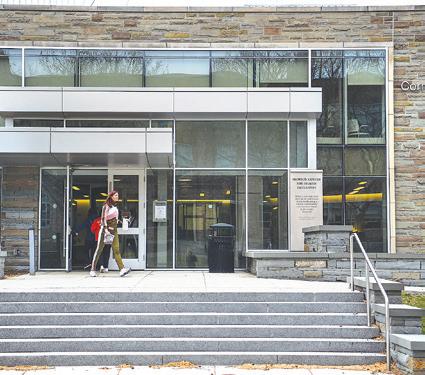
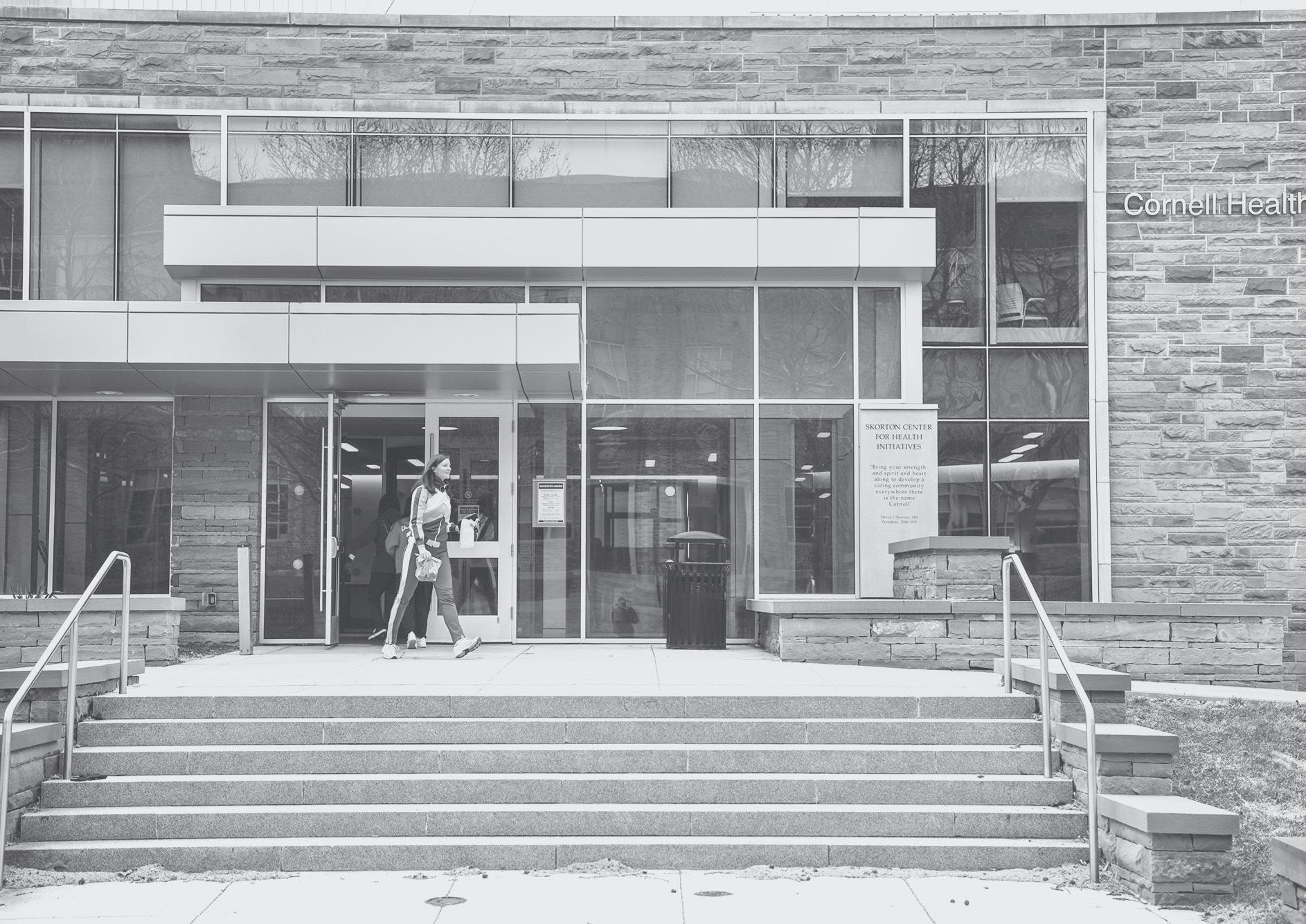
Mental health | A student walks out of Cornell Health on March 20.
BORIS TSANG / SUN PHOTOGRAPHY EDITOR
Faith Fisher can be reached at fsher@cornellsun.com.
SC I ENCE
IN C LASSROOM OR OVER ZOOM? Profs weigh risks, benefits of in-person instruction
By NATALIE MONTICELLO and ALIVA DAS Sun Staff Writers
Cornell is among one of the handful of universities offering hybrid instruction this semester. While the University has gone nearly a month with some in-person courses, the decision to teach remotely or in person did not come easy to many professors.
At the beginning of the semester every professor had to weigh the educational benefits of teaching in person against the potential health risks of reporting to campus — with some finding it necessary to connect face to face with their students, while others opting for the safer route of teaching via Zoom. In the end, the majority of classes ended up being virtual — with over two thirds of classes being entirely remote.
“My goal is to deliver the best possible educational experience for the students along with the most valuable and satisfying use of my time [in the classroom]. Cornell students expect and deserve more [than Zoom],” said Chris Byrne, communication, who is currently teaching Communication 3010: Writing and Producing the Narrative for Digital Media.
The course teaches students how to write, edit and produce personal narratives in essay, podcast and short video documentary formats. Since students learn practical podcasting skills, Byrne says that it was important that students have in-person teaching experience.
“Everything worthwhile is a risk. I play hockey, I run on the railroad tracks, I go to Wegmans and Target and I eat cheese,” Byrne said on his decision to teach in person. “Of course, teaching in a classroom during a pandemic is risky, but I take the necessary precautions: Wash hands, wear a mask, don’t go if I am not feeling well and I trust that the students will as well.”
Danielle Eiseman, communication, came to a similar conclusion when consid-
ering her plans for the fall semester.
“I think that the main benefit of having in-person classes is having that [personal] connection between students and the professors,” Eiseman said, further adding that she believed these classes would help both students and faculty regain a sense of normalcy.
Eiseman is currently teaching Communication 3020: Science Writing for the Media — a class focused on teaching students how to write about scientific topics in digital formats — and Communication 4860: Risk Communication, a course that explores how individuals interpret and manage risk.
However, Byrne explained that even
with in-person instruction, coronavirus restrictions can make it difficult to mimic a normal learning environment.
“The masks make it a little more difficult to hear the students, and they are at least 10 ft. away, but I manage to have conversations in the class. It can’t just be a 75 minute lecture,” Byrne said.
Eiseman also agreed that the requirements of wearing face masks and social distancing restrictions have proved to be quite the barrier to her usual teaching style.
“Normally, I do a lot of active learning … in the past, I have created games [for the students] and we have [also] had some dancing in class,” Eiseman explained. “So it has been frustrating not being able to interact with my students the way I normally do.”
Because Eiseman felt too nervous to take the bus, she purchased an electric bicycle so that she could get to campus and continue teaching her students.
“Even though I am a bit scared, I think that the risk is worth it,” Eiseman said. “I really love my students and I’m doing this all for them.”
Technology has been an integral part of encouraging participation within the classroom. Eiseman uses a polling system where students can type answers into their phones, which then get displayed on a screen. She also uses an online visual collaboration tool called MURAL to keep people engaged in the course material.
“Technology has allowed me to embed a lot of flexibility within the course,” Eiseman said.
As some students may face problems with either access to internet or laptops, Eiseman decided to post annotated slides and lecture videos online so that students could access the course material and submit assignments asynchronously.
However, relying on technology has its downfalls. Eiseman said she found it difficult to manage both the online Zoom meeting and in-person lecture simultaneously, often needing a teaching assistant on hand to monitor the chat room for student questions online.
“It is [also] normal to have Zoom crashing at times. In such cases I just have to keep my patience, as there is nothing I can really do about it,” Eiseman said. “Luckily, my students are very understanding when such technical issues occur.”
Byrne also explained that there are some challenges that arise when a few students in his classes are only online. Out of the over 16 that are enrolled in his three classes, a third attend exclusively on Zoom.
“The biggest challenge I face teaching in person is balancing the additional tech elements while delivering the content. There are students on Zoom, cameras to operate, microphones to adjust, and it all needs to be
recorded,” he said.
Prof. Mark Sarvary, biology, came to a different conclusion than Eiseman and Byrne. Sarvary teaches Biology 1500: Investigative Biology Laboratory, a class that introduces students to research by giving them experience in creating experiments and analyzing data.
Sarvary decided to teach the lab course, which hosts several hundred students, virtually this fall. Biology: 1500 had already transitioned to a completely virtual format in March 2020 and was offered online in Summer 2020, meaning much of the preparations had already been made.
“While redesigning the course for online teaching, we had to keep the challenges our students faced in mind,” Sarvary said. “This made us reconsider the course structure as well as the assessment system, as we obviously could no longer conduct in-person labs or practical exams.”
Despite being a lab-intensive course, Sarvary has found success in teaching his course virtually because many aspects of the lab — like experiment design, data analysis and project presentations — can be conducted over Zoom.
“Based on the surveys we collected from students who took the course in spring and over the summer, I believe that the transition of active learning from the physical laboratories to a virtual teaching environment has been quite successful,” Sarvary said.
The course was broken up into asynchronous lectures that students could watch on their own time and live, remote labs — with groups of students working on their assignments in breakout rooms, under the guidance of the lab instructors and undergraduate TAs. The final exam for the course was also made take-home.
Sarvary and his staff went to campus and shot 10 instructional videos for the students in the lab, making sure to maintain social distancing as well as sanitizing the lab surfaces used.
“The videos feature the use of laboratory
equipment like microscopes as well as lab safety procedures, so that our students could get a good idea of what was happening in the lab even though they weren’t physically present there,” Sarvary said.
According to Sarvary, having undergraduate TAs was instrumental to the success of the course. Because fellow students, he said, know their peers’ interests better than the course instructors, they can create effective icebreakers, such as playing popular music from a Spotify playlist and creating polls that ask students what their favorite movies are.
“It was really amazing to see how they [the undergraduate TAs] changed their mindset from an in-person setting to an online one, despite only having taken the class in-person,” Sarvary said. “I think they adapted even faster than we [the course instructors] did.”
Amiah Hybbert ’22 was one of the course’s TAs last spring, when the class was first forced to transition to remote learning.
“I would say the transition was pretty rough in my opinion because basically no one really knew what was going on at the time. [Cornell] actually went online right in the middle of when we were doing our experiments, so students weren’t able to finish them,” Hybbert said. “Everything was really jumbled.”
Hybbert’s responsibilities shifted from setting up labs and general bookkeeping to monitoring Zoom chats and moderating breakout rooms.
“I think I actually got a better teaching role online because I had to think about how I can teach these kids in a way where I can’t show them or do it,” she said.
While undergraduate TAs have been integral to the course’s success, these students often face the same obstacles that those they are teaching encounter.
“We must remember that UTAs are students as well, and can face challenges that can prevent them from teaching effectively online, such as a poor internet connection, lack of proper working spaces within their homes to conduct labs and office hours, or even no access to a personal computer,” Sarvary said. “We must understand their situations and provide support so that they can continue doing their best.”
As instruction nears the four week mark, both Eiseman and Byrnes are optimistic that classes will be able to proceed until Thanksgiving.
“If everybody is doing what they’re supposed to be doing, and they keep doing that, we might actually make it,” Eiseman said.
Natalie Monticello can be reached at nmonticello@cornellsun.com. Aliva Das can be reached at ad677@cornell.edu.
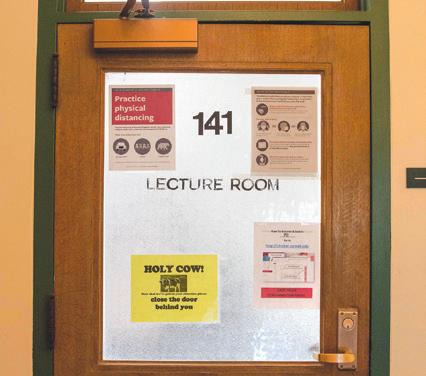
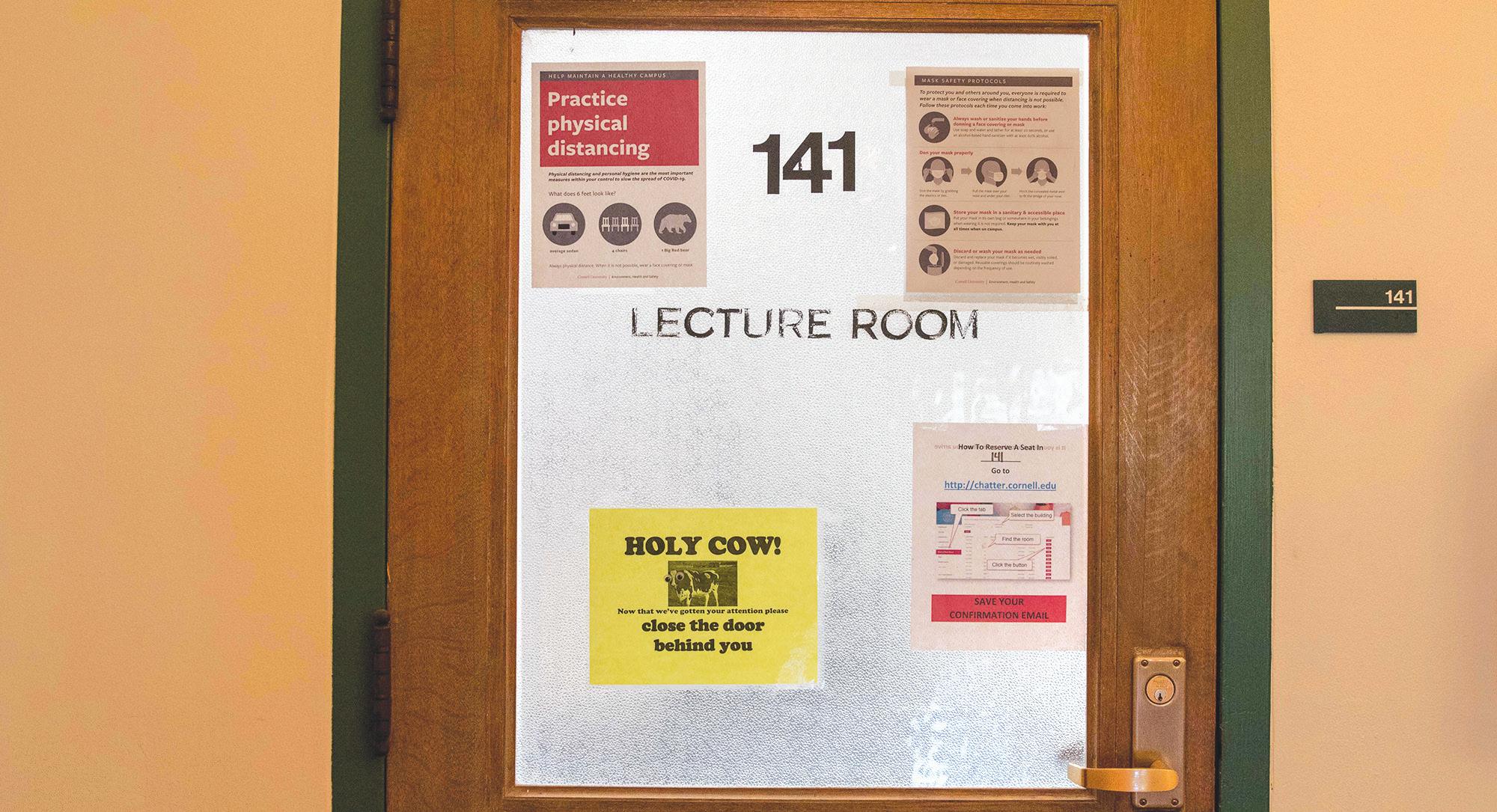
Socially distanced | Those who attend in-person classes must adhere to social distancing requirements posted on this door, including the use of assigned seats and wearing a mask at all times.
HANNAH ROSENBERGR / SUN ASSISTANT PHOTOGRAPHY EDITOR
A calculated risk | While Eiseman sees the risks with in-person teaching, she feels it is worth it to teach her students face to face.
Virtual labs | Since the University transitioned to remote instruction in March, Prof. Mark Sarvary has taught his large, laboratory-based course virtually.
ARTS & ENTERTAINMENT
We Pause, Skip and Rewind. So What?
In the iconic remote control scene in Michael Haneke’s Funny Games, antagonist Paul uses a TV remote to rewind and redo the scene. Throughout the film, Paul repeatedly expresses his regret at breaking the standards of movie plot development by ruining suspense and failing to extend the movie to feature-length. Funny Games is a classic example of how a director can manipulate the temporal flow of a film’s narrative. These days, we as audiences have been offered the autonomy to mess with our own temporal interplay with cinema.
Increasingly, all forms of media are accelerating their adaptation to the same three screens –– laptop, tablet and phone. The emergence of these personal devices has lifted the prior temporal and spatial constraints of old media. We sit at
the same desk switching between Zoom meetings, pre-recorded lectures, Netflix shows and virtual concerts on the same screen –– and at our own pace.
New technologies continue to valorize new possibilities of media consumption. As old mediums are rendered into the digital, our viewing experience continues to be reinvented by the newly afforded possibilities of reconfiguration. Such transformation will never be a neat mapping of our pre-digital experience onto our interactions with our screens. Our laptops, tablets and phones will never be the same as concert venues or movie theaters; they are not even comparable to FM radios or cable TVs. New media will always be new, as their novelty will remain unparalleled in juxtaposition with the old.
Out of all the old media, I tend to think that films have undergone the most intriguing changes in the digital age. The majority of us now watch movies on our personal devices; few people still go to the theaters, and more films — especially this year — are released exclusively on digital platforms.
Not only have digital technologies brought film reels out of the screening rooms –– but they have emancipated the audience from the movie theaters. The viewing experience is no longer one of collectiveness and synchronization but is instead characterized by self-autonomy and mobility.
As a form of recorded media, films in a digital context directly afford the reconfiguration of time and speed. We are now in control of the temporality of the films we watch. This goes beyond the control over when to consume, but we can now pause, fast-forward, backtrack, skip and rewind as we watch. We now have buttons and cursors on our screen, and we use keyboards, touchpads –– even just
fingers –– to command how the story unfolds.
We are no longer in an era of pure spectatorship. A new spectatorial mode of close examination has been afforded by the buttons at our fingertips. The surging interest in previously neglected subtexts in old films is not a random epiphany; it was technologically enabled and invited. When movies were only played in the theater, great scrutiny of minute details wasn’t humanly possible. By contrast, audiences in the digital age can now scroll through the timeline and freely linger on any particular moment as they wish.
The rediscovery of the queer subtext in A Nightmare on Elm Street 2 is not a coincidence, either. Rather, it was a participatory process. In the past few years, the contemporary audiences began drawing connections between protagonist Jessie’s nightmares and his inner struggle with his sexuality. The circulation of screenshots helped establish this perspective as the new reality. While the subtext may seem apparent by contemporary standards, it is crucial to note that the film’s release in 1985 coincided with the height of the AIDS epidemic in the United States. Such longitudinal revisiting of old films would not be possible without the digital functions of pause, screenshot and rewind.
One can argue that such control over the viewing experience is not entirely novel. Indeed, such functions have long been supported since the era of cassette and DVD players, yet the operation was choppy at best, leaving the audience in a constant limbo of watching and un-watching. It is the digital rendition of such functionality that realizes a nearly seamless experience of control over time and speed.
And we didn’t just recently learn to exert our control over time and speed when catching up on missed lectures; we have long been leveraging this newfound power to speedwatch and to jump right into the dramatic events. As contemporary audiences that relish the emancipatory power of digital technologies, we have the predilection for exerting our control whenever we can. I have to admit that the use of arrow keys to slightly jump back and forth has always been particularly tempting. I often mess with the keys when watching movies on Netflix just because I can.
Yet I’m acutely aware that such rearrangements may hinder the ways in which directors fiddle with the temporal flow of the narrative. Against the backdrop of the introduction to the digital age, directors in the 21st century often playfully manipulate the temporal relationship between the audience and the films. Take David Lynch’s Mulholland Drive and
Pedro Almodovar’s Bad Education for instance; both directors extensively employ dream sequences to resemble the distorted temporality of life. In particular, the parallel yet illusory nature of film-within-a-film confronts the audience’s presumption of a linear narrative progression. With the meticulous design of the temporal details, if one fails to keep their hands off of their laptops, the intended cinematic experience may very likely be disrupted by the act of technical reconfiguration.
Our cinematic experience is undergoing a radical renegotiation of the power dynamics between the audience and the works themselves. It becomes increasingly challenging in the digital age to replicate the experience of getting into a zone at a movie theater. As the act of viewing becomes temporally and spatially unrestrained, the temporal-spatial context of the zone also becomes malleable.
We now have a greater responsibility in crafting our own cinematic experience. Perhaps keeping our
hands off the screen, the touchpad and the keyboard could help bring back the zone experience we all miss. After all, we have never had a problem with not having control in a movie theater, yet we have always had a problem with the TV remote in our living room.
Stephen Yang is a junior in the College of Agriculture and Life Sciences. He can be reached at syang@cornellsun.com. Rewiring Technoculture runs alternate Tuesdays this semester.
Stephen Yang Rewiring Technoculture
COURTESY OF UNIVERSAL PICTURES
A scene from David Lynch’s Mulholland Drive
The Corne¬ Daily Sun
138th Editorial Board
MARYAM ZAFAR ’21 Editor in Chief
JOYBEER DATTA GUPTA ’21
Business Manager
PETER BUONANNO ’21
Associate Editor
MEGHNA MAHARISHI ’22
Assistant Managing Editor
CHRISTINA BULKELEY ’21
Sports Editor
BORIS TSANG ’21
Photography Editor
CAROLINE JOHNSON ’22
News Editor
ALEX HALE ’21
News Editor
ARI DUBOW ’21
City Editor
EMMA ROSENBAUM ’22
Science Editor
BENJAMIN VELANI ’22
Dining Editor
JOHN MONKOVIC ’22
Multimedia Editor
MIKE FANG ’21
App Editor
OLIVIA WEINBERG ’22
Assistant News Editor
MADELINE ROSENBERG ’23
Assistant News Editor
LUKE PICHINI ’22
Assistant Sports Editor
HANNAH ROSENBERG ’23
Assistant Photography Editor
BRIAN LU ’23
Assistant Arts & Entertainment Editor
ANNABEL LI ’21
Assistant Money & Business Editor
LEI ANNE RABEJE ’22
Layout Editor
JOHN COLIE ’23
Blogs Editor
JOHNATHAN STIMPSON ’21
Managing Editor
KRYSTAL YANG ’21 Advertising Manager
JASON HUANG ’21
NIKO NGUYEN ’22
Editor
PALLAVI KENKARE ’21
SEAN O’CONNELL ’21 News Editor
KATHRYN STAMM ’22
OZA ’22
’23
LEE ’21
CHENG ’21
PEÑEÑORY ’22
MEGHANA SRIVASTAVA ’23
DAWSON ’21
’22
MORAN ’21
LAW ’22
’21
’22
Catherine St. Hilaire Candid Cathy
You know what I hate? Competing in the “Strugglympics.” I don’t remember where I initially learned the term but I know that it has seamlessly made its way into my daily vernacular. For those of you who don’t know what it refers to, urban dictionary defines it as “When one person, after hearing of the difficulties of another person or persons, tries to top the difficulties and struggles by showing how much harder they’ve had it.”
For example: “I have a prelim this week and I am really worried about it.”
Working on Today’s Sun
Ad Layout Mei Ou ’22
Production Desker Dana Chan ’21
Sabrina Xie ’21
News Deskers Sean O’ Connell ’21
Madeline Rosenberg ’23
Opinion Desker Pallavi Kenkare ’21
Design Desker Niko Nguyen ’22
Science Desker Anil Oza ’22
Photo Desker Hannah Rosenberg ’23
Arts Desker Emma Plowe ’23
Tom the Dancing Bug by Reuben Bolling
A non-Strugglympian would respond in a comforting way. They’d maybe ask the person what’s going on, attempt to reassure them. A seasoned Strugglympian, however, would counter with something along the lines of, “Wow, really? I have two prelims this week and one of them is physics. I’m sure you’ll be fine.” Isn’t that infuriating? When did people stop letting us revel in our problems?
Since 2020 started, everyone has competed in at least one strugglympics, and everyone is going for gold. It’s unfortunate because this year has been marked with loss, a fact that was succinctly mentioned in my good sis Sidney Waite’s latest, Waite, What? There are Strugglympians everywhere: In your lectures, your clubs, your friend circles, probably in the mirror. I can admit it: I hate the petty competition, but I’ve definitely played the game myself.
The other day I found myself partaking in the Strugglympics while talking with my friend about studying abroad. I told her that I couldn’t understand why people had become so invested in something that was unlikely to happen. Afterall, I had made my peace with the fact that I wasn’t going anywhere this spring. It really does be like that sometimes. And to an extent, I think my admission was true. 19-year old, present-day Catherine had made peace with the fact that her dreams of a spring 2021 study abroad at Oxford just wasn’t going to happen. What I failed to consider was that the 15-year-old version of myself who promised to study at Oxford when she went to college had not made peace with the harsh reality. I think that’s why when the email came, I started to cry.
For reference, I wasn’t the one crying. It was my younger self who was upset at the fact that she had done all this work to get into a dream program that was ruined due to a virus she was convinced was out to get her. I was mourning my study abroad plans that had been set since last October, and I didn’t even get the chance to do so before we were onto one of our nation’s biggest losses; that of Ruth Bader Ginsburg ’54.
This year, we haven’t been entitled to mourning like we used to. It started when Kobe Bryant passed away, and
people likened the experience to losing a family member. They were met with inconsiderate responses. Chadwick Boseman passed, and I, along with my friends, found myself mourning my first black superhero. People didn’t fail to remind us that he was just an actor, and that hundreds had lost “actual family and friends” to COVID-19. When Ruth Bader Ginsburg died, people likened it to losing their grandmother, but didn’t get the chance to grieve. Instead, we were immediately confronted with the fact that her replacements and the Senate were ready to make shit happen. We don’t get a chance to breathe, or just be sad anymore. Everyone is too busy moving on to the societal implications of our trauma, effectively invalidating our daily struggles.
I came out of quarantine really jaded. I had learned to push my emotions to the side a little too well. I forced myself to see the uninterrupted time spent at home as “a blessing to practice self-improvement”: Pick up a hobby, start exercising, become better. Twitter was an endless feed of people who lost thirty pounds while being home, started a business, even wrote a book. I sat there, helpless, upset and resentful towards a virus that robbed me of so much. I have yet to confront that.
Instead, it was time to tune into CNN, watch a colossal number climb higher daily and reconcile myself with the fact that it represented lives lost. From there, I had to get up and fight for my life, and the lives of my dad, my brother, my uncles and my cousins as Black men in this country with targets forever on their backs. I have yet to stew in it, in the stack of L’s that I have acquired, from January until now.
I’m still really upset about Oxford. In a way I feel that I was entitled to the experience, after spending hours on a personal statement and making sure my resume was immaculate. However, I can’t go, and that’s something I will continue to work through for myself .
To my peers who have lost things that are really important to them, but seem miniscule in the grand scheme of things, please allow yourself to mourn them. To the Class of 2021, I’m sorry that your senior year looks like this; to the Class of 2024 (my brother Charles included) I’m sorry that your introduction to college looks like this; to the people who were unable to return to Cornell this semester, I’m sorry that you aren’t able to be in Ithaca; and to my fellow study-abroad hopefuls, I’m sorry we were robbed of this experience — we’ll see the world one day. Oh, and to the Strugglympians who are so determined to get the gold even if it means invalidating other people’s feelings along the way, do us all a favor: Sit down and shut up.
Cornell Equestrian Discusses Challenges Of Training During Pandemic
Team adapts to new riding restrictions, but hopes for resumption of show season next year
By EMILY DAWSON
Sun Assistant Sports Editor
Sun Assistant Sports Editor Emily Dawson interviewed equestrian team head coach Joanna Novakovic and senior captain Lena Reeb to discuss the equestrian team’s path during the COVID-19 pandemic.
The transcript has been lightly edited for content and clarity.
THE SUN: What are the rules around team members riding and being at the barn?
H EAD C OAC H J OANNA N OVAKOVI C : Currently only [horse owners] and essential employees are allowed to be in Oxley and only at their assigned times. Many members of the team have been able to lease or partlease horses, or they are working for Oxley. Anyone who wants to ride must sign up for a two hour block of time and can only be at the barn during their assigned time so that we know exactly who is here and when. This allows for contact tracing if we had to and we can also ensure that there aren’t too many people here at the same time. Currently only the outdoor ring is available for riding and only three people can sign up for each time slot.
SUN: How are the horses being maintained?
J.N.: The horses have received full care and attention for the entire shutdown. Essential employees were able to keep the horses that needed to stay in training programs working, while others were allowed a vaca
SUN: How is the team bonding despite social distancing?
SENIOR CAPTAIN LENA REEB: Although we are not able to spend time together in person as a whole team, we have found other ways to connect. This includes Zooming, messaging on Groupme, Snapchatting and other media of communication. Those of us who are leasing or working as an essential employee have been fortunate to be able to see some of our teammates in passing at Oxley. We have also been sharing different workout regimens that don’t require access to a gym and can be done while adhering to social distancing protocol. Our gym managers have worked hard with our trainer to make sure we have access to programs which continue to enhance our strength and conditioning for our sport.
SUN: Were you able to host tryouts as usual or in a modified form?
L. R : We have not been able to host tryouts yet, but hope to do so later on in the semester.
SUN: As a captain, what has it been like for you leading a team during the pandemic?
L. R : When I ran for captain, I never imagined that I would find myself in the current circumstances. The pandemic has brought about a plethora of challenges and disappointment for the student athlete body as a whole. However, my teammates never cease to amaze me. I am inspired by the efforts of my team to adapt and overcome the obstacles we are facing. Even in these unprecedented times, I
be taking their own unique path right now; for example, there is a large variety in modes of learning and course load. What I have found to be challenging, but essential as a leader, is identifying how to support my entire team not only as a whole, but as individuals.
SUN: Is there anything else you would like to share with the Cornell community about the team’s experience during the pandemic?
L. R . : The athletic community overall seems to be optimistic about beginning strength [training], conditioning and practicing. We really hope we can practice and hold tryouts in the near future. We are also hoping
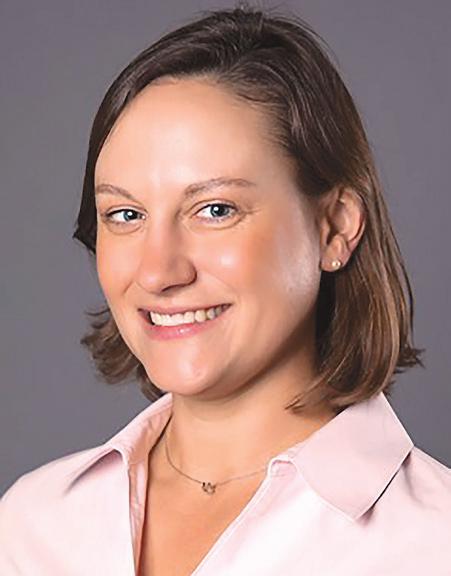
Interviewees | Left: Head coach Joanna Novakovic has been with the Red since 2014. Right: Senior captain Lena Reeb competes in the highest divison of IHSA.