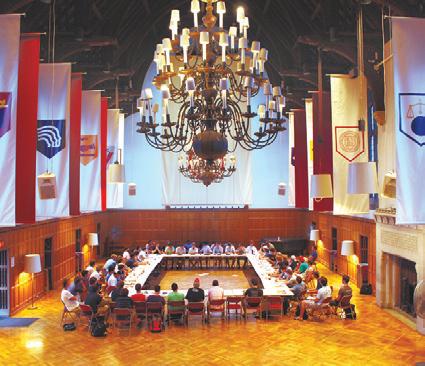
After COVID-19 delayed the election for S.A. president, the candidates debated again, but this time virtually. | Page 2
Sports
Title Legitimacy Christina Bulkeley ’21 questions whether national sports championships count during COVID-19? | Page 8
Ithacans Protest Police Brutality
Demand Mayor Myrick ’09, entire police department step down
By MADELINE ROSENBERG and MEGHANA SRIVASTAVA Sun Assistant News Editors
“How do you spell murderer? IPD! How do you spell $15 million? IPD!”
Chants like these brought the national reckoning with race into Ithaca’s streets Sunday afternoon, as residents and ralliers demanded that those in power be held accountable for Ithaca’s history with police brutality and neglect of Black and brown communities.
Ralliers gathered around the Bernie Milton Pavilion on the Commons and marched through the streets for the 17th consecutive week, calling to defund the police and for the entire Ithaca Police Department and Mayor Svante Myrick ’09 to quit their jobs.
In their speeches, activists also shouted and chanted about why they’re still protesting after 17 weeks.
“There really is no such thing as a peaceful protest,” said Meek, an Ithaca native who has been attending the Commons rallies since July. “When we come out here, we come out here to agitate and disrupt. If Black people don’t get the right to sovereignty, nobody gets the right to sovereignty. If native people don’t get the right to sovereignty, nobody gets the right to sovereignty. ”
Meek said he also attended the rally last week, when a group of pro-police “Back the Blue” protesters clashed with the ralliers. He said he attempted to have a conversation with the other group, but the conversation reached a standstill when they called him unpatriotic for not singing the national anthem.
“I’m here to shine light on things happening in the town ... that you call gorgeous.”
Ithaca organizations working to address structural racism also had a strong presence at the rally, including the Unbroken Promise Initiative, an organization that aims to advocate for Ithaca’s West Village, a low-income neighborhood with a high proportion of Black and brown residents.
Jordan Clemons
Jordan Clemons, one of the organizers of the nonprofit, took the microphone during the first hour of the rally, when attendees could take the mic and have the floor to voice their concerns.
“I’m here to shine light on the things happening in the town you parade in and that you call gorgeous,” Clemons said. While speakers discussed events happening from Rochester to Denver to Louisville, Clemons focused on the problems in Ithaca, which he called “a town full of bubbles.”
Following the speeches on the open floor, ralliers marched from the intersection of North Tioga and East Seneca streets, chanting and waving signs down Seneca and then turning onto North Cayuga Street. They continued through the Fall Creek neighborhood and turned back to Restaurant Row by the Commons, drawing attention from customers and workers, until they reached the IPD building.
At each intersection, the protesters stopped to chant, from “This is what democracy looks like!” to “Fire fire, gentrifier” and “No cops, no prisons, we want abolition.”
The two-mile long loop ended in front of the IPD building, where protesters crowded in front of the door and used the blow horn to direct questions at the IPD, including demands for police officers to quit their jobs.
Protesters also lowered the flag that was flying half-mast
in front of the building. They originally threw it into a garbage can, and then took it out to burn holes in th flag and ripped it apart.
Genevieve Rand, who was not involved in the defacement of the flag, explained that the flag has been flying halfmast for a while now, presumably for those losing their lives to COVID-19. But Rand said this image is not enough of a statement to express the tragedy over the acquittal of the police officers who killed Breonna Taylor.
Madeline Rosenberg can be reached at mrosenberg@cornellsun.com. Meghana Srivastava can be reached at msrivastava@cornellsun.com
Tree Alumni Make Time’s ‘Most Infuential People’ List
By ONALEE DUANE Sun Contributor
For the first time in its history, Time Magazine’s 100 “Most Influential People” list includes three Cornell alumni.
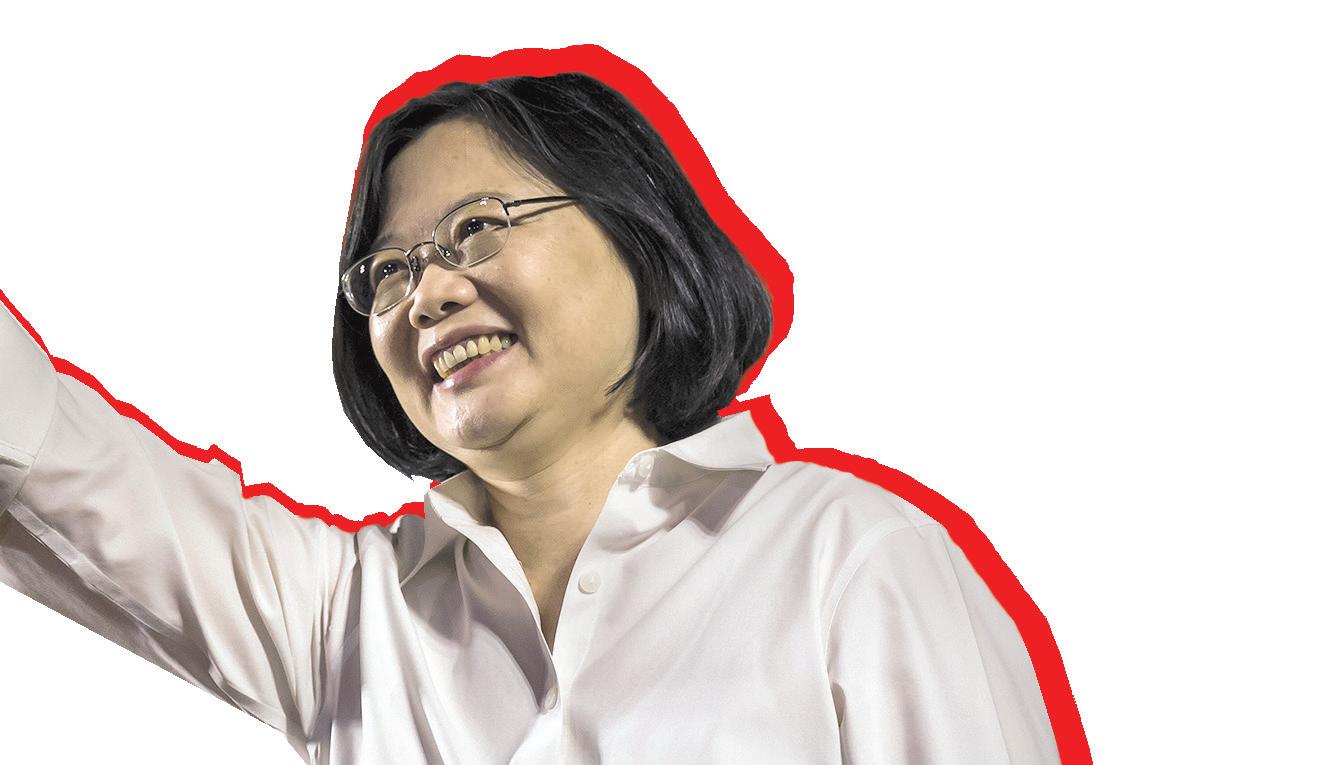
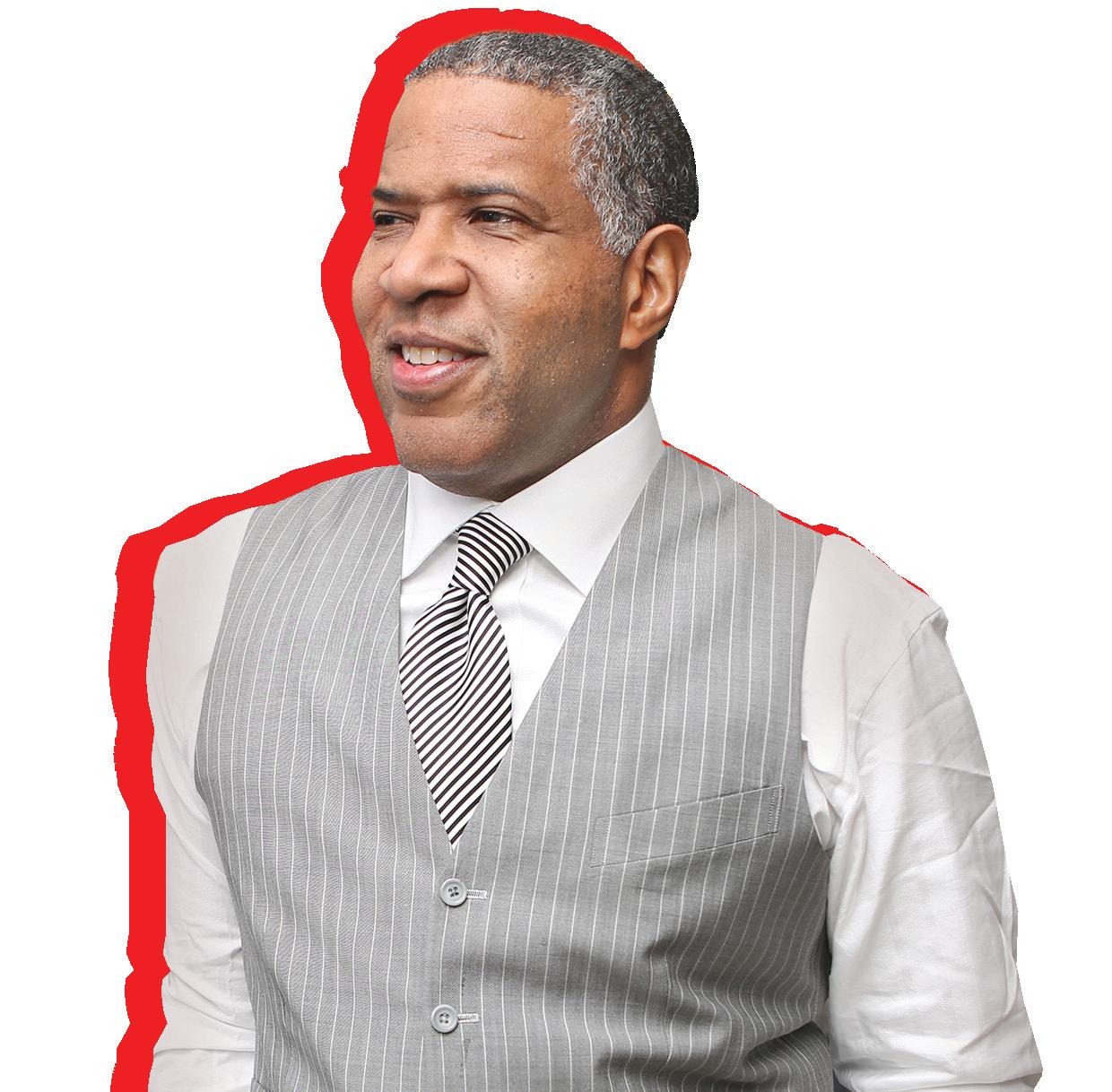
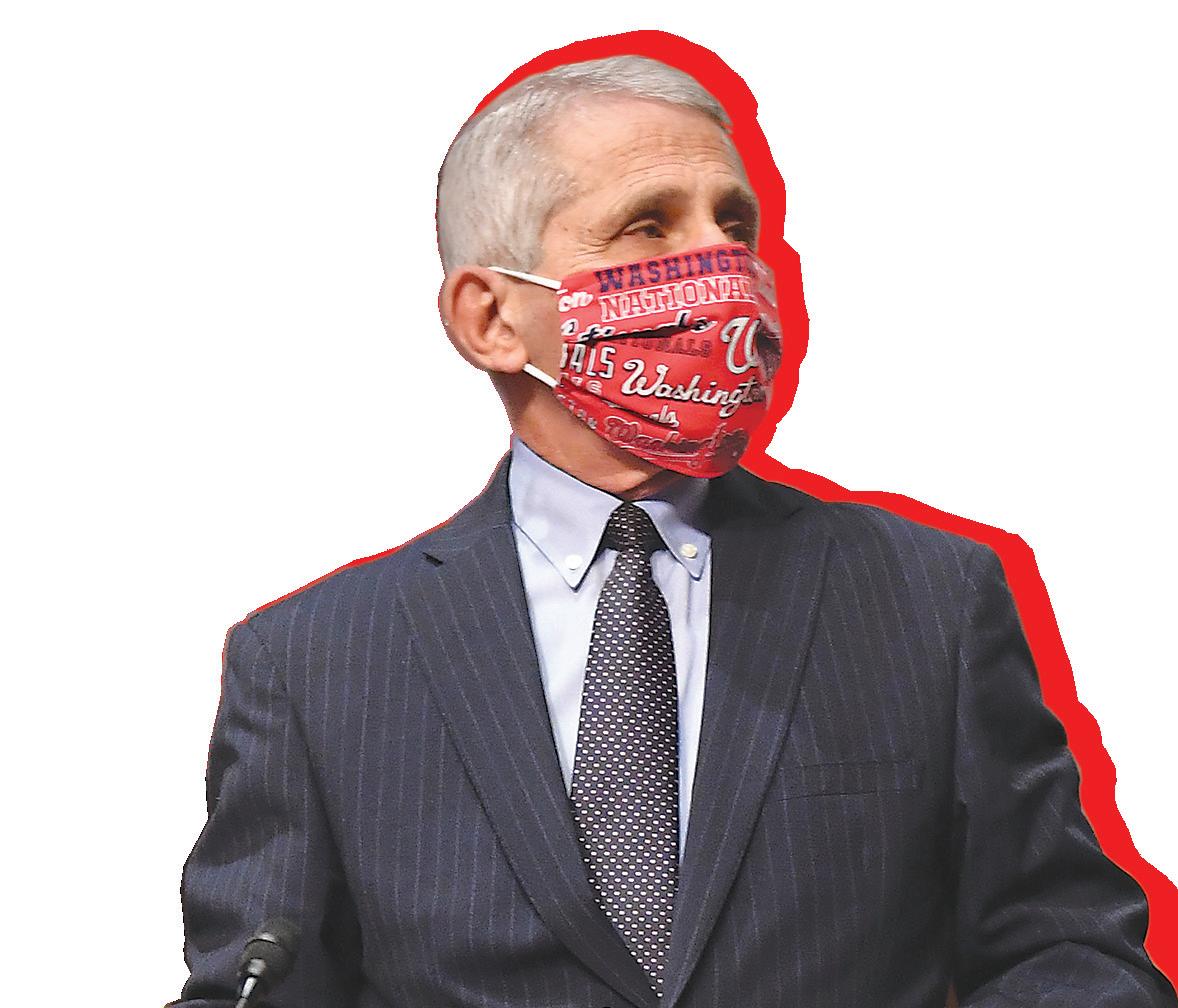
Robert F. Smith ’85, Tsai Ing-wen LLM ’80 and Anthony Fauci M.D. ’66 represented the University in the rankings this year. Fauci and Ing-wen fell into the ”leaders” category, and Smith was listed in the ”titans” category.
With its first publication in 1999, Time 100 has become a widely recognized annu-
When choosing who will make the highly anticipated list, the editors at Time consider many factors, all of which come down to one qualifying trait.
“One way or another they each embody a breakthrough: they broke the rules, broke the record, broke the silence, broke the boundaries to reveal what we’re capable of,” said Nancy Gibbs, a former editor in chief at Time.
Two Cornellians were fea tured in the leaders section, headlined by Fauci. The direc tor of the National Institute of
ship on handling COVID-19.
“Dr. Fauci doesn’t sugarcoat his words and refuses to be pressured by politicians,” wrote Jimmy Kimmel, who wrote Dr. Fauci’s profile for Time. “He delivers the truth, as difficult as it may be to hear, earnestly and with one goal: to save lives. His courage and candor have earned our
graduated first in his class and completed his residency at The New York HospitalCornell Medical Center, now known as NewYork-Presbyterian Hospital.
The other Cornellian in the leaders category is Tsai Ing-wen, the first female president of Taiwan.
In her profile for the list, Sen. Ted Cruz (R-Texas) described Ing-wen as a “signal lamp ing shadow, conveying to the world that Taiwan will not acquiesce to the Chinese Communist
See ALUMNI page 2
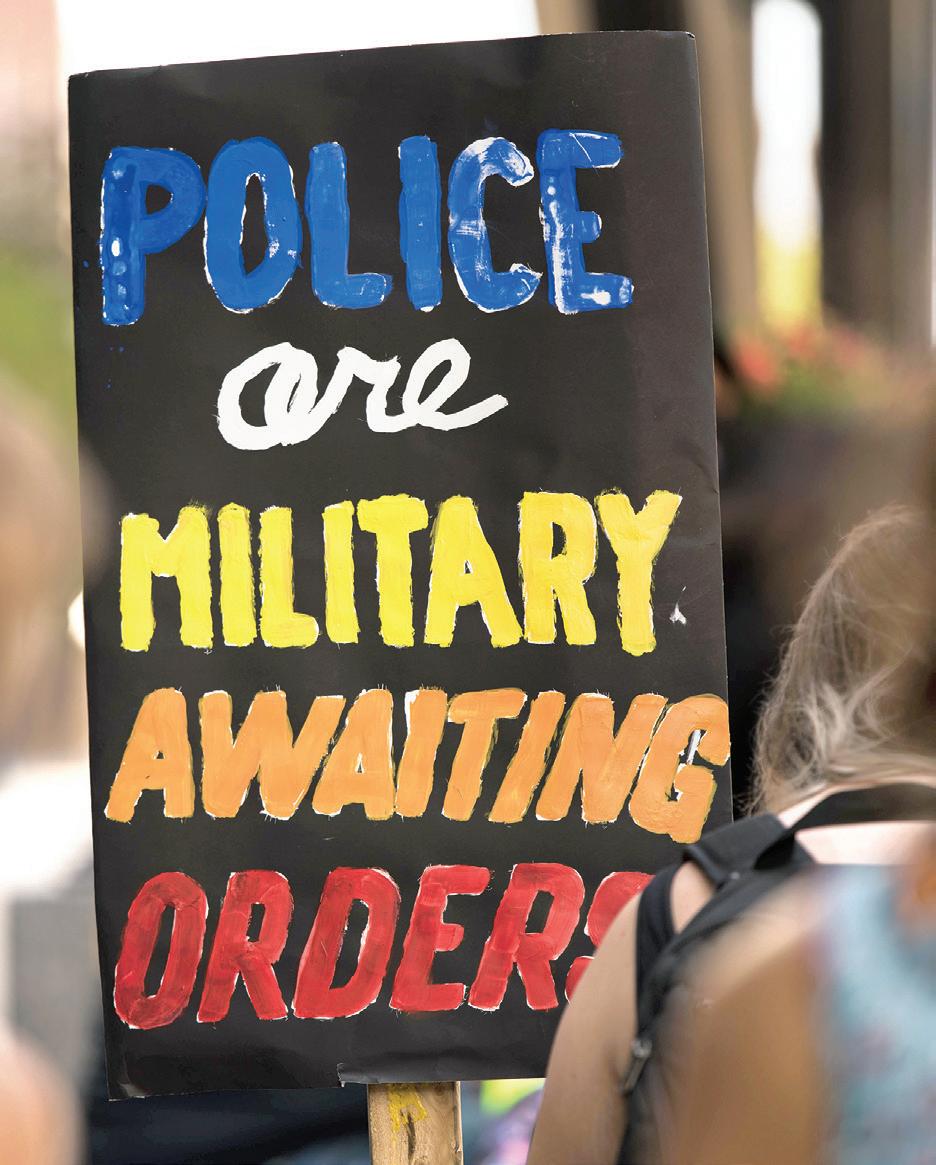
Police protest | A protester holds a sign at the march on Sunday. Protests have gone on for 17 consecutive weeks.
DANIEL RA / SUN STAFF PHOTOGRAPHER
Monday, September 28, 2020
A LISTING OF FREE CAMPUS EVENTS
Moving While Meeting Work With Cornell Wellness 9 - 9:30 a.m., Virtual Event
Advancing Resource Aware Chemical Pathways and Tramsformations in Subsurface Environments and Engineered Processes For a Low Carbon Future 9 - 10 a.m., Virtual Event
Ecology and Evolutionary Biology Weekly Semicar: Behavior is a Motor and a Brake for Evolution 12:20 - 1:30 p.m., Virtual Event
The Science of Greening Our Cities 12:40 p.m., Virtual Event
Planning, Public Health and Responses to COVID-19 3 p.m., Virtual Event
Activism and Mental Health in POC Communities 12:20 - 1:30 p.m., Virtual Event
The Learning Strategies Center Presents: Motivation Stations! 7 - 10 p.m., Virtual Event
How to Be Engaged in Community Service As a Cornell Student 5 - 6 p.m., Virtual Event Tomorrow
Border Environments: Toward a Political Ecology of The Edges of the World 5 p.m., Virtual Event
Alumni Featured in Time 100
since been re-elected in 2020.
-ership has proven to be strong and reliable through her part of Taiwan’s success in containing the spread of COVID-19, along with her unrelenting resistance to the Chinese government.
Ing-wen received her master of law degree from Cornell Law School in 1980. First elected as the president of Taiwan in 2016, Ing-wen faced increased pressure from China to re-establish control of the island, which separated from China in 1949 but never officially declared its independence. She maintained her stance on sovereignty and has
ALUMNI Continued from page 1 Onalee Duane can be reached at osd4@cornell.edu.
Featured in the titans section was Robert F. Smith, the founder, chairman and CEO of investment firm Vista Equity Partners. Smith is “perhaps the savviest investor in America today,” wrote Samuel
neering and received his MBA from Columbia University in 1994.
Since completing his education, Robert F. Smith has worked in investment banking, advised mergers and acquisitions for companies such as Apple and Microsoft and founded Vista Equity Partners, a private equity and venture capital firm.
“Cornell was such a wonderful experience in a fundamental time of my life ... Cornell believes in rigor. We bring a different degree of rigor.”
Robert F. Smith ’85
L. Jackson and Latanya Richardson Jackson. Smith graduated from Cornell with a degree in chemical engi -
Smith is not only featured as a titan for his success in business.
“His most important investments over the years have been in people,” Samuel and Latanya wrote. In 2019, Robert F. Smith donated $34 million to Morehouse College’s Class of 2019, giving students the opportunity to graduate debt-free. He has recognized the value of investing wealth back into people and their communities to make a better future, the Time article read.
“If we can perpetuate this priority, we just may have a shot at creating a better world for future generations,” Samuel and Latanya wrote.
Smith attributes much of his success to his time in Ithaca.
sunmailbox@cornellsun.com
“Cornell was such a wonderful experience in a fundamental time in my life,” Smith said while receiving the Cornell Entrepreneur of the Year award in 2017. “Cornell believes in rigor. We bring a different degree of rigor.”
S.A. Hopefuls Debate After
6-Month Hiatus
By JOHNATHAN STIMPSON Sun Managing Editor
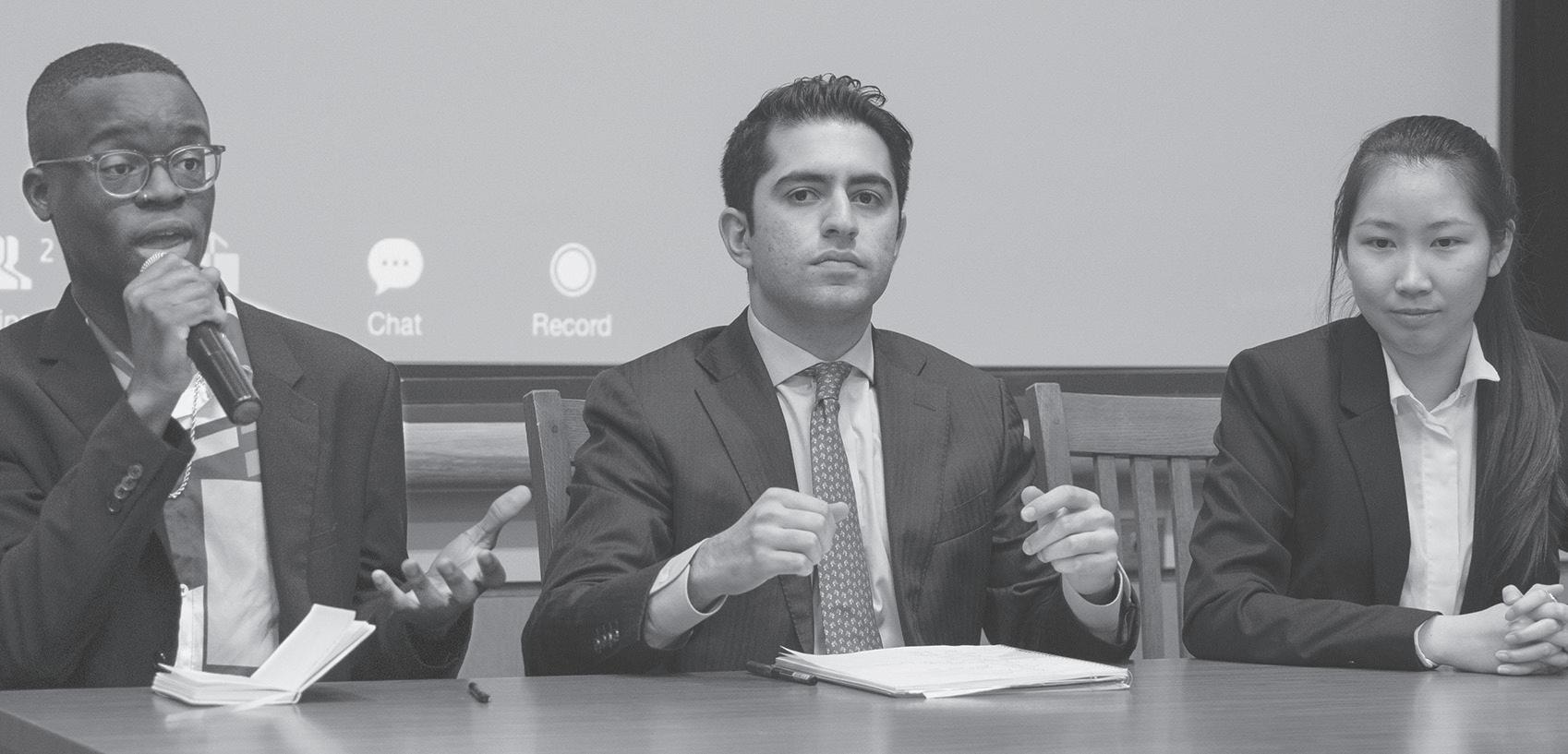
Three candidates vying for the Student Assembly’s top job took to the virtual debate stage Thursday evening, addressing issues ranging from Cornell’s coronavirus response to alleged toxicity within the S.A.’s culture.
Current acting S.A. president Cat Huang ’21, undesignated representative at-large Uche Chukwukere ’21 and Dillon Anadkat ’21 pitched themselves to student voters in an hour-long debate days before voting begins on Sept. 29.
The trio last met in early March, days before the pandemic forced the University to shut down campus and delay S.A. elections. In the seven months since, concerns over COVID-19 and racial equality have come to the forefront as among campus’ most pressing issues.
Huang addressed a slew of reforms as part of her plan — such as eliminating the student contribution fee, ensuring that students have equitable access to healthcare, conducting a review of the University’s student health plan and “defunding and demilitarizing” the Cornell University Police Department.
“Even if you’re not a police abolitionist, I think you can agree that there needs to be changes. There needs to be transparency about where CUPD gets its money,” Huang said, adding that residential staff should not be “forced to choose between losing their jobs or calling the police to student dorms where fully-armed police officers will come in at the
slightest smell of weed.”
Chukwukere similarly called for a series of measures aimed at overhauling how campus law enforcement operates, including implementing an alternative justice board and a CUPD Oversight Committee intended to address the department’s “lack of transparency around the useof-force policy” and “whether they’re actually trying to protect marginalized students on this campus.”
His platform also included abolishing the student contribution fee, mandating diversity and inclusion training for all Cornell employees, providing free menstrual products on campus, creating more gender-neutral bathrooms and continuing to push for fossil fuel divestment.
While Huang and Chukwukere’s platforms were largely aligned on most issues, Anadkat — who stressed several times that he has never held a position on the S.A. — took a different tack, placing less explicit emphasis on marginalized groups than his two opponents.
The candidate’s opening remarks, for example, specifically singled out members of Greek organizations and student athletes as groups that haven’t “had their voices heard” by Cornell’s student governance.
Calling President Martha E. Pollack’s recent Greek reform measures “flawed,” Anadkat argued that the policies — which placed stricter limits on the size of allowed events and mandated third-party alcohol service
S.A. Presidential Candidates Debate for Second Time
DEBATE
Continued from page 2
— “discriminate against Greek organizations based on [their] finances and wealth.”
Anadkat also said the S.A. should strive to be “apolitical and neutral as possible,” claiming that the assembly’s focus on national issues, such as the Trump administration and various divestment campaigns, is a “completely wrong approach” that distracts from representing the interests of undergraduate students.
“Last year, the Student Assembly passed a
“I do not believe that we should be shying away from political things that that ... directly affect our futures.”
Cat Huang ’21
resolution to divest from companies from the State of Israel, and that was very controversial … I do not imagine that the Jews on the Cornell campus felt too good that day,” Anadkat said. “I do not think it is right for the Student Assembly to do that sort of thing.”
The comments drew a sharp rebuke from Chukwukere and Huang, both of whom asserted that the S.A. has an obligation to address issues that extend beyond East Hill.
“I do not believe that we should be shying away from political things that are going to directly affect our futures and our students,” Huang said. “I do agree, to some part, that we should remain bipartisan and make sure all students from any side of the aisle can feel that they are safe … But I completely disagree with [Anadkat] that we should be staying away from political issues because we fear that some students don’t want to talk about it.”
Chukwukere went one step further, stating that Anadkat’s views are “very dismissive and very disrespectful to marginalized students on campus.”
“Whether you know it or not … you cannot sit here and tell people that we cannot engage with these national politics, because they affect all students,” Chukwukere said, highlighting Roe v. Wade, gender identity rights, immigration and police violence as issues the S.A. has a duty to speak out on.
“The coronavirus has caused so much stress and anxiety for virtually everyone.”
Dillon Anadkat ’21
The pandemic also played a central role in the debate.
While a series of early COVID19 clusters prompted fears that campus would be forced to temporarily shutter its doors, all three candidates expressed satisfaction over the University’s recent performance, while underscoring some areas for improvement.
“I think that it’s important we recognize that the University is doing a really good job with
the amount of contact tracing,” Chukwukere said. “[However], students are miserable with … professors who aren’t reading the room and all of the other daily stresses on top of having a pandemic.”
All three candidates highlighted insufficient access to mental health services as an area in which the University has faltered.
“The coronavirus has caused so much stress and anxiety for virtually everyone really,” Anadkat said. “And so that really is a department that needs to be beefed up.”
The debate’s final question asked the candidates to respond to the Cornell Students for Student Assembly Reform, a group formed over the summer after the S.A. used funds collected from the student activity fee to donate $10,000 to a Cornell Students for Black Lives fundraiser.
The group, which includes a number of current S.A. members, wrote in a Facebook post that the disbursement violated the “the SA Charter, SAFC charter and funding guidelines” that prohibit the University from financially backing political causes. Another post alleged that “S.A. leadership use ad hominem attacks,” stating that the assembly’s leadership “publicly smeared the characters of S.A. members who dared to oppose their legislative objectives during meetings.”
10 Tips for Managing Money During COVID-19
By EMILY PARK Sun Staff Writer
Tuition. Board. Books. Financial responsibilities can be difficult to manage during college, and the pandemic’s recession has only made matters more difficult. Due to faltering businesses, travel restrictions and heightened stress levels, students may find themselves out of work or stuck in an unused housing lease.
So how can students mitigate economic stress? Applied economics and management faculty Profs. Scott Yonker, Byoung-Hyoun Hwang and Rich Curtis shared their top tips for money management during these uncertain times.
Monitor Your Spending.
Hwang recommended the online platform Statusmoney.com, which allows you to track and anonymously compare your spending with other people in your age category. This financial tool makes unnecessary expenses in various categories such as cars, home and education more salient, encouraging a decrease in spending.
Set a Budget, and Stick to It.
“I’d set up a budget spreadsheet enumerating all major monthly income and expense items, and strive to keep the expenses less than income,” Curtis said. Students should track their weekly, monthly, and annual expenses to see if they are within the budget, Curtis added. Distinguish ‘wants’ from ‘needs.’
“You need food and healthcare,” Curtis said. “You do not need pizza four nights a week, or the most expensive electronics.” This is a great way to limit discretionary spending and keep within your budget.
Choose Your Credit Card Wisely.
“First, when choosing a credit card, look at annual fees,” Curtis said. “Try to get a $0 annual fee card, a low interest rate and rewards on categories you spend a lot on. However, if you pay off your balance in full monthly, the interest rate is irrelevant, and this can also help you build a good credit rating and lower interest rates on future borrowing, such as for a car or a house.” He recommended Discover cards such as the “Discover It Student Cash Back” card and the “Discover It Student Chrome” card. Consider a Stafford Loan.
If you have a large credit card bill, or other pressing expenses, Yonker recommended the Stafford loan. “Students don’t have to pay interest on these loans until after they graduate,” he said. For those concerned about loan payments, Yonker said, “The objective is to have a higher income when you come out of college. You can borrow on that future. Stafford loans are a great way to do this.”
Comparison Shop.
Whether it’s credit cards, health insurance, renter’s insurance or even potatoes at the grocery store, make sure to cross-compare prices to get the best deal. “There are lots of frugal options for everything from groceries to electronics. You don’t need high-end stuff to get through school,” Curtis said. “Make sure you have what you need, but reign in discretionary expenditures which you can do without.”
Do Some Creative Online Job-Hunting.
“Students are miserable with ... professors who aren’t reading the room.”
All three candidates, to varying degrees, acknowledged some of the points raised by the group, with Chukwukere and Huang conceding that the S.A. has indeed struggled to provide an inclusive environment for its members.
Uche Chukwukere ’21
“Being on the S.A. for as long as I have, I have firsthand experience of the toxic culture that the S.A. cultivates,” Chukwukere said, noting that there is a high turnover rate for students of color on the S.A. “I’ve been called dog whistle terms. I’ve been called an aggressive, racist Black man who doesn’t really look out for everybody’s rights, who doesn’t represent the Black community.”
“Some of the things that Students for S.A. Reform brought up are not unfounded,” Chukwukere continued.
Huang struck a similar note, agreeing with the claims made that some aspects of the S.A.’s current culture are toxic, particularly for women.
“There’s a long history of people in leadership on the S.A. who may not be treating their members well. I’ve had student assembly members come to me after these meetings where they did feel hurt or bullied,” Huang said. “I want to make sure that the members feel safe and that they can share their voice on the assembly, because that’s what we’re here for.”
Meghna Maharishi ’22 contributed reporting.
Johnathan Stimpson can be reached at jstimpson@cornellsun.com.
The transition to remote work may allow students to compete for international opportunities. “In a way, it could be a boon for some students … for instance, in the past, for smaller projects, German firms might have exclusively hired German students,” Hwang said. “But now they can hire from a much wider pool of students including students in the U.S. without having to worry about things such as getting these students a German visa.”
Set Up an Emergency Fund.
Curtis teaches students in his finance class to “try to build up three to 12 months of living expenses by saving [at least] 10 to 15 percent of their pre-tax salary each month.” He highlighted the importance of having a “cash cushion,” especially during a pandemic. “You can start small. Even setting aside 10 to 20 bucks per week can get you in the habit of saving, and as your income grows over time you can increase your weekly savings,” he said. Seek Financial Support.
Federal programs such as the Pandemic Unemployment Assistance program — which is under the CARES Act — provides benefit packages to university students, who typically do not qualify for unemployment insurance. This combination may total up to $800 per week. “If you qualify for something like PUA, then you should take advantage of it,” Yonker said. “Just make sure you understand the rules for these programs.”
If You Are Struggling and Don’t Know Where to Begin, Communicate Your Needs.
Whether that be to your adviser, student services or the financial aid office — “stuff happens. Life happens. There are tremendous resources for students here at Cornell, but students need to let faculty and staff know when they’re having academic or personal challenges,” Curtis said. “The Cornell faculty and staff are here to make students’ lives better, to help students negotiate those challenges and to help enhance each student’s overall collegiate experience.”
Emily Park can be reached at epark@cornellsun.com.
Take two | Uche Chukwukere ’21 (left), Dillon Anadkat ’21 (center) and Cat Huang ’21 (right) at the S.A. presidential debate on March 9. The second round of debates took place on Zoom due to the pandemic.
HANNAH ROSENBERG / SUN ASSISTANT PHOTOGRAPHY EDITOR
ARTS & ENTERTAINMENT
Te Second-Handedness of Fall Semester
“Old movies / are / secondhand dreams,” writes Pablo Neruda, or rather, translates Margaret Sayers Peden, from “ Son las antiguas cintas / los / sueños ya gastados .” Lately, I’ve had the feeling that I’ve been living a kind of secondhand life. Old movies — old books, old songs, old works of art — are more real to me than the reality of my own life. Fragments come to the surface as if they
were churned up from a dark river running underneath experience like the twin spools of a cassette. Here there is a snatch of Sade or Debussy or some ominous electronic texture, there something bleak and sublime as out of Antonioni, here a line from Derek Walcott or Virginia Woolf, there patterns
and immensities emerge like the infinity nets and mirror rooms of Yayoi Kusama. Although this condition of mine — if you can call it that — has been exacerbated by the pandemic, it has always been there to one degree or another, a sort of background radiation.
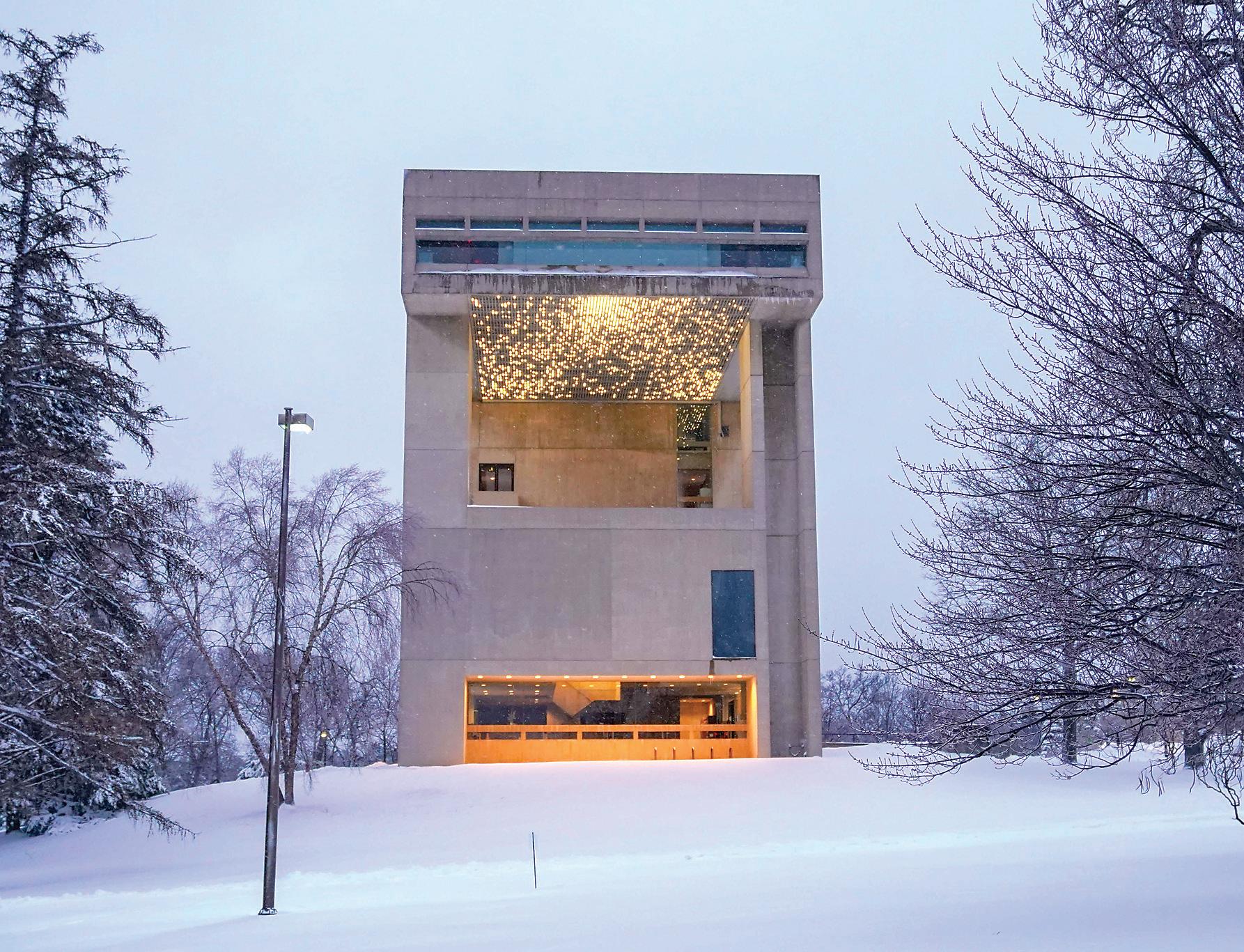
Walking behind Rand Hall from North to West Campus or West to North, looking at the light patterns of Leo Villareal’s “Cosmos” playing on the ceil-
ing of the Johnson Museum, is inseparable in my memory from Louise Glück’s poem “October” (“didn’t the night end, wasn’t the earth / safe when it was planted / didn’t we plant the seeds, / weren’t we necessary to the earth”). April, to me, means the Carmina Burana, a sense of earthy, medieval joy, the bull-
ock prancing and the buck farting and so on. I can’t untangle my suburban girlhood from the experience of discovering and reading Sylvia Plath (typical, I
know, but after all, we did grow up in the same town and go to the same high school).
In his essay “Why Read the Classics?” Italo Calvino arrives at the conclusion that “All that can be done is for each one of us to invent our own ideal library of our classics.” This is an attractive alternative to the idea of a single shared, monolithic canon. But somehow, and especially for the disordered, fragmented times in which we are living, the image of a library seems too neat, too organized, too complete. All I have is a sort of mental commonplace book, a palimpsest, that tells me art and life are indistinguishable, that this dichotomy — like most dichotomies — is largely artificial.
For a long time, I worried
wasted.” But this second-handedness of my life acts instead as a renewal, a deepening. It allows me to chart the landscape of the interior; if I am “out with lanterns, looking for myself,” it lights the dark passages and illuminates what reason and common sense cannot. It forms its own cosmos, creating order and harmony with its symbols, its images, its sounds, slowly but surely stitching the disparate threads of life into a richer fabric of wholeness. We are invented by our private mythologies.
T. S. Eliot, in a review defending Joyce’s Ulysses , speaks of myth as an ordering principle, a “way of controlling, of ordering, of giving a shape and a significance to the immense panorama of futility and anar-
How could such a life be possible when the external situation is so increasingly, unceasingly urgent?
about my way of living life through art, the desire, like Anselmus in Hoffmann’s “Golden Pot,” to live a “life in poetry, where the holy harmony of all things is revealed as the deepest secret of nature.” How could such a life be possible when the external situation is so increasingly, unceasingly urgent? When the voice of the world comes like a battering ram, pounding on the doors of the mind, telling us to take action, to “take arms against a sea of troubles,” to be practical, to grow up, effect change and so on?
In Spanish, “ gastados ” has the sense of “spent, worn out,
chy which is contemporary history.” I would like to take myth not in its narrowly constructed sense, but rather in the ways in which the strange unspeakableness of art, the ephemeral moods and colors and textures pervade the mundane and the quotidian.
“In a dream you saw a way to survive and you were full of joy” is one of Jenny Holzer’s popular texts. Perhaps that way is art.
Ramya Yandava is a senior in the College of Arts and Sciences. She can be reached at ryandava@cornellsun. com. Ramya’s Rambles runs alternate Mondays this semester.
Ramya Yandava
Ramya’s Rambles
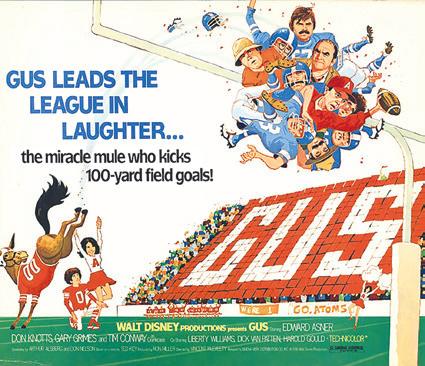
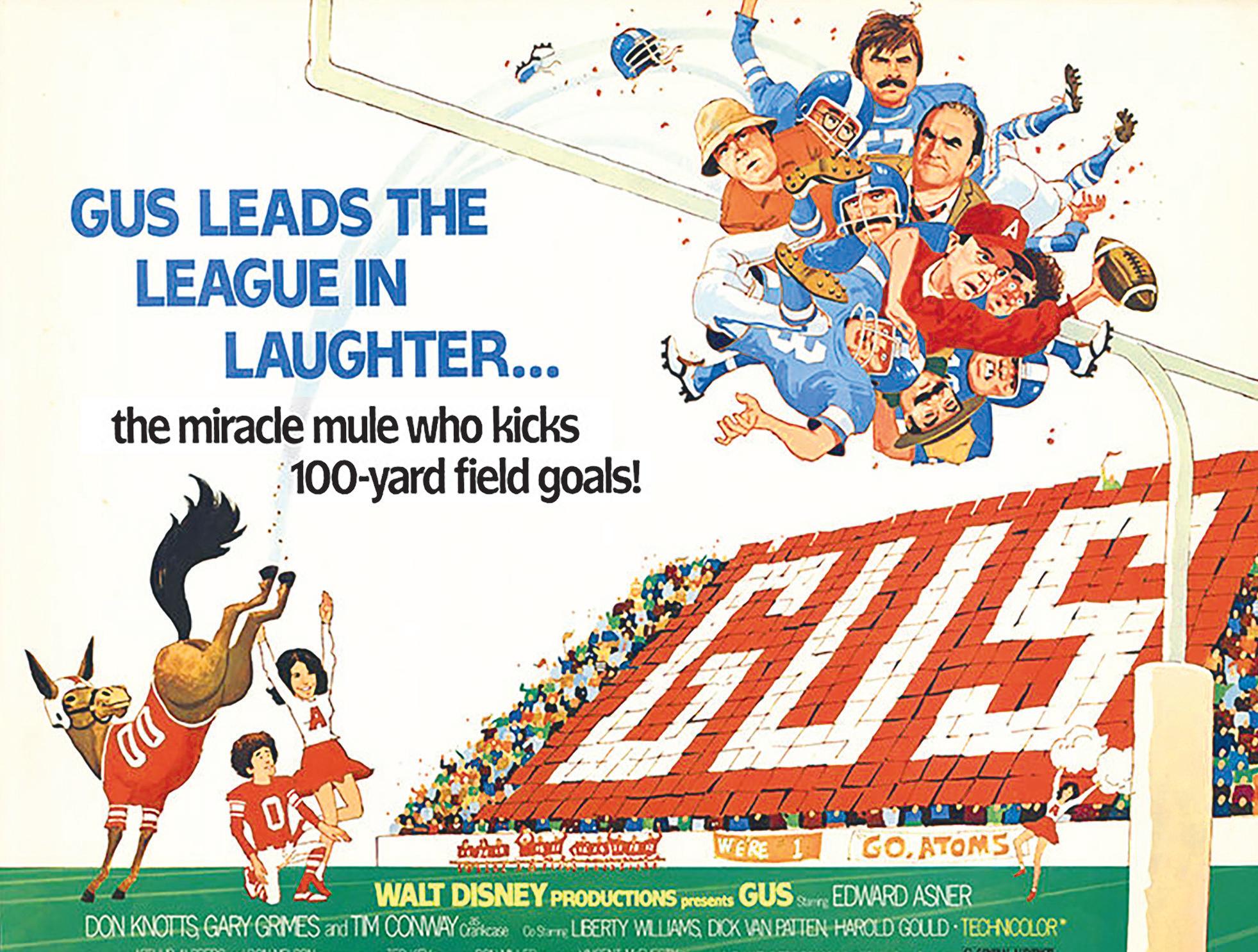
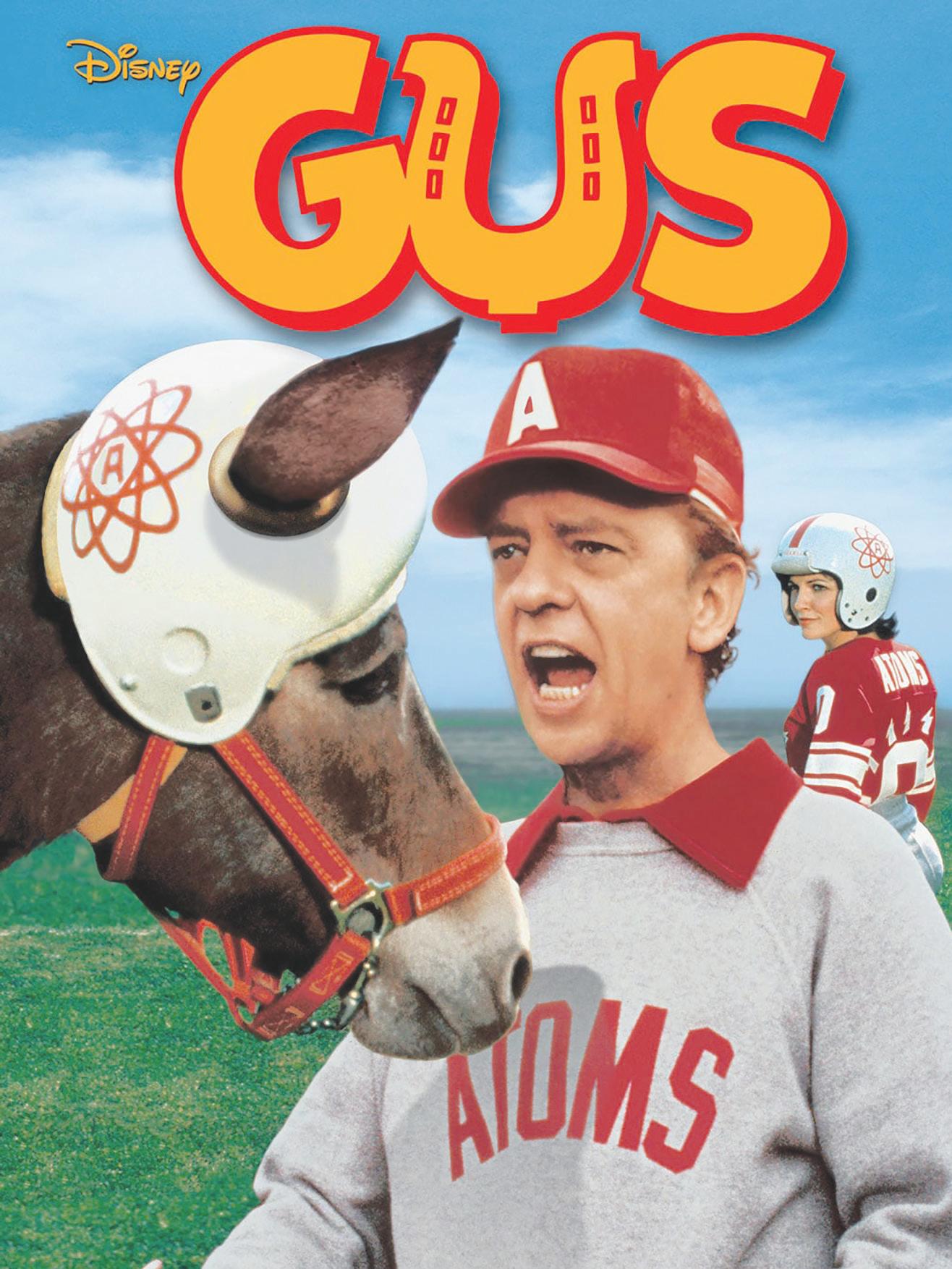
Gus Is Quite Certainly Te Greatest Film to Ever Exist
There is no film as wholesome, pure or inconceivably bizarre as Disney’s 1976 movie Gus, and the company has been and will forever be chasing the heights at which it peaked with that production. The pinnacle of the Disney franchise is, unquestionably, the greatest film about a Yugoslavian mule coming to America and playing professional football ever made (though, I can’t say it has much competition in that category).
Gus opens on a Yugoslavian soccer match in which our main character Andy Petrovic’s brother, Stjepan, lays waste to his supremely overmatched competition on a soccer pitch. Stjepan’s incredible athletic prowess earns him the admiration and undying love of his parents; Andy (Gary Grimes) is a pathetic loser boy who falls in wells and makes a mockery of his family’s name. But when the owner of the California Atoms — an NFL team worse at playing football than Andy is at being someone worthy of his parents’ attention — learns of the Petrovic’s mule, Gus, he immediately flies the duo out to California.
Perhaps through osmosis, or maybe via genetic experimentation, Gus (a mule) has developed a striking ability to kick balls distances of 100 yards or more (but he loses accuracy beyond the century mark, for dramatic effect). Gus’ miracle leg helps turn the Atoms’ season around. Eternal glory and fame are bestowed upon the mule. Sundays are renamed Gus Day. Dick Butkus crushes a professional-grade football helmet with his bare hands. And yet, Andy’s parents still don’t view him as a person worthy of their respect (a truly fascinating C plot).
This movie, while made only 45 years ago, astonishingly does not hold up well at all for modern viewings. Gus makes heavy
use of rear projection in screens, a method for filling in backgrounds similar to green screens, but worse. Every single shot that uses rear projection is a grainy, blurry, disgusting mess. Poorly-framed close-ups on Gus yank the audience out of the otherwise terribly inauthentic NFL action and sideline shots are a sad excuse to squeeze as many uses out of the undoubtedly cheaply-made
Atoms uniforms before Disney executives burned them, along with any remaining copies of the film.
The apex of this goddamn plateau of a movie is a nine-minute and 43-second scene where the bumbling villains — who were introduced nearly 37 minutes into the film and were established as villains only by the fact that they walked out of a jail and possess vague motives — chase Gus around a supermarket. I cannot fathom why, for any reason, security did not kick them out, or why the police weren’t called or even why the shoppers didn’t complain about a wild farm animal running around the store. I also do not understand why the scene went on for so long. Time-wise, Gus bumbled around a Ralphs for over 10 percent of the entire movie. Could that time have been better spent, I don’t know, establishing the romantic connection between Andy and Debbie (Louise Williams), who really seems more attracted to the mule than the human being in charge of it? Probably.
To be fair, Gus did emote better than Andy did, so I can’t blame Debbie too much.
There’s a post-game shower scene (the unsexy kind) where the owner (Ed Asner) yells at Dick Butkus’s character for being a general dumbass. Cool idea (I guess), but the issues here are 1) the water is running, 2) the boom mic was probably left in someone’s truck during the shoot and 3) showers are inherently echoey. So, I could not make out a single word of what either character was saying for the duration of the scene, but it appeared to me that Asner was pretty angry. Which was probably all I needed to know.
Look, was this movie perfect? In some sense, yes. In some realer, more accurate sense, no, it was not even close. Does the score sound like royalty-free music chosen at random and placed haphazardly throughout the movie at varying volume levels? You bet it does. Does Debbie not only play a snap of professional football but also roast the shit out of Andy during a scene at the airport? Absolutely. Are the full credits shown at the beginning of the movie over a
montage of California Atoms mishaps and mistakes, perhaps foreshadowing the rest of the film and subconsciously implying that you should just turn off your TV before you get too invested in the plot? Yes! Perhaps most importantly, Gus somehow swung an official licensing agreement with the NFL, making the film the greatest football action to grace my television throughout this pandemic. The actual NFL season has gone relatively swimmingly thus far, but truth be told, watching large men slam into each other year after year has almost lost its charm after Gus opened my eyes to the true potential of the sport.
Gus was Air Bud before Air Bud. It was that one scene in Alvin and the Chipmunks: The Squeakquel (you know the one) long before signing rodents were approved by money-hungry film executives with no regard for my parents’ sanity. It even edged out Matilda — not the Danny DeVito one, but the 1978 movie about a boxing kangaroo that was so bad, it only has a one-sentence summary on Wikipedia. All of this is to say, Gus is truly the progenitor of Animals Playing Human Sports films, and I am forever grateful to everyone involved in its production for spawning such an illustrious and expansive genre.
I wish I could write five thousand words about Gus, but I would be surprised if my editors even published this abridged version of my thoughts. Long story short, this movie is everything you’d expect from a 1976 Disney film that made nearly $22 million at the box office. It’s poorly paced, oddly written yet uniquely charming. I can find nothing online stating whether or not the mule was harmed during the making of the film, and similarly, there is no statement in the credits absolving Disney of animal cruelty, but perhaps we should give them the benefit of the doubt. Gus makes us feel so happy and safe; I’m sure the crew made him feel the same.
Jeremy Markus is a junior in the College of Agriculture and Life Sciences. He currently serves as a senior editor on The Sun’s board. He can be reached at jmarkus@cornellsun.com.
JEREMY MARKUS SENIOR EDITOR
COURTESY OF DISNEY
COURTESY OF DISNEY
The Corne¬ Daily Sun
Independent Since 1880
138th Editorial Board
MARYAM ZAFAR ’21
Editor in Chief
JOYBEER DATTA GUPTA ’21
Business Manager
PETER BUONANNO ’21
Associate Editor
MEGHNA MAHARISHI ’22
Assistant Managing Editor
CHRISTINA BULKELEY ’21
Sports Editor
BORIS TSANG ’21
Photography Editor
CAROLINE JOHNSON ’22
ALEX HALE ’21
ARI DUBOW ’21
EMMA ROSENBAUM ’22
BENJAMIN VELANI ’22
JOHN MONKOVIC ’22
MIKE FANG ’21
OLIVIA WEINBERG ’22
Assistant News Editor
MADELINE ROSENBERG ’23
Assistant
LUKE PICHINI ’22
Assistant Sports Editor
HANNAH ROSENBERG ’23
Assistant Photography Editor
BRIAN LU ’23
ANNABEL LI ’21
&
LEI ANNE RABEJE ’22
JOHN COLIE ’23
Editor JOHN MONKOVIC ’22
JOHNATHAN STIMPSON ’21
Managing Editor
KRYSTAL YANG ’21
Advertising Manager
JASON HUANG ’21
Web Editor
NIKO NGUYEN ’22
Design Editor
PALLAVI KENKARE ’21
SEAN O’CONNELL ’21
KATHRYN STAMM ’22
OZA ’22
PLOWE ’23 Arts & Entertainment Editor
LEE ’21 Money & Business Editor ANYI CHENG ’21
’22
MEGHANA SRIVASTAVA ’23
DAWSON ’21
PARKER ’22
MORAN ’21
’21
’22
’21
’21
Working on Today’s Sun
Ad Layout Jenny Huang ’22
Production Desker Ben Mayer ’21 Sarah Skinner ’21
News Deskers Alex Hale ’21
Catalina Peñeñory ’22
Opinion Desker Peter Buonanno ’21
Design Desker Lei Amme Rabeje ’22
Photo Desker Boris Tsang ’21
Arts Desker Daniel Moran ’21
Sports Desker Christina Bulkeley ’21
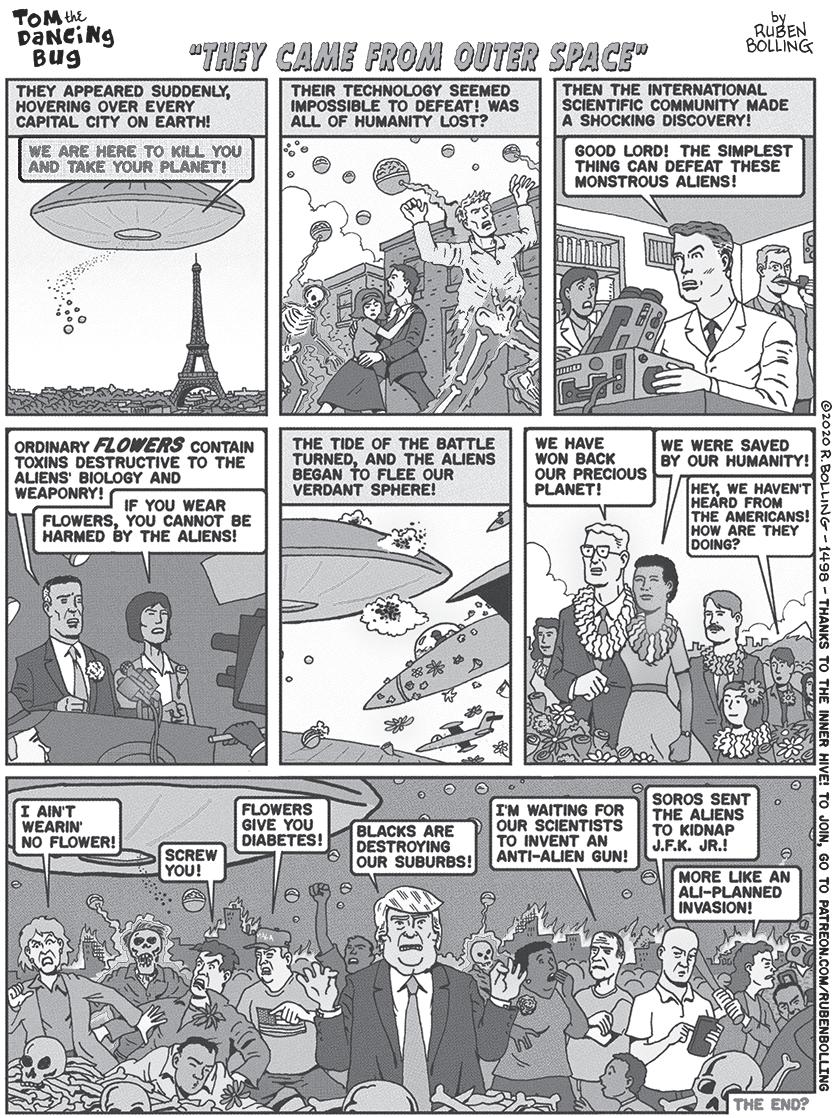
Tom the Dancing Bug by Reuben Bolling
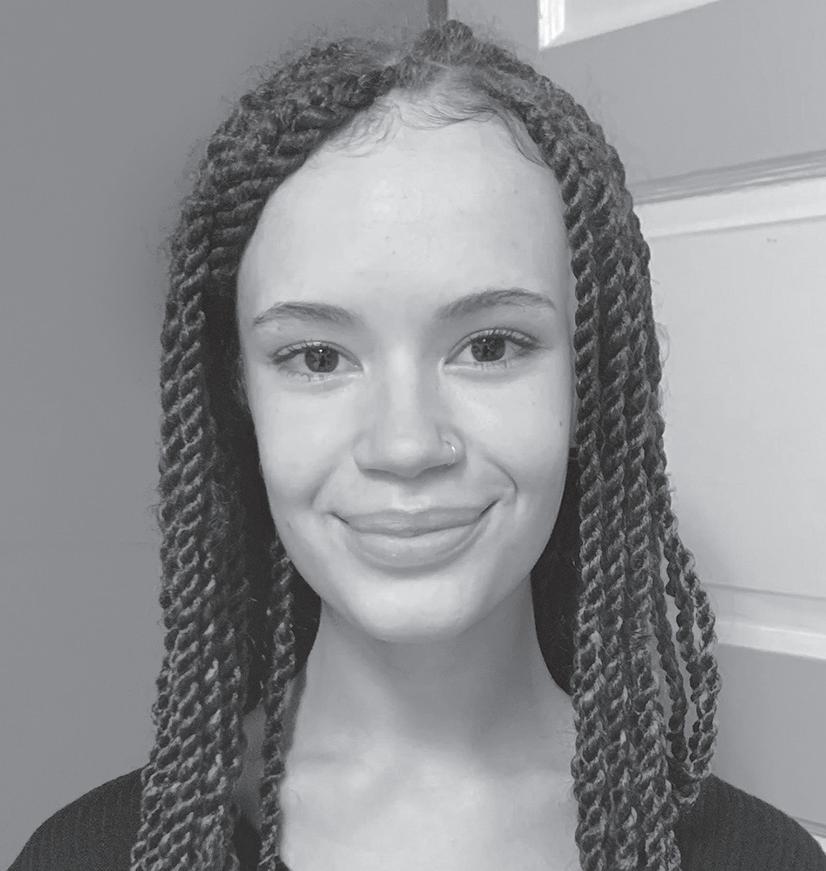
Alecia Wilk Girl, Uninterrupted
Alecia Wilk is a junior in the College of Arts and Sciences. She can be reached at awilk@cornellsun.com. Girl, Uninterrupted runs every other Friday this semester.
Breakup With A Small Town
Coming to college made me conscious of the problem of having an introduction prone to misinterpretation. Every “where do you live” since my first introduction to my freshman year roommate has made me wonder if my graceless attempts to illustrate the distinct small town-ness of where I was raised give people an entirely wrong impression.
I grew up in an oxymoron. Rural New York is a descriptor so pitted against itself that it almost cancels out, diffusing into a vast Middle of Nowhere that disappears off mental maps when you’re tasked with telling someone where you’re from and where that is. My jumbled words between ‘um’s’ and ‘have you heard of’s’ could never capture the character of my piece of upstate in an icebreaker-friendly time crunch, so what follows is a hunch that feels like an itch that strangers walk away thinking of charming shots of green and hay from Hallmark movies instead of the slightly less magical reality I knew.
It was a reality dominated by six-hour days in a single-floor brick building on Pancake Hollow Road, a winding double-yellow-lined path that separated the school’s badly paved parking lot from the dirt one that belonged to Wilklow Orchards. Until the end of the July after my senior year, when I procrastinated packing a suitcase for a week-long stay at Cornell’s campus for a first-generation student program. Even though I received an invitation for the much longer PreFreshman Summer Program, which, like mine, seemed exclusively inclusive of students of color who came from backgrounds that might require a more rigorous, guided, hands-on transition into college. My conflictedly homesick head tried to grapple with the way these college-mandated, college-prep getaways did what they did. The thoughts turned over like a tide in my mind throughout the week, murky waves mixed with indebted gratitude and an anxiety with a monstrous appetite, which they gave a special name to — ‘imposter syndrome.’ I was already learning, observing, like an outsider, the way this institution continually assured us we belonged here all while singling us out by identities they decided quite literally didn’t belong on campus without some tweaking.
Since that first walk up the slope, to take a helpful though insecurity-inducing summer writing workshop sponsored by the Knight Institute, the view from the ivory tower has been enlightening. Cornell offered me distance, in a bird’s-eye-view kind of way, that makes reflecting on the prologue to university like watching myself trapped inside a snow globe. I could see, all at once, the flats of farms and the hills of apple orchards, the aged, 80s charm of the Gateway Diner and the
backroads and potholes in between that kept everything together — there wasn’t much new to take in, but anything there was could no longer hide. My snowglobe was a world isolated inside a world, but instead of icy crystals raining down when I shook things up, I was met with dirty puffs from the exhausts of pick-up trucks and confederate flag memorabilia.
All the out-of-place, out-of-time details about my hometown might actually be very charming if it weren’t for the stinging intolerance that they carry; a chronic disease of that old country conservatism. My change in perspective has made returns on breaks uncanny: Rooms and stretches of pavement look different, filled with feelings I didn’t know I noticed before. But this summer made years of uncanniness stir, settle and stir again, demanding confrontation. Glances and dry inside jokes traded between the “diverse” students snuck off school grounds and turned into texted conversations, which turned into full-fledged google form testimonials about the experiences of students of color, which then stood across linoleum tile and bled out their truths and anti-racist urges in front of a school board who were six feet and shades away from those from whom the grievances came.
Distance showed me how different home looked. It made me wonder how I let memories that ranged from microaggressions to teachers espousing Nazi-like rhetoric slip into the center of my numb little head and stay stuck there, forming a repression tootsie-pop. While writing and reading the racism-drenched testimonials that would be presented to the school board, my sister and I laughed deliriously with each new, confusing, painful memory that resurfaced and brought to light how diffuse ‘the problem’ was.
Although the problem might be more obvious when it’s wrapped in Confederate flag and camo getups, it doesn’t take events like Back the Blue rallies to sense it here. It arises on this campus in ways that are most often more covert than my public high school’s testimonials but is also buried in admissions with a legacy and magnitude that no testimony could communicate. Higher education has a funny method of hiding its problems with the very acknowledgement that they exist. So when I’m sent to breakout rooms and burdened with answering questions like how my zip code defines my identity, words get minced, testimonials get left out and I hope that the quality of my webcam obscures a blankness in my stare as I wonder how current students turned alumnus will choose to chop up and serve bite-sized versions of their own complex histories at this university and if experiences here, too, will be prone to misinterpretation.
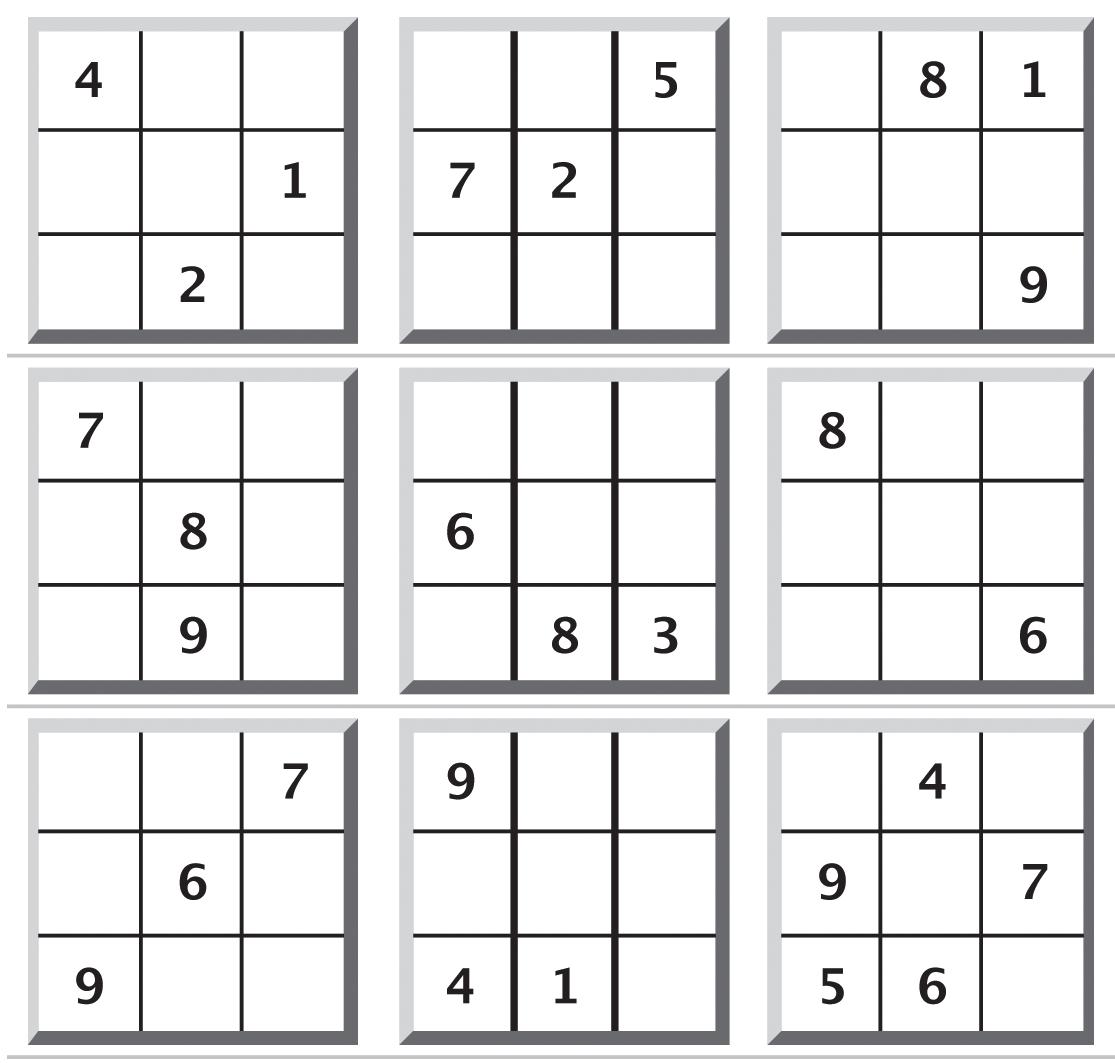
Fill in the empty cells, one number in each, so that each column, row, and region contains the numbers 1-9 exactly once. Each number in the solution therefore occurs only once in each of the three “directions,” hence the “single numbers” implied by the puzzle’s name. (Rules from wikipedia.org/wiki/ Sudoku)
Editor’s Corner
In March, professional sports leagues were shut down. Once the initial dust settled and commissioners began discussing their plans to re-start their respective leagues’ seasons, one question remained that had no definitive answer: Does a 2020 championship win mean as much?
So-called asterisk wins have been a major topic in sports over the last year — for the rest of time, the record books will need to remind people that certain stats or championships are associated with some baggage. The 1919 Reds after their opponents threw the World Series, the 2017 Astros for illegal sign stealing, and the like are teams whose titles have been tarnished as more information came to light after the final game was played. But this year, we are going into the championships for the NBA, MLB and NHL already knowing that people in the future might not lend as much weight to a 2020
Christina Bulkeley is the sports editor on the 138th Editorial Board and previously served as an assistant sports editor. She is a senior in the College of Arts and Sciences and can be reached at cbulkeley@cornellsun.com.
Do We Care About Winning A ‘COVID Cup’?
of a dismal performance in the round robin that determined seeding for elimination games, some people claimed this as evidence that the 2020 playoffs were doomed to be unrepresentative of the season that had led up to it.
The
outcomes we
expect in the playoffs are very frequently not the outcomes we actually get ... and that’s the way it always has been.
title. For the NHL and NBA, teams were already entering the home stretch when they got shut down. The postseason picture, while not set, was getting there. Most people would agree that the teams that were in the NBA and NHL bubbles once play resumed in July and August deserved a spot there. And yet, criticism regarding the validity of playoff outcomes has rained down. When the Boston Bruins, who had the best record of any NHL team leading up to COVID19, ended up with a No. 4 seed because
The validity of the 2020 MLB season might be more questionable.
But doesn’t this happen every year? While perhaps the long break in play highlighted how the playoffs are a crapshoot, the fact remains that they have always been this way. Upsets are nothing new when it comes to big games, and losing cannot be entirely explained away by COVID-19. While it’s not worth going into every individual challenge teams and athletes faced because of the break in play and the sometimes-trying bubble experience, they did exist, and I am not discounting that (looking at Tuukka Rask). But I also have been paying attention for long enough to know that the outcomes we expect in the playoffs are very frequently not the outcomes we actually get. This is an uncertainty that one must accept, to some degree, in order to enjoy the playoffs — and that’s the way it always has been. Those condemning the validity of the 2020 MLB season might have a better case to make. Transforming a 162-game season into one of just 60 compromises the integrity of the postseason and ensuing World Series to a much greater degree than just mandating that all teams take a few months off and shortening the season by several games. For the NBA and NHL, the entire season was played without the knowledge that anything would be different come time for the playoffs, so there is no questioning the legitimacy of the regular season. But for MLB, a league that found out the season would be delayed during the preseason, the entire year has arguably been tainted by COVID-19.
In a game partial to luck on a day-to-day basis — more so than other sports — cutting the season by more than half is guaranteed to totally alter the outcome of the regular season. Multiple teams are primed to enter the postseason either below or just barely skirting above .500. The expanded playoff picture (each league is sending eight teams to October instead of five like usual) means that the Miami Marlins are going to the postseason, and not as a Wildcard team. And so are the San Diego Padres! I am not bashing the underdog, but I don’t think I’m going out on a limb by saying that we would not have so many unexpected contenders if 162 games were played.
But in the end, it’s all pretty much a moot point. COVID-19 exists, it messed up sports for the year and that can’t be changed. We still get to see them (on the TV) and the commissioners each salvaged the seasons in some way or another — whether you agreed with exactly how leadership handled things is an entirely different discussion. The fact of the matter is that some number of games got
played after that March shutdown, and at least that’s better than nothing. Will the hardware that championship teams bring home matter? Well, yes. After all, they still beat out everyone else to earn it. Will it matter in a different way than in a normal year? Maybe. But the teams who win this year overcame a totally new set of challenges by playing in a pandemic, so that counts for something.
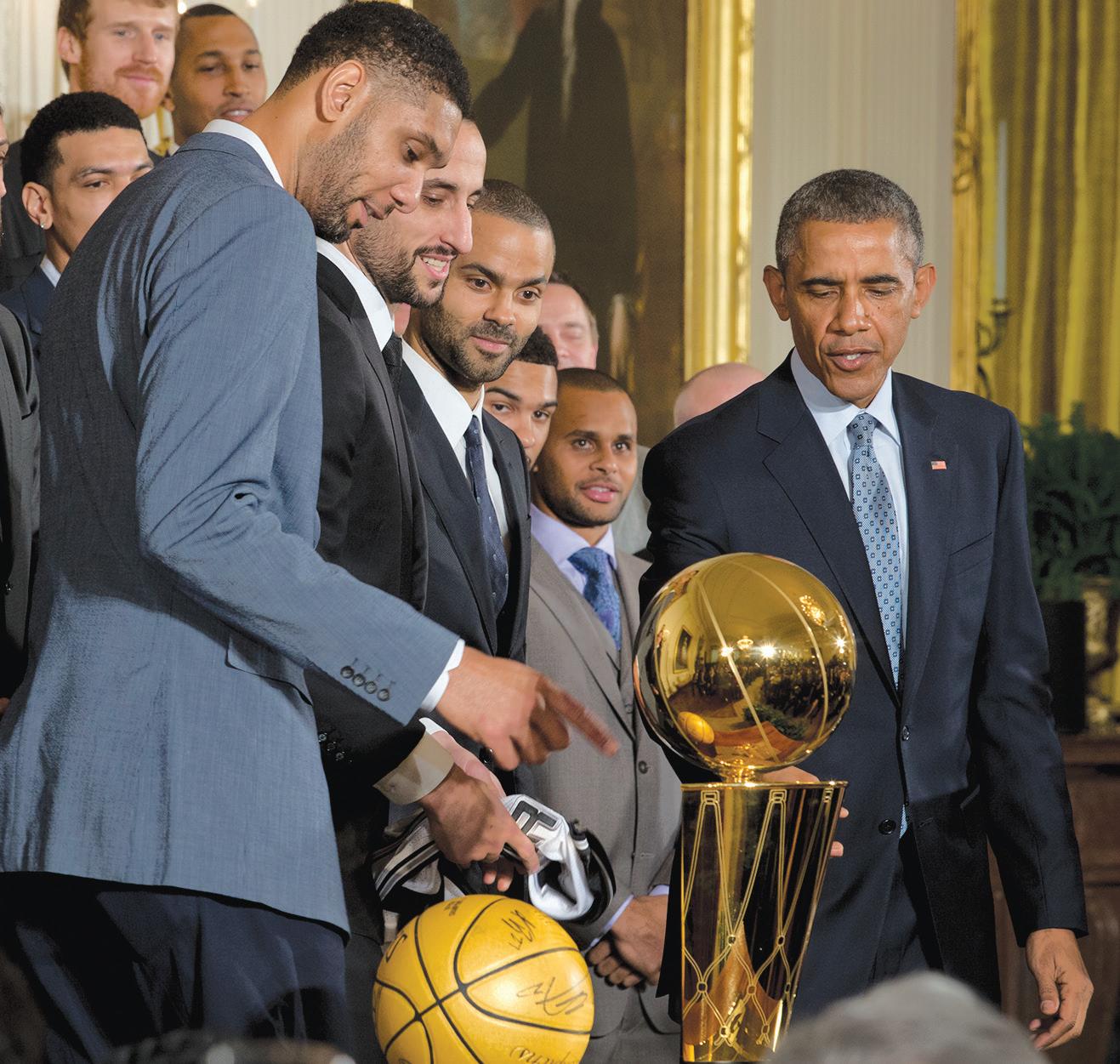
High-level recognition | Fans traditionally love sports and honoring championship winners, all the way through the highest office in the U.S.
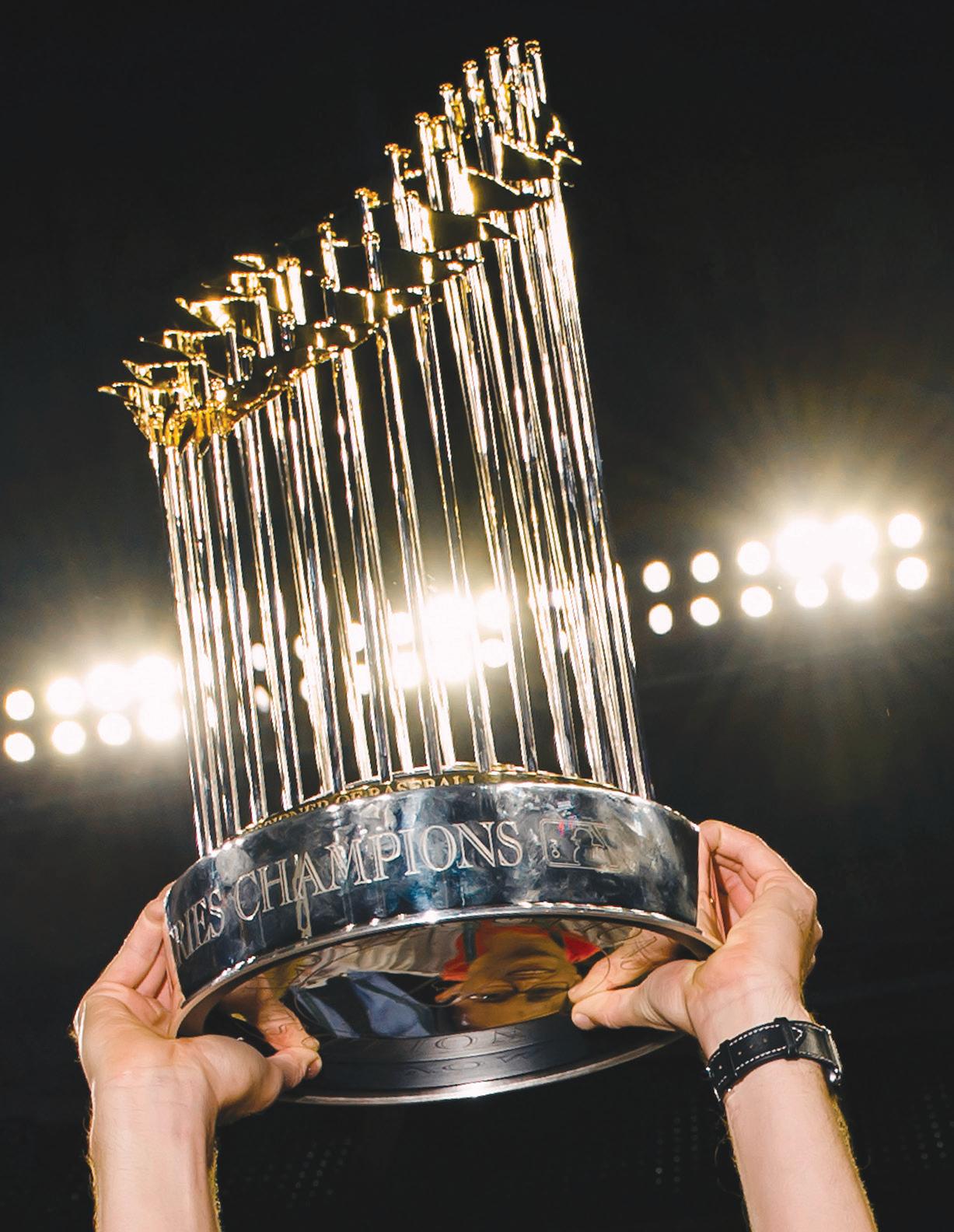
Heavy hardware | There is no question as to whether this year’s seasons will end with a champion taking home a trophy. The question is whether the title will carry as much honor.
DINA LITOVSKY / THE NEW YORK TIMES
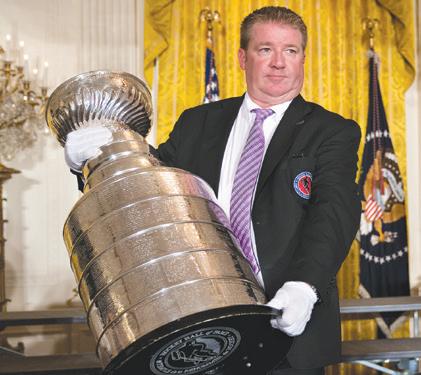
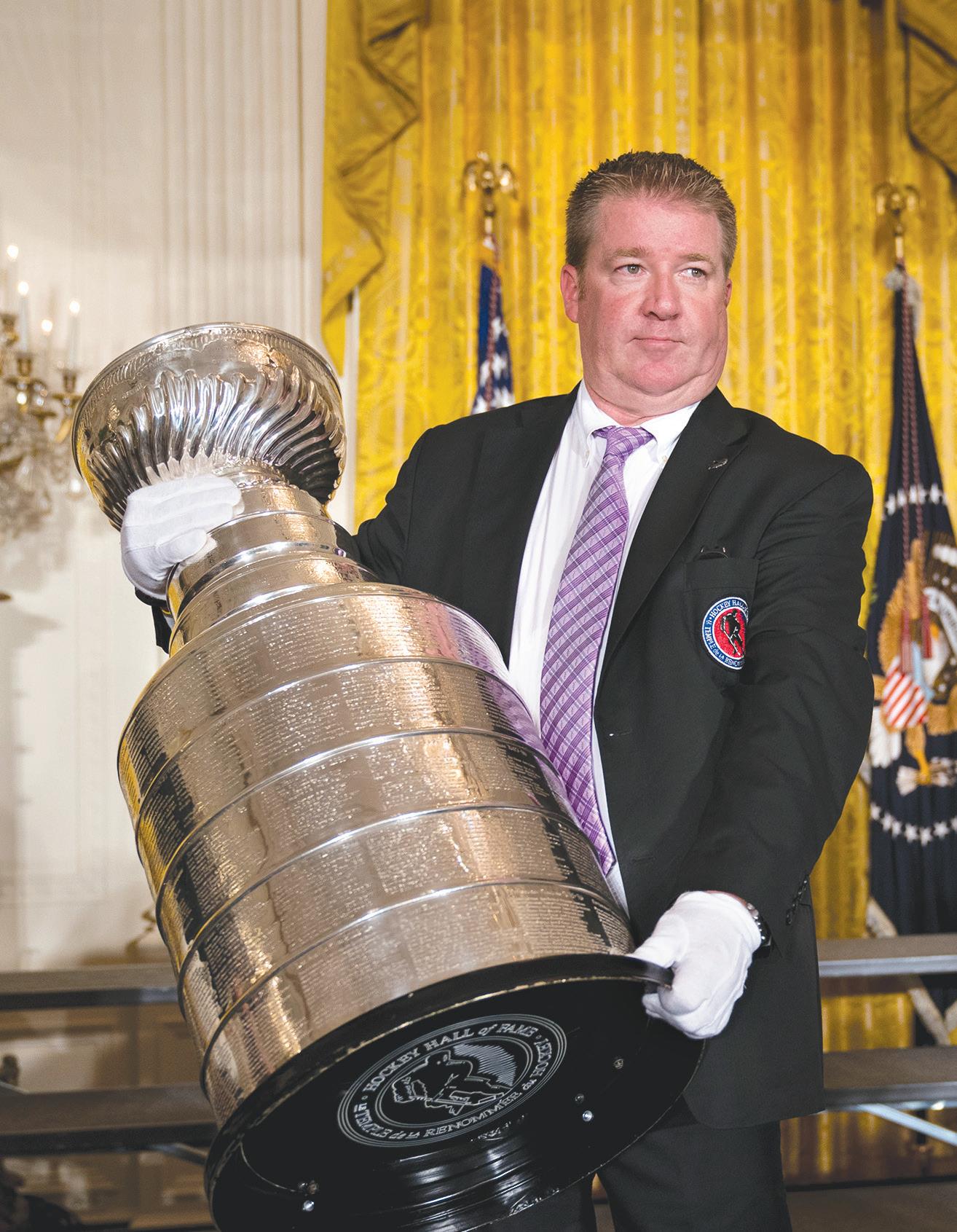
Precious cargo | The Stanley Cup has its very own “Keeper of the Cup.” Does having the 2020 winner’s name carved into the Cup diminish its sentimental value?